The Corne¬ Daily Sun

By JOHNATHAN STIMPSON and MEGHNA MAHARISHI Sun Managing Editor and Sun Assistant Managing Editor
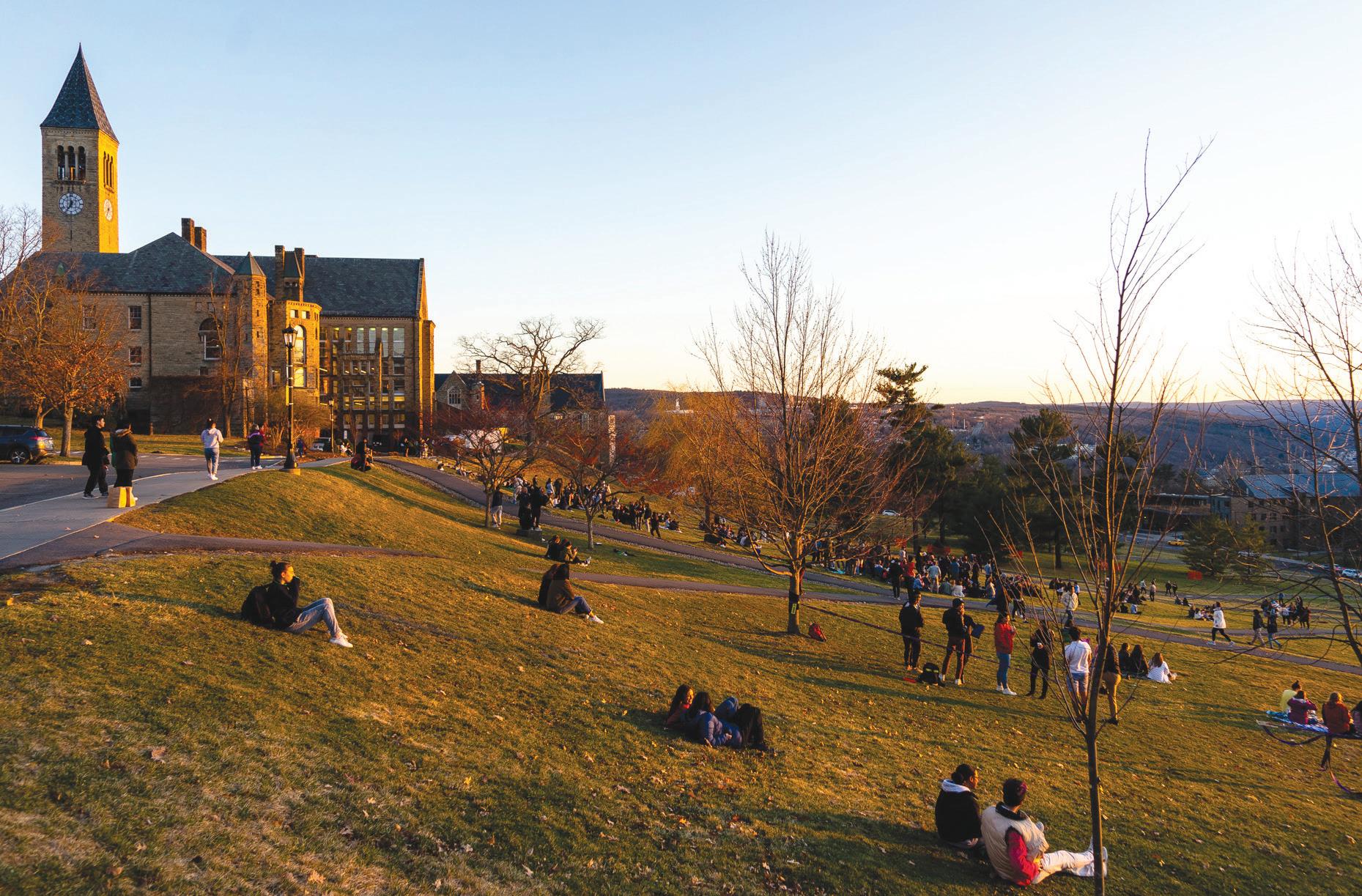
Just as students booked flights and bus tickets, they faced the latest COVID-19 pandemic shock on Friday morning when President Martha E. Pollack canceled classes until April 6.
Uncertainty now permeates Cornell’s campus, as students have now been told to leave as soon as possible.
The surprise announcement reflects a looming concern that the current outbreak will worsen by spring break. Vice President for Student and Campus Life Ryan Lombardi conceded that “in all likelihood it’s going to show up in the county if it hasn’t already.”
Even though Tompkins County said that there were still no confirmed cases in a Friday afternoon press confer ence, Tompkins County administrator Jason Molino declared a state of emergency, shuttering local schools.
With COVID-19 spreading seemingly unabated — the number of confirmed cases spiked 30 percent overnight to 421 in New York State — Cornell officials said the accelerated timeline was necessary to give students the chance to begin making travel plans.

“As you look across the country right now, we’re in fairly unchartered waters,” Lombardi said in an inter-
“The greatest shift that I was feeling was the concern … travel, [which] is becoming more difficult, certainly downstate, in New York,” said Sharon McMullen, Assistant Vice President of Student and Campus Life for Health and Well-being.
The practical logistics of asking over 13,000 students to vacate campus is one that leaves a host of unsolved questions.
Lombardi had sent out an email to students living on-campus earlier in the week, asking them to fill out a form for housing accommodations.
While the form’s deadline has been extended to Sunday, Lombardi said that the majority of students who filled out the survey said
By ALEC GIUFURTA Sun Senior Editor
It’s a tale of two Cornells: There are parties, bars and profane bedsheets; but also panic, hasty departures and those self-quarantining after studying abroad. Amid the COVID-19 pandemic, some students are scrambling for plans to self-quarantine while others defy social distancing.
On Saturday, daytime yard parties — colloquially known as “darties” — dotted Collegetown, including one at the East Seneca Street annex of a Cornell organization. Hanging
from the house’s balcony was a bedsheet-turned-banner, spray-painted to read “I’m not fucking leaving,” just a day after President Martha E. Pollack’s announcement to cancel classes starting Friday at 5 p.m.
Vice President for Student and Campus Life Ryan Lombardi condemned these parties in a Sunday afternoon email, writing, “Some students – particularly those living off campus in Collegetown – have chosen to use the suspension of classes to host or attend large parties,” he wrote. “Hosting or attending a large party is exactly the opposite of what you
should be doing in this moment,” he continued.
Social distancing, a popular defense to the COVID-19 contagion recommended by experts, is what prompted Gov. Andrew Cuomo (D-N.Y.) to cap bars and restaurants to 50 percent capacity.
In a GroupMe called “martha can’t make us leave,” with over 2,000 student members, the conflict these parties posed to social distancing was on full display –– revolving around the Catherine Street Block Party sched-
COVID-19 Hits Tompkins County
On Saturday, the Tompkins County Health Departmet released in a health advisory that an individual in Tompkins County has tested positive for the COVID-19 disease. The individual, a member of the Ithaca College community, is in mandatory isolation. Along with this case, 52 others are under quarantine and 15 await test results.
- See Page 5
New York State Calls State of Emergency
Due to the COVID-19 outbreak, the federal, New York State and Tompkins County governments have all called a state of emergency. In Tompkins Couny, secondary education schools have been closed until April 13. Peer institutions Ithaca College, Syracuse University and SUNY Cortland have instituted virtual classes.
- To read the full story visit www.cornellsun.com
Campus Reacts to Cancellations
From first-year students concluding their rookie year on campus, to international students considering for a second time if they depart from the U.S. and go home, to workers in Ithaca responding to recent economic changes, people from the Cornell community and greater Ithaca area react to Cornell’s decision to cancel classes.
- See Page 3
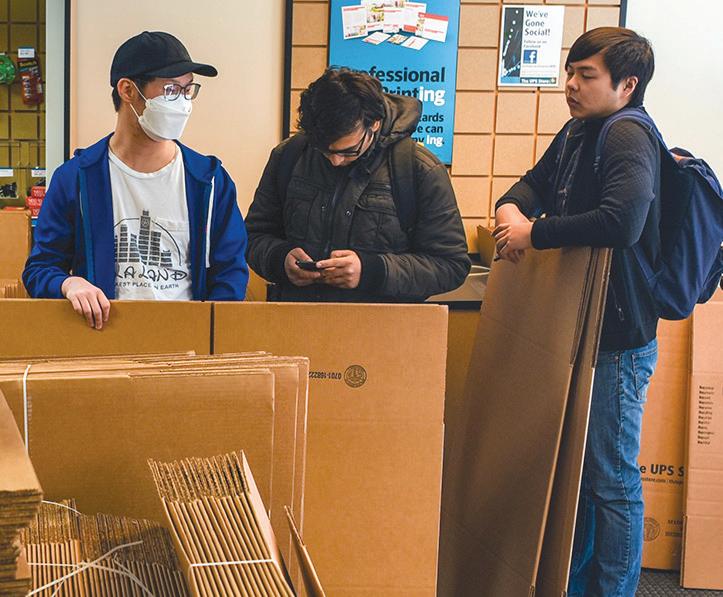
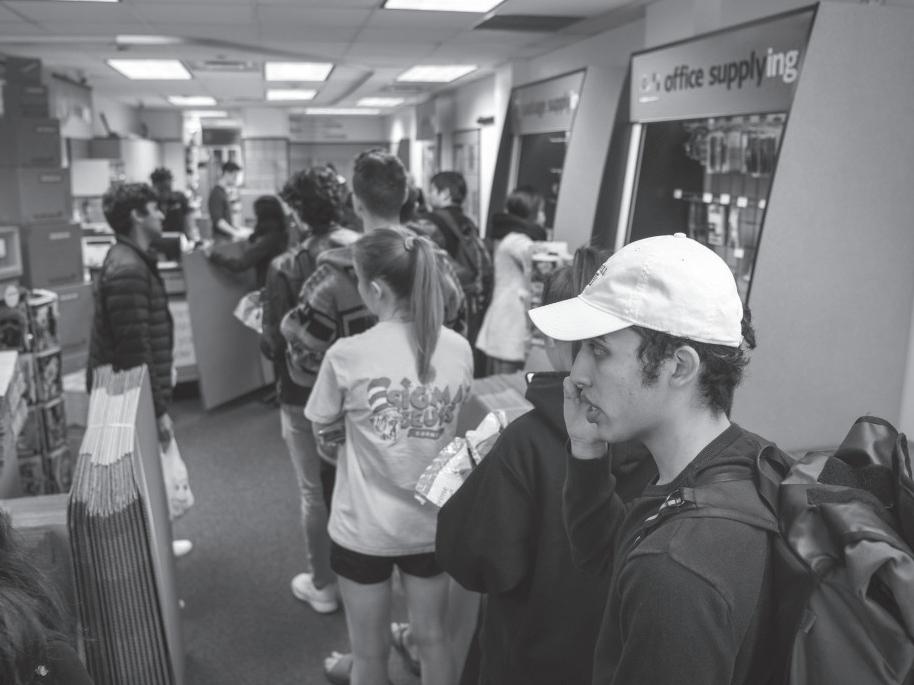
Students Scramble to Box Belongings With the announcement on Friday that Cornell classes were suspended for the rest of the month, students rushed to pack up and go home. In order to do so, they looked for boxed storage, which became overwhelmed with the unexpected demand at the time, causing large backups in stores like Collegetown’s UPS, shown above.
- See Page 5
Weill Cornell Maintains Some Activity
Weill Cornell Medicine, while also transitioning classes to virtual instruction, has kept some of its operations open for the time being, such as their main residence hall or hands-on clinical activities. This differs from other institutions in the New York City area, as other medical schools in the area have shut down all operations.
- To read the full story visit
By MADELINE ROSENBERG Sun Assistant
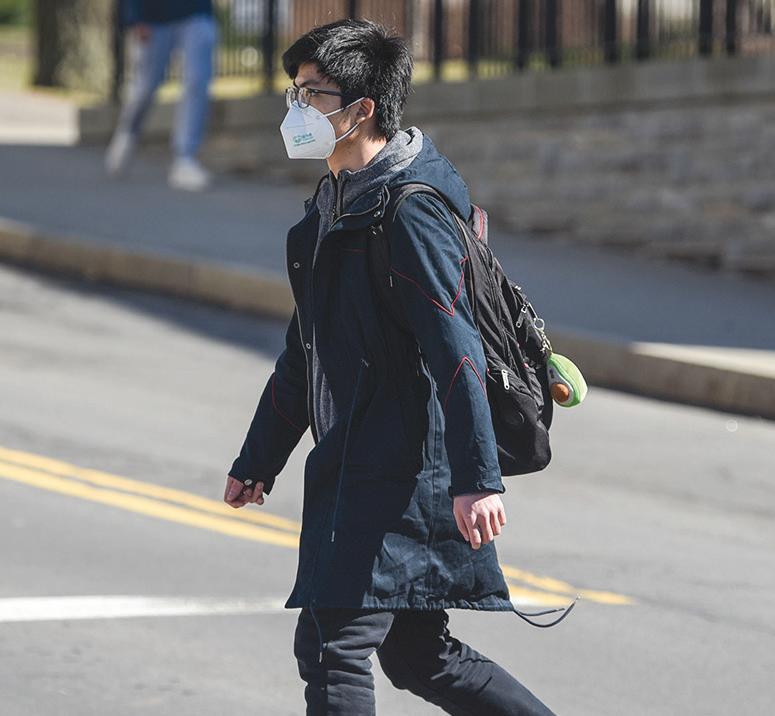
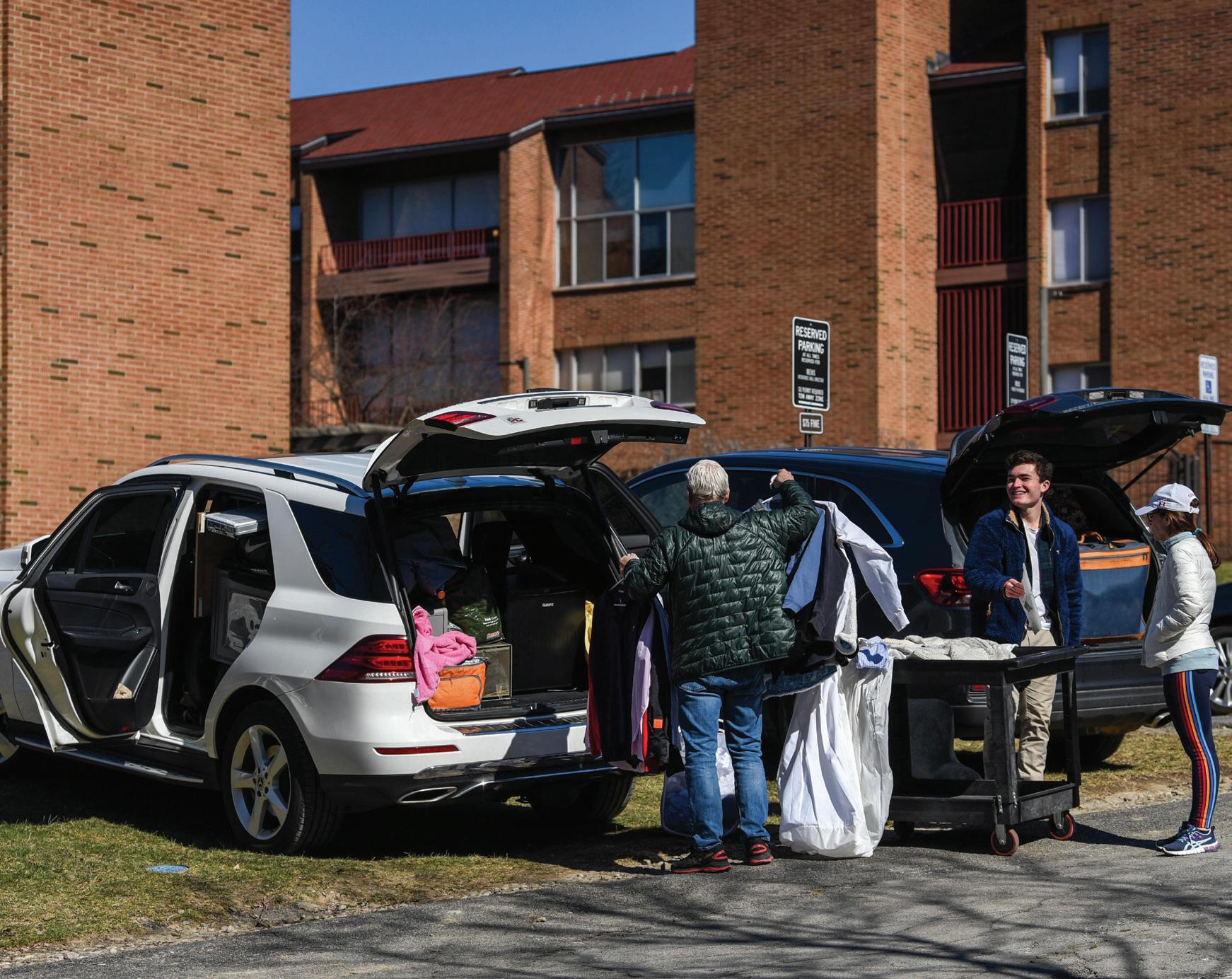
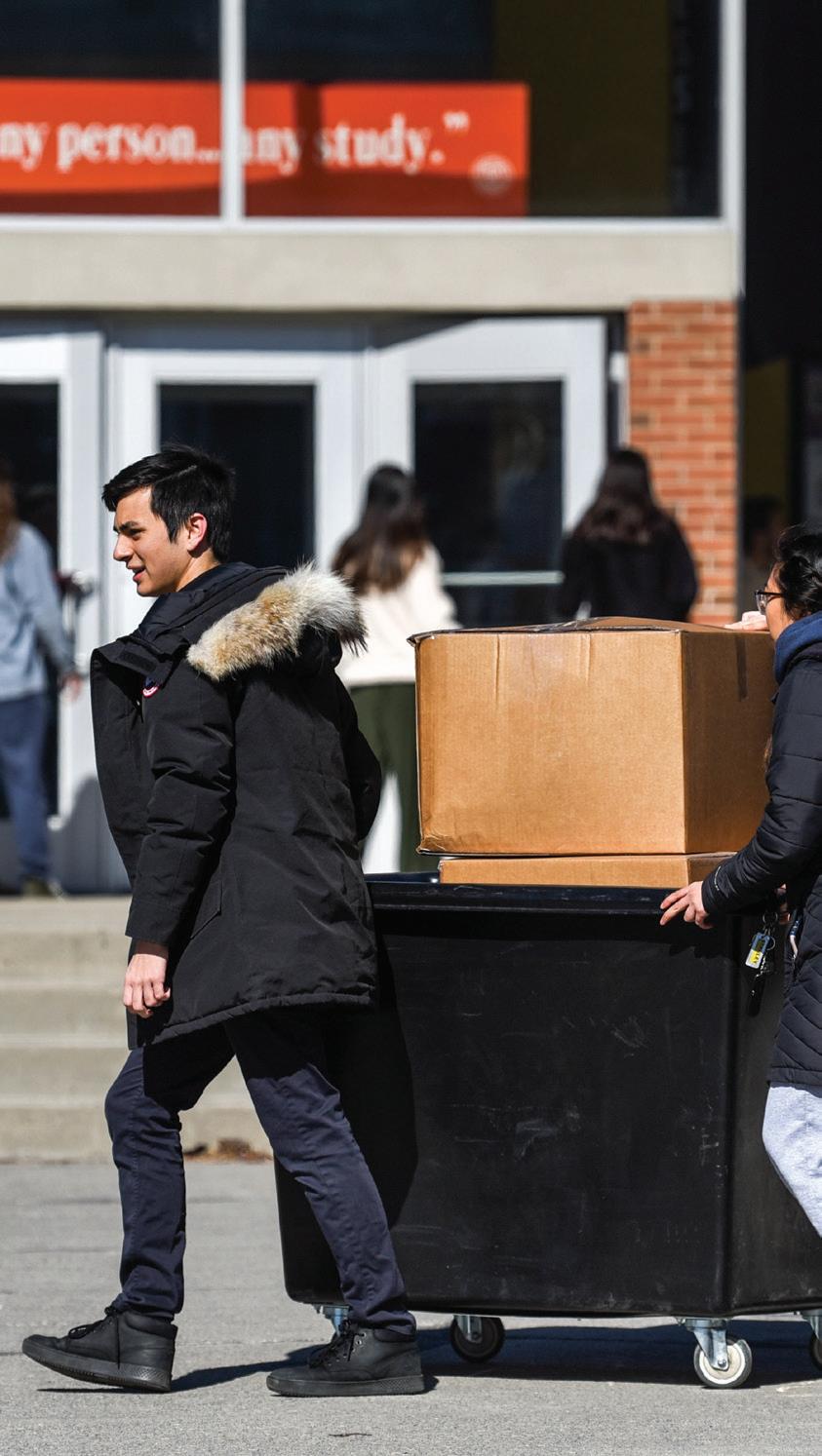
Moving carts piled with stuffed duffle bags and cork boards rolled out of North Campus dorms on Saturday, as first-year students vacated their halls and gave up their room keys — less than 24 hours after the University suspended classes and urged them to return home two months early.
As parents flooded campus and “I’ll miss you”s floated through residence hall stairwells, some first-year students fled campus as soon as President Martha E. Pollack’s Friday email reached their inboxes. Residence halls are emptying, and other first-years are packing up to leave Cornell in the upcoming days.
“My world has flipped upside down,” said Ayesha Chowdhury ’23, helping a friend pack up her car outside of Jameson Hall. “The vibe on campus has shifted and we no longer enjoy it. Yesterday was fine before classes were cancelled, but now there’s nothing to look forward to. It sucks.”
Chowdhury booked a flight home to Minnesota for later on Saturday, but according to William Melancon ’23, some first-years left campus in the middle of the night after they heard Friday’s announcement. Melancon managed to rebook his flight home to California, and waited for a car to the Ithaca airport on Saturday afternoon.
“Between getting all my stuff together, packing up and saying bye to my friends, it’s been a very emotional and stressful time,” Melancon said. “I think it’s really unfortunate, but that’s how it is sometimes.”
Sabrina Martin ’23 joins Melancon on a winding journey back to California. Martin has not yet booked a flight home to the golden state, but she departed campus on Saturday to temporarily stay with family friends in upstate New York after a “frantic” 24 hours.
First-year students who hail from areas particularly affected by COVID-19 have been some of the fastest to rush out of campus.
Salima Ali ’23 of New York City said her parents drove the four hours to Ithaca less than 24 hours after they received Pollack’s email. Standing in her Donlon Hall dorm room beside bare walls and a stripped mattress, Ali would return to the city as soon as she finished packing. Her roommate had already left.
Ali, like many other first-years lamenting the loss of what would have been their first Slope Day and cherry blossom-filled spring, longed for more time to process her departure.
“It is really hard to go so quickly and say goodbye to freshman year,” Ali said. “I feel like I didn’t get a sense of closure because it ended so quickly, but I know the

By CHRISTINA BULKELY Sun Sports Editor
Already reeling from an impending exodus of Cornell students, Ithaca restaurants were hit with yet another obstacle on Friday: Facing a seemingly unabated rise in COVID-19 cases, Gov. Andrew Cuomo (D-N.Y.) put forth an executive order on Friday afternoon requiring all businesses in the state to limit their capacity to 50 percent going forward.
Most service workers heard about the decree shortly before the dinner rush hit, sending them scrambling to limit seating in order to comply. At Viva Taqueria, a Mexican-themed downtown restaurant, empty sour cream containers marked every other table as one that was unavailable to patrons.
“We normally have five table sections for servers, we’re down to three table sections now,” said Lexi, a hostess at Viva Taqueria, who did not want to be identified by her last name. “We took half the barstools out, but there’s nothing we can really do about people standing around the bar.”
For servers, the executive order creates a direct constraint on their earning potential. As the number of patrons is forced into decline, money earned from tips is expected to see a dramatic dip.
“I hate [the order] because we’re already gonna be strapped for trying to make bills and stuff because everybody’s afraid to go out,” said Spike Brooks, a bartender at The Chanticleer. “I understand we’re trying not to spread the disease, but [the order
University has its students’ best interest at heart.”
Resident advisors must also navigate the departures of their hundreds of first-year students. Noah Russo ’22, a Donlon R.A., said he wished residential programming received more information from the University about the move-out process, which he called “hectic” and “very confusing.”
“It’s sad,” Russo said. “I feel like a lot of people feel like their freshman year got cut off way too short. That’s the major sentiment that I’m getting.”
Madeline Rosenberg can be reached at mrosenberg@cornellsun.com.
By GIRISHA ARORA Sun Senior Writer
For first-year Lin Poyraz ’23, Cornell’s consistent policy changes over the last week have taken an expensive toll: On Saturday morning, she rebooked her flight to Turkey for the fourth time in five days.
A Risley Hall resident, Poyraz is currently booked on a Sunday flight to her home country — changing her travel plans twice in less than 24 hours, after she learned that Turkish students studying in Europe have until Monday to return to the country. Turkey also announced it was not accepting flights from certain countries in Europe starting Friday, and there are limited flights incoming from Japan and South Korea.
The evolutionary biology and anthropology major said it is only “a matter of time” before U.S. students may be added to the list. Poyraz added that she is glad Cornell cancelled classes on Friday, as she otherwise may have been blocked from her country by spring break.
online classes, with full virtual instruction set to begin April 6. Due to this latest development, international students’ decisions were flung into further disarray. Some who were earlier staying on-campus until the beginning of spring break or previously had plans to remain in Ithaca now scrambled to make plans to leave the country as soon as possible.
Kenisha Paliwal ’22 of Denmark had planned to stay in her sorority house after Pollack’s initial announcement on March 10. Now, she is getting ready to vacate her room — a decision she is afraid of because it means that she might not be able to re-enter the United States until next
Paliwal appreciated that Cornell canceled classes while everyone struggled to situate themselves, but wished there had been a single unified decision, instead of the current situation with numerous changes.
“I just wish they had thought through it first and said this all at once, than have three different emails come out saying three different things — it’s consistently changing,” Paliwal said.
“If I go to Denmark, I can’t come back into the U.S., so me leaving, is me leaving ‘till August.”
Kenisha Paliwal
’22
semester.
Poyraz’s most recent flight changes were motivated by President Martha E. Pollack’s announcement Friday afternoon that the University would suspend all classes starting at 5 p.m, urging students to “de-densify” the campus to address concerns over the COVID-19 outbreak. This reversed the administration’s decision from earlier in the week to hold in-person classes until March 27 as professors transitioned to
“If I go to Denmark, I can’t come back into the U.S.,” Paliwal said. “So me leaving, is me leaving till August. ” As of 11:59 p.m. on Friday, any foreign nationals trying to enter the United States who were in Europe’s Schengen Area — 26 countries stretching from Iceland to Greece — in the past 14 days will not be allowed to enter for the next 30 days, according to a directive issued by President Donald Trump. It is unclear if there are plans to enforce further travel restrictions as the pandemic spreads.
The first announcement that students received about Cornell’s approach to containing the coronavirus was on March 10. President Pollack encouraged all undergraduate students to leave campus and go to their “permanent home residence” after spring break, announcing that virtual instruction would begin on April 6.
Following this initial announcement, the 22 percent of students at Cornell who are international rushed to find answers about how professors would deal with time zones, whether they would be allowed to stay on campus and if the University would provide refunds or storage solutions if they did plan to leave.
The initial announcement came on Tuesday and, just when students were getting used to their semesters being cut short, Pollack announced Friday afternoon that classes would be suspended later that evening, with all students encouraged to leave as soon as

By Ari Dubow Sun City Editor
Just two hours after Cornell announced that classes would be suspended Friday at 5 p.m., airplanes left Ithaca only partially full, with customers either canceling their tickets or simply not showing up for their flight at all.
Airlines that fly in and out of the Ithaca Tompkins International Airport — American Airlines, Delta Airlines and United Airlines — have received a barrage of calls from customers hoping to reschedule their travel plans, since President Martha E. Pollack’s surprising Friday announcement, said Mike Hall ’86, director of the local airport. These airlines did not respond to a request for comment by the time of publication.
Hall said that he had been informed by the Transportation Security Administration that the number of passengers on flights over the coming weekend is expected to drop by 20 percent. Yet, Hall was optimistic that a potential exodus of students could boost the numbers of passengers on flights.
“The longer this goes, the greater impact this has on the airport budget,” Hall said, adding that airport administrators do not expect to reduce the airport’s services, and no employees will be laid off.
The worse the situation gets, the more important airports become, Hall said. Closing the airport is out of the question.
“That’s not something we even think of,” Hall said. “For something like that to happen there would have to
be an enormous meltdown of society.”
Hall said that in an emergency of this scale, transportation centers become crucial hubs for facilitating relief efforts.
“Our position here is to project determination and strength,” Hall said.
The private and charter flights department at the airport also have reason for concern as a result of the cancellation of high percentage of flights travelling through Ithaca over the next week, according to Amy Jacot, a customer service representative for private and charter flights at the airport.
“We’re going to lose a lot of business, we’re going to lose a lot of revenue,” Jacot said.
As of now, schedules and security procedures at the airport remain the same. In the last several weeks, airport facilities have been taking thorough sanitation precautions, such as wiping down surfaces with disinfectant spray, as well as posting signs around the premises discouraging international travel.
Hall, who is an Ithaca native and Air Force veteran, said he hasn’t dealt with a crisis of this scale since becoming airport director in 2018.
“It’s kind of like a warm spring day with a strong cold front coming from the west,” Hall said, of the crisis. “You know it’s going to rain, you just don’t know how badly.”
Ari Dubow can be
adubow@cornellsun.com.
PRECAUTION
Continued from page 1
they intended to leave campus.
Students living on-campus that leave will receive a rebate for housing and meal plans, though the exact amount has yet to be determined. In anticipation of swelling unemployment, President Donald Trump announced on Friday that interest on federally-backed student loans would be deferred — but the University has yet to address potential changes to financial aid or deadlines for tuition payment.
“We're going to be relying on all of the members of the community.”
Sharon McMullen
Despite Friday’s turn of events, many students living off-campus want to stay in Ithaca. But for those planning to remain, McMullen urged students
who plan to stay in Ithaca to not leave the city and travel to other states that have become epicenters of the virus.
“We're going to be relying on all of the members of the community, both the Cornell community and the larger community to exercise caution during this unprecedented time,” McMullen said.
With classes suspended for almost the next month, significant adjustments to Cornell academics are likely to take place. The drop deadline has been extended from March 17 to April 21.
Though no plans have been confirmed, the University is also contemplating shifting the semester to account for the lost two weeks of instruction.
“We are currently exploring the regulatory requirements related to our academic calendar,” said John Siliciano, deputy provost. “It is likely there will be some shifts later in the semester to account for the break from active instruction this month, however, no changes to the academic calendar have been made at this time."
It is unclear if the pandemic will affect University operations in the fall
SUDDEN
Continued from page 1
possible.
Later that afternoon President Trump declared a national emergency and Tompkins County Administrator Jason Molino also declared a state of emergency, closing all K-12 schools in the local area until April 13. There is currently one confirmed case of coronavirus in the county.
Fabio Cabrera ’23 is also uncertain whether to stay in Ithaca or return home to Colombia. As a freshman, he is in a unique position as he is one of the few first-years living in off-campus housing. He currently plans to stay, but he is still evaluating the “many variables” to see whether he should go back to Colombia — from his visa status to his country’s health system.
Cabrera said he thinks there is much more opportunity for the virus to be controlled in Ithaca than in Colombia, but is concerned that if Colombia shuts its borders to contain the virus, he would be stuck here.
“The situation is very stressful,” Cabrera said. “I’m trying my best to stay here, but the cost of living is higher in the U.S.”
While Cornell’s decisions created confusion for many internationals, others received word about their housing petitions being approved to continue staying on campus and were feeling secure about their near future for the first time in a week.
At 4:30 p.m. Friday, Beijing resident Yue Ji ’23 received confirmation that her petition to continue staying on campus had been approved. She knew she had wanted to stay on North Campus from the start with all the resources to go to school and her plans have not changed, even with the two-week suspension.
Ji plans on using the newfound free time to work on coding projects and making videos with her friends.
Now that her petition has been approved, Ji is allowed to continue living in her room in Low Rise 7. However, it is possible that she could be asked to move to another residence hall if the University decides to shutter some on-campus dormitories.
“When I confirmed my petition, the University made clear that they can ask me to move out and to go to another dorm any time,” she said.
Overall, even though Ji has her housing secured, she is still confused in this “uncertain time” and not sure who to turn to for help.
“I feel like I am kind of lost,” Ji said.
semester.
Amidst widespread fear and frustration over the pandemic, Cornell Health will continue to offer its mental health
“It will require a lot of ongoing work and fluidity as we make our way through this.”
Ryan Lombardi
services to students who remain on campus for these next two weeks.
“The full extent of how this bears out for, you know, for individuals for cities, towns, economies, everything is yet to be fully realized,” Lombardi said. “It will require a lot of ongoing work and fluidity as we make our way through this.”
Johnathan Stimpson can be reached at jstimpson@cornellsun.com. Meghna Maharishi can be reached at mmaharishi@cornellsun.com.
Continued from page 3
is] not helping anybody.” Brooks was not alone in believing that business was already naturally cut down before Cuomo’s order. According to the bartender, fear among the general public has already kept business from being as busy as it would be sans-pandemic.
According to Lexi, the Governor’s forced reduction in capacity takes the onus off patrons to monitor their own safety.
“I sort of think that if you’re going to come out to eat, then that risk is on you,” Lexi said.
And, though The Chanticleer does not generally fill to capacity, Brooks expressed anxiety at potentially having to
turn people away at the door.
“That’s just going to be a headache,” Brooks said.
But reactions to the order are mixed, ranging from Brooks’ “I hate it” to praise from Manpreet Chandhar, a server at Taste of Thai.
Highlighting the importance of containing the coronavirus’ spread, Chandhar hailed the dramatic measure as a boon to public health.
“If a government implements something, it means to take care of the people,” Chandhar said. “It’s a good rule.” The order went into effect at 5 p.m. Friday and is currently slated to last 30 days.
Christina Bulkely can be reached at cbulkely@cornellsun.com.
uled for Monday –– an event usually held post-finals week in May.
As of Sunday evening, most Facebook events for the Catherine Street Block Party had been taken down. One Facebook event, that was started and then canceled, had 459 members that marked “going or interested” at one point.
Lilian Hawkes ’21, currently trapped in Sicily, Italy, posted in the GroupMe chat denouncing Monday’s planned block party, stressing that the event may be “the reason [COVID-19] spreads to the Ithaca population.”
“Like I’m sorry we lost our last semester here,” Hawkes wrote in the GroupMe, “but this is really not the way to handle it.”
Some shot back.
“If you’re so concerned just don’t show up, it’s simple,” Charles Plechner ’20 wrote.
Collegetown bars have also been busy since Pollack’s original Tuesday announcement — which said at the time that classes would be canceled after spring break. On Wednesday, lines for Level B and Hideaway stretched down Eddy Street.
At Loco, hoards of students visited over the weekend. “It’s been pretty packed … I was surprised by how many people were inside [the bar],” said Jacob, a bartender at Loco.
The condemnation for the events were echoed across campus. Moving her daughter out of North Campus on Sunday, Ella Ilan said she felt “very torn for the students.” She understood how “sad it is for them,” but expressed the need to practice social distancing.
Jeanette Melgor, another parent moving her firstyear out, was shocked that students weren’t acting with precaution, noting the counterintuitive nature of the parties: “The reason why we’re moving out is [social distancing].”
Students who escaped Europe — witnessing the pandemic’s fury — held a more urgent attitude toward the virus.
Livia Caligor ’21, who was studying abroad in Paris, France, watched the disease unfold. Caligor flew from Paris-Charles De Gaulle Airport to Newark Liberty International Airport on March 12, noting a complete lack of screening for COVID-19 at either airport.
“I chose to go home when Cornell was giving us the choice,” she said. Cornell gave Caligor the option to leave on March 5.
Now self-quarantined in New York City, Caligor shared her frustration with this weekend’s parties.
In quarantine, Caligor lives isolated in an apartment. She has her own mini-fridge, and a small kitchen. “In the city I really love being out,” Caligor said. “I got
home three days ago and I’ve been doing pretty much nothing.”
“People don’t really understand the privilege they have to throw those block parties,” said Caligor. Her family in China can’t leave their homes besides one the occasional grocery run by one family member, she said.
Brianna Patek ’21 attributed her escape from a study abroad program in Madrid, Spain, to a 2:30 a.m. phone call from a frantic friend: Patek thought that President Donald Trump’s European travel ban applied to her
And while she realized later that day that the ban did not apply to U.S. citizens, Patek made a dash for home: New Jersey, where she’s now self-quarantined.
Patek paralleled the situation she experienced in Spain to that in the U.S. today.
“I’ve seen how bad it got in Europe. I had to basically run from Spain, I see how bad it’s getting here and how unprepared we are.”
Patek — calling from her basement — said that despite the boredom that comes with self-quarantining, it is necessary. Three days into self-quarantining, she’s passing time by facetiming friends “just to have that social contact,” and occasionally walking through her basement’s storm door to get fresh air in her backyard.
“Hearing that there’s all these huge packed parties, I’ve seen the pictures, I know that this block party is happening tomorrow,” Patek shared. “People really need to start taking [COVID-19] seriously.”
Lombardi urged students to depart Ithaca as soon as feasible, noting a possibility of domestic travel restrictions and plead that students try to “flatten the curve.”
In an email to Cornell students on Sunday evening, Vice President for Student and Campus Life Ryan Lombardi issued a plea, imploring students to leave Ithaca as soon as possible and refrain from attending large public gatherings.
The message came in response to a weekend that saw some Cornellians attend off-campus parties in Collegetown, celebrating what suddenly became the final weekend of some students’ collegiate careers.
“Hosting or attending a large party is exactly the opposite of what you should be doing in this moment,” Lombardi wrote. In addition to encouraging social distancing, Lombardi said students should leave Ithaca as soon as they can.
“There is a possibility that domestic travel may soon be restricted by the federal government, so even if you have plans to leave in another week it might not be possible to do so,” he wrote, adding a reminder that university facility and services access would be “extremely limited.”
Raphy Gendler ’21 contributed reporting.
Alec Giufurta can be reached at agiufurta@cornellsun.com
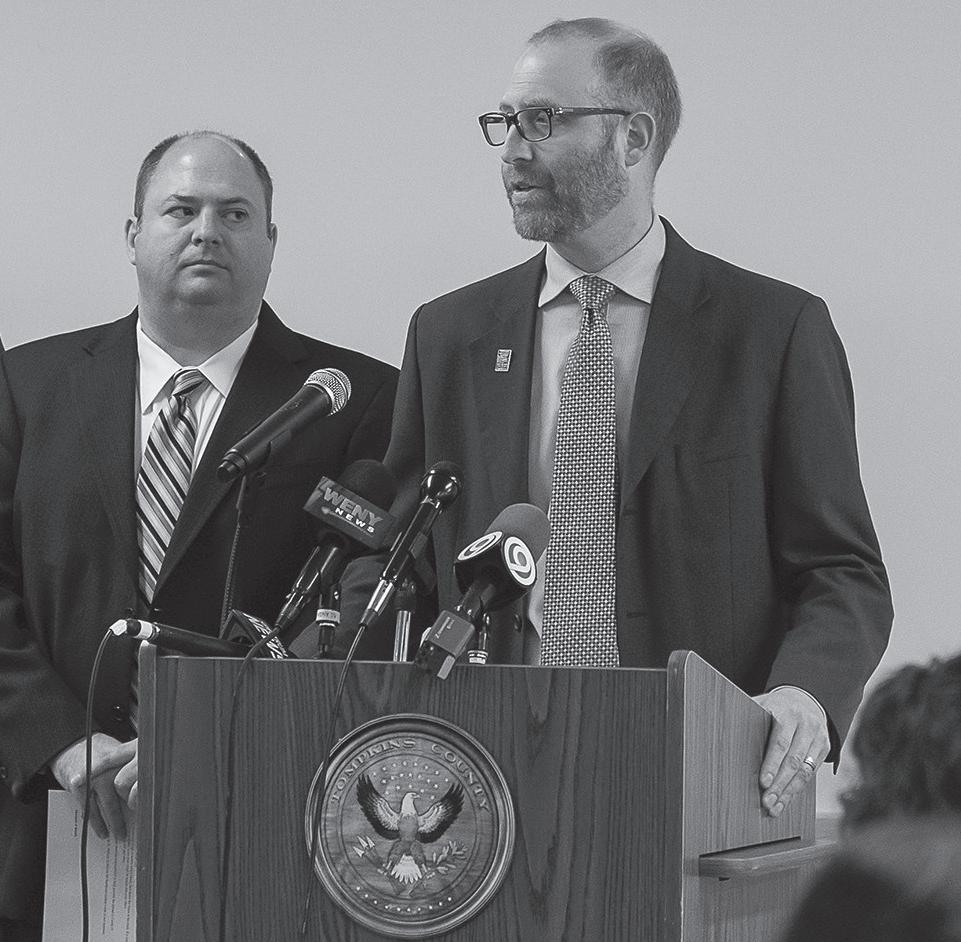
first | As cases swell statewide, Tompkins County reported its first confirmed case of the novel coronavirus.
By MEGHNA MAHARISHI Sun Assistant Managing Editor
An individual in Tompkins County tested positive for COVID-19, the Tompkins County Health Department announced in a health advisory on Saturday. The individual — a member of the Ithaca College community — became symptomatic on March 5, right before the college’s spring break.
“While this is the first case of COVID-19 in Tompkins County, we are prepared to respond to limit future exposures and community spread of the virus. We are looking to our community to take shared responsibility by practicing social distancing and helping each other during the weeks to come,” stat-
ed Frank Kruppa, Public Health Director.
The individual’s sample was tested at the New York State Department of Health’s Wadsworth Laboratory in Albany. Currently, the individual is in mandatory isolation at home and nurses in Tompkins County are working to determine if there was any additional exposure.
The nurses are now in daily contact with any other individuals who were potentially exposed to the student on March 5 or later.
As of Friday afternoon, there are 52 people in Tompkins County under quarantine and 15 waiting for test results.
Meghna Maharishi can be reached at mmaharishi@cornellsun.com.
By KATHRYN
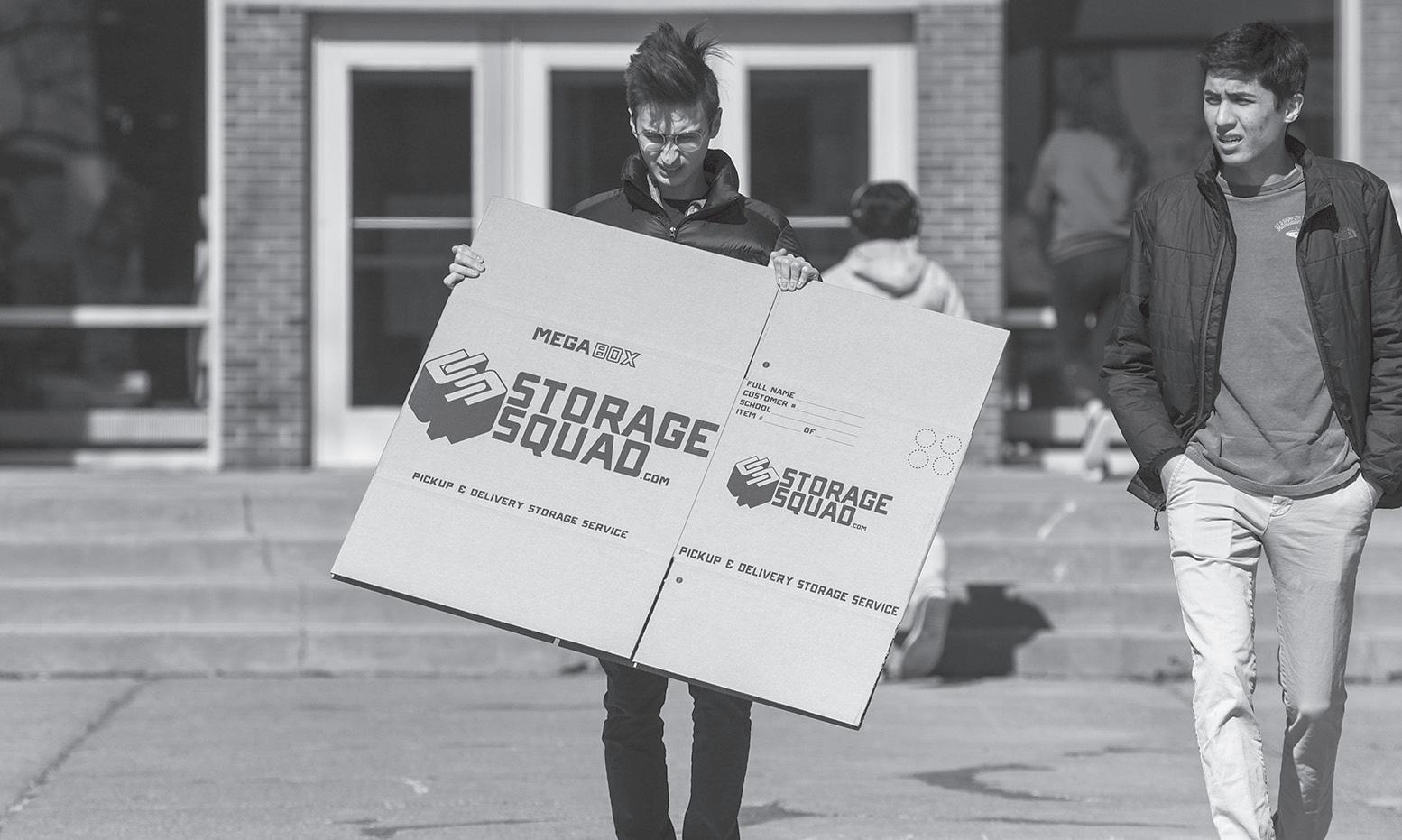
Since Tuesday’s announcement of canceled classes, students scrambled to secure a spot to store their belongings until the fall semester.
The rush threatened storage companies around Ithaca, most of which weren’t pre-
pared to field an influx of business months before the end of the semester.
However, these same businesses now will see a sharp decline in their yearly sales, due to the latest announcement from Ryan Lombardi, Vice President for Student and Campus Life, and Lisa Nishii, vice provost for undergraduate education.
On-campus residents will receive free
storage for their belongings in Ithaca, the administrators wrote, just under two hours after President Martha E. Pollack’s announcement. Lombardi and Nishii promised forthcoming details. These storage operations started just after the initial announcement on Tuesday to shift to virtual instruction.
Ezrabox, a peer-to-peer storage platform, sent a mass email to Cornellians Thursday to promote their services. They received hundreds of requests, according to Connor Reinhold ’22, chief marketing officer for Ezrabox.
change their moving dates sooner or canceled their requests, presumably opting to take advantage of the free option.
“We’ve been cut out of so many of our markets,” Huber said of the concerns about losing business and paying employees.
“Cornell is not communicating with us about what the plan is.”
Nick Huber ’12
“We were getting people by the minute,” Reinhold said, explaining that the sheer number of requests was also becoming “difficult” for the small operation to handle. The storage platform has since stopped accepting new booking requests.
Storage Squad, a Cornell alumni-founded business, has seen over 450 student requests since Tuesday — half of their typical yearly requests — according to owner Nick Huber ’12.
“Our whole world is a mess,” Huber said of the nationwide abrupt closures. When the announcement dropped, Huber rushed to Ithaca to field requests and set up shop.
Scores of students have tried to
According to Huber, Cornell will be partnering with local companies including Storage Squad to provide free storage for Cornell's on-campus students. He said there will be a five box limit per customer — worth $185 through Storage Squad.
But Cornell hasn’t announced further details as of Friday evening.
“I think storage was pretty far down the list of critical campus situations,” Huber said. “Cornell is not communicating with us about what the plan is. We learn information when the students do and we see a big spike in traffic on our website.”
Storage Squad employees were also concerned about germs while moving through dorms and possibly infected students, Huber said.
The plan — as far as he knows — is to deliver boxes to on-campus residents, have students pack and label their belongings and pick up the boxes in early April to mitigate contact.
Kathryn Stamm can be reached at kstamm@cornellsun.com.

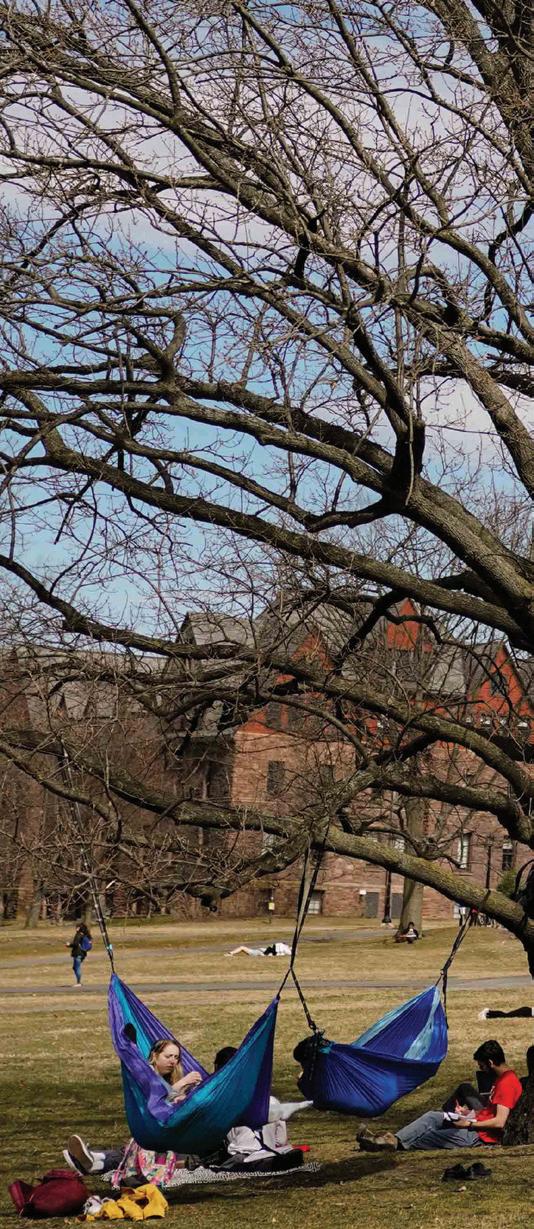
in there | Students make the most of a couple of free days.
EDITOR
No one knew on Friday morning that it would be our last day of classes for the semester. But we had a suspicion that something would change, especially as The New York Times predicted Trump’s announcement of a national emergency. Day Hall must’ve paid attention to The New York Times’ warning; the fantasy of seeing our classmates until spring break evaporated Friday afternoon with the announcement of the immediate suspension of in-person classes, and the national emergency was soon after declared — and the strangest scramble off of campus began.
Within an hour, music began to fill the sunny arts quad. Someone tried to fly a green kite, but it never quite got into the air. “Iaaahhh’m hooked on a feeling!” I sang along to someone’s speaker, interrupting my independent study mentor outside of Goldwin Smith Hall. We were talking about continuing our study online, but I couldn’t pay attention. Music seemed to come from all directions: rap filtered up from the slope, 70s music emanated from a building across the quad and a boisterous moan of brass instruments began outside of Lincoln.
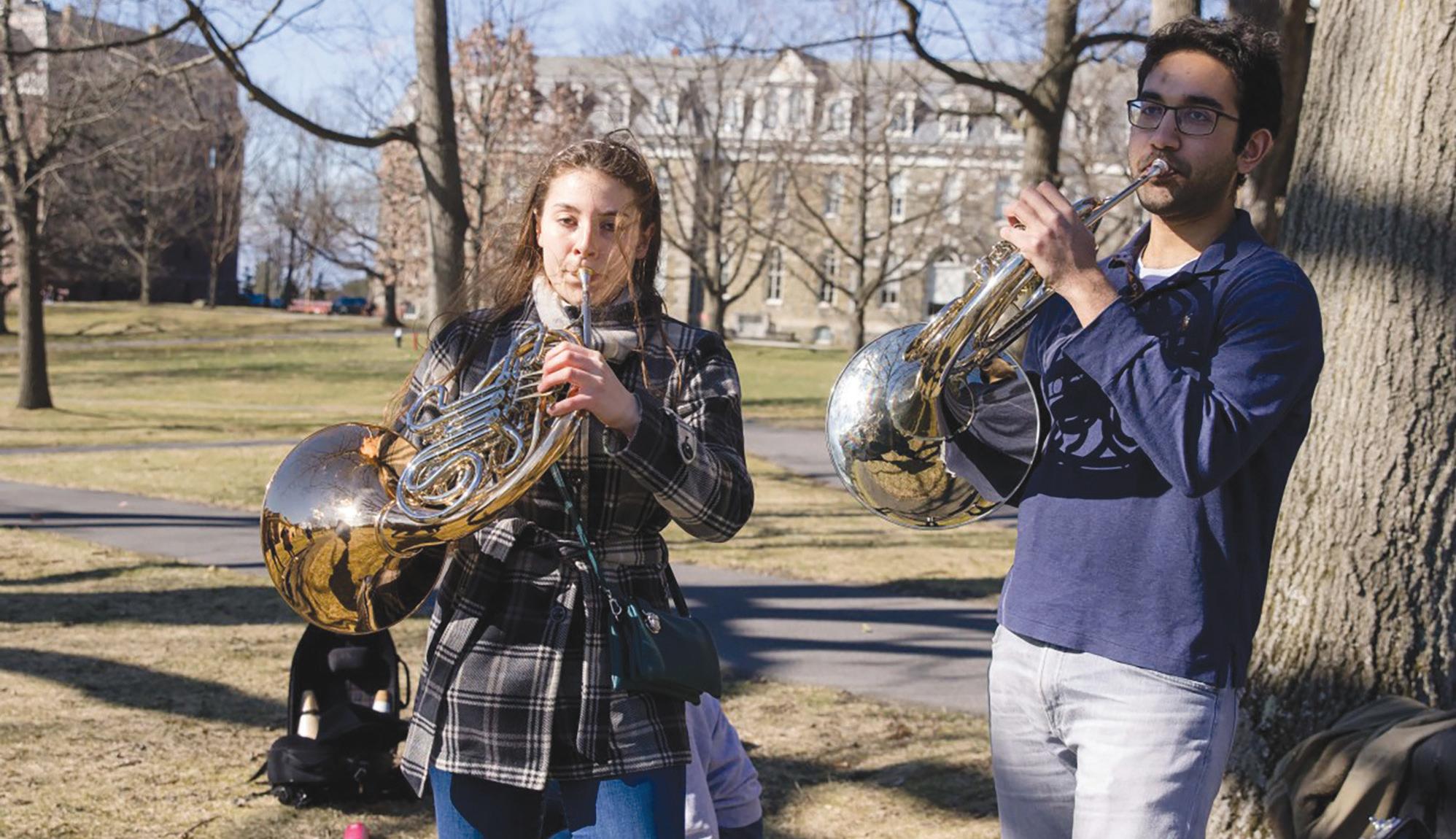
Three beaming music students stood in a circle play-
Students were drunk, skipping around and yelling to each other across the quads, glowering on the phone with their far away family.
ing their french horns. I asked them to play me something that I could film, to document the moment. We all giggled together, over nothing in particular.
Students were drunk, skipping around and yelling to each other across the quads, glowering on the phone with their far-away family, tucked in dorm rooms packing or joining masses at Wegmans and Nasties to stock
up on food and supplies. I watched freshmen steal street signs and take photos with them outside of the dorm they’ve called home since August.
The most fascinating groups of people, though, were the calm ones. The people that were out on the quad enjoying the sunny day. My two friends who went to the Johnson Museum to feel the light through the top floor’s window.
ments are playing us into a new age of whatever is coming. Our mania, joy and grief all come out in the screams peppering campus, but we also sit observing.
During this last weekend at Cornell, we have been embracing our uncertain reality
We have been just feeling Cornell. Friday’s intense wind paralleled the panic and change on campus, yet the sun kept us outside and warm.
During this last weekend at Cornell, we have been embracing our uncertain reality — speakers and instru-
Whether you break out your french horn or sing your heart out, I hope you take the time to appreciate and celebrate Cornell in these last few days (while taking the proper health precautions, of course). Join the pandemonium, be in the moment, tell your crush you like them and play them your favorite song. If music be the food of love, play on.
Emma Plowe is a freshman in the College of Arts & Sciences. She can be reached at eplowe@cornellsun.com
With Vine’s tragic downfall in 2017, our generation was left without a social media platform that could showcase users’ content and reach the same extensive audience in the same way. What TikTok has given us is an even better alternative; Its addictive and entertaining minisode-like format allows people from around the world to watch hours upon hours of content.
Within the app, however, there is more to it than simple 6-second bits like its popular predecessor. TikTok has in essence given rise to a modern-day Renaissance. Millions of users flock to the app to post original content as well as parodies of influential TikTok stars, who have been idolized like some of the world’s most successful celebrities. From its humble beginnings as a basic music video tool, TikTok has now gathered users who showcase talents of every sort, and it’s pretty amazing.
been discovered. User content commonly found on the “For You” page ranges from embarrassing personal stories to elaborately planned sketches bordering on short film statuses (which I personally think give the Netflix stand up specials a run for their money). I’d be lying if I said I’ve never tried to recreate some of the most popular sketches.
Every new TikTok stands as an art piece in itself, whether it’s a feat of videography, music, dance or comedy ... [it is] Gen Z’s artistic voice.
Some take to the app to produce particularly vine-esque comedic sketches or skits, which TikTok’s longer maximum video length benefits greatly. With numerous visual and auditory effects in the hand of each user, several thousand combinations have given rise to a generation of amateur comedians who otherwise never would have
Others have started a revolution of dance trends that have taken off ever since TikTok first emerged. Teens like 15 year-old Charli D’Amelio have enamored the online world with synchronized and mesmerizing dance routines. As deceptively simple as these short routines may seem, however, one of the most remarkable qualities of these dancers is their ability to make everything look so effortless. If you think the Renegade dance is easy, feel free to give it a try yourself without looking incredibly awkward and dumb.
Among the more labor-intensive TikToks are those that focus on the fine arts, including paintings, drawings, collages and more. This passion extends further, however, to minute-long cookie decorating tutorials and even multi-tiered cake recipes. College students upgrading their meals (or showing off personal food hacks) and “What I eat in a

day” formats are among the most common, while even employees have flocked to the app to debut or advertise their newest menu items.
Of course there are singers on the platform who take advantage of its “Musically”inspired beginnings. Some of my favorite TikToks are by freestyle rappers, with many of them taking suggestions from their fanbase and comments about how to produce their next TikTok, much like a paid musician would.
Unlike YouTube, the best part about being a TikTok creator isn’t receiving the profit from views.. Instead, TikTok stands as a visual art gallery unlike any other. Its users are a cohort of massive proportions, sharing their lives sometimes so candidly with the
world that one would think of them as a close friend.
Every new TikTok stands as an art piece in itself, whether it’s a feat of videography, music, dance or comedy. TikTok, since its launch, has become one of the boldest and most influential representations of Gen Z’s artistic voice.
I for one love what the app and its followers have to offer; scrolling down my “For You” page, I often lose track of time taking in the various creative endeavors. And if you disagree, then don’t enter the gallery. Don’t stifle the kids today and expect them to be okay later on.
Zachary Lee is a senior in the College of Arts and Sciences. He can be reached at zlee@cornellsun.com
Since 1880
138th Editorial Board
MARYAM ZAFAR ’21 Editor in Chief
JOYBEER DATTA GUPTA ’21
Business Manager
PETER BUONANNO ’21
Associate Editor
MEGHNA MAHARISHI ’22
Assistant Managing Editor
CHRISTINA BULKELEY ’21
Sports Editor
JOHNATHAN STIMPSON ’21
Managing Editor
KRYSTAL YANG ’21
Advertising Manager
JASON HUANG ’21
Web Editor
NIKO NGUYEN ’22
Design Editor
Working on Today’s Sun
Ad Layout Jenny Huang ’22
Production Deskers Krystal Yang ’21
Ben Mayer ’21
News Deskers Alex Hale ’21
Catalina Peñeñory ’22
Design Deskers Girisha Arora ’20
Photography Desker Hannah Rosenberg ’23
Money & Business Desker Maia Lee ’21
Sports Desker Raphy Gendler ’21
THE UNIVERSITY’S DECISION TO SUSPEND CLASSES AND ACCELERATE THE TIMELINE FOR ITHACA DEPARTURE IS JARRING
In the few days since President Martha Pollack’s Tuesday announcement, many students booked travel based on the presumed knowledge that they would not be ushered off campus until March 28.
Professors have worked with students assuming that they had some in-person communication to make the transition to online learning as smooth as possible.
Now, students have been forced to amend their travel plans again. Entire course syllabi have been destroyed and the academic merit of the current Cornell semester has been called into question.
Pollack’s recent decision could not have been an easy one to make: Cornell is as susceptible to the coronavirus as any other community, and given that many in Ithaca live in extremely close quarters, our campus is certainly an ideal place for an outbreak. And as whole countries shutter, is it strange that our Cornell might have to join them too.
In her announcement, Pollack stressed that the University recognizes “the significant stress that students are under currently, making classroom learning difficult.” However, it is without question that these past weeks, not just days, were detrimental to the grades of some students. Students watched the virus — blissfully ignored by those here — impact their families and friends abroad. And now, as the threat comes home with us, if Cornell hopes to lessen the mental burden of its students, it must consider an alternative academic end to the semester. Like Princeton University, we, too, urge the University to follow the courageous and student-centered decisions of Smith College and the Massachusetts Institute of Technology to espouse mandatory pass/fail and pass/no record semesters.
Despite the enormous shock caused by the twists in policy from Day Hall to D.C., Cornell’s administration must be praised for some of its actions. According to a message from Vice President Ryan Lombardi, the University has secured Ithaca storage for students in on-campus housing at no additional cost and has promised a rebate on housing and dining. Further, the decision to extend the drop and S/U deadline is commendable and will certainly alleviate some student stress.
But these few accommodations do not nearly make up for the accelerated timeline; they do not compensate students who hear that their family is ill or dying; they do not compensate the students who will undoubtedly contract the virus; they do not compensate the students with limited internet access, who must take care of their families when their siblings are home from school and their parents must work.
We acknowledge that this could pinch those who sought this semester as an opportunity to lift their GPA; as pre-professionals we know that this could be of concern. But a special mark on the transcript, and the knowledge that no corner of daily life has escaped the contagion on this virus, we are confident that future employers and admissions officers will be understanding. As life remains unprecedented, Cornell can create one vestige of certainty for its students.
But students, too, are fostering more uncertainty and fear.
One unfortunate side effect of the email blasts, non-stop push notifications and repeated declarations of “states of emergency” is an apocalyptic emotion settling in. Rather than following the advice of the educated and informed, students on and off campus are choosing to congregate beyond coping, to expose each other and their own selves to increased risk. Cornell administrators took an unprecedented step to pull the fire alarm and evacuate the school. Now, students must heed the warning.
Administrators can help; broadcast the available telemedicine resources louder, suggest things for students to do while “social distancing” besides just pack up from the place they love and watch time they’ve coveted for three years tick by.
Students, stay strong. Try to make the best of this nightmare. Go and be with your families, if you can. And if you intend to stay in Ithaca, be family for each other.
The above editorial reflects the opinions of The Cornell Daily Sun. Editorials are penned collaboratively between the Editor in Chief, Associate Editor and Opinion Editor, in consultation with additional Sun editors and staffers. The Sun’s editorials are independent of its news coverage, other columnists and advertisers.
From the Editor
From our office on 139 W. State Street, we try to serve the public by producing consistent, comprehensive reporting.
We continue to bring you recent, responsible reporting regarding changes to campus and to the city online as they happen. But due to circumstances bigger than The Sun, we will cease regular print production after spring break until the fall. If our papers feel thin these next two weeks, know that we reduce our production to lessen the burden on the staffers and editors who work silently behind the scenes to bring the pages to your hands.
We aim to always bring the highest quality coverage we can; but as our student staff is scattered across the globe and governments recommend cutting nonessential in-person work, we find that the best way to communicate to our readers will be in our online coverage.
Pursuing these goals is no easy task, as our staff lives through the tectonic changes it reports on. We anticipate opportunities to spring up as we are not bound to the print schedule for those weeks, and we hope The Sun will be as regular a part of your day online. Please never hesitate to email us at editor@cornellsun.com with concerns or questions.
Thank you for your compassion and empathy in this unpredictable and unprecedented time.
Like many second semester juniors, I was thrilled to be studying abroad. Before my trip, I was looking forward to eating authentic pizza, exploring villages lined with cobblestone streets and getting the chance to learn a new language. Instead, I find myself planning my return trip to the U.S., where I will have to self-quarantine for 14 days.
This semester, I picked an unfortunate place to be studying: Milan. I was recently forced to leave Italy due to the spread of the novel coronavirus.
On Sunday, March 8, the government officially quarantined Lombardy — the region containing Milan — meaning that no one would be allowed to leave the region until April 3, at the earliest. Then, suddenly, the next day, the Italian Prime Minister took the extraordinary step of putting the entire country on lockdown to prevent the spread of the virus. Lombardy now has the largest number of coronavirus cases and deaths in Italy. As of March 10, there were over 10,000 cases and 827 deaths, most of them in the Lombardy region.
The Lombardy quarantine was very unexpected and was announced late at night on March 7. The director of my abroad program called all students that night, begging us to take midnight trains out of Italy. At this point, he stressed that it didn’t matter where anyone ended up, as long as it was out of the country. At 2:00 a.m., my friends frantically packed their suitcases and ran to catch any train leaving Italy. Although most students were able to leave, some were not, and are now trapped and unable to get flights back home. They will remain in Italy until the end of the quarantine, whenever that may be.
Italians also tried to leave Milan that day. A viral video of the Garibaldi station in Milan showed a group of people running to catch the last train to Rome before the closure of the entire region. Hundreds attempted to get on the last train, but the train was so full that many were forced off, leaving them stuck in Milan.
The situation in Milan is dire right now. Highways are blocked by military police. There are no flights landing at major airports and no forms of public transportation are available. A Milanese friend of mine took a short walk outside and was asked by the police to go home and stay home. She is not even allowed to walk to the post office, which is just one block from her apartment. There areis not enough medical staff, and those who are working are exhausted and overworked. The Italian government has even called for
retired doctors and nurses to come out of retirement to offer extra assistance in local hospitals. Universities in Milan have not only hosted virtual graduations but have even graduated nursing students early so that they can immediately go to work. Milan, a city of 3.1 million, is in a crisis.
I find it disheartening that Cornell students are not more supportive of the decision to cancel classes for the rest of the semester. Shifting to online classes and leaving campus is certainly a major disappointment, especially for the graduating class. However, students do not seem to understand that it is better to be safe than to create a potentially dangerous situation in which all of Ithaca becomes a containment zone.
While students have been complaining about missing on-campus events such as Slope Day, Dragon Day and Commencement, they have failed to recognize the dangerous implications of allowing in-person classes to continue. The coronavirus usually creates mild symptoms for people who are young and healthy. However, as we know, Cornell is not merely comprised of young, perfectly healthy people. It is also made up of faculty, staff and students who may be immunocompromised. I fear for the professors and staff who are older or have health conditions. But more importantly, I feel as though Cornell students have failed to show compassion to those who are more vulnerable in our community during this challenging time and have not taken the global situation seriously enough.
Although the Cornell administration has taken a step in the right direction, students will still need more guidance in the coming months. Choosing to hold virtual classes is a complicated decision that will undoubtedly involve more planning and guidance from the administration. But on top of this, there need to be resources in place for students who are unable to go home before or after spring break. The University should also accommodate students in Ithaca if they cannot return home due to coronavirus concerns in their hometowns. In order for the rest of this semester to be successful, the University needs to take action as soon as possible to ensure a smooth transition after spring break. While the closing of the Ithaca campus will create many logistical, emotional and financial disappointments, the example of Milan shows us how necessary it is.
Juliette Raymond is a junior in the School of Industrial and Labor Relations. Comments may be sent to opinion@cornellsun.com. Guest Room runs periodically this semester.
On Tuesday, the University made the right call. The COVID-19 spread is picking up speed, and social distancing is the right tool to curb it. For many upperclassmen, though, the question remains: Do we really need to leave? Despite President Pollack’s request that all Cornell students return to our permanent residences, plenty of upperclassmen seem intent on staying in Collegetown apartments.
While the idea of ‘senior month’ is attractive, we should temper our semi-enthusiasm with consideration for the implications of our choices. We’re likely in the preliminary stages of a pandemic. Whether we’d like them to or not, our actions count.
There are a couple articles circulating that seem to do a good job of summarizing our current situation. One of my favorites is The Atlantic’s Cancel Everything. The article first notes that cases of COVID-19 increase in an
While the idea of ‘senior month’ is attractive, we should temper our semi-enthusiasm with consideration for the implications.
exponential fashion. Though we’ve only seen a little over a thousand domestic cases thus far, we’re probably about to see a lot more.
Second, the article talks about social distancing. This process involves limiting large-scale social gatherings in order to curb a disease’s spread. During the Influenza epidemic of 1918, for example, the health commissioner of St. Louis, Missouri essentially shut his city down. The Philadelphia health commissioner, on the other hand, refused to cancel a 200,000 person parade set to take place downtown. In the months that followed, the per capita fatality rate in Philadelphia was double that of St. Louis.
Shutting Cornell down achieves de-socialization. Our
campus is fast-paced and large, vaguely comparable to the Philadelphia Parade. It’s conceivable that a single case of Coronavirus could create dozens more, even before the first case was detected. Our healthcare system could become overburdened, and the situation could spiral out of control.
I still don’t want to go home. I don’t think it’s necessarily important that I do, either.
How does living in collegetown create a larger public health risk than living … anywhere else? Unless you’re planning on spending the next couple months in full quarantine, small-scale social interaction is nearly inevitable. I practically live in my hometown’s Whole Foods. Frankly, that’s a more active social environment than anything collegetown has to offer. Having already cancelled classes and events, I question how much additional utility our collective exit would generate.
Also, for those who share permanent residences with parents, grandparents, young children, immunocompromised individuals or otherwise vulnerable people, wouldn’t returning home create a more substantial risk? As Coronavirus spreads exponentially, doesn’t each additional person in a household increase that household’s chance of contraction?
If the situation in the US becomes dire, more stringent actions will be taken. Loco could be temporarily shuttered, god forbid. But there doesn’t seem to be a way to predict whether Ithaca will pose a more or less significant risk than most hometowns. For students from the Bay Area, Westchester or heavily affected foreign regions, Ithaca may seem less risky.
Though I’m no expert on the subject, I struggle to see a strong reason to return home. I do, however, see strong reasons to stay in Ithaca. Most importantly, I want a senior spring. I’ve loved my time at Cornell and the communities I’ve found on campus. I learned how to enjoy myself here. Having two weeks to say goodbye feels like an odd dream.
I’m optimistic, though. Having talked to many upperclassmen who also plan on staying in Ithaca, I don’t think I’ll be living in isolation. It’s true we won’t have sporting events, real classes, clubs, date nights, formals or any of the other parts of Cornell we’ve come to love, but we’ll
Do Americans have culture? This question is usually not taken seriously, probably because America — as it is now — is filled with transplants from other countries and is still a relatively new nation. We tend to laugh at the notion of Americans having any sort of culture. Sure, maybe we don’t have the same rich history as France or Japan, but we undeniably have something. Call it whatever you want; there is something that ties us together and makes us a people.
At Cornell, however, the answer to that question seems to be contingent on the tone of the conversation. If the conversation is praising something about American society, we don’t tend to attribute it to the concept of culture. If we’re being too loud or don’t know something about another culture, it’s because of our
I don’t think we can be characterized as loud, obnoxious and ignorant, words with abysmal connotations.
ness” under the table and be more genuine; for example, a recent column in The Sun exhibited how American culture is perceived abroad. Sun columnist AJ Stella wrote that we generally hew to the American stereotypes of being loud, obnoxious, oblivious of our surroundings and worst of all, ignorant, especially towards other cultures. So, when denigrating Americans, we cast our behaviors as stereotypes, which can be considered to be manifestations of culture.

American-ness. If we hold the door with a smile or lend someone money without thinking, it’s because we’re being nice.
On the other hand, if the discussion has a negative hue, American culture exists, and it’s something of which to be embarrassed about. We tell ourselves that we should try to shove our “American-
This is a pessimistic view of America and its people. In no world would I say we are a model country with sterling citizens. However, I don’t think we can be characterized as simply loud, obnoxious and ignorant, words with abysmal connotations. What if we used words like overly friendly, eager and boisterous? What if we interpreted our cringe-worthy attempts to communicate with foreigners as misguided — albeit enthusiastic — attempts of being friendly? What if we started to see our loud, gregarious behavior as just enjoying ourselves? The typical American is certainly unique, but it would be wrong to say that our differences are a result of a culture of insufferable loudmouths.
American society does have evil threads in its history. We practiced slavery, wove a system of discrimination into the foundation of our society and tried to
still be here. Maybe the transition from our events-based social life into a more intimate scene will do us good. We should still try to avoid bars and larger parties.
It’s true we won’t have sporting events, real classes, clubs, date nights, formals or any of the other parts of Cornell we’ve come to love, but we’ll still be here.
Moderately sized gatherings with friends can be just as fun and much less risky. Though I think it’s possible to balance our desire for a senior spring with our responsibility to mitigate risk, we actually need to hold ourselves accountable. Maybe storming fishbowls isn’t the best idea. Similarly, those who leave Ithaca for spring break should not return. If you want a senior spring, commit to it. Stay for the long haul. Don’t put others at risk.
After the announcement was released on Tuesday, I couldn’t help but reminisce on my time at Cornell. Spending my first night in a sleeping bag on the arts quad. Lunch on the A.D. White statue talking about disappointing sex lives and promising exam curves. The first time I met my closest friends. That one time I dropped an entire quad-shot mocha on the counter at Zeus. Having to wrap all of that up in two weeks is unimaginable. I’m not leaving.
We won’t have the senior spring any of us expected. But we still have the chance to make it memorable. Let senior month commence.
Julian Kroll is a senior in the College of Arts and Sciences. He can be reached at jkroll@cornellsun.com. Losing My Edge runs every other Monday this semester.
erase Native Americans from the country. The legacies of these actions continue today, and they undoubtedly influence any bit of culture that we may have. From what I see, progress in addressing toxic elements of American society is continuing apace. However, the progress we’re making seems to foster a dismissal of American culture and a milieu of America-hate. Before coming to Cornell, I’d never seen anything like the hostile attitude the typical Cornellian takes towards American society. I don’t quite understand it. This Americahate, in my mind, ignores the good things about the USA. I don’t see why one can’t appreciate America and see its culture while simultaneously working towards improving it. Personally, my love for the U.S. that exists now is part of what drives me to make a better future America.
tecture of Europe or the traditions that extend thousands of years in the past. But two hundred years ago, Francis Scott
This America-hate, in my mind, ignores the good things about the USA. I don’t see why one can’t appreciate America and see its culture while simultaneously working towards improving it.
No one is arguing that America doesn’t need fixing. Our society has tinges of discrimination, we are environmentally irresponsible and, yeah, sometimes we may act a little ignorant. But America also tries its best to be a bastion of morality and order in the world. Maybe that isn’t our place. Maybe we’re doing a terrible job of it. But we’ll never stop trying. We’re among the most individualistic people in the world. We’re fierce believers in freedom and improvement, and are optimistic almost to the point of stupidity. Ingrained in our society is a burning drive to do better and never quit.
We may not have the ancient archi-
Key wrote our national anthem while watching my home city get bombarded in a drawn-out fight for our freedom. We have it now, and we use it well. Think about it. Kaleidoscopic lights lighting up a father and son’s upturned faces on the Fourth of July. Muscle cars rolling down thousands of Main Streets. The crack of a bat and the roar from a crowd at a high school baseball game. Hand out the window and sunglasses on while driving down a blue-sky backroad. Thirteen stars and fifty stripes flapping in the wind. Call it what you want. Call it American spirit.
Christian Baran is a sophomore in the College of Arts and Sciences. He can be reached at cbaran@cornellsun.com. Honestly runs every other Monday this semester.
Fill in the empty cells, one number in each, so that each column, row, and region contains the numbers 1-9 exactly once. Each number in the solution therefore occurs only once in each of the three “directions,” hence the “single numbers” implied by the puzzle’s name. (Rules from wikipedia.org/wiki/ Sudoku)




120
>>SPECIAL PRICING<< Collegetown Apartments
Furnished 1-3 Bedrooms PARKING, LAUNDRY, UTILITIES! (607) 273-7368 www.WestShoreApts.com

By EMMA DIGIOVANI Sun Staff Writer
Since the COVID-19 outbreak afflicted the U.S., fear of food shortages and interpersonal interactions have driven many people to order non-perishables and more through their screens.
difficult.
Early on, Nickitas and the Rosie team obtained funding after winning the Startup Labs Syracuse competition in 2013, through which they were awarded $150,000 in cash and $50,000 in in-kind marketing support.
Houses, Apts, Parking 1 to 9 Bedroom
Collegetown - College Ave, Linden Ave, Dryden Rd, Bryant Ave, Cook St. 607-330-2442 info@urbanithaca.com www.urbanithaca.com
Catherine & Eddy St.
1 & 2 bedroom
Furnished, heat included Laundry in building Parking available for fee 607-277-1234 office@ithacastudentapartments.com
2020-2021
Studio 1, 3, 8 & 11 BR Apts. Great Locations in Collegetown. 607-227-2535
Collegetown Crossing College Ave's Newest Location 307 College Ave. Now Leasing for 2020-2021 Completely New Modern Studios, 2 & 4 Bedroom Apartments.
Fully furnished, heat & hot water included. Reception area at 307 College Ave. www.urbanithaca.com 607-330-2442 info@urbanithaca.com
*Brand New*
Full Term & Semester Leases
Studio, 1 & 2 Bedrooms College Townhouse 121-125 College Ave. CollegeTownhouseIthaca.com Leasing@inteprop.com 607-379-6023
APTS/HOUSES
COLLEGETOWN
BEST LOCATION/BEST PRICING 607-272-3389 avramisrentals@aol.com

These fears have led to skyrocketing sales for online grocery shopping platforms like InstaCart and Doordash. In Ithaca, one such platform is also providing Ithacans with food so they do not have to step into a single grocery store in the midst of a pandemic.
The online grocery shopping platform, Rosie, founded by Nick Nickitas MBA ’14, “provides a set of technology that turns any local store into a mini Amazon. com.” Retailers that partner with Rosie are now able to meet high demand from consumers who are
unwilling to physically visit their stores and allow them to make orders through their mobile devices or desktops instead.
To mitigate the risk of spreading COVID-19 through increased use of its platform, Rosie is taking preventative measures such as reducing travel for its employees and following the best practices laid out by the Food Marketing Institute.
The service aims to solve a two-sided issue among both grocery stores and shoppers. “[Local grocery stores] want to be able to compete online, but they don’t have the technology or the people like Amazon or Walmart,” Nickitas said. “And people want to shop local, but they want it to be super convenient. They want to be able to order from their favorite local stores, but with the same convenience as when they order online from Amazon.”
After living in Manhattan for four years, where he frequently used online grocery service Fresh Direct, Nickitas found that there were no such services in Ithaca when he was an MBA student in 2012.
“I had wanted to be able to order online from local stores with the same convenience as ordering online from Amazon,” he said, but no similar online platforms were offered in Ithaca. He founded Rosie after realizing that he “could figure out a way to help make any place, any community, not just a big city, super, super convenient.”
While the company was initially founded to serve students, Nickitas said that Rosie has grown to target three main groups of shoppers — young families who find it inconvenient to balance errands with childcare, working professionals who struggle to find the time to grocery shop and impaired individuals for whom shopping in-store is
Since its founding, Rosie has grown to a team of 25 people, serving hundreds of grocery stores in over 40 states and partnering with over 11 wholesalers.
Providing online shopping services to customers at this scale, however, means that Rosie has to compete against big names like Amazon and Walmart, and so do its retailers.
According to Nickitas, the retailers that partner with Rosie are “companies that hire in our community, they invest in our community, they donate to our community, they’re sourcing products from local vendors [and] local farmers.”
“[Local retailers] represent the
“People want to shop local, but they want it to be super convenient.”
Nick Nickitas MBA ’14
fabric of our country. And we want to see these local retailers survive and thrive,” Nickitas said. Near Cornell, retailers that partner with Rosie include P&CIthaca, Trumansburg Shur-Save and Minier's Express.
In order to help make these stores more competitive, Rosie focuses on offering diverse platforms, such as mobile apps and prime technology centered around user experiences. In addition to e-commerce, Rosie provides drivers for delivery and data analytic services to improve the retailer’s ability to serve customers.
In recent years, Rosie has found a new way to give back to the communities it closely works with. Through its partnership with New York retailer Dash’s Market, the platform has extended its services to families who participate in the Supplemental Nutrition Assistance Program . In 2017, Dash’s Market, with Rosie as its online shopping platform, was selected to participate in a USDA pilot program that allows SNAP payments to be processed online. Prior to the purchasing program, SNAP payments were restricted to in-store processing, a constraint that excluded SNAP recipients from the convenience of online grocery shopping.
For students interested in entrepreneurship, Nickitas advised that “being an entrepreneur means finding innovative solutions to challenging problems,” to being “scrappy,” and uncovering useful resources.
“If you have entrepreneurial instincts, you should go for it, try it and find opportunities to leverage those skills,” Nickitas said. Emma DiGiovanni
The 2019-20 seasons for Cornell’s hockey teams and their fans were filled with hope that, finally — after 50 years of waiting — this was the year.
As the teams ascended to the No. 1 spots in the national rankings, dominated opponents and cruised into the playoffs, the excitement only grew that 2020 might be a year to remember in Ithaca, that the drought might come to an end: Cornell women’s hockey has never won a national championship. The men haven’t done it since 1970.
But no postseason trophies will be presented and no national championship banners hung. Instead, both teams will forever wonder what could have been.
Cornell’s No. 1 hockey teams’ championship dreams came to an abrupt end on Thursday when the NCAA canceled all its national tournaments. It capped a wild two days of cancelations across the world of sports.
In addition to ending the hockey seasons in heartbreaking fashion for Cornell’s skaters and hockey fans — and ending the careers of the team’s seniors — the COVID-19 outbreak led to the cancelation of all spring sports in the Ivy League.
The NCAA is expected to grant a fifth year of eligibility for spring athletes. But it remains to be seen how the canceled seasons will impact the Ivy League and Cornell’s teams directly.
Shortly after ECAC Hockey and four other conferences canceled the remainder of their men’s conference tournaments, the NCAA followed suit. The NCAA had already announced measures to limit attendance Wednesday in response to concerns over COVID-19.
Both the men’s and women’s hockey teams have been atop the national polls for multiple weeks. The women were

scheduled to play Mercyhurst in the NCAA Tournament on Saturday. The men’s team was a near lock for a No. 1 seed in the national tournament.
In addition to the end of the hockey season, the eight Cornell wrestlers that had earned bids to the NCAA Tournament will also see their seasons end with no opportunity to secure a national title. Six of them had qualified automatically in the EIWA Championships, while two more had received at-large bids.
Thursday’s announcement came as the latest installment in a series of college sports’ reaction to the spread of the novel coronavirus. In canceling all spring sports on Wednesday, the Ivy League left it up to the discretion of individual institutions whether to allow winter sports teams to compete in the postseason. But not long after — after the cancelation of conference tournaments across the country, most notably in men’s and women’s basketball — the NCAA announced that its tournaments wouldn’t take place.
The cancellation came amid news that Major League Baseball and the National Hockey League were suspending their seasons after the National Basketball Association did so on Wednesday.
The early end to the season marks the end of Cornell hockey careers for the Red’s seniors. On the men’s team, Jeff Malott, Yanni Kaldis and Noah Bauld have played their last games in carnelian and white. For the women, Kristin O’Neill, Amy Curlew, Jaime Bourbonnais, Micah ZandeeHart, Paige Lewis and Grace Graham have also had their last go-around as members of the Red.
With the imminent graduation of captains Kristin O’Neill and Micah Zandee-Hart in addition to a top defenseman in Bourbonnais and the rest of that large and integral senior class, this season might have been Cornell women’s hockey’s best opportunity in several years — and maybe program history — to win a national title.
Raphy Gendler can be reached at rgendler@cornellsun.com. Christina Bulkeley can be reached at cbulkeley@cornellsun.com.

Head coach Mike Schafer ’86 has broken his silence following the end of Cornell men’s hockey’s season.
In an open letter posted on Twitter on Saturday, Schafer explained how his team, which achieved the No. 1 ranking and appeared poised for a postseason run, reacted to the news of the season’s end due to COVID19 outbreak.
“Yesterday, it was very difficult to speak to our team and watch young men cry as their chance of achieving their dreams had disappeared,” Schafer wrote. “In my 34 years of coaching, nothing has been more painful than yesterday’s meeting.”
As the COVID-19 outbreak began to spread across the country, Cornell took the measure of enforcing a no-spectator policy for the ECAC quarterfinal.
Soon after, the cancellations and withdrawals snowballed. Harvard withdrew from the ECAC Tournament, and Yale followed shortly after, sending the Red to the
ECAC semifinal and reseeding the tournament.
But the trip to Lake Placid never materialized as the ECAC Tournament was canceled, along with other major conference tournaments. From there, the NCAA made the decision to cancel its tournament, ending Cornell’s season before
“Working for many years with different teams, you start to get a sense of which teams are destined to accomplish great things. This was one of those teams.”
Mike Schafer ’86
it even saw the ice for the playoffs.
“In sports, the season starts with an unknown,” Schafer wrote. “Everyone invests with all their heart and soul, without knowing what the end result will be. That result can hurt, due to the disappointing fact that there are so many uncontrollable factors in every season’s journey.”
With a star goaltender in junior goaltender Matt Galajda as well as four lines which contributed across the board, Cornell fielded one of its best teams in recent memory.
“Working for many years with different teams, you start to get a sense of which teams are destined to accomplish great things,” Schafer wrote. “This is one of those teams.”
The Red’s season ended with a bevy of accomplishments, including an Ivy League Championship, an ECAC regular-season title and its fourth straight bid to the NCAA Tournament. But with the slew of cancellations, Cornell never had the opportunity to end its Frozen Four drought or Whitelaw Cup drought, which date back to 2003 and 2010, respectively.
“Despite not being able to have this opportunity, I am very proud of what our program accomplished this season, and of the season as a whole,” Schafer wrote.
Luke Pichini can be reached at lpichini@cornellsun.com.