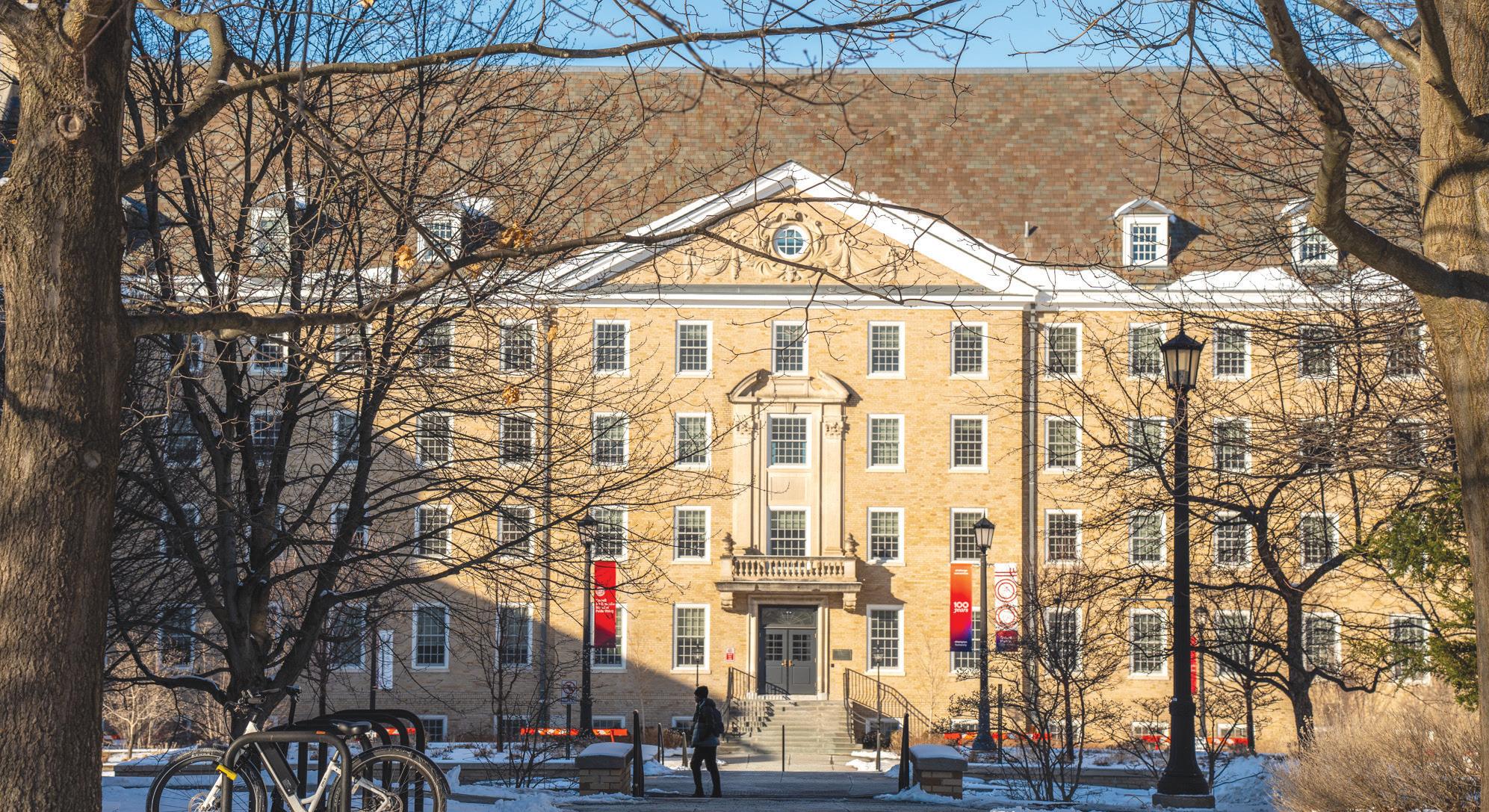
Te City of Ithaca orders residents of the 181-unit Asteri building to vacate due to an “immediate threat” to their safety.
Page 4
Mitski melancholy Mitski’s eighth studio album released this past February, arguably her most emotionally devastating project yet.
Page 14
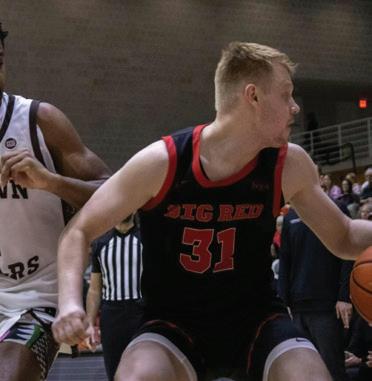
Dartmouth defeated After securing the No. 4 seed in Ivy Madness, men’s basketball defeats Dartmouth 111-90 on March 7. | Page 16
Palantir Hosts ‘Invite-Only’ Recruitment Event on Campus
Te defense and data analytics company, criticized over its contracts with ICE, required attendees to provide IDs and sign NDAs
By EVERETT CHAMBALA Sun Assistant News Editor
March 10 — Palantir Technologies, a data analytics and defense software company that has been criticized for its ties with Immigration and Customs Enforcement, hosted an invite-only recruiting event in Upson Hall on March 2. The event required every participant to sign a non-disclosure agreement, present identification and leave their backpack at the front of the room in order to attend.
The private event was “coordinated with specific project teams,” according to a University spokesperson, and comprised approximately 30 students, according to a student attendee who was granted anonymity by The Sun due to legal concerns. More than five Cornell University Police Department officers were stationed in the hallway, moving in and out of a private room separate from the event.
Palantir Technologies is a Denver-based software company that specializes in data analytics for government and commercial clients. The company holds federal contracts worth billions of dollars, including a 10-year enterprise agreement with the U.S. Army valued at up to $10 billion.
Palantir holds a $30 million contract with ICE to develop a surveillance platform to assist with deportations, called ImmigrationOS. ImmigrationOS works toward “streamlining selection and apprehension operations of illegal aliens,” according to a report from the ICE Office of Acquisition Management. This software utilizes artificial intelligence and data mining to target, track and manage deportations with data from government databases.
The company’s flagship product, Gotham, which it describes as a “global decision-making” defense system, integrates data to identify patterns and connections between people, places and events, and is used across the U.S. intelligence community and Department of Defense for surveillance and monitoring. Palantir’s ICE contracts have drawn criticism from civil liberties organizations. The Event
The attendee told The Sun that there were no disruptions during the event and described the session as a “couple engineers talking about their product.” The student also added that the event had “swag,” a slideshow about the company and a subsequent Q&A session.
During the event, students were split into groups based on which project teams they were a part of, according to the attendee. There were a “few” attendees who were not affiliated with project teams, the attendee added.
The attendee recalled hearing Cornell Custom Silicon Systems, Cornell Autonomous Drone, Cornell Data Science, Cornell Mars Rover and Cornell Rocketry as teams mentioned during the grouping.
When asked about the extent of coordination between Palantir and themselves for this event, Cornell Rocketry and Cornell Mars Rover separately responded with the same message.
“We were not contacted about this event nor have any information regarding other project teams’ involvement with this event,” Cornell Rocketry and Cornell Mars Rover
Cornell Student Arrested for Possessing Firearm on Syracuse University Campus
By ZEINAB FARAJ Sun Senior Writer
March 9 — Mateu Healey-Parera ’26 was arrested on Saturday after the Syracuse Police Department found him carrying a firearm at Syracuse University, according to a Sunday SPD information release. Healey-Parera was waiting for a bus back to Ithaca when he was arrested, according to a statement by Syracuse University’s Department of Public Safety.
Healey-Parera has no affiliation with Syracuse University and was found at approximately 4 p.m. in possession of the firearm at Syracuse University’s Schine Student Center on Saturday. In a press conference on Monday, SPD’s Chief of Police Mark Rusin stated that the firearm was a “bolt action rifle” that was “carried in a case,” and that Healey-Parera was found with 40 rounds of ammunition.
Healey-Parera is from Mansfield Center, Connecticut and enrolled in the College of Art, Architecture and Planning.
Healey-Parera was charged with criminal possession of a weapon on school grounds, a felony under New York State law. He was arraigned Sunday morning, and his bail was set at $50,000 cash or $100,000 bond.
When asked during the press conference if Healey-Parera had a history of threats or mental illness as a student at Cornell, Rusin said that it is “too early on in the investigation” to address these questions, and that SPD is investigating the case with the Cornell University Department of Safety.
“We are asking the same question that you are asking,” Rusin said.
An extreme risk protection order, which is a court order issued when a person may be dangerous to themselves or others that prohibits the purchase or possession of firearms, was secured by the Syracuse University Police Department, Syracuse University DPS, the Onondaga County District Attorney Office and Tompkins County District Attorney Office, which contained a search provision for Healey-Parera’s residence, according to Rusin.
Rusin also stated that the reason why the rifle was purchased and why HealeyParera was traveling between Syracuse and Ithaca are a part of an “ongoing investigation.”
In a statement to the Cornell community released on Monday, Vice President for University Relations Kyle Kimball confirmed that Healey-Parera was a Cornell student and thanked the “swift action” of the Syracuse University DPS and SPD.
“We are deeply concerned by this incident and extend our support to the entire Syracuse University community,” Kimball wrote. “We encourage Cornell community members impacted by this news to access university resources.” SPD information release stated that there is “no ongoing threat to the public.”
To continue reading this article, please visit www.cornellsun.com.
wrote in separate email statements to The Sun. “Whether or not [our] members were invited and attended on their own accord we cannot comment on.”
Cornell Autonomous Drone redirected The Sun’s questions to the Cornell Engineering Project Team director, who did not immediately respond to a request for comment. Cornell Custom Silicon Systems and Cornell Data Science did not immediately respond to The Sun’s request for comment.
According to the attendee, the event showcased Palantir’s Gaia map interface, a part of the Gotham operating system, which allows teams to communicate with each other while out in the field, according to its website.
The attendee also mentioned that during the event, “one of the recruiters said how he got an … email from a soldier in Afghanistan talking about how … one of their Palantir products saved them time or effort.”
The attendee told The Sun that there was no mention of Palantir’s contracts with ICE during the event.
Cornell alumni who now work at Palantir attended the event in addition to the recruiters, which the attendee described as the “only Cornell-specific part of it.” The alumni shared stories, answered questions about their work and discussed how they joined Palantir, according to the attendee.
To continue reading this article, please visit www.cor-
Cornell Political Union Hosts Guest Speaker Curtis Sliwa For Debate
By MARY CAITLIN CRONIN Sun News Editor
March 4 — The Cornell Political Union hosted a debate which featured Curtis Sliwa, two-time Republican nominee for mayor of New York City and founder of the Guardian Angels on Tuesday eve ning. Over 125 students attended the event at Anabel Taylor Hall Chapel to hear Sliwa and the debat ers speak.
Debaters were given the res olution “community over gov ernment” to address. Sliwa, who CPU invited as a guest speaker, provided opening remarks before the debate in agreement with the res olution. The debate was open to all students to attend, and the debate floor was open to CPU members only.
Sliwa, donning his staple red beret, was greeted by a thunderous applause upon entering the chapel and giving his opening speech.
“First off, let’s get the rules straight,” Sliwa said to the crowd. “You can’t be glazing me tonight.”
Going on to voice his support for the resolution, Sliwa empha sized the importance of com munity organization, which he regarded as more proactive than government involvement.
“If you’re just
going to wait for the government, they’re going to be a dollar short and a day late,” Sliwa said.
He then called on the audience to take action to improve their communities.
“I’m a doer, not just a talker, and that is what each and every one of you should be,” Sliwa said. He also implored the audience to question authority and the government, saying “We need to be curious. First and foremost curious.”
Sliwa, born and raised in Brooklyn, New York, founded the Guardian Angels, a nonprofit volunteer organization dedicated to crime prevention, in 1979 in response to rising crime and violence rates in New York City, according to its website. The organization now spans 14 countries and over 130 cities, specializing in safety-patrols, self-defense training and homeless
He continued his community outreach efforts by running for mayor of New York City in 2021 and again in 2025. Although Sliwa received only 7% of the vote, his campaign received a wave of support from Gen-Z on social media.
To continue reading this article, please visit www.cornellsun.com.
Wednesday, March 11, 2026
A LISTING OF FREE EVENTS ON CAMPUS AND IN ITHACA
The Corne¬ Daily Sun
Today
Midday Musics for Organ: Ivan Bosnar (CU Music) 12:30 p.m., Anabel Taylor Chapel
Nasser Abourahme, “In the Open Time of Dispossession: Camp, Colony, Palestine” 4:45 - 6:15 p.m., Goldwin Smith Hall, Kaufmann Auditorium
Case Studies in the Colonialist World of Mandate-Era Archaeology: A Tell en-Nasbeh (Palestine) Trilogy 5:30 - 7 p.m., The History Center in Tompkins County
Bingo Night at the Barn 6 - 8 p.m., Big Red Barn
Verano de Jazz
9 p.m. - midnight, Tres Leches
Tomorrow
Soup & Hope Noon - 1 p.m., Sage Chapel
NeurodiversiTea
1:30 - 3 p.m., Computing and Communications Center, 2nd Floor Auditorium
Muslim Educational and Cultural Association Iftar
4 - 9 p.m., Anabel Taylor Hall, One World Auditorium
Trivia Night at Ithaca Bakery
6 - 8 p.m., Ithaca Bakery - Meadow Street
Brewhouse Blues Jam
6 - 8 p.m., Hopshire Farm & Brewery
“The Sun Is in Your Hands” by Isabelle Jung ’26
ISABELLE JUNG / SENIOR GRAPHICS STAFFER
SUNBURSTS: Chili Cook-Of
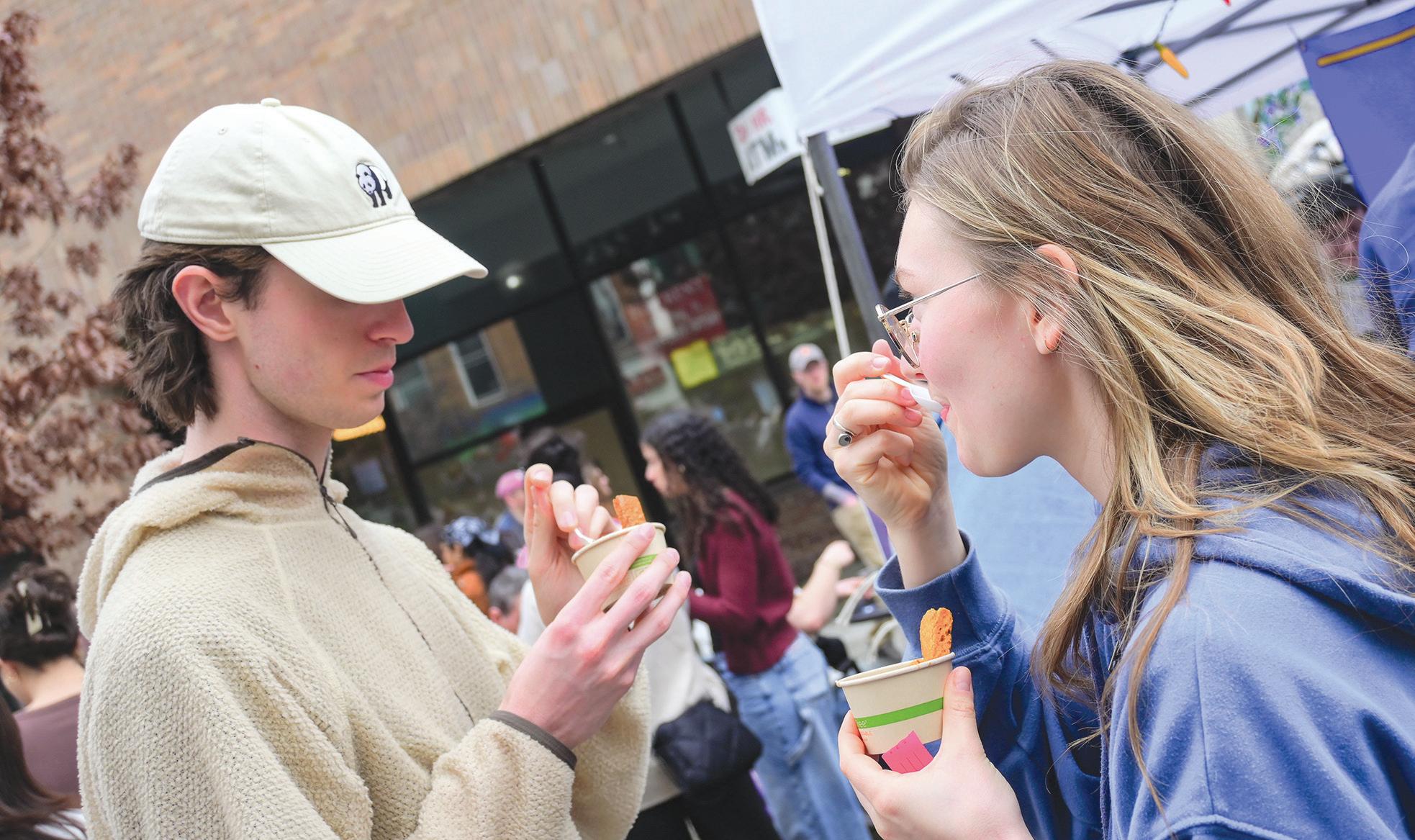
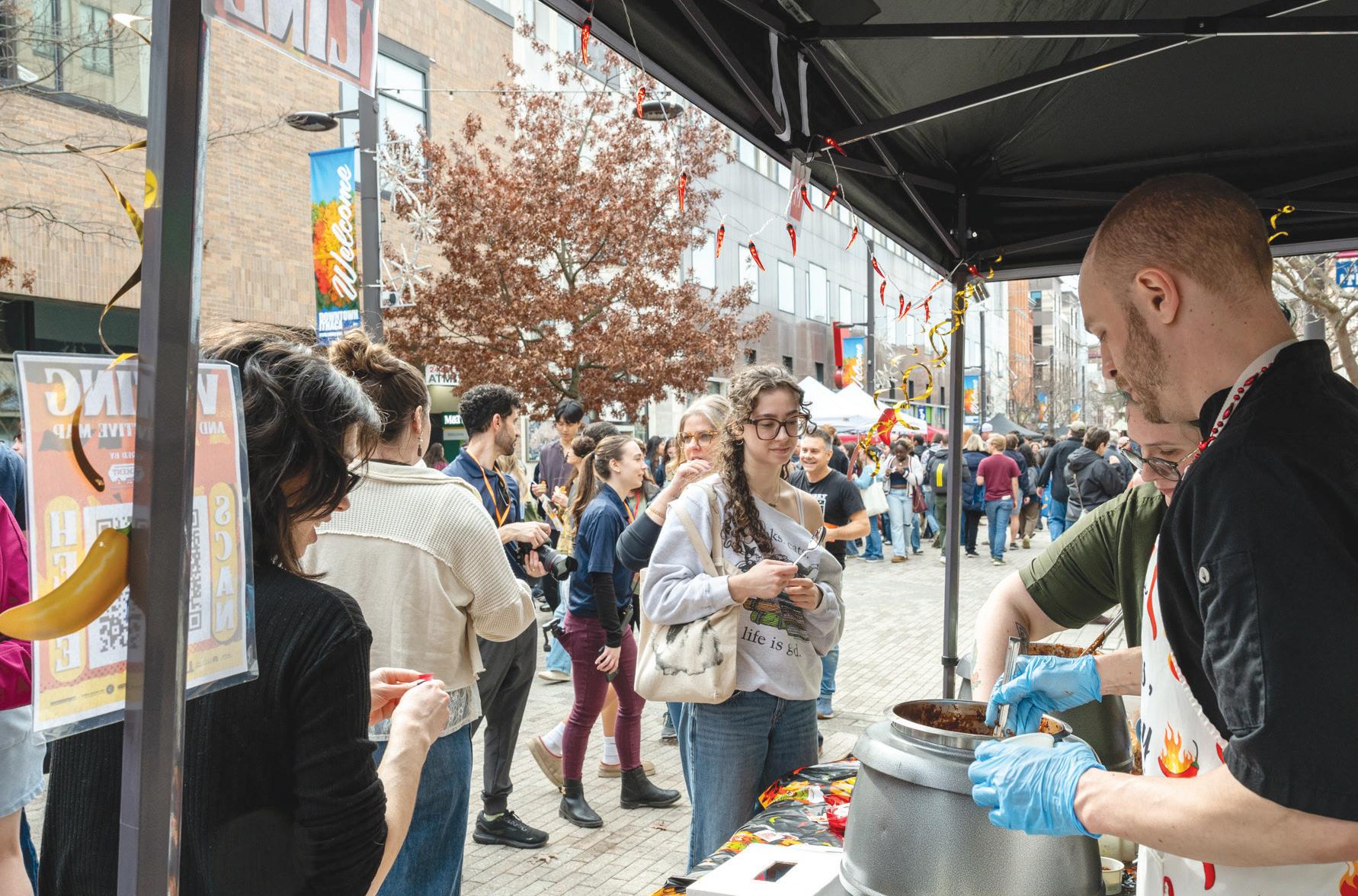
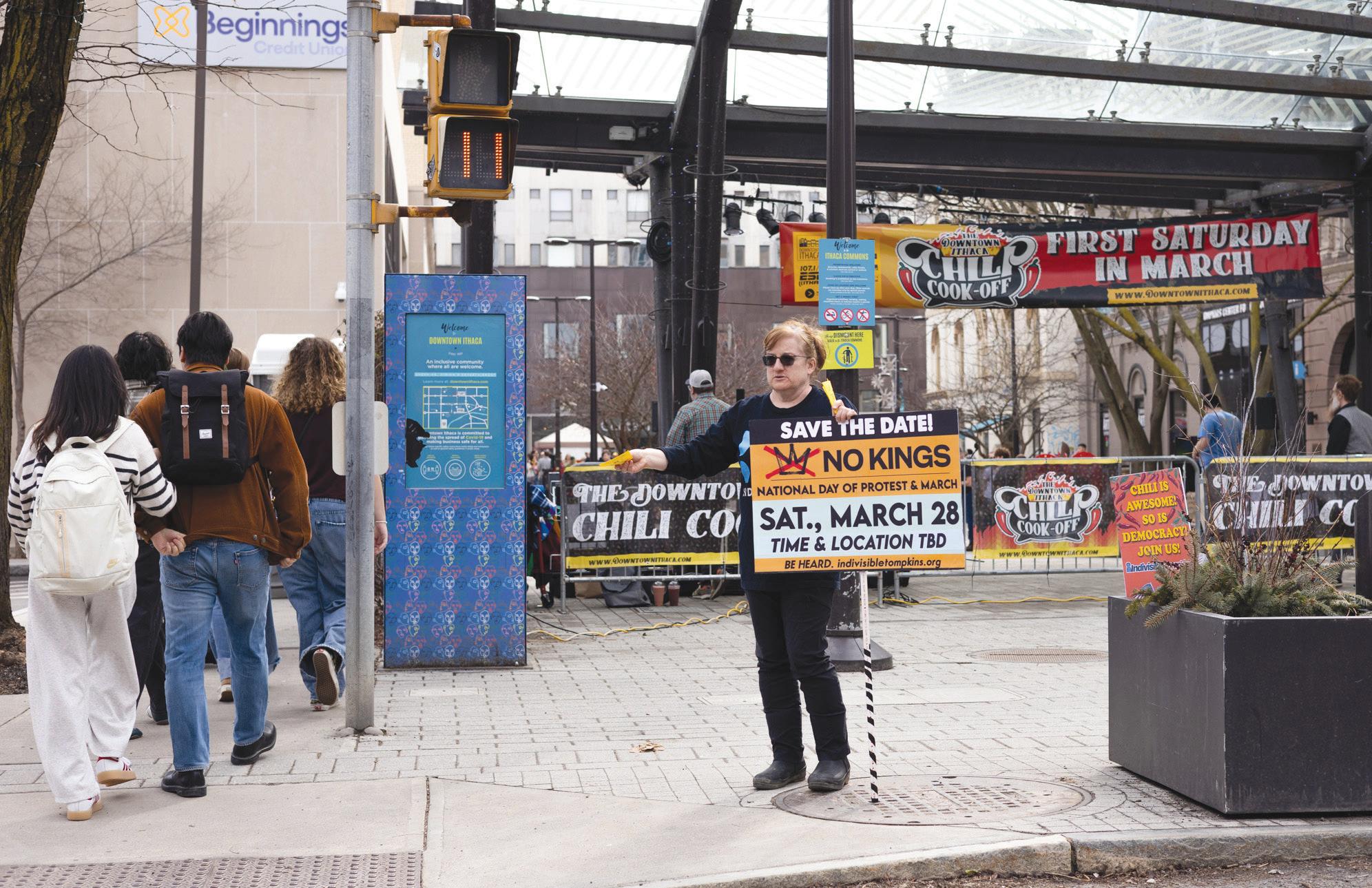
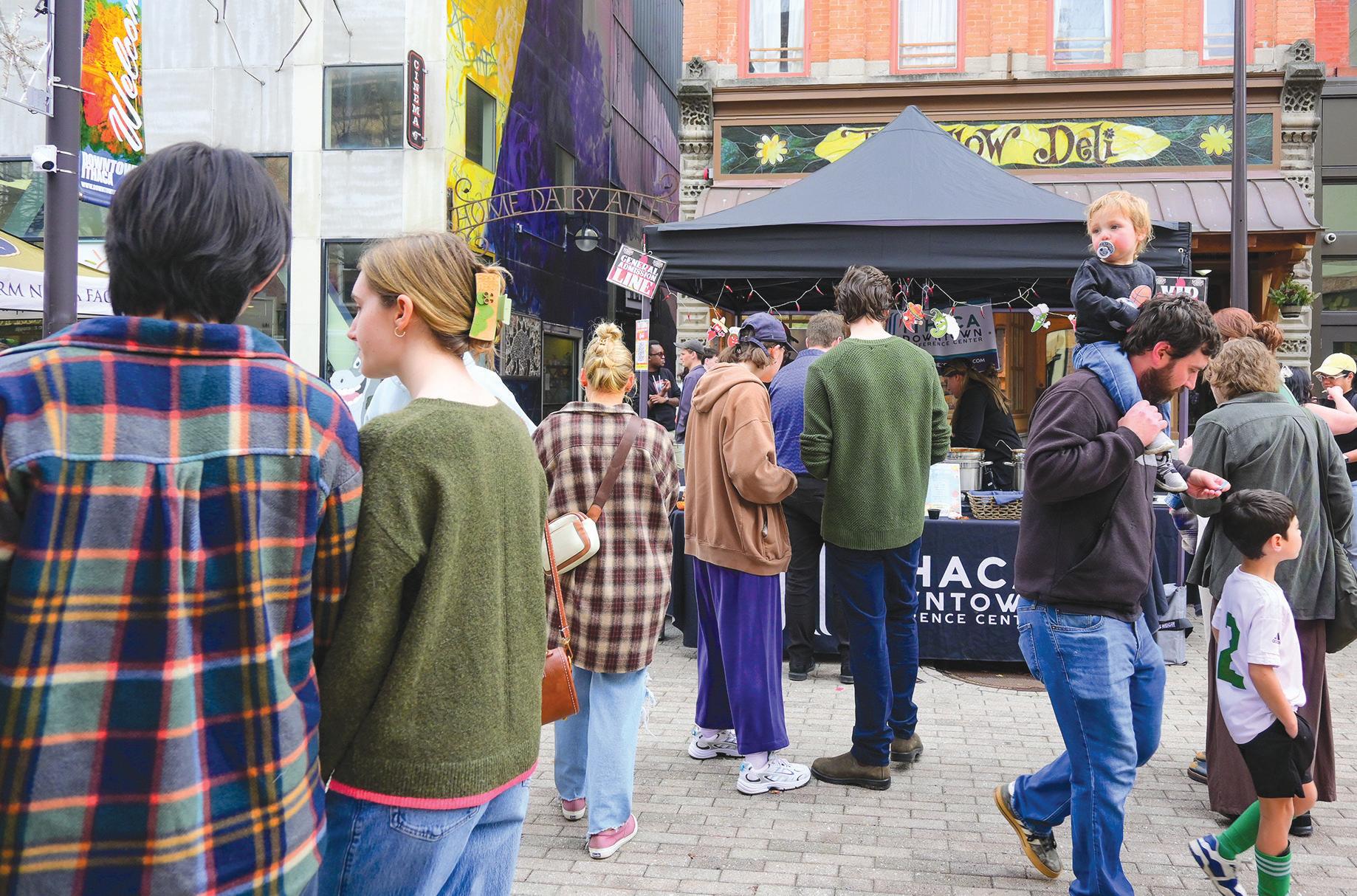
Sun photographers embraced the warm weather and ventured downtown to capture Ithaca’s annual Chili Cook-Of on Saturday! Over 20 community vendors served up chili packed with soul, favor and spice.
By SUN PHOTOGRAPHY DEPARTMENT
CHILI CHEERS | Two attendees savor a meat chili served by Ithaca College Dining.
AMPLE SAMPLE | Vendors from the local community serve hundreds of chili samples to Ithacans for a day of tasting.
COMING IN HOT | A large pot of vegetarian chili simmers near a vendor’s tent.
SPOONS UP | Ithaca Downtown Conference Center serves a unique island pineapple habañero pulled pork chili and vegetarian roasted butternut chili.
POLITICAL STEW | A few attendees rally around the commons protesting the Trump administration and promoting a No Kings Rally.
BEARD PRIDE | A judge for the “Best Beard Contest” examines the texture of a contestant’s beard.
FAMILY AND FRIENDS | The Ithaca community enjoys a beautiful day filled with chili tasting. WINNER WINNER CHILI DINNER | Taverna Banfi in the Statler Hotel takes on the Chili Cook-Off to defend their 2025 title of best meat chili.
Nathan Ellison / Sun Photography Editor
Nathan Bo / Sun Assistant Photography Editor
Samantha Miculinich / Sun Staf Photographer
Nathan Bo / Sun Assistant Photography Editor
Nathan Ellison / Sun Photography Editor
Stephan Menasche / Sun Senior Staf Photographer
Samantha Miculinich / Sun Staf Photographer
Nathan Ellison / Sun Photography Editor
Ithaca Orders Asteri Residents to Vacate
By ATTICUS JOHNSON Sun News Editor
March 5 — Update, March 6, 5:43 p.m.: After a Thursday afternoon status call, Karasin wrote in a statement to The Sun that Vecino, the operator of Asteri, had secured “around 70 rooms” for those displaced by the order. According to Karasin, “housing needs to be provided until the repairs are completed, and the Order to Vacate removed.”
He added that the Tompkins County Public Library will be used again as a warm space to match Asteri residents with housing options starting at 8:30 a.m. tomorrow. “Some” food service will be provided.
TCAT is offering residents free rides to housing, according to the statement.
Update, March 5, 4:27 p.m.: “It is everyone’s belief that Asteri will reopen. Repairs are being coordinated already,” Ithaca Chief Information Officer Alan Karasin wrote in a Thursday afternoon statement to The Sun, adding that the timeline is currently unknown and repairs will need to pass additional inspections.
Karasin said there was a “coordinated effort” to re-house people displaced by the order, though there were “many moving parts.”
Additionally, in a notice distributed to residents of Asteri, the City told the residents to first call their landlord — Vecino — for supportive services and to reach out to any family or friends. As a last resort for residents, the City said that the Ezra Cornell Reading Room in the Tompkins County Public Library would be open on Thursday until 8 p.m.
Update, March 5, 12:26 a.m.: Ithaca Food Not Bombs called the move “the largest mass eviction” in Ithaca, and that the order had “functionally doubled the homeless population in Ithaca.” The group, which said it would be outside of the Asteri building in the early morning, encouraged people to drop boxes and bins outside of Asteri.
The City of Ithaca ordered occupants of the 181unit Asteri building to vacate the residential tower due to an “immediate threat” to the safety of residents, effective immediately, according to a Wednesday night press release sent to The Sun by Ithaca Chief Information Officer Alan Karasin.
The order came after Ithaca firefighters responded to a fire alarm call and found serious safety issues and required the building operator to board up all windows and doors. It also ordered “corrective actions” to address safety concerns.
According to the release, the “Order to Vacate” was due to “unsafe building conditions” including broken windows that left the stairwells — the building’s only exit points — unserviceable in the event of an emergency.
“Because the damaged glass left both stairwells unsafe and out of compliance with the Uniform Code, City officials determined that the condition posed an immediate threat to the life safety of residents,” Karasin wrote in the release. “In some cases, an Order to Remedy may allow the owner to implement a fire watch while repairs are made, but this approach has previously proven unsuccessful at this address.”
A Sun investigation from December 2024 found that some residents described the apartment complex as unsafe, with Ithaca Chief of Police Thomas Kelly saying the development had “increased calls for service.”
The Asteri development has allegedly been the site of a stabbing, an attack in an apartment and intimidation by ax.
Asteri was originally built to combat increasing homelessness in Ithaca, and more than $96 million was spent to complete the affordable housing project, which offers housing for individuals making under a certain amount, alongside on-site support services reserved for previously homeless individuals.
Other residents saw Asteri as a recreation of “the Jungle,” a large homeless encampment behind big-box retail stores in the south of Ithaca.
“The new ‘Jungle’ is basically Asteri,” a self-described ‘Jungle drifter’ said during a November interview with The Sun.
To continue reading this article, please visit www. cornellsun.com.
Atticus Johnson can be reached at ajohnson@cornellsun.com.
Graduate Student Asks NLRB to Question CGSU’s Legality
By RAJORSHI CHATTERJEE Sun Contributor
March 4 — Ph.D. candidate in chemistry and chemical biology Russell Burgett filed an appeal to the National Labor Relations Board to reconsider a previous ruling that granted graduate students bargaining power and union representation. If approved, the appeal would effectively overturn graduate student unions, including the Cornell Graduate Student Union, making their bargaining power obsolete.
The appeal, filed on Feb. 10, seeks to overturn the NLRB’s August 2016 Columbia University decision, which ruled that graduate students are employees and subject to the National Labor Relations Act, granting graduate students bargaining representation.
Burgett’s current appeal surrounds CGSU’s “Union Shop” policy, which states that all graduate students in the University who are part of the bargaining unit are required to pay a fee of 1.44% of their stipend each month or make a charitable donation of the same amount if they hold a religious, moral or ethical objection.
A graduate research assistant’s stipend was $47,548 annually, translating to a monthly fee of approximately $57.
Burgett did not respond to a request for a comment or interview about the appeal from The Sun.
This appeal follows a previous-
ly filed federal charge by Burgett in July with free legal aid from the National Right to Work Legal Defense Foundation, an organization which advances Right to Work laws — laws that prevent unions from forcing employees to join or pay fees.
The filed federal charge, in opposition to the Columbia University ruling, argues that graduate students are not employees because even if they do research and other academics work for the university, they are primarily students and thus ultimately customers of the university. Thus, they would not be considered employees by the National Labor Relations Act and would not be given bargaining power under the law.
The appeal is addressed to the NLRB General Counsel Crystal Carey, who was nominated to the position by President Donald Trump in March 2025 and confirmed by the Senate in December. Carey was previously a partner at Morgan Lewis & Bockius LLP, which pursued the legal argument that the NLRB structure is unconstitutional. In her prior private practice, Carey represented clients, including Amazon and Trader Joe’s, against unionization efforts of their employees.
To continue reading this article, please visit www.cornellsun. com.
Rajorshi Chatterjee can be reached at rc978@cornell.edu.
Kotlikof Justifes Delays in Acknowledging Assembly Resolutions
Te Ofce of the President has acknowledged less than half of S.A. resolutions within the required timeline
By EMMA SPINDLER Sun Senior Writer
March 4 — The Cornell Student Assembly has adopted over 40 resolutions this academic year focused on issues ranging from climate change to disability ramps. A review of publicly available records, though, shows a recurring pattern — delays between when resolutions are sent to the University president and when formal responses are issued.
Under the Student Assembly charter, once a resolution is conveyed to the Office of the President, the president is required to respond within 30 days. Responses include acknowledgment, approval, rejection or other formal action.
Approved resolutions are implemented, while rejected resolutions are returned to the Assembly to be reworked per any feedback the president may choose to give. When resolutions are acknowledged, the president confirms he has received it but does not immediately take any action.
None of the resolutions passed by the Assembly this academic year have been approved by President Michael Kotlikoff. 13 resolutions have been conveyed to the President, all of which were eventually acknowledged –– one of these resolutions was rejected following acknowledgement. The remaining resolutions have either not yet been conveyed to the president, were internal policies or have been referred to committees.
Only 46% of resolutions acknowledged by the president were responded to within the required 30 day period — 38% were acknowledged between 31 and 60 days, and 15% were acknowledged after more than 61 days.
A Notable Delay: Career Services and ICE
Resolution 9: “Ending Career Services Collaboration with ICE,” called for Cornell Career Services to stop promoting Immigration and Customs Enforcement and Customs and Border Patrol career opportunities. It was adopted by the Assembly on Sept. 25 and conveyed on Oct. 8. The President’s acknowledgment came on Dec. 10, more than 60 days after conveyance.
Ehrlich characterized the issue as procedural rather than political, noting that the charter requires formal presidential
action within 30 days.
Vice President of Diversity, Equity and Inclusion Kennedy Young ’28 framed the obligation in contractual terms. “[Kotlikoff] is contracted to do these things,” Young said during debate over enforcement.
The resolution recommended the cancellation of virtual career events with Career Services and ICE and CBP, and the removal of postings from Cornell’s online recruitment platform, Handshake.
During a subsequent Assembly meeting on Feb. 21, members argued that the delay constituted a violation of the charter’s response requirement.
“Resolution 9 should have been enforced. They did not respond timely, so it should now be enacted,” said Max Ehrlich ’26, ILR representative, during the meeting.
Resolution 42: “Enacting the Enforcement of Resolution 9”, was introduced in response to the delayed acknowledgement. The resolution argued that because the administration did not respond in the required window, the administration should implement Resolution 9.
“We need to make it clear we won’t abide by Kotlikoff stepping all over us.”
Max Ehrlich ’26
Shared Governance and Code of Conduct Concerns
Resolution 10: “Condemning the Administration’s Undemocratic Review of the Student Code of Conduct and Affirming Cornell’s System of Shared Governance,” condemned the administration’s review of the Student Code of Conduct by a non-elected committee, and reiterated the importance of shared governance between the various assemblies and the president. The resolution, adopted on Oct. 9 and conveyed on Oct. 21, did not receive presidential acknowledgment until Feb. 2, over three months later.
The resolution invoked Article 3, Section 1 of the charter, which states that the Assembly shall have legislative authority over the Office of Student and Campus Life as well as the Office of the Dean of Students, the offices in charge of the
code, to argue that the Assembly should have a formal role in any revisions to the Student Code of Conduct. Assembly members raised concerns that the administration’s review process bypassed established shared governance structures and limited student input in decisions affecting campus disciplinary policy.
Some Assembly members expressed frustration that delayed responses weaken the body’s authority within Cornell’s shared governance framework.
“We need to make it clear that we won’t abide by Kotlikoff stepping all over us,” Ehrlich said during a debate over enforcement measures.
End-of-Semester Backlog
Resolutions adopted in December, including Resolution 17: “Reinstating the A&S Peer Mentoring Program”, Resolution 19: “University-Wide [Fossil Fuel] Disassociation” and Resolution 20: “Protecting Cornell’s Values from the Trump Administration,” were conveyed Dec. 18 and acknowledged on Feb. 6. These responses occurred roughly 50 days after conveyance, with a significant portion of the time occurring over Cornell’s winter break.
Notably, Resolution 21: “Approving the Recommendation for the 2026-2028 Student Activity Fee,” suggested an increase to the Student Activity Fee. The resolution, conveyed on Dec. 18.was formally rejected by President Kotlikoff on Feb. 6, more than 30 days later., who He expressed concerns about the potential impact that the proposed increase would have on the University’s budget, which covers some or all of the activity fee for students receiving financial aid.
“This increase in the activity fee cannot be absorbed by [Cornell’s] colleges and schools,” Kotlikoff wrote to the Assembly, additionally asking them to “revise the proposed 2026-2028 fee to match the 2025-2026 fee of $424 in recognition of these challenges.”
To continue reading this story, please visit www.cornellsun. com.
A Look Into AI Teaching Support In Cornell’s Classrooms
Multiple Cornell
By HOPE THOMAS Sun Staff Writer
classes have begun to incorporate AI, aiming to more efciently provide assistance for students.
Mar. 6 — Various Cornell classes across departments have begun integrating artificial intelligence to supplement students’ learning and improve efficiency.
Cornell recently appointed Prof. Thorsten Joachims, computer science and information science, to the new position of vice provost for artificial intelligence strategy on Jan. 1.
In a statement to The Sun, Joachims wrote that when he taught CS 3780: “Intro to Machine Learning,” he allowed the use of generative AI for projects. Instead of students spending many hours “stumping the TAs” while trying to debug challenging code, students were able to ask questions relevant to the course content.
“I saw fewer struggles, and they could engage with the TAs on the interesting machine learning questions — not why their code was throwing some mysterious error,” wrote Joachims.
“We
expect these experiments [of classes using chatbot tools] to continue and potentially expand as we see evidence that they strengthen student learning and engagement.”
Vice Provost for Academic Innovation Prof. Steven Jackson, information science, wrote that the use of chatbot tools has allowed students to receive immediate answers for simple questions, mitigating the need for them to rely on office hours for minor questions.
“We expect these experiments [of classes using chatbot tools] to continue and potentially expand as we see evidence that they strengthen student learning and engagement,” Jackson wrote in a statement to The Sun.
While the use of AI for supplementing instruction increases, the Cornell GenAI Education Working Group, including faculty, staff and students is where questions regarding AI in the classroom are discussed. This group is part of the University’s AI Advisory
Council. Their goal is to ensure that students receive quality education, feedback and grading to their students.
These goals are implemented through conducting surveys on GenAI, campus-wide programs regarding Critical AI Literacy and working with Cornell Information Technologies and researchers to assess new software, according to its website.
One newly incorporated AI is HiTA, which has been utilized by departments including language, information science and computer science programs, and across schools including the S.C. Johnson College of Business and Weill Cornell Medicine, according to Prof. Rene Kizilcec, information science.
HiTA, which provides academic assistance for higher education through teaching and learning according to its website, operates differently from generative AI platforms like ChatGPT, Microsoft Copilot and Google Gemini.
“[Generative AI] is designed to give you answers fast, to solve your problems fast, and that is not desirable in education, where learning is a process that requires learners to engage in effortful deliberative,
intentional processes,” Kizilcec said in an interview with The Sun.
Unlike these generative AI chatbots, HiTA does not directly solve students’ homework problems. The goal of the site is to help students with concepts by providing them with hints, according to Kizilcec.
In addition to assisting students, Large Language Models are used to summarize the conversations that students have had and determine the main themes that occurred through conversations.
Kizilcec will look through the summary to understand common questions and misconceptions. Based on these results, he “bring[s] it up in the TA meeting as something that [they] should cover in section” if it is relevant, Kizilcec said.
AI assistance has also found its way into non-STEM courses. Another course that has incorporated AI is SPAN 2090: “Intermediate Spanish I.”
To continue reading this article, please visit www. cornellsun.com.
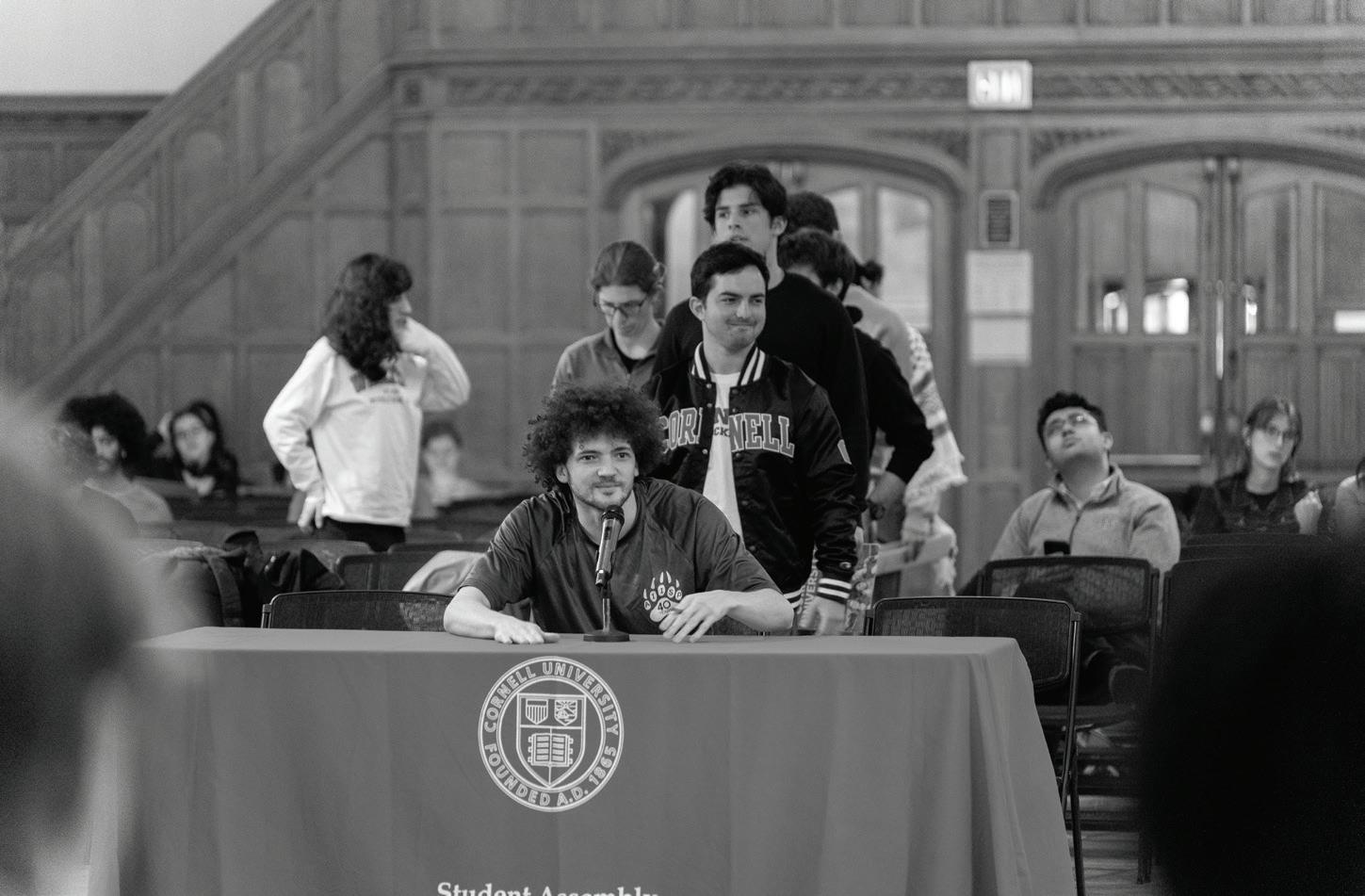
Students Pack Assembly Over Cornell Tech Partnership With Technion-Israel Institute, University-Sponsored Speakers
By VIVIENNE CIERSKI Sun Contributor
Mar. 9 — Students packed the Student Assembly’s Thursday meeting to debate two contentious resolutions:
Resolutions 61 and 55. The resolutions focus on Cornell Tech’s partnership with the Technion-Israel Institute of Technology and University-sponsored events that feature people accused of war crimes or human rights violations.
Resolution 61: “Calling for the Termination of Cornell University’s Partnership with Technion – Israel Institute of Technology While Preserving Cornell Tech” calls on Cornell Tech to terminate its institutional partnership with Technion, citing ethical and legal
concerns related to Technion’s alleged involvement in the development of military technologies connected to human rights violations.
Cornell Tech and the TechnionIsrael Institute of Technology jointly established the Joan and Irwin Jacobs Technion-Cornell Institute, an “applied sciences campus” in New York City, according to the American Technion Society’s website. The institute offers dual master’s degree programs, as well as a postdoctoral program, according to its website.
“Partnerships with institutions that contribute to the production of weapons, military technologies, or infrastructure of apartheid are inconsistent with Cornell University’s stated educational
mission, ethical commitments, and core values,” the resolution states.
Resolution 61 also calls for divestment from any related joint programs and greater transparency in the University’s ethical review process for international partnerships.
“When this university extends an official invitation to an individual radically implicated in war crimes, it is not engaging in open inquiry. It is granting legitimacy to these criminals. ”
Francis Burns
Resolution 55: “Condemning the University Administration’s Use of Programming to Platform Individuals Implicated in War Crimes” condemns the administration for hosting, funding or sponsoring programming for speakers who, according to the resolution’s sponsors, have been “implicated in war crimes and grave human rights violations.”.
The resolution references Tzipi Livni, former vice prime minister and former foreign minister of Israel, who was featured as a panelist during the University’s “Pathways to Peace” event in March 2025, to discuss the Israeli-Palestinian conflict and “potential paths forward for the people of Israel and Palestine.”
During this event, 17 pro-Palestinian protesters were arrested or detained.
Livni faced war crime allegations and a warrant for her arrest in the U.K. in 2009 for her decisions made before and during a three-week-long Israeli offensive in Palestine, Operation Cast Lead, while she was Israel’s foreign minister
and member of the Israeli war cabinet. The warrant was withdrawn when it was discovered that she was not in the U.K. Resolution 55 argues that providing such University-sponsored events “endanger[s] student well-being.”
“Students are entitled to an academic environment free from militarization, intimidation, and the glorification or rehabilitation of individuals responsible for large-scale human rights abuses,” the resolution states.
Ahead of the meeting, several student organizations — including Students for Justice in Palestine at Cornell, Cornell Asian Pacific Americans for Action, the Kashmiri Cultural Alliance and the Progressives at Cornell — encouraged students to attend the Student Assembly meeting via a joint Instagram post published on Wednesday. The groups urged students to “pack the Assembly” and use the public comment period to call on representatives to vote in favor of Resolutions 55 and 61.
Public comment revealed divisions within the student community. While community members criticized the proposals, others voiced strong support, and some argued that the Assembly was not the appropriate forum for debating the issue at all.
Graduate student Hannah DeFelice urged the Assembly not to vote on Resolution 61. DeFelice argued that the undergraduate Student Assembly was not the appropriate body to deliberate on the issue.
To continue reading this article, please visit www.cornellsun.com.
Packing the room | At the Student Assembly’s Thursday meeting, many students showed up to comment on Resolutions 55 and 61.
ADELAIDE CHOW / SUN ASSISTANT PHOTOGRAPHY EDITOR
AI helper | Classrooms at Cornell are starting to incorporate AI tools to accelerate student learning.
CLAIRE LI / SUN FILE PHOTO
’27
Prof. Steven Jackson
Hope Tomas can be reached at hthomas@cornellsun.com.
Vivienne Cierski can be reached at vsc38@cornell. edu.
The Corne¬ Daily Sun
Independent Since 1880 144th Editorial Board
SOPHIA DASSER ’28
Editor in Chief
SOPHIA ROMANOV IMBER ’28
Associate Editor
RAYEN ZHOU ’29
Opinion Editor
ZARA CHEEK ’28
Opinion Editor
JADE DUBUCHE ’27
Multimedia Editor
BENJAMIN LEYNSE ’27
Multimedia Editor
SOPHIA TORRES LUGO ’26
Business Manager
KENDALL MURPHY ’28
Advertising Manager
VICTORIA WROBLEWSKI ’28
Human Resources Manager
MELISSA MOON ’28
Arts & Culture Editor
JAMES PALM ’27
Assistant Arts & Culture Editor
MATTHEW RENTEZELAS ’28
Assistant Arts & Culture Editor
HAZEL TJADEN ’28
Assistant Arts & Culture Editor
MARC STAIANO ’27
Assistant Arts & Culture Editor
KATELYN HALVERSON ’28
Lifestyle Editor
AVA BETNAR ’29
Assistant Lifestyle Editor
SANIKA SARAF ’28
Assistant Lifestyle Editor
KATHERINE ISTOMIN ’29
Social Media Editor
JOIE JEAN-PAUL ’29
Assistant Social Media Editor
ASHLIN KWONG ’28
Graphics Editor
TAVAN BHATIA ’27
Games Editor
HUNTER PETMECKY ’28
Layout Editor
Letter From the Editor
VARSHA BHARGAVA ’27
Managing Editor
KATE TURK ’27
Assistant Managing Editor
CORAL PLATT ’29
News Editor
ATTICUS JOHNSON ’28
News Editor
MARY CAITLIN CRONIN ’28
News Editor
EVERETT CHAMBALA ’27
Assistant News Editor
SHUBHA GAUTAM ’28
Assistant News Editor
GISELLE REDMOND ’28
Assistant News Editor
ANGELINA TANG ’28
Science & Technology Editor
TANIA HAO ’28
Science & Technology Editor
SIMRAN LABORE ’27
Weather & Climate Editor
MATTHEW LEONARD ’28
Sports Editor
GRACE REUBEN ’28
Sports Editor
JANE HAVILAND ’28
Features Editor
NATHAN ELLISON ’28
Photography Editor
NATHAN BO ’28
Assistant Photography Editor
ADELAIDE CHOW ’29
Assistant Photography Editor
MIA SOFIA ORENGO ’28
Video Editor
SMRITHE RAJESH ’29
Newsletter Editor
AMELIA GARCIA ’27
Data Editor
RENA GEULA ’28
Layout Editor
Tis Giving Day, Te Sun Is in Your Hands
If you have ever walked into the Temple of Zeus past 9 p.m., you have seen our editors hunched over laptops, refning the stories you will read in our newsletter the next day. If you have ever passed our ofce at 139 W. State St. on a Monday night, you have seen us fatting the pages you will hold in your hands by Wednesday. If you have ever sat behind one of our writers in lecture, you have watched them emailing the sources whose names you will see quoted in print. If you have ever wandered through Goldwin Smith Hall on a Tursday evening, you have heard us, the laughs, the debates and the occasional heated moments over the pieces you will later share with your friends. And if you have ever found yourself at a concert, at a game, at a protest, at an assembly meeting, on a foggy morning or a bright afternoon, you have seen our photographers with cameras hanging from their necks capturing the moments you will remember Cornell by.
We have always been there. Te question is whether we can stay. None of this work is paid and none of it required. Every single person at Te Sun is here because of you, because they believe this community deserves to see itself clearly. But belief alone does not keep a newsroom running and clarity is not something that sustains itself.
In my inaugural letter, I wrote that the greatest threat facing our University is not hostility to the press but the dimming: the slow erosion of rigor, curiosity and depth that makes a campus actually worth
Prof. Bruce Levitt
Professor Bruce Levitt is a professor in the Department of Performing and Media Arts. He can be reached at bal5@cornell.edu.
What Will Save Us From Ourselves? Not Another Engineering Building
David Duffield’s $371.5 million gift to Cornell University is being celebrated as a triumph of innovation, vision and progress. New laboratories will be built. Nanoscience will advance. Engineering will bear his name for generations. And yet, for all its magnitude, the gift is ultimately irrelevant to the most urgent problem we face: how to keep ourselves from destroying one another. Science, engineering and technology are extraordinarily good at responding to immediate crises. They help us ease the pain of cancer, streamline work life, optimize payroll systems and slow environmental collapse. These are vital achievements and they often arise out of curiosity, creativity and the desire to better humankind. But because they are fundamentally reactive and deal with the physical world, they address symptoms, not causes. They treat just the surface of a deeper human disorder: our capacity for cruelty, denial, groupthink and moral evasion. What we lack is not intelligence, efficiency or innovation. What we lack is wisdom.
David Duffield’s career — founding PeopleSoft, Workday and Ridgeline — embodies the modern faith in systems. But systems, as the Business Insider critique of Workday reminds us through POSIWID (“the purpose of a system is what it does”), are indifferent to human suffering. Workday may streamline organizations, but it also generates frustration, alienation and bureaucratic absurdity on a massive scale. At the University of Washington, its rollout became a fiasco requiring teams of consultants just to repair the damage caused by software meant to ‘fix’ work. This is not a moral failure of engineering; it is its limitation. Systems optimize processes. They do not cultivate conscience.
The band DEVO understood this decades ago. Their theory of ‘devolution’ warned that technological advancement does not equal moral progress. Formed in the shadow of the Kent State shootings, DEVO saw clearly what many still refuse to confront: human beings regress even as their tools advance. Their song “Beautiful World,” set against images of police violence, the KKK and bombings, insists that optimism without reckoning is a lie. The future promised by mid-century technology did not materialize. What arrived instead was regression with
better machines.
Shakespeare said it plainly centuries earlier: “The fault, dear Brutus, is not in our stars, / But in ourselves.” We are endlessly inventive in arguing that STEM research, systems and tools will improve humanity’s lot. And while new discoveries in research can better our immediate lives and short-term future as a species, the relevant, long-term issue goes unaddressed. This evasion is the oldest human reflex.
For 16 years, I have worked with incarcerated individuals through theater. I have witnessed transformations no algorithm could predict and no system could engineer. Men and women discarded by society — labeled irredeemable — have shown me more intelligence, generosity, talent, vulnerability that comes from self-awareness and — perhaps most important — more moral clarity than many people who have never known confinement. Theater does not fix them. It reveals them — to themselves and to one another. It forces responsibility, empathy and imagination into the same room.
That is why the arts, and theater in particular, are not luxuries. They are not ornaments to be funded once the ‘real work’ of science is complete. They are the real work. Theater confronts the duality of human nature that DEVO warned about and Shakespeare dissected. It exposes the stories we tell ourselves to avoid accountability. It makes visible what systems render invisible: suffering, contradiction and moral choice.
Cornell’s celebration of Duffield’s gift is understandable. Universities survive on capital, and engineering drives measurable progress. But if the institution truly wishes “to do the greatest good,” it must answer a harder question: What prepares us not just to build the future, but to inhabit it without destroying one another?
We do not need more proof that we can innovate. We need spaces where we can reckon. Where we can confront violence, power, shame and responsibility without hiding behind efficiency. No amount of nanoscale engineering will teach us how to live together. No enterprise platform will save us from ourselves.
Only the arts ask us to look directly at who we are — and to decide whether we are willing to change.
Cornell Dining Student Workers
Cornell Dining Student Workers is a student-led platform amplifying the lived experiences and voices of Cornell’s dining workers. Feel free to email cornellstudentdiningworkers@gmail.com for any inquiries!
belonging to. Te Sun burns to resist that dimming. But burning takes fuel, and that fuel has always come from the same place: from you.
Te Cornell Daily Sun has been independent since 1880. We hold no fnancial or editorial ties to the University. We answer to nobody but our readers. Tat independence is rare and invaluable, but it is not free. Every dollar you give fows directly back into the community you are a part of. Whether you are a Cornell student, a Cornell parent, a Cornell alum or member of the greater Ithaca community, you are just as part of Te Sun as any writer who has ever walked into our newsroom. Your contributions keep our newsroom running. Tey fund the cameras and equipment our teams depend on. Tey keep every piece of coverage free and accessible to the entire Cornell and Ithaca community. When you give to Te Sun, you are not donating to a newspaper. You are investing in your own story, so it gets told and it stays told.
Tere are two ways to support our Tursday, March 12 Giving Day campaign. You can donate or you can carry Te Sun with you by purchasing merch from our store. Either way, you are making the same statement: Independent, student-driven journalism matters, and it belongs to you. Te 144th Editorial Board made you a promise: we will not be dimmed. So long as Te Sun remains in your hands, we will continue shining.
While Cornell Collaborates with Trump’s Austerity, Student Workers Pay the Price
With these words in June, President Michael Kotlikoff announced what he called “financial austerity” at Cornell: “We must immediately address our significant financial shortfalls by reducing costs and enacting permanent change to our operational model.”
Let’s be clear: Financial austerity is a political choice. It is a choice that chooses to abandon the working-class students who keep this campus running.
As student dining workers at Cornell, we have watched our working conditions deteriorate in real time. The rubber shoe covers that once protected us from burns around the kitchen have been replaced with flimsy ones that fall apart halfway through shifts and become slipping hazards themselves. Students who signed up for the Early Work program — an annual program in which Cornell Dining employs student workers before the semester begins in exchange for bonuses paid in bonus Big Red Bucks, a complimentary meal plan and a waived early move-in fee — were left waiting through weeks of hiring delays and shift assignment failures from Cornell Dining. As a result, they were unable to fulfill the program’s requirements, which demand 12 additional shifts and perfect attendance standing before any bonus is actually paid out. We are asked to operate machinery that we have not been trained to use, stationed in understaffed dining halls where we work hard to pick up the slack, all while Cornell’s $11.8 billion endowment earned a 12.3% return in the past fiscal year.
Austerity is not a financial necessity. It is a choice.
Cornell’s administration claims it faces “pro-
found financial challenges,” citing the federal government’s temporary freeze on research funding that lasted from April 2025 through early November. Yet on Nov. 7, 2025, the very same day Kotlikoff announced the restoration of more than $250 million in federal research funding, the cuts to student dining workers continued. The federal crisis has been resolved. Cornell’s research partnership with the government has been “revive[d],” as Kotlikoff himself declared. Yet the austerity imposed on student workers, justified by that crisis, remains in place. If the federal funding freeze was truly the reason for these cuts, why haven’t they been reversed?
The University’s endowment stands at $11.8 billion. Cornell is not poor by any definition of the word. Kotlikoff writes about “unsustainable increase in expenses,” describing an institution on the brink of financial ruin. In reality, he is describing an institution that has decided it would rather cut the hours and wages of dining workers than dip into its vast reserves to protect the students who depend on these jobs to stay enrolled.
Cornell’s administration is using the federal funding crisis as cover for budget cuts they wanted to make anyway. Kotlikoff’s version of “working together” requires the most vulnerable members of our community to shoulder the burden. Student dining workers — many of us relying on Federal Work Study and working multiple jobs just to pay tuition, rent and food costs — are forced to bear the brunt so that Cornell’s bottom line remains comfortable.
To continue reading this article, please visit www. cornellsun.com.
Leah Badawi Leah Down the Law
Leah Badawi '27 is an Opinion Columnist and a Government and English student in the College of Arts & Sciences. She also serves as the co-editor-inchief of Rainy Day Literary Magazine. Her fortnightly column Leah Down Te Law refects on politics, history and broader culture in an attempt to tell stories that are often left between the lines. She can be reached at lbadawi@ cornellsun.com.
If the true spirit of a university lies in its ability to set a good example for its students, Cornell has failed us.
As an academic institution with not only a responsibility, but a moral imperative to protect all of us, Cornell has promoted Immigration and Customs Enforcement recruitment and denied any measures to sincerely keep its students from harm. In the wake of recent ICE arrests in Ithaca, this has become an even greater threat to the well-being of our campus and fellow students. We must mobilize and hold our University accountable after three years of complicity.
My fellow students, I compel you: Do not forget the injustice. Do not forget how the University tried to sell us the lie of compromise after kicking Kehlani from Slope Day for opposing genocide, how this administration hosted a panel of famed war criminals and had the nerve to call this event “Pathways to Peace,” an event that reportedly did not result in as many arrests as President Kotlikof was “hoping for.”
Do not forget how the land acknowledgement read at every major meeting is treated like an unskippable cutscene rather than a genuine call to action for justice for the Gayogohó:no, who continue to lose land claims cases and don’t have any land of their own in their homeland; do not
Skylar Toddings Views From Sky
Skylar Toddings '29 is an Opinion Columnist and an English and art history student in the College of Arts and Sciences. Her fortnightly column, Views from Sky, ofers a sophisticated exploration of popular social culture, blending a fction reader's imagination with the rigor of journalistic insight to deliver engaging and thought-provoking hot takes for Cornellians to dissect. She can be reached at stoddings@cornellsun.com.
In a world saturated with digital content, it's rare for a show to ignite a global phenomenon, dominating social media trends and international viewership charts, rarer still for its stars to catapult into the stratosphere overnight. Yet, Heated Rivalry, the series adapted from a beloved book about queer hockey players, has done just that. What began as a project fueled by passion and a shoestring budget has become a cultural touchstone, largely thanks to the undeniable chemistry between its leads, Hudson Williams and Connor Storrie, and its unapologetic portrayal of same-sex relationships.
Additionally, the show’s largely female fanbase has skyrocketed its ratings and spilled into the real world, leading to a remarkable surge in NHL ticket sales and efectively bridging the gap between young viewers and the tangible experience of live hockey. Tis is a feat that the NHL itself has not achieved, only to be accomplished in a mere six-episode series. But beneath the surface of sold-out arenas and magazine covers lies a crucial question: Can these stars withstand the heat of their newfound fame?
Williams and Storrie, relatively unknown before their roles as Shane Hollander and Ilya Rozanov, have become the faces of a cultural movement recognized as the queer hockey romance phenomenon that has
Cornellians, the Time to Act is Now!
forget how this University weaponizes growing autocracy on all levels, to the point where it forced student activist Momodou Taal to self-deport last year following his activism eforts; how our divestment referendum which passed by a margin of more than two-thirds of the student body in 2024 was blatantly ignored by Cornell ‘leadership;’ how Cornell hasn’t once paid its share to the city as an organization that pays taxes for only about $8 million dollars worth of property when its property exempted from taxes totals more than $2.7 billion.
Is this the lesson Cornell University wishes to impart upon us? Tat money goes above all student interests? Tat, as a Palestinian student, the existence of my home country has not once been acknowledged by an institution that no less proclaims its own “open, collaborative, and innovative culture” and holds the mission “to do the greatest good,” yet in a way that is completely conditional to a student’s background and political beliefs?
Where is this “greatest good”? In some terrible twist of irony, the same Cornell that memorialized the takeover of Willard Straight Hall in 1969, describing it as an event that “gave birth to enormous social, governance and ideological change,” demonizes student resistance when it threatens political comfort. Te worst thing is that it is certain that in a number of years, the University will memorialize the encampment, the protests, the referendum — all of the eforts we made for justice. I suppose justice is only desirable when the University has something to gain.
Telling the University to take action is not enough. Cornell has shown time and time again that it will not go out of its way to bring about change, and, to be honest, why would it? It is not like the senior administration is going to get deported by ICE anytime soon, nor do they seem to come from any background that would inform them of the true struggles we face. If anything, the University is a microcosm of our own rapidly decaying democracy. With its restrictions on our freedom and its ever-growing authoritarian presence, Cornell has so far followed the path paved by the Trump administration.
Te revolution will not be televised. Angela Davis wrote that resistance and rejection on every front are integral elements of the voyage towards freedom. We are all under
attack, and we all must protect each other and hold Cornell’s feet to the fre. If the administration continues its ways, the responsibility lies with us to hold this University to its original values and prevent it from decaying any further. More than that, this is the community we share, and we must ensure that it is safe for every student, regardless of what Kotlikof does or doesn’t do. Justice can never be negotiated. We will have liberty, or we will have nothing.
Te saving grace of this campus is in its students. We are not only the future donors, we are the future of this country, and it is integral we use our privilege for good. Our need to mobilize is now more pressing than it ever has been.
What we need is a well-organized, sustained and clearly defned movement. In the words of Senior Opinion Columnist Hannia Arevalo ’27, “resistance comes in trickles, not foods.” Our most important weapon is numbers.
Trough peaceful acts of resistance such as sit-ins, walkouts, boycotts and strikes, we can take hold of the University and wipe away the clouds that haunt Cornell’s legacy. Tere are a large number of campus organizations to get involved with, including the Students for Justice in Palestine, the People’s Organizing Collective, Cornell Young Democratic Socialists of America and many others. Similar organizations also exist throughout Ithaca, many of which have already sponsored acts of resistance.
Besides physically showing up, talking about these issues with friends and in class is vital to mobilizing those who are hesitant to act and those who lack the understanding of campus and Ithaca politics. Simply reminding people of injustices occurring is an incredibly underestimated way of resisting the apathetic status quo.
Te word ‘university’ stems from the late latin ‘universus’ meaning ‘all,’ ‘together,’ ‘whole.’ Te true spirit of a university is supposed to be a community, where love and safety are prioritized over administrative logistics and authoritarian policy. And when our community is threatened, we must fght for it! We must strive for a community where everyone feels safe, included and receives equal treatment by this administration.
My fellow students, if you stand for nothing, what will you fall for? I repeat, do not forget the injustice! Act now, or forever hold your ‘peace.’
Overnight Sensations: Te ‘Heated Rivalry’ Stars and the Perils of Superstardom
managed to shift narratives on masculinity, normalize LGBTQ+ stories and foster joy among romance readers and hockey fans alike. Teir intimate scenes, a signifcant draw for the show's predominantly female audience, have blurred the lines between fction and reality due to the actors’ incredible talent and chemistry, fostering an intense public fascination with their of-screen dynamic.
Te pair, now close friends, have navigated red carpets, presented awards at the Golden Globes and even carried the 2026 Olympic torch together. Continuing to move up in the pop culture world, Storrie has recently hosted SNL, while Williams is gracing the covers of Wonderland, his striking looks captivating the fashion world. What’s even more intriguing, the famous cottage used on set for the flming of Heated Rivalry is now being rented out as an Airbnb and is already booked until January 2028! Tis meteoric rise is far from the norm. Unlike the gradual ascent most actors experience, Williams and Storrie have been thrust into the spotlight with little preparation or media training, raising concerns about their mental well-being.
Te entertainment industry is littered with cautionary tales of stars who burned too bright, too fast. Amanda Bynes, a child star who dedicated her youth to Nickelodeon, is a stark reminder of the potential pitfalls. Years of intense pressure and alleged abuse left her a shadow of her former self. While Williams and Storrie appear to be handling their fame with grace, the cracks are beginning to show. Te actors, once inseparable, have consciously taken steps to establish their individual identities, reducing joint appearances. Storrie shies away from the paparazzi, while Williams initially embraced the attention, even playfully posing with photographers.
However, a recent incident where Williams was heckled by an audience member who called him a “D-list actor” after Williams refused to show his face, highlights the darker side of being a celebrity. Recently, celebrities such as Chappel Roan have drawn attention to how they are often treated inappropriately during red carpets and runways. It is because of this that photographers have begun to shout and demand less, with celebrities like Michael B. Jordan and Sabrina
Carpenter taking notice of the recent quiet on the carpets, highlighting the ‘Chappel Roan efect.’ Not all stars have received this same treatment, though, which is why numerous celebrities champion mental health.
Among these advocates are Selena Gomez with Wondermind and the Rare Impact Fund, Lady Gaga through the Born Tis Way Foundation, Dwayne “Te Rock” Johnson sharing his battles with depression and Ariana Grande discussing her PTSD and anxiety, all to spread awareness for mental well-being within the entertainment industry. Mental health is a serious issue and should never be taken lightly, which is why it is important for Williams and Storrie to take a cautious step back once in a while, enabling them to make the smartest decisions for their careers and themselves.
Te relentless media blitz surrounding Storrie and Williams, fueled by fan expectations and an insatiable demand for their perpetual togetherness, reeks of exploitation. While celebrities owe their fans a degree of consideration for supporting them all the way into the limelight, this does not extend to turning them into dancing monkeys, performing on command for the general public. Tese two stars are not mere puppets; they are individuals with their own aspirations and emotions, and their talent, not just public adoration, has propelled them to this point. Te danger lies in overexposure, because should they buckle under the pressure of this incessant spotlight, the fckle public may tire of them once the heat from their show dies down to a simmer, leading to their premature obsolescence.
Teir genuine talent suggests a resilience beyond the feeting hype of their current roles, provided they are given the space to evolve and explore beyond the confnes of this initial success. Otherwise, they risk becoming trapped in a gilded hockey rink, forever defned by this single, albeit signifcant, chapter in their careers. As fans and critics alike dissect their every move, the pressure on these young stars is immense. Te success of Heated Rivalry is undeniable, but the well-being of its stars must be a priority. Only time will tell if Williams and Storrie can navigate the treacherous waters of superstardom and emerge as lasting talents, rather than feeting sensations.
Cornell Professors Weigh in on Trump’s Repeal of Major Greenhouse Gas Regulatory Policy
By ANDREA KIM Sun Staff Writer
The U.S. Environmental Protection Agency, under the Trump administration, officially rescinded the 2009 Greenhouse Gas Endangerment Finding on Feb. 12. The finding is the scientific determination that six greenhouse gases threaten public health and has been the foundation for years of legislation on automobile emission regulations.
The History of the Endangerment Finding
The 2009 Greenhouse Gas Endangerment Finding originated from the 2007 Supreme Court case, Massachusetts v. EPA, which ruled that greenhouse gases are air pollutants under the Clean Air Act. Following the ruling, the EPA was required to investigate and determine if greenhouse gases endanger public health or welfare.
The EPA signed the Endangerment Finding on Dec. 7, 2009, concluding that GHGs threaten public health and welfare and that emissions from motor vehicles contribute to this pollution. Following this decision, the Endangerment Finding has been used to set national regulations for vehicle emissions under the Clean Air Act.
The rescinding of the Endangerment Finding comes after President Donald Trump issued an executive order on Jan. 20 that the EPA must submit recommendations on the finding’s “legality and continuing applicability.”
Trump announced the deregulatory action with EPA Administrator Lee Zeldin, calling it a “historical” choice to aid and bring power to Americans. The EPA stated in a press release that this action “restores consumer choice, makes more affordable vehicles available for American families, and decreases the cost of living on all products by lowering the cost of trucks.”
White House Press Secretary Karoline Leavitt said in a briefing, “This will be the largest deregulatory action in American history, and it will save the American people $1.3 trillion in crushing regulations.
“We're already on a poor trajectory regarding climate change ... and this takes us even further off of an already poor trajectory.”
Chris Schaffer
According to Leavitt, the savings will come from reduced costs for new vehicles. With removed federal emissions regulations, “the EPA [projects] average per vehicle savings of more than $2,400 for popular light-duty cars, SUVs and trucks.”
Cornell Professors Respond Several Cornell professors warned of harmful consequences following the rescinding of the Endangerment Finding.
Prof. Chris Schaffer, biomedical engineering, previously worked for Sen.
Edward Markey (D-M.A.) as a science policy advisor.
“We're already on a poor trajectory regarding climate change, both in this country and globally,” Schaffer said on the rescission of the Endangerment Finding. “And this takes us even further off of an already poor trajectory.”
Schaffer also argued that there should be more of a discussion between experts in science and government when it comes to environmental policy.
“I think there's fault on both sides — both government officials, not looking enough to scientists, and scientists not being sufficiently engaged with government officials,” Schaffer said. “I think there's a lot that folks could do on both sides to improve the use of the fruits of
the scientific enterprise in setting policies that would improve lives.”
Prof. Robert Howarth, ecology and environmental biology, is renowned for his research on the environmental impact of shale gas and liquefied natural gas, which has been highly influential to U.S. policy.
Howarth described the Trump administration’s incentive to rescind the Endangerment Finding as “purely political.”
To continue reading, please visit www. cornellsun.com.
NASA's Artemis Program Opens a New Era of Scientifc Discovery
By GABBY COLEMAN Sun Staff Writer
As NASA prepares for the next phase of its Artemis program, the agency is working toward returning astronauts to the Moon and establishing a sustained scientific presence there for the first time since the Apollo era in the late 1900s. The Sun spoke to Cornell students studying astronomy and astrophysics about this new advancement.
The first phase of the program, Artemis I, occurred in November 2022 and demonstrated that NASA’s new technology can operate in space. The next phase, Artemis II, is anticipated to launch in April. The mission will send four astronauts around the Moon and back to Earth, testing life-support systems and crew operations in deep space for the first time in more than half a century.
While Artemis II will not land on the lunar surface, it represents a critical step toward future missions that will return astronauts to the Moon and enable sustained scientific work.
“We have a plan for getting to the Moon and possibly Mars, but we don’t have the technology for [getting to Mars] yet,” said Alexis Anauo ’29, an astrophysics student interested in human spaceflight research. “Hopefully we will get to the Moon, establish a settlement and then build the technology to get to Mars.”
The program has faced technical delays and funding challenges, but third-year astronomy graduate student Aiden Zelakiewicz said that Artemis represents a major shift from short exploration missions toward long-term research in deep space.
“It’s a stepping stone and a launchpad,” Zelakiewicz said. Rather than producing a
single dramatic moment, Artemis is intended to enable the larger discoveries that follow, he added.
Unlike the short, high-intensity missions of the Apollo Program – NASA’s series of missions that landed astronauts on the Moon between 1969 and 1972 – Artemis is structured as a multi-phase campaign, and its goals extend beyond planting flags or repeating history.
"It's a stepping stone and a launchpad."
Aiden Zelakiewicz
Through the Artemis program, NASA aims to establish a sustained human presence on and around the Moon, refine technologies for deep space travel and enable research that can only be conducted with astronauts working directly on the lunar surface, according to Zelakiewicz and Prof. Bonnie Teece, astronomy.
Human presence in space allows researchers to study how the extreme environment affects the mind and body, something machines cannot replicate.
“Robots aren’t experiencing the effects of space the way humans do,” Anauo said.
The first phase of the Artemis program already demonstrated that NASA’s new systems could safely operate beyond Earth. Artemis I, launched in November 2022, was a 25-day uncrewed test flight designed to evaluate the integrated performance of NASA’s Space Launch System and Orion Spacecraft, a capsule designed to carry astronauts on deepspace missions beyond low Earth orbit.
Designed to carry heavier payloads further than previous rockets, the Space Launch
System will eventually enable human missions and new scientific observatories like the planned Habitable Worlds Observatory, a next-generation NASA telescope designed to directly image Earth-like planets around nearby stars and search for biotic chemical signatures associated with the presence of life.
Since telescopes capable of studying distant planetary atmospheres require extremely large, sensitive instruments, launching them may depend on powerful rockets like the Space Launch System. According to Zelakiewicz, the ability to launch larger telescopes may allow scientists to study distant planetary atmospheres with unprecedented detail.
Beyond enabling future telescopes and missions, Artemis is expected to transform how scientists study the Moon itself. Unlike Earth, where erosion and plate tectonics have erased much of the planet’s early history, the lunar surface preserves a record of the early solar system, Teece said. With astronauts able to select and return samples from a wider range of locations, researchers may be able to revisit long-standing questions about planetary formation.
"The moon is giving us a lot of important scientific information, but it's also acting as a training ground,” Teece said. Its proximity to Earth makes it easier to test technologies and research methods before attempting more complex missions further away, Teece explained.
Studying the Moon may also help scientists better understand how to search for life elsewhere.
To continue reading this article, please visit www.cornellsun.com.
Gabby Coleman can be reached at ggc38@ cornell.edu.
Andrea Kim can be reached at ack247@ cornell.edu.
KARLIE MCGANN / SUN FILE PHOTO
Moon mission | The Artemis mission seeks to pave the way for deep space travel.
CASSANDRA KLOS / THE NEW YORK TIMES
Regulatory rescission | Cornell professors expressed concern for the environmental impact of the Trump administration's recent policy changes.
We Want More Big Red Bucks
By SAHIL RAUT
Sun Staff Writer
Anxietytriggered from checking your bank account balance is a familiar experience for many college students. I get that same jolt of anxiety every time I use Big Red Bucks to grab food on campus. After each swipe of your Cornell ID card, your remaining BRB balance displays on the monitor, and the budgeting spiral follows immediately:
How am I down to two digits already? How much was this drink again? Can I return the stale bag of chips in my room?
“Thank you, have a nice day!” The cashier’s voice yanks me back from my thoughts and I am left scrambling to clear my purchases so that the next student in line can go through the same cycle.
It is evident that I am not alone in feeling this way, as many of my friends and classmates have expressed similar frustrations about their dwindling — but vital — funds. One day, as I ate my overpriced bagel, I wondered why it had to be this way.
I love going down rabbit holes on Reddit. It is somewhat comforting to find unfiltered rants, unhinged conspiracies and refreshing honesty in a shared online space. While on r/Cornell, I came across threads dated over 10 years ago. Students mentioned the frustration of having only $400 worth of BRBs while paying for the unlimited meal plan.
I was astonished. Despite being over a decade old, these threads echo a cry that I still hear loud and clear among my social circles today. I decided to
investigate by looking into the archives of The Cornell Daily Sun to see what people have had to say about Cornell’s credit system over the years. Similarly, I read about the frustrations of needing to budget carefully and the fear of wasting BRBs. There was a general acknowledgement that BRBs are a scarce commodity that need to be fiercely guarded. What frustrates me most is knowing that tuition, housing and meal plan prices have increased over time. Besides that, food and beverage prices have risen as well. College students are always tight on money, but now the situation is worse than ever. I strongly believe that the University should increase the amount of BRBs allotted per meal plan over the next few years in order to fix this outcry long expressed by Cornellians.
Student athletes, for example, require flexibility around demanding practices and travel schedules. Students living on South Campus often do not have convenient access to on-campus dining halls, making BRBs essential rather than optional. Many non-student-athletes also operate on tight, on-the-go schedules where grabbing something quick between classes is the only realistic option. Sometimes, a sit-down meal or even a dining hall visit is simply impossible, and the current BRB amount does not adequately account for that.
More than just increasing the amount of BRBs allotted to students, I also strongly advocate for expanding the number of dining options that accept BRBs. Granted, the vast majority of eateries around campus are covered by the system, but the few that are not covered happen to be some of the most popular spots on campus. Gimme! Coffee is
a favorite among students, especially during early mornings and long afternoons when a quick caffeine boost feels less like a luxury and more like a necessity. Temple of Zeus is always packed, serving as a reliable stop between classes for a quick bite that fits into a tight schedule.
These are not obscure locations. They are central to daily student life, both geographically and socially. I really cannot complain too much about the number of offerings at Cornell because our variety of food options are far superior to many college campuses. The only unfortunate aspect is that some of the most popular spots require an out-ofpocket purchase. It would not be a huge change for these eateries to accept BRBs, but it is one that I believe would be much appreciated by the student body. Maybe the anxiety I feel at the register is a completely valid experience. It is difficult to fully enjoy a meal when you have various account balances looming in the back of your mind. For something that is marketed as convenient and
Let’s Try Qahwah
By RICHARD BALLARD Sun Staff Writer
MELANIE DEOSSE / LIFESTYLE STAFF WRITER
After I told my friend at Binghamton University the name of the new coffee shop opening in Collegetown, she was on her way to Ithaca within the hour. She was already a loyal customer of the chain from her location back home, and I was already planning on visiting the newly-opened Qahwah House myself, but her reaction made me all the more curious to try it out.
Qahwah is the Arabic word for coffee, and Yemen is widely regarded as the birthplace of coffee culture. During the 15th century, Sufi monks in Yemen began cultivating and brewing to help them stay awake for midnight prayers, eventually spreading the practice across the Islamic world. Qahwah House serves a variety of Yemeni coffee, such as Mofawar and Rada’ey.
Situated on Collegetown’s Dryden Road between Wings Over and Kung Fu Tea, the coffee chain has seen a near-constant stream of customers since opening its doors last week. Founded in 2017 in Dearborn, Michigan, Qahwah House has grown to nearly 30 locations across the country, with a strong following in southeastern Michigan and the New York area. With my friend as my guide, I was looking forward to finally trying out the offerings of the cafe myself.
After we placed our order, we received a pager, similar to the buzzer a restaurant gives you while you wait for a table. I appreciated this; the traditional name-calling approach of coffee shops can be nerve-racking
in congested environments. I also enjoyed how our dine-in order came in glassware and a wooden tray, perfect for carrying multiple items at once.
My first item to try, as recommended, was the Adeni Chai. Our small pot came in a glass carafe with accompanying teacups. The black tea is brewed with evaporated milk and the spices cardamom and nutmeg. Although the small pot is recommended for up to two people, I think it was portioned well enough for a group of four if you use the teaware. I enjoyed the taste, especially how the spices came through without overpowering the tea. I usually gravitate towards iced drinks, but the hot version won me over because the spices were balanced rather than overly sweet. The drink felt warm and comforting, which made it easy to keep going back for another cup. The Adeni Chai is one of the most popular menu items.
I also tried two of their Yemeni pastry options: the Khaliat al-Nahl and the Sabaya. Both are sweet and would pair nicely with a drink for breakfast, or stand alone as a dessert.
The Khaliat al-Nahl, in Arabic, translates to “beehive” and is a slice of conjoined cheese-filled bread rolls drizzled with honey and topped with sesame seeds. The hexagonal arrangement of the pull-apart pieces resembles a honeycomb. The bread is soft and airy, malleable enough to pull apart with a fork and share with other
The Sabaya is a flaky, multi-layered, sweet butter pastry also coated in honey and sesame seeds, along with black cumin seeds. Honey is historically important to Yemen and production is a source of livelihood for an estimated 100,000 Yemeni bee-
flexible, BRBs often feel like a ticking time bomb.
Students have voiced these same concerns for years; it is not a fleeting complaint. By increasing the amount of BRBs allocated to each student and expanding the eateries on campus that accept BRBs, we will see a much-needed update to a long-standing system. No one should feel a jolt of anxiety over a bagel. Nor should we have to feel guilty for treating ourselves to one. This is an overdue request, given that the current BRB plan supports, at most, two Trillium visits a week.
Prices have risen. Schedules are tighter. Students are busier. Yet the allotment has remained stubbornly constant. A modest increase in BRBs and broader acceptance at the places we frequent most won’t solve every issue, but it will definitely signal responsiveness.
Sahil Raut is a member of the Class of 2027 in the School of Industrial Labor Relations. He can be recached at ssr247@cornell.edu.
House Co f ee
keepers. Comparatively, it is denser yet thinner-looking than the Khaliat al-Nahl. It is constructed in layers, so the pastry would need to be cut into pieces for sharing.
I was also able to try the seasonal iced strawberry matcha and enjoyed the presentation; it was layered neatly and well put together. It leaned more tart than sweet, with the matcha coming through more strongly than the strawberry. However, if I were to order another iced drink, I would be interested in trying a coffee option — perhaps the Yemeni Latte, as I enjoyed the spices in the Adeni Chai. Qahwah House also sells coffee beans and specialty blends for those who enjoy making coffee on their own. The location’s seating offers plenty of room for groups, so check it out with your friends, but you may
have to stand around for a bit before a table frees up! Considering the steady flow of customers and my friend’s loyalty to the chain, Qahwah House seems likely to maintain a strong presence in Collegetown in the weeks and even months ahead.
Overall, I had a positive experience at Qahwah House. The drinks felt distinct from what you typically find in Collegetown, and it is an enjoyable place to sit and chat with friends. I would go again, especially to try one of their coffee options next time, and I can see why the chain has built such a loyal following across the United States.
Richard Ballard is a member of the Class of 2027 in the College of Agriculture and Life Sciences. He can be reached at rpb233@cornell.edu.
ISABELLE JUNG / SUN GRAPHICS STAFFER
RICHARD BALLARD / SUN STAFF WRITER
By CORAL PLATT Sun News Editor
Weill Cornell Medicine in Qatar Goes Remote Amid Ongoing Military Attacks Kotlikof Lays Out Cornell Financial Plans at Employee Assembly Meeting
March 5 — President Michael Kotlikoff fielded questions regarding Resilient Cornell, University restructuring efforts, fiscal policy and artificial intelligence in an Employee Assembly meeting Wednesday afternoon.
During the meeting, Kotlikoff responded to questions from E.A. members, who were invited to submit questions following a Feb. 4 meeting, where the E.A. discussed the University’s Committee on the Future of the American University, staff welfare and austerity measures. Kotlikoff began his remarks by acknowledging that these are “challenging times for all of us.”
Most of the questions that Kotlikoff answered regarded the University’s financial challenges and plans to address them.
Kotlikoff specifically answered questions about Resilient Cornell, an initiative launched in October with the purpose of ensuring “Cornell’s long-term financial sustainability while reimagining how we operate across all campuses,” according to its website.
Kotlikoff said that throughout March and April, the initiative’s reorganizational and efficiency models, aimed at reducing spending, will be distributed to heads of units across campus.
Then, in April and May, the administration will provide workforce planning and transitional support to programs affected by the initiative. In June, implementation of Resilient Cornell’s recommendations will begin.
When asked how much money the University is seeking to save through restructuring, Kotlikoff responded “as much as we can.”
Kotlikoff also addressed broader concerns about Cornell’s financial situation and the University’s plans to improve it.
He explained that while Cornell has always been running on a tight budget, recent accumulated factors have led to current financial issues. These factors include overhead costs, uncertainty about the future of federally funded research, financial aid cutbacks and issues with international student enrollment, Kotlikoff said.
The Trump administration’s freezing of over $290 million in federal funding for Cornell, while restored with by a settlement in November, had caused “real independent damage to faculty, to faculty careers, to young people’s careers, to graduate studies and [to] post doc careers,” Kotlikoff told the Faculty Senate in January.
The One Big Beautiful Bill Act, passed by Congress in July 2025, affected federal financial aid in the form of “new loan lim-
its, new loan repayment options, and updated eligibility requirements, for both current and future students,” according to the Cornell Office of Financial Aid.
Additionally, international student enrollment is at risk due to visa changes, international student concerns about job opportunities and political concerns, Kotlikoff said, adding that both international graduate student enrollment and applications have decreased.
To address the financial challenges caused by these issues, the University is undertaking a workforce realignment and the centralization of student resources and programs with the intention of improving efficiency, Kotlikoff said.
He added that while the University is continuing to hire new applicants, the process is occurring at a slower pace.
Kotlikof also stated that the University is not planning to change the size of the student body as a result of fnancial challenges, but that they are expecting reductions in graduate programs —- Ph.D programs specifcally — and are “watching [graduate enrollment] carefully.”
To continue reading this article please visit www.cornellsun.com.
Coral Platt can be reached at cplatt@cornellsun.com.
By SHUBHA GAUTAM Sun Assistant News Editor
March 4 — Weill Cornell Medicine in Qatar transitioned to remote learning and work on Monday due to ongoing military actions in the region, according to a Cornell spokesperson.
The decision follows the shelter-in-place directive issued by the U.S. Embassy in Qatar on Sunday. In the directive, the embassy recommended all Americans in Qatar to follow the directive “as the Iranian government and its proxies may seek to target Americans in retaliation for U.S. strikes against Iran.”
Qatar saw dozens of explosions over the past week. According to a report released by its Ministry of Defense on Tuesday, 101 ballistic missiles and 39 drones were detected flying towards its airspace since Saturday. The nation’s airspace is currently closed due to ongoing attacks and threats to Hamad International Airport, according to a spokesperson from the Ministry of Foreign Affairs.
According to a Cornell spokesperson, Weill Cornell MedicineQatar campus facilities will be closed “until it is deemed safe to open.”
“We are closely monitoring the situation and following guidance from the State Department and the Government of Qatar,”
the spokesperson stated. “Cornell is providing support services for U.S.-based students from affected regions. We are also maintaining communication with members of our community traveling on university business in the Middle East.”
The spokesperson did not specify what support services Cornell is providing.
The school, a joint venture between the Qatar Foundation and Cornell, opened its doors in 2001 and currently comprises 348 students, offering both six-year and four-year medical school programs. It has 89 faculty members, who teach and provide medical care at various Qatar healthcare facilities, and 31 active research laboratories.
A Tuesday statement released by President Michael Kotlikoff and Robert Harrington, Stephen and Suzanne Weiss dean for Weill Cornell, stated that the two have been communicating with Weill Cornell Medicine - Qatar Dean Javaid Sheikh and “will continue to provide support to his administration as needed.”
To continue reading this article please visit www.cornellsun.com.
Shubha Gautam can be reached at sgautam@cornellsun.com.
Canvas Strikes at Any time by Jesus Garcia ’29
Standard
Ads are accepted at The Sun’s office at 139 W. State Street downtown, by phone or e-mail. Deadline: Noon at The Sun’s office two days preceding publication.
The
1/2 VALENTINESPersonals
—Julia Senzon
Wednesday March 11th, 2026: Back and Forth
By Ellie Fredine
Standard Rate: $3.95 per day for first 15 words, 39 cents per day per word thereafter. Five or more consecutive insertions, $3.70 per day for first 15 words, 37 cents per day per word thereafter.
Commercial Rate: $5.95 per day for first 15 words, 40 cents per day per word thereafter. Five or more consecutive insertions, $5.75 per day for first 15 words, 38 cents per day per word thereafter. The Sun is responsible for only one day makegood on ads.
Adi Arora ’26 Takes the Stage on NBC’s The Voice
By SOPHIA KOMAN Sun Senior Writer
March 6 — Adi Arora ’26 appeared on the 29th season of NBC’s The Voice: Battle of Champions on March 2, performing Bruno Mars’ “It Will Rain” for his blind audition. His performance prompted coaches John Legend and Kelly Clarkson to turn their chairs. Arora, who studies computer science in the College of Arts and Sciences with a minor in business, shared that he submitted his original audition for The Voice because of pressure from a friend from home.
“She had actually called me on the phone, multiple times, and she was like, you need to audition for The Voice. You need to,” said Arora.
While Arora knew the chances were slim of being selected to perform on the show, he submitted an audition tape, and after many rounds of auditions, he was eventually selected for a blind audition on the show.
When asked about being able to perform on The Voice, Arora called it “just the craziest thing of all time.”
Arora began his musical career at a young age when he learned to play piano, guitar and later saxophone in middle and high school. He shared that during his childhood, music helped him connect with his older brother, who has Down syndrome and is nonverbal.
“The thing that kind of brought us together all the time was just listening to music and singing,” said Arora.
He shared that he focused primarily on instrumental music until his sophomore year of high school, when his friends encouraged him to join an a cappella group with them.
Without vocal training, Arora discovered his natural ability to sing and developed a love for a cappella, eventually leading him to audition and join Last Call, an all-male a cappella group at Cornell, in the fall of his first year.
Arora described the members of Last Call as being some of his closest friends at Cornell.
Matthew Merril ’26, a member of Last Call, said that Arora was not only a talented singer in the group but also a strong leader, serving as the group’s music director for a term where he arranged and taught the music for the group’s concerts.
In addition to his a cappella group, Arora also performs in a band, Sonder, made up of other Cornell students.
Ryder Jones ’26, drummer in Sonder, pointed out that besides Arora’s talent, what makes him stand out is his character.
“He’s one of those guys who’s always encouraging everyone around him and bringing great energy into the room,” said Jones. “When I found out he was going to be on The Voice, I was just pumped for him. Anyone who’s heard him sing knows how special his voice is, so it’s really cool to see him get that kind of opportunity and recognition.”
For his episode premiere, Arora gathered his friends in Willard Straight Hall’s Memorial Room. The room held sentimental meaning for Arora because the location is where Last Call holds their auditions.
Merril shared that watching Arora perform on The Voice was a surreal experience.
“Seeing everyone in the room on the edge of their seat and then the collective cheer when he got two chair turns was unlike anything I’ve experienced on campus,” said Merril.
Arora ultimately selected John Legend to be his coach for the season and noted that among other reasons, his similar background, attending an Ivy League university and performing in an a cappella group at the University of Pennsylvania, led him to feel connected to Legend.
“His list of achievements just goes on and on and on,” Arora said. “I think there were just so many cool things that I felt like I could learn from [him].”
Cornell students have opportunities to hear Arora sing on campus before he graduates. Arora will be performing with his band Sonder in the Big Red Battle of the Bands on March 21 at 3 p.m. in Bailey Hall. Additionally, Last Call’s semesterly concert will be on May 1 at 7 p.m. in Statler Auditorium.
After graduation, Arora plans to move to New York City, where he will pursue a job related to his computer science degree and simultaneously work on his music career.
His message to fellow student musicians at Cornell is to pursue every opportunity to perform and have confidence in their abilities.
“If you really want to do it and you really love music that much and you want people to hear you, you should never hold yourself back,” said Arora.
Arora’s season of NBC’s The Voice: Battle of Champions airs every Monday night at 9 p.m. E.T.
From Hotelie to Hosting ‘New York’s Hottest Dinner Parties’
By CAROLINE McHUGH Sun Contributor
March 6 — Once a month, Eddy Cruz ’17 invites ten strangers into his South Bronx apartment for a supper party. On one occasion, the guests were handed a menu resembling a couch. On another, a vinyl record. Since Cruz’s first dinner in October, they’ve amassed a waitlist of around 10,000 people, been featured in The New York Times, and in May, Cruz is scheduled to give a TedX talk.
Cruz and his boyfriend Pedro Paredes started the Nine26 supper club in September, after videos of Cruz preparing dinner parties for his friends gained social media attention.
“Strangers were asking me if I could invite them to my house,” Cruz said. “I thought it was funny, but took it as a compliment, until I got so many inquiries that I was like: Oh, wait, this is no longer a joke.”
Cruz convinced his mother and boyfriend to host these strangers, and thus began Nine26, a monthly supper club that invites ten complete strangers to get to know one another.
The couple leads the front of the house while Cruz’s mother Yuderka and sister Edileni manage the cooking.
Every dinner has a theme inspired by Cruz’s childhood at 926 Southern Boulevard, the Bronx apartment where the Nine26 supper club gets its name.
“I see [Nine26] sort of as a love letter to a place that gave so much to [the family],” Cruz said.
These dinner parties are a labor of love for Cruz and his loved ones.
“There’s a story that we want to share, which is a story of family, community, culture and love, where people, yes, are interested in the food, because ultimately, without food, we’re not a supper club, but we are
also in a time where people are craving connection,” Cruz said.
During these dinners, the ten strangers sit around the table and open up about their lives, whether that be sharing about a divorce or a birthday.
“It’s always grounding to me when people share these things, because it speaks to not only the story, but also the environment that we’re creating where people feel safe to share such intimate things about their lives,” Cruz said.
Before Cruz hosted supper parties, he attended the Nolan School of Hotel Administration. Although Cruz originally enrolled in the College of Agriculture and Life Sciences, working at the Statler Hotel drew him to pursue hospitality. While employed at Statler’s front desk, Cruz became involved with events hosted at the Statler.
“I was interested in who organized these events, and what was behindthe-scenes and who determined the theme and the decor,” Cruz said.
Cruz reflected on his experiences at the hotel school, noting how it gave him foundational skills that he was later able to apply to his work with Nine26.
“At the hotel school, I learned the basics of how to serve wine, how to clear plates, how to basically manage a table from a service perspective, in the kitchen as well,” he said. “[Nine26] allows me to revisit the skills that I learned at the hotel school when it came to menu creation, when it came to managing a kitchen, when it came to managing the overall flow of how to service the front of house in a way that feels elevated.”
After graduating from the hotel school, Cruz worked in marketing at Goldman Sachs, where he combined his desire for a corporate career with his love for hospitality by planning themed events.
“The way we brought the theme to life was through the decor...That was done through the linens, that was done through the flowers, it was done
through signage,” Cruz said. “And that was when I realized: Oh, wow. Design shapes the experience.”
After leaving his role at Goldman Sachs in 2022, Cruz missed “thinking about design, and thinking about linens and serving glasses.” This drove him to begin hosting dinner parties with his friends in the spring of 2025.
“What we are truly passionate about is always what’s going to pull us in, regardless of how we start our career or where we start our career,” Cruz said.
Despite his sustained love for creativity and hospitality, Cruz did not anticipate Nine26’s success.
“I never thought that I would be in The New York Times like that. I didn’t think that the TED Talk would happen. I didn’t think that brands would reach out, now I’m getting brand deals and people want to showcase their product at Nine26, that was never my intention,” Cruz said. “Strangers were in my DMs asking for a spot at my dinner table. So I listened, and now we took it to another level.”
One expansion for Nine26 is that they began hosting events beyond dinners with strangers. In January, they held one such dinner for New York Mets co-owners Alex and Steve Cohen. For now, though, the next steps for Nine26 are small. Cruz just purchased a new table that seats 12 people rather than ten.
“While I’m not entirely sure where this will lead me, I do feel I am on the right path, because every time I’m doing things like this, I feel good, I feel happy,” Cruz said. “I feel aligned with my purpose.”
Sophia Koman can be reached at skoman@cornellsun.com.
Student singer | Adi Arora ’26 apppeared on NBC’s The Voice for a blind audition.
COURTESY OF ADI ARORA ’26. CREDIT TO NBC/THE VOICE
Cooking connection | Eddy Cruz ’17 hosts lavish dinner parties with 10 strangers, encouraging them to connect with one another over a shared meal.
COURTESY OF EDDY CRUZ ’17
Caroline McHugh can be reached at cjm444@ cornell.edu.
Understanding Senior Defenseman Jack O’Brien
Trough His Four Hockey Seasons at Cornell
By JANE McNALLY Sun Senior Editor
March 3 — If senior defenseman Jack O’Brien’s final week at Cornell is anything like his first week, he wants no part of it.
“It was kind of a nightmare,” he said.
Now on the tail end of his fourth season with the Red and donning an ‘A’ on his sweater, O’Brien recalls that first week with a smile. In the years since, there have been happier memories, moments of laughter and a couple of championships, too.
But he remembers that first week like it was yester day: sleeping through his very first workout.
“I woke up, looked up my phone, and it said, ‘timer done,’ and it wasn’t making any noise,” O’Brien said. “It was 6:20. I had to be at the rink at 6:15.”
Stuck in a triple with two random students, O’Brien didn’t yet have teammates nearby to wake him. So with the little knowledge of campus he had, O’Brien jolted out of bed and ran from North Campus down to Lynah Rink — over a mile.
“All the boys were in the gym already, so I put on whatever [clothes] I could find, and I run in there,” O’Brien said. “And I’m wearing a grey shirt. Everybody else is wearing red shirts, so I stuck out like a sore thumb.”
Late and not in the required team attire at the Friedman Strength and Conditioning Center, O’Brien was “politely” asked to leave the lift by coach Tom Howley.
“I’m standing in the hallway, like, tears in my eyes,” O’Brien said. “I screwed up big time.”
Then-head coach Mike Schafer ’86 spoke with a forlorn O’Brien, and assistant strength and condition ing coach Mike Missen led O’Brien through an extra workout that eventually allowed him to rejoin the team for the remainder of the lift.
The next morning brought an even more important lesson.
“Then I told my mom about that,” O’Brien said. “So the next morning, she was up at three in the morning Pacific Time, calling me, making sure that I’m awake and she’s freaking out [because] I’m not answering.”
Because ever since that first missed workout, O’Brien started working, and he never stopped. He dressed for four games as a freshman, nine as a sophomore, 30 as a junior, before dressing — and racking up significant minutes — in every game so far as a senior in 2025-
Don’t be fooled — O’Brien didn’t sleep through another workout.
“Because we didn’t have to be up early that day,” O’Brien said with a grin. Early morning workouts were just for Monday and Wednesday mornings, not Thursdays, when O’Brien’s mother, Deena, phoned him from British Columbia. “I had, like, 10 missed calls from her, and I didn’t hear from her until noon.”
It’s been over three years since that fateful week for O’Brien, who is seemingly a different person today. His steady presence on the Red’s blueline this season has been vital for a youthful Cornell squad — his leadership, though, is even more valuable.
“You’ve got to be pretty mentally tough, and you’ve got to be driven, and you’ve got to love where you’re at,” said head coach Casey Jones ’90. “That would probably tell you about Jack. [He] loves Cornell, loves his teammates. [He] fought tooth and nail to earn what he’s getting.”
“It comes down to really establishing your role and buying into it and believing in it whatever that may be, line or in the stands
“If you can master ally do contribday.”
shift. jumpand I ing game,” a laugh.
Pro” jump all of a era changes, game.” Feb. 4, 2023 just 19 years hockey at one erhouses of with men. I guys on the team said. “It was you really got to It’s different than
— who hails Rock, British a coastal city just town Vancouver three years of junior arriving at Cornell. aspiring hockey players Canada, O’Brien dreamt in the Western Hockey League — not the British Columbia Hockey League, where he wound up.
“My ninth-grade year is the WHL draft. I played on the Tier-I team for Delta [Hockey Academy] in a pretty good league with some good players, and didn’t get drafted in WHL,” O’Brien said. “And I wasn’t really expecting to get drafted, but after that, I was like, ‘Alright, screw the ‘Dub.’
Let’s go the school route.”
The BCHL — which funnels hundreds of players to college hockey each year due to its amateur standing —- seemed like the next best option. O’Brien went to his first BCHL camp with the Nanaimo Clippers the summer before his grade 10 year.
“After I didn’t get selected, I felt there were some players that got selected that I was better than,” O’Brien said. “So it kind of motivated me to stick it to them and see if I can find my way elsewhere.”
That’s not the first instance of O’Brien’s chip-on-theshoulder mentality that he’s harnessed during his time at
Cornell. It could even be traced back to his early days in White Rock, when his mom — who played the sport, along with O’Brien’s uncle and grandfather — put her son on skates.
“I started skating when I was four, and I hated it,” O’Brien said. “Cried every time I went on the ice. And then when I was six, I told my mom I wanted to play hockey. So she told me I had to get over the fear of skating. So I started learning how to skate, and at six, started playing hockey. I got over it.”
O’Brien — who currently has 26 blocked shots on the year — was a defenseman from the day he started playing. His motives were always clear — not letting the other team score.
“I always like to think I’m pretty good friends with the goalies on every team I’m on, so that’s what I always do, is keep the puck out of my net,” O’Brien said.
That’s what O’Brien wanted to do when he arrived at Cornell — keep the puck out of his net. But his freshman year overlapped with the senior seasons of future NHL defensemen Sam Malinski ‘23 and Travis Mitchell ‘23, so that time was hard to come by.
As a sophomore, O’Brien came in eager to make a bigger impact — those seniors had graduated, and that 2023-2024 team was poised to be one of the younger ones in college hockey.
But he found himself in a similar place — on the bench or in the stands.
“You really want to take that next step and seize an opportunity,” O’Brien said. “Unfortunately for me, it didn’t really work out. My sophomore year, I was sidelined pretty good.”
That was the year, O’Brien said, where he cracked the code to college athletics — no matter what, everyone has a role. Stick to it.
“You’re out there trying to make guys better,” O’Brien said. “You’re trying to get yourself better on the ice, but down the stretch, you’re not going to play in the playoffs. But you better be good on the mock power play and the mock penalty kill, and really set the guys who are playing up for success.”
GROWING UP, O’Brien’s favorite player was Bo Horvat.
“Which is weird,” O’Brien said, “because he’s a centerman. But I love him. I got a couple of his jerseys.”
O’Brien recalls watching Horvat and the rest of the Vancouver Canucks — his favorite NHL team to this day — religiously at home. Every now and then, O’Brien and his family would get to a game, but nights watching Canucks on TV were embedded into his childhood and hockey journey.
Perhaps it was those years glued to the television set that aided O’Brien to success in a position he never could have predicted he’d find himself in.
Enter the 2024-2025 season.
“Now I’m a junior. Now I’m an upperclassman,” O’Brien said. “That’s when I kind of learned [that] you just got to find a way.”
To continue reading this article, please visit www.cornellsun.com.
On defense | O’Brien skates at Madison Square Garden, donning an ‘A’ on his sweater.
GRADY MILLONES/SUN STAFF PHOTOGRAPHER
Baby O’Brien | A young O’Brien on the Ice.
COURTESY OF CORNELL MEN’S HOCKEY
PinkPantheress: Winning at the BRITs
In the midst of the most flamboyant era of her career, UK garage and bedroom pop icon Victoria Walker, known universally by her stage name PinkPantheress, is breaking records. Following the release of her highest-charting mixtape Fancy That last May, the singer and producer has become the first woman and youngest person ever (at 24) to receive the award for Best Producer at the BRIT Awards, the premier British pop music award ceremony first held in 1977. This award has previously been presented to dominant names in the music production industry, including Calvin Harris and Paul Epworth. Besides Kate Bush, PinkPantheress is the only other woman to have been nominated for the award in BRIT history, also receiving nominations for Artist of the Year and Best Dance Act.
PinkPantheress’ career thus far is a masterclass in building a celebrated musical platform on a budget. Having gained her initial recognition posting short portions of her self-produced pieces on TikTok, she began to take off fairly quickly with tunes like “Just for Me,” “Pain” and “Break It Off,” which are all bound to be recognized by anyone who used the app in 2021. In the production of these early hits, PinkPantheress utilized the Macbook app GarageBand to sample and adjust beats and used Apple earbuds to capture her vocals — often working in her university dorm room. After garnering this rapid social media attention, she released her inaugural mixtape, To Hell With It, in October 2021.
To this day, PinkPantheress has three official projects to her name, including the mixtapes To Hell With It (2021), Fancy That (2025) and the studio album Heaven Knows (2023). In an interview with radio DJ Zane Lowe, she explained why she refers to certain works as mixtapes and others as albums, feeling as if mixtapes grant her more freedom for experimentation, while albums are more geared towards a particular structure and theme.
She’s also recently dropped the remix album Fancy Some More?, which is split into three different discs, with Disc 1 featuring various remixes by a multitude of different artists including Zara Larsson and Bladee, Disc 2 featuring collaborations particularly with DJs and producers like Joe Goddard and Mochakk and Disc 3 including the entirety of the original Fancy That mixtape. This album includes a remix of “Stateside” featuring Zara Larsson, which peaked at No. 1 on Spotify in early March and was used by gold medalist Alysa Liu as a backing track for her closing ceremony performance at the 2026 Winter Olympics.
PinkPantheress’ distinct eras have seen an increase in boldness since her professional start, signifying her progressive adaptation to the big stage. With this mind, it’s no doubt that the Fancy That era has proven to be her most exuberant, from the striking, red motif to the consistent usage of tartan patterns and even the brighter quality to the songs on the mixtape itself. A compelling illustration of this stylistic evolution can be seen in the contrast between the more introspective, nostalgic and smooth vibe of “Pain,” the opening track on To Hell With It and the more audacious, fast-tempo and pop-oriented structure of “Illegal,” the opening track on Fancy That. Her third concert tour, “An Evening With … PinkPantheress,” has championed this aesthetic, and has been running since September 2025, being set to conclude in Berlin, Germany on June 2, 2026.
My personal favorite PinkPantheress tracks include “Capable of love,” a melancholic masterpiece with a catchy motif, “Attracted to You,” a brief yet addicting track exploring the theme of fleeting emotions in obsessive relationships and the absolute bop that is “Stateside.” I’m a huge fan of the way that she has managed to carve out such a particular niche in the world of Gen-Z music and culture. Her signature, nostalgic Y2K vibe brings cohesion to all of her works. The manner in which she blends her soft, bedroom pop vocals with groovy beats and bold riffs is an innovative stylistic choice that doesn’t have many precedents in the music-making world. On
top of all this, the authentic way in which she presents herself to the press has garnered her a loyal social media fanbase who appreciates her sense of humor and light-hearted personality.
With her record-breaking accomplishment at the BRIT Awards, PinkPantheress continues to be an inspiration for Gen-Z music artists of all sorts. Her makeshift origins and authentic personality make her an impressive yet relatable figure for many. As she continues to bask in this remarkably successful era of her career, fans can look forward to even more bangers in the future, and perhaps to even more records broken.
Mitski’s ‘Nothing’s About to Happen to Me’
I’ve been listening to Mitski since middle school; I saw her live on her last two tours for Laurel Hell and The Land Is Inhospitable and So Are We , and over the years, I’ve borne witness to how her music is often reduced to a stereotypical ‘sad girl’ soundtrack for all the manic pixie dream girls. This completely strips away the devastatingly beautiful nature of her work, especially with her newest album, Nothing’s About to Happen to Me
Released this past February, marking Mitski’s eighth studio album, Nothing’s About to Happen to Me , is arguably the musician’s most emotionally devastating and lyrically complex project yet. The album, running just over 34 minutes across 11 tracks, is her longest release yet. In Nothing’s About to Happen to Me , we follow a narrator struggling to deal with conflicting desires: a desperate yearning for solitude, and the thirst for an end to the loneliness she faces as she searches for any form of connection, no matter how toxic it may be. We witness the narrator wrestle with her own pathetic actions as she is forced to confront the reality of the end — not necessarily the end of a relationship or life itself, but more so the end of a version of herself that has suffered. The album is as deeply controlled as it is deranged; in one moment, it hauntingly exposes the world’s darkness, and in the next, it reveals the narrator’s strange self-love. In theory, there are too many contradictions in this project for it to work, but it has a surprising cohesiveness as it weaves a narrative about the search for human connection.
The album opens unexpectedly with “In a Lake,” a track dominated by American folk influences that we haven’t heard from Mitski before, as the narrator vents her frustrations on the suffocating feeling of being trapped by a version of yourself that you would rather forget in a small town. There is a longing for an escape from the
crushing forced conformity of small towns and for the inherent anonymity large cities provide that makes personal reinvention possible. And as someone who grew up in a small town, this track perfectly captures the quiet claustrophobia that comes from being vilified for not fitting into conventional and limiting standards.
From there, we’re led into the album’s lead single and standout track, “Where Is My Phone.” Echoing the raw energy of some of Mitski’s early work, such as “Townie,” the track explores dissociation as a twisted form of escape. The narrator faces extreme pressure from society to conform, causing a ubiquitous anxiety that dominates her life, and she copes with it through detached sexual intimacy with strangers. And although there is a strange comfort in this disconnected act, the narrator is only further immersed in a state of numbness — much like that which caused her desperate actions in the first place.
Mitski gives us no room to breathe as she moves into the album’s most devastating stretch: “Cats,”
“If I Leave” and “Dead Women.” Our narrator realizes that although her lover is irreplaceable to her, she is 100% replaceable to her lover. She is disgustingly codependent on her lover for validation — a fact that she is aware of but unwilling to address, since she is convinced no one else would be able to tolerate her many flaws. Mitski gifts us a startling honesty that continues as she explores the structural dehumanization of women in society in “Dead Women.” The narrator comes to the depressing conclusion that although our patriarchal society strips women of their autonomy through exploitative and toxic relationships, as seen in “Cats” and “If I Leave,” there is no true escape for women from this control, not even in death.
By the time “I’ll Change for You” arrives, the album has taken on a melancholic yet hopeful tone. The track leaves room for opposing interpretations: Either the narrator is so desperate
to escape solitude that she is willing to change anything about herself to be more appealing, or the “you” she is changing for is herself — she is ready to grow from this search for connection. The ambiguity of it lies heavy, as we, the audience, are forced to decide if the narrator has given in to her unhinged spiraling journey for human connection or has instead found comfort in the quiet. The eeriness of it all makes the closing track, “Lightning,” a call for rebirth. The narrator has seemingly accepted that the version of herself who has endured incessant suffering — depicted throughout the album — has come to an end. This is her “death,” but, for once, it is not an act of self-destruction; it is a fragile attempt at a new beginning. The narrator finally understands that her conflicting desires for connection and anonymity won’t be found in someone else, but rather in herself.
JORDAN WHITE ARTS & CULTURE WRITER
By AARAV BAVISHI Arts & Culture Writer
ARTS & CULTURE
Why Care About a Celebrity’s Legacy?
How will this affect LeBron’s legacy?
For over a decade, this question has signified LeBron James’ status as one of the greatest NBA players of all time. He’s continued to excel in the league past his physical prime and is a repeat gold-winner at the Olympics, solidifying his status as a world-famous athlete and philanthropist.
But when asked a question, on Feb. 15, about visiting Israel, he responded, “I’ve never been over there, but I’ve heard nothing but great things.” So how does this affect LeBron’s legacy?
The International Criminal Court has issued a warrant for the arrest of Israeli Prime Minister Benjamin Netanyahu for war crimes, and the United Nations has formally declared that a genocide is being conducted in Gaza. Given the controversial nature of the conflict, one would think a man as media savvy as LeBron James would try to sidestep the question entirely. The incident sheds light on the important question of the value of holding athletes and celebrities like James accountable for what they say and do.
However, this phenomenon isn’t limited to James. Earlier in February, it was made public that Stephen Curry was an investor in two Israeli-owned cybersecurity and defense startups, Upwind
and Zafran Security respectively, whose CEOs are both veterans of the Israel Defense Forces. Similarly, Kevin Durant invested in Skydio in 2020, a surveillance drone company which has since supplied the IDF during their genocide in Gaza. This became relevant again as direct messages with his alleged burner account on X (formerly Twitter) were leaked in what his fans have called, “the KD Files.” While apparently disparaging his former teammates on this private account, he publicly tried to dismiss the consequences of his actions at the beginning of the decade. Again, with Israel’s involvement in global affairs becoming a more salient topic, such decisions come off as bold choices reflecting Curry and Durant’s politics. But one doesn’t need to associate with the IDF in order to make headlines for bad reasons.
Even outside geopolitics, the volatility of celebrity reputation is striking.
On Feb. 16, a video of Michael Jordan touching Tyler Reddick’s son’s backside and leg went viral on social media. He was pinching the child’s shirt and rubbing his leg, an act which many found inappropriate, although the boy’s father has since spoken up and said Jordan was simply wiping ice off of him. While that is reassuring, it cements the idea that we as a society need to reconsider how much trust and value we give to these celebrities. Even though Jordan’s actions were misunderstood, it illustrates the
parasocial relationships many have with celebrities they look up to. With their values and intentions obscured, scandals like these may end up being legitimate and not an unfortunate miscommunication.
Moreover, if the conversation regarding the ‘GOAT’ of basketball can change at such a whim, with all four of these NBA stars supposedly becoming defunct candidates, what is the point of holding them on such a pedestal in the first place? Of course, athletes of all sorts are and should continue to be rewarded for their accomplishments. Yet, when the U.S. Men’s Hockey team was found laughing about their female counterparts, their gold medal became tarnished. Despite losing respect from the public, their massive accomplishment still garners them a platform, a phenomenon which similarly seems to affect celebrities. For example, even though J.K Rowling lost a significant amount of popularity for her anti-trans rhetoric, Harry Potter is still getting a brand new television series at HBO. While it is possible for career-ending incidents to occur, they often still retain a platform through infamy and controversy rather than vanishing entirely.
For instance, despite Ye (formerly Kanye West) going on an antisemitic tirade for several years, many still praise his music, claiming the need to separate the art from the artist. So, with his
music still being widely listened to, Ye is still granted a platform. To some, that makes sense; after all, he made “Graduation.” Despite the prevalence of a strong cancel culture only a few years ago, celebrities with powerful and far-reaching voices, including those like LeBron James and Steph Curry, don’t seem to be all too considerate of their impressionable audiences.
Of course, there are those like Leonardo DiCaprio, Pedro Pascal and Mark Ruffalo who are consistently speaking out against injustices in our society, but such are few and far between. It reveals a glaring issue with idolization and the concept of legacies being based solely on one’s talent without taking into account their morality. A cycle begins, starting with public worship, followed by reckless action and finished with little to no repercussions. If we continue to immortalize people, who in the end are fallible, then we only end up perpetually furthering harmful ideas. The concept of a legacy needs to be reassessed, for its fundamental flaws have paved a path which does not necessarily uplift others in their pursuit of greatness, but rather gives such celebrities an escape from the consequences of the real world.
Aarav Bavishi is a member of the Class of 2029 in the Brooks School of Public Policy. He is a contributor for the Arts & Culture department and can be reached at arb438@cornell.edu.
TEST SPINS | Gladys Knight & Te Pips: ‘Imagination’
By SYDNEY LEVINTON Arts & Culture Writer
If you’ve ever read Charles Dickens’ Great Expectations, you’ll know that names play a pretty big role in it, as they do in many Dickens novels. I’m in the middle of Great Expectations right now for ENGL 3470: The Victorian Novel, and from what I’ve seen so far, Dickens has taken extra care to underscore the significance of names in this particular story. Pip, the main character, especially stands out to me; his real name is Philip, but he adopts “Pip” as his nickname during his humble childhood. Pip comes to have what are repeatedly referred to as “great expectations” — in other words, potential. As Pip’s circumstances change, so too does his nickname, despite a promise he made to always be called “Pip.” Interestingly, though, Pip’s name changes at the moment when it seems to best describe him: the word ‘pip,’ which refers to a fruit seed, denotes the very potential Pip — now known as Handel — is being told he has. Now, me being me, I couldn’t help but think of Gladys Knight & The Pips the first time Pip’s name is mentioned. But the connection is far more than just surface-level: in the early ’50s, the family band now remembered as Gladys Knight & The Pips was simply called “The Pips,” which was drawn from the nickname of a cousin. Only when the group relocated from Atlanta to New York and switched record labels did they become Gladys Knight & The Pips. Contrary to what I’ve seen from Pip’s transformation in Great Expectations thus far, however, the group only got better once their name changed. The name change allowed them to stay true to their roots while platforming their star. In honor of a group that truly did live up to ‘great expectations,’ this week’s Test Spin is dedicated to Gladys Knight & The Pips’ 1973 record Imagination — an album that gives a taste of just how far they would go.
“Midnight Train to Georgia” is one of Gladys Knight & The Pips’ most iconic songs, and for good reason. The Queen of Soul spins the tale of a man who is returning home after trying (and failing) to
make it in Los Angeles, and she’s heading home with him. Knight’s voice is guttural as she explains: “He kept dreamin’, ooh / That someday he’d be a star / But he sure found out the hard way that dreams don’t always come true.” She still loves him though, and insists on sticking with him. Track two is “I’ve Got to Use My Imagination,” one of the best songs on the record. Knight is capable of ripping your heart right out with her vocals, and the Pips hold their own with the practically angelic backing vocals. The heavier percussion makes for the perfect exclamation point. This song is the closest Imagination gets to having a title track, and it’s a really strong showing; it’s a moving, emotional whirlwind of a song — exactly what Gladys Knight & The Pips do best. “Storms of Troubled Times” is positively cinematic, and sees Knight offer a helping hand over a gorgeous instrumental accompaniment. “When the world, when the world / Falls down around your shoulders / And you need a hand that’s strong and kind / Reach out for mine, reach out for mine / And I will lead you through the storms of troubled times,” Knight bellows, pledging her friendship.
“Best Thing That Ever Happened to Me” slows the album back down a bit, but certainly does not mellow it out. Knight’s voice soars over the steady harmonies of the Pips as she professes her love and appreciation. In a way, it serves as the flip side to “Storms,” because whereas “Storms” delves into being there during rough times, “Best Thing” delineates someone actually being the cause of the best times. The chilling “Once in a Lifetime Thing” follows this theme, but here we see Knight lament the loss of something that could have been a “once in a lifetime thing.” Some well-placed guitar accoutrements help round it out and punctuate the lyrics. It’s truly impossible to listen to this song without having a visceral reaction, so if you’d like to feel something other than prelim stress, give it a spin. “Where Peaceful Waters Flow” is imbued with funk, and the Pips’ contribution serves as a sort of echo that makes it feel like Knight’s voice is carrying over said waters. The vibrato in her voice is just stunning. Next
is “I Can See Clearly Now,” originally performed by Johnny Nash, in which Merald “Bubba” Knight takes on lead vocals. It’s a theatrical rendition, and it’s lots of fun. “Perfect Love” is a true group effort, and has a Pip on lead vocals yet again. Listening to this song with AirPods in completely transports you — with Gladys in my left ear and the Pip in my right, it felt like I was being serenaded. Imagination ends with “Window Raisin’ Granny” — a funky track with William Guest taking the lead. Everything about this song screams attitude, from the guitar to the trumpets to the woman Guest sings about … a grandmother, a woman who raised the kids with love but took absolutely no sh*t. “Out of the window, she gave me love / But granny didn’t take no stuff / She was a little bitty package in a wheelchair / But she was sure ‘nough mighty rough and tough / That’s why they called her / Everybody called her / Window, window raisin’ granny,” Guest relays. In his 1974 Rolling Stone review, Russell Gersten wrote that “Imagination is exactly what this album so desperately lacks.” But I’d argue that it’s not the album that lacks imagination — it’s the review. Comparing the songs on Imagination with other contemporaneous music simply isn’t productive. Looking at Imagination as the culmination of years of hard work — some might even say as the pinnacle of their bursting potential as The Pips (wink) — is where the real insights come from. Gladys Knight & The Pips was a beacon even in a market that was filled with soul powerhouses. At this point in their time as a group, they had reached the top. It seems like sometimes, ‘great expectations’ can actually be achieved.
Sydney Levinton is a member of the Class of 2027 in the College of Arts and Sciences. She was the Arts and Culture Editor on the 143rd Editorial Board. She can be reached at slevinton@cornellsun.com.
Test Spins is a fortnightly throwback column reviewing and recommending classic and underrated albums from the past. It runs every other Friday.
Men’s Basketball Secures Win as it Prepares for Ivy Madness Women’s Gymnastics Scores Strongly Despite Placing Fourth
By DUNCAN PARK Sun Staff Writer
Fresh off of a thrilling double-header that secured the No. 4 seed in Ivy Madness, men’s basketball continued its dominant run, defeating Dartmouth 111-90 to cap off Ivy play on March 7.
The two sides kept the match close for most of the first half, trading buckets until Cornell jumped to a 34-33 lead with six minutes left in the first half. From there, the Red dominated. Cornell commanded a 59-43 halftime advantage and continued comfortably with that lead into the second half.
Its lead was fueled by an efficient half of shooting, going 65% from the field (21-32) and 55% from three (11-20). Dartmouth’s shooting wasn’t bad by any means — notching 45% from the field, 35% from deep and 100% from the line — yet it simply couldn’t contain Cornell’s offense in the first half.
While Dartmouth kept it closer (Cornell only outscored the Big Green by five in the second half), its attempts
were futile in an already inconsequential game.
Cornell’s three-point dominance (50%) made all the difference in the end.
The entirety of Cornell’s starters found themselves in double-digits, with senior guard Jake Fiegen leading the way (22 points, 7-9 shooting in 22 minutes).
Cornell found their firepower from off the bench, with 13 players scoring points and minutes being split rather evenly across the team.
In part, it was to rest for Ivy Madness next week, with Cornell’s seeding already settled (No. 4 seed).
Dartmouth, too, spread the minutes and scoring across their bench, despite falling short in the end. The Big Green put up 40 points from its own bench (outdoing Cornell’s 36), and was led primarily by freshman guard Cameron McNamee with 5-5 from three and 6-6 from the line for 21 points. Cornell found itself giving Dartmouth countless free throws, and Dartmouth made them count as they shot 30-33 (90.9%) on free
throws.
Most notably, Cornell broke the record for most points scored in a road game in Ivy League program history (111). It was 61 years ago — also against Dartmouth — when Cornell dropped 110 against the Big Green, which was also a thenschool, Ivy, and Barton Hall (Dartmouth’s arena) record.
Cornell will now look to host Ivy Madness next weekend at Newman Arena on Saturday (semi-finals) and Sunday (finals). The Red will face off against Yale (No. 1 seed) at 11 a.m. on Saturday. Last year, the Red fell to Yale in heartbreaking fashion in the championship game. The Red, however, had its revenge in a come-from-behind buzzer-beater against Yale just last week.
The other matchup in Ivy Madness is Harvard vs. the University of Pennsylvania, which tips off at 2 p.m. Coverage for both games is available on ESPNU.
Duncan Park can be reached at dpark@cornellsun.com.
By LYDIA LEKHAL Sun Staff Writer
Women’s gymnastics went back on the road this weekend to College Park, Maryland to face the University of Maryland, Ball State and Temple.
Despite minimal faults and no major falls, Cornell still finished fourth with a total score of 193.175. Head coach Melanie Hall believed that the results seemed odd.
“We counted zero falls, so that’s always a good day when that happens,” Hall said. “I think some of the scores were a little weird. I don’t know how else to say it. They’re just somewhere a little lower than what we thought they should have been.”
Regardless of the team’s overall standing, this marks only the fourth time this season that Cornell has finished with a score over 193.00.
The Red got started on the floor exercise, scoring a 48.450. Junior Addy Rothstein and sophomore Sarah Goetter tied with the team’s highest score of 9.750. Senior Cami Whitaker scored a 9.700, which marks the second week in a row that she has scored a 9.700 or higher on the event.
Freshman Ella Fox has been a solid gymnast on the
floor exercise scoring only below a 9.650 three times this year. Hall knows that when it comes to the freshmen, there is a different kind of pressure present.
“When you’re in middle and high school, you’re competing for yourself,” Hall said. “When you get to college it’s much more of a team aspect and … there’s more pressure. I think the freshmen in general have done a phenomenal job kind of adjusting to that change.”
Next, Cornell competed on vault, finishing with the same total score earned on floor with a 48.450. Once again, Whitaker walked away with a team-best of 9.775.
Whitaker has been consistent in bringing the best performance on vault. As a senior, Whitaker has had a great impact on the team.
“She is going to be very much missed on both vault and floor because she is super consistent and her difficulty has increased over the years and her consistency has increased.” Hall said.
Whitaker frequently brings the team’s highest score and also has the highest start value on vault.
“The maximum she can get is our highest start value,” Hall added. “It’s worth a 10 … almost everybody else is worth either a
9.90 or a 9.95.”
Almost everyone on the team performs a modification of a Yurchenko full, giving them a general start value of 9.95, while Whitaker performs a Yurchenko tuck 1.5, bringing her start value to the maximum of 10.
Next, the Red swiftly moved onto the uneven bars where it scored a 48.200 as a team. The uneven bars have been the only event that has yet to welcome any freshmen into the lineup.
The Red’s starting six has been quite consistent with senior captain Morgen Shambo, junior captain Josie Moylan, Rothstein, sophomores Ava Schenck-Davis, Goetter, Dahlia Jhaveri and occasionally junior captain Natalia Tehrani and sophomore Nora Sherman switching for the final spot. This lineup seems to have been working quite well for the team. The team has been routinely finishing with no major faults throughout the season while scoring over a 48.00. This weekend seemed to be no different.
To continue reading this article, please visit www.cornellsun.com.
Lydia Lekhal can be reached at ll962@cornell.edu.
No. 11 Women’s Hockey’s Season Ends in ECAC Semifinals Defeat
By ELI FASTIFF Sun Senior Editor
LAKE PLACID, N.Y. — For the first 44 seconds of women’s hockey’s ECAC semifinal matchup against No. 7 Yale, the Red looked like an experienced team, one primed and ready for playoff success. Senior forward Mckenna Van Gelder won the opening faceoff, junior forward Karel Prefontaine found an open senior forward Avi Adam streaking towards the net, and less than a minute into the game, Cornell had a 1-0 lead.
Just under three hours later, Doug Derraugh ’91 apologized to his team in the locker room. The Red had fallen, 7-2, and Cornell’s season was over.
“I apologized to them [because] I’m the leader of this team, and I did not feel that I got the best out of this team,” Derraugh said when asked about his message to his squad postgame. “But I [also] said, ‘I enjoyed the journey. I enjoyed the process. I enjoyed working with them, because they love to come to the rink and they wanted to work and they wanted to get better.’
“And I love that more than anything else. I love being at the rink and working with people that just want to work at the game and want to be the best they can. So it’s always exciting when you have a group like that. It’s just unfortunate that we weren’t able to move on and do a little better than we did for the seniors.”
For the Red’s six seniors, the disappointing conclusion of the season spells the end of their Cornell careers. For defender Sarah MacEachern, her final moments wearing a Cornell sweater were not spent dwelling on the defeat, but instead reflecting on four years playing alongside her best friends.
“I had a lot of gratitude in that last minute,” MacEachern said. “There’s nowhere else I’d rather be.
Did I wish the game went differently? Yeah, a lot different. But I was happy to look to my left and right and be with the people that I was with on my bench.”
Cornell entered the season ranked fourth in the nation after reaching the 2025 Frozen Four, and boasted an All-American goaltender, junior Annelies Bergmann. But due to a series of surprising losses in a mid-season swoon, the Red needed to capture the ECAC title to return to the NCAA tournament for a third consecutive season.
Though the Red kept the semifinal game within reach until midway through the third period, a backbreaking shorthanded goal by the Bulldogs meant that Cornell will have to wait until the 2026-2027 season for a chance to win its first women’s hockey national championship.
Despite Adam’s early strike, Yale looked like the better team throughout the opening frame. In the face of an unrelenting forecheck, Cornell repeatedly turned the puck over in its defensive zone, forcing Bergmann to make multiple difficult saves.
Things got worse for Cornell when junior forward Delaney Fleming was whistled for slashing 13 minutes into the period. On the ensuing Bulldog skater-advantage, Bergmann made three more stellar saves, but a loose rebound and a falling Cornell skater gave Yale the netfront chaos it needed to equalize the score.
The Red’s struggles continued. With the puck rarely leaving the Bulldog offensive zone, Yale took the lead three minutes after tying the game when another second-effort shot off a rebound slipped by Bergmann.
After the first intermission, Cornell fixed some of its turnover issues, and back-and-forth play resumed. But just when it seemed like the Red was getting in a groove offensively, an ill-timed neutral zone turnover gave Yale a four-on-one breakaway, which the Bulldogs converted to take a two-goal advantage.
“I don’t think we played one of our better games this year, and it was the wrong day to not play one of your better games,” Derraugh said.
The Bulldogs’ lead increased eight minutes into the stanza when a defensive miscommunication from Cornell left a Yale skater alone in front of Bergmann.
Down three goals, the Red finally began to respond. Late in the period, Cornell hoisted shot after shot — eventually outshooting the Bulldogs 12-5 and outchancing Yale 31-9 in the middle frame — but could not beat first-year netminder Samson Frey.
“I’ll give [Yale] credit. They’re really patient. I think we could have done a better job trying to attack their [defense] using our speed,” MacEachern said. “But at the end of the second going into the third, we kind of got that down and we had our chances.”
That momentum carried over the third period. 99 seconds into the frame, on a two-on-one rush, Van Gelder backhanded a pass to Fleming who found the back of the net. For a moment it seemed like the comeback was on.
“In the second half of the second period, and into the third period, I thought we carried a lot of the play and then got that quick goal. And I thought we had a good chance to make a comeback there,” Derraugh said.
Six minutes later, the Red earned its second power play of the game. But after a pair of missed Cornell shots, Yale picked up the puck and converted a two-on-none chance to extend its lead to three. Derraugh dubbed the shorthanded goal — the third shorthanded goal the Red had conceded all season — the game’s “turning point.”
To continue reading this article, please visit www.cornellsun.com
Eli Fastiff can be reached at efastiff@cornellsun.com.