The Corne¬ Daily Sun

By ALEC GIUFURTA Sun Contributor
Looking for tickets to Eric Andre’s sold-out Cornell show? While some can still be found online, purchasers should be prepared to pay upwards of $75 for illegally marked-up and resold tickets.
With Eric Andre — creator and host of Adult Swim’s “The Eric Andre Show” — slated to perform to a fully booked audience in Bailey Hall on March 23, many students have faced jacked-up ticket prices from resales while a lucky few are reaping profits.
Originally priced at $12 and $15 for balcony and floor seats respectively, tickets to see Eric Andre perform have now skyrocketed to prices averaging between $50 and $75, according to the Facebook discussion page for the event, now booming with more than 50 potential buyers and sellers.
Tameem Jahan ’19 received offers of up to $165 for three tickets after posting to solicit buyers on the event discussion page.



Other posts, like that of Arathi Bezwada ’20, asked potential buyers to “comment offers,” all of which exceeded $50 per ticket.
Ithaca College student Ethan Hughes, who failed to purchase a ticket during normal sales, said that he wished “Cornell would save a certain amount of tickets for [the] general public at a raised price.”
The Cornell University Programing Board tries to do just that, according to president of CUPB Daniela Manzano ’19, but with Eric Andre it was not possible because of the high demand from Cornell students, who had access to tickets a day early.
Ticket sales opened at 10:30 a.m. on March 1 and sold
“Edit-a-Thon” Thursday. Above, a button-making station.
By CHANTAL RAGUIN
Sun Contributor
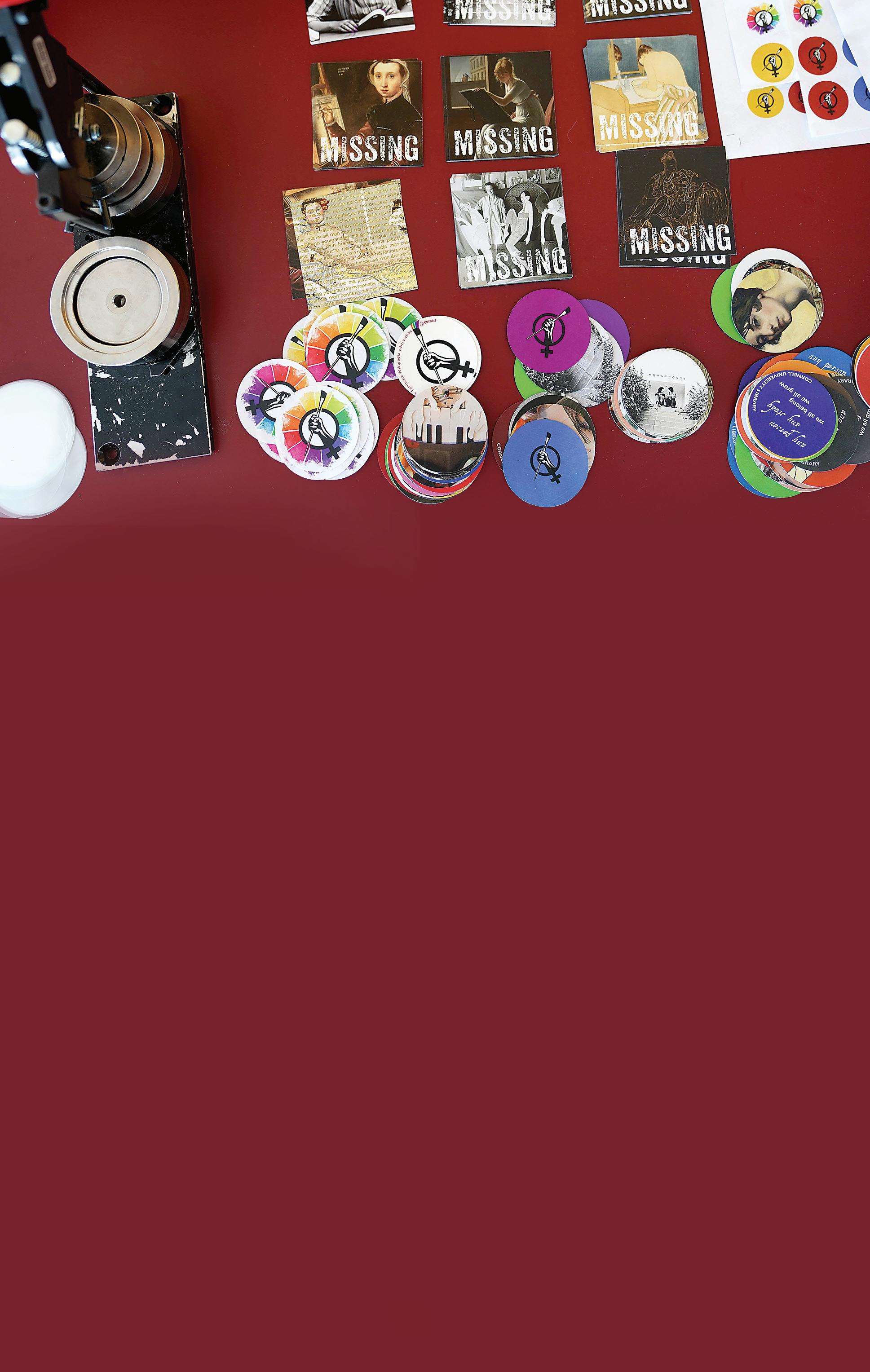
With the hum of laptops and clack of fingers at the keyboard, students, faculty and community members gathered on Friday to create and edit Wikipedia entries of women in the arts, from botanists and scientific illustrators to poets and painters.
This “Edit-a-Thon” was part of an international campaign to improve coverage of female artists, writers and performers. Cornell participated in the movement by hosting the Art+Feminism Wikipedia Edit-a-Thon in Olin Library on International Women’s Day.
For the Art+Feminism movement, training new editors is essen-
tial. Only 10 percent of Wikipedia’s 40 million articles are created and edited by women, according to the campaign website.
“This is an effort that is part of a world-wide program to raise the visibility of female-identifying artists on Wikipedia and female-identifying people in the arts as well,” Brittany Rubin, co-organizer and Johnson Museum curator, told The Sun. “We try to bring in people who have not edited Wikipedia before.”
Three of the four organizers worked the Edit-a-Thon from 10 a.m. to 5 p.m., helping newcomers create Wikipedia accounts and walking them through the editing process.
out by 5:30 p.m. — before the general public even had a chance to access tickets and after the website crashed in the afternoon. According to Manzano, if the ticket purchasing site had not crashed, preventing most purchases, tickets would have sold out in a few hours.
Denice Cassaro, a program coordinator in Campus Activities and CUPB’s advisor, told The Sun that the ticket site relies on both a third-party server and Cornell’s server to both facilitate ticket sales and verify student identification. The back-and-forth between these servers causes
By ANYI CHENG Sun Assistant News Editor
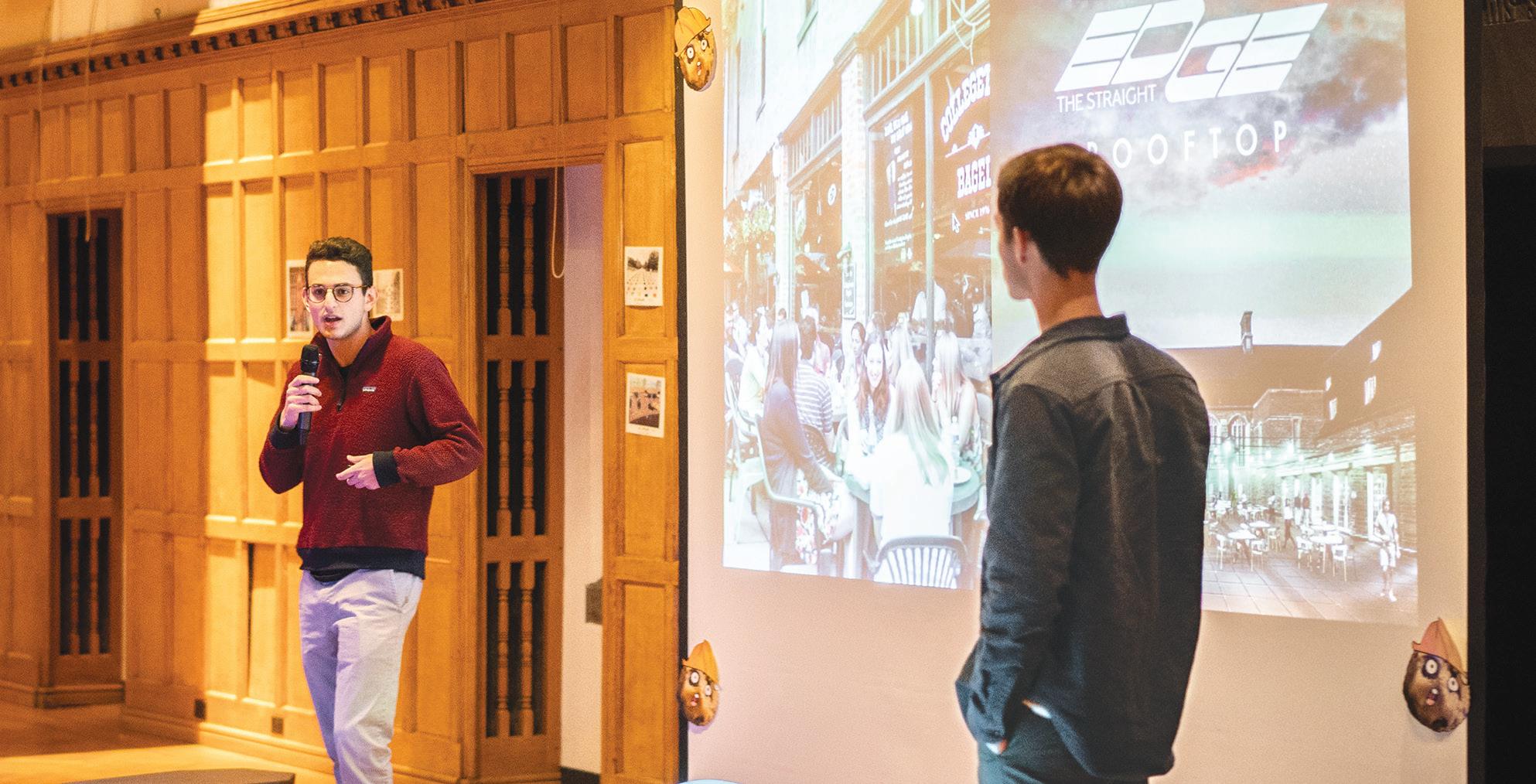
“Reimagine.” That was the power word of Half-Built, a pitch platform event co-organized by The Straight Edge and Half-Baked last Thursday.
The event was structured after “Half-Baked” events, run out of Collegetown’s eHub, where students gather to present startup ideas and snack on cookie dough intended to symbolize “half-baked” ideas. For “Half-Built,” instead of start-up ideas, it was infra-
structure projects.
From bacteria-driven energy collection to shade and light analysis of Uris Hall to mental health space on campus, 13 groups of students across multiple majors and colleges presented their takes in four-minute presentations on how Cornell’s campus could be reimagined at the event last week.
“The student, in this case the user, has very insightful and strategic contributions to the conceptualization and development of a physical campus. Essentially we’re
the perfect designer,” Daniel Correa ’19, president of The Straight Edge, told The Sun. “The university does a great job designing campus, but no campus is perfect. The student can really identify, pinpoint and develop because they know the everyday user.”
The Straight Edge is a project team, originally founded last year to revitalize Willard Straight Hall’s outdoor space. Now, it’s become a group focused not just on
Plankton-inspired Design of Miniature Robots 11:45 a.m. - 1 p.m., Riley Robb Hall, B15
Scientific, Geographic, and Historiographic Inventions of Colombia
12:15 - 1:10 p.m., 153 Uris Hall
The Impact of Ecology Across Scales On Parasite Life History 12:20 - 1:20 p.m., A106 Mudd Hall
Climate Change in Court
2:55 - 4:10 p.m., 233 Plant Science Building
Insights Into Why We Age and How to Reverse It
4 - 5 p.m., 100 Savage Hall
“Bad Rabbi” with Eddy Portnoy 4:30 - 6:15 p.m., 142 Goldwin Smith Hall
Farmers & The Farm Bill
5 - 7 p.m. 404 Plant Science Building
Tomorrow
Connective Recovery in Social Networks After the Death of a Friend Noon - 1 p.m., 423 ILR Conference Center
Dynamic Pricing and Matching for Ride-Hailing 4:15 p.m., 253 Rhodes Hall
The Twilight of Cutting: African Activism and Life after NGOs 4:30 - 5:30 p.m., 106G Olin Library
By RONNI MOK and MILLENA YOHANNES
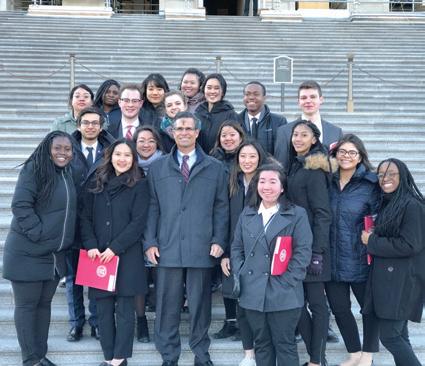
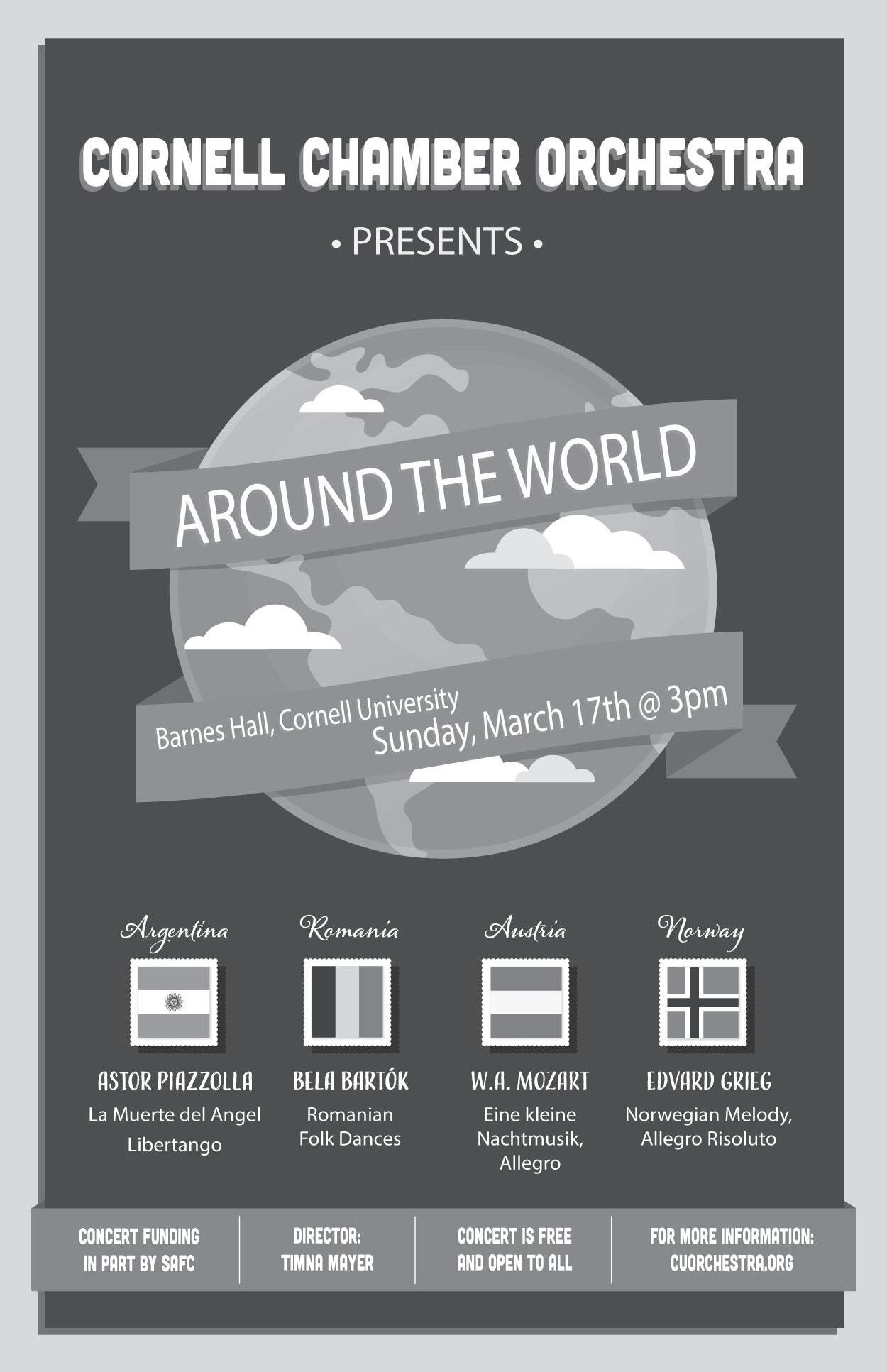
For over 13 years, Cornell students have traveled to Washington D.C. for “Advocacy Day” to lobby Congress to preserve federal fnancial aid programs, and this year was no diferent.
Last week, on March 5 and 6, a group of Cornell students journeyed to Te Hill in Washington D.C., to support the Higher Education Reauthorization Bill — dubbed the Aim Higher Act — which would increase funding for Pell Grants and additional federal programs for disadvantaged students, making loans more afordable.
Over 50 percent of Cornell undergraduate students received federal fnancial aid in the form of Pell Grants or work-study reimbursement during the 2016-2017 academic year.
“We all went with the general consensus that federal aid needs to be increased to compensate for the rising cost of college education,” La’Treil Allen ’22 told Te Sun.
Te trip lasted for two days — the frst spent traveling to Washington D.C. and the second focused on meeting with members of
Congress and their staf
Although the number of meetings varies depending on the number of students attending, the Ofce of Federal Relations tries to allow students to meet with their hometown representative in the House of Representatives along with one senator from their state, according to Kristen Adams, one of the organizers.
“Tis event is a great opportunity for students to tell their stories — of why they chose Cornell and why the federal fnancial aid programs are important to their college education,” Adams told Te Sun in an email. “Te students have powerful stories that resonate well on Capitol Hill.”
Tis year, all students had the opportunity to meet with Rep. Dan Meuser ’88 (R-Penn.), a Cornell alumnus on the House Committee on Education and Labor — the group tasked with reauthorizing the programs that students were advocating for.
“It was notable for us to have met with a Cornell alum and to see that [working in Congress] is achievable, especially because many of the students who went have future aspirations to work on the hill,” Allen told Te Sun.
Some students were also able to catch
glimpses of famous senators while walking through Congressional hallways, including Sen. Cory Booker (D-N.J.), Sen. Ted Cruz (R-T.X.) and Sen. Mitt Romney (R-U.T.).
“It’s funny because we see these people on T.V. and on the news constantly, and we forget they’re real people. Seeing them just stroll down the hallway was just kind of shocking,”
Joanna Hua ’20 told Te Sun.
Allen said that students were grateful for the opportunity to share their stories and meet with the people in charge of making these decisions.
“I wouldn’t be able to go to Cornell without federal student aid,” Allen said. “A lot of times people can get detached from the fact they’re making decisions that have implications on many people’s lives. It’s important that these decisions impact real people and to put real faces to these issues.”
Ronni Mok can be reached at rmok@cornellsun.com.
Millena Yohannes can be reached at my469@cornell.edu
For South African activist and former victim of sexual assault, Jenny Nijenhuis, visual art is not a mere form of communication, but something which represents the “first step in healing.”
Underlining this experience in her keynote speech, Nijenhuis along with Cornell Prof. Naminata Diabate, Africana studies, recounted the impact of the #MeToo movement and sexual violence in South Africa at the “Stories of Empowerment: Women’s Voices Around the World” event on Thursday.
Organized by International Students Union, the event also featured 14 student organizations, who shared information on sexual assault around the world at booths stationed in Klarman Atrium. The booths were backdropped by part of Nijenhuis’ original art installation “Dirty Laundry” — a series of underpants strung on clotheslines donated by victims of sexual assault and violence.
“Our current humanity relies on the masculine perspective, the masculine ex -
perience, and the overwhelmingly loud masculine universal voice, a voice which always tell us that voices of men are superior and that women and girls are less,” Nijenhuis said in her speech. “Less powerful, less capable, less intelligent, have less voice.”
Nijenhuis, who was sexually assaulted when she was young, uses art to speak for herself and to help women in Africa and around the world affected by sexual assault find their “voice.” For Nijenhuis, when verbal communication fails her, visual arts facilitate the “first step towards healing.”
When Nijenhuis learned that only one in 25 sexually assaulted women in a South African province reported rape, she created “Dirty Laundry,” a piece consisting of 3600 pieces of underwear to represent the number of people that could be raped in South Africa each day.
Nijenhuis strung her artwork across public streets so people would interact with the installation.
“[Dirty Laundry] is very bold and inspiring. I just wouldn’t have thought about putting underwear in the mid-

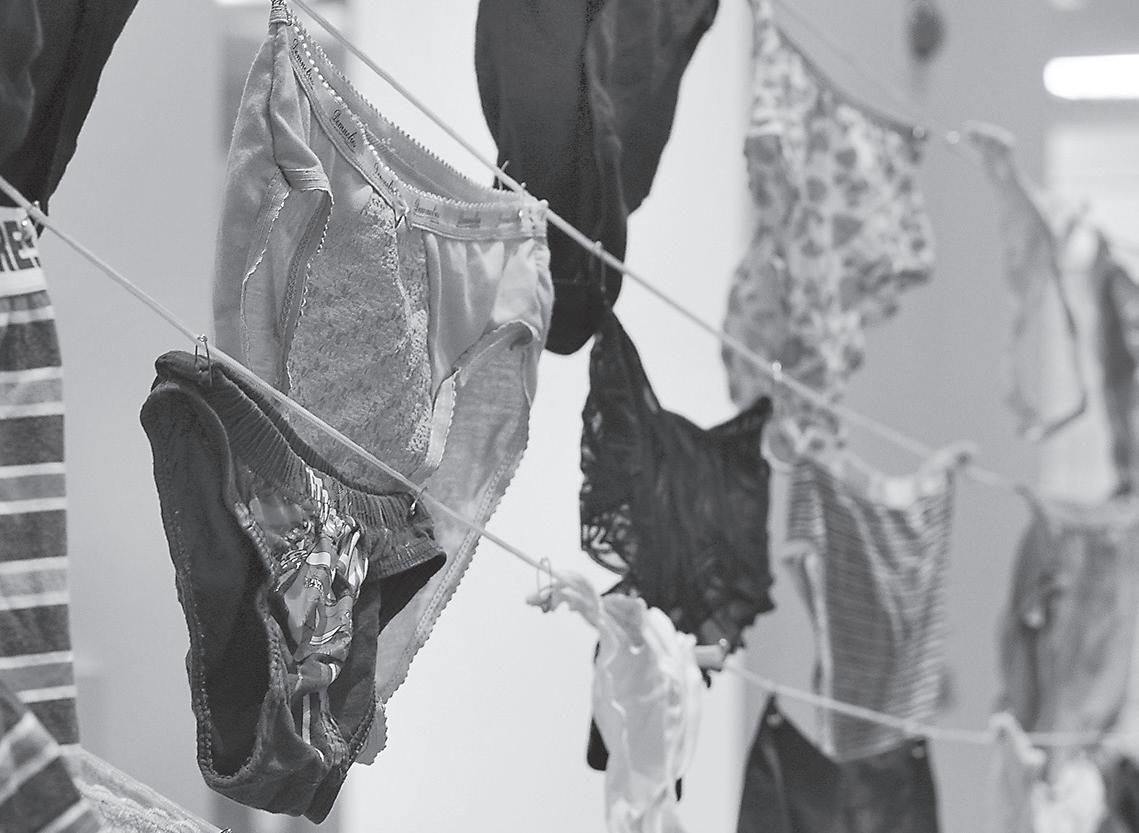
dle of the town,” Chelsea Poku ’21 told The Sun. “Bringing [assault] to life in public, where people once said ‘don’t talk about sexual assault’ — now it’s open to public, in a space you feel safe.”
Providing an academic background to Nijenhuis’ experiences, Diabate discussed the Africanization of the MeToo movement, especially in South Africa.
Of all social media posts tagged #MeToo, posts from South Africa took up 9000 posts compared to the U.S.’s nearly half a million, according to Diabete. This was due to cultural and religious differences, South Africa’s failed justice system, lack of inclusivity in the #MeToo movement and unequal internet access, Diabete said.
Diabate emphasized the importance of distinguishing a “movement” from a “moment,” criticizing news articles that use phrases like “missed opportunity” when describing participation in #MeToo. Diabate argued that there is never a wrong time to participate in the movement.
After the speeches, 14 student organizations held educational booths on sexual violence and movements against it, representing different communities and cultures from around the world.
La Asociación Latina, one of the student groups at the event, presented information on “Ni Una Menos,” a grassroots feminist campaign against gender based violence and the fight to legalize abortion in Argentina.
Kenra Loya ’19, co-president of La Asociación Latina, said she learned a lot by preparing for the event. Even though she had read reports from different coun -
tries, she was still surprised by the statistics and extent to which a culture of masculinity, or machismo, is ingrained within Latinx communities.
HAVEN, Cornell’s LGBTQ student union, also set up a booth in the atrium on Thursday. HAVEN provided information on where students can access LGBTQ+ education, outreach and service throughout Ithaca and the Cornell community.
“I think it’s really important for cultures to reach out to each other and not be silent, because … no one is only in one group. There’s always intersection and overlap between,” Sophia Cook ’20, a member of HAVEN, told The Sun.
Other groups, including Cornell Minds Matter and the Cornell Women’s Resource Center, also provided resources at the event, such as recommending counseling groups and direction to other mental health organizations.
This year marked the first time that Stories of Empowerment was held. Organizers wanted to showcase “how are women around the world [are] fighting to empower themselves,” Malvika Dahiya ’19, event organizer and ISU member, told The Sun.
“The ways in which women are uniquely affected by the cultural context that they’re is strong,” Dahiya continued. “Sexual violence here looks different than another country.”
Aurora Zhang can be reached at yz549@cornell.edu.
Olivia Weinberg can be reached at oweinberg@cornellsun.com.
TICKETS
Continued from page 1
delays and a “bottlenecking,” as Cassaro explained, which can lead to the website server crashing.
Cornell students have the right of first access to tickets because CUPB is funded by the student activity fee, which each student pays to help fund student organizations, according to Manzano.
One reason Eric Andre ticket sales faced long wait times, Cassaro explained, is that CUPB wanted purchasers to be able to select their own seats, rather than opt for suggested seats available to students as they check in at the venue.
Eric Andre’s team also “specifically wanted [the show] to be an event for students,” so that if he tours in the area, his potential audience will boast primarily students — which was part of his contract, according to Manzano.
Regardless, Manzano noted pushback to ticket availability from both the Ithaca community and from Cornell students.
“We’ve noticed specifically that [for] this sold out show … that the response to it selling out has been very aggressive,” Manzano told The Sun. It’s a “very vocal crowd,” inspired by “Eric Andre’s out-of-the-box character.”
Students have further demanded that CUPB change the venue location from Bailey to the much-larger Barton Hall, in order to accommodate interested students who could not procure a ticket. Upgrading the venue was simply not a possibility for Eric Andre’s showing, according to Manzano.
“People don’t realize that there are a lot of logistics that go behind [Barton Hall],” Manzano told The Sun. “You have to reserve [Barton Hall] way ahead of time.”
When Cassaro was asked if she was aware of the ticket sales on Facebook, she acknowledged the activity and warned, “that is not legal for people to be selling tickets.”
After the interview with The Sun, Manzano changed the settings for the event’s discussion page so that all posts had to be approved by the page’s administrators.
“This is just the reality of any ticketed show that gets sold out,” Manzano told The Sun. “Bringing [Eric Andre] back to Cornell is definitely an option.”
Cassaro emphasized that purchasers should be careful when buying tickets online to make sure they don’t receive tickets that have been duplicated, as those tickets will become void at the door.
The show is still slated for 7 p.m. on March 23 in Bailey Hall.

WIKIPEDIA
Continued from page 1
“I think no one here besides us three had edited Wikipedia before today,” Rubin said. Organizers provided guides identifying women in the arts who were lacking online representation, and offered resources to help participants improve article content, add citations and give translations.
By the end of the event, participants had edited a total of 57 articles and begun 11 completely new ones.
First-time editor Alexa Saylan ’22 was drawn to the event’s “message of inclusivity, especially about editing women on different cultural backgrounds, different gender identities, etc.”
Saylan worked on translating an article from Spanish to English.
“Highlighting the art of women across Latin America is really cool to me, and a personal thing for me too because my mom is from Chile,” Saylan told The Sun. “It helps me feel a little bit closer to my Spanishspeaking heritage.”
Newbury has edited Wikipedia for 11 years now, and has worked with the Cornell Art+Feminism movement since it came to campus four years ago.
“We’re so used to being consumers of information on Wikipedia, and we are all scholars of information at Cornell, so it’s easy to apply our skills to improving knowledge for everyone,” she said.
The global Art+Feminism Edit-a-Thon runs for the entire month of March, with edits being counted through March 31.
Resources for editing remotely can be accessed through the Cornell Library website.
CAMPUS
Willard Straight but on exploring the potential in all campus spaces, according to Correa.
Half-Built asked students from all disciplines — hoping to reach outside the boundaries of landscape architecture or engineering — to brainstorm a simple idea on how any part of campus or Collegetown could be improved. The application to present at the pitch event asked for just two things: photos and a napkin sketch.
“The reason for Half-Built was this low barrier to entry. We didn't necessarily want to use the word ‘design’ too much,” Correa said, opting instead for “reimagine.”
“[It] doesn’t matter your major, everyone’s got an imagination and everyone’s got ideas in their head. And everybody approaches problems in such different ways,” Correa continued.
Half-Baked’s pitch events are popular, according to Correa, who noted that many pitch events are full-house. But eHub is
limited in space, and Half-Baked has never had the opportunity to work in a larger space, like the Willard Straight Memorial Room where Half-Built was hosted.
“We shared a lot of [Half-Baked’s] platform. The cookies already had a following, so people knew who they were,” Correa said. “The reason we wanted to partner with [Half-Baked] is that their platform is so user friendly. The whole half baked idea opens it up to everybody. We don't want people to feel intimidated.”
According to Correa, Half-Built has been in the works since the beginning of this semester. Correa and his team originally planned to host pitch rounds within their own organization, but realized that opening the pitch platform up to the public would be a way to also spread the word about the Student Assembly Infrastructure Fund Commission, which provides The Straight Edge’s funding.
The fund is an endowment of over $70,000 for student-proposed infrastructure reform, run by a student committee. Past projects have included electric power outlet strips in Duffield Hall, tabled seating in Green Dragon Cafe and street lamps on


Libe Slope, according to Correa.
The fund has been in place since 2014, but The Straight Edge remains the only project to receive funding for its own operations — other applications to the fund are carried out by the university.
“We really wanted to glorify this platform because we have been beneficiaries of that platform, but every year we’re one of the few student organizations that apply,” Correa said.
All of the pitches presented at the event are eligible for the fund, Correa added.
Rick Burgess, Vice President of Campus Facilities and Services, was in attendance as an audience member.
“Clearly a lot of students have put their minds to creating new spaces,” he told The Sun. “Some of them — everybody presented would agree — could be refined. I think there are many many of them that have very good merit.”
Anyi Cheng can be reached at acheng@cornellsun.com.
BY PETER BUONANNO & DANIEL MORAN ARTS & ENTERTAINMENT EDITORS
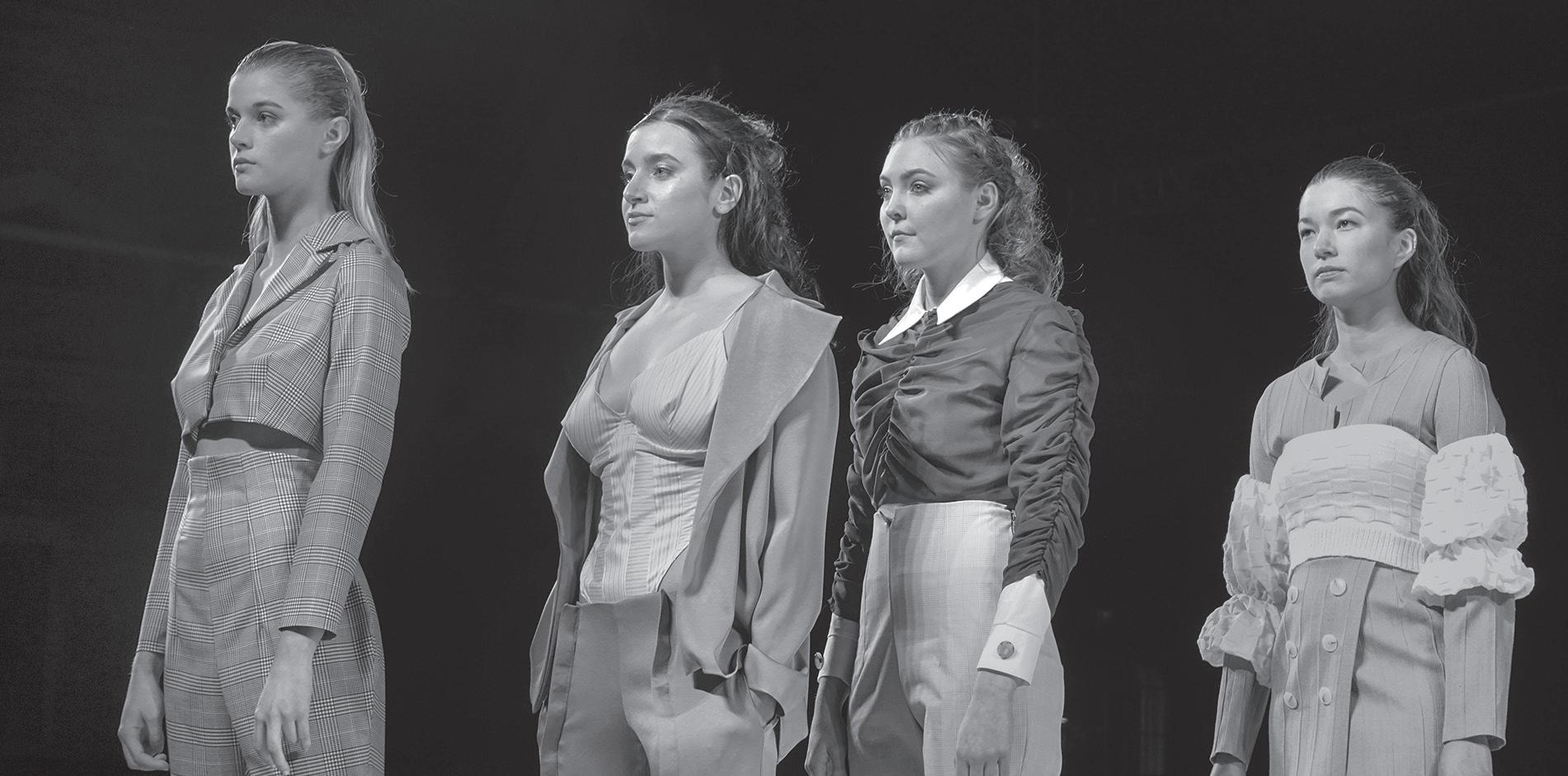
Founded by Onslo Carrington ’88 and Laura Russel ’88 in 1984, the Cornell Fashion Collective started as a small organization based out of Willard Straight Hall. Today, it has grown to be one of the largest organizations on campus, and its show in Barton Hall on Saturday proved that CFC truly puts on one of the biggest events of the year.
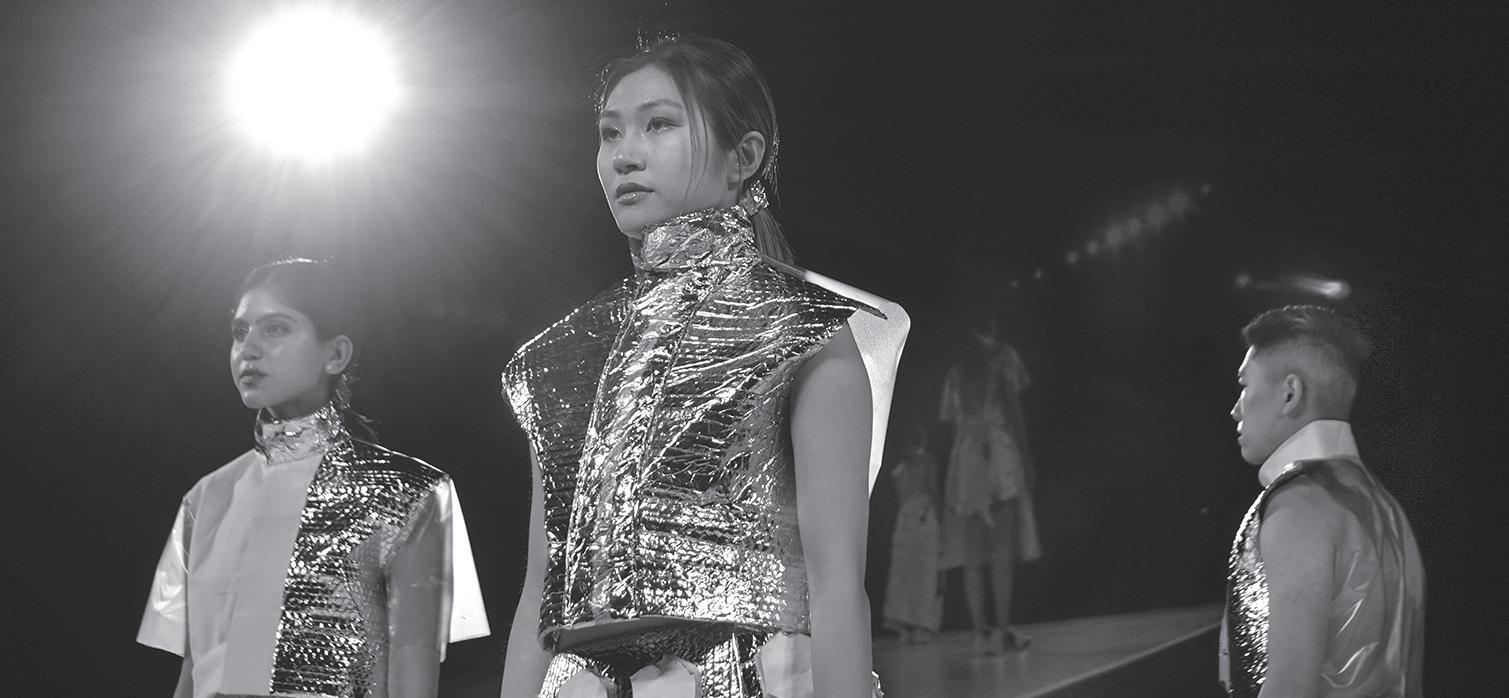
The show began with Eliza Lesser ’20’s Construct collection, which “is inspired by modern industrial architecture, highlighting construction as it focuses on visual appeal and durability” per the CFC program booklet. Lesser’s execution was flawless and one could surely see pieces from Construct being worn on the streets of New York or Los Angeles.
Construct was a fantastic opener to the event and the show immediately built off it with Hansika Ayer ’19’s Scrap collection centered around the idea of waste as a design flaw. Having the models dance on the runway was brilliant, as any way of showing your collection that isn’t just a typical runway walk will always be eye catching.
Ensemble followed Scrap, and to say the least, it was stunning. At a base level, the collection was beautiful, feminine and empowering. It was as if Katherine Williams ’20 was designing for award shows and Met Galas alike. However, it was the ornaments that really differentiated Ensemble as a true work of art. The collection combined music and fashion in a way never seen before, as Williams used parts of a flute for the buttons on a piece and engulfed her models in classical instrument strings. She even styled one piece to represent a treble clef. Finally, her use of gold tuning pegs in the collection was breathtaking.
Julia Deney’s My Forever Sunshine was the definitive crowd pleaser of the night. It’s hard not to steal the show when you have a bunch of little kids modeling your collection. All of the kids had their own special spunk that really showed through in their brightly colored clothes and the most adorable hand holds you have ever seen. In her booklet, Deney wrote that My Forever Sunshine is dedicated to her late best friend Katherine Schlegel, who passed away earlier in the year. Deney described how Schlegel never failed to fill her life with laughter and love — it is safe to say that Deney’s collection carried on that legacy to the audience, as the resulting warmth was one of the most truly human moments of the show.
The level three collection To the Moon — designed by Caley Droof, Shoshana Swell and Amrit Kwatra — is dedicated to “anyone who is trying to blast off and reach their dreams.” This collection made use of
unconventional materials such as vinyl and insulation and was the only collection of the night to feature electronics. Model Brendan Elliott ’19 commented on the collections uniqueness: “Amrit works a lot with electronics, so he wired the piece [I modeled] up so that the lights pulsed. I don’t think any of the other pieces used electronics so it was really cool to be a part of that.”
Other standouts included Georgia Manning’s ’21 two piece collection, which featured a pearl studded shirt which created a sheer effect without the use of fabric on the torso. Stephanie Laginestra’s Elements was also stunning and the skirts featured in her collection were beautifully structured. In an interview with The Sun backstage, Laginestra spoke about how proud she is to be a part of CFC and that “she loves this day and this club.”
CFC president Narhee Kim ’20 echoed these sentiments by saying to her designers, “Thank you so much for being patient with me, thank you so much for just allowing me to be president of this club . . . I’m so proud of everyone, of all the designers and all that hard work that everyone did, and I just love this club so much and just had such a fun time over the year.”
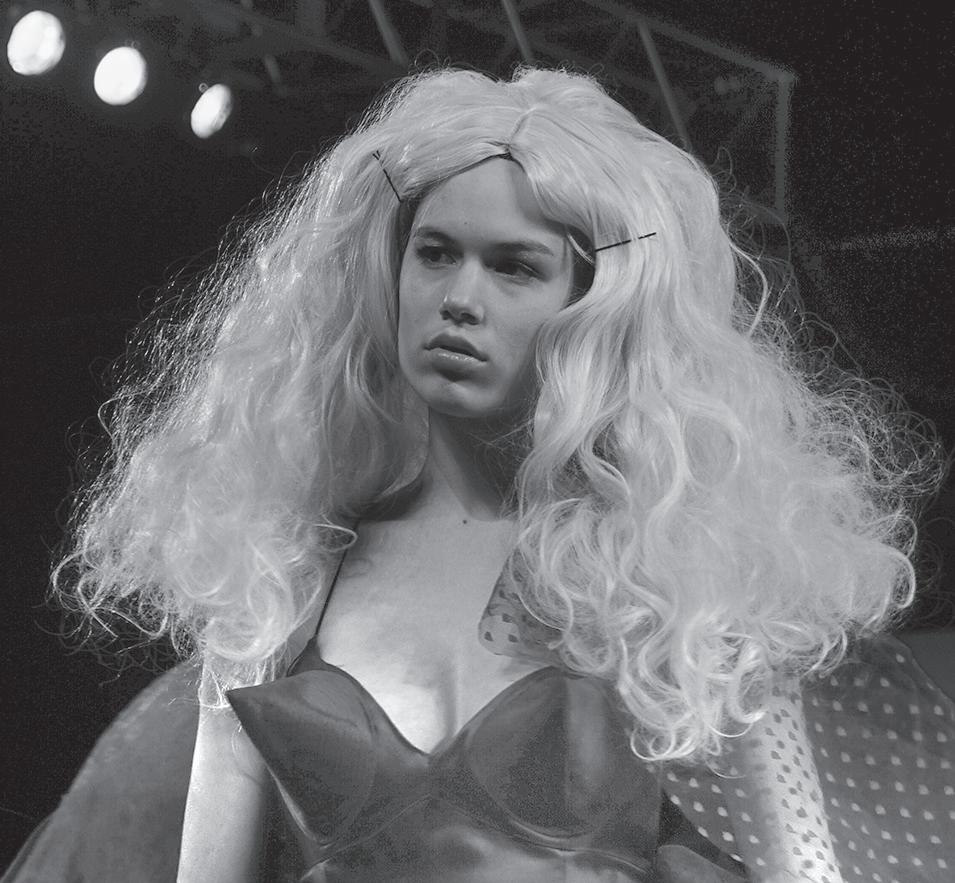
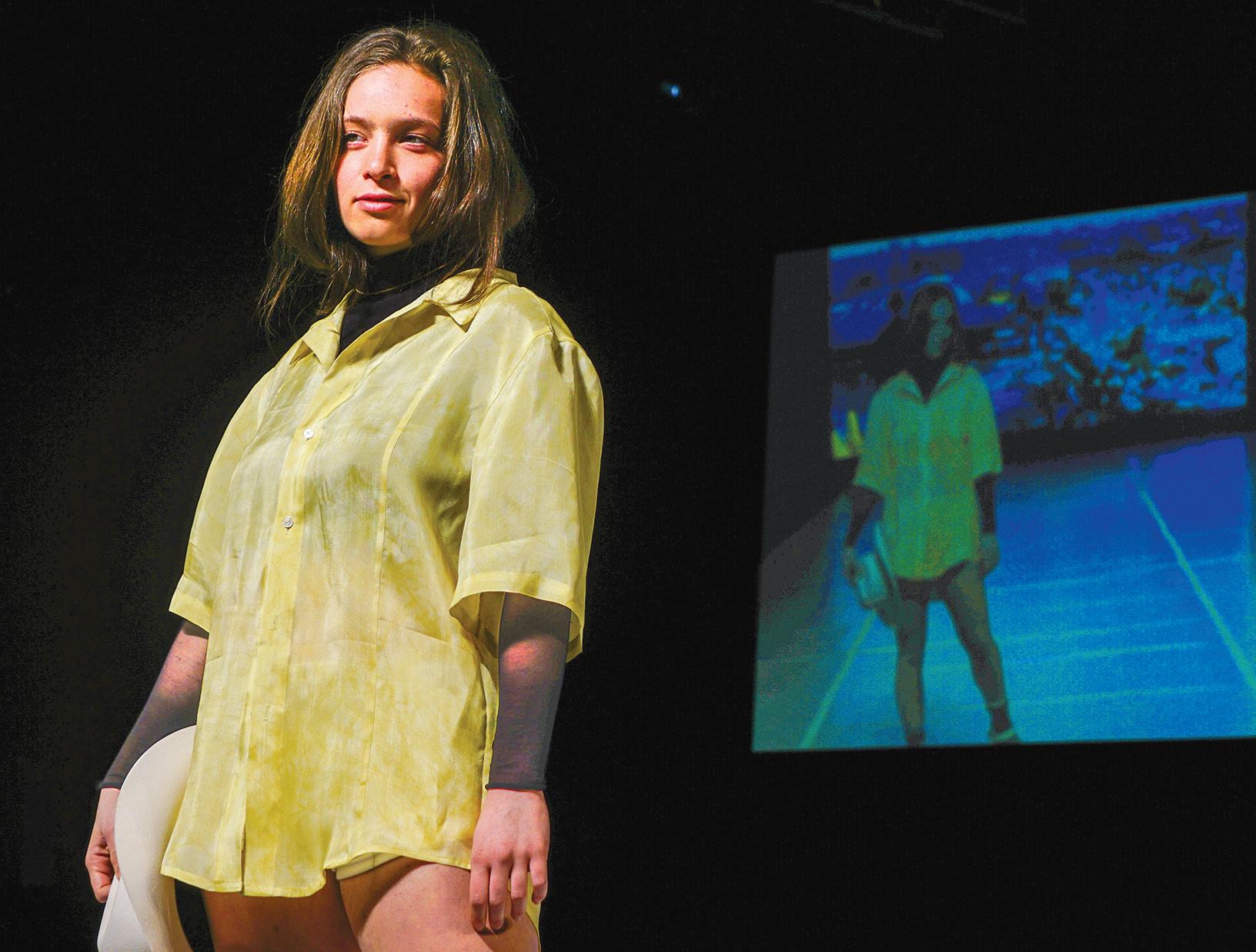
Our consensus favorite show was Regina Mun’s Full Circle, which incorporated discarded fabrics to create a collection of unisex garments. Inspired by her family’s move and mass purge of old clothing, Full Circle’s Western imagery truly stood out. Originally intended to be a streetwear collection inspired by movies and “dad fashion,” Mun found that much of streetwear is superficial and wasteful and decided to take a more sustainable route. We found her repurposing of old fabrics unique; Mun described her work by saying “A lot of people upcycle things but they look very patchwork-y … I wanted to get away from that and make it look new and make people want it… and redefine what is new and what is used.”
Additionally, Full Circle had the best visual effects, beginning with a distorted video of a landfill dump and looping it in the background to foreshadow the collection’s theme before the models started to walk.
As for her goal behind the collection, Mun explained, “I want people to really consider and take value in the materials that they wear and know where they’re coming from, take care of them … even if you throw it out it still comes around, either to haunt us or to make our lives better.”
Pete Buonnano is a sophomore in the College of Arts and Sciences. He can be reached at pbuonanno@ cornellsun.com. Daniel Moran is a sophomore in the College of Human Ecology. He can be reached at dmoran@cornellsun.com.

BY DANIEL MORAN AND JEREMY MARKUS ARTS & ENTERTAINMENT EDITORS
It’s time for your Arts editors to give their honest opinions of what went down on the runway of Cornell Fashion Collective on Saturday. First up is assistant arts editor Daniel Moran’s takes:
One minor but important thing that stood out to me was that the designers in this event weren’t afraid to have fun with this show. You could tell it was student run, but not in the sense that it seemed unprofessional, but because everything was so fresh and unique in a way that only a bunch of student designers could make it. It was incredibly unpredictable, but that’s what made it fun. One minute there’s a collection based on outer space, the next there’s a children’s line walked by actual kids, and in another moment there’s a dance performance.
I was a big fan of Margaux Neborak ’19’s My Key (To The Heart) EDM inspired show. I went into it ready to hate: I don’t like EDM, and she tagged her brother’s SoundCloud in the program. However, the show was fantastic, and further listens proved me wrong about EDM. Neborak described her collection to The Sun as “going from the ethereal to the EDM inspired and back to the ethereal.” I think she more than accomplished this, and all of her pieces looked like they could range from the red carpet to the club to a wedding chapel, flawlessly.
My personal favorite was Regina Mun’s Full Circle. This might be a stretch, but I honestly felt like it is the first collection I’ve seen that makes western clothing both interesting and wearable, even more so than Raf Simon’s first Calvin Klein collection. The fact that all fabric was recycled was cool, too. Thanks for worrying about the planet, Regina.
Now for Jeremy Markus, our lovable, if slightly fashion illiterate, assistant arts editor:
To be frank, I had absolutely no idea what was going on. I am not a fashion-minded person; sauce me a comfy pair of sweatpants and a fluffy flannel and I’m content. I don’t mean to offend any of the designers who spent a lot of time and effort on their collections. It’s not personal. I just hate fashion shows. Regina Mun’s upcycled outfits were unique, and the cowboy hats were a nice, if not slightly odd, touch. I’m not a country boy myself so I was a little uncomfortable with the headwear, but that might have been because the elderly woman next to me and I touched feet. Was it an accident? I’d prefer to think so. Yee-haw.
Designers Caley Drooff, Shoshana Swell, and Amrit Kwatra said that they hoped To The Moon would “transport [the audience] to another galaxy.” When the models walked out decked in paper-white suits I was thoroughly confused. Transported to a galaxy far, far away I was not; I felt like I was in The Bee Movie.
Daniel Moran is a sophomore in the College of Human Ecology. He can be reached at dmoran@cornellsun.com. Jeremy Markus is a freshman in the College of Agriculture and Life Sciences. He can be reached at jmarkus@cornellsun.com.
“Iwonder when I’ll stop coming to these movies.”
My friend and I were standing by the entrance to the mall waiting for our Uber when the thought occurred to me. It was a warm evening, and we had just come out of Captain Marvel, all but screaming excitedly at each other as we made our way out of the theatre. The movie didn’t disappoint, and it was both thrilling and comforting, as it always has been, to come back to and discover more about a world we’ve grown to know perhaps as well as the one we actually live in. Yet bubbling under the surface was an anxiety that’s been gradually materializing itself over the past year, that I’ve so far done a pretty good job ignoring — like all good things, this too must come to an end someday, perhaps even someday soon.
“Maybe if the movies after Endgame aren’t as good as we want them to be, or if they try to reboot stuff,” she replied after a minute of pensive silence. The two of us might be what some people call hardcore Marvel Cinematic Universe fans, and cutting ourselves off from this world had once seemed unimaginable. “Even though I hate it when people complain about how reboots always ‘ruin’ the original.”
Reboot. The word struck me, making me think back on an interview with Daniel Radcliffe I recently came across. The interviewer asked Radcliffe whether he’d consider appearing in a Harry Potter reboot, making it sound like a remake is inevitable and not far off in the future. Oh, I had realized with a start, I’ve gotten to an age where I will start seeing things I loved being remade.
What is it, then? What is it about remakes that angers people so much? I’d never given that question too much thought. Some argue that it’s because fans are worried about the new one being unequivocally bad and tarnishing the reputation of the original; some say that it’s because remakes are often made out of recycled material, they bring nothing new to the table and are born out of studios’ desire to capitalize on the popularity of the original.
Yet off the top of my head I could think of a few instances in recent years when the Internet became outraged over remakes and recastings, and none of those seem to fit the above descriptions. Some of them were because trolls could not get over the casting of actors of a race or gender different from the original, for example Ocean’s 8 and Ghostbusters, which are all-female remakes of their original counterparts, and perhaps more famously, Harry Potter and the Cursed Child, which cast a black actress as the older Hermione. On the other hand, there are remakes that sparked debate precisely because they tell a different story, perhaps too different. The Star Trek reboot, when it first came out in 2011, was pitted against the 1960s original in every possible way, despite being a completely new, free-standing movie. Sure, Chris Pine’s Captain Kirk is nothing like William Shatner’s, but that didn’t stop me from becoming a new fan, having known absolutely nothing about the franchise before. In the end it all comes back to nostalgia and how having a personal
stake often makes our judgement not so sound. It is not to excuse the close-mindedness of being against color-blind casting, or disparage

legitimate criticisms. What I am saying, however, is that for the first time I’ve come to understand how much of ourselves can be tied up in
films and the fictional worlds that we love.
When I think about Harry Potter I’m also thinking about ten year-old me, knowing barely any English, trying to understand the movies without subtitles. When I think about Marvel films I’m also thinking about going to the movies for the first time in America, about latenight theorizing over bubble tea
and making my friend stream the Super Bowl just so I could catch a thirty second trailer. The idea that something we love is ending may be hard, but the idea of it continuing and changing, whether for the better or for worse, is an even harder pill to swallow because we can’t bear the thought of parts ourselves being left behind and some of our fondest memories overwritten.
Is that truly inevitable, though? Is it possible that we have a choice to embrace the changes, to make room in our lives for the new, right alongside the old? After all, it does not do to dwell on old memories and forgo making new ones, to watch the
world carry on and let ourselves be borne back into the past.
“I don’t want to become one of those people,” I turned to my friend. I want to be able to watch the Harry Potter remake or see a Marvel movie another ten years down the line, when I as a person have also been made anew, and be able to remember my younger self and say to her: Hey, look at how far we’ve come.
Andrea Yang is a junior in the College of Arts and Sciences. She can be reached at ayang@cornellsun. com. Five Minutes ‘Til Places runs alternate Mondays this semester.
137th Editorial Board
ANU SUBRAMANIAM ’20
in Chief
DAHLIA WILSON ’19
Business Manager
PARIS GHAZI ’21
Associate Editor
NATALIE FUNG ’20
SARAH SKINNER ’21
Managing Editor
MEREDITH LIU ’20
Assistant Managing Editor
RAPHY GENDLER ’21
Sports Editor
Working on Today’s Sun
Ad Layout Jamie Lai ’20
Production Deskers Dana Chan ’21
Mei Ou ’22
News Deskers Rochelle Li ’21
Shivani Sanghani ’20
Design Deskers Megan Roche ’19
Jamie Lai ’20
Laura DeMassa ’21
Avraham Spraragen | Guest Room
Cornell, an intellectual Garden of Eden, has been my “home away from home” for three miraculous semesters. There is only one other paradisiacal location on earth that is as close to my heart as the Big Red: The State of Israel. I deferred my enrollment to Cornell, resisting the allure of its 25-acre Botanic Gardens, to take a gap year at the Hebrew University of Jerusalem, with its similarly alluring 25-dunams Botanical Garden on Mount Scopus. The miracle of a “nation reborn,” as Israeli author Daniel Gordis characterizes the return of the Jewish people to their homeland, lies at the heart of my deep connection to the State of Israel. I was accepted to Cornell nineteen years after having been born in the Weill Cornell Medical Center; Big Red was my destiny. Likewise, my people were destined to return to Zion. When the former threatens to boycott the latter, as Cornell Students for Justice in Palestine has, my heart breaks.
The Boycott, Divestment, and Sanctions campaign against the Jewish state officially returned to campus last month, after being defeated in 2014. On Feb. 18, SJP announced the start of its #CornellDivest initiative, describing my homeland as “morally reprehensible.” Two days later, SJP chose division over dialogue by threatening to come after Israel using the “names and addresses” of her supporters. SJP then publicized its divestment letter to President Pollack. Riddled with inaccuracies and vitriolic language, the letter and its corresponding Facebook caption ignore Jewish indigeneity to Palestine and engender hatred towards pro-Israel Cornellians, such as myself. Unfortunately, this is not the first time SJP chose hate over love, in direct contravention of Cornell’s founding principles. Last semester, as a barrage of rockets from Gaza were raining down on southern Israel, an SJP member published a letter in The Sun approving the “destruction of Israel as a Jewish state.” I responded to this hateful attack with an article of my own, in which I extended an olive branch to “well-meaning critics of Israel.” I offered to “engage in civil and substantive dialogue” and encouraged “all Cornellians to stay true to our university’s motto of accepting ‘any person.’” This olive branch was beaten to a pulp as SJP has carried on with its vilification of the Jewish state. The current hate-filled BDS campaign is their latest iteration.
I will not dignify SJP’s vicious, fiction-based sloganeering (e.g. “racialized apartheid state,” “settler-colonial project rooted in genocide,” “ethnic cleansing”) with a comprehensive rebuttal. SJP’s most recent attack against the pro-Israel community on campus speaks for its ill-conceived self: In response to a report in The Sun about a “closed door meeting” between an “executive board member of Roitman Chabad Center at Cornell” and S.A. representatives, SJP accused Chabad, an apoliti-
cal Jewish organization, of “shady politics.” This accusation is wholly unfounded; the Chabad ‘executive board member’ did not meet with S.A. representatives in an official capacity, according to Rabbi Eli Silberstein, the Roitman Chabad Center at Cornell director. SJP’s smear also came with a message of “[sincere] hope that this entire process is kept civil.” Here is my message to SJP: Instead of using the antisemitic canard accusing Jews of ‘shady politics,’ heed your own advice and behave civilly. Also, my offer from last semester still stands. Let’s exchange points of view in a respectful manner, rather than threaten BDS and Israel’s destruction.
The BDS movement has three demands: 1) “Ending [Israel’s] occupation and colonization of all Arab lands,” 2) “Full equality” for the “Arab-Palestinian citizens of Israel,” and 3) “Promoting the rights of Palestinian refugees to return to their homes.” My questions for SJP are as follows: In demanding an end to Israeli “colonization of all Arab lands,” are you denying Israel’s claim to any of historic Palestine? In demanding that some 5 million Palestinians be granted a “right of return,” is your aim to erase the Jewish character of the State of Israel, thereby dismantling the safe haven of my people? Regarding demand number two, I recognize that inequities exist in my country, as they do in countries worldwide. I also agree wholeheartedly that Israel must ensure full equality to its 20 percent Arab minority. Our response, however, should not be to seek the elimination of Israel, but to strive for meaningful reforms. So long as BDS and Israel’s destruction are no longer on the table, I am your ally in the fight against lingering inequalities in Israeli society. Finally, I urge SJP to consider the grievances against BDS that Cornellians for Israel outlined in a recent letter in The Sun, as well as the words of our University’s president. In a statement responding to SJP’s #CornellDivest initiative, President Pollack wrote that BDS’ call for “academic boycott” is “at odds with Cornell’s core commitment to academic freedom and the open exchange of ideas.” An example of this ‘core commitment’ in practice is the Jacobs Technion-Cornell Institute, a joint venture between Cornell and the Technion-Israel Institute of Technology to “serve the worldwide common good.” Does SJP want to see the dissolution of this globally altruistic partnership as well? Reflecting on my experience at Hebrew University in an article for the Times of Israel, I described “education” as having the power to “break down walls.” I am confident that by rejecting BDS and instead engaging in productive discourse, we can break down the wall between the Slope and Mount Scopus.
Spraragen
The word “snowflake” is used to identify a person who has an inflated sense of uniqueness — a person with too many emotions and an inability to deal with opposing opinions. It has become a politicized insult by the political right to insult the left. Those targeted as “snowflakes” are seen as fragile, weak, easily offended and desperate for “trigger warnings” and safe spaces. While frequently used to insinuate and insult, it has been increasingly common for Trump protestors to hold up signs that say, “Damn right we’re snowflakes and winter is coming.”
College students seek emotional health by demanding protection from words and ideas they don’t like, suggests an article in The Atlantic, which is actually detrimental for their education and mental health. The authors warn against trigger warnings and restricting speech because students must learn to live in a world that has a plethora of potential offenses. I approached the article with an open mind, as I was told it was well-written and worth the read. But by the end, I was merely frustrated.
The authors argue that trigger warnings and microaggressions are blown to proportions that prevent productive discussion. They tended to focus on the very extreme cases like a law student asking her professors not to use the word “violate” (in “that violates the law”) since it could cause students distress to defend their idea that students are reporting more emotional crises. The authors use the question “Where are you from?” — asked mostly to Asian Americans or Latinx Americans — to transition into an example of an installation being taken down at Brandeis University after Asian Americans found that it perpetuated microaggressions. Perhaps instead of viewing these people as “overly emotional,” we should ask ourselves why this question offended them in the first place?
As an Asian American, getting asked “Where are you from?” is infuriating. While it usually comes from general curiosity and isn’t ill-intentioned, it’s extremely alienating and assumes foreignness. It’s an “othering” question that seeks to define you and confirm presumptions about cultural identity. I usually respond with “Philadelphia,” in which the person says, “No, where are you really from?” as if they assume I can’t really belong here. I distinctly remember an artist from China who came to my elementary school to give a presentation on his artwork. He did beautiful paper cutting. I was surprised, however, when the faculty invited me to have lunch with him without asking me any questions first. They had, in fact, assumed I could speak Chinese and would be able to engage with him. I couldn’t speak Chinese. He came from mainland China; my parents are from Hong Kong. While he spoke Mandarin, I could only understand Cantonese. I thought his artwork was stunning, but I didn’t have the connection with him my teachers hoped for. I didn’t understand his references. I was just like any other kid in elementary school who had been excit-

ed to skip class to watch his presentation. Putting students in the box of fragility as people who need protection dismisses lived experiences. Those that continue to commit microaggressions and engage in hate speech should be taught why their language may offend and hurt others. Students, the article authors also argue, desire protection “from psychological harm.” They continue to say that the need for trigger warnings on campus has led professors to issue them before covering material that might create emotional distress for students. Classroom discussions, they write, are safe places to be exposed to incidental reminders of trauma.
As a university student myself, class is not always a productive or safe space to discuss issues — especially when we deal with our trauma. At Cornell, we come from various backgrounds and experiences and may have strong ideas on certain topics — or may not be able to relate at all. In classes in which students always fight to be “right” or get graded on participation, the classroom dynamic can become argumentative, competitive and unproductive. My friend was in an English class in which the professor told the students that they would be discussing suicide. My friend, who had lost someone very important to her, decided not to attend class and spent that day for herself, cherishing the memories she had with the person she lost. That decision was far more productive than sitting in class and discussing a subject many people could not relate to and might cause emotional distress. The classroom is not a place where you should be expected to relive your trauma.
As an Asian American, getting asked “Where are you from?” is infuriating. While it usually comes from general curiosity and isn’t ill-intentioned, it’s extremely alienating and assumes foreignness.
We must be more aware of how we speak. It’s also a time in which polarizing, dividing talk has been used to strip individuals of their humanity. Recently, President Trump announced his plan to protect free speech on university campuses, threatening to cut off federal funding if colleges don’t allow for views across the political spectrum. Perhaps the article authors would have a changed their opinion in a political climate where speech has been increasingly isolating, harmful and destructive. Instead of complaining that this “new climate” of microaggressions and trigger warnings is being institutionalized and not preparing students for the real world, perhaps it is better to educate those who do not realize that their speech can be hurtful, divisive and unproductive. By disregarding the emotions of those who react to this kind of discourse, they are dismissing both the individual experience, as well as the collective one of many. It is important for students to engage in conversations that question their own biases and world views while respecting the reactions of those who have been asked “Where are you from?” far too many times — and who would, quite honestly, wish to never hear it again.
My mom and I shared a life motto whenever I had struggled with heavy burdens: “What’s more important?” She had always taught me to ask myself this question because life would never be so simple and straightforward. More than ever, I’ve realized the true purpose and meaning of this question.
In a calm and seemingly mindless daydream in the buzzing quiet Kroch library in Olin, my mind was lost in a chaotic and loud frenzy. Flashes of my Google Calendar stamped a never-ending list of tasks through my head in a loop. This semester, I often find myself in this random,
I was fixated on things that didn’t actually matter, and this dissociation from my core values was what really threw me off balance and into a lifestyle where priorities were nonexistent.
momentary crisis, pondering the same dilemma of what comes next. As my focus drifted away from the present, I found myself treading on a minefield of explosive, repetitive and unnecessary overthinking of the future — the realm of the incomplete. The pressure of unorganized priorities bombarded my thoughts, sparking confusion, uncertainty and underlying panic. I felt as though I had lost control over my own mentality, catapulting myself straight into a tumbling catastrophe.
From the beginning of the semester, I filled my plate without considering how many hours were in a day. With back to back meetings, club events and more than 10 hours of research a week, I had always started my studies at 10 p.m. at night, much too close to my desirable bedtime. Weekends and Friday nights were set aside for
catching up on a backed up schedule; there was just never time and space for myself. I didn’t think about the realistic time commitment, and I definitely didn’t consider the consequences of such a burden. Instead, I only focused on an idealistic, short-term vision. As my advisor had put it: I was spreading myself too thin. Like promises I couldn’t keep, I made too many commitments I couldn’t make.
Not realizing this, all I could think about everyday at every hour for the past few weeks was the horrifying list of empty tasks that awaited completion, further preventing me from accomplishing anything. Unable to prioritize one thing over the other, I was conflicted and didn’t know where to begin. When my thoughts were constantly revolving around tasks that held no substantial meaning or personal importance, I felt the stinging realization that my achievements were no longer genuine.
I didn’t grow from the process nor did I really learn. I was fixated on things that didn’t actually matter, and this dissociation from my core values was what really threw me off balance and into a lifestyle where priorities were nonexistent and where ultimately, nothing really mattered. I was living to cross tasks off in my planner — living to feel the 30-second satisfaction of slashing the assignment with the glide of a pen. In the end, I wasn’t living for myself. Without having set priorities for myself and my wellbeing, my core values were thrown into the mix of trivial tasks and were essentially weighed the same in terms of what personally mattered to me the most.
I snapped out of my mid-assignment daydream and noticed that the clock read 2:05 a.m. I had about three-quarters of a single assignment completed, yet my night was not going to be over anytime soon. It was in that moment where I realized that I was doing something wrong, and the source of the problem was my lack of prioritization or at least I was prioritizing in a way that devalued the beliefs that I strongly identified with. Consequently, I found myself completely engulfed in academics and extracurriculars at the expense of the quality of my health through poor eating and sleeping habits. Normally a typical joke passed back and forth between
Giancarlo
Cornell students, the severity and reality of three hours of sleep and skipping meals is always drastically understated. At Cornell, it’s expected to be so overwhelmed with the plethora of opportunities offered. It’s easy to say ‘yes’ to everything without a second thought, scribbling your Net ID left and right during ClubFest. In the end, however, the importance of prioritizing myself became clear. It provides a sense of a stable structure, a voice of reason and a nudge in a positive, upward direction. With clear priorities, the goals are known and within an achievable extent. It also allows me to make my experience at Cornell much more memorable and meaningful. Cornell provided all the possible opportunities I could dream of, but it was ultimately up to me to choose wisely for the sake of my literal sanity.
Unable to recognize myself as the center of it all, I had set myself aside and neglected my well-being like just another task to cross out. But talking to my friends and faculty advisor helped me realize the hole I was digging myself into and inspired me to look at the much larger picture. If I couldn’t put in 100 percent into the commitments I cared about the most, then it was clear that having such commitments only diminished the value of the opportunity itself and its impact on my own self-development. In the end, I was sacrificing more than I needed to, when the solution was actually quite clear and simple. Decisions had to be made, and the right decisions would be those that bring happiness in the process, in the present, and especially in the long run.
Nearing 2:30 a.m., I looked down at my incomplete day, the scribbles each carrying the heavy weight of work and demand. And I asked myself, “What’s more important?”, and at this point, the answer was clear. I closed my laptop, packed my bag, and began my trek back home. Despite all the commitments I couldn’t make, I could make one — a commitment to myself.
Alexia Kim is a sophomore in the College of Human Ecology. She can be reached at alexiakim@cornellsun.com. Who, What, Where, Why? runs every other Monday this semester.
On Thursday evening, the largest blackout in Venezuela’s recent history began, and it continues to leave the vast majority of the country in the dark. This serves as the latest punctuating event in a long-term humanitarian crisis that has recently included the detainment of American journalist Jorge Ramos when he tried to show notoriously-glutted President Nicolás Maduro a video of Venezuelans picking through garbage for food, the failure of international humanitarian aid to enter the country due to blockage by the military and National Assembly President Juan Guaidó’s declaration of himself as the legitimate president.
The true victims of this government-denied crisis are the Venezuelan people. And yet, in a U.S. context, discussion of this crisis has had a collateral casualty: history. On both the left and right of the political spectrum, actors have misrepresented the past to further their present aims.
On the left, a prime example comes from one of my fellow columnists, who last month described why the U.S. has no reason to be involved in Venezuela, citing the U.S.’s own flaws as a democracy and its history of intervention in Latin America. On these points, I do not fundamentally disagree. U.S. democracy has conservatively-biased, fundamentally-flawed cogs. When they rust due to the influence of money in politics, partisan gerrymandering and geographic sorting, the machine breaks down, explaining the author’s cited disconnect between the citizenry’s viewpoints and those of their representatives.
As a dual-citizen of the U.S. and Brazil, I am all too aware of the ugly side of U.S. talking points on freedom and democracy. This is especially true nowadays, as I
watch President Trump, the secretary of state and former ambassador to the U.N. congratulate a president whose monstrous rhetoric makes me fearful of traveling back to the country where my dad was born.
And yet, claiming that the U.S.’s democratic flaws are in any way comparable to Venezuela’s is an astounding distortion of politics there since Hugo Chavez’s election in 1998. He and his successor have taken actions against the press that exceed Trump’s bombastic fervor with restrictive action. Chavez and Maduro both manipulated elections, including the most recent one, and when Maduro didn’t like the results of the National Assembly election in 2015, he stripped the body of its power. Often this election manipulation has involved the infliction of violence upon opposition supporters and leaders, a practice not confined to campaign season. This is to say nothing of the fact that Hugo Chavez’s involvement in politics started with his own extra-judicial coup in 1992, a fact which simply can’t be explained away by pointing to a flaw in U.S. democracy.
Manipulation of history in response to the situation in Venezuela is even more extreme on the right. Immediately before invoking the South American nation, Vice President Mike Pence claimed in a speech to the Conservative Political Action Conference that it “was freedom, not socialism,” which was to account for America’s prosperous economy, the ending of slavery and winning of two world wars, “moving beyond” prejudice and high quality of life. These are all lies. America’s economy was built on exploited labor that restricted the freedom of disenfranchised groups. As described by
another Sun columnist, the South’s economy was built on the backs of African American laborers, during and after slavery. The nation’s railroads were built by Asian immigrants, whose entry into the country was shortly thereafter restricted. Many Mexican immigrants who came to the U.S. to work were eventually “repatriated” after their contributions were made. Furthermore, the U.S. victories “for democracy” in World Wars I and II were contradicted by the continued segrega tion of the forces doing the fighting and the internment of JapaneseAmerican citizens during the lat ter of those two conflicts.
Throughout, and even before, the Cold War, the Soviet Union used segregation as a chance to question the U.S.’s moral authority. Exemplifications of the persistence of racial inequality such as the protests in Ferguson continue to be rhetorical fodder for not just Russia, but other undemocratic states such as Egypt, Iran and North Korea.

Most morally bankrupt and shockingly dishonest of all is the implication that it is some sort of freedom which is ending prejudice. Mike Pence is a man, who, when governor of Indiana, had such a skewed conception of freedom, that he tried to enshrine the freedom to discriminate in statute. No matter how much he guffaws, he specifically is somebody who can make no claim to the moral authority of ending prejudice. The fact that he would even make such an implication is despicable. Beyond being a distortion in an academic sense, such sanitization of history also has consequences for situations like Venezuela. It not only gives my fellow columnist an excuse to engage in whataboutism on the behalf of undemocratic governments, but gives those governments license to do so themselves.
We hold the U.S. to a high standard so that citizens of other nations can demand the same of their
governments.
Pointing out U.S. historical hypocrisy should not excuse current injustices abroad. We hold the U.S. to a high standard so that citizens of other nations can demand the same of their governments, not so those governments can absolve themselves of responsibility when they fail to meet or even to reach for those standards. That doesn’t mean we excuse the U.S. when it doesn’t fulfill its own promises, as it so often hasn’t. But it does mean that in a case like Venezuela, we debate how to help others reach higher, instead of whether or not we should.
Giancarlo Valdetaro is a sophomore in the College of Arts and Sciences. He can be reached at gvaldetaro@cornellsun.com. Setting the Temperature runs every other Monday this semester.
Fill in the empty cells, one number in each, so that each column, row, and region contains the numbers 1-9 exactly once. Each number in the solution therefore occurs only once in each of the three “directions,” hence the “single numbers” implied by the puzzle’s name. (Rules from wikipedia.org/wiki/ Sudoku)




2
ithacastudentapartments.com 607-277-1234
Ithaca
Collegetown
Collegetown Center:
Collegetown Court:
Houses, Apts, Parking 1 to 9 Bedroom
Collegetown - College Ave, Linden Ave, Dryden Rd, Bryant Ave, Cook St. 607-330-2442 info@urbanithaca.com www.urbanithaca.com
We have availability for the 2019-2020 school year beginning June 1st at Hudson heights apartments. The studio apartments come with: heat, water, and electricity included. There are garbages houses and coin-operated laundry facilities on site. Prices start at $740/month for a 12 month lease. If you have any questions or would
26 A PA R TMENT FOR R ENT
WESTBOURNE APARTMENTS
Studios and 3-5 bedroom apartments available!
By JACK KANTOR Sun Staff Writer
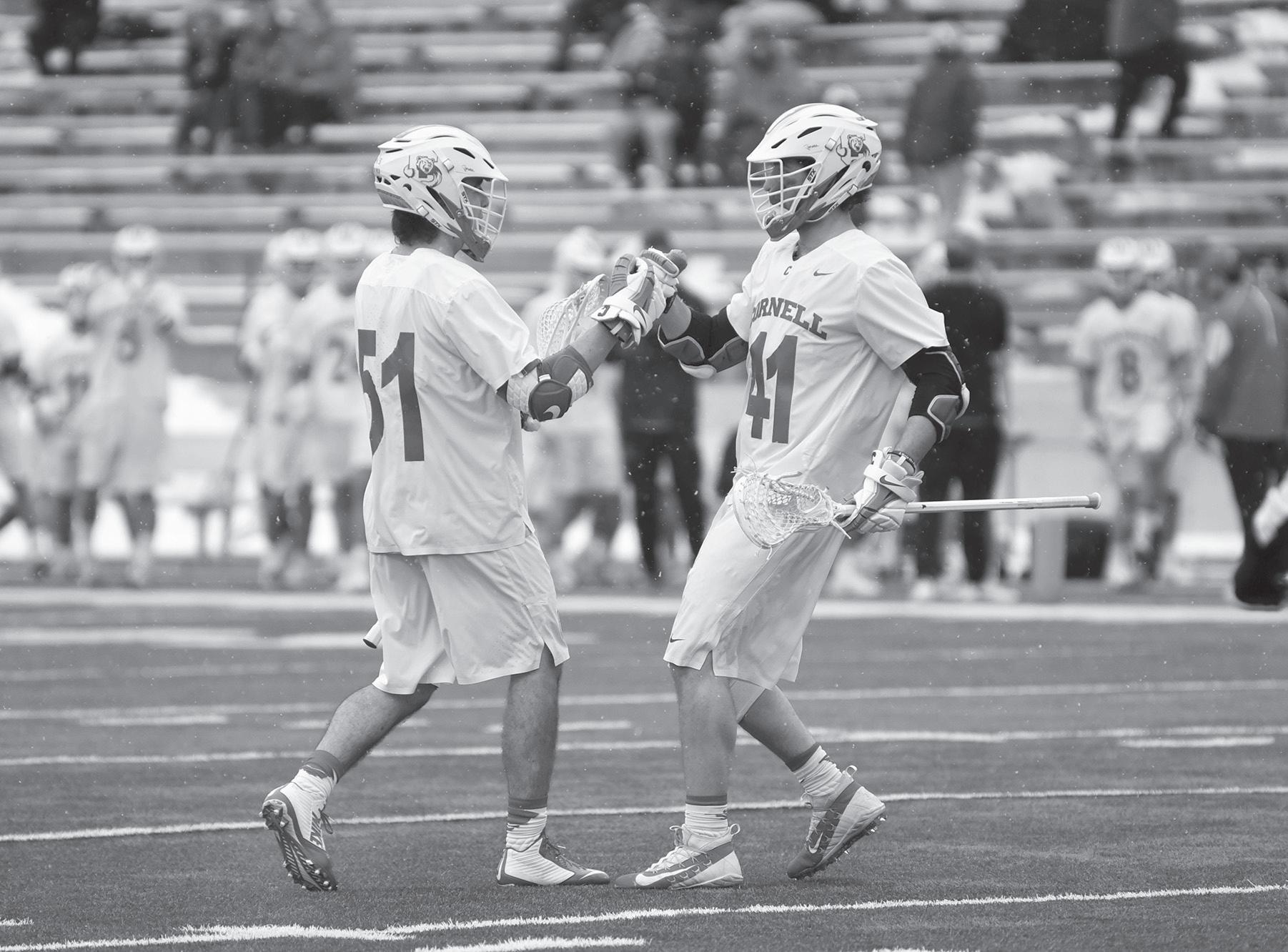
Cornell men’s lacrosse took down the nation’s top team Sunday afternoon, defeating No. 1 Towson 18-11 after coming up empty Friday night against No. 4 Penn State at the Crown Lacrosse Classic down south in Charlotte, N.C.
The win gives the Red its fourth victory of the season and its first against a ranked opponent in 2019.
27 H OUSE FOR R ENT
Linden Ave. 5 Bedroom House
Available June 2019. $900 per bedroom. Parking included. 607-327-2927
WOMEN’S HOCKEY
Continued from page 12
Also named to the all-tournament team, sophomore forward Maddie Mills, who scored a highlight-reel goal in her team’s win over Princeton on Saturday, scored on a rebound early in the third period that looked like it could turn the tide for the Red, which controlled play late in the second period and early in the final frame.
“We were playing so well as a team, I think it was exciting to finally capitalize on something that we’ve been waiting for,” Mills said. “In both games, we were really on top of both teams and we were just waiting for that opportunity, so it was really exciting to get that chance to boost the enthusiasm on the team, and I think we all knew that we could do it.”
But a third Clarkson goal — again on a breakaway, this time scored by Shelton an easy 2-on-0 conversion after a fumbled puck at the blue line — reestablished Clarkson’s two-goal lead.
Cornell would keep its foot on the pedal en route to outshooting Clarkson 15-9 in the final period and 36-25 in the game. But Sauve made all the stops after the Mills tally, including many Grade-A chances amid falling bodies and scrums in front of her crease.
Joined by both Clarkson and Princeton as ECAC squads in the eight-team NCAA Tournament field, Cornell faces Northeastern in Boston next weekend with a trip to the Frozen Four on the line.
Towson jumped out to an early 5-2 lead in the first quarter and it looked as if things might go downhill quickly — just as they did in the team’s 19-13 loss to No. 4 Penn State two days prior. With the best faceoff in the country, the Tigers seemed poised to run away with the game.
Instead, the Red proceeded to make an impressive case, scoring nine unanswered goals, five of which were scored by senior attack Clarke Petterson, who scored a career-high eight goals in the contest. At halftime, Cornell led Towson, 12-6, and momentum was on the side of head coach Peter Milliman’s squad.
The defense managed to force 23 turnovers, resulting in a plus-nine turnover differential, which gave Petterson and the rest of the offense plenty of opportunities to score and extend the lead.
“When we get into our offense, we know we’ve got some good players up there and got a good system going, so it gave us confidence every time we got a stop, thinking we’ve got a good chance to put the ball in the net,”
Ierlan added.
“The energy is good, the attitude is great, the guys are working hard and are committed.”
Peter Milliman
“The energy is good, the attitude is great, the guys are working hard and are committed to the game plan,” Milliman told Lacrosse Talk Radio at halftime. “We started off with a lead for [Towson], but by our standards [there] hasn’t been that big of [a] lead, so we are just happy we got a chance to turn it around.”
This opportunity to turn it around would not have occurred if not for Cornell’s high-quality defensive play. The Red was outmatched on faceoffs all day, only winning six of 32. But the defense still managed to keep the Tigers in check.
“Our defense hasn’t been the strongest it can play at, and I think today was a good example of that,” said freshman goalie Chayse Ierlan, who started and won his first collegiate game on Sunday.
“We know we’ve got some good players up there and got a good system going.”
Chayse Ierlan
Ierlan, who started in place of junior Caelahn Bullen in the cage, made 10 saves but — more importantly — made saves in clutch situations to ensure Cornell kept its distance from Towson once his team got ahead.
The Red struggled to stay out of the penalty box, going down a man on 11 different occasions. But again, the defense stepped up, holding Towson to 3 for 11 on extra-man opportunities.
While Cornell was statistically outplayed in several areas — notably on the faceoff — it stuck to its gameplan and came out with a critical victory.
The Red did not find similar fortune in Charlotte earlier in the weekend when it lost to Penn State by six goals. After falling behind by eight goals, the chances of a comeback looked bleak.
However, Cornell did manage to cut the Nittany Lions’ lead down to three at the beginning of the fourth quarter. But in the end, the Red was unable to stop the nation’s second-best offense.
Next week, Cornell faces yet another top opponent when it will square off against No. 4 Yale in New Haven to begin Ivy League play. Gametime is set for 1 p.m. Saturday.
Jack Kantor can be reached at jkantor@cornellsun.com.

By RAPHY GENDLER and ZACH SILVER
Sports Editor and
Senior Writer
Give Clarkson forwards Loren Gabel and Elizabeth Giguere some room once, and they’ll make you pay. Do so twice in a span of 26 seconds — well, that can’t happen when an ECAC championship and an automatic bid to the NCAA Tournament are on the line, said Cornell head coach Doug Derraugh ’91.
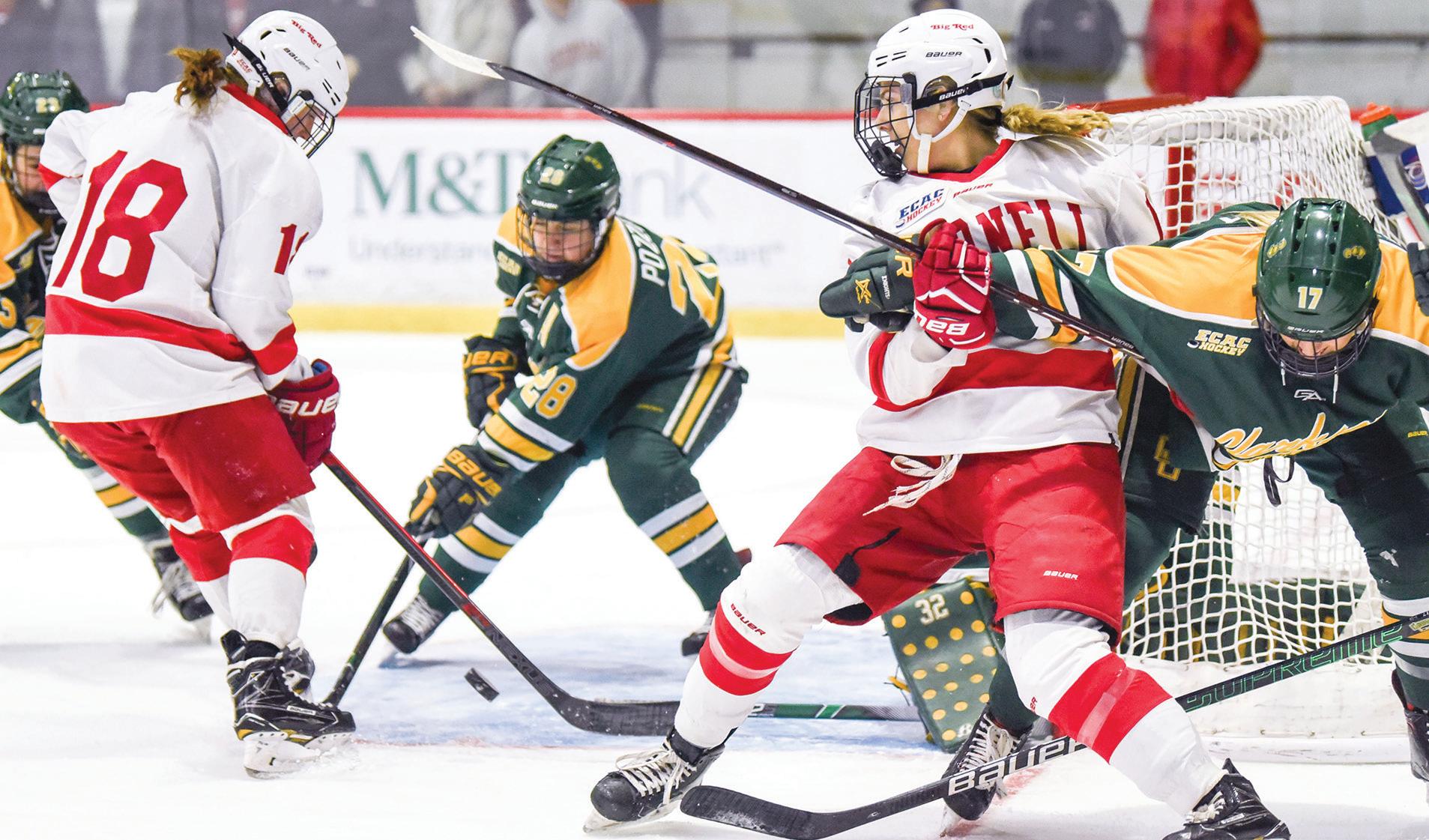
The pair of Clarkson forwards, both candidates for the Patty Kazmaier Award as the top female college hockey player in the country, connected in a span of under 30 seconds at Lynah Rink Sunday to sink Cornell women’s hockey’s hopes of its first ECAC tournament title since 2014, downing the Red, 4-1.
“You can’t give [Gabel] the opportunities that we did,” Derraugh said. “We gave a 2-on-1 to Giguere and Gabel, and there’s
maybe your two best forwards in the entire country. That’s a mistake that just can’t happen in a championship game.”
The loss, which came a day after a thrilling double-overtime win over Princeton sent the Red to the championship game, left Cornell to await its NCAA fate. But Cornell earned an at-large bid and will face No. 3 seed Hockey East champion Northeastern in next weekend’s NCAA quarterfinals.

After a scoreless first period, Cornell found itself in a similar situation to the one it faced in Saturday’s semifinal win: a two-goal deficit.
But this time, despite later pulling within one goal, Cornell couldn’t over-
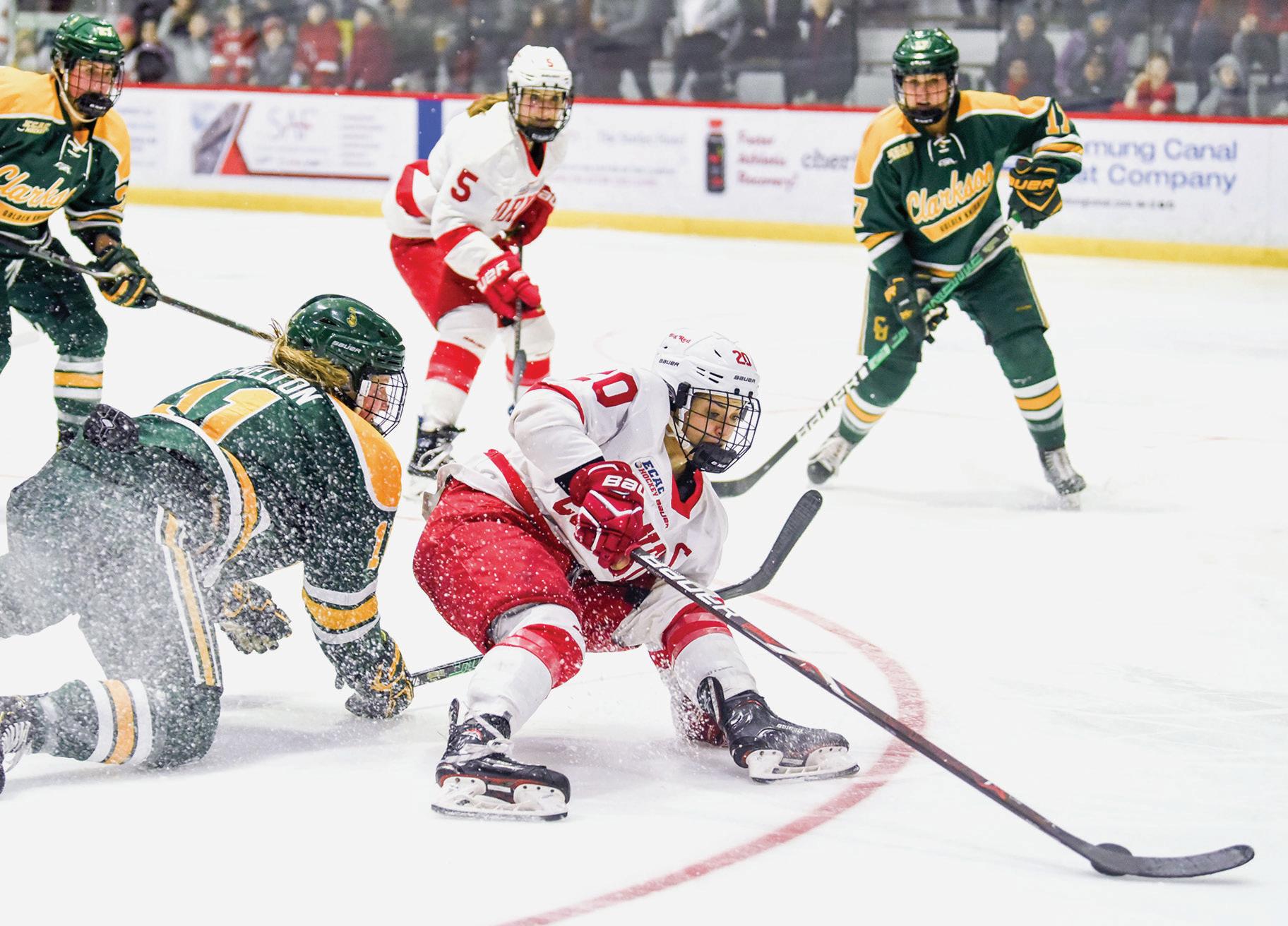
come two quick Clarkson tallies. After allowing a third tally after a blueline turnover, Cornell had to watch the Golden Knights leave Ithaca with their third consecutive league title.

“We always want to beat them just as much as we did last year,” said Cornell goalie Lindsay Browning, who earned the start after making 34 saves in relief of senior Marlène Boissannault on Saturday. “It brings a new vigor and energy to our team each time we get to face off against them.”
“The message [during the timeout when down 2-0] was there’s lots of time left in this game, stay patient, stay within the framework and play as
a team and we’ll battle to get one and work our way back. We got the one and then made a big error and it’s in the back of our net,” Derraugh said. “That’s hockey.”
Gabel was the culprit for both second-period Golden Knight goals, finding the back of the net on a pair of 2-on1 rushes just 26 seconds apart to give Clarkson all the breathing room it needed. Giguere was awarded an assist on each of the tallies, putting Clarkson’s top two scorers on the scoresheet early.
Gabel was tabbed the most outstanding player in the ECAC tournament, and she joined Giguere, goalie Kassidy Saure and defenseman Ella Shelton and Cornell’s senior Micah Zandee-Hart on the all-tournament team.