The Corne¬ Daily Sun


By ANIL OZA and SHRIYA PERATI Sun Science Editor and Sun Senior Staff Writer
As of Monday noon, New York state has reported 142 confirmed cases of COVID-19. With the number of reported cases on the rise, Cornell professors are bracing themselves for the possibility of class cancellations.
According to Jason Molino, county administrator for Tompkins County, there are no cases of COVID-19 in Tompkins County. Despite one individual being under investigation the burden of the virus on the county remains minimal at the moment.
These assurances regarding the county come after New York state declared a state of emergency on Saturday. Even before the declaration of a state of emergency Gov. Andrew Cuomo (D-N.Y.) allocated $40 million dollars to resources necessary to prevent the spread of COVID-19.
As it stands, Tompkins County has not received direct aid, but as the circumstances evolve, this could change in the coming weeks, according to Molino.
“We are going to be closing schools for weeks,”


By ANIKA POTLURI Sun Contributor
Gov. Andrew Cuomo (D-N.Y.) announced on Feb. 26 that he would appropriate $40 million in emergency funding to support the New York State Department of Health’s response to the COVID-19 outbreak.
The funds will be used to help the New York State Department of Health hire additional staff, procure equipment and any other resourc-
es necessary to respond to the crisis, now declared a state of emergency in New York.
With this declaration, the bill also “permits the governor to issue by executive order any directive necessary to respond to a state disaster emergency.”
But the bill drew criticism for expanding the governor’s emergency powers.
Assembly member Richard Gottfried (D-N.Y.) said that the bill’s amendment of executive law gives the governor “extensive and almost unlimited affir-

mative legislative power to … waive existing laws and provisions of existing laws.”
Still, the emergency funding bill, which will cease to have effect after its April 30, 2021 sunset date, passed the State Senate by a margin of 53-4 on March 2.
Although the bill was initially presented and signed as a precautionary measure, COVID19 cases have since proliferated in New York. As of Monday evening, there are 142 positive cases statewide. Ninety-eight of those cases are in Westchester County and two are upstate.
Cuomo unveiled one precautionary tool on Monday, announcing that New York will produce and distribute up to 100,000 gallons of alcohol-based hand sanitizer each week. The move drew swift criticism after it was revealed that the liquid would be produced by Corcraft, a state-owned company that relies on prison labor.
By ALEX HALE Sun News Editor
Candidates pushed the platforms they hope to implement in the Student Assembly at a debate on Monday evening, if voted in during next week’s elections.
Within the walls of a Goldwin Smith Hall auditorium, five vote-seekers eyed one of the top two positions on the S.A.: president and executive vice president. Issues spanned a range of campus concerns, from Greek life to divestment.
Debate festivities began with executive vice president for candidates Noah Watson ’22 and Kirubeal Wondimu ’22. The debate for president followed them, as Dillon Anadkat ’21, Uchenna Chukwukere ’21 and Catherine Huang ’21 presented their proposals.
proposed a Greek life committee to S.A. to play a closer role in the administrative decisions. Huang and Chukwukere pushed back, citing the impact that Greek leaders were already making on campus.
When the debate shifted toward divestment, all candidates agreed that the University should divest funding from fossil fuel industries. Huang furthered her stance on the issue, adding that she wants to ensure that the University doesn’t use divestment against students.
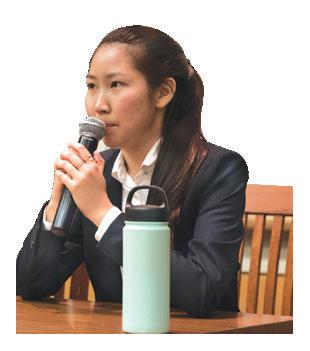
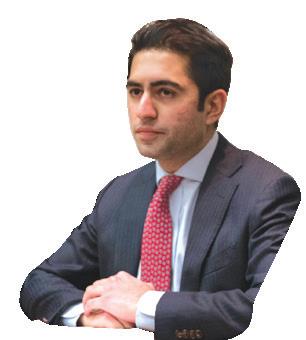
Watson’s and Wondimu’s 20 minutes featured platform pitches, which included discussions on mental health services, S.A. diversity and the student contribution fee. For the most part, the candidates agreed on the issues and tried to differentiate themselves on how to address them.

Huang, the current S.A. executive vice president, advocated for safe and affordable housing and judicial reform on campus in her opening statement.
Chukwukere, undesignated at-large representative, addressed a variety of reforms as part of his plan — such as eliminating the student contribution fee, advocating for Cornell’s divestment from fossil fuels and creating more gender-neutral bathrooms on campus.
Meanwhile, Anadkat’s proposals advocated for increased funding for international student orientation, Greek life policy reforms and helping athletes balance sports and school. He also pressed that, as someone who is not an S.A. member, introducing a “fresh face” could spark the change he believes the governing body needs.
On the issue of Greek life, all candidates agreed it needs reform. But tension rose when Anadkat
On the topic of campus mental health services, Wondimu said he believed Cornell has made major strides through recent reforms. The main hurdle that the University faces in its mental health reforms is in having enough mental health professionals available to students, he added.
“We need to see how [the University] prioritizes spending on this campus so that instead of constructing a $60 million Fine Arts Library, they’re hiring more mental health professionals to deal with systemic problems at our school,” Watson said, echoing Wondimu’s sentiment.
As the current Transfer Representative, one of Watson’s goals is to make on-campus housing more accessible, particularly for transfer students. On March 5, the S.A. unanimously passed a resolution, co-sponsored by Watson and Huang, that guaranteed housing for transfer students during their first year at Cornell.
Topics of the debate also extended beyond the administration and campus life, as the candidates debated the accessibility of the S.A.
“The S.A. lives in a small bubble, and you can actually see that in the number of uncontested seats that there are in this election,” Wondimu said. “I definitely do think that there needs to be more outreach done on behalf of the S.A. toward communities that are underrepresented.”
Tomorrow
BEDR Workshop: Talking to Change Thinking 11:40 a.m. - 1:10 p.m., 141 Sage Hall
LEPP Joint Seminar: Devilish Details In Cosmic Microwave Background Maps 3 p.m., 401 Physical Sciences Building
Regenerating the Ecology of Place: Transformation in the Agricultural Sector 3:30 - 4:30 p.m., G24 Fernow Hall
Professional Directions: Screenwriter Guinevere Turner 4:30 - 5:30 p.m., Schwartz Center for Performing Arts
Update on Immigration Enforcement Developments
4:30 - 5:30 p.m., G85 Myron Taylor Hall
Workshop: Intro to Podcasting 4:30 - 6 p.m., mannUfactory Makerspace
Workshop: Introduction to SPSS Programming 4:30 - 7 p.m., 103 Mann Library
¡Bailemos! Salsa Essentials Spring Series 6 - 7 p.m., 215 Willard Straight Hall
Cornell Equine Seminar Series: Biosecurity For Infectious Diseases 7 p.m., Classroom 6, Center of Veterinary Medicine
Information Processing: Contracts Versus Communication 11:40 a.m. - 12:55 p.m., 333 Sage Hall
A Comparative Perspective On Sex-Selective Abortions Noon - 1 p.m., G85 Myron Taylor Hall
A3C BeComing Lunch Series Featuring Jeannie Yamazaki ’21 Noon - 1 p.m., 626 Thurston Ave
Molecular Genetics of Arbuscular Mycorrhizal Symbiosis in Cereals 12:20 p.m., 404 Plant Science Building
Catching Rain: Sand Dams and Other Strategies For Developing Locally Resilient Water Supplies In Semiarid Areas of Kenya 12:20 - 1:10 p.m., 135 Emerson Hall
Fundamental Studies of Cotton Fabric Dyes And Their Degradation Products in Soil 12:20 - 1:10 p.m., T01 Human Ecology
Sacrifice Across Iranian Religious Communities During the Iran-Iraq War and After 4:30 - 6 p.m., 110 White Hall
‘You are the Masculine; You are the Feminine’: Becoming the Character in Kathak Dance 4:45 p.m., KG70 Klarman Hall
By TAMARA KAMIS Sun Staff Writer
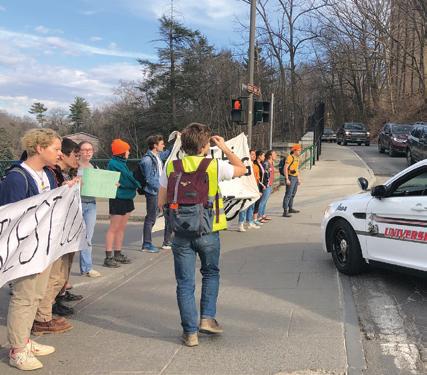
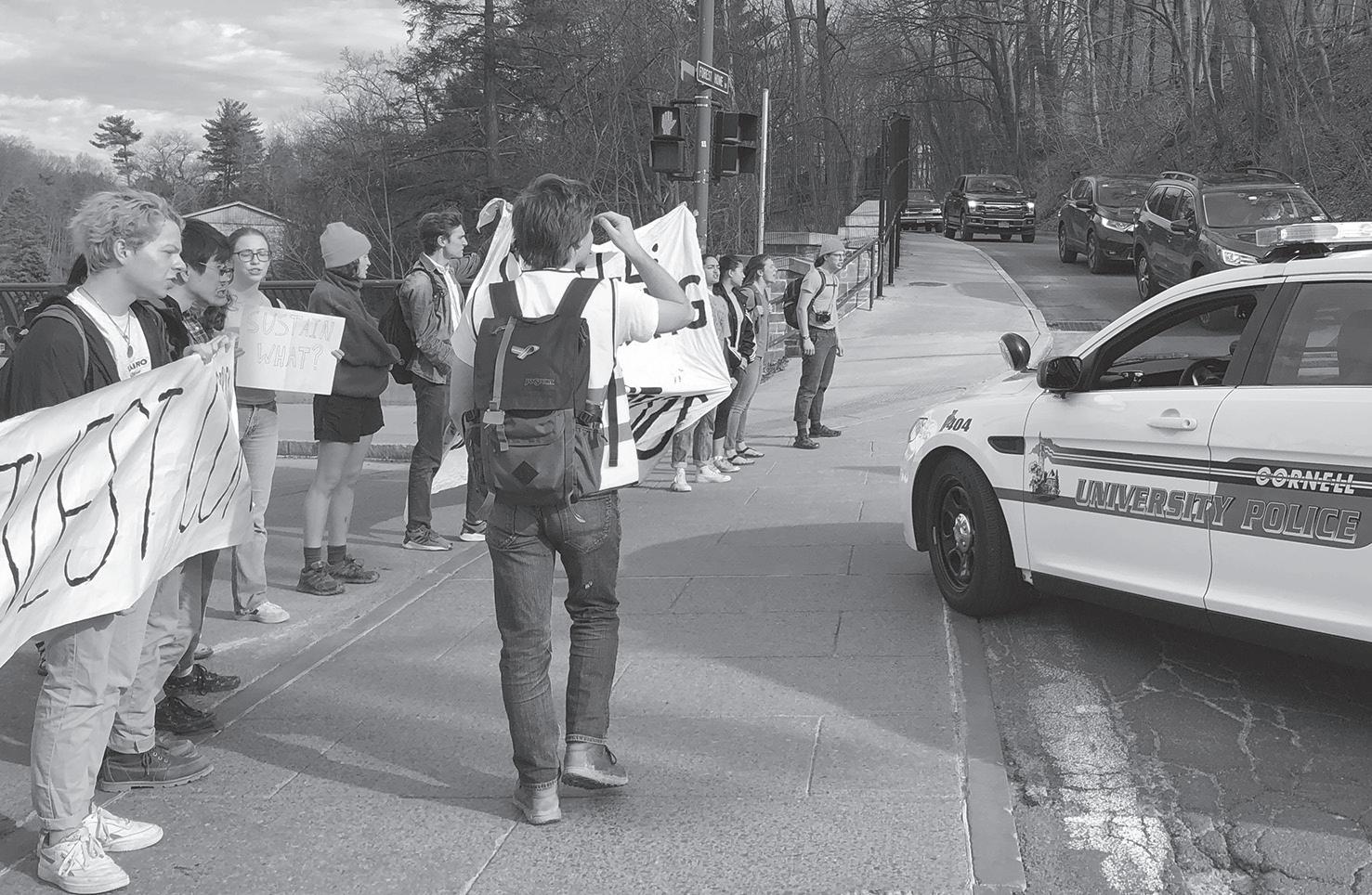
Climate Justice Cornell protesters disrupted traffic near North and South Campus bridges on Monday afternoon, where they faced angry motorists and the Cornell University Police Department.
CJC protesters have blocked roads multiple times in past few weeks to “disrupt business as usual,” which they view as a way to advocate for fossil fuel divestment — Monday’s events were a part of this series of protests.
The demonstrators occupied Thurston Avenue Bridge, at the intersection of Forest Home Drive and East Avenue from 4:15 to 4:45 p.m. and on College Avenue between Snee Hall and the Law School from 4:15 to 4:35 p.m. on Monday.
Even as some people drove their cars dangerously close to the protesters, no one was injured.
Avenue Bridge. A motorist on South Campus shouted, “I don’t care, I’ll run them over.”
Another motorist managed to cross the Thurston Avenue Bridge in a gap between the protesters and the sidewalk, pressing his car against CJC member Gabriel Ewig ’23, who attempted to block him but was forced to move.
“He was almost through,” Ewig said. “I ran in front of him but he was going slowly.”
Cornell police parked its cars between the protesters and traffic on Thurston, blocking the road — only letting through another Cornell police car to block the street on the other side of the protest.
“A big part [of our mission] is awareness, as well as disrupting business as usual.”
Nadia Vitek ’22
Cornell police arrived within 20 minutes of protesting at each bridge.
“We are doing our best to minimize our impact on the people not making the decisions we are against,” said CJC organizer Nadia Vitek ’22, “but there is no such thing as a perfect disruption.”
Multiple motorists yelled at the protesters from their cars, including calls for the protesters to move to the sidewalk. One driver yelled, “Make America Great Again” as they turned their car around on the Thurston
Meanwhile, a CUPD car flashed its lights at CJC protesters on South Campus, according to Vitek. The demonstrators slowly crossed the road back and forth in front of the parked police car for 15 minutes, stopping only when CUPD told them to stop to allow a car through the road.
“This is the most aggressive that CUPD has acted towards us,”
Vitek said.
The CJC protesters allowed multiple TCAT buses through the North and South Campus bridges, as they have previously done. The protesters said they supported public transit as an alternative to individual cars, and generally aimed to minimize their impact on people and systems that they do not disagree with.
By SYDNEY BROWNE Sun Staff Writer
On campus, Sarah Sun ’23 sits on the Student Assembly as a freshman representative and is working toward her applied economics and management major. But off campus, she trades her backpack for a sash to compete in scholarship-oriented pageants.
Hailing from Cedar City, Utah, one of Sun’s first pageant memories — aside from seeing her older sister compete — was watching an Asian-American contestant and former Miss California, Crystal Lee, place first-runner up to Nina Davuluri in Miss America 2014.
“It was such a powerful moment,” Sun told The Sun. “That was one of the first times in my life when I felt like this country valued people who looked like me. After talking to other girls in my community who felt similarly, I knew that it was time that I was that person for them.”
Sun started competing in pageants in high school and decided to continue on the runway once she arrived in Ithaca.
In January, Sun won the Miss Finger Lakes Scholarship Organization, a preliminary event to the Miss New York State pageant and Miss America. Miss Finger Lakes aims to provide women educational scholarships and opportunities to develop life skills and serve the community.
“It was because of this program that I was able to pay for my entire first year of college,” Sun said from her Just About Music North Campus dorm. “It really outlet that encourages women to be their best self and constantly strive for self-improve-
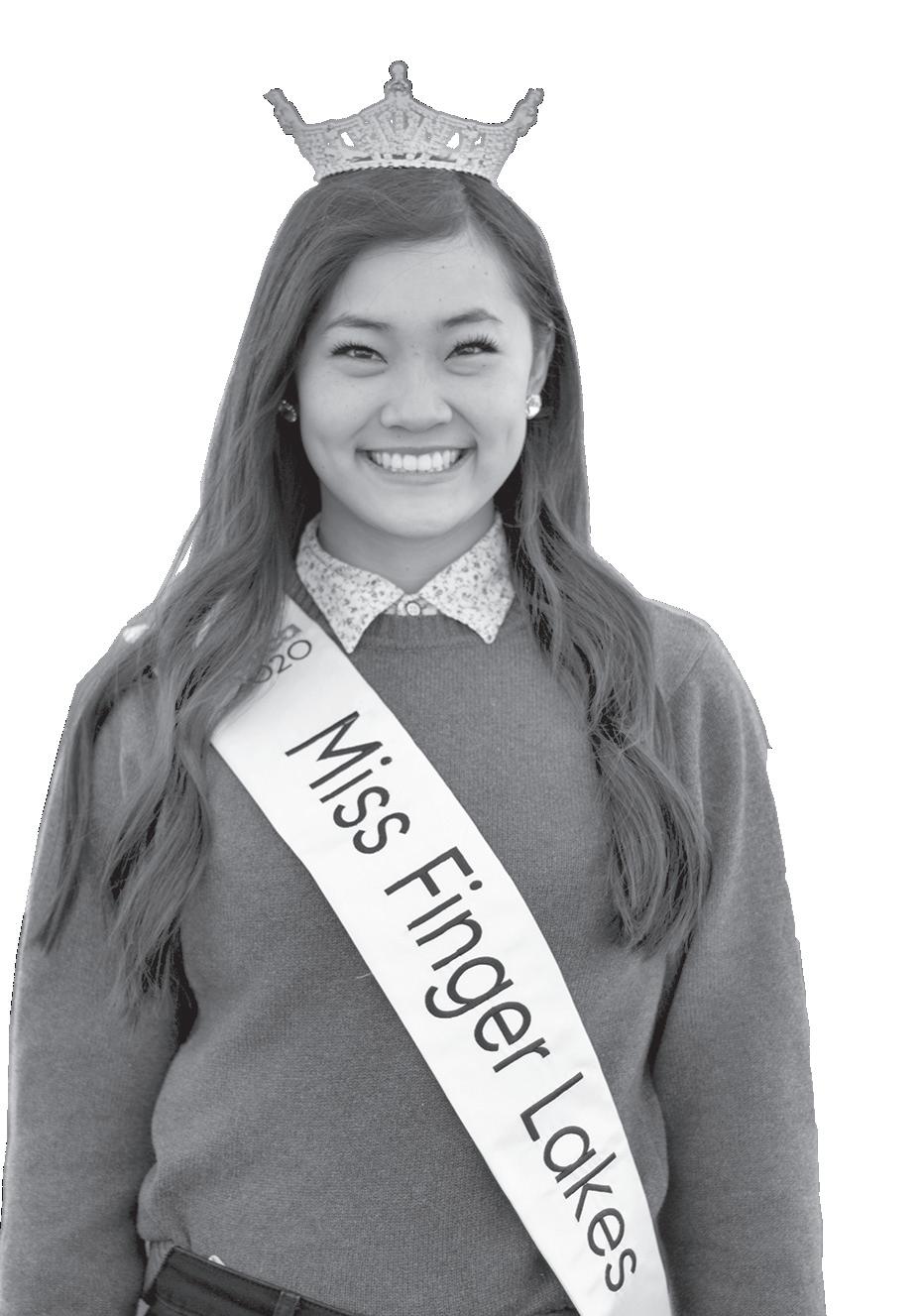
Because Sun’s values aligned closely with the program’s,
paring
for the pageant mostly required her to go about daily life.
The competition is broken into four portions: interview, talent, onstage question and social impact pitch — which allowed Sun to sharpen skills she already had in her toolbelt. Performing a piano piece for her talent event incentivized her to continue practicing. The onstage question only helped her become a stronger speaker and communicator.
Before competing at Miss Finger Lakes, the Miss Distinguished Women organization crowned Sun with another scholarship in January 2019. After she was named Miss Distinguished Woman of Utah, Sun spoke to sponsors, government officials and even elementary schools about the program’s “Be Your Best Self” platform.
“It seems kind of frivolous, but when you’re a 10-year-old girl and you see somebody with a crown on their head, you listen to them,” Sun said about her time holding this title. “Being in this program has really made me aware and inspired me to live in a way that I would be proud of rewatching on my deathbed.”
With her newest crown, Sun is focusing on making her social impact pitch, “This Land is Our Land: The Case for Diversity and Inclusion,” into a more marketable and official platform to compete with as she prepares for the state-level competition, which will take place in late May.
But more than anything, Sun doesn’t want to focus exclusively on her accomplishments. Instead, she wants to break down stereotypes and draw attention to advocacy that is more important than herself — encouraging others to realize they are “equally worthy as anybody..”
“If I have one message, it’s this quote: ‘Sometimes, the most powerful form of activism is existing, taking up space, speaking your mind and being comfortable with who you are,’” Sun said. “That’s really what I want to put out into the world.”
sbrowne@cornellsun.com.
By ARI DUBOW and KATHRYN STAMM Sun City Editor and Sun News Editor
After 10 years of legal battle, the City of Ithaca settled with former Ithaca Police Department officer Chris Miller, who sued the city in 2010, claiming that he had been unfairly treated for being white.
In March 2019, Miller was awarded $20,000 as a result of his demotion to the Commons beat and $520,327 in fees the city agreed to pay Miller’s attorney, according to the Tompkins County Clerk and an April 2019 opinion written by Judge Brenda Sannes from the Northern District of New York Federal District Court. Miller also settled for $420,000 with the City of Ithaca in January to resolve a wrongful termination suit, according to A.J. Bosman, Miller’s attorney.
The settlement followed a decade of convoluted litigation and two decades of controversy around Miller’s presence in the IPD — beginning in September 2000 when he joined the IPD and through a 10-year litigation that began in 2010, when Miller sued in the Northern District of New York Federal U.S. District Court.
“This settlement was a business decision in the best interests of the City and its taxpayers,” wrote Mayor Svante Myrick ’09 in a statement to The Sun. “After nearly a decade of litigation including three federal trials and two appeals, settlement simply became cheaper than continued litigation that showed no signs of letting up.”
Miller had originally made four complaints with the
Tompkins County Human Rights Commission, the U.S. Equal Employment Opportunity Comission and the New York State Divison of Human Rights, alleging race-based discrimination.
Miller’s allegations of race-based discrimination were a result of what he claimed to be excessive scrutiny of his work in comparison to the work of non-white IPD police officers, and getting passed over for a promotion which was ultimately given to a “lesser qualified African-American,” according to Miller’s allegations as written in a decision submitted by Judge Thomas McAvoy from the Northern District of New York federal district court.
In 2009, Miller was reassigned to foot patrol almost exclusively, which he claimed was retaliation for his original complaints.
Then, in May 2010, Miller filed suit in the U.S. District Court, claiming that his demotion and alleged poor treatment from the IPD was in retaliation for the four complaints he had filed.
A month later, in June 2010, the IPD notified him of his termination, according to a case summary from Jan. 9. The city stated that Miller had been fired based on allegations that he had falsified his employment application by not saying that he previously worked for the Vinton Virginia Police Department.
Over the following decade, the case passed through three different federal jury trials, aimed to determine whether Miller’s termination was justified, as well as arbitration, which
sought to determine whether the motivation for Miller’s termination was retaliatory, according to the Jan. 9 case summary.
In 2013, the jury awarded Miller $2 million — for being demoted in his beat assignment and served a termination notice — but a judge later dismissed that decision after the City of Ithaca fought the decision.
Bosman alleged that this initial jury decision “proved” the city’s guilt that they fired Miller out of retaliation.
The city’s settlement with Miller came up last week at the city’s monthly Common Council meeting. Activists, mostly consisting of Ithaca College students, demonstrated against the recent termination of IPD investigator Christine Barksdale, a disciplinary action which they saw as unfair and poorly communicated to the public.
George McGonigal (D-1st Ward) lamented the settlement. “We were advised by the city attorney this was the best call to our taxpayers,” McGonigal said. “None of us wanted to do this. It was the best bad choice.”
The IPD Investigations office declined to comment, and Police Chief Dennis Nayor redirected inquiries to the office of City Attorney Aaron Lavine, who did not respond to phone calls or emails. Neither IPD Deputy Chief John Joly nor Miller could be reached for comment.

Pilot online classes and ease attendance as they brace for cancellations
CANCELED
Continued from page 1
Cuomo said at a March 9 press conference.
Public schools in Scarsdale have already closed for the week, while officials in other districts, like New Rochelle, are closely monitoring the situation.
Despite the lack of any confirmed cases of COVID-19 in Tompkins County, professors have begun altering attendance policies and trialing distance learning practices that could be utilized in the event that in-person classes are suspended.
Prof. Steven Elias Alvarado, sociology, who teaches Sociology 1104: Race and Ethnicity in the United States: Social Constructs, Real World Consequences and Sociology 2208: Social Inequality is experimenting with Zoom in both classes to prepare for the possibility of class cancellations.
members at risk, especially those who are older and more susceptible to the virus,” said Sammi Minion ’21. “I think it just needs to be considered that low risk does not mean zero risk.”
In the past week, other Ivy League universities have modified attendance policies in light of the recent epidemic. Following the quarantine of an individual in Columbia University, the university has canceled all classes until Wednesday and has shifted to virtual instruction until its spring recess, which begins March 16.
“I am monitoring the status of COVID-19 pretty closely and trying to think ahead of how best to keep students safe.”
Prof. Bruce Monger
Another New York City university, Fordham University, closed amid concerns regarding COVID19. Classes were suspended Monday and Tuesday, with online instruction resuming Wednesday. The suspension arose when a student, who commuted to school via the subway, exhibited symptoms consistent with the virus.
FUNDING
Continued from page 1
“The State is working with the Department of Health and other state agencies on how the [$40 million] will be allocated to address the response efforts,” a New York State Department of Health representative wrote in an email to The Sun.
Counties in New York state have also called for additional funds to combat the spread of the novel coronavirus. A press release from the New York State Association of Counties on Feb. 27 requested the federal government to provide $3.1 billion in emergency supplemental funding, with at least $500 million directed to local and state health departments.
that local health departments have adequate resources.
Jason Molino, the Tompkins County Administrator, confirmed at a Monday press conference that the county had not received any direct aid from this funding.
“Right now, we have not received direct aid from the state to address this issue, but we suspect that as this evolves, they will provide additional resources to us,” Molino said at the press conference.
New York state is expected to receive $35 million in funding from the federal government’s $8.3 billion spending bill to combat COVID-19. It is unclear whether local health organizations will see much of that money.
“Out of concern for students’ physical and psychological health, I have given students the option to not attend in person class if they (or their parents) do not feel comfortable with in person attendance,” Alvarado said in an email to The Sun.
Alvarado also expressed in an email to both classes that in the event that classes move to an online format, exams will most likely be take-home.
Students in Government 2169: Survey Data in the Information Age were also informed in class today that attendance is optional. As it stands, the most popular substitute for in-person lectures and classes are Zoom video conferences, where professors broadcast their lessons to their student via the online software.
Prof. Bruce Monger, earth and atmospheric sciences, teaches Earth and Atmospheric Sciences 3540: Ocean Satellite Remote Sensing and is bracing for the possibility of class cancellations. Given that EAS 3540 is only a nine-week class, Monger is prepared to cancel the remaining lab classes if the administration were to cancel all in-person classes. The University did not respond to a request for comment by the time of publication.
“As with most faculty, I am monitoring the status of COVID-19 pretty closely and trying to think ahead of how best to keep students safe,” Monger said in an email to The Sun.
Other students expressed concern for the way in which the University is handling class attendance policies.
“Honestly I think that the university should switch to Zoom classes entirely because putting a student’s health in jeopardy also puts their family
Princeton University has also enacted a policy intended to promote social distancing, which has been touted as a method to curb the spread of the virus. The policy, which moves all lectures, seminars and precepts to a virtual format, will be in effect starting March 23.
“Local county health departments are already stretched thin addressing existing public health issues,” said NYSAC Executive Director Stephen J. Acquario. “Without additional funding, they won’t be able to adequately prepare for the potential spread of this virus.”
“The COVID-19 virus is a significant threat, but it is only one of many,” the New York State Association of County Health Officials said in a statement. “For many years, local health departments have been subject to stagnant state aid and categorical funding reductions, even as their mission has grown substantially with each passing year.”
NYSAC stated that it strongly supported Cuomo’s emergency appropriation, and that it would work with the governor to ensure
“The University should switch to Zoom classes entirely ... low risk does not mean zero risk.”
Sammi Minion ’21
While it is unclear if all classes in Ithaca will be taught via distance learning, the shift to digital instruction has already begun at Weill Cornell Medicine’s Qatar campus. Based on directives from Qatar’s Government and Qatar Foundation, WCM-Q released a statement on its website, saying that they will suspend all in-person classes as of Tuesday, March 10.
The number of confirmed cases in Qatar rose to 15 on Sunday, prompting the closure of many schools and universities in addition to the banning of travelers from 14 countries.
“Until further notice, in order to continue with the educational programs, we will leverage technology-based solutions to deliver the curriculum,” the website read.
Anil Oza can be reached at aoza@cornellsun.com. Shriya Perati can be reached at sperati@cornellsun.com.
Anika Potluri can be reached at abp76@cornell.edu.
DIVESTMENT
Continued from page 3
“The TCAT is not doing anything wrong,” Vitek said. “We didn’t want to disrupt that system.”
Despite frustration with disrupted traffic, Vitek said she thinks CJC’s tactics are positively impacting the likelihood that Cornell will divest from fossil fuels by raising more awareness on the issue.
The fossil fuel divestment resolution has been passed by the Employee Assembly, University Assembly and Graduate Student Assembly, and will be voted on by the Student Assembly on
Thursday. If all five assemblies pass the resolution, then the Board of Trustees will have to vote on it later in March.
Vitek added that most students had “no idea” when they thought of fossil fuel divestment last year. Now, she said, divestment has become a “hot topic” on campus.
“That type of awareness — and the anger at the administration that comes with that awareness — is how we will win,” Vitek said. “A big part [of our mission] is awareness, as well as disrupting business as usual.”
Tamara Kamis can be reached at tkamis@cornellsun.com.
WRESTLING
Continued from page 12
victory.
Even though he suffered a major decision defeat in the quarterfinals, the senior sailed through the consolation rounds. In the battle for third place, the Ohio native avenged an early-season loss to Penn’s Doug Zapf with a 3-1 victory and third place title.
After a major decision 8-0 first round win, freshman Jonathan Loew took a major loss against his quarterfinal opponent. After two victories in the consolation rounds, the freshman suffered a 14-4 blow against Army’s Noah Stewart. Fifth place was still up for grabs, however, and Loew entered the mat against Ivy League foe Tavis Stefanik of Princeton. Despite losing to the Tiger earlier this season, Loew secured a takedown and a pair of escapes to avenge a 4-3 victory.
Furman’s road to the EIWA title went amiss in the semifinal round of the cham-
pionships, where Lehigh’s Jordan Wood took home the 5-0 victory. After wrestling his way through the consolation semifinals, the sophomore was determined to bring home the third place victory. Furman outwrestled Hofstra’s Zach Knighton-Ward for a 7-2 victory, which he won with almost 5 minutes of riding time. The third place finish secured him a bid to the NCAA championship.
Despite two consecutive wins to open up competition, LaJoie suffered three consecutive defeats to give him the sixth place title. Columbia’s Joe Manchio knocked the sophomore out of the main bracket with a 9-7 narrow victory. Gage Curry of American was next to take down the Red wrestlers. In the fight for the fifth place finish, Army’s Trey Chalifoux came out on top.
Junior Adam Santoro mustered a sixth place finish after wrestling an exhausting six matches. After Drexel’s Parker Kropman sent him to the consolation bracket, Santoro defeated his Hofstra and Navy competition with scores of
9-7 and 6-1 respectively. After Army’s Markus Hartman toppled him 8-0 in the consolation semi-finals, the junior struggled to regain his momentum, and lost the fifth place bout to Hunter Ladnier of Harvard.
For senior Milik Dawkins, it was a day of back and forth. After a first round win, the senior lost to Navy’s Tanner Skidgel. In the consolation round, Dawkins beat his Franklin & Marshall competition, but failed to channel this winning momentum into his next match against Richard Stamm of Hofstra.
However, the senior capped off his collegiate wrestling career with a hardfought 3-2 seventh place victory against American’s Tim Fitzpatrick, which featured a match-winning takedown.
“I don’t think that we could have wrestled much better,” Koll said. “It was a great showing from top to bottom. Every single wrestler wrestled above their seed, and I’ve never had a tournament like that.”
It has been a season of unknowns
for the Red, wrestling without Yanni Diakomihalis, Max Dean and Vitali Arujau who took Olympic redshirts. But, the team has exceeded all expectations and reaped the rewards of their hard work that materialized as both team and individual successes this weekend.
“This is by a long shot not the best team we have ever had, but it is without a doubt the team that has done more with less than any other team I have had in my 31 years of coaching at Cornell,” Koll said. “On paper, it wasn’t the team that should be placing top five at Easterns. It wasn’t the team that should have more than a couple of guys going to nationals. But we came in second and we have a minimum of six guys going to nationals.”
On March 17, the qualified wrestlers will head to Minneapolis, Minn. for the 2020 NCAA Division I Wrestling Championships. The first session takes place on March 19 at 11 a.m.
Faith Fisher can be reached at fsher@cornellsun.com.
In light of International Women’s Day, Te Sun highlights two professors who have made signifcant contributions to science and continue to do so, despite facing setbacks
By EMMA ROSENBAUM
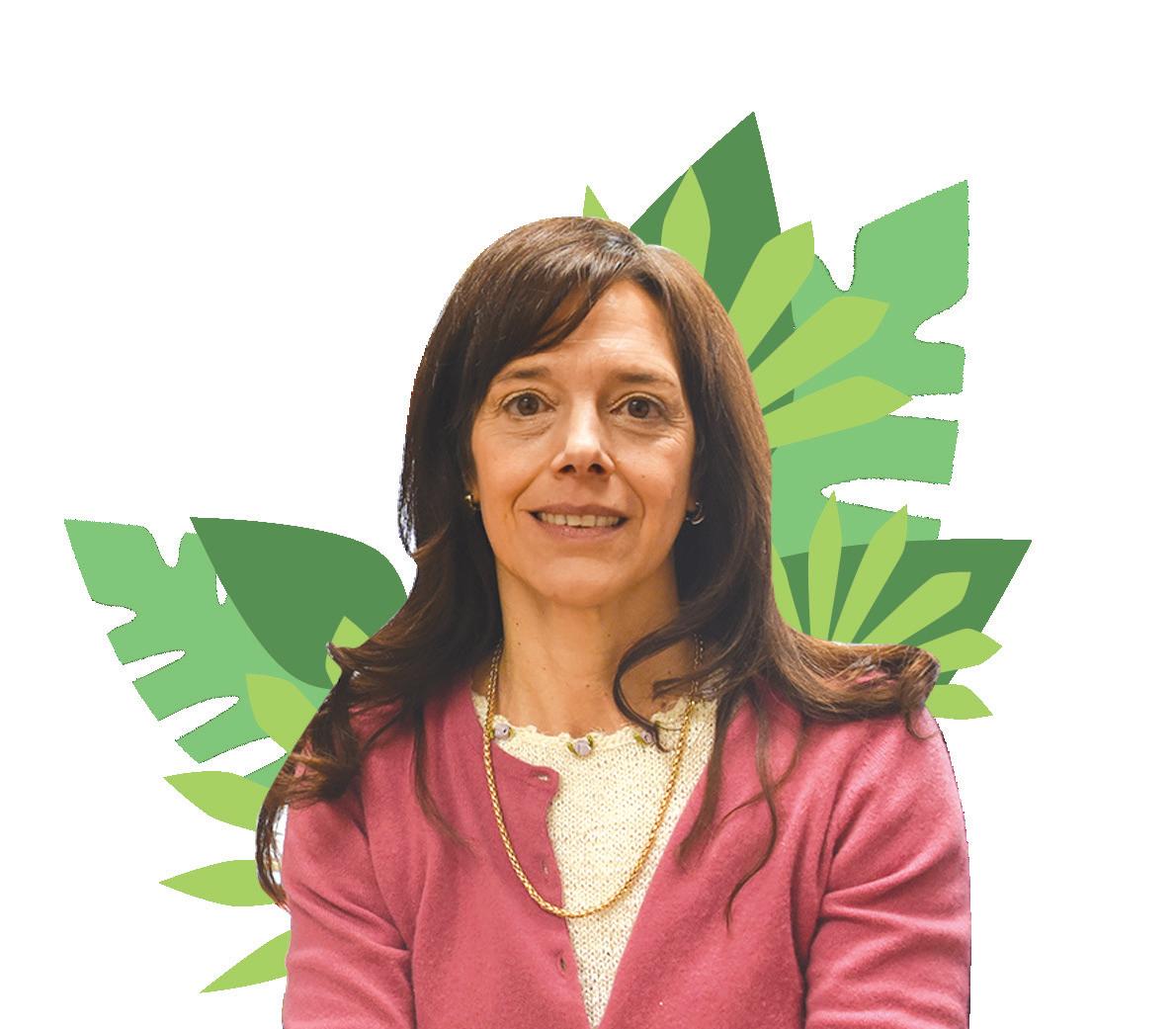
Prof. Giulia Friso, plant science, has always loved plants. While she has been able to embrace her passions for plants and medicine through her courses and research at Cornell, it hasn’t been an easy journey.
When Friso was an undergraduate, “Women were still struggling in science to get their foot in the field,” she said.
During her time as an undergraduate at the University of Padua, in her native country of Italy, Friso worked in a chemistry laboratory, where she was one of few women in the lab.
“My professor never learned my name, but he learned the names of all the boys,” she said.
Despite holding the same position and qualifications as her male peers, her supervisor would ask her to make photocopies for him.
While working on her first research paper in the same laboratory, Friso discovered after it was published that her name had not been included in the list of authors.
“I was not in a position of power, I couldn’t do much about it,” she said.
While she acknowledged this experience could have completely turned her off from pursuing a career in research, Friso was not discouraged.
“I moved on,” she said.
Friso treated the incident as a learning experience, and was able to avoid similar experiences later in her career.
“It’s not a coincidence that all of my other supervisors turned out to be very respectful,” she said. “It made me more aware and made me fight even harder.”
As for her advice to students who find themselves in similar situations in the future, Friso urges them to not “get discouraged but be aware of what your rights are and look out for support.”
Friso does research in the field of plant proteomics — the large
“When proteins are not needed, they get degraded into amino acids and recycled to become new proteins,” she said. Friso researches the enzymes involved in this process, degrading proteins within the chloroplast when they are no longer needed.
Friso is now researching and teaching subjects which she is passionate about, and she encourages her students to do the same.
“I always tell students to follow their passion and pursue [their] interests even if they are very different from one another,” Friso said.
She combines her passions for pharmacology and plants in the two classes she teaches to undergraduates, which explore the important role plants have in human health both in the past and present.
According to Friso,“one-fourth of modern medicine sold by pharmaceuticals are either derived from plants or semi-synthesized from compounds found in plants.”
Her class, Plant Biology 2100: Medicinal Ethnobotany, explores the relationship between plants and native people in various parts of the world.
“When we lose one plant we lose millions of years of evolution,” Friso said, explaining why the preservation of biodiversity and indigenous knowledge is important.
In the course Plant Biology 3100: Medicinal Botany and Drug Discovery, Friso teaches her students the mechanisms behind plants as sources of medicine.
Prior to working at Cornell, Friso did her Ph.D. at Imperial College in London, where she studied biochemistry, and worked as a research scientist at a pharmaceutical company in Sweden.
The plant science professor said students should strive to overcome adversity by following their interests and excelling in their respective fields.
“Empower yourself by mastering competence in the thing you love,” said Friso.
erosenbaum@cornellsun.com
By SHRIYA PERATI Senior Staff Writer
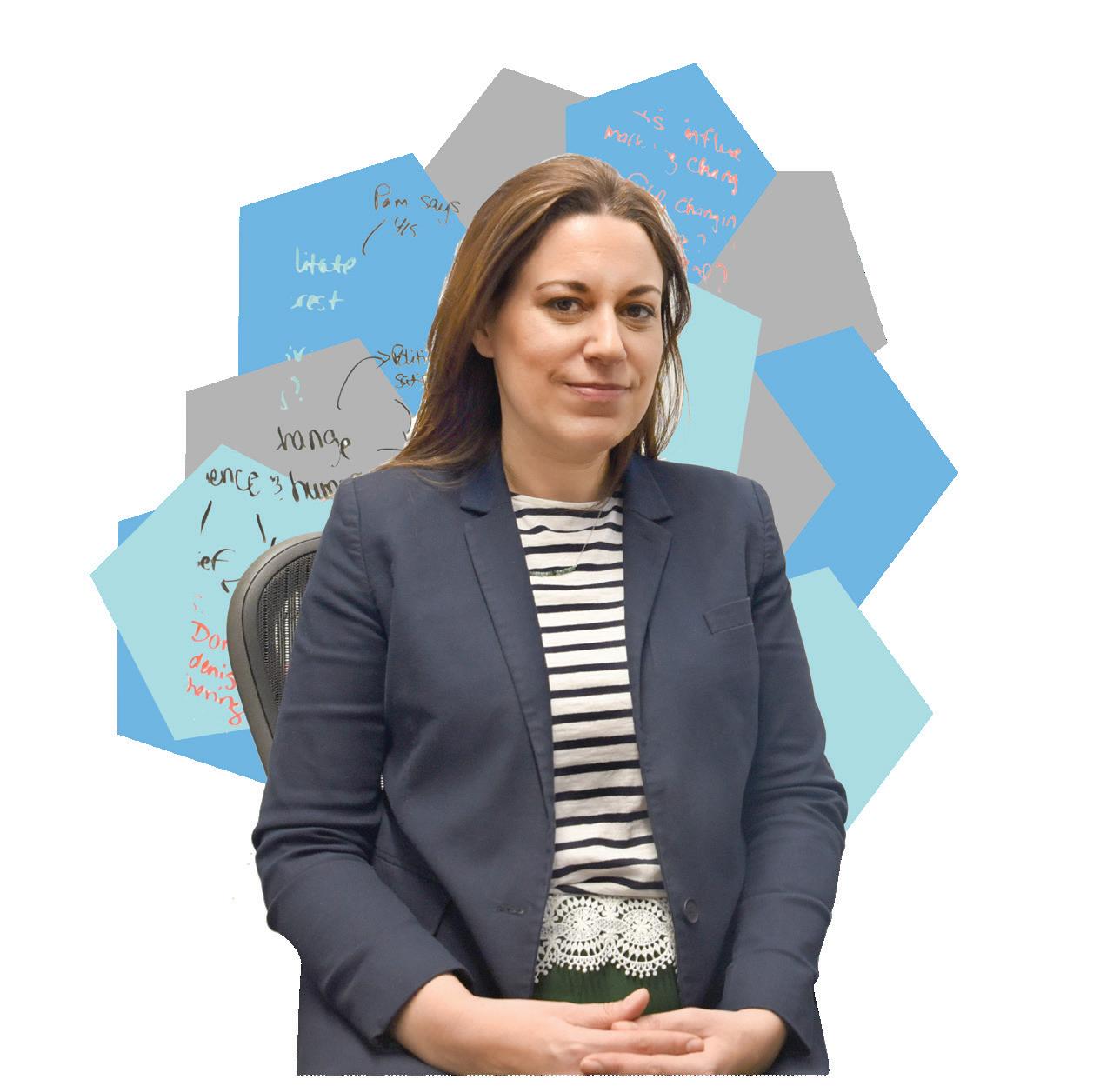
When it comes to careers, Dr. Danielle Eiseman has done it all.
Before finding her home in the Department of Communication at Cornell, Eiseman worked at a children’s hospital, went to culinary school and lived in Scotland for five years, working with the Scottish government to shape a new public engagement strategy for climate action policies.
As a postdoctoral scholar, Eiseman worked at Cornell’s Institute for Climate Smart Solutions, where she did research with farmers, went to the Climate Negotiations twice, spoke at the Food and Agriculture Association in Rome and presented at Youth Climate Summits in New York State.
Now as a visiting lectur er at Cornell, Eiseman teaches Communication 2850: Communication, Environment, Science, and Health and Communication 3210: Communication and the Environment. She supervises a stu dent-run podcast and is work ing on a book with her co-author Prof. Mike Hoffmann, entomol ogy, and Carrie Koplinka-Loehr.
“It was a very wavered path,” Eiseman said, chuckling, as she recalled her path to becoming a lecturer at Cornell. After getting a Bachelor of Science in chemistry at Miami University in Ohio, Eiseman worked at Cincinnati Children’s Hospital for two years, developing genetic therapies for chronic diseases in children.
“What you often find is that the more high end the restaurant, the worse it is, in terms of the sexism and harassment.”
Eiseman eventually took a step back from cooking to finish her Master of Science in marketing and economics.
“I think people should know what goes on in professional kitchens. There was always a lot of hazing, sexual harassment and groping, and I just had had enough,” Eiseman said. Through her classes, Eiseman started to learn more about consumer behavior, the environment and globalization.
engagement strategies in order to help gather support for its climate policies going forward.
Despite the progress made in Scotland, Eiseman expressed that there is still room for growth in climate change policy.
“At the climate negotiations that happen every year, many of the panel experts are older white men,” Eiseman said. Eiseman explained that despite the prevalence of ‘manels’, a panel of experts consisting of only men, it is often women who are doing the work on the ground, implementing climate action policy.
“There’s this invisibility and a lack of voice when it comes to women working in climate change, which is disheartening, and it’s hard to navigate that,” Eiseman said. At Cornell, Eiseman supervises a student-run climate change podcast, Down to Earth: Cornell Conversations About…, created in the fall of 2018 with the goal of increasing climate change literacy.
“When I worked at Cincinnati Children’s, all of the other research assistants on my floor were women,” Eiseman said. “We called ourselves the divas of science.”
Although Eiseman enjoyed the environment of being surrounded by other women, she noted that most of her supervisors were still male and working in a lab felt too far removed from making a tangible impact.
“I made a complete left turn and moved out west to Phoenix, Arizona for culinary school.”
Eiseman worked for five years in fine dining restaurants and hotels, while taking business classes on the side at DePaul University with the hope of eventually opening up her own restaurant.
“During the time when I was working in professional kitchens, I became frustrated with working with men in a very aggressive environment,” Eiseman said.
I could do more to have greater fulfillment,” Eiseman said. “It was one of my professors at DePaul who convinced me to go to Edinburgh, do the Carbon Management program and stay to do a Ph.D.”
Eiseman lived in Scotland for nearly a half-decade while working on her second master’s degree and Ph.D. She worked for ClimateXChange for roughly one year, where she worked with the Scottish government to deliver reports to inform policy.
ClimateXChange is Scotland’s center of expertise on climate change, funded by the Scottish government. The center focuses on providing public agencies and policy makers with research and analysis.
“Last year, I did a project for the Scottish government looking at the ways that we try to understand and segment the population,” Eiseman said. “The Scottish government has a very aggressive climate change policy: they’re planning to go net zero by 2050.”
Eisman said that the Scottish government is now using her work to change its public
“We’re an all-female team, and yet most of the people that we interview as guests are white older men. It can be quite difficult to find those unseen voices,” Still, Eiseman expressed gratitude for the community that she has found working as a visiting lecturer at Cornell.
“Mike Hoffmann has also been a great mentor, and we are about to publish a book on food and climate change,” Eiseman said. “It’s a celebration of food in the first aspect, and it’s also a discussion of how our menu is changing.”
Eiseman’s, Hoffman’s and Koplinka-Loehr’s book, “Our Changing Menu: How Climate Change is Affecting the Foods We Love and Need,” will be published by the Cornell University Press in a year and discusses the global food system, what researchers are doing to adapt to climate change and advances in farming technologies.
The visiting communication lecturer also acknowledged the importance of women supporting one another. “The women in my family have always been supportive and encouraging. My grandma especially helped me develop a certain independence, which probably had the biggest impact,” Eiseman said.
Shriya Perati can be reached at sperati@cornellsun.com
woods was one of my favorites. I’d already seen the concluding dance, or at least a version of it in Mini LGD, but the addition of video elements took it to a whole other level. A dancer’s image
“Follow” was also a reprise of a piece from last semester. I enjoyed the costume choice of masculine suits with pronounced, strong shoulder pads, but I still wonder if it added anything to the piece as a whole.
Let me start by confessing that I’ve never danced in my life. My grandparents sent me to Ballet classes when I was five or so but I sneaked out to join the Taekwondo kids downstairs every single time. Yet I do enjoy watching people dance. I remembered walking out of Mini Locally Grown Dance at the end of last semester absolutely blown away, and regretted not having taken advantage of my department’s dance division. This year’s Locally Grown Dance was no different, and I feel like I have to put at least some of my thoughts in words so you don’t miss out any longer.
Unlike Mini Locally Grown Dance, which featured a range of short dances from different choreographers, this year’s LGD consisted only of four large pieces, each driven by a specific theme. The first piece of the night, titled “Tunneling,” was about “subversive transformation or transgression.” A tunnel links two spaces that are divided geographically, politically or culturally; it can also be created on a personal level where one transitions out of one’s internal struggles towards the light.
What was also particularly interesting to me was director and choreographer Byron Suber’s choice to include video projection in the performance. Frankly, “Tunneling” appeared as a video art show more than anything. Coming from a film and installation background, I found the use of projection utterly captivating, but my friend felt like there wasn’t nearly enough dance. “They [the dancers] don’t even need to be there most of the time, you know.”
While I agree that in some sections the projection and the movement on stage could’ve been integrated better, I was nevertheless impressed by the ambitious formal experimentation. The projection on layers of opaque meshy fabric created a dream-like space that immediately transitioned the viewer into the world of the dance. I also was (and still am) in love with quite a few of the videos — the opening piece of the dancers gazing longingly into the camera amongst spring blossoms and the sporadic kaleidoscopic effect imposed on the footage of women running in the
Lwould first appear on a small square screen upstage right, where she got out of the bulky orange jumpsuit and then the blazer and tulle dress underneath it, until she stripped down to the last layer that hugged her body gently like a ray of moonlight. One by one they then emerged from a mere image into reality, walking through the slits on the screen so seamlessly and gracefully that they really did appear as ethereal beings.
“Atelier 320: upending” was again a collaboration between two art forms — dance and calligraphy. The piece was envisioned in response to Taiwanese calligrapher Tong Yang-Tze’s bold and delicate work, currently on view at the Johnson Museum. Choreographer Jumay Chu wrote that “the brushstrokes of the video Sao are vertiginous traces which press deeply into the mind, and they have inspired the dancers to create movements which race with abandon and yet hold stillness.” The ensemble’s movements were synchronistic yet fast-changing, and the constant making and breaking of patterns reminded me of the calligraphy lessons I took as a child. “The seemingly endless repetition was not supposed to create perfection,” I remembered the teacher telling me; “it’s about embracing each moment with grace.”
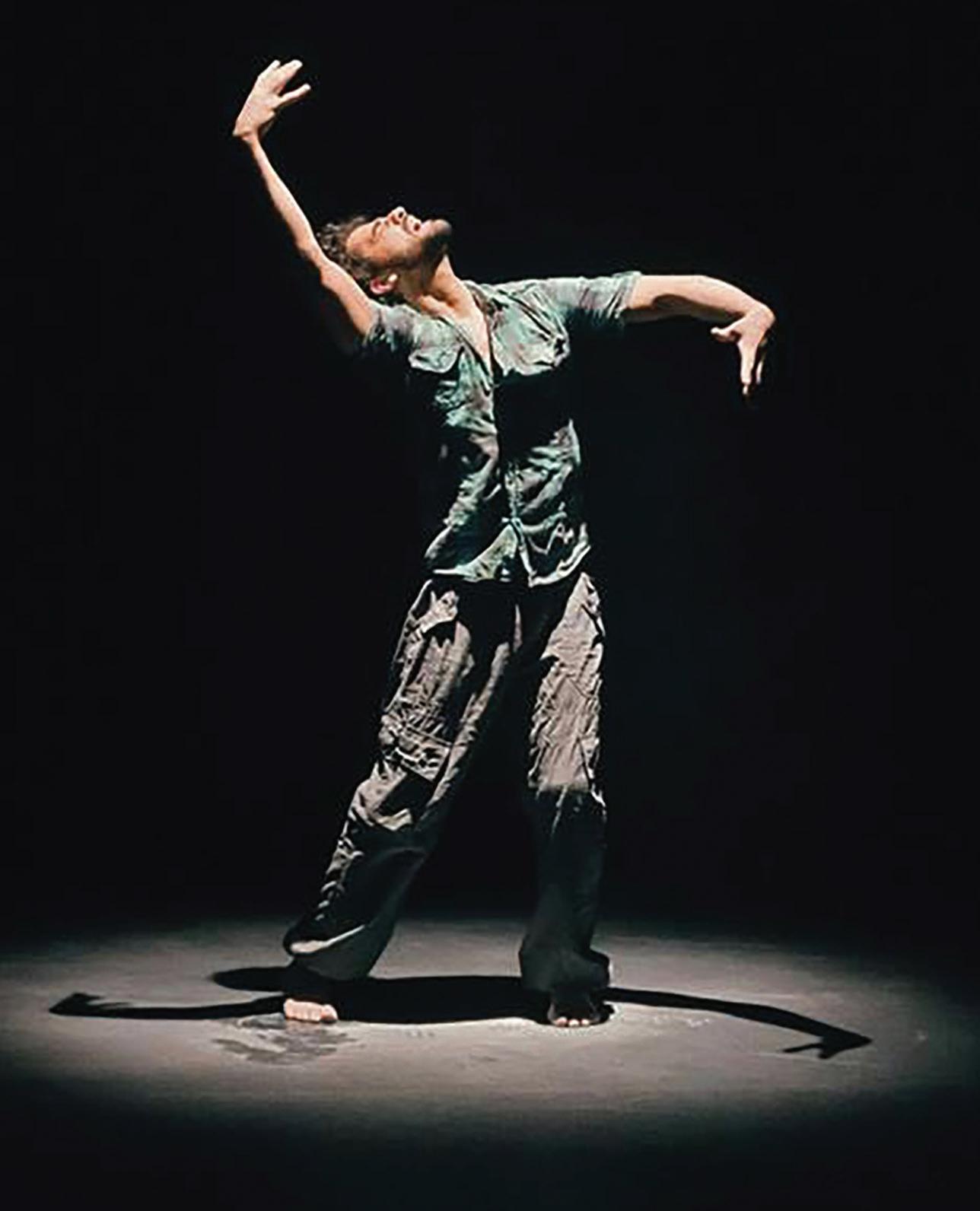
And Sharaf DarZaid’s “To Be…” was simply a tour de force by the palestinian guest artist. When the spotlight came on stage and he raised his arm with the first note of the music the entire auditorium stopped breathing for a second. DarZaid’s precise movements were so attuned to the rhythm of the music that it almost seemed like he had been possessed by the music — or rather that he had been transformed by it. The set design and costume of the piece was minimal compared to the rest of the performances, yet he had this exceptional sense of control — both of his own body and of the space — that his mere presence was enough to captivate the audience. And something about “To Be…” screamed emotions; it wasn’t just a showcase of his dancing talent, but also a story of becoming, of searching for one’s identity, of grief and bereavement and also of pride and hope. With his body, his facial expressions and most importantly his soul, DarZaid invited us into a complex story that’s nothing short of profound.
Ruby Que is a senior in the College of Arts and Sciences. Escape runs alternate Fridays this semester. She can be reached at rque@cornellsun. com.
ast Thursday, the College of Arts and Sciences sent out an email to its students with the subject line “Please tell us your post-graduate plans.” That subject line alone was enough to strike fear into my heart, but the body just made it worse: “If you have solidified your plans for graduate school or employment, please take a few minutes to complete the Class of 2020 Graduate Survey.”
I have not solidified my plans for graduate school or employment. I’m working my way through job applications, but I have no idea what my life will look like in three months, where I’ll live or what field I’ll be working in. I have some ideas, of course, and I can safely say I’ll never be a neurosurgeon or a financial advisor. But I got a preview of the relief-meets-uncertainty that will await me at Schoellkopf in May when I began playing Afterparty (2019) this weekend. The Switch version of the game just came out on March 6, and I’ve been looking forward to its release since the studio, Night School, announced it. I loved their last big title, Oxenfree, in 2016 and was looking forward to a similar experience. Oxenfree was a special game because it blended a genuinely eerie and haunted island environment with a dialogue-based mechanic system that allowed the player to control the story through conversation. A lot of choices had real consequences in the story, especially the game’s ending, which felt especially relevant considering the pro-
tagonists were high school students about to go off into the world. It felt particularly relevant to me as an older teen, starting school in spooky Ithaca.
Afterparty feels like it matured along with 21-year-old me. It was a pleasant surprise to find that the game’s dual protagonists were in a situation I could relate to. I can’t help but wonder if this is how kids who grew up alongside Harry Potter felt, exactly the same age as the characters they read about. When I was a kid, I felt like I was always reading and watching shows about teens, and now as an adult I feel the same way.
Instead of a gang of rebellious teenagers, the new game follows two very recent college graduates, Milo and Lola, as they try to out-drink the devil and escape from the circles of Hell. They died right after graduation and have to find their place in the underworld, a sprawling cluster of islands and demons for which they are woefully unprepared. They stumble through this new environment just as awkwardly as they did their college campus, always managing to find the wrong thing to say to the wrong people. It’s painfully familiar to me, to the point where I find myself agonizing over the right dialogue choice just as much as I do when trying to craft a witty response in a real-life group chat.
But beyond the horror of social faux-pas, the game paints a boozy, corpse-ridden version of Hell that finds new and creative ways

to torture its residents in a way that feels like an R-rated version of The Good Place’s Bad Place. Demons are just there to do their jobs, and beyond the bee stings and humiliating situations, Hell functions as a cluster of neighborhoods each with their own bars, concerts and non-stop parties. Humans and demons both post on a social media app called “Bicker,” with status updates like “hello my baby hello my honey hello my hell hell hellllllll” that feel like they could have come from a weary college student on Twitter. One background character in line for a party at Satan’s house asks, “What’s the point of social media if it’s not a mirror reflecting your every insecurity?” In other words, Milo and Lola’s life after graduation is scary and brutal and they live with the constant threat of being assigned an unbearable torture in the morning, but it’s also a lot like the life they’ve been living. At one point early on, they have trouble even distinguishing Hell from a college party. Every moment of their life is dependent on social interactions, with alcoholic drinks providing extra dialogue options that can get them in or out of trouble. In real life, I personally don’t drink — I’m more prone to clinging to the chips-and-salsa table at a party and I’m the kind of person that brings a bottle
of water everywhere in my purse just in case I’m stuck somewhere with no non-alcoholic options — but even I can relate to Milo and Lola’s struggle to twist the hands of fate in their favor, only to say exactly the wrong thing in a key moment (I just don’t need alcohol to do that).
Post-college life was already on my mind before I started Afterparty, between the emails from Cornell and texts from already-graduated friends urging me to never leave college, but playing through the first couple of hours of the game has got me thinking about it a lot more. Playing Afterparty reminds me that life doesn’t stop after college. I may be in a new environment and at times it may all feel like too much, but I’ll still be myself — flaws and all — and everyone else will just be trying to get through their lives, too. Afterparty presents a worst-case scenario: They die right after graduation, never getting to live up to their dreams, yet Milo and Lola keep going. They find a way forward even as they keep tripping up with demons at their heels.
Olivia Bono is a senior in the College of Arts and Sciences. She can be reached at obono@cornellsun.com. On the Level runs alternating Tuesdays this semester.
138th Editorial Board
MARYAM ZAFAR ’21
Editor in Chief
JOYBEER DATTA GUPTA ’21
Business Manager
PETER BUONANNO ’21
Associate Editor
MEGHNA MAHARISHI ’22
Assistant Managing Editor
CHRISTINA BULKELEY ’21
Sports Editor
BORIS TSANG ’21
Photography Editor
CAROLINE JOHNSON ’22
News Editor
ALEX HALE ’21
News Editor
ARI DUBOW ’21
City Editor
EMMA ROSENBAUM ’22
BENJAMIN VELANI ’22 Dining
JOHN MONKOVIC ’22 Multimedia
MIKE FANG ’21
OLIVIA WEINBERG ’22
MADELINE ROSENBERG ’23
Assistant
LUKE PICHINI ’22 Assistant
HANNAH ROSENBERG ’23
Assistant
BRIAN LU ’23 Assistant
ANNABEL LI ’21 Assistant Money & Business Editor
LEI ANNE RABEJE ’22
Editor JOHN COLIE ’23
JOHNATHAN STIMPSON ’21
Managing Editor
KRYSTAL YANG ’21
Advertising Manager
JASON HUANG ’21
Web Editor
NIKO NGUYEN ’22
Design Editor
PALLAVI KENKARE ’21
Opinion Editor
SEAN O’CONNELL ’21
News Editor
KATHRYN STAMM ’22
OZA ’22
’23
LEE ’21
CHENG ’21
’22
MEGHANA SRIVASTAVA ’23
EMILY DAWSON ’21
’22
’21
LAW ’22
Dining Editor
’22
’21
Working on Today’s Sun
Ad Layout Dana Chan ’21
Production Deskers Krystal Yang ’21
Ben Mayer ’21
News Deskers Kathryn Stamm ’22
Madeline Rosenberg ’23
Design Deskers Niko Nguyen ’22
Photography Desker Ben Parker ’22
Arts Desker Brian Lu ’23
Sports Desker Emily Dawson ’22
Science Deskers Anil Oza ’22
Emma Rosenbaum ’22
y buzzer goes off on the dimly lit floor, but the apron knotted at the small of my back absorbs the vibrations. I weave my way out of the dining area, past the host stand, through the bar space and into the kitchen to fetch the entrees, making sure to move with simultaneous briskness and poise. I steel myself as I brace for the threeplate carry: seat one –– handkerchiefpasta, sideofbrussels; seat two –– halibut, nocouscoussubancientgrains; seat four –– NewYorkstrip, medium. How did I end up here? Me: a young, black vegetarian, setting a slab of dead animal in front of this upper-crust white gentleman in the hopes he’ll tip well and not call me “hon”?
I’ve worked at the fine dining restaurant in the Statler Hotel since the beginning of my junior year. Twice a week, I tuck my septum ring inside my nose, wrap my braids into a neat bun at the nape of my neck and don the uniform and name tag bearing my major and expected graduation date. The learning curve I’ve had to ride these past two years has been more of an upward-sloping abstract squiggle than a curve, and while I’m far from being the worst student server, I’m farther still from being the best. Yet I’d argue that I’ve learned more from serving three-course meals than in any of my Cornell classes.
Half of all U.S. adults have worked in the food service industry at some point in their lives. It’s like a rite of passage for many Americans –– especially immigrants. I remember tales of my mom’s experience as a 19 year-old immigrant college girl working at Roy Rogers, but I remember just as clearly her encouraging me to study hard to avoid flipping burgers for the rest of my life. Even then, it was clear that class is a precarious enough reality to suspend us between the distressing material concerns of the lives of the majority and the comfortable detachment of the one percent of the world.
My job as a server is a box of chocolates. You know that adage about not truly knowing someone’s character until you observe how they treat the waiter? I’ve been that waiter –– on the receiving end of every possible dietary restriction, special occasion, background, whim and temperament. There are nights I recycle the same old jokes ad nauseum, knocking cheekily on the glossy wooden table with a summary of my post-grad plans as yet another guest remarks on my upcoming graduation, but there are also nights I’ve met individuals who have revived my conviction in humanity’s goodness and couples whose love has brought tears to my eyes. There are nights when a party of four leaves without paying, but there are also nights like when my friend received an $800 tip from a mysterious solo patron. There are regulars –– the professors who come for their routine Monday lunch, the Sunday brunchers and the alumni parents –– but there are also adorably nervous first date-ers, the occasional son of a United States cabinet member and families who haven’t treated themselves to a night out in years so they could see Cornell for the first time at their beloved graduate’s commencement.
Whether it’s in between study sessions or last minute because I overslept, when I show up for my shift the meticulously organized chaos of my beloved workplace bears the ambiance of home for the night. It’s an escape; a sixhour mental and physical exercise in which I must heighten each of my senses, suspend the impulse to take even a single thing personally and devote all of my energy to making sure I do not eff up a reputable and well-oiled fine dining apparatus in which I am a mere cog. We’re compensated by the extent of guests’ satisfaction and the subsequent caliber of their gratuity etiquette. If we’re lucky, the hard work pays off.
However, there are costs to the highest-paying student job on campus. The job takes significant physical strength, a sharp memory, nuanced intuition, thick skin and a lot of
patience. The thick skin takes you the farthest. It pushes you into growth mindset you when you screw up your tickets and Chef Bob reprimands you; it shields your ego when a group of kale salad-ordering srat girls gives you Cinderella Story-style “diner girl” treatment; it keeps your feet moving and a smile on your face on nights when your life outside of work feels like it’s swallowing you whole. But there are some things a thick skin hasn’t protected me from: Last fall I took a couple weeks off after I was sexually harassed twice in one week by the same group of men in the guest elevator. (I’d been so excited to ride it while the service elevator was out of order.) I’ve cried in the back station after forgetting the same thing for the fiftieth time and feeling incompetent in front of my supervisors. As someone who does not wish to support the slaughter of animals, I’ve struggled to prepare meat products, and as a climate conscious Gen Z, I’ve felt deeply conflicted about the waste created by our establishment and the broader industry. There are times when these occupational hazards have made me wonder if I have bitten off more than I can chew. But it’s even in these moments that I’ve found the paradigm of student work is a reproduction site for the inequalities of our lives outside Cornell. Reflecting upon my mother’s warnings about a life of flipping burgers, I often consider the inverse relationship between class privilege and one’s proximity to working class jobs like those in the food industry. If, for example, I need to give up a shift or take a month off because of a heavier academic load, I won’t go hungry –– but not everyone can say the same. Employees range from hotelies who need the industry hours to meet their graduation requirements, to full-time workers with kids to students who work six seven-hourlong shifts every two-week pay period to pay their rent. It’d be impossible to hold one of the only student jobs in which Cornell students work alongside full-time working class employees without reflecting deeply on the value of money: We all need it, but some need it to feed their kids, while some of us need it to pay for spring break.
This job isn’t a typical campus job in a lot of ways –– whether it’s the hours, the level of responsibility we carry or the fact that I’ve picked up more about food and wine pairings than HADM 4300 could teach me –– but the most significant to me has been the realization that, at least for the time being, I have more in common with the working-class adult co-worker than I do with a wealthy alum. “I wonder if that will be me one day,” I’ve caught myself wondering at times upon encountering alumni who seem so detached from the daily worries of people trying to make ends meet. It’s humbling, awkward and fascinating to realize that although at Cornell we can learn about labor rights, inequality or the endless lists of genetic and anthropological traits that make us 99.99 percent similar to one another, our education is ultimately pruning us to leave service jobs like this behind upon graduation, setting us on a trajectory to join the educated elite. I often feel as if the Cornell experience asymptotically parallels that of the “real” world, never intersecting; but the existence of jobs like this highlight that the two are not as distinct as they may seem. No matter how easy it is for a college waitressing gig to serve as a cute lesson on how to treat people in the service industry, I recognize the mobility I have in doing so is not common. What good is the illusion of solidarity if you’re blind to the precarity of your own socioeconomic status? Learning how to be decent to others is more about realizing just how human we all are. It’s not enough to be defined by how well you treat the person serving you.
Content Warning: This article contains mentions of depression and suicide.
It seems like everyone you know is “dying.” Not literally in terms of heartbeat and body temperature. No, it’s when you ask them how they’re doing, and they tend to reply, “I’m dying,” “terribly” or with one of those sardonic smiles and tilted heads as they pantomime a noose around their necks. There are people who are genuinely doing well. They’re well adjusted, healthy, probably out running six miles a day, chugging vegan smoothies and holding hands with Martha Pollack somewhere. They do exist … And yet when you talk with any of your peers here and ask them how they’re doing, it seems most of them are unhappy and quick to tell you so. At one of the greatest universities in the world within the wealthiest nation in the world, at a time of unparalleled innovation and technology, most young people — at least qualitatively — are “dying.” Nowadays, the answer to “How are you?” is a dark one.
It’s when you ask how they’re doing, and they tend to reply, “I’m dying,” “terribly” or with one of those sardonic smiles and tilted heads as they pantomine a noose around their neck.
That’s frightening.
It’s frightening because that answer is reflective of a reality more and more of us seem to have. Beyond the litany of headlines calling attention to the Gen Z mental health crisis, the raw statistics point to growing dissatisfaction with life. Between 2009 and 2017, the rate of U.S. adults between the ages of 18 and 25 who reported symptoms of major depression increased by 63%. Moreover, from 2008 to 2017, suicide attempts
spiked 87 percent among individuals aged 20 to 21 and 108 percent for 22 and 23-year-olds. Our generation is more depressed and more suicidal than any before on record. The growing trend towards answering “How are you?” with “terribly” or “I’m dying” is frightening because it is emblematic of the fact that more and more of our peers report that they are indeed doing terribly, even experiencing suicidal thoughts.
It’s frightening because it’s become the cool answer. Camo pants may be out this season, but self destruction is very much in. It’s become cool to portray yourself as run ragged, on the brink of a nervous breakdown. It is already well know that Cornell boasts a culture of competitive sleep deprivation, where we contend for the most intense all nighters and caffeine binges in a self-endangering manifestation of a cutthroat academic culture, but there is a large culture beyond Cornell’s campus through which young people view being unstable as being edgy, different and exciting. We compete to elicit the sympathy of others in what are veiled popularity contests, and we vastly exaggerate the trials and tribulations of our own lives in doing so. We hyper dramatize: We’re not doing “well” or “good” or “fine.” Those are all boring. No, we’re “dying.” Our lives are mysterious and dangerous and fleeting … How are we, really? It depends on how you react to that answer. It’s designed to elicit your attention.
Most of all, it’s frightening because it quite often is entirely genuine. That’s what makes the status of negative answers to “How are you?” so perilous. It’s nearly impossible to tell the difference between “I’m dying” and “I’m dying.” How can we know who needs our support badly, who is really trying to reach out and ask for help? In a generation wracked by such profound depression and suicidal tendencies, there is a real authenticity to answering unhappily, but it is one that is weakened by its adoption as a popular refrain designed to make oneself appear interesting. We have a responsibility to help those going through periods of mental anguish in absolutely any way we can, especially at a school which frequently seems content to create stress in its students like a tea kettle creates steam, only without ever letting
Mit escape — leaving the pot perpetually whistling in a high pitched scream. We have a responsibility to look out for one another, to reach out and offer a comforting word when it’s most needed. That is what makes our language so profoundly important — the casualization of mental health vocabulary makes it more difficult for us to be there for one another because we can’t discern between reality and fiction.
This is what makes our language so profoundly important — the casualization of mental health vocabulary makes it more difficult for us to be there for one another.
As we strive to build a community which cares for its most vulnerable members, we have to first strive towards a community in which we all raise our struggles in conversations honestly and feel comfortable while doing so. To create that dynamic, we need to first challenge ourselves to speak truthfully about our own mental states in even the most fundamental, most mundane social queries. So, ask yourself honestly:
“How are you?”
And then use that answer. It’s the one we all need to hear.
Students may consult with counselors from Counseling & Psychological Services (CAPS) by calling 607-2555155. Employees may call the Faculty Staff Assistance Program (FSAP) at 607-255-2673. An Ithaca-based Crisisline is available at 607-272-1616. For additional resources, visit caringcommunity.cornell.edu.
Andrew Lorenzen is a sophomore in the College of Arts and Sciences. He can be reached at alorenzen@cornellsun.com. When We’re Sixty Four runs every other Tuesday this semester.
y freshman year in high school, I was playing an improv game in my theatre class. Everyone stood in a circle; one person began acting out what object or noun they were and then someone else jumped into the circle, acting as another object or noun that was subsequently added to the scenario. Usually, if people’s instinctive responses to playful prompts are not racist, the game is light-hearted. For instance, if one person jumps in acting like a dog, the next person jumps in acting like a fire hydrant.
But alas, as the second round of the improv game progressed, it quickly turned volatile: One person jumped in saying they were a police officer and immediately after, the next person said
this, so I am not sure how the game continued.
Conversations surrounding Ebola a few years ago were certainly racially charged; however, apart from that improv game, I was not particularly tuned into the discourse. But that was my first experience with racialized pathology. Now, with the spread of Coronavirus, I have employed the help of several of my friends to discuss the impact of the prejudicial and ignorant rhetoric that has proliferated alongside the virus.
Gracie Lu ’21 expressed her thoughts, saying that she feels the current situation is just “another reminder that when people see Chinese/other Eastern Asian people we are still viewed as un-American.” She continues, pointing out how nonsensical it is to associate Asian Americans with Coronavirus: “Because obviously, if we are all in America, Asian people and white people have the same likelihood of contracting the disease because they are offered the same exposure.”
Conversation surrounding Ebola a few years ago were certainly racially charged: I was not particularly tuned in to the discourse. But that was my first experience with racialized pathology. Now, with the spread of Coronaviurs, I want to discuss the ignorant rhetoric that has proliferated alongside the virus.
they were “an african american” and then the following person jumped in with wide eyes and waving hands, exclaiming that he was “Ebola.” I left the room after
Feelings of being “othered” and feared have affected another friend of mine. Jerry Ahn ’20 voiced: “I am worried about the coming months since I have a pollen allergy, and I don’t want to be sneezing everywhere and freaking people out.”
Jerry’s concern of other people’s uneducated and prejudicial misdiagnosis of his seasonal allergies as COVID-19 actually transpired for Cat Huang ’21, who, a
few weeks ago, got sick with the flu. She shared: “A facetious rumor spread that I had the Coronavirus.” Though she was not bothered, because she knew it wasn’t true, at the same time she said: “I kind of realized that this rumor would have never spread in the same way if I had been white … This rumor only held ground because it was attached to my Asian face.”
Jonathan Zheng ’22 agrees, saying that despite the racial “face” the virus has taken, “coronavirus sees no race.” And though “confronting acts of racism isn’t as easy as washing your hands, the implications of containing xenophobia is just as important as containing coronavirus.”
of who you are thinking of when you are thinking about Coronavirus.” In a Code Switch podcast episode focused on Coronavirus, historian Erika Lee discusses the weaponizing power of xenophobia.
There is a double crisis happening in this world. Because while a global virus outbreak is distressing and scary, so too is the profound racism and xenophobia that it has unmasked.
While in many ways the public’s dread of contracting Coronavirus is misguided, the dread Yuan Chen ’22 feels about going back home is not. Yuan relayed a conversation she and a friend were having: “We are scared to go back to NYC because of all the xenophobic attacks that [have] happened.” Jerry expressed similar worries, saying: “The main thing is that I’m sad my parents probably won’t be able to attend my graduation since they live in South Korea.”
Italy — as of now — has the second highest record of COVID-19 cases, and while many Chinese restaurants have become financially decimated, Niko Nguyen ’22 points out, “Olive Garden is still doing well.” Though he says this in jest, he expands on his point, saying, “there should be an awareness
Since this weaponization is compounded by stereotypes and prejudices attributed to “threatening” races, she doubts “that we’re going to see the same types of exclusions or informal acts of discrimination targeting Italians or Italian restaurants or Italian communities in the same way that we’re seeing this with China.” Italians, unlike the Asian community, are white, and — historically, presently and continually — are thus, harmless. There is a double crisis happening in this world, of both health and injustice. Because while a global viral outbreak is distressing and scary, so too is the profound racism and xenophobia that it has unmasked.
Sidney Malia Waite is a sophomore in the School of Industrial and Labor Relations. She can be reached at swaite@cornell.edu. Waite, What? runs every other Friday this semester.
Fill in the empty cells, one number in each, so that each column, row, and region contains the numbers 1-9 exactly once. Each number in the solution therefore occurs only once in each of the three “directions,” hence the “single numbers” implied by the puzzle’s name. (Rules from wikipedia.org/wiki/ Sudoku)


LACROSSE Continued from page 12
>>SPECIAL PRICING<< Collegetown Apartments Furnished 1-3 Bedrooms PARKING, LAUNDRY, UTILITIES! (607) 273-7368 www.WestShoreApts.com
the game with three goals and three assists. The clocked flashed as the two teams met once again for a showdown at the center of the field. On the Petrakis draw, the ball rolled back into the Cornell defensive side. In a frantic scramble, junior defender Dom Doria scooped up the loose ball and heaved it upfield.
The hail mary pass found an unlikely recipient as, rather than jogging off the field after a traditional draw, the faceoff man stayed on the field. The unusual tactic crucially allowed Petrakis to be in the right place at the right time, as he collected the clear and charged to the Penn State goal.
In clutch fashion, the freshman drilled a shot low on the Lions goalie to give the Red the lead with eight seconds left.
When the final whistle blew, Cornell had secured an 18-17 victory.
“My teammates trusted me and I’m happy I pulled through for them,” Petrakis said. “I couldn’t be happier to avenge our loss from last year.”
Petrakis was rewarded for his efforts with Ivy League Rookie of the Week.
After an emphatic win against a proven opponent, Cornell next looks to preserve its perfect
record when it hosts Ivy League rival No. 5 Yale in its Schoellkopf Field home opener Saturday at 1 p.m.
“We showed a lot of toughness. When games get difficult, we’ll just keep fighting and believing in our foundations,” Petrakis said. “It’s just about trusting one another.”
Mike Seitz can be reached at mseitz@cornellsun.com.
www.urbanithaca.com
Catherine & Eddy St. 1 & 2 bedroom Furnished, heat included Laundry in building Parking available for fee 607-277-1234 office@ithacastudentapartments.com
Collegetown Crossing
College Ave's Newest Location 307 College Ave. Now Leasing for 2020-2021
Completely New Modern Studios, 2 & 4 Bedroom Apartments. Fully furnished, heat & hot water included. Reception area at 307 College Ave. www.urbanithaca.com 607-330-2442 info@urbanithaca.com
*Brand New* Full Term & Semester Leases Studio, 1 & 2 Bedrooms College Townhouse 121-125 College Ave. CollegeTownhouseIthaca.com Leasing@inteprop.com 607-379-6023
APTS/HOUSES COLLEGETOWN BEST LOCATION/BEST PRICING 607-272-3389 avramisrentals@aol.com
By MIKE SEITZ Sun Staff Writer
After last week’s narrow escape against No. 19 Ohio State, then-No.5 Cornell met then-No.2 Penn State in North Carolina for the annual The Crown Lacrosse Classic. At last year’s tournament, the Nittany Lions comfortably handled the Red 19-13. This year, the game saw both teams go on dominant offensive runs which made way for a nail-bit ing final quarter.
In the dying seconds, two clutch goals by Cornell attackmen sealed a hard-fought 18-17 win. On Monday, the Red moved up three spots to No. 2 in the Inside Lacrosse NCAA Rankings. Now undefeat ed with a 5-0 battle-tested record, the team is outranked only by upstate rival Syracuse — which is also 5-0.
To start against Penn State, Cornell found itself on the backfoot early as the Nittany Lions scored the game’s first two goals. Penn State’s two Tewaaraton Award watchlist players — Grant Ament and Mac O’Keefe — picked up an assist each on the plays. Ament would finish with five assists, while O’Keefe tallied three goals.
Amidst a slow start, the Red needed its faceoff unit to marshal a response against the Lions’ offensive prowess.
The squad had extreme struggles last game, but this time out freshman faceoff specialist Angelo Petrakis was ready for the battle at the faceoff X. Petrakis won seven of the next nine draws after the Red went down by two goals in the first quarter — he later finished 18 for 29.
“The extra possessions really helped us jump out and gain an early lead on a great Penn State team,” Petrakis said.
Possession was the fuel that the well-oiled Cornell offense needed to get going. In a 10-goal first-half frenzy, the attack circulated the ball crisply — allowing for nine different goal scorers. A key cornerstone in this season’s offense so far, freshman attackman Mikey Long slotted in a goal during the uninterrupted run, and would later add
BORIS TSANG /
PHOTOGRAPHY EDITOR
four assists.

The last goal of the run was a product of the ingenuity of Cornell’s sophomore attackmen, as Billy Coyle initiated the move and John Lombardi finished it.
Off a crisp pass from Coyle, junior midfielder Matt Licciardi fed Lombardi, who cocked back to unleash a shot that rippled the net, putting Cornell up 10-2.
“Our offense was getting the looks that we wanted and dictated the game in the first half,” Lombardi said.
“If we take what we want, we really don’t believe anyone can guard us,” Coyle
Penn State needed halftime to regroup. At the start of the third quarter, the Nittany Lions found themselves down 13-5 but then went on an uninterrupted seven-goal run to claw back the deficit to a single goal heading into the final period.
In a desperate attempt to fend off the Nittany Lions, Cornell’s offense recuperated. Coyle scored back-to-back goals with just under 10 minutes left to play in the fourth. In putting the Red up by two, Coyle put some much-needed separation between the sides and marked his hat trick on the day.
“Late in the game, Penn State had all of the momentum coming back from down very deep,” Coyle said. “Our team never stopped believing and fought until the
Despite Cornell’s firepower, Penn State would not be denied as it fought fire with fire — dramatically edging itself into a 17-16 lead. Down by one goal with time winding down, Cornell entrusted the fate of the game with its go-to offensive weapon.
The Red quickly located senior attackman Jeff Teat, who was guarded closely in a mismatch with a short stick defender. After a series of elusive fakes, Teat freed himself from tight coverage to squeeze in the game-tying goal with 18 seconds left in the game. The senior finished
By FAITH FISHER Sun Staff Writer
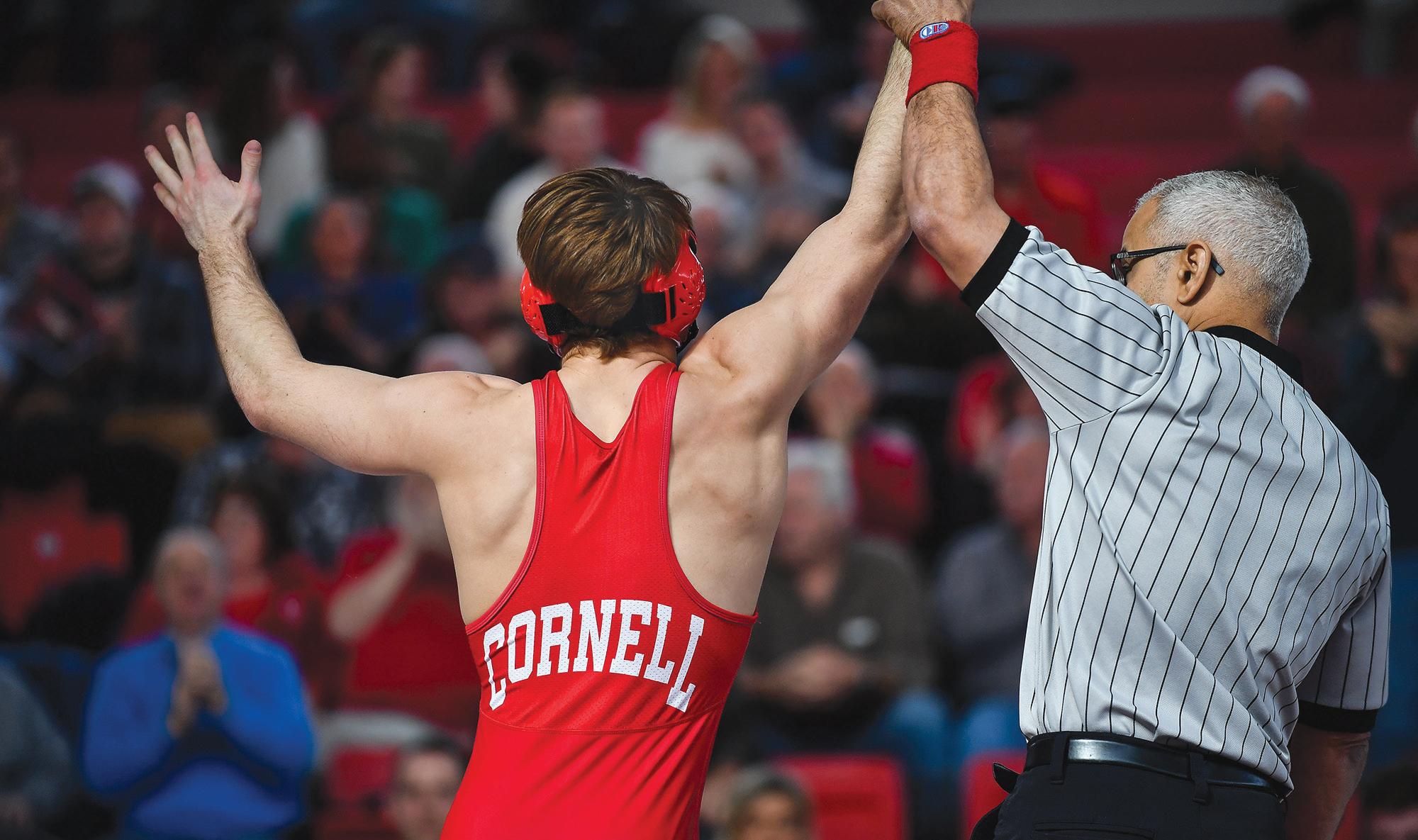
Despite competing without some of their top talent this 2019-2020 season, Cornell wrestling defied the odds and amassed 120 team points to earn a second place finish in the 2020 EIWA championship.
However, the season has yet to end as six wrestlers who earned automatic bids into the 2020 NCAA championships.
Sophomore Dom LaJoie, senior Chas Tucker, senior Noah Baughman, junior Hunter Richard, sophomore Ben Darmstadt and sophomore Brendan Furman will travel to Minneapolis, Minn. to compete on the national stage to compete from March 19 to 21. The other Cornell wrestlers seek an at-large bid into the national tournament.
favorable EIWA result serves as retribution for the Tiger’s dual victory during the regular season.
“They were quite a ways in our rearview mirror, to be honest, so it was gratifying to finish in front of them,” said head coach Robert Koll. “When you have a team who builds their whole season around beating us, it results in a weaker finish in the end. Our goal isn’t just to beat Princeton, but to have the best team at the end of the year where it counts.”
“I don’t think that we could have wrestled much better.”
Robert Koll
As the second place finisher, the Red was sandwiched between Lehigh who finished first with 154 team points, and Army whose 112 team points garnered them the third place spot. For a third straight season, Lehigh has dominated the championship.
The Princeton Tigers, the closest Ivy League finisher, managed a fifth place finish with 100.5 points. The Red’s more
Tucker’s position as the No. 1 seed in the 133 lbs bout of the tournament shortened his road to the EIWA title. After a first round bye, the senior took down Columbia’s Angelo Rini in a 7-3 match. Progressing to the semifinals, Tucker met Navy’s Casey Cobb on the mat, and vanquished him 8-2. With the title on the line, Tucker faced Nick Farro from Lehigh, who he toppled during the finals in the dual season. In a sudden victory, the Red wrestler came out on top for the second time this year. A 31-0 season record will bolster the two-time EIWA title winner as he wrestles in the NCAA tournament.
Darmstadt took home his second EIWA career title this weekend. The sophomore breezed through his first two rounds, and
in the semifinals, he picked up a 6-1 win against his Army opponent. He clinched a major decision against Bucknell’s Drew Phipps in the finals. After a first period takedown, Darmstadt added two near fall points in the second round, widening the lead with another takedown and having four minutes of riding time to win the 11-0 match and the title.
Maintaining his regular season groove, Richard took second place at the EIWA championships and wrestled his way to the NCAA championships. After two major decisions, Richard met Lehigh’s Jimmy Hoffman in the semifinals.
In the third period, Richard changed the trajectory of the match and earned a takedown and four near-fall points — the 7-5 victory sent him to the finals against Princeton’s Matt Kolodzik. During the match, Richard struggled to compensate for Kolodzik’s takedown, and relinquished a 4-3 defeat for a second place title.
Baughman clinched an invitation to the national tournament with a third place EIWA finish. Baughman sent Franklin & Marshall’s Wil Gil to the consolation round after eking out a narrow 12-1 opening