Department to improve policing equity. The panel featured former Mayor Svante Myrick ’09, Ducson Nguyen, 2nd ward alderperson of Ithaca and Eric Rosario and Karen Yearwood, co-leads of Reimagining Public Safety Working Group.
Following the murder of George Floyd in June 2020, former Governor Andrew Cuomo issued Executive Order 203, the New York State Police Reform and Reinvention Collaborative. The order urged all jurisdictions with police forces to evaluate their public safety policies, with the goal of improving service to their communities and addressing past racial biases.
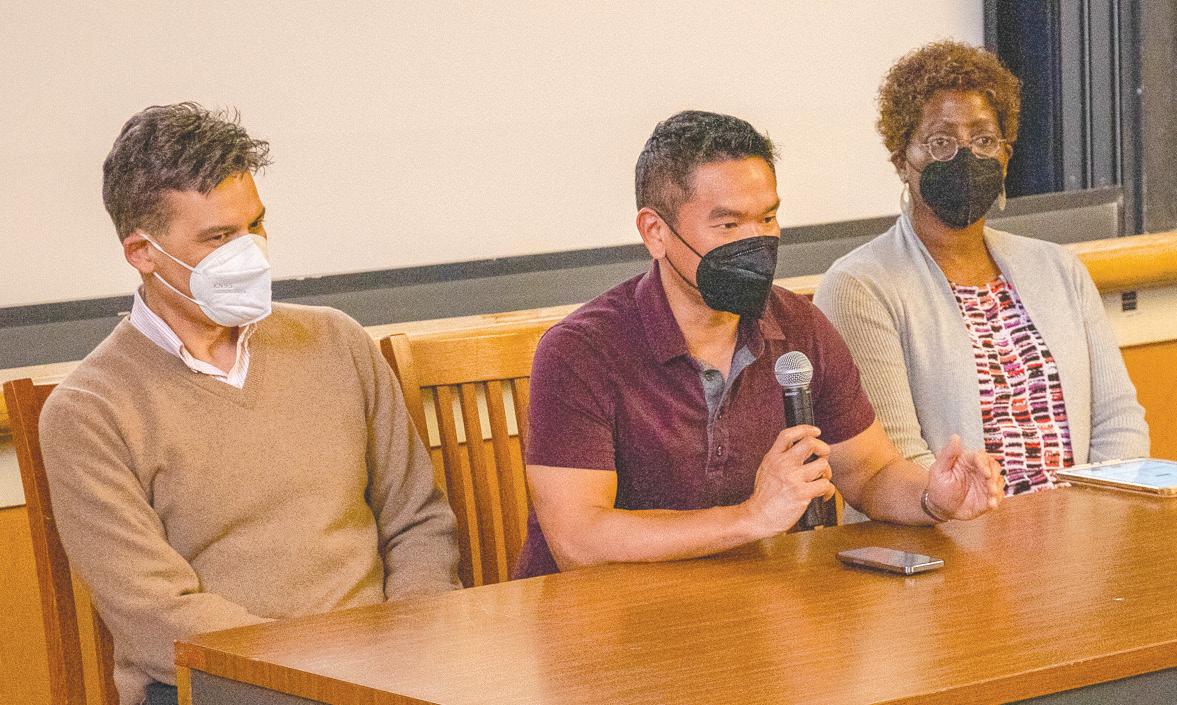
On March 9, Cornell Democrats hosted a panel with leaders of the Reimagining Public Safety Working Group, an organization working to restructure the Ithaca Police
In response to the order, former Tompkins County Administrator Jason Molino and former City of Ithaca Mayor Svante Myrick ’09 called together a collaborative of 40 individuals — experts in public safety and policing policy — to revise the Ithaca Police Department’s public safety policies to improve policing equity. On March 31, 2021,
Campus Support for Ukraine Persists
Students, faculty push
By SAMMIE LAMBOURNE Sun Contributor
Responding to Russia’s invasion of Ukraine on Feb. 24, students and faculty are taking steps to provide educational opportunities to the Cornell community about the conflict. From webinars to protests, Cornellians across the University are pushing for greater awareness of the crisis.
This week, a group of Cornell undergraduates has been advocating for the implementation of a University-wide teach-in day, ded-
for greater
education on the confict
icated to addressing the conflict in Ukraine.
This week, the students have been organizing in Goldwin Smith Hall from noon until 1 p.m. each day, with QR codes for other students that direct them to sign an open letter to the University President, the Provost and the Director of the Mario Einaudi Center for International Studies.
Concerning the teach-in day itself, the students hope to see a variety of lectures and discourses promoted by various departments.
“We want to inter-
rupt normalcy on campus and give students the opportunity to break out of their daily routine and understand the war that's happening in Ukraine right now,” said organizer Willow Martin ’22. “We want to open up space for students who are directly affected to have a safe space, and also for students who aren’t aware of what’s happening to get accurate information.”
Martin and Alyssa Anderson ’22, another organizer, initially learned about the conflict because their pro-
USDA Under Secretary Speaks on Rural Policies
By AIMEE EICHER Sun Assistant News Editor
On March 4, Cornellians gathered in Stocking Hall to hear from Under Secretary for Rural Development of the U.S. Department of Agriculture Xochitl Torres Small, who discussed the initiatives she has led to foster development in rural American communities.
A New Mexico native and the granddaughter of Mexican immigrants employed as farmworkers, Torres Small cited her background as her passion for rural development.
“I'm so grateful to get to work at this time, to invest in rural communities and to build true partnerships with people living in rural communities,” Torres Small said. “And that's grounded for me in my experience of rural opportunity.”
On June 18, 2021, President Joe Biden announced his intent to nominate Torres Small as Under Secretary for Rural Development at USDA. On Nov. 8, 2021, the U.S. Senate appointed her to the position.
Torres Small was also the first woman of color to represent New Mexico’s second Congressional District, holding the position from 2019 to 2021. She was succeeded by Yvette Herrell (R-N.M).
After earning her bachelor’s degree from Georgetown University’s School of Foreign Service, Torres Small went on to earn a law degree from the University of New Mexico’s School of Law. She also holds an international baccalaureate from Waterford Kamhlaba United World College of Southern Africa.
In her talk, Torres Small discussed how the work happening in rural American communities supports,
Policing | Alderperson Ducson Nguyen appears at center.
By ROMAN LAHAYE and AIMEE EICHER Sun News Editor and Sun Assistant News Editor
JULIA NAGEL / SUN PHOTOGRAPHY EDITOR
JULIA NAGEL / SUN PHOTOGRAPHY EDITOR
outside
Goldwin Smith Hall every day.
Public Safety Group Discusses Department Reform
POLICE
Continued from page 1
Ithaca Common Council unanimously voted to pass the plan.
The event focused on the group’s proposed restructuring of Ithaca’s Department of Public Safety into the Department of Community Safety, an umbrella organization with civilian oversight in the form of a commissioner. The new department would be comprised of two branches: the Division of Police — staffed by armed police officers — and the Division of Community Solutions, which will be staffed by unarmed respondents.
“This is all about creating more access to meaningful solutions, decreasing contact with the criminal justice system and freeing up police so that they can focus on preventing crime and solving crimes,” Rosario said. “We over-rely on [the] police, and that creates adverse outcomes disproportionately
for black and brown communities and other marginalized communities.”
The Department of Police would respond to calls such as assaults, burglaries and bomb threats. Meanwhile, the majority of calls for situations such as property checks, noise complaints and animal bites would be directed to the Division of Community Solutions.
The group’s proposals left the employment of the police department intact, without suggesting a decrease in staff. If implemented, it will call for the initial hiring of five respondents for the Department of Community Solutions.
The group cited other municipalities that have successfully diverted certain public safety issues away from the police department, such as Denver’s STAR program, which deploys Emergency Medical Technicians and mental health experts to non-violent calls related to mental health, substance abuse and homelessness.
The group hopes that the police department’s new structure can operate more efficiently and ease much of the burden currently placed on police officers.
“A lot of the police don't want to go on all these calls either. But there are some policies that require them to do so. Sometimes when EMS is going to a homeless shelter, they require the police to come with them to secure the scene. Sometimes the police officers are uncomfortable because there's someone with abdominal pain but they're standing uniform,” Rosario said.
Yearwood noted that police officers had complained about lack of staffing and feeling overworked. He hoped that the department restructuring would help address these burdens.
“I think there's more diversity of opinion within the police and you don't get to always hear all of it,” Rosario said. “I know that some police have said there's good in this report. I don't think anyone agrees 100%
with it, but I know that at least there's some recognition that there's some good in there.”
The team did not enjoy unanimity on all of its proposals and had to make several compromises to their original plans to appeal to a broader array of perspectives.
“I came in thinking we could be a little more radical than I expected, and I guess I was hit by a lot of political and legal realities and labor law realities,” Nguyen said.
Despite this challenge, the team expressed satisfaction with the results.
“But the product, I think, is good — it's a good foundation to make truly systemic change. In the best tradition of being deliberative, taking into account multiple voices and viewpoints,” Nguyen continued.
To continue reading this article, please visit cornellsun.com.
Roman LaHaye can be reached at lahaye@cornellsun.com. Aimée Eicher can be reached at aeicher@cornellsun.com.
Students Push for Education on Ukraine Crisis
fessor, Prof. Jane-Marie Law, religious studies, took a day in class to talk about the crisis.
“It is hard to get students to look up from their studies.… having a mandatory pause provided will be the most effective way to bring awareness,” Martin said.
Aside from the teach-in, Anderson said she hopes that students will take additional action.
“Being present and showing up is what we can do right now, on top of the teach-in,” she said.
Cornell’s Institute of Politics and Global Affairs recently held a series of webinars discussing the Ukraine-Russia crisis. Housed in the new Jeb E. Brooks School of Public Policy, the institute aims to provide the Cornell community with opportunities to hear from various speakers currently invested in the realm of policy.
Steve Israel, director of the Institute of Politics and Global Affairs, emphasized how bringing in speakers gives the Cornell community an unique opportunity to expand their awareness of global issues, as well as support Cornellians directly affected by these conflicts.
“Crises like this present opportunities, particularly on campus. For one, they remind us that Cornell is a global community with students who are personally affected… and, two, they can be used as learning lessons,” Israel said.
The first webinar on Feb. 22 hosted William B. Taylor, who served as the U.S. Ambassador to Ukraine from 2006
to 2009 and is currently the Vice President for Russia and Europe at the United States Institute of Peace. Israel, a former U.S. Congressman (D-N.Y.), emphasized how these webinars and discussions are vital in addressing situations as severe as the Ukraine-Russia crisis.
“This is a generational test for democracies across the world,” Israel said. “This is the first major aggression in Europe since the 1960s and World War II, and instead of reading about it in Russian history books, you can study it in real time today.”
When conflict arises, Israel’s focus is on educating the Cornell community on its dynamics. This education, he emphasized, is an integral part of the Institute for Politics and Global Affairs’s mission.
“We bring in global leaders to the Cornell community to explain it without soundbites. [The Institute] gives us the ability to marry academics with the people who staff our embassies, are elected to Congress and work in the White House,” Israel said.
The Institute hosted its second webinar, titled “Dispatch from Ukraine: Human Rights and Conflict in the Eastern Regions”, on March 2. This webinar brought in Representative Chris Smith (R-N.J.), co-chair of the bipartisan Tom Lantos Human Rights Commission,formerly known as the Congressional Human Rights Caucus, and Bernard-Henri Lévy, a French activist. They discussed Volodymyr Zelenskyy’s response to the crisis as Ukraine’s president and head of state, as well as how other countries are responding to the attack.
Since the start of the webinar series, the U.S. Government has issued a series of sanctions on Russia — which have included blocking Russian banks, air travel and, more recently, oil. Having served on the Subcommittee for State, Foreign Operations, and Related Programs during his time as a U.S. Congressman, Israel is familiar with the process of issuing sanctions. He expressed support for economic sanctions as an alternative to military escalation but stressed that they should not significantly hurt Americans.
“President Biden has been very careful to implement the kinds of protections that will maximize punishment on Putin and reduce the impact on Americans,” Israel said.
To continue reading this article, please visit cornellsun.com.
Sammie Lambourne can be reached at sjl338@cornellsun.com.
Dining Guide
Lab-Grown Food: Meat Without Murder
By SADIE GROBERG Sun Staff Writer
In 2022, it’s more common than ever to see the plant-based diet represented in the world of dining. From Impossible Burgers to dairyfree cheese, the sticky, laminated folds of restaurant menus have opened up to the idea of vegan and vegetarian cuisine. Your waiter doesn’t care whether you’re a life-long vegan, kosher or just watching your cholesterol — the reasons behind avoiding animal products are varying, and it’s never mattered less.
At the same time, recently, issues regarding animal agriculture have received more attention. Environmental impacts, excessive water use, land intensification and health impacts are all areas of concern that are becoming more common among consumers. Beef cattle production is responsible for around half of greenhouse gas emissions caused by agriculture, and many people report a desire to cut back on red meat consumption in favor of plant-based alternatives. For those who wish to eat less meat, the plant-based market has widened immensely to include a plethora of choices. While vegan diners could previously expect to order a black bean burger or simply stick to a salad, the emergence of products such as Beyond Meat and the Impossible Burger have shifted the landscape of meatless options. Not only are these items spotted in the grocery store and on menus, but they are also now appearing in many fast-food spots and drive-throughs, as the brands create successful partnerships with global chains.
For some people who abstain from consuming meat, it might seem odd to seek out its taste and texture. After all, how can something be appealing while simultaneously going against your moral code? However, not everyone goes vegetarian for ethical reasons. In the case of health restrictions or environmental concerns, for example, people might still desire the sensation of a juicy burger or a crispy chicken nugget. This shared urge is what has made brands like Beyond Meat so profitable –– that post-bite reaction, that “I can’t believe it’s not real!” taste. The near-perfect imitation of an animal product is enough for many vegetarian and vegan consumers. Others want to push science even farther. While plant-based meat alternatives have been immensely successful, there is still something left to be desired –– genuineness.
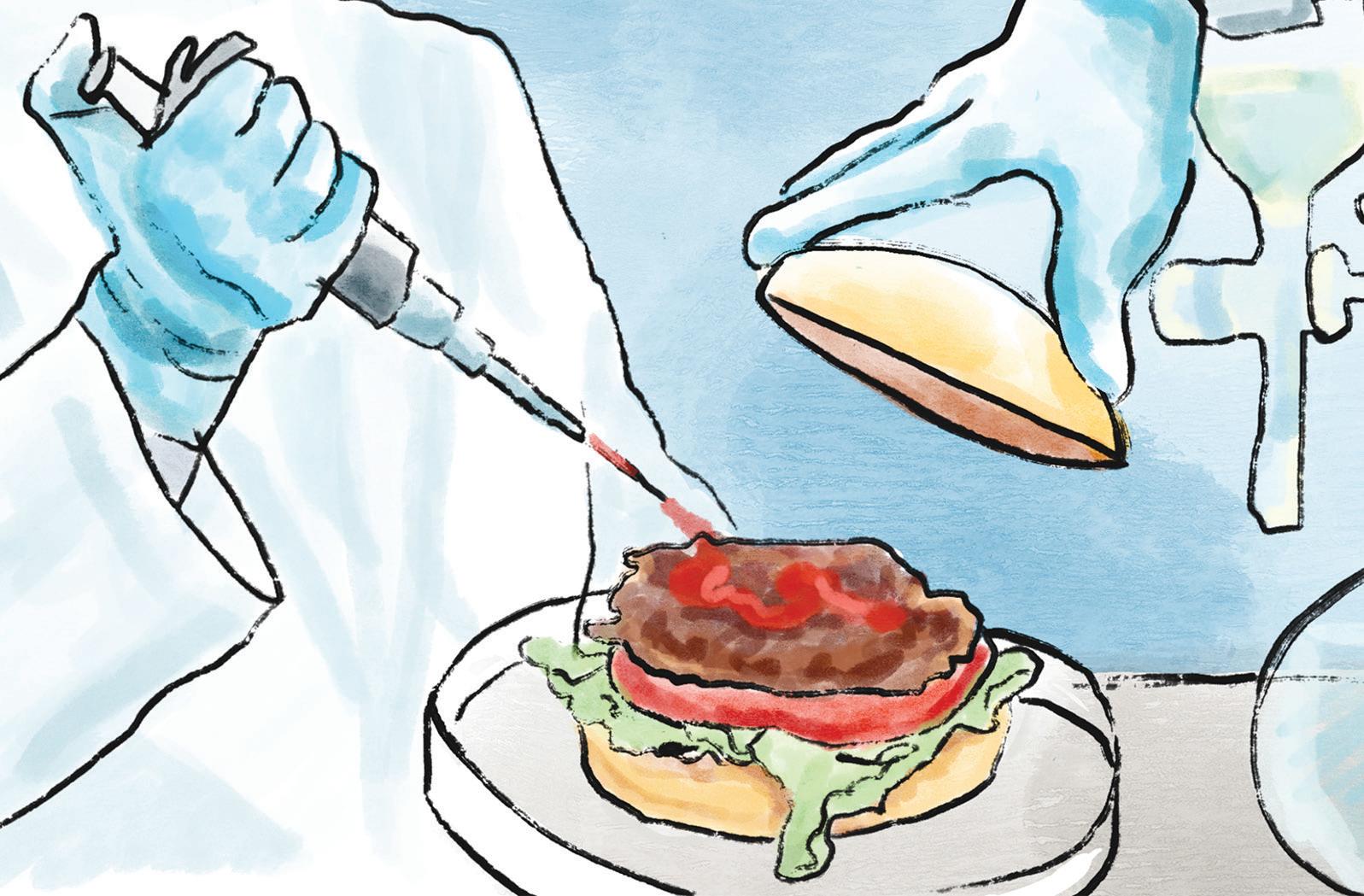
Enter lab-made meat, food that truly is made of animal product, but neither involves the killing of animals nor the use of intensive agricultural practices. Decades ago, a scientist named Willem van Eelen was inspired to create a form of meat that could be grown in a lab using animal muscle tissues. In a world where meat consumption as a social norm is almost ubiquitous, people were quickly intrigued by the idea of lessening hunger and planetary pressures while preserving dietary customs. So how exactly does it work? After harvesting a small sample of muscle cells from an animal, scientists place the cells in bioreactors, where they grow over time and turn into muscle tissue. Based on van Eelen’s research, the product that forms can be shaped into any kind of meat like we would see in the grocery store.
Understandably, this process has left consumers with a number of questions and concerns. Many people are turned off by the idea of their food being grown in a scientific laboratory. However, researchers say that eventually, the process could be completed in smaller scale facilities akin to microbreweries. Additionally, the idea of such a complex and innovative process raises the question of price and access. Companies are currently working to develop a marketable and affordable process. Although lab-grown meat has yet to hit the American marketplace, buyers in Singapore were the first to taste lab chicken in 2020. The Food and Drug Administration and Department of Agriculture announced in 2019 that they would oversee the development of these products and receive approval to market their cultivated meat.
Despite the massive growth in demand for plant-based products, most people still purchase meat, and climate change is worsening much faster than social norms can keep up. We can’t know exactly what the future holds for our planet and our diets, but it’s clear that change is necessary. To be explicit: lab-grown meat is not vegan or vegetarian, as it is real meat from a living animal. The key difference is that animals are not killed or put in pain through the process of cultivation (anesthesia is used to minimize pain). However, the harvesting of muscle cells continues the human tradition of utilizing animals.
To continue reading this article, please visit cornellsun.com.
AVA FASCIANO / SUN STAFF
A Little Less Conversation, More Connection!
Around Valentine’s Day, my friends and I were looking at Te New York Times list of “36 Questions Tat Lead to Love.” Te questions, like “What do you value most in a friendship?” seemed unremarkable considering what the list promises. Always the critic — or maybe too cynical a candidate for love — I couldn’t help but think the prompt only appears to dig so deep in comparison to the standard space-flling that dominates most public conversation. Even in settings as intent on connection as frst dates, it’s easy to take up time with talk that skims the surface, not even allowing the opportunity to fall for someone.
Since then, I’ve been thinking about conversations just as much as having them — sometimes even while having them. In a lot of casual talks I feel this weird separation from what I’m saying. My mouth is on autopilot and my brain annotating, administering strikes every time I’m responsible for an awkward silence. I’ve always wished I was a better conversationalist. Not for falling in love, but to be polite to other people’s parents, to help distract a coworker during the slow parts of a shift, to survive ofce hours past the point of my questions being addressed. To pass endless social tests.
Over the phone the other day my sister asked me what
Cornell people are like, and at frst, I only had thoughtful silence to ofer her. I’m a senior, and I still feel like I only have a vague impression. She was saying that people at her college in Connecticut are repressed. When they go to shows they stand around stify. Tey get happy enough to smile but never shout about it. I told her that wasn’t the case here, but I don’t want to speak for everyone — especially not the Engineering school. Ten again, I lived in Cascadilla sophomore year, and while my foormates may not have found me at fshbowls, they weren’t tight-lipped or reclusive. Tey gave me the humbling experience of being shamed for my study habits as well as the honor of being invited to a Super Smash Bros. tournament.
People here, I decided, are talkers. It can be hard not to feel like a caterpillar among social butterfies. But speaking with people here can feel like reading for a script I’m missing pages from. With every sentence, I sense expectation, that there’s something smart or interesting that they’ve heard before that someone else would say in my place. Everywhere there’s a flm of friendliness that I can’t fnd my way into.
It makes me duck and cover when I see sorority sisters who spoke to me like a spooked horse in frst-year writing seminars. I can’t think of anything else to say to those smiles. Yet on the other hand, I can’t help the crushing invisibility I feel from the averted eyes of people who decided I was unimpressive in a discussion section ages ago. I watch as they scope out social scenes like satellites, searching for only the most intelligent life to make contact with. Although there are diferent styles of doing it, or maybe a spectrum they fall along, it’s like Cornell people learn to talk as a tool. It can be hard to get to know someone while we tend to each other like robots, our moments together amounting to not much more than networking and maintenance. Most of my casual conversations are just someone else’s formalities.
If you stop someone for enough speed-round conversations on campus, they will have to vote for you in that club ofcer election. It’s not legally binding, but what is the law to social code, anyway? Tis order of events is hardly a scheme as much as it is a seed planted in our subconscious. Sometimes being a talker is as simple as being tapped-in to the unwritten rules of social networks. As a freshman, I second-guessed reaching out to a professor when I noticed other students had email signatures. I was so ashamed to lack
such sophistication that I made myself sick speculating how many other trade secrets would have been missing from the email before my modest sign-of Tis type of conversing is an acquired skill, and it makes me wish I had a template for every conversation I start.
But speaking for success shouldn’t mean we have to cut connections so short and shallow. Talk is cheap like a shirt from SHEIN. It’s good to get us through the doors of one frat party, but it’s already falling apart before the night is over. Playing by other people’s rules, even if we do it perfectly, can be fruitless in its own way. A few times over the last month I’ve heard from my friends of this hunger for something missing, whether it be in the form of sex, romance or someone worth standing by. Sticking to the script can leave you unsatisfed when the curtains close.
My most cherished interactions with people who are not yet friends are the ones where we catch each other on a night out, or otherwise unexpectedly. One of us approaches the other too enthusiastically for how well we know each other, and we sing praise we’ve been shyly withholding or spill out about something that’ll be a little embarrassing to remember the next time our eyes meet on campus. But it will become a reason for the smile beneath our hellos.
Even Te New York Times’ 36 questions are from a psychology experiment aimed at the hypothesis that intimacy can be synthesized and streamlined. Te feelings of closeness are meant to be manipulated into reality by the questions, efciently, scientifcally and formulaically. You can take it like an interview and treat love like the dream job at the end.
Networking, I think, is a necessary evil. I know its value, but it can feel so vapid to speak with people just to keep them as social contacts in an ever-growing inventory. Closeness is what helps me cope with my poor conversation skills. It’s hard for my brain to do so much tuning out and anxious annotating when I speak with people that I’ve come to know vividly. A good talk can even feel spiritual when you’re with someone you fnd special enough. Te hunger some of my friends had mentioned has been hitting me too. I know some people so well, who are so great that it makes me greedy for more, wondering how many other Cornell people I’ve let slip through my fngers because I was too busy trying and failing at sticking to the social script.
Te Mandate We Really Should Be Ending
Giancarlo Valdetaro Far Above
Giancarlo Valdetaro is a senior in the College of Arts and Sciences. He can be reached at gvaldetaro@cornellsun.com. Far Above runs every other Wednesday this semester.
Mandates are a hot topic at the moment. As I write the frst draft of this, a conspiratorial group of truckers are attempting to wreak havoc-through-gridlock on the interstate I grew up next to as an act of protest against vaccine mandates. Closer to Sun readership, one of my fellow columnists wrote about Cornell’s mask mandates (again) on the exact same day that the New York statewide school mask mandate ended.
And yet, at a time when these largely unenforced mandates rile up so many, there is a diferent requirement that afects almost every aspect of our day-to-day lives in Ithaca, yet often avoids the spotlight. With signifcant negative repercussions for the climate crisis, socioeconomic equity and general quality of life, it is a precondition for participating in society that policymakers from our city aldermen all the way up to Gov. Kathy Hochul and New York’s senators should be striving to end as soon as possible. What am I talking about? Te driving mandate.
A set of policies which all but requires people to have their own personal vehicle in
order to meet their basic needs, the driving mandate isn’t stated explicitly anywhere.
Despite this, if you need a car to get groceries, go to medical appointments, commute to work or school or spend time with friends and family in a reasonable manner, you too are under the despotic rule of the driving mandate. On Cornell’s campus, in Collegetown and around the Commons, this regime can be difcult to see; all of these areas are fairly dense, walkable and frequently served by multiple TCAT routes.
Wander beyond these neighborhoods, though, and the driving mandate rears its ugly head once again. Want to go to Wegmans or Trader Joes? For most of the day, there’s only one bus an hour. Need to get to the hospital at Cayuga Medical Center? If you don’t catch the hourly bus, you’re stuck taking an Uber or walking. Looking to visit one of Tompkins County’s iconic state parks without having to actually park there? On a weekend, there are only a few buses all day to each entrance. Tese hypotheticals don’t even address intercity travel, where anybody without a car is severely limited if trying to go anywhere other than New York City. Te fact that driving is by far the easiest way to get to many important locations in Ithaca may not seem controversial. What’s so wrong with prioritizing the mode of transportation that over 91% of households have access to?
First of all, driving exacerbates the climate crisis. On a societal level, as I mentioned two weeks ago, a plurality of U.S. greenhouse gas emissions now come from transportation. On a local level, structuring communities around cars leads to the kind of sprawling development in which buildings require more energy to heat them, more land is devoured for parking lots and subdivisions and the longer distances help increase transportation emissions despite recent improvements in fuel efciency. Te suburbs may have more greenery than inner cities, but they also have much larger carbon footprints. Second, catering to driving is inequitable
and always has been. When they were frst adopted, cars were toys rich men used for leisure — and killing scores of children. Since the start of the interstate highway program, car infrastructure has been used to destroy Black and brown communities across the country, from Southeast D.C. to Miami’s Overtown and the many other households that continue to be displaced to this day. Non-drivers today are disproportionately non-white and lower income, and owning a car is a signifcant fnancial burden. People killed while walking are also disproportionately people of color, older and traveling in lower income areas when they die.
Tird, cars severely diminish our quality of life. Air pollution has serious consequences, and even if most cars become electric-powered, recent research suggests most emissions come from the rubber hitting the road, not the tailpipe. Noise pollution from cars is also deleterious to public health; as someone whose bedroom window is about 15 feet above Dryden Road and its noisy drivers, I can attest to this. Commuting tends to be less enjoyable in cars than on transit or by bike or foot, and the sprawl that necessitates commuting is physically isolating and socially alienating. Similarly, being easy to drive to is a sure sign a destination will be even easier to leave. Ask anybody who’s been to restaurants along both the Commons and Route 13: After you’re done eating and drinking, it’s much more enjoyable to spend time relaxing and walking around at the former than the latter.
Finally, the design choices that make driving easy don’t just make the places we drive to sterile but make it much less likely any other transportation mode will be used to get there. Wide roads, wide turns and large parking lots lead to the fast cars and sprawled development styles that make walking and cycling both dangerous and impractical, and usably frequent transit operations prohibitively inefcient. Tis is how a driving preference becomes a driving mandate.
So, how do we end the driving mandate?
Locally, we can encourage developers to build afordable, walkable housing on the city’s acres of underutilized parking lots. We can also turn our parking minimums into parking maximums so that we get more street-oriented, cheaper buildings like Collegetown Crossing and fewer car-oriented, expensive-to-build ones like 312 College Ave. Ten, we could make the streets that serve those buildings ducking safe and frequently served by TCAT, every 10 minutes at least.
At the state level, Gov. Hochul can follow through on her Brooks School rhetoric about shovel-ready infrastructure projects, emissions reduction goals and high-speed rail by looking at this proposal for an intercity rail network in New York that would connect Ithaca to Syracuse via an abandoned rail line. In the meantime, she can subsidize intercity bus service so a Cornell student fying out of the Syracuse airport or even a governor speaking to Cornell students can rely on quality transit for those trips. If Gov. Hochul can get to a Cornell event on Lexington Avenue on transit, she should be able to do the same when going to East Avenue.
Nationally, the actions involve regulation. Instead of prohibiting new public housing units, Congress can give states and local governments funds to build them so the thousands of units built on parking lots across Ithaca are socially owned. Instead of letting auto manufacturers regulate their designs themselves, Congress can require approval of new car models, ensuring that newly safe street designs aren’t counteracted by consumer trucks as large as tanks.
For several decades, driving has fundamentally shaped the way we relate to each other, our society and the planet at large. Tis mobility monopoly has destroyed our cities, kills tens of thousands of us every year and continues to threaten us with disconnection from our most basic needs to survive unless we operate a multi-thousand-pound metal box. It’s time to end it; the driving mandate’s got to go.
Alecia Wilk is a senior in the College of Arts and Sciences. She can be reached at awilk@cornellsun.com. Girl, Uninterrupted runs every other Tuesday this semester.
Alecia Wilk Girl, Uninterrupted
Fill in the empty cells, one number in each, so that each column, row, and region contains the numbers 1-9 exactly once. Each number in the solution therefore occurs only once in each of the three “directions,” hence the “single numbers” implied by the puzzle’s name. (Rules from wikipedia.org/wiki/ Sudoku)
I Am Going to Be Small
Mr. Gnu by Travis Dandro
Mr. Gnu by Travis Dandro
SC I ENCE
Seven Cornell Profs Awarded AAAS Fellowship
By MEGAN KELLER and JESSIE YE Sun Staff Writer and Sun Contributor
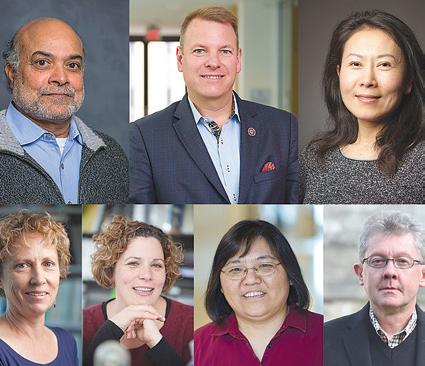
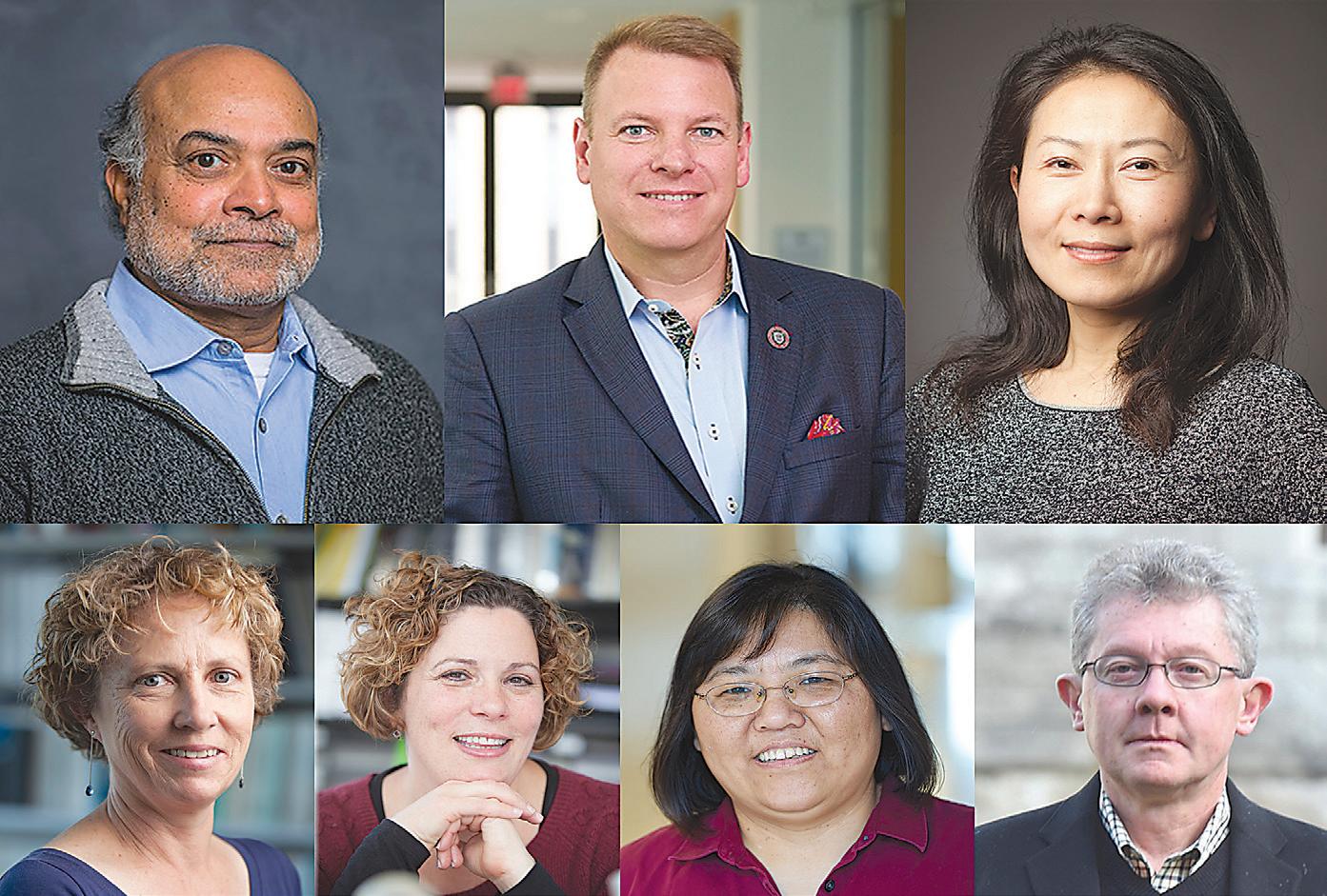
This year seven Cornell faculty members were awarded as American Association for the Advancement of Science Fellows, a distinguished group of scientists, engineers and innovators who have been recognized for their achievements across disciplines.
Prof. Chris Schaffer, biomedical engineering, currently runs a lab with Dr. Nozomi Nishimura, biomedical engineering, where they develop optic-based techniques to inspect the dynamic behavior of live cells. Such techniques include building unique microscopes that can observe new types of cells or see deeper into cell tissue. Using this equipment, the majority of his research has involved protein engineering in the context of more fully understanding cellular interactions that drive downstream symptoms of neurological diseases.
In one project, his team focused on the underlying mechanism of cerebral blood flow reduction in patients with Alzheimer’s disease. They discovered that neutrophils stuck to capillary segments and blocked blood flow in mice models. Other lab studies include spinal cord injury, microvascular stroke and the role of capillary level flow disruptions.
Prof. Huili (Grace) Xing, electrical and computer engineering, joined Cornell in 2014. Her work has focused on high-performance connector devices, including nitride materials, oxide materials, low-dimensional materials and quantum materials that act as semiconductors. With this research, she pioneers the synthesis and application of materials that are not naturally found to increase their functionality and speed.
Prof. Prabhu Pingali, applied economics and policy, has studied the relationship between food systems and poverty reductions in rural populations of Africa, South America and Latin America for four decades. He has
recently studied three particular areas. The first is on creating more diversity and an increased supply of fruits, vegetables, meat and dairy products, moving away from grains and wheat. The second is to create a food system that allows farmers to be responsive to market signals of consumption and demand for fresh foods. The third is creating government policies that provide incentives for farmers to diversify their products.
Prof. Paula Cohen, biomedical sciences became interested in germ cell biology and genome integrity during her postdoc where she has since studied the role of DNA repair proteins in mammalian meiosis. Her work has discovered novel checkpoints and regulatory mechanisms during the first meiotic crossover event, which are essential for the accurate segregation of homologous chromosomes during the first phase of meiosis. Her work has allowed scientists to gain a better understanding of how cells maintain their genomic integrity, ensuring the
successful recombination of the gametes.
Prof. Jun (Kelly) Liu, molecular biology and genetics received her Ph.D. at Cornell in 1996 and came back as a faculty member in 2001. Liu’s research involves the free-living nematode C. elegans as a model system for studying two significant themes: how stem cells divide to produce multiple cell types and the discovery of new genes within a highly conserved signaling pathway, the bone morphogenetic protein pathway.
“[C. elegans are] one of the best organisms to study molecular mechanisms controlling development at single cell resolution.” Liu explained in a previous interview. By using this unique system, she was able to thoroughly investigate the origin of the cells that make up our mesoderm — the heart, bones, blood and muscles. She discovered how they differentiate into various types and when this differentiating process occurs during growth. The BMP pathway was an accidental find through a mutant C. elegan. The location in which some
of the cells migrated to differed, resulting in new knowledge on cell-to-cell signaling.
Prof. Claire Cardie, computer science, serves as a professor in the Computer Science and Information Science departments studying natural language processing. Dr. Cardie’s goals are to help users find, absorb and extract information from the internet by creating algorithms and systems.
Her recent research accomplishments include studying the recognition of human intent through social media images, creating Classification with Alternating Normalization — a non-parametric post-processing step for classification — and proposing studying models under a setting increasingly similar to what an agent might encounter in the real world.
Prof. J.C. Séamus Davis, physics, was awarded in 2019 the James Gilbert White Distinguished Professor Emeritus in the Department of Physics for his groundbreaking contributions to experimental low-temperature and condensed matter physics. Davis has also invented low-temperature spectroscopic STM imaging, which is used to explore surfaces, electronic structures and bulk properties with atomic resolution
Dr. Davis’ lab concentrates creating unique instruments that can visualize the physical properties of electronic, magnetic, atomic and space-time quantum matter at the atomic level. His group is a single research group conducting simultaneous studies with labs at three different locations, one at Cornell, the second at The University College Cork and a third at Oxford University.
AAAS mission statement is to “advance science, engineering and innovation throughout the world for the benefit of all people.” This year’s fellow selection highlights how much of that innovation is occurring right here at Cornell.
Megan Keller can be reached at mrk269@cornell.edu. Jessie Ye can be reached at jy562@cornell.edu.
Weill Faculty Discusses Leading Haiti Cholera Response
By MEGAN KELLER Sun Staff Writer
On Jan. 10, 2010, a 7.0 magnitude earthquake struck the heart of Haiti, displacing millions of people, destroying much of the country’s infrastructure and ultimately creating nearly inhabitable conditions — a common recipe for a disease outbreak to take hold. It was not unexpected when Haiti then experienced the worst cholera outbreak in modern history. Through the combined efforts of Haiti’s Ministry of Health, Weill Cornell and GHESKIO, a Cornell-affiliated, world-class
Haitian clinical treatment and research facility, the country recently celebrated its 3rd year anniversary of the last documented case of cholera on Feb. 4, 2022.
The World Health Organization utilizes a three year benchmark to declare that a country has eliminated cholera. The proclamation has become a monumental milestone, not just for Haiti, but for global epidemic mitigation procedures as well.
Weill Cornell and GHESKIO have been affiliated with one another since 1979. Weill graduate Dr. Jean Pape serves as co-founder of GHESKIO and has since become a
Weill Cornell professor.
“The mission is to provide clinical care to the most vulnerable, conduct clinical research and share the knowledge through training at the national model,” said Dr. Vanessa Rouzier, a Weill Cornell trained pediatrician and faculty member with a specialty in infectious disease.
Cholera is caused by the waterborne pathogen Vibrio cholerae and is characterized as a disease born from poverty. Poor sanitation and limited waste-management strategies allow for fecal-contaminated water sources that contain the bacteria to spread disease.
Between 2010 and 2014, there were 699,579 cases and 8539 deaths due to the cholera outbreak in Haiti. The earthquake destroyed 80 percent of downtown buildings in the capital Port-au-Prince, displacing 1.5 million people. When one of the largest rivers in Haiti became contaminated with cholera, it quickly spread.
Rouzier, born and raised in Haiti, returned to work there in 2009 after the earthquake-induced cholera epidemic. Seeing the action first hand, she described the aftermath as “chaos.”
Haiti, with its limited healthcare infrastructure, became quickly overwhelmed. Rouzier explained that improving sanitation and access to clean water is the first step
to eradicating cholera.
However, such plans at the time were unaffordable for a country like Haiti. The transition to a proper sewage system, access to potable water and an economy where people can buy disinfecting materials would have cost an estimated $2 trillion. This is the long term goal, but midterm strategies were necessary as well.
Rouzier and her team started to implement these strategies, starting with a single slum. Working with leaders in the community, they improved water sanitation by developing a chlorine factory, established a public trash system to reduce litter and worked with schools to build a biodigester — a mechanism to decontaminate feces. The effort as a whole demonstrated the capacity to enact change at the local level.
“We don’t have to wait for the multimillion investments in the country,” Rouzier explained. “[It showed] we can do things locally.”
The last strategy was introducing a vaccine. Back in 2010, there were only two cholera vaccines approved by the WHO. Both were limited in supply and only distributed to people traveling to areas with cholera outbreaks.
After battling the WHO, CDC and partners, Rouzier and her team convinced the Red Cross to buy 100,000 doses of one of the cholera
vaccines for a trial run. The first of the pilot programs officially vaccinated 50,000 people with the oral cholera vaccine in 2012. A Haitian organization called Partners in Health vaccinated an additional 50,000 in the area where the outbreak started.
“People at the time were saying, ‘Oh, this is impossible. You’re in a post earthquake situation, the country is in disarray. It’s not feasible, you’re not going to get people to come back for the second dose!’ Rouzier said. “It’s funny how history repeats itself. But from April to June 2012, nearly two years after the outbreak, we vaccinated 100,000 people and we showed that it was feasible.”
The monumental success led WHO to begin advocating to include the OCV in cholera outbreak scenarios.Though the health and sanitation of Haiti has still not improved greatly, the country has effectively eradicated the transmission of cholera in a population that remains very poor and has little access to water and basic sanitation.
“To me, this is a remarkable story because it really shows that you can be faced with [amazingly] overwhelming circumstances, take [it] one step at a time, don’t stop when they say no and [still] turn the tide around.”
Megan Keller can be reached at mrk269@cornell.edu.
Cholera epidemic | Local cholera patients overfill a small clinic in Rendel, Haiti, waiting to be treated in the devestating aftermath of the 2010 earthquake.
Fellows | From the crossroads of economics and agriculture to Alzheimer’s research and engineering, these faculty members have displayed new research of which Cornell boasts.