The Corne¬ Daily Sun
By TAMARA KAMIS Sun News Editor
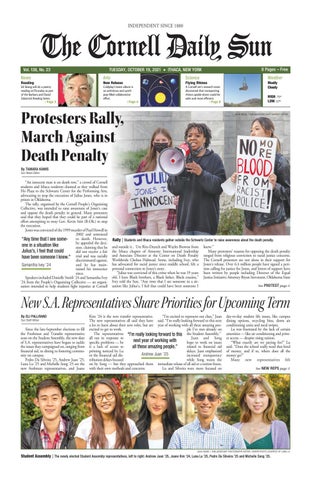
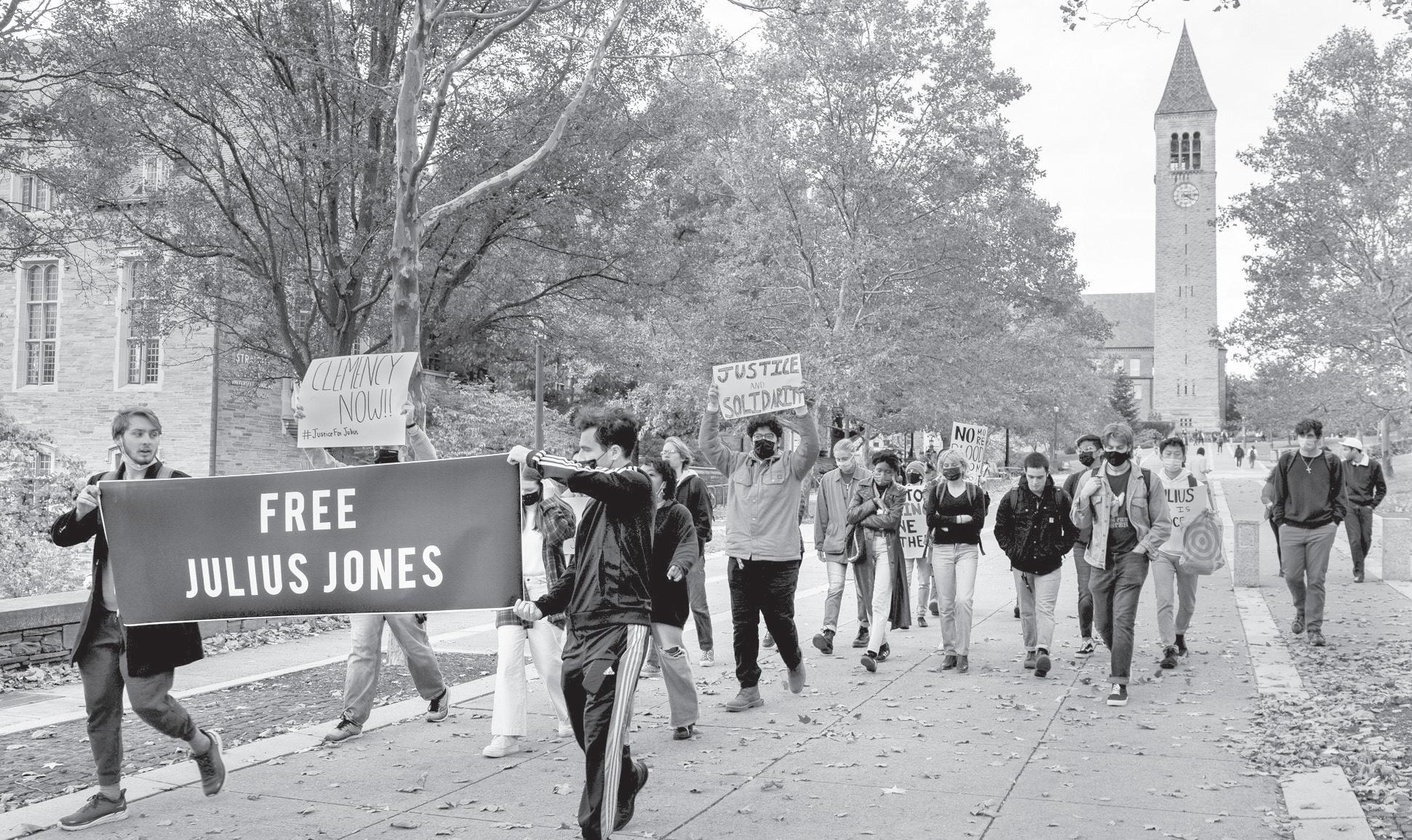
“An innocent man is on death row,” a crowd of Cornell students and Ithaca residents chanted as they walked from Ho Plaza to the Schwartz Center for the Performing Arts, advocating to stop the execution of Julius Jones, who is in prison in Oklahoma.
The rally, organized by the Cornell People’s Organizing Collective, was intended to raise awareness of Jones’s case and oppose the death penalty in general. Many protesters said that they hoped that they could be part of a national effort attempting to sway Gov. Kevin Stitt (R-Ok.) to stop the execution.
“Any time that I see someone in a situation like Julius’s, I feel that could have been someone I knew.”
Samantha Ivey ’24
Jones was convicted of the 1999 murder of Paul Howell in 2002 and sentenced to death. However, he appealed the decision, claiming that he did not receive a fair trial and was racially discriminated against, and he has maintained his innocence since.
Speakers included Danielle Smith ’24 and Samantha Ivey ’24 from the People’s Organizing Collective — an organization intended to help students fight injustice at Cornell


and outside it , Ute Ritz-Deutch and Wayles Browne from the Ithaca chapter of Amnesty International leadership and Associate Director at the Center on Death Penalty Worldwide Chelsea Halstead. Some, including Ivey, who has advocated for racial justice since middle school, felt a personal connection to Jones’s story.
“Julius was convicted of this crime when he was 19 years old. I have Black brothers, a Black father, Black cousins,” Ivey told the Sun. “Any time that I see someone in a situation like Julius’s, I feel that could have been someone I
knew.”
Many protestors’ reasons for opposing the death penalty ranged from religious conviction to racial justice concerns. The Cornell protesters are not alone in their support for Jones’s release. Over 6.4 million people have signed a petition calling for justice for Jones, and letters of support have been written by people including Director of the Equal Justice Initiative Attorney Bryan Stevenson, Oklahoma State
By ELI PALLRAND Sun Staff Writer
Since the late-September elections to fill the Freshman and Transfer representative seats on the Student Assembly, the new slate of S.A. representatives have begun to tackle the issues they campaigned on, ranging from financial aid, to dining to fostering community on campus.
Pedro Da Silveira ’25, Andrew Juan ’25, Luna Lu ’25 and Michelle Song ’25 are the new freshman representatives, and Joane
Kim ’24 is the new transfer representative.
The new representatives all said they have a lot to learn about their new roles, but are excited to get to work.
The representatives all ran in response to specific problems — be it a lack of access to printing noticed by Lu or the financial aid distribution delays focused on by Song — but they approached them with their own methods and concerns.
“I’m really looking forward to this next year of working with all these amazing people.”
“I’m excited to represent our class,” Juan said. “I’m really looking forward to this next year of working with all these amazing people I’ve met already on the Student Assembly.”
Andrew Juan ’25
Juan and Song hope to work on issues related to financial aid delays. Juan emphasized increased transparency while Song wants the immediate release of all aid or a tuition freeze.
Lu and Silveira were more focused on
day-to-day student life issues, like campus dining options, recycling bins, dorm air conditioning units and meal swipes.
Lu was frustrated by the lack of certain amenities — like air conditioning and printer access — despite rising tuition.
“What exactly are we paying for?” Lu said. “Does the school really need that kind of money, and if so, where does all the money go?”
Many new representatives felt

Tuesday, October 19,
Pillsbury Institute for Hospitality Entrepreneurship’s Entrepreneur in Residence: Bill Minnock ’79, MBA ’83
11 a.m. - Noon, Statler Hall 540
Econometrics Workshop: Ben Deaner
11:15 a.m. - 12:45 p.m., Ives Hall 217
Fake News, Alternative Facts, and Disinformation: Learning to Critically Evaluate Media Sources Noon - 1 p.m., Uris Library, Uris Classroom
Berger International Speaker Series With Sandra Babcock Documenting the Resistance to Israel’s Occupations Amid an Escalating Campaign to Silence Dissent: The Work of the International Human Rights Clinic 12:15 - 1:15 p.m., Myron Taylor Hall, Landis Auditorium
37th Annual Hospitality Virtual Career Fair 1-5 p.m., Virtual Event
Cornell in Washington Virtual Information Session 4:30 - 6 p.m., Virtual Event
Webinar with Fatema Sumar ’01 — The Development Diplomat: Working Across Borders, Boardrooms and Bureaucracies to End Poverty 4:30 - 6 p.m., Martha Van Rensselaer Hall 2114 & Virtual Event
Industrial Organization Workshop: Qinshu Xue
11:15 a.m. - 12:45 p.m., ILR Conference Center 423
Rene Crespin: “The Value of School Social Climate Information: Evidence from Chicago Housing Transactions” 1:15 - 2:30 p.m., Martha Van Rensselaer Hall 2250
CEAS Book Talk: Eight Dogs, or Hakkenden: Part One — An Ill-Considered Jest. 1:30 - 2:30 p.m., Virtual Event
Leadership in Sustainable & Ethical Decision Making Workshop with Cheryl Einhorn 3:30 p.m., Virtual Event
Mental Fitness for All: Strategies f For Academic & Life Success
4:30 p.m., Africana Studies and Research Center, Multipurpose Room
Info Session: Fulbright U.S. Student Program for Undergraduates 4:45 - 5:45 p.m., Virtual Event
J. Yolande Daniels: Building | Un-Building 5:15 p.m., Virtual Event
Israeli Chamber Project: C.U. Music 8 p.m., Barnes Hall

Skoog’s event will be second in this semester’s creative writing program series, back after hiatus
By SURITA BASU Sun Assistant News Editor
Cornell’s creative writing program is once again inviting prominent writers to campus for live readings, as the Barbara & David Zalaznick Reading Series returns after over a year of hiatus.
This week’s installment — the second of the year — will feature a reading by poet Ed Skoog. Throughout his career, Skoog has authored four books of poems and has been published in The New Yorker, Harper’s and The New Republic. He has also been the recipient of several awards including the Marble Faun Prize in Poetry in 2005 and the Lyric Poetry Award from the Poetry Society of America in 2007. His work has been recognized for word play and juxtaposition of image and phrase.
Skoog’s latest book, Travelers Leaving for the City, was published by Copper Canyon press in May 2020. It centers around the murder of Skoog’s grandfather in 1955 in a Pittsburgh hotel. His other works include Toolkit (1995), Field Recording (2003), Mister Skylight (2009) and Rough Day (2013).
Skoog has taught at the Idyllwild Arts Foundation in California, the New Orleans Center for Creative Arts
and Tulane University. He has previously held positions at George Washington University and Richard Hugo House, a non-profit community writing center in Seattle. He is currently a visiting writer at the University of Montana and resides in Portland, Oregon.
Past visiting writers have included former U.S. poets laureate Billy Collins and Charles Simic, novelists Salman Rushdie and Margaret Atwood and Toni Morrison, M.A. ’55.
This semester’s series was kicked off on Sept. 23 by Poet & National Book Critics Circle Award winner Ada Limón. Novelist Angie Cruz will close the series on Oct. 28.
Readings take place in-person on Thursdays at 5 p.m. in Rhodes-Rawlings Auditorium. All Cornell students and employees may attend for free. Each reading concludes with a Q&A. MFA and Ph.D. students are invited to a separate informal event with the visiting writer. The event is then followed by a book signing at Ithaca’s Buffalo Street Books, where attendees can purchase books on-site. Registration is available at events. cornell.edu.
sbasu@cornellsun.com.
empowered by their newfound position. Silveira said he thinks that it’s easier to speed projects along when he can use his S.A. title to show potential partners that he’s serious.
“There’s a certain weight to being associated with the Student Assembly that can kind of incline people to listen to you… [people would be] more willing to help and work with you because they know that… you have a say in how things are run,” Silveira said.
Song is hoping to use this platform to advocate for issues that many of her peers have expressed concern over — including virtual learning options like recorded lectures and affordability issues like financial aid and student employee wages.
“These issues that I chose… respond to a crisis that I thought would completely destabilize our student body if not addressed immediately,” Song said.
Kim was inspired to run by her experience with miscommunication and a lack of transparency with the Cornell Transfer Option, a program offered to first-year applicants that allows them to come to Cornell after doing their first year at another uni-
versity. Recalling slow communication during her own transfer option process, she hopes to push for greater transparency about the release dates for transfer option decisions.
“There were a lot of steps that were taken during my transfer process that could’ve been a lot better,”
Kim said
Kim also said she wants to use her position to fill that communication gap, allowing transfer students to voice their concerns through her.
“There’s 696 of us [transfer students], and [my role is] just being a point person for any transfer who’s going through something,” Kim said.
The new S.A. representatives will also face the issue of representing a diverse class on issues they are just becoming familiar with during their third month on campus. Juan said the bridge between the students and representatives will have to be better communication.
“That communication aspect is so important… if we have this table that we’re at but people don’t know where the table is, then we can’t get their voice,” Juan said. “We can only say so many things at one time about what our thoughts are and what we think our constituents think.”
Juan focused more than other representatives on increasing com-
munications with students and communicating the S.A.’s weekly agenda earlier in the week, which he said would benefit disengaged people and help bring in underrepresented perspectives.
For Silveira, solving student issues in areas like dining requires communicating clear ideas to the freshman class so that they can understand who he is and what he wants to do.
“I wanted to show to my fellow students… I have plans that I can put into place, rather than just talking about something that can’t be done,” Silveira said.
Despite their short tenure, they have started to plan some initiatives. Juan and Lu want to act quickly to reduce laundry prices and issues with laundry machines, and all four freshman representatives plan to present a resolution to the S.A. calling for classes to include remote learning options like recording lectures.
However, because the S.A. cannot implement resolutions itself and instead has to have its resolutions approved by President Martha Pollack, the new representatives will have to work with students and faculty to get their demands met.
Eli Pallrand can be reached at epallrand@cornellsun.com.

Continued from page 1
Senator George Young and the Oklahoma American Civil Liberties Union.
“When will the [criminal justice] system finally consider the trauma that it places on Black families?” protest organizer Smith asked the crowd. “Julius Jones is not your scapegoat to prove that the state’s cracking down on crime. Julius Jones is a living breathing man who has been sitting on death row for half of his life despite his innocence and his life matters.”
Smith first learned about Julius Jones’s incarceration in the summer of 2020 through social media and began to write letters to him. When Smith learned that Jones’s execution was scheduled for this November, she quickly began organizing a protest and reaching out to Jones’s family members, to advocate on behalf of Jones and to increase awareness of the death penalty among students.
Josiah Rutledge, grad, was at the protest because he wants people to be more aware of how often those who are sentenced to death are exonerated — for every nine people executed in the United States, one is exonerated. He sees this statistic as an indication that courts struggle to accurately determine guilt.
Wayles Browne, the treasurer of the Ithaca chapter of Amnesty International, an international human rights focused nonprofit, was at the protest because he sees the death penalty as a violation of the United Declaration of Human Rights’ guarantee to life. However, he is hopeful looking forward because of student involvement in the event.
Some protesters — including John Coffey ‘23, part of the Cornell Catholic Community’s Spirituality Committee, and Laurie Konwinski, coordinator of Justice & Peace Ministry for Catholic Charities of Tompkins and Tioga County — oppose the death penalty in part because of their Catholic faith.
“I believe that life is a gift from God, and it is sacred. Every single human life, no matter the condition, is great, and we are all made in the image of God,” Konwinski said. “We don’t have the right to take that gift away from anybody. It’s not our right.”
Konwinski plans both to advocate for Jones as well as to encourage others in the local Catholic community to do the same, especially if they have family members or friends in Oklahoma.
Halstead believes that death penalty abolition is an important step in criminal justice reform. According to Halstead, who encouraged students to become involved in anti-death penalty advocacy, public pressure can make an impact on death sentence cases.
“Petitions, engaging on social media and sharing press are really effective ways to get people to take a second look at folks who are sentenced to death,” Halstead said.
Ivey sees the fight for Jones’s freedom as both essential in its own right and as part of a wider fight for racial equity.
“An innocent man is about to die for a crime he did not commit, and that is not justice,” she said. “Our fights will not end until he is off of death row, and is alive, healthy and safe.”
Tamara Kamis can be reached at tkamis@cornellsun.com.
Over the course of their 20-year career, Coldplay has morphed from Britain’s alternative rock staple into the latest representation of pop music’s new trajectory. On their latest studio album, Music of the Spheres, released Friday, Oct. 15 (and indubitably overshadowed by the reemergence of Adele), the band fully embraces the synth-pop they’ve dabbled with on past albums, such as 2015’s A Head Full of Dreams.
Following suit in a string of concept albums, the band has this time embraced outer space, the inspiration for which lead singer Chris Martin has attributed to the Star Wars franchise.
Despite beginning with one of three unnecessary instrumental interludes, the album kicks into high gear on lead single “Higher Power,” a high-octane example of modern pop’s often eighties-inspired, melody-driven sound. The album then moves to another highlight, “Humankind.” The transcendent melody of its chorus will remain in your head hours after your first listen.
Heading into the middle of the album, however, Music of the Spheres rapidly loses speed
following two unnecessary collaborations that show the band making ill use of their song partners — while Selena Gomez sounds great on the ballad “Let Somebody Go,” she seems replaceable as a female counterpart to Chris Martin’s interplay on an albeit pleasant pop duet. This continues in We Are KING’s presence on the next track, “Human Heart,” on which fellow collaborator Jacob Collier, the latest beloved pioneer of experimentation (check out his work if you have yet to do so), remains unheard beyond the dense multitrack backup harmonies often used in his recordings.
overseeing the album this time around, Music of the Spheres is glazed with a sonic sheen, something many bands have
bag of songs — some are a clear amplification of Coldplay’s sound and others are evident attempts of the band’s goal to

With recent pioneer in pop music production Max Martin
yet to achieve. Throughout the album, it is unclear where Coldplay ends and Martin begins, which leads to a mixed
appeal to younger audiences (see the TikTok-ready vocalizer on the saccharine “Biutyful”).
That said, the band does
not let Martin’s presence disrupt the integrity of their sound, which is admirable considering the failed efforts of other bands to do the same, like on Maroon 5’s Jordi
Martin’s production techniques allow for the single-ready tracks that kick off the album to impact the listener much more than had this sonic collaboration not occurred. Indeed, only this Swedish pop phenom would be capable of overseeing the convergence of two of the world’s biggest bands on “My Universe.” Recently reaching the top of the charts in the U.S., “My Universe,” a collaboration with Korean boy band BTS, is the album’s brightest moment, though my place as a closeted BTS fan may squander my judgement.
The song maximizes what both bands do best, as Coldplay’s energetic songwriting merges with BTS’s unique charisma. “My Universe” is an example of the band’s attempt to achieve Chris Martin’s proposed concept for the album, tying the complexity and authenticity of human relationships to the universe. While it’s an interesting pitch, it seems irrelevant to most of the album’s material beyond the surface explored on “My Universe.”
Following cloying lines like “I loved you to the moon and back again,” the album seems to carry a sense of superficial weight heading into its final track. The connection between the cosmos and love is a constant message throughout the album, but the band never fully uncovers what it wants this to mean until the album’s closing track.
“Coloratura,” a 10-minute long final track, shows Coldplay at their best and seems to serve as the starting point for the band’s conceptual mission to outer space. It is a stunning ballad full of intense imagery, atmospheric synthesizers and dramatic guitars that at long last successfully sets up the intended connection between the cosmos and love.
“Coloratura” may instantly remind one of “Yellow,” Coldplay’s first hit from their debut. That said, this is a band that has evolved beyond their alt-rock origins into one capable of shooting for the pop stratosphere — and may their seamless evolution remain their greatest strength.
P.J. Brown is a Freshman in the College of Arts and Sciences. He can be reached at pjb279@cornell.edu.
KATHRYN STAMM ’22
in Chief MADELINE ROSENBERG ’23
ANUSHYA ALANDUR ’23
Business Manager
CATHERINE ST. HILAIRE ’22
Associate Editor
PRANAV KENGERI ’24
Advertising Manager
ODEYA ROSENBAND ’22
Opinion Editor
JYOTHSNA BOLLEDULA ’24
News Editor
TAMARA KAMIS ’22
News Editor
CAMERON HAMIDI ’22
App Editor
KRISTEN D’SOUZA ’24
Design Editor
HANNAH ROSENBERG ’23
Photography Editor
OMSALAMA AYOUB ’22
Science Editor
PUJA OAK ’24
Layout Editor
ANNIE WU ’22
Production Editor
MIHIKA BADJATE ’23
Assistant News Editor
SERENA HUANG ’24
Assistant Business Editor
ANGELA BUNAY ’24
Assistant News Editor
JOHN COLIE ’23
Assistant Arts & Culture Editor
AMELIA CLUTE ’22
Assistant Dining Editor
WILLIAM BODENMAN ’23
Assistant Sports Editor
AARON SNYDER ’23
Assistant Sports Editor
MEGHANA SRIVASTAVA ’23
Compet Manager
Working on today’s sun
ad layout Annie Wu ’22
opinion desker Odeya Rosenband ’22 managing desker Anil Oza ’22
news deskers Tamara Kamis ’22
Surita Basu ’23
production deskers Alexandra Kim ’24
Katrien de Waard ’24 layout deskers Niko Nguyen ’22 photo desker Hannah Rosenberg ’23 Arts desker John Colie ’23
science desker Srishti Tyagi ’22
Have an issue with our news coverage?
Want to give your take on a campus issue?
The Sun thrives on your feedback. Continue the conversation by sending a letter to the editor to opinion@cornellsun.com.
Letters should be no longer than 250 words in length.
Please include graduating year if applicable.
All opinions welcome.
KOH ’23
OZA ’22
HEO ’24
CIPPERMAN ’23
UMAR ’23
PLOWE ’23
’23
VELANI ’22
PICHINI ’22
TYAGI ’22
MENDOZA ’24
ARANDA ’23
BASU ’23
RIGGS ’24
LEYNSE ’23
NAGEL ’24
’24
Katherine Yao Hello Katie
My roommate will tell you that true happiness is watching the parallel-parkers on Dryden Road. At six p.m., a stream of red, gray and blue vehicles come bumping down the street, each vying for a coveted spot on the side of the road. After three near-crashes, a series of deafening car horns and one unlucky driver trying to bypass the chaos, the excitement draws to a close. The street again holds its breath in anticipation for the show to start anew in 24 hours. I’m not going to lie, my roommate was onto something — it is kind of engaging. Small joys, right?
Back in our firstyear dining-hall days, my friends and I liked to joke that college life was just about filling the time between trips to Appel. Now, I marvel at the potential truth in that statement. I’ve spent a lot of time in my feelings this past year, pondering pseudo-deep stuff like what the meaning of my existence is and whether water is wet. At the end of each mini-crisis, I reaffirm that water isn’t actually wet, and I have no idea what it is that I live for. For the most part, I would consider myself a driven person, always reaching for that next goal on my checklist, and it’s terrifying, in the midst of my existential phase, to now be asking myself, “Why, though?”
gaped at the view.
It’s the times where I’ve allowed myself to actively seek out something small to brighten my day that I cherish the most out of my college experience.
Yesterday, I went to the Dairy Bar for the first time ever and savored my scoop of Clocktower Pumpkin ice cream. I spent an afternoon meandering through the Johnson Museum with my phone camera at the ready, and I watched some cars honk at each other on Dryden Road. On the nights where I can feel stress rolling over me in waves, where the feeling of uncertainty is all but stifling, these are the moments I turn to for solace. These are the moments I reflect on as a reminder that I can create joy for myself. That it is, in fact, okay to live for the little things in life. Always chasing some grander purpose is great and all, but is there a point if we don’t take a second to savor the in-between moments?
These are the moments I reflect on as a reminder that I can create joy for myself. That it is, in fact, okay to live for the little things in life.
But, perhaps life really is all about finding those brief moments of happiness within the mundane, whether that be car-watching, eating donuts at Appel or something else. As Kurt Vonnegut ’44 once wrote, “I urge you to please notice when you are happy, and exclaim or murmur or think at some point, ‘If this isn’t nice, I don’t know what is.’ ” It’s all too easy to defer happiness in favor of going through the motions that make up the daily trudge. I hate to admit it, but it’s become second nature for me to point out all the ways prelims and job search stress and pandemic fears make life miserable. However, it’s the times where I’ve allowed myself to actively seek out something small to brighten my day that I cherish the most out of my college experience. Last weekend, I dragged myself up 161 steps to the top of McGraw Tower and felt time stand still as I
Through my co-op, I’ve had the opportunity to speak with several Cornell alums. The question I’ve asked most of them is, “What brings you fulfillment outside of work?” I heard answers ranging from making music to walking dogs to rock-climbing. Most admitted to still figuring it out but learning to lean on new experiences or fun hobbies to derive meaning. One person I spoke with told me she was realizing that happiness doesn’t need to be reserved for large milestones or achievements. She said her fondest memories in Ithaca were those moments of spontaneity born from hiking the gorges or attending student performances.
When I graduate and my memories of Cornell start to soften at the edges, I’m sure that it will be those seemingly inconsequential moments of contentment that will make me sigh over “the good old college years.” I hope my next three and a half semesters allow me to soak up those small pockets of joy on campus before I have to find them elsewhere. So, for now, catch me and my roommate spending our weekday evenings looking out the window and waiting for our 6 p.m. entertainment to begin.
Patrick J. Mehler is a junior in the School of Industrial and Labor Relations. He can be reached at pmehler@cornellsun.com. Te Mehl Man Delivers runs every other Tuesday this semester.
Every Cornell student lives in the City of Ithaca while attending our University. It’s your choice to not only call Cornell your home, but call Ithaca your home too. In a recent piece by columnist Emma Smith ’22, I read about Smith questioning whether or not they considered themselves to be an Ithacan. In asking my friends and others about their thoughts on the article, I was surprised to hear how many other students evaluated the question of whether they were an Ithacan. Teir frst response tended to be that they thought of themselves as Cornellians with Cornell
being their home. But, why can’t you be both? Coming to Cornell, I believe all students understand that they are choosing to make Cornell one of their homes. What we seem to forget (and what I forgot as a 17-year-old applicant), is that we also have the opportunity to choose Ithaca as our home when we choose Cornell. Whether you arrived as a freshman or transferred as a junior, Ithaca is where we live, eat, work and sleep. Ithaca provides for us, and we in turn provide for Ithaca. It’s our choice to identify as Ithacans or just temporary visitors.
I believe that Ithaca is my home. Te rent I pay to a Collegetown landlord funnels into property taxes that fund the quality of Collegetown’s streets which I walk every day. I order and eat food from dozens of restaurants in both Collegetown and the Commons; that sales tax funds social services for everyone throughout the city. Te fnancial contributions we as students make directly to the city is over $350 million. Tat certainly makes me feel like an Ithacan who is contributing to my community. Secondly, in my new direct work with the city government, I have come to learn how important the impact of students is on the city. Beyond the taxes, we as students fund Cornell, which in turn funds over $1 billion of payroll to permanent residents. Tat makes me feel like an Ithacan who is contributing to my community.
Most importantly, I feel connected to the organizations and operations of the City of Ithaca. For me, that currently looks like being an alderperson serving on the Common Council and on committees that consider the economic and development planning of the city. For others, that means working with Unbroken Promise Initiative or My Brother’s Keeper, working as a server at Red’s Place or Luna’s, or
just participating in the protests and marches over the past couple years.
Cornell needs Ithaca and Ithaca needs Cornell; our mutual
We also have the opportunity to choose Ithaca as our home when we choose Cornell.
dependence on one another allows us to thrive as a community. Te importance of town-gown relations cannot be understated. Our role as students is not unimportant in how the city operates and the role of permanent residents is not unimportant in our experiences as students.
Ultimately, I wish to make one succinct point in your own question as to whether or not you consider yourself an Ithacan: It is your choice. Where you make your homes throughout your life is a personal choice that should be one of sincerity and belonging. I have personally decided that Ithaca is one of my homes, just as Yonkers, the Bronx and Cornell are for me. My decision to call Ithaca my home is my choice; I encourage you all to try the same. Ithaca will always have its gorges, but you can choose to make these gorges your home.

Anuli Ononye is a senior in the College of Arts and Sciences. She can be reached at aononye@cornellsun.com. Womansplaining runs every other Monday this semester.
During my freshman year, I joined Building Ourselves through Sisterhood and Service, a peer mentoring program for womxn of color on campus. Every year B.O.S.S. assigns upper-level mentors to frst-year and
The truth is, with academic, career and extracurricular pressure, it’s hard to be a babysitter. But everytime I think about that, I think about how many babysitters led me here.
sophomore womxn on campus. It is very much a get-as-much-as-you-putin sort of organization. Tey provide brunches, movie nights and service opportunities for mentor-mentee pairs to bond, but still encourage them to get to know each other beyond scheduled events.
My mentor, Amanda JoyWright ‘20 (who remained my mentor both freshman and sophomore year), became a big sister on campus. She invited me to hang out with her friends when I was fnding my footing on campus, introduced me to Chatty Cathy’s açaí bowls and was a shoulder to cry on through guy troubles.
Last year, I had a B.O.S.S. mentee who I love very dearly. She and I had CTB co f ee dates and late night chats in her dorm. During the pandemic, it felt nice to have someone to support in the same way that Amanda helped me.
The pandemic effectively zapped us into upperclassmen, who although hardworking, sometimes feel unprepared to be our school’s leaders. Regardless of how ready you feel to mentor others, you are ready.
Tis year, although one of my closest friends on campus is B.O.S.S.’s President, Ezinwa Osuoha ‘22, I really considered not taking a mentee, overwhelmed with so many other things on campus. I ended up signing up (when Ezi signed me up) because there were more mentees than mentors.
Te truth is, with academic, career and extracurricular pressure, it’s hard to be a babysitter. But everytime I think about that, I think about how many babysitters led me here and shaped me into the person I am today. While
the amazing faculty and sta f on this campus deserve so much credit for the person I am, I also wouldn’t be here without the great friends who paved the path for me. Upperclassmen mentors helped me prepare for internship interviews, chau f eured me around Ithaca for dinners and parties, recommended me for campus clubs and fellowships and checked in on me when I needed it. Now that I am older, many of those relationships have evolved: upperclassmen that I coffee-chatted with in my law frat are friends that I visit in New York City and people who interviewed me for campus organizations now send me memes and funny videos on instagram. I saw the same cycle happen with my brother, Ezugo Ononye ‘24, who survived Cornell because some of my friends took him under their wings. I joke about the guy friends he stole from me, who now have a much better read on his Cornell life than I do. Tey helped him navigate his major, apply for internships, apply for clubs and meet friends on campus.
I’ve spoken to many of my senior friends who are hesitant about mentoring this year. While we are seniors, our last fully in person year on campus was our freshman year. Te pandemic efectively zapped us into upperclassmen, who although hardworking, sometimes feel unprepared to be our school’s leaders. Regardless of how ready you feel to mentor others, you are ready and you
are prepared. Your unique experiences at Cornell prepared you to be the person you are.
I had my frst meet-up with my new B.O.S.S. mentee this week, which was a breath of fresh air. We had fun, joking about my least-favorite Cornell classes, checking in on her frst few weeks at Cornell and creating the start to a meaningful relationship. I am thankful for this last opportunity to support a student on campus.
B.O.S.S. is only one of the many ways that seniors can mentor lowerclassmen on campus. Take a little or grand-little in your fraternity or sorority, pick out the freshman who doesn’t have a partner for your next class project, sign up to be an ambassador for your college or major or tutor/TA for
It’s much easier to be a mentee than a mentor, but the culture of our campus dissolves when we don’t make the effort to create a home for those coming after us.
an old class that you enjoyed. Every senior on campus can name at least one (and probably many more) students older than them who helped make Cornell their home. Everyone knows that it’s much easier to be a mentee than a mentor, but the culture of our campus dissolves when we don’t make the effort to create a home for those coming after us.

Fill in the empty cells, one number in each, so that each column, row, and region contains the numbers 1-9 exactly once. Each number in the solution therefore occurs only once in each of the three “directions,” hence the “single numbers” implied by the puzzle’s name. (Rules from wikipedia.org/wiki/ Sudoku)




By MEGAN KELLER Sun Contributor
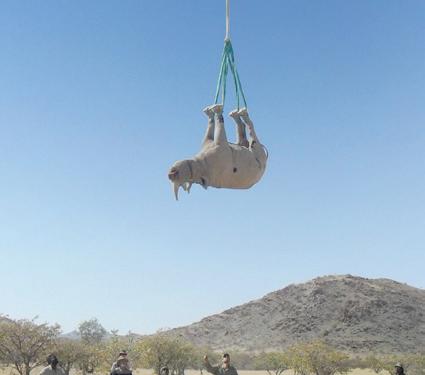
Cornell researchers have discovered that the best way rhinos can fly is upside-down.
Prof. Robin Radcliffe, wildlife veterinarian and director of the Cornell Conservation Medicine program, and his team were recognized for taking wild rhino transportation airborne with the Ig Nobel Prize, which celebrates “scientific achievements that first make people laugh, and then make them think.”
“The only downside of lifting them upside down is the rhinos weren’t made to land on their backs,” Morkel said. “So, we bought ourselves a nice big mattress, and we were dashing around trying to get this
mattress under the rhino as it came down.”
While some national parks, zoos, conservation sites and other community-lead preserves use helicopters, generally rhinos are transported on their sides on a heavy sledge, a metal piece of equipment that resembles a stretcher. The main struggle with either method, according to Pete Morkel, a member of the veterinary team, is transporting these beasts that can weigh up to 6000 pounds.
While taking rhinos to the sky has become increasingly common, the effects of these helicopter joyrides on the animals had not been studied. Radcliffe and his team took it upon themselves to understand how the more efficient, cheaper method could affect the rhino’s internal organs — particularly their lungs and heart.

Radcliffe partnered with the Namibian Ministry of Environment, Forestry and Tourism, to strap 12 anesthetized black rhinos by their ankles, suspend them upside down in the air by a crane and measure their physical condi-
tions, such as oxygen levels, heart rate and partial pressure of their lungs.
The team initially suspected that being upside down could be worse for the rhinos considering the additional pressure on their joints and internal organs, according to Morkel. Body positioning is vital in maintaining proper airway and blood circulation, and can be compromised when the weight of the animal is pressing down against their internal organs. Therefore, keeping rhinos under anesthesia is a delicate process.
To the team’s surprise, the rhinos had higher oxygen levels and coped better than when the rhinos were transported on their sides, a promising sign for the new method.
To further test this new mode of transportation Radcliffe’s team took to the skies for a 30 minute helicopter ride, in a simulated transportation of the rhinos, where they reported the animals responded well to the journey.
Although the experiment was a success and the new method proved useful, Radcliffe and his team had to navigate challenges.
“Wildlife veterinarians must really learn to think outside the box,” Radcliffe said. ”Our talented field team in Namibia — including rhino managers, biologists, ecologists, field rangers and veterinarians — have met these challenges through careful planning and lots and lots of innovation!”
According to the World Wildlife Fund, the current wild rhino populations are a measly 5 percent of what they used to be at
the start of the 20th century due primarily to illegal poaching and habitat loss. The Black rhino, one of three species that are on the critically endangered list, has made a home in the country Namibia, where Radcliffe conducted his research.
“The work we are doing in Namibia may also help Indonesia in efforts to save the rarest rhinos of all — the Sumatran and Javan rhinoceroses that live in the rainforest,” Radcliffe said.Radcliffe and his team have been working in Namibia for over a decade to improve the management and conservation of wild rhinoceroses. Protecting these endangered species has proved to be complex work, given their large size, limited habitat space and the market demand for their horns, which some believe to contain medicinal properties.
Radcliffe’s fascination with rhinoceroses began when he visited Botswana as a student and got to see his first wild rhino, and he focused in on conservation when he learned that the same rhinos he saw were killed by poachers just a few weeks after his visit.
Morkel said that receiving the Ig Nobel Prize felt gratifying, but more importantly, it raises awareness for other wildlife veterinarians’ innovative fieldwork, and helps the often-misunderstood rhinos.
“Rhinoceroses are not evil dinosaurs, but are actually sweet natured, playful, underestimated creatures,” Morkel said.
Megan Keller can be reached at mrk269@cornell.edu.
By MEHER BHATIA
Sun Contributor
On Sept. 24, Cornell University and the City and Town of Ithaca officially became the first partnership between a college campus and a city to be recognized by the United Nations in working toward the U.N.’s sustainability goals.
The Finger Lakes Energy Compact was made to reach carbon neutrality by 2030 and transition to sustainable energy for all of Ithaca, aiming to support the goals of the Paris Agreement on climate change and impart solutions towards a clean, just, renewable energy future.
While the initiative is new, Cornell and Ithaca have a history of working together toward sustainability goals.
“[The compact is] nothing more than a couple of stakeholders getting together in a group before the United Nations to do the best they can do to accelerate the deployment of renewable energy and increase access to clean energy,” said Luis Aguirre-Torres, the City of Ithaca’s new director of sustainability.
As part of the compact, the City of Ithaca is in the process of integrating community choice aggregation — purchasing renewable energy in bulk on behalf of all its residents to make the transition to more sustainable energy sources cheaper.
Another plan the compact implements is the Energy Efficiency Retrofit and Thermal Load Electrification Program,
which aims to replace the use of natural gas in homes with electricity, Aguirre-Torres explained.
To accomplish this, the City and Town of Ithaca created the Ithaca Electrification Fund, which would offset some of the costs of replacing fossil fuel energy with renewables for its residents. The fund, in conjunction with providing financial assistance to lower-income communities, will help cover costs for the replacement of fossil fuel-based space and water heating systems with zero-cost energy performance lending and leasing programs.
Part of moving forward, Aguirre-Torres said, is showing the people of Ithaca what is possible.
“Everybody knows about climate change, but the next level is education on what’s possible and what’s not,” Aguirre-Torres said. “And what’s possible [is] figuring out a way of making it cheaper. That’s the way we make progress.”
The programs are only two of several steps being taken to move toward affordable and clean energy by 2030 — Sustainable Development Goal 7 of the United Nations Development Program.
“I’m very happy and proud to say [this is] the most aggressive program ... in the entire country,” Aguirre-Torres said. “Nobody else in the U.S. is doing this.”
Aguirre-Torres sees the compact as essential because federal climate legislation is stagnating, which necessitates more local solutions.
“[Local governments] are literally the last line of defense,”
Aguirre-Torres said. “If [the feder-
al government is] not going to do it, I’m going to do it, because it’s not going to happen at the macro level. We tried that and we failed.”
Cornell students and faculty have also been getting involved in local initiatives to mitigate climate change.
Dyson students in Applied Economics & Management 3000: Pre-Project Immersion have assisted with proposals to electrify transportation across Ithaca. Prof. Sarah K. Chalmers, applied economics and management, decided a focus on climate change mitigation and adaptation in the course would have high educational value for students while also mobilizing the Ithaca community.
Although climate change cannot be solved with a straightforward approach, Chalmer explained, it is an issue “that we must face together if we are to have a positive impact.”
Cornell continues to take several steps at the institutional level to strive toward the Finger Lake Energy Compact’s most ambitious goals.
According to Rick Burgess, vice president of facilities and campus services, Cornell’s Radical Collaboration on Solutions for Sustainability — a group assembled in 2017— is already focusing on interdisciplinary research to meet the U.N. Sustainable Development Goals.
He explained that Cornell joining forces with the City and Town of Ithaca to form a campus-regional partnership will fortify Ithaca’s ability to promote efficient, innovative and accessible

energy, and achieve carbon neutrality by the early 2030s.
Cornell’s Climate Action Plan is also identifying steps the university will take to achieve carbon neutrality net-zero carbon dioxide emissions for the campus by 2035. A Climate Action Plan update on completed, in progress and critical priorities is currently pending.
The compact highlights Cornell’s “living laboratory approach” to improving campus energy efficiency and supporting the creation of new renewable energy resources such as Earth Source Heat, Burgess explained.
Due to these initiatives, the University is already seeing massive reductions in its carbon, energy and water footprints.
“Cornell’s diligent energy conservation work has dramatically reduced the campus energy use intensity … to the point that the campus is using less energy now
than it did 20 years ago despite having added about 15 percent more floor space,” Burgess said.
Cornell’s greenhouse gas emissions are down more than 36 percent since 2008, taking into account direct emissions from on-campus combustion, and indirect emissions from purchased electricity and daily commuting by employees and students. Compared to its 2005 baseline, Cornell’s water usage is additionally down over 25 percent overall.
“In my office, once again, it’s just me and I’m [working] twenty hours a day, because I love this thing and I believe this change is possible, ‘’ Aguirre-Torres said. “[B]ut now it’s about more people. I need the [entirety of] Cornell University to be behind this project, so we can produce change.”
Meher Bhatia can be reached at mb2479@cornell.edu.