The Corne¬ Daily Sun

By JULIA NAGEL Sun Staff Writer
As the spring semester begins, student leaders are critical of the University’s progress on anti-racist initiatives, hoping for increased, substantial action around campus throughout the remainder of the year.
The University updated students over winter break on the ongoing diversity and inclusion initiatives at Cornell, including the creation of the Public Safety Advisory Committee, the Community Response team, the Faculty Senate’s anti-racism initiatives and research into Cornell’s ties to Indigenous dispossession.
But according to some Cornell student groups, the way these initiatives were communicated to the general student body was unimpressive. An email detailing these initiatives, they said, did little to raise awareness.
“I didn’t even read an email like that. I barely read University emails as it is, and I’m sure a lot of people feel the same way,” said Mikala Bliahu ’22, the Native American and Indigenous Students at Cornell co-chair.
Bliahu said the University needs to take steps to make this information more public and accessible to students.
Co-president of the South Asian Council Atif Akhter ’22 agreed, noting that if students aren’t directly impacted by the initiatives, it might be easy for them to overlook this information.
“I think most students here have the privilege to not
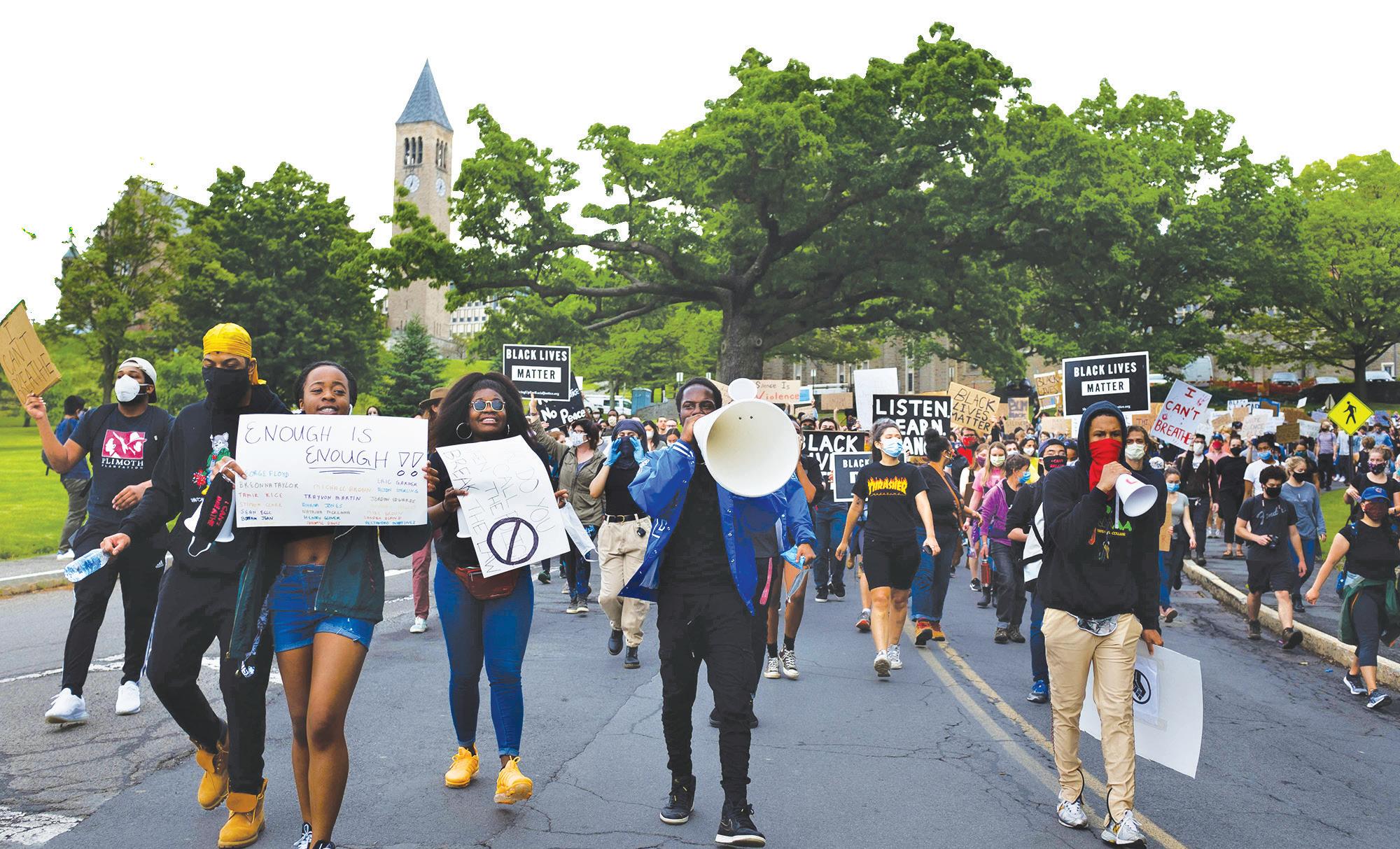
Change in the making | Here, protesters participate in a June 2020 march down Campus Road. Currently, Cornellians are pushing the administration to turn anti-racist statements into long-awaited action.
be affected by diversity [and] inclusion initiatives, and especially for people of color here like myself, diversity and inclusion is almost present in all aspects of our lives,” Akhter said.
Cornell Students 4 Black Lives organizer Sherell
By ANGELA BUNAY Sun Staff Writer
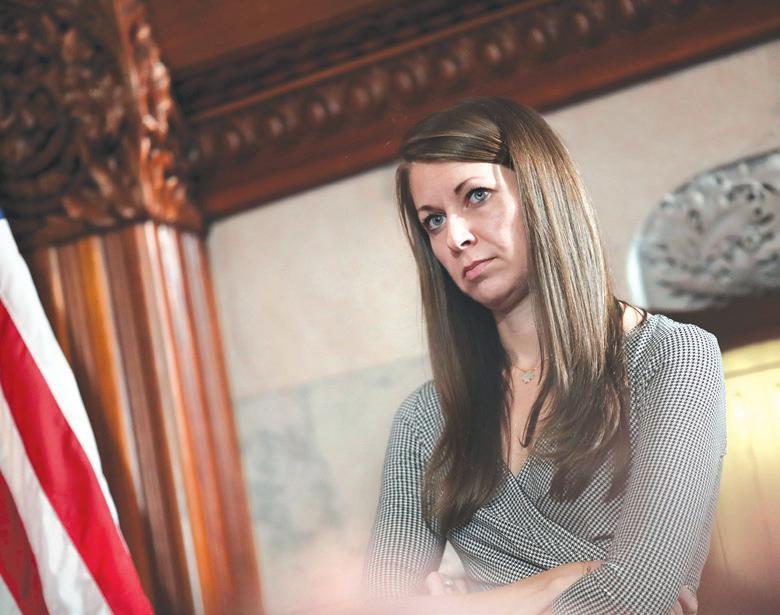
Melissa DeRosa ’04 MPA ’09, secretary to Gov. Andrew Cuomo (D-N.Y.), has worked with the Cuomo administration to conceal the accurate nursing home death toll caused by the pandemic in New York State.
On Jan. 28, Attorney General Letitia James released a report that uncovered reporting discrepancies on death rates in senior facilities. The Cuomo administration did not deny nor confirm these allegations until the New York Post acquired audio, where DeRosa admitted
to the administration’s concealing of the numbers.
James’s report said COVIDrelated deaths in nursing homes had been underreported by 56 percent from late March to early May. In January, the Department of Health originally reported 8,500 deaths, excluding residents who died once they arrived at a hospital.
“Because of your decisions, thousands of people died who did not have to die.”
Sen. Alessandra Biaggi
homes to accept and readmit COVID-positive patients. This action has garnered controversy, as many believe the order to have contributed to the high death toll.
Newly released numbers report over 15,000 confirmed nursing home resident deaths, a far greater number than James’s report anticipated.
At the beginning of the pandemic, Gov. Cuomo issued a March 25 directive, which ordered nursing
DeRosa explained the decision to withhold the numbers on a Feb. 10 conference call with Democratic legislative leaders, stating that the Cuomo administration made its decision as former President Trump criticized the coronavirus responses of various governors, including Phil Murphy (D-N.J.), Gavin Newsom (D-Calif.) and Gretchen Whitmer (D-Mich.).
Former President Trump’s move to have the Department of Justice investigate the administration’s nursing home order also influenced the administration’s decision.
When Trump initially accused the Cuomo administration of underreporting the
Farmer ’22 expressed that the University could improve by posting more about their diversity and inclusion actions on social media platforms. She also suggested they
See ANTI-RACISM page 2

By ONALEE DUANE Sun Staff Writer
A winter storm warning for Tompkins County was announced on Monday afternoon, as forecasters predict seven to 12 inches of snow to blanket the Ithaca area by Tuesday morning.
The majority of the heavy snowfall will start Monday evening and continue through the night, according to the forecast. The chance of precipitation will be 100 percent, with a low temperature of around 26 degrees Fahrenheit. By Tuesday morning, the snow is anticipated to become sleet.
Snowfall rates will potentially reach one inch per hour from Monday evening to Tuesday. This
overnight accumulation, along with the potential of sleet, presents the risk of hazardous roads and sidewalks for Tuesday morning commuters.
A Monday afternoon University email wrote that all employees and students are expected to “make reasonable efforts” to maintain their regular work, class and surveillance testing schedules as snow falls on the Ithaca campus. Cornell advised against any unnecessary travel, stating the hazardous impacts of the storm on commuting and day-today operations.
In-person classes will continue to take place, unless an instructor teaching on campus is unable to
DEROSA
Continued from page 1
number of nursing home deaths in a tweet on Sep. 3, Rich Azzopardi, Cuomo’s senior advisor, called such accusations “lies and conspiracies.”
DeRosa explained over the conference call that the administration was unsure what information they would provide to the DOJ and their fellow state legislatures, and whether their statements would be used against them in a DOJ investigation.
gressions for many years. “I think that we all share the same goal, which is to hold them accountable,” DeRosa said.
On Feb. 11, Azzopardi released a statement on Twitter that responded to the New York Post story.
It explained their concerns about backlash from the Trump Administration’s effort in blaming Democratic states for COVIDrelated deaths. “We were cooperating with Federal document productions and that was the priority and now that it is over we can address the state legislature,”
“I think that we all share the same goal, which is to hold them accountable.”
Melissa DeRosa ’04
In that same call, New York Democratic assembly member Ron Kim told DeRosa to hold the appropriate people accountable for mixing COVID-positive and negative nursing home residents.
DeRosa responded by explaining that even before the pandemic, state laws have allowed nursing homes to get away with trans-
Azzopardi wrote. A number of state legislatures commented on the scandal.
New York State
Sen. Alessandra Biaggi tweeted: “You’re only sorry that you all got caught. Because of your decisions, thousands of people died who did not have to die.”
Demands for Cuomo and his administration to be investigated and for the governor to be stripped of his emergency powers were made by New York State Senate Republican leader Rob Ortt.
Republican New York State
Sen. Tom O’Mara, whose district includes Tompkins County, said, “Top legislative Democrats going behind closed doors with the Cuomo administration to discuss the nursing homes scandal is another stonewalling session that has nothing to do with revealing the truth.”
State Democratic leaders are considering drafting a bill to repeal the Governor’s expanded executive powers, despite Cuomo denying a connection between such powers and the nursing home coverup.
On Monday, Gov. Cuomo said his decisions are not political, but are instead related to matters of public health.
The Governor was granted expanded powers back in March to better manage the pandemic, but it remains a source of contention among state legislators, some voicing concerns over the creation of an imbalance of power.
CNN reported that a bill to remove Cuomo’s powers will likely be introduced this week and voted on early next week.
Angela Bunay can be reached at abunay@cornellsun.com.
Tuesday, February 16, 2021
Introduction to Podcasting: Session 1 11 - 11:50 a.m., Virtual Event
Explore Nature Through Sound and Music Webinar: Tropical Oceans and Islands 12 - 1 p.m., Virtual Event
Designing Effective Virtual Flyers 2 - 3:30 p.m., Virtual Event
The Science of Greening Our Cities 12:40 p.m., Virtual Event
Verdant Views: Growing Vegetables and Connections 2 - 3 p.m., Virtual Event
Radical Alternatives: Art & Spatial Politics in Iran 4:30 p.m., Virtual Event
Conserving an American Rarity: American Hart’s Tongue Fern 7 - 8:30 p.m., Virtual Event Today
ANTI-RACISM
Continued from page 1
reach out to student groups with a vested interest in these initiatives.
“The important part is that the University needs to meet students where they are,” Farmer said. She explained that information on social justice tends to spread on social media, and suggested an active University commitment to updating Instagram, Facebook and other platforms.
Reflecting on the initiatives, NAISAC co-chair Della Uran ’22 was skeptical that they would produce real change, noting the vagueness and lack of details about how many of these initiatives would be realized.
“I’m all for these things conceptually. But I’m like, ‘I need you to give me a plan’,” Uran said. “I think it’s highly possible that a lot of this just won’t happen.”
Akhter echoed these sentiments, questioning whether the initiatives will be fruitful. He referenced a recent Sun letter
to the editor about the Presidential Task Force on Campus Climate, expressing disappointment with the administration’s response to the racism and misogyny that resulted from several Cornell students being targeted during calls for disarmament.
“That letter to the editor really showed that task forces have great initiatives and great ideas. But how many are being followed through after the task force is gone?” Akhter said. “The students really put their hard work into the task force, only to see that it didn’t work.”
Akhter added that he wants to see initiatives carried out faster, though he understands why there is a need for extensive planning and discussions.
“I think when the University has a crisis, the first thing that happens is a committee or task force is [put] in place,” Akhter said. “Not saying that change is unable to happen from these, I just have a desire for it to occur more urgently.”
Others, however, disagreed with the need to speed things up. Farmer said she
wishes the process could go faster, but she felt this would result in a rushed, incomplete outcome.
“Perfection doesn’t come overnight, but I feel like the Black community and other marginalized groups on campus deserve perfection,” Farmer said. “So I’d like to make sure they get that.”
CS4BL organizer Ashley Bishop ’22 was hopeful that the initiatives will lead to real changes, even though progress might seem slow. However, she noted that the University still falls short when it comes to proactively addressing issues of racism and bias.
“I think there’s a lack of [the University] being proactive to handle these issues, and for that reason, there’s a lot of pressure put on students to create these demand lists, and to sit here and plan what could be the right solution that the University can implement,” Bishop said.
Bliahu agreed that there is still progress to be made to address the racism and bias that students of color face on campus.
“Cornell hasn’t made me feel safe,”
Bliahu said. “I am very white presenting, and I have the privilege [of] feeling safer around police. But I don’t even feel safe, so I can’t even imagine how unsafe a lot of our students of color feel.”
Akhter hopes that students, faculty and the administration will work together to address issues of diversity and inclusion. He said he was glad to see the formation of the Public Safety Advisory, seeing it as a tangible marker of progress toward reforming the Cornell University Police Department and addressing student safety concerns.
However, he still believes more needs to be done on an administrative level.
“If it’s such a weak update that nobody really knew anything about it, or the students who are a minority here on campus don’t feel like their life has changed at all or will change while they are students,” Akhter said, “then I think there’s an issue.”
can be reached at jnagel@cornellsun.com.
SNOW STORM
Continued from page 1
make the commute due to the weather. Any instructors unable to make it to teach in-person are to communicate directly with their students, and students are expected to communicate with professors if they cannot commute to campus.
But a snow day isn’t in the realm of possibility. In the fall, Cornell eliminated the possibility of snow days as long as Zoom University was in session, as any in-person classes also have an
online section available for students to attend.
In the fall, Cornell eliminated the possibility of snow days as long as Zoom University was in sesssion.
Classes at Tompkins Cortland Community College will similarly run remotely starting 6 p.m.
Monday, and continue to be held virtually through the day Tuesday.
The winter storm warning will be in place until Tuesday at 4 p.m. Snowfall is predicted to lighten Tuesday morning around 8 a.m., with accumulation expected to total around an inch of snow throughout the day.
Forecasters predict a slight chance of snow showers Tuesday evening, with the chance of precipitation falling to 20 percent.
Onalee Duane can be reached at oduane@cornellsun.com.
By TAMARA KAMIS Sun Staff Writer
Balancing school and work can prove to be a daunting task for Cornell’s student employees — especially with the addition of virus safety concerns.
From research labs to popular school stores, students work in a variety of locations across campus, each site requiring Cornellians to find different ways to balance having a job on campus during a pandemic with classes, clubs and their personal well-being.
Kataryna Restrepo ’21 works 30 hours a week at two campus jobs –– 20 hours as a student supervisor at the Becker House Dining Room and 10 hours at the Architecture, Art and Planning Supply Store. Restrepo had work-study funding for her first three years, but lost it this year. She said she doesn’t know why this happened.
“I wasn’t granted work-study for my last year, and it
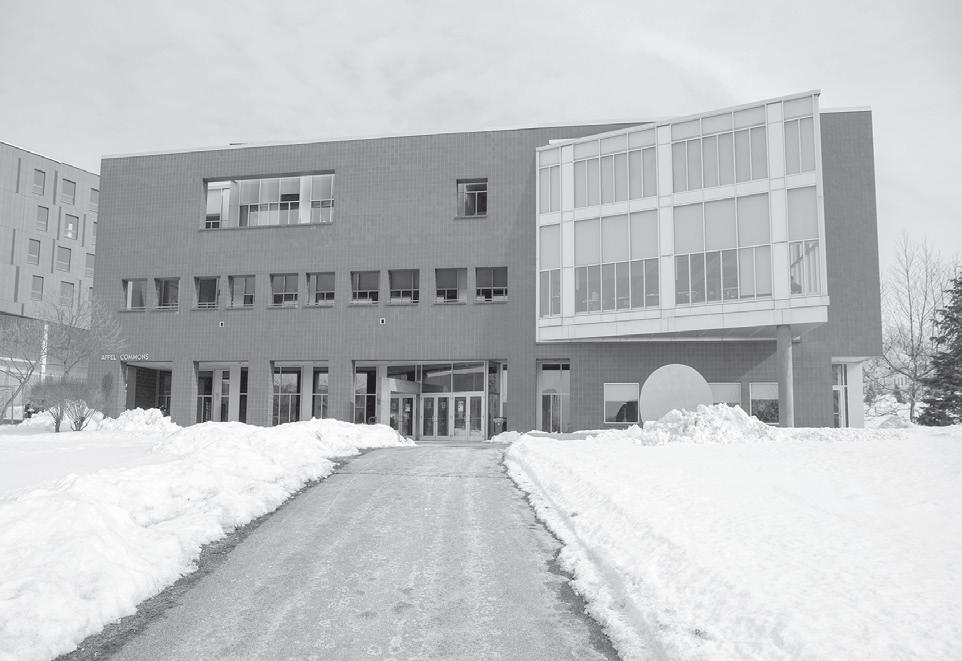
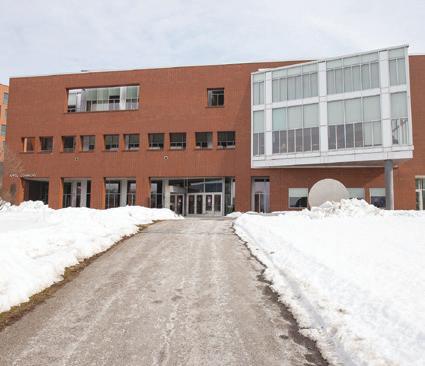
at Appel Commons above — are busier than in the fall.
seemed like other seniors also had similar experiences,” Restrepo said. According to Restrepo, finding a job on campus this year has been more of a challenge due to pandemic limitations, so she was glad to be able to keep her jobs from last year.
Colleen Wright, deputy director of operations for the financial aid and student employment, said in an email that students trying to find work can consult resources the University provides, including the Student Employment Job Database. Students can also contact the financial aid office if they want to replace their work expectation for the academic year with a student loan, according to Wright.
selves and other students safe from the virus.
“After how well last semester went, workers feel a little more safe working,” Restrepo said. “We are being tested. I think it is more of a concern of how overworked we are, because a lot of what was happening in the dining hall pre-pandemic is double the work now.”
Madeline Yeh ’24 works at the North Campus Service Center, in addition to writing for Creme de Cornell and serving as a member of the CUAir Project team. Like Restrepo, Yeh is navigating the risks and benefits of in-person work in the time of COVID-19.
“It is more of a concern of how overworked we are ...”
Kataryna Restrepo ’21
Restrepo said time management has been important as she juggles her academics as an Industrial and Labor Relations major with her campus jobs. She begins her days early to get a head start on homework and studies after her night shifts end.
The burden of balancing long work hours and COVID-19 risk with school work has disproportionately fallen on low-income students, according to Restrepo.
“I’ve noticed that the majority of my peers, my co-workers, student workers who are working with me are coming from low-income, first-generation backgrounds,” Restrepo said, adding that she thinks this may be because dining jobs are less desirable during the pandemic.
As a dining worker, Restrepo is now eligible for a COVID-19 vaccine. However, finding an appointment nearby has posed a significant challenge. She was able to make an appointment for March 27 in Potsdam, New York — more than a month away and over 150 miles from Ithaca.
But in the meantime, she and her co-workers at Becker must rely on masks and social distancing to keep them-
Yeh said she spends eight hours a week processing mail and helping students find resources to deal with building issues such as lost keys. She said she feels that the COVID-19 safety protocols are enough to keep her safe on the job, although the smaller number of people allowed to work per shift has sometimes made her work responsibilities more challenging.
“We have to follow the capacity guidelines, which has definitely been tough,” Yeh said. “There is so much to do every day and with less people. That is more difficult, but we’ve had to adjust.”
For Restrepo, Cornell Dining’s expanded menu options has made dining hall workers busier, as additional students returned to campus this semester. Restrepo said she feels her peers often do not appreciate dining workers enough.
“There’s no recognition that workers, United Auto Workers and student workers, are working right now without any hazard pay,” Restrepo said. “There’s not an appreciation of the labor that they’re doing.”
Tamara Kamis can be reached at tkamis@cornellsun.com.
By ANNABEL LI Sun Staff Writer
When GameStop was at the peak of its trading in January, widely used brokerages like Robinhood, Charles Schwab, ETrade and Webull took restricted trading of the stock that became the catalyst for conspiracy theories, social media outrage — and ultimately an escalation of the GameStop stock pop into a war between regular investors and giant funds on Wall Street.
“It might have been my worst, but most profitable investing decision,” said Dylan Kim ’23, who made around $2,500 off of the stock in late January.
GameStop’s price soared around 1,700 percent in the last month, despite reporting an $18 million loss in its recent quarter and closing 15 percent of store locations in the past two years. However, like many other investors, students at Cornell didn’t invest in GameStop because of fundamentals.
“When my friend first told me about GME, I was kind of skeptical,” said Michael Zhang ’22. “I usually put my money into exchange traded funds, because I’m more risk-averse.” Zhang made around $2,000 from buying and selling the stock.
The students’ primary rationale for investing was something called a short squeeze — a sharp increase in price that forces short-sellers to close their positions, which pushes the price even higher.
Hunter Kahn ’23, who made $30,000 on GameStop, referred to a post that started circulating on r/WallStreetBets back in September.
This fall 2020 Reddit post pointed out that a lot of hedge funds were shorting GameStop to the point that short interest was at 120 percent — this means that more stocks were being borrowed and sold short than existed in the market.
“Investors short a stock when they think the stock price is going to fall,” said Prof. Vicki Bogan, applied economics and management. “The plan is to wait for the share
price to fall, buy the shares back at the lower price, return the borrowed shares and keep the difference between the price they sold the shares and the price they bought the shares.”
This post argued that investors could push the price up –– this would make it more expensive to short sell –– and eventually pressure short-sellers to buy back the shares they sold short. The process of buying back is called “closing the short.”
“Closing their short positions required them to buy GameStop stock, which pushed the price even higher,” Bogan said.
Because the short interest was over 100 percent, that means if every short seller wanted to buy back their stock, there would be demand to buy more stock than is available, drastically increasing the price.
Because of Reddit’s coordinated short squeeze, hedge funds like Melvin Capital and Maplelane Capital lost around half their investments in just the month of January. When questioned about these losses, Kahn, Kim and Zhang said that they felt no sympathy for these hedge funds.
hedge funds.
Executives from Robinhood, Citadel and Melvin Capital will testify in front of Congress on Thursday as part of a probe into Robinhood’s trading ban.
This backlash for brokerages like Robinhood catalyzed even more buying. GME opened 96 percent higher at around $380 the very next day after Robinhood’s trading suspension.
Kim, who had previously sold GME for a profit, bought back in. “I have to admit, I believed the cause had some steam
Short-focused equity research firms such as Citron Research and Hindenburg Research have met this unrest on social media by calling the retail investors on Reddit “suckers” and publishing a report defending short-sellers.
“The only difference between you guys on Wall Street and us retail traders is when we make a bad mistake, we go back to our nine-to-fives to raise some more funds,” Kahn said.
After losing $4.5 billion from GameStop, Melvin Capital received a $2.75 billion cash injection from hedge funds Citadel and Point72.
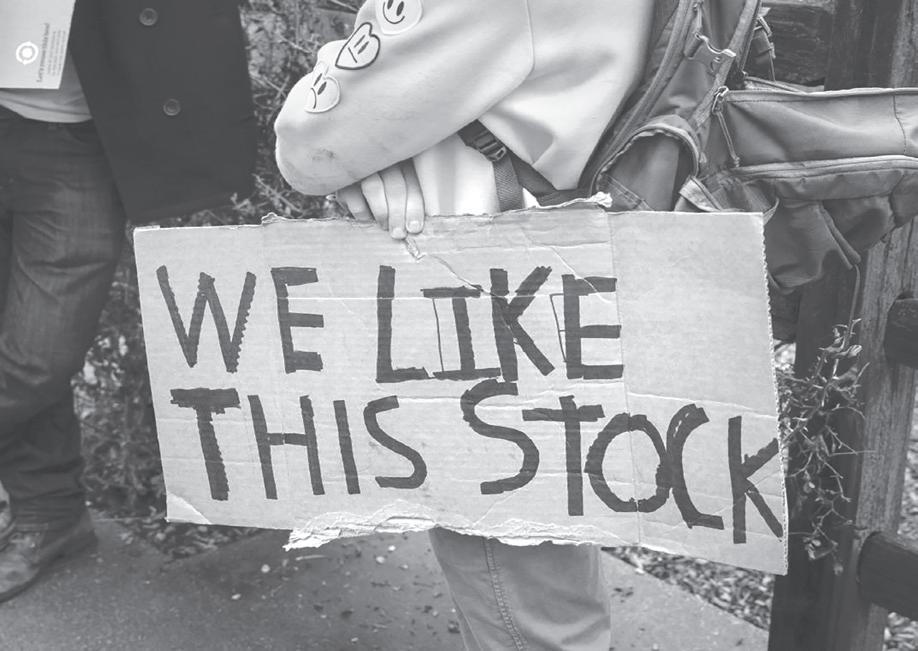
GameStop pop | Student investors explain how they made thousands from the “short squeeze.”
For a period of time, the Reddit strategy worked. Since the debut of the short squeeze argument last fall, GameStop rose over 4000 percent to its highest level in January. And r/ WallStreetBets grew from just 1.5 million users to 9 million.
However, on January 28, 2021, Robinhood — the app many Redditors use to buy and sell stocks — halted all buying of GME on their platform. Users could only sell, and the stock fell 73 percent in a single day.
This move by Robinhood was followed by similar actions from other brokerages, as well as speculation about a potential conspiracy where brokerages are hindering retail investors to prevent further losses to
left, particularly when RobinHood and the other brokerages imposed largely one-sided trading restrictions,” Kim said. “So, then I bought in again.”
The resentment between Wall Street and retail investors has a long history, some redditors buying GME as a gesture of retribution for their parents who lost money in the 2008 mortgage crisis.
“At one point I did feel a slight sense of community,” Kim said. “There was the hype of a bunch of decentralized retail traders cooperating in an unprecedented way under that hope of, ‘We’re going to profit off of the same types of hedge funds that caused 2008.’”
“Short squeezes are nothing new,” Bogan said. “However, what is unusual in this case is that retail investors, not institutional investors or hedge funds, were driving the short squeeze.” This reversal has been labeled by some as the “revenge of the common man.” This makes the role of charity especially important. By donating trading profits to charity, retail investors can distinguish themselves from the institutions they’ve bet against.
“[Shortsellers] end up screwing over innocent retail traders and just taking the money for themselves,” said Kahn, who donated his profits to a children’s hospital. “Whereas, I want to be like, ‘Hey, look at what us retail traders do when we make money, we do good with it.’”
GameStop stock has since dropped down to $52.40, but Kahn is still holding his shares.
“I’m still holding on to shares just as a middle finger to the hedge funds. I’m completely willing to go down in a blaze of glory,” Kahn said. Kim and Zhang have both exited their positions.
Annabel Li can be reached at annabelli@cornellsun.com.
ASHLEY RAMYNKE SUN CONTRIBUTOR
Ithaca is worlds away from Los Angeles. The distance is actually about 2,661 miles via (“the” — for us Californians) I-80 E. But, instead of gorges with snow caressed around their curves and students woven in the frost of winter, it is a land of desires and disillusionment where performers wait for post-pandemic days when the decrepit nightclubs nestled on the boulevards won’t just be old haunts. Yet, Los Angeles native Phoebe Bridgers manages to amalgamate these two worlds.
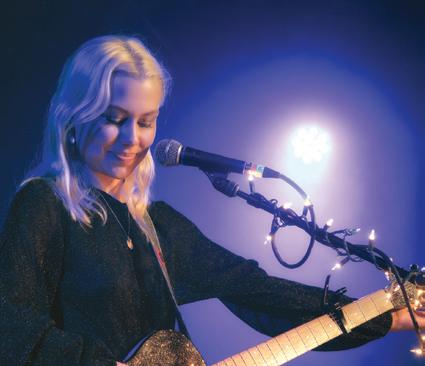
The 26-year-old, who has earned four 2021 Grammy Awards nominations, released her second solo album, Punisher, in June and launched her label, Saddest Factory Records, in October. Presented by the Cornell Concert Commission, she performed virtually for students with an opening performance by Chicago singer-songwriter Andrew Belle last night.
In contrast to her Saturday Night Live performance last weekend, where she was accompanied by her band and her on-stage antics included smashing her guitar into an amp, the virtual performance took place with her sitting in a dark wood-paneled room, described by Bridgers as her “cave.” Clad in her skeleton onesie and accompanied by three acoustic guitars, her music was sad — sad like being haunted by suppressed memories once suffocated into near obsolescence,
all met with an indie rock hum delicately wailing from her acoustic guitar.
Opening the setlist — composed of eight songs spanning across her catalog from her work as a solo artist and with the band Boygenius — with “Kyoto” off her most recent solo album, almost 500 students
her weird occurrence with someone wearing Birkenstocks when she visited Cornell’s campus. Throughout the rest of the performance, there would be moments mid-song where she would change her glance from near the neck of her guitar to look at the screen and grin, noting that it was tough to
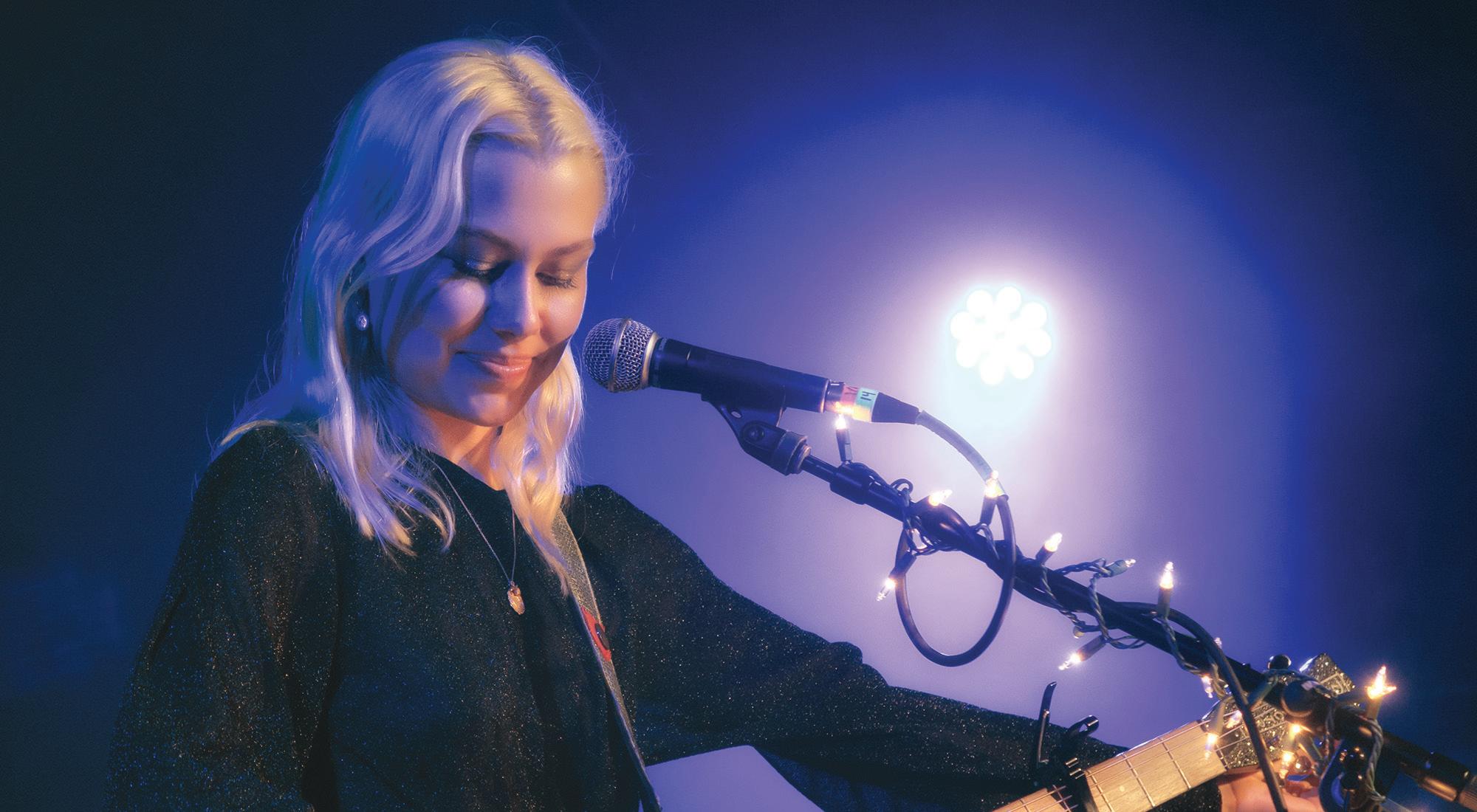
flooded the Zoom comments section with utter admiration and odd remarks to Bridgers. Minimally addressing students in the lull between songs at the beginning — such as quickly saying how she was going to get the saddest songs out early before playing “Moon Song” — Bridgers grew to speak more about the origins of each subsequent song.
She later joked about always double fisting oat milk lattes and water, and recounted
not look at the chat.
Bridgers opted to play a song from one of her collaborations, Boygenius’ “Me & My Dog” off their 2018 self-titled E.P. Joking that she normally screams when she performs that song, she estimated that while 80 percent of the time she can successfully scream, the other 20 percent she sounds more like she is yodeling. She told the audience how the next song was not yet released and that
she liked trying out new material in performance settings. The caveat was that no one could record, (even though recording wasn’t allowed during any part of the performance), because she didn’t want to see lyrics on the internet that weren’t right yet.
The set closed with songs “I Know the End” and “Motion Sickness” before opening the Q&A session. When students registered online to attend the virtual performance, they were able to ask questions which were later presented to Bridgers by CCC executive board members, Jenn Muson ’23 and Miles Greenblatt ’22. The conversation drifted between what Elliot Smith deep cuts she’s been listening to, her changed Instagram username and the ways in which COVID-19 has altered how she collaborates with other artists. She ended the night with telling the audience that she disappointedly was unable to show her dog on screen because her mom was babysitting it in fear that it would yodel while she was performing.
Despite her growing fame with the Grammy nominations, influx of late-night television performances and front-cover publications, she’s not going to sell out. There’s no chance. She’ll always be Phoebe. And, students will remember her sitting in her cave, singing sad songs, making blunt remarks and coping with the crap of life with dark humor after this intimate performance.
Ashley Ramynke is a junior in the College of Arts and Sciences. She can be reached at aer285@cornell.edu.
When I think of self care, I’ll admit that the first things that come to mind are Pinterest-approved Instagram graphics and Goop, Gwyneth Paltrow’s wellness and lifestyle company. As a matter of fact, as I was writing this article, I took a moment to examine the self-care philosophies of both groups — Instagram led me to a post on “How to De-Stress For Your Zodiac Sign,” which had recommendations ranging from watching a rom-com to opening memory boxes, while Goop guided me to a $837 skincare routine claiming that a hot bath would get rid of all my problems.
Now, to be fair to Gwyneth, it’s possible that “luxuriating in a steamy tub” for 20 minutes would truly revolutionize my world view, but I doubt it. This attitude towards self care — which seems to emphasize materialism as well as an ever-increasing turn into oneself — rubs me the wrong way. It feels consumerist, self-aggrandizing and also just … not that helpful. Well, again, maybe I’m wrong, and a singular bath will transform the caffeine-addicted, grouchy columnist before you into a glowing beacon of new age womanhood with a Buddha
mentality.
However, the history of self-care is far more expansive and revolutionary than this materialistic attitude would suggest.
In 1982, during his lecture series, The Hermeneutics of the Subject, Michel Foucault uses “care of the self” in contrast to self-knowledge in order to investigate the relation between subjectivity and truth. His exact argument centers around understanding how Stoic and Epicurean models of “care of the self” differ from Platonic and Christian views; but, as I’d guess that most people aren’t reading this article as part of their philosophical endeavors, I’ll instead leave you with a brief summary as presented by the Internet Encyclopedia of Philosophy.
To sum, Foucalt claims that, for ancient philosophers, care of the self was an essential principle of morality and ethical conduct, whereas care of the self within modern thought lacks moral content. Within this ancient framework, self care is an act of ethical transformation.
Self care took on a new life with Audre Lorde’s 1988 book A Burst of Light, where she writes: “Caring for myself is not self-indulgence. It is self-preservation, and
that is an act of political warfare.” The book came shortly after Lorde’s second cancer diagnosis and was picked up within many queer, activ-
Self care, as either an act of ethical transformation or a mechanism of self-preservation, is undeniably important. Especially at this histor-

ist and feminist circles. In a world that constantly undermines and attacks one’s very identity, self-care becomes a necessary aspect of survival.
Both Foucalt and Lorde’s conceptions of self-care oper-
ate upon very different logics than the mode of self care which has weaseled its way into the mainstream.
ical moment, amid political turmoil, extreme violence and a global pandemic, selfcare should be considered essential — especially for those communities who are suffering the most from the
Too often, our intent to care for ourselves gives rise to self-sabotage, as our intentions for comfort begin to supersede growth. There’s a cultural element to this argument. As Kenneth Jones and Tema Okun lay out in their 15 characteristics of white supremacy culture, one of the norms of white supremacy is a belief in the “right to comfort,” or rather, “the belief that those with power have a right to emotional and psychological comfort.”
The same characteristic plays in with other cultural norms presented in their work, especially — and in my mind most importantly — “individualism.”
It’s kind of funny that one of the first people to speak on self care was Michel Foucault — a man who famously embraced neoliberalism later in life, claiming that market control would ultimately increase individual autonomy and allow for new styles of living. This same logic, wherein the market presents individualist solutions, exemplifies how self care has been co-opted.
failings of our medical and economic systems. The issue, then, is what we consider self care.
Self care, from a radical point of view, still goes back to the collective. Looking at self care from the perspective of activist burnout, Yashna Padamsee — a writer and employee of the National
Domestic Workers Alliance — writes: “Audre Lorde’s quote refers back to an act of preservation and act of survival for people at the margins. Self-care is an act of shoring up and resourcing ourselves to bring a stronger self to the movement. That’s the school of thought I come from.”
The commercialization of self care would have you think that the only solution to your alienation and pain comes from the market, that only a turn inwards will solve your problems. Basically, slap a face mask on your trauma and see what happens. Now, this may be ungenerous. But why accept the coopting of radical self care by the market? By all means, preserve yourselves. Take a moment to breathe, to recenter and reflect. But, don’t accept the self care which tells you that removing yourself from society and spending all your money on products will somehow solve your woes. Self care should be an act of love, and love is anything but a capitalist construction.
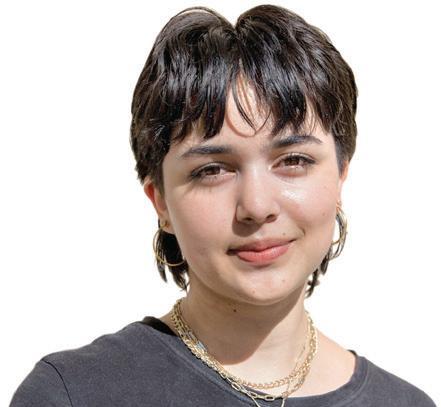
Mira Kudva Driskell is a sophomore in the College of Agriculture and Life Sciences. She can be reached at mdriskell@cornellsun.com. Portrait of a Gen Z on Fire runs every other Monday this semester.
Independent Since 1880
138th Editorial Board
MARYAM ZAFAR ’21 Editor in Chief
JOYBEER DATTA GUPTA ’21
Business Manager
PETER BUONANNO ’21
Associate Editor
MEGHNA MAHARISHI ’22
Assistant Managing Editor
CHRISTINA BULKELEY ’21
Sports Editor
BORIS TSANG ’21
Photography Editor
CAROLINE JOHNSON ’22
News Editor
ALEX HALE ’21
News Editor
ARI DUBOW ’21
City Editor
EMMA ROSENBAUM ’22
Science Editor
BENJAMIN VELANI ’22
Dining Editor
JOHN MONKOVIC ’22
Multimedia Editor
MIKE FANG ’21
App Editor
OLIVIA WEINBERG ’22
Assistant News Editor
MADELINE ROSENBERG ’23
Assistant News Editor
LUKE PICHINI ’22
Assistant Sports Editor
HANNAH ROSENBERG ’23
Assistant Photography Editor
BRIAN LU ’23
Assistant
JOHNATHAN STIMPSON ’21 Managing Editor
KRYSTAL YANG ’21
Manager JASON HUANG ’21 Web Editor NIKO NGUYEN ’22
PALLAVI KENKARE ’21
SEAN O’CONNELL ’21
KATHRYN STAMM ’22
OZA ’22
PLOWE ’23
LEE ’21
& Business Editor
CHENG ’21
PEÑEÑORY ’22
MEGHANA SRIVASTAVA ’23
DAWSON ’21
PARKER ’22 Assistant Photography Editor DANIEL MORAN ’21
DOMINIC LAW ’22
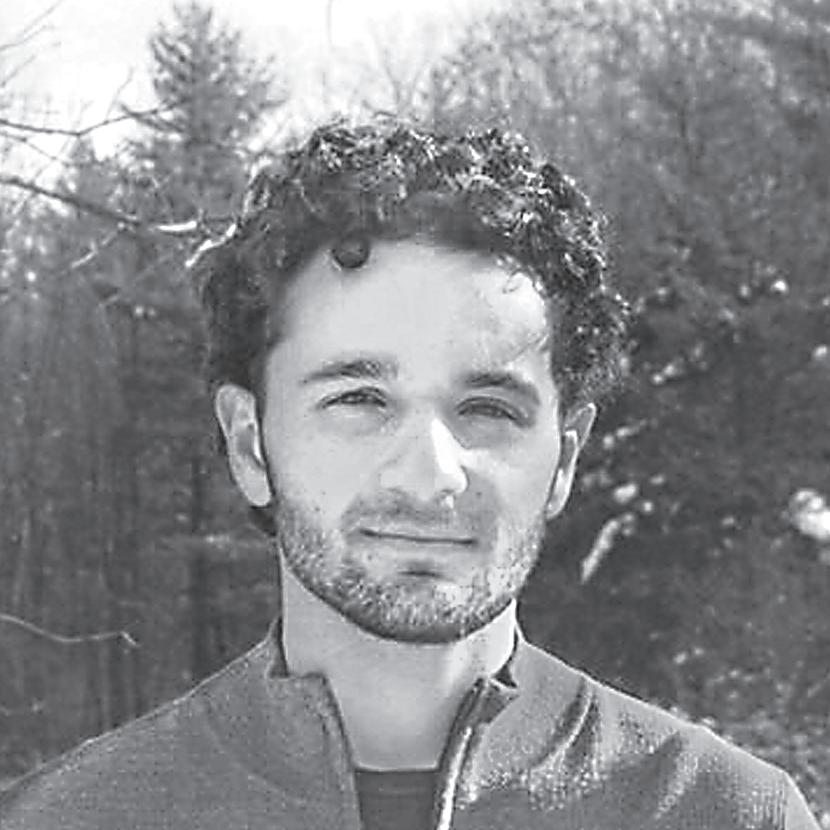
Andrew V. Lorenzen is a junior in the College of Arts and Sciences. He can be reached at alorenzen@cornellsun.com. When We’re Sixty Four runs every other Tuesday this semester.
My thoughts tend to drift to home nowadays. It’s not out of nostalgia or homesickness. It’s out of appreciation. I’ve been in Ithaca for three weeks now after spending last semester in Miami studying remotely. And the reason why these three weeks have gone so well is directly because I was home last semester. It’s directly because of a little blue recipe book I brought with me.
and thereby inherently not entirely real.
’21
’21
’22
Working on Today’s Sun Editors in Training
Deskers Niko Ngyuyen ’22
Kristen Dsouza ’24 Puja Oak ’24
Editor in Chief Caroline Johnson ’22
Managing Editor Madeline Rosenberg ’23
Associate Editor Catherine St. Hilaire ’22
Opinion Editor Benjamin Velani ’22
Arts Editors John Colie ’23
Isabelle Pappas ’24
News Editors Onalee Duane ’22
Olivia Cipperman ’23
Kayla Riggs ’24
Science Editor Srishti Tyagi ’22
Photography Editor Julia Nagel ’24
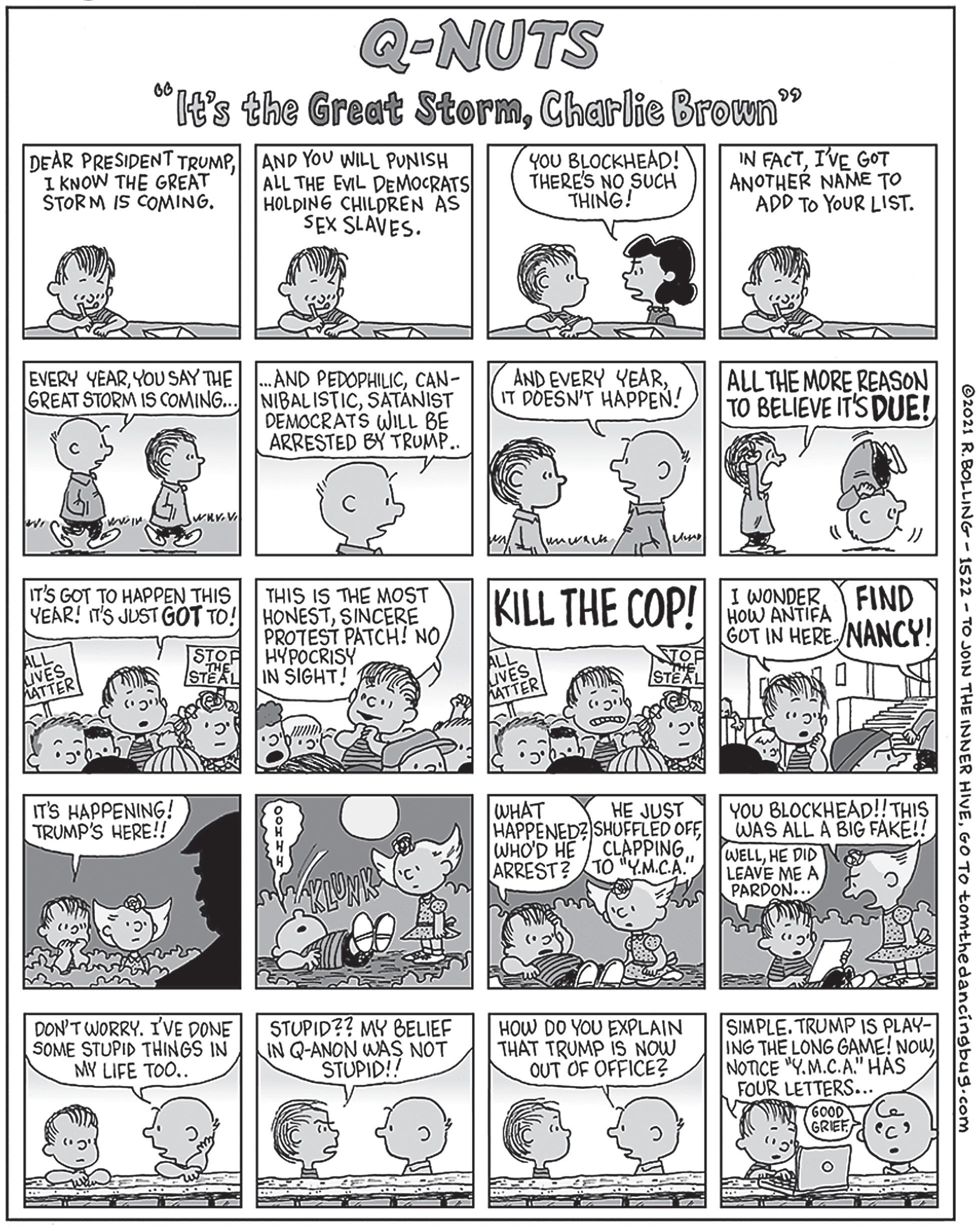
Tom the Dancing Bug by Reuben Bolling
When I made the decision to stay home last semester, I was worried. I knew that I would see practically no one besides my parents out of caution for their health. I knew I would miss out on a lot, and I’d be constantly reminded of that fact via the ever-present Snap stories of all the experiences I’d elected not to have this semester. I knew quite honestly that it would be difficult.
I also knew that, if nothing else, I’d at least be eating well. As I’ve written about before, living with my family feels similar to sleeping in a booth in your favorite Italian restaurant. It’s the kind of home where you roll out of bed in the morning, and the tomato sauce is already simmering on the stove with a Post-it note on the refrigerator reminding you to stir it. As last semester began, I resolved to write down my family’s recipes and learn to make as many of them as I could. If nothing else, I figured, I would return to Ithaca in the spring ready to make some truly legendary dinners for my much missed friends.
When I was at home last semester, there were ‘real’ things which kept me grounded amidst this great uncertainty. There was sauce simmering in pots on the stove. There was my father clearly enjoying himself as he planned a week’s worth of meals while ordering on the Instacart app. There was my mother dancing in the kitchen while we washed dishes together with Jefferson Airplane blaring out of the kitchen radio in the background. There was an ability to remain grounded in a time where it feels like gravity has ceased to exist, and we’re all grasping at the walls, trying to latch onto a coat hook or a doorknob to avoid floating off into Zoom space.
... We’re all grasping at the walls, trying to latch onto a coat hook or a doorknob to avoid floating off into Zoom space.
That grounding, those conversations I had with my parents before, during and after those dinners, genuinely helped me last semester. It helped me to avoid the dreaded Zoom fatigue we all come to feel. It helped me to keep focused on the long term perspective beyond the daily stresses of an academic semester with few breaks and added obstacles to learning. It helped me return to campus in the spring not just with a book of recipes for Italian food but a book of recipes for maintaining good mental health while pushing myself academically during these strange times.
As I began scribbling recipes into a little blue notebook — my chicken scratch handwriting crawling up the margins and reminding me to “add a little pancetta if you have some” or “stir every ten minutes” — I began to see it as something more than just hoarding recipes for next semester. It became a kind of grounding.
As we spend our days floating as disembodied boxes on Zoom screens, refreshing CNN for each new, alarming headline, checking Cornell’s COVID-19 alert level, internally debating whether or not it’s worth seeing someone because of the virus and wondering what in the world any of us are supposed to do after graduation in this ailing economy, we realize that our lives are dominated by uncertainty.
There’s a perpetual kind of confusion which comes with coming of age in the COVID era –– a pervading anxiety because none of us ever know exactly what we’re doing, or what we’re supposed to be doing. It all feels surreal in a way not made easier by the fact that everything is virtual
That, in and of itself, was a result of significant privilege — the fact that we were lucky enough to have enough food on the table when so many families are struggling, the fact that I have a loving and supportive family when that unfortunately isn’t the case for everyone. There are a lot of students for whom finding comfort from their family just isn’t realistic. But I’ve come to believe that wherever you find it, whether it’s with your family or friends who come to feel like family, it’s essential as we enter another Zoom dominated semester (and one without any significant breaks) that you find ways to stay connected to the little hobbies –– the little non-virtual traditions which mean something to you.
Your mental health has to come first. On a campus where more than 40 percent of students were “unable to function academically for at least a week due to depression, stress or anxiety” even pre-COVID, we have to make a concerted effort to do the little things which fulfill us when life around us doesn’t. And when more help is needed, we can’t be afraid to ask for it.
As we start this semester, fall back onto whatever fulfills you and carry it with you. For me, it’s a little blue recipe book.
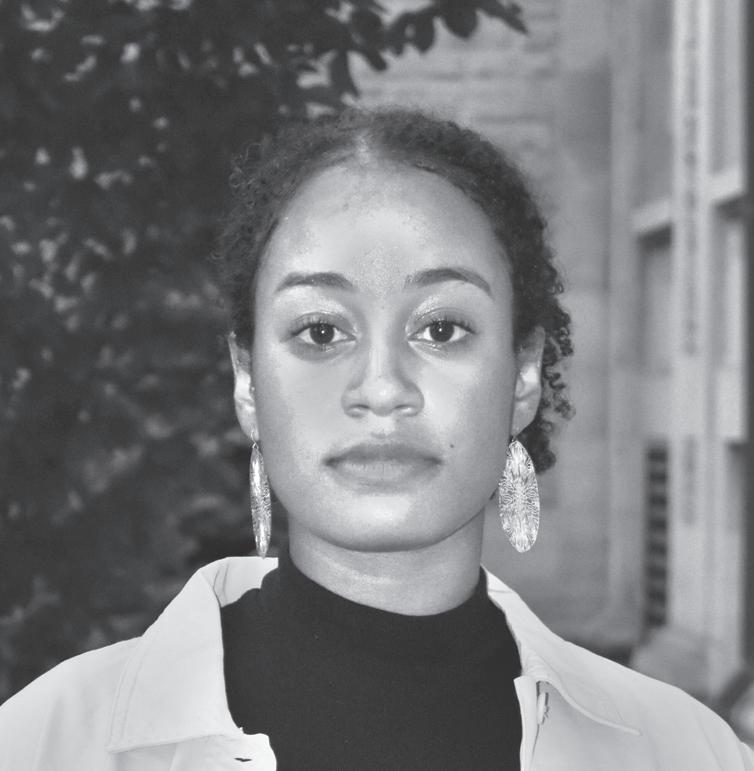
Sidney Malia Waite is a junior in the School of Industrial and Labor Relations. She can be reached at swaite@cornellsun.com. Waite, What? runs every other Tuesday this semester.
Last week, as a little early Valentine’s day celebration for myself (because who loves me more than me?
Evidently no one), I decided to watch the movie Malcolm & Marie. Because, come on –– what is a better way to spend a day in February than to simultaneously celebrate the two things this month is revered for: Black people and love.
Armed with only the information provided by its short and enigmatic trailer, I lounged across the fve pillows on my bed and began the black and white flm about Black love. For the most part, I was enjoying myself. Te movie’s cinematography is beautiful, the acting is enjoyable, and most of the script, though at a few points tiresome, is engaging. About 50 minutes in, however, I had to hit pause.
Te movie focuses on Malcolm, a flmmaker, who in response to a critic’s review of his latest flm, begins a lengthy tirade about the tendency for white people to turn all Black art into something “political.” Malcolm shouts about Blackness and identity and the incredibly frustrating fact that the flm industry is “white as f—”. He belabors over the fact that “the white girl,” (as Malcolm and Marie continue to call the unseen flm critic throughout the movie), could not possibly
understand the meaning of Malcolm’s flm. Te implied reason being that she is white.
It was at this part of the flm that I swiped out of the Netfix app on my phone and looked up the writer of Malcolm & Marie. Up until that moment, the idea that a white man would write a script about Black love didn’t even cross my mind. After watching that scene, however, I was sure that whoever wrote the script was not Black. But, this is not because Malcolm’s monologue about identity was problematic or ofensive. Actually, being Black myself, I resonated with a lot of what he said. However, the presentation of Malcolm’s contentions on Black identity and politics felt like a clumsy regurgitation of the many infographics that graced our social media screens at the height of BLM demonstrations last summer. And once I discovered that the writer/director, Sam Levinson, was white, Malcolm’s monologue (and subsequently much of the rest of the flm) became not just clumsy, but also painfully ironic and hypocritical.
Here is the thing: while there have surely been an upsetting number of times in which Black characters have been depicted in extremely problematic and harmful ways under the pen of a white writer, I do not feel that is what happened here. As a matter of fact, I do not inherently fnd a problem with a white or non-Black person writing a Black character. I know that white writers and directors have and will continue to write and direct flms with Black characters. Sure, I’d prefer for Black stories to be told by Black people, and to share Malcolm’s sentiment, I’d also prefer if “every f—ing system [wasn’t] white as f—”, but that’s not the hill I feel like dying on at the moment. All I want to do today is talk about irony.
Te irony of Levinson, a white flmmaker, is having a Black character shout in frustration that he has “been waiting [his] whole life, askin’, ‘where the f— are all the Black flmmakers?’”
Te irony of Marie mocking the flm critics review with jest, saying, “and if you can’t tell by the rhythm of my white girl words, you are in for a Black flm,” is baffing, seeing as the rhythm of Sam Levinson’s white boy words are currently speaking through Marie’s disparagement of the flm critic.
Te irony of Malcolm at one point voicing his distrust of the flm critic’s white perspective, saying he does not enjoy the political flms that “the white woman from the
L.A. times calls political,” is once again ridiculous, given what we know of screen.
What is most ironic in a flm that explores the value and importance of authenticity is that the writer, Levinson, stated in an interview that even though the flm is about Black love and identity, no, he did not have any worries about himself being a white flmmaker and expressing the discussions about race raised in the flm. Because, though his name is the only one credited as Malcolm & Marie’s “writer”, Levinson maintains that he “trusts the collaborative nature of flmmaking”.
Film critic, Justin Chang, illuminates this issue perfectly, writing that, “Maybe after listening to Malcolm’s lengthy rant about how dumb it is to interpret art through a political lens, you’ll be too exhausted to question the wisdom of a white flmmaker using a Black character to advance that opinion.”
After watching the flm, I had a conversation with Carley Robinson ’20 and Maryam Zafar ’22, Sun editor in chief –– both of whom have worked with IDP as facilitators here on campus. We talked about the authenticity of one’s own experiences and what it means to be represented on the screen and behind the camera. Robinson shared that though she liked the movie she ultimately felt that “it is from an observer’s perspective.” I agree.
A white flmmaker creating a flm that intimately discusses Blackness, and explicitly articulates the unreliable and inaccurate perspective a white person has on Black art, felt like a slap in the face. Not because I think Levinson was trying to make a personal afront on the Black community for asking to be represented in all aspects of all industries — after all, both Zendaya and John David Washington are producers of the flm — but, because it impressively pointed out how futile such a request is.
I think that it is important to note the fact that this flm was swiftly conceived and created during not just the current COVID-19 pandemic, but also last summer, when American — and international — streets erupted in protests and demonstrations calling for people to respect, protect, and care about Black lives. Tis certainly informed much of the flm’s script.
I wonder if people now feel justifed in acknowledging the complicated dynamic between white and Black identities without actively doing anything to mitigate those complications. For example, when having an idea to write a flm about Black love and identity, at least have the foresight and respect to co-write it with a Black flmmaker.
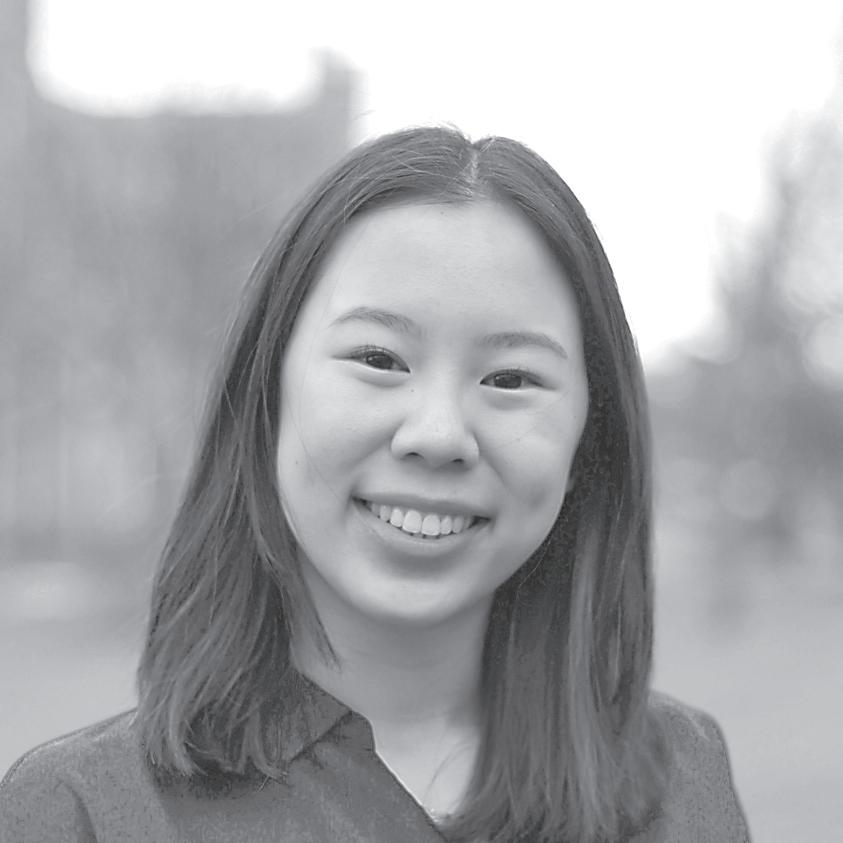
Jonna Chen is a sophomore in the College of Engineering. She can be reached at jc267@cornell.edu. Jonna.write() runs every other Monday this semester.
Signing up for a grocery store rewards card, I’m hesitant to enter my real birthday. When asked for my name at Starbucks, I simply say my last name, ‘Chen’, instead of my frst name — not just for fear of the mispronunciation. Tere are instances where using my real name, phone number or birthday feels like leaving my wallet out while going to the bathroom. However, the truth of the matter is that the internet probably already knows everything about me, from my shoe size to my preference in ice cream favors.
Humans are always trying to learn more about ourselves, whether it’s through our personality type or Buzzfeed telling us what kind of condiment we are. For me, it was always looking forward to Spotify Wrapped. It only occupies a few minutes of my time annually, but adds a satisfying conclusion to a year of chronic music
listening. Just for a day or two, everyone is posting about how they are in the top one percent of Khalid listeners, or what their top fve genres are. It’s cool to have every piece of your Spotify history and playlist-making tracked. It’s cool to agree mindlessly to the terms and conditions and never think again about the tech conglomerates that can track every single one of your clicks.
It’s all fun and games when it’s just about your music listening history. But, what about when you spit into a tube to have your DNA analyzed, only for it to be kept in a lab that may attempt to clone you in the future? Or, when you agree to screen time tracking, allowing each of your laptop interface histories to be kept forever and ever? Or, more commonly, how staring at a single TikTok for fve seconds too long will cause your entire ‘For You’ page to be about the “Drivers License” drama epidemic? When does data sharing become a risk for you? Is it worth it?
For me, the potential risks of data sharing are worth the enhanced user experience and cool statistics, but we should still weigh these novelties against the risks.
Tere’s certain aspects to be cautious about, like how each time you agree to a new terms and conditions essay full of fne print, the tech giant behind can start asking for more and more. Your access to your own information is your right, and large tech companies shouldn’t be able to take advantage of your information to play mind games with you in your ads, recommended posts and news feeds.
However, there’s also a sense of customization for the user. Te apps you use know you better and are able to cater to you. Tere’s more ease of use since they know what you want.
Additionally, like with Spotify Wrapped, you get to learn more about yourself — maybe it’s your exact ethnicity, your bad habits or your taste in content. Sometimes, it takes an outside perspective to allow you to learn more about your own identity and interests. If
a simple data analysis that runs through your numbers and information is able to do that in a click of a button, why not?
So is it worth it to know that I’m in the top 0.5 percent of Joji listeners from Spotify Wrapped? To know that I’m 0.1 percent Filipino from Ancestry DNA?
There are instances where using my real name, phone number or birthday feels like leaving my wallet out while going to the bathroom. However, the truth of the matter is that the internet probably already knows everything about me...
To be honest, I would say yes. I’m still a Gen-Zer who grew up sharing my data to countless websites and social media apps. Tere’s a certain sense of comradery in knowing that my entire generation is documented up there in the cloud. It wouldn’t be worth my paranoia and all the extra steps just to be a little less entertained, and a little more private.


By MILENA BIMPONG Sun Staff Writer
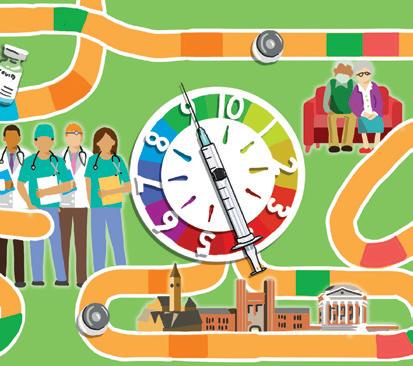
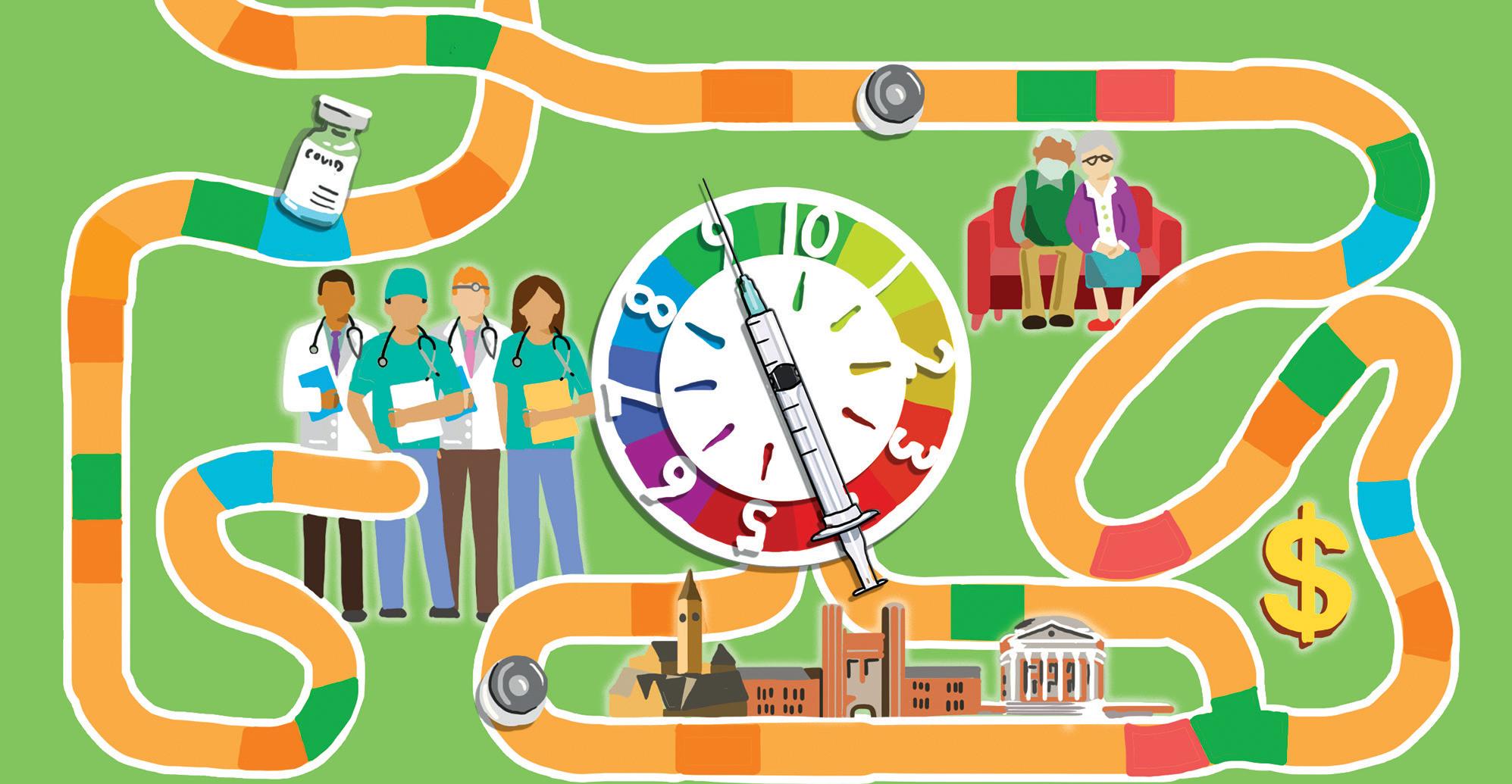
With a limited supply of COVID-19 vaccines and a long list of Americans waiting to receive one, federal and state governments are figuring out the vaccine line — weighing how to equitably distribute vaccines while maximizing benefit to society.
To demystify the decisions behind vaccine distribution plans, medical professional and ethicist Prof. Kim Overby, science and technology studies, offered insight into the ethical challenges that complicate the country’s vaccine rollout.
Epidemiologists currently estimate that 70 to 90 percent of the population needs resistance to COVID-19 to achieve herd immunity. However, only 4.2 percent of Americans have received both doses of the COVID-19 vaccine, meaning federal and state policymakers must ration available doses and decide who gets to stand at the head of the vaccine line.
According to Overby, policymakers must use ethics — the field governing what makes something right or wrong — to determine the order in which groups of people are vaccinated.
These ethical considerations include prioritizing those who have a high risk of contracting or having severe consequences from COVID-19, as well as those who have essential roles in society, Overby said.
Overby explained that four key ethical principles are guiding policymakers who are deciding the vaccine line — societal benefit, equity, social usefulness and social vulnerability. Societal benefit and social usefulness ensure a maximum positive impact in society, while equity and social vulnerability consider the roles of social inequities and health conditions.
Healthcare workers and other essential employees have priority for the vaccine because of a phenomenon known as the “multiplier effect” — since people with
these jobs are at a higher risk of being infected with and spreading COVID-19, society benefits most when these groups receive the vaccine first, Overby said.
Older adults and others with a high risk for serious disease from COVID-19 also have high priority due to their social vulnerability.
Although Overby said the benefits of the multiplier effect made it clear who would be in the first phase of vaccine rollout, there’s much more gray area for the following rollout phases, as policymakers weigh underlying social inequities and pre-existing health conditions.
However, state policymakers are bearing the brunt of vaccine distribution decision-making. How these ethical principles are put into action will look different based on the priorities of each state and its individual communities, according to Overby.
But, leaving vaccine distribution plans to state governments has its own advantages.
“Distribution criteria is not going to be identical from state to state. And that’s part of the challenge — you don’t have one [allocation plan],” Overby said. “That’s also somewhat of a strength because you can then tailor [the ethical principles] to your community.”
The result is a patchwork of vaccine policies, as states are strewn across different rollout phases, each with varying vaccine eligibility criteria based on the risk of virus exposure, age and health conditions.
As for whether college students are a high priority group to receive the COVID-19 vaccine, Overby said it depends on students’ individual circumstances.
Some Cornellians — such as grocery workers and emergency medical services providers — have already received the vaccine due to their high risk of exposure to the virus, while others must wait.
“There will be college students who have health conditions, jobs or other circumstances that warrant vaccination at
different times,” Overby said, “so it is not a situation where all college students will necessarily be treated as one big group and receive the vaccine at the same time.”
Overby added that one way to eventually increase vaccinations for the general population is for employers to mandate vaccination for their employees. However, this policy can be ethically complicated, due to persisting vaccine hesitancy and safety concerns in the general public.
“Evidence suggests that the available vaccines are quite safe and effective, but we are still in kind of an uncertain period,” Overby said. “This gets back to the issue of making sure that it’s not just the benefits, but also the burdens that are being equally shared.”
Social determinants of health such as housing, transportation and education also play a critical role in the ethics of vaccine distribution. Communities of color and Indigenous people are facing higher rates of COVID-19 infections, hospitalizations and deaths — a consequence of centuries of structural inequities and underlying health disparities.
Some health departments, like Washington, D.C., are trying to mitigate vaccine distribution disparities caused by
social determinants by narrowing vaccine sign-ups to less affluent ZIP codes hardest hit by the pandemic. Although promising, these plans have yet to show how equitable they are in practice, Overby said.
“Plans for allocating COVID-19 vaccines are attempting to take [social determinants] into consideration in various ways, but we will have to see how this actually plays out in the coming months,” Overby said.
Even though individuals are eager to receive the vaccine to protect their own health, Overby said a collective mindset and strong sense of community are crucial to overcome the COVID-19 pandemic.
“We tend to be a very individualistic society, but the pandemic has made it clear that we are very much interconnected,” Overby said. “We need the will and the mechanisms to work together to address challenging situations, like how we ought to allocate scarce resources, [when] we all have an interest as both individuals and as members of a larger community.”
Milena Bimpong can be reached at mbimpong@cornellsun.com.
By NATALIE MONTICELLO Sun Staff Writer
As misinformation over COVID-19 vaccine side effects and distribution conspiracy theories continue to flood social media, members of the general public are often left unequipped with the scientific literacy to discern between clickbait headlines and reliable information.
But Prof. Elizabeth Rhoades, microbiology and immunology, is trying to change that.
A researcher and lecturer, Rhoades jumped on the opportunity to mold a more science-informed student body by crafting a new first-year seminar course: Biology 1250: Keep Calm and Be Science Literate in the Pandemic.
As science is politicized and misinformation continues to spread through social media feeds like wildfire, the class teaches students how to ask questions, find reputable sources and make informed decisions — and how dangerous it can be when that doesn’t happen, Rhoades explained.
“How can you distinguish pseudoscience from real science? How can you make well-informed decisions about your health if you don’t know immunology? The answer is that you become science literate,” the course description reads.
Targeted toward first-year students regardless of their science background, Rhoades is offering this one-credit course in-person during the second half of the semester. Rhoades explained that the course is structured around class discussions and hands-on activities, and will equip students with the tools to distinguish fact from fiction.
“I want to teach [my students] how to go find real news, and how you can tell it’s not fake,” Rhoades said. “They will learn how to check if the source has any biases or gains, and how to be skeptical when they consider certain sources.”
Rhoades said the course will first provide students with a foundational knowledge of the immunology behind the COVID-19 pandemic, as well
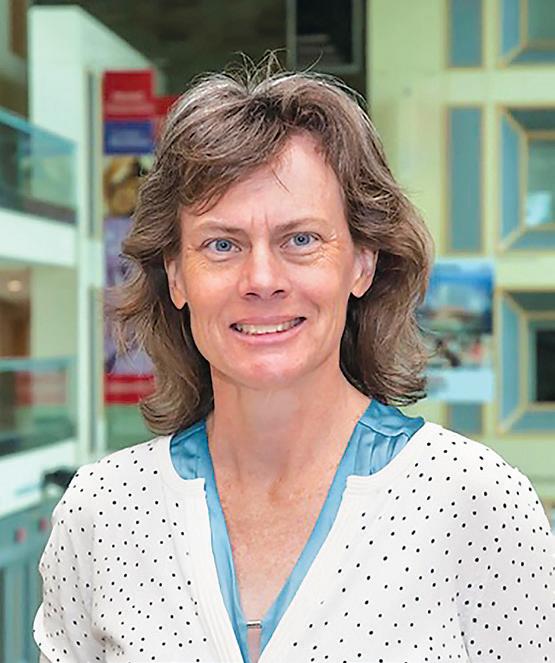
“You don’t have to be a science expert to make science decisions, but I want to teach students to track down the facts online when reading the news, and to be able to make educated choices for themselves .”
Prof. Elizabeth Rhoades
as how the vaccine can trigger the body’s defense against infection.
According to the course syllabus, students who take this class will be able to evaluate popular scientific claims, explain the biology behind vaccines and COVID-19 tests and engage in productive conversations around sociocultural issues of the pandemic such as healthcare disparities.
Then, the class will shift toward dissecting the social implications of the virus, as well as misinformation across social media and fraudulent news sites.
Students will also gain hands-on experience navigating scientific rhetoric. For one assignment, students will either take the stance of a COVID-19 vaccine skeptic or believer and analyze each side’s argument for the impact the vaccine could have on the long-term health of individuals.
“This type of exercise highlights the technique of gathering and applying information, and more importantly, it may open students’ eyes to different perspectives,” Rhoades said. “I want students to learn enough
about vaccines and where to find information about them, so they can make informed decisions if a vaccine is a good decision for them or not.”
According to Rhoades, the experience of this class will have a multiplying effect on generating a more scientifically literate public, as students can have informed discussions on vaccine safety with their friends and family.
Ultimately, Rhoades said she hopes the course will empower students with the critical thinking skills that will allow them to draw their own conclusions on scientific issues, even if they don’t have extensive knowledge of science.
“You don’t have to be a science expert to make science decisions, but I want to teach students to track down the facts online when reading the news, and to be able to make educated choices for themselves,” Rhoades said. “I see this as science communication at its best.”
Natalie Monticello can be reached at nmonticello@cornellsun.com.