The Corne¬ Daily Sun


By
Harold Levy ’74 J.D ’79, former head of the New York City public school system and a spirited advocate for education, died from Amyotrophic Lateral Sclerosis on Tuesday at the age of 65. Levy’s contemporaries recounted a zeal and energy that left a lasting impact on thousands of underprivileged and minority children in his prodigious career.
The son of Jewish refugees from Nazi Germany, Levy grew up in the Manhattan neighborhood of Washington Heights. He graduated from the Bronx High School of Science in 1970, 30 years before taking the helm as chancellor of the very same school system of his alma mater — the largest in the country and among the most diverse.
Levy’s drive was evident even during college. As an undergraduate in the School of Industrial and Labor Relations, Levy served on the University Senate and was eventually elected student trustee. Prof. Barry Strauss ’74, history and classics — who was one of Levy’s friends during college — remembered him as intellectual and ambitious in a time when, “for a lot of people, [being ambitious] wasn’t cool.”
“What struck me about Harold freshman year was just how mature and pragmatic he was,” said Joel Rudin ’74, who met Levy the first week of freshman year. “He was years
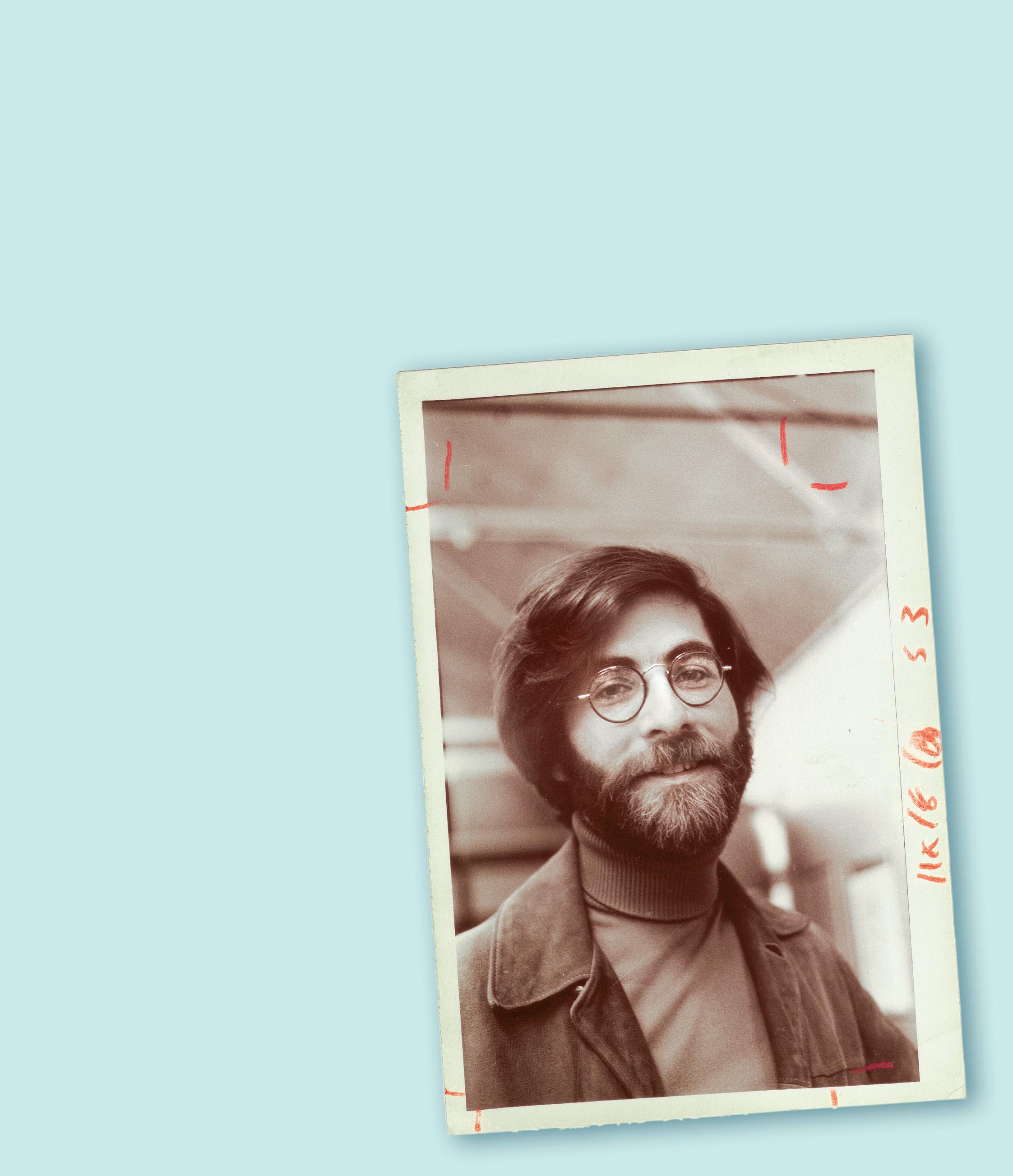
‘One of the best’ | The young Harold O. Levy ’74 J.D. ’79, right, was an ‘articulate’ columnist for The
ahead of the most of the rest of us in terms of being level-headed and understanding [of] how things get done in the world.”
The former student trustee was also a columnist and
See LEVY page 5
Following a
sleeping in the library, Shimon Shuchat ’19 and Mei Zheng ’18 have secured housing in Collegetown Terrace at the bequest of individuals that wish
tically assess long-standing issues of housing affordability and quality.
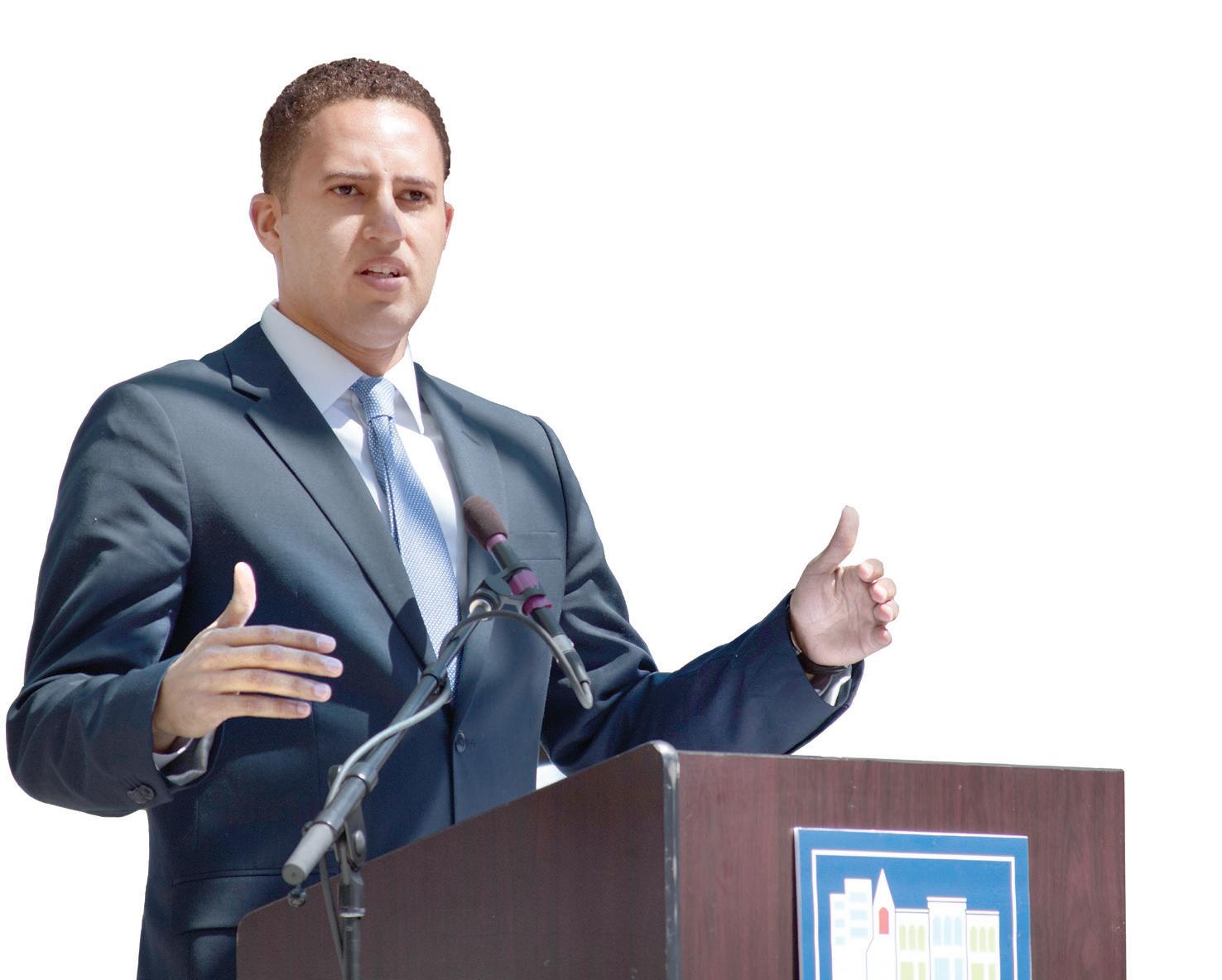
According to Stephen Smith (D-4th Ward), Ithaca Mayor Svante Myrick ’09 intends to create a new commission to holistically assess long-standing housing issues in the city, including the lack of enforcement mechanisms, affordable housing and preventing landlords from requiring leases to be signed over a year in advance.
The commission will be made up of renters, Common Council members, lawyers, representatives from the Cornell Law School, Ithaca College and the Cornell Off-Campus Housing Office.
“This has been a common theme,” Smith said in an interview with The Sun. “I’ve been on Common Council for six years now, and one of the early frustrations was realizing how little power we have to crackdown on low quality housing.” Smith added that the Common Council would separately look closely at enforcing the

By MATTHEW McGOWEN and MARYAM ZAFAR Sun Senior Editor and Sun Staff Writer
The student-led Mental Health Task Force formally submitted a letter to Vice President of Student and Campus Life Ryan Lombardi on Friday, outlining proposed actions to improve Cornell’s mental health services.
“They should be responding ... they should be committing to more of what we’ve outlined.”
Matthew Jirsa ’19
In January, President Martha Pollack rejected calls by The Sophie Fund — a mental health advocacy group — for an independent review of campus mental health services. The Sophie Fund called an assessment by the JED foundation and internal University reviews “insufficient” in a letter in August.
Following Pollack’s announcement, the student-led task force, now co-chaired by Joanna Hua ’20, Matthew Jirsa ’19 and Chelsea Kiely ’20, began a months-long process of drafting recommendations to the University, culminating in the letter on Friday. As of Sunday evening, the letter had 273 co-signatures from students, faculty and community members.
“Definitely, the ball’s in their court. They should be responding to this; they should be committing to more of what we’ve outlined in there,” Jirsa said in an interview Friday morning.
Proposed reforms outlined in the letter include hiring more CAPS counselors, increasing access to off-campus mental health networks, appointing permanent mental health advocates as liaisons between students and administrators and creating a transparent grading scheme to ease stress.
“Every person in my seat said we could double our therapy staff ... and we're not sure it would be enough.”
Vice President Ryan Lombardi
Kent Bullis, executive director of Cornell Health since July 2017, was also present during Jirsa’s reading of the letter. Bullis expressed his support for including students in the University’s reform efforts.
“I’m very grateful to have folks that are like-minded and have the same concerns that we do. One of the things we always struggle with is making sure we have the student voice represented in the ways we’re thinking about things,” Bullis said in an interview with The Sun.
The letter’s recommendations are not binding, but Jirsa hopes they will be considered during the University’s comprehensive review slated to start some time next semester. Lombardi said in an email Friday that the details of the review, includ-

Let’s Meditate 4 - 4:30 p.m., Big Red Barn
“Moors-Tupiniquins”: An Analysis of the Diverse Identities of the Brazilian Islamic Community 4:30 - 6 p.m., 404 Morrill Hall
Leaders in SGE Speaker Series - Thomas McQuillan 6 p.m., B08 Sage Hall
Tatkon Center Study Break: Yogibana
7 - 8:30 p.m., Tatkon Center for First Year Students
Screening: Bird of Prey
7 - 8:30 p.m., Cornell Cinema
Lessons and Carols: C.U. Music 7:30 p.m., Sage Chapel
Gamelan Ensemble Open Rehearsal: C.U. Music 8 p.m., 111 Morrill Hall

Robotics Day
9 a.m. - 4 p.m., Duffield Hall
Behavioral Economics Workshop: Florian Zimmermann 11:40 - 1:10 p.m., 141 Sage Hall
Econometrics Workshop: Matt Masten 11:40 a.m., 498 Uris Hall
Afterschool Language and Culture Program 2 - 3 p.m., Engaged Cornell Living Room, Kennedy Hall
Traveling Abroad: Preparations and Advice 3 - 4:30 p.m., G08 Uris Hall
Association of Veterans Happy Hour 5 - 6 p.m., Big Red Barn
Celebrate an Arabian Night 6:30 - 9 p.m., Multipurpose Room, Africana Studies and Research Center
2018 Korean Song Contest 7 - 8:30 p.m., HEC Auditorium, Goldwin Smith Hall
Weekly Study Skills Tutoring 7 - 9 p.m., 3339 Tatkon Center
By VALE LEWIS and SHAWN HIKOSAKA Sun Staff Writers
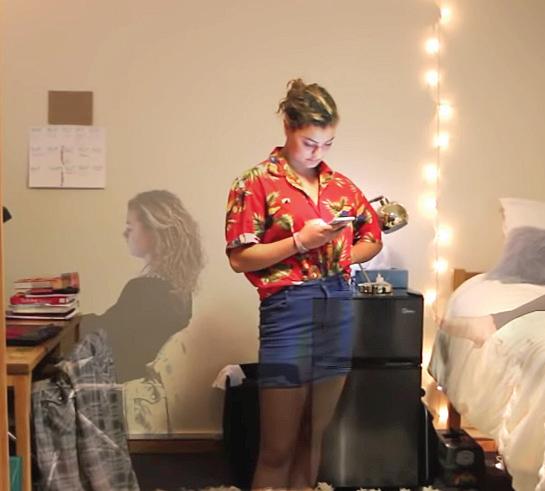
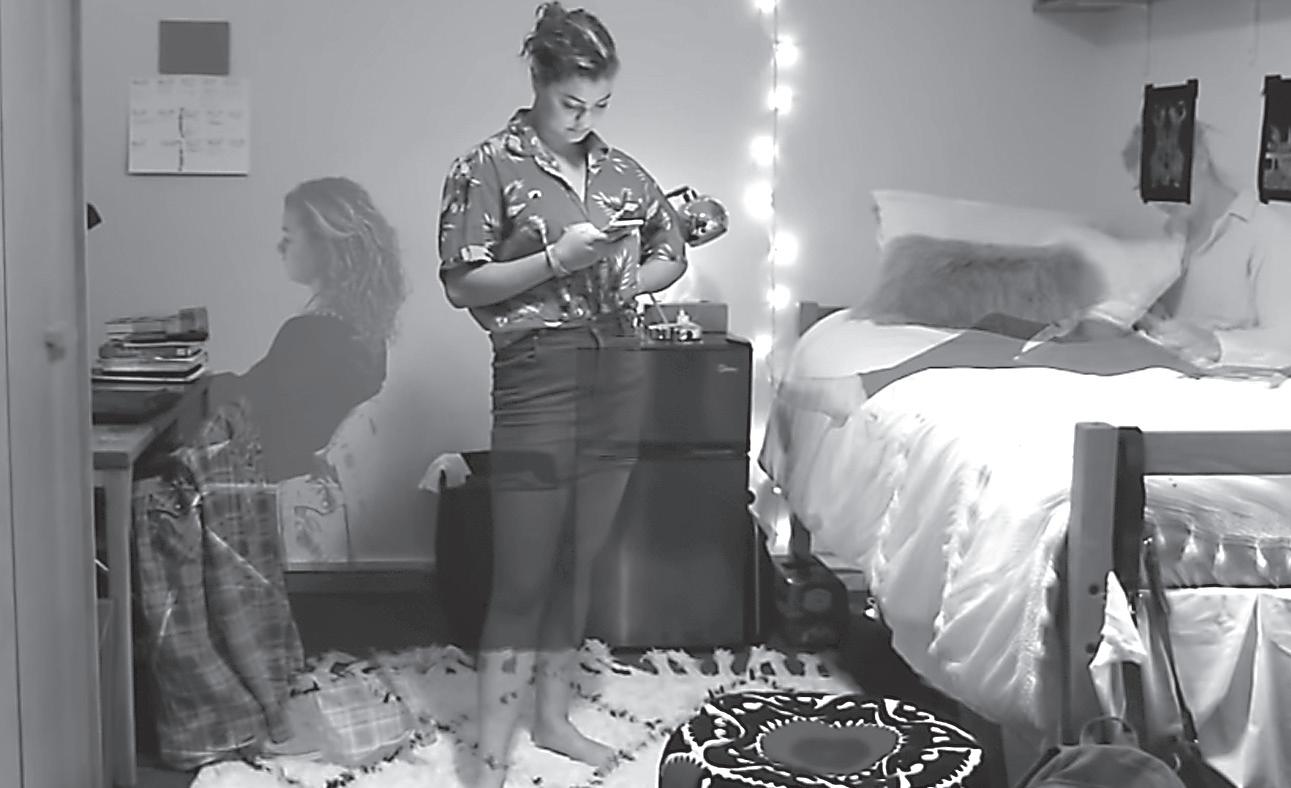
For Emery Bergmann ’21, freshman year was already daunting enough before a video for her Introduction to Digital Media class launched her into viral fame. Then she became known as the “girl with no friends.”
Going viral for a video about loneliness was “super embarrassing,” she told The Sun during an evening interview at the Green Dragon cafe in Central Campus on Nov. 16.
Her self-made video focuses on her transition from high school to freshman year at Cornell and the loneliness that comes along with moving away from home.
“I assumed that once I was at school that would be it,” she said in the video. “I was gonna have a million friends, I was gonna just party all the time … but it’s just not really like that.”
Bergmann’s video, which she expected only her professor and maybe a few friends to see, has now been viewed over 346,000 times on YouTube. She has been interviewed by news outlets across the country and wrote an editorial for the New York Times in October.
Hearing from students around the country who could relate to her experience with loneliness was “extremely validating,” Bergmann said. She even heard from adults who said they felt this way when they moved jobs or went into retirement — a “humbling” experience that helped her realize that she is not alone in her solitude.
“People thought that I was trying to solve loneliness or speak for the college experience. That’s ... not what I was doing.”
Emery Bergmann ’21
In her New York Times editorial, Bergmann gave lonely students three pieces of advice: you can’t clone your high school friends, social media is not reality and give yourself
time to adjust. However, she acknowledges that these pieces of advice are very specific to her and that they may not work for everyone.
“There’s no recipe to address loneliness,” she told The Sun. “It can be based on socio-economic things, it can be based in race or just never leaving home before, and those things for every individual are so drastically different.”
Bergmann said she has received thousands of positive messages from people of all ages across the world, but also faced some criticism for her content by people who were upset that she didn’t acknowledge her privilege. She acknowledged the criticism, conceding that — unlike some of her peers — she does not have to juggle jobs and other
By SETH KIM Sun Contributor
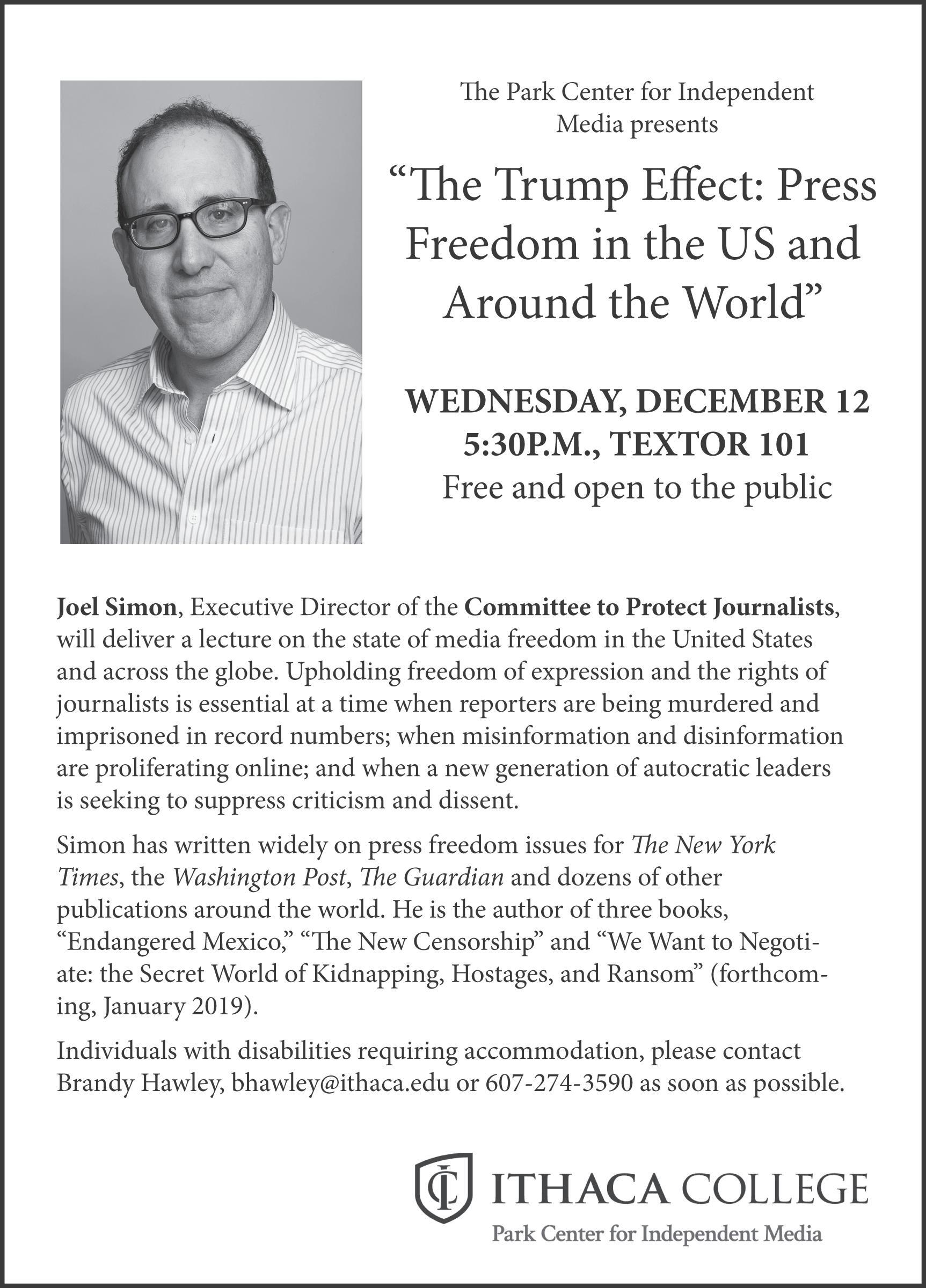
Microsoft, the world’s most valued company, has an operating profit margin of around 30 percent. Meanwhile, a documentary screened at Cornell cited that Elsevier — a major publishing company behind numerous closed-access journals — has more than that, with a near 40 percent profit margin.
“There’s nothing that prevents an open-access journal from being peer reviewed.”
Director Jason Schmitt objected to the ever-increasing financial barrier erected around quality research in his documentary Paywall: The Business of Scholarship , screened at Cornell Cinema last Thursday. He joined several Cornell faculty in exploring potential solutions to the exorbitant costs needed to access research articles in a Q&A that followed the screening.
The academic publishing industry presents a tension between the exploration of knowledge and generation of revenue, according to the documentary. Companies such as Elsevier boast “a 35 to 40 percent profit margin,” which is higher than some of the most valuable technology companies in the world, said Karla Cosgriff, director of Free The Science at The Electrochemical Society in an interview during the documentary.
Prof. Paul Fleming
While the publication companies benefit from limiting access to the research articles, the film argues that the academics that produce the research do not get appropriately compensated for their work, further driving up the companies’
See PUBLISHING page 4

commitments and can focus on making friends.
Nevertheless, Bergmann said that it was “frustrating” for her to get this criticism because she intended the video to be a reflection of her own experiences and never anticipated it would have such a large audience.
“People thought that I was trying to solve loneliness or speak for the college experience … That’s very much not what I was doing,” she lamented.
Since she posted the video, Bergmann said she has learned ways to combat loneliness at school: for example, she committed herself to try at least two new things every semester, whether it be joining a new club or doing something
By ANU SUBRAMANIAM Sun News Editor
Downtown Ithaca will be battling the cold December weather this weekend, with more than 20 different variants of warm chowder.
A competition for the Chowder Cup Champion will commence this Saturday at noon in Downtown Ithaca, featuring “traditional, exotic, and gourmet chowder from local restaurants,” according to the event’s Facebook page.
The Cook-off is part of Ice Fest, an annual Ithaca festival that celebrates the cold weather, and will take place on the Commons and the surrounding streets, according to the Facebook post.
The Chowder Cook-Off is in its ninth year, and tickets for it can be purchased either in advance or on the day of the competition. After the event, attendees have the option of voting on what they think is the best chowder.
According to the Ithaca Voice, Simeons American Bistro was the winner in the 2017, 8th Annual Chowder Cook-Off. There was also a separate title for Best Veggie Chowder, which went to Greenstar Natural Food Markets. The last category the Voice reported was Best Meat Chowder, a title that went to Max’s American Grill.
This annual tourist event is hosted by Elmira Savings Bank, City Centre Apartments and Downtown Ithaca. Over 2,000 people are interested
in or are going to the Cookoff, according to its Facebook event page.
The Cook-Off was partially funded by a grant from the Tompkins County Tourism Program, according to the event page. The tourism program works to protect economic development and enhance quality of life, according to its website. The grants work to fund efforts that draw visitors to Tompkins County for overnight stays or accomplish other critical actions listed in the 2020 Strategic Tourism Plan.
The grant for Ice Fest totaled $10,000, according to the Tompkins County’s page. A total of $97,500 in grants were given out for other community projects, including the Ithaca Festival After Dark in June and the Shakespeare Festival in July.
According to Scott Rougeau, associate special events director for the Downtown Ithaca Alliance, “the events were a huge success” in 2017.
“The crowds saw some amazing sculptures created by some amazing ice carvers, and they enjoyed some very tasty chowders, especially from our people’s choice winners. They really rocked it,” Rougeau told the Finger Lakes Daily News.
“We thank the participating restaurants for their tasty concoctions, and we thank the public for attending, sampling and then offering their votes.”
Anu Subramaniam can be reached at asubramaniam@ cornellsun.com.
off-campus. She has also found new friends she connects with after she accepted the first piece of advice she gave in the New York Times: you can’t clone your high school friends.
“Finding people who were like [my high school friends] and reminded me of them was kind of like my M.O.,” she said. “It took me a long time to realize that making friends isn’t replacing your old friends … That was relieving. It also opened my mind to a lot of new people.”
While her own social circle has grown since a year ago, Bergmann still thinks Cornell could be doing more to help combat loneliness on campus, like improving Orientation Week. However, she admits it’s hard to adopt these measures because there is a “huge variety of people within this campus going through a variety of different life experiences.”
Bergmann also thinks students put too much of an expectation
on themselves to find their best friends right when they get to college. In fact, a certain degree of loneliness is part of the package of moving to a new environment.
“You finding friends in the first two months of school … is asking for a lot, especially when you’re balancing schoolwork and living in a new place,” she said. “You moving to a new place with people you’ve never met and living alone for the first time is just going to induce loneliness regardless.”
However, she acknowledges that she learned a lot from the time she spent alone at the beginning of college.
“I got to know myself very well and what I wanted out of these new relationships … Being lonely sucks, but I reflected a lot, and I’m very thankful for what I learned in the time I spent alone,” she said.
Vale Lewis can be reached at vlewis@cornellsun.com. Shawn Hikosaka can be reached at shikosaka@cornellsun.com.


Continued from page 1
ing the membership conducting it, have not yet been worked out.
The letter was presented a day after the Student Assembly voted to recommend a $20-30 increase to student health fees to the Student Health Benefits Advisory Committee. The SHBAC is a body of students, administrators and staff that will in turn decide whether to send that proposal to Lombardi.
The recommended $20 increase would apply to both the student health fee and the regular Student Health Plan and SHP+ plans. The student health fee is an out of pocket cost paid by all students not enrolled in the Cornell SHP to cover administrative costs and on-campus health services; the increase would represent a 10.9 percent raise over the 2018-19 rate of $183 per semester.
“The most vulnerable of the communities, that do receive financial aid, won’t be severely impacted.”
Varun Devatha ’19
This increase, according to Student Assembly President Varun Devatha ’19, wouldn’t create a financial burden for students.
“The most vulnerable of the communities, that do receive financial aid, won’t be severely impacted,” he said.
Lombardi said in an email early Friday afternoon that he would give the S.A. recommendation “a very close review,” and “consider it very strongly.”
The S.A. recommendation was informed largely by results from a survey of undergraduate and graduate students sent in mid-November. According to Devatha, the survey found that 80.75 percent of students considered adding
counselors a “medium” or “high” priority, and 74.89 percent of students believed that opening Cornell Health on Sundays was of “medium” or “high” priority.
S.A. ultimately voted to recommend that the increase only be used to fund the addition of more counselors and not Sunday hours.
A $20-30 increase could contribute “somewhere in the range of 5 to 6 additional counselors deployed in various programs within Cornell Health,” according to Chris Payne, director of Cornell Health’s administrative services, who fielded questions from the S.A. on Thursday. Payne listed programs such as CAPS, “Let’s Talk” and behavioral health consulting programs as possible beneficiaries of the increased funds.
Currently, Cornell Health has 18 psychologists, 18 clinical social workers, three psychiatrists and two psychiatric nurse practitioners, according to Sharon Dittman, director of community relations for Cornell Health.
Lombardi returned to campus Thursday evening from a meeting in St. Louis with university officials in comparable positions from many other schools, including Duke, Brown and the University of Miami. Many of them expressed concerns about mental health services on their campuses as well, Lombardi told The Sun.
“Every person in my seat said we could double our therapy staff tomorrow and we’re not sure it would be enough. Everybody’s feeling that pressure on their campus to do more and try to figure out the best way to do it,” Lombardi said.
In a follow-up email, Lombardi clarified that while he was not advocating against an increase in staffing, he doesn’t believe that adding counselors alone will solve the “broad mental health challenges that we face as a campus.”
Matthew McGowen can be reached at mmcgowen@cornellsun.com. Maryam Zafar can be reached at mzafar@cornellsun.com.
Content in system will be ‘available and free to the end user’
PUBLISHING
from page 3
profit margins.
“Publishing is so profitable because the workers don’t get paid,” said Emeritus Prof. John Adler, neurosurgery, Stanford University, in the documentary. “Profit margins in the publishing industry are second to none.”
Peter Suber, director of the Harvard Office for Scholarly Communication, explained in the documentary that journal prices grow at a rate far higher than library budgets.
Multiple professors and librarians in the documentary also agreed that closed access often runs contrary to the mission of research. Though taxpayer money is in part used to fund academic research, the general public does not have access to this body of information, even when a paper was published 30 or 40 years ago.
are not able to spend close to a $100 for an article that may not even be helpful to their needs, according to the documentary.
After the screening, a panel of five members entered the stage for a brief Q&A session. The members consisted of Jason Schmitt, director of Paywall, Gerald Beasley, university librarian, Prof. Jeremy Braddock, English, Prof. Paul Fleming, comparative literature and German studies, and Prof. Max Zhang, mechanical and aerospace engineering.
essays were in peer-review open-access journals, and disciplines should be able to enforce the quality of those journals.”
To remedy the lack of open-access publications, Braddock said that Cornell Library is currently working to build an open access platform called Open Journal System.
“Publishing is so profitable because the workers don’t get paid. Profit margins in the ... industry are second to none.”
John Adler
Braddock, Fleming and Zhang are co-chairs of the Cornell University Faculty Library Board.
The documentary argued that the two groups most affected by the business are budding researchers and concerned families. Ph.D. candidates are often limited in their study of a field by the research they are able to find and access. Similarly, families interested in researching a specific topic are restricted by the paywalls they face: most
All panel members attested to the benefits of an open-access journal — publications where readers can access all the articles without paying — arguing that these sorts of journals can still be academically rigorous as long as they are subjected to peer-review.
“There’s nothing that prevents an open-access journal from being peer reviewed,” Fleming said. “My last two
“We’re working very hard on that, and anybody who wants to bring a journal to OJS will have a very privileged way of making that content available and free to the end user,” Braddock told the audience members. Wrapping up the Q&A session, Schmitt, the movie’s director, commended California for passing a bill that requires all public-funded research to be made available to the public in no more than a year.
“It’s a start,” Schmitt concluded. “California being the first state in the United States to do that, in my mind, it would make sense that New York should probably be the second state to perhaps do that.”
Seth Kim can be reached at ssk257@cornell.edu.
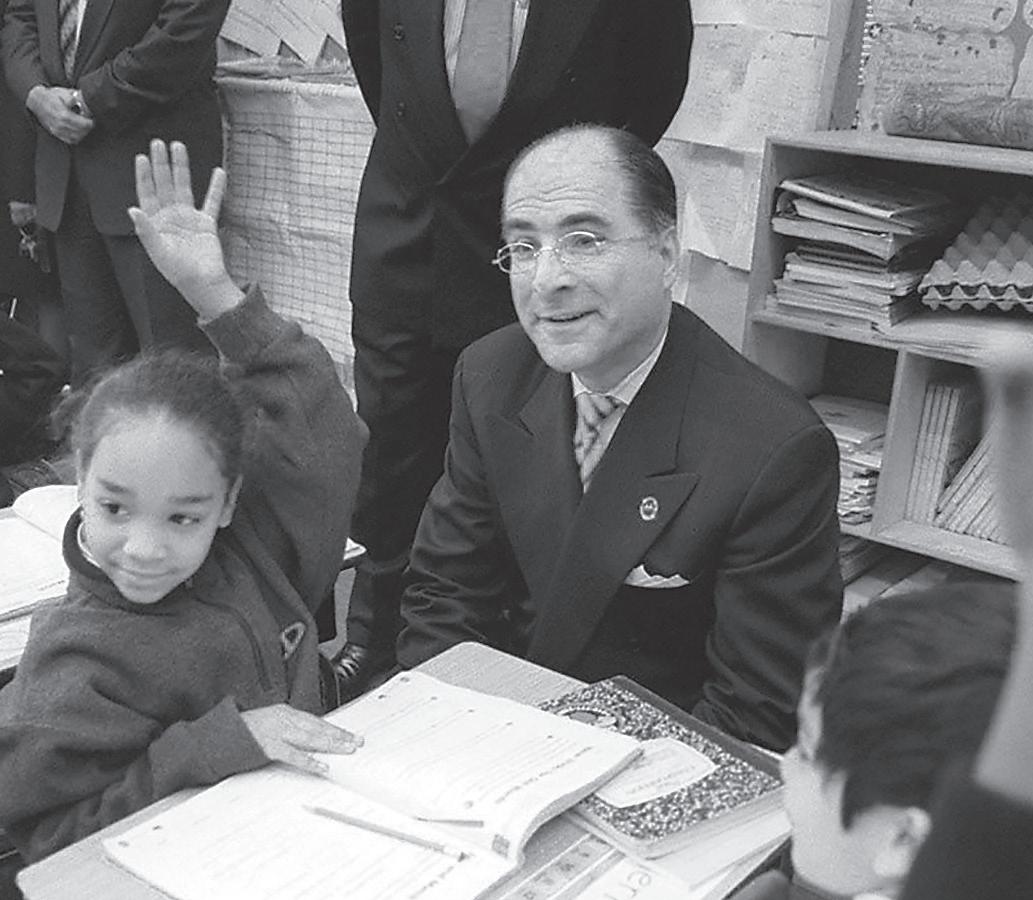
member of The Sun’s editorial writing board. Sun alumni advisor John Schroeder ’74, who as associate editor worked with Levy, remembered him as a “principled student politician” who was always concerned about empowering students — and “one of the best, one of the most intelligent, most articulate” columnists he worked with.
Mature though he may have been, Levy’s classmates also reflected on his lighter side during his time as an undergraduate. While in student government, he passed a resolution to keep the song “Jumpin’ Jack Flash” in the Willard Straight jukebox forever. When a brick flooring was added under the A.D. White statue, Levy and some friends from The Sun put a hoop on A.D. White’s head and played basketball to “protest” the brick patio, a controversial construction at the time, according to Strauss.
In his early career, Levy was a corporate lawyer for CitiGroup, now one of the largest banks in the U.S., but he supported and advocated for public education even before his time as the New York public school system’s chancellor from 2000 to 2002.
Levy chaired the City Bar Association's Committee on Education and worked pro bono for several community organizations. He was president of the University Settlement Society of New York, an education center for immigrant communities.
When Levy started as interim chancellor, he was appointed against the wishes of then Mayor Rudolph Giuliani. Within four months, Levy won popular support from many city officials, and Giuliani endorsed him to become the formal chancellor.
Levy’s list of accomplishments in only two years leading the behemoth school system are evidence of an energy and pragmatism that ran throughout his time in office.
He established a summer school to pick up the slack for 300,000 failing students, doing away with automatic promotion to the next grade. He opened new specialized high schools, founded the New York City Teaching Fellows to recruit thousands of teachers and led the schools through 9/11.
When Levy began his chancellorship in 2000, there were four specialized public schools in the city. Over two years, Levy spurred the opening of three more: the High School of Mathematics, Science and
SVANTE
Continued from page 1
Certificate of Compliance violations, improving awareness of the City’s resources for tenants and instituting stronger repercussions for improperly functioning heating.
Donna Fleming (D-3rd Ward) of Ithaca Common Council questioned whether the current model of enforcing housing code violations is strong enough to achieve its goals.
“I wonder if seeking compliance, rather than penalties, does nothing to stop repeat offenders among landlords,” Fleming said in an email to The Sun. “Do our building staff need stronger legislation to support [the building department’s] work? If so, what can Council do to help them?”
The certificate of compliance for Zheng and Shuchat’s house expired in November 2015, according to the Building Department.
to include Cornell in the conversation about housing. “When a parent drops their kid off at Cornell, Cornell becomes responsible for the wellbeing for that kid to a large extent … if the main driver of their stress is coming from a lack of affordable housing, Cornell has a role to play in part with the city,” said Smith, the Common Council member.
Cornell’s Off-Campus Housing Office has already taken steps to crack down on landlords by requiring current Certificates of Compliance to list on their housing platform, but some university officials have suggested that Cornell could do more to protect students.
Ian Schachner ILR ’04, associate director of undergraduate admissions for the School of Industrial and Labor Relations, has long hoped to form a renters association to protect against mistreatment by landlords, slow response times and poor quality housing.
“I wonder if seeking compliance, rather than penalties, does nothing to stop repeat offenders among landlords.”
Engineering at City College; the High School of American Studies at Lehman College; and the High School for Sciences at York College.
“Harold had an indomitable spirit and really big heart, both of which led him to devote much of his career to providing greater educational opportunities to all young people, but especially those from low income families,” said Alessandro Weiss, principal of the High School of American Studies at Lehman College, in a phone call to The Sun.
After serving as chancellor, Levy remained devoted to education. He continued to visit many of the schools he helped create over the course of his time in various offices, sitting in on classes and meeting students even after his official responsibilities ended, according to Weiss.
Levy convened national conventions for principals of specialized high schools from all over the country, joined the Kaplan Education Foundation and invested in education through Palm Ventures.
In 2014, he became the executive director of the Jack Kent Cooke Foundation, which provides scholarships to students with financial need. Alessandro Bailetti ’12, who was a Cooke scholar, remembers Levy as a “different kind of director.”
“He was such an example,” Bailetti said. “It’s difficult for me to change the verb from ‘is’ to ‘was’ because I feel like he’s still so fresh. I still feel like he’s still around. His legacy will live forever with every student his work touched."
Even when Levy was diagnosed with ALS in 2017, he continued advocating for education reform. Levy wrote an op-ed in The New York Times that called for changes in the college admissions process to make it more accessible for low-income students. Levy wanted to end legacy admissions and increase guidance counselors.
“Please stop giving to your alma mater,” Levy wrote. “Donors to top universities are getting hefty tax deductions to support a system that can seem calculated to ensure that the rich get richer.”
Levy is survived by his wife, Pat Sapinsley, and two children Hannah Levy ’13 and Noah Levy ’16. He died in his home in Manhattan.
Rochelle Li can be reached at rli@cornellsun.com. Matthew McGowen can be reached at mmcgowen@cornellsun.com.
Assuming a Certificate of Compliance is reinstated after an inspection scheduled for Dec. 5, the minimum penalty landlords David and Barbara Lower could technically face is $111,300 and the maximum is $278,250, based on rates outlined in the City Code.
Donna Fleming
It is unclear whether any fines will be levied against landlords David and Barbara Lower as a result of the dispute, and Fleming indicated in an email that such cases are “often not prosecuted.”
Some landlords in the Ithaca area also expressed concern about the city’s handling of Certificate of Compliance violations. Costa Lambrou ’16 of Lambrou Real Estate, which owns over a dozen Collegetown apartments and houses, said that the time elapsed without a certificate in Zheng and Shuchat’s case was “outrageous.”
“If there’s no legislation in place that catches that or that fines for that, there needs to be, but a lapse of a month is fairly typical,” Lambrou said.
Lambrou and Smith both stressed the need
“When that many of your undergrads live off campus, you can't claim to care about their well-being if you’re not taking a sufficient role in their housing situation,” Schachner said. “We have 20 organizations about every animal, vegetable and environmental cause, but not a single one related to an issue that defines most of the people, which is that we are a city of renters.”
Schachner also expressed support for the creation of a Law School tenants rights clinic to assist students with housing woes, an idea previously proposed by former graduate student-elected trustee Annie O’Toole J.D. ’16 and echoed by an editorial in The Sun. University spokesperson Gillian Smith declined to comment on any pending response from Cornell.
Matthew McGowen can be reached at









The fact that Noname’s Room 25 is our album of the year despite its relative lack of promotion is truly a testament to the quality of the album. Every track wows on its own but gets even better within the context of the album. Its live instrumentation and Noname’s poetic vocals give Room 25 the feeling of it being just you and her, something no other album is able to achieve to the same degree. All in all, it’s the most cohesive and surprising album of 2018 and is deservedly our number one.
—Daniel Moran
Janelle Monáe’s latest release accompanied an “Emotion Picture” of the same name — a gorgeous combination of music video and narrative film loaded with social commentary. Like a lot of Monáe’s work, Dirty Computer follows a futuristic android (Monáe’s alter ego Jane) but confronts modern, human topics like race, gender, (pan)sexuality and nationalism. Standouts from the album include the Prince-inspired “Make Me Feel” and the powerful rap “Django Jane.”
— Olivia Bono
After Mitski released Puberty 2 , nobody believed she could top it. However, Mistki surprised the world with Be The Cowboy.Mitski reached somewhere into heartbreak and loneliness to assemble a touching collection of indescribable but relatable feelings only she would be able to find for us all. From the surreal organ intro from “Geyser” to the dance-as-you-cry masterpeice “Nobody,” Mitski is once more capable of moving anyone to tears and feel vulnerable and so, so very small.
— Viri Garcia

Swimming Mac Miller 6

Whack World is only 15 minutes long and each track is only one minute long. Tierra Whack’s bold, short album teases listeners with extremely good but extremely short songs that explore different emotions in an immensely creative way. She released a music video for the whole album in which the transitions between songs and different aesthetics used for each track greatly contribute to the experience to be had in Whack World. This year, Tierra Whack created a piece of art like no other female rapper.
— Viri Garcia
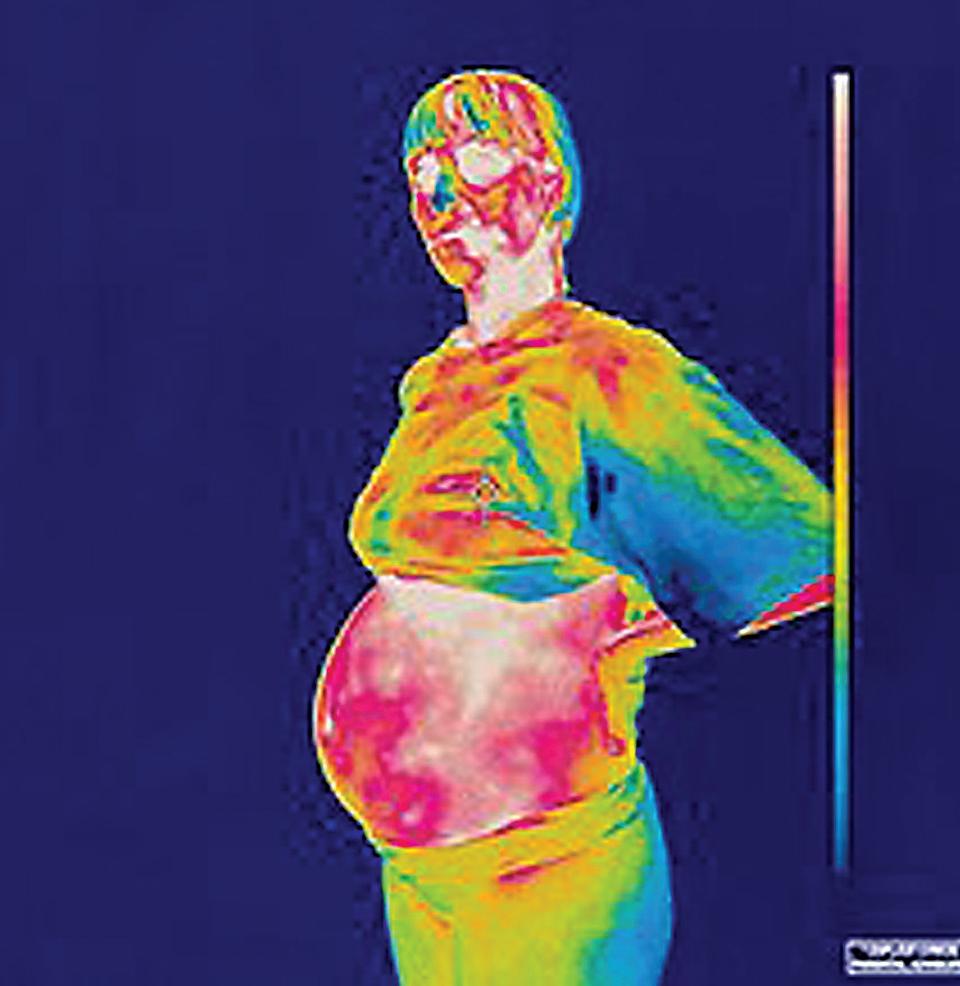
After a busy 2017, during which the group released the Saturation Trilogy, Brockhampton teased fans for the beginning of 2018 with multiple album titles. It seemed the group was all set to release their next album Puppy when they were hit with a #MeToo scandal that resulted in Ameer Van leaving the group. They spent the summer reinventing themselves before releasing Iridescence. Iridescence shows the groups versatility and uncanny ability to capture the human condition. Joba not only fills the hole left by Ameer Van, but completely reinvents the boy band’s sound to something that is even more unique and amazing.
—Pete Buonanno
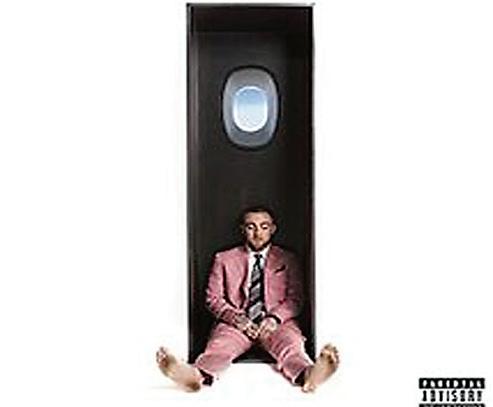
Swimming is Mac Miller’s final album. It’s his parting gift, his swan song. Since the 2011 release of his debut album Blue Slide Park , Miller has continually redefined himself as an artist on each subsequent release — and Swimming is no different. It is impressive, experimental, and raw. Thank you, Mac Miller, for contributing to the soundtrack of our lives.
—Pete Buonanno
136th Editorial Board
JACOB S. KARASIK RUBASHKIN ’19
Editor in Chief
JOHN McKIM MILLER ’20
Business Manager
KATIE SIMS ’20
Associate Editor
VARUN IYENGAR ’21
Web Editor
MEGAN ROCHE ’19
Projects Editor
EMMA WILLIAMS ’19
Design Editor
JEREMIAH KIM ’19
Blogs Editor
AMOL RAJESH ’20
Science Editor
BREANNE FLEER ’20
News Editor
YUICHIRO KAKUTANI ’19
News Editor
NICHOLAS BOGEL-BURROUGHS ’19
City Editor
GIRISHA ARORA ’20
Managing Editor
HEIDI MYUNG ’19
Advertising Manager
ALISHA GUPTA ’20
Assistant Managing Editor
DYLAN McDEVITT ’19
Sports Editor
MICHAEL LI ’20
Photography Editor
GRIFFIN SMITH-NICHOLS ’19
Blogs Editor
JACQUELINE QUACH ’19
Dining Editor
SHRUTI JUNEJA ’20
News Editor
ANU SUBRAMANIAM ’20
News Editor
JUSTIN J. PARK ’19
Multimedia Editor
Working on Today’s Sun
Ad Layout Medhavi Gandhi ’20
Design Desker Girisha Arora ’20
News Deskers Yuichiro Kakutani ’19
Anne Snabes ’19
Sports Desker Johnathan Stimpson ’21
Arts Desker Viri Garcia ’20
Photography Desker Edem Dzodzomenyo ’20
Production Deskers Jenny Huang ’22 Mei Ou ’22
Editorial
Te best a Sunnie could be
HAROLD O. LEVY ’74 J.D. ’79, FORMER CORNELL STUDENT TRUSTEE, chancellor of New York City Public Schools, progressive firebrand, and a member of The Sun’s editorial board, died last Tuesday after a bout with Lou Gehrig’s disease. As we look back on Levy’s life, we should take inspiration from the causes he championed while at Cornell and afterward: women’s rights, transparency, the rights of underrepresented communities, and the belief that everyone, regardless of background, deserves a high-class education. A champion for progress and a voice for the voiceless, Harold Levy was the best a Sunnie, and a Cornellian, could be.
At Cornell, Levy served in a multitude of leadership roles, first in the University Senate, and then as one of four undergraduates on the Board of Trustees. (If only undergraduates were as well-represented on the board today.) From the beginning, Levy advocated against what he viewed as a deeply flawed Cornell judicial system, one in which students were treated like criminals and faced structural disadvantages in their cases. In a 1971 column, Levy derided the system as an “outrageous sham,” and in 1973, after a landmark Hearing Board decision, he celebrated the end of “the days when all-white judicial boards found black defendants guilty in absentia,” among other inequities.
As a member of the University Senate and later as a trustee, Levy was a strong proponent of improved student housing. When 69 students found themselves without housing at the beginning of the 1972 school year, Levy pushed for them to be housed in the Statler Hotel until permanent accommodations could be found. And when Cornell came under fire from the federal government for discriminatory housing assignments, it was Levy who pushed an amendment that would end de facto segregation in Cornell housing. Much like his successor Annie O’Toole J.D. ’16 did 40 years later, Levy proposed the creation of a free legal service for Cornell students, the “Office of the University Advocate.” (This was a good idea 40 years ago, and it is a good idea today.)
Levy was unafraid to stand up to powerful interests on campus. As a trustee, in a display of conviction no longer seen often on the Hill, he took a public stance against the rest of the Board on the issue of investing in apartheid South Africa, and as a law student threatened to sue the Board unless it opened its meetings to students. As a member of Quill and Dagger, Cornell’s regressive senior honor society, he publicly castigated the organization’s reticence to admit women, telling The Sun in 1974, “You don’t put up to a vote somebody else’s rights.”
Later in his career, as Chancellor of New York Public Schools, Levy pressed Mayors Giuliani and Bloomberg to expand the city’s school system, raise teachers’ wages, and create new opportunities for specialized education for “thousands of minority students who might not otherwise had access,” according to The New York Times.
We need more people like Harold Levy — people who use their power and leverage to make the world a better place not for themselves, but for others. May his memory be a blessing.
William Wang | Willpower
For some reason, on Saturday afternoon, I sat myself down to watch the University of Oklahoma and Texas football teams lock horns to determine the winner of the Big 12 Championship. And even though I don’t know half the words I just typed thanks to my neophyte nature when it comes to college sports, and my disdain for football that largely stems from the abusive damage it lays on its players, I stayed sitting and watched. Because once in a while, you just have to see something exceptional. Kyler Murray, who plays quarterback for the Oklahoma Sooners, is short for his position. He’s also one of the five most talented athletes in the world. With jets for legs and dart throwers for arms, he’s Hercules hammered in a 5’11’ height. On one play, he’s a threat to take it to the house; the next, he may fling a gorgeous throw to his waiting receivers.
He’s remarkable not because of these gifts on the football field but because it might not even be his best sport. This June, he was taken 9th overall in the MLB draft (something I’m much more comfortable with), and signed a contract for $5 million with the Oakland Athletics to play professional baseball. To football scouts, he can potentially be an exciting dual quarterback; To baseball scouts, he’s a future all-star outfielder in the making, blessed with premium athleticism. And before the college football season, it seemed like baseball would be the easy choice, because his potential as a football QB was limited by questions about his height and throwing accuracy. But so far, he’s been perhaps the best player in college football, and if not, he’s certainly the most entertaining. Otherwise, I wouldn’t have bothered watching an hour of college football during finals season.
He’s also stirred a heavily passionate debate about where his true destiny lies. He can potentially excel in two sports; so which one should he excel in?
It’s hard to be happy; it’s even harder to know where to look for it.
Murray right now. He has a good option, and an even better one. What could go wrong?
The parallels run deep here on campus. The people at Cornell can be an exercise in agony. Wherever you go, there’s someone in an existential crisis. For instance, there’s my pre-med friend, the one who’s been suplexing her competition for the past 2.5 years, but who’s still unsure medical school is worth the sacrifice. And so imagine fighting your way through gen chem, orgo and biochem for a 4.2 GPA, all the while knowing it might not even relevant to your future career path.
And she’s not an isolated case. As students, we fret endlessly over our futures. Is this the right field? Will it be stable in 20 years? Will it make us happy? And that might be the most important one. There’s my C.S. major friend who prefers screenplays over screensavers; she seems happier when discussing movies over bits. There’s my banking friend who’s unsure whether it’s really for him. And then there’s my hotel friend, who wonders if it’s all a bit too vacuous. Our career decisions are too important to mess up.
What happens, happens, and we have to live with our decisions.
It’s hard to be happy; it’s even harder to know where to look for it.
Absurdly, I fell in love with fashion and cosmetics this semester; I started reading up on cosmetics for fun. And so I applied for a job at L’Oreal, because I figured, to enjoy my job, you have to work for something you enjoy. And so, foundation brush in hand, I went in to fulfill a long-running joke. I came to Cornell, to the AEM major, with a friend from my high school class. And it was so strange, so unexpected that someone who sat in the same high school classroom had ended up with me in the same major, that a joke started. What was next: Were we going to end up working for the same company?
One of my friends was trying to convince me that football was the better option. There was better visibility for athletes, he argued, plus the fact that there wouldn’t be a need for grooming time in the minors that would be needed in baseball. There was a direct payoff, an immediate salary, a higher present value. As you can tell, he’s a business major.
And sure, to become a baseball player is like going through a professional school. Everyone wants to make it to the end; the only question is getting there. But to me, there was a degree of danger present on the gridiron not found on the baseball diamond. One misstep and he might tear his ACL. One unfortunate pileup of 300 lb lineman on him, and his career would be over. Football is a sport of precious moments; you might never know when it might be your last.
So I thought that was nonsense. It wasn’t even close. And with each heartbreaking discovery of traumatic brain injuries in passed football athletes, it’s clear the sport of football does not treat its players like Teflon; it crushes them and beats them, torments them and drugs them, and we cheer and clap, and they die a little inside each time.
But either way, there are young men on either coast who would kill for a chance to be in a position to be an NFL QB or an MLB outfielder. To have both in his hands is special. So it must be nice to be Kyler
As a matter of fact, we ended up applying to L’Oreal. And for a moment, absurdity almost became reality. And then it wasn’t funny, because I was stunned, and when I seemed like it would happen, I started to play the lottery because, really, what were the odds?
It didn’t happen though, because another company came in at the last minute out of nowhere, and I decided to go with it because it appealed more to me. But it almost did, which is remarkable in itself. It proved as much to me that you never know what truly might happen; things are never so clear-cut. She ended up getting the job, and I’m thrilled for her because it’s something she’s happy to be a part of. And that’s really all that matters.
We can’t tell the future. We can’t control it, contort it, bend it to our liking. What happens, happens, and we have to live with our decisions. Kyler, as much as I envy him, has a certain cloud hanging over him his. If he fails in baseball, there will be a certain subset of people like my friend always asking “What if he had stayed with football?” It’s a lot of pressure, a lot of bitterness awaiting him if it does happen. The steep descent of star athletes is unbearable to watch. For his sake, I hope he finds stardom. For our sake, I hope we find happiness.
William Wang is a junior in the College of Agriculture and Life Sciences. Willpower runs every other Monday this semester. He can be reached at wwang@cornellsun.com.
Political journalists aren’t acting responsibly. I think it’s gotten worse since the beginning of President Trump’s term in 2016. The roughly partisan split of journalistic outlets, at least partially hewn by the election of a black president and thrown into sharp relief by backlash to said black president, isn’t backing down. As a result, this sentiment bears repeating: political journalists must adhere to standards that eschew the scoop-based big headline reporting in favor of responsible journalistic practice.
On Oct. 30, just a week before the Nov. 6 midterm election, Axios published a piece titled “Exclusive: Trump targeting birthright citizenship with executive order.” The interview sparked a political firestorm after the media magnified the ridiculous Axios claim to rile up both the open borders and nativist bases. Only a few outlets figured that on a factual level, constitutional scholars agree that the president can’t change the 14th Amendment through executive order.
We have to force progress within ourselves and our communities.
Axios’s headline-stealing interview had two major problems. First, it featured star reporter Jonathan Swan egging the president on so Trump would continue clarifying his planned executive order. Swan barely attempts to correct the president’s false sense of facts, only saying that “it’s very much in dispute” whether birthright citizenship can be ended without a constitutional amendment. Instead, Jonathan Swan gleefully ignores the president’s incorrect claim that the United States is the only country with birthright citizenship.
though, doesn’t equate to smart journalism.
One line in particular sticks out as an example of irresponsible “access journalism” — compromises given in exchange for more media time with a celebrity — that relies on the same group of insiders. The president expresses surprise that Jonathan Swan knows about his plan to end birthright citizenship with an executive order, saying “Jonathan, I’m impressed.” On the spot, Swan attributes his knowledge to a “good guess.” But the Axios article explains the lead comes from cooperation between Axios on HBO and the White House Counsel “behind the scenes.” And although Axios claims to be focused on a reader-first model that breaks down the news into brief and digestible bits, this sort of journalism shifts away from an information focus and into irresponsibility.
Second, Swan’s interview is a barely-concealed attempt to hype up the Axios model of snippets of insider information and the outlet’s upcoming show on HBO (definitely saw that coming … not). Indeed, the first paragraph of the Axios article ends in an advertisement for the show. The video released on their website is one minute and eight seconds of pure clickbait of President Trump satisfying the deepest fantasy of nativists who believe this country is “too nice to illegals” while simultaneously sparking fury in hardcore liberals who are most anti-Trump on immigration. A smart business move,
I’m not great at painting, but this semester I spent about six hours a week in Tjaden trying to paint anyways. On somewhat of a whim, I took a friend’s advice and signed up for an introductory art class. I was definitely the least experienced in the class. And still, the environment it created — where I had room to mess up and get better, where I was out of my element and felt no pressure to make anything perfect — brought me a kind of peace that I haven’t found in many other spaces here at Cornell.
I painted everything from a portrait of a stranger to an exterior of the Sun office building (that I ultimately had to call “abstract” because it was unforgivingly unrealistic.)
Every few weeks, we would have class-wide critiques where I’d nervously hang my attempts on the wall next to perfect, often photo-like pieces done by freshman Fine Arts students. And every so often, one would wander over to my side of the room and ask me questions that got funnier over the course of the semester, like, “did you intend for this painting to look like a cartoon?” (I did not) and, the ever-quot-
But goodness! Jim Acosta could chill a little. The Nov. 7 Acosta-Trump clash wasn’t the first time the two had locked horns. Acosta has notably shouted questions during the president’s speeches and the White House Easter Egg Roll. He often refuses to yield the microphone, instead continuing to ask (or yell) questions.
Political journalists must adhere to standards that eschew scoop-based big headline reporting.
I don’t know the exact decision-making calculus that made the president sit down for an exclusive with a center-left organization that’s smeared him in the past, but journalistic objectivity wasn’t a key goal of Axios going into the interview.
Then, there’s the Acosta business. After a Nov. 7 press conference where CNN reporter Jim Acosta continued to question President Trump about the migrant caravan after being dismissed, Acosta’s press credentials were briefly revoked before a district court judge ordered the White House to restore the press pass on Nov. 16. I need to preface this by saying that Acosta’s hard pass press credentials shouldn’t have been revoked. In fact, I enjoy watching his sharp-tongued reporting and on-screen camaraderie with Wolf Blitzer. The president is and has been hostile and unfair to the press, especially CNN and other left-leaning news organizations. That behavior from the president is outrageous and should never be supported. The press is not an enemy of the people.
Commitment to objectivity — or at least facts — shouldn’t be given up in favor of access and scoops.
While the president deserves to be asked difficult questions and the First Amendment guarantees Acosta to ask whatever questions he wants, Acosta isn’t the only reporter at the White House press conferences (even if he’s the most outspoken). By continuing to play what Politico columnist Jack Shafer calls “the preening, self-aggrandizing, sanctimonious reporter,” Acosta is only playing into the “evil press” hate narrative that Press Secretary Sarah Huckabee Sanders and President Trump continually use to justify their actions to limit the freedom of the press. This kind of “here we go again” belittling of reporters like Acosta is what excites rah-rah base voters and encourages the White House’s self-righteous indignation when dealing with the press. Journalists shouldn’t give the White House opportunities to demonize the press corps as a whole because we are too rude. Or because they don’t follow rules they followed under a different administration because of partisanship. In the case of Axios, commitment to objectivity — or at least facts — shouldn’t be given up in favor of access and scoops. Both Acosta and Axios are two sides of the same coin of irresponsible journalism that seeks to gain retweets instead of seeking stories and well-reasoned opinions. Political journalism must seek a fairer approach at all levels, from the college paper columnist (oops, that’s me, and I hope I follow my own advice) to the star reporter at a major news outlet.
Darren Chang is a sophomore in the College of Arts and Sciences. Swamp Snorkeling runs every other Monday this semester. He can be reached at dchang@cornellsun.com.
able, “at least you’re having fun.” But they weren’t wrong. One of my still lifes did look intentionally cartoonish and I was having a really great time navigating my new hobby, even if I was doing so clumsily.
I’m approaching my last semester at Cornell, and still, every so often I’m struck by the pervasiveness of perfectionism here.
A study published by the American Psychological Association shows that perfectionism has been increasing over time, citing socially prescribed perfectionism as a large influence on this trend. And if you look around at our peers, the examples are everywhere but explanations are trickier to pin down. Social media definitely exacerbates this. Want to compare your social life? Your professional trajectory? Look no further than Instagram, LinkedIn, or your peers for titles and images that are ripe for comparison.
I had room to mess up and get better.
That counts for something, even if the only things I was consistently good at in that class were learning and relaxing.
A quick search of other student newspapers, from The Harvard Crimson to
The Daily Californian to The Columbia Spectator, reveals a widespread interest in perfectionism among people our age: whether we’re identifying it, dismissing it or problematizing it. Exactly what I’m doing right here. But perfectionism, in its most extreme forms, can extend beyond an annoying trend and can actually be hazardous to our health and linked to various disorders, according to a publication from Harvard Medical School. This is not to say that me taking, and being mediocre at, one painting class has allowed me to “rise above” this, but it has helped in a lot of small ways. Because my painting class happened to fall right after one of my most difficult classes of the semester, it was always a nice escape, a therapeutic routine. I’d take an exam, and then head into the studio, put headphones in and focus on a canvas that I couldn’t make perfect, but could make okay, or kind of good, with a few hours and earnest effort.
And by the time I left, I felt oriented. And that counts for something, even if the only things I was consistently good at in that class were learning and
It’s tempting to put a romantic spin on the clumsiness of these attempts and of trying new things in general. But in my case, that wouldn’t be entirely honest. I would definitely prefer that my paintings look more like those of my classmates, but sometimes, no matter how much extra time you spend in the studio, correcting parts of a painting, messing them up, and making them okay again, your skill level just kind of is what it is. And that’s fine. We all have some version of the painting class.
But in a place where it feels like there’s an almost constant preoccupation with perfection in the areas where we do excel, it’s nice to hide, even if just for six hours a week, in the ones where we unabashedly do not. Because at least we’re having fun.
Jacqueline Groskaufmanis is a senior in the College of Arts and Sciences. The Dissent runs every other Monday this semester. She can be reached at jgroskaufmanis@cornellsun.com.
Christian
When my mom dropped me off at Cornell two weekends ago after a family funeral, I had to screenshot directions to get back home and send them to her. Her tiny phone made the pictures grainy and hard to read. Still, she persevered and managed to get back to Maryland safely. She probably squinted and looked down at the phone more often than was safe, but she did it. And she went through this whole ordeal with a smile, for the alternative was to her much worse than some occasional inconvenience.
I’m not suggesting I’m better than anyone for reading so much.
gave us. So I put the books away in public. They became a private pleasure, and remained as such until late in high school. That’s when I finally gained the maturity to realize that my love of reading was good for me, enjoyable and an intrinsic part of my personality. So why would I stop?

As is probably obvious by now, my mother bought a clunky, archaic flip-phone last month, in a fit of exasperation at the superfluities of modern technology. She hasn’t thought about going back.
I gotta say, I agree with my mom and respect her decision. I’ve had similar thoughts in the past few years. I wish I could do the same thing, but I just don’t think I have the willpower. Every time I find myself scrolling, dead-eyed, through the Instagram Discover page, having just wasted 20 minutes of my life staring at my phone, I’m disgusted with myself. In those moments, an urge comes over me to just chuck my mobile device into the woods. And that’s just one time-waster. I don’t even want to know how much of my time has been tossed down the drain on other distractions like Snapchat, YouTube and Netflix. Mobile devices and their concomitant time-sucking apps are a waste of brainpower and time. The question is: are you willing to put the phone down for the greater good?
I’ve been hearing my mom’s complaints about technology since I was a little kid. She used to tell me that T.V. and cell phones rotted your brain. Her motto was (and still is): “Facebook? How ‘bout you put your face in a book?”
I’m a first child, so my parents were strictest about limiting technology with me. I didn’t have a T.V. in the house growing up, which a lot of kids at school thought was really weird. I didn’t get a phone until I was 12, and even that was a flip phone that my mom used to constantly take away. It was such a piece of junk that I was able to take out the battery every time my mom reached for it. I didn’t want her to read my texts. When I finally got a smartphone at age 14, I wasn’t very interested in it. I had grown accustomed to reading for entertainment instead of staring at screens.
I can remember reading for entire days during the summer, reading in the car right up until my mom dropped me off for school, reading in homeroom before the bell rang, reading everywhere. I don’t remember this, but my mom says in elementary school I read standing up on the sidewalk while I waited for her to pick me up. I was addicted, and that was fine with me.
As I entered middle school, I began to think reading wasn’t “cool.” I noticed that none of my friends were reading as much as I was, and scoffed at the reading assignments teachers
A study performed by a group of Stanford neurobiologists several years ago found that reading, both for leisure and critical analysis, increased blood flow to areas of the brain associated with intensive problem-solving. Of course, it’s not like any of us needed proof that reading is good for our brains. Intuitively, we all know the benefits of reading. Whether we choose to reap those benefits or not is a personal decision. On the other hand, a recent Wall Street Journal article drew from several scientific studies in recognizing that smartphones have a powerful hold on our attention and a detrimental bearing on our cognitive abilities. Again, this is intuitive. Most of us recognize that excessive time on our smartphones is bad for our brains and our well-being.
Another study by scientists at Eulji University in South Korea found that people addicted to their smartphones had significantly higher rates of anxiety, depression, and other disorders than those not addicted. Thing is, according to a study by the Pew Research Center, 46 percent of Americans say they couldn’t live without their phones. I’d say that qualifies as addiction. That’s a bad sign for our society, and a call to action to get off our phones.
I’m not suggesting I’m better than anyone for reading so much. In fact, I’ve found that since entering college, I’ve been reading significantly less. I’ve been stuck on the same book for about a month. I just don’t feel like I have the time for pleasure reading. And when I do have time, I’m usually so drained that all I want to do is turn off my brain and watch some YouTube.
But maybe, we can try to pick up a book one evening.
It’s not easy to tear ourselves away from the screens, especially as college students. We are an incredibly social age group and feel the need to be constantly connected with our friends. We spend hours each day doing work, much of which involves staring at our laptops. With that comes the nagging urge to procrastinate by checking Facebook or Reddit. After a long day of work, it’s nice to unwind by watching an episode of our favorite T.V. show or scrolling through our Instagram feed. So it might be a little much to ask college students to give up their smartphones completely and switch to a flip-phone. But maybe, we can try to pick up a book one evening. Maybe, we’ll do it the next day. Maybe, it’ll turn into a habit. Maybe.
Christian Baran is a freshman in the College of Arts and Sciences. Honestly runs every other Friday this semester. He can be reached at cbaran@cornellsun. com.
For 17 days, the surface of the Earth flipped inside out, unleashing the ghastly pits of Hell. A paradise of a state and the town of Paradise itself were demolished, engulfed in the rapacious, formidable flames. Seeing the photos and videos, I couldn’t believe my eyes when I first heard about the California wildfires. Entire houses were completely reduced to black wood chips. Cars were melted into the street like chocolate on a hot summer day. The life-size model of the Paradise town mascot was distorted into a grotesque, indistinguishable blob, its welcoming grin oozing down its face.
The fires first ignited on November 9 and were reported to be fully contained on November 26. For 17 days, thousands upon thousands of families evacuated from their beloved homes to live in tent communities or the Walmart parking lot. Firefighters fought the furious forces of nature with full power and effort, putting their lives on the line. The number of lives lost and individuals missing increased with every tragic day. In the end, 85 lives were lost, 296 individuals are estimated to be unaccounted for or missing, approximately 14,000 residences were destroyed and land the size of Chicago was charred by the Camp Wildfire alone, according to The Washington Post.
This end-of-the-world, apocalyptic event is still hard for me to believe. I feel chills whenever I visualize the towering flames completely swallowing a house within minutes, incinerating everything in its path. I can’t even imagine the devastation of losing a loved one to these ravaging infernos. It reminded me of the hypothetical situation where I would have to choose two things to bring with me if my house was burning down. Except now it wasn’t hypothetical, and these families couldn’t “choose” anything. They were busy saving their own lives.
A nightmare molding into reality, all these families went from having everything to nothing. Despite having lost nearly everything, though, California is still home to these individuals. A few of my friends asked out of genuine curiosity, “If California has such destructive wildfires, why do people still live there?” It’s an understandable question from the perspective of someone who’s never lived in California. I was born and raised in California. To me, the state is more than just sunshine, beaches and avocado toast. It’s the diversity and the ease of finding a comfortable niche, the underrated local donut shops and thrift stores, the childhood neighbors, the same dog-walkers I would see every day, the colorful flower beds decorating the front yards, the streets bustling with life and movement and the distinguished public-school education I was so lucky to have. To my parents who are immigrants, California holds a whole other meaning. To them, California is a land of final and only hope — it’s the land of opportunity and chance, from education to occupation and for mere survival.
I feel chills whenever I visualize the towering flames completely swallowing a house within minutes, incinerating everything in its path.
And in the background of this scene of dreams, small fires lit up the hills when the summer season came around, accompanying the busy freeways on a regular basis, resulting in patches of black in the yellow hills. These miniature induced fires have always been our protection; they were typical and almost routine. However, the wildfires that rip through the land are gradually becoming more uncontrollable, vicious and murderous with every year, despite the efforts to increase management of the forests themselves, fuel use and controlled burning.
With the rising temperatures and melting ice caps, it’s clear why the forests would shrivel and burst into flames. California’s already dry enough — the rising temperatures are only tremendously intensifying the hellish wildfires. It has even been estimated in a New York Times article that “half as much forest area would have burned between 1984 and 2015 in a world not warmed by climate change,” according to Kendra Pierre-Louis and Nadja Popovich. Half as much forest area over the course of about 30 years! If we imagine a world where climate change was truly absent, there would be fewer wildfires, smaller hurricanes, moderate rain and sea levels, fewer droughts, well-preserved ecosystems, thriving agriculture and stable infrastructure. We would have lived in a healthy, happy utopia.
Unfortunately, our reality consists of calamitous disasters, acidic waters, reduced species diversity and poor air quality to name just a few. Despite this grim truth, though, families of the California wildfires woke up Thanksgiving morning to paper bags decorated with warm-hearted words of encouragement containing fresh, homemade gourmet turkey dinners. Just like a light at the end of a long, dark tunnel, our inherent, fundamental sense of compassion represents the glimmer of hope that our humanity must rely on to breathe life back into our decaying planet.
Despite it all, the citizens of California continue to pursue the dream, the last chance, they came to achieve. This place I and many others call home has been devastated by a force of disaster mankind has nurtured through poor environmental care. Many friends and family members have been lost from the wildfires that devastated California this year, and seeing the horrifying line graphs and real statistical reports presented by NASA, I’ve realized how much the state of our very own species is balancing on a thin line. The fires of Hell have risen, and before the demons break loose, let’s all cherish the world we have left.
Fill in the empty cells, one number in each, so that each column, row, and region contains the numbers 1-9 exactly once. Each number in the solution therefore occurs only once in each of the three “directions,” hence the “single numbers” implied by the puzzle’s name. (Rules from wikipedia.org/wiki/ Sudoku)




WOMEN’S HOCKEY


2 & 3 BEDROOMS
109 SAGE PLACE
Available NOW, Spring 2019 & 2019/2020 Shuttle Bus Access to Campus Access to Free Fitness Center
Novarr- Mackesey Property Management office@ithacastudentapartments.com ithacastudentapartments.com 607-277-1234
Houses, Apts, Parking 1 to 9 Bedroom
Collegetown - College Ave, Linden Ave, Dryden Rd, Bryant Ave, Cook St. 607-330-2442 info@urbanithaca.com www.urbanithaca.com
Nicest Apts. in Collegetown Located on Eddy St. 4 Bedrooms
Fully furnished. Spacious living areas with large bedrooms & closets. Hardwood flors, spectacular views, eat-in kitchens with additional sun rooms. Laundry & parking. 607-339-1137 bgm900@gmail.com
RENT NOW, GET THE BEST www.MatoulasHouses.com
Apartments & Houses In Collegetown LINDEN AVE & E. SENECA ST 3 BEDROOM APARTMENTS ALL FURNISHED EMAIL: MatoulasHouses@Gmail.com PHONE: (607) 339-9644 FIRST-COME, FIRST-SERVED
*****************************
312 College Ave
Collegetown’s Best Address Now leasing for 2018-19. Superior Studio, 1, 2, 3 Bedroom Apartments. Fitness facility, theater, and meeting space. Free high-speed internet. Exclusive resident parking. Overnight concierge. Package delivery. 312collegeave.com 607-273-9777
Collegetown Terrace Apartments INSPIRED LIVING TAILORED TO YOUR SUCCESS 24-Hour Fitness Center Shuttle Bus Service to Campus Study Rooms w/ Expansive Views
Apartments Available NOW, Spring 2019 & 2019/2020 Novarr- Mackesey Property Management collegetownterraceithaca.com office@ithacastudentapartments.com 607-277-1234
Campus Hill Apts. We are not near the campus, We are ON WEST CAMPUS. 1-4 bedroom apartments available!
and
12 month lease. If you have any questions or would like to schedule a tour contact us by phone 607-208-7660 or email: renting@ithacaLS.com *****************************
By SMITA NALLURI Sun Staff Writer
in 2018 Rate Today Rent at any of out 7 communities Call 607-257-3311
Prices start at $750/month for

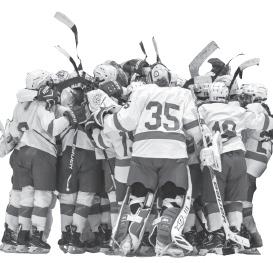
After spending a long month on the road, the Red returned to a lively Lynah for a critical matchup against St. Lawrence. But undaunted by No.9/9 St.Lawrence’s (9-8-1, 4-2-0 ECAC) unblemished ECAC record, No.7/7 Cornell (8-1-4, 6-1-1 ECAC) had little trouble handing the Saints its first conference loss.
The Red — which has not lost a matchup in almost a month — got off to a fiery start, firing seven shots on goal within the game’s first five minutes, and finishing the first period with 11 shots on goal. While St. Lawrence goaltender Grace Harrison deftly answered each shot with a block, Cornell’s aggressive opening act marked a stark contrast from its last game — where the Red faced an early 2-0 deficit and was only able to battle back to a draw.
chemistry on the ice — a worry fueled by the fact the Red had previously lost three key players who were called up to play for Team Canada at the Four Nations Cup.
“It has been a challenging year so far,” Derraugh said. “We got off to a good start, then we lost three players to Team Canada for two weeks so that meant we had make a number of adjustments. Then they returned two weeks ago, and we have had to get back in sync again.”
“I thought we battled hard, but disciplined, and managed the game well.”
Head coach Doug Derraugh ’91
But such concerns failed to materialize as the Red outshot the Saints 35-18, one of the team’s strongest offensive showings of the season. And in a remarkable milestone, the win was also Derraugh’s 250th victory as head coach — marking a major landmark in a Cornell coaching career that began in 2005, has featured six NCAA tournament appearances and .618 winning percentage.
After spending much of the first period sparring with the Saints’ capable defense, senior forward Piper Gerace, assisted by a pass from senior forward Lenka Serdar, broke past Harrison’s wall to score the Red’s first goal.
This was Gerace’s fourth goal of her season — in the 100th game of her collegiate career.
With 10:22 left in the third, sophomore defenseman Willow Slobodzian smashed a one-timer towards the goal, where it was picked up by Serdar to notch Cornell’s second goal of the game, prompting St. Lawrence to remove Harrison from net.
Junior Paige Lewis and sophomore forward Maddie Mills each recorded an empty-netter goal, lifting Cornell to a 4-0 lead from which St. Lawrence was unable to recover. The victory was the Red’s third shutout win of the season and represented an important step forward in the ECAC conference race.
Heading into the weekend, head coach Doug Derraugh ’91 expressed concern about his team’s
The Red appeared to lose little momentum as it turned its focus to Clarkson, the league’s two-time defending champion, the following day. Powered by two goals from Mills and senior goaltender Marlène Boissonnault’s stunning 19 saves — good for her 43rd career win in net — Cornell landed a redeeming victory over the team that handed the Red a devastating 4-3 overtime defeat last year.
“This was a big win for us going into the break,” Derraugh said in an interview with Big Red Sports. “Clarkson is always a tough opponent. We have struggled to keep the lead at home against them in the past two games at Lynah, but tonight we played through until the end. I thought we battled hard, but disciplined, and managed the game well.”
After closing out the first half of the season with a strong 8-1-4 record, women’s hockey will now enjoy a much deserved, monthlong break from the rink. The team next plays Penn State on January 8.
Smita Nalluri can be reached at snalluri@cornellsun.com.
By DYLAN McDEVITT
Sports Editor
CAMBRIDGE, Mass. — Down four of its nightly skaters, its All-American goaltender and with a captain playing “on just one leg,” Cornell men’s hockey marched into Bright-Landry Hockey Center on Saturday and defeated its archrival Harvard, 2-1.
The win, which avenged a disappointing loss to the Crimson at Madison Square Garden just a week ago, sends Cornell into the mid-season break on a high note. Now owners of a 6-5 record (4-2 ECAC), the Red can allow its ailing bodies to heal up for the second half of the season.
“‘Heal up’ is the key word here,” said head coach Mike Schafer ’86. “To get those guys back, it’ll be huge for our hockey team.”
Despite ultimately emerging victorious, Cornell faced significant adversity throughout much of the contest.
Harvard jumped out to an early lead in the first courtesy of a power play goal from Jack Rathbone. But Cornell was able to exorcize its demons from a week ago behind 22 saves from Austin McGrath in the sophomore goalie’s first career win.
“One of the grittiest wins I’ve been a part of in my time as a head coach,” Schafer said.
The momentum shifted in the second period, when Cornell scored twice to enter the second intermission with the lead it would eventually finish with. First sophomore forward Cam Donaldson scooped up a loose puck in front of Harvard goaltender Michael Lackey and buried it to tie the game at one goal apiece.
“They never hung their head, they never got down,”


Schafer said. “They just kept competing.”
Later in the middle frame, it was Tristan Mullin’s turn to light the lamp. The sophomore forward’s tally gave Cornell its first lead and proved to be the game-winner.
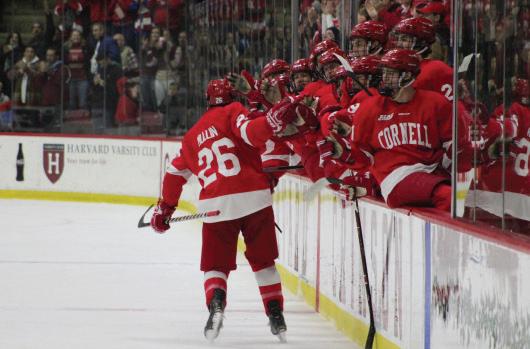
“I was sitting back door kind of, and I saw it pop up,” Mullin said. “Got a fortunate bounce. … Pretty happy with that.”
The vengeance-filled win allowed a sold-out Cornellbiased crowd to celebrate in an arena nicknamed “Lynah East” a week after disappointment in New York City.
McGrath, filling in the second night in a row for injured classmate Matt Galajda in net, backstopped his team to a victory, especially in the third, when Cornell was outshot, 10-1.
“Walking in … and playing cool, calm, wasn’t out of control in the net,” Schafer said. “[McGrath’s] got great character.”
McGrath’s performance earned him his first collegiate win in his second career start.
“Feels really good [to get win No. 1],” McGrath said. “It makes it feel really worth it, you put in a lot of work to play and you got the job done.”
Cornell’s victory is a crucial one, as the hobbled team enters the mid-season holiday break over .500 and 4-2 in
the ECAC. Playing through a stretch in which injuries have completely decimated its roster, Cornell has struggled to find its way in the early going of the 2018-19 season.
Now, the Red owns a key win ahead of the break in which it hopes to mend its wounds and return at full strength when the schedule resumes in January. Two conference points on the road will likely prove valuable at the season’s end.
“It’s really huge to get a little confidence going into the break with a big win, and getting back to the way we like to play,” McGrath said. “It was big to get a game like that in before we go off for a month.”
Cornell will next play Jan. 4 and 5 at Princeton and Quinnipiac, respectively.
Dylan McDevitt can be reached at dmcdevitt@cornellsun.com.
By JONATHAN HARRIS Sun Assistant Sports Editor
The battle of the Boeheims featured one more member this year as freshman guard Buddy Boeheim and head coach Jim Boeheim’s Syracuse Orange faced off against sophomore forward Jimmy Boeheim and Cornell men’s basketball.
Despite mounting a furious second-half comeback to erase a 15-point deficit and hang with the Orange until late on the road, the Red eventually fell, 65-53.
The loss brings the Red’s record to an even 4-4. The teams played a tightly contested first 20 minutes with the Red, even taking a 19-14 lead with seven minutes left in the first half. This was the Red’s largest lead of the game — the Orange responded with a 25-5 run of their own, stretching into early on in the second half.
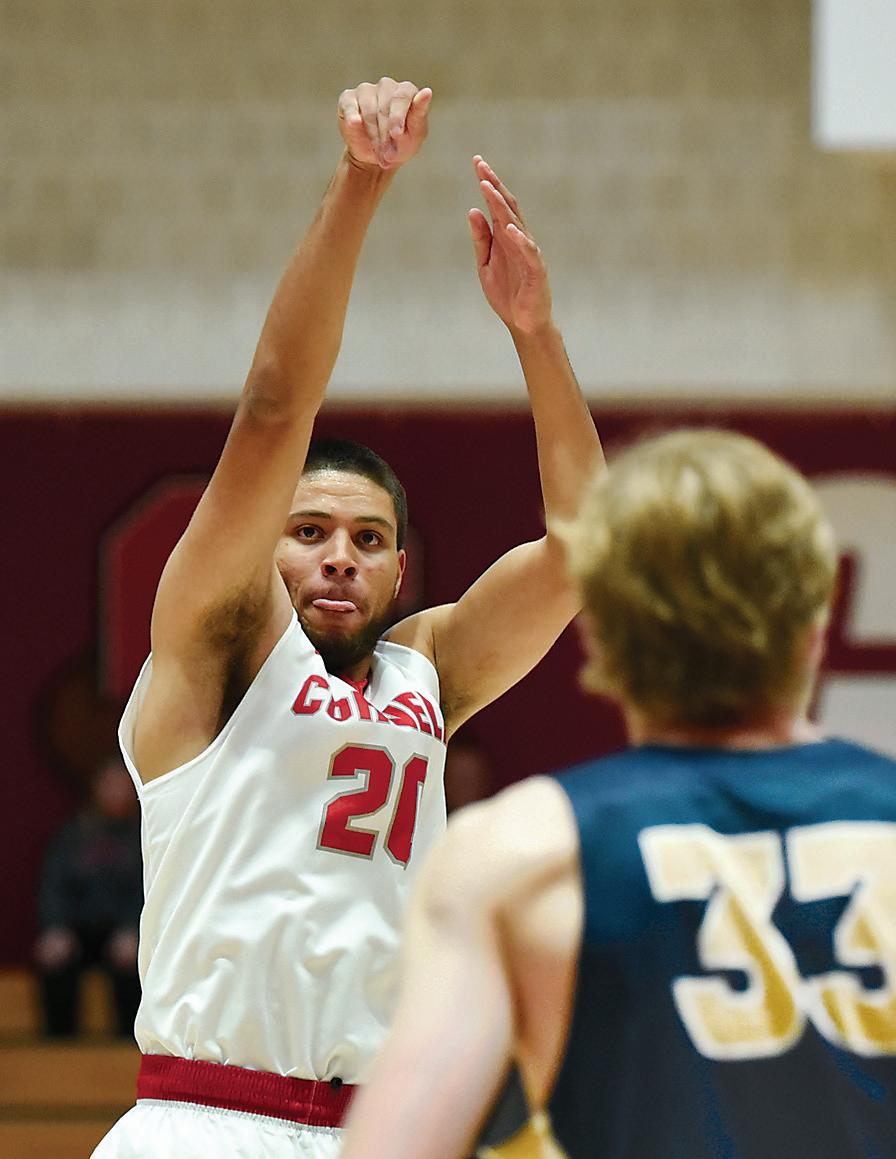
The Red was led offensively yet again by senior guard Matt Morgan, who scored 26 points, bringing his career scoring total to 1,837 — 8th place all-time in Ivy League history. Morgan
shot an efficient 9-14 from the field and 6-10 from the three point line while playing nearly every minute of Saturday’s game.
The 26-point outing was also Morgan’s 59th consecutive game consecutively scoring in double figures, the third-longest active streak in Division I.
Syracuse’s length and athleticism affected the supporting cast for the Red as they struggled at points against the Orange’s signature 2-3 zone defense. Jimmy Boeheim scored nine points and notched six rebounds and four assists.
Reminiscent of last year’s father-son matchup, the Carrier Dome was buzzing with anticipation as Syracuse’s Buddy Boeheim joined the familial rivalry to face off against brother Jimmy on the court. The two siblings lined up next to each other during free throws and guarded each other on a few possessions.
“He came down and stood next to me,” Jimmy told the Daily Orange. “And I was like wow, that’s pretty crazy. In that moment, it clicked. It’s tough because we really were right there,
we had a really good chance to win. It’s definitely in my mind. It might be there for a while.”
As head coach Brian Earl has been quick to acknowledge, the Red needs to maintain its defensive intensity and focus, and improve its offensive balance in order to stay competitive through a grueling non-conference schedule and consistently challenging Ivy League slate.
The road to a successful season and a potential second consecutive berth in the Ivy League tournament doesn’t get any easier for the Red after the break for final exams. The Red still has upcoming matchups at SMU, Navy, Wake Forest and Towson to look forward to before kicking off the Ivy League schedule.
The Red will finish a gritty early-season road stretch marked by games at UConn, Lafayette and Syracuse with a game at Niagara on December 16.
Jonathan Harris can be reached at jharris@cornellsun.com.