The Corne¬ Daily Sun

By KATHERINE HEANEY
Sun Staff Writer
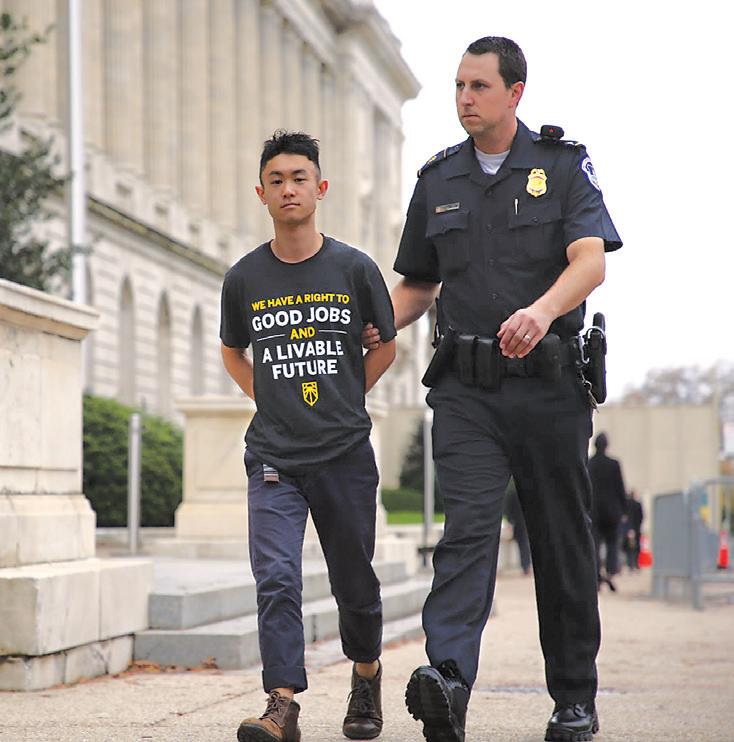
Two hundred climate activists assembled in the Capitol Building in Washington D.C. on Nov. 13 and entered the offices of House Minority Leader Nancy Pelosi (D-Calif.). Among the 50 arrested was Cornell student Benjamin Finegan ’19, who a year ago sat in an oceanography course and wondered where his professor’s call for political change could lead him.
The occupation in the office of Pelosi — who will re-assume the position of Speaker of the House in January 2019 — was an effort to put ambitious climate change policy at the top of the Democratic political agenda.
Finegan, who was a Sun staff writer for the news department, is a Government major in the College of Arts and Sciences. This year, he is taking time off from Cornell to work as a climate activist.
Finegan and the other activists who participated in the protest are members of “The Sunrise Movement.”
“The Sunrise Movement is a national youth-led movement fighting to stop the Climate Crisis and achieve economic justice in the process,” Finegan said.
Finegan said that the group occupied Pelosi’s office to demand that, “Democrats reject money from the fossil fuel industry and take real action to address the Climate Crisis at the scale and scope we need.”
“To prevent ecological disaster and human suffering on a massive, sickening scale, we need to transition our economy to 100 percent renewable energy by 2030,” Finegan said.
According to Finegan, the activists trickled through the building’s security as “youth lobbyists.” They regrouped and crowded into Pelosi’s office, spilling into

By HUNTER SEITZ Sun Staff Writer
New research suggests that too much water could eradicate life on Mars before we even know it exists.
Alberto Fairén, a visiting scientist in Cornell’s Center for Astrophysics and Planetary Science, co-authored a paper recently published in Nature which found that microbial species that are adapted to arid or “extreme desiccating” conditions can go through “osmotic shock” if exposed to large, unexpected quantities of water. According to The New York Times, the microbes drown due to being unable to handle the influx of water into their external membrane.
This could pose a unique threat to potential life on Mars and future human exploration on the red planet.
Fairén and colleagues discovered the phenomenon of osmotic shock while studying the effect of rainfall on desert ecosystems in the Atacama Desert in Chile.
The Atacama Desert is considered one of the driest places in the world, receiving just 0.04 inches of rainfall annually and no significant rainfall has fallen in the past 500 years.


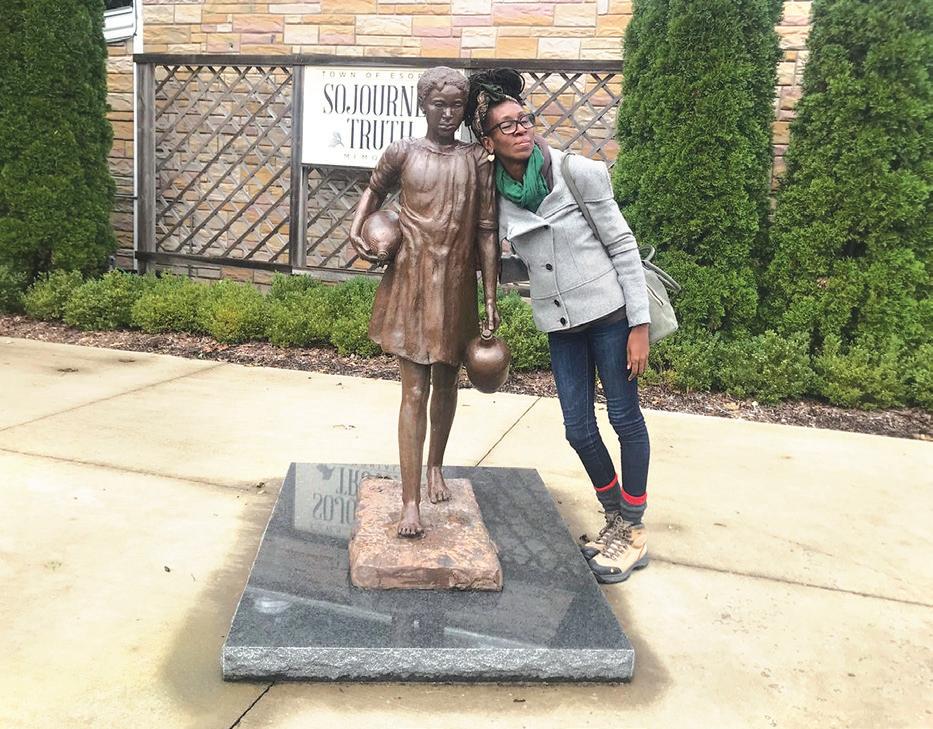
Truth told | Prof. Lyrae Van Clief-Stefanon’s play was performed on Nov. 16 and was inspired by African-American history and the efforts of Sojourner Truth.
According to Fairen, past human attempts at looking for life on Mars could have already damaged local ecosystems. The 1976 Viking landers used “aqueous solutions” to test for life on the surface of Mars. Fairén noted that “[it] would have caused first their osmotic burst, and then the subsequent destruction of the organic molecules.”
Fairen said that Cornell has been integral in allowing
“[The Atacama desert] is the driest desert on Earth, with a hyperarid core where no rains have been recorded in centuries. As a consequence of the extreme dryness … sporadic rains concentrated [large deposits of] nitrates at valley bottoms and former lakes,” Fairén told The Sun in an email. “This unique distribution of the Atacama nitrates is identical to the nitrate deposits recently discovered on Mars by the rover Curiosity.”
Drawing inspiration from her pentecostal upbringing, Sojourner Truth and a 1998 workshop retreat for African Americans, Prof. Lyrae Van CliefStefanon, English, wrote one of the three monologues in a play that was performed at the National Theatre London. The play was performed on Nov. 16 to mark the 100th anniversary in the United Kingdom of some women gaining the right to vote.
The other two monologues in the play Magda, Jo, Isabella are written by Prof. Saviana Stanescu, performing and media arts and Prof. Aoise Stratford, theatre arts, Ithaca College. The play premiered in Ithaca in May 2017. Samuel Buggeln of The Cherry, an Ithaca artists’ collective, told The Sun in an email that she reached out to Van CliefStefanon to write the monologue. For the professor, the play presented the opportunity to high-
By AMANDA CRONIN Sun Staff Writer
Jaslyn Dominique ’20 spent days perfecting her responses to the interview questions, had practiced her greeting and handshake and had even gone through the trouble of printing her resume on the thick paper in Olin. However, the day before the career fair Dominique had a sinking realization — she did not have anything to wear.
Specifically, Dominique
lacked business professional clothing. As a result, she decided to miss out on the career fair altogether because, “I don’t want to be remembered as the black girl who wore business casual to a business professional event.”
Dominique’s problem is not unique. Through dialogue with lower income vstudents, the Dyson Students of Color Coalition recognized that there was a


Thursday, November 29, 2018
Analyzing Intergenerational Mobility with Oriented Measures and Mobility Curves 11:40 a.m. - 1:10 p.m., 494 Uris Hall
Environmental Modeling in Architecture 12:20 - 1:10 p.m., 203 Phillips Hall
Finding Resilience in Cropping Systems 12:20 - 1:10 p.m., 135 Emerson Hall
Thomas Marzetta: Propagating Random Field Models for Small Scale Fading 4:15 p.m., 233 Phillips Hall
Brigid Cohen: “Maciunas, Fluxus, and the Haunting of Empires” 4:30 p.m., 124 Lincoln Hall
Bridging Policy Adoption Implementation: An Exploration of Local Governments’ Sustainability Actions 4:30 p.m., 101 W. Sibley Hall
High Pressure: A New Dimension in Physics, Chemistry, Materials and Earth Science 10 a.m., 401 Physical Sciences Building
The Consequence of Federal Mandates for Local Governments: Evidence from the 1972 Clean Water Act 10:30 a.m. - Noon, 151 Warren Hall
Smart Cities: Data and Decision Science for Parking Management 12:15 p.m., 253 Frank H. T. Rhodes Hall
Parasites from Parasites: Defective Viruses in Flu Infections 12:15 - 1:15 p.m., Lecture Hall 3 College of Veterinary Medicine
Dissecting Molecular Mechanisms of Eukaryotic Transcription Regulation Using the Power of Genome-Wide Assays 12:20 p.m., 404 Plant Science Building
By ROCHELLE LI Sun Staff Writer
What does the Greek hero Achilles have to do with Donald Trump? In a new podcast called Antiquitas, Prof. Barry Strauss ’74, history and classics, tells the tales of ancient historical leaders and connects them with modern themes.
Each Antiquitas episode focuses on a single figure in ancient history. In 30-to-45-minute episodes, Strauss leads the listener through the stories of legends in ancient Greece and Rome, such as Helen of Troy and Pericles.
After learning about podcasts from his children and other friends, Strauss decided that he wanted to create a podcast about the topic he’s most familiar with — ancient history. Strauss enjoyed lecturing and wanted to be able to connect with a wider audience. A podcast, he thought, would offer the reach and form he desired. Over the summer, Strauss recorded the first season, consisting of eight episodes.
“I really think there’s an audience for it. I think people really like good storytelling and the fact that I’m a scholar and that I know this stuff really deeply really helps,” Strauss told The Sun.
Antiquitas might be created by a first-time podcaster, but Strauss has incorporated all the aspects of a traditional podcast. A professional musician wrote an opening theme song and Strauss hired a professional to make the podcast available on a wide network of servers, including Spotify and Overcast. The podcast has received over 1,600 listens since the first episode was released Nov. 10.
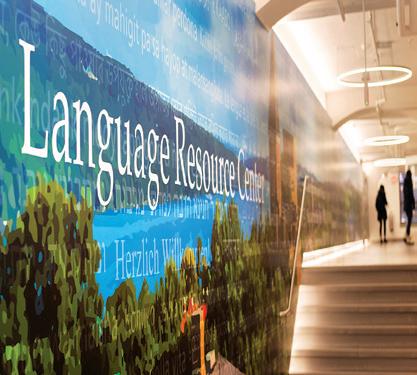
The podcast is produced in the Language Resource Center, which Strauss discovered through Michael Fontaine, the associate vice provost for undergraduate

education. Fontaine visited the center and thought the new facilities were “out of this world,” and recommended that Strauss record his podcast there.
“I made an email introduction. The next thing you know he emailed me the other day and he said he
By SHAWN HIKOSAKA Sun Staff Writer
Greek life was one of the central topics for Wednesday’s Employee Assembly meeting. Mary Beth Grant ’88, senior associate dean of students, reported that the existing Chapter Review Board process “falls short in a couple of significant ways.”
Grant is the committee chair of a group consisting of staff, faculty, students and alumni that are tasked with conducting a “comprehensive review of the Chapter Review Board process,” according to Cornell Campus and Community Engagement website. This is Phase III of the presidential initiative meant to implement greater oversight on Greek life on campus.
Grant and her colleagues were present as guest speakers to update the assembly on the committee’s progress.
The group’s core values are the safety of community members, fundamental fairness (due process), transparency and the necessity to view everything under the context of higher education.
On this last point, Grant said that “we shouldn’t be comparing ourselves to a criminal justice system. We should really be thinking about what a system of accountability looks like in higher ed.”
ed fundamental fairness. It has been described to the board that there have been some inequities about who has information during a hearing process … everybody should know the same information,” she said.
She also reported on the problem of prevalent ad hoc practices in the review board. “We really want to make sure that there’s a standard practice and that we always have trained people,” Grant said.
Grant’s group has found triaging to be imperfect. In the past, some cases were referred to the Greek Judicial Board, a student-run group typically tasked with event management. “Cases that were more serious were referred there in error,” she said.
According to Grant, however, “the biggest thing is that there is just a lack of confidence right now”. She described this as being a community-wide phenomenon.
“We should be thinking about what a system of accountability looks like in higher
ed.”
Mary Beth Grant ’88
The four main shortcomings the group discovered were the complexity of the process, lack of fundamental fairness, imperfection of triaging and the lack of confidence from both Greek life members and the greater Cornell community.
“The system is complex … [it] can be a challenge for people to understand,” Grant said.
“There are some ways that, unfortunately, the system has not demonstrat-
“People who were within the Greek system didn’t trust the system because they think that non-Greeks are out to get them … and people outside of the Greek system think that the processes are set up as a way to protect themselves and be very insular,” she said.
Her committee will be submitting a list of short-term solutions to combat these issues. This includes the implementation of “Plain English procedures”, the recruitment and training of review board panel members (instead of relying on ad hoc practices), and a greater transparency overall. Long-term solutions are still being discussed.
Shawn Hikosaka can be reached at shikosaka@cornellsun.com.
already made the first four episodes,” Fontaine told The Sun.
The Language Resource Center aims to support
New research fnds dopamine related to detecting mistakes
By GAYATRI SOMAIYA Sun Staff Writer
After attending a lecture by famous neuroscientist V.S. Ramachandran in middle school, research associate Vikram Gadagkar Ph.D. ’13 found he had an interest in neuroscience. His curiosity led him to songbird research, for which he was awarded the Peter and Patricia Gruber International Research Award in Neuroscience. His research found that dopamine neurons encode performance error in songbirds.
played it over syllable B, a method called ‘distorted auditory feedback.’ This method tricked the birds into thinking they heard the wrong note.
“It is very difficult. We would come to lab every day and hunt for these neurons.”
Vikram Gadagkar Ph.D. ’13
Gadagkar, who currently works in the department of neurobiology and behavior, first decided to study quantitative sciences, before moving to neuroscience.
During his Ph.D., he spent a lot of time with the neuroscience department. Gadagkar went to all the talks the department had while interviewing candidates, and after seeing the talk by Prof. Jesse Goldberg, neurobiology and behavior, he knew it was something he wanted to pursue.
Gadagkar’s research tested the hypothesis that dopamine neurons in birds might convey an error signal for song learning, which would allow birds to know when they are singing the wrong note.
To explain this hypothesis more broadly, Gadagkar said to imagine learning to play a piece on the piano.
“How does the brain know when you are making a mistake?” he asked. “That is kind of the question we are asking.”
To explore this question, Gadagkar and his colleagues used male zebra finches. While the birds were singing, the researchers recorded the song and took the first part of syllable A and
Gadagkar and his colleagues discovered that the dopamine neurons were suppressed immediately after distortions which suggested that the dopamine neurons were involved with error signals. One of the biggest challenges that Gadagkar faced during the research was locating the dopamine neurons.
“It is very difficult,” Gadagkar told The Sun. “We would come to lab everyday and hunt for these neurons.” His time and effort in the lab, however, earned him the Peter and Patricia Gruber International Research Award, supported by the Gruber foundation, which honors scientists “for major discoveries that have advanced understanding of the nervous system,” according to their website. Recipients of the award receive a cash prize of $25,000 and a gold laureate pin.
Other than the cash prize, the biggest reward Gadagkar said he received was the exposure.
“There is a community of scientists that I can now talk to,” Gadagkar said. In the future, Gadagkar is looking to take this research further in three different ways. Firstly, he wants to observe the difference in dopamine activity in the songbirds during practice and performance. He also wants to observe how the female songbird decodes the song and relates it to mating. Finally, the Gadagkar wants to explore whether birds use this trial and error learning when they are very young.
Gayatri Somaiya can be reached at gsomaiya@cornellsun.com.
ACTIVIST
Continued from page 1
into Pelosi’s office, spilling into the lobby hallways.
“We delivered letters filled with the people and places we are fighting to protect,” Finegan said.
The protesters were advocating for the “Green New Deal”, a plan which addresses climate change. Representative-elect Alexandria Ocasio-Cortez (D-N.Y) who has been vocal regarding her support for the plan, visited the protestors and shared her support.
When Ocasio-Cortez joined the protesters, the event immediately drew significant media attention and was featured in national news sources.
“We already sent waves through Washington,” Finegan said. “In one morning we put the Green New Deal on the map, and gave Democrats a stark moral choice. Will you choose the side of the people and future generations? Or will you choose the side of fossil fuel corporations?”
Finegan said that within a day of the protest, five members of Congress signed on to Ocasio-Cortez’s Resolution for a Select Committee on the Green New Deal. Since then, a total of 14 have “shown moral clarity and political courage and backed the Green New Deal.”
Finegan said that the group “will not stop until we have a critical mass of support for the GND, or until those who lack moral
POP-UP
Continued from page 1
clarity and political courage are removed from power.”
According to Ocasio-Cortez’s website, the Green New Deal makes environmental policy demands including using 100 percent renewable resources, upgrading to energy-efficient buildings, decarbonizing industries, funding the drawdown of greenhouse gases, and making the U.S. a leader in “green” technology.
Following the protest, Pelosi tweeted that she was, “deeply inspired by the young activists and advocates leading the way on confronting climate change.
in Philadelphia.
“Learning the science of climate change and its ecological effects made it clear how urgent this problem is.”
The climate crisis threatens the futures of communities nationwide, and I strongly support reinstating the select committee to address the crisis.”
“Professor Monger’s Oceanography class helped me to see that the Climate Crisis is one of the defining human rights issues of our time,” Finegan said. “Learning the science of climate change and its ecological effects made it clear how urgent this problem is, and that the answer is not lifestyle changes or new technology. We have the necessary technology, resources and even popular support for bold action to address the Climate Crisis. Now we need the political will to see this action through, and pass a Green New Deal.”
Benjamin Finegan ’19
Last year, Finegan took BIOEE 1540: Introduction to Oceanography. The course is taught every fall in Bailey Hall by Prof. Bruce Monger to over 1,000 students across class years and colleges. h
Finegan said that taking Monger’s course was “instrumental in changing [his] sense of agency and responsibility for this crisis.”
The course was part of the reason Finegan became vegan and took the year off from Cornell to work full-time as an environmental activist with the Sunrise Movement
When Monger received the email that his former student had been arrested in his efforts to combat the climate crisis, Monger said that his “reaction was one of great admiration for the former student and a deep sense of satisfaction for [himself] and the work [he does] in the oceanography class.”
“A central theme of the oceanography class asks that students not be passive with regard to environmental issues and to raise their voices, especially with regard to climate change,” Monger said. “This former student clearly heard that important message.”
The final assignment for students in Introduction to Oceanography is to write a
to affordable professional clothing, “many students have come to us asking for assistance with business clothes.” said Michelle Reiss ’20, one of the founding members of the Coalition.
Even after the DSCC directed students to different campus resources such as the Office of Academic Diversity Initiatives, Financial Aid and the Dyson school administration, Reiss said “they would come back letting us know that no one was able to support them.” Dominique herself spent “three weeks trying to secure money to get business clothes.”
But in the end, “none of them helped me.”
creates a sense of confidence in your ability to perform while showing the utmost respect for the interviewer, speaker, or guest,” Creaser said. “When you dress for success, people focus on your message, not your wardrobe.”
“I don’t want to be remembered as the black girl who wore business casual to a business professional event.”
Jaslyn Dominique ’20
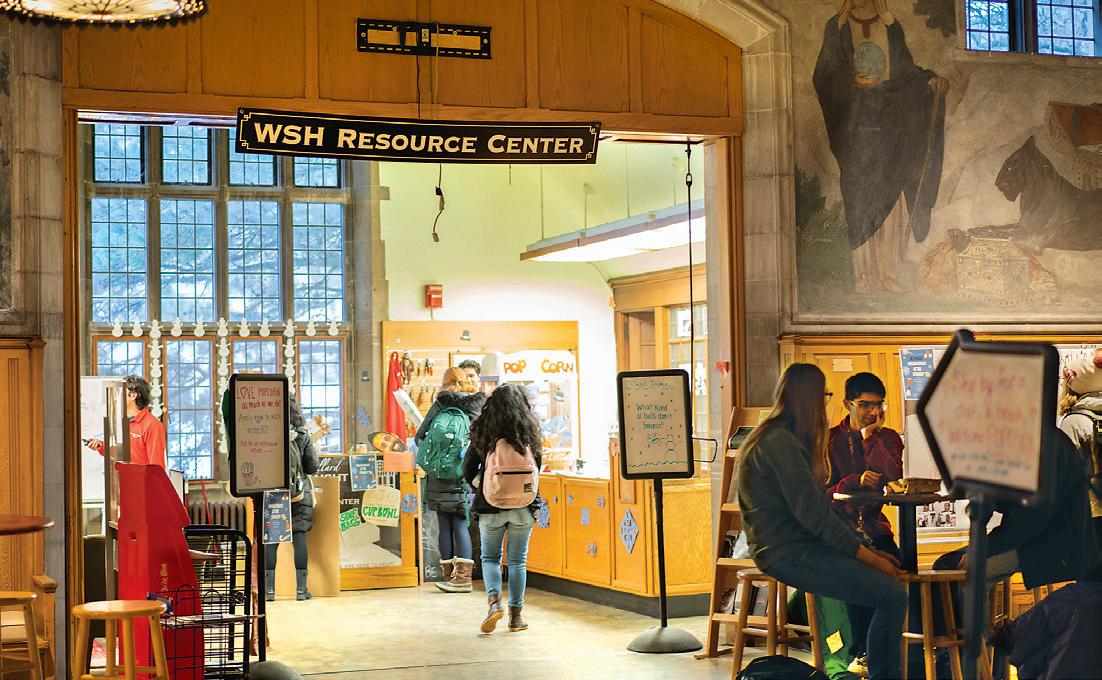
Thus, with the help of Cornell Thrift and funding from the Willard Straight Student Union Board, the idea of a pop-up shop was born. The pop-up shop will be held from 5-7 p.m. on Thursday, Nov. 29 in Willard Straight Hall.
Cornell Thrift members spent several hours scouring the racks of the local Ithaca Salvation Army store and a Goodwill location in NYC and compiled a “moderate amount” of blazers, shirts, pants, ties, skirts, dresses and some suits in a variety of sizes.
“Especially in Dyson, business clothes might as well be a textbook because it is necessary to pass certain classes,” Reiss noted. “Yes, it is expensive and not accessible to everyone, yet professors and clubs perpetuate a culture where it is assumed that all students can afford these items.”
Another student option is The Wardrobe, founded last year. It is a student-run organization that “provides free professional business clothing to students on campus so that any student can pursue any opportunity,” according to the organization’s marketing director Julia Gleason ’20.
“We found that
two-thirds of undergraduate students had felt underdressed in a professional setting. Onethird of students didn’t attend an interview or information session because of lack of professional clothing,” Gleason said. “The problem is the same across gender and graduation year. Of those without proper attire, 50 percent can’t afford it and 50 percent can’t fit it in luggage brought to campus.”
The Wardrobe follows two models in providing dress garments to the student body: the pop up shop and an online interface that allows students to rent clothing items for up to five days at a time.
“Business clothes might as well be a textbook because it is necessary to pass certain classes.”
Michelle Reiss ’20
However, the Dyson school isn’t the only program on campus with dress code requirements.
Caroline Creaser, a sophomore in the school of Hotel Administration, added that her school enforces a dress code for the Dean’s Distinguished Lecture Series, and students who do not meet the code criteria are penalized in their final grades. She emphasized that this is a beneficial requirement that is about making a good first impression. “Dressing appropriately
The difference between the Wardrobe’s approach and that of Cornell Thrift is that for the event on Thursday, all the clothing is previously owned, whereas the Wardrobe has a mix of donated and newly purchased attire.
Depending on the success of the event, Reiss said that she hopes to continue hosting events like these in the future.
“We are hoping that this event is helpful to students and hopefully we receive more funding, more clothes, and eventually open up pop up shops for [other] things that might not be accessible to students, such as winter clothes,” she said. “To continue events like this would only help the Cornell community as a whole.”
Amanda Cronin can be reached at acronin@cornellsun.com.
letter to their government leaders, requesting that the government address issues of climate change and other environmental impacts. Students are required to write the letter, but actually sending out the letter is optional. According to Monger, the point of the assignment is to show students how “they can raise their voice for climate action using the scientific concepts presented in the class.”
Monger said that he became an oceanographer because he liked science, liked the ocean and wanted to travel the world, but that his current interested in teaching oceanography at Cornell is “driven by [his] evangelical fervor to inform and inspire all Cornell Students to act on climate change.”
He said that to reduce the effects of climate change, students should vote, be vocal and advocate for change to help spark a social movement, and take individual actions such as eating less meat, flying less, and taking less public transportation.
Finegan said that he left the oceonography class “feeling angry, but galvanized and hopeful.” He hopes others are also motivated to join the fight for an equitable future.
“If you care about human beings, if you care about racial justice or economic justice, if you believe that your dignity and future is tied to everyone’s dignity and future, than we need you in this fight,” he said.
Katherine Heaney can be reached at kheaney@cornellsun.com.
PLAY
Continued from page 1
light the life of African-American abolitionist and women’s rights activist Sojourner Truth.
“It felt like a perfect opportunity to write about Sojourner Truth which I’d wanted to do since having been asked previously in Ithaca to perform the ‘Ain’t I a Woman’ speech, having resisted doing that,” Van CliefStefanon said. “I did not want to perform that popular whitewashed version of this complex radical black woman who travelled and lectured on Civil Rights and women’s suffrage.”
Van Clief-Stefanon’s monologue follows “Isabella’s” retreat to a monastery in Esopus, New York, to “clear her mind” before the 2016 presidential election. While at the monastery, Isabella encounters the voice of Sojourner Truth (born Isabella Baumfree).
“I began by thinking about voice: wondering what Sojourner might have sounded like, what her accent, for example, would have been like given that she spoke only Dutch until she was around 8 years old,” Van CliefStefanon said.
Sojourner Truth served as inspiration to her monologue because she was a, “radical Pentecostal Christian women” that broke away from suffragists Susan B. Anthony and Elizabeth Cady Stanton, Van CliefStefanon said.
According to PBS, in addition to breaking away from the white suffragists, Sojourner Truth sued the Ulster County grand jury because her child was sold illegally. She become the first woman to win a lawsuit in the United States and later sued a newspaper
for slander, the newspaper having called her a “witch.”
“The contemporary Isabella in my piece obsesses on the idea of a palinode: a retraction or recanting (of what she has said previously with regards to the election) that will allow her a new vision,” Van Clief-Stefanon said. Van Clief-Stefanon attended the Caven Canem retreat in Esopus in 1998, where she got inspiration for her monologue from the place’s historical ties to Sojourner Truth and her study of poems by Sonia Sanchez and Lucille Clifton.
The community that develops from working on a project such as producing Magda, Jo, Isabella for the National Theatre London was Van Clief-Stefanon’s favorite part in collaborating with Saviana Stanescu and Aoise Stratford.
“There are writers and directors and actors and stage managers and lighting and set designers. It’s the thing that attracts me most to theatre. It’s a conversation, a mix of voices,” Van Clief Stefanon said, adding, “It was a pleasure to meet with the people who brought the piece to life.”
Van Clief-Stefanon wants to expand Isabella into a full play and is working on a piece about the defacement of public art near her home. Through a Cornell Engaged Opportunity grant, Van-Clief-Stefanon is working with local filmmaker Sue Perlgut to document, “... student and community participation in a recent workshop for women on moving from trauma to joy.”
Miguel Soto can be reached at msoto@cornellsun.com. Emma Rosenbaum can be reachd at err73@cornell.edu.
MARS
Continued from page 1
him to bring attention to his work and spread the word about the potential hazards of Mars exploration.
“Cornell has always supported my research and, most importantly, contributed to the dissemination of my results. It is tempting to wonder whether my research on human exploration of Mars, which has been always challenging NASA and other agencies’ status quo in the subject, would have reached large audiences without the Cornell logo behind me.”
With recent steps forward in the possibility of a manned mission to Mars, Fairen expressed that now more than ever that we
need to consider the ecological effect we could have on potential microbial life on Mars.
“This problem has evolved rapidly during the last decade, and it seems that national agencies are a bit slow to keep abreast of the ambition and intentions of private companies, which hope to send human missions to Mars in the 2030’s or even earlier,” he said. “We urgently need to know if there are extant microbial ecosystems at or near the surface of Mars. This is a one-time only chance for humanity, and thus of paramount importance.”
Hunter Setiz can be reached at hseitz@cornellsun.com. Jinwook Lee can be reached at jl2658@cornell.edu.

The Sun.
PODCAST Continued from page 3
The Language Resource Center aims to support language learning and teaching. Use of the recording studio is often centered around language faculty and students. Language teachers often create their own course audio files through the LRC, according to Director Angelika Kraemer. When Strauss reached out, the LRC agreed to help produce the podcast.
Over the past few years, the LRC has received multiple requests from Cornell organizations who wanted to make podcasts, which the LRC has not had the resources and infrastructure to grant. Sam Lupowitz, LRC’s media development manager, who edited Antiquitas, hopes that other organizations on campus will realize this desire and begin to provide recording spaces beyond the LRC.
“I think it’s a really cool future that we live in right now where if you have an idea or something you want to talk about or a conversation you want to share with people, it’s really easy to make it available to anyone, anytime,” Lupowitz told The Sun. “I think it’s natural that, especially at an institution of higher learning, that
more and more people are looking for ways to take advantage of that.”
For academics, podcasts offer a way to connect with the general public. Fontaine thinks podcasts can bring information out of the “ivory tower” of academic institutions, and make history more accessible. This year, the Society for Classical Studies’ Forum Prize, which “recognizes outstanding contributions to public engagement made by non-academic works” was awarded to the creator of a podcast, rather than a book or a movie. Fontaine thinks this reflects the podcasts’ potential in communicating with non-academics.
“I think [podcasts] are going to become huge. We’re trying to think right now about how we can leverage the format for teaching the old drudge stuff, like Latin grammar,” Fontaine said.
Strauss plans to continue Antiquitas after the initial eight episodes are released. Season two will start with Strauss’s book, The Death of Caesar Strauss hopes to also include interviews with other classicists and talk about popular music related to the content.


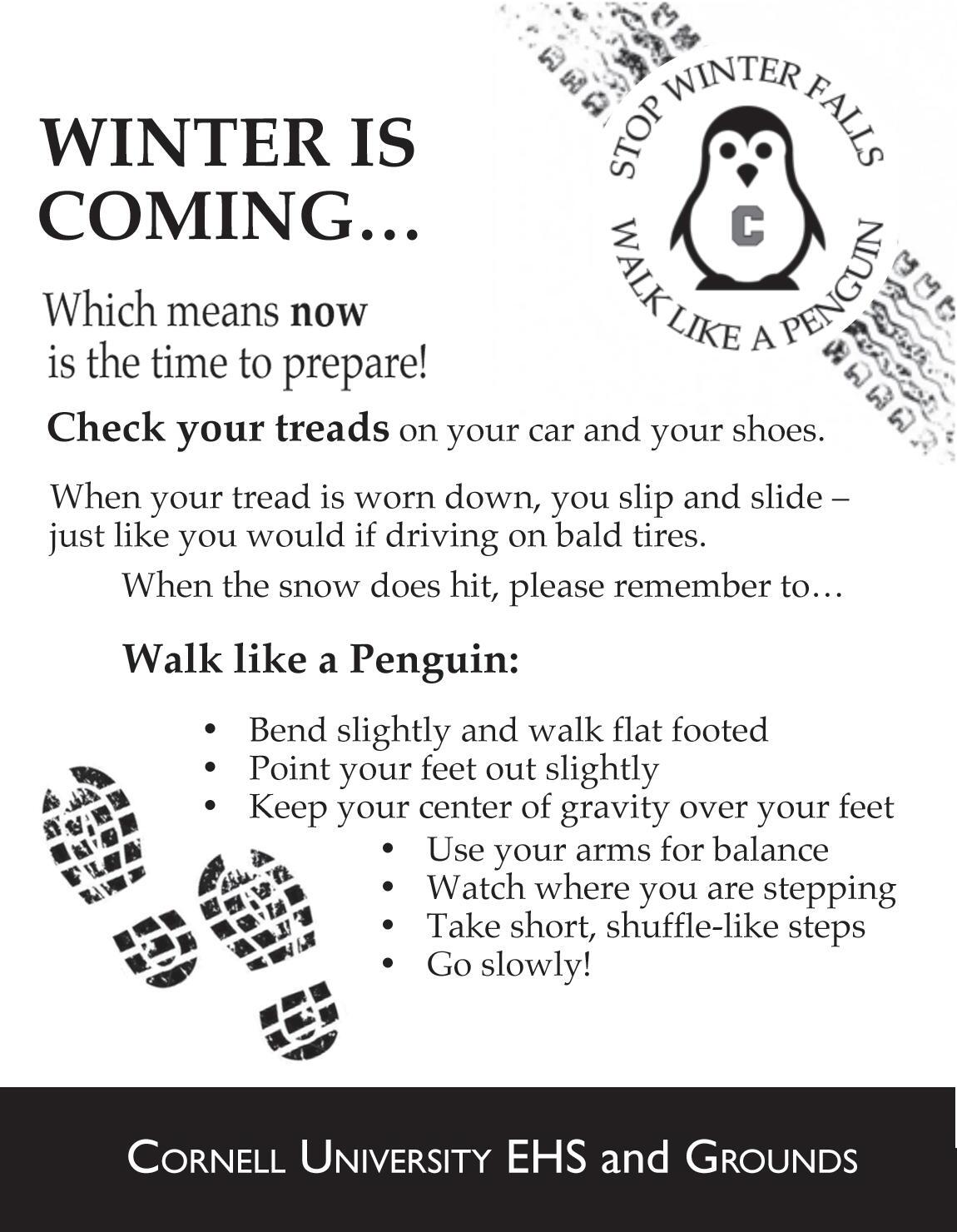
slip and slide—
• Keep your hands/arms free (use a backpack!)
• Bend slightly and walk flat-footed
• Point your feet out slightly
• Keep your center of gravity over your feet
• Use your arms for balance
• Watch each step
• Take short, shuffle-like steps
• Go slowly!
• Report hazardous conditions to 254-COLD (2653)
136th Editorial Board
JACOB S. KARASIK RUBASHKIN ’19
Editor in Chief
JOHN McKIM MILLER ’20
Business Manager
KATIE SIMS ’20
Associate Editor
GIRISHA ARORA ’20
Managing Editor
HEIDI MYUNG ’19
Advertising Manager
VARUN IYENGAR ’21
Web Editor
Working on Today’s Sun
Ad Layout Dana Chan ’21
Design Deskers Emma Williams ’19
Krystal Yang ’21
Simon Chen ’21
News Deskers Anu Subranamiam ’20
Paris Ghazi ’21
Night Desker Maryam Zafar ’21
Arts Desker Peter Buonanno ’21
Dining Desker Jacqueline Quach ’19
Photography Desker Michael Li ’20
Production Deskers
Krystal Yang ’21
Emma Williams ’19
Letter to the Editor
To the Editor:
The following letter was sent to Cornell President Martha Pollack on November 27, 2018:
Dear President Pollack:
We, the undersigned members of the Cornell community, urge you to examine Cornell’s ties with the Kingdom of Saudi Arabia. As the KSA’s human rights violations escalate, we cannot endorse any form of academic support and/or collaboration with the current regime. To do so is to support injustice and undermine the purpose and integrity of Cornell’s mission. We therefore urge you to discontinue Cornell’s institutional and financial collaboration with the KSA. We further ask that you disclose to the Cornell community all grants and gifts received from the KSA, in addition to programmatic collaboration such as academic exchanges.
The Kingdom of Saudi Arabia is responsible for egregious human rights violations both within and outside the country. At present, the Kingdom’s armed intervention in Yemen is causing massive civilian casualties and a humanitarian crisis of untold proportions. Saudi actions have caused widespread suffering. As just one illustration, the United Nations estimates that 1.8 million Yemeni children under the age of five are acutely malnourished. Of these, 400,000 suffer from a life-threatening form of severe acute malnutrition. Approximately 14 million Yemenis are on the verge of famine.
Saudi Arabia has also escalated its crackdown on internal dissent. Over the last few years, it has detained peaceful protesters, assassinated opposition leaders and targeted journalists. Recently, as you are no doubt aware, Jamal Khashoggi was murdered by Saudi agents inside the Kingdom’s consulate in Turkey. Women continue to suffer discriminatory treatment that impairs their fundamental rights to travel, work and study, and to create and maintain a family. It is no exaggeration to say that Saudi Arabia is among the very worst regimes in its disregard for fundamental human rights.
Cornell’s Johnson College of Business is a major supporter of the KSA Global Business School in Jeddah, which features Cornell as one of two university “collaboration partners.” Cornell’s engagement with the Global Business School allows the KSA to profit from the status of Cornell faculty and to boost its reputation in the international community. We have serious concerns that this relationship papers over the KSA’s ongoing human rights violations. We note with equal concern that the KSA Global Business School lists among its clients the Royal Court of Saudi Arabia and the Saudi Ministry of Defense.
We appreciate your attention to this matter, and thank you for your time.
Zohra Ahmed, clinical teaching fellow, law
Prof. Michael Ashkin, art
Prof. Sandra Babcock, law
Prof. Richard Bensel, the Gary S. Davis Professor, government
Prof. John Blume, the Samuel F. Leibowitz Professor of Trial Techniques, law
Prof. Eric T. Cheyfitz, the Ernest I. White Professor of American Studies and Humane Letters, American studies and English
Prof. Angela B. Cornell, law
Prof. Ella Maria Diaz, Latina/o studies and English Kaitlin Emmanuel, grad
Prof. Matthew Evangelista, the President White Professor of History and Political Science
Darlene Evans, director of writing outreach, Knight Institute August Faller, grad
Prof. Jill Frank, government
Prof. Eli Friedman, industrial and labor relations
Prof. María Cristina García, the Howard A. Newman Professor of American Studies
Prof. Durba Ghosh, history
Prof. Shannon Gleeson, industrial and labor relations
Prof. T.J. Hinrichs, history
Prof. Rayna Kalas, English
Prof. Jonathan Kirshner, government
Prof. Julilly Kohler-Hausmann, history
Prof. Neema Kudva, City and Regional Planning, AAP
Prof. Risa L. Lieberwitz, labor and employment law
Jonathan Lohnes grad
Delphine Lourtau, Executive Director, Cornell Center on the Death Penalty
Worldwide Prof. Beth Lyon, law
Prof. Jordan Calazan Manalastas, law
Prof. Joseph Margulies, law and government
Prof. Richard W. Miller, philosophy
Prof. Aziz Rana, law
Prof. Kenneth M. Roberts, the Richard J. Schwartz Professor of Government
Prof. Vilma Santiago-Irizarry, anthropology and Latina/o studies
Prof. Paul Lincoln Sawyer, English
Prof. Rebecca Slayton, science & technology studies
Prof. Chantal Thomas, law
Prof. Helena Maria Viramontes, the Goldwin Smith Professor of English
Prof. Rachel Weil, history
Michael Johns | Athwart History
In 1940, the American Association of University Professors released a declaration on higher education in the United States that has since served as the foundational definition and defense of academic freedom. The declaration, titled “Statement of Principles on Academic Freedom and Tenure,” correctly acknowledged the rights of faculty to pursue lines of intellectual inquiry without interference, groupthink or other pressures. Nearly eight decades later, universities in the U.S. and throughout the world must confront the unpleasant and yet undeniable fact that this vision is at risk, both on campuses and in foreign academic partnerships.
This semester, Cornell University had an unprecedented opportunity to face these risks, at least as they apply to its foreign engagements. The Cornell Political Union, a nonpartisan student-run debating society which I am a member of, hosted two speakers on the increasingly totalitarian pressures being asserted by the Chinese Communist Party at American universities. In October, Gordon Chang ’73 J.D. ’76, an esteemed author and Asia expert, warned about the mounting and threatening ramifications of Chinese state influence at Western academic institutions. Earlier this month, Wang Dan, a surviving student leader of the 1989 Tiananmen Square protests, echoed these burgeoning concerns, calling for an assertive Western response to the Chinese government’s increasingly repressive,
Students must join faculty in emphasizing academic freedom as a core part of their education.
sophisticated and self-serving tyranny over information.
At Cornell, to its credit, there now appears to be an awakening to what is transpiring, and other universities wrestling with how to respond to these threats to academic freedom should take note.
On October 20, the School of Industrial and Labor Relations properly ended its exchange program with China’s Renmin University after it became evident that the Chinese government was insisting on altering academic truths presented to the program’s students so that they more properly aligned with the Chinese government’s official positions on issues such as Taiwan’s independence, China’s mistreatment of its ethnic minorities and even indisputable historical facts such as the 1989 Tiananmen Square student protests. The program’s faculty was “explicitly being told ‘That is not a valid question. Here are the questions that are valid. Here are the types of conclusions that we determine to be valid.’ And they all have to sort of be in line with the politics that [Chinese President] Xi Jinping has been advocating,” ILR’s director of international programs Eli Friedman told The Sun.
Friedman deserves credit for standing up to China’s encroachment on academic freedom. There is no room for such dangerous manipulation in higher learning, as had been the case with Cornell’s Renmin University program. Ending this program was a courageous decision, and it was the right one. Unfortunately, too many comparable programs, particularly those funded by China, remain in place at universities across the nation, including here at Cornell. Whether these programs continue to operate because of vested financial interests, overwhelming political

fear or simple administrative apathy is almost beside the point. The threat they represent to academic freedom is only intensifying. The Chinese Communist Party, as this column noted in September, is investing hundreds of millions of dollars to ensure the Chinese government is presented more positively to students. China has emerged as a central threat to U.S. academic freedom, but it is not the only one. At universities throughout the world, students and even some faculty have abandoned the values of the crucially important AAUP Statement of Principles, and it is through these abandonments that foreign threats to U.S. academic freedom have advanced. At Cornell, in 2004, the Student Assembly Resolution on Academic Freedom failed narrowly and was apparently derided during consideration, even as the university faculty report that year cited the AAUP Statement of Principles and reemphasized its importance. A subsequent, narrower version of the Student Assembly resolution was reintroduced in 2016 but sadly failed on a similarly narrow margin.The subsequent 2017 Cornell Faculty Senate Statement on Academic Freedom, in contrast, upheld the importance of academic freedom: that while professors are entitled to speak and teach freely, they also have a “responsibility … to seek and respect the truth,” and “obligations to provide advising and balanced programs of instruction for students.” These sentiments are drawn almost verbatim from the AAUP Statement of Principles and prove their enduring importance as a centerpiece of a Cornell education. The campus can be relieved that, at least in principle, the faculty “reaffirm … the ability of faculty members to express unpopular or unorthodox views” and “reject pressures … to censure faculty for their speech,” even if this basic courtesy does not extend in actual practice to prominent guest speakers at the university, at least three of whom over the past two years have had their presentations disrupted without disciplinary consequence to the Cornell students responsible.
Why do Ivy League universities turn their backs on such outrageous behavior from their students, even when their own codes of conduct prohibit it?
Students must join faculty in emphasizing academic freedom as a core part of their education — not simply for the benefit of their own learning, but for the survival of their universities as well. Even great institutions can err: in 2017, Cambridge University Press agreed under Chinese pressure to censor hundreds of articles, caving in to their demands to alter indisputable academic facts at the expense of academic freedom. The international academic community, rightly outraged at this flagrant and unacceptable capitulation, demanded that the decision be reversed — and ultimately influenced Cambridge to restore the articles they previously suppressed. At Cambridge and now here at Cornell, universities that have compromised academic freedom ultimately changed course. They should both serve as examples of universities standing up to well-funded, ideologically-driven efforts to suppress academic truths. Other universities facing similar challenges can find in both motivation to do the right thing.
Michael Johns, Jr. is a junior in the College of Arts and Sciences. Athwart History runs every other Wednesday this semester. He can be reached at mjohns@cornellsun.com.
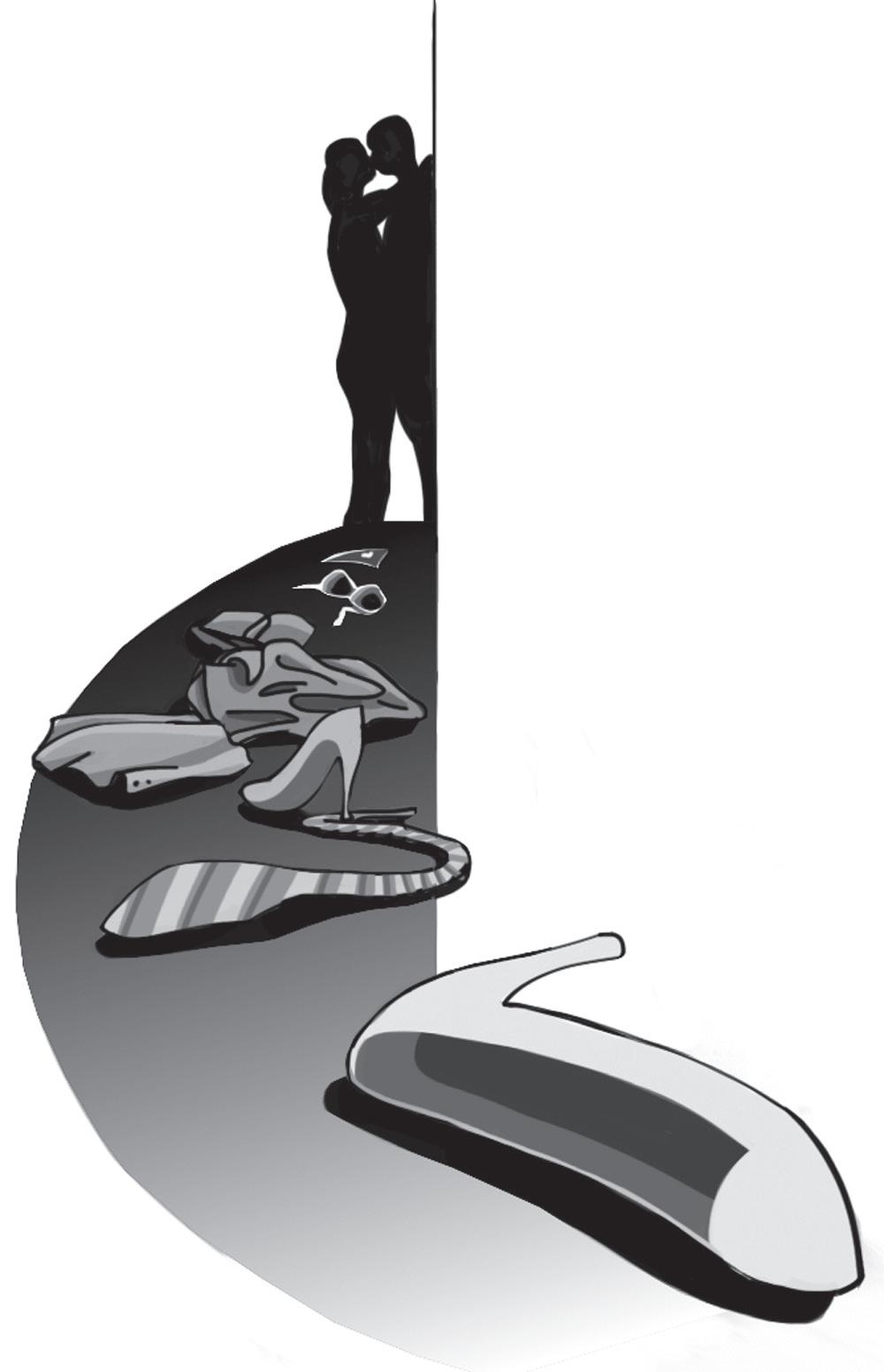
definitely on the table, strip down whenever the person you’re with leaves the room for a few minutes. Has this worked for me? Yes. Did I get one of my favorite moves from a sitcom? Also yes. (Disclaimer: I repeat. Make sure hooking up is definitely on the table. Nothing warrants skipping consent).
3. The Semi-Naked Man
If flashing someone isn’t the right move for you, be creative about getting naked. Try to take off their clothes without your hands, and use your teeth instead. Or perform a lil’ strip tease. Show up in lingerie. The possibilities here are endless.
4. Making Out
Never underestimate the importance of kissing. A steamy makeout sesh sets the tone for the rest of the night. Nibble on their lips and then kiss their neck. Work your way down to tease them around more erogenous zones. Fun psychology fact: if you kiss every time you come, you’ll start to associate it with orgasming so eventually even a peck can turn you on.
5. Talk Dirty
I’m a huge fan of dirty talk. I’m unfortunately also very bad at it. I know exactly what to do: grab their hair, pull them close, bite their ear, and then whisper every carnal thing you’ve ever wanted to do to them. And while I can visualize everything I want to do, I fail to put it into words. If you’re anything like this, I 10/10
It is a truth universally acknowledged that a single man in possession of good fortune must masturbate. Despite this, I had sex before I masturbated for the first time, and the masturbation took a great deal of effort. Masturbation is fucking hard, but fucking hard is not masturbation.
To clarify, I learned calculus before I masturbated for the first time but I attempted and failed at masturbating before I attempted calculus. Thus, calculus is easier than masturbation but primarily because there are more guides for it. When I looked up how to do a calculus problem, I generally found a nice guide to walk me through it. I’ve never been able to find a good article that teaches boys how to masturbate. However, there are loads of articles for girls. Apparently and surprisingly, it’s more common for girls to struggle with the mysterious magic of masturbation based on my careful analysis of responses on Yahoo Answers. But here’s a perfunctory guide of what to do. There are two primary areas for attacking masturbation. The first is physical technique. The motion to masturbation takes practice and some degree of physical strength. I am a small, weak boy with flaccid arms and tight pants, so I struggled with this one at first. But it is a hurdle you may surprisingly easily overcome through focused practice. The second is inspiration. People often talk about what they masturbate to. Some masturbate to pictures, books, picture books, videos,
recommend watching porn together. It’ll give you some ideas about what to say or even turn you on enough that you can skip the dirty talk all together.
6. Talk. Period. Not everyone’s good at reading body language. Do you wish the lights were a bit dimmer? Is your leg cramping up? Do you need a five second break to catch your breath? Say it! Taking a minute to express how you’re feeling will make the next 29 minutes so much better. After all, you didn’t shave your legs to have a night full of awkward sex and regret.
7. Lube
For the love of all that is good, please buy lube. I don’t care if you personally don’t need it because eventually, someone will. There’s no such thing as a one-size-fits-all for lubes, but something waterbased is the safest. It’s the least likely to cause an allergic reaction, is less sticky and won’t degrade any silicone-based sex toys or latex condoms.
It’s not every Saturday night that I want to put effort into hooking up. Usually, I want to blow off steam in a way that requires no planning or thought. But if you’re getting a little bored of the same old thing, I hope these tips make your next night in go from good to great.
comics, real-live people, and even poorly written Sun columns. You may just need to find the inspiration that’s right for you.
So first of all, you’re probably already familiar with the motion and the rhythm. You can get that shit from porn videos and Charlie Day’s performance in the uncomfortable after-allegations film I Love You, Daddy. But did you know that you can use both hands? This is already a game changer. All the little, literal bastards at my local regional high school would ask me jokingly whether I go left or right, and I never thought to innovate until the summer after my sophomore year at college while doing research on C*-algebras. There’s just something about noncommutative geometry that makes me think “I need both hands for this.”
So step one if you’re having trouble with the generally suggested, standard run of the mill, pumping method is to try breaking out your leftover hand. After that, it would make sense to start taking advantage of the machinery well known for sexual things. By that, I of course mean the materials you can purchase at that one pretty sketch sex shop in Ithaca. Feel free to attempt butt stuff, introduce lubrication, put your dick in between your mattress and your bed. The world is your oyster, and oysters resemble vaginas when you look at them from the right angle. So go wild. Fuck a roll of toilet paper. Get creative.
inspiration and physical categories you’ve found some favorites or at least some things that work well but maybe just can’t get you to finish. I suggest putting them all together. If covering yourself in butter and watching butt stuff work well separately, maybe doing both at once will get you there. Finding out how to masturbate is similar to figuring out how to socialize. You have to develop a personality, figure out your needs, and find out how to get them met. Put all of these suggestions together, and you’ll be firing off loads like your peers in no time. Sexless in
Inspiration
Inspiration also requires some degree of creativity. I found this to be the easy part, but it’s primarily about finding out what you like and getting rid of your shame. The most important piece of advice I can provide is to feel no shame unless it can get you arrested. This is a core principle I live by in any area of my life but specifically when it comes to masturbation. If you’ve sacrificed your shame but are still struggling, you may just need to look around more and find things you kinda like and move forward. A good rule of thumb is that if you haven’t tried hentai, you haven’t tried hard enough. So step one if you’re having trouble with inspiration is to acknowledge that whatever you’re watching, I probably watched worse when I was 12, without masturbating, with no shame. And here I am, still surviving. After that, just explore, and you’ll likely find something that somewhat works for you.
Putting It All together
At this point, you have no shame, you’re using both hands, you’re getting cre ative, and you’ve explored a while. Now it’s just about figuring out how these things fit together. Likely in both of the



By CHELSEA LEEDS Sun Staff Writer
vegetarian one...at least for me, the lone vegetarian in my family.
For those of you who may be afraid of what I detail in this piece after I just revealed I’m a vegetarian, know that I do not plan on challenging your beliefs whatever they may be. The purpose of this piece is solely to share the story of my vegetarian Thanksgiving.
While this was not my first Thanksgiving as a vegetarian (I went through a three-year phase during middle school), this time was different. This time around, I knew my decision to be vegetarian was neither a phase nor a product of my stubbornness or resistance to authority (a characteristic of a young Taurus) as it was when I first became a vegetarian. Instead, it had become a belief I adopted that I could not turn my back on. You may ask why at age 22, I would decide to become a vegetarian again — practically a vegan? That’s for another time.
Just as my experience being a vegetarian since this past June has been different from that of my childhood, so was this past Thanksgiving distinct from
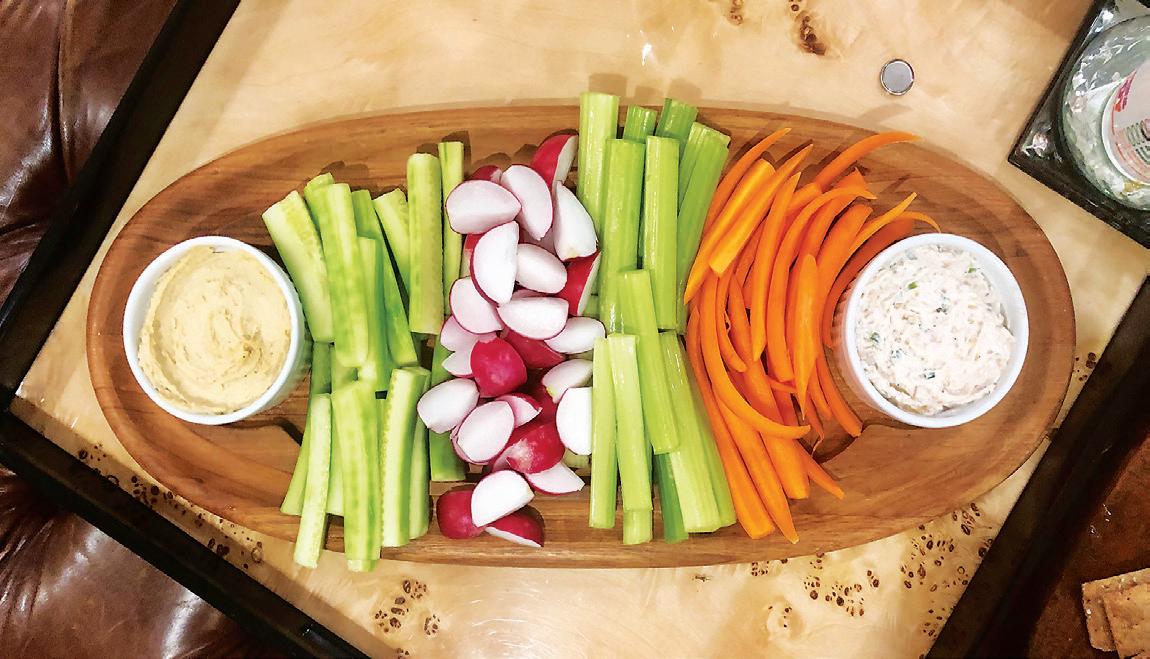
those of years past. I was asked, “So you’re not having turkey?”, “What are you going to eat?” and “How can you not have turkey?”
Despite the legitimacy of these questions, I was still taken aback and slightly surprised when they were asked because, to me, turkey is not what Thanksgiving is all about.
Although Thanksgiving Day accounts for 18 percent of annual turkey consumption — which is a considerable amount of turkey — when I talk to family and friends, most share that they don’t even like turkey all that much. The only reason they take a small piece of it is for the purpose of tradition. Likewise, I’ve never enjoyed turkey all that much and, prior to becoming a

vegetarian, only took one little slice on the holiday as well. I did this to follow Thanksgiving tradition, which I was taught revolved around turkey. A picture of a turkey dinner is, in fact, the first photo that appears when you Google Image search “Thanksgiving.” Interestingly, I found research that the Pilgrims didn’t even eat turkey at the very first Thanksgiving. Rather, they feasted on wild game, such as venison and waterfowl.
Despite knowing what the Pilgrims really ate at their first Thanksgiving, I chose not to divulge this knowledge to those who asked me the aforementioned questions regarding Thanksgiving and turkey. Rather, I responded with my excitement over the deli-
cious vegetable sides that are part of any Thanksgiving dinner. My response quickly put the issue to bed, which was my goal, as I often fear inciting anger or insecurity when discussing my vegetarian lifestyle, one that contradicts the sentiments held by those in my company, who may find my beliefs threatening to theirs.
While I succeeded in defusing what could have turned into a heated debate (which has happened in the past), my mind always returned to the same thing. It’s what I would spend my drives back to school thinking about after every Thanksgiving break. It wasn’t the drive itself, the crowded supermarkets, the turkey, the stuffing or the wine. It was family.
Family is what makes Thanksgiving my favorite holiday. Despite being a self-proclaimed foodie, I never really cared much about food when it came to Thanksgiving. While food is often what brings us all together, it’s the company and people you surround yourself with that leads to extended trips, family yoga classes, snuggling up on the couch to watch a movie or sticking around for breakfast the day after. During each of these
moments and soon-to-be memories, I am not thinking about what is on the table in front of me, but how thankful I am to be surrounded by the people I love. For me, this is what Thanksgiving is all about.



Tyler, the Creator’s sexuality has been debated over the course of his career. While never coming out “officially,” in a number of interviews he has expressed an attraction to other men, including Leonardo DiCaprio and Cole Sprouse (both of whom he also references in 2018’s “Potato Salad”). The rapper appears to respond to and mock these conjectures in his music, toying with the listeners’ expectations; in one of my favorite verses from Flower Boy,Tyler employs a bit of rhetorical play when he raps, “Hi y’all, y’all ain’t hit me all day/What the fuck is the problem? Is it me?/’Cause I’m not solved, I’m… bored.”
Nevertheless, none of these speculative debates, whether about Tyler, the Creator or any other hip-hop artist, avoid assuming an air of banality as they fixate so profusely on one aspect of personal identity, that being sexual orientation. Of course, one might argue that such popular conversations are trite by virtue of being mainstream in the first place, but I think that the problem here is more deeply ingrained. In the exciting and somewhat agonizing midst of writing a thesis about masculinity and hip hop, I’ve done a lot of thinking during this past semester about Tyler, the Creator and the social context in which he and other rappers create their music and personas. Many hip-hop scholars, like Justin Adams Burton or Savannah Shange, locate black hip-hop artists within a neoliberal

society where wealth determines some ultimate social hierarchy that places rich capitalists at its peak. While this world is predicated primarily upon money, but various other things, including race, gender and sexuality, compose its controlling power structures and create the very notion of first-class and second-class publics; thus, the neoliberal, cisheteropatriarchy is thrown into a stark relief. So, these circular discussions of sexuality that we see in the media are not simply mundane, but they exhibit a mainstream obsession with its own structural binaries, such as those between gay and straight or black and white. The problem is that, when we write-off and place artists in such neatly devised dichotomies, we neutralize the productivity of any other positive work they may be doing regarding the formation of personal identity. It is easier to reduce Tyler, the Creator to superficial talks of sexuality than it is to consider the ways in which Tyler has, for instance, deconstructed restrictive notions of hegemonic masculinity throughout his discography, from Goblin to Flower Boy.If a subject is made readable in the eyes of a neoliber-


al society, then it could not possibly do anything to dismantle these aforementioned power structures and alter the system in a way that’s truly meaningful. Perhaps the most significant mainstream misunderstanding of minority cultures is that they are based around the same legible formulations of the self that characterize expression in dominant cultures. In a brilliant 2017 article about black identity, Marquis Bey points out the fact that, as a result of centuries of messy racial oppression and cultural appropriation, “blackness” has developed as something of a transitory, dynamic “refusal” to mainstream (white) society. Assuming this, we can conclude that binaries and normativities have no place in any identity conceived around something that’s not even so static in the first place. If we stop the constant employing
of these archetypes, we can stop restricting people to boxes and allow identities to develop more fully.
For a column that has thus far been fairly theoretical, I would like to step back and do some more concrete, end-of-semester reflecting. I’ve definitely reconsidered the ways in which I think about hip hop over this past semester, and I definitely owe thanks to all of the intellectual discussions I’ve had around my thesis and in courses like Women in Hip Hop. I’d also like to mention the number of rappers who have been on my mind lately, including Tyler, the Creator and his Odd Future counterpart, Frank Ocean, as well as Princess Nokia and Akua Naru, and thank them for doing their thing and helping us all renegotiate and expand the ways in which we can perceive our own identities.
Nick Swan is a senior in the College of Arts and Sciences. She can be reached at nwan@ cornellsun.com. Swan’s Song runs alternating Tuesdays this semester.
BY
Kayla Olson’s second book
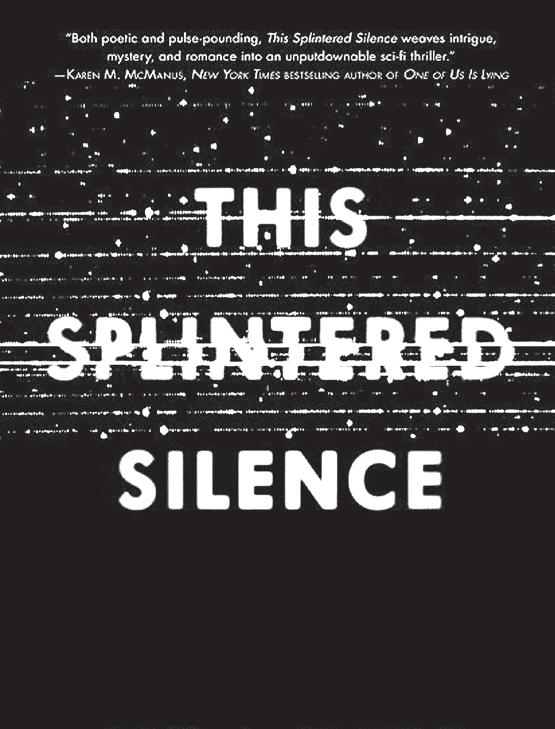
This Splintered Silence invites us onboard the Lusca, an exploratory space station that houses Earth’s top scientists and their families as they work to terraform the nearby planet Radix. These operations are halted, however, by the arrival of a virus that decimates the entire adult population of the station. Lindley Hamilton, the daughter of the Commander, and her five closest friends, Leo, Heath, Haven, Natalin and Zesi, are forced to step into the roles their parents have left to them. With no help or guidance and still reeling from the loss of those closest to them, they must shoulder the burden of running the station and keep everyone together — an impossible job made only more impossible when a member of the second generation dies, appearing to succumb to the virus they were supposed to be immune from.
But as more kids die and the facts refuse to add up, Lindley must face the most horrible of possibilities: either the virus has mutated, or one of their own is a killer. Under these pressures, Lindley struggles to keep her footing. Olson grounds the narrative in Lindley’s perspective, aligning us with the girl who is only fighting to do her best when she is hopelessly out of her depth. As a character, Lindley is fierce, independent and broken. Like everyone on the station, she lost her mother to the virus, and her newfound duties as Commander leave her no time to deal with this grief. She is a hollow girl trying to keep everyone else together, and in this her strength is nothing short of admirable. The tightness of Lindley’s perspective keeps us trapped in her head; we feel her anxieties, her exhaustion, her doubts, her insecurities and her sadness. We also feel her hope, her determination to make a bad situation work and her unwillingness to
fail. The intensity of the novel can be overwhelming at times, but it only mirrors the situation. It reminds us that even the tiniest of victories can feel like huge ones, and that no matter the odds, you can survive.
In keeping so close to Lindley’s immediate perspective, however, the overall sense of the world Olson has built is lost, consumed by the drama onboard the station. Only a few bits of information are given as to the politics and spaces around them. Earth is known only through voice calls and supply missions. The outside threat of Vonn and his colonist-slaves on Radix is not fully developed or explored, only talked about in relation to Lindley’s fears. The novel struggles to balance the external threats of the company and the internal threats of the virus and the possible killer, ultimately focusing more on the internal. In doing so, the station really does seem to be marooned in space, leaving the reader to accept its existence for the sake of
the story without contextualizing it further.
In a similar manner, even some of the internal conflicts of the story appear to be dropped or sidelined for the sake of focusing more heavily on the mutated virus and the murderer. Lindley’s life before the virus and her mother’s death is alluded to but never fully explored, and her connection to her friends is established and then left largely unchanged. The burgeoning love triangle that occurs as the story progresses is incidental to the plot and ultimately left unresolved. Taking these together, it feels like the plot tried to include both too much and not enough, weighting itself unevenly.
Overall, however, as a meditation on human endurance, This Splintered Silence succeeds as a character study and a thriller. Lindley is a great character to follow; she’s smart, capable and humanly flawed. The ending manages to surprise, and the writing is an immersive blend of poetic language and
prose. In its depiction of the bonds of friendship and family, the novel shines. Though a greater sense of the world could have been developed, the strength of the novel rests in the smaller things: in Lindley and her friends, in the holes left by the ones they have lost and their willingness to fight for the only home they have known.
Jessica Lussier is sophomore in the College of Arts and Sciences.. She can be reached at jll355@cornell. edu.




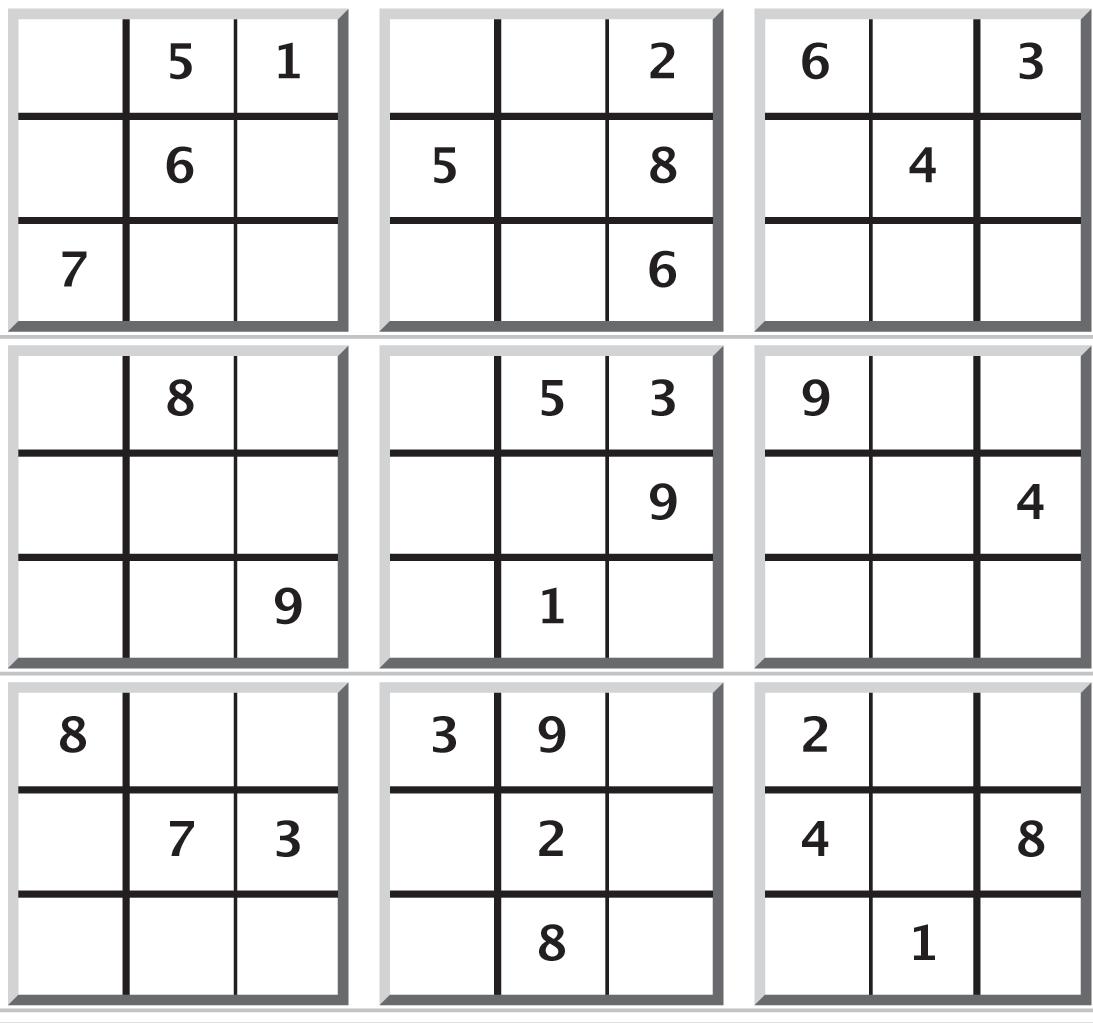
Fill in the empty cells, one number in each, so that each column, row, and region contains the numbers 1-9 exactly once. Each number in the solution therefore occurs only once in each of the three “directions,” hence the “single numbers” implied by the puzzle’s name. (Rules from wikipedia.org/wiki/ Sudoku)



26
26 A PA R TMENT FOR R ENT
ithacastudentapartments.com 607-277-1234
2 & 3 BEDROOMS
109 SAGE PLACE
Available NOW, Spring 2019 & 2019/2020 Shuttle Bus Access to Campus Access to Free Fitness Center Novarr- Mackesey Property Management office@ithacastudentapartments.com ithacastudentapartments.com 607-277-1234
COLLEGETOWN 6 BEDROOMS Newly Remodeled PRICES SLASHED TO RENT 607-272-3389 avramisrentals@aol.com
Houses, Apts, Parking 1 to 9 Bedroom
Collegetown - College Ave, Linden Ave, Dryden Rd, Bryant Ave, Cook St. 607-330-2442 info@urbanithaca.com www.urbanithaca.com
Nicest Apts. in Collegetown Located on Eddy St.
4 Bedrooms
Fully furnished. Spacious living areas with large bedrooms & closets. Hardwood flors, spectacular views, eat-in kitchens with additional sun rooms. Laundry & parking. 607-339-1137 bgm900@gmail.com
RENT NOW, GET THE BEST www.MatoulasHouses.com
Apartments & Houses In Collegetown LINDEN AVE & E. SENECA ST 3 BEDROOM APARTMENTS ALL FURNISHED EMAIL: MatoulasHouses@Gmail.com PHONE: (607) 339-9644 FIRST-COME, FIRST-SERVED *****************************
312 College Ave
Collegetown’s Best Address Now leasing for 2018-19. Superior Studio, 1, 2, 3 Bedroom Apartments. Fitness facility, theater, and meeting space. Free high-speed internet. Exclusive resident parking. Overnight concierge. Package delivery. 312collegeave.com 607-273-9777
Collegetown Terrace Apartments INSPIRED LIVING TAILORED TO YOUR SUCCESS
24-Hour Fitness Center Shuttle Bus Service to Campus Study Rooms w/ Expansive Views
Apartments Available NOW, Spring 2019 & 2019/2020 Novarr- Mackesey Property Management collegetownterraceithaca.com office@ithacastudentapartments.com 607-277-1234
Campus
We have availability for the 2019-2020 school year beginning June 1st at Hudson heights apartments. The studio apartments come with: heat, water, and electricity included. There are garbages houses and coin-operated laundry facilities on site. Prices start at $750/month for a 12 month lease. If you have any questions or would like to schedule a tour contact us by phone 607-208-7660 or email: renting@ithacaLS.com *****************************
in 2018 Rate Today Rent at any of out 7 communities Call 607-257-3311
QUALITY LIVING<< Special Deals for you! Furnished 1-6 Bedrooms Collegetown Apartments PARKING, LAUNDRY, UTILITIES! (607) 273-7368 www.IthacaApartmentRental.com
201 WYCKOFF AVE 6 Bedroom House Novarr-Mackesey Property Management office@ithacastudentapartments.com ithacastudentapartments.com 607-277-1234










Continued from page 16
playoffs, when it fell to Princeton in the ECAC semifinals and B.U. in the NCAA Tournament.
This year, though, difficulties have come early, and the Red has a chance to respond.
“As a freshman class this is the first adversity we’ve really faced,” Betts said. “I think it’s actually beneficial for the team to face it now. It’s better to be facing it now than figuring things out the last week of the sea son.”
Cornell faces off at Dartmouth at 7:30 p.m. Friday and at Harvard at 7 p.m. Saturday.

on,” Derraugh said. “So for us coming into our house now, hopefully we will be the ones putting pressure on the opponents who are coming into our building.”
“We all know about the disappointment this weekend but the fact that we get another crack at [Harvard] is nice, so hopefully — definitely — we’ll be ready to go,” Nuttle said.

A.D. White House
Admissions Offce
Africana Studies & Research Center
Alice Cook Dining
Anabel Taylor Hall
Appel Commons
Baker Hall
Bard Hall
Barnes Hall
on its special teams — an aspect of the game that has proven especially troublesome for the team as it has given up goals in the past few games while playing man down.
“A focus of our team against St. Lawrence will be execution on our special teams,” Serdar said. “Both the power play and penalty kill can have a huge affect on the outcome of games. We must take fewer penalties against St. Lawrence if we want to be successful.”
When it comes to Clarkson, the Red will employ a similar approach — paying attention to details, while staying disciplined defensively.
The Red has been on the road for the past several weeks — a challenging, though mostly successful, stretch that has tested the team’s resolve. But according to Derraugh, the time away from home has been a vital stress test, and the experience gained from eight consecutive games on the road will ultimately give Cornell the edge as it heads into some of its most difficult competition of the season.
“Every single game will be a challenge, so we have to be prepared to play a full 60 minutes every single game.”
Junior co-captain forward Kristin O’Neill
“Our main focus moving into this weekend is playing the fast, aggressive style of defense that we are known for,” Buckley said. “Both teams have great offensive players so fueling our own offense through strong defensive plays will be key.”
Cornell has also recently struggled with running up losses early on in games. Against Robert Morris, its most recent competitor, the Red faced an early 2-0 deficit, and was only able to battle back to a draw.
But Derraugh expects that Cornell’s home ice advantage will spur the team to get off to stronger starts in the weekend’s upcoming games.
“Being on the road, you are in their building, so they are going to want to put pressure on you early
“The only way you have a chance of winning in the playoffs or the NCAA tournament is if you’re able to win on the road, so hopefully that experience will bode well for us,” Derraugh said.
“Every single game will be a challenge, so we have to be prepared to play a full 60 minutes every single game — no matter who the opponent is,” added junior co-captain forward Kristin O’Neill. “We are definitely happy with the team so far, but not satisfied. We have a lot of potential, and I’m very excited to see what we can do with it.”
The Red squares off against St. Lawrence Friday at 6 p.m. and Clarkson on Saturday at 3 p.m.
Faith Fisher can be reached at fsher@cornellsun.com.
Smita Nalluri can be reached at snalluri@cornell.sun.com.
By RAPHY GENDLER
Under the bright lights of the Big Apple and against its bitter rival Harvard, No. 16 Cornell men’s hockey fell flat over Thanksgiving weekend. But lucky for the Red, the team had to wait just seven days to get another shot at the Crimson.
A “lifeless” effort sent the Red (5-4, 3-1 ECAC) to its fourth loss of the season last Saturday, highlighting the team’s injury-plagued tough start to the 2018-19 season after starting last season 7-0. But Cornell returns to league play against Dartmouth (3-3, 3-2) and Harvard (3-3-2, 1-2-2) this weekend in its first road ECAC games of the season, and the Red is excited that after its 4-1 Frozen Apple loss it gets another shot against the Crimson

“After a game like [Saturday’s] it’s easy to let that linger in the back of your head,” said sophomore forward Kyle Betts of his team’s chance to prove that it’s better than what it showed in New York. “But the nice thing is we’re prepping for [Harvard] again this week, so it’s right back at it and chance to redeem ourselves.”
Despite a shaky first month of the season, Cornell has just one conference loss (the Frozen Apple technical counts as a non-league game) and could position itself well in the ECAC with road wins over the Green and Crimson.
“Every game’s difficult,” said associate head coach Ben Syer, who filled in at Tuesday media day since head coach Mike Schafer ’86 had a family commitment. “You’ve got to be ready every night and every shift, and every time you roll over the boards you got to be ready to compete.”
The Red is confident that it’s not overlooking Friday’s matchup with Dartmouth in favor of Saturday’s rematch with the Crimson at “Lynah East,” Harvard’s BrightLandry Center.
“I’d be shocked if anybody’s overlooking that game on Friday night,” Syer said. “It’s all about getting an opportunity to get out and play again and compete; our guys are
After playing the last eight games on the road, women’s hockey will return home for the first time in over a month, hoping


chomping at the bit.”
In order to capitalize on its chance to down rival Harvard a week after failing to show up in New York, Cornell — still missing two of its top four defensemen, sophomore Alex Green and senior Brendan Smith, due to injury — will need to make improvements on the blueline. Schafer said after the MSG game that the team lacked physicality.
“When we talk about physicality it’s not just big hits,” said senior defenseman and alternate captain Matt Nuttle.
“It’s also finishing every check and what that’ll do is frustrate the [opposing] defense, it’ll force them into turnovers and create scoring chances for us.”
Cornell hardly faced any adversity in a 2017-18 season that saw it ascend to No. 1 in the country and a No. 1 seed in the NCAA Tournament. Cornell steered relatively clear of injury woes, missing just 10 man-games from top-six defensemen, and didn’t suffer back-to-back losses until the
to maintain its so far flawless Lynah record as it takes on a pair of upstate New York rivals. No. 7/7 Cornell (6-1-4, 4-1-1 ECAC) will face off against No. 8/9 St.Lawrence (9-6-1, 4-0-0 ECAC) on Friday and

two-time defending national champion Clarkson (12-2-0, 3-1-0 ECAC) on Saturday.
Last year, the Red triumphed over St. Lawrence by comfortable margins, securing a 3-1 and 4-1 win. But despite last season’s convincing wins, St Lawrence — a team with a perfect conference record — is a fierce national competitor, and will demand nothing less than Cornell’s best.
“St. Lawrence tends to be a wide open game. They will take risks, they play with a lot of speed and they forecheck hard,” said head coach Doug Derraugh. “They have a good team from top to bottom with great goaltending, and that’s why they are one of the top teams in the ECAC and the country.”
Clarkson — which Cornell suffered a devastating 4-3 overtime loss to last year — also promises to put up a similarly tough challenge.
“Clarkson plays a real stingy defensive game. It’s very hard to get scoring opportunities,” Derraugh said. “They are well-coached, disciplined and have players who can score up front and are a dangerous threat every time they are on the ice.”
The outcomes of both games will be crucial in determining the eventual conference winner and host of the ECAC tournament in February.
“Both St. Lawrence and Clarkson are
huge games in the NCAA standings, but more importantly in the ECAC standings,” said senior forward Diana Buckley. “These games will feature some of the best players in the NCAA, so I can guarantee it will be a pair of aggressive, fast and fun games.”
And while St. Lawrence might remain undefeated in conference play, the Red has an unblemished record at home that it won’t be willing to tarnish without a stiff fight.

“Playing in front of family, friends, the rowdy Lynah faithful and the band is something special to our team,” said senior forward Lenka Serdar. “The atmosphere at Lynah gives our team so much energy on the ice.”
In addition to channeling Lynah’s electric atmosphere, the Red will be focusing