The Corne¬ Daily Sun

By
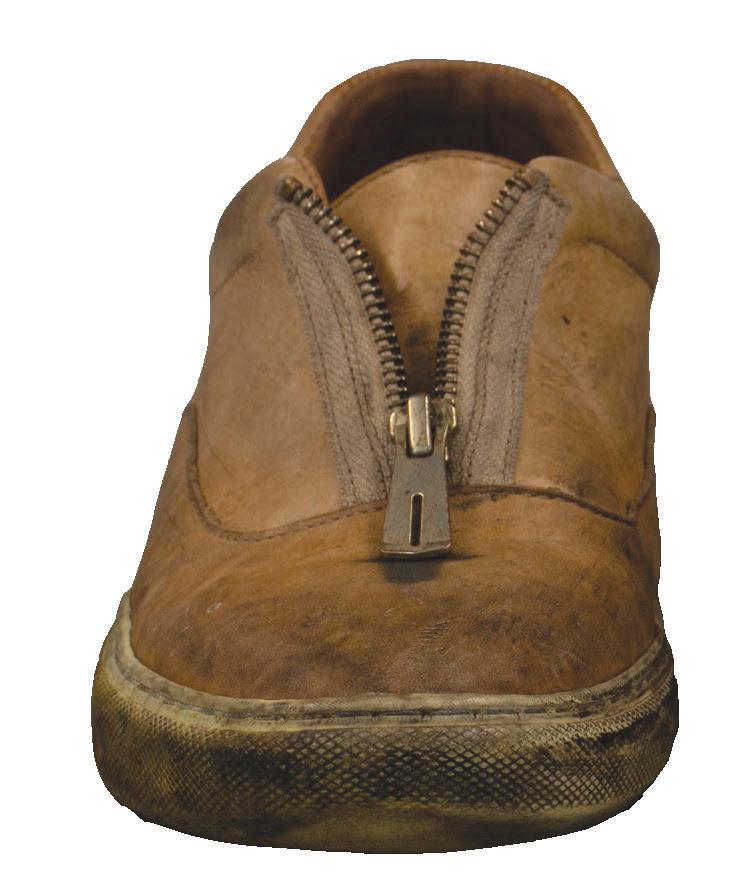
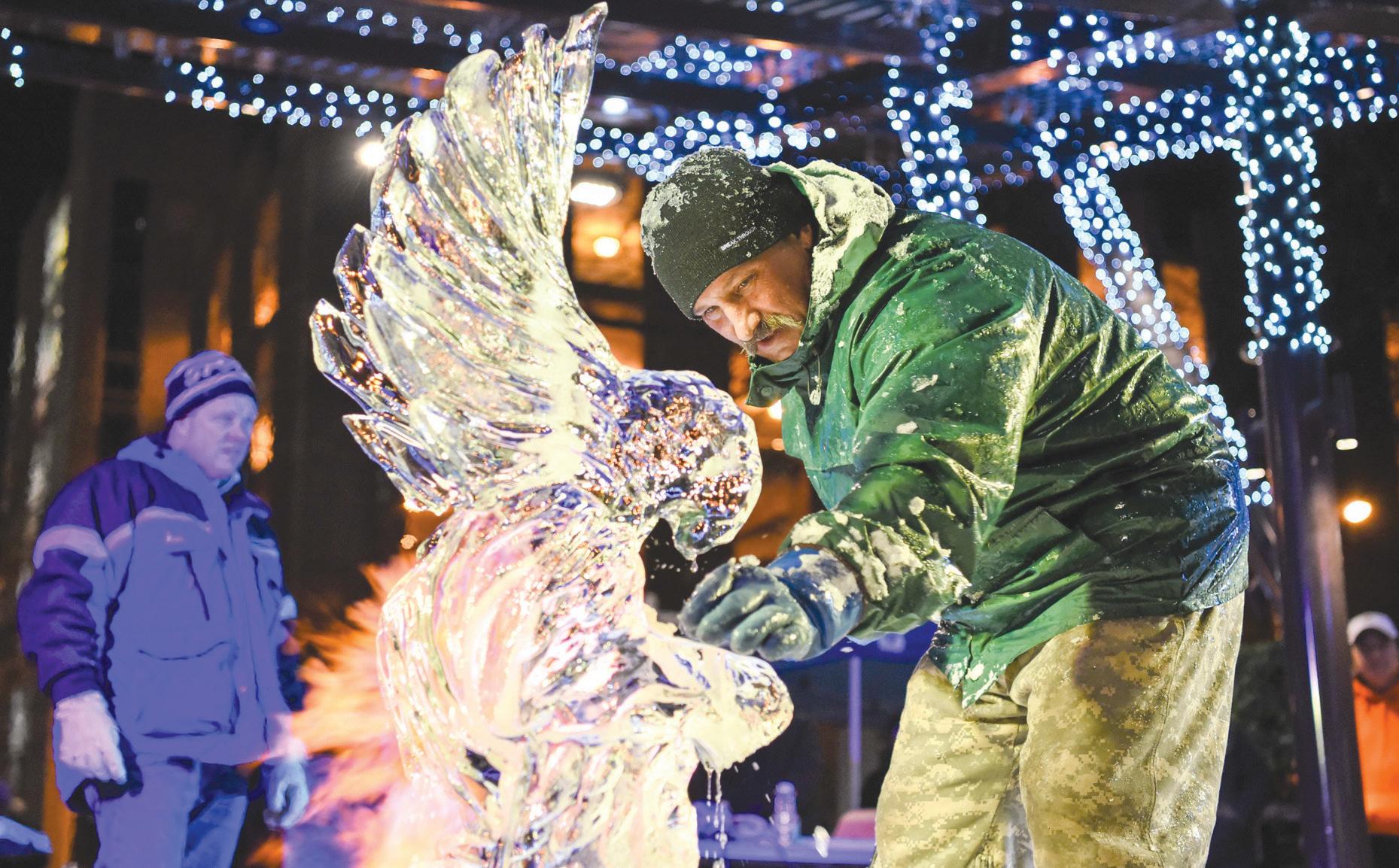
Worn and scuffed with cracks and holes in them, the shoes that Rep.-elect Alexandria Ocasio-Cortez (D-N.Y.) wore campaigning will be shown at Cornell in an exhibit beginning Dec. 6.
The exhibit, entitled “Women Empowered: Fashions From the Frontline” will feature clothing items that represent women’s empowerment. The exhibit is part of the biennial celebration that the Cornell Council for the Arts has held throughout the fall semester.
After winning the primary election in June 2018, Ocasio-Cortez explained on her Twitter the significance of the shoes to her. In her viral tweet, she used the shoes as an example of the hard work she put into campaigning.
“Here’s my 1st pair of campaign shoes,” OcasioCortez said. “I knocked doors until rainwater came through my soles. Respect the hustle. We won bc we out-worked the competition. Period.”
Curator of the exhibit, Prof. Denise Green, fiber science and apparel design, said Ocasio-Cortez’s shoes
were a good representation of the 2018 Biennial theme, “Duration: Passage, Persistence, Survival,” and are unique to the exhibit since worn clothing items are not often displayed.
“In fashion exhibitions you almost never see a gar ment that is not pristine,” Green said. “The shoes are so beauti ful in their own way in that they show these concepts that are apart of the CCA Biennial — the concepts of persistence, of dura tion, of survival. You can see time worn away on these shoes with
hard work.”
As a member of the curatorial team, Jenny Leigh Du Puis grad said Ocasio-Cortez’s shoes came up as the team was thinking about examples of women in government and important fash-
In order to obtain the shoes, Green reached out to Ocasio-Cortez’s team. According to Green, Ocasio-Cortez glady loaned the shoes for the exhibit; however, she did not gift them to Cornell since they mean so
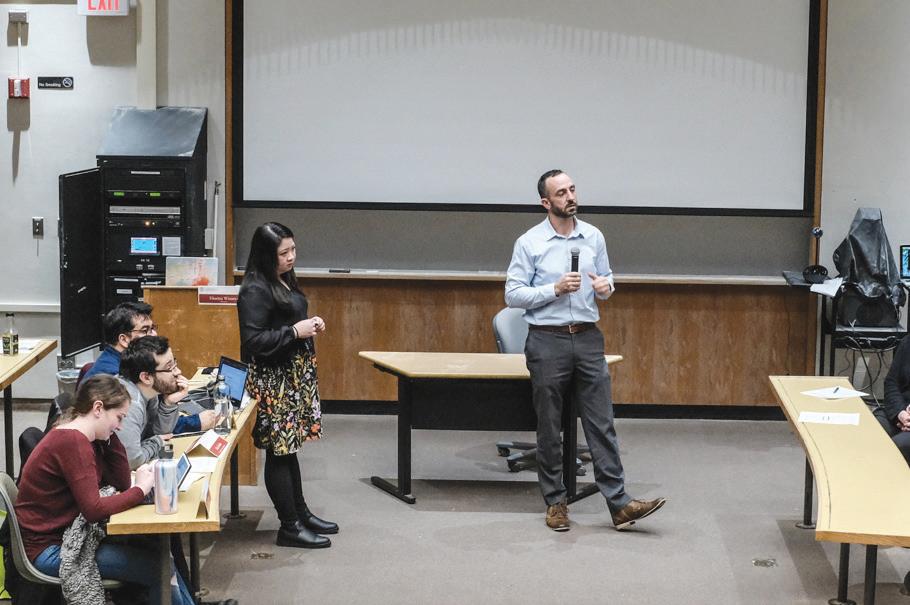
Two University deans explained that the current financial compensation package for doctoral and some masters students is in the “middle of the pack” compared to Ivy League and comparable peer institutions at the semester’s last Graduate and Professional Student Assembly meeting Monday.
Jason Kahabka, associate dean for administration at the Graduate School, said that graduate students working as teaching assistants or
research assistants will at minimum receive a $26,426 stipend during the academic year. The stipend for the nine-month period is slightly lower than the $26,582 living wage for Tompkins County residents — a figure calculated by the Massachusetts Institute of Technology that was cited by Kahabka.
“What [the living wage] doesn’t take into account is that students also have health insurance covered and don't have to pay certain taxes,” Kahabka said. “In general the
By
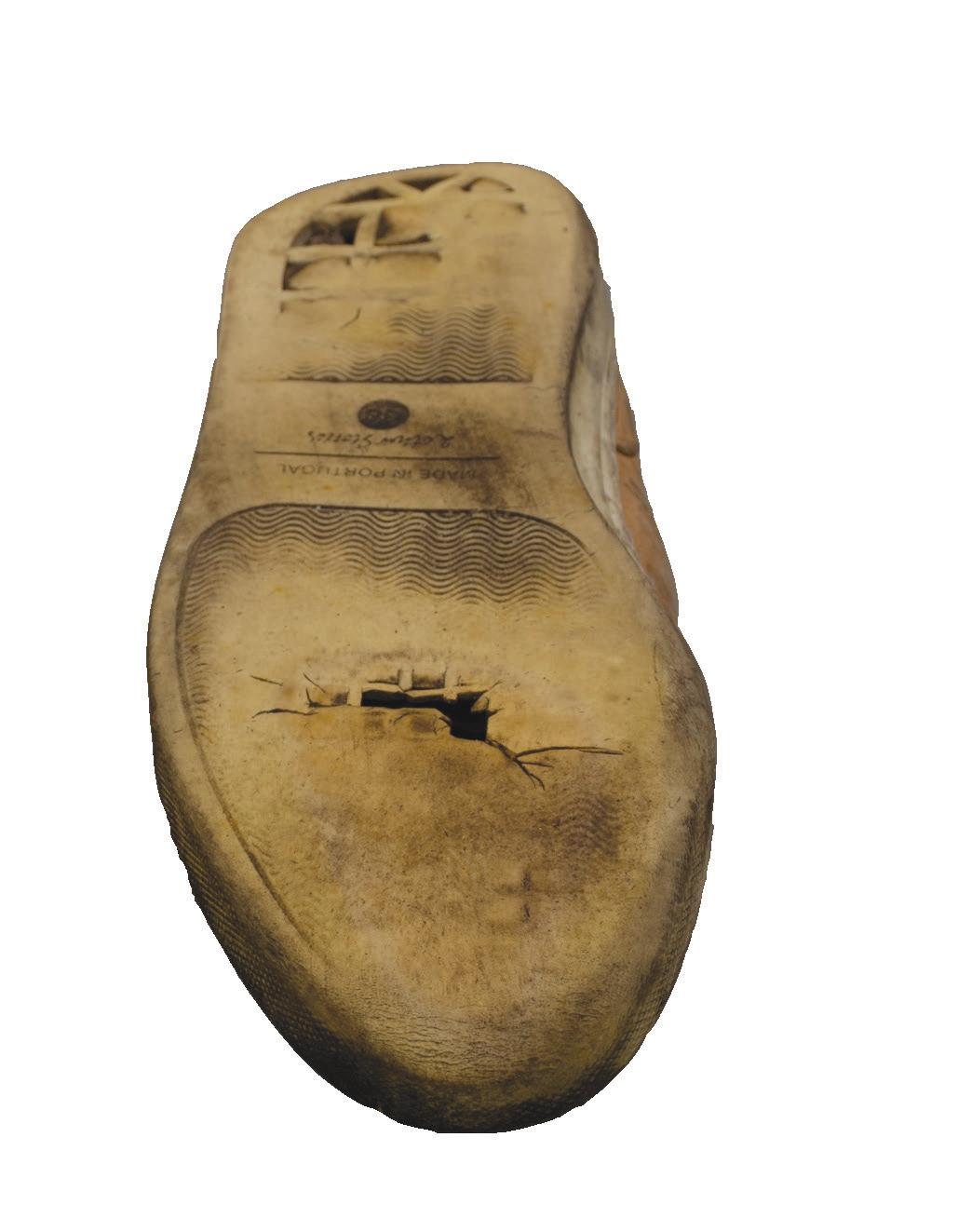
Downtown Ithaca will host its 12th Annual Ice Fest to celebrate the cold weather from Dec. 6 to 8. The three-day festival will feature an ice carving competition along with other activities such as a silent disco, fire dancing demonstrations, an Ice Bar and a Chowder Cook-off.
“The idea for Ice Fest began when we were searching for a festival that would be enjoyable in cold weather,” said Summer Keown, special events director of the Downtown Ithaca Alliance.
“The ice carvers thrive in the winter — the colder the better.”
This year, the ice carving competition will again be a part of Ice Fest. There will be a speed carving single-elimination competition on Friday eve -
ning and a two-block showpiece challenge, which includes three rounds of competition, on Saturday.
“The sculptors who participate are incredibly talented, and they compete all over,” Keown said.
“As this is my first year serving as the event director, I am most interested in seeing the ice carvers creating their unique artworks.”
Aaron Costic was the winner of the last ice carving competition, which was judged by members of the National Ice Carving Association. Costic also previously won the Ice Carving World Championships in Alaska, and his 2017 Ice Fest first-prize sculpture “Wind” was of an angel’s torso.
In addition to the ice carving competition, the Ice Fest will host the Chowder Cook-Off, which







Tuesday, November 27, 2018
Today
Exhibition - Mixed Media: The Interplay of Sound and Text
9 a.m., Hirshland Exhibition Gallery, Carl A. Kroch Library
BEDR Workshop: Leaf Van Boven 11:40 a.m. - 1:10 p.m., B11 Sage Hall
CFS - Sarah Hormozi, Ph.D. ‘Shear Thickening in Non-Brownian Suspensions’ Noon, 106 Upson Hall
Basic Legal Agreements for Farm Business Management 1 - 3 p.m., CCE Tioga County, 56 Main Street
Professional Directions: Filmmaker Jesse Robinson
4:30 p.m., Schwartz Center for Performing Arts, Film Forum
There Will Be Blood
7 - 9:30 p.m., Cornell Cinema
Tomorrow
Winter Sustainability Market
11 a.m. - 4 p.m., Mann Library, Mann Lobby
Studies in The Pezizomycotina: In the footsteps of Whetzel and Korf- Teresa Iturriaga 12:20 p.m, 404 Plant Science Building
By EMILY YANG Sun Staff Writer
Over 125 years of Cornell athletics history sits on the shelves of Associate Director of Athletics for Communications Jeremy Hartigan’s office in Schoellkopf House.
These shelves house a catalogue of every varsity athlete who has lettered at Cornell, football scrapbooks dating back to 1887 that include game tickets and newspaper clippings and meeting minutes from the earliest University Athletic Council. In order to preserve these records that have been stored away for decades, the Athletics Communications team has begun a crowdfunding campaign to create a digital library.
Tens of thousands of photo negatives and film reels going back to the mid 1900s, VHS tapes, game programs and other documents fill cabinets and shelves around the rest of the office, and these would also be included in the digital library.
“The story remains, but the paper it’s written on crumbles,” Hartigan said. “Once it’s gone, it’s gone. It doesn’t exist anywhere else.”
According to Hartigan, the department hopes to compile an archive that is catalogued and easily searchable, as well as a social platform for former athletes and others to reminisce and discuss.
Hartigan said athletics plays a “huge role” in Cornell’s history.
“This crowdfunding opportunity is really a way to jump us forward in a way that would otherwise take us decades, and some of this data doesn’t have decades,” he said.
Hartigan anticipates that the entire project will take six to seven years. He said that as the Athletics Communications team starts to share photos and videos, others will probably “get excited” and want to donate money to the project.
The department has already begun the process, with 55,000 photos digitized. The funds from the campaign will be used to hire student workers and purchase equipment. Some of the more difficult processes, including preserving film, will be outsourced to archiving specialists.
The monthlong campaign, posted to Cornell’s crowdfunding page on Nov.1, has attracted 72 donors and raised over $17,000 of the $20,000 goal.
The majority of donors have been student athlete alumni as well as those connected with the athletics office.
“The people in those photos are now at a time in their lives when they’re reminiscing the old days, about what it was like when they were students,” Hartigan said. “Doing this for them and their families is really important. It’s going to benefit thousands and thousands of former student athletes.”

By AELYA EHTASHAM Sun Staff Writer
Humans may soon be able to interact with tiny robots small enough to fit in the bloodstream because of advancements in technology, according to ongoing research at Cornell.
Prof. Paul McEuen, physics, presented progress in creating cell-sized technology on Monday, examining the approaches under-
way at Cornell in making miniaturized machines powered by light.
The heading of his presentation stated that Moore’s Law — which says that the number of transistors in a microprocessor chip will increase by a factor of two about every two years, according to Nature — is “dead” and asks “now what?” This references the “crisis” of finding new ways to make computers more
By MATTHEW McGOWEN Sun Senior Editor
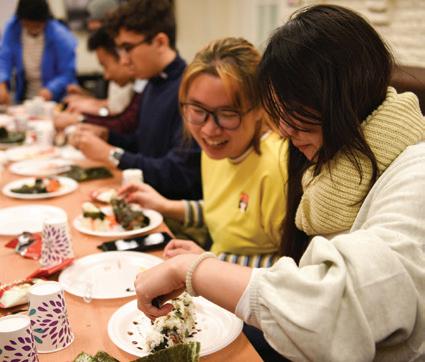
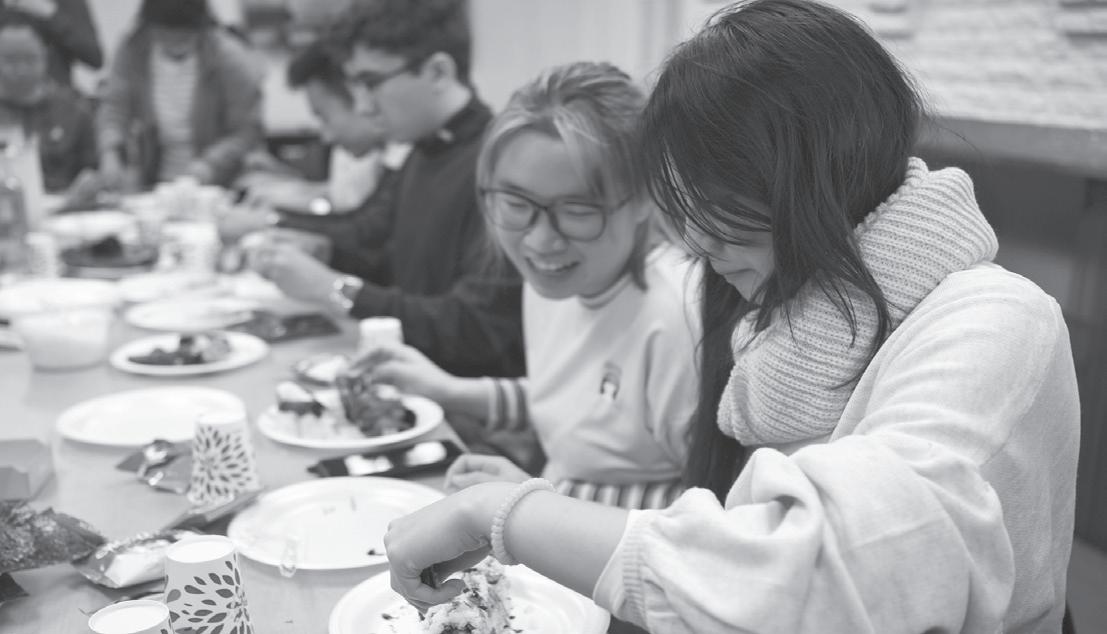
There are plenty of places to get sushi on campus, but few if any feature the originality on display at the first annual Asian Chopped culinary competition, an event hosted by Cornell Asian Pacific Student Union’s First Year Initiative.
FYI co-directors Jennifer Yu ’21, Jeannie Yamazaki ’21 and Grace Shau ’20 judged the cooking contest mostly on appearance and creativity, refraining from taste testing some of the more creative flavor combinations.
“It’s 50 percent presentation, 50 percent creativity, zero percent taste,” Shau said. The table shared by all of the participants was strewn with a bewildering mix of ingredients: avocados, rice, Chips Ahoy!, egg, ham, Oreo Thins and seaweed.
The event mirrored the television show Chopped on the Food Network, a contest in which contestants must incorporate discordant ingredients into dishes on tight time constraints. The format of the FYI event included a 20-minute time limit but a decidedly casual approach to which ingredients were required in students’ dishes.
capable.
The shifted focus, McEuen explained, finds its source in physicist and former Cornell associate professor Richard Feynman explaining that humans should not only miniaturize information and computing, but also miniaturize machines on a tiny scale.
“I want to build things that I could inject into my bloodstream if I wanted to,” McEuen said, laughing. “I don’t know why I want to inject little things into my bloodstream but I do.”
Aiming for a size of 100 microns and the width of a human hair or smaller, this point of technological development has far-reaching implications for understanding the building blocks of life, one of McEuen’s interests.
His talk focused on the current efforts to build these cell-sized devices, including work on campus. Much of the development of this nanotechnology comes from already existing technology and an imitation of biological designs.
“There are two obvious places you can steal from,” he explained. “The first is biology of course, which has an absurd level of nanomachines at its disposal. The other is existing technology.”
There are five characteristics
Victor Butoi ’22 proved his name with a first place prize for his piece titled “Under the Sea,” featuring a choco-pie crab, a hand roll hermit crab, a deli ham sea star and a cookie crumble sea floor.
“The judges were impressed by his command of the canvas (plate), and felt he earned his place as champion for the complexity and artistry of the scene
that he depicted,” Yamazaki told The Sun in an email.
Honorable mentions included Priyanka Dilip ’22 for her “socially conscious” piece, “Elon Musk Rocket,” and Samantha Chu ’22 for her “Millennial Snowman,” complete with a Canada Goose cape and avocado toast. Unfortunately, the sushi sculpture met an untimely demise shortly after the judging, tumbling to the floor in a flurry of rice.
The culinary aspect of the event, however, was secondary to the overall mission of bringing Asian American students together to celebrate culture and teaching students how to plan and execute an event from start to finish.
Asian Chopped, one of FYI’s three projects this semester, was spearheaded by organizers Tamara Sato ’22, Liying Wang ’22 and Crystal Tang ’22. Other FYI teams include a bubble tea fundraiser that took place last week and a photography project currently in the works.
Sato said the event went “much better than planned.” Wang added that “we weren’t expecting such innovative designs.”
The mission statement of FYI, is to “create future leaders in the Cornell community by instilling passion and drive, encouraging skills development, and sparking intellectual growth through the lens of the Asian and Asian American experience,” according to their website.
Matthew McGowen can be reached at mmcgowen@cornellsun.com.
PHYSICS
Continued from page 3
of cell-sized microbots, which must have 3D structure, actuation, sensing, communication and computation or memory, according to McEuen’s presentation. Additionally, the devices have two “camps,” including “smart panels” that “need to process information as the equivalent of a cell phone” and the “exoskeleton” that allows for movement.
To build the smart panels, groups at Cornell created Optical Wireless Integrated Circuits, or OWICs. Similar efforts from the University of Michigan and the University of California, Berkeley have been underway, according to the presentation, which compared the visible sizes of each on a penny. Cornell’s OWIC, at 100 microns, is barely a speck on the
penny, hidden between the coin’s pillars of the Lincoln Memorial.
OWICs use light for power and communication, and McEuen described their progress on making these smart panels as the equivalent of a cell phone, in that they serve as “a generic platform, not a solution for a particular problem.”
“Once you develop this platform you can amp it up very easily,” he said. “We solved the communication problem, and then you can build whatever app on it or create your own circuit.”
To make the technology mobile, or build the exoskeleton, McEuen used paper origami as an analogy for the foldable cells focus of this technology.
The movement of the tiny devices then relies on a voltage-controlled bimorph, which means it has two layers combining thin graphene paper and a five nanometer thick platinum, making it the world’s thinnest electrically-actuated bimorph.
However, McEuen explained that improvements need to be made since “their force is relatively weak due their incredibly small size. They move well through water but struggle in gel.”
Continued from page 1
will feature over 20 restaurants from the Commons and from nearby blocks. Several restaurants will be participating in the Cook-Off for the first time this year, including Thai Basil and Sushi Osaka, according to Keown.
Last year, Keown said, Cornell Catering came in third place for “Best Seafood Chowder” behind Simeon’s American Bistro and Luna Inspired Street Food.
Apart from these main events, there will also be two new performances this year: holiday carols from the Flight Performing Arts and a holiday play featuring masked characters from the Civic Ensemble.
“The civic ensemble holiday show utilizes the art form of [Commedia] Del’Arte; it lends itself to street theater, so this year we reached out to the Downtown Ithaca Alliance about doing a short
presentation and here we are,” said Gabriella Carr, the artistic line producer for Civic Ensemble and co-director of the Ice Fest performance.
The play will feature members of the Civic Ensemble as well as students from Ithaca College.
Performances and competitions aside, the Downtown Ithaca Alliance has brought back community favorites. Throughout the weekend, Keown said, attendees can grab drinks from the Ice Bar, which is fully made from ice, meet a team of sled dogs, participate in the Silent Disco with DJ ha-MEEN and watch fire demonstrations from Nate the Great.
“[The Ice Fest] is a great way to draw interest downtown and bring people downtown to participate in the ongoing development of the Ithaca Commons,” Carr said.
Ronni Mok can be reached at rmok@cornellsun.com.
Future progress is focused on putting all the pieces together to create OptoBots — incredibly small machines powered by light. The size of these would be small enough for them to be picked up and transported by a pipette and made “using extraordinarily thin materials,” according to McEuen.
“We’re getting pretty excited,” McEuen said. “Depending on your way of looking at life you can say this looks really exciting, or this looks really scary.”
“We’ve come a far distance in the last couple of years,” he continued. “We’ve made smart panels that can do a lot of computation and communication, and we’ve gotten much better at building an exoskeleton.”
Though all of the devices McEuen presented were made at Cornell, he established that they are designed to “work together” in a “standard environment.”
“Once we get this right you can add more complexity at will, like a sensor that tells it to go left or right,” he said. “We’re all set to take it to the next level.”
Aelya Ehtasham can be reached at aehtasham@cornellsun.com.
Continued from page 1
much to her.
In addition to Ocasio-Cortez’s shoes, the exhibit will also feature items of clothing worn by other women throughout history. T-shirts from monumental occasions like the Stonewall Riots are also displayed. The entire collection will highlight approximately 17 pieces.
The inspiration for the exhibit, came from the “pussyhats” worn during the Women’s March. When the CCA called for submissions for the 2018 Biennial in January, Green said she “kept coming up with examples in my head of all these different ways women had used fashion in the past to create social change.”
“One of the things that fashion does that is really profound is that it allows you to display a message or an idea and visually you come into contact with people and you transform those people … through your appearance,” Green said.
Students in the graduate course entitled “Anthropology of the Fashion Body” taught by Green were tasked with curating the exhibit. Du Puis, a student in the class, said the class brainstormed “different spaces where women use fashion as a means of empowerment” and came up with five areas: the sports arena, the street, the stage, the academy and the government.
In an effort to provide representation of different types of women, the exhibit will also feature pussyhats sourced locally from women in Ithaca.
“We are just trying to make sure we have representation across the entire exhibit from the highest echelons of the Supreme Court all the way down to the everyday person,” Du Puis said. “We are trying to make sure we represent as many women as we can.”
The exhibit creates a unique blend of women’s history and Cornell history by highlighting many Cornell women and their accomplishments. Green herself had procured judicial collars
worn by Supreme Court Justice Ruth Bader Ginsburg ’54 and an outfit worn by former U.S. Attorney General Janet Reno ’60, the clothing of two influential Cornell women in government, before formalizing the exhibit.
Martha Van Rensselaer, co-founder of the College of Human Ecology, is also represented among the fashion pieces. A dress that Rensselaer wore to Belgium after World War I to help rebuild libraries will be featured in the exhibit, according to Green.
“There is a whole range of interesting pieces and stories, and I think what we have done in this exhibit is to focus on women and the unique ways that each one has used fashion to uplift other women,” Green said.
The exhibit opens Dec. 6 with a reception at 5 p.m. on Level T of the Human Ecology Building, and the items will be on display until March 31.
Amina Kilpatrick can be reached at akilpatrick@cornellsun.com.
GPSA Continued from page 1
nine-month rate comes out pretty favorably to the living wage. Students with summer wages jump up higher than that.”
In addition to their labor during the school year, graduate students will also receive compensation for the work they do in the summer. The rates vary by departments: summer fellowship ratings in the humanities and the “humanistic social sciences” are $5,568, while students in other fields receive $8,809.
sent [wages at schools in] Palo Alto and Cambridge and others, where we know there is very high cost of living,” Kahabka said. “I don’t mean to say that’s what the policy should be, but in practical terms, we realized it is problematic to be at the bottom.”
“Some people might assume everyone has laptops; that’s not true.”
Cornell’s compensation scheme puts the University “near the middle of the pack” compared to other Ivy League peers and ahead of most flagship state universities. When Rebecca Harrison grad, arts and humanities representative, asked whether Cornell “felt okay with being in the middle of the pack,” Kahabka said that some peer institutions are located in areas with higher costs of living.
Eugene Law grad
Eugene Law grad said that the University should also take into account that expensive technology purchases and long career-advancing trips to locations outside Ithaca also affect the wallets of graduate students. Kahabka acknowledged the high cost of purchasing necessary equipment, while Prof. Barbara Knuth, dean of the graduate school, told Law that travel grants to subsidize student travels do exist.
“Are there ways to have need-based grants for certain things that might bridge the gap that might not come in with certain advantages?” Law asked. “Some people might assume everyone has laptops; that’s not true.”
Kahabka also clarified that these rates
only apply to students who are officially employed as T.A.s or R.A.s — titles that are not awarded to many professional students, who are paid hourly for their work instead.
“What we typically see in professional programs is that students have appointments that are called teaching specialists or GTRF, some other job titles that is not in fact a teaching assistantship as defined,” Kahabka said.
The associate dean for administration also noted that less students are taking loans as a result of insufficient University stipends than in recent memory.
2018 Health Survey, which polled graduate students about upcoming hikes in health fees and their feelings about which Cornell Health initiative is most important.
“Surprising to me at least is that online mental health resources is fairly low on people’s agenda.”
The survey — answered by 15 percent of the graduate and professional student population — found that the initiative to hire more mental health providers was important. In comparison, plans to expand “online and app-based mental health resources” was less popular.
Ekarina Winarto grad
“In 2018, three percent of doctoral students took out educational loans,” Kahabka said. “The trend is moving in the better direction, which is trending slightly downward. There was in 2011, 13 or above percent [of students took loans.]”
“There are some numbers that repre-
The GPSA meeting concluded with a brief discussion by Ekarina Winarto grad, GPSA president, about the results of the
“Surprising to me at least is that online mental health resources is fairly low on people’s agenda,” Winarto said. “This sends a signal because recently there has been a lot of talks about actually going towards more online based resources for mental health. Now we know that we are not necessarily super supportive of that yet.”
Yuichiro Kakutani can be reached at ykakutani@cornellsun.com.
Independent Since 1880
136th Editorial Board
JACOB S. KARASIK RUBASHKIN ’19 Editor in Chief
JOHN McKIM MILLER ’20
Business Manager
KATIE SIMS ’20
Associate Editor
VARUN IYENGAR ’21
Web Editor
MEGAN ROCHE ’19
Projects Editor
EMMA WILLIAMS ’19
Design Editor
JEREMIAH KIM ’19
Blogs Editor
AMOL RAJESH ’20
Science Editor
BREANNE FLEER ’20
News Editor
YUICHIRO KAKUTANI ’19
News Editor
NICHOLAS BOGEL-BURROUGHS ’19
City Editor
GIRISHA ARORA ’20
Managing Editor
HEIDI MYUNG ’19
Advertising Manager
ALISHA GUPTA ’20
Assistant Managing Editor
DYLAN McDEVITT ’19
Sports Editor
MICHAEL LI ’20
Photography Editor
GRIFFIN SMITH-NICHOLS ’19
Blogs Editor
JACQUELINE QUACH ’19
Dining Editor
SHRUTI JUNEJA ’20
News Editor
ANU SUBRAMANIAM ’20
News Editor
JUSTIN J. PARK ’19
Multimedia Editor
Working on Today’s Sun
Ad Layout Dana Chan ’21
Design Deskers Julian Robison ’20
Greta Reis ’21
Lei Lei Wu ’21
News Deskers BreAnne Fleer ’20
Anne Snabes ’19
Night Desker Shivani Sanghani ’20
Sports Desker Dylan McDevitt ’19
Arts Desker Lev Akabas ’19
Science Desker Amol Rajesh ’20
Photography Desker Boris Tsang ’20
Production Deskers Katie Reis ’21
Sabrina Xie ’21
Editorial
TWO WEEKS AGO, A SUN REPORT ILLUSTRATED the bruising, protracted process of securing Collegetown housing. Yesterday, another report showed how after students obtain housing, the living conditions to which they are subjected can be positively nightmarish.
The stories presented in those two articles are not unique. The Collegetown housing market is notoriously difficult to navigate, and with such limited supply concentrated in the hands of so few landlords, students often find themselves overpaying for accommodations that are sub-par or worse. And when circumstances reach a breaking point, students are left unprepared and unequipped to assert their rights as tenants.
We propose that Cornell institute a student-oriented service to help Collegetown and Ithaca renters deal with legal disputes involving their landlords. While not extending to full legal representation, this service would allow students to review potential leases prior to signing, and advise students on landlord-tenant conflicts and the rights afforded to them under New York and federal law.
Such a service would be staffed by Cornell Law School students. Such a setup — law students advising undergrads and grads — already has precedent in the Office of the Judicial Codes Counselor, and would have the bonus effect of giving law students real-world experience. Perhaps this service could be organized as a legal clinic; the law school already operates 22 clinics and practicums, on issues as varied as securities law, gender justice and capital punishment — and there are several eminently qualified property lawyers on the law faculty staff.
If creating a new clinic out of whole cloth is too tall a task, or if a clinic is not well-suited to such a narrow focus, the Office of Student and Campus Life could partner with the law school to develop a program operating out of Day Hall.
It is not beneficial to the administration or the student body to allow this housing nonsense to continue unabated. Students must be able to be confident in the quality of their housing. If their energy is spent fighting for the most basic of necessities — a roof, heating, working toilets — how can Cornell expect them to be productive members of the community? How long before Cornell begins to lose qualified, desired students because it’s not worth the trouble to physically live here? And while the North Campus expansion is a step toward a more sound housing system, the reality is that Cornellians will be negotiating with Collegetown landlords for the foreseeable future.
We should note that none of the ideas presented here are groundbreaking. Many of them are continuations of a report prepared by former graduate student-elected trustee Annie O’Toole J.D. ’16 and obtained by The Sun. O’Toole proposed a comprehensive “Student Legal Services” organization, one that would offer guidance on issues ranging from noise ordinance citations to personal bankruptcy to, yes, landlord-tenant disputes.
O’Toole’s proposal is aspirational. We are curious why it was shelved three years ago, and we would like to see something like it created down the line. Cornell can start by creating a more specialized service to advise on housing issues, and perhaps, in time it can grow to be more comprehensive.
But for now, we just need someone to help students keep the heat on, the toilets flushing, and the ceilings in the ceiling and not on the floor.
As we near the end of the fall semester and get into the mood for final exams and projects, we also prepare to greet a new year in hopes for better times to come. While the below-freezing weather or piling-up work are nowhere near festive, the lingering spirit of Thanksgiving along with holiday decorations and Christmas songs played in stores convey just the right amount of cheerfulness we need to pull through the few more tasks to be completed for the year to culminate. 2018 may have been a pleasant year for some, disheartening for others. But as we contemplate all the different events that have taken place within the last 12 months or so, we realize how far we’ve come to be who we are at this point in time. And whether we like it or not, we are growing up as we grow older each year.
I love the holiday season. It evokes heartwarming memories of spending time with family and friends and leaves even a pretty cynical person like myself feeling thankful for the various experiences that have shaped me into the individual that I am as of now. Year-ends have always been delightful even in times of distress because they give rise to hope and a better year to look forward to.
In December of 2015, I spent one of the most exhilarating end-of-the-year periods after being accepted to Cornell for early decision. On December 25, 2017, I remember feeling at home attending Christmas mass with family at Myeong-dong Cathedral in Korea. Back in elementary school, my parents would regularly take me and my sister on road trips to beaches or mountains on New Year’s Day to see the sun rise and mark a new beginning.
At the center of all of these uplifting holiday season memories was my family. They were there as I parted with the old year and welcomed a new one, and their presence provided a sense of belonging that warmed my heart in the frigid winters. But this year, for the first time in my 21 years of life, I will be spending Christmas and New Year’s in the U.S. alone and away from family.
Letter to the Editor

I realize that this is just the beginning of many more holidays and anniversaries to be spent away from the nest. I can’t recall the last time all four of my family members had gathered around the dinner table for Chuseok, the Korean equivalent of Thanksgiving, or Seollal, the Korean New Year. My father’s frequent business trips and relocation overseas, along with my sister’s departure for university, meant that at least one of us would be absent from major family occasions.
And now it has become my turn. I haven’t been able to spend Chuseok or Seollal with my family ever since I moved away to attend college in a distant country halfway across the globe. As my peers return home for Thanksgiving each year, I reflect upon just how far off I am from the nest. The empty campus reminds me of the physical and emotional connections I have left behind to embark upon a new stage in life. And as I plan for my future through taking part in internships over the breaks, returning home for the holidays is becoming increasingly difficult.
So here’s to all those who can’t go home for Thanksgiving, Christmas, New Year’s or any other family occasion. From the cashier I met at the Collegetown 7-Eleven on Thanksgiving Day to the police officers working around the clock to make sure everyone else can safely enjoy their New Year’s Eve celebrations. To all the people who haven’t seen their family in weeks, months, or years, I stand by you. I had not realized how woeful it is to grow distant from loved ones as we grow up and map out our own lives. We come to terms with saying goodbyes to family and become accustomed to new beginnings. I now know that the hardest part of growing up is not aging itself but learning to accept this newfound sense of physical and emotional distance.
DongYeon (Margaret) Lee is a junior in the School of Industrial and Labor Relations. Here, There and Everywhere appears alternate Tuesdays this semester. She can be reached at margaretlee@cornellsun.com.
Re: ‘Te TPUSA Debacle & Cornell’s Flirtations with the Far-Right’
To the editor:
“The TPUSA Debacle & Cornell’s Flirtations with the Far-Right” is unfounded and reeks of political ignorance. The authors make multiple outlandish assertions, most notably is their classification of TPUSA as a fascist organization, despite our core principles advocating for small, limited government. These two characterizations are mutually exclusive; any fascist government is, by definition, immense and intrusive upon its citizens’ everyday lives.
TPUSA holds events specifically to promote minority leadership in the members’ respective colleges. A large portion of TPUSA members belong to minority groups and a variety of religions. One of our planned speakers whom these authors object to attending, Candace Owens, is an African American woman. I, the President and Founder of the Cornell chapter, am half Jewish. If TPUSA really is the fascist, Nazi-esque group these students describe us as, we could not do a worse job if we tried.
In opposition to TPUSA’s unequivocal support for freedom of speech, the authors of this letter ironically advocate for restriction on speech, “[TPUSA’s] approach to matters of ‘free speech’ could be devolving into tacit support for the malignant growth of rightwing extremism.” Outlawed speech is simply language with what the powerful disagree. Controversial issues could never be discussed without offending the easily offended. Our basic human rights would be limited by those who define prohibited language, a limitation that can change continuously.
Restriction on citizens’ right to speak is imperative for any oppressive ideology, regardless of its time, manner, or location. We see this famously in Nazi Germany, Stalinist Soviet Union, Hirohito’s Japan, and all others. If citizens have the right to debate controversial issues and the validity of opposing sides, no oppressive regime can thrive. Freedom of speech is a not a privilege; it is an innate human right necessary to keep totalitarian regimes at bay.
TPUSA and I condemn any totalitarian movement wherever it may arise. However, we are sufficiently intellectually consistent to realize that all should have the right to speak freely, regardless of how morally corrupt they may be. It is our civic responsibility, as Americans who value basic human rights, to intellectually argue with these oppressive ideologies, not to set an arbitrary, fluid, historically ignorant and morally corrupt limitation on basic expression. Marshal Hofman ’19
The first column that I authored for The Sun was a repurposed high school essay. I bet I can even dig up the prompt if I ventured into 2014 territory on my laptop — it asked for something along the lines of a satirical piece inspired by a celebrity. Anyway — I freaked out, okay?! 800 words, a whole novel’s worth, to introduce myself to a nameless, faceless, potentially imaginary body of peers and faculty and parents and alumni and…?

shared or thought before, while still resonating with every reader. Of course, I am painfully aware of the futility of this mindset. Our world, even our small Cornell world, is simply too large for any of us to expect zero overlap or repeat.
They’d know I’m approachable and intellectual and opinionated in the best way without any explicit introduction, right?
Yeah. Take the distaste you feel for ice breakers and multiply it by a factor of 10. That’s approximately half as uneasy as I felt.
So, I made the decision, emboldened by all three ounces of my sophomore year wit and wisdom, to recycle. It seemed like an ingenious escape at the time — I’d let my writing speak for me, bypassing the need for melodramatic hellos and pleasantries. Invested readers would be able to glimpse the Real Me™ through my voice, my tone, my perspectives, would they not? They’d know I’m approachable and intellectual and opinionated in the best way without any explicit introduction, right?
I wonder if I’ve left too much unsaid.
Well, I sure hoped so. Why pour energy into useless topics? Why waste 800 words distinguishing myself when we’re all the same here? I felt — and to a large extent, still feel — an unspoken order to write what’s never been written before, share ideas and thoughts that have never been
This is my last column of my last fall semester at Cornell. I went home for break, where my parents, and my friends’ parents and my parents’ friends all wanted to hear how I was doing and if I was ready to be done. My answers were always “good,” and “kind of.” I’m ready to be done only in the sense that I’m going to pass astronomy, and I’m finishing my creative writing concentration, and I paid all my parking tickets and I returned all my library books.
In all the less explainable — but more serious— ways, I’m petrified and clumsy in trying to prove my own preparedness. I cried over a cover letter last week, I still haven’t memorized my student I.D. number, I can’t decide if I’m writing a thesis and I was lying when I said I returned all of my library books. Who could ever live for four years in a town and not lose a few library books? Certainly not me.
praying to make some semblance of sense. I haven’t written everything I’ve wanted to write. Plenty of times, I’ve danced around what I’ve intended to say, and other times, I’ve failed to translate swirling fragments of thought into digestible prose. I wonder if I’ve left too much unsaid.
That being said, each of our experiences are unique to us. Even if we are all eating the same food, chasing the same goals and facing the same challenges, originality and individuality still have meaning. The nuance, I’ve come to recognize over the years, is that individuality can exist within collective experience. We respond to the same things in different ways. Ultimately, we’re all bonded by our journey through Cornell, but that’s not a pigeonhole. It’s not a title meant to be shed.
The nuance is that individuality can exist within collective experience.
Then, the question of identity morphs into one of expression. I haven’t quite figured out how to write for an audience. You might think that after five semesters of churning out opinion columns, I would have amassed some insight into the art of public articulation, but alas. Here I am, five semesters later, punching keys and
Sarah
and maybe that’s why I’m an opinion columnist; I have a lot of feelings.
Right now, I feel nostalgic. When I look back at these four ungraceful but still remarkable years, I see so many patterns. Like, how I always gain five pounds in November, and I always lose my water bottle by December and I get a sinus infection every winter month (practically). The patterns that
I still have one more semester left, so it’s plausible to believe I will be ready, eventually.
bring me the most joy, when I take the time to recognize them, are people. There are people that I can trace through all four years of my college experience, not without changes or distances, but their presence is ineffable and unrelenting.
So, for now, I’d like to ignore all the questions about whether or not I’m ready to go. The simple, but generally unacceptable answer, is not yet. However, I still have one more semester left, so it’s plausible to believe I will be ready, eventually. Instead, I want to focus on the questions about how it feels — to have come this far, to have done this much, to have this much left to do. I like to talk about feelings, maybe that’s why I’m an English major
I feel so lucky to have people who stuck by me from my first day. It seems that everything has changed, except for how much I love these people and my unexplainable luck in having them love me back. I’ve always believed that love, most reliably platonic love, can last forever, but when I think about it, the whole feat sounds so impossible it could be a fairytale.
In the last four years alone I’ve changed almost everything about myself. My hair went from short to long and purple to blonde. I’ve changed my mind
I have figured out, though, a little more about myself. Sure, that doesn’t have much market value, but it does a great deal for, you know, the heart and soul. Now, as I near the close of my final column — conceived on mobile phone in the backseat of my car — as well as my undergraduate years at Cornell, I’m more incentivized than ever to conjecture at what comes next. I can imagine how eager I’ll be, maybe immediately after I leave or maybe a long while later, to romanticize this very moment. It’s unlikely that I’ll have the opportunity, the freedom or, frankly, the will to write again, but what I have written is the sturdiest time capsule I could’ve dreamed of. Cornell has been a truly warm (ha!) and wonderful cocoon from all the harsh and exciting realties perched right outside, but it’s also armed me with the courage to find myself and define my principles. I’d like to think I’ve grown, and I’m able to introduce myself now. Hi, I’m Priya. How’s that for a start?
Priya Kankanhalli is a senior in the College of Arts and Sciences. Matters of Fact runs every other Tuesday this semester. She can be reached at pkankanhalli@cornellsun.com.
a Lifeboat
about GMOs, Bernie Sanders and reality television. I went from shy to un-shutup-able. I changed my major three times. I went vegan. I un-went vegan. I’ve gone months feeling immense joy, and I’ve had months that were permeated by grief. I’ve told probably fifty people that I loved them, and I’ve meant it every time.
I feel so completely different, and still changing every day, that I expect my relationship to wax and wane with this evolution. I am heartbroken when I lose a friend, but I do understand how and why someone could leave or something could change. I get it. We are all growing.
This brings me back to my point; how have we created lifelong friendships? It’s so incredible — it feels like magic. My freshman year roommate and I have been around the block, and we have taken such different paths, but we still love each other fiercely. And this girl, who I thought was cool in my freshman writing seminar, is now my senior year roommate. I still think she is so cool. My high school best friend and I have talked about moving to a big city together since we were fifteen, and now we are looking at apartment listings on Craigslist. It
doesn’t matter if we have to share a bed, as long as we’re together. Maybe I’m just being hard on myself, maybe I haven’t been through as much personal overhaul as it feels like, but in my mind, these people and their stubbornly loyal friendship has given me a testimony for the purest type of human love. I am so sappy, but please let me have this amid the dredge of seasonal depression: true friendship is a goddamn miracle.
I’ve always believed that love, most reliably platonic love, can last forever.
This life has and will continue to throw every type of curveball our way. But I feel really brave, knowing who and what I will still have, when I re-emerge on the other side of struggle. Platonic love is a lifeboat in this unpredictable, disaster machine of a world. We should prioritize our friendships. They will do more for us than any unpaid internship could. This is what I will

remember when I look back on my college experience. I know this is cheesy — I never said I wouldn’t be cheesy. But I think putting care and intention and time into our relationships is more than worthy of all the energy we give it.
Sarah Lieberman is a senior in the College of Arts and Sciences. Blueberries for Sal runs every other Tuesday this semester. She can be reached at slieberman@cornellsun.com.
My friend was singing some pop song from the 2000s a few days ago at Bethe dining hall when she turned to me and said, “You like trash, too, right?” I nodded, more focused at the time on my brownie than puzzling through the complex dichotomies between high and low art.
However, something about the idea of liking “trash,” or admitting to liking it, stuck with me. When it comes down to it, it’s pretty easy to say what many would consider “trash” — Keeping Up with the Kardashians, for one, along with the whole gamut of reality television. This is media that doesn’t seem to invite much in the way of critical or intellectual thinking. Still, you can brag proudly to most people about how many episodes of Real Housewives you binge-watched last night or blast pop music at top volume without much fear of shame.

On the opposite end of the spectrum, there are the highbrows — here one imagines a man in a top hat looking through a monocle at a weathered copy of Finnegan’s Wake, or some other rarified and distinguished literary or artistic work. If you brag about your highbrow tastes, sure, people might find you pretentious, but there’s also a superiority about it that you can lord over others.
Less easy to define is everything “which is betwixt and between,” a.k.a. “middlebrow” art.
When Virginia Woolf first made a distinction between the “brows” in an unposted letter to the editor of the British magazine New Statesman, she defined a “highbrow” as someone who directed their intelligence to “gallop across country in pursuit of an idea.” In contrast, a “lowbrow” was someone engaged primarily in the dayto-day business of living — here Woolf cites train conductors, cooks, women with ten children. Woolf admired both but derided the “middlebrows,” whom she saw as people without taste, currying favor with both sides, concerned more with money and appearance than beauty and integrity.
Reading Woolf’s essay, it’s hard now not to view her comments as classist and pretentious. For one thing, the idea that there should be a class of people who do the cooking and washing-up and breadwinning and managing of day-to-day affairs while another class lounges around in their ivory towers looking at art is problematic. For another, Woolf’s reviews and essays themselves dealt with topics many might consider “middlebrow,” writing in a way that dealt with complex ideas using accessible language.
But does this matter at all? Is accessible even bad? In an age where all sorts of art are available at the click of a button, is it useful to make these kinds of distinctions
anymore? I wrote about Rupi Kaur in a previous column, attacking popular poetry. I guess the question really is whether influence means doing something different with one’s art or reaching as many people as possible. If something is too highbrow, it’s arguably more for the critics than the average person. If something is too lowbrow, those enjoying it are shamed. Middlebrow, hard as it is to be defined, is probably that layer where both happen at once and some respectable viewing/reading/whatever is allowed.
This whole thing then goes to why we need art at all. Why we can’t resist it, why we can’t stop creating it. If art is for oneself, then it shouldn’t matter what “brow” it’s on. If art is for others, then whoever enjoys it matters most. Maybe some of it is just for entertainment. I’m not sure if we can get anything intellectual from Keeping Up with the Kardashians, but we sure as hell can bond with people over it. Perhaps this is precisely the value of middlebrow art: that it allows us to engage with meaningful art in a way that is direct and accessible for both us and people we can connect to.
As for the friend I mentioned? I told her I love trash. In all shapes and sizes. In all of media. We then linked arms and skipped off into the horizon to keep up with the Kardashians. But we knew that we never could keep up because their eyebrows are too on fleek.
Ramya Yandava is a sophomore in the College of Arts and Sciences. She can be reached at ry86@cornell.edu. Ramy’s Rambles runs alternating Tuesdays this semester.
By SABRINA XIE Sun Contributor
Scientists have long-sought to optimize photosynthesis to improve agricultural efficiency. Specifically, research has focused on modifying the key rate-limiting enzyme in carbon fixation, RuBisCo. A team of researchers at the Cornell-affiliated Boyce Thompson Institute have found a way to “turbocharge” photosynthesis by manipulating corn plants to overproduce the enzyme. The results show that this procedure can significantly boost corn crop performance, and may be a game-changer in crop genetic engineering.
ficient protein” since the enzyme evolved at a time when oxygen levels were much lower, and cannot differentiate between carbon dioxide and oxygen. This causes it to sometimes waste energy by fixing oxygen.

According to Coralie Salesse-Smith, a doctoral candidate in plant biology, RuBisCo is one of the most abundant proteins on Earth. Its role is to catalyze an important step of plant photosynthesis, taking carbon dioxide from the atmosphere and converting it to sugars for plant growth.
Salesse-Smith calls RuBisCo an “inef-
By TAMARA KAMIS Sun Contributer
While much research has been dedicated to improving RuBisCo’s properties by gene editing, the scientists at BTI took a different approach.
“We actually haven’t added anything to corn plants that weren’t already in there. We’re just giving them more doses, if you will, of what they already do,” said Prof. David Stern, plant biology, and president of BTI.
“The other approach is just to make more of this enzyme; as slow as it is, if you make more, it’s like adding lanes to a clogged freeway,” Stern explained. “Maybe the cars can go a little faster.”
Compared to other plants, like soybeans and wheat, corn plants need much less nitrogen and energy to build RuBisCo, which is adapted to drier environments.
Stern said that the thought process was that in corn you could potentially teach the plant to make more RuBisCo without causing problems related to nitrogen limitation.
That insight proved to be correct.
“Increasing expression of the large and small subunits that make up RuBisCo, as well as a chaperone protein, RuBisCo Assembly Factor 1, which helps assemble the subunits, caused the corn plants to produce more of the RuBisCo enzyme,” Salesse-Smith said.
The results, recently published in an article in Nature magazine, found that increasing RuBisCo abundance caused plants in greenhouse conditions to grow taller, mature faster, and produce 15 percent more biomass.
print is reduced,” said Stern, “but Boyce Thompson is for discoveries. So we put out these discoveries and hope that people, like this company that we’ve partnered with, can make it work in the real world.”
With more maize grown annually than rice or wheat, these findings could greatly improve agricultural yield and efficiency if applied in the field. According to Stern, a company has already licensed the technique.
“The long-term societal goal is to make farming more efficient, so its foot-
According to Stern, BTI’s future study will focus on determining the underlying mechanism in order to further optimize photosynthesis.
“How does the plant translate this increase in ability to absorb carbon dioxide into a bigger plant? Carbon dioxide doesn’t, by itself, make the plant bigger,” Stern said. “Somehow the plant is taking advantage of this ability that we’ve given it, to grow faster. We want to find out how that’s happening.”
The group also plans to apply the same technique to other plants similar to corn, such as miscanthus, a biomass grass, and energy cane, an alternative source of ethanol.
Sabrina Xie can be reached at sx235@cornell.edu
phone, Nutri-phone, and Fever-phone, are managed by Cornell researchers at both the Ithaca and Cornell Tech campuses in collaboration with researchers from UCLA.
What do stress, viral loading in HIV, nutritional awareness, and fever related disease diagnosis all have in common? They are all health-monitoring related challenges which the Public Health, Nanotechnology, and Mobility program are researching via the use of mobile phone applications and lab on a chip technology, which minituarizes processes that usually require a laboratory, to fit inside a small, portable device.
The four PHeNoM projects, Stress-phone, Hema-

The Stress-Phone project is the PHeNoM initiative which focuses on mental health monitoring.
“The idea behind Stress-Phone is finding a biochemical way to measure the general level of stress,” said Prof. David Erickson, mechanical and aerospace engineering, the principal investigator for the PHeNoM program.“Changes in salivary cortisol, day to day and week to week, give us a general sense of stress levels.”
Salivary cortisol is measured using a lab on a chip technology based in optofluidics, a field that Erickson helped co-found.
“The basic idea was optical devices could be made to work better at a very small scale using microfluidics, which is fluid mechanics at very small scales.”
“The
radar to measure changes in heart rate and motion, monitoring sleep, a major factor in mental health.
“We are going from research to clinical trials, collaborating with Stanford, in the context of mental health and depression,” Choudhury said.
One project from PHeNoM that has already moved beyond research into application is Nutri-phone. Erickson’s original interest in nutrition monitoring came from a meeting with the Defense Advanced Research Projects Agency, when he became aware of nutritional deficiencies in the U.S. army. Erickson collaborated with Prof. Saurabh Mehta, nutritional sciences, to create the Nutri-phone project.
idea behind Stress-Phone is finding a biochemical way to measure the general level of stress.”
According to Erickson, the use of waves to guide particles, allowing for small scale chemical analysis, makes mobile health testing a possibility. Lateral flow testing is also a component of lab on a chip technology. It is the same fluid wicking and testing mechanism used in pregnancy tests.
Prof. David Erickson
Nutri-phone research is focused on testing for micronutrient deficiencies, including vitamin A, vitamin B, vitamin D, and iron. After research was conducted on developing tests for each of these micronutrients, a scanner was developed that tests for all of the above nutrients.
The Stress-Phone project uses voice signatures and analysis of user engagement with their smartphone to supplement cortisol testing, thus allowing for a more comprehensive assessment of stress. Prof. Tanzeem Choudhury, information science, said that having multiple ways to collect health information can be used to build a more robust signal for detecting stress.
Choudhury conducts her own research monitoring behavioral symptoms of mental health, such as speech patterns, sleep patterns, and user-phone interaction. One of her projects, Dopplesleep, is a bedside device that uses
Erickson and Mehta have created a startup company, Vita-scan, which seeks to deploy Nutriphone technology to consumer use. According to the company’s website, a user’s blood sample can be placed on a test strip and inserted into a reader, which can then send the nutrition information to the user’s phone.
The PHeNoM program has been operating on a five year, 3 million dollar grant from the National Science Foundation and started in 2014. According to Erickson, it will end in its current form in 2019.
Tamara Kamis can be reached at tnk8@cornell.edu

Fill in the empty cells, one number in each, so that each column, row, and region contains the numbers 1-9 exactly once. Each number in the solution therefore occurs only once in each of the three “directions,” hence the “single numbers” implied by the puzzle’s name. (Rules from wikipedia.org/wiki/ Sudoku)
Jeffrey Sondike

2 & 3 BEDROOMS
109 SAGE PLACE
Available NOW, Spring 2019 & 2019/2020 Shuttle Bus Access to Campus Access to Free Fitness Center Novarr- Mackesey Property Management office@ithacastudentapartments.com ithacastudentapartments.com 607-277-1234
26 A PA R TMENT FOR R ENT
27 H OUSE FOR R ENT
COLLEGETOWN
6 BEDROOMS
Newly Remodeled PRICES SLASHED TO RENT 607-272-3389 avramisrentals@aol.com
201 WYCKOFF AVE
607-277-1234
***************************** RENT NOW, GET THE BEST www.MatoulasHouses.com
Apartments & Houses In Collegetown LINDEN AVE & E. SENECA ST 3 BEDROOM APARTMENTS ALL FURNISHED EMAIL: MatoulasHouses@Gmail.com PHONE: (607) 339-9644 FIRST-COME, FIRST-SERVED *****************************
312 College Ave
Collegetown’s Best Address Now leasing for 2018-19. Superior Studio, 1, 2, 3 Bedroom Apartments. Fitness facility, theater, and meeting space. Free high-speed internet. Exclusive resident parking. Overnight concierge. Package delivery. 312collegeave.com 607-273-9777
Collegetown Terrace Apartments INSPIRED LIVING TAILORED TO YOUR SUCCESS 24-Hour Fitness Center Shuttle Bus Service to Campus Study Rooms w/ Expansive Views
Apartments Available NOW, Spring 2019 & 2019/2020 Novarr- Mackesey Property Management collegetownterraceithaca.com office@ithacastudentapartments.com 607-277-1234
6 Bedroom House Novarr-Mackesey Property Management office@ithacastudentapartments.com ithacastudentapartments.com 607-277-1234

Ithaca is GORGES
Houses, Apts, Parking 1 to 9 Bedroom
Collegetown - College Ave, Linden Ave, Dryden Rd, Bryant Ave, Cook St. 607-330-2442 info@urbanithaca.com www.urbanithaca.com
Nicest Apts. in Collegetown Located on Eddy St. 4 Bedrooms
Fully furnished. Spacious living areas with large bedrooms & closets. Hardwood flors, spectacular views, eat-in kitchens with additional sun rooms. Laundry & parking. 607-339-1137 bgm900@gmail.com
Apartments
Internet 7. On-site parking 8. Furnished with TVs 9. Very competitive pricing Call us (607)257-0313 for details or to schedule a tour!
ITHACA-APARTMENTS.COM Lock in 2018 Rate Today Rent at any of out 7 communities Call 607-257-3311
>>AFFORDABLE, QUALITY LIVING<< Special Deals for you! Furnished 1-6 Bedrooms Collegetown Apartments PARKING, LAUNDRY, UTILITIES! (607) 273-7368 www.IthacaApartmentRental.com
We have availability for the 2019-2020 school year beginning June 1st at Hudson heights apartments. The studio apartments come with: heat, water, and electricity included. There are garbages houses and coin-operated laundry facilities on site. Prices start at $750/month for a 12 month lease. If you have any questions or would like to schedule a tour contact us by phone 607-208-7660 or email: renting@ithacaLS.com
POWELL RIVER
Continued
prep school.
At least for now, Cornell is what he’s decided to call home.
“For Cam, it was mostly that I thought it was going to help the fact that he had spent a year with us,” Betts said of enticing Donaldson, who was the BCHL rookie of the year for the 2016-17 season. “Two guys going to the same place, so maybe [it would] help the transition.”
Cairns, who joined the trio on the Kings in the middle of the 2016-17 season for a “change of scenery” from the United States Hockey League, didn’t need much outside help.
“Matty, I actually didn’t do any recruiting of him,” Betts said. “He made that choice on his own.”
“I just tagged along,” Cairns joked.
“[But] we’re happy to have him,” Betts laughed.
No matter the methods nor paths, four former Kings have brought to Cornell a cohesion and that was built by the unique circumstances life in Powell River can bring. Located on the northern part of the Strait of Georgia just northwest of Vancouver and part of the Island Division of the BCHL, much of the Kings’ travel comes on ferries across the strait.
Donaldson said the team’s closest trip was four hours away, and sometimes, late arrivals at the ferry depot or poor conditions on the water handed some rough living conditions for the Powell River squad.
“We sometimes slept on the bus overnight,” Donaldson said. “Sometimes we wouldn’t make the ferry or there would be terrible weather out on the ocean, so we wouldn’t be able to get to the game on time. We’d have to get there like 20 minutes before.”
It was on these chilled nights sprawled across bus seats in Western Canada that bonds were solidified. No matter the obstacles, the future Cornellians helped
power the Kings to consecutive second place finishes in the Island Division from 2015-17.
Friend or foe?
Betts and Cornell’s now-sophomore goalie Matt Galajda first met when the duo was selected to the Canada West U19 team in the 2016-17 World Junior A Challenge — an annual tournament for skaters under the age of 20 that takes place among a rotating six countries.
The pair had already been familiar with one another prior to the tournament, but the familiarity was from a distance. The two had faced off numerous times as Galajda was the starting goalie for the Victoria Grizzlies, a rival of the Kings located on the southern tip of Vancouver Island.
Galajda and the Grizzlies had a rough season in 2015-16, finishing last in the Island Division while Betts, Mullin and the Kings finished second. Betts and Mullin ran into another future Cornellian when they met current Cornell junior defenseman Yanni Kaldis and the Nanaimo Clippers in the Island championship.
Fast forward to a year later and Betts and Mullin were joined by Donaldson and Cairns to fight right back into the Island championship. This time against a resurgent Grizzlies squad and Galajda, who was selected as the Island Division MVP for 2016-17.
With four future Cornellians pitted against one, it was the lone wolf in Galajda who came out victorious. A double-overtime goal in a decisive game seven sent the quartet packing and Galajda and the Grizzlies onto the league semifinals.
“That is a tough one for them to have the bragging rights,” Mullin said of Galajda and Kaldis. “But they’re great teammates, and they’re obviously tough to play against but [also] good to have them on our team now.”
In nearly every contest between them, all future Cornellians facing off knew the other would one day be a teammate on East Hill. That did not lessen the on-ice rivalry, however.
“We would always say hi to each other and make a little conversation on the ice,” Donaldson said. “But nothing too much. Still opponents at that point.”
Do the past rivalries mean the quartet of Kings put a little more gusto behind every shot on Galajda or more finesse in their moves against Kaldis now in Lynah Rink practice?
“I don’t think so. We’ve turned the page on that one,” Mullin said with a laugh.
“We try to score on every goalie we face,” Betts reassured.
But Galajda and Cornell associate head coach Ben Syer have slightly different viewpoints.
“I honestly never bring it up. Kyle brings it up sometimes,” Galajda said recently with a smile. “He’s always watching the highlights from [game seven], and he always says our overtime winning goal was offsides. I even watched the video, and I think it was offsides. He always brings that up, but the refs didn’t see it and we won the series. No coach’s challenge.”
“They still kid each other [about that],” Syer said recently. “Don’t kid yourself, those guys from Powell River — they don’t forget they lost that game, and Matty’s not afraid to rub it in.”
The cohort of Powell River graduates on East Hill will grow one larger next season when Ben Berard, a Cornell commit currently in his third season with the Kings, enrolls as a freshman.
When he does arrive, he’ll not only be welcomed by a self-described close-knit Cornell team but also a quartet of former Kings who have been in his exact shoes. A quartet that was at the forefront of Cornell’s success last year and so far this up-anddown 2018-19 campaign.
“Although you come with four guys you already know, with all the freshmen I think it’s really good to know everyone, there’s always a nice little security having four guys you can always lean on when going through
tough stuff, whether it’s in school or on the ice,” Betts said last year.
“[Cornell head coach Mike Schafer ’86] said this at the start of [last] year to our parents,” Cairns said. “He mentioned how much our parents are going to see us grow as people outside of the rink. The biggest thing I’ve seen so far with us four and will continue to see is that we’ve grown so much as men and will continue to grow outside the rink just from helping each other out from interacting with older guys, younger guys and just learning new things every day.”
Schafer and his staff kept close tabs on the quartet as it fought its way through the season and into the BCHL playoffs. Any sign of weakness, a note from the staff in Ithaca would offer a suggested tweak in their respective games to make them as ready as possible by the time they land on East Hill.
That communal development toward a hoped-for championship in Powell River was elevated by operating under the knowledge that the next four years would be shared together in a quest for yet another championship.
“We are kind of our own support system,” Mullin said. “We help each other out. Before we got here, coach Schafer would talk about our weaknesses and we would help each other out. Mine was skating, so Kyle gave me some help with that and his was shooting, so we’d help each other out … [and] really push each other day-to-day.”
But now that they have a drove of games together in the carnelian and white, any prior chemistry has now melded into one goal with all their other current teammates: an NCAA championship.
“For us, we were pretty excited because you have players that we liked as recruits,” Syer said recently. “But the other piece of it, now they are playing for something meaningful and competing for something.” Red’s
Zachary Silver can be reached at zsilver@cornellsun.com.
“And the rest of our team has heard a lot of Minnesota references because of the fact that practically a third of our team is from Minnesota.”
“Our other teammates actually make fun of our Minnesotan accents sometimes and the fact that we say ‘pop’ [instead of soda],” Jorgenson said.
The Cornell basketball team
is more influenced by a professional football team than a casual observer would guess. A Minnesotan contestant on “The Bachelorette” piqued the interest of both reality TV fans and members of team who spent the summer working at a basketball camp for girls in Ithaca.
“We were watching ‘The Bachelorette’ and one of the characters did the motion of ‘Skol’ and suddenly like all four of us were doing the Skol
chant, and the three people who weren’t Minnesotans were looking at us like we were absolutely insane,” Hoff said. “Now all of our teammates know what ‘skol’ means and [say] ‘skol’ even though they’re not from Minnesota.”
The four have benefitted from hailing from a state where women’s basketball is, as Jorgenson put it, “part of the culture,” despite a national sports world that tends to favor
men’s sports.
“I went to my first Lynx game in 2011 which was the first year they won a championship and I’ve been going ever since, and prior to that I didn’t have any knowledge of the WNBA,” Hoff said. “Watching them has definitely been an inspiration for me and it’s really cool that people talk about women’s basketball [in Minnesota].”
Raphy Gendler can be reached at rgendler@cornellsun.com.
By ZACHARY SILVER Sun Senior Editor
If the whole hockey thing doesn’t pan out for Kyle Betts, salesperson should probably be the next item on his list of careers.
Sure, he’s technically enrolled in Cornell’s College of Engineering, but as any job recruiter will tell you, the most sought-after bullet point for an entry-level position is realworld experience in the field. Betts has plenty of that in sales.
That experience began in April 2015. Betts had just become the first of four from the British Columbia Hockey League’s Powell River Kings to commit to play for Cornell men’s hockey. With his future locked up, Betts looked to add some firepower to his eventual freshman class.
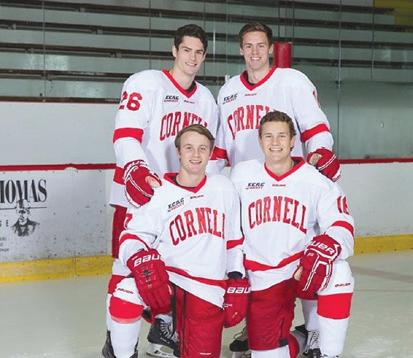
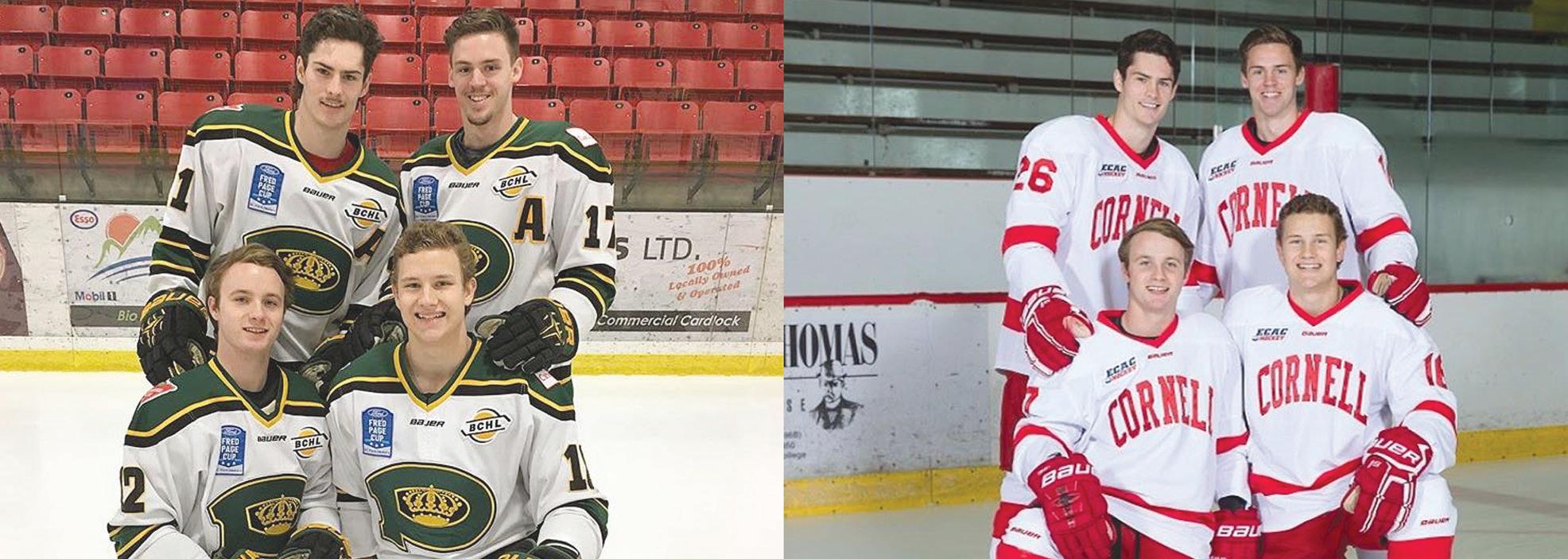
What ultimately came about is four former Kings now part of nationally-ranked Cornell’s 10-member sophomore class.
Betts, Tristan Mullin, Cam Donaldson — all forwards — and defenseman Matt Cairns are all nightly members
of Cornell’s lineup, and the quartet has brought to Ithaca a close bond built by long ferry rides from the island-hopping life of Powell River, runs in the BCHL playoffs and friendly rivalries with current Cornell teammates whom they once faced off against in the junior leagues.
“The coolest thing was knowing that … me and Tristan will have six years together,” Betts said in an interview last season alongside the three other Powell River products. “I’ll have four and a half with Matt and five with Cam, so it’s pretty neat to have relationships that are going to be strong after our senior year here.”
Four paths, one destination
To get Mullin to come to Cornell, Betts, like any good salesperson, knew he had to pull at the heartstrings of his client to close the sale.
Mullin hails from Cartwright, Manitoba, a small farming town by the Canadian border with North Dakota whose population in 2011 was 308. Cornell’s prestigious College of Agriculture and Life Sciences seemed like a good selling
point, Betts thought.
“For Tristan, I kind of sold him because I knew he was from a farming small town in Manitoba,” Betts said. “My main push for Cornell was the agriculture program we have here. Obviously the hockey program is a big interest too, but I think I really pushed him that way — the fact that you can get a good degree at the same time.”
Betts and Mullin played two years together for the Kings after each played a year in the minor junior league of their respective home provinces (Betts in Ontario, Mullin in Manitoba). Not long after the two first linked up in the 2015-16 campaign, they were joined at the start of the following season by Donaldson.
A small, high-flying winger, Donaldson has spent his life traversing the North American hockey landscape. A North Carolina native, Donaldson spent a year playing minor midget hockey in Dallas with the Dallas Stars Elite Hockey Club program before enrolling in a Connecticut
By RAPHY GENDLER Sun Assistant Sports Editor
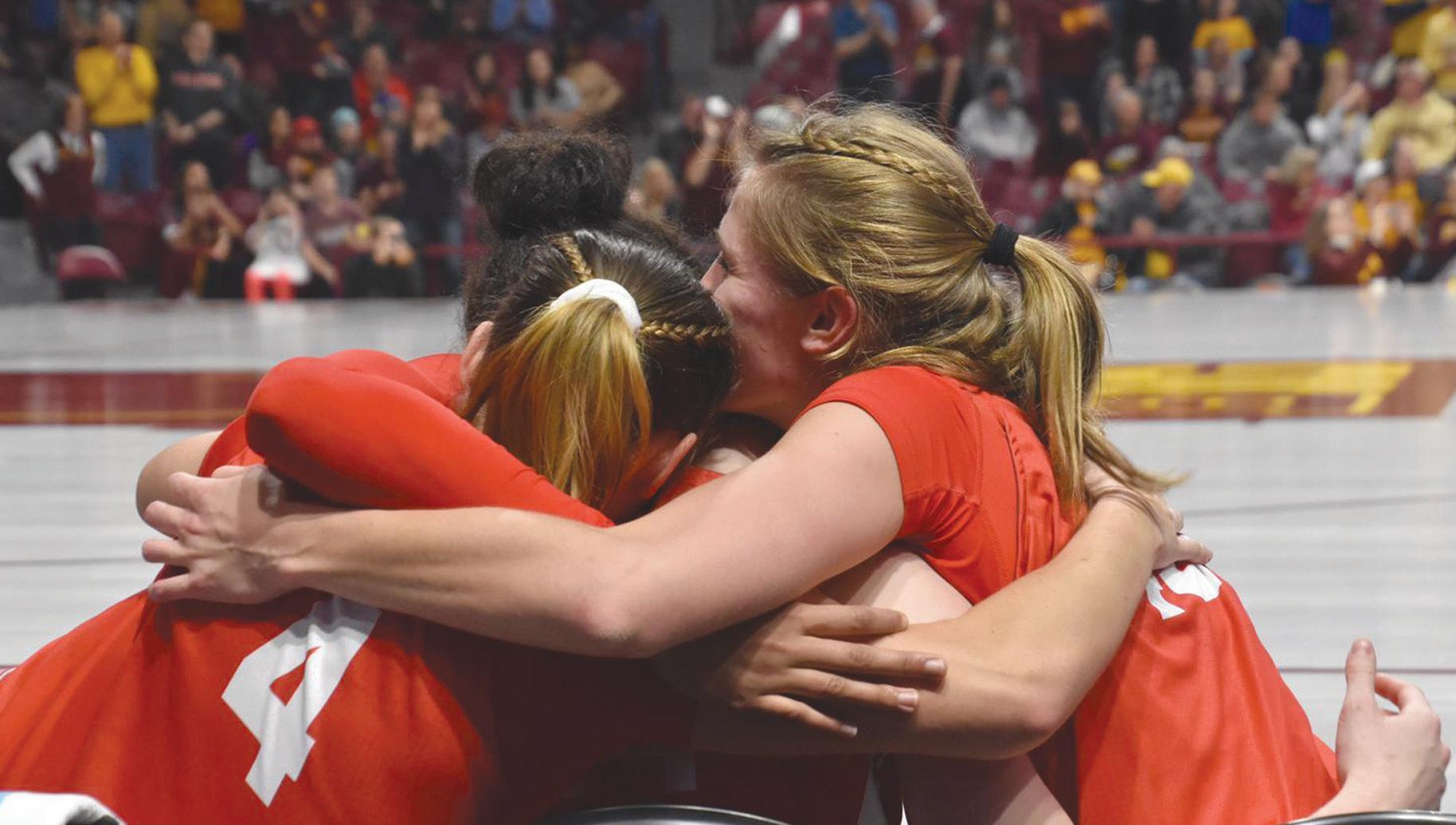
MINNEAPOLIS — The biggest ovation of the afternoon at Williams Arena came during pregame introductions for hometown hero, WNBA champion and former Golden Gopher Lindsay Whalen, the first-year Minnesota head coach. The second-most emphatic cheer came during garbage time of a 20-point Gopher romp for a hometown kid playing for the visitors.
“There was no part of me that ever thought I’d be playing against [Whalen] and her team in The Barn in front of my family and friends,” said Cornell women’s basketball freshman Annika Hoff, who played her first collegiate minutes in the Red’s 65-45 loss to No. 23 Minnesota.
Hoff, a Northfield, Minnesota, native,
by Minnesota from the opening tip to the final buzzer, has nearly enough players from the Land of 10,000 Lakes on its roster to fill a starting lineup: Hoff, junior Danielle Jorgenson, freshman Theresa Grace Mbanefo and junior Laura BagwellKatalinitch. Jorgenson, Mbanefo and Bagwell-Katalinitch each scored two points in the Black Friday afternoon contest in Minneapolis. The four got a chance to take the court together late in the game.
Hoff had played on this court before, for Northfield High School in the 2018 state tournament, and Friday was a “dream come true” all over again. She said assistant coach David Elliott told her family about the Red’s upcoming trip to the Twin Cities when he came to watch Hoff play at The Barn last March when she was a senior at Northfield.
“There was no part of me that ever thought I’d be playing against [Whalen] and her team in The Barn.”
Freshman Annika Hoff
checked out of the game at Williams Arena — lovingly called ‘The Barn’ in Minnesota — in the final minutes to applause from family, friends, high school coaches and some Gopher fans after scoring six fourth-quarter points in Cornell’s loss to the nationally-ranked Gophers.
The squad from Ithaca, overmatched
“When we had the opportunity to play in high school it was a dream come true because I always wanted to play at The Barn,” Hoff said. “And then when I found out I was going to get the opportunity to do it in college, too, it was just amazing to hear.”
Jorgenson and BagwellKatalinitch played AAU basketball together in high school, so go way back in their shared path from Minnesota to Cornell. Like Hoff, Bagwell-Katalinitch and Jorgenson played at The Barn in high school (Bagwell-Katalinitch won the State tournament her senior year).
“[Minnesota] seems to be more of a hotbed for basketball than a lot of people real-
ize,” said Jorgenson, who grew up following the Gophers and is a “huge” Lynx fan.
Jorgenson said knowing that Whalen was likely scouting her as an opponent prior to the game after rooting for Whalen throughout the now-coach’s WNBA career was a special experience.
“[Whalen has] been a huge idol for me and I know the other Minnesotans can attest to that as well,” Jorgenson said. “She’s a legend in that state.”
Hoff, who grew up watching the Gophers, has also been a fan of Whalen since the recently retired point guard helped the Lynx to their first of four WNBA championships in the span of seven years, a few years after guiding the Gophers to the 2004 Final Four and earning her No. 13 a place in The Barn’s rafters.
“When I was younger there was no part of me that ever thought I’d be playing against [the Gophers], let alone scoring which was just really fun,” Hoff said. “I also grew up watching Lindsay Whalen play for the Lynx and I was there when she won her championship when [the Lynx] played at The Barn in 2017.”
Hoff’s story of North Star State high school star-turned Cornellian isn’t unique on head coach Dayna Smith’s team. Jorgenson and Bagwell-Katalinitch, both juniors, trained with Hoff and Mbanefo in St. Paul over the summer and helped the pair of freshmen transition to college basketball. Do the four share a special bond?
“Yes, 100 percent,” Hoff said.