The Corne¬ Daily Sun


Sun that over the weekend all of the hotel’s 150 rooms were full.
After Cornell identified a cluster of COVID-19 cases Friday, a record-high number of students moved into isolation, forcing the University to expand capacity beyond the Statler Hotel and into nearby hotels for contact-traced and COVID-19 positive students.
Quarantine and isolation room capacity dipped to 38 percent on Monday evening, the lowest percentage so far during the pandemic. According to Cornell’s COVID-19 dashboard, 223 of 360 rooms have already been filled.
In its reopening plans, the University said it contracted with nearby hotels in case it needed the space, but Cornell has not publicly released these locations and declined to disclose them to The Sun due to privacy concerns.
A source at the Statler Hotel confirmed to The
The Statler, closed to outside visitors since the pandemic’s onset in March 2020, has been used to isolate students who have been exposed to or tested positive for COVID-19. Early in the fall semester, students reported subpar conditions in the hotel-turned-quarantine location.
The Sun found Cornell students iso-
lating at three other Ithaca properties –– the Hilton Garden Inn, Hotel Ithaca and the Courtyard by Marriott Ithaca Airport. Other area hotels have been used to quarantine arriving students, including Fairfield Inn and Suites, Canopy by Hilton and the Homewood Suites by Hilton.
At the Ithaca Airport Courtyard Marriott, a COVID-19 positive Cornell
senior, whose case is connected to the COVID-19 cluster identified on Friday, said they receive two calls each day –– one from Cornell Health and one from the Tompkins County Health Department –– to check in on symptoms, and to see if they need mental health services or medicine.
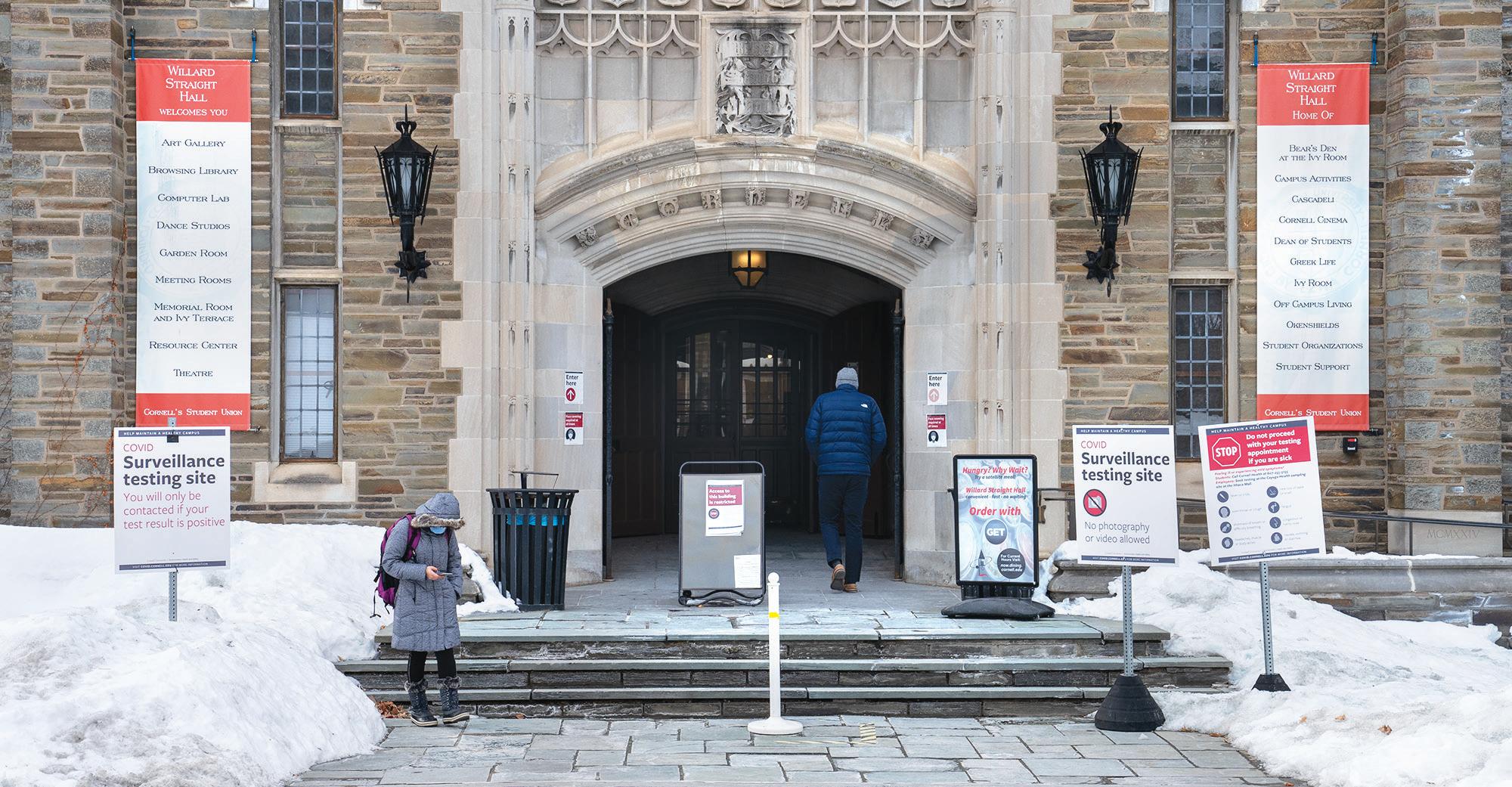
The student said they felt safe and taken care of at the Courtyard Marriott: the hotel stay has come with lunches from Collegetown Bagels, dinner from Ithaca Bakery, free premium-level Wi-Fi and comfortable beds.
A manager who answered the phone on Saturday declined to say whether or not the hotel was contracting with Cornell to house isolated students.
But for the senior, cause for concern came not from the hotel, but from Cornell Health. They said they worried they had come into contact with someone who had tested positive for the virus on campus, but
Two Cornellians featured in CNBC for their leadership
CNBC published an article Feb. 1 celebrating 23 Black leaders shaping history and inspiring future generations — and

Cornell students are among them. Cheick Camara ’22 and Ermias Tadesse ’22 earned a spot on the exclusive list for their work founding BlackGen Capital, the first minority-owned investment fund to be founded on Cornell’s campus.
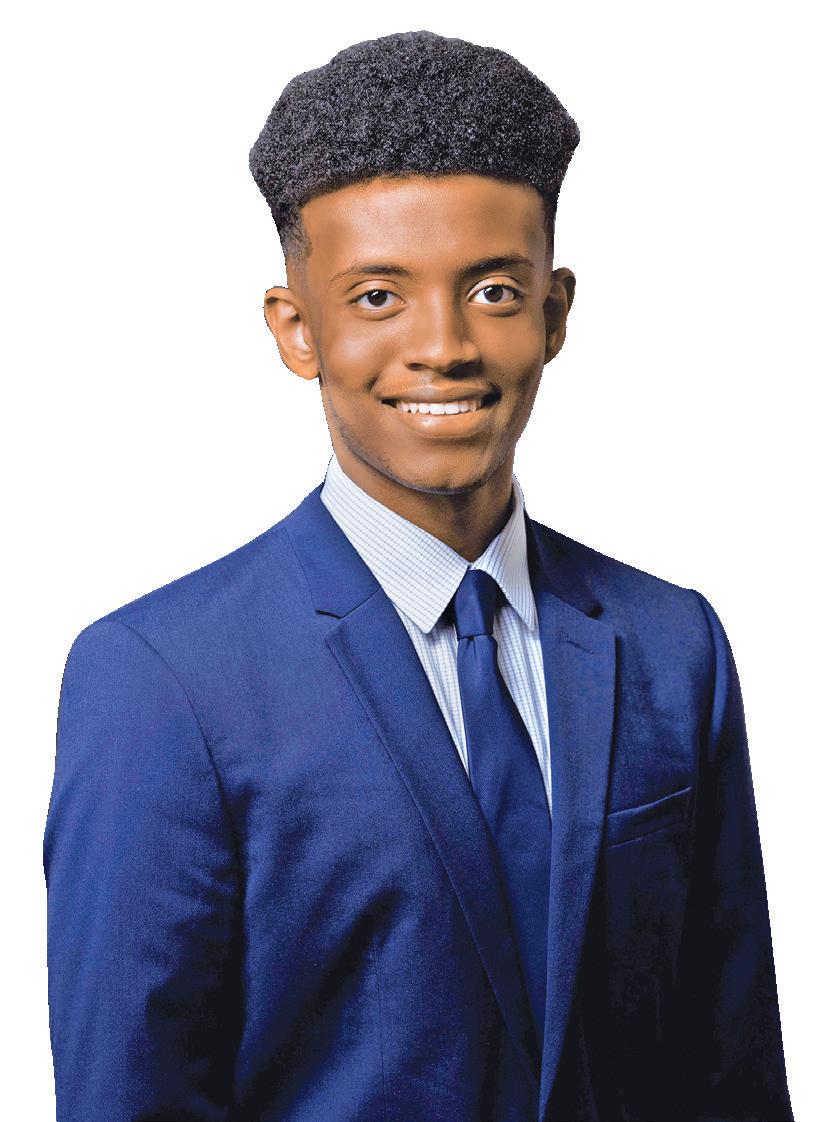
Camara and Tadesse share their success with their executive team: Yasmin Watt ’22, Savannah Holsey ’22 and Alec
Dinwiddie ’22 helped the pair turn the idea of BlackGen into a flourishing reality.
Camara and Tadesse share the spotlight with sitting Vice President Kamala Harris, corporate powerhouse Rosalind Brewer, director Nia DaCosta and astronaut Victor J. Glover. Other young history-makers on the list include 21-year-old Noah Harris, the first Black man to be student body president at Harvard, and 22-year-old Amanda Gorman, the youngest inaugural poet in U.S. history.
The BlackGen executive team called it a “humbling” experience to have earned a place on the list among people they consider role models. Camara recalls being especially inspired by Nicholas Johnson, the 23-year-old who earned distinction as Princeton’s first Black valedictorian.
“Just like last year, Ermias and I were talking about how this guy is incredible,” Camara said. “He has definitely served as a source of inspiration for me.”
Beyond the honor of CNBC’s
As COVID-19 variants spread rapidly across the United States, Tompkins County has only seen four cases of the virus variant first identified in the United Kingdom as of Feb. 8. But the health department remains vigilant, sequencing some COVID19 samples for the variant and encouraging people to avoid traveling.
Frank Kruppa said.
“We’re looking for relevant travel related to all variants that have been identified around the world at this point. Fortunately, to date, we’ve only identified the U.K. variant,” Kruppa said. Other variants identified internationally include the South Africa and Brazil variants.
“Fortunately, to date, we’ve only identified the U.K. variant.”
People are considered more at risk for COVID-19 variants if they tested positive for the virus and recently traveled internationally, or were exposed to someone who did. Cornell’s COVID-19 Testing Laboratory sequences the genomes of COVID-19 samples, Tompkins County Health Director Public Health Director
Frank Kuppa
While sequencing COVID19 samples allows the health department to monitor possible changes in how infectious COVID-19 will be in Tompkins County, the variant type does not currently change what medical care someone will receive.
“Sequencing is not considered a medical test so it doesn’t really tell us anything about the indi-
said Cornell Health declared them safe “because I wasn’t exposed to people within 48 hours of them testing positive,” the student wrote.
Anxious about their exposure to the virus, the student scheduled a supplemental test, which, 24 hours later, came back positive.
“If I hadn’t ignored Cornell Health and stayed isolated, [it probably] would’ve spread to other people,” the student wrote.
Kevin Merila ’22 also reported problems with COVID-19 testing. Merila isolated after coming into close contact with a student who tested positive for COVID19, and said a mistake in his patient data prevented him from being tested.
“When they initially called me I was supposed to be at the Hilton [Garden Inn]. They called back, saying ‘No, chill here in your room, because you have a single,’” Merila said. “They called me back saying we only have space for you at the Courtyard.”
Now five days into his isolation, he said Cornell Health still has not tested him. Cornell Health could not be reached for comment in time for publication.
“They never actually updated the Cornell Health backend,” Merila said, “While they knew I was at the Courtyard, my testing schedule was for the Hilton.”
At off-campus hotels, isolated students are supposed to stay in their rooms for a minimum of 10 days, staying away from non-isolating guests.
At the properties housing isolated students, however, regular guests also were able to book rooms. On Monday, when The Sun went through the Courtyard’s reservation system, all nights were available for booking besides Monday night.
Likewise, at the Hilton Garden Inn downtown, students isolating are sharing the property with guests.
Teri Tarshus, the general manager at the Garden Inn, declined to confirm if the property was contracting with Cornell to house isolated students or share how many people were isolated at the hotel.
If someone at the property tests positive for COVID-19, the hotel isn’t notified, Tarshus said.
While the Garden Inn sets entire floors aside for quarantine and isolation, Tarshus said regular guests booking at the hotel are not notified of the location’s isolation use.
“I don’t consider myself an isolation site,” Tarshus said. “I wouldn’t reach out to a guest and share with them that I have a basketball team staying here before they book.”
She said the hotel has protocols to prevent isolated individuals from potentially spreading COVID-19: Separate entrances, elevators and check-in procedures, as well as a text-in system where guests can request new linens and other needs, contactless meal delivery and enhanced cleaning protocols.
The Tompkins County Health Department did not respond to a request for comment by the time of publication when asked about their oversight and knowledge of Cornell’s off-campus isolation protocols.
On Monday, an updated Cornell dashboard showed that there were no new cases over the weekend, and only two new cases on Friday, a possible signal of what could be the end to the latest cluster-originated outbreak on Cornell’s campus.
a text-in system where guests can request new linens and other needs,; contactless meal delivery ; and enhanced cleaning protocols.
But when someone at the property tests positive for COVID-19, the hotel isn’t notified, Tarshus said. The same is true at the downtown Marriott, a manager answering the pho
The Tompkins County Health Department did not respond to a request for comment by the timein oftime for publication when asked about their oversight over, and knowledge of, Cornell’s off-campus isolation protocols.
On Monday, an updated Cornell dashboard showed that there were no new cases over the weekend, and only two new cases on Friday, an early signal of what could perhaps be the end to the latest cluster-originated outbreak on Cornell’s campus.
Alec Giufurta and Sean O’Connell can be reached at agiufurta@cornellsun.com and soconnell@cornellsun.com.
The Biden NLRB: Bipartisan Perspectives 1:00 - 2:00 p.m., Virtual Event
Introduction to
Two current Cornellians compared to other Black trailblazers
BLACKGEN
Continued from page 1
recognition, the BlackGen team sees it as validation of their efforts starting and executing the investment fund they started two years ago.
Recognizing a profound lack of diversity within the finance community at Cornell, Tadesse and Camara founded BlackGen Capital in 2019 to reduce the barriers that underrepresented students face in the field of finance.
On a national scale, white men dominate the world of finance. Beyond the racial gap in representation, minorities who have broken through the field face additional unique barriers.
Camara and Tadesse found that this trend pervaded Cornell’s campus: according to their own research, Black and Hispanic students populate less than 5 percent of the membership in many of Cornell’s other finance clubs.
To close the access gap and empower minorities within the finance community at Cornell, BlackGen provides its members with extensive resources and training in areas such as financial modeling, personal finance, resume building and stock pitch analysis. The members have the
opportunity to attend private networking events with their sponsors who hail from some of the top firms in the industry such as JP Morgan, Bloomberg and Bank of America.
“Breaking away allowed us to empower a whole entire community on Cornell’s campus that previously lacked exposure to careers on Wall Street, exposure to the financial resources
“It is crucial to bring change to college campuses, especially in this era where the underrepresented are blatantly discriminated against.”
Cheick Camara ’22
and access to information, as well as the corporate access to actually land internships and secure full time offers,” Camara said.
The publicity garnered by the article has bombarded the BlackGen team with student and industry attention. Corporations have flooded BlackGen’s email seeking opportunities to engage with the investment fund.
Even celebrities such as NFL players have interacted with the BlackGen’s LinkedIn page, inspiring the team to launch a
speaker series for members of the club in the coming months with other professional and celebrity role models.
BlackGen’s ambitions transcend Cornell’s campus, and the team has always aimed to expand the organization to universities across the nation. Especially now, the team is dedicated to using the attention generated by the article to foster connections with other students and multiply their impact.
According to Watt, chief operating officer of BlackGen, Georgetown University has already populated their executive board, and it will be the second university with a BlackGen Capital chapter on campus.
“It is crucial to bring change to college campuses, especially in this era where the underrepresented are blatantly discriminated against,” Camara said. “I’m very appreciative of the time and effort that we’ve all put in because these students have really shown that they’ve benefited from what we’ve been able to give them. Ultimately, BlackGen is helping us and them advance our professional journeys.”
Faith Fisher can be reached at fsher@cornellsun.com.
VARIANT
Continued from page 1
vidual at this point and what it will mean to them,” Kruppa said. “It’s really just knowing what variants we have here locally.”
According to Prof. Luis Schang, microbiology and immunology, it is normal for viruses to mutate as they replicate and form new variants over time, and that eventually, the distribution of COVID-19 variants may stabilize. However, this equilibrium may still change.
“This is nothing new, nothing special. Any virus walking into a new population does the same,” Schang said. “At some moment, there are going to be some [COVID-19] genomes that will be the most
predominant ones in the human population. We don’t know which ones they are going to be.”
Mutations that allow spikes on COVID19 viruses to better fit into cell receptors could increase the likelihood of infection, according to Schang. This easier fit between virus and receptor may be partially responsible for the fast spread of the UK variant, and has also emerged in the South Africa variant and others.
“Mutations that appear to be becoming more predominant include changes to the receptor binding site,” Schang said. “It appears that is having a major role in favoring entry.”
According to Schang, virus variants can become more prevalent in a variety of ways, including
through a superspreader event and high transmission rates. To limit the risk of more variant cases reaching Tompkins County, Kruppa suggests that people avoid all non-essential travel. If someone does travel, Kruppa recommends that they be cautious about distancing and wearing a mask while away, and follow state quarantine guidelines when they return.
For Cornell students, the travel planning process includes University regulations. Students who live in the Ithaca area this spring won’t leave until the semester ends, unless they have extenuating circumstances. Even then, students are required to apply for permission to travel, as well as quarantine and get tested when they return.
Despite changing variants, Kruppa’s recommendations remain the same: wear a mask, stay socially distanced and wash your hands. While Kruppa acknowledged many are weary of safety measures, he recommends that the best way to limit the spread of new variants is to more stringently follow the existing guidelines.
“I think folks are beginning to, and have been for a while, feel that fatigue associated with those measures that we’ve put in place and I completely understand that,” Kruppa said. “We would just encourage everyone to hang with us a bit longer.”
Tamara Kamis can be reached at tkamis@cornellsun.com.
By SYDNEY ORASKOVICH Sun Senior Staff Writer
While COVID-19 took center stage last year, science continued to celebrate exceptional leaps in other areas of research. The lessons learned from trial and error even found themselves translated into politics.
The bridge between science and government was showcased in December 2020 when Sen. Mark Kelly (D-Ariz.), a retired astronaut, was sworn in as Arizona’s newest senator in a special election.
Kelly’s experience as a scientist has informed his resilience and aptitude to make a bid for office, as he contributed to large bodies of research and logged over 50 days in space during his service to NASA from 2001 through 2011.
“When you are orbiting the earth at 25 times the speed of sound and bad stuff starts to happen, you have to work the problem as a team,” Kelly said in his campaign announcement. “You can not dismiss ideas based on the politics of the person offering them.”
Two months before he was sworn into office, Kelly’s great contribution to space research was recognized by NASA as integral research since the founding of the International Space Station in 2000.
In 2014, Mark Kelly and his twin brother, Scott Kelly, who is also a retired astronaut, participated in NASA’s twin study to make observations on the changes the human body endures in microgravity. The study shed light on how scientists can better prepare the human body for extreme environments — as the pace of space exploration picks up steam.
Weill Cornell Prof. Christopher E. Mason, physiology and biophysics, spearheaded the gene expression leg of the study that Kelly participated in. Mason worked simultaneously with nine other research teams, each focusing on a specific biological factor including cir-

cadian rhythm, mathematical modeling, cognition, exercise and changes in the genome.
“I have always had an interest in space and genetics,” Mason said. “[I’m interested in what] happens to the body in [microgravity].”
Scott Kelly, Mark Kelly’s twin brother, headed into space in 2014 and lived at the International Space Station for one year, while Mark stayed on Earth. The two routinely sent biological samples.
Using the biological samples, Mason examined the gene changes in Scott’s DNA and RNA compared to Mark’s, as well as their microbiota — the sum of all the bacteria found on the Kellys in both biological samples.
The results were surprising: Scott’s telomeres had grown longer, a shocking discovery since telomeres shorten with age, according to Mason.
“[Telomeres] are basically the caps at
the end of the chromosomes which keep the DNA intact and maintain integrity,” Mason explained. “You can imagine a shoelace and you have little plastic ends in the bottom — it’s like that, but for your DNA.”
Mason suspects that the elongation may be due not to the effects of space, but to Scott’s strict work schedule aboard the International Space Station.
“When they are in space, they actually have a well-balanced nutritious diet, they exercise every day and they are pretty regimented about getting sleep,” Mason said. “They ironically have a healthier lifestyle in some ways than on Earth.”
To eliminate potential variability in the study, Mark was given the option to follow the same diet and exercise schedule on Earth as his brother in space. However, as Mason described in an interview with the Sun, Mark ultimately opted for “nachos and margaritas.”
The study also found that Scott’s immune system went on “high alert” while in space, likely due to stress on the body from the extraterrestrial environment. In the space station, he picked up new microbiota.
When Scott Kelly returned to Earth, his cognitive function — measured by the speed at which he could solve problems — was also slightly lower than before his expedition.
Mason counted thousands of genes that had changed expression while in space, and about 91 percent of them reverted to their state before the trip after landing on Earth, the study found.
Overall, the study reinforced that the human body –– with the aid of gene editing –– could be robust enough to survive longer missions in space.
“Most things about the body are very plastic and reform back to baseline,” Mason said. “We [now] know the beginning roadmap of what we would do to protect the genome or protect astronauts, especially if they are going somewhere on a one-way trip where there’s more radiation or environmental stressors.”
Mason counted thousands of genes that had changed expression while in space, and about 91 percent of them reverted to their state before the trip after landing on Earth, the study found.
Overall, the study reinforced that the human body –– with the aid of gene editing –– could be robust enough to survive longer missions in space.
“Most things about the body are very plastic and reform back to baseline,” Mason said. “We [now] know the beginning roadmap of what we would do to protect the genome or protect astronauts, especially if they are going somewhere on a one-way trip where there’s more radiation or environmental stressors.”
Sydney Oraskovich can be reached at soraskovich@cornellsun.com.
By FEIFEI HU Sun Contributor
Gov. Wanda Vázquez Garced signed an executive order commiting Puerto Rico to reconstruct the Arecibo radio observatory — a telescope Cornell managed for 42 years.
The order was passed less than a month after the collapse of the radio telescope in December 2020, when the cables supporting the 900ton telescope snapped due to accumulated damages from Hurricane Maria in 2017 and multiple earthquakes in 2020.
The collapse of the
1,000-foot-wide dish, which was the largest radio telescope on Earth until 2016, paused current research and sent shockwaves in the astronomy community.
It was unsafe to make any repairs on the damaged cables before the collapse, according to the National Science Foundation, which announced in November 2020 that the Arecibo Telescope would be decommissioned.
The design of the Arecibo Observatory began in 1958, and was the brainchild of Prof. William Gordon, electrical engineering, who was known as the “father of the Arecibo Observatory.”
Gordon was interested in studying the ionosphere, a region of the atmosphere capable of reflecting radio waves.
“Gordon’s concept of using a natural earth form to support a 1,000-foot-diameter reflector to focus radio waves was ingenious and challenging,” said former Cornell President Dale Corson when the telescope was being designed. “A spherical reflector does not focus the radio waves at a point but along a line, and
he had to devise a way to collect those waves, which he and his staff did in brilliant fashion.”
The Advanced Research Projects Agency, under the Department of Defense, funded the construction. The agency was interested in monitoring the Earth ionosphere as a part of its Defender Program to develop ballistic missiles.
Since its inception, the observatory has contributed to numerous scientific discoveries. In 1967, Arecibo discovered that the rotation rate of the planet Mercury was 59 days rather than 88 — marking a significant transition from geocentric to heliocentric theory in understanding the solar system.
And beyond heliocentric theory, the radio telescope was also a technological achievement signifying more accurate equipment for studying space.
“Arecibo was the perfect telescope to study pulsars after they were discovered,” said Prof. Donald Campbell, astronomy.
Under subsequent directors in 1974, the observatory was used to discover binary pulsars — dense neutron stars that rotate rapidly and emit electro-
magnetic waves in pulses. In a binary pulsar, the two stars orbit around each other in an elliptical path.
The telescope’s detection of the radio waves emitted by this binary pulsar helped to confirm Einstein’s predictions of general relativity, and garnered the 1993 Nobel Prize in physics.
Arecibo’s initial asteroid detection later led to one of the biggest programs at the observatory, Donald Campbell said. This program expanded to detect not only asteroid existence, but also size, shape and rotation. Campbell was also involved in mapping the surface of Venus using Arecibo’s radar data in the 1980s, becoming the first observatory to produce radar maps of the planet Venus.
Arecibo has used radar data from pulsars to discover other phenomena in space, such as discovering exoplanets, planets that exist outside of the Solar System, from a pulsar they orbited.
Further, Arecibo has contributed to NANOGrav, a North American collaboration that aims to use pulsars to detect
gravitational waves — which are disturbances in the curvature of the space time continuum, and are produced from the collision of black holes.
“Arecibo has been crucial to [NANOGrav],” said Prof. James Cordes, astronomy, one of the researchers involved with the project. “We’re right on the verge of detecting these gravitational waves.”
Arecibo had been supplying half of the data used by researchers at NANOGrav. However, this data supply will be discontinued, as the collapse put an immediate halt to any research fully dependent on Arecibo.
Cordes emphasized the importance of the observatory as not just a facility, but an overall environment.
“It’s been a tremendous influence on me and not just as a physical place or a physical object,” Cordes said. “It was also a sanctuary to go to to be able to think. The radar was one of the world’s most powerful ... so it will be hard to replicate.”
Feifei Hu can be reached at fh22@cornell.edu.
The Cornell Concert Commission announced Jan. 18 that its latest virtual concert will star singer-songwriter Phoebe Bridgers at 7 p.m. on Saturday. Bridgers will be joined by fellow singer-songwriter Andrew Belle.
The free event, which will also consist of an additional Q&A with Bridgers, will be available to all Cornell students and accessible through the events page on Campus Groups.
“Los Angeles based singer-songwriter Phoebe Bridgers had something of a breakout 2020, topping critics’ year-end lists, accu-
mulating hundreds of millions of streams and receiving four Grammy nominations,” the CCC wrote in a press release. “Her dreamy indie folk and deeply personal lyrics, though, have been capturing fans’ hearts for years.”
Students will recognize her popular singles such as “Smoke Signals,” “Funeral” and “Motion Sickness” from her debut album, Stranger in the Alps . Her most recent album, 2020’s Punisher, received widespread critical acclaim. She is also known for forming the indie rock duo Better Oblivion Community Center with Conor Oberst, as well as her work with the group Boygenius, which features musicians Julien Baker and
Immortals Fenyx Rising , Ubisoft’s first original intellectual property in years, launched Dec. 3. Originally revealed under the title Gods and Monsters, Immortals Fenyx Rising brings players on a fun-filled ride into a world bursting with magic, monsters and, of course, the Greek gods of myth and legend.
Like many games over the past few years, Immortals draws on a painterly art-style to create its fantastic visuals. The lushly rendered imagery plunges you into the otherworldly nature of the island of the gods. For those that have played The Legend of Zelda: Breath of the Wild , Immortals ’ beautifully painted, cel-shaded art style will be familiar — perhaps overly so — but the mountains, monsters and rivers of Immortals are breathtaking all the same. I played Immortals on the Switch, and even with its lackluster hardware, the visuals in Immortals are captivating on screen.
As a third-person, exploration-based action role-playing game, Immortals places you in the shoes of Fenyx, the hero/heroine of Immortals , as they battle various mythical monsters with a combination of swords, axes, arrows and four activated abilities called godly powers. The gameplay seamlessly merges third-person melee combat and puzzle-solving areas, throwing players into the vaults of Tartarus to complete objectives or simply to earn more rewards. Though the map of Immortals is rel-
Lucy Dacus. Bridgers will be performing as a musical guest on Saturday Night Live’ s Feb. 6 show. Singer Andrew Belle released his debut album The Ladder in 2010 and has since released Black Bear and Dive Deep , two albums “filled with soaring choruses and moody arrangements,” the CCC wrote. Although currently living in Chicago, Belle has also resided in Los Angeles and Nashville and is a member of the critically acclaimed Nashville-based songwriter collective, Ten out of Tenn.
Emma Leynse is a sophomore in the College of Arts and Sciences. She can be reached at eleynse@cornellsun.com.

atively small compared to many of the sprawling oaking pen-world games that dominate the market today, it is packed with monsters, vaults and puzzles that will have completionists playing for well over 70 hours. To those familiar with Breath of the Wild , these gameplay elements will likely look very familiar. However, that is not necessarily a bad thing. If you enjoyed playing Breath of the Wild , Immortals offers a fresh story to go along with the similar mechanics.
The game takes a very hands-off approach, giving players almost freereign in exploring the virtual world at
where your climbing ability is limited by a stamina bar, a mini-map would have been useful in helping to navigate around unscalable cliffs and figure out the terrain before you blunder into it.
Where the game really shines, however, is in its plot and characters. Cast onto a beach in the middle of a storm, Fenyx wakes to a world in which everyone around them — from the inhabitants of the island to their brother — has been turned to stone. With Prometheus and Zeus taking turns narrating their story, Fenyx travels deeper into the island of the gods — taking on perilous mon-

their leisure. As a result of this handsoff approach, however, I did find that some elements of the gameplay — especially in the beginning — were not fully explained. Another minor, though still annoying, issue is the lack of a mini-map. A bar with the featured objectives works fine with games like Assassin’s Creed Odyssey — where you can climb literally anything with impunity. However, in a game like Immortals
sters, running into mythical heroes, and learning how to become as great of a warrior as their older brother Ligyron.
For me, the biggest highlights of the game are the characters of Fenyx, Zeus, and Prometheus. Fenyx in particular bursts with personality and heart. Some of my favorite moments in the game are just Fenyx’s reactions to the gods and monsters they encounter.
Fenyx is always ready with a quip or
joke — injecting humor into every situation. Even the way they open chests — drumming their hands excitedly on the lid or kicking at it only to clutch their foot in pain and hop around before trying again — works to showcase their fun-loving personality and the attention to detail placed into each character. Fenyx tackles every new adventure with unabashed glee, facing even the grandest and most terrifying of foes with a laugh and unshakeable optimism. The narrators, Prometheus and Zeus, also add to the game’s jovial atmosphere. Their witty banter helps provide context for the myths and legends that Fenyx encounters and shapes the story in often hilarious ways. Truly funny games are often hard to come by, but Prometheus and Zeus’ snide commentary often had me laughing out loud — which was not always helpful while I was battling a cyclops or minotaur. On the whole, Immortals Fenyx Rising is a perfectly fun, satisfying game — perhaps a bit too similar to other successful games of the past few years. Personally, I loved the use of Greek mythology, and the characters of Fenyx, Prometheus, and Zeus created a lovely, light-hearted atmosphere that was enjoyable to sink into. If you are a fan of Breath of the Wild or Greek mythology and are looking for a refreshingly fun gaming experience, Immortals Fenyx Rising is well worth picking up if you can find a good price.
Independent Since 1880
138th Editorial Board
MARYAM ZAFAR ’21
Rochester, N.Y. Editor in Chief
JOYBEER DATTA GUPTA ’21
Kolkata, West Bengal, India
Business Manager
PETER BUONANNO ’21
Charlotte, N.C.
Associate Editor
MEGHNA MAHARISHI ’22
Montclair, N.J.
Assistant Managing Editor
CHRISTINA BULKELEY ’21
Boston, Mass. Sports Editor
BORIS TSANG ’21
Plano, Texas
Photography Editor
AMBER KRISCH ’21
Brewster, N.Y. Blogs Editor
EMMA ROSENBAUM ’22
Toronto, Ontario, Canada Science Editor
ARI DUBOW ’21
Brooklyn, N.Y. City Editor
CAROLINE JOHNSON ’22
Huntington, N.Y. News Editor
KATHRYN STAMM ’22
Evansville, Ind. News Editor
PALLAVI KENKARE ’21
Atlanta, Ga. Opinion Editor
MIKE FANG ’21
San Jose, Calif. App Editor
CATALINA PEÑEÑORY ’22
Jakarta, Indonesia
Assistant News Editor
MADELINE ROSENBERG ’23
Chappaqua, N.Y.
Assistant News Editor
LUKE PICHINI ’22
Dresher, Pa.
Assistant Sports Editor
HANNAH ROSENBERG ’23
Chappaqua, N.Y.
Assistant Photography Editor
DANIEL MORAN ’21
Matthews, N.C.
Assistant Arts & Entertainment Editor
ANNABEL LI ’21
Cupertino, Calif.
Assistant Money & Business Editor
LEI ANNE RABEJE ’22
Ossining, N.Y. Layout Editor
JOHN MONKOVIC ’22
Ardsley, N.Y. Multimedia Editor
WINNY SUN ’20
Vancouver, B.C., Canada Newsletter Editor
AMANDA H. CRONIN ’21
Chappaqua, N.Y. Senior Editor
RAPHY GENDLER ’21
Minneapolis, Minn. Senior Editor
ALEC GIURFURTA ’21
Southampton, N.Y. Senior Editor
JOHNATHAN STIMPSON ’21
Darien, Conn. Managing Editor
KRYSTAL YANG ’21
Shanghai, China Advertising Manager
JASON HUANG ’21
College Point, N.Y. Web Editor
NIKO NGUYEN ’22
Fremont, Calif. Design Editor
JOHN COLIE ’23
West Paterson, N.J. Blogs Editor
ANIL OZA ’22
Queens, N.Y. Science Editor
BENJAMIN VELANI ’22
Minneapolis, Minn. Dining Editor
ALEX HALE ’21
Cumberland, R.I. News Editor
SEAN O’CONNELL ’21
Brooklyn, N.Y. News Editor
EMMA PLOWE ’23
West Nyack, N.Y.
Arts & Entertainment Editor
MAIA LEE ’21
Yorba Linda, Calif.
Money & Business Editor
OLIVIA WEINBERG ’22
Briarclif Manor, N.Y.
Assistant News Editor
MEGHANA SRIVASTAVA ’23
Plainsboro, N.J.
Assistant News Editor
EMILY DAWSON ’21
Ithaca, N.Y.
Assistant Sports Editor
BEN PARKER ’22
New York, N.Y.
Assistant Photography Editor
DOMINIC LAW ’22
Hong Kong
Assistant Dining Editor
BRIAN LU ’23
Taipei, Taiwan
Assistant Arts & Entertainment Editor
ALICIA WANG ’21
Fayetville, N.C. Graphics & Sketch Editor
MEI OU ’22
Brooklyn, N.Y. Production Editor
ANYI CHENG ’21
Palo Alto, Calif. Compet Manager
SARAH SKINNER ’21
Outer Banks, N.C. Senior Editor
PARIS GHAZI ’21
Cambridge, Mass. Senior Editor
NICOLE ZHU ’21
Princeton, N.J. Senior Editor
JEREMY MARKUS ’21
Rochester, N.Y. Senior Editor

Daniel Bernstein is a sophomore in the College of Arts and Sciences. He can be reached at dgb222@cornell.edu. Feel the Bern runs every other Monday this semester.
This piece is a plea to professors: keep the participation grade on your syllabus if you otherwise would, but don’t bother grading it. Give an A. Some of your students need it, all of them deserve it, and it really is your duty to do so.
Entering our third semester of the COVID-19 era and the second of the school year, the most obvious academic takeaway for students and teachers alike is clear: Online school sucks. I know that’s a cold take, but it’s painfully true. Although it has great benefts of spreading information and making an education more accessible, virtual school just can’t compare to the real thing.
You, the Professors, don’t need to hear about the fow of sufering that runs through hours of Zoom class, into Zoom club meetings, into online homeworks or how students barely leave our self-containment-cell rooms except for sustenance and exercise. You’ve heard all about it before.
And you know how draining class can be, regardless of modality. You know that bad grades hang over our heads like guillotines, even now, when surviving a pandemic should wipe away all other concerns.
So I ask you, Professor, with this in mind, to give us a break in the upcoming semester. Do not expect your students to be loud and proud in discussions and come to class ready with extra questions. By showing up to class (even with the camera of!) and by completing assignments, we show our willingness to participate and learn in your class.
Tat’s really all it should take. If we’re coming to class and doing work during a pandemic, that is full-on participation. Now, many professors understand that participation really should be a pretty easy A to begin with. Tis is a place where you can help your students and, after all, what good professor doesn’t want to do that? But, it must be said that during a pandemic, no opportunity to help students can be taken lightly. If you can, make it easier for us: Resiliency shouldn’t be a necessity of getting an education.
Of course, having school during a pandemic is hard for the professors as well. I don’t envy having to teach to a sometimes silent group of sometimes blank squares. I really do believe that all who are able to should keep their cameras on, and I think it’s good when professors encourage students to do so. But, I don’t think a student’s grade should sufer at the hand of their camera.
People have bad days and don’t feel active for class. Tat’s true of any semester but it is especially true now, when we still feel isolated and stressed because of, you know, the global pandemic and societal anxiety. It’s also more true for some
than others. Tere’s not an equal playing feld in this game. While all might struggle, some are dealing with more than just Zoom fatigue — illness for themselves or for friends/family, living spaces that are non-conducive to learning, and serious mental health issues.
Professors, just as you should encourage your students to speak up and turn their cameras on if they can, you should also encourage them to avoid doing so if they need to or if it will make their time in your class easier.
Te best way to really encourage this is to promise that it simply won’t afect their grade. Our participation as shown by attendance and completed assignments (or even proper communication in
Of course, having school during a pandemic is hard for the professors as well. I don't envy having to teach to a ... silent group of sometimes blank squares.
lieu of the two) should be good enough. Tis really does open up the broader question of academia, which is why do we grade? What is it that grades grade? I feel that the right answer is that a grade is a refection of how much a student learns. Tat’s why we’re here, to learn, right? According to its mission statement, Cornell aims to “disseminate knowledge” and “to educate the next generation of global citizens.”
Maybe grades are arbitrary anyway and everyone should get A’s. I mean who are you (yes, you, Professor) or anyone else to judge how much I or one of my peers have learned? During a pandemic, any amount of learning deserves to be fully rewarded. But the conversation for a Big Red Pass ended last spring, and now students are back once more, as if everything’s normal, starting a semester where grades will drive them insane and the outside world will continue to knock them down.
Tis semester, don’t brag that it’s impossible to get an A or an A+ in your class. You’re not cooler or smarter for that. You’re really just a prick. Don’t hurt students for being quiet, sleepy, or inactive. Instead, take pride in helping your students more easily get through what is bound to be a difcult semester. Help where it counts: the gradebook.

Joshua Dov Epstein is a sophomore in the College of Arts and Sciences, and can be reached at jde74@cornell.edu. His column, Heterodox, appears every other Tuesday this semester.
Last fall, to help ease the experience of returning to campus from states on New York’s 14-day mandatory quarantine list, Cornell promised to welcome back out-of-state students with a comfortable quarantine, meals, and a smooth transition to in-person study. Cornellians found all the mentioned necessities waiting for them, albeit with a slight twist. Te three meals usually featured soda, chips and cookies with a small quesadilla or salad. Many students joked on their social media about Cornell’s only distinction between lunch and dinner being a diferent brand of potato chips. As classes began, students returned to their routines and most put those welcome snacks out of their minds. But it’s worth another thought as the new semester starts.
Cornell is renowned for its meal plans, consistently ranking among top universities in the nation in terms of culinary quality, and in the past our university has made great progress in its oferings of healthy, fresh options
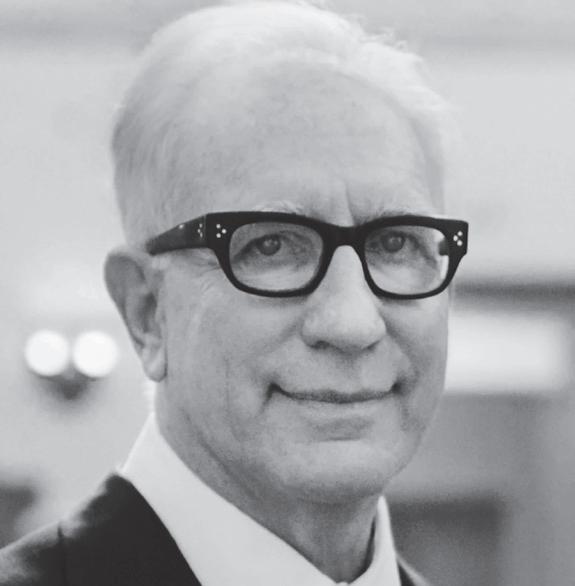
Howard A. Rodman
Tand guidance on how to make healthy choices with food. In terms of Cornell’s response to the pandemic, last semester the university set the bar for institutions of higher learning across the world by coming up with in-person instruction protocols centered around student safety. Yet, as part of its future pandemic response, Cornell could do much more to encourage healthy eating and exercise and reduce sugary and processed foods on campus.
A higher body mass index is directly linked to developing serious complications from a COVID-19 infection, as reported by the Center for Disease Control. Being overweight and obese can triple the risk of hospitalization from infection by the virus by weakening the immune system. Te CDC has said that along with its general recommendations to slow the spread of the pandemic, maintaining a healthy diet and properly exercising can shield against the adverse efects of COVID-19. With this information, as with other guidelines set by the CDC, Cornell could do a lot of good for students by adding a dietary consciousness and exercise component to its response to the pandemic. A healthy diet
...Cornell could do a lot of good for students by adding a dietary consciousness and exercise component to its response to the pandemic. The healthier students are physically, the safer they will be against the virus....
and exercise are more important now than ever, just by virtue of lowering BMI and bolstering immune system function. Te healthier students are physically, the safer
The three meals usually featured soda, chips and cookies ... Many students joked on their social media about Cornell’s only distinction between lunch and dinner being a different brand of potato chips.
they will be against the virsus and the better they will fare if infected.
Tere are a lot of ways this could be accomplished. One could be as simple as small reminders through the Daily Check or periodic newsletters, ofering ideas for healthy food options on campus and where to fnd them. Another idea could be to describe exercises that could be done in dorms, apartments or outside, socially distanced with friends. Te most direct approach, of course, would be to reduce the amount of sugary and processed foods that are part of Cornell meal plans or served by on-campus vendors and as a replacement, sourcing more healthy products from local small businesses and restaurants in Tompkins county.
With these two measures alone — reducing unhealthy products and more visibly promoting healthy diet and exercise — Cornell could help give its students a big advantage in reducing the risk of contracting and suffering the worst symptoms of COVID-19.
Schwerner was 24 years old. Chaney was 21. Goodman was 20.
Fifty years later they were posthumously awarded the Medal of Freedom by President Obama in a moving ceremony at the White House. As Obama put it, “While they are often remembered for how they died, we honor them today for how they lived — with the idealism and the courage of youth. James, Andrew and Michael could not have known the impact they would have on the civil rights movement or on future generations. And here today, inspired by their sacrifce, we continue to fght for the ideals of equality and justice for which they gave their lives.”
itles are symbolic, of course, but they also carry weight. When the buildings on a university campus are named for robber barons and captains of industry, that says something about the institution, and about the purpose of the education we receive. In buildings that bear the name of the highest bidder, are we not being told — perhaps subtly, perhaps brutally — that our post-collegiate life also belongs to whatever entity makes the winning ofer?
So it was with real pride that I read that new North Campus dormitories were being named not for mega-donors, but for those whose lives set a stunning and wondrous example. Toni Morrison M.A. ’55. Ruth Bader Ginsberg ’54. To reside in one of those dorms sends a diferent message: here is a life worth living. Tis is how I might live, had I the compassion, and the courage.
It’s in this context that I’m writing to urge that Cornell name one of these dormitories after Michael (Mickey) Schwerner ’61, James Chaney and Andrew Goodman.
Working with the Congress of Racial Equality, Schwerner, Chaney, and Goodman journeyed to the Deep South during ‘Freedom Summer’ of 1964 to help Black citizens — who had been disenfranchised en masse since the 1890s — register to vote. Tey paid for this work with their lives: slain by a mob of Klansmen outside of Meridian, Mississippi on June 21, 1964.
As we painfully know from recent elections, the franchise is still not something that all citizens can take for granted. Te Voting Rights Act of 1965, inspired in part by these slain civil rights activists and their comrades in CORE and SNCC, gave a national guarantee. But that act was eviscerated by the Roberts court in 2013. And the wholesale purging of voter rolls, the denial of the vote to former felons, the systematic elimination of polling places in predominantly Black precincts, the wholesale disqualifcation of mail-in ballots from predominantly poor and BIPOC districts from Detroit to Georgia, all of this tells us that the work for which Schwerner, Goodman, and Chaney gave their lives is still savagely unfnished.
After Cornell I worked in New York for the National Emergency Civil Liberties Committee, editing their publication Te Bill of Rights Journal. My boss there was Nat Schwerner, Mickey’s father. I spent many afternoons listening to Nat talk about his son. His pride in the choices Mickey had made. His
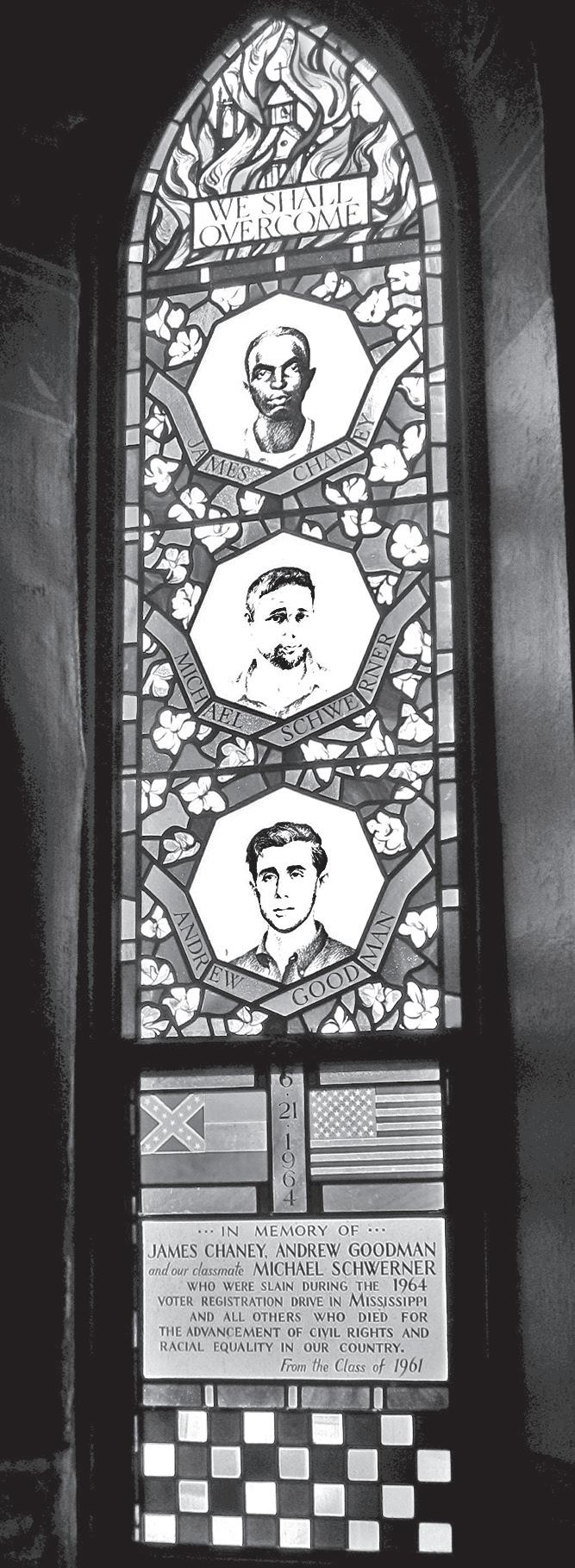
unending sense of loss. And over the course of long conversations, together we would envision, and mourn, the life Mickey would have lived — and the world he would have created, had he not been taken. My own commitment to a life of activism was not forged in those conversations, but it was deepened, strengthened. I did not possess the courage to risk my life the way Mickey had. But I did want to live like him. So much of what I’ve done in the half-century since leaving Ithaca has been informed by the memory of Mickey Schwerner. Tat I might leave the world a more just place than I found it. And that my parents might one day be as proud of me as Nat was of his son. When I was at Cornell, the memory of Mickey Schwerner burned bright, but there was no acknowledgement on our campus of his work, his sacrifce. Later, in 1991, a stainedglass window commemorating the three slain civil rights workers was installed in Sage Chapel, that sunlight might shine through them, onto us, coloring our lives.
Still, there is a larger window we might open here. Cornell University, its students and its professors, played a disproportionately large role in the civil rights movement. Tis is something that deserves to be honored, celebrated, remembered. I can think of no better way than to name one of our residence halls after Schwerner, Goodman and Chaney.
Joshua Dov Epstein is a sophomore in the College of Arts and Sciences, and can be reached at jde74@cornell.edu. His column, Heterodox, appears every other Tuesday this semester.
Last fall, to help ease the experience of returning to campus from states on New York’s 14-day mandatory quarantine list, Cornell promised to welcome back out-of-state students with a comfortable quarantine, meals, and a smooth transition to in-person study. Cornellians found all the mentioned necessities waiting for them, albeit with a slight twist. Te three meals usually featured soda, chips and cookies with a small quesadilla or salad. Many students joked on their social media about Cornell’s only distinction between lunch and dinner being a diferent brand of potato chips. As classes began, students returned to their routines and most put those welcome snacks out of their minds. But it’s worth another thought as the new semester starts.
Cornell is renowned for its meal plans, consistently ranking among top universities in the nation in terms of culinary quality, and in the past our university has made great progress in its oferings of healthy, fresh options
Howard A. Rodman
Tand guidance on how to make healthy choices with food. In terms of Cornell’s response to the pandemic, last semester the university set the bar for institutions of higher learning across the world by coming up with in-person instruction protocols centered around student safety. Yet, as part of its future pandemic response, Cornell could do much more to encourage healthy eating and exercise and reduce sugary and processed foods on campus.
A higher body mass index is directly linked to developing serious complications from a COVID-19 infection, as reported by the Center for Disease Control. Being overweight and obese can triple the risk of hospitalization from infection by the virus by weakening the immune system. Te CDC has said that along with its general recommendations to slow the spread of the pandemic, maintaining a healthy diet and properly exercising can shield against the adverse efects of COVID-19. With this information, as with other guidelines set by the CDC, Cornell could do a lot of good for students by adding a dietary consciousness and exercise component to its response to the pandemic. A healthy diet
...Cornell could do a lot of good for students by adding a dietary consciousness and exercise component to its response to the pandemic. The healthier students are physically, the safer they will be against the virus....
and exercise are more important now than ever, just by virtue of lowering BMI and bolstering immune system function. Te healthier students are physically, the safer
The three meals usually featured soda, chips and cookies ... Many students joked on their social media about Cornell’s only distinction between lunch and dinner being a different brand of potato chips.
they will be against the virsus and the better they will fare if infected.
Tere are a lot of ways this could be accomplished. One could be as simple as small reminders through the Daily Check or periodic newsletters, ofering ideas for healthy food options on campus and where to fnd them. Another idea could be to describe exercises that could be done in dorms, apartments or outside, socially distanced with friends. Te most direct approach, of course, would be to reduce the amount of sugary and processed foods that are part of Cornell meal plans or served by on-campus vendors and as a replacement, sourcing more healthy products from local small businesses and restaurants in Tompkins county.
With these two measures alone — reducing unhealthy products and more visibly promoting healthy diet and exercise — Cornell could help give its students a big advantage in reducing the risk of contracting and suffering the worst symptoms of COVID-19.
Schwerner was 24 years old. Chaney was 21. Goodman was 20.
Fifty years later they were posthumously awarded the Medal of Freedom by President Obama in a moving ceremony at the White House. As Obama put it, “While they are often remembered for how they died, we honor them today for how they lived — with the idealism and the courage of youth. James, Andrew and Michael could not have known the impact they would have on the civil rights movement or on future generations. And here today, inspired by their sacrifce, we continue to fght for the ideals of equality and justice for which they gave their lives.”
itles are symbolic, of course, but they also carry weight. When the buildings on a university campus are named for robber barons and captains of industry, that says something about the institution, and about the purpose of the education we receive. In buildings that bear the name of the highest bidder, are we not being told — perhaps subtly, perhaps brutally — that our post-collegiate life also belongs to whatever entity makes the winning ofer?
So it was with real pride that I read that new North Campus dormitories were being named not for mega-donors, but for those whose lives set a stunning and wondrous example. Toni Morrison M.A. ’55. Ruth Bader Ginsberg ’54. To reside in one of those dorms sends a diferent message: here is a life worth living. Tis is how I might live, had I the compassion, and the courage.
It’s in this context that I’m writing to urge that Cornell name one of these dormitories after Michael (Mickey) Schwerner ’61, James Chaney and Andrew Goodman.
Working with the Congress of Racial Equality, Schwerner, Chaney, and Goodman journeyed to the Deep South during ‘Freedom Summer’ of 1964 to help Black citizens — who had been disenfranchised en masse since the 1890s — register to vote. Tey paid for this work with their lives: slain by a mob of Klansmen outside of Meridian, Mississippi on June 21, 1964.
As we painfully know from recent elections, the franchise is still not something that all citizens can take for granted. Te Voting Rights Act of 1965, inspired in part by these slain civil rights activists and their comrades in CORE and SNCC, gave a national guarantee. But that act was eviscerated by the Roberts court in 2013. And the wholesale purging of voter rolls, the denial of the vote to former felons, the systematic elimination of polling places in predominantly Black precincts, the wholesale disqualifcation of mail-in ballots from predominantly poor and BIPOC districts from Detroit to Georgia, all of this tells us that the work for which Schwerner, Goodman, and Chaney gave their lives is still savagely unfnished.
After Cornell I worked in New York for the National Emergency Civil Liberties Committee, editing their publication Te Bill of Rights Journal. My boss there was Nat Schwerner, Mickey’s father. I spent many afternoons listening to Nat talk about his son. His pride in the choices Mickey had made. His
unending sense of loss. And over the course of long conversations, together we would envision, and mourn, the life Mickey would have lived — and the world he would have created, had he not been taken. My own commitment to a life of activism was not forged in those conversations, but it was deepened, strengthened. I did not possess the courage to risk my life the way Mickey had. But I did want to live like him. So much of what I’ve done in the half-century since leaving Ithaca has been informed by the memory of Mickey Schwerner. Tat I might leave the world a more just place than I found it. And that my parents might one day be as proud of me as Nat was of his son. When I was at Cornell, the memory of Mickey Schwerner burned bright, but there was no acknowledgement on our campus of his work, his sacrifce. Later, in 1991, a stainedglass window commemorating the three slain civil rights workers was installed in Sage Chapel, that sunlight might shine through them, onto us, coloring our lives.
Still, there is a larger window we might open here. Cornell University, its students and its professors, played a disproportionately large role in the civil rights movement. Tis is something that deserves to be honored, celebrated, remembered. I can think of no better way than to name one of our residence halls after Schwerner, Goodman and Chaney.
Fill in the empty cells, one number in each, so that each column, row, and region contains the numbers 1-9 exactly once. Each number in the solution therefore occurs only once in each of the three “directions,” hence the “single numbers” implied by the puzzle’s name. (Rules from wikipedia.org/wiki/ Sudoku)






By RAPHY GENDLER Sun Senior Editor
Shoppers looking for specialty items like Scandinavian Swimmers, Everything but the Bagel Sesame seasoning and dark chocolate peanut butter cups are counting down the days until Feb. 19, when Trader Joe’s is set to open in Ithaca.
The new store, located on Meadow Street southwest of Cornell’s campus, will open next Friday after the pandemic delayed its arrival, which was first reported in March of last year. The opening will make the Ithaca location the 29th Trader Joe’s store in New York State and the 515th location in the country, according to The Ithaca Voice, which first reported the opening date.
For Ithacans and Cornellians looking for organic options and fun snacks, the arrival of a Trader Joe’s — the Californiabased grocery store known for its specialty products — is years in the making. The Facebook page “Ithaca Needs a Trader Joe’s” launched 10 years ago and the local push for a store gained steam after one opened in Syracuse in 2014.
Allison Herstic ’21 said she is excited to cut down on gas costs from her every-other-week trips with friends to Syracuse, previously the closest branch of her favorite grocery store. She loves the Brooklyn Babka, and is hoping Trader Joe’s brings back her favorite gorgonzola crackers.
The site will open in a crowded shopping corridor in Ithaca’s west end — down the road from Wegmans, the upstate New York-based go-to, as well as the new flagship store for the co-op GreenStar. Walmart, Tops and Aldi are
also nearby, as is a Ren’s Mart, a new Asian market that occupies GreenStar’s previous location.
Prof. Edward McLaughlin, applied economics and management, who studies marketing and retail in the food industry, said Aldi and GreenStar will feel the impact of introducing Trader Joe’s, which carries about 4,000 products, to local competition more than a larger retailer like Wegmans, which carries more than 50,000 items and is around 10 times the size of a Trader Joe’s.
“It’s a radically different concept than any other store we have in Ithaca,” McLaughlin said, citing the focus at Trader Joe’s on organic and local-oriented food, and the use of a private label.
He said the store will benefit from local buzz and wordof-mouth advertising. Furthermore, it will benefit from the fact that many in Ithaca are already familiar with Trader Joe’s from other cities, according to McLaughlin.
“They are going to be very successful because they are basically successful wherever they open stores,” Gómez said. “Ithaca has the right demographic composition for Trader Joe’s to open because Trader Joe’s [provides] a fun environment to shop and very good prices with fairly high-quality products.”
“I couldn’t welcome it more with open arms, couldn’t be more excited.”
“We warmly welcome Trader Joe’s to the Ithaca neighborhood as a new business that will surely support our local economy and offer new food choices to the community,” Brandon Kane, GreenStar’s general manager, wrote in a statement to The Sun, mentioning GreenStar’s sustainability efforts and use of a living wage. “We’re confident customers will continue to support GreenStar for our unique features and the values that distinguish us among food retailers.”
Allison Herstic ‘21
Ithaca is smaller than most markets Trader Joe’s has entered, but checks a number of the company’s boxes: It caters to college students, faculty and locals who want organic products. Gómez said he expects Trader Joe’s to increase the number of shoppers in Ithaca, since customers from towns outside Ithaca might flock to the new grocery store.
Trader Joe’s is a fast-growing player in the grocery industry. The chain has locations in 42 states and opened 21 new stores in 2019.
The Director of the Cornell Food Industry Management Program, Prof. Miguel Gómez, applied economics and management, said Trader Joe’s alternative approach — high-quality products at low prices — makes it one of

While Trader Joe’s might threaten a locally-operated co-op like GreenStar, customers like Trader Joe’s fans on the Facebook page are hopeful that the community can sustain both retailers. GreenStar has felt the impact of the pandemic even more than other small businesses — it opened its new, larger store right as the coronavirus upended normal operations.
Matt McLaren, GreenStar’s prepared foods director, said GreenStar’s support of local farmers, workers and businesses makes its success important to the community.
“Bringing in that kind of competition, which offers unrealistically low pricing in certain areas of their product line, is really going to be tough on us as a business,” McLaren said of Trader Joe’s. “Why I think that’s not so great for Ithaca as a whole is GreenStar plays a vital role in supporting local farmers [and] local businesses.”
While it’s unclear how Trader Joe’s will challenge other well-established shopping options, especially in its first few weeks, it also remains to be seen whether the establishment can succeed in a smaller market than it’s used to — and in a part of town saturated with grocery stores.
The pandemic adds to the already long list of challenges facing a new store. But Trader Joe’s has been successful elsewhere because it identifies promising markets and appeals to people who want a different type of shopping experience, McLaughlin said.
“I am ecstatic. It has been a long time coming,” Herstic said. “I have always wanted there to be a Trader Joe’s in Ithaca. ... I couldn’t welcome it more with open arms, couldn’t be more excited.”
The new Trader Joe’s location is at 744 S. Meadow Street. The store will be open seven days a week from 8 a.m. to 9 p.m.
Christina Bulkeley ’21 contributed reporting.
Gendler can be reached at rgendler@cornellsun.com.
By MICHAEL CADOGAN Sun Contributor
With the explosive growth of the cryptocurrency industry in the past five years, tech-savvy professionals are seeking business opportunities in this industry in the form of entrepreneurship.
Founder of crypto-startup Ava Labs Prof. Emin Gün Sirer, computer science, is one person taking advantage of the burgeoning industry, raising over $60 million in venture capital funding in less than two years.
Sirer started Ava Labs in 2018 with the help of two Cornell graduate students, Kevin Sekniqi ’20 and Maofan Yin ’21. According to the company’s leaders, the team’s success has relied on its unique “consensus protocol” — the technology that underlies the transactions of cryptocurrency and ensures its legitimacy.
Ava Labs’ novel consensus protocol, Avalanche, can expand cryptocurrency’s potential in
the financial sector by offering greater transaction speeds, said Sirer. Unlike Bitcoin and other traditional cryptocurrencies, Avalanche does not rely on a master-ledger to process payments.
Instead, by avoiding the process of recording all past transactions on a single ledger, Avalanche reduces processing time and can finalize transactions faster than existing networks.
As more people buy the AVAX token, it appreciates in value — much like Bitcoin. Stockholders are then able to make profits off of the token’s appreciation.
The viability of Ava Labs’ innovations were met with some skepticism from those within the cryptocurrency sphere. But to quickly prove them wrong, Sirer said, he brought Avalanche directly to the market, rather than subject it to a lengthy peer-review process.
“I thought, let me just jump
in and show the world,” Sirer said.
The launch of Ava Labs’ Avalanche came at a time of mixed sentiments for the cryptocurrency and blockchain world. Though initially hailed as potentially revolutionary by some, high-profile hacks and extreme volatility have dogged many cryptocurrencies, sowing
“I thought, let me just jump in and show the world.”
Prof. Emin Gün Sirer
doubt in their true potential to replace regular money.
In addition, cryptocurrency’s links to illegal activity have tarnished its reputation as a legitimate alternative to currency. For example, the infamous, now-defunct online marketplace Silk Road relied on cryptocurrency to provide anonymity to facili-
tate illegal transactions.
However, a large part of Sirer’s strategy for Ava Labs rests on dispelling some of these preconceptions.
Considering himself just as much a professor as a startup executive, Sirer emphasized his commitment to the facts and academic rigor. His team, composed of blockchain enthusiasts from Cornell and beyond, shuns the type of sensational bravado that has accompanied Bitcoin’s meteoric rise.
“Our backgrounds, or personalities involved in our system, our discourse … It’s all science driven, empirically driven,” Sirer said.
When it first released the Avalanche protocol in March 2020, Ava Labs tapped the cryptocurrency community to identify bugs that could otherwise leave its network vulnerable to attacks. The company hosted an event called a Bug Bounty, which it used to incentivize participants to discover
bugs by offering $50,000 in prizes.
By July 2020, Ava officially released its token into the market, ultimately generating $42 million in additional funding.
Sirer credited Ava’s rapid growth to his Cornell-educated team: “I’ve been blessed with access to the Cornell talent pool. The people who know about [the Cornell network] and have inroads into it do really well,” Sirer said. “But I feel that it’s actually under-utilized by industry.”
As technology stocks continue to receive sky-high valuations, Sirer underscored how entrepreneurship can often be rewarded in the current financial climate.
“There’s a lot of money lying idle in the economy,” Sirer said. “[Investors are] looking for credible, trustworthy teams doing things to improve the state of the world.”
Michael Cadogan can be reached at mbc86@cornell.edu.