The Corne¬ Daily Sun


By CHRISTINA MAcCORKLE
Staff Writer
In an interview with The Sun, emeritus board member and generous donor, Jon Lindseth ’56, refuted his critics who have defended the University’s commitment to diversity, equity and inclusion.
Multiple alumni have criticized Lindseth’s open letter calling for President Martha Pollack and Provost Michael Kotlikoff’s resignation which connected antisemitic incidents and a lack of free speech to the University’s “misguided commitment” to DEI.
The Alpha Chapter Alumni Association — a network of alumni who were initiated at Cornell’s chapter of Alpha Phi Alpha, the first intercollegiate Greekletter fraternity established for African American men — published a letter to the editor defending the University’s commitment to DEI, maintaining that DEI is central to Cornell’s founding principles.
“Cornell University’s founding principle of ‘any person, any study’ was indeed our beloved University’s first ever DEI statement,” their letter read.
In response, Lindseth told The Sun that he agreed that diversity has been part of Cornell’s history, but objected to how he perceived advocates of DEI to go beyond the acronym’s stated values.
“Diversity is not new at Cornell. Here’s the problem with DEI — it's the
‘E.’ They want everyone’s outcome to be the same. They aren’t satisfied with all people are created equal at birth. They want everyone to come out the same,” Lindseth said. “For instance, they don’t want advanced placement and secondary schools because those people are going to get better grades and be more likely to be admitted.”
In an email to The Sun, Lindseth also affirmed that while he supports diversity, he believes that it has gone too far.
“I said I favor the Blacks at Cornell. What I don’t favor is anybody admitted just to fill a diversity need,” Lindseth said. “I am with Martin Luther King in this regard. He was very clear. Merit should be the overriding criteria.”
Lindseth maintained that although he supports the principles of inclusion and diversity, DEI is harmful because it “has become a religion to people.”
“This is their belief system. I happen to believe in Jesus Christ the Savior. For the DEI people, that’s their religion,” Lindseth said.
Lindesth had not seen the contents of The Alpha Chapter Alumni Association’s letter before his interview with The Sun.
In the interview, when presented with the letter’s contents, rather than addressing those arguments, Lindseth said that he supported Black students attending Cornell.
“Blacks have chosen
See LINDSETH page 4

By CATHERINE ZHU Sun Staff Writer
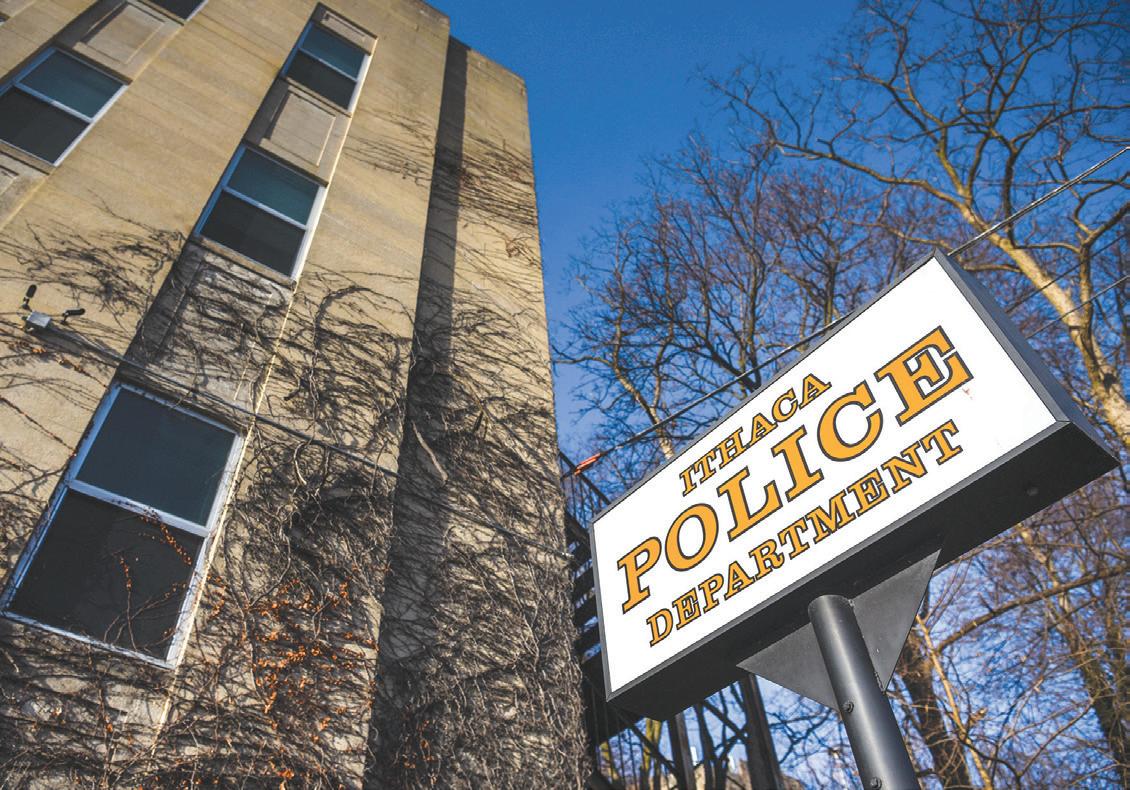
After reports last fall that the Ithaca Police Department was “dangerously under-staffed,” the City of Ithaca and IPD have aimed to mitigate officer shortages.
Ithaca Mayor Robert Cantelmo grad told The Sun that the renewed union contract between the city and IPD as well as a new chief of police have helped facilitate the increase in hiring.
IPD’s staffing issues were highlighted in 2023 when Ithaca Police Union President Tom Condzella said that the IPD had only 38 officers, down over 50 percent from just two decades ago.
“In less than a month, since I’ve taken office as mayor, we’ve sworn in four new police officers,” Cantelmo said. “Back in 2022 when I first joined the council, we had 15 or 17 vacancies in the roster.”
The new labor contract negotiated in October between the IPD and the city increased pay and added additional health benefits for its officers. Cantelmo also cited Ithaca’s new police chief as an important factor in the IPD’s renewal.
Thomas Kelly, the new Ithaca chief of police filled a nearly three-
year vacancy in the agency. Kelly said engaging the IPD further in the community is one of his top priorities.
“For Ithaca specifically, not having a chief for a few years and not knowing what the future of IPD looked like certainly impacted the department,” Kelly said.
Kelly also described IPD staffing shortages reflect nationwide trends in police staffing.
“This is one of those careers that was very challenging 20 years ago to get into with so many people com-
peting for positions,” Kelly said. “But certainly across the country in the last few years, along with competitive pay in other jobs, calls for change in law enforcement — which produced a lot of [necessary] conversations — also became a barrier for recruitment.”
To continue reading this article, please visit www.cornellsun.com.
By DOROTHY FRANCE-MILLER Sun Staff Writer
Eva Pérez ’27 originally opted to study biology within the College of Agriculture and Life Sciences rather than the College of Arts and Sciences due to qualifying for CALS in-state tuition, which drops Cornell’s annual tuition from $65,204 to $43,888. But Pérez said that her academic path is consequently out of alignment with her interdisciplinary interests, due to Cornell’s restriction on double majoring across different colleges.
“I do not plan on going into agriculture or just life sciences but rather computational biology,” Pérez said. “If I were permitted, I would be a computer science major as well as a CALS biology student.”
CALS is a contract college, meaning it is affiliated with and partially funded by New York State. There are two other undergraduate contract colleges at Cornell: the College of Industrial and Labor Relations and the College of Human Ecology.
For access to multiple majors, not all schools are created equal. For example, CAS offers 40+ majors, whereas ILR offers only one major from which students can choose between four concentrations.
While students can pursue minors outside of their home college, some students believe that double majoring offers greater benefits.
“You get to learn a variety of concepts that connect with each other through double majoring,” said Carina Lau ’27, who is double majoring in communication and information science in CALS.
Cornell’s restriction on double majoring across colleges is due to the inability to reasonably complete general education requirements from both colleges within four years, according to Cornell Undergraduate Admissions.
The University previously operated a concurrent degree program, which “allowed both a bachelor of science and either a bachelor of arts or bachelor of fine arts degree to be earned in about five years.”
But this program was discontinued for students who matriculated after fall 2021. The concurrent degree program was also only open to students in endowed colleges — excluding students enrolled in contract colleges.
When asked if the existence of Cornell’s contract colleges affected the availability of double majors or dual enrollment across schools, a representative of the University simply replied “No.”
To continue reading this article, please visit www. cornellsun.com.
Dorothy France-Miller can be reached at dfrancemiller@cornellsun.com.



By GRACE LIU AND LUCA PAVLOVICH Sun Staff Writer and Sun Contributor
“I start in Alliance, Nebraska. I fly into Denver on a nine-seater plane. Then, I either fly from Denver to Detroit or Denver to New York City. And then, from either of those places, I fly into Syracuse. Then I take an OurBus ride from Syracuse to Ithaca, which is usually about an hour and 45 minutes. All in all, that usually makes for a 15-hour travel day.
Like many Cornellians, Carver Hauptman ’27 faces a long and arduous journey to Ithaca every semester. However, students must bring more than themselves to The Hill — their baggage.
With students relying on multiple modes of transportation to reach Ithaca, varying baggage policies on airplanes and buses and climbing costs of shipping complicate how students can bring their belongings to Ithaca.
OurBus, a company that partners with various bus companies to arrange transportation for passengers by offering intercity and commuter bus routes, is a staple of Cornellians’ travel plans back to Ithaca. According to Axel Hellman, co-founder and head of transportation planning at OurBus, between 240 and 500 people rode the OurBus from New York City to Ithaca every day between Jan. 18 and Jan. 22.
Although airplanes allow customers to bring extra baggage for a small added cost in comparison to the price of the ticket, busing companies’ policies on extra luggage differ drastically. Unlike airplanes, buses do not have massive luggage holds, limiting passengers to one large bag per person.
“The current policy is that space for one bag is guaranteed for each ticket. Additional bags can be accommodated at no charge if and only if space is available once everyone else boarded,” Hellman said in an interview with The Sun. “Generally, at Cornell movein times in August, December, January and May, almost every passenger brings large luggage, so extra space is extremely limited.”
Hauptman, an OurBus customer familiar with these rules and the packed buses heading back to Ithaca for the spring semester, plans in advance.
“I bring one checked bag and one personal item, so my backpack,” Hauptman said. “Last time, my bag was over the weight limit by 5 pounds, so I had to wear a heavier pair of shoes and pack a jacket and my vest in my backpack. I had to leave a lot of stuff at home to have it shipped out to Cornell later.”
During busy travel periods, passengers can be guaranteed two large bags on OurBus only by buying two seats. In the past, OurBus has experimented with solutions to transport multi-bag travelers.
“A year or two ago, we did an experiment to offer one bus a day at busy times that would allow passengers to bring extra luggage and charge a little extra for it, less than the cost of an extra ticket,” Hellman said. “Our plan was — if this was popular — to investigate other solutions like having a cargo van follow the bus or to attach a
luggage trailer. But we found that people found the option of having only one bus a day be the ‘extra luggage bus’ too limiting, and they wanted to travel at their preferred departure time regardless of the luggage policy.”
Current policies to curb baggage issues involve hiring staff to load buses. Hellman explained that bus loaders can effectively maximize space in the storage compartments under the bus. However, Hellman mentioned that it is not feasible for a skilled bagger to help out at every stop every day. Hellman added that he himself helps load buses whenever he can.
One solution Hellman recommended for passengers who hope to bring extra baggage is to travel at less popular times.
“For instance, that could mean coming back early Monday morning for a break that ends on Sunday, or by taking the first or last buses of the day, which are generally less popular,” Hellman said.
Still, many students will be traveling to Cornell during high travel time. As Hauptman pointed out, shipping serves as an alternative solution to bring needed luggage into Ithaca.
Big Red Shipping and Storage, a Student Agencies company, partners with FedEx to offer storage, shipping, packing and pre-arrival services, with shipping prices based on current FedEx rates. Recently, however, FedEx and UPS have raised prices quickly, after relatively slower increases over the last decade.
But surges in incoming packages as students return to campus have posed capacity issues in recent years.
On Sep. 6, 2022, Cornell sent an email to North Campus residents requesting that they “be circumspect regarding what [they] are ordering,” as the Robert Purcell Community Center could not handle the influx of early-semester packages. According to the email, the service center had processed nearly 28,000 packages since the start of the semester just two weeks earlier.
Shemin Nurmohamed ’94, Executive Vice President and President of Sending Technology Solutions at Pitney Bowes, a shipping software company, described smart lockers as an emerging solution to such issues.
“Campuses are increasingly turning to smart locker solutions as their mailrooms become overwhelmed with inbound deliveries and students can’t always pick up packages during the mail center’s business hours,” Nurmohamed said, adding that smart lockers provide “safety, flexibility and convenience” for students when traveling between home and school
Locker systems have emerged at Cornell through Big Red Shipping and Storage, offering a potential solution for travelers. Nevertheless, students still face steep costs in bringing their belongings to school.
By KATE SANDERS Sun Staff Writer
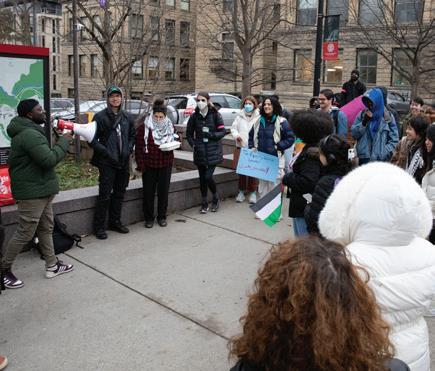
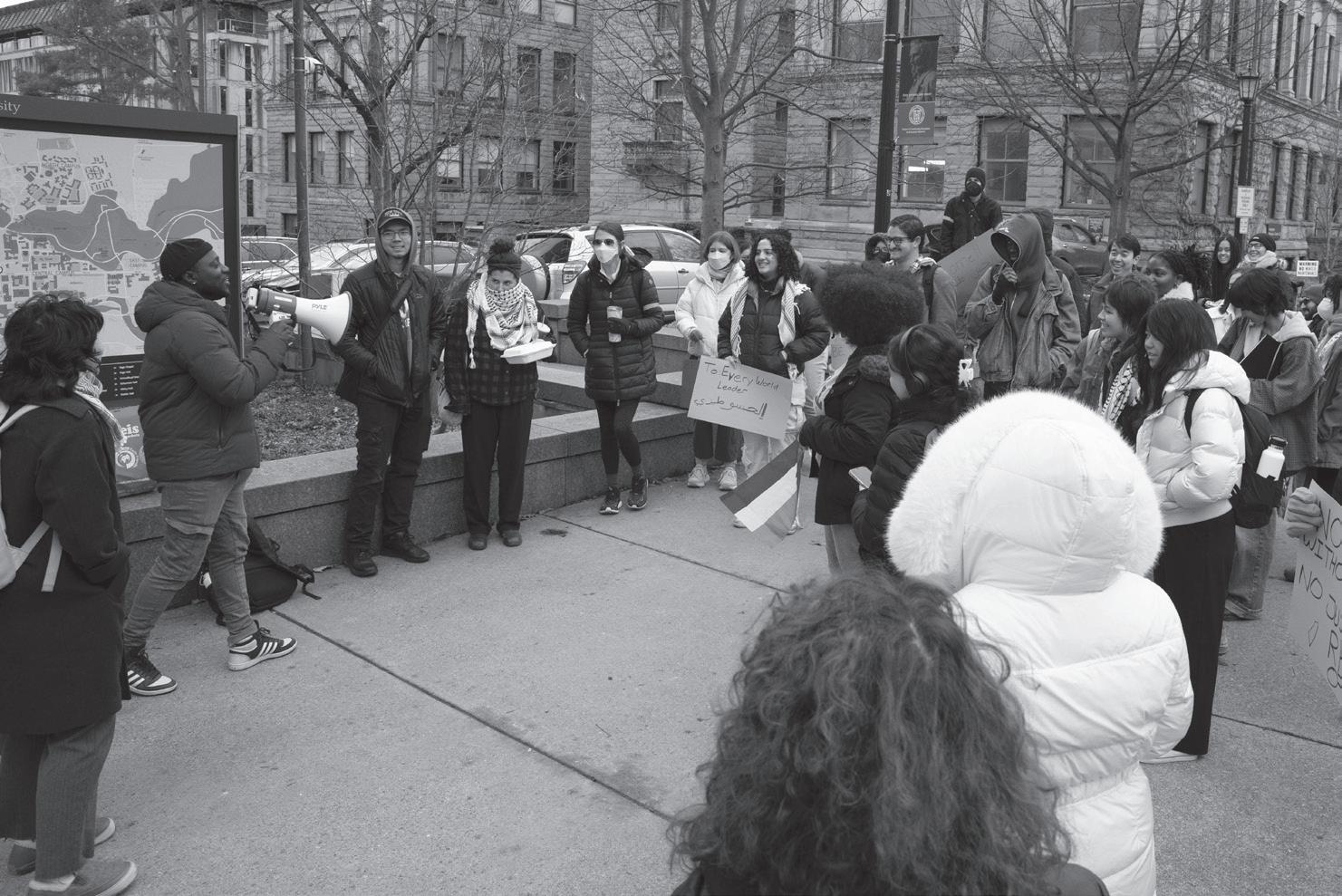
About 70 demonstrators gathered outside of Day Hall on Friday afternoon to protest the Student Assembly’s 16-4 rejection of Resolution 51, which called on Cornell to end partnerships with and suspected investments in arms companies — such as Boeing and Raytheon — that provide weapons to Israel.
“We don’t take our cue from some bullsh*t Student Assembly at Cornell,” said Momodou Taal, grad, who led chants throughout the event. “We take our cue from the armed resistance in Palestine. We are in solidarity with the armed resistance in Palestine from the river to the sea,” he continued, garnering some cheers from the crowd.
At time of publication, Taal did not respond to repeated requests to elaborate on his remarks. Taal has previously described himself as the liaison representative for Cornell’s Coalition for Mutual Liberation, an activist collective that organized Friday’s protest.
Taal’s statement was not the only apparent praise of militant groups at the event. At one point, the crowd chanted, “Yemen, Yemen, make us proud. Turn another ship around.” Yemen’s Houthi rebels, a group the Biden administration recently labeled a terrorist organization, have fired at Red Sea ships, including commercial vessels and a U.S. warship.
Cornell’s Media Relations Office did not respond to a request for comment on how, if at all, it would respond to instances of students expressing support for militant groups.
Friday’s protest came nearly four months after Oct. 7, when Hamas gunmen and other Palestinian militants charged across Gaza’s border, systematically killing around 1,200 people, according to Israel’s Foreign Ministry. Since then, Israel’s offensive in Gaza has killed more than 27,000 people, according to the Hamas-run Gazan Ministry of Health.
Throughout the protest, demonstrators shouted, “from the river to the sea, Palestine will be free,” a rallying cry whose specific meaning is the subject of widespread debate, with some defending the slogan as a demand for Palestinian liberation and others decrying it as advocating for the destruction of Israel.
In a Dec. 9 statement, President Martha Pollack clarified that “explicit calls to genocide” would be in violation of Cornell’s policies. The University did not respond to a request for comment for this article on whether the phrase “from the river to the sea” constitutes a call to genocide and has previously declined to comment on how it would respond to instances of students using the phrase.
Cornell has been under scrutiny from the federal government over its response to antisemitism on campus.
Chairman Jason Smith (R-M.O.) of the House Ways and Means Committee on Jan. 10 sent a letter to Pollack, which threatened to
revoke Cornell’s tax-exempt status over a “failure to adequately protect Jewish students from discrimination and harassment.”
The Department of Education announced on Nov. 16 that Cornell was under investigation for violating Title VI of the Civil Rights Act of 1964 over either on-campus antisemitic harassment, anti-Muslim harassment or both. A spokesperson from the Department of Education declined to disclose whether Cornell’s investigation was for antisemitic or anti-Muslim harassment.
A set of speakers denounced the Thursday vote against the divestment resolution. Hasham Khan ’26 expressed his anger over his peers objecting to the measure.
“It was just embarrassing to see our fellow students — people that we go to class with — vote no. I’m never going to forget 16 to four. I was angry in that room,” Khan said.
Taal claimed that many of the 16 students who voted against the measure may have been motivated by fears of retribution in their future careers. Students at Cornell and other universities have faced doxxing and blacklisting over their support for the Palestinian cause.
“This is a direct message to the Student Assembly yesterday,” Taal said. “I understand people are scared. They’re worried about their career. They’re worried about the internship they may get afterwards…if you choose your career over courage, then you have chosen [to be] powerless.
In December, CML staged a multi-day sitin at University buildings calling for Cornell to enact a new anti-doxxing policy, adopt a new definition of antisemitism that does not include anti-Zionism and divest from particular companies said to support Israel. In response, CML said the University agreed to stage a meeting between Chief Financial Officer Christopher Cowen and CML representatives to explain Cornell’s investment policies.
Speakers on Friday — as in previous demonstrations — called Cornell “complicit” in what they considered to be a genocide against Palestinians in Gaza. On Dec. 29, South Africa filed a case against Israel in the International Court of Justice, accusing the country of committing genocide in Gaza. A verdict has not yet been reached, though the ICJ called the charge “plausible.”
Adrián Cardona Young ’26 spoke about what he perceived to be Pollack and the Board of Trustees’ responsibility for the conflict in Gaza.
“Let’s continue calling on [President] Martha [Pollack] to recognize and the Board of Trustees to recognize that they have the power here,” Cardona Young said. “They are not powerless. There are people who have no means to change what’s happening right now. Their decision not to cut ties with these companies is directly making them complicit, and they are choosing to prioritize their funding and their money over this.”
similar criticisms as that which Lindseth expressed in reaction to the Alpha Phi Alpha fraternity.
“Blacks have chosen to be apart [from the rest of the University,] haven’t they, by having a fraternity of Blacks?” Lindseth said. “In any event, tell the Cornell Alpha Chapter Alumni Association that I support them. Tell them that I’m delighted they’re at Cornell.”
“Blacks have chosen to be apart [from the rest of the University,] haven’t they, by having a fraternity of Blacks?”
Jon Lindseth ’56
Charles L. Schlumberger ’76 also wrote a letter to the editor entitled, “Cornell Should Remain Committed to Overcoming Prejudice” which criticized Lindseth’s effort to discourage DEI.
In Schlumberger’s letter to the editor, he described how the founding of Ujamaa, an African-American residential college at Cornell, evoked
“The nice thing about speech is that it gets people talking to each other about differences and being expose to different cultures and religions.”
Charles L. Schlumberger ’76
“White students felt that Ujamaa — reserved only for Black students — was ‘reverse’ segregation that did not foster goals of racial inclusion; Black students championed Ujamaa as a recognition of Black culture,” his letter read.
Lindseth disagreed with Schlumberger’s argument in his email to The Sun.
“In [Schlumberger’s letter,] he urged me to change my position — as he sees it — based on Cornell’s founding principles. I support the concept that ‘any person can find instruction in any study.’ But merit has always been the overriding requirement,” Lindseth
wrote. “His one sentence … saying I should change my position based on Cornell’s founding principles is nonsense.”
Schlumberger also said that the logic behind Lindseth’s argument that DEI conflicts with free speech was unclear.
“I can’t tell you why Pollack, the president of Cornell, says she believes in DEI and free speech.”
Jon Lindseth ’56
“DEI does not infringe on free speech. It invites it,” Schlumberger said. “The nice thing about speech is that it gets people talking to each other about differences and being exposed to different cultures and religions.”
While Lindseth asserted that “DEI ends up promoting the lack of free speech,” he was uncertain as to how.
“I wish I knew why,” Lindseth said.
Lindseth suggested arranging a meeting with The Sun’s editorial board and Carl Neuss, chair of the
Cornell Free Speech Alliance, to provide further information at a later date.
“I can’t tell you why Pollack, the president of Cornell, says she believes in DEI and free speech,” Lindseth said. “If you believe in Christianity, you have certain beliefs. She believes that DEI and free speech are compatible. Ask her to answer the question [of how DEI infringes on free speech].”
“DEI does not infringe on free speech. It invites it.”
Charles L. Schlumberger ’76
Ultimately, Lindseth maintained his view that Cornell needs a new administration amid the failures of the current one.
“The present [administration] has led us down the wrong path resulting in the U.S. Department of Education investigating us along with two committees of Congress,” Lindseth wrote. “This has never happened before.”
Christina MacCorkle can be reached at cmaccorkle@cornellsun.com.
By ISABELLA HANSON and MARISA CEFOLA
When Brianna Cheng ’27 entered Barton Hall for Cornell’s Spring 2024 ClubFest, she could feel the bustling energy of countless campus clubs gathered in a single room, all extending students a warm invitation to join their community this semester.
“It’s definitely overwhelming because there are so many people, and it’s kind of scary to go up to somebody,” Cheng said. “But a lot of people are very welcoming and lure you [into signing up for their club] in a good way.”
On Sunday, ClubFest featured many of the University’s more than 1200 organizations and maintained its postCOVID-19 two-session structure. During the first session, students had the opportunity to explore a variety of clubs specializing in career development, sustainability and publication. The second session focused on clubs dedicated to community service, games, sports and the arts.
“It was really cool to come here and see everybody in person,” said Rayanu Adam ’27, a member of the Cornell University Autonomous Underwater Vehicle project team. “As someone who’s a minority, [when] I was looking at the websites, it seemed like there wasn’t much diversity. But coming [to ClubFest] in person and seeing, speaking and getting to know the people — I think I found the place for me.”
Cornell Capital Club is one of the many business and entrepreneur -
ship organizations on campus. Established this past fall, the club aims to stand apart from others with its diverse and unique educational approach, encouraging students with little to no entrepreneurial experience to join. CCC features an extensive in-house training program for new members and opportunities such as a networking trip to New York City.
“Working with people of different backgrounds and having a goal in mind really helps [students] break down those barriers in terms of majors and [other differences] to work together and find something unique and what they’re passionate
about,” said Lawrence Han ’27, vice president of new member education.
Other organizations spoke about diversity and inclusion at their ClubFest tables, such as Women Leaders of Color. Founded in 2021, WLC aims to promote female empowerment in the professional scene and provide ample resources to women of color who aspire to assume leadership positions in their communities and careers. WLC brought Christina Li, a managing director at Goldman Sachs, and Karen Chen ’25, a 2022 Olympic Figure Skater, to speak last semester.
“We have a lot of networking and mentorship programs that helped
me grow as a woman of color and in the business industry,” said Nia Denis ’26, co-vice president of marketing at WLC. “We’ve grown so much as a club just [by] being in a professional environment with women that are like-minded and have a lot in common.”
To continue reading this story, please visit www.cornellsun.com.
Isabella Hanson can be reached at ilh6@ cornell.edu.
Marisa Cefola can be reached at mcefola@cornellsun.com.

Upon viewing the rather uncensored Saltburn , as Rosamund Pike proclaimed her “complete and utter horror of ugliness,” I couldn’t help but reflect on my own musings of perfectionism. Though rooted in external aesthetics, Pike’s aversion served as a gateway into a broader, more insidious struggle — one that transcends the surface and subsists across various aspects of our lives. Beyond the glitz of Hollywood, this pervasive dilemma infiltrates the minutiae of daily routines, casts a shadow over academic pursuits and propels us into the relentless pursuit of a self-constructed ideal of success.
As I grapple with my journey as a recovering perfectionist, Pike’s revelation resonates
deeply. It speaks to the relentless pursuit of unattainable standards — chasing straight A’s, maintaining a buzzing social life, fitting into size two jeans and securing an impressive work position for my age. It’s an all too familiar endeavor, a testament to the universal nature of this internal tug-of-war.
We convince ourselves that meeting these ideals will garner approval from our peers — our motivations are fueled by accolades, social media likes and affirming nods. Our online personas become meticulously curated, showcasing only the polished highlights of our lives as if anything less than perfection is a forbidden disclosure.
In this pursuit, success and happiness are commodified, stripped of their intrinsic value and reduced to a numerical game of likes, flawless test scores and desired numbers on the scale. However, in our
relentless quest to adhere to this arbitrary quota — performing the perfectionism that society and we (by extension) demand — we often overlook the most crucial judge: ourselves.
This pursuit of satisfaction from external sources often leaves us in a perpetual state of longing. I vividly remember, and continue to experience, the cycle where each personal achievement — whether in the classroom, on the gym floor or across various workplaces — was met with a fleeting sense of accomplishment, immediately overshadowed by a new expectation. The elusive concept of “perfection,” constantly evolving and increasingly unapparent, remained an ever-evasive ideal that was never quite attained. In a society riddled with hyperproductivity, the ideals of flawlessness are tightly woven into a cultural fabric that prioritizes speed and
efficiency, enabling quantity to outshine quality. While these practices have undeniably paved the way for success in some quarters, a fervent adherence to these doctrines can stifle our capacity to openly recognize and learn from our mistakes. As a consequence, we root growth in artificiality as opposed to authenticity.
Even now, I find myself in a space where the struggle with perfectionism persists. Navigating the realms of academia, stepping into a workforce more considerable than the businesses in my hometown and maturing amid the burgeoning era of social media, perfectionism appears as an omnipresent force, at times overwhelmingly inescapable. However, my evolving understanding is that falling short of these ideals— that is, not seeking to market ourselves as “perfect”— is not something we should “fear.”
Instead, within the imperfect — the “ugly” — a distinctive and genuine opportunity for success and a sense of self arises.
Recognizing that self-worth is not a binary choice between flawless success or futile failure is crucial. The pursuit of perfection, when held as an unattainable standard, exacts a toll on our mental health and self-confidence, breeding a paralyzing fear of ignominy. By relinquishing the toxic pedestal of perfection, we can redirect our journey toward embracing imperfection. This shift is not a concession but a decisive reorientation that prioritizes mental well-being and self-confidence, fostering a path where the “ugly” is no longer feared but embraced as an integral part of our authentic selves.
Eve Iulo is a sophomore in the College of Agriculture and Life Sciences. She can be reached at eti2@cornell.edu.
ASSISTANT ARTS EDITOR
Alright. You’ve read the headline. You get what’s happening here: I went through a breakup; I watch a lot of movies; now; I’m looking back and attempting to confer upon them some sort of rhyme and reason to distinguish the ones that helped from the ones that hurt and all that jazz. Movies are a super cool window into universal experience, and there’s a lot that they can do in helping you take steps towards feeling better. But even the most hardcore cinephile will tell you that there are limits to the healing powers of movies. I found that a lot of the time, the best medicine ended up being a disconnected array of Simpsons, 30 Rock or Veep clips. However, I also know that my taste is pretty eccentric by most standards. After all, most people aren’t particularly interested in Italian exploitation or ’20s silent comedy on their best days. These recommendations are primarily thematic — I hope I can suggest some sort of direction, even if I can’t precisely program your bed rotting film festival.
The Rom-dram
This is pretty easy: Don’t watch a rom-com. At least from my experience, the juxtaposition of the genre’s carefree fantasy with your momentarily brutal reality turns the whole experience sour. It can be really exciting to begin getting back into that nervous-romantic headspace, but you’re also going to need to take
some time to be a little bit cynical, shed a tear and get caught up in the sadness of it all. Romantic dramas (rom-drams), even the ones with happy endings, rarely let you forget that there aren’t really right choices when it comes to romance — or to the extent that there are, they’re emotionally exacting. For my part, I watched last year’s Past Lives, a meditation on receding possibilities and “the one that got away,” filtered through the lens of an immigration story. It fits a nice mold: Healthy people in healthy relationships who nonetheless can’t shake every pesky emotion that they feel. For a slightly more toxic (if also counterintuitively optimistic) alternative, I’d throw out Asako I & II, a brilliant love triangle, body-double hypothetical that reminds us how easy it is to make mistakes, and then continue making mistakes.
For those who really want to let it all out, try watching Brief Encounter or The Worst Person in the World. Both are incredibly watchable films that play with the idea of unambiguous domestic love that still ends up supplanted by exhilarating emotional affairs. Post-breakup, recalculating the tradeoff between stable happiness and anxious excitement can be a difficult task, so see if one of the above movies can give you something of an answer. Also, no matter what you do, do not watch Eternal Sunshine of the Spotless Mind: Nobody deserves that level of self-imposed emotional devastation.
Make a New Memory
If you are like me, you probably watched a lot of movies
with your ex-partner: You probably formed some really wonderful memories, and you might even have a sense of joint-custody extending over those shared favorites. Depending on how things ended, the memories might feel pretty bitter, and even in the best cases, you don’t really get to have that sense of mutual belonging over a movie anymore. But that doesn’t mean you have to change your film taste or forget a favorite. If a movie reminds you of an ex, make it remind you of something else: Find a way to watch a movie that’s going to supplant those previous memories of watching it; if it’s playing at a local repertory theater, go to a screening; get a group of friends together and watch it as a drinking game; rewatch it alone and write a review of it for The Sun. It won’t always be entirely effective. I rewatched Basic Instinct with friends, and while it didn’t supplant those earlier memories, it certainly lives with them now. Try not to lose bits of your taste and identity simply because those bits were held up by a foundation that isn’t there anymore. Those movies can still represent you — you just have to find a way to figure out how they’re going to do that now.
Challenge Yourself
As important as cinema is as an escapist medium, especially when you’re in a situation where you are trying to escape some difficult emotions, there also exists a whole world of cinema that asks you either not to escape or pursues escapism not through constant attention-grabbing engagement, but through
meditation, obfuscation and, occasionally, boredom. Being newly single can be the best time to challenge yourself with a film that might be a bit more difficult in one way or another. After all, it’s a challenge to convince anyone else to watch an overlong, deliberately boring or unfollowable movie with you. There’s a lot to be gained, first and foremost in taking on a project that, while not too difficult or draining, will require just enough of a commitment to provoke a sense of accomplishment. You also might find yourself more able to connect with some fundamentally lonely films — like the slow cinema masterpiece Goodbye, Dragon Inn — in a way that’s fortunately more difficult when you aren’t feeling lonely.
There’s a lot of time after a breakup when you want to scream-cry and let everything escape in a burst of sadness and rage, and there’s also a lot of time that feels just a little bit emptier than it used to be. Watch a rom-dram or try some exposure therapy with a shared favorite for those big emotions, but the best salve for the quieter ones isn’t going to come in the form of a big musical cue or impassioned profession of love, but in long dreary segments of confused neon cityscapes or muddy, sepia farmlands. There are so many wonderful places to start, but I’d recommend picking a film or two from Tsai Ming-Liang, Claire Denis, Hong Sangsoo, Wong Kar-Wai or David Lynch — many of these might technically double as romantic dramas as well.
Press Rewind
What was your favorite movie the day before you met your now ex-partner? What didn’t you watch during your entire relationship that you still have fond memories of? It’s never good to retreat too far into a past self: Besides having far less respect for the taste of my 18-year-old counterpart, mental regression can only progress you so far in getting over a breakup. But there is a role for those old favorites, especially if you’ve been in a relationship long enough to have seen yourself substantially transform with and around your ex. It’s important to remind yourself of — and actually internalize — the fact that you were a living, breathing, functioning single person for most of your life. It was during that time that you might have first had your brain chemistry reconfigured by Wes Anderson, or been unable to conceive of anything more exhilarating than a John Wick movie or even that you had the slightly awkward experience of inviting all your friends to watch Call Me by Your Name and being the only one in the group who was messy crying at the end. Whatever it is for you, you shouldn’t want to regress to that person crystalized in the amber of those films, but make sure to remind yourself that they existed. It can be hard to recapture the emotional footprint of a former you, and rewatching a movie or two can go a long way.
Max Fattal is a junior in the College of Arts and Sciences. They can be reached at mfattal@cornellsun.com.
SHEILA YU ’25
Advertising Manager
NOAH DO ‘24
Associate Editor
HUGO AMADOR ’24
Opinion Editor
JONATHAN MONG ’25
News Editor
JULIA SENZON ’26
News Editor
JULIA NAGEL ’24
Photography Editor
GRAYSON RUHL ’24
Sports Editor
TENZIN KUNSANG ’25
Science Editor
JOANNE HU ’24
Assistant News Editor
MARISA CEFOLA ’26
Assistant News Editor
MAX FATTAL ’25
Assistant Arts & Culture Editor
MING DEMERS ’25
Assistant Photography Editor
KATE KIM ’24
Layout Editor
ISABELLE JUNG ’26
Graphics Editor
VEE CIPPERMAN ’23
Senior Editor
ESTEE YI ’24
Senior Editor
PAREESAY AFZAL ’24
Senior Editor
ELI PALLRAND ’24
Senior Editor
ANGELA BUNAY ’24
Editor
SOFIA RUBINSON ’24
Managing Editor
GRACE XIAO ’25
Web Editor
AIMÉE EICHER ’24
Assistant Managing Editor
UYEN HOANG ’25
Assitant Web Editor
ANNA LIANG ‘24
Assistant Advertising Editor ERIC REILLY ’25 News Editor
GABRIEL MUÑOZ ’26 News Editor
NIHAR HEGDE ’24
Arts & Culture Editor
DANIELA ROJAS ’25
Dining Editor
RUTH ABRAHAM ’24
Sports Editor
MEHER BHATIA ’24
Science Editor
MARIAN CABALLO ’25
Assistant News Editor
CARLIN REYEN ’25
Assistant News Editor
KIKI PLOWE ’25
Assistant Arts & Culture Editor
CLAIRE LI ’24
Assistant Photography Editor
DAVID SUGARMANN ’24
Assistant Sports Editor
ALLISON HECHT ’26
Newsletter Editor
JASON WU ’24 Senior Editor
Editor in
Fattal '25 Photography Desker
Davis '26
Sports Desker Hamna Waseem '27 Layout Desker Sophie Zhang '27 Jolin Li '27 Caroline Park '27
Dear Chair Kraig H. Kayser and the Board of Trustees:
The undersigned Cornell alumni are members of the Alpha Chapter Alumni Association. We write in full support of Cornell University’s efforts to promote diversity, equity and inclusion on campus because those principles are core features of the Cornell Tradition. In fact, Cornell University’s founding principle of “any person, any study” was indeed our beloved University’s first ever DEI statement. Accordingly, we urge Cornell University’s leadership and its Board of Trustees to remain steadfast behind this sacred concept that has distinguished Cornell from other American universities from its founding.
We are aware of alumnus Jon Lindseth’s letter to Cornell’s Board of Trustees, submitted on January 23, that mischaracterizes Cornell’s legitimate efforts to live up to its founding principles. Although the letter purposefully fails to spell out the words “equity” or “inclusion,” it does pay lip service to “viewpoint diversity” which has recently become a catchphrase for antiDEI political activists. The truth of that matter is that achieving “viewpoint diversity” is impossible without ensuring individuals of different backgrounds have access to Cornell University, feel included when on campus and have equal opportunity to succeed. For this and other reasons, we consider Lindseth’s letter disingenuous – at best – and overly political in nature. It is worth noting that – like our country – Cornell University has not always lived up to its best ideals, especially in relation to its students and alumni of color. Retired Cornell lecturer and historian Carol Kammen wrote a historical narrative of the University’s Black students and titled her book “Part and Apart.” This history of Cornell is an admission that despite Cornell’s egalitarian principles of “any person, any study,” there were painful moments in Cornell’s history where diversity was limited, equity was an afterthought and many students – unfortunately – were excluded from core facets of campus life. This dynamic was the impetus for the founding of Alpha Phi Alpha Fraternity, Inc., at Cornell on December 4, 1906. Indeed, one of our Fraternity’s founders proclaimed: “Society offered us narrowly circumscribed opportunity and no security.

Ilana Livshits is a frst-year student in the College of Arts & Sciences. Her fortnightly column Live Laugh Livshits focuses on politics, social issues and culture at Cornell. She can be reached at ilivshits@ cornellsun.com.
In a way, whenever I try to notice, I obscure. As I seek to write about my interactions with race, I think back to events that I took little part in: Black Lives Matter protests after the murder of George Floyd, anti-Asian violence during the Covid pandemic or even the 2022 Russian invasion of Ukraine where the “us versus them” boundaries were blurred. These proclamations by others — and not by myself — of an outsider race make it easy for me to distance myself from the reality of these ongoing (and perhaps never-ending) circumstances. Although I recognize the police brutality against African-American communities across the nation, I stayed home during BLM demonstrations. Although I perceive my Asian American friends’ fear of hate crimes after Trump’s tweet about COVID19 as the “Chinese virus,” I did not attempt to find a way to help address AAPI hate. Although I acknowledge the complicated relationship of families torn by country borders in Russia and Ukraine, I overlooked fundraisers for Ukrainian children. In simply acting as a “leftist” and supporting its tenets, I insulate myself from learning, taking action or simply doing. I am both purposely and subconsciously obscuring. It is easy.
When I try to think about how race impacted me, I often portray myself as a victim: I was bullied in elementary school for being Jewish and assimilated into that rhetoric by learning to hate Jewish culture. I’ve written and rewritten and overwritten this topic. I’ve fleshed it out to its greatest extent as my go-to when talking about racial and ethnic relations. Simply put, I find it easy to notice race when it makes my life more difficult but ignore it when it affects other people.
To a certain extent, dialogue on the Israel-Hamas war has been my first earnest attempt at confronting race and my own hate. I grew up among sharp yet small Islamophobic indictments: “Muslim husbands completely control their wives.” “Muslim women are forced to wear hijabs.” I defended these biases through feminism, perverting the ideology with the rhetoric of bigotry and imperialist hegemony. I was similarly blind to: “Islam produces extremist Muslims who become terrorists.” “Muslims hate Jews; they would kill you in Palestine.” Only now I can see that Palestinians are the ones being killed in Palestine. However, this recognition was not instantaneous. When the IsraelPalestine conflict resurfaced, I obscured, again. As a Jewish-American leftist, it frustrated me how irreconcilable my two halves often seem. Israel has never been a home for me, but it
is the mystified haven that my parents wish to retire to. In this duality, I recognize that many critical words and deploring looks have stuck with me.
I say I have tried to relearn race past my community’s Islamophobia; somehow, this doesn’t always ring true. My racism stems not from my desire to hurt or hate others, but from my lack of desire to educate myself. Ignorance is, again, easy. Growing up, people around me did not have the words to hate Brown people; their isolation narrowed their racism to Islamophobia. They obscured the humanity of the Brown ethno-racial community (differentiated by ethnicity, nationality and religion) by leaving the language untaught. In trying to amend labels without the effort of learning the correct ones, I previously opted for referring to all my Brown friends as South Asian. This was, at times, the correct term to use. However, more often than not, it wasn’t. And, debatably, it never fit until I understood its meaning. I’ve broken down the first barrier in trying to use the correct language: I’m able to comfortably say that the appellation "Brown people" encompasses a variety of ethnic groups. But living through the reclamation of the term “Brown” from pejorative to one of self-identification has proved that resistance against discrimination extends past racial slurs. I respect Brown people. I do not act. And yet, as a Jew, I refuse to persist in that inaction. I do take a stand: Israel’s indiscriminate bombing of Gaza is nothing short of genocide. Since the Israel-Hamas war began on Oct. 7, 2023 (or even decades earlier), more than 27,000 Palestinians have been killed in Gaza, while another 66,000 have been wounded and 2 million displaced. 800,000 Palestinians living in Gaza City and its northern region do not have access to health care: Their remaining hospitals lack basic healthcare supplies and fuel.
Last Saturday’s Holocaust Remembrance Day echoed that never again is never again for anyone, irrespective of race, religion and supposed moral righteousness. My sempiternal longing for Jewish people to find safety in a violent world coalesces with my unwavering desire for Palestinian liberation, equity and dignity. Collective liberation is a labor of transformation through love and justice. It does not come by way of institutions; it is not bestowed by thrones of power; and it does not persist in cycles of domination. To build from the ground up, the first step is here at Cornell.
To continue reading, visit cornellsun.com.

Fill in the empty cells, one number in each, so that each column, row, and region contains the numbers 1-9 exactly once. Each number in the solution therefore occurs only once in each of the three “directions,” hence the “sigle numbers” implied by the puzzle’s name. (Rules from wikipedia.org/




By HAMNA WASEEM and ELI FASTIFF Sun Staff Writer and Sun Contributer
“We knew we weren’t gonna walk away with two easy wins,” said sophomore forward Avi Adam, the player responsible for the sole Cornell goal scored on Friday night against the Saints.
After dropping its match to St. Lawrence (21-9-0, 14-4-0 ECAC) on Friday evening in a 2-1 loss, the Red (18-6-1, 13-5-0 ECAC) flipped the script the next day with a 3-0 shutout of No. 3 Clarkson (25-3-2, 14-3-1 ECAC).
Freshman goaltender Annelies Bergmann logged 43 saves in the match against the Golden Knights and recorded her second career shutout.
But Friday night didn’t start so smoothly for Bergmann, as just 16 seconds into the game the Saints struck first, scoring the quickest goal yet against the Red this season when a pass from behind the net found its way in front of the crease.
Playing catch-up, the Red recorded 13 shots in the first period, but none would make it past Emma-Sofie Nordström, who was between the pipes for the Saints.
St. Lawrence came into the weekend with the third-best power play nationally, but when sophomore defenseman Alyssa Regalado got called for interference, the Saints couldn’t capitalize on their powerplay. Cornell fared the same fate with its power play when St. Lawrence got flagged for body checking, and the first period came to a close with the Red trailing behind at a one-point deficit.
The middle frame saw both teams up their offensive pressure as they documented 16 shots each, only one of which would make it past either goaltender. The Red’s score-tying goal followed a strong forechecking by junior forwards Claudia Yu
and Gabbie Rud, which allowed the puck to find Adam in front of the net.
Adam, who has scored five goals in her past four games, credited her recent goals scoring outburst to her line-mates Yu and Rud.
“We definitely clicked in the last two or three weeks,” Adam said. “I attribute a lot of it to Claudia and Gabby.”
the game.
“We did not bury them as much as we hoped we would,” Adam said.
Saturday was a different story, as Bergmann and senior forward Izzy Daniel shined bright and propelled Cornell to an upset win. Bergmann held the Golden Knights scoreless, stopping all 43 shots she faced and improving her save percentage to
Unfortunately for the Red, one minute and 54 seconds into the third period the Saints retook the lead when a wrist shot from Melissa Jefferies floated by Bergmann. The goal was partially caused by a St. Laurence skater falling into the crease and knocking Bergmann down, but a review for Goaltender interference after the goal did not yield a call.
The Red had some offensive opportunities as the clock winded down, including a power play with just under 14 minutes in the third, but they were unable to win
.92, third in the nation amongst freshmen.
“She’s a crucial part of our success, and we’re lucky to have her,” Adam stated. “I think it was a big energy shift for her to play so well … and we were able to feed off that.”
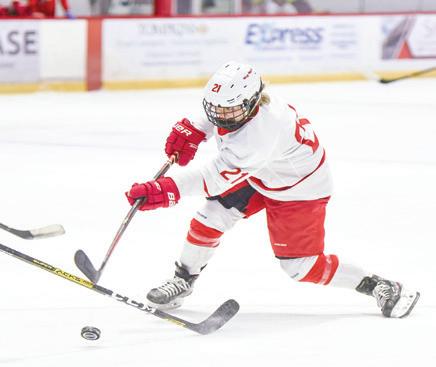
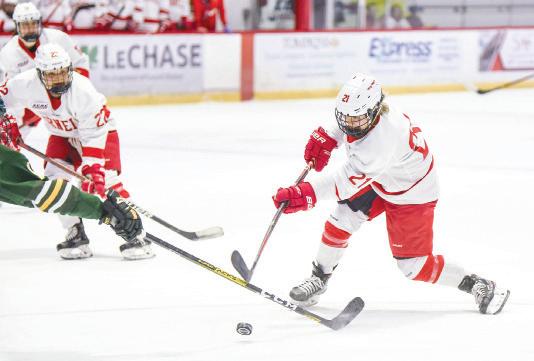
Around seven minutes into the first period, junior forward Kaitlin Jockims got the scoring started for the Red when she ripped a slap shot from just above the right circle while falling on the ice. Bergmann’s 14 saves in that period didn’t allow Clarkson to tie up the score, and the
second period began with Cornell in the lead by one.
“We knew that we could continue to play our game defensively against Clarkson,” Adam said. “But it was on offense that we would have to pull through against them.”
The Red evidently internalized this desire, as NCAA points-leader Daniel would extend the Red’s lead to 2-0 early in the second following a Clarkson turnover. The rest of the period would see no scoring from either team as both stood tall in their defensive zones.
The last period started on a blunder from the Red, as less than a minute in, sophomore defenseman Alyssa Regalado was called for an interference penalty. Cornell would hold strong in the face of Clarkson’s woman-advantage, killing off the power play.
The last goal was made on a block from sophomore defenseman Grace Dwyer, who sprung the puck out in front of freshman forward Karel Prefontaine. A gliding Prefontaine would win her breakaway battle with Clarkson’s goaltender Michelle Pasiechny and go on to score the game-winning goal.
The Red has its sights set on being in a top-four spot going into NCAA and ECAC playoffs.
To comtinue reading this article, please visit www.cornellsun.com.
Hamna Waseem and Eli Fastiff can be reached at hwaseem@cornellsun.com and esf75@cornell.edu, respectively.
By Jane McNally Sun Staff Writer
Booming yells and shrilled shouts bellowed from the locker room at Lynah Rink on Saturday, Feb. 3. The home team was victorious, fresh off a win over a top conference team and extending its unbeaten streak to 10 games.
“It was just awesome,” said junior forward Sullivan Mack. Offensive floodgates opened on Saturday as men’s hockey (13-4-4, 8-4-2 ECAC) took down Clarkson (13-12-1, 7-6-1 ECAC). It was a physical battle from the very beginning, as both teams combined for 113 penalty minutes in the game, but Cornell was able to coast to a 7-2 victory over a rougharound-the-edges Clarkson team.
“They’re a good hockey team. They [have] a lot of good players on their team,” said head coach Mike Schafer ’86. “I thought we had a good tenacity [and] a good pace to our game tonight.”
Cornell came out of the gates flying, immediately sustaining offensive zone pressure and pushing the Golden Knights onto its heels. The Red rattled off shot after shot on Clarkson’s goaltender, Emmett Croteau –– a freshman who has played in just three games this season. Clarkson’s usual tandem of junior Brady Parker and graduate student Austin Roden was, unexpectedly, benched.
The Red took advantage of the inexperienced netminder just under two minutes into the game, when junior forward Jack O’Leary cleaned up a rebound on top of the crease and shoveled it past Croteau. The goal came on a Clarkson delayed penalty, allowing the Red to receive both
the goal and the ensuing man-advantage.
Without skipping a beat, Cornell doubled its lead on its first power play chance of the night. 1:13 after O’Leary’s opening goal, a beautiful cross-crease dish from senior forward Gabriel Seger found sophomore forward Dalton Bancroft, who one-timed the puck masterfully past Croteau. Just three minutes into the contest, Cornell had a two-goal lead.
Chaos began to unfold in the first when a minor penalty by freshman defenseman Hoyt Stanley preceded a major penalty by junior forward Ondrej Psenicka, who was consequently ejected for a “contact to the head” call.
Clarkson capitalized not long into its two-man advantage, when Anthony Romano halved Cornell’s lead around 20 seconds into the Clarkson power play. Though Cornell worked hard on its penalty kill, and junior goaltender Ian Shane made a couple of strong saves, the Golden Knights ultimately tied the game up with 1:04 left on the major penalty. The experienced graduate student, Mathieu Gosselin, equalized the score on an obscure shot that floated by Shane, whose confused look was indicative of not seeing the initial shot.
“We kind of let them back into the game a bit,” Mack said.
However, those two goals would be the only given up by Shane, who finished the game with 20 saves on 24 shots.
Though Cornell saw its first period lead dwindle away, the Red wasted little time earning it back in the second. Cornell crushed Clarkson’s momentum heading into the
second when freshman forward Ryan Walsh bolted into the offensive zone on a one-on-none breakaway, burying it past the Clarkson netminder.
That goal began a stretch of five unanswered for Cornell, ultimately tying its highest goal total in a game this season. Seven different players scored for Cornell, and all four lines contributed to the dominant offensive performance.
“The guys were saying it on the way up [to the locker room after the first period]: ‘time to get refocused and get back out there,’” Schafer said. “And they came right back out there in the second and scored.”
Then, just 1:37 after Walsh’s go-ahead tally, junior forward Kyle Penney lasered a shot off the post and into the net, regaining the Red’s two-goal lead. Penney, who had gone 11 games without a goal entering the weekend, netted two goals and three points on the weekend.
Cornell wasn’t finished, however. Freshman forward Jake Kraft –– another goalscorer from Friday night’s win over St. Lawrence –– joined in on the fun with a nifty deflection goal to cushion Cornell’s lead to 5-3. The Red’s three goals in the second all came within a 3:43 span.
To comtinue reading this article, please visit www.cornellsun.com.