The Corne¬ Daily Sun


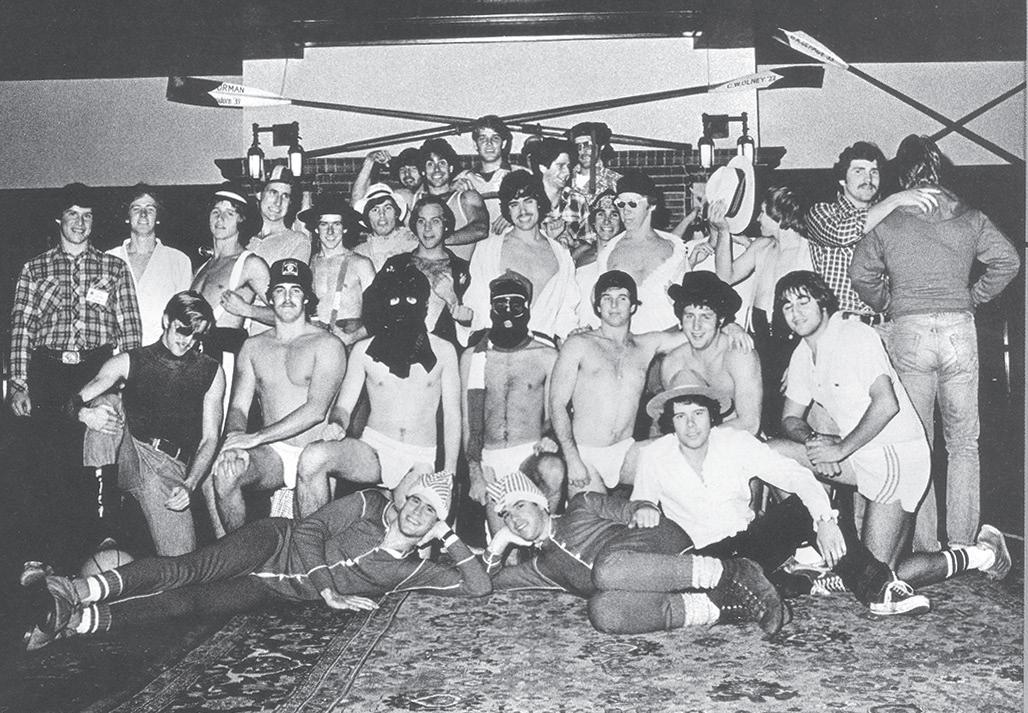
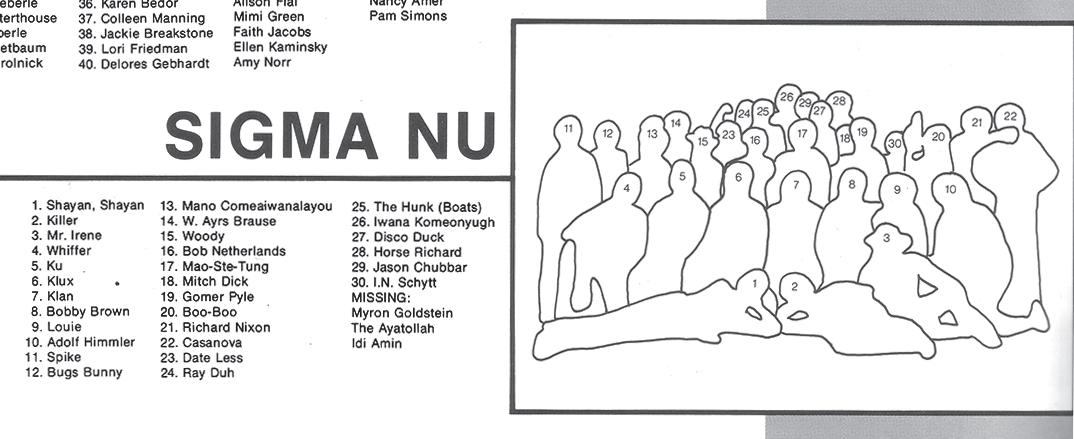
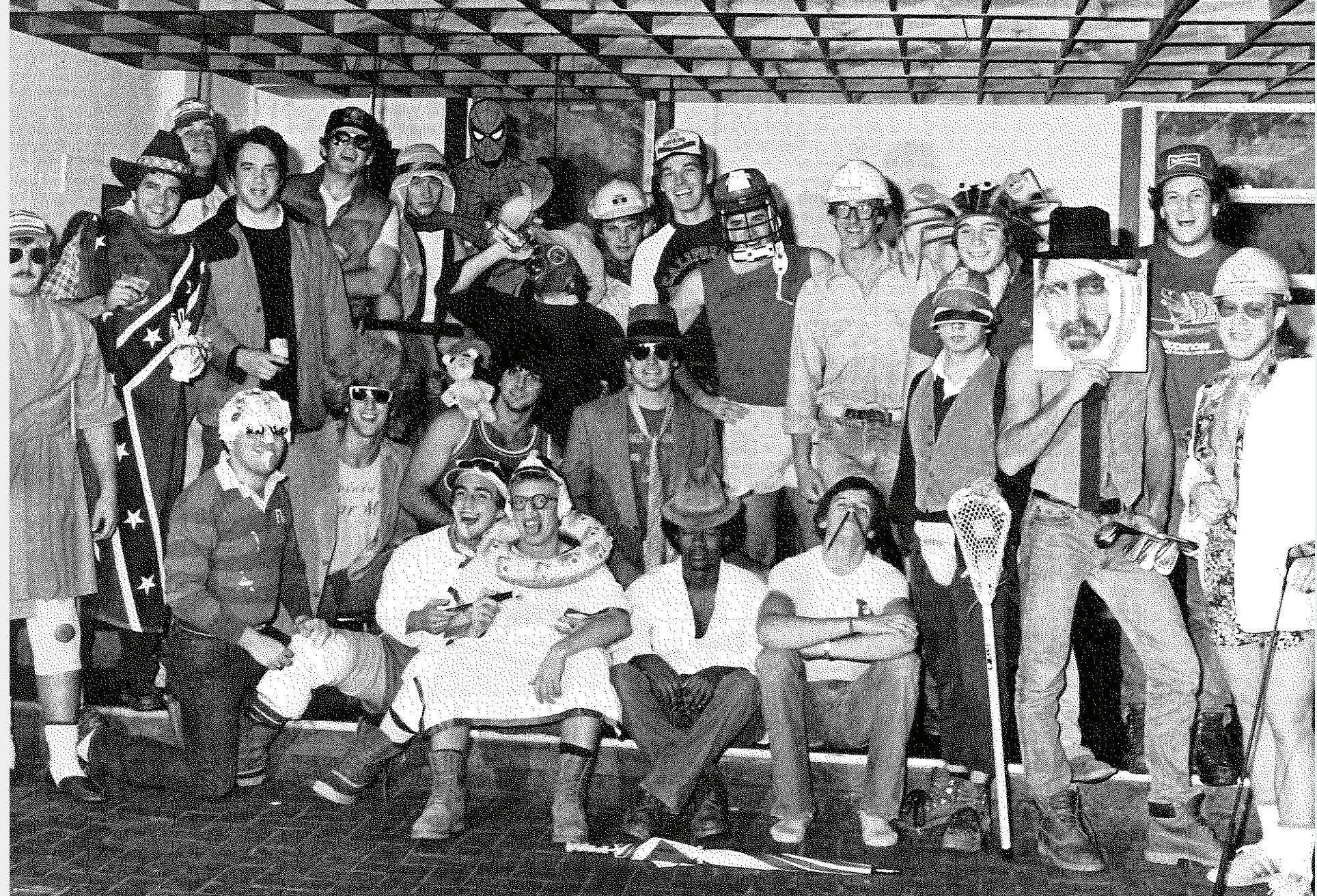
‘Offensive’ captions | Printed in the 1980 edition of the Cornellian, captions for fraternity Sigma Nu included altered names such as “Adolf Himmler,”“Bugs Bunny” and “The Ayatollah.”
By WINNY SUN Sun Staff Writer
Boasting nearly one million views and more than 17,000 subscribers, Anna Fang ’19 runs a successful YouTube channel that showcases the diferent facets of Cornell life to thousands of eager high school and college students from across the nation. Fang’s channel highlights the ups and downs of college life in an attempt to help potential applicants learn more about what the Big Red experience en-
See YOUTUBE page 5
By SARAH SKINNER and MARYAM ZAFAR Sun Assistant News Editor and Sun Staff Writer
On the sixth foor of Olin Library, tucked away behind dusty manuscripts and fnancial planning papers, are rows of hefty yearbooks, their pages flled with decades of student-selected highlights of Cornell’s best and brightest moments.
Among those moments captured in the yearbook, the Cornellian, are snapshots of the college experience — faces, words and pictures that reveal the campus as it appeared. Te yearbook has been published since 1868, according to its website, and features sections looking at University, residential and campus life.
One photograph features members of the Sigma Nu fraternity alongside a roster of altered names. “Ku,” “Klux” and “Klan” were names assigned in the 1980 yearbook in a roster that named other students as “Adolf Himmler,” “Bugs Bunny” and “Te Ayatollah.”
Bob Linden ’71 M.D. ’75, president of Cornell’s Sigma Nu fraternity property association, condemned the picture, saying it was disappointing and that the chapter is now “very diverse.”
“I have zero tolerance for discrimination,” Linden told Te Sun. He said there were many possible motivations for the yearbook spread.
“I don’t pretend to know what was going through the minds of the individuals in it,” Linden said. “Were these undergrads drunk and partying, were they simply ignorant, or was there a defnite malintent to the picture?”
Cornell revoked recognition of Sigma Nu for at least three years last May after four anonymous hazing allegations.
After USA Today reviewed 900 yearbooks across the nation — including the Cornellian — President Martha Pollack called the image captions “both rac-
By ANNE SNABES Sun Assistant News Editor
As local municipalities review the University’s plan to expand North Campus housing, chairs of multiple planning boards expressed concern about how the project will afect traffc, parking and sewage on campus.
Te North Campus Residential Expansion will build two new housing sites on North, which will provide beds for 1,200 freshmen and 800 sophomores, Te Sun previously reported. Te expansion will also add residential facilities, such as a new dining hall and an outdoor basketball court, to the
See HOUSING page 5


Business
Joint Microeconomics, Industrial Organization and Applied Microeconomics Workshop 11:40 a.m. - 1:10 p.m., 498 Uris Hall
Working the Tides: Pawangs, Fishers and Scientists in the Straits of Melaka, 1870-1940 Noon - 1:30 p.m., 102 Mann Library
On the Frontlines of Peace: The Unlikely People Who Are Getting it Right 12:15 - 1:30 p.m., G08 Uris Hall
Energy Engineering Seminar: Scott Hsu 12:20 p.m., 165 Olin Hall
Col. Eli Bar-on: How the Israel Defense Forces Implement the Law of Armed Conflict 12:30 - 1:30 p.m., G90 Myron Taylor Hall
’20
International Students — How to Get Work Authorization in the U.S. 3 - 4 p.m., 103 Kennedy Hall
As Worlds Turn: Planetary Spin, Climate and Life
4 - 5 p.m., 105 Space Sciences Building
SAP Seminar Series, Aliens, Code-shifters and Rude-Mapping by Jaret Vadera 4:30 - 6 p.m., 374 Rockefeller Hall
Choosing a Family Business Advisor 11 a.m., 445 Statler Hotel
Innovations in Population Science: Monica Alexander Noon - 1:15 p.m., 102 Mann Library
College in Prison: The Cornell Prison Education Program and a Different Perspective on Extension 12:20 p.m., 404 Plant Science Building
Department of Psychology Colloquium Series 12:20 p.m., 202 Uris Hall
Old Is the New; Existing Buildings, Climate Change and the New Urban Agenda 12:20 p.m., Abby and Howard Milstein Auditorium, Milstein Hall
Rethinking Glyphosate: Soil and Water Seminar Series 2:30 - 3:20 p.m., B15 Riley-Robb Hall
Scrivener for Academic Writing 4 p.m., 106G Olin Library
Opportunities for Public Communication of Science 4:30 p.m., 143 Plant Science Building

By LEANN MCDOWALL
Sun Staff Writer
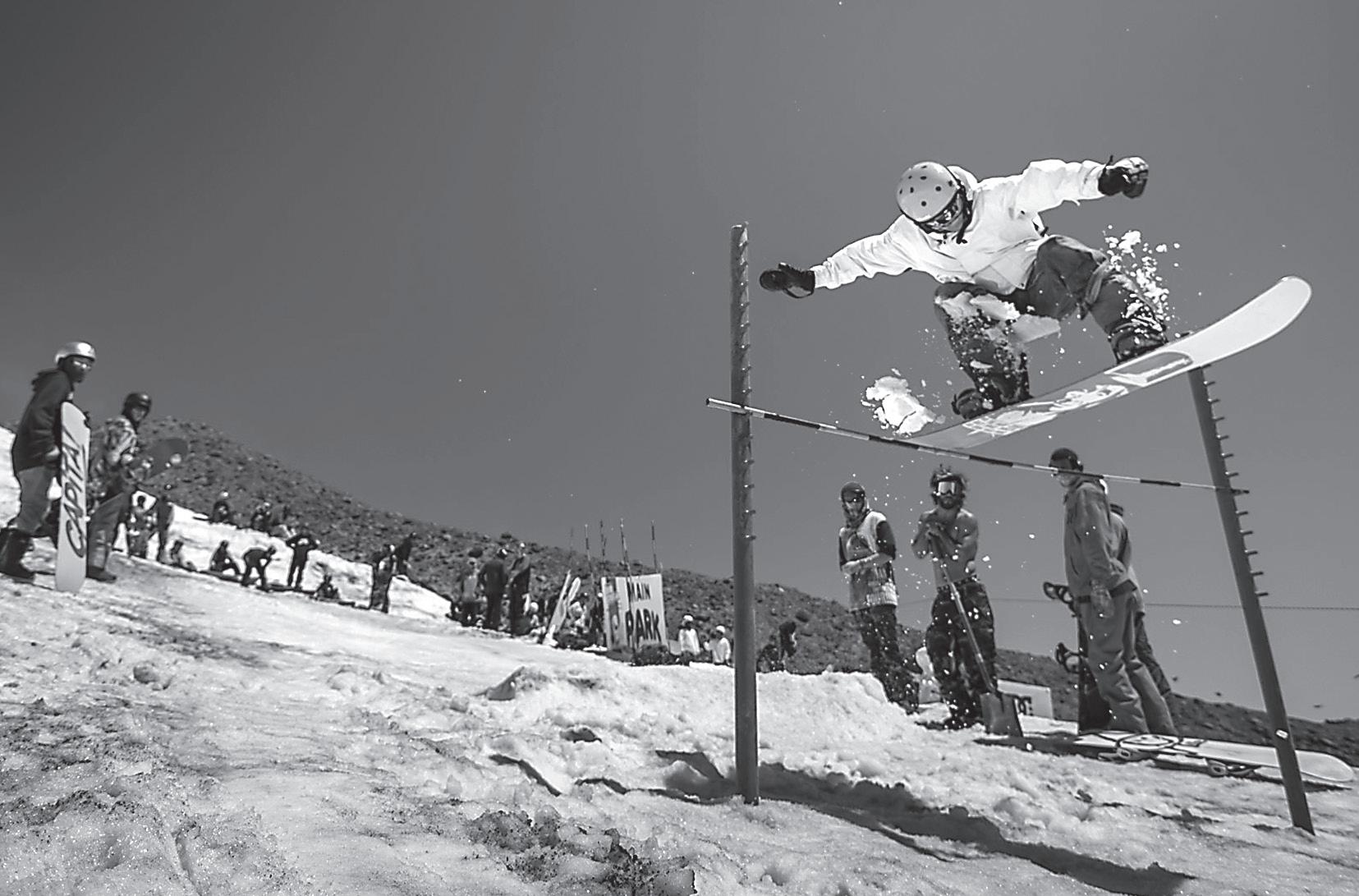
Every two years, college athletes from around the world compete at the World University Games. This year, snowboarder Joey Binder ’18 will represent Cornell and Team USA in the Games’ 2019 Winter Universiade, set to begin March 2 in Krasnoyarsk, Russia.
The World University Games or “Universiade,” organized by the International University Sports Federation, is the largest university winter multi-sport competition in the world, drawing thousands of student athletes from over 50 countries to a different city every two years, according to the FISU website.
Based in Krasnoyarsk, Russia, the 29th Winter Universiade this year will run March 2-12 and will include sports from skiing to ice hockey. To be eligible, a prospective competitor must be between the ages of 17
“It’s like my first international competition and a once-in-a-lifetime opportunity.”
Joey Binder ’18
and 25 and registered at a university or have graduated within the year before the event.
Binder, who fell in love with snowboarding at age four, will contend in the Snowboard Cross Competition on March 2 EST. The event involves four to six snowboarders competing for the fastest time on the same course, according to Binder.
His participation in the event is over two years in the making. He first learned of the Universiade as a sophomore while watching Far From Home , a documentary about Ugandan snowboarder Brolin Mawejje, but studying abroad in 2017 prevented Binder from participating.
Since then, Binder has participated in a couple of other snowboarding competitions in preparation, though none have compared to the Games.
Hood, Oregon for several years, where he met big names in snowboarding such as Shaun White, Jamie Anderson and Red Gerard.
“I think what hooked me was that it just looked cool, and many people weren’t doing it back when I was little.”
“It’s like my first international competition and a once-in-a-lifetime opportunity,” Binder told The Sun.
Snowboarding has been a huge part of Binder’s life. He attended High Cascade snowboarding camp in Mt.
“I think what hooked me was that it just looked cool, and many people weren’t doing it back when I was little,” Binder said.
Joey Binder ’18
While at Cornell, snowboard -
ing continued to play a major role in Binder’s life. Hoping to raise awareness for snowboarding culture, he founded Big Red Boarders — Cornell’s first dedicated snowboarding club — in 2016.
“I really wanted to build a community of snowboarders on campus,” Binder said, which he did through screening films and live-streaming events.
The club started out small, but by the time Binder graduated it boasted a membership of around 90 students.
Hoping to attend medical school in the future, Binder is currently taking a gap year and ultimately seeks to pursue a career in oncology, plastic surgery or sports medicine. “I have a lot of experience with [athletics] and I think it would be really cool specifically to help extreme athletes,” Binder said.
Binder will compete on March 2 at 10:30 p.m. EST, and will be livestreamed.
LeAnn McDowall can be reached at lmcdowall@cornellsun.com
Dark chocolate favor becomes newest addition to other savory and sweet combinations
By MICHAEL OVERMEER Sun Staff Writer
Willard Straight Hall currently offers a trove of popcorn flavors, including one that shamelessly mixes all the current savory and sweet flavors — sugar, butter, garlic, cinnamon, salt and pumpkin spice. Now, they’ll add one more tantalizing taste to the bizarre blend — dark chocolate, a mix of sugar and cocoa powder.
Patrons of the popcorn stand are not limited to existing flavors and can create
their own concoction of available flavors and recommend new flavors in the suggestion basket next to the stand.
“That’s what makes it exciting. We try to give the people what they want.”
Deciding new flavors is a detailed process involving student feedback. Once suggestions are submitted — “mushroom” and “olive oil” being among the more
Maya Cutforth ’20
daring ones — their fate is then fervently discussed at manager meetings, followed by a trial period, according to stand manager Maya Cutforth ’20. The results are then recorded in a Google spreadsheet that students opt to fill out as they receive their treat.
In the case of the dark chocolate fla-
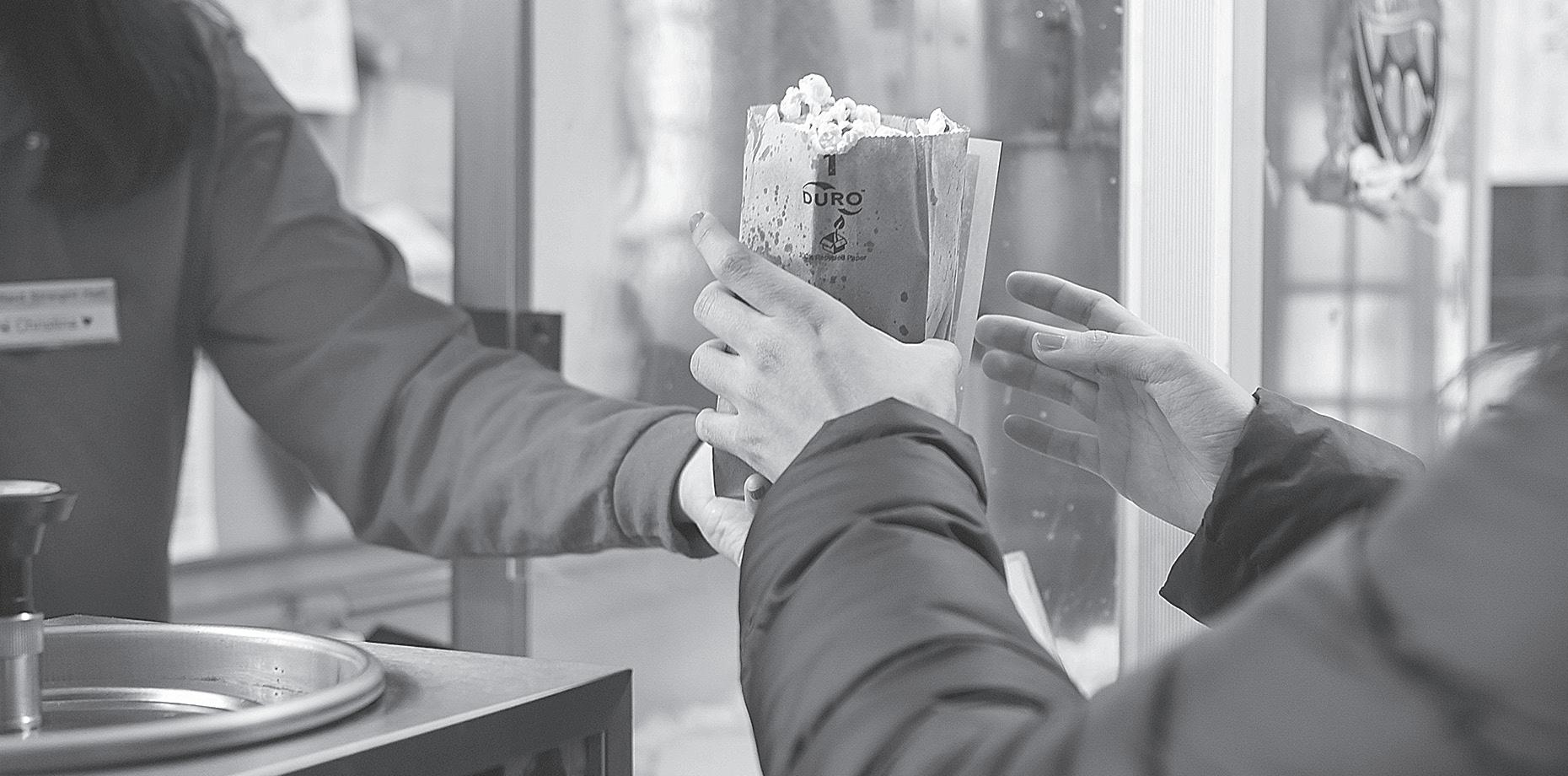
vor, a general staff meeting was held in addition to the manager meetings, during which six buckets of popcorn with different flavors were taste tested.
This was succeeded by a trial period that narrowed down the final flavors to white cheddar, taco and dark chocolate, according to Cutforth, who has worked at the stand since her sophomore year.
Ultimately, patrons’ taste buds decided on the dark chocolate flavor. The process took about a month of planning, testing and discussing.
The length of the trial period for dark chocolate, however, is currently undetermined. “That’s what makes it exciting. We try to give the people what they want,” Cutforth said.
It could have a similar fate to pumpkin spice, which was so popular that it is now a permanent flavor, Cutforth said.
The popcorn stand has kept a strong reputation among Cornellians, some of whom attend the stand so routinely that they simply ask for “the usual” and are provided with their desired order, according to Cutforth.
“A lot of crazy things happen at the popcorn stand,” Cutforth said, adding that Ryan Lombardi, vice president of student and campus life, will be helping serve popcorn on April 11.
So whether patrons like sweet, savory or a mix of all flavors called “The Abomination,” the Willard Straight Popcorn stand continues to concoct new combinations.
ist and anti-Semitic.”
“I strongly denounce the use of these ofensive captions, which are completely at odds with the values of our university,” Pollack said.
One fraternity member at the time, Mark Faber ’81, a former sports night desker for Te Sun, said he did not remember the picture or the roster of names.
“I don't remember that picture and I do not see myself in the picture,” Faber said in a phone interview. “Te people in the photo are victimized by the ofensive caption and the yearbook was negligent for publishing the picture with these captions.”
Faber, president of Cornell’s Alumni Interfraternity Council, said the council denounces the captions. In his role as president, Faber also oversees the third phase of Pollack’s recommended Greek Life reforms.
Former Cornellian staf photographer Jef Earickson ’77 M.Eng. ’80, who also worked for Te Sun, said the standard yearbook process was for assigned photographers to drop group photos on an editor’s desk to be traced onto onion skin paper. Ten, Earickson said, a yearbook stafer numbered each outline and a member of the organization would provide names for each person — identifcations he said were “taken at face value.” Organizations paid a sum to be published
in the yearbook, the former photographer said, although he could not recall the exact price point.
“Tose things happened back when,” Earickson said. “Tese fraternities were responsible for their own content.”
In an interview, Rona Hollander Citrin ’80 — the Cornellian photographer who shot the Sigma Nu picture — said she didn’t recall taking the photograph at frst. She called the group of men “wild” and the picture itself inappropriate but described the time at Cornell as one when people were “less sensitive.”
According to the 1981 “Status of Women and Minorities at Cornell University” report, submitted to the then-board of trustees by Provost W. Keith Kennedy, the percentage of minority students was 12.1 percent in 1980. Minority students included “American Indian,” Asian, Black and Hispanic students.
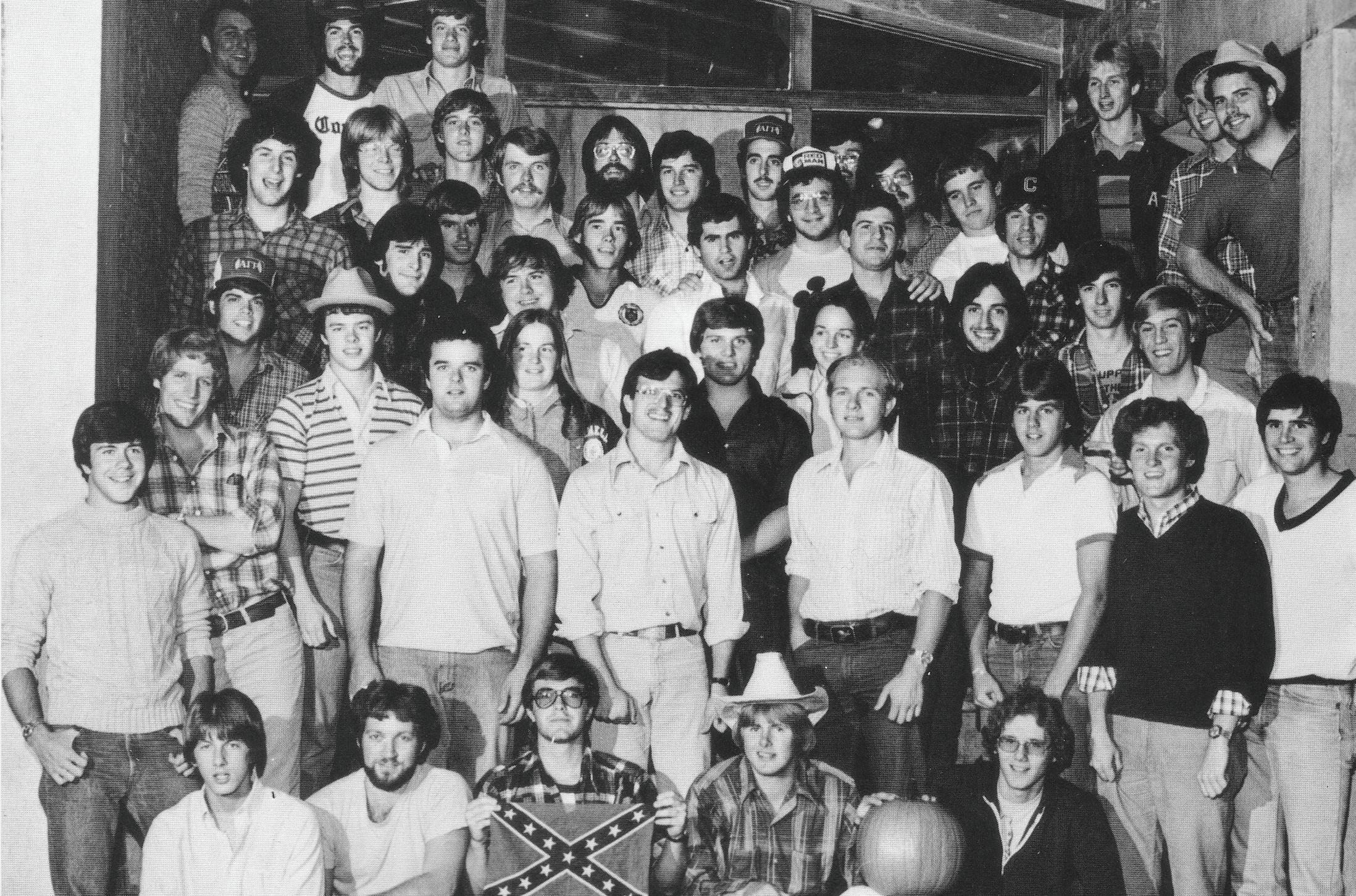
In the years following the printing of the caption, more than one student group
displayed a Confederate fag in yearbooks reviewed by Te Sun. A member of Alpha Gamma Rho held the fag up in the front row of his group picture in 1981 and members of Phi Gamma Delta did the same a year later.
“While the photo may be seen, by some, as ofensive in nature because of the displaying of the Confederate Flag, the intent to display the fag in the image printed … is unknown,” national fraternity Alpha Gamma Rho wrote in a statement. Te fraternity said its members should “refect, value and advocate diversity in our membership and professional lives.”
In the 1982 Cornellian, nicknames were printed alongside the Phi Gamma Delta group photo, one of which was “Hitleryouth.”
David Ayers ’80, alumni vice president of Cornell’s chapter of Phi Gamma Delta, said in an email to Te Sun that the fraternity was “a place flled with diverse people and diverse interests.”
“I think the yearbook photo shows that the brothers were non-conformists,” Ayers said. “Te brothers
wanted to show that fraternities we’re [sic] not stufy places flled only with elite young men.”
Years later, the University would implement a fag ban in its housing contract, a change introduced in response to Confederate fags fying outside dormitory windows, Te New York Times reported. In 1991, the University suspended the ban after students wanted to fy the American fag to support troops stationed in the Persian Gulf.
“We feel this photo’s content is indicative of neither non-conformity, diversity nor friendship, but rather insensitivity,” said Nick Smith ’20 in an email to Te Sun. Smith, an arts columnist at Te Sun, is the current president of Phi Gamma Delta.
Smith continued: “Regardless of how ‘status’ quo this photo’s subjects might have thought the garb of their brother was, times have changed and it is no longer our place to pretend actions such as these were acceptable in any context.”
Linden, Cornell’s Sigma Nu property association president, noted that the pictures and captions were part of Cornell’s past.
“Te problem is when you erase history you don’t learn from it,” Linden said. “It went on back then … but unfortunately … this stuf is still going on now."
Maryam Zafar can be reached at mzafar@cornellsun.com.
Sarah Skinner can be reached at sskinner@cornellsun.com.

Please Recycle this Paper in one of the recycling bins located on the Cornell Campus.
HOUSING
campus.
Te project will take place in three municipalities — the City of Ithaca, the Town of Ithaca and the Village of Cayuga Heights — and each will have to approve the project’s site plan before construction can begin. Te site plan review started in late January, according to Rick Burgess, Vice President of Facilities and Management.
“While the timing of approvals will be dictated by the local municipalities, we are hopeful to receive them later this spring,” Burgess said in an email to Te Sun.
Before the site plan review started, the City of Ithaca’s Planning and Development Board conducted an environmental review of the project. Lisa Nicholas, senior planner for the City of Ithaca, said an environmental review looks at “big, macro issues” such as trafc and energy usage.
Te project will bump usage of natural gas by Cornell’s power plant by 1.4 percent, according to an assessment conducted by Taitem Engineering, an engineering consulting business. Environmental activists have voiced concerns over how the project will contribute to upstream methane emissions.
Te Planning and Development Board completed the environmental review in December, and determined that the project will lead to “no signifcant adverse impacts on the environment,” according to a resolution.
According to the full assessment form, the University predicts that the campus’ energy demands will decrease after the project ends, and Cornell’s Combined Heat and Power Plant is expected to decrease natural gas use after the expansion is fnished.
Now that the environmental review is fnished, local municipalities are beginning the site plan review, narrowing down details such as the building materials and the landscaping, according to Nicholas. She said that there were issues introduced in the environmental review that have to be mitigated during the site plan review, such as how visible buildings will be from certain
areas of the Cornell Heights Historic District.
She said the site plan review is expected to take up to three months, as it involves multiple public hearings and an approval vote by the Planning and Development Board. According to Nicholas, the board has already held two public hearings, one of which was on Tuesday.
Te city is not the only municipality that has a say in the expansion — so do the Village of Cayuga Heights and the Town of Ithaca. Fred Cowett, chair of the Village of Cayuga Heights Planning Board, told Te Sun that representatives of the NCRE’s design team will speak at the village board’s meeting on Tursday.
He said the board will likely vote in favor of a resolution to accept the project for site plan review, and will likely vote to schedule a public hearing at its March 25 meeting. At the end of the public hearing, the board can either close the hearing or adjourn it until the board’s meeting in April.
“Te Board sometimes adjourns rather than closes the public hearing so as to ensure that the Board hears as fully as possible from members of the public,” Cowett said in an email to Te Sun. “It's hard to say beforehand what will transpire and whether the public hearing in March will be closed or adjourned, but, once the public hearing is closed, Board members will then discuss the project.”
Te planning board will then make fndings based on criteria in the village’s zoning law and will ultimately either approve the project, approve it with conditions or disapprove it, according to Cowett.
He said that it is possible that the site plan review will be completed by the end of March, but that completion by the end of April or May is “more likely” to him.
Cornell does not have “a frm start date identifed” at this time, according to John Carberry, a spokesperson for the University. “As with any large construction project, the start dates are fuid and contingent upon permitting.”
However, according to the NCRE Preliminary Site Plan Review Booklet published on Feb. 8, work on the sophomore site is expected to begin on April 1, before
Cowett expects the overall review to be fnished.
Te Village of Cayuga Heights Planning Board has several concerns about the North Campus Residential Expansion, according to Cowett, revolving around traffc and parking.
Te board is concerned about an increase in trafc on village roads during the project or after it is fnished, according to Cowett, and the CC Lot will be built over because of the project. Tis will likely cause some students to park in A Lot in Cayuga Heights, and Cowett said that the A Lot cannot hold all of the cars currently in CC Lot.
“Te Board is particularly concerned about parking associated with events such as move-in day and reunion weekend when parking in CC Lot typically overfows onto Jessup Road; what is going to happen during those events when the CC lot is lost to the NCRE?” Cowett wrote in an email to Te Sun.
Fred T. Wilcox III, chair of the Town of Ithaca planning board, told Te Sun the project will have an impact on trafc in the city, the town or in the Village of Cayuga Heights. Another concern is the sewer system which may not “be sufcient to handle increased load” from the additional students on campus.
In addition, the Town of Ithaca is concerned about the appearance and architecture of the buildings that will be constructed in the town, according to Wilcox.
“Planning board members have expressed the idea that they may not blend in as well as we would like,” he said. “So we don’t know whether Cornell University, when they come back to the town for approval, might change the building materials on the outside. We’ll see.”
Te town will discuss preliminary site plan approval of the North Campus project at a March 19 meeting. Wilcox said that projects “of this size” are usually approved with conditions. Once conditions have been addressed, the project will undergo fnal site plan approval.
Anne Snabes can be reached at asnabes@cornellsun.com.
YOUTUBE
tails.
Originally from Indiana, Fang was discouraged that she could not visit Cornell’s campus due to its considerable distance from her home. Two years later, during her sophomore year and after noting an absence of Cornell students on YouTube, Fang decided to begin making videos herself.
“Anna from Indiana” currently has more than 17,400 subscribers. Her most popular video, “A Day in My Life at Cornell University,” has garnered close to half

a million views and nearly nine thousand likes.
Refecting about her channel, Fang said her experience as a YouTuber has been mostly positive.
“It’s cool 99 percent of the time,” she said. “I have met a lot of people from it and this is the reason why I continue to do it … About one percent of the time, it can be frustrating.”
She pointed out one downside in particular: people calling her by her channel name instead of her frst name.
“Tat can be frustrating because I don’t want to be always seen like that, especially in professional settings or in
class,” she continued.
Fang shared that when she frst started her channel, she did not envision it to be as far-reaching as it is today.
“In some ways it is cool to make content that reaches a wide audience but it is also really scary because I don’t want to advise people wrongly,” she said. “It’s a lot of pressure on someone who is only 21. I don’t know a lot of things myself.”
At frst, she crafted content based on what she thought would be popular, but it was soon clear to Fang that doing it didn’t make her happier. She advised potential YouTubers to be themselves, and said she doesn’t dwell on the analytical

aspects of her channel, such as her subscriber count.
“I have always found social media to be an unhealthy cycle that can start easily,” she shared. “If I try to make everyone happy, I will never be happy.”
When asked how much money she makes, Fang said there is no fxed amount. It depends on many factors, including how long people watch the videos and how many of them click on the ads.
Companies also sometimes send her products for review, she said. She has taken on a few ofers, such as one for back-
Independent Since 1880 136th Editorial Board
JOHN McKIM MILLER ’20
Business Manager
KATIE SIMS ’20
Associate Editor
MEGAN ROCHE ’19
Projects Editor
MICHAEL LI ’20
Photography Editor
LEV AKABAS ’19
Arts and Entertainment Editor
BREANNE FLEER ’20 News Editor
YUICHIRO KAKUTANI ’19
News Editor
PARIS GHAZI ’21
Assistant News Editor
ANNE SNABES ’19
Assistant News Editor
JOHNATHAN STIMPSON ’21
Assistant Sports Editor
VIRI GARCIA ’20
Assistant Arts and Entertainment Editor
CATHERINE HORNG ’21
Assistant Dining Editor
HELEN HU ’21
Graphics Editor
JOSHUA GIRSKY ’19
Senior Editor
ZACHARY SILVER ’19
Senior Editor
Drew Musto* ’19
Julia Curley ’19
Chance Maslof ’19
Aeyla Ehtasham ’19
Lauren Woods ’19
John Yoon * ’20
Stacey Blansky ’20
Penelope Campos ’20
Shauna Cheatham ’20
Angela Chon ’20
Celine Choo ’20
Mollie Cramer ’20
Vivian Fan ’20
Meghan Flanigen ’20
Faiza Ahmad ’19
Jacqueline
Groskaufmanis ’19
Gabrielle Leung ’19
Jade Pinero ’19
Varun Belur* ’19
Varun Biddanda* ’19
Nick Swan ’19
Isabel Ling ’19
Ashley Davilla ’19
Isabelle Philippe ’19
Madeline Rutowski ’20
Troy Bridson ’19
Charles Cotton* ’19
Karen Papazian ’19
Jamil Rahman ’19
Eleanor Bent* ’20
Sophie Reynolds* ’20
Vas Mathur* ’19
Emma Hoarty ’19
Omar Abdul-Rahim ’19
Emem-Esther Ikpot ’19
Gabriel Ares ’19
Lev Akabas ’19
Emma Freiman ’19
GIRISHA ARORA ’20
JACOB S. RUBASHKIN ’19
Editor in Chief
HEIDI MYUNG ’19
Advertising Manager
VARUN IYENGAR ’21
Web Editor
DYLAN MCDEVITT ’19
Sports Editor
JEREMIAH KIM ’19
Blogs Editor
JACQUELINE QUACH ’19
Dining Editor
SHRUTI JUNEJA ’20
News Editor
NICHOLAS BOGEL-BURROUGHS ’19
City Editor
SARAH SKINNER ’21
Assistant News Editor
JACK KANTOR ’19
Assistant Sports Editor
EDEM DZODZOMENYO ’20
Assistant Photography Editor
PETER BUONANNO ’21
Assistant Arts and Entertainment Editor
JULIAN ROBISON ’20 Layout Editor
ALICIA WANG ’21 Sketch Editor
News Board
Hnin Ei Wai Lwin ’20
Katherine Heaney ’20
Kevin Lam ’20
Marin Langlieb ’20
Gloria Lee ’20
Jai Malhotra ’20
Zain Mehdi ’20
Sabira Mehjabin ’20 Ronni Mok ’20
Samuel Nolan ’20
Alexis Oh ’20
Hunter Seitz ’20
Miguel Soto ’20 Toba Stern ’20 Winny Sun ’20
Jason Jeong ’19
Sarah Lieberman ’19
Anna Kambhampaty ’19
Victoria Pietsch ’19
Dongyeon (Margaret)
Olivia Bono ’20
Michelle Golderg ’20 Andrea Yang* ’20
Nick Smith* ’20
Ruby Que* ’20
Nicole Yan ’20
Juliette Rolnick* ’20
Mary Barger ’19
Smita Nalluri ’19
Noah Elden ’19
Sarah Peters ’19
Christian Ong ’20 Alex Zarska ’20
Jacob Wexler ’20
Kurlya Yan ’20
Emily Yang ’20
Karen Li ’20
Aaran Leviton ’20
Jinwook Lee ’21
Alex Hale ’21
Anyi Cheng ’21
Amanda Cronin ’21
Jill Crosby ’21
Dan Draytsel ’21
Xing Gao ’21
Alexia Ge ’21
Opinion Board
Lee ’20
Nile Jones ’20
Kelly Song ’20
Michael Johns ’20
Sarah Park ’20
Arts Board
Noah Tomas ’20 Ariadna Lubinus ’20
Rachel Mattessich ’20
Zach Lee* ’20
Victoria Horrocks ’20
Katie Sims ’20
Daniel Moran ’21
Joshua Zhu* ’20
Junyoung Lee ’20
Adam Masters ’20
Sidd Srinivasan ’20
Karen Zaklama ’21
Emma DiGiovanni ’21
Shriya Perati ’21
Managing Editor
ALISHA GUPTA ’20
Assistant Managing Editor
EMMA WILLIAMS ’18
Design Editor
GRIFFIN SMITH-NICHOLS ’19
Blogs Editor
AMOL RAJESH ’20
Science Editor
ANU SUBRAMANIAM ’20 News Editor
JUSTIN J. PARK ’19
Multimedia Editor
MEREDITH LIU ’20
Assistant News Editor
RAPHY GENDLER ’21
Assistant Sports Editor
BORIS TSANG ’21
Assistant Photography Editor
CHENAB KHAKH ’20
Assistant Science Editor
LIZ CANTLEBARY ’21
Snapchat Editor
KRYSTAL YANG ’21
Production Editor
ANNA DELWICHE ’19 Senior Editor
MATTHEW McGOWEN ’19 Senior Editor
Shawn Hikosaka ’21
Amina Kilpatrick ’21
Vale Lewis ’21
Rochelle Li ’21
Helen Liang ’21
Victoria Moore ’21
Avraham Spraragen ’21
Samantha Stern ’21
Xinyu Tang ’21
Louise Xie ’21
Lucy Xu ’21
Maryam Zafar ’21
Lucas Reyes ’21
Xinyu (Louise) Tang ’21
William Wang ’20
Alexia Kim ’21
Aminah Taariq ’21
Darren Chang ’21
Ethan Wu ’21
Michael Chang ’21
Rebecca Reuning ’21
Grant Muller ’21
James Robertson ’21
Aaron Stella ’21
Ramya Yandava ’21
Adam Kanwal ’21
Alex Hale ’20
Bennett Gross ’20
Zora Hahn ’20 Jack Roscoe ’20
Photography Board Science Board
Lily Croskey-Englert ’19
Alice Song ’19
Aubrey Akers ’19 Anant Sriram ’19
Monika Bandi ’19 Stephanie McBath ’19 Yvette Ndlovu ’19
Chelsea Leeds ’19 Spencer Sigalow ’19
Murali Saravanan ’20
Jose Covarrubias ’19
Nandita Mohan ’20 Yisu Zheng ’21 Lexi Quarles ’21
Blogs Board
Sarah Chekfa ’19
Jefrey Ho ’20
Amber Krisch ’21
Dining Board
Augusta Gordon ’21
Elijah Fox ’21
Piper Torpey ’21
Catherine Cai ’21
Sabrina Xie ’21
Jefrey Li ’21
Sabrina Xie ’21
Nicole Zhu ’21
Seth Kim ’22
Puneet Velidi ’22
Jolie Wei ’22
Olivia Weinberg ’22
Rachel Liu ’22
Emma Cordover ’22
Michael Overmeer ’22
Tomas Engquist ’22
Gayatri Somaiya ’22
Emma Rosenbaum ’22
Magdalena Smith ’22
Giancarlo Valdetaro ’21
Canaan Delgado ’21
Laura DeMassa ’21
Christian Baran ’22
Jonvi Rollins ’21
Jessica Lussier ’21
Maggie Gaus ’22
Jeremy Markus ’22
Caitlin Stanton ’20
Miles Henshaw ’20
Christina Bulkeley ’21
Tamara Kamis ’22
Tucker Hwang ’22
Jing Jiang ’21
Yuhang (Chelsea) Wang ’21
Ben Parker ’22
Haonan Peng ’22
Noah Harrelson ’21
Olivia Faulhaber ’21
Sam Khatchadourian ’21
Katie Zhang ’21
Meridien Mach ’22
Harry Dang ’22
Michelle Yang ’22
Daniel Ra grad
Mindy Lou ’19 Brendan Elliott ’19
Chris Sciavolino ’19 Alexis Vinzons ’19
Teo Carrel
’81
Roberts ’68
Underberg ’77
Batten ’99
Morisy ’07
Lefkowitz ’95 Jacob S. Rubashkin ’19
Current Cornell Sun & Sun Alumni Association Employees & Contractors Sun Business Office Amy Wilson, Ofce Manager; Matt Clark, Advertising Salesperson Sun Production S. K. List Sun Delivery Robert Armstrong ’75 Sun Alumni Asso John Schroeder ’74, Alumni Advisor; Linda Holzbaur, Contractor
TO FULLY DESCRIBE MY PAST YEAR AT THE SUN would require more space and more profanity than I am comfortable with or able to use here. All of the stresses and pressures of doing good journalism, the late nights, emotional stories, unforgiving deadlines, and a critical readership, are compounded infinitely for student journalists. We live with, eat with, sleep with, and study with the very subjects of our reporting — there is no escape for us from this paper’s impact — all while balancing our responsibilities as full-time students at a university not known for its easiness. It is enough to try even the most seasoned practitioners.
But I cannot imagine a group of students handling those challenges with more grace, poise and talent than the members of the 136th Editorial Board. Everything The Sun has produced over the past year is a testament to their indefatigability. From our coverage of breaking news like the Max Reynolds case, to deeply reported features like our look at hotel school diversity, to the launch of our iPhone app and so much more, 136 has proven themselves over and over again to be worthy of the great responsibility The Sun carries. There are things I will not miss about The Sun; but I will most certainly miss the time spent with each and every one of the people who comprised this extraordinary team. To the 136th, I am more proud of you than can be put into words. Our work is not yet done. Now more than ever, journalism stands as the most integral of public services. An informed populace is the foundation of stable society, and in this time of uncertainty and mistrust we cannot tire in our mission to ensure that Cornell has access to the best possible reporting on the issues of the day. Everything I have seen over the last six weeks leaves me confident that the incoming editors of the 137th board are ready to take on this mission with more than enough passion and ability. I am excited to see what they do with their turn at the helm.
It will not be easy — it never is. But the job is of the utmost importance, and I know the 137s will overcome whatever obstacles they may face. Once more unto the breach, dear friends, once more.
In independence, —J.S.K.R.
Letter to the Editor
Dearest Jay Ruby,
Today marks the special day when you begin to return to civilian-hood. Much like how I imagine it is when public servants return to their normal lives, I’m sure there will be some adjustments down this road. Perhaps you’ll still find yourself mindlessly wandering down to The Sun, drafting endorsements (or lack thereof) for shared governance candidates, ending every Wegmans run with “can you take me to the office,” and always reminding people that the chairman of the Board of Trustees once noted that the only institution more influential than the Board was The Cornell Daily Sun.
Lucy Spahr ’22
Benjamin Velani ’22
I’ll miss parts of EIC Jacob — I’ll no longer be able to use the length of your beard as an indication of how long you’ve worked on a paper. I’ll no longer be able to ask strangers if they read The Sun and then point excitedly at your face to proclaim that you run it. I’ll no longer have to preface every one of our conversations with “can I tell you something off the record?” . . . though maybe I’ll keep doing that just to be safe.
And what are we going to do with all this free time? Maybe you’ll discover fishing, unicycling, cooking, knitting, quilting or driving as great ways to fill your days. Regardless, I’m excited to spend the next three months and the rest of my life making new memories with my favorite EIC.
Even though your time at The Sun is setting, the rest of your life is rising. Here’s to your time at the helm, to your leadership, your grit and verve and everlasting passion for making The Sun my favorite newspaper to read.
* Denotes Senior Staf
Semper sui iuris (because tbh “To the Hill!” doesn’t make sense . . . like it’s a slope, not a hill), [Redacted due to NDA]
The first time I heard about how selections for exclusive organizations occurred in my freshman year, I laughed. The concept of organizations founded on the concept of selectivity was foreign to me. A close friend from high school described to me, with a straight and serious face, how slides are created with headshots and resumes, how groups of 30-40 peers judge “potential” and “professionalism” in a matter of minutes, how many hours go into this process of judging peers, how the number of applicants becomes a measure of pride, how low acceptance rates represent elite organizations and how hundreds of people subject themselves to this process every semester. She described how some of these organizations wore cloaks! What I was hearing was straight out of a Bravo TV show. Could it be true that Cornell students were directly feeding into a structure of elitism and ego? That so many of my peers enjoyed the power trip of “selecting” students just a few months younger?
Soon enough, I fell into the same trap. I rushed so many organizations from business clubs to public service groups that my Google Drive ran out of room from all the cover letters and resumes I was editing. My first few semesters at Cornell always started with running from one group’s info session to another group’s recruitment rounds. Seeing people in these organizations felt like I was talking to someone superior. The pressure to impress or look “competent” and get the attention of these members controlled interactions. Nights were spent scrolling through the membership pages, looking at LinkedIn profiles, checking mutual friends for conversation starters and hoping that I would someday be a part of these organizations.
When one’s Cornell experience becomes
fundamentally an audition, inauthentic relationships prosper. That a Student Assembly member could feel as though they can’t “vote a certain way” because they don’t want to rub someone a certain way is unethical and sad. The fact that letters or an organizational affiliation bring a sense of power and confidence seems contrary to both human and student development. The fascination and awe exhibited by those seeking membership is just flat out misguided — these are your peers. No matter how many leadership positions someone holds, they also go to class and sleep and eat and scroll through memes. We are all students.
Let’s not perpetuate a power dynamic that shouldn’t and doesn’t exist.
An organization formed by the brash exclusion of peers will never be inclusive. The model by which we create community on campus is cruel and outright mean.
Let me address the usual rebuttal that “this happens in the real world”: When I applied to graduate school, top scholars in my field read my application. It was supplemented by a writing sample, a personal statement and reviewed in a process protected by FERPA. This is not how any organization on campus runs recruitment. Deliberations are never confidential, no matter how much secrecy is mandated and how many punishments are threatened. Humans are social beings. Word travels quickly with a snap or a text. Nepotism plays a larger role in these organizations than any legacy policy you can compare it to, personal vendettas are brought to the table with dirty laundry to air and, most disturbingly, college students believe that they have the right and the ability to judge their peers in this way.
CMy greatest disappointment is that it took me seven semesters to realize the extent of the problem. I now clearly see in hindsight how I fed into and benefited from the process. I began exploiting the social capital gained by joining these organizations, serving as a major force in recruitment and, sadly, successfully convincing underclassman that they too needed to be a part of these organizations to feel validated and find success. The amount of qualified candidates who get rejected is disturbing. If you were rejected by one of these organizations, a deep, sincere apology for how you were adversely affected by this culture on our campus.
Just the mere notion that peers have the expertise to judge potential, character, leadership or sociability boggles my mind. The notion that some acts of leadership are more important than others indicates that there is a metric by which leadership can be measured. Contributions to the Cornell community should all be valued. There are certainly enough kudos to go around.
The notion that some potential members “deserve” or “would add value” over others is preposterous. Everyone can gain value from these organizations — who wouldn’t enjoy building community, exploring careers and having a social schedule? The decision is made with subjective measures colored by personal experiences with peers, there is no certain way to eliminate bias from selections. I have never felt more like I returned to middle school than
Munasinghe & Dustin Liu | Trustee Viewpoint
when I sat through my first club deliberations. It felt like a modern day burn book, with members of the organization openly bashing potential applicants they were chatting with just hours earlier. The duplicitous nature of these actions adds to the inauthentic interactions that drain our humanity. And we wonder why so many of us feel lonely at Cornell?
What complicates this even more is that we are living shoulder to shoulder. We live on a campus that breeds this selectivity, with those who publicly condemn structures serving as those most active members of parallel spaces that reflect similar values. An organization formed by the brash exclusion of peers will never be inclusive. The model by which we create community on campus is cruel and outright mean.
If you are in these exclusive organizations, I ask you to think about how your individual choice to tie your name and social capital to these groups causes discomfort and exclusion for so many on campus. Is it worth it? Aren’t we playing complacent to a system that is inherently broken? In an already divided world, how does this contribute to further pockets of power?
And the ultimate question: Do I have a solution to this problem? No. But I do know that what we are currently doing is wrong and in direct conflict to our values as an institution. Let’s do better and start sharing these precious resources that we guard so tightly. There are enough study guides, keystones, blindfolds, case study workshops, pins, rings, good conversations and meaningful moments to go around for everyone. Let’s try to democratize the things we guard most closely at Cornell.
Dustin Liu is the undergraduate student-elected member of the Board of Trustees, and a senior in the School of Industrial and Labor Relations. He can be reached at dliu@cornellsun.com.
ornell University’s Board of Trustees is unique in its inclusion of students as full voting members. Of our Ivy League peers, we are the only one to seat students on our Board even though many other student communities have argued for a similar position. Other academic institutions may allow students to elect a representative to serve on their Board, but Cornell is one of the few institutions to seat not one but two students. One student-elected trustee must be an undergraduate student while the other must be either a graduate or a professional student. Regardless of their academic status, both student-elected trustees represent the student community as a whole. It is worth noting that Cornell continues to seat students on the Board despite the Association of Governing Boards of Universities and Colleges stating that it “does not support the inclusion of students as voting board members.” While some argue against the inclusion of students as Board members, Cornell continues to stand by this practice. Studentelected trustees provide a perspective to the Board that it would not otherwise have, and Cornell is able to make more informed decisions with our inclusion than without.
In the next few weeks, the Cornell student community will be electing a new undergraduate student-elected trustee. While only undergraduate students can run
for this position, all undergraduate, graduate, and professional students can vote. All relevant election material is now available online, and there will be an Information Session for any interested parties on Monday, March 4 at 5 p.m. in 316 Day Hall. We have decided to jointly write this Trustee Viewpoint to make clear what exactly the student-elected trustees do as we both recognize that the responsibilities of our role may be unclear to a number of students. While we cannot fully encapsulate all that we do in this one piece, we hope that this provides some insight to students interested in the position.
We are full voting members of the board with the same rights and responsibilities as Board elected members. The 64 member board — consisting of experts in finance, construction, health care, research, technology, communications and law — meets four times a year to address a variety of issues impacting Cornell, such as tuition and academic services, campus physical and mental health, student services and property development. Despite their breadth of expertise, many trustees are no longer at Cornell. As such, they may be disconnected from the lived experience of students. It is the responsibility of the student-elected trustees to help bridge this gap. In order to be effective, we must be informed. Therefore, it is our responsibility to stay up to date
on issues affecting students and to hear directly from students as frequently as possible.
To share this perspective, we are required to attend and vote in all full Board meetings and the Board committee meetings for those committees we serve on. We each get to present an issue to the Student Life Committee, which allows us to bring matters to the forefront of the Board members’ minds. Additionally, we work together to organize events designed to bring trustees and students together to discuss the student experience at Cornell. Our goal is to create as many opportunities as possible for trustees to hear directly from students. In addition to Board meetings, we are often routinely asked to sit on University committees, campus task forces, or search committees. This may not be a direct responsibility of the student-elected trustees, but it is yet another important way in which we can serve the Cornell student community. Finally, it would be negligent of us not to highlight two key differences between student-elected trustees and other student leaders. As Board members, we have a fiduciary responsibility to the University. This means that we must make decisions and vote accordingly based on what is in the University’s best interests. While we are there to provide insight into the student experience, we must
take a holistic approach to decision making. This often means listening to faculty and staff needs, analyzing national trends and scholarly research and seeking the views of recognized experts. Very often the fiduciary interests of the University align with student interests; however, it would be dishonest of us to say that fiduciary decision making always aligns with how students want us to vote. It is these moments that are the most difficult as student-elected trustees.
This problem is exacerbated by the fact that we are also required to sign non-disclosure agreements — a requirement of all board members, not just the student-elected trustees. We cannot share what is discussed during Board meetings, which very often means we cannot share the discussions that influenced our vote. There are good reasons for this requirement. It allows Board members to honestly discuss problems, bounce new and innovative ideas off of each other and safeguard the University’s long term strategies and plans in order to remain competitive with our peer institutions. But it also means that we cannot explain to students how we voted and what motivated our decision. The pressure to share what takes place during the Board meetings is strong, as you will repeatedly be asked about it. If you want to be an effective trustee, you must abide by these rules or risk being left out of conversations that impact students.
Despite these limitations, serving as a student-elected trustee is an extremely fulfilling experience. You will learn more about Cornell and how it operates than you could ever imagine. You will gain experience gathering information, constructing positions, and conveying your views. You will meet a diverse community of students, faculty, staff and alumni who will broaden your perspective on what it means to be a Cornellian. The responsibility to serve the student community to the best of your ability is not one that should be taken lightly, but, if you commit to that responsibility, you will grow and learn from this experience in ways we cannot convey. We encourage any interested student to peruse the election material and to attend the information session next. If you have any additional questions, please feel free to reach out to either of us. Both of us would love to share our perspectives and experiences to the best of our ability.
Manisha Munasinghe is the graduate and professional student-elected member of the Board of Trustees, and a Ph.D. candidate at Cornell University. Munasinghe can be reached at mmunasinghe@cornellsun. com. Dustin Liu is the undergraduate student-elected member of the Board of Trustees, and a senior in the School of Industrial and Labor Relations. He can be reached at dliu@cornellsun.com. Trustee Viewpoint runs every other week this semester.

Giancarlo Valdetaro
Anation of over 80 million people, Iran has been a belligerent boogeyman for U.S. politicians to rail against ever since the 1979 Islamic Revolution and ensuing Iran Hostage Crisis. In the four decades since, the response to this initial attack on U.S. citizens and its continuing rhetorical accompaniments has ranged from aiding Iraq in a war against their Farsispeaking neighbors to sending humanitarian aid to those same neighbors in the wake of a December 2003 earthquake. Today, as President Trump meets in Vietnam for a summit with the totalitarian leader of North Korea, another oppressive regime posing a nuclear threat to the U.S. and its allies across the globe, he and the U.S. foreign policy establishment should recognize that protecting Americans and liberating Iranians are not mutually exclusive aims. In fact, by rejoining the Iran deal, the U.S. can not only reduce the threat of Iran acquiring a nuclear weapon, but can drastically improve the chances of Iran’s population achieving the democracy they have so long deserved.
Before President Trump pulled out of the deal on May 8, 2018, the Iran deal exchanged relief from crippling sanctions for limitations on and enhanced scrutiny of Iran’s nuclear program. Per its conditions, the time it would take Iran to rush production of a nuclear weapon increased from a few months to a year. Although this may not seem like much, it not only gives time for preventative diplomacy to take place, but makes any military action a last resort, as opposed to the every day consideration it was before the Iran deal. That said, the deal has flaws, namely the ten-year expiration of key provisions and few constraints on Iran’s non-nuclear efforts to influence the region.
for a future Iranian democracy by lifting economic sanctions, thereby boosting Iran’s economy. This would not only improve the day-to-day lives of everyday Iranians, who are increasingly wary of all political leaders, but could help cleave traditionally conservative voters from their hard-line views on the U.S. Unlike in 2009, when the re-election of President Ahmadinejad was disputed by supporters of moderates and reformists mostly living in Iran’s big cities, the most recent round of protests occurred in rural areas that traditionally support Supreme Leader Ayatollah Khameini and his political allies. Were President Rouhani able to make life better for these Iranians, through a diplomatic agreement with the U.S. no less, their support for the theocratic faction of Iran’s government, which prevents candidates from running and leads a wave of arrests following electoral victories of reformists, might wane.
Even more important than these economic benefits, though, the U.S. re-joining the nuclear deal could help foster democracy in Iran by removing the U.S. as a foil for Iranian hard-liners to invoke whenever they wish to distract from their failures. After the U.S. overthrew Iran’s last legitimate democracy in 1953 — replacing it with a brutal, but U.S.-friendly and oil-rich, dictatorship — the sense of betrayal and anger over U.S. hypocrisy at the root of Iran’s anti-American rhetoric is justifiable. By leaving the nuclear deal after spending years negotiating it,

Fortunately, unlike in some other non-democratic nations, Iran’s door to democracy is already open.
However, not only could a time period of regularly verified cooperation be used to work towards a longer-lasting, more expansive agreement that addressed Iran’s regional power plays, but the positives of rejoining the deal far outweigh the negatives. In addition to reducing Iran’s nuclear weapons capabilities, the Iran deal bolsters the Islamic nation’s moderate and reformist opposition. After eight years of Mahmoud Ahmadinejad’s hard-line rule, Iran’s current president, Hassan Rouhani, was elected president in 2013, promising economic and social liberalization. Though he delivered on the latter, improving Iran’s economy has been difficult — even with the increased fiscal space from the nuclear deal — due to government incompetence and renewed U.S. sanctions. At the turn of 2017, frustration over Iran’s economic plight led to protests aimed not only at the conservative members of the political system whose corruption and graft most-deleteriously affected everyday Iranians, but at Mr. Rouhani as well.
With a coalition that is grateful for — but not satisfied by — the increased social freedoms Rouhani has delivered, U.S. re-entry into the nuclear deal could buoy hopes
trying to have its cake and eat it too, the U.S. fits the malevolent portrait that Iranian hard-liners have painted of it over their last four decades in power. Re-entering the deal means that the U.S. would fit that mold no longer.
Fortunately, unlike in some other non-democratic nations, Iran’s door to democracy is already open. Not only are there competitive, albeit constrained, elections, but reformists have been elected before and continue to be elected in large numbers. Furthermore, there have been times before when the Islamic Republic and the U.S. seemed close to negotiating terms that were more generous than those in the nuclear deal. However, as Monday’s resignation of Foreign Minister Mohammad Zarif, the chief negotiator on the nuclear deal, after criticizing hard-liners in the country shows, political progress in Iran can be tenuous. Rejoining the nuclear deal is the best chance the U.S. has at encouraging further progress. The U.S. owes it to itself and the Iranian people to recognize this, and make sure that progress isn’t crushed by the door to democracy slamming shut.
gvaldetaro@cornellsun.com.
Michael Johns, Jr.
An unidentified man was publicly hanged in the Iranian city of Kazeroon last month, one of thousands of Iranians executed on charges of homosexuality in the country since its 1979 Islamic Revolution. Iran’s despotic legal system and practice of secret executions make it easy to underestimate the magnitude of Iran’s human rights abuses, which also have targeted political opponents and religious minorities. Yet, while numbers are hard to come by, human rights experts are nearly unanimous in placing Iran among the world’s worst human rights violators.
Since the Iranian regime came to power in 1979, it has opposed all international efforts to improve and monitor the country’s human rights conditions. And for good reason — the regime has a lot to hide. From the
sanctions (while lying repeatedly to Congress about those plans) and covertly sent $400 million in cash to Iran’s dictators, overriding a Clinton administration promise to deliver that money to American victims of Iranian terror.
The Iranian regime’s support for global terrorism is slowly being denied the resources it demands, and new hope is emerging that its survival is no longer guaranteed.
slaughter of 5,000 political prisoners in 1988 to the arbitrary arrest of more than 7,000 protesters and journalists in 2018, the Iranian regime has beaten down any who challenge its brutal, autocratic reign. Additionally, as I wrote in The Hill in August 2016, thousands of protesters participating in the pro-democracy Green Revolution in 2009 were killed, injured or jailed by the Iranian regime as the Obama administration stood idly by, failing to lend the movement even perfunctory rhetorical support. These demonstrators were sent to the same prisons, subjected to similar mass show trials and executed with the same impunity that the regime’s opponents were when it first took power.
Nor has Iran’s militant and repressive ideology been constrained to its own country. Since coming to power, the regime has aggressively exported its violent and dogmatic brand of Islamism, and is today the world’s largest state sponsor of terrorism. Tehran has provided substantial and long-standing support for multiple vicious terrorist groups, including Hezbollah in Lebanon, Hamas in the Gaza Strip, the Houthis in Yemen, Shiite militias in Iraq and the bloody Assad dictatorship in Syria — all of which have used Iran’s backing to commit horrific acts of repression. The regime has openly tested ballistic missiles and, even more outrageously, shipped them to extremist rebels in Yemen in defiance of United Nations prohibitions. Brazenly, Iran also has been implicated in plotting assassination attempts against its political opponents throughout Europe and the U.S.
Since the Carter administration, the U.S. has properly condemned Iran’s terrorist acts and human rights violations, though efforts to curtail Iran’s malign influence have consistently fallen short. The Obama administration, however, departed from this posture and instead negotiated an unjustifiably accommodating nuclear deal with Iran while cutting a variety of secret side deals. These deals were secret for a reason — they disproportionately benefited the Iranian regime. Throughout the negotiations, the Obama administration undermined international arms control efforts against Iran and Hezbollah, sought to give Iran access to the U.S. financial system in violation of

President Obama’s 2015 Iran deal proved a colossal failure. Not only did the regime refuse to end its destabilizing terrorist activities, it used U.S. aid to further extend them. Not only did human rights conditions fail to improve, but they worsened substantially. Alarmingly, the Iran deal also failed to rein in the country’s covert nuclear weapons development program. The deal did not, as former U.S. Secretary of State John Kerry promised, “permanently shut down all pathways” to an Iranian nuclear weapon. Instead, it left Iran with most of its nuclear infrastructure, permitted it to research and build advanced centrifuges and ballistic missiles and unconditionally unfroze $150 billion in Iranian assets. The few requirements it did impose, such as intolerably limited visits from nuclear inspectors, included conditions that rendered this promise meaningless, such as precluding inspections at probable nuclear development sites and requiring advance notice for inspections. So glaring were the deficiencies of the Iran agreement that it never was presented to the Senate for ratification. Its proponents knew it would be met with overwhelming bipartisan opposition.
Responding to Iran’s repeated violations of the deal, and the lies which Iran circulated when originally negotiating it, the Trump administration properly opted to withdraw the U.S. from the agreement last May. With the support of Congress, President Trump instead expanded economic sanctions against the country and rallied allies to join in isolating the regime. Since this policy change, Iran’s dictators have confronted unprecedented pressure as the economy has contracted, inflation has surged and anti-regime protests have erupted. Many Iran analysts saw the abrupt resignation of Iranian Foreign Minister Mohammad Zarif earlier this week as a sign that the Iranian regime is now beginning to crack under the mounting pressure.
For the first time since 1979, U.S. policy toward Iran shows promise. Denied financial resources and export markets, the Iranian regime’s support for global terrorism is slowly being denied the resources it demands, and new hope is emerging that its survival is no longer guaranteed. While regime change would ultimately need to be initiated by Iranians, not the U.S., it increasingly appears that domestic opposition to the regime may well force the sort of democratization and liberalization that most Iranians seek. The key to realizing that goal is for the U.S. to continue President Trump’s policy of isolating Iran’s dictatorship, both economically and politically. For the first time in four decades, Washington appears to have gotten Iran policy right.
By KATIE ZHANG Sun Staff Writer
Considering that Cornell ranks as one of the greenest colleges in the nation, it comes as no surprise that being green here pertains to food and accessibility in plant-based lifestyles as well, especially in combination with our consistently

meat cold turkey in a completely new environment would be easier than trying to do the same at home. It didn’t mean I wouldn’t have any complications at all, though. What about those meat sweats everyone talks about? What if there weren’t enough options in the dining halls, and I’d be stuck eating lettuce for dinner? Would I give in to the craving for chicken wings and char siu pork? Would I even get the proper amount of nutrients every day to survive?
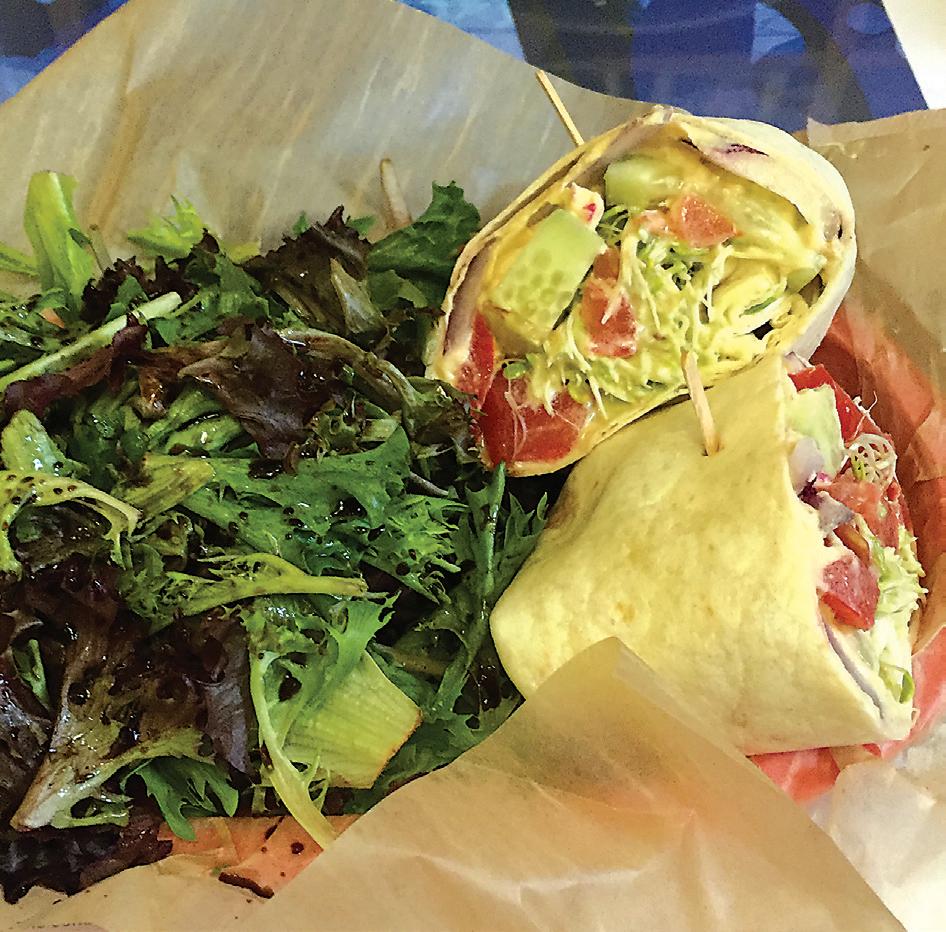
high dining hall rankings. I transferred to Cornell this year from the University of Virginia, a university that’s widely known for its terrible food and limited options — upperclassmen often say that getting food poisoning from one of the dining halls is a rite of passage as a firstyear student — so seeing fresh strawberries and well-cooked rice in the dining halls is still something of a small miracle.
All my worries and fears dissipated when the first meal I had here — breakfast at Becker — contained tofu scramble presented in a gleaming silver tray. It wasn’t tasteless; rather, it was perfectly cooked — firm but still easy to chew — with hints of cayenne and tomato, so that it tasted less like scrambled eggs and more like a beef chili without the beans.
But as I navigate my way through West Campus dining halls, Trillium, Terrace and yes, even Okenshields, I realize my appreciation for Cornell’s food extends beyond the meals the University provides and into the accessibility and openness this community has for vegetarians and vegans alike.
I decided to become a vegetarian in August at the start of the school year for environmental reasons, but without a lot of proper thought or planning, I didn’t exactly know what I had committed to. Still, I felt that cutting out
All my worries and fears dissipated when the first meal I had here — breakfast at Becker — contained tofu scramble presented in a gleaming silver tray. It wasn’t tasteless; rather, it was perfectly cooked — firm but still easy to chew — with hints of cayenne and tomato, so that it tasted less like scrambled eggs and more like a beef chili without the beans. As an introduction to the meatless options at Cornell, the tofu scramble definitely didn’t disappoint. I didn’t want to get my hopes up from just one dish, but after discovering that veggie burgers, meatless chicken, tofu and Seitan options, vegan chili and nutritional yeast
can be found in nearly every dining establishment on campus, I have realized how lucky I am to attend a university that actively caters its meals to accommodate people with different diets.
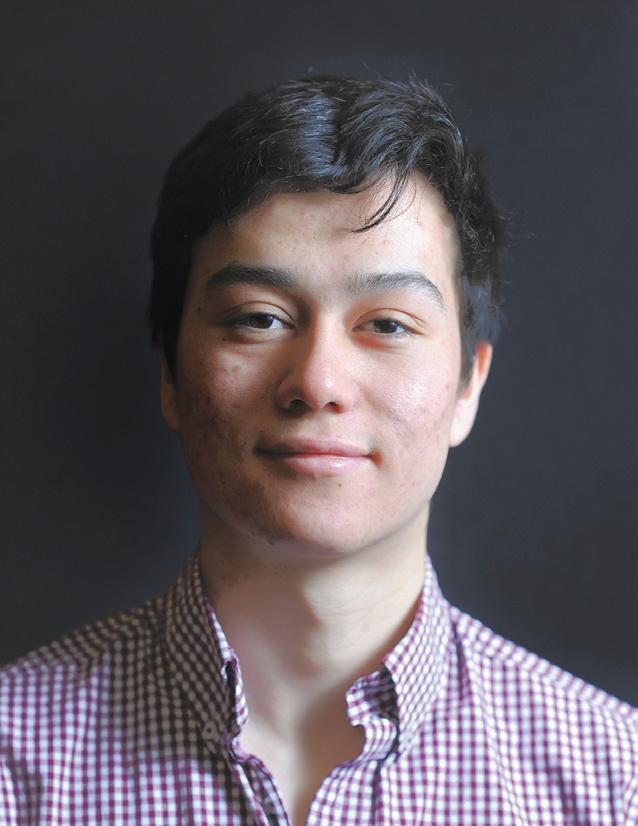
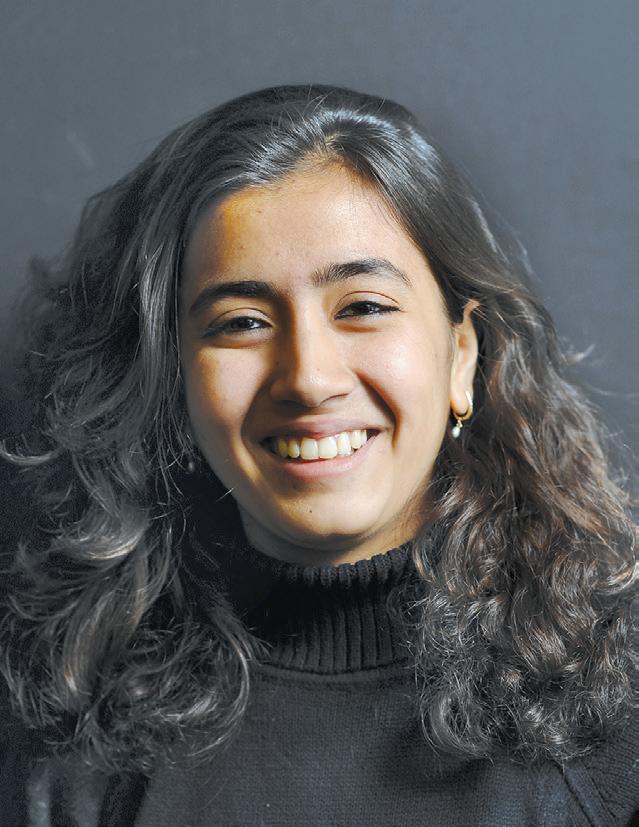
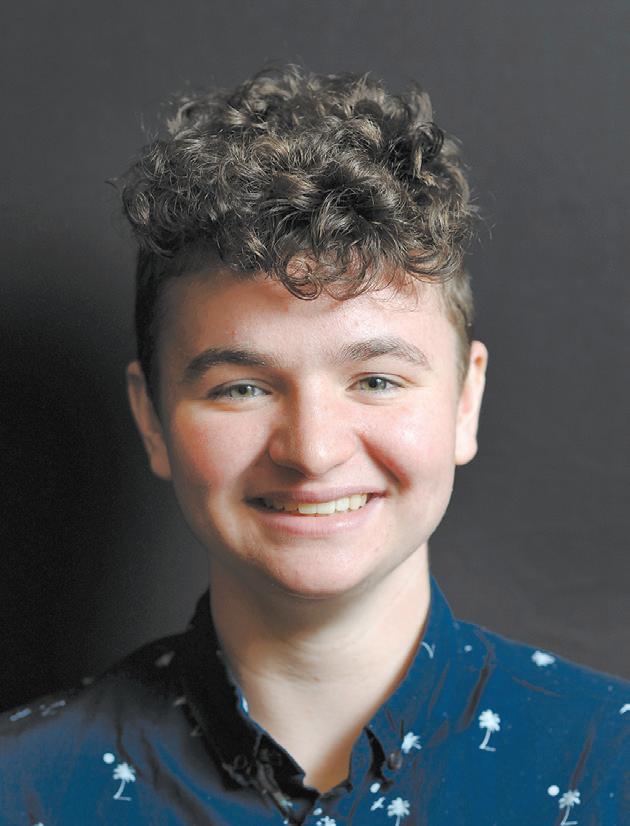
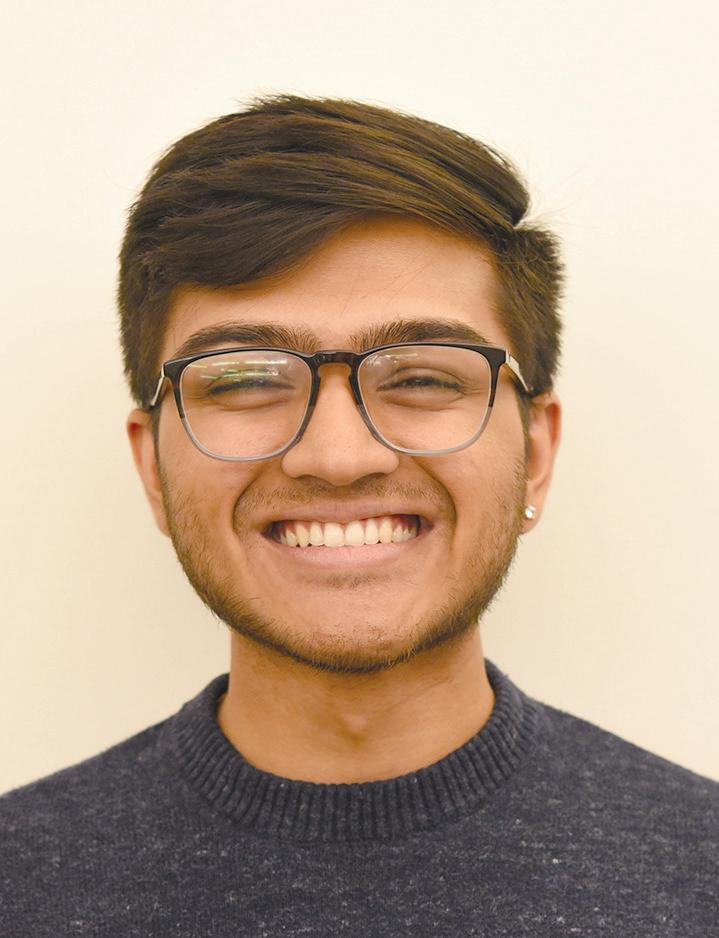
This is a stark contrast to the experience my friends have had back at my old university, where being vegetarian is simply not an option. My best friend there was forced to briefly revert to a pescatarian diet due to the limited vegetarian options — besides the salad bar, there was nothing else that consistently provided fresh vegetables for her to eat. Molly Smullen ’21 shared similar experiences from her friends attending other universities, who couldn’t maintain a plant-based diet without compromising their own health. “And ultimately,” Molly noted, as a vegan here at Cornell herself, “It’s all about privilege. We’re really just privileged to be able to walk into any dining hall and enjoy so many options without having to try, and it’s something that I think we don’t recognize enough here.” And lucky we are indeed, as Molly and
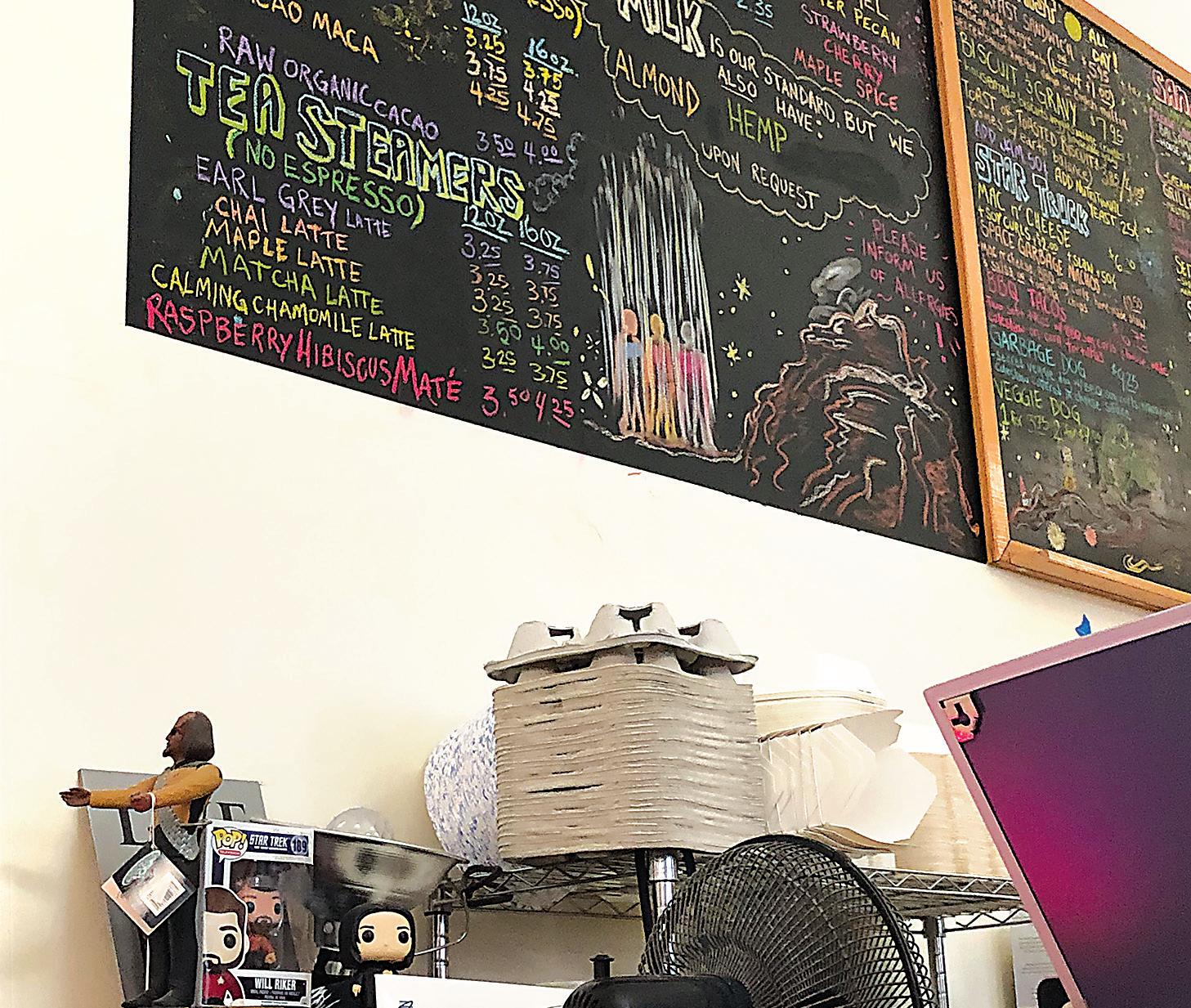
difficult, especially if you’re not vegetarian in any aspect, than to just say no to everything, so they were fine with it,” Molly said. “My mom is super supportive, and my little sister went vegetarian after I had been a vegetarian for about a year and a half, so it helped for things like Thanksgiving — we all went out and bought a fake meat roast for the occasion.”
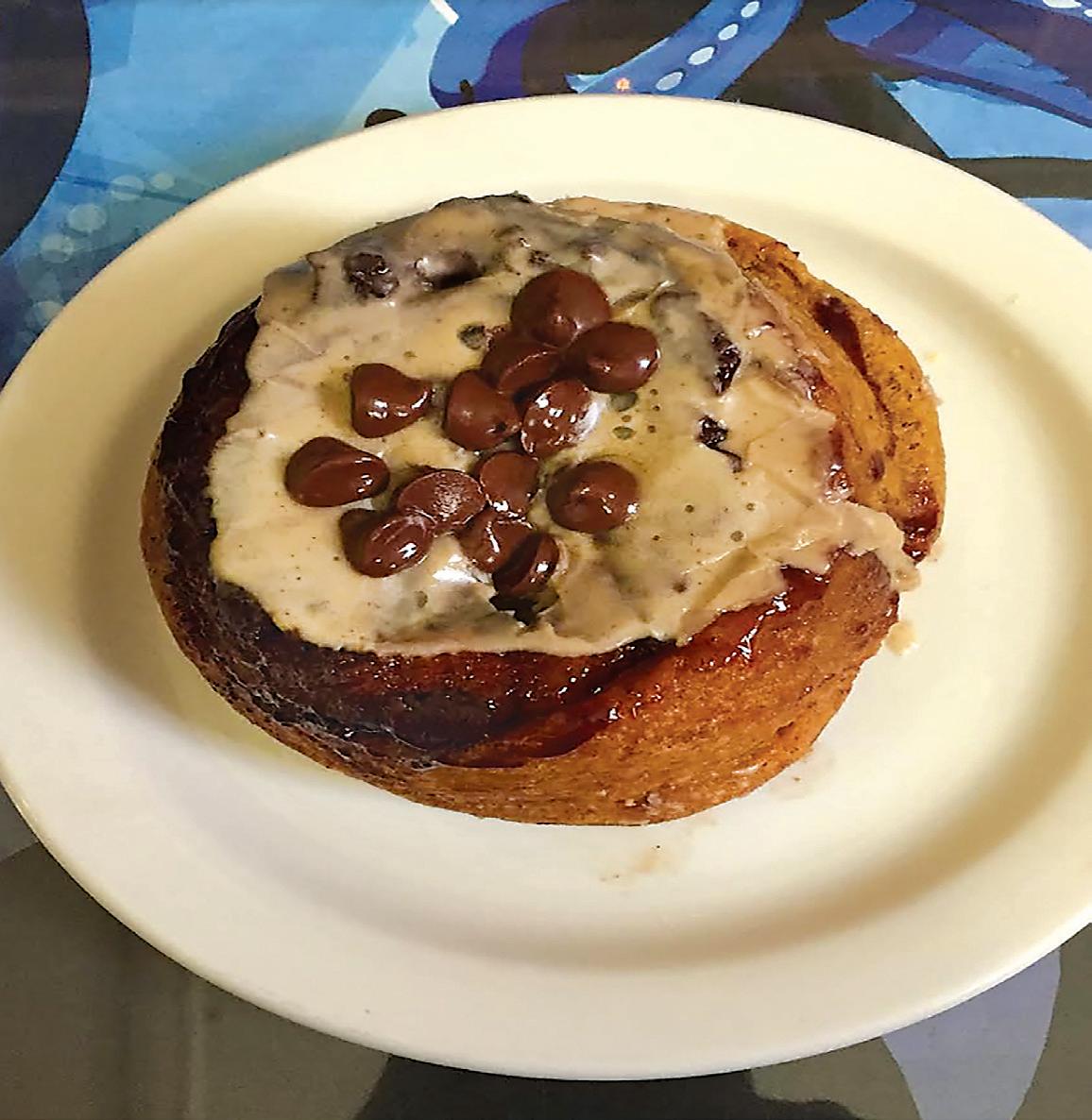
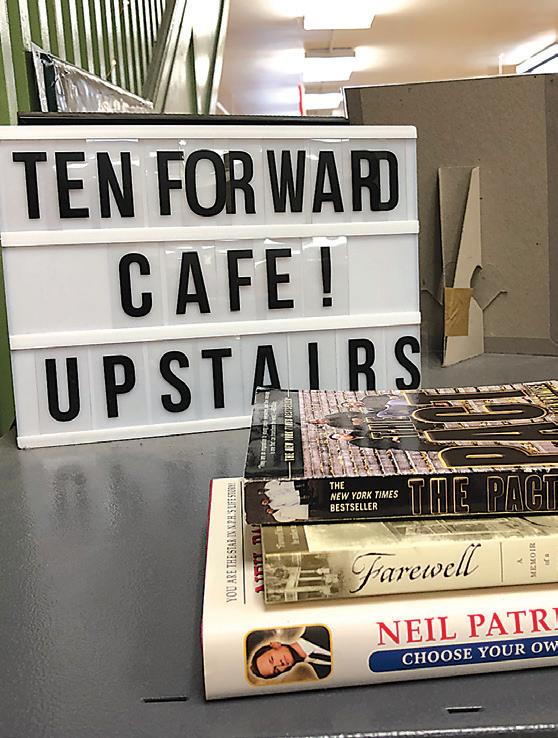
I chat about veganism and all that stems from it at Ten Forward, an exclusively vegan cafe in the Commons. We share a chocolate chip pumpkin bread scone from their huge selection of homemade baked goods (all of which has been amazing in portion, cost and flavor, and I wouldn’t have guessed it was all vegan) over conversation about how her parents felt about her transition into vegetarianism and, eventually, veganism.

“It was pretty easy because I feel like saying, ‘Oh, I’m not going to eat meat,’ is not as
I pose my own question: does your family ever worry that you might not be getting the right nutrients or enough of them? This has been something that both of my parents regularly mention to me, and at the beginning of my transition, I too became concerned about any adverse effects vegetarianism might have on my health.
Molly replied, “I don’t worry about that. And part of that is because I went vegetarian in high school, and I was young and wasn’t considering that aspect. I think it’s also interesting because people are often like, ‘Well what about this nutrient? And this nutrient?’ While I totally understand the concern, if you’re asking me, you better be asking everyone else... You can be a meat-eater and still have anemia — relax! I didn’t notice the transition from eating meat to not either; there was no difference in the way my body
felt before or after.” I find myself agreeing because I had the same experience; as much as people discuss their post-diet changes — good or bad — I felt like my life was as normal as ever upon the transition. The only real difference I experienced was eating in accordance with my own values and feeling like I was working toward change.
Needless to say, I’ve found that the transition to vegetarianism at Cornell is incredibly easy, a realization that comes after much reflection and with immense gratitude. I don’t have to worry about whether or not I’ll go hungry to uphold my personal ideals in environmentalism, a privilege that vegans and vegetarians at other college campuses do not have. The fact that Cornell is so open to plant-based and locally sourced foods means that there also exists a supportive community of people who are striving for the same goals and opening up the conversation around making a difference individually, and I’ve found the student population to be very respectful overall of all different kinds of lifestyle choices. Nobody really bats an eye when you tell them you


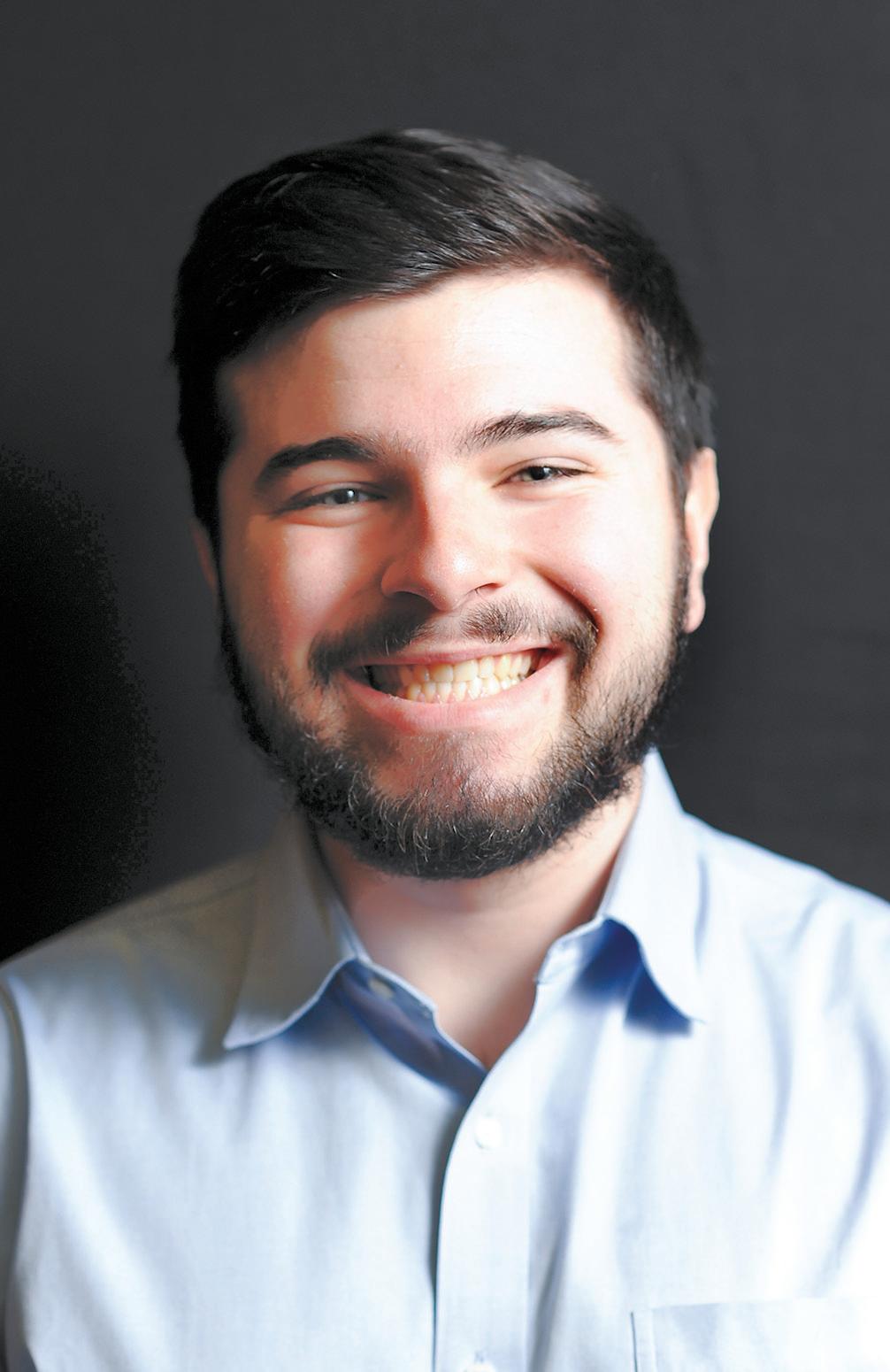
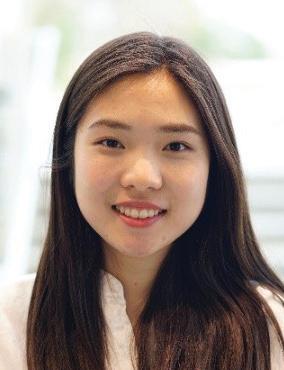



don’t eat meat, and aside from the occasional “what made you vegetarian?” query, I haven’t heard or been the subject of any negativity about my change. More often
Nobody really bats an eye when you tell them you don’t eat meat, and aside from the occasional “what made you vegetarian?” query, I haven’t heard or been the subject of negativity about my change. More often than not, it leads to rewarding conversations about how culture and background play into one’s lifestyle.
than not, it leads to rewarding conversations about how culture and background play into one’s lifestyle.
Before we go, I asked Molly one final, and arguably the most important, question: what are your favorite foods on campus?
“Last year, RPCC did fried cauliflower rice, and I really, really liked that. Appel had vegan cake a couple times too — very good,” she said without hesitation. For me, the fried cauliflower and chia seed pudding in Rose are top notch. Seeing them in the dining hall makes me happy every time and really, isn’t that what good food should be about?


DANIEL MORAN Sun Staff Writer
Friday’s release of Father of 4 by Offset marked the last of the Migos solo releases for the near future. While Father of 4 is the clear standout project of the three, this isn’t saying much. Quavo’s QUAVO HUNCHO and Takeoff’s The Last Rocket were two mediocre, forgettable albums. None of the three come anywhere near hitting the highs of the Migos’ studio albums or even mixtapes. This doesn’t mean that Father of 4 should be disregarded; rather it provided a place for Offset to experiment and open up en large for the first time in his career in a way that will only stand to make the next Migos album even better.
Father of 4 sees Offset take a new artistic direction. This project involves a healthy dose of autotune, creating an incredibly smooth end product when layered over Metro Boomin and Southside’s sleek production. This smoothness stands in stark contrast with Offset and the Migos’ early career; oftentimes early Migos projects such as the underground hit No Label II felt like the sonic embodiment of Lenox Mall’s True Religion store in terms of fostering an environment dedicated to the heaviest of flexing, for better or for worse. Father of 4, then, felt far less gimmicky than the average Migos album. Father of 4 stays relatively free from the “bubblegum trap” lyrics Migos coined in the first place, and there’s far fewer ad libs than expected, which is probably nice because it would sound slightly weird to hear Offset rap about not knowing his child’s mother followed by Takeoff’s signature “MAMA!” adlib. It also expands upon the triplet flow that Migos brought into the mainstream, but this time incorpo-

Irates it with far greater rhythmic diversity. While Offset’s previous work with Migos was great, it often felt impersonal. The eponymous opening track, “Father of 4” addresses this issue immediately, and continues throughout the album as Offset discusses everything from his relationship with each of his children, drug addiction and a car accident that forced an overnight hospital stay. Curiously though, his relationship with Cardi B is hardly discussed at all.
Even though Father of 4 sees Offset make
significant artistic project, the whole album still feels flat in a way you can’t quite put your finger on. Each listen reminds you that for as solid of a project as it is, it still lacks the dynamism of a full length Migos project. This makes sense: Quavo, Offset and Takeoff all grew up together and have spent years making music together, allowing each other to specialize and build off each other. For instance, some of the best Migos songs such as “T-Shirt” or “Hannah Montana” involve a catchy hook by Quavo, a rhythmically dexterous verse by Offset and some
unique way of providing the steel to fill the in-betweens by Takeoff. Each ingredient in this formula doesn’t stand out particularly well on its own because it’s never needed to, there’s always been another Migo to fill in the gaps. Separating one member isn’t conducive to a quality song because they’ve all developed together, in a similar way that separating mutually beneficial organisms has an effect of damaging all parties involved.
So what’s next for Offset and the Migos?
Two mediocre solo albums and an experimental, anecdotal project don’t exactly provide the most solid ground to build on, particularly when the group’s most recent release, Culture II, showed cracks in the Migo style. However, it’s important to note that there was a similar exhaustion with Migos back in 2015; there was a sense that hits like “Versace” and “Hannah Montana” were just trendy songs that would be quickly forgotten about, in much the same way we currently talk about other viral artists such as Lil Pump or Blueface. They responded to these criticisms by developing a darker, less in-your-face style and released the genre defining Culture, their most critically and commercially successful project at that time. It feels like another shift is coming in the Migos sound, likely with Offset at the front. Considering how he was incarcerated during their early success and had the least number of words on Culture, it feels like it’s finally his turn at the helm. It’s difficult to shake the feeling that the next Migos project will be a much darker, more mature sound as they’re finally able to open up about their rise to fame.
Daniel Moran is a sophomore in the College of Human Ecology. He can be reached at dmoran@cornellsun.com.
will begin by saying that traveling by plane can do wonders for the mind. Being suspended tens of thousands of feet above ground in a comparatively tiny aircraft makes any sane person think about this world, while literally passing through whatever concept of time we have so mindlessly succumbed ourselves to. Before we created our modern notion of time, music has, somehow, always operated within it. Many are aware that the monumental 19th century building of trains and the threat of collision propelled us to standardize the inherently subjective notion of time. Prior to the invention of rail travel, there always seemed to be an objective way in which music deals with the concept of time. From ancient orchestras to production tools like Logic Pro, where tempo and “keeping time” are necessary, it feels safe to say that music is the exception to time’s subjectivity, as it does not exist without a seemingly objective conceptual-
ization of time. In preparation for February break, in which I visited friends who are studying abroad in Barcelona, I plugged in my headphones — not my AirPods — and prepared for take-off. I put on some Kygo, stared out the airplane window and watched the clouds engulf me in their beauty. It was all in good fun, until I pulled out my newly purchased book entitled This Book Will

Blow Your Mind , which truly it did.
Skipping directly to the quantum physics section, I grew entranced by a specific chapter on time, in which Einstein’s widely known space time theory is used as its primary basis. For those unaware, Einstein’s space time theory can lead many philosophers to view time largely
as a social construct, or in the words of Kanye West, “a myth.” With Kygo’s “Happy Now” loud in my ears, here’s what I gathered: music is one of the best proofs for Einstein’s — or I guess Kanye’s — space time theory, or the debunking of our society’s largely skewed view of time. What differentiates music from mere noise? Well, patterns; in other words, it is music’s predictability which allows for listeners to become stuck in time. At that split second in time, we are simultaneously living in the past, present, and future.
There is something about the Kygo in my ears during that flight to Barcelona that made me feel this notion more than I believe any other artist could on my playlist. There is something about the predictability of EDM, “tropical house” in Kygo’s case, which I feel really exemplifies the integration of music and time. Predictability is what keeps Kygo remixes hitting streaming records which surpass the original tracks’ stats. Remixing, EDM and feel-good music can all be grouped together as a science and as an art, and

Kygo certainly has perfected both aspects. Through Kygo and tropical house, we are time travelers. So next time, when you’re stuck wondering why you like that beat so much, maybe it’s because you
found a time machine.
Rolnick is a junior in the College of Arts and Sciences. She can be reached at jr798@cornell. edu. Eyes Wide Shut runs alternate Tursdays this semester.
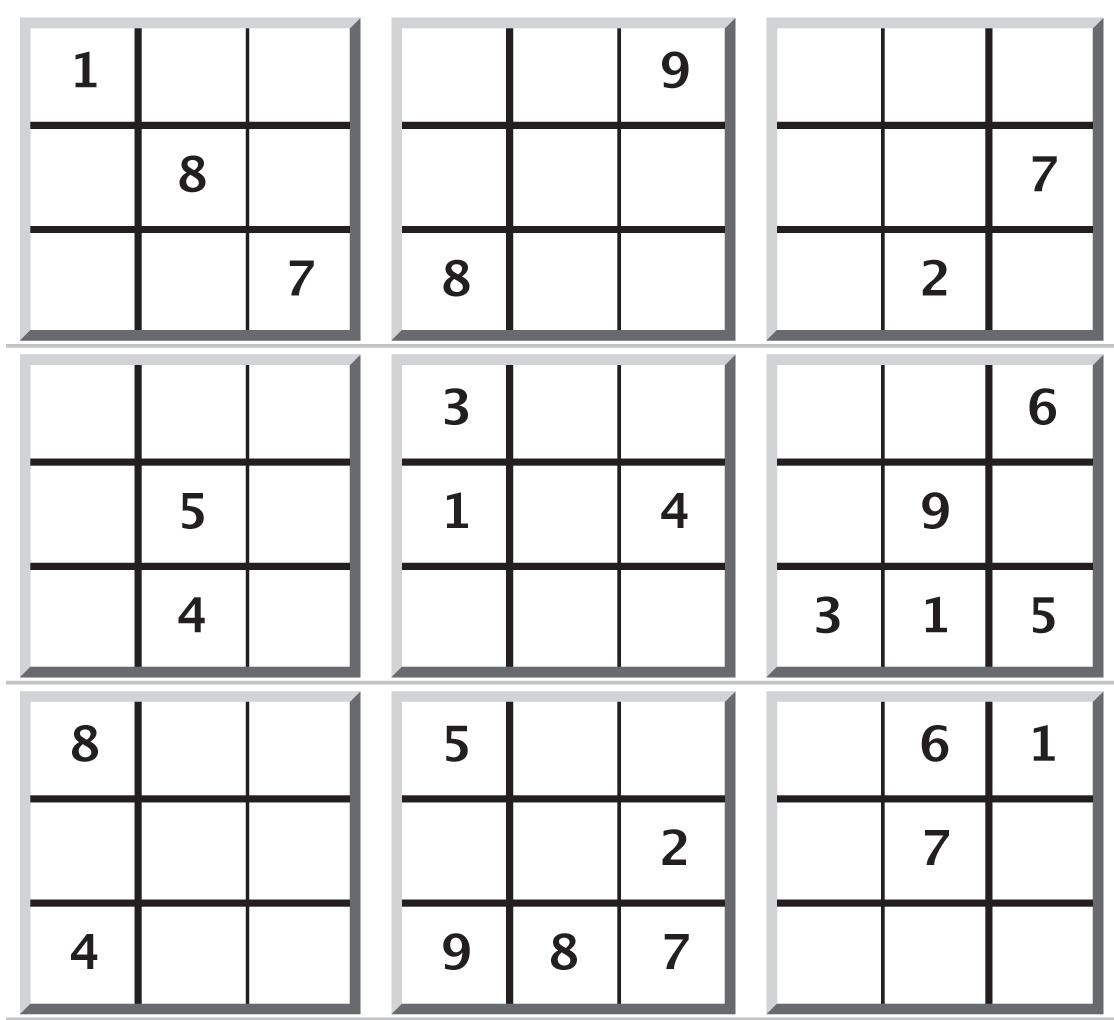
Fill in the empty cells, one number in each, so that each column, row, and region contains the numbers 1-9 exactly once. Each number in the solution therefore occurs only once in each of the three “directions,” hence the “single numbers” implied by the puzzle’s name. (Rules from wikipedia.org/wiki/ Sudoku)

Fill in the grid with numbers 1-6. Do not repeat a number in any row or column. In each heavily outlined set of squares, the numbers must combine, in any order, to produce the target number in the top left corner using the operation indicated.


26 A PA R TMENT FOR R ENT
2
607-330-2442 info@urbanithaca.com www.urbanithaca.com
1 BR Apartment in Private Home in Cayuga Heights. Furnished, internet, water, included. Private entrance, off-road parking Ideal for grad student or postdoc 607-255-6139
27 H OUSE FOR R ENT
9 Bedroom House For Up to 10 People 521 E. State St. Walk to Cornell. Must see. $5950/month. Furnished. Free parking. Available 6/1/2019. 607-379-9168
Linden Ave.



‘Anna From Indiana’ has nearly one million views on her popular college-themed videos
pack brand Bagail, but said none of them require her to promote the product in her video.
"I am only promoting products that I have used and liked," she said.
“I don’t put any livelihood on it,” she continued. “For me, what I fear is that when I start doing YouTube for money, I will start to attach myself too much to my social media, which I don’t think is healthy for anyone to do.”
Being both a YouTuber and a student is demanding, Fang said. Her most popular video took several weeks to edit, totalling over 20 hours. But she said that as she gains more experience, the stress has subsided.
Creating videos has also taught her useful skills. Fang said the videography skills she developed helped her get a job on CUAir, a project team in the engineering school.
After graduating from Cornell this spring, Fang will go to work for online shopping giant Amazon, and plans on continuing YouTube to share her life as a software engineer.
“The really cool thing about YouTube is when I look back now, even though I have only been on YouTube for a short amount of time, I can already see my growth as a person. It would be cool to let my YouTube grow with me,” she said.
by strong
By ZORA HAHN Sun Staff Writer
Cornell gymnastics has been electric for the past three weeks, consistently receiving scores in the high 193 range. Tis past weekend, the team scored 193.925, nearly beating their season-high score of 194.000.
Despite Cornell’s strong showing, Yale’s impressive 195.100 score edged out the Red. However, as associate head coach Melanie Hall noted, Cornell has fnished frst or second in the tournament 13 times since 1994, a testament to the excellence sustained by Cornell gymnastics under the guidance of Hall and head coach Paul Beckwith.
Tree Cornell gymnasts placed frst in their respective events, and were thus crowned Ivy League champions. On vault, freshman Donna Webster won with a 9.800 score; on bars, senior Christina Luniewicz scored 9.850; on foor, sophomore Claire Haklik matched her season-high score of 9.900.
Despite top performances in several categories for the Red, points lost elsewhere cost the team a frst-place fnish. Te team’s slip into second place was primarily due to errors on beam routines.
“Only three people out of the six made their routines, and so beam was really rough for us,” Hall said. “Two of the people who had a rough day on beam were sick.”
Sophomore Claire Haklik stepped up on foor, scoring a strong 9.900 and tying a career-high mark she set at the Big Red
Goes Pink Invitational on Feb. 9.
Haklik’s frst tumbling pass was mentioned in an episode of GymCastic, a popular gymnastics podcast. One of the judges from the Pink Invitational was interviewed on the podcast, and spoke about Haklik’s pass. Haklik recalled his comments on her performance.
“My frst pass is pretty rare to see in NCAA gymnastics, because it is a pretty difcult combination,” Haklik said. “[Te judge] talked to them about my frst pass, and … how difcult it is and how it was impressive. [He talked] about the Ivy League and how our skills are extremely impressive given that we’re not scholarship athletes.”
Haklik partially credited her success to her pre-meet routine and preparation.
“I have a mindset where I’m like: ‘Tis is for my team. I have to do this for my team,’” Haklik said. “I go behind the bleachers and … I don’t really watch anybody else.”
“In practice, my teammates have been super supportive … [senior Malia Mackey] especially helps with jumps — my jumps have defnitely gotten better and my tumbling passes as well,” Haklik said. “She’s been a huge asset to me.”
Te team is improving at just the right moment in the season, with ECAC championships coming up, followed by NCAA Regionals and USAG Collegiate Nationals.
“Tis coming weekend, we go to Penn State and we see Yale again,” Hall said. “Our goal is to hit all of our routines, and if we hit all of our routines and every-
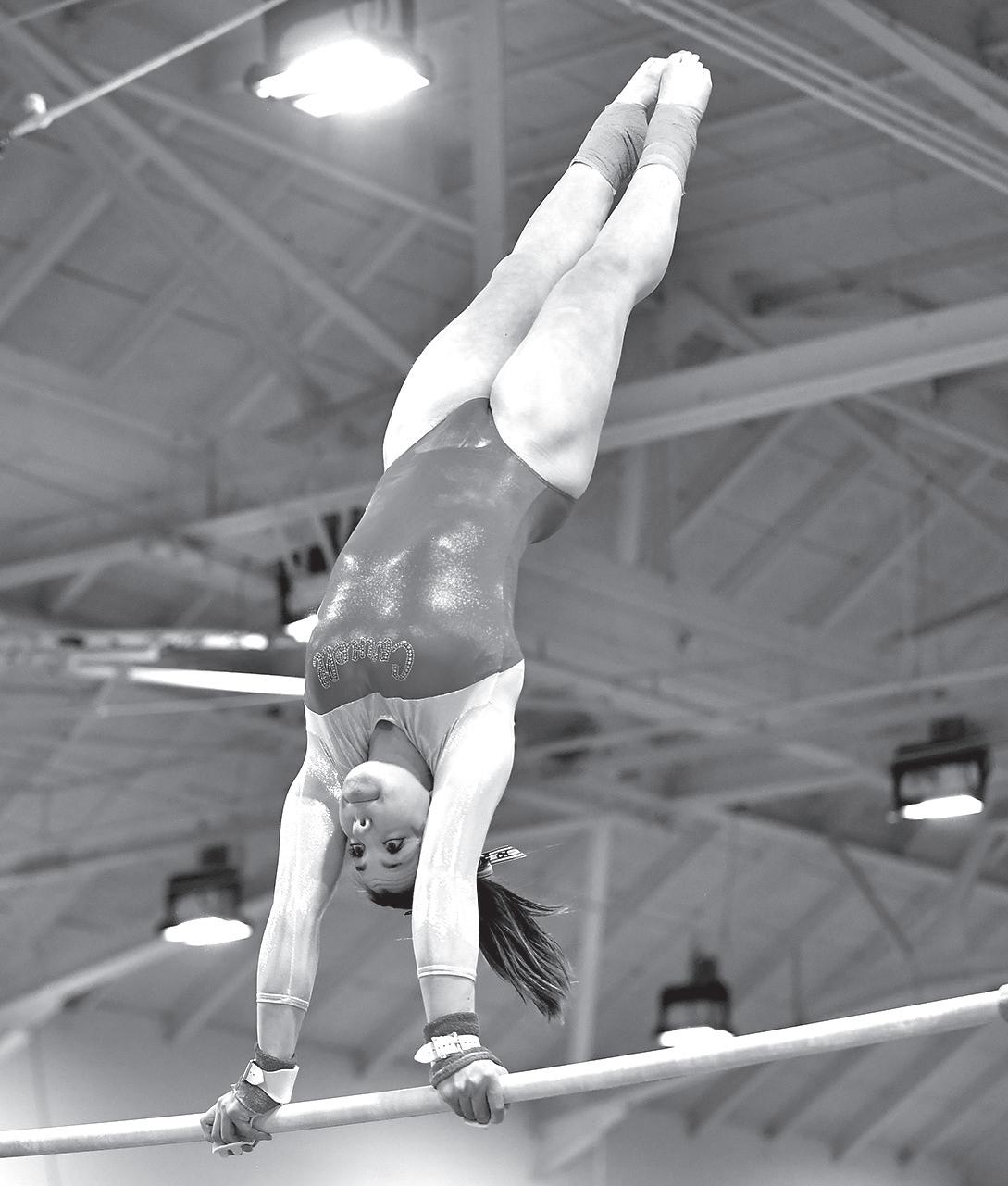
body else does that, then the best team will win.”
Coach Hall and her players have high aspirations for the remainder of their season ahead of the team’s trip to Penn State this weekend.
“I really would like my team to hit 195 [or more],” Haklik said. “Last year at
nationals we broke our school record at 195, and I think we can break that again. I want [the team] to be frst … at ECACs … [and] I want my team to make it to collegiate national fnals.”
Zora Hahn can be reached at zhahn@cornellsun.com.

By SMITA NALLURI Sun Staff Writer
Despite an even second half, Cornell women’s lacrosse ultimately succumbed to No. 11 Penn State, 14-12, in a narrow loss.
Cornell (0-2) headed into its home opener looking for its first win of the season, but two yellow cards and a rough opening to the second half left Penn State (3-0) with the slight edge.
The Nittany Lions were the first to get on the board after a yellow card on Cornell junior defender Taylor Lis gave them a man-up advantage. The visitors also tallied the next two goals to take an early 3-0 lead, but the Red then netted four unanswered goals of its own to take the lead, 4-3, about halfway through the first half.
Penn State then went on a scoring rampage of its own, scoring the next four goals to take a three-goal lead. The teams then traded goals until a shot from senior captain and attacker Sarah Phillips found the back of the net with a little over three minutes left in the first half to shrink Penn State’s lead to two.
However, within the first five minutes of the second half, the Nittany Lions scored four unanswered goals to extend their lead to six. Freshman midfielder Genevieve DeWinter then put an end to Penn State’s scoring streak by netting two consecutive goals and cutting the Nittany Lions’ lead to four.
After another Penn State goal, the Red scored three in a row to shrink the Nittany Lions’ lead even further to two with a little over 11 minutes left to play. However, after a Cornell yellow card on freshman midfielder Reilly Fletcher, Penn State capitalized on its second man-up opportunity of the game to extend its lead to three again.
Freshman midfielder Shannon Brazier put the Red back in striking distance, scoring her first career goal with a little
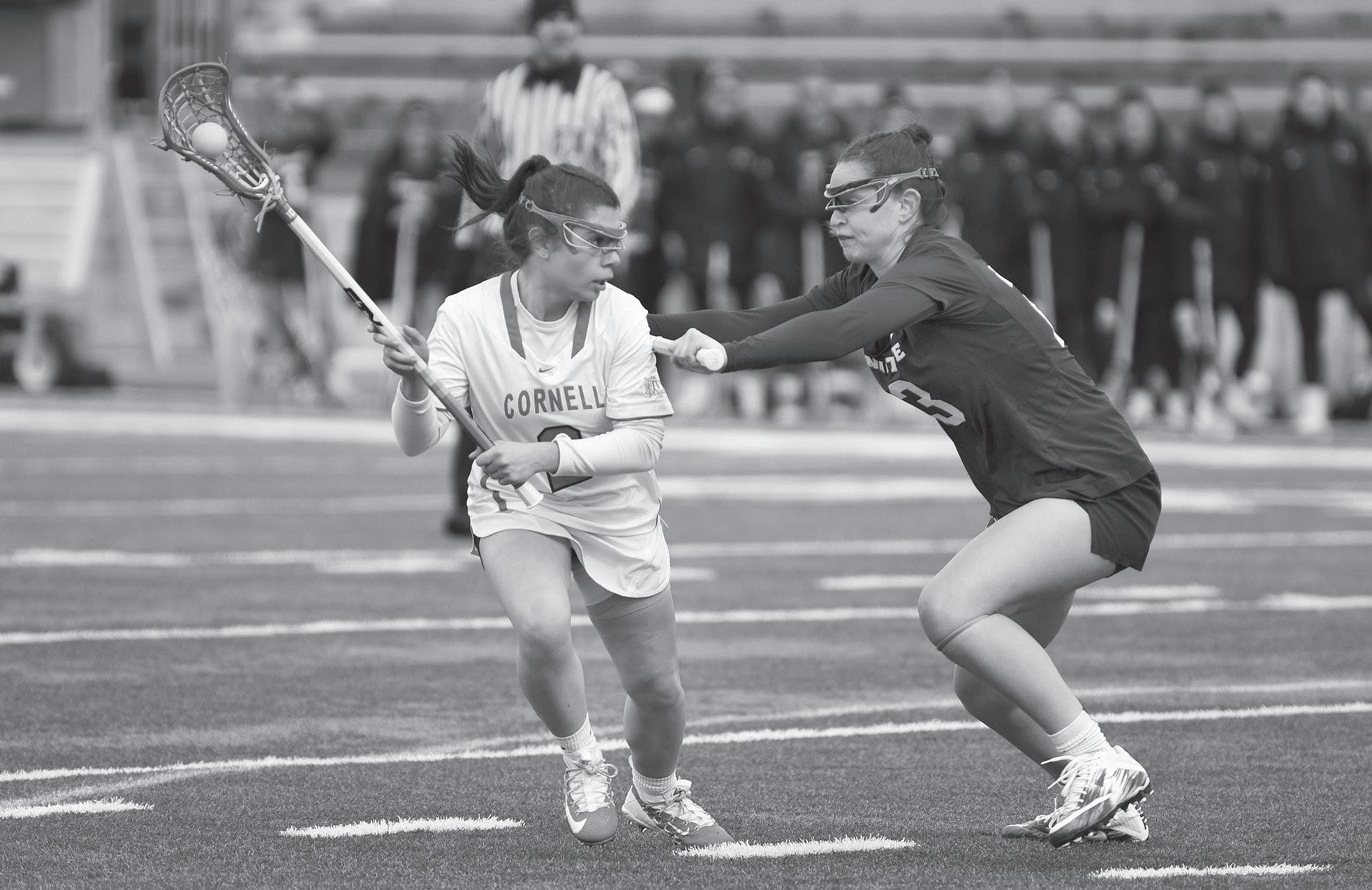
less than eight minutes on the clock. However, neither team was able to find the net for the rest of the game and the Nittany Lions walked away with the win.
Junior captain and midfielder Caroline Allen led the way for the Red with six points — two goals and four assists— and Phillips was close behind with four goals. DeWinter netted three goals of her own and sophomore midfielder Ellie Walsh, senior attacker Shannon Bertscha and Brazier each found the back of the net once. Walsh was also outstanding on the draw, winning a career-high seven faceoffs.
Junior goalkeeper Katie McGahan was outstanding in the crease, tallying nine saves and fielding three ground balls.
“I think our team showed a lot of growth from last week against Villanova to this week against Penn State,” said junior captain and defender Mary Kate Bonanni. “It wasn’t the outcome we wanted. But we had great energy on the field and played with heart the entire game, which made all the difference out there.”
Though it did not achieve the end result it was looking for, the Red proved its ability to compete with a nationally
ranked team — both squads took 23 shots on goal, caused 10 turnovers and fielded 15 ground balls. The Red had the advantage in draw controls, winning 15 to Penn State’s 13.
The match against the Red also marked the closest game of the season for Penn State, whose previous two matches were won by an average margin of eight goals.
“After this past weekend, [the team] realizes our potential since Penn State is such a good team,” Allen said. “We want to continue to improve and build off the lessons learned from our games so far.”
Primed to work for its first win of the season and to open up conference play, the Red will return to Schoellkopf Field on Saturday at noon to face rival Harvard.
“We’ve got to stay in a growth mindset — learning and improving with every game and every practice,” said head coach Jenny Graap ’86. “Starting conference play this weekend is exciting. The competition in the Ivy League is always intense and [we] will be hungry for our first win of the year.”
Smita Nalluri can be reached at snalluri@cornellsun.com.
By KATHERINE FAIOLA Sun Contributor
Cornell baseball threw down the gauntlet to open the 2019 season, but Baylor (7-0) posed an insurmountable opponent in the Red’s first weekend series of the year.
The Red (0-3) traveled to Waco, Texas and suffered a 17-0 shutout on Friday, a 10-3 loss on Saturday and a 12-4 loss in Sunday’s finale.
Cornell tightened up its play for game two, but couldn’t answer the five runs scored by the Bears in the bottom of the second inning.
In game three, Cornell got on the board first with two runs in the top of the first inning, but was held scoreless until the eighth.
The Bears beat the Red by more than seven runs in all three games, whereas Cornell managed only seven runs combined over the weekend.
In game one on Friday, Cornell had just four hits against the
Baylor pitching staff. Cornell rebounded on Saturday to score three runs off five hits. In the final game of the series, freshman Justin Taylor had two hits, sophomore Ramon Garza had a run-scoring double and senior catcher Will Simoneit had a double and a home run, good for two RBI.
Garza and Simoneit’s batting averages stand at .455 and .364, respectively, after three games.
While the scores reflect a tough outing for the Red, a bright spot for the young team was the depth showcased by middle-inning relief pitchers junior Colby Wyatt and freshman Jonathan Zacharias, who pitched 5.2 innings in game two and four innings in game three, respectively.
Cornell continues on the road for a three-game series starting March 1 against Virginia Commonwealth University (4-2), which is currently riding a three-game winning streak.
Katherine Faiola can be reached at kef66@cornell.edu.
HOCKEY
Continued from page 20
“Our guys know that we need to win both games in order to get what we want, so I think we just focus on St. Lawrence on Friday night,” Schafer said. “They competed really hard here in the 3-1 game. It’s not like we can go up there and have a misstep against St. Lawrence and expect to win the championship.”
As for Clarkson, the Golden Knights suffered a 5-0 beatdown when they came to Lynah Rink in early February. Cornell went up 2-0 after one period and chased Clarkson goaltender Jake Kielly from the game after two periods, a year removed from failing to get one past Kielly in 125 minutes of action.
“We’re expecting [Clarkson] to push back for sure,” Smith, who missed the first matchup with an injury, said. “[We] had one of our best games of the year … Their goalie’s probably going to have a bit better game and their team’s going to be a bit better.”
Cornell remembers when it clinched the Cleary Cup last year at RPI. It was satisfying simply for the vengeance it inflicted on the Engineers, but even sweeter by solidifying the Red’s status as the paragon of the conference.
Repeating the feat this year — a year which has seen a multitude of long-term injuries to key players, among other adversities — would be a validation that Cornell may be better prepared for the imminent postseason than last year, when the team admitted adversity was almost nonexistent — Cornell didn’t lose consecutive games until its final two of the season, in the ECAC semifinals and NCAA Tournament.
“One of the things we really didn’t have last year was as much adversity,” said sophomore forward Brenden Locke. “Losing a few games, tying, not really getting those points is tough, but adversity is what you have to face in order to win and be a successful hockey team, so the fact that we can face that now and look at that and learn from it is really going to help us going into the playoffs.”
And to do so, it’ll have to make some opposing fans disappointed along the way just like last season.
“We have to remember how it felt when we actually did it,” Smith said.
“A greasy road win is sometimes just as good as a nice home win,” Locke said. “It’s going to be tougher, it’s always hard going into someone’s rink, especially like Clarkson and St. Lawrence, those are some tough barns to play in … Being away adds some extra toughness to it.”
Cornell plays St. Lawrence at 7 p.m. Friday and Clarkson at 7 p.m. Saturday.
Zach Silver can be reached at zsilver@cornellsun.com.
Raphy Gendler can be reached at rgendler@cornellsun.com.
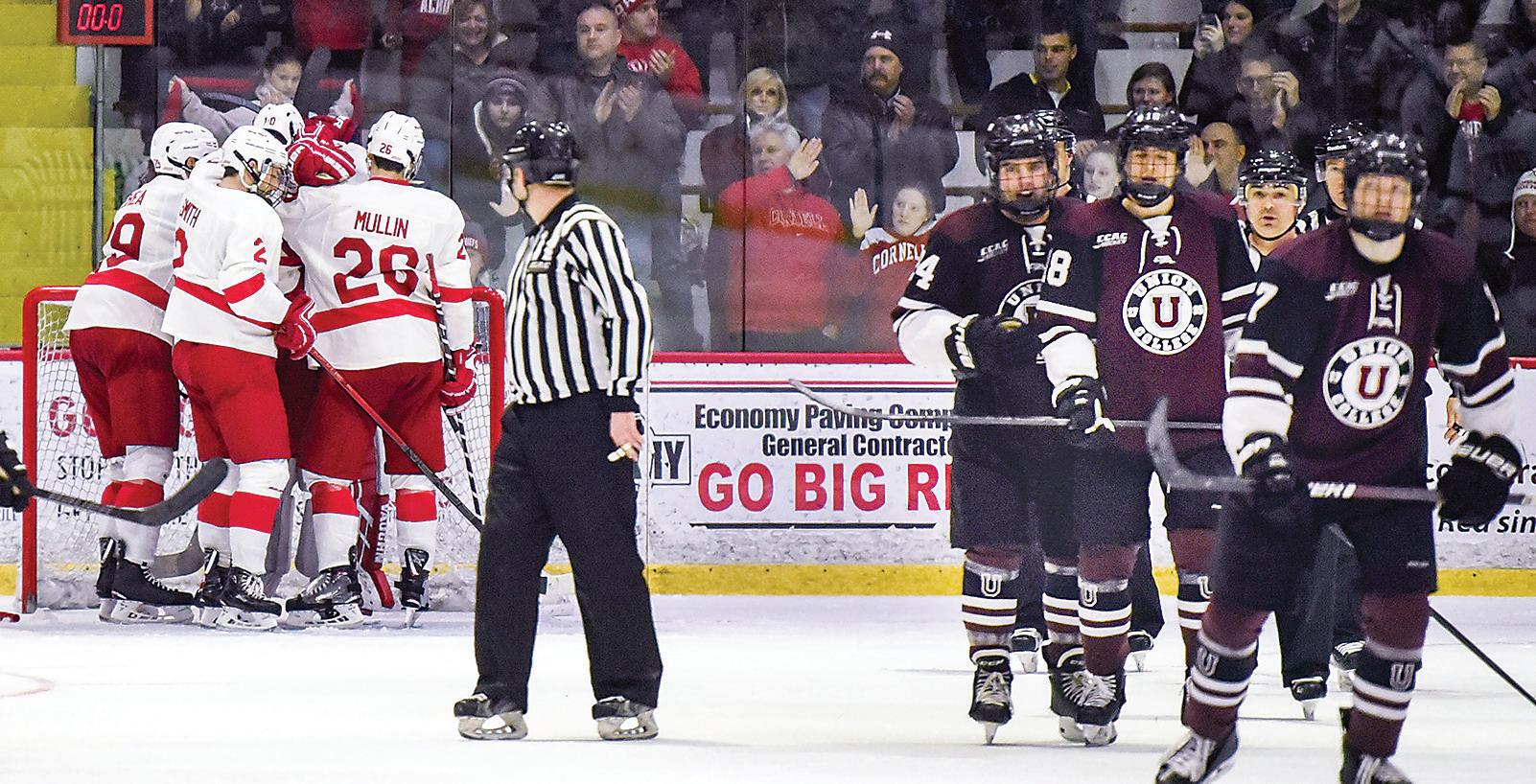
In order for Cornell men’s hockey to secure its second consecutive Cleary Cup as ECAC regular season champions — something the program has not done in over a decade — it may have to sweep its North Country foes on the road, also something the Red has not done in over a decade.
In first place in the ECAC, Cornell can use this weekend to clinch a Cleary Cup for the second straight year, a feat that hasn’t been done since the the 2001-02 and 2002-03 seasons. There is a chance that the Red won’t necessarily need to sweep St. Lawrence and Clarkson on the Saints’ and Golden Knights’ home rinks this coming weekend — something it hasn’t done since 2005 — but with just one point separating Cornell and HarvardQuinnipiac tied for second, it’s certainly likely.
“It’s a very similar situation this year where we’ve gotta go on the road, gotta win two games to clinch,” head coach Mike Schafer ’86 said, referencing when Cornell locked up the Cleary Cup in the penultimate game last season visiting RPI. “That’s gotta be the mindset — we’re going to have to sweep to get the league championship.”
But arguably more important this weekend, however, is that Cornell can secure itself a first-round bye in the ECAC playoffs with at least one point this weekend. On the flip side, being swept up north and Yale sweeping its own home series could push Cornell out of the all-important top-four bye territory.


“Being a guy that’s been injured all year, it’s amazing what an extra week off can do,” said senior defenseman Brendan Smith.
In order to get two wins, Cornell will have to down a relatively upstart second-half St. Lawrence squad and a vengeful Clarkson squad also clawing for postseason security. The Red has already swept the North Country teams at home, but history has proved replicating that success upstate far more difficult.
“It’s great that we were able to [win the regular season title] last year, we’d love to do it again,” Smith said.
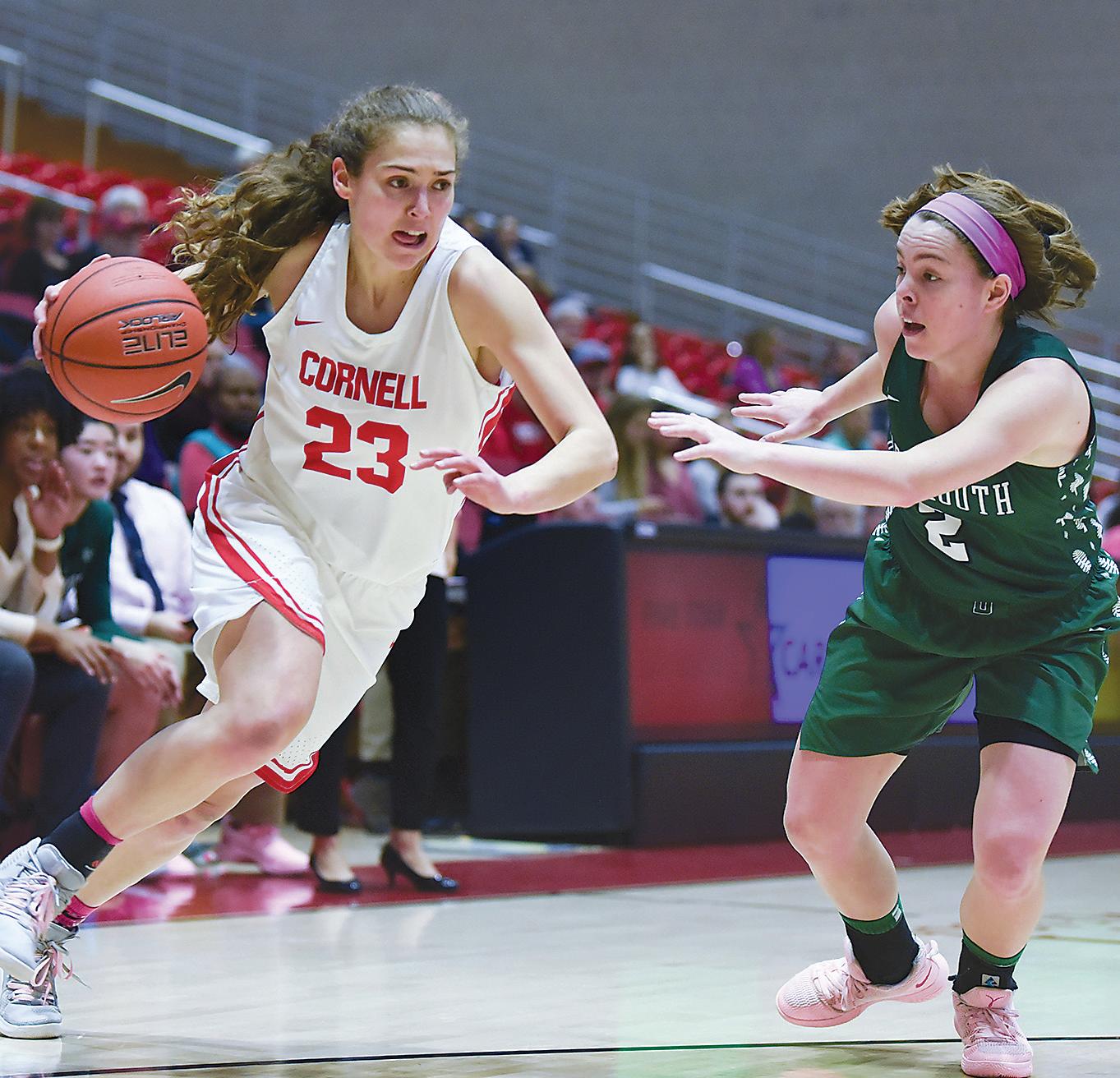
By MANAN MODI Sun Contributor
“Being able to win the regular season in ECAC two years in a row is really tough to do.”
Looking ahead to the NCAA Tournament, a loss to a lowly St. Lawrence — second to last in the PairWise — would surely move the Red down in the NCAA tournament picture and would require Cornell to advance far into, or perhaps even win, the ECAC tournament to earn an NCAA bid.
In regards to St. Lawrence, the basement-dweller of the ECAC, the Saints have not gotten close to an easy win over the course of the second half — especially at home. St. Lawrence has won just a single game in 2019, but nearly all of the Saints’ home losses in the second half have been decided by a single goal. Their one win, too, was determined by a single goal over Princeton, and a 2-2 tie with Dartmouth salvaged another point.
Coming off back-to-back victories, Cornell women’s basketball went to Princeton looking to maintain momentum and take down the Tigers. The match got off to a tough start for the Red, who staged a near-comeback in the second half before ultimately falling to Princeton, 68-64.
Princeton outscored the Red, 44-27, in the first half of the match. Junior guard and forward Samantha Widmann led the team with 14 points in the first half, shooting an efficient 6-for-9 from the floor in under 20 minutes.
During the second half, however, Cornell showed marked improvement. Junior guard Lauren Bagwell-Katalinich led the Red’s comeback by scoring 18 points in the latter two quarters despite only playing 15 minutes. Bagwell-Katalinich shot 8-for12 from the floor and led the team in steals in the second half.
“Our performance during the first half ... prepared us for the second half and our pressure defense late in the game catapulted our offense and allowed us to have a great comeback,” Widmann said.
Cornell’s 25-point performance in the fourth quarter drew the game to a four-point deficit by
the time the final buzzer sounded.
“I’m so proud of how our team responded in the fourth quarter ... I know we would’ve liked to leave Princeton with a win, but all we can do now is learn from it and look ahead to the next game,” Bagwell-Katalinich said.
Even with the game going in Cornell’s loss column, the energy of the comeback — coupled with Widmann and Bagwell-Katalinich’s impressive showings — made the game feel a little less like a defeat.
“I think running and looking to be aggressive in transition helped us. We pride ourselves on defense, and in the Princeton game we were able to get some steals and scores off of fast break opportunities,” sophomore guard Kate Sramac said.
Going forward, the Red hopes to improve its play by increasing ball movement and giving more players the chance to get on the scoreboard.
Cornell could also improve on its ball movement and three-point shooting — the Red only shot eight three-pointers during the game, while Princeton shot more than triple that amount.
This weekend, Cornell will take on Ivy foes Yale and Brown at home.