The Corne¬ Daily Sun


By BENJAMIN LEYNSE Sun Senior Writer
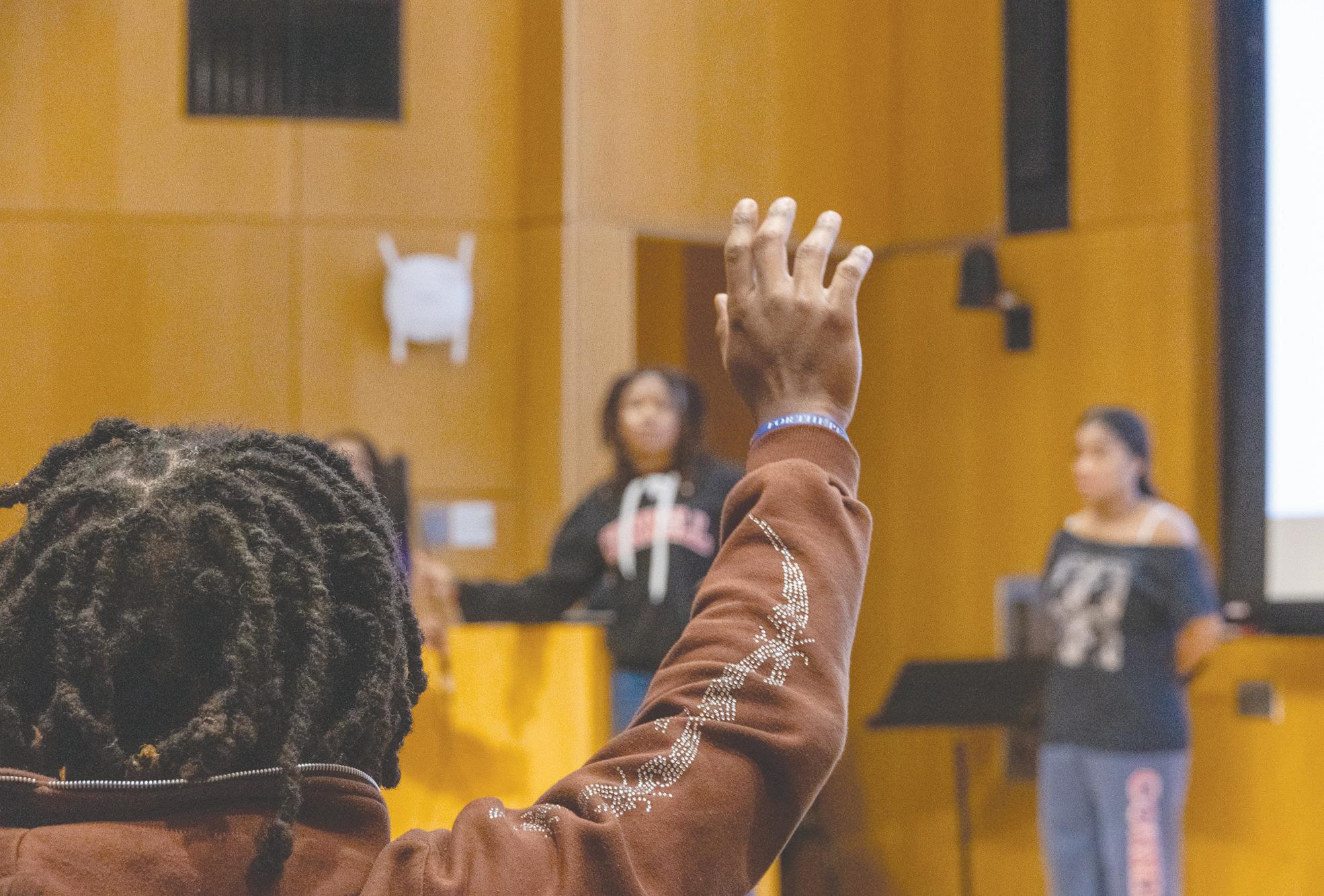
Feb. 24 — Black Students United held an “Emergency Meeting” Friday evening in response to a letter sent by the Department of Education ordering the elimination of “racial preferences” and race-conscious programs from admissions, hiring and institutional programming at federally funded educational institutions. At the forefront of the nearly 60-person meeting were concerns that community spaces for marginalized groups on campus would be targeted and closed.
In the Instagram post announcing the event, BSU stated, “The Trump Administration looks to end affinity groups for marginalized people across all schools & universities … we won’t allow this to happen.”
The Feb. 14 ED letter called the use of race in dormitories, such as some of Cornell’s program houses, a “shameful echo” of America’s history and banned the inclusion of race in
decisions of all “aspects of student, academic, and campus life.” This includes admissions, financial aid, administrative support and housing. Educational institutions were given until Feb. 28 to comply, after which they may be subject to investigation and loss of federal funding.
Faced with the threat of the letter’s directives, leaders of BSU — a registered student organization that receives University funding — chose to convene on Friday.
“[We] wanted to just be a place in where we are all on the same page, so that if [Cornell does comply], we can mobilize quickly and we can make sure that we’re letting Cornell know that we aren’t taking that for an answer,” said Athena Holloway ’27, BSU co-president. “We want to preserve our communities, our identities [and] our well-being.”
To continue reading this article, please visit www.cornellsun.com.
By MATTHEW KIVIAT Sun News Editor
Feb. 21 — Interim President Michael Kotlikoff sent a statement to the Cornell community on Friday morning addressing campus concerns regarding recent changes to federal regulations and guidelines relating to cuts in federal research funding and research and diversity, equity and inclusion programs. In the statement, Kotlikoff both affirmed the University’s commitment to following the law and described diversity as essential to the University’s mission.
Kotlikoff announced in the statement the creation of a new university response planning team, which will be led by Provost Kavita Bala to analyze the impacts of the new federal policies.
“This is a dynamic and evolving situation, and our response planning team will be prepared to address new developments as they arise,” Kotlikoff wrote. The statement addresses a Feb. 14 letter sent by the U.S. Department of Education to federally funded educational institutions, including Cornell, calling for the end of “racial preferences” regarding admissions, hiring and institutional programming. If the institutions do not comply within two weeks, they may be subject to investigation and the loss of federal funding, according to the ED.
Kotlikoff wrote that Cornell will continue to affirm its “founding principle of opportunity and access”
and commitment to free inquiry and openness that “helped make Cornell the model of the modern American research university.”
The statement explained that diversity is essential to the University’s mission. Kotlikoff wrote that diversity comes in many different forms — which include lived experience, geographic location, viewpoints and veteran status — and it is critical to Cornell’s “‘any person’ history.”
Though Kotlikoff wrote that the University “prizes diversity as a driver of our excellence,” he also affirmed that Cornell is “committed to merit-based decisions,” in all processes.
“This is a dynamic and evolving situation, and our response planning team will be prepared to address new developments as they arise.”
Interim President Michael
Kotlikoff
“Just as we do not exclude anyone at Cornell for reasons irrelevant to merit, neither do we admit or evaluate students, hire or promote employees, award chairs or tenure, or make any other merit-driven decisions at Cornell based on race, ethnicity, or other attributes not relevant to merit,” Kotlikoff wrote.
The statement emphasized the
importance that members of the Cornell community be cautious to ensure the University follows the law amid new federal policies relating to DEI initiatives.
“We must be vigilant, particularly, to ensure that when Cornell departments, organizations, or interest groups offer programming designed to support particular groups within our community, those opportunities are equally open to all, without bias for or against any groups,” Kotlikoff wrote.
However, Kotlikoff also wrote that the University continues to maintain its commitment to “ensuring equal opportunity for all of our students, faculty, and staff, without regard to race, gender, or any other characteristic protected by law” and will “continue to convey this commitment to nondiscrimination in communications and our activities.“
The statement also addressed federal guidance surrounding research. After affirming that “Cornell follows the law,” Kotlikoff emphasized that as far as the University is aware, “none of the recent federal guidance limits the academic freedom of our community to research or study any subject [or] our ability to exercise free expression within a safe and respectful community.”
To continue reading this article, please visit www.cornellsun.com.
By
Feb. 25 — It was the photo seen around the world — a group of Black anti-war activists walking down the steps of Willard Straight Hall, rifles in hand and demands met.
Ed Whitfield ’70, leader of the Cornell Afro-American Society — which is now Cornell Black Students United — helped organize the 36-hour occupation of Willard Straight Hall to protest racial injustice and the Vietnam War in 1969.
At the time, tensions at Cornell and across college campuses were at their peak as groups on campus conducted teach-ins, protests and other demonstrations to bring attention to what they saw as an unjust war and lack of racial equality on campus.
In an interview with The Sun, Whitfield said that regardless of what other students thought of the protest, the Vietnam War was “immoral and unreasonable.”
“I didn’t think it was right for us to be killing people across the world,” Whitfield said.
other AAS student activists occupied Willard Straight Hall for 36 hours to protest the slow progress of the establishment of a University Afro-American Studies Center and frustrations with the judicial decision that found previous protestors guilty for breaking the student behavior coe. Within days, uprisings also began at Dartmouth, Princeton and several other colleges.
According to Whitfield, the guns in the famous picture were not part of the original plan and instead were a response to white Delta Upsilon fraternity brothers entering Willard Straight and fighting the protesters.
“We decided to throw them back out the windows they broke,” Whitfield added. Influenced by the Orangeburg Massacre of 1968, where three civil rights protesters were killed by police in South Carolina, Whitfield explained that the protesters got firearms to protect themselves from a potential other attack from the fraternity.
To continue reading this article, please visit www.cornellsun.com. Matthew
On April 20, 1969, during parent’s weekend, Whitfield and

INDEPENDENT SINCE 1880
Tomorrow Today ALL DEPARTMENTS (607) 273-3606 Editor in Chief Gabriel Levin ’26
Business: For questions regarding advertising, classifeds, subscriptions or delivery problems, please call from 9 a.m. to 5 p.m., Monday-Friday. News: To report breaking news or story ideas, please call after 5 p.m., SundayTursday.
SEND A FAX (607) 273-0746
VISIT
139 W. State Street, Ithaca, N.Y.
THE SUN ONLINE www.cornellsun.com E-MAIL sunmailbox@cornellsun.com
Postal Information: The Cornell Daily Sun (USPS 132680 ISSN 1095-8169) is published by the Cornell Daily Sun, a New York corporation, 139 W. State St., Ithaca, N.Y. 14850. The Sun is published Tuesday and Thursday during the academic year and every weekday online. Three special issues — one for seniors in May, one for reunion alumni in June and one for incoming freshmen in July — make for a total of 61 issues this academic year. Subscriptions are: $60.00 for fall term, $60.00 for spring term and $120.00 for both terms if paid in advance. Standard postage paid at Ithaca, New York. Postmaster: Send address changes to The Cornell Daily Sun, 139 W. State St., Ithaca, N.Y. 14850.
The Werk Room: Grad Writing Hours at the LGBTRC
11 a.m. - 1 p.m., LGBT Resource Center 3rd Floor Multipurpose Room
Midday Music for Organ: Guests Anne Laver and William Knuth
12:30 p.m. - 1:30 p.m., Sage Chapel
Careers in the Labor Movement: Discussions with ILR Alumni
4:30 p.m. - 5:30 p.m., Ives Hall
Preparing for Consulting Recruitment
4:30 p.m. - 6 p.m., Zoom
An Afternoon With Citronino
5 p.m. - 6 p.m., 291 Statler Hall
Weekly Buddhist Sangha Meeting
5 p.m. - 6 p.m., G14 Anabel Taylor Hall
Take Action For Animals, Animal Advocacy at Cornell 6 p.m. - 7 p.m., G24 Goldwin Smith Hall
BlackOUT Week: Movie Night
6 p.m. - 8 p.m., 626 Thurston Avenue, Garden Level
The Spoken Word, Interfaith Council at Cornell 7 p.m. - 8 p.m., Anabel Taylor Hall Auditorium
AAP Career Fair Overview and Q&A Noon - 1 p.m., Sibley Hall B56 Conference Suite
Upcycling Series: Mending Party, Eco Artivism Club at Cornell
5 p.m. - 6 p.m., 283 Goldwin Smith Hall
Rotaract Book Packing and Letter Writing to Prisoners
5 p.m. - 7 p.m., Anabel Taylor Hall
Free Hot Chocolate and Tea Bar
7 p.m. - 9 p.m., Noyes Community Recreation Center
Moroccan Tile Art Night, Arab Student Association
7 p.m. - 9 p.m., WSH Art Gallery Room 413 Tango Lesson/Practica
7 p.m. - 10 p.m., Physical Sciences Building Atrium
Creating Conversations: A Fringe Artist Performance Event
7:30 p.m. - 9:30 p.m., The Black Box Theatre at Schwartz Center for the Performing Arts
Cornell Film Club Screening: “Mulholland Drive” (2001)
7:30 p.m. - 10:30 p.m., B21 Schwartz Performing Arts Center

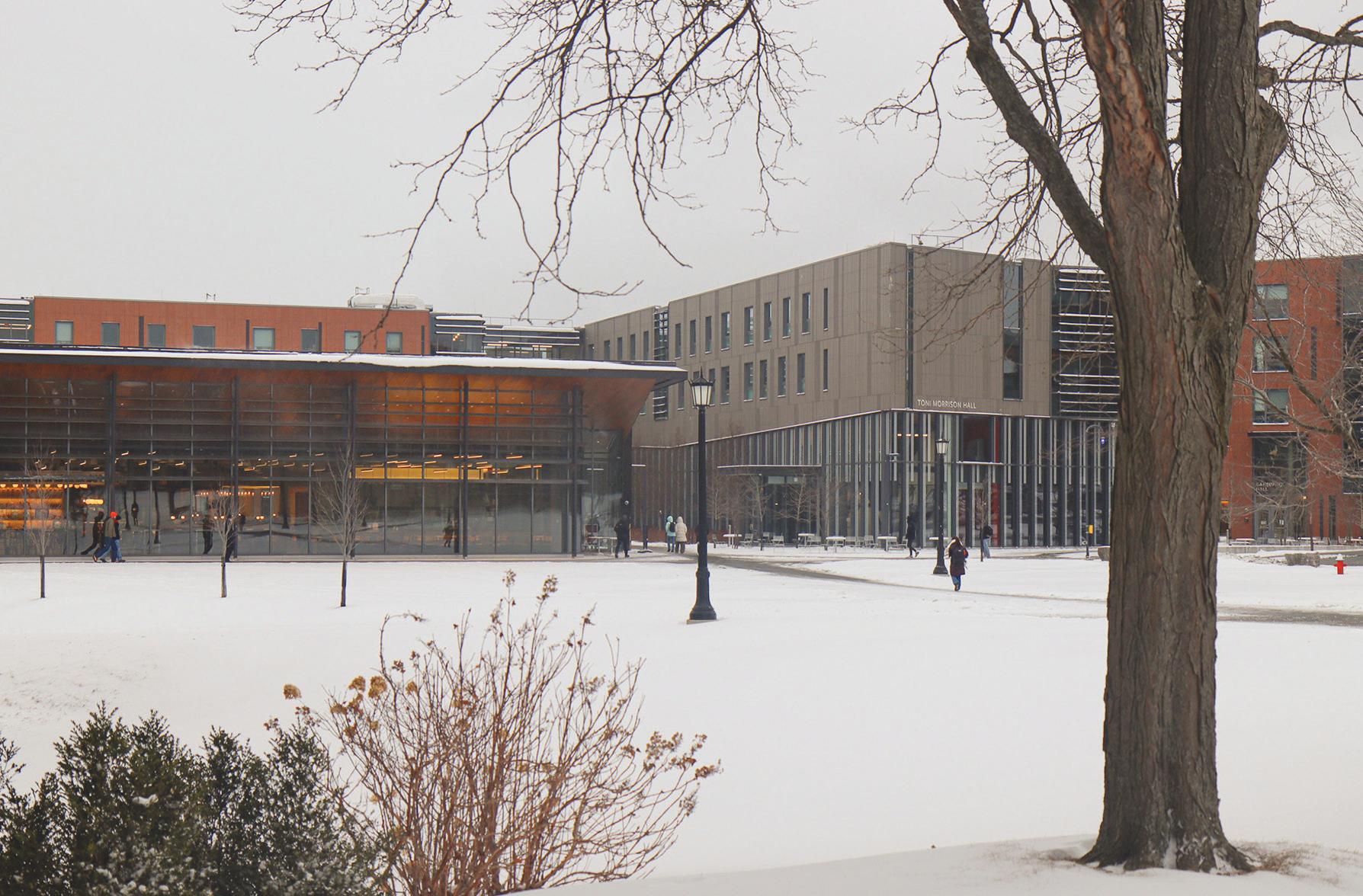
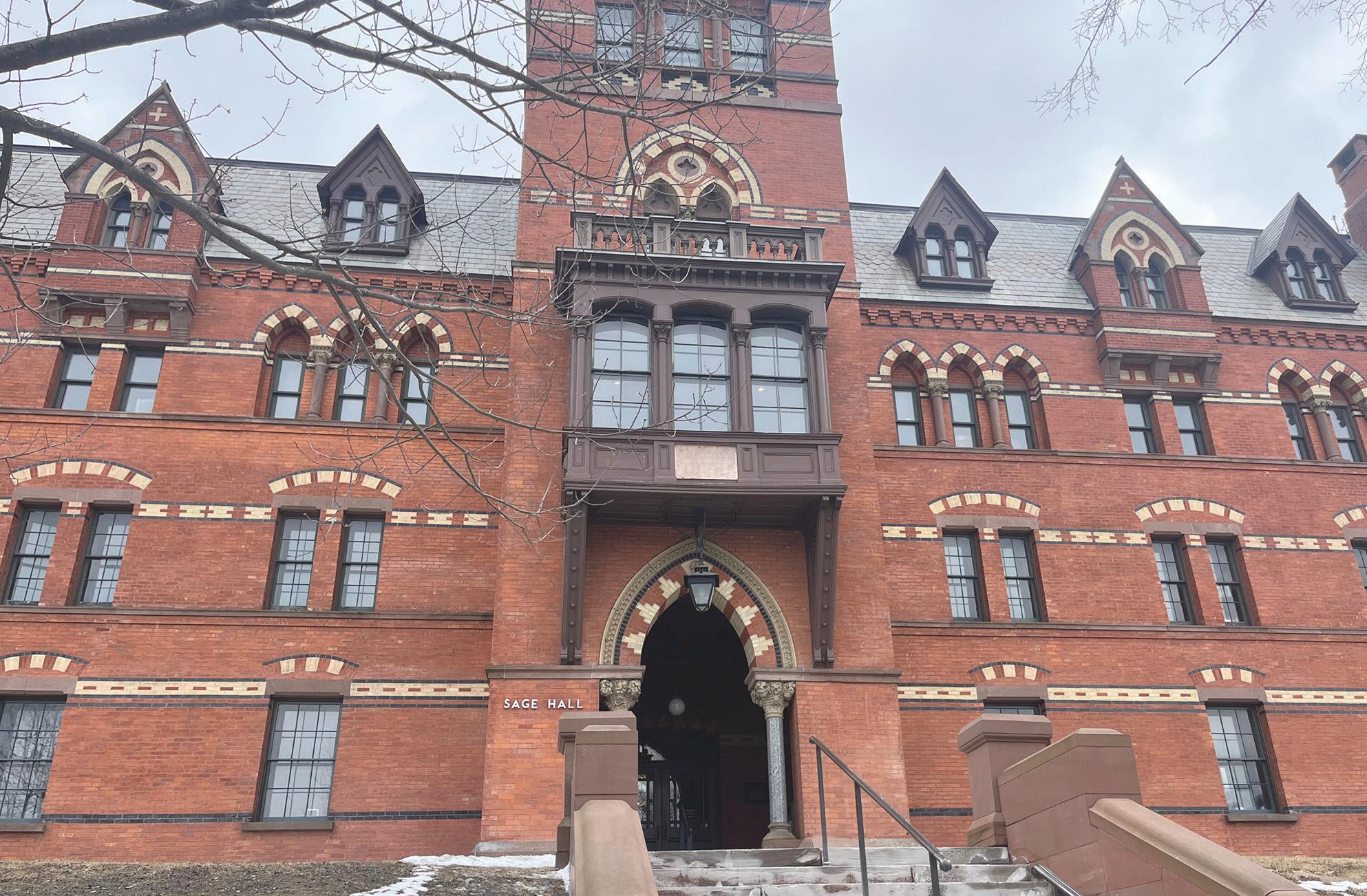
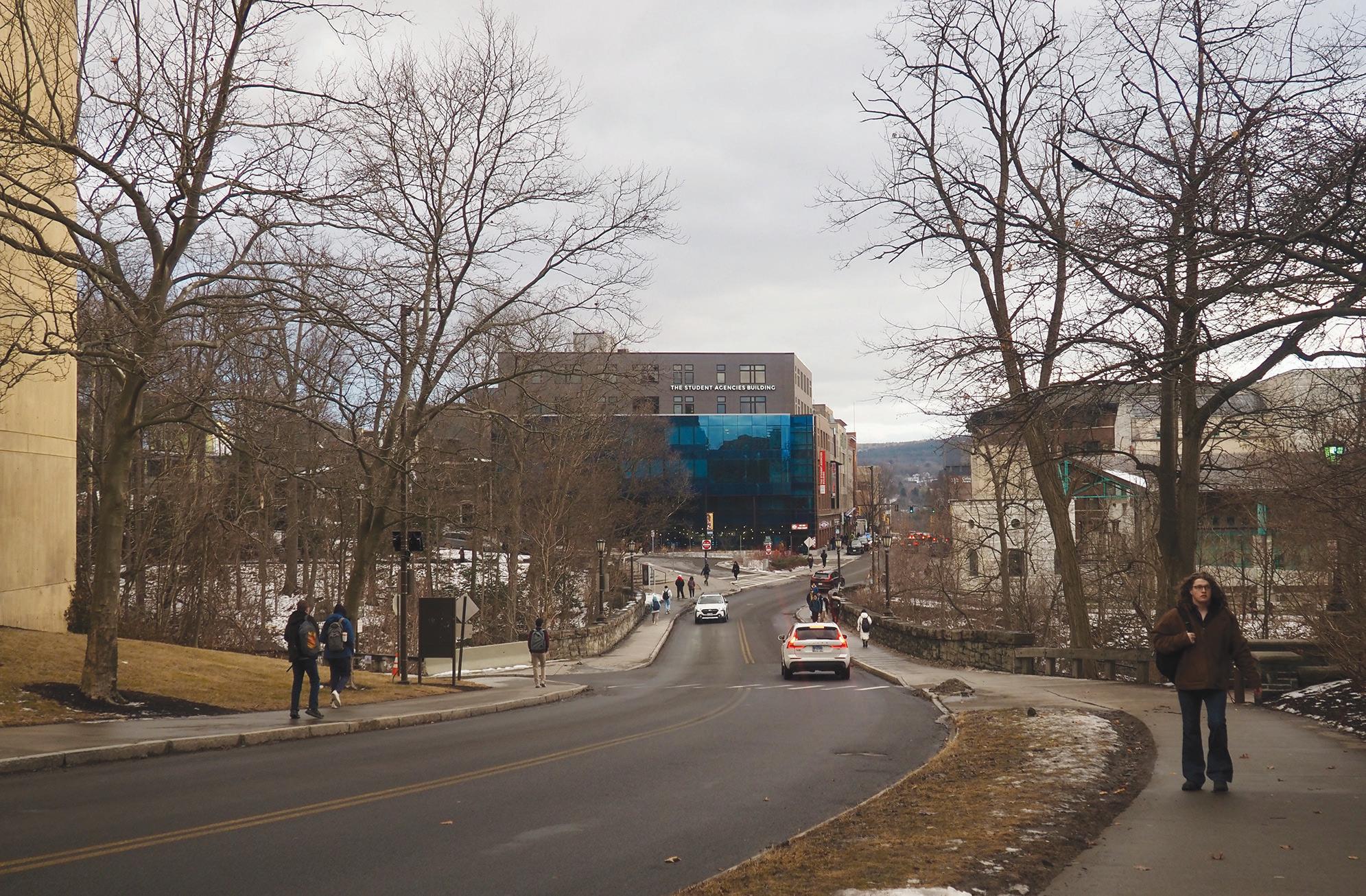
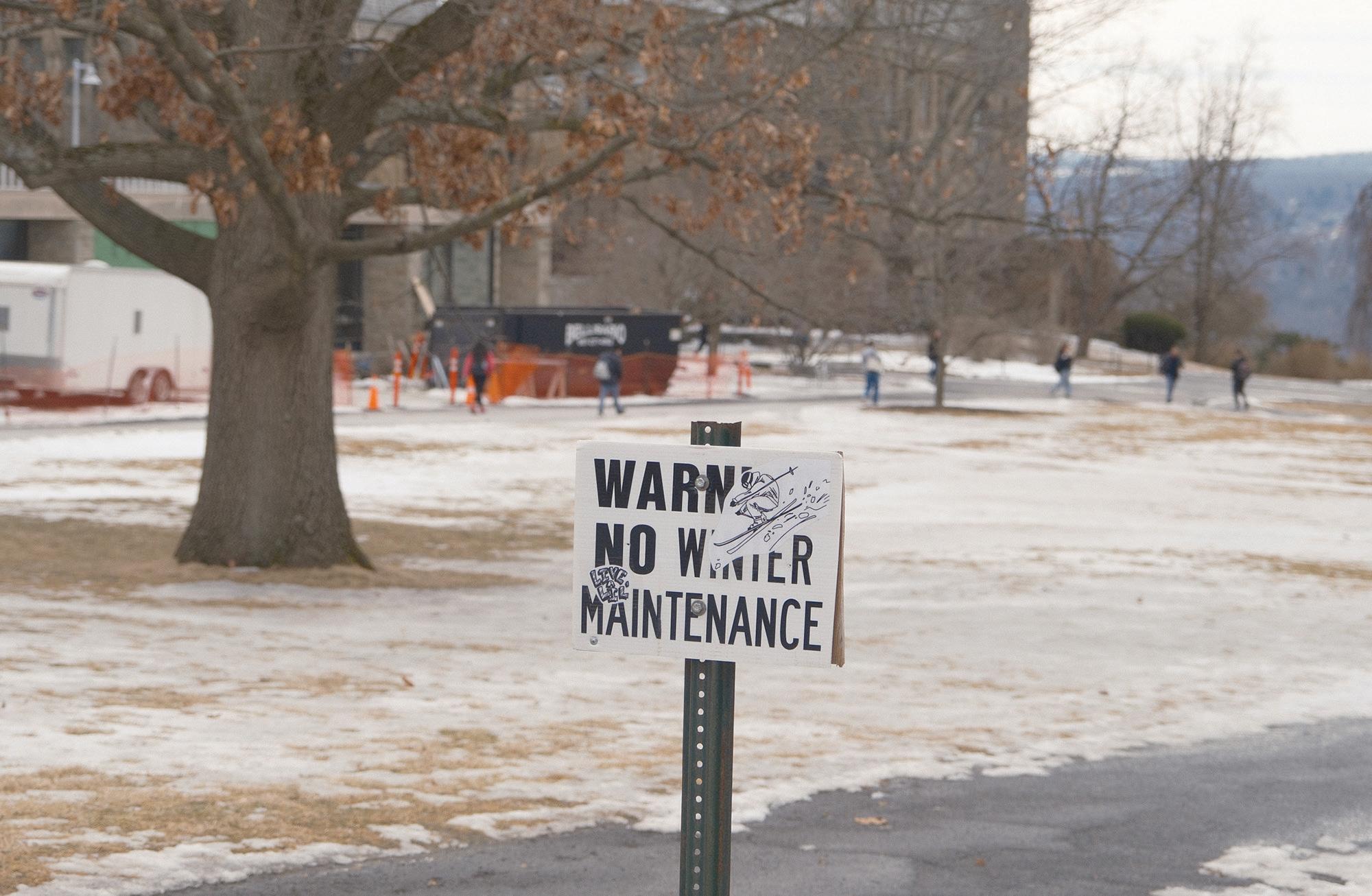
Over the last few weeks, Te Sun has welcomed over seven new photographers — called compets — to the department. Here are some of their recent shots of campus from their frst assignments
By SUN PHOTOGRAPHY DEPARTMENT




By RAFAELA GANDOLFO BUSTAMANTE Sun Staff Writer
Feb. 24 — Amid President Donald Trump’s recent executive orders aiming to ban diversity, equity, and inclusion initiatives, Cornellians are continuing to find ways to commemorate their diverse student body. In celebration of Black History Month, Black Students United and Cornell Dining have partnered to bring a variety of traditional African dishes to dining halls.
Nearly all dining halls have been designated a specific day and country to showcase dishes representing the culinary classics of that nation. So far, dining halls have given students a taste of five different cuisines, ranging from Sierra Leone to Somalia.
BSU Co-President Cameron Smith ’26 played a central role in organizing the collaboration and recognizing the importance of celebrating now more than ever.
“What we are seeing with [Trump’s] administration is that they are purposefully trying to make our role in this country belittled,” Smith said. “We’re taking back ownership of the fact that we are the ones that originated with this [cuisine], and that this is a sole part of American history.”
University students have taken initiative to ensure that spaces for cultural celebration remain intact. BSU and Cornell Dining’s collaboration offers an opportunity to explore a
wide variety of African cuisines while celebrating the diverse heritage and history of African American students.
According to Smith, though this event has taken place in prior years, BSU saw this year as an opportunity for more involvement in the partnership. The club communicated menus and recipes with chefs, decorated halls and chose the countries being represented in each dining hall. Smith expressed that in doing so, a broader diaspora was represented compared to years before.
Working with a big team of chefs and directors, BSU found a disparity in accommodation and effort when discussing their visions for the event.
“The amount of work that the chefs and directors wanted to put in was different across the dining halls, where I would like it to be standardized,” Smith said. “During this time period, and during [the Trump] administration, it’s important to do [things like] this. … But that means that the standard still has to be high.”
BSU had high hopes of bringing traditional African dishes to the University dining halls and getting the recipes to be as authentic as possible. Smith expressed that this goal was not completely reached this year, due to areas of communication and collaboration that were varied. She is appreciative that the events have still been able to provide a certain level of
outreach and celebration to the community, while acknowledging improvements still need to be made.
Cornell Media Relations did not respond by the time of publication to a request for comment on the claim that a higher standard could have been met.
Chef manager at the William Keeton House, Samuel Ramer, explained that he appreciated collaborating with the Haitian Student Association to create the menu for the upcoming Haitian night.
“At the end of these events, I always find myself walking away from the kitchen with a deep appreciation of the cultural history and human experience that encoded such unique knowledge inside the flavors on those plates,” Ramer wrote in a statement to The Sun.
To continue reading this article, please visit www.cornellsun.com.

By ISABELLA HANSON Sun Senior Writer
Feb. 26 — On an average day, finance lawyer Radhika Gupta ’18 closes deals in the office. But recently she traded spreadsheets for roses, appearing as a contestant on the 29th season of The Bachelor.
Despite being eliminated during week one of the show, she found love in new friendships while filming, describing how “there were 25 of us, so making 24 new friends amongst the girls was amazing.”
“At this age, it’s hard to find friends, because you’re kind of ingrained in work and you’re not in school anymore — you’re not joining anything new,” Gupta said. “Meeting so many accomplished, beautiful, very smart and great personality women [through the show] was just amazing.”
Gupta said she is still looking for romance. She’s currently completing a challenge to find love by going on 50 dates and sharing her journey as an influencer on Instagram.
Reality television was not originally in Gupta’s life plan, she said. However, after repeatedly watching videos of The Bachelor on TikTok, her best friend encouraged her to apply for a spot on the show.
“I had really just applied thinking that nothing would come from it,” Gupta said. “So now I’m always like, you should apply to everything cause
you never know [what will happen,] and you should just always shoot your shot.”
As a woman of color, Gupta said she was pleasantly surprised by the diversity of the cast. Since 2010, only 20 percent of contestants on The Bachelor have been people of color, but this number hit 63 percent for Season 25.
“I wasn’t expecting [the level of diversity], because you don’t know who else is on the show when you get there,” Gupta said. “Seeing so many other women of color really felt amazing and because of that, [I] was a little bit more comfortable than I think otherwise I might have felt.”
Gupta said her time on The Bachelor bridged her professional world with her passion for sharing insights on being an influencer.
“When our casting came out, there were just a lot of girls that were excited about it,” Gupta said.
“I got so many DMs from younger Indian girls just being like, ‘Oh my God, I’m so excited to see some representation,’ ‘I’m so excited to see someone that looks like me’ [and] ‘I wanna be like you, how did you do this?’”
To continue reading this article, please visit www. cornellsun.com.

Feb. 21 — Keri Blakinger’s ’14 work documenting the lives of death row inmates earned her the title of 2024 Pulitzer Prize Finalist. Now, she can add an Oscar nomination to her roster.
The former Sun staff writer and current Los Angeles Times staff writer helped produce the death row documentary I Am Ready, Warden and was named a contender for the Best Documentary Short Film Oscar on Jan. 23. The documentary is based on the story of John Ramirez, an inmate who was executed at the Huntsville, Texas state penitentiary on Oct. 4, 2022.
The film came out of her journalistic work featuring death row inmates, including the 2023 article “Dungeons & Dragons Players of Death Row.”
The article was written for The Marshall Project, a nonprofit newsroom reporting on the U.S. criminal justice system, and featured in The New York Times Magazine.
Blakinger first became entangled with Ramirez when a prison spokesman pulled her aside during a reporting outing. He informed her that Ramirez requested she view his execution.
She found it an “unusual request.” Blakinger did not know who Ramirez was before then. “I’ve witnessed executions, but never because someone requested that I do so,” she said.
From there, Blakinger began interviewing Ramirez to get to know him. She published several articles inspired by him in his final days. One article, “The Prisoner-Run Radio Station That’s Reaching Men on Death Row,” caught the eye of American filmmaker Smriti Mundhra. Mundhra and Blakinger decided to collaborate and bring Ramirez’s story to film.
Mundhra and Blakinger initially intended to focus on the idea of redemption, intrigued by Ramirez’s admission of guilt and conversion to faith during his time on death row. With small hopes, they reached out to the family of Pablo Castro, who Ramirez fatally attacked in the 2004 robbery that brought him to death row.
At the last minute, Aaron Castro, the son of Pablo Castro, agreed to be in the film — a move that would transform the entire focus of the documentary.
“[Watching him] in the moments after the execution, sitting with his immediate reaction to it … ended up allowing us to create a film that explored whether the death penalty actually provides closure in the way that we are often told that it does,” Blakinger said.
Instead of an angle focused solely on Ramirez’s redemption, viewers are left watching Aaron come to terms with the execution of his father’s killer.
To continue reading this article, please visit www.cornellsun.com.
By XAVIER ROLSTON Sun Staff Writer
Feb. 20 — Zellnor Myrie’s J.D. ’16 campaign for the New York City mayoral primary saw a key development on Feb. 10 when he received the endorsement of Rep. Dan Goldman (D-N.Y.), who represents lower Manhattan and parts of Brooklyn.
“My focus is on talking to as many people as possible about a vision for the future of this city.”
Zellnor Myrie J.D. ’16
Goldman rose to national prominence in 2019 when he served as lead counsel during the first impeachment inquiry and trial for President Donald Trump. In 2022, he was elected to Congress to represent New York’s 10th district.
“We obviously are facing, in this city, a number of different crises that are just not getting the proper attention that they are due,” Goldman said during his announcement on MSNBC’s “Morning Joe”. Goldman said he believes that Myrie would provide the type of leadership the Democrat party needs right now.
“He balances the vision — the courage of his convictions — but also the very smart, pragmatic policies that our city really needs,”
Goldman said.
Myrie, a Democratic state senator representing central Brooklyn, is looking to make his case in a crowded New York City mayoral primary. Myrie is one of seven other Democratic nominees looking to unseat incumbent Democrat Eric Adams, who’s coming off a scandal-ridden first term. Two additional candidates — including former New York Governor Andrew Cuomo, who currently leads early polling — are considering running as well.
Myrie entered the race last May, becoming the second Democrat after NYC Comptroller Brad Lander to challenge Adams. He has since fought to distinguish himself from other candidates, including fellow progressives Lander and State Sen. Jessica Ramos (D-N.Y.), who are tied with Myrie at six percent each for voters who would rank them first, according to an Emerson College poll from earlier this month.
“He balances the vision — the courage of his convictions — but also the very smart, pragmatic policies that our city really needs.”
Rep. Dan Goldman
Myrie told MSNBC viewers that his campaign focuses on two key priorities: making NYC more afford-

able for residents and making the city a safer place to live. He proposed policies including universal afterschool programs for all students at city public schools and bolstering the New York City Police Department by adding 2,000 new detectives and 3,000 new officers to the force.
Adams faces the threat of removal by New York Gov. Kathy Hochul and has an approval rating of 26 percent among New Yorkers. He also trails President Donald Trump by 12.3 points and Cuomo by 19.5 points in favorability. Candidates, including Myrie, are responding by focusing much of their campaign
efforts on demonstrating clear vision and effective leadership abilities.
“My focus is on talking to as many people as possible about a vision for the future of this city — and right now, we are rudderless,” Myrie said during the segment. “We do not have that leadership, and that is why I think that this indictment has been so distracting and hurtful for this city.”
Myrie did not respond to multiple requests for comment from The Sun.
By TAEHEE OH Sun Senior Writer
Feb. 24 — Sacred Root Kava Lounge & Tea Bar is now barred from selling its signature kava drink due to a new New York State Department of Health regulation.
Located at 139 West State St. beneath The Sun’s office, the downtown Ithaca staple offers a space for customers to relax, enjoy live music and connect with one another. As the only kava-focused establishment in Tompkins County, Sacred Root has built a dedicated following.
Sacred Root’s kava drink was made by steeping the root of the kava plant in water. Kava, a shrub native to the South Pacific, has been used by Pacific Islanders to promote physical relaxation for medicinal and ceremonial purposes.
In late October 2024, Paul Galgoczy, founder and co-owner of Sacred Root Kava Lounge & Tea Bar, was informed by the Tompkins County Health Department that kava was not approved as a food additive under NYSDOH regulations. This means kava could no longer be added to food or beverages at food service establishments.
The NYSDOH’s regulation follows a 2020 review by the U.S. Food and Drug Administration, which raised concerns about the safety of kava. Citing potential negative health impacts including liver damage, such as hepatitis and cirrhosis, the FDA concluded that kava is not generally recognized as safe for human consumption, meaning that kava was deemed not “adequately shown to be safe under the conditions of its intended use.”
Galgoczy challenged the FDA review, arguing that the review fails to make a distinction between kava as a dietary supplement and the traditional use of kava as an ingredient for tea.
“No matter how long you steep kava in water, it will only achieve a certain degree of potency
— whereas supplements are made with chemical extractions of active ingredients, so they’ll use acetone or alcohol or other harsh chemicals to heighten and extract the active ingredients [and] concentrate them into a pill for maximum potency,” Galgoczy said.
Pointing to kava’s status in Michigan and Hawaii, where traditional use has been granted GRAS status, Galgoczy submitted a request to the NYSDOH to reconsider its regulation.
The NYSDOH rejected Galgoczy’s challenge, and the Tompkins County Health Department ordered Sacred Root to remove kava from the menu by January 1, 2025, or shut down.
The NYSDOH did not respond to a request for comment.
To keep the business afloat, Galgoczy “scrambled” to shift Sacred Root’s focus away from kava in a short time frame. While the lounge also serves as a live music venue and offers other non-alcoholic drinks, losing its signature kava beverage has placed a significant strain on the business.
“Prior to Jan. 1, kava was approximately 90 percent of our business sales, … so obviously, we’ve been severely impacted,” Galgoczy said. “Because we don’t have kava, we’re not doing the sales that we were before.”
Erika Busch, a regular customer at Sacred Root, said that she enjoys drinking kava for its taste and calming effect.
“Kava is like a bitter flavor, and I enjoy the bitter flavor. Some of the effects on your body — they’re very subtle but nice. There’s a relaxing quality to it,” Busch said.
When Busch learned that kava would be removed from Sacred Root’s menu, she was concerned that an alternative to Ithaca’s bars might be lost.
“I feel worried that in a place that can be very alcohol centric for social recreation, that
there was the one place that wasn’t focused on [alcohol] that is feeling threatened and at risk,” Busch said.
Busch also expressed worries that the crackdown on kava could jeopardize the space’s sense of community.
“I come for open mic night pretty regularly, and [it] is just a really warm, connected [space] for people to go, be vulnerable, perform and support each other,” Busch said. “My worry was that the environment and space would be at risk, and that would be a huge loss in the community.”
Sacred Root’s struggle reflects a broader trend in New York, as kava bars across the state face threats of closure from regulators.
New York City has been cracking down on kava bars beginning in late 2022, with health officials issuing summons, seizing products and
shutting down multiple kava bars. The legal battle is ongoing, with kava bar owners contesting the classification of kava as an unsafe food additive.
To raise awareness and advocate for the re-evaluation of kava regulations, Galgoczy has started a petition that has garnered over 860 signatures at time of publication.
Galgoczy is also considering legal action although he said it would be costly, especially given the financial challenges that Sacred Root is experiencing.
To continue reading this article, please visit www.cornellsun.com.
Taehee Oh can be reached at toh@cornellsun.com.

GABRIEL LEVIN ’26
Editor in Chief
MAX FATTAL ’25
Associate Editor
HENRY SCHECHTER ’26
Opinion Editor
MARIAN CABALLO ’26
Multimedia Editor
MING DeMERS ’25
Photography Editor
ERIC HAN ’26
Arts & Culture Editor
SYDNEY LEVINTON ’27
Arts & Culture Editor
JADE DUBUCHE ’27
Social Media Editor
JESSIE GUILLEN ’27
Graphics Editor
JOLIN LI ’27
Layout Editor
PARIS CHAKRAVARTY ’27
Layout Editor
LEILANI BURKE ’25
Assistant Photography Editor
KARLIE McGANN ’27
Assistant Photography Editor
KIRA WALTER ’26
Lifestyle Editor
DANIELA ROJAS ’25
Assistant Lifestyle Editor
NICOLE COLLINS ’25
Weather Editor
JULIA SENZON ’26
Managing Editor
ERIC REILLY ’25
Assistant Managing Editor
MARISA CEFOLA ’26 News Editor
MATTHEW KIVIAT ’27 News Editor
CHRISTINA MacCORKLE ’26 News Editor
DOROTHY FRANCE-MILLER ’27 News Editor
JANE McNALLY ’26
Sports Editor
GABRIEL MUÑOZ ’26 City Editor
KAITLIN CHUNG ’26 Science Editor
LAINE HAVENS ’25
Science Editor
ANUSHKA SHOREWALA ’26
Assistant News Editor
OLIVIA HOLLOWAY ’25
Assistant News Editor
DINA SHLUFMAN ’27
Assistant News Editor
ALLISON HECHT ’26 Newsletter Editor
JENNA LEDLEY ’27
Anthony Ingrafea is the Dwight C. Baum Professor Emeritus in the School of Civil and Environmental Engineering. He can be reached at ari1@cornell.edu and 607-351-0043.
In his Jan. 21 op-ed, Interim President Kotlikoff emphasized the importance of Cornell’s Earth Source Heat, or ESH, project in decarbonizing campus heating: “In the long term, the most promising way for us to meet our energy goals is Earth Source Heat: a game-changing technology with the potential to meet cold-climate heating needs with less electricity than other options.” I agree but worry about the depth of Cornell’s financial commitment to ESH.
For the past ten years, while ESH has struggled to gain momentum, I have been a technical advisor to the project, frequently consulting with some University staff whom I admire as climate heroes: Bert Bland ’74 M.S. ’80 MBA ’98, Wayne Bezner-Kerr and Sarah Carson. They and other key staff and faculty have labored intensely over that decade to breathe life into this high-risk, high-reward experimental program. The most significant achievement of the ESH project to date is the completion of the Cornell University Borehole Observatory, or CUBO, in 2022, a nearly two-mile-deep well that provided valuable geological insights. However, the data from CUBO was not sufficient to de-risk the next phase, and the project, which cost over $10 million, has since stalled due to a lack of additional funding.
After three years of waiting for funding, the project is now at a standstill. To move forward, we need to re-enter CUBO, deepen it and perform crucial experiments to de-risk that next step. We must build a complete system below and above ground to meet 95 percent of the heating needs of the campus. Last year, Cornell’s ESH team applied for over $10 million from the U.S. Department of Energy to expand CUBO, but hopes for funding are diminishing because of the long lapse in response to our proposal, and the changing political scene in DC, leaving the project in an uncomfortable limbo.
There is no time to wait to rescue the project. It is time for the administration to step up the magnitude of this effort. Kotlikoff wrote, “Cornell has made major investments to prove the feasibility of earth source heat in our region.” That is simply not true — not relative to the actual cost and urgency of ESH addressing accelerating climate change. The University’s contribution to date just won’t meet the scale of heating the campus. ESH requires an extensive infrastructure, far beyond CUBO: multiple well pairs, one injecting cold water down and the other extracting hot water up, likely connected through hydraulic fracturing. The total cost could range from $100 million to $200 million when including surface infrastructure. This level of investment demands a decisive commitment from the Board of Trustees.
The new Chair of the Board, Anne Meinig Smalling, is also the CEO of an investment firm with a principal holding in a Mexican natural gas pipeline company, IGASAMEX, now promoting expansion into liquefied natural gas, or LNG. According to recent research by my Cornell colleague, Prof. Robert Howarth, ecology and environmental biology, the greenhouse gas emissions footprint of LNG far exceeds that of coal. However, this same CEO also has a principal holding in a company producing high-quality geothermal well equipment, EnLink Geoenergy Services. These conflicting interests highlight a challenge: Who within Cornell is championing ESH to the Board, and how will the Board navigate potential conflicts of interest?
So, I implore the Board of Trustees to revive ESH, now. Please don’t make Kotlikoff appear naive about the scale of heating decarbonization. And please don’t leave Cornell’s ESH heroes out in the cold.
Max Nam ‘26 is part of the Milstein Program in Technology and Humanity, the Mellon Mays Undergraduate Fellowship and the Humanities Scholars Program.
For our generation, the world’s various problems today share a common element: their lack of precedent. From nuclear war to climate change to domination by artificial intelligence, we seem to face so many threats for the first time as a species, forcing us into action without the benefit of past examples to guide us.
Yet at Cornell, I’ve come to realize that, by this point in history, to think that anything at all is unprecedented is simply to have not read enough history. There is no question that someone else has not already tried to answer, no issue that another society has not previously addressed (if not in content then at least in form). If, therefore, we find ourselves so unable to locate a prior moment comparable with our own, perhaps we just need to look further back in time.
Throughout my studies in literature and the humanities, I’ve been surprised to discover that many of the figures I find most relatable belong to a period much detached from my own —
CAncient Rome. Despite the huge temporal disparity between us and the Romans (or perhaps precisely because of it), the accounts of writers like Horace, Seneca and Tacitus may feel more familiar to a modern reader than even those of later writers, revealing societal conditions unexpectedly reminiscent of our current age.
The letters of Pliny the Younger, for example, are concerned not with heroic struggles or lofty idealism, but with, in the words of historian Ronald Syme, “Betrothal and matrimony, wills and bequest, the illness of a friend or bereavement in a family, the first flowering of poetical or oratorical genius,” and so on. Pliny’s writing deals with the everyday Rome of the middle-to-upper class, showcasing a society in which people matured slowly (with some reaching their sixties and seventies), worried about their careers and enjoyed cosmopolitan creature comforts — all exactly as we do now.
To continue reading, visit www.cornellsun.com.
ornell United is a diverse group of Cornell graduate students, representing a wide range of departments and political perspectives, united in opposition to a union shop or any other form of compulsory unionism in the graduate school. We are writing in response to a letter from professors in the School of Industrial and Labor Relations, titled “Wrong on the Facts, Wrong on the Law,” which misrepresents the facts and the law to present a misleading defense of union shop for Cornell Graduate Student Union-United Electrical, Radio & Machine Workers of America, or CGSU-UE. Attorneys from Cornell’s contract negotiation team have already responded with a perspective inside the bargaining room; we offer the viewpoint of graduate students seeking to protect our right to choose whether or not to support the union. The policy alternative that adequately protects this freedom to choose while preserving collective bargaining is called “open shop.”
The open shop principle ensures that current and future Cornell graduate students can study here, free from pressure and political conformity. By advocating for a union shop, CGSUUE opposes this principle. Requiring graduate students to join and fund the union contradicts Cornell’s founding principle that “any person can find instruction in any study.” Our primary opposition to the union shop is that no one should be forced to fund a political organization — or any organization — whose positions they fundamentally oppose. For example, the union annually establishes an official party line at the national level, known as UE Policy, advocating far-left positions on both foreign and domestic policy. On campus, our union leadership has advocated the Boycott, Divestment, Sanction movement at union rallies and has used bargaining sessions to litigate the suspension of union leaders for violating Cornell’s Code of Conduct at pro-Palestine demonstrations. We came to Cornell to focus on our studies, and it is unacceptable that our academic experience should be tied to financially supporting a cause that conflicts with our personal beliefs.
The letter’s authors fixate on the technical distinctions between union membership and compulsory dues in order to side-step the core issue, but the fundamental reality remains. A union shop compels all graduate students to financially support a political organization whose ideology they may find abhorrent. Under the union’s proposal, graduate students would face a choice: pay full dues, including contributions to the union’s explicitly political and ideological activities, or pay marginally reduced “agency fees” while forfeiting their right to vote on contracts and representatives.
Those unwilling to accept either option risk termination of their employment, jeopardizing their ability to complete their degree with a graduate appointment. In defending this proposal, the professors’ letter invokes the
Communications Workers of America v. Beck decision but glosses over the full financial burden imposed on those paying agency fees as well as their surrendered democratic representation. The Beck decision bars forcing non-union members to fund political activities, but it allows the union itself to determine what qualifies as “political activity,” leading to only token reductions from full dues while forcing graduate students to fund activities with no direct relation to the economic benefits in our contract. Examples include travel funds to attend the national union conference to vote on UE policy, contributions to a strike fund to sustain strikes in other states, office supplies and rent supporting all union efforts, and legal assistance for students facing discipline for their political activity on campus.
Labeling the union’s proposal “not extraordinary,” they fail to acknowledge the more recent Supreme Court ruling in Janus v. American Federation of State, County and Municipal Employees, which categorically prohibits such arrangements for public-sector unions, citing an unacceptable burden on First Amendment rights. Furthermore, the Supreme Court also recognized in Davenport v. Washington Ed. Assn that compulsory union shop arrangements represent an “extraordinary state entitlement to acquire and spend other people’s money.” While Janus does not apply to private universities like Cornell, its holding underscores the importance of ensuring that graduate students here receive the same protections as their peers at public institutions. The only way to safeguard academic freedom is for the Cornell administration to uphold an open shop policy. Why should graduate students at Cornell enjoy fewer protections for our academic freedom than our peers at public universities?
The letter also asserts that “it is only fair that all employees in the bargaining unit should … pay their share of the costs of collective bargaining.” We respectfully disagree. Our moral values take precedence over any financial benefit the union may secure through negotiations. The assumption that we should be compelled to support a political group we strongly oppose in exchange for better pay is misguided. This issue is not about obtaining a higher salary; it is about upholding our ethical principles. Just because the union believes it acts “for our benefit” does not mean we agree. Indeed, we believe the union’s imposed representation is a detriment to our working lives and a violation of our conscience.
Interim President Michael Kotlikoff’s and Provost Kavita Bala’s recent statement and the Letter to the Editor from Cornell’s bargaining team together affirm Cornell’s commitment to an open shop: a stance that is right on the facts and right on the law. We hope that Cornell will continue to uphold its commitment to academic freedom for all students.
Willow Starr is an Associate Professor in the Department of Philosophy. Tey can be reached at w.starr@cornell.edu.
Atornado of executive orders has arrived from the White House, with transgender people in the eye of the storm. A directive implementing these orders froze trillions of federal dollars, shocking our nation and federally-funded campus. Its central threat was this: eliminate “Marxist equity, transgenderism, and green new deal social engineering policies” or federal funding will cease. As Prof. Kate Manne, philosophy, helpfully sums up the research, preferential U.S. hiring practices still favor white men. So Trump could have just cut to the chase, as his State Department appointee Darren Beattie did and declared “competent [sic] white men must be in charge.” Cornell’s leadership reassured us with a measured Jan. 28 statement. It was reassuring that Cornell was not making immediate changes in response to this threat, even if the statement was released after a federal judge temporarily blocked Trump’s directive. No mention of trans people made it into that statement, but I recommend keeping an eye on us.
Cornell’s founding principle of “... any person … any study” and our core value of free and open inquiry and expression are under threat. Studying the White House’s attack on transgender people shows exactly how this threat is operating, what the stakes are, and how we can resist.
The executive order on K–12 education also explicitly targets the content of instruction, including trans issues alongside sex education/reproductive rights, racial justice and climate change. As Erin Reed has reported, many districts are publicly refusing to comply with this order, emphasizing that it is illegal and against core institutional values. Staffers at U.S.-funded medical facilities in Chad “had a choice to make: Defy President Donald Trump’s order to immediately stop their operations or let up to 100 babies and toddlers die. They chose the children.”
We are already learning what compliance looks like at the United States Department of Agriculture, Centers for Disease Control and Prevention and Census Bureau. National Science Foundation grants are being vetted for ideological purity, with “woman” and “female” among the many banned words. Dr. Jeremy Faust is reporting that “the CDC has instructed its scientists to retract or pause the publication of any research manuscript being considered by any medical or scientific journal ,” and that researchers must censor these terms from their research: “Gender, transgender, pregnant person, pregnant people, LGBT, transsexual, non-binary, nonbinary, assigned male at birth, assigned female at birth, biologically male, biologically female.”
It’s beyond alarming that political censoring is happening at key institutions of research. But it should be crystal clear that if this practice were followed at Cornell, our core value of free and open inquiry and expression would be cooked. Forget the “What We Know” Project, hello “What We’re Banned from Considering” training. This censorship is linked with policies that will result in the deaths of transgender, nonbinary, intersex and other gender-diverse people — policies which Cornell has a specific power and duty to resist. The White House also issued an executive order attempting to ban gender-affirming care for youth nationwide, including 18 year olds. This ban contradicts the expert medical consensus of the American Academy of Pediatrics, the American Psychological Association, the American Medical Association, the Endocrine Society and the World Professional Association for
Transgender Health. Reed provides a more detailed line-by-line analysis, arguing that this order contradicts medical evidence and existing law and rulings. Contrary to online moral panic, only 0.1 percent of American youth are accessing this care, and it consists mostly of interventions that remain legal for cisgender youth. This care brings the mental health of trans youth in line with their cisgender peers. Interventions aimed at ‘converting’ trans youth to cisgender identities appear to worsen mental health and to increase suicidality. And the largest study to date of this youth population found a causal link between anti-trans policies like Trump’s and significantly more suicide attempts . Prohibiting the study of these topics both harms our nation’s youth and mandates that researchers become complicit in concealing it.
Surely ‘... any… person...’ means that Cornell cannot permit making our community members politico-medical refugees. Because Weill Cornell Medicine is a healthcare provider and research hospital, there is a stronger responsibility to do no harm. Pediatricians at Weill Cornell previously advocated for treating trans youth despite political attacks. As of Monday, Feb. 3, this statement has been removed from their website. Weill Cornell, please, choose the children , and do not preemptively discontinue research and care of trans youth. Indeed, New York Attorney General Letitia James has just reminded you of your obligation under state law to provide this care, and has joined 14 AGs in a joint statement defending the legal right to this care. Hundreds protested New York University Langone on Feb. 3 for withholding this care. Dr. Jeffery Birnbaum at the University Hospital of Brooklyn has vowed to his patients, “I’m willing to go to jail to continue to provide your care.” Philosopher Thomas Hobbes theorized that “Reputation of power is power.” Trump creates this reputation with shows of power against targets of fear, which is used to justify bulldozing evidence and law to expand executive power, destroying people and institutions. Hitler also targeted trans and queer people, who then joined Jewish people in concentration camps. Hitler targeted Jewish people with “outsider” fear campaigns, and Trump is using that same strategy on immigrants now, including the establishment of an immigration prison in Guantanamo Bay. Trump plans to “combat anti-semitism” by (illegally) deporting international students who dare to join protests that question whether the mass killing of civilians in Gaza is justified or who might protest Trump’s plan to literally bulldoze Gaza and exile Palestinians. Simultaneously, Trump is removing Holocaust Remembrance Day at the Pentagon, and illegally permitting Elon Musk, a Nazi salute throwing civilian, to seize all executive funding agencies — just a week after Musk addressed the rising anti-semitic German AfD party, saying that their country has “too much of a focus on past guilt.” Just like Viktor Orbán, this gives Musk and Trump control of taxpayer money to enforce funding threats at the whimsy of the executive branch alone. After all, “white men must be in charge.” Hobbes theorized power, but trans people lead lives of resistance, which also permeates the Black History we celebrate this month. This threatens Trump’s reputational power, and this makes the trans struggle everyone’s struggle. Gather your people, and compel your local groups, institutions and politicians to resist until we can’t.
Cornell on Fire is a coalition of Cornellians and community members calling for a just and comprehensive university-wide response to the climate emergency. One author, bethany ojalehto mays, can be reached at bethany.o.mays@gmail.com.
As Interim President Kotlikoff pointed out in a recent op-ed in Te Sun, we need to take action on climate change. However, how he proposes Cornell does so is troublingly flawed. He suggests that the University should not begin decarbonizing campus heat in the near term because, on Cornell’s incorrect analysis, switching to electrified heat will backfire by increasing greenhouse gas emissions relative to continued use of Cornell’s gas-fired plant for heating. Cornell’s argument is well-intentioned but wrong and sets a dangerous precedent that severely undermines climate action here and everywhere.
Unwittingly, the Cornell president platformed a talking point for the American Gas Association (henceforth referred to as Big Oil), which is based on the wrong conclusion from the wrong choice of method: a short-run instead of a long-run emission rate analysis. Decisions about building electrification need to be based on a long-run perspective, not a short-run snapshot. Te crux of the matter is: Should we adopt a long-run view and build now for the renewable energy transition we need, or adopt a short-run perspective and delay action until the grid has already largely transitioned?
Cornell and Big Oil appear united in their approach: We should make decarbonization decisions based on a short-run analysis. As Big Oil knows well, this incorrect methodology dramatically underestimates the benefits of decarbonization and would cripple progressive electrification laws in both the short and long term, in Ithaca and most of the U.S. Cornell is leveraging this misplaced argument to change Ithaca’s progressive energy law (the Ithaca Energy Code Supplement, or IECS). Starting in 2026, the IECS holds that fossil fuels cannot be used to heat any new buildings or major renovations in Ithaca. Cornell believes their district energy system should be exempt from the fossil-fuel phaseout, arguing that this would save emissions. Except that is wrong.
To put it in technical terms: When making long-term decisions about campus infrastructure, Cornell should use emissions estimates that account for the long-run evolution of the power grid (“long-run marginal emission rates”), not short-run emissions estimates that exclude grid evolution (“short-run marginal emission rates”). In making its case against near-term heat decarbonization, Cornell rejects the widespread consensus in the academic and industry literature that long-run emission rates are appropriate and instead aligns with Big Oil’s deployment of methodologically inappropriate short-run emission rates.
To be sure, Cornell’s intended messaging diverges from Big Oil’s: Namely, Cornell still thinks everyone else should decarbonize. But the methodology that Cornell uses to exempt themselves from Ithaca’s fossil-fuel phaseout would necessarily exempt everyone else. If we were to adopt Cornell’s logic of using shortrun emission rates for building electrification decisions, we would find that the IECS is ineffective or even self-defeating, and so are other building electrification mandates across much of the US
Here’s the twist: While Big Oil continues to present misleading public-facing claims that gas heating saves emissions, they have quietly updated their narrative elsewhere. Between 2022 and 2023, the American Gas Association updated its attack on Denver’s decarbonization law to use long-run (instead of
short-run) emission rates. Tat forced them to radically change their tune: Tey went from incorrectly arguing in 2022 that Denver’s law would scarcely reduce emissions, to correctly acknowledging in 2023 that it would reduce emissions by more than 50 percent. Now, Cornell is asking Ithaca to change its progressive energy code on the basis of an inaccurate methodology that even Big Oil has been forced to disavow.
To correct this methodological error, we co-authored a white paper called “Estimating the Operational Emissions of Cornell University Heat Decarbonization Pathways.” We find that Cornell will reduce emissions by decarbonizing new construction projects now, as mandated by the IECS. We presented our findings to the larger community including Cornell.
Cornell is skeptical that long-run emission rates are too optimistic given challenges to the New York energy transition. We accounted for that pessimism by modeling delayed- and no-decarbonization scenarios to see how emissions are affected if climate goals are delayed or weakened. We still find significant benefits for near-term decarbonization — even in the pessimistic case of a grid that is dirtier than ours and has a weak decarbonization policy. If Cornell maintains that our pessimistic scenarios are not pessimistic enough, then we must ask: What climate leader bets thousands of tons of carbon pollution on the fatalistic wager that New York’s energy transition will fail — not just a little, but miserably? Tis is a high-stakes bet. More to the point: Cornell could make it more likely that the energy transition will fail. Cornell’s choices about building electrification actively affect the evolution of the grid and send signals to investors about the decline (or not) of fossil fuel demand in the near future.
Bottom line: We do not find it reasonable for Cornell to reject all published estimates of long-run emissions and instead revert to a methodologically incorrect short-run emission rate known to downplay the benefits of decarbonization. Tis is bad strategy for the BIG RED Energy Transition, bad policy for Ithaca and lends unwarranted credibility to Big Oil’s false public narrative about America’s energy transition.
We could not agree more with Kotlikoff that Cornell’s energy transition requires a holistic approach focused on equitable solutions. Yes, Cornell needs to decarbonize their buildings, but it also needs to decarbonize and degrow the entire university system and lifestyle while foregrounding perspectives from frontline communities. We are concerned that Cornell’s climate action does not match the scale or urgency of the crisis, and there are gaps between Cornell’s climate rhetoric and action. If Cornell is so concerned about the emissions consequences of adding new load to the grid, then why are they expanding campus at such a great rate?
Cornell’s arguments for delayed decarbonization are well-intentioned. But good intentions do not make good climate policy. And good intentions exist in context. At Cornell, that context includes a University-owned Combined Heat and Power Plant that creates an economic incentive to remain on gas, and a Board of Trustees that answers to and empowers key players in the oil and gas industry. Cornell must ensure its climate actions are clear, collective and commensurate with the crisis. With allies in academic and activist circles, Cornell can and — will do — better.

By TANIA HAO Sun Staff Writer
At the end of a gravel road off Game Farm Road, on the outskirts of Cornell’s campus, stands a one-story white building housing the Cornell Plant Pathology Herbarium, also known as CUP. As the fourth largest museum of fungi in North America, CUP hosts more than 400,000 fungal specimens, as well as several ongoing research projects in mycology — the study of fungi. Beyond research, CUP is also home to a small community of students, researchers and volunteers, each with their own journey to mycology at Cornell.
For Teresa Iturriaga, the curator of CUP, fascination with these tiny mushrooms began during her doctoral studies in mycology at Cornell, under the guidance of former professor emeritus of mycology Richard P. Korf ’46 Ph.D. ’50.
“There’s still a lot to discover, it’s a wonderful area to be. There’s so much to be done. There’s a whole lane of things for you to start.”
Teresa Iturriaga
In addition to her duties as the CUP curator, Iturriaga also conducts her own mycology research focusing on the Pezizaceae family of fungi, commonly known as cup fungi. However, when she first arrived at Cornell from Venezuela as a doctoral student, Iturriaga had never considered working with tiny mushrooms.
“I wanted to work with big fungi, like polypores and agarics,” Iturriaga said. “But Professor Korf was a specialist in the small ones, and when I started looking at them under the microscope, I fell in love with them. Since then, I have dedicated all my life to their study.”
Currently, Iturriaga is working on a project re-examining one of Korf’s collections of cup fungi, gathered in the Canary Islands during the 1970s. At the time, Korf classified the specimens as belonging to the genus Lutremia, but further analysis suggests that the specimens may represent several previously unidentified species of fungi. With the help of undergraduate herbarium assistant Tommy Victor ’25, Iturriaga is using DNA sequencing
to determine whether Korf’s collection indeed contains new species.
For Iturriaga, connecting with other scientists is the most valuable part of mycology research. Of all her responsibilities at CUP, her favorite is mentoring students.
“I like the fact that we have become like one group,” she said. “We all get together and discuss many important things, not only about herbarium specimens, but of course, most of the things are about this.”
“The human connection is most important to me. The connection with students, mainly, is invaluable.”
Teresa Iturriaga
Many of the students that Iturriaga works with go on to continue mycology research, pursue graduate studies in the field or work in herbariums, applying the techniques they learned at CUP.
For Finn Horn ’25, an undergraduate herbarium assistant at CUP, discovering a passion for mycology was certainly unexpected. After transferring to Cornell as a junior to pursue philosophy, Horn became interested in biology and decided to pursue a double major.
“We got a lot of rain in California this one summer, so there were

“The human connection is most important to me,” she said. “The connection with students, mainly, is invaluable. I always have three to four students working with me — not every day, not every time — but I want to teach them the admiration for the natural world.”
After collecting specimens from the small forest behind the herbarium, Iturriaga guides students in processing, identifying and packaging the specimens to be inserted into the herbarium collections. “So they relate to the whole process — making a collection, and how difficult it is, and how important,” she said.
“I looked on the app store, found [a fungi app], then just started taking pictures of mushrooms on walks, and eventually ended up here.”
Finn Horn ’25
Iturriaga greatly appreciates the small, close community between the volunteers, students and researchers at CUP.
tor of lichens, has been affiliated with CUP since 1977. He served as the curator of CUP from 2008 to 2010, after which he continued to work closely with the herbarium, pursuing his passion for lichens. As part of the lichen project, he is currently working on creating a list of all of the approximately 100 lichens located in the pine barrens of the Albany Pine Bush Preserve.
Dirig was also instrumental in helping CUP transition to its current facility on Game Farm Road in the early 2000s. The current building was converted from an old poultry barn to a modern herbarium space. Prior to that, the herbarium was located in an old transmission factory space on South Hill in Ithaca.
For Dirig, it was the visual beauty of fungi that drew him to mycology, and lichens in particular. As a child, he was fascinated by colorful butterflies and beetles, and a large lichen specimen found on his great-grandfather’s farm captured his attention for weeks.
“I like the fact that we have become like one group. We all get together and discuss many important things.”
Teresa Iturriaga
In his undergraduate years at Cornell studying entomology and environmental education, Dirig discovered his passion for lichens during a natural history class where the professor led students on a walk across the Cornell campus, identifying lichens and collecting specimens to perform tests. Over his time at CUP, Dirig has drawn many detailed illustrations of fungi from the herbarium’s collections.
Iturriaga encourages any student who is interested in mycology to reach out to her and take a tour of the herbarium’s collections, become a volunteer or apply for a role as a herbarium assistant.
fungi growing everywhere,” Horn said. “It occurred to me that maybe somebody made an app for identifying fungi. I looked on the app store, found one, then just started taking pictures of mushrooms on walks and eventually ended up here.”
Bob Dirig, CUP’s honorary cura -
“There’s still a lot to discover, it’s a wonderful area to be,” Iturriaga said, referring to work in mycology and herbaria. “There’s so much to be done. There’s a whole lane of things for you to start.”
Tania Hao can be reached

By Caitlin Gallagher
Caitlin Gallagher is a junior in the School of Industrial and Labor Relations. She can be reached at cmg323@cornell.edu.
Iwish to start off this article by saying that I do not regret being in a sorority at all, nor do I have anything against my former sorority. It is important to me that I acknowledge that being involved in a sorority was a time in my life that brought me good things: a clean, safe home to live in and friends that I hope I will have for the rest of my life. However, as my time here went on, I felt increasingly distant from this community. My dues had become more expensive, and I was no longer interested in spending my Friday nights in sweaty basements packed wall-to-wall with people –– perhaps my frontal lobe is developing. But, most importantly, I found it difficult to reconcile the deplorable behavior the Greek Life community inherently promotes with my own moral integrity. Going into college, I couldn’t picture myself in a sorority. Not that I had anything against them, but it was difficult to imagine myself wearing matching shirts with a hundred other girls and lining up in front of the house door like I had seen on my Instagram. Admittedly, the scene is less intense here, but I think the influence to join a Greek organization is still rampant. I do not believe any of my friends would have abandoned me had I not joined Greek Life. However, when rush came around, and I was the only one in my friend group not pursuing a new “home,” I felt an urgency to do the thing everyone else seemed to be so excited about.
Recruitment came and went with much anxiety. My friend group remained close, but was reshuffled so that everyone fell into supposed “natural” social stratospheres. I was having fun with my new friends, but in the back of my mind, I was aware that I had been sorted into a house based on a 20-minute conversation, an estimate of how wealthy I was based on my clothing and personal anecdotes and how physically appealing I would be deemed by men in fraternities after recruitment. It was a troubling thought to me then, even as I began to form these wonderful friendships and meet so many new people.
How had I let myself get sucked into this system that a younger version of myself would have despised? How could it have only taken a few months for me to abandon my core values of feminism and inclusion for social acceptance? In the back of my mind, I knew this was not a decision I could take pride in, but I worried if I voiced that concern, I would experience something worse
than self-loathing: social isolation.
If the seeds of doubt were, at best, only just beginning to sprout at first, they slowly grew into densely packed weeds last semester. To say the crime committed at the Chi Phi house was sickening would be an understatement. However, what continued to turn my stomach was the lack of meaningful response from my sorority or any Greek Life organization on campus beyond the cancellation of a weekend’s worth of social events. For a community supposedly dedicated to camaraderie and philanthropy, it was jarring to see no public condemnation of the fraternity or the men responsible for what happened. I was especially surprised to see this from my own sorority, whose espoused philanthropy is raising awareness for survivors of domestic abuse and sexual assault.
I was puzzled for many weeks by the lack of response. I urged the leadership in my sorority to say something, thinking I had the opportunity to change the system from within. I would soon learn that my thinking was flawed. I came to understand that in a system where women are sorted into tiers based, at least in part, on their appeal to men, part of that appeal is putting up with egregious conduct and shutting up when acts of violence are committed against them and their peers. The choice to not remain a member of my sorority was a no-brainer to me after this realization –– one I wish I had made my freshman year.
I write this not to shame anyone who remains in the Greek Life community. It would be extremely hypocritical of me to do so, as I was a member just a few months ago. I do write to urge my peers involved in Greek life to reconsider their membership. It might be the case that, like me, you felt pressure to hastily join Greek Life to make friends early on in your college career. It is likely the case that, if you are in a sorority or fraternity, you really love the friends you made as a result of your decision to join your organization. I can guarantee you that if you have made true lifelong friends, they will continue to be your friends, even if you leave your organization. You will still go to parties. You will be happy, you will still meet new people, you will join clubs. I know now that this is true. So, I will leave you with only one question: is being part of this system something you can be proud of? For me, the answer was no.
I hope my life after Greek Life serves as an example for those who have chosen the same answer to that question.



By Maia Mehring
Maia Mehring is a sophomore in the School of Industrial and Labor Relations. She can be reached at mjm743@cornell.edu.
Most Cornellians know the struggle of our painfully limited dining options on Central Campus. The daily choice between using up BRBs at a café, venturing to another part of campus, scavenging for leftover snacks in our bags, not eating at all or dining at Okenshields (enough said) consistently proves to be one of the most difficult ones of each day. It shouldn’t be, since the average Cornell undergraduate student on a meal plan pays between $4,896 and $7,132 a year to eat at dining halls and eateries on campus.
Most undergraduate meal plans include some combination of meal swipes, Big Red Bucks, and guest swipes. All three payment options are accepted at Cornell’s dining halls, however specialized eateries across campus only accept credit or debit cards, mobile payments and Big Red Bucks (BRBs), which, according to the university’s Student and Campus Life website, are “a dollar-for-dollar, tax-exempt, debit declining plan.” Students on undergraduate meal plans will typically receive 400 to 500 BRBs to spend per semester; in theory, this is a hefty amount of bucks. In reality, students often forgo eating in dining halls during the day and burn through BRBs by the middle of the semester (if they even make it that far).
Some of the food court-style cafeterias on Central Campus include Mac’s, Terrace and Trillium. While Mac’s and Terrace are specialty eateries associated with The Statler Hotel at Cornell, Trillium is an on-campus food court in Roberts Hall that offers a variety of food options ranging from Asian dishes, salads, burgers, sandwiches and more. Most of what Trillium has to offer is very much on par with the rest of Cornell dining, as its dishes arguably rival those of Morrison Dining or Cook House Dining Room. However, while a typical dining room is an all-you-can-eat experience, Trillium is a pay-per-item situation, with full entrées typically averaging around $7 to $14. This makes for a somewhat expensive meal, especially if you make a trip to Trillium multiple times a week.
Aside from the aforementioned examples, as well as a few other cafés and restaurants on Central that don’t accept meal swipes either, the only other option for students who want to stay on Central during the day is Okenshields.
Okenshields, which lives in the basement of Willard Straight Hall, is the only dining option on Central Campus which accepts meal swipes as payment. Though you’re usually greeted by friendly dining staff at the door, the experience usually deteriorates quickly from there. With food options ranging from fried catfish to Cornell Manhattan clam chowder, the assortment is often random at best, and somehow (without fail), I always leave with an upset stomach and in a worse mood.
Even if collective sentiment about Okenshields’ quality of food is dramatized, it is still unacceptable that there is only one dining hall that allows students to use meal swipes on Central. Setting aside critiques about the taste (and effects on one’s digestive system) of its food, Okenshields is still far from most academic buildings on Central and overcrowded most days. Liat Cohen ’27, who actually enjoyed eating at the dining hall as a first-year student, recalled aspects of impracticality with eating at Okenshields. “I went to Okenshields a few times freshman year and thought [the food] was good — no real complaints. It was just far from all of my classes, and it was way too crowded a lot of the time.”
Though now primarily dependent on her sorority house’s meal plan, Cohen still remembers struggling to find a sustainable lunch break option as a first-year student. “When I was more reliant on a meal plan and could go to dining halls whenever I wanted, it was annoying to have to choose between going
back to North, spending money or being hungry.” This statement rings especially true for students who have back-to-back classes, a scenario in which they cannot go back to North, West or South Campus to eat during the day. In an incredibly competitive environment where students take on multiple challenging courses and hours of extracurricular activities a day, the last thing students should worry about is if they are able to eat on campus. There needs to be a better solution. The argument for Trillium not accepting meal swipes is that entrées vary in prices, and it would be unrealistic to ask the university to allow students to use their swipes to pay for multiple specialty food items. The first option would be to enact a program in which meal swipes cover a just portion of the cost of food items bought at Trillium, a plan which would likely reduce the burden of Trillium’s prices on students’ bank accounts and prevent students from abusing the meal swipe choice. Zoe Grotegut ’27 and Sophia Marangoudakis ’27, who both lived on South Campus last year but have since moved to North Campus and switched to unlimited meal plans, truly understand how inconvenient the lack of Central Campus dining halls is. When asked about whether or not Trillium should accept meal swipes as a form of payment, both were of the opinion that it absolutely should. “I think Trillium should at least allow students on meal plans to subsidize their meal with a meal swipe (for example, students get a certain amount of money off of their meal by using a swipe). There is only one meal swipe option on central campus, and it is very far from many students’ classes (especially students whose classes are predominantly near the Ag Quad and Human Ecology buildings),” noted Grotegut. “Additionally, our meal plans are already so expensive, and it is unfair for us to have to pay that much out of pocket money for Trillium when our limited BRBs run out.”
Marangoudakis also brought up an interesting point about the potential for Trillium to serve a different sector of students because of its more central location, which could solve the overcrowding issue Okenshields so often succumbs to. There may be an argument here about transforming Trillium into a full blown dining hall. Most items at Trillium that are not formal entrées can be purchased in other cafés in the same area, such as Big Red Barn and Rusty’s. Furthermore, the price of entrées is basically equal to what it costs to pay outof-pocket to eat in a dining hall if you aren’t on a meal plan, as the price at the door is $15.50 for lunch Monday through Saturday. Students pay too much for their meal plans for swipes to not be a valid form of payment at all of the eateries on Central Campus save Okenshields. Implementing a meal swipe option at Trillium—or another eatery on Central Campus—would not only alleviate both the financial and physical burden on students but also provide a more accessible, practical and equitable dining experience for all Cornellians.

By RAFAELA GANDOLFO BUSTAMANTE Sun Staff Writer
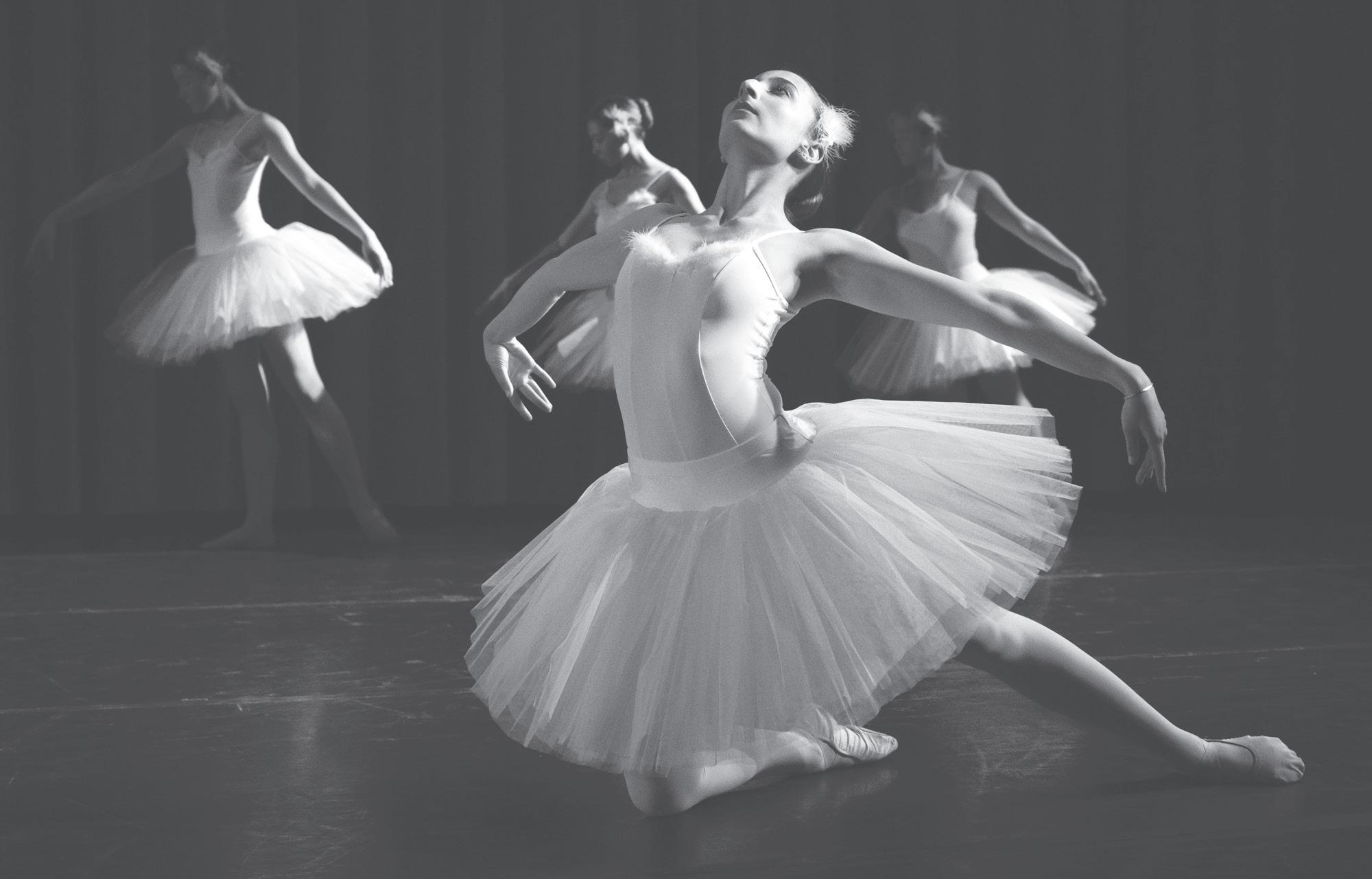
Feb. 24 — Dancers in tutus fluttered their arms in a packed theatre resonating with the well-known classical music as Cornell Ballet Club performed their interpretation of Swan Lake’s second act.
Founded just seven months ago as the University’s first and only ballet club, CBC captivated its sold-out Schwartz Performing Arts Center audience with the beloved classic on Saturday night.
CBC put unique spins on the production, making the show its own. Usually set on a moonlit lake, the rendition took place at a more familiar setting — Beebe Lake. The Swan Queens and their maidens are cursed by a spell that transforms them into swans by day. With no male dancers or “king” to pledge eternal love and break the spell, the club focused on a “shared sisterhood among the swans” to lift the curse, according to CBC’s Marketing Chair Tobie Bertisch ’25.
Their creative interpretation left a lasting impression on audience members. Sumner Broadfoot ’25 attended the performance to support her friend and explained that she left with admiration for CBC’s dedication and artistry that brought the show to life.
“It was incredible to get to watch everyone do something they were so clearly passionate about and put so much work and effort into,” Broadfoot said.
Just over a day after releasing tickets, the 130-seat theatre in Schwartz Performing Arts Center sold out. The club’s quickly-gained success filled its members with gratitude for the community they built and the outreach they achieved.
Bertisch recognized the impact the club and their first performance of Swan Lake have made across the University.
“It really feels like this club filled a niche that people were wanting and are interested in,” Bertisch said. “It’s allowed us to connect not only among other students but across faculty.”
This enthusiasm extended to the audience, drawing in ballet enthusiasts and newcomers alike. Jessica
Dure, who is pursuing a doctorate in veterinary medicine, decided to attend after receiving an email about the production.
“It was so beautiful. I thought they did such a great job, and it was so surprising to hear that this was their first [performance],” Dure said.
“We don’t get graded. We don’t get tested. ... It’s purely because we love it.”
Molly Goldstein ‘25
Behind their seamless first performance were months of planning and dedication, starting back just one month after the founding of the club in September. The club decided on Swan Lake as a fitting production that would suit the myriad of skill levels in their cast. Emma Rethy ’25, co-president of CBC, found joy in the process of selecting a production that suited everyone’s skillset, as more than 50 dancers of varied skill levels comprise CBC.
“It works really well with a cast of a lot of dancers,” Rethy said. “[There is] lots of room for solos and small groups, … so it really lets everyone’s dancing shine.”
With their first performance a success, CBC is eager to continue the momentum. The club hopes to make these performances an annual tradition.
To close out their production, CBC ended with an acknowledgment of the senior dancers and choreographer Anna Liba ’25. The seniors received immense praise for the mark they left on the newly founded club and the University.
Molly Goldstein ’25, co-president of CBC, feels grateful for the work, friendships and legacy they were able to create.
“It’s our passion project — that’s really what it feels like. It’s something that we love to do,” Goldstein said. “We don’t get graded. We don’t get tested. ... It’s purely because we love it.”
By EVELYN MULLEN WALSH Sun Staff Writer
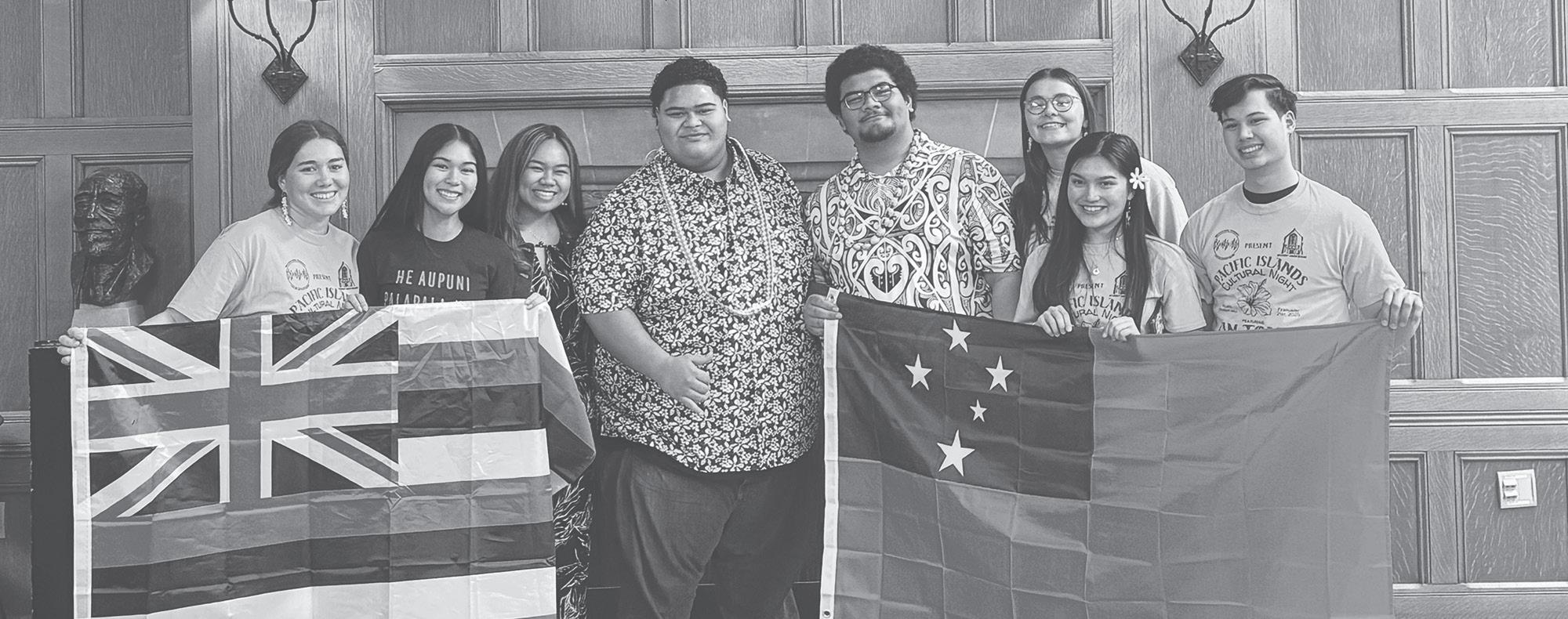
Feb. 22 — Willard Straight Hall was the site of a celebration of Pacific Islands culture on Friday night at an event co-hosted by Cornell’s Multicultural Community-Fueled Activities Board, Student Union Board and Hawai’i Club. Pacific Island Cultural Night featured a performance by Iam Tongi, the first Pacific Islander to win American Idol, as well as activities, food and beverages.
“MCFAB chose to put on a Pacific Islands centered event because we noticed a lack of representation for pacific islander culture on campus, both academically and socially,” wrote Samantha Smith ’26, the chief executive officer of MCFAB, in an email to The Sun.
Tongi, a 20-year-old singer, became the first Pacific Islander to win American Idol in 2023 at only 18 years old. Tongi was born in the small town of Kahuku in Honolulu, Hawaii, and grew up singing with his father and grandfather. Tongi’s father died in December 2021, after which Tongi struggled to perform. His mother ultimately signed him up for American Idol — an opportunity his father had long encouraged — and surprised Tongi with the news just two days before his audition.
At 7 p.m., attendees crowded into Willard Straight’s Memorial Room for an hour-long per-
formance by Tongi.
Tongi opened with his song, “Road to Hana,” which received much applause. Supported by a drummer and a backup singer, Tongi played the acoustic guitar while serenading the crowd. He then played “I’ll Be Seeing You,” written by fellow American Idol contestant Francisco Martin, which he performed in honor of his late father during the season finale of American Idol.
Between songs, Tongi conversed with the crowd, discussing his recent move to Memphis and his current music projects, including his new song “Good for my Soul.”
Tongi’s rendition of “Cool Down” by Kolohe Kai elicited screams from the audience. When introducing “Sylvia’s Mother” by Dr. Hook & the Medicine Show, Tongi spoke of growing up in Hawaii, listening to a variety of music genres with his father.
Tongi then performed “Monsters” by James Blunt, the first song he performed on American Idol. Tongi’s duet of the song with Blunt is his most popular song on Spotify, with 12 million streams. Tongi closed the event with a cover of “Don’t Let Go” by Spawnbreezie.
To continue reading, please visit www.cornellsun.com.
By ROWAN WALLIN and ASHLEY LEE Sun Staff Writers
Feb. 22 — Pianist Jonathan Biss brought a program of musical compositions regarding tragedy and catharsis to life on the stage of Bailey Hall on Friday evening. His performance, as well as his mental health talk and piano masterclass on Thursday, allowed him to uniquely connect with the Cornell community.
Biss is a pianist and musical educator who specializes in classical music scholarship. He is also the co-artistic director of the Marlboro Music Festival held in Marlboro, Vermont.
Biss’ two-hour performance on Friday evening drew approximately 600 audience members and was part of the Cornell Concert Series’ 2024-2025 season. Biss’ performance featured three pieces, as well as an encore finale.
Biss’ program consisted of classic pieces and modern works. It included classical pieces by Franz Schubert, a 19th-century Austrian composer, as well as “…Expansions of Light,” a modern piece composed by Tyson Gholston Davis in 2023, a composer studying at The Juilliard School.
In addition to playing a mixture of classical sonatas and a modern music piece, Biss also employed another instrument: his breathing.
During particularly intense sections of pieces, Biss’ breathing would intensify and become more abrupt in tune with the composition,
adding to the chaotic energy of the notes. Regarding his breathing, graduate student Sam Kemiji said that he was “wondering the whole time if it was a ‘hot mic’ … The breathing … was very eerie in the second song for me.”
Kemiji was drawn to Biss’ performance because of his interest in Schubert’s works, specifically the opening composition, “Sonata in C Minor, D. 958,” which conveys themes of existential struggle, fleeting beauty and an unresolved emotional journey, according to the Cornell Concert Series program for the show.
Following “Sonata in C Minor, D. 958” came “…Expansions of Light.” Graduate student Logan Mims commented on the two pieces’ common theme of catharsis, describing the performances as a journey that takes the audience through tragedies and bursts of energy. Mims said, “I enjoyed the slower, more meditative aspect [of the piece].”
Graduate student Victor Chen appreciated the third piece “Sonata in A Major, D. 959,” which embarks on a profound emotional journey, navigating the depths of depression, anger and eventual acceptance — as highlighted in the event’s program brochure.
To continue reading, please visit www. cornellsun.com.
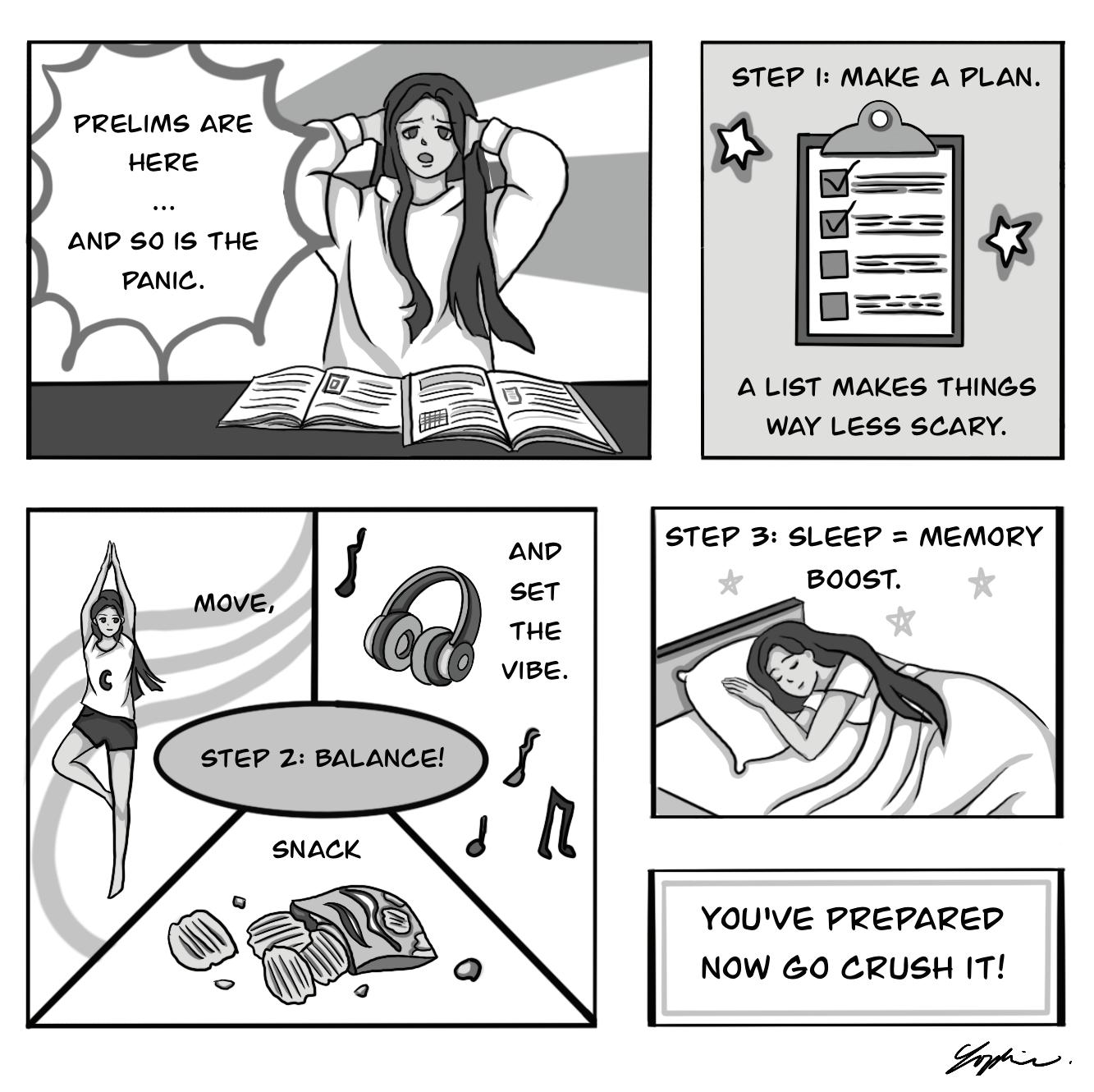
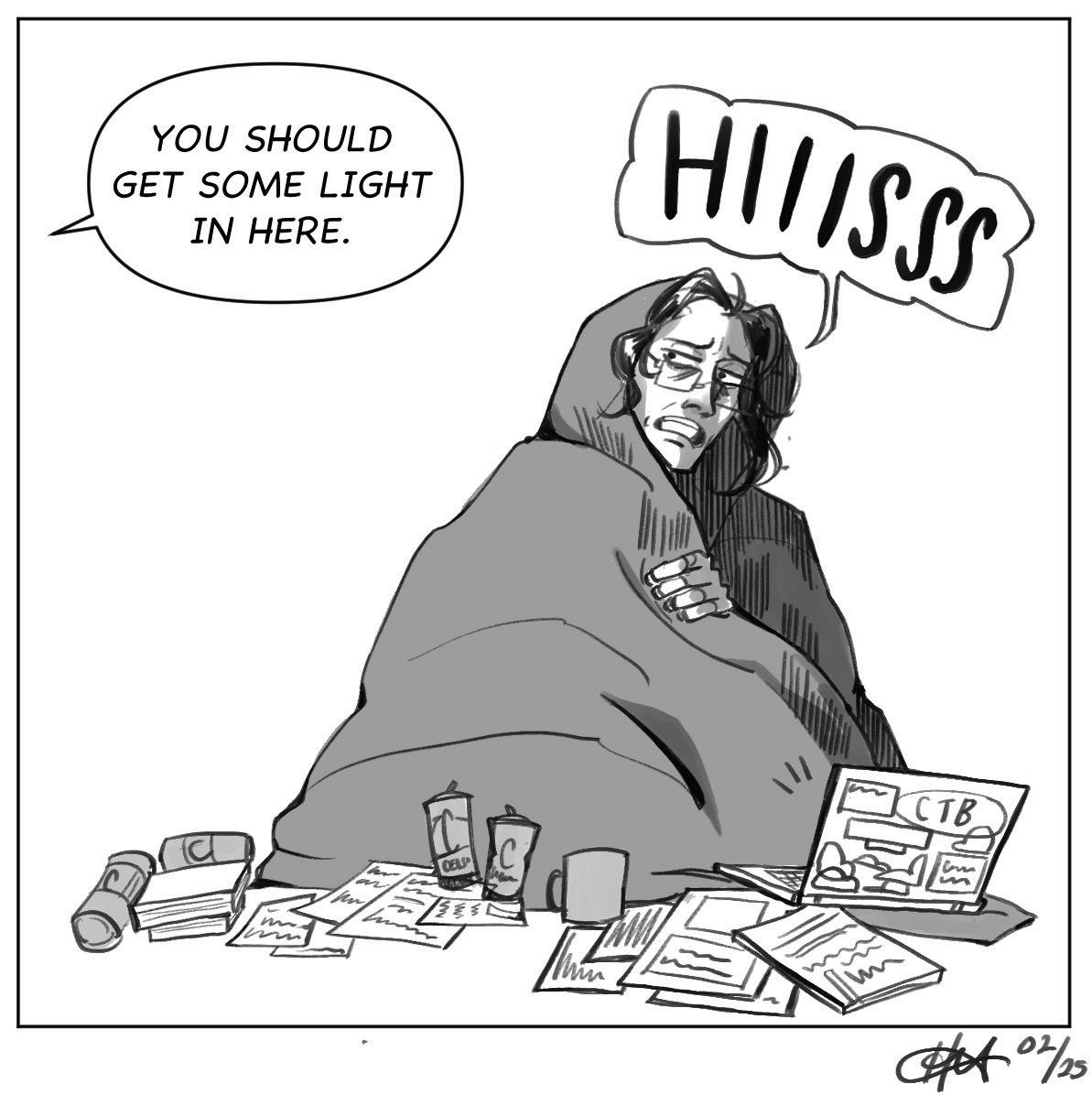
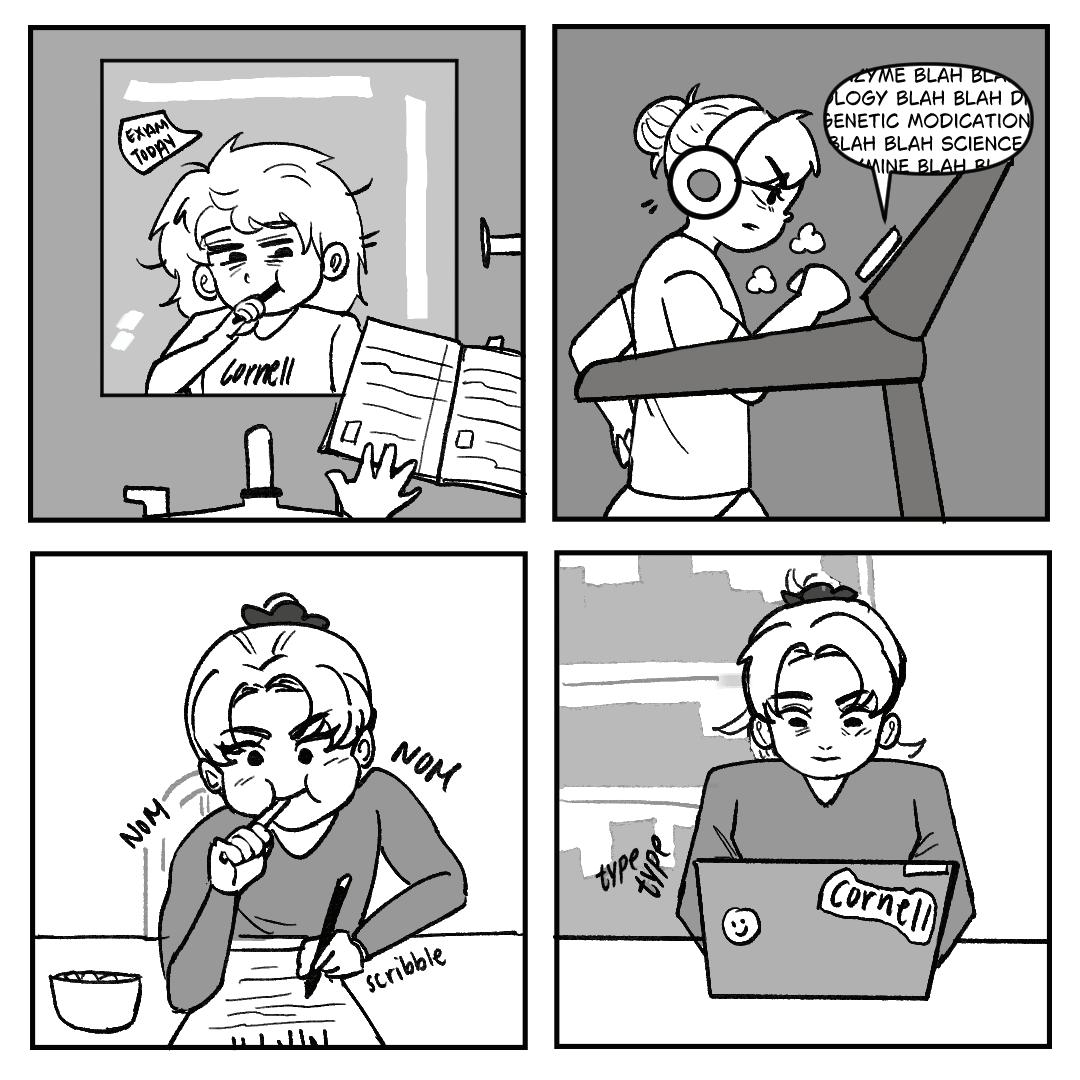

Standard


By THEODORA CURTIN
Sun Contributor
Feb. 19 — Technical lead, program manager, public relations lead, product strategist and content creator — these are just some of the titles that can be found on Jahnavi Shah’s MEng ’23 resume.
With over 70,000 LinkedIn followers, Shah has become a LinkedIn Top Voice — a title the networking platform gives to content creators with at least 10,000 followers. Shah documents her professional and academic accomplishments on her account, sharing her strategies for reaching success.
During her sophomore year of college at Pandit Deendayal Energy University in Gandhinagar, India, Shah began creating content on LinkedIn by sharing her academic and personal projects, including a patented mood-based lighting sensing system. Eventually, her posts started gaining traction and she committed to developing her account as a content creator.
“I was there as a student, just sharing my work [and] the projects I was doing, and sometimes there were really cool opportunities, so I would share [those],” Shah said. “That started building my brand. And then slowly I started pivoting to networking, [how to build] your brand as a student and also studying abroad or getting into an Ivy League.”
Shah achieved her goal of becoming a LinkedIn top voice in August 2024, providing advice to other students as someone who got into an Ivy League master’s program from a “non-target” undergraduate university.
“I picked a niche that I saw a lot of people were not talking about,” Shah said. “I post on LinkedIn [consistently] — almost
two to three times a week, and I think I had 100 posts last year. So it definitely takes a lot of time. And I think when you consistently do it and build up a good following, the LinkedIn team notices.”
Shah’s status as a content creator on LinkedIn gave her visibility — opening more opportunities. Shah sent a “cold email” to the product officer at LinkedIn and was invited to their headquarters in New York after a research project she worked on at Cornell caught the eyes of LinkedIn employees.
Her research studied how Generation Z interacted with hiring apps such as LinkedIn, allowing her to be recognized by the LinkedIn executive and chief product officer.
Through it all, Shah said that the job market was “super competitive” and emphasized the importance of persistence despite rejection. She recalled applying to a position with the New York Times that she formed an “attachment” to but ultimately received a frustrating rejection. And yet — she landed a job that she loved two weeks after that rejection.
“Don’t care about the rejections. Just keep applying and just know that your job search is your own journey,” Shah said. “Have a plan for yourself and find ways and how we can succeed in that plan alone, and don’t compare it with what everyone else around you is doing.”
Shah also credits her success in the job market to the connections she made at Cornell, where she completed a master of engineering management. Shah explained that the kindness of the Cornell community shone through her journey looking for a job, as she was able to reach out to multiple University alumni who helped her along the way.
“Even if [Cornell alumni did] not know me, just because I studied at the same university, they would vouch for me,” Shah said. “That kindness and that attitude to help people … stood out to me so much.”
Today, Shah seeks to continue sharing the same kindness that she’d received from Cornell alumni herself. She said after she got her current job as a product deployment strategist at Persona — a company that helps businesses verify user identities and avoid fraud — she helped connect more Cornellians to Persona as the company continued to recruit. “It feels really nice when someone you know from Cornell … [is] interested in your company and you get a chance to refer them,” she said.
Shah leaves Cornellians with the message that getting yourself out there and committing the time to talk about your achievements will open so many doors
after graduation.
“Start applying to internships. … Start reaching out to people. Build a list of companies you want to work at or intern at,” Shah said. “You don’t know where your next job is going to come from, and you need that visibility, and getting that as a student would accelerate your career.”
“Don’t care about rejections. Just keep applying and just know that your job search is your own journey.”
Jahnavi Shah ’23

By ANJELINA GONZALEZ Sun Staff Writer
Feb. 21 — Arnav Kamulkar ’26 — or @chefarnav on Instagram — made ripples on campus with his private, music-inspired pop-up restaurant experience, CENA, in the fall of 2023.
Just over a year later, CENA now thrives as a meal-prep business, with the School of Hotel Administration student taking on further culinary endeavors — most recently, competing on season four of Fox’s Next Level Chef featuring celebrity chef Gordon Ramsay. The fourth season began on Feb. 13.
Contestants on the show compete in a three-level kitchen, first fighting to land a spot on one of three cooking teams. As the show progresses, contestants are eliminated until a single winner receives a $250,000 prize and a year of mentorship from all three judges.
Kamulkar’s appearance on television began with a LinkedIn request to apply from a casting agent who “stumbled upon [his] Instagram” during the fall semester of his sophomore year. Though he initially believed the opportunity was spam, Kamulkar realized the offer’s legitimacy and began a lengthy vetting process to join the show.
“It was like 80 questions, all of them short answers, and then over the next two or three months, I went through like five or six rounds of interviews as the casting team sort of cut down the applicants from like thousands to just like 24,” Kamulkar said.
Kamulkar learned he was cast on the show in December 2023, a few months after receiving the scout’s message.
While Next Level Chef was an opportunity for professional visibility, it also served as a valuable networking resource when Kamulkar stepped down from an internship last summer and began reaching out to chefs associated with the show.
After Kamulkar connected with Chef Brandon Rogers, who offered Kamulkar the opportunity to work with him at a Chicago NASCAR race and later as a private chef for NFL players in Florida.
Though Kamulkar grew up cooking at home with his mother, he said he was undecided about his career path when he entered Cornell. He was initially considering the possibility of entering into business or consulting.
Kamulkar believes all of his courses at Cornell have taught him transferrable skills and helped guide his career toward culinary work.
“If it wasn’t for the motto of ‘any person, any study,’ I don’t think I would have been exposed to so many opportunities and career paths,” Kamulkar said.
Kamulkar served in the fall as an undergraduate course assistant in “Managerial Accounting,” taught by Prof. Asís Martínez-Jerez, accounting.
“He’s not one that does things just following the rules — he wants to understand,” Martinez-Jerez said about Kamulkar. “He’s a student [who] needs curiosity, wants to learn why and finds creative solutions to problems and gets to the essence of things.”
In addition to his time at Cornell, Kamulkar credits his summer experiences and Next Level Chef with solidifying his direction in the food and beverage industry. “Being on the show itself was [the] deciding moment where I think I really [needed] to decide what I want to do in life,” Kamulkar said.
Anjelina Gonzalez can be reached at ang54@cornell.edu.
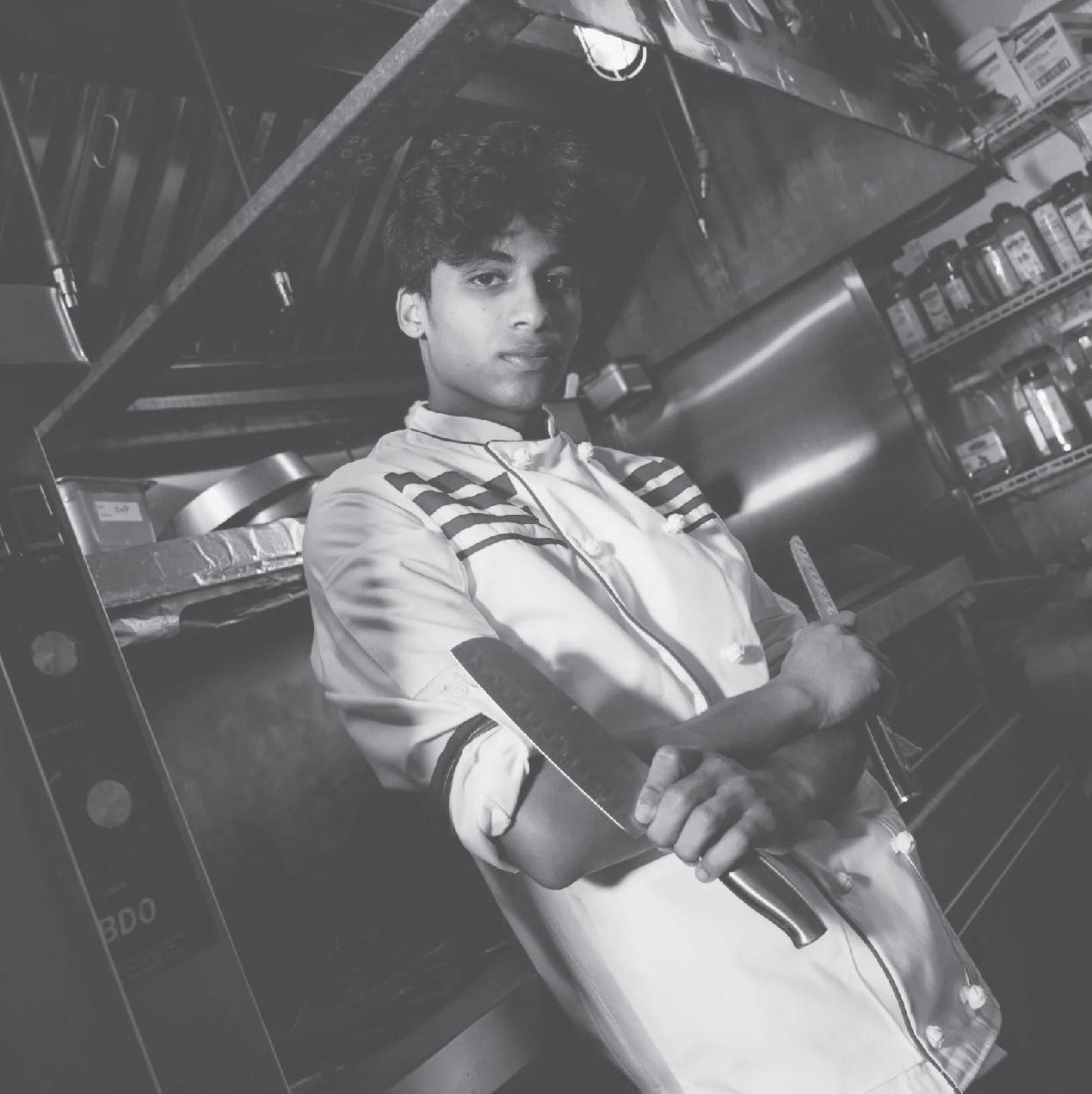

By JANE MCNALLY
Feb. 20 — When senior forward Ondrej Psenicka takes his well-earned farewell lap on senior night on Saturday, it will mark the end of a long journey chock full of adversity — and mileage — that inevitably comes with moving 4,000 miles away to play college hockey.
The Prague, Czech Republic native will salute the Lynah Faithful for his final home game at Lynah Rink in front of his parents, who although typically only traverse the cross-continental flight once a year, will make their second of three trips this season to watch their son play.
“They came for the Madison Square Garden game, they are coming for this weekend and then eventually they are coming for the graduation,” Psenicka said with a wide grin. “So that’s awesome. It’s exciting.”
No international student’s path to Cornell is ever the same. And for a Division I hockey player from the Czech Republic, that path is even narrower and more difficult to navigate.
Before Psenicka arrived at Cornell, he had gone almost two years without playing hockey — unheard of for highly coveted, National Collegiate Athletic Association-bound hockey prospects.
Psenicka will leave Cornell with at least 124 games played, scoring 36 goals, 35 assists and counting. As he prepares to graduate with a degree from the School of Industrial and Labor Relations this spring, Psenicka looks back fondly on everything that got him here.
“I would never think that I would be that lucky to get to such a prestigious university like Cornell,” Psenicka said. “[I] still can’t believe it.
The Early Years
While the Czech Republic
is now a strong competitor in international hockey, having medaled in the last three International Ice Hockey Federation U20 World Junior Championships and securing a bronze in the 2022 IIHF World Championship, it wasn’t always that way.
When a young Ondrej Psenicka was growing up in Prague, ice hockey wasn’t the popular sport amongst his friends. Instead, Europeandominated sports like soccer and tennis were more common after-school activities.
Psenicka, much taller than most at his age, and who stands at 6’6” today, picked up a hockey stick because of his dad.
Stanislav Psenicka played hockey throughout his childhood, up until he hit a crossroads — go pro or get a college degree. The elder Psenicka ultimately chose the latter, a decision his son gives him a lot of credit for. But once his children reached an apt age, they were on skates.
“He kind of pushed my older brother to start playing hockey when he was three years old,” Psenicka said.
Tomas Psenicka, like his younger brother, rose through the ranks of HC Sparta Praha — a premier hockey club in Prague that has bred dozens of National Hockey League talents, including Zdeno Chåra, Martin Havlát and Patrik Štefan, among others.
“So when I was very little, I used to go to watch [Tomas’] practices. I was sitting on a bench with my mother, and eventually, I wanted to try it also,” Psenicka said. “So that’s how I got into it. And I’ve been loving it since then.”
Ondrej was a natural — his size and fluidity on skates molded him to be a standout player on HC Sparta Praha’s U16 team, posting 80 points in 58 games across two seasons of play. Psenicka then graduated to the U18 team and ultimately cemented a spot for himself on the U18
By ZEINAB FARAJ Sun Staff Writer
Feb. 17 — “Guts” is the word head coach Dan Pepicelli used to describe baseball’s attitude going into this season.
“This team is a really tough group,” Pepicelli said. “We just don’t give up. To coach a group that has so much grit and guts is so much fun.”
The new energy of nine recruited freshmen and one walk-on is motivating for the team.
“They are joining such a good group of veteran players,” Pepicelli said. “I think it will allow them to mix right in and learn a lot from the older guys. We hope to see a quick transition.”
The Sun spoke to some of the oncoming players to get a feel of the newest additions to Cornell’s lineup and what they will contribute to the team.
Ryan Dillon
national team roster.
In April 2019, 18-yearold Psenicka played in the IIHF U18 World Junior Championship in Sweden. Later that year, in December 2019, Psenicka flew across the ocean to Western Canada to participate in the World Junior A Challenge, a tournament organized by Hockey Canada catered to U19 hockey prospects.
In that tournament, Psenicka stuck out — his five points in as many games, in addition to taking the United States to double-overtime in the third-place match, drew attention from NCAA scouts.
The Pandemic in Prague
Many European hockey prospects consider going pro around the ages of 19 and 20, but in the Czech Republic, Psenicka explained that certain teams and clubs can force younger kids — as early as ages 16 and 17 — into restrictive contracts.
While some of his friends and teammates signed on to play professionally, Psenicka — encouraged by his father — stayed behind, preserving his amateur status and remaining eligible to play in the NCAA.
Psenicka signed with the Waterloo Black Hawks of the United States Hockey League to adjust to the surface before he got to college. He played 43 games for the team and had his first discussions with Cornell, the dream starting to take shape.
Then, in March 2020, the world shut down.
“I had to go back home and I didn’t play hockey for two years,” Psenicka said. “I was only practicing on my own with two of my buddies in the little gym in my house.”
To continue reading this article, please visit www.cornellsun.com.
Jane McNally can be reached at jmcnally@cornellsun.com.
Ryan Dillon ’28 is a student in the School of Hotel Administration. Dillon was a four-year varsity starter in high school and a three-time team captain. He is the lone freshman catcher, holding the same position as sophomore Mark Quatrani — the 2024 All-Ivy League Rookie of the Year — and junior Jackson Marko — the most experienced catcher on the team.
A two-time preseason All-American honoree from Perfect Game and the 2024 Mid-Wach All-Star Most Valuable Player, Dillon has extensive experience behind the plate. As he “integrates on the team,” Dillon is grateful to the upperclassmen and hopes to “contribute to the team in any way possible.”
“This level of play is new,” Dillon said. “Getting to work with Mark [Quatrani], who had so much success last year, and [Jackson] Marko is so motivating.”
John Hegarty
John Hegarty ’28 is a right-handed pitcher from Needham, Massachusetts. He is an economics major in the College of Arts and Sciences. Hegarty earned four varsity letters in baseball at St. Mark’s School, where he was dubbed Team MVP and was a First Team All-Independent School League and First Team All-New England Prep School Athletic Conference selection.
Hegarty has experience playing other varsity high school sports including two years of football and three years of basketball.
Hegarty feels his past experiences taught him how to play through long seasons and perform under pressure. He says that fans can expect him to be someone who deeply cares about the game.
“I am someone who will show 100 percent of my effort on and off the field all the time,” Hegarty said. “I am very passionate about playing and giving it my all.”
Braeden Johnson
Braeden Johnson ’28 is a New York native who is an animal science major with a concentration in dairy management at the College of Agriculture and Life Sciences. Johnson, a left-handed pitcher, is no stranger to leading a team; he was a four-time Defensive Most Valuable Player at his high school, a four-time First Team All-Star selection for the Mid-State Athletic Conference and a New York State Public High School Athletic Association Section IV First Team All-Star selection.
As a child, Johnson enjoyed watching Cornell baseball and attending games in person. Now, as a part of the team, Johnson hopes to contribute in any way he can.
“I am a team guy. I will always put
my best effort in the weight room and at practices,” Johnson said. “On the field, I do not show too much emotion, but inside I want fans to know that there is a storm brewing.”
Sam Keene
Sam Keene ’28 is a student in Arts and Sciences studying economics. Keene is a left-handed pitcher whose goal this year is to both be a team player and do his part individually —- working to be an athlete who improves every single day. The ultimate team goal, according to Keene, is to win an Ivy League Championship. As a left-handed pitcher, Keene relies on precision.
A former team captain and two-time All-Star selection, Keene says that fans and Cornell athletics can expect someone who will “bring the energy every time” he steps out on the field. Keene was the starting pitcher and captain of the Boston College High School team, a program that clinched the 2024 Massachusetts State Baseball Championship.
“I am going to give 110 percent, leave it all out on the field and bring all my energy, hard work and passion,” Keene said. “I want to give everything I have to get back to where we should be — the Ivy League Championship.”
Gus Magill
Gus Magill ’28 is a right-handed pitcher from New York City and studies in Arts and Sciences. He played two years of varsity baseball at his Fordham Preparatory School where he was a New York State Catholic High School Athletic Association First Team member and finalist for the NY CHSAA Ron Patnosh Player of the Year award. His pitching strength is a fastball slider, and he employs a mix of fastballs and sliders at the mound. He also likes to change up his style with sinker.
Magill is coming off an elbow injury and hopes to be fully healthy in the latter half of the season. He wants to contribute to the team in any way possible — on or off the field.
“I am always willing to take whatever steps necessary to contribute to the team as a team player,” Magill said.
Travian Ramos
Travian Ramos ’28 hails from Neenah, Wisconsin as the fourth player in Cornell baseball history to be from Wisconsin. Ramos is a student in Arts and Sciences studying economics.
Ramos is a right-handed pitcher hoping to level up his playing experience as a Division I athlete. He works on live pitching to teammates to improve his “straightforward pitching” style on the mound. Ramos’ four-year goal as a pitcher is to play professionally.
“Even though many people do not consider Cornell [baseball] to be a powerhouse school, I want to show that it is very possible for our program to produce professional players,” Ramos said.
Jayden Shin
Jayden Shin ’28 is from Pennington, New Jersey and is enrolled in the School of Industrial and Labor Relations. Shin earned four varsity baseball letters from Hopewell Valley High School and 2023 and 2024 First Team All-Conference and All-Area selections. Shin played two years of varsity basketball that exposed him to “loud, competitive environments” that forced him to become more mentally tough, a skill he says he will transfer to his experience with the Red.
To continue reading this article, please visit www.cornellsun.com.
Zeinab Faraj can be reached at zfaraj@ cornellsun.com.
SYDNEY LEVINTON ARTS & CULTURE EDITOR
If you’re on social media, then you know there has been a lot of hubbub around Bruno Mars recently with the release of three new collaborations: “Die With A Smile” with Lady Gaga, “APT.” with Rosé and “Fat Juicy & Wet” with Sexyy Red. After a 2024 NewsNation report purported that Mars owed MGM Grand $50 million in gambling debt and the release of “Die With A Smile,” rumors started to spread that Mars’ sudden fruitfulness was a maneuver to repay his debts. Despite MGM’s statement refuting the report and reaffirming their relationship with Mars, the rumors persisted. On Jan. 27, Mars became the first artist to hit 150 million monthly listeners on Spotify and playfully responded to the rumors with “Keep streaming! I’ll be out of debt in no time.” Whether it was because of the discussion around them or purely their musical value, these songs thrust Mars back into the cultural zeitgeist and my mind. And, although some of my favorite Mars songs can be found on his 2012 triumph Unorthodox Jukebox, it’s an established fact that his pièce de résistance is his 2010 debut record, Doo-Wops & Hooligans. What would be more appropriate than to welcome Mars back into the milieu with a review of his masterpiece?
Doo-Wops kicks off with one of his
most evergreen hits, “Grenade,” where Mars pledges himself to bodily harm for his lover, but she will not commit to him the same way. For me, the highlight of this song has always been the bridge, both for the intense, emotional rasp in his voice and the cutting lyrics: “If my body was on fire / Ooh, you’d watch me burn down in flames / You said you loved me, you’re a liar / ’Cause you never, ever, ever did, baby. “Just The Way You Are” is a turn for the sugary sweet, as he sings, “When I see your face / There’s not a thing that I would change / ’Cause you’re amazing / Just the way you are.” Mars said of the song, “I’m a big fan of songs like Joe Cocker’s ‘You Are So Beautiful’ and Eric Clapton’s ‘Wonderful Tonight’ — songs that go straight to the point. You know, there’s no mind-boggling lyrics or twists in the story — they just come directly from the heart. And to me ‘Just The Way You Are’ is one of those songs.”
“Our First Time” is part breathy vocals, part funk, and part elevator music — and it works. It’s also a reminder that despite claims that Mars is new to more sexually explicit songs like Sexyy Red’s “Fat Juicy & Wet,” he is most definitely not; this most recent release joins the ranks of “Our First Time,” 24K Magic’s “Versace on the Floor,” and Silk Sonic’s collaboration with Thundercat, “After Last Night.” He’s done this before, folks. Next we transition into the absolutely electric “Runaway Baby,” one of my
favorites on Doo-Wops. It’s just so singable, so danceable, so fun — well, that is until you listen to the actual lyrics … a warning for the girls that he’s not the one for you.
Perhaps the realest song on the album, “The Lazy Song” never fails to stir up all sorts of nostalgia in me. That whistle, that “Today, I don’t feel like doing anything / I just wanna lay in my bed” — such memories. I also can’t help but note that Mars sings “I’m gonna kick my feet up, then stare at the fan”; someone alert Sabrina Carpenter, because apparently it’s a vital option! “The Lazy Song” is followed up by the instantly recognizable wedding bells of “Marry You.” It’s a good, solid pop song, with a catchy tune and lyrics that are just the right amount of silly.
“Talking to the Moon” slows DooWops back down for a soulful ballad. By far the most underrated song on the album and another one of my favorites, “Talking to the Moon” puts Mars’ abilities on full display, reminding listeners that his vocals are at the heart of everything he does. The oft-forgotten “Liquor Store Blues,” featuring Damian Marley, is Mars’ little reggae-blues crossover with an offbeat rhythm which makes for an interesting listening experience.
“Count on Me” is cute and wholesome — who doesn’t love a good song about friendship? Mars cheerily sings, “You can count on me like one, two, three, I’ll be there / And I know that

when I need it I can count on you like four, three, two and you’ll be there.” Doo-Wops caps off with “The Other Side” with CeeLo Green and B.o.B, a spooky-sounding song about living such a different life from other people that it’s better if they don’t try to understand it. Green gives Mars some competition in his vocal runs, and B.o.B rounds the track out with his verses.
This trip down memory lane justifies why Mars’ reentrance into cultural discourse was so effortless — his voice is enrapturing, and he knows it. Even if the man was in debt, with a voice like that, I don’t think he’d have much to worry about.
Sydney Levinton is a sophomore in the College of Arts and Sciences. She can be reached at slevinton@ cornellsun.com.
SOPHIA ROMANOV IMBER ARTS ASSITANT EDITOR
In 2017, White House Press Secretary Sean Spicer gave inaccurate information on the crowd size for President Donald Trump’s inauguration. When Kellyanne Conway, Senior Counselor to President Trump in his first term, defended Spicer’s claim, she called it an “alternative fact.” This phrase picked up in popularity and Conway was criticized for calling blatant falsehoods “alternative facts.”
This is where Emily Greenberg ’13 got the title for her debut short story collection, Alternative Facts. Greenberg explained, “Fiction is also a form of lying in a way. It’s interesting to think about these Trump administration figures who are … telling fictions. What does that mean for me as a fiction writer? … they’re telling these fictions to manipulate us and to divide us. I want to turn the tables and use fiction on them. But I have a different purpose. I want people to be able to reflect more and connect with the idea of another human being on the page.”
Greenberg wrote for The Cornell Daily Sun in an arts column titled “Greener on the Other Side.” In January 2025, Kallisto Gaia Press published her debut short story collection
Alternative Facts. Greenberg reflected on the collection’s purpose: “Reclaiming fiction is a useful and meaningful thing. During the first Trump administration, in reaction to lies being told and fake news, people were saying ‘We must defend facts [and truth]’ … But there were also people that said maybe it’s irresponsible to do satire, given this administration is basically peddling satire … is it responsible right now to write stuff that toys with the idea of truth? I think this book is an attempt to say, yes, actually we do still need … to embrace works that have this complicated understanding of truth and reality, but at the same time condemn the outright lies and the fake news.”
Alternative Facts consists of seven short stories that contemplate reality and perception. In my interview with Emily, we discussed her intentions and why she wrote the collection.
The first short story, “Alternative Facts,” takes Kellyanne Conway’s perspective at Trump’s first inauguration ball. It’s quick and all in one breath, only one sentence but 12 pages long. A major theme throughout the collection is introduced in “Alternative Facts”: what does and does not exist. Conway repeats that if something wasn’t observed, then it didn’t happen. This fits with the story’s end-
ing, whether or not Conway punched someone in the face at the ball, as reported by an eyewitness. It sets the scene for the rest of the collection; Alternative Facts is whimsical with its voice, writing and format yet haunting with questions about reality and whether truth is only found in observation.
Greenberg makes use of pop culture references to participate in fact-based fiction and political criticism. “There’s something about historical specificity that has become more ascendant with postmodernism, which is a rejection of abstractions, universalisms and grand narratives. The modernist school of thought is that we do want the work to have universal appeal, which is why you might be encouraged not to have pop culture references … Whereas the postmodernist thinking is that there are no universalisms, there are no grand narratives, everything is subjective and we want to be historically specific in order to make a more political critique,” Greenberg explains.
“Black Box,” the second story, involves American psychologist B.F. Skinner. Skinner believed it isn’t necessary to understand a person’s thoughts to understand their behavior. This story depicts his perspective through his career and relationship with his wife. Greenberg wrote “Black
Box” as a refutation of the idea that internal thoughts are unimportant. “That was definitely an interesting challenge … how do I convey [his] voice but also undermine it and what he believes in a way?” Greenberg wondered.
Lost in the Desert of the Real,” possibly my favorite story in the collection, follows key players in the 2018 Hawai’i false missile alert. While the story is absurd when it jumps between perspectives like Donald Trump golfing or the employee who sent out the alert, it is also bleak when we see Hawaiian citizens fear for their lives. The most significant perspective, I believe, is of the Japanese-American O‘ahu native and army veteran. He remembers Pearl Harbor and thinks back to his time in the army, “living with multiple identities and in multiple realities” (Greenberg, 81).
The story tackles the tumultuous history of the U.S. overthrowing the Hawaiian kingdom to annex Hawai’i. Greenberg emphasizes, “People had a real terrifying experience even though what they thought was happening … was false, but that doesn’t mean that what they went through was false … All of these stories are meant to complicate our relationship to the real and to the truth and fact.”
That’s exactly what Alternative Facts accomplishes. Each story introduces a new set of charac-
ters and timelines that “complicates our relationship to the real.” The intention behind each story, experimental formats and characters are what make Alternative Facts such an enjoyable read.
When asked “Who is your ideal reader?” Greenberg responded, “Anyone who’s … lost in our current political moment. I hope my book would offer them a different way to think about current events … instead of feeling stuck.”
Finally, I asked, “What would you say to any Cornell student who is aspiring to the arts as they’re looking toward their future?”
“You have to just keep going. I’ve gotten so many rejections in my life. This book was rejected a ton of times. … It’s really easy to get discouraged … No matter how smart and talented you are as a writer, rejection is just part of the game … to go back to what my professor [Michael Koch] had said to me: A writer is just somebody who writes. All the external validation stuff doesn’t matter, if you’re a writer, you need to find a way to keep writing and to keep at it over many, many years, regardless of the outcome … just keep going with it.”
is a freshman in the College of Arts and Sciences. She can be reached at sromanovimber@cornell.com.
By AIMA RAZA Arts & Culture Writer
“Sometimes I think I was born backwards… you know, came out of my mum the wrong way. I hear words go past me backwards. The people I should love, I hate, and the people I hate…”
— Skins, Effy (TV Episode, 2007)
Waterlines chalked with jetblack pencil liner, low-cut Henleys, and chain necklaces reminiscent of Crystal Castles… Effy Stonem from Skins (2007) and Tracy Freeland and Evie Zamora from Thirteen (2003) have cemented themselves as cultural icons for those who have wrestled with teenage rebellion, particularly those from broken families. Their allure isn’t just in their recklessness, but in how their stories reflect the yearning for freedom, control and identity amid chaos. To many, these characters serve as comforting figures — not in the traditional sense of being soothing presences, but in their relatability. They embody the struggles of those who have self-destructed as a means of survival, and their narratives provide an odd sense of validation to those who have felt unseen in their own turmoil.
At first glance, Effy, Tracy and Evie are the quintessential rebellious teenage girls — enigmatic, hedonistic and volatile. They smoke, drink
and engage in risky behavior, often skirting the edge of masochism. But underneath their carefully cultivated personas, they are deeply wounded girls burdened with broken homes and dysfunctional relationships. Effy, emotionally neglected and overshadowed by her brother in Skins, is raised in a household where her parents’ marriage is falling apart, and she learns early on that detachment is a form of protection. Evie, in Thirteen, comes from an unstable background where parental guidance is lacking, leading her to construct a hypersexualized, delinquent image to mask her vulnerability. Tracy, once a model student, spirals into rebellion largely due to her need for validation and control in a life where her mother’s attention is divided and inconsistent.
For people who have grown up in similar environments — where stability was never a given and rebellion felt like the only means of autonomy — these characters resonate on an intimate level. They depict the ways in which teenage girls, particularly those raised in dysfunction, weaponize self-destruction as both an escape and an assertion of independence. Their reckless behaviors — drunken nights, risky relationships, defying authority — aren’t just rebellious for rebellion’s sake, they are desperate acts of agency.
There’s an undeniable romanticization in how these characters
are framed, particularly in their aesthetics. Effy is the textbook definition of the “cool girl” archetype — smudged eyeliner, vacant stares, cigarette in hand, radiating an effortless detachment that makes her seem invincible. Tracy and Evie, in their cropped tank tops, low-rise True Religion jeans and stolen makeup, embody the early 2000s aesthetic of teenage rebellion, one that feels both reckless and intoxicating. This aestheticization can make their downward spirals feel almost aspirational, particularly for viewers who have experienced similar turmoil and lack of control. When self-destruction is made to look beautiful, it can be easier to embrace one’s own struggles rather than confront them. In Skins, Effy’s suffering is wrapped in dreamy cinematography, her breakdowns set against neon lights and indie soundtracks. Thirteen is grittier, handheld cameras making every bad decision feel uncomfortably intimate, but still, there’s something hypnotic about the way Tracy and Evie’s downfall is framed.
But beyond the surface-level aesthetics, the deeper comfort in these characters comes from their unfiltered portrayal of pain. Effy’s descent into mental illness in Skins showcases the devastating consequences of unchecked trauma. Evie’s manipulation and exploitation of Tracy reflect the dangerous dynam-
ics that can arise when teenage girls seek validation in the wrong places. Tracy’s desperation to be seen and loved leads her to lose herself entirely, a feeling that many from broken homes understand all too well.
These characters provide solace not because they are aspirational, but because they make those who have struggled feel less alone. They validate the messiness of growing up in instability, where the need to be desired, the chase for euphoria and the avoidance of pain all blur together. Their stories remind viewers that beyond rule-breaking, teenage rebellion is about coping, surviving and searching for something that feels like control.
In the end, Effy, Tracy and Evie are tragic figures, but they are also deeply human. They comfort those who have walked similar paths, not by offering solutions, but by reflecting back the complexity of their experiences. They embody the duality of rebellion — how it can feel liberating yet suffocating, empowering yet self-destructive. And for those who have been there, seeing that chaos represented on screen, even in its most raw and destructive form, can feel like an acknowledgment of the battles fought within themselves.
Aima Raza is a sophomore in the School of Industrial and Labor Relations. She can be reached at araza@cornellsun.com.
By PEN FANG
Arts & Culture Writer
I am woefully unfamiliar with FKA twigs. I was tugged into Eusexua through its visuals — contorted bodies, geometric patterns on twigs’ face, her bald haircut and unwavering gaze.
“Eusexua is a practice. Eusexua is a state of being. Eusexua is the pinnacle of human experience,” twigs includes in the music video for “Eusexua.” How do I describe this state of being, this album’s sounds and where they are taking me? To describe Eusexua is to describe a bodily experience, the rhythms taking hold of my body and compelling me to move and feel.
Listening to the titular album opener, I felt the pulsing beat snaking under my skin like my blood was vibrating with the music. The production jitters underneath the semi-ethereal clearness of twigs’ voice, what Pitchfork describes as “sonic titanium — light and unfathomably strong.” This song resembles what I imagine being an atom must be like, to be everything at once and incorporeal. It is as if I become nothing but the sound waves flitting through space. Eusexua made me hyper-aware of how music translates into bodily sensation. The buzzing static outro of “Eusexua” is reminiscent of a defibrillator: a convulsion into life, only more tentative tingling in my body. In “Girl Feels Good,” there is a near-robotic sound, reminiscent of heavy breathing, that physically took hold in my chest. “Perfect Stranger” is an aural dissolution into the
moment. It is so easy to lose myself in twigs’ story, riding the pulsating waves of rhythm and desire, uncaring of danger and consequence and just surrendering to the moment through the ceaseless drumbeat (“I’d rather know nothing than all the lies / Just give me the person you are tonight.”) “Sticky” has rather sparse production at first, the notes just barely reaching each other, as if attempting to cling together. Yet as twigs sings about the pain of yearning for vulnerability, the production grows grittier. In the outro, a repetition of the intro, she is cut off by a violent bass which I swear I could feel vibrating in my bones, a sonic translation of the physical destruction caused by repression and the denial of healing.
Eusexua ’s production is lush and psychedelic, using twigs’ voice as another layer of instrumentation that is sometimes cut into by the production. The main rhythm in “Drums of Death” augments different vocal splices and percussion noises with a repetition akin to convulsion. The constant repetitive stutter felt like something beating inside me, trying to get out. In “Room of Fools,” twigs’ voice feels distinctly angry during the chorus. She growls: “This room of fools / We make something together / We’re open wounds / Just bleeding out the pressure.” But when she falls back to “It feels nice,” repeated over and over, her voice is ghostly and wispy. Maybe both ends of what she sings are the truth — the gritty, angry fact that we are bleeding open wounds and also the soothing feel-good of it all. Maybe this is the experience of eusexua, physically
feeling the violent contradictions of the body yet at peace with it at the same time, simply letting go and letting the rhythm flow.
“Keep It, Hold It” flicks between a soft melody questioning what to do and the mantra-like chant of an answer: keep it… hold it… (if you have stopped, keep going). The song ends amidst twigs’ grainy voice and no answer. It is followed directly by “Childlike Things,” which is reminiscent of bubblegum pop. I wanted to be as whimsy as this song: twigs’ baby-voiced singing “I’ve got supersonic powers!” with bright and carefree production, featuring North West singing in Japanese praising Jesus. For me, “Childlike Things” attains a lightness untethered to this reality, fading to an end with “Ha! Ha! Ha! Ha! Ha!” I read “Childlike Things” almost as an answer to “Keep It, Hold It,” like a nostalgic yearning and a quasi-Surrealist return to youth as the true transcendence of reality.
Tracks 9 and 10, “Striptease” and “24hr Dog,” are my current favorites. “Striptease” is simply, unbelievably ethereal. There is a hint of sultriness in the airiness of her voice and the content of her lyrics. When twigs sings “opening me feels like a striptease,” her voice is so delicate, so controlled and emotional simultaneously. Looping this song over and over, I yearn to perhaps voyeuristically open up these lyrics, learn what emotions and experiences were condensed into this single line.
Toward the end of the song, as she sings “Late nights / My sternum stretched wide,”
her voice becomes painfully distorted (as if stretched) on the word “stretched.” The distortion feels like an inability to push the words out, especially with the following clarity of her voice, high and fine like the edge of a knife. I imagine a sternum stretched wide, the opening up of the bone and the heart behind it spilling out. Perhaps the stuttering is the resistance of my body right before everything comes bursting out.
In “24hr Dog,” twigs sings: “Please don’t call my name / When I submit to you this way / I’m a dog for you.” It is followed by panting intertwined with the beat of the song, forcing its way into the movement of my chest. I want to live in this soundscape forever — twigs’ vocal repetition of “ah-ahah-ah” reverberating around my head and the blurring of guilt, desperation, pleasure and degradation, all these things once inside me now in the open air.
“Wanderlust” is the closing to the experience of eusexua. The constant desire for eusexua and euphoria does not dissipate as Twigs sings: “Hold tight when the sky’s not enough / Give me pure wanderlust.” But maybe it is okay: “You’ve one life to live, do it freely / It’s your choice to break or believe in it / I’ll be in my head if you need me.” Maybe this is our collective experience ending eusexua, where twigs has led us and is trusting us to navigate alone now.
Pen Fang is a freshman in the College of Arts & Sciences. They can be reached at pfang@cornellsun. com.

By JANE McNALLY Sun Sports Editor
Since head coach Mike Schafer ’86 began coaching 30 years ago, his teams have been renowned for their stingy defense and relentlessness on and off the puck.
Dozens of Cornell hockey alumni, most of whom were coached by Schafer himself, were in attendance to celebrate the historic head coach’s final regular season home game at Lynah Rink.
“I just think that there’s more to [tonight] than just hockey. … For me, it’s embodied everything about being a college coach, and I’m very proud.”
Head Coach Mike Schafer
The alumni, representing teams such as the 2019-2020 squad ranked No. 1 in the nation as the COVID-19 pandemic hit and the 2004-2005 ECAC tournament champions, are a reminder of the prestige that exudes from the Cornell hockey program. And even moreso, a reminder of the success Schafer has brought to Ithaca, cementing his legacy as one of the greatest to ever grace the ice — and bench — in college hockey.
“Cornell is a special place. … It’s a place of excellence: not just in the university, but in the community and [for me] raising family here,” Schafer said. “I just think that there’s more to [tonight] than just hockey. … For me, it’s embodied everything about being a college coach, and I’m very proud.”
It was only fitting that the alumni, as well as friends and family and the Lynah Faithful, were treated to a marquee Cornell hockey performance.
Men’s hockey saluted its seniors and Schafer with a triumphant 6-0 victory over St. Lawrence on Saturday night.
“I think something [Schafer] talked about a lot was considering who you’re doing it for, and I think that’s a message that resonated with all of us having our families
here as seniors, but also with it being Schafer’s last regular season home game,” said senior defenseman Jimmy Rayhill. “All of us wanted to get the job done for him, for all the alums here who paved the way for us. … We really wanted it, and so that kind of led to us buying in and doing.”
With two goals in each of the first two periods, the Red easily skated past the Saints, limiting them to just 13 shots on goal.
“I thought they came out and played really well tonight, right from start to finish. They weren’t happy [with how] we didn’t capitalize and score last night, but we didn’t make that mistake two nights in a row,” Schafer said. “[We’re] starting to get more of a belief in our locker room.”
Senior goaltender Ian Shane concluded his final regular season game at Lynah Rink with a shutout. A senior having made an immeasurable impact on the program, Shane capped off a four-year career as Cornell’s starting goaltender. With the 13th shutout of his career, Shane tied legendary Ken Dryden ’69 for the fourth-most career shutouts by any goaltender in Cornell history.
The starting lineup for Cornell featured six seniors: senior forwards Sullivan Mack, Kyle Penney and defenseman Jimmy Rayhill taking the right-wing spot, while senior defensemen Michael Suda and Tim Rego and Shane rounded out the group.
Kempf, cracked the starting lineup the night prior against Clarkson on Friday night.
All 10 took their well-deserved farewell laps after the final buzzer had sounded, and Schafer was honored after the game with speeches from athletics director Nicki Moore as well as ECAC commissioner Doug Christiansen.
After a slower start on Friday night, the Red made sure not to begin flat-footed once again.
Cornell rattled off the game’s first shots and threw boatloads of pucks at St. Lawrence goaltender Mason Kucenski who — despite letting two shots squeak by — had a strong opening period.
Amped by a roaring Lynah Rink capacity crowd celebrating the seniors and Schafer, it was only fitting that a senior got the Red on the board first. After a spin-o-rama pass by freshman forward Charlie Major from behind the net, O’Leary backhanded the puck past Kucenski to send the Lynah Faithful into a fit of roars.
“I think one of [Schafer’s] messages was that those alums would just give anything to be on the ice at Lynah for one more game,” Mack said. “So I think everyone kind of understood that. And, you know, we had everyone going tonight.”
With the crowd on its feet waving the white towels left on each seat, public address announcer Arthur Mintz ’71 didn’t have a chance to finish the announcement of O’Leary’s goal before the next one beat Kucenski.
29 seconds after O’Leary potted the first score, junior forward Dalton Bancroft roofed a shot over the St. Lawrence netminder to double the Red’s lead. Bancroft’s 11th tally on the season prompted the Saints to take a timeout.
St. Lawrence’s undisciplined ways persisted in the second period as the Saints were penalized twice more in the first eight minutes. The second of the two came on Cayden Casey, who had already sat for two minutes in the first, after making head contact with a Cornell skater. Casey was issued a misconduct, awarding the Red a precious five minutes of power play time.
Despite some strong passing plays along the perimeter, Cornell’s reluctance to shoot kept it a 2-0 game with the St. Lawrence bench hollering as play returned to even strength.
But less than a minute after the major penalty’s expiration, the third goal would finally come, off the stick of yet another senior. Bancroft fired a hard one-timer that Kucenski couldn’t control, and Mack came barrelling in to poke it past the goal line.
“Even though [we didn’t score on] the five minute major, we came right back out, and to score the power play goal was awesome,” Schafer said. “I think the power play is turning the corner.”
“Something [Schafer] talked about a lot was considering who you’re doing it for, and I think that’s a message that resonated with all of us.”
Jimmy Rayhill ’25
“It’s always an emotional night, but there’s just a little added touch of how special it was, especially with all the alums around the circle and everything like that,” Mack said. “[It] was just an awesome night.”
The remaining four seniors: forwards Ondrej Psenicka, Kyler Kovich and Jack O’Leary, alongside defenseman Hank
Both goals were scored after even strength despite the two power plays Cornell earned in the opening period. Both came in the final 4:45, and both were cross-checking calls. The Red came close to making it a three-goal lead when sophomore defenseman Ben Robertson wired a shot that ricocheted off the mask of Kucenski in the final minute of the period.
Inevitably frustrated, the Saints took yet another penalty just 44 seconds after Mack’s tally, this time a holding call on Jan Olenginski. The fifth time was the charm for the Red, as Bancroft collected his second of the night on a one-timer that deflected off a Saint skater past Kucenski with just over five minutes left in the period.
To continue reading this article, please visit www.cornellsun.com