Author Aja Barber will speak to Cornellians about consumerism and climate change. | Page 3
Students Honor
Lunar New Year
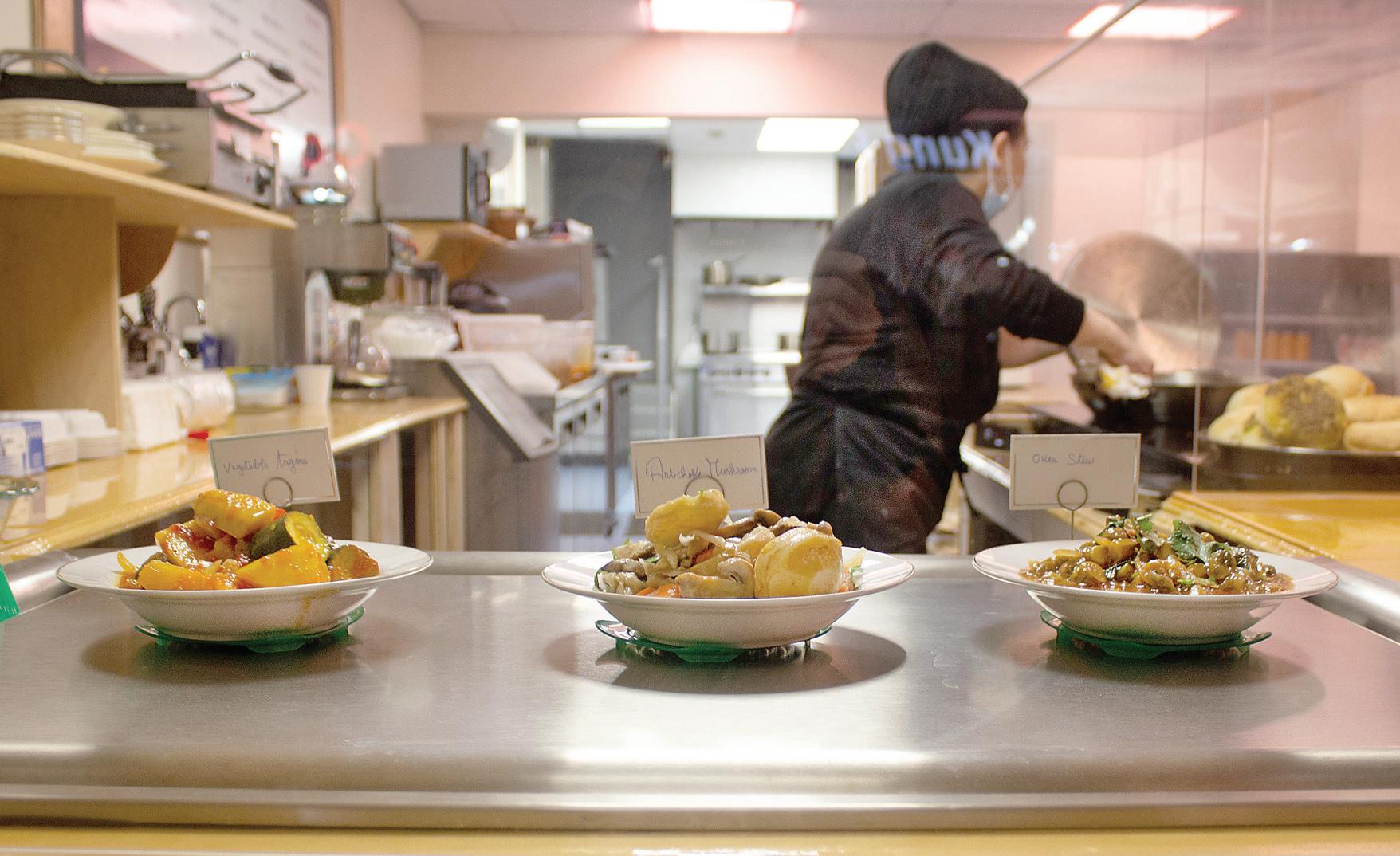
Seven-Spice Shop Loumies, a Middle Eastern and Mediterranean eatery, has made its mark in its Collegetown location. | Page 4
Change Cornellians gathered in the Global Health Case Competition to address climate change. | Page 8
On the night of Feb. 19, students walking past Willard Straight Hall could hear the melodic tune of traditional Chinese music by artists such as Michael Wong. Although the Lunar New Year celebration was pushed back from Feb. 4, students in the Chinese Student Association celebrated once the virtual hiatus passed.
“The event being pushed back, that was just kind of inevitable based on the fact we were online for the first two weeks of school,” said Ava Tan ’23, president of the Chinese Student Association.
Though members of the Chinese Student Association could not attend an organized event on Lunar New Year,
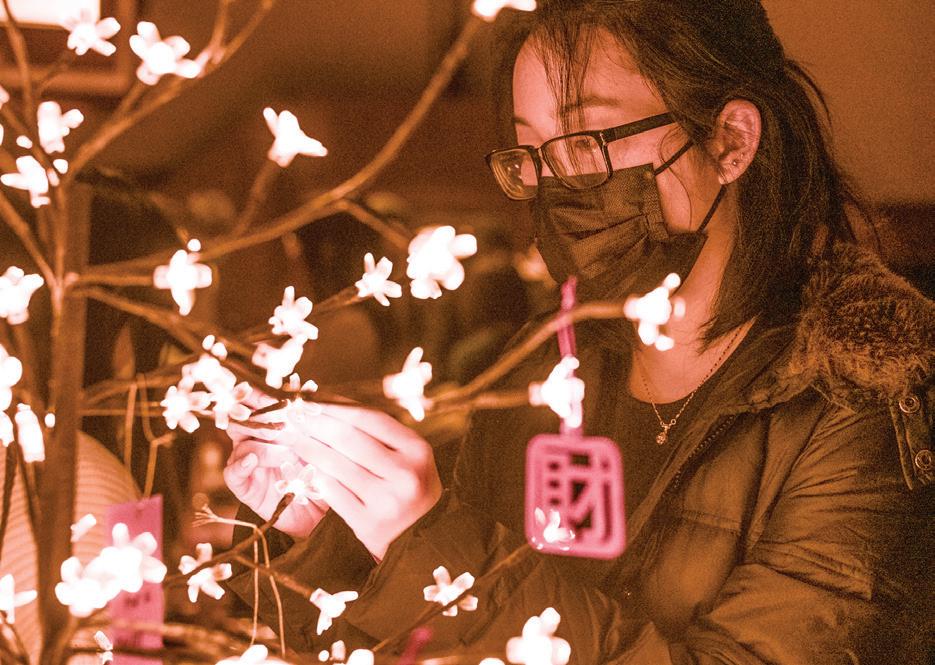
Wishful thinking | A student hangs wishes on a lighted tree.
many celebrated with friends instead.
“Personally, for Lunar New Year, I just had a big dinner with my friends, and we just cooked a lot and ate a lot,” Tan said.
On the night of Lunar New Year, many Chinese Student Association lineages celebrated with big meals
See NEW YEAR page 3
After Two-Year Haitus, Historic Dragon Day to Return Tis March
By MARY SOTIRYADIS
Sun Staff Writer
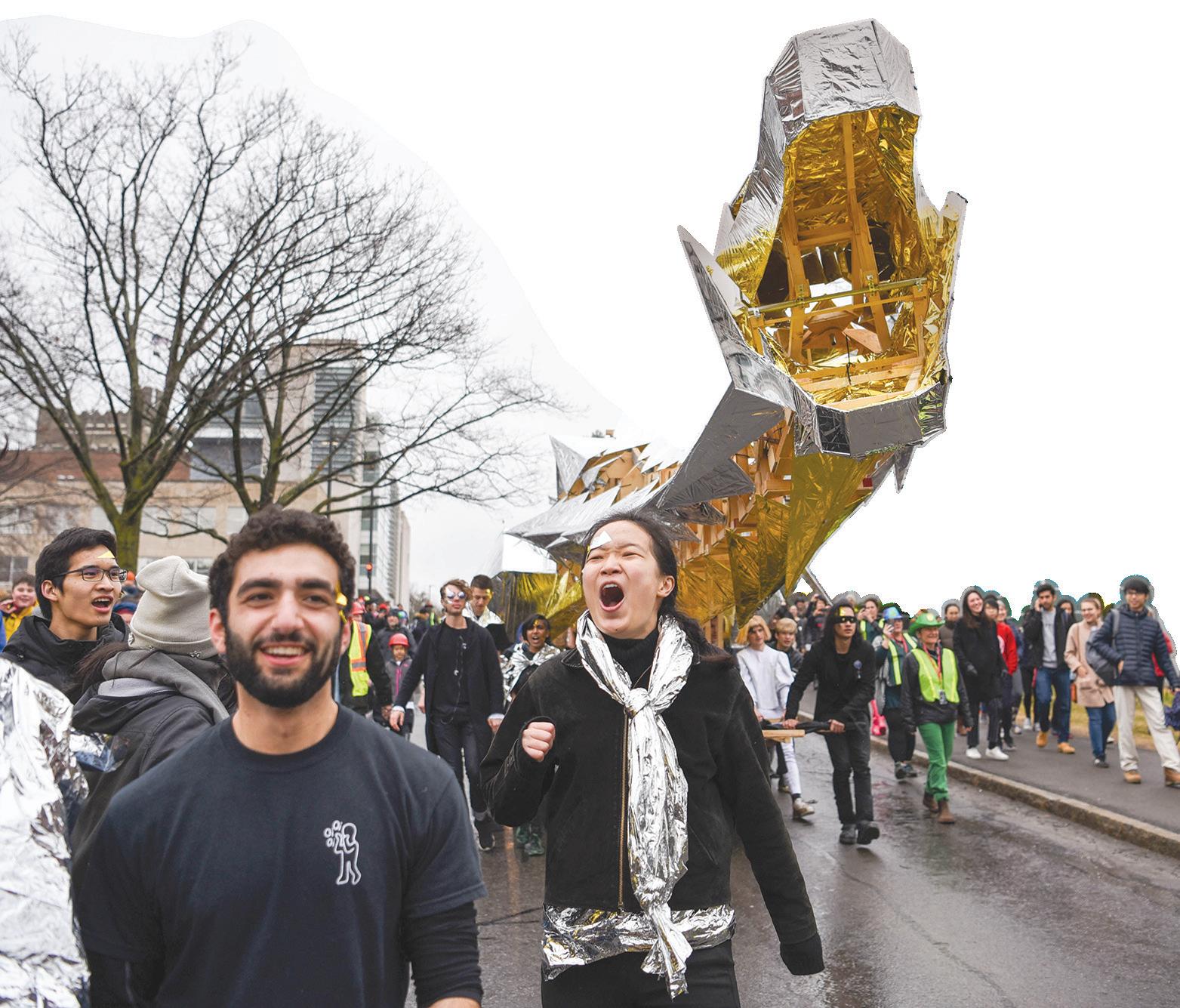
For over a century, Cornell’s Dragon Day has been a rite of passage for first year students in the College of Architecture, Art and Planning, who construct a large dragon to parade around campus the Friday before spring break. After being canceled in 2020 and 2021 due to the COVID-19 pandemic, Dragon Day will return in 2022.
The tradition’s origins can be attributed to Willard Straight ’01, who sought
Patrick’s Day and decorate the college accordingly. Since Irish legend has it that Saint Patrick drove the serpents out of Ireland, the event featured a serpent as its main symbol. Sometime in the 1950s, the celebration became known as “Dragon Day.”
Dragon Day has recently come to involve students in the College of Engineering as well –– engineers build a phoenix to represent the friendly rivalry between the two colleges.
Dragon Day cancellations in previous years arose due to logistical chal lenges. According to AAP
Where’s the fire? | The 2019 version of the dragon moves down Campus Road on March 29 of that spring.
Ithaca Beer Co. Opens in C-Town
Joins site on Ithaca Beer Dr.
By ANANTHI JAYASUNDERA Sun Contributor
Finger Lakes inhabitants have long lauded Ithaca Beer Co. Taproom at Brewery for top-notch dining and brewing. On Feb. 23, Ithaca Beer Co. opened its first satellite location in Collegetown on the eponymous Ithaca Beer Drive within the Student Agencies Building.
Ithaca Beer Co. takes the place of Collegetown Bagels, which moved across the street in June 2020. To determine whether the new restaurant lives up to its prime location at the top of College Avenue, hungry students and thirsty seniors filled the new Ithaca Beer Co. on opening night.
“I definitely think this is on par with some of the nicer places in Collegetown.”
Gabe Cohen ’22
“This is better than what I expected it to be,” said Rohan Bansal ’22. “I thought Ithaca Beer Co. would be like Rulloff’s, honestly.”
Rulloff’s, a staple Collegetown saloon that closed its doors in 2020 after 43 years of operation, had a rustic, antique atmosphere. Ithaca Beer Co.’s blue tinted glass windows, neon signs and free-hanging, bare light bulbs has students concurring that the restaurant brings a new flavor in food and decor.
“The one thing Collegetown was missing was a sports bar vibe,” said Gabe Cohen ’22. “The vibes are very different from what Level B and Hideaway offer. Here, I can sit down with my friends and grab a beer and pizza, which is not an experience I really had before.”
Compared to other restaurants in Collegetown, Cohen said Ithaca Beer Co. is among the best currently operating.
“I’m from Long Island, so I’m a bit biased about CTB, but I definitely think this is on par with some of the nicer places in Collegetown,” Cohen said.
pus to enjoy the parade, but also prevented dents from coming together for the six or more weeks of close collaboration required to plan and
Llodra said that Dragon Day is one of the few times when the
See DRAGON page 3
Although Ithaca Beer Co. Collegetown opened on a freezing February day, many Cornell students will enjoy dining and drinking outdoors as the weather warms. According to Ithaca Beer Co. Owner and President Dan Mitchell, the company kept this in mind when it included 2,000 square feet of outdoor patio seating in the plans for itss Collegetown location.
“This is better than what I expected it to be. I thought Ithaca Beer Co. would be like Rulloff’s.” Rohan Bansal ’22
However, some Cornell students have noticed that there is far less outdoor seating than promised.
“I don’t know off the top of my head what the square footage is, but I want to say it is somewhere between 1,200 to 1,600 square feet of outdoor patio space,” said Mike Wilber, a manager at Ithaca Beer Co. Collegetown. “Everything was pre-designed through the city and through Student Agencies, so the footprint that we have to put tables in has already been laid out for us.”
However, Cornell students dining at Ithaca Beer Co. on opening night did not seem to mind the limited outdoor seating.
“It’s cold right now, so I don’t really care,” said Daniel Hernandez ’22.
Other Cornell students expressed their agreement.
By GWEN SCHWAY Sun Contributor
CLAIRE LI / SUN STAFF PHOTOGRAPHER
Cornell Celebrates Year of the Tiger
tickets by playing games, which they could then use to purchase snacks.
instead of the traditional festival that otherwise occurs during the celebration. The club’s lineage system builds community among its members and helps them arrange get-togethers.
“My bigs actually hosted all of the littles to go to their apartment, and we all made dumplings together,” said Kelly Zhang ’25.
When students finally gathered in Willard Straight Hall for the Lunar New Year event, they played traditional games, congregated around the photo booth and hung their wishes on the Wishing Tree — a tree draped with red ribbons — which sparkled in one corner of the room. During the Lunar New Year, hanging a wish on a tree is seen as a symbol of good luck.
One booth sported a pile of traditional snacks often enjoyed in China, such as peach gummy candy and original pretzel stick Pretz, while others dispensed red envelopes and tickets. Red envelopes were given to the first 88 Chinese Student Association members who attended the event, since the number 88 symbolizes fortune and good luck in Chinese culture. Students could win
Games featured at the event included Jianzi, Mahjong and Chinese checkers. Jianzi, otherwise known as “feather-ball,” is a traditional game in which players use their feet to keep a feathered weight off the ground. Near the entryway, students gathered together to play in a circle most of the night, while other participants tried their hand at Jianzi in pairs.
Maxwell Pang ’25, a general body member, helped set up the event. Pang said that turnout was higher than anticipated, estimating that 100 people turned up for the festivities.
“Especially at the start, we had quite a crowd gathering outside,” Pang said.
Zhang partly attributed the bustling atmosphere of the event to its location.
“It’s indoors. I know one of our class events was outside, and it was really cold outside, and a lot of people didn’t want to come,” Zhang said. “This time, I feel like the music, the games and the snacks being here are all really great.”
Gwen Schway can be reached at pgs74@cornell.edu.
Ithaca Beer Co. Collegetown
Taphouse Opens for First Night
the same items, alongside new entrées and locally sourced ingredients such as Hudson Valley fish and steelhead trout.
Dragon Day Celebration Returns to Campus for First Time Since 2019
2022 will feature two-headed dragon, costumes
DRAGON Continued from page 1
entire architecture class can come together. He also stated that many current sophomores and juniors in AAP will participate in the event, since they didn’t get the chance to do so during their freshman years.
“Everyone cares about the tradition so much,” Llodra said. “It’s an opportunity to make something happen, which is always really fun … but it also bonds the entire class of first and second years. That’s just really exciting because it’s really hard to do that.”
This year, Llodra will serve as one of two second-year “Dragon Lords” — peer-elected project leaders who appoint students to the executive board that directs the creation of the Dragon team — alongside classmate Gabby Melton ’25.
purchasing materials and constructing the dragon.
Because Dragon Day is fully student-funded, the executive board heavily emphasizes fundraising for the event. Llodra and Melton said that selling Dragon Day t-shirts gives them the funds to purchase construction materials for the dragon.
“We need to start selling t-shirts ASAP,” said Melton. “We did a logo design contest that's going to be sort of converted into a t-shirt, and then next week, we'll start selling T-shirts.”
The Dragon Day con-
“I think this is going to be a year that will definitely go down in the books,” Lily Mager ’26
together allows for increased collaboration and socialization, with a bigger team also bringing more diverse visions and perspectives to the project.
To generate excitement for Dragon Day, Llodra said that a prank team organizes a series of CUPD-andadministration-approved jokes leading up to the event.
“Although the event is very carnivalesque and seems unhinged … everything is planned with the various administrative levels,” Llodra said. Some older students who participated in past Dragon Days continue their involvement in the event for years.
“I’m a second semester senior, so the fact that I’m able to experience this in any capacity is refreshing,” Cohen said. “I’m not going to quibble about 800 missing square feet outside.”
Naturally, students at Ithaca Beer Co. arrived for good food and drinks, hoping that the new location would be similar to the original.
“I got the Cornell Chicken Sandwich, and it is fantastic,” said Hernandez. “This is the same good food as the main Ithaca Beer Co., and I can’t really tell the difference.”
Compared to the Brewery location, Wilber noted that the menu offers many of
Though currently unable to sell their own alcohol, according to Wilber, the taproom will acquire its full liquor license Friday morning, allowing customers to enjoy their famous beers as soon as Friday afternoon.
In the meantime, students and Ithacans alike can get a taste of Collegetown’s newest eatery with other varieties of beer.
When asked to describe Ithaca Beer Co.’s satellite location in three words, Cohen did not hesitate to respond.
“Good, beer, vibes,” he said.
Ananthi Jayasundera can be reached at atj35@cornell.edu.
Writer to Speak on Waste and Inequality in Fashion Industry
By KAYLA RIGGS Sun Assistant News Editor
In a Thursday evening virtual event, prominent writer, consultant and stylist Aja Barber will speak to Cornellians about the intersection of consumerism and climate change.
The event, which will consist of a discussion and live Q&A with the audience, is partially sponsored by Cornell’s Sustainability Office, in addition to nine other University organizations. It is a part of Cornell’s Beyond Waste program, a two-month-long institutional waste reduction campaign encouraging students to re-evaluate their waste management habits.
Running from Feb. 14 to Mar. 26, the program will occur in conjunction with the nationwide Campus Race to Zero Waste competition, which provides tools and resources –– like mentors, case studies and webinars –– to colleges across the country in an effort to increase their sustainable pathways toward zero waste on campus.
Barber was raised in Reston, Virginia and currently lives in London. She is most recently the author of Consumed: The Need for Collective Change:
Colonialism, Climate Change and Consumerism, a 2021 book which calls for systematic change within consumer industries and examines the history of waste and endemic injustice in the textile field.
Barber’s work primarily revolves around ideas of privilege, wealth inequality, racism, feminism, colonialism and the fashion industry. Her writing has appeared in The Guardian, Eco-Age and CNN, as well as on Instagram and her Patreon page.
According to the Cornell events website's description of the event, “Barber calls for change within an industry that regularly overreaches with abandon, creating real imbalances in the environment and the lives of those who do the work.”
The forum will be moderated by Ph.D. candidate Cindy Cordoba Arroyo, grad, who studies apparel design and post-consumer textile waste management of airline Studentsuniforms.interested in the event, which will occur on Zoom from 3 to 4:15 p.m., can register for free online.
Kayla Riggs can be reached at kriggs@cornellsun.com.
The first year class also has two Dragon Lords: Lily Mager ’26 and Jose Ortega ’26. They are responsible for appointing other students to roles that are necessary in making Dragon Day happen, such as construction or finance management.
While many Cornellians only engaged in a single day of Dragon Day festivities, the event requires at least six weeks of planning and preparation in advance. An executive board of students must be chosen to oversee and direct essential activities, such as fundraising,
struction team, which consists of the majority of both first and second year participants, uses woodworking and welding to build the dragon. This year, because there will be twice the amount of students working to build the dragon as there were in 2019, the board decided to build a larger, two-headed dragon to represent each of the two classes who produced the dragon.
“I think this is going to be a year that will definitely go down in the books,” Mager said.
Mager added that having two classes work
Remy Mermelstein ’22 was a head designer and builder of the 2018 dragon; this year, he will conduct an introductory meeting informing younger students about Dragon Day. Mermelstein said he was drawn back to the project by its sense of community and fun atmosphere.
“I think [Dragon Day] is the best time for first year architects and a week of bonding and team building that you would be hard pressed to find anywhere else,” Mermelstein said. “And Dragon Day is just wicked fun. Especially as upper years, it is fun as well to participate in the parade.”
Mary Sotiryadis can be reached at msotiryadis@cornellsun.com.
Seven-Spice Stop Loumies Opens in C-Town
By NATASHA AYSSEH Sun Staff Writer
Home-cooked
Middle Eastern and Mediterranean food is exactly what Collegetown needs, and Loumies has blown away all expectations. Inspired by the flavors of the Middle East, Persia and North Africa, Loumies has created a delicious blend of tasty dishes for
ness. While there, I got a chance to speak with the chef, Rania Chidiac Kaldi and her husband, Raed. Kaldi, previously a Director of Corporate Communications for Western Union in the Middle East, Africa and Southeast Asia, left the corporate setting to share her love for cooking.
The couple describes their food as Levantine, or from the Levant region, with a mix of other North African and Middle Eastern influences.
Ithaca’s students and residents. They offer scrumptious dishes including Kufta Meatballs, okra stew and Labneh sandwiches, with flavorful sides of hummus, “Seven Spice” rice and more.
Loumies is a family busi-
Rania draws on her own background in Lebanese cuisine but expands the menu with many new flavors and dietary accommodations, including vegetarian, vegan and gluten free options. I tried five different dishes:
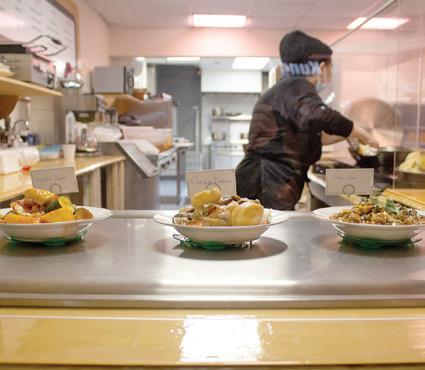
the Za’atar, meat and cheese pies, Lebanese Okra Stew, Kufta meatballs and Moroccan vegetable tagine. Each of the plates was served on a bed of warm, fresh rice, and I couldn’t help but compliment the wonderful aroma every few seconds as I carried the bag of food back to my apartment.
The pies were doughy, chewy and absolutely satisfying: the perfect quick bite on your way through Collegetown. While the Za’atar and cheese pies were large rolls with spices and cheese on top, respectively, the meat pie was a sphere filled with delicious ground meat spiced with cinnamon, allspice and more. The okra stew was fresh and perfectly flavorful with blends of onion and coriander. The vegetable tagine was warm and comforting; the beautiful aroma of cinnamon and other spices complimented the variety of squashes, parsnips carrots, chickpeas and dried apricots.
The Kufta was a hit among my friends and me. Growing up, Kufta (or Kofta) was a favorite dish of mine. It’s a delicious blend of meat, spices, onions and other ingredients, cooked in the shape and style of the chef’s liking. These Kufta were in the shape of meatballs, and Loumies served them with a delectable, aromatic tomato sauce.
While I didn’t get a chance last time, I’m looking forward to trying the SevenSpice chicken during my next visit, as well as the restaurant’s Armenian-inspired pita bread.
Kaldi and her husband emphasized how excited they were to provide home-cooked meals for Ithaca students and residents. Their restaurant is homey and inviting, with an open space and a few seats to sit down and chat.
Collegetown has lacked
somewhere to enjoy homecooked Middle Eastern and North African food, so, I cannot express how excited I am to find this restaurant.
I recommend it to everyone I know. For those who have never tried this type of cuisine, Loumies will give you an incredible experience for your first taste! Next time, I plan on going back to try the Kufta Sandwich, Peasant Salad and Ash Soup. I would absolutely rec -
ommend the dishes I tried, and I encourage anyone curious to go and check it out. Kaldi expressed pride in her cooking, and it’s well-earned. Whether you stop there for an iced coffee or a Za’atar pie, there really is something for everyone at Loumies, and I’m excited to welcome them into Collegetown.
Natasha Aysseh is a junior in Arts and Sciences. She can be reached at nca28@cornell.edu.
KATRIEN DE WAARD / SUN STAFF PHOTOGRAPHER
Spicing it up | Loumies is a newly-opened quick service restaurant in Collegetown focusing on a variety of Mediterranean and Middle Eastern dishes. Assortment
Pictured above
NATASHA AYSSEH/ SUN STAFF WRTIER
Patrick J. Mehler Te Mehl-Man Delivers
Patrick J. Mehler is a junior in the School of Industrial and Labor Relations. He can be reached at pmehler@cornellsun.com. Te Mehl-Man Delivers runs every other Tuesday this semester.
Feb. 18, 2022 would have been Toni Morrison’s 81st birthday. Most current Cornell students could identify her as one of Cornell’s most famous alumni, but I believe her recent surge in popularity at Cornell can be attributed to two things.
Te frst, unfortunately, was her passing in 2019. When Cornellian giants such as Morrison, Ruth Bader Ginsburg and Frank H. T. Rhodes pass on, their legacies and names immediately rise to the front of our memories. Te second reason I believe Morrison’s popularity continues to grow at Cornell has nothing to do with her accomplishments or her death, but rather with her status as namesake of Cornell’s new-
Happy Birthday, Toni Morrison Make Collegetown Ducking Safe
Giancarlo Valdetaro Far Above
Giancarlo Valdetaro is a senior in the College of Arts and Sciences. He can be reached at gvaldetaro@cornellsun.com. Far Above runs every other Wednesday this semester.
Last week, one of my roommates wrote a column about communal attempts to protect a duck on the Collegetown Bridge, a situation he called “entirely unserious.” If I wasn’t the friend who interrupts every light-hearted exchange with a miniature tirade about transportation policy, I might have agreed with him. And yet, I am that person. Tis is why I think Duckley, as my roommate named him (without noting whether or not he wore a top hat or smoked a pipe), and his journey on the Collegetown Bridge are actually incredibly relevant. Te fact that Duckley needed a collective efort to keep him safe shows a systemic failure in the design of Collegetown’s streets.
Instead of a safe environment for drivers, cyclists and pedestrians alike, Collegetown intersections and streets put all in danger. Instead of a livable, climate-resilient environment, Collegetown streets exacerbate the climate crisis and leave pedestrians with soaked shoes any time it rains more heavily than a passing shower. Instead of space to walk at varied speeds, places to stop and take in Ithaca’s natural beauty and areas to relax with friends, Collegetown forces pedestrians to compete with each other for space. Yet, it doesn’t have to be this way —
est dining hall. Te overhung sterling silver letters of “Morrison Dining Hall” fail to tell her full story, but start the conversation of one of our most important Cornellians.
On Feb. 18, my friends and I trekked up from Collegetown and West Campus to fnally eat at the new dining hall, hoping the initial rush of excitement from its recent opening had passed. Upon arrival, the line to swipe in was already out the door; by no means had its popularity died down. My brother, who lives on North Campus, had beaten us there and claimed a table while we were stuck in line. Finally, we made it through and began to search for him.
Once you enter Morrison, the sheer size of the place grabs your attention. From any one point of the dining hall, you cannot see the entirety of the space; endless marble tables and high-top chairs fll the gaps between a dozen specialty stations.
While I looked around, fnding my brother and venturing across the hall, the setup reminded me of Morrison’s predecessors on North Campus: RPCC and Appel. In stark contrast to West Campus’ oneway snaking line system, students scooted past other students with full plates of food, jetting from one end of the hall to the other.
While I am certain the Sun’s Dining section will cover every aspect of Morrison’s food better than I can, I was pleasantly surprised by the quality. Te pizza was far better than the average central New York slice (although I must admit, far behind anything within a ten-mile radius of Grand Central), and the water machines were very fancy (and defnitely intuitive to operate the frst time around). Tere was even a special dessert at the East End Market within
all of these outcomes are due to policy choices. It is possible for Collegetown residents to keep their shoes dry when it rains, peace of mind as a pedestrian and ample space to enjoy with friends, if we do just three things.
First, we should take away space from cars by removing parking spots from commercialized areas and narrowing vehicle trafc on the bridge to campus to one lane. Smaller curb-to-curb widths would encourage drivers to go slowly and efectively “calm” trafc, making the street safer for pedestrians and cyclists. Space could still be put aside for truck loading zones, delivery drivers and shorter stops, ensuring that businesses can access supplies, people can able to receive food at home and residents who need it have the option to park close to where they live.
Reducing the bridge into campus to one lane would force vehicles to yield not only to oncoming trafc, but also to pedestrians trying to cross on either end of the bridge. Te current stop signs force pedestrians to rely on the generosity of drivers, who are often speeding across the bridge into campus. Tis is an inherently imbalanced power dynamic, given that cars weigh thousands of pounds and people do not — an imbalance we can fght against with urban design choices.
Second, we should put space reclaimed from cars to better use. Expanded sidewalks could be used as outdoor dining for restaurants or public seating. On the bridge into campus, expanding sidewalks would allow people to take pictures of the gorges, pass others walking more slowly or walk side-by-side with friends, all without forcing other people into a dangerous confict with cars. Furthermore, former parking spots could be replaced with pervious surfaces such as trees and bioswales, allowing more of the rain to soak back into the ground instead of our shoes. Vibrant spaces to hang out, more space to walk, and dry shoes: Tese are all the things we could achieve with the small sacrifce of some parking spots and one extra lane for cars.
the dining hall that day: Toni Morrison Birthday Ice Cream Floats.
None of us had put together that we happened to visit Morrison Dining on Toni Morrison’s birthday, but it led us down a conversation of the names on buildings and how they came to be there. Tere has been plenty of discussion around how buildings are named, and even more articles about their origins, but the most important conclusion we landed on was that the names of buildings matter.
While nowhere close to a nuclear physicist myself, I know more about Hans Bethe than I do about any other scientist after living in his namesake dorm for the past two years. ILR’s founding dean Irving Ives, Human Ecology’s founder Martha Van Rensselaer, and other notable Cornellians continue their legacies through building names across campus.
With the three remaining North Campus dorms of Ginsberg, McClintock and Hu on their way, it makes me smile to know some of Cornell’s most notable alumni will become conversation starters once again. I encourage everyone to take a second and learn about the Cornellian whose building you enter the most, discovering who they were as a person and as a student formerly in our shoes.
From the Ag Quad’s Mann and Warren to Central Campus’ Bailey and Baker to West Campus’ Keeton, Bethe, Rose, Becker and Cook, each of our buildings’ names have a Cornellian behind them, all of whom have left their mark on our home. Learning their stories makes our time here feel that much more magical. And to the newest famous Cornellian to join the ranks of named buildings, thank you for a lovely meal. Happy Birthday, Toni Morrison.
Tird, we should alter the remaining space for cars so that the environment is safer for pedestrians. Te mid-block crosswalk between the law school and the engineering quad should be raised to sidewalk level, as crosswalks on East Avenue are. Tis would force drivers to slow down on a stretch of road that many currently speed through. It would also fx a crossing that doesn’t currently include curb cuts, making it more accessible for people with mobility issues.
Back in Collegetown, make College Avenue, Eddy Street and Dryden Road kinkier. No, this hasn’t suddenly become a Wednesday edition of Sex on Tursday. Instead, I’m referring to bumping
The fact that Duckley needed a collective effort to keep him safe shows a systemic failure in the design of Collegetown’s streets.
out sidewalks to induce what’s called a chicane efect, meaning that drivers are forced to slow down because they can’t drive in a straight line. By further reducing vehicle speeds in and around Collegetown, these changes would make the space reclaimed from cars even more lively, as it would help people sitting at a sidewalk feel safer.
Tese changes might seem extreme, but that extra space for cars likely isn’t reducing trafc right now. In fact, it’s probably inducing trafc by making people more likely to drive in the frst place. If you drive through Collegetown when you don’t absolutely need to and fnd it slow or difcult to park, I hate to break it to you, but you are the problem; you
aren’t stuck in trafc, you are trafc. By taking away on-street space to drive and park, we can make Collegetown a safer, more vibrant place to live while reducing trafc.
T e current problems with urban design in Collegetown don’t surprise me — systemic failures are the public policy favor of the day. In fact, if we look back to the beginning of the pandemic, those seeking to justify inaction compared COVID-19’s death toll to that of trafc violence. Tis is wrong for a number of reasons, but chief among them is that the U.S. is exceptionally subpar and getting exceedingly worse at combating trafc violence. Whether it’s the way we regulate car design nationally, the continued atrophying of intercity rail and bus transportation, or the design of our streets, there are problems to solve and responsible actors to blame at every level of government.
And yet, complacency can’t be our response either nationally or locally, because the costs of it are paid in blood. In the last few days of 2021, a cyclist and a pedestrian were killed in separate incidents by drivers just a few miles from my house. Tis past Saturday, I saw three people nearly get hit by cars at the intersection of College Avenue and Dryden Road at two separate times; it’s a miracle that close calls haven’t become crashes at other intersections throughout Collegetown and campus. Outside of just Ithaca, the transportation sector was responsible for a plurality of greenhouse gas emissions across the country in 2019. If car crashes don’t kill us on impact, cars (even electric ones) will burn us later.
Duckley’s tale is actually instructive in this case: A street that isn’t safe for a wayfaring waterfowl isn’t going to be safe for its human counterparts. Tankfully, there are already examples of fowl-friendly streets across the globe. Although trafc violence may be a problem larger than Collegetown itself, we should take local initiative to stop it here and get drier shoes, fuller tables and less crowded sidewalks in the process. We should make our streets ducking safe.
Fill in the empty cells, one number in each, so that each column, row, and region contains the numbers 1-9 exactly once. Each number in the solution therefore occurs only once in each of the three “directions,” hence the “single numbers” implied by the puzzle’s name. (Rules from wikipedia.org/wiki/ Sudoku)
I Am Going to Be Small
Mr. Gnu
SC I ENCE
Students Address Climate Change at Annual Competition
Climate.
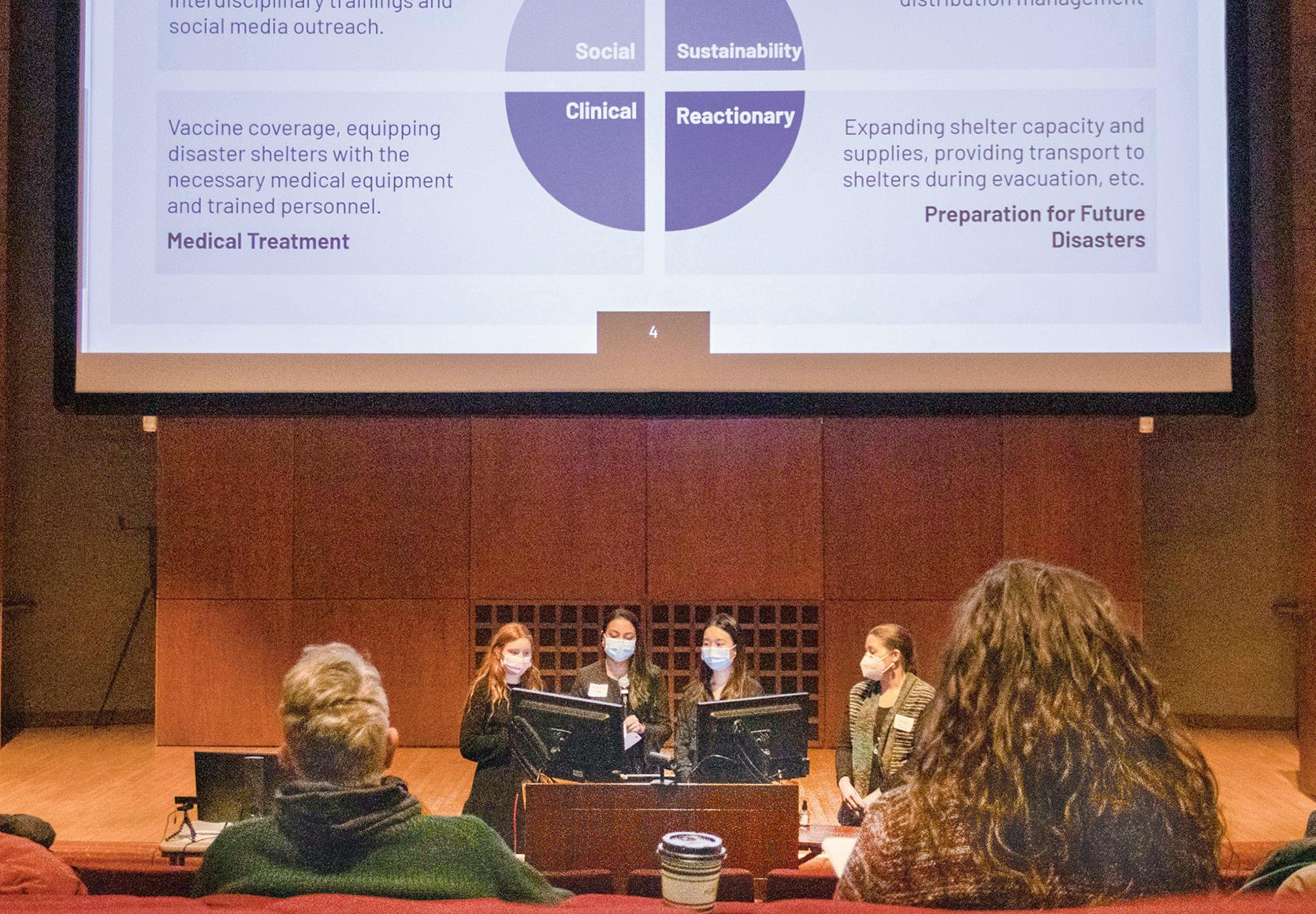
On Feb. 19, 23 teams of Cornell un dergraduate and graduate students competed in the University’s eighth annual Global Health Case Competition, hosted by the University’s Global Health Program and Global Health Student Advisory Board.
The competition offered Cornell undergraduate and graduate students the opportunity to develop creative solutions addressing this year’s topic: A Storm’s A-Comin! Implementing Hurricane Disaster Preparedness Strategies in a Changing Global
With the effects of climate change intensifying, the Global Health Student Advisory Board chose this topic to highlight the increasing severity and relevance of climate change.
There are many health problems related to climate change and environmental destruction.
“As time goes on, if we do not handle or find interventions for these sorts of problems, they will overwhelm our society,” said Conseulo Le ’22, lead coordinator of GHSAB.
Participants in the case competition acted as representatives for the Dominican Republic with a budget of $50 million to research, develop and
establish solutions surrounding environmental disaster preparedness. Teams spent the week leading up to the event meeting on their own time and utilizing office hours to develop interventions geared towards disaster preparedness in the Dominican Republic.
For many undergraduate students, the competition was their first time exercising all steps of a public health plan, which takes into consideration budget, worker safety, dignity and cultural competence, according to Le.
The competition gives students the opportunity to immerse themselves into a global health challenge far beyond the surface level that is explored in some classes.
“The competition allows people to get into the idea of representing a country or being attached to things that could really happen. There is more context necessary for this as opposed to other classroom experiences,” said Samuel Jett, grad, who was part of this year’s winning team.
Jett was accompanied by Ashley Lewis, grad, Connie Hou ’22 and Chloe Hasund ’22.
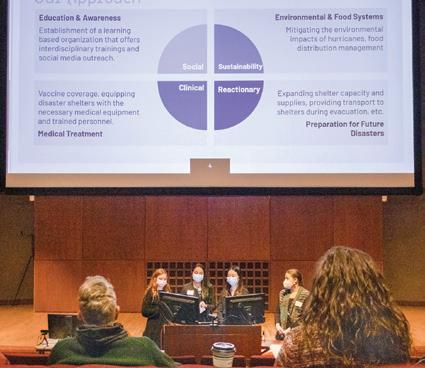
The team’s solution involved a twofold approach that emphasized disaster preparation and unified response to minimize economic loss and structural damages.
The team allocated funds toward coral reef conservation efforts because reefs can act as flood protection. Prehurricane preparation also included education, logistic and communication efforts.
The team chose drones as a tool for immediate relief; they employed soccer and baseball stadiums as temporary shelters. The team also created a logistical plan for monitoring and evaluating the disaster response, with the intention to scale successful aspects of the intervention to other areas of the country over time.
Not only does the competition allow for creative exploration and the real-world application of global health topics, but it segues into other skills including public speaking, confidence and collaboration.
One of the most profound aspects of the competition is also the opportunity to learn from the various perspectives of students across many disciplines at Cornell, according to the competition’s website
“One of my favorite parts of the competition is hearing the diversity of solutions that are presented,” Le said.
With over 80 participants, the case competition brings together a breadth of ideas.
“The teams look at the problem in different ways,” Le said. “Many of them frame the solution as an evolution over time or with a backstory so that you know it impacts real people’s lives, and it’s not just an exercise that could never be implemented.”
The winning team will compete at the international Emory Morningside Global Health Case Competition this March, which will be held on Zoom due to COVID safety precautions. This competition brings together students from numerous countries and backgrounds to address another realworld global health problem. instead of just hardware or software.
What Are the ‘Winter Blues’ and How to Strike Back
By JOHN CAPEWELL Sun Contributor
Although the days are getting longer and the air becoming warmer, the Seasonal Affective Disorder season will continue for several weeks. SAD is a prolonged period of depression tied to seasonal changes, usually spanning the shorter, colder days of winter.
Although many may have passed the worst of it as spring approaches, dark, early mornings and the added stress of exam season can worsen the effects.
A more common and less severe version of SAD is known as the “winter blues,” which tends to mimic the same symptoms as generalized depression, such as sleeping problems, feelings of apathy and loss of focus or motivation.
Wiljar Ojuro, a post-master’s resident in Cornell Counseling and Psychological Services, noted that this has been a problem for students here at Cornell in particular.
“It’s not unusual for people to get the winter blues during long, gray winters like we have in Ithaca,” Ojuro said. “Students from warmer, sunnier climates, including some international
students, might be especially susceptible.”
According to Ojuro, SAD and the winter blues are caused by reduced exposure to sunlight, which can affect the hypothalamus region in the brain. The hypothalamus is responsible for producing and releasing hormones into the body which regulate appetite, sleep and mood.
Lack of sunlight can cause the hypothalamus to produce more melatonin, sometimes called the “sleep hormone” because of its link to the sleep-wake cycle that regulates tiredness. This increased melatonin causes people with the winter blues to feel sleepier, even in the middle of the day.
Lack of sunlight can also cause a decrease in serotonin, the hormone linked to mood; less serotonin means that you are more likely to feel depressed or anxious.
According to Ojuro, the winter blues can affect anyone. SAD is a more severe version.
“Typically, people who suffer from SAD fall into a depressed mood in the fall and continue to experience symptoms of depression into the spring,” she said.
According to a report from Cornell Health, up to 25 percent of college students report
suffering symptoms of SAD, and it seems to be much more prevalent in women than men by about four times, possibly due to fluctuating levels of estrogen, which appears in higher levels in female people.
Ojuro noted that other factors may also play a role in whether or not certain people experience SAD.
“Like other mental health problems like depression and anxiety, one’s susceptibility to SAD is usually a result of a combination of biological and environmental factors,” Ojuro said. “It is possible that some people are more vulnerable to SAD as a result of their genes, as some cases appear to run in families.”
Despite that, environmental factors can be regulated. Given that SAD is linked to getting fewer hours of sunlight, experts recommend purchasing a light box, which mimics the effects of sunlight and helps to lessen the symptoms of SAD. Other solutions include increasing the brightness in one’s bedroom.
One important on-campus resource for students suffering with SAD or the winter blues is the Cornell Campus Activities Resource Center in Willard Straight Hall, which provides light boxes for loan
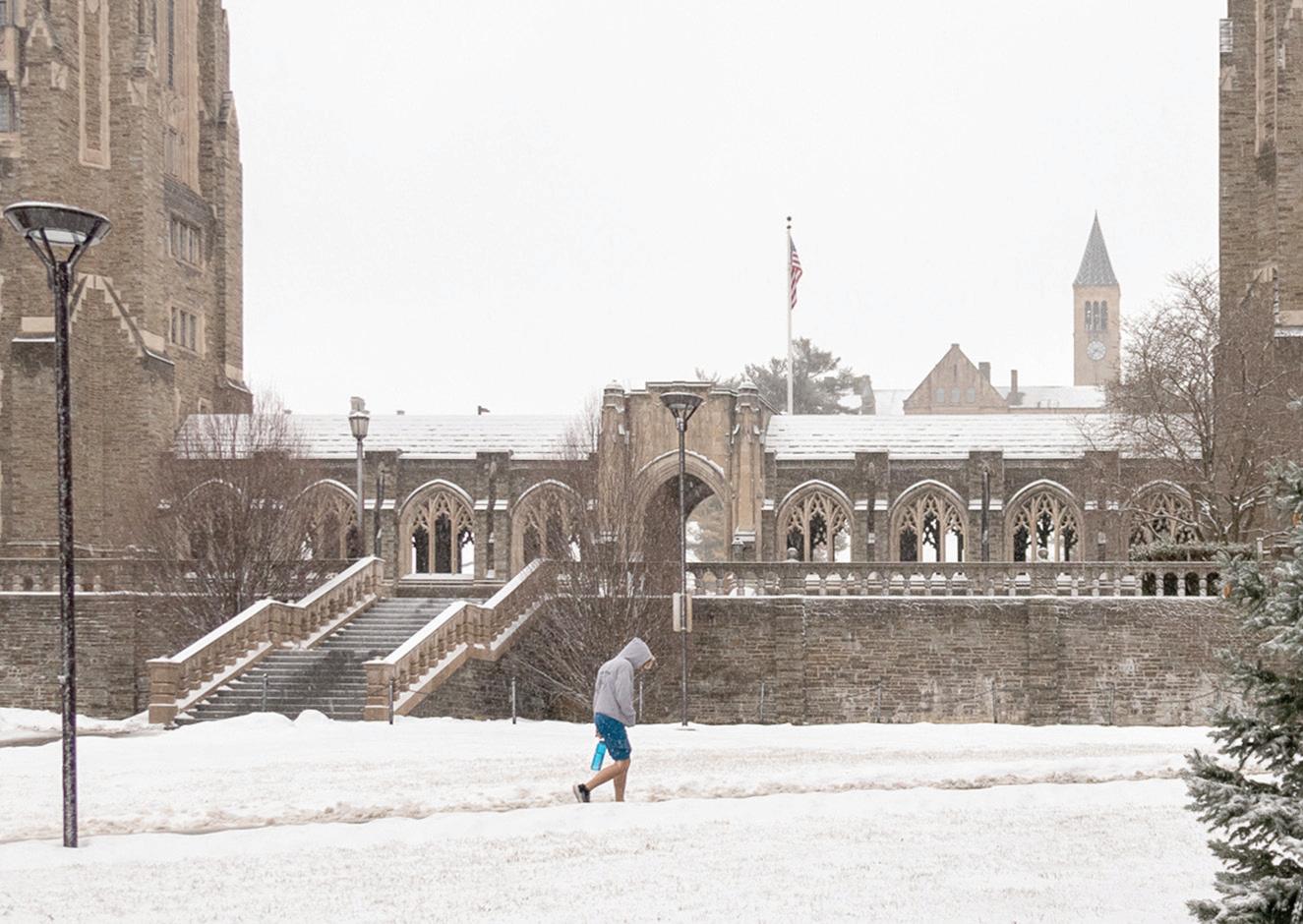
Winter Walk | Inclement weather can amplify the effects of SAD, creating even more challenges for students.
on a half-hourly basis. Students can simply go there and sign one out.
Ojuro said that it is important for people suffering from SAD to not give in to the symptoms.
“Oversleeping, and having an inconsistent sleep-wake cycle, can cause increased levels of melatonin, which can contribute to feelings of depression,” Ojuro said.
Ojuro also said that aerobic exercise can help combat the winter blues, as well as stress and
depression in general. Even if it is cloudy outside, Ojuro stated that exercise outdoors can be more effective than indoors. If all else fails and these solutions do not help, Ojuro said that reaching out to mental health professionals, such as the ones in Cornell Psychological Services, or supportive loved ones is key. For more information, check the Cornell Health website.
JASON WU / SUN STAFF PHOTOGRAPHER
John Capwell can be reached at jcc462@cornell.edu.
JASON WU / SUN STAFF PHOTOGRAPHER
Grace Maines can be reached at gkm44@cornell. edu.
By GRACE MAINES Sun Contributor
Case Competition | Finalists present their hurricane disaster solutions in front of judges and other participants in the Kennedy Call Auditorium.