


By ERIC LECHPAMMER and CARLY HERMANN Sun Staff Writers
Jon Lindseth ’56, emeritus member of the Cornell Board of Trustees, released an open letter on Jan. 23 calling for President Martha Pollack and Provost Michael Kotlikoff’s resignation over their response to antisemitism and Hamas’s Oct. 7 attack on Israel, which Lindseth considered a consequence of the University’s “misguided commitment to diversity, equity and inclusion.”
Lindseth’s letter came in the wake of national scrutiny of DEI initiatives at Cornell and peer institutions. On Jan. 10, Jason Smith (R-M.O.), chairman of the Ways and Means Committee of the U.S. House of Representatives, sent a letter to the presidents of Cornell, Harvard University, the University of Pennsylvania and the Massachusetts Institute of Technology challenging their tax-exempt status over their treatment of Jewish students and requesting answers to 13 questions about campus policies. Four of these questions concerned DEI programs and initiatives.
orientation, race and ethnicity differences” present in the workforce. Equity is defined as the ability for everyone to “access the same opportunities.” Inclusion is defined as “the invitation for someone to actively engage as their authentic self” in an educational or professional environment.
Katrina Greene ’27, the freshman representative of external affairs for the Caribbean Student Association and member of the Black Ivy Pre-Law Society, explained the benefit of spaces that encourage students to share their diverse lived experiences.
“I think [DEI initiatives] should definitely be included [in academia] in the sense of basically allowing for everyone to learn about different cultures and different ideas,” Greene said.
“I think [DEI initiatives] should definitely be included [in academia] in the sense of basically allowing for everyone to learn about different cultures and different ideas.”
Katrina Greene '27
Cornell implemented DEI initiatives during the 20172018 academic year when the Presidential Task Force on Campus Climate and the Provost’s Task Force to Enhance Faculty Diversity created a list of sixty suggestions for institutional and faculty initiatives to promote DEI.

With the criticism toward DEI policies at Cornell, The Sun explored how DEI practices impact students and faculty at the University.
Cornell’s DEI glossary defines diversity as the “age, socioeconomic background, gender identity, sexual
The University launched the Belonging at Cornell institutional model in fall 2019 to meet the task forces’ initiatives of determining priorities for diversity and inclusion-related progress. The framework conducts analyses of diversity scorecard information and examines staff evaluations to ensure an inclusive workplace atmosphere.
By
Cornell’s financial aid website touts an “Ivy League education within reach,” but a class-action lawsuit that some universities recently settled alleges that Cornell and 16 other schools engaged in a “price-fixing cartel” to reduce student financial aid awards.
On Jan. 23, five universities — Yale, Emory, Brown, Columbia and Duke — agreed to settle the case for a total of $104.5 million, according to a press release by the plaintiffs’ legal team.
In light of the new settlements, Robert D. Gilbert, one of the plaintiffs’ lawyers, said in the same press release that it “is past time for the presidents and governing bodies of

the remaining defendants to … resolve the overcharges to middle-class and working-class students that stemmed from the twenty years of collusion on financial aid by elite universities.”
Prior to this announcement, the University of Chicago settled separately for $13.5 million in August, while Rice University agreed to pay $33.75 million, according to its financial documents. Vanderbilt University also settled for an undisclosed amount in November.
According to statements provided to Inside Higher Ed, the five settling universities denied the allegations and expressed confidence in their educational and financial aid programs.
“Though we believe the plaintiffs’ claims are without merit, we have reached a settlement in order to maintain our commitment to the privacy of our students and families and keep our focus on providing talented scholars from all social, cultural and economic backgrounds one of the world’s best undergraduate educations,” a Vanderbilt representative said to the outlet.
By DALTON MULLINS Sun Staff Writer
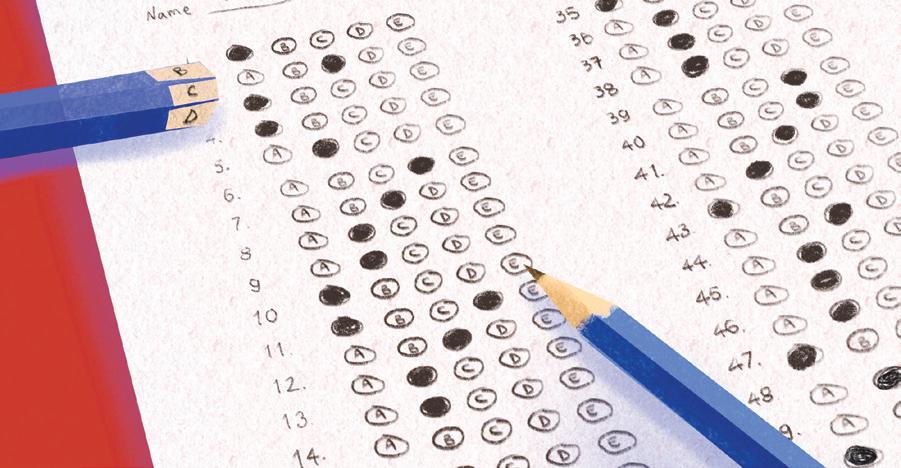
With more than 80 percent of colleges and universities not requiring standardized tests as part of their admissions processes, including Cornell, many high school students question if SAT and ACT exam scores can adequately represent the potential for collegiate success.
This sense of skepticism among students comes in light of new data that show a strong correlation between standardized test scores and student socioeconomic status, with students from a higher socioeconomic status often performing better than those from a lower one.
Cornell suspended its standardized testing requirement in April 2020 due to COVID-19 limiting testing opportunities. At the time, Cornell did not intend to permanently remove the testing requirement, but the policy remains in place for fall 2024 applicants.
Three of Cornell’s undergraduate colleges — the College of Agriculture and Life Sciences, the College of Architecture, Art and Planning and the Cornell S.C. Johnson College of Business — are “test-blind,” meaning the colleges do not consider standardized scores when making admissions decisions for any applicants.
The other colleges utilize test-optional policies, meaning each applicant can opt into whether to use their standardized test score as a component of their application.
According to the University’s standardized testing policy, the University is conducting two years of “deliberate experimental review” to guide the future role that standardized testing will play in admissions decisions. The standardized testing policy for fall 2025 and following years will be announced this spring semester.
The University declined to comment further on the future role of standardized testing.
Opportunity Insights, a research organization at Harvard University, published a study that found families in the top 20 percent of income earners were seven times more likely to score at least a 1300 on the SAT or a 29 on the ACT than students with families in the bottom 20 percent of income earners.
Laura Whitmore, an ACT and SAT tutor with 16 years of experience, attributed this disparity to inequities in the education system that play a pivotal role in students’ test scores.
Black Plant Scientists: A Traveling Exhibit from the Plant Cells Atlas Initiative
8 a.m. - 5 p.m., 1st Floor, Mann Library
Let’s Meditate with Sophia Scholl
8:30 a.m. - 9 a.m., 501 Cornell Health
Data and Donuts
9:30 a.m. - 10:30 a.m., 100 Mann Library
The Legitimacy of Drone Warfare Noon - 1:15 p.m., G08 Uris Hall
Energy Seminar Series Speaker — Douglas MacMartin
12:20 p.m. - 1:10 p.m., 101 Phillips Hall
NBB Seminar Series: Damian Elias from University of California, Berkely 12:30 p.m. - 1:30 p.m., A106n Corson/Mudd Hall
Institute for African Development Seminar: Climate Change Mitigation, Carbon Markets, and Rurual Livelihoods: Rise of Green Extractivism
2:30 p.m. - 4:30 p.m., G08 Uris Hall
Cornell Department of Astronomy and Space Sciences Spring 2024 Colloquium Series
3:30 p.m. - 4:30 p.m., 105 Space Sciences Building
Cornell State of Sustainability Address 3:30 p.m. - 5 p.m., Virtual
Perry Zurn at the Political Theory Workshop: “Cis Goes Mainstream”
5 p.m. - 6:30 p.m., A.D. White House
Bassem Eid, “What Led to the Current War Between Israel and Hamas” 5:30 p.m. - 7 p.m., 398 Statler Hall
Tomorrow
Latina/o Studies Fridays With Faculty Luncheon Seminar Noon - 1 p.m., 103 Mann Library
Center for Aging and Policy Studies — Cornell Population Center Methodology Workshop Noon - 1:30 p.m., Virtual
CIAMS Workshop — Troubled Waters: Jewish Heritage Flows and the Spectral Mikveh
12:15 p.m. - 1:15 p.m., 125 McGraw Hall
Scott Markley — From Redlining to Exclusionary Zoning: How New Spatial Datasets Are Changing How We Understand Suburban Inequality 12:20 p.m., Abby and Howard Milstein Auditorium
Sustainably Responsible Design — How Technology Serves to Provide Significant Impacts
12:30 p.m. - 1:30 p.m., T01 Human Ecology Building
BME 7900 Seminar Series — Madineh Sedigh-Sarvestani 2:55 p.m. - 3:55 p.m., 226 Weill Hall
Quantum Theory Seminar — Nishad Maskara, Harvard University 3:30 p.m. - 4:30 p.m., 701 Clark Hall
Cornell Classical Chinese Colloquium: Tomoyasu Iiyama 3:30 p.m. - 5:30 p.m., Virtual
A Systems View of Fair Elections — Moon Duchin, Tufts University 3:45 p.m. - 4:45 p.m., G01 Bill and Melinda Gates Hall
Animal Health Hackathon 5 p.m., Schurman Hall

Business Manager Katie Chen ’25
www.cornellsun.com
sunmailbox@cornellsun.com
Moon Duchin
Professor of Mathematics
John DiBiaggio Professor of Citizenship & Public Service; Senior Fellow, Jonathan M. Tisch College of Civil Life; Tufts University

Algorithms, race, and redistricting: Can computers find fairness?
Monday, February 5, 2024 • 4:45-5:45pm Rhodes-Rawlings Auditorium Klarman Hall

According to the University’s website, Belonging at Cornell uses a data-driven approach to address DEIrelated metrics, such as by assessing faculty and staff turnover rates and the diversity of candidate pools. It also tracks qualitative data such as employees’ feelings of fairness and belonging and their inclination to recommend Cornell to others.
In 2020, Cornell acknowledged historical and current instances of “racialized violence in our nation” by promoting existing DEI initiatives and establishing new ones.
The promotion of former initiatives included amplifying anti-racist-oriented education in Cornell’s academic departments, such as the Africana Studies and American Indian and Indigenous Studies programs, among others.
Cornell’s newer initiatives include the six-course certificate program on advancing DEI at Cornell, mandatory for all staff, and campus resources such as the Center for Racial Justice and Equitable Futures, established this month. Additionally, every college at Cornell has a webpage acknowledging their commitment to DEI initiatives.
In Lindseth’s letter, he claimed that DEI policies are replacing what he called Cornell’s “four essential pillars” of open inquiry, academic freedom, viewpoint diversity and free expression.
These pillars are not officially associated with Cornell, but three of the four pillars appear in an August letter
to Pollack, Kotlikoff and the Board of Trustees from the Cornell Free Speech Alliance as priorities that members of the Alumni Free Speech Alliance, a collective of alumni groups from various higher education institutions, the administration should promote. Lindseth’s name appears as a signature on the letter.
He also called for Pollack and Provost Kotlikoff to resign and outlined seven policy recommendations, which include terminating Cornell’s Bias Reporting System and canceling the new Center for Racial Justice and Equitable Futures.
A representative of the University declined to comment on Lindseth’s letter and potential changes to DEI initiatives. They also declined to explain what the University considers to be the purpose of DEI initiatives on campus.
Nadine Strossen, a senior fellow at the Foundation for Individual Rights and Expression and former president of the American Civil Liberties Union, said that while the concepts composing DEI are fundamentally positive, certain DEI initiatives are often flawed.
“No matter how well intended these concepts are and programs for training in them, study after study has shown that mandatory training is at best ineffective in promoting those goals and is often counterproductive, undermining people’s understanding of and commitment to those values,” Strossen said.
Strossen also believes that individual DEI programs warrant examination to assess their effectiveness.
“When we find evidence that a particular program is not effectively promoting [DEI] values, it should be repealed or reformed,” Strossen said. Citing an op-ed from journalist Bari Weiss, she noted how certain programs “infamously [place] everybody in binary groups, that you’re either an oppressor or oppressed. Any such DEI program is counter to its stated goals and does help foment antisemitism.”
“Cornell has taken over the authoritarian way of thinking.”
Prof. Randy Wayne
The claim that DEI programs are associated with campus antisemitism was also brought up in Smith’s Jan. 10 letter, which cited research from the Heritage Foundation, a conservative activist group, that claimed campus DEI staff were “unwelcoming toward Jewish students.”
Strossen said that positive programs can be nurtured through the unity of DEI values with academic freedom and diversity of beliefs.
“Constructive criticism will help improve programs that [need] improving, and reinforce the pride of those that are already implementing positive programs,” Strossen said.
Prof. Randy Wayne, plant science, claimed that DEI programs at Cornell are in opposition to the free expression of ideas on campus.
“Cornell has taken over the authoritarian way of thinking,” Wayne said. “And DEI goes very much with [the
notion of] ‘We decide who speaks.’”
Wayne said that facilitating conversations and open dialogue is effective in combating hate and racism, whereas DEI initiatives, he claimed, actually cause them.
Greene disagreed with Wayne’s assessment.
“I don’t think DEI is meant to exclude or separate and divide people,” Greene said. “I think that DEI helps bring people together to understand each other’s hardships and struggles.”
Wayne claimed without evidence that a majority of Cornell students and staff share his views, but many are too afraid of backlash from DEI to publicly admit it.
“I believe that at most 20 percent of the people on Cornell campus are into DEI,” Wayne said. “There’s 10 percent that think it’s terrible and [are] outspoken that it’s terrible. 80 percent are too afraid to even speak, and that’s unfortunately what DEI does.”
However, Greene contended that discontinuing DEI initiatives and programming as Wayne and Lindseth have proposed would stifle the expression of students of color on campus.
“I think [abandoning DEI is] very hurtful for students of color,” Greene said. “Because if these [initiatives] are places where their voices can be heard and shared, why diminish those organizations [by taking] money back from them?”
Eric Lechpammer can be reached at elechpammer@cornellsun.com.
Carly Hermann can be reached at chermann@cornellsun.com.


Continued from page 1
“There’s a systemic problem [in education equity], and [the disparities in] standardized testing [are] just a symptom,” Whitmore said. “Depending on what neighborhood you grew up in [and] what your income is, people buy their way into school districts that get more money, more funding and more programs. Some people can’t afford to move to the more affluent areas and pay the higher school taxes, so they end up going to a school that doesn’t have as many resources.”
Whitmore founded and serves as the chief executive officer for Strategic Test Prep, which increases the price of one-on-one sessions based on the experience of tutors. A one-hour private session with Whitmore, who has 17 years of experience in test preparation, costs $250.
Of the students who scored in the 99th percentile on either the ACT or SAT, the study found that 30 percent came from families in the top 1 percent of the national income distribution, while only 10 percent came from families between the 70th and 80th percentile of national income earners.
Cornellians boast impressive standardized test scores. The middle 50 percent of SAT and ACT scores submitted to Cornell range from 1470 to 1550, which is between the 96th and 99th percentile and 33 to 35, which is between the 98th and 99th percentile.
But the correlation between socioeconomic status and standardized test scores may have implications for the composition of classes admitted to Cornell and other elite universities.
According to the Opportunity Insights study, students from families in the top 1 percent are 2.3 times more likely to attend Ivy League universities or other elite colleges than students from families of lower socioeconomic standing.
The Sun reported in 2017 that approximately 10 percent of all Cornell students came from families in the top 1 percent of income earners, compared to about 1.5 percent of students at all colleges.
However, Cornell has the smallest proportion of students from a family in the top 1 percent of income earners among Ivy League universities, according to The Sun’s reporting. Princeton and
Yale have the highest percentage of students in this category with about 18.9 percent and 18.2 percent of students, respectively.
Whitmore also believes that a student’s home life plays a major role in their ability to succeed, both as a student and on standardized tests.
“If you’re a student and you’re coming home to a house where your parents don’t care if you’re doing your homework or not, and they don’t think education is important, why are you going to try?” Whitmore said.
The New York Times also reported that the national high school class of 2023 had the lowest average ACT score since the class of 1991, with an average score of 19.5. In the 2023 testing cycle, 43 percent of students failed to meet any of the organization’s benchmark scores in English, reading, math and science.
Whitmore attributes the record low ACT scores to the gap in knowledge created by the pandemic — the class of 2019 scored an average 20.7 on the exam — and the fact that many schools require all students to take the ACT regardless of students’ intentions to apply to college.
“I have never seen such gaps in student learning before [COVID-19]. As a tutor, I almost felt like I was filling in as a teacher at the same time,” Whitmore said. “The data is [also] skewed because kids are taking the ACT for free. When you have kids going in there who may not be interested in applying to college, but they … take the test [anyway], that’s going to definitely skew the data lower.”
There are currently 10 states that require students to take the ACT for graduation, with three other states – Ohio, Tennessee and Oklahoma — requiring students to either take the ACT or SAT. Ohio is one of the states that requires mandatory standardized testing days, with most districts opting for the ACT.
Brady Payton, a senior at Global Impact STEM Academy in Springfield, Ohio, said that mandatory ACT testing days are impractical due to students’ diversity of academic and professional goals.
“The entire [junior] class took [the ACT] at the same time,” Payton said. “There were kids who knew they weren’t going to college or knew that they had a specific route planned out for them, and they maybe didn’t necessarily take it
as seriously as those who have a more important view of college.”
Charlie Perlman, a junior at the Hackley School, a private college preparatory school in Tarrytown, New York said that while standardized tests are a helpful method of testing a “student’s overall intelligence,” they do not adequately represent the more nuanced abilities of a student.
“I think it can tell you a little bit about a person as a student but some people are not test takers and there is a lot more to a person than their test-taking ability,” Perlman said. “So [for] people who are more inclined to creative arts and other fields in school, it’s not a fair representation.”
Payton also questioned the ACT and SAT’s ability to accurately represent a student’s abilities.
“I think there are other methods of testing that could prove to be better [than the ACT and SAT], such as experience-based testing,” Payton said. “I don’t think standardized tests are necessarily a testament to how good of a student you may be, but how good of a test taker you are.”
Even as colleges continue to reevaluate their use of standardized test scores in the admissions process, the study from Opportunity Insights found that standardized test scores are still one of the best predictors of a potential student’s success in college. In March of 2022, MIT announced that they would reinstate the SAT/ACT requirement as they believe it allows them to better assess the academic preparedness of applicants.
In 2023,1.9 million high school students used the SAT and 1.4 million high school students took the ACT as components of their college applications in 2023.
Despite the current standardized testing trends, Whitmore explained that she still views standardized test scores as a helpful and relevant tool for college admissions officers when determining students’ skills.
“Colleges are businesses, so they have to make a bet on each student that they accept,” Whitmore said. “So [test scores] help mitigate risk for them [and] see where students’ skills are at and what kind of additional support they may need.”
Dalton Mullins can be reached at dmullins@cornellsun.com.
Continued from page 1
The Original Complaint
The complaint — initially filed in U.S. District Court on Jan. 9, 2022 by several current and former students of the accused universities — alleges that this group violated Section 568 of the Improving America’s Schools Act of 1994.
Section 568 is a now-expired antitrust exemption that allowed a group of universities to share financial aid information and methodology among themselves.
“We have reached a settlement in order to maintain the privacy of our students and families.”
Vanderbilt University Spokesperson
The schools, dubbed the “568 Cartel,” include Brown University, the California Institute of Technology, the University of Chicago, Columbia University, Cornell University, Dartmouth College, Duke University, Johns Hopkins University, Georgetown University, the Massachusetts
Institute of Technology, Northwestern University, the University of Notre Dame, the University of Pennsylvania, Rice University, Vanderbilt University and Yale University.
The accused universities were exempt from antitrust law as long as they admitted students “without regard to the financial circumstances of the student involved or the student’s family,” referred to as a needblind admissions policy.
The amended complaint argues that the defendants violated that exemption because they were not acting in a need-blind manner before its expiration.
“Far from adhering to this statutory requirement when the 568 exemption existed, all defendants considered the financial circumstances of students and their families in deciding whether to admit students,” the suit alleges.
The defendants allegedly raised the net price of attendance for over 200,000 financial aid recipients in the amount of several billions of dollars, in violation of Section 1 of the Sherman Antitrust Act.
Ivy League policy of not awarding athletic scholarships — borne out of Section 568 — had “direct anticompetitive effects, raising the net price of education that Ivy League athletes pay.”
Cornell’s Position
Cornell, along with eight other schools, remains a defendant in the suit. The University declined to comment on pending litigation.
The plaintiffs’ lawyers claimed in the press release that they had “pursued a strategy of increasing the settlement amounts with each successive agreement to exert pressure on non-settling defendants to reach agreement imminently or risk having to pay significantly more by waiting.”
“Cornell, if it holds out, is on the hook for everything — the whole shooting match. They’re going to be under enormous pressure to settle.”
Prof. George A. Hay
everyone settles, the more pressure there is on the [universities] ... left over [in the lawsuit] because if they’re left holding the bag, it’s a big bag,” said antitrust specialist Prof. George A. Hay, law.
“They have to be very confident that they’re going to eventually win this case to justify holding out much longer.”
Prof. George A. Hay
With no clear trial date yet, the case remains unresolved. According to Hay, the plaintiffs will have to get the court to certify a very large class, demonstrate that the universities overcharged students and prove damages.
Regardless, whether Cornell settles is likely to hinge on the strength of its case.
“Cornell, if it holds out, is on the hook for everything — the whole shooting match. They’re going to be under enormous pressure to settle,” Hay said. “They have to be very confident that they’re going to eventually win this case to justify holding out much longer.” PRICE FIXING
Two Brown University basketball players filed a similar class-action lawsuit against the Ivy League in March 2023 that also referenced Section 568. They alleged that the
This raises questions about whether Cornell and other schools would be forced to pay out a larger settlement if they decide to wait.
Because of a legal doctrine called joint and several liability, “the more
Evan Liberman can be reached at eliberman@cornellsun.com.
Your source for good food

By KATIE RUEFF Sun Staff Writer
Picture this — it’s midnight on a Sunday. You’re hungry and disastrously behind on work. You’re in need of a quick, satiating snack. But, your only clean dish is that one mug from your middle school science fair. As you try to push away any and all haunting memories of your middle-school self, you shift your gaze to your pantry. Sure, you could heat up a packet of oatmeal and just hope it doesn’t spill over in the microwave, but you’re tired of oatmeal. You want something with real flavor. Well, you’re in luck! This week, I’m bringing you three simple and vegan mug cake recipes.
Starting off strong, up first is the iconic choco late mug cake. While many chocolate mug cake rec ipes have a substantial list of ingredients, Nora Cook’s recipe is both vegan and has a more accessible ingredient list, even for a kitchen-less college student. This chocolate mug cake is a perfect choice for a midnight snack; deliciously moist and fluffy, this delicacy is sure to give you the fuel you need to power through your next (hopefully last) all-nighter. As it cooks, watch as the chocolate chips melt away, oozing through the chocolatey-volcano goodness like sweet lava. Speaking of chocolate chips, if you don’t have a sweet tooth, try substituting her dairy-free chocolate chips with high-quality dark chocolate (around 70-80 percent cacao) for an added dimension of flavor.

While it’s nothing like your middle school baking soda-vinegar volcano,
up next we have a banana bread mug cake. Packed with fruit, Jessica in the Kitchen’s recipe is simple, practical and the perfect balance of sweet and savory. It also features a short ingredient list and many options for add-ons, including nuts. Many types of nuts can have many health-benefits. Walnuts, for instance, contain high levels of polyunsaturated fats, which can provide a steady source of energy while you cram for a midnight deadline. With a beautiful harmony of flavors, this recipe is also equally as perfect for a stormy night, cozied up indoors.
Last on our list is a super simple oatmeal mug cake. Okay, hear me out on this one. I know you’ve grown tired of simple oatmeal, and you’ve just spent this article learning about many exciting flavor possibilities. But, there’s a reason oatmeal is a classic. In fact, life is like a bowl of oatmeal: basic and stale, but with the potential to be exciting and flavorful. So, let’s give oatmeal credit where credit is due.
The Conscious Plant Kitchen’s oatmeal mug cake recipe is especially great because it only requires rolled oats, a form of nut butter, a little bit of milk, a few ingredients for texture, and some added sweetness — like maple syrup. Because of its versatility, this recipe can be modified with different toppings as a perfect snack for any study break.
And there you have it — you’ve revolutionized not only your midnight snacking choices but also your perception of mundanity itself. Because, although your old middle-school mug might have seemed like a memento of your golden — or dark — days, it can become an exciting opportunity to experiment and create your own mug cake with only a few additional ingredients.
Katie Ruef, dining stafer, is a frst year in the College of Arts and Sciences. She can be reached at kr468@cornell.edu.

ANGELA BUNAY ’24
SHEILA YU ’25
Advertising Manager
NOAH DO ‘24
Associate Editor
HUGO AMADOR ’24
Opinion Editor
JONATHAN MONG ’25
News Editor
JULIA SENZON ’26
News Editor
JULIA NAGEL ’24
Photography Editor
GRAYSON RUHL ’24 Sports Editor
TENZIN KUNSANG ’25
JOANNE HU ’24 Assistant News Editor
MARISA CEFOLA ’26 Assistant News Editor
MAX FATTAL ’25
Assistant Arts & Culture Editor
MING DEMERS ’25
Assistant Photography Editor
KATE KIM ’24
Layout Editor
ISABELLE JUNG ’26
Graphics Editor
VEE CIPPERMAN ’23
Senior Editor
ESTEE YI ’24
Senior Editor
PAREESAY AFZAL ’24
Senior Editor
ELI PALLRAND ’24
Senior Editor
SOFIA RUBINSON ’24
Managing Editor
GRACE XIAO ’25 Web Editor
AIMÉE EICHER ’24
Assistant Managing Editor
UYEN HOANG ’25
Assitant Web Editor
ANNA LIANG ‘24
Assistant Advertising Editor
ERIC REILLY ’25 News Editor
GABRIEL MUÑOZ ’26 News Editor
NIHAR HEGDE ’24 Arts & Culture Editor
DANIELA ROJAS ’25 Dining Editor
RUTH ABRAHAM ’24 Sports Editor
MEHER BHATIA ’24 Science Editor
MARIAN CABALLO ’25 Assistant News Editor
CARLIN REYEN ’25
Assistant News Editor
KIKI PLOWE ’25
Assistant Arts & Culture Editor
CLAIRE LI ’24
Assistant Photography Editor
DAVID SUGARMANN ’24
Assistant Sports Editor
ALLISON HECHT ’26 Newsletter Editor
JASON WU ’24
Senior Editor
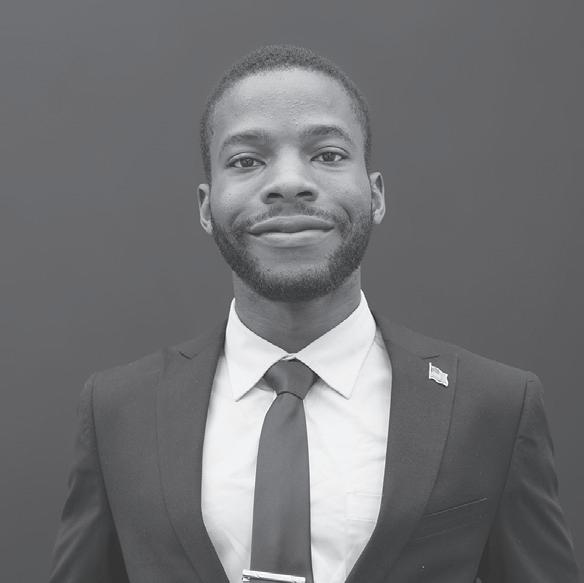
Daniel Obaseki is a fourth year student in the College of Arts and Sciences and the President of the Cornell Political Union. His fortnightly column Beyond Discourse focuses on politics, culture and student life at Cornell. He can be reached at dobaseki@cornellsun.com.
The height of humility is admitting that you, the reader, might be the very subject of these words. Despite how morally righteous your philosophy, ideology, or movement may be, it’s ultimately subject to the corruptive nature of human beings in our desire for righteous indignation. It is understandable that we all want to be good people, or at least strive to do good. But this impulse inevitably leads us to consider ourselves either better than those who embody such ‘evil,’ or do not strive for the same good that we do. Do all you can to work against this impulse for moral supremacy, and broaden your Cornell experience by engaging with opposing and challenging views. If not, you will compromise your own principles and movements.
This natural thought of moral supremacy is what underlines the “crusades” that Huxley identifies. History is full of moral crusades, and we needn’t look far to identify harmful movements of the past, such as pogroms of the 20th century. But there are honorable moral crusades, such as that of the Civil Rights Movement, that ushered in a much more moral society.
The Cornell Daily Sun is devoted to publishing a broad and diverse set of content from the Cornell and greater Ithaca community.
We want to hear what you have to say about today's paper or any of our pieces.
Guidelines on how to submit can be found at Cornellsun.com. And here is our email: opinion@cornellsun.com
Also consider that Cornell has been through its fair share of moral crusades. From the disarmament movement of years ago to protests relating to conflicts in the Middle East that occur now. We should consider that we are not immune to the impulses towards moral crusades, and understand that they can be malformed by this surest, most natural and easiest form of motivation in exaggerating your sense of self-righteousness in cruelty towards another.
You do not need to be a philosophy major to surmise that human beings have an inherent capacity for cruelty. What is interesting is our equal capacity to rationalize such cruelty as righteous, because we never want to compromise our moral sense of self. No war is fought by those who believe themselves an agent of evil, so they simply justify their actions in the perception of their political opposition as such an agent that deserves to be stopped by all means. As collective frustrations from a lack of social change increases, so does the demand for more impactful actions, which incentivises a heightened perception of one’s political opposition as evil in their obstructive nature: this is polarization.
In this era of social media, we're often confined to echo chambers that reinforce negative perceptions of opposing views, leading to acts of cruelty such as political violence, doxxing, and scandalizing. Even on our own campus, we can observe the effects of this corruptive nature of self-righteousness. The aforementioned moral crusades that occurred
at Cornell have led to similar outcomes, as students have been doxxed, harassed and threatened for the positions and identities that they had. This mistreatment is the height of “psychological luxury,” particularly when individuals take it upon themselves to mete out vigilante-like punishment, believing they are creating positive change by harming such perceived evil. While not everyone engages in such cruelty, we are collectively guilty of permitting or ignoring it when those we believe deserving are targeted.
This trend is continuously highlighted in studies of political polarization, as polarized individuals increasingly see the other side as an existential threat. And I fear that, despite how morally righteous new social movements intend to be, they will all be undermined by this increasing sentiment that one’s very neighbor is his enemy and an existential threat to himself and his nation. But that simply is not the reality. What is real is that it is far too easy for these emotions to be exploited by political and social leaders for their own benefit. As future leaders, us Cornellians must be aware of the corrosive impact of moral self-righteousness in our understanding of others. It's crucial to acknowledge our shortcomings and actively strive against them by seeking to understand perspectives different from our own. The solution is quite simple: actively seek to understand the other side. That doesn’t mean taking the descriptions of your political allies as absolute, but instead engaging with individuals you see as political opposites of yourself. Understand their background, why they hold their beliefs and you will be surprised by how much common ground there is to work with. There are plenty of opportunities on campus to understand the other, whether through classes on dissenting topics or participation in organizations like the Cornell Political Union. In my experience with them, I have discovered some of the kindest people that I know who disagree with me on almost every issue. When disconnected from the echo chambers of social media and our friend groups, forming such uncommon and beneficial relationships are made much more possible.
Let us not fall victim to blindly concluding our political opposition is essentially evil, because it is the thought that they are deserving of maltreatment that will always corrupt our own social movements.
Regardless of where we stand politically, it is only through proper exposure to and understanding of the other side that we can work against this impulse towards cruelty, or the permittance thereof.







By MEHER BHATIA Sun Science Editor
Editor’s Note: This article was previously published in The Nation.
For the first time in over 40 years, the Federal Emergency Management Agency has updated its flood maps for the city of Ithaca.
The new flood map draft, released by FEMA in 2022, significantly broadens many of the previously confined flood risk zones enveloping a substantial portion of Ithaca that was not included in FEMA’s 1981 boundaries, including low-lying areas in close proximity to a large body of water.
This includes the Southside neighborhood, located along Six Mile Creek just beyond downtown, which stands as a bastion of rich culture and Black heritage and is one of the few places in the city with a density of AfricanAmerican residents. Home to landmarks such as the St. James African Methodist Episcopal Zion Church — which served as a station along the Underground Railroad — the neighborhood has provided Black Ithacans with a sense of community for more than 150 years.
Increases in Ithaca’s housing and living costs however have begun to push out many longtime lower-income residents and undermine this sense of community. Just this past year, the living wage in Tompkins County made an 11 percent jump to $18.45 per hour — the largest increase seen since 2006 — according to the Ithaca Voice. Yet almost 60 percent of Black wage earners in the county earn below this rate.
Rebecca M. Brenner, senior lecturer at the Cornell Brooks School of Public Policy, suggested that this new flood map could push many more residents in Southside over the edge.
“This is scary to a lot of people,” Brenner told The Nation.
Anticipated to take effect in mid-2024, the new map greatly expands areas of the city that are considered at risk of being impacted by a “100-year flood,” with a 1 percent chance or greater of flooding in any given year and a one-in-four chance of flooding during the life of a 30-year mortgage.
Regions of the city within these “special hazard flood zones” will require many Ithacans to acquire a federally backed mortgage on their homes to purchase flood insurance who previously were not required to.
“We’re expecting that when this flood map [is put into effect], it’s gonna displace people,” Brenner said. “They’re going to get forced from their homes.”
“Unfortunately, if you look at the demographics, the more affordable properties and lower-income homes [in Ithaca] seem to be in these low-lying floodplains,” said Sally Hyot, regional flood insurance expert and retired vice president of Tompkins Insurance. According to the Ithaca Times, the number of properties affected increased by over 650 percent in this update.
According to Hyot, this new flood insurance could add an additional $2,000 to $4,000 to a house-

Climate gentrification | Revised FEMA flood maps significantly broadened risk zones enveloping the Southside neighborhood, which has provided Black residents with a sense of community for more than 150 years.
hold’s annual bills. Those who are unable to afford the increase may end up being priced out of their homes.
“At this point, [the Black and brown people] that made this neighborhood can’t afford to live here anymore,” said Chavon Bunch, Southside resident and executive director of the Southside Community Center. “With the numbers we got for flood insurance prices, we’re looking at $7,000 to $10,000 annually in insurance and taxes. That’s hard for anyone. I can’t imagine what these renters or people who don’t make as much are going to do.”
FEMA is typically required to review a community’s flood maps every five years, at which time the agency analyzes new local developments in land use and hydrology data, deciding whether to change or update them. The previous flood maps for Ithaca, which the city had been using for more than four decades, are notoriously outdated.
“The fact that it’s taken 40 years to get around to updating this [Ithaca] map is egregious,” said Dr. Sandra Knight, a former deputy administrator of FEMA. “That’s too slow. And then when [FEMA] finally does take action, that’s too fast. So it’s kind of become this [lose-lose] deal. In recent years, [sparsely populated regions with no maps] have become areas of growth. And so there’s this whole game of catch-up—catching up the maps to [the development] that’s going on. And that’s not even considering the real risk of climate change issues today, much less the future.”
Approximately 22,000 communities take part in the National Flood Insurance Program, including the city of Ithaca. In exchange for making flood insurance available for all residents — which they still must pay for on their own — communities affiliated with the NFIP make a promise to follow federal floodplain management stan-
dards set up through the FEMA program. These standards are based on the federal insurance rate maps which categorize areas by flood risk zones, with Zone A the highest risk — requiring insurance — and Zone X the lowest.
With most of Southside now engulfed in Zone A — typically a designation for low-lying areas — FEMA’s new flood map for Ithaca will place a sudden and additional burden on the neighborhood, according to Brenner.
“Whether it’s intentional or not, [Southside] has faced so much pressure from so many different angles that [this flood map] is just exacerbating,” Brenner told The Nation. “We can see a pathway to [further] gentrification because people who can afford it can go in and buy places and move people who have historically been a part of [this] community for multiple generations.”
The new flood map may only be accelerating an existing process.
“This neighborhood is getting whiter and whiter, and that’s been happening for a long time,” said Ruth Yarrows, an elderly white resident of Southside.
In the past nine years of living in the neighborhood, Yarrow has seen two homes on her block previously owned by elderly Black women turn over to “white folks” who could afford to buy them.
“I’ve seen residents that have lived and died in this area,” said Sonya Hicks, a pastor who has lived in Southside for almost 30 years. “The home remains, but the residents no longer are African American.”
Insurance premiums will affect everyone in zones designated as high-risk, no matter their experience — or lack thereof — with flooding. Hicks finds herself in a unique situation. In all of her years of residence, her house — placed in Zone A — has never flooded.
“I don’t understand how they came up with the flood map, because my house never flooded. Not once,” Hicks told The Nation. “But now, I’m in [a flood zone] according to a map that I have never seen. They never even inquired of me. Nobody ever talked to me. I don’t know anything.”
Much of the rest of my interview with Hicks was spent explaining this FEMA policy — that she, in fact, would be required to purchase flood insurance as per federal regulation.
“I’m retired. What am I going to buy [insurance] with?” Hicks said. “I don’t have any additional resources where I could come up with the money. They’re asking for something that I call impossible.”
Yet the impacts in Southside are even more than financial. Displaced families are often forced to move outside Ithaca’s urbanized areas, where they lose access to essential city benefits, from walkability to public transportation.
“There’s a real second-class citizenship that happens for folks getting priced out of the housing market here but still [working] jobs in the city,” said Southside resident Sarah Chalmers.
Though a number of solutions have been offered, they simply may not be enough to offset this displacement. In an effort to mitigate the breadth of the flood zones, the city of Ithaca has been working to build floodwalls along the creeks that are susceptible to overflowing — even more so as extreme rainfall is expected to be the most dangerous impact of climate change in the already flood-prone region.
However, there is a hole in this solution that the walls will likely not be able to fill: timing. Once the flood map officially goes into effect, homeowners will be given only 45 days to purchase the flood insurance they are federally obligated to buy through the NFIP. For those that do not comply, FEMA is within
its authority to issue monetary penalties against them or put a forceplaced insurance policy into effect.
Construction of the walls is expected to take three years, if not more.
“There’s going to be this gap of time where people who have the financial capacity to pay for flood insurance over those years while the flood walls are being built can stay in the community,” Brenner said. “Part of what is going to gentrify and displace people is the difference between people who can and can’t float that time.”
Though the walls, once in place, will significantly reduce Ithaca’s flood risk and mitigate the need for flood insurance in a large portion of the city, for Southside, this may be a moot point.
“[Building floodwalls] won’t matter because by the time they’re constructed, everyone will already be gone,” Bunch said.
Yarrow isn’t personally worried about an additional bill, but is concerned about how flood insurance will continue to exacerbate the gentrification of Southside.
“I’ve bought a house in a very traditionally Black neighborhood because I can afford it,” Yarrow said. “Many people who are a part of the Black community can’t do that anymore.”
For Brenner, there is no option other than building an equitable pathway forward. Such a path would involve making sure the people of Southside are at the forefront of the discussion surrounding flood insurance in the city.
“These maps are going into effect incredibly quickly and communities are going to be ripped apart,” Brenner said. “We need to make sure that as we put policies in place that we are recognizing and involving everybody in the [Southside] community [as stakeholders] these conversations.”
Meher Bhatia can be reached at mbhatia@cornellsun.com.