The Corne¬ Daily Sun


By SAMANTHA STERN Sun Staff Writer
After first revising the event planning process in May, Cornell’s Event Management Planning team implemented further revisions, including timeline reductions, in response to student concerns.
The EMPT used student feedback to change the event planning process, according to an email sent to the Cornell community last week from Ryan Lombardi, vice president for student & campus life. The team includes representatives from Campus Activities, the Cornell University Police Department, the Dean of Students Office and other on-campus bodies.
One change was a shift in the event planning timeframe. Student organizations planning events were required to
submit an Event Registration Form four weeks before the expected event date. Now, some events have been granted a two-week timeline.
“In the months following the [changes last year], we learned that students had concerns and were encountering issues with the new process.”
Vice President Ryan Lombardi
Events that qualify for the new two-week requirement usually involve catering and food, money collection, student performers in small venues and outdoor venues with
amplified sound.
Lombardi said some groups should submit their planning documents four-weeks in advance. The four-week deadline applies to events that have non-Cornell dignitaries or performing artists, alcohol, home-cooked food, ending times past 11 p.m., a large venue, a government permit or a potential high physical risk.
The University also implemented other changes, hoping to facilitate event planning. For example, the Office of Campus Activities will have student interns to help other students organizing events and a representative from the Student Assembly will now serve on the EMPT, according to Lombardi’s email.
These changes come after the team unveiled new

Former prime minister to speak on campus, discuss book i n March address hosted by the Cornell Republicans
By YUICHIRO KAKUTANI Sun News Editor
Former Canadian Prime Minister Stephen Harper will address the Cornell community next month. The leader, after serving about nine-and-a-half years as head of government, was invited by the Cornell Republicans.
Harper will address the Cornell community on March 7 at 4:30 p.m. in Uris Hall G01.
In addition to this lecture catering to the entire Cornell community, Harper will also speak at smaller events for individual clubs. For his lecture, the former
By AMINA KILPATRICK Sun Staff Writer
Anabel’s Grocery, a student-run grocery formerly operating out of Anabel Taylor Hall, is currently pausing their oper-
“They decided to put the store operations on pause and use the course ... for the reflection ... process.”
Anke Wessels
ations to re-evaluate their business operations and future.
Anabel’s was created to provide accessible and affordable groceries to Cornell students. After years of planning, the store
had its grand opening in May 2017.
The main goal of the break was to address the store's problems before they negatively affect the function and future of Anabel’s, such as revitalizing the purchasing system. Organizers also hoped to inquire about federal work study to pay employees — the store faced issues stemming from its reliance on volunteers to operate.
Financial struggles were not the main cause for the pause, according to project coordinator Michael Cornette ’18, who said that revenue “broke even,” aligning with the grocery’s non-profit status.
The grocery is a subsidiary of
prime minister will draw on his recently published book, “Right Here, Right Now: Politics and Leadership in the Age of Disruption.”
In his book, Harper claims that President Trump’s election to office should be a wake-up call for conservatives across the world to shift away from a doctrinal adherence to the free market and consider “present-day populism,” according to a Washington Times book review.
“Harper contends that Donald Trump's surprise

Cornell Fluids Seminar: Boundary Integral Formulation for Stokes Equations in Multi-Fluid Domains 12 p.m., 106 Upson Hall
ORIE Colloquium: The Interface Between Theoretical Economics and Theoretical Computer Science 3 p.m., 571 Frank H. T. Rhodes Hall
Mandarin Chinese Conversation Hour 4:30 - 5:30 p.m. G27 Stimson Hall
CIAM Lecture Series: Alison Wylie 4:30 p.m., G22 Goldwin Smith Hall
Milstein Program Info Session
5 - 6 p.m., 3331 Tatkon Center for First-Year Students
Spring 2019 Salsa Lesson Series 5 - 7 p.m., 601 Willard Straight Hall
Zumba Fitness
5 - 6 a.m., 5th Fl. Lounge, Willard Straight Hall
Canvas@Cornell: Moving from Blackboard to Canvas 8:30 - 10 a.m., G27 Stimson Hall
Our Broken Immigration System and How to Fix It 11:30 a.m. - 12:30 p.m., 182 Myron Taylor Hall
Entrepreneur in Residence Office Hours: Phil Miller ’83 Noon - 4:30 p.m., G80P Statler Hall
Talk About Teaching 4 - 6:30 p.m., 258 Goldwin Smith Hall
CRP Cooperative Summer Internship Program: Information Session 4:30 p.m., B1 W. Sibley Hal
Be the Change Workshop: Mentorship as Community Engagement And Leadership Development 5:30 - 7 p.m., 213 Kennedy Hall
Black History Month Dinners 5:30 - 9 p.m., Robert Purcell Marketplace Eatery

A local man was taken into custody Monday morning after an incident at the Econo Lodge where he allegedly exposed himself, harassed staff, then proceeded to barricade himself in his room and threaten to shoot deputies at the scene. Deputies were called to the lodge, which is located on Triphammer Road, at 11:40 p.m, according to Sheriff Derek Osborne. The man then allegedly claimed to have a firearm in the room and threatened to shoot the deputies. Officials and the SWAT Team remained on the scene until the man was safely taken into custody at 8:30 a.m. Monday and was charged with public lewdness, resisting arrest and second-degree obstructing governmental administration. The man was identified by the Tompkins County Sheriff’s Office as Scott Linderberry, 50, according to The Ithaca Voice.
Cornell Letter to Professor From President John F. Kennedy Donated to Library
A letter from President John F. Kennedy to Professor Rossiter ’39, history, was recently donated to the Cornell University Library by the Rossiter family. In the letter, President Kennedy praises Rossiter’s book, “The American Presidency,” and extended him an invitation to visit the White House. “If you ever come to Washington, I hope you will stop by to see us,” the letter reads. Sadly, Rossiter never had a chance to give his reply. President Kennedy would be assassinated in Dallas, Texas four days later, on Nov. 22, 1963. Rossiter passed away in 1970 and his widow, Mary Ellen Rossiter M.A. ’69 donated the letter to the library’s Division of Rare and Manuscript Collections.
In Southern California, two major highways reopened Monday morning after a massive snowstorm induced closure. The closures on Sunday evening, a result of ice and blowing snow, stranded hundreds of motorists overnight. Although some managed to pull off the highway, motels quickly filled. Many motorists spent the night at gas stations or rest stops and slept in their vehicles. On Monday at 11 a.m., traffic resumed on Interstate 5, a key route between San Francisco and Los Angeles. In the midst of the closures, transportation officials were still clearing the debris wreckage of a previous storm that forced closures across the state over the past week. Officials warned that some routes leading to ski resorts near Los Angeles were still closed following 10 inches of snow in some ski resort areas.
— Compiled by Anyi Cheng ’21 and Hunter Seitz ’21
Te Mental Health Make-a-thon seeks to take on mental health with technology
By RONNI MOK Sun Staff Writer
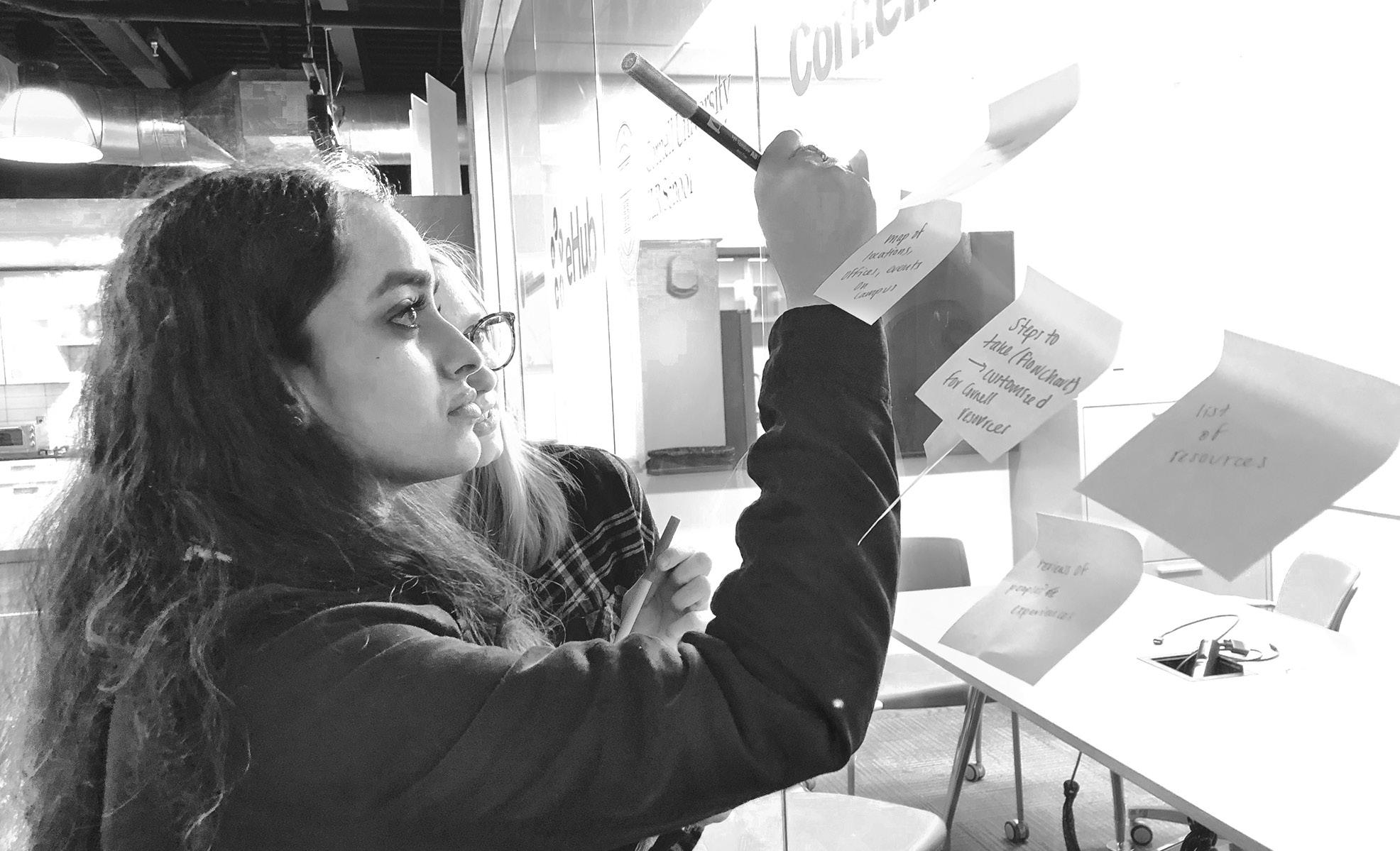
Last weekend, Cornell Minds Matter and project team Design and Tech Initiative collaborated to host a hackathon alternative that focused on tackling mental health and wellness issues and looking at solutions through a tech perspective.
The Mental Health Make-a-thon aimed to “create an ‘anti-hackathon’ centered
around solving problems in the mental health space with design and technology,”
DTI co-lead Matt Barker ’19 told The Sun.
“We felt the campus needed an event like this to unwind and de-stress, but still learn something new and build something cool,” Barker said. “Mental health is an important issue for sure, but we really felt that we could put a unique spin on raising awareness for the issue through a new platform.”
Working with an engineering project
team, Cornell Minds Matter also hoped to address the specific issues directly influencing STEM students.
“Engineering culture glamorizes credit overloading, sacrificing sleep and nonstop work. Mental health is not a priority for many students,” said Vy Nguyen ’21, vice president of events for Cornell Minds Matter.
By HUNTER SEITZ Sun Staff Writer
From mocking President
Martha E. Pollack’s new job on IBM’s board of directors to making fun of Cornell’s snow day policies, a group of undergraduate students have made satire their mission while observing and reporting on campus happenings
around them.
Modeled after The Onion, Cornell’s own satirical publication CU Nooz publishes stories based on current news stories or events that might be relevant to their fellow students, according to co-editors-in-chief Sam Ringel ’20 and Julia Herrmann ’19.
“We are a comedy club that writes. It’s a place if you want to
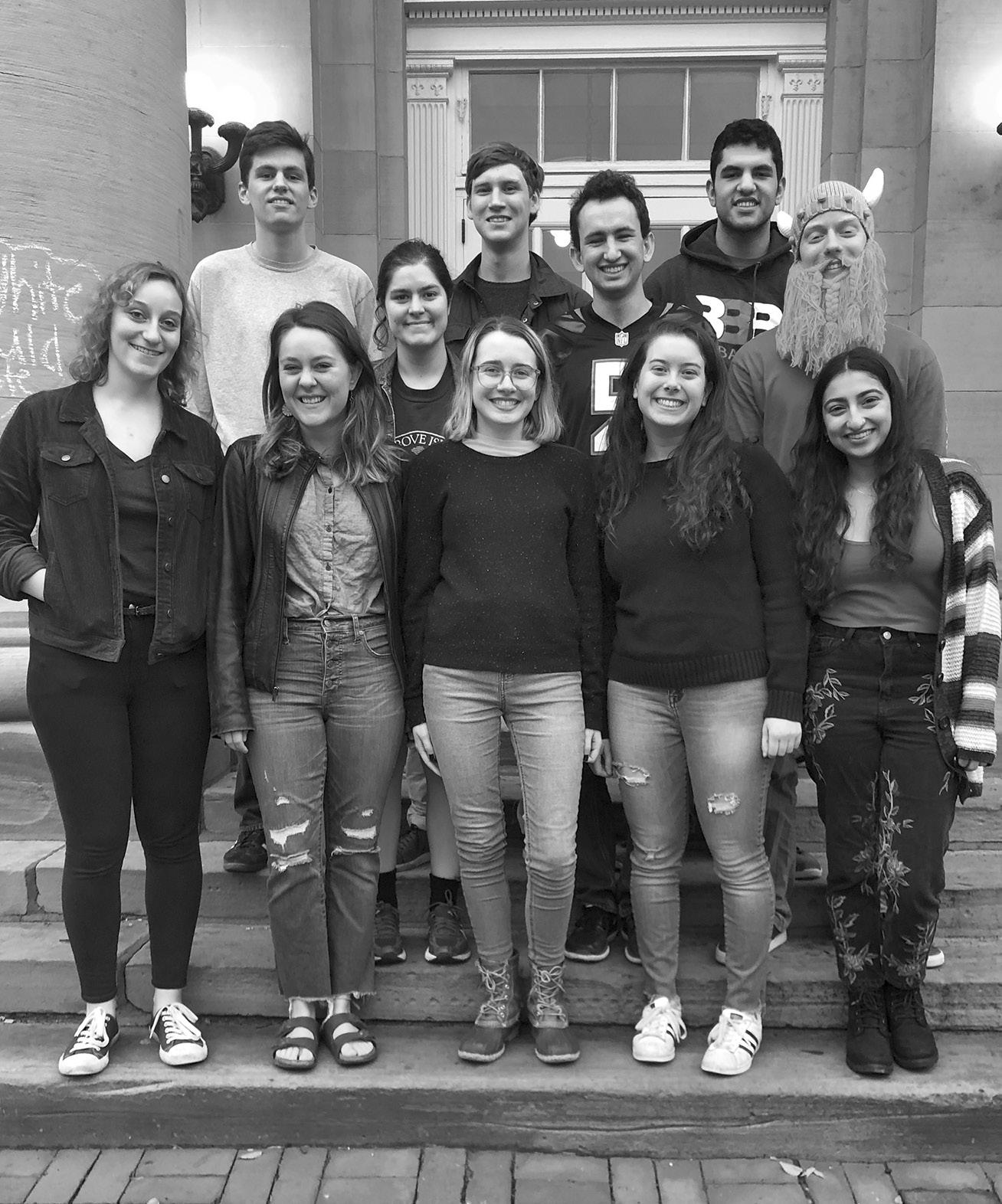
get better at satire, or understand what’s going on at Cornell better, or have a fun time with some cool satire writers,” Ringel told The Sun in an interview.
Since its fall 2013 founding, CU Nooz has been regularly publishing stories. Despite having a relatively small staff of 10 to 15 members, Herrmann said CU Nooz always actively recruits members of all ages and majors.
“There are people that come in with comedy experience, there are people that come in with no comedy experience,” Ringel said. “We have people who aren’t writers, who are in engineering, who are in whatever. The first funny thing I ever wrote was my application for CU Nooz.”
cal publication gives writers the ability to look at various issues or aspects of student life and the university from new perspectives.
“When something big happens and we can do something that gives a critical insight ... humor is a great way to do that.”
Sam Ringel ’20
The ideas usually come out of a weekly meeting, where writers pitch ideas and go over recent news and events. Then, they will try to “make fun of them in a new way,” Herrmann said.
“Every writer has their own way of going about thinking of what the best take might be for an issue … the more you notice things that are strange or commonplace and accepted but shouldn’t be, then there are a lot of things to mock,” Herrmann continued.
According to Ringel and Herrmann, working for a satiri-
“Satire is making an insight about something and talking about it in a funny way. That’s what we try to do — observe what’s around us and do it in different ways,” Ringel said. “When something big happens and we can do something that gives a critical insight or new lens to look at it, humor is a great way to do that.” CU Nooz has even gotten some national attention, mentioned in The New York Times for their article making fun of the condition of the Low and High Rise dorms on North Campus.
With so many articles mocking the administration or various Cornell policies, such as the article lampooning the crackdown on Greek houses last year, there has been no official pushback from the University.
When questioned about whether the University had responded to the site, Ringel said, “We haven’t, and it’s very heartening to see that they are open to our criticism and/or don’t read our articles.”
Hunter Seitz can be reached at hseitz@cornellsun.com.

the Center for Transformative Action, which is a 501(c)3, nonprofit organization. The CTA is a separate legal entity from the University, although it has been affiliated with Cornell since 1971, according to Anke Wessels, executive director of the center.
The grocery is currently assessing key functions of the store, according to Cornette.
“The Anabel’s team realized that taking the time to reflect and reassess while also running the store six days a week was not feasible, given their busy lives as students,” Wessels told The Sun in an email. “Thus, they decided to put the store operations on pause and use the course I teach to provide structure for the reflection, learning and iteration process.”
While the store is temporarily closed, leaders of the store are enrolled in AEM 3385: Social Entrepreneurship Practicum: Anabel’s Grocery, a course taught by Wessels. According to Cornette, 16 students are currently enrolled in the class.
The course aims to help students address previously unresolved issues. The leaders of the store typically focused on day-to-day operations, preventing them from focusing on the future of the store and its longevity, Cornette said.
According to Wessels, the course is employing a variety of methods to address the store’s function. This includes holding focus groups, assessing the business and governance structure and hosting guest speakers.
“All of this work is informed by the lessons learned over the last [three] semesters of operations, relevant research and the practices of other related social enterprises,” Wessels said.
When the store first opened, initiatives such as the Bread N Butter food pantry and Cornell’s pilot meal swipe food insecurity program, where students could donate bonus meal swipes to those in need, did not exist. Cornette acknowledges the potential influence Anabel’s opening had on these initiatives and hopes to inspire other actions in the future.
“Whether it is cooking a
meal for a friend, or completely starting a new initiative like the graduate students did with the mobile food pantry, there is all this opportunity [and] we are just hoping we can play a part in that,” Cornette said.
The current plan is to be “fully operational” by fall 2019, according to Wessels. Additionally, Wessels said some new initiatives could be implemented by the end of the semester.
Anabel’s Programming is an active club associated with, but not the same as, the grocery store. The store and the club are two separate functions — the programming side of Anabel’s is an SAFC-funded undergraduate organization.
Adeline Lerner ’20, president of Anabel’s Programming, said they are still hosting events. In previous semesters, the club has hosted cooking classes and partnered with organizations such as the Women’s Resource Center for advocacy events.
The purpose of the programming team is to educate students about the food system and address topics such as affordability, sustainability and health, according to Lerner.
Additionally, Lerner hopes to help students make more conscious decisions related to the food they consume and buy. She used a decision to consume less meat as an example of a conscious sustainable choice.
“Every decision that you are making with food, where you are going to buy it, where you are going to eat — those are all things that we don’t think about too closely,” she said.
Cornette hopes that after taking this break the store can become more “efficient” and be a better resource for students. Additionally, he hopes that the store will keep inspiring students.
“Even beyond the store, creating a very vibrant food system on campus,” Cornette said. “It is not just about the store, it’s about all the initiatives that are happening, like we talked about before, inspiring students to make change is another huge thing we are trying to do.”

Cornell-wide technological improvements, training and communication, according to the email.
regulations last year, prompting strong criticism from students and administrators. Specifically, recent critiques revolved around the four-week notice required for hosting on-campus events.
According to Lombardi, the policy changes were made in response to student concerns.
“In the months following the [changes last year], we learned that students had concerns and were encountering issues with the new process,” Lombardi wrote.
EMPT is still reviewing other potential changes and said they “anticipated” those would be decided by the end of the semester. EMPT is still contemplating events’ security costs,
In terms of technological improvements, the EMPT is set to launch a new software this summer called 25Live, which allows students to schedule events in available venues and complete the event registration forms online.
Earlier this school year, the EMPT suspended security costs for smaller events in response to student concerns about budgeting, The Sun previously reported.
Many student leaders were also energized by the new changes.
to The Sun.
“I believe this is a vast improvement over the system that was temporarily rolled out last semester and is significantly more lenient,” they wrote in an email to The Sun. “The new proposal clearly delineates between events that require four weeks for approval and two weeks for approval instead of a blanket four weeks for all events as proposed last semester.” EVENT Continued from page 1
“I’m excited that the new guidelines have taken a student-focused approach in regards to the regulations, the student representation, and the student support,” Varun Devatha ’19, Student Assembly president, wrote in an email
Daniel Hirsch ’20 and Michael Jeong ’19, co-presidents of the Student Activities Funding Commission, the funding arm of the Student Assembly, expressed their excitement and said the financials of the new system have not been finalized. They declined to comment on how the changes will affect the SAFC funding process specifically.
Samantha Stern can be reached at sstern@cornellsun.com.
election and governing agenda clearly signal that political, economic, and social institutions must be more responsive to legitimate concerns about public policy, market regulation, immigration, and technology,” reads the book’s preview on Amazon.
Michael Johns ’20, Sun columnist and president of Cornell Republicans, emphasized Harper’s current role as chair of the International Democratic Union, a coalition of conservative political parties from across the world. “[He]
has the opportunity to bring us great perspective, if not on American politics, but on politics more essentially,” Johns said.
After uniting the Canadian Tories in 2003 under the newly constituted Conservative Party of Canada, Harper served as Canada’s prime minister from February 2006 to November 2015.
The legacy of his roughly nine-and-a-half-year tenure remains complicated. Under his premiership, Canada emerged from the 2008 Great Recession relatively unscathed, putting his country towards steady recovery while keeping down the national debt
at a comparatively lower amount, according to The Economist.
Harper also campaigned in 2006 for better government accountability after a 2004 scandal incriminated
“[He] has the opportunity to bring us great perspective.”
Michael Johns ’20
Canada’s liberal party. His government soon passed the Federal Accountability Act in 2006, but Harper’s conservative party was also incriminated in several
MAKE-A-THON
Continued from page 3
According to data from a 2017 Cornell PULSE survey, nearly 43 percent of students surveyed were “unable to function academically for at least a week due to depression, stress or anxiety” within the past year.
“I think we were able to give participants a better understanding of mental health but also provide them with the technical skills needed to implement a solution,” Nguyen said. “I think we succeeded in finding a nice balance of both.”
the Make-a-thon was given to Yanis Park ’20, Michelle Cho ’20 and Rachel Lee ’20, who created Explor, a digital platform that blended the concepts of Yelp and Pokémon Go intending to encourage discovery and travel as a coping mechanism for mental health.
“Engineering culture glamorizes
credit overloading, sacrificing
The Makea-thon’s activities focusing on how to build a relaxing environment, including a presentation called “Let’s CU Sleep,” care package distribution, meditation and yoga, or even playing with dogs and bamboo planting.
sleep and nonstop work.”
“The Mental Health Makea-thon was such a unique spin on Cornell’s typical stress-filled and competitive hackathon culture,” said Rebecca Fu ’21, DTI business team member. “I had fun meeting and collaborating with students from all different places and majors, including an M.Eng. student from Germany.”
Vy Nguyen ’21
Although this was the first year of the Mental Health Make-a-thon, leaders of both DTI and Minds Matter are hoping to make it an annual event.
Additionally, students worked to come up with solutions to mental health issues using design and technology over the two days. The event featured a presentation on technological solutions to mental health issues, a tech startup talk by Basis Tech and workshops on design processes to teach participants the basics of creating online platforms.
The Best Solution award at
“The most rewarding aspect was seeing groups tie in what they learned about technology over these past two days to their mental health solutions,” said Gleni Kodra ’19, DTI business lead. “Everyone came up with amazing ideas to help the Ithaca and Cornell communities manage and improve their Mental Health.”
Ronni Mok can be reached at rmok@cornellsun.com.
scandals later in his tenure.
Cornell Republicans have hosted many other conservative speakers in the past, including former Vice President Dick Cheney and former Republican House Speaker Newt Gingrich.
The group will post information on how to acquire the tickets on their Facebook page once they finalize event logistics with the University. The event’s tickets will be electronically distributed and limited to one per person, Johns said.
“We will be working closely with Cornell police to ensure that all those who oppose this event [will] have a safe and protected opportunity to
express their view,” he told The Sun.
Harper will not be the only speaker to lecture at Cornell at the invitation of Cornell Republicans this semester: Johns said that the group plans to announce a second speaker event which will take place after spring break.
“Given that Prime Minister Stephen Harper was intended to be our fall speaker, who unfortunately had to postpone his visit to March 7, we will be having a doubleheader speaking event this semester,” Johns said.
Yuichiro Kakutani can be reached at ykakutani@cornellsun.com.

By Tamara Kamis Sun Staff Writer
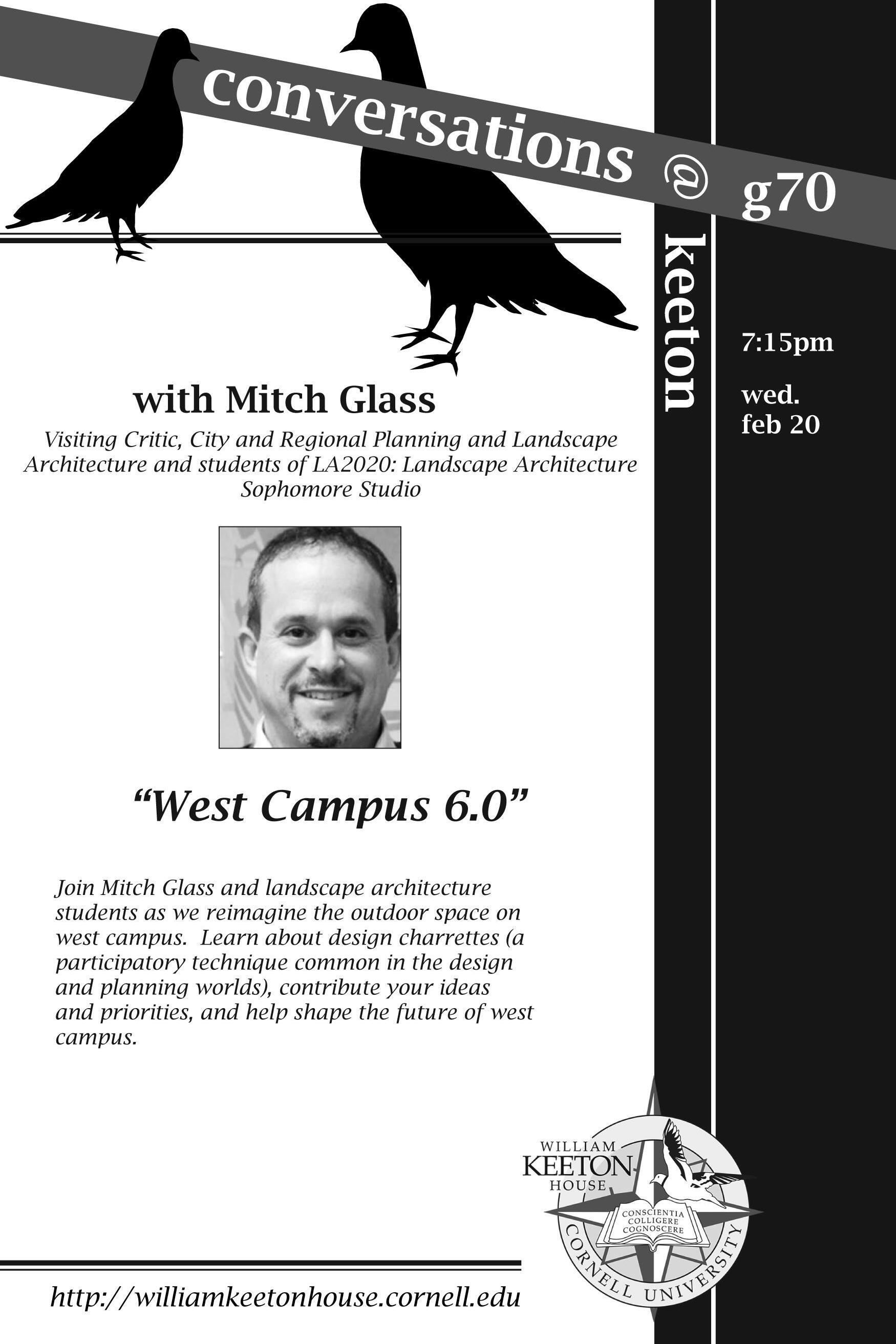
In the United States alone, over 3.4 million people are blind or visually impaired and over 30 million Americans live with some degree of hearing loss. To make daily life tasks more accessible for the visually and hearing impaired, Prof. Shiri Azenkot, Cornell Tech is researching augmented reality solutions.
AR is the addition of a computer generated image to someone’s field of vision, a technology that allows people to see an enhanced version of their environment with a hand-held screen. One of Azenkot’s projects, Cuesee, is an AR application that aims to help people with impaired vision find items while shopping. It does so by focusing on augmenting visual search, the brain’s visual processing technique.
“Visual search is very common ... [it is used] when you are looking for a word in a document, when you are looking for a friend in a cafeteria or ... looking for the bathroom or exit sign. There are lots of examples,” Azenkot said.
According to Azenkot, there are no current tools to help the visually impaired with broad visual scanning tasks like visual search. This makes it difficult for impaired individuals to complete everyday tasks like shopping. As a solution, Azenkot and her team designed five different cues that help attract a user’s attention to where products are located in grocery stores.
“We designed visual cues based on
principles from cognitive psychology and what is accessible to people with different visual conditions,” Azenkot said.
Azenkot is hopeful about applications of this research beyond grocery shopping.
touch a 3D print, it recognizes where you are touching and it can speak descriptions of what you are touching,” Azenkot said.
Christopher Caulfield ’19 and Devon Bain ’19, advisees of Azenkot at Cornell

She is working on other accessibility projects, such as interactive 3D-printed learning tools for students who are visually impaired.
“We developed this system where, as you
Tech, are also working on AR projects to improve learning and accessibility for individuals with disabilities. They are developing methods to make conversing easier for the deaf community.
Together, Caulfield and Bain are creating a captioning system so that users who are deaf or hard of hearing can read what someone says to them. To facilitate this process, computer vision will be used to place captions below the chin of the person talking.
“We realized that a lot of people want to be able to maintain eye contact and also be able to read their lips,” Caulfield said.
After interviewing people who are deaf or hard of hearing to identify needs, Caulfield and Bane created image and video prototypes to simulate the user experience of having a conversation with someone while reading captions of what they say.
Another design innovation developed by Caulfield and Bane is the use of color to show tone or affect, with negative speech highlighted in red and positive or enthusiastic speech highlighted in green. According to Caulfield, tone is often difficult to interpret for people with hearing loss, so indicating tone in captioning may facilitate easier communication.
Both Azenkot and Caulfield expressed concern about the weight and bulkiness of currently available AR headsets. However, Azenkot remains optimistic.
“I hope that someday all of this will be available to use, that all our research will be translated into products,” Azenkot said.
By TUCKER HWANG Sun Staff Writer
In 2014, the skeleton of a young man — dated to 1200 B.C. — was unearthed in northern Sudan. The well-preserved holes riddled his bones, indicating the earliest confirmed case of cancer.
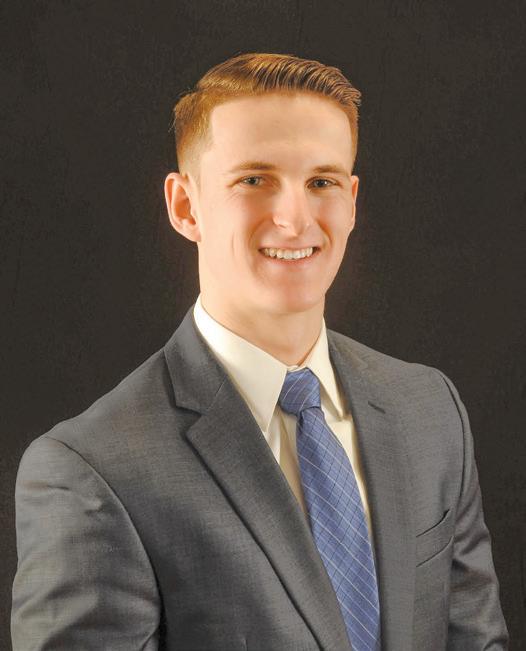
Cancer has taken millions of lives since then, but humanity is learning to fight back. As part of this struggle, Connor McGuigan ’20 is researching ways to prevent metastasis, cancer’s most deadly form.
Although the word “cancer” calls to mind a single tumor growing in the body, cancer’s deadly power is actually derived from metastasis — its ability to move away from its initial site to other places in the body.
Working under Pragya Shah grad at the Lammerding Lab, McGuigan conducts research investigating the relationship between a cell’s ability to repair DNA, its deformability and how those two characteristics contribute to cancer.
“Metastasis is the number one leading cause of cancer deaths; 90 percent of patients that have metastatic stage four cancer end up dying from their disease, so it is a huge area of research for clinicians and scientists alike,” McGuigan said.
applied to multiple parts of the body — or even the entire body — killing many healthy cells in its attempt to kill cancerous ones.
Although most cancer research is preventative or treatment-oriented, McGuigan’s research uses biomedical engineering and mechanics to approach the issue. Since metastasis involves cancer cells physically breaking off from the initial tumor and spreading to other places, McGuigan has worked to model cancer cell movement.
McGuigan and others at the Lammerding Lab use devices made of polydimethylsiloxane, a hard gelatin-like substance, to replicate the tight constrictions found in pores lining blood vessel walls. Systems like the lymphatic or circulatory system offer a perfect route for cancer cells in the body.
According to McGuigan, in a case of metastatic cancer, treatment becomes significantly more difficult. Instead of being concentrated in one area, radiation therapy must be
By sending cells through the PDMS devices, researchers can determine the structural consequences of passing cells through small openings. This can help predict how well cancer cells penetrate blood vessel walls.
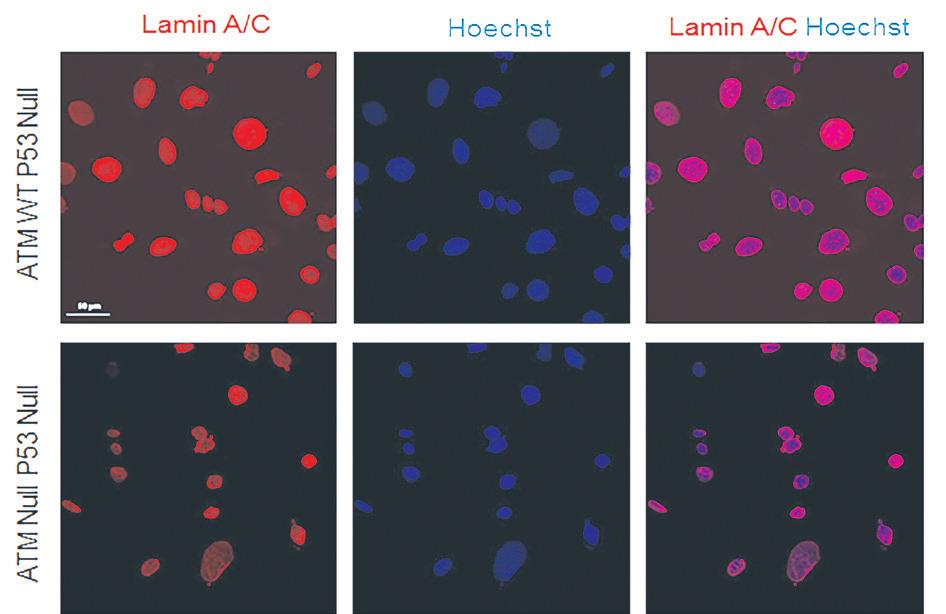
McGuigan discovered that mouse tissue cells with a forced ataxia telangiectasia (ATM) deficiency — removed chemically or through gene modification — have up to 40 percent lower lamin levels than regular mouse tissue cells.
According to McGuigan, this suggests that cancer cells, which have lower ATM levels, might also have this lamin deficiency. If cancer cells have a consistently lower lamin level than healthy cells, it might explain why cancer cells can easily penetrate blood vessel walls and form secondary tumor sites in the form of metastasis.
While the discovery of the lamin-ATM relationship is promising, McGuigan says there is still work to be done. McGuigan hopes to further test on cancer cells, which do not all have ATM deficiency, in order to see if these cancer cells also have lower lamin levels. This would confirm or reject the supposed protein correlation.
The Edwin Smith Papyrus, dated to 3000 B.C., is humanity’s oldest written description of cancer. Its section on the disease ends with the simple phrase: “There is no treatment.” Although cancer has resulted in many lives lost, research like McGuigan’s has contributed to many lives saved, by both identifying and treating one of humanity’s oldest diseases.
My battery is low, and it’s getting dark.Last week, the Opportunity Mars rover was declared dead by NASA, 15 years after it first landed on the Red Planet. However, these aren’t technically the rover’s last words — they are, however, a translation tweeted by science reporter Jacob Margolis of the rover’s last battery power and light sensor readings. Nevertheless, this statement and the popularity it has achieved in recent reportings regarding the rover’s death speak to the great power of human imagination, and the lengths we go to empathize. When we age and die, isn’t this effectually what happens to us, too? Yet to hear it from the mouth (as it were) of a machine strikes a different — and strange — emotional tenor.
At Cornell, often it seems as though STEM and the humanities are quite disparate. When I tell engineers my major, the response is often something like: “Wow, you have to read and write?” (Then again, it’s not like I don’t become a little queasy at the sight of math). However, their intersection is often the place where the most interesting things happen, especially in an age where digital technology has become so entrenched in our daily lives.
afternoon, a story, is about Peter, a technical writer who sees a car crash and later suspects it might have belonged to his ex-wife and that his son was in it. The hypertextuality of the story’s format mirrors Peter’s confusion and fear, as well as his role as an unreliable narrator. If the reader chooses different paths while reading it, the story might also change with each read. Joyce comments, “When the story no longer progresses, or when it cycles, or when you tire of the paths, the experience of reading it ends.” In electronic literature, then, the reader has far greater agency in the creation of the narrative itself.

This was especially the case around the ’80s and ’90s, when home computing and the Internet were just starting to become a thing. One of the most wellknown pieces of electronic literature, Michael Joyce’s





afternoon was first presented in 1987 to demonstrate the usage of the hypertext fiction software Storyspace. Though there
are now countless apps and programs designed for writers, the fact that this one was created specifically for the writing and editing of hypertext fiction so early on surprised me. It seems that electronic literature was expected to be a bigger phenomenon than it currently is. One of its biggest drawbacks is the fluidity of technology and media. While physical books have remained relatively stable in their form for centuries,
and Tyler Hubbard, released their album Can’t Say I Ain’t Country on Friday.
The album, which contains 19 tracks, has a bouncin’ vibe and traditional country twang. I listened to the album on a long weekend road trip on the way back to Ithaca, and the tunes were perfect to keep the energy up over the five-hour journey.
First off, I found the smooth lyrics in the song “Women,” which features Jason Derulo, cute and heartfelt. “Women” is an ode to feminine beauty and essence that just makes me say “awww.” The passion, yet seriousness of the song can’t help but put a smile on my face as I embrace the juxtaposition of Derulo’s silky voice with the affectionate “bro-country” style of Florida Georgia Line.
“Simple,” has a sweet folksy rhythm. It’s an honest and catchy love song about appreciating a romance without sharing it on Instagram or complicating life. The lyrics match the song title, as the duo sings, “it’s like one, two, three, just as easy as can be” — the track just puts me at ease.
“Talk You Out of It,” another romantic tune, follows “Simple.” The song is about trying to convince a girl to stay in rather than go out and party downtown. It’s like a mellow version of “House Party” by Sam Montevallo. Such songs take me back to
the diskette on which afternoon was first published in 1990 is now a relic. If it hadn’t become such a classic of its genre, it probably wouldn’t still be distributed as a USB flash drive.
Yet electronic literature is a reminder that new technologies and new media don’t necessarily cause the death of old ones. Rather, they re-conceptualize them and allow us to see our art in new ways. “Our writing tools are also working on our thoughts,” confessed Nietzsche when, due to blindness, he first began to use the Malling-Hansen Writing Ball. Is this a bad thing? Sure, there are a lot of dumb things we do with our writing tools (no, the Electronic Literature Organization does not count memes — yet), which are either relatively harmless or turning us all into unthinking sheeple. But if our writing tools are working on our thoughts, don’t we have a responsibility to be more cognizant of how and why we use them?
That there is something so achingly sad and human in the death of Oppy who we sent out to explore the universe for us shouldn’t surprise us. Neither should the power of technology to connect us more deeply to our own humanity, if we embrace the poetic possibilities we have to offer. After all, as a friend of mine so succinctly put it, “we built it.” Homo ex machina, then?
Ramya Yandava is a sophomore in the College of Arts and Sciences. She can be reached at ry86@cornell.edu. Ramya’s Rambles runs alternate Tuesdays this semester.
the country dance halls in Dallas where I was raised.
The song “People are Different” shares a good-hearted message similar to Tim McGraw’s “Humble and Kind.” Lyrics like “love thy neighbor” and “slip on a pair of another man’s shoes” are a biblical message and idiom respectively that work to promote empathy. This is the kind of country you’d wanna raise your kids on — the themes of morality and open-mindedness in “People are Different” is comforting in this period, especially the wake of the border discussion and toxic political climate kindled during the Trumpian era.

Some of the songs on the album, however, such as “Like You Never Had It” are a bit too repetitive for my taste. Also, the choruses for most of the album seem to barge in too soon, before I’ve been able to fully immerse myself in the groove of the song.
Since I find it fruitful to relate each song to another country song I’ve heard before, I conclude that the album isn’t the most innovative nor mind-blowing I have heard. The songs are catchy and interesting, but nothing worthy of a long-term hit. Then again, you never know.
Jason Derulo and Jason Aldean were both featured. Their addition added some pop flare that complemented Florida Georgia Line’s personal style. A timely post-Valentine’s Day album, Can’t Say I Ain’t Country shares the spirit of love with songs expressing gratitude towards women, friendships and the simple life — but don’t expect it to knock your socks off.
Ariadna Lubinus is a sophomore in the College of Engineering. She can be reached at aml386@cornell.edu.

The Corne¬ Daily Sun Independent Since 1880
136th Editorial Board
JACOB S. KARASIK RUBASHKIN ’19 Editor in Chief
JOHN McKIM MILLER ’20
Business Manager
KATIE SIMS ’20
Associate Editor
VARUN IYENGAR ’21
Web Editor
MEGAN ROCHE ’19
Projects Editor
EMMA WILLIAMS ’19
Design Editor
JEREMIAH KIM ’19
Blogs Editor
AMOL RAJESH ’20
Science Editor
BREANNE FLEER ’20 News Editor
YUICHIRO KAKUTANI ’19
News Editor
NICHOLAS BOGEL-BURROUGHS ’19
City Editor
LEV AKABAS ’19
Arts & Entertainment Editor
SARAH SKINNER ’21
Assistant News Editor
Editorial
GIRISHA ARORA ’20
Managing Editor
HEIDI MYUNG ’19
Advertising Manager
ALISHA GUPTA ’20
Assistant Managing Editor
DYLAN McDEVITT ’19 Sports Editor
MICHAEL LI ’20
Photography Editor
GRIFFIN SMITH-NICHOLS ’19 Blogs Editor
JACQUELINE QUACH ’19 Dining Editor
SHRUTI JUNEJA ’20 News Editor
ANU SUBRAMANIAM ’20 News Editor
JUSTIN J. PARK ’19 Multimedia Editor
PARIS GHAZI ’21 Assistant News Editor
MEREDITH LIU ’20 Assistant News Editor
Working on Today’s Sun
Ad Layout Krystal Yang ’19
Design Desker Lei Lei Wu ’21 Greta Reis ’21
Night Desker Nicole Zhu ’21
Production Deskers Sabrina Xie ’21 Ben Mayer ’21
Editors in Training
Editor in Chief Anu Subramaniam ’20
Managing Editor Meredith Liu ’20 Maryam Zafar ’21
Associate Editor Paris Ghazi ’21
Sports Editor Raphy Gendler ’21
Photo Editor Boris Tsang ’21
Science Editor Shriya Perati ’21 Sophie Reynolds ’20
News Editor Anyi Cheng ’21 Hunter Seitz ’20
Arts Editor Peter Buonanno ’21
GENERATIONS OF CORNELLIANS CAME TOGETHER LAST WEEKEND for current students and alumni alike to enjoy an opportunity to learn from each other. There’s nothing like an invite-only potential networking opportunity to bring generations of Big Red back together.
But the weekend took a turn. When Paul Blanchard ’52 was accepting the William “Bill” Vanneman ’31 Outstanding Class Leader Award, he said something so unexpected, students in attendance thought they misheard him.
While talking about Satchel Paige, a Hall of Fame pitcher, he referred to the former baseballer as a “Negro,” then qualifying his statement with, “Now they call them blacks.” Cornell’s Alumni Affairs handled this situation with grace, speed, efficiency and sensitivity that many of the conference-goers commented on and appreciated. There was a debrief session for students and the group is creating a task force to address this issue. Cornell’s Alumni Affairs really shined in this moment, and they put the students first, which they should be commended for. Many students agreed that the situation was handled promptly.
How did we get here? Yes, this situation was dealt with in a very appropriate manner. But in this case and in similar instances on campus, we consistently deal in reactionary measures when we should be striving for preventative ones.
Students arriving at Cornell now spend orientation week participating in the Intergroup Dialogue Project. But we can’t expect every single alumnus to sit down and go through IDP before they attend a conference or networking event. It would only benefit the world, but when resources like time and money are finite, it isn’t the plausible answer.
This time, what happened was not an act of malice, and the situation was addressed with the necessary grace.
So let it be a lesson: Cornell needs to understand that the generational gap between alumni and students exists and can present challenges. This event, the Cornell Alumni Leadership Conference, went from inviting 20 students to inviting over 100 just in a few years, and increasingly features people from a diverse array of backgrounds. Something was bound to happen. While everyone there walked through Ho Plaza at one time or another, the cultures and what was appropriate in that era is not the same. Cornell must become more conscious of this difference as they continue to host events like these.
Networking and learning from alumni are such valuable parts of the Cornell experience. But incidents like these can disrupt that experience and have lasting impacts. Being proactive and putting precautionary measures into place could make conferences like CALC the valuable inter-generational Cornell experience the University envisioned.
When I was younger, I found myself in a Shanghai bookstore looking up at a tall bookshelf that seemed to be only that large to mock me. Oddly, I had an urge to get to the top shelf. So, I climbed.
Well, it ended poorly. I only got a foot on the shelf before wiping out and bringing down with me an impressive amount of material. Luckily, no one heard me because I was in the back, and my family had left me alone. I shuffled to clear my mess of Chinese comics and crude drawings that didn’t seem to belong in the bookstore. Most of it was uninteresting and staid, the kind of material even local papers hesitated to put in.
But there was a strange, amateurish picture that stood out to me even then. It was of a man coming out to his parents, and to reassure his parents that he’ll find a wife to appease them, he repeats the famous Deng Xiaoping line: “It doesn’t matter what color the cat is, so long as it catches mice.”
I didn’t get it. I could barely read the words, let alone understand the humor. I pushed it to the back of my head where it stayed, until last week, when I came upon Deng’s quote again while reading up on LGBT rights in China. LGBT culture and my failed attempt at climbing Mt. Bookshelf suddenly slid by each other like tectonic plates. I screamed. It only took 10 years, but I finally understood the joke.
It’s an ugly pill to swallow.
I recently attended the Creating Change conference in Detroit, a national conference for LGBT activists from across the country. Glee exuded from attendees, with one visitor even leading a chant in an elevator. It was exultant; instead of fitting in and staying hidden, they fitted out, to stand out and be loved.
While there, I attended a workshop on Asian Pacific Islanders of the LGBT community. We sat in a circle and talked — and more importantly, listened. It was cathartic to be there.
One of the speakers talked about his aunt who came out. Instantly, she disappeared from all family talk. One day she was there; the next, she never existed. The family decided it was to better ignore the issue than confront her. He hasn’t seen her since.
As for him, he was a pastor who had come out to his delegation, but his struggle was greatest coming out to his family. It’s strange to think coming out might be easier to strangers, but it reflected the dangers of being excluded from your family. He was lucky. His family stuck by him, and while it’s been challenging as a process, they’ve been there for each other.
A not-so-subtle strain of homophobia poisons the atmosphere of Chinese culture, and I’ve found it easiest to simply drop the topic.
The joke’s implication bothered me though. Why did it matter if the cat caught the mice or not? And why were we so concerned about the cat’s life in the first place?
There’s an estimated 20 million gay men in China right now, and 90 percent of them have married a woman. There’s a new trend where gay men and women get married to cover for each other’s sexuality. During holidays, the women can bring the men to dinner, and vice versa. In some cases, when the parents weren’t watching, the husbands and wives drifted apart to their real partners. But the real gut punch wasn’t that they hid; it was that they hid and failed because their parents caught on to their charade. The parents just didn’t care enough to act because they got what they wanted: A husband for their daughter, a wife for their son.
Growing up with other Asian friends, LGBT issues were to be tiptoed around. Unabashed Asian acquaintances might call the LGBT community “defective”; others found the whole topic unbecoming. A notso-subtle strain of homophobia poisons the atmosphere of Chinese culture, and I’ve found it easiest to simply drop the topic.
I can’t speak for every Asian nationality, given my limited experience, but in Chinese American culture, I’ve noticed a special focus on family. Older generations are to be fiercely respected and taken care of. The nuclear family is important, and the stability and reputation of the family is crucial to an effective society. These values are only magnified in immigrant Asian American families who have branched out in this country alone. It’s your typical model minority way of impulse control — reveling in the idea of a model family with no tolerance for deviance. Image is crucial. Your reputation amongst friends is prized above all. Being LGBT or even loosely affiliated with the community just isn’t a part of that model.
So I guess there’s two truths I’ve learned working as an intern at the LGBT resource center. One, you don’t get to choose what, or who, makes you happy. And two, there will always be someone unhappy with what makes you happy, because they’ve simply prioritized their own happiness over yours.
One woman struggled for the longest time with her feelings and figuring out how to appeal to her ultra conservative parents. At first she feigned interest in men despite her heart saying otherwise. In the end, she did what was best for her by entering a relationship with another woman.But her dad, who was a stern pastor for a church, threatened to resign as a way of blackmailing her to end the relationship. He wondered endlessly what his congregation would feel about him once word got out. It’s also fair to wonder if even he even gave the same consideration to his daughter.
She ended up raising a child with her partner. And while they did visit their grandson from time to time, they refused to acknowledge her wife. But despite the emotional damage they assailed upon her and their absence in her life, she refused to give up on them. She was patient. At one point, I wanted to say: “You don’t need them!” But the truth was, she did. For most of her life, they were her world, a close-knit family until she came out. Now she wasn’t sure if they’d ever talk again. For her and her parents, it came down to a cat and mouse game of who would give in first. If she gave in and abandoned the wife, they would take her back. They’d finally be proud, and if it hurt their daughter grievously, so be it.
So we’ve come to this: Silence has replaced concrete conversations in our culture that can help us build understanding. When given the choice to confront these issues, most people choose to look the other way.
To some, it doesn’t really matter how you feel or how you love. What matters are your looks, your family, a picture you can pass on to friends and relatives and glow with pride. In the end, it’s the success story everyone longs for. I’ve heard my whole life that nothing is quite as important as your parents, your relatives and the bonds we share. But if we’re refusing to accommodate family members for who they are, what good is this preaching? What’s actually important, I’ve realized, is image. The number of lives that are trampled in the process doesn’t matter one bit.
Laura DeMassa & Canaan Delgado | Double Take
Earlier this month, we attended the Cornell Alumni Leadership Conference, where over 100 students and 500 alumni convened to undertake the prophetic task of setting a five year strategic plan for the Office of Alumni Affairs.
The Office faces a number of growing challenges. LinkedIn has largely replaced and superseded the Office’s role in facilitating professional networking. Social media has become the dominant mode of information-sharing, obliging the Office to either adapt or get left in the dust. With data revealing a lack of donations from young alumni, as announced at the conference, the Office faces an existential threat.
the ’70s that Title IX would block gender discrimination in school athletics.
In response, we mentioned we thought gender discrimination in higher education was a conversation worth having. While much has changed, we argued there are still a multitude of barriers for women on campus. Immediately, the male alumnus interrupted, cited the brand new statistic that women comprise 50 percent of engineers on campus today, switched the subject of conversation and began telling an unrelated anecdote.
Our weekend at CALC exposed the disparities between Cornellians. It was a testament to the two distinct Cornell experiences: that of those with privilege and those without it.
Our weekend at CALC only further revealed this dissociation between young alumni and the Cornell hailed by so many older alumni. Our weekend at CALC exposed the disparities between Cornellians. It was a testament to the two distinct Cornell experiences: that of those with privilege and those without it.
At our first event of the weekend, we had a round table discussion with three alumni: two women who had graduated in the ’50s and a man from a later class in the ’60s. Past pleasantries and acclaims about Cornell’s cuisine, a picture of Cornell’s disparities began to materialize.
The two women at our table, in giving basic introductions of themselves, mentioned the discrimination they felt as women in higher education. The first said she was deterred from a degree in engineering because she felt she “could not keep up with the men.” The next described how despite her love for sports, she could not join any sports teams on campus. It would not be until
In our eyes, the best institutions are not those that are spared from criticism, glorified and hailed as the “best ever.” Rather, what makes an institution worthy of praise is its ability for serious reflection based on criticism and subsequent growth. We should not shy away from real issues in favor of exalting a Cornell exempt from disapproval.
Later, we sat with an alumnus from the Class of 1963. He spoke of the discrimination he faced as one of two African American students of his class at Cornell. He told us about how he was not allowed to travel with the football team to southern states. He talked about hosting Martin Luther King Jr. on campus, and later Malcolm X. His experience at Cornell was largely defined and impacted by the color of his skin and the prejudice of others. But our breaks with the past are not as sharp as we believe them to be. This alumnus’s story of racial discrimination is not a story of the past, as only minutes later, the recipient of the esteemed William “Bill” Vanneman ’31 Outstanding Class Leader Award referred to Satchel Paige as a “Negro,” elaborating, “Now they call them blacks,” as previously reported by The Sun.
MMany alumni have retorted that we are too sensitive if we are offended by this term. They responded that this is one isolated incident, a word that was “reasonable” back in this alumnus’ college years, a simple mistake.
However, this incident was not anomalous. It was the confrontation of the elephant in the room: Across the room, older white men were the dominant presence over the few older women, and the even scarcer older minorities. The fact of the matter is these marginalized groups were largely absent until recently, and if they were, their experiences — shrouded in discrimination — was not one that would likely yield loyal alumni donors.
The Office of Alumni Affairs leadership was quick to respond to the incident, claiming to screen speeches and ensure “this will never happen again.” Although approached appropriately, speech-screening is a limited solution. It will not impede prejudice from taking root in people’s minds, in daily conversations and in the organizations in which these individuals have influence.
Rather, we should look at disrupting the structural manifestations of discrimination. For example, 11 out of the 14 past winners of this same Vanneman Award have been older white men. In more than half of the instances in which women were given the award, they won in conjunction with their husbands.
Unlike the alumni at CALC, we the new generation of students have the ability to return and shape Cornell. With a disproportionate faculty, the blatantly racist Psi Upsilon incident and lack of diversity in leadership, Blanchard’s language is representative of larger prejudice at Cornell.
The language we use matters. It embodies our perceptions, and further sculpts our conceptions of those around us. It is imperative that we do not box-up and forget about this incident, dismissing it as anomalous. We must use this as an opportunity to confront the legacy of discrimination omnipresent at Cornell.
Laura DeMassa and Canaan Delgado are sophomores at Cornell University. They can be reached at demassa-delgado@cornellsun.com. Double Take appears every other Tuesday.
y mother now is different than the mother of my childhood memories. I remember the latter in comforting rhymes. She sang a song that healed every scraped knee and bumped head: Sana, sana, colita de rana
Si no sanas hoy, sanarás mañana
It was a nonsensical song meaning, “Heal, heal, little frog tail / If it doesn’t heal today, it’ll heal tomorrow.”
While I never knew its meaning, the cureall was more powerful than any Disneythemed band-aid.
people, because my own identity has strayed from hers. As I responded to societal pressures, she adjusted to meet me.
While I am Colombian American, I feel like an impostor saying it.
She taught my sister and me the colors and numbers in Spanish, although I had a hard time remembering “amarillo” because it was the hardest to say. She asked us endearing questions: Did I want “espaghetti” for dinner or some Jell-Ocolored yellow she’d made for me. She took us to family reunions where my cousins and I would run and hide from cumbia dance lessons I’m now desperate to learn from.
My mother still sings and dances to nursery rhymes to make us laugh, but I say my colors and numbers in English. She asks if we want spaghetti for dinner, and she leaves yellow Jell-O in the fridge. She gets frustrated when I’m embarrassed to say “arepa” because I worry about my American accent. For efficiency, she texts back in English after I spend five minutes trying to text her in Spanish for the millionth time.
Her identity as a strong woman and unconditionally loving mother has never wavered. In my mind, however, she becomes inconsistent, almost like two
My mom — born and raised in Colombia — married my dad — born and raised in New York — in 1986. I was born in Florida and raised in Massachusetts. While I am Colombian American, I feel like an impostor saying it. I didn’t grow up speaking fluent Spanish at home. I have blue eyes, not brown, and my name, at face value, lacks characteristics of Colombian heritage. I hesitate to say “arepa,” even though I make them once a week. On Christmas, we open presents in the morning, not at midnight.
My discomfort with my cultural identity largely stems from growing up in Massachusetts, where my predominantly white hometown failed to consider alternatives to my outward appearance. In second grade, we read a story about a girl and her family in Mexico. My friend, whose parents are Venezuelan and Italian, was called on to teach us how to say the Spanish words we learned alongside the story. She was called on, I assumed, for her more obviously Hispanic name and her naturally curly hair. I knew the words, too, but I repeated them with the rest of the class as though I did not.
In my second year of college, my friend laughed instinctively when she saw a notification on my laptop from Cornell’s Association for Students of Color.
“What? Why do you get emails from them?”
“Because I’m Colombian,” I replied, my tone more defensive than matter-offact.
Then came the awkward response: “Oh. Yeah.”
I don’t blame my peers’ assumptions. Growing up in Massachusetts, I’d had few resources with which to clarify my Colombian heritage. The local supermarkets’ “ethnic” aisles sell 10 varieties of Old El Paso hard taco shells, but no Harina Pan. I speak proudly and often of my loyalty to Boston, where I celebrate St. Patrick’s Day with friends while letting Colombian Independence Day pass by each July. I blast salsa Colombiana in the car to make my mom laugh; our laughter comes from embarrassment. We’re out of place, driving past cows and barns in Dunstable, Massachusetts.
I’m grateful for my hometown and the way my parents raised me. I find belonging in my community. Because of my Boston pride, I am an afterthought when someone evaluates the quantity of Latinx people in a room — which has happened often, for some reason. I have been laughed at for being considered a person of color, not because I am one, but because to others, it’s as if I am trying to be. I’ve been told “you don’t look that Colombian,” after informing someone I am. I’m never sure how to respond.
Because
I feel judged for my inability to speak fluent Spanish. Awkward when I bring up my heritage, which feels like a boast or an admission. Guilty because my appearance has made me exempt from the struggles other Latinx women face. Sad for my anxiety and procrastination in calling my abuelita, who only speaks Spanish.
But I also feel proud for my ability to speak almost-fluent Spanish. Proud for the rhymes my sister and I still remember. Proud for supporting and uniting with other Latinx women. Proud for texting my abuelita.
At Cornell, I don’t attend the meetings for the Association for Students of Color, but I make arepas and tostones from Wegman’s for breakfast. I teach friends to dance at Agava’s Wednesday salsa nights, even if I’m only half-capable myself. I wear candongas, tiny gold
of my Boston pride, I am an afterthought when someone evaluates the quantity of Latinx people in a room.
I have not known how to interpret my dual identity. While I’m not apologetic for my lifestyle in Massachusetts, nor for the ways my mother has adapted to meet it, I feel sad for the pieces of us that were lost when I allowed others to define me.
hoops, similar to the ones I’d worn from age four to eleven. Despite judgment and defense, I find myself in what people have neglected to mention: there is power in the crevice between two cultural extremes.
Victoria Pietsch is a senior in the College of Human Ecology. She can be reached at vpietsch@cornellsun.com. Fancy Pants runs every other Monday this semester.

Fill in the empty cells, one number in each, so that each column, row, and region contains the numbers 1-9 exactly once. Each number in the solution therefore occurs only once in each of the three “directions,” hence the “single numbers” implied by the puzzle’s name. (Rules from wikipedia.org/wiki/ Sudoku)
by Jeffrey Sondike ’19




2 & 3 BEDROOMS
109 SAGE PLACE
Available NOW, Spring 2019 & 2019/2020
Shuttle Bus Access to Campus Access to Free Fitness Center Novarr- Mackesey Property Management office@ithacastudentapartments.com ithacastudentapartments.com
607-277-1234
Collegetown Terrace Apartments INSPIRED LIVING TAILORED TO YOUR SUCCESS 24-Hour Fitness Center Shuttle Bus Service to Campus Study Rooms w/ Expansive Views
Apartments Available NOW, Spring 2019 & 2019/2020 Novarr- Mackesey Property Management collegetownterraceithaca.com office@ithacastudentapartments.com 607-277-1234
Houses, Apts, Parking 1 to 9 Bedroom
Collegetown - College Ave, Linden Ave, Dryden Rd, Bryant Ave, Cook St. 607-330-2442 info@urbanithaca.com www.urbanithaca.com
Nicest Apts. in Collegetown Located on Eddy St. 4 Bedrooms
Fully furnished. Spacious living areas with large bedrooms & closets. Hardwood flors, spectacular views, eat-in kitchens with additional sun rooms. Laundry & parking. 607-339-1137 bgm900@gmail.com
COLLEGE AVE.
1 Bedroom available In a 2 BR apartment For Male, Undergrad student. Available NOW & Spring 2019
4 Bedroom Apartment Available NOW & Spring 2019
Novarr-Mackesey Property Management office@ithacastudentapartments.com ithacastudentapartments.com 607-277-1234
201 WYCKOFF AVE 6 Bedroom House
10 month lease. $790.00 per person. 3 and 2 Bedrooms Also Available. Contact Lisa 607-227-4167 snyder.lisa24@gmail.com

By ZORA HAHN Sun Staff Writer
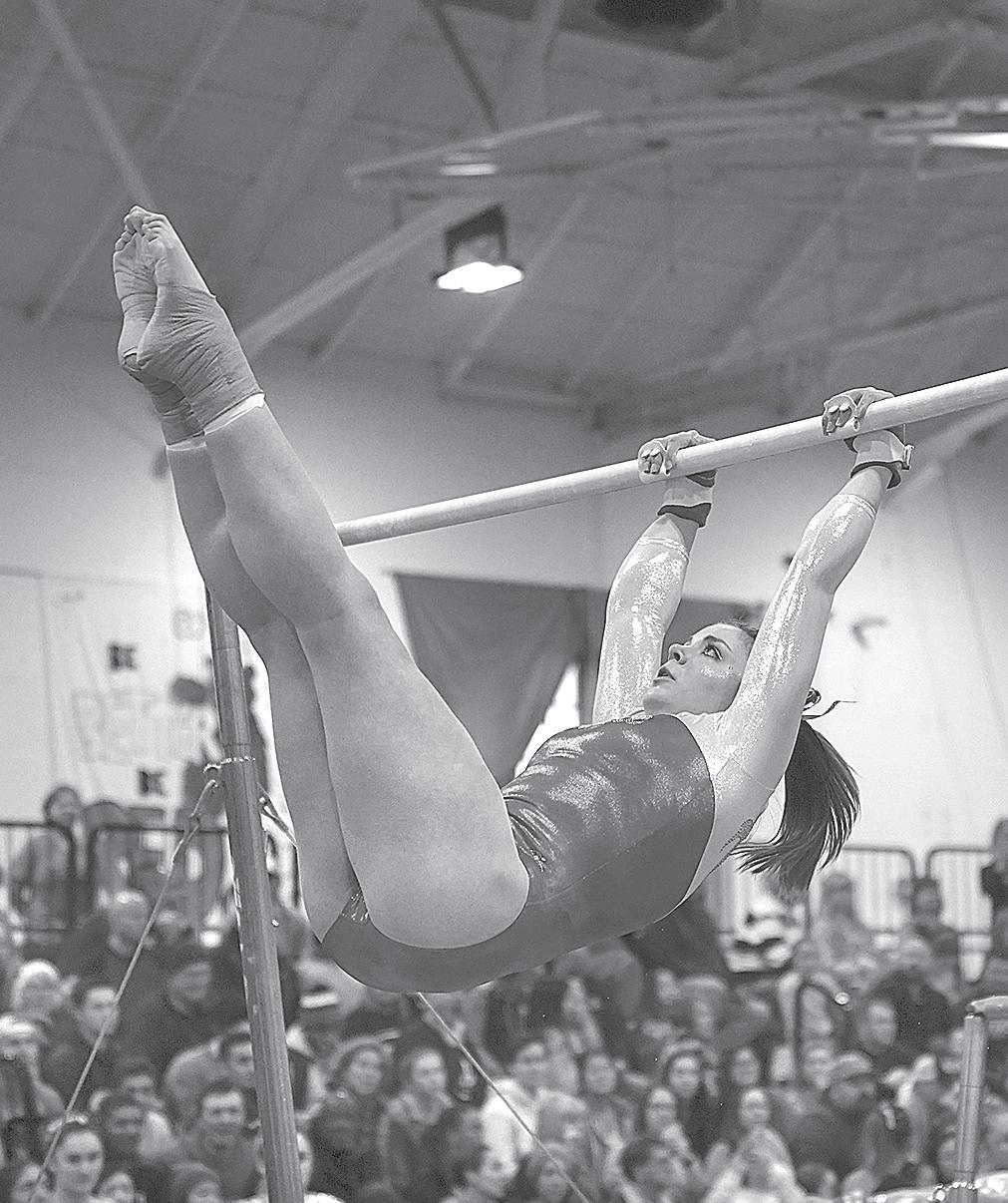
On the tails of its season-high score of 194.000 two weekends ago during the “Big Red Goes Pink Invitational,” Cornell women’s gymnastics scored its second-highest score of 193.075 this past weekend in its competition against West Virginia, Pittsburgh and Utah State at West Virginia University.
While Cornell scored well, the Red was outperformed by its three rivals. Utah State, West Virginia and Pitt scored 196.075, 195.575 and 195.100, respectively.
“They’re all teams that have qualified [for] NCAA regionals in the past and that means they’re ranked in the top 36 teams in the country,” said Cornell senior Christina Luniewicz. “Every year, [head coach Paul Beckwith] makes sure we have at least one meet against one of these really good teams … so we can show face and represent the Ivy League and Cornell at these competitions, and show them that we are just as good as them.”
Cornell definitively held its own against these top-tier programs. One small part of the Red’s success may have been due to the recent addition of sophomore Izzy Herczeg to the lineup.
Back from a labrum tear in her hip from the beginning of last year, Herczeg rejoined the lineup last weekend at the Pink Invitational and scored 9.850 on floor at that meet. She improved to a 9.875 in the same event in West Virginia this weekend.
Herczeg competed with the labrum tear last year and competed on the floor for the first time last weekend since her surgery in June.
Herczeg has had to alter her training regimen to ensure her newly healed hip does not feel any undue strain. She said she has
to “train smart” for the remainder of the season to ensure that her recent injury will not impede her ability to compete.
Freshman Donna Webster said Herczeg’s recovery has positively influenced the team.
“Having her come back from her injury has been uplifting for the team dynamic, because everyone recognizes how strong, clean and tight her gymnastics are,” Webster said. “It’s been a real motivator to meet that standard.”
The team, in lieu of its recent successes these past few weekends, hopes to continue achieving the same high scores this upcoming weekend at the Ivy Classic Championships.
“Going into Ivies, we’re pretty evenly matched. It’s going to be a great competition, a tight race.”
Christina Luniewicz
“Going into Ivies, we’re pretty evenly matched,” Luniewicz said. “It’s going to be a great competition, a tight race.”
Beckwith’s strategy to compete against top teams this past weekend may pay off during the Ivy Championship.
“I think it’ll be helpful going into Ivies this next weekend,” Webster said. “We had the sense that we can pull through and we did have a few errors so knowing if we fix those errors this week … [we know we’ll be in good shape].”
Cornell will compete against Penn, Brown and Yale in the Ivy Classic Championships on Sunday.
Zora Hahn can be reached at zhahn@cornellsun.com.
By SMITA NALLURI Sun Staff Writer
After a close battle with Villanova, the Red ultimately succumbed to the Wildcats in a narrow overtime loss, 13-12.
Villanova (1-1) was quick to get on the board, finding the back of the net less than four minutes into the game. But just 10 seconds later, Cornell (0-1) scored the first of four unanswered goals to go up 4-1.
The Wildcats responded with two goals of their own to bring the game back within one. The teams then traded goals for the rest of the half with Villanova holding a onegoal advantage, 6-5, heading into the second half.
“What
was promising was that we showed a lot of fight once we buckled down.”
After trading more goals, senior captain attacker Sarah Phillips equalized the score at 10 apiece a little over seven minutes into the second half. Not willing to relinquish its lead, however, the Wildcats scored three unanswered goals. The Red made a late push to force overtime, but fell just short as the clock wound down with a final score of 13-12.
Despite the loss, the young squad has a lot of positives to take away from the game.
Junior captain attacker Caroline Allen led the way, notching a career high five goals and three assists to give her a career high eight points on the day.
“It was just great to finally get the season started,” Allen said. “Even though it wasn’t the outcome we wanted, there’s definitely a lot to learn from going forward.”
The Red also had two players — senior attacker Shannon Bertscha and freshman midfielder Genevieve DeWinter — tally their first collegiate goals.
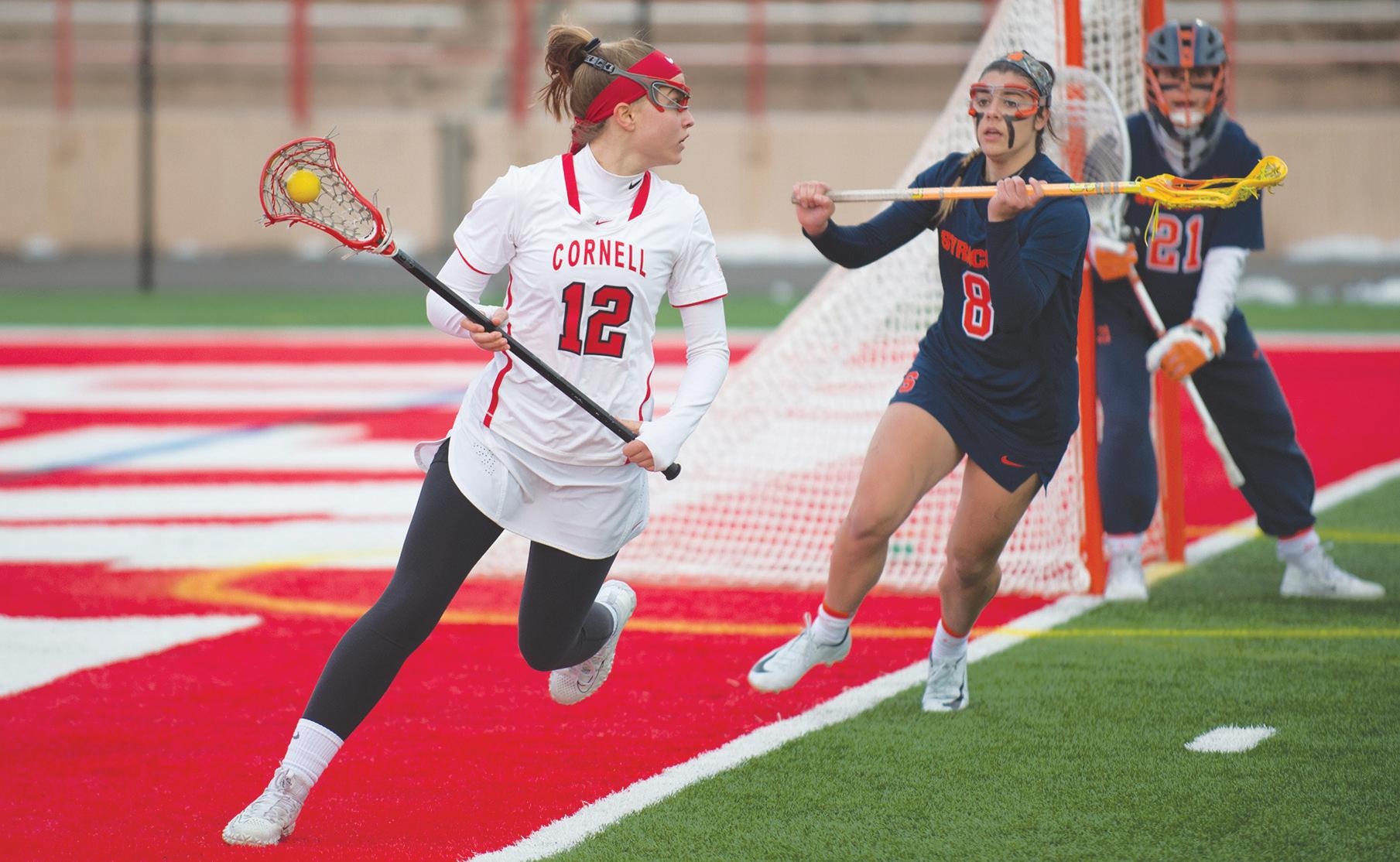
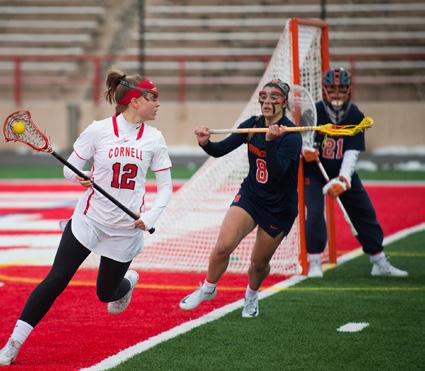
Bouncing back | After a one-goal overtime loss to Villanova, Cornell is confident in its ability to compete going forward this season. The Red hosts Penn State on Saturday.
Sophomore goalkeeper Hailey Andress made her first collegiate start, but junior goalkeeper Katie McGahan came on in relief a little over six minutes into the second half and recorded three saves of her own.
Cornell also outshot the Wildcats, 19-17, and fielded 17 ground balls to Villanova’s 16.
“What was promising was that we showed a lot of fight once we buckled down,” said junior captain and defender Mary Kate Bonanni. “That’s good news for us because we can always lean back on [our ability to keep fighting through] when things aren’t going our way.”
With a blend of fresh talent and seasoned veterans, the Red thinks it can be a formidable opponent if it tidies its game up.
“It was only our first game,” Bonanni said, “so we have a lot to learn from it and we have time to do so. Once we clean those [mistakes] up, which we definitely can, I think we’ll be in good shape.”
Cornell will have its first opportunity to play in front of a home crowd as it takes on No. 10 Penn State (2-0) in its home opener at 1 p.m. on Saturday.
Smita Nalluri can be reached at snalluri@cornellsun.com.
By MANAN MODI Sun
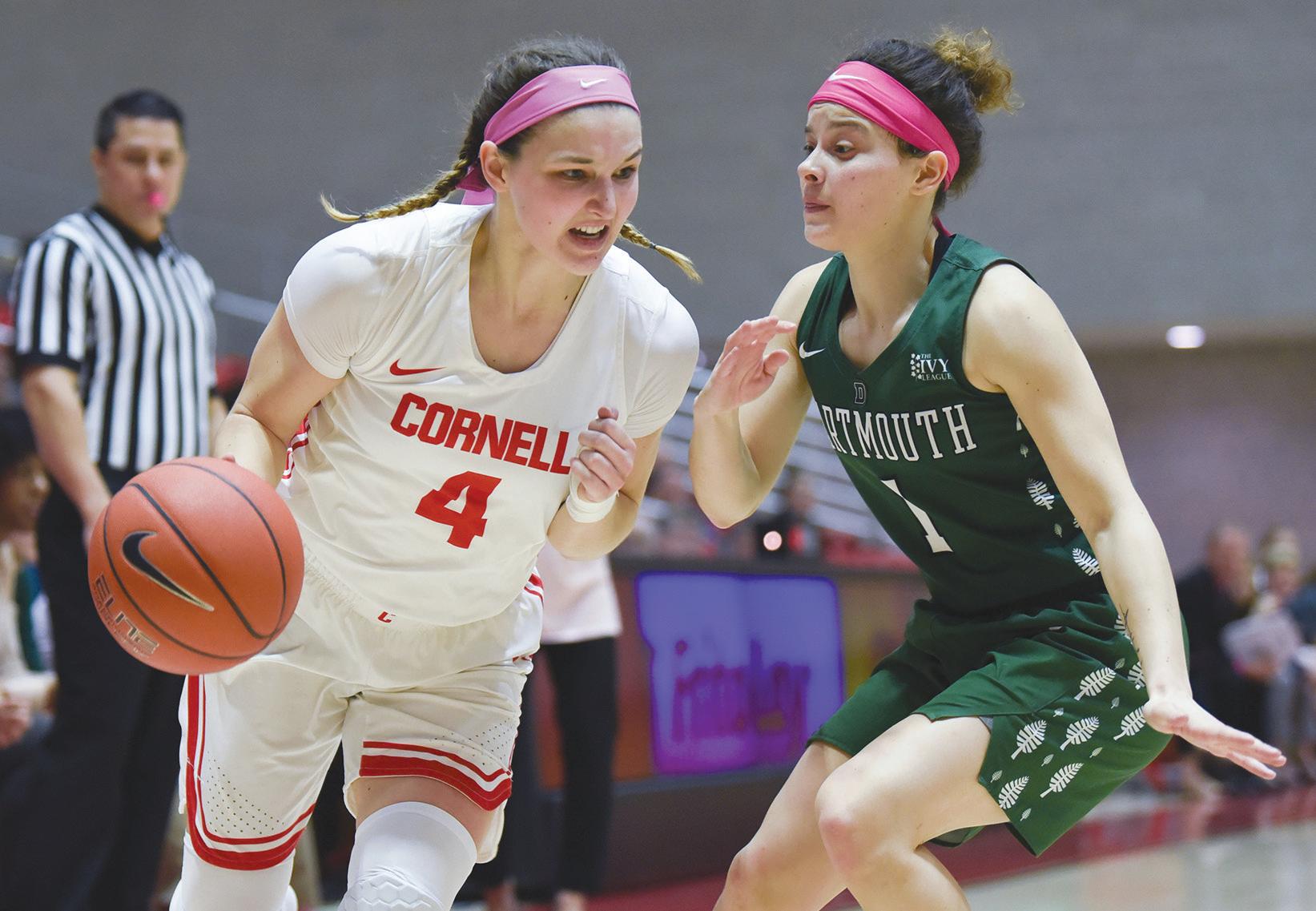
The Cornell women’s basketball team unleashed back-to-back victories against Yale and Brown this past weekend, climbing back into the Ivy League race with a pair of road wins.
“Back-to-back nights are never easy, not only because of the physical toll but also the mental aspect,” said junior forward Lauren Bagwell-Katalinich, whose double-double on Friday and 17 points on Saturday paced Cornell. “You can’t afford to let Friday’s result affect how
you play on Saturday.”
Despite being on the road, the Red (9-10, 3-5 Ivy) downed its competition, beating Brown (9-15, 1-7), 65-53, before defeating Yale (15-8, 5-3) in a tight 43-41 contest. The Red is still two games out of the Ivy League’s top four, but reasserted itself as a team that can compete in the league.
As a team, Cornell shot an impressive 43.8 percent from the field in the game against the Bears, while Brown lagged with 29.2 percent. The most positive aspect of the contest for the visitors was the performance by Bagwell-
Katalinich, who turned in 14 points and 14 rebounds. Along with double-digit numbers in the point and rebound categories, she was a perfect 6-for-6 from the free throw line.
After Cornell’s losses to Dartmouth and Harvard last weekend, BagwellKatalinich led the team to an impactful victory, shifting the tide of its Ivy season. The Red consistently scored over 15 points per quarter while holding Brown to only 17 points total in the third and fourth quarters. Though the Bears rank last in the Ivy League, the much-needed victory may have given the Red a confidence boost for its win at Yale the next night.
“Brown was a unique game for us because our styles are so different; they love to run the score up and we prefer a defensive game,” Bagwell-Katalinich said. “Brown has some really talented scorers, but I thought we played solid team defense against them and took them out of their rhythm.”
Perhaps the more interesting victory was the one over Yale — an “absolute battle” according to BagwellKatalinich. Yale is currently two spots ahead of Cornell and in third place of the Ancient Eight.
Cornell started the game slowly, scoring only six points in the second quarter. But the team still managed to fight back in the third and fourth quarters, emerging victorious in a low-scoring affair.
Saturday’s game against the Bulldogs was decided by a much tighter margin than the one at Brown. Cornell, how-
ever, struggled from an efficiency standpoint compared to Friday’s matchup.
Despite having a lower field-goal percentage of just 28.6 percent, Cornell fared well against Yale. BagwellKatalinich again led the team and scored more points than against Brown, finishing with 17 points on 5-for-15 shooting. Bagwell-Katalinich and freshman forward Theresa Grace Mbanefo each had nine rebounds.
The win against the higher-ranked Bulldogs could be a big-time boost for Cornell in its hopes of competing in the Ivy League. Yale previously defeated both Harvard and Dartmouth, two squads Cornell lost to before last weekend’s games.
“The shots weren’t really falling for either team, and it became pretty obvious that defense was going to decide the game,” Bagwell-Katalinich said. With momentum swung its way, Cornell’s biggest challenge of the year so far is imminent: The Red will face Penn and Princeton — the conference’s top two teams — on the road next weekend.
“At this point in the season, we’ve played every team and we know what adjustments we have to make to get a win,” Bagwell-Katalinich said. “Penn and Princeton are both tough teams to play, especially at home, but this past weekend proved to us that we’re capable of playing hard for 40 minutes and finishing close games.”
Manan Modi can be reached at mnm67@cornell.edu.