The Corne¬ Daily Sun

By DOROTHY FRANCE-MILLER Sun Staff Writer
Approximately two weeks after Cornell announced its Interim Expressive Activity Policy, protestors participating in Thursday’s Coalition for Mutual Liberation divestment protest were referred to the Office of Student Conduct and Community Standards for disciplinary action.
As outlined in the new policy, the protestors failed to comply with the University’s “time, place and manner guidelines to ensure the ability of our faculty and students to teach and learn without disruption,” according to Vice President for University Relations Joel Malina.
The new policy, announced on Jan. 24, adds to Cornell’s current Political Campaign Activity regulations and the Campus Code of Conduct to regulate expressive activity on campus.
The new policy requires registration for all “indoor demonstrations, tabling or other expressive activity” and for outdoor events for groups over 50. The policy also places limitations on amplified sound, a twoweek time limit on posters, signs and light projections and restrictions on items that can be used and carried in protests or events.
The policy’s language centers on protecting public safety.
“Expressive activity may not
compromise public safety, impede the free movement of people or vehicles, damage university property or interfere with regular university operations, as determined by the University,” the policy reads.
Some members of organizations, including Luke O’Brien ‘27, a member of the Coalition for Mutual Liberation, disagree with the policy’s restrictions on organizing, gathering and campaigning. CML frequently holds pro-Palestinian protests, including eight events within four days in November.
“[The policy] is an attempt to stifle the organizing happening on campus,” O’Brien told The Sun. “No amplified sound? Such a decree comes from such a place of privilege — that the hostility people supposedly feel is some yelling.”
Tensions regarding the policy particularly emerged throughout the University Assembly’s open meeting to hear questions, comments and concerns regarding the policy on Tuesday, Feb. 6.
At the meeting, Vice President and General Counsel Donica Varner said that the policy was created to facilitate a supportive and diverse educational environment.
“The policy was designed with an intentional educational focus to encourage individual responsibility within a diverse and pluralistic academic community,” Varner said.

By HENRY FERNANDEZ and CHRISTINA MacCORKLE Sun Staff Writers
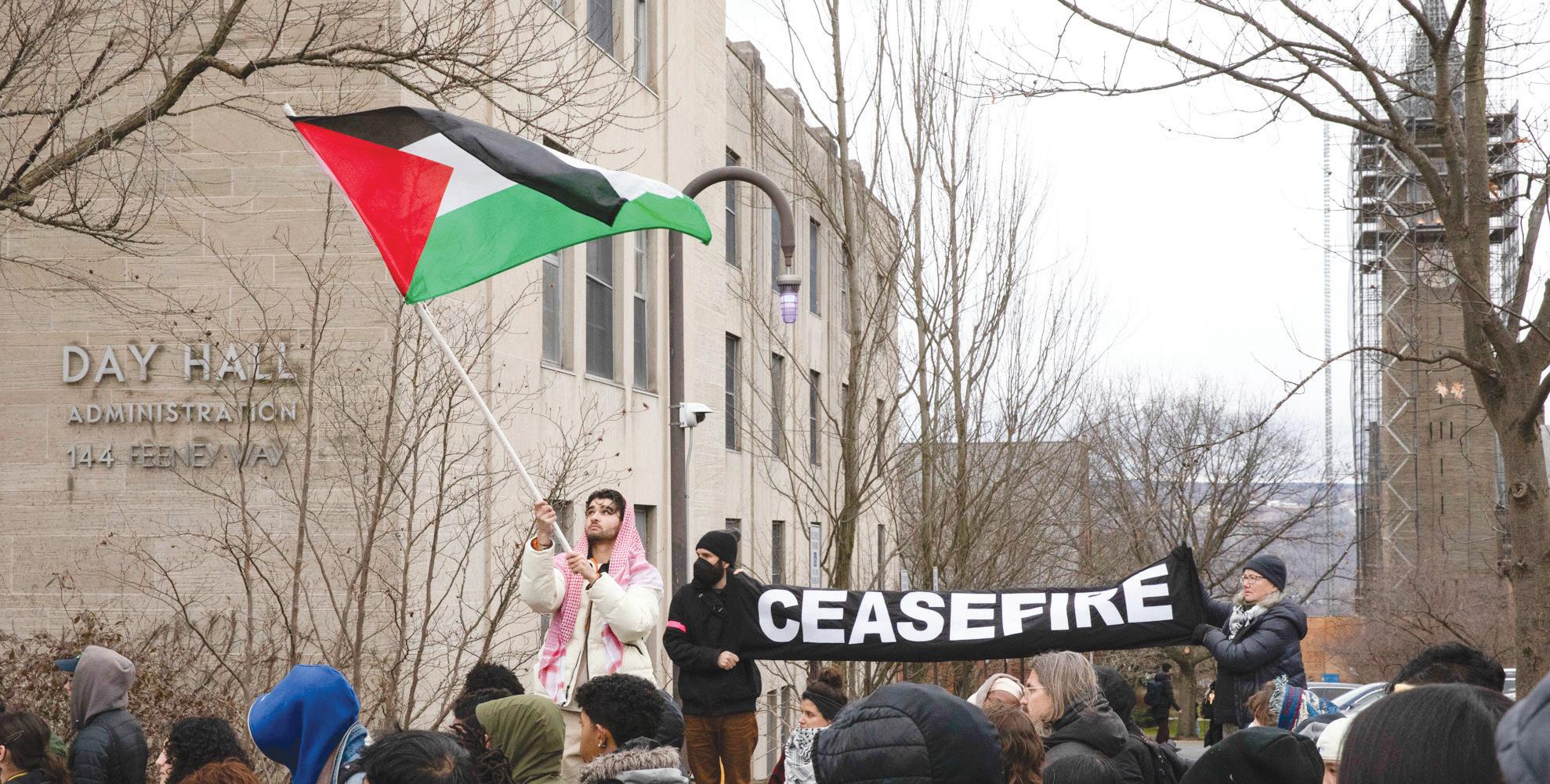
Students participating in Thursday’s Coalition for Mutual Liberation “Walk Out To a Die In” divestment protest have been referred to the Office of Student Conduct and Community Standards for disciplinary action.
Approximately one hundred students walked out of their classes at noon and gathered in the Ag Quad before sprawling within Mann Library, where they read the names of Palestinians who have died throughout the Israel-Hamas War and chanted “Cornell is complicit in genocide,” referring to the University’s investments.
Police were called to the library to remove and collect identification from the students “to refer [them] for disciplinary action,” according to Vice President for University Relations Joel Malina. Students left Mann Library about 10 minutes after the police officers’ arrival but contin-
ued to occupy other libraries and academic buildings including Klarman Hall and the Cocktail Lounge in Uris Library, propelling further police intervention.
In a statement to The Sun, Malina said the protest broke the University’s Interim Expressive Activity Policy which was announced on Jan. 24. The policy states that “organizers should plan the time, place and conduct of demonstrations wisely to avoid disrupting classrooms, libraries, auditoriums, laboratories, living units, administrative offices and special event venues.”
The policy also stipulates that outdoor events, including those on the Ag Quad, involving more than 50 people are expected to be registered. Registration is also expected for all “indoor demonstrations, tabling or other expressive activity.” The policy specifies that “living units, private laboratories and offices, dining halls and libraries are never appropriate locations for indoor demonstrations.”
By DINA SHLUFMAN Sun Staff Writer
Ithaca is now one month into a new system of governance after a vote last November introduced the City Manager position. The inaugural City Manager, Deb Mohlenhoff, began her term on Jan. 1.
The City Manager role was created after 76 percent of voters approved the switch from a strong-mayor to a coun cil-manager form of government.
As City Manager, Mohlenhoff oversees all the City’s depart ments, facilities, operations, programs and services. Previously, the Mayor was in charge of managing both the City of Ithaca and the Common Council.

“[This new system] draws a firewall between elected officials and the staff that runs all of the day-to-day operations of the City,” Mohlenhoff said. “It provides for cleaner, easier decision-making and resource-alMohlenhoff acts as a buffer between the City departments and the Common Council to help implement various infrastructure projects and City events. “I am here to do the will of the Common Council,” Mohlenhoff said. Mohlenhoff has a long history with community involvement. During her time working at Ithaca College,
Mohlenhoff ran various volunteer trips to New Orleans.
Reflecting on what first got her interested in politics, Mohlenhoff recalled what one resident once told her on a trip rebuilding houses in New Orleans.
“If you really want to change the world, you need to get a seat at the table where the decision-makers are,” Mohlenhoff recounted the advice.
As a long-time Ithaca resident and an Ithaca College alumna, Mohlenhoff wanted to give back to her community.
“I’ve lived here for almost 30 years. I absolutely love the City. I love everything about it. I want to see it survive. I want to see it thrive,” Mohlenhoff said. “The behind-the-scenes stuff was where I felt that my skills aligned. I thought I could make a difference.”
Mohlenhoff also hopes to promote transparency in all government processes.
“The tax-payers deserve to know that their local tax dollars are being used as effectively
and efficiently as possible,” Mohlenhoff said. “Being in this role, I will have a direct impact on that.”
As part of her plan for her first 100 days in office, Mohlenhoff aims to fill many of the leadership roles that were left vacant after a slew of retirements that included the City’s human resources director, City controller and City attorney.
Mohlenhoff also plans to improve the management of the City budget. Having previously worked in public office, Mohlenhoff said she understands where these critical gaps in leadership and funding are.
As for her long-term goals, Mohlenhoff wants to prove to Ithaca residents the value of her appointment.
“I want to demonstrate to the public that they made the right choice in voting for this form of government,” Mohlenhoff said.





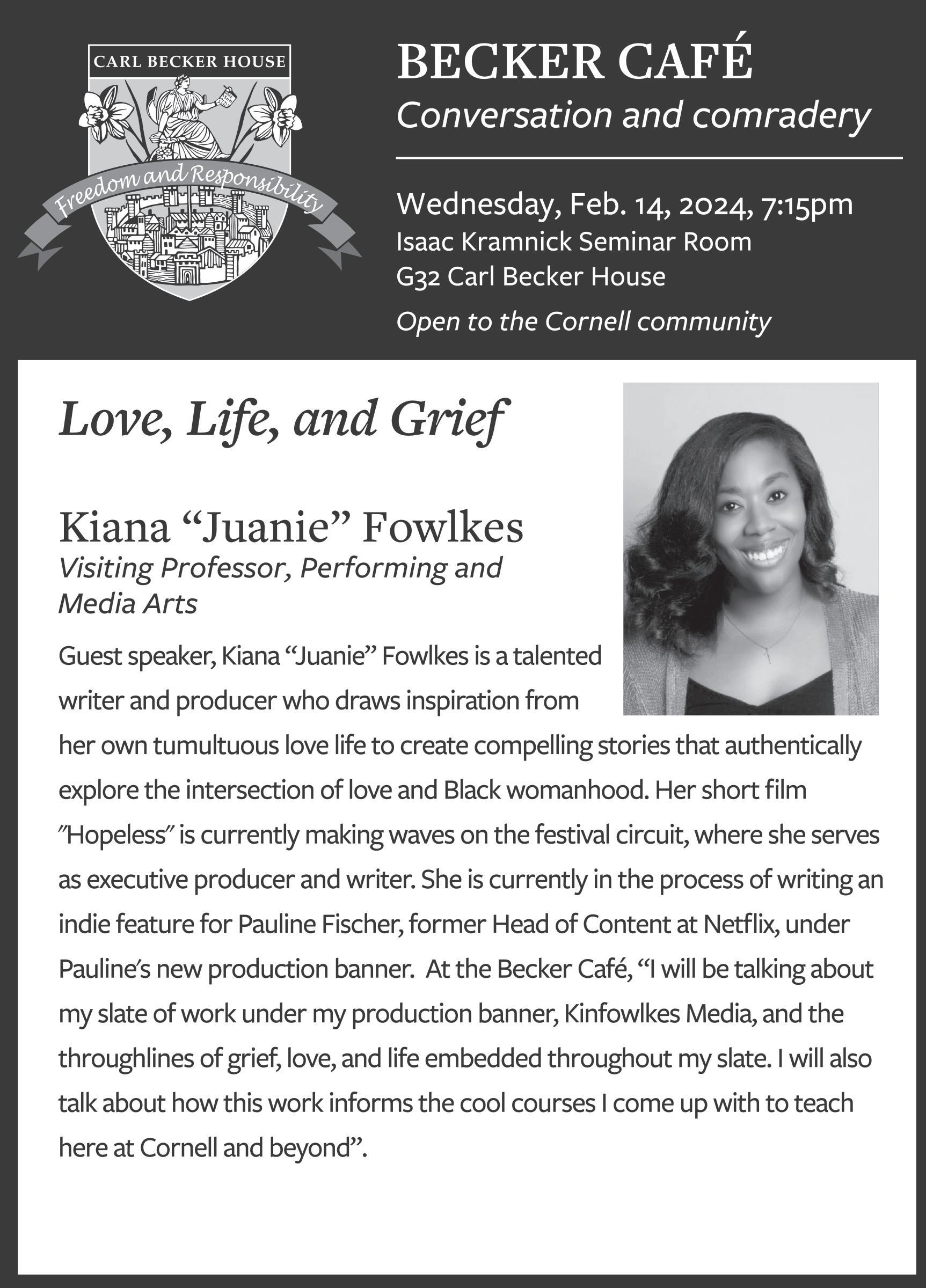
By DALTON MULLINS Sun Staff Writer
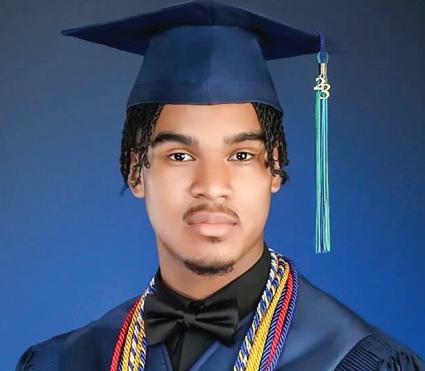
Dennis ‘Maliq’ Barnes ’27 made national headlines last spring for his record-breaking accumulation of over $10 million in scholarships as well as his acceptance into 210 colleges. With a smorgasbord of schools across the country to choose from, Barnes ultimately decided on Cornell University.
The Sun spoke to Barnes to unpack his decision and discuss his transition from being a senior at the International High School of New Orleans to being a 16-year-old firstyear at Cornell.
When Barnes began applying to college, he never intended on breaking records. Instead, he described his goal as simply finding the best opportunity to get into a college that would support him financially and academically.
Barnes did not realize he was on the verge of breaking the record for dollar amount of scholarships offered until a school board member from his high school informed him. Once Barnes knew he was close, his competitive drive led him to become the student with the most scholarship money in the history of the United States.
“[My] motivation kind of changed, [and] the dynamics of the entire situation changed,” Barnes said.
Out of his 210 college accep-
tances, Cornell stood out to Barnes because of the opportunity to attend one of the best engineering programs in the country.
“Cornell was that school that had the best fit for me — they accommodated me the best,”
Barnes said. “They have a great education system, [and] they supported me financially. They just put everything in place for me to be successful. After doing my research, Cornell University has the best engineering school in the Ivy League.”
Barnes is currently studying computer science and electrical computer engineering in the College of Engineering.
Despite feeling like he made the right decision, the New Orleans native is still adjusting to life in Ithaca.
“I do believe that I made the right decision — I love it here at Cornell,” Barnes said. “[It is] not necessarily what I’m accustomed to. We are in a country area, as opposed to New Orleans. It’s definitely warmer [back home] … but I love it here. I think I made the right choice.”
When his nose isn’t in a book or a problem set, Barnes is involved in multiple organizations at Cornell. Barnes is preparing to attend a national conference for the National Society of Black Engineers. He is also a part of SWAG, an organization dedicated to increasing the
retention and graduation rates of Black students at Cornell.
In addition to his fascination with technological innovation, Barnes is also interested in how law responds to innovation and plans to attend law school after graduating from Cornell.
“Those are two rapidly growing fields: law and technology,” Barnes said. “All the intellectual property, the NFTs, the things that are being developed require ownership of technology, [and] because it’s so rapidly growing, you’re going to need representation for it in court.”
With all of his success in acquiring scholarships and college acceptances, Barnes often speaks with students and gives them guidance on navigating the college application process.
“I talk to high school students all the time,” Barnes said. “I give advice to my friends all the time, [and] I taught for Breakthrough Collaborative over the summer. I had a lot of students that were in middle school, and I always tried to encourage them.”
Breakthrough Collaborative is a nationwide organization with the goal of bringing equity to education.
To continue reading this story, please visit www.cornellsun.com.
Dalton Mullins can be reached at dmullins@cornellsun.com.
By JANE McNALLY and MARIAN CABALLO Sun Staff Writer and Sun Multimedia Editor
It was a normal Tuesday for figure skater Karen Chen ’25, carving out a brief moment between her pre-med classes to check her phone. Suddenly, it was flooded with notifications, calls and texts saying she had become an Olympic champion.
Two years removed from her stint at the 2022 Winter Olympics in Beijing that saw the US Figure Skating Team in second place, Chen is now an Olympic gold medalist.
“It was crazy,” Chen said. “The past two years, the whole team ––we’ve just been waiting for things that were out of our control.”
The Swiss-based Court of Arbitration for Sport ruled on Monday, Jan. 29 that Russian figure skater Kamila Valieva violated anti-doping rules for a positive drug test from December 2021, just a couple months before the Winter Olympics. Following Valieva’s disqualification from competition, the International Skating Union demoted the Russian Olympic Committee, pushing the United States to the top spot on Tuesday, Jan. 30.
“When the decision was made, it all just came so suddenly out of nowhere, I didn’t expect it to happen. All of a sudden, like I was getting texts from like, friends, family — anyone just congratulating me and [it was] so weird,” Chen said. “They’re congratulating me for something that hap-
pened two years ago.”
This marks the first-ever team Olympic skating gold medal for the United States, with Chen winning alongside teammates Evan Bates, Nathan Chen, Madison Chock, Zachary Donohue, Brandon Frazier, Madison Hubbell, Alexa Knierim and Vincent Zhou.
Chen is the first Cornellian to ever medal in an Olympic figure skating competition and the fifth to earn gold at the 2022 Winter Olympics, according to a post on X, previously known as Twitter, from Cornell historian and visiting lecturer Corey Ryan Earle ’07.
“[It] was really incredible. I can’t even put it into words — and I think I’m still processing it since it just happened really recently,” Chen said. “I think a part of me doesn’t want to fully process it until I get the medal.”
The date of the medal ceremony is still unknown two years after the scandal, however.
Chen, and the rest of Team USA, never received the silver medal in 2022. A mere few hours after the United States had earned silver in the team skate, the group boarded the team bus to receive their silver medals. Before the bus was put in drive, the team was told the event was canceled.
To continue reading this story, please visit www.cornellsun.com.
Jane McNally can be reached at jmcnally@cornellsun.com. Marian Caballo can be reached at mcaballo@cornellsun.com

DISCIPLINE
activity.” The policy specifies that “living units, private laboratories and offices, dining halls and libraries are never appropriate locations for indoor demonstrations.”
“While Cornell values and protects students’ right to free expression, including the right to protest, those protests must comply with our time, place and manner guidelines to ensure the ability of our faculty and students to teach and learn without disruption,” Malina’s statement read.
Some student protesters believe the interim policies are an attack on students’ rights to protest freely.
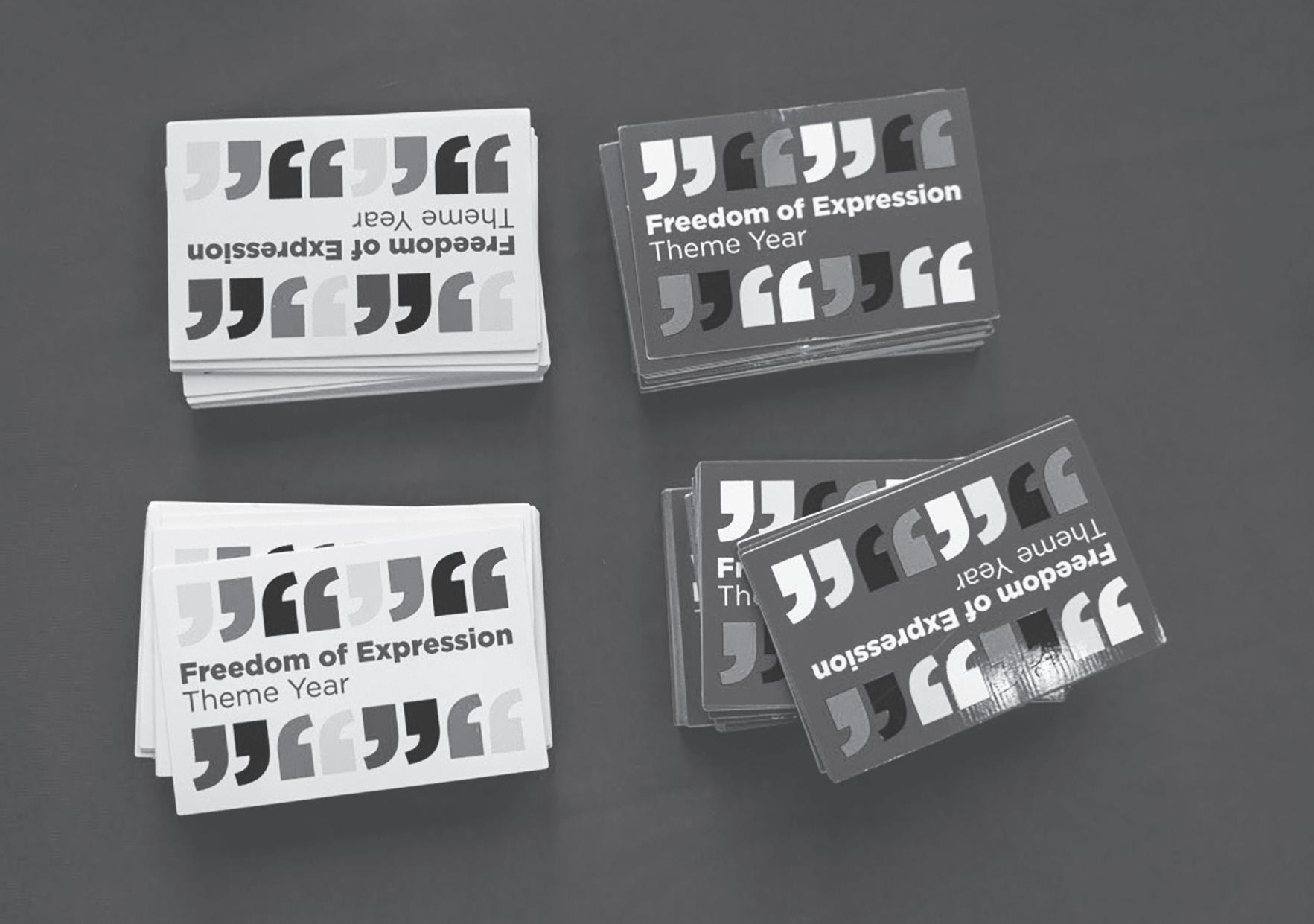
“[The new rules are] absolutely absurd and draconian, especially in the light of it being the free speech year,” said Nick Wilson ’26, a member of The People’s Organizing Collective who participated in Thursday’s protest. “Cracking down on students’ right to protest prevents us from holding the University accountable and obligating it to act ethically.”
said. “[Restricting] the use of candles on the grounds of safety when it’s tiny tea lights that people are using to mourn the loss of civilian lives strikes me as absurd.”
Continued from page 1 POLICIES
The protest follows the Student Assembly’s Feb. 1 rejection of Resolution 51 which advocated for Cornell to halt investment in companies that “through their ‘action or inaction,’ partake in ‘morally reprehensible activities’” in Gaza. Approximately 70 protestors gathered outside of Day Hall on Feb. 2 condemning the 16-4 vote, while utilizing controversial language. The University did not discipline protestors for this demonstration.
When asked if Thursday’s demonstrations were intentionally meant to defy the University’s new policy, Wilson declined to comment.
Wilson said that the policy restricts peaceful demonstrations, referring to the restrictions on the use of tea lights and candles. The policy states: “Candles, lamps, and other open flame sources are generally not permitted, but may be approved on a case-by-case basis after review by health and safety personnel.”
“The restriction of things like candles and tea lights to me feels like a direct retaliation to students who came together during vigils as the genocide in Gaza began,” Wilson
Thursday’s protests did see a physical altercation. In a video acquired by The Sun from attendee Sara Abouchaaoua ’27, a man is seen having an altercation with a protester in Mann Library. During the protest, the man shouted at protestors and attempted to grab a protestor’s phone from their hand.
Aaron-Onuigbo Kingsley ’27, a protestor at the event, witnessed the man’s behavior.
Kingsley alleged that the man “was screaming at us, telling us that we were the ones killing the Palestinians, Hamas hates homosexuals and lesbians and gays, and that we are at fault, we are wasting our parent’s money.”
Kingsley said that despite the man’s words, protestors were brought together.
“It was really cool. We banded together and ensured our chants were louder than his words,” Kingsley said.
Kingsley also witnessed the altercation and subsequent alleged police response.
“[The man] became an issue,” Kingsley said. “I raised up my head and I saw him reaching out to grab somebody.”
Kingsley said he did not perceive bias in CUPD’s response to the altercation.
“Police had to come and restrain him,” Kingsley said. “So yeah, I don’t think the police were there against us … They were just doing their work.”
Wilson said he felt the incident would have garnered more public sympathy had the protesters not been pro-Palestine.
“[If it] were someone affiliated with CML, or a Palestinian student, to approach another person — a student of the University or someone affiliated with the University — and grab a phone out of their hands, I think you would hear about that very quickly. Not only from the University itself but in national media,” Wilson said.
To continue reading this story, please visit www.cornellsun.com.
Henry Fernandez and Christina MacCorkle can be reached at hfernandez@cornellsun.com and cmaccorkle@cornellsun.com.
Continued from page 1
Many community members raised concerns regarding the ambiguity of the line: “Cornellians engaging in expressive activity are expected to conduct themselves responsibly and in accordance with this policy.”
The speakers particularly questioned what it meant for Cornellians to be “expected” to comply with the policy. w
“I would like to see the ambiguities removed,” said Prof. Risa Lieberwitz, industrial and labor relations. “In particular, the ambiguities around the word ‘expectation.’ If the University wants to suggest that groups register any event, then they can suggest that and make clear explicitly in any policy that there is no requirement to register an event.”
Prof. Yuval Grossman, physics, agreed with Lieberwitz.
“Rather than say, ‘Hey, we’ll give you a guideline,’ I think
it should [say] something very, very clear,” Grossman said.
Varner clarified that registration for outdoor gatherings is a strong request rather than an essential precondition.
“We’re asking for and have set an expectation but not a requirement that protest activity in certain outdoor locations involving 50 or more people be registered so that we can provide the appropriate support for those activities,” Varner said.
Upon further questioning about whether the policies were obligatory, Varner also confirmed the Interim Expressive Policy was considered under Section H: “Failure to Comply” in the Student Code of Conduct, meaning that students who fail to abide by these policies will face repercussions.
President Martha Pollack emphasized the policy is intended to promote rather than restrict free expression in a Thursday, Feb. 8 public statement.
“These measures aim to
ensure all Cornellians can express and hear opposing viewpoints while being safeguarded against behavior that seeks to silence speech,” Pollack wrote. However, some speakers asserted the policy stifles free expression.
“I grew up in a country both socialist and authoritarian, and I can smell authoritarianism,” said Prof. Saida Hodži, anthropology and feminist, gender and sexuality studies. “And this smells like authoritarianism.”
Individuals who wish to give input regarding the new policies are encouraged by the University to contact the University Assembly as they finalize the policies in the upcoming weeks.
To continue reading this story, please visit www.cornellsun.com.
Dorothy France-Miller can be reached at dfrancemiller@cornellsun.com.

The 2024 Grammy Awards was a night of celebrations and record breaking, as well as some snubs and surprises. The ceremony took place Sunday night at the Crypto. com Arena in Los Angeles. Comedian Trevor Noah hosted the show for the fourth consecutive year, providing light-hearted commentary throughout the night.
The big winners included Miley Cyrus and Billie Eilish. Cyrus won her first two Grammys, after only receiving two nominations in years prior. She took home Best Pop Solo Performance and Record of the Year, both for her hit single “Flowers”, which debuted in January 2023. Eilish won Song of the Year for “What Was I Made For?” Her single featured in the film “Barbie” which premiered this past summer. She shared the award with her brother FINNEAS, who served as a co-writer on the track. In her acceptance speech, she thanked Greta Gerwig, the director of Barbie , for giving her the platform to write and perform the song.
Of course, pop sensation Taylor Swift left her mark on the Grammys stage. Swift took home both Best Pop Vocal Album and Album of the Year for “Midnights”, her
tenth studio album released in October 2022. In her acceptance speech for Best Pop Vocal Album, Swift surprised fans by revealing the news that her eleventh studio album, “The Tortured Poets Department”, would be released in April. Album of the Year marked Swift’s fourteenth Grammy win and her fourth in that category, setting a new record for the number of Album of the Year awards held by one artist.
Despite Swift’s recent success, she wasn’t the favorite to win the award. Many thought that it should have gone to SZA’s “SOS”, which had the longest run on the Billboard 200 out of all the nominees. The decision to give the award to Swift caused many to question the Recording Academy’s bias against R&B and hiphop, which notoriously do not do well in the category. This concern was also raised last year, when Beyonce’s “Renaissance” lost the title to Harry Styles’ “Harry’s House”. Her husband, JayZ, criticized the Recording Academy for this in his acceptance speech for the Dr. Dre Global Impact Award, which was recognized at the ceremony for the first time last year. His comments called out suspected racial bias by the Recording Academy.
SZA wasn’t the only artist with losses that night.
Both Jon Batiste and Olivia Rodrigo, previous Grammy

winners, went home empty handed despite receiving six nominations each. In 2022, Batiste won five Grammys, including Album of the Year, and Rodrigo won three, including Best New Artist. The rock/alternative trio Boygenius received seven nominations, but only took home three awards during the daytime ceremony for Best Rock Performance, Best Rock Song and Best Alternative Music Album, missing out on the larger, televised cate-
gories, such as Record of the Year.
The award show would not have been complete without featured performers. Nominees Olivia Rodrigo, Miley Cyrus and Billie Eilish all took the stage. Billy Joel performed his new track “Turn the Lights Back On,” which is his first new release in almost three decades. Arguably the best performance of the night was a duet between Joni Mitchell and Brandi Carlile, bringing
many audience members, including Beyonce and Meryl Streep, to tears. Although the night was celebratory for some, for others it was full of some disappointment and surprise. While all the winners were deserving, it is important to acknowledge the success and talent of all the nominees.
Ili Pecullan is a sophomore in the College of Human Ecology. She can be reached at ipecullan@cornellsun.com.
ERIC HAN ARTS STAFF WRITER
Henry Kissinger died and thus a spotlight shone on imperialist absurdity. A Tom Lehrer quote has re-emerged in the American zeitgeist: "Political satire became obsolete when Henry Kissinger was awarded the Nobel peace prize." Indeed, it is no secret that Kissinger killed millions. It is also no secret that O.J. Simpson very likely killed his wife. Yet, Simpson jests in a recent viral TikTok that he is a “slayer of the women.” In this way, Simpson reclaims the narrative — such blatant irony could only come from a subject wholly unaffected by his guilt. Any further condemnation of his moral corruption is futile; the comment section is only full of jokes because what is there to gain from saying, “Hey! You’re a murderer!” at that point?
I am reminded of that Black Mirror episode, “The Waldo
Moment.” A struggling actor Jamie plays a cartoon character named Waldo, who stumbles into popularity by humiliating a conservative politician. The character accrues political clout and runs for office as a populist outsider. Waldo’s significance outgrows Jamie’s control and becomes a figure of political unrest. Being a cartoon grants him immunity from serious criticism; when that conservative opponent points out the fact that he is a joke, not a genuine candidate, it only provokes the public into a greater, violent mistrust of career politics. An unserious candidate has become the most imponent. To be satirical is to be poignant, discerning. This is the politics of Donald Trump. His significance, like Waldo’s, transcends his personal agency. He is a joke to the media, to career politics, and thus he is immensely popular with disillusioned voters against those candidates that lack self-awareness (i.e. Hillary Clinton). This means that
Trump cannot afford to act in any rational, traditional fashion — he must play into the part, making unsavory jokes and disturbing the status quo. Otherwise, he loses his political claim, his outsider appeal that relates him to alienated voters. You will occasionally find other outsider wannabes, like Andrew Yang; but the moment that Yang unwittingly became the butt of the joke, his campaign devolved to irrelevancy.
What do we make of George Bush’s redemption? He has resigned to a tranquil life of painting and fundraising, we think. But let’s recall when he mistakenly condemned “the decision of one man to launch a wholly unjustified and brutal invasion of Iraq.” Of course, he meant Ukraine, but was able to quickly recover to a roar of laughter: “Iraq too.” Bush is responsible for a brutal Iraq war that took hundreds of thousands of lives. Yet we allow him to participate in the joke. He compels us to laugh with him, not at him.
Theodor Adorno had already discovered the death of satire after the Second World War. He wrote, “Irony used to say: such it claims to be, but such it is; today, however, the world, even in its most radical lie, falls back on the argument that things are like this, a simple finding which coincides, for it, with the good.” The capitalist’s cultural hegemony preserves simple truths that adhere to his universalized ideology. You cannot make ironic comparisons between reality and what actually is. You cannot joke that O.J. Simpson is a murderous lunatic if he beats you to the punch. You cannot joke that the capitalist is willing to sacrifice thousands of Iraqi lives for his cause if the capitalist jokes the same.
That leaves the Left in a precarious position. Jakob Norberg cites Marxist critic Georg Lukács here: “The politically oriented satirist, he claims, discerns the unsustainable character of society with perfect clarity and detects its
corruption through the medium of a hatred that nobody and nothing can mitigate.” Satire is a critical tool for demonstration. Maybe that’s why leftists are so notoriously unfunny — we have been robbed of our jokes.
It might be fitting to leave you with another heinous TikTok: Martin Skhreli, convicted not for gouging the price of a life-saving medication by 55 times but rather securities fraud, jokes that he can’t come over to a woman’s place because he is on house arrest. Society’s greatest shitbags seem to have found their escape in satire — a tool once necessary for the liberation of oppressed peoples, transformed to maintain cultural dominance. Some will tell you that satire died when Kissinger was awarded for his “peace efforts.” We know that it died long before then.
Eric Han is a sophomore in the College of Arts and Sciences. He can be reached at ehan@cornellsun.com.
ANGELA BUNAY ’24
SHEILA YU ’25
Advertising Manager
NOAH DO ‘24
Associate Editor
HUGO AMADOR ’24
Opinion Editor
JONATHAN MONG ’25
News Editor
JULIA SENZON ’26
News Editor
JULIA NAGEL ’24
Photography Editor
GRAYSON RUHL ’24
Sports Editor
TENZIN KUNSANG ’25
Science Editor
JOANNE HU ’24
Assistant News Editor
MARISA CEFOLA ’26
Assistant News Editor
MAX FATTAL ’25
Assistant Arts & Culture Editor
MING DEMERS ’25
Assistant Photography Editor
KATE KIM ’24
Layout Editor
ISABELLE JUNG ’26
Graphics Editor
VEE CIPPERMAN ’23
Senior Editor
ESTEE YI ’24
Senior Editor
PAREESAY AFZAL ’24
Senior Editor
ELI PALLRAND ’24
Senior Editor
SOFIA RUBINSON ’24
Managing Editor
GRACE XIAO ’25
Web Editor
AIMÉE EICHER ’24
Assistant Managing Editor
UYEN HOANG ’25
Assitant Web Editor
ANNA LIANG ‘24
Assistant Advertising Editor
ERIC REILLY ’25
News Editor
GABRIEL MUÑOZ ’26
News Editor
NIHAR HEGDE ’24
Arts & Culture Editor
DANIELA ROJAS ’25 Dining Editor
RUTH ABRAHAM ’24
Sports Editor
MEHER BHATIA ’24
Science Editor
MARIAN CABALLO ’25
Assistant News Editor
CARLIN REYEN ’25
Assistant News Editor
KIKI PLOWE ’25
Assistant Arts & Culture Editor
CLAIRE LI ’24
Assistant Photography Editor
DAVID SUGARMANN ’24
Assistant Sports Editor
ALLISON HECHT ’26
Newsletter Editor
JASON WU ’24
Senior Editor
Editors in training
Editor in chief Desker Gabriel Levin '26
Managing Desker Eric Reilly '25
Associate Desker Max Fattal '25
News Deskers Henry Fernandez '27 Iskander Khan '26
Arts & Culture Desker Eric Han '26
Photography Desker Nina Davis '26
Sports Desker Jane McNally '26 Layout Desker Jolin Li '27
Re: “Why Anti-Zionism is Anti-Semitism in Disguise” (opinion, Feb. 2)
The guest column by professors Saar, Strauss and Zax argues that anti-Zionism is anti-Semitism. The title, then, implies that all Jews are Zionists, when, for example, Jewish Voice for Peace, “working towards Palestinian freedom and Judaism beyond Zionism” notes on its website that “Tens of thousands have joined JVP.” Zionism is a late 19th century political ideology that seeks to solve the historic virulence of anti-Semitism in Europe by founding a Jewish state. Zionism, then, is not a part of Jewish tradition, either religiously or culturally. This tradition, beginning with the Old Testament prophets, is a tradition of social justice. The Zionist state of Israel has been violating this tradition since its inception in 1948, beginning with the ethnic cleansing of 750,000 Palestinians from their native land and continuing through the present moment with the genocide in Gaza.
While Saar et al. claim Jewish indigeneity as the foundation of Jewish rights to historic Palestine, they ignore the rights of the Palestinians who have at least equal claim as Indigenous people of the region. Israel is recognized by Amnesty International, Human Rights Watch, and B’Tselem (the principal Israeli human rights organization) as an apartheid state. The conservative International Court of Justice has just declared that the charge of genocide brought against Israel by South Africa is “plausible” and thus will continue to be investigated by the court.
In light of this history of apartheid, the idea, promulgated by Saar et al, that somehow Israel’s historic violence against Palestine is carried out by “humanitarian” means, as if “humanitarian” violence is not itself a contradiction in terms, is belied by the facts on the ground: According to Gaza’s Health Ministry, more than 28,000 Palestinians have been killed to date in Gaza, 70 percent of whom are non-combatants and upward of 12,300 of whom are children and young teens. In addition to which, as stated by Save the Children, 10 Palestinian children are being maimed by Israeli forces every day, supported by the U.S. government through the supplying of armaments to Israel and refusal to call for a ceasefire. This violence is not new and has repeated itself historically: UN figures note that from 2008 to 2020, for every Israeli killed in the ongoing “conflict,” 22 Palestinians, predominantly non-combatants, were killed by the Israeli Defense Forces.
To continue reading, visit cornellsun.com — Prof. Eric Cheyfitz with nine other current and former faculty
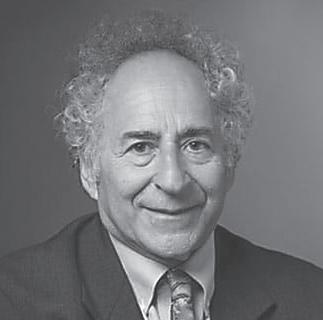
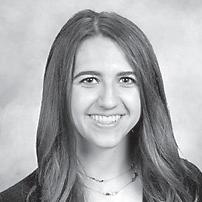
Daniel R. Schwarz is the Frederic J. Whiton Professor of English Literature and Stephen H. Weiss Presidential Fellow in the College of Arts & Sciences. He is Te Cornell Daily Sun’s 2023-2024 visiting columnist. He can be reached at drs6@cornell.edu.
Rebecca Sparacio is a senior in Te College of Arts & Sciences. Her fortnightly column Te Space Between is a discussion on student life, politics and community. She can be reached at rsparacio@cornellsun.com.
Rebecca: Let us discuss the issue of freedom of speech, an issue which has been troubling us both and which has several aspects.
Dan: Free speech — that is, expressing opinions without government intervention or legal sanctions — is a universal right that is enshrined in Article 19 of the United Nations’ Universal Declaration of Human Rights and in the First Amendment to the U.S. Constitution.
Free speech is an accepted human right, but it does not mean one can say anything at any time. Free speech is provisional and fungible; it is defined by context and depends on the situation. This semester will test how universities and colleges maintain free speech and lively discourse on controversial issues without tolerating hate speech or allowing faculty to use classes to forward political agendas.
University leadership must staunchly defend what universities do in terms of encouraging opportunity and possibility for all students and fostering objective teaching and research.
I do think that elite universities need to be aware of the world we live in and communicate better what we do and why.
When I travel outside Ithaca and Manhattan, I realize there is another world between the coasts and beyond the hermetic world of elite universities. What I learn when I listen to well-meaning people I meet is that we who live in the academic enclaves of places like Cornell cannot patronize those who think what we mean by free speech has a strong leftist polemic slant and that DEI (Diversity, Equality and Inclusion) is a threat that undermines merit. These people may believe that because of DEI their children or grandchildren did not get accepted at elite schools or get the jobs that they sought. Universities need stress that DEI includes everyone, including those who come from economically disadvantaged backgrounds and those who are physically challenged.
While Cornell has had a fraught fall semester, if Oct. 6, 2023 is “one” and chaos is “10,” we have never gone past 3.5. Yes, there have been troubling instances, but no one has been physically hurt by our intense disagreements. Yes, some students have been uncomfortable in regrettable ways, but some discomfort is necessarily part of life for all of us.
Rebecca: I first became interested in the issue of free speech on campus when Ann Coulter was shouted off the stage at a talk she gave on campus on Nov. 10, 2022. Coulter was
brought to campus by a conservative women’s group but was shouted down in an organized demonstration of so-called “progressive” individuals.
The Student Assembly also attempted to pass a resolution that would mandate trigger warnings. This was a serious threat to free expression that President Pollack immediately vetoed.
Trigger warnings can infantilize people, including those haunted by past traumas, and prevent them from choosing to reckon with them in the manner that they choose. Mandating trigger warnings would have been an authoritarian move and the Student Assembly acted on passion to protect others from triggering material rather than on reason.
Dan: Yes, I concur. An anecdote: I always announce when I am going to discuss sex in reading Manet, Picasso and D.H. Lawrence and allow anyone to leave the room. No one has in 56 years, but the students pay better attention.
More importantly, if we as professors are dealing with sensitive subjects such as torture, sadistic behavior and genocide — as I do in my Holocaust class — and have an audience that includes descendants of victims, we must try to present the material with some sensitivity.
In the disruption of Ann Coulter’s speech, you cite an example of the cancel culture, which threatens the open dialogue that is essential to free speech. By most standards, I am reasonably woke, but I am not an insomniac. I do not agree with “wokeness” when it imposes a kind of censorship by disrupting speakers.
I strongly resist the Right’s effort to suppress points of view that are sympathetic to DEI or when they cite extreme or distorted examples of the application of these principles.
Skeptics are not always completely wrong about “woke” inflections under the guise of DEI. They are to my mind right to be troubled when a Cornell instructor, in violation of Cornell standards for holding classes, irresponsibly cancels the first meeting of class entitled “Race, Writing, and Power” in sympathy with Palestinians. This is an example when under the guise of free speech, a teacher veers into political re-education and does not consider the exclusionary nature of his/her/their behavior.
In some cases, the exercise of free speech can become a kind of harassment to some listeners and, for that reason, we judiciously hold our tongues.

Fill in the empty cells, one number in each, so that each column, row, and region contains the numbers 1-9 exactly once. Each number in the solution therefore occurs only once in each of the three “directions,” hence the “single numbers” implied by the puzzle’s name.
(Rules from wikipedia.org/wiki/ Sudoku)

By JANE McNALLY
Staff Writer
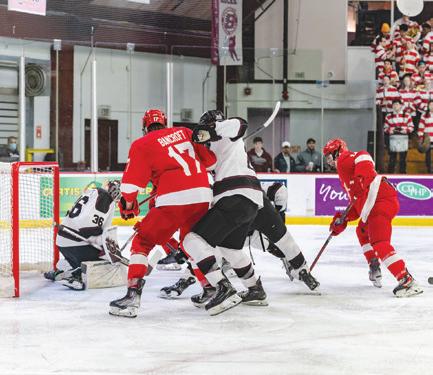
A strong all-around effort by red-hot men’s hockey (15-4-4, 10-4-2 ECAC) lifted the team over Union, 6-1. The win marks another road-trip sweep for the Red and extends Cornell’s unbeaten streak to 12 games — the longest unbeaten stretch by any Division-I team this year.
While the Red got a quick lead in the first, the game was stuck at a 4-1 score for much of the second and third period, much accredited to improved play by Union (1313-2, 7-7-2 ECAC).
Ultimately, two late goals worsened the score for Cornell’s opponent. Union outshot Cornell, 24-23, including in the third period where Cornell trailed 14-7 in the shot department.
However, Cornell overwhelmed the Garnet Chargers, which entered Saturday’s contest unbeaten in seven of its previous eight matchups. Freshman forward Jonathan Castagna buried two goals in the first period — and four points in the game — en route to the 6-1 victory.
Cornell earns another three points with the win, giving it 33 points overall. It still remains eight points behind first-place Quinnipiac after the Bobcats’ Saturday night win and maintains a five-point lead over Colgate after the Raiders’ shootout victory Saturday.
Cornell wasted no time getting on the board on Saturday night, as it established offensive zone time right off the opening faceoff. Castagna found the puck on his stick after a couple of preceding chances and fired it over the shoulder of the Union goaltender to give the Red a 1-0 less than five minutes in.
Union retaliated with a few chances of its own, but all were fended off by junior goaltender Ian Shane.
Though tested infrequently in the opening frame, Shane stopped the three shots he saw to maintain Cornell’s lead.
Bancroft, sending him into the boards beside the Union bench. Carter Korpi was tossed from the game on a major boarding call, sending Cornell to a 46-second 5-on-3 advantage into the ensuing 4:14 5-on-4 power play.
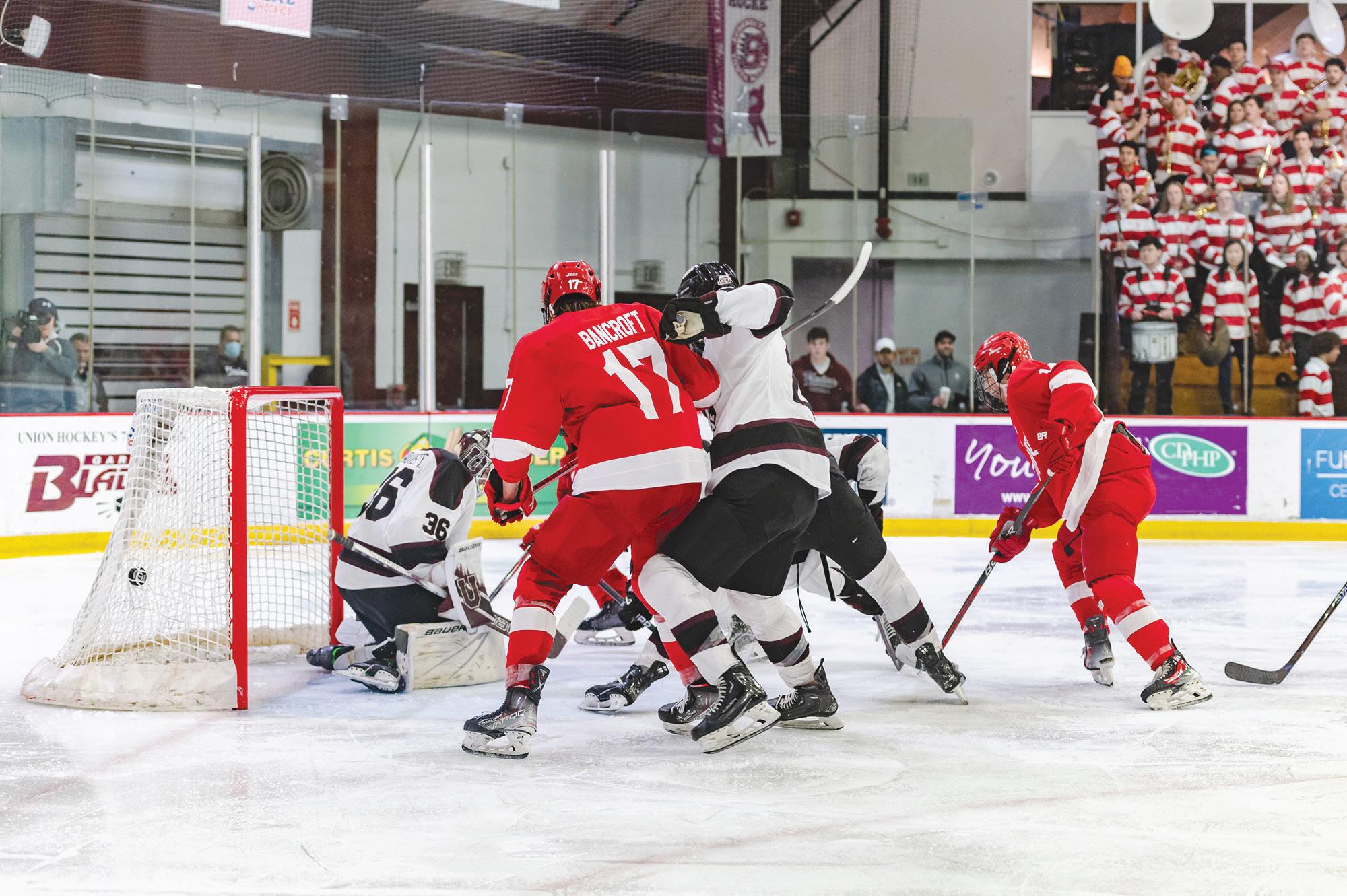
Shane’s save percentage improved to .922 after Saturday night’s victory, which stands as ninth-best in the nation. The netminder continues to lead the country in goals against average at 1.62.
Just a few minutes after the opening tally, the Red got on the board once again. It was Castagna again, this time cleaning up a loose puck to double Cornell’s lead.
The latter half of the first was highlighted by a potentially game-changing call. Already on the penalty kill, a Union skater made a hard hit on sophomore forward Dalton
However, Cornell couldn’t find an answer to the third-best penalty kill in the nation. It was a strong shower on the penalty kill for the Garnet Chargers — Union blocked three shots in the final four minutes of the period and nearly halved Cornell’s lead on a shorthanded breakaway attempt.
Despite having 1:42 left on the man-advantage to begin the middle frame, the Red struggled to generate much offensively. Union was quick to block shots and redirect shots from the Cornell power play unit and was aided by a handful of impressive saves by
Kyle Chauvette.
Chauvette was a large reason Cornell failed to extend its lead on the five-minute power play chance. The sophomore goaltender concluded the game with 17 saves, while Shane finished with 23 for Cornell.
Despite the major penalty, Union’s discipline was its weakness on Saturday, as another penalty six minutes into the second proved to be a pivotal mistake. The Cornell power play, though lacking on its previous opportunity, quickly retaliated to cushion the lead. Senior forward Gabriel Seger, fresh off of his 100-point milestone in Friday night’s victory over RPI, converted on the man-advantage.
With momentum on its side, Cornell continued to apply pressure in the Union defensive zone. The Red’s offensive prowess was rewarded yet again, its fourth tally of the night coming just 47 seconds after Seger’s goal. Junior forward Sullivan Mack, breaking into the offensive zone with speed, juked the Union goaltender and snuck the puck between the pads for his third goal of the season.
The two goals in the middle frame were a reward from Cornell’s stifling style of play — after 40 minutes, Cornell limited the Garnet Chargers to just 10 shots on goal, with an impressive three of those coming while Union was shorthanded.
Cornell didn’t leave the ice in the second period unscathed, as a power play tally by Cullen Ferguson spoiled Shane’s shutout bid.
To continue reading this article, please visit www.cornellsun.com.
Jane McNally can be reached at jmcnally@cornellsun.com.
By SAM KIMBALL and JANE McNALLY Sun Staff Writers
Down two with 3.2 seconds on the clock, Cornell had one shot to preserve its undefeated Ivy League record. But after a last-second heave from junior guard Nazir Williams back-rimmed out, its undefeated Ivy League record was no more.
Having each won their six Ivy League matchups thus farw, men’s basketball (17-4, 6-1 Ivy) and Yale (16-6, 7-0 Ivy) took the court on Saturday, Feb. 10 in a battle to remain undefeated in the conference. After a strong first half from the Red, a second-half comeback from Yale led to a heartbreaking defeat, giving Cornell its first Ivy League loss of the season.
“We fought hard,” said head coach Brian Earl. “From the untrained eye, I think we looked pretty good. But there are some things we need to work on.”
Prior to Saturday afternoon’s game, Earl emphasized the importance of playing a complete game against Yale, particularly alluding to Cornell’s appearance in the Ivy League Tournament in 2023. The Red underwent a similar second-half lapse in the 80-60 loss on March 11, 2023.
“[In] the second half of [the 2023 Ivy League Tournament] game, we fell apart a little bit. We had it where we wanted it in the first half,” Earl said.
The Red took advantage of costly turnovers from Yale in the first 20 minutes of Saturday’s game, holding an 11-2 advantage in points off turnovers. However, second-chance points by the Bulldogs ultimately contributed to the Cornell loss.
“Sometimes, you make shots. We made a couple [of] hard ones in the first half but [there were a] couple of open three [pointers] we missed that maybe went in the first half,” Earl said.
The first seven minutes presented an even battle between both teams, with Williams and senior guards Chris Manon and Isaiah Gray leading the way for the Red. After freshman guard Jake Fiegen knocked down a three with 15 minutes left in the half, Cornell controlled the momentum, with their lead growing to as much as 15 points.
The Red held the advantage in both field goal percentage and three-point percentage throughout the first half, going 16-28 (57 percent) and 7-13 (54 percent) respectively. This efficient shooting contributed to Cornell’s eightpoint halftime lead.
Despite the lights-out first half that showed Cornell could hang with the strong Yale squad, Earl was quick to deflect praise, focusing on the game’s outcome.
“You have to acknowledge you lost,” Earl said. “We know we can play hard and win most of our games in the league, but in the end, you have to win the actual game.”
In the second half, Yale came out with energy, driving to the paint, drawing fouls and earning free-throws. Midway through the half, the Bulldogs scored six straight points to shrink the lead to a singular point.
Yale shot the ball better in the second half, improving their 10 percent three-point shooting and 44 percent fieldgoal shooting to a strong 50 percent in both categories. Their improved production and continued capitalization of second-chance points helped the Bulldogs claw their way back into the game.
The Red’s lead continued to fluctuate throughout the final 10 minutes. After Cornell led nearly the whole game, Yale went on another 6-0 run, tying the score with four minutes left following a jumper by forward Danny Wolf.
Wolf was dominant for Yale, leading all players with 25 points. The Red’s scoring was driven largely by Manon’s
22 points, but also by its bench, which accumulated 26 points.
With 1:30 left, a foul by Gray brought Yale guard August Mahoney to the line to shoot two. Mahoney went 1-2, but Cornell could not respond as they missed two three-pointers with one minute left in regulation.
“[Yale is] a really tough team,” Earl said. “It takes everybody doing the right thing all the time to beat a team like that.”
A turnover by Yale with 37 seconds remaining gave the Red life, as Manon hit a difficult jumper in the paint to take the one point lead. Seconds later, the Bulldogs missed a shot of their own but grabbed the offensive rebound and took a quick timeout with only four seconds remaining.
Yale guard Bez Mbeng inbounded the ball and found forward Matt Knowling who made a jumper and drew a foul from Gray to put the Bulldogs up 79-78. A free-throw would extend the lead to 80-78, where the game ended.
With the heartbreaking loss, the Red dropped to second place in the Ivy League, with a chance at redemption against Yale at home in a couple weeks time.
“[We have to] keep playing our brand of basketball. We need to improve on a couple things, including rebounding, playing our pace at the end of the game and covering up some coverage issues,” Earl said. “Those are the little technical things we need to clean up, [but we need to] make sure that we’re doing everything we need to do to hang with them [next time].”
The Red takes on Harvard (12-8, 3-4 Ivy) at 6 p.m. on Friday, Feb. 16 at Newman Arena.
Sam Kimball and Jane McNally can be reached at skimball@cornellsun.com and jmcnally@cornellsun.com.