Sticker price to increase 3.6 percent for 2019-2020 academic year
By MARYAM ZAFAR and SARAH SKINNER
Sun Staff Writer and Sun Assistant News Editor
Rising seniors who receive no financial aid will have had their tuition costs rise 11.5 percent since they committed to Cornell.
“We’re
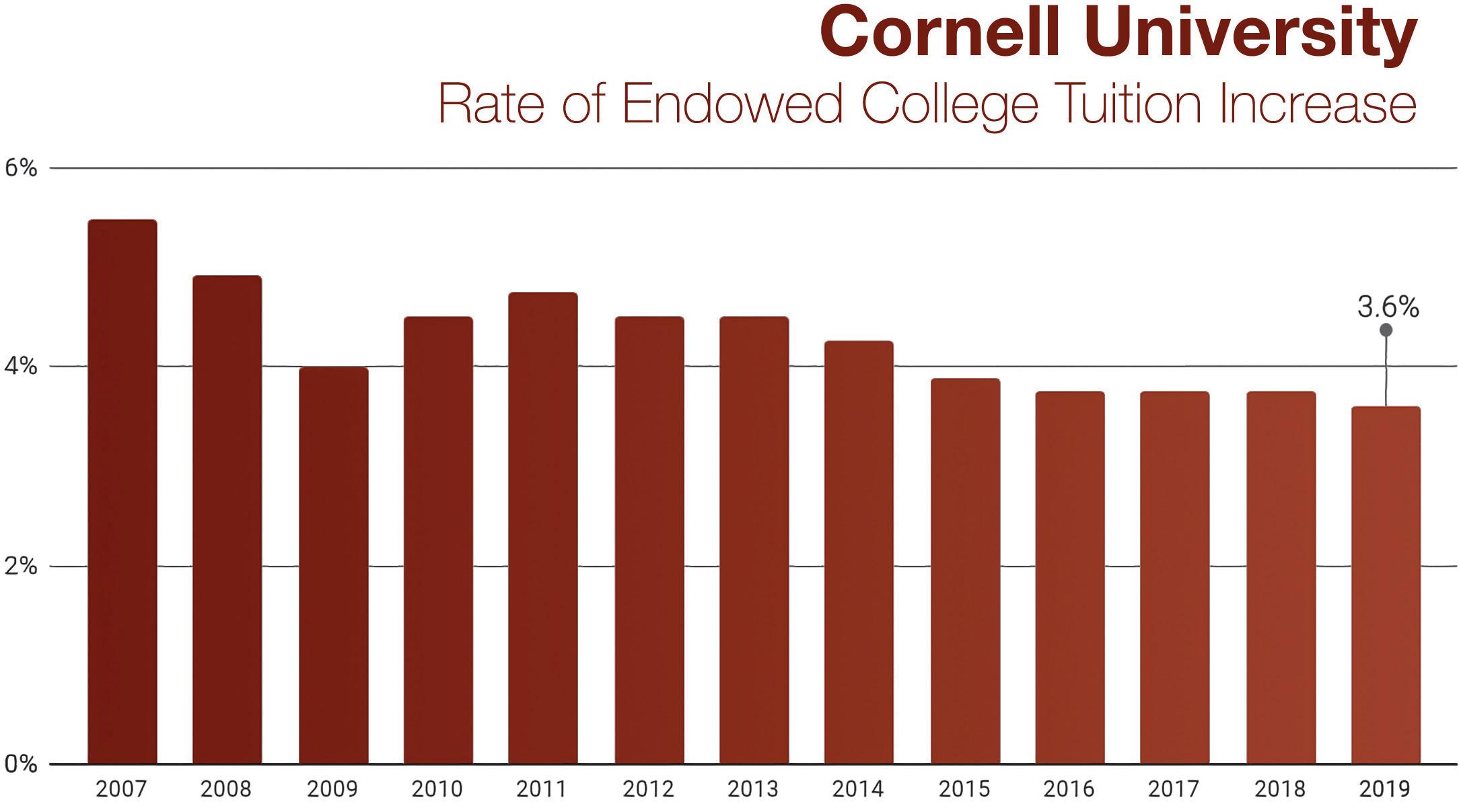
Cornell will raise tuition for both endowed and land-grant colleges by 3.6 percent for the upcoming academic year, the University announced today, the lowest proportional tuition increase in years. The rise — $1,966 for endowed colleges and $1,316 for land-grant schools — is 6 dollars less than last year’s increase.
at its meeting in New York City, which convened at the medical college and which President Martha E. Pollack attended.
Cornell’s 3.6 percent increase in tuition compares to a 5 percent jump for Brown University and a 3.8 percent hike for Yale University. Cornell's cost of attendance — including housing and dining — will equal $71,796 for students in endowed colleges and $53,126 for New York residents in a land-grant college.
not socioeconomically diverse. We don’t look like the rest of the country.”
Provost Michael Kotlikoff
Provost Michael Kotlikoff said in an interview Sunday that students receiving University financial aid will see “no net increase” in tuition owed next year, even as the sticker price increases.
The Board of Trustees approved the budget bump on Feb. 1
The University practices “needblind” admissions for domestic students, Kotlikoff said, but is pouring roughly $2 million into initiatives to boost socioeconomic diversity by encouraging lower-income students to apply. One way to do this is to make it easier for undecided, financially challenged students to choose Cornell by offering competitive aid packages, he said.
See TUITION page 4
Bree Newsome Refects on King’s Ascent —
By AMINA KILPATRICK
Sun Staff Writer
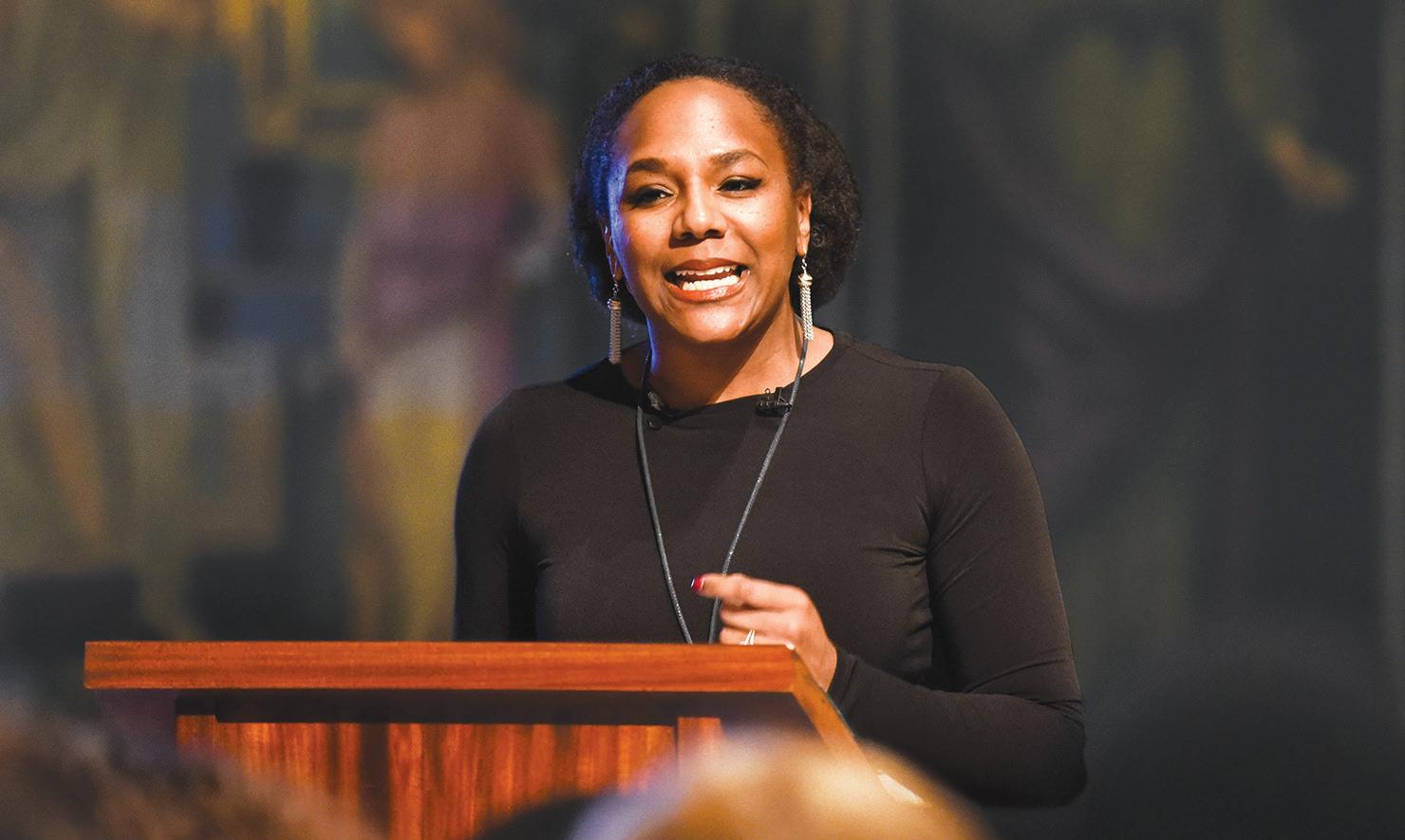
Civil rights activist Bree Newsome gave an invigorating lecture Monday in Cornell’s Sage Hall on the legacy of the Rev. Dr. Martin Luther King, Jr. and her own motivation for scaling a 30-foot flagpole in front of the South Carolina statehouse in 2015 to remove the Confederate flag that had flown there for decades.
There was no question-and-answer session after the speech and attendees were asked to quickly leave Sage Chapel because of a suitcase reported as suspicious. But Cornell Police said late Monday that the suitcase did not pose a threat and was simply left by a student who was using the bathroom.
“Upon investigation, officers quickly determined that the bag belonged to a student who was located nearby,” Deputy Chief David Honan, who is taking over next month as chief, said shortly before 10 p.m. the same night.
“The student told officers that he needed to use the restroom and left the bag because he didn’t want to create a disturbance. The bag was determined to not pose a threat and Sage Chapel will be reopened shortly.”
Newsome, a Charlotte, N.C., native, told Cornellians and Ithacans that she was inspired to take matters into her own hands in 2015 following the murder of nine black parishioners in a Charleston,
Snow, Ice, Sleet Predicted for Ithaca Today
By NICHOLAS BOGELBURROUGHS Sun City Editor
The National Weather Service on Monday upgraded a winter storm watch to a winter storm warning for Tompkins County, predicting that Ithaca could receive between 6 and 8 inches of snow between early this morning and Wednesday’s sunrise. It could be hard for many Ithacans and Cornellians to get both to work and back home.
Snow is expected to begin falling on Tuesday morning and get heavier during commuting hours and around lunchtime. Then, in the afternoon, snow will mix with sleet and freezing rain and continue through Wednesday morning. The government weather service’s warning is in effect from 3 a.m. Tuesday to 7 a.m. Wednesday.
“[Cornell just isn’t] in the heaviest snow bands, whereas they might be just 15 miles away.”
Jack Sillin ’22
The roads could be “very icy for the afternoon and evening commute,” said Jack Sillin ’22, an assistant forecasting chair for the Cornell chapter of the American Meteorological Society. Sillin predicted that Cornell’s campus could see about 3 to 5 inches of snow before the precipitation turns into sleet and freezing rain in the early afternoon. He explained that the City of Ithaca — and to a lesser extent, Cornell — al-
See SNOW page 4
and a Climb of Her Own
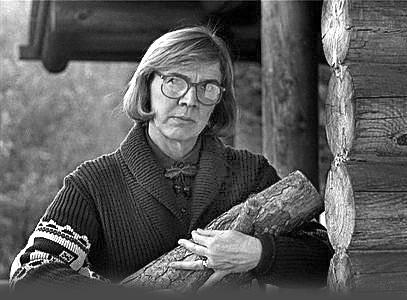
Rise | Bree Newsome, who rose to fame after scaling a flag pole to remove a Confederate flag, speaks at Sage Chapel on Monday night.
BORIS TSANG / SUN ASSISTANT PHOTOGRAPHY EDITOR
All Labor Has Dignity:
Martin Luther King Jr. and the Labor Movement
8 a.m. - 5 p.m., 227 Ives Hall
Cornell Art Faculty 2019
10 a.m. - 5 p.m., Floor 2L, Gold Gallery, Johnson Museum of Art
Medicare Basics Noon - 1 p.m., East Hill Office Building
Plant Metabolic Diversity: Evolution and Applications 12:20 p.m., 135 Emerson Hall
Judged for More Than Her Crime: Women on Death Row
12:30 - 2:30 p.m., Zhu Faculty Room, Cornell Law School
Internal Transfer 1:1 Help
3 - 5 p.m., Tatkon Center for First-Year Students
ORIE Colloquium: An Aggregative Game Framework for the Analysis of Socio-Technical Systems 4:15 p.m., 253 Frank H. T. Rhodes Hall
9th Annual Cornell Student Topical Sermon Contest 4:30 p.m., Founders Room, Anabel Taylor Hall
Gilets Jaunes in France
4:30 - 6:30 p.m.., Guerlac Room, AD White House
The Resistance: The Dawn of the Anti-Trump Opposition Movement 4:30 - 5:30 p.m., Room 106G, Olin Library
Galentine’s Day at mannUfactory 5 - 6:30 p.m., mannUfactory makerspace, Mann Library
Procrastinate at the Straight 6 - 8 p.m., lobby, Willard Straight Hall
Cornell Cafes Discard Excess Food After Closing
Despite campus food insecurity, cafe food tossed, not donated
By GABRIELLE GONZALEZ Sun Contributor
When Libe Cafe closes, employees fill trash bags with sushi, salads and pastries. This food — which had been for sale just hours before — will all be thrown out.
Despite being a major stop on campus for sleep-deprived and hungry students, Cornell cafes and coffee shops do not follow recently-introduced sustainability initiatives that regulate the handling of food waste at most dining halls and lunch spots. Trillium, the Ivy Room, Martha’s Cafe and other lunch eateries on campus have compost bins for patrons to use.
Cornell’s current compost facility, which was constructed in 1992 and is located one mile off campus, turns 4,000 tons of organic waste into compost each year. Cornell Dining alone provides 850 tons of this food waste, while the rest comes from animal bedding, manure and plant debris.
Most of Cornell Dining’s compost is generated during the cooking and preparation process, according to Karen Brown, director of Campus Life Marketing and Communications. This includes unusable parts of vegetables, bones from meat products, coffee grounds and paper towels. All kitchen facilities must partake in this process called “pre-consumer” composting.
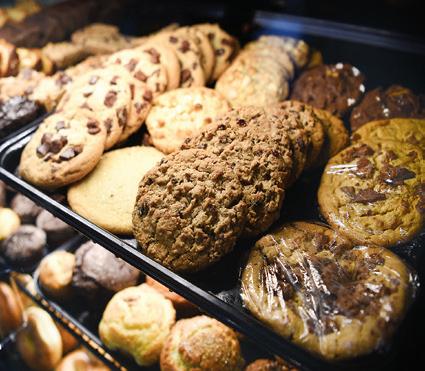
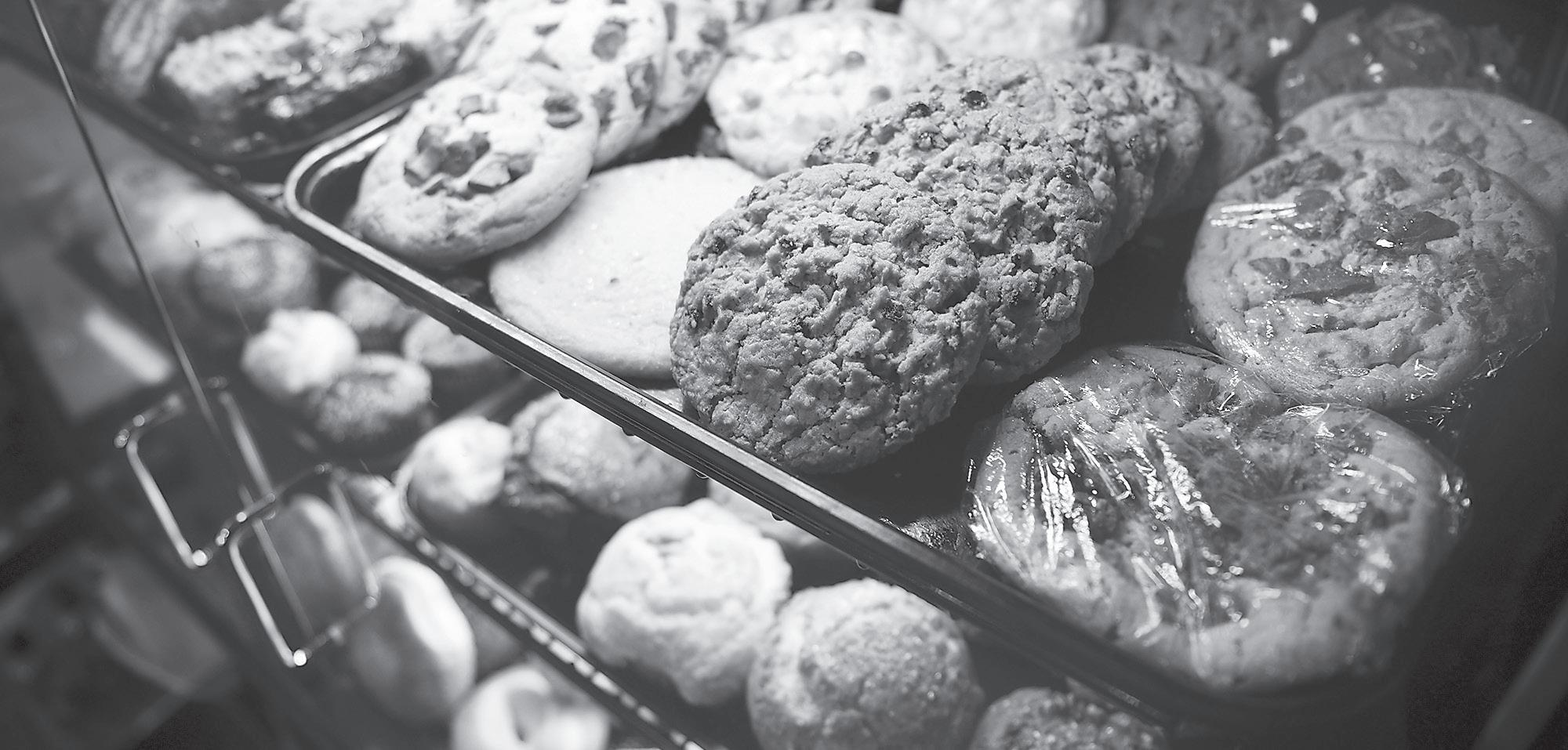
But not included in those 850 tons are the pastries, sushi and expiring grab-and-go items from cafes across campus, such as Amit Bhatia Libe Cafe and Carol’s Cafe, according to Joshua Gathany, a manager for Libe Cafe. Instead of being donated or composted, leftover items such as salads, sandwiches, cookies and cupcakes are often thrown away daily.
said that they had occasionally or often skipped meals in order to save money. This is up six percent from just two years prior.
Beyond Cornell, 12.5 percent of residents and 20 percent of children in Tompkins County and surrounding areas are food insecure, according to Feeding America.
Several student associations have formed to address this issue. The Cornell Food Recovery Network sets out to eliminate dining hall waste by donating leftover food to local food pantries. Currently, FRN is partnered with Cook House, Becker House, Okenshields and RPCC dining halls.
“We save cookies for the next day, things without frosting. Bagels get thrown away, but that’s a very small amount.”
Joshua Gathany
Libe Cafe attempts to limit the amount of food waste they create by saving the baked goods that will stay fresh to the next day.
“We save cookies for the next day, things without frosting,” Gathany told The Sun. “Bagels get thrown away, but that’s a very small amount. Things with frosting such as cinnamon rolls [also get thrown away], but we almost always sell out of those. Croissants get thrown away.”
Due to a lack of space, and the fact that Libe Cafe does not prepare food items on the premises, there is no compost receptacle, according to Gathany. Libe Cafe also does not currently partner with any organizations to donate their leftover items.
While this food is thrown out, there are many Cornell students that struggle with food insecurity. According to a Cornell PULSE survey in 2017, 28 percent of respondents
However, some students are turning towards more unconventional means. A GroupMe group, in which members update each other on free food events happening on campus or if there is leftover food after club meetings, has over 3,400 members.
Current group owner Moriah Adeghe ’21 believes it’s an important resource for those who may be food insecure on campus.
“I think that the Free Food GroupMe does a lot of good as far as trying to help people find food when they might be out of meal swipes or low on BRBs,” Adeghe told The Sun in a GroupMe message. “It can’t really be used in place of a meal plan for sure, but it can definitely help on those nights where you aren’t sure where, or if you can even buy food.”
Currently, extra food from Cornell cafes are not deliberately marketed to the group chat.
For those working in the campus cafes, any food that is set to be thrown out at the end of the night is up for grabs by the employees. Samantha Annunziato ’20, who works at
Carol’s Cafe in the Tatkon Center, usually takes bagels and other pastries home for her roommates.
“Some days [the amount of food waste] is fine. Like today, it’s not that much,” Annunziato said, and gestured toward the leftover bakery tray still full with cookies, danishes, cupcakes and other goods. “Other days, it’s a lot more.”
Despite the system’s flaws, Cornell Dining is making an effort to monitor the amount of food left over through the use of waste logs required in every cafe. Managers read these reports weekly and adjust their food orders accordingly, Brown told The Sun.
Brown seemed optimistic about the impact of the waste logs. “We’ve generally been seeing a decline in the numbers [of food leftover], with individual units curbing their waste,” she said.
Moreover, grab-and-go items such as salads and sandwiches are consolidated each Friday from the eateries open only on weekdays, and transferred to facilities that are open through the weekend.
According to Gathany, Libe Cafe is efficient at minimizing their food waste.
“We pay attention to our ordering practices, we record how much we throw away, we forecast how much to order based on sales,” Gathany said.
However, Cornell Dining remains open to new policies or initiatives.
“For the future, we’re continuing to work toward a campus where as much food as possible is eaten, rather than discarded because it can no longer be served,” Brown said. “I’m sure there will be new programs in the future that we haven’t even considered yet.”
gkg24@cornell.edu.
OurBus Now Ofers Year-Round Route to Long Island
By HNIN EI WAI LWIN Sun Staff Writer
The trip to Long Island has now become easier for Cornellians. OurBus, a transportation service that operates in the area, has added a year-round route between Ithaca and Long Island, with stops along the North Shore of Long Island.
The route runs on Fridays and Sundays, with extra trips added for school
finally Calverton, a Suffolk County town located near the Hamptons.
Rather than owning or operating buses, OurBus matches popular routes with charter bus companies, in coordination with spikes in demand.
In the past, OurBus only offered trips between Ithaca and Long Island near holidays and school breaks. The weekend route was added because of students’ request for a more regular schedule, Sa-
land have already bought tickets because of the convenience of the new route and the upcoming February break. Jibran Gilani ’20 was one of those students.
“The final stop is incredibly close to my house, which makes it a lot more convenient than stopping at Port Authority Bus Termi -
Station and the LIRR, which costs extra as well.”
When Eli Serrano ’20 took the bus home, she would have to take the bus to New York City, and then transfer to the Long Island Rail Road.
“The final stop is incredibly close to my house, which makes it a lot more convenient.”
Jibran Gilani ’20
“[The transfer] added a lot of time to my trip,” Serrano told The Sun.
The University, which is reevaluating their permitting process, has yet to give OurBus permission to pick up students directly from campus, according to Matuke. The service currently collects passengers from the Green Street Pharmacy, which has been Ithaca’s primary regional bus hub since last year’s closure of the Ithaca Bus
OurBus also offers routes to New York City, Washington, D.C., Philadelphia and Allentown, Pennsylvania.
In the future, OurBus hopes to provide regular service between Ithaca and Boston as well. OurBus prices from Ithaca to Long Island currently start at $25, according to OurBus’s website.
Hnin Ei Wai Lwin can be reached at hwailwin@cornellsun.com.
Donut dump | Cinnamon rolls, croissants, bagels and pastries with frosting are thrown away after Libe Cafe closes.
BORIS TSANG / SUN ASSISTANT PHOTOGRAPHY EDITOR
Gabrielle Gonzalez can be reached at
Busy buses | Students going to Long Island can now travel with OurBus every weekend.
COURTESY OF OURBUS
Storm Warning Issued, 6 to 8 Inches Expected
SNOW
Continued from page 1
ways receives a lighter snowfall than surrounding areas in the county because of its relatively low elevation.
“Downtown Ithaca will get even less snow than Cornell or places like the airport,” he said. “That’s because as air moves downhill along Cornell’s campus and down to the Commons, it dries out, and that will lead to less precipitation and warmer temperatures.”
Wind gusts could reach up to 35 miles per hour, with the wind chill on Tuesday expected to dip down to 13 degrees at some points. Sillin said that Tuesday will likely be “windy enough to make the walk around outside unpleasant, but not enough to cause any damage.”
lack decided to keep the University open in the face of a predicted wind chill as low as minus 29 degrees. Before that, in March 2018, Cornell declared a snow day amid predictions of about half a foot of snow, even though Ithaca ultimately received less than 4 inches, according to the Northeast Regional Climate Center.
Today will likely be “windy enough to make the walk around outside unpleasant, but not ... cause any damage.”
Jack Sillin ’22
Sillin said the storms are like “complex puzzles to solve” and that every storm “provides a unique challenge” both to Cornell student forecasters and to those at the National Weather Service’s nearest forecast office in Binghamton.
Tuition to Increase by 3.6 Percent
TUITION
Continued from page 1
“We’re not socioeconomically diverse,” Kotlikoff said of the undergraduate study body, 55 percent of whom do not receive Cornell grant aid. “We don’t look like the rest of the country and that’s why we’re trying to do whatever we can to try and improve that socioeconomic balance.”
A university’s “yield rate” shows what proportion of students who are offered spots choose to attend that school. Cornell has a yield rate that fluctuates between about 55 and 75 percent, Kotlikoff said; that rate is stratified by income quintiles, but the provost did not share those specific yield values stratified by income with The Sun.
“That’s where they go really, really in-depth over those numbers,” Munasinghe said, noting that while they are allowed to attend finance committee meetings, they had other meetings scheduled at the same time.
Cornell’s tuition has climbed every spring for at least a decade. Last year, tuition increased by 3.75 percent over the previous $52,612 figure.
The cost of an on-campus double room in a residential hall will increase to $9,152 per year, according to Kotlikoff — the same 3.25 percent increase as dining costs.
er than Cornell’s operating budget last year, which was projected to be $2.3 billion.
This reflected a net budget surplus that was “about the same,” as this year’s, Kotlikoff said.
Other future expenditures will require the University to take out a loan.
“North Campus will be built on debt that the University is taking to be able to build that housing,” Kotlikoff said, describing North Campus Expansion Plan costs that he projected at around $250 million.
New York State Electric and Gas Co., or NYSEG, said in an email to customers that it was monitoring the weather and had resources available “to respond to any reports of downed power lines and outages from storms.”
Cornell administrators were on the receiving end of an unsurprising student backlash last month, when President Martha E. Pol-
“It’s been a tricky series of storms, where we’ve gotten stymied here in Ithaca,” Sillin said. “The tiny minutiae of the system just don’t align for us to be in the heaviest snow bands, whereas they might be just 15 miles away.”
Sillin said the student meteorologists would be posting updates on the society’s Twitter account, @CornellWeather. The National Weather Service’s warning covers much of Central New York and northeastern Pennsylvania.
Nicholas Bogel-Burroughs can be reached at nickbogel@gmail.com.
“Our yields in every socioeconomic status in every socioeconomic class is above 55 percent,” Kotlikoff said. “And it goes up above 75 percent in some. We continue to have very high yields and we’re being very selective; I just want to make the point.”
Other Ivy League universities have higher yield rates than Cornell. “I think about Cornell as the most democratic Ivy,” Kotlikoff said.
Kotlikoff said students have a voice in the budgetary process, in part because of the two student trustees who sit on the Board and because of presentations that he said he gave to the Student Assembly.
Neither Dustin Liu ’19, the undergraduate trustee, nor Manisha Munasinghe grad, graduate student trustee, sit on the Board of Trustees’ finance committee.
Looking forward, the University has big plans for its budget, Kotlikoff said, adding that many costs will continue to increase for Cornell in the coming years. He highlighted mental healthcare spending over the last three years and Title IX litigation as costs that have grown recently.
Cornell’s largest source of revenue is students’ tuition, according to Kotlikoff. The biggest cost will continue to be staff and faculty salaries, wages and benefits, on which the University spent 55.1 percent of its budget last year.
Cornell currently employs 1,679 faculty members and 8,392 staff members. A 2016 survey conducted by Cornell’s Human Resources department found that 46 percent of Cornell employees “did not feel fairly compensated” for the work they perform.
Kotlikoff said the anticipated operating budget for the Ithaca campus for the upcoming fiscal year is about $2.06 billion, small-
With 2,000 new freshman and sophomore beds, Cornell will grow its undergraduate population by 900 total students, whose tuition payments will help pay off the project’s 30-year loan term, Kotlikoff said.
Cornell has already borrowed some money for the project — less than $50 million — to “get going,” Kotlikoff said, while the University shops around for the best lending strategy.
Kotlikoff also confirmed Sunday night that the same summer earnings expectation — staggered based on class year — will remain in place this upcoming year despite a petition that earned hundreds of signatures from students.
Kotlikoff did acknowledge frustration with steep growth rates seen across higher education.
“I think the rate of growth of costs [in] our Universities — it is a problem.”
Maryam Zafar can be reached at mzafar@cornellsun.com.
Sarah Skinner can be reached at sskinner@cornellsun.com.
The Corne¬ Daily Sun
Activist Refects on King, And Her Own 2015 Climb
S.C., church by a white supremacist. At Cornell, she recited the names of all nine who were killed in the Emanuel AME Church during a bible study service.
“They were only doing what Christians are called to do when knocks come to the doors of the church, which is to invite them into fellowship and worship,” she said.
Throughout her speech, Newsome weaved in messages from King, who himself visited campus in 1961. She said peaceful activism does not have to be passive and that non-violence is not the same as being non-disruptive.
“It’s not simply about, as King said, cooperating with the good, it is about actively refusing to participate in and cooperate with oppressive systems,” Newsome said.
Among the catalysts that brought Newsome to activism were the election of Barack Obama in 2008, subsequent efforts by states to suppress black and Latino voters and the killing of Trayvon Martin in 2012. At that point, she got involved with her local NAACP and began organizing, which ultimately led to her planning and carrying out the yanking of the Confederate flag from its perch.
society. When machines and computers, profit motives, and property rights are considered more important than people, the giant triplets of racism, materialism and militarism are incapable of being conquered.”
“This transformation that King describes that we must undergo as society is the process of decolonization,” Newsome said. “He didn’t use that term, that is in more popular usage today, but that is the process that he is effectively describing.”
She said that despite what many people may think, colonialism has not ended in the U.S. because there has not been a reparations process.
“Modern colonialism or neocolonialism, looks like my community in Charlotte, North Carolina, where those who form the labor to make the city operable struggle to survive,” she said.
Newsome encouraged everyone at the lecture to apply their
“Modern colonialism or neocolonialism, looks like my community in Charlotte, N.C., where those who form the labor to make the city operable struggle to survive.”
Bree Newsome
own talents and abilities to contribute to social activism.
“Social movement looks like thousands of people doing thousands of things in a thousand different places,” she said.
“As I scaled the flagpole, my climb would represent the century-long struggle to dismantle white supremacist systems,” she said, recalling her planning for the action.
She said that history will “rightly remember” James Tyson — a white man who aided in her effort to remove the
As the crowd clapped at the end of Newsome’s lecture, the Rev. Daniel T. McMullin, director of Cornell United Religious Work, asked people to quickly make their way to the chapel’s two exits because of the unattended suitcase.
“Friends, for reasons of safety, let me invite you to leave the building as quickly and quietly as possible,” he said. “I can’t say more than that, but there is a situation that we need to attend to.”
“As I scaled the flagpole, my climb would represent the century-long struggle to dismantle white supremacist systems.”
Bree Newsome
Confederate flag — “alongside the many allies who over the century have risked their own safety and in some cases spilled their own blood in defense of black lives and in the name of freedom.”
“James’s presence would serve as a reminder that the work of dismantling racism cannot be the labor of the oppressed alone, but must be actively undertaken by those who benefit from the perpetuation of racist policies,” she said.
Newsome closed the lecture by discussing the need to “decolonize,” and she detailed ways people can be activists in their everyday lives.
She quoted King as saying, “We must rapidly begin the shift from a thing-oriented society to a person-oriented
People calmly made their away along pews and out of the building before later learning that the suitcase was never a threat.
Delmar Fears ’19 said she and others saw the suitcase and were worried that someone was targeting the event because of its civil rights message. Many people were initially shaken after leaving the speech.
“There were some people who were really scared,” said Fears, who previously served as a co-chair of Black Students United. “I have friends who are at [Collegetown Bagels] right now eating their feelings and calming down.”
Nicholas Bogel-Burroughs ’19 contributed reporting to this article.
Amina Kirkpatrick can be reached at akirkpatrick@cornellsun.com.
Cornell Students Assist With Medical Clinics on MEDLIFE Brigade to Lima, Peru
From Ithaca to Latin America: Cornell volunteers work to aid global health disparities through community service
By SABRINA XIE Sun Staff Writer
Morgan Hubbard ’20 knows zero
cologist, a toothbrushing workshop and a development project, according to Hubbard.
On the first day of the brigade, Hubbard’s group began working on their
breaking a bottle of champagne on the site while a band played and children danced in traditional clothing.
Throughout the rest of the week, Hubbard shadowed a doc
working with the MEDLIFE doctors, her most lasting memories came from personal interactions with the patients.
“I gave her ibuprofen or something that she needed, nothing big, but she started crying and gave me kisses on the cheek.”
Morgan Hubbard ’20
Each day, students would rotate through different stations: dental care, triage, pharmacy, obstetrician and gyne-
paint the staircase.
“In a biased way, I think it was the hardest day. There was concrete at the bottom and we had paint buckets that we were passing, one by one, up the hill...there were some buckets flying,” Hubbard said.
“It’s not an easy thing to do but it’s a small thing that makes a big impact there,” she continued.
When the staircase was completed and painted red, the community celebrated by
Southern Lima. Students acted as informal medical and dental assistants, working in tents that were set up roadside.
“If you want to even shadow [in the U.S.], you have to go through 800 hoops and sign forms and take classes just to get there. But there, you just jumped in. You’re really in there with them, it’s a hands-on experience that you can’t get here,” Hubbard said.
While Hubbard learned a lot from
“There was a woman who, when I gave her her medication at the pharmacy station, she started crying,” Hubbard recalled. “I’m not sure what I gave her — I think I gave her ibuprofen or something that she needed, nothing big, but she started crying and gave me kisses on the cheek.”
According to Hubbard, even providing basic hygienic tools like toothbrushes and toothpaste made a big impact. At the toothbrushing station, Hubbard and other students taught children how to brush their teeth — for the
“They could be up to 12 years old getting their first toothbrush,” Hubbard said. “It
“If I have a cold then I can just go to Cornell Health ... but for them, MEDLIFE will come however often they can. Even then it’s not enough. They deserve more.”
Morgan Hubbard ’20
seems like such a small thing until you’re with them like that and they’re so happy and you don’t realize … it really put things in perspective.”
Hubbard said that the experience also opened her eyes to the socioeconomic differences among global communities and how much medical aid could mean.
“If I have a cold then I can just go to Cornell Health, even if it’s not incredible, I can just walk over there. But for them, MEDLIFE will come however often they can. Even then it’s not enough. They deserve more,” Hubbard said.
Now, while back on campus, Hubbard is still providing help to the communities in Peru by contributing to MEDLIFE fundraisers, with a goal of helping to build the third floor of a community center in the Miraflores district.
MEDLIFE is currently accepting applications for their spring break brigade to Lima, Peru.
Sabrina Xie can be reached at sx235@cornell.edu.
ARTS & ENTERTAINMENT
Ralph Lauren Fails to Impress in New York
“It ain’t no Ralph, though. What’s the name of your clothing line? We don’t know.”
Kanye West’s famed emotional interview on Sway’s Universe might have involved him unfairly putting down one of America’s favorite radio hosts, but it brings up a point — when it comes to quality and consistency, no one measures up to Polo Ralph Lauren.
But what does a six-year-old Kanye interview have to do with anything right now?
Last week, Ralph Lauren released a statement about the brand’s intention to orient their business more towards a younger demographic. It’s rare to see a brand be this open about their intentions, particularly one that’s so deeply entrenched in a WASP-y, Ivy League aesthetic. Almost unintentionally, Polo has its own roots in street culture, but this is really the first time they’ve ever formally attempted to market themselves specifically to younger audiences. In theory, this should’ve made their New York Fashion Week show the perfect chance to embrace this change; instead, they delivered a half-hearted attempt at appealing to younger audiences without seriously attempting to stray from the given Ralph Lauren formula.
One way to finally bridge the gap from prep to street is to embrace the subcultures that keep you viable with people outside of your target audience. Polo is a part of a myriad of subcultures, among them ’80s British dance, 90’s hip hop and modern day streetwear. Currently, vintage Polo is having a moment, which was first made relevant by Wu-Tang Clan rapper Raekwon during their “Can It All Be So Simple” music video and then re-popularized in the 2010s by streetwear icons such as Sean Wotherspoon and the A$AP Mob. It’s prevalence in ’90s hip hop and its resurgence in modern streetwear gives Polo a very solid foothold within youth culture to build on, yet Polo’s attempts to capitalize on this are half-hearted at best.
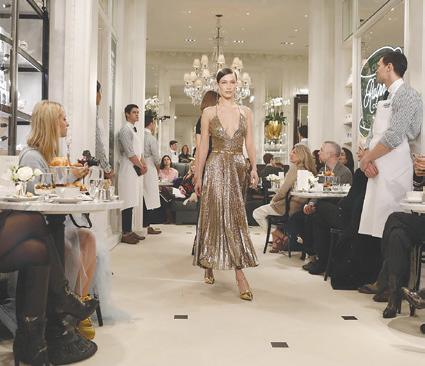
Ralph Lauren’s womenswear debut at New York Fashion Week felt like a boardroom interpretation of what youth might enjoy. The show took place within its Madison Avenue flagship store, where there is now a coffee shop — as some executive probably read a Facebook post about how millennials love coffee. Bella Hadid was the star of the show, which ordinarily would have been fine . . . too bad she was the face of the Kith x Versace campaign, which was a much better attempt at appealing to younger demographics. The whole event felt stuffy, from its classical music to its marble floors and Upper East Side location. Watching it, I couldn’t help but feel that they had fallen out of touch.
Apart from the coffee shop and Bella Hadid, it’s hard to see what differentiates this Ralph Lauren show from any of its predecessors. All of the clothes were standard Ralph — they were good, just not necessarily appealing to young people. This is a shame; Ralph Lauren is one of the only companies that makes its collections available for purchase immediately after their runway debut rather than waiting the standard six months. In a social media age dominated by constant, seemingly unlimited content, this could be a very legitimate branding strategy if Polo were willing enough to commit to its youth movement.
There is a very precedented way for Polo to capitalize on its already established reputation within youth culture. Collabs are incredibly straightforward and are a fantastic way to expose your brand to an entirely new audience. Winter 2018 saw Polo’s first collaboration through its collection with Palace Skateboards, the unapologetically British streetwear brand best known for roasting its own fans on Instagram. Ralph Lauren’s recent earnings report indicates that roughly 75 percent of the collection’s customers were first-time buyers of Polo, and on average are 10 years younger than the average Polo costumer. This report shows that even a brand as well established as Polo still has new avenues it can successfully reach.
Polo also can draw inspiration from Gucci and their embracing of 80’s custom-counterfeit legend Dapper Dan who styled everyone from Mike Tyson to Rakim. Embracing a fringe culture is a great way to expand your boundaries and show the world that you aren’t some stuck up country club brand reserved for private school kids. Polo has yet to do this, but something simple like a campaign with the Wu-Tang Clan and a line of reimagined retro wear could make Polo one of the top brands for a new generation.
For better or for worse, Polo finds itself at a crossroads. Their efforts to expand to younger audiences might require them to finally embracing some of the figures that helped keep Ralph Lauren relevant, such as Kanye and his famed pink polos or Sean Wotherspoon and the Polo bear. Either way, Ralph Lauren needs to commit fully to their youth movement. With a foothold in streetwear and its power as one of the most legendary American fashion brands, Polo Ralph Lauren has the ability to solidify its status for generations. However, sadly, they were unable to do so through their New York Fashion Week show last week.
Daniel Moran is a sophomore in the College of Human Ecology. He can be reached at dmoran@cornellsun.com.
DANIEL MORAN Sun Staff Writer
LANDON NORDEMAN / THE NEW YORK TIMES
136th Editorial Board
JACOB S. KARASIK RUBASHKIN ’19
Editor in Chief The Corne¬ Daily Sun Independent Since 1880
JOHN McKIM MILLER ’20
Business Manager
KATIE SIMS ’20
Associate Editor
VARUN IYENGAR ’21
Web Editor
MEGAN ROCHE ’19 Projects Editor
EMMA WILLIAMS ’19 Design Editor
JEREMIAH KIM ’19
AMOL RAJESH ’20
BREANNE FLEER ’20
YUICHIRO KAKUTANI ’19 News Editor
NICHOLAS BOGEL-BURROUGHS ’19 City Editor
Editors in Training
Editor in Chief Meredith Liu ’20
Associate Editor Ethan Wu ’21
Managing Editor Anu Subramaniam ’20 Sarah Skinner ’21
GIRISHA ARORA ’20
Managing Editor
HEIDI MYUNG ’19
ALISHA GUPTA ’20 Assistant
DYLAN McDEVITT ’19
MICHAEL LI ’20
GRIFFIN SMITH-NICHOLS ’19
JACQUELINE QUACH ’19 Dining Editor
SHRUTI JUNEJA ’20 News Editor
ANU SUBRAMANIAM ’20 News Editor
JUSTIN J. PARK ’19 Multimedia Editor
Working on Today’s Sun
Desker Nicole Zhu ’21
Sports Desker Christina Bulkeley ’21
Production Deskers Sabrina Xie ’21 Ben Mayer ’21
Editorial
Cornell, You May Be a Fan Of Hills, but Where Does Tis One End?
WHAT FOLLOWED THE BOARD OF TRUSTEES ANNOUNCEMENT ABOUT THE THE 2020 FISCAL YEAR BUDGET AND THE CORRESPONDING 3.6 PERCENT TUITION HIKE? An implicit announcement aimed at members of the Class of 2020: their tuition has increased 11.5 percent since they committed to the Red.
The University boasted that this tuition rise was the smallest in recent years. This year’s increase comes in at $6 less than last year’s raise — that’s a single venti coffee with a shot of espresso at Cornell Dining, to put things in perspective.
Maybe Cornellians should consider themselves lucky. It’s an average 3.6 percent rise in tuition, compared to Brown’s 5 percent and Yale’s 3.8 percent. From the University’s perspective, the increase — $1,966 for endowed colleges and $1,316 for land-grant schools — might seem like chump change.
But, we hate to break it to you: Though universities may be need-blind, students are not.
Provost Michael Kotlikoff told The Sun that “Cornell is not socioeconomically diverse.” Maybe that’s because a limited scope of people can handle year-to-year $2,000-increases with a few months notice.
This latest announcement is indicative of a gross trend in the United States — ballooning tuition costs.
Today’s tuition, ringing in at a solid $56,550 for endowed college students and $37,880 for contract college side, does not consider the additional costs students are expected to shoulder. Like the 3.25 percent increase in room and board (which puts the true cost of attendance over $71,000 for endowed colleges). Or textbooks. Or a bus pass. Or travel costs.
A tuition increase itself is not criminal. But Cornell, where does this end?
The tuition in 1968 also rose. It took climbed by $150, to $2,200. So it seems that Cornell raising its tuition is one of the more consistent things over the past 50 years. But Cornell, if you add up our four-year tuition, it is more than the median price for a home in the United States. A house, or a degree?
Should students assume that this increase in tuition is indefinite? Will today’s graduates be able to afford tuition if their children chose to come here? If the current four-year trend continues, tuition will double every 20 years. Just imagine: In a generation, your proud Big Red family could be cutting a check to Cornell for $142,000 … per year.
If Cornell really is the most “democratic” Ivy, and if these changes are for the students, then this needs to stop. If we want to economically diversify our school, we should find more options to make it affordable and not remain on this indefinite incline of tuition increases.
This year’s smaller jump is a start — and we’ll certainly enjoy that “extra” venti coffee with a shot of espresso (we at The Sun certainly need it). Not only does Cornell’s ever-heftier price tag scare people, but the thought of being asked to produce $2,000 more for the next school year to continue one’s education can be downright panic-inducing. And that’s not even considering the long-term implications of this Sisyphean endeavor.
It’s more clear than ever that something needs to change. We were the first IvyLeague to accept women, why not try and be a tuition trailblazer, too?
Editorial
Te Sun Endorses Spring 2019 S.A. Special Election Candidates
AFTER LAST YEAR’S MEME-FRACAS, ONE MIGHT BE FORGIVEN FOR WIPING THE STUDENT ASSEMBLY FROM MEMORY , or perhaps just forgetting that positions beyond that of the president exist. But that would be a mistake.
Starting Tuesday at 9 a.m., and continuing until noon Feb. 14, students will have the opportunity to vote four new representatives onto the Student Assembly: one LGBTQ+ liaison, one first-generation student representative and two minority students liaisons.
Cornell’s unique system of shared governance and S.A. affinity representation creates seats at the table for communities long marginalized in higher education. But for such a system to work, undergraduates need to be active participants in the processes that undergird student governance, and that participation begins with elections.
Which is why Cornellians should care about voting in the upcoming S.A. special election. Each of the four open positions is on the S.A. Diversity Committee and in the general voting body of the S.A. Whoever wins will shape S.A. priorities — and thereby University policy — for vulnerable students groups demanding steadfast representation.
We reached out to all 12 S.A. candidates to discuss their platforms. After hearing from nine of them, here’s who The Sun endorses.
First Generation Student Representative At-Large: Grady Owens
Sociologists have long noted that the most prevalent hurdle first-generation students face is a cultural capital deficit. Essential skills that children of the college-educated take for granted — for example, how to navigate complex institutions, how to study, how to ask for help — can prove formidable for first-gens to learn.
Grady Owens ’21, a first-gen student himself, intimately understands these challenges. And he has a plan to help. In an email exchange with The Sun, Owens outlined his plan to foster ties between first-gens and faculty. The existing faculty advisor system, he noted, ought to cater more to the needs of first-gens. Owens would pair first-gens with faculty able to help out with the basics, like graduation requirements, study skills and using the library.
Optional programs teaching basic college skills already exist, of course. But first-gens may struggle knowing how to access such resources. That faculty advisor meetings are mandatory will create a touchpoint to give first-gen students the help they need to succeed.
We enthusiastically endorse Owens and hope his idea will someday soon become reality.
LGBTQ+ Liaison At-Large: Uche Chukwukere
It is easy for us to support Uche Chukwukere ’21. Chukwukere’s constructive proposals would make the University more inclusive, especially at a time when LGBTQ+ rights are coming under assault from Washington, D.C. He would expand gender-neutral bathrooms on campus. He would push to get inclusive pronoun systems into intro language class syllabi. And he would promote Cornell Health’s existing gender services for trans students, such as gender-affirming hormone treatment.
As an unyielding advocate for LGBTQ+ Cornellians, Chukwukere earns our endorsement.
Minority Students Liaison At-Large: Moriah Adeghe
Two Minority Students Liaison positions need filling. And of the five students running, Moriah Adeghe ’21 is the clear front-runner. Her experience on the SADC and the S.A. Appropriations Committee shines through in her ideas, which are thoughtful and pragmatic. In an email to The Sun, Adeghe explained that she would subsidize laptops for low-income students, moving away from Cornell’s current loan-based system. She would also tweak Cornell Dining’s new meal swipes donation program to let students donate Big Red Bucks instead of just guest swipes. We can, without hesitation, recommend Adeghe for Minority Students Liaison.
Yet we cannot recommend any of the other candidates for the Liaison position.
Colin Benedict ’21 has some commendable ideas, such as hoisting the Haudenosaunee flag on Indigenous People’s Day. But many of his other ideas — like abolishing the Student Contribution Fee — are facially unworkable.
Neither Alex Davis ’21 nor Emily Prest ’21 responded to The Sun’s request for comment. Moreover, both candidates’ online statements included little more than platitudes. We do not feel confident endorsing either candidate.
Masa Haddad ’21 comes the closest. Her suggestion of a peer mentoring program for people of color warrants further consideration. But too many of her ideas are airy or moot. In a statement to The Sun, Haddad said she would work to create “a program for minority students to ease their transition to Cornell.” But what exactly does that mean? What form would such program take?
She would also have Cornell become a “sanctuary” campus — i.e., one that shields unauthorized immigrants from federal-level deportation. This mostly symbolic move is blunted by the fact that Ithaca is already a sanctuary city and that CUPD policy is concordant with a sanctuary campus in all but name.
Don’t Like our Coverage? SenD LetterS to the eDitor anD gueSt CoLumnS to opinion@CorneLLSun Com
A Non-American’s American Dream
Prior to coming to the United States for university, I regarded the American Dream as a far-fetched ideal that had little to do with my personal life. Taking part in Ellis Island role-play simulations in middle school and reading about Willy Loman’s despairs in Death of a Salesman made me aware of the disillusionment associated with the so-called land of opportunity. While I was able to appreciate the sentiments and discussions that revolved around this ideology that has shaped much of the U.S., I saw it as a distant concept as a non-immigrant foreign student expecting to leave the country after my student visa expires.
But over the past two and a half years, I, too, have developed my own American Dream. Lively discussions across campus about social mobility and success have ignited a desire to work hard to improve my circumstances, who I am and who I strive to become. Open conversations about differing political views have instilled an understanding that there is value in discomfort. I am able to expand horizons in ways I had never expected to do so through my experiences here. And like many others in this country I am also disillu sioned by the American Dream.
As I see friends who attend other universities
But over the past two and a half years, I, too, have developed my own American Dream.
for the capabilities and aspirations that I bring rather than for my non-immigrant temporary status. Yet, recent immigration policies and personal encounters have convinced me otherwise.
International students on this campus and beyond are often seen as outsiders. In a classroom filled with students from Long Island and Westchester, I appear to be the odd one out as we go around the room to introduce ourselves. Whenever peers or professors compliment me on my English, I wonder if they view me as someone different when, after all, I am just like any other individual seeking to expand my academic and cultural knowledge at this institution. I know that such compliments are mostly out of good intention, but each time, I am reminded of my place in this country as a foreigner, as someone that is not expected to belong here.
in Canada or Australia prospering and integrating into their communities through receiving residency, I wonder if I made the wrong decision to come to the U.S. Regardless of citizenship, I had expected to be seen more
Those who voice their discontent with racial prejudices are often also the ones that are so quick to judge and characterize international students who come from various backgrounds as alien, rich and different.
not everyone on the floor could understand.” And for that matter — she could be characterizing every Asian as Chinese, when they may as well have been Korean, Japanese, Malaysian, Thai or from any other Asian country. I have had the privilege of learning English from an early age, but have also seen plenty of international students and recent immigrants brushed aside for their English abilities. And each time I ask myself — are we not even worthy of being considered a part of this society despite our contributions and the unique backgrounds that we bring?
Discourse that revolves around issues such as race or gender seeks to lessen discriminatory practices and their impact. But those who voice their discontent with racial prejudices are often also the ones that are so quick to judge and characterize international students who come from various backgrounds as alien, rich and different, instead of seeing them for their individual attributes. They continue to be marginalized, as even a Duke University professor so patronizingly condemns and outspokenly discriminates against Chinese students for “being so impolite as to have a conversation that
CFrom employers who distinguish those who “require sponsorship now or in the future” from the rest of the applicants, to interviewers who change their demeanor after realizing that I am not American, so many people and structural circumstances indicate that I have no place here. But I will not give up. Because I believe that I, too, constitute the American Dream. During my time here, I am just as entitled to receiving equal treatment and deserving of the right to “life, liberty and happiness” like everyone else. Whether the Dream is a flawed ideal or not, I am also rightfully a part of its principles and imperfections just like everyone else who immigrated to this country to be a part of the United States of America.
DongYeon (Margaret) Lee is a junior in the School of Industrial and Labor Relations. She can be reached at margaretlee@cornellsun.com. Here, There and Everywhere appears alternate Tuesdays this semester.
Jacqueline Groskaufmanis | Te Dissent
Two College Students Walk Into a Comedy Show
hris Rock and Jerry Seinfeld, two of America’s most well-respected veteran comedians, won’t perform on college campuses. Their reasoning centers around the usual complaints about political correctness, assuming that today’s young people don’t appreciate, or maybe can’t even handle, the types of humor they tend to use in their sets.
High-profile examples of clashes between college audiences and comedians are ripe for cherry-picking. Last December Nimesh Patel, a writer for SNL, was pulled off stage in the middle of a set at Columbia University after one of his jokes was deemed too offensive for the event: an example that fits snuggly into the idea that college students can’t take a joke.
their audiences on and off campus, in terms of sensitivity to edgier material. Their input offered necessary perspective on a debate that tends to revolve around, but rarely consult, people who are central to it: young performers themselves.
“I think there’s a very big difference between someone who is 21 years old doing comedy for other 21-year-olds and someone who’s a lot older and deeper in their comedy career,” said Leo Dominguez, a senior at the University of Virginia who performs on campus and around the D.C. circuit.
These comedians’ material is grounded in their own experience, tapping into commentary and self-deprecation.
“When a joke bombs, a lot of people aren’t ready to be like, ‘Maybe it wasn’t funny,’ so instead they jump to, ‘Oh, these kids are just too uptight to get the joke.’”
riences in different ways, and comedy is a fantastic way for comedians to claim their own voices,” said Vanessa Okoyeh ’19, a senior who performs improv and stand-up on campus, at IC and downtown. “But it’s very different when someone jokes about something they have absolutely no experience with that has traumatized other people. That, I think, is where certain jokes cross the line.”
I’ve been thinking about this a lot since last November, when I went to a “women in comedy” festival at Princeton. I don’t perform, but a friend of mine invited me and I figured it would be an interesting place to go and listen. One thing I was surprised by was the amount of discussion, and the extent of disagreement, among students at the conference regarding the role of offensive material in humor.
a handful of male comedians tell jokes about women, week after week, that were kind of lame — angry one-liners about girls who didn’t text them back, tired material that wasn’t so much offensive as it was boring. But I also heard other men joke thoughtfully about gender in some really funny ways, and was ultimately appreciative that they had.
Experience is important, but I also think that if you’re joking about a disadvantage that isn’t your own, the essential thing to consider is context and whether your jokes are punching up or punching down. Ultimately, I think comedy can and should maintain an edge. I just think that edge is a lot funnier when comedians don’t depend entirely on putting others in the crossfire of their punchlines. Julia
But in an op-ed in The New York Times that followed the incident, Patel himself acknowledged a complexity that this stereotype doesn’t completely capture, writing, “I do not think we should let the actions of a small group — actions that get blown out of proportion because they feed a narrative many people want to hear — paint college campuses as bad places to perform and paint this next generation as doomed.”
I talked to students who perform comedy at Cornell, at other universities and in cities across the United States. Nearly everyone I spoke with said that they haven’t noticed a difference between
This idea led us into a discussion about rising comedians like Cat Cohen and Jaboukie Young-White — just two of many examples of performers who are innovating and adapting to younger audiences, their peers. These comedians aren’t “playing it safe” by any means; they’re still engaging with what other comedians would consider provocative material, tackling issues of race, gender, sexuality, family dynamics and rejection. But a lot of their material is grounded in their own experience, tapping into commentary and self-deprecation, rather than punching down at the expense of others.
“Individuals can talk about their expe-
I didn’t hear anyone say that comedy should be, or even could be, wholly inoffensive. Disagreement tended to surround the question of whether the right to make edgy jokes depends on having direct personal experience with whatever one is joking about.
I think comedy can and should maintain an edge. I just think that edge is a lot funnier when comedians don’t depend entirely on putting others in the crossfire of their punchlines.
I think the answer to this falls into a very grey area.
In the shows that I’ve been to, I’ve found comedians navigate this question with varying degrees of success. My friends and I spent a lot of time over the summer at a small spot in D.C. that had free stand-up every Thursday. I heard
Shebek ’19, another senior who performs stand-up and sketch comedy on campus, put it best when she told me, “If you’re doing [edgy material] in a way where your joke is the stereotype, you’re doing it wrong.”
Jacqueline Groskaufmanis is a senior in the College of Arts and Sciences. She can be reached at jgroskaufmanis@cornellsun.com. The Dissent runs every other Monday this semester.
Fill in the empty cells, one number in each, so that each column, row, and region contains the numbers 1-9 exactly once. Each number in the solution therefore occurs only once in each of the three “directions,” hence the “single numbers” implied by the puzzle’s name. (Rules from wikipedia.org/wiki/ Sudoku)
Simulated Basement
Classic Doonesbury (1991) by Garry Trudeau
Mr. Gnu
Dandro
by Jeffrey Sondike ’19
Full Story: Haiskanen’s Injury
2 & 3 BEDROOMS
109 SAGE PLACE
Available NOW, Spring 2019 & 2019/2020 Shuttle Bus Access to Campus Access to Free Fitness Center Novarr- Mackesey Property Management office@ithacastudentapartments.com ithacastudentapartments.com
607-277-1234
Collegetown
Collegetown Terrace Apartments INSPIRED LIVING TAILORED TO YOUR SUCCESS 24-Hour Fitness Center Shuttle Bus Service to Campus Study Rooms w/ Expansive Views
Apartments Available NOW, Spring 2019 & 2019/2020 Novarr- Mackesey Property Management collegetownterraceithaca.com office@ithacastudentapartments.com 607-277-1234
Prices start at $740/month for a 12 month lease. If you have any questions or would like to schedule a tour contact us by phone 607-208-7660 or email: renting@ithacaLS.com
WESTBOURNE APARTMENTS
Houses, Apts, Parking 1 to 9 Bedroom
Collegetown - College Ave, Linden Ave, Dryden Rd, Bryant Ave, Cook St. 607-330-2442 info@urbanithaca.com www.urbanithaca.com
Nicest Apts. in Collegetown Located on Eddy St. 4 Bedrooms Fully furnished. Spacious living areas with large bedrooms & closets. Hardwood flors, spectacular views, eat-in kitchens with additional sun rooms. Laundry & parking. 607-339-1137 bgm900@gmail.com
COLLEGE AVE.
1 Bedroom available In a 2 BR apartment For Male, Undergrad student. Available NOW & Spring 2019
By CHRISTINA BULKELEY Sun Staff Writer
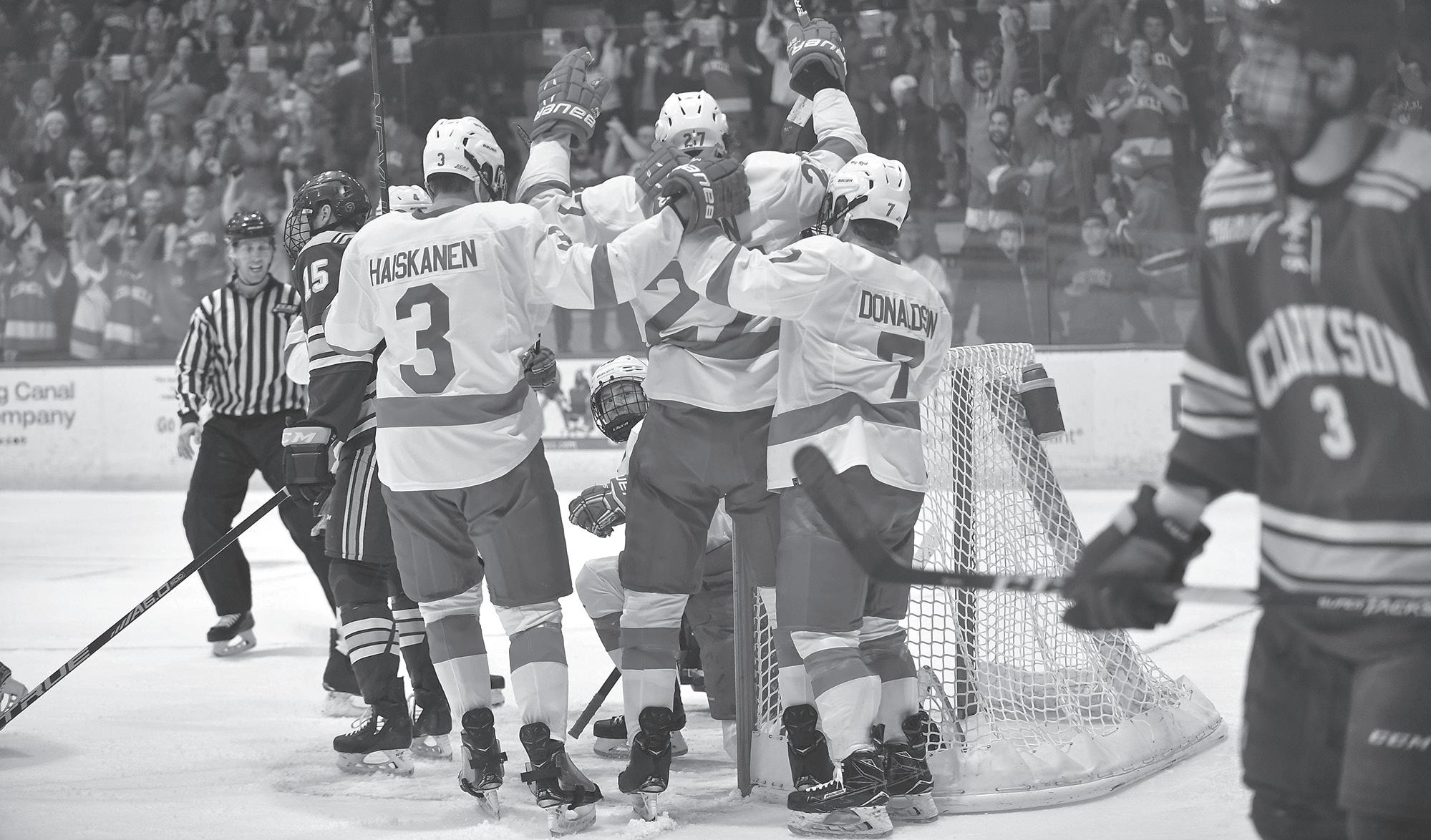
On Friday night, Cornell men’s hockey took to the ice not just to play but also to clean. Partway through the second period, they cleared the bench, spread out in a line across the rink and scraped at the surface with their skates until it was spotless.
Sophomore defenseman Cody Haiskanen had just skated off in a hurry, clutching his hand. In his wake was a trail of blood, starting from behind Cornell’s own goal and extending all the way to the bench. He then made his exit in an ambulance down Route 34 to a hospital in Sayre, Pennsylvania.
At the 10:45 mark of the second period, Haiskanen and Clarkson forward Chris Klack were racing to the right Cornell hash marks to win an icing call in their team’s favor. As the whistle was being blown, a skate sliced part of Haiskanen’s right arm.
Haiskanen underwent surgery at the hospital in Sayre. At the time of publication, no update had been given on Haiskanen’s condition, though he was spotted in the arena on Saturday night.
The referees seemed to be in a rush to get the game going again, so they attempted to start playing with the rink still spattered with blood.
“That was crazy, the referees wanted to start the game,” head coach Mike Schafer ’86 said after his team’s 5-0 win over Clarkson. “There was still blood from inside the blue line all the way to our bench.”
“The rink guys weren’t doing the job, so we needed more guys out there,” added sophomore goaltender Matt Galajda.
After the confusing episode had finally settled, reality set in.
Haiskanen’s laceration, which Schafer says will keep the defenseman out for “a while,” only adds to the list of injuries that won’t stop coming this season. The Red’s defense just got healthy again, with sophomore Alex Green returning to play last weekend after missing three months of game time only for a banged up senior Brendan Smith to then miss consecutive games.
was malicious in any way, shape or form. There just should be no contact whatsoever.”
The issue Schafer and many who saw the injury take with the incident is with how the play was called. Because the referees took so long to make the call, the two
“Everyone can kind of rally together off of that ... We obviously never want anything like that to happen on the ice.”
Jeff Malott
Haiskanen’s abrupt exit drew immediate comparisons to Green’s in November. Though the injuries themselves are not similar — Green suffered a concussion — the reaction in Lynah on Friday felt the same as it did three months ago in that Nov. 3 game against Yale, during which Green was stretchered off following a collision in front of Yale’s bench.
Saturday night, sophomore forward Cam Donaldson also went down with an injury. His was to the upper body, and will likely keep him out a few weeks.
“Any time you see a guy ... and they rush him off the ice, it’s pretty scary,” said junior forward Jeff Malott. “But he’s in good hands [now].”
“The whistle should be blown way before that, if it’s either no icing or icing ... they blew it really late.”
Mike Schafer
All at once, every Cornell skater stood up, got back on the ice and chipped away at the dirtied parts using the blades on their skates. The cleaning crew came through with a broom and shovel, the ice was white again and play finally resumed.
“I didn’t understand what they were doing,” Schafer said. “So I was just like, ‘you know what, we’ll scrape it.’”
As for the Haiskanen play itself, Schafer said it was a culmination of a faulty rule alongside ill-advised refereeing amid an unfortunate sequence.
“I’ve never liked the icing rule — when two guys are racing for the puck, there’s supposed to be zero contact on both sides,” Schafer said. “To me, the whistle should be blown way before that, if it’s either no icing or icing … they blew it really late — that’s what you get when you get those high-speed races for pucks.”
“It’s just unfortunate,” Schafer added. “I don’t think their kid
players were forced to fight for the puck until the whistle was blown. In theory, the whistle should have been blown by the time the puck reached the dots in front of the goal. But because the referees were delayed in making the call, the skaters had to continue to battle.
“I just saw Cody on the ground [and] didn’t think anything happened,” said Galajda, who was just feet away from the incident in his net. “But when he got up and took his glove off, it didn’t look too good. It definitely didn’t look good when he skated off the ice.”
After Haiskanen went down, Cornell went on to score two more goals and secure the 5-0 victory over Clarkson.
“Everyone can kind of rally together off of that,” Malott said. “We obviously never want anything like that to happen on the ice.”
And rally the team did. Even with the slew of players scratched from the lineup over the course of the season, the Red has improved steadily since its bumpy start and is back in the top 10 in the national rankings.
With three weekends left before the playoffs commence, Cornell skaters will need to fight forward without Haiskanen, Donaldson and freshman forward Max Andreev, all now out with long-term injuries.
But, if the team’s quick thinking and ice cleaning provide any indication, they’re up to the task of moving forward and looking out for one another.
“That sums up Cornell hockey: if there’s a job to do, just do it yourself,” Malott said.
Christina
can be reached at cbulkeley@cornellsun.com.
Bulkeley
Unlucky | The Red can’t seem to catch a break this season, with injuries coming in consecutive games this weekend to sophomores Cody Haiskanen and Cam Donaldson.
BEN PARKER / SUN STAFF PHOTOGRAPHER
Gymnastics Senior Day Yields Season-High Score
By ZORA HAHN Sun Staff Writer
It was Senior Day, and parents of graduating Cornell gymnasts had flown, driven and bussed into Ithaca to see their daughters compete. Families of gymnasts from nearby Ithaca College and The College at Brockport also came to cheer on their own teams, adding to the crowd.
The air felt electric.
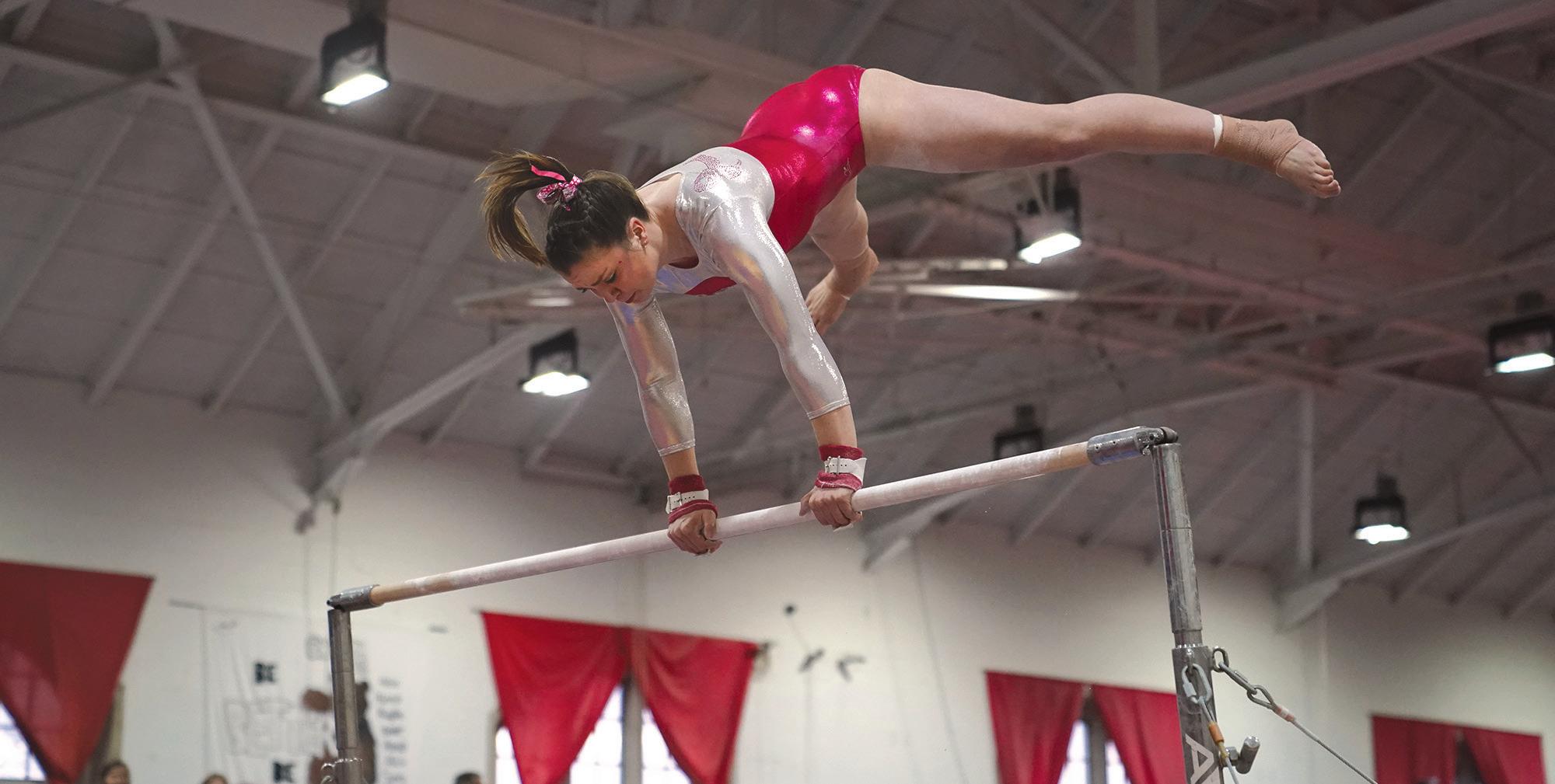
Whether it was the added energy of Senior Day, the support of so many fans or the home advantage, the Red scored a season-high 194.000 at the Big Red Goes Pink Invitational.
Brockport followed closely with a tally of 192.575 and Ithaca College came in third with 189.375. Cornell only scored above 194.000 twice last year — at the Ivy League Championship and at the USA Gymnastics Collegiate National Championships, both of which take place later in the season.
and had individual top scorers in two of the four events.
“The seniors this year carry the team a lot,” said sophomore Amy Shen. “They all compete a lot and contribute to the team scores … This current senior class is such a powerhouse.”
Senior Malia Mackey had the best individual performance on beam and the second-best performance on vault this weekend.
“What helps me is I smile and I kind of have fun with it,” Mackey said. “Having fun and really focusing on every skill.”
“The seniors this year carry the team a lot. They all compete a lot ... This current senior class is such a powerhouse.”
Amy Shen
In addition to the strong performances put on by the seniors, another encouraging development was sophomore Izzy Herczeg’s return to the lineup after recovering from a hip injury that had kept her out from the season’s onset.
Herczeg came back strong, scoring a 9.850 on the floor, good for the thirdbest individual performance of the meet.
The seniors were incredibly successful
“Izzy had an injury over the summer ... and she had to make sure her hip would be okay to handle it,” Shen said.
The season may be less than halfway through, but Senior Day prompted members of the Class of 2019 to reflect on their time on the Cornell squad. The Red will only compete at Teagle Gymnasium once more in the regular season.
“All the seniors are going to miss the sport … we’ll definitely miss the team
Red Forwards Earn ECAC Accolades
Malott and Regush recognized for their showing this weekend
By ZACHARY SILVER Sun Senior Editor
A pair of wins has birthed a pair of ECAC weekly award winners for Cornell men’s hockey.
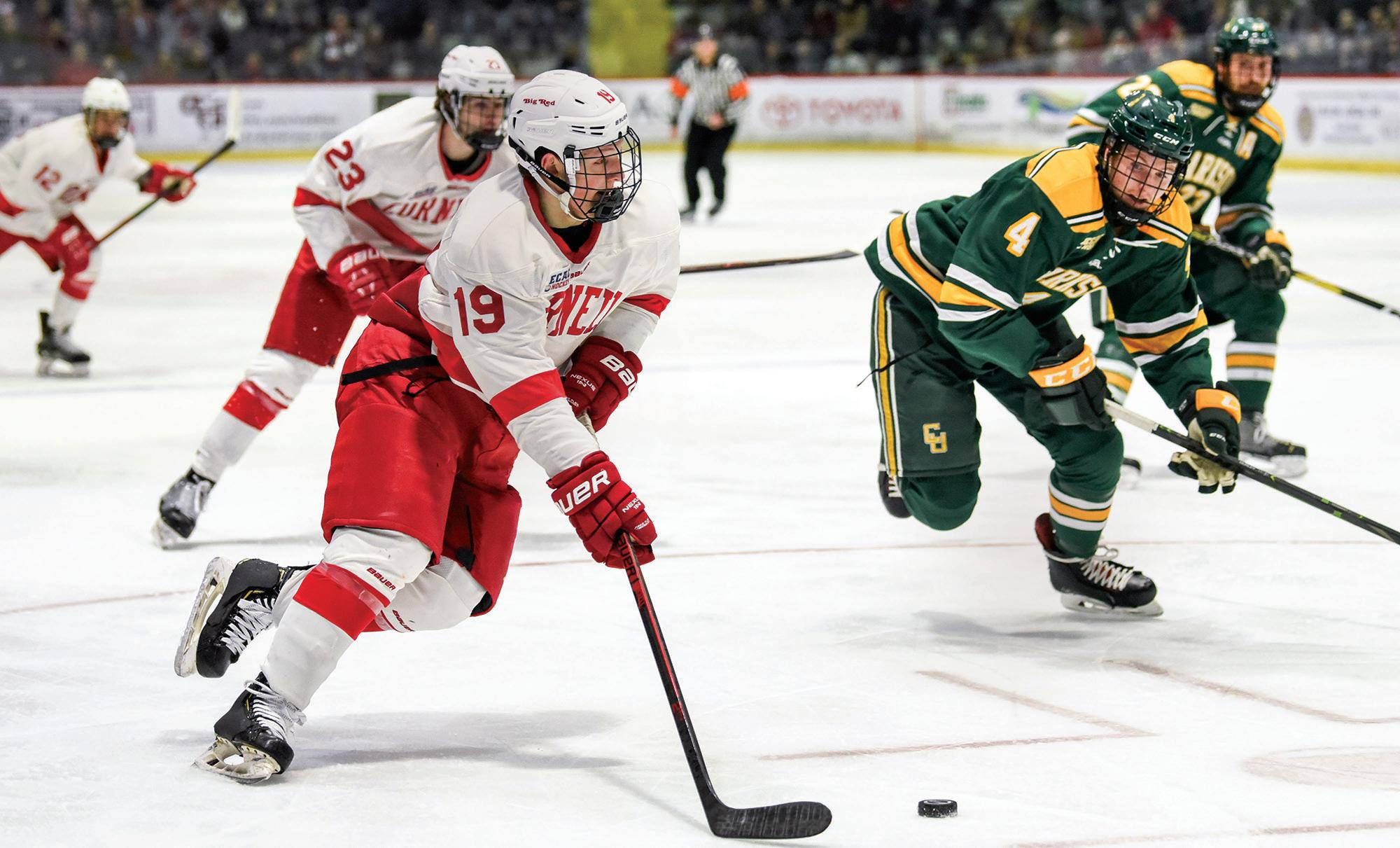
Junior forward Jeff Malott has been named the ECAC Player of the Week and freshman forward Michael Regush has earned ECAC Rookie of the Week honors — both for their respective efforts in Cornell’s weekend sweep over Clarkson and St. Lawrence.
For Regush, the award comes thanks to a goal in each win on the weekend, highlighted by
a SportsCenter Top 10-caliber effort on a tally that made it 4-0 against Clarkson in the second period Friday night.
On the highlight reel effort, Regush danced between two Golden Knights with a toe drag before tucking the puck between the legs of Clarkson netminder Jake Kielly.
When asked how many times he’s watched that goal against Clarkson, Regush laughed.
“If I answer that honestly, it won’t sound good,” he said.
Regush’s second goal on the weekend, a power play effort that opened the scoring against St. Lawrence, was his fourth on
the man-advantage this season, making him the first Cornell rookie to record four or more power play goals in a season since current Columbus Blue Jackets forward Riley Nash ’11.
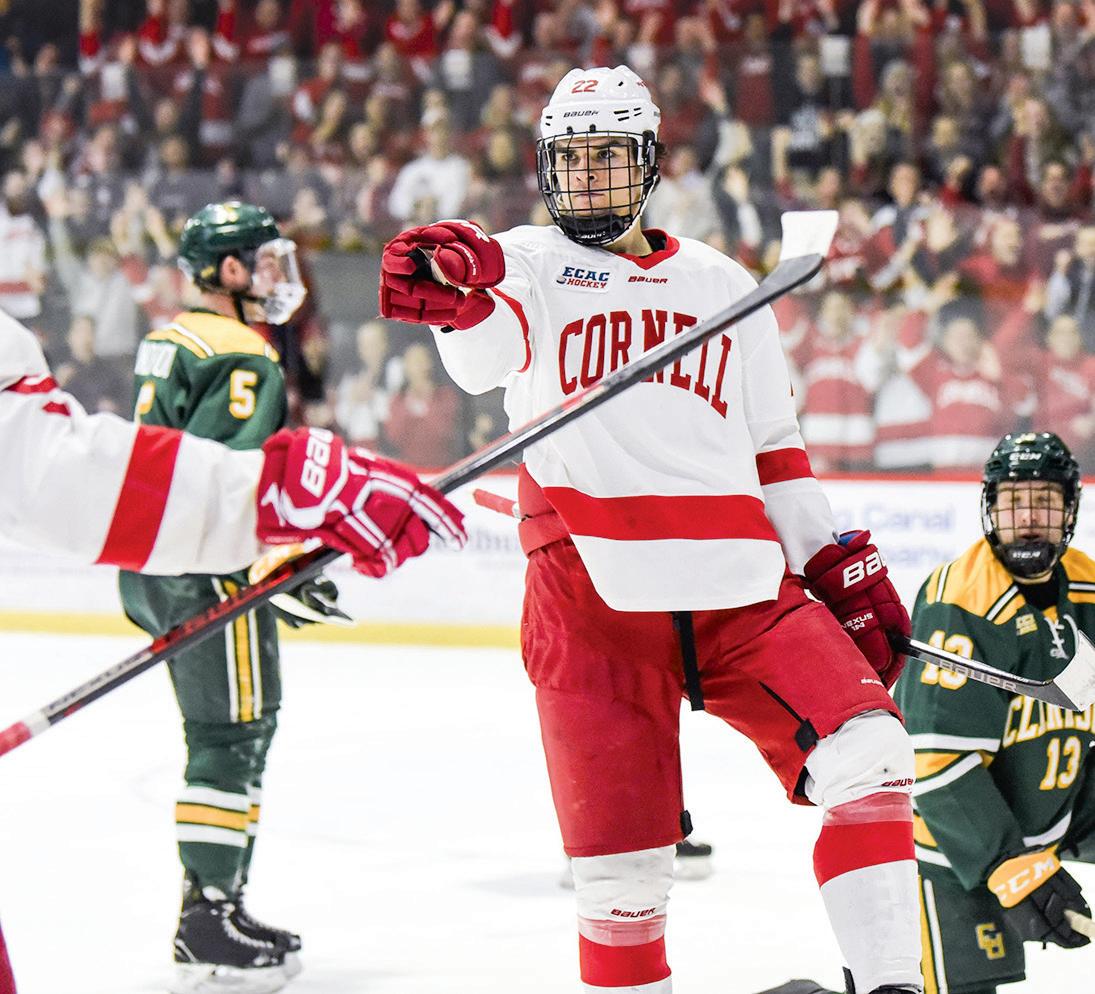
Malott, who has seen his season riddled by injuries, earned himself the accolade after two goals against Clarkson and a secondary assist on Cornell’s first goal against St. Lawrence.
On his first tally, Malott scored a deft power play tip-in on a man-advantage opportunity that he himself drew. On his second, the power forward made a cut to the net during 4-on-4 play and roofed a shot
aspect and performance aspect,” Mackey said.
On the heels of this victory, the Red will travel to Morgantown, West Virginia next weekend and try to keep its momentum going. Cornell will compete at West Virginia University on Sunday at 1 p.m.
to make it 5-0 against Clarkson.
Following its defeat at the hands of Cornell, Clarkson fell out of the top ten in the national rankings.
“That’s the kind of play we’ve been encouraging of all our guys,” Schafer said Friday of Malott’s second goal.
Now up two spots to its
Yale and Brown — both teams also receiving votes in the poll — on the road this weekend.
season-high No. 8 in the country in the latest USCHO.com poll, Cornell takes on
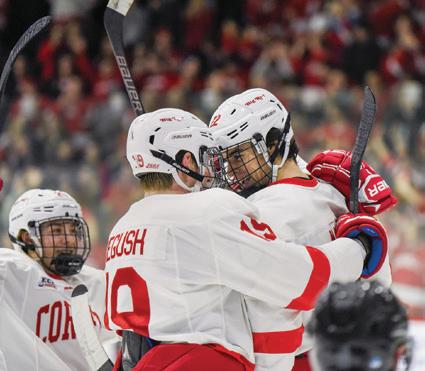
Perfect pair | ECAC Rookie of the Week freshman Michael Regush (left) and ECAC Player of the Week junior Jeff Malott (right) asserted their dominance over the opposition this weekend.
Senior showing | The Cornell seniors put up impressive numbers in their penultimate meet at Teagle Gymnasium.
BEN PARKER / SUN STAFF PHOTOGRAPHER
Hug it out | Junior Jeff Malott and freshman Michael Regush huddle following a goal during the Red’s win over ECAC foe Clarkson. BORIS