The Corne¬ Daily Sun




relief to commuters, business owners, C-Town thoroughfare once again open
By ARI DUBOW Sun Staff Writer
College Avenue reopened to traffic earlier this week as the first of three phases of construction came to a close. The 100300 block of College Avenue had been closed to cars — with its asphalt torn up — since the College Avenue Sewer Replacement Project began on August 7, with construction crews installing new water and sewage lines.
The road has been repaved for the winter and spring to allow vehicles to drive as usual. In the next construction phase, most likely beginning in May, New York State Electric and Gas Corporation crews will dig up College Avenue once again and install a gas line, as well as an electric line underground to replace the current above-ground electric lines.
Since the road reopened, TCAT routes 11N, 30, 51 and 70 have resumed normal paths along College Avenue, according to a TCAT press release. The return of the bus route to this section of
See COLLEGE AVE page 3


By STACEY BLANSKY Sun Staff Writer
After a survey spent nearly a month polling Cornellians for their views on nicotine, the results of what could have proved to be a step towards banning tobacco from the entirety of campus are finally in: little support for a smoking suspension.
At an Employee Assembly meeting held Wednesday night, members discussed the outcome of the survey — which revealed a meager 14.7 percent response rate and ambiguous attitudes among faculty, student and staff on whether the University should take a harsher stance on tobacco.
While initially billed as a move that could prompt the University Assembly to formally recommend that administration officials enact a tobacco ban, the survey’s tepid participation and unclear findings have, instead, elicited a more measured response, The Sun previously reported.
“I still think there needs to be a lot of debate,” said David Hiner, voting member and LGBTQ+
Representative At-Large for the E.A. “We would probably draft a resolution that would recommend Cornell to do a feasibility study of offered cessation programs, how we could further enforce the 25-foot rule and, then, see what it would take for Cornell to actually enact a nicotine use ban.”
“I still think there needs to be a lot of debate ... see what it would take for Cornell.”
By GABRIELLE GONZALEZ
For all Cornell students desiring a pet in college without having to undertake a lifetime commitment, look no further — the Alley Cat Cafe allows students and Ithaca community members to foster cats while they wait to be adopted into a forever home.
er, the cafe houses an adoption center for Browncoat Cat Rescue, an organization that focuses on saving and rehabilitating feral and abandoned cats.
These cats are often found on the side of the road, in trailer parks, barns and even in Collegetown. receive medical attention second chances
David Hiner
While the survey was spawned by recent fears that nicotine use has spiralled into a near epidemic, it could, despite its low turnout, conclude that smoking rates across campus were low — and surprisingly so, Hiner said.
“What is interesting is that the perception that people smoke is much higher,” Hiner said. “It makes you wonder if there is a perception that there is an
Located just off the Ithaca Commons, the Alley Cat Cafe offers its customers both coffee drinks with cat-inspired names — among them, the “Meowcchiato” or the “Catnap Latte” — and the unique opportunity to spend time with adoptable cats in various cat rooms situated throughout the shop. For only $5, patrons can reserve 30 minutes of cat play time in either the high- or low-energy cat rooms.
But the hall mark of this eccen tric eatery is not its witty coffee drinks or cat play rooms — rath


Today
Surfaces of Selection and Constraint: A Skull Story 9 - 10 a.m., A106 Corson/Mudd
1774: The Long Year of Revolution 10:30 - 11:30 a.m., Auditorium, Boyce Thompson Institute
Sustainable Holiday Pop-Up Market 11 a.m. - 4:30 p.m., Mann Library Lobby
A Conversation with LaTosha Brown, co-founder of Black Voters Matter 1:25 - 2:40 p.m., 132 Goldwin Smith Hall
Yoga sponsored by Cornell Minds Matter and Cornell Fitness Centers 5 - 6:15 p.m., Art Gallery, Willard Straight Hall
Tomorrow
Let’s Get Real: Conversations about Diversity and Teaching 11:15 a.m. - 1:15 p.m., Warren Hall
Feel Good Friday: Free Lunch and Thoughtful Conservations Noon - 1 p.m., International Lounge, Willard Straight Hall
Nahua and Precolumbian Influences in Xicanx Art 12:20 p.m., 400 Caldwell Hall
How Philosophers Value Justice in Plato’s Republic 3 - 5 p.m., 206 Stimson Hall
Cornell Women’s Polo vs Harvard University 7 p.m., Oxley Equestrian Center


By SHRUTI JUNEJA and BREANNE FLEER Sun Senior Editors
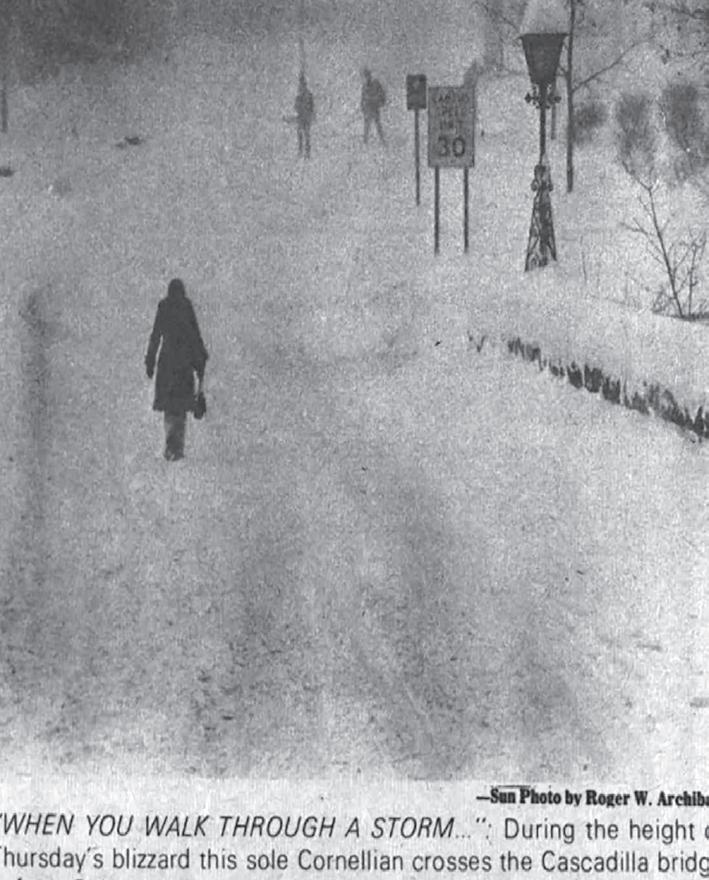
Cornellians are no strangers to snow. Whether sledding down the slope and finding fun in the flakes or trekking through treacherous paths and ignoring “No Winter Maintenance” signs, students and others acclimate to the wintry weather. The University cancelled classes and closed the campus on Monday due to the latest seasonal storm, and although past shutdowns have been rare, snow storms have affected campus in various ways over the decades.
Solar Flashbacks is a special project connecting The Sun’s — and Cornell’s — past to the present to understand how this rich history has shaped the campus today. Flashbacks appear periodically throughout the semester. #ThrowbackThursday
This weekend’s storm triggered additional trouble due to the scores of students trying to travel back to campus from Thanksgiving Break, who were slapped with significant delays. A similar situation occurred in December 1958, when “students returning to Ithaca from Thanksgiving vacation found their trip delayed by snow, cold and ice and the remains of a 7 ½ inch snowfall in the Ithaca area.”
“A wake of violent squalls had turned northern New York highways into ice-covered traps, barely negotiable in place,” and “the temperature plummeted to 7 above zero and wind gusts hit 50 miles an hour,” The Sun reported. Conditions were quite perilous, and “a five-car accident involving University students was reported on Route 79, in which no one was injured.”
Ironically, The Sun published an article titled “The Great Snow Famine” just a few weeks earlier on November 19, 1958, stating, “We have had no snow yet, and it is almost Thanksgiving.”
“The Tompkins County Snow Removal Squad must be perplexed and frustrated by the lack of snow this year,” the article read. “It has been almost seven months since it
last had a chance to pilot its tremendous plows through the white drifts. The squad has acquired some new equipment for snow removal and it is probably holding its breath for a chance to dig into the snow-removal fund and get busy. We do not share the Snow Removal squad’s eager anticipation of the first snow.”
The travel troubles brought on by blustery, brumal storms and massive snowfalls have often affected Cornellians attempting to reach isolated Ithaca. In essence, things can snowball out of control.
On a chilly February weekend in 1960, “violent blizzards in recent years paralyzed almost all transportation in and out of Ithaca and obstructed power and telephone service.” Because of a fuse blowout at the East Ithaca substation of the New York State Electric and Gas Corporation, the University lost power for an hour and a half on that Friday. Furthermore, “no planes had left or entered Ithaca since Thursday” and “only one bus arrived in Ithaca Saturday.”
Transportation was stalled again the next year, and in February 1961, “the heavy snowfall which blanketed Ithaca over the weekend clogged many streets, making them one-way. They were then made nearly impassable by
the parked cars of students.”
Going back over a hundred years, in an article titled “STILL MORE SNOW PROMISED ITHACA” from February 1914, “Snow and more snow is the prediction of the local weather prophets.” While the local trains continued their normal service, the trolleys that used to run were “restricted to a few cars up Eddy street and down Stewart avenue.”
“Unless the present snow continues the demoralization of traffic conditions, the prospects are that deliveries, mail, express and other traffic will be about normal again by this evening,” The Sun reported.
The aftermath of clearing up snowstorms hasn’t been cheap, either. In March 1914, “A bill of $225 for clearing walks and paths will have to be paid by the University on account of Monday’s blizzard” and the “Street Railway Company will be out anywhere from $1,000 up, not counting all the business lost.”
Classes Canceled!
Though Cornellians have previously prided themselves on their hearty handling of hiemal weather, recent years have seen a softening of the snow day threshold. The Class of 2020 has been treated to at least one day of weather-related class cancelation in three of their years at Cornell.
However, before 2016, the University only called off classes a few notable times. The apparent first snow day was in March 1971, when “Mother Nature was not above proving that she could still dump 18 inches of snow in 24 hours on unsuspecting Ithaca and close Cornell University due to a blizzard for the first time in its history.”
The Sun reported then: “In the dorms, the mood was holiday. ‘No school! It’s a snow day,’ students shouted to the uninformed. Some answered cynically, ‘Don’t you know that Cornell University never closes?’”
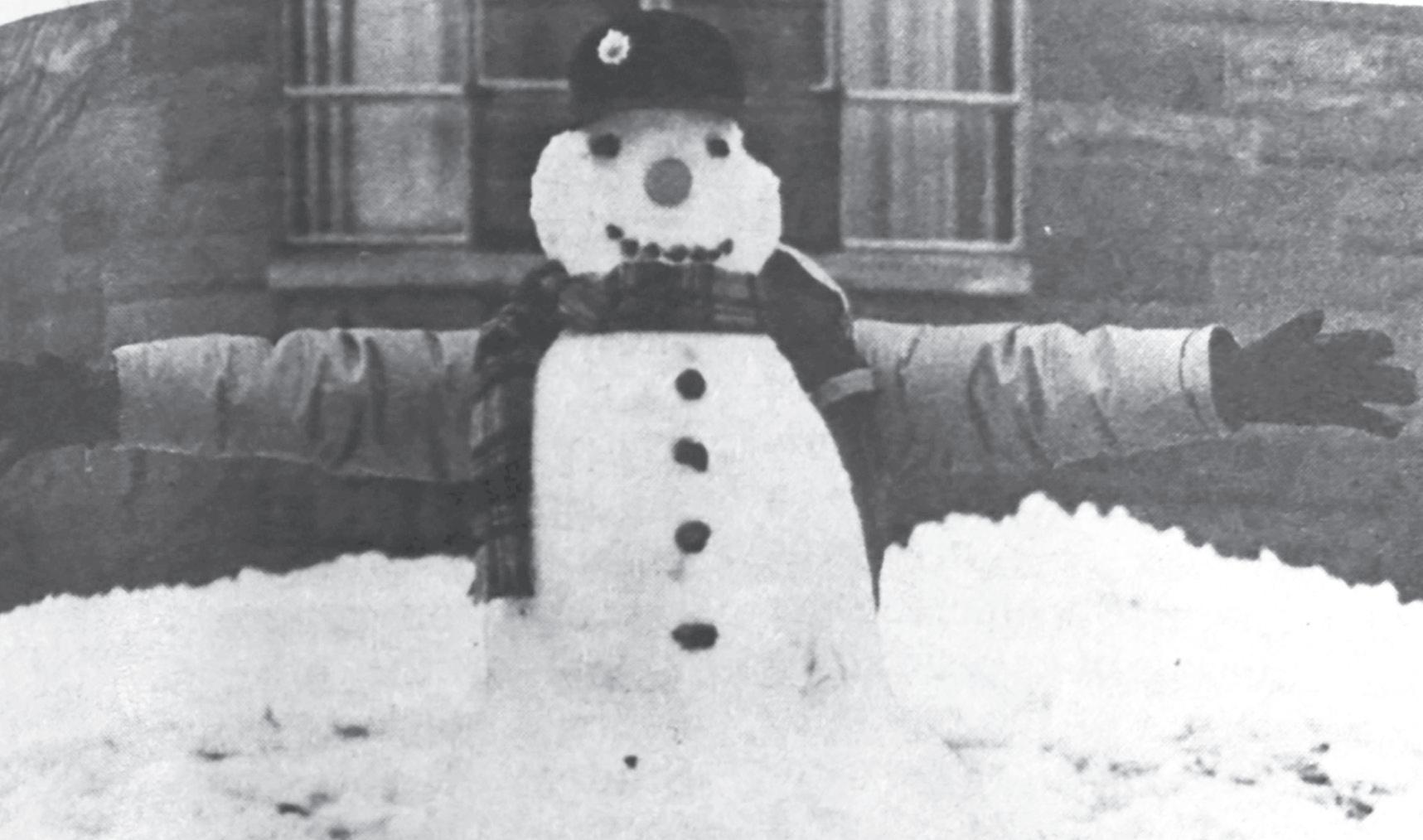
“Snowball fights abounded, from trifle skirmishes to all-out wars. A snowfort built on the Arts Quad became a white dragon and Collegetown was graced by a ten-foot totem pole. Students trampled zigzag pathways in the snow and slithered. flailing, down stairways.”
However, “After the first excitement was past, a few practical types began to ask questions like ‘How are we going to eat?’” While the cafeterias at Willard Straight and Noyes were able to remain open, with the help of janitors, only one kitchen employee had been able to make it to the Risley Dining Hall.
The next year, in February 1972, the cam-
pus saw another bout of snow, but courses went on as planned. “All regular full-time Cornell employe[e]s who worked Monday in spite of the snow will be given compensatory time off. and those who did not work will be paid,” The Sun reported.
In December 1972, the University announced two changes to snow day policies, with the first to “permit classes to go on as scheduled while the rest of the University remains closed and the second to “establish a plan to open the University ‘gradually’ during a day when heavy snow restricts travel and parking on and around the campus.”
Since then, Cornell has rarely seen snow days. Thirty inches of snow prompted a University closure on a March day in 1993, for example, and The University also shut down once in 1999. Administrators decided on Valentine’s Day in 2007 to call off afternoon courses.
Some Cornellians have advocated policy progress in response to inundations of the powdery flakes. After Winter Storm Stella covered the campus in snow and forced a closure in March 2017, faculty and staff expressed dismay at the late notice, with the Employee Assembly debating revisions to snow day decision policy.
Last February, another wintry condition,
marked by low wind chills, provoked debate on the University’s inclement weather stance. The policy was last updated in 2017.
Sports Shutdown Spring did not kick off with a home run in April 1935, as the first home baseball game was cancelled due to prolonged hours of snowfall.
“The snow yesterday came down In clouds. It covered the infield and lay like a shroud over the outfield; lt blanketed the dugouts and covered the bleak grandstand with row on row of slush; lt covered the press coop, and then gleefully smothered the calendar,” The Sun reported.
Snow impeded sports the year before as well, and in 1934, interfraternity touch football games were cancelled because “in addition to snow, the sun’s reticence soon made the light so poor that the pigskin became Invisible.”
Skiers in January 1950 faced an opposite problem: too little snow, and The Sun reported that “foul weather, at least in a skiiers’ perspective, has forced the cancellation of all Cornell skiing engagements to date. The Big Red Skiers have been forced to drop two meets.”
Furthermore, “The Cornell varsity and freshmen skiers [were] scheduled to play host to the Penn State squad this weekend, but if no snow comes before then, it will have to be cancelled.”
In February 1953, “The weatherman has predicted colder temperatures, cloudy skies, and possible snow for the rest of the weekend, which has already seen the tray races and ice sculpture contests cancelled due the weather.”
The weather also resulted in the cancellation of a skating party due to warm weather making the thick ice “soft.”
Facing the feet of snow that fall on the frozen city of Ithaca is no small feat for Cornell students, faculty and staff, and this powdery precipitation has played an integral role in the history of the University.
Shruti Juneja can be reached at sjuneja@cornellsun.com.
BreAnne Fleer can be reached at bfeer@cornellsun.com.
By TAMARA KAMIS Sun Staff Writer
More than a year after a sweeping bacterial outbreak led Cornell Dining — along with tens of thousands of other restaurants nationwide — to throw out all of its romaine lettuce, E.coli has returned, once again prompting concerns over how to safely consume lettuce.
So far spanning 19 states, 67 cases of E. coli related to the consumption of romaine lettuce have been reported, hospitalizing at least 39 people, according to the New York Times. The Centers for Disease Control and Prevention currently suspects the outbreak is linked to contaminated lettuce originating from Salinas, California.
But despite the breakout, Cornell Dining, which operates nearly 30 separate eateries, has expressed confidence that its “proactive” approach to food safety and management is more than enough to secure the safety of its patrons.
“We have no reason to believe that any of the produce we received from Maines [a produce supplier] or served in our eateries was actually contaminated,” Paul Muscente, asso-
ciate director of Cornell Dining told The Sun in an email. Cornell Dining’s food supplies currently use codes that track products to their production lines and dates, enabling the system to identify salad product units from the at-risk area before having to destroy all products, Muscente said. Other greens were used to replace the romaine lettuce in salad bars, and packaged products were not affected.
“There was no romaine from Salinas in our packaged salads and sandwiches from our external providers including York Street Market,” Muscente continued. “We’ve had no need to cancel any contracts or change any suppliers.”
But while Cornell Dining salads have been deemed safe, people cooking for themselves should still be careful, the CDC has warned.
The strain of E. coli that the CDC has found responsible for this outbreak produces Shiga toxin. Symptoms can include vomiting, diarrhea, stomach cramps, mild fevers and, in dramatic cases, life-threatening kidney failure.
According to Executive Director for Cornell’s Institute for Food Safety, Prof. Elizabeth A. Bihn, food science, contamination can be attributed to a variety of reasons, includ-
Te Commons’ Alley Cat Cafe houses a program dedicated to saving abandoned cats
ADOPTION
Continued from page 1
Cat Rescue is currently directed by Alley Cat Cafe owner Kristin O., who asked to use only her first name due to past harassment. Dubbing herself the “captain” of Browncoat Cat Rescue, Kristin has helmed the effort to rescue all the cats found in the cafe.
As Browncoat currently has no official shelter space to house the available cats, it primarily runs through a series of foster homes, where willing individuals open their homes to cats until they are socialized to live with humans. ing to Kristin, this fostering can range from two weeks to a year, depending on the cat’s needs. From there, the cat is either adopted through the Browncoat website or brought to the cafe, where patrons can spend time with them in the cat rooms before adopting them.
junior Jamie Duncan. After volunteering at the cafe for some time, they are currently fostering their second cat, a two-year-old Russian Blue, Persian mix named Sonni.
According to Duncan, the best part of fostering is seeing the cats come out of their shell after receiving proper medical care, attention and love.
“He’s really making remarkable progress and he’s not aggressive at all,” Duncan said regarding Sonni’s transition from a stray.
Balancing schoolwork and a cat isn’t always easy, especially for someone not used to taking care of cats. However, having lived with felines their whole life, Duncan told The Sun that a two-year-old Sonni is much easier to manage due to his independence as an older cat who can remain alone at home.
“Alley Cat Cafe serves as a community space ... We wanted it to be a very homey environment.”
Kristin O.
“Alley Cat Cafe serves as a community space,” Kristin told The Sun. “We didn’t want it to be a sterile adoption center — we wanted it to be a very homey environment where people can come and play with the cats.”
Browncoat Cat Rescue has particularly appealed to students from Cornell and Ithaca College, eager to be involved in the program, Kristin told The Sun. Currently, two Cornell graduate students and one Ithaca College student participate in the program, with one cat each. Between the three students and the Ithaca community, the program currently cares for 15 felines.
Foster volunteers receive a cat that works best for them and their schedule. For example, a student taking a full course load and one who is rarely home may not be best suited for a kitten, which requires constant care, but might be a better match for a relatively more self-sufficient older cat.
One of those current foster parents is Ithaca College
After spending two weeks with Duncan, Sonni is set to be adopted sometime this week — a difficult goodbye, Duncan told The Sun.
“You really do get attached, because you see these cats come in that have gone through things and you can relate to them, and you get to unlock their little personality traits,” Duncan said. “The more you do, the more they trust you. I’m gonna miss Sonni.”
The time spent with a foster parent can exert a lasting impact on a cat’s development and happiness, according to Duncan, and Kristin and Browncoat can be found actively working to ensure that cats are ready to be adopted by a forever family.
“One in five cats stay in their first home, and we want all our cats to stay in their first home. We want these cats to stay and not experience the trauma and stress of being moved around,” Kristin said. “We do everything we can to set our cats up for success.”
Gabrielle Gonzalez can be reached at ggonzalez@cornellsun.com.
TOBACCO
Continued from page 1
issue of people smoking across campus when there maybe isn’t.”
That sentiment is apparently not unique to Cornell, Hiner added. There is a nationwide perception across many universities that more people are smoking on campus than is actually the case, a trend that also holds true for increasingly ubiquitous e-cigarettes, he said.
According to the survey, “most people aren’t exposed to secondhand smoke when going across campus,” Hiner said, contradicting the com-
mon consensus that many perceive supposedly high smoking rates to be a widespread, and growing, problem.
Most respondents stated that they would support the proposed two to three year process of establishing a nicotine free campus, which would first begin with a university-wide resolution encouraging the enforcement of current smoking policy on campus. However, in an online public debate conducted by Hiner along-
“Most people aren't exposed to secondhand smoke ...”
David Hiner
side the survey, about two-thirds of respondents commented that they did not support a total nicotine ban on campus, with many instead preferring stricter enforcement of existing policies, such as the rule that requires smokers from standing at least 25 feet away from public buildings.
Stacey Blansky can be reached at sblanksy@cornellsun.com.
ing wildlife, domesticated animals, and changes to water and soil, spreading pathogens to agriculture.
As the CDC investigates the cause of the outbreak, consumers can work to keep themselves safe. Bihn, for instance, recommends refrigerating and washing produce with cold water as good strategies to keep produce pathogen-free, as well as staying up to date with product recalls.
Moreover, if romaine lettuce is labeled as coming from Salinas, California, or consumers do not know where the lettuce came from, the CDC recommends discarding the lettuce, and then cleaning the refrigerator where it was stored.
“Outbreaks are a concern as they cause illnesses and death, but it is important to understand eating produce is very important to good health, maintaining proper body weight, reducing cancer risks, and other important things like nutrients,” Bihn said.
“Avoiding produce is not a good recommendation,” she added.
Tamara Kamis can be reached at tkamis@cornellsun.com.
COLLEGE AVE
Continued from page 1
of the road has helped business at the Green Star grocery, as people waiting for the bus frequently stop into the store for a snack, according to Green Star employee Jimmy Pomm.
But another local employee saw the effects of construction differently. Elber Calderon at Enzo Pizzeria told The Sun that business has remained steady throughout the construction.
Thomas Knipe, Ithaca’s Deputy Director for Economic Development, said that city officials are aware of the potential negative impacts that the construction might have on businesses. To address these issues, the city posted signs near the construction site indicating that the businesses remained open as usual, Knipe said.
Some employees at nearby businesses have had trouble parking since the project reduced parking spaces in the area, according to Calderon. Graham Kerslick (D-4th), Alderperson for the 4th Ward, said that limited parking was an issue that city officials are trying to mitigate.
Another concern that residents and local employees voiced about the construction was the dust in the air, which contractors have tried to quell, Kerslick said.
The sewer and water lines have not been replaced since 1895, according to Erik Whitney, assistant superintendent of the Department of Public Works, Water & Sewer.
“We got our money’s worth out of this infrastructure,” Whitney said. “It’s roughly a 100-year life cycle with the water and sewer, so this is a once in a lifetime project for everyone involved.”
Aging aside, Whitney said that the water and sewage system needs an urgent update to provide adequate fire protection to the increasing population of Collegetown. According to Alderperson Stephen Smith (D-4th Ward), housing developments over the last five years have increased the living capacity of the area by approximately 1000 people, including the area of the College Avenue construction.
“If a sprinkler system is activated, we need to know that the flow rate is enough to provide fire suppression,” Whitney said. “This was completely different with two or three story buildings.” The new water pipes are larger than those installed in 1895 to supply sufficient water to these buildings in case of a fire.
The water and sewage pipes are being installed first because they are buried deeper than electrical and gas lines — at around 5 and 8 feet deep respectively — to avoid freezing in the winter. Electrical and gas lines, buried around two feet deep, will be installed next construction season.
To read the rest of the story, please visit cornellsun.com.
Ari Dubow can be reached at adubow@cornellsun.com.
Independent Since 1880
137th Editorial Board
ANU SUBRAMANIAM ’20
Editor in Chief
JOYBEER DATTA GUPTA ’21
Business Manager
PARIS GHAZI ’21
Associate Editor
MEREDITH LIU ’20
Assistant Managing Editor
RAPHY GENDLER ’21
Sports Editor
BORIS TSANG ’21
Photography Editor
AMBER KRISCH ’21
Blogs Editor
SOPHIE REYNOLDS ’20
Science Editor
AMANDA H. CRONIN ’21
News Editor
JOHNATHAN STIMPSON ’21
News Editor
PETER BUONANNO ’21
Arts & Entertainment Editor
ANYI CHENG ’21
Assistant News Editor
HUNTER SEITZ ’20
Assistant News Editor
CHRISTINA BULKELEY ’21
Assistant Sports Editor
BEN PARKER ’22
Assistant Photography Editor
JEREMY MARKUS ’22
Assistant Arts & Entertainment Editor
ALICIA WANG ’21
Graphics and Sketch Editor
SARAH SKINNER ’21
Managing Editor
KRYSTAL YANG ’21
Advertising Manager
NATALIE FUNG ’20 Web Editor
SABRINA XIE ’21 Design Editor
NOAH HARRELSON ’21
SHRIYA PERATI ’21
Editor KATIE ZHANG ’21 Dining Editor
AMINA KILPATRICK ’21 News Editor
MARYAM ZAFAR ’21
Editor ETHAN WU ’21
SHIVANI SANGHANI ’20
News Editor
ZHU ’21
News Editor
PICHINI ’22
Sports Editor JING JIANG ’21 Assistant Photography Editor
DANIEL MORAN ’21
LEI WU ’21
Working on Today’s Sun
Ad Layout Dana Chan ’21
Production Deskers Krystal Yang ’21
News Deskers Johnathan Stimpson ’21 Shivani Sanghani ’20
Night Deskers Girisha Arora ’20
Design Deskers Lei Lei Wu ’21 Krystal Yang ’21
Photography Desker Jing Jiang ’21
Sports Desker Christina Bulkeley ’21
Arts Desker Jeremy Markus ’22
Editorial
IN A RECENT INTERVIEW WITH THE SUN, President Martha E. Pollack discussed how increasing socioeconomic diversity at the University was a top priority for her. This is an admirable goal which Pollack says goes beyond active recruitment and includes supporting students while they make their way through Cornell. The Sun previously reported on various initiatives led by the University and students to promote socioeconomic diversity including addressing food insecurity and cost of textbooks. Pollack also reported success in overcoming resource gaps with a flipped classroom structure.
These are all necessary steps for creating an environment for students of all different backgrounds to thrive. A Cornell education, however, extends the classroom. We are at Cornell to prepare ourselves for a future, and a mandatory life skills class requirement for freshmen could be another step that aligns with Pollack’s goal.
High schools with more resources offer students opportunities beyond just academic ones. These students might have more chances to give presentations, interact with professionals or receive career counseling. Some students have parents who they can ask for about salary negotiations, financial planning or graduate school options. These are not available to everyone and having these abilities can make a difference in a student’s future.
If every freshman that enters Cornell is required to go through a two to four credit class that reviews basic skills they may lack out of high school, the University could help reduce barriers that students face as they prepare for their future. Making this class mandatory allows each student to walk away with the same foundation and could reduce any stigmas students may fear if they sign up for this class. This course could be an excellent place to educate new students about the resources on campus that also assist with these endeavors, such as the Career Services Office or the libraries. These few credits could provide students with a home-base, a faculty member who is dedicated to their non-academic skills and can provide freshman with another opportunity to meet their classmates and learn from each other.
President Pollack, you are doing a great thing by raising money and creating programs for students who come from different socioeconomic backgrounds. This course or an opportunity similar to this where students learn about school resources, post-Cornell options, financial literacy, healthcare, tenant’s rights or any other skills that students frequently need during or after Cornell would be another chance for socioeconomically diverse students to receive support they need or never previously received. Logistically, it may be a lot of maneuvering, especially with major and college requirements, but we require first-year writing seminars and non-academic skills are important to individual success, well-being and inclusivity, too.
On a November evening — more winter than fall — two dozen Cornell Political Union members debated a contentious question: Is Cornell failing the United States? I passionately opposed a fellow ILRie who argued that Cornell does a disservice to the nation by failing to address its toxic student culture, since I’m confident that Cornellians’ contributions to society outweigh our institution’s flaws. But a portion of her speech stuck with me.
“To deal with [Cornell’s] hyper competitive environment and zero-work life balance,” she observed, “Cornell students turn to alcohol — whether it’s karaoke Tuesday, Fishbowls or the handle of vodka in the closet.” This tendency should be glaringly obvious, but it’s one that many of us seem to be in denial about. For many Cornellians, alcohol doesn’t just enhance a night out; it’s seen as a tool for coping with the demands of life on East Hill. But when you target stress with Svedka, things just get worse.
expectations — are ever-present.
We too often insist on trying to resolve disputes and misunderstandings while drunk. Doing this means taking the easy way out. It’s much more difficult to let your guard down, expose vulnerability or admit error while fully lucid. But drunken attempts at interpersonal problem-solving create more room for misunderstanding or unproductive confrontation, which only damage bonds. And if you avoid facing the sometimes-uncomfortable work it takes to maintain relationships while sober, you
For many Cornellians, alcohol doesn’t just enhance a night out; it’s seen as a tool for coping with the demands of life on East Hill.

deprive yourself of an opportunity to grow in maturity and emotional intelligence.
We too often fail to understand the burden our stress-induced intoxication has on those close to us. No one wants to babysit a friend who’s too drunk to make it home on his own, but good friends will do what it takes to ensure that the people they care
Though many Cornellians have recently indicted our campus’s destructively-competitive tendencies, less attention has been paid to how we cope with our stress culture — which, let’s face it, won’t disappear any time soon. We have to denormalize drinking-to-escape and drinking-to-avoid because they contribute to addiction risk, damage relationships, burden caring friends and ultimately do nothing to alleviate the pressures of college life. And though this unhealthy alcohol use is by no means unique to Cornell — substitute any other U.S. university and this column still holds true — we still need to address its impact in our community.
So, when you drink so much that your friends have to take care of you, there’s a good chance you’re contributing to their own cycles of stress.
about are safe. So, when you drink so much that your friends have to take care of you, there’s a good chance you’re contributing to their own cycles of stress.
I’ve witnessed the destructive power of alcohol and drug dependence firsthand. My biological father, a law school valedictorian, a pillar of my hometown’s legal community and a legendary local disc jockey (who, according to family lore, inspired Warren Zevon’s 1976 hit “Mohamed’s Radio”), struggled with addiction for years until he passed away in 2012. He had much to offer the world beyond his 57 years, but he was never able to completely overcome the vices he developed as a young man.
As I watch friends with promising futures drink themselves to sleep or descend into maudlin incoherence night after night, I can’t shake the fear that their life story might end up looking something like his. As the Mayo Clinic points out, excessive drinking can lead to alcohol use disorders by altering brain function and reducing one’s self-control and judgment. Students who drink to alleviate the pressures of student life wind up drinking to excess because sources of stress — from problem sets to career recruitment to social
Alcohol can only offer a temporary respite from the demands of Cornell life. Sure, if you take enough tequila shots you might temporarily get your mind off the seemingly make-or-break interview you have next week, but you’ll wake up in the morning, head throbbing, with the daunting call still bearing down on you.
So, next time you’re hit with a painful prelim result, find yourself reeling from romantic rejection or become overwhelmed by the weight of our culture’s expectations, don’t reach for the bottle. You owe it to yourself to do better.
To seek alcohol and drug addiction resources, visit health.cornell.edu. Students may also consult with counselors from Counseling & Psychological Services by calling (607)2555155. Employees may call the Faculty Staff Assistance Program at (607)255-2673. An Ithaca-based Crisisline is available at (607)272-1616. For additional resources, visit caringcommunity.cornell.edu.
John Sullivan Baker is a senior in the School of Industrial and Labor Relations. He can be reached at jsullivanbaker@cornellsun.com. Regards to Davy runs every other Thursday this semester.
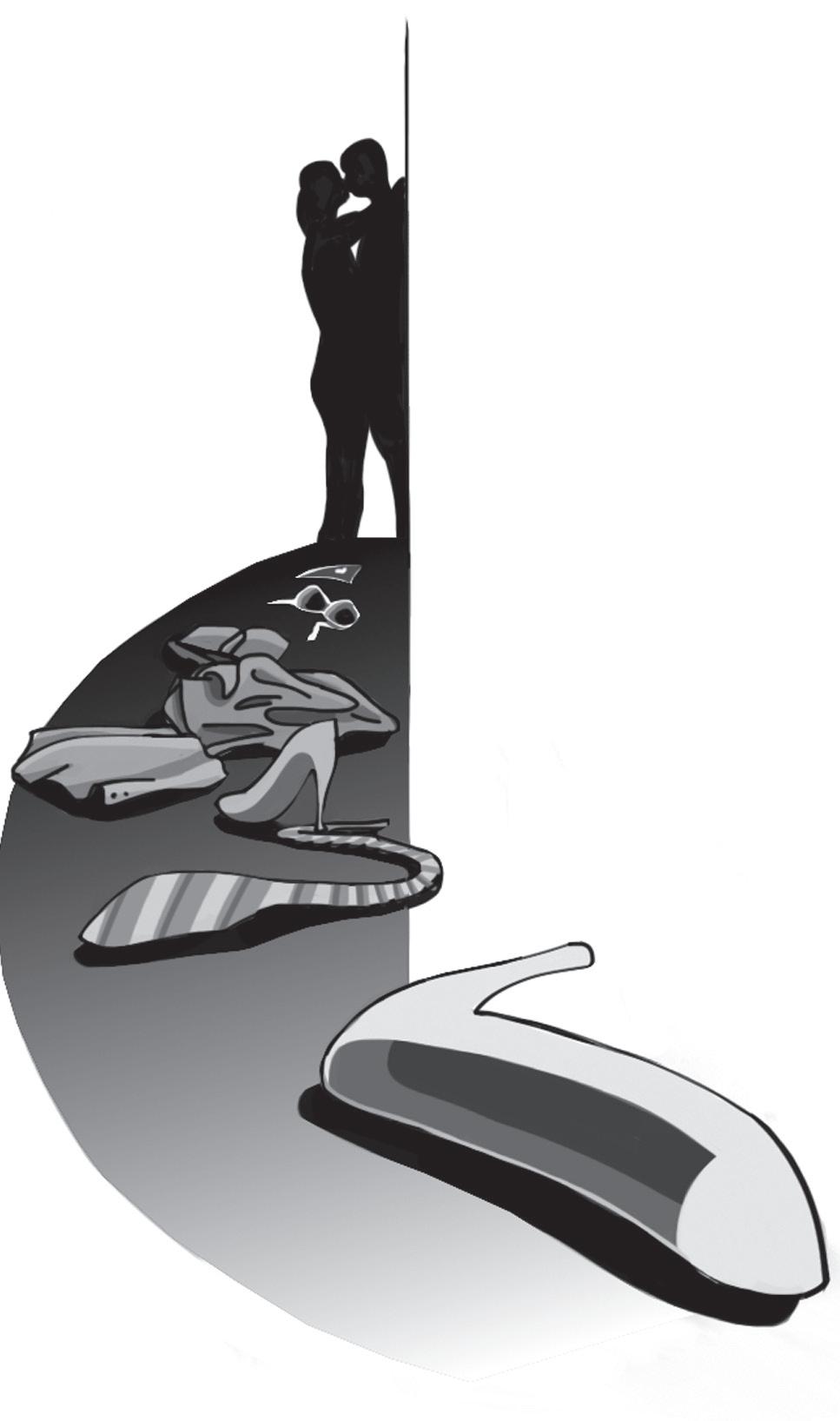
icture this: It’s freshman fall, just a few weeks into the semester. You’re at some annex in Collegetown that you never actually learned the name of but managed to get yourself into (you’re a girl in a low cut top. It wasn’t hard). You’re dancing and drinking with your friends when someone catches your eye. They come up to you, you chat, you drink, you dance and things progress. You both want to take things somewhere a little more private, but North Campus is just so far away, so you head upstairs and somehow end up on the fire escape instead. You’re perched on the stairs between floors and there are people above and below you, but somewhat surprisingly, you find you don’t really care that much. In fact, you kind of like it. So you’ve discovered you’re a little bit of an exhibitionist. Maybe you’re like me and you unexpectedly realized it through experience, or maybe you just think it would be really fun. It’s not that you actually want people to see you hooking up, but there’s just something about the risk of getting caught that just gets you going. Maybe it’s the adrenaline rush that comes with knowing you’re doing something that you’re not supposed to be doing. Maybe it’s the thrill of being sneaky and getting away with it. Whatever it is, there’s something to be said for getting down somewhere other than a bedroom. But in order to explore this further, you need places to go, and that’s where I come in. Pulled from my experiences, here are some of my thoughts on hooking up outside the bedroom.
Maybe you’re still living in a dorm and you’re looking to get down somewhere that isn’t your forced triple (with bunkbeds!). Depending on what dorm you’re in, your common room or laundry room could be a decent idea. It’s best if it’s late enough at night that people aren’t wandering around, otherwise you won’t manage to get far enough for the uncomfortable couches to be worth it. But if it is late and you manage to find a dark enough fun. At least the walk back to your room will be pretty short after? If
Cyou’re still on North but you want a little more semblance of privacy, consider the Mews meditation room. Yes, the door doesn’t lock, but that’s part of the fun. A bonus: Never forget that Mews has A.C. What about if you’re in Collegetown and you want to stay there?
If you’re inspired by my experience, a frat annex fire escape isn’t a bad choice if it’s during the warmer months (read: warm month) here. Too late in the fall or too early in the spring and those metal bars get wicked cold at night. Find yourself a spot on the stairs that’s between two floors and not directly next to a window and go to town. Just watch out for any drunk frat guys who decide they want to pee off the side. But what about where not to consider?
Let’s make the situation a little bit more specific. You’re at a party on Catherine Street and you’re trying to find somewhere to hook up. While a porch roof might seem like a great idea at the time — you’re getting away from the party, it’ll be quiet, you’ll be alone — it bears remembering that Cath St. is on a hill and that means that everyone both above and below you on the slope can see exactly what you’re doing. The fun is in almost getting caught, not actually getting caught. Learn from my mistakes. Living beyond the dorms and C.Town? Go find an unlocked academic building. I would recommend one on the Arts Quad, but that’s just because that’s where I spend most of my time. Also, all engineering buildings smell like stress and sadness to me. It’s been said before, likely more eloquently than here, but I’ll say it again: This is hot. Go for it. Do it on a desk, blow your boy in the lecture seating, whatever you want. It’s a classic for a reason. You’re less likely to get yelled at than in the stacks like I watched happen to someone just a few weeks ago (word to the wise: The fifth floor stacks are still pretty busy on a Saturday evening!), but I’ve heard that security will still sometimes check in if they hear anything suspicious happening while they make their rounds. Maybe exhibitionism isn’t your cup of tea, and that’s okay. But if you want to start exploring it, hopefully I’ve given you some suggestions of places to go that aren’t private but also aren’t totally out in the open. Maybe you think this is all too tame, in which case, you’re a braver soul than I. No matter what, I encourage everyone to push their limits and try out something (or somewhere) new. You might just find you like it.
reepy boys don’t often think of themselves or their actions as creepy. The rants my friends and I often have about how men suck don’t register in their minds as having any relation to them. They’re too nice to hurt a girl, they say. Still, there are many things that men have done to women on campus to make them uncomfortable and yet there are very few men who recognize this. That doesn’t add up.
But I recognize that what is upsetting to us girls doesn’t necessarily translate over to men, and it is hard to directly call someone out on their bullshit. For the convenience of the (probably no more than two) men who read Sex on Thursdays, I’ve laid some of these out for you here.
1. Choking without asking for permission
Much like asking for consent for sex, you should ask, “Hey, do you like being choked?” If the answer is no, don’t try again. Many people really don’t like getting choked and it can be a traumatizing experience to be flung from innocent fun to literally getting strangled.
2. Pushing someone’s head down to your penis to indicate that you want a blowjob or you want the person to go faster
My friend told me that once when she was making out with a boy, he started repeatedly and aggressively pushing on her head. After he didn’t stop, she told him that he was hurting her. He responded, “So does that mean you don’t want to?”
“Don’t want to what?” She said.
“Give me a blowjob.”
“If you wanted a blowjob, why didn’t you ask for one?” He didn’t have an
answer to this, and she got the impression that he had done this many times before. My friend was genuinely shaken that he thought this was an appropriate way to communicate with an almost-stranger. If he had just asked for a blowjob, it wouldn’t have been a problem, but instead she left feeling like he saw her as a sex object rather than a fully participating partner. A rule of thumb: Repeatedly pushing for something after you are told anything but “yes” makes you creepy, if not much worse. Similarly, you shouldn’t dribble someone’s head up and down like it’s a basketball. I’m more likely to end up gagging than going faster anyway. Instead, ask them to go faster. Also, you’re not going to get a lot of enjoyment out of your hookups if you don’t explicitly communicate what you want. To all the boys who seem to forget this in the pursuit of a blowjob: You have a mouth too and you should use it to ask for the things that you want.
3. Finishing on someone’s face without their permission
Can someone explain to me why some dudes haven’t figured out that this could be gross for most people? Hooking up with someone does not give you license to do everything you want to do without clearing it beforehand; behaving otherwise makes you creepy.
4. Texting someone multiple times in a row in pursuit of a hookup even though you don’t get a response
If your text conversation looks something like this:
You: It’s Adam from level b last night (the really good looking guy that you made out with)
The girl: ahah. hey
You: Haha you replied :p how’s your day?
Two days later
You: Hey again :) let’s hang out again. Wednesday night was fun ;) *Spongebob narrator voice* one debt to society later
You: Hey *hand-wave emoji* You’re being creepy.
This is more extreme than usual, but still, after three texts in a row, you should have gotten the strongly implied “no” and stopped persisting. By ignoring obvious cues of disinterest, you are demonstrating that you may not register or respect similar cues during a hypothetical hook up; there’s a risk that you won’t take no for an answer. You might think that you’re innocently showing interest, and besides, don’t we all forget to respond to texts sometimes and need to be reminded to reply? In reality, you’re making someone uncomfortable. (This isn’t about double texting. Two texts are fine. Five are not.)
5. Asking for a second date after you’ve been politely turned down
Firstly, be thankful that you weren’t ghosted because turning someone down explicitly requires maturity that us col lege kids don’t always have. Secondly, no means no. If you ask someone on a second date and they reply, “I don’t think this is going to work out, sorry!” don’t respond with, “Yeah it was a bit awkward on my end, but I was also exhausted as hell from a week of non-stop studying. I think we could get along well and would like anoth er chance.” This will increase your chance of getting a second date from 0% to 0%. But the group chat to which the screenshot of your conversation was sent did get a kick out of this, so thanks!
Just because your actions upheld university procedures, Title IX rules and federal laws does not mean that you didn’t violate someone’s boundaries. Just because you won’t face any disciplinary or legal consequences doesn’t mean that they weren’t disrespectful, demeaning or hurtful. If you creep out a girl, even if this wasn’t out of malintent, you are still creepy; similarly, being awkward is no excuse. It’s on you, unintentionally creepy humans, to realize that your actions can have negative impacts even if you don’t mean them. Now that you know some of the things that can make someone uncomfortable, watch your behavior and control yourself so you don’t do that. And to the girls reading this: If you have friends who talk about having done something like this and didn’t recognize the problematic nature of their actions, you can call them out too.

By JORDAN ROTH Sun Contributor
With the holidays fast approaching, it’s easy to get bombarded by the best things of the season: snow, Hallmark original movies and of course, holiday baking.
As a vegan, holiday baking is a little bit difficult to partake in, as fruitcake and peppermint bark aren’t the most vegan-friendly treats. So, this year, I decided to take matters into my own hands and bake a vegan creation anyone would want to eat. What’s on the menu? The one treat the holidays aren’t complete without: gingerbread cookies. Finding a recipe for vegan gingerbread wasn’t difficult at all — just a few clicks and I found a relatively easy one to follow. The recipe I used can be found online from Loving It Vegan.
Most of the ingredients I already had, but I did have to make the trip to Wegman’s to pick up molasses, flax meal, ginger and allspice. Then, I was ready to start baking. Mixing
the ingredients was simple enough, although molasses is always difficult to handle. Making a flax egg was also a bit of a struggle, because I ran out of bowls — to be fair, I only had two — so I had to use a measuring cup to hold the flax and water. I also may or may
nothing Cornell Health worthy. From there, it was time to put the cookie dough on baking sheets.
My interpretation of gingerbread cookie dough-laying was that you are supposed to flatten the dough before putting it in the oven. So, I did just that, with the exception of a few thicker cookies because chewy cookies are my personal preference. Due to my lack of cookie cutters, I hand-shaped the dough into squares, circles, stars, hearts and a few blobs when I ran out of creativity. Two baking sheets later, the dough was ready to bake.

not have burned myself on the hot water I used to make the flax egg — surprisingly, even dorm kitchen water can be hot — but
After the cookies had finished baking, I took them out of the oven, and was, well, confused by the results. The thinner cookies were burnt black on the bottoms, and only the doughier cookies were cooked to my expectations. In an effort to save the cookies, I decided to ice them, hopefully mitigating the burnt taste one would receive when biting into a cookie. I didn’t have to make my own vegan icing, because most store-bought icing brands are vegan — while
By PETER KAPLINSKY Sun Staff Writer
Around 6:30 p.m. on a Friday, if you walk past 102 Willard Way, you’ll see a group of men with thick beards armed with Kippahs and prayer books. At this time, they’re deep in focus, unified in prayer, speaking the Hebrew words that welcome in the Shabbat — the holiest day of the week. Around the world, thousands of synagogues join. Walk past the same building an hour later, and the sights and sounds of 102 Willard Way will be those you can’t find in synagogues anywhere else. Friday night Shabbat dinner is a culinary and cultural spectacle only the Chabad at Cornell can do. Dinner is not just a meal here, but a time to become connected with a community. Long dining tables create a communal and inviting atmosphere, allowing people to connect with not only their friends, but also other fellow Shabbat-goers. When you enter, you may be greeted by a rabbi, who won’t sit down at the table until he knows you have a place to sit and a plate of food in your hands. The environment is cell-phone free, promoting human connection over screentime. In Jewish law, it’s forbidden to use phones on Shabbat, and it is beautiful how such a simple rule allows for dozens of people —
Jews and non-Jews — to talk and laugh, rather than scroll and type.
Because Chabad is Kosher, there are some aspects of a typical dinner that won’t be found here — there is no menu, no mixing of meat and milk and certainly no pork. When the feeling that food is coming arises, the room quiets down in anticipation and the Rabbi blesses the challah. This bread is ceremonious, with a warm, salty crust and fluffy inside that makes you want to eat a full loaf. It goes well with snacks that have been on the table since you first sit down — hummus, eggplant and jerky. Next, matzo ball soup comes around, helping wash down the bread. Reminiscent of Katz’s Deli’s famous matzo ball soup, each bowl comes with one giant matzo and plenty of warm broth. Soft and full of matzo flavor, the soup recalls childhood memories of my grandma cooking fresh matzo for Passover. Once finished with soup, we all stand in line, impatient to fill our plates with the main course. This past weekend, we had potato kugel, rice with vegetables and chicken thighs. The families of Chabad prepare every dish with
care and energy, and it is a bold task for less than 10 people to cook dinner for close to 100 hungry guests. The aroma of the chicken permeated the room, its rich spice marinade complemented by the mellowness of the potato kugel. While the meal at Shabbat dinner is filling and delicious, it is certainly not the highlight of the evening. The presence of everybody
The sights and sounds of 102 Willard Way will be those you can’t find in synagogues anywhere else. Friday night Shabbat dinner is a culinary and cultural spectacle only the Chabad at Cornell can do.
in the room is what gives the humble space a cozy feel: The group of students squished together on the couch, talking about their weeks; the Rabbis and their families, donating time and energy to prepare the meal; the dozens who attend, giving their attention to their peers. When all of these come together, we have a Shabbat dinner — and that is a spectacle you will find only at the Roitman Chabad Center.
Peter Kaplinsky is a sophomore in the College of Agriculture and Life Sciences. He can be reached at pk445@cornell.edu.
they’re pumped with chemicals, that leaves milk out of their recipes. However, as with most things, I became impatient with waiting for the cookies to cool down before decorating them. This resulted in a few cookies having runny, although surprisingly even, icing. As I went from one cookie to the next, the batch eventually cooled down and a considerable number of cookies ended up looking cheerful, festive and unblemished.
Still, however nicely the cookies were decorated would not save them during the final test: How do they taste? While the burnt cookies tasted overwhelmingly burnt (no surprise there),
the thicker cookies were perfectly cooked and slightly chewy. With each bite, I was reminded of the holiday spirit with the cookies’ familiar spices and sweet molasses. The icing was also a nice touch, adding a sweet creaminess to cut the spice of the ginger. Overall, the gingerbread cookies tasted great — the ones that didn’t burn, that is. I would definitely make this recipe again, and if you’re considering making it too, just remember: Chewy is the way to go.
Jordan Roth is a freshman in the College of Agriculture and Life Sciences. She can be reached at jar545@cornell.edu.


Two years ago, a dreaded major requirement plunged me into an ethical crisis that I’m still wading through. Like one of those foam pits for kids to jump into, I keep thinking that I’ve found the singular moral truth that I can stand upon. But one of those foamy cubes of logic gives under my feet and I find myself rolled back into the uncertainty again.
I think most people are living out their lives in search of whatever they think is good, and I was taught that this is a noble goal. But very few people seem to notify the children they mentor that ‘good’ is not a thing. There aren’t just good things with a little sign that points it out for you.
Throughout this time floating through the ambiguity, The Good Place has been a companion sailor. The characters of The Good Place and I have considered, overconsidered, discussed, tried, critiqued, committed to and regretted agreeing with a whole spectrum of what good is, and if good even is.
The Good Place makes it exciting and interesting to be flailing in the foam pit of uncertainty.
It brings in real, useful ideas that you don’t have to fight through ethical texts to understand. Yeah, it won’t get you that far in your philosophy classes, but it’s considerably more detailed information about ethics than most people know.
And I’d argue that the show’s interpretation of the material includes the most pertinent theory in the most coherent way I have ever been exposed.

Plus, it’s funny and generative, not just critical. Generations of parents have complained about TV shows, movies and music rotting their kids’ brains, and while there are a lot of flaws with that, they certainly didn’t understand the way shows like The Good Place can help people learn and
Iunderstand the world around them.

While there are astute cultural critiques, the show is far more focused on how the characters experience the world, and what it’s like to be frustrated by the state of a community or culture. Unlike standup, late-night talk shows or a lot of other comedy, the characters demonstrate what it looks like to work through the critiques they have with nearly endless energy to believe that they can make the system better. Characters think, try, fail, revise and try again. They look to philosophy, art and friends for advice. It’s always about the process that they’re working through, not just the problem that they identify as needing work.
In doing this, the show isn’t prescriptive; it demonstrates how to think, not what to think. It doesn’t hide behind too much shrouding metaphor and allegory, and often the scenarios that are dreamt up bring the major themes to the forefront with bluntness and clarity that don’t require any reading between the lines. By not prescribing and not coming to clear or certain answers — we’re going to ignore the last thing Chidi said in the most
recent episode — the show is honest to the world it exists in.
As characters demonstrate this process, they come across the same challenges that real people do. They get anxious, scared, regretful, downtrodden, vengeful. They validate these experiences and offer ideas for addressing them.
When The Good Place finishes up this spring, I hope more shows follow its lead. Its grace and tact at considering the world are well-needed on our screens and in our heads. Its model for teaching and encouraging thought is excellent and adaptable. My greatest hope, as I continue my trek through the foam pit and The Good Place feels the bittersweet release of its culmination, is that the writers will not wrap the show up in a bow in some stupid resolution. I hope it haunts me in the pit forever.
Katie Sims is a senior in the College of Agriculture and Life Sciences. She can be reached at ksims@cornellsun.com. Resident Bad Media Critic runs alternate Tuesdays this semester.
’m just going to preface this by saying that I think “Top Ten” or “Best of” lists are kind of silly and extremely subjective; however, I also think they are a great deal of fun. Here is a list of seven books published between 2010 and 2019 that I vaguely remember enjoying or that had some kind of formative influence on me, in no particular order. (Also please note I began this decade as an 11-year-old. Also RIP to any wonderful amazing books that happen to be published after the publication of this column.)
The Goldfinch by Donna Tartt (2013) Tartt’s behemoth coming-of-age tale tells the story of Theo Decker, a 13-yearold boy who must navigate the tragic aftermath of his mother’s death in a museum bombing, accompanied by the stolen titular painting. Although the book received the 2014 Pulitzer Prize, it was polarizing among critics, with some making unfavorable comparisons to children’s literature. However, it was precisely this “children’s literature” quality that made me love it — this is the type of novel that takes you back to that feeling of discovering the joys of reading for the first time, the type of novel that makes you want to stay up all night, homework be damned.
Deathless by Catherynne M. Valente (2011)
This fantasy novel situates the Russian
folktale of Marya Morevna and Koschei the Deathless in the events during and after the Russian Revolution. Interweaving the fantastic with the political, fairy tale with history, Valente creates a beautiful tapestry of love, death and war. More than that, though, it’s her glittering, intertextual, metaphor-laden prose that first gripped me and made this one of the formative novels of my early adolescence.
The Night Circus by Erin Morgenstern (2011)
During the years in which I was beginning to turn away from the likes of Harry Potter, The Night Circus was one of the few YA fantasy books that I could still find appealing. I admit, much of the appeal came from the aesthetic of the novel’s red, black and white cover, but the magic of Morgenstern’s world carries all the way through. This phantasmagorical, Victorian fairy tale/love story centers around a mysterious circus and two protégé magicians embroiled in a deadly competition, creating a narrative that is beautifully and artfully woven.
My Brilliant Friend by Elena Ferrante (2011)
Ferrante’s modern classic is primarily a story about friendship, namely that of Elena and Lila, two girls growing up on the outskirts of Naples in the 1950s. As these two become young women and their paths start to diverge, postwar Italy also
begins to undergo great changes. This highly intense, personal tale is a beautiful Bildungsroman told with great delicacy, meticulousness and brilliance.
Nox by Anne Carson (2010)
Like most Carson works, Nox resists being put into a box. Or rather, it is a box — a box containing a facsimile of a fold-out notebook containing family photos, letters, sketches, paintings, collages, fragments, etc. all revolving around the death of her older brother Michael. Nox shows Carson’s ability to communicate the personal through the act of translation and literary analysis at its best. Although it might initially seem inaccessible or obscure, Carson’s artifact is ultimately a deeply moving exploration of grief and loss.

Incarnadine by Mary Szybist (2013)
Another poetry collection, Szybist also takes experimentation to another level, presenting one poem in the form of a diagrammed sentence, another as lines organized as spokes in a circle like the rays of the sun. The book springs off the mere
coincidence of Szybist having the first name Mary to explore the Annunciation in ways that are surprising, profound, playful, dark and sometimes terrifying. Throughout these 42 poems, Szybist shies away from nothing, asking, “What slouches / toward us?”
The Complete Stories by Clarice Lispector (2015)
Okay, so Clarice Lispector has been dead for over four decades, but I just had to include this because Lispector is one of my favorite writers. Hailed as one of Brazil’s greatest authors after the publication of her début novel at the age of just 23, Lispector’s fiction is often difficult to categorize. It’s feminist, modernist, surreal, existential and haunting, and these stories — translated by Katrina Dodson — are no different. If you’re intimidated by her larger prose works, I highly recommend these stories as a wonderful introduction to her rich, dazzling literary universe.
Ramya Yandava is a junior in the College of Arts and Sciences. She can be reached at ry86@cornell. edu. Ramya’s Rambles runs alternate Thursdays this semester.
Fill in the empty cells, one number in each, so that each column, row, and region contains the numbers 1-9 exactly once. Each number in the solution therefore occurs only once in each of the three “directions,” hence the “single numbers” implied by the puzzle’s name. (Rules from wikipedia.org/wiki/ Sudoku)






26 A PA R TMENT FOR R ENT
We have availability for the 2020-2021 school year beginning June 1st at Hudson heights apartments. The studios include electric, heat, water, garbage and parking. There is coin-operated laundry facilities on site. Prices start at $750 / month for a 12 month lease. If you have any questions or would like to schedule a tour contact us by phone 607-280-7660 or email: renting@ithacaLS.com
COLLEGETOWN TERRACE APARTMENTS
Leasing for 2020/2021
Spring 2020 Semester leases available Heat, hot water and Wi Fi State of Art Fitness Center Shuttle Bus Service to campus Washer & Dryer in Apartments collegetownterraceithaca.com office@ithacastudentapartments.com (607) 277-1234
AVAILABLE 2020-2021
1, 2, 4 Bedroom Apts. and 7 person House
10 & 12 month leases Cook/Blair Street Call or Text Christopher George RE 607-279-5520
Collegetown Crossing College Ave's Newest Location 307 College Ave. Now Leasing for 2020-2021 Completely New Modern Studios, 2 & 4 Bedroom Apartments. Fully furnished, heat & hot water included. Reception area at 307 College Ave. www.urbanithaca.com 607-330-2442 info@urbanithaca.com
120 Oak Avenue
Just steps to Cornell Campus 10 bedroom house & 1 and 2 bedroom apartment 607-277-1234 office@ithacastudentapartments.com Ithacastudentapartments.com
1, 2 & 5 Person Apts.
Overlooking Cascadilla Gorge Architecturally designed. Decks, patio, fireplaces, Jacuzzis. Furnished, parking, internet. Utilities included. 607-592-7564
Now Renting 2-10 Bedroom Houses/ Apartments for 20-21. All Locations. Call today or visit our website: Certified Properties of TC Inc certifiedpropertiesinc.com 607-273-1669
Catherine & Eddy St. 1 & 2 bedroom
Furnished, heat included Laundry in building Parking available for fee 607-277-1234
office@ithacastudentapartments.com
109 Sage Place
2 & 3 Bedroom Apartments
Access to Shuttle to Campus Access to Free Fitness Center Novarr-Mackesey Property Management office@ithacastudentapartments.com 607-277-1234
504 1/2 Thurston AveSTUDIO 607-277-1234
office@ithacastudentapartments.com Ithacastudentapartments.com
20-21
College Ave. 5 BR House Furnished. Laundry. Parking. Call 607-273-8576
Spring 2020 Upper Eddy St. 7 BR house Furnished. Laundry. Call 607-273-8576
8-9 BEDROOM HOUSE FOR 2020-2021 133 Blair St Corner of Cook and Blair just off of College Ave. Huge rooms, great porch, free laundry, furniture, 4 bathrooms, 3 kitchens. Great storage closets, parking for 3-4 cars. Contact Nick at 607-256-3778 or nick@lambrourealestate.com












By CHRISTINA BULKELEY
Assistant Sports Editor
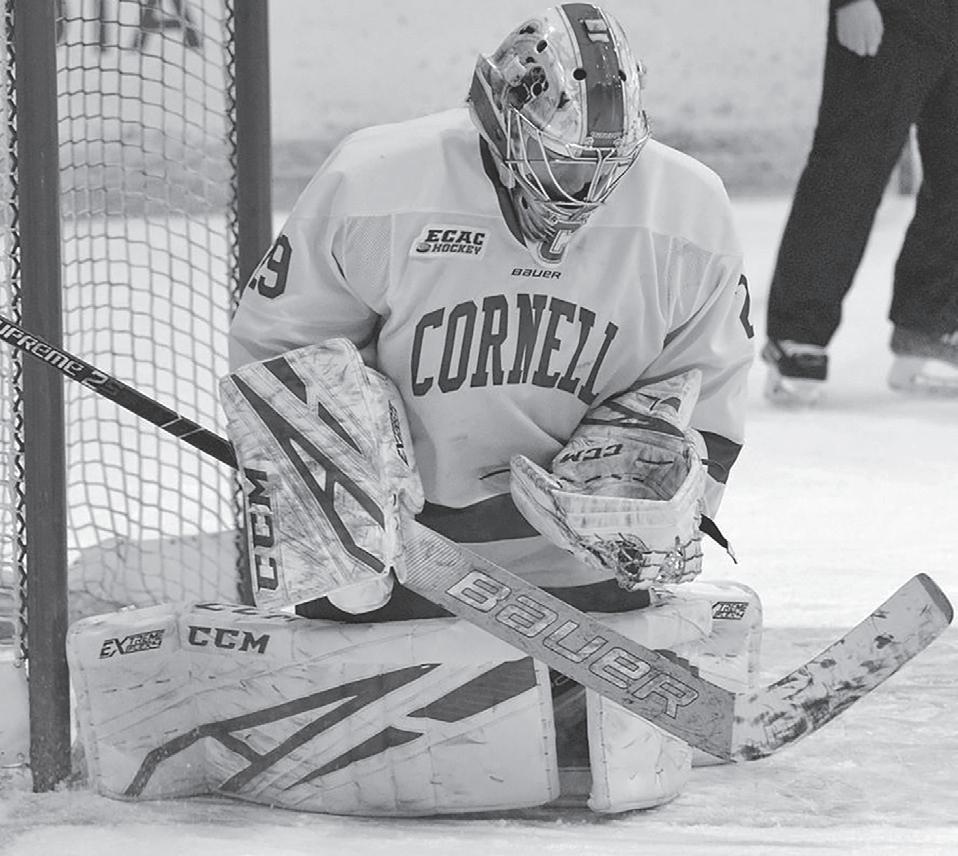
Cornell hockey took home half of the ECAC’s monthly accolades for November, winning Goaltender of the Month for both the men’s and women’s categories in addition to men’s Rookie of the Month.
Junior goaltender Lindsay Browning, with a .958 save

percentage on the month, claimed the award for her position. Browning, the first goaltender in team history to open the season with three shutouts, has stepped up in her first season as the regular starter for the Red, following the graduation of Marlène Boissonnault ’19. Browning played over 216 minutes of shutout hockey to start the season.
Browning leads the nation in shutouts with four, save percentage with .967 and goals against average with .748 — all for the entire season, not just November. Cornell went 7-1-1 on the month, closing out November with a 5-1 win at Ohio State. Browning allowed more than one goal in only one tilt all month.
Junior goaltender Matt Galajda earned the analogous honor for the men’s team, in addition to being named ECAC Goaltender of the Week. With the men’s season not starting until Nov. 1, all nine of Cornell’s wins came behind Galajda’s steady goaltending last month.
Galajda has not ceded more than two goals in any game and notched his first shutout of the season at Madison Square Garden on Saturday against Boston University. His 1.34 goals against average is good for second in the country. He allowed 12 goals over nine games, with five of them coming at even-strength.
“I think that the guys have done a great job around him, limiting second chances and he’s seeing the pocket — he’s really confident right now,” head coach Mike Schafer ’86 said of his goaltender. “He’s aggressive, he’s out on top of his crease.”
Freshman defenseman Sam Malinski started contributing to Cornell men’s hockey immediately this season, scoring twice in the team’s first three games. His efforts were enough to earn him ECAC Rookie of the Week twice in November
and ultimately culminated in the monthly award, as well. A plus-eight rating is also a testament to his defensive capabilities, helping anchor a solid blue line in front of Galajda.
Malinski seems to be having no problems adjusting to collegiate hockey right out of the gates. If that fact isn’t made clear by the level of his play over the last month, his enthusiasm will make it so.
“It was my first game in front of the Lynah fans, and it did not disappoint,” he said after the Nov. 8 win over Brown. Cornell was the only school to earn multiple ECAC monthly awards for November. Clarkson, Yale and Harvard each won one apiece.
either of this weekend’s competitors, the Red does accept the inevitability of a loss coming eventually.
“Whether we win or lose, obviously it’s important, but
we’re going to lose at some point,” Kaldis said. “So as long as we’re just getting better as a team and we peak at the right moment at the end of the year, I think that's what's most important.”
This road trip is the Red’s last set of games for 2019. The team won’t return to action until Jan. 3, when Cornell faces
off against Ohio State at the Fortress Invitational in Las Vegas. Cornell will take the ice Friday at Harvard at 7 p.m. and Saturday at Dartmouth at the same time to go for yet another four-point weekend.

Men’s hockey, fresh off a win in front of a crowd of 15,000, will hit the road again as it looks to keep its record perfect against a pair of Ivy rivals.
On Friday, the No. 2 Red will take the ice against No. 12 Harvard at Bright-Landry Hockey Center — or, as some call it, Lynah East, so named for its strong Cornell presence.
“That’s one of the more fun games of the year,” senior defenseman and captain Yanni Kaldis said. “Most of the fans there are Cornell fans, a lot of alumni. So it gets pretty rowdy in there.”
— on Tuesday night.
Indeed, Saturday night’s game also marked a return to form for Cornell at Madison Square Garden, where the Red’s 2018 loss to Harvard was its first at “The World’s Most Famous Arena” since 2013.
Against the Crimson, Cornell will square off against a strong Harvard offense with a lot of depth, not unlike its fellow Beanpot team that Cornell saw last weekend.
“They have a top line that’s very similar to [B.U.’s] top line,” Schafer said. “They can zip it around and they can move pucks and they can beat you one on one.”
Harvard leads the nation in scoring offense with 4.63 goals per game. Crimson forward Casey Dornbach was named the Men’s ECAC Player of the Month for November on Wednesday afternoon.

“If we can shut down their top players and just play our game, it could lead to success,” Kaldis said.
at Bright-Landry. Head coach Mike Schafer ’86 referred to the victory as “one of the grittiest wins [he’d] been a part of in [his] time as head coach” at the time.
“Last year, we were very desperate, obviously … that was the game that really pivoted our season,” junior forward Kyle Betts said. “And this is a game that can be a big pivot point for us, too. Every game is so important, the standings have been so tight.”
“I think it’s going to be vital to get that first goal — to set the momentum, really.”
Kyle Betts
Cornell and Harvard’s storied rivalry, which draws scores of Cornellians to even the away games, dates back to 1910 when the teams first met. But recent chapters of the rivalry have proven just as dramatic as matchups of the more distant past.
Last season, the Red fell to Harvard at Madison Square Garden, 4-1 — but the following weekend bounced back
Going into that 2018 game, Cornell was in a wildly different position than this year, plagued by injury and playing with a .500 record. The Red is entering this weekend at full health and at 9-0.
“The rivalry always brings out the best in teams and it did that for us last year,” Schafer said.
Entering last weekend, Harvard and Cornell were the only remaining teams in the nation that had won every game they played. But Harvard’s undefeated run ended with a loss to Boston College the day after Thanksgiving. The Crimson’s losing streak is now at two with a 5-2 loss at Boston University — which Cornell downed last Saturday
Coming off a road split at nationally-ranked Ohio State that included its first loss of the 2019-20 season, Cornell women’s hockey continues its long stretch of road games with tilts at No. 6 Princeton and Quinnipiac this weekend.
On the Road Again
After playing six of its first eight games of the season at Lynah Rink, Cornell finds itself in the midst of a long stretch of time away from Ithaca. Friday and Saturday’s games against the Tigers and Bobcats will be the fourth and fifth of five straight road contests. The team doesn’t return home until an early January series against Mercyhurst.
The two-game set against Mercyhurst after a four-week winter break will be the Red’s last non-conference games of the season — the team finishes its 29-game
slate with seven straight weekends of backto-back ECAC tilts.
Goaltender Earns November Award
Junior Lindsay Browning earned the ECAC’s Goaltender of the Month award for November, the league announced on Wednesday. Browning had two shutouts in November to go along with a .958 save percentage and .89 goals against average.
A Model of Consistency
Senior defender Jaime Bourbonnais leads the team with 18 points on two goals and 16 assists. Currently riding a six-game point streak, Bourbonnais has recorded at least one point in all but one of the Red’s games. Her 1.64 points per game ranks No. 1 in the nation among defensemen.
Goal-Scoring Spree
After scoring only four goals last season, top-line senior forward Amy Curlew

Cornell vs. Dartmouth Saturday, 7:00 p.m. Hanover, N.H.
Looking ahead to Dartmouth the next night, Cornell will be meeting its least-experienced opponent of the season. By Saturday night, the Green will have played in seven games as opposed to Cornell’s 10. Neither of Dartmouth’s two losses thus far came against a team that Cornell has seen yet.
Last year’s match at Dartmouth marked Cornell’s final loss before going on an eight-game unbeaten streak that the Red rode from November through January 25.
“[We don’t want to be] playing from behind on the road, so I think it’s going to be vital to get that first goal,” Betts said. “To set the momentum, really.” Dartmouth received votes in the latest USCHO.com poll, but a top-20 ranking continues to elude the Green. While Cornell won’t be satisfied with a loss against

has exploded offensively in the first half of the 2019-20 season. Curlew has eight goals — including a hat trick against Brown as part of a fivegoal weekend — and five assists. Her three game-winning goals are tied with senior forward and captain Kristin O’Neill for most on the team, and four of her goals have come on the power play.
Familiar Face Quinnipiac assistant coach Amanda Mazzotta ’12, in her fifth year with the Bobcats, was once a star between the pipes for Cornell. Mazzotta helped lead the Red to three ECAC regular-season championships, two ECAC tournament championships, three Frozen Fours and an appearance in the 2009-10 national championship game. Mazzotta posted a 53-17-8 record with
Princeton and Quinnipiac
Cornell is hoping to achieve its second sweep of the season against these two teams after earning a 1-0 win against Quinnipiac and a 3-1 win over Princeton at Lynah Rink in the first weekend of November. Browning made 14 saves in a shutout win over the Bobcats and the team used a three-goal second period to beat the Tigers.
Raphy Gendler can be reached at rgendler@cornellsun.com.