
SN OW DAY! SN OW DAY!
Fourth such shutdown in three decades

Going downhill fast | Despite closures and cancellations, some Cornellians made the best of the wintry weather during the most recent previous snow day on March 2, 2018, as they flew down Libe Slope on sleds, boards, box lids and every feasible device in between.

Black Votes Matter
Co-Founder to Visit Campus on Tursday
By JOHN YOON Sun Contributor
As the 2020 general election quickly approaches, voting power is a topic of interest.
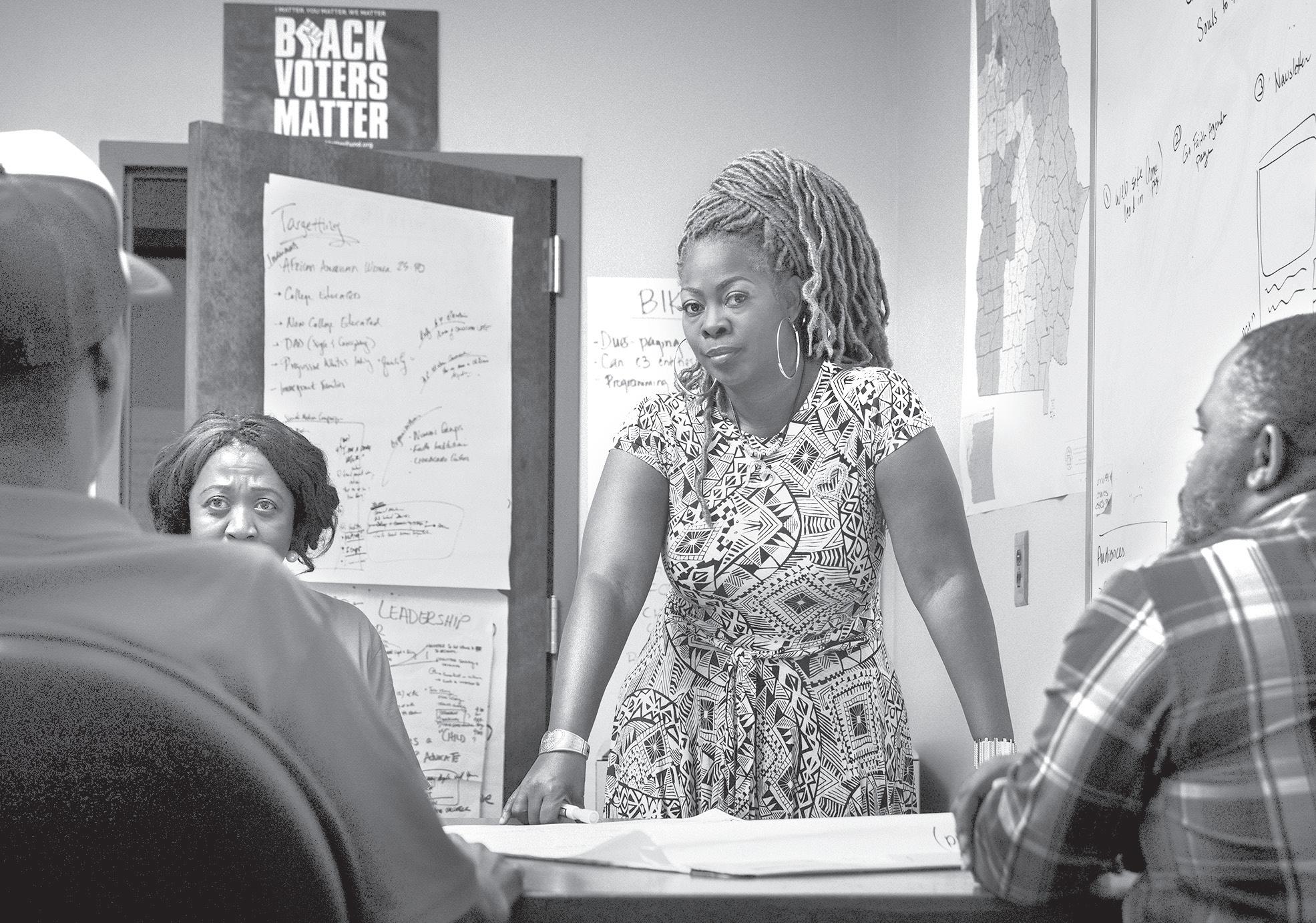
Co-founder of Black Votes Matter Fund, LaTosha Brown, will visit Ithaca this week to highlight community organizing and voting.
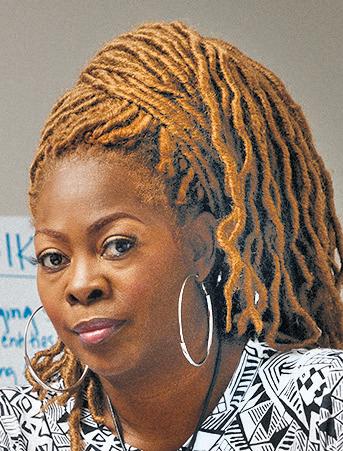
Brown will speak at two different events in Ithaca — she is the keynote speaker for a fundraising gala hosted by the Center for Transformative Action on Thursday for the Dorothy Cotton Institute, an organization that works to inspire and support

By MEGHNA MAHARISHI Sun Staff Writer
The University canceled all Monday classes on its Ithaca campus amid a snowstorm predicted to hit Ithaca with approximately six to 12 inches of snow. This is only the fourth time in the past 26 years the University has canceled all classes because of inclement weather.
This is the earliest snow day in decades — Cornell canceled all Friday classes in March 2018 and had another full snow
SNOW page 5
Santa Claus Hat Caps Top Of McGraw Tower on Sunday
By ALEC GIUFURTA Sun Staff Writer
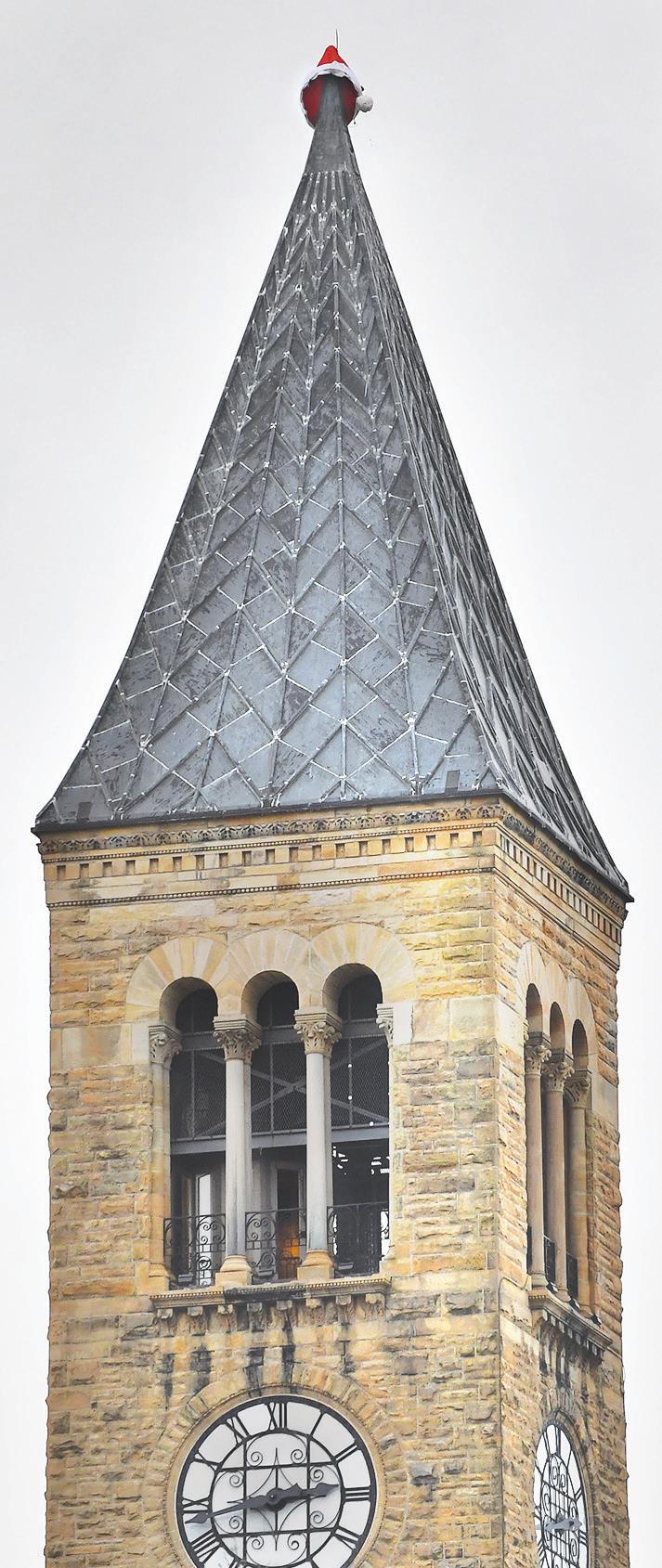
Through a haze of sleet and snow, Cornellians who happened to look up through the storm noticed something unusual about McGraw Tower: a red Santa hat currently crowns the spire. The hat, as of Sunday, rests –– 173 feet and 161 steps up –– on the pinnacle of the tower. A representative from Cornell’s emergency facilities phone line declined to comment to The Sun, and no student group or individual has yet claimed responsibility.
that he had been sent to confirm the hat’s presence after a call came in “about ten minutes ago,” the officer said.
“Today’s
just full of Christmas miracles.”
Hannah Master ’23
At 4:05 p.m. Sunday, a Cornell University Police Department officer outside McGraw Tower told The Sun
Studying on the sixth floor of Olin Library, a group of first year students viewing the hat expressed shock that someone could scale the tower. Hannah Master ’23 speculated that the hat might have been placed by a drone, noticing a small string dangling from the tip of the hat’s white pom-pom.
Andrew Darby ’23 thought the hat felt “festive,” while Estelle Hooper ’23 wondered how the hat would be removed, likening it to the pumpkin placed on
ALICE SONG / SUN STAFF PHOTOGRAPHER
12 THINGS TO DO IN THE SNOW
1. Sled down Libe Slope in the middle of a snowstorm (#5 on 161 Things to do at Cornell)
2. Ski down the steepest part of Libe Slope
3. Have a snowball fight
4. Build a snowman!
5. Build an elaborate snow fort!
6. Make snow angels!
7. Try ice skating on Beebe Lake (only if it’s safe!)
8. Build a snow penis or count how many you see around campus (#35)
9. Walk to class in the snow, uphill both ways on Tuesday (#152)
10. Make snow cones (but only use fresh snow, please!)
11. Take pictures of Cornell’s snowy campus and Instagram the experience of a rare snow day
12. Stay in, make a cup of hot chocolate and watch Netflix all day
A FEW THINGS TO LOOK OUT FOR:
* Be careful of walking on any icy sidewalks and streets, there will be black ice!
* If possible, avoid driving
*If you’re heading back to campus after Thanksgiving break, be on the lookout for further delays and travel disruptions
* Stay safe and use your own discretion when deciding how to spend your snow day!
fourth time in two decades, the University announced it will cancel
classes on Monday due to a major snowstorm that is expected to drop anywhere between six to 12 inches of snow in Ithaca.
BORIS TSANG / SUN PHOTO EDITOR
Teach-In Seeks to ‘Humanize’ Hong Kong Protests
Aiming for balance, the event will feature two students from China and two students from Hong Kong
By NICOLE ZHU Sun Assistant News Editor
Discord over the student-led protests in Hong Kong has spilled over onto Cornell’s campus, sparking cries of vandalism and spoiling plans to study abroad. A teach-in by students from both mainland China and Hong Kong hopes to address questions and misconceptions about the conflict.
The event, sponsored by the China & Asia-Pacific Studies Program and organized by Weifeng Yang ’20 and Kinen Kao ’22, will start with presentations from three students from Hong Kong and mainland China, followed by a moderated question-and-answer session.
Originally scheduled for Monday, the teach-in will now instead take place either on Thursday or Dec. 9 due to the cancellation of classes.
According to Yang, the student speakers — two of whom are from Hong Kong — have been encouraged to present their “subjective viewpoints,” including their own personal experiences with the protests.
Why? To “humanize” the events in Hong Kong, especially for Cornellians who feel far-removed from the city.
“These are actually people around on this campus whose friends might have been arrested, or whose parents’ business are being hurt because of the consequences of the protest,” Yang said.
For moderator and director of the China and AsiaPacific Studies program Prof. Allen Carlson, government, the teach-in is essential for constructive dialogue, especially given the proliferation of news about Hong Kong on social media.
“There is a great deal of misunderstanding and misperceptions about both why the protests began, how they have unfolded, and what their implications are likely to be,” Carlson told The Sun in an email.
The organizers, both of whom will speak, wanted to show a “diverse representation” of opinions by featuring two

students from Hong Kong and two from China, one from each location with pro-democracy or pro-establishment views.
“You still have a significant amount of the population who are pro-establishment and pro-Beijing for a reason. Alongside many of my mainland Chinese friends, you know, they hold these views for legitimate and concrete reasons. And I do think that it is important to recognize [them], even if you disagree with them,” Yang said.
However, the organizers were unable to find a pro-establishment Chinese student willing to speak publicly — most likely out of fear of backlash from fellow students, Yang said.
Cornell Minds Matter Provides Weekly Rides
By SOPHIE ARZUMANOV Sun Staff Writer
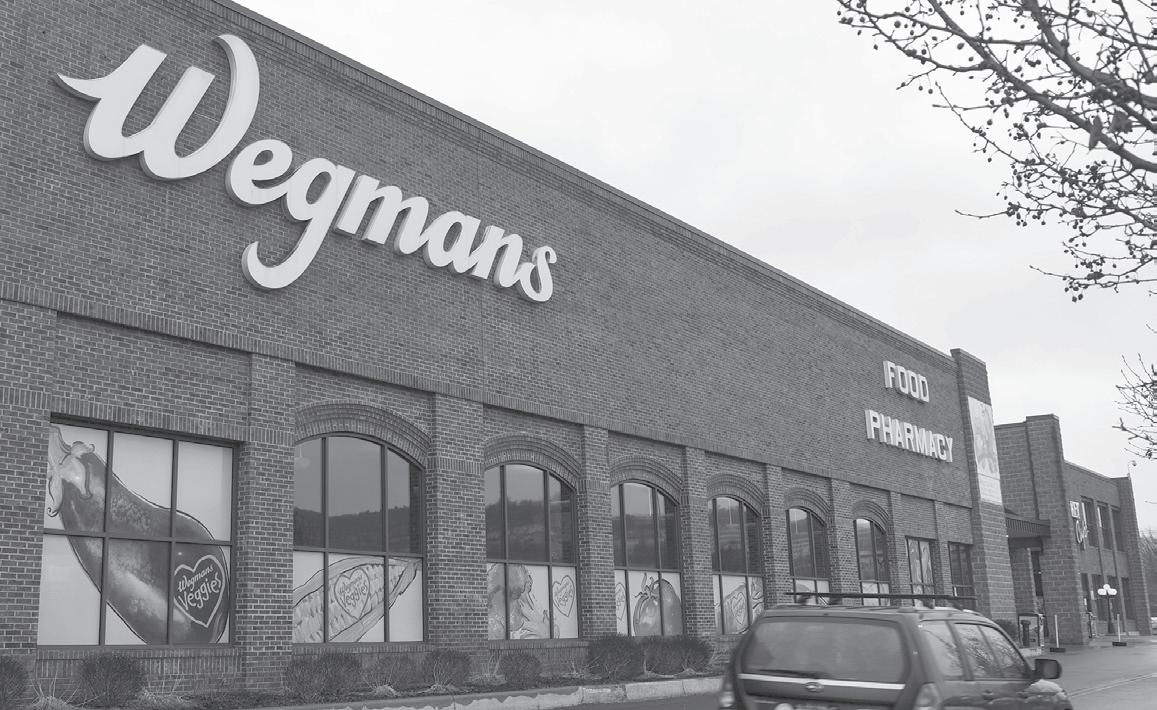
Members of the Cornell community are now able to take advantage of a unique opportunity offered by Cornell Minds Matter to get their grocery shopping done. Weekly Wegmans Run, started this semester, allows individuals free transportation to and from Wegmans on Mondays.
“We wanted to provide students with an alternative resource for getting groceries.”
Tatiana Blechman ’20
Traditionally, students have to take two hourly buses to Wegmans, use ride sharing services such as Uber or use a car, if they have one. Since Nov. 11, they now have a new option. Emily Hurwitz ’21 has had a positive experience participating in a few of the Weekly Wegmans Runs. Before, Hurwitz noted that although Target is accessible by bus, it wasn’t the best for her grocery shopping needs, and the TCAT commute to Wegmans ultimately took her three hours per trip.
Tatiana Blechman ’20, Social Events Coordinator for CMM, organizes the transportation for individuals and makes sure that everyone gets rides to and from Wegmans accordingly. She does not foresee a
Instead, he plans to compile views from his own pro-establishment Chinese friends, who will remain anonymous, and present them alongside his own pro-democracy perspective.
“There have been few events that feel as consequential for the country as the current protest movement in Hong Kong,” Carlson said. “What is happening there will have great consequence not only for those who live in [Hong Kong], but also in the rest of the PRC, and in the rest of the world.”
What Does It Mean to Internally Transfer?
Switching
Majors and Declaring Interests
By WINNY SUN Sun Staff Writer
In a university that boasts seven undergraduate colleges, students are neatly sorted into their collegiate home before even arriving to Cornell. But for students who decide their academic interests lie beyond their chosen school, an internal transfer means that isn’t a permanent assignment.
To Sabrina Wong ’21, who was originally undeclared in the College of Arts and Sciences with intended majors in English and economics, the process of transferring into Applied Economics and Management was “competitive.” Applicants need a high G.P.A., a strong personal statement and related extracurricular activities, among other things, she said.
“You also need to have good, concrete reasons [for switching your major.] It’s a pretty big decision, and admissions wants to see a responsible person who has done their research and reached out to rele-
vant people,” Wong said.
“That actual process itself is like applying to college all over again. You have to really really want it to keep track of all the deadlines and writing samples,” she added.
Molly Smith ’21 switched from being undeclared in the College of Engineering to food science in the College of Agriculture and Life Sciences.
To internally transfer, she had to meet with several advisors, from both her old and new intended majors and fill out a comprehensive application, noting, like Wong, that one has to demonstrate genuine interest in the major, either through classes or activities.
“I couldn’t get into a food science class before I applied, so I ended up doing research in food science. Admissions officers want to see that you like the major you are going into, not just that you hate your current major,” she said.
Alumnus Receives Poetry Award
By MIA GLASS Sun Contributor
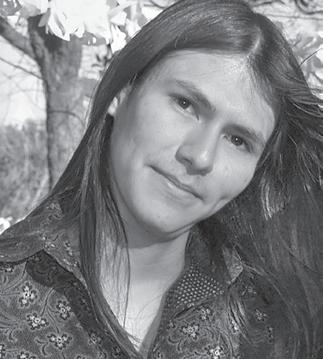
The National Poetry Series chose Cornell alumnus author Benjamin Garcia ’11 as one of five winners in a prestigious competition that grants awardees a chance at publication. His book Thrown in the Throat was chosen by poet Kazim Ali, and will be published next fall.
The books were chosen through an open competition featuring more than 1,000 poets. The winners, announced this week, receive a $10,000 cash prize and are connected to participating publishers that fund the printing of their full-length manuscripts.
The competition aims to promote poetry and heighten the involvement of publishers and booksellers. Garcia received his B.A. in English and Spanish from the University of New Mexico and his MFA from Cornell University in 2011. He has emerged as a prominent poet ever since, accumulating numerous literary awards and scholarships.
queer and Latinx writers whose hard work has made it easier for me to pursue that right. I hope that someday my work can do this for others.”
As a 2017 Latin@ Scholar, Garcia said: “If after my MFA I questioned whether poetry mattered, 2017 answered—art is a human right. Thank you to the
Garcia was awarded the 2018 CantoMundo Fellow at the Palm Beach Poetry Festival as well. His work has also appeared in distinguished journals such as the New England Review and the American Poetry Review, among many others.
Grocery gets | Every Monday, Cornell Minds Matter offers free transportation to Wegmans so that students have easier access to groceries.
BORIS TSANG / SUN PHOTOGRAPHY EDITOR
Demonstrations continue | On Dec. 1, thousands of protestors in Hong Kong congregate in the Tsim Sha Tsui neighborhood, marking a resurgence in protests after a small slowdown.
GARCIA ’11
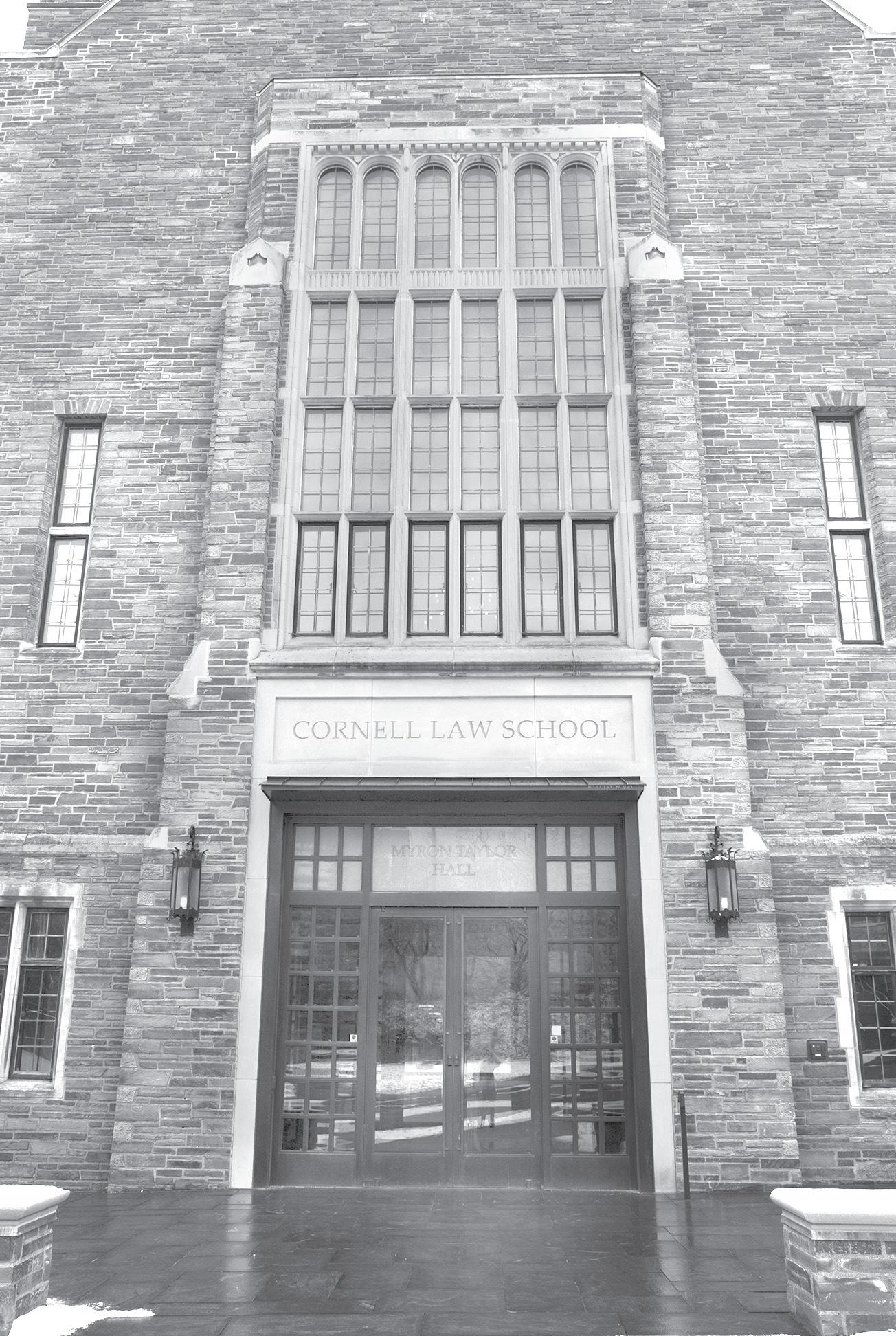
Legal Clinics Give Law Students Real World Practice
Labor Law, Immigration Law and Advocacy Clinics help underserved communities
By LOUIS CHUANG Sun Staff Writer
To supplement what they learn in the law school classroom with real-life experience, Cornell law students participate in courses, dubbed “clinics,” where students assist real clients with real legal problems.
Many people are unaware of their legal protections or have trouble accessing government agencies that do assist workers with certain types of cases because “low-income people do not have a right to legal counsel with civil matters,” said Labor Law Clinic director Prof. Angela B. Cornell, law.
According to Kelley-Widmer, “the [immigration law] clinic will handle limited immigration applications for Cornell students, faculty, and staff, specifically working on DACA renewal cases (Deferred Action for Childhood Arrivals) and naturalization cases (for citizenship).”
Throughout the process, students work in teams on legal work, meeting with clients, collecting evidence, drafting applications and preparing filings.
Under faculty supervision, students interview clients and conduct a legal analysis of their claims, eventually suggesting a course of action for the clients.
“Low-income people do not have a right to legal counsel with civil matters.”
As part of its day to day routine, the Labor Law Clinic assists non-profits, worker centers and unions with issues that need legal attention in addition to members of our community and international labor law cases.
Prof. Angela B. Cornell
The clinic’s cases involved workers who faced retaliation for trying to address workplace issues: Cornell recalled a case last year when she represented a woman who lawfully spoke to other workers about issues of pay but was fired for doing so.
Likewise, inspired by the demand for immigration assistance to the Cornell community and asylum seekers, Prof. Jaclyn Kelley-Widmer, Law, created the Immigration Law and Advocacy Clinic, giving first-year law students an opportunity to engage in real client work.
The cases sometimes involve Cornellians, too.
Red Santa Hat
Tops McGraw Clock Tower
Continued from page 1
McGraw Tower in 1997, noting that a pumpkin will rot and fall to the ground naturally.
In fact, the pumpkin sat atop the tower for five months, finally falling to the ground on March 13, 1998, when then-Provost Don M. Randel attempted to cut the gourd down.
With today’s announcement of a rare class cancelation for Monday, Master said: “Today’s just full of Christmas miracles.”
Alec Giufurta an be reached at agiufurta@cornellsun.com.
“Students will also present legal information orally and/ or in writing during presentations,” Kelley-Widmer told The Sun in an email.
By offering a clinic to the community, the assistance will benefit clients, who will not have to travel far for the immigration assistance they need, which requires detailed knowledge of the law and process.
Outside of Cornell, the immigration clinic involves law students traveling to other states to bring legal knowledge directly to impacted communities, such as through presentations and public trainings about how to be an ally to undocumented and DACA students.
Ultimately Kelley-Widmer “hopes that [the immigration] clinic inspires law students to get involved and stay involved with public service.”
lchuang@cornellsun.com.
LaTosha Brown to Speak on Community Engagement
Continued from page 1
people to protect human rights, named for civil rights leader Dorothy Cotton.
Earlier in the day, Brown will deliver a 1:25 p.m. talk supported by the anthropology course Global Engagements: Living and Working in a Diverse World taught by Prof. Sofia A. Villenas, anthropology. The class focuses on community engagement and civic participation.
“Students may learn from Ms. Brown that turning people into committed voters and building political power involves the hard work of respectful listening, engaging in difficult conversations about race and racism, and attention to building relationships,” Villenas said. “This is the long-term work of organizing the vote from below.”
The Black Voters Matter Fund works to increase the political power of black communities, even playing a large role in the 2017 Alabama U.S. Senate race by launching the Alabama Grassroot Mobilization Project, which helped to put grassroot groups in 18 Alabama counties. In addition, the fund was able to provide mini grants to more than 30 local communities to encourage communities to vote.
Brown has over twenty years of experience in the nonprofit sector for issues relating to social justice, civil rights, political empowerment and more. She served as a consultant and advisor for numerous donors, public foundations and the government for over 25 years as the principal owner of TruthSpeaks Consulting, Inc., a philanthropy advisory consulting firm in Atlanta.
Brown is also the founding project director of Grantmakers for Southern Progress. The GSP is a membership-based network that works to create structural change in the South. Currently, she is an Institute of Politics Fellow at the Kennedy School at Harvard University. Brown, co-founder of Black Voters Matter Funds, has been involved in helping neglected communities learn about the importance of voting and the power that they can wield to change their future.
“I also hope students learn more about the central role that Black women continue to play in civil rights organizing, and in particular for the vote,” Villenas said.
John
Law | As a part of their coursework, law students engage in legal clinics and gain practice working with clients.
COURTESY OF CORNELL UNIVERSITY
Louis Chuang can be reached at
Voting power | LaTosha Brown, a co-founder of Black Voters Matter Fund, stands at the offices of the New Georgia Project, in Atlanta, on Sept. 19, 2018.
ANDREA MORALES / THE NEW YORK TIMES
Yoon can be reached at jjy46@cornell.edu.
Cornell Cancels Classes for Snow
ing to the service’s website. The company OurBus canceled some of its Sunday trips to Ithaca, saying that it had notified customers of cancellations via email.
day in March 2017. Other than those two closures, March 1993 was the last time that the University canceled all classes.
In a tweet, Ithaca Mayor Svante Myrick ’09 urged students not to travel back in such inclement conditions.
“If you’re a student trying to drive back today — don’t,” Myrick said.
Ithaca will experience a total snowfall of 11 inches, current forecasts estimate, with winds up to 35 miles per hour. Ithaca is under a Winter Storm Watch until Monday night. The National Weather Service also warned of power outages, saying that it was “dangerous” to travel.
Aidan Mahoney ’22, co-president of Cornell’s American Meteorological Society, told The Sun that while the sleet and snow will calm down Sunday afternoon and evening, heavy snow will develop later tonight and continue to accumulate into Monday afternoon.
Campus buildings will remain open for faculty and staff, but the University is “continuing to evaluate the weather and operating status.”
The cancellation comes as students struggle to return to campus after Thanksgiving break. Coach USA’s Shortline Ithaca Platinum service, which runs from New York City, rescheduled all Sunday departures to leave between 9 and 10 a.m. Other Shortline buses leaving from New York City on Sunday only operated between 8 to 10:15 a.m, accord-
Other areas in Ithaca are also bunkering down. Ithaca College announced on Saturday that it would cancel all Monday classes. The Ithaca YMCA and Cinemapolis will be closed Sunday. All Cornell women’s and men’s Sunday basketball games have also been canceled.
Neighboring universities, including Binghamton University, SUNY Geneseo, SUNY Cortland and Tompkins Cortland Community College also announced that they would cancel classes on Monday because of the storm.
While the storm initially inspired a series of memes from students poking fun at the rare likelihood that Cornell would cancel classes, the news of no classes on Monday led to a flurry of celebratory memes and reactions.
Mahoney believed that the University made a good decision in canceling Monday classes.
“So many people who are traveling today or maybe stuck wherever they are, now have the stress of missing classes absolved,” Mahoney said. “I cannot stress enough people are custodians of their own personal safety, but canceling classes is a good decision.”
It is unclear at this time how the cancellation would affect final exam schedules or remaining classes of the semester.
Meghna Maharishi can be reached at mmaharishi@cornellsun.com.
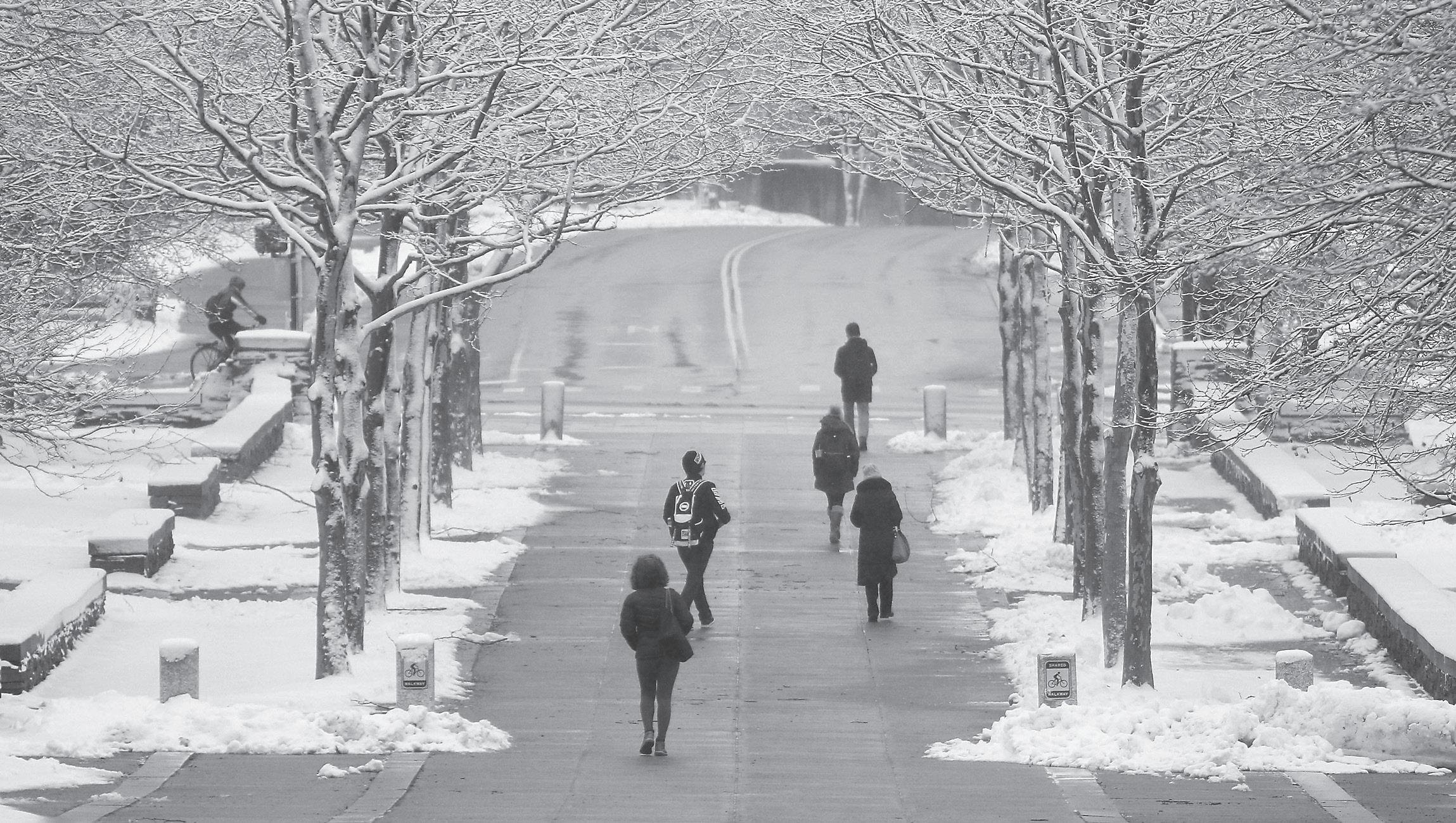
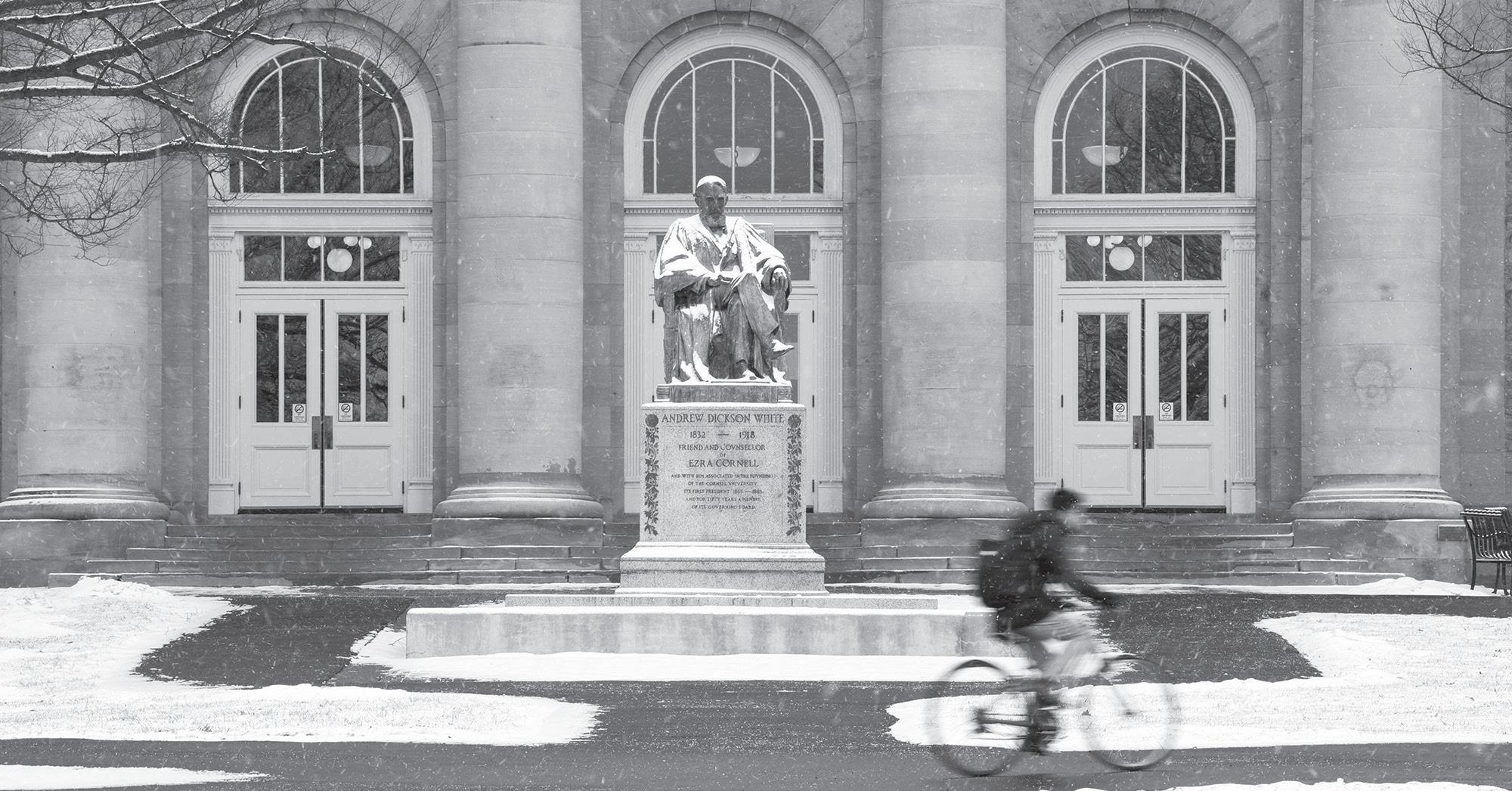
| Cornell announced Sunday afternoon that it would cancel Monday’s classes. Above, students
on Cornell’s most recent snow day, March 2, 2018.
Internal
Continued from page 3
through
CMM Ofers Free Rides to and From Wegmans
WEGMANS
Continued from page 3
participation limit in the future.
“We recognize that getting to Wegmans can often be very difficult for individuals that do not have a car on campus,” Blechman said. “We wanted to provide students with an alternative resource for getting groceries.”
The weekly event has made the planning side of grocery shopping easier, too. Before, Hurwitz recalls spending “over $100 at Wegmans, stocking up on cooking supplies” and making additional trips to Target and Anabel’s Grocery.
Now, Hurwitz enjoys not having to worry about carefully planning her meals anymore because she can get what she needs for the week in one trip to Wegmans.
The quality of her purchases has also improved. “I can buy healthier meats, fresh bread and better bakery items.”
“Lack of access to quality groceries is an important aspect of food insecurity.”
Abhi
Ramakrishnan ’20
Abhi Ramakrishnan ’20 was very excited when she first heard about the opportunity.
“I have been looking for an easy shopping solution like this since sophomore year when I started cooking,” Ramakrishnan said, describing similar benefits. “This does make it easier to track my spending as I am mostly purchasing everything I need at one store, at one time.”
Ramakirshnan lauded Weekly Wegmans Runs for being “environmentally friendly,” “time-efficient” and “reliable.” She pointed out the initiative’s connection to accessibility of food at Cornell.
“Lack of access to quality groceries is an important aspect of food insecurity which I believe is very prevalent on this campus,” Ramakirshnan said.
The next Weekly Wegmans Runs are Dec. 2 and 9. Interested participants can sign up on a weekly basis via a sign-up sheet on the organization’s Facebook page. They then meet by Robert Purcell Community Center on Monday at approximately 6:20 p.m., travel to Wegmans in groups via taxis paid for by CMM, and return at 7:15 p.m.
Sophie Arzumanov can be reached at sarzumanov@cornellsun.com.
Transfers: Finding a New Home Within Cornell
According to Smith, a successful application depends on a combination of factors. Personal statement and being in good academic standing in the home college matter. Since internal transfers may be behind in their new major, they also have to show how they plan to catch up to graduate on time, by taking extra classes during break or using transfer credits.
of the most critical application components.
“Though I came from a STEM major, both freshman writing seminars I took were related to history in some way,” she said. “In my personal statement, I wrote about those classes and experiences I have had and how since I was little, I had been really interested in history.”
“I already decided freshman year, very early on, that I wanted to switch my major.”
Jaylen Keith ’20
The academic trajectory of Grace Bichler ’22 took a more unconventional turn. Switching from environment and sustainability studies to history, Bichler said the personal statement is one
As for Jaylen Keith ’20, who was undeclared in the College of Arts and Sciences before transferring into electrical and computer engineering, “taking the right classes and maintaining a certain G.P.A.” is the most important.
“After taking some of the classes that freshmen engineers take, I decided that I want to do an engineering major,” he said. “Though I applied for inter-
nal transfer the second semester of sophomore year, I already decided freshman year, very early on, that I wanted to switch my major.”
The process for transferring to each college can vary considerably. While all students looking to transfer must fill out the same internal transfer application, which asks applicants for a 600-word essay on why their “academic or career goals have led” them to “pursue an internal transfer,” some colleges have more requirements than others.
gram and depend on the unique applicant pool each semester, explained Florencia Ardon, program manager and advisor at the Office of Internal Transfer and Concurrent Degrees.
“More than thinking if it is
taken into consideration.”
All four students are happy with the decisions they have made; they have also learned and matured through this experience. For instance, Smith learned to be true to herself and follow her passions.
“It is very important that students reflect on whether they know enough of their target
major to be sure they want to transfer...”
Florencia Ardon
For instance, while the College of Arts and Sciences requires that potential transfers have at least a 2.7 G.P.A., AEM notes that most of its successful applicants have “at least a 3.3,” in addition to also asking for a resume and supplemental transfer application.
Acceptance rates for internal transfer vary by college and pro-
easy or hard to transfer into a major, it is very important that students reflect on whether they know enough of their target major to be sure they want to transfer to that major, first of all,” Ardon told The Sun in an email.
“Then, students need to see whether it is feasible, i.e., will they finish on time and do they fulfill the requirements?” she continued. “The process is definitely holistic and all components are
“A lot of people thought that I was switching out of engineering because it was too hard for me. But I was switching because I didn’t have any interests,” she said. “I was not backing out and being weak. I was just doing what I like.”
Wong, on the other hand, learned “a lot about independence, taking control of one’s life, and making big decisions and acting upon them.”
“That in itself is the whole point of college,” she said.
Winny Sun can be reached at wsun@cornellsun.com.
Snow day
trudge
Ho Plaza
MICHAEL WENYE LI / SUN SENIOR PHOTOGRAPHER
ARTS & ENTERTAINMENT
Mobsters in Twilight: T e Irishman Is Immaculate
It seems that as we grow older, the more we think about life; we wonder how we will be remembered, and who will remember us. Or maybe you wish you had spent more time with your family rather than killing all those people for your mob boss. Such is the case of Frank Sheeran, the titular character and focus of Martin Scorsese’s new film The Irishman,which is based on the book I Heard You Paint Houses by Charles Brandt. From a vantage point of an old man in a retirement home reflecting on his life, Sheeran (Robert De Niro) narrates his story, which ranges from World War II to the early 2000s and includes (among many other elements) his friendship with Jimmy Hoffa, the General President of the International Brotherhood of Teamsters. The book and film most prominently answer the question of what happened to Hoffa after his disappearance, which might be the primary motivation for many to watch it; however, there is so much more to it than that. In what is arguably one of Scorsese’s best and most pensive films yet, The Irishman depicts a harrowing account of a man grappling with his past — a past which leaves him with nothing besides pain and regret.
Frank Sheeran begins his career as a truck driver in Philadelphia and a member of the Teamsters, languishing as “one of a thousand working stiffs” providing for his family, the most prominent of whom is his younger daughter Peggy, played as a child by Lucy Gallina and as an adult by Anna Paquin, silently casting judgement on Frank’s actions throughout the film with a piercing stare. Eventually, he meets powerful Pennsylvania mob boss Russell Bufalino (Joe Pesci), who starts giving him various tasks to perform for the mob including murder. As Sheeran gradually begins to become more powerful, he is introduced to Hoffa (Al Pacino). Sheeran and Hoffa become close friends and confidantes, but Sheeran watches with growing concern as Hoffa’s relationship with the mob sours more and more. Sheeran is ultimately forced to choose between Hoffa and the mob, a decision which affects him for the rest of his life. Of course, much debate surrounds the question of whether his account is actually true or not; in a sense, though, it does not necessarily have to be, as its ambiguity perfectly mirrors the uncertainty which continues to plague Sheeran long after his days in the mob are over. One can probably assume from this synopsis that the film is long — an accurate statement, considering it runs for almost three hours and thirty minutes. This is not to say that it drags as a result, though. Indeed, some people have expressed a wish that it was shorter, but after watching it, I realized that there were no parts which I could unequivocally claim the film did not need. One of its biggest strengths is its immensity; it might be hard to watch in one sitting, but it is definitely worth it.
Seeing The Irishman inevitably prompts comparisons to Scorsese’s other mob films, Goodfellas and Casino.All three films share a similar premise, but The Irishman makes for a much different experience; it is more
reflective, slower and more suspenseful, as it slowly arrives at the conclusion we all know is eventually coming. The Irishman portrays the rise of its main character within the mob before his standing and opulent lifestyle are permanently undone; after Hoffa’s eventual disappearance, Sheeran, like Bufalino and the other main characters, is convicted of various crimes and sent to prison, with nothing really waiting for him after he is released. While the respective stars of the previous two films fall expressly due to the choices they make and their consequences, Sheeran slips into obscurity as those around him steadily die off with the years. He does not lose his prominent position in the mob like Henry Hill of Goodfellas or Ace Rothstein of Casino;instead, he simply fades away into time. Scorsese illustrates this unmaking with unparalleled ease, allowing the camera to linger in places as Sheeran re–examines exactly what happened. This authenticity of sorts might also come from the age of the main players themselves — De Niro, Pacino, Pesci and Scorsese are all in their late seventies or early eighties. While they may be more contemplative in old age, however, their talents and sensibilities are not muted in the least. Other members of the cast stand out as well; Ray Romano plays the clever and resourceful attorney Bill Bufalino (Russell’s cousin and the attorney for Hoffa and the mob); Stephen Graham nonchalantly portrays Anthony Provenzano (a New Jersey boss and Hoffa’s main rival); and the aforementioned Gallina and Paquin brilliantly serve as Sheeran’s eternal reminder of the consequences of his actions. Action Bronson even shows up as a coffin store owner. It is an ensemble not to be glossed over.
Of course, Sheeran must face the consequences of his choices just as much as the protagonists of the other two films, but rather than affecting his position in the mob in a fairly quick progression of events, they alienate his family over decades and ensure that he has nobody else around him by the film’s chronological conclusion. Near the end of the film, two government agents ask him about what happened to Hoffa once more, mentioning the pain his family has endured that came with the uncertainty regarding his disappearance. “You got kids, Frank — can you imagine?,” they ask him. The saddest part of this exchange is the fact that, in a way, Frank cannot imagine it because he has no kids who still talk to him — they do not even want to associate with him, with Peggy refusing to talk to him when he visits her at her job. While it is true that he committed many horrific acts, you cannot help but feel sympathy for him, as his final fate is one which could easily befall any of us.
The final shot of the film shows Frank Sheeran through the slightly open door of his room in the retirement home to which he is confined, abandoned. While he may not have encountered the same brutal fate as Hoffa or many of the other characters throughout the film, the audience has to wonder whether the alternative they are shown is any better.
John Colie is a freshman in the College of Arts and Sciences. He can be reached at jcolie@ cornellsun.com.



JOHN COLIE SUN STAFF WRITER
PHOTOS COURTESY OF NETFLIX
Frozen II Is a Cut Below Its Predecessor
It is no controversial statement to say that Disney has been hitting animated movies out of the park at an astonishing clip lately. Between their Disney Animation Studios and Pixar umbrellas, they have brought us Inside Out, Coco, Tangled, Zootopia and Moana in just this decade, which is not to mention the first Frozen film, one that somehow managed to rise above even the House of Mouse’s staggeringly high standards.
Frozen outpaced every other one of Disney’s animated movies except 2019’s Lion King (which I still have trouble seeing as animated) and even gave the upper echelon of Marvel and Star Wars films a run for their money. While I know that the box office success of any given film is no indicator of its value as a piece of art, I still feel the need to stress that these movies are pop-cultural singularities — Frozen made about the 2017 GDP of the Solomon Islands without its merchandise sales.
Unlike some of those other top-grossing films (the grossest films, if you will) that the truly artsy folks seem to think are eroding our society, Frozen told a deeply affecting and highly beneficial narrative to an entire generation of children that has been conditioned to believe that extranormal powers are what make extraordinary people extraordinary.
In an era of superpowered extremes, the power that saved the day in Frozen was that of the superhero’s “ordinary” sister, whose capacity for familial love outshone even the most slanted odds. On top of that, many of the more tired tropes of olden Disney princesses were absent in Frozen.
The film’s leading characters were two fully independent sisters who achieved their goals through some combination of compassion and tenacity. That, in itself, is reason enough to see the first film without mention of its stunning visuals or inspired (if not, as the new sequel cheekily acknowledges, now worn-out) soundtrack. Unfortunately, though, the lasting emotional thrust provided by the first film is why I was so disappointed when its sequel’s credits started to role.
Frozen II is a cautionary tale in following up a film that cast an inescapable shadow. I in no way mean to say that the new movie is not serviceable — it just broke the worldwide animated debut box
office record and so has achieved success in at least one sense of the word — but has done so on the coattails of its far superior film. No world exists in which Frozen II has the same staying power as its older sister.
Although six years ago is not exactly recent, its predecessor is still fresh enough in moviegoers minds for Frozen II not to be granted the rose-colored tint lent to films like Finding Dory and Incredibles 2 and suffers greatly for it. Its visuals, while still astonishing, are not a noticeable step up and its music, while still memorable, cannot hold a candle to the songs of the original that still find their way into my regular Spotify rotation.
Worst of all, though, is the new film’s story, which was at best pedestrian and at worst utterly baffling. I know that on some level films like this one are made for the kids in the theater, but what has made Disney and Pixar films so special is that they consistently tell stories cohesive enough to service the adults in the audience. Regardless of how impossibly high Disney has set that bar, Frozen II’s falling short of it left a sour taste in my mouth.
I found myself checking in with my neighbors throughout the film to see if they had any clue what was going on (if only to affirm that I was not being intellectually outmatched by a movie with sentient snowmen) and found they shared my confusion. Whereas Frozen’s narrative felt organically propelled, with its songs at times serving as plot-driving exposition and development, Frozen II feels as though its garbled story was colored in between a set of predetermined musical numbers. Its plot inexplicably leaps from point to point simply because it needs to move forward. It feels more akin to a run-of-the-mill episodic video game than it does to what we have come to expect from Disney.
If I were comparing Frozen II to whatever 10 cent action film I could have seen instead (no offense, 21 Bridges), I would likely consider it more favorably. The status quo Disney has set for itself is near cinematic perfection. Anything below that line — even though Frozen II still has its handful of thoroughly joyful moments — feels hollow.

Dark Star Orchestra Brings Back the Dead
WILLIAM MIKSIC SUN STAFF WRITER
Long before I started applying to college or even thought about Cornell, I started listening to the Grateful Dead. Little did I know that the college I would end up at was the home to arguably the best Grateful Dead show that ever took place (Barton Hall on May 8, 1977). Like many other fans of the Grateful Dead, I was introduced to them through my older brother. I found his iPod and stumbled upon some Dead songs, the first being “Casey Jones.” I was immediately captivated and began to dive deeper and deeper into the vast Grateful Dead catalog, which includes 13 studio albums and about 3,000 live performances.
Today, I consider myself an amateur deadhead. I can pick out the names of songs, and in some cases the date on which a live song was played, but I’ve never seen Jerry Garcia in the flesh and won’t ever really know what a Grateful Dead show is like. Dark Star Orchestra, however, gave me a little taste of what that show might be like. This was my second time seeing Dark Star, and I was beyond excited to see them in a venue like the State Theatre. I saw them perform for the first time at the Stone Pony in Asbury Park, N.J., the famous venue where Bruce Springsteen came to be. It was a great show, but unfortunately, a security guard decided to cut my Stone Pony experience short. I was holding a beer and didn’t have a wristband on (rookie mistake). I gave him the drink and began my walk of shame out of the venue. Not the best end to a show, but I was ready to redeem myself at the State Theatre.
I pulled up to the State Theatre the week before Thanksgiving and was pleasantly surprised to find out that our tickets were general admission and we could sit wherever we wanted. While we waited for the show to start, I grabbed a beer (legally this time!) and headed back to my seat. As I looked around, it was comforting to know that we were surrounded by a big group of kids our age and wouldn’t be terrorized by die-hard deadheads claiming we’re at the wrong concert or berating me for wearing a Phish shirt.
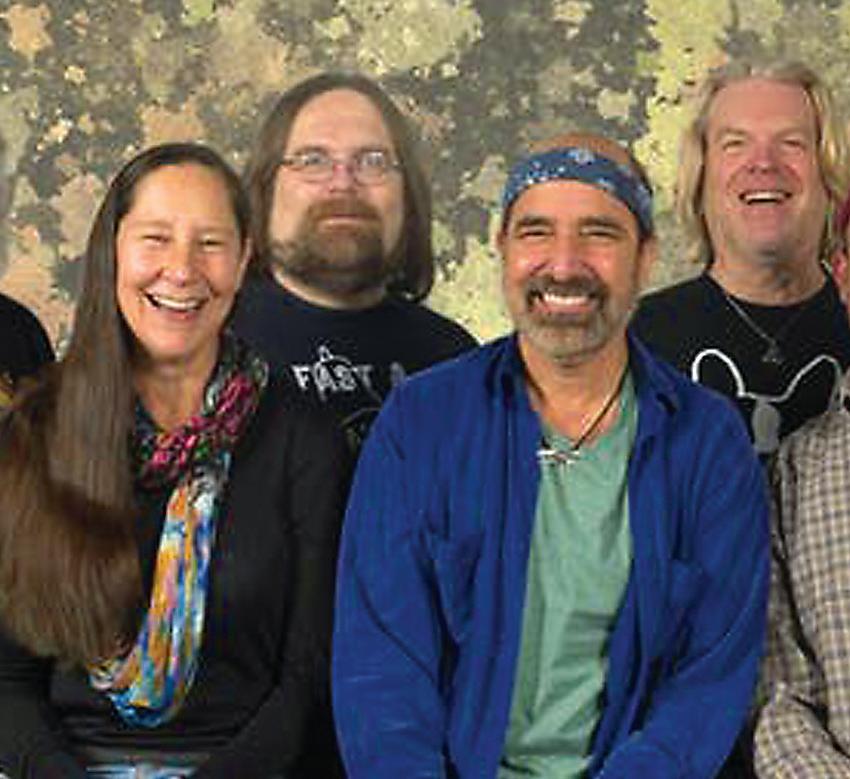
Soon enough the lights went down and the band came on stage. They started off with “The Music Never Stopped,” a song written by Bob Weir (rhythm guitarist of the Dead) and John Perry Barlow (songwriter and childhood friend of Weir). I was immediately taken back by the band. Although I had seen them before, I was shocked at how closely DSO resembled the playing of the Grateful Dead. The lead guitarist, Jeff Mattson, does a great job at mimicking Jerry’s playing, especially in the way he spaces out the notes he plays. This won’t come as a surprise to many, as Jeff has played with every member of the Grateful Dead and has been involved in the scene since the early 1970s.
Some of the highlights of the show included a pumping “New Minglewood Blues,” a dreamy “It Looks Like Rain,” a “Lazy Lightning” similar to the one played at Barton Hall in 1977 and “It Must Have Been the Roses.”
Anytime this band comes into town, I highly recommend you go see them. Maybe they aren’t the same band that emerged during the San Francisco Acid Tests in the ’60s, and they definitely didn’t live together in Haight-Ashbury. But if you squint really hard they are pretty damn close. There’s a reason why Phil Lesh (Dead bassist) picked Dark Star to fill in for him for his Halloween shows and why my Uncle Chris (a traveling Dead fan who attended the famous show at Barton Hall) asked me how I knew who Dark Star Orchestra was. This band has it and whether you know it or not, you need it.
NICK SMITH SUN STAFF WRITER
Nick Smith is a senior in the College of Arts and Sciences. He can be reached at nsmith@cornellsun.com.
William Miksic is a senior in the College of Arts and Sciences. He can be reached at wmiksic@cornellsun.com.
The Corne¬ Daily Sun
Independent Since 1880
137th Editorial Board
ANU SUBRAMANIAM ’20
Editor in Chief
JOYBEER DATTA GUPTA ’21
Business Manager
PARIS GHAZI ’21
Associate Editor
MEREDITH LIU ’20
Assistant Managing Editor
RAPHY GENDLER ’21
Sports Editor
BORIS TSANG ’21 Photography Editor
AMBER KRISCH ’21
SOPHIE REYNOLDS ’20
Editor
AMANDA H. CRONIN ’21 News Editor
JOHNATHAN STIMPSON ’21
PETER BUONANNO ’21
ANYI CHENG ’21
HUNTER SEITZ ’20
BULKELEY ’21
’22
JEREMY MARKUS ’22 Assistant
ALICIA WANG ’21
DANA CHAN ’21
RYAN RICHARDSON ’21 Snapchat Editor
GIRISHA ARORA ’20
Editor
SARAH SKINNER ’21 Managing Editor
KRYSTAL YANG ’21 Advertising Manager
NATALIE FUNG ’20 Web Editor
SABRINA XIE ’21 Design Editor
NOAH HARRELSON ’21 Blogs Editor
SHRIYA PERATI ’21 Science Editor
KATIE ZHANG ’21 Dining Editor
AMINA KILPATRICK ’21 News Editor
MARYAM ZAFAR ’21 City Editor
ETHAN WU ’21 Opinion Editor
SHIVANI SANGHANI ’20 Assistant News Editor
NICOLE ZHU ’21
PICHINI ’22
JIANG ’21
MORAN ’21
LEI WU ’21
WANG ’20
’21
’20
Working on Today’s Sun
Ad Layout Mei Ou ’22
Production Deskers Mei Ou ’22
News Deskers Amina Kilpatrick ’21 Maryam Zafar ’21
Design Deskers Lei Lei Wu ’21
Xiangyi Zhao ’22
Photography Desker Boris Tsang ’21
Sports Desker Luke Pichini ’22
Arts Desker Peter Buonanno ’21
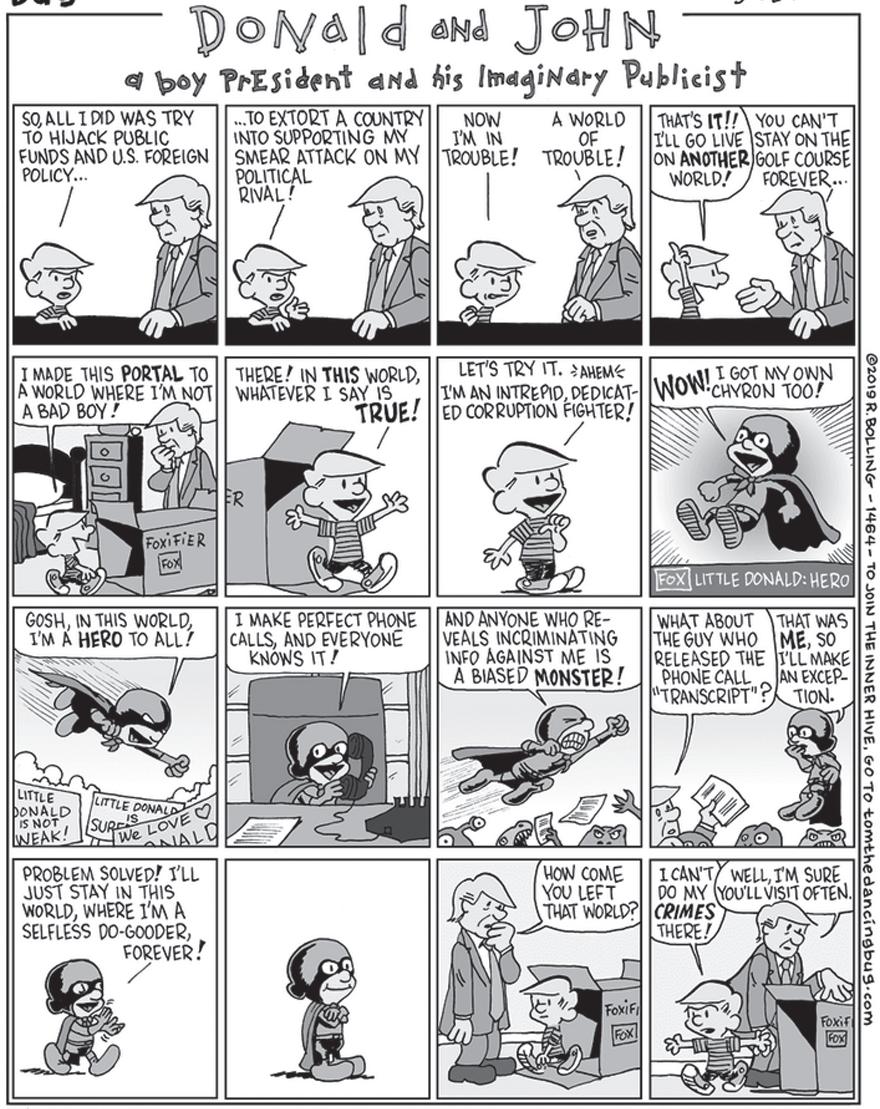
Tom the Dancing Bug by
Reuben Bolling
Invitation to My Collegetown Dinner Party
There comes a moment in every undergraduate’s life when we aspire to something more. For some, it’s when you’re living in your first apartment in Collegetown. For the more ambitious, it’s when you still inhabit a cramped dorm. Either way, the day comes when you utter five dreaded words: “Let’s plan a dinner party.” Your housemates look at you doubtfully, likely remembering the time you cracked eggs into a pan and forgot to turn on the gas for a wild and confusing half hour. They suggest alternatives: Why not just plan a group outing to Koko? How about we order pizza? In all your deluded glory, you stand firm. The egg thing happened once, and anyway the next week you burnt them to a crisp, which is obviously an improvement. You are ready for adulthood’s first hurdle.
Saturday at 5 p.m., your roommate reminds you that everyone’s coming over at 7 p.m. You pretend that you’ve been planning the whole time, and in a way (subconscious anxiety has resulted in sleepless nights), you have. At the very least, you know what you want to make. Drumroll please: pasta! This staple of any ‘fancy’ dinner prepared by a college student has not yet let you down. The steps are simple: Boil the pasta, pour sauce fresh from the jar and sprinkle frozen cheese over your delectable creation. What could possibly go wrong? Turns out, a lot. You overboil the pasta. You became distracted while attempting to pinpoint the location of the weird smell that haunts the kitchen every weekend and now the pasta is a soggy, soft mess, lumped in a sad pile in a colander in the middle of the sink. Sighing, you pull the sauce out of a cupboard, and find that, despite frequent trips to Noyes (twice in 2019), you are unable to remove the cap. The struggle ensues for the next 15 minutes. Finally, frustrated, you gently whack the jar against the countertop. It shatters upon impact, and you’re left gaping at the red pool spreading rapidly across the counter and dripping onto the floor. The entire apartment now smells like marinara and you know that if you don’t do something fast, your roommate will gently whack you
but you proudly reject their pity. Now, they watch amusedly from the table as you wring your hands over the meager offerings. Ultimately, though, you know what you must do. You set the pasta aside and grab seven familiar styrofoam cups from the cupboard. You add water to the marked line and microwave each cup for 90 seconds, maintaining triumphant eye contact with your roommate. Cup noodles are not often lauded for their nutritional content, however, and upon contemplation, you place a decorative and nutritious banana next to each bowl. You step back and observe your
The day comes when you utter five dreaded words: ‘Let’s plan a dinner party.’ Your housemates look at you doubtfully, remembering the time you cracked eggs into a pan and forgot to turn on the gas.
masterpiece with satisfaction.
Dear reader, you may have guessed this hypothetical scenario is based off of a true story. I don’t want to recount in detail the rest of the night, as I can’t afford to dissolve into tears again. The table was set with actual silverware and glass plates, with my roommate’s orgo assignment serving as the centerpiece. After a moment of stunned silence, my lovely guests suggested eating
After a moment of stunned silence, my lovely guests suggested eating literally anywhere else — from CTB, to Okenshields, to the trash can outside of Olin.
Between the ages of 18 and 22, do not invite anyone over to dinner. Your time would be better spent pretending to prepare for hell week, while enjoying one styrofoam cup of joy.
against the countertop.
A roll of paper towels later, the sea of marinara is cleaned up, the pasta is a cold, clammy pile of mush and guests are due in minutes. Your housemates offer to help,
literally anywhere else — from CTB, to Okenshields, to the trash can outside of Olin. My disappointment was immeasurable, and my night was ruined. I would love to say the moral of this story is something inspiring, like “learn how to cook pasta, you infant,” or “not everyone loves cup noodles, and that’s ok.” However, this story has one moral, and one moral only. Between the ages of 18 and 22, do not invite anyone over to dinner. Ever. Not your friends, not your neighbors, definitely not the boy you’re trying to impress in introductory biology. As undergraduates, we are, frankly, incompetent. Your time would be better spent pretending to prepare for hell week, while enjoying yourself one styrofoam cup of joy.
Pallavi Kenkare is a junior in the College of Arts and Sciences. She can be reached at pkenkare@cornellsun.com. Jabberwocky runs every other Thursday this semester.
Not Another Krispy Kreme Fundraiser
Ilost my virginity to a Krispy Kreme donut the other day. I ate my first one, that is (disappointed?
Head over to Sex on Thursday). My hometown of Rochester is a Dunkin’ Donuts stronghold, so the pastry was a distant dream of mine only delivered by friends who ventured to the Krispy Kreme Scranton branch hours away. Fast forward three days, a dozen donuts and 20 bucks shelled out to the donut pimps, and I know now that a greater truth about this philanthropy comes unglazed. What is missing from our donate-eat-forget loop is that each fresh batch of Krispy Kreme represents the suffering of the final recipients of our contribution. What is missing from our fundraising model based on incoming money is outgoing knowledge.
No longer can we walk through an atrium without a club booth imploring us to “treat yo self” as they channel their inner Parks and Recreation Tom and Donna. On the receiving end, we consumers donate to indulge, not to reflect on the recipients of our proceeds. From my initial bite into that first, cream-filled half-dozen to licking my chocolate-glazed fingers after the third, I knew I was eating my money’s worth — but clearly not because I was supporting charitable groups in the
Charity at Cornell has become too mindless and too easy. When we donate for donuts, donors become consumers and volunteers reduce to vendors.
process. In fact, beyond the distinct Venmo username for each campus club, the different causes felt arbitrary, and even unnecessary, as an appeal. Charity at Cornell has become too mindless and too easy. When we donate
for donuts, donors become consumers and volunteers reduce to vendors: Where does the cause fit in?
At face value, the club’s profit and the satisfaction of the donor-turned-consumer is a win-win situation — and club treasurers are keenly aware of this. Given that these proceeds go to charity, the fundraising prowess of the clubs and their respective causes undoubtedly thrive, but little can be said for the actual awareness raised for each cause. Our fundraising scene equates activism with revenue, when in reality, one comes at the expense of the other. When clubs morf their activism to suit a consumerist market of 20,000 Cornellians, charity becomes no more than another business model that targets sweet-toothed suckers like yours truly. Clubs quickly lose sight of their original cause as the money flows in, and us donors are trained to believe that charity is supposed to be convenient and self-serving.
No longer should we confuse baked goods as the core of a fundraiser, but rather only as the means to advocate for a bigger picture.
When I “donated,” I only recall that the proceeds were Venmoed the first time to tumor research and the third time to Haiti, but remember little else. I walked up to the table because of the boxed delights and donated since they hadn’t yet run out of chocolate-glazed. I wasn’t offered a single reason beyond pastries for why I should care about one movement or another. I happily left the booth not too concerned about what I paid for beyond the immediate transaction. Charity at Cornell is dangerously convenient, as the allure of a Krispy Kreme and the like prompts no further questions. In turn, we slip out our wallets and skip a few key steps in the process. Activism is stagnant when awareness is overshadowed by a distracting treat on one end and an appealing bottom line on the other.
After my roommate’s own service club completed their fundraiser, they had paid approximately $4 for a box and had sold each dozen for $10: a 60% profit mar-
Egin. At another club booth, when I pointed to a larger stack on the table and asked how much they expect to sell, they replied without hesitation, “All of them.” But each sold-out batch of donuts is no more than a club selling-out its cause; behind the impressive influx of donations lies our non-unique and ineffective awareness-raising system. Each fundraising organization loses its individuality when it, too, hooks donors through donuts. To the average Cornellian, the abuse of Krispy Kreme ers blurs the lines between buying donuts ine passion for a cause.
What on the surface appears successful has merely become a blanket technique of fundraising that encourages donations for all the wrong reasons. The integrity of campus advocacy decays as the intentions behind our donations and the cause itself grow further apart.
Though clubs themselves should do more to raise awareness beyond booth transactions, us donors suffer equally when we are trained to believe our consumerist culture can be applied to charity. No longer should we confuse baked goods as the core of a fundraiser, but rather only as the means to advocate for a bigger picture. Only once us donors reshift our focus will Cornellian charity finally transcend donuts.
Roei Dery is a freshman in the College of Arts and Sciences. He can be reached at rdery@cornellsun.com. The Dery Bar runs every other Monday this semester.
Being an Intellectual Is Nice, but I Still Need a Job
very day, I pass by the wise words of former Cornell President Hunter R. Rawlings III in Goldwin Smith gatekeeping the entrance to the Temple of Zeus: “Genuine education is not a commodity, it is the awakening of a human being.”
Though I will not argue here about whether the education at Cornell is to be considered genuine or not, I have often thought that if it costs over $60,000 a year to awaken myself, I’d much rather have stayed in bed.
I assume that the notion of a genuine education is tightly linked to age-old sayings like “explore your interests” and “follow your passion.” And I assume that awakening a human being probably involves something more than an alarm clock. The author of the quote I pass each day was probably thinking in more abstract terms of becoming an engaged citizen and a better person.
But isn’t spending a couple hundred thousand dollars to allow clueless 18 year-olds to spend four years removed from society in the pursuit of vague ideas
a better person. I’m not reading novels in my English classes that aren’t easily available from Amazon. I don’t suspect that I’ve uncovered any secrets about biology in any of my required courses. It’s generally agreed across academia, I think, that a tibia is a tibia, that being pre-med is hard and that intro chemistry is a weed-out course.
I came to Cornell because I was accepted, because I received enough financial aid and because it wasn’t the one in Iowa. I came to Cornell because I knew there was something inexplicably impressive about the fact that I learned a tibia was a tibia at Cornell University. It’s in upstate New York. Four hours from New York City. One and a half hours from Syracuse. Lots of pretty waterfalls. Oh, and — gaze averted, modest tone — it’s an Ivy.
Hunter R. Rawlings III’s greatest nightmares might be coming true because I don’t think I’m an outlier in my sentiments. I’ve heard more students discuss job searches than Latin syntax. More students talk about their summer internships than about the Odyssey and the Iliad combined. When our former president returns to Ithaca, he’ll find his campus swarming with students that are destroying its intellectual prowess all for the sake of getting an interview. To him, perhaps, he’ll return to Ithaca only to find his vision burn ing.
family by doing so. The University is no longer an Elysium where students with the necessary means can become enlightened human beings. I’m afraid, former president Rawlings, that it’s been made pedestrian by the souls of those that are simply trying to earn a living.
Elite universities like Cornell are now caught between two values systems. On one hand lie the echoes of the upper class — a past in which a student’s goal was to become a citizen of the world.
I came to Cornell because I was accepted, because I received enough financial aid and because it wasn’t the one in Iowa.
like self-improvement and intellectual rigor just a way to say that you’re rich?
I didn’t come to Cornell to become
And when I utter those magic words — Ivy League — I have previous generations of rich males to thank. The ones that had the ability to explore their interests without worrying about what happens at the end of four years, to read the English canon for the sake of self-improvement and to emerge as citizens of the world. The ones who helped maintain the idea of a university as a finishing school for the elite. Because those are the associations that I assume people make when they hear me say Cornell. They think that I’m metamorphosing into one of those worldly citizens. I’m only half-sorry to report that I’m really just looking for a job.
But Ithaca isn’t burning; it’s only changing. What Rawlings would see as hell fire springs from the idea that many of us have grown disenchanted with the idea that the university is a place to improve ourselves. At the very least, we’ve become disenchanted with the price tag associated with that improvement. What we saw in Cornell wasn’t the chance to awaken our humanity but the opportunity to access a brand name that would provide us with social mobility — or at least social stability.
And though I don’t deny that I’ve spent countless hours discussing Middlemarch and Beowulf with my professors or that I do believe I’ve improved myself over my time here, I’m not ashamed to admit that I came here, first and foremost, to secure a solid job for myself and to uplift my
No amount of prestige can make up for a student who’s been duped into believing that stress makes them valuable.
On the other hand is a modern promise of skill-learning and social mobility. The former produces good people, and the latter produces good workers. And though I’d like to become both someday, I suppose that for now, I’ll have to settle — I’ll be keeping Cornell University in its place at the top of my resume.
Hunter R. Rawlings III: Ithaca is here, but it’s no longer the epic destination that you envisioned. And there’s nothing wrong with that.
Colton Poore is a senior in the College of Arts & Sciences. He can be reached at cpoore@cornellsun. com. Help Me, I’m Poore runs every other Monday this semester.
Colton Poore | Help Me, I’m Poore
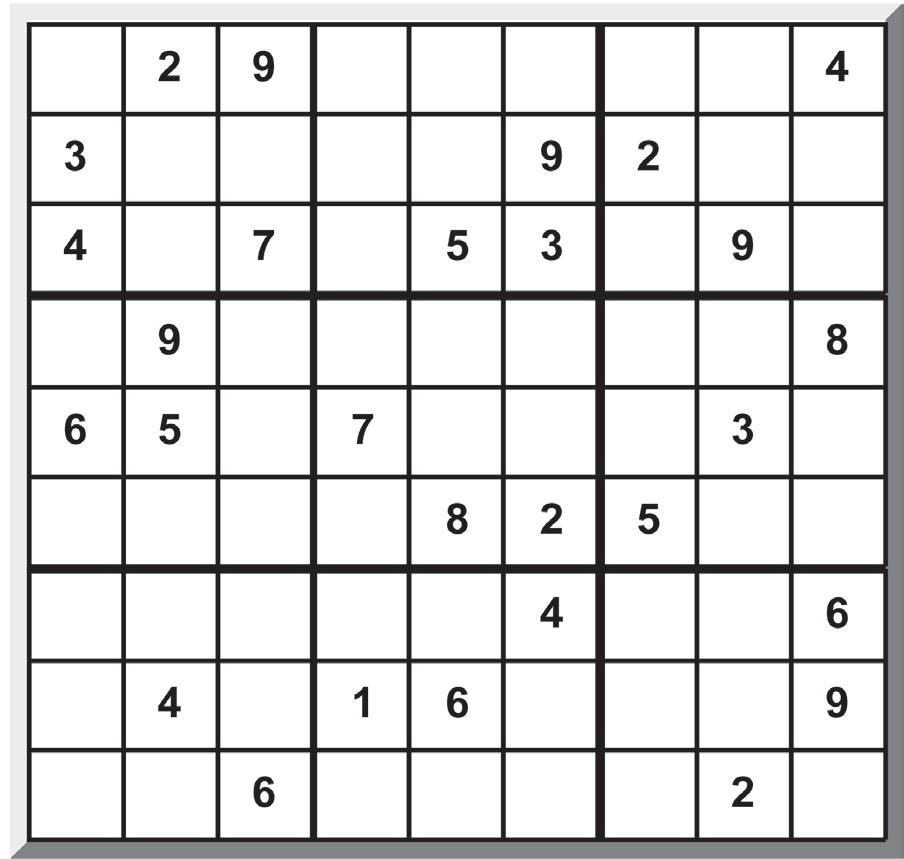
Fill in the empty cells, one number in each, so that each column, row, and region contains the numbers 1-9 exactly once. Each number in the solution therefore occurs only once in each of the three “directions,” hence the “single numbers” implied by the puzzle’s name. (Rules from wikipedia.org/wiki/ Sudoku)
Caption Contest Winner
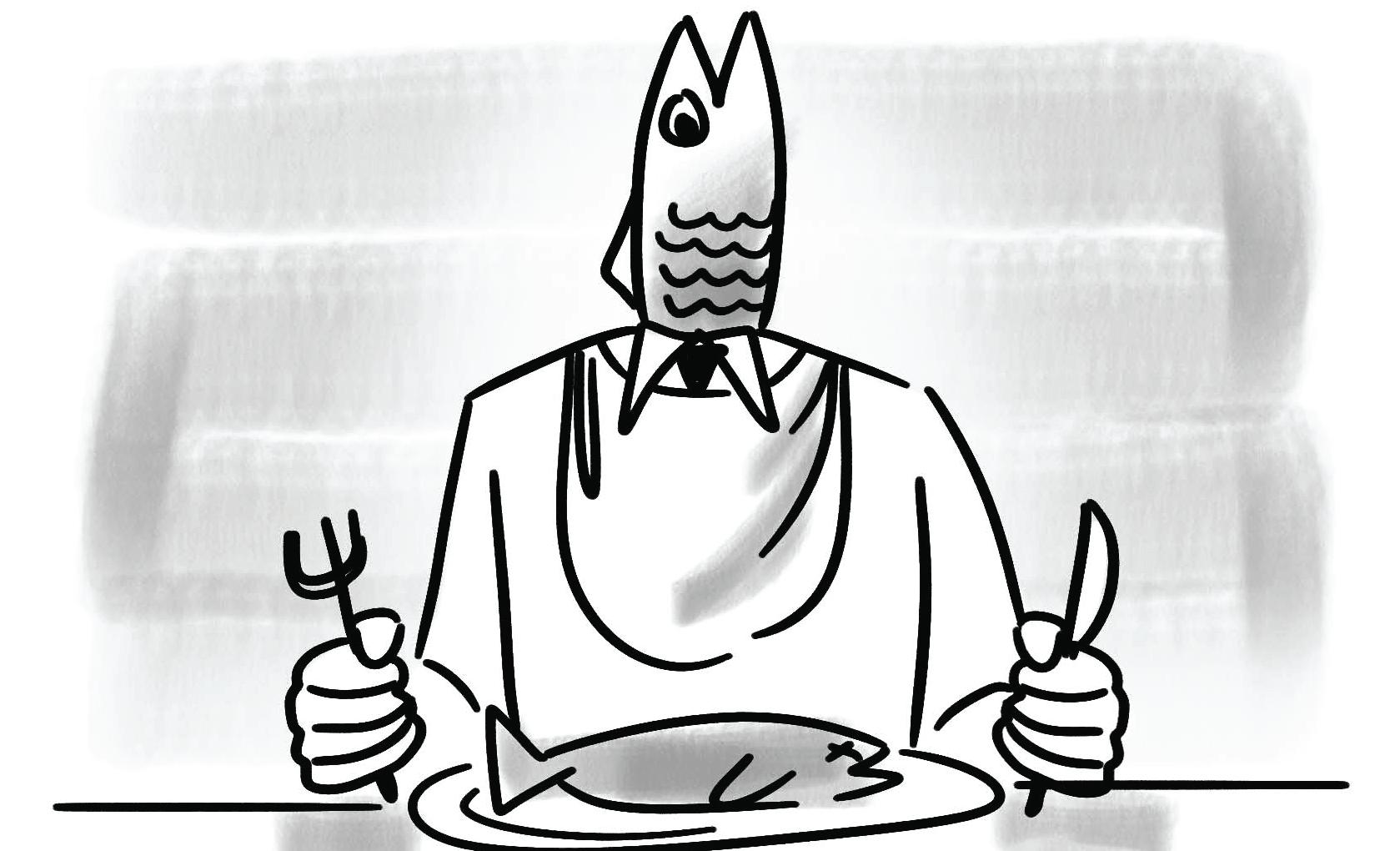


Art by Alicia Wang ’21
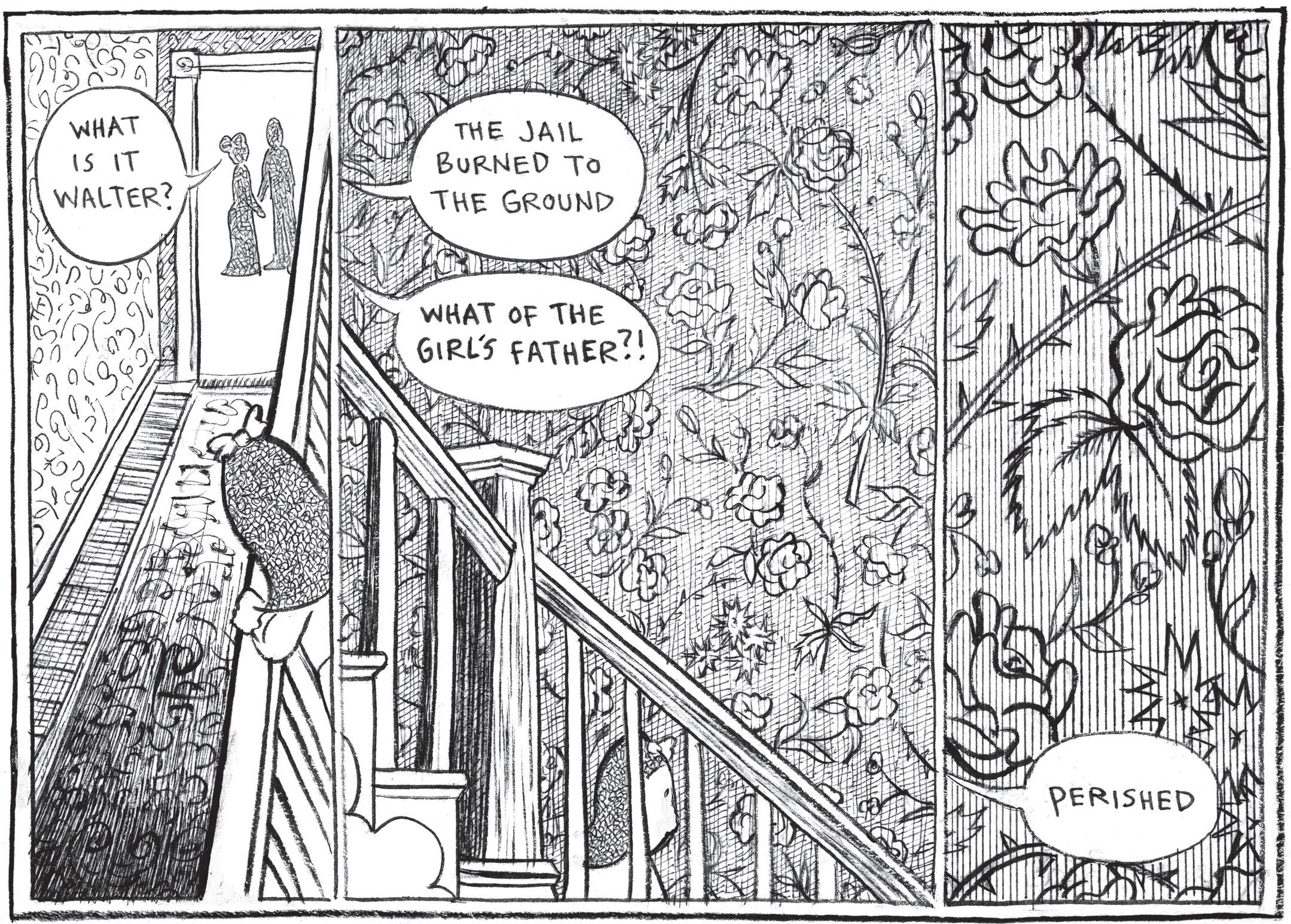
Johnny Woodruff by Travis Dandro

26 A PA R TMENT FOR R ENT
We have availability for the 2020-2021 school year beginning June 1st at Hudson heights apartments. The studios include electric, heat, water, garbage and parking. There is coin-operated laundry facilities on site. Prices start at $750 / month for a 12 month lease. If you have any questions or would like to schedule a tour contact us by phone 607-280-7660 or email: renting@ithacaLS.com
COLLEGETOWN TERRACE APARTMENTS
Leasing for 2020/2021 Spring 2020 Semester leases available Heat, hot water and Wi Fi State of Art Fitness Center Shuttle Bus Service to campus Washer & Dryer in Apartments collegetownterraceithaca.com office@ithacastudentapartments.com (607) 277-1234
AVAILABLE 2020-2021
1, 2, 4 Bedroom Apts. and 7 person House
10 & 12 month leases Cook/Blair Street Call or Text Christopher George RE 607-279-5520
Collegetown Crossing College Ave's Newest Location 307 College Ave. Now Leasing for 2020-2021
Completely New Modern Studios, 2 & 4 Bedroom Apartments. Fully furnished, heat & hot water included. Reception area at 307 College Ave. www.urbanithaca.com 607-330-2442 info@urbanithaca.com
120 Oak Avenue
Just steps to Cornell Campus 10 bedroom house & 1 and 2 bedroom apartment 607-277-1234 office@ithacastudentapartments.com Ithacastudentapartments.com
1, 2 & 5 Person Apts.
Overlooking Cascadilla Gorge Architecturally designed. Decks, patio, fireplaces, Jacuzzis. Furnished, parking, internet. Utilities included. 607-592-7564
26 A PA R TMENT FOR R ENT
Now Renting 2-10 Bedroom Houses/ Apartments for 20-21. All Locations. Call today or visit our website: Certified Properties of TC Inc certifiedpropertiesinc.com 607-273-1669
Catherine & Eddy St. 1 & 2 bedroom
Furnished, heat included Laundry in building Parking available for fee 607-277-1234 office@ithacastudentapartments.com
109 Sage Place 2 & 3 Bedroom Apartments Access to Shuttle to Campus Access to Free Fitness Center Novarr-Mackesey Property Management office@ithacastudentapartments.com 607-277-1234
504 1/2 Thurston AveSTUDIO 607-277-1234
office@ithacastudentapartments.com Ithacastudentapartments.com
27 H OUSE FOR R ENT
20-21
College Ave. 5 BR House Furnished. Laundry. Parking. Call 607-273-8576
Spring 2020 Upper Eddy St. 7 BR house Furnished. Laundry. Call 607-273-8576
8-9 BEDROOM HOUSE FOR 2020-2021 133 Blair St Corner of Cook and Blair just off of College Ave. Huge rooms, great porch, free laundry, furniture, 4 bathrooms, 3 kitchens. Great storage closets, parking for 3-4 cars. Contact Nick at 607-256-3778 or nick@lambrourealestate.com

Red Shuts Down Terriers, Picks Up 9th Straight Win
MEN’S HOCKEY
Continued from page 12
Just seconds after the restart, junior forward Brenden Locke wasted no time in doubling the Red’s lead. Locke’s one-time shot from the slot off a tight pass from freshman forward Ben Berard found the back of the net just 20 seconds after Regush’s tally.
Cornell took control in the second and third periods, but Galajda stood tall in an opening period dominated by the Terriers. He made a key save on an early breakaway chance to prevent B.U. from taking a lead.
For Galajda, the MSG game marked a special triumph. Last year at the Garden, the netminder was injured in an ugly 4-1 loss to Harvard. This year, though, the junior rectified his form and used the big NYC stage to showcase his hard work — and pick up his first shutout of the 2019 season.
BOSTON U. @ CORNELL
“Playing at Madison Square Garden, you really can’t compare to that, the world’s biggest venue. It’s something I’ll never forget,” Galajda said.
Game: Boston U. Cornell 0 2
Galajda didn’t do it alone, as the Red’s defense thwarted each and every Terrier attack in the second and third periods.
“Our defense kept them to the outside and were on them all game,” Galajda said of his defensemen.
Cornell now turns its attention to a road matchup with No. 9 Harvard, set for 7 p.m. Friday in Cambridge.
“It’s about ignoring the noise and managing expectations,” Schafer said.
Luke Pichini and Raphy Gendler contributed reporting.
Mike Seitz can be reached at mseitz@cornellsun.com.
Cornell Sufers First Loss of Year, Defeats Buckeyes in Rematch
WOMEN’S HOCKEY
Continued from page 12
Maltais put Ohio State ahead, beating Browning once again.
Despite the push by Cornell in the third period, the Red couldn’t get past Ohio State’s defense and failed to generate any offense. The Buckeyes added in one more goal as insurance to make it 3-1.
After suffering its first loss of the season, Cornell had little time to make adjustments as it played Ohio State again the next day. Undeterred by its previous loss, the Red put on a much stronger performance on Saturday.
Shortly into the first period, senior Paige Lewis redirected a shot from Bourbonnais for a brilliant deflection goal right past Braendli. Halfway through the period, Cornell was called for an unsportsmanlike conduct
penalty and Ohio State jumped on the power-play opportunity. Schepers made it 1-1 in the first off a quick shot that beat Browning. It was the only goal the Buckeyes would score in the game.
The game was tied in the second until Ohio State’s Sara Saekkinen was called for slashing. The Red’s excellent power-play team finally showcased its skills and scored, giving the team a 2-1 lead. Assisted by Curlew and senior Micah Zandee-Hart, junior forward Maddie Mills deeked out the goalie and slid the puck between her skate and the post for the goal.
Sophomore Gillis Frechette and junior Finley Frechette combined for the team’s third goal only six minutes later. Gillis stole the puck in the Buckeyes’ zone and passed it across the ice to her sister Finley at the hash mark. Finley then fired into the top
corner, beating Braendli. In the third, Ohio State suffered another penalty, this time for boarding. Mills delivered her second power-play goal of the night off feeds from Lewis and Zandee-Hart. The end of the game saw an empty netter from O’Neill to cap off the 5-1 victory.
After allowing three goals a day prior, Browning had a career night between the pipes. She stopped 48 out of 49 shots she saw, a season-high for the junior. Cornell will return home after the long weekend and will rest up before heading out on another road trip on Dec. 6 and Dec. 7 to take on Princeton and Quinnipiac. The Red handled both of these foes, 3-1 and 1-0, respectively, the last time it faced them.
Justin Suzzan can be reached at jbs389@cornell.edu.

Galajda Earns 1st Shutout; Red Defeats B.U. at MSG
No. 2 Cornell scores two second-period goals, wins Kelly-Harkness Cup
NEW YORK — Junior goaltender Matt Galajda has been a stalwart all season for No. 2 Cornell men’s hockey. But as his team dominated opponents en route to an 8-0 start, Galajda still hadn’t secured a shutout.
That finally changed at the world’s most famous arena on Saturday night, when Galajda made 28 saves to help Cornell take the Kelley-Harkness Cup with a 2-0 win over Boston University in front of 15,142 fans at Madison Square Garden.
“[Galajda] absolutely can’t stand getting scored on in practice … and it carries over for him in games,” said head coach Mike Schafer ’86, whose team improved to 9-0 for the first time since its perfect 1969-70 national championship season.
Galajda was called upon early and often as Cornell (9-0, 6-0 ECAC) got off to a
slow start — a recurring theme this season. The Terriers (4-6-5, 3-3-4 Hockey East) fired shot after shot at Galajda, who was forced to make some vital early saves to keep the game scoreless. B.U. outshot Cornell during the first frame, 19-8.
“They came out really strong in the first period and had some chances,” Galajda said.
An exciting second period proved to make all the difference after the Red’s slow start. Cornell scored both its goals in the second and has dominated in middle periods all season: The Red is outscoring opponents 22-6 in second periods this season and has scored more than half of its goals in middle frames.
A goal by sophomore forward Michael Regush catapulted Cornell into the lead 7:39 into the frame, after he punched in a rebound following a shot by senior defenseman Yanni Kaldis.

C.U. Splits Road Contests Against No. 6 Ohio State
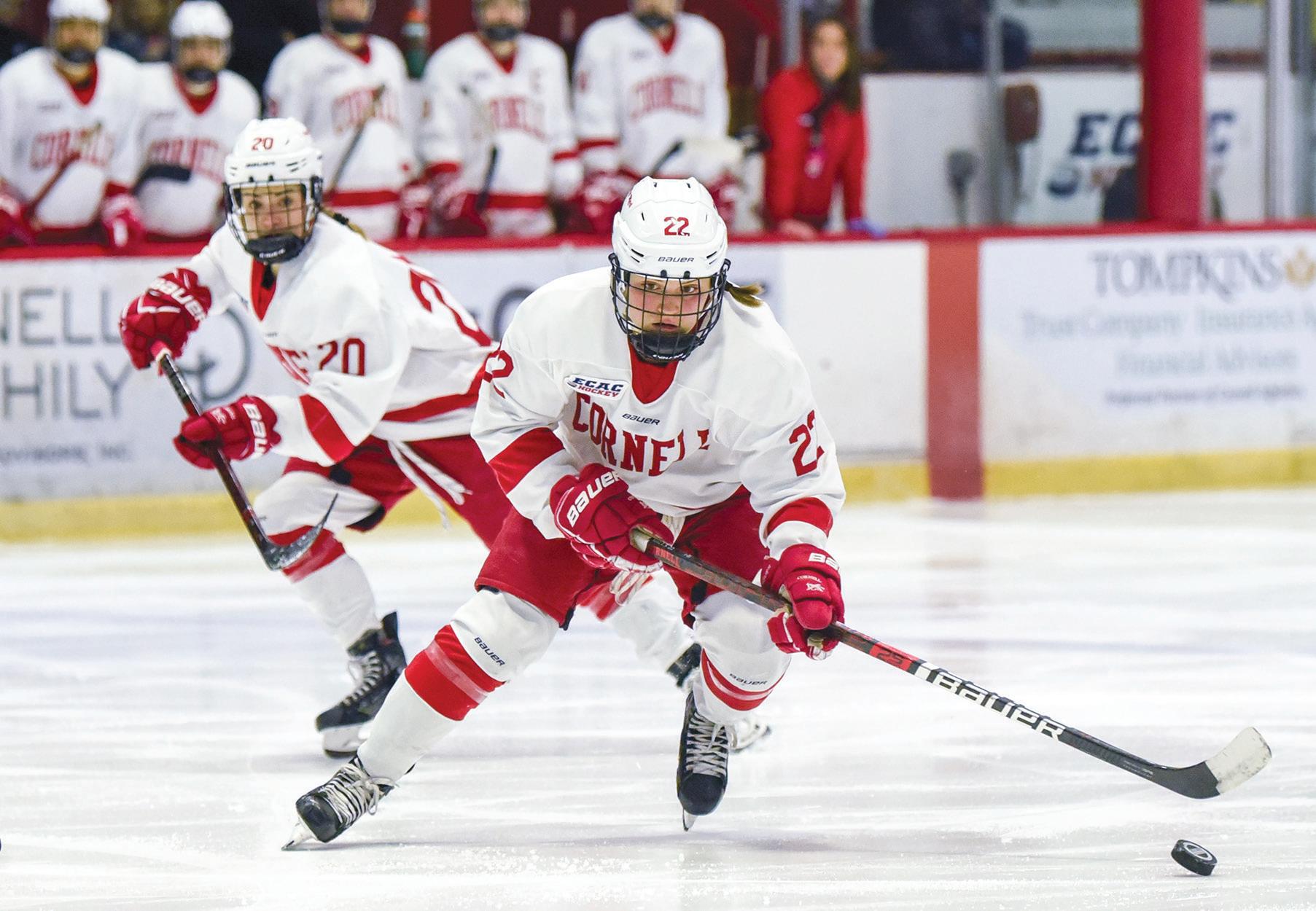
After a quick break for the Thanksgiving holiday, No. 3 Cornell women’s hockey looked to preserve its undefeated season in what proved to be its most challenging matchup of the year.
The Red traveled to Columbus, Ohio, this past weekend to take on WCHA powerhouse Ohio State. The No. 6 Buckeyes played up to their billing, splitting the twogame series with Cornell. On Friday, the Red lost, 3-1, but it bounced back the next day to win, 5-1.
The first game started off slow for both clubs. In the first, Cornell (9-1-1, 5-0-1 ECAC) and Ohio State (10-3-4, 6-3-3 WCHA) struggled to find the back of the net and stood behind their strong goalies,
Lindsay Browning and Andrea Braendli, respectively. The Red was able to break the scoreless drought in the second off a goal from senior forward Kristin O’Neill. The play began on Cornell’s side of the ice when senior Amy Curlew cleared the puck from the Red’s defensive zone. After senior Jaime Bourbonnais picked up the loose puck, she coasted into the Buckeyes’ zone and ripped a shot from the blue line. Her shot was turned aside, but Curlew scooped up the rebound and put in a quick shot for the 1-0 lead.
But that lead only held for about four minutes. Later in the same frame, the Buckeyes’ Emma Maltais equalized the game off assists from Lisa Bruno and Liz Schepers. With time expiring in the frame,
WOMEN’S HOCKEY
Capitalizing | Junior forward Maddie Mills scored two power-play goals to propel the Red to a convincing 5-1 victory on Saturday.
BORIS TSANG / SUN PHOTOGRAPHY EDITOR
By MIKE SEITZ Sun Staff Writer
By JUSTIN SUZZAN Sun Staff Writer
Red hot | After picking up its ninth win in a row by defeating the Terriers, 2-0, C.U. is 9-0 for the first time since the 1969-70 season, a year in which the team won the national title.
BEN PARKER / SUN ASSISTANT PHOTOGRAPHY EDITOR
Up to the task | Junior goaltender Matt Galajda continued his dominant season, making 28 saves and notching his first shutout of the season.
BORIS TSANG / SUN PHOTOGRAPHY EDITOR