
The Corne¬ Daily Sun

Cornellians Attend United Nations Climate Conference
By STACEY BLANSKY Sun Staff Writer
Earlier this month, a group of Cornellians travelled nearly 4,000 miles to Madrid to attend the United Nations’ Framework
She thanked us for our work in climate action and for dedicating our education to that.”
For the past few years, Cornell has obtained passes for students taking Earth and Atmospheric Science 4442: Global Climate
Wildstein said. “To see how that process happens and how all of the different parties interact at a global level was really important for me. You hear about COP all the time in my field, but to see COP and be a part of COP is an entirely different story.”
Convention on Climate Change
— a two-week climate summit that allowed students to brush shoulders with some of the international stage’s biggest names.
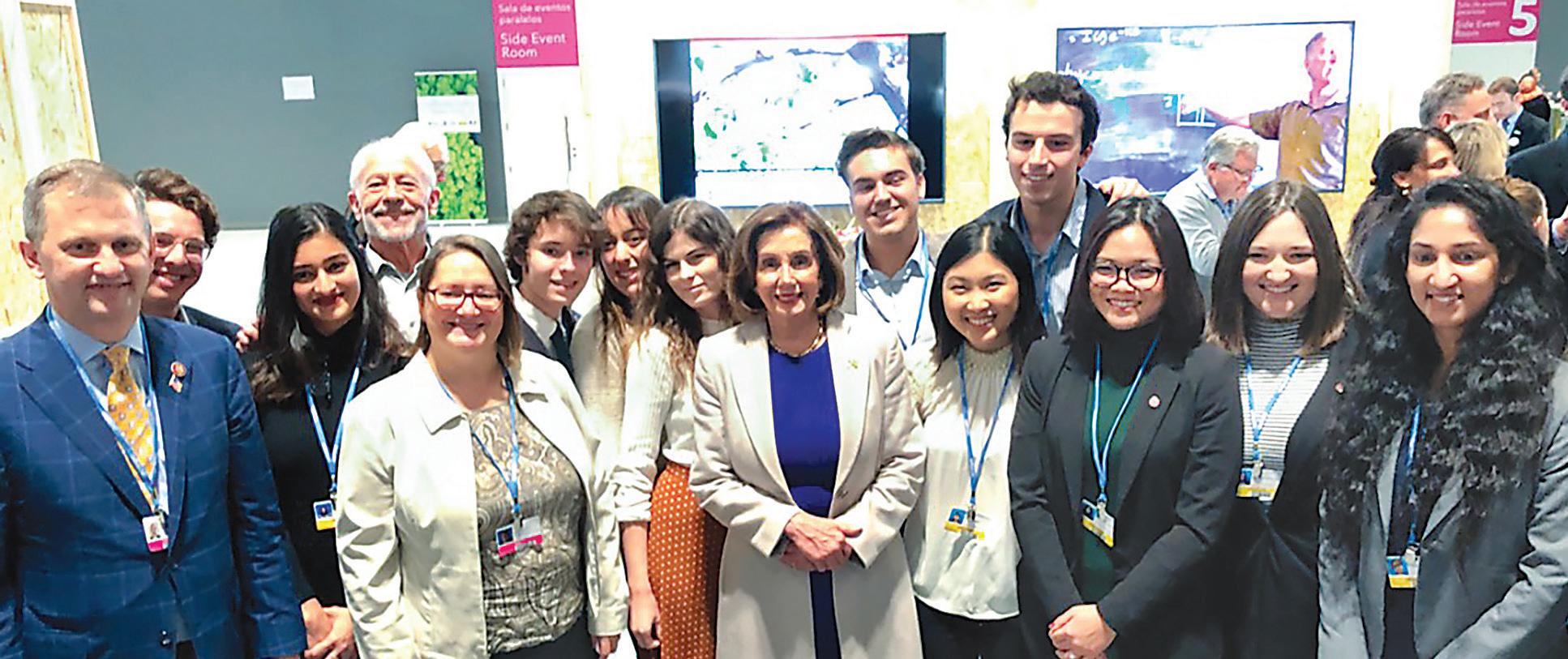
Featuring government leaders from around the world, students who went during the second week had the opportunity to meet with Speaker of the House Nancy Pelosi (D-Calif.), a Democrat who has made aggressive climate change action key to her political pitch.
“We were really lucky. She was making an effort to stop by the universities, and she stopped by our booth,” said Pamela Wildstein ’20, one of the conference attendees. “Speaker Pelosi was very nice.
Change Science and Policy to attend COP and experience the convention firsthand, Wilstein told The Sun.
But beyond hob-knobbing with some of the world’s top climate policymakers, attending COP25 exposed Wildstein to energy policy on an international scale, which she said informed the work that she plans to do in the future.
While the United Nations has long garnered a reputation for its bureaucracy and ineffectiveness, one of the main takeaways students had, despite popular perceptions, is that there is plenty of progress and work being made at an international level.
“The interactions that are being made behind the scenes and the networking that happens is so valuable,” Wildstein said. “It’s
“We were really lucky. She was making an effort to stop by the universities, and she [Pelosi] stopped by our booth.”
Pamela Wildstein ’20
not all politics. There is a lot of important sharing of information and data from an academic
“For me, it’s huge because this is the work that I want to do,”
See CLIMATE page 5

That time of the year

Scoop of
By MIA GLASS Sun Contributor
An eager Cornell student walks up to the Dairy Bar counter in deep contemplation over what flavor to choose. The options are endless: Would the student go for the luscious Triple Caramel Bliss, the refreshing yet satisfying Mint Chocolate Chip,
Alumna Awarded Prestigious Rhodes Scholarship
By JOHN YOON Sun Staff Writer
On Saturday, November 23, Nina Acharya ’19 was finishing up a Secret Santa gift exchange with her sister and childhood friends when she got a phone call. She had interviewed for the Rhodes Scholarship earlier that day, and was told to expect a call that evening. That call came with good news: she had just been accepted into the scholarship,
becoming one of only 11 Canadian students to claim the prestigious award — whose previous winners have ranged from former President Bill Clinton to current candidate Pete Buttigieg. Widely considered one of the most prestigious honors a student can earn, the Rhodes Scholarship is a postgraduate scholarship that provides students the ability to study at the University of Oxford without paying tuition fees and receive an annual stipend
of £13,000. The Scholarship bears the name of British businessman and politician Cecil John Rhodes, who founded the award over a hundred years ago in the hopes of bringing English-speaking nations closer together.
Now one of 95 newly minted Rhodes Scholars worldwide, Acharya, currently a first-year medical student McMaster University’s medical school, plans on attending Oxford next fall.
“One thing about the
Rhodes that excites me is the idea that the scholars are supposed to learn from each other as much as they learn from their degrees,” Acharya said.
“I am looking forward to meeting the other scholars and par ticipate in this sort of exchange of ideas and
See RHODES page 5
the Chocolate Gorges trickled with bits of cookies and fudge or … the “Martha Pollack”?
The Dairy Bar has a tradition of dedicating ice cream flavors to important figures, such as University presidents, college deans and special guests. Cornell’s current president Martha E. Pollack is just
See ICE CREAM page 4

BORIS TSANG / SUN PHOTOGRAPHY EDITOR
As Christmas nears, downtown Ithaca features a variety of festive displays, including these multi-colored prisms, which can be spun around.
summit | A group of Cornellians meet with House Speaker Nancy Pelosi. COURTESY OF CORNELL UNIVERSITY
A LISTING OF FREE CAMPUS EVENTS
Today
IT@Cornell Symposium on Cybersecurity
8:15 a.m. - 4:30 p.m., G10 Biotechnology Building
Robotics Day
10 a.m. - 4 p.m., Duffield Hall Atrium
Thank-a-Professor
11:30 a.m. - 1:30 p.m., Mann Library Lobby
Parasites and Pizza Noon - 1 p.m., Hagan Room, College of Veterinary Medicine
Cornell Companions Visit
2 - 7 p.m., Olin Library Lobby
Research and Sustainable Development Goals: An Editor’s Prospective
3 - 4 p.m., 401 Warren Hall
Violin Studio Recital: CU Music 5 p.m., Carriage House Cafe
2019 K-Pop Noraebang Contest
7 - 8:30 p.m., HEC Auditorium, Goldwin Smith Hall
Exploration of Rock Opera
7 - 8 p.m., 230 Anabel Taylor Hall
Rescheduled Piano Studio Recital: CU Music 8 p.m., Barnes Hall Auditorium

Tomorrow
BBS Program WIP Presentation 9 - 10 a.m., Lecture Hall 3, College of Veterinary Medicine
Course Design Institute for Faculty and Instructors 9 a.m. - 4 p.m., ILR Conference Center
Designing Topological Electronic States on the Kagome Lattice 11:15 a.m. - 12:20 p.m., 40 Physical Sciences Building


UDALL Scholarship Info Session Noon - 1 p.m., 103 Barnes Hall
Sam Magavern: Drop-In Coffee 1:30 - 3 p.m., Kennedy Hall 3rd floor
International Student Group Counseling 3 - 4 p.m., 276 Caldwell Hall

Karaoke night | Students enrolled in the Cornell Korean Language Program will be competing in the 2019 Noraebang Contest hosted in Goldwin Smith Hall. Free Korean food will be provided, as well as feature performances from student dance groups LOKO and E.Motion.
Chlamydia Most Prevalent STD Amongst Student Body
Gonorrhea and HIV were the other prevalent STDs amongst the 7,000 students who seek STD testing at Cornell Health each year
By AMANDA H. CRONIN Sun News Editor
Whether it’s sores, rashes, aches or other uncomfortable symptoms, this is just another busy year on the books for Cornell’s health center, which annually tests thousands of Cornellians for sexually transmitted diseases.
“Approximately 1 in 4 college students has an STI at some point in their life,” Rachel Clark, Cornell Health clinical director of women’s and sexual health, told The Sun. She said the clinic sees about 8,000 patients for STD testing each year.
Chlamydia currently tops the list as the most common disease currently spreading on Cornell’s campus, with gonorrhea, HIV and syphilis following behind, according to Beth Kutler, assistant director for medical services at Cornell Health. Citing HIPAA regulations, Cornell Health could not breakdown specific numbers for the amount of students who have received treatment.
New Yorkers across the state are also most likely to contract chlamydia out of all STDs, according to the CDC annual report. The Empire State clocks in at number 10 in the country for the number of annual Chlamydia cases, with around 119,571 reported in 2018. Almost two-thirds of all nationally recorded chlamydia cases were among patients aged 15–24 years.
“The stability [in STD prevalence] shows that our clinical staff is doing a good job of not overor under-screening in the student body.”
Beth Kutler
Physicians have also noticed occasional upticks for syphilis “over the years,” prompting state and Tompkins county health departments concerned about the spread of the bacterial infection to coordinate their monitoring efforts with the University.
On campus, there have been fluctuations in the rate of students seeking testing over the last 10 years. Clark partially attributed these changes to the influx of students requesting testing after service access was granted to all students, regardless of whether they are enrolled in the Student Health Plans.
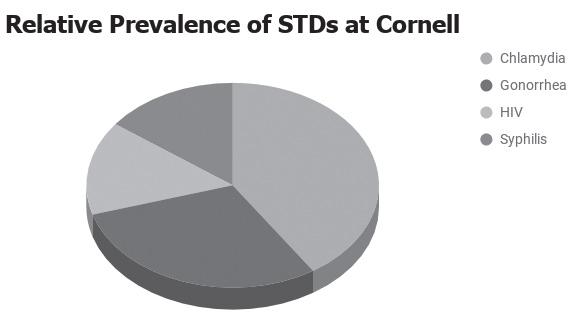
students, followed by gonorrhea and HIV.
But while the move created an inflow of new visitors, according to Cornell Health representatives, the proportion of disease occurrence has remained mostly unchanged.
The month of August is typically the busiest time for medical staff conducting urine and blood samples for testing, according to Kutler, who said that many students might get tested at the beginning of the fall semester after returning from summer break.
Besides those surges, the relative prevalence of STDs has been “quite stable,” Kutler said. “The stability shows that our clinical staff is doing a good job of not over- or under-screening in the student population.”
Even so, the rise of Tinder, Bumble, Grindr, Hinge and other dating apps has become a major driver in the contraction of STDs among college students, public health officials have warned.
“They are the apps most often used by individuals who
have tested positive for STIs, both in Tompkins County and in New York State,” said Jennifer Austin, Cornell Health’s director of communications. “Anonymous sex creates a real public health challenge.”
Compounding matters, the normalization of so-called “hook-up culture” and its associated anonymity can also lead to the potentially awkward situation of notifying your partner about your diagnosis, said Clark, who cautioned that “honesty is the best policy.”
Students looking to test for STD can go to Cornell Health, Planned Parenthood, CVS Pharmacy, Urgent Care offices and Cayuga Medical Center. Student organizations like the Panhellenic Council also sponsor pop-up clinics over the course of the semester.
Amanda
Years After Department Closure, Education Minors Seek Reinstatement
By MEGHANA SRIVASTAVA Sun Staff Writer
Every Cornellian has heard Ezra Cornell’s famous motto for the University: “Any Person, Any Study.” While Cornell boasts 80 major fields from eight undergraduate colleges, there is one gap in the education the University provides.
Students who attend Cornell cannot major in Education, and, as a result, cannot be certified to teach K-12; in fact, there is no longer a Department of Education at Cornell after being shuttered over the course of two years starting in 2010.
“We do not have the additional resources that would need to be invested in the pro-
gram to ensure its pre-eminence as we move into the future,” said Kathryn Boor ’80, Dean of the College of Agriculture and Life Sciences, in a Cornell press release announcing the department’s closure nine years ago.
Cornell’s teacher certification program, a master’s program that allowed students to be approved to teach in New York state, also wound down at the same time, due to lack of resources and costly new accreditation requirements implemented after 2008.
“New York State had its own accrediting body for teacher certification. The recession hit that accrediting body very, very hard … All the programs that used to be accredited by New York State now had to get national accreditation,” said Prof. Bryan Duff, devel-
opment sociology, who said such a hurdle “requires more resources, more money, more faculty, [and] lots of time.”
“When I first got here in 2011, Cornell had a teacher certification program, and so, we could train teachers. We could recommend them for New York State certification. But only in agriculture and the STEM fields,” Duff told The Sun, noting the limitations of its program.
But the decision to not seek national accreditation, and instead close its department, was not one mirrored by other schools, however. Duff pointed out that nearby schools Cazenovia College and Ithaca College decided to conform to the new regulations in order to keep on offering their education program.
As a result, Cornell students interested in getting certified to teach humanities, for instance, are encouraged to apply to the teacher certification program at Ithaca College.
ers in agricultural education, Prof. Jeffrey Perry ’89, development sociology, now works as a full-time professor at Cornell and an adjunct professor at Ithaca College, allowing its students to be certified in that field.
“While we did lose the major and we no longer certify here, I’ve run four cohorts at Ithaca College, and in the 30 years that I’ve been teaching, the students coming out of Ithaca College are stronger teachers than what we produced at Cornell,” Perry said.
And even though the University’s education imprint has been significantly reduced, students interested in pursuing the field can still pursue the Education minor, which Perry called an important component of Cornell’s Education structure.
“The students coming out of Ithaca College are stronger teachers than what we’ve produced at Cornell.”
Prof. Jeffrey Perry ’89
“After Cornell got rid of its teacher certification program, we formalized that referral process a little more … we call it on the website, an Articulation Agreement, but all it really says is, if you complete the Education minor at Cornell and do a lot of fieldwork in the process ... you do have to apply to Ithaca College, but you do not have to get letters of recommendation,” Duff said.
Such a process aims to make up for the University’s lack of a certification program, providing an easier pathway to teacher certification for Cornell students, while also creating closer links between the two schools.
For instance, since Ithaca College previously did not have a program to certify teach-
According to Perry, students who major in any field and pursue an Education minor are ultimately more “content-based teachers” than those who major in Education, highlighting the notion that Cornell’s lack of an Education Department does not necessarily make for poor educators.
Kyle-Avory Muna ’21, a student pursuing the minor, too echoed these sentiments, saying that the lack of a “full-on” education department has given reason to be “more creative with my education at Cornell,” which will “make me a better educator.”
Nevertheless, Muna said that reconstituting Cornell’s dormant Education department could send an important “signal to the New York state community and abroad that Cornell actually cares about education.”
Meghana Srivastava can be reached at msrivastava@cornellsun.com.
Busy body | With over 7,000 students undergoing STD testing at Cornell Health each year, chlamydia has appeared as the most prevalent STD amongst
AMANDA H. CRONIN / SUN NEWS EDITOR
H. Cronin can be reached at acronin@cornellsun.com.
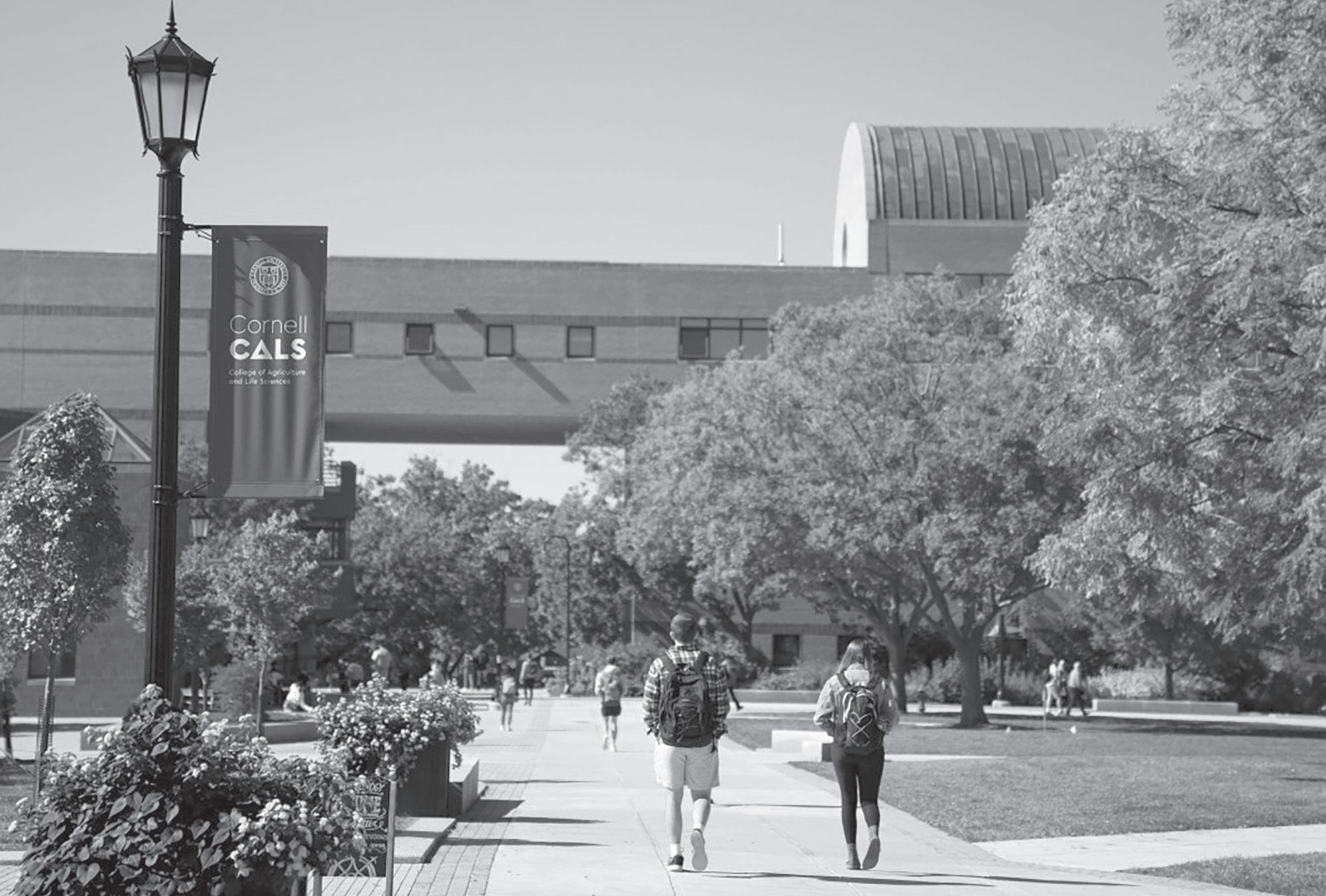
Money matters | Cornell shuttered its Department of Education over the course of two years from 2010 to 2012, citing issues with resources. Now, some students are asking for its return.
BEN PARKER / SUN ASSISTANT PHOTOGRAPHY EDITOR
What’s in a Name? Cornell Dairy’s List of Notable Ice Cream Flavors
Martha’s was made out of real bananas, but it didn’t taste real. But that’s my personal opinion.”
the most recent continuation of this unique custom: Her “Bits and Bytes” flavor gets its tongue-in-cheek name from her artificial intelligence research.
Its custard-like French vanilla is complemented with banana swirl and brownie pieces, sprinkled with white chocolate to top it all off. The flavor’s logo even evokes Pollack’s computer science background, as it spells out “Any Person, Any Study” in binary numbers.
This Dairy Bar honor stretches all the way back to 1995 when former President Hunter R. Rawlings III was inaugurated. His flavor, “Inauguration Swirl,” was a chocolate ice cream with a swirl of rich mocha.
In 2003, the Dairy Bar created “Ezra and
In 2015, the Dairy Bar presented “24 Garrett Swirl,” blending together chocolate, mocha, and smooth caramel, for President Elizabeth Garrett’s inauguration. Cornell students chose this name in an online contest, voting out “Garrett’s Chocolate Bar Association” and “Cornelle Chocolate Chunk.”
Presidents are not the only individuals who can get their own ice cream. Dean of College of Agriculture and Life Sciences Kathryn J. Boor ’80 had the flavor Boorange Chip named after her. “When I first started, we had Boorange Chip. That was orange with chocolate chips and that was fantastic!”
Ryan Newton, another Dairy Bar employee, told The Sun.
Andrew’s World View” for President Jeffrey Lehman, an espresso-base ice cream featuring a fudge swirl and hints of cinnamon, vanilla, hazelnuts and praline pecans. Other than inaugurations, the Dairy Bar also commemorated President H.T. Rhodes’ retirement in 1995 with the special flavor “Rocky Rhodes.”
President David J. Skorton was honored with “Banana Berry Skorton,” a medley of chocolate with swirls of banana and raspberry in 2006 to mark his inaugural reception. The flavor was taste-tested by his wife Robin Davisson and her staff. The Dairy Bar compiled 100 gallons of chocolate ice cream, 11 gallons of raspberry sauce, 11 gallons of chocolate flakes and a few pounds of banana flavoring to make 3,500 cups of the eponymous flavor.
“Skorton’s was banana and I liked his. To me, Martha’s tasted like the fake banana, but Skorton’s tasted real,” Dairy Bar employee Karen Muckey said. “Actually, they told us
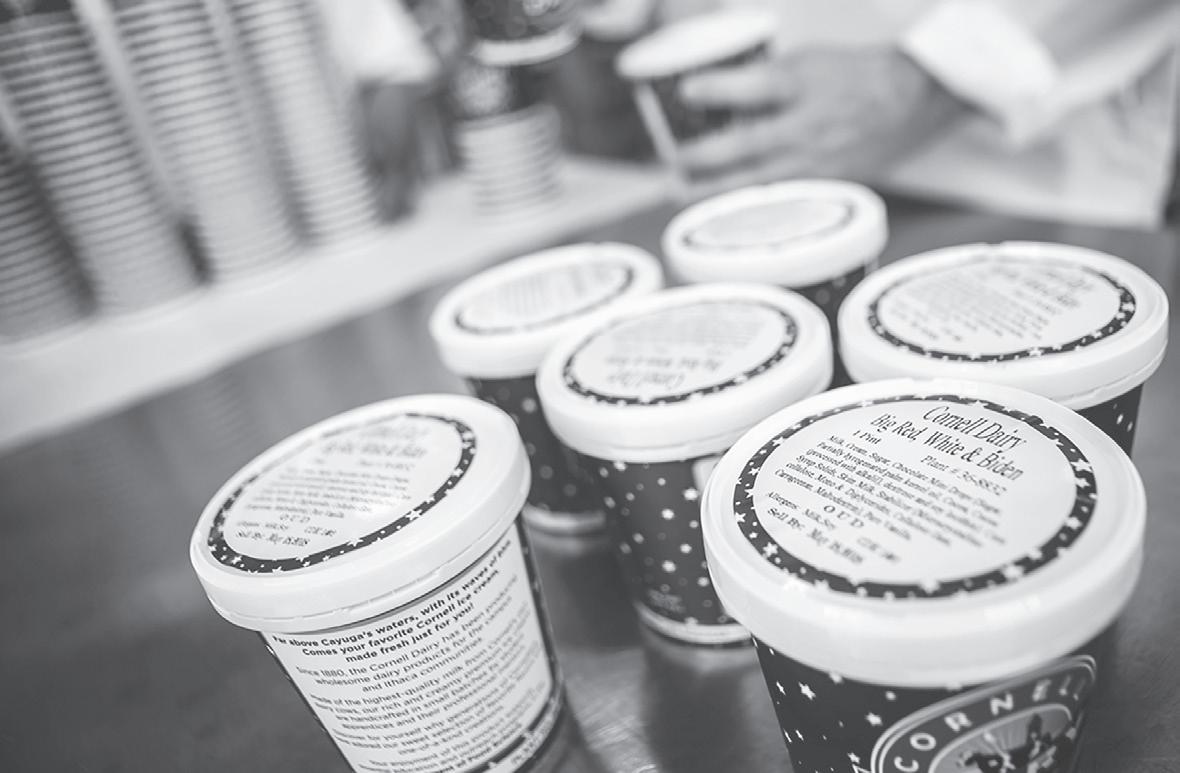
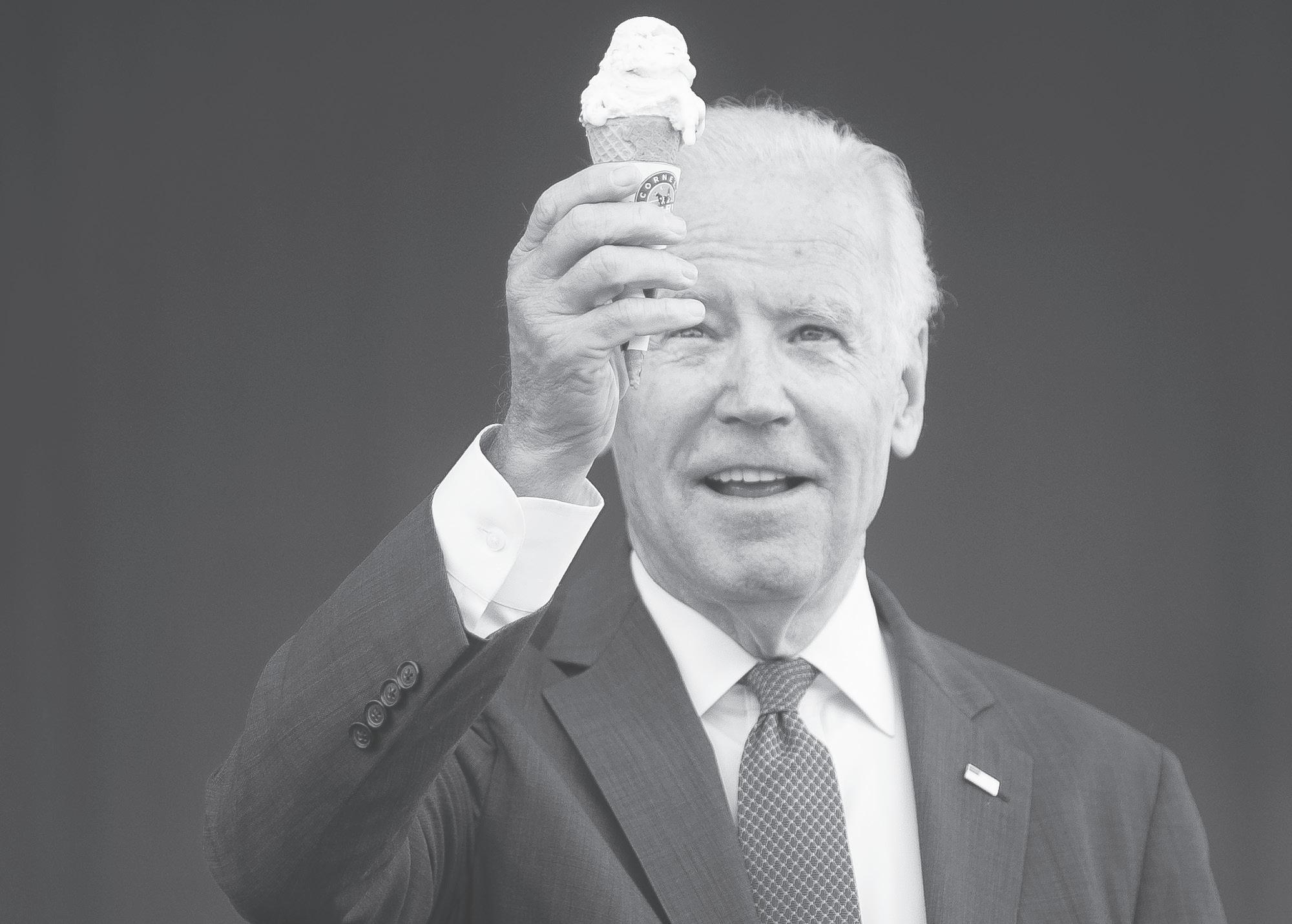
Upon finding out that the former Vice President is a big ice cream-lover, when Joe Biden came to Cornell to give a convocation address in 2017, the Dairy Bar made it their mission to deliver a flavor for him. Tim Barnard, Cornell’s dairy plant manager, discovered that Biden’s favorite flavor was vanilla chocolate chip, and after a naming contest, decided to produce “Big Red, White, and Biden.”
“They were special chocolate chips imported from Buffalo. They were extra small and milk chocolate instead of dark. It was super popular. We had requests for it for months after we had it,” Newton said.
Cornell’s FDSC 1101: Science and Technology of Foods class also came up with a “Freedom of Peach” flavor for the election of President Donald J. Trump in 2016. Judges from CALS and Cornell Dining picked this peach-base flavor that featured cinnamon and graham crackers throughout.
These flavors were only at the Dairy Bar for a limited time and are currently not available. Now, the Cornell community excitedly awaits the next dean or president that will be honored with an ice cream flavor of their own.
Mia Glass can be reached at mtg74@cornell.edu.
Famous Psychoanalyst, Alumna Dies at Age 105
By MARYAM ZAFAR Sun City Editor
When Margaret Lawrence ’36 arrived in Ithaca in 1932, she was the only black student in her class. Denied on-campus housing due to her race, the future psychoanalyst and pediatrician once slept in an attic, working as a live-in maid to help pay for her Cornell degree.
Lawrence — whose name was Margaret Cornelia Morgan at the time — applied in her senior year to the medical school to continue her education at Cornell, but was denied, since “twenty-five years ago there was a Negro man admitted,” a dean explained, “and it didn't work out.” That student had died from tuberculosis.
At Cornell, Lawrence was a skilled archer, scoring in the top eight and snagging a spot on the archery team, according to archived editions of The Sun.
She would chronicle these challenges in a book titled “Balm in Gilead: Journey of a Healer,” written by her daughter, Prof. Sara Lawrence-Lightfoot, sociology, Harvard University. In one recollection, Lawrence described how when
Lawrence 's story resonated with former Cornell University President Frank H.T. Rhodes, who reportedly heard her struggles and penned a short apology letter for the discrimination in 2008.
Columbia University did accept Lawrence, propelling the alumna to eventually direct the Therapeutic Developmental Nursery at Harlem Hospital and becoming chief of the Developmental Psychiatry Service for
she turned 21 and went to register to vote, she was asked to take a literacy test.
Lawrence’s story resonated with former Cornell University President Frank H. T. Rhodes, who reportedly heard her struggles and penned a short apology letter for the discrimination in 2008.
Columbia University did accept Lawrence, propelling the alumna to eventually direct the Therapeutic Developmental Nursery at Harlem Hospital.
Infants and Children for 21 years.
When Lawrence — who would be known for her empathy for children patients, according to The New York Times — was in medical school, she continually faced the compounded difficulty of sexism and racism as one of 10 women, and the only black woman in her class.
“He wrote her a short letter of sincere and serious apology for the assaults of discrimination and racism she had suffered,” LawrenceLightfoot said.
According to The New York Times, Lawrence-Lightfood said that her mother appreciated the “respectful and heartfelt apology.” Lawrence died on Wednesday in Boston at an assisted living center at the age of 105.
Maryam Zafar can be reached at mzafar@cornellsun.com.
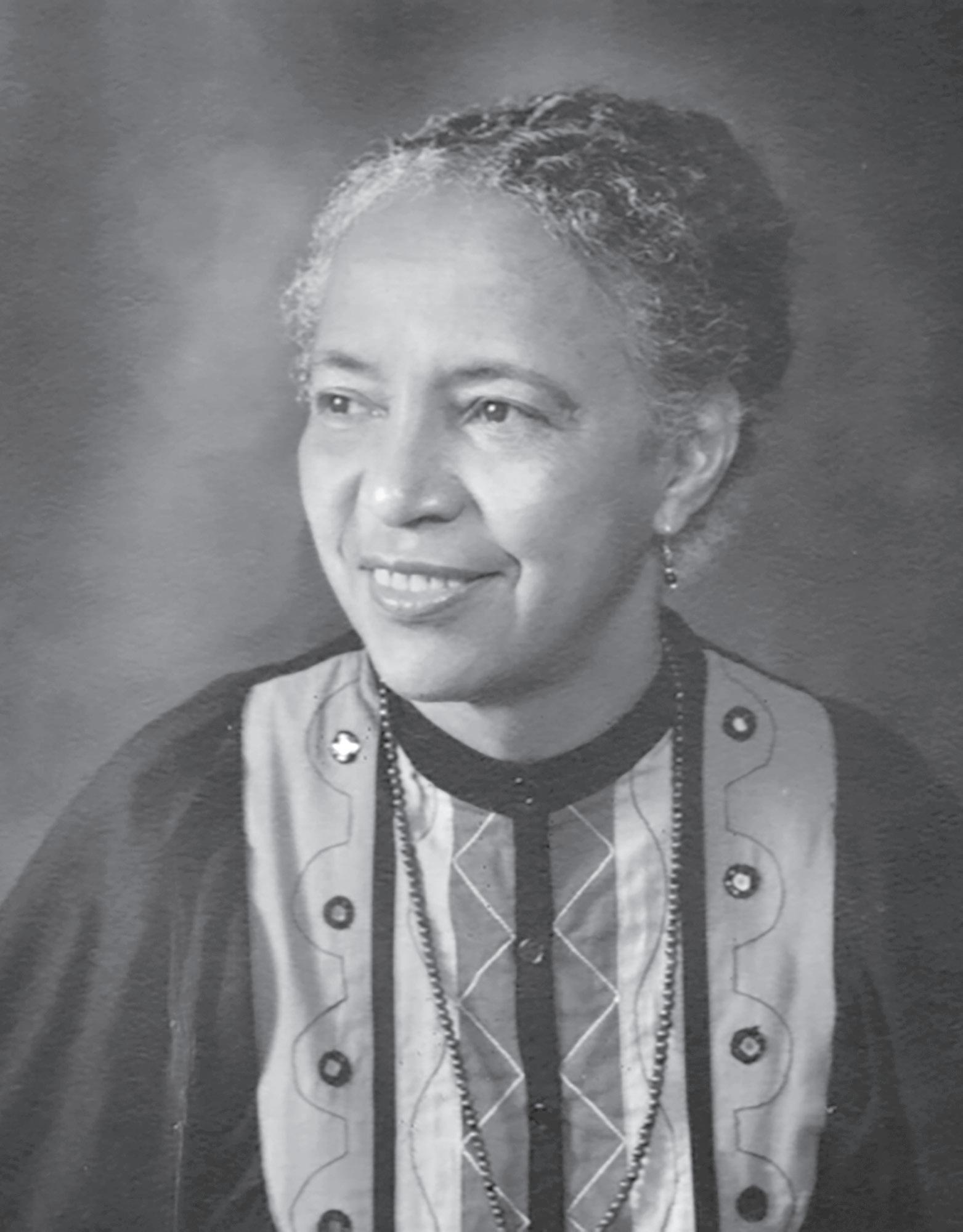
Icon | Margaret Lawrence ’36 was the only black student in her class at Cornell. Despite facing prejudice due to her race, she overcame and went on to have an illustrious career in medicine.
Fan favorite | Upon discovering former Vice President was a huge fan of ice cream, Cornell Dairy rushed to deliver him a flavor in time for his convocation speech in 2017.
CAMERON POLLACK / SUN FILE PHOTO
Name brand | The list of notable people with ice cream flavors in their honor includes former and current University presidents, Joe Biden, and others.
COURTESY OF CORNELL UNIVERSITY
Revered Astronomy Professor Dies at 80 After Prolifc Career
A legend in his feld, Prof. Yervant Terzian inspired thousands, won dozens of awards and saw Cornell’s Department of Astronomy reach new heights
By SHRUTI JUNEJA Sun Senior Editor
Praised as an engaging professor, respected academic, persistent leader, compassionate friend and supportive colleague, Prof. Yervant Terzian, astronomy, passed away last week on Nov. 25 at the age of 80 “after a long illness,” according to his obituary.
While Terzian had an impressive and extensive CV — which included receiving NASA’s highest honor and authoring over 235 scientific publications — it was his charismatic personality and passion for supporting aspiring scientists that many of his colleagues and friends remember most as his defining legacy.
1979 to 1999, which, according to Teukolsky, who also served as chair, is highly unusual. In science departments, individuals typically serve as chair for only three to five years, Teukolsky said.
“He used the time to really oversee the hiring of a lot of the faculty, attracting world class people to come and really
and I have taught many hundreds and thousands actually of students.”
His introductory astronomy course, ASTRO 1101, which Rhodes called a “legend on campus,” was known for always filling up the lecture hall in Uris for many years.
“What struck me right from the beginning was just how upbeat and optimistic he always was.”
Prof. Saul Teukolsky
increase both the size and the caliber of the department. A lot of it was his doing,” Teukolsky said.
“What struck me right from the beginning was just how upbeat and optimistic he always was. Whenever there would be some problem … whatever it was, he always … helped people figure it out,” Prof. Saul Teukolsky, astronomy, told The Sun. “He was completely tenacious, if he had something he wanted to accomplish, he would go at it and just wouldn’t take no for an answer, always with a big smile on his face.”
Terzian began this illustrious career from humble roots. He was born in Alexandria, Egypt in 1939; his father had fled the Armenian genocide at a young age, while his mother was the daughter of a fisherman from a remote Greek island, according to his obituary.
“I was very curious about the sky. In Egypt, the sky was very dark at night, particularly from the desert, and those diamonds in the sky needed an explanation,” Terzian remarked in a
One of the faculty members recruited by Terzian was Prof. Martha Haynes, astronomy, who told The Sun that she first met Terzian in 1973 when she was a research intern at the Arecibo Observatory in Puerto Rico. She still vividly remembers how, although just a guest lecturer, he still took the students on a field trip and out to dinner.
Terzian later went on to recruit Haynes and persuade her to join the astronomy department at Cornell, changing the trajectory of her career.
“He was an enabler of people,” Haynes said, adding that he not only recruited talented faculty, but was amazing at supporting and retaining them.
As department chair, Terzian was also credited with building consensus and uniting various stakeholders to build up the department into what it is today.
“He is a bright and bubbly personality who just loves to share what he does.”
Patricia E. Fernandez de Castro Martinez
documentary made for his 70th birthday by members of Friends of Astronomy at Cornell, a group he founded in 1992. “I started a love with the sky at a very young age. I read all I could about astronomy, it was not easy to find books, but the American embassy had a lovely library where I read all the astronomy books they had.”
Terzian went on to earn an undergraduate degree in physics from the American University in Cairo in 1960 and a Ph.D. in astrophysics from Indiana University in Bloomington in 1965. He then joined the newly built Arecibo Observatory in 1965, which was then managed by Cornell, before coming over to Ithaca two years later as an assistant professor.
He went on to lead the department as its chair for 20 years from
“He presided over a remarkable department, full of wonderful colleagues — Carl Sagan, Tommy Gold, Ed Salpeter ... and somehow the wisdom and sheer sense of partnership that Yervant brought to that distinguished group was something that not only kept the department intact, but allowed it to grow,” President Emeritus Frank H.T. Rhodes recounted in the documentary.
“I remember his beating up on me to get two more floors added to the astronomy building and he succeeded and that’s no small undertaking,” Rhodes added.
In 2017, a conference room on one of these new floors — the 6th floor of the Space Sciences Building — was renamed and dedicated to Terzian “in recognition of his many years of leadership, scholarship and citizenship to Cornell.”
Terzian was also remembered for having a profound impact on students, stating in the documentary that “the most important thing for me during my career at Cornell have been the students
Cornellians Attend U.N. Climate Summit, Brush Shoulders With Pelosi
CLIMATE Continued from page 1
perspective.”
Prof. Lisa Kaltenegger, astronomy, who is the director of the Carl Sagan Institute and currently teaches that same introductory course, told The Sun that she and Terzian shared a similar attitude towards giving students who might not go on to take additional science classes a chance to appreciate the complexities of the universe.
“He came from a country where it was not easy for him to become a scientist and he made it work and … he also dedicated a lot of his time to make sure that other people could do that too,” she said.
For his engagement in the classroom, Terzian earned the Clark Distinguished Award for Excellence in Teaching in 1984.
His academic focus was primarily on examining the “physics of the stellar evolution, planetary nebulae, hydrogen gas between galaxies and the presence of unseen matter in intergalactic space,” according to a University press release. He also received the Gold Medal, the highest honor for scientific achievement, from the Armenian government, served on eight NASA committees, directed the NASA New York Space Grant Consortium, and held a variety of other scientific leadership positions.
In the documentary, Terzian said he realized that “Cornell is the place for me, and Arecibo is the telescope … Through the decades at Cornell, it has been a journey of happiness, discovery, science, education. Cornell has been a fantastic place to have a career.”
His obituary asks that “in lieu of flowers, memorial donations may be made to the Armenian National Science & Education Fund.” Terzian was the founder of this fund, which is “a project that ultimately promotes scientific innovation by giving the unique opportunity to Armenian scientists to carry out research in their home country through the support of annual grant,” according to its website.
A memorial service for Terzian will be held on Friday from noon to 2:30 p.m. at 404 Highland Avenue in Ithaca.
“He is a bright and bubbly personality who just loves to share what he does and his awe and his intense and deep knowledge of the universe,” his wife, Patricia E. Fernandez de Castro Martinez, said in the documentary.
Shruti Juneja can be reached at sjuneja@cornellsun.com.
According to Christopher Galantino M.Eng.’19, although the climate-related challenges discussed at COP are part of larger, more complex systems, the conference motivated him to consider how he might incorporate solutions into life back at Cornell.
“Some of the challenges outlined in the conference are extremely systemic,” Galantino said. ”I think you have to push yourself to make a difference in whatever way you think you would be most effective towards sustainable development goals and helping climate change.”
Facing knowledge that five of the warmest years on record have taken place since 2010, the threat of global warming feels more imminent than ever but, according to Galantino, but the conference nevertheless found ways to encourage and inspire.
“It is so hard not to be negative about what is going on, but it’s encouraging when you learn about all of the really cool
One
ways that people are applying technology and policy in very elegant ways,” Galantino said. “The fact that Cornell was able to give us the opportunity to present in an international context is truly an honor.”
At the conference, Cornellians were only with a handful of other universities, and for the most part, were surrounded by delegates and legal policy representatives from around the globe.
Invigorated by the chance to see the workings of climate policy up close, in trying to explain the complexity of climate change policy through a simple metaphor, Galantino encouraged individuals to “act like a bee.”
“Bees are very task-oriented and, [individually], they are not necessarily going to make a big difference with respect to the hive,” Galantino said. “When everyone is working together toward a common goal, the impact that a group can make is substantial.”
Stacey Blansky can be reached at sblansky@cornellsun.com.
of Only 95
Worldwide, Alumna Claims Rhodes Honor
RHODES Continued from page 1
knowledge.”
While abroad, she aims to study children’s nutrition, researching how the varying development of international countries affects health among vulnerable communities. That goal marks a continuation of Acharya’s time at Cornell, where her undergraduate honor’s thesis focused on how the lack of vitamin D affects the sun-deprived Inuit people.
and to take an interest in one’s fellow beings” just as much as scholastic achievement, and Acharya has had a key role in a wide variety of organizations.
While a student at Cornell, Acharya co-founded the Canadian Science Fair Journey, which attempts to introduce up and com-
International and Dance Ability Movement, which support people with disabilities.
After graduating from Cornell, Acharya received the inspiration to pursue the Rhodes Scholarship after working at the Canadian government on formulating international nutrition assistance policy.
“I genuinely thought I had no chance, but ... I knew I would regret it if I didn’t try.”
Nina Acharya ’19
“She is just simply an excellent student. She is sweet she laughs easily, you can see her kind heart clearly,” said Prof. Pilar Parra, nutritional sciences, Acharya’s faculty advisor. “She was assigned to me due to her HBHS major. The first thing you notice is that she is very organized and she can manage her stress easily.”
The Rhodes selection process stresses “instincts to lead,
ing college students to scientific journals. She also served as performance director and co-president of the Sitara Bollywood Fusion Dance Team.
“A big passion of mine is dance, and it has always been a significant part of my life,” Acharya said. “It took up a lot of time, but is one of the things I was most proud of during university.”
She was also involved in Best Buddies
“I genuinely thought I had no chance, but, similar to when I was applying to Cornell, I knew I would regret it if I didn’t try,” Acharya said. Pressing future students who might be interested in the Scholarship not to harbor self-doubt, Acharya said, “if when the time comes you are still interested, talk to the fellowships office and put in an application. You will never know if you don’t try!”
John Yoon can be reached at johnyoon@cornellsun.com.
The Corne¬ Daily Sun
Since 1880
137th Editorial Board
ANU SUBRAMANIAM ’20
Editor in Chief
JOYBEER DATTA GUPTA ’21
Business Manager
PARIS GHAZI ’21
Associate Editor
MEREDITH LIU ’20
Assistant Managing Editor
RAPHY GENDLER ’21
Sports Editor
BORIS TSANG ’21
Photography Editor
AMBER KRISCH ’21
Blogs Editor
SOPHIE REYNOLDS ’20
Science Editor
AMANDA H. CRONIN ’21
News Editor
JOHNATHAN STIMPSON ’21
News Editor
PETER BUONANNO ’21
Arts & Entertainment Editor
ANYI CHENG ’21
Assistant News Editor
HUNTER SEITZ ’20
Assistant News Editor
CHRISTINA BULKELEY ’21
Assistant Sports Editor
BEN PARKER ’22
Assistant Photography Editor
JEREMY MARKUS ’22
Assistant Arts & Entertainment Editor
ALICIA WANG ’21 Graphics and Sketch Editor
DANA CHAN ’21 Production Editor
RYAN RICHARDSON ’21
Snapchat Editor
GIRISHA ARORA ’20
Senior Editor
ALISHA GUPTA ’20
Senior Editor
AMOL RAJESH ’20
Senior Editor
SARAH SKINNER ’21
Managing Editor
KRYSTAL YANG ’21
Advertising Manager
NATALIE FUNG ’20
Web Editor
SABRINA XIE ’21
Design Editor
NOAH HARRELSON ’21 Blogs Editor
SHRIYA PERATI ’21
Science Editor
KATIE ZHANG ’21 Dining Editor
AMINA KILPATRICK ’21 News Editor
MARYAM ZAFAR ’21 City Editor
ETHAN WU ’21 Opinion Editor
SHIVANI SANGHANI ’20 Assistant News Editor
NICOLE ZHU ’21 Assistant News Editor
LUKE PICHINI ’22
Sports Editor
JIANG ’21 Assistant Photography Editor
MORAN ’21
WU ’21
WANG ’20
LEANN McDOWALL ’21
BREANNE FLEER ’20
SHRUTI JUNEJA ’20
KATIE SIMS ’20
Working on Today’s Sun
Ad Layout Dana Chan ’21
Production Deskers Sabrina Xie ’21
Mei Ou ’22
News Deskers Johnathan Stimpson ’21 Hunter Seitz ’20
Design Deskers Lei Anne Rabeje ’22 Niko Nguyen ’22
Photography Desker Boris Tsang ’21
Sports Desker Christina Bulkeley ’21
Arts Desker Daniel Moran ’21
Science Desker Sophie Reynolds ’20
Letter From the Editor
Never Dull
What an honor to finish off the year and decade with this semester’s last regular print publication. Just like that, The Sun wraps up another semester. But, don’t worry, The Sun is not setting just quite yet. We may not be sending out our usual dozen Facebook posts a day, but we will still publish major Cornell happenings on our website, Twitter and Facebook. For those of you waiting on your toes for our full-time return, we will be back next semester after our editors get some major sleep and overcome their denial that The Sun affected our final grades.
This past semester has allowed us to take you, our readers, on quite the ride. We have covered everything from underage drinking and fake IDs to the proposed changes in the Greek system. We have given you minute-to-minute updates of our hockey games while live tweeting the action on the ice. We are diligently working on our app to provide new services such as QR code readers to take our future stories to the next level. We are looking at ongoing issues such as the mental health services and reforms on campus, food insecurity and the divestment issue.
Even though it seems like the editors of the 137th Editorial Board just took over the reigns of The Sun, we will be passing them on to the 138th Editorial Board compets for our next issues. Beginning Jan. 20, the candidates for the next editorial board will maneuver the do’s and don’ts of The Sun while learning how to answer angry emails and run on superhuman levels of caffeine. They’ll join the thousands of Sun alums that have walked through the doors of 139 W. State Street to support the nation’s oldest continuously independent college daily. We can’t wait to see how they better our 139-year-old institution, and hope they share our love for Shortstop and 2 a.m. TCAT rides by the time they are through with the six week process.
Forward and onward into a new semester, new year, new decade and a new Sun Editorial Board. Stay stunny.
—A.S.
Into the Unknown
Idecided to give myself a break over the weekend to relax and rejuvenate. I tend to do things in chunks such that I spend either a full day studying or a full day unwinding all at once. I realized, however, that I now have less than two weeks until graduation, and that I can’t leave spending time with and appreciating my friends here for later. So, with final papers and exams in the back of my mind, I went to watch Frozen II at Regal Ithaca Mall.
The scene where Elsa begins singing “Into the Unknown” particularly caught my attention. Besides the stunning visual effects and Idina Menzel’s graceful voice, I was most captivated by the eeriness of the melody that expressed Elsa’s sense of discomfort and desire for journey. In many ways, I realized that I am like Elsa, seeking to venture out into the world that lies beyond the confines of the Cornell bubble, but also a little intimidated by what unknowns I face and will have to overcome to become the best version of myself.
comes to asking for help and seeking support when necessary. One thing that freshman me didn’t know that senior me now knows is that being resourceful is being comfortable with soliciting guidance from others. Although my past three and a half years may sound dismal and full of regrets,
Freshman me expected graduating seniors to be sophisticated members of society. But now that I am at this stage, I realize that not too much has changed.

When I first set foot on the unknown land of Ithaca in August 2016, I thought that I would become a very different person by the time I graduate. Freshman me expected graduating seniors, with their experiences on campus — academic, extracurricular, personal — to be sophisticated and poised, soon-to-be productive members of society.
I am truly thankful for the privilege of being a Cornell student. I will miss all the amazing people I’ve met, the beauty of the gorges and trees and the feeling of knowing that I am one of the thousands of other Cornellians who have left a mark to make this place what it is. As much as I complained, I love this campus, its people and all that it stands for (love is a strong word that I use with caution, but I do really love Cornell). I am most thankful for my parents who
As much as I complained, I love this campus, its people and all that it stands for (love is a strong word that I use with caution, but I do really love Cornell).
But now that I am actually at this stage, I realize that not too much has changed. I still overthink every little situation, wake up almost every morning regretting why I hadn’t slept earlier the night before and ignore my will to live healthier by exercising and reducing my instant ramen intake. I don’t feel ready to graduate, and I wish that I could slow down time to relive happy memories. I wish I would have spent more time looking at the
I keep asking myself, is it ok to graduate with so much hesitation? Am I prepared enough?
bigger picture and embracing the life of a college student as part of a greater adventure rather than a series of prelims, papers and internships.
And through all the regrets and doubts, I also know that I have grown and developed during my time here. I have learned most to be more communicative, whether that is with others or to myself. At times, I was not outspoken enough and felt like I compromised my sense of self. I realize the need to be more expressive and candid when it
have supported me through and through over the past three and a half years. Thank you for sending me to Cornell to give me the experiences that you never had, giving up literally everything you have to support me and Agnes. Thank you for teaching me to be thankful for what I have, for raising me up when I doubted myself and for teaching me to explore the greater world. I came to Cornell with a 50-pound suitcase and so many hopes and dreams. I leave with a similar sense of mixed confusion and curiosity, alarmed with what lies ahead. I am still a little afraid, a little too comfortable here in Ithaca to embrace the uncertainty that lies ahead. I keep asking myself, is it ok to graduate with so much hesitation? Am I prepared enough? While I will never know the answer until perhaps another three and a half years, I know deep down that my time as a Cornellian now and beyond will serve as a stepping stone to venture out into the unknown.
DongYeon (Margaret) Lee is a senior in the School of Industrial and Labor Relations. She can be reached at margaretlee@cornellsun.com. Here, There, Everywhere appears alternate Tuesdays this semester.
WANT TO WEIGH IN? SUBMIT LETTERS TO THE EDITOR AND GUEST COLUMNS TO
Te Ivy League Breeds Obedient Capitalists
Prestigious universities like Cornell are, in theory, institutions where talented young people receive the education, ideas and skills needed to tackle the world’s most pressing issues. A closer look into elite culture reveals that these conceptions are fantasies that serve privileged, wealthy sectors of society that equate their own interests with those of the rest of the world. While the concerns of financial institutions, big tech and other sources of extreme wealth are carefully looked after by Cornell as an institution and community, the most fundamental issues for the world’s poor majority and for future generations: Climate change, nuclear proliferation and widespread hunger, are hardly considered outside of abstraction.
That two of these issues are existential threats to human civilization is a testament to the irrationality of managerial class interests which dominate discourse among the political, business and intellectual communities. That universities like Cornell ignore calls for modest steps towards social responsibility on climate change, whereas dialogue about world hunger and nuclear proliferation is virtually nonexistent, is demonstrative of an intellectual environment that discourages cosmopolitan, rational policy in favor of the pathological preservation of the status quo.
Elite universities indoctrinate future professionals and upperclass members of society into conformity, creating generation after generation of obedient capitalists.
Elite universities indoctrinate future professionals and upper-class members of society into conformity, creating generation after generation of obedient capitalists. Contrary to the commonplace, paranoid belief that universities are overrun with neo-Marxist professors and
radical students, more American students study business than any other discipline. William Wang ’20 put it well when he wrote in The Sun that “There isn’t anything more intriguing and sexy than working on Wall Street for most students here.” In my own graduate field, two out of the four Ph.D. graduates last semester took jobs at banks. The vast majority of students at elite universities are not looking to change the world in any meaningful way, but to secure or maintain their position in its professional and managerial classes.
Meanwhile, discussion of bold initiatives to address the world’s problems are largely absent from the campus playgrounds of the wealthy and privileged. It is not that issues such as world hunger are unsolvable abstractions no one knows how to address, but that the majority of the intellectual establishment has determined that issues such as the fact that 150 million children have stunted growth due to malnutrition or that nine million people die of starvation every year are unimportant — at least not important enough to implement mild budgetary reforms that would radically transform the world for the gmajority.
approaches and rational approaches tend to look more or less the same.
Imagine if, rather than bowing to the will of powerful interests, the intellectual community devoted more of its resources to the establishment of a sustainable socio-economic order, or to the eradication of hunger, poverty and other manifestations of human misery. Imagine if the business-academic class had the courage or intellectual curiosity to have honest discussions about these barbaric realities.
Imagine a world in which our universities encourage students to seek bold, rational, moral solutions to the real problems of the world.
International aid organizations estimate that redirecting about 10% of global military spending could eradicate hunger and extreme poverty in 15 years. The United Nations estimates that spending about $30 billion a year could end world hunger. These are clearly achievable goals that would be of utmost urgency in rational socio-economic system. The fact that this readily-available information goes undiscussed at Cornell and other elite centers of Western education is indicative of an intellectual culture that values the interests of the boards of Lockheed Martin, IBM and other benefactors of the taxpayer-subsidized war machine more than it values the lives of the 100 million or so who will die of hunger over the next decade.
I find that in issue after issue facing the world, moral

Imagine if, instead of seeking that “sexy” Wall Street job, Cornellians sought to create a world in which human needs are put before investor “needs.” A map of the world that does not include Utopia is not worth even glancing at.
Imagine a world in which our universities encourage students to seek bold, rational, moral solutions to the real problems of the world. An educational environment that does not encourage us to imagine how we might strive towards a better world for all is not an educational environment at all, but a center for the manufacture of conformity and for the preservation of wealth and power.
Jacob Brown is a Ph.D. candidate in applied mathematics at Cornell University. He can be reached at jbrown@cornellsun.com. Mapping Utopia runs every other Tuesday this semester.
Change Your Major (Before It’s Too Late)
As a student advisor for the biology major, I’ve listened to two cohorts of bright-eyed first year students talk excitedly about writing seminars, languages courses and PE classes. I’ve yet to hear one say they enjoy general chemistry, intro to cell bio or any other class that’s actually related to biology. It’s an implicit understanding between us that those classes are merely supposed to be survived rather than enjoyed.
As a senior, then, I’m nothing if not a survivor. I’ve survived general chemistry to then survive organic chemistry to then survive biochemistry, genetics and physics. I waited for the time I’d finally get to take biology classes I thought I’d enjoy, and I’m writing now to tell you that I’m only surviving those too. And after having almost outlasted biology, I can say that it’s a lot more exciting to enjoy your major than to endure it.
I stand today as a biology and English
gotten excited over reading lists and felt the agony of having to choose between two courses being held at the same time. After my excitement fades, I pull out the four-year plan I made with my own biology student advisor during my first year, type in the course numbers with clinical precision and make the appropriate adjustments in my master spreadsheet.
I’m an English major by choice and a biology major because for the first two years of college, I thought I had to be STEM to survive, and afterwards I stayed in it because I had already invested too much time in it to drop.
I think a lot of people become engineers and scientists because they feel they must. They choose biology as first-years because they think it’s what they have to do to become a doctor. They study computer science because everyone around them is doing it. They choose engineering because they want a fulfilling career. When I ask them what a fulfilling career is, they tell me that it’s a stable one.
I’ve survived general chemistry to then survive organic chemistry to survive biochemistry. I held out for the time I’d get to take biology classes I thought I’d enjoy, and I’m writing to tell you that I’m only surviving those too.
double-major. Each pre-enroll, I’ve pored over the English course offerings,
Sciences and the College of Engineering — all of which, unsurprisingly, have science or engineering in the name.
And when we get to Cornell, we don’t gain much more exposure. Distribution requirements are nice in theory. But when we have to take general chemistry, introductory biology, math and biology lab in our first year to not fall behind, one required history course is limited in its ability to change my life. And engineers are similar, taking one introductory ENGRI before feeling like they must pigeonhole themselves into a major.
enjoying them.
STEM may be the way of the future, but it’s not the only way to salvation. That way has and will always be doing the thing that makes you happy — and not being miserable doesn’t count as happiness. I’m not miserable studying biology, but I’m not content, either. If you truly enjoy science and engineering — and I have several friends that do — congratulations, you will be rich

As 18-year-olds forced to choose one of Cornell’s colleges to apply to, we haven’t been adequately exposed to other fields of study to make an informed decision.
The first time I realized that Cornell had seven different colleges was when I had to choose one to write an essay about two days before the application deadline. And in my mind that was conditioned to equate STEM with success, I quickly narrowed in on CALS, Arts and
The con sequence is a University of students who chose a career path out of relative ignorance, pursue that choice out of compulsion and realize too late that they made the wrong one. We get trapped in our major because it’s really hard to start over by the time we realize that we do, in fact, want to start over.
While I do know a lot of people that are entirely happy with their major, I know a lot more that aren’t. And the common theme among those that aren’t is that they wish they’d had more time to explore. But when we elect to explore, we fall behind in our requirements. So we become survivors. We survive our majors to survive our careers to survive our lives, when we really ought to be
If you truly enjoy science and engineering — and I have several friends that do — congratulations. If you don’t like your major, then change it.
and joyous. And to the rest of you with “inferior” interests such as myself, please give yourself at least a small chance at joy. If someone had told me that the peak of being a biology major would be breeding fruit flies and memorizing all 20 amino acids, I’d be reading Jane Austen right now and not writing this column. If you don’t like your major, then change it.
Colton Poore is a senior in the College of Arts & Sciences. He can be reached at cpoore@cornellsun.com. Help Me, I’m Poore runs every other Tuesday this semester.
Colton Poore | Help Me, I’m Poore




ARTS & ENTERTAINMENT
How Super Mario Unknowingly Fought Bots
I’m not gonna lie: Art is hard. You practice illustration or animation or music or writing for years and years, waffling between periods of time when you either think your creation is the greatest thing known to man or everything you do stinks like a dorm room dumpster. When you’re an artist online, all of these internal suspicions are confirmed by thousands of commenters, emboldened by varying degrees of anonymity, praising your accomplishments and highlighting your flaws. In that kind of environment, you might look for ways to make your work better, to take shortcuts, to make all the money you can to support yourself. But in doing so, you might walk the line between inspiration and plagiarism, or cop others’ work entirely — after all, who’s going to say you can’t? The art police? It’s just the Internet.
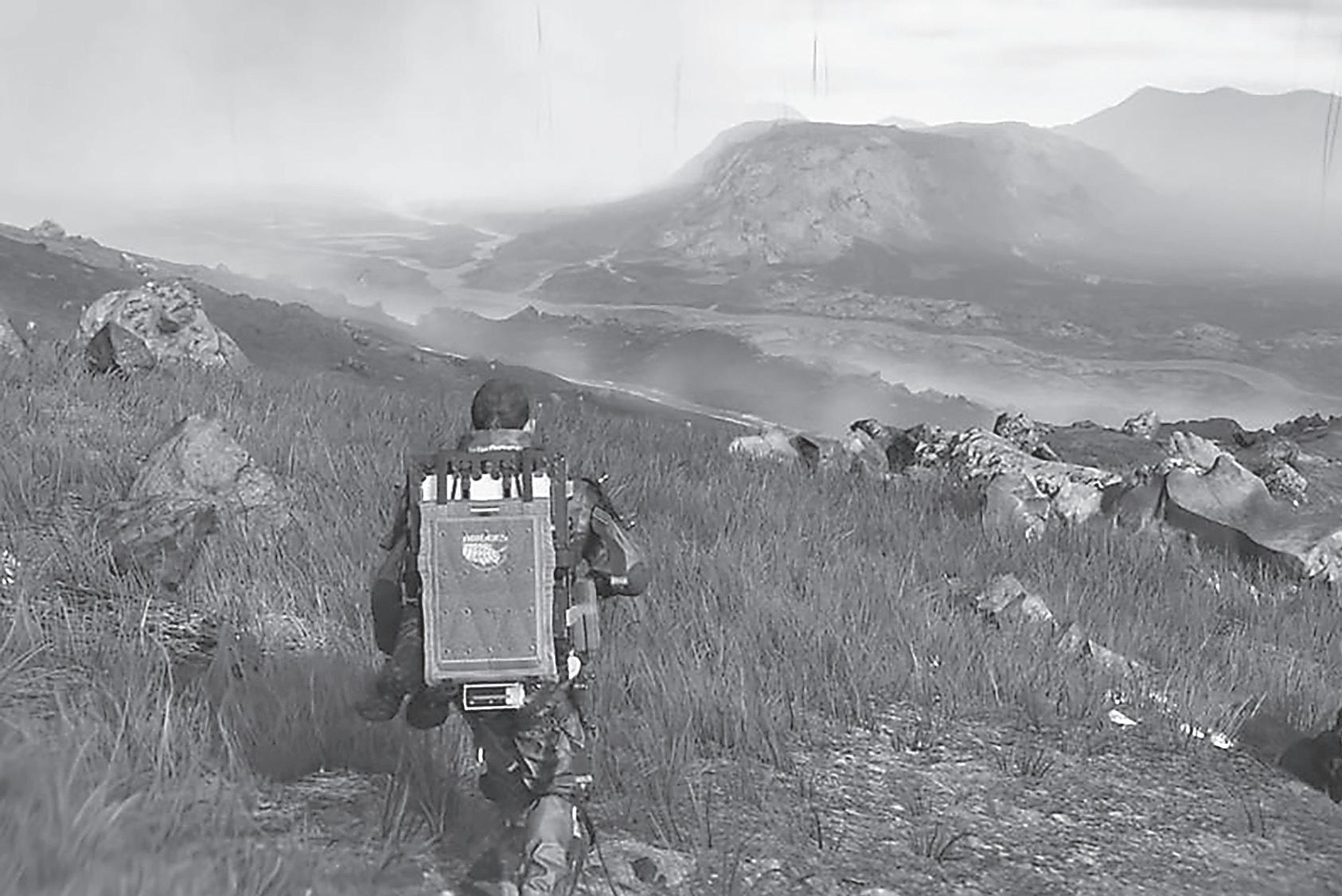
The Internet might not be such a lawless place for much longer. Last week, a large swath of Twitter’s art community took a stand against art theft. It technically started on Nov. 29, the day after Thanksgiving, when a Japanese promotional account for Sony’s Playstation posted a “PS4 Lineup” compilation video. The spot featured clips from current games like Death Stranding and Persona 5, punctuated by animated bumpers depicting an (unnervingly-smiley, like he knew what he was getting away with) cartoon character running, jumping and fighting through colorful shapes and PS4 controllers. It stayed up for only a couple days before Animation Twitter realized there was something wrong. The character’s design and environment were original and specific
to the spot, but his movements — swinging through clouds of dust and turning rubber-hose to jump on top of a planet — were all taken from somewhere else. Twitter users quickly started stitching together side-byside comparisons, suggesting that the character’s movements were all traced frame-byframe from a wide range of works, from small student films to well-known shows like FLCL and Steven Universe.Sony took the video down and cut ties with the animator responsible, but that wasn’t where Twitter’s anti-plagiarism crusade ended.
It continued on Dec. 3 when artists began to upload curious, text-based art, urging their followers to respond asking for t-shirts of the images. Every image had some variation on the phrase “this website steals art.” Why? For a while now — I first saw this happen a few months ago, but the trend probably has gone on longer than that — custom-shirt websites have sent swarms of bots, disguised as normal Twitter accounts, into the replies of popular artists. Whenever someone comments something along the lines of “I’d love to buy a shirt of this!” on a popular illustration, that bot downloads the art, removes the artist’s signature and lists it for sale as a shirt on a separate website. It then tags anyone who replied to the original tweet, posing as a regular user who just happened to find the listing online. Unsurprisingly, artists didn’t like this too much — it’s a little like stealing a shirt from Kohl’s and then reselling it in the parking lot of the Kohl’s.
That’s when the Twitter artists’ plan comes in. They figure if they can bait these bots into stealing images that say “don’t buy



from this website!,” they can trick them into warning potential buyers that the site sells stolen art. It’s a solid plan, but the trend mutated a step farther: Some artists started putting copyrighted characters in the images, like Mickey Mouse or Mario, in the hopes that Disney’s and Nintendo’s respective lawyers will join the fray. When an independent artist’s work is stolen and sold elsewhere, they usually don’t have the legal muscle to do more than request the site takes the one listing down, but big corporations are famous for using legal action to protect their IPs online. YouTube, in particular, always yields to big copyright holders to avoid facing legal action themselves, which is why the video-sharing platform has survived so long.
It remains to be seen whether this tactic will actually work, whether these bizarre shirts will stop the bot problem once and for all or just drive more traffic to these knockoff sites. Corporate legal teams can’t sweep every corner of the Internet, as evidenced by the copyrighted content that lives on
YouTube despite its strict rules, the reruns of That’s So Raven sped up 1.25x, mirrored and pasted onto a stock image of a television that pop up if you know where to look. The Playstation incident won’t stop tracers from making money on other people’s work, either; outrage around the video has calmed down since its deletion, but that doesn’t mean the conversation around plagiarism is over. Every week, I see new debates about referencing vs tracing, homages vs rip-offs, springing up on my Twitter timeline like grass growing in sidewalk cracks. But maybe this past week is a sign of gradual change. Maybe if artists continue to make noise, one day, copyright law will protect smaller creators the way it does larger ones, and The Bots will finally be defeated.
Olivia Bono is a senior in the College of Arts and Sciences. She can be reached at obono@cornellsun.com. On the Level runs alternating Tuesdays this semester.
RACHAEL STERNLICHT/ SUN GRAPHIC DESIGNER
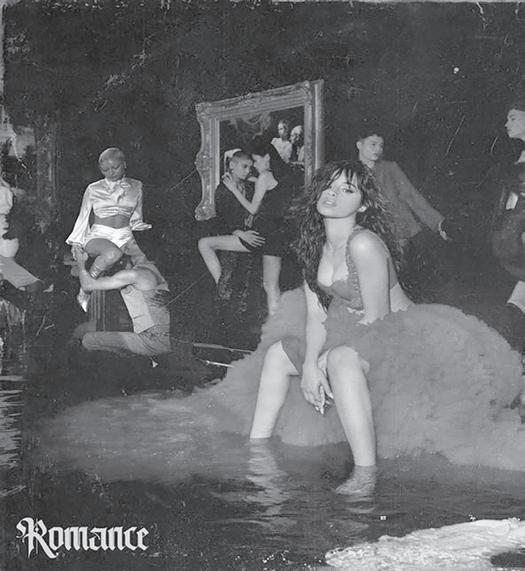
Most of the first half of Romance feels like different iterations of the same overly produced love song. However, I did appreciate the variety of sounds used; Romance makes use of Latin-inspired guitars, trap beats and of course classic pop instrumentals. But even so, the radio-ready tracks on this album seem to easily blur together, with few sticking out as clear hits. “Shameless” is an attempt to recreate the angst of Cabello’s 2017 hit “Never Be the Same,” with the dramatics dialed up even higher than ever before. Despite the strong build-up to the chorus of this
In between sucking face with Shawn Mendes courtside and becoming one half of the most meme-able couple of 2019, Camila Cabello has been falling in love, falling out of love and falling back in it again. More importantly, she’s been writing songs about all of it. On Romance, Cabello is clearly drawing from more personal material (taking cues from her pop-star contemporaries Taylor Swift and Selena Gomez). Sonically, the album is an amalgamation of songs we have already heard on the radio. Some are undoubtedly hits, but others feel half-baked and some others are simply annoying to listen to — especially those that make generous use of her signature falsetto.
track, it ultimately just does not pack the punch that “Never Be the Same” did and simply is not as memorable.
The sweet revenge song “Should’ve Said It” and the danceable “Liar” get better with a bit of time and I have found myself accidentally humming them to myself after a couple of listens, but unfortunately, many of the other tracks simply fall flat and blend into one another.
The low spot of Romance for me is stuck right in the middle of the album with “Bad Kind of Butterflies” and is meant to be somewhat of a thesis statement for the project: Camilla is in love with someone, but she wants someone else. Presumably,
this is drawn from her real-life experiences as Cabello has been in two serious relationships during the creation of this album. While the concept is a tale as old as time, “Bad Kind of Butterflies” is annoyingly dramatic and the production makes it oddly feel almost like a Halloween themed track.
The bright spots on the second half of the album redeem the repetitiveness of the first. “Easy” is a love song with a chorus that makes it almost impossible to hate: “Always thought I was hard to love, ‘till you made it seem so easy.”
“Used to This” is undeniably
a bop and “First Man” is a sweet and emotional letter to Cabello’s father, the first man she ever loved. Both were uncoincidentally produced by Grammy-nominated producer Finneas, as they are unquestionably the high point of the album, both sonically and in their honest delivery. On Romance, Cabello has not fully formed a unique voice within the industry, but she has proven her ability to churn out a slate of hit pop songs, even at the expense of a few fails.
Jean Cambareri is a sophomore in the College of Agriculture and Life Sciences. She can be reached at jcc444@cornell.edu.
Olivia Bono
COURTESY OF KOJIMA PRODUCTIONS
Te Perpetual Quest to be ‘Good Enough’
To be completely honest with you, I forgot I had this column due today and when my editor emailed me, I had a minor freakout. But please, bear with me — I tend to overcommit myself, and this semester has been particularly bad since I’m desperate to prove my value to everyone again after coming back from abroad.
I spent last night in the studio, downing coffee and trying to work on two films and a paper simultaneously. When I was about to leave, my friend asked me to take a look at his cut again. Reluctantly, I sat down again and watched his roughly assembled movie I had finished producing a mere month ago. It was not quite done yet; there were placeholders for not-yet-shot sequences here and there. The main character was out of focus in a few shots, some moments could be shorter, the music was mediocre, etc. I was so exhausted that I might have come across as cranky, and after I finally finished commenting he asked, anxiously, “How bad is it?”
Someone else asked me the same question earlier in the night, holding up a piece of costume she had made for my upcoming installation. The sheer dress seemed like it was about to disappear in her hands, and her eyes sparkled in the dim light. It had been a long day
— I said it wasn’t bad at all. But she was still worried about the thread ends sticking out from places and told me she would’ve done better, but she didn’t have time.
When I first started taking more humanities classes, I had a really hard time letting go of my projects. Unlike a problem set you can just submit and throw out of your head forever, creative assignments demand personal attention. There’s always something to go back and change, always room for improvement. Especially when you’re a growing artist, maybe you, like me, can’t help but look at your past work with many regrets. I made my first film almost three years ago, and to this day I still tell myself that I’ll revise it when I have time. I know exactly what sequence I would modify and where I would fade in which soundtrack, but I never have time.
And I don’t even have enough time for ongoing projects, which is anxiety-inducing. I try to pick and choose, but that becomes hard, too, when everything is so interesting. Can I do each project justice with limited attention? If I sleep less, if I do another cut, if I start drafting early, if I can just film for one more day, maybe, just maybe, it could’ve been much better.
But everyone has just 24 hours a day.
There are deadlines I have to meet as a creative, for pay or for grades. In an ideal world I would spend as much time as I could with each project, but it’s also possible that I would never get anything done because nothing could ever be perfect. Some of the flaws in my past work still bother me, but more of them have grown on me. It’s endearing to see an earlier version of yourself through these explorations.
During the excruciatingly long post-breakup months, my incredibly patient ex-boyfriend ensured me again and again that I was “good enough.” At the time, I struggled to understand why being “good enough” still didn’t guarantee me a place in his life, but I was hung
up on the wrong thing. We all want to do better, to be better. But sometimes when we can’t, “good enough” is good enough. At least, it’s a nice thing to believe when you are lying in bed trying to sleep for two hours before your alarm goes off again as another existential crisis hits.
I had to whip this column out in way too little time. Treat it as a draft. Maybe I will revise it. But probably not before I get to the other 87 things on my list.
Ruby Que is a senior in the College of Arts and Sciences. Escape runs alternate Tursdays this semester. She can be reached at rque@ cornellsun.com.
ARTS & ENTERTAINMENT
CORNELL CAMPUS
• A.D. White House
• Admissions Offce
• Africana Library Center
• Alice Cook Dining
• Anabel Taylor Hall
• Appel Commons
• Baker Hall
• Bard Hall
• Barnes Hall
• Bartels Hall
• Bethe House
• Big Red Barn
• Carl Becker House
• Carpenter Hall Library
• Center for Intercultural Dialogue
• Clark Hall
• Computer Services & Financial Aid, East Hill Plz.
• Cornell Institute for Social & Economic Research • Cornell Store • Corson Hall • Court Hall
Dairy Bar
• Day Hall Main Lobby
• Dickson Hall • Donlon Hall • Duffeld Hall
• East Hill Offce Complex
• Environmental Health & Safety Building
• Flora Rose
• Gannett
• Goldie’s (Physical Sci. Bldg)
• Goldwin Smith
• Hasbrouck Center
• Horticulture Offce
• Humphreys Service Building
• Ives Hall (ILR)
• Ivy Room (WSH)
• Johnson Museum • Keeton House Dining
• Kosher Dining Hall
• Mac’s Café
• Martha’s (MVR)
• Mann Library
• Myron Taylor Hall
+ Hughes Dining
• Noyes Main Lobby
• Okenshields (Willard Straight Hall)
• Olin Hall
• Olin Library B Level
• Plantations Gift Shop
• Rhodes Hall
• Risley Dining
• Robert Purcell Community Center (RPCC)
• Sage Hall Atrium
•Sibley Hall, Green Dragon Café
• Snee Hall
• Statler Lobby
• Statler Terrace Restaurant
• Tatkon Center
• Teagle Hall
• Transportation Dept., Maple Avenue
• Trillium
• Uris Hall
• Vet Center (Shurman Hall)
•Weill Hall, M1 Rm +
• Autumn Leaves Used Books (Ithaca Commons)
• Bear Necessities
• Center Ithaca
• Coal House Café
• Collegetown Bagels: CTown + Triphammer
• Commons Grocery (Ithaca
stop by The Sun’s downtown Ithaca offce at 139 W. State St.
Ruby Que Escape
Cornell Prof Finds Hidden Connections Between Energy and the Environment
on nanoparticles and how they transform near highways.”
tion per hour is usually around 13 gigawatts, he said.
Despite the relative scarcity of these spikes in energy demand, the energy production system needs to have the capability to match that demand, even if it’s not all the time.
To put it in perspective, Zhang explained the situation with a car analogy.
“My car is maybe 120 horsepower. The question is: When do you actually use that power? Actually very rarely, maybe once a year, when you really need to accelerate. But you have to have it, even if you’re not using it, in case you need it,” Zhang said. “In the same way, you need your power plants to be ready to meet the peak demand.”
However, Zhang’s most interesting findings came when he looked at ramping, a measure of the spikes and dips in energy demand, and how energy systems are currently equipped to handle these rapid changes in energy consumption.
sunny winter days is also somewhat exacerbated by the fact that, despite higher ramping during these days, energy demand on the whole is higher during the summer.
Thanks to research like Zhang’s, energy providers are starting to notice and create contingency plans for these kinds of events. One popular idea is efficient energy storage. In the context of sunny winter days, for example, a system would store the excess energy in the midday and distribute it for use when traditional energy production methods can’t meet the demands on their own.
“When we talk about solar resources, or wind resources, that’s all meteorology,” Zhang said. “Renewable energy is really just a natural way of converting natural resources into an energy form. … That’s why energy and the environment are always coupled together.”
With the introduction of congressional bills like the Green New Deal, climate change and the environment have been at the forefront of the nation’s mind. However, for Prof. K. Max Zhang, mechanical and aerospace engineering, it was a class at Cornell that inspired his current research on High Energy Demand Days — days during the year when energy demand is particularly high.
Zhang’s focus within environmental engineering is the study of particulate matter, or, “the physical and chemical transformations of ambient airborne particulate matter,” Zhang said. “I did my dissertation
He was initially introduced to HEDD research when he first taught MAE 5010: Future Energy Systems, where he became familiar with the literature and current research around human energy systems.
The Energy and the Environment Research Laboratory at Cornell, led by Zhang, recently published a paper looking at the most recent data on energy consumption of New Yorkers and how the placement and use of photovoltaics like solar panels can help meet the state’s energy needs.
Zhang estimates that if the threshold of the voltaic cell is set at 10 gigawatts, you would only find 50 to 100 hours per year to be above that threshold. The peak consump-
“We expected high ramping during summer days, but to our surprise, [high ramping occurs] during sunny winter days,” Zhang said.
According to Zhang, in the winter, energy demand is actually the lowest during midday. But if it’s a sunny winter day, your energy generation from photovoltaics is highest in the midday, exactly the time when you need that energy the least.
When the sun goes down and people return to their homes in the evening, energy demand rises again but energy generation drops sharply in the absence of sunlight — a perfect recipe for high ramping.
Zhang says that this specific issue with
This coupling — a two-way cause-andeffect relationship between energy demand and energy supply — is the primary focus of Zhang’s new research. “When you talk about renewable energy, you’re really talking about the merging of two systems, the energy system and the atmospheric system.” Zhang said.
But for Zhang, his study is more than just practical: “We are doing this [research] in the context of New York State’s goal of clean electricity by 2040: 6-gigawatt solar by 2025, 9-gigawatt wind by 2025. These are big targets in a short amount of time.”
Tucker Hwang can be reached at thwang@ cornellsun.com
The Environmental and Economic Impact Of Oat, Almond and Soy Milks
By CHENAB KHAKH Sun Staff Writer
Many Cornellians begin their day with a cup of coffee. Beyond the classic addins like caramel syrup and half-and-half, alternative milk products have recently gained popularity as add-ins for cold brews, lattes, and even fruit smoothies.
The rise in demand for plant-based milk products is actually nothing new. Since the 1970s, soy milk has been a famous alternative for those who were lactose intolerant, allergic to dairy or vegan. The latest rise in alternative milk products is particularly note-worthy because of the more recent emphasis on environmental sustainability and improving human nutrition.
Today, 37 percent fewer Americans drink cow’s milk than in 1970, and dairy milk sales dropped 20 percent — from $15 billion to $12 billion — between 2011 and 2017. On the other hand, plant-based milks have soared in pop-
ularity with sales at $2.11 billion in 2017 from $900 million in 2012.
While dairy milk offers a balanced mix of proteins, fats and carbohydrates, it also has allergens that can make digestion and consumption very difficult. As far as nutrition is concerned, oat, soy and almond are all fortified with vitamins and proteins, but each to a different extent.
Unsweetened soy milk is considered heart healthy with less saturated fats.
Almond milk does fall short on protein content — about 1 gram per cup versus soy and dairy — but is a good source of vitamins A and E, and has less fat and carbohydrate content.
Oat milk has a high level of dietary fiber at 2 grams but also has a high carbohydrate content and a medium protein content at 3 grams per cup. It is also important to note that sugar and fat content will vary if the product is sweetened, flavored, or unsweetened.
The environmental
impacts also vary across the three alternative milk options.
A glass of soy milk produces about 195 grams of carbon dioxide, compared to dairy milk at 600 grams. It takes 0.26 calories of fossil fuel to make 1 calorie of soy milk, in comparison to the 14 calories of fossil fuels needed for the same amount of dairy milk, according to a study conducted by Professor Emeritus David Pimentel, ecology and evolutionary biology.
It has also been found that one liter of soy milk requires about 297 liters of water to produce, which is one-third of the water required to produce one liter of cow’s milk.
After 2008, however, soy milk lost its crown in sales due to a rise in almond milk. By the end of 2015, almond milk was sold at three times the rate as soy milk.
Almond milk also has a lower environmental impact than dairy or soy milk, produceing about
0.14 kilograms of carbon dioxide.
What is of concern with almond milk is the incredibly high water requirement. Produceing one almond requires 14.5 liters of water. With droughts on the rise in California, a major almond growing state, the sustainability of almond production has come under question.
Oat milk is the newest and most rapidly growing milk alternative. Oatly, a Swedish company, introduced oat milk in the United States through specialty coffee shops. These cafes then began to sell Oatly milk across the counter in bulk.
As of January 2019, Oatly began to sell at Wegmans and will join Fairway and Shop Rite stores this year.
Oat milk has a lower adverse environmental impact, compared to soy and almond. To produce one pound of oats, it takes one-sixth the amount of water and resources needed to produce one pound of

almonds. Furthermore, oats use 80% less land to grow than dairy milk.
Currently, oat milk represents a small fraction of the total plant-based milk sales in the United States, but Chris Ross, vice president of marketing and research development at HP Hood, predicts this is going to change.
Ross suggests that dairy companies like Hood will produce both dairy and non-dairy products. In fact, HP Hood launched Planet Oat, the company’s first non-dairy product, earlier this year to compete with Oatly.
“The competition from plant-based products makes dairy improve its game, at least to the extent that the competition is honest. Paying more attention to reducing our environmental impacts is simply necessary,” said Prof. Andrew Novakovic, applied economics and management. Ross predicts that oat and almond dairy will dominate the milk industry more equitably in the future in the United States in both milk and all other dairy products. Therefore, it will also be important for farmers and milk industry leaders to stay ahead of the changes to come.
COURTESY OF ALICIA WANG
Alt milk | Soy, oat,
By TUCKER HWANG Sun Staff Writer

Fill in the empty cells, one number in each, so that each column, row, and region contains the numbers 1-9 exactly once. Each number in the solution therefore occurs only once in each of the three “directions,” hence the “single numbers” implied by the puzzle’s name. (Rules from wikipedia.org/wiki/ Sudoku)



10
11 F OR S ALE
On Campus by Elizabeth Klosky ’21
Johnny Woodruff by Travis Dandro Nuclear Apocalypse by Halle Buescher ’21

26 A PA R TMENT FOR R ENT
We have availability for the 2020-2021 school year beginning June 1st at Hudson heights apartments. The studios include electric, heat, water, garbage and parking. There is coin-operated laundry facilities on site. Prices start at $750 / month for a 12 month lease. If you have any questions or would like to schedule a tour contact us by phone 607-280-7660 or email: renting@ithacaLS.com
COLLEGETOWN TERRACE APARTMENTS
Leasing for 2020/2021
Spring 2020 Semester leases available Heat, hot water and Wi Fi State of Art Fitness Center Shuttle Bus Service to campus Washer & Dryer in Apartments collegetownterraceithaca.com office@ithacastudentapartments.com (607) 277-1234
AVAILABLE 2020-2021
1, 2, 4 Bedroom Apts. and 7 person House
10 & 12 month leases Cook/Blair Street Call or Text Christopher George RE 607-279-5520
Collegetown Crossing College Ave's Newest Location 307 College Ave. Now Leasing for 2020-2021 Completely New Modern Studios, 2 & 4 Bedroom Apartments. Fully furnished, heat & hot water included. Reception area at 307 College Ave. www.urbanithaca.com 607-330-2442 info@urbanithaca.com
120 Oak Avenue
1, 2 & 5 Person Apts. Overlooking Cascadilla Gorge
Architecturally designed. Decks, patio, fireplaces, Jacuzzis. Furnished, parking, internet. Utilities included. 607-592-7564
*SEMESTER LEASES*
Brand New Apartments
26 A PA R TMENT FOR R ENT
Now Renting 2-10 Bedroom Houses/ Apartments for 20-21. All Locations. Call today or visit our website: Certified Properties of TC Inc certifiedpropertiesinc.com 607-273-1669
Catherine & Eddy St.
1 & 2 bedroom
Furnished, heat included Laundry in building Parking available for fee 607-277-1234 office@ithacastudentapartments.com
109 Sage Place
2 & 3 Bedroom Apartments
Access to Shuttle to Campus Access to Free Fitness Center Novarr-Mackesey Property Management office@ithacastudentapartments.com 607-277-1234
504 1/2 Thurston AveSTUDIO 607-277-1234
office@ithacastudentapartments.com Ithacastudentapartments.com
Boldly Refined Living
312 College Avenue
Sophisticated studio, 1, 2, 3-bedroom apartments. Superior fitness facility, theater, and coworking space. Free high-speed internet. Exclusive resident parking. Package delivery/return. Overnight concierge. 607-273-9777 or 312collegeave.com
27
H OUSE FOR R ENT
20-21
College Ave. 5 BR House Furnished. Laundry. Parking. Call 607-273-8576
Spring 2020 Upper Eddy St. 7 BR house Furnished. Laundry. Call 607-273-8576
As America Steers Away From Dairy, Cornell Alumnus-led Dean Foods Goes Under
By OLIVIA WEINBERG Sun Staff Writer
Dean Foods, America’s largest milk producer, filed for bankruptcy on Nov. 12, following years of declining sales and steep competition from both industry competitors and rival food groups.
Best known for producing labels such as Dairy Pure and Troo Moo, the company has been a staple of American refrigerators for over 94 years. But despite its long venerated status, the dairy-maker has, in recent years, been the victim of milk’s broadly declining popularity as plant-based, lower-calorie alternatives, like coconut and soy milk, soar in sales.
Amidst increasingly desperate financial straits, Cornell SC Johnson School of Management alumnus Eric Beringause MBA ’82 took the reigns of the embattled company only four months ago. With decades of executive experience in the food industry, Beringause was appointed Chief Executive Officer at the end of July, after a slew of predecessors had failed to stem the firm’s bleeding.
Dean Foods declined to
offer comment to The Sun.
“I am honored to join Dean Foods at this important juncture,” said Beringause in a press release. “I am excited to work with the Board and management team to leverage our scale and substantial assets to realize the significant opportunities available to transform our company.”
But the combination of a swelling debt load and declining revenue proved a nearly impossible challenge for the newly minted CEO to surmount. In what proved to be one of the company’s breaking points, Walmart — once the brand’s largest buyer — announced that it would drop the company’s products in favor of its own in-house dairy line.
Dean Foods is currently working with the Dairy Farmers of America cooperative on a potential deal in which the DFA would purchase almost all of the company. While talks are underway, Dean Foods has procured loans to keep the business running as it works its way through Chapter 11 bankruptcy proceedings, Bloomberg reported.
Yet even if Dean Foods sur-
vives, the rising popularity of plant-based alternatives cannot be ignored, according to Emily Ooms ’20, president of Cornell University Dairy Science Club, who said that most of Cornell’s dining locations — the famed Dairy Bar included — are offering more vegan options to keep pace with growing demand.
In 2018 alone, total milk output fell by over $1 billion, while sales of vegan-friendly beverages increased by nine percent.
But while the high-profile fall of a dairy titan has left many producers on edge, Cornell students involved in the industry have nevertheless expressed confidence that milk is here to stay.
The bankruptcy, ultimately, does not mean “a whole lot,” Aaron Harbach ’20, who grew up working on his family’s dairy farm, told The Sun. “The milk that the farmers were sending [before] is still getting sent and being processed … [the DFA] is still willing to take on more.”
Olivia Weinberg can be reached at oweinberg@cornellsun.com.
Just steps to Cornell Campus 10 bedroom house & 1 and 2 bedroom apartment 607-277-1234 office@ithacastudentapartments.com Ithacastudentapartments.com 8-9 BEDROOM HOUSE FOR 2020-2021 133 Blair St Corner of Cook and Blair just off of College Ave. Huge rooms, great porch, free laundry, furniture, 4 bathrooms, 3 kitchens. Great storage closets, parking for 3-4 cars. Contact Nick at 607-256-3778 or nick@lambrourealestate.com
238 Linden Ave. 121-125 College Ave. Studio, 1 & 2 Bedrooms Contact Leasing@inteprop.com


Women Defeat Central N.Y. Polo
By ZORA HAHN Sun Staff Writer
A scheduling conflict created by Harvard students protesting their university’s investment in fossil fuels forced Cornell polo to play the Central New York Polo Club instead of its Ancient Eight foe over the weekend.
Women’s polo found success, downing the club, 15-12.
The men’s team, however, was not as fortunate in its Saturday match, losing to the Polo Club 11-21.
These games bring the women’s record up to 10-4 and the men’s record to 8-4. The women have won 7 of their last 8 games; the victory marked a return to form after the Red fell to Virginia on Nov. 24.
The Central New York Polo Club draws members from a 75-mile radius, with half of its members being high school and college students and the rest of the team comprised of non-students.
Senior Anna Ullmann and sophomore Rachel Booth, who both also competed with the varsity team last year, helped lead their team to victory in their match last weekend.
Cornell polo is now done for the semester, and will be back in action in January. The women’s program will face off against the University of Massachusetts on Jan. 25. The men’s program resumes a bit later, and will be playing Yale on Jan. 31.
Zora Hahn can be reached at zhahn@cornellsun.com.
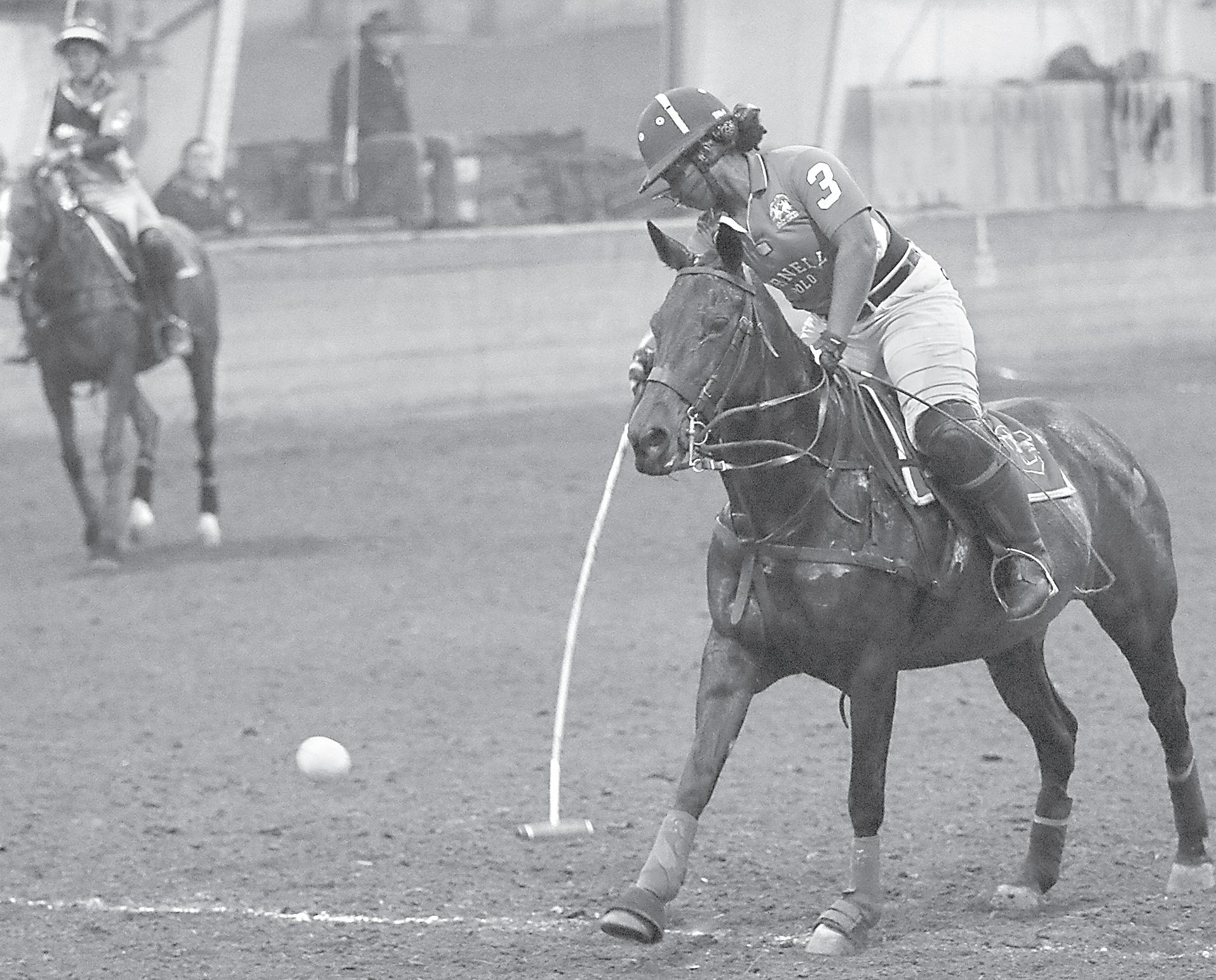
Quick thinking | The teams had a last-minute schedule change, but the women took down its unexpected opponent for its seventh win in eight games.

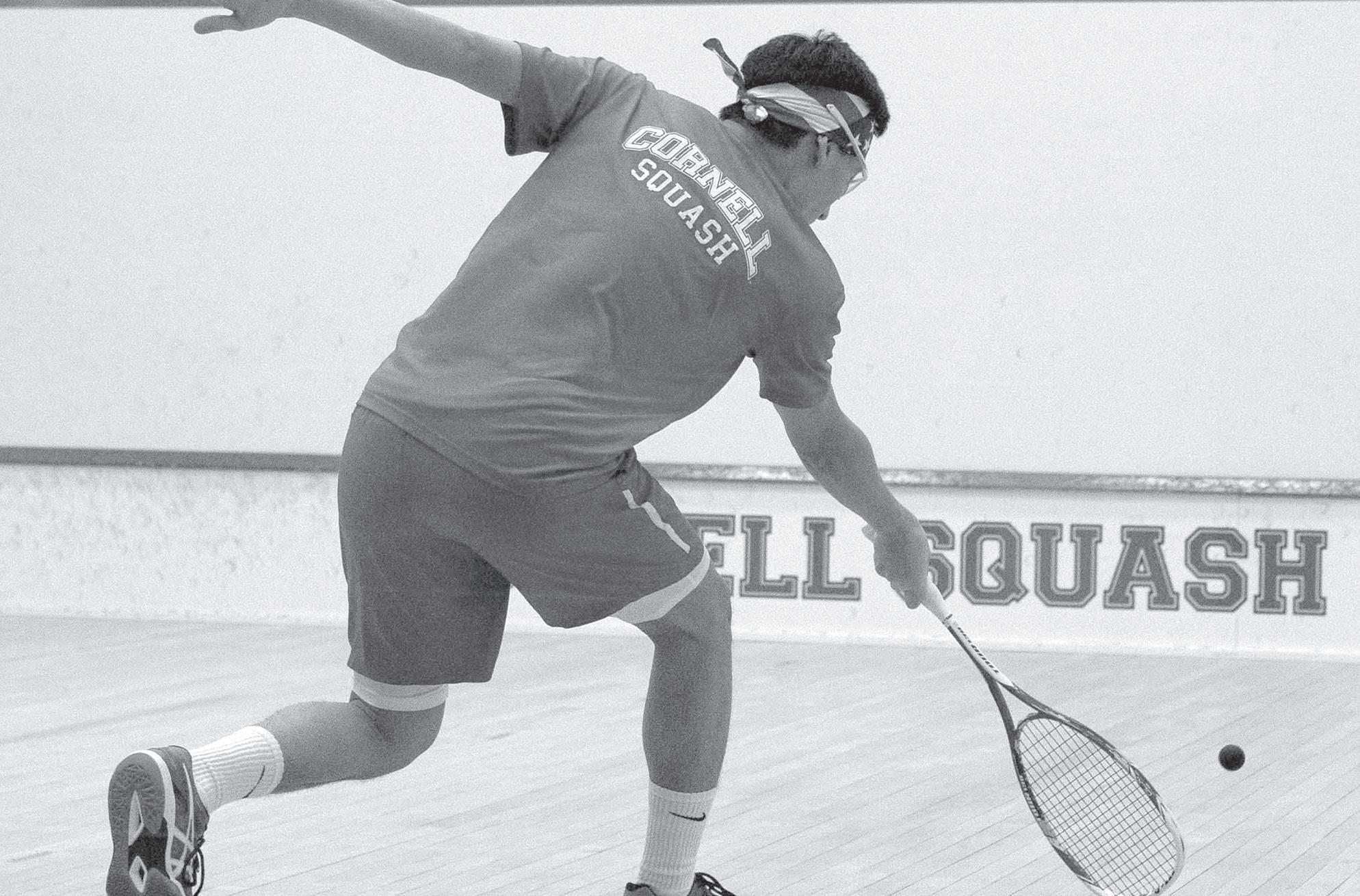

Men’s swim and dive came in first place out of a field of seven teams at the Zippy Invitational in Akron, Ohio. In the women’s version of the meet, Cornell placed third out of eight.
Swim and dive
Both men’s and women’s squash fell to Columbia over the weekend at home. The final scores were 8-1 for the women and 7-2 for the men.
Squash
POLO
C.U. Ends 2019 With Sweep
Red outscores opponents, 9-2, in away series
for the goal.
Cornell women’s hockey concluded its 2019 season schedule by picking up two big wins on the road against Princeton on Friday and Quinnipiac on Saturday.
The last time No. 4 Cornell took on No. 6 Princeton, the Tigers put up a tough fight in Cornell’s 3-1 victory. This time around, the Red earned a far more comfortable 5-1 victory.
In the win, junior Lindsay Browning once again played outstanding for the Red, stopping 23 out of 24 shots in the 5-1 win.
After stomping its Ivy League foe, Cornell left New Jersey for Hamden, Connecticut, to take on Quinnipiac (9-7-3, 3-6-2 ECAC). The result was similar as the Red defeated the Bobcats, 4-1. In the first, Lewis continued her impressive weekend for the Red, scoring the opening goal. Coming off an assist from Slobodzian, Lewis took the puck and charged towards the goalie deeking her out and sliding the puck passed for the goal.


The game was deadlocked until Princeton’s (9-3, 7-3 ECAC) Shannon Griffin was called for a charging penalty. Like it has done all year, Cornell’s (11-1-1, 7-0-1 ECAC) power-play unit jumped on the opportunity. The team waited for its chance and worked the puck around the Tigers’ zone until sophomore Gillis Frechette opened the scoring. Her wrist shot from the faceoff mark whizzed over the goalie’s pad for the goal. Senior Paige Lewis and junior Willow Slobodzian notched assists off the goal as well.
After a quiet end to the period, Lewis once again was involved in Cornell’s second goal of the night. Taking over the puck in the corner of Princeton’s zone, she drove towards the crease and her skills were unmatched as she gave the Red a 2-0 lead heading into the third.
The final period of play saw the Red tack on three more goals to Princeton’s one. Cornell’s goals came in a span of just six minutes and it put the game completely out of reach for the Tigers. Lewis notched her second assist of the night off a goal from senior Grace Graham. The Red then added another power play goal on a 5-on-3 from the stick of senior Micah Zandee-Hart. Only 30 seconds later, Graham scored her second of the night as she received the puck in the slot from Slobodzian and beat the goalie as she lifted it up

Halfway through the second, Cornell once again got on the scoresheet. This time, senior Jaime Bourbonnais led the charge as she took control of the puck in Quinnipiac’s zone. She fired the puck towards the net and it found the stick of junior Finley Frechette for the redirect goal.
With three minutes left in the period, Quinnipiac’s Coutu-Godbout was able to cut the deficit in half for the Bobcats. Off a slapshot, the team’s leading goal scorer was able to tip it in past Browning making the game 2-1 entering the third.
The last period of play saw a defensive lockdown from the Red as it refused to let its opponent back into the game. Along with the solid defensive play, senior Kristin O’Neil and Gillis Frechette added goals in the period in the 4-1 win. By the end of the contest, 11 players tailed a point for the Red.
Cornell will now enter the long winter break having won 11 of its first 13 games. The Red will have a few weeks off before taking on Mercyhurst in a two-game series on Jan. 4 and Jan. 5.
Justin Suzzan
jsuzzan@cornellsun.com.
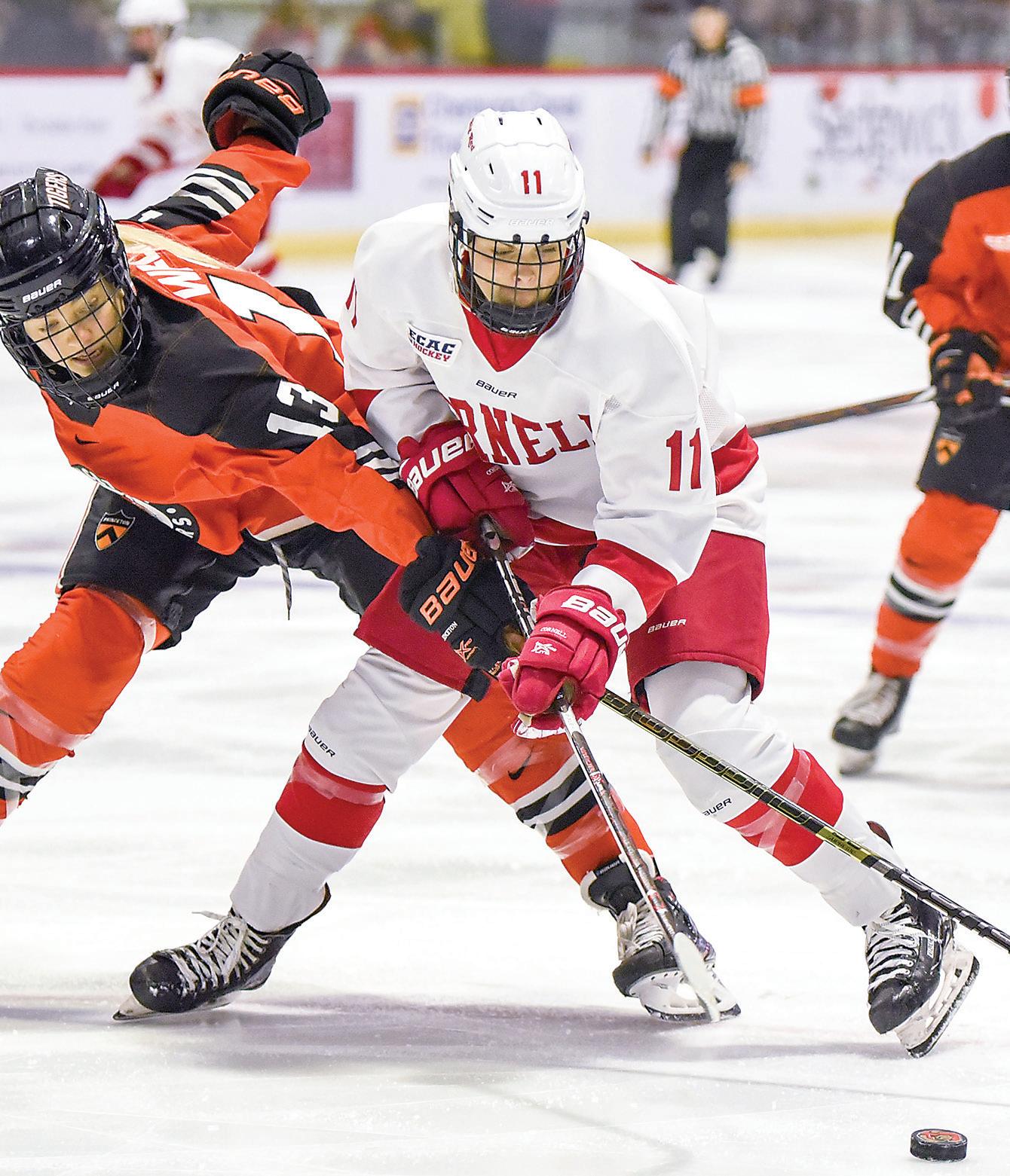
Tucker Places 1st, Red Comes at No. 11
By FAITH FISHER Sun Staff Writer
Cornell wrestling put a pause on its collegiate dual matches and brought its talent to the Cliff Keen Invitational in Las Vegas, Nevada. Competing with 15 of its fellow top-25 teams, No. 17 Red clinched the 11th place overall finish.
As a testament to the tournament’s staunch competition, over 100 nationally-ranked wrestlers from some of the nation’s top wrestling programs were in attendance in a field of 31 teams. Among the teams were No. 3 Nebraska, No. 4 NC State, No. 5 Ohio State, No. 6 Iowa State, No. 7 Arizona State and No. 8 Northern Iowa.
to carry the title of Cliff Keen Champion. After persevering through a grueling four rounds to reach the finals, he hit the mat against Wyoming’s No. 7 ranked Montorie Bridges in the fifth and final round, an opponent he had failed to defeat in their two previous career meetings.
Although Bridges opened up the final round’s scoring with an escape, Tucker quickly responded with an escape of his own to even the score. With the scoring deficit eliminated, the Red wrestler took
“It is still early in the year — I felt good for Chas [Tucker], but we have a lot of work to do.”
Rob Koll
“When you wrestle against teams and guys of this caliber, you are going to lose a lot,” head coach Rob Koll said. “If you’re not wrestling against this type of competition it’s hard to deal with it when you face it. Hopefully our guys are learning from it, and not getting discouraged from it.”
control of the match, successfully firing off his first shot of the day. In a third-period offensive attack, Tucker pinned his opponent to the mat to seal his 4-1 national victory.
“[Tucker]
confident. He
“He has become extremely poised and confident,” Koll said. “He is really controlling matches. It was a dominating victory. With the way he wrestles, Chas doesn’t score a lot of points, so a 4-1 victory is like a 10-0 shutout score for him.”
As he sailed through the tournament, Tucker conceded only one takedown. His win pushes his individual season record to an immaculate 12-0.
has become extremely poised and
is really controlling matches. It was a dominating victory.”
Rob Koll
Even though the Red has embarked on this 2019 season without four of its top wrestlers, Cornell’s 2019 results in the tournament eclipsed its performance last year. In 2018, Cornell secured only 40 points, placing 21st in the invitational.
Pivotal to the Red’s 11th place this year was Chas Tucker’s triumphant performance as the senior took home first place in the 133 weight class. Sophomore Ben Darmstadt found himself on the 184 weight class podium with a seventh-place finish and senior Brandon Womack clinched the eighth-place position at 174 pounds.
Tucker is the 20th Cornell wrestler in the program’s history
“There were some mixed results,” Koll said.
“Obviously we had Chas who did a fantastic job and two other place winners, but we expected to have those place winners. It is still early in the year — I felt good for Chas, but we have a lot of work to do.”
After taking a pause for the holidays, the Red will return to competition at the South Beach Duals. The action will occur on Dec. 29-30 in Fort Lauderdale, Florida.
Faith Fisher can be reached at fsher@cornellsun.com.
What happens in Vegas... | The Red couldn’t break the top 10 against a tough field of ranked teams at the Cliff Keen Invitational in Nevada.
BORIS TSANG / SUN PHOTOGRAPHY EDITOR
ECAC does it | With the wins over Princeton and Quinnipiac, Cornell stays unbeaten in conference play at 7-0-1.
BORIS TSANG / SUN PHOTOGRAPHY EDITOR WOMEN’S HOCKEY
By JUSTIN SUZZAN Sun Staff Writer