The Corne¬ Daily Sun

By AMINA KILPATRICK Sun Staff Writer
Despite the discussions of mental health that are happening campus-wide at Cornell, six women believe not enough attention has been given to the mental health issues among women of color.
After nine months of planning, a summit that focuses on these issues took place this weekend under the theme “The I of the Storm: Finding Calm Amongst Chaos.” The hosting organization, Building Ourselves through
Sisterhood and Service, hopes the attendees can learn more about dealing with mental health issues through workshops and activities. “I think that conversations about the really heavy stuff, conversations about depression ... conversations about suicidality … about domestic abuse, aren’t often had with women of color and about women of color at the forefront, but it is something that disproportionately affects us,” said Amber Haywood ’21, mental health summit chair for BOSS.

By SABRINA XIE Sun Contributor
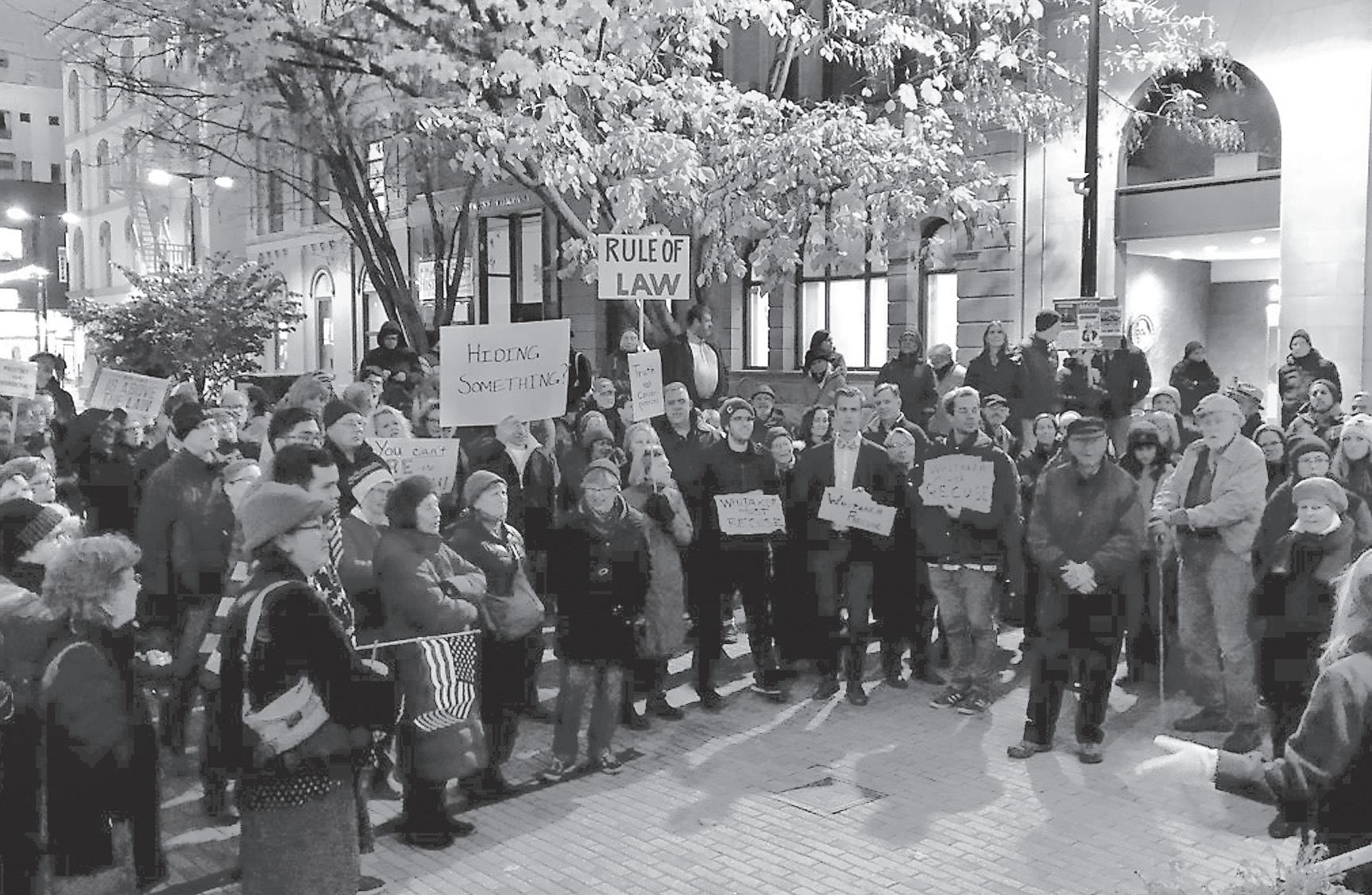
Dozens of protesters gathered on the Commons on Thursday evening in response to President Donald Trump “violating the independence of the [Russia] investigation,” according to the event description. The demonstration mirrored protests in over 1,000 U.S. cities, which converged on Thursday at 5 p.m. to call for the protection of special counsel Robert Mueller’s investigation of TrumpRussia ties.
Washington that people across the country are very concerned and, if necessary, we’ll go to Washington to press our point,” said John Dennis of Cayuga Lake Environmental Action Now.
“Trump moving against the independence of the special counsel is where I draw the line.”
Andres Loret de Mola ’21
Signs reading “Protect Mueller” and “You Can’t Fire the Truth” were accompanied by American flags. Attendees ranged from parents with their children to college students and retirees.
“We’re trying to send a signal to
According to former Tompkins County Legislator Carol Chock, “people signed up over a year ago, around the first time Donald Trump made noises about trying to stifle the Mueller investigation. We made pledges online that if he did so, we would show up.”
The demonstration, and others around the country, was organized by a group of activist organizations under the banner “Nobody is Above the Law,” which has had “rapid response” protests planned since the beginning of special counsel Robert Mueller’s investigation.
World War I anniversary festivities feature live music, poetry and guest speakers
By AARAN LEVITON and SHAWN HIKOSAKA Sun Contributor and Sun Staff Writer
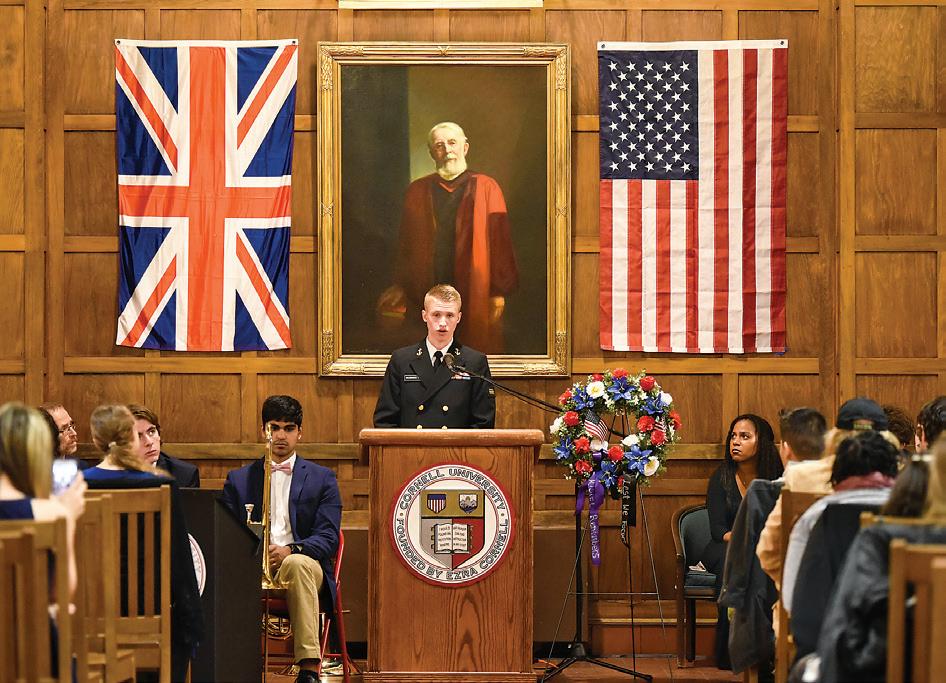
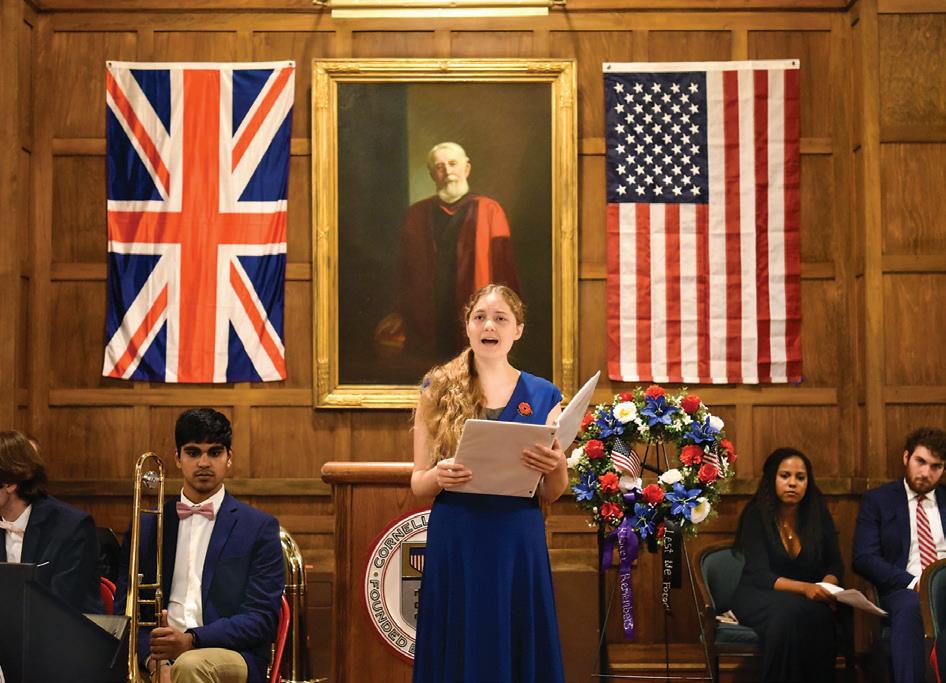
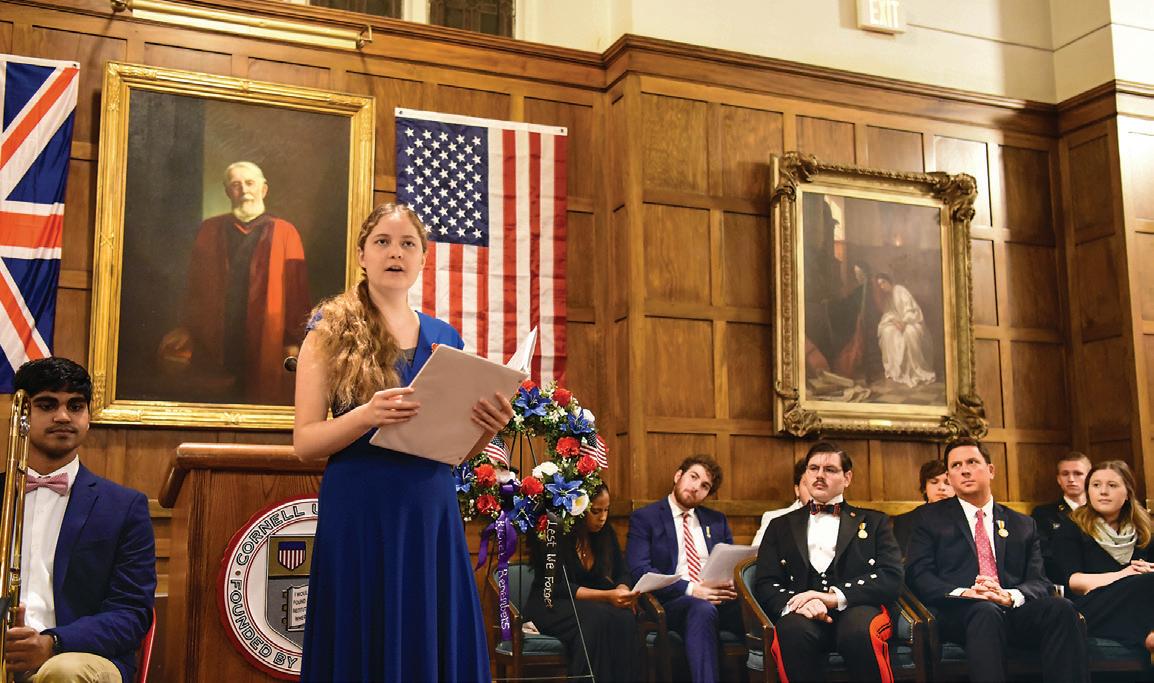
On Saturday night, Risley’s Great Hall was transported back 100 years to the end of World War I in a celebration that featured distinguished speakers and live music.
“Ladies and gentlemen, the war is over,” said Grady Owens ’21. “The guns have fallen silent. It is now time to celebrate, and welcome our proud men home from the battlefields of Europe.”
Sporting a Prince Charlie jacket with a bow tie and black wire-rimmed glasses, Owens, chair of the Risley arts subcommittee — which spent the last three months organizing the celebration — delivered last-minute instructions to speakers and performers in Risley’s Great Hall on Saturday night.
Owens, an archeology and history major in the College of Arts and Sciences,
Monday, November 12, 2018
Working at Cornell: Staff Conversations
9 - 10 a.m., 184 Myron Taylor Hall
BEE Seminar:
Preparing the Ground for Endogenous Repair
11:45 a.m. - 1 p.m., B15 Riley-Robb Hall
Are Politics Local?
The Two Dimensions of Party Nationalization In Latin America
12:15 - 1:10 p.m., 153 Uris Hall
The Challenges of Urban Farming in NYC 12:20 p.m., 404 Plant Science Building
Professional Directions: Producer Scott Ferguson 1:30 p.m., Black Box Theatre, Schwartz Performing Arts Center
WVLDI: Self Defense Class
3 - 4 p.m., Multipurpose Room, College of Veterinary Medicine
Physics Colloquium: Torsional Consequences of DNA Motor Proteins
4 - 5 p.m., Rockefeller Hall, Schwartz Auditorium
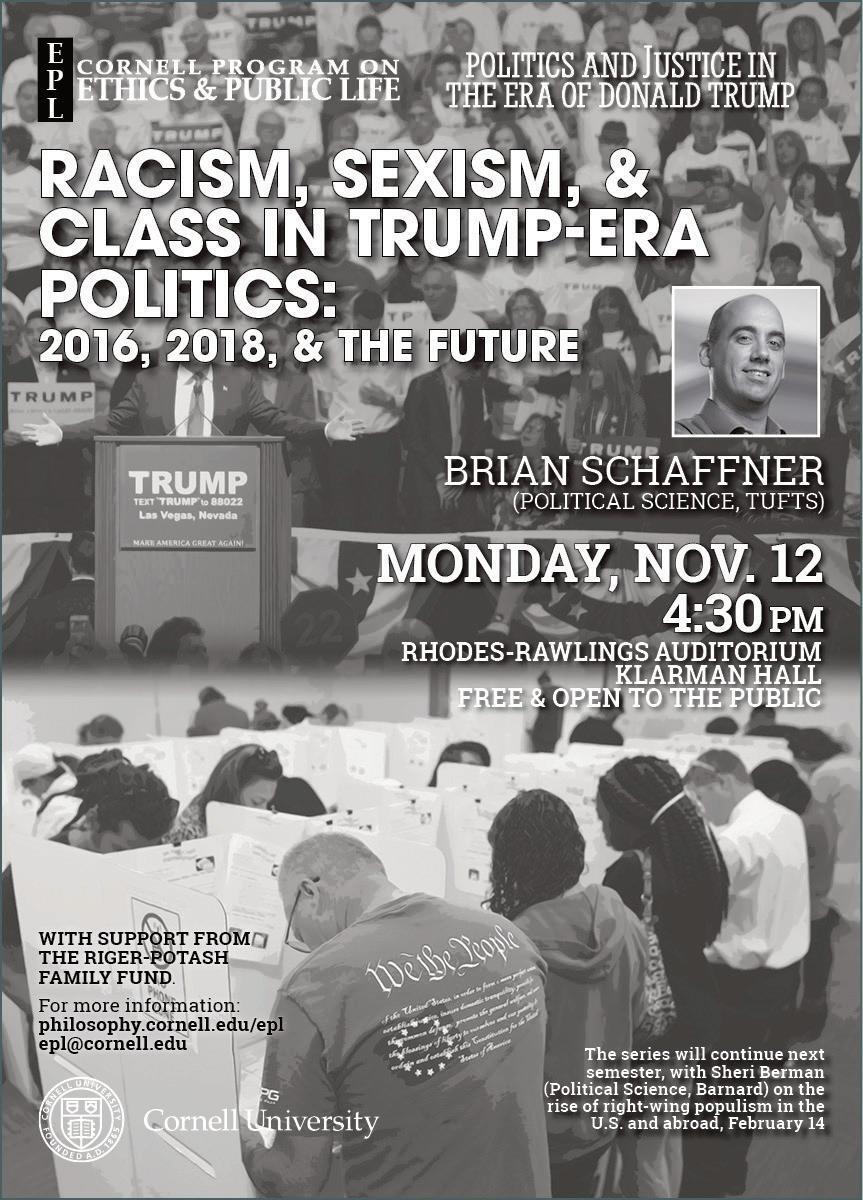
Racism, Sexism, Class & U.S. Elections
4:30 - 6 p.m., KG70 Klarman Hall
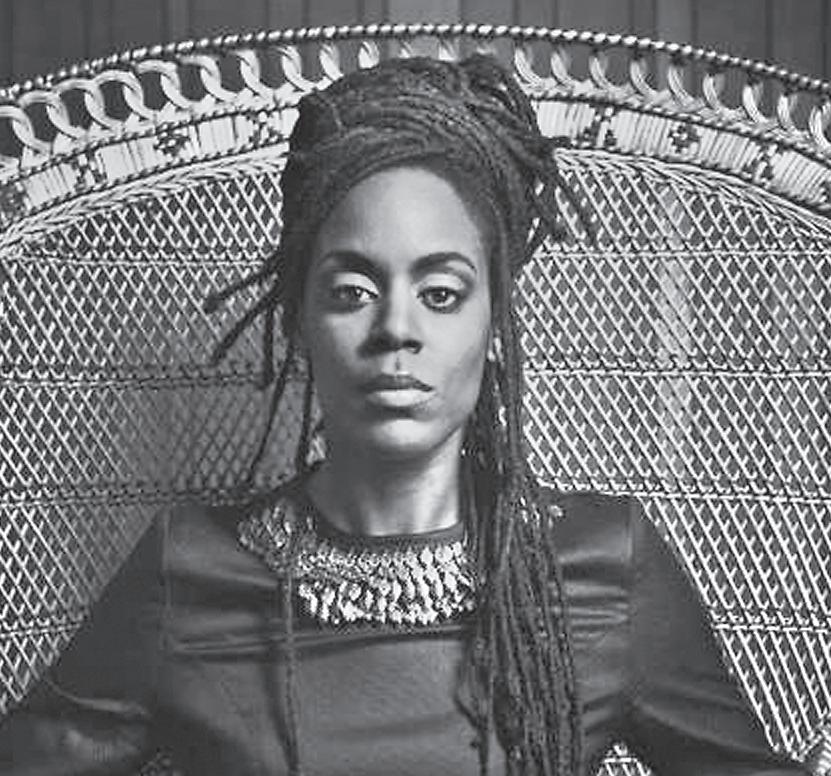
A Conversation With Global Hip Hop Artist Akua Naru
4:30 p.m., Multipurpose Room, Africana Studies and Research Center
American Daoists in China: Cultural Appropriation or Soft Power 4:30 - 6 p.m., G64 Goldwin Smith Hall
Misperceived Social Norms: Female Labor Force Participation in Saudi Arabia 11:40 a.m. - 1:10 p.m., 106 Sage Hall
MAE Colloquium: Theories of Locomotion 12 p.m., 203 Thurston Hall
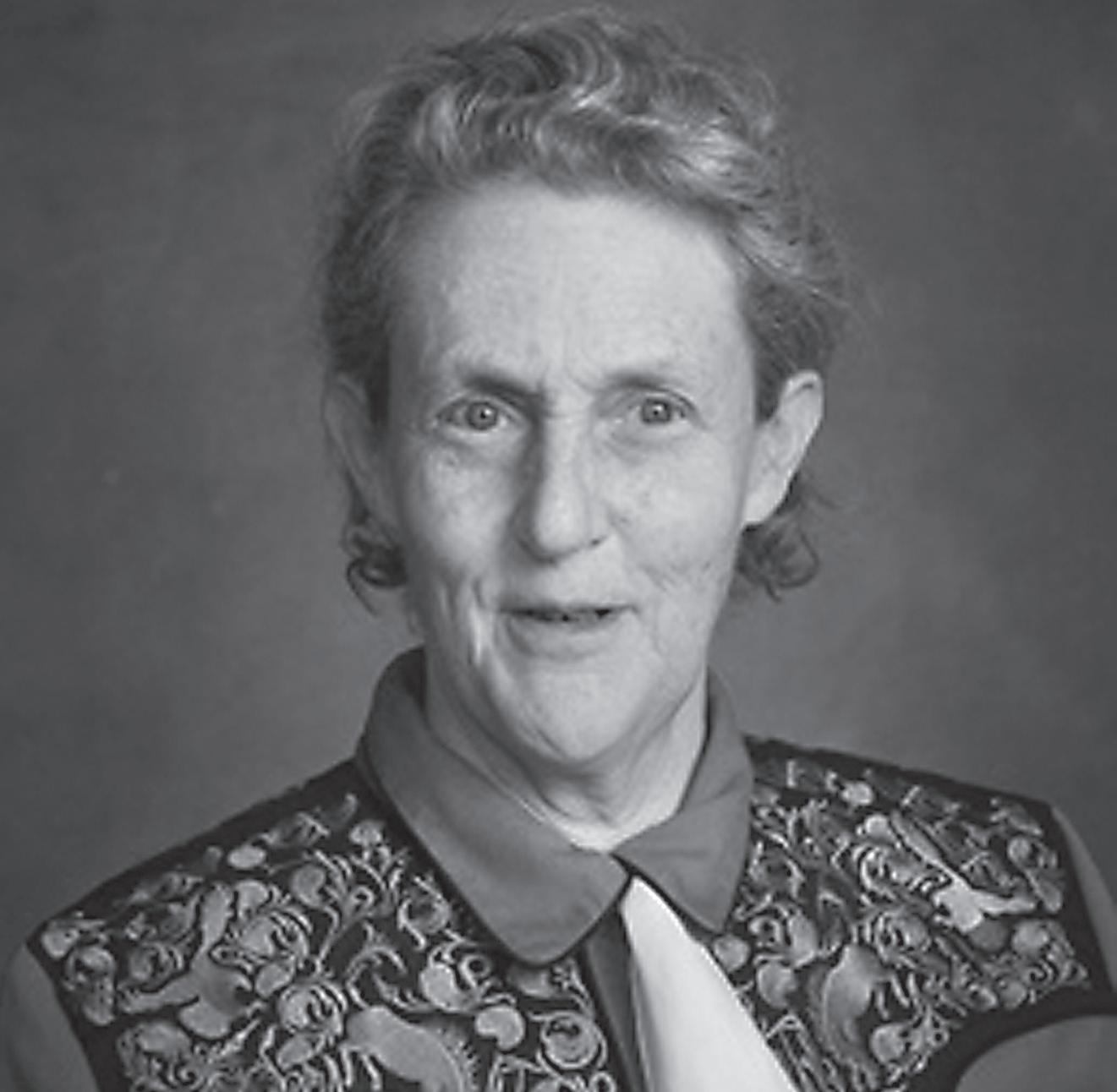
Talk With Dr. Temple Grandin Noon - 1 p.m., Lecture Halls 4 and 5, College of Veterinary Medicine
International Coffee Hour, Open House, All Students 3:30 - 5:30 p.m., 276 Caldwell Hall
Cornell Companions Visit 4 - 8 p.m., Olin Lobby, Olin Library
By WINNY SUN Sun Staff Writer
Coursicle, a course registration tool that alerts users about open class space, became available on November 5 for Cornell students.
Just in the first three days after launching at Cornell, the number of Cornell students using the app has risen to 150, according to Joe Puccio from the University of North Carolina, Chapel Hill, who co-founded the app with Harvard graduate Tara Aida.
Jesse Potts ’21 is one of the 29 Cornell students who requested Coursicle add support for Cornell. Even though Coursicle became available after pre-enrollment was over, he said he still looks forward to using the app.
“It was put up after pre-enrollment, and I had already enrolled in my courses. But I am excited to use the notification feature [in the future]. I think it’s going to very helpful,” he said.
Puccio said he created the app during his freshman year after being frustrated with the inefficient enrollment system. In order to make course registration
easier, Coursicle allows students to select the courses they want to enroll in and will send out a notification once a space has been opened up in one of the classes.
In addition, students can log into Facebook and see what courses their Facebook friends have added to their schedules.
The app quickly gained momentum at UNC, attracting 900 users in the first semester and 1,800 in the next. Given the app’s rising popularity, Puccio began introducing it to other colleges in 2015.
Puccio built the app using publicly available course data from each school. He said he was “surprised” to find that almost every college in the United States makes its course catalogue public.
“Cornell is pretty unique in that it [appears to] want students to create an extension to their existing system,” Puccio said, adding that the University’s API has made his retrieval of course information easier.
According to Puccio, student demand for the app is still on the rise. On average, the company receives 30 to 40 requests for service each day.
“We had written scripts that … identify schools with a lot of requests, and then we cross-reference
By KATHERINE HEANEY
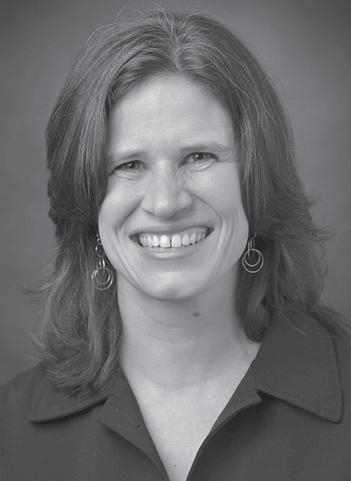
Prof. Kelly Musick, policy analysis and management, was awarded $1 million for her research on the discrepancy in earnings between women with children and their male partners.
After having a child, inequality within families tends to increase because women are more likely to stop working or to work less, which Musick said contributes to the gender wage gap and also leaves women economically vulnerable — especially when facing divorce.
Women’s lower relative earnings can also impact their role in family decision-making, Musick said.
“Most women still have primary responsibility at home, and their partners maintain the status of primary earner, especially after a child is born,” Musick told the Cornell Chronicle, which is run by the University.
Musick’s research also suggests that the United States is far behind many other countries in the world in regard to policies that support work and family — for example, it is one of the only countries with no federally mandated paid parental leave.
“Weak work hour regulations and the all-or-nothing structure of many workplaces also push mothers to leave the labor force, and push couples toward a traditional male breadwinner family model,” Musick said.
“Understanding long-run changes in how couples navigate the transition to parenthood can inform policy changes with the broad goal of supporting parents’ in their work and family roles,” she continued.
According to the University, Musick’s research will use four decades of studies from the U.S. Census Bureau’s Current Population Survey to analyze changes in husbands and wives’ work and earnings following the birth of their first child. This is the largest and longest-running longitudinal data source in the U.S. and is “virtually untapped for research on family dynamics and change,” according to Musick.
Musick said her research can also educate Cornell students on their “understanding of broad social changes in men and women’s role and how they play into patterns of inequality.”
“I think many students are surprised to see the data on how men and women’s time investments diverge after parenthood, with mothers spending more time in housework and childcare and less in paid work,” Musick said.
Musick is also collaborating with Patrick Ishizuka, a Cornell Population Center Rhodes Postdoctoral Fellow, whose research has found that mothers are more likely to continue working in occupations that have greater work hour flexibility.
Moving forward, with the grant from the Eunice Kennedy Shriver National Institute of Child Health and Human Development, Musick said she has started to explore “what characteristics of workplaces make it easier or harder for women to remain employed following parenthood.”
be reached at kheaney@cornellsun.com.
that against [whether] we think Coursicle could grow very quickly at that school,” he said.
Currently, the app is available for students at more than 830 colleges across the nation. Students can track the space available in one course for free; to track unlimited courses, there is a premium fee of $4.99 per semester.
Recently, Puccio said the company has also launched a referral program: students who share the app with three friends will get to enjoy the premium service for free.
Puccio explained that Coursicle had done some marketing in the past to get students interested in the app, but that those efforts are “miniscule compared to how many users [they] get from the word-of-the mouth spread.”
“Usually what we see across most schools is the first semester we get some amount of users, every semester after that, we double our user count,” he said.
Winny Sun can be reached at wsun@cornellsun.com.
By JOLIE WEI Sun Contributor
Dim sum is conventionally enjoyed as an open brunch during the day, but at the Midnight Dim Sum in Duffield on Saturday, busy Cornellians got to have a taste of both the traditional Chinese dishes and Chinese culture.
“We know students are really busy, so we moved the event to the night time to put a fun twist on it,” said Sharon Wu ’20, president of the Chinese Students Association, which hosted the event.
According to Ada Zhu ’21, CSA cultural chair, the event served as a good entry point towards highlighting different cultural groups on campus.
“It’s a fun way to get everyone here to learn about the different Asian organizations,” Zhu told The Sun.
“People come for the food, and they stay for the performances,” Wu said.
The performers at the event this year included Cornell Big Red Raas, which showcased traditional Indian dances, HanChum Traditional Korean
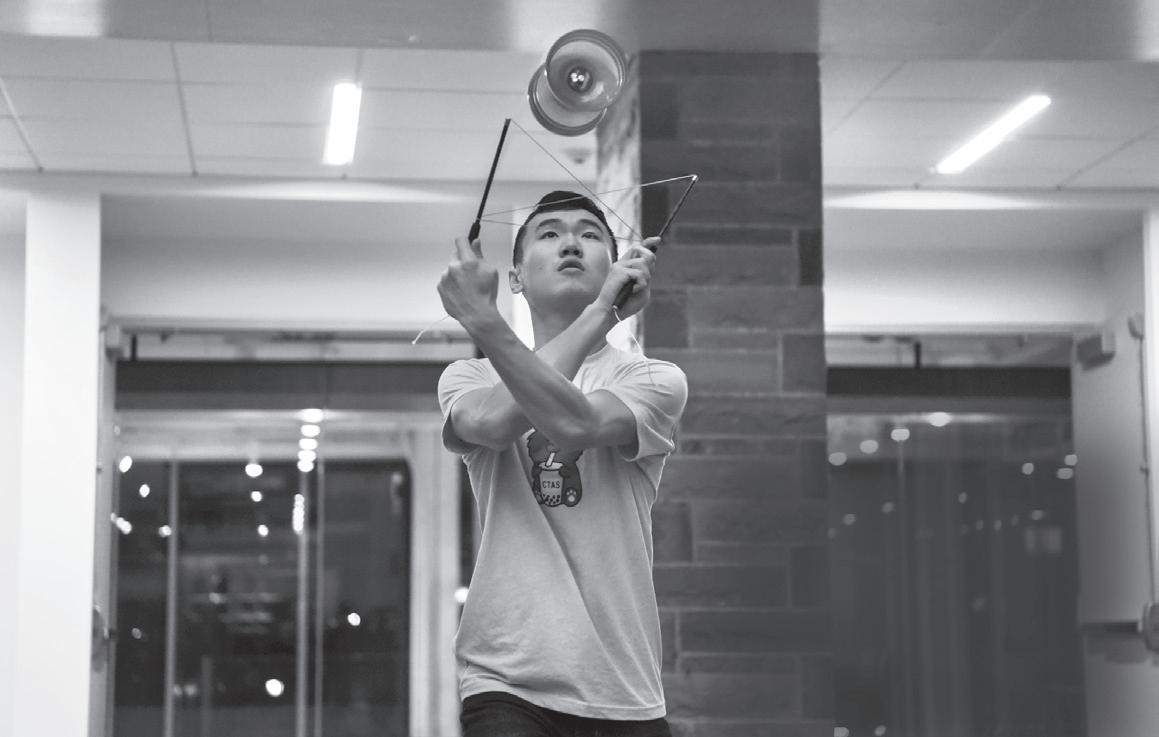
Dance Team and Cornell Wushu, which performed Chinese martial arts.
“We try to choose groups that will really showcase the unique aspects of their culture as well as their appeal to the Cornell public,” Zhu said, adding that they were thankful for the performers and audience who came out to support the event and the performances.
Attendees and performers alike appreciated the energy and lively vibe of the event.
Raymond Zhang ’20, a performer from the Cornell Taiwanese American Society, said that it
was “a really nice time to relax on a Saturday night.”
Hana Aram ’22, a member of the HanChum Traditional Korean Dance Team, said she enjoyed the variety of performances at the event.
“I really liked how the event also included other Asian performance groups even though it was hosted by the Chinese Student Association. I thought it was a good opportunity to be introduced to other elements of cultures,” she said.
Jolie Wei can be reached at jw2493@cornell.edu.
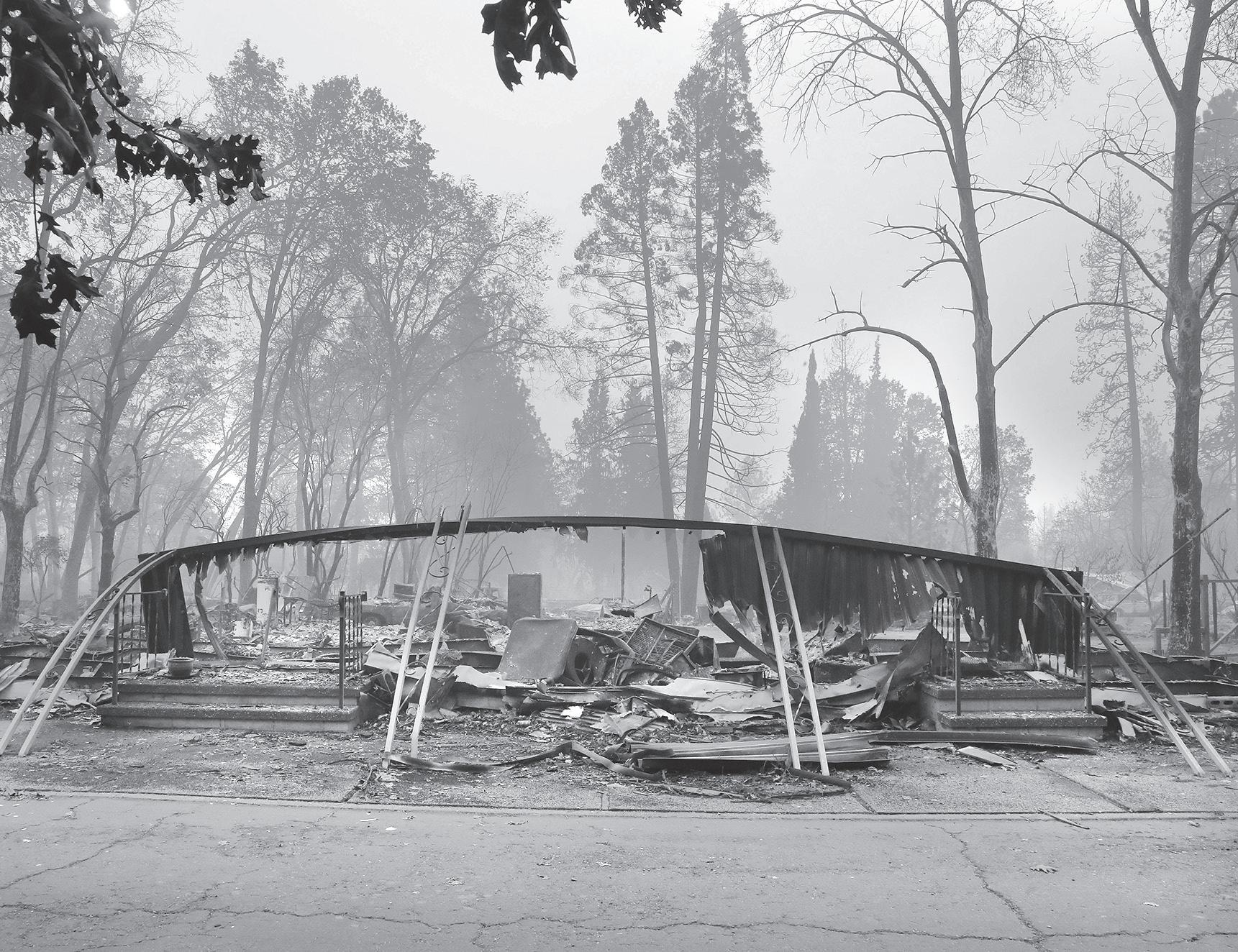
According to Haywood, mental health conversations at Cornell do not address women of color adequately, mentioning that two women of color died by suicide on campus last year and did not receive much attention.
“That in and of itself shows enough that we are a silent voice and we are also a body, that we have physical bodies that are affected by the silence from other people,” she said.
Approximately 50 people attended the summit, which began on Friday evening
with midnight yoga, providing an opportunity for attendees to relax and ended on Sunday with a brunch.
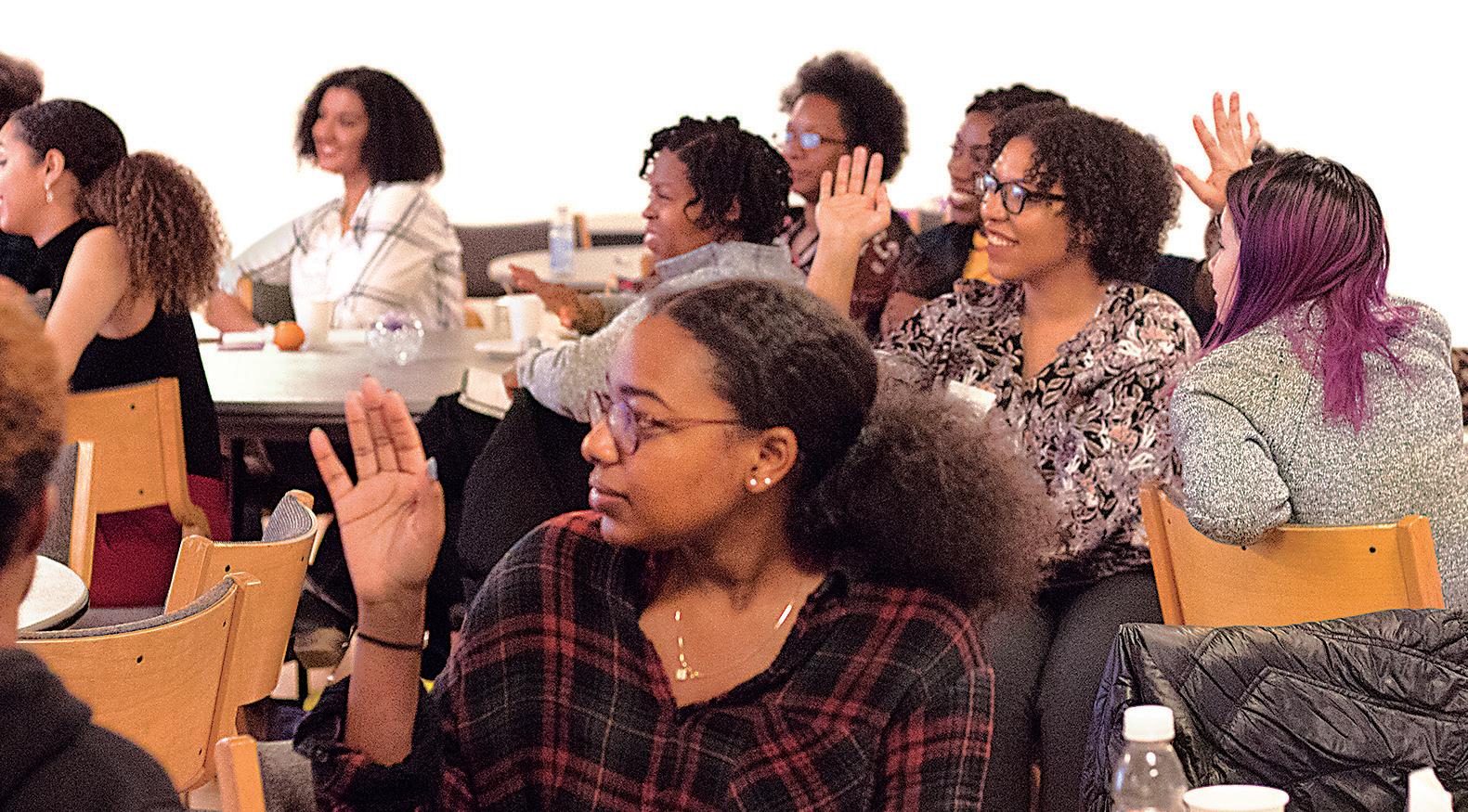
On Saturday, the organization hosted 10 different workshops on topics including body image, student activism and relationships. The workshops were hosted by professionals from Cornell Health and the Title IX Office, as well as student leaders from organizations such as Cornell Minds Matter and La Asociación Latina.
In a workshop about student activism and mental health, students shared ways they decompress after dealing with heavy issues. For example, Natalia Hernandez ’21 talked about how taking walks helped
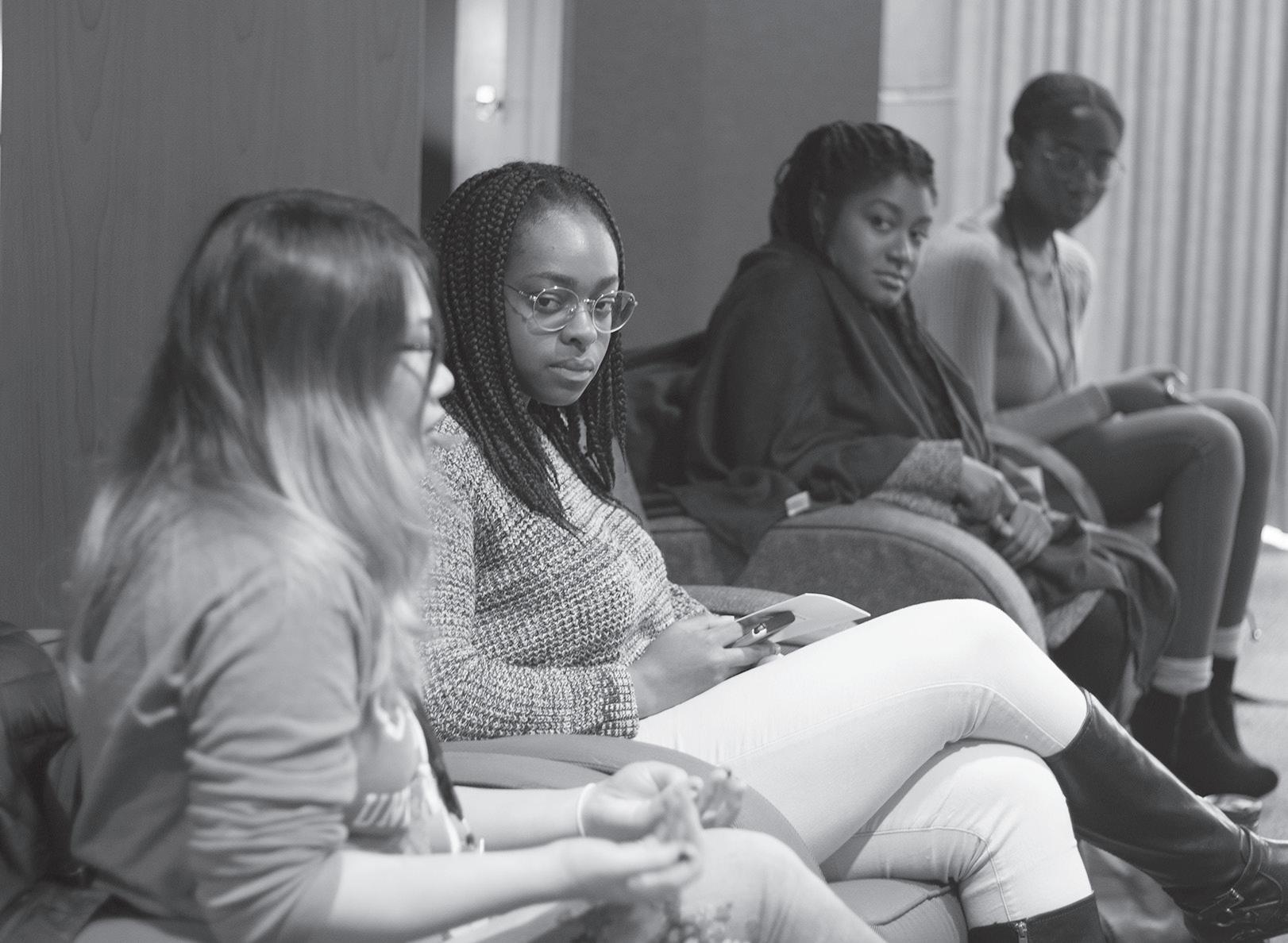
ment, with proposals to call Congress or to organize hunger strikes.
“We have rallies like this going on all around the country. The country has to stand up, across the continent, to get the point home to Congress that they don’t have to be intimidated by a bully President,” said Charles Geisler while holding up a sign that read “Don’t Squelch Mueller.”
Many attendees saw the rally as a small part of a larger move-
“It’s a real slippery slope to authoritarianism and we’re right in the middle of it, and no one seems to care,” said Sylvan Donenfeld ’20. “Everyone’s looking for this one big thing that Trump’s gonna do, but there’s not gonna be one big thing, so we just need to be out all the time.”
Others, like Sheila Out, an Ithaca resident, simply found
her cope with the racially charged incident that happened at the Latino Living Center while she lived there.
At another workshop, Theoria Cason, a representative from the Title IX office, talked about how social media can impact the perception of a relationship and the varying signs of unhealthy relationships and domestic abuse.
Dior Vargas, a Latina feminist mental health activist, discussed the importance of representing people of color and their mental health beyond statistics in the keynote address. Vargas is the editor of The Color of My Mind, a 2018 photo essay about people of color and mental health based on a 2014 photo series about the same topic.
According to Vargas, although statistics can provide useful information about misdiagnoses, estimation of pain and limited access to quality care, they “weren’t telling the whole story” and lack “humanizations of this subject.”
Vargas showed a few excerpts from the photo essay during her speech and talked about the “personal touch” the photographs brought.
“There is a familiarity with these faces because these are people that look like us,” Vargas said. “They also show a side of mental illness that people rarely see. It shows the ability to move forward, to be successful and to accomplish what we want in life.”
She also addressed how mental health should be an important part of the concept of the American dream.
“We raise our families thinking and talking about how living the American Dream is where we have a big job, a partner, children, food on the table, a home,” Vargas said. “Why isn’t mental health
apart of that? When you don’t have good mental health, it is hard to maintain a job, have good relationships and other essential things.”
The first summit was held in 2016 and was only one day long, but this year the summit expanded and even had attendees from other colleges.
Stephanie Carter ’17, co-founder of BOSS, acknowledged the growing diversity of BOSS and the summit and how they changed from primarily catering to African-American women to more women of color, including Asian-American, Latinx, Native American and queer women.
“I think there can’t really be diversity without inclusivity,” Carter told The Sun. “We were trying to be more conscious of catering to all identities.
Haywood also spoke about how the decision to include a workshop about body image hosted by Cornell Health is an example of a subject that uniquely affects women of color.
“I think women of color have a really unique position with body image that our bodies are normally hyper- or desexualized constantly,” Haywood told The Sun. “One [reason they chose the topic] is to realize how white standards have come to be so normative and how we can disrupt that and love our own bodies.”
In future, Haywood hopes that discussions about women of color will be integrated into conversations about mental health and not be a side topic.
“This isn’t meant to be a lecture series,” Haywood said. “It’s supposed to be the starting point of conversations.”
Amina Kilpatrick can be reached at akilpatrick@cornellsun.com.
comfort in the rally.
“I’m just here to be with other people who are so concerned about what’s happening,” she said, holding a small homemade sign. “It’s helpful to feel like I’m not alone in this.”
Unlike larger rallies in New York City or Washington D.C., the rally did not involve much chanting. Instead, the rally took the form of an open mic, with individuals coming forward to tell their stories while the crowd acted as a microphone, echoing
their words.
“My father made me learn to type,” said Dr. Sandra Steingraber, a biologist and activist, who told the story of her upbringing as an adoptee. “What he taught me was to type, very fast, this phrase: ‘Now is the time for all good men to come to the aid of their country.’ And we did it very fast. A thousand times. And that’s what we’re doing right now.”
Andres Loret de Mola ’21 also stepped forward to talk about his experience as a birthright citizen and the child of immigrants, with an American flag draped over his shoulders.
“I’m here because this is it,” he said. “I think it’s been way too long; I’ve sat on my ass way too long. Trump moving against the independence of the special counsel is where I draw the line.”
After reading the poem “First They Came …” by Martin Niemöller, with the crowd reso-
nating each line, he continued, “I was born here but my parents are from Mexico, I know there are a lot of you in this country who would rather see me go back, but I’m here to tell all of you that I love this country and I’m not going back.”
Other speakers included Mother Megan Castellan from St. John’s Episcopal Church and Rabbi Brian Walt from Congregation Tikkun v’Or, with messages about faith and justice.
“Only people like us are going to change the status quo,” Chock said. “It will take all of us stepping up, speaking out, taking small actions, building together to make a whole larger effort to make sure that justice prevails in this country.”
The crowd sang “We Shall Overcome” by Pete Seeger before dispersing.
WWI Continued from page 1
said that “people kind of look over” the First World War. After noticing that Cornell would not have any events to commemorate the 100th anniversary of the First World War’s end, Owens took the initiative to organize an event at Risley.
This Sunday marked the centennial anniversary of Armistice Day, which remembers the formal end of hostilities between the Allied forces and Germany on November 11, 1918 at 11 a.m.
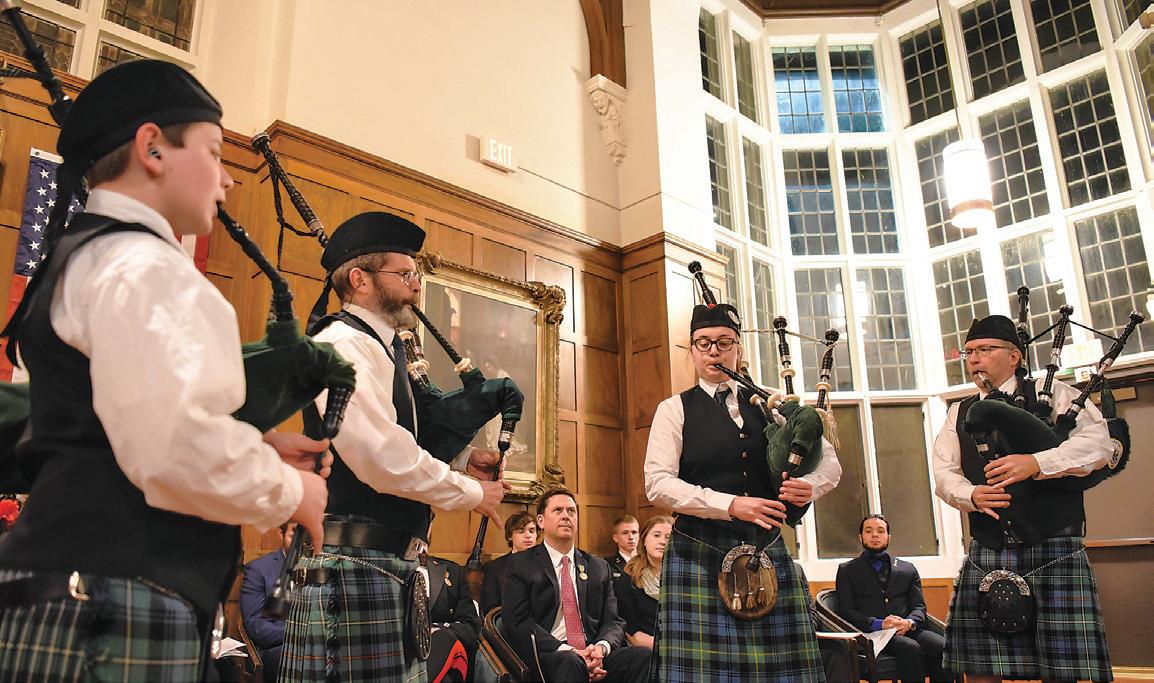
The event opened with a performance by the Original Cornell Syncopators, who played a tune from the WWI era. The evening went on to feature additional performances from the Original Cornell Syncopators, as well as the Cornell University Glee Club, the Cornell Opera Society, the ROTC Color Guard and the Finger Lakes Pipes and Drums, which played a bagpipe rendition of “Amazing Grace.”
Several distinguished guests gave speeches, including Ryan Lombardi, vice president of student and campus life, and Frederick Burgess, a former commanding officer of Naval Facilities Engineering Command who is now the vice president of facilities and campus services.
“We come together tonight to honor the thousands of
Cornellians who served in the war and to remember the hundreds that we lost,” Lombardi said.
Before reading final letters home written by soldiers killed in the war, Burgess talked about the meaning of looking at individual stories in history.
“Sometimes when we go back, when we review past events, we see the participants somehow different from ourselves,” Burgess said. “You will discover as I read these few glimpses, these letters, that they were every bit as real as you and I.”
Over 9,000 Cornellians fought in World War I, and 265 of them gave their lives on the battlefields — one while serving the German Empire. Cornell also sent 4,598 commissioned officers during the war, more than any other institution in the United States.
Cornellians served in various distinguished capacities during the war. During the fighting on the Aisne front, it was a unit composed of Cornell undergraduates that first carried the American flag into battle.
“What is the price of freedom?” Owens said, reflecting on the lessons from the war. “Freedom should be for all.”
Aaran Leviton can be reached at al739@cornell.edu. Shawn Hikosaka can be reached at shikosaka@cornellsun.

When I returned home from a semester spent in pop culture isolation abroad, I found my father dancing in the living room, singing the chorus to radio earworm, ‘FAKE LOVE’ by K-Pop stars BTS. While I was strolling through grocery store aisles listening to Italo disco interspersed with Chainsmokers hits (always featuring Italian ad-libs), BTS had monopolized American radio waves. Now this is not to discredit the success of K-Pop, K-Pop has an incredibly established global fanbase that extends to fans of vastly diverse backgrounds (I remember my friends and I showing our 5th grade teacher our rendition of the Wonder Girls’ ‘Nobody’ dance routine). However, language is political, and in a political landscape where fear and oppression are used as cornerstones of an ideological wall built against all things foreign, it’s ironic, unsettling and exciting that Americans in Anytown, USA are bopping their heads, maybe even mouthing the unfamiliar syllables, culturally embracing a difference that is politically controversial.

Language is flexible and dynamic, and, in its ability to connect us to one another, is deeply personal. Maybe that’s why people feel entitled censoring the conversations in other languages of others, why immigrants and their children colonize their tongues, enduring laughter and ridicule, ironing the accents out of their voices in order to better assimilate. On the other hand, it’s why there is a sense of urgency for immigrant families to pass their mother tongue down from generation to generation, hoping to provide the future with a tangible sense of belonging to a community that spans borders, a way of remembering and of being. In all this talk about the growing pains and divisiveness of Western nations coming to terms with their multicultural identity, it has been forgotten that there are generations that have grown up within and contributed to this existing, albeit imperfect mul-
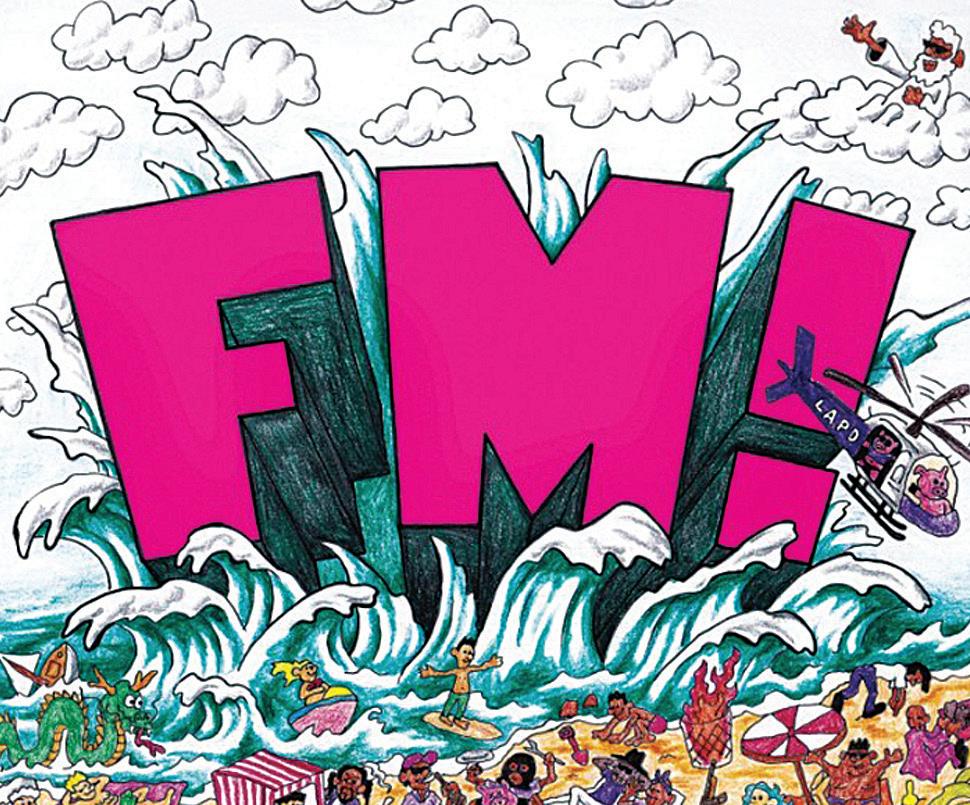




In the last eight years, Vince Staples has proven himself as one of the most captivating personalities in hip hop. Always unpredictable and always opinionated, a Vince Staples interview can take you anywhere, whether that’s sobriety or explaining why Bill Nye is underrated. FM! captures his personality perfectly; it sounds like if someone read every Vince Staples tweet and interview and then tried to craft an album out of it. This almost makes it sound like a caricature of Vince Staples, but that’s exactly what Vince Staples is,
ticulturalism. While BTS is a highly calculated and curated foreign import, there is a growing movement of artists who utilize their bilingualism in their art and music simply to express their own ways of being.
When I speak about this bilingualism, I don’t just mean our national anthem, “Despacito”, or the reign of Shakira, but rather, a generation of musicians whose music seamlessly integrates other languages, not as a celebration of it necessarily, but rather as a normalization of a duality of identity. This phenomenon surpasses genre boundaries, with bedroom pop softboys Cuco and Omar Apollo effortlessly transitioning between verses in Spanish and English while crooning about unrequited love and the suburbs, Yaeji whispering in Korean over soft house beats, or with 88rising’s Higher Brothers bringing staccato Mandarin to mumble rap flow on tracks that feature Goldlink and Playboi Carti.
Like identities themselves, the motivations for incorporating different languages into music is nuanced and different for each individual artist. In an interview with Pitchfork, Yaeji who frequently references her Korean identity in her music, reveals that she initially chose to incorporate Korean into her music because she didn’t want people to understand what she was saying. For 88rising, a collective dedicated to creating a platform for Asians in hip hop, it’s about visibility, and providing content for an audience demographic whose demand hasn’t previously been addressed. On the other hand, it can be a natural extension of the artist, with Omar Apollo citing his Mexican-American upbringing’s sonic influence and his first language being Spanish, as to why he chooses to switch between English and Spanish in an interview with Dazed. However, the success of each aforementioned artist as well as the others who are driving this movement is a reflection of a huge demographic of America and by extension, the West, who are navigating their own dualities, who juggle their own heritage and culture manifested in appearance, habits, and customs as well as the reality they confront when they leave the house.
Language is just one aspect of the creation of multicultural
and that’s why this project is unique. I mean, who else would include a 23 second Earl Sweatshirt snippet on their album just to mess with their mutual fans? It’s Vince Staples at his most Vince Staples. From its announcement, (Vince Staples tweeted “You know them tweets everybody send out insinuating they got new music ? This one of those”) to its content, it’s clear that Vince Staples is making the music he wants to make.
The album is structured as a Long Beach radio show hosted by the legendary west coast radio personality Big Boy. Usually skits and radio breaks in an album water the content down, but somehow that’s what makes this album work. Although this album is 11 songs long, only eight actually contain Vince; the other three either showcase new music from other artists or are extended radio skits. Nobody ever asks for brand new Tyga, but this album gives us that to no complaints. One thing about this structure is that it only makes the album listenable when it’s taken together- if you pull individual songs from the album and listen to them on their own, the attached radio skits sound misplaced.
This album could be viewed as a pushback against the current norms in the music industry, where albums are diluted to fit as many songs as possible to inflate streaming numbers. The album is 11 songs but only 22 minutes long, which at first glance makes the album seem like it follows this trend as well. However, the album needs to be taken as a whole, and each sub-30 second album skit is essential to the functioning of this album. No singles were released prior to the album, and

sonic landscapes that are being made available to listeners, with the Swet Shop Boys sampling classic Bollywood songs while gleefully rapping about crushes and microagressions or Kero Kero Bonito’s bouncy Japanese quips over emo melodies. These landscapes pull from vast and diverse experiences, colliding different cultures to create new innovative ways to communicate, to entertain, to make others feel like they’re understood.
For the listener, what is the point, or rather the importance of having multicultural, bilingual music? For those who have grown up within the same culture or speak the same language, it opens up a world of in-jokes and cultural references, touchstones of recognition, a validation of experience. For those who don’t understand the language, it is a chance not only to listen to some good and interesting music, but also to appreciate something that is different from oneself. It calls into question the purpose of art and how we interact with it. Perhaps, this sets the guideline how we should interact with each other on a human level, cultivating an appreciation and an okayness with not understanding and not claiming to understand.
Isabel Ling is a senior in the College of Art, Architecture and Planning. She can be reached at ayang@cornellsun.com. Linguistics runs alternate Mondays this semester.
RACHAEL STERNLICHT / SUN
ering how Staples is signed to a major label through Def Jam. Lyrics in the album reflect this, such as “Record deal, but I did it independent” on “Don’t Get Chipped.” This deal is essential to him creating an album that fits his exact personality, because no conventional record deal would allow an album in this format to be released.
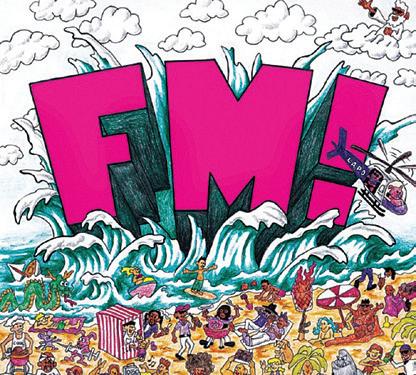
Summer has always been a theme in Vince Staples’ music, but this time the sound he captures throughout the project fits the general view of summer. Whereas his debut album Summertime ‘06 flipped this image of summer and the happiness associated with it to fit his grim outlook, FM! runs with this exact image. From the album cover that pays hom-
of the project is estab lished immediately. “Feels like Summer” opens with a radio snippet telling you to vibe and lay back before Vince adds his own spin with the line “Summertime in the LB wild, we gon’ party ‘till the sun or the guns come out.” The album ends right where it needs to. This format is a good experiment and is incredibly well executed. Although it will most likely be a forgotten component of Staples’ discography, FM! is an incredibly cohesive project and deserves attention. Expect something big from Staples in the coming months.
Daniel Moran is a sophomore in the College of Human Ecology. He can be reached at dhm96@cornell.edu.
Independent Since 1880
JACOB S. KARASIK
RUBASHKIN ’19 Editor in Chief
JOHN McKIM MILLER ’20
Business Manager
KATIE SIMS ’20
Associate Editor
VARUN IYENGAR ’21
Web Editor
MEGAN ROCHE ’19
Projects Editor
EMMA WILLIAMS ’19
Design Editor
JEREMIAH KIM ’19
Blogs Editor
AMOL RAJESH ’20
Science Editor
BREANNE FLEER ’20
News Editor
YUICHIRO KAKUTANI ’19
News Editor
Working on Today’s Sun 136th Editorial Board
GIRISHA ARORA ’20
Managing Editor
HEIDI MYUNG ’19
Advertising Manager
ALISHA GUPTA ’20
Assistant Managing Editor
DYLAN McDEVITT ’19
Sports Editor
MICHAEL LI ’20
Photography Editor
GRIFFIN SMITH-NICHOLS ’19
Blogs Editor
JACQUELINE QUACH ’19
Dining Editor
SHRUTI JUNEJA ’20
News Editor
ANU SUBRAMANIAM ’20
News Editor
Ad Layout Emma Williams ’19
Design Deskers Jamie Lai ’20
Lauren Roseman ’21
News Deskers Shruti Juneja ’20
Meredith Liu ’20
Night Desker Katherine Heaney ’20
Sports Desker Raphy Gendler ’21
Arts Desker Peter Buonanno ’21
Photography Desker Edem Dzodzomenyo ’20
Production Deskers Megan Roche ’19
Jamie Lai ’20
Letter to the Editor
To the Editor:
On Thursday, I read the article in the Daily Sun’s Guest Room section entitled “Cornellians Must Combat Anti-Semitism,” in which the author, Josh Eibelman ’20, underlined the need to fight anti-Semitism on campus. Though Eibelman is absolutely correct in that anti-Semitism remains an enormous problem both on campus and in America as a whole, he spends most of his piece not denouncing actual anti-Semitism, but instead attacking Cornell Students for Justice in Palestine. As an Ashkenazi Jew and a committed member of Cornell SJP, I thought it necessary to respond to Eibelman’s accusations from a Jewish, anti-Zionist perspective.
Eibelman claims that SJP’s activity qualifies as antisemitic because it works to “delegitimize Israel — the only Jewish state in the world — as a ‘settler colonial’ and ‘apartheid’ state.” According to Eibelman, this stance is incontrovertibly antisemitic since “the State Department classifies ‘denying the Jewish people their right to self-determination, e.g., by claiming that the existence of a State of Israel is a racist endeavor’” as a form of anti-Semitism. I would hope that Eibelman realizes that the State Department of the United States of America, which has supported ethnic cleansing around the world and is by far the greatest backer of the State of Israel abroad, is not the final arbiter on what is and isn’t anti-Semitism. I would also hope that Eibelman has enough knowledge of Jewish history to recognize that the Israeli project itself has historically been at odds with Jewish self-determination: it was the early Zionists, not the Palestinians, who coerced Holocaust survivors into enlisting in the Israeli Defense Forces and who banned the use of Yiddish as the living language of the Ashkenazi people in their “Jewish state.”
Eibelman is correct that “Cornell SJP effectively endorses the destruction of Israel as a Jewish state,” to the same extent that we oppose the existence of any state predicated on the primacy of white people, Jewish or otherwise, over everyone else. This stance should not be controversial. Most Americans rightly denounce Richard Spencer’s calls for the creation of a hypothetical white ethnostate in America through “peaceful ethnic cleansing,” so why do a few certain so-called “progressives” seem to have such difficulty denouncing an actually existing white ethnostate, established by the wholesale slaughter of Palestinian Arabs and the forced sterilization of African Jews by European Jewish colonists? There’s no two ways about it: Zionism is a particularly horrific formulation of white supremacy.
Any accusation that Cornell Students for Justice in Palestine is somehow a bastion of “anti-Semitism masked as anti-Zionism,” or that anti-Zionism itself is inherently antisemitic, is completely baseless. We stand against oppression in all its forms, including anti-Semitism. I speak from personal experience when I say that being a Jew and being a member of Cornell SJP is not at all contradictory, nor is being a Jew and being opposed to the existence of a Jewish state on principle.
But Eibelman, in seeking to push his agenda in the face of tragedy, seems to ignore these inconvenient truths. Instead of directly condemning the American Neo-Nazi movement and beginning a productive discussion on how to prevent another Pittsburgh massacre, Eibelman tries to shift the blame onto a group consisting almost entirely of people of color, who are bigger potential targets of fascist violence than almost anyone else. In frantically pointing out instances of “anti-Semitism” which are actually just figments of his own imagination, Eibelman helps nobody but Neo-Nazis and their ilk. Ultimately, the more confusion people like Eibelman create with their unfounded accusations of anti-Semitism against progressive organizations, the more time fascism in America is allowed to fester.
Max Greenberg ’22
Joseph Campbell | Guest Room
In his 1972 inauguration speech, former Cornell President Frank Rhodes noted that Cornell, blending the intellectual atmosphere of an Ivy League institution with the practicality of a public university, is a bit of a misfit. That is, it’s not quite intellectually absorbed to be considered among the likes of Harvard, Yale and Princeton, and not so accessible and pragmatic to be considered among public universities.
in five years of each other, so the difference certainly isn’t due to a difference in time).
Admissions should pick the strongest applicants, disregarding legacy status.
Last Saturday, President Martha Pollack embraced Cornell’s ambiguity, suggesting that those hunting the essentially American college will identify Cornell — and perhaps Harvard, Yale and Princeton. That would be true if Cornell’s commitment to the public good — exemplified by both its founding mission and land-grant status — was not tarnished by an artifact of elitism: legacy admissions.
To advocate so strongly our college’s public mission while consequently employing a practice that gives preference to those who were privileged to begin with is simply wrong. When asked about legacy admissions, Pollack answered that the University is “trying to create Cornell families that go on for generations.” Is this not at least reminiscent of aristocracy?
Another common defense of legacy admissions is that it’s only used to give legacy students an advantage among equally qualified applicants. One Cornell admissions officer said that it gives “some preference … with all other things equal.” Of course this sounds great, but in reality there’s no such thing as equally qualified applicants. If an employer receives 60 applications for one position, it doesn’t throw darts to pick among the top five; the single strongest applicant gets the job. Similarly, admissions should pick the strongest applicants, disregarding legacy status.
To advocate so strongly our college’s public mission while consequently employing a practice that gives preference to those who were privileged to begin with is simply wrong.
Why is it that affirmative action is criticized as discriminatory while so many turn a blind eye to legacy admissions? The first is at least defensible. Many, if not most, would agree that underrepresented minorities suffer some sort of additional challenges in life and that diversity does have an inherent benefit. Children of Cornell alumni aren’t facing any challenges
We
can be fairly certain that Cornell gives more than just some preference to legacy applicants.
in life that others aren’t — except, perhaps, being hauled into the cold Ithaca weather during Homecoming.
One the most-heard arguments in favor of legacy admissions are that they help to bring in donations and grow the University’s endowment. Of course, this makes sense in theory but that doesn’t mean it’s true. MIT has an endowment twice as large as ours even though it gives no preference to legacy applicants (and both Cornell and MIT were founded with-
Furthermore, we can be fairly certain that Cornell gives more than just some preference to legacy applicants. Cornell doesn’t release statistics on acceptance rates for legacies, but that doesn’t mean we can’t guess. Roughly 15 percent of students at Cornell are legacy students compared to just 13 percent at Harvard. Harvard already admits legacy students at four times the regular admission rate, so it’s not unreasonable to assume that Cornell would enjoy at least an equally large advantage. Just to clarify, I have nothing against people whose parents happened to go to Cornell — after all, I’m going to have kids eventually — but I do take issue with the preference given to legacies in the admission process. If a student truly deserves to be here, they’ll be able to make it in with or without a “slight preference” because their parent attended Cornell. Admissions should depend on what you’ve accomplished, not on what your parents have. The essentially American college should essentially be a meritocracy. If President Pollack wants Cornell to be the essential American college, she can start by cleansing it of legacy admissions.
Joseph Campbell is a freshman in the College of Human Ecology. Guest Room runs periodically this semester. Comments may be sent to opinion@cornellsun.com.
Paul
Russell | Russelling Feathers
Perhaps no motif is more ingrained in our psyche than that of the mentor or father figure offering up powerful life lessons in low-voiced, soothing maxims. As the undisputed “next generation,” we’ve come to expect these teaching moments in not just our films or television shows, but also in most of our interactions with people over 40. It’s hard to go a week without the typical “As you move into the real world, remember…” or “There’s an old saying in Tennessee…” For me, many of these conversations center around the idea that we have the opportunity to undo or at least avoid the mistakes of our parents — to get the best out of the world we’re inheriting as we shape it into something more fair and welcoming for all. There’s one aspect of this “real world” before us, however, that many in the baby boomer generation still don’t recognize as a problem for their successors to address. The area, in my view, is a source of untold anguish and ruin – a dark spot we must bleach before it further stains American society. To me, there’s no question: we must let die the mass abuse of those stupid cliché business terms.
Phrases like these are verbal stock photos — overtly staged and woefully conventional. They’ve created a world where workers can’t tell if they’re being fired and no one really knows each other on any distinguishable level, behind the masks of veiled rhetoric. If we’re all saying the same thing in the same way based on the same pseudo-scientific studies advocating for ambiguous language, we’re only dehumanizing corporate culture. Why fight automation’s potential to replace employees, when employees themselves are becoming robots by way of their words?
We must let die the mass abuse of those stupid cliché business terms.
If you’re not familiar, some examples of these banal utterances include saying “improvement opportunities” instead of “problems,” or, yes, even calling managers “people leaders” and the H.R. department “people operations” (et tu Google). It isn’t just euphemisms, however. There’s a slew of trite idioms you’ll hear on repeat at any office space: “boots on the ground,” “moving the needle,” “open door policy,” “let’s take this off-line,” and many more.
I’m convinced that a sizable portion of the people you’ll meet who tell you they “work in business” really just do busy work and recite these buzzwords to their “team members” (not co-workers) at the office.
Sometimes I’m scared to write certain pieces, because if I do, I’ll fall into some downward spiral after shifting through my memories, and this article isn’t supposed to be my attempt to pull myself from some depth, but one that hopes to understand? Find hope? I don’t really know yet.
I’ve been thinking about pain a lot. About how every individual carries their own burden and as much as we try to relieve the pain of others, there’s not always a way to. We can listen, support, love. But a lot of times, that doesn’t feel like enough.
I remember walking through the streets of a foreign city with a person I had met a few days earlier. He told me his friend had just died, and here he was in a place he didn’t want to be in anymore and I didn’t know what to do. I said sorry; I knew that wasn’t enough.
I was sitting in a bar, listening to live music. One of my friends walked off. When I followed him, he told me his mom was ill and there was a high chance she wouldn’t survive. I sat next to him, and wanted to tell him it would be okay. But it wasn’t; his sadness and pain and anger was justified.
No wonder our chance of a mid-life crisis is as sure as death and taxes.
Today, the same parents complaining that their children get participation trophies are espousing the semantic equivalent when they give every person and every situation the same canned clichés. Business is about the rush of both the triumphs and the failures, not making failures sound like triumphs with dull language.
The truth is, though, that there’s little hope for change.
The other day, I watched a nine-year-old yell “YOLO” before he rolled down a hill with his friends. He was two years old when Drake’s “The Motto” came out, so I doubt the reference was an homage to the 6 God. For almost a decade, this has been just a part of how you talk in elementary school. You pick up the terms once you arrive, and no matter where you came from, it’s hard to resist their allure. When everyone else says “YOLO,” eight times a day, it feels like adopting the vernacular is the way to gain membership into fourth grade culture.
It’s the same in the corporate world. As I look back at my internship experience, I can chart a distinct path of language shifts. Each fall I return to campus with a few more idiotic idioms in my toolkit. I don’t want to talk like a character in Office Space, but I can’t help it. I want to sound smart, so instead of actually making intelligent comments I resort to the next easiest alternative: using the same terms the smart people use. It’s all about being accepted, and despite this article, I’m unlikely to change.
Each fall I return to campus with a few more idiotic idioms in my toolkit.
Whether or not our generation can do away with “people leaders” for good, our converging vernaculars are proof of a truth we’ll likely all come to terms with as we move into our careers: in more ways than we’d like to admit, we really aren’t all that unique. No wonder our chance of a mid-life crisis is as sure as death and taxes. Becoming “part of the crowd” is the default, even for high achieving Ivy League students. Overused business terminology is just a symptom. But there’s certainly hope for us. Maybe there’s something to be said for trying not to fit in, even in the corporate cultures we strive so earnestly to blend into. Standing out surely won’t always get you promoted, but at least it’ll help us keep our sanity. So I say it’s worth it.
Paul Russell is a senior in the School of Industrial and Labor Relations. Russelling Feathers runs every other Friday this semester. He can be reached at prussell@cornellsun.com.
cannot be compared. There is no way the suffering one feels can be measured up against someone else’s.
I took a six week course in Rome and in the end, I was supposed to read something I had written for the class; a creative piece, or a poem, something my teacher had already read and edited. I think I read a villanelle I had workshopped in class. But I also read another piece that my closest friends on the program probably didn’t know, or expect, to be read. I ended with a paragraph about how I wish there was some way I could shoulder everyone’s pain so I wouldn’t have to see everyone pretending to be so strong all the time. I wrote that I wanted to bottle all of our mem -
hug, a voice), when someone can give me that, it makes me realize that their openness to care means I am not alone.
Milan Kundera, in The Unbearable Lightness of Being , writes that the type of compassion that allows you to not only
allows action to take place, because even though something might not affect you directly, the fear of its repercussions on others is enough to move you.
I do believe there’s a certain strength that comes from empathizing so greatly with others that pain alone cannot be isolated.
live with other people’s misfortune, but also feel with them any emotion — joy, anxiety, happiness, pain — signifies the maximal capacity of affective imagination: the art of emotional telepathy. It is the highest level of the hierarchy of sentiments. When I read that, I felt some sort of relief; it made me feel better at how upset I get about other people’s problems and always try to find ways in which I can relieve them.
We can listen, support, love. But a lot of times, that doesn’t feel like enough. But right now, I just feel the pain.
ories — the sweetness of sunsets and gelato, late nights and cheap wine — but I wanted a way I could take a little bit of their burden and make it my own.
I feel like I don’t even have to state it, but there is importance in it: pain
Then I think of my own pain. When I have sought answers and realized I have none. When the inevitability of events seems overwhelming. And while my presence on the other end seems pointless at times (a shoulder, an ear, a
I’m a crier — any world event that I don’t agree with and know will affect many people’s lives will start the tears; any personal problem on the smallest scale will also do the same. Maybe people will dub me a snowflake. Others, weak. But I do believe there’s a certain strength that comes from empathizing so greatly with others that pain alone cannot be isolated. I think it
Thursday morning, I woke to news of another shooting that occurred at a bar in Thousand Oaks, California, leaving 12 dead. It was a college night at the bar, bringing in dozens of students to one of Ventura County’s largest country dance halls and live music venues. I am hurting for the people whose family members and friends were in that bar; for the moment when they heard about the shooting and knew that someone they knew or loved was in there and not responding. This strengthens my belief that there is a need for stricter gun control — of continuing to elect officials who stand with this, to support organizations that work towards this goal — but right now, I just feel the pain.
I wish I could channel this emotion into something meaningful. Maybe writing allows people to find solace in something and begin to heal. So, for now, this is to everyone who is hurting.
Gabrielle Leung is a senior in the College of Arts and Sciences. She can be reached at gleung@cornellsun. com.
Fill in the empty cells, one number in each, so that each column, row, and region contains the numbers 1-9 exactly once. Each number in the solution therefore occurs only once in each of the three “directions,” hence the “single numbers” implied by the puzzle’s name. (Rules from wikipedia.org/wiki/ Sudoku)


What’s up with these shapes? Submit a caption to our website by Friday, November 16, and if you win, your name could appear in The Sun!
To submit your caption for this week’s contest, visit sunspots.cornellsun.com.



1, 2, 3, 4, 8 BEDROOMS FURNISHED VERY REASONABLY PRICED
607-272-3389 avramisrentals@aol.com
COLLEGE AVE.
1 Bedroom available In a 2 BR apartment For Male, Undergrad student. Available NOW & Spring 2019
4 Bedroom Apartment Available NOW & Spring 2019 Novarr-Mackesey Property Management office@ithacastudentapartments.com 607-277-1234
Brooklane
Continued from page 12
2 & 3 BEDROOMS 109 SAGE PLACE
Available NOW, Spring 2019 & 2019/2020 Shuttle Bus Access to Campus Access to Free Fitness Center Novarr- Mackesey Property Management office@ithacastudentapartments.com 607-277-1234
RENT NOW, GET THE BEST www.MatoulasHouses.com Apartments & Houses In Collegetown LINDEN AVE & E. SENECA ST 1 & 3 BEDROOM APARTMENTS ALL FURNISHED EMAIL: MatoulasHouses@Gmail.com PHONE: (607) 339-9644 FIRST-COME, FIRST-SERVED *****************************
312 College Ave
Collegetown’s Best Address Now leasing for 2018-19. Superior Studio, 1, 2, 3 Bedroom Apartments. Fitness facility, theater, and meeting space. Free high-speed internet. Exclusive resident parking. Overnight concierge. Package delivery. 312collegeave.com 607-273-9777
Collegetown Terrace Apartments INSPIRED LIVING TAILORED TO YOUR SUCCESS 24-Hour Fitness Center Shuttle Bus Service to Campus Study Rooms w/ Expansive Views
Apartments Available NOW, Spring 2019 & 2019/2020 Novarr- Mackesey Property Management collegetownterraceithaca.com office@ithacastudentapartments.com 607-277-1234
Street, Buffalo Street
2, 3, 4, 6, 8, 10, 14 BRs Parking
Road www.ithacarenting.com
Houses, Apts, Parking 1 to 9 Bedroom
Collegetown - College Ave, Linden Ave, Dryden Rd, Bryant Ave, Cook St. 607-330-2442 info@urbanithaca.com www.urbanithaca.com
Nicest Apts. in Collegetown
Located on Eddy St. 4 Bedrooms Fully furnished. Spacious living areas with large bedrooms & closets. Hardwood flors, spectacular views, eat-in kitchens with additional sun rooms. Laundry & parking. 607-339-1137 bgm900@gmail.com
Campus Hill Apts. We are not near the campus, We are ON WEST CAMPUS. 1-4 bedroom apartments available!
Features include: 1. Brick fireplaces and balconies 2. Brand New On-Site Laundry 5. Free high-speed Internet 7. On-site parking 8. Furnished with TVs
9. Very competitive pricing Call us (607)257-0313 for details or to schedule a tour!
ITHACA-APARTMENTS.COM
Lock in 2018 Rate Today Rent at any of out 7 communities Call 607-257-3311
>>AFFORDABLE, QUALITY LIVING<< Special Deals for you! Furnished 1-6 Bedrooms Collegetown Apartments PARKING, LAUNDRY, UTILITIES! (607) 273-7368 www.IthacaApartmentRental.com
We have availability for the 2019-2020 school year beginning June 1st at Hudson heights apartments. The studio apartments come with: heat, water, and electricity included. There are garbages houses and coin-operated laundry facilities on site. Prices start at $750/month for a 12 month lease. If you have any questions or would like to schedule a tour contact us by phone 607-208-7660 or email: renting@ithacaLS.com
DRYDEN SOUTH CollegeTowns Best Address Now renting for 2019 Visit DrydenSouth.com for details Email Leasing@drydensouth.com

201 WYCKOFF AVE
6 Bedroom House Novarr-Mackesey Property Management office@ithacastudentapartments.com 607-277-1234
COLLEGETOWN 6 BEDROOMS NEWLY RENOVATED 607-272-3389 avramisrentals@aol.com

[NMU] took some penalties,” Schafer said. “The first couple power plays we didn’t do the job; we came out with a third one and [Vanderlaan] made a great play to [Regush] for a tip.”
A minute-long Wildcat 5-on-3 opportunity late in the second presented the hosts a chance to climb back into the contest. But what Schafer called a “tremendous” penalty
kill preserved the Red’s twogoal lead. The Cornell penalty kill was a perfect 3-for-3 on the evening after some struggles last week against Yale and Brown.
Sophomore goaltender Matt Galajda allowed just one NMU goal and needed to make just 12 saves to pick up his third straight win after being pulled in the first two games of the season.
Raphy Gendler can be reached at rgendler@cornellsun.com.
FOOTBALL
Continued from page 12
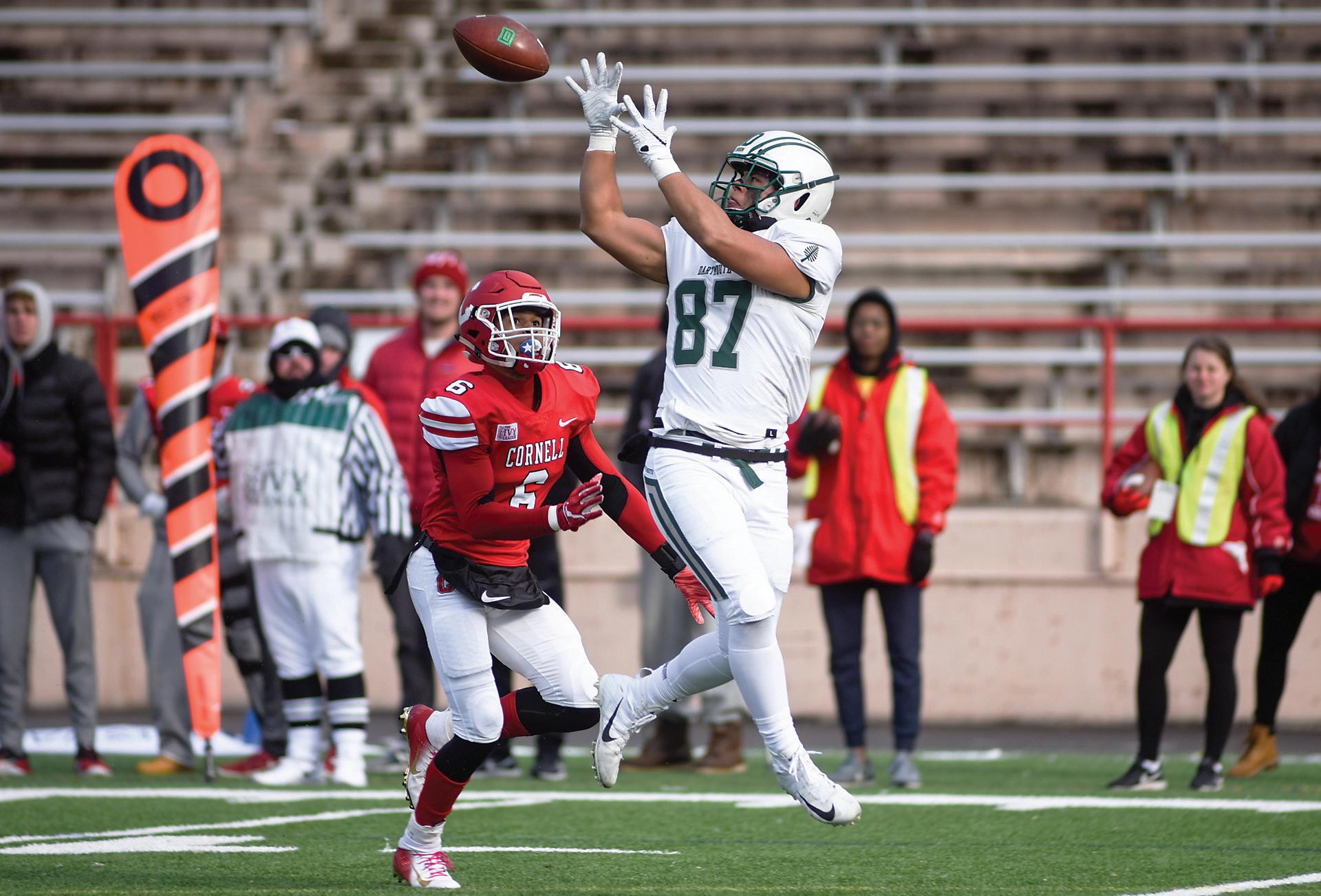
itself as an overwhelmingly run-first team this season, so an aerial attack to begin the game caught a Cornell secondary playing without its key player in junior safety Jelani Taylor off-guard. The secondary was especially exposed when the Green used some trickery to open the scoring, as Kyler found the unusual target of offensive lineman Jake Guidone for the 27-yard score. Kyler would later hit J.J. Jones for a 22-yard touchdown the next drive, and Rashaad Cooper rushed in seven yards for the 21-0 lead.
larly hurts because he lines us all up.”
Junior running back Harold Coles picked up his defense when it struggled early, tallying a pair of touchdowns in the second quarter — one a seven-yard run and one a 21-yard catchand-run — to dig into the Dartmouth lead. The scores sandwiched a careerlong 43-yard field goal from senior Zach Mays to make it a 21-17 game at the break.
resolve leading into the season finale — just a little too late.
“They stormed out 21-0,” Archer said. “It could’ve been easy to fold the tank, but they didn’t.” Now Cornell is left with nothing but a pure moral opportunity in front of it. The Ivy title is long gone. The winning
“We wanted to change it up and play something they didn’t expect and we kind of tricked ourselves a little bit.”
Head Coach David Archer ’05
After coming out and scoring on its first three drives of the game, Dartmouth came out hot yet again in the second half.
The Green scored on two of its first three drives of the third quarter — the second of two of which were aided by a botched snap by Cornell to give Dartmouth ideal field position.
Both third quarter touchdowns came via Gerbino on the ground as Dartmouth
“All we can do now is go out and try to get this win [against Columbia] and finish our career on a good note.”
Senior Dalton Banks
“It was rusty in the beginning. We thought they were going to run it and they started passing on us,” said senior cornerback D.J. Woullard, who had an interception in his final home game. “[Those were] things we didn’t gameplan for, but we made our adjustments … and we defensively stopped them. I felt like we gave them a game.”
“We wanted to change it up and play something they didn’t expect and we kind of tricked ourselves a little bit,” Archer added.
“Not having Jelani in that situation particu-
moved back into its bread-and-butter rush attack as the game progressed. It was how Dartmouth was able to muster by Cornell, but in the loss Archer liked what he saw in the overall
record just passed by. No matter if Archer believed the team could have competed for the Ivy League title, those hopes were quickly erased come week six’s demolishing at the hands of Princeton.
Now that the goal of ending the streak of losing seasons has come to an end, too, all that is left is to finish the season with an Empire State Bowl on the Lions’ home turf.
“All we can do now is go out and try to get this win [against Columbia] and finish our career on a good note,” said senior quarterback Dalton Banks. “The best thing you can do is end the season on a win because it makes the whole offseason a little better.”
Zachary Silver can be reached at zsilver@cornellsun.com.
By GRACIE TODD Sun Staff Writer
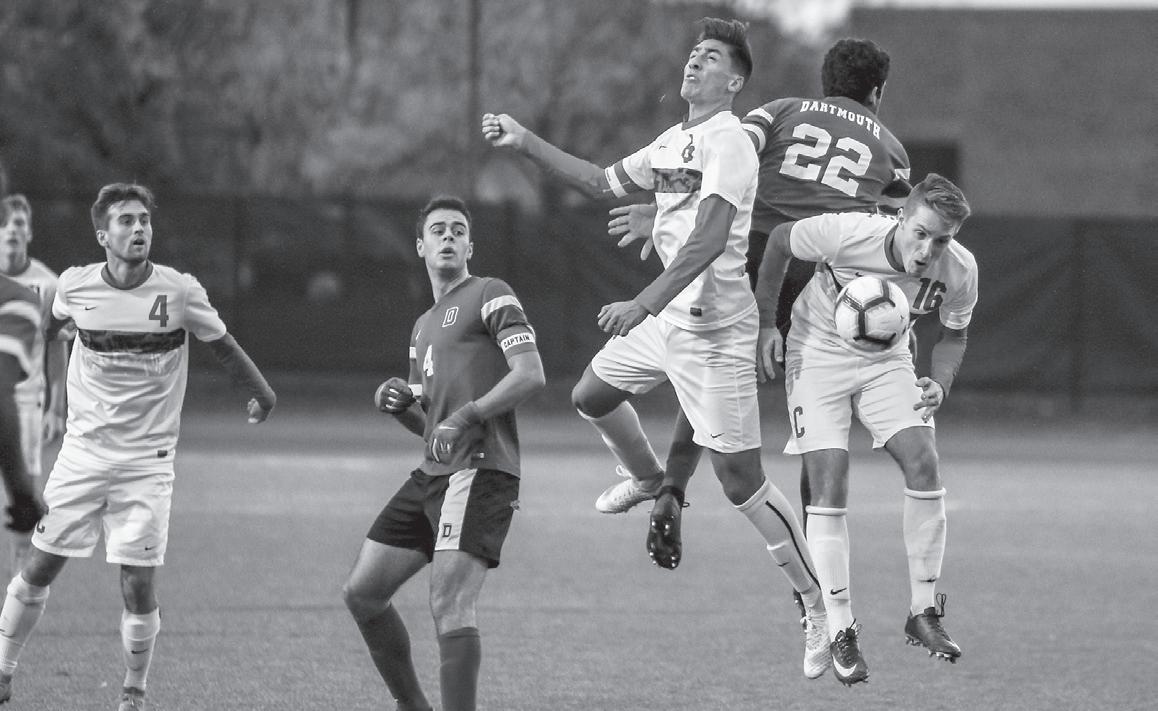
On Saturday afternoon in New York City, Cornell men’s soccer beat out Columbia 2-1 in overtime to break a three-game losing streak and finish the season with an 11-6 record.
After a scoreless first half, the Lions initially took the lead with a goal in the 58th minute — but the hosts failed to tally any more goals.
“We were slightly cagey and tentative in the first half,” said head coach John Smith. “But ultimately kicked into gear in the second half once we went a goal behind.”
Junior midfielder John Scearce tied up the game in the 73rd minute. Sophomore midfielder Tyler Bagley assisted the goal. Tied up, the two teams continued the battle into overtime.
“We responded unbelievably well once we conceded the goal,” Smith said. “And I thought we ultimately deserved the win.”
And a win the Red ultimately captured — sophomore forward Charles Touche scored in the 97th
minute, sending the Red home winners with his eighth goal and fifth game-winning goal of the season.
Throughout the game, the Red tallied 17 shots, nine of which were on goal, outplaying Columbia’s 13 shots, seven of which were on goal. Junior goalkeeper Ryan Shellow made six saves for the Red.
This was the Red’s winningest season since 2012. Just two years ago, Cornell men’s soccer won only one game — 10 fewer than this season. Smith attributes the program’s improvement all to the players.
“They are the ones who made the necessary sacrifices to help steer the program in the right direction,” Smith said. “They have learned to push their emotional and physical boundaries, and in turn, their performances on the field have reflected that.”
“There are definitely exciting times ahead for Cornell men’s soccer.”
Gracie Todd can be reached at gtodd@cornellsun.com.
GAME TWO
Continued from page 12
McCrea’s tally 5:16 into the first period — his first of the season after scoring five goals last year, all on the power play — opened the scoring in what would be a true special teams showdown. The Wildcats scored both of their goals on the power play as well.

having Alex Green, not having Brendan Smith,” Schafer said. “That made it much more difficult.”
“It was definitely a special teams game the whole night tonight, that’s for sure.”
Head Coach Mike Schafer ’86
“We were 3-for-7 … I’ll take that every night,” Schafer said. “It was definitely a special teams game the whole night tonight, that’s for sure.”
The reigning firstteam All American’s performance was desperately needed, as two of the Red’s top four defensemen, sophomore Alex Green and senior Brendan Smith, were out with injuries.
“We had a really short bench, not
Barron’s goal was good for his team-leading fourth of the season and came 12 seconds into a 5-on-3 opportunity for Cornell. In his team’s fourth consecutive victory, sophomore goaltender Matt Galajda made 24 saves to backstop his team to victory.
On offense, the Red lost junior forward Jeff Malott and sophomore forward Brenden Locke to injuries during the game. Schafer said Malott is unlikely to play next week. As it tries to get healthy, Cornell will take its fourgame winning streak back to East Hill, where it awaits a pair of ECAC playoff rematches next weekend against Quinnipiac and Princeton at Lynah.
Dylan McDevitt can be reached at dmcdevitt@ cornellsun.com.
By RAPHY GENDLER Sun Assistant Sports Editor
see him get the first one, [and] he made a great pass on the third goal to [senior forward Beau Starrett].”

After scoring three second-period goals to dispatch Brown last weekend, No. 17 Cornell men’s hockey used two middle-frame tallies just 1:15 apart to put away Northern Michigan and emerge victorious in its first road matchup of the season.
“Tonight was the first night I didn’t feel like we had any letdowns for 60 minutes,” said head coach Mike Schafer ’86. “I thought we kept it going throughout the course of the night.”
Cornell took an early lead in an eventual 3-1 win thanks to the continuation of sophomore forward Cam Donaldson’s hot start to the season. Donaldson took a feed from senior forward and captain Mitch Vanderlaan and put his third goal of the season past Northern Michigan goaltender Atte Tolvanen just 3:13 into the contest.
“[Donaldson has] just been playing faster,” Schafer said of Donaldson, who was able to utilize his speed on the Wildcats’ Olympic size ice sheet, which is bigger than traditional college rinks. “He’s really added that to his game this year. It was great to

The Wildcats tied the game at one in the final two minutes of the opening period, and the score remained tied until 13:30 into the second period, when a power-play goal from freshman forward Michael Regush in the form of a tipin shot on net by Vanderlaan broke the tie and was the eventual game-winner.
Starrett’s first tally of the season extended the Cornell lead to 3-1 just 1:15 later.
“I thought we played with good speed throughout the course of the night,” Schafer said. “I thought our forwards were absolutely relentless as far as their pressure on the puck in the offensive zone and the back side pressure back in our own zone was really good to see.”
Regush’s goal was his second of the season, and both have come via primary assists from Vanderlaan — the captain’s two helpers in the contest extended his team lead in apples to six.
“We just had good pressure through the second period and

Red scores thrice on power play to emerge victorious in
By DYLAN McDEVITT Sun Sports Editor
emerge victorious for the second night in a row.
It was a long journey to Michigan’s Upper Peninsula for Cornell men’s hockey, but the roughly 800 mile long trip appears to have been well worth it, as the Red prevailed over Northern Michigan, 3-2, to
“It’s a long trip,” said head coach Mike Schafer ’86. “Not an easy place to get to. For us, it’s good to get two wins, get home and get some rest.”
All three goals for Cornell (4-2, 2-0 ECAC) came on the power play — a unit that had been struggling to start the season but found success on Saturday, going 3-for-7. Freshman forward Michael Regush scored his third goal in as many games and has quickly emerged as one of the Red’s standout first-year
players. Regush’s man-up tally 11:13 into the third ultimately proved to be the game-winner.
“[Regush’s goal] was a great finish. It was a great line rush, great play by Mitch Vanderlaan at the blue line on the power play,” Schafer said. “When [Regush] gets his chances, he buries them.”
The Red’s other two power play goals came courtesy of senior defenseman Alec McCrea and sophomore forward Morgan Barron, both in the first period.
By ZACHARY SILVER Sun Senior Editor
Cornell football head coach David Archer ’05 remembers the last time a winning Ivy season was brought back to East Hill.
It was his senior year, and he was an offensive lineman part of a Cornell squad that clinched one of three winning Ivy records so far this century. He remembers all the injuries and toils that went into the rare winning
record. And he remembers the euphoria that came with it.
Archer believed the Cornell football team of now, despite entering the season’s penultimate game against Dartmouth
at 2-3 in the league, had the tenacity and moxie to to finally end the 13-year skid and bask in the glory he remembers from 2005. Cornell needed to win out on the year to accomplish the feat, but a 35-24 loss to the Green on Senior Day sunk Cornell’s record within the Ancient Eight to 2-4, making next weekend’s finale at Columbia nothing more than the potential for a moral victory over a rival to close out the season.
“You go into the year believing you’re going to win the league. Particularly the last couple of years, I’ve really felt that way,” Archer said after hopes of a winning league record were dashed by the Green. “It’s a hard pill to even adjust the goal during the year. … But I’m certainly proud of these guys, and I wanted more for them. For sure.”
At times against Dartmouth Saturday, it looked like Cornell might
just accomplish the improbable against the No. 7 defense in the FCS. A 21-0 deficit was quickly erased by a 17-point second quarter, and a bite was taken out of a later 35-17 deficit late in the game. But the rally was
individuals to be honored on Senior Day Saturday. Dartmouth’s offense came in bursts, powered by the two-headed quarterback attack of Derek Kyler and Jared Gerbino. Gerbino was the spark plug for the
“We didn’t even play remotely close to how well we should have played and how well we can play.”
Senior Lars Pedersen
too little too late, and even though Cornell scored the most points of any team against Dartmouth this season, the Green showcased why it’s placed among the top of the Ivy League and locked down for the win.
“And we didn’t even play remotely close to how well we should have played and how well we can play,” said senior wide receiver Lars Pedersen, who was one of 25
Green’s offense, using his feet for over 100 yards and two touchdowns on the ground — both of which came in the third quarter lead-padding rally. But where Dartmouth excelled, at least at the early onset, was in the air. With the most rushing attempts of any team in the Ivy League, the Green has built