The Corne¬ Daily Sun



By JOSH GIRSKY and MATTHEW McGOWEN Sun Senior Editors
In the 12-bedroom house at 410 Elmwood, there was a broken door for each resident. The sprinkler line also was broken, and there were massive amounts of trash to be removed, including two heavy beer pong tables. There was a wall covered in eggs from residents throwing them at each other and the remnants of a pool built out of tarp and hay bales in the backyard.
“I know friends who struggled later down the line trying to find housing.”
Although there was a massive cleanup, longtime Collegetown landlord Nick Lambrou didn’t have to worry about renting it out the next year. It is one of the fastest properties to leave the market in Collegetown, and this year’s residents signed for it in April 2017, 16 months before they moved in.
While several new apartment buildings have been constructed in Collegetown in the last several years, the number of large houses where eight, 10 or even 14 people can live together has declined, making the hunt to get those properties even more cutthroat.
Jonny Levenfeld ’19, one of the current residents of 410 Elmwood, signed the lease in the spring of his sophomore year. He said that although it might seem “slightly ridiculous” to sign that early, he remembers that there was another group interested in the property at the time, and that if they had waited even a week or two longer, he thinks it would have been off the market.
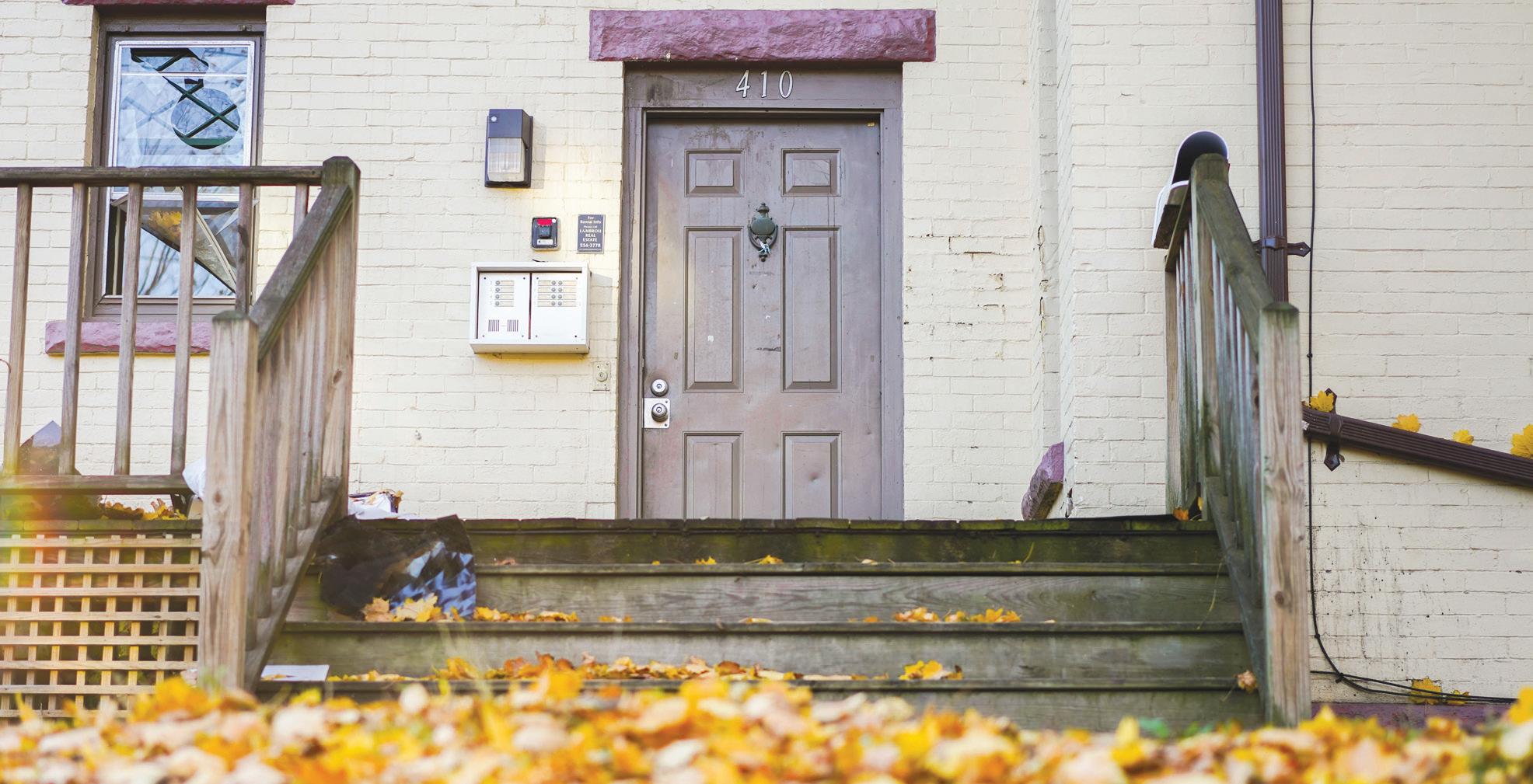
“I believe from what I’ve been told from [Lambrou] and from past tenants and whatnot that that is often one of the houses that is quickest to go off the market,” Levenfeld said.
Levenfeld said he and several friends knew they wanted to live together, that they wanted to be near campus, and since “there just aren’t that many houses on the market,” they wanted to get the process over with.
It was tense at the time, he said, between dealing with roommates that were either non-committal or on the edge and parents who couldn’t see the house for themselves and

By KATHERINE HEANEY Sun Staff Writer
The second annual Cornell ILR Sports Leadership Summit in New York City will bring together 15 sports industry professionals to discuss the opportunities and future of the industry. The speakers, most of them Cornell alumni, range from league commissioners, journalists, network executives and other leaders in the field.
Cornellians have had a long history of leadership in sports,
as the current commissioner of the National Hockey League and ESPN’s president are both Cornell alumni.
Many courses in the School of Industrial and Labor Relations allow students to explore components of careers in sports, such as negotiations, ethics, labor economics, labor law, sports statistics and conflict resolution. Several ILR courses are directly related to sports, including ILROB 3760: Sport Psychology and ILRLR 4030: Economics of Collective
Bargaining in Sports.
The ILR School is also home to the ILR Sports Business Society, a student club that aims to provide members with access to the world of sports. The club hosts guest speakers and special events and runs a radio show, magazine and blog.
According to the Summit’s website, it will celebrate trailblazers and leaders in sports, who will discuss the opportunities and chal-
may have thought that it was “slightly ludicrous” to sign a lease that far in advance.
“We’re just a bunch of 19-year-olds figuring out where to live. We’ve never dealt with any process like this,” Levenfeld said.
They may have been doing it for the first time, but Levenfeld and his group were not doing it alone. Ian Chu ’19 signed to live in his 10-bedroom house on North Quarry
With roots in its Ithaca campus’ natural setting and its Climate Action Plan, Cornell University has been named one of the top 20 “Coolest Schools,” or, greenest colleges of 2018 in the Sierra Club’s annual list.
The Sierra Club is one of the most prominent environmental advocacy organizations in the
country and has been running the “Coolest Schools” awards since 2006.
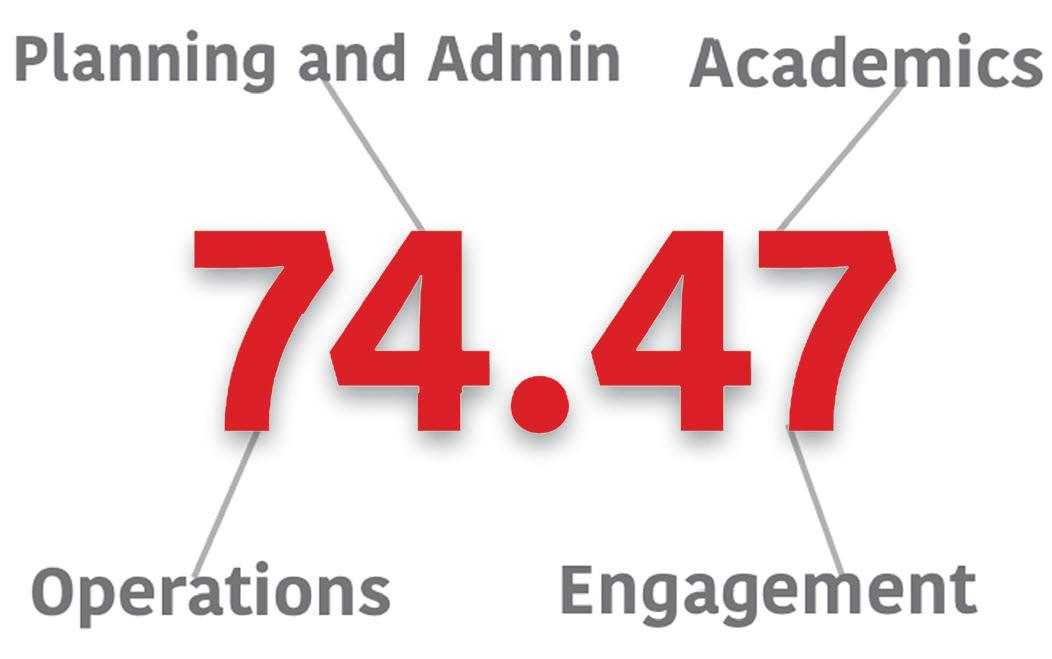
Cornell scored a 74.7 out of 100 on the Sustainability Tracking, Assessment and Rating System — an annual survey sent by the Association for the Advancement of Sustainability in Higher Education to schools for their community members
Thursday, November 8, 2018

Putting the Cycle Back Into
Thailand’s Rural Proletariat Noon, Kahin Center
Cognitive Abilities of Grey Parrots 12:30 - 1:30 p.m., A106 Mudd Hall
International Investment Arbitration: Where Arbitration and Politics Meet 2 - 3:30 p.m., Myron Taylor Hall
Transformational Solutions of Sustainable Agricultural Development in Africa
2:30 - 4 p.m., G08 Uris Hall
Multiscale Simulations of the Thin Passivation Layers –For Aluminum Forming and Lithium-Ion Battery Durability 4 - 5 p.m., B11 Kimball Hall
What’s Next for Super-Earths? Population Demographics to Probabilistic Planetary Physics 4 - 5 p.m., 105 Space Sciences Building
The Common Marmoset: An Emerging Non-Human Primate Model for Cognitive, Behavior and Biomedical Research
5 p.m., Classroom 6 College of Veterinary Medicine
The Unhappiest Place on Earth: The Family Economy in the American Century 5 p.m., Lewis Auditorium Goldwin Smith Hall
Be the Change Workshop: Facilitating Critical Reflection
6 - 7:30 p.m., 100 Mann Library
Cornell Global Grand Challenges Syposium 9 a.m.- 5 p.m., 401 Warren Hall
Alcohol Regulation and Consumer Product Choices 9:30 - 11 a.m., B50 Warren Hall
Politics, Sandwiches and Comments 12:15 - 1:45 p.m., 106 White Hall
Women Who Change into Men: A Gendered History of Precarity in ‘Useful’ Chad Noon - 1 p.m., 190 Rockefeller Hall
Atomic Layer Semiconductor and Heterostructure Electromechanical Systems for Classical and Quantum Information Processing 12:15 p.m., 233 Phillips Hall
STEMing the Tide: How Female Scientists and Peers Act as Social Vaccines to Promote Young Women’s Success in STEM
12:20 p.m., 202 Uris Hall


By OLIVIA WEINBERG Sun Contributor
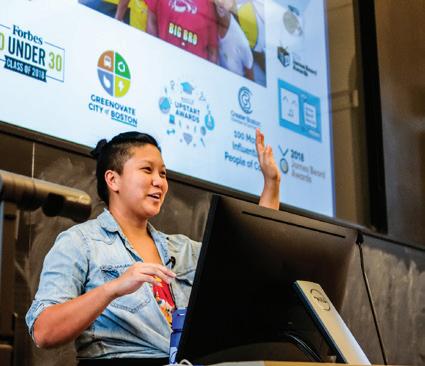
Three years after graduating Cornell, Irene Li ’15 has already made it onto Forbes’ 30 Under 30.
Li operates Street Kitchen, a food truck, and Mei Mei restaurant. Both business ventures are located in Boston and have an emphasis on sustainability and transparency. According to her Forbes profile, Li’s focus on transparency and sustainability in terms of food sourcing and employment using an open book program — which involves the entire staff in a weekly discussion of the performance of the business — earned her a spot on the list.
Li spoke to students and faculty on Wednesday and hosted a dinner following her talk. She also will lead a Lunch and Learn and interactive cooking demo on Thursday.
Li opened the food truck with her brother and sister in 2012 and quickly discovered that buying locally sourced meat in bulk helps the restaurant cut down its expenses. At the same time, realizing that purchasing locally-sourced ingredients helps local farmers, Li made sure that a majority of the ingredients — such as eggs and flour — in Mei Mei’s kitchen come from local producers.
While at Cornell, Li worked with the Cornell Prison Education Program and advocated for increasing the minimum wage. After opening the food truck and experiencing difficulties with not being able to give employees better wages, she realized that social justice inequalities were present in the food industry as well.

This year, with the help of a grant from the State of Massachusetts, Mei Mei launched an open book, profit sharing program. Each week, the entire staff sits down and assesses the financial performance of the restaurant. They also go through training classes where they learn how to complete tasks like managing profits, so that they may eventually go solo and open their own business.
Li, who is interested in sustainability beyond her restaurants, also reached out to local farms and distributors and

By RONNI MOK Sun Staff Writer
At the Clinton Global Initiative University in Chicago in late October, Cornell students and alumni met individuals from all over the world to discuss ideas and share their experience in launching social ventures, which aim to tackle specific social issues in their communities.
In order to attend the conference, students needed to apply as individuals or in small groups of up to three students and make a “Commitment to Action,” which addresses a “pressing challenge” in one of CGIU’s five focus areas: education, environment and climate change, peace and human rights, poverty alleviation or public health, according to Winice Hui ’21, one of the summit attendees.
Girl4Girl, a startup created to empower women in STEM and to demonstrate “a commitment to combat challenges in education, particularly femme discrimination and stereotypes.”
“The most valuable aspect of the conference was the community of passionate advocates coming together for social good.”
Kiyan Rajabi M.S. ’18
Ghali Jorio ’21 attended the conference with her project, the Moroccan Youth Social Entrepreneurs Group, which serves as a mentorship program that is committed “to provide Moroccan youth with the resources, spaces and network to contribute to the development of the country,” explained Jorio.
Cornell, which was represented by 12 students and alumni, was one of the biggest delegations at the conference, according to Jorio.
By EMMA CORDOVER Sun Contributor
Hui, along with Naviya Kothari ‘20 and Annie Hughey ‘18, applied as co-founders for
During the conference, delegates from over 100 countries and 50 states came together to network, listen to inspiring panels and keynote speakers, as well as
Learn on the job | Irene Li ’15 said running the restaurant helps her gain a better understanding of Chinese culture and langauge.
connected them with other small businesses. These businesses include other restaurants as well as aggregators, who act as middlemen between farmers, restaurants and local communities. These aggregators offer restaurants an array of food items from local producers that might be hard for them to get otherwise.
Growing up, Li was raised in an English-speaking
Richard McNeil, biology professor emeritus in the department of natural resources, died on September 25, 2018 at the age of 85. McNeil began teaching at Cornell in 1964 and earned his emeritus status in 1999.
During his time at Cornell, McNeil participated in and lectured at several conferences such as “Who Owns Nature?” in 1999 and a conference on “Sustainable Development” in 1996, which was hosted by the Cornell African Students Association.
McNeil received his bachelor’s and master’s degrees from Michigan State University and his doctorate in 1963 from the University of Michigan in fish, game and wildlife management, according to the Cornell Chronicle, which is run by the University..
“Dick was a wildlife biologist who realized that policy makers and the public were central to the successful management of wildlife in specific and natural resources in general,” Prof. Jim Lassoie, natural resources, one of McNeil’s colleagues, told the Chronicle.
Even in his retirement, in 2001, McNeil led 25 people on Cornell Adult University’s first study tour to Mongolia. While exploring the Mongolian
outback, the professor led the group in dinosaur hunts and relaxed in the sands of the Gobi desert. Throughout his career, McNeil published several research papers including “Population Dynamics and Economic Impact of Deer in Southern Michigan” and “In Pursuit of the Universal Oneness” in 1974.
The professor also published a number of books such as Deer in New York in 1965 and Pesticides in 1966.
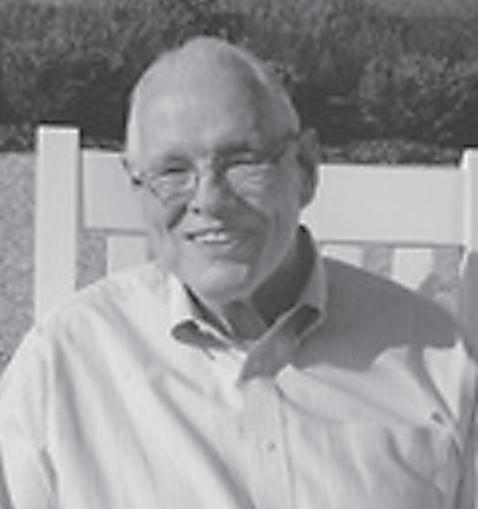
McNeil received the SUNY Chancellor’s Award of Excellence in Teaching in 1994 and the CALS Edgerton Career Teaching Award in 1996. He was known for international conservation, interdisciplinary environmental studies and broadening the Department of Natural Resources’ curriculum by advocating for environmental sciences and ethics courses, according to the Chronicle.
Emma Cordorver can be reached at esc78@cornell.edu.
on the
ited in 2015 and showed a
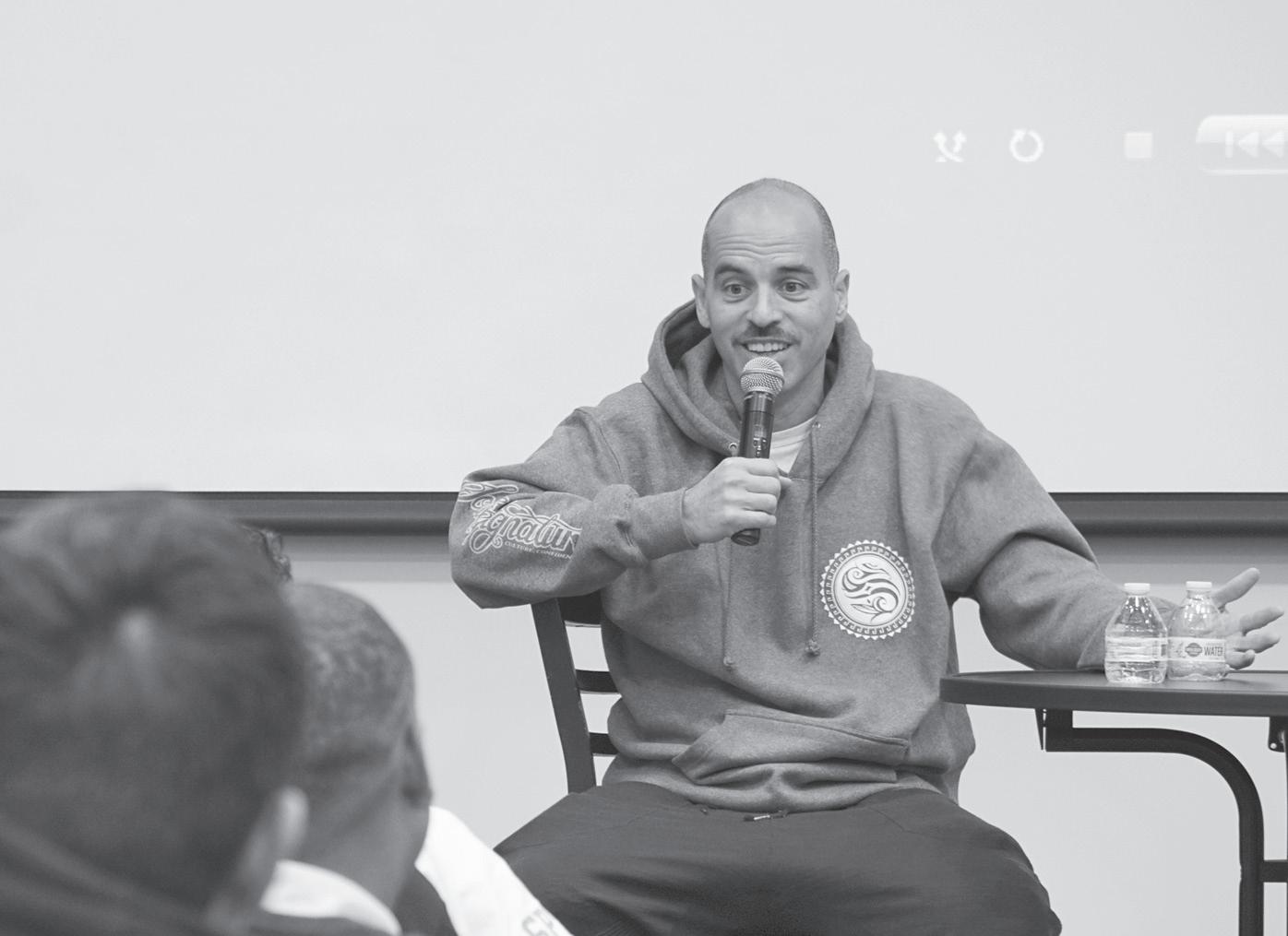
By WINNY SUN Sun Staff Writer
ed autobiographical film to a full-house on Tuesday, chronicling his ascension from a child struggling with alienation to a multi-talented icon.
In addition to being a celebrated figure in the hip-hop community, García is also an author, D.J. host, ballplayer and filmmaker, according to Ben Ortiz, curator of Cornell HipHop Collection. Located in the Division of Rare and Manuscript Collections in the Carl A. Kroch Library, the collection is the largest archive of its kind in the entire world with more than half a million of artifacts on hip-hop culture.
García first visited Cornell in 2015, during which he showed a film about his hip-hop radio show from the 1990s. Since then, he and the collection had built a connection, Ortiz said. After releasing a new autobi-
COLLEGETOWN
Continued from page 1
Street in May of 2017. Like Levenfeld, he was also a sophomore at the time.
Chu said that he was told by older friends that if they wanted to live in a house that they liked, they would have to act early. He said he thinks his group could have waited longer, but he’s glad that they didn’t.
“While we did, I guess, kind of jump the gun a bit, I think I’m glad we did, because I know friends who struggled later down the line trying to find housing and obviously by then there’s not as many options,” he said.
Although it is still a stressful process for them, Lambrou told The Sun that people like Levenfeld and Chu have the advantage when looking for these houses. He said that it’s often rising juniors — or in the case of Chu and Levenfeld, second-semester sophomores — who secure the desirable leases because they have visited the houses when their older friends lived there, they have a solid group of friends and they know that they want to get the process over with before prelims start.
And for some groups, the process isn’t that difficult at all. Laurel Fox ’19 signed the lease for the two-story five-bedroom apartment that she currently lives in even before she arrived in Ithaca for her junior year. Once she figured out who she was going to live with, Fox said, everything was pretty straightforward.
She admits that she wasn’t the most involved of her friends in dealing with the logistics of signing the lease, but since they knew of one of Lambrou’s apartments on Eddy Street from older members of their sorority, her friends didn’t have to worry too much either.
“I never felt personally responsible for my own housing,” she said. “It was also very little effort on their part. All they did was email Lambrou.”
Fox said she’s satisfied with her apartment, as did Levenfeld and Chu. They all said that signing early meant they didn’t have to worry about housing during prelims and junior year internship searches, but Chu also pointed out that it leaves groups with little flexibility if they find out about issues with the house or if circumstances change.
“I think we realized a few months before moving in we’re like ‘oh wow the walk to class is actually a lot longer than we thought’ so we couldn’t really change there,” he said.
If signing early is an advantage in the tight market for large houses, signing for a 14-person lease within a year of moving in might be a warning sign for quality.
Christina Nastos ’19 and her friends thought they would live in Greek housing after their freshman year. But once those plans evaporated, they found themselves on a house hunt in February.
“We kind of poked around to see what was available, and we went to Ithaca Renting, and they had this massive disgusting house that was still available. We rallied a bunch
of people together, and that’s where we lived,” Nastos said. Nastos said she had her own kitchen, but opted for a meal plan instead. The stove worked infrequently, and she said there was never enough fridge space between the 14 people living there, not including rodents in the head count.
“It was kind of just generally falling apart at the seams. Very rickety, like I lived on the top floor and basically I would hear squirrels scratching into my roof. You could just tell that the house was never maintained and it probably still shouldn’t be standing. It’s probably not very safe to live there,” Nastos told the Sun.
Signing early for a lease does not prevent quality issues either. Chu said when he moved in there was no electricity or light in his room and their laundry machine didn’t work perfectly.
Costa Lambrou ’16, Nick Lambrou’s son and colleague, said those kinds of issues come with the older houses, and pointed out they come with newer buildings too. He said the first several weeks are known to be a busy time for their maintenance team, which works 10 hours a day, seven days a week “so that everyone’s happy by the time school starts.” Chu said he understands that, and that he and his roommates are overall satisfied with their property.
“But I just wish that I had some lights in my room.”
Josh Girsky can be reached at jgirsky@cornellsun.com.
Matthew McGowen can be reached at mmcgowen@cornellsun.com.
the ILR school curriculum.
lenges surrounding athletes, owners, managers, leagues, sponsors and networks and what they predict to see in the future of sports.
The speakers will also discuss their experience in the sports industry, in relation to topics taught in
Alexander Colvin, interim dean of the ILR School and the Martin F. Scheinman Professor of conflict resolution, told the University that “many ILR School and Cornell alumni are industry influencers who have a wide-ranging impact on sports” and that “their leadership sets the pace for an industry that is at the heart of the American
cultural experience.”
Thomas Heiden J.D. ’71, one of the panelists, is a partner at Latham & Watkins and the global chair of the firm’s product liability, mass torts and consumer class actions practice. He said that the summit offers a “collection of perspectives” in a “broad and rapidly changing sports industry.”
“Sports business is full of

tensions and enormous sums of money,” Heiden said. “There are tensions between ameteur and pro athletes, legal challenges over things like whether college athletes should be paid, who gets what share of the sums of money available and issues over health, safety and injury, such as concussions.”
Heiden also noted that there are other stakeholders’ interests to consider in the sports business, including “electronic game developers, clothes and merchandise manufacturers and vendors and other interested parties.”
Heiden, who will be speaking about “High Stakes Betting Litigation in the Business of Sports,” said that sports betting is already a big industry, with more than $15 billion spent on betting for the Superbowl and for NCAA basketball, alone. Ninety-seven percent of that betting was illegal.
“Now states can make that betting legal,” Heiden said. “When that happens, leagues, franchise and players are going to want to find a way to get some of that money. States are also going to want some of that money. And sports bettors are going to want more information and discourse on what they are betting on.”
Marc Cornstein ’92, head of
sports M&A for Financo, will be moderating the panel that Heiden is speaking on.
Cornstein said he is “looking forward to discussing this very timely issue and to seeing some of the other wonderful speakers that are scheduled to participate.”
“It will also be great to catch up with some old friends that I don’t get to see very often,” said Cornstein.
Gary Bettman ’74, commissioner of the National Hockey League and Michael Levine ‘93, co-head of CAA Sports, will also hold a fireside chat titled “Innovation Leadership and Deal-Making in Sports.”
James Pitaro ’91, ESPN president and co-chairman of Disney Media Networks, will discuss disruptive trends in sports media through his fireside chat titled “Leading Through Chain.”
The summit also includes several networking sessions and receptions, which will allow Cornell alumni and students the unique opportunity to discuss their career interests with sports leaders and to learn more about the different career tracks in the sports industry.
Katherine Heaney can be reached at kheaney@cornellsun.com.
ALUMNA
Continued from page 3
American household, but starting a business helped her learn about Chinese culture and language through food.
Li described her family life as one “that revolved around the dinner table,” though she did not get into cooking until opening the food truck. When people ask if she cooked when
she was little, Li responds, “No, I was mostly focused on eating.”
She describes Mei Mei as “creative ChineseAmerican food” with a menu boasting items like scallion pancake sandwiches, smoked bluefish fritters and an assortment of dumplings.
Mei Mei has won countless awards and features in sources like The New York Times,
Food & Wine and Eater Boston & National. With a driven attitude mindset focused on social justice and sustainable food, Li sets up her employees for the future and business so that it is built to last. After all, she said, “being connected to your food makes the food tastes better.”
SUSTAINABLE
Continued from page 1
to self-evaluate.
The public report compiled from the findings quantifies every school’s sustainability based on a number of criteria, including curriculum, campus engagement, food and dining, waste and innovation. According to the Campus Sustainability Office, this is Cornell’s 7th year achieving STARS Gold status, and Cornell has the longest running Gold ranking of any university in the world.
Cornell leaped from #64 on list in 2017 to #20 in 2018. The University has been recognized as a “Cool School” almost every year since the rankings began in 2006, though its place in the lineup has fluctuated.
Some of the key initiatives that the Sierra Club pointed out in their explanation for Cornell’s score are the new Sustainable Landscapes Trail, Anabel’s Grocery store, the Lak e Source Cooling energy system and the in-progress Earth Source Heat energy project.
Since 2000, lake source cooling has transported the deep cold water in Cayuga lake up to campus to cool buildings in the hot summer through a heat exchange process. This process has saved the University millions of dollars and 25 million kilowatt hours of energy over the past 18 years, as stated on the project’s website.
The Earth Source Heating project, which would harness the geothermal energy stored in the rock underneath campus to heat all 608 buildings on campus, has been in development for many years and, if pursued and accomplished, would be an unprecedented feat of engineering and sustainable design.
“[The Sustainable Landscapes Trail] is an interdisciplinary project, our planning department, grounds department and landscape architecture department collaborated with students to design the trail and highlight areas on campus to showcase living laboratory spaces, examples of sustainable landscaping and more,” said Sarah Brylinsky,
sustainability communications and integration manager of the Campus Sustainability Office.
Brylinsky emphasized that what sets Cornell apart from other college campuses is that “faculty, staff and students work together to improve sustainability.” She believes “the most innovative things happen when we work together.”
According to the Sustainable Campus Office, the University as a whole has reduced carbon emissions by more than 30 percent since committing to carbon neutrality in 2008. However, student leaders of sustainability clubs across campus believe that this is only the beginning and that the University has a long road ahead before reaching the level of sustainability that the administration lauds.
Cornell Environmental Collaborative is the central coordinating organization of over 40 environmental clubs on campus. According to ECO co-facilitator Elizabeth Couse ’19, the Cornell community is making strides in the right direction, but since committing to a carbon neutrality by 2035 plan in 2008, the administration has so far targeted “low-hanging fruit,” like increasing energy efficiency in older buildings on campus.
“The administration likes to point at graphs and say that we’ve greatly decreased carbon emissions since 2008, but we still have a lot of work to do,” Couse said.
Audrey Stanton ’19, co-president of Society for Natural Resources Club, said Cornell should have the resources and capabilities to achieve more than it does now.
“Cornell has many sustainability-focused initiatives, though there is always room for growth,” Stanton said. “We are capable of achieving carbon neutrality, sourcing our energy from renewable options, investing and supporting consciously and reducing the amount of waste we produce.”
Although all other Ivy League schools have campus-wide sustainability initiatives and environmental clubs, none besides Cornell were honored in the Sierra Club’s Top 20 list. And in the Princeton Review’s top 50 rankings, Cornell’s STARS score also makes it the most
sustainable Ivy school despite Cornell’s significantly larger student population and campus size.
In contrast, Brown University has an undergraduate student population of 6,988 and a Princeton Review Green Ranking of #47 out of 50 schools, compared to Cornell’s #8 spot with 14,907 students and 745 acres.
Brylinsky said that one of the major things Cornell students can do to advance sustainability is actually small, such as turning off lights when leaving the room or installing smart plugs. “On a campus this large, they make a difference,” she said.
Couse pointed to fossil fuel divestment, increasing local food sourcing and severing ties with funding corporations like Monsanto and Coca Cola as just some ways to work towards the radical carbon neutrality goal.
When asked how the University can most efficiently work towards the 2035 goal, Couse and Brylinsky mentioned greater collaboration between the administration, faculty and student body.
The President’s Sustainable Campus Committee and the Sustainable Campus Steering Committee is currently updating a Campus Sustainability Plan for 2016-26. The draft is available online for comments for a limited time to the Cornell community until it is finalized and put into action.
The Sierra Club acknowledged in their methodology review that none of the 20 schools in their ranking have reached 100 percent sustainability. “In 2018, the top-rated universities scored a solid B. In higher education, as in the rest of society, there is room for improvement.”
“Sustainability initiatives have always stemmed from the students and community, not the administration. I think that the University needs to improve their partnership between the administration and the students,” Couse said. “Change will not come fast enough if students have to continually push the administration. We need to work together.”
Amanda Cronin can be reached at acronin@cornellsun.com.
HIP-HOP
Continued from page 3
ographical film Rock Rubber 45s this past summer, he wanted to screen it for the University.
Rock Rubber 45s explores “the connectivity of global basketball, sneaker and music lifestyles through the first-hand lens of authentic NYC culture orchestrator Bobbito García,” according to the film’s website.
Ortiz said he had organized the screening to help students and researchers broaden their understanding of the hip-hop genre. In the film, García not only discussed his participation in hip-hop culture
but also his involvement with basketball and sneakers.
“To some people, the connectivity between those three things is obvious. But to other people, it’s a surprising realization to have,” Ortiz said, explaining that baseketball and sneakers are just as important as hip-hop in García’s life.
“As a person, he is incredibly intelligent, warm and sociable,” Ortiz added. “He is always excited to be in front of a
“Hip-hop is fundamentally something that brings people together ... it helps people understand how many things came to be.”
Ortiz described García as “a renaissance man who is multi-talented and multidimensional.” García is interested in education and in promoting Latino history, “the values of positive community and the history around social justice movement,” Ortiz told The Sun.
CLINTON
Continued from page 3
connect to other change-makers. Selected delegates were paired with mentors who previously attended the conference and had launched their own commitments.
“The Clinton Global Initiative University conference was an awesome experience because of all the inspiring student leaders I had the opportunity to meet and the quality of the speeches and presentations,” Imani Majied ’19 said. “It gave me the opportunity to talk about challenges I’ve encountered with launching my own social venture with people who could relate and brainstorm potential solutions I could bring back with me.”
The conference featured a number of panels on topics, such as how to integrate technology
into social commitments, how to monitor and evaluate start-ups, and how to manage, recruit and expand. Students also had the opportunity to meet President Bill Clinton, former Secretary of State Hillary Clinton and their daughter Chelsea Clinton.
“I believe the most valuable aspect of the conference was the community of passionate advocates coming together for social good,” said Kiyan Rajabi M.S. ’18. “As Chelsea Clinton put it, ‘Optimism is a moral choice. I wake up everyday and choose to be optimistic.’ The conference did just that; it surrounded me with an optimistic tribe that will certainly become some of the world’s next generation of leaders.”
Ben Ortiz
crowd and always has something really interesting to offer no matter what the event is.”
The event was met with a full house at the Africana Research Center multipur-
pose room, according to Ortiz. The Q&A session following the film screening lasted more than an hour, after which García was “gracious” and took pictures and gave hugs to the audience members, Ortiz said.
“Something that is really important about hip hop is that along with music, some of the core topics that you will find that hip-hop deals with are socioeconomic status, race, the co-mingling of disparate cultures,” Ortiz said. “Hip-hop is fundamentally something that brings people together … it helps people understand how many things came to be. ”
Winny Sun can be reached at wsun@cornellsun.com.
1880
136th Editorial Board
JACOB S. KARASIK RUBASHKIN ’19 Editor in Chief The
JOHN McKIM MILLER ’20
Business Manager
KATIE SIMS ’20
Associate Editor
VARUN IYENGAR ’21
Web Editor
MEGAN ROCHE ’19
Projects Editor
EMMA WILLIAMS ’19
Design Editor
JEREMIAH KIM ’19
Blogs Editor
AMOL RAJESH ’20
Science Editor
BREANNE FLEER ’20
News Editor
YUICHIRO KAKUTANI ’19
News Editor
NICHOLAS BOGEL-BURROUGHS ’19
City Editor
LEV AKABAS ’19
Arts & Entertainment Editor
SARAH SKINNER ’21
Assistant News Editor
ANNE SNABES ’19
Assistant News Editor
JOHNATHAN STIMPSON ’21
Assistant Sports Editor
EDEM DZODZOMENYO ’20
Assistant Photography Editor
GIRISHA ARORA ’20
Managing Editor
HEIDI MYUNG ’19
Advertising Manager
ALISHA GUPTA ’20
Assistant Managing Editor
DYLAN McDEVITT ’19
Sports Editor
MICHAEL LI ’20
Photography Editor
GRIFFIN SMITH-NICHOLS ’19 Blogs Editor
JACQUELINE QUACH ’19 Dining Editor
SHRUTI JUNEJA ’20 News Editor
ANU SUBRAMANIAM ’20 News Editor
JUSTIN J. PARK ’19
Multimedia Editor
PARIS GHAZI ’21
Assistant News Editor
MEREDITH LIU ’20
Assistant News Editor
JONATHAN HARRIS ’21
Assistant Sports Editor
RAPHY GENDLER ’21
Assistant Sports Editor
BORIS TSANG ’21
Assistant Photography Editor
Working on Today’s Sun
Ad Layout Dana Chan ’21
Design Deskers Emma Williams ’19
Lei Lei Wu ’20
News Deskers Anu Subramaniam ’20 Meredith Liu ’20
Night Desker Maryam Zafar ’21
Sports Desker Dylan McDevitt ’19
Arts Desker Viri Garcia ’20
Dining Desker Jacqueline Quach ’19
Photography Desker Boris Tsang ’20
Production Deskers Sarah Skinner ’21 Emma Williams ’19
Editorial
TODAY’S STORY ON THE HIGH DEMAND FOR LARGE APARTMENTS in Collegetown underscores the need for substantial change in how Cornell does housing. It is not a sign of health that students feel compelled to sign leases well over a year before moving in — nor is it acceptable that many of those houses often exist in various states of perpetual disrepair. Cornell can and should do more to foster a better system of housing for upperclassmen, particularly in Collegetown.
Yes, Cornell has begun to implement its Master Housing Plan, including the much-trumpeted North Campus expansion, but we are skeptical that those efforts will ease the pressure on Collegetown rentals. Notwithstanding the fact that Cornell intends to increase enrollment by 900 students per class just as it begins to build more housing, the University’s North Campus construction reflects a key misdirection of effort.
Because the truth is, many Cornellians don’t want to live on campus as upperclassmen — and they certainly don’t want to live all the way on North Campus. They want to live with their friends in houses and apartments, not in dorms. And as long as the Collegetown real estate market remains constricted, students will be forced to pay high prices for subpar accommodations they had to reserve before submitting the Common App.
Furthermore, what will happen after the University completes its 2,000 bed, 3,600 student expansion? An additional 1,800 upperclassmen unleashed on an already-creaky Ithaca rental scene.
Will the private landlords build more housing to meet demand? Perhaps. But keep in mind these are the same landlords that have let Collegetown become a ghost town, the same landlords that hold prime real estate that has stood vacant for close to a decade. It’s been eight years since the four corners of the CollegeDryden intersection had four tenants. We have scant faith in the landlords to rise to the occasion this time.
So it falls on Cornell, for better or for worse. The University must develop more off-campus housing for upperclassmen: apartment-style, rather than dorm-style like what currently exists. Whether this entails the refurbishment of Cascadilla, Sheldon Court or Schuyler, or the purchase of new real estate and new construction, we leave up to the folks in Day Hall. Maybe they can buy The Nines and fulfill a student’s dream of living in a firehouse.
But one thing’s for sure — simply adding more students and some fancy new dorms in Cayuga Heights won’t solve the problem.
To the editor:
Thanks for the very good piece about the professorial discussion about the current reality of Ezra Cornell’s egalitarian ideals as embodied in the university’s motto. Alas, as you well know, Ezra never said “Any person.... any study”, which you claim in the first sentence. Lest some readers believe that, your writer should have included something to the effect that this is a recent (last 15 years) informal and casual substitute for the much more profound and dignified words of the university motto, which several years ago was voted the best among all US colleges. “I would found an institution where any person can find instruction in any study.”
Isaac Kramnick, Richard J. Schwartz Professor of Government, Emeritus
To the editor:
The faculty signatories among the Cornell Coalition for Inclusive Democracy manage to applaud themselves for their bold immigration stance in a wholly unrelated solidarity letter regarding transgender rights. It perfectly reflects the Left’s proclivity to link every progressive cause together under their loosely and poorly defined banner of “human rights.” These same faculty dedicated to inclusion and openness happily and willingly teach at an institution that the Sun recently informed us rejects close to 90 percent of the thousands of applicants seeking to arrive. This amounts to a veritable caravan of students stopped before even getting to the CU campus border! How would they feel about their classes, their campus offices or even their domiciles being open for anyone who wishes to occupy them consistent with their advocacy for unrestrained immigration in the nation writ large? Or why not remove tenure and open their departments to anyone wishing to offer instruction in their subjects providing the prospective professors are fleeing persecution? They make their living operating in one of the most closeted, cloistered and exclusive environments that exist in the world today and seek to assuage their guilt by affixing their names to pointless statements of solidarity.
Cameron Brace
To the editor:
The 161 Things Every Cornellian Should Do has been gaining significant attention over the past couple of days. As I was reading the list, I noticed some activities would be considered inappropriate and even illegal. I am not in favor of eradicating the list; there just need to be some major changes to ensure everyone complies with the law. It all started when I posted a meme criticizing the 161 Things on Cornell: Any Person Any Meme, the Facebook page. Some students have caught on and are now in favor of wanting those changes. Others were not in favor of the changes and thought it would mean having their freedoms taken away.
There are many notable activities that need to be removed from the list just because some are plain stupid, offensive to others, and even illegal. I named over 80 activities that need to be considered for removal; however, I will name a few of utmost importance right here.
1. Sex in the stacks.
I find this behavior to be extremely offensive. In fact, public sex is a misdemeanor that can result in a year in jail and a fine.
90. Getting kicked out of Balch Hall.
You must be male in order to cross off this activity. I am in favor in removing activities that can only be performed by certain groups. Everyone should be able to enjoy an activity, regardless of gender.
92. Skinny-dipping in the gorge.
I can’t believe the number of students that have drowned in the gorges. In fact, swimming in the gorges is illegal and highly dangerous. No more students should have to die because of that activity.
134. Get J.A.’d for urinating at the law school.
Does anyone really need to see a private activity? In fact, public urination is a misdemeanor in some locations that can result in a fine.
140. Writing dirty messages on rocks.
I am a nature lover who believes that anything natural should be left in peace. Beauty that has taken millions of years to form has just been desecrated in one second.
In the end, if you ever get in trouble with law enforcement and just say you were crossing off activities on the list, it would be a very poor excuse with regards to the law and arrest would definitely occur. As I posted the potential consequences on the meme group, a few students just laughed at my comment. It’s never funny to get arrested and face potential imprisonment, and it’s certainly no fun to end up with a criminal record. No one should have to get in trouble just because of an activity. I am not trying to destroy everyone’s fun time; I just want to make the campus a better place by promoting law and order.
Matthew Press ’20
Editor’s Response: Matthew, on the off-chance you’re serious, and not just trying to cross #61 off your list...dude.
Don’t Like our Coverage? SenD LetterS to the eDitor anD gueSt CoLumnS to opinion@CorneLLSun.Com
Unpopular opinion: I adore the food at Cornell Dining and still retain a meal plan with them as a senior. As a result, I’ve spent quite a bit of time at the various dining halls across campus and I’m noticing the increasing plethora of people on their phones while eating, usually alone. It seems to be a wider phenomenon. Even my dad does it too now at home — and recently I called him out for it. “You’re using a phone after I took a five hour-long bus trip to see you? Are you kidding me?” I asked, while taking his iPhone 6S+ away, now regretting that I chose it for him at the T-Mobile Store. At Cornell and other college campuses, however, distracted eating is clearly an everyday phenomenon. On different occasions at Appel, for example, I’ve counted 8 out of 10 people at my table on their phones. They also sure don’t look particularly happy.
I used to do it too, so I know the urges, the reasons why. First, we are so programmed to be with technology. Perhaps even more important, however, is that phones help to escape the dread of eating alone, the double whammy of feeling lonely and looking lonely in front of others. Like all other addictions or false panaceas, the small momentary relief, however,
Physiologically, stimuli from a Facebook feed or video on your phone literally activates stress in your body.
leads to many high long-term costs.
body. The parasympathetic system, which is supposed to calm you down when you’re eating, fades away, while the sympathetic side takes over, usually in situations of stress. Because we were not evolved to be eating while running running from a sabre-tooth tiger, our digestive capabilities lowered as a result. Less digestive enzymes are released and less nutrients are being broken down and absorbed from the food. Psychologically, distracted eating has been shown to be correlated with overeating and worse memory of what you ate, not to mention general unhappiness.
Once I’ve made a promise to myself to stop using my phones at dining halls, I have actually had a good deal of pleasant conversations with strangers.

To begin with, you are literally not eating well with your phones. Physiologically, stimuli from a Facebook feed or video on your phone literally activates stress in your
The opportunity cost of missed social connections is also very high. Once I’ve made a promise to myself to stop using my phones at dining halls, I have actually had a good deal of pleasant conversations with strangers I sit across from at Appel. For example, I’ve met people from different majors and homes. Admittedly an East Coast liberal, I was surprised and glad to finally meet someone from West Virginia for the first time and get to know a little about their perspective. Having a phone in front of you eliminates these types of immersion opportunities, almost wholesale, and we are trapped in our echo chambers. For the many who completely focus on their phones, the dining hall has effectively changed from being a social space to an ocean of small, individual island-tables, where each student clings on to their device and servings. The buffet tables are the shore, where students shuttle to and fro with little boats of food, barely acknowledging each others’ presence.
Not eating with your phone is also another buffer against the further intrusion of technology into our lives. Luddism is silly, given the way of the world, but I do believe in preserving time away from screens. The science is not completely in on the issue, but take it from people who know technology a lot more than me. Over in Silicon Valley, parents are making sure to enroll their kids in fancy private schools that minimise screens and technology.
Admittedly, I still do it sometimes, usually for work. The personal line I draw where I will take out my phone is read an urgent email or reply to someone’s text, but no more. And for those situations, I try to pause my eating, complete the task on my phone and then get back to my food rather than pointlessly try to multitask. For those who can’t sit still or bear to eat alone in a large public setting, even reading a book or newspaper is a way better alternative. You look smarter, less insecure, learn to focus, and don’t strain your eyes.
Try it for a day; just try it. A campus with so many similarly-aged young people should not be a collection of islands. Eating has been conducted as a social encounter for eons and using your phone while doing it is no answer to the modern epidemic of increasing isolation and busy schedules. And by literally acknowledging the world around you, maybe you’d make a friend or two. So please: put down the device, tower above the noise, and truly enjoy your meal for thirty minutes. It’ll taste better.
Matthew Lam is a senior in the College of Arts and Sciences. He can be reached at mhl82@cornell.edu. The Despatch Box appears alternate Wednesdays this semester.
Manisha Munasinghe | Trustee Viewpoint
This week, domestic Cornell students had the opportunity to participate in the midterm elections. The interest surrounding this year’s election cycle on campus was palpable. In the past few months, I’ve seen students organize voter registration drive after voter registration drive. Others spent time collating resources so that every eligible student would be able to easily find and travel to their polling place. My social media feed the day of was filled not only with students exercising their right to vote but also with post after post encouraging others to exercise their right as well.
public service, to enhance the lives and livelihoods of students, the people of New York, and others around the world.” Our commitment to helping students, faculty and staff live up to this ideal is strong, with a variety of institutional resources in place to connect community members to civic engagement opportunities.
Public service and engagement are intimately linked to Cornell’s history as a Land Grant institution.
While the energy surrounding election is still strong, we should remember that voting is only one way in which Cornell students can engage at a local, state and national level. Voting during election day may seem like the most impactful way to make our voices heard, but there are a variety of ways in which students can impact the wellbeing of our country. Local civic engagement is one of the largest, most immediate ways Cornell students can make a difference, while state and national opportunities can connect students to a network of individuals across the country working to enact change.
Public service and engagement are intimately linked to Cornell’s history as a Land Grant institution. This is clearly delineated in our University Mission. It states that “Cornell also aims, through
Into the Streets, an annual service event that works with over 40 different local, non-profit organizations in Tompkins County, connected over 500 students and faculty during this year’s event on Oct. 27. The upcoming Cornell Cares Day, scheduled for Saturday, Jan. 5, 2019, is a worldwide student-alumni service event that provides service opportunities for students in their hometowns while they are there over winter break. Engaged Cornell and the Cornell Public Service Center work tirelessly to connect students, faculty and staff with community partners in order to tackle complex local, national and global issues. These engagement programs continue to have real impacts on the community. The Cornell Prison Education Program is part of a regional collaboration that brings together Cornell faculty and graduate students in order to provide free college-level liberal arts curriculum to a select group of inmates at Correctional Facilities in upstate New York. These credits can then be applied toward an associates degree from Cayuga Community College. This program relies
on faculty and student volunteers in order to fulfil its mission. The Graduate Student School Outreach Program, GRASSHOPR, pairs graduate students with teachers in Tompkins County to create mini-courses aimed at introducing K-12 students to new and exciting topics.
These are just two examples of engagement opportunities that are directly transforming the lives of not only local community members but also the students that participate in these programs. Civic engagement and public service come in a variety of shapes, forms and time commitments. If you have not yet found a program that fits your interests and your availabilities, I strongly recommend browsing the multitude of programs Cornell either organizes or promotes. The Cornell Public Service Center compiles multiple lists for students to peruse that highlight both student-led service initiatives and opportunities beyond Ithaca.
sion as Cornell University community members, but also as students who value higher education. There is a very real public perception that the value of a college education and of higher education in general is decreasing. Civic engagement provides us a direct opportunity to contradict that narrative. It allows us, as Cornellians, to highlight the value of our academic work and the direct impact both it and we can have on transforming communities.
This past year, the Office of Engagement Initiatives awarded nearly $840,000 to 21 teams of faculty and community partners to help integrate
While the energy surrounding election is still strong, we should remember that voting is only one way in which Cornell students can engage at a local, state and national level.
The reality, however, is that it is easy to forget about public service. For most students, our calendar is packed to the brim with academic and professional responsibilities. Finding time to add another responsibility to our workload, without overloading ourselves, can be difficult. However, I firmly believe that participating in public service should be a priority, not just in pursuit of our mis-
community engagement into curriculum across the university. It is up to us as students to take these courses and to commit to using that knowledge to assist our local, national and global communities. The opportunities for civic engagement are there. It is now up to us to figure out how we can best contribute.
Manisha Munasinghe is the graduate and professional student-elected member of the Board of Trustees, and a PhD candidate at Cornell University. Trustee Viewpoint runs every other week this semester. Munasinghe can be reached at mmunasinghe@cornellsun.com.
On Saturday, Oct. 27, an anti-Semite committed the worst anti-Semitic act in America’s history. We have an obligation to mourn the eleven Jews slaughtered in Pittsburgh at the Tree of Life synagogue. We also have a collective responsibility to act against anti-Semitism. I propose starting right here, on our campus.
He represents a classical, blatant sort of Jew-hatred, which certainly exists at Cornell, despite the large Jewish population here.
The shooter in Pittsburgh is a far-right, white nationalist, and anti-Semitic bigot. He represents a classical, blatant sort of Jew-hatred, which certainly exists at Cornell, despite the large Jewish population here. My sophomore year, I discovered that my next-door neighbor told his (non-Jewish) roommate that Jews are morally corrupt and that Hitler did not finish the job. The roommate was rightly disgusted and moved out, the incident was reported to the residence hall director, but this individual faced no real consequences for his despicable anti-Semitic statements. But more prevalent on our campus is an anti-Semitism masked as anti-Zionism. Students for Justice in Palestine, which has a Cornell chapter, exemplifies this sort of anti-Semitism. To its credit, Cornell SJP posted on Facebook about the need to combat “anti-Jewish hate” after the Pittsburgh shooting. Ironically, Cornell SJP engages, to some degree, in a form of anti-Semitism itself. On its Facebook page, the group delegitimizes Israel — the only Jewish state in the world — as a “settler colonial” and “apartheid” state, and calls for resistance against the “fascist grip of US and Zionist state violence.”
Cornell SJP will argue that they are defending Palestinian human rights and are not anti-Semitic. The U.S State Department’s definition of anti-Semitism refutes this argument. The State Department classifies “denying the Jewish people their right to self-determination, e.g., by claiming that the existence of a State of Israel is a racist endeavor” as acts of anti-Semitism. When it calls to “make Israel Palestine again” and to “Free Palestine” (both found on Cornell SJP’s Facebook page), Cornell SJP effectively endorses the destruction of Israel as a Jewish state and a haven for the Jewish people.
But more prevalent on our campus is an anti-Semitism masked as anti-Zionism.
My fellow Cornellians: we must combat anti-Semitism wherever its origins and whatever form it takes. If you are dismayed at the brutal shooting of eleven Jews in Pittsburgh, know that anti-Semitism exists on our campus too. And we are all duty-bound to fight it.
S UBMIT L ETTER S TO THE E DITOR AND G UE S T C O L UMN S TO O PINION @C ORNE LL S UN .C OM
ALL M EMBERS OF THE C ORNE LL AND I THAC A C OMMUNITY WELCOME TO SUBMIT
L ETTER S: FE WER THAN 250 WORD S; C O L UMNS: FE WER THAN 800 WORD S
Patrick Young ’06 MILR ’20 | Guest Room
On October 2, ILR Dean Kevin Hallock shocked the ILR community by sending out a mass e-mail announcing that he had sought and received an appointment as the Dean of the Cornell SC Johnson College of Business, an apparent promotion over his position at the School of Industrial and Labor Relations. As Dean Hallock goes on to what he and Cornell’s senior administration believe to be bigger and better things, he leaves behind an ILR school at an important crossroads. Will the ILR school be reduced to a niche business school and a stepping stone for promising business leaders or will it fulfill its potential to be the world’s leading institution for the study of work, workers, and employment?
The ILR school was founded in 1945 during an era of massive change in the American labor market. Enabled by New Deal legislation and fueled by a wave of post-depression left-wing militancy workers across the United States were joining unions by the millions and organizing bold and confrontational strikes to demand a bigger share of the economic fruits of their labor. While much of this conflict was certainly a product of workers stepping up to demand a fairer share of the profits they were generating, many labor, business and political leaders suggested that at least some of this friction was caused by labor and management leaders lacking common methods, skills and practices to facilitate orderly collective bargaining relationships.
nological change and evolving models of employment.
At various points in the school’s history, institutional forces have attempted to push ILR away from its focus on the world of work. In 2005, while I was an undergraduate at ILR, then-President Jeffrey Lehman sought reposition ILR as a business and prelaw program by offering Jan Svejnar, a business professor from the University of Michigan who had served on the supervisory boards of multiple public companies an appointment as dean.
Throughout the public search process, students, faculty and alumni expressed an overwhelming opposition to Svejnar’s appointment, seeing it as a move to shift the school away original mission and towards offering a more generic education in
of business or will the administration appoint a dean with the experience and commitment to lead our school and our society in understanding and creating the jobs of the future?
Will ILR’s next dean see leadership of this unique school as a stepping stone to bigger and better things in the world of business or will the administration appoint a dean with the experience and commitment to lead our school and our society in understanding and creating the jobs of the future?
business administration. Having been ignored in the formal search process, dozens of students and alumni contacted Svejnar directly to discourage him from accepting the controversial appointment.
To address this challenge the ILR school was founded, “to improve industrial and labor conditions in the State through the provision of instruction, the conduct of research, and the dissemination of information in all aspects of industrial, labor, and public relations affecting employers and employees.” While the founding challenge of the ILR school may have been navigating the emerging relationship between unions and management, over the past seven decades the ILR school has been at the leading edge of research and education human resources management, emerging models conflict resolution, compensation studies, and most recently, tech-
Recognizing the commitment of so many stakeholders to upholding ILR’s mission to promote study of work, workers and employment, Svejnar turned the offer down. Cornell appointed Professor Harry Katz as dean and the ILR school not only continued the work of studying and teaching industrial and labor relations, it redoubled its efforts by expanding programs in conflict resolution, compensation studies and evolving models of workplace organizing.
More recently, the ILR school survived yet another existential threat to its unique identity when Provost Michael Kotlikoff announced that he had set aside the widely panned proposal to merge ILR and the School of Human Ecology.
With the sudden departure of Dean Hallock and the upcoming search for a new dean, the ILR school finds itself at a crossroads once again. Will ILR’s next dean see leadership of this unique school as a stepping stone to bigger and better things in the world
Decades ago the ILR school set out to help our country to navigate the tumultuous relationship between manufacturing workers in labor unions and the country’s massive industrial employers. Now fewer than ten percent of workers are members of labor unions and employment in the manufacturing sectors is a shell of what it once was. While the study of traditional union-management relations will certainly always be a core part of the study of industrial relations, the ILR school is faced with the daunting task of making sense of employment relationships in today’s economy. Today, the world of work is changing every bit as rapidly and dramatically as it was in 1945 when the ILR school was founded. The rise of the gig economy, platform capitalism and the rise of artificial intelligence and machine learning are all dramatically re-organizing the labor market and transforming the relationship between people and their work. Employers, workers and policy makers are all faced with important and challenging questions about the status of independent contractors, the role of employment arbitration, technology’s uneven impact on the workplace and new models of collective representation. The ILR school is uniquely positioned to help our society navigate these questions.
Now, more than ever workers, employers and policy makers need a top-flight institution dedicated to studying the world of work and developing the tools that we need to create productive, healthy, and equitable workplaces. With the upcoming dean search we will have an important opportunity to rise to that challenge by choosing a dean with a serious track record in the study of labor and employment relations and a commitment to helping us understand and create the workplaces of the future.




By LUCY SPAHR Sun Staff Writer
fter following the arrows down the winding halls, my friend and I finally arrived in Tuscany, Italy. The candlelit space was bustling with life at 6 p.m. on a Sunday. The wooden tables were bare and stylish, yet the understated simplicity only added to the elegance. At the front of the room, the antipasti were displayed on a round table, the only one with a lace tablecloth. Antipasti are normally appetizers consisting of olives, cheese and meats, but here, they took on a more creative flair, with offerings like meatballs della Giuseppe (pork meatballs baked with ricotta and crispy basil), and prosciutto di Parma, complete with Turkish figs and Tuma Persa cheese. Two waiters whisked by us with plates of still steaming black spaghetti and lamb ragu fettuccine, as if they were doing a pasta dance. The dichotomy between traditional Italy and a more artistic twist was evident.
To clarify, we were not actually in Tuscany, but Ithaca, New York. But over the course of our two-hour meal at Gola Osteria, we were transported to a vineyard on a cool fall night as we indulged in a variety of pasta straight from grandma’s kitchen, albeit with some added special umami. This hid-

den gem, which is tucked away in the unassuming Quarry Arms building located in downtown Ithaca, is a pleasant surprise.
Our waiter arrived at our table, which to my dismay, was in the back room due to the fact that it was so busy. He asked about my “unique” last name, as he knew some Spahrs from New Jersey. Although I was a Spahr from Chicago, I appreciated the special touch, since he had taken the extra minute to look at my name, under which the reservation was made. He waved his arms, grandly walking us through the menu as if he were performing a show. He had a reason to be proud. The menu frequently changes to make use of the freshest ingredients of the season –– think squash and pumpkin in the fall, black truffle in the winter. Gola Osteria presents its cuisine in three main courses: antipasti, primi (pasta) and secondi (generally meat and fish). Since it was Sunday, there was a special $25 three-course tasting menu. However, we wanted to try the more creative options that were available, so we
decided to order à la carte.
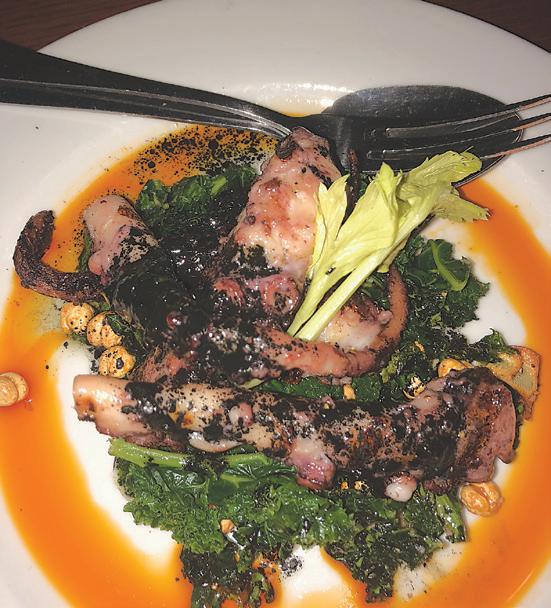

Our antipasti arrived in the form of insalata Gola and grilled Mediterranean octopus. The insalata was akin to a Caesar salad, but better. The delicately presented anchovies added the perfect amount of saltiness to the Pecorino Romano sauce. Then there was the grilled octopus, which was situated like a king upon a bed of vibrantly green rapini, surrounded by marinated chickpeas and a homemade squid ink vinaigrette. The colorful presentation, with the bright pumpkin-orange vinaigrette and leafy greens, made this dish entirely Instagrammable, but we preferred to simply eat it. The antipasti were the perfect prelude to what was to come. Of course, our anticipation continued to build for the pasta, and it certainly did not disappoint.
After a bit of a lull, the main event was presented to us: the squash pappardelle and the housemade spaghetti our waiter had recommended from the five pasta choices. The squash pappardelle was a brilliant medley, with an abundance of bacon lardons
and fresh candied squash, dressed with a light cheese sauce that did not distract from the other elements. Pappardelle is a thicker noodle, so it aptly absorbed the other flavors. This decadent dish was the perfect ode to a warm and cozy fall evening.
The spaghetti, then, was a transition into winter, with foraged mushrooms, garlic, thyme, butter and Parmigiano Reggiano. We eagerly twirled our spoons around, trying to catch as many richly flavored mushrooms onto the fork as we could. I noticed that when we were finished gobbling up both pastas, the noodles were gone, but a few of the other parts remained. Thus, more noodles would have prolonged our blissful indulgent experience, especially considering each pasta dish cost around $23. Nonetheless, we were still content to eat the lardons and mushrooms without the noodles.
That brings us to the grand finale (excluding dessert): secondi. As college students already breaking the bank, we did not select any of the pricier offerings, ranging from whole branzino fish to classical veal, which cost at least $30. Luckily, we were already very full and content with our previous choices. Gola Osteria is a special-occasion, destination-only restaurant. Maybe one day, I thought, we could return to a little bit of Tuscany in our own Ithaca.







RUBY QUE: Let me just start off by saying that it’s a pretty bad idea to see a horror film with Varun.
VARUN BELUR: Watching a horror movie is, for me, an act of pure masochism.
R.Q.: Yeah, but honestly it’s not even scary.
V.B.: If you’ve seen enough slashers it’s probably not that scary since the film dogmatically clings to the tropes of that genre. But I think there’s enough jump scares in the film to make all but the most hardcore horror fans sweat a little.
R.Q.: I think the problem is not as much “clinging to the genre,” but clinging to the original — David Gordon Green approaches the project like a loyal Carpenter fanboy, copying everything from the overall structure, the dialogue, the obsessive therapist who saves/ruins the day, to details like how the babysitter’s boyfriend was pinned up to the wall by a kitchen knife. Don’t get me wrong — I was excited at the sight of the familiar font and the ominous jack-o’-lantern during opening credits, but nostalgia only works for so long.
V.B.: The film does reference the original excessively. It suffers from the same disease as Star Wars: The Force Awakens and doesn’t quite manage to tell a new, compelling story. As a side note, this is sort of how I felt about Carpenter’s original theme too: it is perfect but, in a way, too perfect. It overshadows the 1978 soundtrack and makes this film feel excessively derivative.
I definitely missed the suspense and mystery that made the original terrifying. Michael Myers is still a black box but his actions in the film feel more mechanical than mysterious. He’s not given enough agency to interest me as a character.
R.Q.: But that’s exactly what makes him so terrifying! His mechanical movement and lack of a face, both literally and metaphorically, offer the audience no way of under-
standing the character — his killing spree seems anything but motivated. Yes, we do talk about “characterization” and “motivation” all the time in film criticism, but Michael Myers isn’t just another character; rather, he is an abstraction, a shape (The Shape) and an embodiment of our incomprehensible fear. Anyone could be his next target — including you and me.
V.B.: Because we’re not allowed a glimpse into Michael’s psychology, I can’t buy the idea of Laurie Strode and Michael Myers as two sides of the same coin. The film tried to push that pretty heavily by emphasizing Strode’s “obsession” with Michael and equating them in several ways, including through Strode’s replication of Michael’s old “reanimate and disappear” routine (which was one of my favorite moments in the film). And on the topic of Michael’s psychology, my biggest disappointment with the film was that it refused to explore the subject despite dangling it front of us more than once.

R.Q.: As far as I understand, Michael’s key character is not having a character/psychology. And I don’t necessarily see the emphasis on Laurie’s “obsession” with Michael as an effort to equate them. To me, the film deals with trauma, both personal and collective/intergenerational. Jamie Lee Curtis carries the film with her remarkable performance once again, eyes burning with cold fire and hands shaking with aged anger.
V.B.: In our last review, you brought up the “sadistic male gaze” that makes a spectacle of violence in Mandy. Do you think that gaze is present here? I’m asking because it never felt like we saw through Michael’s eyes (like in the original) but exclusively through the eyes of the three female leads.
R.Q.: As a pretty standard slasher, Halloween definitely offers a spectacle of violence (some very gory deaths, and the headcount definitely exceeds that of the original; not to
mention the head-stomping!), but it’s not one that features the helpless female victim. Rather, the film turns women into heroines. There’s nothing more satisfying than seeing three generations of women with remarkable resilience standing together against the boogeyman (a man!). Compared to the original where revealingly dressed teenage girls are killed either on the way to pick up the boyfriend or waiting for the boyfriend in bed — this is not just a small step forward. V.B.: Like Michael Myers, the Halloween franchise has resurrected itself from the dead with this latest film. And if “the new Loomis” couldn’t bring himself to kill Michael once and for all, something tells me that neither can Blumhouse Productions. I think I’ve had enough horror for a while, though.
Ruby Que is a junior in the College of Arts and Sciences. She can be reached at rque@cornellsun.com. Varun Belur is a senior in the College of Engineering. He can be reached at vb239@cornell.edu
My experience at the Kitchen Theatre Company’s The Piano Teacher was so disorienting that I find it quite difficult to put my feelings to words, however I will try, for all the good in me that seeks to save Ithaca from this play. Playwright Julia Cho works alongside director Diego Arciniegas to bring to life a story that seems it would be much better off numb in its grave. The Piano Teacher is a narrative about — you guessed it — a piano teacher, who reminisces about fond memories with her many students. Lonely after her husband’s death, lead Mrs. K (Beth Dixon) reaches out to her former students with the hopes of reconnecting. After receiving visits from two students, Michael (Matthew J. Harris) and Mary Fields (Amelia Windom), she is informed of the disturbing reason as to why her students have not kept in better
touch: her deceased husband Mr. K. With an audience of exclusively senior citizens and a dead-ended plot, I had absolutely no desire to dust the cobwebs off of what could have been here.
Dixon begins the show with a friendly monologue that showcases her impeccable talent as an actress. Her acting was the only thing that centered me amongst the discombobulation that was the show’s plotline. Dixon’s unapologetic emotion, including the passionate tears she shed at the end of the play, tethered the audience to the theater. She was the rope, our ground and all I wish is that the play ended after her initial monologue and saved itself some veracity. Following her lengthy introductory speech, the Kitchen Theatre takes us nowhere but down the kitchen sink, into a deep, dark drain of sinistery and mayhem.

We begin to follow Mrs. K’s journey to locating and reuniting with her students, expecting to see quaint interactions and reminiscent conversations, however we are wrong. As the story progresses, we find that Mr. K has relayed disturbing stories of his dark past to Mrs. K’s former students, involving sexual assault and murder, leading them to quit their lessons. We witness Mrs. K’s
jumbled emotions as she grapples with learning that her beloved husband did such questionable things. Feelings appear raw and real, but they are jumbled up in a weak storyline about a piano teacher.
While I never thought I would say this, because we theatre-geeks largely encounter quite the opposite, I will say it now: I wish that this play was more predictable. I see what The Piano Teacher was striving for. It was attempting to give us a unique and interesting plot twist, however all it did was smack the keys and give us a dissonant chord — and much too loudly. This rings especially true when Mrs. K suddenly receives creepy prank calls from a former student, which to me were highly uncalled for. What began as a interesting story on growth, memory and love quickly became a disturbing tale about a piano teacher’s eerie household.
That being said, the show’s set design was well done (Steve Teneyck). Space was utilized interestingly, with a back room that led to the theatre’s engaging three-dimensional quality. The main stage and piano room had charming decor, with edible cookies as a prop, which Mrs. K so intimately handed out in the beginning of the performance (nothing less than what we would expect from a Kitchen Theatre production). In the context of play, however, the set created the oddest juxtaposition between your sweet grandmother’s house and a home straight out of American Horror Story.With the show’s contagiously reminiscent tone, and as a pianist, I found myself questioning the safety and authenticity of my former piano teacher’s house, which I once found so warm and
cozy. It’s safe to say that my memories of her were successfully tainted.
While the show was off-puttingly cynical and quite uncomfortable, my main problem with The Piano Teacher were the upsetting and controversial topics that were introduced and then abruptly shut down. The play dances around heavy topics like sexual assault, abuse, race and PTSD. Producing artistic director M. Bevin O’Gara writes in her notes to the audience, “Theatre and the power of the stories we are able to tell in this medium [the theatre] feels more vital than it ever has before.” Well, true. But covering up serious subject matter with a major key chord and a little tune won’t and didn’t accomplish that.
All in all, one of the only good things I got out of this performance was a reminder to send my middle school piano teacher a Facebook friend request. I left The Kitchen Theatre Company’s The Piano Teacher touched by Dixon’s performance, however utterly jarred and confused at the fact that such heavy topics could be so carelessly dropped into my lap and just left there. If you’d like to see talent and you’re skilled at separating acting from story (which a lot of people detached from the critical-theatre world have difficulty doing), then go for it. See The Piano Teacher. But if you wish to keep your sanity, save your fond memories of your music teacher and salvage your Friday night, stay home.
Juliette Rolnick is a junior in the College of Arts and Sciences. She can be reached at jr798@cornell.edu.
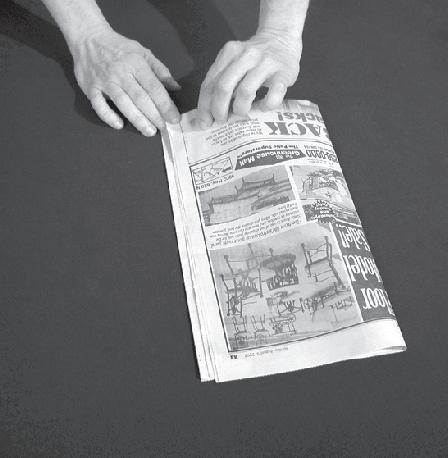
Fill in the empty cells, one number in each, so that each column, row, and region contains the numbers 1-9 exactly once. Each number in the solution therefore occurs only once in each of the three “directions,” hence the “single numbers” implied by the puzzle’s name.
(Rules from wikipedia.org/wiki/ Sudoku)
















1, 2, 3, 4, 8 BEDROOMS FURNISHED VERY REASONABLY PRICED 607-272-3389 avramisrentals@aol.com
Now Renting for 2019-2020 3-7 Bedroom Apartments All locations. Contact us today or visit our website: certifiedpropertiesinc.com
Certified Properties of TC Inc 273-1669
2 & 3 BEDROOMS 109 SAGE PLACE
Available NOW, Spring 2019 & 2019/2020 Shuttle Bus Access to Campus Access to Free Fitness Center Novarr- Mackesey Property Management office@ithacastudentapartments.com 607-277-1234
Ithaca Renting Company Apartments, Houses, Parking Central Collegetown Superb Panoramic Views Modern Elevator Buildings
Collegetown Plaza: Fitness Room, fantastic Cayuga Lake Views Studio, 1, 2, 3, 4, 5, 6 BRs Parking
Collegetown Center: Concierge Service, quiet building, Fitness Room Studio, 1, 2 BRs Parking
Collegetown Court: Super convenient, exceptional value Fitness room Studio, 1, 3, 4, 5 BRs
Other Collegetown Locations: Apartments and Houses Dryden Road, Eddy Street, Buffalo Street 2, 3, 4, 6, 8, 10, 14 BRs Parking Rent Smart. Live Well. 607-272-3000 Visit our office at: 119 Dryden Road www.ithacarenting.com
WESTBOURNE APARTMENTS Studios and 3-5 bedroom apartments available!
1. Walk to classes and Center Campus amenities in minutes
2. Units with dishwashers, fireplaces, and two bathrooms available.
3. On-Site Laundry
4. Free high-speed Roadrunner Internet and Cable
5. On-site parking
6. Furnished with TVs
7. Very competitive pricing Call us (607)257-0313 for details or to schedule a tour!
COLLEGE AVE.
1 Bedroom available In a 2 BR apartment For Male, Undergrad student. Available NOW & Spring 2019
4 Bedroom Apartment
Available NOW & Spring 2019 Novarr-Mackesey Property Management office@ithacastudentapartments.com 607-277-1234
RENT NOW, GET THE BEST
www.MatoulasHouses.com
Apartments & Houses In Collegetown
LINDEN AVE & E. SENECA ST
1 & 3
BEDROOM APARTMENTS ALL FURNISHED
EMAIL: MatoulasHouses@Gmail.com
PHONE: (607) 339-9644
FIRST-COME, FIRST-SERVED *****************************
We have availability for the 2019-2020 school year beginning June 1st at Hudson heights apartments. The studio apartments come with: heat, water, and electricity included. There are garbages houses and coin-operated laundry facilities on site. Prices start at $750/month for a 12 month lease. If you have any questions or would like to schedule a tour contact us by phone 607-208-7660 or email: renting@ithacaLS.com *****************************
Collegetown Terrace Apartments INSPIRED LIVING TAILORED TO YOUR SUCCESS
24-Hour Fitness Center Shuttle Bus Service to Campus Study Rooms w/ Expansive Views
Apartments Available NOW, Spring 2019 & 2019/2020 Novarr- Mackesey Property Management collegetownterraceithaca.com office@ithacastudentapartments.com
607-277-1234
Nicest Apts. in Collegetown Located on Eddy St. 4 Bedrooms Fully furnished. Spacious living areas with large bedrooms & closets. Hardwood flors, spectacular views, eat-in kitchens with additional sun rooms. Laundry & parking. 607-339-1137 bgm900@gmail.com
NORTH CAMPUS
Studio and 3 bedrooms
Available 2019/2020 Novarr-Mackesey Property Management office@ithacastudentapartments.com 607-277-1234
Houses, Apts, Parking 1 to 9 Bedroom
Collegetown - College Ave, Linden Ave, Dryden Rd, Bryant Ave, Cook St. 607-330-2442 info@urbanithaca.com www.urbanithaca.com

All Display Advertising for the Monday, November 26 & Tuesday, November 27 issues and Classified Advertising for the Monday, November 26 issue of The Corne¬ Daily Sun is due Monday, November 19 by 2:30 p.m.
Te Sun Business Ofce will close Monday, November 19 at 3 p.m. and will reopen Monday, November 26 at 9 a.m. The Cornell Daily Sun • 139 W. State St. • Ithaca, New York • 607-273-3606

By ARCHER BIGGS Sun Staff Writer
While the tournament was not officially scored, Cornell women’s tennis played evenly with the competition last weekend at the Harvard Invitational in Boston. The Red won seven of nine matches against Boston University, lost eight of nine matches against Michigan State and lost four of seven matches against Georgetown.
The Red faced a new team each day over three days of competition.
Freshman Valerie Ho won every match she played, going 3-for-3 in singles and 2-for-2 in doubles. Ho played at number three against Michigan State and Georgetown and number four against Boston University.
Coach Mike Stevens clarified, “no one has a number” on the team. He likes to keep the roster competitive. The fall season, according to Stevens, is about practicing. Stevens wants to “build work ethic and develop each player.” As far as results, “they are all individual” as team scores are not counted.
Steven’s two focuses this fall season are “development and a championship.”
Stevens achieved the first goal back in 2017 by leading the Red to their first Ivy League title. Then, in 2018, the Red finished seventh in the Ivy League.
This year Cornell has a remarkably young team. The roster at
Harvard included five freshmen, one sophomore and zero juniors or seniors. Right now the top three players are all freshmen. It is no wonder that one of Steven’s two goals is development.
The team had two junior players last year, Michelle Wang ’19 and Mariko Iinuma ’19. Wang graduated a year early, and Iinuma is currently interning with Google in London. Iinuma will return to the Red in January. Although Stevens emphasizes that “no one has a number,” Iinuma played at number two for the Red last season. Her return will certainly strengthen the roster.
The Red’s roster is also remarkably small. With Iinuma abroad, there are only six women on the team. All of the other Ivy League rosters have nine to thirteen players. Stevens does not see this as an obstacle. “When Mariko [Iinuma] returns we’ll have seven, and seven is perfect.”
Additionally, the team has no captain. “Some years we do not have captains,” Stevens explained. “Captain is something that needs to be earned and needs to be respected.”
The Harvard Invitational was the last of four fall tournaments. The Red will not return until new year. Their next matches are in Fort Myers, Florida, against Georgia State on January 19 and Miami on January 20.
Archer Biggs can be reached at abiggs@cornellsun.com.
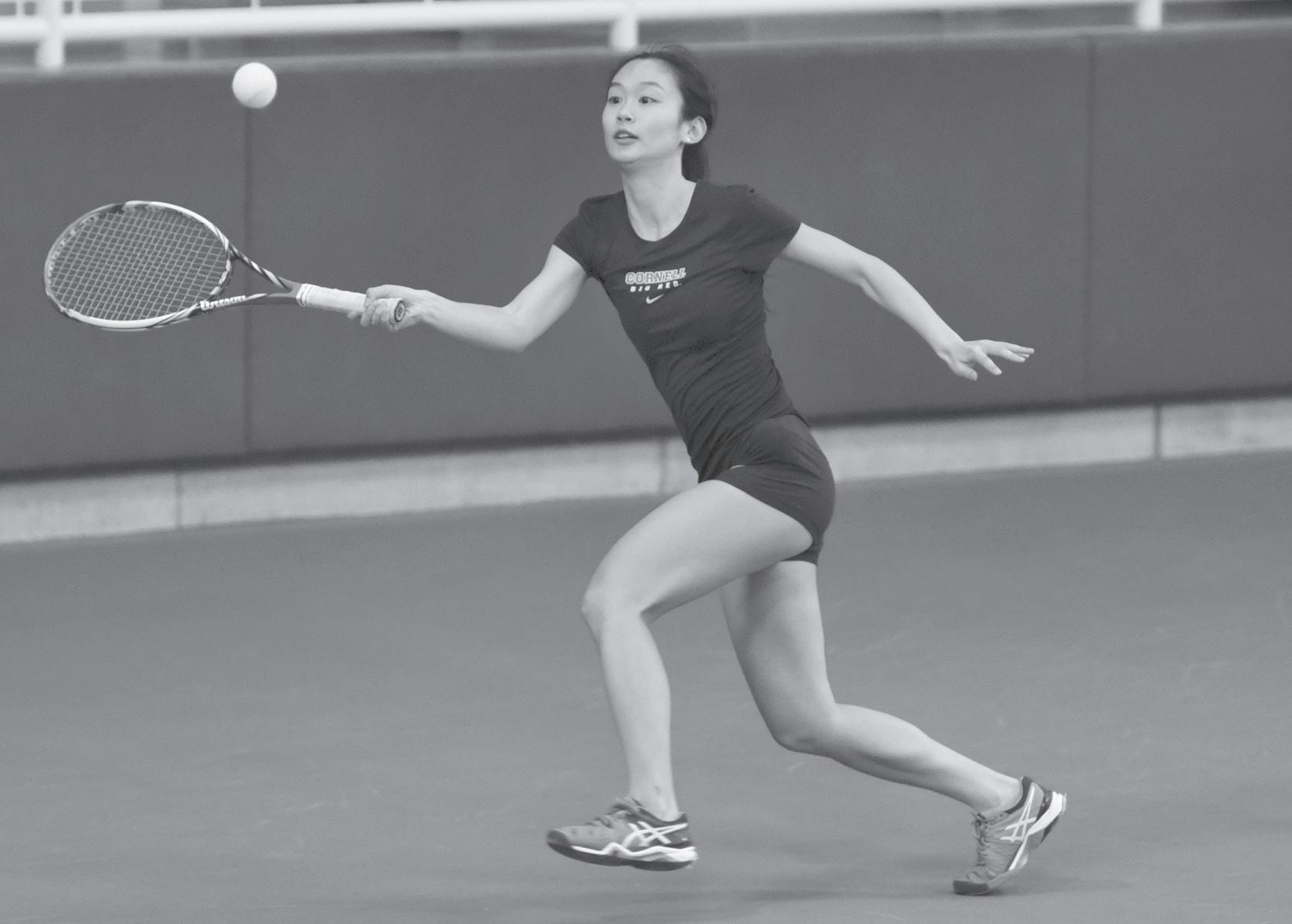
FOOTBALL
Continued from page 19
Despite the uphill battle before Cornell and a senior day win, the team hopes it can wrap up the final stretch of the season and finish above .500 in league play for the first time since 2005.
“Just being written off is a reoccurring trend that everyone is tired of,” Coles said. “If we can prove somebody wrong this would be a huge win for our program and our season, and it would be a good way to send our seniors off.”
For the seniors, no matter what happens Saturday, Archer knows that even if the results have not been showing up as much in the win column, the second class he

recruited is leaving the program in a better place.
“It’s night and day from when they walked in,” Archer said. “Ross [Tucker from the ESPNU broadcast] was like, ‘It’d be fair to say you and Penn are pretty similar.’ … That’s the only line you need for the progress because no one five years ago would have said Cornell and Penn are similar. And nobody would have been disappointed after we lost to Penn because we should have beat Penn. Those lines would have never been uttered five years ago.”
Senior day kickoff is set for 1:30 p.m. on Saturday.
Zachary Silver can be reached at zsilver@cornellsun.com.



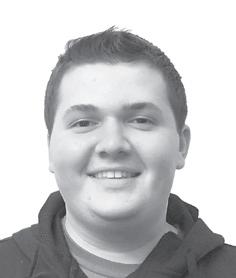
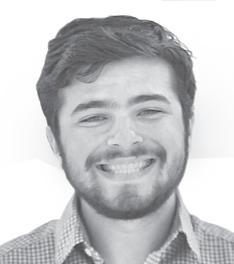
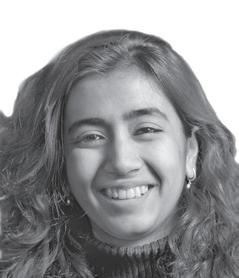




DARTMOUTH
COLUMBIA AT
COWBOYS


Save the season | With no more hope for a league title, Cornell hopes to take a step towards an even league record on senior day this weekend.
An Ivy League title is out of the picture and a winning record would be an uphill battle, but don’t tell Cornell football there’s nothing left to play for in the 2018 season.
After a disappointing 20-7 loss to Penn, the Red welcomes Dartmouth to Schoellkopf this Saturday for senior day and hopes to send off its senior class with a much-needed win. The current seniors have never beaten Dartmouth and are the last class that endured the infamous back-toback 1-9 seasons from 2014-15.
“A lot of people know there are a lot of things to still play for,” said junior running back Harold Coles. “Whether it’s a winning record in the Ivy League or for our seniors the last time they can play. I think everybody is trying to at least prove something to ourselves and everyone else in the league.”
Cornell certainly has its work cut out for it against the nationally-ranked Green.
“It would be huge. Huge,” head coach David Archer ’05 said of notching a senior day win. “Especially beating a team that’s ranked in the top 25. I know we have gotten better, and I know these seniors have helped make us better. Beating a team like Dartmouth Saturday would be validation of it in the win column.”
A win, however, will have to come against a Dartmouth
team that touts just one loss and one of the best defenses in the FCS. The Green entered week seven along with Princeton as the two remaining undefeated teams in the Ivy League teams. But the Tigers came out victorious in the highly-anticipated matchup, 14-9, and the Green fell a step behind in the title chase despite holding the high-octane Princeton offense to 14 points.
For a struggling Cornell offense that has been blanked twice in its last four games and scored seven points in one of the other two, the challenge of yet another lockdown defense comes at a difficult time. In all, Dartmouth will be the seventh top-30 defense Cornell faces this season.
“It’s a great challenge and it only makes us better,” Coles said. “There’s literally nothing to lose when you go into a game like this. … I think we can prove a lot of people wrong.”
Cornell, however, will be reassured by the possible return of junior run-first quarterback Mike Catanese, who has been battling an ankle injury since the win over Harvard in week four. Both Catanese and senior quarterback Dalton Banks will be game-time decisions as Banks is nursing a sore pectoral muscle.
Catanese has been heralded by the team as a spark plug, seemingly able to change the tide of the game with both his feet or arm in desperate moments. The Cornell offense has averaged 10.25 points per game since Catanese went down and has been shut out twice.
“Looking more positive for both of them than not,”
Archer said.
On defense, Cornell will be handed an overwhelmingly run-first offense in the Green. No team in the Ancient Eight attempts more rushes or fewer throws than Dartmouth.
After giving up 177 rushing yards to Penn, Archer and his coaching staff have gotten the team’s focus back on fundamentals with an old-school football game of running on the horizon.
“Last couple games I haven’t liked how we have been able to stop the run or establish our running game,” Archer said. “Our tackling was very, very poor [against Penn] on Friday.”
“We have simplified the game plan so we are lined up before they are,” said senior defensive lineman Cyrus Nolan, who had a screw put into a fractured hand Monday but plans to play against Dartmouth in a cast. “It’s less about scheme and more about the fundamentals.”
The Cornell defense will also have to survive the first half without junior safety Jelani Taylor, who will be forced to sit out the first 30 minutes after being called for targeting in the second half of the loss to Penn.
“It’s going to be hard,” Archer said of losing Taylor, who he calls the quarterback of the defense, for the first half. “Not athletically or physically. It’s going to be tough just to get lined up especially with Dartmouth’s sets.”
“Jelani is a great player and I think we have a lot of other great players, too,” rebuffed Nolan. “We’ll be fine.”
C.U. looks to end 2018 on a high note as a new and improved squad
After losing three straight games to Albany, Princeton and Dartmouth, Cornell men’s soccer will look to end the season on a high note this weekend with its final match at Columbia. Although the Red have struggled of late, this season marks yet another year of improvement for a program which only two years ago finished the season with just one win.
The Red will return nearly every player on the roster next year and will look to improve on this year’s season which saw the team reach national recognition with a spot in the top 25.
In the meantime, however, Cornell is focusing on what they can take and improve upon — including from tough losses such as the overtime defeat to Albany.
“Results aside you want your guys to give everything they’ve got and I don’t think they did [against Albany],” said head coach John Smith. “Despite the fact that we didn’t bring the effort, we shouldn’t have lost. It was one of two games in a three game period where we missed a penalty, and that would have shaped the game. Sometimes it’s those key moments that either go your way or don’t. In that game they didn’t and we lost.”
Despite the Red’s recent struggles,

Smith had nothing but praise for his young team. The young and inexperienced players that make up the roster have grown leaps and bounds over the course of the season.
Players like Emeka Eneli, Charles Touche, Harry Fuller and many others have solidified themselves as legitimate and consistent threats over the course of the season and will only improve through the offseason.
“The season has been a success. I look at it as an overall picture, and we have had a phenomenally successful season regardless of anything,” Smith said. “Two years ago, this program was an embarrassment. The
culture was ridiculously bad, and it was a team that after our first training session had four or five soccer balls. If you look at all the changes that have been made, it’s incredible.”
Smith also commended Columbia in advance of this weekend’s meeting, describing their team and style of play as incredibly technical, impressive and hard-working. He also commented on the difference in the surface they will be playing on this weekend: turf.
“Whenever we’re playing on turf, I make a point of telling our guys that they
have to have poker faces,” Smith said. “They can’t show their cards and let people know that they’re upset that the ball doesn’t bounce normally or the ball is out of bounds a lot. There’s so many moments when you play on turf that you could let yourself get frustrated, but we have to have those poker faces and not show anyone our cards.”
The Red will kick off at Columbia this Saturday at 1 p.m

Bounce back | After a rough start to the season, the Red defeated Yale and Brown last weekend and now looks to build a streak.
By CHRISTINA BULKELEY Sun Staff Writer
Cornell men’s hockey’s first road series of the season isn’t a trip down the street to Hamilton or a few hours east to Cambridge. It’s a two-game set 800 miles away in Marquette, Michigan.
On Friday night, the Red will face off against Northern Michigan in the state’s Upper Peninsula — no matter what lengths the team may need to go to in order to get there.
“It’s planes, trains and automobiles to get there for us,” said head coach Mike Schafer ’86.
After a drive to Rochester, a two-leg flight to Green Bay, Wisconsin and a bus to Marquette, Cornell was scheduled to arrive in time for a practice Wednesday night.
In preparation for the road trip, Schafer is making sure his players are well-rested and ready to go, giving players who were key to this past weekend’s victories a break from practice on Monday.
“Last week was a heavy, heavy work week; we grinded all week,” Schafer said. “You just have to continue to do that — now that [this week] was a lighter week of practice — you need to carry that mentality into the game because you just can’t practice that way all year.”
With such a long road trip ahead, fatigue is certainly a concern among members of the team. But like everything else, the extensive journey brings its fair share of pros and cons.
“It’s so weird,” Smith said. “But you have to put a piece of food on their shoe, and if you get them without their noticing, they have to stand on their chair and sing. You gotta pick a song out and memorize it and sing it in front of the restaurant.”
Even though this rarely happens with the Cornell men’s team, it paints a picture of the types of activities players take part in to pass the time on these long journeys.
“We didn’t have that many long road trips during the year last year,” said sophomore forward Cam Donaldson. “I used to live in Dallas, and we had to drive or fly a long ways for road trips like this and it’s a good way to bond with the teammates.”


“It’s gonna be lack of sleep,” said senior defenseman Brendan Smith. “But I think if anything, it kind of is good … these kinds of trips really do build camaraderie.”
With eight freshmen on the team, building bonds now is crucial — even with a short road trip roster. Chemistry is a vital component of the team, making this trip in the third weekend of the season ideal.
“It’s gonna be a lack of sleep. But I think if anything it’s kind of good ... these kinds of trips really do build camaraderie.”
Senior Brendan Smith
“[Long road trips] usually help teams,” Smith said. “Especially at the beginning of the year — if this were the second half, it might be a little different; guys might get worn down a little faster.”
While Cornell men’s hockey does not have any road trip traditions — or at least none to which outsiders are privy — Smith did describe a common tradition among junior league teams.
Clearly, though the players might not have traveled too much with Cornell, they are all accustomed to the trials of travel from their past years of competition on different teams.
Northern Michigan has a losing record, but they split a series against Michigan State in Lansing, while the Red lost two in a row to the Spartans at Lynah Rink.
“Their 3-5 record is kind of deceiving in terms of who they’ve played,” Schafer said.
The Red last saw Northern Michigan in 2016 at the Florida College Hockey Classic, when Cornell won the semifinal match over the Wildcats by a score of 5-2.
As for the team’s state of mind when comparing their attitudes going into this weekend versus last weekend, nothing has changed. This weekend, however, Cornell is coming off of two wins against Ivy rivals Yale and Brown.
“I don’t think our confidence is any different than when we came off the two losses,” Schafer said. “I think our guys knew we had some things we had to correct and get better at.”
Beyond just the distance they’re traveling, however, the team must prepare for something new in the U.P. — an Olympic-sized rink.
“Olympic sheet ice surface poses an issue,” Schafer said. “It’s just a different game being on Olympic ice surface. It’s 15 feet wider; that makes a huge difference in all your systems — you know, power play, penalty kills.”
Of course, Cornell is somewhat familiar with the international-seized ice sheet. The ice at Lake Placid where the ECAC Championships are held is famously of Olympic specifications. Still, it poses an added challenge.
“They’re on Olympic ice, so that’s a lot of skating,” Smith said. “You got to treat that differently as a defenseman; different angles and stuff like that.”
Perhaps getting experience playing on Olympic ice now will benefit the Red down the road, come time for the ECAC championship. As long as the journey to Northern Michigan might be, it’s an even longer season.
By SMITA NALLURI Sun Staff Writer
After getting off to a thunderous start, Cornell women’s hockey will travel to Erie, Pennsylvania to take on Mercyhurst.
Coming off its first loss of the season this past weekend, Cornell (4-1, 3-1 ECAC) takes a brief respite from conference play for a weekend road series against the Lakers (6-6, 6-2 CHA).
“Mercyhurst has a solid team every year,” said assistant coach Edith Racine. “They present a good out-of-conference challenge for us. We are excited about the matchup and looking forward to it.”
The Lakers hold the series advantage against the Red, 16-9-3, but Cornell defeated Mercyhurst 2-1 in their most recent meeting in 2016.
The Lakers enter the weekend with a .500 record, but has had four of its six losses come from nationally ranked opponents in No. 1 Wisconsin and No. 2 Minnesota.
The Red will also be playing without key starters — junior co-captain forward Kristin O’Neill, junior co-captain defender Micah Zandee-Hart and junior defender Jamie Bourbonnais — and head coach Doug Derraugh ’91.
The trio has been selected to play for the Canadian National Team, with Derraugh serving as the assistant coach, in the 4 Nations Cup that takes place November 6-10 between Canada, the United States, Sweden and Finland.
“Obviously we miss them as they are a part of our team,” Racine said. “We would miss any members of our team that are out, but this is a great opportunity for us to come together as a group.”
The Red will be sticking to fundamentals and honing in on details to sharpen up its game against the Lakers.
“We have been focusing on the little details,” Racine said. “It is the little things that are going to help us this weekend against an opponent like Mercyhurst.”
The puck will drop at 6 p.m. on Friday and 1 p.m. on Saturday at the Mercyhurst Ice Center.
Smita Nalluri can be reached at snalluri@cornellsun.com.