The Corne¬ Daily Sun


Friedman states concern with actions ‘counter to the principles that Cornell holds’
By ROCHELLE LI Sun Staff Writer
The School of Industrial and Labor Relations suspended its exchange program with China’s Renmin University on Oct. 20 because of Renmin’s growing academic freedom restrictions.
Last summer, students from Renmin University were arrested for protesting in support of workers’ rights, according to Eli Friedman, director of international programs at ILR. Friedman said in an email he posted on Twitter that he believes Renmin University failed to protect its students when they were arrested by the police and also issued punishments to students who protested. Over the years, Friedman has also noticed significant restrictions on academic freedom in Renmin University. After consulting Cornell faculty and administration, Friedman decided to suspend the exchange
program.
“Once it became clear that [Renmin] had been taking some actions that were quite obviously counter to the principles that Cornell holds, the question was, what could I do?”
Friedman told The Sun. “I decided that doing nothing was not an option.”
Academic freedom, according to Friedman, is slightly different between students and faculty. For students, it means “learning without fear” and being able to have an opinion. For faculty, it means talking about and researching conflicts. Friedman thinks the Chinese Community Party restricts both to the degree that academic freedom in Renmin University no longer exists.
“Now, for labor [research] as well, you’re explicitly being
By MAGDALENA SMITH Sun Staff Writer
Cornell will mirror national protests by showing support for transgender, nonbinary and gender nonconforming people on Monday, Nov. 5. The rally will take place at 4:30 p.m. on the steps outside Goldwin Smith Hall.
The rally is in response to a memo obtained by the
administration’s Department of Health and Human Services said it is working to establish a legal definition of sex under Title IX such that gender is “on a biological basis that is clear, grounded in science, objective and administrable.” Protest against this memo erupted on social media through the hashtag #WeWillNotBeErased, which the rally is named after.

By MIGUEL SOTO and ANNE SNABES Sun Staff Writer and Sun Assistant News Editor
The College of Arts and Sciences will allow students to take sign language to fulfill the college’s language requirement and will have a “social difference” requirement. The college is hoping to implement these changes in Fall 2020.
The college’s new curriculum proposal was passed on Tuesday, after an online vote for faculty from October 15 to 29. 182 faculty members voted in favor of the proposal, 90 voted against it and 18 abstained.
“I think it’s a good sign that the faculty has come together around the proposal that’s been endorsed by the majority of the faculty,” said Prof. Tom Pepinsky, government, chair of the curriculum committee.
The current distribution
requirement system will be reorganized so there will be 10 distribution categories, and students need to take a course in each category. New categories include statistics and data science, social difference and global citizenship.
The Arts and Science Curriculum Committee released its final report in March. This report recommended shortening the current language requirement — which makes students take one non-introductory course or 11 credits of instruction in one language — to one non-introductory course or two classes of at least three credits each in the same language. This recommendation received pushback from language faculty and graduate students and was ultimately not included in a revised version of
By HUNTER SEITZ Sun Staff Writer
Normally parked at the intersection of Stewart and University Avenue, the Hot Truck has been missing since the beginning of the semester for unknown reasons.
The exact date it disappeared is unknown, but students have
reported that it was not in its regular spot at the start of the Fall 2018 semester.
“I noticed that [it] had disappeared once I got back to campus following my summer break,” Justin Kim ’20 told The Sun. “I drive on that road occasionally and noticed it was missing.”
Robert Petrillose opened the
Hot Truck first opened over 50 years ago in 1960, and he operated the truck until he retired in late 2000. Ownership of the truck was then handed over to Albert and Cindy Smith, owners of Shortstop Deli.
As of yet, there is still no confirmed reason as to why the

By PUNEET VELIDI Sun Staff Writer
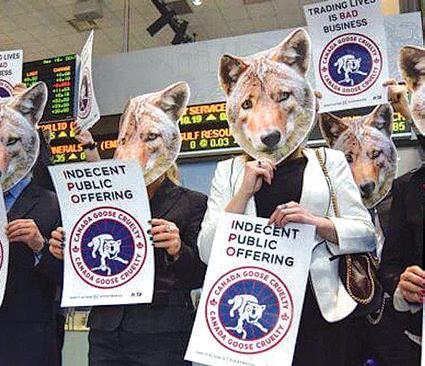
This Halloween, a group of lightly-clothed protestors stood shoulder to shoulder in front of the Cornell Store with red paint on their torsos spelling, “Wear your own skin!”
They were a part of The Halloween Canada Goose protest — organized by the Cornell Vegan Society and Cornell Students for Animal Rights — objecting to Canada Goose’s use of live-plucked down and its method of procuring coyote fur and other furs in general.
The clubs said they “are opposed to the use of all fur and down regardless of brand.”
A demonstrator said that the protest was assisted by People for the Ethical Treatment of Animals.
Other protestors were passing out pamphlets and stickers or holding posters with images of coyotes. There was a group of protestors in coyote masks standing silently holding laptops playing graphic PETA videos of the fur and down industries.
“Coyotes are trapped and left to agonize for days before they are ... removed from the trap when they’re almost dead.”
Lucy Contreras ’21
“As we all know Canada Goose is really prominent on Cornell’s campus, mostly as a status symbol but a lot people don’t know that the fur trim comes from actually killed coyotes that are skinned,” said Lucy Contreras ’21, president of the Cornell Vegan Society.
“Coyotes are trapped and left to agonize for days before they are actually removed from the trap when they’re almost dead. At that point, they’re skinned, even if they’re still alive,” Contreras added.
“The inside of the Canada Goose jacket is made out of live-plucking geese so the process is ... they yank off the feathers and leaves red blood spots,” Contreras said. “This happens their whole life until they’re slaughtered.”
The protestors were in front of the store for two hours. Contreras said that they chose to protest on Halloween because “Canada goose is scary” and “the masks and painting fits the Halloween theme.”
She said that since Cornell was a progressive space, it would be receptive to their message.
Throughout the protest, onlookers talked to demonstrators who explained the reasons for the protest and received posters and stickers from the demonstrators.
Some onlookers thought that the protest was useful, bringing attention to the issue.
“I feel like people are set in their morals when they buy this sort of thing because they feel like it’s the same thing as eating meat,” said Richard Green ’21. “It’s conspicuous ... so people will stop [to look].”
Contreras said that she wanted to “start a conversation,” acknowledging the provocative display.
“If this protest is too radical for you ... do your own research,” she said. “We’re not nitpicking.”
She said that overall the protest was successful because they changed a lot of minds and informed many people.
Some people even put a sticker “Canada Douche” on their Canada Goose jackets, saying they wouldn’t buy a Canada Goose again, and others said that they would tell their friends, she said.
“We’re willing to sacrifice a lot of things in order for our message come across,” Contreras said. “It doesn’t compare to the level of suffering the animals are going through.”
By MAGDALENA SMITH Sun Staff Writer
Cornell Sustainability Fellow Jennifer Carlson discussed the politics of contemporary climate change denialism in a lecture Tuesday.
Carlson is a cultural anthropologist and researcher, visiting fellow at Rice University, and the author of Unruly Energies. She holds an A.M. from the University of Chicago and a Ph.D. from the University of Texas. Her talk was titled “Denial’s Authority: Anti-Environmentalism and the Aesthetics of Negativity in Contemporary Climate Politics.”
“You could say it’s kind of a Frankentalk, which is appropriate for the day before Halloween,” Carlson quipped, encouraging attendees to engage in difficult conversations — including ones about the end of the world.
Climate denialism is predicated on a number of factors and cannot be ended by simply presenting denialists with scientific information, Carlson said. Instead, “it is necessary to unpack the underlying reasons that we disagree about climate action before we can find constructive ways for acting politically in the world,” she said, paraphrasing climate geographer Mike Hulme.
come people.
Carlson argued that “when we stop thinking primarily of denial as a deficit to be remedied, and instead envision it as a negative move that grounds a positive, if ecologically problematic, sociality, we can gain greater perspective on consequential formations of power and capital.”
The most recent United Nations climate report states that emissions and consumption must be radically cut for humans to survive, which will require fundamentally changed economic, political and social structures and an end to contemporary laissez-faire capitalism.
“A growing number of scholars have called for the democratization of climate governance.”
Jennifer Carlson
“Existing strategies of climate governance are not only insufficient to safeguard humanity’s survival, they can also work to undermine the very sustainability they set out to promote,” Carlson said. “While contemporary climate governance relies on accurate science, fostered in long-standing and committed collaborations that are often extremely arduous, the technocratic apparatus through which that governance takes shape has fallen strikingly short of its aims.”
“A growing number of scholars have called for the democratization of climate governance,” Carlson said.
“We have to get the politics right before we can act,” she said.
Scientific consensus on the environment has been used to justify suspending democratic norms in regions affected by climate change, thus exacerbating global inequality, Carlson said.
Incorporating climate denialists into discussions of climate action can inform how societies fight climate change, Carlson said. Without legitimizing the denial of scientific consensus, it is useful to understand the roots, manifestations and consequences of climate denialism.
Denials of climate change include refusal to believe climate change exists, as well as disillusioned convictions that the end of the world due to climate change is imminent and inevitable, according to Carlson.
Climate cynicism is perpetuated by rampant national, regional, and global economic inequalities, Carlson said. Those at the top of the global socioeconomic hierarchy can buy mansions in the areas climate change will destroy last, and climate change is not a main priority for low-in-
In order to engage our societies to salvage the planet, “we don’t need transparency: we need conversation,” Carlson proposed. Attempts to enforce adherence to a singular narrative of how to fight climate change have constructed a binary of being either with or against the fight for climate justice, which is a false dichotomy: climate denialists can still advocate for climate justice, she said.
Seeking to understand climate denialism as a societally predicated phenomenon rather than a lack of scientific understanding is more productive than viewing denialism solely as an environmental false consciousness, she said.
“By engaging with [our] differences, perhaps we can find new ways of allying… in collective action against climate injustice in ways that are incomplete, not always easy, not known in advance — this might open other avenues towards changing our ecologically harmful ways,” Carlson concluded. “And in so doing, maybe we can lend partial voices to a new story of action against global warming. Because our storytelling has been democratized, and democracy is an open experiment.”
Application uses phone’s front-facing camera to assess a user’s alertness levels
By LUCY XU Sun Staff Writer
Smartphones are now capable of telling users’ bodies about their physical activity, heart rate or sleep amount. New research from the People Aware Computing Lab may be adding user alertness to that list.
For the past two years, a group of four researchers in the Cornell lab have been working on AlertnessScanner, an Android application that utilizes a smartphone’s front-facing camera to assess a user’s alertness levels.
AlertnessScanner is one of many research projects being carried out in the People Aware Computing Lab, headed by Prof. Tanzeem Choudhury, information science, which focuses on developing mobile sensing systems for capturing, learning and interpreting human activities.
the smartphone’s camera when the user unlocks their phone.
According to the researchers, measuring pupil size has been shown to be effective in determining a person’s fatigue and alertness since the size of a person’s pupil is controlled by two complementary nervous systems — the sympathetic nervous system and the parasympathetic nervous system — that cause the pupil to dilate when a person is alert and to constrict when they are drowsy.
“For example, students can determine their prime time for accomplishing tasks.”
Vincent Tseng
To account for the varying distances that a user’s eye may be from the camera at the time of image capturing, AlertnessScanner utilizes PIR, pupil-to-iris ratio, as a measure for pupillary response.
Such method uses the user’s iris size, which remains constant in diameter, as a reference to determine pupil size.
“Alertness has a great impact on our performance,” said Vincent Tseng, a Ph.D. student working on the project.
“We are interested in seeing if we can measure and understand the changes in people’s alertness unobtrusively using smartphones, which people regularly interact with.”
The app does so by measuring the change in a user’s pupil size through analysis of a burst of pictures captured by
As part of this task, the researchers developed a computer-vision-based algorithm that extracts the PIR measure of a user’s pupils using eye detection, iris segmentation and pupil segmentation.
The research team hopes that by making alertness information available, people can meaningfully influence and interact with the world around them.
Magdalena Smith can be reached at mrs444@cornell.edu. Lucy
So far, the team has conducted two in-the-wild studies involving Cornell students as research subjects to evaluate the effectiveness of the application.
Participants in the study were given Google Nexus 5 phones with AlertnessScanner downloaded to use. Over the course of three weeks, the app collected sleep data and captured images from the users. Additionally, users were asked to complete a Psychomotor Vigilance Task, an objective method of determining alertness. At the end of the study, the data collected by the app is compared with the data from collected from PVT.
The results of their studies suggest that AlertnessScanner is accurate and reliable in evaluating alertness and that it is possible for the application to replace other less convenient methods of alertness assessment.
Going forward, the team wants to utilize its findings from this project to gain better understanding about people’s productivity and performance.
“We’re currently in the process of developing a study such that we can get signals from phone data and behavior data to know when people perform better and see how the curve changes over time,” Tseng said.
“The goal is to know the peak and low point of our alertness,” Tseng said. “Then, we can also learn other things about ourselves. For example, students can determine their prime time for accomplishing tasks, and surgical clinicians or employees with demanding jobs can see when they experience highest level of alertness.”
can be reached at lxu@cornellsun.com.

Women empowerment in agriculture | Hazel Malapit from the Poverty, Health and Nutrition program will discuss women in agriculture in Savage Hall.
Today
Geography, Search Frictions and Endogenous Trade Costs
11:40 a.m. - 1:10 p.m., 498 Uris Hall
Measuring Women’s Empowerment in Agricultural Development Prograams 12:20 - 1:10 p.m., 100 Savage Hall
Exploiting Geometry and Disorder in Exotic Quantum States of Matter
1 - 2 p.m., 416 Physical Sciences Building
How to Text Like a Sumerian 1 - 2 p.m., 419 White Hall
Women’s Rights and the African Union Agenda 2063 2:30 - 4 p.m., G08 Uris Hall
Manipulating Exciton Dynamics for Energy Conversion Applications 4 - 5 p.m., 119 Baker Lab
Thermodynamics and Machine Learning 4:15 p.m., 416 Physical Sciences Building
The Work Captives Did: The Consequences of Captive’s Labor in Small Scale Societies 4:30 p.m., G22 Goldwin Smith Hall
Reconstructing Leadership: Why Economics and Empathy Matter in Equal Measure 4:30 - 5:30 p.m., Alice Statler Auditorium
Implicational Generalizations and Stringency: The Final-Over-Final Condition
4:30 - 5:30 p.m., 106 Morrill Hall
Similarity, Difference and Social Conflict 11:40 a.m. - 1:10 p.m., 142 Goldwin Smith Hall
Overview of Recent Progress and Potential Applications for Process Systems Engineering 12:15 p.m., 253 Frank H. T. Rhodes Hall

Precision in proteomes | Dr. Haiyan Yu will speak on the relationships among genes, complex molecular networks and computational models tomorrow.
Managing Metals in Microbes: New Insights for Bacillus Subtillis
12:15 - 1:15 p.m., Lecture Hall 3 College of Veterinary Medicine
Bringing Context and Agency More Fully Into Cultural Psychology 12:20 - 1:30 p.m., 202 Uris Hall
Precision Medicine Through Proteome-Scale 3D Interactome Models and Network Perturbation Studies
2:30 - 3 p.m., 226 Weill Hall

RENMIN
Continued from page 1
told ‘That is not a valid question. Here are the questions that are valid. Here are the types of conclusions that we determine to be valid.’ And they all have to be sort of in line with the politics that Xi Jinping has been advocating,” Friedman said.
Friedman said that Renmin University isn’t the only Chinese research institution restricting academic freedom and that Cornell isn’t the only foreign institution grappling with this problem. Other universities deal with restrictions in a “quiet diplomacy”, hoping that in the future, Chinese universities will have more academic freedom.
“But that strategy has failed,” Friedman told The Sun.
The exchange program sent eight to 10 students each summer to Beijing to study at Renmin. During the school year, the ILR school typically accepted two to three students from Renmin for a semester.
“While my experience at Renmin was a transformative month of intensive language learning and a renewed appreciation of Chinese history, the current acts of suppression against Renmin’s students cannot go unanswered,” Cameron Dunbar ’21, who participated in the program, told The Sun in an email.
The current Renmin University exchange
students at Cornell won’t be affected by the program’s suspension and will be able to continue as Cornell students for their semester, according to Friedman.
The Renmin students at Cornell this semester declined to comment on this story.
Weifeng Yang ’20, a Chinese international student, observed that Cornell’s Chinese international students were largely indifferent or in support of the ILR school’s suspension. According to Yang, his mother sent him a screenshot of a WeChat group chat of around 500 Chinese parents where one criticized a Chinese news article about the suspension. Yang said the parent argued that the article failed to properly support its arguments or explain why the partnership ended. Yang supports the suspension.
“In many ways Cornell students when they go to Renmin University are basically fed propaganda,” he told The Sun. “Academically speaking, this program is also not worth continuing.”
Friedman thinks the suspension will make an impact on other foreign universities’ relationships with China. Since the Financial Times broke the story last Sunday, Friedman has received messages from “a flood” of academics across the world, with one from a U.S. university, telling him that their university is reviewing its relationship with China as a result of the suspension.
“I was a little surprised, I thought that I
ARTS
Continued from page 1
the proposal released in June.
Faculty also made amendments to the proposal in a meeting on October 3. The amendments included changing the name of the “human difference” distribution category to “social difference” and clarifying the meaning of “double-listing” courses under two distribution categories.
The March report also recommended that students be able to use sign language to fulfill the language requirement, and that recommendation remained in the new version of the proposal that was passed.
Mary Grace Hager ’19, president of Cornell University Deaf Awareness Project, said American Sign Language “meets every linguistic definition” of a language, so there is no reason that students should not be able to use ASL courses to fulfill the requirement.
“Taking such classes would also allow students to learn about Deaf culture, just as any other foreign language course at Cornell introduces a new culture,” Hager said. “Additionally, many students come to Cornell after having taken ASL classes in high school, but have no way to continue their ASL education here.”
According to Pepinsky, three years of work went into changing the distribution requirements. Pepinsky said he did not have any plans to propose any future changes to the curriculum.
“My guess is that this curriculum will remain for quite some time,” Pepinsky said.
Pepinksy said the new changes will not take effect until fall 2020, but “even that may be a little optimistic.” Current students will not face any changes to their graduation requirements. Before the new changes are implemented, however, there “could be some fiddling around the margins in terms of implementation,” he said.
would announce this and I thought maybe there would be one small article buried in a newspaper somewhere and that would be that, but it has clearly struck something of a nerve,” Friedman said. “Whether it leads to the desired result … remains to be seen.
Two prominent newspapers in China, Global Times and People’s Daily, wrote articles about the program suspension. Global Times wrote that the decision was “part of unreasonable changes in U.S. engagement with China.” The Cornell Alumni Association in China also released a statement yesterday, which Yang believes played down the significance of the suspension.
Friedman first contacted Renmin University about these concerns on August 30 and formally suspended the program October 20. Hu Xijin, the editor-in-chief of the Global Times, incorrectly tweeted that Renmin had only received news of the suspension through the Financial Times story. Friedman responded with a screenshot of his email to Renmin. Renmin officials did not respond to requests for comment by any news sources outside of China, including the Financial Times and the New York Times.
Cornell is not completely cutting off ties with China. The Cornell China Center, which aims to foster a collaboration between Cornell and China through research and education, is continuing its development in China. But the Cornell faculty was
concerned even before the ILR school announced its suspension. The East Asia Program held a meeting among faculty a couple weeks ago about this issue, according to Friedman. For now, the program has decided to remain in cooperation with other Chinese universities.
“The Cornell China Center is devoted to supporting the commitment that the university has, for a long and rich history, to continue and further develop meaningful collaboration with Chinese partners, of which Chinese universities are an important part,” Ying Hua, director of Cornell China Center, told The Sun in an email.
The current suspension is not permanent. If Renmin University changes and begins to support academic freedom, Friedman is willing to reconsider the suspension. Renmin University’s restrictions on academic freedom is not the university’s fault, but rather the fault of the Chinese Communist Party, Friedman said. These restrictions occur in all Chinese research institutions.
“Cornell has really put itself in a position to lead on this question of academic freedom in thinking about how to maintain our commitment to academic freedom and those sorts of principles as we engage in China,” Friedman said
RALLY
The new social difference requirement can be fulfilled by classes that “take class, race, ethnicity, nativity status, religion, gender, sexuality, or ability as an object of study,” according to the proposal.
Prof. Durba Ghosh, history, director of the feminist, gender and sexuality program, said she is “pleased” that social difference is one the distribution requirements that students need to take to graduate from Arts and Sciences.
“I think most students think of questions of diversity and inclusion as a part of their education at Cornell so I am glad this set of requirements validates what many students are already doing,” Ghosh wrote in an email to The Sun. “This curriculum is a promising step toward affirming the college’s commitment to our motto, ‘any person … any study.’”
Ghosh said it is “unclear” how the requirement will change the appeal of FGSS and LGBT Studies classes and whether it will affect enrollments. She added that the reform to the curriculum “builds on” the programs’ current offerings, which she hopes “validates the important pedagogical and scholarly work done by all the programs with a strong presence in the college,” including American studies and Asian American studies, among other programs.
“It’s hard to know what lies behind the faculty who did not endorse the new curriculum,” Pepinsky said, explaining that faculty might have thought the new changes were not “meaningful” or “substantial” enough to vote for.
Pepinsky encouraged students to remain “engaged” in the changes to the distribution requirements.
Miguel Soto can be reached at msoto@cornellsun.com. Anne Snabes can be reached at asnabes@cornellsun.com.
Continued from page 1
“In a national climate that forces trans students to actively fear for the future of our health and safety, community commitment to supporting us through whatever comes next is what provides us with hope for the stability of our futures,” reads the Facebook page for the Cornell We Will Not Be Erased rally. “Show up for us and show us, Cornell, Ithaca, and the world that there is an army of people who know we are not going anywhere.”
According to the New York Times, the United States’ definitions of sex and gender, if established, will not recognize the identities of intersex people, transgender people, nonbinary people, gender nonconforming people and anyone whose gender identity falls outside the binary sex assigned to them at birth.
If the legal definition is altered to match the memo, it would affect 1.4 million Americans who have recognized themselves officially as a gender other than cisgender, according
to the New York Times.
The 2012 Equal Employment Opportunity Commission determined that “discrimination against an individual because of gender identity, including transgender status, or because of sexual orientation” is discrimination of sex, which violates Title VII. That year the United States Department of Justice adopted the same interpretation, but in 2017, it stopped using the interpretation.
The 2014 Executive Order 13672 issued by Obama further supports the rights of individuals with gender identities other than cisgender, as it prohibits “discrimination based on sexual orientation and gender identity.”
The Matthew Shepard and James Byrd Jr. Hate Crimes Prevention Act, Violence Against Women Act and Hate Crime Statistics Act all prohibit discrimination on the basis of gender identity — including transgender, nonbinary and gender nonconforming identities.
According to the New York Times, harmful repercussion
could include more obstacles in discrimination claims, increased difficulties accessing health care, and psychological and physical impacts on the mental health of people whose identities would be written out of existence.
The article also said the policy could heighten discrimination against transgender, nonbinary and gender nonconforming people attempting to enter the country if their identity documents do not match their gender assigned at birth. There could also be greater risks of assault and harassment for incarcerated individuals after being placed into prisons that do not correspond with their gender identities.
The rally will be in support of those whose identity would be legislatively erased if the discussed legislation is passed and in protest of the current administration further revoking the rights of anyone with a gender identity other than cisgender.
Magdalena Smith can be reached at msmith@cornellsun.com.
HOT TRUCK
Continued from page 1
truck has been missing. Students have speculated on a variety of reasons, ranging from the truck going out of business to issues with city permits.
The Shortstop Deli declined The Sun’s request for comment on the truck’s disappearance.
“I would go like once a week because it came in really clutch but wasn’t open during the week and only on the weekends,” James Abert ’19
said. “If it were open during the week I’d likely have gone more often. My go-to order was a Shaggy.”
“I used to go maybe once or twice a month,” Kim said. “My go to order has been the PMP — Poor Man’s Pizza.”
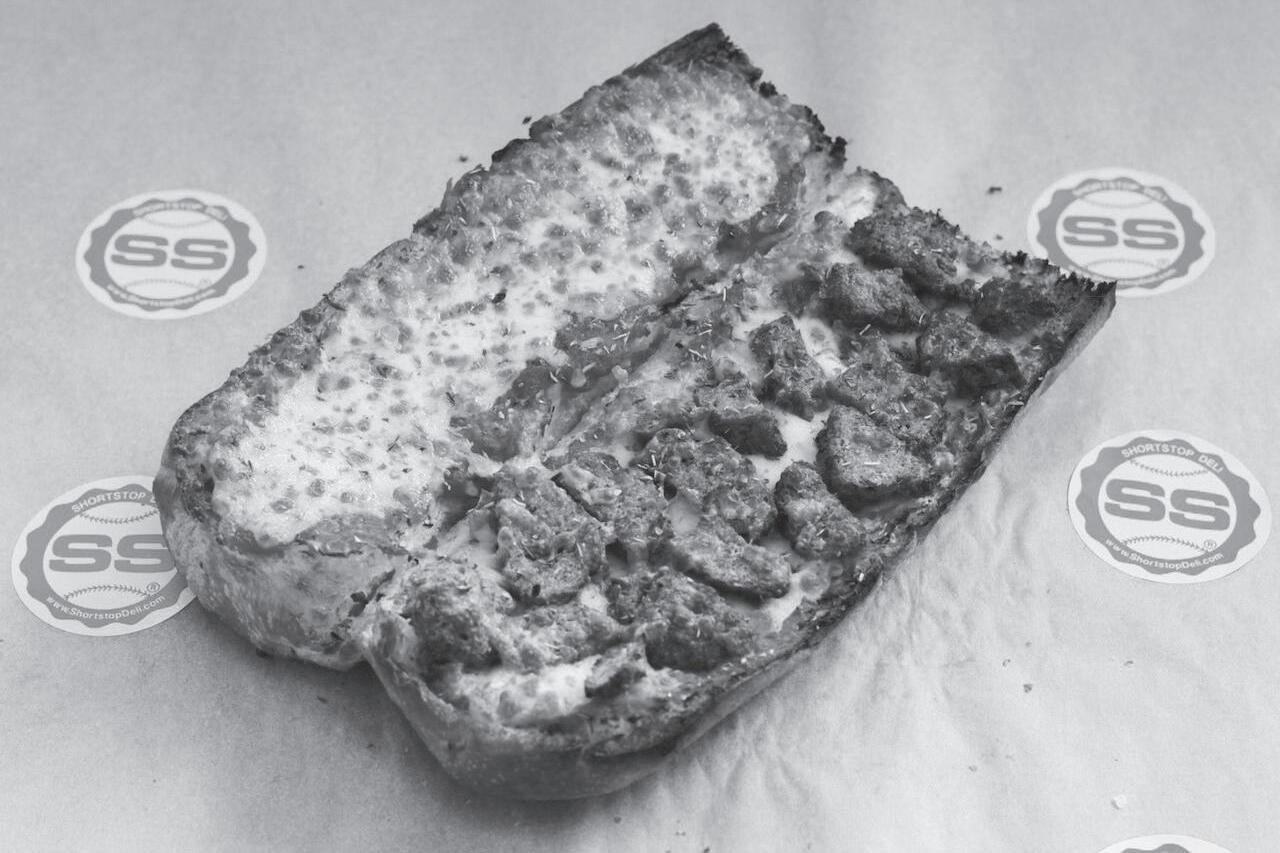
The PMP is mozzarella cheese and pizza sauce between two pieces of French bread baked in an oven and was born in Petrillose’s father’s restaurant, when Petrillose noticed some extra french bread lying around restaurant, The Sun previously reported.
The sandwich would grow
in popularity since its creation, even landing itself a spot of The Sun’s “161 Things Every Cornellian Should Do.” Its reputation wasn’t just limited to Cornell’s campus. In the same article, it mentions that Petrillose sold the idea to Stouffer’s, and it even inspired a handful of Cornell alumni to start their own restaurant in Boston.
Hunter Seitz can be reached at hseitz@cornellsun.com.
136th Editorial Board
JACOB S. KARASIK RUBASHKIN ’19 Editor in Chief
JOHN McKIM MILLER ’20
Business Manager
KATIE SIMS ’20
Associate Editor
GIRISHA ARORA ’20 Managing Editor
HEIDI MYUNG ’19
Manager
VARUN IYENGAR ’21
Editor
Working on Today’s Sun
Ad Layout Jamie Lai ’21
Design Deskers Emma Williams ’19
Krystal Yang ’21
Simon Chen ’21
News Deskers Anu Subranamiam ’20
Anne Snabes ’19
Night Desker Maryam Zafar ’21
Arts Desker Lev Akabas ’19
Dining Desker Jacqueline Quach ’19
Photography Desker Michael Li ’20
Production Deskers
Krystal Yang ’21
Emma Williams ’19
As someone that is engaged in politics, passionate about advocacy and dedicated to creating legislation to improve the well-being of marginalized communities, it is quite ironic that I only just registered to vote.
The last day to register to vote in New York was October 12, and just like many of my homework assignments, I waited until that day to do it. I have been of voting age for well over a year now, and just never had the stamina to take the few minutes it took to register. I pulled out my state ID, typed in a few numbers and then all of a sudden I was registered. After the satisfaction of finally checking a task off my list, I then had to stop and think to myself if I will actually bring myself to vote.
If we know we should, why aren’t people voting? Considering how divided our country is over the current administration, the voter turnout for the 2016 elections was quite upsetting. Only 58.1 percent of our voting eligible population voted in the presidential election. People unhappy with the results continuously asked themselves how Donald Trump won, and this can be attributed to the large amount of voters he rallied from commanding demographics such as rural America, swing states and the white female population. There was also a sharp decline in black voter turnout, where only 59.6 percent of black voters voted in the presidential election, a 7 percent decrease from 2012. Because lack of diversity of voters, the election resulted in an administration that may not be working in the best interest of some marginalized groups.
In the upcoming elections for 2018, there are a number of races coming up at the federal, state and local level. Numerous Mayors, 36 state governors, three U.S. territory governors, one third of the Senate, and all 435 seats in the U.S. House of Representatives.
These are the people with detrimental power. The electoral college system they work within distorts the one-person-onevote principle of democracy, as these people represent carefully carved out regions of America. Even if the general public doesn’t want to see someone in the Oval Office, it is our representatives votes that decide who the next president of one of the strongest nations will be. So, if we know the midterms are important, why don’t we vote?
Another underrepresented group is the youth. If millennials such as myself are becoming increasingly conscious of the political turmoil occurring in this country — regardless of their preferred political party — then why are we not turning out? Millennial voting rates have never exceeded 50 percent, even for candidates like Obama or Sanders. We see students quarter-carding and setting up tables along
Ho Plaza, telling us that “Your vote and your voice matter!”, yet students keep pushing along. The apathy associated with voting and the intense indignation related to politics clashes, and has resulted in a generation of young adults who have all of the verve to tweet about a problem, but not to actually do something about it.
So again I ask, why don’t we vote? The biggest problem with the voting process is accessibility. Although it took me a few minutes to register to vote at the deadline, the voting process that comes after can be quite complicated. Things like lack of access to unbiased and easy-to-understand information on all candidates, to voter suppression, leaves people who are actually disadvantaged — and would benefit from representation — unable to vote.
This doesn’t fail to be present in an Ivy League institution like Cornell. Many students haven’t done their own research, or been provided with the research, on political candidates that align best with their personal interests. Nationally, there are eligible voters who don’t even know what they are voting for if it is not for another president.
I asked my friends from all over the U.S. if they have voted before. For many, the answer is no; they missed the deadline, they are out of state, they don’t know how, they don’t know who to vote for; the list goes on.
We have to keep in mind that we all come from different familial and academic backgrounds, and study diverse educational fields. Not everyone is constantly exposed to the political information they need.
There is hope for our progress. There was an approximately thirty-five percent increase in Cornell student voter turnout between 2012 and 2016 for the presidential election. But the there is more progression in other elections. At an institution like Cornell, which cultivates the future leaders of America, the University should ensure that all of students questions are answered concerning voting as part of their academic guidelines, and that it is accessible for us to be able to go out and vote. We are going to be the ones inheriting the country.
When I go to vote for the midterm elections, I will go with the belief that my single decision will influence the well-being of thousands of underrepresented people nationally, and millions of underrepresented people globally. We can no longer blame the government for all of the problems we face, when our missing votes put politicians in positions of power. We must take the first step on this campus. I implore you, go out and vote.
Aminah Taariq is a sophomore in the College of Agriculture and Life Sciences. I Spy runs every other Wednesday this semester. She can be reached at ataariq@cornellsun.com
My parents packed all their luggage in one just bag when they came to the United States from China. That’s a story my family loves to tell over and over again — the layers of coats my mother wore so she could bring over all her clothes, the prized kitchen knife my father snuck past security, the Scott McKenzie song playing on the airplane when they first landed.
But I never quite thought about what my parents couldn’t pack — the scallion pancakes from the shack downstairs in their province, my mother’s pink bike she rode for three days on a road trip, the Napa cabbage blooming behind their old home. All their brothers, sisters, cousins. Those were all faint elements I knew existed, but never saw for myself.
My grandfather passed away a few weeks ago. I found out in the middle of fall break while mining quartz with my boyfriend. Squatting in the quarry, with goggles that made my face look too wide, it stung. I wanted more time with him. I wanted to fly back to China again, to refuse my parents all those times when they said we were too busy. I wanted to tell them it was never too hard to get on an airplane.
After my grandfather’s passing, I became distinctly aware of the tragedy of the immigrant family, and the grandparents that are left behind in the process. My family and I have only visited China twice together, meaning I was only able to see my grandparents a handful of times. Flying the elderly across continents was hardly an option, and uplifting a family in the middle of work and school was equally challenging.
the Chinese mantra: we grow up to serve our elders. But I never truly reconciled with the fact that my elders would outgrow me, or that I wouldn’t be able to visit them. I remember feeling angry that I had to grasp onto those moments; time with family shouldn’t be limited, it should be a life necessity to have people you love surround you. But perhaps it is because those days were numbered that makes them special.
When someone comes up to me and degrades an immigrant, I often wonder — do they know what it’s like to leave everything behind? I wonder if they know what it’s like to wish for a big family, knowing they have one waiting for them overseas, and being unable to see them. Do they know the smell of foreign snacks, the fumbling hands that fed them congee, each a cherished memory that is rarely relived?
I remember the distinct glow of finally seeing a real family.

I only remember him briefly; how he spoon-fed me egg pudding in my high chair and read me a Buddhist passage from his book, taking care of me while my mother was at work. I remember how my mother used to send him to follow me on my walk to school — I hated having a chaperone, insisting I was “old enough” while bouncing around with a Hello Kitty backpack. Now, I’d do anything to rewind time; I’d slow down my pace and walk with him.
When my mother called me about my grandfather getting sick a few weeks ago, the most frustrating part was being unable to do anything about it. Only my mother was able to fly back China in time, booking her plane ticket as soon as she found out. By the time she arrived, he was already in a coma.
I wondered, what could that feel like, your father so inaccessible you don’t even have time to say goodbye?
I think that’s the way China feels for many children of immigrants; somewhere distant, but still deeply connected. I still remember our home in China the way I did when I was nine — it’s been so long since I’d been back. I remember buying milk in a plastic bag off the carts on the streets, heating it in a boiler pot for breakfast. I remember the spice of herbal medicine, jerky my grandmother served for lunch, watching TV shows with my grandfather; him in his knitted vest, me in a purple sweater. My grandfather always asked if I was hungry — I always told him I was, hoping to sneak in another pork bun or a spoonful of sesame. I was too foolishly young to think of giving him the last bite, but he didn’t mind. How I thought those moments were immortal; when you’re nine, you think anything can last.
I hoped that when I got older, I could be the one to feed him porridge. That’s
There’s an emptiness to being the second generation of an immigrant family, and realizing most of your family has been left behind. I remember aching for that big family, one that was whole. I envied Thanksgiving dinners with huge tables of bunches of cousins, and the pair of grandparents beaming at the front, Grandma bringing out a turkey in her floral apron. Instead, during the Lunar New Year, my father would stick the telephone in the middle of our tiny dinner table and put my relatives on speaker. They would all be on the line, sharing the dumpling recipes we were all making simultaneously.
The few times I flew back to China, I remember the distinct glow of finally seeing a real family. I remember my grandmother sticking a plate of shrimp and wintermelon under my nose as soon as I stepped into the house, her comfort food for a long plane ride. My head would be careening from the jet lag, but I always had an appetite for those strange, authentic versions of dishes I’d always known. My grandfather would come downstairs, bundled in scarves from the winter, carrying a newspaper. His granddaughters were home, and it was a rare sight — the next morning he’d take me to the streets, pointing out shoes he’d like to buy for me, sneaking me a red bean pancake.
It was those family reunions, packed with food every night for two weeks straight like it was a holiday, that made me realize how stepping foot into their province was not just a visit — it was a homecoming, long overdue. And it was one they knew they wouldn’t see again for a while. My uncle bought me a string of candied hawthorns every night, knowing how much I loved them. Every bite of food, every story told, had to be savored.
China is now just a memory — dusted lanes with bikes, children in blue jumper uniforms, bookstores with colorful pens. But it will always be my home; the one that exists, but is inaccessible. The one that is warm with grandparents and cousins and aunts and uncles, who will have ginger candies and tea eggs on the table, and shoe stores at the giant malls they picked out three weeks in advance to show me. I know they will be there to welcome me; I just hope I can go back while there’s still someone waiting.
Kelly Song is a junior in the College of Arts and Sciences. The Songbird Sings runs every other Thursday this semester. She can be reached at ksong@ cornellsun.com
was an endless cycle of expectations, pain and apologies. I kept telling myself I was nervous, a comfortable excuse at this point, and pushed it out of my mind.
But deep down, I really wanted to have sex. I was scrolling through YouTube on my phone one night, when I came across a Buzzfeed video about someone else who experienced painful sex. Every symptom she listed matched mine. Chronic discomfort? Check. Can’t wear a tampon? Check. Sharp stabbing when I tried to have sex? Triple check. Maybe it’s questionable to trust Buzzfeed for a medical diagnosis, but I was convinced I had a condition called vulvodynia.
I made an appointment with a gynecologist ASAP. As soon as the doctor came into the examination room, I told her that I wanted to be tested for the condition. She was surprised, but she obliged. I lay down, spread my legs, and took a few deep breaths. “I’m going to touch you with a Q-tip. Tell me when you feel pain,” she instructed. A second later, I was begging her to stop the exam. “Was the Q-tip able to go in at least?” I asked hopefully. She shook her head no. I received confirmation of a diagnosis I already knew and went home. I felt broken. So what happened next? If this were a movie, there would be a montage of doctor appointments, steroid creams, antidepressants, laser treatments and vaginal dilators. There’s no one cure. Instead, it’s a series of trial and error. Nothing about this is pretty. Nothing about this is attractive.
Vulvodynia sucks and there’s no pretending it doesn’t. Living with this doesn’t always make me sad, or angry, or scared, but sometimes it makes me all three. I was hanging out with a friend in my room, when suddenly I remembered I had physical therapy to do, so I asked him to leave. “Why?” he teased. “Do you have a guy coming over?” I looked over at my night table drawer, which safely housed my baby pink dilator and some lube, and said, “not quite,” before shoving him out the door. It’s at times like these that I feel the emotional pain of my condition the most. I feel it when there’s a sex scene on TV. I feel it when I’m swiping through Tinder. I feel it when my roommates get asked out on dates and don’t return until the next morning. I feel it even when I think I’ve forgotten about it, when it creeps up again without warning. So on the nights that it’s hard to deal with, and I find myself scrolling through the comments section on the Buzzfeed videos that diagnosed me in the first place, I remember that I’m not alone. I remember that I’m not less deserving. I focus on the small victories, like keeping my dilator in for an extra minute or going a third day in a row without any discomfort. And I’m hopeful that I’ll have bigger victories in the future. That’s not always reassuring, but as I continue to have more good days than bad, I know they are right around the corner.
Three words. Say them, and I’m yours. Arguably the sexiest words I want breathlessly whispered in my ears. The only sentence I want my man to blow up my phone with.
Three words. 11 letters.
Sex. On. Campus.
Let’s just say, I got a bit carried away by Numero Uno on the list of 161 Things Every Cornellian Should Do, “Make the library into your bedroom and have sex in the stacks.” Instead of just making the library my bedroom and having sex in the stacks, I made this entire campus my bedroom and had sex, well, everywhere.
The first time I had sex on campus really opened up a can of worms for me. It was just too easy, and so damn good. I lost my “Sex On Campus” virginity late one sultry fall night. Venturing home from a date night in a tight black dress and heels, my man and decided to take detour and explore McGraw Hall. The lecture hall in McGraw quickly became the hottest place on campus.
In the big, dark lecture hall, we were feeling extra frisky, with a scandalous rush of adrenaline coursing through us. My man sat in the front row, and like the dirty little schoolgirl I am, I got down on my Ivy-educated knees and starting sucking his Bingalee Dingalee. Tearing off our clothes, he picked me up and carried me to the table in the front and center of
the hall. Like a professor setting down his notes before lecture, he laid me out across the podium. There was something extra sexy about hiking my skirt up and wrapping my heels around his waist as he fucked me in front of the classroom. I couldn’t help but imagine that the lec ture hall was filled, and all eyes were on us. Is this what Ezra Cornell would have wanted for me?
Regardless, after this first time, I was hooked. I became Ezra’s Horny Little Schoolgirl. Between classes, I cross my fingers that I’ll get a text, “meet me in XXX location in 15 minutes.” In my favorite single occupancy bathroom sexscapade, my man bent me over and we boned right in front of the mirror. It was a spectacular visual; I’m pretty hot in action. Watching him put his McGraw Tower into my Ezra’s Tunnel drove me wild. Ironically, I was holding onto a baby changing table as he railed me — which seemed to be the uni verse’s reminder that babies = yikes. The bathroom got steamy, and the mirror fogged. As he lifted me onto the sink, I reached my hand up behind me in a Titanic-like fashion and dragged a wet handprint down the mirror. When we finished togeth er, it was like the Cherry Blossoms on Ho Plaza burst ing in bloom. A sight to behold.
Single occupancy bathroom sex became a dirty little secret we shared. I would go to my next class slightly flushed, slightly sweaty, and fully satisfied.
boning in every possible location at every possible moment? No, probably not. Get while the gettin’s good.


By PIPER TORPEY Sun Contributor
Ithaca sushi: one of the most heavily debated topics among students on Cornell’s campus. While some Cornellians swear by That’s How I Roll, others contend that Plum Tree is the best, and some refuse to even step into a sushi restaurant in this town at all. But alas, I believe that I have found the winner: Mitsuba. Nestled on a commercial strip near Ithaca Mall, Mitsuba offers the great flavor and affordable prices every college student yearns for when it comes to sharing a meal with friends.
Housed in a lofty space with large tables and an open sushi bar, Mitsuba has a casual ambiance that welcomes you the moment you step through the door. With only some paintings and bamboo plants for decor, Mitsuba’s overall aesthetic leaves much to be desired, but the extensive selection of Japanese fare on its menu more than makes up for it. I won’t waste too many words on the sparse decor when there is so much to be said for the quality and taste of the food.
As my friends and I settled into our seats, the waiter came over and informed us that there was a free salad bar. That’s right — it was free. More importantly, the salad bar offered a standard assortment of greens and toppings garnished with a mouthwatering ginger dressing that brought me back to hibachi birthday dinners at Sumo freshman year. I opted to assemble a simple salad of iceberg
lettuce, sliced cucumber and ginger dressing, but there are undoubtedly enough toppings to make something more decadent if that’s what you prefer.
We began to peruse the menu, which includes over 30 signature rolls, when the waiter came over with a plate of complimentary sushi rolls. That’s right — they were free. Although we weren’t exactly sure what type of roll we had been given, we happily tucked into our food and quickly discovered it was a white fish “Volcano roll.” Lightly fried, the roll’s tempura exterior offered the perfect crunch as you bit in to reveal a soft mix of rice and white fish. The roll was complete with the unidentifiable but exquisite “special sauce,” a thick, orange concoction that was simultaneously sweet and tangy. By this point in the meal, my friends and I were raving about this restaurant; from the free salad to the incredible complimentary appetizer, our expectations had been exceeded beyond belief, and we hadn’t even eaten our entrées yet.
For my main course, I ordered the yakisoba, a stir-fry noodle dish fused with chicken and vegetables. At $9.95, this dish offers some serious bang for your buck, especially considering the generous portion size. While the presentation was not exactly beautiful, the taste was exquisite and authentic. Each bite was more delicious than the last, with the ideal ratio of noodle to chicken to vegetable. The velvety consistency of the noodles com-
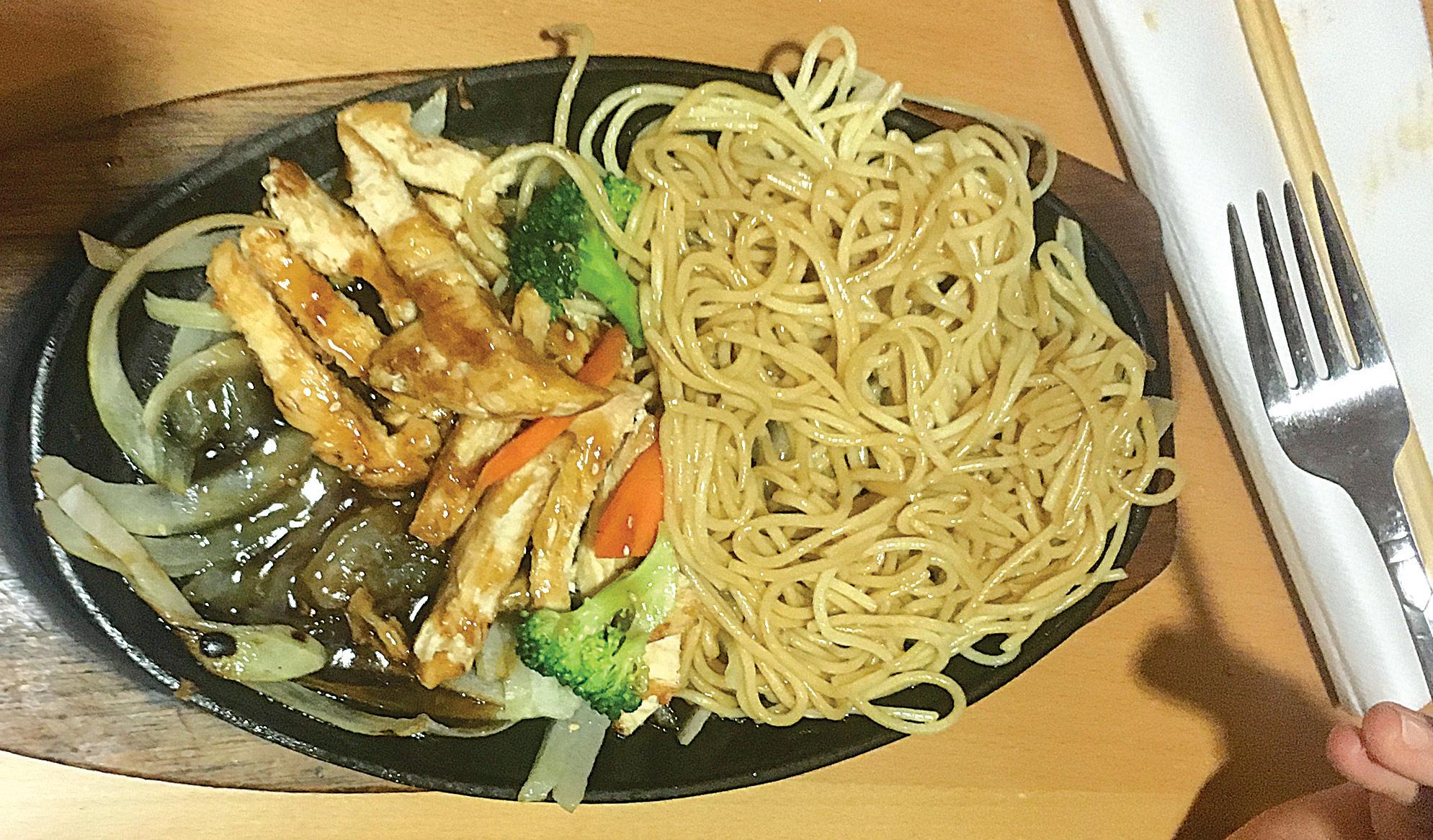
plemented the chicken’s crispy texture and briny taste. The refreshing mélange of carrots, mushrooms and onions was the perfect addition to the yakisoba. As a whole, the dish had a rich umami flavor, and I detected the slightest hint of sweetness in the stir-fry oil.
My friends, who ordered a diverse selection of dishes from the expansive menu, were equally pleased with their meals. Alexandra Mantz ’21 went for a spicy tuna naruto roll and declared it “simply delectable.” She also noted that she enjoyed her dining experience because the Mitsuba staff is “accommodating, hospitable and quick.” Overall, if you’re a college student with a penchant for freebies
and a hankering for flavorful yet inexpensive Japanese cuisine, Mitsuba is the place for you.
Serves: wide range of authentic Japanese cuisine
Vibe: super casual spot to grab a bite with friends
Price: $ Overall:



Piper Torpey is a sophomore in the College of Human Ecology. She can be reached at pat72@ cornell.edu.
By ELIJAH FOX Sun Contributor
On Saturday morning I had the privilege of going to Carriage House Café for a rainy day brunch with my girlfriend. On Saturday afternoon I had the pleasure of eating it. Commonly referred to simply as Carriage House, this restaurant housed in a historic landmark is reliably popular, especially on weekends. Upon our arrival, we were greeted with an accurately predicted wait time — approximately 45 minutes for a table for two — and handed a remote buzzer to notify us when our table would be ready.
The second floor of the building, which operates as The Loft Bar and Lounge Wednesday through Saturday nights, serves as a waiting area for brunch patrons in the mornings. With wooden walls and floors, the space has a rustic American ambiance that is completed by the presence of a grand piano, an organ and various antiques. Light floods in through numerous skylights and windows to create a warm and comfortable environment for those who wish to enjoy a scone or coffee while waiting for the buzzer to sound off.
When we were called for our table, my girlfriend and I descended into a jovial array of diners who were all clearly there for the food rather than the quiet. After much deliberation that was punctuated with our waitress frequently stopping by to see if we were ready, I ordered the cured salmon plate. The dish consists of four
toasted pieces of the house-made French bread — a point of pride for Carriage House — as well as a small salad of greens with a slice of beet, a wedge of double creme brie, a candied fig and a spiral of thin-cut pastrami-style cured salmon that invoked the image of a rose. To top it off, the whole dish was lightly drizzled in a sweet fig dressing. My compliments went first to the artist before I had taken the necessary bite to give my compliments to the chef. The artful arrangement was lovely and almost a shame to cut into, but having been there for nearly an hour, I was in no mood to wait.
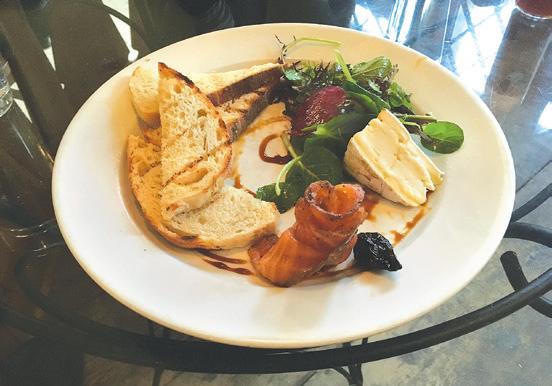
The enduring reputation of the cafe and the long (yet pleasant) wait time were both immediately justified. The bread’s flavor was crisp and strong. Unlike most toast eaten during brunch, the French bread is served not exclusively as a vehicle for the meal but also as a tasty piece in its own right. Creamy in both texture and taste, the salmon nearly created the illusion of butter with every bite. The floral spiral of fish, while undeniably beautiful, ought to be larger for how quickly one could eat it if they weren’t being careful. The greens, salmon and cheese stood out as delicious and refreshing on their own, but exercised their full potential only
when combined on the toast as an open-faced sandwich.
While the taste of the fig dressing defined the sweet aspects of the dish, the salmon determined its savory features. Rather than overwhelming the flavor of the salmon, the brie emboldened it, and I had to resist the urge to finish my meal within minutes of it being placed in front of me. The two distinct flavor profiles blended perfectly. Having grown up in Brooklyn with regular access to lox, I was initially surprised by the cured salmon, but its sweeter tones and slicker texture grew on me. The crispy toast on the bottom and smooth salmon on the top together served as an excellent catalyst for the sweet and savory fusion happening within. Tasty foods abound in Collegetown but genuinely interesting flavors are rare; to experience both high quality and unexpected compositions is a treat well worthwhile.
I ended my brunch with the candied fig, which inconspicuously sat on the side of my plate and nearly went without notice until everything else had vanished. It is a curious addition to the dish but still one I would not neglect. Perhaps the only thing on my plate that tasted just as I predicted it would, the fig gave a quick burst of sweetness that ensured I did not regret passing on the cafe’s French toast. It has a taste worth allowing to linger while waiting for the check.
At $14, the cured salmon plate is a reasonably priced delight. The food and atmosphere make the cafe a lovely way to escape for a few hours, whether it’s with a date or your parents who are visiting
Ithaca; the experience demands to be shared. A significant portion of Carriage House’s appeal lies in its aesthetics, both in the cafe and on the plate. While my wandering eyes landed on many other beautiful and appetizing plates, one might find its options to be somewhat limited, as beverages comprise twothirds of the menu. Expect a wait on weekends, when they do not take reservations — if they did, walk-ins would be out of luck.
The meal was certainly tastier than it was filling, as the portions are somewhat small for the price, but it is without a doubt worth it.
The wait staff at Carriage House Café is friendly and in good spirits, as they have all the reason to be. The cafe demonstrates true appreciation for its workers, including an 18% gratuity in every check regardless of party size “for improved wages for all staff,” as is printed on the bottom corner of the menu.
Whether you are looking for a predictably delicious omelet or a thoughtfully prepared surprise, I recommend Carriage House Café and look forward to returning and being thrilled again by this cornerstone of Collegetown.
Serves: American breakfast and brunch
Vibe: rustic and hip
Price: $$
Overall:
All indoor seating is in the same well-lit and fascinatingly decorated room on the ground floor of the building. The walls are lined with vinyl covers (none dating later than the mid-20th century), antique radios, posters, cameras and even a keyboard detached from a piano. The colors are muted, the walls are stone and most objects in the space are either wooden or iron. Despite the loud chatter at full occupancy, Carriage House remains a wonderful place to go for respite from the stressful college atmosphere. Modernity in Carriage House is confined to the iPhones sitting dutifully on the table next to every dining patron and the sleek, eyecatching espresso machine sitting on the bar.
Elijah Fox is a sophomore in the School of Industrial and Labor Relations. He can be reached at etf25@cornell.edu.


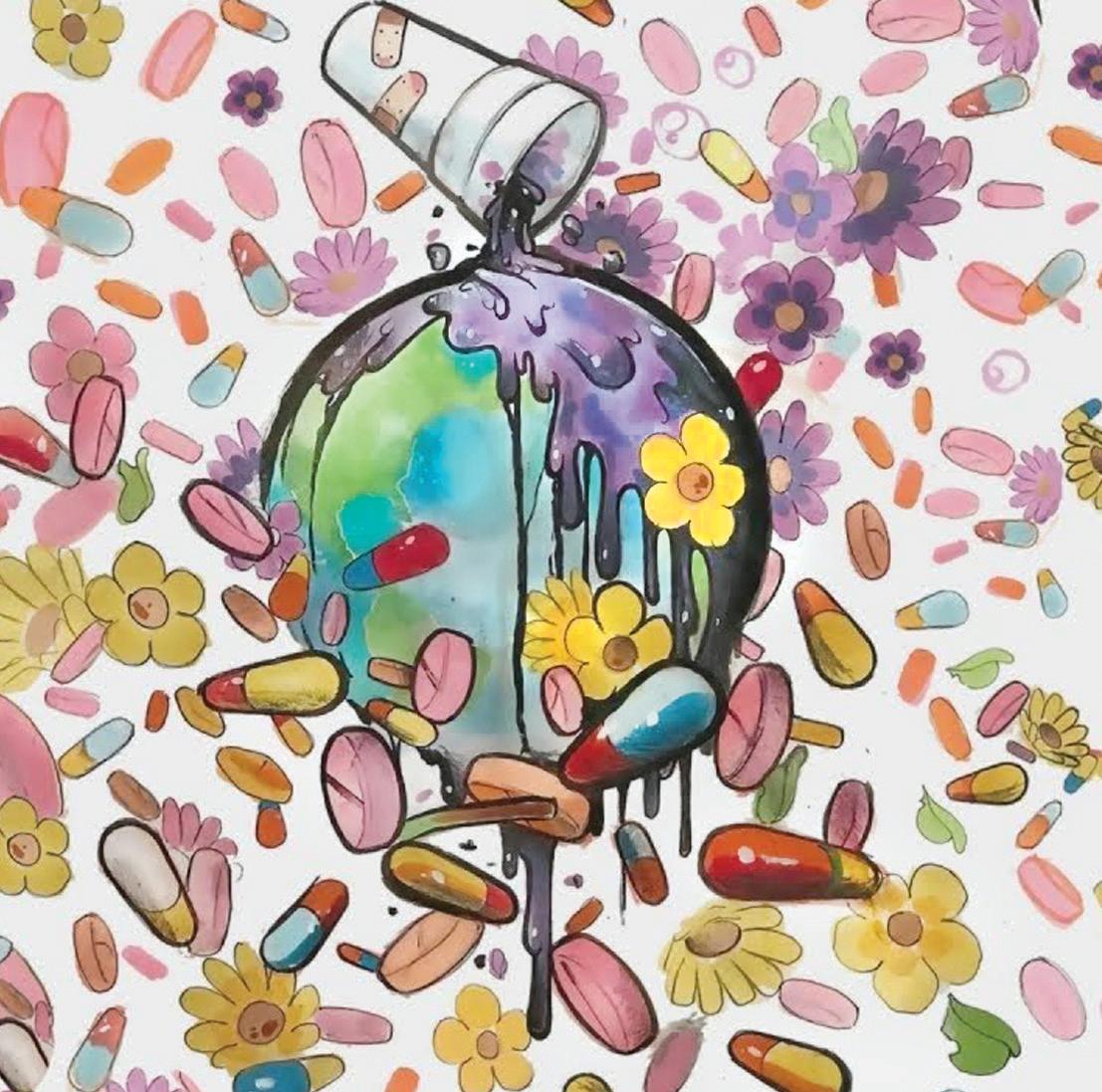
Very few collaborative albums live up to their hype, but this rarely prevents artists from trying. The past month has seen the release of Gunna and Lil Baby’s Drip Harder and Future and Juice WRLD’s Wrld On Drugs . Both were solid, but neither seemed to exceed what each of the pairings could have achieved on their own, which is surprising considering the success of Gunna and Lil Baby’s past collaborations. A deeper look into past collab projects from other artists indicates that very few actually live up to expectations, especially the ones coming from big name artists at the peak of their careers. But there are a few exceptions — Drake and Future’s What A Time To Be Alive and Kanye West and Jay-Z’s Watch the Throne stand out. The majority of these other collab albums aren’t bad, though, they’re just forgettable, and oftentimes doomed from the start due to high expectations, poor timing, lack of album depth and weak production.
In December 2016, Travis Scott and Quavo announced their collab album Huncho Jack, Jack Huncho . The album wasn’t released until a year later, despite both artists frequently teasing its release for months on end. During this time, Quavo dominated the Billboard charts, including a run where he occupied 10 spots on the Hot 100 simultaneously, only the third rapper to do so. During this time, Travis Scott also teased his own album, Astroworld ,

but consistently refused to release anything from either project. When paired with the success of their earlier collab songs such as “Oh My Dis Side” and “Pick Up the Phone,” this had the effect of warping the expectations for both projects, creating an amount of hype that no project could ever live up to. When the album finally released in December 2017, the reaction was predictably lukewarm, and the album sits nearly forgotten less than
a year later. 2018 saw the release of two collab albums that had been rumoured for years with the release of Jay-Z and Beyoncé’s Everything Is Love and Kanye West and Kid Cudi’s Kids
See Ghosts . Both fell victim to expectations, simply because the idea of their existence had reached a sort of mythical status that no album could ever match, and although both albums are solid, they certainly aren’t as good as they should be considering the chemistry of the artists making them.
Another issue that plagues collab albums is a lack of depth within the album, something that ruined Gunna and Lil Baby’s Drip Harder
This is a shame considering their chemistry is unmatched in the rap industry today; after all, Gunna taught Lil Baby how to rap, and the two are each other’s most frequent collaborators. Their collaborative album, however, sounded exactly like all of their previous songs together, except this project was 13 songs long and only had about four quality songs. This issue isn’t unique to them either; it’s hard to make an album with multiple different sounds on it when working with someone else because that requires a major shift from what the two artists had previously accomplished. This is part of the reason why Drake and Future’s What a Time to Be Alive is such a good album — it has the expected high energy songs like “Jumpman” and “Digital Dash,” but it also has some slow-burning songs like “Diamonds Dancing” and “Live From the Gutter.”

The production behind the album is another crucial aspect of the success. Unlike solo albums, collab albums often lack a specific vision and can attempt to recreate one sound throughout the entire album. When both the artists and the producers do this, the album sounds repetitive, which is what killed Drip Harder Keeping one or two producers for the majority of the project generally prevents this — What a Time to Be Alive featured production from either Metro Boomin or Southside on eight of the 11 tracks. Of course, producers themselves can partner with artists to create their own collab albums, such as Nav and Metro Boomin’s Perfect Timing ; 21 Savage, Offset and Metro Boomin’s Without Warning ; and Vince Staples and Larry Fisherman’s (Mac Miller) Stolen Youth LP
One important
thing to note about producer/artist collab albums is that they generally occur early in the artist’s career and face much less pressure and expectations than other collab albums do. Savage Mode by 21 Savage and Metro Boomin served as mainstream rap’s first introduction to 21 Savage, and it’s generally highly rated, although not quite at the same level as Watch the Throne . The same thing happened with Vince Staples and Larry Fisherman’s Stolen Youth LP , which essentially acted as a double debut project considering how it was the first full length project Vince Staples had put out and the first project Mac Miller had produced in its entirety. G Herbo and Southside’s Swervo is a producer/artist collab that almost reaches the level of What a Time to Be Alive but falls just short. G Herbo is an aggressive rapper, and Southside is the perfect producer to match. They prove to be perfect complements who haven’t experimented together enough to find their own cohesive sound. That said, if they were to release another album in the future after they’ve developed chemistry together, I have no doubt this would be a top tier collab album. One last note, though, is that good production can’t make up for everything — just look at Big Sean and Metro Boomin’s Double or Nothing album, which may be the worst collab project of the last decade.
What does this mean for some of the major collab albums that are expected to come within the next year, such as Playboi Carti and Lil Uzi Vert’s 16*29 , Tame Impala and Theophilus London’s Theo Impala , and A$AP Rocky and Tyler, the Creator’s Wang$AP ? It’s almost impossible that any of these projects match expectations, regardless of their content. For Wang$AP , there will always be the feeling that Tyler, the Creator’s collab projects should be with Odd Future, the collective he used to be a part of that split up in 2015. For 16*29 , the album has been announced and leaked repeatedly since September 2017, so despite Playboi Carti and Lil Uzi’s chemistry, the album isn’t going to be as new as it should be, nor will it match the hype they’ve unintentionally built around it.
I predict, however, that Theo Impala will be the best collab album of the year and potentially one of the best of all time should it be released, considering its timing and lack of expectations due to its being a cross-genre collab album. In fact, it wouldn’t be surprising if there’s an emerging trend of cross-genre collab albums considering Travis Scott’s recent work with Tame Impala and John Mayer, as well as the recent rise of genre bending emo rap with artists such as Lil Uzi Vert and Juice WRLD.
Daniel Moran is a sophomore in the College of Human Ecology. He can be reached at dhm96@cornell.edu. Guest Room appears periodically this semester.




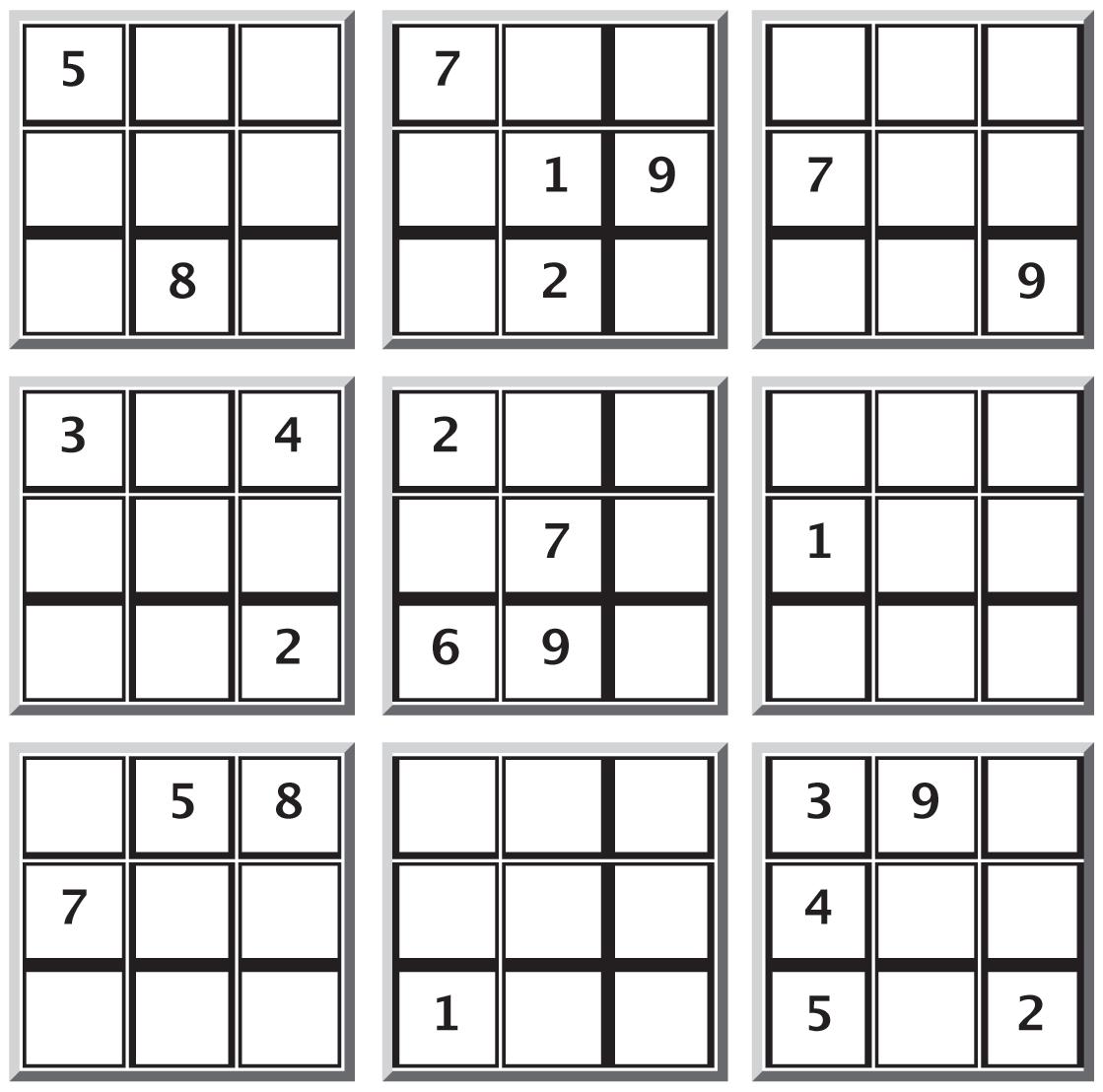
Fill in the empty cells, one number in each, so that each column, row, and region contains the numbers 1-9 exactly once. Each number in the solution therefore occurs only once in each of the three “directions,” hence the “single numbers” implied by the puzzle’s name. (Rules from wikipedia.org/wiki/ Sudoku)





1, 2, 3, 4, 8 BEDROOMS FURNISHED VERY REASONABLY PRICED 607-272-3389
avramisrentals@aol.com
2 & 3 BEDROOMS
109 SAGE PLACE
Available NOW, Spring 2019 & 2019/2020 Shuttle Bus Access to Campus Access to Free Fitness Center Novarr- Mackesey Property Management office@ithacastudentapartments.com
607-277-1234
Houses, Apts, Parking 1 to 9 Bedroom
Collegetown - College Ave, Linden Ave, Dryden Rd, Bryant Ave, Cook St. 607-330-2442 info@urbanithaca.com www.urbanithaca.com
We have availability for the 2019-2020 school year beginning June 1st at
If
607-208-7660 or
607-277-1234
>>AFFORDABLE, QUALITY LIVING<<
Special Deals for you! Furnished 1-6 Bedrooms Collegetown Apartments PARKING, LAUNDRY, UTILITIES! (607) 273-7368 www.IthacaApartmentRental.com
RENT NOW, GET THE BEST www.MatoulasHouses.com
Apartments & Houses In Collegetown LINDEN AVE & E. SENECA ST 1 & 3 BEDROOM APARTMENTS ALL FURNISHED
EMAIL: MatoulasHouses@Gmail.com
PHONE: (607) 339-9644 FIRST-COME, FIRST-SERVED
Collegetown Terrace Apartments INSPIRED LIVING TAILORED TO YOUR SUCCESS 24-Hour Fitness Center Shuttle Bus Service to Campus Study Rooms w/ Expansive Views
Apartments Available NOW, Spring 2019 & 2019/2020 Novarr- Mackesey Property Management collegetownterraceithaca.com office@ithacastudentapartments.com 607-277-1234
NORTH CAMPUS Studio, 3 and 5 bedroom Available 2019/2020 Novarr-Mackesey Property Management office@ithacastudentapartments.com 607-277-1234
2019-2020 317 Upper Eddy St. 1, 2 & 3 BR Apartments Ten month lease. Furnished. Hardwood floors. 607-227-0924
Nicest Apts. in Collegetown Located on Eddy St. 4 Bedrooms Fully furnished. Spacious living areas with large bedrooms & closets. Hardwood flors, spectacular views, eat-in kitchens with additional sun rooms. Laundry & parking. 607-339-1137 bgm900@gmail.com
27 H OUSE FOR R ENT
201 WYCKOFF AVE 6 Bedroom House Novarr-Mackesey Property Management office@ithacastudentapartments.com 607-277-1234
COLLEGETOWN 6 BEDROOMS NEWLY RENOVATED 607-272-3389 avramisrentals@aol.com





“For us, we [face] adversity early on, and now we can see how we can deal with it.”
The earlier timing of this season’s challenges could present an opportunity for the team to grow, with eight freshmen on the roster who did not experience last season, when Cornell rattled off seven straight wins to start. For the sophomore class, this sort of start to the season is something rather foreign in their young collegiate careers.
“It’s definitely a big change from last year,” said sophomore forward Brenden Locke. “I think the biggest thing is it’s good that we got those games out of the way earlier in the season … so we see that we can’t take any days off.”
As for the opponents who present the opportunity for Cornell to bounce back, the Bulldogs (1-0, 1-0) and Bears (0-2, 0-1) will travel to East Hill having just competed against each other, with Yale emerging victorious last Saturday in Providence by a score of 3-2.
“Obviously, they’re well coached,” Schafer said of the Bulldogs. “They’re great in transition and they push the envelope as far as getting up and down the ice. But they’re also a good defensive team. … You need to be patient against them.”
The Bulldogs have represented a challenge for Cornell at times in recent history. Although the Red hasn’t lost
that matchup since 2015-16, there have been a pair of ties since, in addition to the comeback win for Cornell in New Haven last season. In particular, Yale boasts first-team AllECAC forward Joe Snively, who is one of the premiere offensive players in the conference and the country.
“Joe Snively, you know, we’ve been playing against him for four years now,” McCrea said. “So we know some of his tendencies and we know his line is going to bring it. … We’re not going to dictate our play just because he’s on the ice. We’re going to bring it to them.”
As for Brown, the Bears have not emerged victorious over the Red since January 2013 — when Cornell was in the midst of one of just four losing seasons under Schafer.
Having been crowned the ECAC regular season champions a season ago, the Red’s journey back to that position begins now, with the opportunity to earn some conference points early could provide exactly the confidence boost it needs coming off two devastating losses.
“You earn your stripes this year, and you earn what we’re going to get this year,” Schafer said. “And that’s a long process.”
The puck drops at 7 p.m. Friday against the Bulldogs and Saturday against the Bears.
because of the frustrating third period Friday night. However, a more likely explanation has to do with the pep band.
Most sportswriters are not technically knowledgeable about music (besides one of our previous hockey columnists, Kevin Linsey ’18). Therefore, it takes a lot for someone in such a position to actually comment on the pep band. As a disclaimer, the pep band is usually awesome and is an integral part of what makes the Lynah Faithful what it is.
But the band was missing a few too many musicians on Saturday because
something was off. In turn, the fans were off at times, too.
The alma mater was almost unrecognizable because of missing players, to name one of several mishaps. But the worst was certainly the “tubas.”
Every game, three tubas play in the aisle behind the opponent’s bench in the 3rd period. And sometimes, like on Friday, there’s only one tuba. But still, at least it’s a tuba.
However, on Saturday, the fans didn’t even get a tuba, but instead got what looked like a bass saxophone. Needless to say, the fans were confused, and it was clear something was wrong with the band. Give some credit to that
saxophonist by the way, he actually did a pretty bang up job, all things considered.
That single, lonely saxophonist embodied the atmosphere of the game on Saturday. Everything was not as it supposed to be. It was not the Lynah Faithful that is renowned, and feared, throughout college hockey.
Hopefully the fans return in greater numbers, with greater energy this weekend as Cornell opens up conference play — when it really starts to matter.
senior forward Lenka Serdar. “The new players are always so eager to learn and contribute, and this inspires the rest of the team to become better too.”
“We had a great group of seniors last year, but we are also excited about our freshman,” Racine added. “They are adapting well to our team and program so far and have already done some great things on the ice.”
Last season saw the Red achieve impressive success; overall, Cornell secured 21 wins, 9 losses and 3 ties. The team is convinced that it can emulate these results in the 2018-19 season.
“We need to play with speed and consistency — keep things simple,” Racine said. “We need to just keep up with what we have been doing for the past years and continue to grow and get better as a team each and every day.”
“Team road trips … are a great way for our team to bond, and playing on the road brings a new kind of preparation,” Serdar said. “Although we don’t have the Lynah Faithful feeding us energy from the stands, we must bring our own energy.”
The team will have plenty of time to bond, as Cornell does not return to East Hill until after Thanksgiving.
The Red hits the ice at Yale this Friday at 6 p.m. The following day, the game against Brown will begin at 3 p.m. The upcoming games will be streamed live on ESPN+.
With four wins already under their belt, the Red is prepared to take on Yale (0-2) and Brown (3-2) this Friday and Saturday. These will be their first matchups away from the comfort of Lynah Rink and the supportive Lynah Faithful, but the team will not let the change of scenery dampen its success, and instead sees it as an opportunity to grow as a unit.

By MILES HENSHAW Sun Staff Writer
There’s one thing that can be said of football’s 66-0 loss at Princeton: it wasn’t on national television.
This week’s game will be. Cornell will take on Penn Friday at 6 p.m. under the lights at Schoellkopf, and ESPNU will be in Ithaca to bring the game to the masses. It will be a chance for the Red to hold onto a shred of hope for an Ivy title and paint over last week’s disappointment on a big stage.
“Sometimes in life you have unexpected horrific adversity, whether it’s in your academics or career or personal life,” said head coach David Archer ‘05. “It’s how you respond that matters.”
Last week marked Cornell’s second Ivy league loss, essentially removing the team from title contention. But with three league games left on the slate, the Red is finding no shortage of reasons to win.
“It’s not over yet,” Archer said. “The league title is still in reach but we’re certainly playing for each other and for a chance to beat a league opponent we thought we should’ve last year.”
Penn edged out the Red last year, 29-22, for its fourth straight win over Cornell. The Quakers finished last season 4-3 in the Ivy league after starting 0-3. Penn started slowly this year, too, but now stands at 2-2 in the league with losses to Dartmouth and Yale. The Quakers boast a top-20 defense in scoring, total yards and passing yards against: not a cupcake opponent for a team looking to get back on track.
“We got down so fast [against Princeton] that we had to put the ball in the air more than we wanted,” Archer said. “We want to be able to keep our commitment to the ground game more so than we did Saturday.”

Club, before the advent of television, even before the advent of radio. This Friday’s game will be beamed into homes across America, and Cornell’s players are relishing the opportunity.
“They have playmakers — nobody of a [fifth] round caliber — but we can load it up more on the run game knowing they don’t have an NFL threat at receiver,” Archer said.
This will be Cornell’s fifth Friday game ever; the Red’s last win on a Friday came in 1892 against Manhattan Athletics
One weapon the Quakers will be without this Friday is former wide receiver phenom Justin Watson, who graduated last year as Penn’s all-time leader in receptions, receiving yards and receiving touchdowns. Watson was selected in the fifth round of the NFL Draft; he has seen time in four games for the Tampa Bay Buccaneers and recorded his first reception last week.
“It’s awesome,” said senior quarterback Dalton Banks. “There’s nothing better than playing on national TV. It’ll be fun having the country watching and knowing we’re on this stage to show the country what we’ve got.”
Miles
can be reached at mhenshaw@cornellsun.com.
By
Looking to continue their athletic and academic careers, they left their homes in England and landed in the Finger Lakes region of central New York.
Junior George Pedlow, sophomore Harry Fuller and freshman Charlie Ferguson are essential members of the recently nationally ranked Cornell men’s soccer team and have journeyed over 3,000 miles across the pond to wear the carnelian and white. Leaving a country — and continent — obsessed with soccer, these three young men have found a home in Ithaca under the ever-watchful eyes of a fellow Englishman, head coach John Smith.
Pedlow, Fuller and Ferguson have traveled distinct paths to get to where they are today. While Pedlow and Fuller both hail from London, Ferguson is from Brighton. Pedlow and Fuller both root, almost religiously, for Arsenal while Ferguson is a Chelsea supporter. They all differ from their coach Smith, however, whose Evertonian blood runs generations deep in his family.
“I support Everton,” Smith said. “My dad did and my granddad did. So basically I had no choice, that’s how it works in England.
My kids support Everton now, and they also have no choice. I’m sure they would have much sooner supported [Manchester] City or Man United, but I’ll be an Evertonian until I die. Regardless of how they’re doing and what division they’re in that won’t ever change for me.”
While they may disagree on whose Premier League club is best, the players know better than to rib their coach about his struggling team.
“I’m an Arsenal fan,” Pedlow said proudly. “But we don’t try to make any jokes at [Smith] because he’s a very strong Everton fan. He’s had that in his family for a while.”
Oftentimes international students, much less athletes, struggle immensely with adjustments to collegiate life, academic workload and cultural differences, among many other things. Pedlow, who is actually American but grew up in London, Fuller and Ferguson have been adept at taking these challenges head on.
“It’s fun to see a different culture,” Ferguson said. “The language is the same and everyone is naturally more friendly than home. In a way it’s been easier to fit in here than what it would have been going to university at home.”
Smith agreed with Ferguson, but ad-
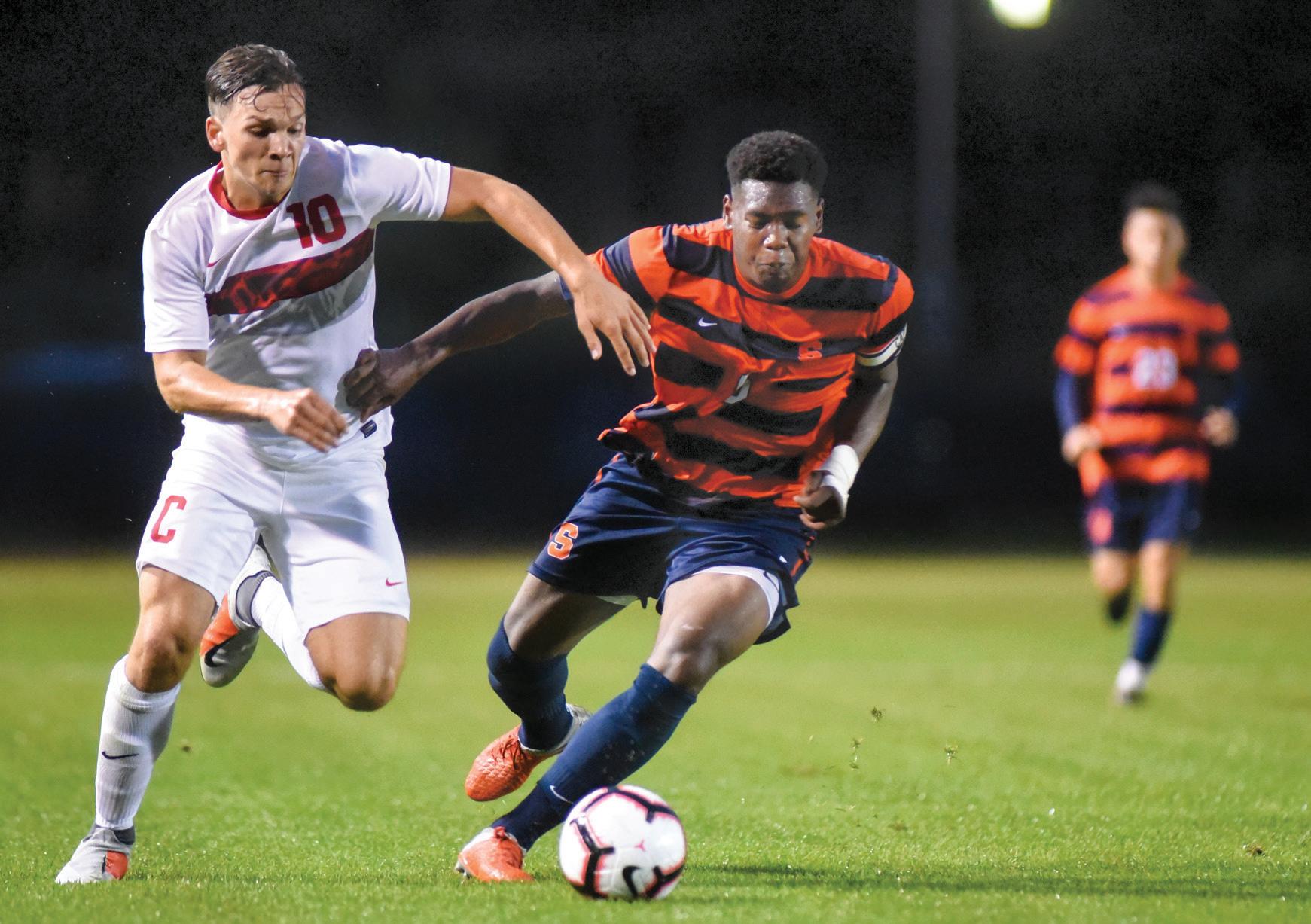
dressed the challenge of adjusting his accent to untrained American ears.
“Culturally, the transition wasn’t all that hard for me. Having said that, even though we speak the same language, we are different cultures so there’s a lot of different little sayings and words,” Smith said. “Initially my accent was quite strong, it was very much a Mancunian accent, it isn’t that way anymore simply because I had to change the way I spoke so people could understand me. I’d be ordering food at Subway and getting different things on my sandwich because they misunderstood what I was asking for.”
While the cultural differences between the U.S. and U.K. may not be as obvious or prevalent as those between other countries, there are drastic differences in the schooling systems which can prove to be difficult adjustments. England is known for its comprehensive standardized tests which high school students take roughly every two years. In between, grades and schooling hold a lesser importance than doing well on the tests.
“Academically it’s really different,” Pedlow said. “Coming here my first semester or two it was a weird experience. I had to keep on top of my work constantly because of my GPA, and with quizzes and tests, it was all new to me.”
Pedlow is a student in the College of Agriculture and Life Sciences and the S.C. Johnson College of Business, Ferguson is in the School of Industrial and Labor Relations, and Fuller is in the College of Engineering.
As for the change to American collegiate soccer, the three young men are thriving. Fuller, currently dealing with a foot injury, has notched two goals and four assists. Pedlow and Ferguson have both played in each of the team’s 15 games. Pedlow has scored three goals and Ferguson, just a freshman, has a goal and has been a steadying force for the squad.
All three players agree that their experiences playing in England at all levels helped to prepare them for the rigors of Division I soccer and Smith’s demanding expectations. Pedlow emphasized that the higher level of physicality in the English game has given him an important advantage throughout his college career. He also commented on the
traditionally English formation that Smith deploys.
“We play a 4-4-2 [formation] which is a very traditional English style of soccer,” Pedlow said. “Barely any teams here play that except for a few teams like Stanford and Duke. We’re playing under an English system in America, so it wasn’t that harsh a transition.”
Pedlow, Fuller and Ferguson have become instrumental parts in one of the great turnarounds in NCAA men’s soccer and possibly Cornell Athletics history. Two years ago, the Red ended the year 1-14-2, with an 0-7 Ivy record. Last year, the team finished just below .500 with a 7-8-2 record and 2-4-1 Ivy mark. This season, the Red sits at 10-5 — 3-2 in Ivy play — and just recently fell out of the national top 25. For the first time since 2012, the Red has a chance at winning the Ivy League and reaching postseason play.
“This season as a whole has been a huge positive,” Fuller said. “We’ve got quite strong chances of making the postseason for the first time in a long time in this program’s history, which would be incredible. When you’re winning and you start to be a bigger deal as a team, it makes the hard work and the stresses of training and schoolwork all a little bit easier.”
The winning ways haven’t just come out of nowhere. It’s been the product of steady planning and hard work that the players and coaches have forged together.
“The good stuff that we’re doing and that’s making us win is the product of two and a half, nearly three years, of work of John, Drew and Scott this season,” Fuller said. “It’s made the last year of work worthwhile for me seeing it pay off. The trajectory we’re on is really remarkable considering where the program was two years ago.”
Pedlow, Fuller and Ferguson’s success very well could be the linchpin in a new trend in college athletics: recruitment outside the United States. Should the three players continue to succeed in their roles, or even improve, Cornell men’s soccer could be ground zero for college soccer’s next competitive advantage.

By DYLAN
In 2017-18, Cornell men’s hockey did not endure its first losing streak until a couple of elimination losses in the playoffs. In 2018-19, it came in the first two games.
Now after two upset losses to visiting Big Ten opponent Michigan State, it’s now time for the Red to shake off its disappointment and turn to improving going forward.
“First week is a tough weekend,” said head coach Mike Schafer ’86. “I think the biggest thing is the physicality of the game that you need to get into. … Playing simple at certain times of the game wasn’t there.”
“For all the times that Matty saved us and did things last year for us to have success, I didn’t think he had a great weekend,” Schafer said. “I think he knows that.”


Cornell (0-2, 0-0 ECAC) gave up nine goals to the Spartans over the weekend — a number that stands in contrast to the success that the Red’s defensive unit displayed all throughout last season. In part, the relatively poor performance of sophomore goaltender Matt Galajda, who was pulled from both games, did not exactly set the team up for success.
But Galajda was far from the only issue in the pair of defeats. Cornell’s power play was dismal on Friday, and although the Red bounced back on Saturday and recorded two goals in eight tries, the success of that unit remains a question. The man-up advantage was one of the weaker points for Cornell in an otherwise successful 2017-18.
The start to the season represented some significant adversity for the Red — something this group is no stranger to. Last season, Cornell endured a handful of come-from-behind victories, including one against the Bulldogs, and always seemed to come out strong after its regular season defeats.
“It’s going to be a real big test for our character as a team,” said senior defenseman Alec McCrea. “We still have a young group. …
By FAITH FISHER
The Cornell women’s hockey team recently hit the ice for their 201819 season, hungry for their 3rd consecutive Ivy League title. With a threegame winning streak to open the season, the Red’s prospects already look bright.
Just this past week, Cornell shut down two Ivy League foes, Harvard and Dartmouth, clinching a 3-2 win
over the Crimson and a comfortable 4-0 shutout victory against the Green. Although the auspicious season has just begun, the Red’s early success can be traced back to its preseason efforts.
“Early success comes from the preseason,” said assistant coach Edith Racine. “It is about getting ready for those big games and getting the team to work together. It’s the work that you put in everyday, the effort to get better, that leads to success.”
Racine is taking on an increased role while head coach Doug Derraugh ’91 is coaching the Canadian national women’s hockey team.
With the new season, there’s been some turnover of faces. The Red graduated three seniors last year, all of whom had a dominating presence on the ice. Erin O’Connor ’18 was responsible for leading the power play unit, under which the team scored 20 goals
It was an underwhelming weekend at Lynah Rink, to say the least. Coming off the season the team had, it was somewhat of a letdown for Cornell men’s hockey to get swept at home by unranked Michigan State, predicted to finish last in the Big Ten. To be fair, the Spartans are by no means a bad hockey team. However, it seems everyone expected a bit more from the Red in its opening weekend at home.
If you want to start panicking, give it another week or two. It’s early, and it’s only two games. Cornell will have its chance to bounce back against familiar foes Yale and Brown this weekend at home.
The team needs to redeem itself, sure, but so do the fans — the Lynah Faithful.
It was a pretty decent crowd on opening night Friday. But to no surprise, as the game began to slip away from
Cornell, the fans slipped out the doors as well. It’s disappointing, but certainly not unreasonable.
The focus here is more on Saturday night’s contest, following the 5-2 blowout on Friday evening. According to Cornell Athletics, the attendance numbers were similar on both Friday and Saturday. But from the perspective of section B, that’s hard to believe.
Large chunks of Section B, the one section that is expected to be packed for every home game, had scores of empty seats. The absence was nonetheless also noticeable during certain chants and cheers.
Perhaps the low attendance was due to Halloween weekend festivities? Not unless you’re partying at 7 p.m.
Or maybe the low attendance was due to the Red’s lackluster performance on Friday. But that’s also unlikely; it’s not the first bad loss Cornell’s taken at home.
The fact a school of 14,907 undergraduates cannot fill the approximately 600 seats in sections A and B is pretty absurd, considering it is the most “popular” sport at the university. Maybe it’s the case that sports aren’t cool anymore and our section of the paper is passé — a discussion for another time, perhaps.
But clearly there’s one issue:
the student sections weren’t sold out; or rather the students didn’t show. A second issue lies with the students who did show up. In other words, the energy was not up to par.
The fans were great when Cornell took an initial lead, but, on the aggregate, something was just missing. Again, perhaps the lack of spirit was

last season. Sarah Knee ’18 and Brianna Veerman ’18 were integral playmakers, securing 17 and 15 assists, respectively, for the Red. The team, however, has enlisted the skills of six new freshmen, who the team is confident
will further contribute to its success.
“Although we miss the seniors who graduated last year, it is also exciting getting to know some new faces around the rink,” said