
By
The Corne¬ Daily Sun
BIDEN WINS

Sweet victory | The next U.S. president is known for his love of ice cream. During his 2017 convocation speech visit to Cornell, President-elect Joe Biden enjoys a Dairy Bar cone, with the new flavor, “Big Red, White and Biden,” named in his honor.
2017 Convocation Speaker Hits 270 ‘Big Red, White And Biden’ Now A Campus Cheer
Joe Biden has hit the magic number: He has over 270 electoral votes, and with it, the presidency. The former vice president’s win ends four years of an administration many critics said defied and defaced the norms of American democracy.
News outlets called Pennsylvania for the Biden-Harris ticket at 11:25 a.m. Saturday –– pushing the ticket over the edge at 284 electoral votes. Sen. Kamala Harris (D-Calif.), of Jamaican and Indian descent, is the first woman and first woman of color to be elected vice president.
The president-elect visited Cornell a few times over his career, most notably in 2017 to deliver the senior convocation address. In his speech, Biden admitted that he almost attended Cornell Law School, but he withdrew his application because “I couldn’t get enough financial aid,” he said. “Y’all think I’m kidding, but I’m not.”
Even Cornell Dairy Bar celebrated the self-proclaimed ice cream fan that year with a new flavor, “Big Red, White and Biden.”
Votes are still being counted in Pennsylvania, Georgia and Arizona but Biden held significant leads in all three. AP called Arizona for Biden Tuesday night and Nevada for Biden Saturday afternoon. Biden also holds a 4,000 vote lead in Georgia, and the state is headed toward a recount.
The Biden campaign’s presence on Cornell’s campus had a sputtering start. Among a crowded primary field of Democratic candidates, the veteran politician was not initially number one for most Cornell students. Even close to the election, the campus campaign group failed to attract enthusiastic student supporters, as had been previously seen with candidates like Hillary Clinton.
After nearly half a century in politics, Biden, long a staunch moderate, has adopted one of the most progres-
sive platforms in American presidential history. Biden is perhaps most notorious for his authorship of the 1994 Crime Bill, which led to the explosion of mass incarceration and predominantly affected people of color in America. He has since called the bill “a mistake.”
Biden’s ascent to the presidency has been an unexpected road. He previously ran for the Democratic ticket in 1988 and 2008, but quickly abandoned those campaigns after failing to receive much support in the primaries. Biden, 77, is the oldest president-elect in U.S. history, but he has thought of this moment for a while, musing about possible runs for president in 1980, 1984 and 2004.
Ithaca Mayor Svante Myrick ’09 congratulated Biden and Harris on Twitter Friday morning after a different news desk — Decision Desk HQ — called the race, writing “[C]ongratulations to everyone who worked and fought for a better government.”
The Scranton son’s win — the highest number of votes cast in any U.S. election — occurred as Democrats underperformed in down-ballot races. Democrats failed to take official control of the Senate yet and lost seats in their House of Representatives majority. Control of the Senate now rests in Georgia –– the state will elect two senators in runoff races on Jan. 5.
Rep. Tom Reed (R-N.Y.), fresh off his own victory, affirmed his support to have every vote counted and congratulated Biden in a Saturday afternoon statement. Reed’s statement contradicts the sentiment of many Republicans, who have been reluctant to comment on the election.
“I extend my congratulations to President-elect Biden,” the statement read. “We are ready to come together, work as one and all Americans through the difficult times ahead.”
Alec Giufurta can be reached at agiurfurta@cornellsun.com. Amanda H. Cronin can be reached at acronin@cornellsun. Milo Gringlas can be reached at mgringlas@cornellsun.com.
By MADELINE ROSENBERG and KATHRYN STAMM Sun Assistant News Editor and Sun News Editor
Cheers, honks and relief filled the unusually-warm Ithaca autumn air after President-elect Joe Biden officially clinched the presidency at 11:25 a.m., surpassing 270 electoral votes after winning Pennsylvania.
Cornell’s campus has been extraordinarily quiet this semester, since the coronavirus made student gatherings impermissible. But after news outlets called the election for Biden and Vice Presidentelect Kamala Harris Saturday morning, Cornell launched into loud celebration.
Students, half-looking down at their phones, turned to marvel: “Biden won.”
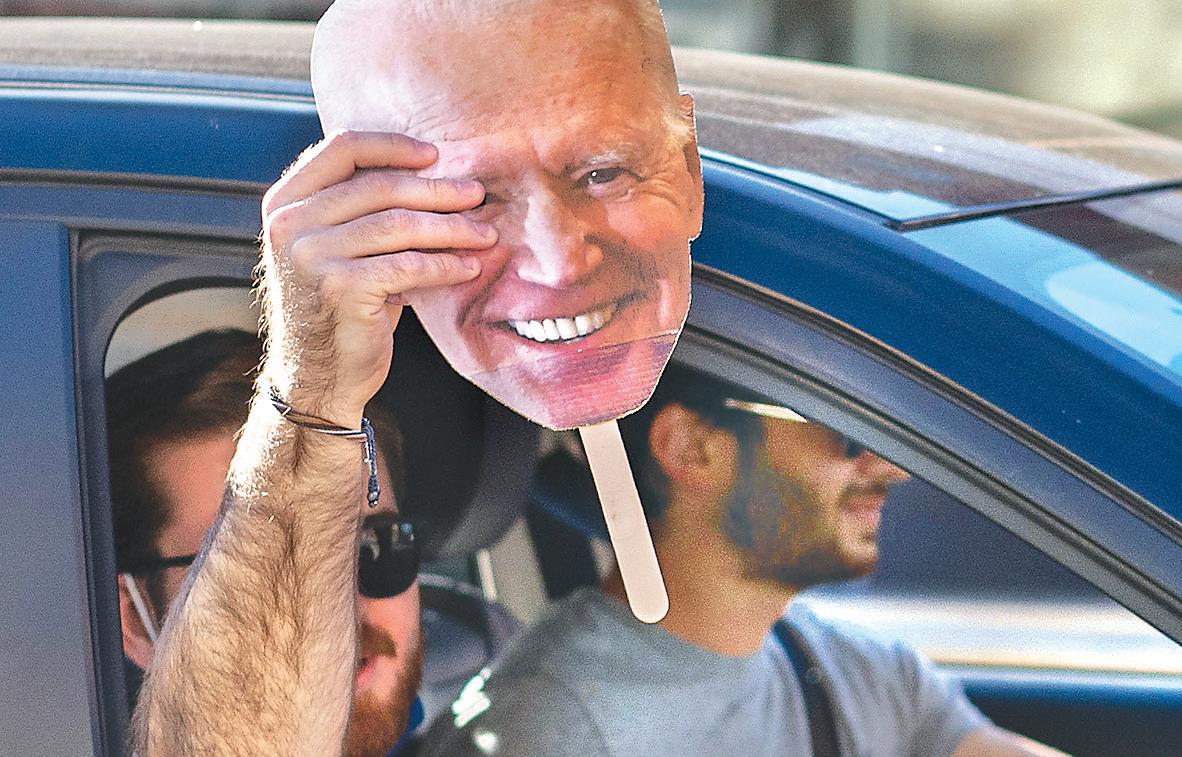
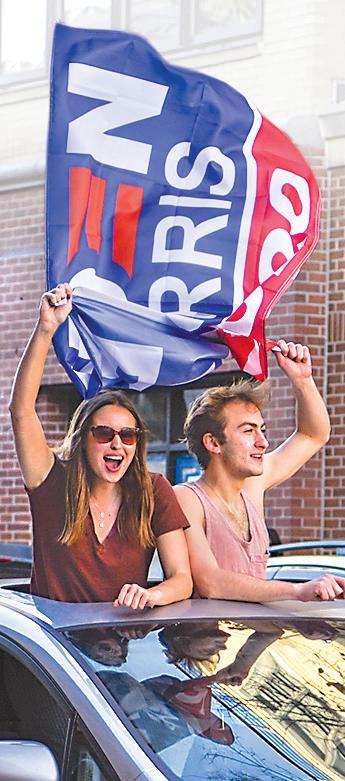
Parades of honking cars drove up and down Collegetown; some blasted “Party in the USA,” and students showed off “Fuck Trump” signs and Biden shirts through sunroofs to whoops from passersby. Reveling in the weekend announcement, students took to porch celebrations and picnics after five days of waiting and eyeing the electoral map.
“I’m just so excited,” said Danielle Mangini ’23, a Biden supporter “since day one.” Mangini, in line at CTB waiting for a Brooklyn bagel and smoothie, heard the news and began fielding a “barrage of calls” from her mom and her friends.
Sitting beside Mangini on a stone bench, Daniela Rodriguez-Chavez ’23 digested the news
See BIDEN page 3
ALEC GIUFURTA, AMANDA H. CRONIN and MILO GRINGLAS Sun Senior Editors and Sun Staff Writer
Monday, November 9, 2020
Today
Diversity and Inclusion: Effective Diversity and Inclusion Councils 10 a.m. - 1 p.m., Virtual Event
Coping With 2020: Resiliency for International Scholars 11 a.m. - noon, Virtual Event
Leadership Development: Emotional Intelligence — An Edge for Leaders 11 a.m. - 1:30 p.m., Virtual Event
South of the Future: Marketing Care and Speculating Life in South Asia and the Americas 11:15 a.m. - 12:30 p.m., Virtual Event
Contemporary Significance of the Canandaigua Treaty 4:30 - 6 p.m., Virtual Event
Tomorrow
Sowing Seeds of Peace: Inside Colombia’s Peace-Building Initiatives 11:30 a.m. - 1 p.m., Virtual Event
White Kids: Growing Up With Privilege in a Racially-Divided America 1:25 - 2:15 p.m., Virtual Event
The Informational Impact of Opinion Leaders 4:15 p.m., Virtual Event
Election 2020: A Bipartisan Analysis With Former Reps. Tom Davis (R-Va.) and Steve Israel (D-N.Y.) 7 - 8 p.m., Virtual Event
Commons Crowd Celebrates Trump’s Defeat, Urges Advocacy
By ARI DUBOW Sun City Editor
After a drawn out election week ended in President Donald Trump’s defeat, a “Protect Democracy” rally on the Commons became a celebration of the Democratic Party’s victory Saturday afternoon.
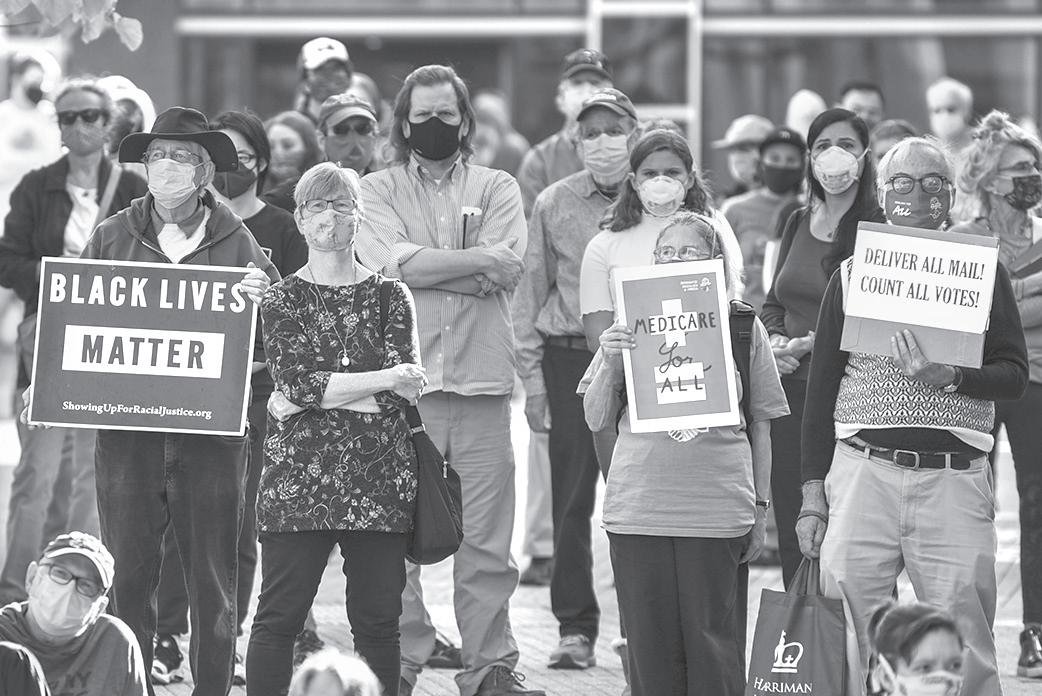
Organized by the Tompkins County chapter of Just Democracy Coalition, the “rally to protect the results and build a better democracy” began around 1 p.m. with music and dancing as the crowd of around 200 filed in to the Bernie Milton Pavilion. Until around 3:30 p.m., local activists and organizers celebrated President-elect Joe Biden and Vice president-elect Kamala Harris, while urging listeners to continue fighting for progressive ideals.
In addition to celebrating, the rally aimed to bring attention to the efforts of the Trump administration to challenge the results of the election.
“We gather to prevent a coup. And if there is a coup we’re going to be here to
“We have to stand in the streets and defend our democracy from bigotry. And we did it with this vote.”
Leslyn McBean-Clairborne
reverse it,” said Tad Sadler, one of the organizers of the event. “It’s easier to prevent a coup than to reverse a coup. The coup-ometer has been moved back one degree or two. Trump is not quitting neither am I. Neither are we.”
Many speeches — including from Tompkins County Legislature Chair Leslyn McBean-Clairborne and Southside Community Center board of directors chair Prof. Nia Nunn, education, Ithaca College — focused on ongoing systemic racism on both a national and a local level.
“We have to stand in the streets and defend our democracy from bigotry. And we did it with this vote,” McBean-Clairborne said in the final speech of the afternoon. “We showed up to say that we want to bring some decency and repeat to the White House. We showed up to say that bigotry, misogyny, inequity, the killing of black people in general, have no place or stronghold in our democracy.“
For many rally-goers, racism was an important factor of the 2020 election. “We need to figure out some way to work better with white America,” said Camille Tischler, a local resident. “They’ve got their heads on backwards.”
Paul Sirma said since Trump’s 2016 election, he has felt more unsafe speaking in public as an immigrant with an accent.
Profs Refect on Historic Race
After drawn-out election, express relief over Biden win
By AMAYA ARANDA Sun Staff Writer
Once news outlets reported that President-elect Joe Biden won Pennsylvania and surpassed the needed 270 electoral college votes, Cornell professors expressed relief that the election had come to a close, joining other Americans in a nationwide exhale.
But they also reflected as scholars — voicing how the 2020 election and the work that still must follow, will alter the course of the country.
Friday night, the evening Biden edged closer to victory as Georgia and Pennsylvania flipped blue, Prof. Lawrence Glickman, history, said this election has been unique in many ways.
This race was highly polarized and had the highest voting turnout since the early 1900s, said Glickman, who studies the political and cultural history of the U.S.
tion results were only the start to affirming them.
For Ajunwa, the election posed several central questions: “Are we welcoming immigrants that come and want to contribute? Are we people that support equal opportunity in the workplace? Are we people who want to ensure everyone has good healthcare, such that a bad luck accident or illness doesn’t bankrupt working people?”
But the weight of Biden’s victory stretches beyond domestic concerns. Prof. Eli Friedman, industrial and labor relations, said the president-elect offers more behavioral and political predictability in international relations.
Although he expressed skepticism over Biden’s history on race, he said he sees the Democratic victory as a good step toward working on the country’s legacy of systemic racism.
But the excitement wasn’t always specifically for the Biden-Harris ticket platform — it was often more for Trump’s defeat and what he stood for.
“I’m not a fan of Biden,” said Richard Rivera, a local researcher and activist. Rivera pointed to Biden’s support of the 1994 Crime Bill, which many critics have said led to the mass incarceration of Black people in the United States. “It doesn’t matter who the hell wins. It matters that the world we want hasn’t been realized,” he said.
Phoebe Brown, central New York coordinator for the human rights group Families for Justice Alliance, echoed the sentiment: “Nobody wanted Biden. Nobody wanted Kamala.” But she still encouraged celebration of a Biden presidency as an opportunity “to get outside the systemic box.”
Emily Turner, a rally-goer, said Biden did not run on the progressive platform that she hoped for, but she was confident that Biden will have a better approach to the COVID19 pandemic than Trump.
Throughout the afternoon, event organizers encouraged non-violence, passing around fliers that outlined non-violent principles including, “We will express our feelings but will not harbor hatred,” and, “We will be honest, treat everyone with respect, including law officers.”
Before sharing two poems about her personal experiences with racism, local poet Peaches Gillette further emphasized the importance of non-violence to this advocacy: “There are times for fights and there are times for battles, but that is not the first step you take for change.”
Speeches were separated by dancing and music, including protest songs sung by event organizers and the crowd.
The festivities swept the downtown area. Only minutes after major news outlets announced that Biden defeated Trump, cars driving down Tioga Street and Aurora Street honked as pedestrians waved and cheered. People leaned out of apartment buildings to cheer and bang pans and customers at the downtown Collegetown Bagels applauded.
One person, retrieving his order at the counter, looked at his phone and yelled “It’s all over!”
After the final speech and repeated calls to continue the protests and activism of the past several months, the celebratory spirit continued, as rally-goers danced in the Commons to Bob Marley and mingled.
Ari Dubow can be reached at adubow@cornellsun.com.
More historically surprising for Glickman, the presidential election did not favor the incumbent, which has only ever happened 10 times — William Howard Taft, Herbert Hoover, Gerald Ford, Jimmy Carter and George H. W. Bush have been the only oneterm presidents in the past century.
“It suggests that a majority of voters wanted a change,” Glickman said. “And a lot of people cared passionately to turn out.” Still, he added that he would not be surprised if Trump continues to contest his loss, saying he was unsure the president would concede before Inauguration Day.
But Prof. Eduardo Peñalver ’94, Cornell Law School dean, said contesting this election effectively would be highly improbable, given Biden’s margin of victory.
“Unlike in 2000, when a single state separated the winner from the loser, and only by a few hundred votes, in this year’s election, Trump would have to find a way to erase thousands of votes in at least three states,” Peñalver wrote in an email to The Sun.
Prof. Ifeoma Ajunwa, industrial and labor relations, said Saturday afternoon she was immensely relieved and unsurprised when the results were announced. But she reiterated that this election boiled down to a battle for American ideals — and the elec-
“This election signifies a move away from a US foreign policy that sees the whole world as hostile … and the possibility of moving towards a multilateral approach of working with other countries,” said Friedman, who is the chair of international and comparative labor and studies worker unrest in China.
Walking through the New York City streets, Prof. Mabel Berezin, sociology, said in comparison to other elections she has witnessed, “none have evoked so much joy.” In Ithaca, too, people took to the streets to celebrate, filling the air with cheers and car horns.
Berezin added that this election has started a discussion about the meaning of democracy, which she believed may still be intact.
“This is such an important victory for our electoral system, despite all of its flaws,” Prof. Rosemary Batt ’73, industrial and labor relations, wrote in an email to The Sun. “We need to celebrate that.”
Batt also said that as more women and people of color assume national leadership, the White House needs to highlight all voices, including people of color, women and younger voters.
“We need to keep a broad coalition alive to continue registering people to vote,” Batt said, “and put in place processes to make sure that future elections don’t have the problems we have had this time.”
Amaya Aranda can be reached at aaranda@cornellsun.com.
C.U. Bursts Into Celebration
BIDEN
Continued from page 1
as she munched on her bagel. “I am so relieved this is over,” she said. “The fear mongering had to stop, and enough people realized to not give into fear.”
“This whole week has been so stressful,” Mangini continued. “Now that this burden is lifted off of my shoulders, I’m so happy.”
Despite the pandemic, celebratory events have already cropped up in Ithaca. On the Commons, activists from the Just Democracy Coalition had planned a “Protect the Ballot Count” protest — but it has since turned into a celebration, despite the continued “work that needs to be done,” said organizer Joanna Green.
About 200 people gathered around 1 p.m. at the Bernie Milton pavilion, where activists stressed the need to not settle and to continue holding power accountable. They referenced ongoing experiences of racism and Biden’s involvement in American oppressive sys-
tems, in between music and dance party breaks.
By noon, McGraw Tower chimed with “Old Town Road” and “Somewhere Over the Rainbow,” closing off with an extended alma mater, sounding across campus as the Cornell community soaked up the news.
Down the hill, two more students reflected on the election and the “happy atmosphere” of campus.
“I wasn’t too invested in the election, but I voted for Biden, and I’m happy he won,” said Fedor Merkulov ’23, who has U.S. citizenship but grew up exclusively in the United Kingdom. He sat with Daniel Wallace ’23, who just returned from voting in Brooklyn, New York.
Delilah Hernandez ’22 was about to step into the shower when she first learned the election results from the whole community GroupMe, a group chat for the Cornell community of color, relief washed over her.
“When Trump was elected, there was already this kind of permission for some people to be racist,”
Hernandez said. “I already felt like a lot of my communities were just talking about what it means to be a minority in these predominantly white institutions, and a lot of the times we would just share how we felt ousted or not really heard.” But some students aren’t relieved at all. In fact, while some hugged and celebrated with friends, others said they didn’t believe the results of the election that have been called by every major news outlet.
“I don’t accept that at all,” said Joe Silverstein ’22, editor in chief of the conservative publication The Cornell Review, before cataloguing a list of common and debunked conspiracy theories about the election endorsed by President Trump, including deceased people voting in Nevada, a design software problem and false Michigan votes.
Echoing the sentiments of Trump and some conservatives across the country, Silverstein said the election was both “illegitimate” and
See BIDEN page 8
Rally for democracy | Ithacans gather Saturday for the “Protect Democracy” rally on the Commons, celebrating the Biden-Harris victory the afternoon the presidential election results were announced.
BORIS TSANG / SUN PHOTOGRAPHY EDITOR
ARTS & ENTERTAINMENT
Te Painting on the Wall
It is an oft-repeated fact of modern life that we tend to look but rarely see.
When we wear the twin blinders of rush and routine, we cannot help taking the things that surround us for granted. Especially now that being at home cannot, surely, offer anything in the way of the new or novel, it is easy to let the eye glaze over these objects and assume that if they do serve any purpose, it must be as a brief break from the glare of the computer screen.
Sitting in bed with my computer, this is exactly what happens: I pause to think about something, my eye drifts absently over a stretch of wall or pile of books, some idea is obtained, and the eye returns. Today, however, something manages to catch — a copy of Van Gogh’s Irises
The painting has hung in my childhood bedroom for as long as I can remember. I love the movement in it, the indigo blues and the manifold shades of
green, the reddish tones in the earth and the distinct outlines of the flower petals and leaves. The last probably speaks to the influence of Japanese ukiyo-e woodblock painting; in a novel, 17th-century Japanese writer Asai Ryoi defines ukiyo as “living only for the moment … buoyant
and carefree, like a gourd carried along with the river current.” Indeed, Van Gogh must have felt something similar while painting. Having checked himself into the asylum at Saint-Rémy after a series of debilitating mental episodes, he began to paint feverishly, inspired by the hospital garden that was no doubt in full bloom by May 1889.
Writing to his brother Theo, Van Gogh described his efforts to hold onto sanity and the will to live: “I’m struggling with all my energy to master my work, telling myself that if I win this it will be the best lightning conductor for the illness. I take great care of myself by carefully shutting myself away.” Fatigued by the stress of the pandemic and the isolation of lockdown, one can relate, if not to the last sentiment of self-care, at least to the first. Theo, upon receiving the first canvases from Saint-Rémy, wrote back, “They all have an intensity of color you have not attained before … I see that you have achieved that in many of your canvases by conveying the quintessence of your thoughts about nature and living beings, which, you feel, are so closely bound up with them.”
I was able to see the original Irises in person this past January at the Getty Museum in Los Angeles. It was larger than I had expected, but I was delighted to see the energeia —active force, vigor — contained in Van Gogh’s brushstrokes and the enargeia — clearness, vividness, radiance — captured in the whole of the work. In a museum, it’s easy to appreciate

art as art: The time and space required for deep, intentional looking has been specifically carved out for you. At home, however, the line between art and object blurs. It’s only when you decide to pay attention that the item reasserts its life force, its living history, its story and significance.
The other day, I saw a video of Belgian interior designer Gert Voorjans giving a tour of his house. It was filled top to bottom with all sorts of wonderfully eclectic pieces, a veritable treasure trove of things that mattered to him and gave him joy. When I look — really look — at the little Irises hanging on my bedroom wall, I feel
the interconnectedness of Van Gogh’s joy and struggle and the Provençal sunshine of over 100 years ago with the trials and tribulations, the daily vicissitudes of my own life, and I begin, little by little, to lose “the vague dread, the fear of the thing.”
Of course, that all sounds very sentimental. But they are sometimes true, the old sentiments. There are flowers. And we should look at them.
Storytelling and Representation: An Evening With Justin H. Min ’11
Many Cornellians boast of our RBG, Toni Morrison, Bill Nye and even fictive Andy Bernard clout, but someone well-deserving of our alum bragging rights is Justin H. Min ’11, best known for his role as Ben Hargreeves on Netflix’s The Umbrella Academy. Since it first came out in February 2019, the show’s off-kilter take on superheroism has been a hit, complete with a highly dysfunctional family, time travel and extremely catchy dance sequences.
On Friday Oct. 30, Cornellians got a chance to hear from Min himself at a virtual event hosted by the Cornell Asian Pacific Student Union, where we learned about Min’s experiences working on The Umbrella Academy, his time on Wong Fu Production’s series Dating After College, his studies at Cornell and his thoughts on Asian American representation. The hosts, students and alumni also asked Min about everything from combatting imposter syndrome to his favorite boba order — which is, incidentally, classic milk tea
with oat milk.
Min first spoke to his time at Cornell, comparing the difficulty of having confidence in himself while surrounded by extremely talented peers to the competitive spirit of Hollywood. Min admitted that at first he questioned whether he belonged at all, but he realized he wasn’t alone, and that everyone has their own strengths.
“[Imposter syndrome] feels like a very unique and isolating experience,” Min said, “but you have an honest conversation with anyone, and the vast majority of people have felt the same.”
Recognizing the potential drawbacks of an Ivy League education, including debt and a casual arrogance that the well-educated sometimes end up with, Min still expressed his gratitude for going to Cornell, and most importantly for his relationships outside of the classroom. He also navigated — as a great many of us do — uncertainty about what career he wanted to pursue, interning at law firms, working abroad, trying to integrate learning with substantively helping communities. After realizing government and journalism
weren’t for him, what Min took with him was a sense of the power of storytelling.
“I couldn’t be more grateful to have a platform like Netflix and our show to be on to do what I love doing,” Min said, “which is to share stories that make people laugh and entertain people, and provide a means of escape, especially during times like these.”
It’s not always a laughing matter, however — Min shared with us how his identity as an Asian American means navigating an industry fraught with racial stereotypes and preconceptions. Min argued that there’s nothing inherently wrong with certain stereotypes, like the martial artist or the shy IT guy, because there really are Asian and Asian American people that identify with those. The problem lies in how few of these characters are three-dimensional people, with nuances and backstories of their own. There is also a recent stereotyping shift in another direction, according to Min.
“Because there has been such a backlash in terms of stereotypical roles, every Asian American character is this bonafide sex fiend,”
Min said, with a wide grin. He expressed that while he appreciates this distinct change in representation, as a self-proclaimed nerd, “that’s also not me. I would genuinely just love a normal Asian character, with flaws.”
Min is excited to have reached a point in his career where he feels he will be able to be choosier in how he represents himself and other Asian Americans. Every actor has to find a balance between financial practicality and staying true to themselves, but the more successful they are, the more control they generally have over their own image. In general, Min is proud of how far good representation on screen has come, and expressed his hopes for more Asian and Asian American writers, producers and directors, who he said are the key to protecting and valuing their cultures. When asked what advice he has for aspiring young Asian American creators, Min suggested finding a unique voice and drawing inspiration from relationships, where you live and daily life in general.
As for The Umbrella Academy, Min said he did not expect to get
the role of Ben Hargreeves, but gave it a shot anyway. “I am also proud to represent the ghost community,” Min joked, of his spectral character, and admitted that while they share a certain loyalty to family and a love of reading, Ben has way more patience. No way would Min ever put up with a real-life Klaus!
Fittingly in these times of exhaustion and uncertainty, Min closed with an emphasis on finding a ‘why’ that can carry an actor through tough times, a message that I think any Cornell student can also benefit from. Whenever Min feels discouraged, something, like a stage reading or a small theater production, will bring him face to face with people who tell him his portrayal of a character helped them process grief or understand events in their own life. That’s his why, what keeps him going — a compelling empathy that connects people.
“I would come out of those experiences,” Min said, “realizing the power of story again.”
Charlotte Mandy is a junior in the College of Arts and Sciences. She can be reached at crm299@cornell.edu.
Ramya Yandava
Ramya’s Rambles
Ramya Yandava is a senior in the College of Arts and Sciences. She can be reached at ryandava@ cornellsun.com. Ramya’s Rambles runs alternate Mondays this semester.
CHARLOTTE MANDY SUN CONTRIBUTOR
The Corne¬ Daily Sun
Independent Since 1880
138th Editorial Board
MARYAM ZAFAR ’21
JOYBEER DATTA GUPTA ’21
Business Manager
PETER BUONANNO ’21
Associate Editor
MEGHNA MAHARISHI ’22
Assistant Managing Editor
CHRISTINA BULKELEY ’21
Sports Editor
BORIS TSANG ’21
Photography Editor
JOHNATHAN STIMPSON ’21
KRYSTAL YANG ’21
JASON HUANG ’21 Web Editor
NIKO NGUYEN ’22
PALLAVI KENKARE ’21
Working on Today’s Sun
Ad Layout Jenny Huang ’22
Production Deskers Sarah Skinner ’21
Lorena Flores ’21
News Deskers Kathryn Stamm ’22
Madeline Rosenberg ’23
Opinion Desker Peter Buonanno ’21
Design Desker Lei Anne Rabeje ’22
Photo Desker Boris Tsang ’21
Arts Desker Daniel Moran ’21
Sports Desker Christina Bulkeley ’21
Editorial
We Do Not Stop With Biden’s Victory
THIS YEAR, WE ARE NOT JUST LIVING HISTORY; we are battling to be on the right side of it. Te denouement to this tumultuous era in American history came Saturday morning in the form of President-Elect Joe Biden’s victory over the incumbent President Donald Trump.
On a warm, November day, Cornellians heralded the defeat of Trump. Students fooded the streets of Collegetown and central campus to celebrate. Many gathered on their porches and lawns, and others paraded across campus in a motor brigade so long that it brought trafc to a halt. As the sound of honks and chimes flled the air, we witnessed a victory for democracy and a victory for America; the result of record voter turnout; the ascendancy of the frst Black and American-Indian woman to the nation’s second highest ofce.
While this victory was and should be celebrated, our campus needs to remember that the coming change of administration does not solve the problems that our country faces. We should hold on to every positive moment we can in a time like this, but it is of paramount importance to remember that the battle to redefne our nation has just begun.
Tis election — as noted by many, including the president of the Cornell Republicans in a letter to Te Sun — has created a deep divide between the citizens of our country. After all, many Cornellians did not celebrate in the streets over Biden’s victory. Tis group is not limited to conservatives; many progressives felt alienated by this cycle’s electoral politics as well.
On a national scale, while Biden may have received the largest tally of votes for any U.S. Presidential Candidate in history, Trump received the second most. Although progressives played a crucial role in deciding this election, some are concerned that their hopes will be forgotten in the Biden era. And in the words of Dave Chappelle, the election of Biden doesn’t make America feel any safer for marginalized people in this country.
Our duty now, liberals and conservatives together, is to pursue policy that benefts society as a whole.
As Biden reminded us during his victory speech, this is only possible when we “give each other a chance.” We must frstly begin our campus’ healing process; the past four years have sowed unimaginable discord, leaving many fearful of voicing their opinions or unwilling to listen to opposing points of view. One shouldn’t have to subscribe to a particular political ideology to have their voice heard. Use these last few weeks on campus this semester to have difcult conversations with one another. Tere will be a new president come January, and those conversations will only become harder to have. Cornell was founded on the principle of diversity of thought — we have a unique opportunity to move past partisan boundaries.
Working to separate partisanship from morality on campus will enable us to address systemic injustice on a national level. While Biden’s victory is a good place to start, policy change doesn’t come without efective local organization. Cornellians have a unique opportunity to afect change. We live in a country with an undeniably broken policing system that manifests itself in our own city. A pandemic is ravaging the United States, claiming more than 200,000 lives in the process. With no swift executive action, followed by pointed, nonpartisan legislature, our country will continue to plunge itself deeper into climate disaster. Now is not the time to allow petty fscal diferences prevent us from agreeing that the lives of our peers are worth fghting for.
It’s going to be nice to lay our heads down at night knowing that our next president will not disseminate mass misinformation. It’s going to be nice to hear a president say Black Lives Matter. It’s going to be nice to unfollow Trump on Twitter (if you haven’t done so already). So enjoy the celebration; it has been hard earned. But don’t allow your relief to blind you. We cannot aford complacency. Use the hope that is pervading campus to spark a new fght for justice. And, most importantly, don’t forget to support each other in this transition. It’s time to go to work, because we fnally have a fghting chance to make life in America better.
Te above editorial refects the opinions of Te Cornell Daily Sun. Editorials are penned collaboratively between the Associate Editor and Opinion Editor, in consultation with additional Sun editors and stafers. Te Sun’s editorials are independent of its news coverage, other columnists and advertisers.
Catherine St. Hilaire Candid Cathy
Catherine St. Hilaire is a junior in the School of Industrial and Labor Relations. She can be reached at cas529@cornell.edu. Candid Cathy runs every other Monday this semester.
Te Shoulders
On Which I Stand
Ihaven’t cried truly happy tears in a long time. This isn’t to say that I haven’t cried this semester, because I have, but the tears that dampened my cheeks as I saw Vice President-Elect Kamala Harris emerge in white on that stage in Delaware Saturday night weren’t a means of coping with everything going wrong in my life. Instead they were an intense acknowledgement of what I knew would be coming, of the joy and light and happiness that I hoped were waiting for us on the other side of Trump’s America. Call me a senseless optimist. I’m alright with the title, and I’ll wear it with honor. I am optimistic for what she and every other Black girl has in store for this country.
Kamala Harris exudes Black girl magic, but in a more refined way. Her magic isn’t boundless and unyielding, unaware of where it will establish itself to foster change. Instead, Harris is controlled. Her magic has been concentrated with years of experience and fight to nest itself in the realm of politics as her way of instituting change in the world around her. I can only hope that the sense of magic within me reaches that level of refinery one day without losing its spark, its drive and its power.
She stood on a podium before millions of people, accepting an honor that I couldn’t fathom, standing on top of the imaginary shattered glass of ceilings that she elegantly broke through, and I couldn’t stop myself from crying when she acknowledged that she was standing on the shoulders of “all the women who have worked to secure and protect the right to vote.” That feeling ran deeper than joy or pride, it was so much more than that. I can only summarize it in my mother’s words, “You may finally have a seat at the table”.
This election has caused me to revere the wonderful women in the public eye that have paved the way for myself and my peers. On an even smaller scale, I have found myself feeling especially grateful for the wonderful women, specifically the women of color, who have continued to guide me and have lent me their shoulders to stand on so that I could see the horizon of something better and brighter than their wildest dreams.
My mother has always encouraged me to see the world for myself and take every opportunity handed to me. I recognize that she has spent my whole life building me up, making sure that I loved myself and believed in myself enough for three people. She has been doing that with no foreseeable goal, no matter how much I loved myself and she loved me, this is a hostile world for a young black girl with a big mouth, lots of ideas and bright eyes. Last night, Harris was a glimpse into a world where I could thrive without having to work as hard. Thank you to my mother for continuing to push me to do
my best.
To my Godmother, my second mother who is one of my biggest fans, the largest proponent of me learning French. Je t’adore. To my grandmothers, aunts, my teachers, my professors, my older cousins all who have served as strong black women and pillars to a support system that I acknowledge I could not live without, thank you for fighting to ensure that I knew that I had everything I needed to embark on a journey to earn everything that I wanted. Thank you for lending me your shoulders to stand upon so that I could see the future while the rest of the world was so intent on grounding me. I can’t help but think about the thirteen wonderful women who make up the Balch staff, my mentors, and the two women of color who will edit and publish this little column of mine who continue to inspire me on the daily. I have had the fortunate opportunity to work under two amazing women of color in Balch Hall and having the opportunity to watch them advocate for their interests alongside my own has endowed me with a sense of inner strength that I find priceless.. I am fortunate to be surrounded by a diverse and strong group of Black girls at Cornell, all who know exactly who they are. They continue to show me the diverse ways that one’s magic can manifest itself on Cornell’s campus in equally impactful ways, and for that I am grateful. They have empowered me to speak my mind. Despite the hostile environment that can also be Long Island, I am grateful for the support system of women and girls I have there. Without them, I often question where I would be.
My cousins and god sisters who have gone on to work jobs, raise kids, make lives for themselves while still making time for me, I hope to be half as amazing as you all are. Thank you for lending me your ears when I needed them and taking the time to set me straight in terms of boys, hopes, dreams and aspirations. I appreciate your ability to be curt when I need it and comforting when I can’t handle another lecture.
To my younger cousins, who I continue to look to in trying times because in their eyes I see nothing but hope and joy, you are my example of unbridled, limitless, Black girl magic. When I look in the eyes of these wonderful young ladies, I can’t help but to be hopeful because they will grow into nothing short of amazing. I can already say that I will have an architect, a doctor and many other young professionals that I can rely on very soon. To these wonderful Black girls, I can’t wait to watch you take this world by storm, and I gladly lend you my shoulders to stand on so that you may see the world like those before you. Only this time, thanks to Saturday night, you won’t need to be lifted quite so high.
Bring Back Opt-In S/U
Katherine Yao Hello Katie
Katherine Yao is a sophomore in the College of Arts and Sciences. She can be reached at kyao@cornellsun.com. Hello Katie runs every other Wednesday this semester.
Last semester, Cornell implemented an opt-in S/U grading policy, where students had until the end of the semester to switch any class to S/U –– even if the course did not previously ofer it as a grading option. Furthermore, courses where students received a satisfactory grade could be used to satisfy major or minor requirements. In doing so, the University recognized the need for fexibility and solicitude during a year where we saw the world as we knew it fall apart.
Some of that empathy might come in handy this semester as well. Tis fall, Cornell chose to revert to standard grading practices, implying that students should treat the semester the same manner they treated every other year. However, this year is still far from normal, and Cornell’s policies should continue to refect current circumstances.
As most classes are now online, few courses are operating in the same way that they had been pre-pandemic. We
tend to underestimate the value of face-to-face instruction. It is impossible to replicate the communal feeling of group work while interacting online. Right now, it is still too soon to know for certain what works and what doesn’t in a virtual setting –– both students and instructors are participating in the world’s largest pedagogical experiment. Zoom meetings have been shown to be more taxing on the brain since we cannot rely on non-verbal cues to aid our understanding. Te additional subconscious layer of anxiety about technology issues adds to the already stressful reality of learning through a screen.
Te ways in which exams are held has also completely changed for the majority of classes. Because of these changes, there isn’t even a university-mandated prelim schedule. Numerous math classes –– courses where the process of deriving the answer is almost as important as the answer itself –– have incorporated multiple-choice tests and quizzes. Some classes choose to proctor exams through Zoom or Examity, while other courses give untimed prelims with a 24-hour window.
Due to the high degree of variance from course to course, opt-in S/U could alleviate much of the stress that comes
Zoom meetings have been shown to be more taxing on the brain. The additional subconscious layer of anxiety about technology adds to the already stressful reality of learning through a screen.
from managing an unprecedented semester. Students could have a chance to learn without the pressure of being penalized for circumstances outside of their control. Not every
Cornell could learn a few lessons of compassion and versatility from these other schools. Prioritize student mental health.
student is on campus. A substantial portion of the student body is taking classes remotely –– some even in diferent time zones or diferent countries altogether. It doesn’t seem entirely equitable to compare the work of remote students with those in campus classrooms. Providing all students with more options is necessary to account for the varied consequences of the pandemic.
Other colleges across the country have heeded the wishes of their students and extended accommodations to Fall 2020. Te University of North Carolina Chapel Hill permits courses taken pass/fail to satisfy any degree requirement. In a statement, the University indicated student mental health as the primary reason for this decision. Numerous colleges within Ohio State University, including the College of Arts and Sciences, adopted a similar approach to UNC. Te University also pushed back the deadline to change a grading basis or drop a course.
Cornell could learn a few lessons of compassion and versatility from these other schools. Students are not all on a level playing feld this semester, and the University should not pretend that this is the case. Allowing students the opportunity to make the choices right for their specifc circumstances would send the message that Cornell is taking measures to prioritize student mental health.
Give Yourself Permission to Celebrate
Paris Ghazi
La Vie en Prose
Paris Ghazi is a senior in the College of Arts and Sciences. She can be reached at pghazi@cornellsun.com. La Vie en Prose runs alternate Mondays this semester.
In my frst year in the U.S., my parents participated in an election that didn’t go their way. It wasn’t an American election, but a presidential race in Iran that they voted in from continents away. I watched them cycle through the emotions that their political engagements with their homeland always follows: frst, a hop in their steps in the days leading up to the election, dinnertime banter about how “this could really be it, change could really be coming,” then sudden angst and heartache as they watch familiar streets go up in fames and grieve what could have been alongside neighbors and family — again. Iranians that year incited the Green Movement to demand removal of an authoritarian in what they deemed a fraudulent election. Every family member’s Facebook profle photo became a green square that read, “Where is my vote?” My mother took my hand, tied a green ribbon around my wrist and we marched to New York City to join other Iranians in demonstrations outside the United Nations.
On Saturday, I heard city sounds again in the wake of an election. Tis time, it was classmates honking past my window, fying Biden-Harris fags, as one car darty followed another into the night. I was 21 when I voted in my frst election, and it went my way. Te frst election I voted in is the frst election my parents participated in that went their way, too. Tey are in their ffties. Tat, to me, is cause for celebration.
To cast a ballot with “just pick the least fascist candidates’’ and “how can my few flled-in bubbles minimize death?” as our mantras is the lowest of low bars when choosing our nation’s decision makers. I didn’t toss my vote into a mailbox and skip home while humming Schoolhouse Rock. A vote for Joe Biden doesn’t tell me much about what fundamental human rights you believe in. Any sign of excitement for the name “Biden’’ on our campus only comes after four trying years and one hazy, torturous week of a refresh frenzy and our eyeballs seared on an election map.
I remember all notable days in Ithaca based on what the sky looked like that day. For seniors, our entrance into college was marked by the start of the Trump presidency, and each stage of our growth on campus has been shaped by reactions to his administration’s harm. Our political selves came into fruition not just because it’s the thing to do when you attend college. In the sunkissed innocent frst weeks of a former fall semester, we demanded protection for Dreamers faced with deportation. One bitter November, we reacted to anti-Semitic acts like multiple swastikas drawn on our campus on a snowy day. We rallied from our respective living rooms to ensure residency of our international student peers threatened by ICE restrictions. We march for Black lives, rain or shine.
But this time, clear, blue skies were not just the backdrop of a campus that a few months ago packed up and retreated when the weather was in high spirits. Blue skies warmed us up to better news in the days to come. So, when the phone alert hit that we elected our frst woman, Black and Southeast Asian Vice President, we were a campus ripe for celebration. Saturday, besides being a historically relevant day, brought something we have not experienced in 2020: a news notifcation that made me feel like I was foating. For a day there, we were at Cornell again, seeing jubilant faces of people I’ve never met celebrate our collectivity. And it wasn’t even Slope Day.
While I know it’s not just me who noticed that a solid nine out of 10 of all honking cars zooming past my house were people of the, shall we say, demographic that fts the third part of “liberte, egalite, fraternite,” I hope you give yourself permission to celebrate. As we tread national exhaustion, we are allowed to celebrate, because celebrating Joe Biden winning the presidency has little to do with Joe Biden. We celebrate community organizers, our very own classmates who phone banked and volunteered at polling places in Ithaca and their hometowns
to ensure high turnout. An anti-racism booklist certainly didn’t make it possible for us to pack College Ave. with life in November during a pandemic year — Black and Indigenous women did. We celebrate them because we singlehandedly owe them our golden day in a gray semester.
At 21, I joined my classmates in celebrations on social media and streetside sing-alongs of “Party in the U.S.A.” At 21, my mother snuck to the roof of her dorm to
You are not a morally better liberal for abstaining to celebrate just as much as you are not any less devoted to causes that mobilize you in your communities if you want to scream and dance your little heart out.
whisper songs and strum a guitar with her friends under the stars because she missed music, but to listen to it, let alone sing it, was a crime. My parents have never had evidence that the system that raised them deserves their faith, yet they still believe a good day will come. But faith doesn’t have to be what I feel for the nation I vote in. Because in my very frst election, I got proof that organizing and showing up works. We don’t need faith, we need participation.
You are not a morally better liberal for abstaining to celebrate just as much as you are not any less devoted to causes that mobilize you in your communities if you want to scream and dance your little heart out. Remember that non-white Cornellians don’t get to celebrate a win as a direct result of their political participation like ever, really. Maybe you had the privilege in your short life to opt out of political engagement till this year. If so, know that signs of victory and afrmation that your efort to protect your loved ones, community and planet is working just months after you joined a movement is uncommon. So go ahead, be loud — please, my ear drums miss noise. But keep showing up.

Fill in the empty cells, one number in each, so that each column, row, and region contains the numbers 1-9 exactly once. Each number in the solution therefore occurs only once in each of the three “directions,” hence the “single numbers” implied by the puzzle’s name. (Rules from wikipedia.org/wiki/ Sudoku)





by Ariana Stephen ’22
Mr. Gnu by Travis Dandro
Mr. Gnu by Travis Dandro
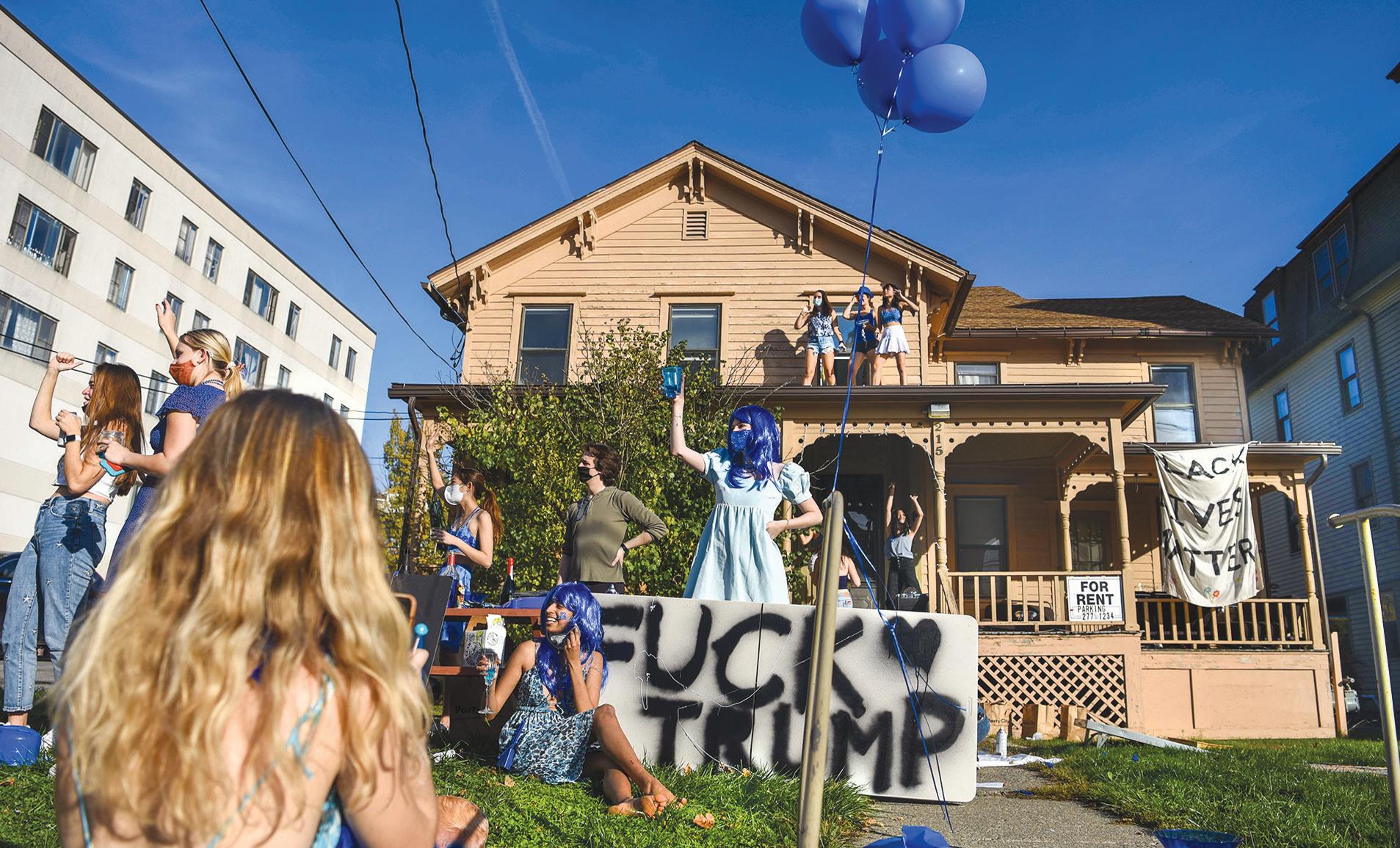
Celebrations Rock Collegetown
Students blare horns, circle Cornell campus, downtown Ithaca
BIDEN Continued from page 3
“fraudulent,” calling for the Supreme Court’s involvement and a recount.
But Cornell Republicans president Weston Barker ’21 dismissed such theories, saying it was clear that Biden was the President-elect. He highlighted gains for the Republican Party in the House of Representatives and called the moment an opportunity for “a culture of renewed bipartisanship.”
“This election has been an incredibly divisive one,” Barker said. “Now, more than ever, it’s time for us to come together as a nation and ensure that the transfer of power is smooth and easy, as it has always been.”
The 2020 election’s results were markedly different
from 2016 which saw a stunned student body gathering for a cry-in event when Trump won. This year, students exhaled at Trump’s loss.
“My only reaction is ‘yay.’ I don’t know, I don’t have words,” said Isabel O’Connell ’23, studying for a nutritional studies prelim in Upson Library when news broke. “I’m just so happy.”
After a week of switching tabs between Zoom and the electoral map, students on edge the news would break in the middle of the night or in the shower, an overwhelming sight of relief stretched across campus — the election was over.
Asha Patt ’23, Caroline Johnson ’22, Ari Dubow ’21 and Amanda H. Cronin ’21 contributed reporting.
Madeline Rosenberg can be reached at mrosenberg@cornellsun.com. Kathryn Stamm can be reached at kstamm@cornellsun.com.

BORIS TSANG /