The Corne¬ Daily Sun


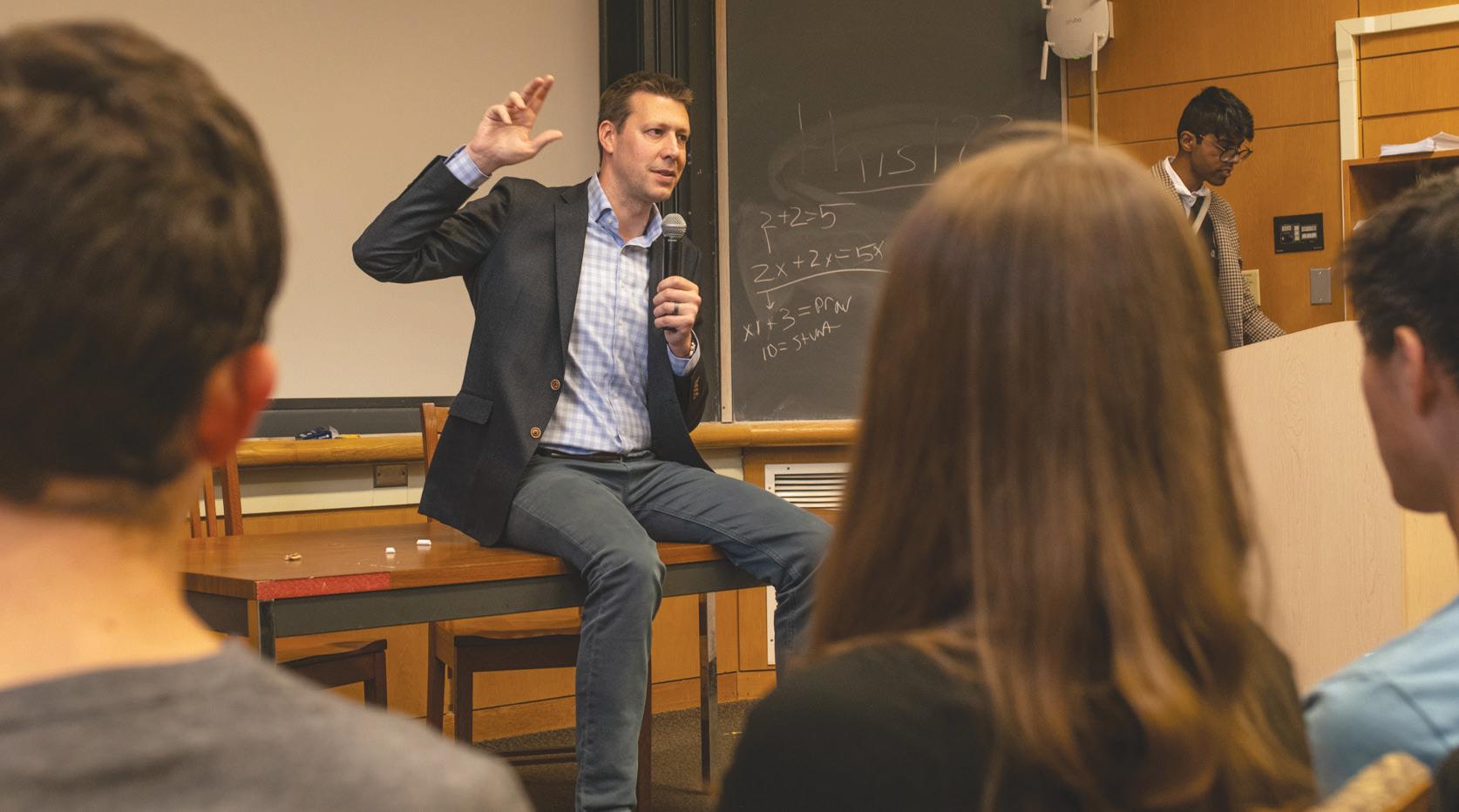

Cornell Democrats, Riley spoke to Cornellians about his platform and vision for the region if elected.

On Nov. 8, Americans all over the country will cast their votes to determine who should represent them in the 118th Congress — Ithaca is no different. In preparation for this widely-anticipated and widely-consequential election, Democratic nominee for the NY-19 district Josh Riley (D-N.Y.) visited campus as part of his home-stretch tour of Upstate New York.
In a Friday afternoon town hall hosted by the
As a result of the 2020 Census, Ithaca was redistricted from the solidly Republican 23rd congressional district to the tossup 19th, which extends east to the New York-Massachusetts border. Students cited this as a reason why they were drawn to attending.
“He might be our next Congressperson. He will be representing us as Cornell students if he wins, so I think it is a good use of time to see what he is all about
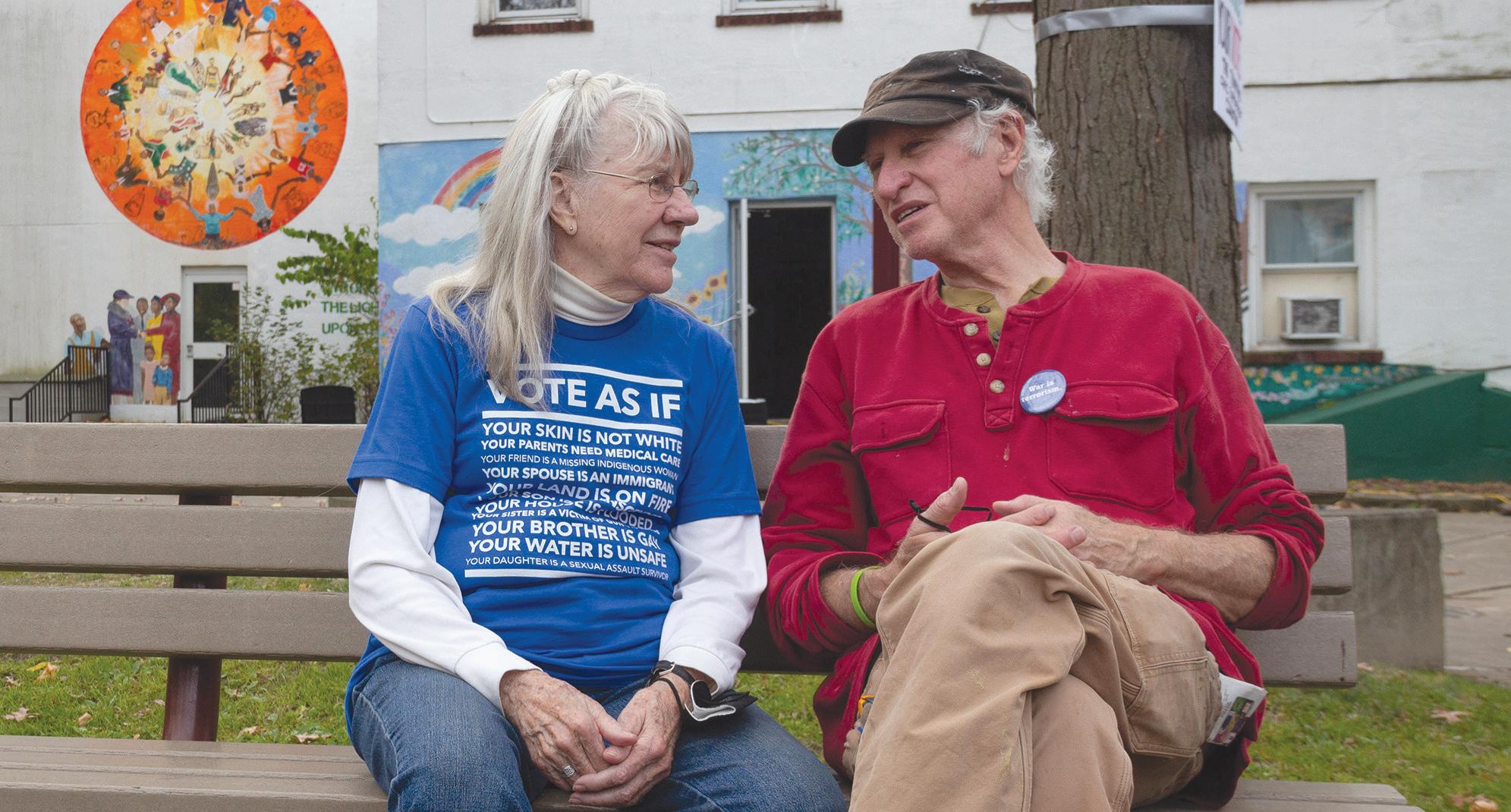
Your Voice + Your Vote, a brand-new coalition of local nonpartisan groups — including the League of Women Voters of Tompkins County, Tompkins County Human Rights Commission, Finger Lakes Independence Center and Rejoice the Vote — hosted a celebration of voting event on Saturday.
“Your Voice + Your Vote grew out of a conversation we had in the Human Rights Commission and with the Office of Human Rights back in July, and we’ve been meeting every two weeks with this group of partners that we’ve pulled together,” said Joanna Green, a member of the Tompkins County Human Rights Commission.
Green explained that while the group has been meeting since July, the event marked their first time meeting in person and launching the coalition to the public. Held at the Southside Community Center, the event featured voter registration aid, information tables for each of the attending groups, local speakers and music.
Green and Sally Grubb, co-president of the League of Women Voters of Tompkins County, spearheaded the event, coordinating all of its logistics within a mere two weeks.
“We wanted to spread the word about each group here today, and what they’re doing independently of
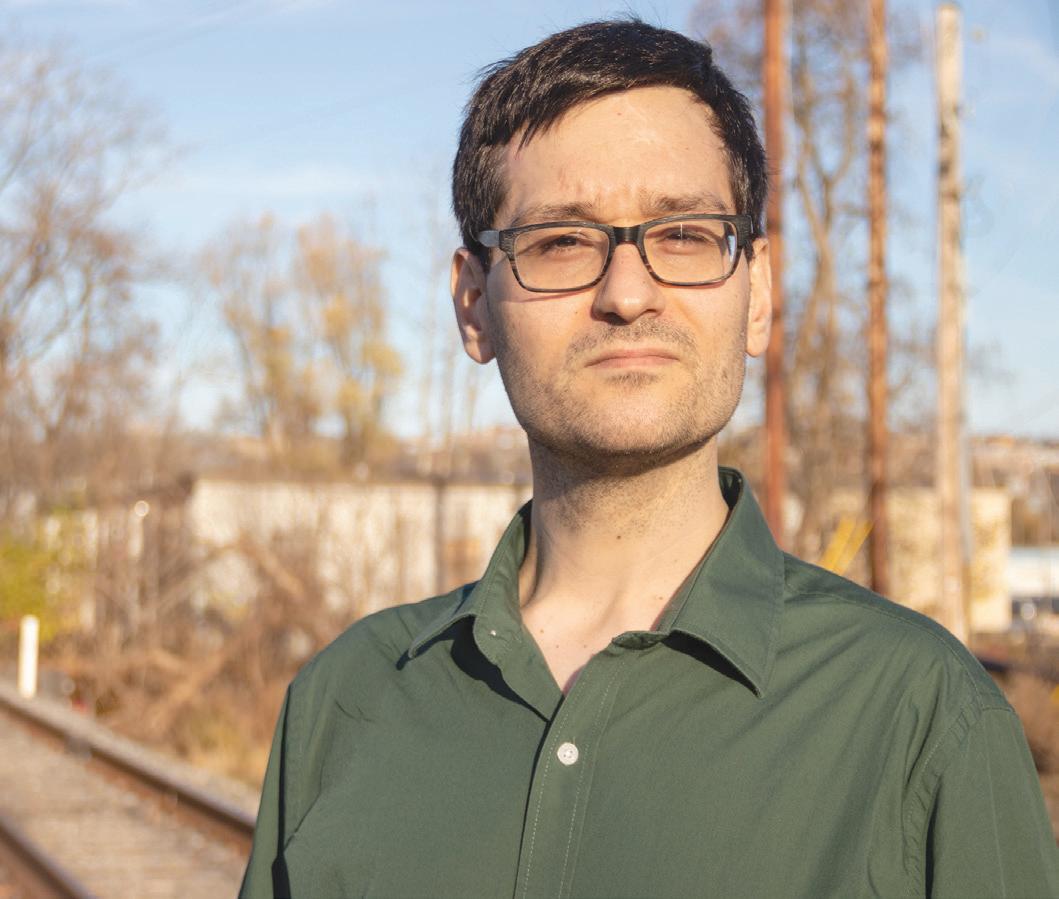
Zachary Winn is a lifelong, politically-active resident of Ithaca. He decided to run for mayor on the Republican ticket after finding out that Acting Mayor Laura Lewis was set to run unopposed, though Independent Katie Sims joined the race soon after.
“I felt obligated to give people an actual choice when they entered the voting booth,” Winn said. “It was hard to imagine Laura Lewis fixing problems she helped create.”
Winn views public safety, taxes, corruption in City Hall and negative repercussions from the COVID-19 lockdowns as the biggest issues currently facing the City of Ithaca. Of particular concern to Winn is a section of the City termed “The Jungle,” an encampment that stretches from behind Lowes to behind Walmart on South Meadow Street, where many unhoused Ithacans reside.
The encampment is littered with discarded clothing, propane tanks and shopping carts from neighboring retailers, along with needles and syringes. Winn feels the City should increase its efforts to improve conditions for the unhoused population.
“This is not compassion,” Winn said. “To leave people out here to do whatever they want. There are people who are routinely victimized within the community by other people in the community.”
Currently, the City has created The Ithaca Designated Encampment Sites proposal which aims to construct around 25 cottages, a common bathroom and a community space in the area occupied by the unsanctioned encampment, providing safer living conditions for the unhoused population.
“With the money set aside on the city and county level for TIDES, I think the first step would be enforcement,” Winn


Econometrics Lecture: “Optimal and Safe Estimation for HighDimensional Semi-Supervised Learning” — Yang Ning 11:15 a.m. - 12:45 p.m., Uris Hall 498
Lisa Corinne Davis, Hunter College in New York: Place — A Geographical, Metaphorical and Metaphysical Concept 11:30 a.m., Sibley Hall 157
National First-Generation College Students Celebration Lunch Noon - 1 p.m., Rockefeller Hall 133
Berger International Speaker Series with Marissa Jackson Sow — Reckoning with the Racial Contract in International Law 12:15 p.m. - 1:15 p.m., Virtual Event
Scientific Computing Training Series — Introduction to Modern R Data Analysis 9 a.m. - 10 a.m., Virtual Event
Industrial Organization Workshop: Subsidies Versus Tradable Credits for Electric Vehicles: The Role of Market Power in the Credit Market — Hyuk-soo Kwon, grad 11:15 a.m. - 12:45 p.m., Uris Hall 498
Asian American Studies Program and Asian and Asian American Center BeComing Lunch Series with Pearl Ngai Noon - 1 p.m., Rockefeller Hall 429
Cornell Reproductive Sciences Seminar Series: “Impacts of EarlyLife Social Experiences on Reproductive Decision-making in Prairie Voles” — Prof. Alex Ophir, psychology 4 p.m. - 5 p.m., Schurman Hall Lecture Hall 5, S1-212
VOTING
Continued from page 1
each other and what we’re doing together,” Grubb said. “We wanted to start a community-wide effort to increase civic awareness and educate people who are not in power at the moment, thus generating involvement by everybody.”
In addition to soft-launching the Your Voice + Your Vote coalition, event participants also aimed to foster community involvement in democracy. Specifically, the coalition wanted to encourage people to extend their efforts in politics and advocacy beyond voting.
“It goes way beyond voting — it’s about developing political power,” Green said. “I really feel like work to save our democracy has to have local roots. It needs to happen within communities. We have to be talking across divides and working really hard to make sure that people’s needs can be met.”
Vote 411, an nonpartisan online resource that contains voting information, also participated in the event. The organization sends questions to all candidates for Tompkins County races, to which the candidates respond to in a secure, password-based log.
Nancy Skipper, coordinator of Vote 411 for Tompkins County, explained that the website’s goal is to expand voting accessibility.
“This enables potential voters to go in and compare the candidates and pick the best one,” Skipper said. “A lot of people are really shocked by what shows up on the ballots when they do go to vote, or they just don’t vote because they don’t know what is going to be on the ballot. But if you go into Vote 411, you can see it all.”
To continue reading this article, please visit cornellsun.com.
Sam Johnstone can be reached at sjohnstone@cornellsun.com.
and see what he has in store if he is elected,” said Tover Feist ’26.
Riley began by sharing his background as a native to the region, whose family had exemplified the American Dream, but he also saw many communities like his being left behind by globalization. As a lawyer, he represented the American Academy of Pediatrics in a civil rights case, which solidified his belief that healthcare should be a civil right. The husband of a daughter of Indian and Ecuadorian immigrants, he also spoke about the impact that the Trump administration’s ban on travel from Muslim countries had had on their family.
Javed Jokhai ’24, president of the Cornell Democrats and Sun Columnist, spoke about the Cornell Dems’ history with the Riley campaign.
“We were just moved by him and his policies and his story,” Johkai said. “So then, during the summer we decided that we would take the bold move of endorsing him in the primaries before the Democratic Party, like the National Party decided [to do so], and we just started getting to work with fieldwork.”
Patrick Mehler ’23, Ithaca Commons Council Alderperson, also attended the town hall.
“I see why he makes sense for not just this district and for this specific area, but for students and permanent residents alike,” Mehler said. “I think he did a really good job of highlighting practical solutions to some of the larger problems we’re facing and that we’re going to face once most of these college kids are adults. So I was very happy to hear him speak.”
Riley emphasized his commitment to run a campaign based on individual contributions and grassroots efforts, consistent with his endorsement by labor unions and the stories that people have told him about their cost of living.
“I believe that doing the right thing
and rejecting corporate PAC money is the winning thing. And that is on the line on Tuesday,” Riley said. “I want to be able to wake up on Wednesday and prove the world wrong [that individual donations can be stronger than PAC money]. And we’re able to [create] grassroots campaigns and knock out the special interest.”
However, Riley was investigated by The Sun, along with his opponent Mark Molinaro, for accepting money from Political Action Committees. According to the Federal Election Committee campaign finance filing, the organization Communications Workers of America, a labor union that has donated funds from nationals PACs, donated $10,000 to Riley this election cycle.
As a father of a 2-year-old, Riley said some of the most important issues to him were the preservation of democracy and the fight against climate change. He expressed optimism that the advances in green technology made in Upstate New York could be instrumental in achieving the latter.
Moreover, he spoke about the importance of public education funding and government support. He spoke about the community schools model proposed by Senator Sherrod Brown (D-Ohio), which would provide services such as mental health services, nurses, better funding for their academic programs and nutrition programs.
“The studies are very clear that if you’re investing one dollar into the community school model, over the long term, you’re saving $14 in benefits because we’ve got kids who are healthier, kids are getting the support they need,” Riley said. “The kids are coming out of our educational system in a position to succeed that they’re not right now.”
To continue reading this article, please visit cornellsun.com.
Jonathan Mong can be reached at jcm482@cornell.edu.
and services that allow Jungle residents to find purpose in life so that they can improve their life trajectory.

By ERIC REILLY Sun Contributor
The Cornell University Borehole Observatory project team held an open meeting on Thursday to inform the Cornell community on the future of the project.
CUBO is a nearly two-mile-deep borehole located on the southeast edge of campus, about a mile east of Collegetown. CUBO is designed to analyze the deep earth conditions beneath Cornell’s campus. The data gathered from CUBO will help determine if conditions are adequate for Earth Source Heat, a geothermal energy process in which water is circulated through underground wells, harvesting heat from Earth’s interior.
With drilling having been completed in August, CUBO has shifted to its data analysis stage. Thursday’s meeting gave community members the opportunity to hear from six members of the project team, as they reported early findings from CUBO.
“I am personally pleased to announce that the early data gathered from CUBO are promising,” said Prof. Lynden Archer, chemical and biomolecular engineering, who is also the dean of engineering and co-chair of the Sustainable Cornell Council.
For ESH to be a possibility at Cornell, three conditions must be met — temperature, flow volume and long-term sustainability. Data from CUBO confirmed that the temperature, rock type and permeability align with initial hypotheses, giving the project team hope that an enhanced geothermal system could be implemented at Cornell.
wells supporting 40-80 liters per second of water flow across permeable rock between 75-100 degrees Celsius. The well pair would pump that hot water to the surface, where heat would be transferred to another closed-loop system and circulated throughout campus buildings. Water in the well pair would then be pumped back down beneath Earth’s surface, where it would once again be heated.
CUBO has identified three target depths beneath the surface that meet the permeability and temperature requirements. The borehole has also painted a clearer picture of Cornell’s proposed EGS system, as the construction of CUBO mirrors the drilling required to build geothermal wells.
“We now have excellent knowledge of how to design and how to budget for the well,” said Prof. Terry Jordan, earth and atmospheric sciences.
The project team has focused on transparency throughout the drilling and data collection process, posting weekly videos and data in a blog. This frequent communication has increased both collaboration with partners in the geothermal industry and education outreach for the public.
“Having a real demonstration here that’s fully transparent, letting people learn from what we’re doing — will be an important first step forward,” said Prof. Jeff Tester, chemical and biomolecular engineering, who also serves as the principal scientist for ESH.
To continue reading this article, please visit cornellsun.com.
said. “If there is no mechanism for enforcement, TIDES is already a failure.”
Winn said that he does not believe housing first is the solution. Instead, he would like to see more enforcement against lawless behavior, which would require creating access roads so that the police and emergency services can reach the residents of The Jungle.
“Extending these access roads, getting some light down here, going through and making it known that this isn’t going to be able to go on forever, trying to get people in touch with services,” Winn said. “These things should be getting done right now, immediately, because there is an immediate crisis.”
Right now, Winn said the residents of the encampment are facing routine victimization through the torching of campsites and that there is widespread use of methamphetamine. He pointed to a meth bust in November 2021 on Lake Avenue as proof of the methamphetamine problem in Ithaca.
“This is a lawless area,” Winn said. “This is like the thieves’ forest in Robin Hood, except it’s not a bunch of dudes running around singing songs, it’s people injecting methamphetamine.”
As Mayor, Winn would prioritize more funding for the Ithaca Police Department, which currently has 15 vacancies. He would like to see enforcement against criminal behaviors
“Philosophies that created this situation are the same policies that are in place in places like Los Angeles, San Francisco and New York City, where there is this belief that enforcing the law and holding people accountable for their actions is somehow cruel and inhumane,” Winn said. “I fundamentally disagree with that, and I think you are doing somebody a disservice by allowing them to spiral down.”
To document the crime occurring in The Jungle and in the City, Winn created the website IthacaCrime.com in August 2021, where he writes under the pen name Chip Daley — an ironic nod towards one of his favorite films, Bob Roberts, in which the character Daley represents an uncaring corporate journalist who laughs when reading a report about homelessness.
Winn began the website because his questions on the makeup of the Reimagining Public Safety Working Group were going unanswered by the legislature. He wanted to know why there was limited involvement from the law enforcement groups that would be affected by any reimagining proposals. If elected, Winn would end the Reimagining Public Safety process.
To continue reading this article, please visit cornellsun.com.
Sofa
The proposed EGS technology includes two
Eric Reilly can be reached at er496@cornell.edu.
By JONATHAN MONG Sun Staff Writer
For whom someone votes is only part of the equation when understanding political landscapes. In addition to party affiliation, there are many other reasons why a voter may choose a character, such as major issues that influence their voting decisions, support for or opposition to a candidate’s policies or even simple gut reactions like fear.
The current status of democracy also factors into some decision making. Following former president Donald Trump’s refusal to accept the results of the 2020 election and the subsequent attempted January 6 insurrection at the Capitol, many Republicans have followed in his footsteps and denied the results of the 2020 election. Other students focused on the economy, women’s rights and immigration as determinants for their vote.
The Future of Democracy and Election Denial
Given the refusal by many Republicans to accept the results of the 2020 election, many of the students interviewed expressed fears either about the future of democracy in the United States or that one of their states’ candidates would refuse to accept a loss, disseminating lies that their defeat was fraudulent.
“I think [democracy] really is at stake, especially in local election.”
Sammie Engel ’25
“The future of democracy is at stake in the United States because of the Republican Party and the ideologies they enforce and promote,” said Anna Casey ’25, who is from Arizona. “This is especially true for women’s rights, as the decision to take them away in many states has already been made. If you are eligible to vote, it is your duty as an American citizen to ensure that those who have the power to take away those rights do not get re-elected under any circumstances.”
Vivian Lewandowski ’25 also raised concerns over the future of democracy, citing Wisconsin, from where she hails, as a battleground state in which she feels democracy is especially threatened.
Sammie Engel ’25, from Ohio, expressed similar worries.
“I think [democracy] really is at stake, especially in local elections,” she said. “People
By MARISA CEFOLA Sun Contributor
This year’s flu season has students struggling to keep up on missed work while Cornell Health struggles to handle an influx of appointments punctually.
Influenza A has come to Cornell in mass waves: students experienced fevers, heat flashes, fatigue and non-stop coughing among other severe symptoms.
According to Dr. Jada Hamilton, medical director at Cornell Health, the flu can have students bed-ridden for up to a week, sometimes longer if they have underlying health concerns.
“Flu season has definitely begun,” Hamilton said. “Cornell Health has seen a sharp increase in influenza cases in recent weeks, causing us to focus many of our clinical appointments on students presenting with flu and flu-like illnesses.”
With COVID-19 still in circulation, Hamilton emphasized the importance of taking the necessary precautions like vaccinations and washing hands frequently to avoid getting sick.
“We’ve had cases of individuals contracting COVID and
the flu simultaneously, which can make you sicker than if you experience just one illness,” Hamilton said.
Cornell Health offers numerous resources such as self-care supplies in the pharmacy, consultations and free and accessible flu vaccines. This fall, almost 6,000 Cornell community members have received their shot at various vaccine clinics around campus.
Still, students voiced having trouble booking in-person appointments despite Cornell Health’s focus on flu-related affairs. Individuals with urgent cases have waited up to three days to be seen; by then, the appointment was less helpful.
“I couldn’t get an appointment while I was sick… by the time I got to Cornell Health, I was already past the worst part of my flu,” said Abigail Kim ’26.
When asked to comment directly on students’ concerns with appointment wait times, Cornell Health declined to further comment, saying they stood by their original statements.
Kim along with Austin Bares ’26 additionally found communication with their professors to be difficult, struggling to learn through their accommodations.
“The professor said he was going to give us online videos, but they were poorly recorded…I had to end up asking other students for notes,” Kim said.
Some professors, in Bares’ case, were less accommodating.
“Two of my professors were understanding out of five,” Bares said. “My P.E. coach told me to drop out of the P.E. class due to medical reasons… I won’t be doing that.”
While severe cases of the flu were common among students, others experienced milder cases and were still able to attend classes. But, they were easily distracted in lecture.
“When I’m sick, I don’t feel like paying attention at all…all I’m focused on is my illness,” said Videesha Mohan ’26.
No matter the severity of symptoms, flu season has deterred students from staying on top of work, causing most to fall behind. Many have been sick at Cornell before, however, the flu has impacted their studies most.
To continue reading this article, please visit cornellsun.com.


can overlook state and municipal elections, but electoral maps, abortion rights, gun control, climate change, education, economy — everything is controlled to an extent at the state level and so it’s critical to vote.”
Caroline Hinrichs ’22, who lives in Madison, Wisconsin, noted Wisconsin’s strict absentee voting laws.
“I’ve heard people at work say, ‘Oh, if you’re doing an absentee ballot or if you’re voting early, you have to make sure that everything is perfect. If there’s one thing that’s out of place, if one check mark is in the wrong box, they will throw out your ballot,’” Hinrichs said. “You have to be fastidious when it comes to getting your ballot right in Wisconsin, so I am trying to go vote in person on the day of for maximum chances that my vote will be counted.”
Other students, like Max Hafner ’23, said they did not share such intense concerns.
“I don’t believe that the future of democracy is at stake,” Hafner, who hails from Pennsylvania, said. “I don’t believe that most important decisions are relevant to popular desire, and while elections may have minimal influence, war and corporate greed will continue to be pushed regardless of the letter next to the politicians’ names.”
Sam Schneider ’22 said that he was considering broader questions of democracy, mentioning Mehmet Oz’s (R-Penn.) running in the upcoming Senate election as an example of under-qualified candidates being allowed onto the ballot.
“Do we want a democracy where we actually hold potentially unbalanced candidates responsible and hold them to a higher level, or do we just let any rando like Mehmet Oz onto the ballot whenever they want?” Schneider said.
“The country has quietly accepted the concept of getting bad ballots in terms of the quality of candidates on them, and just being okay with that and saying, ‘Well, I have to vote.’ That’s the bigger concern.” To continue reading this article, please visit cornellsun.com.
Jonathan Mong can be reached at jmong@cornellsun.com.
At once praised for its stunning visuals and lambasted for its deviations from lore, Amazon’s The Rings of Power has sparked debate among fans, inspired a new generation of Silmarillion readers and been the object of racist vitriol. It follows the radiant, vengeance-fueled quest of Galadriel (Morfydd Clark), from the spires of Elven cities to the island kingdom of Númenor, to confront ancient evil rising without and within. (Spoilers ahead!)
Much of the emotional heart of the story in truth lies under the mountains, with Prince of the Dwarven kingdom, Durin IV (Owain Arthur) and Half-Elven herald Elrond (Robert Aramayo), whose friendship illuminates the magnificent darkness of Khazad-dûm. Durin’s wife and resonator of the deep earth, Disa (Sophia Nomvete), is also a beacon in her warm and queenly presence — and Lady Macbeth-ish monologues. Alas, the Khazad-dûm plot veers into ominous Mithril Mystery, and is left for later stories.
Elsewhere amidst the artful visuals of orchards, wastelands and Sundering Seas, some especially standout moments are Adar’s (Joseph Mawle) quiet grief for his fellow Uruks, the feathery ships of Númenor sailing into the dawn, the eruption of Mount Doom and the finale’s mind-bending confrontation between Galadriel and Halbrand/Sauron (Charlie Vickers). In his gentle respect for green and growing things, Silvan Elf Arondir (Ismael Cruz Córdova) is also particularly grounding, and gets the best action scenes of the series in his defense of Bronwyn (Nazanin Boniadi), Theo (Tyroe Muhafidin) and the Southlander villagers. I confess I found the Harfoots and the Stranger, though intriguing at first, overwrought.
Bear McGreary’s incredible soundtrack is the golden thread that binds the series together — from the winding, processional grandeur of “Númenor,” to the proud march of “Khazad-dûm,” to the deftly twofold hope and sorrow of “Elrond Half-elven.” Faced with the daunting task of following in Howard Shore’s footsteps, McGreary resorts to pure musical alchemy, deploying character motifs with such skill that one might discern from them whispers of the plot. For example, the acoustically elegiac “Halbrand” is in fact a major key echo of “Sauron.” (It might have been an
obvious twist, but I enjoyed it, along with Halbrand’s theatrics.)
Much ink has been spilled on the show’s shortcomings, but like the Elven Rings forged (rather too hastily) at the end of the season, I think we have been exerting an incendiary degree of pressure on the apparent alloying of the legendarium with new creations. The showrunners J.D. Payne and Patrick McKay are setting up a story that will span five seasons, which they have said will henceforth lean more heavily on canon. In the meantime, they have laid the groundwork by compressing time and creating (mostly) compelling characters to reacquaint us with Middle-earth. Adaptation is always in part creation, not wholly mimicry.
For me, pacing is the main issue. Slow burn, exposition-driven elements are productive; it is rather that the writers seek a deeper narrative haste without taking much time to build the wheeling scale of epic. Númenor in particular falls victim to this, where we see only inklings of the all-consuming desire for eternal life that will eventually drown them. But where the Númenor storyline falters, it is rescued by the gravity of Elendil (Lloyd Owen) and Queen-regent Míriel, as well as their trials of faith.
As for Galadriel, I enjoyed her strength and vulnerability. At first I was worried that she was going to be consigned by poor writing to seem vaguely motivated by kicking ass. Then, at last, I got confirmation that this was a deliberate arc — she swears to Adar that she will eradicate orcs, but in the ashes muses bleakly on war’s poisoning of the heart. All at once, the writers’ vision of Galadriel began to materialize for me like dawn, the flickering reflection of a Queen that all might love and despair. We must first see the roots of her rage, and struggle with her desire for absolution, before we can see her rise to be Sauron’s great equal and enemy.
Legally, the writers can only draw on the material of The Hobbit, The Lord of the Rings and its appendices; one might wonder why tell a tale of the Second Age without rights to The Silmarillion. For the readers that have not encountered The Silmarillion, it is a mythic collection of stories recounting the origins of Middle-earth, the rise and fall of Morgoth (Sauron’s predecessor), the strife over jewels called the Silmarils and many other beautiful tales besides.
Although cloaked in concern for the lore, some so-called criticism has in fact drawn on a sleepless racist malice, roused not only

since the casting of Black and Brown actors in Rings of Power, but since the beginning. Tolkien himself employed racist imagery of monolithic antagonist orcs as “blackskinned” and once described them as “squat, broad, flat-nosed, sallow-skinned, with wide mouths and slant eyes,” going on to use specific, degrading anti-Asian language. Fans often claim Tolkien was only a product of his time — that he was speaking from a place of profound (and self-admitted) Eurocentrism. In Lord of the Rings, however, we see narratives that foreground and criticize racism, especially between Elves and Dwarves. Tolkien’s letters also strongly denounced “race-doctrine” and Nazism. We cannot, and should not, absolve Tolkien of his racism, but we can take account of his complex attempts to condemn it.
Indeed, many BIPOC fans do choose to engage with Tolkien’s works, an embattled resistance to those that claim a “white” Middle-earth (for further and more in depth reading, I recommend an article by Christina Warmbrunn, “Dear Tolkien Fans: Black People Exist”). In a recent Instagram caption, Arondir’s Ismael Cruz Córdova spoke of growing up as a poor Puerto Rican boy with an “impossible” dream of being an Elf. Despite embodying Elven beauty, lethal grace, and love of life, as one of the only Elves played by a POC Córdova has faced waves of hatred.
“But I believed in my right, and our right, to exist. Just like the rest,” Córdova said. “To see ourselves, to imagine ourselves
and to occupy the spaces that we rightfully deserved.”
Needless to say, the right to claim and reclaim Middle-earth is contested territory, and more condemnation of racism needs to come from white fans who, like myself, may have grown up without having to question or defend their part in the tale, and its telling. Although there is room for improvement, Rings of Power is a worthwhile reminder to hold fast to the commonplace acts of love and courage at the heart of the legendarium.
I look forward to the next season, where we can probably hope for Sauron machinations, more Khazad-dûm, more Celebrimbor (Charles Edwards) and ring-forging. And perhaps (fingers crossed) a more arcane Galadriel seen for the being of immense inward power that she is.
The show is not a dilution but an adaptation — flawed, but a luminous selection of organically piecemeal lore, as though of stories and songs half-remembered, longloved. There is a sense of shifting myth, the labyrinthic tapestry of memory, that I hope future stories will rely on and embroider more boldly. As Aragorn describes an ancient song of Beren and Lúthien to the Hobbits: “It is a fair tale, though it is sad, as are all the tales of Middle-earth, and yet it may lift up your hearts.”
Charlee Mandy is a senior in the College of Arts and Sciences. She can be reached at cmandy@cornellsun.com.
YUNOO KIM SUN CONTRIBUTOR
It’s 1931 in Shanghai, and assassin Rosalind Lang is not happy with her newest assignment. She’s the main protagonist of author Chloe Gong’s newest book Foul Lady Fortune, with plenty of secrets to hide and complaints to voice. Her country is caught in the midst of a civil war as well as an imperialist invasion, and she has just been assigned the joint codename High Tide. The flirtatious other half of this operation is fellow agent Orion Hong, and the pair are tasked with investigating a series of murders under the guise of being a married couple. There’s just one small problem with this plan: the two can’t seem to get along.
Foul Lady Fortune is the highly-anticipated follow-up to Gong’s previous series, These Violent Delights, with Rosalind being the cousin of Gong’s first protagonist, Juliette Cai. Whereas the These Violent Delights duology was inspired by Romeo and Juliet, Foul Lady Fortune is loosely based off of the comedy As You Like It, with Rosalind and Orion taking on the roles of Shakespeare’s Rosalind and Orlando.
Appropriately, Gong places a stronger emphasis on humor in her new series — Rosalind and Orion’s relationship is a disastrous blend of distrust and belligerent cooperation.
Nevertheless, there are stylistic similarities between the two series. Once again Gong experiments boldly with the border between fantasy and historical truth, stitching the reality of 1930s Shanghai into genres like noir mystery and science fiction. It’s a risk, especially when the consequences of such events are still sensitive subjects today. Even readers who are unfamiliar with Imperial Japanese policies or the Nationalist and Communist conflict in China will be able to pick up on the severity of these political tensions. It’s clear that Gong has made an effort to tastefully navigate these topics from a modern perspective, without being overly preachy or holier-than-thou. Contemporary issues of representation are also casually addressed, with most of the main cast being East Asian as well as LGBTQ+.
Gong also reuses her strategy of rotating chapters between narrators, so that the story is told not only by Rosalind, but also by Orion and their respective families. I especially enjoyed the sections narrated by Phoebe, Orion’s
flippant younger sister who desires nothing more than to be a spy. While Rosalind’s chapters are dark and intense, Phoebe’s are filled with mischief; likewise, each narrator has a unique voice that mirrors their personality.
Even apart from their roles as narrators, the two leads are deeply compelling. Rosalind is genuinely flawed and plausibly powerful, and the transformation of her dynamic with Orion is entertaining to read about regardless of who’s narrating. The two carry both an immense amount of burdens, and, despite their bickering, admiration for each other. Their relationship is far from smooth, but it is a pleasant change of pace from the unhealthy power dynamics and toxic behavior perpetuated by similar YA romances.
In summary, Foul Lady Fortune has everything it promised — humor, mystery, romance, a jaw-dropping ending. From her elegant metaphors to drastic tone shifts even within the same chapter, Gong’s prose is a delight to read and is sure to attract both new and returning readers.
Yunoo Kim is a freshman in the College of Arts and Sciences. She can be reached at yk646@cornell.edu.
SERENA HUANG ’24
Business Manager
EMMA LEYNSE ’23
Associate Editor
SURITA BASU ’23
Assistant Managing Editor
NAOMI KOH ’23
Assistant Web Editor
ELI PALLRAND ’24
News Editor
ESTEE YI ’24
News Editor
KAYLA RIGGS ’24
City Editor
JULA NAGEL ’24
Photography Editor
MEHER BHATIA ’24
Science Editor
KATRIEN DE WAARD ’24
Production Editor
PAREESAY AFZAL ’24
Assistant News Editor
JIWOOK JUNG ’25
Assistant News Editor
ADITI HUKERIKAR ’23
Assistant Arts & Culture Editor
JASON WU ’24
Assistant Photography Editor
GRAYSON RUHL ’24
Assistant Sports Editor
KEVIN CHENG ’25
Newsletter Editor
HANNAH ROSENBERG ’23
Senior Editor
JYOTHSNA BOLLEDDULA ’24
Senior Editor
VEE CIPPERMAN ’23
Editor in Chief
ANGELA BUNAY ’24
Managing Editor
TRACY ZENG ’24
Advertising Manager
DEVAN FLORES ’24
Web Editor
KATHERINE YAO ’23
SOFIA RUBINSON ’24
COLIE ’23
DANIELA WISE-ROJAS ’25
AARON SNYDER ’23
Editor
TENZIN KUNSANG ’25
KIM ’24
AIMEE EICHER ’24
YOUNG ’24
HEGDE ’24
’24
GABRIELLA PACITTO ’24 Assistant Sports Editor
RUTH ABRAHAM ’24 Assistant Sports Editor
DANIEL BERNSTEIN ’23
MADELINE ROSENBERG ’23 Senior Editor
Working on Today’s Sun
Ad Layout Stella Wang ’24
Managing Desker Angela Bunay ’24
Associate Desker Emma Leynse ’23
Arts Desker John Colie ’23
News Deskers Sofa Rubinson ’24
Aimee Eicher ’24
Sports Desker Ruth Abraham ’24
Photography Desker Julia Nagel ’24
Production Desker Katrien de Waard ’24
Letter to the Editor
To the Editor:
Dr. Wickham’s recent letter was an important and helpful clarification of the redistricting changes affecting the Cornell community. With the election just a few days away, I’d like to add a further exhortation for everyone who’s eligible to get out and vote. Low voter turnout has long plagued our midterm elections.
That began to change in 2018 when, according to the U.S. Census Bureau, 53.4 percent of eligible voters actually voted, as compared to the 41.9 percent turnout in 2014.
Among 18 to 29-year-olds, the 2018 turnout was 16 points higher than it was four years earlier (U.S. Census Bureau). It’s imperative that the increase we saw in 2018 continues. So please vote. And when you do, consider which political party:
• advances minority, women’s, voters, immigrant and LGBTQ+ rights;
• wants you to take the time to vote;
• respects a woman’s right to choose;
• believes climate change is real;
• passed health care reform that brought coverage to millions of Americans;
• condemns the Jan. 6, 2021 attack on the U.S. Capitol as an attempt to overturn a free and fair election and considers it an attack on our democracy.
As the nation’s largest voting bloc, 18 to 29-year-olds have the power to determine our shared futures. Use it! Go to vote.org for more info.
Timothy Worrall

Gabriel Levin (he/him) is a freshman in the College of Arts and Sciences. He can be reached at gpl48@cornell.edu. Almost Fit to Print runs every other Monday this semester.
Last week, the Supreme Court assembled to hear arguments against affirmative action in two cases. Affirmative action is the longstanding practice of considering race and membership in underrepresented demographics as one of many factors in admissions and hiring. Race-conscious admissions are proven to increase diversity in higher education and combat racial inequality. Legal experts forecast that the conservative Court will scale back, if not eliminate entirely, a college’s right to practice affirmative policies that take race into account. This should worry us all.
If the Court bans race-conscious admissions, decades of progress toward equal opportunity will be reversed and the wealth of perspectives that we enjoy in academic forums today could dwindle in years to come. We also stand to lose a time-honored, effective mechanism “to counteract the inherited disadvantages that unequally but in patterned ways burden certain races in our society but not others,” Prof. Nelson Tebbe, law, told me. Tebbe, a constitutional law expert, stressed the importance of recognizing “structural racism as an empirical reality in the United States.”
Tebbe’s sentiments offer lucidity at a time when Republican politicians deny systemic racism and disregard the lingering symptoms of centuries of legalized discrimination, slavery and genocide. Distressingly, that reactionary rhetoric is being parroted from the Bench. Dismissing the need for diversity in higher education, Justice Clarence Thomas said last Monday, “I’ve heard the word ‘diversity’ quite a few times, and I don’t have a clue what it means. It seems to mean everything for everyone.”
No, Justice Thomas, what diversity simply means is that, in the interest of democracy, our colleges and universities are representative of the country whose future leaders they’ll graduate. In an economy where a college degree is a prerequisite for high-paying, specialized jobs, affirmative action is crucial to upward mobility for those who didn’t have the luxury of being born into generational wealth because their ancestors’ skin color was seen as reason enough to deny a loan, an education, healthcare, housing, a job and anything else that fell to discretion.
Another benefit of affirmative action is that, by promoting minority leaders, it helps to defeat prejudice everywhere decisions are made. Thus, the positive impacts of affirmative policies reverberate throughout underserved communities, ensuring that the inequities of the past won’t survive to make it to the future.
“It’s not fair,” exclaimed Cornell’s Vice Provost for Enrollment Jon Burdick when I asked him about the Court’s treatment of affirmative action. I couldn’t have put it better myself. Burdick oversees admissions, registrar leaders, financial aid and student employment. He told me that Cornell is bracing for all potential outcomes, assessing measures to preserve racial diversity ahead of restrictions that the Supreme Court may impose. University policies that we discussed include extensive early outreach campaigns aimed at low-income, first-generation stu-
dents; expanded financial aid offerings; and an ambitious goal to raise the number of aided low- and middle-income students at Cornell by 1,000.
While we students should applaud Cornell’s wide-ranging plans, we must also remember that at best there’s no guarantee that representative racial diversity will remain if the Court falls in line with conservativism’s crusade against discussions of race in education. Detractors claim that race-conscious admissions work against meritocracy, favoring the disadvantaged over the highly-competitive. This is an argument I can hardly entertain. How can there be any talk of fairness when the scales of our nation’s history have been tipped against generations of Americans on the basis of race?
Our centuries-long legacy of structural racism shows today like a scar that will take generations of collective effort to remedy. To critics of affirmative action, I say there can be no talk of fairness when Black Americans find themselves more than three times more likely to be killed by law enforcement than white Americans. There can be no talk of fairness when, on average, Hispanic workers earn nearly 30 percent less than their white peers.
“It’s not fair,” exclaimed Cornell’s Vice Provost for Enrollment Jon Burdick ... about the Court’s treatment of affirmative action.
There can be no talk of color blindness in admissions when prejudice pervades our society and unequally steals opportunities from the historical victims of racist laws and cultural intolerance. Race is one of many factors in the holistic review of an applicant that gives important context of who they are and what barriers they’ve overcome in their academic journey.
To become responsible leaders, it’s imperative that students are exposed to a plurality of perspectives, living and learning in a community where differences are celebrated. Affirmative action enables that and is a boon for overcoming intergenerational racial disparities in our society. Diversity in academia is not just fundamental to a well-rounded education — it’s the lifeblood of democracy. The Court’s impending decision threatens the fight for equal opportunity and our advancement as an inclusive society. We students must embody tolerance and forge a future that keeps our democracy, which is under siege by the Court, alive. If we wish to remain on the right side of history, we must vocalize our support of affirmative action, seeing how our country’s long history of racism afflicts students of color today.
Fill in the empty cells, one number in each, so that each column, row, and region contains the numbers 1-9 exactly once. Each number in the solution therefore occurs only once in each of the three “directions,” hence the “single numbers” implied by the puzzle’s name. (Rules from wikipedia.org/wiki/ Sudoku)

I am going to be small





tied at 7.
By GRAYSON RUHL Sun Assistant Sports Editor
Football returned home to Schoellkopf this Saturday to take on Penn for the Trustees’ Cup. Continuing to have difficulties on offense and special teams, Cornell lost, 28-21.
Both teams were seeking to get back in the win column. The Red (4-4, 1-4 Ivy) lost on the road to Princeton last week — in large part due to five turnovers. The Quakers (7-1, 4-1 Ivy) fell for the first time last week — an upset on the road against Brown.
The game got off to a slow start, with four consecutive punts to open up. Sophomore quarterback Jameson Wang struggled to find comfort in the pocket throughout the game, frequently looking to make plays on the edges with his legs.
The first score came with just under four remaining in the first half. Starting from its own six yard line, the Quakers embarked on a six-play, 94-yard drive. The keynote came on the touchdown pass, a 47-yard strike from quarterback Aidan Sayin to receiver Sterling Stokes.
The Red wasted no time responding, as senior kick returner Javonni Cunningham gave the team an immediate boost with a 60-yard kickoff return. Set up at the Penn 30, it took two plays for Wang to connect with senior wide receiver Thomas Glover for a 31-yard touchdown. Just like that, the game was
Following a Penn punt, the Red had an opportunity to take the lead. After gaining just a yard on its first two plays, Wang, looking to make a play on his legs, took a disastrous 15-yard loss. This forced Cornell to punt from its own six yard line.
seconds left in the half, Cornell opted to run a fake field goal play. Penn shut it down quickly, and the Red went into the locker room down 14.
of the defense, he bolted down the field on a 53-yard rush, the longest play from scrimmage for either team.

The Quakers blocked the kick, setting itself up with an immediate redzone opportunity at the 20. Capitalizing on its special teams play, Penn rushed the ball to a goal-to-go opportunity, before running back Trey Flowers put it in the endzone from the wildcat.
The Red struggled to maintain drives throughout the first half, and Wang made another crucial mistake late in the second quarter. Looking for Laboy over the middle, he was picked off by linebacker Garrett Morris, who returned it to the Cornell 13.
Two plays later, Flowers rushed it up the gut for his second touchdown of the day. The Quakers extended its lead to 14.
Looking for any momentum before the half, the Red began to move the ball in a two-minute drill. Faced with a fourth down on the Penn 20 with only
Getting the ball to start the second half, it was once again special teams that hurt the Red. After being forced into a three-and-out, sophomore punter Ayden McCarter had his second punt blocked of the day. Working quickly, Penn converted its second two-play touchdown drive of the day, capped off by a 38-yard dime over the middle from Sayin.
However, the Red’s struggles in the red zone continued. The team mustered just two yards on its next four plays, with Wang throwing a pass just out of the reach of Glover on fourth down. The Quakers took over on downs.

Playing with maximum urgency, the Red finally put together a sustained drive. The nine-play, 75-yard drive was aided by a targeting call against Penn which resulted in an ejection. Wang finished the drive himself, rushing up the gut for a four-yard score.
Wang threw his second interception of the day on the Red’s next drive. Set up in Cornell territory, the Quakers stalled at the 30 before having its field goal attempt blocked. The third quarter ended with Penn leading, 28-14.
With less than 10 minutes remaining in the game and still down by 14, Wang decided to take matters into his own hands. Seeing an opening in the middle
With the game seemingly slipping away, the Cornell defense stepped up. Opting to pass on a 3rd and 2, Sayin made his first major mistake of the game. Junior cornerback Anthony ChidemeAlfaro jumped the route, picking off Sayin and setting the Red up in Penn territory.
Needing points desperately, the Red could not get anything going on offense.
The four-and-out drive was highlighted by a drop on fourth down by junior wide receiver Will Kenner which would have given the Red a first down.
The drop seemed to take the air out of the Cornell offense, which mustered only a garbage time touchdown with four seconds remaining in the game. After an unsuccessful onside kick, Penn secured the victory, 28-21.
The Red finishes its home schedule next weekend, when it hosts Dartmouth on Saturday, Nov. 12 at 1 p.m. The game will be available on ESPN+.