
Biden Gains Electoral Advantage
Race hinges on key swing states Georgia, Nevada, Arizona and Pennsylvania
By
Late Wednesday, results of the 2020 presidential election were still too close to call as boards of elections in several key swing states had not yet finished counting a slew of mail-in ballots, but former Vice President Joe Biden held a clear electoral map advantage.
While President Donald Trump took to Twitter to question mail-in votes as “surprise ballot dumps,” Cornell professors and Ithaca elected officials condemned the president’s messaging as irrevocably damaging.
All eyes now rest on the not yet called states of Georgia, Pennsylvania and Nevada, as former Vice President Biden currently leads President Donald Trump in the formal electoral vote count (264-214, as of midnight Thursday).
Throughout Wednesday
afternoon, Trump’s narrow lead in Georgia started shrinking as votes from the Atlanta metropolitan area filtered in. Over 130,000 mail in ballots remain to be counted, mostly from
Students Express
Atlanta, and Georgia’s Secretary of State Brad Raffensperger pushed for results to be delivered Wednesday.
On Wednesday, the Trump campaign said it sued
Frustration, Stress at Slow Election Results
By
Sipping tea Tuesday night in her Keeton House lounge, Madeline Lei ’23 and her suitemate eyed the polls. The pair refreshed the CBS News election results page on their computers and refreshed it again, trying to stay calm as a sea of red appeared on their screens.
in Pennsylvania, Michigan and Georgia state courts to temporarily halt ballot counting.
As results trickled in late Wednesday, Cornell Prof. Richard Bensel, government, a
political historian who studies voting and electoral history in the United States, did not think any of Trump’s suits would matter, and distinguished the situation from the procedural posture of Bush v. Gore (2000).
“If there’s really a serious suit on a legal question, then it will end up in the Supreme Court,” Bensel said..
“The problem the Trump [legal team has] is that they are going to have trouble selecting or identifying a large enough discrepancy in the voting ––failure to to follow the law or outside outright corruption –– They’re gonna have trouble with that.,” Bensel said.
He pointed to two problems: Biden is poised to win by more than just one state, meaning one state lawsuit won’t affect the outcome of the race; and the suits Trump’s team filed are statutorily weak.
“We’re both pretty stressed right now. We’re constantly refreshing the polls seeing what’s happening,” Lei, who voted for former Vice
these states in red and it’s really disturbing and kind of shocking to see it a tight race.”
“We’re seeing all these states in red and it’s really disturbing and kind of shocking to see it a tight race.”
Madeline Lei ’23
President Joe Biden, said around 11 p.m. “There hasn’t really been much positive. We’re seeing all
This is election night on a COVID-19 campus. Instead of packing into watch parties and eyeing
the polls until the morning, Cornellians huddled with housemates around computers and television screens, bracing through push notifications and live news broadcasts in between prelim study sessions and problem sets.
In an election marked by battleground states and a still-undeclared winner, many Cornell students said they felt the weight of the election.
See STUDENTS page 4

SAUL MARTINEZ / THE NEW
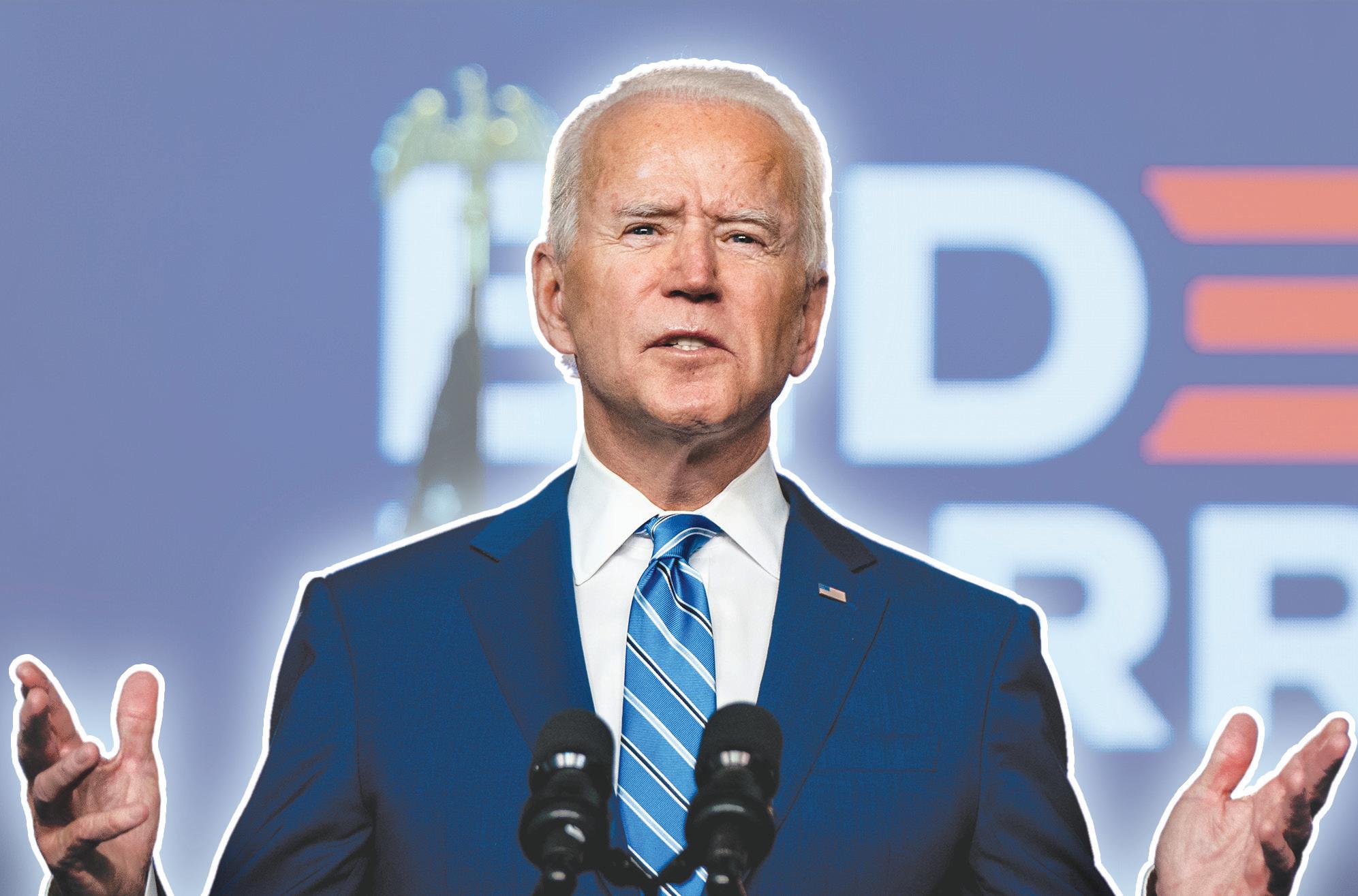
No malarkey | Former Vice President Joe Biden needs to pick up at least two more battleground states in order to win the election.
ERIN SCHAFF / THE NEW YORK TIMES
ALEC GIUFURTA Sun Senior Editor
See VOTES page 4
MADELINE ROSENBERG Sun Assistant News Editor
President pending
Daybook
Today
COVID-19 Summit
Thursday, November 5, 2020
A LISTING OF FREE CAMPUS EVENTS
8 a.m. - 6 p.m., Virtual Event
Let’s Meditate With Cornell Wellness
9 - 9:30 a.m., Virtual Event
Into the Desert: Questions of Coloniality and Toxicity 10 - 11:10 a.m., Virtual Event
Labor Relations: Strategic Grievance Handling 10 a.m. - 1 p.m., Virtual Event
Post-Election: A Mental Health Check-In 10 a.m. - 1 p.m., Virtual Event
Learning Community on Inclusive Teaching for Graduate Students and Postdocs 11 a.m. - Noon, Virtual Event
Paradigm Lost: From Two-State Solution to One-State Reality 11:30 a.m. - 12:45 p.m., Virtual Event
Taking a Hard Look: Is Cornell a Land-Grab University? 2:30 - 3:30 p.m., Virtual Event
Space Wars: An Investigation Into Kuwait’s Hinterland 3 - 4:30 p.m., Virtual Event
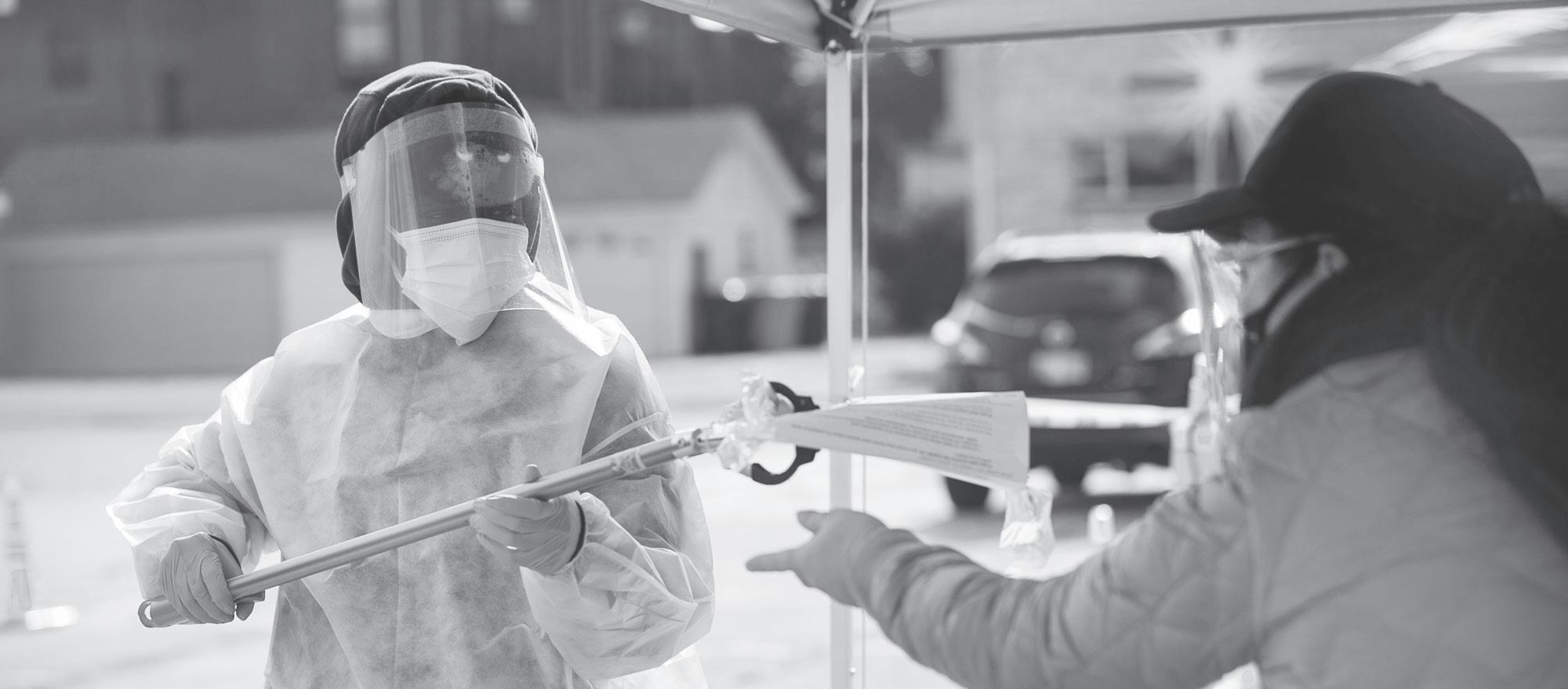
Pandemic resurgent | A worker in full personal protective equipment takes a self-adminstered COVID-19 test from a woman. The U.S. tallied 92,660 cases on Nov. 2, the highest single-day total recorded during the pandemic.
Tomorrow
Into the Desert: Questions of Coloniality and Toxicity 10 - 11:10 a.m., Virtual Event
Post-Election: A Mental Health Check-In 10 - 11 a.m., Virtual Event
Labor Relations: Effective Collective Bargaining and Simulation 10 a.m. - 1 p.m., Virtual Event
Beethoven and Pianos Noon - 1 p.m., Virtual Event

Queer Ecologies of Glitter Noon - 1 p.m., Virtual Event
Cognitive Science Colloquium Series 12:20 - 1:20 p.m., Virtual Event
COVID-Related Grief Support 1 p.m., Virtual Event
The Antarctic Imaginary 3 - 4:30 p.m., Virtual Event
Up in the Air: Buridan’s Principled Rejection of Grounding 3 - 5 p.m., Virtual Event

State Assembly, Senate Races Uncalled
By MEGHANA
With thousands of mail-in ballots yet to be processed, neither elections for the 125th district in the New York State Assembly nor the 58th district of the State Senate have officially been called.
However, Anna Kelles (D) is well ahead in the State Assembly race and her opponent Matthew McIntyre (R) appears to have conceded. In the State Senate race, incumbent Tom O’Mara (R-N.Y.) has been projected to win by NBC affiliate WETM, but he and his opponent Leslie Danks Burke (D) have committed to waiting for all mail-in ballots to be counted.
In the State Assembly race, an apparent concession Wednesday morning from McIntyre and an approximate 8,000-vote lead for Kelles as of Wednesday evening indicated that she is poised to win the seat.
McIntyre took to Facebook to say that while he is grateful for his votes, “there are not 10,000 additional votes in the mail ins for me and zero for Kelles. 2 years we come back with a different plan of attack.”
Election officials will start counting mail-in ballots Nov. 11. “I think it’s really important, as we are seeing at the national level, to respect the ballot counting process,” Kelles said. She and her campaign feel hopeful about their strong lead.
by watching Harry Potter with her family. Kelles plans on spending at least the next week — as votes are still tallied — on researching the different committees within the State Assembly and ironing out her legislative priorities, preparing herself for the possibility that she wins the seat.
“I think it’s really important, as we are seeing at the national level, to respect the ballot counting process.”
Anna Kelles
As of Wednesday evening, Kelles had received over 61 percent of the vote, with 96 out 98 election districts reported.
Kelles spent Election Day evening attending watch parties for various elections and relaxing Wednesday night
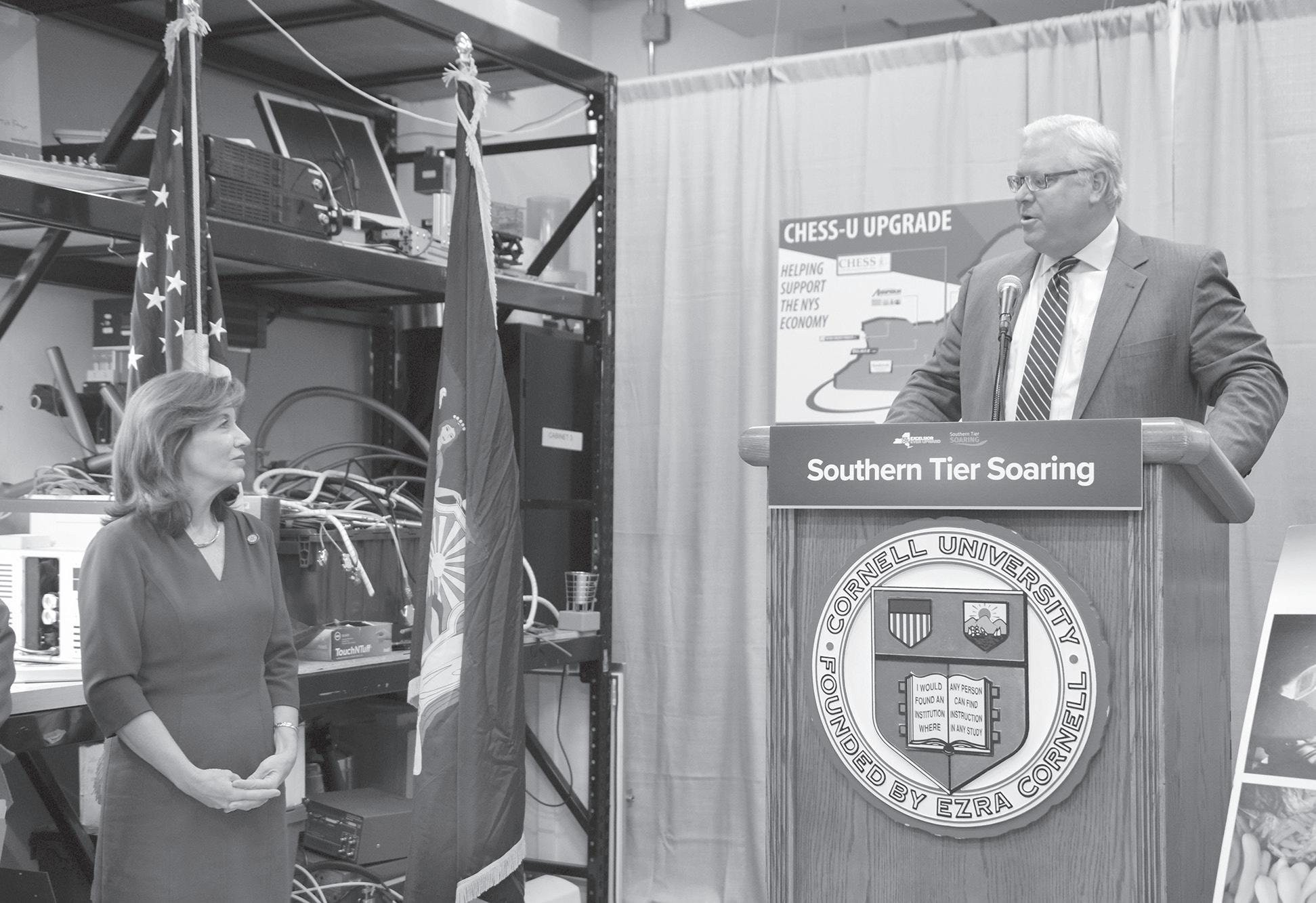
“I take this role extremely seriously,” Kelles said. “I will represent everyone who supported me and I deeply honor and thank those who did, but I will be representing those who didn’t as well.”
On the national level, Kelles was disappointed to see how close the election was, although she was glad to see several states tilting blue on Wednesday evening.
“We have a lot of healing to do as a country. A lot of facing our shadows, a lot of self-reflection on who we want to be,” Kelles said.
In the State Senate race, official results have yet to be certified because of incoming mail-in ballots, but O’Mara is certain of his victory.
are overwhelmingly Democrats.”
The candidates disagreed about the overall tone of Danks Burke’s campaign.
“Leslie ran on an extremely negative campaign full of lies and misrepresentations and false innuendos, and I think the voters clearly saw that for what it is,” O’Mara said. “That style of politics does not play well in the South Tier and Finger Lakes region.”
In contrast, Danks Burke defended her campaign, saying it has been about “getting a fair share for the generation that’s coming up to run our future.”
The partisan breakdown of the State Assembly is currently 103 Democrats, 42 Republicans and 1 independent. Kelles will succeed Democrat incumbent Assemblywoman Barbara Lifton (D-N.Y.), who did not endorse Kelles in the Democratic primaries but instead endorsed Jordan Lesser ’03, her former general counsel.
The State Senate also has a Democratic majority, with 40 seats filled by Democrats and 20 by Republicans.
“We’re going to hear there are a quarter of the ballots still out there left to be counted.”
“I won this election. I’m up by 23,000 votes, there aren’t many more than that in absentee ballots,” O’Mara said. “I suspect the numbers will be a slight advantage for her. There’s no way she can close that 23,000 gap.”
Danks Burke, his opponent, does not believe the election is decided yet.
“I’m optimistic. I think that that’s a lot of posturing. We’re going to hear there are a quarter of the ballots still out there left to be counted,” Danks Burke said. “The people who requested
Leslie Danks Burke
Assuming he wins the seat, O’Mara will begin his sixth term in January.
Both members of the New York State Assembly and State Senate serve two-year terms and are not subject to term limits.
Meghana Srivastava can be reached at msrivastava@cornellsun.com. Ari Dubow can be reached at adubow@cornellsun.com.
Increased Mail-In Voting Spurs Low Election Day Turnout
Some students work as pollworkers as others cast their frst ballots in Ithaca during momentous election
By SARAH SKINNER Sun Senior Editor
“It started off with a lot of excitement at five in the morning.”
Natalie Breitkopf ’22 was speaking of volunteering as a poll worker, and she wasn’t speaking facetiously. She said she’d been waiting years for Tuesday — Election Day — to come, where she worked a 16-hour shift as the youngest person at the Alice Cook House polling station.
She was one of the thousands of poll workers across the east coast who opened up polling stations on a rainy Election Day, unsure of what the day would look like.
was working the Belle Sherman Annex polling site, said he could tell even in the morning that this was the lowest turnout he’d seen in eight years of working the polls. He chalked it up to the increase in early voting this year.
Many of the people he did see at the polling site southeast of Collegetown were student voters such as Shriya Desai ’24 and her hallmate Isabella Ritchie ’24, who hiked a mile and a half from Dickson Hall on North Campus to bubble in their first presidential tickets.
“This is the most important election, possibly, of my life.”
Natalie Breitkopf ’22
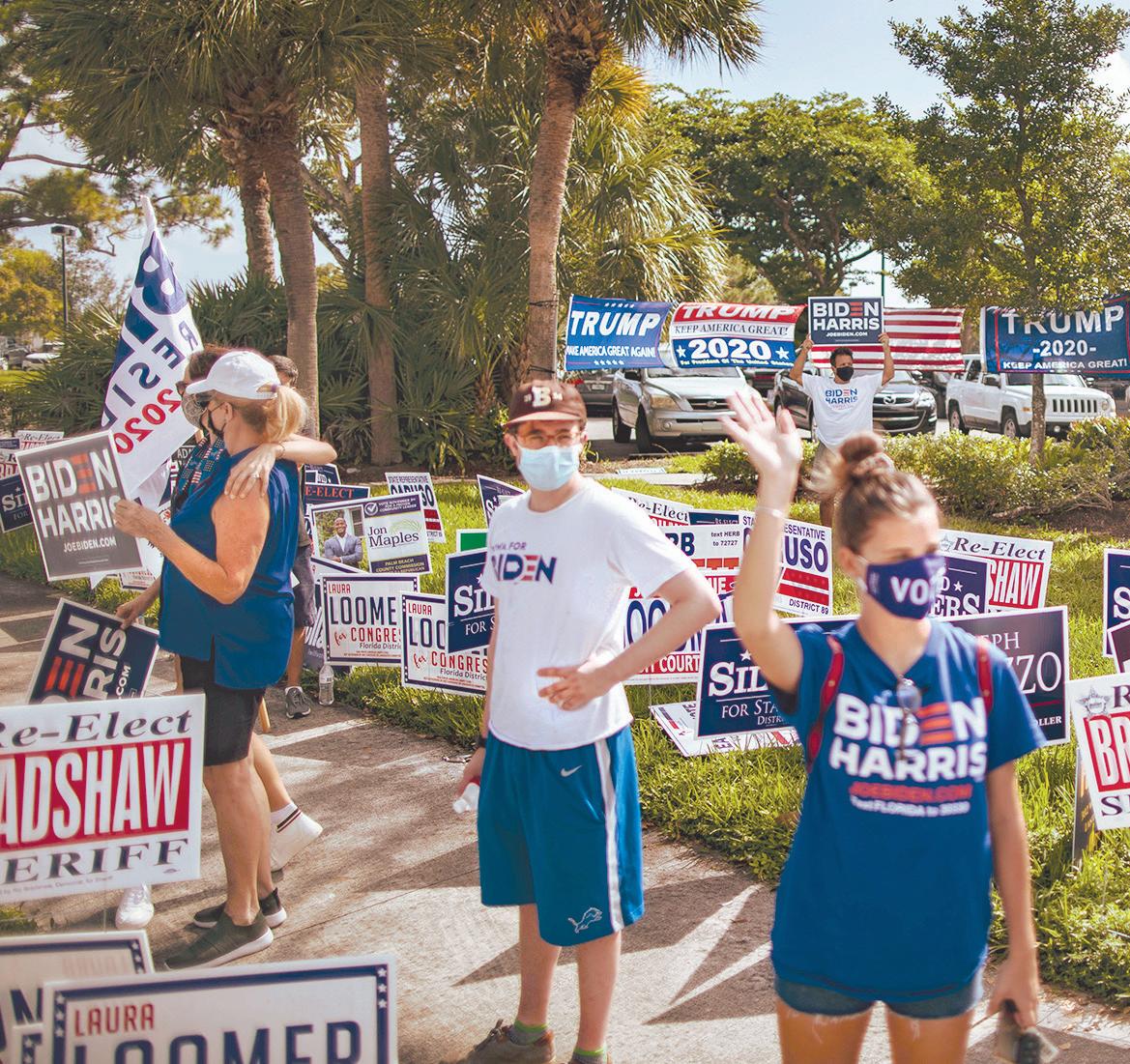
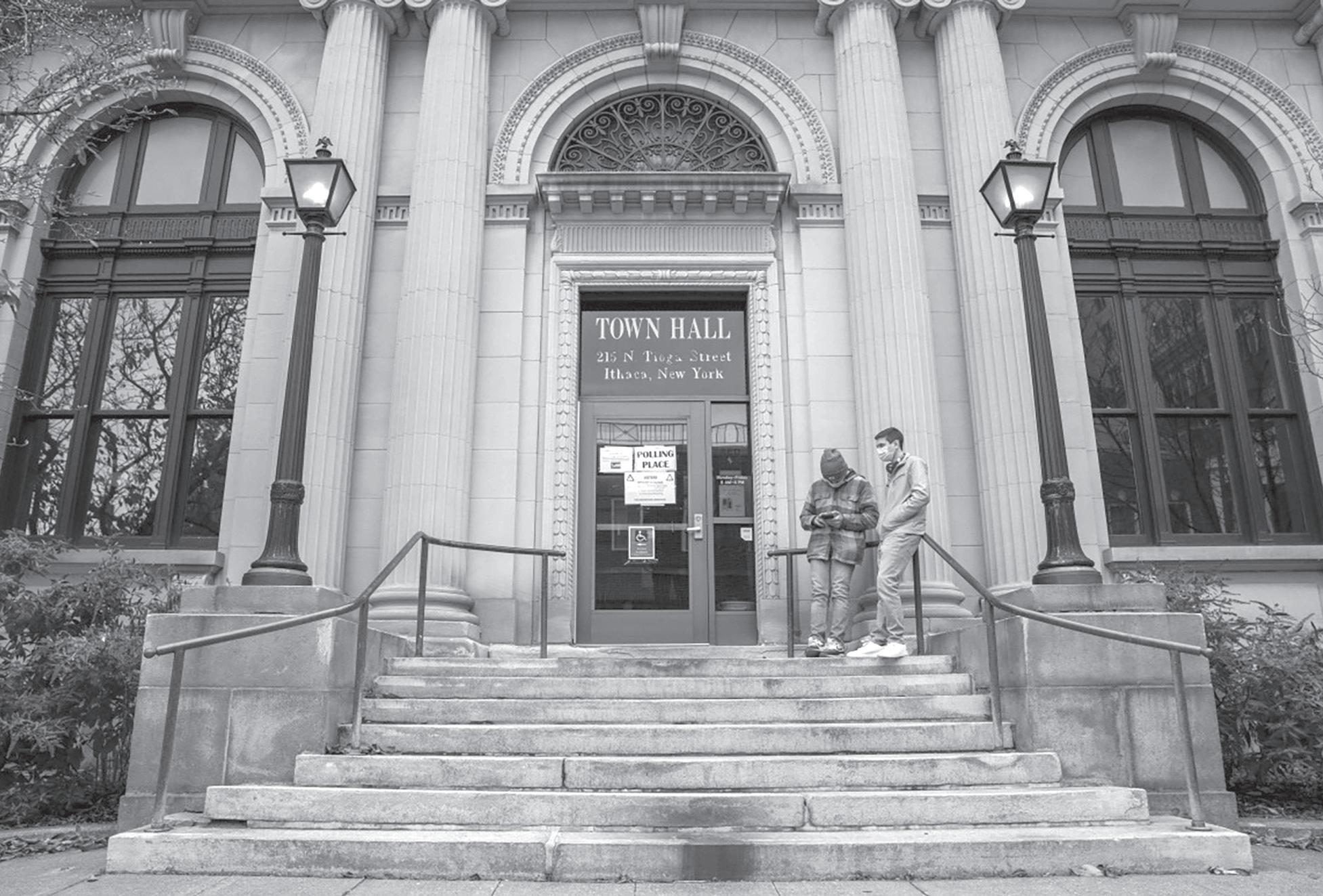
Strong early voting numbers — over 13,000 in Tompkins County — led to shorter lines and calmer days than other election years. In the afternoon, the Ithaca Town Hall site was all but empty; workers chatted or read books as voters trickled in to vote using socially distant booths.
David Bravo-Cullen ’85, who
“We didn’t mind the walk. Being in online classes, it’s nice to have some exercise,” Desai said after voting.
Both students registered in Ithaca to vote instead of their homes in Connecticut and London. While they weren’t as familiar with the local candidates, the first-years were excited to vote and nervous about bubbling in the ballot correctly.
“It was like taking the SAT all over again!” Ritchie said.
Alice Cook House’s lounge, which once held comfy chairs
and a pool table, was turned into a voting station for the day with long tables and plenty of hand sanitizer. Breitkopf had taped up the signs outside the door — those prohibiting electioneering and announcing COVID-19 protocol and voting information — herself.
Outside, the socially-distant sidewalk markers stood mostly empty. Turnout was low there as well, and Breitkopf estimated that by midafternoon only around 80 of the approximately 800 registered voters in the district had
voted in person, largely due to high early and absentee balloting. Breitkopf, a Scarsdale native, had voted early herself.
Sarah Skinner can be reached at sskinner@cornellsun.com.
Casting votes | Ithaca Town Hall served as a polling site on Election Day. The city saw
SRIVASTAVA and ARI DUBOW Sun Assistant News Editor and Sun City Editor
Incumbent | Tom O’Mara (R-N.Y.) is expected to keep his seat in the State Senate.
BORIS TSANG / SUN PHOTOGRAPHY EDITOR
Biden Holds Small Lead; Race Still Too Close to Call
VOTES
Continued from page 1
“It’s a remarkably clean election,” Bensel said.
Prof. Alexandra Cirone, government, studies party systems and teaches courses on fake news. She lamented the president’s false statements regarding mail in voting.
“There is no evidence of fraud, whatsoever,” Cirone said. “This narrative has been circulated by the Trump campaign and the RNC for months now, precisely to set the stage for fraudulent election claims on election day.”
Trump’s persistent messaging around voter fraud as the reason for his loss has undermined faith in democratic institutions, Cirone said: “The damage has been done.”
an unsubstantiated victory, saying “As far as I’m concerned, we already have won.” Both the left and the right saw Trump’s preemptive declaration as inaccurate and “irresponsible.”
In Tompkins County, unofficial results indicated Biden carried 69.89 percent of the vote to Trump’s 27.52 percent. Libertarian Presidential candidate Jo Jorgensen, a senior lecturer at Clemson University, received 1.11 percent of the vote. It wasn’t immediately clear if these figures is number included absentee returns; the Board of Elections did not respond to a request for comment in time for publication.
“This is why Trump wants to stop counting early. If you don’t count the votes, it looks like he’s won.”
Svante Myrick ’09
Ithaca Mayor Svante Myrick ’09 blasted the president’s statement opposing vote counting Wednesday morning, tweeting, “This is why Trump wants to stop counting early. If you don’t count the votes, it looks like he’s won.”
A surge in mail-in votes across the nation overwhelmed postal service offices and caused delays in vote counts. An unprecedented 64.6 million Americans cast their ballots before Election Day via mail-in voting, against the backdrop of a COVID-19 pandemic that has continued to spike across the nation.
In New York, a prelude to Tuesday night’s reporting delays occurred in June, as primary races took weeks to count after a surge in mail-in voting; in Ithaca, Democratic prima -
“I’m not here to declare that we won, we believe we will be the winners.”
Former Vice President Joe Biden
ry candidate for District Attorney Edward Kopko led incumbent Matthew Van Houten with 57.5 percent the day after the primary, only for Van Houten come from behind with absentee ballots to win the race.
Speaking from his hometown of Wilmington, Delaware Wednesday afternoon, Biden expressed optimism at the election’s outcome: “I’m not here to declare that we won, we believe we will be the winners.”
Early Wednesday morning in the White House east room, Trump appeared to claim
Beyond the ballot
In 2016, Hillary Clinton carried 60 percent of the vote in Tompkins County.
On campus Tuesday night, students sat in uncertainty as unconvincing results slowly trickled in. For students of color recounting first-time voting experiences, the increased implications and impact of the election’s result were at the top of their minds.
In Wisconsin, the Associated Press called the race for Biden at 2:17 p.m. Wednesday after election officials stated that all ballots had been counted and he held around a 20,000 vote lead. The president has pledged to file a recount petition under Wisconsin law. In Michigan, the race was called for Biden by AP at 6:00 p.m..
As predicted, Pennsylvania had yet to report a sufficient number of votes for the AP to definitively call the races, even into late Wednesday. In the do-or-die state for Trump’s re-election, votes reported on election night heavily leaned toward Trump, but officials in both states expect mail in ballot counts –– which lean Democrat ––to be completed within three days of Nov. 3. Seven Pennsylvania counties did not start processing mailin ballots until Wednesday. Trump’s lead in the state shrunk considerably through Wednesday.
Across the South, Trump appeared to have the lead in North Carolina and AP called the state of Florida for Trump early Wednesday morning.
Locally, Rep. Tom Reed (R-N.Y.) won his race against second-time challenger Tracy Mitrano J.D. ’95. Reed co-chaired Trump’s re-election campaign in New York. Amanda H. Cronin ’21 contributed reporting.
Alec Giufurta can be reached at agiufurta@cornellsun.com.
Tumultuous Election Leaves Students Anxious Students
watch from dorms, apartments
STUDENTS
Continued from page 1
But on Tuesday night, few said they had fully processed the trickling results as ballots, too, are still being counted across the country.
Lei said she was tracking the Texas and Florida polls on Tuesday, uneasy that swing states would shape the outcome of the election. But not everyone was watching — Lei said her two other suitemates were plugging away at problem sets on election night, worried about looming deadlines and uncertain that final results would roll in before Wednesday classes.
But Lei, who studies sociology and chemistry, said she couldn’t focus, especially after she called her Illinois board of elections office more than 30 times to secure an absentee ballot. Lei walked through 30-degree temperatures and wind on Monday to submit her delayed ballot to a Buffalo Street drop-off ballot box.
“This is a form of voter suppression. Exhaustion is also voter suppression. Making it this difficult for certain people to vote is very disturbing,” Lei said. “This election feels like this heavy weight on our shoulders. There’s the future of democracy. Why does the plasma membrane matter right now? Why is this important to the future of the U.S.?”
rounded by friends from New York whose mail-in ballot process went smoothly made her feel powerless, as she watched the Texas results trickle in. A first-time voter, she said she is eager for leadership that adequately addresses climate change and ongoing racial justice protests.
After checking her Becker House mailbox each week throughout the semester, her elections office told Gomez her ballot wasn’t in the system.
“It hurts me to hear all of these stories of people having a sticker saying, ‘I voted,’” Gomez said. “It hurts because it’s not exactly my fault. It’s a mess. People will say ‘I voted,” and I kind of have to stay quiet. Everyone in New York is telling me how important it is to vote, but I can’t do anything.”
One New Yorker is Hannah Fuchs ’23, who said she felt her Biden vote didn’t mean much in New York — the state was going to remain blue, even after she cast her absentee ballot and received an “I’m a Cornellian and I voted” sticker.
“This election feels like this heavy weight on our shoulders. There’s the future of democracy.”
Lei wasn’t the only one struggling to focus. Valeria Gomez ’23 said she jumped between studying for her evolutionary biology prelim — it’s on Thursday — and zooming in on the Texas polls, surrounded by her friends in another Keeton common room.
A Texas native, Gomez said refreshing the Google election results was more frustrating than reassuring. Gomez was watching Texas turn blue, then red, without her vote — after requesting her absentee ballot in August, it never arrived. Early Wednesday morning, the typically red stronghold state and its 38 electoral votes were cast for President Donald Trump.
“My vote mattered in Texas,” Gomez said Tuesday evening, equipped with cookies and cream ice cream for comfort. “I’m really worried about that.”
Gomez added that being sur-
Madeline Lei ’23
The government major said she turned to phone and text banked for Michigan and Texas for the first time on Nov. 2, energizing voters to get to the polls and distributing the information to get them there.
“With our Electoral College process, the whole election can hinge on states that I admittedly don’t think a lot about because I don’t have a connection to them,” Fuchs said. “I cannot focus on the past tense of Spanish verbs when I’m thinking about the election. No one is apathetic. Everyone is excited and feeling pretty anxious. Everyone knows how high the stakes are.”
Fuchs added that she struggled to focus in her classes all day Tuesday as she checked MSNBC and CNN in between Zoom calls, worried how swing states would steer the election. By Tuesday night, she felt tense but cautiously optimistic.
Madeline Rosenberg can be reached at mrosenberg@cornellsun.com.
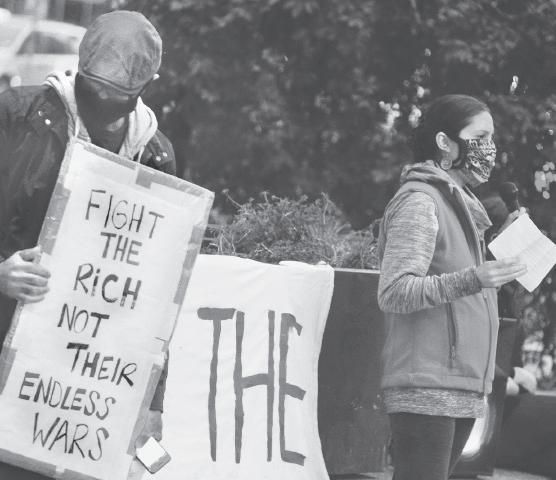
Activists and Ithacans gather on the Commons on Nov. 4 to share information and call for reforms.
MICHAEL SUGUITAN / SUN STAFF PHOTOGRAPHER
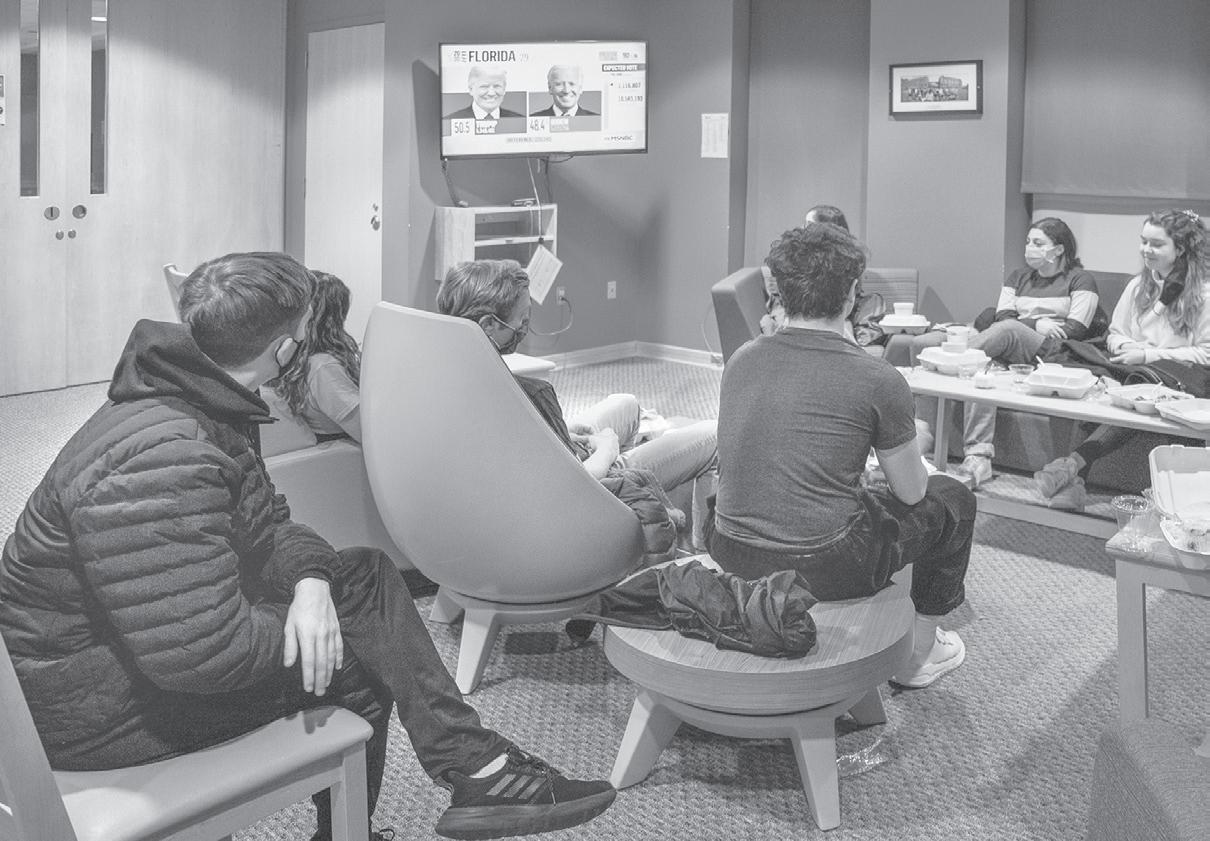
Watch party | Students gather in a Kay Hall lounge to watch the election unfold on Nov. 3, clad in masks and following the news closely.
JULIA NAGEL / SUN STAFF PHOTOGRAPHER
Five Cornellians Win House Seats; Six Lose
All Cornellian incumbents reelected as alumni run for Congress across the country
By ROMAN LAHAYE and ELEANOR ZWEBER Sun Contributors
Five Cornell alumni — all incumbents — were called the winners to serve in the 117th United States Congress. Six alumni lost their House races on Tuesday, with one remaining race too close to call at time of publication.
The five represent a variety of Cornellian identities: Rep. Katherine Clark J.D. ’89 (D-Mass.) and Rep. Sharice Davids J.D. ’10 (D-Kan.) are former Cornell Law School students, while Rep. Dan Meuser ’88 (R-Pa.) and Rep. Kurt Schrader ’73 (D-Ore.) both have undergraduate degrees in government. Rep. Elissa Slotkin ’98 (D-Mich.) majored in rural sociology in the College of Agriculture and Life Sciences during her time at Cornell.
WINS (* indicates incumbency)
*Katherine Clark J.D. ’89, Massachusetts Fifth District
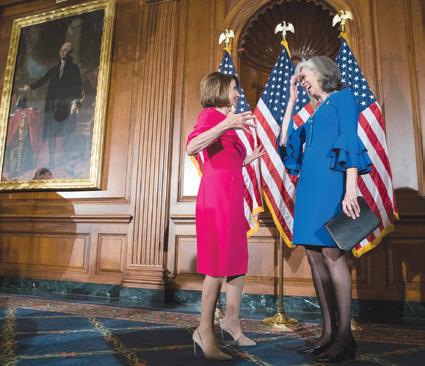
Rep. Katherine Clark (D-Mass.) won her race against Republican challenger Caroline Calurusso by an impressive margin, with 74.4 percent of the vote. This is Clark’s fifth term since entering office in a 2013 special election.
In the 116th Congress, Clark served as Vice Chair of the Democratic Congress, the sixth-highest ranking position within the House’s Democratic caucus. Now, Clark is running within the party to serve as the Assistant House Speaker, which would make her the fourth highest-ranking Democrat in the chamber. House Speaker Nancy Pelosi (D-Calif.) established the role of Assistant Speaker in 2006 to give rising party members a “seat at the leadership table” and establish a united front of multiple leaders within the party.
In a public statement released on Twitter, Clark thanked her supporters for remaining confident.
“This moment in our history demands not just recovery but rebirth. We must finally confront the challenges that have long plagued America,” she wrote. “From health care access to racial injustice to climate change to voting rights, the threats facing our planet and democracy are great. We need bold solutions and urgent action to allow us to live up to our nation’s promise of liberty and justice for all.”
*Sharice Davids J.D. ’10, Kansas 3rd District
Rep. Sharice Davids (D-Kan.) secured her second term in Congress representing Kansas’ Third District. Although the Kansas City area district once leaned Republican, Davids was favored in polls throughout the race, ultimately winning with 53.4 percent of the vote, according to the Associated Press.
Davids was first elected in 2018 as the first Democratic candidate to represent the district in eight years. The win made her one of the first Indigenous women to be elected to the U.S. Congress. In her first term, she was a member of both the Congressional LGBT Equality Caucus and the Congressional Native American Congress, positions in which she advocated equal rights for LGBTQ+ Americans and increasing economic development among Indigenous communities.
“Our state motto, Ad Astra Per Aspera — to the stars through difficulties — has never felt more real than it does right now. Because we are in this fight and we’re in it together,” Davids said in an interview with NBC affiliate KSHB Kansas City. “And I can tell you this, for as long as I am here, we are going to fight for every single seat across this state.”
*Dan Meuser ’88, Pennsylvania Ninth District Republican incumbent Rep. Dan Meuser (R-Pa.) won reelection to the northeastern Pennsylvania district for a second term. The victory was widely expected, as the Ninth District is strongly Republican and Meuser won his first election by nearly 20 points.
Since his 2018 election, Meuser has been a staunch supporter of President Donald Trump, backing numerous aspects of his agenda. Meuser, a former business executive, has also been a strong backer of local Republicans, financially supporting conservative candidates across the state.
As the early results came in last night, Meuser told local outlets: “We worked real hard. We had a great team … I think we told everyone what we were going to do, and we did it. I supported President Trump’s agenda that was in the interest of Pennsylvania.”
*Kurt Schrader ’73, Oregon Fifth District Rep. Kurt Schrader (D-Ore.) gained a seventh term in Congress, defeating Republican Amy Ryan Courser with 54.4 percent of the vote in a district he has represented since 2008.
The months leading up to this election were especially challenging for constituents of the district, whose communities were devastated by one of the most destructive wildfire seasons in Oregon’s history. In the Fifth District, citizens faced evacuations, property loss and poor air quality throughout the late summer and fall. Schrader dedicated the final months of his campaign to helping constituents receive disaster aid from FEMA.
*Elissa Slotkin ’98, Michigan Eighth District
Rep. Elissa Slotkin (D-Mich.) won reelection in the highly competitive race for Michigan’s Eighth District by a slim margin of 51.1 percent, according to the AP. In 2018, Slotkin flipped the historically Republican district in a midterm election that resulted in Democrats gaining 41 Congressional seats.
This election cycle, Michigan once again proved especially competitive, with the district’s lead having flipped back and forth from Slotkin to Republican challenger Paul Junge. Vote totals initially reported on election night largely favored Republicans, as mail in ballots that lean Democratic were counted later on.
Slotkin had the upper hand in fundraising during her campaign, despite the conservative leanings of a district that includes a large portion of Lansing, the state capital, and its outlying suburbs.
While Michigan ballots were still being counted into the early afternoon of Nov. 4, Slotkin made a public statement stating, “Although we can’t be totally certain until every vote is counted, at this hour I have really strong confidence we will succeed here in the 8th District.”
TOO EARLY TO CALL
Beth Van Duyne ’95, Texas 24th District
Republican Beth Van Duyne narrowly leads Democrat Candace Valenzuela, 48.8 to 47.5 percent, in a race that most outlets have currently deemed still too close to call. According to the AP, 99 percent of the district’s results have been reported.
In August 2019, incumbent Rep. Kenny Marchant (R-Texas) announced that he would not run for reelection after serving the Dallas suburbs-based district since 2005. His retirement quickly set off a competitive race to represent the district, which Marchant only won by three points in 2018. During the election cycle, Valenzuela outraised Van Duyne $4 to $2.8 million.
If Van Duyne holds onto her lead, it will likely be one of the bigger Congressional upsets of 2020. Both Politico and the Cook Political Report projected the race to be “lean Democrat,” citing the district’s growing Hispanic population and suburban backlash to Trump’s administration.
LOSSES
Dana Barrett ’88, Georgia 11th District
Democrat Dana Barrett handily lost to Rep. Barry Loudermilk (R-Ga.), the four-term incumbent, by over 20 points. The heavily Republican district includes a swath of land reaching from a sliver of Atlanta to its northern suburbs and exurbs.
Barrett, who received a Cornell degree from the School of Hotel Administration, began advocating for political change during her career as a talk radio show host following Trump’s election. During her run for Congress, Barrett primarily focused her campaign on healthcare reform, advocating universal coverage for all Americans.
Tracy Mitrano J.D. ’95, New York 23rd District Democrat Tracy Mitrano lost to incumbent Rep. Tom Reed (R-N.Y.) in her second run for the seat since 2018. A Cornell Law School graduate and former lecturer at the University, Mitrano campaigned on a platform supporting healthcare reform, increased wages for teachers and improving accessibility to student loans.
Her expertise in cybersecurity was one cornerstone of her policy plans. She urged government agencies to enhance security systems and protect Americans from threats of intellectual property theft and fake news.
Devin Thorpe MBA ’93, Utah Third District
Journalist and author Devin Thorpe lost to Rep. John Curtis (R-Utah) to represent the Third Congressional District of Utah. The district, which includes the southeastern portion of the state, is strongly Republican.
While the race was not very competitive — Thorpe won only 27.5 percent of the vote — the political leanings of the candidates were particularly unique in an era of intense partisanship.
Thorpe was a lifelong Republican and worked for former Utah Sen. Jake Garn. But after observing the work Democrats were doing to reform healthcare legislation, Thorpe abandoned the GOP and became a Democrat. By contrast, Curtis also switched political parties during his career, leaving the Democratic Party to run as a Republican for Congress in 2017.
Mike Siegel J.D. ’09, Texas 10th District
Mike Siegel lost against Rep. Michael McCaul (R-Texas) for the second time, after the incumbent narrowly bested the civil rights lawyer in 2018. The sprawling 10th District stretches from the suburbs of Houston to the northern edge of Austin.
Siegel was a favored candidate of progressives, and ran in 2018 on the slate of Brand New Congress, a political action committee founded by ex-staffers of Bernie Sanders’ 2016 campaign. He ran his campaign championing causes such as healthcare for all and the Green New Deal, despite the district’s conservative tilt.
While the race had been fiercely contested, McCaul ultimately defeated Siegel, 52.5 to 45.3 percent.
Andy Ruff ’87, Indiana Ninth District
Andy Ruff lost against incumbent Rep. Trey Hollingsworth (R-Ind.) in the race for the southern Indiana district, garnering only 35 percent of the vote according to the Associated Press. The self-described progressive set out for a difficult run in this district, which had been rated solid Republican by the Cook Political Report.
Ruff, who studied natural resources during his undergraduate career at Cornell, has enjoyed a long career in public service. First working as a public school teacher, Ruff began a career in politics serving as a city council member in Bloomington, Indiana, a position he held for 20 years. Despite the conservative leanings of the district, Ruff’s platform included implementing universal health care and increasing environmental regulations.
Wesley Hunt MPA ’15, MBA ’15, MILR ’16, Texas Seventh District
Wesley Hunt narrowly lost to Rep. Lizzie Fletcher (R-Texas) in a competitive race, falling in a close final margin of 50.8 percent to 47.5 percent.
The win continues the trend toward Democratic voting in the Houston suburban district — before Fletcher’s 2018 win, the district had sent Republicans to Congress for 50 straight years.
Hunt’s campaign focused on protecting the oil and gas industries, which have historically been integral to Houston’s economy. He outwardly opposed government energy regulations such as the Green New Deal. Hunt’s campaign gave Fletcher a run for her money, outraising her by more than $1.5 million in the third quarter.
Roman LaHaye can be reached at ral344@cornell.edu. Eleanor Zweber can be reached at enz4@cornell.edu.
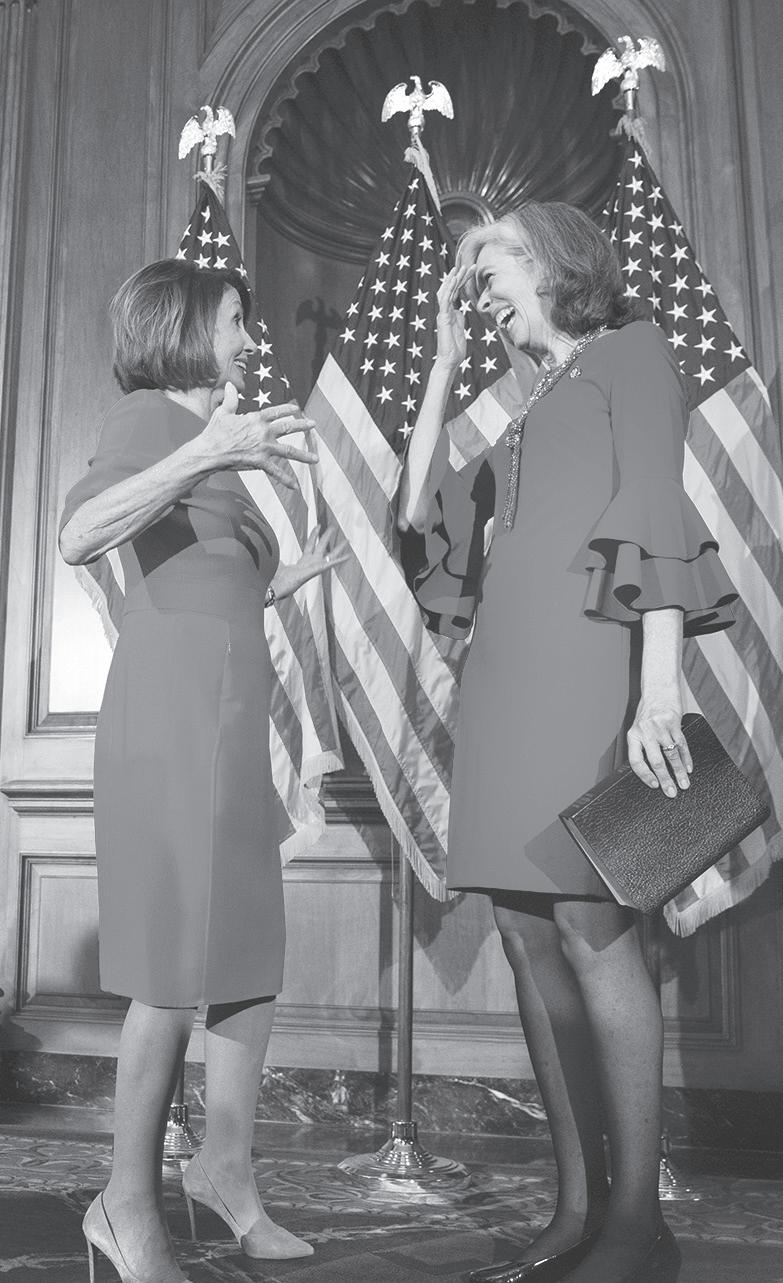
Congress | Rep. Katherine Clark (D-Mass.), right, seen here with House Speaker Nancy Pelosi, won her race against a Republican challenger with 74.4 percent of the vote.
SARAH SILBIGER / THE NEW YORK TIMES
Dining Guide
Your source for good food

Why Urban America Can’t Forget Its Farmers
By BENJAMIN VELANI Dining Editor
Why do agricultural issues matter to young cosmopolites attending an Ivy League institution and who quite possibly are from a family in the top one percent? Besides being consistently ranked as one of the top agricultural schools in the country and the world, Cornell’s College of Agriculture and Life Sciences conducts an enormous amount of research and outreach to help end food insecurity, combat climate change and, most recently, protect food production workers against COVID-19; just check out the litany of innovations here. Cornell is in a unique position to conduct its research; unlike many of its peers, it’s role as a land-grant institution informs its involvement in communities surrounding it. 43 percent of the counties in the Southern Tier are classified as rural. If you include upstate micropolities, such as Corning and Cortland, as semi-rural, that figure jumps to 57 percent. Within these communities, people are intimately connected to our nation’s food system. The most recent United States Department of Agriculture census conducted in 2017 shows that 55,363 people are employed by New York farms, and that 98 percent of these farms are family owned. From the hard work of these New Yorkers in the same year came $3.785 billion worth of agricultural products, with dairy dominating sales. This goes to show how important it is to not take American farmers for granted. However, because of the relatively small population size

of rural communities compared to metropolitan centers like New York City, whose population alone is larger than 38 states, it will be in the electoral college that rural voices are heard — a system now under attack by the National Popular Vote campaign, already passed in 14 states and Washington D.C. America’s family-run farms are threatened by big ag and a lack of access to federal subsidies. I looked at the statements made by Joe Biden and Donald Trump in response to the Farm Bureau’s annual presidential candidate questionnaire to see what they had to say about these and other issues affecting American farmers. Biden argues, “[t]he BidenHarris administration will protect small and medium-sized farmers and producers by strengthening enforcement of the Sherman and Clayton Antitrust Acts and the

Packers and Stockyards Act.” Biden and Harris say they will stand up and fight for family farms, in Tompkins county, in the Southern Tier and across the United States. Trump, however, seems to favor the big industry producers who already reap most of the benefits resulting from current agriculture policy. His response to the same question on food system resiliency recounted how, “[t]hroughout this [COVID-19] crisis, the Trump/ Pence administration has engaged heavily with leaders in the industry at every point in the supply chain.” How many farmers running family operations were “engaged” by the Trump administration? My guess — not many.
Even though the majority of farmers would not benefit from another four years of trade wars, tariffs, commodity price drops and unaddressed climate change, DTN, an agricultural focus news source, reported on Friday that Trump still leads by 18 points amongst rural adults. However, rural communities are not unified in their support of Trump. In fact, the same report shows a great deal of indecision among many rural adults, with 39 per-
cent of farmers believing U.S. agriculture is worse off than it was when Trump took office. In any case, the issues that farmers are facing exist outside the realm of polls and percentages. I don’t downplay the importance of agriculture specific issues when I highlight climate change; it affects farmers as much, if not more, than urbanites. When it comes to agricultural sustainability and supporting rural communities specifically, Biden has a plan and policy “to ensure our agricultural sector is the first in the world to achieve net-zero emissions.” Proposed as an expansion to the Conservation Stewardship Program created by Senator Tom Harkin (D-Iowa), the program will “support farm income through payments based on farmers’ practices to protect the environment,” and is based on scientific evidence. I echo Biden when I say Trump has no plan to address climate change, and in his response to the Farm Bureau’s questionnaire he makes no attempt to give one. Instead, he says we should be thanking our farmers as they’re the best stewards of the land America has got. At least we agree on one
thing. Regardless, Trump has the firm support of many rural communities despite his harmful policies towards small American farmers. But why? Arlie Russell Hochschild, in her 2016 book Strangers in Their Own Land: Anger and Mourning on the American Right, sets out to understand how Tea Party conservatives think and feel. Through extensive interviews, she shows how white Americans have been “triply marginalized by flat or falling wages, rapid demographic change and liberal culture that mocks their faith and patriotism.” It only makes sense that someone who expresses farmers’ grievances and shares their fears will make them feel heard and have their political support. That someone was Donald Trump and his supporters were frustrated, rural, white Americans. However, I would argue there is now a candidate that those same Trump supporters can get behind without getting stabbed in the back — Joe Biden.
Benjamin Velani is a junior in the College of
and Sciences. He can be reached at bvelani@cornellsun.com.


1880
138th Editorial Board
MARYAM ZAFAR ’21
Editor in Chief
JOYBEER DATTA GUPTA ’21 Business Manager
PETER BUONANNO ’21
Associate Editor
MEGHNA MAHARISHI ’22
Assistant Managing Editor
CHRISTINA BULKELEY ’21
Sports Editor
BORIS TSANG ’21
Photography Editor
CAROLINE JOHNSON ’22
News Editor
ALEX HALE ’21
News Editor
ARI DUBOW ’21 City Editor
EMMA ROSENBAUM ’22 Science Editor
BENJAMIN VELANI ’22 Dining Editor
JOHN MONKOVIC ’22
MIKE FANG ’21
OLIVIA WEINBERG ’22
Assistant News Editor
MADELINE ROSENBERG ’23
Assistant News Editor
LUKE PICHINI ’22
Assistant Sports Editor
HANNAH ROSENBERG ’23
Assistant Photography Editor
BRIAN LU ’23
Assistant Arts & Entertainment Editor
ANNABEL LI ’21
Assistant Money & Business Editor
LEI ANNE RABEJE ’22
Layout Editor
JOHN COLIE ’23 Blogs Editor
JOHNATHAN STIMPSON ’21 Managing Editor
KRYSTAL YANG ’21
Advertising Manager
JASON HUANG ’21
Web Editor
NIKO NGUYEN ’22 Design Editor
PALLAVI KENKARE ’21 Opinion Editor
SEAN O’CONNELL ’21
KATHRYN STAMM ’22
OZA ’22
PLOWE ’23
LEE ’21
CHENG ’21
PEÑEÑORY ’22
’23
’21
’22
’21
’22

Darren Chang Swamp Snorkeling
Darren Chang is a senior in the College of Arts and Sciences. He can be reached at dchang@cornellsun.com. Swamp Snorkeling runs alternate Tursdays this semester.
Te Polls Dropped the Ball
Last night was another error-filled look for pre-election polling after the so-called polling debacle of 2016. It’s still too early to compare all of the results to what the gurus predicted, but several key states and races already appear off the mark, and leaves us to wonder: Can we ever trust polls again?
Working on Today’s Sun
Ad Layout Ella Benjamin ’24
Production Deskers Camilla Bacolod ’21 Sabrina Xie ’21
News Deskers Meghana Srivastava ’23 Sean O’Connell ’21
Opinion Desker Peter Buonanno ’21
Design Desker Lei Anne Rabeje ’22
Photo Desker Hannah Rosenberg ’23
Arts Desker Peter Buonanno ’21
Sports Desker Luke Pichini ’22
Dining Desker Benjamin Velani ’22
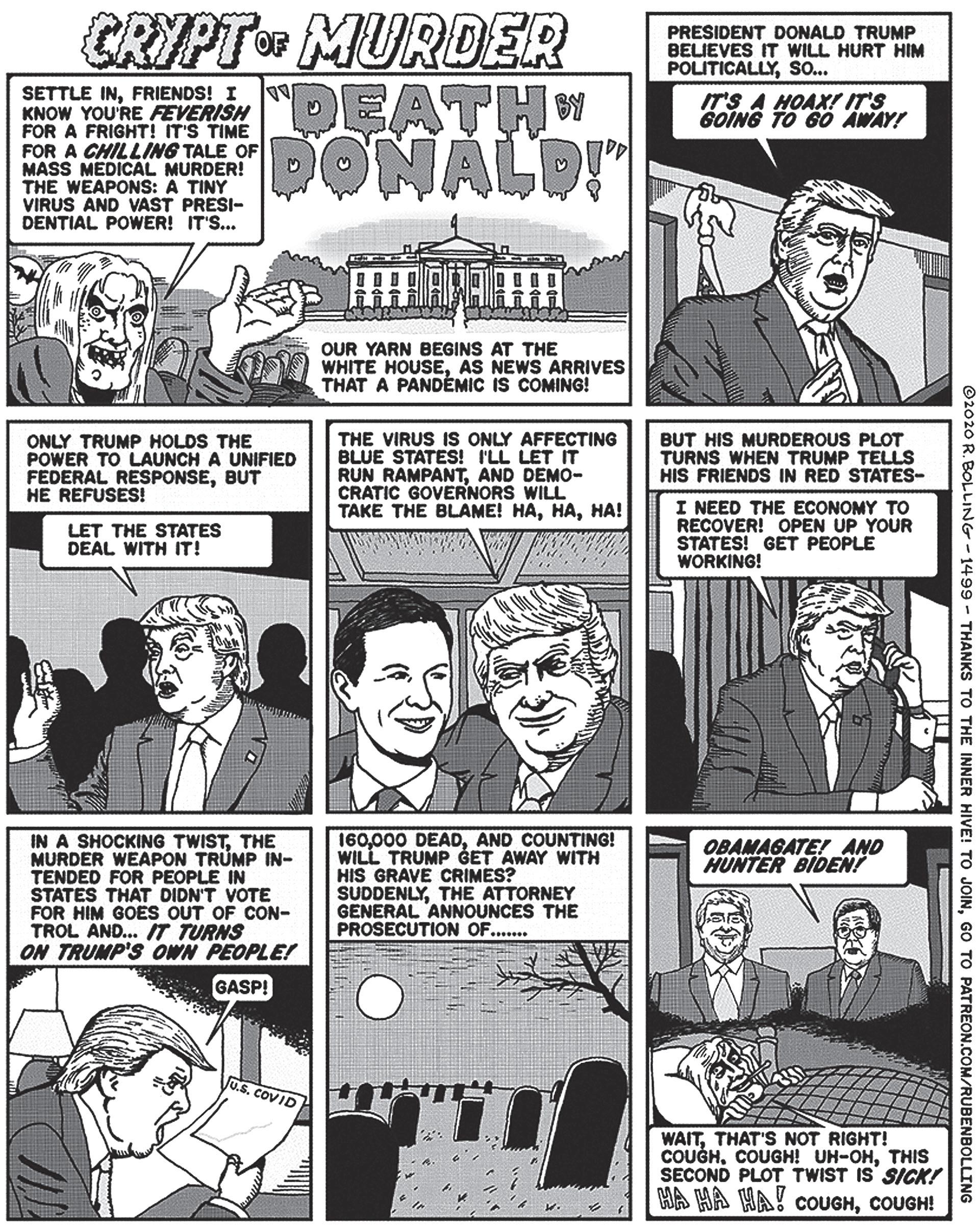
Tom the Dancing Bug by Reuben Bolling
Monitoring the election results this year seemed even more a game than usual, even though the results of each election would have real implications for Americans across the country. Due to COVID-19 and what is likely going to be higher turnout than usual for an election, the number of mailin absentee and in-person early ballots was far higher than past years. The predicted “blue mirage” effect showed up en masse. Many of the early votes and mail-in ballots in states such as Texas and Florida went blue, making it appear that Democratic nominee Joe Biden had a slight advantage. As the night got longer, President Donald Trump gained ground in a redshift effect. If voters continue to take advantage of early and absentee voting in the future, we may see more of these patterns that break for a specific party early in the night only to suddenly reverse in a heart-wrenching turn. Unsurprisingly, many of these races are close, and could take until the end of the week for a final tally.
Four key swing states — Florida, North Carolina, Ohio and Texas — that went early for Biden and redshifted towards Trump were also four swing states that Fivethirtyeight predicted to have a higher vote share for the Democrats than the reported vote counts late in the night — even with a 3 percentage point “2016-sized” national error. In addition, several other states were systematically overpredicted for Biden in the Fivethirtyeight model, which predicted a +2.5 victory, +1.8 victory, +1.0 victory, -0.6 loss, -1.5 loss, -1.5 loss for Biden in Florida, North Carolina, Georgia, Ohio, Iowa and Texas respectively.
races in N.Y.-02, my home Congressional district of Ind.-05 and Va.-02 were all rated as toss-ups; Nate Silver had the probability of victory for the Democrats as 57 percent, 50 percent and 49 percent respectively. In each of these districts, the Democrats lost handedly: They ended up as -16, -6 and -5 losses for the Democrats. Sure, the model spit out probabilities and not point spreads, but these outcomes don’t quite look like the outcomes of races that the Democrats even had a fighting chance in.
At the national resolution, many of the forecasts predicted strong Biden victories — even landslides. The Washington Post’s Henry Olsen predicted 350 electoral votes for Biden, The Economist predicted 356 electoral votes for Biden and Fivethirtyeight predicted 348.5 electoral votes for Biden. Each of these baseline scenarios are already impossible: Trump has gained too many electoral votes for these Democratic pipe dreams.
From the experiences of the past three general elections, though, we may need to step away from the numbers and adjust our priors before we can trust the numbers again.
The underrepresentation of the Trump voter (and perhaps the Republican voter) appears to be a systematic and continuing trend that pollsters will need to adjust to, either with different sampling methodologies or with corrections during the creations of different models. There’s still quite a bit of time to go, and with votes still being counted in Georgia due to a burst pipe and other swing states including Pennsylvania, Michigan and Wisconsin, the early results could be reversed and the pollsters’ predictions confirmed. In a few weeks, we’ll have more information, and only then will we be able to make better hypotheses about why polling went wrong … again.
At the time of writing, these states were -3, -1, -3, -8, -8 and -6 losses for Biden, although only Florida, Iowa and Ohio had been definitively called for Trump by the Associated Press. One of the possible reasons for this underprediction was the higher support from Latinos for Trump and the Republicans: Majority Hispanic precincts were +11.5 R and precincts that were primarily composed of Cuban neighborhoods were +13 R in 2020 compared to the same voter groups in 2016. No matter the reason, though, each of these races represented surprisingly large losses for Biden in ways that pollsters didn’t expect and couldn’t explain. This pattern of overpredicting Democratic victories wasn’t limited only to the national races, either. The House
I don’t know when elections became so dominated by numbers and so inundated by polling, models and the quantitative road to 270. From the experiences of the past three general elections, though, we may need to step away from the numbers and adjust our priors before we can trust the numbers again. For the statistics major in me, I doubt I’ll ever be able to put down the polls and go purely by intuition alone. Or worse yet, just leave it up to journalists with the attitude of “we’ll know when we know.”
I’m that person in your friend group who’s willing to stare at the New York Times needles and question how the probabilities are being calculated. However, I’ve lost a good amount of faith this year. The next models will be viewed through a lens of suspicion, a quantity of salt equivalent to the size of a Terrace salad. Without serious fixes to the ways that polling is conducted and models are constructed for the next election, it will be next to impossible to put faith in predictions before the results are set in stone.
Election Day Doesn’t End the Fight for Change
Daniel Bernstein
Feel the Bern
Daniel Bernstein is a sophomore in the College of Arts and Sciences. He can be reached at dgb222@cornell.edu. Feel the Bern runs every other Monday this semester.
With outstanding early and absentee ballots yet to be counted, it seems like the presidential election will take a long time — maybe days — before conclusive results are announced. Both candidates gave speeches of confdence late in the night, but victory couldn’t be formally declared.
Te night was tense and many fear for their futures, the futures of their loved ones and the future of the nation. Knowing this, we must not let the battle for progressive change end, regardless of the election’s outcome. Racial injustice, climate change and COVID-19 have not gone away; they never will without pressure from the people.
While the past year has been flled with hope-crippling horrors and endless dread, it’s also provided inspiration. Tere may be dissenters, but we’ve seen collective action to combat the pandemic unlike ever before. We’ve seen mass protest movements demanding equal justice and we saw unprecedented voter turnout in yesterday’s election. I look
at these as successes and know that change for the better lies ahead.
But that change will never be realized unless the fght continues.
A victory for Joe Biden would be great for progressives: It rebukes Trumpist fascism and puts someone in the White House that can be pushed to the left. His platform would probably make him the most progressive president in American history. But still, his reluctance to adopt policies like the Green New Deal or commit to fundamental change to the justice system show that he needs to be pressured.
If the houses of Congress pass substantial justice reform, education reform, climate change action or anything of the like with strong support from the public (at least among Democrats), then we will see a truly progressive Biden administration. But our legislators and leaders need us to tell them what we want — and we have to go beyond yesterday’s trip to the ballot box.
But there’s still so much at play. Votes are yet to be counted and we don’t know how long it will take before a victor to be announced. Not to mention, time and time again, Trump has refused to commit to a peaceful transfer of power. In the wake of a coup or false claims of fraud and stolen victory, we must not allow our leaders to sit idly by. Democrats in the senate already allowed Republicans to steal a supreme court seat. Tey can’t be allowed to take the Presidency too.
And if Trump does fairly win, it is even more obvious that pushing for progressive change is necessary. No matter the outcome, action must continue. Protest, call your representatives and demand change. Yesterday did nothing to negate the immediacy of fghting for progress. We cannot respond to victory with complacency and we cannot respond to loss with sullenness.
It’s important to remember that a lot of change comes locally, too. Individual city police departments won’t be reformed or rebuilt by congress or the president, but by local governments. States themselves can lead progress; they can expand voting rights, reform criminal justice systems
and promote social justice.
To our federal, state and local leaders, we must keep demanding action. We won’t get by on waiting to vote each election cycle. We have to organize, mobilize and make our politicians fulfll their duty to work for us.
Tis happens in Ithaca all the time. Every week, Cornellians and Ithacans alike gather in the commons and rally for change. Groups like Ithaca Pantheras and Cornell Abolitionist Revolutionary Society have been part of organizing local rallies that demand systemic changes in Ithaca, like reallocating money from Ithaca Police Department or from Cornell University Police Department to investment in the city and campus themselves.
Tese events have been met with stark resistance. Just the other day, we saw protestors pepper sprayed and arrested. Not long after, a Back-the-Blue rally took to the commons, including one protestor sporting a “Proud Boys” logo, representing support for the white supremacist group.
White supremacy and racial injustice in America is clearly present and it won’t just go away with one election. Most Cornellians know that Ithaca’s surrounding neighborhoods aren’t the most liberal — a 20 minute drive outside the city will show you a handful of Confederate fags hanging on porches. To root out systemic racism and other problems this country faces, the pressure has to stay on.
CARS and other local progressive groups know that election day doesn’t really change anything. Tey wouldn’t receive any help federally — Joe Biden wouldn’t call to defund police and Trump wouldn’t dare — so the actions of these groups were always supposed to continue beyond November 3rd, until their ideas reach Ithaca City Hall and take efect.
Tere is no reason for any other individual to treat their work for change diferently. Neither Trump nor Biden would cure climate change, nor would they root out racism nor accomplish much other systemic change — not on their own.
Tose things can only ever be accomplished if the public pushes. No matter what the coming days hand us, we have to fght on.
If Republicans Steal the Election: General Strike
Elijah Fox
What Does the Fox Say?
Elijah Fox is a Senior in the School of Industrial and Labor Relations. He can be reached at efox@cornellsun.com. What Does the Fox Say? Runs every other Tursday this semester.
How romantic, to stand on the edge of democracy’s demise. Romantic, of course, in the classical sense of the word: the “standing in the Roman Senate as Caesar declares himself dictator for life and knowing the world will never be the same” sense of the word.
It is difcult, or maybe impossible, to grasp. While our democratic union has never been perfect, it has, since the end of Reconstruction, consistently trended toward more perfect. No one alive in America remembers those days of democratic backsliding or reactionary success on a national scale. Tey all occurred before the Second World War and the Civil Rights Movement. Te modern Republican party is the only thing remotely reminiscent of this.
Many (although none of my peers) recall the destructive force of Newt Gingrich as he slashed and burned his way through political norms. More know of the 2000 presidential election being stolen by way of a Supreme Court’s slim Republican-appointed majority. Fewer know that the Court would have never had the opportunity to steal the election, if not for the state’s racist practice of felon-disenfranchisement. George W. Bush then went on to appoint the Supreme Court justices who efectively overturned the Voting Rights Act of 1965, clearing the way for
Southern states to impose draconian restrictions on voting, with a disproportionate efect on Black people. Following successful midterms in 2010, Republicans redrew district lines in the most extreme act of gerrymandering ever, diminishing the electoral power of Black and Democratic voters “with surgical precision.”
To recount, the Republican assaults on democracy over the last couple decades requires far more space than this column is allowed. But the country has survived through the power of the vote. Te 2020 election is an infection point.
We have heard a lot recently that fve out of nine Supreme Court justices were appointed by presidents who lost the popular vote. While this is true, the more thorough story is more sinister.
Tese fve justices were appointed by presidents whose elections — thanks certainly to racist voter suppression and possible to foreign intervention as well — should be understood as illegitimate. In the case of Bush, at least, the governed did eventually give their consent. Te same cannot be said of Donald Trump. And it certainly will not be true if he seizes power following this year’s election.
Tat’s right, siezes.
If Trump steals the election by way of the alreadypacked courts, we, the People, should launch a general boycott of the economy. Do not work, do not shop. Begin to withdraw all your money from your bank accounts. Special interests will force their Republican lap dogs to preserve the economy and protect their bottom line and turn on Trump.
In contrast to nations more accustomed to mass mobilization, like France, the concept of a generals strike is foreign to Americans. But new is sometimes necessary. Judith Sulevitz describes the full-scale efort that will be required to resist a coup attempt. “Should fnanciers, college presidents, distinguished members of opposition parties, and middle-school students start defecting to the other side,” she explains, “the political, physical, and even psychological costs of putting down an insurrection will become prohibitive.” And that must be our goal. Making the costs of anti-democratic takeover too great for the Republican is a last resort. We still have to be ready for it.
Te strongest counter argument is that deliberately damaging our own economy will have long-term consequences and that ordinary people will sufer. Tis argument is true, but the alternative is worse.
Te United States is the world’s oldest, modern democracy. A successful coup would both undo all our gains to date and entrench minority Republican power for generations. Imagine eight of nine Supreme Court Justices being Republican-appointed — fve of them by Trump. Imagine another ten years of extreme racial gerrymandering. Imagine voter suppression on an even larger institutional scale.
Or don’t imagine these things. Just look to states under Republican control to understand what they will do after seizing the mantle of national domination. They must be stopped.
I, and countless other writers, have written plenty of columns outlining why Republican policy is bad. Cutting taxes on the rich is selfish. Taking away peo -
If Trump steals the election by way of the already-packed courts, we, the People, should launch a general boycott of the economy.
ple’s health care is cruel. Turning a blind eye to global warming is calamitous. But so committed to awful policy that they cannot win a majority of the voters, the GOP has adopted a final and fatal plank to their platform: antipathy toward democracy itself. If they follow through on that commitment, we must fight them with every weapon we have.
Every other option should be exhausted first. But if courts packed by two presidents who lost the popular vote — one of whom is impeached — decide the election for Trump, the American People will have no choice.
To defend our republic, we will have to challenge our own economy. The concept is foreign to us, but for once might be necessary. While we pray it does not come to this, we must prepare for it at the same time. One of humanity’s great republics hangs in the balance. We must be prepared to do what it takes to tip the scales.

Fill in the empty cells, one number in each, so that each column, row, and region contains the numbers 1-9 exactly once. Each number in the solution therefore occurs only once in each of the three “directions,” hence the “single numbers” implied by the puzzle’s name. (Rules from wikipedia.org/wiki/ Sudoku)

Faster Than Light by Alicia Wang ’21


VICES
Niko! by Priya Malla ’21
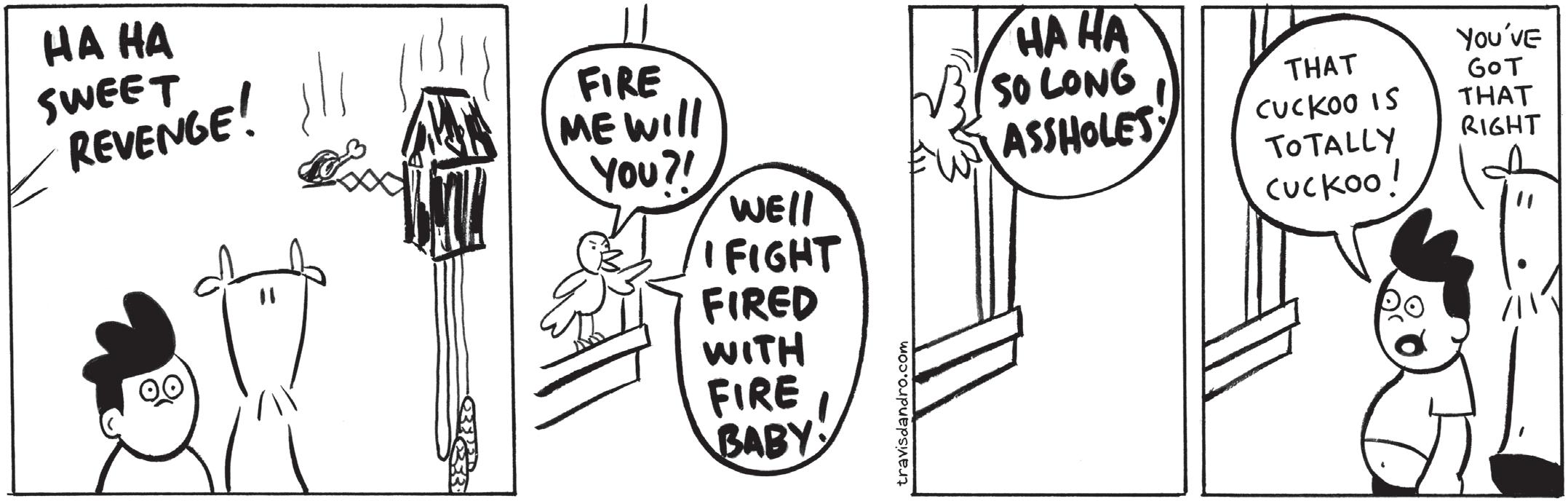
Mr. Gnu by Travis Dandro
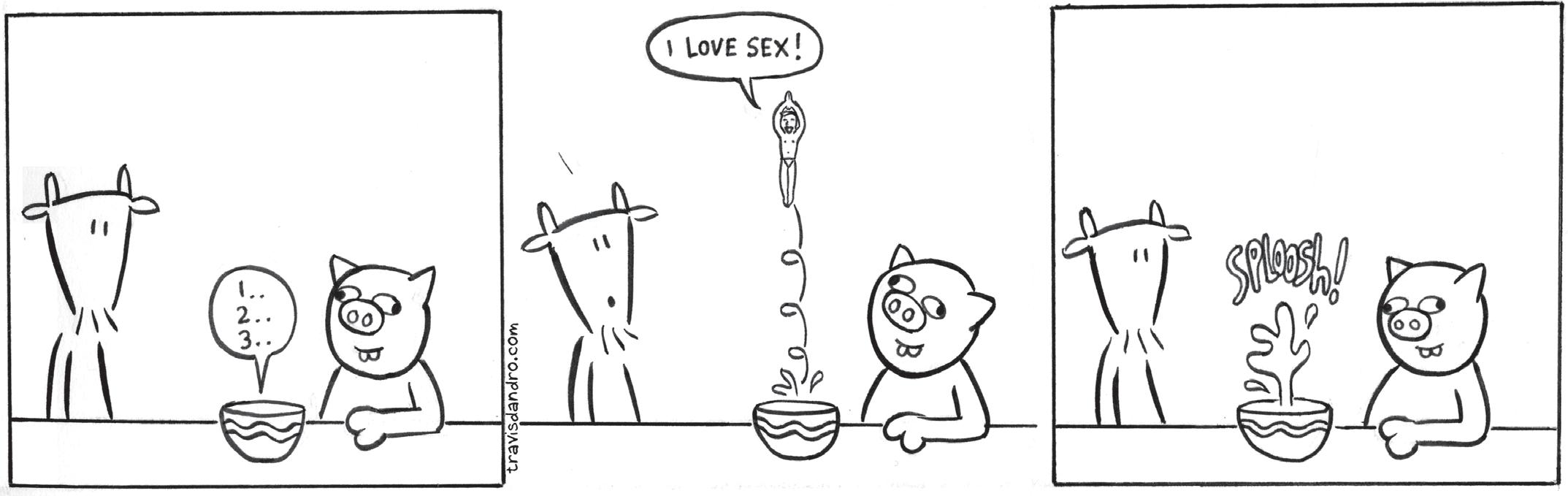
Mr. Gnu by Travis Dandro



Editor’s Corner
During President Donald Trump’s tumultuous term in office, there has been an enormous increase in activism among athletes. This activism is not new, as athletes such as Muhammad Ali and Tommie Smith previously engaged in prominent displays of protest.
Activism in the modern era became far more prominent with the decision by then-San Francisco 49ers quarterback Colin Kaepernick to take a knee during the national anthem to protest racial injustice and police brutality. Kaepernick’s fateful knee ultimately cost him a job in the NFL as the league subsequently blackballed him, but it did spur more activism.
The following season, more and more NFL players followed Kaepernick’s lead and kneeled during the anthem. The act of kneeling spread across major sports leagues, and activism only ramped up in 2020, especially following the death of George Floyd and the rise of the Black Lives Matter Movement.
After the police shooting of another Black man — Jacob Blake — NBA players threatened to boycott games before the league formally halted playoff action for three days. In addition, stoppages occurred in the NHL, MLB, MLS and WNBA.
Not only are we seeing activism on the national stage, but it’s also taking place on East Hill. Black student-athletes coalesced to organize “Our March — Our Campus,” an event that took place last month and called for systemic change to Cornell athletics.
Luke Pichini is an assistant sports editor on the 138th Editorial Board and previously served as an assistant sports editor on the 137th Editorial Board. He is a junior in the School of Industrial and Labor Relations and can be reached at lpichini@cornellsun.com.
Athletes Using Teir Voice: Activism Belongs in Athletics
deeply personal to them. Now, athletes are beginning to exercise their voice in a more forceful manner to better demand change.
Activism by athletes has unfortunately attracted frequent opposition. One of the prevailing beliefs going against activism by athletes states that sports and politics simply “do not mix.” The argument behind this fallacy is that viewers who tune in to watch sporting events do so as an escape from politics. The last thing viewers want is for athletes to make political statements.
This belief is incredibly flawed as it dehumanizes athletes to the point where they are only used for our entertainment purposes. Fox News host Laura Ingraham best epitomized this belief during an unhinged segment in which she told LeBron James and Kevin Durant to “shut up and dribble” back in February 2018.
But one only needs to look at who Fox News brings in as commentators to detect the immediate hypocrisy. The network has invited athletic figures such as Curt
This increasing activism represents a positive development. Athletes deserve to have a voice on social issues that are often deeply personal to them. Now, athletes are beginning to exercise their voice ... to better demand change.
Schilling and Bob Knight and celebrities like Kid Rock and Chuck Norris to discuss an array of political issues.
you agree with Fox News’ obvious conservative tilt, you are welcomed to express your political views. This logic is applied not just on major news networks, but in the minds of millions of Americans — speak up if I agree with you; if not, then shut up.
For many young Black athletes, who mainly tend to express progressive views and advocate for racial justice, the goal among the conservative establishment is to silence their voices, hence the personalities like Ingraham who spew hateful rhetoric.
But no one has been a more vocal figure in criticizing Black athletes than President Donald Trump. Back in 2017, he levied divisive comments against NFL players who opted to take the knee during pregame ceremonies.
“If we don’t practice one day and go back to practicing the next day, I don’t know what that really accomplishes,” McCourty said. “I know we could take a whole day off and we could talk about a whole bunch of different things. It just hasn’t mattered.”
Obviously, there is no tangible way to measure the impact that this activism will have on the election. But there is a shift in the sentiment of Americans regarding activism by athletes.
What this activism does is raise awareness around these issues. A large portion of the country does not actively keep up with current events. But for those who tune into sporting events while straying away from national news, athletes’ activism draws the viewers’ attention to these important issues.
This increasing activism represents a positive development. Athletes deserve to have a voice on social issues that are often
Why does Fox invite figures like this but then tell athletes like James to “shut up and dribble?” Well, the answer lies in political views. If you’re an athlete and
“Wouldn’t you love to see one of these NFL owners, when somebody disrespects our flag, to say, ‘Get that son of a bitch off the field right now. Out. He’s fired! He’s fired!’” Trump said at a rally in Huntsville, Alabama.
Since then, he has repeatedly traded jabs with professional sports players. Aside from James and Kaepernick, Trump has also launched feuds with athletes such as Stephen Curry and Megan Rapinoe.
Detractors may denounce the actual results of the activism. Does it yield any direct benefits or advance the causes that these athletes care about? In an interview with the Boston Globe, New England Patriots safety Devin McCourty expressed doubt about the fruits of activism.
Obviously, there is no tangible way to measure the impact that this activism will have on the election. But there is a shift in the sentiment of Americans regarding the activism by athletes.
Despite Trump’s best efforts to stir up division, he has actually managed to unite the country in terms of its view regarding activism by athletes. When Kaepernick first took the knee during the national anthem to protest racial injustice, only 20 percent of people polled at the time supported his actions.
But now, 70 percent of U.S. sports fans support protests by athletes. The widening practice of activism by athletes has led to a gradual acceptance by Americans. Just as all Americans have a right to exercise their right to free speech, athletes do as well, and they should not be confined to the sidelines during these politically turbulent times.
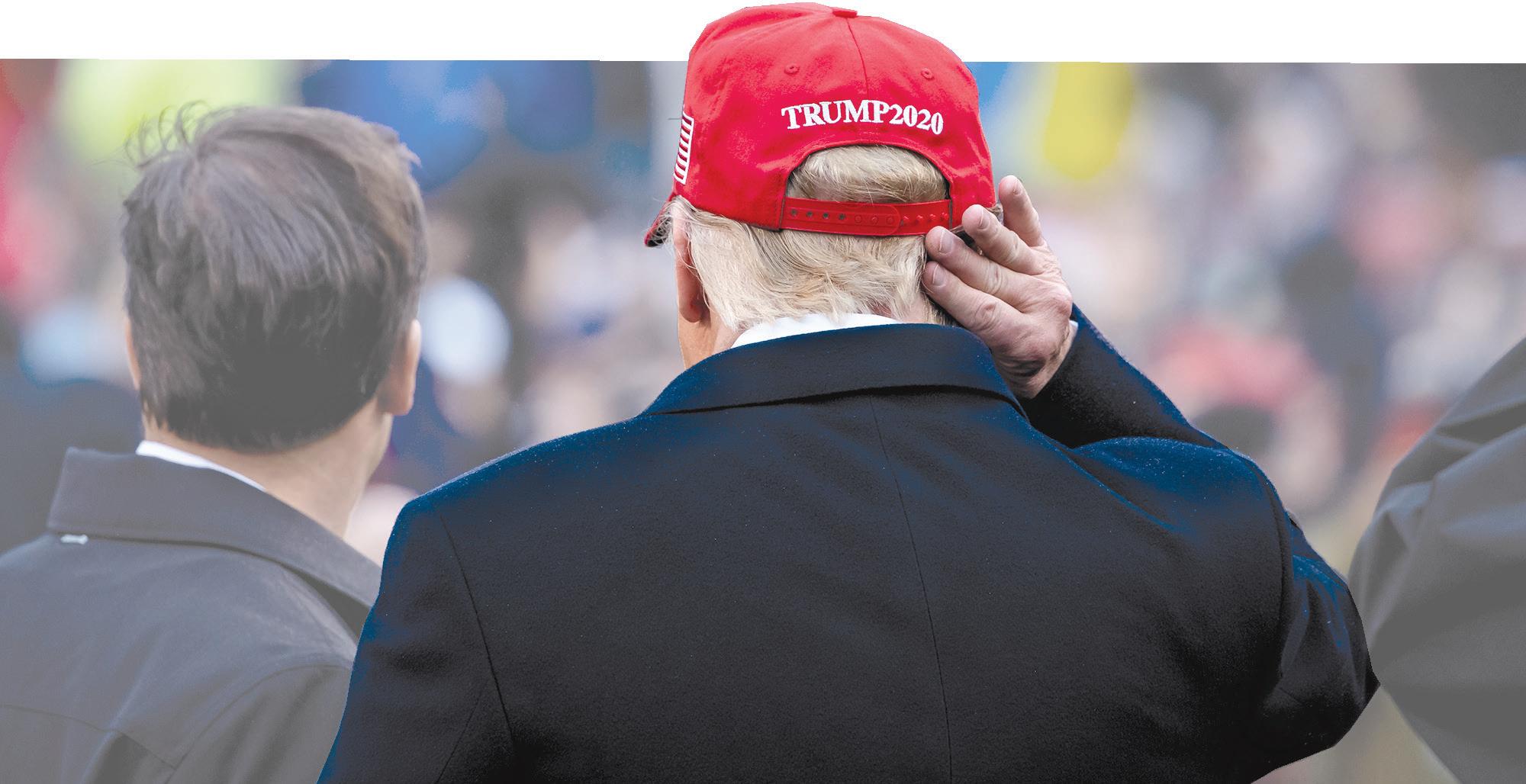
Pouring gas on the flame | President Donald Trump has attempted to stir division in the U.S. by criticizing athletes who use their platform to speak on social issues.