The Corne¬ Daily Sun
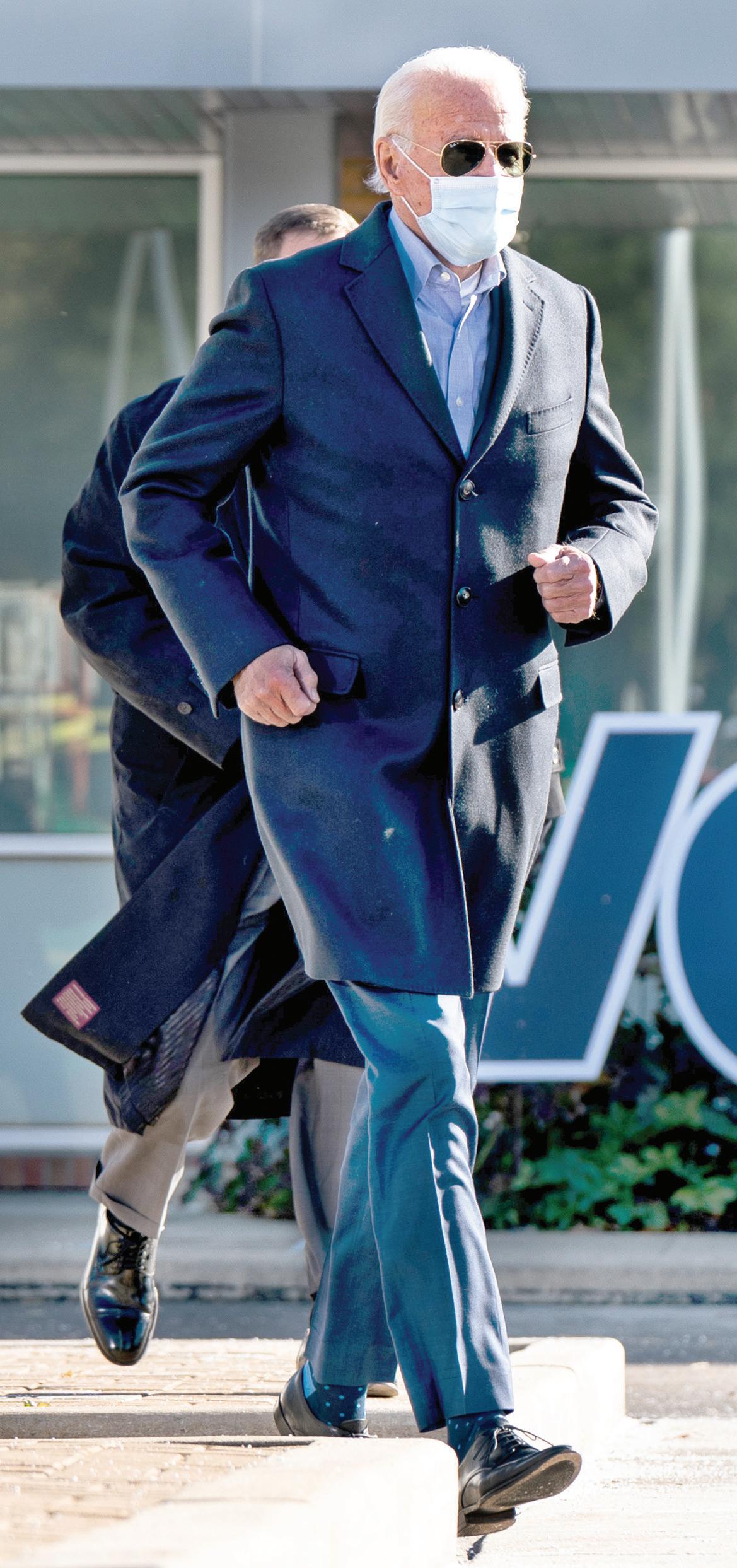

As the clock turned past midnight early Wednesday, results of the 2020 presidential election remained unclear as boards of elections in several key swing states had not yet finished –– or in some cases, even started –– counting a slew of mail-in ballots.
While Biden currently leads Trump in the formal electoral vote count (223-174, as of 12:30 a.m.), several states left on the map could swing either way.
The only swing states to be called by the Associated Press as of 12:30 a.m. were Ohio, Iowa and Florida for Trump and New Hampshire for Biden.
As predicted, Upper Midwest and Rust Belt states like Pennsylvania, Michigan and Wisconsin had yet to report a sufficient number of votes for the AP to definitively call races on election night. Likewise, the race in Wisconsin was not called by publication time (elections officials had pledged to deliver results sometime early Wednesday).
Across the South, Trump appeared to lead in two other crucial battleground states — North Carolina and Georgia — but neither of these races had been officially called.
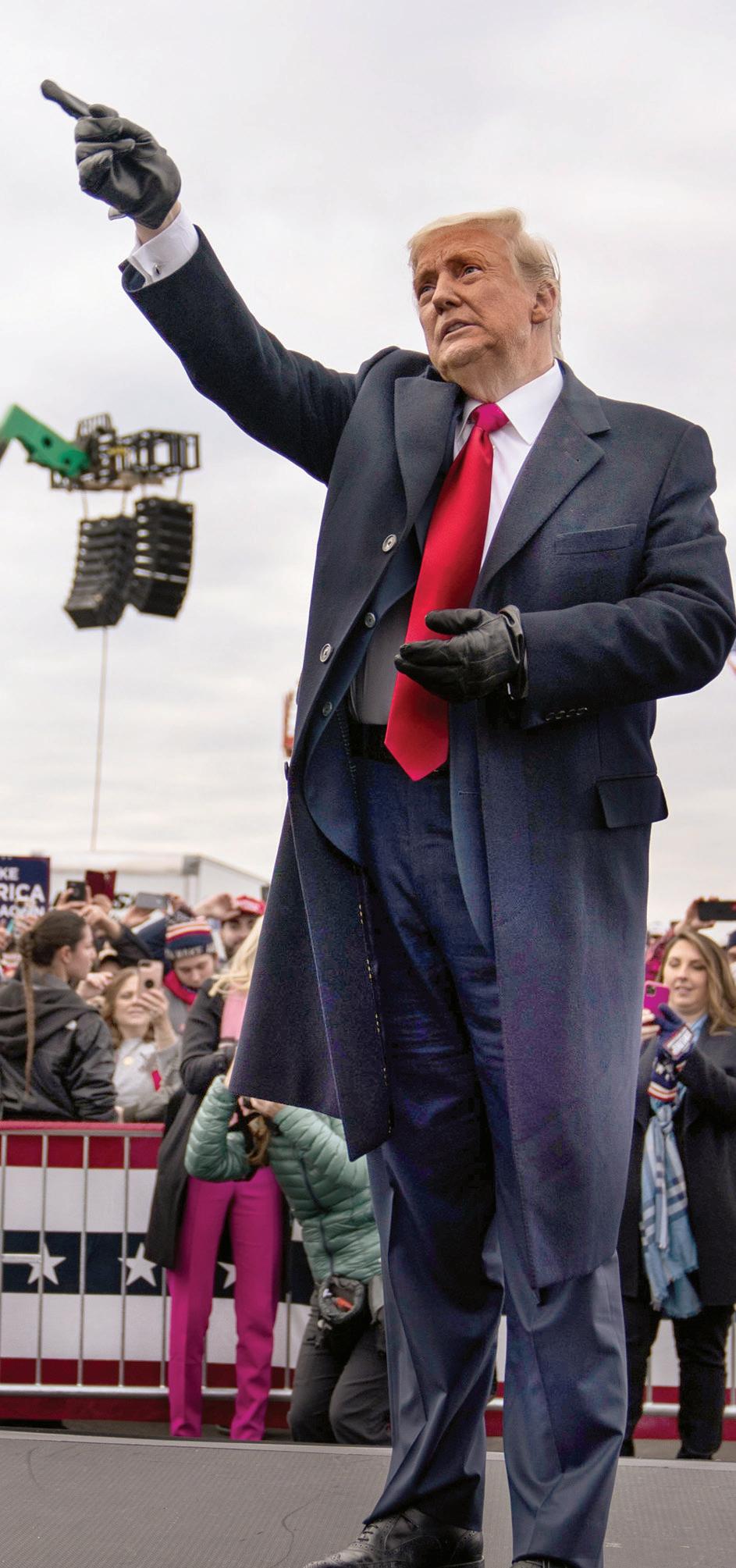
Trump was notably silent on Tuesday evening. The only tweet he sent out was at 6:15 p.m., as only early results from Indiana and Kentucky were out, when he (in all caps), wrote “We are looking really good all over the country.”
In Pennsylvania, a do-or-die state for Trump’s re-election, Trump secured 56.5 percent of the election night vote; in Michigan, Trump had 54.1 percent. But officials in both states expect full ballot counts to be completed within three days of Nov. 3. Seven Pennsylvania counties did not start processing mail-in ballots until Wednesday.
Even before the election, Republicans mounted court fights around the nation to challenge early and mail-in votes, leading some Cornell experts to cast concern over voter
By RAPHY GENDLER
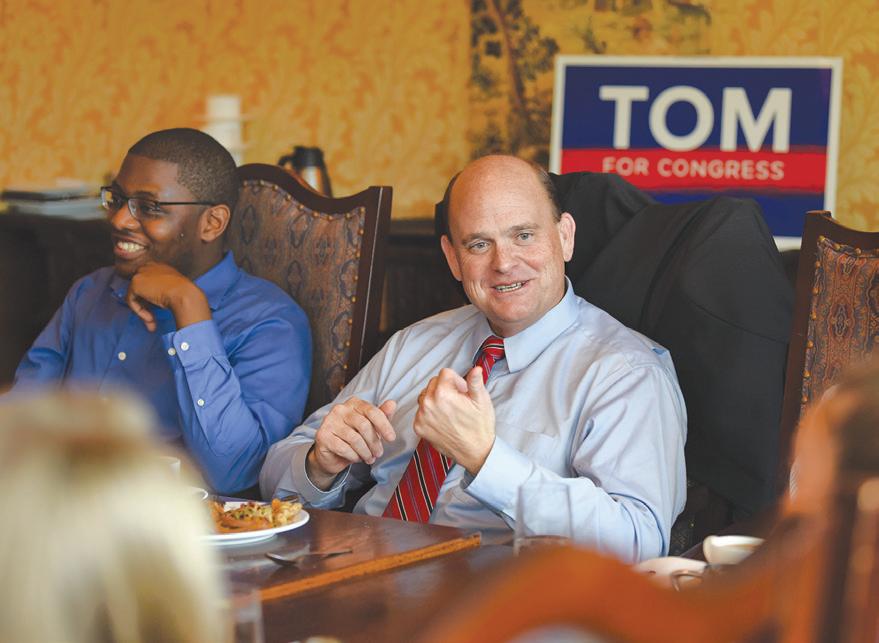
Rep. Tom Reed (R-N.Y.) declared victory in his reelection campaign for Congress in New York’s 23rd Congressional District at a small election night gathering in Corning around 11 p.m. Tuesday night. A delay in results caused by a high volume of mail-in ballots, however, means Reed and Democratic challenger Tracy Mitrano
J.D. ’95 won’t know for several days the official and final results of their second head-to-head race.
“We’re going to go back to D.C. and we’re going to bring people together and we’re going to have brighter days ahead of us, and we’re going to get COVID-19 in the rearview mirror,” Reed told supporters. As of a few minutes after
By ARI DUBOW and MEGHANA SRIVASTAVA Sun City Editor and Sun Assistant News Editor
Tompkins County District Attorney
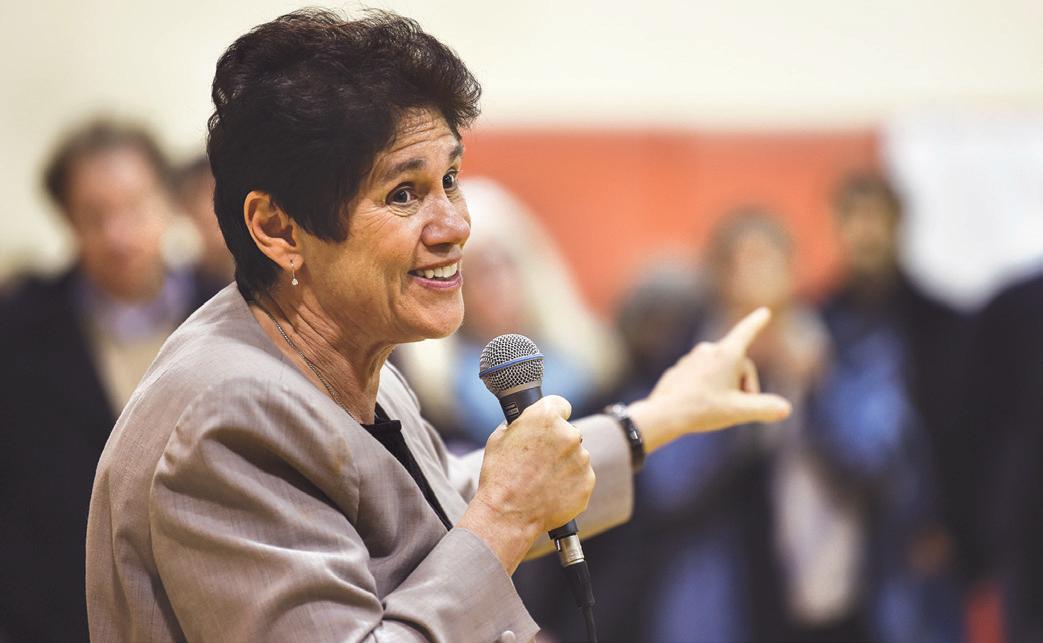
Matthew Van Houten (D) was re-elected as the Tompkins County District Attorney, entering his second term. He ran unopposed.
Van Houten’s first term began in 2016, winning against Edward Kopko, who ran as an independent that year. This year, Kopko challenged Van Houten in the Democratic primaries instead. Van Houten won the primary election with 57.5 percent of the vote.
In June, over 40 local attorneys for reelection endorsed Van Houten for reelection. His reelection was certified Nov. 3 at
11:36 p.m.
Van Houten, who identifies as a “progressive prosecutor,” graduated from Dryden High School in 1995. He then attended West Point and Albany Law School, which he graduated from in 1995.
Tompkins County Court Judge
John Rowley ’82 ran unopposed for Tompkins County Court Judge and was reelected for his third 10-year term. Rowley has held multiple positions in the Tompkins County legal system, serving as a Counsel to the Tompkins County Department of Social Services starting in 1991, and then as a judge on the Ithaca City Court starting in 1996. His first term as County Court Judge began in 2001.
By MEGHANA SRIVASTAVA and SARAH SKINNER Sun Assistant News Editor and Sun Senior Editor
Nov. 3 seemed like a fairly normal day on Cornell’s campus: against a backdrop of gray skies and chilly winds, Cornellians went to class, huddled up in cafes and grabbed food from campus dining halls. Around the country, however, the highly-anticipated, contentious 2020 presidential election unfolds. And most Cornellians have already made their voices heard through absentee or early voting.
The Sun interviewed Cornellians around campus about their voting habits and who they voted for. Here’s what they said.
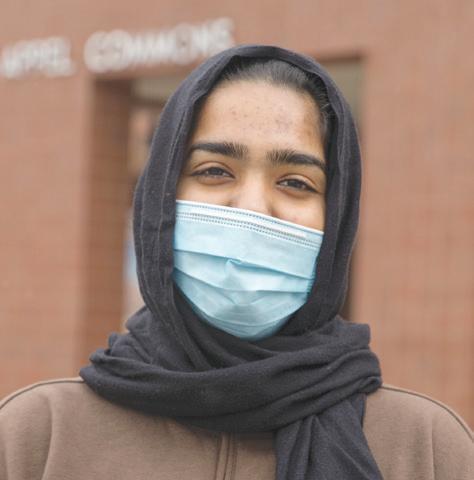
Method of Voting: Mail-in ballot for Long Island, New York
Voted for: Joe Biden
Reason: For Malick, the choice to vote for Biden was “obvious” — there was “no way” she could vote for Trump “based on the things that he’s done and the things that he’s said.” Citing climate change and health care as a few of her top issues, Malick said she stays in touch with politics. “I think the 2016 presidential election kind of forced you to pay attention,” she said.
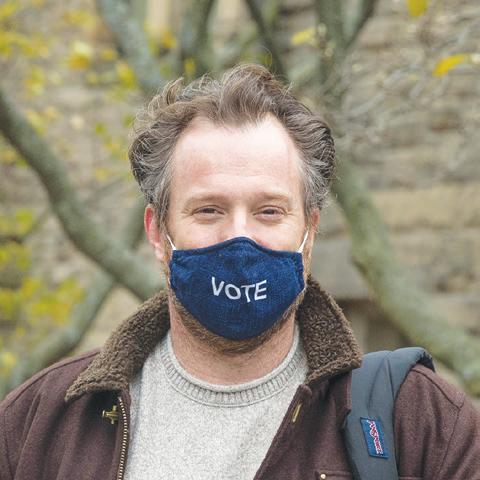
Job: Visiting lecturer in the Department of Near Eastern Studies
Method of Voting: In-person dropoff ballot in Pennsylvania
Voted for: Joe Biden
Reason: “I’m a really progressive leftist socialist, so there’s not really anyone representing my political opinion,” Winitsky said. He voted via a drop-off ballot in Philadelphia where he is every weekend, citing competence level as why he picked Biden despite differing politics.
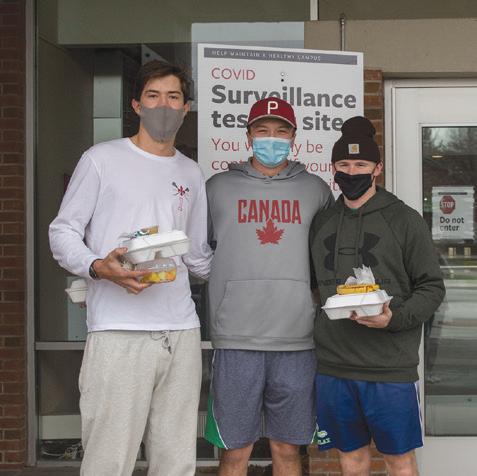
Method of Voting: Mail-in ballots for Syracuse, New York, and Virginia, respectively
Voted for: Donald J. Trump
Reason: Sheehan voted for Trump because of the pandemic. “I want this pandemic to be over with as soon as possible. It’s starting to drive me insane,” Sheehan said. Wallace agreed. Both Wallace and Sheehan are firsttime voters.
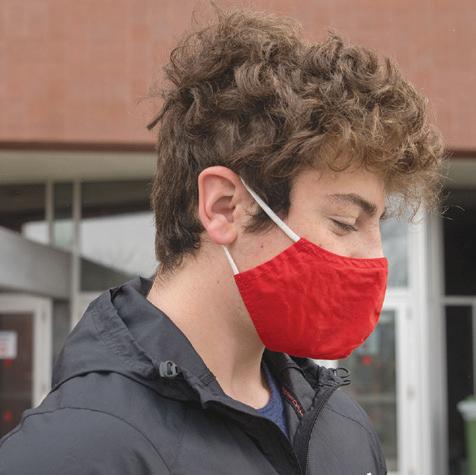
Method of Voting: Mail-in ballots for Connecticut
Voted for: Joe Biden
Reason: Desimone voted for the first time this year. Desimone voted for Biden, in part because of his personal identity: “I’m not a big fan of Trump. I’m Hispanic; he’s kind of racist.”
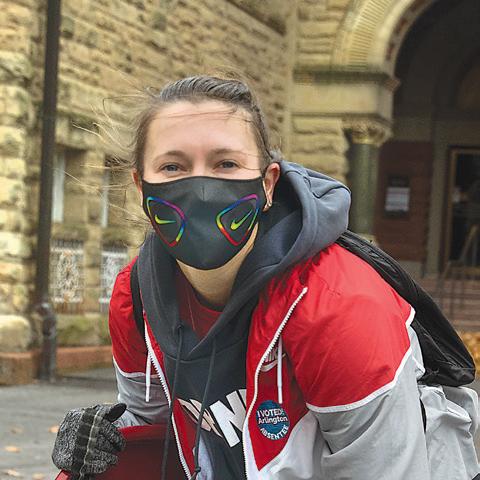
Job: Assistant coach, Cornell Women’s Basketball Method of Voting: Absentee ballot in Virginia
Voted for: Declined to say as an employee Reason: Mattox felt that the country was at a moment of change, and said she had worked to use her platform to encourage bipartisan participation.
“One of our goals was to try to get the entire student-athlete population registered to vote,” Mattox said. “We’ve had pretty good success with that.”
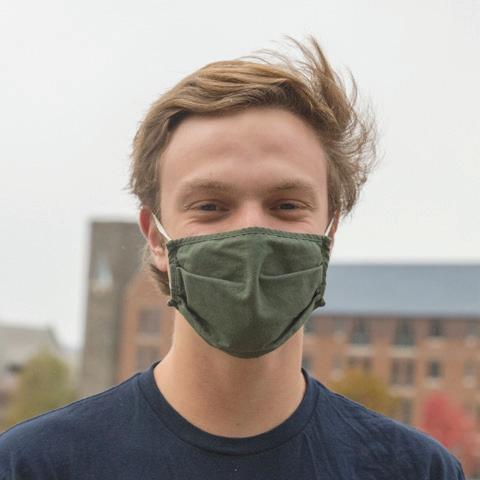
Method of Voting: Mail-in ballots for New Jersey
Voted for: Joe Biden
Reason: Katz is a registered Democrat who voted for biden because he wants “restored confidence in the government and to not have this craziness.” Katz planned on watching the election unfold in the loung of Kay Hall with his friends.

Method of Voting: Planned to vote in person Will vote for: Joe Biden
Reason: Wang, a Long Island native, hadn’t yet voted Tuesday morning. She wasn’t sure what polling station she was voting at either — “I was planning on looking it up” — but she knew she was going to cast her ballot for Joe Biden.
Meghana Srivastava can be reached at msrivastava@cornellsun.com. Sarah Skinner can be reached at sskinner@cornellsun.com.
By FAITH FISHER and MILO GRINGLAS Sun Staff Writers
After weeks of waiting for his mail-in ballot to arrive, Brandon Wolf ’23 finally gave up on voting absentee.
“I’ve been packing all day,” Wolf said. “I’m going home for the semester just so that I can vote.”
The Pennsylvania -native is not alone. Samantha Puzzi ’22 and Maddie August ’22 — also from the state that President Donald Trump won in 2016 by less than 1 percent — experienced lengthy delays and difficulties receiving their absentee ballots in Ithaca.
This is the first year that all Pennsylvania voters are eligible to vote by mail, and the state was bombarded with ballot requests. More than 3 million ballots were requested statewide — nearly half the total voter turnout from four years ago.
Party officials in Pennsylvania
and other battleground states have inundated the courts with requests to rule on cases regarding the election, — especially on with respect to mail-in ballots, which have a higher demand this year.
Pennsylvania Republicans requested that the justices block the ruling made by the Pennsylvania Supreme Court, which said absentee ballots received up to three days after Nov. 3 would still count. Much to the president’s dismay, the court was deadlocked on the Republican Party’s appeal, allowing the three-day extension to stand.
Mail delays have been a pertinent concern surrounding the 2020 election, and recent slowdowns have jeopardized thousands of votes made by absentee ballots. As of Nov. 2, there were an estimated 29.6 million outstanding mail-in ballots and delivery rates in swing states have been significantly lower than the national average. Both campaigns made it a priority to spend the final days of the
campaign traversing Pennsylvania, vying for the state’s 20 electoral votes. Before Trump flipped the swing state in 2016, Pennsylvania had voted for Democratic candidates in six consecutive presidential elections.
Wolf, who hails from Bucks County, Pennsylvania, registered for an absentee ballot on Oct. 6. This is his first presidential election, and considering the uncertainty of Pennsylvania’s outcome, he wanted his vote to count in his home state.
After registering, he received a message from the Bucks County election office confirming that his request had been processed and that it should be mailed shortly. But two weeks later, it still hadn’t arrived.
He called the office, where a representative told him that there was a problem with his application because they could not verify his current address in Ithaca.
“I shouldn’t have had to reach out to them when they were trying
to verify my address,” he said. “I understand they’re trying to prevent fraud, but they should have told me the issue because the whole time my application said it had been processed and was waiting to be mailed.”
Wolf, distrustful of the mailing system after this initial ballot mishap, ultimately decided that he would cut his Ithaca semester short to go home and vote in person.
“What if [my ballot] gets lost in the mail?” he asked. “What if it’s not there until [Nov.] 15th? Are they going to recount? Are they going to add it to the total tally? You would think that the election would already be called by the 15th.”
Puzzi — from Schuylkill County, Pennsylvania, which voted overwhelmingly Republican in the 2016 presidential election — shared the “maddening” process it took to obtain her absentee ballot.
A first time voter, Puzzi requested her ballot months in advance
through the Pennsylvania voting website. Immediately, she “had a lot of problems.”
The website failed to recognize her Ithaca address and refused to let her finish the form as a result. She re-tried continuously for a few weeks to no avail.
A couple weeks out from the election, Puzzi said she “started to worry.” This time around, Puzzi filled out the form again with her home address in Pottsville, Pennsylvania, figuring that her dad would mail it to her at school to fill out.
She was finally allowed to complete the form and received a confirmation email that the elections office was processing her information and a ballot would soon be sent to her house. But the ballot showed up at her Ithaca address a week ago, even though the voting website told her there was no USPS record of that address.
See MAIL-IN page 3
PRESIDENT Continued from page 1
suppression and dubiously motivated post-election day court challenges across the country.
As results trickled in late Tuesday, Prof. David Bateman, government, who studies American political development and voting rights, said he foresees nationwide litigation in the coming days and weeks, an echo of previous election years.
“There’s very likely going to be litigation in North Carolina, very likely to be litigation in Florida,” he said. “There are processes for this but it’s not clear that given the animosity around this particular president, it’s not clear that the process will be seen as legitimate by all.”
Bateman said if the election for president ends up in the House of Representatives –– an Electoral College outcome that became increasingly, albeit still very slightly, possible Tuesday night –– he expressed concerns that Americans will not see the process as legitimate.
A surge in mail-in votes across the nation overwhelmed postal service offices and caused delays in vote counts. An unprecedented 64.6 million Americans cast their ballots before Election Day via mail-in voting, at the backdrop of a COVID-19 pandemic that has continued to spike across the nation. In New York, a prelude to Tuesday night’s reporting delays occurred in June, as primary races took weeks to count after a surge in mail-in voting.
Democrats retained control of the House of Representatives, and, as of midnight, had no net gain in the Senate: Sen. Doug Jones (D-Ala.) was ousted by former Auburn University football coach Tommy Tuberville, while former Colorado Gov. John Hickenlooper flipped Colorado’s Senate seat.
Votes in several key Senate races left it unclear as to whether Democrats or the GOP would control the chamber. In order to take back the Senate, Democrats needed to flip at least three Republican-controlled seats if they also won the White House.
In North Carolina, challenger Cal Cunningham trailed incumbent Sen. Thom Tillis (R-N.C.) by less than a point with 93 percent of the vote reporting. On the other hand, Arizona returns showed former astronaut and Democrat Mark Kelly polling ahead of Sen. Martha McSally (R-Ariz.).
In Maine, results had yet to paint a clear picture as to whether state House Speaker Sarah Gideon or Sen. Susan Collins (R-Me.) was ahead. Likewise, in Montana, Gov. Steve Bullock was ahead of Sen. Steve Daines (R-Mont.).
In South Carolina, Sen. Lindsey Graham (R-S.C.) bested challenger Jamie Harrison. In Georgia, no winners had been called in either Senate race, both of which were expected to be highly competitive.
As of 12:30 a.m., Trump was called the winner in Alabama, Arkansas, Florida, Idaho, Iowa, Indiana, Kansas, Kentucky, Louisiana, Mississippi, Missouri, Nebraska, North Dakota, Oklahoma, Ohio, South Carolina, South Dakota, Tennessee, Utah, West Virginia and Wyoming.
Biden was called the victor in California, Colorado, Connecticut, Delaware, Illinois, Maryland, Massachusetts, Minnesota, New Hampshire, New Jersey, New Mexico, New York, Oregon, Rhode Island, Vermont, Virginia and Washington.
Alec Giufurta can be reached at agiufurta@cornellsun.com. Amanda H. Cronin can be reached at acronin@cornell.sun.com
MAIL-IN
Continued from page 2
August, although from a different county, experienced an equally cumbersome process.
She applied for an absentee ballot Sept. 4. She, along with 200,000 other voters in her home county, Montgomery County, were sent an accidental email on Sept. 21 by Pennsylvania’s Department of State stating that mail ballots had been dispatched and should arrive within 11 to 14 days.
August’s county didn’t actually begin mailing out ballots until Sept. 30, causing confusion and anxiety among voters. Even after the Department of State mailed ballots, herAugust’s ballot still never arrived. Three weeks after receiving the initial email on Sept. 21, Augustshe called her local election office, which told her that her ballot had been canceled.
The election office sent her another email on Oct. 25 confirming that it sent another ballot to her. The second ballot never arrived, however, prompting August to return to the Keystone state to cast her vote in person, like Wolf.
But before August could vote she needed to visit the election office to receive a provisional ballot. Because her second mail-in ballot has not been formally canceled, she would have been ineli-
gible to vote in person.
“I would have much preferred, especially in a pandemic, to be voting by mail,” she said. “I don’t want to have to be quarantined for more of school.”
Although August will be able to make up the asynchronous lecture she missed to vote, COVID-19 restrictions require her to quarantine until receiving two negative tests upon her return. She will miss out on in-person instruction and along with a week’s worth of work — August will have to find people to cover her missed shifts and will lose a week’s worth of wages.
While for her this is merely an “extra annoyance,” she realizes that others may not be in the same position to go home with the same ease. This situation has only revealed to her the many barriers that face voters, which have only been exacerbated by the pandemic.
“I’m very privileged in that I can take a day off and drive home — I have a way to go home,” she said. “So many people don’t live within driving distance, or just can’t take off a day at work.The system is so flawed. There are so many barriers for people to vote.”
Faith Fisher can be reached at fsher@cornellsun.com. Milo Gringlas can be reached at mg862@cornell. edu.
said in a Facebook video. Peacock is the first Black City Court Judge in Ithaca, as well the first judge of color in the 6th judicial district, which encompasses 10 counties.
His reelection was certified on Nov. 3 at TKTK p.m. Seth Peacock
Seth Peacock J.D. ’01 ran in an uncontested race for Ithaca City Judge against Dan Johnson. Johnson dropped out of the race, but failed to meet the deadline to withdraw from the ballot –– Johnson is on the Working Family Party Line.
Peacock attended Cornell Law School and has served as City Judge since 2019, when Mayor Svante Myrick ’09 appointed him alongside City Judge Richard M. Wallace to fill a vacancy. He also served as interim City Judge in 2014. Myrick endorsed Peacock in June.
“I believe that Seth is the right person for this seat. He’s the right person to lead the court at this moment,” Myrick
“He’s carried that distinction and that burden with
“What distinguishes Seth Peacock in this race is his grassroots connection with community members.”
Leslyn McBean-Claireborne
uncommon wisdom, strength, and grace,” Myrick wrote in the video caption.
Tompkins County Legislature Chairwoman Leslyn
McBean-Clairborne also endorsed Peacock prior to the primary last June.
“What distinguishes Seth Peacock in this race is his grassroots connection with community members,” McBeanClaireborne wrote. “Ithaca needs a judge who knows and understands community.”
The races for State Assembly and State Senate were too early to call as of the print publication deadline. As of early Wednesday morning, the Tompkins County Board of Elections vote totals reported Democrat Anna Kelles leading Republican Matt McIntyre 61.17 percent to 32.72 percent. As of 12:49 a.m., State Sen. Tom O’Mara (R) led Leslie Danks-Burke (D) in the State Senate race at 58.5 percent.
Ari Dubow can be reached at adubow@cornellsun.com. Meghana Srivastava can be reached at msrivastava@cornellsun.com.
midnight, about 77 percent of ballots had been counted, The New York Times reported.
Mitrano told The Sun Tuesday night, before most of the votes in Tompkins County were accounted for, that Reed’s victory declaration was premature. When Reed declared victory, less than a third of votes from Tompkins County, the district’s only Democratic stronghold, had been counted.
“Now I know that [Reed] would prefer not to have Tompkins County in this district, but I’m afraid that it is a part of the 23rd and with 70
percent of it yet to report today’s results and 40,000 absentee ballots outstanding, that declaration was premature,” Mitrano told The Sun.
Mitrano, who in 2018, conceded the election after it became clear that a victory wasn’t mathematically possible, blasted Reed for not waiting until larger bunches of Democratic votes came in before declaring victory.
“I’m afraid Mr. Reed wants to continue to make it his day when today belongs to the voters, and for him to get ahead of the numbers when there is not a mathematical certainty tells you something about him,” Mitrano said. “It’s more about him than the people.”
Just after 12:15 a.m. Wednesday, Reed had 60.95 percent of the vote and Mitrano had 35.64 percent, according to the New York State Board of Elections. Reed led in every county except for Tompkins, where Mitrano had garnered 67.64 percent of the vote with 61 of 63 election districts reported. The New York Times reported that about 65 percent of the votes in Tompkins had been counted as of midnight.
Reed has held the congressional seat since 2010. The district is made up of 11 mostly rural and conservative counties.
Raphy Gendler can be reached at rgendler@cornellsun.com.
Not only is 2020 the first election to occur during a deadly pandemic, it is taking place at a time when the effects of climate change have intensified — with this year having the highest number of extreme weather events like hurricanes and wildfires.
Matching the severity of these two phenomena, many scientists are breaking their previous political silence. Several scientific publications, including the New England Journal of Medicine, Scientific American and the Lancet made their first political endorsement in their history. Additionally, scientists have been both actively endorsing candidates and partaking in the nationwide movement to encourage everyone to vote.
In recent years, it has been common practice for Nobel laureates to support candidates, endorsing former President Barack Obama in both 2008 and 2012, and then Hillary Clinton in 2016. While these endorsements are customary, the group saw its number of signatories spike in 2020 with 81 laureates endorsing Joe Biden.
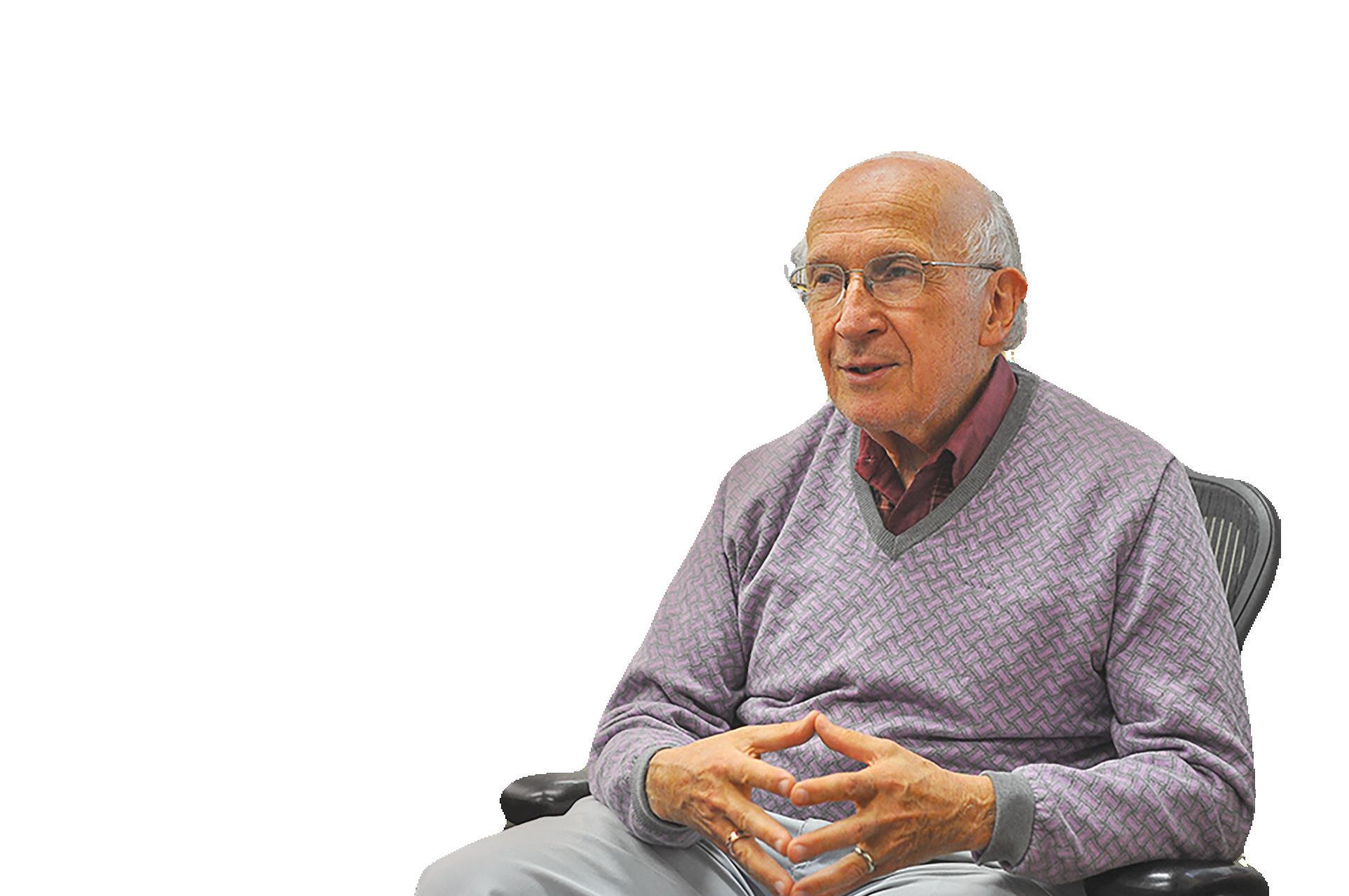
Among the signatories are Dr. Harold Varmus, medicine, and Prof. Roald E. Hoffmann, chemistry. According to them, the level of engagement by scientists in this election is nothing new, but the vigor and passion has definitely experienced an uptick.
“I’ve been involved in most Presidential campaigns since 1992 and we’ve always had ‘science and technology’ committees, scientific leaders endorsing candidates, etc.,” Varmus wrote in an email to The Sun. “It is true that this year is different, because Trump is so blatantly anti-science. For that reason and many others, scientists, and many others, are passionate about sending him home (wherever that is).”
While scientists were outspoken during the last election, the Trump administration’s handling of the COVID-19 pandemic “creates an immediate danger that I don’t think we’ve felt at this level of intensity before,” Varmus said.
For Hoffmann, who has always been a supporter of the Democratic Party, endorsing Biden was an easy decision.
“It was a recognition that we need to get past these four years and we need to get back to an attempt at a rational society,” Hoffmann said.
Prof. Bruce Lewenstein, science and technology studies and communication, said that the 2020 election — which has seen public health and climate come to the forefront — represents a unique moment for both science and politics.
“It is certainly true that scientists have been involved in politics long before this election and that there are many scientists who have been active and articulate about their political positions in many elections in the past, in that sense it is not a new thing,” Lewenstein said. “[But] I do think it has ratcheted to a new level.”
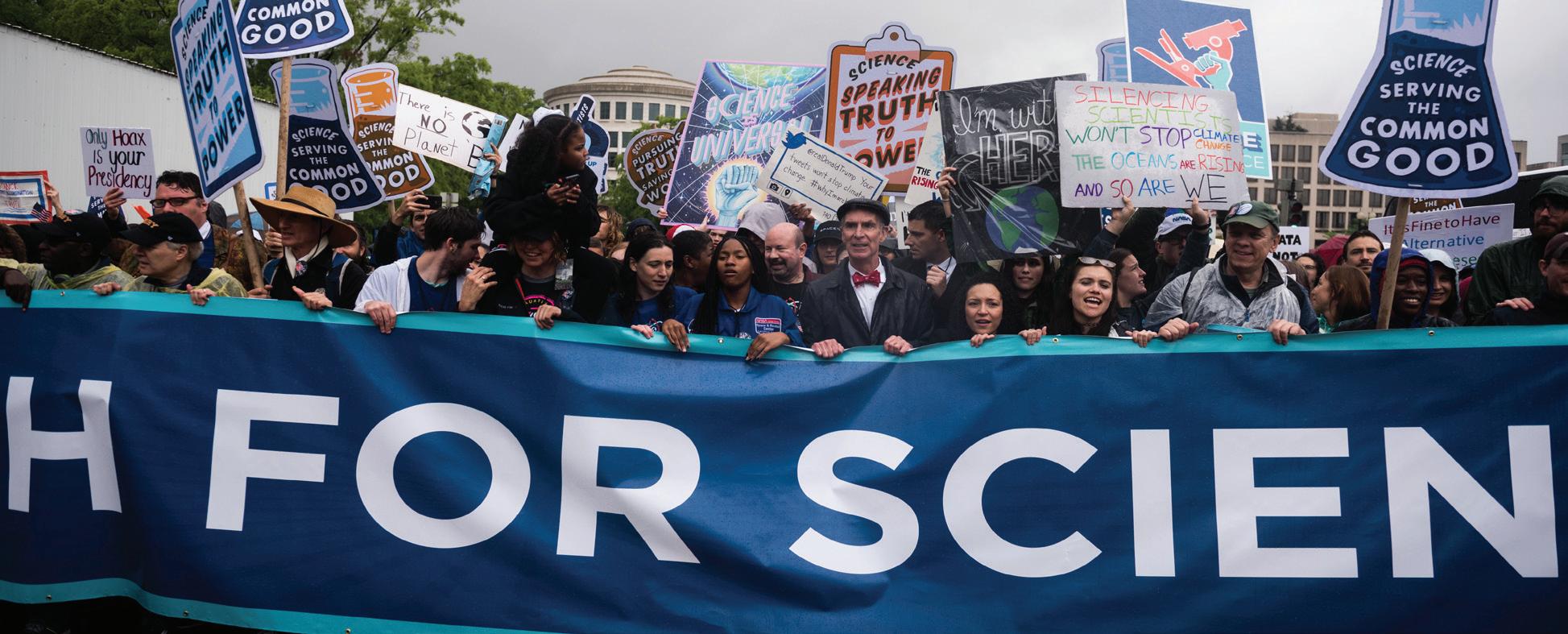
Science’s involvement in politics has grown over the course of Trump’s administration. Lewenstein marked the March for Science as a pivotal turning point in the willingness of scientists to publicly involve themselves in the political arena.
While the first march was held on Earth Day in 2017 — several months after Trump’s inauguration — to many, Trump’s election simply represented the last straw
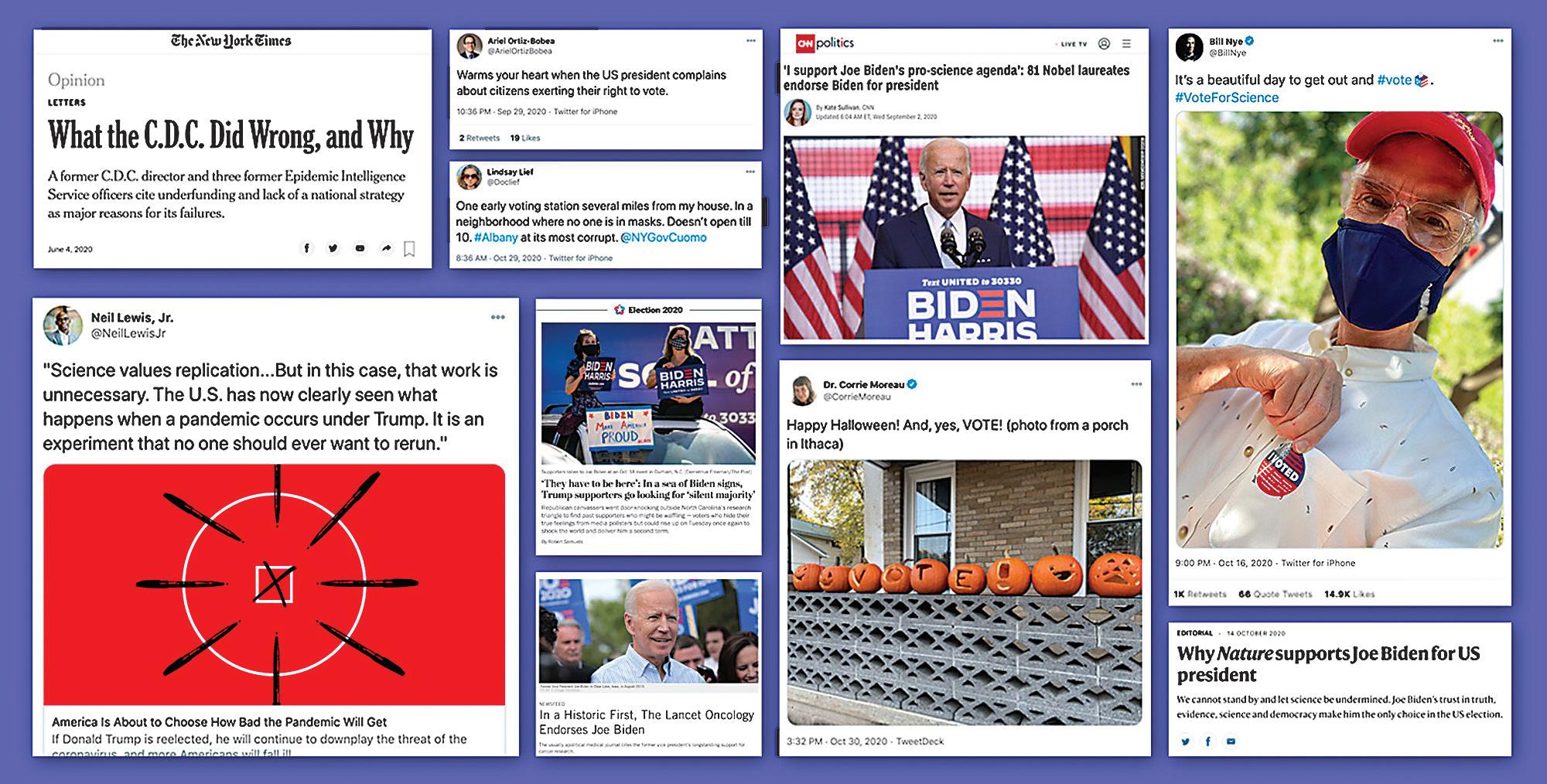
in a growing sentiment of science denialism, which has sparked increasing skepticism over vaccine safety and humans’ involvement in climate change.
“There’s been a slow building of science denialism in both the government and in society in the general,” said
much more vocal about politics and voting on social media: “The presence of science and scientists on social media being willing to take positions is a crucial thing,” he said.
of political polarization.
“There was definitely the notion that there should be political activity, and that was controversial,” Lewenstein said. “There were a lot of scientists that said ‘we should not be doing this’ because it violates this ideal of objectivity and nonpartisanship.”
Anecdotally, Lewenstein has noticed scientists being
While the coronavirus outbreak ranks among the top concerns for voters in the 2020 election, Lewenstein nevertheless said he doesn’t see this as a primarily sci-
“It’s not explicitly the science [that is frustrating people]. Those of us on the science side see the failure, but I’m not sure that the political anger about [the pandemic] is tied to ignoring science. I think it’s tied to ‘I know people who are dying’, ‘this was mismanaged economically,’” Lewenstein said. Even though the endorsements made by journals like the New England Journal of Medicine and Scientific American are historic, Lewenstein said he sees it more as an indication of a larger sentiment among scientists rather than a move that will sway many voters.
While scientists play a crucial role in advising and making recommendations to those in charge, Hoffmann does not believe they should the ones running the country.
“Science plays an important role in technical and advisory questions. It cannot make the decisions that a country has to make and proportion resources. There never is enough money for everything and everyone,” he said.
Lewenstein, on the other hand, believes that the sphere of science shouldn’t be far removed from politics — individual scientists should bring their personal expertise to voting, while scientific institutions should recognize the role they play in the political world.
“What I think scientists should not do is believe that somehow their science is separate from their politics, I don’t think that science is some idealized thing that operates outside of politics,” Lewenstein said.
Hoffmann ultimately expressed optimism about the future of the country and the role science will play in it.
“It’s time for a change and Biden represents that change,” Hoffmann said.
ADITI HUKERIKAR SUN ARTS STAFF
The 2020 presidential election has seen an immense amount of television advertising from both President Donald Trump and former Vice President Joe Biden’s campaigns. With the ever-evolving media landscape that’s shaping our current presidential election, TV ads play a more important role than ever before. Because of the diversity of television programming on both broadcast and cable television, politicians have to carefully consider which content they want to place campaign advertisements alongside. Whether targeting reliable voters to reaffirm their support or appealing to unlikely voters to change their voting plans, politicians aim to maximize the impact of their political advertisements.
Unsurprisingly, both campaigns placed many advertisements during news and weather programming; informational programming tends to draw viewers from across the political spectrum, allowing political campaigns to target a variety of potential voters. On the other hand, entertainment television programming — like sitcoms, dramas, comedy shows and game shows — tend to draw narrower audiences. These shows can provide reasonable assumptions about demographic compositions or even political views of the audiences of each show.
Art consumption becomes almost weaponized by revealing information about its audience to political candidates, who intend to use that information to target specific groups of potential viewers.
Some of the most popular fictional programming targeted by the political campaigns included sitcoms, as both candidates placed high numbers of advertisements during reruns of the popular The Big Bang Theory . During its run, this show performed well, and both campaigns seem to hope that reruns of the show continue to be viewed by large audiences.
Trump also targeted sitcoms Two and a Half Men and The Andy Griffith Show . The latter, which came out in the 1960s, especially appeals to older audiences who are known to support conservative candidates. The campaign is able to target shows that appeal to potential voters, perhaps revealing the campaign’s goals of recognizing which groups to reaffirm support amongst.
Many of the sitcoms that Biden has chosen to place ads spots next to, such as Family Matters, Good Times and The Bernie Mac Show , have casts composed of mostly Black actors. Biden’s campaign hopes to appeal to Black voters, and targeting these shows with advertisements reflects this attempt.
Trump also placed numerous advertisement spots next to the
“Despite the variety of programming targeted, the purposeful placement of advertisements transform art from just entertainment to a political tool.”
true crime series The First 48 . Centered around detectives investigating murder cases, this television show tends to portray law enforcement in a more positive light. With a significant part of the President’s platform focusing on law enforcement, specifically in regards to police around the country, the President’s campaign seems to be calling to audiences who would support this platform.
Surprisingly, Trump also aired 1200 advertisement spots alongside left-leaning comedy program The Late Show with Stephen Colbert . Colbert — a comedian who has been exceedingly vocal in criticizing President Trump on his show — even mentioned his surprise over this choice of advertisement spots. Viewers of Colbert’s show are almost guaranteed to oppose or at least dislike President Trump — something that his campaign is likely aware of. Choosing to target this audience reveals the campaign’s hopes to convert likely Biden voters towards voting for the President’s re-election. Despite the variety of programming targeted, the purposeful placement of advertisements transform art from just entertainment to a political tool.
Aditi Hukerikar is a freshman in the College of Arts and Sciences. She can be reached adh247@cornell.edu.
CHRISTINA OCHOA SUN ARTS STAFF
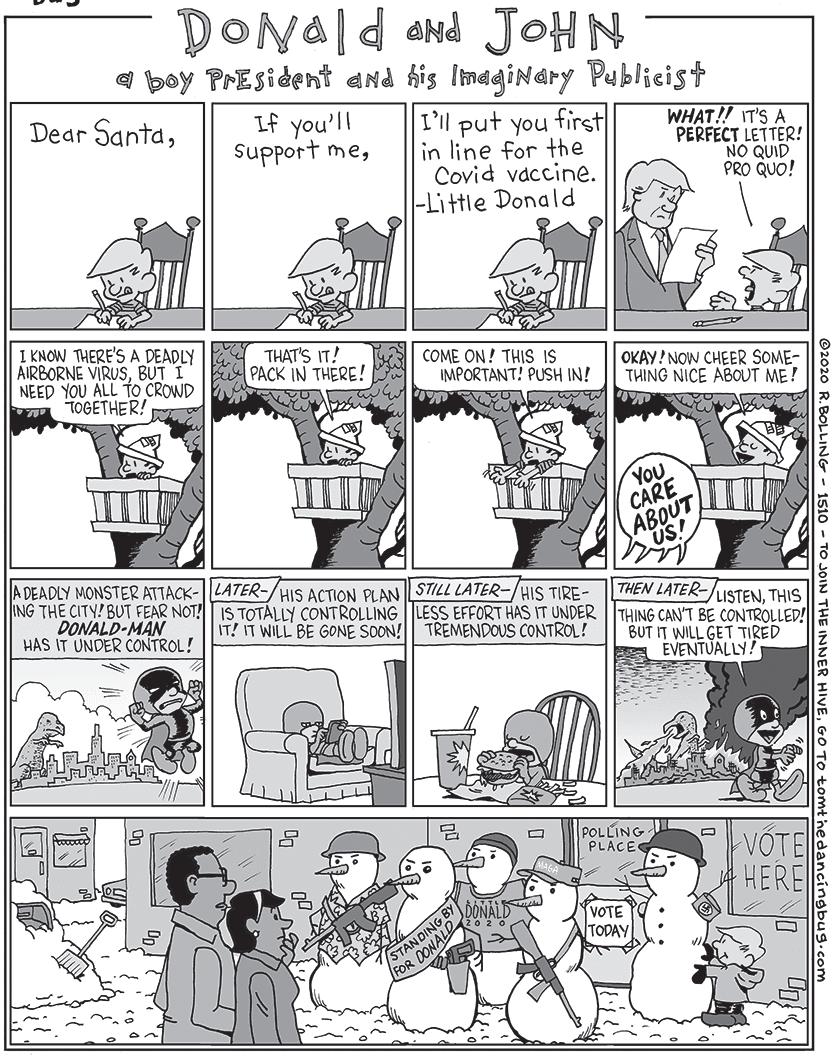
Trump’s visuals have been the centerpiece of some of the most controversial moments of his re-election campaign. The Trump campaign has managed their visual production in a way much different from anything we have seen before, often including many overtly racist and sometimes fascist undertones.
Impactful visuals are a huge part of any successful election campaign. The more ideas and visuals that stick with people, the more likely they are to pay attention to the campaign’s message. The images and motifs used in political signs, merchandise and advertisements are typically shaped by current events and what people will most likely gravitate toward.
Reelection campaigns in particular tend to harp on the images produced during the most evocative moments of the presidency. Bush used images from the Sept. 11 terrorist attacks in his 2004 re-election campaign. Likewise, Obama ran ads that centered around his successful killing of Osama Bin Laden. Both of these ads brought controversy, which ultimately brought more attention to the campaign.
Unlike typical re-election campaigns, Trump is working from a position where the most striking images from his presidency come from moments of protest and national outcry against him, forcing him to take more unconventional routes in finding evocative images.
The general strategy with campaign imagery is usually to cast as wide a net as possible in order to
appeal to as many voters as possible. While some pieces may be more provocative and elicit stronger emotions to hit a certain niche, the goal is to never alienate potential voters. However, with this election, things appear to have been flipped.
A quick visit to Trump’s campaign website, and you’ll find “__ for Trump” shirts and signs that follow every race, gender, religion and occupation: lawyers for Trump, Irish Catholics for Trump, Women for Trump. This hyper-fixation on the “diversity” of the Trump campaign is born out of a belief from 2016 that the only people who supported him were white men. The response was to create merchandise that would illustrate the different minority groups that still support Trump, and thus dispel the belief that every marginalized person would automatically vote for a Democrat. These products have been prevalent throughout the presidency and has expanded to include more and more specific groups, highlighting the way that the Trump campaign’s imagery is shaped by what best serves their support base.
However, this does not account for the number of Trump ads and propaganda that seem to strike an autocratic tone. Side-by-side comparisons of Trump’s ad of him flying home from Walter Reed Hospital with Hitler’s arrival at the Nazi Party Congress
To continue reading this article, please visit cornellsun.com.
Christina Ochoa is a junior in the College of Agriculture and Life Sciences. She can be reached at co234@cornell.edu.

The Corne¬ Daily Sun Independent Since 1880
138th Editorial Board
MARYAM ZAFAR ’21
Editor in Chief
JOYBEER DATTA GUPTA ’21
Business Manager
PETER BUONANNO ’21
Associate Editor
MEGHNA MAHARISHI ’22
Assistant Managing Editor
CHRISTINA BULKELEY ’21
Sports Editor
BORIS TSANG ’21
Photography Editor
CAROLINE JOHNSON ’22
News Editor
ALEX HALE ’21
News Editor
ARI DUBOW ’21
City Editor
EMMA ROSENBAUM ’22
Science Editor
BENJAMIN VELANI ’22
Dining Editor
JOHN MONKOVIC ’22
Multimedia Editor
MIKE FANG ’21 App Editor
OLIVIA WEINBERG ’22
Assistant News Editor
MADELINE ROSENBERG ’23
Assistant News Editor
LUKE PICHINI ’22
Assistant Sports Editor
HANNAH ROSENBERG ’23
Assistant Photography Editor
BRIAN LU ’23
Assistant Arts & Entertainment Editor
ANNABEL LI ’21
Assistant Money & Business Editor
LEI ANNE RABEJE ’22
Layout Editor
JOHN COLIE ’23
Blogs Editor
JOHNATHAN STIMPSON ’21 Managing Editor
KRYSTAL YANG ’21
Advertising Manager
JASON HUANG ’21 Web Editor
NIKO NGUYEN ’22
Editor PALLAVI KENKARE ’21
Editor SEAN O’CONNELL ’21
STAMM ’22
Editor ANIL OZA ’22
EMMA PLOWE ’23
LEE ’21
’21
’22
’23
DAWSON ’21
’22
MORAN ’21
’22
WANG ’21
OU ’22
’21
Ad Layout Dana Chan ’21 Production Deskers Mei Ou ’22
Ross ’22 News Deskers Kathryn Stamm ’22 Madeline Rosenberg ’23 Opinion Desker Peter Buonanno ’21 Pallavi Kenkare ’21 Design Desker Niko Nguyen ’22 Photo Desker Hannah Rosenberg ’23 Arts Desker Daniel Moran ’21 Sports Desker Christina Bulkeley ’21 Science Desker Anil Oza ’22
Catherine St. Hilaire is a junior in the School of Industrial and Labor Relations. She can be reached at cas529@cornell.edu. Candid Cathy runs every other Monday this semester.
This election day, I decided to commemorate the occasion with that most patriotic of soundtracks: Hamilton. While humming along to my personal favorite, “The Room Where It Happens,”I realized that I, myself, am barely in the room where it happens. I blame this fact on the electoral college; it has allowed politicians to neglect myself and my fellow New York constituents on the national level.
For some context, the electoral college is an indirect popular voting system. In simpler terms, everyone votes and whichever candidate wins the majority of votes within a state takes home the entirety of the state’s electoral votes. There are 538 total electoral votes up for grabs. The goal is to win 270. The electoral college is an archaic system; it was created in 1738 and has changed little since. It emerged as the brain child of James Madison, who, as a staunch southerner, wanted to ensure that the less dense American south would not be outnumbered by Northern states. The electoral college allowed the Southern states to count their slaves as 3/5 of a person to shrink the population disparity that existed between the two regions. Like many aspects of modern America, the electoral college is a quadrennial throwback to this nation’s racist origins.
The electoral college wasn’t brought to the forefront of the national consciousness 2016 when the electoral college votes sat at odds with the popular vote. Four years ago, as we all know, Donald Trump won the presidential election despite having less popular votes than Secretary Clinton. The country was in shock; the results made it seem like the American people weren’t voting for their leader, replaced by this nebulous, external body that could defy the people’s will. It’s a dismal picture, but that’s what the electoral college is: an external body that can elect a president that was not the people’s choice.
And who could forget the 2000 election between Bush and Gore? The year 2000 pulled the electoral college into relevancy, along with the household phrase of “voter fraud” for the first time since Senator Bayh’s push to abolish the Electoral College in 1969.
In 2016, the outcome of the election perplexed me. Aside from the fact that the country had really stooped so low, I couldn’t believe that the candidate who garnered the most votes hadn’t won. We hadn’t learned about the origin of the electoral system in my Advanced Placement U.S. History Class yet, and I felt confused and helpless. If my vote didn’t mean anything, then what was the point?
On the brighter side, Americans are making an effort to learn from past mistakes with the electoral college. Isabelle Aboaf ’21, who filled her ballot out alongside me, was proud to report that electoral college reform was an issue on her ballot as proposition 113. However, I feel that that push against the system isn’t intense enough. Frankly, the system is in need of a complete makeover. A state’s electors are determined by the
combined number of their House Members and their two senators. This system leads to a wide disparity between certain states. A notable example is that of California and Wyoming, where an electoral vote in the former accounts for over 700,000 people while the latter represents 193,000.
The electoral college has also birthed this idea of battleground states that I, as someone from a very predictably blue state, find infuriating. Since the presidential election does not come down to winning individual people, but individual states, politicians have made a habit of diverting their resources to swing states. This system favors states such as Pennsylvania, Ohio, and Florida which are not habitually democratic or republican while neglecting historically leaning states like New Jersey and Kentucky.
I tuned into the Vice Presidential debate and had the opportunity to listen to a heated discourse centered around fracking, an issue that doesn’t affect the daily life or the economy of a New Yorker, but means a whole lot to Pennsylvania voters as Maya Rudolph made very clear in a Saturday Night Live Cold-Open sketch. Pennsylvania holds 20 electoral votes, which is nearly 50 percent less than New York’s 29 and 35 less than California’s 55 and yet Pennsylvania is a state to watch and a place where politicians routinely focus their time and resources.
States like Texas, Georgia, North Carolina, and Arizona have fallen into this category of “purple statehood” leaving reliably blue and red states alike to be neglected in the campaigns. It becomes harder to convince myself that my vote matters when both the electoral college and national politicians don’t think so.
As a Black woman whose vote has been routinely discounted by segregationist laws, poll taxes or structural barriers like work hours, I can not afford to be further ignored because of the state I live in.
Sure, I can admit it, New York won’t be turning red anytime soon. We are a reliably blue state and will remain that way, and there is something exciting about turning on CNN and watching John King explain the multicolored map behind him. States become blue and red right before our very eyes as Trump claims another midwestern state and the Biden-Harris ticket seemingly sweeps along the coasts.
However, let’s face it — no one is contesting the non-crucial poll closings of states like New York and California. I won’t be staying up until almost 3 a.m. tonight trying to figure out which candidate is going to pick up New Jersey or Washington; neither will the candidates. Instead, we continue to play into the web of the electoral college and watch our televisions to see if Cal Cunningham, the North Carolina Democratic Senate challenger will win the Senate race; if Jon Ossoff, the Georgian challenger, will give the state a Democratic Senator; and whether Trump or Biden will take Florida’s 29 electoral votes.
To continue reading this column, please visit cornellsun.com.

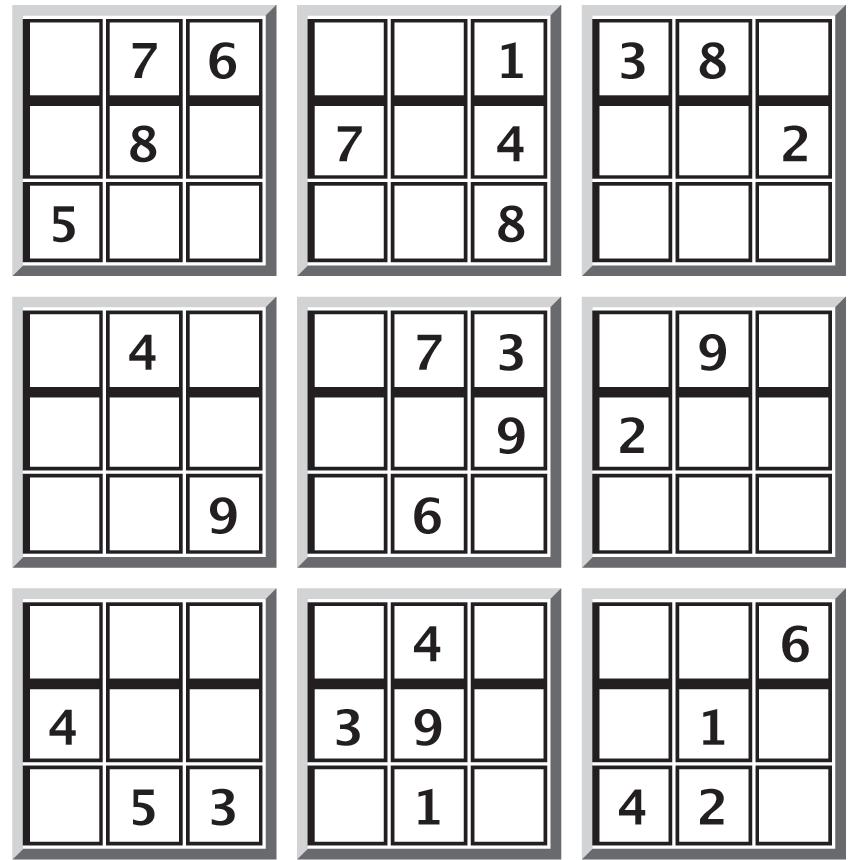
Fill in the empty cells, one number in each, so that each column, row, and region contains the numbers 1-9 exactly once. Each number in the solution therefore occurs only once in each of the three “directions,” hence the “single numbers” implied by the puzzle’s name. (Rules from wikipedia.org/wiki/ Sudoku)


By CHRISTINA BULKELEY Sun Sports Editor
“By the way, I brought back Big Ten football. It was me, and I’m very happy to do it,” President Donald Trump claimed in the first presidential debate in September.
This year’s presidential race has seen the politicization of sports take on enhanced importance as players and candidates alike try to use the platform to influence the election.
While Trump’s alleged responsibility in reviving the Power-5 conference after it at first canceled the season due to COVID-19 was almost immediately discredited, it was just one notable instance during this election cycle in which high-level sports were used to sway constituents’ allegiances.
“The people of Ohio are very proud of me,” the president said regarding his alleged involvement in the Big Ten season. Of course, Ohio, a key battleground state, is home to Big Ten contender The Ohio State University, whose fanbase is theoretically composed of voters who Trump hopes will fill in the bubble next to his name on Election Day to swing the state red.
Christina Bulkeley is the sports editor on the 138th Editorial Board and previously served as an assistant sports editor. She is a senior in the College of Arts and Sciences and can be reached at cbulkeley@cornellsun.com.
ing on nationally televised sporting events. The Biden campaign has spent $35.8 million on ads during NFL games alone this season. Trump, of course, has criticized the NFL ad nauseam for allowing players to kneel during the National Anthem.
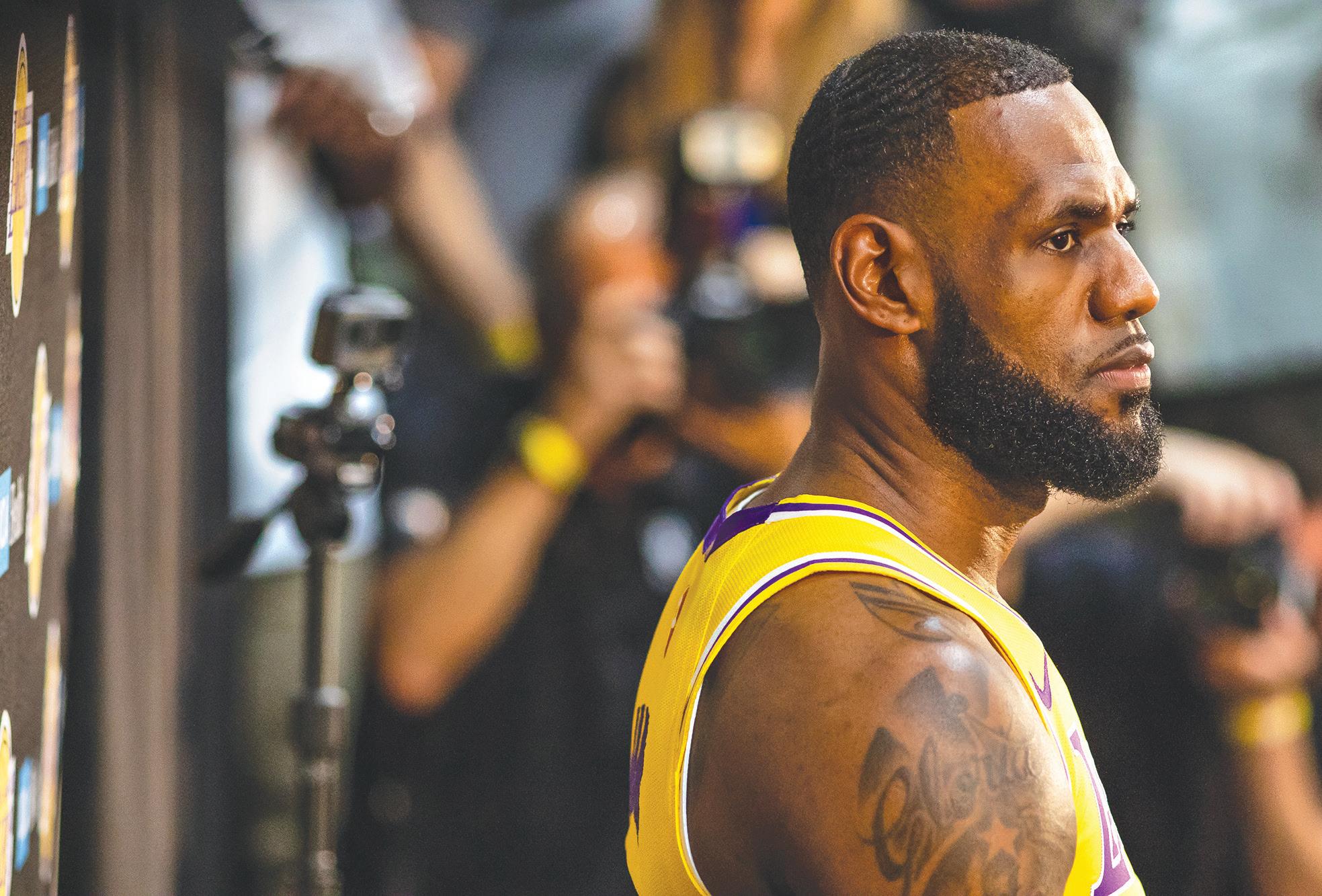
And, where Trump hasn’t been able to forge alliances, he has deepened divisions — recently by encouraging a crowd to chant “LeBron James sucks” at a rally in Pennsylvania on the eve of Election Day. Los Angeles Lakers star James, who at that point had not officially endorsed any presidential candidate, has been outspoken regarding social justice issues this year and has in the past made clear a certain disdain for the president.
“By the way, I brought back Big Ten football. It was me, and I’m very happy to do it.”
President Donald Trump
After Trump commented that James and the NBA overall “don’t respect our country” at the rally, James came out that night with an official endorsement of Biden’s campaign on his Instagram. Prior to Monday night, James’ official stance did not go beyond promoting his More Than a Vote campaign that was aimed at get-out-the-vote and anti-voter suppression efforts.
with the Biden campaign. The NHL, which has long been noted for a lack of diversity, was criticized for how little it acted to support this summer’s social justice movements.
Biden’s campaign outspent Trump’s on advertising on nationally televised sports. The Biden campaign spent $35.8 million on ads during NFL games alone this season.
Further suggesting a conservative viewpoint throughout the league in comparison to the NBA, NHL legend Bobby Orr took out a full-page ad in a New Hampshire newspaper on Oct. 30: The ad, in support of Trump, showed Orr, his wife and the president grinning and giving the camera thumbs-ups. Orr is still involved with the NHL and acts as an agent to several top players in the league.
By aligning himself with something as quintessentially American as football, Trump likely aims to appeal particularly to voters in the Rust Belt. And by claiming responsibility for the return of Buckeyes football, he might paint himself as a hero to many such voters — Ohio State currently sits at No. 3 in the AP Poll.
Meanwhile, former Vice President Joe Biden’s campaign has outspent Trump’s when it comes to advertis-
The NBA has shown a deep commitment to social justice this year, leading the way in canceling all games on the day of Jacob Blake’s shooting in Kenosha, Wisconsin. The NBA and its players have been outspoken in the fight against police brutality and had the term Black Lives Matter prominently displayed throughout games in the playoffs.
Though the NBA itself takes no political stance, supporting the Black Lives Matter movement is often viewed as a liberal viewpoint, particularly by Trump and those in his camp.
Not all leagues have found themselves as synonymous
Like Trump’s comment about the Big Ten, Orr is trying to pull at the heartstrings of his fanbase in a battleground state — with Orr being a former Boston Bruins player, many voters in New Hampshire will have fond memories of the defenseman.
Candidates and athletes alike have significantly intertwined sports and politics in the runup to the 2020 election. Sports leagues this year have been affected by both COVID-19 and social movements, leading to the difficulty of differentiating between these leagues and the politics of the presidential race. With sports used as a political tool in this year’s campaigns, citizens are tasked with separating their sports allegiances from their political affiliations.
Christina Bulkeley can be reached at cbulkeley@cornellsun.com.