


By MARYAM ZAFAR Sun City Editor
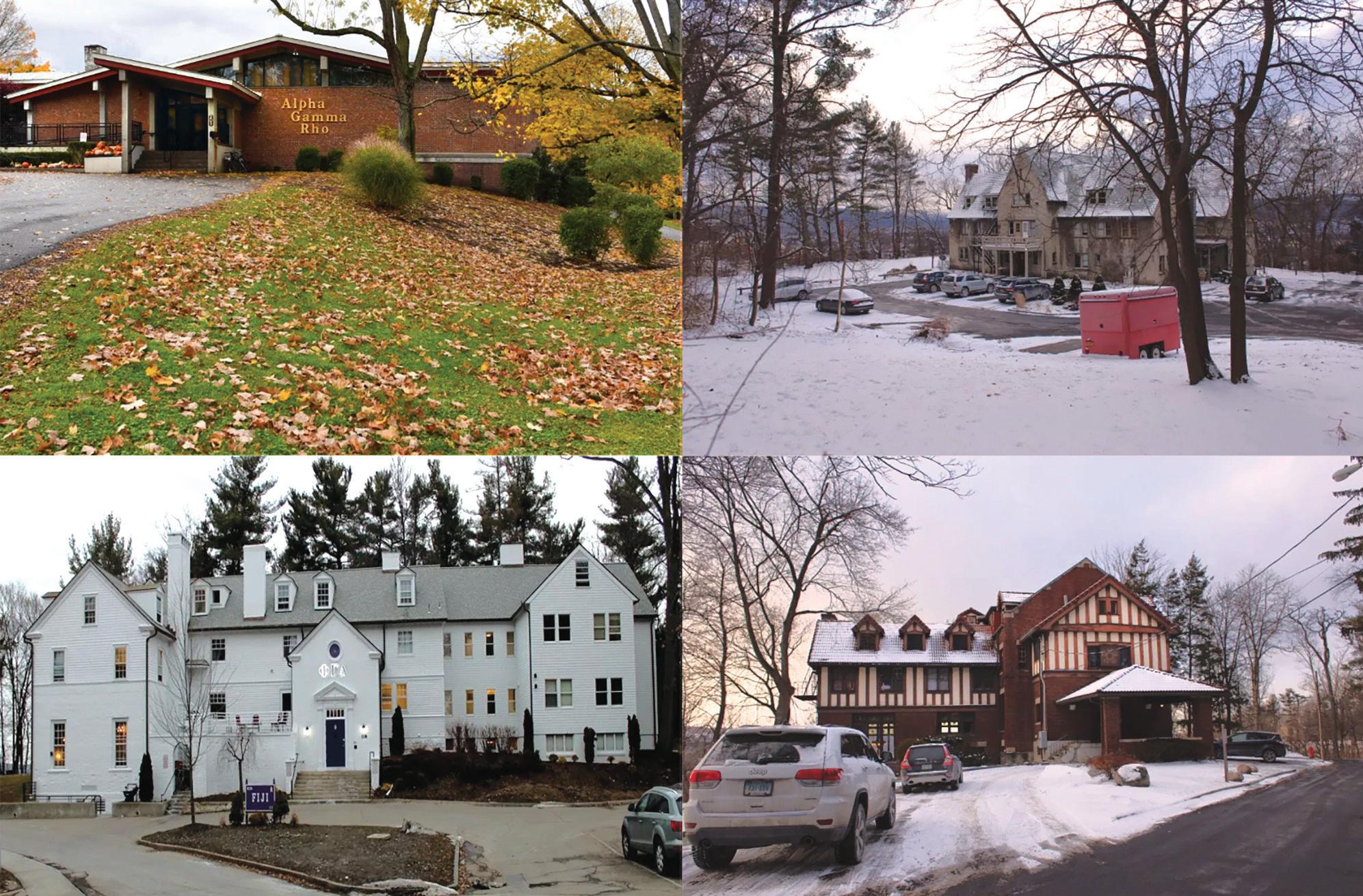
On Friday, the President of the Panhellenic Council proposed an unprecedented shift in Greek Life on campus: a freeze of all social mixers between sororities and fraternities on campus until the Interfraternity Council and Executive Board upped safety measures for party-goers.
The demands include a curb on “dirty rushing” — or the premature recruitment of members before the official rushing period — as well as the enforcement of safety-centered event management rules, including scanning Cornell IDs, requiring trained Cayuga’s Watchers sobriety monitors at all parties and safe transportation to and from mixers held at fraternity houses.
Panhel President Maya Cutforth ’20 proposed the boycott on mixers after the Interfraternity Council suspended
official fraternity events last weekend, a move announced on Wednesday night in response to the death of Antonio Tsialas ’23.
Since Tsialas’ death, Cornell University Police Chief David Honan has urged individuals with information to come forward by reaching out to the CUPD, or by using the Silent Witness Program, writing in a campus-wide “blue light” email on Friday.
“As the number of cooperative witnesses increases, so does the probability of a conclusion to this investigation which will provide answers for the grieving family and to our community as a whole,” Honan continued.
The statement, which was featured in a weekly email about general campus safety information, was the first public statement by the police department since the announcement
See GREEK page 5

By AMINA KILPATRICK Sun News Editor
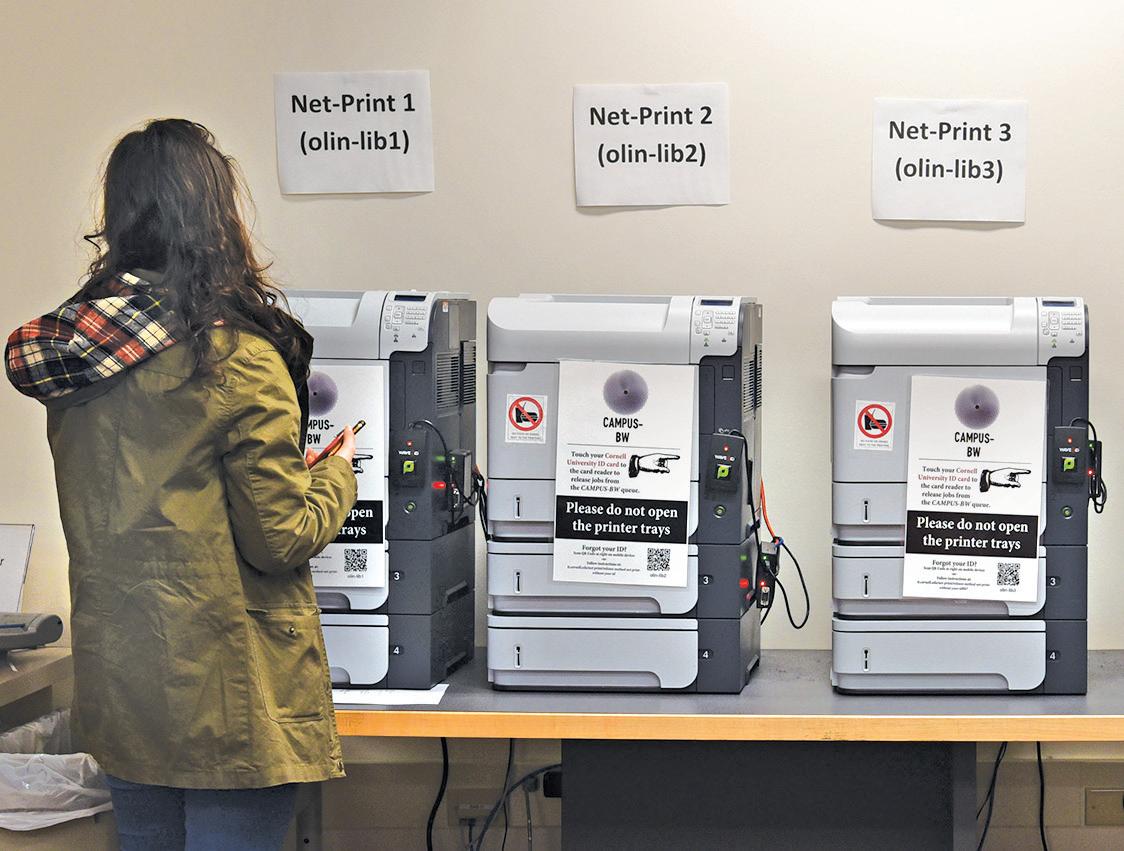
Are printing fees stacking up in your bursar account? Students should not expect free printing credits to roll out until Fall 2020, according to Stephen Burke, director of enterprise services for Cornell Information Technology.
A prototype of the system was originally supposed to be available by October, but Burke said it was not the plan to roll out the entire system in October.
expanded the Vendor on-site assessment of current print locations to include more departments / locations which caused a delay in the current design phase.”
The Student Printing Service Project, managed by CIT, is still in the blueprinting stage. Once it is completed,
“We experienced delays in securing a vendor contract related to the legal review of terms between parties.”
Stephen Burke
“We experienced delays in securing a vendor contract related to the legal review of terms between parties,” Burke said in a statement to The Sun. “We also
Burke said they should be able to give a more accurate timeline of the project, although the target date is currently Fall 2020 for completion. The project outline
By KATHRYN STAMM Sun Staff Writer
In its two decades of existence, the website RateMyProfessors.com has become notorious on college campuses. While some students turn to the review site for informal evaluations of their prospective professors, many criticize the site as unfairly biased and unrepresentative.
As students begin to choose classes for the upcoming semester, with pre-enrollment for undergraduates starting on Nov. 4,
Cornellians are doing their own ratings of RateMyProfessors — and the reviews are mixed.
Becky Borrazzo ’22 started using RateMyProfessors to help choose classes in her first year, when she didn’t have a network of peers to tap for class recommendations. It hasn’t always been successful, though, she admitted.
which she has more flexibility in choosing. For those courses, it’s especially important for her to
“There are so many options when you’re looking at extra classes. I use [RateMyProfessors] to help narrow it down... But it’s not the end all, be all.”
Becky Borrazzo ’22
Borrazzo generally uses the site to pick classes outside of her major’s requirements, for
enjoy the class, which is heavily influenced by which professor is teaching.
“There are so many options when you’re looking at extra classes,” Borrazzo said. “I use it to help narrow it down … But it’s not the end all, be all.”
There are a few key words Borrazzo looks for when parsing RateMyProfessors reviews, rather than looking just at the average score. If reviewers write that a class made them want to take more classes from the same
professor, she knows it’s a good sign.
The site allows students numerous predetermined options to describe their professors, too, including “inspirational,” “hilarious,” “accessible outside of class” and “tough grader.”
But Borrazzo admits that it’s not the best system. A lot of the classes are big lectures, without much face-time with the professor, and reviewers are ultimately strangers who Borazzo doesn’t


Colonial Infrastructure and the Politics Of Partition of Punjab 12:15 p.m., G08 Uris Hall
Connecting Dots: Working Within Urban Food Systems to Support Agricultural Producers Kim Vallejo 12:20 - 1:10 p.m., 404 Plant Science Building
Disasters, Development, and Social Capital: Understanding Economic Recovery After Earthquakes In Nepal 3 - 4:30 p.m., B73 Warren Hall
The Salpeter Lecture Series
4 - 5 p.m., Schwartz Auditorium, Rockefeller Hall
Stop, Drop, Create: Video Editing 4:30 - 5:30 p.m., 112 Mann Library
Governor Scott Walker: Courage and Conservative Governance 5:30 - 7 p.m., B25 Warren Hall
Benefair Ithaca (Free Flu Clinic)
9 a.m. - 3 p.m., G10 Biotechnology Building
Afro-Asia Working Group Noon - 2:30 p.m., G24B Stimson Hall
Cornell India Law Center and Berger International Speaker Series: Professor Priya Guptar 12:15 - 1:15 p.m., 277 Myron Taylor Hall
Introduction to Adobe Photoshop 2 - 4 p.m., Uris Library Classroom
Raymond G. Thorpe Lecture In Chemical & Biomolecular Engineering 4:30 - 5:30 p.m., 155 Olin Hall
The Apocalypse Debate 5 - 6 p.m., KG70 Klarman Hall
Writing History, Writing Biography: Capturing H.G. Adler’s Many Worlds 5 p.m., KG42 Klarman Hall
On Nov. 5, voters registered in New York State will have the chance to elect candidates to a smorgasbord of positions: mayor, city council alderpersons, town board members, a supervisor and state supreme court justices. Here is The Sun’s guide to the 2019 local elections.
Svante Myrick ’09 (Incumbent)
Two-time incumbent Svante Myrick (D) has held office since 2011, beating out three other candidates to become Ithaca’s youngest and only African-American mayor. During his time in office, Myrick, from Earlville, New York, is credited by Forbes Magazine with eliminating a multi-million city deficit, lowering taxes and increasing affordable housing. He ran again in 2015 unopposed, winning with 89% of the popular vote. While serving as mayor, Myrick has been vocally critical of Cornell University’s tax dollar contributions. Adam Levine
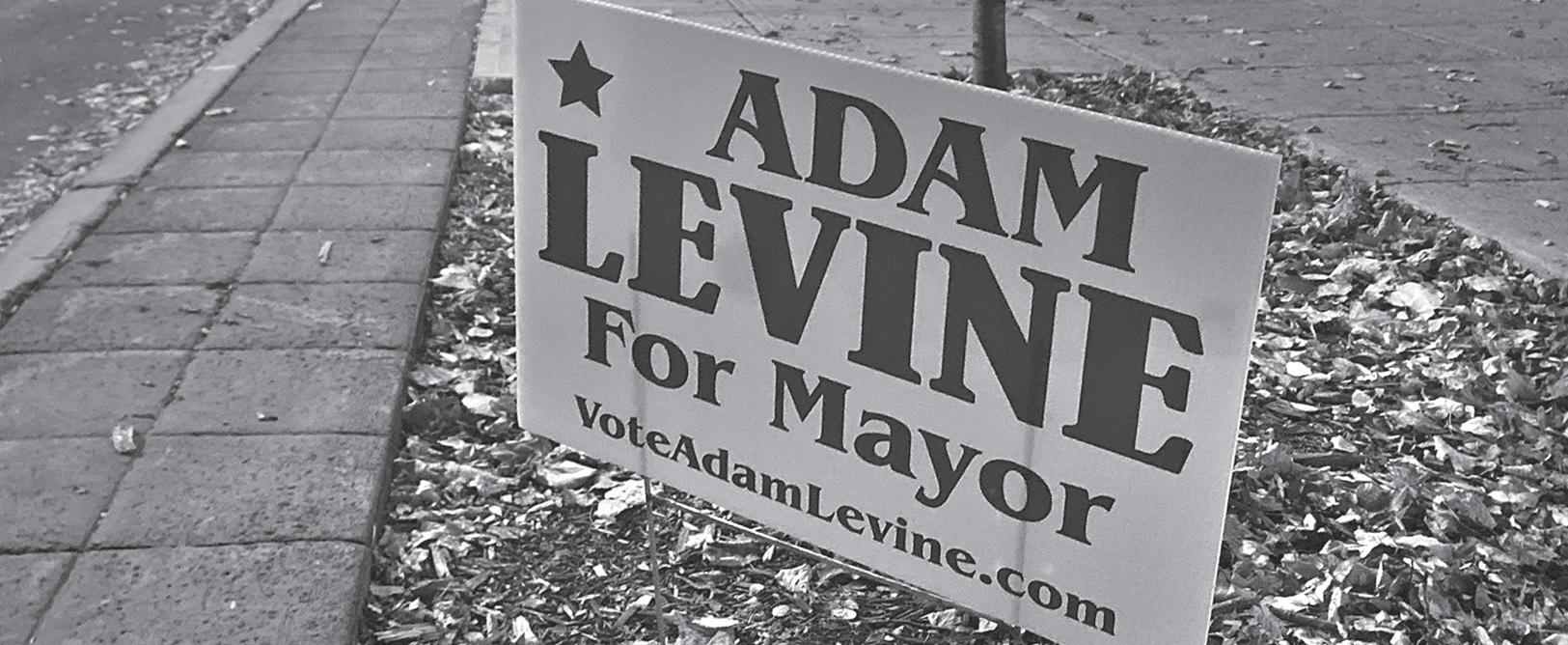
Political newcomer Adam Levine entered the Ithaca mayoral race despite not attaining the required number of signatures. A blue-collar worker, Levine, who is originally from New York City, has made income inequality a cornerstone of his campaign. In an interview with The Sun, Levine stressed the need for inclusion, whether in the form of higher wages or affordable housing. Like Myrick, Levine has expressed interest in increasing Cornell’s “financial contribution” to Ithaca, which Levine says is disproportionately low compared with that of other Ivy League universities.
(Western Ithaca, Southern Ithaca and Six Mile Creek)
George McGonigal (Incumbent)
Alderperson George McGonigal (D-1st Ward) has held his seat on Common Council since 2011, and is running for re-election. The landscaper decided to re-run to have a say in the 1st Ward’s development, he told the Tompkins Weekly. McGonigal wants to maintain a space throughout where local manufacturers, trade and business can continue to thrive. Building on work during his previous term, McGonigal also wants to prioritize making the 1st Ward family-friendly, with a focus on public safety and a possible playground.
(Dewitt Park, downtown Ithaca and Fall Creek) Ducson Nguyen (Incumbent)
Alderperson Ducson Nguyen (D-2nd Ward) moved to Ithaca just over ten years ago, where he now works as a software engineer at GrammaTech, a cybersecurity research company. Four years ago, he ran for alderperson in the 2nd ward on a position of “housing issues,” he told The Sun on Sunday.
“Four years later, I feel like we’ve made progress,” Nguyen said. “I have all these things that intersect with my interest in housing and equity issues, and I’d like to continue that work.”
For Nguyen, these issues include expanding affordable housing, updating the current housing zoning and working with TCAT to have more electric buses — all issues he wants to tackle in a second term. In the past four years, Nguyen is especially proud of his efforts to connect with his constituents, especially through social media. With his fellow Alderperson Seph Murtagh (D-2nd Ward), Nguyen started a podcast to communicate their work to the public “in a more accessible way.”
(Eastern Cornell University, upper Collegetown and Belle Sherman)
Rob Gearhart (Incumbent)
Alderperson Rob Gearhart (D-3rd Ward) is running for re-election for the City Council of Ithaca, where he has lived for the better part of 40 years. His day job is the Interim Associate Dean of Ithaca College’s Roy H. Park School of Communications, a position he has held since 2015. Goals for this successive term, should Gearhart win re-election, include continuing his work in restructuring Ithaca committees and potentially adding an elected position to aid in neighborhood-government communication.
One of Gearhart’s priorities is sustainability — he has expressed support for enacting a Green New Deal in Ithaca. Part of this effort includes rethinking transportation, which includes discouraging cars in the city, he told The Sun in October. Even little changes, Gearhart said, can make a “big impact.”
Similar to other council members and Myrick, Gearhart also believes that Cornell does not contribute enough to Ithaca. Gearhart sees Cornell as a “huge economic engine” that does not provide enough resources for the city, but said he sees room to negotiate with the University on major issues such as infrastructure.
Ellie Pfeffer ’23 (Write-In Candidate) Freshman environmental sustainability science major
Political musical chairs | Voters will decide on Tuesday who makes the rules in New York State and in the town and city of Ithaca.
Ellie Pfeffer decided to run to represent the district encompassing much of North Campus last minute. As a member of Climate Justice Cornell and the Sunrise Movement, her number one priority is to follow through on the promises of the Ithaca Green New Deal: a plan to achieve carbon neutrality by 2030 through emission reduction, building renovation, and dispersal of green technologies. Pfeffer said in an interview with The Sun that she felt that she “had no choice but to run.” She emphasized that she is also running to bring student attention to the importance of local politics. “It’s exciting for people to see someone like them; someone who’s young and visionary.”
(Collegetown and adjacent parts of Cornell University) Stephen J. Smith (Incumbent)
Alderperson Stephen Smith (D-4th Ward) is running for re-election for the City Council of Ithaca, where he has served since 2012. Smith also works for the Cornell College of Engineering as a major gifts officer. Focusing on his constituency, who are largely associated with the Cornell campus, Smith wants to increase contributions from the University and encourage development in Collegetown to further develop community culture. In terms of the students, he wants to lift their voices and invite them to City Council meetings.
“I would hope that the students feel comfortable and confident applying for positions on commissions and joining the conversation,” Smith told The Sun in October.
Smith has seen much of this involvement through the environmental issues. One of his priorities should he win re-election is sustainability. Aside from institutional changes at the governmental level, Smith also advocated for individual actions to rethinking sustainability, including “car-culture.” Smith wants to encourage transportation methods away from cars through changes in parking, which he called “artificially subsidizing owning a car.”
“You need to get to the point where we’re making it just a little harder to own a car,” Smith said. “You force people to make the choice on whether they really need that car.”
Thea Kozakis (Write-In Candidate)
When she isn’t looking for other habitable planets as a Ph.D. student at Cornell’s Carl Sagan Institute, Thea Kozakis grad is advocating to keep Earth habitable by fighting climate change.
“No one knows better than people working on what I do [finding habitable planets] that there is no planet B,” Kozakis said.
Kozakis became involved with Ithaca’s chapter of the Sunrise Movement after the Global Climate Strike. Her campaign platform centers on implementing the Ithaca Green New Deal and addressing its housing shortage. Kozakis believes that if Ithaca had more housing, Ithaca workers would commute less, producing fewer emissions.
(Cayuga Heights, Stewart Park, Fall Creek)
Laura Lewis (Incumbent)
After retiring as director of student services at the School of Industrial and Labor Relations for 30 years, Laura Lewis (D-5th Ward) won a 2017 special election to represent the fifth ward on the Ithaca Common Council. Now, Lewis is seeking re-election on a platform of creating more affordable housing, improving Ithaca’s streets and sidewalks and implementing Ithaca Green New Deal measures in the city.
In a statement to The Sun, Lewis said she saw these issues as most “affecting my constituents and city residents as a whole.”
During her time as the fifth ward’s Alderperson, Lewis has sought to address major infrastructure issues in Ithaca by increasing funding for the Department of Public Works — allowing the department to increase its personnel to better address issues with sewers, streets, water and other facilities.
Cheyenne Carter (Write-In Candidate)
Cheyenne Carter, a senior at Ithaca College majoring in environmental studies, is currently the public outreach coordinator for Ithaca’s chapter of the Sunrise Movement.
Carter has done work on plastic bag ban legislation with the waste management committee of Tompkins County as a senior at Ithaca College, a project still in progress. Carter describes her platform as centered on the Ithaca Green New deal, focusing on both carbon neutrality and social equity.
“We don’t see anything from the Common Council about the gentrification we already see in Ithaca,” she claimed.
Rod Howe
Rod Howe is running for the Town Supervisor position unopposed. In the role of Town Supervisor, Howe would be responsible for directing, planning and supervising the management of infrastructure throughout the Town of Ithaca. This includes all construction and repair work on highways and sidewalks. Howe is the executive director of the History Center of Tompkins County, and has served on the Town Board for one and a half terms, also acting as the dzeputy supervisor. He will be stepping down from both of these roles to run for Town Supervisor.
Eric Levine (Incumbent)
Levine is an incumbent town board member. He is an attorney at law and the Acting CEO of Alternatives Federal Credit Union, Ithaca’s local credit union. During his time as a board member, Levine served as 2019 Chair of the Budget Committee, as well as a member of the Records Management Advisory Board Committee. Levine has also previously expressed his support for a living wage law, the Ithaca Journal reported.
Pamela Bleiwas (Incumbent)
Pamela Bleiwas ’87 has served on the board since 2015, and is the deputy town supervisor. She is a recipient of the American Jurisprudence Award for Legal Writing. Bleiwas graduated from Cornell University in 1987 with a B.A. in government and earned her J.D. at Brooklyn College. She has served on the boards of directors for the Tompkins County SPCA, Sisterhood of Temple Beth El, Kitchen Theatre Company, Chemung County Neighborhood Legal Services, and Offender Aid and Restoration. The attorney plans to continue to draw on her experience litigating family court cases in delegating town issues, according to her campaign website.
Bill Goodman
Bill Goodman has been Ithaca Town Supervisor since 2015, and has previously served as a member of the Ithaca town board. When elected town supervisor, he promised to focus on affordable housing. In 2017, Goodman raised concerns about Cornell University and Ithaca College not paying their fair share for Ithaca emergency services. He is an active member of EcoVillage, a community focused on sustainable living.
Scott Miller
Scott Miller ’90 J.D. ’95 is currently is the senior presiding judge of the Ithaca City Court, where he has served since 2013. He is running unopposed for the position of county court judge of the Tompkins County Court. Miller will fill the newly added third seat that Gov. Andrew Cuomo signed into legislation on June 25, the Ithaca Voice reported.
This year, voters will not cast ballots on any referendum items as in previous years. The impactful statewide decision will be made on the State Supreme Court judge seats, with five candidates vying for three seats in the court. The two Democratic candidates are Pete Chametsky and Claudette Y. Newmann; the three Republican candidates are Chris Baker, Oliver N. Blaise, and Mark Masler.
— Compiled by Amanda H. Cronin, Tamara Kamis, Meghna Maharishi, Ayana Smith, Kathryn Stamm and Maryam Zafar. Comments can be sent to news-editor@cornellsun.com.
By MEGAN PONTIN Sun Contributor
Running across the Arts Quad from spinning class to sociology lecture might not always lend the best body odor, and fitting physical education classes into a jam-packed schedule can be challenging. However, Cornell students are not alone in their quest to fulfill the two-course P.E. requirement.
Some other schools in the Ivy League require the same of their students, while others offer a range of group fitness classes students can participate in at will.
“Sometimes it’s not ideal, but honestly, it’s nice to have a break,” said Revathi Athavale ’23, a student in Beginning Tae Kwon Do who appreciates Cornell’s course requirements.
Similar to Cornell, Columbia and Dartmouth require their students to earn P.E. credit.
Dartmouth also requires students to pass a swim test in order to graduate, according to their respective websites.
Cornell, the first college in the country to institute the two-lap test, has had all undergraduates jumping into pools since 1905.
At Dartmouth, roughly half of all students work towards the P.E. requirement by participating in sports on the varsity or club levels, according to Joann Brislin, Dartmouth’s Senior Associate Athletic Director for Physical Education and Recreation.
According to The Washington Post, 21% of Dartmouth’s undergraduates are also varsity athletes, as opposed to Cornell’s 8%. Cornell athletics does offer P.E. credit to students registered with Cornell Athletics.
Brislin added that skiing and snowboarding courses are the most popular among Dartmouth students, whose New Hampshire
campus is located just a short drive from several hills.
This semester, Dartmouth’s offerings include T’ai Chi Chuan and Fly Fishing.
The remaining five Ivy League universities do not have P.E. requirements, although they do have their own roster of fitness classes.
At the University of Pennsylvania, spinning classes attract the highest number of participants, with total attendance reaching over 4,500 in the spring of 2019, according to Chloe Cole, Penn Campus Recreation’s Assistant Director of Fitness and Wellness. At Brown, spin and BODYPUMP group fitness courses are also well-attended, according to Kelly Sorge, Brown Recreation’s Fitness and Wellness Coordinator.
Staff at Columbia, Harvard and Princeton all similarly noted yoga classes as among the most popular group exercise options, according to the directors of physical education at those universities. Princeton offers ten yoga classes each week at no cost to students.
Yale also provides group exercise opportunities in Hatha Yoga, Kundalini Yoga, Shotokan Karate, and two levels of Argentine Tango.
Recreation departments across the Ivy League also work to engage students through a variety of events, such as Princeton’s Planksgiving Challenge and Columbia’s Table Tennis Tournament, both on the docket for November.
Regardless of whether or not such exercise is required, students across the Ivy League take advantage of opportunities to stay active on campus.
Megan Pontin can be reached at mfp62@cornell.edu.
By MEGHANA SRIVASTAVA Sun Staff Writer
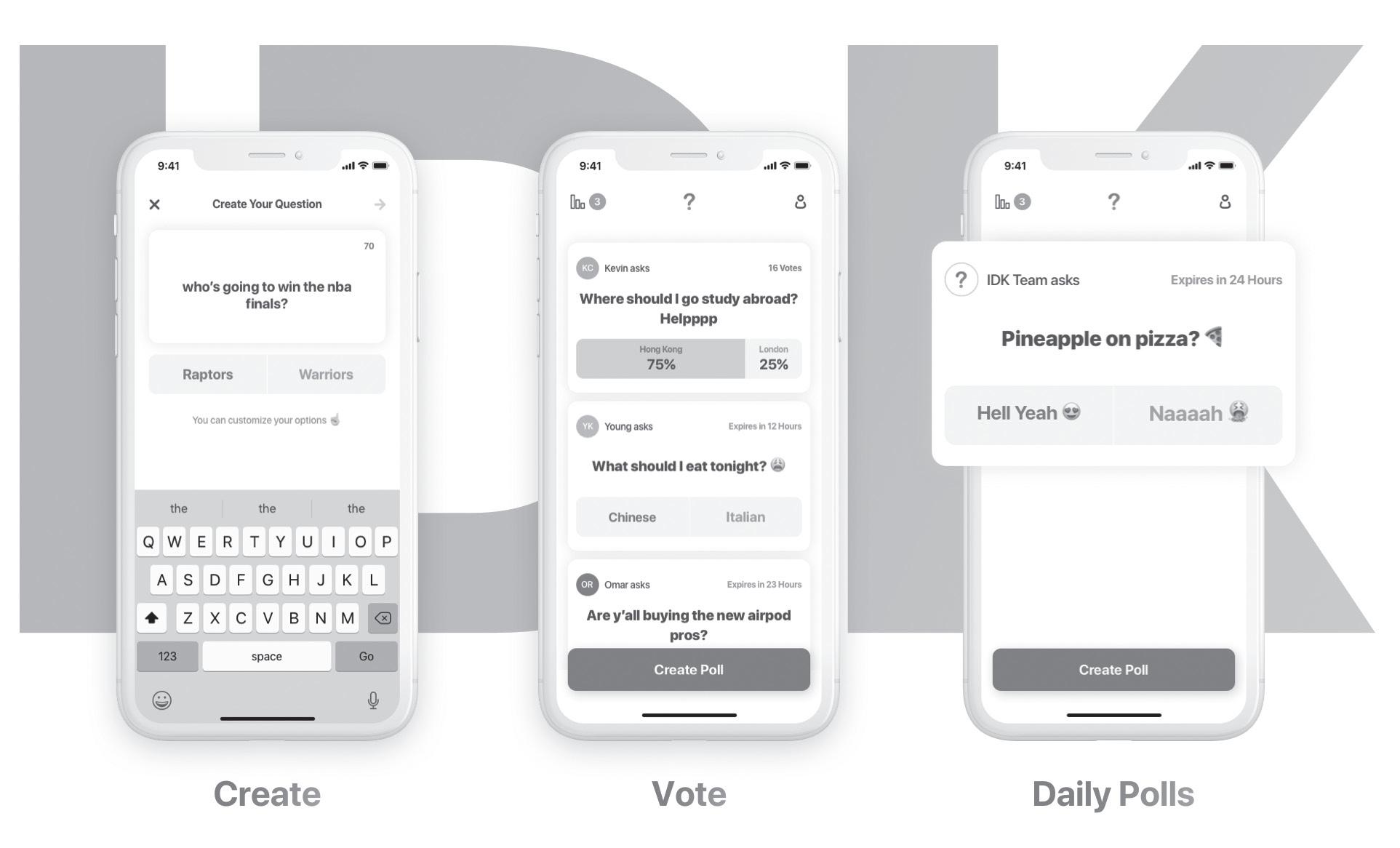
Indecisiveness is a universal plague: “Should I wear my parka or my light jacket?” “Should I go to sleep early or stay up to study more?” “Should I go out or stay in?” Realizing this problem, a team of Cornell students from developed an app to help streamline and consolidate that process: the IDK App.
Created by a team of four engineering students, the mobile application allows users to post polls that exist for 24 hours. The app connects users via phone number; any user already in the poll maker’s contacts can vote in the poll.
The app can be used to ask any question with two answer choices. Examples range from weekend activities to course selection advice to ice cream flavors.
“The purpose of the IDK
App is to get opinions from friends really quickly,” said co-creator Tae Kyung “T.K.” Kong ’20.
The team noticed that many people make important choices largely based on input from their close friends, but there was a gap in the app market that didn’t address this social phenomenon. Instagram story polls offer the choice of crowdsourced decision making, but Kong and his team saw an opportunity to bring this functionality to an app of its own.
“It can be various sets of friends: people from their hometown, people from their high school, people that you’ve met in different clubs and organizations,” said Kong.
With the app, users can streamline the process of asking multiple group chats or individuals for opinions to simply posting one poll. The app is also intended to connect
people mainly with their close friends, which is why it connects users via phone number and not social media, according to Kong.
The app’s team also consists of Kevin Chan ’20, Young Kim ’20 and Omar Rasheed ’21, who are all computer science majors. The ball started rolling on this project in May 2019, and they quickly organized a plan to have a finished product as soon as possible. While other students were on summer vacation, the app team was hard at work developing the interface. They continued to work on the project after returning to Cornell, with Chan, Kim, and Rasheed working on backend development and Kong working on interface and marketing.
The app was recently submitted to Apple’s App Store team to be approved for sale. If all goes according to plan, the IDK app should launch as soon as Wednesday this week, Kong said. The app will also include a few other Easter eggs, such as being able to change the color of one’s profile and emoji-related features.
After launching, the team is planning to seek initial feedback on the app before potentially expanding.
“We’re trying to see if college students will really use this app,” Kong said. “Does it help with decision making? Does it help them make decisions faster? Does it make it more consolidated, so that they don’t have to manage multiple group chats?”
When asked about the future of this app, Kong hopes that IDK app will be able to partner with corporate partners, or even the University, for help with market research.
“We would partner with businesses so that they can ask polls on the app,” Kong said. “So like, if Starbucks is curious about what flavor of frappuccino they should launch next, they could potentially have this community of college students that they can ask.”
GREEK
Continued from page 1
of the freshman’s death on Oct. 26. When asked about the status of the investigation, Honan referred back to the blue light statement and said the case was still under active investigation.
IFC President Cristian Gonzalez ’20 told The Sun at the time of his announcement of the moratorium that the council had chosen to suspend the weekend parties to respect the tragedy.
The council made the decision after the freshman Tsialas was found Saturday in Fall Creek Gorge, after last being seen Thursday night at a Phi Kappa Psi fraternity party. The Phi Kappa Psi president did not respond to The Sun’s requests for comment.
“We believe that it would be disrespectful and wrong to be celebrating this weekend given the passing of Antonio,” Gonzalez told The Sun at the time.
The Panhel proposal was reflecting “an element of that” message, but was also a long-awaited step towards upping safety for students, Cutforth said.
The fraternities’ temporary suspension of social events last weekend was a key first step, but one weekend wouldn’t create “meaningful” social change, Cutforth noted, saying that IFC members could do more to promote safety.
Cutforth’s proposal to suspend mixers was presented to representatives of the thirteen active on-campus sororities on Thursday, and sororities were encouraged to weigh the merits and critiques of the proposal in their own chapter meetings. On Wednesday, when sorority presidents will vote on the proposal, Cutforth is seeking a unanimous vote, saying that the freeze will not be effective unless all sororities agree to it.
If passed, sororities would agree to not attend social events hosted in fraternity houses until actionable items were taken by Panhel and IFC. Items included an internal review by both Panhel and IFC of sober monitoring training, the placement and enforcement of sober monitors at fraternity house exits and the prevention of first-years at official fraternity events in the fall semester. Cutforth said she discussed the proposal with leadership of the Panhel and IFC executive board.
While Cutforth said some have criticized the plan for simply shifting parties from chapter houses to Collegetown, Cutforth said the critiques were “reproducing rhetoric.”
The Panhel vote, which will be open to the community to attend, will be held in Willard Straight Hall’s Room 413 on Wednesday at 6:30 p.m.
Maryam Zafar can be reached at mzafar@cornellsun.com.
Continued from page 1
is available to view on their website.
One of the most anticipated changes to the printing system were its free printing allocations, which would award approximately 200 free pages to each student per year. The credits will be doled out through students’ printing accounts, and will be the automatic selection when printing, according to Burke.
In the meantime, free printing is available at select locations on campus including the Office of Diversity and Academic Initiatives in the Computing and Communications Center, the Student Development Diversity Initiatives office in 626 Thurston Avenue and in the Asian American Studies Resource Center in Rockefeller Hall.
The new system will include both hardware and software changes, with new printers in more than 100 locations according to the project website. The software will be handled through PaperCut, a printing management company. The Sun reported in April that the Student Assembly was looking to donate old printers to the Cornell Prison Education Program.
While the implementation of
‘My reality is not RateMyProfessors,’ one professor declares
Continued from page 1
know if she can trust, or who might not have the same interests.
For Prof. Peter Katzenstein, government, RateMyProfessors has numerous benefits, filling in the gaps that exist when students don’t have free access to evaluation data. He thinks that students deserve to know how past students felt about their professors and that the pressure encourages professors to improve.
“In general, I’ve always complained that student evaluations are not made public,” he said. “Absent a public, accessible evaluation system in the University, [RateMyProfessors] is the second best thing we can have.”
online ratings, but that it’s true of the official course evaluations as well.
But not all faculty are quite so optimistic about RateMyProfessors’ assets.
Prof. Simone Pinet, romance studies, said in an email to The Sun that she hesitates to read reviews on RateMyProfessors, based on “extensive research on gender and racial biases on all kinds of evaluations.”
Up until 2018, reviews included a chili pepper “hot-
the project is managed by CIT, the S.A. is in charge of overseeing the progress and timeline of the project, according to S.A. President Joe Anderson ’20. The S.A. is “satisfied” with the progress of the project according to Anderson.
“We understand that with projects of this scale delays are going to occur,” Anderson said in an email to The Sun.
The new system will reduce printing costs from $0.09 to $0.07 per black and white page. Color pages have been discounted by $0.02 as well, and will cost $0.23 per page. Additional pages under both black and white and color printing pricing schemes will be discounted as well.
The process of changing the system began in February 2018, when an ad-hoc committee of the S.A. was tasked with investigating the printing system after a report was made highlighting the system’s inefficiencies. After a year of planning and gathering feedback, the committee announced the changes to Cornell’s printing system in March.
Katzenstein, who has taught at Cornell since 1973, actively encourages his students to review him on the site, whether they give positive feedback or not. With 139 ratings, Katzenstein boasts an overall rating of 4.3 out of 5.
“I think it’s of value; I think students are quite responsible on the whole and get professors right,” Katzenstein said.
Katzenstein admits that some abnormalities appear in the
Prof. Peter Katzenstein
ness” rating. After professors criticized the site for “contributing to a poor academic climate for women,” RateMyProfessors eliminated the feature, Inside Higher Ed reported.
Beyond the gendered and racialized language in the reviews, other Cornell professors warn against RateMyProfessors as unrepresentative on the whole — having overly emotional responses, thin data and no checks on if the student actually took the class.
Lisa Nishii, vice provost for undergraduate education, similarly explained that RateMyProfessors ultimately does not represent the experiences of all students who took a given course.
“Absent a public, accessible evaluation system in the University, [RateMyProfessors] is the second best thing we can have.”
“My reality is not RateMyProfessors,” Prof. Pedro Pérez, applied economics and management, said. “During the last 20 years, I have taught close to 20,000 students. So what you’re basically saying is that these 1 of every 100 [students] are representing who I am.”
On RateMyProfessors, no Cornell professor has more than 250 total ratings.
Pérez makes a point to get as many official evaluations as possible, because he uses them as valuable feedback. However, when cross-examining those evaluation results with the ratings on RateMyProfessors, he finds the online reviews “harsh.”
Kathryn Stamm can be reached at kstamm@cornellsun.com.
“[Online evaluations] are weighted toward (and written by) disgruntled people,” Prof. Jane-Marie Law, Asian studies, said in an email to The Sun. “A person dislikes a professor (and the reasons a person may dislike a professor can range from the very legitimate to the crazy) or gets a bad grade and writes a scathing review.”

Itook a trip back to the Bay Area over Fall Break and spent a few blissful days with my three best friends from high school. It was like having gone back in a time machine: We had dinner at our favorite Puerto Rican restaurant, surprised our theatre teachers, did Carpool Karaoke to musicals and cursed at Bay Bridge traffic. If it weren’t for the addition of the Salesforce Tower in the city skyline, you could’ve told me it was 2015, and I’d have believed you.
That is, until we went to City Lights. Upon entering the bookstore, I practically hopped down the stairs into the basement. There are two small alcoves tucked in the very back, where the old wooden floorboards creak loudly and the shelves are piled high with mystery, fantasy and young adult (Y.A.) novels. It’s my favorite place in City Lights, and I used to spend hours just standing in front of the shelves browsing until my legs went numb.

This time, however, I found myself scanning the Y.A. shelves for no more than five minutes before I became bored. I circled the alcoves a few more times, feeling out of place and distracted. Then I went back upstairs to the “proper” fiction section and ended up buying two books by F. Scott Fitzgerald.
“I miss when we were young enough to read Y.A. novels,” I said to my friend when we left the store.
“I don’t think you have to be a certain age to read them,” she frowned.
She’s right, of course, but it’s the same as saying you don’t have to be a kid to read children’s books. The fact is neither
of us have actually read Y.A. novels in years, when back in high school they were pretty much all we read. What’s ironic, however, is that the name of the genre describes exactly what we are, yet somehow the age range it caters to is heavily skewed toward teenagers. Some have defined another genre “new adult” for fiction with college-aged protagonists, but I can probably count on one hand the books released this year that fits that description. The college and “new adult” experience is missing from the fiction world, a gap that most people don’t even realize exists, and subconsciously fill by reading “real” fiction instead.
From a writer’s perspective, the teenage experience may appear more alluring of a subject compared to the new adult one. When the ups and downs inherent within being a teenager comes in contact with family issues, identity struggles, bullying, illness, tragedy or romance, dramatic conflict ensues inevitably. The high school setting itself is conveniently romantic and distinguishable. Yellow school bus, lunch table, homecoming, prom and graduation — these are all not only ideal settings that enable plot development, but culturally significant symbols etched into the American psyche. Most importantly, no matter what went down in the storyline, at the end of the novel, hope and change is in the air, and the possibilities seem infinite.
The college and post-college new adult life, if put on paper as it is, gives tangible form to those possibilities. And suddenly, they don’t seem so infinite anymore.

They would take the shape of academic pressure, job search, financial stress, party and hookup culture. Professor Nabokov may have done his research for Lolita by listening to conversations on the bus in Ithaca, but I doubt he would find our conversations on the TCAT these days very inspiring when all we talk about is prelims, job interviews and frat parties. This stage in our lives is an awkward one. We’re no longer young enough to be as freely expressive of our feelings as teenagers, yet not old enough to be completely comfortable in our own skin as adults. We continue on the same old quest of trying to figure out who we are, yet this time with the burden of the real world weighing on our shoulders. But for that very same reason, it’s also, literarily speaking, a potentially very interesting stage that’s somehow gone unrecognized by writers. It has a unique set of language that expires as quickly as a Snapchat, and a set of challenges that’s an awful yet won-
derful conglomerate of being young and being a grown-up.
Not long after Fall Break, Sonoma and the East Bay caught on fire, and so did our lives. One friend went back home to face a family crisis, another lost loved ones and I was overwhelmed by my own mental state. Just like I couldn’t ignore how the Salesforce Tower has fundamentally altered the San Francisco skyline, I couldn’t ignore the fact that we’ve grown up.
So maybe I don’t want to read about the protagonist bemoaning failing a midterm, but I want to read about them pursuing their dream or being forced to give it up, about wanting and being afraid of love, about loss, mistakes and redemption. I want stories about who we used to be, and who we’ll become.
Andrea Yang is a senior in the College of Arts & Sciences. She can be reached at ayang@cornellsun. com. Five Minutes ‘Til Places runs alternate Mondays this semester.
The pervasive mantra of every sequel to 1984’s The Terminator has been “if it ain’t broke don’t fix it” in regards to plot. The storylines of Terminator 2: Judgment Day, Terminator 3: Rise of the Machines and Terminator: Genisys all deal in part with a robotic entity being sent to the past to kill some important human figure while an equally adept soldier (or machine) was also sent back to save said individual. The latest installment, Terminator: Dark Fate (which ignores all other sequels and continues the story of T2), proves that not fixing the seemingly “perfect” things are often what makes them break. Dark Fate is committed to the old and vintage, as it puts franchise founder James Cameron in the Producer chair and sees Linda Hamilton and Arnold Schwarzenegger reprise their roles Sarah Connor and the T-800. But rather than set those characters against the backdrop of a new
story, it chooses the way of recapitulation. The film fills the narrative gaps it inherits from prior installments with impressive CGI action sequences and a crew of new characters that, while exciting, are too few and far between to make Dark Fate feel like a truly organic (instead of mechanical) continuation of the story.
Given how much technology has integrated into daily life in the modern day, the dangers of artificial intelligence gone awry should feel more relevant than prophetic in 2019. Dark Fate expertly capitalizes throughout its first act. The film’s new “messiah” is Dani Ramos (Natalia Reyes) who works in a factory in Mexico City with her brother where she later learns she’ll play a pivotal role in fighting back against the machines that take over the world. She finds to her dismay that her brother has been let go from his work because a machine is able to do his job more efficiently and cheaply. To her complaints, her boss utters that this is “the future.” The fact that our fantastical fears of killer robots
can blind us to the real dangers and effects machines are having in people’s lives (like taking away their jobs) is poignant commentary that the film sadly spends little time on. It does not take long for the usual plot beats to kick-in and thus rob Dark Fate of more meaningful things to say: As if on cue, an advanced Rev-9 Terminator (played by a beguiling Gabriel Luna) arrives to kill Dani but Grace (played by Mackenzie Davis) an enhanced soldier from the future comes to save her. When the pair are saved by Sarah Connor, we learn that while Skynet was defeated, a new artificial intelligence arose and took its place, going by the name of Legion — the same AI that wants Dani dead. One could read this as clever commentary and cruel irony that human beings’ propensity for self-destruction always triumphs over more noble intentions, but after having spent the past two films destroying Skynet, a recapitulation of the same villain is lazy and uninspired. This is just one of the many instances where
Dark Fate inundates viewers with banal homage disguised as a clever throwback (“I’ll be back” is uttered for the umpteenth time here, its once quippy potency mitigated by sheer repetition).
But perhaps it is unfair to blame the movie for what it does not have. When it comes to the franchises’ staple action scenes, Dark Fate delivers. Director Tim Miller’s eye for using cramped spaces as gladiatorial arenas (as he displayed in the memorable bullet counting sequence in Deadpool) is put to full effect here as the grim and stripped down scale of the carnage provides a nice contrast to the ultra-powered beings who are dealing the bullets, punches and stabbings. There is a sort of visceral quality to the fight scenes as in the hands of these machines and/or human-machine hybrids, anything from a rebar to a helicopter blade is a weapon.
Grace states in Dark Fate that “the future’s not set. There’s no fate but what we make for ourselves.” A variation of this line has appeared in every Terminator franchise so far and Dark Fate is the latest example of failing to practice what it preaches. While what it does with the franchises’ formula is exciting, it is just another in a long line of sequel/reboot types that masquerades repetition as ingenuity. It is too straitjacketed by its own mythology to offer anything else other than minor tweaks to its lore which while exciting, ultimately still ring hollow as its famed antagonists.
Zachary Lee is a senior in the College of Arts and Sciences. He can be reached at zlee@cornell.edu.
Additionally, the ways in which Dani, Grace and Sarah fulfill and subvert the character archetypes of the franchise help elevate this film from being a sole retread. Schwarzenegger’s return is welcome but it really is the trio of women who carry the film and reveal that it always was the human characters that made this franchise tick. Hamilton’s Sarah Connor in particular has fully embraced her vocation hardened, no-nonsense warrior that she only reluctantly accepted in prior installments.
nightclub experience after experiencing frustration with the toxicity of some of Ithaca’s nightlife.
I had no idea what to expect as the Uber bounced across a narrow bridge into an empty lot and halted to a stop in front of what seemed like an abandoned warehouse. The Uber had ventured west of Wegmans, beyond the limit of my freshman map of Ithaca. When I stepped out of the car, however, I grew eager. Perched atop an inlet of Cayuga Lake with pink light oozing out of its few windows and music throbbing, POP’d at The Cherry Artspace already had me and my friends under its spell.
The Halloween-themed POP’d event on October 19th was an all-inclusive, consent-oriented pop-up nightclub experience where I finally learned how to dance. The attendance of the event was diverse in age, race, costume design and talent — but not in attitude. Whether attendees were sporting harnesses and duct tape or work clothes, everyone was enjoying themselves. Local dancers, drag and burlesque performers heightened the energy of the space. My personal favorite was a performer’s Us themed performance, where she and her scissors terrified and delighted the crowd. On one wall read a sign “dance your tits off” and the other wall played a video montage of spooky clips.
To learn more about the event, I met with three of its creators: Samuel Buggeln, artistic director of The Cherry Artspace, Mickie Quinn, emcee of POP’d, and Jonny Tunnel of the DJ group Spirit Posse. I was dying to ask them how this perfect party was born.
Tunnell and Quinn had met while attending “Barstander” training, a program run by the Tompkins Advocacy Center that provides bartenders with the tools to recognize predatory behavior and to safely intervene. Quinn and Tunnell said that their personalities “clicked” when they met, and they immediately began brainstorming ways to combine their complementary talents. They came up with the idea for a consent-oriented
A “culture of consent and inclusion isn’t being promoted” in Ithaca’s nightlife spaces, Quinn told me. Tunnell explained his personal discomfort.
“Every time [Spirit Possey] did a party in town, there was always something that would happen… it’s heavy when you’re an event promoter and something happens at your event, and there’s not much you can do about it.” The two artists decided they wanted to have more control over a party space, yet still include the freedom and sexiness typical of nightlife. They chose The Cherry, champion of multidisciplinary arts, to host the event; familiar with Quinn and Tunnell’s work, Buggeln was thrilled to enable such a safe and colorful space. Buggeln smiled as he explained to me that he and The Cherry support “radical self expression” and “exploring our most extreme selves.”
Having a safe space to do just that is POP’d’s biggest success. Quinn described that making clear in the physical space that POP’d supports consensual fun creates a new kind of positive atmosphere. Signs posted on each wall gently reminded attendees to be respectful to one another. On paper, it would seem that these physical reminders could’ve imposed on the space, but they truly did make the environment feel safer. POP’d sold alcohol, but its creators told me that they didn’t want alcohol to be the event’s main attraction. The de-emphasis on alcohol contributed to the space’s safe vibe, as everyone was in control.
POP’d is open to all over 18, but the event attracted a visible celebration of marginalized communities. Buggeln expressed that while POP’d is not for any specific group of people, “homes for the arts have always been homes for the queer community.” Quinn said proudly that the POP’d supports “intersections of many communities.”
“We are our own art,” Buggeln said. POP’d is the perfect space for anyone to bask in this.
Emma Plowe is a freshman in the College of Arts and Sciences. She can be reached at eplowe@cornellsun.com.
COURTESY OF THE CHERRY

GRIFFIN BADER SUN CONTRIBUTOR
At a moment in which it can be easy to see the bread and butter of the R&B genre as a casualty of today’s genreless blur of streaming-driven pop music, Gallant feels like a traditionalist up to the task of maintaining that center. As its most distinct edges continue to be swallowed, the most obvious angles to approach R&B now come in the form of co-opting hip hop or leaning into the branding of bedroom pop. Gallant makes no such concessions.
Sweet Insomnia is the 27 year old Maryland native’s second major push toward the center of the R&B world, and represents his strongest success in that realm thus far. While the crooner’s 2016 debut, Ology, felt like a formidable starting point driven by a handful of impeccably crafted singles, Sweet Insomnia is a more tightly and singularly constructed statement.
On his sophomore effort, Gallant serves as our own personal curator, displaying snapshots of his favorite moments of R&B over the last number of decades. Somehow, throughout this effort, he manages to skip from place to place with enough grace to pay homage all over the map, but never sound derivative, nor fickle. Instead, by painting us a broad picture, Gallant finds himself squarely in that R&B realm. On “Sharpest Edges,” an early highlight, Gallant floats through vocal acrobatics over a syrupy but dynamic R&B bounce. On “Sleep On It,” he channels his best 2000s Usher impression. Elsewhere, on “Paper Tulips,” he conjures a sultrier after-hours vibe. In each instance, his sound never feels overly derivative, and always leaves room to inject his own angle.
For all of its musical strengths, Sweet Insomnia’s most glaring weakness is, at times, its songwriting. Even over the course of a succinct 35 minutes, Gallant’s lack of creativity with the pen can make his effusion of R&B tropes like love and nostalgia blend together. Gallant provides nothing new on “Hips,” as evident in his distinctly pedestrian lyrics of “your hips on mine.” On “Hurt,” he attempts to invigorate a gratingly repetitive chorus (“Hurt, hurt, hurt, hurt, hurt hurt”) with a misfire of an EDM-inspired instrumental breakdown. It is in these moments where Gallant’s sound can feel either pandering or indistinct.
But over the course of a mostly tight 13 tracks, Gallant’s astounding vocal range and musical dexterity make for a largely lively affair. This is especially true of the two songs which feature guest vocalists, “Sweet Insomnia” with 6lack and “Compromise” with Sabrina Claudio. On the former, Gallant finds a worthy hip hop-indebted foil to his traditionalist view. On the latter, meanwhile, Afrobeat stylings add an important late-album dynamism. In both cases, these carefully curated guests inject an expertly calibrated change of pace.
Two albums in, Gallant emerges as an impressive artist with the pedigree to maintain a promising career in the center of today’s R&B scene. Undoubtedly, though, there remains room or growth atop this formidable foundation. For Gallant to truly take the next leap, he must be willing to graduate from putting his own touch on a smorgasbord of nostalgic subgenres, and begin to carve out his own.
Grifn Bader is a senior in the College of Arts and Sciences. He can be reached at gcb66@cornell.edu
137th Editorial Board
JOYBEER DATTA GUPTA ’21
Business Manager
PARIS GHAZI ’21
Associate Editor
MEREDITH LIU ’20
Assistant Managing Editor
RAPHY GENDLER ’21
Sports Editor
BORIS TSANG ’21
Photography Editor
AMBER KRISCH ’21
Blogs Editor
SOPHIE REYNOLDS ’20
Science Editor
AMANDA H. CRONIN ’21
News Editor
JOHNATHAN STIMPSON ’21
News Editor
PETER BUONANNO ’21
Arts & Entertainment Editor
ANYI CHENG ’21
Assistant News Editor
HUNTER SEITZ ’20
Assistant News Editor
Working on Today’s Sun
SARAH SKINNER ’21
KRYSTAL YANG ’21
FUNG ’20
Editor SABRINA XIE ’21
Editor NOAH HARRELSON ’21
SHRIYA PERATI ’21
KATIE ZHANG ’21
Editor
AMINA KILPATRICK ’21
Editor
MARYAM ZAFAR ’21
Editor
ETHAN WU ’21
SHIVANI SANGHANI ’20
NICOLE ZHU ’21
“Follow your passions.” “Do what you’re interested in.” This is advice we receive too often as college students. It’s also generally ignored. I’ve met many students, including myself, who take the path of least resistance when it came to classes and course loads. We say that a good GPA is all that matters or that we want to have fun and not be stuck in the library all weekend. We even eschew our areas of interest in favor of easier, less interesting subjects. This is a myopic and selfish path to take.
Now, halfway through my third semester at Cornell, I am taking advantage of the school to the fullest. I’m in a major that I’m passionate about and will be taking courses I find intellectually stimulating, such as environmental governance and an introductory biology class. I’m on track to earn my first B (I’ll probably earn several, actually), but I don’t care. I know that challenging myself and engaging in material that is both exciting and relevant to my career goals was the right choice. If you’re taking oceanography or your credit load is under 15, I’m not calling

’21 Design Desker Lei Anne Rabeje ’22 Photography Desker Jing Jiang ’21
Sports Desker Raphy Gendler ’21
Arts Desker Daniel Moran ’21
Iurge members of the Panhellenic community to consider the power we yield in regard to changing unsafe party culture on this campus. I ask that Panhellenic’s 13 chapters unanimously vote to stop attending mixers at fraternity houses until the following demands are met by the Interfraternity Council President’s Council and Executive Board:
1. An action plan demonstrating tangible ways they will cease dirty rushing, including forms of punishment for chapters that engage in dirty rush events.
2. A commitment to make their events safer in the following ways:
a. Scanning IDs of every individual in attendance and fully marking over or under 21 years of age.
b. Having Cayuga’s Watchers, who are students trained in both bystander intervention and sober monitoring, at every event hosted by a fraternity.
c. At least one sober monitor at every exit of the chapter house to check that individuals leaving the house are able to arrive home safely, and have sober people offer rides for those who need transportation home.
d. A poster with the definition of affirmative consent at the front of every chapter house that will be read aloud by party attendees upon entering.
I acknowledge that Panhellenic members participate in and are accountable for some of the unsafe behaviors that occur at fraternity houses. During this time of not having mixers, I ask that Panhellenic chapters do the following:
1. Conduct a council-wide sober monitor training.
2. Create systems to ensure that no first-year students are present at Panhellenic social events in the fall.
3. Enforce and strengthen punishments for Panhellenic members who attend fraternity dirty rush events.
If Panhellenic chapters feel confident that we have strengthened our own risk management policies and IFC chapters have demonstrated that they have mechanisms in place to ensure their events are safer, Panhellenic will begin mixing with fraternities on a probationary period. If any fraternity is found to be in violation of the commitments listed above or any other event management policies, Panhellenic chapters will discontinue attending mixers until the rules are adequately followed.
I acknowledge that this is not a perfect solution to the issues of how dangerous Cornell parties are. Many events take place off campus or in other environments. I believe the University can help support safe partying in those spaces, and I hope that they consider creating policies that can facilitate this. Nonetheless, I believe it is our obligation as Panhellenic members and Cornell students to do anything in our power to improve safety at parties.
If you are a member of Panhellenic, please consider your role in this. Unsafe partying may seem inconsequential, but it has real consequences on the Cornell community. If you are not involved in Greek life but care, please voice your beliefs to your peers in Greek Life.
The Panhellenic Council will be voting on freezing mixers for the foreseeable future on Wednesday, Nov.6 at 6:30 p.m. in Willard Straight Hall 413. Each Panhellenic chapter has one vote. Members of the Cornell community are welcome to attend.
Maya Cutforth is a senior in the College of Arts and Sciences. She is the president of the Cornell Panhellenic Council. Comments may be sent to opinion@cornellsun.com.
Coming to Cornell, I thought I was going to major in biology. I enjoyed it in high school and was good at it. I didn’t have a clear picture of what I wanted to do after col lege beyond a vague desire to help the environment and maybe go to law school, but I thought that biology could help me. Rumors of the difficulty of the biology major, along with the realization that it was mostly full of pre-med and pre-vet students, quickly dissuaded from that course and instead put me on the biology & society track. But I soon realized that I had to take a lot of science courses to fulfill that requirement. I had never taken chemistry or physics before, and although I had excelled in math classes, I never considered myself a “math kid.”
So, thinking ahead to the possibility of law school and its need for a good
We even eschew our areas of interest in favor of easier, less interesting subjects. This is a myopic and selfish path to take.
you out for being any less a busy student. Many are genuinely interested in classes that are considered easy; if you are heavily engaged in research or other extracurricular work, it’s probably not a good idea to load yourself with a demanding courses. With respect to course difficulty, there is, of course, a balance. It’s silly for an English major to take a quantum mechanics class on a whim, but it’s also irresponsible to yourself and your parents to hunt for the easiest classes until you graduate. And of course, this is college: It’s okay to have fun — just not too much fun.
Now, halfway through my third semester at Cornell, I am taking advantage of the school to the fullest.
GPA, I picked a seemingly easier major. I opted for science & technology studies, a subject for which I felt no particular passion. My freshman year, I took classes in that major and other easy, filler classes. I finished with close to a 4.0 with little effort but found myself unsatisfied and burdened with what was close to a sense of guilt.
Going into sophomore year, I lost my full scholarship. My guilt intensified, and I knew I couldn’t keep taking easy classes for the sake of earning a high GPA. I dropped all of the classes I pre-enrolled in the previous spring, and added classes that would enable me to major in environment & sustainability. E&S isn’t nearly as technical as biology, but it’s certainly more involved than STS.
Some of the people I respect the most at Cornell are those who fit into a sort of conditional “work hard, play hard” mold. Last year, my friend Andrew confided to me that he had realized that he should be taking full advantage of Cornell while he’s here and soaking up all of the knowledge he can. Now, he takes over 20 challenging credits in the Engineering School, while maintaining a 4.2 GPA and managing to spend lots of time with his friends. If he has to spend a Friday night studying, he’ll do it.
At the end of the day, we are here to learn and wring this school of all the opportunity it offers. Most of our parents and relatives sacrificed a lot for us to be here. Breezing through college, or even making an attempt to do so, would be irresponsible. Do what you’re passionate about. You won’t regret it.
Christian Baran is a sophomore in the College of Arts and Sciences. He can be reached
All of us romance lovers have been there: a seemingly unimportant moment — maybe they’ve got food on their chin, maybe they roll their eyes at us — when we look over at our significant other and unpromptedly think, “God, I fucking love you.” Yesterday we were on top of the world, wiping mustard from their face. Today we’re cradling ourselves in bed while listening to James Blunt’s “Goodbye My Lover.” It’s at points like these when we envy our casual friends who prefer one night stands and labelless partnerships.
Cornell has a “work hard, play hard” environment. With that comes the nonchalant attitude towards hook-ups that we see in so many Cornellians.
Many romance lovers find ourselves falling head over heels time and time again. Once for the person in the grade above us in high school, once for the friend we’d always insisted was just a friend and once for the pair of unfamiliar eyes across the beer pong table. We love the idea of romance and gleefully look past early red flags (she still talks about her ex, he only talks about himself) to tell our friends we’ve found someone. Relationship people experience higher highs and lower lows than the rest of you cold-blooded souls. It doesn’t have to be an important date or big gesture that brings out the romantics in us. Sometimes something as simple as meeting their parents, getting lost taking back roads home or snuggling up to your favorite movie — the one they haven’t seen yet — can serve as a rush of dopamine to our heads to create our adolescent sense of euphoria. Contrastingly, breakups lead to spikes in Kleenex sales. We experience the five stages of
grief, but ultimately settle into the temporary sadness that comes with losing that special someone.
The first love cuts the deepest. I forgot who said that, but someone important, probably my dad. I’ve only ever really been in love once, but as a self-proclaimed sap, I tell my friends I’m in love every other week. They don’t notice anymore. In highschool, I was the asshole who didn’t say the “L” word back. We were going to college in a few months and I was scared. I saw my brother break up with his high school sweetheart and my friends do it with theirs. That’s what you’re supposed to do — find someone new in college. But then you get to Cornell.
into me on her walk to class I’d thank her and take the blame. For the majority of my college experience, however, I didn’t let myself look for anyone else.
Relationship people experience higher highs and lower lows than the rest of you cold-blooded souls.

Cornell has a “work hard, play hard” environment. With that comes the nonchalant attitude towards hookups that we see in so many Cornellians. A series of dance floor makeouts at frat parties is as meaningful to many of us as a budding relationship is to others. I’ve fallen into this culture as well, as have many of my friends who also prefer relationships. It’s hard not to when you’re surrounded by it, but strangely enough some lucky souls can find love in the dampest of basements.
I love love, even when I’m not contributing to it.
Two friends of mine met at one of my fraternity’s mixers and have now been dating for close to three years. As juniors, they’ve spent more of their college experience with each other than they have alone. He’s in ROTC, she’s a tour guide and I’ve been vying for the best man role since their six month-mark. I love love, even when I’m not contributing to it.
I’ve never had a relationship with someone at Cornell. Lots of people haven’t, but most of those don’t want one, or don’t let themselves believe they want one. Fear of commitment seems to be airborne on campus. I’m not saying I’m looking for one, but if the girl of my dreams bumped
After we broke up for college, my high school sweetheart and I still talked (I know, I know). We hooked up when we went home for winter break and spent the holidays together after I finally mustered up the courage to say “I love you too.” I tried almost every kind of relationship with her. Friends at first, and second semester freshman year we attempted an open relationship (oh hey, those don’t work!). Sophomore year, we never spoke — until second semester when we tried dating again. A fully-fledged, committed, long-distance relationship. And it worked, for a while. We dated throughout the semester, buying plane tickets to visit each other. I took her to Taughannock. She took me to Nashville’s Honky Tonks (we had a heated debate over Ithaca vs. Nashville, I won, of course). But sometimes things just don’t work out. I loved being in love, and I laid in a fetal position while my friends stroked my hair to the voice of John Mayer. Highest of highs, lowest of lows, but we always end up back on our feet with a little time. To quote perhaps the biggest romantic of all (I know who said this one), “the course of true love never did run smooth.” That’s Shakespeare, for the engineers among you. Romantics like to stick together. In the beginning of my sophomore year, almost all my friends were single, and we’d spend our nights drinking wine and complaining of broken hearts or hoping to find someone new. At first, this helps you with your own love troubles, but then all of your friends get girlfriends and you’re left to drink alone while listening to your sad song playlist on repeat.
A.J. Stella is a junior in the College of Arts and Sciences. He can be reached at astella@cornellsun.com. Stellin’ It Like It Is runs every other Monday this semester.
Outside our summer Cornell residence hall, a group of high schoolers chase each other with water balloons. They laugh uproariously when their attacker misses and viciously
mumbles to herself, “Wow, they’re so loud.”
Because being “colorblind” cannot be possible when she is white and I, instead, am a person of color.
when they instead soak their targets. A girl in the program and I look at each other — we were merely acquaintances at this point — and arrive at the same conclusion: these kids are having a blast.
“We should go join them,” I exclaim to my friend. She remains expressionless and says “I don’t fit in with them. But you can go.”
Not entirely willing to hear her response, I ask her what she means. Without even a flinch, she replies, “Well, they’re all black.” Feeling like she has to justify her answer, she adds, “It’s like a club or something”.
It is odd, because I was — and still am — unsure whether or not to be upset by this.
“If you don’t fit in with them, then I must not fit into Cornell,” I say. And maybe she doesn’t. And maybe I don’t. She remains silent and neglects to meet my eyes. As I turn to walk away, she
She may not believe that I’m an outsider on Cornell’s campus. After all, I was the one who said I don’t belong. But the silence that followed my claim was not exactly comforting. Maybe she would be uncomfortable being the only white person in a sea of black. With this, I am forced to agree. Such a situation of solitude would be uncomfortable. Because being “colorblind” cannot be possible when she is white and I, instead, am a person of color.
Though her tone left much clarity to be desired, her words were not malicious.
Once we step onto this campus, we become connected in some way, even if we are not conscious of the links that tie us.
She did not see a representation of herself among the group, so she felt she didn’t belong. That’s valid. But as we looked out the window, she missed it: the irony. The irony in the fact that she articulated something so key to my existence at the predominantly white institution that we
both attend.
Once we step onto this campus, we become connected in some way, even if we are not conscious of the links that tie us. We are connected by our majors, classes we take with others outside our major, groups we join, mutual friends we have and mutual friends of mutual friends. Our connections to each other make college campuses a microcosm of the rest of the nation.
Historically — though rather ironic — America is dubbed “the melting pot.” But sometimes I wonder if it is more accurately described as putting water and oil in a basin. Sure, there are so many people from an array of cultural backgrounds, but how much do they really mix? And because of their disparate cultures, how possible can integration be?
own background. And though I don’t actively look for this type of absolute relatability, this encounter reminded me that statistically, and systemically, I do not have much power to choose.
If I looked down at a group of white
As a black woman at a PWI, it is almost impossible to have friends and acquaintances that solely look and present themselves in ways that are similar to my own background.
When I look around campus, I ponder the distinction between tolerance and acceptance. This campus houses a broad range of cultural backgrounds and identities. Occasionally, I wonder if I have lost my place when I dare to think that, en masse, — like oil and water — our disparate backgrounds are anything but immiscible.
As a black woman at a PWI, it is almost impossible to have friends and acquaintances that solely look and present themselves in ways that are similar to my
teens having a water balloon fight, I would still want to join in the festivities. For all of my life, I have always been the minor speck amidst an extensive majority. I have almost become numb to seeing a group of people, and hesitating to include myself because they do not look like me. Because the reality is, if I did this, my life would be incredibly reclusive. But her reason for not joining the teens below, was not because they were younger than us, but instead because they looked nothing like her. They were black, and she was white.
Sidney Malia Waite is a sophomore in the School of Industrial and Labor Relations. She can be reached at swaite@cornellsun.com. Waite, What? runs every other Monday this semester.
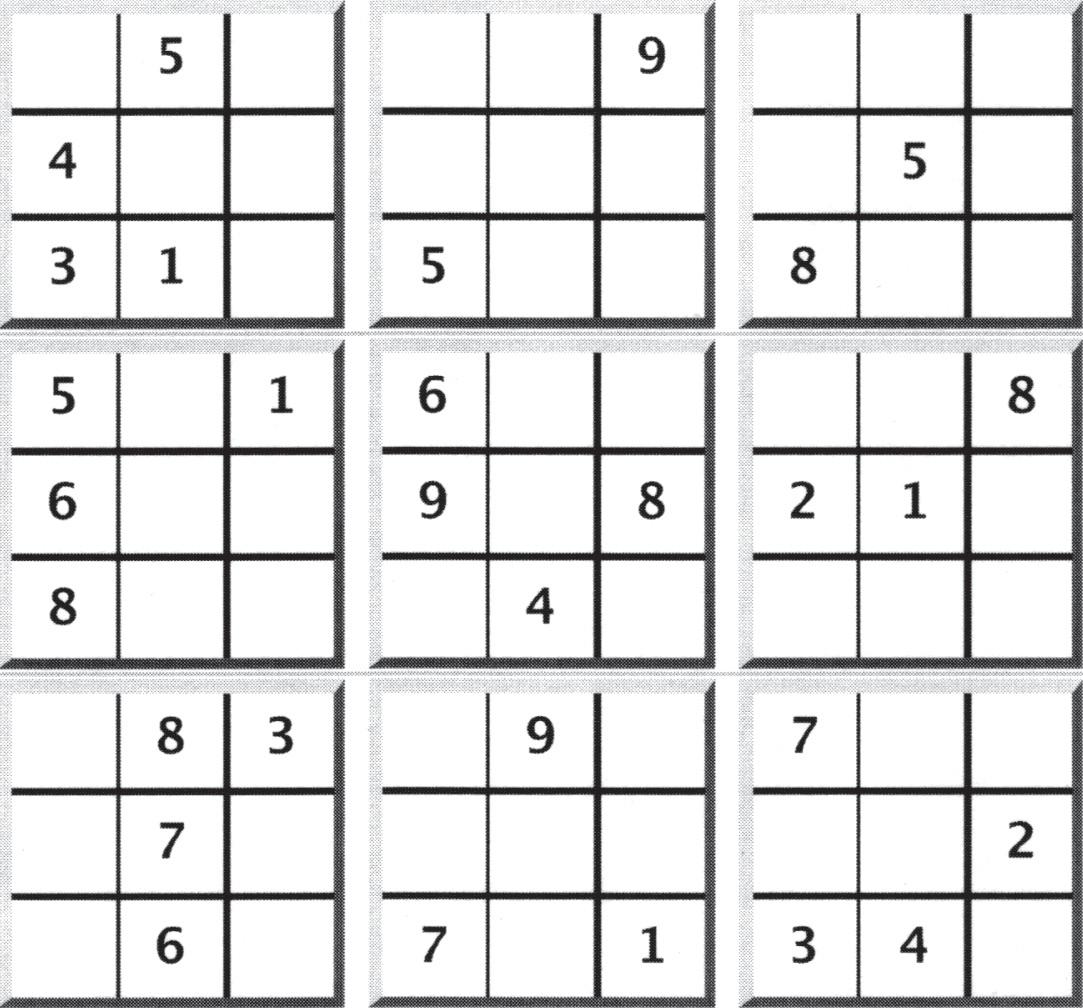
Fill in the empty cells, one number in each, so that each column, row, and region contains the numbers 1-9 exactly once. Each number in the solution therefore occurs only once in each of the three “directions,” hence the “single numbers” implied by the puzzle’s name. (Rules from wikipedia.org/wiki/ Sudoku)

To submit your caption for this week’s contest, visit sunspots.cornellsun.com.





We have availability for the 2020-2021 school year beginning June 1st at Hudson heights apartments. The studios include electric, heat, water, garbage and parking. There is coin-operated laundry facilities on site. Prices start at $750 / month for a 12 month lease. If you have any questions or would like to schedule a tour contact us by phone 607-280-7660 or email: renting@ithacaLS.com
COLLEGETOWN TERRACE APARTMENTS
Leasing for 2020/2021 Spring 2020 Semester leases available Heat, hot water and Wi Fi State of Art Fitness Center Shuttle Bus Service to campus Washer & Dryer in Apartments collegetownterraceithaca.com office@ithacastudentapartments.com (607) 277-1234
Now Renting 2-10 Bedroom Houses/ Apartments for 20-21. All Locations. Call today or visit our website: Certified Properties of TC Inc certifiedpropertiesinc.com 607-273-1669
120 Oak Avenue
Boldly Refined Living 312 College Avenue Sophisticated studio, 1, 2, 3-bedroom apartments. Superior fitness facility, theater, and coworking space. Free high-speed internet. Exclusive resident parking. Package delivery/return. Overnight concierge. 607-273-9777 or 312collegeave.com
2020-2021 Studio 1, 3, 8 & 11 BR Apts. Great Locations in Collegetown. 607-227-2535
3 Bedroom 1 Block from Starbucks in Collegetown Heat & hot water included. Lease starts June 2020. Parking & laundry available. www.porealty88.com 607-277-1888
20-21 College Ave. 5 BR House Furnished. Laundry. Parking. Call 607-273-8576
20-21 Upper Eddy St. 7 BR house Furnished. Laundry. Call 607-273-8576
Just steps to Cornell Campus 10 bedroom house & 1 and 2 bedroom apartment 607-277-1234 office@ithacastudentapartments.com Ithacastudentapartments.com DISCOUNTED!!! COLLEGETOWN 8, 10 or 11 BEDROOMS 607-272-3389 cbeach24@aol.com
AVAILABLE 2020-2021
1, 2, 4 Bedroom Apts. and 7 person House 10 & 12 month leases Cook/Blair Street Call or Text Christopher George RE 607-279-5520
Collegetown Crossing College Ave's Newest Location 307 College Ave. Now Leasing for 2020-2021 Completely New Modern Studios, 2 & 4 Bedroom Apartments. Fully furnished, heat & hot water included. Reception area at 307 College Ave. www.urbanithaca.com 607-330-2442 info@urbanithaca.com

yeah, we’ve been around awhile... since 1880
By LUKE PICHINI Sun Assistant Sports Editor
Cornell’s defense kept it in the game, but the Red’s offense scored just once in a 21-7 loss.
The game came a year after Cornell suffered an embarrassing 66-0 loss to the Tigers.
The loss to unbeaten Princeton moves Cornell’s record in Ivy League play to 1-3. The Red faces Penn next weekend.
After last year’s debacle, which saw Cornell football suffer an embarrassing 66-0 defeat to Princeton in a game that snowballed out of control, the Red sought vengeance on national television.
But under the Friday night lights, Cornell fought hard, but came up short in a 21-7 loss.
The Red’s performance marked an improvement over last year’s effort as the team limited the Tigers to only three scores. But on the offensive end, Cornell only managed one touchdown as three turnovers derailed several drives.
“As a defensive unit, we definitely kept that 66-0 loss in the back of our minds,” said junior safety Logan Thut. “We’re on national television — we definitely didn’t want to get embarrassed like last year. I think that provided a chip on our shoulder … we were close and our great group of guys kept fighting until
That occurred as a result of Cornell’s fourth-down defense, which was ranked No. 1 in the country entering Friday’s clash. In the first frame alone, the Red stopped two Princeton drives on fourth and short while backed up in its own territory.
Still, the Red could not use that momentum to its advantage. It could not score in the first frame, and it only managed one touchdown thereafter. A 9% conversion rate on third down paired with the aforementioned turnovers sunk any chance the Red had at a victory.
score.
Kuzy, who caught four passes for 38 yards, touched on his growing connection with his quarterback.
“We came in in the same grade, and since then, we’ve worked our way up together,” Kuzy said. “The chemistry is building, and I’m excited to see where it continues to go.”
Trailing by just a touchdown and with a bit of momentum
“The offense has a lot of new guys, and it sounds like the same song — and it is. I’m tired of hearing it, everybody’s tired of hearing it, but it’s the truth.”
“We needed to capitalize on some plays,” junior wide receiver Alex Kuzy said. “We had some bad plays that ended up costing us a lot more than it should have.”
In the second quarter, the Red eventually broke down on defense as the Tigers found their mojo. Princeton’s first score came courtesy of a Cornell turnover. Sophomore running back Delonte Harrell fumbled after catching a screen pass, gifting the Tigers the ball at Cornell’s 37-yard line.
“We definitely kept that 66-0 loss in the back of our minds. ... We definitely didn’t want to get embarassed like last year. I think that provided a chip on our shoulder.”
Logan Thut
the end.”
Early on, Princeton controlled the ball. In fact, during the first quarter, the Tigers possessed the rock for over 10 minutes. But during that time, the Red held Princeton scoreless.
It didn’t take long for Princeton to find the end zone. Tigers running back Ryan Quigley carved up the Red for two 15-yard gains, and fellow back Collin Eaddy finished the job with a three-yard score, giving Princeton the early lead.
After Cornell’s offense stalled again, Princeton soaked up every last minute of the half on the ensuing drive. After a big tackle for a loss by Thut, the Tigers faced a 3rd-and-14 in their own territory. That was when quarterback Kevin Davidson unleashed a deep ball to Andrew Griffin, who corralled the pass for a 33-yard gain.
From there, Princeton continued to crack Cornell’s defense. Quigley and Eaddy worked the ball down to the Red’s four-yard line, where Davidson capped off the drive with a touchdown pass to Griffin to give the Tigers a two-score lead.
Though Cornell’s first drive mirrored its previous first-half possessions, the team was able to string together a successful drive midway through the third. Kenney kickstarted the effort with a big 39-yard pass to junior wide receiver Phazione McClurge.
Sophomore running back Thomas Glover then emerged for several big plays. The Pasadena, California, native recorded two first downs with a 23-yard catch and a 10-yard run, the latter of which set up first-and-goal at the Princeton one-yard line. There, Kenney ran in for Cornell’s first
David Archer ’05
swung its way, the Red suffered another defensive breakdown. On third down, Davidson completed a simple screen pass to Dylan Classi, who ran all the way to the red zone on the 49-yard gain. Eaddy then punched in the rock to quickly restore Princeton’s two-touchdown advantage.
“We came on an all-out blitz, and they picked the perfect play to counter it,” Thut said. “They got us on that one.”
Senior safety Jelani Taylor did his best to keep his team in the contest. The co-captain, who was recently named a finalist for William V. Campbell Trophy, recorded both an interception and a forced fumble in the second half, but the Red still could not better its total of seven points.
“[The defense] follows the leader, and the leader is Jelani Taylor,” said head coach David Archer ’05. “He makes that thing go. The coaches had a great plan, but [Taylor] makes it go. He’s playing at such a high level, and he’s one of the best defenders in the Ivy League.”
After Taylor forced a fumble midway through the fourth quarter, Kenney and the Cornell offense worked it deep into Princeton territory, but Kenney threw an interception in the end zone — his second pick of the contest — all but ending the game.
“I thought we were going to pull it off, but we didn’t,” Archer said. “We gave the ball away too much and weren’t good enough on third down to sustain drives.”
Like all of its previous contests, the Red was firmly in contention thanks to a phenomenal effort from its defense, but Cornell’s shortcomings on offense held it back.
“The offense has a lot of new guys, and it sounds like the same song — and it is,” Archer said. “I’m tired of hearing it, everybody’s tired of hearing it, but it’s the truth. The game experience just hasn’t caught up — it’s better … but it’s not solid.”
The Red will hope for a better offensive performance as it travels to Penn next weekend in search of its second Ivy victory.
Luke Pichini can be reached at lpichini@cornellsun.com.
By JUSTIN SUZZAN Sun Staff Writer
Cornell women’s hockey continued its hot start to the season Saturday against Princeton, defeating its Ivy League counterpart by a score of 3-1.
The Red (4-0, 2-0 ECAC) and the Tigers (4-1, 2-1) squared off at Lynah Rink in a showdown between the third-best and sixthbest team in the nation, respectively.
After a hard-fought 1-0 victory against Quinnipiac just the night before, the Red showed no signs of fatigue and flew around the ice throughout the entire 60 minutes of play.
As the pucked dropped in the first period, Cornell led a relentless forecheck behind senior defenseman and captain Micah Zandee-Hart. Still early in the first period, Princeton winger Carly Bullock managed to draw a tripping penalty on senior captain Kristin O’Neill after dekeing her way through the Red’s defense. Junior goalkeeper Lindsay Browning — behind some excellent shot blocking — stood tall for Cornell saving three big shots during the power play.


After Princeton killed off a powerplay of its own, both teams were dead-locked heading into the locker room at the end of the first.
“I think we came out tentative,” said head coach Doug Derraugh ’91. “I thought we were reacting to everything they were doing rather than anticipating and being on our toes. I wanted us to play more aggressively, but we also knew we needed to be smart against this team because they are really dangerous.”
Derraugh’s words had an impact on his players as the Red came out firing. Halfway through the second frame, senior defenseman Jaime Bourbonnais gained control of the puck in Princeton’s zone and slid it across the crease to find junior forward Maddie Mills, who tipped the puck in for Cornell’s first goal of the day.
“We tried to calm down after the first [period] and play our game,” Mills said. “We play our best when we’re playing Big Red hockey — it doesn’t matter who we’re playing.”
Just a minute later, senior
off an excellent leading pass from junior defender Willow Slobodzian, doubling the lead to 2-0. It seemed as though Cornell would run away with the game if it wasn’t for Princeton’s Bullock. The senior winger coasted into the Red’s zone and launched a quick wrist shot, which whipped past Browning in the top left of the goal. On the 23 shots she faced, that was the only score the junior ceded.
It ended Browning’s season-opening shutout streak, which lasted over 200 minutes of game action.
Cornell, however, wasn’t done in the second just yet. With 1:30 remaining in the period, junior forward Joie Phelps snatched up the rebound off a shot by senior forward Sam Burke. Phelps skated behind the net quickly and scored on a wraparound, making it 3-1 in favor of the Red.
The second period featured every goal in the contest. Late in the third, Princeton goalie Stephanie Neatby was pulled, and it appeared the Tigers were gaining some momentum with the extra player advantage. Despite this, their efforts were short-lived as Princeton senior Sarah Fillier checked a Cornell defender into the boards resulting in a power play that would run out the game for the Red.
“The Ivy League season is so short, and every game has so much importance to it,” Derraugh said after the win. “You can’t afford to lose too many games if you want to win the Ivy League championship.”
A win of this magnitude only fuels the Red’s desire to come out on top in the Ivy League and make it back to the NCAA tournament.
“With our tough beginning of the season, every game we’ve had so far is super important,” Mills said. “I think for everyone on our team, beating a great Ivy League team like Princeton is huge for us and it gives us more motivation. We were all looking forward to this — it was marked on all our calendars.”
Cornell will now prepare for its first road trip of the year against St. Lawrence on Nov. 8 and Clarkson on Nov. 9. Despite the short week, the Red is more than capable of tackling the challenge at hand.
“The road trip moves things up in the week,” Mills said. “We just have to be a little more focused. Both of those rinks are hard to play in. We just have to play our game.”
Cornell will attempt to preserve its perfect record against a pair of ECAC foes next weekend.

4-0 | After a 1-0 victory over Quinnipiac on Friday, the Red beat Princeton, 3-1, on Saturday to move to 2-0 in ECAC play.

By RAPHY GENDLER Sun Sports Editor
Six different players scored a goal for Cornell men’s hockey as the Red cruised to a 6-2 victory on Saturday in East Lansing, completing a vengeful sweep of the team that stormed into Ithaca to pull of a surprising pair of wins a season ago.
CORNELL @ MICH. ST. (GM. 2)


Cornell Mich. St.
In last season’s losses to the Spartans, the Red wasn’t beaten on X’s and O’s or tactically so much as it got outworked and outcompeted. So head coach Mike Schafer ’86 and his staff approached preseason practices differently — “[teaching] our guys to get that battle” — in hopes that the team would be ready to go from the opening puck drop.
“They came in and taught us a lesson last year,” Schafer said. “I think one of our guys’ biggest concerns coming into the season was ‘are we going to get off to a slow start with so many freshmen in the lineup?’ … I think those guys have answered that concern.”
Freshman defenseman Sam Malinski scored his first collegiate goal and had a three-point night, sophomore forward Michael Regush scored twice and the Cornell power play potted three goals to up its early-season power-play conversion rate to 5-for-14.
Cornell (2-0) scored three goals in less than five minutes of game time late in the second period and early in the third to pull away from the Spartans (2-4). Clinging to a two-goal lead thanks to goals from junior forward Tristan Mullin and sophomore forward Liam Motley, who was back in the lineup after being a healthy scratch in Friday’s opener, Regush’s first goal, with 3:51 left in the second period, opened up a three-goal lead.
“We got off to a really, really slow start so it was kind of frustrating in that sense, but after we came back and regrouped after the first period I thought our guys got into the flow of things and started to really get into the flow of things offensively,” Schafer said.
Less than two minutes after Regush’s tally, a tip-in of a Malinski shot by junior forward and captain Morgan Barron made it 4-0. Less than a minute into the third period, Regush scored again, this time on the power play, to give Cornell a 5-0 lead.
With three points in two games, Regush is off to a hot start offensively in his sophomore campaign after scoring 12 goals, six of which came on the power play, in his rookie season.
Junior goaltender Matt Galajda made 21 saves, allowing two power play goals to the Spartans in the third period after the Red had already built a five-goal cushion. Malinski’s late goal completed the six-pack.
It’s only been two games, but the Red has impressed with its depth so far: Cornell’s nine total goals have been scored by eight different players, the team dressed eight freshmen on Friday and seven on Saturday and two rookies have already scored their first goal.
On the blue line, newcomers Malinski, Sebastian Dirven and Travis Mitchell haven’t looked out of place, slowing down some potent Michigan State forwards, stymying Michigan State during 5-on-5 play.
“I just like the fact that we came on the road with seven [and] eight freshmen in the lineup and a lot of new guys back on the blue line and we didn’t give up an even strength goal all weekend,” Schafer said. “The competition [for playing time] is what’s going to lead its way for just to be consistent. You have a lot of guys that played solid and that competition to be back in the lineup … is going to ratchet it up in practice.”
If the depth displayed on the road in a Big Ten barn isn’t enough, Cornell is still awaiting the return from injury of a top-line forward in junior Cam Donaldson, a topsix defensemen in junior Cody Haiskanen and a maybe-top-six blueliner in sophomore Joe Leahy.
Cornell begins ECAC and Ivy League play — and its home schedule — next weekend against Brown and Yale. Faceoff is set for 7 p.m. Friday against the Bears and 7 p.m. Saturday against the Bulldogs at Lynah Rink.
Raphy Gendler can be reached at rgendler@cornellsun.com.