Undergraduate veterans, student representatives support proposed resolution for university holiday
By RORY CONFINO-PINZON Sun Contributor
On Nov. 11,Veteran’s Day is celebrated across the country every year with many U.S. government agencies and businesses closing and many cities hosting parades across the country. However, Cornell students, staff and faculty will still be expected to come to their classes and jobs. For many, this either means missing out on on-campus celebrations or making arrangements for their other responsibilities.
ticipate in events on Veterans day as opposed to after,” said Roland Molina ’22, president of the Cornell Undergraduate Veterans Association and co-sponsor of a resolution first introduced in the Graduate and Professional student assembly to officially make Veterans Day a University holiday.
“I would like to actually participate in events on Veterans Day as opposed to after.”
Roland Molina ’22
While some Cornell student representatives and undergraduate veterans are trying to make next year’s Veterans Day a University holiday, not all members of Cornell’s veterans community see it as necessary.
“I would like to actually par-
Biden Nominates Cornell Law Professor to Oversee Big Banks
Several lawmakers oppose Prof. Omarova’s nomination
By SURITA BASU Sun Assistant News Editor
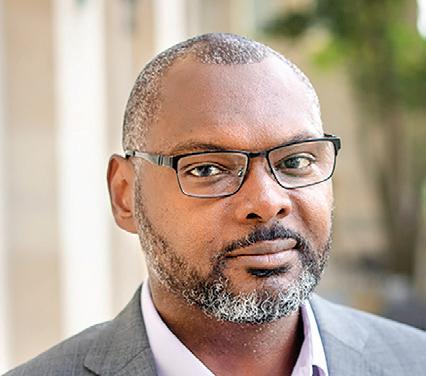
Prof. Saule Omarova, law, was nominated on Nov. 2 by the Biden Administration to head the Office of the Comptroller of the Currency. However, several lawmakers remain opposed to her nomination.
The Office of the Comptroller of the Currency is an independent bureau of the U.S. Department of the Treasury and regulates assets held by large national banks. The Biden administration announced their intent to nominate Omarova in September which was quickly met by opposition from Republican lawmakers who attacked both Omarova’s background and academic work.
Omarova has been openly critical of Wall Street, arguing that the current financial system allows big banks to engage in unnecessary risk, citing speculation that occurred during the 2008 financial crisis. Omarova has expressed her goal to make banking “more inclusive” for everyday Americans and has
(D-Va.) and Kyrsten Sinema (D-Ariz.), who expressed their opposition in a phone call to Senate Banking Committee Chairman Sherrod Brown (D-Ohio), along with Senators John Hickenlooper (D-Col.) and Mark Kelly (D-Ariz.). In particular, Republicans have taken issue with Omarova’s upbringing in the former USSR and a proposal she wrote for the Federal Reserve to start providing loans to consumers, which would take business away from private banks. Tester and Warner also both raised concerns about Omorova’s oppo-
claim, saying that she supports free-market capitalism but also wants to prevent big banks from reaping all of the rewards from government bailouts.
“I want to protect the
“The White House continues to strongly support her historic nomination.”
White House official
American taxpayer, basically, from holding the bag,” Omarova told the Wall Street Journal. Senator Brown also stood by the nomination and reportedly described Republican attacks against Omarova as “McCarthyism.”
“I don’t think I’ve ever seen a more radical choice for any regulatory spot in our federal government.”
Sen. Pat Toomey
sition to the 2018 Economic Growth, Regulatory Relief and Consumer Protection Act, which she opposed due to the fact that it eased financial sector regulations that were put in place by the 2010 Dodd-Frank Act after
“I want to protect the American taxpayer, basically, from holding the bag.”
Prof. Saule Omarova
This year, Cornell events for Veterans day included a walking tour of Cornell’s various Veteran Memorials across the campus and a speech by Brigadier General Joseph Bieler, who spoke on the military’s role in supporting states during crises, including the 9/11 attacks and the COVID-19 pandemic. However, without a day off, many undergraduate veterans, including Molina, were not able
Despite the opposition, the Biden administration has stood by their choice of Omarova. A White House official reportedly told Axios that “The White House continues to strongly support her historic nomination.”
Basu can be reached at sbasu@cornellsun.com.
ASHLEY RAMYNKE / SUN STAFF PHOTOGRAPHER
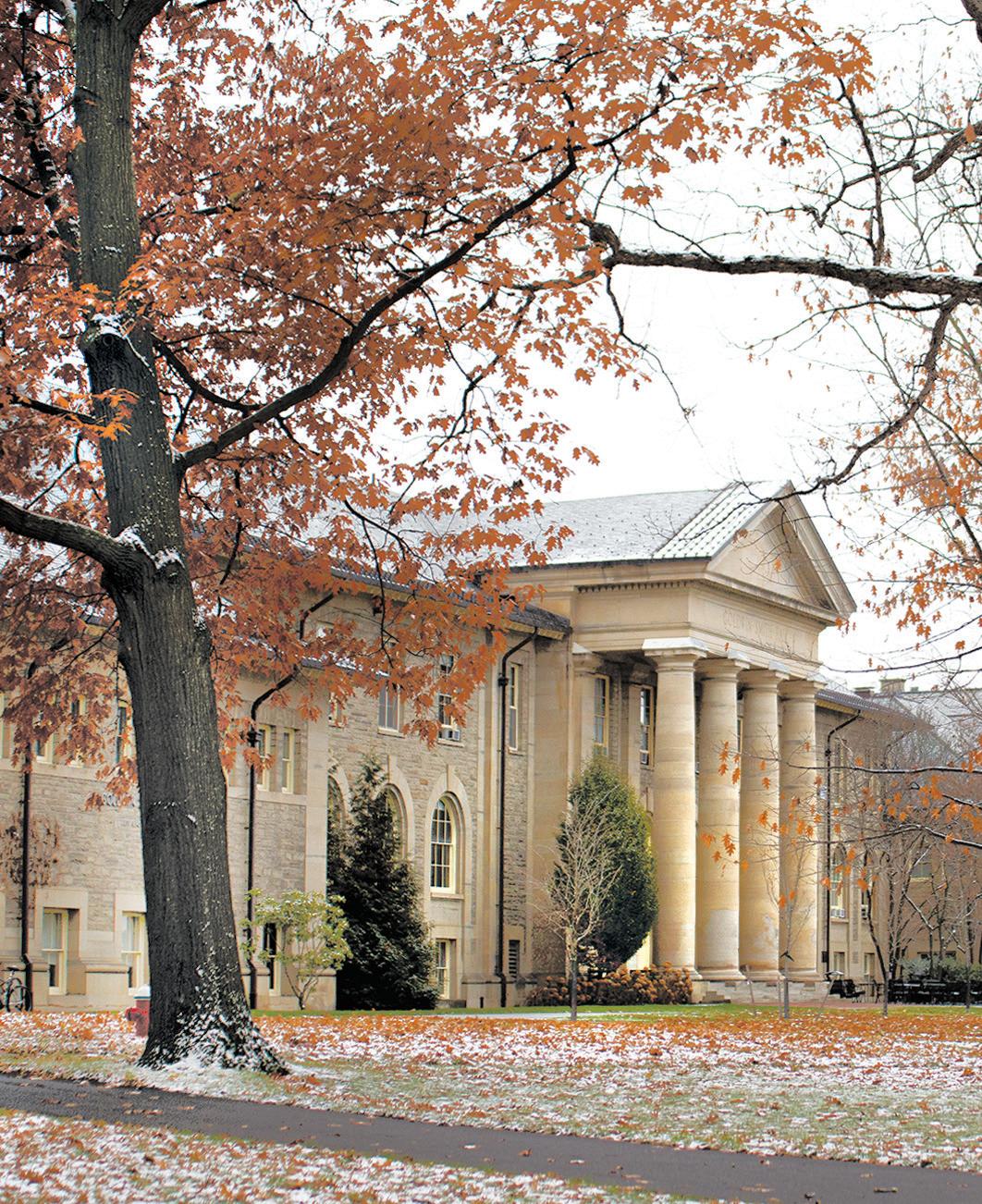
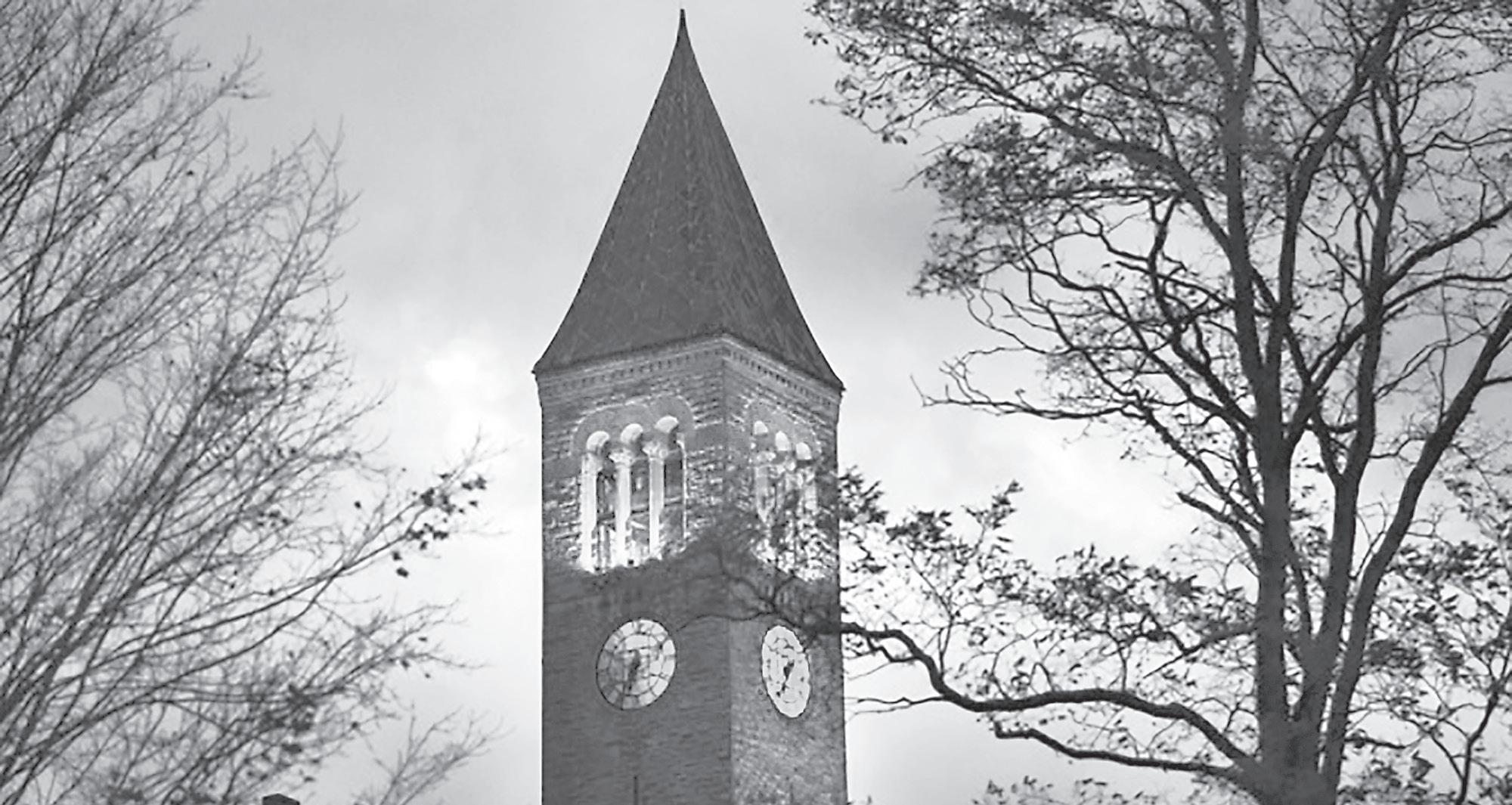
Fall is quickly turning into winter on Cornell’s campus with the first snow of the season dusting the buildings and trees on the Arts Quad.
Surita
Senate hearing | Prof. Saule Omarova, law, testifies before the Senate Banking Committee on Nov. 8.
SARABETH MANEY / THE NEW YORK TIMES
Winter wonderland
A LISTING OF FREE CAMPUS EVENTS
a
between immigration journalists Sonia
and
during
will be
event on Wednesday in
will be discussing what should be the role of immigration reporters in shaping politics and policy.
Today
The Role and Challenges of Textile Recycling Technologies in a Circular Economy
8 - 9 a.m., Virtual Event
Baker Institute Virtual Seminar Noon - 1 p.m., Virtual Event
Twenty Years of War: The Global War on Terror, Security Statecraft and Racial Justice 3 p.m., Virtual Event
Immigration journalism | Molly O’Toole ’09, distinguished visiting journalist in the College
moderating
conversation
Nazario
Nadja Drost
Goldwin Smith Hall. They
Professor to Discuss Early African American Writing
Expert on African American intellectual history challenges misconceptions about Black print culture
By TAMARA KAMIS Sun Staff Writer
Prof. Derrick Spires, literatures in english, will give a webcast on Wednesday about the past and present of Black culture in written work in the United States, including discussion of African American intellectual history and activism in New York State. Spires will use materials from the Cornell Rare and Manuscript Collections as part of his lecture.
“If you start thinking about citizenship as what people do...you start seeing citizenship happening all over.”
Prof. Derrick Spires
Spires, who is an affiliate faculty member in Media Studies, Visual Studies and American Studies, is an author and literary historian. He researches early American and African American print culture, which includes the study of a range of documents including poems, pamphlets and letters. Spires’s past work has also analyzed African American intellectual history and the meaning of U.S. citizenship for Black people before the 14th amendment was passed. “If you start thinking about citizenship as what people do, rather than [who they are], you start seeing citizenship happening all over the place,” Spires said in 2020. “People who see someone in need, and they go to meet that need, that is someone behaving as a citizen.”
Spires has taught courses including Literature in English 2650: Introduction to African American Literature and Literatures in English 6655: Contemporary Issues in African American Studies and Literary Criticism.
In 2019, Spires published The Practice of Citizenship: Black Politics and Print Culture in the Early United States, a book about how ideas of Black citizenship in the early United States were shaped by Black print culture. The book won the
Bibliographical Society-St. Louis Mercantile Library Prize and the Modern Language Association Prize for First Book.
Spires is currently working on a new book project about serial publication, including newspapers and novels that were published in installments, as a part of African American literary history. His research
has been supported by organizations including the National Endowment for the Humanities, the Social Science Research Council and the Library Company of Philadelphia.
Tamara Kamis can be reached at tkamis@cornellsun.com.
Calls for Veterans Day O f Gets Mixed Reactions
While
some student veterans support the proposal, some employee veterans think a University holiday is not needed
VETERANS
Continued from page 1
to attend the events.
Several undergraduate veterans said that celebrating Veterans Day was a way to help all students with stress and burnout. Molina suggested removing a day off from fall break and dedicating it to Veterans Day, making both fall break and Veterans day three day weekends.
“Cornell students push themselves hard and tend to burn themselves out by working nonstop,” said Damien Osborne ’23, an undergraduate veteran
who supports the 3 day weekend proposal.
“This resolution is important because it reminds Cornellians, many of whom may have no personal ties to current service members or the veteran community, that these individuals exist and sometimes they need society’s help,” said Ian Akisoglu ’22, an undergraduate veteran who sits on the University
Assembly.
Debra Howell, the employee representative for the Veteran Colleague Network Group, believes a formal recognition of this holiday by the University is not needed.
“Cornell students push themselves hard and tend to burn themselves out by working non-stop.”
Damien Osborne ’23
“The VCNG feels that there is clear acknowledgment that the University does a lot for the veterans’ community,” Howell said, “We do not see the formal recognition as a necessary step.”
The resolution, which has already passed the Graduate Students and Professionals Assembly, the Student Assembly and most recently the University Assembly, states that all “University Affiliates” should have off on Veterans Day, and classes should be canceled.
The resolution has already been acknowledged by President Pollack, who responded by describing the many ways that Cornell celebrated Veterans Day and supported its veterans throughout the year.
“Although Cornell University held classes on Veterans Day, and Nov. 11 remains a regular workday for staff, we were glad to be able to recognize and honor our faculty, staff and student veterans in several ways this year,” Pollack wrote.
“The VCNG feels that there is clear acknowledgment that the University does a lot for the veterans community.”
Debra Howell, employee
In order for the resolution to bypass Pollack and be considered by the trustees directly, it needs to pass both the Employee Assembly and the Faculty Senate, neither of which have passed it yet.
Rory Confno-Pinzon can be reached at rec292@cornellsun.com.
Print culture | Prof. Derrick Spires researches the connection between early African American citizenship and print culture.
When Did Sleep Go Out of Style?
DYLAN MCINTYRE SUN STAFF WRITER
I love sleeping, not unlike most other people my age. It’s one of the few activities where I can just stop thinking and forget about all my troubles, and once I gently rest my head on a comfy pillow, swathed in soft blankets and bed sheets, I smile on the inside (and probably a bit on the outside, too). On an ideal day, I would have slept for ten hours the night prior — obviously, I don’t have many ideal days. As juvenile as it sounds, sometimes I wish I could spend a whole day sleeping — no work, no worries, only sleep. And yet, it seems like everything in my life is actively trying to rob me of that wish: problem sets, research papers, exams, internship applications, social activities and leisure time all demand my undivided attention, and inevitably, my perfect sleep schedule gets quickly discarded before being utterly annihilated halfway through the semester. Other college students have been met with the same fate, pulling all-nighters powered by caffeine, showing up yawning and blearyeyed to 8 a.m. lectures and making jokes with their friends about how sleep-deprived they are, which wouldn’t be funny if they weren’t so relatable. But this is just part of the college experience. Nothing to get too worked up about, right?
If only it were limited to the “college experience.” Instead, the woes of the sleep-deprived extend far into adulthood, plaguing dispassionate office workers and caffeinated corporate drones alike. Essential workers who cover night shifts overhaul their entire sleep schedule in order to make ends meet as on-call doctors barely sleep a wink, rushing around the hospital while caring for their patients; not helping matters, overtime pay incentivizes people to overwork themselves for only
a meager wage increase. No matter how much work someone puts into their job, there’s always more that can be done in the eyes of their superiors; so, they work as much as possible to please them lest they are deemed unmotivated, which leads to overly competitive, toxic work cultures and potentially death for the workers involved.
riser, you’re an ambitious go-getter, but if you like to sleep in, you’re irredeemably lazy and hopelessly unproductive. The necessary combination of late nights and early mornings in order to seem appealing means many people aren’t sleeping as well as they should. The real kicker comes with the popular — and really toxic — phrase “sleep is for the
Evidently, once you enter the realm of the corporate workforce, maintaining your health is no longer a concern so long as you can still produce results.
Let’s face it: sleep just isn’t cool anymore, nor is it valued by society. Instead of encouraging exhausted people to get a good night’s sleep, society’s go-to advice is to have an energy drink and push through the pain. So many people subscribe to this method of maintaining consciousness that it’s honestly kind of weird if you don’t. People also love to judge others for their sleeping habits — if you like to stay up late, you’re a fun, active person, but if you go to bed early, you’re basically a senior citizen; if you’re an early
weak,” reinforcing the prevailing societal ideology that if you’re resting, you aren’t working hard enough; hard work leads to success, after all, so the longer you’re awake, the more work you can accomplish. Large businesses and corporations have their priorities set based on this philosophy — results are what matter most to them, and the health of their employees is just collateral damage. In the eyes of many, sleep is the enemy of progress. If sacrificing sleep means achieving success, then the ends justify the means, and if an all-nighter is what it takes to pull off that research paper, ace tXhat final exam, or secure that critical business deal, then it must be worth it, right?
I mean, maybe? Maybe some things really are worth sacrificing a night’s worth of sleep to accomplish. The trouble comes when neglecting sleep for the sake of greater productivity becomes a routine habit. At that point, no amount of sugar or caffeine can save your weary brain, and although you may be producing a high quantity of work, that doesn’t necessarily indicate its quality. Doing as much work as possible for as long as possible sounds like a marvelous idea in theory, but in practice, how long you can work without tiring yourself out honestly depends. Some people are great at remaining focused for long periods of time, while others need periodic breaks to relax and avoid burnout, but no matter how determined you are to keep working at the expense of your sleep, your fatigue will eventually catch up with you. You’ll become irritable and forgetful, your critical thinking skills will decline and you may even put yourself at risk for a heart condition — that’s not worth an all-nighter.
If you’re one of the many students at this University who can regularly count the hours of sleep they got the previous night on one hand, I have news for you: that’s not healthy. You shouldn’t ever accept sleep deprivation as a normal part of college or a normal part of life, and you’re certainly not weak for getting enough rest. Just as you prioritize your assignments and your social lives, you should aim to prioritize an important part of your health as well. Set a consistent sleep schedule and take naps during the day if you need to — even 20 short minutes of rest can work wonders for your focus. By making these small lifestyle changes while still being a high achiever, you’ll prove to the world that sleep is still cool — and your body and mind will thank you for it.
Dylan McIntyre is a sophomore in the College of Arts and Sciences. He can be reached at drm293@cornell. edu.
Seven Mammoths Find a Home at Schwartz
TOM SANDFORD SUN CONTRIBUTOR
The most recent production from Cornell’s Department of Performing and Media Arts, Seven Homeless Mammoths Wander New England, has recently finished their run of shows at the Schwartz Theatre in Collegetown. Having been put on during the week before Thanksgiving break, the show offered a thoughtful respite for students struggling with last minute final projects and essays that we all seem to be endowed with at this point in the semester.
Spearheaded by director Samuel Blake, a graduate student in PMA, the production consisted of a modest crew of seven, although it is unconfirmed whether this choice was a deliberate homage to the title of the play. Assuming the role of producer/assistant director was Abbey Crowley ’21. The stage management team consisted of Howard Klein as stage manager and Bella Peters serving as his assistant stage manager. The design team was split in three between Jason Simms on the scenic design, Sarah Eckert Bernstein on costume design and Warren Cross on the sound design.
Apart from Blake and Crowley ’21, all members of the production team were a part of the PMA faculty body.
The central focus of the play, which was penned by Cornell alum Madeline George ’96 revolves around the dean of a New England college that is struggling to balance her workload with her love life. There are calls for a new first year dormitory to be built on the site of a natural history museum that houses the titular seven mammoths.
Dean Wreen (Samantha Noland ’21) must negotiate between the powerfully wealthy school donors and the sudden outcrop of student activists. Accompanying the Dean is her ex-girlfriend and fellow academic, Greer (Kit Ellsworth ’23), who has just been diagnosed with cancer and is invited to move in with Dean Wreen and the Dean’s new girlfriend, Andromeda (Yue Aki Ji ’23). Rounding out the cast of characters is the Caretaker (Trence Wilson-Gillem ’21) of the museum and four “early humans” (Sumire Doi MPS ’22, Yishan Hou ’24, Ezgi Ecem Yilmaz ’24 and Saif Leonardo Tariq Quraishi ’22).
While only consisting of two acts, the time spent in the theatre
feels longer than the two hour runtime. The pacing of the play is odd, with certain sequences extending far beyond what is necessary, and others barely giving the audience a chance to breathe as it jumps from one dramatic moment to another. Numerous instances are meant to be more humorous than they are, although whether that is a quirk of the narrative style or the actors’ delivery is unclear. The manner in which the actors present their lines appears to be forced and unnatural, with a persistent condescending tone being overused by certain actors. The “early human” characters as well play a strange role in the overall narrative. There are certain times where they appear to be parallels for the modern day story between Dean Wreen, Greer and Andromeda, and there are other times where they seem to be gratuitously profane side characters that do not add much depth to the story. There is simply something jarring about watching someone dressed as a caveman say, “Yeah you look so fucking hot in that outfit.”
Out of all the performances on stage, the most consistently entertaining one hailed from WilsonGillem’s “Caretaker” role. His stoic
demeanor on stage lent itself to a level of gravitas that the other characters did not seem to exude. When he shuffled onto stage with his old blue hat and crumpled newspaper, I felt the importance of his character, not just as someone who deals with the upkeep of the museum, but as an integral part of the historicity of the museum itself. In no way am I attempting to discredit the efforts of Noland and Ellsworth in their starring roles. However, as I was watching their performances, I was always aware that I was watching young adults attempt to portray mature, middle-aged women.
The most impressive part of the production was the staging and set. The way in which each scene transitioned between the museum, the school office, the living room and the bedroom was simply exquisite.
In particular, I enjoyed the way in which the kitchen was utilized, especially when Greer is not able to find things where they had been during her previous relationship with Dean Wreen. Furthermore, the scenes where the actors had to become immobile so as to resemble a display in a museum was done with incredibly commendable stillness.
The decision to keep the displays of animals slightly off the center stage so that they would always be in the scene was also much appreciated. This specific instance was the most effective way for the audience to understand the parallels between the ancient history portrayed in the doomed museum and the long history between Dean Wreen and Greer that had already ended once by the time the play begins.
This play was not for the uninitiated theatre goer. With complex intersections of queer romance and the struggles of accepting change in both positive and negative manners, one must truly be prepared to think throughout the entire 120 minutes. If you wish to spend your weekends relaxing in a world that seeks to dissociate you from your own, then I would recommend seeing the latest Dwayne Johnson film. However, if you are willing to embrace this elephantid-inspired production for all its quirky dialogue and heavy themes, then these seven wooly mammoths will find their home in your heart.
Tom Sandford is a sophomore in the College of Arts and Sciences. He can be reached at tjs266@cornell.edu.
CRAIG FRAZIER / THE NEW YORK TIMES
The Corne¬ Daily Sun
Independent Since 1880
139th Editorial Board
KATHRYN STAMM ’22 Editor in Chief
ANUSHYA ALANDUR ’23
Business Manager
CATHERINE ST. HILAIRE ’22
Associate Editor
PRANAV KENGERI ’24
Advertising Manager
ODEYA ROSENBAND ’22
Opinion Editor
JYOTHSNA BOLLEDULA ’24
News Editor
TAMARA KAMIS ’22
News Editor
CAMERON HAMIDI ’22
App Editor
KRISTEN D’SOUZA ’24
Design Editor
HANNAH ROSENBERG ’23
Photography Editor
OMSALAMA AYOUB ’22
Science Editor
PUJA OAK ’24
Layout Editor
ANNIE WU ’22
Production Editor
MIHIKA BADJATE ’23
Assistant News Editor
SERENA HUANG ’24
Assistant Business Editor
ANGELA BUNAY ’24
Assistant News Editor
JOHN COLIE ’23
Assistant Arts & Culture Editor
AMELIA CLUTE ’22
Assistant Dining Editor
WILLIAM BODENMAN ’23
Assistant Sports Editor
AARON SNYDER ’23
Assistant Sports Editor
MEGHANA SRIVASTAVA ’23
Compet Manager
CONNOR GREENE ’22
Senior Editor
NIKO NGUYEN ’22
Senior Editor
MADELINE ROSENBERG ’23
Editor NAOMI KOH ’23
Editor ANIL OZA ’22
Editor YUBIN HEO ’24
VEE CIPPERMAN ’23
NOOREJEHAN UMAR ’23
E.D. PLOWE ’23
YOON ’23
BENJAMIN VELANI ’22
PICHINI ’22
TYAGI ’22
MENDOZA ’24
ARANDA ’23
Editor SURITA BASU ’23
KAYLA RIGGS ’24
News Editor EMMA LEYNSE ’23 Assistant Arts & Culture Editor JULIA NAGEL ’24 Assistant
Editor LIAM MONOHAN ’24
ABAYEVA ’24
ALPERS ’22
JOHNSON ’22
BENJAMIN PARKER ’22
EMMA ROSENBAUM ’22 Senior Editor
’22
Kristen D’Souza ’24 Puja Oak ’24
desker Hannah Rosenberg ’23
desker John Colie ’23
desker Srishti Tyagi ’22
Letter to the Editor
Re: football loses early lead, sufers loss in season fnale to Columbia and ties for last-place Ivy League fnish
To the Editor:
I am astounded by the kid-gloves coverage by the Sun of the Cornell football program. In Cornell’s nearly 70 years in the Ivy League, the University has somehow managed to share the title a total of only 3 times, and has never outright won the league.
Head Coach David Archer’s record is 21-59. Cornell should not countenance that kind of failure in anything it does, especially in football where it invests considerable resources, including many precious admissions spots. We have recruited the last six University Presidents from Big-10 and Pac-12 schools, where records of 59-21 get coaches fired, yet they come here and support a non-competitive football program.
Week after week, year after year, decade after decade Cornell football is an embarrassment. There is no accountability in the athletic department at any level. The Sun’s coverage perpetuates this by failing to ask Coach Archer hard questions about the repeated failures of his teams, to question whether he should continue to retain his job and to ask the same of the athletic director.
Andrew Wong ’89
Mark Wolcott Guest Room
has served on the Cornell Council and volunteers as a Class Representative program for Big Red Sprint Football. He has spent his career in Commercial Banking. Guest Room runs periodically throughout the semester.
Should Cornell Exit Te Ivy League?
The Ivy League was officially founded in 1954 and became a National Collegiate Athletic Association athletic conference for Division I sports. There are currently eight member schools, all along the East coast.
The Ivy League was founded on the premises of being a Division I sports conference with academic excellence, selectivity in admissions and financial aid based on need.
However, we must always remember membership in the Ivy League is a privilege and not a guarantee. Especially as conference realignments occur and great universities are left on the sidelines. As a reminder the Big Red hockey team plays in the ECAC Conference, as not all Ivy League Universities have hockey teams. I decided to write this column when Cornell football was awarded a nationally televised Ivy League game on ESPNU against the University of Pennsylvania on Friday Nov. 2nd, 2018 which was the same time as Trustee-Council weekend.
I have served two terms on the Cornell Council and enjoyed giving back to the University. Cornell athletics are rarely featured on national television and I was surprised that the Cornell administration decided to host the annual TCAM reception and dinner in Barton Hall during the game rather than coming out and supporting the team. As a result, only about 1,000 fans attended the nationally televised game which was quite frankly an embarrassment to the University. Not to mention Cornell lost the game 0-20. Nothing like kicking the team in the facemask when they are already down!
When students apply to Cornell, the link to the Ivy League is obviously a big draw. Additionally, most of our faculty and administrative staff are proud to work at an Ivy League institution. However, our faculty and staff often forget that the Ivy League is a sports conference and not an academic affiliation. Unfortunately, a large percentage of our faculty and administrative staff are completely indifferent to the true purpose of the Ivy League and are only concerned with the title.
Many Big Red athletes are amazed by the beautiful athletic facilities on other Ivy League campuses. Therefore, is it any wonder that our football team (2-8) once again was swept by Harvard, Princeton and Yale, and hasn’t posted a winning record in 16 years? Many of our alumni and student-athletes were understandably upset when it was announced that the historic Hoy Baseball Field would be relocated off campus near East Hill Plaza, in favor of a new computer center.
A few years ago, while parking my car, I found the Cornell Club Baseball team practicing on the roof of the parking garage, which was ridiculous. I think everyone agrees academics comes first and the presence of a College of Computer Science is a wonderful opportunity. But, why does academic progress often come at the expense of athletics at Cornell? I find it ironic that Cornell talks a good game regarding global
warming, but our students will soon need to ride a green-house gas emitting bus every day to attend practices and games.
Cornell soccer has had a spectacular season and are nationally ranked. The only problem is that our soccer facility is located almost next to the Vet School and they rarely draw more than a couple hundred fans. For years Cornell’s soccer games were held at the historic Schoellkopf Field and students would pack the West Stands (the Student Section) for home games. Unfortunately, the West Stands were condemned and torn down in 2016 and the administration didn’t think our students needed them anymore. Today, Cornell is the only Ivy institution with “half” a stadium that continues to deteriorate. This year they had to place a red tarp over part of the Crescent because it no longer meets safety protocols.
Our faculty and staff have complained for years about the money being allocated for Big Red athletics even though we spend less than most of the other Ivy League members. On the other hand, we could save a lot of money by exiting the Ivy League and joining the Empire 8 sports conference with contests against Ithaca College, Cortland State and SUNY Brockport. Even better, we could move our football team to Ithaca High School and turn Schoellkopf Field into a state of the art parking garage. Short bus rides and no overnight travel would significantly reduce travel expenses for Cornell athletics. Then, we could fill in Alumni Fields with even more buildings and move all our practices next to a strip plaza. At least our student-athletes will be able to purchase a sub and soda after practice.
Our beautiful Ithaca campus has over 270 buildings, many of which are underutilized. President David J. Skorton said that we need to do a better job repurposing many of our existing buildings. A perfect example is the Johnson Graduate School of Business. It was relocated to Sage Hall and was completely renovated. It is now one of the most beautiful and technically advanced business schools in the country! The last thing Cornell needs right now is another building that sucks more energy off the grid and removes healthy outside activities for our students. Many universities and corporations are working to reduce their brick and mortar footprint and decrease energy consumption, Cornell seems to be doing the opposite.
In closing, I love Cornell and only wish our University would take our membership in the Ivy League more seriously like Harvard, Princeton and Yale. As an alum who only lives about 90 miles from campus, it seems the only time Cornell is in the news is when tragedy strikes like the recent threats of violence on Nov. 7th. Cornell should be the model of what academics, campus life and athletics are all about! As I mentioned,membership in the Ivy League is a privilege that’s not to be taken lightly. There are many great universities in the United States who would love to take our place. Let’s save our Ivy League heritage before it’s too late.
Mark Wolcott ‘83 is an active Cornell alum who
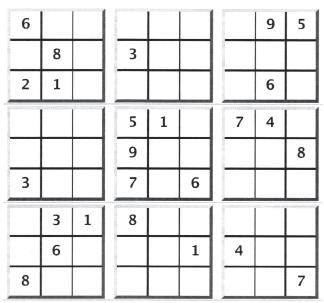
Sundoku Puzzle 1329
Fill in the empty cells, one number in each, so that each column, row, and region contains the numbers 1-9 exactly once. Each number in the solution therefore occurs only once in each of the three “directions,” hence the “single numbers” implied by the puzzle’s name. (Rules from wikipedia.org/wiki/ Sudoku)
I Am Going to Be Small
Dandro
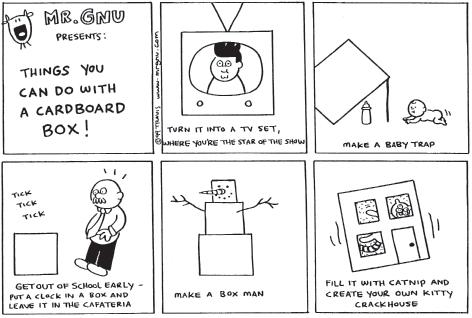
Mr. Gnu by Travis
SC I ENCE
Inside Ithaca’s Total Decarbonization Effort
By MEHER BHATIA Sun Staff Writer
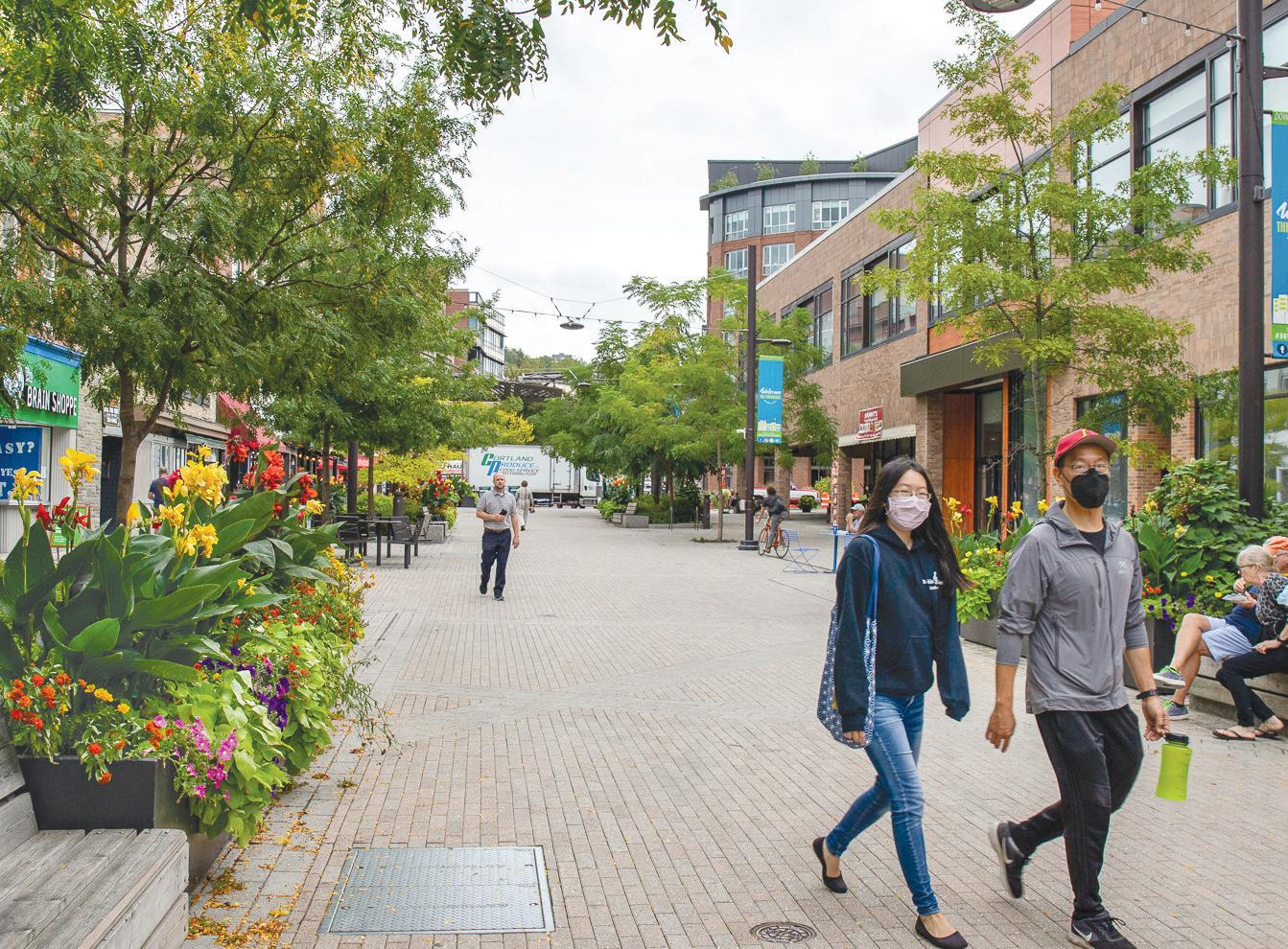
On Nov. 3, the City of Ithaca’s Common Council voted to begin decarbonizing all 6,000 of its buildings, becoming the first city in the entire United States to do so.
For Ithaca, decarbonization will mean replacing sources of carbon dioxide emission — like heating, cooking or drying clothes — with electrical alternatives, and hoping to serve as a model for other cities in the process.
“We’re essentially removing sources of carbon dioxide emissions from buildings, but in the next several years, [we hope to remove them] from every part of the [city’s] economy,” said Luis Aguirre-Torres, the City of Ithaca’s director of sustainability.
Ithaca’s decarbonization project will not only involve being carbon neutral in terms of day to day operations but also producing materials necessary for the transition without emitting carbon dioxide, explained Prof. Felix Heisel, architecture.
“We have to ask ourselves what should be done with utilities [like gas that are] not needed anymore. Do they just go to landfill or do we find a secondary use for them and save carbon emissions because of that? It’s a very complicated process,” Heisel said.
To Aguirre-Torres, Ithaca is unique in its approach to decarbonization by incorporating elements of entrepreneurship and considering the economic side of electrification.
“The entrepreneurial experience of raising capital, of implementing large scale projects, is not typical in a local government,” Aguirre-Torres said. “So these types of structures are very rarely considered.”
Aguirre-Torres raised $100 million of private equity from investors to help building owners decarbonize by modifying existing
buildings to make them more energy efficient. Currently, the City of Ithaca is working in close collaboration with BlocPower, a climate startup focused on updating aging urban buildings to operate on clean energy.
According to Donnel Baird, chief executive officer of BlocPower, the company is working to assess Ithaca’s existing buildings and provide recommendations to improve overall energy efficiency..
“Finding cities and partners that are willing to commit to total decarbonization is one of our biggest challenges,” Baird said. “[W]e need more local leaders to commit to retrofitting existing building infrastructure to fight the climate crisis in their communities.”
The city has also tapped into Cornell faculty and students to aid in decarbonization.
Ryan Thompson ’22, co-leader of Ithaca Carbon Neutrality Policy — a Sustainable Design project team with the core mission of helping the City of Ithaca reduce its greenhouse gas emissions and reach its goal of carbon neutrality by 2030 — said the team is working with various stakeholders within Cornell and the City of Ithaca to make sure both communities are effectively working towards the same carbon neutrality goals.
This semester, ICN Policy has been focusing on educating the Ithaca community by designing and distributing educational brochures to ensure low-income communities and communities of color are included in conversations regarding climate policy.
“We’re making sure that nobody’s left out in the conversation about a transition to a healthy and sustainable future,” Thompson said.
Many involved in Ithaca’s decarbonization project hope that the program turns into an example that several other similar
cities can learn from.
“We’re far more interested in finding a solution for a town of 30,000 inhabitants and 6,000 buildings than we are for New York City,” said Heisel. “Because if we find a scalable solution to a town like Ithaca, the impact across the U.S. as a nation is immensely higher than a solution for a kind of unique case study like New York City.”
Solutions implemented in large cities like Los Angeles and New York City cannot be used as a case study for developing countries because they simply do not have the infrastructure or the technology, Aguirre-Torres added.
“But what we have [in Ithaca] can be implemented in Africa, in the Caribbean, in Southeast Asia, in Latin America. At the end of the day, I believe that we are figuring out a way of doing decarbonization nationally, maybe even globally, because these are elements that will be replicable everywhere,” Aguirre-Torres said.
The decarbonization of buildings may be more important now than ever; emissions for the City of Ithaca are estimated to be around 400,000 metric tons of carbon dioxide equivalent — with 40 percent coming from buildings.
The city also plans on adding solar energy to its electricity generation, to move away from a reliance on fossil fuels.
But ensuring clean sources of electricity is tricky, according to Prof. Max Zhang, mechanical engineering, faculty director of the Cornell
Atkinson Center for Sustainability.
“One of the biggest challenges we face is ensuring our sources of electricity are clean. You can have an ‘all-electric’ community but all the electricity you consume is generated by coal,” Zhang said.
Renewable electricity generation may be an even bigger challenge. According to Zhang, renewable generation is intermittent as wind and solar resources aren’t constantly available or predictable with high percent accuracy. “So, basically you have a potential ‘all-electric’ community but you have to deal with this challenge with intermittent electric generation,” Zhang said.
Nonetheless, Aguirre-Torres remains optimistic. “We’re pioneering. The news was that Ithaca is the first city in the U.S., but we are the first city in the entire world to go for this,” Aguirre-Torres said. “I believe that this is the beginning of a potential solution for everybody.”
Cornell Experts Dissect Football Concussions, Safety
By TENZIN KUNSANG Sun Staff Writer
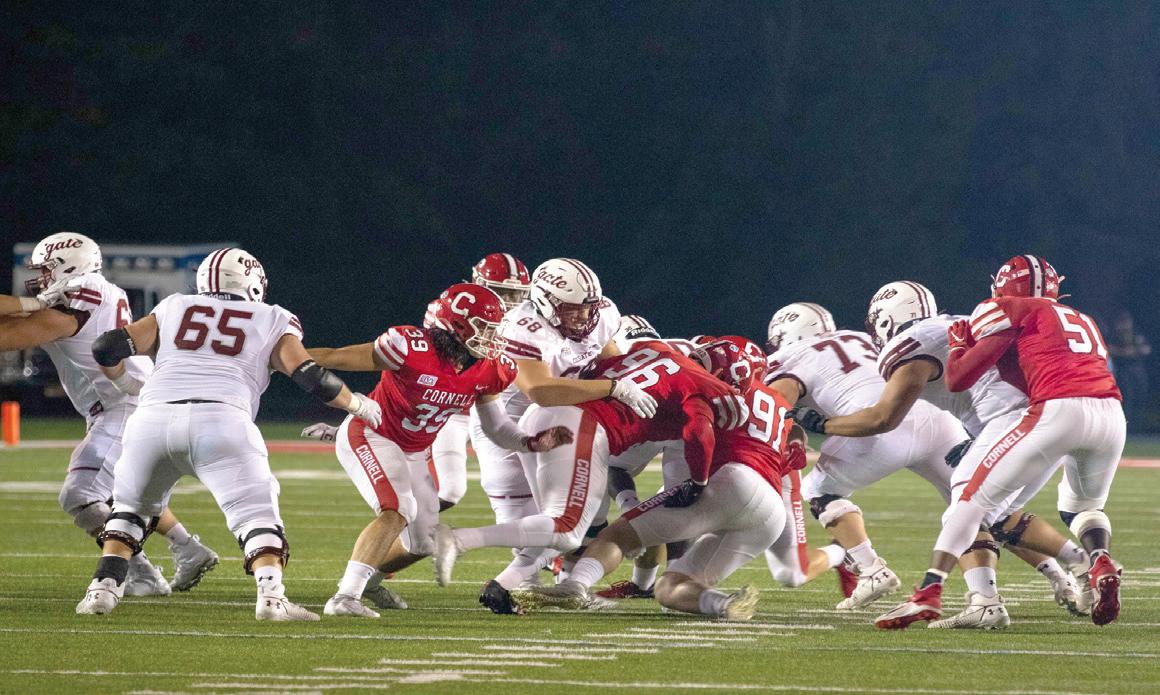
The American tradition of Thanksgiving is one filled with food, family and football. With eyes glued to the screen to watch the next touchdown, the dangers of football are often overlooked. From the National Football League to Cornell’s football team, concussions pose a great risk to football players.
In recent years, after lawsuits filed by former NFL players and more research on the brains of NFL players, the league has aimed to mitigate the risk posed by concussions by improving helmets.
Prof. Asad Siddiqi, clinical rehabilitation, said that a concussion is
a neurological disturbance caused by forces that transmit impact to the brain, such as through a blow to the head or a tackle to the body.
The frequency of tackling in football and fast paced nature of the sport has resulted in high incidences of concussions.
“With athletes who are very large, very strong, and very fast, the ability to hit somebody and induce a force that is transmitted to the head is pretty likely,” Siddiqi said.
Part of the issue, Siddiqi said, are deficiencies in the current standard of football helmets, which currently have an improper field of view, poor fit and heavy weight that could cause neck fatigue.
To combat this, the NFL allocated $1.55 million to three
companies in 2019 as part of its Helmet Challenge to promote the development of more effective helmets..
“What [the NFL is] trying to do with these newer helmets is ensure a more proper fit with lighter weight materials that are still resilient, but are also able to dampen force,” Siddiqi said. “[This will] minimize the jostling that happens at the level of the brain.”
The shift in safety has reverberated on campus too, Cornell Associate Athletic Director for Sports Medicine and Head Athletic Trainer, Bernie DePalma, agreed that companies are trying to develop helmets that distributes kinetic energy and protects athletes from the majority of impact.
DePalma explained that neck strength is just as critical, if not more important than the helmet itself. The neck prevents excessive motion of the head and brain within the skull when a player is prepared for a hit due to awareness and strength and using the neck muscles to stabilize the head.
If a player is able to prepare for a tackle to the chest, for example, the neck will automatically tense up and prevent free motion of the head. But, if they don’t brace for impact, there’s more movement of the neck and head, leading to greater rotatory impact that can
lead to concussions.
In order to minimize athletes’ risk of injury on the field, DePalma said Cornell Athletics puts in place various safety measures, such as baseline cognitive exams and a concussion assessment
According to DePalma, one of the tools utilized, The Sideline Concussion Assessment Tool tests for orientation, which requires knowing the date and current time. This test is performed on all incoming freshmen to provide a baseline for an athlete’s score after they are believed to have a concussion.
Also, every student-athlete performs an annual baseline ImPact test. ImPact testing is a computerized test that measures the effects of concussion on the brain. The test assesses areas such as verbal memory, visual memory, reaction time and processing ability.
These precautionary measures are critical because once a player is injured, they must undergo extensive rehabilitation to prevent longer lasting cognitive deficits and if left untreated could lead to Alzheimer’s, dementia, depression and chronic traumatic encephalopathy.
Those who are concussed while playing slowly increase their physical activity as they recover, first riding a bike to ensure that symp-
toms aren’t increasing, and later progressing to sport-specific training, such as sprinting and changing directions.
Subsequently, an athlete will lift weights then non-contact practices and eventually return to regular practices, DePalma said.
These measures are implemented to prevent a second impact, which could prolong a seven to 10 day recovery period to three to four weeks.
“We’ve had athletes who missed an entire season because they didn’t say anything because they went back in and had another or second impact before recovering from the initial concussion that wasn’t reported,” DePalma said.
Despite the ongoing efforts to make football a safer sport, DePalma emphasizes that there will never be a helmet that completely prevents concussions.
However, DePalma noted that concussion rates have always been relatively low for Cornell football athletes due to the department’s coaching and training techniques.
“Our coaches are great at teaching technique and limiting that [direct] type of contact in practice. We’re eliminating a lot of exposures,” DePalma said.
Tenzin Kunsang can be reached at tk489@cornell.edu.
Meher Bhatia can be reached at mb2479@cornell.edu.
Concerning collisions | Athletes could face weeks of rehab if they receive a concussion on the field. Here, Cornell plays Colgate on Oct. 15.
HANNAH ROSENBERG / SUN PHOTOGRAPHY EDITOR
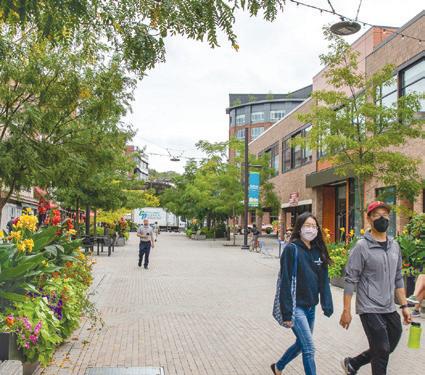
Carbon neutrality | Ithaca made waves in early November as the first city in the U.S. to commit to carbon neutrality.