

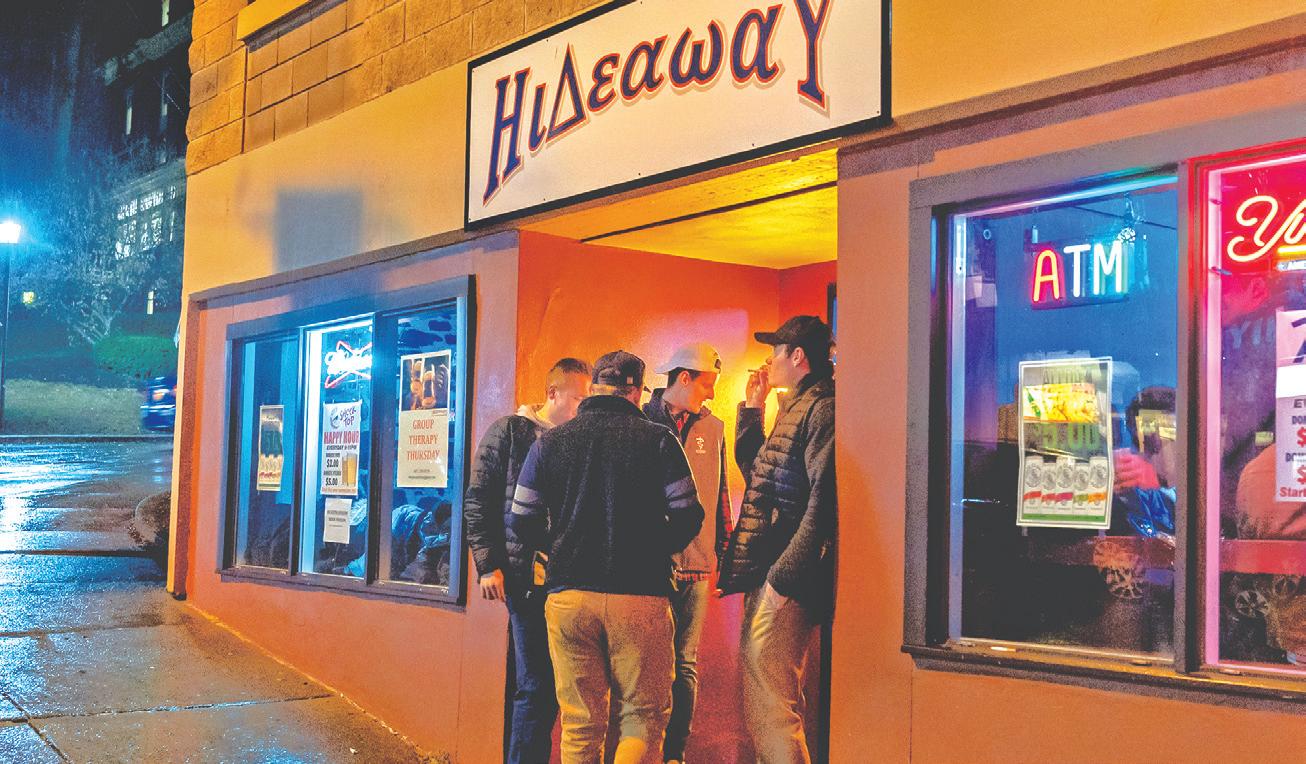
In the wake of an Interfraternity Council mixing ban, the dimly lit bars of Collegetown have risen to increased significance for Cornell’s social scene –– even for those under 21. New York
State Liquor Authority Agents busted Hideaway in October for selling to an underage decoy, according to a Nov. 18 press release.
Hideaway was the only location in Tompkins County caught in this sting.
In Collegetown, both Loco and Level B were found to be in compliance,
Despite high use of fake IDs, other bars safe from sting
refusing to sell to minors. At Loco, however, the prevalence of underage drinkers using tattered or poorly reproduced fake IDs is no secret to the staff.
On the night of Sept. 26, State Police raided Ithaca bars including both Loco and Hideaway, the Ithaca Voice reported. At Loco, the raid uncovered a slew of underage customers.
“That night, I think 90 percent of the people in here had fakes,” Manya Weintraub ’21, a bartender at Loco who was working the busy night of the 26, told The Sun. She shared how once State Police raided the “packed” bar, people panicked, with groups of people hiding in bathrooms and in the downstairs stockroom. “Once they cleared it out there were like six people left in the bar,” she added.
By TAMARA KAMIS Sun Staff Writer
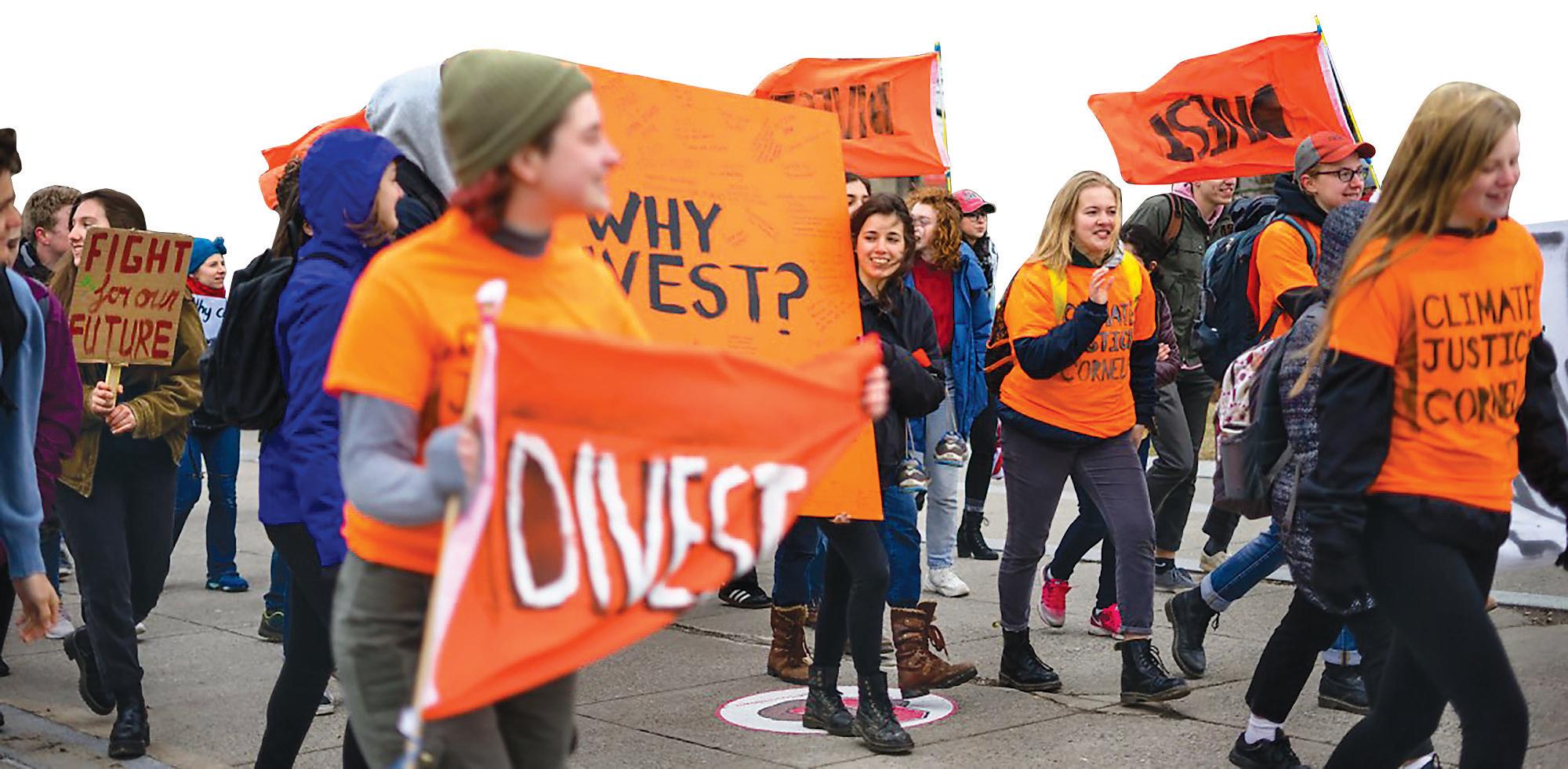
After seven years of student activism to encourage the Board of Trustees to divest from fossil fuels, Climate Justice Cornell is escalating the fight by filing a complaint to New York Attorney General Letitia James to initiate an investigation into Cornell University’s continued investment in fossil fuels.
In the complaint, the CJC wrote that “Cornell’s investments in companies that sell oil, gas, and coal violate these [fiduciary] duties by directly promoting the harms stemming from climate change.” The co-signatories include 17 undergraduate students, one graduate student, as well as Prof. Bruce Monger, earth and atmo-
Russell Rickford, history.
On Friday, the majority of CJC protestors were prevented from occupying the waiting area of President Martha E. Pollack’s office, where they had previously planned to peacefully sit, sing movement songs. However, four CJC members were allowed inside the building by CUPD to press the email send button on their complaint to the attorney general.
The sit-in followed a rally in front of Day Hall.
The complaint claims that by investing in fossil fuels, Cornell is performing acts that contradict its stated tenants of pure and inclusive academic purpose, such as “disadvantaging low income communities and Black and Indigenous people of color,” “engaging in sci-
entific misinformation campaigns to obscure climate science” and hiding “the financial risks associated with emissions regulations and future fossil fuel extraction.”
In the complaint, the CJC also cited the Cornell University Charter, New York Education Law, Prudent Management of Institutional Funds Act, Non-Profit Corporation Law, the New York Supreme court case New York v. ExxonMobil and the Cornell Office of the President’s statement of the Core Values.
“There is nothing inherently wrong about being in a waiting room. We did make the plan that if we are asked to leave by someone with the authority to do so, we will leave. We
DIVEST page 4


By
Out of the many emails received by Cornellians each day, residents of Cascadilla Hall were likely not expecting the one that arrived in their inboxes on Thursday: several large bottles of urine had been discovered in the trash, prompting a stern warning from housing staff.
Because of health concerns, regular building care staff cannot dispose of the bottles. Instead, Cornell Residential Staff has to contract a service to dispose of the bodily fluids.
The email cites a section of the building’s house rules, which state that “the storage of bodily fluids is prohibited in residential communities. Bodily fluids must be disposed of in the proper waste removal system.”
If Cascadilla residents continue to violate House Rules, “the entire Cascadilla community will be assessed the costs associated with this contracted service.”
Residential staff are prohibited from commenting on matters regarding their position. Vernon Miller, the Area Coordinator for South Campus who sent the email, also declined to comment.
Several residents of Cascadilla Hall shared their thoughts on the news.
“I personally have never seen it, but it doesn’t surprise me.” Taylor Owens ’22
“I personally have never seen it,” said Taylor Owens ’22. “But it doesn’t surprise me.” There have been other episodes of misconduct within the dormitory as well.
“A few weeks ago, people weren’t flushing the toilet either,” Owens said.
“Upon hearing of the recent developments, I was initially shocked,” said Matthew Tan ’22.
Monday, November 25, 2019
Biennial Roundtable: Cornell Biennial 2020 Noon - 1 p.m., 101B Lincoln Hall
Solutions to Malnutrition in India: Evidence From Diverse Approaches, by Kathryn Merckel And Jocelyn Boiteau
12:15 p.m., G018 Uris Hall
Modeling the Tangled Bank: Eco-Evolutionary Dynamics in Multi-Species, Multi-Trait, Non-Equilibrium Systems
12:20 - 1:20 p.m., A106 Corson/Mudd Hall
Thinking and Acting to Address Climate Change As a Student Scholar
2:55 - 4:10 p.m., 175 Warren Hall
Department of Physics Colloquium: Krumhansl Lecture
4 - 5 p.m., Rockefeller Hall, Schwartz Auditiorium
The Rohingya: Remain in Myanmar Or Leave for Bangladesh?
4:30 p.m., 106 White Hall
Stop, Drop, Create: 3-D Models
5 - 6 p.m., Guerlac Room, 112 Mann Library
Michael Plagerman Organ Recital: C.U. Music
8 p.m., Sage Chapel
Tomorrow
Rome Neighborhood Studies: Urban Agriculture and Community in Rome
8 a.m. - 5 p.m., West Sibley Exhibition Hallway, West Sibley Hall
Arachnophilia: A Passion for Spiders
8 a.m. - 5 p.m., 2nd Floor Gallery, Mann Library
Applied Physics Grad Society Coffee Hour
3:30 - 4:30 p.m., 243 Clark Hall
Department of Natural Resources Fall Seminar Series
2019: Pushing the Edge of Natural Resource
3:30 - 4:30 p.m., G24 Fernow Hall
American Sign Language Conversation Hour
4:45 - 5:45 p.m., G24A Stimson Hall
KiSwahili Conversation Hour
5 - 6 p.m., G12 Stimson Hall
Yoga sponsored by Cornell Minds Matter And Cornell Fitness Centers
5 - 6:30 p.m., Art Gallery, Willard Straight Hall
Yoruba Conversation Hour
5 - 6 p.m., G27 Stimson Hall
Arabic Conversation Hour
5:30 - 6:30 p.m., G25 Stimson Hall

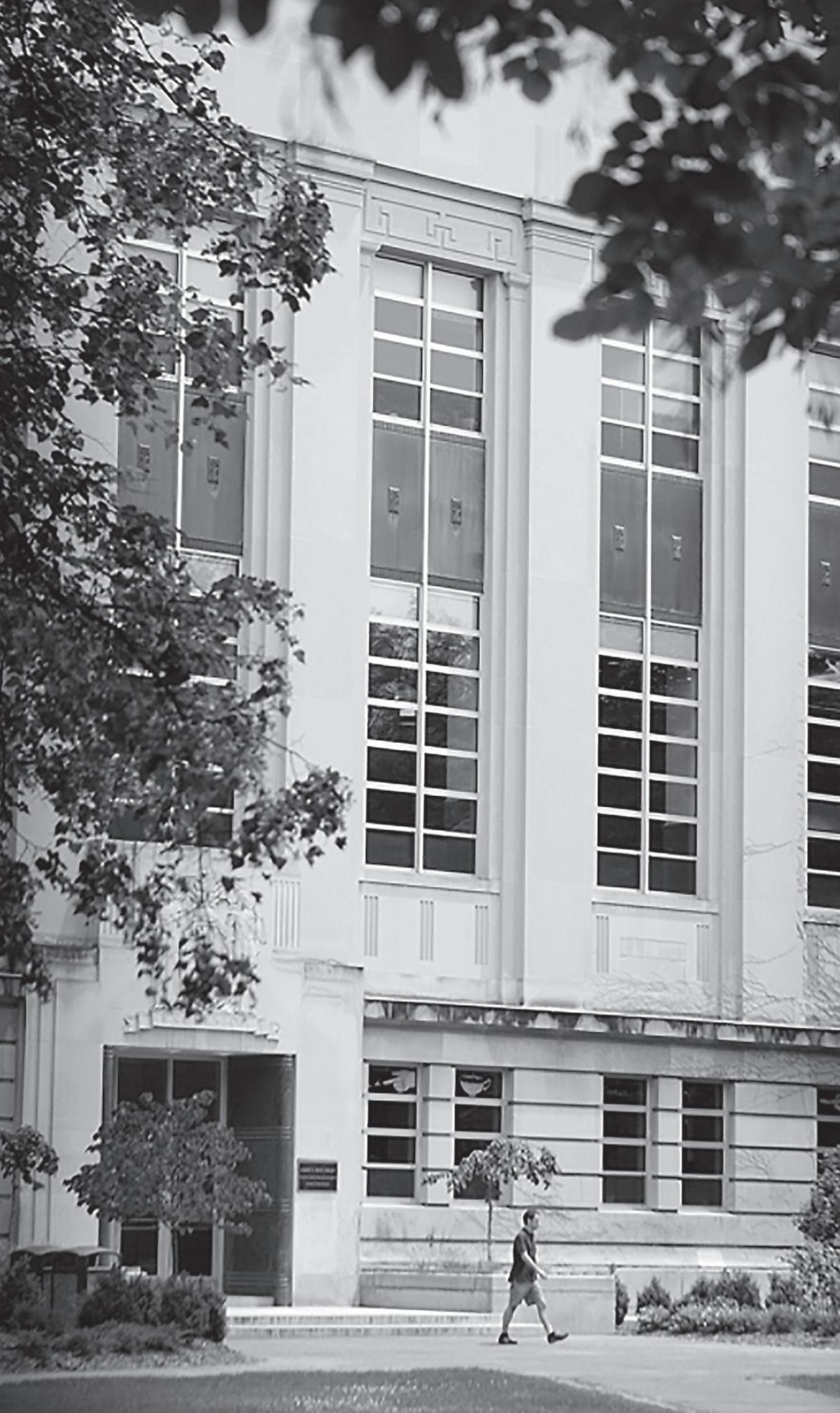
Making things right now | At Mann Library’s mannUfactory, learn how to 3-D print things with software such as Tinkercad, Fusion 360 and Rhino. Monday’s session is one of several drop-in sessions open for students.

By ALIYAH KILPATRICK Sun Staff Writer
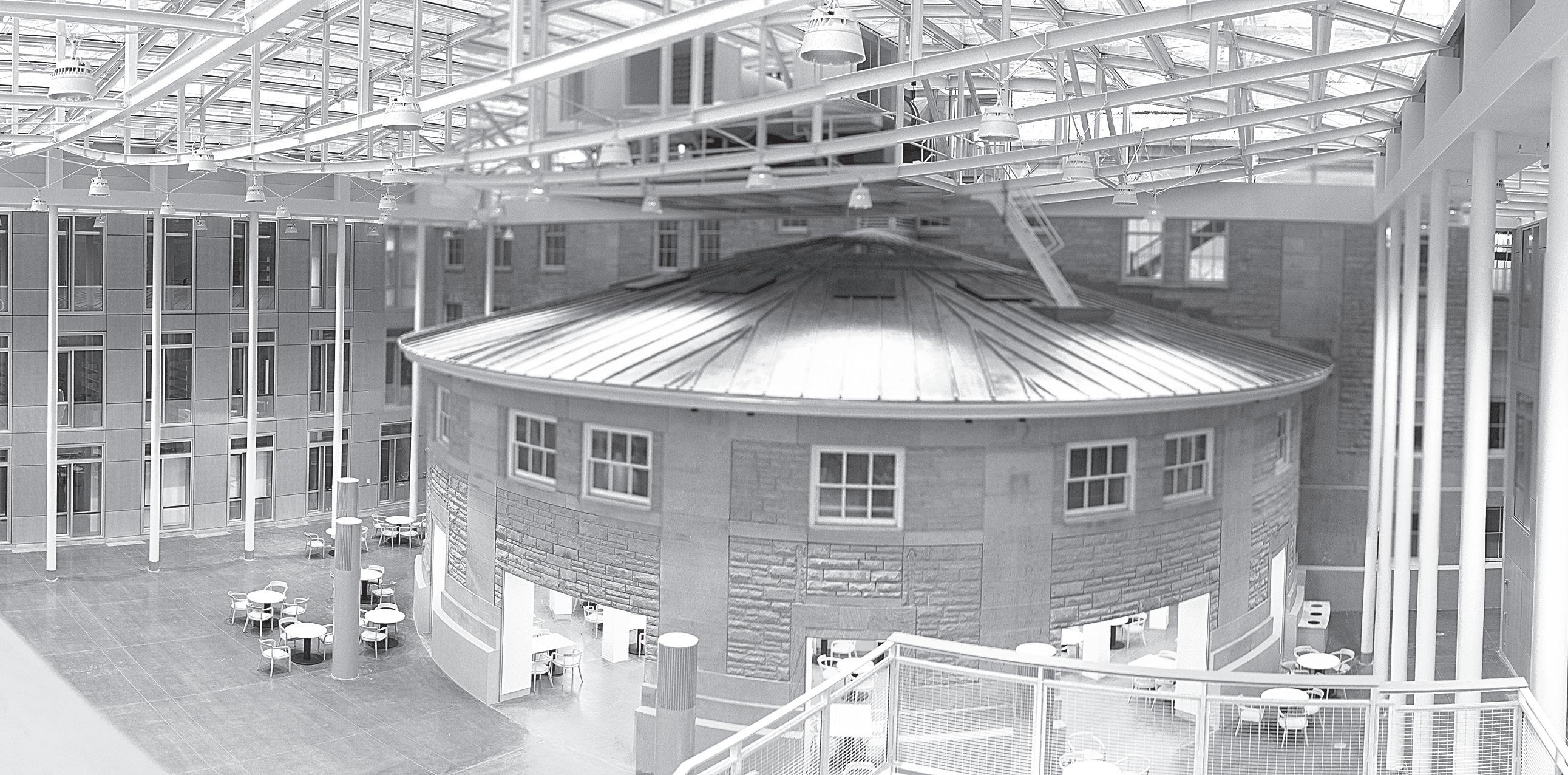
The popular Klarman Hall Atrium is always full of students studying and collaborating or sipping coffee from the Temple of Zeus — but that means many Cornellians have experienced the Klarman Hall runaround when they struggle a place to sit during its busiest hours.
The Medium Design collective’s newest project — the “Reimagine the Design” pop-up installation series — hopes to improve common spaces like Klarman Atrium by crowdsourcing solutions from students.
“It’s an idea of bringing our design conversation to more people, because this year we are focusing on talking about diversity and inclusivity,” Medium Collective editorial team leader Mollie Zhang ’22 told The Sun. “It makes sense to have more people involved in the conversation to foster it, otherwise we won’t have enough perspectives coming in.”
The project aims to cover all seven colleges as a part of a larger series dedicated to reimagining Cornell’s most popular student sites. This semester, it has its sights set on Klarman Atrium, Duffield Atrium and Fanny’s at Green Dragon.
Having run for only a week, the project — including trifolds with blank space for students to write in their suggestions — has already received what Zhang called an “overwhelming” number of responses, reflecting how strongly students feel about the buildings in which they spend much of their week.
“Duffield is the one that has received most of the responses. We’ve gotten about 25 to 35 in two days of displaying it, which is pretty scary,” Zhang said. “People have a lot of opinions.”
This responses from the project will be published in Medium Design Collective’s annual magazine, in the hopes of encouraging in conversations about design.
Although the project has gotten a lot of opinions, Medium Collective hasn’t gotten all of the responses they would like, according to Zhang. With the goal of making these spaces more diverse and acceptable, many of the responses have been about having more outlets and tables to study.
Zhang told the Sun, “A lot of the conversations inside our club was more so pulled around accommodating for disabled people or underrepresented minorities and we are trying to think about how to get that input in.”
Different voices mean different ideas, and although there were numerous responses, Medium knew not to expect just one idea.
“This uniform opinion is not expected, or is expected. Reading through them, I also feel like this is what I struggle with when I come into this place. I think the initial intention of bringing in different perspectives was to see [what] this building lacks in terms of needs that are … underrep-

Annual celebration ofers dose of light on dark, cold evening
By MEGHANA SRIVASTAVA Sun Staff Writer
Once a year, Duffield Atrium, normally the home of engineers working late into the night, becomes adorned with lights and candles as a mix of Bollywood and Indian classical music plays in the background.
That colorful scene arrived once again on Saturday evening, as students celebrated Diwali Dhamaka, an annual event which highlights Indian culture in the form of song, dance, food and art.
Student received Henna tattoos, applied by members of Cornell’s Hindu Student Council, and painted diyas — small, clay lamps that are often used in Diwali celebrations and prayers. Attendees watched live performances by cultural groups such as classical music act SPICMACAY and dance troupe Cornell Nazaquat, while enjoying authentic Indian food.
“There were a lot of activities, like the Diya painting [and] performanc-
es, so I was looking forward to this,” Krinal Thakkar ’23 said.
While waiting by the painting stations, Helena Echenique ’23, Meghana Gavirneni ’23 and Priya Mukhi ’23 highlighted the affordability of the event, and the wide variety of activities that were included.
“I get to see how happy people get, and I get to interact with everyone who comes in the room.”
Anjali Saini ’21
“The food was really worth it, like five bucks was really cheap for all the stuff that we’re getting,” Echenique said. “We’re really excited to see the other performances,” Gavirneni added.
The event was organized by HSC, the only Hindu student organization on campus, according to president Smita Bhoopatiraju ’21.
Anjali Saini ’21, the vice president
of HSC, spoke with The Sun about her role in organizing the event — a task that required assigning members of the organization to different tasks and coordinating with the Student Activities Funding Commission to obtain funding.
Saini described the labor-intensive process of managing members, explaining that a cadre of volunteers were responsible for setting up the ornate set of light demonstrations, table clothes, candles, chairs and balloons.
Despite the arduous effort that goes into putting on such an elaborate event, Saini, who joined the organization her freshman year, said that helping to host Diwali was a powerful way to better connect with both a larger community and her culture.
“I get to see how happy people get, and I get to interact with everyone who comes in the room,” Saini said.
Meghana Srivastava can be reached at msrivastava@cornellsun.com.
resented,” Zhang told the Sun.
The project hopes to someday bring these opinions to the Cornell administration, although right now they are focusing on getting the responses and trying to bring design to more people.
“We want to see more students who originally didn’t like the space to come in and feel like ‘Oh, my needs are satisfied. This design is improved, and me who originally didn’t like this space can also use this space,’” Zhang said.
Aliyah Kilpatrick can be reached at aliyahkilpatrick@cornellsun.com.
By MAIA LEE Sun Staff Writer
In today’s digital era, LinkedIn has become an essential tool for many to find job opportunities, network and cultivate career interests. While a handful might consider themselves to be pros of the work network, for those just starting out on LinkedIn, the art of marketing yourself online can prove to be tricky.
As internship and fulltime recruiting continues to kick into high gear, The Sun asked Cornell’s Career Center and three “LinkedIn famous” students — active LinkedIn users with over 1000 followers on their profiles — for their tips and tricks on how to best navigate the vast, sometimes confusing world of career networking.
What is your background?
Jen Maclaughlin: I’m the Assistant Dean and Director of Arts & Sciences Career Development. I’ve been at Cornell for a little over three and a half years, but within the area of career services for 17 years.
Julio Lopez ’21: I’m a junior in [Applied Economics and Management] with a concentration in marketing. Freshman year, I did a two internship type of thing where I was working for my
local non-profit, my local United Way — that was during the day, like regular office hours. But then at night, like overnight, and the weekends, I was working at a startup company called GOALOOP. I actually got my offer to work with Microsoft next summer early this year in March. Eric Hu ’20: I’m a senior in Arts & Sciences. I study Economics and Biology and I’m minoring in Business. My freshman year, I interned at two startups: one was a growth type consulting firm and the other one was a database platform for buy side equity reports. My sophomore year, I interned at a credit fund in a private equity firm called KKR. My junior year, I did investment banking at a bank called Evercore, where I’ll be returning full time.
Shoshana Swell ’20: I’m a senior studying Performing and Media Arts and Information Science. I started within the film industry and my sophomore year, I discovered product design and went full-fledged within that. Last year, I was at Facebook as a product design intern in Menlo Park, California. After graduation, I’ll be working as a product designer at Facebook in New York.
BUST
“For the sake of business, it was unfortunate,” Weintraub said of the raid.
Loco uses a mobile scanner to verify IDs, and sometimes, Weintraub said, the bar will ask for a second form to ensure the name on the ID matches the name of the customer. September’s raid, however, proved this system less than foolproof.
“We’re not Vegas,” Stella Gianoukakis ’20, also a bartender at Loco, added, highlighting the challenges the bar faces in stopping fake ID usage.
Olivia*, a junior at Cornell, shared how her fake ID consistently worked at Loco. “Loco just scans your ID and if it scans hands it back to you … there was one night last spring where they asked for a second form of ID and that was wild.”
At Hideaway, students likewise shared the ease of using a fake ID. Josh*, a sophomore at Cornell, told The Sun how “I’ve never gone there and had my ID scanned,” adding that he was “not shocked” to learn Hideaway had been slapped with a violation.
Some of the IDs are obviously poor quality, students said. Laura*, a junior at Cornell, has a fake ID that was picked up off a street in Manhattan by her uncle’s
co-worker. Her uncle thought it looked like her. “My fake ID is awful, it’s not even me. It’s comical,” she told The Sun.
And Laura’s ID still works at Hideaway, though sometimes with some difficulty: “I’ve been scanned, and then it’s been red” –– the machine flagged her ID as fake ––“and then they still let me in,” Laura said.
“Right now we have the best scanner … but I know it is not 100 percent,” Hossain Shakawat, the owner of Hideaway, told The Sun. Shakawat often stands in the entryway of Hideaway to double-check the work of his bouncers.
Currently, Shakawat trains his bouncers with a FakeID book from the DMV — but he stressed that, with the ever-evolving dexterity of fake IDs, and with states releasing new and updated driver’s licenses, it’s still difficult to differentiate fake IDs from real.
Shakawat, neverthless, expressed frustration that he was the only bar in Collegetown cited with violating New York State Law by selling to a minor. He recalled the night of Sept. 26, when State Police also raided his bar.
“The whole night when [the] bar [was] full … they found only three or four people us[ing] fake ID,” he said, adding that police found many more underage customers at Loco than at his bar.
According to the press release, the State
Building staf warns of health hazard, potential fnes
Liquor Authority deployed 55 underage details in 38 counties across the state, canvassing 812 locations with a liquor license. Of these 812 locations, 156 sold to decoys.
The list of 656 businesses who refused to serve a minor included Loco, Moonies, Level B and Silky Jones.
Fines for not complying begin at $2,500 to $3,000 for first-offenders, with
more severe consequences, including loss of liquor license for repeat offenders, according to the press release.
*Names have been changed to protect anonymity.
Alec Giufurta can be reached at agiufurta@cornellsun.com.

DORM
Continued from page 1
“However, I am not that surprised as we have had problems with people shaving and clogging the shower stalls.”
Suspicion surrounds video game players who engage in long gaming sessions, students said. Rather than getting up to use the restroom, they use the bottles on the spot.
“I don’t have much to offer but I can say this,” said Dylan Young ’22 in a message to The Sun. “I’ve been on the fourth floor of Cascadilla and I’ve heard loud Fortnite sounds coming from some room down there. And occasionally, I’ve seen some guy with gaming headphones carrying bottles.”
“I just assumed it was gamer fuel
or Mountain Dew or something like that,” Young added.
But it appears that the suspect may have already been apprehended.
“It happened on the third floor,” said Rina Peterson ’22, a resident of the same floor. “The roommate turned him in, and maintenance knew.”
“Cornell’s Housing & Residential Life team are working to bring awareness to the Cascadilla community about these incidents in order to ensure the safety and well-being of our colleagues and community members,” wrote Robert King, the director of Residential Life, in an email to The Sun.
Luke Pichini can be reached at lpichini@cornellsun.com.
DIVEST
Continued from page 1
might not do that in the future, necessarily,” said Nadia Vitek ’19, a CJC organizer.
While Cornell’s administration and student activists are on the same page that climate change exists and addressing it is important, there are fundamental differences in strategy. The University has a Campus Sustainability Office, and is working to reduce environmental impact of every aspect of campus life, including food, transportation and housing.
The Cornell Climate Action Plan website states that “By demonstrating scalable low-carbon solutions on campus, advancing climate literacy and research initiatives, and accelerating impact through collaborative partnerships locally and globally, we can make a difference.”
For student activists like Vitek, these efforts
seem hypocritical as long as the University continues to invest its endowment in fossil fuel producing companies.
“They talk about climate change and how they are ‘the greenest Ivy,’ but when it comes down to it, money and profit and corporate interests are what they care about. That’s what I see with their investments,” Vitek said.
The event is part of CJC’s Fossil Free Fridays, which have included a photo campaign, banner painting and participation in the Global Climate Strike.
“Our Fossil Free Fridays, which have been happening every Friday, we are making it all about escalation, starting with smaller things and working up to bigger and bigger things,” Vitek said.
Amanda H. Cronin ’21 contributed reporting to this article.
Tamara Kamis can be reached at tkamis@cornellsun.com.

Continued from page 3
What advice do you have for Cornell students who are just starting out on LinkedIn?
Maclaughlin: I really emphasize skill sets to be placed onto LinkedIn because that’s essentially what employers are looking for. There are eight core competencies that deem students to be careerready: critical thinking and problem solving abilities; communication skills; professionalism and work ethic; teamwork and collaboration; leadership; digital technology; global and intercultural fluency; and career management. I highly recommend that students really try to place these on their LinkedIn profiles.
your professional aspirations. For me, that’s increasing the number of Latinos that are in power in the business world. The summary is like a mini cover letter. Make sure you always change it every year.
Hu: Absolutely cherry pick. A lot of times, LinkedIn is just used as a screening tool. The last thing you want is a summary of your resume. Some people make the mistake of essentially copying the resume’s bullet points on LinkedIn. If it’s a known role — for example Software Engineering at Facebook — everyone knows what that is, so you don’t need a description. Other times, for example, startups or projects that you’ve founded, you want to give a brief descrip-
out to; who is someone I would be interested in following on their journey?
What professional opportunities have you gained from being active on LinkedIn?
“Think of your LinkedIn account or page like a website.”
Lopez: Think of your LinkedIn account or page like a website, where recruiters have a different interface in which they can search for applicants. If you’re looking for an internship, your header should be something like “junior at Cornell University seeking a summer internship in product marketing.” Don’t be afraid to reach out to people who you don’t know. But 100 percent of the time, add a note on the connection request. I was talking to a professional and he said, “if you don’t have a note, you failed the first test.” Say why you want to connect; don’t just connect randomly to people for no reason.
Hu: As far as content goes, taking the time to have a more academic lense and providing something substantial rather than commercial is very important. In addition, we don’t realize as students how extensive the alumni network is, and alumni love to help. I think people are scared to cold call. I think any alumni will be delighted to get a LinkedIn request and move that to phone or email for a student.
Swell: It depends on what industry you’re in, but I would say one of the biggest benefits is messaging people to set up a time to call. It could be very scary to actually speak with people who are seniors at different companies, but I think that’s one of the best ways to look for possible career fields you want to go down. It’s a good tip to always add a note when you’re connecting with people — and you can only do this on a desktop. It becomes this more personalized approach, especially if you don’t have a ton of mutual connections.
What guidance can you give on building LinkedIn profiles and crafting summaries?
Maclaughlin: I think of LinkedIn as a Master Resume, which is more inclusive. It’s going to have everything that you have done, while a regular resume is created based upon the specific job to which you are applying to. It can create this bigger narrative about who you are as a person, as opposed to the resume — which is much shorter. It needs to be readable, but not too long.
Lopez: For me, personally, have everything on there. You never know, there could be someone who is looking for somebody like you that had that one particular experience. For the summary, I personally like the “I” because it feels more personal, like I’m talking to somebody. Second, I’d definitely have an objective for
Ramos: I was posting a lot of things on LinkedIn related to marketing, and a recruiter from this new program at Microsoft reached out to me. I got a phone call and then they flew me in. I really loved everyone, and that’s when I decided to take the offer. LinkedIn is so big right now, particularly with the bigger companies, like the tech companies. They are aware that this is the network that people use and they use that to reach out to networks that they otherwise wouldn’t have access to.
Julio Lopez ’21
tion about why that’s unique. For extracurricular projects, you can attach papers, files, and links to websites under “Add Media.” That is another way to make your profile stand out.
Swell: As a freshman, I think putting your experiences under the “Experience” category could be beneficial if you had a primary role or lead within a project. Other things I put under “Experience” are any roles in a project team and other campus-related experiences that I have a very dedicated role to that are directly related to my career. There are some extracurriculars, like being in Cornell Fashion Collective or Thread Magazine, that I put under the “Education” section for Cornell as bullets.
Can you describe your path to becoming “LinkedIn famous?”
Lopez: It definitely starts off with content. I’ve been able to be in talks and spaces with people who are considered LinkedIn influencers. The number one recommendation that they always give is content. Find something you’re passionate about, and share content about it. You may not think you’re big, but if someone likes that content, then somebody else in their network will see it. So the more often you do it, the more often you appear in other people’s timelines. Number two: I would like, comment, and engage on other people’s posts. Then other people in their network will see your account, your profile, and they’ll see what you’re doing. You have to look at it like social media.
Hu: I think everyone kinda starts the same; they begin and they have no idea what to do. Luckily, I had a couple of older people at Cornell that I modeled my LinkedIn account after. You start out by essentially spamming everyone you know in your nearest connections. LinkedIn is not to be used as your resume, it’s an initial screening. Also, it’s really important that you not only engage with your own network, but try and see people that you might want to follow or companies that you are interested in. Be really involved in the space rather than being a watcher on the sidelines.
Swell: When I discovered product design, I originally looked in LinkedIn to find people who I could reach out and learn more about the industry. I never was someone who wanted a certain amount of LinkedIn connections. It’s just about who I can reach
Hu: The bigger strength of LinkedIn is getting in touch with the right people in order to get the softer opportunities. Maybe you want to get a job, and there’s 20,000 applicants. You reaching out on LinkedIn, and not just connecting, but following up, making a phone call, exchanging emails, is really a strength of LinkedIn. That can lead to internship opportunities. For me, it has been more invites to conferences.
Are there any LinkedIn “faux pas” that students should be aware of?
Maclaughlin: First of all, always portray yourself accurately and appropriately in a professional manner. Know that LinkedIn is different from places like Facebook, Snapchat, etc. Often, students think that they should exaggerate their experience, but you don’t want to overextend what you’ve done. Finally, a big faux pas is reaching out initially to say, “Can you help me with a job?” without taking the time to invest in the person. A much better approach is reaching out and saying, “I’m interested in learning about you.”
The purpose of LinkedIn is networking, and networking is about relationship building, and there needs to be a give and take. Also, every time that you talk to somebody on LinkedIn, ask “Can you suggest others whom I could speak with about this field?”
Lopez: LinkedIn is a professional network, and sometimes some people don’t see it as such and will post things that would go on Facebook, or Instagram. Be very wary of these things. Make sure you spell things out. Don’t just put the suggested auto-click messages, because those do appear on your profile.
Hu: There’s private browsing mode on LinkedIn, and that’s the first thing you should take on. The scariest thing when you’re essentially stalking these people multiple times and they get a little notification.
Swell: The algorithm for LinkedIn’s feed is very different from other platforms. When you like a post, you’re endorsing it two times more than say, an Instagram post because it will show up on your news feed. Make sure what you’re liking is endorsed by you and something that you would approve of. So liking and commenting is way more of a heavy interaction that will show more about you to your followers.

All DISPLAY ADVERTISING for the Monday, Dec. 2 & Tuesday, Dec. 3 issues and CLASSIFIED ADVERTISING for the Monday, Dec. 2 issue of The Corne¬ Daily Sun is due MONDAY, NOVEMBER 25 by 2:30 p.m.
The Sun Business Office will close Monday, Nov. 25 at 3 p.m. and will reopen Monday, Dec. 2 at 9 a.m.

The Corne¬ Daily Sun
D Ve R Ti S Er S
Who pays for software these days? Software is either free or is meant to be pirated. That is the implication of our digital culture. Everything on the Internet by default has to be free, or it will be vehemently tinkered until it’s free. We equate accessibility to the expectation of free content. This mentality in regards to the digital sphere feeds into our perception of Internet art. What is Internet art? It can be an Instagram post, a website, a digitally restored artwork in an online archive, an audio-visual offered through a streaming platform, a program that is creatively miscoded with artistic vision or even a glitch that is artfully crafted. Once artwork is mediated through the Internet, our critique has a fundamentally different basis than our assessment of any other form of art. Many of us have ingrained the belief that Internet art is intrinsically vulgar, or at least inferior to other art forms.
Why? Because the Internet as an open network offers artists and audiences unprecedented possibilities to be connected to one another. The notion of openness and accessibility is embedded in our Internet culture. This is often enabled by offering content for free. When the Internet makes it easier to make, distribute, critique and consume art, it challenges the elitism of the art world. In the networked age, the hierarchical art ecosystem consists of artists, curators, critics and audiences is flattened. Internet art emerges in the art world as another new wave that challenges the status quo and calls for greater openness and accessibility. It echoes coun-
tercultural beliefs in the 1960s that seek to obliterate hierarchies with small-scale devices that connect to large-scale networks.
The Internet as an open platform is perceived as a threat to the purity of art. Just like its predecessors, Internet art comes off as an intimidating force of the unknown to the establishment. In response to the perceived threat, the rhetoric of vulgarity and impurity is institutionalized and thus amplified. It argues that the openness and accessibility of the Internet have devalued the appreciation of art, enabling the mass circulation and thus the mass production and consumption of art. This echoes the criticism of low art and pop art and implies the belief that the viewing experience of Internet art can hardly be cultured. Yet I would argue that the noise on the Internet is precisely the context of the medium. As Marshall McLuhan introduced the world to the enigmatic paradox “the medium is the message,” it can be perceived that the unique viewing experience of Internet art — with pop-up ads and glitches being integrated in free software — is central to the message of the medium.

There is often a misconception regarding the Internet as a platform. It is often perceived as merely a medium to deliver other art mediums. Yet I would argue that the Internet is not only a platform but an infrastructure, and it is through its fluid and often amorphous infrastructure that leaves ample possibilities for artistic endeavors to be implemented. The creative misuse that accentuates the infrastructure is what distinguishes Internet art from pure technological

engagement with the protocols that operate on the very same platform. The essence of Internet art is that it reminds the audience of the medium.
As Internet art often exists within such obscurity, it is often presumed to be hard to be collected and thus ephemeral and insignificant. This nature of Internet art reflects the perpetuating rhetoric of vulgarity and impurity. As such, Internet art is never a standalone piece but is always seen in coexistence, and when it appears on a platform, it often co-exists with applied, practical design. This speaks to the dichotomy between art and design. How can we draw the line between web art and web design? We cannot. We cannot delineate the two components from their symbiotic presence. This ties to the aforementioned connotation of free software. As we cannot delineate Internet art from content that can be accessed for free (even when the content is not offered for free, it will ultimately be rendered free) on the Internet as a platform, we essentially perceive Internet art the same way we perceive free software. As
we associate Internet art with free software, we essentially associate Internet art with the softness within the context of long-standing hierarchies of hardware and software, of engineering and programming, of manufacturing and design and of men and women. For some, this amorphous state of Internet art connotes a sense of inferiority, yet for others, this echoes the hope of technological utopianism to shed light on the power imbalance. For these people, Internet art is an electronic force of resistance to our hierarchical bureaucracies. This sense of freedom speaks to Stewart Brand’s belief that the use of technologies can lead to a non-hierarchical society. Perhaps this is why Internet art is no less controversial than free software. How do we get free software? Through the Internet. How do we access art for free? Through the Internet.
Stephen Yang is a sophomore in the College of Agriculture and Life Sciences. He can be reached at syang@cornellsun.com. Rewiring Technoculture runs alternate Mondays this semester.
“Unsung Heroes” is a senior thesis done by Aiza Ahmed B.F.A. ’20, created in order to cast a light on those in society who tend to be left in the dark. The utilization of lines and color are two of the most prominent mediums Ahmed uses to convey her message about these people from her hometown in Lahore, Pakistan.
“My initial inspiration came from the streets in my home … the people whom I saw wandering … were predominantly men, performing their ordinary, daily routine … I felt like they did not receive the amount of recognition and acknowledgement as they should have, perhaps because the tasks were ‘ordinary.’ As a result, this body of work aims to celebrate these men, the ‘unsung heroes.’” — Aiza Ahmed.
The exhibit consisted of 14 different portraits conveying different men completing various labor-intensive tasks on a
typical day. From selling bananas to driving a rickshaw, the workers in these canvas creations articulate those not as well off in society as others. Ahmed’s intention in centering these members of society is to “bridge the gap” between social classes, despite the persistent inequality visible both in her community and in many cities with an expansive industrial nature.
When asked about why she chose to specialize in lines and color as opposed to shape, detail or contrast, Ahmed replied, “Color means a lot to me — color has the power and ability to convey emotion, attract attention ... it can be incredibly bold.” Ahmed also later said, “[I am] very influenced by my Pakistani culture – which tends to be very bright, warm, loud ... I have a natural fascination with color and have been using it as a tool to explore emotion and the human figure as well as how it affects the viewer’s interpretation of the individuals I portray.”
Complementary of the
vibrant and often dichromatic portraits, Ahmed also had an exquisite oversight of the orientation of lines as a way to recount detail in certain parts of the scene. Utilizing a combination of meticulous and swift brushstrokes, the artist explained, “‘mark making’ [can] convey great meaning,” before further stating that “[I am] thinking about the intersection between drawing and painting — ‘drawing with paint’ — the formal element, line, lent it itself to that.”
In relation to the actual subjects themselves, Ahmed wanted to move toward a shift in perspective in her art that had not been articulated in such a way before, describing this exhibition as a means to “explore ways in which I could activate the surrounding space as well as the activity the figure engaged in ... it has been exciting to create a ... narrative in which it is not only the figures that play a central role, but also the objects they interact with.”
Ahmed had an interesting interpretation of working in her
hometown, as the entire exhibit was comprised solely of men doing these various and somewhat systematic tasks. When questioned on her usage of such subjects, she mentioned what she found most fascinating about these working people were their physical features and the implications surrounding such characteristics. As many of them were older men, they had similar traits such as beards and wrinkles, encompassing a “sense of wisdom and age and wanting to learn from the hardships they may have experienced in life.”
This ultimately leaves the viewer with the clearest question after slowly completing a full rotation around the exhibition room in Olive Tjaden Hall after a balmy walk across the Arts Quad: Where are the women? Why aren’t there any women included in the exhibit? Ahmed responds to this question with a coherent and contextual answer, saying that “women [are not seen] in such roles in public spaces; they largely engage in behind-the-scenes, cottage industries, that I don’t
have access to in the same way I can simply walk into a market or wander the streets.” The artist makes it clear how our views of “heroes” can be construed and socially constructed, and how we have more strides to make if we want women to start appearing as heroes before they are seen as the opposite. This is done so in such a mesmerizing way, showing the intersection of politics and modern art as we see it. She dichotomizes this idea while also showing the clear distinction between the two that we — as consumers of mass information in the modern digital age — seem to brush off, just as Ahmed did with such effortless grace in this depiction of humaneness. “Unsung Heroes” is truly successful in how it praises those who often do not get the cognizance from society that they more than deserve.
Tyler Brown is a sophomore in the College of Engineering. He can be reached at tlb239@cornell.edu.
EMMA PLOWE SUN STAFF WRITER
I normally don’t enter spaces actively conscious of my identity as a grandchild of a Holocaust survivor. However, I was highly aware of my Judaism as I nervously entered the theater to see Jojo Rabbit. I felt I had a special responsibility to evaluate the movie to ensure that Nazism was not made light of in a way that would make people forget its horrors. I was hesitant to attend a comedy about Nazis in an era where fewer and fewer people actually understand the nature of the Holocaust. Despite the fact that director Taika Watiti identifies as a Jew, I still worried about his sensitivity in making a comedy about Nazis.
I’m not sure that this is something that my colleague Nick Smith ’20 considers enough in his review of Jojo Rabbit. Smith was right in that the film is “surprisingly sweet” in showing love and morality develop within the 10-year-old Nazi Jojo, but the film also made me sweat.
Jojo Rabbit stands in an uncomfortable place between a comedy and a drama. The film is moralizing, but it is also packed with dark humor. It is not the “satirical revisionism” I take issue with, but the film’s disjunctive tone that results from Watiti biting off more than he could chew.
The opening titles of the film included cheerful and real footage of the mass public support of Hitler’s regime. If the regime were not associated with one of the worst genocides in human history, I would have thought that the opening cleverly primes the audience for the context in which Jojo is immersed in. The audience could gain more sympathy for the protagonist and thus understand his consciousness.

My history with Coldplay has been long and arduous. I once loved the band more than any other, but that all changed when — in my angst-ridden, indie-centric opinion — they sold out. The beginning of Coldplay’s downfall occurred with the release of their 2014 album Ghost Stories and was reinforced by the release of A Head Full of Dreams in 2015. Coldplay’s recent artistic endeavors have been saccharine and empty. The songs, though catchy, were bubblegum pop, devoid of any genuine message. The band’s first five albums each told a different story and were packed with meaningful, eloquent lyrics and iconic melodies. Coldplay’s newest album, Everyday Life, makes an attempt to regain the respect that was once had for their music. For the most part, it succeeds. Everyday Life is a politically charged commentary on the current state of the world, tackling issues like police brutality and gun control. The album is broken up into two sections, “Sunrise” and “Sunset,” each of which consists of eight songs. According to lead singer Chris Martin, the first
Instead of inspiring sympathy, the crowds reminded me of the abhorrent history of Jojo’s world. I felt that in a time where neo-Nazism is on the rise, there should be a good reason for propagating Nazi imagery.
The first half of Jojo Rabbit is characterized by the lively characters that Watiti brilliantly presents us. I actually loved how the characters showed the ridiculous nature of fascism. Sam Rockwell shines as the closeted, blunt, incapable officer in charge of the child Nazis-in-training troop. Rebel Wilson constantly tickled my funny bone as an insane secretary. Waititi’s dark humor as Jojo’s imagined Hitler was truly entertaining and did shed light on how children perceive the world. This first half of the movie was similar to Wes Anderson’s Moonrise Kingdom, where characters become more colorful due to their positions in the eyes of child protagonists. Although I agree with Smith that the film’s “upbeat mood is merely a product of its chosen perspective,” when the film takes a more serious turn in its second half, the aforementioned comedy becomes almost offensive.
Jojo’s mother is hung for conspiring against the German government. Scarlett Johansson’s joyful portrayal of the Inglourious Basterds-like rebel contributed to the lightness of the film’s first half. The death of his mother signifies an end to Jojo’s childish perceptions of Hitler, and he begins to understand that his friendly-Hitler doesn’t exist. Changes in the personality or presence of imaginary Hitler is how Watiti shows Jojo’s moral development. The death of Jojo’s mother is extremely emotional with what felt like minutes of shots of Jojo clinging to her feet hanging from the gallows. It therefore felt wrong when the film continued its jaunty humor.
When the German city is attacked by



Americans, Rebel Wilson’s character sends a child out with a grenade telling him to run at the Nazis. This dark humor elicited a hearty laugh from the audience, but moments later the film becomes somber again with a slow-motion war sequence. Shots of dead elderly women and civilians seemed indicative of Watiti’s desire to ground the audience in historical fact once more, but moments later was another lighthearted moment. This created a flipflop effect.
By the end of the movie, I felt a bit manipulated into liking the movie. I thought the fast-paced comedy was incredibly smart and fun, but I was also disappointed with its proximity to tragedy. I appreciated the moral narrative of resistance to oppression, but I felt that the narrative was forced. The film wants to spread a message of love in the face of hatred, but the moral message is buried too much in the movie’s lightheartedness.
The film was like two different short films were chopped up and Frankensteined
together. I was unsettled. Does my discomfort mean that the film was bad? I don’t think so. But it may mean that the film’s impact should be considered.
Is belittling Nazis through humanizing them with humor actually helpful in combating hatred? Is now a good time to approach Hitler’s fascism from the viewpoint of a child? How might neo-Nazis react to the film, or even people who are just mildly anti-Semitic? Does a director’s intention matter as much as the possible consequences of a film? Is it okay to make comedies concerning the Rwandan genocide or American slavery?
I’m not sure it’s possible to answer these questions will full certainty, but this movie should definitely inspire debate. Leaving the movie theater, I certainly had more on my mind than the film’s sweetness.
Emma Plowe is a sophomore in the College of Arts and Sciences. She can be reached at edp52@cornell.edu.



half of the album demonstrates the social problems being faced, while the second half attempts to simulate solutions. Everyday Life makes a statement, functioning more so as a work of art, intangible to the archetypal fan.
The album opens with “Sunrise,” a beautiful instrumental piece that instills a sense of unease into the beginning of the album. The song feels almost like a film score, and the violin cautiously loops the Middle Eastern drums through a deeply evocative melody. One would expect it to play as the camera pans over the aftermath of a battle, showing peace in destructive calm.
The album’s true political commentary begins with “Trouble in Town,” which addresses police brutality. The song feels like Parachutes-era Coldplay, with its soft and subtle melody and gently sung, thought-provoking lyrics. This changes with the inclusion of a recording of a disturbing altercation between a non-white man and a police officer. The recording follows the upsettingly over-zealous tactics employed by the officer who verbally abuses
the man, getting angry at his attempt at answering the officer’s questions. What follows is an instrumental cacophonous rampage. The orchestrated chaos makes the listener intentionally uneasy. Perhaps it symbolizes the unfortunate, violent result that often comes from an interaction with the police like the one found in this song.
The second part of the album begins with “Guns,” a song that is similarly politically charged. “Guns” is a blatant attack on American gun policy. The lyrics address the tumult surrounding the Second Amendment’s “well regulated militia” debate: “Advertise a revolution, arm it when it comes.” The song goes on to attack the American courts who perpetuate this antiquated justifications for individual possession of tools designed to kill, “The judgment of this court is we need more guns.” The song is highly critical and mocks America’s unwavering desire to place individual rights over the safety and welfare of its citizenry.

The final song of the album, “Everyday Life,” is one with which I take issue. The album leading up to it was of high quality, a redemption for Coldplay from the forgettable pop they had been producing in the last few years. This redemption falls short in the album’s final song. The band’s effort to artfully address the dichotomy between social problems and social solutions is not lost on me. I understand that in recent years, Coldplay’s message has been about love, but the lyrics in the final song perpetuate said message in such a way that comes off as pandering and infantile. The song summarizes the album, begging the question: “What in the world are we going to do? Look at what everybody’s going through.” It then poses the solution: “Got to keep dancing when the lights go out.” That’s Coldplay’s advice? For the political pandemic that this generation is suffering through? The Earth is self-destructing, innocent racial minorities are being murdered by individuals hired to protect, there is a demagogue in the Oval Office spewing hatred and causing divi-
sion, but Coldplay thinks that if we just keep dancing through these mercilessly dark times we will somehow come out unscathed?
I understand that Coldplay was not intending to manifest world peace in releasing this album. I appreciate their message, but by presenting viscerally upsetting and well-crafted songs that perfectly delineate the hardships this world is facing, I hoped the resolution would be more than just a simple “Let’s all just get along and spread love.” This album attempts to make intense social commentary but falls flat. The sincerity is there and the intentions are good. But music is a powerful medium — it has the power to bring the reality of social hardships and tragedies to life in a way that no other form of media can. I hoped that Coldplay could provide a more substantive solution to an album that is quite impactful and well crafted.
Madeline Rutowski is a senior in the School of Industrial and Labor Relations. She can be reached at mjr444@cornell.edu.
JOYBEER DATTA GUPTA ’21
Business Manager
PARIS GHAZI ’21
Associate Editor
MEREDITH LIU ’20
Assistant Managing Editor
ANU SUBRAMANIAM ’20
SARAH SKINNER ’21
KRYSTAL YANG ’21
NATALIE FUNG ’20
Working on Today’s Sun
Ad Layout Jenny Huang ’22
Production Deskers Dana Chan ’21
Jenny Huang ’22
News Deskers Nicole Zhu ’21
Johnathan Stimpson ’21
Design Desker Niko Nguyen ’22
Xiangyi Zhao ’22
Photography Desker Jing Jiang ’21
Sports Desker Luke Pichini ’21
Arts Desker Daniel Moran ’21
Letter to the Editor
To the Editor:
I want to start by emphasizing that this is no way an attack on Christianity or the author of the op-ed. This is a response to reflect on religious privilege on campus and to continue the conversation of religious acceptance and accommodation at Cornell.
If you can write an op-ed about your religious beliefs and not fear for your safety on campus after it’s published, you are experiencing religious privilege. If you can write an op-ed about your religion and not be stereotyped as the voice for your entire religion by the public, you are experiencing religious privilege. If you can attend Cornell University and never have your religion be the target of a hate crime, you are experiencing religious privilege.
To be a Christian at Cornell is to experience religious privilege.
Christianity is so prevalent in our society that capitalism milks it for all it is worth: $465 billion each holiday season. Let’s be real — it’s not December; it’s Christmas time, regardless of whether you are Christian or not.
Want to watch a holiday movie? Try to find a Hanukkah film, I’ll wait. Want to listen to Hanukkah music? Let’s all sing along to that one Adam Sandler song.
For a Christian, religious privilege is everywhere, especially this time of year.
As a member of a persecuted people, I find the author’s plea to make Cornell a more accepting and “open” space for Christianity a bit tunnel-visioned. If a religious majority feels closed off, imagine how closed off religious minorities feel.
Take whatever it feels like to be Christian and multiply it by any reasonable number of your choice, and you will get a sense of what feels like to be a religious minority in a world that was built for and by a Christian plurality.
You need not look any further than our holiday schedule here, and across our country, to know that school vacations are strategically aligned for the Christian majority. The calendar is designed so that Christians can celebrate their holidays free of work and at home with family.
That opportunity is a privilege.
Ask almost any Jewish student, and they will tell you they have to choose between missing iClicker attendance questions or observing Yom Kippur, the highest holy day in the Jewish calendar.
Lucky are the few Jews who can drive home in the middle of the week and miss classes to spend the Jewish holidays with their family. Good luck writing those papers while fasting.
Jews, who admittedly have a disproportionately large presence at Cornell (19 percent according to Hillel.org) compared to the general American population, do not get out of Cornell’s academic commitments for any Jewish Holiday. Not Rosh Hashanah, not Yom Kippur, not Hanukkah and not Passover (let alone the many other ones you aren’t familiar with; Sukkot who?).
With all of this being said, I do not question the reality of feeling discomfort from offensive comments based on one’s Christian beliefs. No one should be subject to offensive comments based on who they are and what they do, or do not, believe.
However, as a Jewish woman, a member of a religious minority making up only about 1 percent of the U.S. population, I can confirm that those in religious minorities not only feel discomfort, but also feel direct attacks in the form of intimidation, discrimination and persecution for our beliefs.
Religious freedoms are a sensitive and very real topic for religious minorities.
I remember when border-line anti-Semitic, and definitely anti-Zionist, rhetoric began to appear last spring around the BDS movement vote in the Student Assembly. I remember in 2018 three swastikas were found around Cornell’s campus within the span of nine days. I remember in 2017 several posters were found on campus proclaiming “just say no to Jewish lies” and “join the white gang.” Anti-Semitism happens here; it happens everywhere.
It is no secret that both anti-Semitism and Islamophobia are on the rise on campus and around the world.
There is also the separation of church (geez, even the language perpetuates Christian dominance) and state (or institution). It is not Cornell’s place to encourage religion and Christianity on campus. Instead, the religious role of the institution is to protect all religious freedoms.
I understand how Christians may feel, but I think people, in general, are pretty tolerant of Christianity. Non-Christians may “jeer” in avoidance of someone quarter-carding, but people on their way to class hardly have time to respond to emails, let alone stop and chat about someone else’s religion.
If you think Christianity has it hard, I press you to think critically both about how the system treats your friends who are in a religious minority and about the oppressive history religious minorities have endured. And, next time, maybe include us in your vision for a more accommodating religious future.
After all, religious groups could work together at Cornell to seek change for exam and class accommodations that benefit everyone, and not just those with the majority voice.
Sophie Slutsky ’20
In response to The Sun’s Oct. 29 article, “Cornell Bleeds Red Ink in Latest Financial Report with Operating Losses of $104 Million,” as an alum, parent and long-time volunteer for the University I was not surprised by the bad news. While student tuition and alumni contributions continue to rise, once again University expenses outpaced revenues.
In the world of finance, most businesses and not-for-profits lose money by either not generating enough revenue or they pile on too much administrative overhead. Many iconic brands like Eastman Kodak, Lehman Brothers and Enron filed for bankruptcy or closed because executives rewarded themselves with fat salaries and happily ran to the bank while taking their eye off the true meaning of their business. Cornell may be one of the nation’s top universities, but we are also a “not-for-profit” institution, which enables the school to avoid paying taxes and ensures alumni donations are tax-deductible.
However, with the not-for-profit tag also comes the responsibility to ensure the primary objective of the University is education and research, and not to line the pockets of the administration. Let me be clear, the vast majority of our professors and staff work very hard every day and certainly are not overpaid. However, as per the article, Cornell has nearly 18,000 employees with a $2.9 billion payroll, which is a whopping 64.8 percent or nearly two-thirds of the overall budget. Although The Sun’s article said Cornell can plug the deficit with its $7 billion investment portfolio, the purpose of the endowment is to fund priorities such as student financial aid, lab equipment and facilities — not to cover the cost of excessive spending on payroll.
tution, should be making tuition affordable! According to a U.S. News & World Report piece from Sept. 19, 2019, the average tuition and fees at private national universities have jumped 154 percent over the past 20 years and have significantly outpaced inflation. Every year, our students and parents are subjected to tuition and fee increases with no end in sight. Therefore, where is the accountability of our administrative decision-making?
The majority of not-for-profits operate under a “wing and a prayer” with very tight budgets and scrape by to the last dollar. For example, I recently served on a $10 million not-for-profit that served people with developmental disabilities. It’s a wonderful organization, and its staff have a real passion for helping their clients who are faced with difficult physical and mental handicaps. The agency provides a valuable service to the community and their employees are paid good wages and benefits but they are not living large. The Executive Director of that organization earns $119,000 per year, which is a nice salary, but still significantly less than Cornell’s average payroll.
In 2012, Gov. Andrew Cuomo (a progressive Democrat) issued an executive order to limit not-for-profit administrative sal-
It defeats the entire purpose of a not-for-profit when those employees often earn significantly more than for-profit institutions that pay taxes and drive our economy.
Based on those numbers, the average income per Cornell employee is approximately $161,000. While that figure may be skewed due to the Weill Cornell Medical Center; the hospital is a moneymaker for the University. In comparison, according
With the not-for-profit tag also comes the responsibility to ensure the primary objective of the University is education and research.
to the New York Department of Labor, the average state income including New York City is $63,270. Not-for-profit institutions were created to further a particular social cause and they are meant to help the needy, religious, scientific, research and educational purposes for the greater good of society. The payroll objective of the not-for-profit is that employees should receive good living wages, healthcare and retirement benefits. However, it defeats the entire purpose of a not-for-profit when those employees often earn significantly more than for-profit institutions that pay taxes and drive our economy.
Colleges and universities were granted not-for-profit status in order to further the advancement of education and research. Cornell, as a not-for-profit insti-
aries to any state-supported organization at $199,000. Cornell receives much of its funding from both state and federal grants. Gov. Cuomo was furious to learn some state-supported not-for-profits were paying their executives significant six-figure and even seven-figure salaries. His order had bipartisan support but the bill was mostly struck down by special interests and eventually the courts. Meanwhile, New York State continues to have some of the highest taxes in the country and many state-supported not-forprofit executives earn significantly more than their for-profit counterparts. As a freshman, I remember my advisor inviting me to his home for dinner. He joked “our house is easy to find as we live on Professor Slum Row.” While he actually had a very nice but modest home, I’ll never forget the passion my advisor had for his students and his work at Cornell. The East Hill is a special place, and it’s imperative the University focus on its mission of academic excellence. However, we also have a responsibility to ensure our students are getting a great education for their tuition dollars and those funds are spent wisely. The numbers from the 201819 fiscal year-end indicate we have a serious problem with administrative overhead that needs to be addressed. As an alum, the purpose of my letter is not to make enemies with the administration but advocate for our students while ensuring the long term financial health of Cornell University.
Being a Chinese who holds dissident views is weird. You face all kinds of stereotypes, from being antisocial to just a dangerous person. One accusation of character, however, stands out, and it is perhaps one that I am most afraid of: that I am an unpatriotic Chinese. As a Chinese studying abroad, this allegation is perhaps one that I am most insecure about. It is often a devastating punch too. No matter how eloquent I might be or how effective my arguments are, I need only make one tiny error in referring to “Hong Kong and mainland” as “Hong Kong and China,” and voila: I
From Xinjiang to Taiwan, Hong Kong to Tibet, the fear that this great land mass might be reduced suddenly justifies all kinds of actions.

am a separatist, hence unpatriotic, hence invalid to talk anything about my homeland. It is with deep insecurity that I ask, who is a Chinese patriot?
Perhaps we should begin this conversation by asking the important corollary: Must all Chinese be Chinese patriots? The social norm in China appears to demand it. With heavy sentences for defacing national symbols and countless laws dedicated to preventing all kinds of unpatriotic actions — such as online chats that disrespected our military and the National Day Parade — it appears to be both a social and legal duty of every Chinese citizen to be also a Chinese patriot. Or at least to not be unpatriotic. Patriotism is not only a profession of ardent love for your country, but also is shown through actions, or at least the commitment to act. To be a Chinese patriot, one must be ready to do something for the country at the expense of oneself, and China certainly should not be a country that demands all of its citizens to sacrifice themselves for it. If patriotism is a duty, it is not even something that ought to be cherished. This is perhaps why we have such a rampant cheapening of the word “patriot” in
China. Rich Chinese, who drive luxurious cars and wave Chinese flags all around the world, naturally think of themselves as patriots, for they think such profession of ardent, material love is enough to earn them the title. By posting patriotic messages on Weibo and WeChat, they somehow can become patriots, even having the authority to accuse others of not being patriotic. In the U.S., I have the privilege to witness the most extreme forms of this cheapening. People who wish to emigrate and become U.S. citizens (which in and of itself is not wrong at all) call me an unpatriotic American stooge. But by writing this column so publicly, I have already taken a small risk. One day I am determined to return home and be more directly involved in activism, even if such a path entails the utmost political danger. Indeed, if we didn’t demand that everybody must be a patriot, such an oxymoron may cease to exist.
Chinese patriots pledge to act and love China, but what is China? Given this year’s 70th anniversary of what many call “China,” is China then defined by its post-1949 communist leadership? If that is the case, we are certainly a very young country with history no richer than my grandmother, who herself is not older than a mere 70 years. Even Cornell’s relationship with China lasts longer than 70 years, for the first Chinese student at Cornell came to this institution 149 years ago. Even the great patriots who defended this motherland against the Japanese invasion died before the founding of this regime. Thus, is China the land — 9.6 million square kilometers of lustrous soil shaped like a mighty rooster, with every inch of it shall not be lost? This definition of China is perhaps what fuels the patriotic rage against many separatist — real or suspected — sentiments coming from all corners of China. From Xinjiang to Taiwan, Hong Kong to Tibet, the fear that this great land mass might be reduced suddenly justifies all kinds of actions. You can threaten military action, you can imprison and re-educate an entire ethnicity with “absolutely no mercy,” you can command police brutality to siege down college campuses. It is such a strong attachment to the so-called Chinaland that made some Chinese students chant the horrifying slogan: “We can keep the island, but not its people.” How inhumane is that?
As a Chinese patriot myself, might I suggest an
alternative definition of China: its people. The Chinese. Instead of an extreme attachment to the acreage, why not be attached to the 1.4 billion Chinese who hail from all kinds of backgrounds? The Chinese people are certainly not limited to the ethnic Hans. They include the Uighurs, Tibetans, Zhuang, Hui, Bizika and more. They include people both rich and poor, oppressors and oppressed. Most are agnostic, but many are Muslims, Christians and Buddhists. If China is not its people, but only its land, what agency shall we Chinese even have? If anti-separatism is only a rabid belief in the integrity of the land, so much so that the nation can commit countless atrocities against its own people, what point is it to keep the land, if not only for a predatory desire for its resources? For me — a self-considered Chinese patriot — to love China and to sacrifice for it is to love its people. It means to be willing to sacrfice myself for them — both the Beijingnese and Uighurs, both Shanghainese and Hong Kong locals. Indeed, a Chinese patriot should sympathize with and
A Chinese patriot should sympathize with and defend all China’s people, for our love and action for the great China shall be embodied in what it actually is: the Chinese people.
defend all of China’s people, for our love and action for the great China shall be embodied in what it actually is: the Chinese people. When our fellow Uighur brothers and sisters languish in re-education camps, it is China that languishes. When police tear gas and beat our fellow brothers and sisters in Hong Kong, it is China that is beaten up. When our fellow Chinese Muslims and Christians are suppressed in their practice of religion, it is China that is suppressed.
Weifeng Yang is a senior in the College of Arts and Sciences. He can be reached at weifengyang@cornellsun.com. Poplar Sovereignty runs every other Wednesday this semester.
Bang! Out of the corner of my eye, I managed to see where the blast came from: A riot policeman fired something from the balcony of Mong Kok Police Station. Someone screamed. Adrenaline flushed through my body as I began to run away with the masses. “Everyone, c’mon, retreat in an orderly fashion!” one ostensibly seasoned protester shouted, trying to prevent a stampede on Hong Kong’s cramped sidewalks. Others began coughing. Suddenly, I felt my lungs stinging as if nails were poured into them. My throat became unquenchably parched. The vessels in my eyes flared up. Tear gas. I quickly shoved a respirator mask — given to me by a kind medic just 30 minutes prior — on my face, not even putting on the strap, and tried to breathe slowly.
student fell to his death. A young protester was then shot by live rounds days later. This week, an entire university is under siege.
However much the Chinese propaganda machine wants to poison the well, this movement is not about independence.
That night, nearly three months ago, was a demonstration against the Hong Kong Police Force for their inhumane violence against civilians in Prince Edward MTR station on Aug. 31. This type of unrest is happening nearly every night and day in Hong Kong now. During clashes two weeks ago, a college
But why does Hong Kong keep protesting? Why do Hong Kongers keep coming out? Though seemingly chaotic, especially to foreign eyes, Hong Kong’s ongoing movement has a clear agenda, as enshrined in our five demands. Underlying these demands are Hong Kongers’ commitment to the values of democracy, fairness and freedom. Simply put, we believe that these values are elements of a functioning and fair society that are worth striving for. But ever since its transfer to rule under the People’s Republic of China in 1997, Hong Kong’s progress towards democratization, which started during the late colonial era, has ended abruptly. In fact, citizens are now even losing whatever rights and democratic channels left that were enjoyed, ironically, under the British. This reversal has tangible effects, even for apolitical Hong Kongers. Because of our city’s increasingly unrepresentative politics, problems like housing shortages, poverty and a lack of upward mobility have become unsolvable. Reforms have deteriorated to mere slogans. Public funds have been poured into nonsense “One Belt, One Road” white elephants. An immense inequality persists underneath the gild of our international finance center.
However much the Chinese propaganda machine wants to poison the well, this movement is not about independence. But because
the People’s Republic of China holds different values and standards from us, then we, as a semi-autonomous entity, are keen to keep our distance. Our postcolonial constitution actually provided for this need after 1997, establishing a highly independent government and guaranteeing freedoms like free speech and assembly. In fact, universal suffrage of local leaders, the last of our five demands, is clearly stated as the “ultimate aim” of the city’s political plan (Basic Law, Article 45). This was all written down. Most Hong Kongers, if not all, are satisfied with this.
Unfortunately, Beijing has other ideas — especially since the rise of a certain leader. For reasons geopolitical or otherwise, the CPC regime has been hellbent on imposing direct rule onto every facet of life in Hong Kong, from governance to education to infrastructure. Law after law, policy after policy advanced by the comically inept Hong Kong government have pushed towards forced integration with no regard to the welfare of Hong Kongers. And the extradition bill, by trampling over our judicial system, was utterly unacceptable.
The bill has been withdrawn, but only after months of government indifference and police brutality. Not one senior official has resigned. Not one Hong Kong policeman has been investigated. Instead, the Hong Kong Police Force, given a blank check from Beijing, is now a rabid bulldog out to terrorize citizens and enact revenge. Withdrawal of the bill, fulfilling only one out of five demands, was simply too little, too late. Those preoccupied with violence in Hong Kong and inconveniences caused by protests are woefully missing the forest — as outlined above — for
the trees.
A previous column by Weifeng Yang ’20 offered the brilliant insight that mainland Chinese students who destroy pro-Hong Kong materials on campus are actually victims themselves. To complete his metaphor, then the Chinese government, under the control of the Chinese Communist Party, is the undeniable assailant. It is this regime that is pushing Hong Kongers, peaceful and polite people, toward drastic actions. It is this regime, with the attitude of “We are 1.4 billion strong and the world’s second-largest economy,” that is weaponizing its economic success and a sick, historical “Chinese psyche” to advance its bullying. It is this regime — beneath the luster of high-speed rail, mobile payment systems and 5G networks — that remains a fundamentally autocratic and unjust entity that has never and should never impose direct rule onto Hong Kong.
We just wanted to be left alone — but now, with backs against the wall, Hong Kong will keep resisting both overtly and covertly, especially against Beijing’s literal tool, the Hong Kong Police Force. We know that there are many voices across the world, even within mainland China, that support our cause. Words cannot express our gratitude, and we appreciate every ounce of aid from the warrens of the Internet to the halls of Congress. Meanwhile, Hong Kong, a former colony, will nevertheless continue its fight for freedom and democracy, despite having already been re-colonized under a far crueler god.
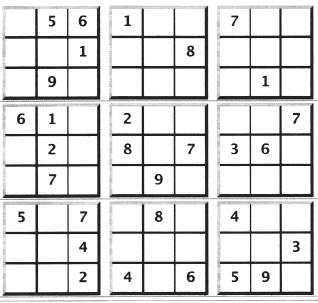
Fill in the empty cells, one number in each, so that each column, row, and region contains the numbers 1-9 exactly once. Each number in the solution therefore occurs only once in each of the three “directions,” hence the “single numbers” implied by the puzzle’s name. (Rules from wikipedia.org/wiki/ Sudoku)

“Thanks



We have availability for the 2020-2021 school year beginning June 1st at Hudson heights apartments. The studios include electric, heat, water, garbage and parking. There is coin-operated laundry facilities on site. Prices start at $750 / month for a 12 month lease. If you have any questions or would like to schedule a tour contact us by phone 607-280-7660 or email: renting@ithacaLS.com
COLLEGETOWN TERRACE APARTMENTS
Leasing for 2020/2021 Spring 2020 Semester leases available Heat, hot water and Wi Fi State of Art Fitness Center Shuttle Bus Service to campus Washer & Dryer in Apartments collegetownterraceithaca.com office@ithacastudentapartments.com (607) 277-1234
AVAILABLE 2020-2021
1, 2, 4 Bedroom Apts. and 7 person House 10 & 12 month leases Cook/Blair Street Call or Text Christopher George RE 607-279-5520
Collegetown Crossing College Ave's Newest Location 307 College Ave.
Now Leasing for 2020-2021
Completely New Modern Studios, 2 & 4 Bedroom Apartments.
Fully furnished, heat & hot water included. Reception area at 307 College Ave. www.urbanithaca.com 607-330-2442 info@urbanithaca.com
120 Oak Avenue
Just steps to Cornell Campus 10 bedroom house & 1 and 2 bedroom apartment 607-277-1234 office@ithacastudentapartments.com Ithacastudentapartments.com
26 A PA R TMENT FOR R ENT
Now Renting 2-10 Bedroom Houses/ Apartments for 20-21. All Locations. Call today or visit our website: Certified Properties of TC Inc certifiedpropertiesinc.com 607-273-1669
20-21
College Ave. 5 BR House Furnished. Laundry. Parking. Call 607-273-8576
Spring 2020 Upper Eddy St. 7 BR house Furnished. Laundry. Call 607-273-8576
DISCOUNTED!!! COLLEGETOWN 8, 10 or 11 BEDROOMS 607-272-3389 cbeach24@aol.com
8-9 BEDROOM HOUSE FOR 2020-2021 133 Blair St Corner of Cook and Blair just off of College Ave. Huge rooms, great porch, free laundry, furniture, 4 bathrooms, 3 kitchens. Great storage closets, parking for 3-4 cars. Contact Nick at 607-256-3778 or nick@lambrourealestate.com
2020-2021
400 Block Dryden Rd. 9, 10 & 13 Bedrooms 607-257-3578 Call or Text info@oconnorapartments.com
FOOTBALL
Continued from page 12
only five plays to travel 74 yards for its third score.
Kenney went 3-of-3 for 64 yards as he connected with junior wide receivers Phazione McClurge and Mason McManamon to move the Red down to the Columbia 10. Then, Coles made his second trip into the end zone, scoring on a handoff from the 10.
Down by 21 midway through the second quarter, the Lions had to respond and encountered yet another fourth-down situation in its own territory. Having punted five times in a row, Columbia head coach Al Bagnoli made a gutsy call, opting for a fake punt.
The play worked, as punter Drew Schmid caught the Red sleeping, gaining 27 yards on the ground. Lenhart capped off the drive with a 10-yard touchdown pass to the Wainwright, but the PAT doinked off the upright, resulting in the Lions trailing, 21-6.
corps on its next drive. Coles, Glover and junior running back SK Howard combined for 72 yards. Howard himself contributed 43 yards thanks to an athletic 32-yard run, putting the Red inside Columbia’s 5. Kenney ended the drive with a QB sneak to give Cornell a 35-9 edge.
The Lions failed to put a dent in their deficit. Early in the fourth quarter, Columbia turned the ball over on downs outside the red zone, and it failed to garner any quality scoring opportunities thereafter.
“We took away some of the stuff they do really well,” said senior cornerback David Jones, assessing the defense’s strong performance. “They like to take some shots and run the ball, and we were just out there playing hard defense with a lot of energy. Everyone was trying to get in on the tackles.”
“Everyone knew that we were a really solid team that could pull out some wins against great teams.”
David Jones
With time dwindling in the half, Columbia took over after a Cornell punt and executed its two-minute offense. The Lions methodically moved down the field before they stalled out at the Cornell 10. This time, Columbia kicker Alex Felkins’ boot was good, cutting the Red’s lead to 21-9 heading into the half.
“The only thing I said [in the halftime locker room] was, ‘Keep your poise,’” Archer said. “Even though [Columbia] had scored, I didn’t think they had enough to get it done. Everybody just had to use their head, keep their poise and play smart.”
Bagnoli made another bold call out of the intermission. The Lions started the second half with an onside kick, but freshman linebacker Jake Stebbins was there to scoop up the ball.
On the Red’s drive, Cornell stalled for a threeand-out but a Columbia defender ran into senior punter Nickolas Null, resulting in a penalty.
With a new set of downs, Kenney found McClurge for a 24-yard pickup, and sophomore running back Thomas Glover rushed for a threeyard touchdown on a jet sweep.
Cornell displayed its dynamic running back
Cornell coasted in the fourth quarter to earn its second straight victory and send its seniors out on a high note.
“Credit goes to the leadership on this team,” Jones said. “No one came in to take a day off — everyone knew we were a really solid team that could pull out some wins against some great teams. We just kept pushing every week, every day for moments like this.”
Not only will the seniors have this parting memory, but Cornell’s victory serves as a springboard to build success heading into next year.
“I just hope [this win] catapults these younger guys into an Ivy League Championship,” Coles said. “At the end of the day, that’s the goal. Knowing that we got two pretty big wins at the end of the season is awesome — that’s all you want.”
Archer shared his final message to his seniors.
“Thank you,” Archer said. “I look at winning the Ivy League Championship like lighting the Olympic Flame … Different people carry it to get it [to the Olympics]. These guys have carried this flame through some rough terrain and broken through that rough terrain. Now, we know how to run it and let’s continue that thing on and light that sucker next year.”
Luke Pichini can be reached at lpichini@cornellsun.com.
MEN’S HOCKEY
Continued from page 12
with last night,” Malott said. “As the game went along we really came up to our standard and we found four lines that were really working hard and had strong details and kind of found our game as things went on.” Despite the slow start, Cornell built a big lead in the middle period, taking the pressure off its netminder. After the third goal provided some breathing room, junior forward Cam Donaldson’s breakaway goal later in the second — after a blocked shot by freshman defenseman Travis Mitchell sent the puck free and sent Mitchell hobbling toward the bench — made it 4-0.
the third, but junior defenseman Alex Green’s goal on a nice feed from Donaldson about four minutes later reestablished the four-goal lead.
“We found four lines that were really working hard and had strong details.”
Jeff Malott
The Tigers’ goal at the tail end of a power play ended an otherwise solid weekend for the Cornell penalty killing unit. The Red went 5-for-5 on the kill in the win against Quinnipiac and was 5-for-5 to start Saturday’s game before a shot hit a defenseman’s stick before riding up over Galajda’s shoulder. Through eight games, Galajda is yet to record a shutout, but has allowed two or fewer goals in each of his wins.
Cornell takes on Boston University at 8 p.m. Saturday at Madison Square Garden in New York City.
Princeton closed the gap a bit and ended Galajda’s shutout bid with a power-play goal early in
Raphy Gendler can be reached at rgendler@cornellsun.com.
By RAPHY GENDLER Sun Sports Editor
A night after stealing a 2-1 win against Quinnipiac, junior goaltender Matt Galajda was the star again in the second game of a four-point weekend on Saturday, helping No. 2 Cornell men’s hockey to a 5-1 win over Princeton and giving the Red its first 8-0 start to a season since 1971.
Cornell (8-0, 6-0 ECAC) erupted for four goals in the second period to run away from the Tigers (1-4-3, 0-4-2), who forced Galajda to make several impressive stops on odd-man rushes and chances in the crease.
Galajda made 12 of his 25 saves in the first period. He made 10 stops in the second before Cornell dominated the final period.

Following a scoreless opening frame, senior forward and captain Jeff Malott’s snipe from near the right circle gave the Red the lead less than a minute into the middle period. After several penalties were assessed in rapid succession against both teams, junior forward Tristan Mullin and freshman forward Ben Berard scored goals 45 seconds apart to widen the lead to 3-0 past the midway point of the period and chase Princeton goalie Ryan Ferland from the game.
“They have a little bit more of a killer instinct than some teams I’ve had in the past,” said head coach Mike Schafer ’86. “They see that opportunity to go up 1-0, 2-0 and then get to the third goal, which is always critical.”
The Mullin and Berard goals continued two patterns for Cornell: scoring in bunches and dominating second periods. The Red had four goals in Saturday’s second period after tallying two on Friday, and the team has scored more than half its goals this season in the middle 20 minutes.

“We kind of just took over with our depth and really got back to the way we should be playing, rolling our lines and letting our skill take over,” Mullin said.
Mullin has played on a line with senior Noah Bauld and junior Kyle Betts throughout the season. In two games this weekend, the trio shut down both opponents’ top lines. In Saturday’s contest, Mullin scored a goal and Betts chipped in two assists, including a nifty feed on Malott’s goal. Betts also dominated in the faceoff circle, winning 12 of his 13 draws.
“Once we get one it’s like we can taste blood,” Malott said of his team’s quick scoring. “We just kind of keep pressing and keep pressing and it ends up breaking teams’ will.

We haven’t had crazy good starts; we haven’t made a living off of starting the game and breaking their will right away but it just seems like if we play our game, teams have a hard time maintaining pressure for more than the first period.”
After being bailed out by Galajda in Friday’s 2-1 win, Cornell got off to a slow
start on Saturday, relying on Galajda to make a few excellent saves early in the first period and again surrendering some oddman rushes in the first and second.
“It’s kind of tough to see a start like that especially because we weren’t very happy
MEN’S
page 11
By LUKE PICHINI Sun Assistant Sports Editor
After a crushing loss to Penn two weeks ago, Cornell football was sitting at 2-6 with only a single conference victory. The Red was slotted at seventh in the Ivy League standings and appeared primed for another disappointing finish.
But a lot changed in two weeks. With emotions running high on Senior Day, the Red blew out Columbia, 35-9, to secure a fourthplace finish in the Ivy League and
finish with a 3-4 record in conference play.
After Cornell’s incredible upset of then-No. 11 Dartmouth on the road along with losses by Harvard and Columbia, the Red had a chance to move up the standings — and it took advantage, earning its first top-four finish of David Archer’s ’05 tenure.
For the final week of the season, Columbia — coming off an embarrassing 48-24 loss to Brown — visited Ithaca for the Empire State Bowl.
The Red’s victory comes a year after it fell to Columbia off a last-minute kick return for a touchdown.
“I’m just so happy for the senior class — those kids have worked so hard through so many ups and downs,” Archer said. “They posted one of their best performances last in a dominant win over a team [that we suffered] a heartbreaking, crushing loss to last year.”
Playing for its seniors, Cornell (4-6, 3-4 Ivy League) came out with high energy. The Red forced

three-and-outs on Columbia’s (3-7, 2-5) first three drives, providing no breathing room for the Lions.
“This week, our captain [senior] Jelani Taylor gave [the senior speech],” said senior running back Harold Coles. “Listening to that guy speak, you want to run through a wall for that man. He’s awesome, and I love him to death … he’s just one of the most natural leaders I’ve ever met. You can see that energy from the first play for sure.”
offensive guys on the headsets were like, ‘Man, I’m going to miss that breakaway speed.”
Eventually, Columbia gained some steam. On third down, Lions quarterback Ty Lenhart found wide receiver Josh Wainwright for a 33-yard gain to move into Cornell territory. But Columbia squandered this opportunity, shooting itself in the foot with two unsportsmanlike conduct penalties.

Meanwhile, Cornell found much more success on its first possessions. In fact, on the second play of the game, senior running back Harold Coles found an opening and burst through. The Erie, Pennsylvania, native rumbled all the way into paydirt for a 58-yard score to give the Red the early advantage. Coles became the eighth player to rush for 2,000 career yards in program history with the big run.
“You see those stats, but there’s just a lot of other things that go into it,” Coles said. “There’s a lot of great guys that block for me, a lot of great coaches that helped me get here. It’s more of a testament to everybody else than me because I’m so blessed to be here.”
“Did you wonder, on the second offensive snap, when [Coles] took it to the house whether it was our day or not,” Archer said. “He just set the tone from the start with that … When he broke that run, the
“I think we had a [couple penalties], but we didn’t cross the [line],” Archer said.
“You got to be really smart, and that’s the line — don’t do anything that’s going to hurt us.”
After the Lions were forced to punt, Cornell extended its lead. Near the end of the first quarter, junior wide receiver Eric Gallman made a catch at the first down marker, broke a tackle and ran all the way down to the Columbia 20 for a 51-yard catch-and-run.
Shortly after, the Red worked the ball down to the goal line. On 4th-and-1, junior quarterback Richie Kenney pitched the ball to sophomore running back Delonte Harrell, who easily walked into the end zone. Early in the second frame, Cornell held a two-score lead. That lead grew once more as the Lions were forced to punt again on the ensuing drive. Cornell needed
FOOTBALL page 11