
C.U. Students in Hong Kong Evacuate
By NICOLE ZHU Sun Assistant News Editor
After five months of protests in Hong Kong, the city’s universities are becoming epicenters of increasingly violent conflict— and now international students studying abroad in Hong Kong, like Abbie Zhu ’21, are evacuating the city. Although her peers from other American universities have been called back home, Zhu and her fellow Cornellians are figuring out their own travel plans amidst limited communication from Ithaca.
As one of the four Cornell students studying abroad in Hong Kong this semester, Zhu had originally planned to leave Hong Kong at the end of December. But she decided to cut her time short and will be flying out of the city next

week to Shanghai, where she has extended family.
On Thursday, Zhu’s classes at the University of Hong Kong were cancelled for the rest of the semester, and a statement by vice provost of international affairs Wendy Wolford confirmed that several Hong Kong universities had ceased face-to-face classes.
“I’m leaving with a lot of regrets,” Zhu told The Sun in a phone interview. “I thought that I would have a month more to go to explore the city. A lot of things that I planned to do, I won’t be able to do.”
Major clashes with the police have largely occurred at other universities, such as Hong Kong Polytechnic University, where police stormed the campus barricades on Monday morning (Hong Kong Standard Time) and fired petrol bombs at the students inside, the Washington Post reported. At HKU, protesters
Design of Fine Arts Libe Sparks Uproar
Architect prioritized form over function, critics say

By KATHRYN STAMM Sun Staff Writer
The newly renovated Mui Ho Fine Arts Library houses over 100,000 books suspended from the ceiling. The steel grate floors between the three levels of stacks are permeable by air and light — and are see-through.
Located in the College of Art, Architecture and Planning’s Rand Hall, the $22.6 million project’s
goal was to create a light-filled space that would connect students to the library’s resources and wealth of knowledge, The Sun previously reported. However, since its opening on Aug. 5, many have criticized the library about its usability and accessibility, including for people wearing dresses or afraid of heights.
Nicole Noruma, grad, first visited the library with a friend in
September. When she arrived, she instantly realized that she would be “very uncomfortable” going into the stacks — because she was wearing a dress.
“I think [the library] is really beautiful, but I realized I couldn’t use it,” said Noruma, who studies landscape architecture and urban planning. “A successful design is something that all people can use, no matter who they are, or what their style is or what their clothing preference is.”
In response to these criticisms, architect Wolfgang Tschapeller M.Arch ’87, who designed the renovation, urged visitors to respect each other and not look up, Metropolis Magazine reported.
“It's a beautiful library, so your eyes are drawn up, because you can see up through the floors of the library,” Noruma countered. “That comment [is] really disconnected from the actual human experience.”
Yuhan Ji ’21 said the first time she was in the library, she was
3
Student to Be First-Ever Black Woman to Earn CompSci Ph.D. From C.U.
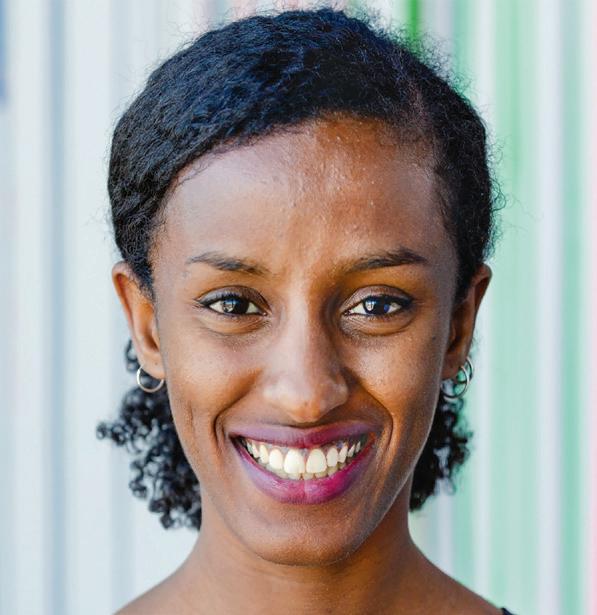
Last Monday at 11 a.m., Rediet Abebe grad presented her thesis to a room full of supporters representing disciplines and educational levels from across the university. In December, she will become the first black woman to graduate with a Ph.D. in computer science from Cornell. Her presentation,
entitled “Designing Algorithms for Social Good” was her B exam, the final requirement towards her Ph.D.
Jehron Petty ’20, co-president of Underrepresented Minorities in Computing, orga-
nized for students to attend the thesis presentation in support, some of whom had no connection to the computing world. Other groups rallied around her as well, including the Black Graduate & Professional Students Association. “It was a very diverse audience and it was very meaningful to me, actually, to have them there,” Abebe told The Sun.
Finding perspective | Cornell’s newest library has met criticism, with detractors calling the space inaccessible to certain groups.
Set in stone | Protesters wrote “revolution” in Mandarin with roadblocking bricks.
COURTESY OF ABBIE ZHU '20
REDIET ABEBE GRAD
By AMINA KILPATRICK Sun News Editor


Monday, November 18, 2019
Today
Vocation for Travel: Catholic Seminary Training in Sri Lanka Lecture 12:15 p.m., G08 Uris Hall
Presidents, Populism, and American Democracy 4:30 - 6 p.m., 120 Physical Sciences Building
“Rare Islamic Books in the Olin Library Collection” Seminar 4:30 - 6 p.m., Basement Floor, Kroch Library
Data Visualization Workshop 4:45 - 7:15 p.m., 3330 Tatkon Center
Tomorrow
Chat with Social Entrepreneur Marcela Torres, CEO of HolaCode Noon - 1 p.m., eHub, Kenndey Hall
“Planet Nine From Outer Space” Lecture 4 -5 p.m., 105 Space Sciences Building
International Transgender Day of Remembrance Vigil and Reception 6 - 7:30 p.m., Chapel, Anabel Taylor Hall
Pan-African Drum and Dance Ensemble Open House 7:15 p.m., B20 Lincoln Hall

Cornell
New University Registrar Hired
On January 13, former North Dakota State University registrar Rhonda Kitch will assume the same position at Cornell. Kitch received her Ph.D. from North Dakota State University, and remained there for twenty years working in offices such as admissions and then the registrar’s office, according to The Cornell Chronicle.
At Cornell, Kitch will oversee the organization of all Cornell student academic records. Some examples of her duties include approving transcript requests, sending school enrollment certifications and the distribution of diplomas after graduation.
New York State
Take Respite in Puerto Rico
Last week, the vast majority of the New York state political class spent several days in Puerto Rico as part of their annual getaway. The trip is held by a non-profit called “Somos,” whose official stated purpose is to“address problems of the Hispanic community” through grants and scholarships.
However, Somos’s primary event is this weekend-long trip: a rare opportunity for Albany lawmakers, lobbyists, reporters and candidates to fraternize outside the confines of the state house.
Their number included political heavyweights such as Mayor Bill DeBlasio and Governor Andrew Cuomo, as well as half of the New York City Council, who rubbed shoulders with unions and corporations such as Airbnb and cigarette company Altria. These career politicians use the event as a chance to network and discuss policy, and also unwind with one $15 cocktail each, paid for by various lobbyist groups, according to the New York Times.
Louisiana Governorship Goes to Democrat
On Democra t John Bell Edwards was reelected the governor of Louisiana in a special election on Saturday, narrowly beating out his Republican opponent Eddie Rispone. Rispone’s campaign was largely centered on far-right conservative policies championed by President Donald Trump. Political pundits are hailing this election result as a symbolic signal of opposition against Trump in traditionally “red” states, according to The New York Times.
— Compiled by Amanda H. Cronin ’21
Champion Player Carli Lloyd to Speak
By AMANDA H.
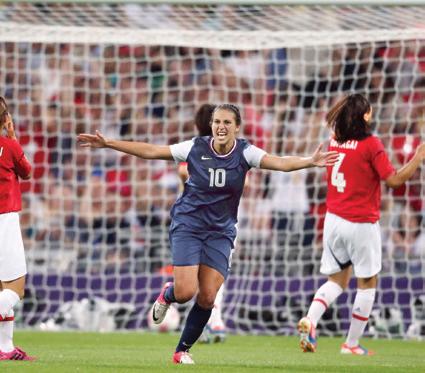
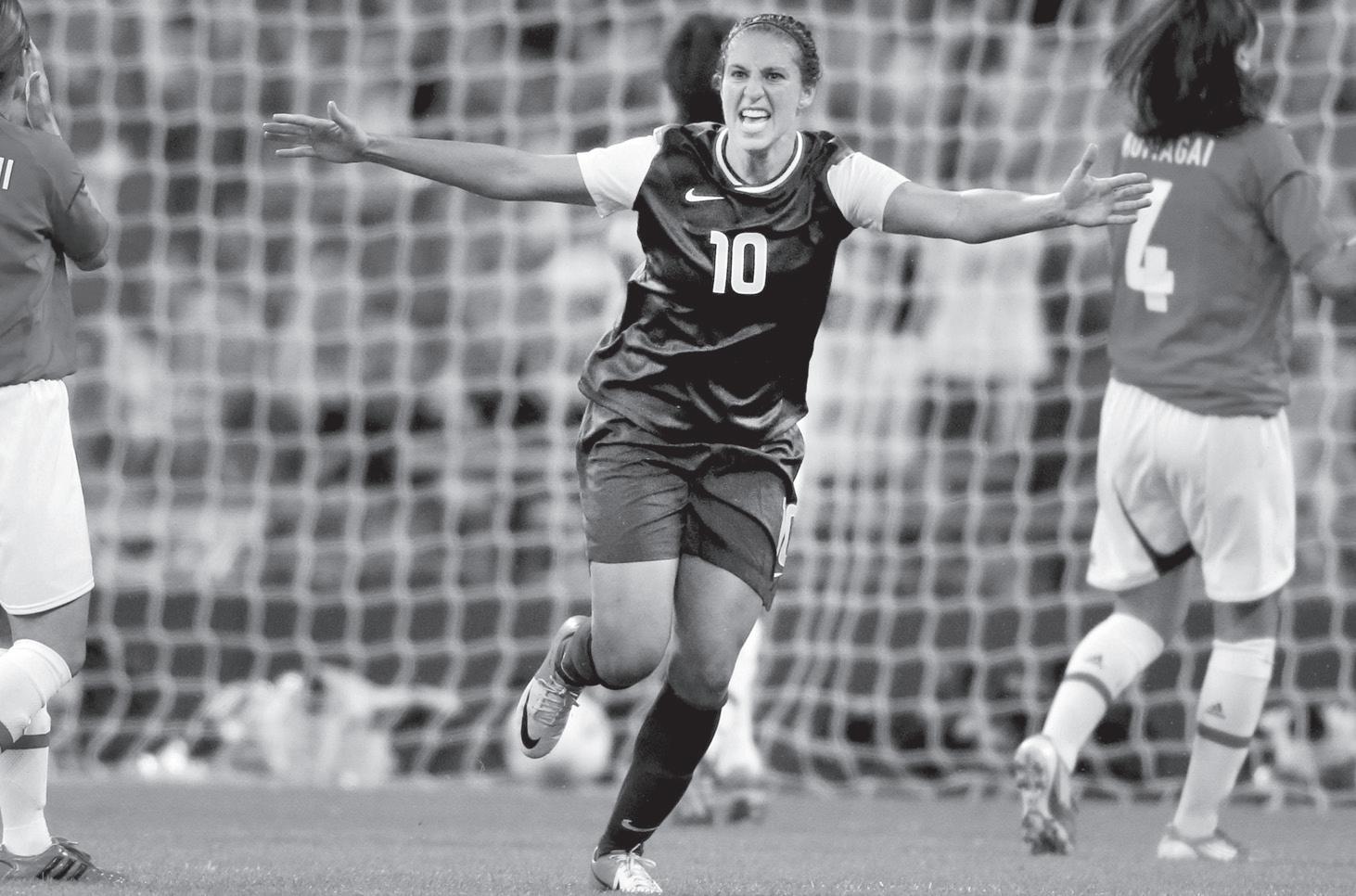
On the soccer pitch, she’s known as number 10 and the player who once completed an unprecedented feat: a hat-trick within the first 15 minutes of a World Cup championship game. Off the field, Carli Lloyd has emerged as one of the foremost advocates for pay equality in sports.
Lloyd will bring that equal-pay-forequal-play message to Bailey Hall on Friday December 6 in an event sponsored by Cornell University Programming Board.
The two-time Olympic medalist will be interviewed by Prof. Lawrence Glickman, American history, followed by a question-and-answer session. Audience members can submit their questions to CUPB online
prior to the event.
Lloyd, now 36 years old, has made headlines for years as one of the top scorers in the national league, and has been generously decorated with accolades throughout her career. Most notably, she was named FIFA Player of the Year in 2015 and 2016 and served as co-chair of President Obama’s Council on Fitness, Sports and Nutrition. The Rutgers University alumna has been playing soccer since she was a young girl. She now mentors the young players on her hometown team, the Medford Strikers.
right thing, the fair thing. It’s about treating people the way they deserve to be treated, no matter their gender.”
Her essay was published to explain her
“Each player [on the women’s national team] is a role model to me and it’s really amazing what they’ve done.”
Naomi Jaffe ’21
In 2016, Lloyd authored a New York Times essay calling for salary increases for the women’s team, stating, “This isn’t about a money grab. It’s about doing the
See-Trough Stacks Prove Modesty Problem
sitting at a desk and happened to look up, where someone in a dress was standing.
“The floor is completely transparent,” Ji said. “Of course I could see everything.”
Tschapeller also told Metropolis Magazine that addressing the modesty concerns with by covering up the seethrough floors would “literally destroy the project.”
“The flow of space and flow of air are essential,” he told the magazine.
As classmates reacted that they “couldn’t believe this happened,” Noruma said she wasn’t surprised about the oversight. Though these issues seem like common sense, not everyone thinks about these things, she explained.
“Every space that we use is designed by someone,” Noruma said. “[These concerns are] starting a really interesting conversation: Who is that someone? What’s their intention? Who are they really designing for?”
Prof. Jonathan Oschorn ‘75,
architecture, also raised concerns about the library’s design and its lack of adequate safety precautions. He has been tracking the library for nearly a decade, and more recently writing on its renovation. On June 5, Oschorn filed an official complaint about the design proposal with the New York State Division of Building Standards and Codes.
For instance, Oschorn wrote that the elevators are too small to fit a stretcher and noted potential fire-safety hazards, especially given the vertical design of the library. He specifically criticized the “vertical openings in bookstack floors” and that the “smoke control system does not protect building occupants.”
The Oversight Unit of the New York State Division of Building Standards and Codes rejected the complaint on Sept. 26, but Oschorn plans to appeal the decision.
Noruma also pointed out that there are shoe issues with the floors, which are grated. People wearing high heeled shoes will
motivation for signing onto a wage discrimination lawsuit against US Soccer in March 2016. The case will have its day in court
Sculpture in C-Town
CRONIN Sun News Editor
#10 is Number 1 | Carli Lloyd celebrates a goal during a World Cup match. The forward player and former team captain is one of the top scorers.
DOUG MILLS / THE NEW YORK TIMES
Library Architect Defends Design
not be able to walk in the stacks without catching their heels in the holes. And in the winter, people will likely track in snow and slush that could melt and drip through the floors.
She explained that the library’s design set limits on who could use the library — “very specific things” have to be worn to be comfortable in the space.
“[In] design, you have to think about people first, and that’s how you shape your design,” Noruma said.
Officials from the architecture college and Tschapeller both did not respond to The Sun by publication time.
Other students using the space have also voiced their critiques about different aspects of the library and the barriers preventing them from using it.
Hana Gabrielle “H.G.” Bidon ’21 said the library is “overwhelming” and a “sensory overload” for her, especially auditorily. Ji agreed, finding the library “too loud,” with carts rolling over the metal floors, which don’t dampen any
sound.
“Why didn’t they take that into consideration?” Bidon said. “[The library] is not welcoming at all.”
Bidon said she heard from friends that people with mobility or visual aids will not be able to experience the library as easily as others, because the grated floor would not be conducive to canes.
According to the architecture college's website, the building is fully compliant with the Americans with Disabilities Act.
Ji also explained that her friends with acrophobia, or fear of heights, find themselves unable to access the books, because there isn’t a solid floor. The only other solution is to ask a librarian to retrieve the books for them, which can be stressful, she said.
“There are two simple things you want to be able to do in a library,” Ji, who studies landscape architecture, said. “You want to be able to study in the quiet, and you want to be able to find books. It doesn’t do any of them. It’s got to be a library first.”
Kathryn Stamm can be reached at kstamm@cornellsun.com.
Star Soccer Striker Carli Lloyd to Speak
next year — a federal judge ruled on Nov. 8 to elevate it to a class-action lawsuit, which will be heard in May 2020.
This past July, Lloyd was instrumental in helping her team to victory in the 2019 World Cup final game against the Netherlands. In her Times piece, Lloyd laid out the discrepancies between how US Soccer treats its champions.
“If I were a male soccer player who won a World Cup for the United States, my bonus would be $390,000,” she wrote. “Because I am a female soccer player, the bonus I got for our World Cup victory last summer was $75,000.”
It was the U.S. women’s team’s fourth World Cup win in eight appearances. The men’s US national team has appeared in ten World Cup tournaments, and has never claimed a trophy since the men’s competition began in 1930.
When Naomi Jaffe ’21, a defenseman on the Cornell
women’s soccer team, found out that Lloyd was coming to Cornell, she and her teammates “freaked out.”
“Each player [on the women’s national team] is a role model to me and it’s really amazing what they’ve done to put women’s soccer on the map and make a difference on and off the field,” Jaffe said.
Jaffe told The Sun that her whole team is excited to attend the event and hear Lloyd speak about her work in advocating for equal pay.
“It’s an extremely important movement. It’s just not fair for female athletes to be rewarded less for their hard work than men who do the same job,” Jaffe said.
Members of the Cornell Community can pick up their free ticket with a valid Cornell ID at Willard Straight Hall Resource Center beginning Nov. 19 at noon. Tickets for the general public will be available beginning on Nov. 25. A limited amount of tickets will be available at the door.
are obstructing roads and local Mass Transit Railway subway stations and barricading buildings on campus.
“[The protestors] are literally on the campus, and blocking all the entrances [to campus and academic buildings],” Zhu said. Public transportation has also been crippled; buses are unable to pick up passengers at HKU due to roadblocks set up by protestors.
The protestors are also responsible for “destroying” the HKU subway stop, Zhu said, shutting off yet another transportation option.
Dozens of American universities have issued notices for their students to abandon their abroad programs and retreat back to the U.S. Syracuse University announced last Thursday that it would give students in its Hong Kong program until 4 p.m. on Nov. 19 to check out of student housing, while Georgetown University told its students in an announcement on Nov. 13 to leave the city as soon as possible, according to student newspaper
The Hoya.
But according to Zhu, Cornell “has been very not attentive,” in comparison with other American universities.
“[The University of California] schools have been actively reaching out to all of the students and telling them to go back as soon as possible, and that they’ll cover any flight changes or whatever if they want to leave early,” Zhu said. “We don't have any of that.”
For students enrolled in the
Syracuse program, the cost of changing to a Nov. 19 flight would be reimbursed later by the school, according to The Hoya.
“[Cornell’s international health and safety team] sent me an email recently asking me what my plans were and to check if I was safe,” Zhu said. “I told them that classes are cancelled and I'm going to Shanghai, and they were like, ‘Okay.’ And that’s it.”
“It just feels different,” Zhu said.
Email correspondence on Nov. 13 from Chris Cook, manager of international health and safety, to students abroad in Hong Kong included instructions to “continue to monitor local media, avoid all protests and demonstrations, follow the advice of local authorities, and keep in regular contact with friends and family.”
Cornellians in Hong Kong were “encouraged” to leave and finish their semesters elsewhere, and have access to Cornell’s International Health & Safety Team — a division of the Office for International Affairs that facilitates international travel for Cornellians — as well as International SOS hotlines, according to a statement by Wolford, the vice provost for international affairs.
For Zhu, the protests have defined her time in Hong Kong.
“I still really like the city, but the protests have affected how well I’ve been able to explore the city, and I guess how close I can feel to the city and its people,” Zhu said.
Before she arrived in Hong Kong in August, Cornell offered
Hong Kong Students Weigh Teir Options
HONG KONG
Continued from page 4
Zhu and the other Hong Kongbound students deferred enrollment until the spring semester, but Zhu decided to go anyway.
“It really wasn’t that bad back then,” Zhu said. “I didn’t really expect it to escalate that much.”
Zhu will complete the rest of her coursework online for the duration of the fall semester.
For former Hong Kong study abroad students, reports about the protests present a strange dichotomy between the city they experienced and the city they hear about now.
“Things started right after I had just left,” wrote Joyee Mok ’20, who studied at the Hong Kong University of Science and Technology during the Spring 2019 semester. “It felt really weird to think that the home I just had for the past half year had become something so different. With how things have become now, I am incredibly upset.”
Unlike Mok, Joanna Li ’20,
who attended HKU also during the spring semester, saw firsthand signs of rising tensions over the proposed extradition law.
On one occasion in May, Li happened upon a public discussion in a park by local Hong Kong residents of the controversial law.
“So many people were shouting — and it was all in Cantonese, so I had no idea what was going on. And then I talked to someone in the crowd, like, ‘Oh, can you tell me what’s happening?’ They kind of filled me in, and it was about the extradition law.”
Li was “taken aback” by how heated the public discussion became, but thought that it was an isolated incident. Upon her return to the states, reports of the increasing unrest in Hong Kong proved otherwise.
“It’s just very jarring. And your heart, like, breaks as you read it,” said Li. “This city that gave me the best semester is just — it’s never going to be the same, you know?”
Nicole Zhu can be reached at nzhu@cornellsun.com.
1st Black Woman C.S. Ph.D.
PH.D.
Continued from page 1
Abebe said her research focuses on using artificial intelligence techniques in order to improve societal welfare. One example is addressing income shocks low-income people face such as missed paychecks. Her research involves a welfare model that uses information about families to find intervention methods and mitigate the effects of the income shocks.
She said that her interest in social problems roots back to her upbringing in Addis Ababa, Ethiopia. There, she recognized the income inequality and social issues that face her home country, noting that the “big mansions and plastic homes” are on the same block.
“Addis Abba is a very beautiful city,” Abebe said. “It’s something that's really shaped my identity as a person, as a researcher.”
This awareness was something she kept with her throughout her academic career, and after she moved to the United States to study at Harvard University, from which she graduated with a degree in mathematics in 2013.
After studying at the University of Cambridge for one year, where she received a Master of Advanced Studies in Mathematics degree, Abebe’s academic trajectory changed directions — to focus on the world of algorithms and applied mathematics and to address social issues.
Abebe’s passion for social policy issues was piqued while writing for The Harvard Crimson student newspaper as an undergraduate student. Abebe covered Cambridge City Council and Cambridge Public School meetings and heard about the issues most deeply affecting residents, and the inequality that surrounded them, she said.
Learning about funding issues, achievement gap problems and general problems that plagued the city created a dilemma for Abebe, as she was confronted with social issues
she was interested in studying, she said.
She described her year at the University of Cambridge as a time to freely explore her academic interests. It was during that time she realized she did not have to explicitly choose between those two career paths.
“I realized that actually, if you do computer science or applied mathematics and ultimately other fields, you can work on these really interesting challenging mathematical questions you can do a lot of data-driven work, you can play with data, but you can also think about problems that affect society immediately,” Abebe said.
Once she returned to the United States, she obtained her M.S. in Applied Mathematics from Harvard in 2015, and applied to a range of Ph.D. programs. She said her decision to choose Cornell was due in part to her advisor Prof. Jon Kleinberg, computer science, and the relationship between their areas of research, which she described as “spiritually similar.”
“His way of thinking about the world was something that resonated with me as well; that you can do exciting math and computing problems that are inspired by social processes,” Abebe said about Kleiberg.
Kleinberg is also the interim Dean of the CIS department, following Dean Greg Morrisett’s move to Cornell Tech.
Abebe was recently selected a member of the Harvard Society of Fellows, a three-year fellowship program offered to a handful of people annually who are in the early stages of their career. She is the fifth computer scientist to be selected in the program’s history, which was founded in 1933. Abebe said she plans to be a professor at a research institution.
To continue reading this story, please visit www.cornellsun.com.
Amina Kilpatrick can be reached at akilpatrick@cornellsun.com.
ARTS & ENTERTAINMENT
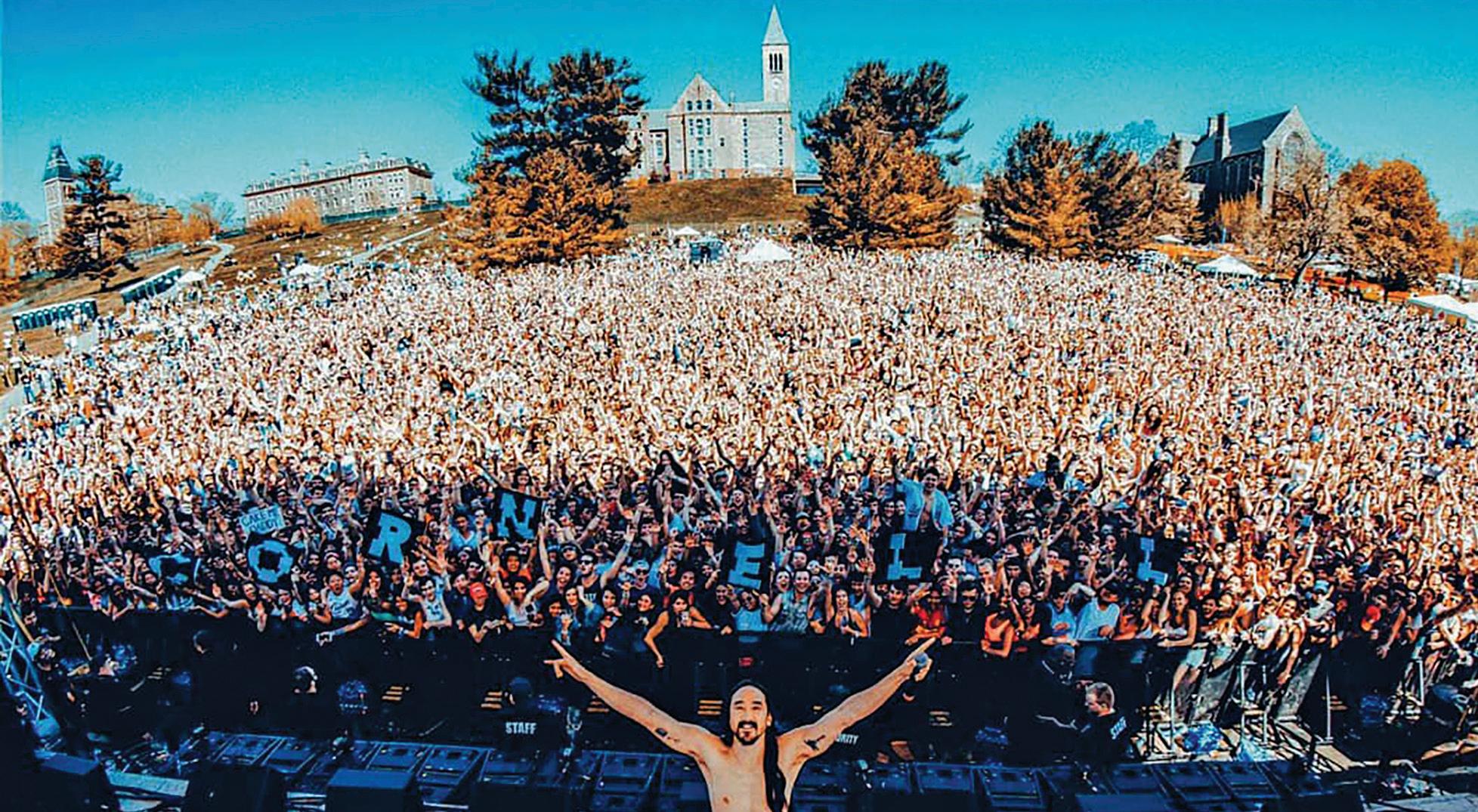
Slope Day Selections Survey Set for Release
For many Cornell Students, Slope Day is a fun way to celebrate the end of spring classes. For the Slope Day Programming Board — the student-run organization tasked with the day’s planning and execution — however, it is a year-round affair. I got the chance to sit down with Alana Udwin ’20 and Logan Altheim ’20, the SDPB’s executive and selections directors, last week to discuss the inner workings of the Board in anticipation of its annual selections survey being released this week.
Per Udwin, who formerly served as selections director, the organization’s planning for this coming Slope Day started just about as soon as last year’s came to a close. As has been the case for the last couple of years, though its distribution has changed hands between the SDPB and Cornell Health, students were sent an event feedback survey through which those organizations can gauge the efficacy of their programming.
As the SDPB sifts through several thousand feedback responses over summer break, the organization’s six-member executive board is also keeping a close eye on music trends and starting to reach out to agents of popular artists.
Once school starts back up in the fall, it is full steam ahead for the SBDP and its 30-some-odd member general body (which is open to anyone who would like to become more involved). Overseen by two advisors — Joseph Scaffido, Cornell’s director of campus events, and Jessie White, a conference and event services event manager — this semester the group has placed special emphasis on meeting with a wide range of campus groups in an effort to make this year’s Slope Day choices as representative of current campus culture as possible.
Just this semester, Udwin and company have met with a number of campus organizations including Slope Media, the Cornell Concert Commission, the Gender Justice Advocacy Coalition and the ALANA Intercultural Board. In doing so, they have put together a list of artists they feel to be a more representative sample of what campus wants than ever before.
“What campus wants,” though, proves a difficult question for the Board as many chart-topping musicians fall outside the realm of what they can make happen. The SDPB receives funding through the undergraduate Student Assembly to the tune of $19 per student, totaling to over $250,000 dollars per year. However, as Altheim notes, that total is not as large as it may seem.
“The rise of music festivals and streaming platforms have significantly impacted the music industry. Artists now charge more for their concert tickets and live performances, which means that with a static pool of resources we have seen the pool of performers we can book shrink,” said Altheim, who is also tasked with agent communications and fulfilling artists’ riders.
Not only have performance fees increased, but it is also worth noting that the SDPB’s funding is all-encompassing: The money does not just need to cover artist fees, but also food, set-up and all the other peripheral costs of running such a large event that many students might overlook. The S.A. recently voted to increase the organization’s allocation to $21 per student, but that SDPB will be unable to utilize that increase until the start of the fall 2020 semester.
In curating the list of artists to be included in the selection survey, Altheim and others work diligently to ensure that the musicians presented are not only popular choices among the student body but are also choices within that realm of possibility.
“To make the survey as effective as possible, we consult with talent agencies to ensure the artists on the survey are both within our budget and available [to perform on] Slope Day,” said Altheim.
Following the model established last year, this year’s survey will allow students to rate artists on a five-point scale, with an included sixth option for unknown artists. The team also considers artist’s past live performances, potentially controversial lyrics and reputation for concert cancellation as well as staying mindful of what artists and genres have been present in Ithaca over the past couple years to try and keep things fresh.
This year’s selections survey will include 24 artists and include names such as Swae Lee, Lil Baby, Alesso and Bebe Rexha. Though it might be easy for many students to dismiss their opportunity to vote on the grounds that it will get lost in the wash, Udwin stresses its importance.
“As Executive Board members of the SDPB, we try to act as an instrument through which Cornell can make its voice heard and the selections survey is the main way we can gauge the community’s interest in artists,” said Udwin.
Once the selections survey closes, the SDPB will begin digging through its results and reaching out to agents with hopes of having struck a deal with one of campus’ top choices by around the time classes resume in the spring.
To continue reading this story, please visit www.cornellsun.com.
Nick Smith is a senior in the College of Arts and Sciences. He can be reached at nsmith@cornellsun.com.
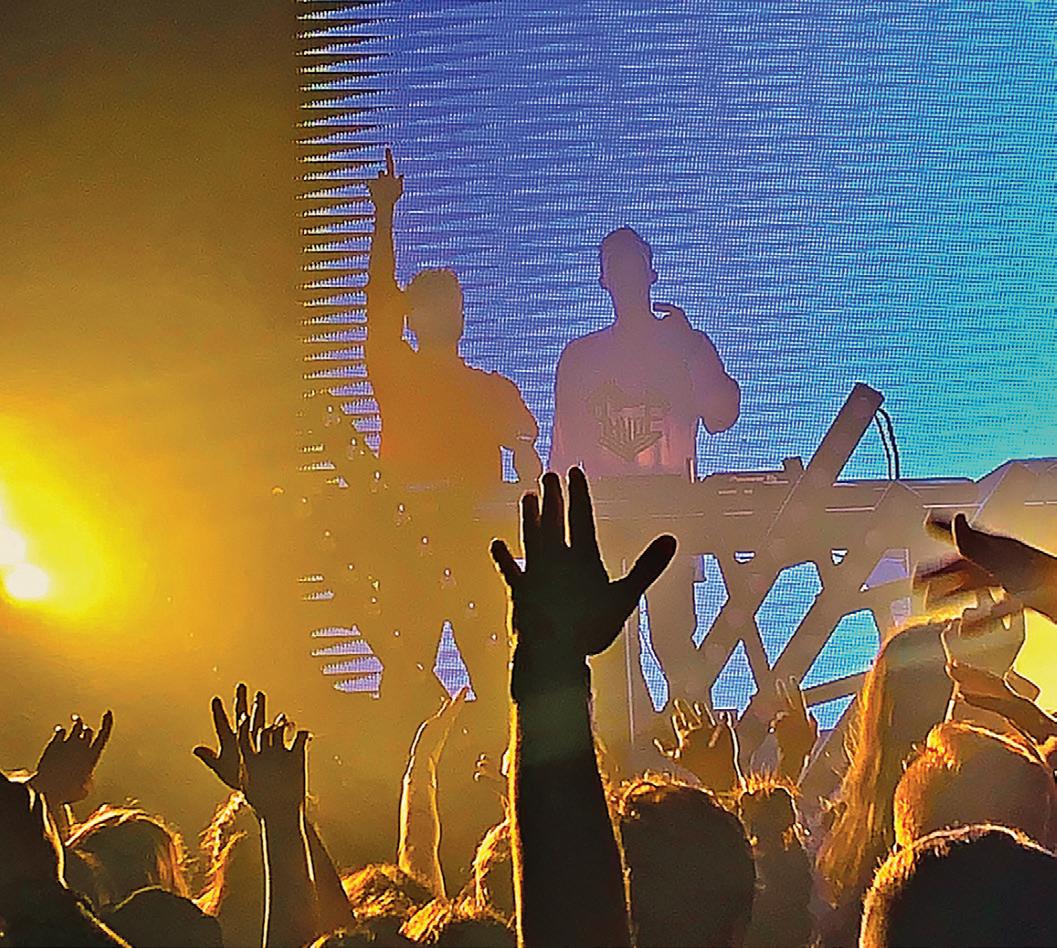
Loud Luxury Proves Syracuse Goes Hard
PETER BUONANNO SUN ARTS EDITOR
A trip to Syracuse turned an ordinary Thursday night, which most likely would have consisted of playing 2K and listening to Odesza, into one of the craziest experiences of my life. After about an hour’s drive, followed by a 10-minute walk through the freezing weather (Syracuse cold hits different for some reason), we entered the Westcott Theater near Syracuse University’s campus. The venue is small and intimate, almost as if someone took half of Klarman atrium, turned off the lights and put down a stage.
The floor was riddled with White Klaws, and the smell of Juul filled the air. The crowd was thin at first. It was mostly made up of people realizing that Loud Luxury wouldn’t go on until close to 11 and then complaining about how they started rolling way too early.
When the first opener went on, people started filing in. No one knows the name of the mysterious first DJ, but he was awesome. Mysterious DJ number one spun mostly trance-type tracks, and he certainly got the crowd going. Unfortunately, DJ number two did not do so hot. He was a little too into disco and the dancing was just too much. If you can’t dance, like me, keep your moves subtle. He was met with constant booing, but props to him for sticking it out for the full hour set. He was bad, but it was clearly just an off night.
Thank god for Black Caviar, the New York City-based EDM group which has been gaining notoriety on the festival scene, for saving the day. They played a lot of great remixes, but the highlight of their set was certainly their bass remix of “Mo Bamba,” which made that song cool again. They had the shortest set of the night, which is super unfortunate, as I could’ve listened to them for a few hours and been totally satisfied.
Loud Luxury sauntered onto the stage around 11 p.m.. The set was almost two hours, and the crowd did not stop dancing the entire time. They played remixes of Lizzo’s “Truth Hurts” and Travis Scott’s “Wake Up,” but they also played quite a few unreleased tracks of their own. Everyone needs to watch out for them to drop “Cold Feet” as it has the potential to get a lot of radio play. Of course, they closed their set with “Body,” which has been a staple at Cornell and Syracuse parties since its release. Their set was vibrant and sophisticated. Unlike with a lot of EDM, they didn’t need to count down to drops or verbally signal where the songs were going. They let the music speak for itself, and it paid off.
Loud Luxury, while they certainly haven’t reached superstardom, made a statement Thursday night in Syracuse. But maybe the biggest takeaway was that Syracuse simply knows how to have a good time way better than Cornell does. People seemed more connected; it was clear that everyone was genuinely happy to be there. Cornell needs to learn some lessons from schools and communities like Syracuse. Get into the music, dance and, above all else, stop standing in corners and not talking to each other. You can learn a lot from one another, and Loud Luxury’s concert proved that theory.
Peter Buonanno is a junior in the College of Arts and Sciences. He can be reached at pbuonanno@cornellsun.com.
COURTESY OF STEVE AOKI
NICK SMITH SUN STAFF WRITER
PETER BUONANNO / SUN ARTS EDITOR
The Corne¬ Daily Sun
Independent Since 1880
137th Editorial Board
ANU SUBRAMANIAM ’20
Editor in Chief
JOYBEER DATTA GUPTA ’21
Business Manager
PARIS GHAZI ’21
Associate Editor
MEREDITH LIU ’20
Assistant Managing Editor
RAPHY GENDLER ’21
Sports Editor
BORIS TSANG ’21
Photography Editor
AMBER KRISCH ’21
Blogs Editor
SOPHIE REYNOLDS ’20
Science Editor
AMANDA H. CRONIN ’21
News Editor
JOHNATHAN STIMPSON ’21
News Editor
PETER BUONANNO ’21
Arts & Entertainment Editor
ANYI CHENG ’21
Assistant News Editor
HUNTER SEITZ ’20
Assistant News Editor
SARAH SKINNER ’21 Managing Editor
KRYSTAL YANG ’21
NATALIE FUNG ’20
SABRINA XIE ’21
NOAH HARRELSON ’21
SHRIYA PERATI ’21
Science Editor
KATIE ZHANG ’21
AMINA KILPATRICK ’21
MARYAM ZAFAR ’21
ETHAN WU ’21
SHIVANI SANGHANI ’20
NICOLE ZHU ’21 Assistant News
Working on Today’s Sun
Ad Layout Mei Ou ’22
Production Deskers Mei Ou ’22
Ben Mayer ’21
News Deskers Nicole Zhu ’21 Amanda Cronin ’21
Design Desker Simon Chen ’21 Xiangyi Zhao ’22
Photography Desker Jing Jiang ’21
Sports Desker Luke Pichini ’21
Arts Desker Peter Buonanno ’21
Letter to the Editor
Sorority members defend philanthropic event, dispute notion of ‘true’ service
To the Editor:
In a recent Sun column, Nicholas Nguyen ’22 writes about his experience interacting with a philanthropy event on campus, voicing his discomfort about many on-campus organizations that seem to not care enough about the causes they support.
As members of the sorority holding the event Nguyen referenced, we want to respond to this criticism. It is heartening to mention that on that fall day, we raised over $680 to support the Wounded Warriors Project, a nonprofit organization that serves veterans and service members who incurred a physical or mental injury, illness or wound while serving in the military on or after Sept. 11, 2001. That money, we are proud to say, will directly contribute to initiatives for supporting injured veterans. For the past six or so years, our sorority has been holding this fundraiser to bring the community together to raise money, support a good cause and have fun while doing it. Those hosting the event fully support and understand the organization’s goals, and we were happy to talk about it with those who participated and donated.
Cornell’s approach to philanthropy may not be flawless and we will be the first to recognize this. However, at a time when our society is so divisive, we should not be criticizing people for trying to help. Philanthropy is a way for students on campus to feel that they are making a positive contribution to their communities and using the privilege granted to us as students to give back to those around us. In our view, taking the time to raise money to support an organization that we believe in adds more good to the world than it detracts.
Although the author may not have remembered where his donation was going that day, that should not belittle the value our chapter places on philanthropy. It is perhaps a flaw that attendees of our event may have simply wanted a s’more. On our end, the ultimate goal of our event was never once lost — to raise money to contribute to the Wounded Warriors Project. Though we cannot guarantee the intentions of everyone who attended such fundraising events, this message was conveyed clearly by our chapter via all promotional efforts, as well as at the event itself.
While we acknowledge the benefits of active philanthropy, we will not apologize for our attempts to better the lives of others. Philanthropy events should always strive to be better, and as Cornellians, we should hold ourselves accountable for ensuring that our initiatives have a real impact. However, by setting a standard that “true” service can only be achieved through hours of active volunteering, we exclude many students’ attempts to help. That being said, the notion that our sorority simply sat around a fire as an attempt at philanthropy is somewhat upsetting.
The narrative created by this article, regardless of intent, fosters an environment where individuals feel discouraged from trying to help out of fear of being ridiculed for “not doing enough.” Regardless of personal beliefs, no philanthropy with good intent and tangible outcomes should be deemed “fake.” Although we respect all opinions, we hope that future efforts will be focused on improving and participating in philanthropy events on campus, rather than criticizing them.
Sama Joshi ’22
Hannah Strauss ’22
Jordan Rusoff ’21
161 Tings Every Cornellian Shouldn’t Do
We’ve seen the list of things to do while attending Cornell, and while there is an immense amount of fun activities to do around campus, there are certain things we should all avoid. Don’t:
1. Write your email down for more than three clubs at ClubFest. The emails never stop.
2. Waste your time at Cornell Health.
3. Open a tab at Loco.
4. Wear flip flops in the winter.
5. Trust your Collegetown landlord.
6. Ask someone about their summer in Ithaca.
7. Hit on your T.A. Wait, maybe try that one.
8. Go to every single one of your friends’ acapella concerts and club performances. There should be a friends and family discount.
9. Not go to every single one of your friends’ acapella concerts and club performances. You selfish friend.
10. Decide not to go abroad. You uncultured scum.
11. Get a tattoo of Low Rise Seven on your ass cheek. Someone beat you to it.
12. Doubt the Cornell admissions office. They definitely don’t favor legacy students, it’s been that way since my mom went here.
13. Go to fishbowls after freshman year. The novelty of little plastic animals fades quickly.
14. Go to Okenshields.
15. Ever think the winters are done. It’s only April 30.
16. Fall in love with a Collegetown establishment. It’ll be gone by the time you graduate.
17. Expect to keep in touch with O Week friends.
18. Order XXX spice at Louie’s. You’ll be in a stall for the next two days.
19. Forget to pack your Canada Goose.
20. Have a Goose.
21. Call it Bear Necessities.
22. Go to a Cornell Football game.
23. Drive down Catherine Street. Unless you’re prepared to reverse the whole way back.
24. Buy a textbook from the Cornell Store.
25. Join a business fraternity.
26. Major in applied engineering physics. That should go without saying.
27. Take a class with a twelve year old. He’ll ruin your curve.
28. Think an 8:40 a.m. is ever okay to take.
29. Think a 9:05 a.m. is ever okay to take.
30. Sled down Libe Slope without gloves.
31. Expect Cornell to cancel classes when there’s a high chance of frostbite.
32. Expect to get work done in Mann.
33. Expect not to have a prelim the day after Fall Break.
34. Fly out of the Ithaca Airport.
35. Let anyone tell you it’s not okay to wear a ski mask.
36. Forget about your oceanography weekly questions.
37. Puke on a TCAT. If you do, don’t catch it in your hands.
38. Skip Dos Amigos on the way home. Chicken Quesadilla with hot salsa so you feel alive.
39. Go number two in Olin stacks.
40. Get a Trillium Buffalo Chicken Burrito before the class where you sit next to your crush.
41. Wait until Senior year to take your swim test.
42. Miss Chili Fest. Hell, you should even enter your own recipe.
43. Live on West Campus.
44. Try to come up with 161 things not to do at Cornell.
45. Smoke in the room next to your R.A.
46. Delete Denice Cassaro’s emails without skimming them.
47. Run for president of a fraternity.
48. Talk shit about the Tri-State area.
Chances are the person behind you is from there.
49. Be from Westchester.
50. Take Swedish massage without a friend.
51. Take outdoor tai chi. Two hours every Tuesday and Thursday of moving in slow motion in the freezing cold.
52. Drink La Croix.
53. Attend every single info session. Sorry AEM majors, after a certain number of evenings in suits, it’s a waste of time.
54. Go to Slope Day sober.
55. Use the bathroom at Loco.
56. Take computer science as an English major.
57. Order food when you go Sake Bombing.
58. Wear anything you care about to a frat party. I think something’s growing on my Vans, feeding off the stale beer.
59. Order fish at Nasties.
60. Listen to Christmas music before Thanksgiving.
61. Trust the printing system. By the end of four years, you will have spent hundreds.
62. Share your Netflix password.
63. Set foot in Willard Straight Hall without opting for the free popcorn and conversation.
64. Forget to get your free flu shot.
65. Expect to sleep a human amount of hours.
66. Stand too close to a frat’s speakers. Tinnitus is a bitch.
67. Get so drunk you pee on your roommates laundry.
68. Wake up 15 minutes before a prelim.
69. Forget to try this.
70. Ever listen to a do not touch sign. No one’s the boss of you.
71. Smile at anyone during the winter. It’s a rule.
72. Have sex in Olin stacks, you’ll get caught.
73. Forget a change of clothes if you plan on doing the walk of shame the morning after Halloween.
74. Expect to only get what you came for at Wegmans. Their layout is perfected to persuade you into buying 12 extra items.
75. Forget to hassle tour groups around campus.
76. Leave your hair wet before a walk to class in the winter. Both frosted tips and literal frosted tips will ruin your hairdo.
77. Tell anyone you injured yourself in an I.M. game. Tell them it happened while you were doing something cool. Hang gliding.
78. Get a pet gecko. They eat live crickets. Crickets go everywhere.
79. Forget to update the world about your professional ventures via LinkedIn.
80. Go through Cornell without having spent a full school-week at Loco’s assorted evening events (Margarita Monday, Karaoke, Tequila Corona, $5 Longos).
81. Take your hands out of your pockets from the months of November to April.
82. Be guilted into buying things from quarter cards.
83. Casually sip a Keystone.
84. Miss the Base concert.
85. Forget to pregame wines.
86. Drink jungle juice.
87. Go home for Fall Break.
88. Drunk text your ex.
89. Send any “U up?” texts.
90. Walk barefoot into the dorm showers.
91. Become a fifth year.
92. Attempt the Pines Challenge unless you’re ready to puke.
Read the remaining 69 things every Cornellian definitely shouldn’t do at www.cornellsun.com.
A.J. Stella is a junior in the College of Arts and Sciences. He can be reached at astella@cornellsun. com. Stellin’ It Like It Is runs every other Friday this semester.
Make Cornell More Inclusive for Christians
Here’s the lowdown: I’m a Christian, and I think Cornell should be more open to religion — specifically Christianity.
Although I’d grown up going to church (sort of — because my dad was never interested), it wasn’t until my senior year in high school that I began to develop my personal faith. In the midst of college applications and a long list of rejections, I felt a deep-seated inadequacy that I couldn’t solve by myself. Through a series of conversations with Christian friends that I’d had since elementary school and a long period of soul-searching and Bible-reading, I realized that my faith was something that was incredibly important to me.
More importantly, I realized I wanted to remain a Christian in college. This was a task that was easier said than done. After all, college is filled with plenty of temptations that contradict mainstream Christian lifestyles. Parties, frat culture, hookup culture and the need for stress relief are commonplace. I can’t say that I’ve entirely strayed away from these integral elements of Cornell — I’ve attended my fair share of parties. But I’ve also found community and belonging in my church life and on-campus fellowship. In college,
The comments from students and policies from the administration haven’t always made being a Christian at Cornell easy.
Christianity became the guiding force behind my decisions and way of life.
Many Americans grow up in Christian homes — or at least households that attend church on Christmas and Easter — but by the time we hit college, the majority drift away from religion because we never developed personal beliefs. Once we were outside of our parents’ oppressive umbrellas, we just left and never looked back. That’s fine and all, but Cornell
students should have the right to freely attend religious services and practice their religion without denigrating jokes and comments.
The comments from students and policies from the administration haven’t always made being a Christian at Cornell easy. It’s no secret that many students at Cornell are atheist or agnostic, as is the case at many elite universities. Because of that, comments that deride religion are commonplace. I’ve often heard these questions directed at Christians or Christianity. Some of the common ones revolve around the wool that’s apparently over the eyes of the religious: “Why would they be so stupid to believe that?” Maybe: “Wow, I can’t believe that they would spend their Friday nights praying instead of partying.” Possibly the worst: “They’re so Christian — like, they talked about it all the time.” These comments hurt deeply, and imply that Christians, or even all religious people, aren’t truly welcome.
system of beliefs and guiding values, and we want to have the opportunity to practice our identity in Christ on campus.
Instead of jeering or ignoring someone who is quarter-carding for their religious group, stop by.
The administration doesn’t encourage religion, either. There’s an implicit enlightened liberal image that’s part and parcel of the Cornell vibe, and religion isn’t part of that image. Funding for religious groups is often limited, and opportunities to advertise faith-affiliated events are often lacking. For example, different fellowships and on-campus groups weren’t allowed to quarter-card on North Campus during O-Week. The University Registrar began assigning final
I get it. Christians are different. We often stick to ourselves, believe in a supernatural and omniscient God and typically go against the grain of college student life. Christianity also has a violent and complicated history that involves the Crusades, the Westboro Baptist Church, child molestation and serious issues involving homophobia and racism. Some of these problems should be thought about much harder by Christians; some are the root of theological and academic divisions.
For the most part, though, Christians at Cornell aren’t in-your-face. We don’t want gay people to undergo conversion therapy. We aren’t in friendships with people of different religious backgrounds just to evangelize. We often don’t tell people about our religion or skirt around questions when we’re asked, because we’ve had negative experiences with sharing our testimony of how we came to believe what we believe. Many late-night discussions have centered around how we can present our groups, our churches and even our religion to accurately reflect the big-tent philosophy of what we believe. We just have a different
Sarah Park | Spark Notes
exams on Sunday morning in fall of 2018 with unreasonable requirements for religion-based exemptions. The deadline for a religious exemption for a makeup exam was Aug. 31. This semester, it was on Sept. 6 — before the add/drop period ended. Students wouldn’t have known their finals schedules or whether they needed to apply for the religious exemption. Seeking religious accommodations should be easier.
I’m not condemning the campus as a place that is entirely intolerant of religion: Various pockets and groups have made Cornell their home. But students and administrations should reconsider their perspective on religion. We should seek to create an atmosphere that is tolerant of all religions. Instead of jeering or ignoring someone who is quarter-carding for or spreading the word about their religious group, stop by. Different religious groups take turns opening themselves to questioning on Ho Plaza. Ask questions (yes, hard ones!) about what they believe and why they believe it. You’ll find that we are more than happy to answer.
Darren Chang is a junior in the College of Arts and Sciences. He can be reached at dchang@cornellsun.com. Swamp Snorkeling runs every other Monday this semester.
Rediscovering Cornell Trough Oceans
For the uninitiated, Earth and Atmospheric Sciences 1540: Introduction to Oceanography is Prof. Bruce Monger’s, earth and atmospheric sciences, 1000-level introductory science course of over a thousand students, #8 on Cornell’s 161 and an easy A for the scientifically challenged trying to fulfill distribution requirements. No one takes Oceans as a senior because their career path took a turn for the nautical or because of a deep, latent love for the sea, especially not an ILRie who barely survived high school biology. So how did I find myself doing Oceans homework on a Friday night, crying about the environment?
prior, and now we were discussing the implications of Cornell’s 2035 Climate Neutrality Plan. I felt beyond lucky to be at Cornell; I was certain I would take full advantage of all this school had to offer, learn from such prominent scholars and take courses that inspired and changed me.
But somewhere over the next four years, as the novelty of Cornell faded, I forgot about this; I let my intellectual curiosity fall behind my course requirements and arbitrary GPA aspirations set forth by the law school powers that be. We like to think that each class we take changes us or challenges our worldview, but I could certainly name a few where I already forgot everything I learned. At the same time, It’s hard to find meaning or appreciate the beauty of the process when you’re trying to stuff facts into your brain at 3 a.m. hours before an exam.
No one takes Oceans as a senior because their career path took a turn for the nautical or because of a deep, latent love for the sea.
My first semester at Cornell, I joined the University Assembly, where I sat next to Prof. Robert Howarth, ecology and evolutionary biology. To freshman Sarah, this was nothing short of insane, because I had cited his research on methane in a high school debate case just a few months
I made a spreadsheet of my grades, tracked my course requirements and planned out my minors, and the crazy part is that there was literally no need for any of this. I don’t even know if I want to go to law school. And I’m fairly certain that none of my future employers will give a single damn about my minors. Even during my
final course enroll, I found the easiest way to fulfill my final requirements so I can have the freedom to spend my time how I please in my last semester.
But that’s how I found myself, in the second-tolast semester in one of the largest and cushiest of Cornell classes, to satisfy my single science requirement. And after attending a cumulative 0.5 lectures this semester (the amount of time it took me to realize they were recorded) and completing two prelims, I finally decided to watch my assigned movie on climate change.
surprised to see Robert Howarth giving a guest lecture on how methane contributes to global warming. And sitting in Bailey with a half-
Somewhere
along the way, I forgot the simple, exquisite beauty of sitting in a class
I never expected
to take and having my mind blown.
After watching the jarring destruction we have laid, how much people are suffering, all the means we have to bring about change and how little we do for our world, I became acutely aware of how my behavior was directly impacting climate change. And over the next week, I found myself evaluating my own carbon output, deciding to give up red meat for good, trying to determine if purchasing carbon offsets will do more than assuage my moral guilt, binge-watching my missed lectures and telling my uninterested friends how marine algae can save our world. This all came strangely full circle when I attended my first full lecture I’ve all year, where I found myself
full lecture hall of hungover freshmen reminded me of the reason I came here to get educated in the first place, which had nothing to do with test grades or scores, but to be a more mindful, aware and thoughtful member of this world. And that intellectual engagement can come in so many forms in so many places, but somewhere along the way, I forgot the simple, exquisite beauty of sitting in a class I never expected to take and having my mind blown. I just have to show up.
Sarah Park is a senior in the School of Industrial and Labor Relations. She can be reached at sarahpark@cornellsun.com. Spark Notes runs every other Monday this semester.
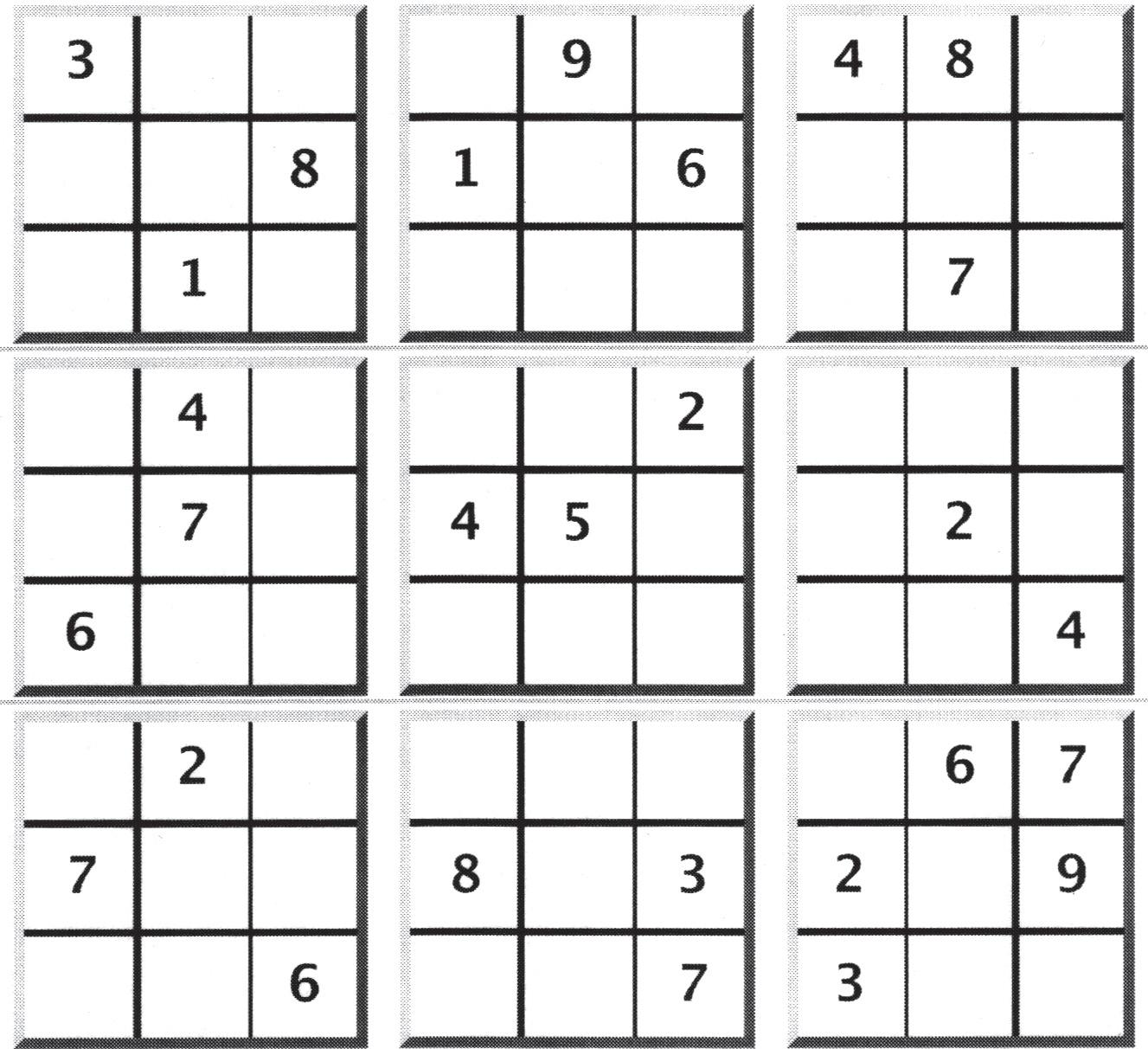
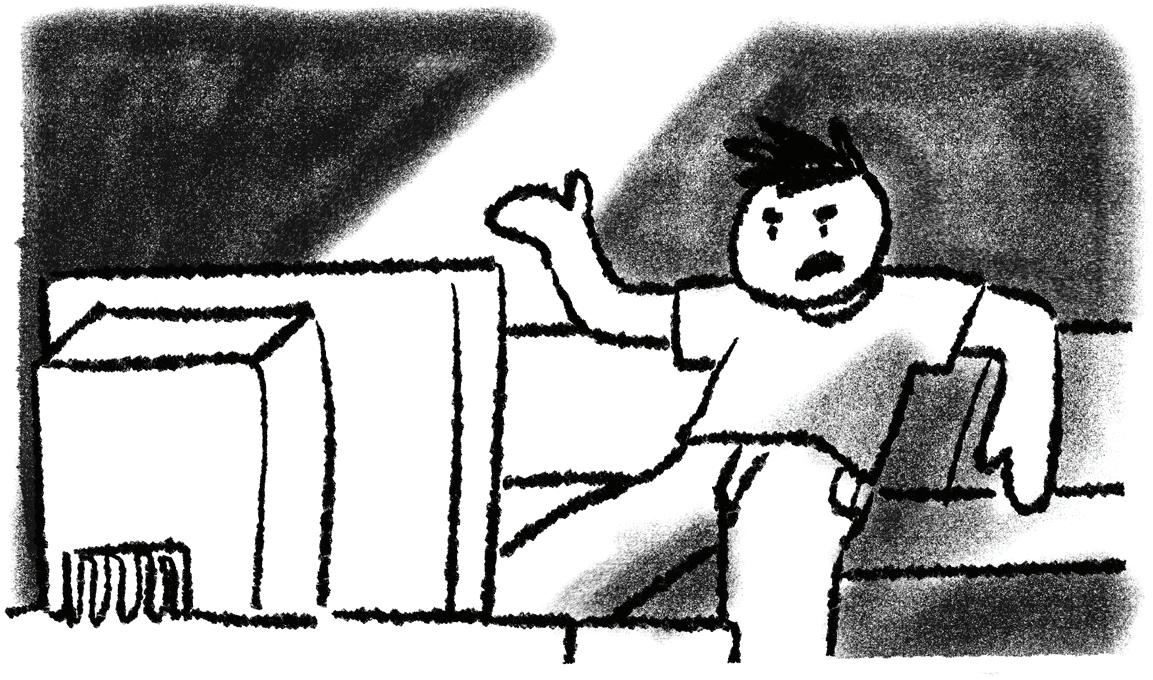
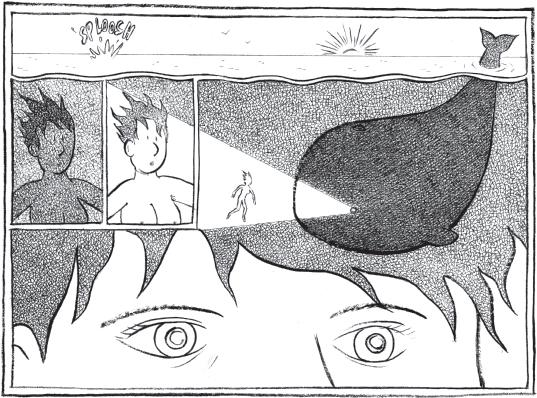


Art by Alicia Wang ’21

26 A PA R TMENT FOR R ENT
We have availability for the 2020-2021 school year beginning June 1st at Hudson heights apartments. The studios include electric, heat, water, garbage and parking. There is coin-operated laundry facilities on site. Prices start at $750 / month for a 12 month lease. If you have any questions or would like to schedule a tour contact us by phone 607-280-7660 or email: renting@ithacaLS.com
COLLEGETOWN TERRACE APARTMENTS
Leasing for 2020/2021
Spring 2020 Semester leases available Heat, hot water and Wi Fi State of Art Fitness Center Shuttle Bus Service to campus Washer & Dryer in Apartments collegetownterraceithaca.com office@ithacastudentapartments.com (607) 277-1234
AVAILABLE 2020-2021
1, 2, 4 Bedroom Apts. and 7 person House 10 & 12 month leases Cook/Blair Street Call or Text Christopher George RE 607-279-5520
Collegetown Crossing College Ave's Newest Location 307 College Ave. Now Leasing for 2020-2021
Completely New Modern Studios, 2 & 4 Bedroom Apartments. Fully furnished, heat & hot water included. Reception area at 307 College Ave. www.urbanithaca.com 607-330-2442 info@urbanithaca.com
120 Oak Avenue
Just steps to Cornell Campus 10 bedroom house & 1 and 2 bedroom apartment 607-277-1234 office@ithacastudentapartments.com Ithacastudentapartments.com
26 A PA R TMENT FOR R ENT
Now Renting 2-10 Bedroom Houses/ Apartments for 20-21.
All Locations. Call today or visit our website: Certified Properties of TC Inc certifiedpropertiesinc.com 607-273-1669
27 H OUSE FOR R ENT
20-21
College Ave. 5 BR House Furnished. Laundry. Parking. Call 607-273-8576
Spring 2020 Upper Eddy St. 7 BR house Furnished. Laundry. Call 607-273-8576
DISCOUNTED!!!
COLLEGETOWN 8, 10 or 11 BEDROOMS 607-272-3389 cbeach24@aol.com
8-9 BEDROOM HOUSE FOR 2020-2021 133 Blair St Corner of Cook and Blair just off of College Ave. Huge rooms, great porch, free laundry, furniture, 4 bathrooms, 3 kitchens. Great storage closets, parking for 3-4 cars. Contact Nick at 607-256-3778 or nick@lambrourealestate.com
2020-2021
400 Block Dryden Rd. 9, 10 & 13 Bedrooms 607-257-3578 Call or Text info@oconnorapartments.com
Cornell Beats Saints For 6th Straight Win
MEN’S HOCKEY
Continued from page 12
retake the lead.
“That was a big goal by Alex Green on the power play,” Schafer said. “It just got it going after that — it was good to see.”
Shortly after, senior defenseman Yanni Kaldis added a tally of his own. With both teams at full strength, Kaldis scored off his own rebound to make it 3-1. Within three minutes, Cornell scored three goals, and third came thanks to sophomore forward Liam Motley, who made his second appearance of the season after scoring a goal earlier in the team’s 6-2 victory over Michigan State.
“We didn’t even talk about adjustments between the first and second,” Schafer said. “We needed to get to work and play with some pace and get back that intensity that we had last night.”
“We didn’t have it from line to line, and we got it going with four lines rolling in the second period,” Schafer continued. “I was happy to see our guys put the pedal to the metal.”
Entering the third, the Red still had another flurry that it
Red Spoils Green’s Perfect Year
FOOTBALL
Continued from page 12
under a minute into the frame, senior running back Harold Coles rushed for 74 yards to make the score 14-12. Up until that point, the Erie, Pennsylvania, native had been stymied by Dartmouth’s stout defense.
“He’s had a ton of runs like that in his career,” Kenney said.
Coles, considered one of the best running backs in the Ivy League, rushed for 93 yards last weekend at Penn and finished with 111 against Dartmouth. Saturday’s game was his first with 100+ rushing yards since Sept. 28 at Yale.
The Cornell defensive unit returned to form in the third quarter, holding the Green scoreless for the duration of the frame to keep the Red in the game.
“The defense choked them out towards the end,” Kenney said. “It was great to see it all come together.”
In the third quarter, with a two-point lead too close for comfort for Dartmouth, the Green
kicked a 34-yard field goal to extend its lead to five.
But Cornell’s next drive, which went the distance for 75 yards, put the Red on top — where it would stay until the final whistle was blown.
Kenney capped off the drive with a 24-yard touchdown pass to senior wide receiver Owen Peters, bringing the score to 18-17, Cornell. The team went for the two-point conversion and, in a rare event, Kenney rushed into the end zone. The junior finished the day with 267 passing yards.
“We had a corner and a post, and the safety bit a little bit too much on the corner,” Kenney said. “Owen Peters made a great catch over the middle.”
With 5:32 left, Dartmouth was a field goal away from tying Cornell.
Dartmouth’s fate was sealed at its own 15-yard line with under two minutes in the contest when senior cornerback David Jones recorded his first interception of 2019.
From there, Cornell ran out the clock on offense as the Red
won its first game against a ranked Ivy opponent since 2006. It also marked the first time that Cornell beat a ranked conference opponent on the road since 1950.
The Red’s mentality of having nothing to lose paid off as it spoiled the Green’s perfect record.
“We talked about how they had literally everything to lose — they had just played two enormous, emotional games,” Archer said. “I don’t think Dartmouth circled the Cornell game on their calendar … We could be the most dangerous team because we didn’t have anything to lose.”
“At this point, we’re probably not going to win the Ivy League Championship,” Kenney said. “All we’re really playing for is each other, for our brotherhood, for the seniors to send them out the right way.”
The Red will look for a proper send-off on Senior Day as it hosts Columbia next weekend in its final game of the year.
Luke Pichini can be reached at lpichini@cornellsun.com.
Women’s Hockey Races Past Yale and Brown
was waiting to unleash. With a Saints penalty carrying over from the end of the second frame, Cornell capitalized during the first minute of the final period.
After peppering Boisvert, the Red went up, 5-1, following a strike by junior Kyle Betts.
Unsatisfied with a four-goal lead, Cornell extended its edge with a goal by Locke a mere 27 seconds later. Locke, who tallied a goal and two assists, led Cornell with three points on the night.
St. Lawrence failed to mount much of a response after these devastating blows. Galajda continued to deny the Saints at every turn, and the junior finished with a .938 save percentage. Through six games, Galajda has only given up 10 goals.
Meanwhile, Cornell’s depth continued to shine six different players found the back of the net in the blowout victory.
The Red will host two ECAC opponents in Quinnipiac and Princeton next weekend at Lynah Rink.
Christina Bulkeley can be reached at cbulkeley@cornellsun.com.
By JUSTIN SUZZAN Sun Staff Writer
Cornell women’s hockey team continued its undefeated season this weekend by picking up two home wins against a pair of Ivy League teams in dominant fashion. On Friday, the Red defeated Yale, 6-0, and on Saturday, it defeated Brown, 9-1.
In the first victory, No. 3 Cornell (7-0-1, 5-0-1 ECAC) overpowered Yale (5-4, 3-3), and the Bulldogs never stood a chance from the first minute of play.
Just 43 seconds into the first period, senior captain Kristin O’Neill wrapped around the net and delivered a perfect pass right to the stick of fellow senior Amy Curlew, who fired it between the legs of Yale goalie Gianna Meloni for the opening goal. From there, the Red added on two more goals thanks to O’Neill and sophomore forward Gillis Frechette.
With a comfortable lead, Cornell did not let up. Junior forward Maddie Mills notched her first score of the evening while Freschette and Curlew each added goals of their own to put the game away.
In the crease for the Red, junior Lindsay Browning stood tall for the team denying all 15 shots she faced. This was the dependable junior’s fourth shutout thus far this season.
The team didn’t have much time to celebrate the convincing Ivy League win as it faced Brown (1-8, 1-5 ECAC) the next day. The Red showed no signs of fatigue and once again jumped out to an early lead. Mills delivered the first goal for the team by way of a deflection off a feed from Bourbonnais.
Still in the first period, O’Neill grabbed the puck in Brown’s zone and fired a wrist shot that Brown goalie Calla Isaac could not stop. During the first, the Red dominated on both sides of the ice, only allowing Brown to take one shot.
“We were really focused on playing defense first,” O’Neill said. “I think reiterating that throughout the game, not to play as an individual but as a team, while sticking to our game plan led to us keeping the pressure on them all game.”
In the second frame, Cornell exploded for six goals. Brown was stunned by the Red’s relentless attack. Curlew netted a hat trick for the team in the second period alone. Senior captain Micah Zandee-
Hart, Slobodzian, and sophomore defender Bella Kang each contributed a goal in the period.
If that wasn’t enough, Cornell made it 9-0 off a goal from freshman Sydney Breza in the third for her first goal as a Cornellian.
“It’s different than any type of other goal,” Breza said, while holding her goal puck in hand. “I had a chance last night against Yale, but just being able to get it out of the way was really nice.”
After Cornell put in the ninth goal, Brown upped the physicality of its play, committing several penalties against the Red in the period. Despite the penalties, head coach Doug Derraugh emphasized to his players to keep a level head and to continue to play their game.
“It definitely gets a little challenging to stay focused when the score gets up so high,” Bourbonnais said after the game. “I think that was a good test for us to see if we were mentally strong enough to stay focused.”
Still riding their unbeaten streak to kick off their season, the women will travel to Syracuse on Nov 26.
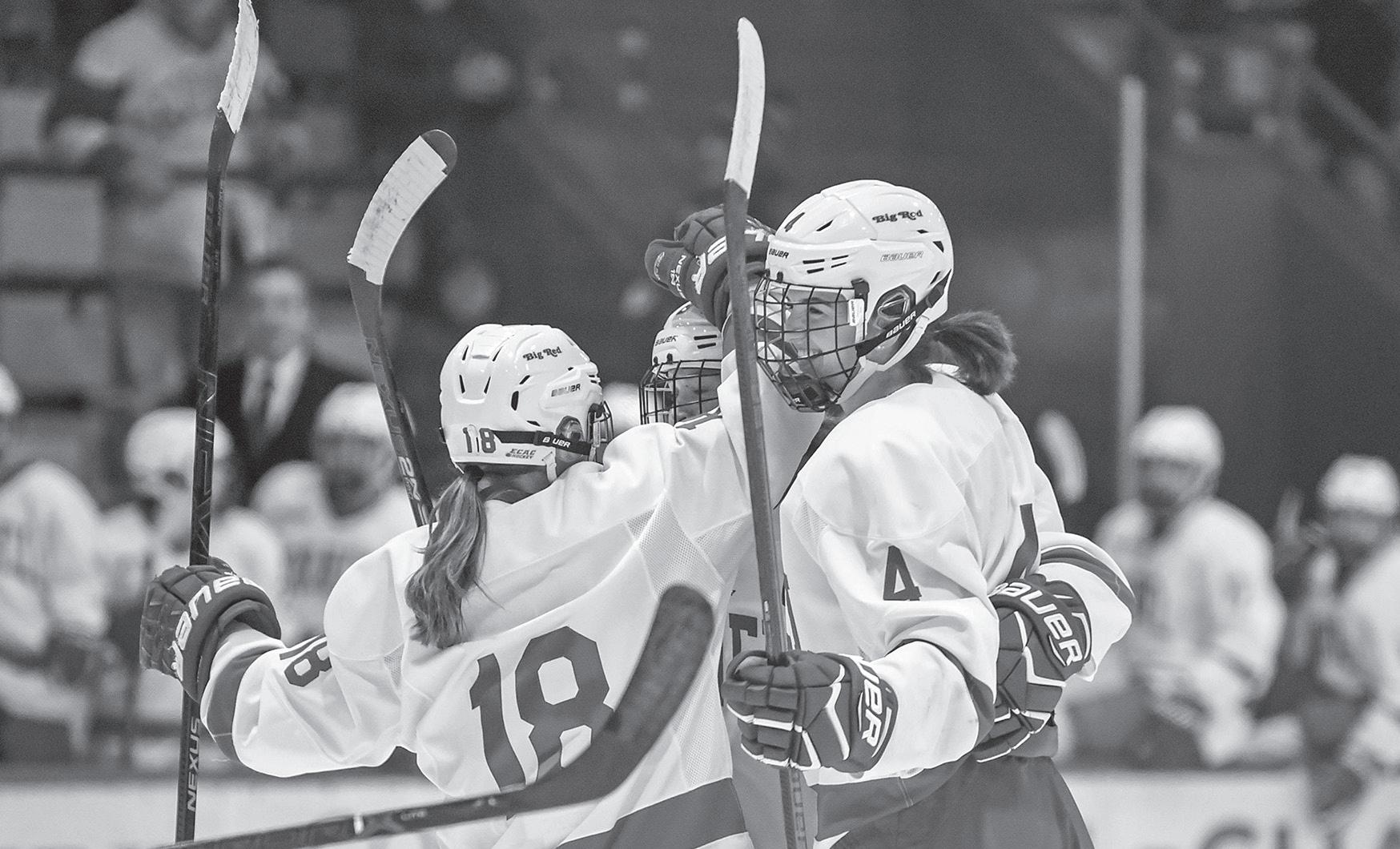
Dominant | The Red completely overpowered the Bulldogs and the Bears, outscoring them, 15-1, over the weekend.
BORIS TSANG / SUN PHOTOGRAPHY EDITOR Justin Suzzan can be reached at jbs389@cornell.edu.
Sports
FOOTBALL
‘I don’t think Dartmouth circled the Cornell game on their calendar’
Red Deflates Dartmouth’s Dreams
By CHRISTINA BULKELEY Sun Assistant Sports Editor
Cornell football marched into a contest against undefeated Dartmouth on Saturday looking to play spoiler — with a win, Dartmouth would clinch the Ivy League title on its Senior Day.
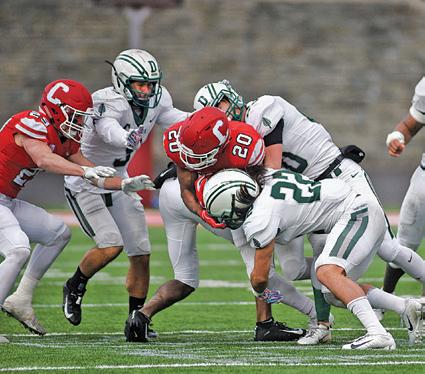
Entering with a 2-6 record, the Red seemed to have little chance of pulling out a victory. After all, it came in as a 30.5point underdog. Improbably, Cornell delayed Dartmouth’s shot at the title.
The Red came from behind with 5:32 left in the game to down the Green, 20-17.
“There’s a saying that ‘You are what your record says,’” said head coach David Archer ’05. “Not these kids — they have a next level of resiliency and togetherness, and I’m super proud of them and happy for them.”
The win comes in the midst of a year in which Cornell has dropped many close games, including two contests that were decided by only one point.
“I’m really proud of our team and our staff — we’ve had an adversity-filled year,” Archer said. “We played in some really close games where we felt we should have won. I told them, ‘It takes a really special group of people to not let that affect you going forward.’”
Cornell actually took an early lead in the contest — it was the Red who got on the board first with a field goal. But that 3-0 lead wouldn’t even last through the quarter, as
MEN’S HOCKEY
C.U. Blows Out St. Lawrence
Red completes frst sweep in North Country since 2005
By LUKE PICHINI Sun Assistant Sports Editor
Cornell men’s hockey faced its toughest challenge yet by taking on two ECAC opponents on the road in its third weekend series.
Friday’s game against Clarkson — a rematch of last year’s conference championship — was the Red’s most challenging task, but Cornell emerged with a 4-2 victory thanks to Cam Donaldson’s game-winning goal.
All that stood in the way of the Red earning its first sweep in the North Country since 2005 was St. Lawrence, which had only managed three wins through 11 games. A victory was quite likely, and on Saturday, Cornell pulled through.
Despite a slow start that saw the Red tied with the Saints through the first 30 minutes, Cornell ran away with a blowout 6-1 victory thanks to a three-goal flurry in the second period as well as a pair of quick goals in the beginning of the third frame.
“I had no idea the last time we swept up here,” said head coach Mike Schafer ’86. “But, [these are] tough places to play, and they’re good programs … We just stayed in the moment — we did that in the second and third,
but not the first. That’s a good lesson for us.”
In the early going, it looked like the Red was going to coast to victory. After the Saints opened with a few shots, Cornell took control of the puck and came up with the first strike.
Freshman defenseman Sam Malinski laid out a nice pass from the blue line to junior Cam Donaldson. Donaldson then found junior Morgan Barron, who launched the puck past St.


Lawrence goalie Francis Boisvert for the Red’s first tally and his sixth goal of the year.
“We probably went off the pedal a little bit,” Barron said.
“They’re a really good team, so they pushed back.”
But Cornell struggled to pull away. The Red had a prime opportunity to double its lead when Saints forward Callum Cusinato was penalized, giving Cornell a one-man advantage. While Cornell fired off several
shots on goal, the Red’s power-play unit, which entered the night with a 43% conversion rate, could not add to the team’s lead.
“When we scored the first goal, I thought we were going to have an easier night,” Schafer said. “But [St. Lawrence] works hard, plays at a pace, and our guys didn’t respect that early on.”
St. Lawrence soon evened up the contest. Freshman defenseman Travis Mitchell was called for interference, and the Saints began to apply pressure. Cornell’s penalty kill, which had only stopped 72% of opposing power plays, came up short as Keenan Suther picked up a rebound off junior goaltender Matt Galajda and buried it into the net to tie the game.
With the Saints putting up a strong fight, the Red sought to take control — and that, they did. To start the period, Cornell fired off seven shots on goal. Meanwhile, St. Lawrence could not muster a single shot on goal.
Still, the scoreboard did not reflect the Red’s effort as the game was still tied, 1-1. But within just a three minute span, Cornell turned a 1-1 game into a lead that it would not relinquish.
“Obviously we trailed off a little bit in the first,” Barron said.
with under a minute left in the first part of the tilt, Dartmouth cornerback Isiah Swann scored his team’s first touchdown when junior quarterback Richie Kenney missed his receiver. Before the interception, Kenney had completed eight of his first nine passes.
Swann returned his 16th career interception — a Dartmouth record — 69 yards to put Dartmouth ahead, a position the Green would maintain until Cornell’s game-winning touchdown in the fourth quarter. The senior, who outran Cornell tackles down the field, is graduating early in order to prepare for the NFL draft this spring.
“He’s a phenomenal cornerback, I think he was the [Ivy League] Defensive Player of the Year last year,” Kenney said. “He’s a good playmaker, but that didn’t stop us from trying him.”
The second quarter looked similar to the first scoring-wise, with the only scoring being a Dartmouth touchdown and PAT and a Cornell field goal. Exiting the half, the score was 14-6.
Cornell carried the momentum of that late second-quarter field goal into the latter half of the game, putting up points quickly in the third quarter.
Things didn’t look promising when Kenney rushed for one yard before fumbling — but after recovering the ball, things started to swing in Cornell’s favor. On the next play,
See FOOTBALL page 11
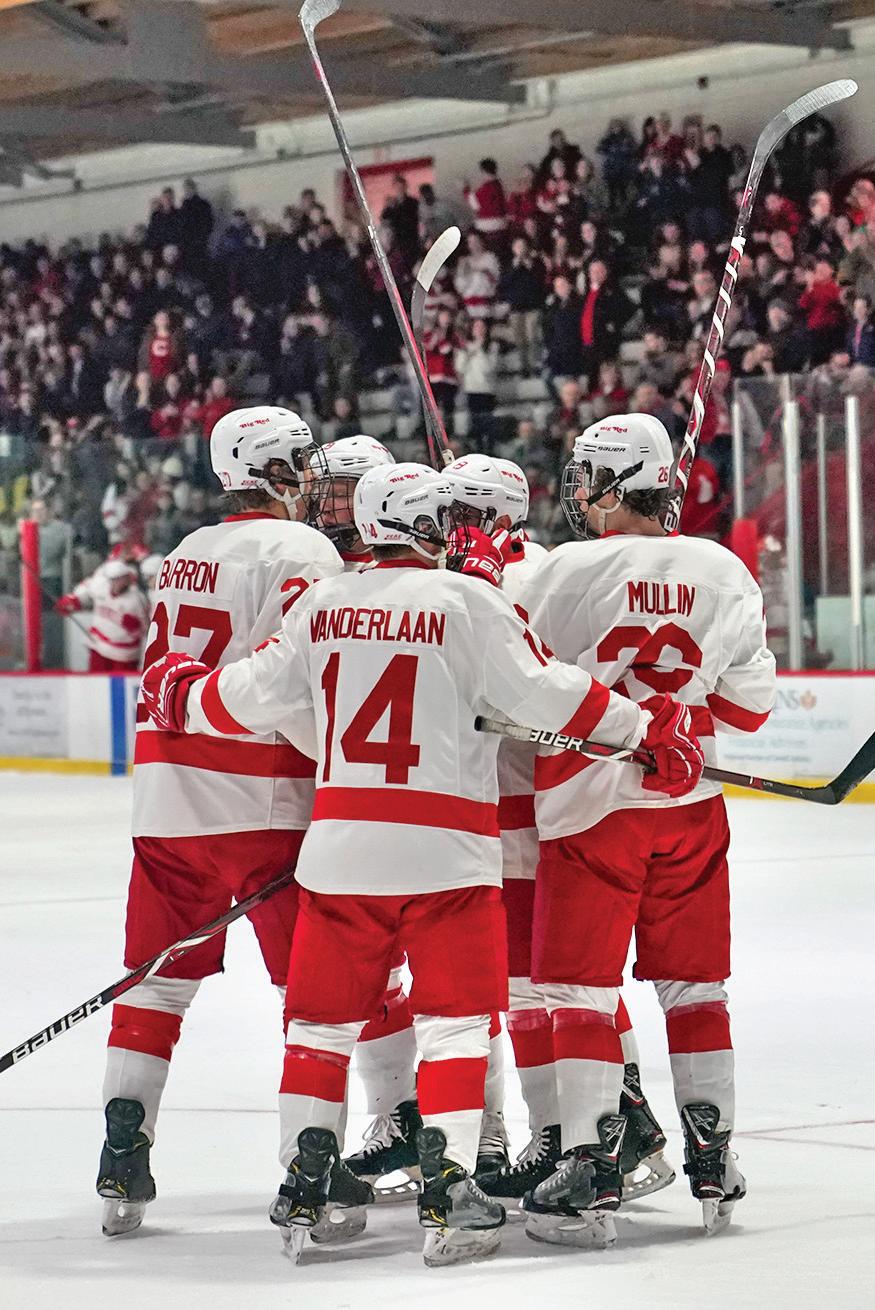
Slow start | Cornell was tied with St. Lawrence through the first 30 minutes, but two separate scoring flurries allowed the Red to pull away.
“But once we got back on our horse, it felt good to get it going.”
It all started with the Red’s third power-play opportunity of the night. Cornell’s unit missed out on a scoring chance earlier in the second period, but
this time around, the Red converted. Junior forward Brenden Locke and freshman forward Ben Berard assisted Alex Green, who scored and allowed Cornell to
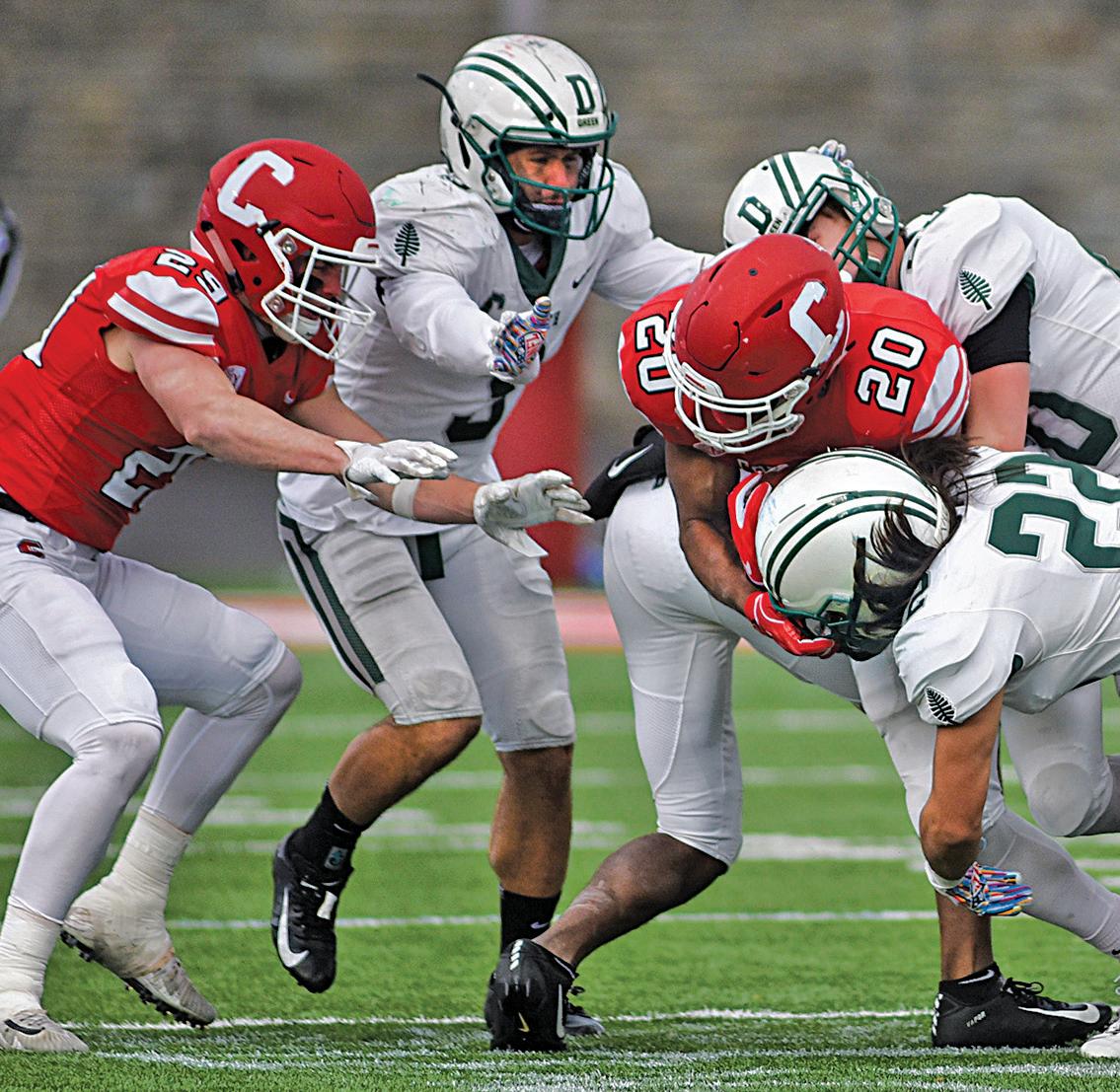
Underdog | Cornell faced a Dartmouth team that stood as a 30.5-point favorite, but the Red still pulled off the upset.
BORIS TSANG / SUN PHOTOGRAPHY EDITOR