The Corne¬ Daily Sun



By MEGHNA MAHARISHI Sun Staff Writer
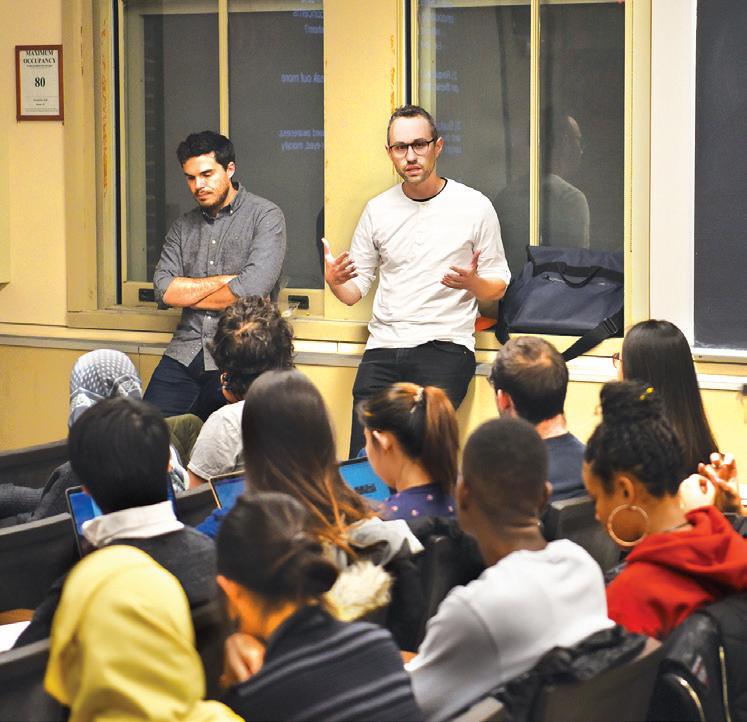
As China has come under international scrutiny for sending Uyghurs — a predominantly Muslim ethnic minority — to detention camps, dozens of Cornellians packed a room in Rockefeller Hall on Monday for a “teach-in” intended to shed light on the situation.
Nick Kline grad, a third-year law student and lecturer at the event, told The Sun that it was important to stimulate a conversation about these human rights violations on campus.
“We wanted to bring attention to [the Uyghurs] because it’s important, but then we wanted to situate it in the larger context of Islamophobia and
“We wanted ... to talk about it in the right way.”
Nick Kline
try and talk about it in the right way because it’s often talked about it in the wrong way,” said Kline, who has a master’s degree in Chinese politics,
foreign policy and international relations from Tsinghua University in Beijing.
Since 2017, the Chinese government has imprisoned Uyghurs as well as other primarily Muslim ethnic groups like Uzbeks and Kazakhs in detention camps.
The Chinese government has held approximately one to two million Uyghurs in detention camps in their native province of Xinjiang.
While the government claims that the camps are “vocational training centers” and that there are no human rights violations, The New York Times reports that many have been forced to renounce Islam in the camps and are living in squalid conditions under constant surveillance.
The event consisted of a presentation detailing China’s discrimination of the Uyghurs in what Kline described as “concentration
By JOHNATHAN STIMPSON Sun News Writer
After months of revisions, proposals and backand-forth, the City of Ithaca has finally settled on a budget for the upcoming 2020 year. Passed at a meeting of Ithaca’s Common Council meeting last Wednesday, the plan — which lists $80,397,578 in total spending — carries few surprises.
Calling for a 5.2 percent increase in spending, the budget’s aims largely skewed towards financial restraint, seeking to reduce the City’s debt load and tax burden and to purchase more efficiently and eco-
nomically, according to a report published by Mayor Svante Myrick ’09 — who called the unanimously passed plan “a tremendous budget” and the product of
“We all agree the climate change is an emergency ... and we have acted.”
Deb Mohlenoff
“a very thorough process.”
Constituting over 40 percent of Ithaca’s revenues, the property tax rate rose modestly to $11.71 per $1,000 of taxable valuation, up from $11.60 in the pre-
vious budget — meaning that the owner of a house worth $500,000 will expect to pay just $55 more than last year. However, that hiked rate still represents the City’s second lowest since 2003.
The fee Ithaca residents pay for water increased by 10 percent from last year to $8.67 per 100 cubic feet of consumption, while sewage fees were unchanged.
While spending and tax policy remained only slightly altered, one of the budget’s few notable highlights came in the form of a decision to earmark funds for the implementation of
By MIN SHIN Sun Contributor
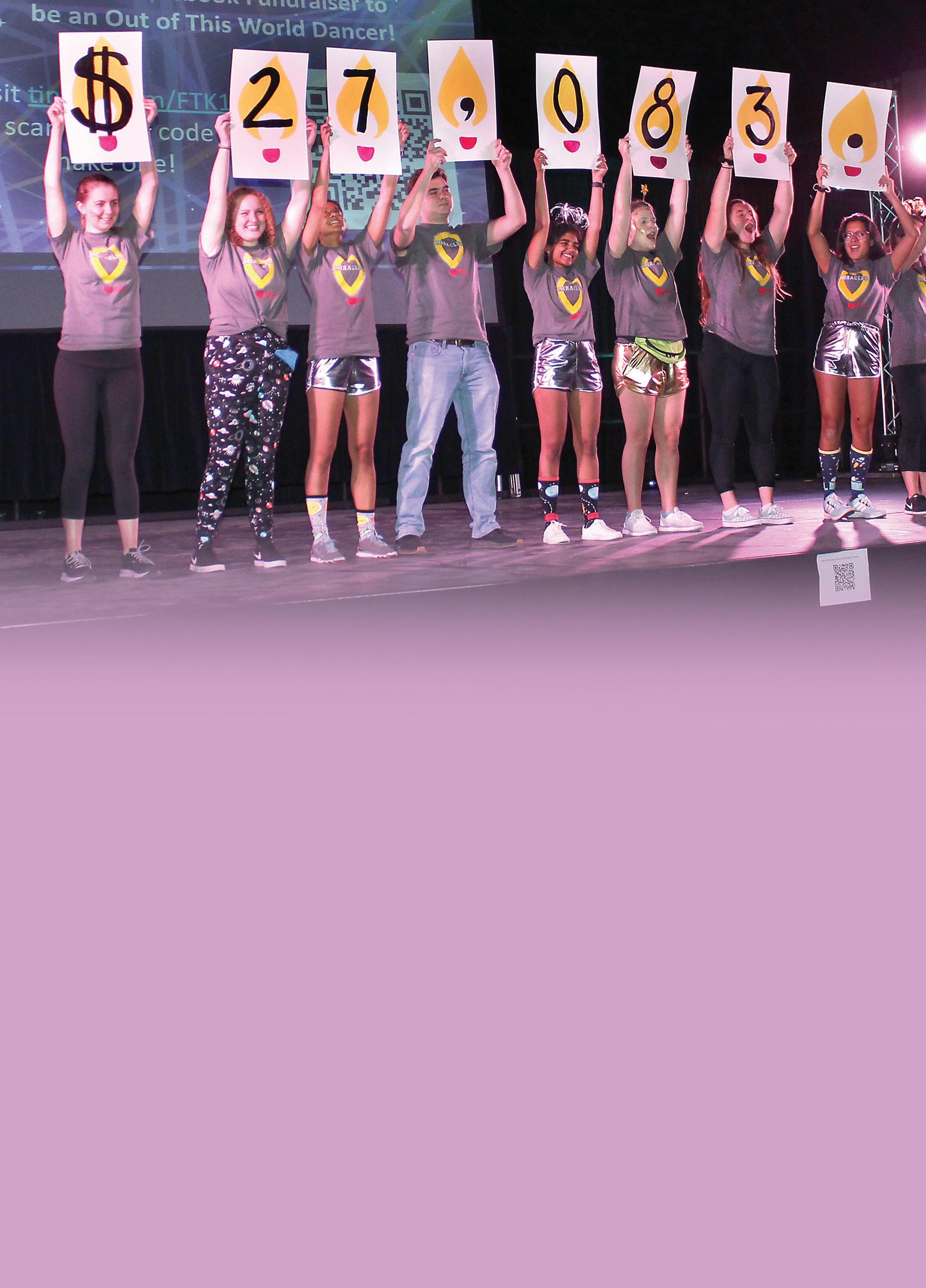
Upbeat music vibrated from Barton Hall Saturday afternoon as crowds gathered in the gym for the annual Big Red Thon. Multi-colored lights lit up the crowd of students dancing along to the music — a mix of the Little Einsteins Theme Song and current pop songs. The event marked the fifth year of Cornell’s Big Red Thon, a dance mara-
thon that raises funds and awareness for the local Children’s Miracle Network Hospital, Upstate Golisano Children’s Hospital in Syracuse, New York. The event runs from 2 p.m. until midnight, with each hour featuring a special event such as performances from dance or a cappella groups, lip-sync battles and story times — during which students met the “Miracle Children.” These children are patients of
the Miracle Children’s Network, comprised of 170 children’s hospitals, 10 million patients and 97 corporate partners, according to the Big Red Thon Instagram page. By the end of the night, Big Red Thon was able to raise over $27,000 from the almost 700 people who registered for the event, according to the group’s Instagram post. One of the “Miracle Children,” two-yearold Logan, came onstage with his moth-
er as she spoke about the impact of the hospital network after she discovered her son was sick.
Surgeons were able to remove Logan’s neuroblastoma due to its early detection, his mother said, and spared him the process of chemotherapy or radiation.
The Big Red Thon Facebook page states that all funds this year will be going to the just-established

Dismantling India’s Anti-Sodomy Law: A
Journey in India 12:30 - 1:30 p.m., 277 Myron Taylor Hall
Michelle Jackson - Manifesto for a Dream: Inequality, Constraint, And an Agenda for Radical Reform 2:55 - 4:10 p.m., KG70 Klarman Hall
Global Climate Change and Its Consequences: Science Assessments to Inform Decision-Making 4:30 - 5:30 p.m., 401 Warren Hall
The Road to Diabetes: Prevention and Maintenance Noon - 1 p.m., G10 Biotechnology Building
AASP and A3C PRAXIS Lunch Series Noon - 1 p.m., 429 Rockefeller Hall
Berger International Speaker Series: Marcos Pacheco 12:15 - 1:15 p.m., 279 Myron Taylor Hall
Another Perspective on Climate Change 12:20 - 1:10 p.m., 135 Emerson Hall

Howard Mumford Jones Professor of
Thursday, November 14, 2019

By EMMA DiGIOVANNI Sun Staff Writer
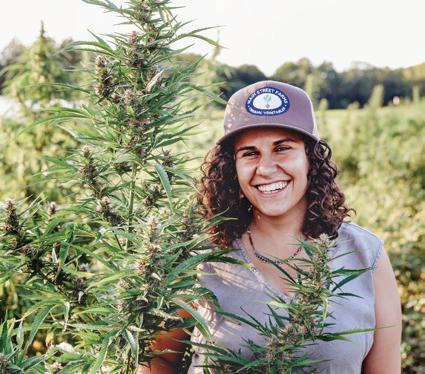
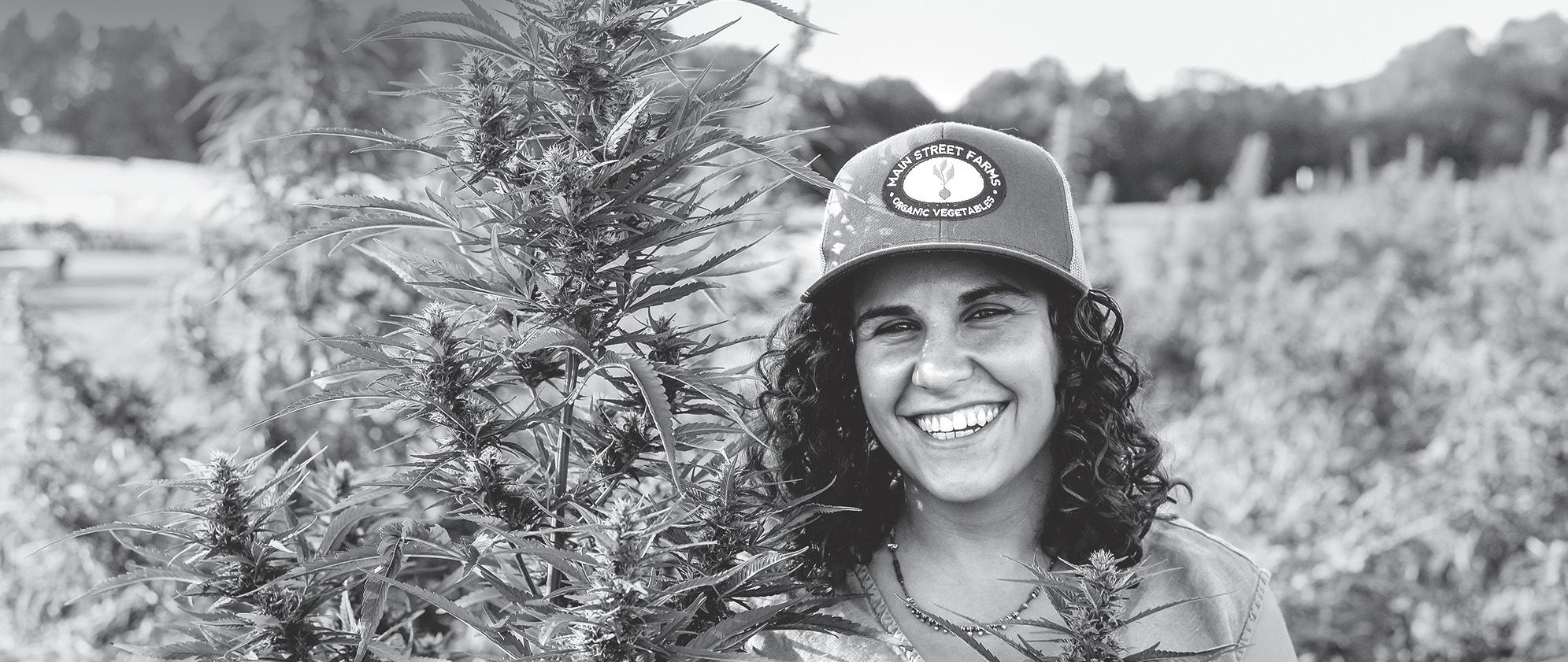
Just 17 miles from Cornell’s campus lies an organic farm which grows a particular variety of cannabis — hemp. The reason? Fueling the growing supply of cannabidiol (CBD) products produced by local startup Head and Heal.
Hemp is a term used to identify varieties of the cannabis plant that contain 0.3% or less tetrahydrocannabinol (THC), a chemical compound from the cannabis plant that can have psychoactive effects. While it contains low levels of THC, hemp is rich in CBD, a chemical compound which is not psychoactive and instead can help reduce pain and anxiety.
Head and Heal was created in 2017 after co-founders Karli Miller-Hornick ’11 and Allan Gandelman were inspired by the health benefits of CBD and decided to invest their farm in the industry. “We didn’t really trust any of the products out there,” Miller-Hornick told The Sun, “so we wanted to make a product that was safe, and also accessible.”
According to Miller-Hornick, the company sells a variety of CBD products, including tinctures (herbal extracts), soft gels and lotions, all of which are made with CBD grown and processed at Main Street Farms in Cortland.
Head and Heal’s products are now sold in Cornell Health’s pharmacy.
Early on, the team raised funding from friends and family in a seed round before beginning to grow their hemp crops. They also enjoyed support from the local community and business owners in Cortland. Since its founding, Head and Heal has grown rapidly, hiring about 1 to 2 people every month and developing from a 3-person team into a business of over 25 employees in just a year. “It’s been really great to create those jobs for our community,” said Miller-Hornick.
to drugs derived from cannabis has posed a number of challenges for the company.
“We’ve lost bank accounts, we’ve lost our credit card processing, we had our payroll company not willing to work with us, we’re not able to get normal business loans,” she explained. “So there’s a lot of challenges we face because of the stigma of hemp and marijuana.”
According to the American Bankers Association, even though several states have legalized the use of cannabis, possession, distribution or sale of cannabis remains illegal under federal law, which can expose banks–which are federally regulated–to regulatory risks.
Even after the 2018 Farm Bill legalized hemp and changed its classification from a Schedule 1 drug to an agricultural crop, challenges persisted. “We really thought that was going to change things for us,” said MillerHornick, “but it hasn’t, unfortunately.”
In response, the company has created a lobbyist group and has partnered with other hemp growers in the state to engage in legislative advocacy for the CBD industry.
“We’ve worked really hard on the legislation,” said Miller-Hornick. “We had Senator Schumer here a few weeks ago holding a press conference urging the banks to open up to hemp growers.”
The team also helped to write a hemp bill, which passed unanimously in the state senate and assembly last July. If signed by Governor Cuomo, the bill would, among other provisions, require companies to disclose where their hemp was grown and could legalize CBD-containing beverages in New York State.
According to Miller-Hornick, legalizing CBD in food and beverages in the state is important not only for eroding the stigma around CBD and hemp, but also for helping CBD companies respond to their consumers.
“New York State says that they want to create an industry here and support farms.”
Karli Miller-Hornick
’11
According to Miller-Hornick, Head and Heal’s main competitors are Charlotte’s Web, a Boulder, Colorado-based producer of hempbased CBD wellness products and Garden of Life, a Palm Beach Gardens, Florida-based vitamin company that has recently branched into the CBD industry.
While Head and Heal may not have the geographic reach of its competitors, there are a number of factors which differentiate it from the competition.
For one, unlike products sold by Charlotte’s Web or Garden of Life, Head and Heal tinctures are USDA-certified organic. According to Miller-Hornick, because this certification is difficult to obtain “that is a huge deal in this industry.”
Furthermore, because Head and Heal is “farmer-owned,” it enjoys a “price point” advantage.
“Because we’re vertically integrated, because we’re the farm, because we’re the profiter, we can come to market at almost a third of what other companies are charging,” Miller-Hornick said.
While a 600 mg tincture by Head and Heal costs about $45, a less-concentrated 500 mg tincture by Charlotte’s Web costs about $75. Despite its advantages, however, Head and Heal has not achieved success free of obstacles. The stigma surrounding hemp and its relation
By JUN OH KOO Sun Contributor
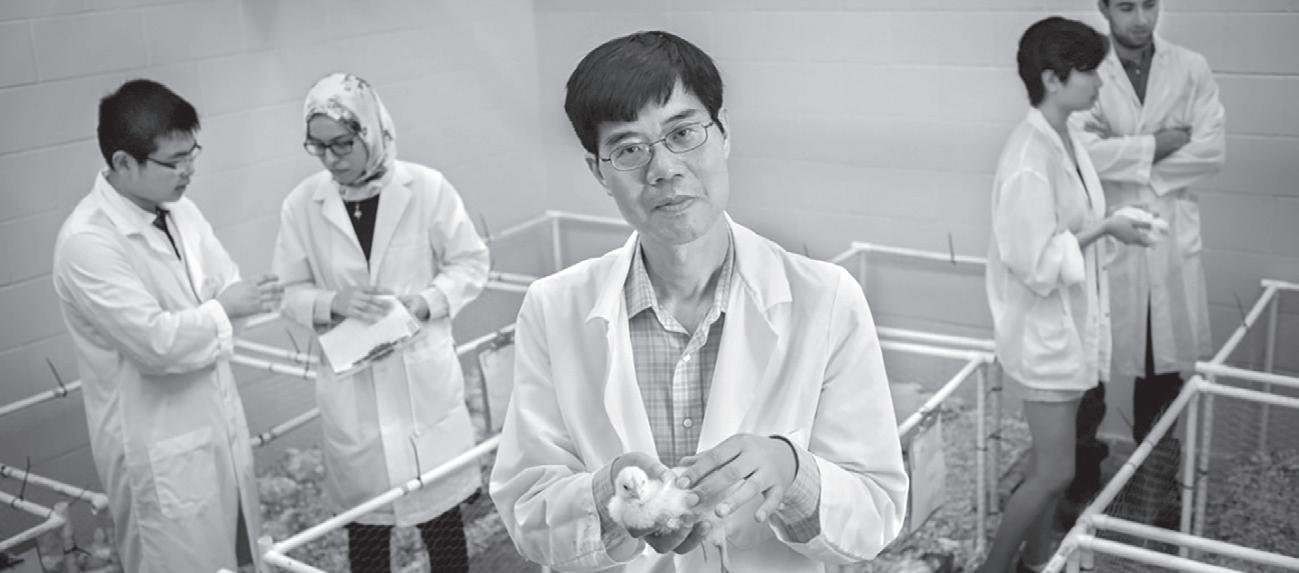
As the University whose research helped spawn the invention of the chicken nugget decades ago, Cornell has had a long history in hatching poultry innovations. That long legacy stands to continue as Cornell was selected to help take the lead on a five-year, $10 million grant that aims to transform the poultry industry by improving its environmental impact and nutrition.
Awarded by the National Institute of Food and Agriculture earlier this year, the grant, which will also be co-led by the University of Arkansas, is one of the largest ever given by the United States Department of Agriculture.
“The purpose is to try and make U.S. poultry production more sustainable and more profitable for the producers,” said Prof. Xingen Lei, animal science, one of the co-principal investigators on the project, who explained that the project stands to disrupt one of America’s largest and most ubiquitous consumer markets.
“Microalgae can not only produce biofuel, but we’re also going to engineer the microalgae to provide the protein and all the other nutrients and enzymes to improve the general efficiency of the feed and water,” Lei said.
For instance, according to Lei, in order to improve the nutritional profile of chicken meat, the team plans to work with researchers from the Biomolecular Engineering department to “engineer” microalgae by introducing enzymes that favor unsaturated fatty acids and vitamin D, which, collectively, will have the effect of making poultry “better for human health health.”
“The purpose is to try and make U.S. poultry production more sustainable.”
Prof. Xingen Lei
Finally, waste constitutes one of the poultry industry’s biggest barriers to sustainability, continued Lei — a problem that he hopes can be combated by making use of a product that, up until now, has been destined for the landfill. Feathers, almost always treated as waste products by farmers, contain up to 85 percent of the protein meat provides.
U.S. poultry production amounts to over 9 billion chickens raised annually, last year yielding 20 billion kilograms of meat and $45 billion in revenues. Only five years ago, chicken surpassed beef to become America’s most popular meat product for the first time in over a century, according to the USDA.
But such a behemoth market comes with equally sizable environmental impacts, leaving “large room for improvement” as researchers explore ways to improve the industry’s sustainability, Lei said.
For instance, according to Lei, each year poultry production consumes about 54 billion kilograms of feed and 108 billion tons of water, while creating, as a byproduct, 55 billion tons of poultry manure and more than 1 billion tons of chicken feathers. Forty-four percent of all soybean meal produced is used to raised chickens.
To take advantage of this underutilized protein source, Lei and his colleagues are aiming to use a combination of enzymes to try and break down feathers for animal feed, drastically cutting down on the amount of unused debris created in the poultry production process if successful.
But while producing research that will ultimately have practical implications for how the poultry industry functions is a priority for the team, the project also more broadly hopes to educate and provide outreach programs for consumers and producers alike.
That goal comes as academic poultry research and programs have slowly withered over the years, leaving key industry stakeholders in the dark about best practices, even as poultry production swells to its highest historical heights.
“We create products based on what our customers want,” she said. But the illegality of CBD in food has meant that, even though Head and Heal customers have requested CBD gummies, the company has not been able to deliver.
“New York State says that they want to create an industry here and support farms,” said Miller-Hornick, “but they’re not allowing us to go to market with products that consumers actually want.”
Despite the challenges of entrepreneurial work, however, Head and Heal has enjoyed success in only a short period of time. MillerHornick reflected on her path to the company, saying that although she felt a desire to start her own business right after graduating from Cornell, she received a piece of guiding advice that she is glad to have followed: “to go learn from others first.”
“I spent six years working at a startup company and watched them go through the whole process, from raising capital, to expanding rapidly, and then finally shutting down,” Miller-Hornick explained. “And I remember my interview for that job… The CEO asked me: ‘You have an entrepreneurial spirit; why aren’t you going off and starting your own business?’ And I remember telling him that I wanted to learn from his failures.”
For students interested in entrepreneurship, Miller-Hornick advised that “it’s great to go and get your foot in the door at a company that is in its beginning stages and just try to wear as many hats as possible and learn as much as you can through that process, before starting your own business.”
“That’s a huge amount of resources being used to support production,” Lei told The Sun, who pointed out that current farming processes leave sizable inefficiencies in how water and feed are used.
As a result, the vast, multi-year project, which will enlist the help of at least four other Cornell faculty, has its sights set on improving on deploying a variety of novel techniques to lessen the industry’s environmental impacts.
“Firstly, we want to improve the feed water use efficiency and find alternatives to soybean chicken feed, in order to reduce the competition between feed and food,” Lei said, explaining that the team hopes to replace soybeans with microalgae as an alternative feed protein to raise chickens.
In comparison to soybeans, which are dominant in the poultry industry, microalgae can capture carbon dioxide from the atmosphere, making production “greener,” while also serving as effective targets for innovative bioengineering.
With over 40 percent of chicken producers having attained only a high school education or less, and the number of poultry science departments having decreased for the past 20 years, there is a “shortage in the future workforce and education in the industry [that is] is unsustainable for the current level of production,” remarked Lei.
To counter that trend, Lei is working to have Cornell offer minors, and eventually a master’s program, in sustainable agriculture and animal subsistence. He also currently teaches the animal science course Global Food, Energy, and Water Nexus for a Sustainable Future, which aims to engage students in the US, China and India to collaborate on more sustainable agricultural practices.
“Teaching means that we first have to teach our undergraduates here at Cornell and Arkansas and other places to be aware of the need and importance of agricultural sustainability,” Lei said. “How to make our system more efficient, more environmentally-friendly and more economically sustainable.”
Jun Oh Koo can be reached at jk2324@cornellsun.com.
DANCE
Continued from page 1
Golisano Center for Special Needs, a branch of the children’s hospital where Logan and his mother spent 10 days during his treatment.
The center will have the capacity to treat up to 7,600 children per year, according to a recent press release, and is dedicated to “providing care and treatment for children with intellectual and developmental disabilities, such as autism, ADHD, Down Syndrome, cerebral palsy, spina bifida, sensory impairments, and more.”
“Upstate Golisano gets less than 5 percent of its funding from the state, so every dollar we raise goes a really long way,” said Natalie Brown ’20, co-head of the
e-board of Big Red Thon. “We’re going into our fifth year now. So we’ve made over $110,000 since [the] dance marathon started at Cornell and again that all goes straight to the hospital.”
This year, more than 30 teams participated, with groups including both social and pre-professional fraternities and sororities, On Tap Dance Troupe, Shadows Dance Troupe, Base Productions, Pandora Dance Troupe, Cornell Track and Field and more.
Apart from dancing, there were stations set up for arts and crafts, snacks, hula hoops, Spikeball, balloons and inflatables.
“I think it’s really great because everyone can come together and just try to raise money together and in a really fun way because you’re also dancing, you also
have a fun time with your friends,” said Rebekah Kang ’22, a member of the Alpha Phi Omega service fraternity. “Rather than raising money through such rigid ways, which aren’t fun, this is a better way, I think.”
Bhavya Bhushan ’20, another co-head of the e-board of Big Red Thon and a member of APO, has also been involved in the event for the past three years.
"We’re in upstate New York and we’re here for four years, and it’s important to remember that we’re not just here as a part of Cornell. We live here and we’re a part of this community and we can actually help the people around us,” Bhushan said.
Min Shin can be reached at ds2342@cornell.edu.
By ALIZA SAUNDER Sun Contributor
About three years after graduating from Cornell University, friends Delia Hughes ’14 grad, Meagan McKeever ’14 and Lindsay Simon ’14 walked through the aisles of Whole Foods in Manhattan with one goal in mind: find a food product that was ripe for innovation.
These three friends knew they wanted to become active in the food distribution agency and just needed the right product to start this process. They landed in the candy aisle. The three friends noticed that people loved eating sweets but also wanted to limit their sugar intake.
Two years later, they are currently working on a lollipop that allows for people to snack without feeling guilty over calorie counts, a business that was recently selected as part of Cornell’s 2019-2020 eLab cohort.
eLab, a collaboration of Student Agencies and Foundation of Entrepreneurship at Cornell, is an accelerator program for student startups — admitted startups enter a year-long program that provides mentors, a $5,000 investment and access to Cornell’s alumni network. This past weekend, about half of this year’s 24 chosen startups pitched at NYC Pitch Night, where Cornell entrepreneurs forged relationships with advisors and mentors in their field.
This year eLab has expanded its cohort into eLab One and eLab Two. eLab One participants are further along in the business process, with a more specific customer focus than the business in eLab One, according to Hughes.
Spark Pop: Guilt-Free Candy
Spark Pop, a product in eLab two, looks to balance people’s craving to snack with the desire to be healthy. Hughes, McKeever and Simon are currently finalizing the formula for their lollipop, made from a derivative of beet juice, apple juice concentrate, natural flavors, citric acid and vegetable juice.
“We want people to enjoy themselves and satisfy their sweet cravings without
feeling guilty for snacking. Thus, we created a lollipop that has less than 2g of sugar per pop and only 30 calories,” Hughes said. “The product is long-lasting, so it takes away all cravings and someone is not eating a couple handfuls of candy just to feel satisfied and satiated.”
While they originally settled on a lollipop due to the complexities of balancing their formulas with the limited equipment available in the food science kitchens, Hughes and her co-founders are looking to expand into other types of candy.
Hughes, who was involved in Cornell Food Ventures, a CALS center that provides assistance to food entrepreneurs, saw applying to eLab as the logical progression in the growth of her business. As part of the cohort, Hughes said that she has enjoyed being a part of a support system of startups and being mentored by the teaching team, as well as having the ability to practice her pitch. Last month, she spoke in front of 200 Cornell trustees and will pitch her idea again this month at Rev, a business incubator in Ithaca.
Hughes, estimates that she spends about 25 hours per week working on her project. She and co-founders, who both have fulltime jobs, usually take calls together at night, as well as work weekends.
While Spark Pop is not currently on the market, Hughes and her co-founders hope that it will launch in the next few months.
Normal: CBD Infused Sparkling Water
Mike Wagner grad and Moses Oh grad are the founders of Normal, a CBD-infused sparkling water. According to their website, Normal provides “a sense of calm and focus after your mid-afternoon coffee crash.”
Using green tea-derived L-Theanine, an amino acid found in many teas that promote relaxation, and all natural flavors, Normal comes in lemonade and strawberry flavors and can be purchased at Collegetown Bagels, Ithaca Bakery and Green Star Co-op. Wagner and Oh met through Destination Johnson, a weekend event held by the SC Johnson College of Business filled with presentation and networking opportunities, and officially

launched their product in August 2019.
“We began looking for opportunities within the cannabis base, and we saw beverages as a form of consumption that people are used to — not everyone wants to smoke weed, not everyone wants to take CBD oil droplets — so we decided to make a drink,” Wagner said.
As part of eLab, Wagner is most looking forward to the access to mentorship and personal support, as well as learning from other members of the cohort.
Right now, Wagner and Oh manufacture all the drinks themselves, working between 7 p.m. and 1 a.m., and joke about their “unbalanced” lives. Though this process is exhausting, Wagner says it’s worth it: “I’ve had some of the best feelings of exhilaration that I’ve ever had in my life these last few months,” he said.
takk
As a freshman, Claire McLeod ’20 was working at Cornell’s Annual Fund at the Student Phoning Program and noticed the extreme inefficiencies of the software that Cornell uses for its phone-a-thons. After hearing McLeod’s complaints, Iliana Paleva grad decided to apply for the job to take a better look at those inefficiencies — and, once hired, Paleva realized that the two of them could build more functional software.
Starting by making sketches in their kitchen, McLeod and Paleva are now developing a phone-a-thon software that enables higher education institutions to manage
their alumni databases by automatically calling alumni and processing the payment in a more intuitive and less time-consuming way, as opposed to using outdated software or hand-written pledge cards.
Paleva says takk will save time re-entering information into the databases and decrease mistakes and training time, in hopes to ultimately modernize this technology.
As part of eLab, Paleva is looking forward to her access to mentorship and the ability to create a wider network.
“Every mentor in the program has such rich and different backgrounds and experiences, so it’s really nice to be able to share all of your ideas and thoughts will someone who has experience working in that industry,” Pelava said. “Being able to put your thoughts out there in a safe space and getting very honest feedback I think is very valuable.”
As a part of eLab One, Paleva pitched takk Thursday in front of Cornell alumni. Paleva said that experience was great, allowing her to pitch her product, hear other cohort members’ pitches, and network at the reception.
To read the rest of this story, please visit www.cornellsun.com.
Aliza Saunders can be reached at als488@cornell.edu.
BUDGET
Continued from page 1
Ithaca’s Green New Deal, a plan passed earlier this year that calls for the City to create 100 percent renewable electricity by 2025 and reduce emissions from the municipal vehicle fleet by 50 percent by 2025 with the ultimate goal of “achiev[ing] carbon-neutrality community-wide by 2030.”
But despite those lofty aspirations, only an additional $34,000 was allocated for the plan — or less than 0.0425 percent of the City’s budget.
The funding was additionally classified as a “restricted con-
tingency,” which means the money will only be released to the Planning Department — the municipal agency responsible for directing the Green New Deal’s rollout — should the Common Council vote to do so at a separate time.
With plans already in place to hire a full-time sustainability coordinator who will begin this March, the budget report said that the funds may be used to hire a second position should a need to do so become apparent. Concerns over the apparent tepidness of the City’s approach to implementing the ambitious plan have recently raised the ire of
some local climate activists, catalyzing a move by environmental advocacy group The Sunrise Movement to run a slate of writein candidates in last week’s local elections.
While all lost their elections and no incumbent official was removed, Common Council members had reportedly fielded calls from “dozens of people” in advance of the Wednesday meeting urging them to allocate as much money as possible to the Green New Deal, according to WSKG Public Radio.
“We all agree that climate change is an emergency … We have acted,” Alderperson and
Chair of the Budget Committee
Deb Mohlenoff (D-5th Ward) said at the meeting on the decision to reserve $34,000 in funding; however, other members stressed the importance of striking a balance between swift action and protecting the taxpayer.
Myrick previously told The Sun that while “we are seeking funding opportunities as aggressively as we can … we don’t want to raise taxes in the city; there’s only so much the residents can bear.”
Another council member expressed the need for other area governments to pick up the slack, noting that one city can only
hope to do so much.
“I would hope that the same folks that have come to us, urging us to invest more money are also speaking to the Town of Ithaca, are also speaking to the county, and are also speaking to the state and the federal government,” Alderperson Seph Murtagh (D-2nd Ward) said at the meeting. “Because the only way we’re going to change this is if we do it together as a society.”
Johnathan Stimpson can be reached at jstimpson@cornellsun.com.
Te event drew mixed reactions, with some arguing the media has exaggerated the situation
UYGHUR
camps” and a discussion among students and faculty on the issue.
At the end of the half-hour presentation, Kline offered advice for what Cornell could do to raise awareness on the issue. One of his suggestions was that the University be completely transparent about its relationship with China and Chinese companies.
“We don’t want to be in relationships with [Chinese companies] that are complicit in the development of technologies that can then be utilized by the security regime in Xinjiang,” Kline said.
In 2017, multinational technology firm Huawei Technologies paid Cornell roughly $5.3 million in research contracts, The Sun previously reported. Huawei signed a contract with Xinjiang’s police department in 2018 to help monitor and analyze data in the region.
Beyond Cornell, other U.S. universities, through research contracts, collaborated with Chinese companies that specialize in surveillance technology.
The Massachusetts Institute of Technology had a research partnership with iFlytek — a Chinese company that has aided the Chinese government in enhancing surveillance in Xinjiang.
the [oversimplification] of the camps because according to [my friends from Xinjiang], there are some … Han minorities and their concern is that there is some [Uyghur] campaign that would put their safety at risk,” Pan said.
“In the 21st century, everyone has the right to keep their culture.”
Ablajan Mahmut grad
Pan added that she believes the Chinese government has already enacted policies that benefit Uyghurs, such as large point increases on standardized tests like the Chinese-language Gaokao if the taker was a nonnative speaker, a policy which China’s Ministry of Education ended for the Xinjiang province in April 2017. The Diplomat reported these increases as 10 points; Pan claimed they were as high as 50.
In an impassioned response, postdoctoral associate Ablajan Mahmut grad — who is of Uyghur descent — refuted Pan’s claims, saying that none of them were true.
“These sort of atrocities are happening on this large scale, you really need to think carefully about why that’s happening.”
Prof. Eli Friedman
During the discussion, some students disagreed with the information presented, claiming that the Chinese government was not committing any human rights violations against the Uyghurs.
Jinchao Guo grad, a Chinese international student, questioned if the information on the Uyghurs’ plight was true, saying that he did not necessarily believe Uyghurs were targeted for their religion. Guo said there is a mosque in his town near Shanghai, which the local government has left untouched.
While this mosque remains, the Chinese government has destroyed mosques in northern China, The New York Times reported.
Huinie Pan grad, also a Chinese international student, said at the event that the Chinese government is only educating Uyghurs on Chinese law, claiming that they present a safety threat to other Chinese ethnic groups like the Hans — who comprise around 91.6 percent of China’s population.
“I just have an issue with
“In the 21st century, everyone has the right to keep their culture,” Mahmut said at the event.
“I’m a medical doctor, I don’t know the politics, I only know the science, but this is lying.”
After the event, Mahmut told The Sun he had no resentment towards the students who disputed the severity of the human rights violations against the Uyghurs, saying that he felt their perspectives have been molded by the media.
Prof. Eli Friedman, international and comparative labor, told The Sun that he hoped the event ultimately gave Cornellians the opportunity to reflect on this crisis, despite the disagreements.
“When you have a country that has the second largest economy in the world, it’s a country that has all kinds of relationships with the United States and higher education,” Friedman said. “These sort of atrocities are happening on this large scale, you really need to think carefully [about] why that’s happening and sort out in a very thorough-going way whether we are implicated or not.”

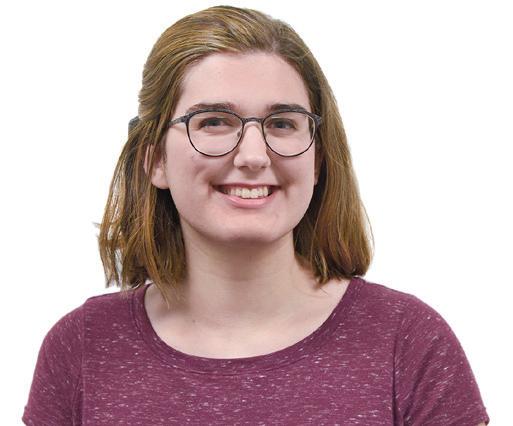
It might be the wrong decision to start this column with a discussion of Ducktales, the show whose original run came too early and whose rebooted run came too late for the weird fringe generation of ’97-’00 kids who currently make up a large portion of the student body. Millennials and Zoomers alike can bond over the 1987 and 2017 incarnations, but we’re square in the middle. Luckily, our little stuck-in-the-gutter micro-generation is used to poaching things from our generational neighbors, whether it’s watching the Snorks on Boomerang as kids, swiping older siblings’ original Game Boys or guiltily watching episodes of Amphibia on the Disney Now app.
The latter is what I found myself doing, catching up on cartoons in the precious few minutes of free time I had one Saturday morning. It’s a ritual from my childhood I couldn’t quite let go of. I, admittedly, spend a fair amount of time on kids’ streaming apps like Cartoon Network and Disney. However, I usually stick to the video sections of these apps, maybe sneaking in a DCOM here and there. Recently, I experienced the Disney app in a whole new way when I stumbled across the games section, specifically one game called Disney All-Star Racers. It’s basically what it says on the tin — a Mario Kart-clone racing game featuring a crossover cast of popular characters. Ducktales and Descendants characters do battle with Mickey Mouse and his friends, racing through stages from each of their IPs.
I know that I can get a similar, and probably better, experience with Mario Kart. But there’s something low-key magical about watching Webby Vanderquack chuck one of Mickey Mouse Clubhouse’s hot dogs at Jafar’s son Jay while the Ducktales Moon Theme (a track from the 1989 video game that was
reimagined in a 2019 episode) plays in the background. Throwing a bunch of video game characters into a different video game is one thing, but there’s something about throwing licensed TV characters into a game that feels different, makes you want to play a game regardless of how derivative or busted the controls are.
If you’re a part of that young-Millennial/old-Zoomer generation I mentioned earlier, this sentiment is probably familiar to you. We didn’t grow up with the App Store in the way that traditional members of Gen Z did, but we did have something that sets our pre-iPhone childhood apart. Weird, in-browser Flash games.
I see nostalgia about this a lot on Twitter — people “unlocking forbidden memories” of playing American Dragon: All Star Skate Park and Lilo & Stitch 625 Sandwich Stacker on their parents’ bulky desktop computers. I too share these fond memories, of raising a digi-pet with Pippa the Cyber Fairy on Barbie’s tie-in EverythingGirl.com and of breeding fish in that one Flash game that was somehow connected to the Bratz brand. We didn’t have on-demand streaming, but we could still hang out with our favorite characters online while waiting for new episodes and movies. Sadly, though, all of these games have gone the way of Club Penguin and Pixie Hollow, lost forever to
the ether of corporate restructuring as companies (although mostly Disney and Mattel) decided to axe their interactive web divisions and focus on mobile games and YouTube series. Flash itself is a dead

medium, so why would companies continue to host Flash-based games? You can’t even play them on the go on iPads and iPhones, so what would be the point? I would argue, though, that maybe the lucrative Flash game market of the ’00s isn’t quite dead, despite what technological advancements might suggest. I lied a minute ago: These games aren’t truly lost to time, but pirated and re-uploaded across a sea of somewhat-sketchy, nostalgia-bait sites. There was actually some drama a little while back between warring factions of fans re-uploading “rewritten” servers of Club Penguin, fully functional game clones without the paywalls of the original. People are taking it upon themselves to host copies of these games because they know there’s Zillennials out there looking for the classics from their childhood. And when one generation starts to get too nostalgic, that trickles down to the kids. Take today’s high schoolers, for instance. A lot of their interests come from ’80s and ’90s nostalgia (if I’m interpreting the scrunchie and puka shell clad VSCO Girl phenomenon correctly) and it’s only a matter of
time before they’ll be sucked into ’00s nostalgia, if they haven’t already. What happens when “I was born in the wrong generation” comes to entail a yearning for the days of clunky desktops and browser games?
Media tie-ins aren’t exclusive to our childhood, of course, as evidenced by the NES Ducktales game and Disney Now’s All-Star Racers. But there was something about that golden age of cheap games, when you didn’t have to download anything or block in-app purchases but instead surf a catalogue of shiny but simple Disney Channel and Mattel games after school. By the amount of nostalgia I see online, I guarantee there’s a market for a comeback in the way 80s nostalgia has driven Nintendo to re-releasing NES games — and I’m definitely not just saying this because I can’t find a reuploaded server of Pixie Hollow.
runs alternating Tuesdays this semester.
We all enjoy art, and we all experience and consume it everyday, whether by going to a museum, watching an award winning film or just by listening to our favorite Spotify playlists in between classes. Art therapy allows the participant to not only relate to art through an experience of it, but to make our their own art in a low-pressure and inclusive environment.
“We all have these experiences where we feel like words can’t quite capture what has happened to us or what we want to explain to other people,” Emily Walsh, owner of Ithaca’s The Art Therapy Studio, told me when we sat down to talk about all things art therapy. “Instead of talking, [art therapy] would use art supplies,” she explained, which allows those who participate in art therapy to “have something that reflects the fullness of [their] experience[s] back to [them].”
A therapist with 11 years of experience, Walsh just recently celebrated her five year anniversary of the opening of The Art Therapy Studio in Ithaca. “I wanted to be in a place that has an active arts culture, and it would be a healthy environment for me where I would have access to nature. Ithaca combined all of those things.” Walsh told me that she felt that Ithaca’s creative culture would be perfect for providing people interested it and excited to try art therapy. Art therapy, however, is also for those who may not describe themselves as artistic or have much artistic experience. Walsh explained to me that art therapy requires no background knowledge about making art, and even better, “You don’t even have to have an idea about what you’re making. You can just come and smush some clay around [and] get more into your body and the present moment and enjoy yourself.”
Drawing or using clay to muddle through emotions may sound a little childlike, but Walsh explained
that “com[ing] back to a childlike place” can be incredibly helpful for the process. She explained that sometimes we all can “feel like we are having a battle … between two different parts of us. And it’s hard to put into words why we feel so conflicted.” She went on to describe how the process of art therapy can make these conflicts more concrete and that in her mind, “Imagery can help us connect with our most genuine selves. It can put really complex ideas all into one image, and having that in our space at home can feel really powerful.” She described a recent project she did with her Creative Sanctuary Club, a monthly event she hosts in which she leads participants in making their own creative sanctuary through collages, where they “consider those things [that would make up their personal creative sanctuary] and translate those things into [their own] environment.”
These forms of exploration can be especially beneficial for students who are dealing with “this
balance of having a stronger sense of who [they] are and having a very strong sense of reaching out into the future. [In this] period of life where there is a lot of pressure to be performing well and anxiety about the future,” it can be “really good for people to take a break from their logical, thinking, wordy brain and just relax and use [their] hands.” Indeed Walsh enjoys working “with people on confidence, self-compassion and figuring out how to match [their] values and what [they] most want in [their] lives.”
She described a past event held at the Tompkins County Public Library back in September — an Ugly Art Therapy workshop in which participants took a list of “all these personality characteristics of things you’re told not to be” and circle the ones which they felt most negative or insecure about. Walsh elaborates that “ugly art is about reclaiming all of that stuff, like anger or not knowing or periods of time that we go through in our life where we feel things are
out of control or we don’t understand things … about taking our defenses down against ugliness and understanding how its so important for our growth, our souls and our culture.” It was her first event at the Tompkins County Public Library, and it turned out to be a huge success.
Her upcoming event Flourish works specifically with people struggling with anxiety and depression by using art journaling to develop methods of coping. Walsh draws from her own art making practice in order to decide “what is it that [she] really want[s] to offer to people and the world, and what I think people will really understand and benefit from. And making sure I can translate that so other people get it.” Walsh explained:“I’m handing people a framework and they make it their own.”
Erin Hockenberry is a sophomore in the College of Arts and Sciences. She can be reached at ehockenberry@cornellsun.com.

By
On Monday, the Trump administration officially notified the United Nation of the United States’ intention to withdraw from the Paris Climate Agreement, a pact signed by over 200 countries to reduce greenhouse gas emissions, triggering a host of criticism from Cornell professors.
“It sickened me to read the news headlines the other day that President Trump had taken the highly symbolic final step needed to formally withdraw the U.S. from the Paris Agreement,” said Prof. Bruce Monger, earth and atmospheric sciences.
Despite having to undergo a required
one-year grace-period before formal withdrawal, the United States still sent a clear and immediate message with the decision; the U.S. would not honor the emission reductions made when it signed the Paris Agreement.
The Paris Agreement is founded on each nation voluntarily reducing emissions. By formally withdrawing from the Paris Agreement, Monger fears that “President Trump has greatly harmed the prestige of the United States as world leader” by forcing the U.S. “to now sit silently on the sidelines while other nations take over a global leadership role on climate action.”
Prof. Michael Hoffmann, entomology, is the Executive Director of the Cornell
Institute for Climate Smart Solutions and called the decision to withdraw “dead wrong” and “a crime” in an interview with the Sun.
“The U.S. should be leading the way for the rest of the world but the administration in Washington is taking us in the opposite direction. It’s an affront to science and to common sense,” Hoffmann said.
When asked about steps that the U.S. should take to help fight climate change, Hoffmann pointed to a transition to wind and solar power, planting trees, improving building design and creating dialogue about the urgency of the situation in everyday life as really important.
“We’ve already gained one degree centigrade in the warming of the atmosphere; I believe we’re going to go past 1.5 in 10 to 15 years,” Hoffmann said.
In Hoffmann’s upcoming book Our Changing Menu: What Climate Change Means to the Food You Need and Love, to be published in 2020 by the Cornell University Press, he describes how according to Yale Climate Opinion polls only 70% of the U.S. population agreed that Global Warming was happening and 57% agreed that it was caused mostly by human activities.
In Hoffmann’s expert opinion, Cornell students can help in the fight against climate change by “taking courses on campus to understand what the challenge is, the science behind it (and) how to make informed decisions; once the student is informed, start talking about it.”
Prof. Mark Sarvary, director of Cornell Investigative Biology, agreed with this view, citing students’ involvement in the Climate Change Forum, an exercise for students
to identify and problem solve the unique and complex consequences of a changing climate.
“We want our Cornell students to be prepared to solve and participate in the global climate conversation. And they are,” Sarvary said. The forum has run for the past six years.
Though both Hoffmann and Monger lamented the United States’ failure to take a more proactive role in the climate change fight and that the U.S. is the only country in the world to withdraw from the agreement, Monger struck a much more condemnatory tone.
“The U.S. should be leading the way for the rest of the world but the administration in Washington is taking us in the opposite direction.”
Prof. Michael Hoffmann
“I consider President Trump’s decision to walk away from the Paris Agreement as generational theft. And I strongly encourage young people today to raise their collective voice and to vote leaders out of office. If a new U.S. President is voted into office in 2020, the new President will almost certainly re-enter the U.S. back into the Paris Agreement,” Monger said.
Louis Chuang can be reached at lc742@ cornell.edu.
By VANESSA OLGUIN Sun Contributor
A Cornell-led team of ecologists and computer scientists in collaboration with the Wildlife Conservation Society created an Artificial Intelligence program that tackles ecological impacts of hydropower dams in the Amazon basin — a sensitive region consisting of more than a third of South America.
Spearheaded by Prof. Carla Gomes, Director of the Institute of Computational Sustainability, Prof. Alex Flecker, evolutionary biology and ecology, and postdoctoral research fellow Rafael Almeida, the program could improve the way future hydropower dams are built by determining favorable locations for dam installation and ensuring maximum energy use and low carbon emissions.
Hydropower dams generate hydro-electricity by controlling the flow of water. Water flowing through the dam spins a turbine, which turns a
shaft in an electric generator which produces electricity. If you’re familiar with Beebe Lake, then you have most likely seen the Triphammer Dam in action generating electricity for Cornell.
However, the construction of hydropower dams in the Amazon are often unsustainably built in poor locations, potentially undermining the ecological goals that hydropower aims to address. These poorly designed dams can emit up to ten times more greenhouse gases than thermoelectric plants.
Almeida explained that non-optimal locations of dams can emit dangerous levels of greenhouse gases. The team found that while 92% of planned highland hydroelectric dams in the Amazon would be sustainable over the long term, only 36% of the lowland dams would yield less emissions.
“If you don’t pick the right locations for dams, you can have a combination of dams that are dirtier
than coal and natural gas [emissions],” Gomes said. According to Gomes, these greenhouse gas emissions are attributed to the decaying vegetation within reservoirs created by such poorly placed hydropower dams.
Flecker, specializing in Latin American ecology, described the focus of the team’s research: biodiverse places containing major tropical rivers that are located in countries with growing economies. In Brazil, there were many proposed hydropower dam locations in the Amazon basin yet a lack of history with constructing hydropower dams.
In addressing the ecological effects of hydropower, the team looked at different combinations of already existing dams, and developed a computational model that uses A.I. to find the most promising configurations of dam sites.
With this new program, researchers are able to determine where low-carbon hydropower dams would best be built.
Looking at every possible location would be “naive,” Gomes said. “The A.I. based approach can look at this problem in a very smart way and decompose it into smaller problems that eliminate … and rule out dams that are provably bad.”
Almeida further explained how, in the pursuit of accomplishing environmental and energy objectives, this model shows that strategic planning can minimize the environmental impacts of each desired energy generation target.
“It’s not just enough to look at the energy they produce,” Gomes explained. The effects of hydropower dams are more substantial than the service they provide. It’s important to “look at other aspects like how it’s going to impact fisheries, [and] how it’s going to impact populations,” Gomes said.
Overall, the team hopes that decision makers will plan carefully and look at the ecological effects

Hydropower dam | The Santo Antonio Dam, shown above, is a large hydropower dam in Brazil.
of hydropower dams and energy. Gomes explained that often the “thinking behind hydropower energy means ‘Oh, this is clean energy’ but really the big message is ‘Well, not so fast.’”
In the pursuit of sustainable energy, the effects of the infrastructure are underlooked, as such it’s “not a guarantee that by just using hydropower you are using clean energy, you might end up with solutions that are worse than
coal,” Gomes said. The model shows the potential for A.I. in addressing sustainability efforts.
“A.I. can transform the world,” Gomes said — and this tech should be ethically used “to address key challenges and the protection of the environment so that we can really be on the path [to] a sustainable future.”
Vanessa Olguin can be reached at vjo6@cornell.edu.
Since 1880
137th Editorial Board
ANU SUBRAMANIAM ’20 Editor in Chief
JOYBEER DATTA GUPTA ’21
Business Manager
PARIS GHAZI ’21
Associate Editor
MEREDITH LIU ’20
Assistant Managing Editor
RAPHY GENDLER ’21
Sports Editor
BORIS TSANG ’21
Photography Editor
AMBER KRISCH ’21
Blogs Editor
SOPHIE REYNOLDS ’20
Science Editor
AMANDA H. CRONIN ’21
News Editor
JOHNATHAN STIMPSON ’21 News Editor
PETER BUONANNO ’21
Arts & Entertainment Editor
ANYI CHENG ’21
Assistant News Editor
HUNTER SEITZ ’20
Assistant News Editor
CHRISTINA BULKELEY ’21
Assistant Sports Editor
BEN PARKER ’22
Assistant Photography Editor
JEREMY MARKUS ’22
Assistant Arts & Entertainment Editor
ALICIA WANG ’21 Graphics and Sketch Editor
DANA CHAN ’21 Production Editor
RYAN RICHARDSON ’21
Snapchat Editor
GIRISHA ARORA ’20
Senior Editor
ALISHA GUPTA ’20
Senior Editor
SARAH SKINNER ’21
Managing Editor
KRYSTAL YANG ’21
Advertising Manager
NATALIE FUNG ’20
Web Editor
SABRINA XIE ’21
Design Editor
NOAH HARRELSON ’21
SHRIYA PERATI ’21
KATIE ZHANG ’21
AMINA KILPATRICK ’21
MARYAM ZAFAR ’21
Editor
ETHAN WU ’21
SHIVANI SANGHANI ’20
ZHU ’21
PICHINI ’22
JIANG ’21
MORAN ’21
LEI WU ’21
EMMA WANG ’20
Editor LEANN McDOWALL ’21
BREANNE FLEER ’20
SHRUTI JUNEJA ’20 Senior Editor
Working on Today’s Sun
Ad Layout Dana Chan ’21
Production Deskers Sabrina Xie ’21
Mei Ou ’22
News Deskers Hunter Seitz ’20
Johnathan Stimpson ’21
Design Desker Lei Lei Wu ’21
Niko Nguyen ’22
Photography Desker Ben Parker ’22
Sports Desker Christina Bulkeley ’21
Arts Desker Peter Buonanno ’21
Letter to the Editor
At Cornell, we teach how to be a test taker, not a student
To the Editor:
In “Remember What It Means to Be a Student,” Colton Poore writes, “Over the past three years, I’ve felt that I’ve had my desire to learn sucked out of me with memorization, regurgitation and prayers of scoring at least the mean.” This is a result of a culture that prioritizes the measurable over the meaningful. I usually have a blue shirt on. The shirt is clearly blue. However, as a professor, if I told Cornell students that my shirt is red and then gave them a test with one question on it — “What color is my shirt?” — 95% would answer, without hesitation, “Red,” regardless of whether I am speaking one-on-one, in a small group or in a large auditorium (just ask my students, advisees and anyone else who was around to watch). I would tell them that we are here to teach them how to observe nature and to develop the courage of their convictions to explain their observations and conclusions using reasoning. Then I would ask them how a drunk lying next to a dumpster would respond to my question, and would they all say, “Blue.” This would then lead into a discussion on Bob Marley’s “Redemption Song,” in which he sings, “Emancipate yourselves from mental slavery. None but ourselves can free our minds,” which is based on the words of Jamaican activist Marcus Garvey. Poore also writes, “It’s tragic that the world makes us feel as though we have to hide what we really love in order to fit in.” This semester, I am on sabbatical at the University of Massachusetts Amherst. If I asked students here the same question, 10% would answer “Red.” Ten percent is still too high. I am afraid that at the elite world of Cornell, we are teaching people to become test takers and not students. In a word, we are teaching students to be compliant. We are not heeding the warnings of Aldous Huxley, Marcus Garvey, George Orwell, Neil Postman and Bob Marley. Prof. Randy Wayne, plant biology
As the fall semester begins to wind down, fall recruitment season also nears its end. For some, this could be a time of joy as they receive offers to their dream company, while others continue the search in hopes of having better luck with the next cover letter they submit. Because of such a focus on the outcome of the recruitment cycle, both candidates and employers appear to have less consideration for the process through which an offer is extended. Firms rarely ask for feedback regarding their process despite many candidates having strong opinions about a particular employer’s recruitment method.
cess such that candidates are not evaluated based on arbitrary traits, the metrics used are often considered more objective than those by people. For instance, Unilever found a 16% increase in diversity hires through the HireVue platform they utilized, which enabled them to diversify the talent pool.
However, these one-way video interviews still ignore many other aspects integral to the recruiting process. Candidate experience is
As companies attract the best and brightest applicants from a diverse pool, they must think about the implications of the technological tools.
One particular practice in the candidate vetting process has been particularly off-putting: one-way video interviews. This type of interviewing now has widespread use among large firms seeking to minimize scheduling complications with interviewees, increase efficiency with candidates and remove potential interviewer bias. Prominent employers such as Goldman Sachs and Unilever use artificial intelligence to screen candidates. Many college students like myself at Cornell and elsewhere are prompted to speak to their computer screen with no human presence at the other end of the interview. When an interviewee submits their video interview to platforms like HireVue, they are assessed not only based on the content of their responses but also on emotion detection cues that compare them to “top performers” at the organization. HireVue contends that their assessment tool eliminates human bias and can actually increase employee diversity.
Yet, such AI-based evaluation platforms continue to leave questions unanswered due to the proprietary nature of their algorithms. Firms like HireVue are permitted to veil the exact standards used to evaluate candidates, leaving much room for ambiguity. These tools create models based on established practices that, despite intentions to remove human bias, could simply reproduce the demographics of existing staff. This is particularly alarming when only 18% of the tech workforce is female in major technology firms like Google. And because AI technology is only as thorough as the input it uses, certain interviewees could be viewed as favorable for possessing traits traditionally considered masculine. The algorithms written by humans from male-dominated fields like tech could simply create a ‘closed-loop system’ that systematically discriminates minority groups, as claimed in a class action lawsuit against Facebook. What’s more, the algorithm doesn’t provide assessment scores or explanations to its decisions, unlike a human recruiter.
But there are indeed benefits to these assessment tools. Designed to minimize human subjectivity in the interview pro-

easily neglected as companies use third-party programs that are impersonal and disconnected from company values. Responses in one-way interviews are cut off after a set time limit, disempowering candidates even more than they already are. Interviewees are not given the chance to ask questions or demonstrate themselves in ways outside of the predetermined questions, posing a challenge to exemplifying how they are not simply one face among many others. And despite the rampant potential for misuse of a well-intended tool, companies continue to use inherently biased algorithms to discern one applicant over another.
Firms can still incorporate the merits of technology in other ways that are beneficial to both parties. For instance, skill-based assessments conducted online enable the firm to evaluate the applicant in a timely fashion and on an objective set of criteria such as their ability to process Microsoft Excel functions. This allows the organization to continue screening candidates and ensure that prejudiced factors like those corresponding to facial expressions don’t select one equally qualified applicant over another. One-way video interviews shouldn’t be the main standard for rejecting or moving candidates forward. Candidates’ entire profile should be taken into consideration through a multifaceted approach that blends resumes, neutral screening software and interviews.
As companies seek to attract the best and brightest applicants from a diverse talent pool, they must think once more about the implications of the technological tools they utilize. In an era where Facebook likes can be utilized to predict gender, sexual orientation or even political beliefs, using A.I.powered technology with caution to determine something so significant as interview results has become important now more than ever. As someone preparing to enter the workforce, I hope that my skills are not determined by an artificially created model that rationalizes the bias it was built upon. DongYeon (Margaret) Lee is a senior in the School of Industrial and Labor Relations. She can be reached at margaretlee@cornellsun.com. Here, There, Everywhere appears alternate Tuesdays this semester.
Joanna Hua | Cup of
On the way to a prelim on Halloween night, rain washed away any possibility of a bus coming through the flooded intersection of CTB. I crossed the street and had the right of way when a car decided to turn, stopped inches away from me and the driver rolled down the window. A racial slur escaped
Our belief that Cornellians are more accomplished by way of being at Cornell undermines the reality that we are just as capable of harboring the same biases that we criticize people who don’t bleed Big Red.
from the window, along with some choice phrases about how I failed to see with my small eyes.
At first, I couldn’t believe that I was called a racial slur at Cornell. I then remembered that a similar event happened to me freshman year. These events are not uncommon, even on Cornell’s campus. We know that racism still exists, but I wondered why I thought that this sort of behavior was more unbelievable to me because it occurred at Cornell and why I would have been less upset by this sort of incident if I were somewhere else.
harboring the same biases that we criticize people who don’t bleed Big Red. This mentality doesn’t just manifest in objectively rude and racists incidents. I have friends who talk about only swiping right Cornell students when they use dating apps, or how they have lower standards on physical attributes if a person goes to Cornell. Comments under Sun articles come from people from different backgrounds (many of them not students), and many of these claim that Cornell students who make mistakes are not deserv ing of being here, without recognizing that students here have just as much room for growth as others. While not as damaging as racial slurs, this mindset of Cornell students being automatically better than others takes root throughout our daily lives, extending from the seemingly innocuous dat ing app considerations to the unexpected surprise of racism in action.
We lower our expectations of others and increase our expectations for ourselves. We shouldn’t think that incidents like what I experienced are rare.
Our belief that Cornellians are more accomplished, intelligent and better overall just by way of being at Cornell undermines the reality that we are just as capable of
Stoxicity to always prove to yourself that you must be better, but also of putting others down in the process. We then lower our expectations of others and increase our expectations for ourselves. We shouldn’t act shocked and think that incidents like what I experienced are rare and isolated, but rather address the biases that perpetuate at Cornell just as they do everywhere else.
Why do we have loftier expectations and judgments about people at Cornell? Just because we are on top of this hill in Ithaca doesn’t mean that we are

I fell victim to a similar mindset when I first came here, thinking that Ithaca College students somehow did not work as hard as I did in high school to get to where we are. Coming from an incredibly competitive high school and being ridiculed for “only getting into Cornell,” I spent a good chunk of freshman year trying to justify my achievement by setting very high expectations for Cornell students as a whole and lowering my expectations of others as a result. The inferiority complex of being a “low” Ivy League school comes not only with internalized
Each of us has room to grow and learn, and to expect that as a student body we are better than people outside of Cornell inhibits our pursuit of higher education.
automatically granted a higher status and are “holier than thou” — the people who diminished me to a racial stereotype on that rainy night certainly did not deserve that distinction. Each of us has as much room to grow and learn as others, and to expect that as a student body we are better than people outside of Cornell inhibits our pursuit of higher education and our insatiable attitude toward personal growth. While we should always strive to be better and hold ourselves to better standards, this shouldn’t be accompanied with lowering of others — we need to walk down the Hill and off the pedestal.
Joanna Hua is a senior in the College of Arts & Sciences. She can be reached out at jhua@cornellsun.com. Cup of Jo runs every other Tuesday this semester.
tudents walking between Collegetown and the Engineering Quad in recent weeks have seen the pro-Hong Kong slogans on the footbridge over Cascadilla Gorge. The Sun has featured several articles this semester about the protests rocking the semi-autonomous region, including a recent story on vandalism of the bridge stickers
tors, gets marginal coverage at best.
The corporate media in the Global North have tacitly concluded that Haiti, unlike Hong Kong, is undeserving of our attention and sympathies.
and other pro-Hong Kong posters on campus. Not a single article, however, mentions the deadly anti-government protests less than 700 miles from Miami that have thrown impoverished Haiti to a political standstill for most of 2019. But The Sun is not alone: The corporate media in the Global North have tacitly concluded that Haiti, unlike Hong Kong, is undeserving of our attention and sympathies.
It is natural then to ask why Hong Kong gets so much attention from American politicians across the spectrum and every major news outlet despite much less violence against protestors. Haiti, despite dozens of fatalities and a video of a Haitian senator shooting at Associated Press journalists and protes-
Events unraveling in Hong Kong serve as an example of Chinese Communist Party repression, perhaps explaining the relative media blackout on Haiti. Haiti’s much more severe crisis, like many that have repeatedly wrecked the country since post-Cold War political transition, are largely a result of several decades of predatory U.S. policy and the extraordinary corruption of U.S.backed President Jovenel Moïse. The United States, which had long enjoyed the support of an iron-fisted Haitian junta during the Cold War, quickly realized that it could not accept a democratic government in Haiti.
In fact, on two separate occasions in the past three decades, in 1991 and then again in 2004, the U.S. played an instrumental role in the ouster of the immensely popular priest turned-President Jean-Bertrand Arisitide. Aristide was eventually allowed to return to Haiti with U.S. military backing. The aftermath of both coups resulted in a reign of terror in which thousands were killed and policies favored by U.S. agribusiness and financial institutions were implemented. It is in this context that Haiti has become a country run by people like Jovenel Moïse: crooked businessmen and gangsters, all preferred by corporate
power. In other words, protests in Hong Kong serve as a convenient contribution to the propaganda line, whereas Haiti’s misery is unserving to the ideology of self-righteous nationalism.
These facts highlight something profoundly immoral about the role of corporate and financial interests in foreign policy: The U.S. would subject a tiny impoverished nation, the poorest outside of Africa, to multiple episodes of state-sponsored ter ror for the

hike was a response to the 2008 “clorox riots,” named for a hunger so painful that it feels like bleach in the stomach. What monstrous cruelty and insatiable greed it must require for ultra-wealthy corporate executives to undermine a modest step away from mass-starvation in a hapless country — all so that they can maximize their underwear profits.
Meanwhile, as Haiti stagnates in perpetual misery, our politicians and mainstream media outlets zoom in on protesters in Hong Kong who decry the evils of the
It is our responsibility to look beyond self-serving narratives on global affairs and shine light on the horrors of the world that are the result of nefarious U.S. policy.
crime of not voting for Washington and the International Monetary Fund’s preferred candidate. That the State Department would work with clothing manufacturers such as Fruit of the Loom, Levi’s, and Hanes to lobby against a minimum wage hike unanimously passed in the Haitian parliament in 2009, despite the fact that that the $3 per day minimum wage was estimated to be less than one-fourth of what was needed to achieve basic nutritional standards for a family of three. The attempted minimum wage
Chinese communist totalitarianism. But it is our responsibility to look beyond these self-serving narratives on global affairs and shine light on the horrors of the world that are in large part the result of nefarious U.S. policy and corporate greed, consequently ignored by politicians and media in service to the privileged and powerful.
Jacob Brown is a Ph.D. candidate at Cornell University. He can be reached at jtb257@cornell. edu. Mapping Utopia runs every other Tuesday this semester.

Fill in the empty cells, one number in each, so that each column, row, and region contains the numbers 1-9 exactly once. Each number in the solution therefore occurs only once in each of the three “directions,” hence the “single numbers” implied by the puzzle’s name. (Rules from wikipedia.org/wiki/ Sudoku)





We have availability for the 2020-2021 school year beginning June 1st at Hudson heights apartments. The studios include electric, heat, water, garbage and parking. There is coin-operated laundry facilities on site. Prices start at $750 / month for a 12 month lease. If you have any questions or would like to schedule a tour contact us by phone 607-280-7660 or email: renting@ithacaLS.com
COLLEGETOWN TERRACE APARTMENTS
Leasing for 2020/2021 Spring 2020 Semester leases available Heat, hot water and Wi Fi State of Art Fitness Center Shuttle Bus Service to campus Washer & Dryer in Apartments collegetownterraceithaca.com office@ithacastudentapartments.com (607) 277-1234
Now Renting 2-10 Bedroom Houses/ Apartments for 20-21. All Locations. Call today or visit our website: Certified Properties of TC Inc certifiedpropertiesinc.com 607-273-1669
AVAILABLE 2020-2021
1, 2, 4 Bedroom Apts. and 7 person House
10 & 12 month leases
Cook/Blair Street Call or Text Christopher George RE 607-279-5520
Collegetown Crossing
College Ave's Newest Location 307 College Ave. Now Leasing for 2020-2021 Completely New Modern Studios, 2 & 4 Bedroom Apartments. Fully furnished, heat & hot water included. Reception area at 307 College Ave. www.urbanithaca.com 607-330-2442 info@urbanithaca.com
120 Oak Avenue
Just steps to Cornell Campus 10 bedroom house & 1 and 2 bedroom apartment 607-277-1234 office@ithacastudentapartments.com Ithacastudentapartments.com
2020-2021
Studio 1, 3, 8 & 11 BR Apts. Great Locations in Collegetown. 607-227-2535
3 Bedroom 1 Block from Starbucks in Collegetown Heat & hot water included. Lease starts June 2020. Parking & laundry available. www.porealty88.com 607-277-1888
Boldly Refined Living 312 College Avenue
Sophisticated studio, 1, 2, 3-bedroom apartments. Superior fitness facility, theater, and coworking space. Free high-speed internet. Exclusive resident parking. Package delivery/return. Overnight concierge. 607-273-9777 or 312collegeave.com
27 H OUSE FOR R ENT
20-21 College Ave. 5 BR House Furnished. Laundry. Parking. Call 607-273-8576
Spring 2020 Upper Eddy St. 7 BR house Furnished. Laundry. Call 607-273-8576
DISCOUNTED!!!
COLLEGETOWN
8, 10 or 11 BEDROOMS 607-272-3389 cbeach24@aol.com
8-9 BEDROOM HOUSE FOR 2020-2021
133 Blair St Corner of Cook and Blair just off of College Ave. Huge rooms, great porch, free laundry, furniture, 4 bathrooms, 3 kitchens. Great storage closets, parking for 3-4 cars. Contact Nick at 607-256-3778 or nick@lambrourealestate.com
By EMILY DAWSON Sun Staff Writer
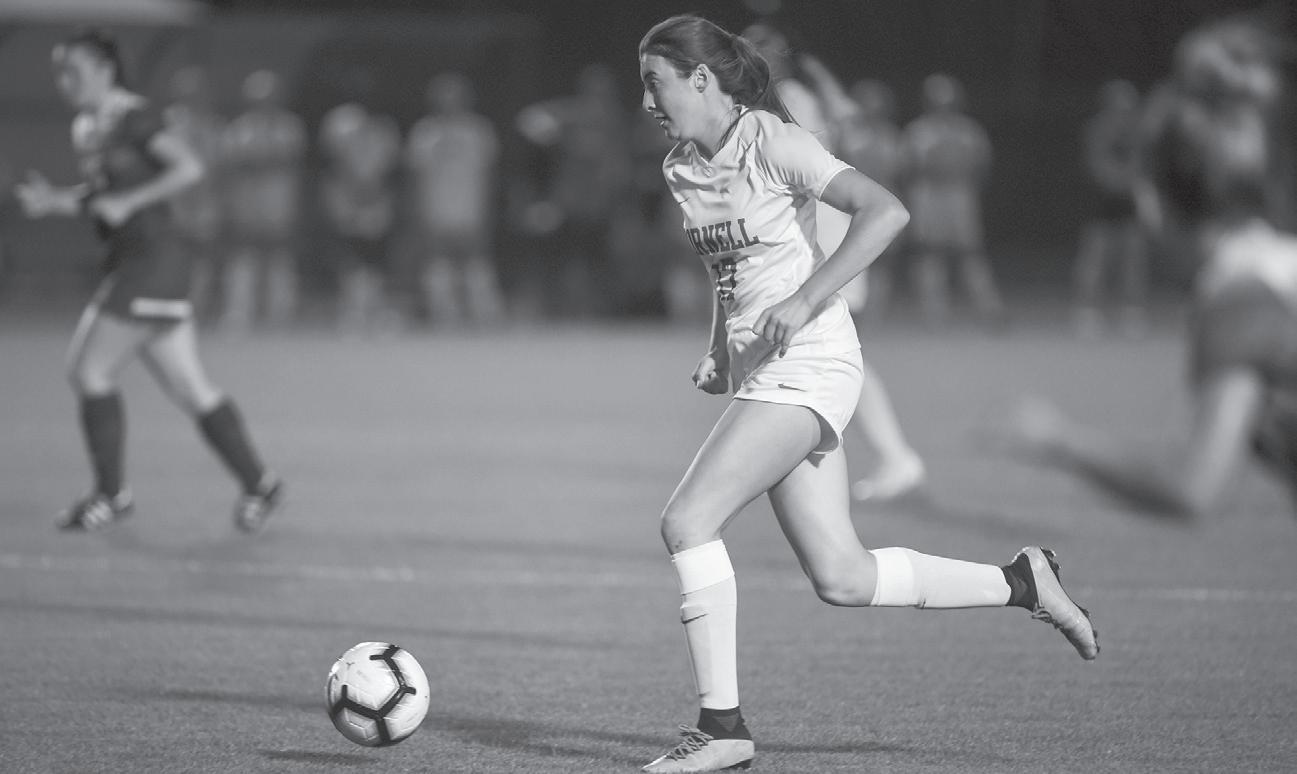
Women’s soccer’s hopes for an Ivy League win on the season died on Saturday when the team lost its final match at Dartmouth. The 5-1 defeat closed out Cornell’s season 0-7 in-conference.
The Green had the advantage the entire game, starting with a goal in the 26th minute, followed by another in minute 34 to put the game at 2-0.
The one bright spot in Saturday’s game came from freshman forward Liza Mariner, who scored her first collegiate goal in the 71st minute. Mariner was assisted by sophomore midfielder Evanthia Spyredes, who sent a long shot in front of the left side to Mariner — who reached the net despite the best efforts of the Dartmouth goalkeeper.
But the momentum didn’t last long; Dartmouth quickly scored three more times to secure the 1-5 victory in Hanover, N.H.
After starting the season with a four-game winning streak, the Red finished its 2019 season by losing nine games and
finishing overall at 4-101. Cornell’s 0-7 record in the Ivy League put the team in last place. Brown finished on top with an in-conference record of 6-0-1, followed by Harvard’s 5-1-1. The Red closed out its season with a total of 10 goals across the 15 games — three coming in conference games — resulting from a mere 129 shots. Cornell’s opponents, when facing the Red, overall had 224 shots, earning 25 goals for the season — more than double Cornell’s efforts. Cornell also came up short in assists with only six versus its opponents’ 24. There were two major categories in which the Red outperformed its competition: saves and,
unfortunately for the team, fouls. In saves, Cornell recorded 68 as compared to its competitors’ 51, but this was born of the fact that Cornell simply needed to defend against more shots than its opponents did. Cornell incurred 129 total fouls on the season — 15 more than its competition.
Despite the lackluster overall results, individual players put forth encouraging performances over the course of the season. Spyredes led the team in points earned with six by scoring two goals and two assists. Spyredes was also the second-leading shot taker this year with 18. Next year as a junior, look for her to continue to improve and elevate her team’s overall play.
Freshman forward Ashley Durik led the team in shots with 21. She also earned four points with her two goals scored early in the season in Cornell’s win against Iona. In goal, senior Chrissy Mayer started for the Red in eight games and came up with 38 saves. With almost a third of the current roster comprised of freshmen, 2019 was a building year for the team. Cornell will need to figure out how to get more aggressive with shot taking, keep the penalties down and keep their opponents’ shots from reaching the net.
Emily Dawson can be reached at etd28@cornell.edu.
All Display Advertising for the Monday, Nov. 25 and Tuesday, Nov. 26 issues plus all Classified Advertising for the Monday, Nov. 25 issue of The Corne¬ Daily Sun
The Sun Business Offce will close at 3 p.m. Monday, Nov. 18 and will reopen Monday, Dec. 2 at 9 a.m. is due MONDAY, NOV. 18 BY 2:30 p.m.

By EMILY DAWSON and KEN CHOI Sun Staff Writers
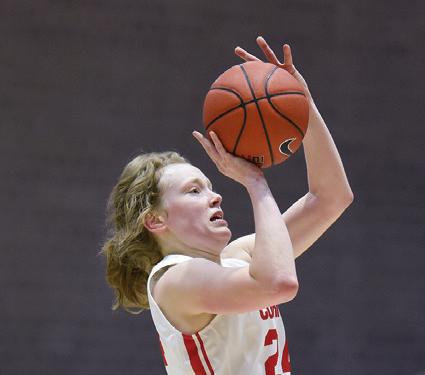
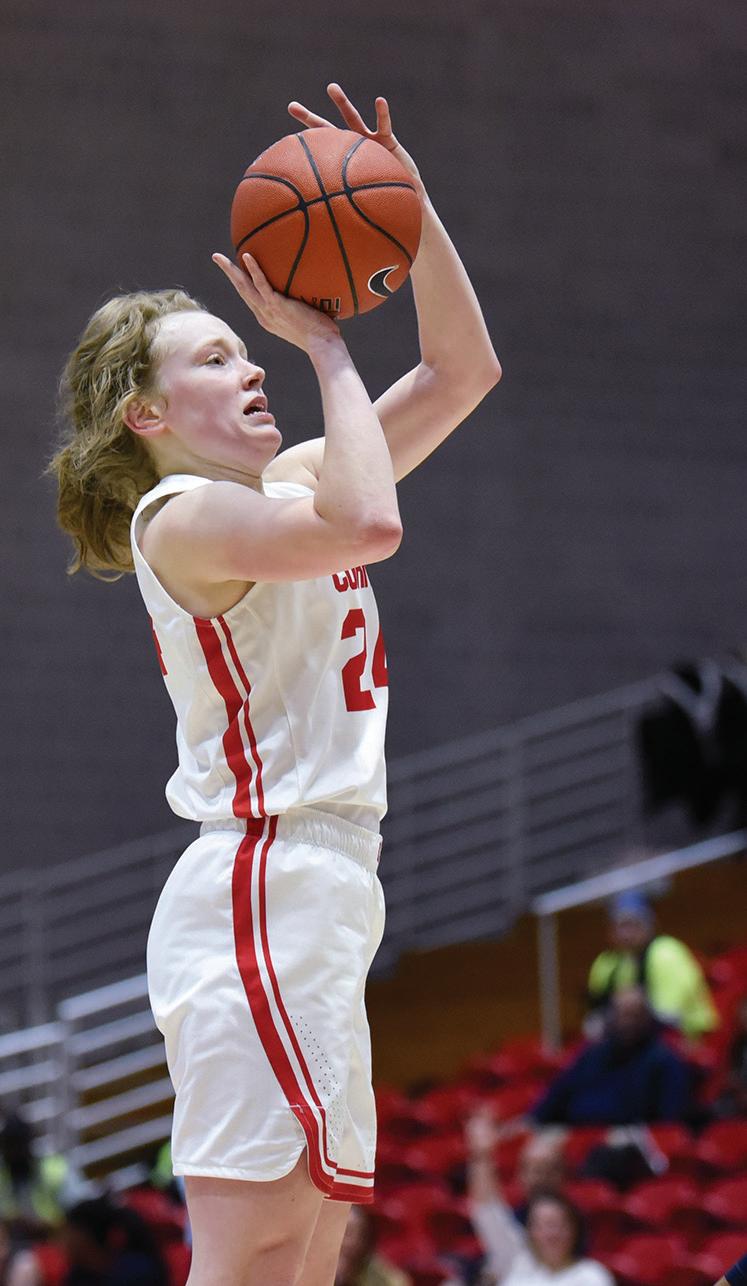
In each of the women’s basketball team’s first two games, a Cornell player has recorded a double-double. A 20-point win at University at Albany opened the Red on a high note on Friday before the team fell to Texas Christian University on Sunday.
Starting out its season at Albany, the Red posted a convincing 71-51 win. Cornell dominated throughout the game, going up 14 points in the first half. Senior guard/ forward and captain Samantha Widmann led the team, scoring a double-double in the game. After giving up points at the start of the game, Widmann hit a jump shot to give the Red the lead. After that, Cornell never looked back. The Red was up by 13 at the end of the first quarter. The momentum did not change, as the team continued quality drives to complete a 22-2 run.
The Red shot over 50% in field goals in each of its first two quarters. In the second half, the team’s already-impressive performance improved even further. Cornell shot 71% in the second part of the tilt, giving the team a commanding lead and crushing Albany’s hopes for a comeback.
Widmann played a teamhigh 33 minutes, shooting
10-for-12 from the field. She scored 22 points along with 11 rebounds while also adding five assists and one block on the day. Junior guard Kate Sramac and senior forward and captain Laura BagwellKatalinich each scored 11 points. Sophomore forward Theresa Grace Mbanefo shot 4-for-5 from the field, putting up eight points coming off the bench.
Every member of the Red saw playing time and 10 players put up points, showing efficiency on offense throughout the roster.
After the victory at Albany, the Red traveled to Fort Worth, Texas, to take on TCU.
The Big 12 opponent proved more challenging than the Albany team Cornell had faced two days prior. Despite the Red’s best efforts, its vigor was not enough to ultimately take the game and the final score was 59-49 in favor of the Horned Frogs.
The Red saw a slow accumulation of points in the first half and headed into the intermission 15 points behind TCU, 40-25. Freshman point guard Shannon Mulroy and Bagwell-Katalinich both were key contributors to the Red’s score in the first half. Across the entire game, both were aggressive and confident on the court.
Bagwell-Katalinich secured
a game-high 17 points and a collegiate-best 17 rebounds for the seventh double-double of her career.
Coming out for the second half, Mulroy and BagwellKatalinich continued to contribute to their team’s scoring. The Red was clearly fired up and ready to give its best effort to take the lead from the Horned Frogs. Going into the final quarter, the Red had narrowed the scoring gap to just a 6-point difference.
In the final frame, the Red tallied another 10 points on the scoreboard. BagwellKatalinich and Mbanefo both contributed to this effort with solid layups in the sixth and third minutes of the quarter.
Senior Dylan Higgins also played a major role in the fourth quarter, closing the Horned Frogs’ lead to just 3 points. But TCU regained its strength and bested the Red in the closing minutes with a 7-2 run.
In the end, the team lost by 10 to the Horned Frogs.
The Red is slated to return home this week, with a contest against Colgate at 7 p.m. Thursday and then a game against the New Jersey Institute of Technology on Saturday at 1 p.m.
Emily Dawson and Ken Choi can be reached at etd28@cornell.edu and kyc37@cornell.edu.
By ALYSON WONG Sun Staff Writer
Men’s and women’s polo each swept Ivy rivals over the weekend, both home and away. The teams kicked the weekend off by hosting Yale before traveling to down Harvard at the Crimson’s home arena.
The men’s team showcased strong performances, beating Yale and Harvard with commanding final scores of 22-9 and 20-2, respectively — improving their overall record to 6-2. The Red, after besting Yale 21-5 and Harvard 38-2 last year, further asserted its primacy in the Ancient Eight.
The men’s team looked to continue playing well after a pivotal 18-15 comeback victory against
Gardnertown Polo on Nov. 1. That win got the team back on track following two tough losses at the 2019 Virginia Polo Invitational the weekend before.
“It gave us an opportunity to iron out some plays and make more fluid transitions.”
Shariah Harris
The women’s team similarly dominated its opponents and turned in lopsided scores, beating Yale 21-2 and Harvard 13-1 to improve its record to 6-3. The women, too, annihilated these two foes last year.
“Overall, I believe our team performed very well
this weekend,” senior caption Shariah Harris said. “It gave us an opportunity to iron out some plays and make more fluid transitions, while also continuing to build on our team communication.”
Both teams now sport three-game winning streaks that they hope to extend when they face off against the University of Connecticut and Roger Williams next weekend.
Looking even further ahead, Harris noted that the team aims to do well at the Bill Field Invitational on Nov. 21.
The tournament takes place at Cornell’s own Oxley Equestrian Center.
“Our main goal is to prepare as best as we can for our Bill Field tournament that begins next week,” said Harris. “We

are focusing on the small things, like building onto our individual skills and … [continuing] to build on team communication and cohesion so that we are able to make smarter plays and refine our transitions.”
The Red will host Connecticut at the Oxley Equestrian Center, with the men’s team squaring off on Friday, Nov. 15 at 7 p.m. and the women’s team the next day at 7 p.m. Both teams will then travel to Portsmouth, R.I., to face Roger Williams. The men’s team will play on Nov. 16 and the
en’s team will play on Nov. 17.