

S.A. Debates How
To Replace Finance
V.P. Mid-Semester
Funding cycle continues with interim V.P.
By SOFIA RUBINSON and ELI PALLRAND
Sun Staff Writers
Following the resignation of its vice president of finance, the Student Assembly is trying to decide on a replacement as the end of semester funding cycle deadline approaches.
At the end of the S.A.’s Oct. 21 meeting, S.A. president
Anuli Ononye ’22 announced that Morgan Baker ’23 had resigned from her role as vice president of finance, which oversees the appropriations committee — the body within the S.A. which allocates funding to student organizations on campus from the Student Activity Fee. In an email to the Sun, Baker said she voluntarily resigned from the position for personal reasons.
“I will continue to fulfill my duties as a good representative in the position of an Undesignated Representative At-Large,” Baker wrote.
The Student Activity Fee is a mandatory fee that all students must pay to fund student organizations. Currently, the SAF is $309 per year for every student. The S.A. determines how much money each byline funded organization will receive every two years. Byline funded organizations, which each get a fraction of the student activity fee, work as umbrella groups to fund other campus organizations.
The lack of a public rationale for Baker’s resignation has left some S.A. members scratching their heads.
“There’s a lot that happens behind closed doors,” freshman representative Andrew Juan ’25 said. “We have, one, S.A. members confused, and two, now we have the general population confused.”
Public conversations about the developments within the appropriations committee are suppressed, in part, by the committee’s rules. Members sign permanently binding non-disclosure agreements that bar them from disclosing the committee’s confidential materials, which include the information submitted by organizations in support of their applications for funding. Additionally, votes within the committee are anonymous.
According to Baker, the NDAs and anonymous voting
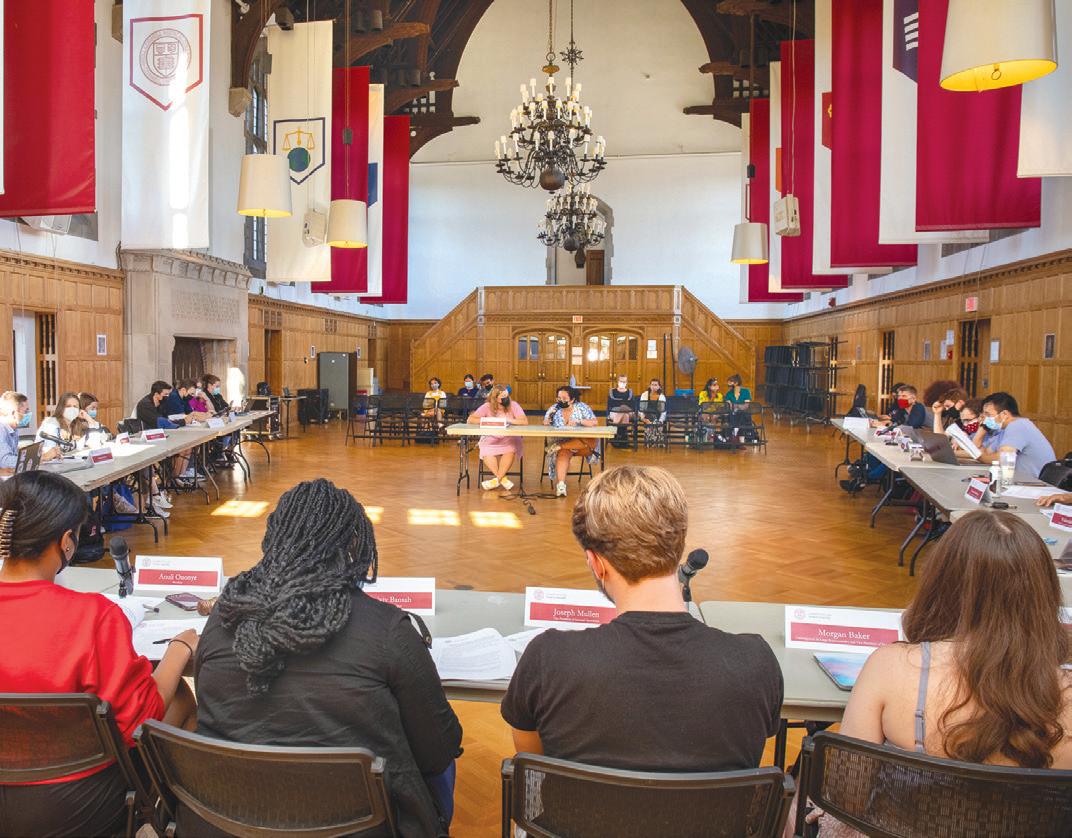
meeting last September.


Lecturers Discuss
Gun Violence Prevention Strategies
In a Friday evening lecture, President of Heartland Alliance Evelyn Diaz and Prof. Jens Ludwig, public policy, University of Chicago, argued that insights from behavioral science could be critical for reducing gun violence in the United States by helping people de-escalate conflicts.
As gun violence rates rose sharply across the country during the pandemic, many are looking
for solutions. At the same time, there is growing concern across the United States about the need for criminal justice system reform. Ludwig and Diaz argue that behavioral science-based interventions to help people learn to de-escalate conflict are a key for reducing gun violence.
The lecture was supported by a gift from Mark Horowitz and Jennifer Koen-Horowitz ’93, and was co-sponsored by the Cornell Institute for Public Affairs, the Sloan Program in Health
See LECTURE page 3
Speakers to Refect on Baghdad History
By JOHN YOON Sun City Editor
On Monday, two Iraqi scholars will speak about their work in Baghdad to restore the architecture and accompanying social history after the American invasion of Iraq in a Cornell webinar at noon.
At the event, which is titled “Iraq: From the Inside Out,” Prof. Mohammed Qasim Al Ani, architecture, Al Nahrain University, and Prof. Saba Al Ali, architecture, Al Nahrain University, will speak about their work in Baghdad transforming urban centers and addressing the architectural issues left after the American invasion of Iraq.
The webinar is hosted by the Mario Einaudi Center for International Studies and the Critical Ottoman and PostOttoman Studies program.

According to the event announcement, the invasion led to the collapse of social
order with the facilities that support urban development — like architecture, state norms and city planning — broke down. The speakers have since worked to improve and address the issues that emerged from the invasion, specifically focusing on Baghdad.
Receiving her Ph.D. from the University of Baghdad, most of Ali’s work has been focused on the history of architecture, local architectural heritage and urban history. Most recently, Ali has published a study identifying that insufficient budgets and a lack of labor has led to Iraq applying corrective rather than preventative maintenance on heritage buildings.
Ani also received his Ph.D. from the University of Baghdad, focusing on strategies developing neglected areas and preserv-
By ALEXIS AHN and TAMARA KAMIS Sun Contributor and Sun News Editor
Ruined arch | A man walks by a building ruin in Baghdad in 2010.
JOAO SILVA / THE NEW YORK TIMES
Fall trees paint the town
A LISTING OF FREE CAMPUS EVENTS

Student funding | The East Asia Program, housed in the Einaudi Center for International Studies, offers several types of fellowships and grants to support student research relating to East Asia, including a language study grant for undergraduate students. This session will detail the application process and provide guidance on writing proposals.
Today
Joint Labor Economics & School of Public Policy Workshop: Adam Shumway
11:15 a.m. - 12:45 p.m., Ives Hall 16
Info Session: East Asia Program Student Funding 1:00 p.m., Virtual Event
Bioinformatics Workshop: Docker and Singularity 3 - 4:30 p.m., Virtual Event
Joseph Nye | The American State in a Multipolar World: The Future of U.S.-China Relations 4:30 - 6:00 p.m., Virtual Event
Annie’s Project: Risk Management for Farm Women 6:30 - 8:30 p.m., Virtual Event
Tomorrow
Behavioral Economics Workshop: Lynn Conell-Price 11:15 a.m. - 12:45 p.m., Sage Hall 141
Berger International Speaker Series with Dipali Mukhopadhyay: Afghan State-building in the Shadow of Counterterrorism 12:15 - 1:15 p.m., Landis Auditorium, Myron Taylor Hall, Room 184
Development and Social Change: A Global Perspective 4 - 5 p.m., Virtual Event
Microeconomic Theory Workshop: Yuhta Ishii 4:15 - 5:45 p.m., Virtual Event
Inside ILR: Cornell Engagement 4:30 p.m., 423 King-Shaw Hall
Apocalypse Debate 5 - 6 p.m., Kaufmann Auditorium, Goldwin Smith Hall G64
#decoded Career Prepping 6 - 7:30 p.m., Wendy Purcell Lounge RPCC 203
Winterizing Your Ornamental Garden 6 - 7:30 p.m., Virtual Event


W W W . C O R N E L L S U N . C O M
S.A. Seeks New Appropriations Committee Head
STUDENT ASSEMBLY
Continued from page 1
procedures for the appropriations committee are required by the Student Assembly’s governing documents. Representative Valeria Valencia ’23 thinks the NDAs are useful because the committee deals with sensitive financial matters, but can make S.A. general assembly meetings more challenging as they cannot publically address members’ concerns about byline funding.
Vice president of internal operations Joseph Mullen ’24 said he thinks the NDAs shouldn’t be in place because they make it difficult for representatives to speak publicly about issues that affect students.
“If we’re directly impacting students, people should know what we’re talking about [on appropriations] publicly.”
Joseph Mullen ’24
“The appropriations funding stuff is the one instance where we do have direct control over how these student organizations are getting funded and, to my mind, there’s no reason why that stuff should be private,” Mullen said. “If we’re directly impacting students, people should know what we’re talking about [on appropriations] publicly.”
Immediately after announcing Baker’s resignation on Oct. 21, Ononye tried to appoint Valencia, a member of the appropriations committee who was the runner-up to Baker in the internal election in June, to fill the post. Ononye made the decision on the grounds that other committees had previously filled seats based on standings in internal elections and that both Baker and Valencia had agreed to this move.
However, after multiple representatives noted that the S.A. charter does not provide guidance on the procedure proposed by Ononye, she gave the vice presidential position to Valencia on an interim basis.
The committee set up an election to fill the position on a permanent basis, a process that began Thursday with the nomination of two candidates, Valencia and Dillon Eisman ’22 — both of whom are currently on the appropriations committee. Neither candidate was given time at the meeting to discuss their platform or qualifications and voting was
tabled until the next meeting.
“I want to ensure that the Student Activity Fee is being spent efficiently,” Valencia said in an email to The Sun. “I also want to work with the different byline funded organizations to find ways to make the application and byline process simpler and more accessible.”
Valencia thinks that the byline funding process this year was made more challenging by the pandemic because many organizations lost institutional knowledge of what a normal year looks like, making it more difficult to work through the funding process. She also sees room for improvement in how the appropriations committee interacts with byline funded organizations, as she feels institutional changes of switching back to in-person activities requires open communication.
According to Atif Akhter ’22, treasurer of the Cornell Interfaith Council — which receives byline funding, the process has not been easy. They had their hearing two weeks ago and have yet to hear a response on their funding status, which Akhter considers unusually long.
“During our meeting, it felt like we were graded on how well we could spend money,” Akhter said. Due to restrictions on in-person gatherings during the 2020-2021 school year, the Cornell Interfaith Council did not get to do as much with their byline funding that they would have liked, which Akhter hopes the committee takes into consideration.
”We submitted our application on time. We were early to our meeting. Everything was done by the rules,” Akhter said. “I’m just a little confused on why this is taking so long.”
If Valencia is elected to become the vice president of finance, she hopes to better address these concerns.
“Historically, the [appropriations committee] hasn’t been popular with the different byline funded orgs,” Valencia wrote. “Most of the time our only interaction with them is during their byline hearing but I think the system as a whole can really benefit from more collaboration so that everyone in the apps comm is really familiar with all the hard work that all the orgs put in.”
At the time of publishing, Eisman has not responded to multiple requests for comment.
Sofa Rubinson can be reached at srubinson@cornellsun.com. Eli Pallrand can be reached at epallrand@cornellsun.com.
Speakers Discuss Behavioral Science Application to Gun Violence
LECTURE
Continued from page 1
Administration and the Jeb E. Brooks School of Public Policy. It was hosted by Prof. Rosemary Avery, public policy, and Prof. Max Kapustin, public policy.
Ludwig said two common strategies that are proposed for reducing gun violence are poverty reduction and imprisoning people who commit crimes. But, he argued, much of gun violence is neither an intentional effort for material gain, such as armed robbery, nor previously planned actions to hurt another person.
“About 70 percent of the murders that happen in American cities are basically arguments that go sideways because nobody de-escalated and a gun was present and turned it into a tragedy,” Ludwig said. “That’s the gun violence problem in America right there.”
To help reduce rates of violence, Ludwig suggested teaching people — including children — to de-escalate conflict.
Ludwig conducted a large-scale, randomized control trial of the “Becoming a Man,” program which had been developed by a Chicago organization called Youth Guidance to help participants de-escalate high stakes situations. BAM exercises focused on trust and community building, role playing and skill building.
The trial saw a significant reduction in violent crime arrests. Ludwig is hopeful that the promising outcomes of these studies will help inform gun violence regulation in America.
Diaz agreed with Ludwig that teaching people de-escalation strategies can be effective in reducing gun violence
based on her experience at The Heartland Alliance. The organization runs the READI Chicago Program, which includes paid transitional work, job training, coaching and multiple sessions of cognitive behavioral interventions per week for men at high risk of experiencing gun violence based on factors including referrals from community organizations.
According to Diaz, preliminary results suggest the program has been successful in reducing the odds of being arrested or involved in violence for participants in comparison to those in group that did not go through the program. According to the READI website, participants learn to less immediately react to stress, slowing down their reactions and de-escalating where possible.
“[The participants] care about doing right by their families, their children, their moms, their grandmas,” Diaz said. “They’re resilient, they’re ambitious... The fact that they’re showing up consistently to the program means that they see a different possible future for themselves.”
Avery, one of the professors who helped organize the event, hopes that attending the event taught students to think critically and creatively about policy solutions to social issues.
“I’m trying to try to teach the students in public policy to think outside the box and not to assume the way we’ve done things in the past is the way we should do things in the future,” Avery said. “We need to think creatively about public policy.”
“The fact that they’re showing up consistently to the program means that they see a different possible future.”
Aiyana Green ’22, the head teaching assistant of Prof. Avery’s Policy Analysis & Management 2300: Introduction to Policy Analysis course, found the lecture engaging and informative. The most impactful part of the lecture for Green was hearing about aspects of the READI program from the participants themselves via a video that was shown during the presentation.
Evelyn Diaz
According to Diaz, Biden’s Build Back Better plan may include some funding for community violence prevention, which makes her hopeful for more large-scale intervention efforts.
“Remember our collective humanity, center in your work. If we do that we’re not only going to bring evidence-based policy and practice to bear at scale, but we’ll elevate the people and the communities that have been most harmed by gun violence,” Diaz said. “We’re going to help them heal and rebuild.”
Iraqi Scholars to Discuss Architecture, Planning
Professors refect on legacy of 2003 U.S. invasion
IRAQ
Continued from page 1
ing cultural heritage through architecture. Ani is part of the International Council on Monuments, a non-governmental organization that promotes conservation and protection of monuments around the world, and Sites and International Society of City and Regional Planners, an association of over 700 professional city and regional planners.
The event will be moderated by Prof. Esra Akcan, archi -
The invasion led to the collapse of social order with the facilities that supported urban development.
tecture, who studies how the history of Europe and West
Asia are linked when considering modern and contemporary architecture. Akcan is director of European studies for the Einaudi Center and her other areas of research include architectural history, migration and critical and postcolonial theory.
The event requires registration and will be virtual.
John Yoon can be reached at johnyoon@ cornellsun.com.
Julia Cerio ’23, another T.A. for the policy analysis class, hopes that people will come away from this lecture with a more open-minded perspective when approaching the gun violence crisis in America.
“Both of the lecturers really humanized the [gun violence] epidemic. I appreciated how Ms. Diaz put faces to the crisis in her work with READI,” Cerio wrote in an email to the Sun. “I hope that people will move forward from this seminar with a more open-minded perspective on one of the most pressing policy crises in America.”
Tamara Kamis can be reached at tkamis@cornellsun.com. Alexis Ahn can be reached at aja262@cornell.edu.
Gender and Murder in Titane
VIOLET GOODING SUN CONTRIBUTOR
Titane is easily the strangest movie I’ve ever seen. The Palme d’Or winner gained notoriety and praise for its demented portrayal of love. While that sometimes gets lost in the movie’s unhinged plot, Titane’s visceral experience of blending horror and eroticism results in a thrumming crescendo of creative ingenuity.
Titane centers around Alexia (Agathe Rousselle), a murderous strip-club dancer who takes on the identity of a long-missing boy named Adrien in order to escape the authorities. At risk of spoiling the movie, I should note that it is also about cars, and the companionship that accompanies the grotesqueness of the human body. It’s a lot to take on in just under two hours, but director and writer Julia DuCourneau deftly navigates her subject material with artistry, precision, compassion, discomfort and even humor.
From a technical standpoint, Titane is stunning. In an opening scene wherein Alexia dances on top of a car, the camera sweeps around her writhing form, a mess of spandex and aluminum underneath headache-inducing stadium lights. Just as her thrusting becomes nearly unbearable, and the viewer begins to grasp her violent intentions, the camera pans upward to a wide shot of the dispersing crowd, mostly disturbed. Alexia is nothing but a spectacle to them, a passing amusement; she retains a similar relationship with her father, who views her with a detached disturbance.
Dance scenes are also a vehicle for DuCourneau to subvert expectations of gen-
AUDREY AHN SUN CONTRIBUTOR
der. In Vincent’s, the father of the missing boy, fire station after hours, a crew of burly firemen gracefully sways in slow motion, bathed in pink light. DuCourneau deliberately cast professionally trained dancers to play the movie’s firemen, noting in an interview
with love?” This is most evident in another dance scene between Alexia and Vincent. Set against “She’s Not There” by The Zombies, Vincent desperately seeks connection with Alexia/Adrien despite her shoddy disguise; Alexia, on the other hand, tries to kill him, but

that through these graceful, almost typically feminine movements; DuCourneau said: “Somehow it becomes more of a tableaux than just a regular party.” In a later scene, the same firefighters jostle violently in a mosh pit. It is an aggressive affirmation of masculinity in which Alexia tries and fails to find comfort.For DuCourneau, the film is rooted in a search for familial love. In her words, “The whole point with my film is to make you feel what the characters feel, but it’s hard to make you feel love, to physically feel it. So I decided to do it as a challenge and ask: can you do that
can’t quite bring herself to do it, instead quietly dodging him. All of this is accentuated by a brilliant use of sound. From the vibrating rev of a Cadillac to the sickening crack of a broken nose, DuCourneau pushes noise to extremes. I flinched and squirmed every time Alexia tightly binds her chest and bulging belly; even if you look away (I did), there is no respite for the agony of ribs cracking and heavy breathing, all tangible through the theater’s subwoofers. This repulsiveness is expected for DuCourneau, whose infamous debut Raw
caused some viewers to feel physically ill and even pass out in theaters.
Titane, however, never feels like it uses its violence for shock value alone; as gruesome as it was, I enjoyed the murder scene when Alexia frantically slaughters her coworker. Just as she starts to pin her hair back up with her weapon (has anyone seen Killing Eve?), yet another dopey housemate bumbles in and witnesses the horror. The needle drops to “Nessuno mi può giudicare” by Caterina Caselli, a bouncy 1960s pop song, as Alexia grumbles, “How many of you are there?” and proceeds to finish the job. The best part of this dark comedy? Throughout the bloodshed, she wears a neon muscle tank that reads “Never Give Up.” Later, when Alexia brandishes her killer hairpin on another victim, he blankly asks, “Do you like to knit or something?”
That said, the development of Vincent and Adrien/Alexia’s relationship adds a surprisingly tender note to the prior bloodshed. They have simply found each other. In the soundtrack, the scene is referred to as “Bathroom Pietá.” Vincent mourns his dead son, but Alexia/ Adrien resurrects his ability for compassion. Perhaps Alexia/Adrien is also a symbol of the Virgin Mary, with her seemingly impossible pregnancy. Religious allusions aside, the two soften each other’s hardened outlook on life. After all this, I still don’t really “get” Titane, but I do find myself wondering about it every now and then. Titane is not for the faint of heart (or stomach), but for those willing to dwell in discomfort, it rewards you with surprising compassion and clear creative vision.
Violet Gooding is a freshman in the College of Arts and Sciences. She can be reached at vbg22@cornell.edu.
You Season 3: Memes and Meaning
TikTok creators have been posting hypothetical scenarios in which their significant other engages in some jealousy-inducing activities such as texting someone else, hanging out with them behind their back, etc. The video would then quickly cut to a clip of Joe Goldberg or Love Quinn, the protagonists of the hit Netflix series You. And if you know anything about the show, you know that they are a whole lot of crazy.
Netflix and has been attracting the attention of audiences everywhere.
The eagerly anticipated third season to You has just released on

A story that started in 2018 with Joe Goldberg’s dangerous obsession with Guinevere Beck has now evolved into one about his marriage with Love Quinn, the equally dangerous female protagonist. The show is filled with the same creepy stalking, violence, and thrill that made it so popular in the past. Yet, with this season having two psychopaths instead of one, there is arguably double the fun.
I’ve always noticed an interesting phenomenon when it comes to You. Although the general consensus amongst audiences is that almost everything that the protagonists do in the show is horrible and disgusting, people have time and time again refused to turn away and continued watching. Despite our inherent tendency to avoid looking at things that make us uncomfortable (and I’m assuming that creepy stalking and creative murder techniques can make almost everyone uneasy), You seems to be the exception. Not only are people simply tolerating the show, they are reveling in all of its gory detail in comedic fashion. Just this past week, there has been a mass influx of TikToks and memes about Joe and Love, which is not something you frequently see with real-life stalkers and murderers.
But going one step further from simply making jokes out of Joe and
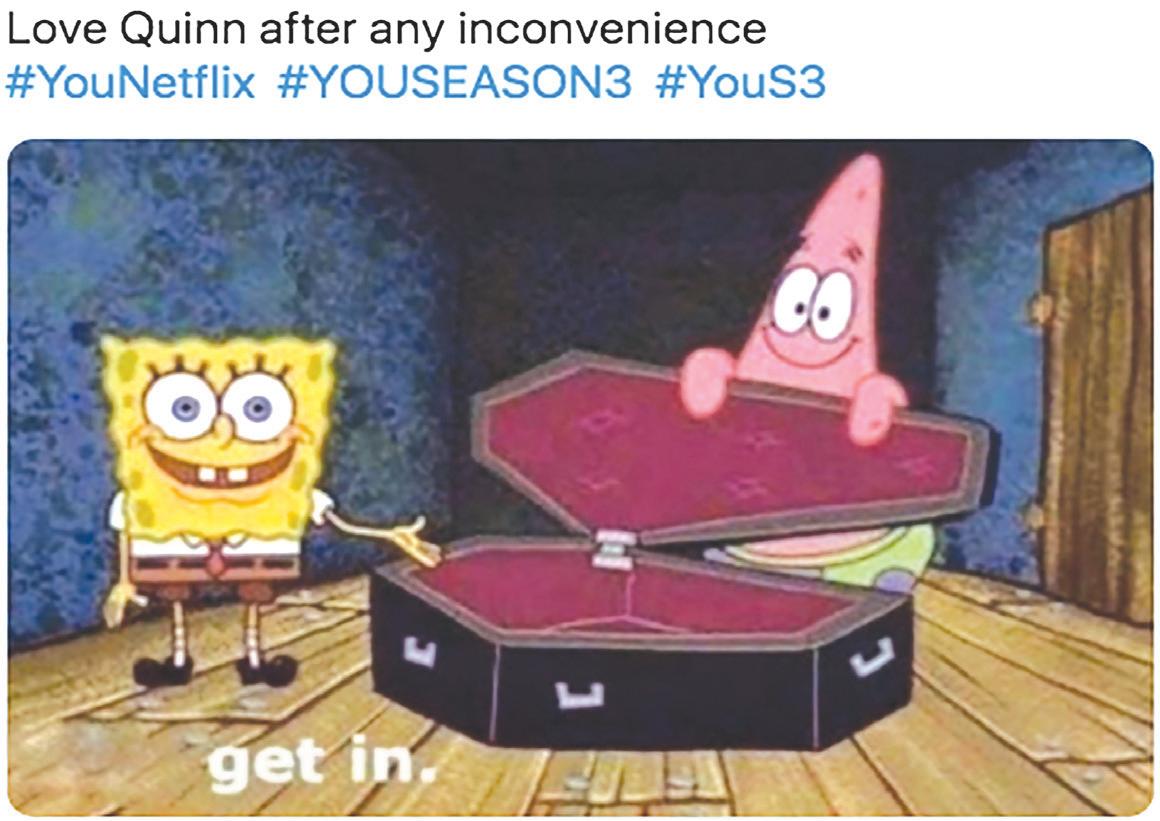
Love, I believe that there is a part in all of us that vicariously lives through them. Now, I’m not arguing that we all have innate murderous and stalkerish tendencies. We don’t. But I think the larger theme that Joe and Love embody is control. The desire to control every facet of your life so that things go perfectly. Reality, if you live it equitably, doesn’t work that way. At the end of the day, there is no way we can handle every situation from going wrong, or avoid the consequences of our actions by killing whoever will impose it upon us. This control over our lives and our futures is something that can only exist in our wildest imagination, or in You
But I think another interesting aspect of the show this season is
that it delves deeper into the past of the protagonists, allowing us to understand them on a deeper level. In this season, we delve deeper into Joe’s turbulent childhood filled with violence, abuse and neglect. The show does a great job in weaving in parts of Joe’s past with his present, allowing the audience to clearly see how his present is largely derivative of his past. Love is also given a lot more dimension than you would normally expect from a standard ‘evil’ character.
To read more of this article, please visit cornellsun.com.
Audrey Ahn is a freshman in the College of arts and sciences. She can be reached at sa752@ cornell.edu.
COURTESY OF NEON
Blatant Militarism in the Marvel Universe
MIRA KUDVA DRISKELL SUN COLUMNIST
I’ll start this column out with a confession: In my youth, I was an honest-to-god comic book stan. We’re talking hours spent in comic book stores — which should give you a sense of my unbelievably rad seventh grade social life.
But, despite this love for comics, I’ve found that recent superhero movies just don’t do it for me. There’s just something off about having perfectly sculpted celebrities swooping in to save the world the day in skintight leather and latex. Also, with the notable exceptions of WandaVision and Black Panther, I would venture to say that the vast majority of superhero movies have started to fit into a series of tropes — the tortured anti-hero, the All-American goodie two shoes, blah, blah, blah — that leave them entirely interchangeable.
But, there’s something more nefarious at play. Recently, Marvel’s The Eternals has become the topic of a great deal of online discourse, in part because of a scene where Phastos, a character blessed with the power of invention — and Marvel’s first gay superhero — helps humanity create the atomic bomb. As you can probably imagine, Twitter saw

this and lost it.
One podcaster, Jesse Hawkins, tweeted “The gay Eternal assuming responsibility for the atomic bomb being dropped on Hiroshima is even more amazing once you factor in that
Marvel scripts are all approved in advance by the Pentagon.”
In response, James Gunn, director of the Guardians of the Galaxy franchise, lept to Marvel’s defense, explaining that 1) films using military assets need approval to make sure the military isn’t disparaged and 2) that the military doesn’t really approve any scripts.
So, our question becomes: Who’s telling the truth?
First, we do need to note that the Department of Defense has a long history of working with film producers. Essentially, the arrangement is that if a producer wants to feature U.S. military equipment in their film, the department will provide funding and resources in exchange for controlling the military’s image. The practice goes back to the silent era, where the first ever Best Picture winner, Wings (1927) received Pentagon support. Since then, films ranging from Indiana Jones and the Last Crusade (1989), King Kong (2005) tp Top Gun (1986) have received support from the Department of Defense. It works, too: following the navy’s rewrite of Top Gun and the general positive portrayal of the military, the navy saw a 500 percent increase in enlistments. The relationship, which has been persisting since the Cold War, is often termed the military-entertainment complex.
Marvel is, therefore, one of many industry tycoons working alongside the Department of Defense, with franchises such as Iron Man, Captain America and Captain Marvel working closely with the military. But, also consider: any film, TV show, etc. that’s using U.S. military equipment is required to seek authorization from the Department of Defense. Which, for superhero movies and beyond, means that the vast majority of what you’re consuming has been whitewashed by the military so that pro-war propaganda weasels it’s way into your malleable little brain. Pentagon funding aside, let’s consider the basic plot of the vast majority of Marvel movies wherein an attractive superhero travels to another country or world to fight a horde of faceless CGI monsters. It seems obvious to me that there’s a degree of subconscious indoctrination taking place.
But, that’s also Hollywood. It shouldn’t come as a surprise when giants of the industry are against portraying
stories that would undermine their power and privilege. There are, of course, films that seek to challenge the status-quo, whose careful analysis and artistry portray messages of resistance far better than any other art form. There’s also a bunch of shit-tier propaganda that uncritically accepts the world as it is. Which is not to say that propaganda can’t be artistic, just that it’s hard to create a well-crafted film or TV show that simultaneously beats you over the head with a pro-military message.
It’s obvious to me that there’s a degree of subconscious indoctrination taking place.
So, what do we do? Is it wrong to consume this media? I don’t necessarily think so. As I have pointed out, a great deal of media is propaganda of some sort. And, even when it’s not, I would venture to say that the content you’re consuming is probably being sent out via platforms controlled by billionaires. In the age of late capitalism, there will always be a moral dilemma posed by what you consume. But, in my mind, though we’re all ethically compromised, what truly determines whether your consumption is good or bad is how far you’ll go to question yourself, and whether or not you’ll blindly accept the world as it is.
Mira Kudva Driskell is a junior in the College of Agriculture and Life Sciences. They can be reached at mdriskell@cornellsun.com. Portrait of a Gen Z on Fire runs alternate Mondays.
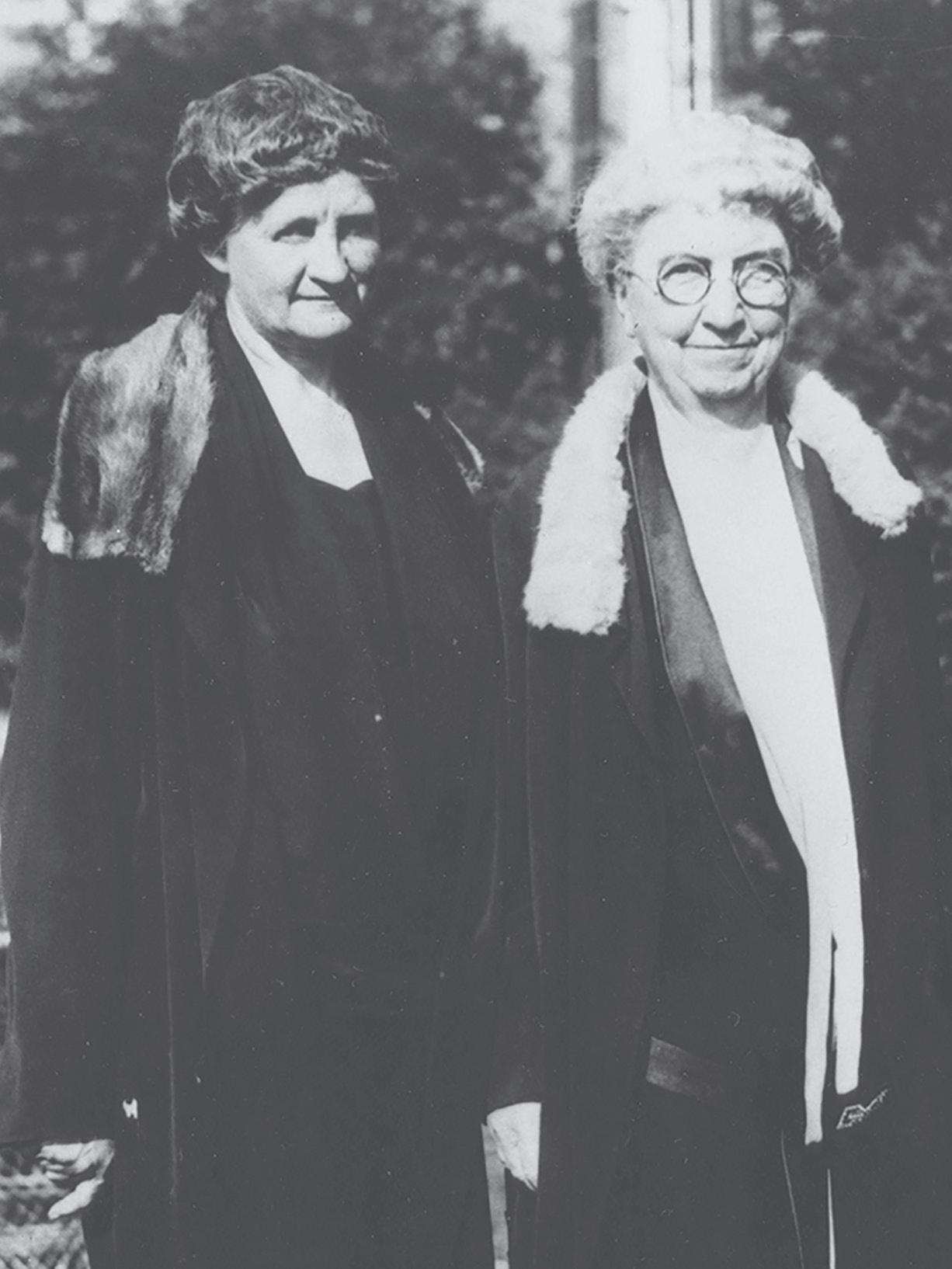
And Tey Were Roomates: Flora Rose and Martha Van Rensselaer
ELIZA SALAMON SUN CONTRIBUTOR
A few weeks ago, while eating dinner on West Campus with some friends, I began to look up the people whose names graced the buildings we all lived in, people whose names have been reduced to proper nouns: “I live in Keeton,”
“Let’s get dinner at Becker.” (They are all esteemed Cornell professors if you were wondering). On the Wikipedia page for Flora Rose, I learned that she had been hired by Cornell to establish the home economics department (now the School of Human Ecology) with Martha Van Rensselaer, another name adorning the side of a wellknown Cornell building. What especially caught my attention was the next sentence: “She and Martha Van Rensselaer were oftenww “collectively referred to as Miss Van Rose,” and they lived together from 1908 until 1932 when Van Rensselaer died; “they were equal partners in their work, taking an academic, scholarly approach to the matters of personal and family life.”
Immediately intrigued, I returned home from dinner, intent on finding out more about these two Cornell scholars in the early twentieth century, a time certainly not known for publicly gay relationships. After some digging, I found a few online sources which explicitly talk about Rose and Van Rensselaer in romantic terms, and a few others conspicuously lacking a mention of anything beyond platonics. In an article from 2006, Megan Elias wrote of the women that “Their
relationship was treated by friends as both a model for and representative of other same-sex relationships within the home economics movement.” A 1925 speech about Van Rensselaer includes the quote: “She it is, with the partner she came to love and who came to love her.”
This admission seemed surprisingly frank and accepting, but I quickly learned the seeming brazenness of their relationship was not unique.
During this time period, it was not uncommon for women in higher education to live together in domestic partnerships, sometimes called “Boston marriages.”
Although these relationships were not all romantic or sexual, many were; no matter the circumstances, they allowed women to live outside the traditional confines of hetero marriage and live independently to pursue academic goals. It seems this was especially common within women teaching and studying home economics at Cornell, a department that fostered women’s independence, achievement and ostensibly, allowed them to explore their sexuality.
However, a 1957 biography about Van Rensselaer (with a foreword by Rose nonetheless) excludes any mention of any romantic or sexual connection between the two, instead using “friendship and partnership” to describe their relationship. To most readers, it is easy to read between the lines and one might look no further than Rose’s description of Van Rensselaer: “About five feet, six inches tall, with brown hair, warm brown eyes, wellshaped, strong eyebrows, a beautiful skin, and in her earlier years, a bril-
liant complexion. She had a strong, straight figure; well-shaped, expressive, capable hands; a deep, resonant
ment, an area of study which sought to turn traditionally lowbrow women’s duties into a scientific and
voice, which often sounded cold to strangers; and great dignity of bearing,” to conclude the probable nature of their relationship.
The two women owned homes together, hosted friends at their mountain house and even opened a hotel in Ithaca. They were pioneers in the home economics depart-
respected craft. Their teachings at Cornell included nutrition, cooking, child-rearing, textile design and management. Rose and Van Rensselaer spoke before the New York state legislature to advocate for the study of home economics and successfully convinced the male legislators to fund a building
for the department. Van Rensselaer found encouragement and support, both personally and politically, in Eleanor Roosevelt (who was also commonly suspected to have had relationships with women).
An article in The Ithaca Voice from last spring about renovations on Martha Van Rensselaer Hall neglects to mention the complex relationship between the two home economics founders, instead referring to Van Rensselaer “and her colleague and housemate Flora Rose.”
Why this exclusion? It’s easy to place historical figures in a box constrained to a different era. The relationship between Rose and Van Rensselaer was not renounced or considered unusual in the time and place in which they resided. Instead, it was acknowledged, respected and admired. What may be merely an academic building, a dorm or a dining hall to us is a dedication to the lives of former Cornellians. Yes, they were smart and innovative, but they also had rich lives and relationships. We may never know the true dynamics of the relationships between Rose and Van Renssalaer, but their steadfast passion for their work and affection for each other is clear.
Next time you read a name off the side of a building (and yes, there are some left that haven’t been bought with seven-figure donations), I urge you to look a little into the past and find out who these people were — how they lived, what they taught and who they loved.
Eliza Salamon is a sophomore in the College of Arts and Sciences. She can be reached at ecs287@cornell.edu.
Portrait of a Gen Z on Fire
Mira Kudva Driskell
COURTESY OF CORNELL UNIVERSITY
The Corne¬ Daily Sun
Independent Since 1880
139th Editorial Board
KATHRYN STAMM ’22
Editor in Chief
ANUSHYA ALANDUR ’23
Business Manager
CATHERINE ST. HILAIRE ’22
Associate Editor
PRANAV KENGERI ’24
Advertising Manager
ODEYA ROSENBAND ’22
Opinion Editor
MADELINE ROSENBERG ’23
Managing Editor
NAOMI KOH ’23 Web Editor
ANIL OZA ’22
Assistant Managing Editor
YUBIN HEO ’24
Assistant Web Editor
Working on today’s sun
ad layout Christine Wu ’23
opinion desker Catherine St. Hilaire ’22
managing desker Anil Oza ’22
news deskers Tamara Kamis ’22
Surita Basu ’23
production deskers Dennis Quizhpi ’24
Jacqueline Woo ’24
layout deskers Kristen D’Souza ’24
Puja Oak ’24
photo desker Hannah Rosenberg ’24
arts desker E.D. Plowe ’23
sports desker Will Bodenman ’23

Christian Baran Honestly
Christian Baran is a senior in the College of Agriculture & Life Sciences. He can be reached at cbaran@cornellsun.com. Honestly runs alternate Fridays this semester.
Bust Down the Door
Iwould never just open a door and walk through, I always had to bust it down for the hell of it. I just naturally liked doing things the hard way.”
Edna Ferber, Pulitzer Prize-winning novelist and the source of that quote, represents a nebulous, undefined philosophy that’s been in my mind for years. I pump sporadic life into it during offhand conversations with my best friends or drunken discussions with people I don’t expect to see again, but mostly, it sits comatose in the periphery of my thoughts.
The essence of the philosophy is simple: doing the worst, or the word I use more often, shitter, alternative makes you a better person. I, along with most people I know, don’t follow it.
We face uncomfortable options every day. They aren’t always big decisions, like choosing between taking a job offer that’s about to expire or betting on yourself to nail the interview for your preferred company the following week. They can be little ones, like eating an apple instead of a Snickers bar or leaving your comfy Collegetown workspace for a stiff, uncomfortable chair in Olin Library. No matter the decision, there is usually one that is more unpleasant than the other. That option builds character, discipline and resiliency.
I can’t speak for all Cornellians, but I think that most would agree that we’ve settled into relatively comfortable routines here. We have cozy beds to sleep in, good food to eat and limitless opportunities for recreation and professional development. That’s all well and good, but our comfort lets us forget the immense benefits of discomfort.
By no means am I saying that I have lived a Spartan lifestyle of pain and discomfort, or lived anything remotely close to what could be considered
a hard life. Quite the opposite. But nevertheless, I can’t help but gravitate towards the paradox of the worse option being the best one.
Ferber, in her simple quote, takes that paradox one step further: one must not only choose the more difficult option, but create such an option when none exists. In her example, the only reasonable options are walking through the door or not walking through the door. Both are easy. When Ferber is presented with that choice, she chose to create a difficult path by breaking down the door. She shrouds her philosophy in humility by adding she “naturally like[s] doing things the hard way.”
Ferber’s attitude is something I strive for, but have yet to achieve. Intuitively, pain and discomfort are things to be avoided. It takes a certain person to embrace them in the pursuit of self-improvement. At this stage in my life, I am not that person. This morning, I took a nap after my morning workout instead of reading for a class (which was my intention). Later, while working in the library, I repeatedly checked Instagram and read my pleasure book instead of focusing on schoolwork.
I don’t embrace discomfort to the extent that I should, but Ferber’s attitude is always on my mind. I’ve found it helps to think of her philosophy as a matter of framing and perspective. We’re told to be grateful for the difficult things in life. We’re told that we’ll learn from life’s tougher lessons: heartbreak, a failed prelim despite countless hours of studying, a job we worked really hard for but didn’t get. If we can see the benefits of suffering in hindsight, why can’t we seem to recognize them in the present?
To read the rest of this column, please visit cornellsun.com.

Brenner Beard Agree to Disagree
Brenner Beard ‘24 is a sophomore in the College of Arts and Sciences. He can be reached at bbeard@cornellsun.com. Agree to Disagree runs every other Friday this semester.
All EARS: It’s Time
To Pay Attention to S.A.
So this is crazy, but apparently the Cornell Student Assembly actually does things. I did not realize the extent of their power on campus, but it exists. You’ll have to excuse my pointedness but if we’re being honest with ourselves, the assembly is mostly an “out of sight, out of mind” idea for many of us undergraduates. Yet, the S.A. has the power to really screw with the day-to-day lives of students. In this case, the “screwing” in question dealt with proposed funding for the already embattled EARS mental health service.
Yet, the S.A. has the power to really screw with the day-to-day lives of students.
Before last year, EARS was a Cornell institution providing accessible mental health counseling to all undergraduate students. Unfortunately, last February, due to circumstances beyond the control of any elected student official, the University discontinued the service after finding the school’s insurance didn’t cover it.
Thankfully, EARS is back in a reimagined way providing mentorship training and similar services. Although more limited in scope, the newly designed EARS planned to open its doors once again to students which brings us to the recent actions of the S.A.’s Appropriations Committee.
As a student organization, the revamped EARS leadership requested an operating budget of $1.60 per student from the S.A.. When it came time for deliberations, however, the appropriations committee only wanted to award them $1.30 per student. Granted, it was only a thirty cent decrease, but those thirty cents would have given an already cash-strapped mental health resource a twenty percent lower per-patient operating budget. That’s thirty cents per student saved, but at what cost? Fewer people helped and fewer on-campus mental-health resources? After what all of us went through the last two years, how could shirking mental health even appear to be a viable option to our student leaders?
There is good news, though. The S.A. at large blocked this decision and rightfully awarded EARS its requested budget. But, even that news didn’t exactly give me a warm and fuzzy feeling. I was still disturbed by the audacity of the budget decrease proposal itself. These were students, people who are supposed to have our backs, and yet our mental health still came to splitting financial hairs. We’re all attending one of the more demanding universities in the middle of a global pandemic that has already taken
a toll on young people’s mental health but not even our student representatives could agree that a counseling service was something worth funding extensively. With the context of pandemic isolation, the campus tragedies of the last two years and an utter lack of normalcy, I found it appalling to think there was even an opportunity for student health to be neglected. Of course, the low-balled funding proposal wasn’t allowed to happen and truthfully, I don’t think there was any malice intended by the representatives who proposed it. I also understand that the appropriations committee has the prerogative to ensure adequate funding from the S.A.’s own limited budget for all of the student organizations on campus. That being said, it’s suggestion signals a continued disregard for mental health on campus. A sentiment that is reflected in our courses, our professors and the institution at large. In the interest of saving costs or maintaining convenience, the students are too often the ones short changed.
Instead of belaboring this point from my idealistic high ground, I think two clear lessons can be taken away from the EARS fiasco. Firstly, the S.A. matters. Turns out those first semester elections and cheesy “vote me for S.A.” Instagram accounts affect us as the student body. Looking past the symbolic resolutions and petty politics, our undergraduate representatives do make decisions and approve appropriations that impact the everyday welfare of students. Maybe it’s time we pay them the attention their actions warrant. Whether it’s by actively participating, staying informed or voicing concerns to your representatives, we must reduce the distance between the assembly and the students they represent. The second lesson here is that the attention paid towards mental wellness and the public-facing statements made by the University are nothing beyond callous virtue signaling. By not providing a mechanism to sustain EARS last year and, instead, leaving it up to students to revitalize it, the University has once again shown us that we are on our own. Certainly, there is room to be frustrated with our student representatives but it’s not their fault that these decisions were left in the assembly’s hands. Mental health services should be easily accessible for all students and not distilled down to $1.60 per head. If the University’s cutrate insurance can’t even accommodate mental health, maybe it’s time the administration addressed the larger issue.

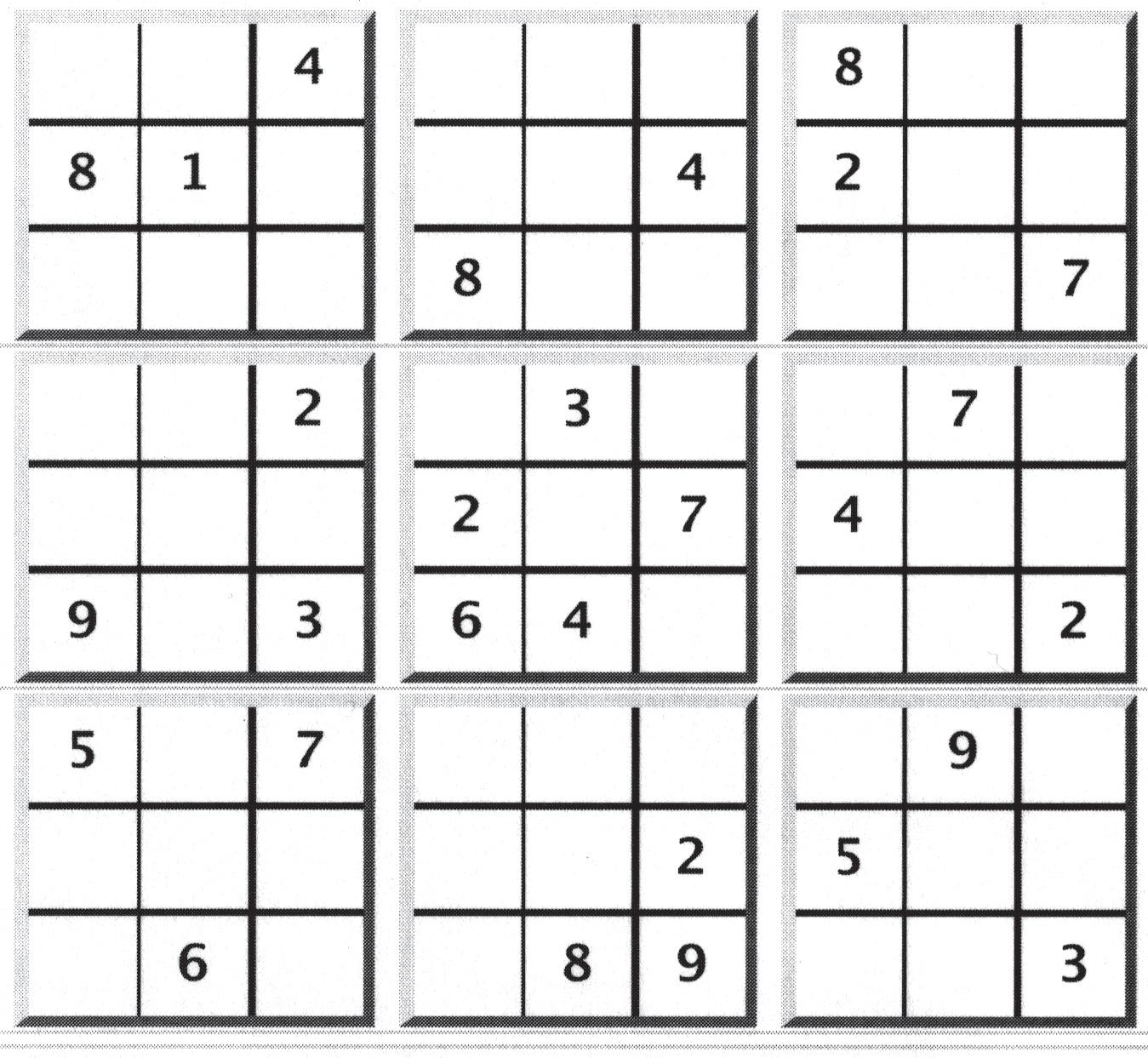
Fill in the empty cells, one number in each, so that each column, row, and region contains the numbers 1-9 exactly once. Each number in the solution therefore occurs only once in each of the three “directions,” hence the “single numbers” implied by the puzzle’s name. (Rules from wikipedia.org/wiki/ Sudoku)
I Am Going To Be Small

Mr. Gnu by Travis Dandro
Mr. Gnu
Travis Dandro
Sports
Men’s Hockey Escapes University of Alaska At Fairbanks in Second Overtime Win
By LIAM MONAHAN Sun Assistant Sports Editor
For the second night in a row, Cornell took the University of Alaska at Fairbanks to overtime, only this time the defense prevailed on both sides, keeping the game scoreless through regulation.
History somewhat repeated itself tonight, with another early score in extra time sealing the game for the Red and marking the second win — this time, at 1-0 — this season for Cornell.
The night started off with freshman Joe Howe starting in goal. The goalie was tested throughout Cornell’s two exhibition games and quickly proved his worth in his first collegiate regular season start. Howe recorded nine saves across the first period, keeping the match as a back-and-forth affair early.
“I’d be lying if I said I wasn’t a little nervous before the game,” Howe said. “But then, you know, come puck drop, hockey’s hockey.”
Cornell’s first offensive test would come off a Garrett Pyke holding penalty, giving the Red a man advantage in the first three minutes of action. Alaska’s defensive unit would hold, as an open shot by junior Matt Stienburg would be blocked by laid-out Nanook goaltender Gustavs Grigals.
Grigals put on an impressive showing of his own in his second start against Cornell, taking away multiple Cornell scoring opportunities with his impressive reaction time. On the night, the goaltender recorded 24 saves behind the Nanook defense.
The first Nanook scoring opportunity came with Stienburg being put in the penalty box for interference. Alaska crowded the goal, but in Howe’s first try in a penalty kill situation, he successfully covered the puck with players getting chippy at the goal.
“I think he was outstanding,” said Head Coach Mike Schafer ’86 about Howe. “[He] controlled rebounds and played the puck a couple times to help us break things out of the zone. I thought he did a really good job.”
would prove to be an extremely tough unit to penetrate.
The Nanooks took the defensive again in the eighth minute of action, with goaltending continuing to dominate with three more saves. However during the scrum, Alaska’s Riley Murphy would step out of the game following a brutal check.
Alaska would switch to the offensive in the absence of Murphy, and Howe once again stepped up recording two consecutive saves against Nanook’s Risk at the halfway mark.
A cross checking penalty by Alaska forward Colin Doyle would mark the only Cornell power play in the period with 8:47 remaining. However, nothing would amount besides an errant shot by junior Sam Malinski.
Finally, nearing the end of the second, freshman defenseman Hank Kempf seemingly finally sailed a shot by Grigals to give the Red the lead. However no score was indicated and play resumed after the controversial score review.
“We thought it went in, but I don’t know what the view on the overhead is,” Schafer said. “[Our] guys thought it hit and then landed inside and then hit the other post, but obviously, [the referees] have that view.”
The beginning of the third period remained more of the same, with each team switching sides between offense and defense but continuing to hold their ground nonetheless.

Following the penalties, Cornell took the defensive for the majority of the first period before Stienburg was again placed in the penalty box, this time for holding, eight minutes into the contest. In Alaska’s second power play, Howe stepped up again to deflect two shots from Nanook players Pyke and Brady Risk.
Following the well-defended power play, senior captain Brenden Locke had the opportunity to open up the scoring with a breakaway shot on goal halfway through the first. Grigals once again stood his ground against the Red.
After a few more well-defended shots on both sides, Locke again took his opportunity on an open goal with 6:18 remaining in the first. In what may have been Cornell’s best early scoring opportunity, the puck was impressively caught by the glove of Grigals.
The match remained even until Nanook defenseman Antti Virtanen was placed in the penalty box for interference with 5:24 left in the first. Cornell junior defenseman Travis Mitchell attempted to capitalize, but his shot fell into the body of Grigals who allowed his defense to recover.
With 2:56 remaining, a too many men on the ice call on Cornell gave Alaska the advantage in the final minutes. Two more deflected shots by Howe though sealed the scoreless first period.
A final interference call on Alaska’s Brayden Nicholletts gave Cornell the power play going into the second period.
Heading into the second with the advantage, Mitchell, along with juniors Jack Malone and Ben Berard, would each be denied consecutively by Grigals, and the Nanook defense
Kempf and sophomore Tim Rego each had the best opportunities to score in the early minutes, with Kempf having his shot initially defended by Grigals before Rego rebounded and had his shot blocked by the Nanook defensemen.
The puck remained in Alaska territory, prompting more aggressive play by the Nanook defense with every passing minute. Every Alaska attempt at an offensive attack was thwarted, until they finally attacked the defense as a unit with 12 minutes remaining. Howe defended two strong slap shots to keep the Nanooks at bay and let Cornell regain puck control.
With time winding down and the score still at 0-0, Nanook forward Matt Koethe would find his opportunity to give Alaska the lead with an open shot and three minutes remaining. Howe, however, smothered the puck once again to keep the contest tied.
Facing the real opportunity at another overtime for the second night in a row, the Red took their final offensive drive headed by freshman Ondrej Psenicka before Stienburg stepped out with eight seconds left due to an injury from colliding with Alaska’s Jakob Breault. Breault sustained a major penalty violation, and the unceremonious end to Stienburg’s third period would also mark the end of regulation.
“[We need to] support each other down low and get pucks in the net while having a constant net presence,” said Stienburg, when asked about the lack of scoring in regulation the past two games. “I think those are things we work a lot in and I think … it’s kind of our identity to be a strong team down low. We’re going to get back to that this weekend and hopefully make some improvements.”
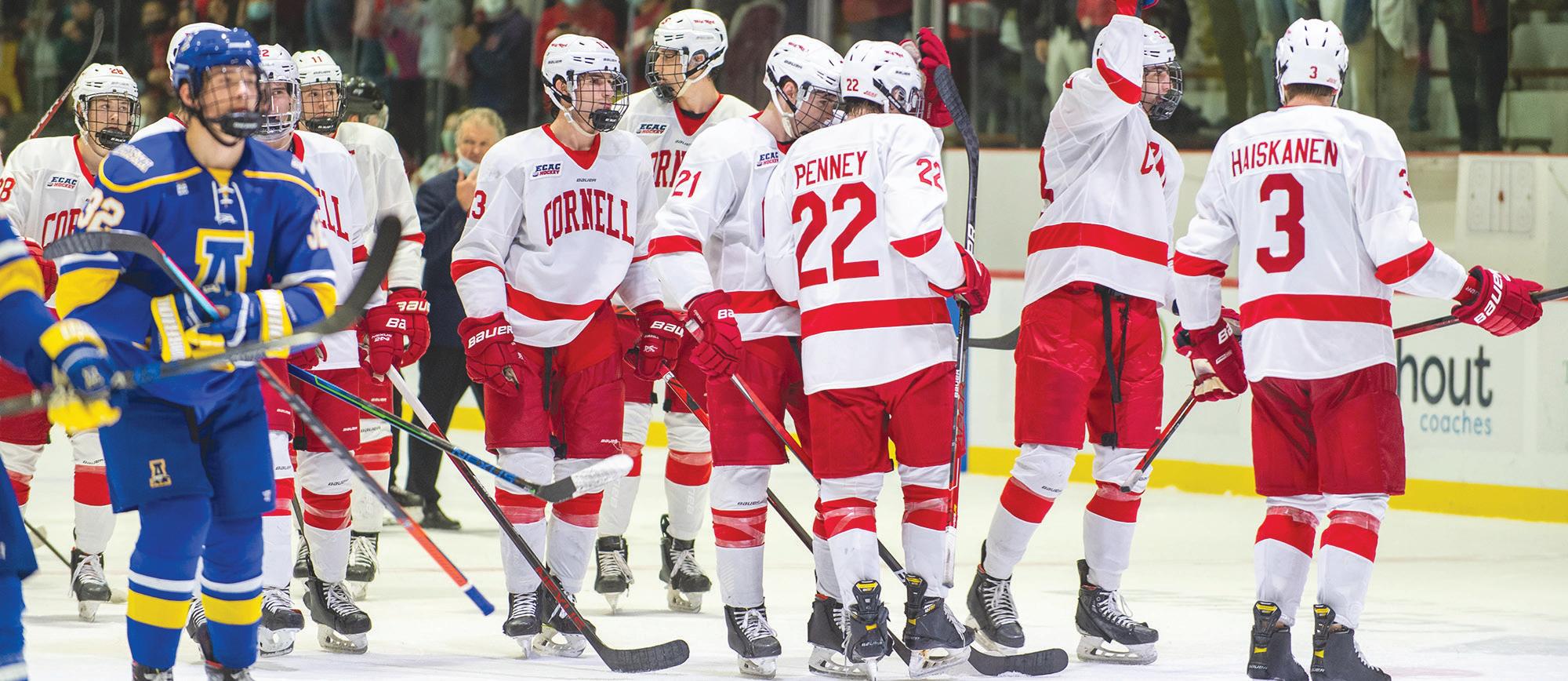
Because of the penalty, the Red entered overtime with a four-to-three man advantage. Once again, Cornell sealed the game early in the extra period, with Stienburg stepping back in to score the game winning goal only one minute into overtime.
“Obviously it felt really good to get the winner, but it was a long weekend obviously,” said Stienburg. “Two games going into overtime. They’re a tough team and they showed a lot of character for us.”
The win marks the second victory for the Red and a sweep over the Nanooks. The next matchup will be against Ivy League rival Harvard next Friday at 7 p.m. at Bright-Landry Hockey Center.
Victory lap | Forward Matt Stienburg celebrates his game-winning goal over the Cornell logo at Lynah Rink.
BEN PARKER / SUN SENIOR EDITOR
Back-to-back | During the match, the Red prepares to face a stout Nanooks’ defense for the second night in a row. Here players are introduced to the full-capacity Lynah Rink crowd.
BEN PARKER / SUN SENIOR EDITOR