The Corne¬ Daily Sun


By JOHNATHAN STIMPSON Sun News Editor
Wisconsin was the first state to ever formally provide collective bargaining rights to public-sector employees, reflecting its long legacy as a traditionally manufacturing-heavy, blue-collar state stradling the American Rust Belt.
But by 2016, when, for the first time since 1984, the Badger State voted for a Republican presidential candidate, much of that century-long legacy had been reversed — after a series of bills introduced by former Gov. Scott Walker over two terms of solidified “Right to Work” legislation and restrictions on bargaining.
for union activism into a state synonymous with organized labor’s most high-profile, decisive defeats.
Sponsored by the People’s Organizing Collective and co-hosted by the Cornell Democrats and Cornell Students for Bernie, the talk was held as a counterpoint to Walker’s speech, which organizer Daniel Bromberg ’20 said would offer a “platform of disregard for public-sector unions.”
“They wanted to be against urban elites, the people who disrespected rural life.”
Prof. Lee Adler
In a Monday night event immediately preceding former Walker’s talk at Cornell, Prof. Lee Adler, labor relations, dissected how — in just eight years — one leader’s tenure turned a once hotbed
Instead, Adler, who has represented dozens of unions in his decadeslong career, offered his diagnosis of what went wrong for labor and what a way forward for the beleaguered groups might look like.
According to Adler, Walker, who was described as a “smooth talker,” successfully leveraged conditions created by the 2008 financial crash in order to build popular support for measures that reduced the size of government.
See ADLER page 4

Gov. makes case for conservatism, criticizes ‘rise of socialism’
By AMANDA H. CRONIN Sun News Editor
Republican former presidential hopeful and governor of Wisconsin Scott Walker emphasized the “difference between socialism and freedom” in a speech to an ideologically mixed audience on Monday that highlighted his conservative record and high-profile battles against unions.
The son of a Baptist pastor who gained political fame as a fiscal conservative, Walker began his talk by painting a picture of the
unfortunate circumstances under which he first took office as governor in 2010, describing the “economic and fiscal crisis” that struck Wisconsin in the wake of the 2008 financial collapse. In the face of these odds, he detailed a highlight reel of his administration, including his administration’s decision to redirect funding for town governments to boost the state economy, and give public sector employees “the opportunity to choose whether to be in a union or not.”
He endeared himself to the
audience through emphasizing his identity as an “authentic” politician, a “conservationist,” and someone who relies on facts.
Walker was recently named the President-Elect of Young Americans Foundation, an organization based in Reaganist values dedicated to spreading conservative thought among students. The Cornell University College Republicans partnered with the youth conservative group to invite
See WALKER page 4
By CATHERINE CHMIEL Sun Staff Writer
Featuring colorful flowers and butterflies alongside burning homes and people fleeing their homeland, a new mural on the corner of Seneca and Geneva Street painted by teen refugees from Myanmar depicts the dramatic transition from their life back home to their new life in Ithaca. Many refugees from Myanmar, including those of the Karen ethnic group, fled the country after genocide and religious and ethnic persecution by the government. At a camping
retreat near Ithaca, some of the Karen Burmese teens expressed a desire to highlight their presence in Ithaca and make a mark on the community, feeling that their ethnicities and histories were often misunderstood, according to Ramona Cornell, coordinator for 4-H Urban
Outreach.
After hatching a plan to honor their unique heritage visually, the teens created the design, obtained funding and conducted interviews to contract an artist. After two year’s efforts, the mural was completed this August and showcased to the public in
September.
The process of creating the mural involved meeting with local government officials, studying mural stories and designing an image that reflects the violence they endured. While 30 teens contributed in various ways to the mural, it was largely spearheaded
by
Eh Tha Yoo Lee, who is now studying at Wells College, and Eh Lay Paw, who attends Binghamton University.
Funding the mural required “doing anything we could,” Cornell said. The group received a grant
See MURAL page 5


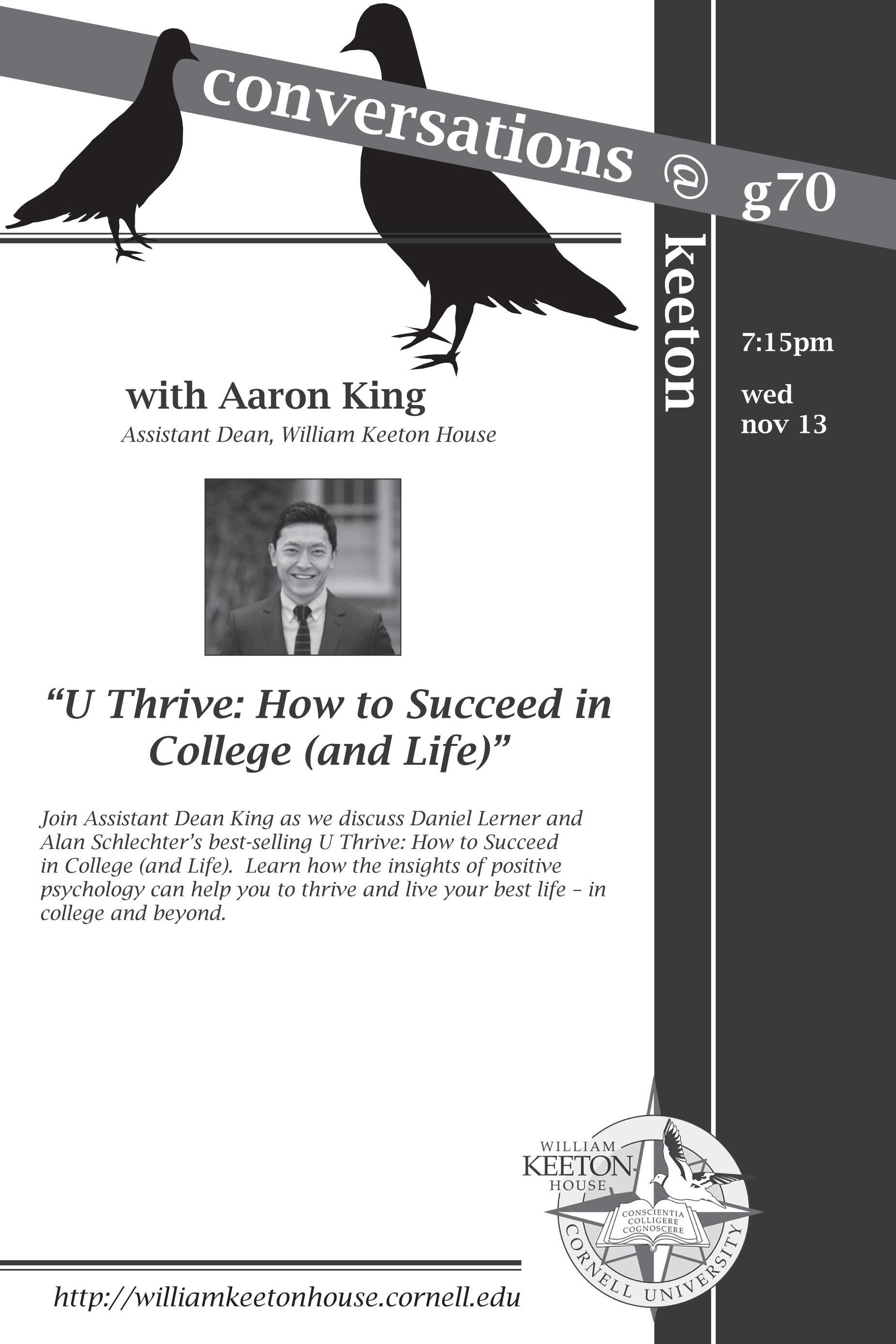
KG70 Klarman Hall
Writing History, Writing Biography: Capturing H.G. Adler’s Many Worlds 5- 6 p.m., KG42 Klarman Hall
Asian American Studies Program Trivia Night and Open House 5:30 - 7 p.m., 429 Rockefeller Hall
Meditation 9 - 10 p.m., G27 Carl Becker House
A Conversation With Felice León, Journalist at The Root 1:45 - 2:45 p.m., Hoyt Fuller Room, Africana Studies Center
International Student Group Counseling 3 - 4 p.m., 276 Caldwell Hall
Sierra Woodruff: Adaption to Resilience Planning: Alternative Pathways to Prepare for Climate Change 3 - 5 p.m., Tatkon Center
Political Polarization in the United States: A Network Approach With Daniel DellaPosta 3:30 - 5 p.m., 388 Uris Hall
Careers in Public Symposium 5 - 6:30 p.m., 216 Stimson Hall
Fatal Attraction: An Introduction to Carnivorous 7 - 8 p.m., Brian C. Nevin Welcome Center
Securing the Vote 7:30 - 9 p.m., Call Auditorium

By AMANDA H. CRONIN Sun News Editor
In February, Representative Alexandria Ocasio-Cortez (D-N.Y.) and Senator Edward Markey (D-Mass.) presented their proposal for an overhaul of domestic climate policy, the “Green New Deal.” In June, the City of Ithaca responded by unanimously adopting their own Green New Deal.
A miniature version of its national namesake, Ithaca’s plan aims to create 100% renewable electricity by 2025 and reduce emissions from the municipal vehicle fleet by 50% by 2025 with the ultimate goal of “achiev[ing] carbon-neutrality community-wide by 2030.”
However, in the months following its passage, the city has been slow to act on those ambitions while “ensur[ing] benefits are shared among all local communities to reduce historical social and economic inequities.” The meandering budget approval process has momentarily halted progress on the plan, as lawmakers negotiate how much money to direct towards the plan, and whether a dedicated staff position be added to share in the task of realizing the policy.
The patience of local environmentalists has dwindled. Frustrated by what they see as “slow bureaucracy,” several members of the local Sunrise Movement chapter,
a youth-led organization that promotes aggressive action on climate change, have decided to take matters into their own hands.
The organization drafted three Sunrise members — including two Cornell students — to toss their hats into the race for common council. Because the deadline to run a formal campaign had already passed, the environmentalists will have to convince voters to scribble their names on the ballot on Election Day today.
There are many players in the unchartered territory of Green New Deal implementation. The Sun sat down with three of them: Sustainability Planner Nick Goldsmith, Mayor Svante Myrick ’09 and City Council hopeful and freshman Ellie Pfeffer to learn more about their visions for a more sustainable future for Ithaca.
The Plan - Nick Goldsmith
Nick Goldsmith, a former circus actor, now spends his days juggling the many moving parts of sustainable planning in Ithaca.
Goldsmith is employed by the Town of Ithaca, which includes Cornell’s campus. The distinction between the Town and City of Ithaca makes his job tricky: the City passed the Green New Deal, while the Town of Ithaca, which is made up of the City’s surroundings, is
still considering the framework for their own version.
Goldsmith laid out a rough timeline for the next steps of the Deal. Once the 2020 budget is approved and passed in November, the ball can start rolling. As it currently stands, the budget proposes hiring an additional sustainability manager and $100,000 to go towards realizing the Green New Deal, although some activists criticize this for being too little. The city hopes to complete the updated Climate Action Plan by the end of 2020, which Goldsmith admits might be too “ambitious.” In the first quarter of 2020, he hopes to have the new green building requirements solidified.
The toughest goal to accomplish within the purview of the Green New Deal will be upgrading every single commercial and residential buildings to have net zero energy output. “I can’t wrap my head around how to do that in 10 years,” he said.
Goldsmith shared that from a staff perspective, he is overwhelmed by the goals of the plan and doesn’t believe that he alone will be able to see them through. Achieving the ambitious goals of the GND, he said, will only be possible with universal cooperation. “The sheer scale of the project will require commitment at a level I don’t think [Ithaca has] ever seen before.”
That collaboration includes
Cornell — “We can’t do this without them,” Goldsmith said. The University has already proven to be an “exemplary” participant, establishing a carbon neutrality goal by 2035 and “constantly” renovating buildings to meet LEED Silver construction standards.
“There’s a lot of knowledge at Cornell. We’ll be looking to them for help and leadership,” said Goldsmith. A team of about 20 engineering and architecture students are already lending their expertise to the cause under the guidance of professors Al George and David Schneider.
Right now, Goldsmith encourages anyone interested in advancing sustainable practices in Ithaca to get involved by subscribing to for their monthly e-newsletter, attending city council meetings and beginning to brainstorm their vision for a pseudo-utopian sustainable Ithaca.
When asked about his ideal vision, Goldsmith shared that he had been pondering this for awhile, and was excited by the possibilities.
“When the council first passed this in June, I would walk around the city and think ‘what would this look like in 2035?’” He encourages all Ithaca residents to have the same mindset.
The Policy Mayor Svante Myrick ’09 Myrick’s record shows that,
alongside affordable housing, the environment has always been among his top priorities as an elected official. Under his leadership in 2013, Ithaca became the first east coast city to divest from fossil fuels.
The former editor at The Sun and undergraduate at Cornell remembers the beginning of the student fossil fuel divestment movement in response to the passage of the Kyoto Protocol. He expressed his support for the student activists still fighting the board of trustees to divest.
“It’s going to take a new generation of leadership; folks who were born and raised learning the science,” Myrick said. “We’re the grownups now, we can handle it.”
The activist community, Myrick said, has been the heat underneath the government’s feet; he credits the Sunrise movement and other groups for continuing to push for accountability. However, he said, unless Ithaca receives funding support from Cornell, the state or DC, the zeal of the community will be met with little action.
“With the backing with a federal government that knows that climate change is a real threat and takes steps to address it, we can meet our goals,” he said. However, given the current state of the Environmental
See GREEN page 5
By ARI DUBOW Sun Staff Writer
Following the actions taken by the Student Assembly and amidst concerns of the lack of information, the Graduate and Professional Student Assembly considered a new resolution to condemn Cornell’s dismissal of Julia Feliz from the Alliance for Science program.
Feliz was dismissed from the program on the grounds that they
and representative of life sciences.
The resolution seeks to explicitly condemn the University’s dismissal of Feliz on the grounds that they used classroom space to criticize their program.
Several students at the meeting expressed concern about a lack of information about Feliz’s dismissal, both available to the general public as well as in the resolution itself.
“Hearing a fellow was dismissed in the program for bringing up issues in the program — that was really scary.”
Arielle Johnson grad
“utilized the classroom environment to discuss [their] satisfaction with the program,” as stated in the dismissal letter that Feliz received. Feliz, on the other hand, said that the University failed to address their reports of racism in the department.
Feliz’s dismissal has since prompted significant student protest and heated discussion.
The GPSA resolution was introduced to the assembly by Arielle Johnson grad, a voting member
But while Johnson acknowledged that she lacked information about all of the details of Feliz’s case, “we should make a statement that it’s not okay for someone to be dismissed for criticizing their program,” she said.
Johnson said that advisors and departments often have a lot of power over graduate and professional students, a dynamic that she believed might have been at play in the University’s alleged treatment of Feliz.
In its final clause, the resolution stated that all Cornell students and fellows should “be free to critique their programs without fear of retaliation.”

“It feels like there might be repercussions for bringing up issues like racism or sexism in our department,” Johnson said. “Hearing a fellow was dismissed in the program for bringing up issues in that program — that was really scary.”
As the resolution stands, it solely expressed condemnation and does not ask the University to take any actions, although Johnson and several other students expressed interest in adding requests or suggestions to the document.
To address this issue, one student proposed that the resolution
be split into two different parts: One would express GPSA’s call for condemnation on the University’s action, while the other would provide specific concrete requests of the University, such as a more clear definition of the role of a University Fellow as distinct from student, staff member, or faculty member.
Johnson said that she wanted to write a resolution on which all of the GPSA members could agree, saying that she was not looking for a contentious meeting like that of the Student Assembly on Oct. 24, in which a Student Assembly reso-
lution was at odds with a number of fellows who backed Feliz’s removal. The resolution will be voted on at the next GPSA meeting on Nov. 18. Before then, Johnson is considering revising the motion to ask the University for more details of its investigation of the situation, though stressed that any resolution should have a narrow scope.
“I just think we should just make a statement in solidarity with Julia,” Johnson said.
Ari Dubow can be reached at adubow@cornellsun.com.
By LOUIS CHUANG Sun Staff Writer
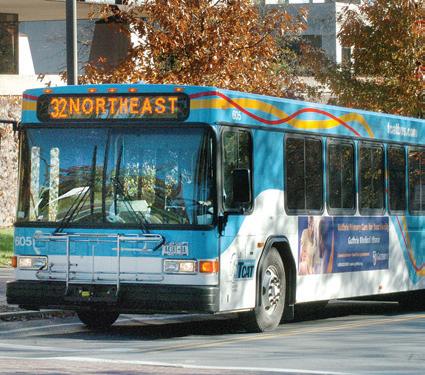
Vandals destroyed six TCAT bus shelters in the Ithaca area, causing financial damages and forcing the transportation company to halt scheduled renovations.
The destruction occurred over the past few weeks, according to a
TCAT press release.
“Vandals have smashed out several glass panels at six TCAT bus shelters causing inconvenience to riders and costing TCAT thousands of dollars to repair,” the press release said.
According to the message, the shelters vandalized were located at West Village, Lehman
Alternative Community School, Chestnut Hill, State @ Fulton, Albany St. @ Salvation Army, and Tops at Lansing.
Beyond the inconveniences and the repair costs, the damages have resulted in a decision to delay renovating other shelters.
Prior to the vandalism, TCAT had six bus shelters
scheduled for replacement. Now, as a result of the vandalism incidents, the agency is holding off on certain renovation projects out of the concern that new and improved shelters would be another target for vandals.
“We are really looking forward to providing our riders with new and improved
shelters, but we don’t want to risk those being damaged as well,” said TCAT project manager Megan Pulver in the press release. “This is disappointing to our customers who rely on the shelters to protect them from the elements while waiting for their buses.”
TCAT is a not-for-profit corporation that has a rider-
ship of more than 4 million people every year, covering a distance of about 1.6 million miles, with a fleet of 55 buses. TCAT urged those who may have information about the incident to contact authorities.
Louis Chuang can be reached at lchuang@cornellsun.com.

WALKER
Continued from page 1
Walker to share his views on modern conservatism, economic policy and union management.
Acknowledging statistics demonstrating rising support of socialist policies among young people, Walker focused his talk on exposing its flaws, asserting that “socialism promises prosperity, but leads to poverty.”
Over the course of his talk, he offered his commentary on ideas that have increasingly gained traction among young voters, like Rep. Alexandria Ocasio-Cortez’s (D-N.Y.) Green New Deal, Democratic presidential frontrunner Senator Elizabeth Warren’s (D-Mass.) wealth tax proposal, and Warren and Senator Bernie Sanders’ (D-Vt.) government-run healthcare program policies.
In giving vocal opposition to these reforms, Walker ultimately asserted that “true freedom and prosperity does not come from the clumsy hand of federal government,” but rather from the actions of free individuals.
For instance, Walker poked holes in the Green New Deal, chuckling at what he said were its unrealistic suggestions to “get rid of airplanes and farting cows.”
Walker has a history of dismissing anthropogenic climate change and has pointed to dayto-day temperature changes as evidence against the existence of global warming, a record that prompted a number of pointed questions during the talk’s question and answer round.
At one point, a graduate student chemist denounced the governor’s stance and invited
Walker to visit his lab after the talk to help him understand. In response, Walker conceded that while humans do contribute to environmental harm, there are other factors and that one of the best solutions to addressing this is education.
Walker received a variety of questions on everything from Jeffery Epstein’s death to higher education to his views on the midwestern democratic candidates. Irene Chapman-Hartmann grad Walker for accepting donations from the conservative Koch brothers, asking him “How do you sleep?”
He replied in earnest, and argued that criticisms should be based in fact.
In this age of political polarization, “no matter [the news outlet], Fox, MSNBC or CNN, everything today has an attitude,” said Walker. “I learned a long time ago, I don’t speculate on things that I know nothing about.” The audience applauded.
Several audience members praised Walker for his bravery in coming to talk at Cornell, a student population that largely identifies as liberal, as Walker leaned on what he called factsbased thinking.
Since losing his run for a third-term governorship in 2018, Trump appointed Walker to a six-year board position at the Woodrow Wilson International Center for Scholars in the Smithsonian Institute. Walker currently serves as the chair of Trump’s reelection campaign in Wisconsin, a swing state that that may be crucial for clinching a second term for Trump.
During his brief stint as a can-
didate in the 2016 presidential election race, Walker sparred with President Trump over a number of issues. Since dropping out of the race, Walker smoothed out his differences with Trump and threw his support behind the campaign. In April, he attended a Trump rally in Green Bay, Wisconsin, where the president called out Walker’s successor, Democrat Tony Evers, for his support of pro-choice legislation.
In his talk, Walker said that while he is focused on his presidential term at YAF, he is still “22 years younger than the current president” and hasn’t ruled it out as a future possibility.
When asked about the issue of abortion, Walker affirmed his pro-life beliefs that “we should protect an unborn child in the same way we protect a child the day after its born.
An hour before Walker was due to take the stage, some students expressed their opposition to his political stances via an informational event about his legacy on unions.
Students also retaliated to the event by vandalizing posters hung in Industrial Labor Relations school buildings last week, one stating in sharpie “the first man with a rectum for a mouth.” In response, YAF called the vandals “liberal tyrants-in-training” who were attempting to silence conservative student voices. In response, Dean Alexander J.S. Colvin called for “acceptance and inclusion” and “respectful disagreement and discussion” in an email to ILR students.
Amanda H. Cronin can be reached at acronin@cornellsun.com.
ADLER
Continued from page 1
“Republicans had created a deficit in state funding by passing huge tax cuts,” Adler said. “Then, [Walker] turned to everybody, and said ‘we need to find a way to have enough money.’ And the only way ‘we can do that is by changing the education budget and ending collective bargaining.’”
That “end” to collective bargaining restricted teachers’ ability to negotiate for higher wages, capping salary hikes to increases in inflation, which at the time, Adler pointed out, amounted to an effective “wage freeze” on the state’s almost 60,000 educational professionals.
conservative maneuvering — producing high deficits in the hopes of selling even greater cuts to government spending — and a deep-pocketed Tea Party revolt drove much of Walker’s political success, Adler withheld little blame for Democrats, whose recent record has cost the party its once iron-clad union support.
For instance, Adler said that former President Obama and former Secretary of Education Arnold Duncan’s reforms, particularly Race to the Top, had a particularly strong effect in stymieing and provoking the anger of teacher unions.
“The unions brought out enormous numbers of people but ... there was no strategy.”
Prof. Lee Adler
Notably — and in a move Adler regarded as core to Walker’s strategy of “divide and conquer” — police and firefighters were exempted from the changes, occupations that have traditionally provided Republicans with one of their strongest bases of support.
While public safety officers were spared the restrictions, Walker argued that teacher unions posed an obstacle to increased school choice, accountability and the ability to fire underperformers, further justifying the need for reforms.
The measures sparked immediate and massive backlash, prompting thousands of union members and their supporters to stage a constant flow of sit-ins that regularly numbered in the thousands. That backlash culminated in the 2012 recall election of Walker, which, like much of labor’s attempts at resistance during the Governor’s tenure, failed at rolling back changes.
“The unions brought out enormous numbers of people, but they couldn’t … there was no strategy to change that numerical majority that had been gained in the election from the Tea Party and super wealthy right,” Adler said, who argued that much of the Republicans' political successes in Wisconsin were buttressed by a small handful of wealthy, conservative benefactors.
But while Adler asserted that
The bill made it so that
“essentially every state in America seeking to gain half a billion to a billion dollars from the United States could show the President that they were really threatening the power, the hegemony of teacher unions” through increasing the use of teacher evaluations and the prevalence of charter schools, Adler said.
“Those were the liberal Democratic reform measures on public education,” Adler said, which had the effect of putting “so many public-sector teacher unions on the defensive” by placing in opposition rank-and-file members and the Democratic Party.
But while much criticism of Walker centered on specific legislation, Adler said that the Governor’s dramatic reshaping of Wisconsin’s policies was a war fought on a far broader battlefield — often focused more on cultural divides than on the intricacies of bargaining power.
Echoing President Trump’s shocking upset victory in the State, Adler said that much of the political energy behind Walker came not from explicit policy ambitions, but feelings of resentment that have long been simmering among the working and rural classes.
“Why did they turn against these school teachers?” Adler said. “They wanted to be against urban elites, the people who disrespected rural culture and real life.”
Johnathan Stimpson can be reached at jstimpson@cornellsun.com.

GREEN
Continued from page 3
Protection Agency, this will not likely happen under the Trump administration, he said.
Therefore, “we are seeking funding opportunities as aggressively as we can.” Myrick understands Ithacans’ concerns about budget increases and simultaneous tax increases, “we don’t want to raise taxes in the city; there’s only so much the residents can bear.”
Myrick hopes that other cities across the country will see Ithaca as a role model and follow suit with their own Green New Deal plans.
“It’s going to take activism, thinking, collaborative work to figure all of
Continued from page 1
from the Ithaca Park Foundation, which was supplemented with the money made from selling flowers and Valentine’s Day merchandise to members of the Cornell community. A GoFundMe campaign created last April raised over $1,000 in donations.
In January, the teens enlisted the help of local mural artist Dan Burgevin and Caleb Thomas from Ithaca Murals.
The mural uses three panels to showcase this journey, with the first panel depicting a girl in a forest hiding in the forest and homes burning in the background of Myanmar. The second image shows Karen people fleeing to refugee camps in neighboring Thailand. And following the theme of transition, the final panel shows the teens living in Ithaca, featuring notable buildings, such as the Immaculate Conception Church, layered over a Cayuga Lake sunset in the background.
“Flowers and butterfly mask the genocide on the Karen People. A girl hiding in the Burmese forest from the brutal military junta. Many Karen crossed the Sarawren to peace and security in Thailand,” reads the text placed at the bottom of the three panels.
“Starting new families, they obtained refugee status and eventually came to the USA where they vote, work, and live free!”
Catherine Chmiel can be reached at cchmiel@cornellsun.com.

this out,” he said.
The Activists - Ellie Pfeffer ’23 and the Sunrise Movement
The night that freshman Ellie Pfeffer ’23 decided to run as a writein candidate for common council, she turned to a Lil Wayne rap for the words to express her exasperation with the status quo and thrill at having the chance to make a difference: “What the fuck though? Where the love go?”
The vegan New York native said that she is running to represent the Ithaca’s third ward — which includes the largely first-year students of North Campus — to enact
“bold, visionary, and transformational stewardship on climate issues.”
Pfeffer is also a member of Climate Justice Cornell and assisted in organizing the campus climate strike and march in September. The environment and sustainability major said that she didn’t see running for elected office as a choice, but as an imperative.
“It’s not some political issue that ‘would be nice,’” said Pfeffer. “It’s about our future,” a common call-to-action among young climate activists.
While the Green New Deal is her number one priority, she dismisses claims that she is a one-trick-horse candidate. Reforming the criminal
justice system, promoting the rights of the indigenous Cayuga Nation, and encouraging civic engagement among young people are also on her political to-do list.
Pfeffer isn’t the only student activist vying for the council. Carl Sagan Institute Ph.D. student Thea Kozakis and Ithaca College senior Cheyenne Carter are also trying their hands at the game.
The Sunrise Movement’s ideas for how to follow through on the plan are “to champion climate justice in all departments; to significantly increase the proposed additions for GND resources in Ithaca 2020 Budget; and uplift youth voices call for huge, transformational change to
address the climate emergency and social injustice,” according to a press release statement. The Ithaca chapter of Sunrise currently supports about 50 active members.
The students said that they are not daunted by the incumbent candidates. Optimism prevails at Pfeffer’s dorm room headquarters in Clara Dickson Hall.
“Oh, I’m here to win,” she said, a week out from election day. However, if she doesn’t beat out incumbent Rob Gearhart, she said that running the campaign has been “a great learning experience.”
Amanda H. Cronin can be reached at acronin@cornellsun.com.
While camping by the Delaware River with a gaggle of 13-year-olds, I finally finished the month-long endeavor of rereading my favorite book and found myself searching for a new stack of papers to put my eyes on. I asked the group of scouts around me for a young adult novel that I could finish in the next 72 hours and was handed Simon vs. the Homo Sapiens Agenda, the Becky Albertalli novel which the movie Love, Simon is based on.
As I made my way through the book on a sleepy bus ride across southern New York, I was annoyed by the way the prose discussed social issues.
I was well acquainted with Love, Simon since I performed a pilgrimage to see the film in a theater with a friend who cried for a good half of the runtime. I thought it was fine, but it didn’t provide me with the self-actualizing validation that a lot of my friends and campers described to me.

Both the film and the book suffer from a plot that pardons unacceptable behavior as character after character fails to act with literally any empathy. I can almost accept the argument that many appreciators of the story explain: “Bad behavior exists, just because they’re portraying people making bad decisions doesn’t mean they approve of it.” Except the whole story is built around social teaching — its agenda is to normalize the images and stories of gay youth, and it was hailed as a victory because representation is a powerful way of normalizing. Why, then, should it get away with doing a poor job of representing other social interactions?
The book tries to tackle other issues by having the characters take short tangents to mention basic facts or critiques about racism and intersectionality. I wish all of the papers I had to read for class would just come out and say the main points like that, but that’s not what you expect from a novel. A novel is all about show, don’t tell. It’s up for interpretation. It teaches by example.
What the book lacks is modeling for how a young person might be anti-racist. Maybe that looks like this: “A white high schooler feeling uncomfortable going to a friend’s predominantly black neighbor-
hood, and then through a conversation they reflect on their discomfort motivated by their implicit bias which associates black people with violence.” I’m not sure exactly what it looks like, and many artists aren’t either; it requires imagining anti-racist actions that most people aren’t doing. The work is hard, but it’s part of imagining justice, and I don’t think there’s any way around that.
When you show these examples, young people pick it up. They are so unbelievably perceptive and emulative; anyone who has ever accidentally acted irresponsibly in front of a tween knows that they see it immediately. Reading young adult fiction helped me, and helps a lot of young people, decide where boundaries are — how far they can push the rules of parents, the law and social norms before they’re going to face repercussions.
Furthermore, they are much more interested in following examples than lessons. Has anyone actually ever had success with telling the young person they’re taking care of to “do as I say, not as I do?” Many can and will listen to adults, but the way they decide to act is much more commonly similar to what they see and not what they know.
Resident Bad Media Critic
And the glory of entertainment is that it’s largely in the creators’ hands to decide what happens. While positive examples in our lives are often riddled with unforeseen consequences and other actors which may not help facilitate a certain lesson. But art that is revised and edited and improved has the opportunity to facilitate a full lesson using multiple characters in a way that is simply impossible to show in everyday life. They can encompass much of the complexity of human interaction while maintaining a level of control and sticking to their message.
Art and entertainment is such an exciting way to understand and consider our world, it’s worth our careful imagination and diligent modeling.
Katie Sims is a senior in the College of Agriculture and Life Sciences. She can be reached at ksims@cornellsun.com. Resident Bad Media Critic runs alternate Tuesdays this semester.


ARIADNA LUBINUS SUN STAFF WRITER
Salsa legend Marlow Rosado lit up Bailey Hall this Friday with his band, La Riqueña. Rosado is a native Puerto Rican who began his music career by studying Jazz education in Florida. He is now a producer, composer, skilled pianist and tireless vocalist. He dabbles in multiple musical genres, incorporating elements of salsa, merengue, bachata and reggaetón into his compositions. Speaking to his mastery of music, his album Retro won the 2013 Grammy Award for Best Tropical Latin Album against competing nominations from star bachatero Romeo Santos.
Marlow Rosado and La Riqueña brought the nightclub vibes to Bailey Hall. The band, consisting of Mike Rivera strumming the bass, Pablo Molina on the congas and Gamalier Reyes playing the timbales performed high-energy rhythms that brought the audience to their feet. Reyes’ rapid-fire drumming was jaw-dropping to watch. Meanwhile, Marlow Rosado’s passionately played Afro-Cuban montuno and tumbao patterns on the piano, intermittently interrupted by strong glissandos, where he would slide his fingers rapidly across the entire keyboard. He carried the air of Elton John, unable to keep from rocking out to the rhythm while attacking the keys.
The band played upbeat pieces, including “Quiero Que Me Quieras” from their 2014 album Salsanimal, alternated with a few slower, romantic ballads that paid homage to their homeland Puerto Rico.
As a surprise to the audience, Rosado invited an old buddy to the stage — coincidentally a Cornell alum who had studied organically chemistry. Rosado exclaimed, “It doesn’t matter how much organic chemistry you do, the music is in your blood!” The two used to perform together, and it was heart-warming to watch them reunite and sing duets. They sang a beautiful rendition of the song “El Cuarto de Tula,” originally by the Buena Vista Social Club, an ensemble of Cuban musicians established in 1996 to promote the music of pre-revolutionary Cuba.
The most astounding moment of the night was when Rosado invited audience members to the stage for the concert’s grande finale. He asked two Cornell music students, a pianist and violinist, to improvise a song with the band and encouraged the audience to join in by dancing or clapping. The Cornell students successfully composed an impromptu song with the band, and the audience thoroughly enjoyed the show.
Like the Buena Vista Social Club, Marlow Rosado’s music also strives to revive salsa’s roots with old-fashioned, traditional instruments and vocal styles. His music transports the listener to another time, another place. He makes me wonder about the future of the salsa genre. Will there be enough singers to keep the genre going?
Ariadna Lubinus is a sophomore in the College of Engineering. She can be reached at aml386@cornell.edu.
By DEANA GONZALES Sun Staff Writer
On Oct. 29, in a guest lecture hosted by the Natural Resources Department, Michael P. Hamilton Ph.D.’83, reflected on his career as the former field station director of James San Jacinto Mountains Reserve and Blue Oak Ranch Reserve, in California, during which he combined his knowledge of computer science and ecology to develop technologies that can track animal populations, manage wildfires, and help conserve nature areas.
Hamilton attributes his knowledge of field stations that contributed to his success at the reserves to BIOEE 6602: Graduate Field Course in Ecology at Cornell. The course takes place during spring break at the Archbold Biological Station in South Central Florida.
“The Archbold is a 10,000 acre protected natural area, and you have the opportunity to learn the biota and design an ecological project and carry it out in seven days with final results and presentation. It was a great effort to learn how to think quickly and come up with great questions,” Hamilton said.
In the beginning of his career at the reserves, Hamilton built a laserdisc, which he called a “data management system before the internet.” The device, which employed interactive touch screen technology, stores and plays video, audio, and data. The laserdisc had over 50,000 images of natural areas that he and his college professors had been researching.
His project inspired professors in the University of California system to bring their biology and computer science students
together to brainstorm ways to create digital models of life forms, which was called “artificial life.”
“These artificial life workshops happened a couple of times a year and we ultimately created a robot challenge. [Students competed and built] small field robots that could go around and collect data around the buildings. This started a trend in the James Reserve in attracting technology savvy students and faculty,” Hamilton said.
During his time at the reserve, Hamilton also utilized one of the earliest versions of geographic information systems. Today, GIS is still used at the various reserves in California to characterize the fire-related aspects of the mountain range. After applying simulation models to the data, simulations of wildfires that burn up the mountain under different weather conditions can be created for researchers to learn more about the phenomenon.
In 1989, Hamilton also implemented the use of webcams placed in nest boxes to survey wildlife at the James San Jacinto Mountains Reserve.
“We learned about predation of blue birds in the nest boxes by gopher snakes, these were nests up on trees and gopher snakes would climb into the nests and eat the eggs,” Hamilton said.
This technology also helped researchers detect birds’ presence, whether they were in the box and the process of egg-hatching. The technology screened from millions of raw images to highlight a few thousand that were important for researchers to look at.
“We were able to detect cold environmental events that caused nest abandonment, we were able to determine that when

Violet-green swallows couldn’t find food they just stop feeding their young and abandon them,” Hamilton said.
Cameras were also used as spectrograms where researchers can look at spectrum that correlate to physiological states of species. Researchers utilize, “hyper-spectral monitoring to estimate net carbon dioxide updates,” Hamilton said.
According to Hamilton, other eco-devices were tested at the reserve including Treebots. Treebots automatically record phenological data, which is plant growth over time. By measuring surface area and calculating biomass per unit area, these devices can determine how much light can reach leaves in complex canopies.
To measure moisture that plants can utilize such as fog, Hamilton and researchers built leaf wetness sensors. According to Hamilton these sensors can detect condensation on artificial leaf surfaces.
“We built dew collectors that can collect enough fog to turn it into measurable moisture, and used a camera system to document the beginning and end of fog events as they rolled in and out.” Hamilton said.
The reserve also utilized drones to see how plants respond to microclimate variability in certain locations. According to Hamilton, “drones are very useful for creating high resolution, usable vegetation maps on a regular basis.
“Looking at these microsites have led us to some really interesting insights on refugia and landscapes, what the resilience of certain species and lack of others are. We can model how plants are going to adapt or not adapt to future climate models and climate conditions which would drastically change the biodiversity of these protected areas,” Hamilton said.
Deana Gonzales can be reached at dgonzales@cornellsun.com.

On Oct. 28, the Town of Ithaca announced that it will undertake a $51,000 project to remove invasive plant species along the South Hill Recreation Way in hopes of promoting biodiversity and natural wildlife.
The project was
inspired by the desire of the Town of Ithaca “to help promote biodiversity, provide shelter and food (nectar, pollen, seeds, nuts, leaves, etc.) for wildlife, and support pollinators,” wrote Michael Smith, senior planner of the Town of Ithaca, in a press release. Smith went on to explain that because the invasive plants have
“altered the native ecosystem … and do not provide the appropriate food or habitat for native wildlife,” they must be removed. This includes species such as Honeysuckle, Common Buckthorn, Japanese Barberry and Norway Maple. The replacements will be native trees and shrubs such as Sugar Maple, American Sycamore and White/Red Oaks, according to the press release.
The project will take place along the entire 3.4-mile-long South Hill Recreation Way during this fall and winter, said Smith. During the project, town staff and hired specialists will be cutting down woody invasive plants and treating the stumps with an herbicide on approximately 15 feet from each side of the trail, according to a press release sent by the Town of Ithaca.
During the course of this project, the trail will remain open, Smith told The Sun in an email.
However, even though
no work will take place on private property, there will still be a noticeable effect on property owners nearby: “Adjacent private property owners may experience fewer plants between their property and the trail prior [and] a large amount of dead woody vegetation left to decay along the trail,” Smith said in the email.
Each year, the Town Board allocates money to be used towards eliminating invasive species on different Town-owned parks and trials. For example, over the past years, invasives were removed and native plants were planted [with] tree tubes or fences to protect them along the East Ithaca Recreation Way, according to Smith.
The $51,000 grant that the town received this year — issued by the Urban and Community Forestry Grants Program under the New York State Department of Environmental Conservatism — is limited to include “only the removal of woody invasive
plants, so other invasives like swallow-wort or garlic mustard would not be removed as part of this
To better involve the community, the town plans to hold a public event towards the end of the

project,” Smith said.
Smith hoped that this project will inspire private landowners along the trail to also participate in removing the invasive plants on their property.
project to help with the native planting next spring and summer.
Louis Chuang can be reached at lchuang@cornellsun.com.
Since 1880
137th Editorial Board
ANU SUBRAMANIAM ’20 Editor in Chief
JOYBEER DATTA GUPTA ’21 Business Manager
PARIS GHAZI ’21
MEREDITH LIU ’20
Assistant Managing Editor
RAPHY GENDLER ’21
Sports Editor
BORIS TSANG ’21 Photography Editor
AMBER KRISCH ’21 Blogs Editor
SOPHIE REYNOLDS ’20 Science Editor
AMANDA H. CRONIN ’21 News Editor
JOHNATHAN STIMPSON ’21
PETER BUONANNO ’21 Arts & Entertainment Editor
ANYI CHENG ’21
HUNTER SEITZ ’20
CHRISTINA BULKELEY ’21
BEN PARKER ’22
JEREMY MARKUS ’22 Assistant Arts & Entertainment Editor
ALICIA WANG ’21 Graphics and Sketch Editor
DANA CHAN ’21 Production Editor
RYAN RICHARDSON ’21
Snapchat Editor
GIRISHA ARORA ’20 Senior Editor
SARAH SKINNER ’21
Managing Editor
KRYSTAL YANG ’21 Advertising Manager
NATALIE FUNG ’20 Web Editor
SABRINA XIE ’21 Design Editor
NOAH HARRELSON ’21 Blogs Editor
SHRIYA PERATI ’21 Science Editor
KATIE ZHANG ’21
AMINA KILPATRICK ’21
MARYAM ZAFAR ’21
ETHAN WU ’21
SHIVANI SANGHANI ’20
NICOLE ZHU ’21
PICHINI ’22
JIANG ’21
’21
WU ’21
WANG ’20
McDOWALL ’21
FLEER ’20
Cornell’s lack of a comprehensive public policy school is one of its major Achilles heels. Harvard and Princeton both have world-renowned programs named for influential presidents; Cornell has a messy organization of similar but ununified programs. While this university ranks 17th on US News & World Report’s list of best national universities, it comes in at 35th in respect to public affairs. This puts Cornell behind four Ivies, four schools in the Empire State and 10 land-grant universities. While I have found the MPA program at Cornell to be incredibly rewarding and deserving of a much higher rank, the lack of cohesion amongst its public policy education programs appears to be a detriment to its national stature. In Cornell’s decentralized, fragmented environment, the education of future policy leaders feels to be an afterthought by the University as a whole.
status in 2015. This unique institution offers two undergraduate degrees, four masters degrees and a doctoral program based in the capital of the seventh most populous state. The Washington Academic Internship, OSU’s version of CIW, is also housed under the Glenn College. Both sitting U.S. Senators from Ohio, Sherrod Brown and Rob Portman, sit on the
Harvard and Princeton both have world-renowned programs named for influential presidents; Cornell has a messy organization of similar but ununified programs.
Under the current system, undergraduate and doctoral students have their courses housed in the Department of Policy Analysis & Management along with the Sloan Program in Health Administration. The Master of Public Administration, meanwhile, is housed under the Cornell Institute for Public Affairs; CIPA sits out-
Board of Distinguished Visitors and have strong ties to the College; Brown holds an MPA from the Glenn’s predecessor while Portman is a former professor. Many of the 16 congressional representatives are also linked to the Glenn College. And, perhaps most notably, the former senator, astronaut and namesake himself was an on-campus fixture and guiding force for the College until his death in December 2016.
Ad Layout Mei Ou ’22
Production Deskers Sabrina Xie ’21
Ben Mayer ’21
Arts Desker Peter Buonanno ’21 Working on Today’s Sun
News Deskers Anyi Cheng ’21 Johnathan Stimpson ’21
Design Desker Simon Chen ’21
Niko Nguyen ’22
Photography Desker Boris Tsang ’21
Sports Desker Luke Pichini ’22
Perhaps a Dyson-like arrangement would fit better, with a collaboration between PAM,
CIPA and the government department.
side of any department but still within the College of Human Ecology. The Cornell in Washington program, which allows students to intern in the nation’s capital and learn about policy and government, is offered through Engaged Cornell with no mention of it anywhere on the PAM website. To compound all of this, members of the New York Delegation to the United States Congress appear to have no active relationship with policy and civics education at their state’s land-grant university.
As an undergrad, I attended Ohio State’s John Glenn College of Public Affairs, ranked 14th in the nation by US News and World Report and 10th globally by ShanghaiRanking. The College was formed in 2006 by a merger of the School of Public Policy & Management and the John Glenn Institute of Public Service & Policy and received full college
Letter to the Editor
The case above highlights the expectations I, and many others, have for public affairs education at a large school like Cornell. While it’s unrealistic to expect every university to have a beloved American hero on-hand to advocate for increased civics and policy scholarship, having a working relationship with the Congressional delegation is not. The same goes for housing all related-degree programs under the same department or having a dedicated college specifically to the complex, interdisciplinary study of public policy.
Cornell is the only university in the United States that houses its public policy and affairs programs in a College of Human Ecology because, fundamentally, they are different disciplines; rebranding HumEc as well as the College of Public Policy won’t help either of these academic areas. Perhaps a Dyson-like arrangement would fit better, with a collaboration between PAM, CIPA and the government department; perhaps that’s just a greater problem. What is increasingly apparent, however, is that Cornell cannot properly educate policy leaders of the 21st century without addressing this issue.
Beth Fry is a Master of Public Administration candidate in the College of Human Ecology. Guest Room runs periodically this semester. Comments may be sent to opinion@cornellsun.com.
Prof: Too many students take path of least resistance at Cornell
To the Editor:
I write in response to “College Shouldn’t Be a Breeze” by Christian Baran ’22. He wrote, “I’ve met many students, including myself, who take the path of least resistance when it came to classes and course loads. We say that a good GPA is all that matters.” This is all too true at Cornell. I define this worldview as “conveyor belt philosophy,” and it is the predominant, although not the only, philosophy I see at Cornell. Conveyor belt philosophy values getting the highest GPA for the least amount of work, and then taking a gap year to find oneself. This philosophy prioritizes the measurable over the meaningful, credentials over education, foolishness over wisdom, and it is nothing more than a waste of time, money and life.
Last semester, I met one of my closest friends. We were in a computer science class, filled with approximately 700 other students. Our rather comical teacher always made the class enjoyable and invigorating in our poorly lit auditorium in Statler. Yet, tucked behind his big friendly smile, my friend was suffering from depression, an illness that plagues many on the Cornell campus. I always sought to make sure that I could be there for him, especially given the fact that I myself haven’t had the easiest transition into the Ivy League.
Last semester on Dec. 15, after our final exam in Data Structures Using Java, we walked through the infamous Ho Plaza. It was truly a beautiful day: the sky glistening blue, the flowers demonstrating their beautiful colors and students smiling with joy after completing their final prelim (or maybe it was sadness…?). We finally ended up in Libe Cafe, where he purchased a medium caramel macchiato and a bag of golden-crisped sour cream and onion potato chips. Had I not gone bankrupt due to Trillium’s mouth-watering quesadillas, I would have purchased something myself. If my friend had known that I didn’t have any left, he would’ve offered to pay as he had done in previous instances, so I told him I just wasn’t hungry after consuming my usual bag of organic baby carrots.
We took a seat in front of the windows: fraternity kids were tossing around their white frisbees, dogs were frolicking galore and another friend of mine, probably looking at that girl from his psychology class on his Instagram, dropped his double-scooped Triple Play Chocolate ice cream. After taking in the scene outside, we began to share our summer plans. I found myself speaking about my potential paid internships in the Amazon Rainforest and in Los Angeles, which would finally allow me to alleviate the financial burden of my tuition off my and my mother’s shoulders. After the divorce of my parents, our household had been struggling significantly, and with the introduction of three new baby siblings (whom I absolutely adore), the financial quagmire only deepened.
I had noticed during our conversation that he seemed abnormally quiet; I wasn’t sure if it had been the exam and that he didn’t feel too optimistic about his performance, or that he simply wasn’t in the mood to engage in conversation. After some awkward silence, he spoke of what he planned on doing this summer: dropping out of school and finding a job. Dropping out? He seemed to be settled so well in all of his classes. He had friends from all corners of our community, from fraternities to
project team members to individuals hailing from around the world. He truly was a gifted individual, and I am not just saying that because he goes to Cornell. He truly possessed something I had never seen in anybody before. “Yeah, I just feel like I don’t fit in. I am doing poorly in [my classes]. I also just had a bad semester emotionally.” I knew exactly what he was referring to, and for his sake, I will not disclose any of that information in this response. I could see my friend’s future fading before my eyes: a gift and a talent being stained by mental illness.
This semester, things seem so different around campus without him. Playing music in the music room in my dorm had become a distant memory of the past. Late night walks to Jansen’s to utilize our stash of Pocket Points has become a faint memory. I especially missed going out on the slope with our friend to play the guitar and escape from our shared academic pressure as engineers at Cornell. It was gorgeous taking in those vivid sunsets, just three friends staring out into that orange stained skyline. Smelling the plethora of blossoming flowers, their scents brought us refreshing happiness. We all hated being inside anyways, so in addition to being our very own musical venue, this spot on the slope became our habitual, multi-purpose location: studying, eating and even napping.
At Cornell, sometimes it is truly a challenge to understand and tap into the minds of our peers, even if we spend all of our days together.
At Cornell, sometimes it is truly a challenge to understand and tap into the minds of our peers, even if we spend all of our days together. Don’t get me wrong, I absolutely adore Cornell: the chirping birds, the powerful vibrations of our morning chime tower concerts, the breathtaking, luscious slope that makes the morning such an obstacle, the different languages being spoken and the professors that shape our very own education. However, there are many flaws within the curriculum that can make life here sometimes a bland drag. Like a pressure cooker, many of these pressures ultimately prey on the minds of their students.
I had never witnessed a friend of mine suffer like this before in my life, and it made me realize a couple of things. First, I realized that I needed to start cherishing every second of my life. Here at Cornell, I found myself spending hours on my phone,
Ithe time that I could have spent with my best friend, time that I could have spent helping others. After losing my friend, I began to stop my compulsive phone use, and I began to cultivate richer relationships. There’s no wePhones or usPhones — it’s simply just “i” — where we spend time, alone, suffering from fake societies that Instagram constructs, wasting time that could have been spent with our best friends. Second, I started to challenge the status quo and began to be more involved in mental health for students. I attended a conference at Brown spearheaded by an inspirational woman who spoke about her traumatic experiences of being mentally unstable in an intense atmosphere with no assistance. To hear her experiences and the ways that she later helped her peers to be more confident in themselves was truly awe-inspiring and became something I desired to incorporate into my daily life. Lastly, I learned the value of having a real friend. After being bullied for nine years of my life as a child, my hostility began to overpower my potential to make friends. This friend of mine showed me the strength that can be instilled in an individual by a single connection. He inspired me to be positive no matter what the situation and to appreciate all the moments that comprise our days — how valuable our time is something that we may never fully appreciate, especially when it comes down to the sheer fact that your time can be used to impact somebody’s life for the better.
Since his departure, I’ve texted, called and Facebook messaged him, all of which failed to garner a response. I hope he is alright. What I do know now moving forward is that, regardless if I do make an impact or not, that I will be there for my friends and start living presently in the world where I trade in screentime for people-time, for family-time, for conversation-time and, most importantly, for intentional-time; time spent living intentionally will shape our future and those who may need our actions.
Canaan Delgado is a junior in the College of Agriculture and Life Sciences. He can be reached at cdelgado@cornellsun.com. No Church in the Wild appears every other Tuesday this semester.
f you haven’t noticed the bubbling racial tension on campus as of late, you should probably come out from under your rock. From the unjust removal of and discrimination against Julia Feliz to racially insensitive Halloween costumes across campus, there is reason for people of color at Cornell to be on edge.
So, when some friends informed me that they heard a member of an on-campus organization, who requested not to be named, say, “I’m not racist, but I just don’t like Mexicans,” I felt compelled to respond. As a Mexican-American student at Cornell, I am appalled that one of my peers felt comfortable to not only announce their racist beliefs, but do so at a public University event.
The racist comment occurred on Oct. 24 at Dairy Day, a public semi-annual event hosted by said unnamed organization where students and locals gather at Cornell’s Livestock Pavilion to interact with cows and farmers. Two of my white friends were attending the event when they were recognized as animal rights activists and approached by a member of the organization. The member expressed that they don’t watch undercover footage from factory farms because it “makes them sick.” They followed, “you know, it’s mostly Mexicans that do that,” referring to the brutality towards animals recorded on farms. When my friends explained the inaccuracy of the statement, as well as the harm perpetuated by the misconception, they replied, “I’m not racist, but I just don’t like Mexicans,” as if prefacing a textbook example of racism with “I’m not racist” makes it less racist. When my friends pointed out that their statement was actually very racist, they shrugged.
The organization claims to be “Educating the future leaders of the dairy industry” — which begs the question, who exactly are
these future leaders? Should we be concerned?
It is no secret that the dairy industry depends on undocumented workers, many of whom are from Mexico. In fact, Mexican immigrants make up 53% of all hired labor on dairy farms and dairies that employ immigrants produce 79% of the U.S. milk supply. One study even found that more than 7,000 dairy farms would close and milk prices would increase by 90% without immigrant labor.
So, future leader of the dairy industry, you say you don’t like us. Yet, despite this, you’re more than likely going to exploit us for cheap labor. Realistically, as dairy sales decline and U.S. citizens continue to avoid the “physically demanding, dirty and socially denigrating” work conditions on dairies, you probably won’t have a choice.
Racism, abuse and exploitation are commonplace on dairy farms. A report on the state of New York’s dairy workers noted that 48% of Latino immigrants were victims of workplace discrimination. Another 28% reported aggressive and disrespectful behavior from their boss. Beyond that, nearly all immigrant workers live in cramped, bug-infested farmhouses or trailers that house several immigrant families at a time. Workers have 12-14 hour shifts for seven days a week. These long hours, often accompanied by fear of immigration enforcement authorities, cause workers to leave the farm once every 11 days, on average. All this for a miserable wage of $9-12 an hour with no overtime pay. Unsurprisingly, the majority of workers reported feeling depressed. So yes, my concerns include but extend beyond flippant racist remarks. As a white Ivy League undergraduate in dairy science, you are likely to be a future employer of Mexican workers. How can you be expected to treat them with dignity when you demonize them, deny their humanity and
ignore the reality of systemic worker abuse?
The hypocrisy inherent to your myopic worldview is staggering. You don’t like us but you enjoy the products of our exploited labor. You indulge in lactose-free Fairlife milk (I know this because you said it), despite the fact that Fairlife is a known perpetrator of horrific animal abuse. You think animal-hating sadists are to blame for animal abuse when the industry itself is inseparable from the suffering it inflicts. You take the moral high-ground when abused workers abuse animals, yet barely flinch when your beloved cows are slaughtered for not producing enough. Just like you can’t get milk without animal suffering, you also can’t get it without the blood, sweat and tears of undocumented workers.
tions are inevitable in the milky white echo chamber that is … this club that I’m not at liberty to name.
Even though we’re talking about the actions of one individual, it does raise questions about why this student felt okay with saying something racist in a room full of only white people in the first place. Would their fellow club members have called them out if they said something racist to them?
The confident way this student expressed themselves makes me think they wouldn’t.
The apparent racial homogeneity of the club leads me to believe that difficult con-
Would their fellow
club members
have called them out if they said something racist to them? The confident way this student expressed themselves makes me think they wouldn’t.
When I reported the incident to this unnamed organization, I was told that the member “could not be removed” for their racist remarks. Instead, they will be banned from participating in international trips, since they “can’t trust someone in another country making racist comments.” The club seems more concerned about the PR implications of a racist in their midst than they are about actually having one.
I strongly recommended that said organization have a mandatory discussion about the role of migrant labor in animal agriculture and was told that they’re handling this by “working with [the member] to understand the offensive nature of [their] remarks.” What the club’s leadership fails to recognize is that their desire to blame the individual for an institutional problem glosses over the fact that these misconcep-
versations about racism and oppression within the industry are not being held. Is this white ignorance? Or something more sinister?
The dairy industry, fundamentally, cannot exist as it currently does without both human and nonhuman animal oppression and exploitation. By failing to address how the dairy industry systematically abuses not only farmworkers and animals but farmers as well, future dairy leaders at this University are doing a disservice not only to their industry but also to themselves.
Lucy Contreras is a junior in the College of Arts and Sciences. She can be reached at lc644@cornell.edu.
Her column, Lucy Dreams, runs every other Tuesday this semester.

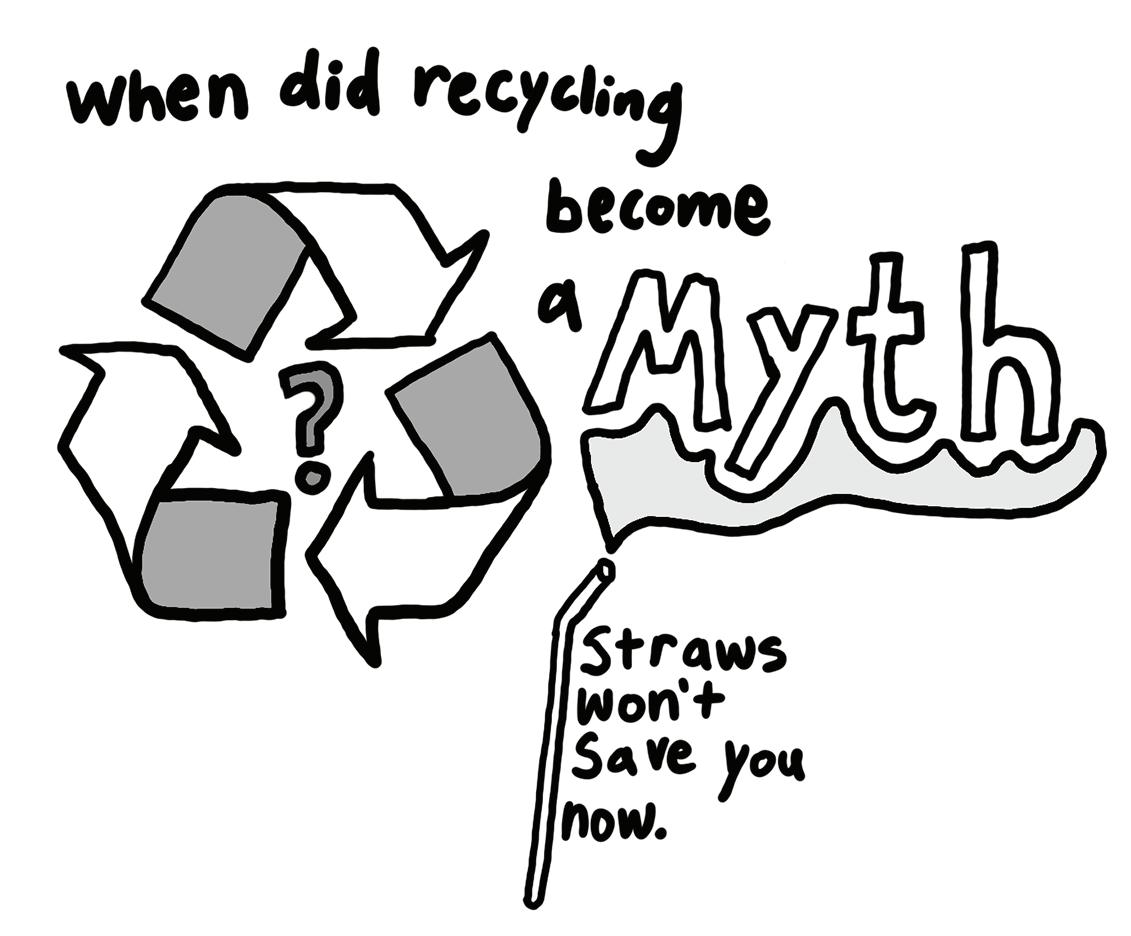
Fill in the empty cells, one number in each, so that each column, row, and region contains the numbers 1-9 exactly once. Each number in the solution therefore occurs only once in each of the three “directions,” hence the “single numbers” implied by the puzzle’s name. (Rules from wikipedia.org/wiki/ Sudoku)



We have availability for the 2020-2021 school year beginning June 1st at Hudson heights apartments. The studios include electric, heat, water, garbage and parking. There is coin-operated laundry facilities on site. Prices start at $750 / month for a 12 month lease. If you have any questions or would like to schedule a tour contact us by phone 607-280-7660 or email: renting@ithacaLS.com
COLLEGETOWN TERRACE APARTMENTS
Leasing for 2020/2021 Spring 2020 Semester leases available Heat, hot water and Wi Fi State of Art Fitness Center Shuttle Bus Service to campus Washer & Dryer in Apartments collegetownterraceithaca.com office@ithacastudentapartments.com (607) 277-1234
Now Renting 2-10 Bedroom Houses/ Apartments for 20-21. All Locations. Call today or visit our website: Certified Properties of TC Inc certifiedpropertiesinc.com
607-273-1669
120 Oak Avenue
Just steps to Cornell Campus 10 bedroom house & 1 and 2 bedroom apartment 607-277-1234 office@ithacastudentapartments.com Ithacastudentapartments.com
A
AVAILABLE 2020-2021
1, 2, 4 Bedroom Apts. and 7 person House 10 & 12 month leases Cook/Blair Street Call or Text Christopher George RE 607-279-5520
Collegetown Crossing
College Ave's Newest Location
307 College Ave. Now Leasing for 2020-2021
Completely New Modern Studios, 2 & 4 Bedroom Apartments. Fully furnished, heat & hot water included. Reception area at 307 College Ave. www.urbanithaca.com 607-330-2442 info@urbanithaca.com
Boldly Refined Living
312 College Avenue
Sophisticated studio, 1, 2, 3-bedroom apartments. Superior fitness facility, theater, and coworking space. Free high-speed internet. Exclusive resident parking. Package delivery/return. Overnight concierge. 607-273-9777 or 312collegeave.com
2020-2021
Studio 1, 3, 8 & 11 BR Apts. Great Locations in Collegetown. 607-227-2535
3 Bedroom 1 Block from Starbucks in Collegetown Heat & hot water included. Lease starts June 2020. Parking & laundry available. www.porealty88.com 607-277-1888
20-21
College Ave.
5 BR House Furnished. Laundry. Parking. Call 607-273-8576
20-21 Upper Eddy St.
7 BR house Furnished. Laundry. Call 607-273-8576
DISCOUNTED!!!
COLLEGETOWN
8, 10 or 11 BEDROOMS 607-272-3389
cbeach24@aol.com
8-9 BEDROOM HOUSE FOR 2020-2021
133 Blair St
Corner of Cook and Blair just off of College Ave. Huge rooms, great porch, free laundry, furniture, 4 bathrooms, 3 kitchens. Great storage closets, parking for 3-4 cars. Contact Nick at 607-256-3778 or nick@lambrourealestate.com

Both teams improved from last year
By ALYSON WONG Sun Staff Writer
This past Friday, the Cornell men’s and women’s cross country team competed against the rest of the Ivy League at the annual Heptagonal Championships in New York City. Twelve runners from both teams participated, with the women’s team running the 6k and the men’s team running a five-mile course.
The men’s team placed sixth overall out of eight teams, finishing with 164 points. Freshman Perry MacKinnon (25:19.1) led all Cornell runners and placed 20th overall. He was followed shortly after by sophomore Matthew Fusco (24th, 25:24.2), sophomore Marek Nowak (27th, 25:32.2), freshman Rishabh Prakash (49th, 26:03.5) and junior co-captain Paul Casavant (50th, 25:03.8).
Following an eighth-place finish in 2018, Casavant was encouraged by this year’s results.
“[The meet] was definitely a step in the right direction from last year,” Casavant said. “We got almost 100 fewer points and moved up two places, so there’s really some growth we’re seeing from the team which is exciting. We still have a really young team, and we struggled a lot with injuries this year, which means there’s a lot more to give.”
(25th, 22:01.5), sophomore Natalie Morris (40th, 22:17.0) and Audrey Huelskamp (43rd, 22:20.8) crossed the line.
“I was really happy with the team’s performance,” Spearing said. “I think we worked really well together and that’s something we’ve been working on all season. Everyone that was racing really performed for each other and that’s something I will always be proud of.”
With the Heptagonals wrapped up, both teams now look forward to the NCAA Northeast Regional Championships to continue their season. This meet will serve as a qualifier for the NCAA Championships.
“Everyone’s really looking forward to another chance to race and show that even though we’re a young team, we’re still really eager to compete,” said Casavant.
“I think we’re really excited. Last year, we actually placed higher at Regionals than we did at Heps, so it’s a comfortable course,” said Spearing.
The cold Ithaca climate might help the Red run better
“Everybody’s really looking forward to another chance to race ... we’re still really eager to compete.”
Paul Casavant
than its opponents, who may not be as well acclimated to such harsh weather conditions.
Casavant also praised the growing young talent on the freshman-heavy team.
“[We] had some really exciting performances from some of our young guys,” Casavant said. “Perry [MacKinnon] ... was our top finisher for the team and we had another guy really step up, Sean Henretta. … It was really nice to see some of the young guys step up on that bigger stage.”
The women’s team also placed sixth out of the eight teams with 127 points. Senior Taylor Knibb (21:10.0) led Cornell runners with a fifthplace finish. Afterward, senior Kyleigh Spearing (18th, 21:54.0), junior Gabrielle Orie
“The weather is usually awful, so the teams that are successful are usually the ones who are ready to just go in and forget about the weather and … grind through [it],” Casavant said.
“Usually the weather is a bit unpredictable at Buffalo, which plays to our strengths, so the team’s really excited for it,” Spearing echoed.
The men’s and women’s cross country teams will head to Buffalo, New York on Friday, Nov. 15 to compete at the NCAA Northeast Regional Championships.
Alyson Wong can be reached at aw797@cornell.edu.

By FAITH FISHER Sun Staff Writer
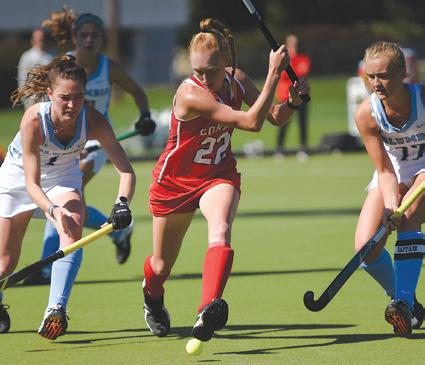
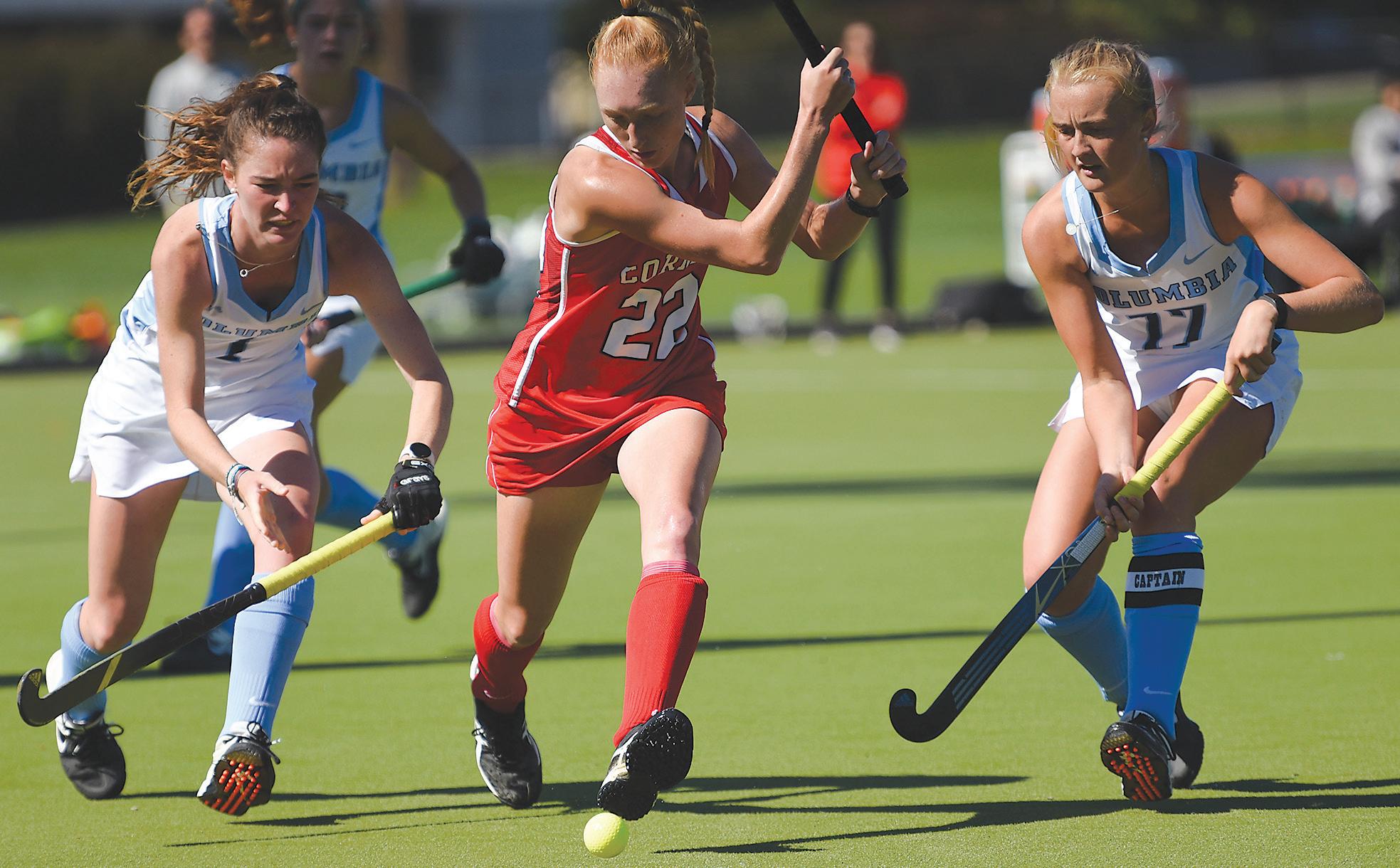
In just the fourth minute of its game against Princeton, Cornell field hockey conceded an early goal to the Tigers that ultimately amounted to the game-winner, but two “diabolical umpiring decisions” turned a competitive game into a 3-0 walkover.
“Unfortunately for us, we haven’t executed properly, but two diabolical umpiring decisions made the scoreline 3-0,” said head coach Andy Smith. “Princeton is a very good team, they were probably the better team on the balance of today, but I think the 3-0 scoreline was very unfair to us.”
“As I said, two diabolical umpiring decisions went against us today,” Smith continued. “They are outrageous. Appalling.”
Sunday’s disappointing loss added another chapter to a conference rivalry that has not stood in the Red’s (9-7, 3-3 Ivy League) favor. In the past 29 years, Cornell has only notched two victories over the Tigers (12-4, 6-0), with the most recent coming in 2016.
Not only did Princeton earn yet another win over the Red, but in doing so, it clinched a share of the Ivy League title. Meanwhile, Cornell sits at fourth in the Ancient Eight standings with only one game remaining.
Within a few minutes of the first whistle, the Tigers held the early advantage. Princeton’s Sammy Popper gained control of the ball in the Red’s defensive circle. With a quick dribble to the left, she found an opening and fired it past the Red’s senior goaltender Maddie Henry for the Tigers’ first score.
“We knew they would come out and have a fast start,” Smith said. “We expected that, and they scored early. Credit
to them — they executed a rebound on a corner very well. It was a great hockey from them, but we were right in it all the way through the first half and most of the way through the second half as well.”
Following the first goal, the game stood at a standstill. The Red struggled to penetrate the Tiger’s defensive zone, and it did not come up with a scoring opportunity until the 20th minute of the game. A penalty corner granted Cornell its first piece of ammunition on offense, but freshman midfielder Caroline Ramsay’s scoring attempt was shut down. The Red would be playing catch-up into the second half with Princeton possessing a one-goal edge.
Cornell reversed the offensive advantage in its favor on the outset of the second half, with two shots on goal, one of which came from a penalty corner attempt. But up against the Tiger’s defense, the Red struggled to capitalize on their opportunities. Cornell only placed one more shot on goal for the rest of the game.
“We didn’t maintain possession of the ball. We had a lot of soft turnovers in the midfield today,” Smith said.
In a burst of offensive energy in the 37th minute of the game, the Tigers forced a midfield turnover into a threeman breakaway. Up against three undefended Tiger players in the disputed play, Henry was left helpless in goal. With a quick fire into the net, Ali McCarthy extended Princeton’s lead.
Later, a fourth-quarter penalty corner gave the Tigers even more breathing room in their 3-0 win.
The validity of those last two goals, however, was brought into question. The umpires ultimately ruled in favor of the Tigers, much to the dismay of the Red.
“It’s two bad decisions, but you have to move on,” Smith said. “I do not usually talk about umpires. But today really was sad. I am not going to tell you that we would have won the game otherwise, but the two decisions that were made for the second and third goals were appalling.”
Two questionable calls by the umpires were not the only force that tipped offensive advantage toward the Tigers. Not only did Princeton have a 14-3 edge in shots on goal, but it also held a 13-3 edge in penalty corners for the day. Limiting the penalty corners the Red grants its opponents has been an ongoing focus for the team.
“We have to be better at defending our own circle,” Smith said. “It is something that we are trying to minimize right now but it is probably something that will not be totally fixed until we go into next season. We have to be smarter when teams are attacking our circle.”
Although the game ended with a three-goal chasm between Cornell and the Tigers, “the game was a lot closer than the scoreline would suggest,” Smith said.
“I am really proud of the way the team played today,” Smith said. “We could not play a lot better than that without scoring goals. We knew what Princeton was going to do, and they’ve outshot everyone all season. They were great, but we are getting there, and we will continue to grow from here.”
The Red will cap off the regular season next weekend with a road game against its final Ivy League opponent — Dartmouth. The showdown will take place on Saturday at 12 p.m.
Faith Fisher can be reached at fsher@cornellsun.com.
By ZORA HAHN Sun Staff Writer
With showdowns against Princeton and Penn on the docket, Cornell volleyball needed a big weekend to keep pace in the race for the top spot in the Ivy League.
The Tigers have finished first or second in the Ancient Eight in the last five years, and they’ve proven to be a tough opponent for the Red.
A month ago, Cornell seemed to buck that trend as it defeated Princeton, 3-1, in what many saw as a changing of the tide in the conference.
But on Friday, the Tigers came back with a vengeance. While the Red won its first two sets over Princeton, 25-19 and 25-22, the Tigers stormed back to take the last three sets and earn a win in a pivotal matchup, 25-21, 25-21, and 15-12.
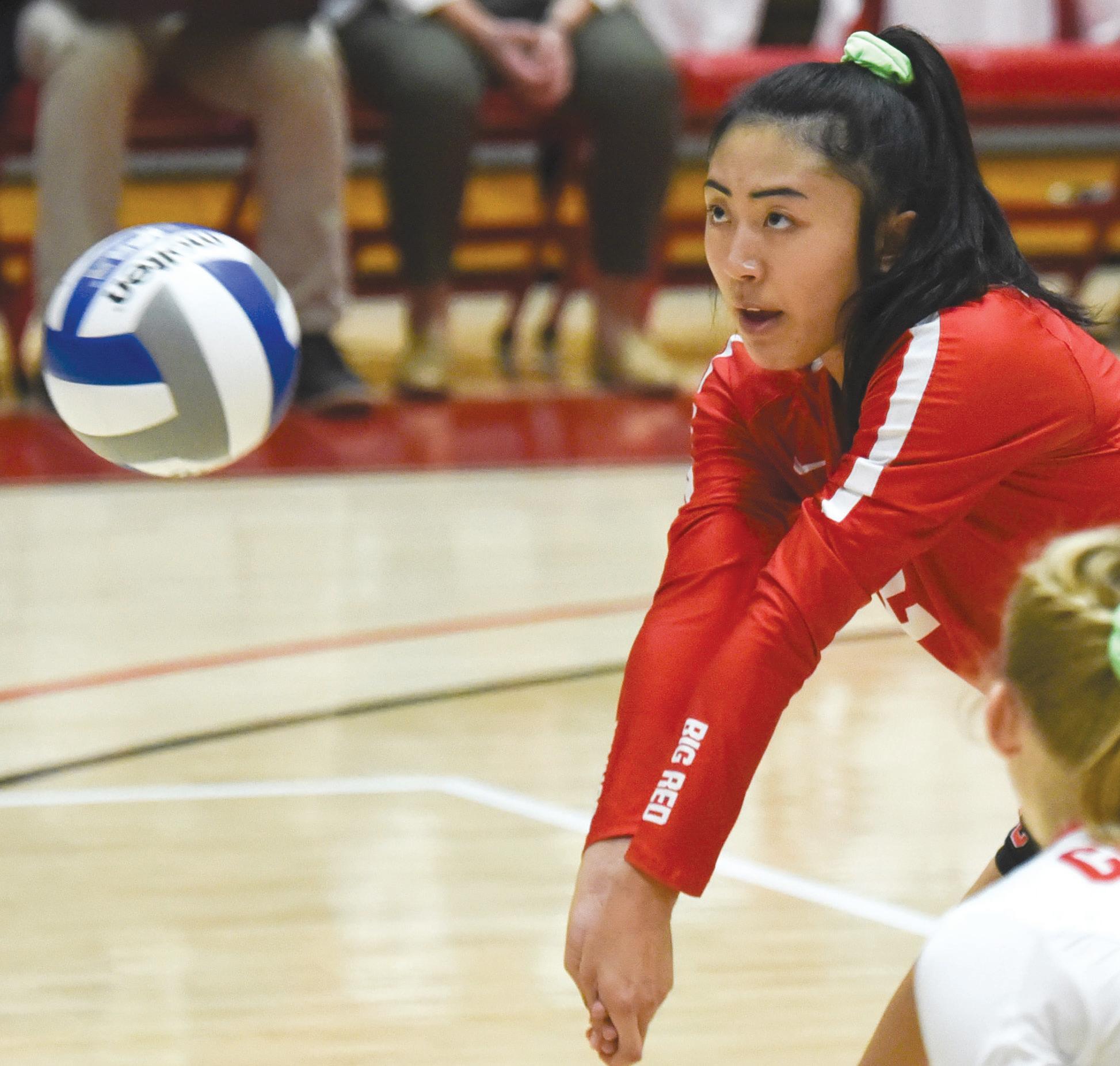
Sophomore outside hitter Madison Baptiste was the star player in Friday’s game, scoring a matchhigh and career-best 23 hits. She also added two service aces and two blocks.
Head coach Trudy Vande Berg took note of the sophomore’s outstanding performance.
“We’re a team that has so many people that can score,” Vande Berg said. “She really stepped up. She’s been playing really well … scoring well and at a high percentage … I couldn’t be more proud of her.”
Baptiste single-handedly contributed almost 25% of the total points won by the Red, and she emphasized the role her teammates played in her success.
“I think we…[challenge] each other every practice and take the time to make sure we’re playing crisp and clean,” Baptiste said. “I think this helps us as a team excel during games.”
The sophomore also commented on the factors that led to the Red’s ultimate defeat against Princeton, a
loss that dropped Cornell from first to second in the Ivy League conference.
“I think we came out really confident, but then we were just making too many errors at crucial times in the game,” Baptise said. “They were being more conscious of the ball and that was … a big determining factor.”
Despite the disappointing loss, Cornell was able to salvage at least one conference victory during the weekend.
Against Penn, the Red bounced back to earn a dominant 3-0 victory on Saturday.
As a team, Cornell posted a .333 hitting percentage, markedly better than the Quakers’ percentage of .085. Meanwhile, Baptiste continued her strong performance, earning a double-double with 12 kills and 13 digs.
After the Red’s weekend split, Princeton currently occupies the top slot in the Ivy League with a conference record of 9-1. Cornell and Yale are tied for second, with each boasting 8-2 conference records.
The Red will host Yale this Friday in another crucial conference matchup. During its last meeting on Oct. 19, Cornell lost to the Bulldogs, 3-1.
“Yale is always an emotional game because it’s two good teams playing against each other,” Baptiste said. “[We need to make] sure everyone’s doing their job. Leveling the playing field and making sure we’re … being more consistent with our level of play.”
“Our focus will be on staying disciplined and focused in the long rallies,” Vande Berg said. “Whichever team wins the long rallies will win the match.”
Along with its big match on Friday, Cornell will also square off against Brown at 5 p.m. on Saturday at Newman Arena.
Zora Hahn can be reached at zhahn@cornellsun.com.