


By AMANDA CRONIN Sun Staff Writer
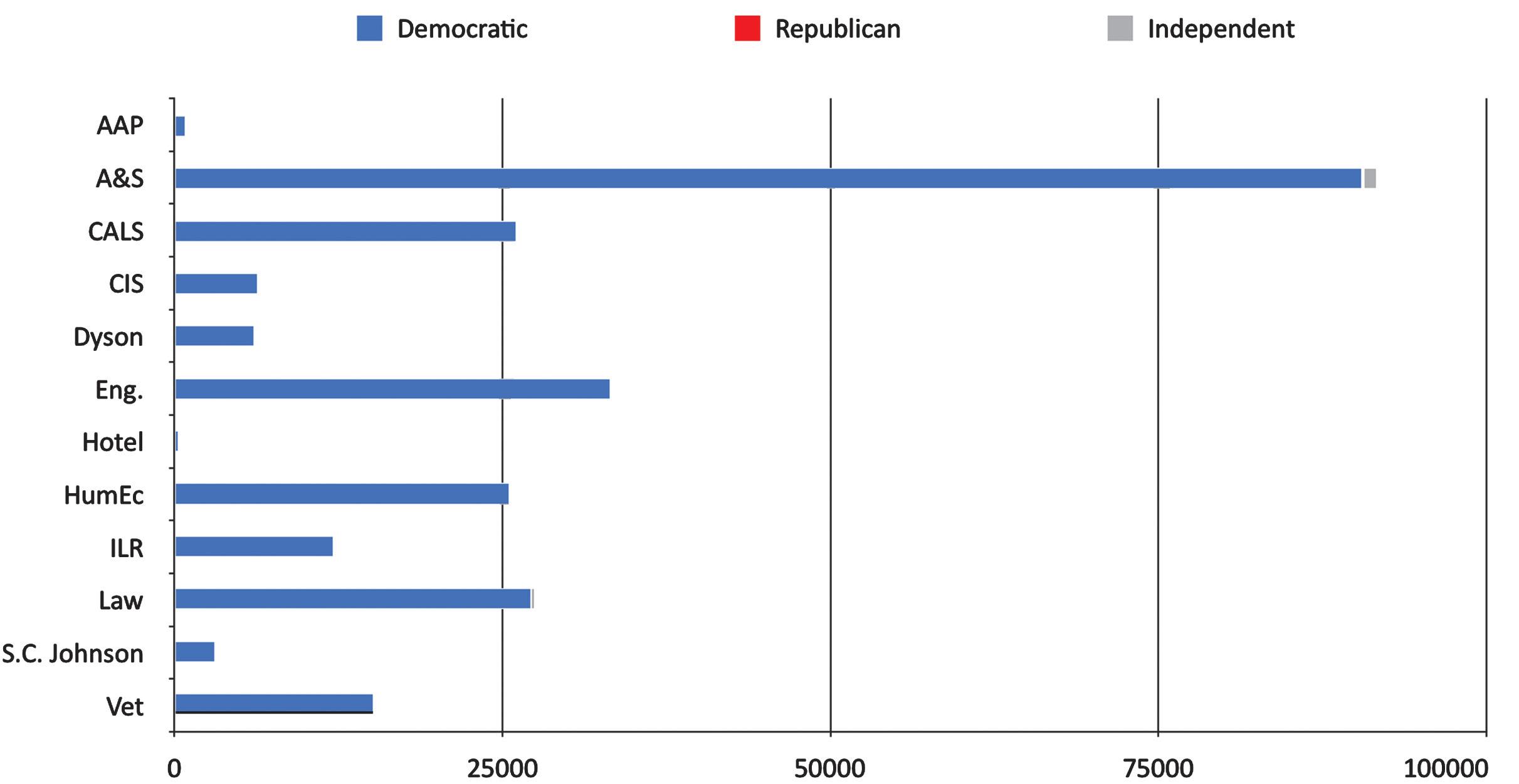
Over the last year, professors, researchers and lecturers collectively donated approximately $289,975.05 to election campaigns. Almost all donations were to left-leaning candidates for Congressional, gubernatorial and other races. There was only one donation to Republican candidates.
To compile this data, The Sun filtered public Federal Election Committee filings, collecting the donation information from individuals who listed Cornell University as their employer. The Sun then confirmed the current appointment of each donor as a Cornell faculty member, instructor or researcher. Administrators and other personnel were excluded from all calculations.
“I don’t think this data is surprising at all; it’s reflective of the political alignment of the University and its staff,” said Michael Johns ’20, president of Cornell Republicans.
“... The Cornell community should carefully consider the implications of [The Sun’s] findings, especially as it relates to the political culture of the university.”
Most campaign dollars were contributed through Political Action Committees or PACs. These organizations are dedicated to raising money on behalf of a particular party, candidate or cause. Some of the most common

include End Citizens United, Emily’s List, the Democratic Congressional Campaign Committee and the Democratic National Committee, ActBlue.
Seventy-six percent of the professors, researchers and lecturers donated $165,858.35 directly through individual
By BREANNE FLEER and GAYATRI SOMAIYA Sun News Editor and Sun Contributor
To help get Cornellians to the polls to vote in Tuesday’s U.S. midterm elections, Cornell Outdoor Education and the Cornell Public Service Center will be providing shuttles to transport Cornell community members to polling locations.
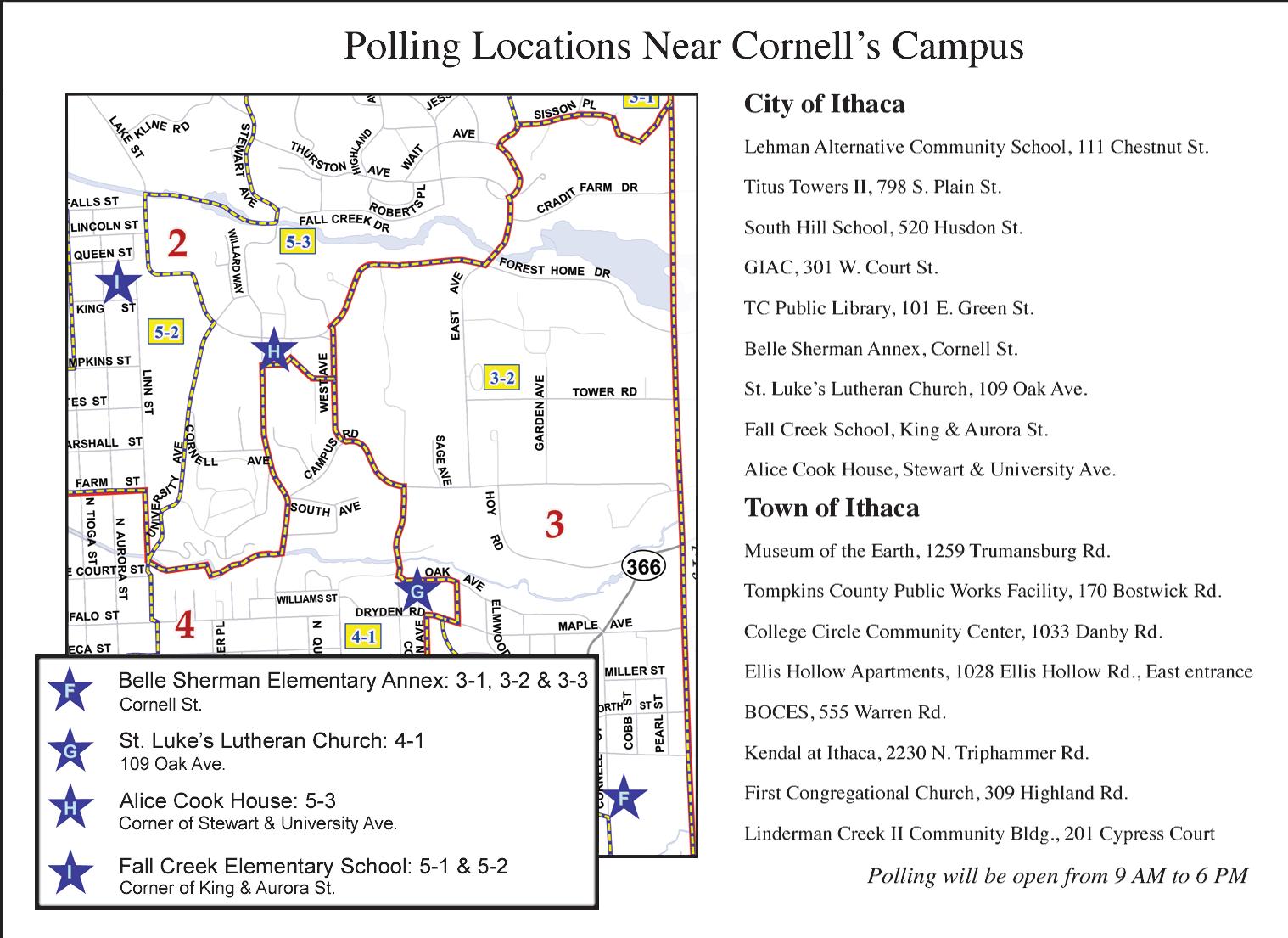
The shuttles are free of charge and will run from 8 a.m. to 9 p.m. every 15 to 20 minutes on Tuesday. The vans will stop at locations on North Campus, West Campus, Central Campus and in Collegetown to drive individuals to the five off-campus polling locations — Belle Sherman School Annex, the Tompkins-Seneca-Tioga Board of Cooperative Educational Services, the First Congregational Church, St. Luke Lutheran Church and Fall Creek School.
The one on-campus polling location that serves residents who live on campus, Alice Cook House, is not included in the route.
Specific route stops, as well as which polling places serve which campus residential buildings, can be found on the Public Service Center website. The Public Service Center is helping to organize the shuttles in partnership with the Andrew Goodman Foundation.
This is the first time that the PSC has organized Election Day shuttles, according to Amy K. Somchanhmavong, associate director of service-learning and partnership at the Public Service Center.


ACTS OF VIOLENCE fueled by h atred an d xe nophobia have continued to escalate in re cent we eks. As leaders of Cornell’ s religious communities, we wo rship and seek meaning in dive rse ways, but on this we are united: acts of terror and hatred have no home in our communities, or on our campus.
No mat te r yo ur backg ro und, tradition, beliefsystem, faith, spiritualit y, or wo rl dview, th e ed chaplaincies of the Cornell of Spirituality and Meaning Making are available for conversation, solidarity, and support. Find a list of campus ministries and contact information at <curw.cornell.edu> .
— Daniel McMullen Associate Dean of Students for Spirituality and Meaning-Making and
Cornell United Religious Work
Monday, November 5, 2018
Today
Its Mysterious Life: An Appreciation of Beetles 8 a.m. - 5 p.m., Top Shelf Gallery Mann Library
Shadow, Light, and Life: Color and Design 8 a.m. - 8 p.m., Terrace Level Display Cases Human Ecology Building
Special LASSP Seminar With Itay Griniasty 11:30 a.m. - 1:10 p.m., 416 Physical Sciences Building
David Slusky, Assistant Professor, University of Kansas Noon - 1 p.m., T01 Human Ecology Building
SAP Seminar Series, Brand-Name Capitalism, Advertising and the Making of Middle-Class Conjugality in Western India, 1918-1950, by Doug Haynes 12:15 - 1:30 p.m., G08 Uris Hall
Ecology and Evolutionary Biology: Piecing Together the Puzzle to Understand the Evolution of the Ants, by Corrie Moreau 12:20 - 1:20 p.m., A106 Mudd Hall
The Power of Networking With Micaela Coleman 4 - 5 p.m., 606 Tower Road
CCCI: China’s Cities: Divisions and Plans 4:30 - 6 p.m., G64 Goldwin Smith Hall
Seminar: A Galaxy of Falcons 7:30 - 9 p.m., Auditorium 159 Cornell Lab of Ornithology
By EMILY YANG Sun Staff Writer
In her second State of the University speech, President Martha E. Pollack announced to an audience of 675 trustees, University Council members and other audience members that she has “no hesitancy in saying that the state of Cornell University is strong.”
“They’re applying in droves, and when we admit them, they’re saying, ‘Cornell, yes!’”
President Martha E. Pollack
Pollack’s speech was given as part of the Trustee-Council Joint Annual Meeting in Statler Hall on Friday. In his introduction, Robert S. Harrison ’76, chairman of the Board of Trustees, praised Pollack for handling disturbing incidents on and off campus, reforming Greek life and elevating innovative classroom technologies.
Harrison related how Pollack sang along with alumni and the Cornell Glee Club at events “as if she was one of them,” and said that Pollack “has become
a red-blooded, full-throated Cornellian.”
Pollack began her remarks by quoting Prof. Morris Bishop 1913 M.A. 1914 Ph.D. ’26, who was the University historian and a professor from 1921 to 1960. In an essay, Bishop wrote that Cornell is considered a “part neither of the aristocratic tradition of the original colonies nor the educational democracy of the great West.”
Pollack mentioned a newspaper that Bishop once wrote about, which “had listed, as places of intellectual pretensions and as essentially American colleges, Harvard, Yale, Princeton, and perhaps Cornell.”
“Perhaps Cornell! It has always been the fate of our University to be Perhaps Cornell!” Bishop wrote.
In her address, Pollack sought to counter this opinion. “As I describe to you this morning the state of the University, I’m sure you’ll see that today, Cornell is not ‘perhaps’ anything,” she said.
Pollack ran through statistics about the Class of 2022 and noted that while application numbers are increasing and thus admittance rates are decreasing, yield percentages are increasing, which means that students are not just adding Cornell to their list, according to Pollack.
“Students aren’t saying, ‘Perhaps I’ll go to Cornell.’ They’re applying in droves, and when we admit them, they’re saying, “‘Cornell, yes!’” Pollack said.

Pollack also described how professors, as well as government agencies, non-governmental organizations and industry, are “saying yes to Cornell.” The University has gained 173 new professors across the Ithaca, Weill Cornell Medicine and Cornell Tech campuses. The University sponsored-research has also increased by 10 percent to $700 million, with a 175 percent increase from industrial sources.
The president continued by emphasiz-
when the last committed University funding ends.
process for the 2019-20 academic year,” Lombardi said.
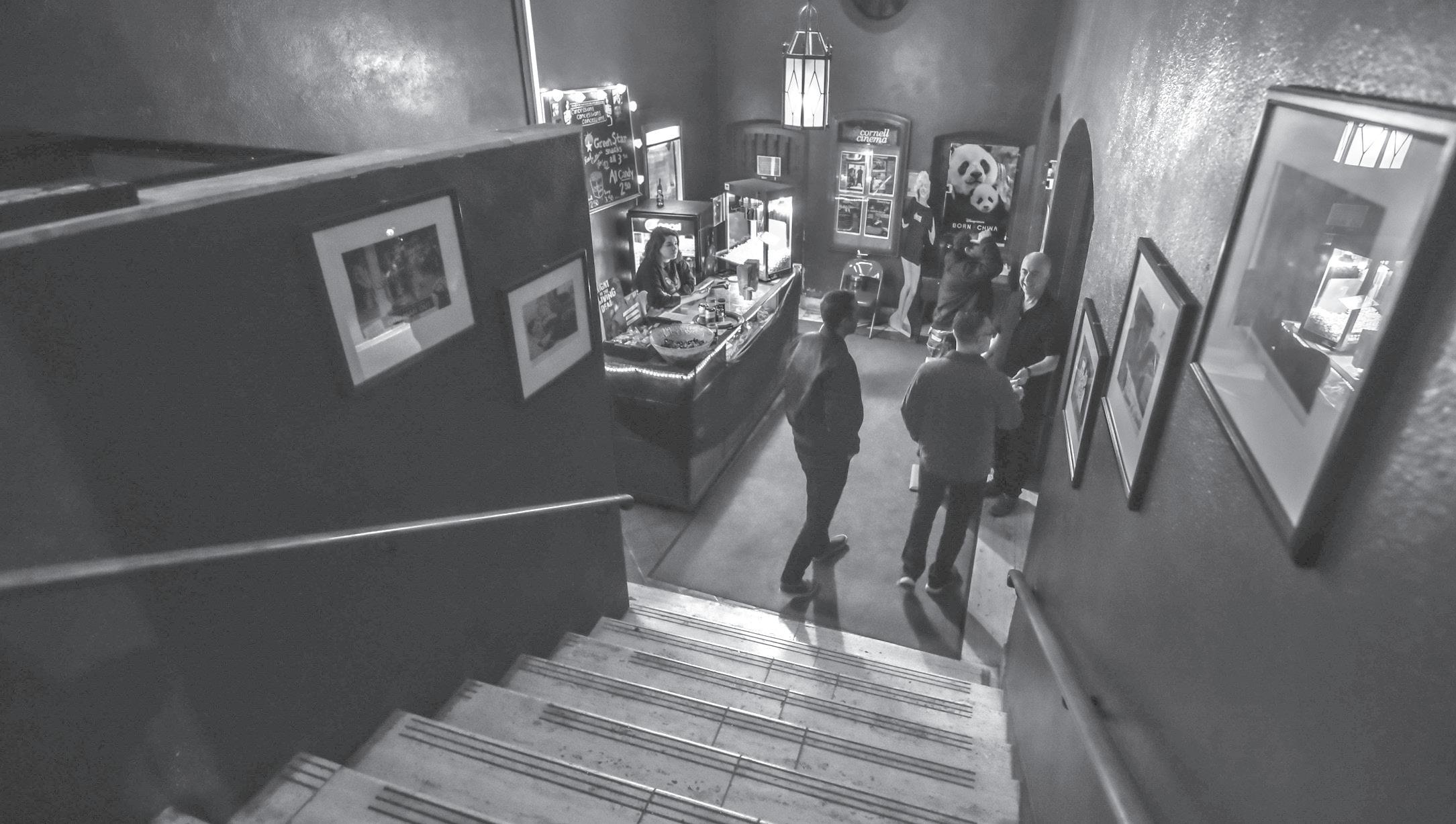
The University will not immediately commit to funding Cornell Cinema, which is seeking to stay afloat in the wake of last fall’s steep funding cuts, according to Ryan Lombardi, vice president of student and campus life.
In November 2017, the Student Assembly voted to cut byline funding for Cornell Cinema from $10.90 to $0, resulting in an estimated funding gap of $150,000 of the 48-year-old organization and casting uncertainties into its future, The Sun previously reported.
According to cinema Director Mary Fessenden, programming for this academic year was supported by $40,000 of bridge funding from the Office of the Provost, as well as a $50,000 annual donation from an anonymous benefactor for the next 5 years, $15,000 from the 2018 Giving Day campaign and a commitment from the College of Arts & Sciences to cover the estimated $40,000 balance.
The Cinema is currently seeking out new co-sponsors for after June 30 next year,
In an email to The Sun, Lombardi said that the Office of Student and Campus Life met with Cinema leadership on Tuesday to discuss the Cinema’s request for “major sponsorship” from SCL.
“There are currently no discretionary funds ... to support this request immediately.”
Ryan Lombardi
However, SCL will not provide immediate funding for the Cinema as such a decision would mean reducing investments in other departments under the SCL, such as athletics and physical education, Cornell Health, Campus and Community Engagement and Career Services, according to Lombardi.
“There are currently no discretionary funds within SCL to support this request immediately, so we will closely consider it along with other needs that are identified through the budgeting
Before the meeting, Lombardi and Vijay Pendakur, dean of students, received letters from the Graduate and Professional Student Assembly and the Cinema Student Advisory Board urging support for the Cinema.
Kriszta Pozsonyi grad, GPSA liaison to Cornell Cinema, said that SCL is an optimal funding partner with the Cinema because of the similarities between the Cinema’s programming and the services of SCL. However, she also said the money should come from new sources rather than the office’s current operating budget.
“Because the Cinema has a double function in that it’s both educational and entertainment … a lot of students believe that they should be fully or mostly funded by the University rather than through the student activity funding,” Pozsonyi told The Sun
Roughly 25 percent of the Cinema’s current funding comes from University
ing the importance of alumni, who “have never said ‘perhaps Cornell.’”
“Over the past year or so, I’ve met Cornell alumni across the country and around the globe,” she said. “Everywhere I went … I met people like you who are deeply proud of their Cornell education and all the ways it has enriched their lives.”
She mentioned that donations helped
By JINWOOK LEE Sun Contributor
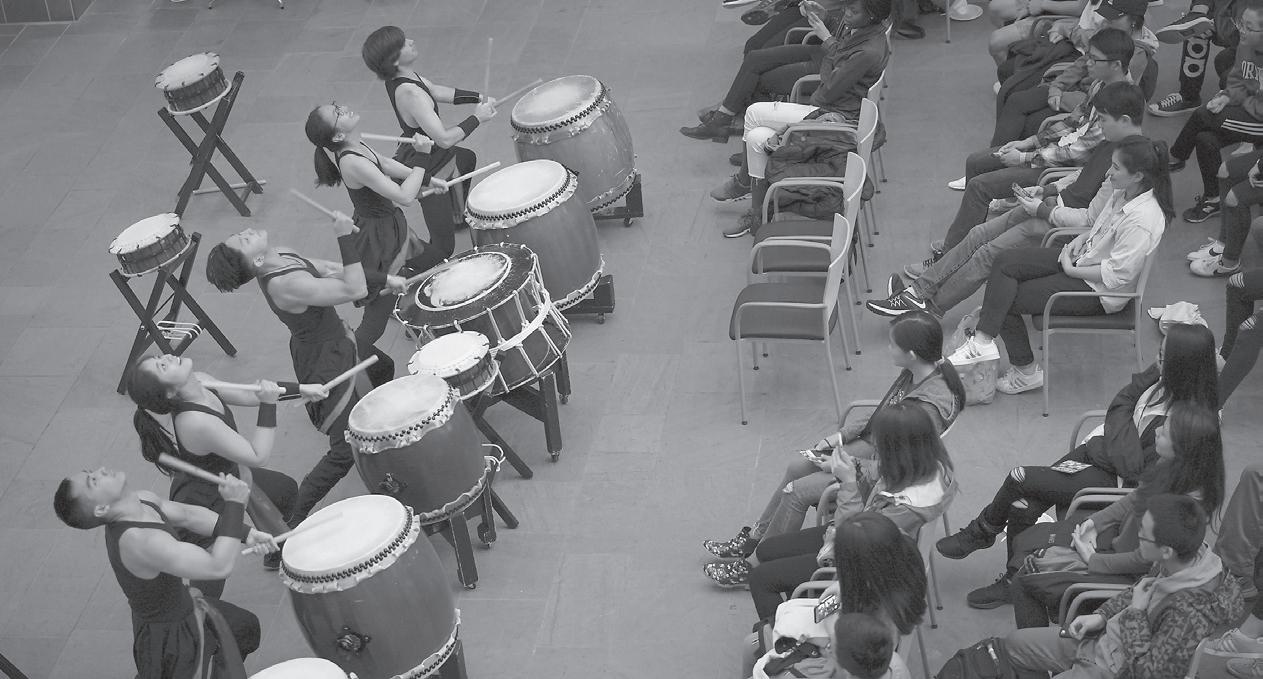
The Cornell Taiwanese American Society presented a slice of Taiwan in their annual night market with traditional food dishes and a host of performances by other student groups Friday evening at Duffield Hall.
“The purpose of night market is to be able to show Cornell what Taiwanese culture is like in a comfortable setting,” said Ryan Chen ’21, cultural chair of CTAS. “For us, a comfortable setting involves a lot of food, drinks, performances and games. We wanted to share something that was familiar and fun to us which were night markets in Taiwan.”
Among the many dishes at night market were three-cup chicken, tea eggs and Taiwanese sausage. As visitors moved around from stand to stand to sample the foods, various student performance groups such as Yamatai, E.Motion and the Cornell Eastern Music Ensemble kept the atmosphere fresh and energetic with music and dances.
“We were trying to improve the liveliness of the venue and we thought that performances would attract more attention and that people would have something fun to watch while eating,” Chen told The Sun.
To ensure authenticity, CTAS prepared the dishes through the efforts of their own members and volunteers.
“Some logistical challenges we faced were the fact that we cook all the food we service ourselves,” said Jared Chang ’19, CTAS treasurer. “We have to come up with the recipes, ingredients list, buy all of it, plan how we are going to time the cooking so we have everything finished and move to the location before the event.”
When asked about what he wanted attendees to get out of the night market, Chang said he “want[ed] people to enjoy themselves and enjoy eating good homemade Taiwanese food.”
Kyle Wang ’20, an event attendee, said he felt as if he was in an actual night market in Taiwan.
“I thoroughly enjoyed the event, it really captured what it was like to be at a night market,” he said. “There’s this Chinese character for the mood and if I had to translate it would be something like lively, bustling, chaotic, or fun.”
“The authenticity of the food was great. It was actual Chinese cuisine instead of Chinese-American,” Wang added.
Jinwook Lee can be reached at jl2658@cornellsun.com.
Continued from page 1
date campaign websites supported by the PAC ActBlue.
Prof. Emeritus Brian Chabot, ecology and evolutionary biology, donated to Tracy Mitrano’s J.D. ’95 campaign and previously told The Sun said he didn’t bring his “political views at all into the classroom.”
“I think all of us who are contributing to the Democrats, and I’m not the only one, try not to let those views get into anything we’re doing on the campus,” Chabot said.
The most politically engaged school in terms of campaign donations was the College of Arts and Sciences, with a total of $91,617.51 dollars in campaign contributions from 863 professors, researchers and lecturers.
The professor that gave the most money and to the largest variety of campaigns was Prof. Cynthia Chase, English. Her contributions worked towards making the department in the College of Arts and Sciences the most generous in the entire University, with a total of $27,151.50 going towards an all-Democratic slate of candidates.
Chase did not respond to a request for comment by the time of publication late Sunday night.
The least amount of donations came from the Hotel school at $360, but the SC Johnson School of Business as a whole gave $3,312.
Those affiliated with the government department gave a collective $6,857, while those in the law school donated $22,873.
Republican candidates only
received one donation of $100 from one professor through a donation to the National Republican Senatorial Committee. The donor is in the department of molecular biology and genetics. Independent candidates received $1,290 through Alyse Galvin (I-Alaska) and Angus King (I-Maine).
Many of the candidates receiving the most donations were running in New York districts, such as Max Della Pia (who lost the Democratic primary for the 23rd District), Erin Collier (who lost the Democratic primary for the 19th District), Edward Sundquist (who lost the Democratic primary for the 23rd District) and Mitrano (who is representing the Democratic party in the election for the 23rd District).
Previous reporting by The Sun found that two members of Cornell staff and faculty donated to Rep. Tom Reed’s (R-N.Y.) campaign. However, the methodology used in conducting this analysis was focused on professors, researchers and lecturers, thus removing these donations from University employees.
Joanne Florino ’75, a former project director for the Atlantic Philanthropies Archives Project and current Ithaca resident, is one of the employees who donated to Reed, giving $3,500. She also gave $50 to Mitrano.
Florino previously told The Sun that she believes more Cornell faculty members are “center right but would not wish to be public about it.”
Large donations did not discriminate by geography and went to candidates for Congress across the country, including Sharice Davids J.D. ’10 (D-Kan.), Beto O’Rourke (D-Texas),
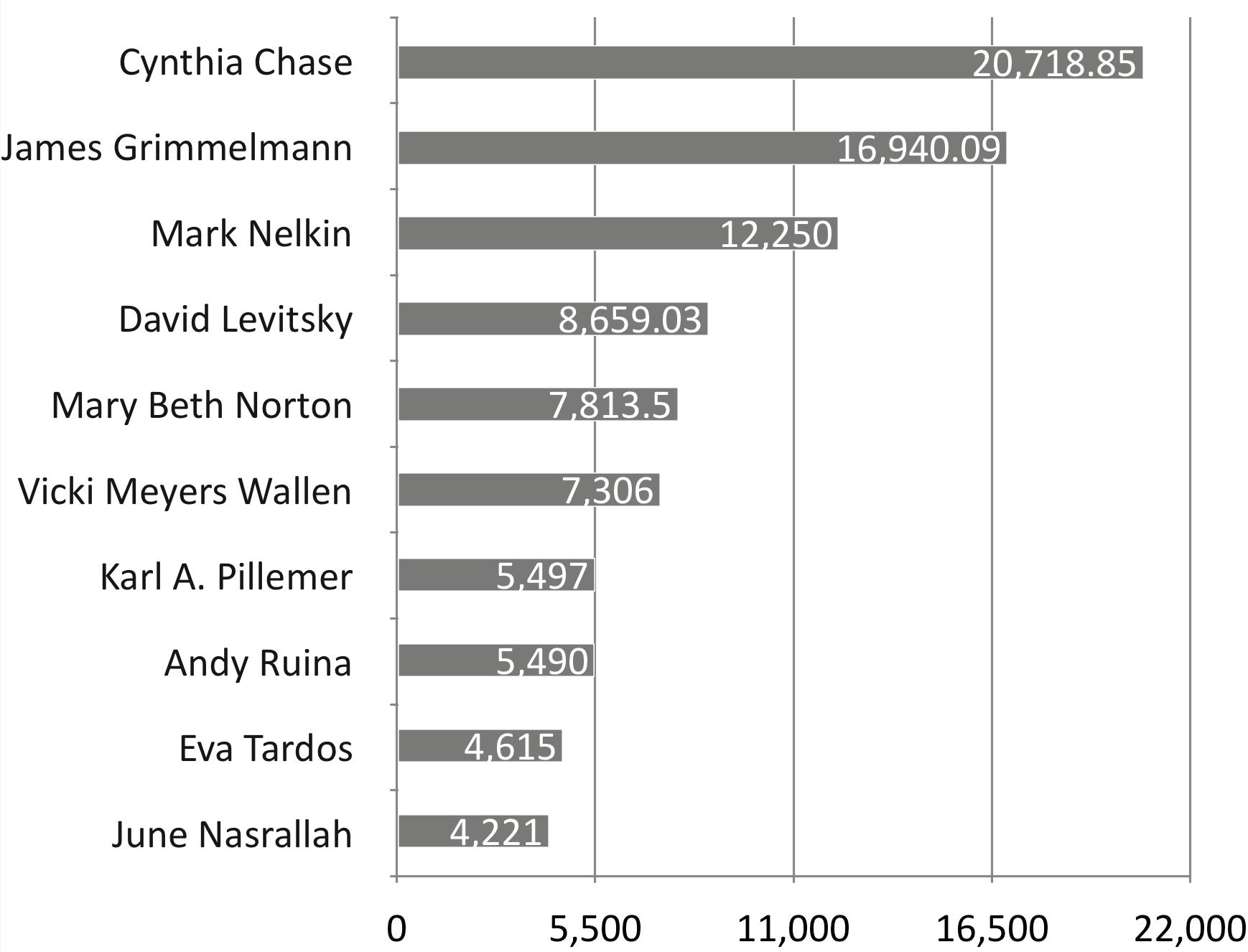
Money moves | The top 10 donations made by Cornell faculty members and academic staff ranged from $20,718.85 to $4,221. Prof. Cynthia Chase, English, helmed the list.
Elizabeth Warren (D-Mass.), Nancy Pelosi (D-Calif.) and Doug Jones (D-Ala.).
The candidate with one of the most donations from professors and administrators alike was Jon Ossoff (D-Ga.), a documentarian and candidate for Congress in Georgia’s sixth congressional district. This is statistically proportional, considering Ossoff has outraised any candidate for congress in the nation at $30 million.
The partisan trend findings seem
SHUTTLE
Continued from page 1
According to Somchanhmavong, many different organizations, student ambassadors from the Andrew Goodman Foundation and residential dorms have taken extensive steps to make sure students were registered to vote. Therefore, she said, the PSC and COE were trying to think of ways to make it more accessible for students who registered to go out and vote.
“On campus, transportation is a huge issue, and we want more
students to go out and vote,”
Somchanhmavong told The Sun.
“Some of the polling locations such as the elementary schools are at a distance and it’s hard for the students living on campus to get to them,” she added.
A previous study showed that turnout rate for midterm elections of Cornell students are relatively low, at around nine percent.
Somchanhmavong hopes that election services such as these will increase the voter turnout and encourage students to vote.
“Voter turnout has a tremen-
dous impact on any elections, especially this one,” she said.
Somchanhmavong encouraged students to utilize these election shuttles, as they are free of charge, and she emphasized the importance of voting and that every student deserves a voice to make an impact on a national scale.
BreAnne Fleer can be reached at bfeer@cornellsun.com. Gayatri Somaiya can be reached at gaa79@cornell.edu
create the newly constructed Tang Welcome Center and will go towards constructing a new building for the Atkinson Center for a Sustainable Future at Weill.
“Last year we received $512 million in new gifts and commitments, with alumni and friends strengthening our Annual Funds by $44.4 million, a 6.5 percent increase over fiscal year 2017,” she said.
Despite the prosperity, Pollack also listed problems that still need addressing, such as mental health, which has been a concern throughout Pollack’s first year-and-a-half as president. She
said the University has expanded mental health resources in the face of increasing demand and plans to “conduct a comprehensive evaluation of student mental health needs and our approaches.”
“Everywhere
I went ... I met people like you who are deeply proud of their Cornell education.”
Pres. Martha Pollack
Pollack also stated that the University has been working very hard to keep costs down for families by reining in administrative expenses while maintaining the
quality of education.
“For most students with financial aid, the net cost of a Cornell education is actually lower than it was a decade ago and even, in many cases, two decades ago,” she said.
The president concluded by returning to Bishop’s essay. “‘Perhaps it is important that we should not be grouped as a member of any Big Four or Big Twelve. As the qualities in the seed persist and fructify, it may be that foreign observers hunting the essentially American college will specify Cornell University. And perhaps Harvard, Yale, and Princeton,’” she quoted.
Emily Yang can be reached at eyang@cornellsun.com.
to be in alignment with data collected before the 2016 Presidential election.
Prof. William Jacobson, law, stated in 2015 that he found the statistics “completely predictable.”
“Academia in general leans heavily liberal, and that likely is compounded at Cornell because Ithaca itself is a progressive bubble, surrounded by reality, as the saying goes,” he said.
Amanda Cronin can be reached at acronin@cornellsun.com.
C.U. Will Not Provide Immediate Funding To Cornell
sources, including subsidies from the College of Arts and Sciences and the Department of Performing and Media Arts, co-sponsorships from academic departments and grants from sources such as the Cornell Council for the Arts, according to Pozsonyi.
GPSA increased its funding to the Cinema from a graduate and professional student activity fee contribution of $10.54 to $11 per student last fall, but the amount is set to decrease to $9, $7 and then $5 over the next three funding cycles, according to Pozsonyi.
The decrease is one component of the GPSA’s three-part plan to fund the Cinema to the full amount requested this year, gradually decrease the student contribution fee and help the Cinema find additional sources of support, according to Pozsonyi.
An early draft of a letter intended for Pendakur written by the Cinema Student Advisory Board said the Cinema is a “sober” alternative activity for students. The letter is being circulated among undergraduate student organizations to gather co-signatures.
In an email to The Sun on Thursday, S.A. executive vice president Joseph Anderson ’20 said the S.A. “has not been approached by the cinema to support their endeavor [sic], but we would welcome a conversation.”
Members of the Cinema Student Advisory Board did not respond to a request for comment.
Since 1880
JACOB S. KARASIK RUBASHKIN ’19 Editor in Chief
JOHN
McKIM MILLER ’20
KATIE SIMS ’20
VARUN IYENGAR ’21 Web
Editorial
GIRISHA ARORA ’20
HEIDI MYUNG ’19
ALISHA GUPTA ’20
THIS WEEK’S MIDTERM ELECTIONS will be among the most consequential in recent memory. At stake is nothing less than the direction of our democracy and our nation. The past two years have not been easy for many Americans — the Trump administration has embarked on a substantial rollback of rights and protections for women, immigrants, LGBTQ people, religious minorities and more. Congress tried repeatedly (though unsuccessfully) to repeal the lifesaving Affordable Care Act, and succeeded in passing in passing a massive tax cut for the wealthiest Americans at the expense of working people. And a growing but still fragile economy finds itself at the mercy of a capricious administration’s trade policy.
If you have an opinion on anything that has occurred over the past two years, your greatest recourse comes at the ballot box. Many Cornellians vote absentee — if you are one of them, make sure you have mailed in your ballot. Most states accept ballots postmarked by Election Day, so no, it’s not too late.
For N.Y. Governor
For governor, The Sun recommends Gov. Andrew Cuomo in his race against Dutchess County Executive Marc Molinaro. While Cuomo’s tenure has at times been rocky, his list of accomplishments is long, and on issues like gun control, gay marriage and minimum wage, his record is strong. And here in Tompkins County, Cuomo has spearheaded the $25 million expansion of Ithaca Tompkins Regional Airport. While Molinaro has distanced himself from national Republicans, his record as a state legislator from 2007-2011 is lacking. And quite simply, the last eight years have shown the detrimental effects of divided government in Albany, to which Molinaro as a Republican would contribute to.
For N.Y.
For senate, The Sun recommends Sen. Kirsten Gillibrand (D-N.Y.) in her race against Republican Chele Farley. In the Senate, where she has served since 2009, Gillibrand has been an advocate for working families, women and immigrants, and she has led the charge against sexual harassment and insider trading in our nation’s capital. Her opponent is Wall Street-bankrolled and Trump-endorsed, and like the president, she trafficks in fear-mongering on issues like immigration and MS-13. New Yorkers should return Sen. Gillibrand to Washington to continue her unfinished work.
For New York’s 23rd Congressional District, The Sun recommends Tracy Mitrano J.D. ’95 in her race against incumbent Rep. Tom Reed, who has represented Tompkins County since he was redistricted from N.Y.-29 in 2012. In six years, what has Reed done for the 23rd?
Last year, Reed voted with Paul Ryan and Mitch McConnell to repeal the Affordable Care Act. Had the Reed-Ryan-McConnell troika been successful in its efforts, hundreds of thousands of N.Y.-23 residents could have lost or been priced out of their health insurance. Reed claims to be fighting extremism in Washington, and often touts his membership in the bipartisan “Problem Solvers’ Caucus.” But tell us, what is bipartisan about attempting to overhaul the entire American healthcare system with only 1 hour of floor debate, and no committee hearings or markups? What is bipartisan about pushing through a vote on that bill without even waiting for a non-partisan accounting from the Congressional Budget Office? How can you call yourself a “problem-solver” when you vote for a tax bill that will cost New York State an estimated $15 billion while putting money back in the pockets of the wealthiest Americans and corporations?
The truth is, Reed is neither fighting extremism, nor working bipartisanly solve problems. One of the first members of Congress to endorse Trump for president, Reed has an A rating from the NRA and a paltry 5 percent rating from NARAL-Pro Choice America. His much-ballyhooed “REDUCE Act,” which he claims tackles college affordability, is in reality an extreme attempt at extorting institutions of higher education. It applies only to a sliver of all colleges and universities, imposes inflexible rules and taxes that would harm long-term stability and growth, and could lead to severe tuition hikes at affected institutions.
Unlike Reed, Mitrano is a moderate voice who will put New Yorkers first as a member of Congress. Like Reed, Mitrano is a first-generation college graduate, and knows what it is like to grow up and live working-class in America. But while Reed was busy founding a medical debt collections firm that preyed on the most vulnerable New Yorkers, Mitrano was putting her education to good use as Cornell’s director of information technology policy from 2001-2014.
Mitrano has made rural broadband access a central plank in her platform, a goal The Sun heartily approves of. Consider that communities mere minutes away from Cornell lack even basic cell service, and we believe that in Congress, Mitrano would work to provide the 23rd — and all of the 23rd — with the resources it needs for the 21st century.
A Congresswoman Mitrano would never vote to deprive New Yorkers of their health insurance or of their reproductive rights. A Congresswoman Mitrano would fight to ensure that every American has the ability to exercise their right to vote, to have a quality public education, to breathe clean air and drink clean water. Unfortunately, we cannot say the same about our current representative.
Disclosure: Tracy Mitrano J.D. ’95 previously served on The Sun’s board of directors. Her term ended in 2013, and she has not been involved with The Sun since then. None of the people responsible for today’s endorsements have ever worked with Mitrano in any context.
In the biggest game of his life, Los Angeles Dodgers pitcher Kenta Maeda had finally run out of surprises. In a critical Game 4 of the World Series against the Boston Red Sox, Maeda had been asked to bail out the Dodgers in another sticky situation. Bases loaded, two outs, down 5-4, he was tasked to holding the Red Sox from expanding their lead any further. Up to the plate came Steven Pearce, who looked like the kind of guy who spent his spare time wrangling cattle just for kicks.
As a pitcher, Maeda is particularly meticulous. He likes to pitch backward, which is baseball lingo for saying he liked to start batters with his slower pitches, before blowing them away with his fastball. It is a good way of keeping batters off balance, and judging by the fact that the Dodgers were paying him $25 million, he had been pretty successful so far. The problem was, he had already pitched in Game 2 and Game 3 of the World Series, and was already risking overexposure by appearing in Game 4. The Red Sox knew what to expect, so when pitch 1, a slider, sailed by Pearce for strike one, he knew what was coming. On Maeda’s next pitch, a fastball, Pearce crushed it for a 3 run double. Game over. The next night, the Red Sox would hoist the World Series crown.
The Dodgers aren’t the only one wondering if they would have been better served changing up the formula. The “Halloween” franchise, of Michael Myers fame, is somehow back again for *checks notes* the 11th time, featuring the same standard slasher formula: violent psychopath stalks a group of people, group of people is whittled, lone survivor somehow escapes from Myers. The movie itself is marked improvement over the miserable string of sequels that came out in the mid 2000s, but the whole premise is incredibly stale at this point. Guy meets girl. Guy stalks girl. Girl escapes. Rinse, Repeat, Profit.
films of this genre in the past few years, Burning and Get Out, have something to say. Both movies touched on social issues that tied them to the ground. Getting to the destination is key, but the process there is meaningful. They’re innovators. Every step counts; every word matters. There’s fear mined in the unknown. It’s authentic; it’s different.
And it’s this conundrum that has defined the last few weeks leading up to the U.S. midterm elections, or more specifically, the particularly troubling messaging from our president. In an election cycle that has been marred, to a greater degree, by partisan fighting, the rhetoric from the President has declined even further below his usual standards. The problem is, once you hit rock bottom, anything else seems like a cheap imitation.
First, it was his attack on the migrant caravan in Central America, moving toward Mexico, where he theorized that the group contained “Middle Easterners.” It calls back to his similar remarks about Mexican immigrants during the 2016 election cycle.
But at a time when pipe bomb attacks and shootings are perpetrated by men who could have been easily as mistaken as middle-aged shopping mall dads, it rings especially crude and short sighted. But because Trump has nothing new to say; nothing fresh to offer, because he can’t get out of his own head, he has nowhere else to go.
Win or lose, Trump’s administration won’t change.
There’s a reason why horror franchises and baseball pitchers always fare worse the second and third time around; they don’t know how to reinvent themselves. The scares himself dont land as effectively as they did at first; the pitches don’t land at all.
Compare that with Burning, the recently released South Korean horror/ mystery film. The characters take on new life in a different kind of setting. Instead of masked men, it’s the slow burning smiles and innuendos of the character that build a more organic tension. A love triangle, set on the Korean Peninsula, run amok. The horror comes not from jump scares and leering shots of the killer, but a disturbing plot device that sweeps readers for a stunning reveal, before setting everything ablaze.
It’s not a coincidence the best two
He’s a pitcher who’s been figured out; a slasher film that scares no one. It’s tiresome, and worn out, and at this point, utterly surreal. When he attacked Andrew Gillum, the Democratic candidate for governor of Florida for being a thief, and Stacey Abrams, the Democratic candidate for governor of Georgia for being unqualified, you could almost hear the populace sigh. What was remarkable about the entire exchange was that at the same time praising Gillum’s opponent, Ron De Santis, being Harvard Law School educated, he crushed Abrams for being unprepared, despite having graduated from Yale Law School herself. If the irony flew over his head, he must have missed it. Nothing new, nothing unexpected. Same old Trump, same old nonsense. The whole cycle is predictable. Win or lose, Trump’s administration won’t change. He’s done the same thing over and over again, backed by his pantry of yes men. It’s no longer infuriating. It’s dull. They point to the same imagined threats and prey on the fears that they know will play to their base. It works, unfortunately. They’re scarecrows, but they’re only scaring themselves.
William Wang is a junior in the College of Agriculture and Life Sciences. Willpower runs every other Monday this semester. He can be reached at wwang@cornellsun.com.
Christian Baran | Honestly
Every time a debate about climate change arises around me, I grind my teeth and waver. Should I add my opinion? Will others hear my perspective and denounce me as ignorant? Sometimes they do, but I usually speak my mind anyway. I tell them about an alternative perspec tive that is constantly weighing on my mind: are humans even obligated to try to mitigate climate change?

Are humans even obligated to try to mitigate climate change?
Don’t get me wrong, I believe in climate change. I’m a vociferous advocate of climate change mitiga tion, and plan on dedicating my life to arguing for the protection of the environment as an environmental lawyer. But I think it’s provincial and myopic to be absolutely sure of your stance on any one issue. I know enough to know that I don’t know anything. As such, I often find myself vacillating between opposing positions on any given issue. This often makes me feel indecisive and dumb, because I don’t have actual stances on many important disputes.
In my senior year of high school, I took an environmental science class with a teacher named Mr. Watson. Mr. Watson was a young, passionate environmentalist — a favorite among students — but the general consensus was that he wasn’t the sharpest tool in the shed. Personally, I thought he was smarter than my peers gave him credit for. At least, he definitely knew his environmental science. One day I decided to engage him in a debate about some thoughts that had recently been simmering in my mind.
I challenged him to tell me why humans are obligated to fix climate change. I had recently read about the Great Oxidation Event of circa 2 billion years ago, in which organisms called cyanobacteria began to produce oxygen via photosynthesis. This event created an atmosphere dominated by oxygen, which in turn
The first election I ever voted in was a down-ballot wipeout, at least with respect to the people I was voting for. My introduction to the democratic process was coupled with my introduction to large-scale electoral loss, and like many others, it was a loss that I didn’t see coming.
I remember exactly how I felt on the morning of Nov. 9, 2016: dejected, blind-sided, stupid. (Also cold, because the weather that day in Ithaca was rainy and dramatic.) Before election day, I had listened to one too many episodes of the FiveThirtyEight elections podcast, interpreting their analysis to mean that there wasn’t much to worry about, so I didn’t. The lead up to the 2016 election, at least for myself, was a lot of preemptive, unearned celebration of a victory that never came to fruition.
induced an ice age and mass die-off of obligate anaerobic organisms (organisms with a low oxygen tolerance). Shortly after learning about the GOE, I learned about Gaia Theory, which posits that the Earth is a single self-regulating system. The theory hypothesizes that every living and non-living component on the planet evolved in tandem with one another and work together to maintain habitability. In other words, there is a master plan at work, controlled by nothing and everything at once.
My thought was, if cyanobacteria could cause massive climate change, why shouldn’t humans be able to do the same? After all, humans are just as “natural” as bacteria, seeing as we’re both just different organisms on the same planet. Albeit, we’re a bit more advanced than bacteria, but level of advancement shouldn’t make a difference in our respective obligations to reverse our effects on the climate. That level of advancement means we can understand our impact on the climate more than cyanobacteria could, but still, why should increased understanding increase our obligation to fix what we’ve done? In accordance with Gaia Theory, if we’re all part of one big self-regulating system, maybe human-caused climate change is part of the self-regulation. Maybe climate change is supposed to happen, and by trying to stop it, we’re actually disrupting that system of self-regulation.
somehow ‘unnatural’…to quarrel with technology is to quarrel with the nature of man.” If, as Volti puts forward, human technology is as natural as his upright gait or speech, then any resultant of our technology, to wit, climate change, must also be considered natural. Climate change has developed as an unintended consequence of our technological systems. Even if we say as a society that we should mitigate climate change because it poses a danger to ourselves, other creatures and the environment (which we should do), we still face other potential unintended consequences of our mitigation efforts. We can never truly know what effect our actions will have. To that, a friend with whom I was discussing the issue said that we can’t get caught up in the “what if’s.” If we get mired in those endless possibilities, we’ll become paralyzed by indecision and nothing will actually get accomplished.
If we get mired in those endless possibilities, we’ll become paralyzed.
Mr. Watson responded by saying that humans are not “natural,” and as such must fix all “unnatural” effects they’ve had on the environment. However, sociologist Rudi Volti in his book Society and Technological Change posits, “it is pointless to indict technology as
At Cornell, I’ve found there to be a very single-minded dialogue about most issues. In the climate change debate here, the opinion is of a single stripe: everyone believes in it, and believes we should fix it. There’s no room for alternative perspectives, and if someone presents one, they are charged with oblivion and idiocy. But to foster a fertile environment for ideas and debate, alternative perspectives like this one are not just helpful, but needed. In a relatively isolated, homogeneously minded place like Cornell, students need challenges to their mindsets to prepare them for the world, where opinion will be much more diverse.
Jacqueline Groskaufmanis | Te Dissent
on election day. I think we should, and need to, prove them wrong.
The voting process here in the U.S. is deeply flawed, and it feels strange to encourage participation in a flawed system as a remedy for its brokenness. You wouldn’t tell someone to drive a
The voting process here in the U.S. is deeply flawed, and it feels strange to encourage participation in a flawed system as a remedy for its brokenness.
car with broken brakes in order to fix it, but here I am encouraging engagement in a system of voting that is host to strategic voter suppression and suffers from incomparably low voter turnout from those who are eligible to vote.
But there’s complication bundled up in voting that no broken-brakes metaphor can really capture. For instance, in some states there are initiatives on
means of potentially expanding voting rights to others. I’m wary of the “be a voice for other people” trope, but in this particular instance, voting is a perfect opportunity to hand someone else the microphone.
I’ve been talking to a lot of people who don’t plan to vote, from all walks of life and all ends of the political spectrum. I’ve talked to friends who missed the registration deadline, people who are registered but on the fence about showing up, and some people who think it is a moral act of “civil disobedience” to abstain from voting. On Saturday I went door to door canvassing in a nearby district and talked to some people who clearly had 1,000 things on their mind that came before Election Day. In some ways,
I’ve been talking to a lot of people who don’t plan to vote.

Fortunately, the follow up, from a few days after onwards, has been a better understanding of how important it is for all of us to actually show up. As the age group that consistently has the most abysmal turnout rates, a lot of people are writing us off and expecting us to stay home
Between every election cycle we endure the consequences, positive or negative, created by those we elect.
the ballot that could potentially restore voting rights to hundreds of thousands of citizens who have been disenfranchised. In these places, voting itself is a
I get that.
But at the same time, our electoral politics right now are particularly urgent. In the fall of 2018, about 50 million students were enrolled in public schools nationwide, and were subject to curriculum and funding that was shaped by the public officials we elected. We don’t have time to sit on our hands and hope for the best every two years. In the time that spans between elections, second graders become fourth graders, middle schoolers become high schoolers, and college students become graduates. Between
every election cycle we endure the consequences, positive or negative, created by the those we elect. So it goes without saying that it is important for us to show up because, if we don’t, we surrender that small but important piece of control that we’ve been given. Vote like the race is tied and you will be the determining vote, even if your candidate is predicted to win by a landslide or be bulldozed by their opponent. Vote like the candidates are radically different, even if one is only marginally better in your opinion. Vote with urgency, because these appointments are urgent and their decisions are consequential whether you’re a staunch party loyalist or largely apolitI hope if you’re registered to vote, you show up tomorrow and that, if you’re not registered to vote, you show up in the next election. In the interim, I hope that all of us show up a bit more for one another, because if the events of the last few weeks, and of the last two years, have shown us anything, it’s the polar opposites of destructive danger and positive potential that exist in tension at this political moment.
Tomorrow, voters across New York’s 23rd congressional district will decide whether longtime representative Tom Reed (R-N.Y.) or Democratic challenger Tracy Mitrano J.D. ’95 will represent them in Congress.
Reed has served the district since 2010. In the House of Representatives, Reed sits on the Ways and Means Committee, which makes recommendations regarding tax bills and other revenue-generating legislature to the House. Reed was endorsed by President Donald J. Trump on Oct. 22, when the President tweeted that Reed has done a “great job” and that “he has my complete and total Endorsement!” According to FiveThirtyEight, a non-partisan polling website, Reed has voted alongside President Trump’s position 96.6 percent of the time. Mitrano, a former Cornell employee, decided to run for Congress after the last election when she realized that Congress lacked a data security expert. Running as a moderate Democrat, Mitrano was endorsed by Ithaca Mayor Svante Myrick ’09.
Reed and Mitrano have gone head-to-head in three debates in the past two weeks. While Ithaca has consistently voted for the Democratic candidate for Congress, New York’s 23rd district has been a hearty red district, re-electing Reed by a margin of more than 15 percent in the past two elections. The district also includes “pivot counties” — counties that voted for Barack Obama in 2008 and 2012, but for Trump in 2016.
Still, Mitrano’s camp has asserted that the nationally posited “blue wave” is strong enough to allow her to win and that her self-described “centrist” campaign is appealing to voters. New York’s 23rd district lacks significant polling statistics, but Mitrano’s campaign has advertised a poll that shows her trailing Reed by two percentage points. FiveThirtyEight projects the race as “likely” Republican, with Reed collecting 53.3 percent of the popular vote and Mitrano receiving 46.7 percent.
Mitrano, although a recipient of an “F” rating from the National Rifle Association, is a “proud” gun-owner, according to The New York Times. Mitrano supports background checks and looks to eliminate loopholes in legislation, including the “gun show loophole.”
Mitrano cited recent tragedies in her support for safeguards and believes that individuals with a history of domestic violence should also be prohibited from purchasing firearms.
The Democratic candidate also has repeatedly criticized the NRA’s — as well as other lobbies’ — power over Congress.
With Reed’s campaign website featuring a picture of him posing with a firearm, as well as an “A” rating from the National Rifle Association, Reed has positioned himself as a champion for gun owners’ rights.
In Congress, Reed has co-sponsored a bill to validate concealed carry permits across state lines, which passed in the House.
Reed also opposes the SAFE Act, a gun law passed in 2013 that requires background checks from ammunition vendors, among other regulations. Reed has repeatedly called for its repeal, describing it as state “overreach.”
Describing the country as one of immigrants, Mitrano said during the debate, according to, and hosted by, the Olean Times Herald, on Friday that “our own tradition of immigration is at stake.”
A supporter of the DREAM Act, Mitrano has also publicly spoken out against the separation of families at the southern border.
Citing the needs of dairy farmers in the district, Mitrano supports the expansion of the H2A visa. “Our dairy farmers require laborers year-round, not just during a harvest season,” reads Mitrano’s campaign website.
During Friday’s debate, Reed reaffirmed his support for the border wall, saying the country “need[s] a secure border.”
In July, following public outrage due to family separations at the southern border, Reed voted for a House resolution that expressed its support for U.S. Immigration and Customs Enforcement personnel and denounced the concept of abolishing ICE.
Reed has also demonstrated general support for immigration for economic purposes, saying in Friday’s debate that “we want to make sure our farmers get access to the labor they need.”
Regarding health care, Mitrano is a proponent of a single-payer health care system. In a single-payer system, health care is financed by a single public entity through taxes, and all residents are covered for essential medical services.
“I think a single-payer system that is brought in incrementally but is designed to have coverage for everyone is the best way to go,” Mitrano said at a town hall event hosted by Cornell Democrats. “I believe that our problem right now is that there is no real competition in the market.”
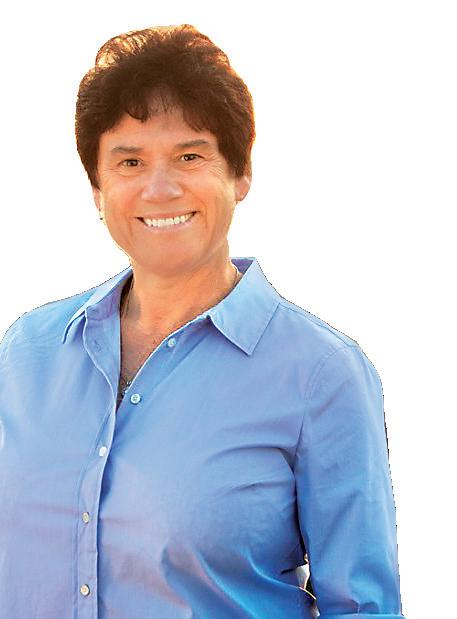
At the same event, Mitrano criticized rising drug prices and pharmaceutical companies.
Calling the Affordable Care Act a “failed solution” on his website, Reed has criticized the program for “robbing” other programs. In Congress, Reed voted in favor of repealing and replacing the ACA, commonly known as Obamacare.
At Friday’s debate, Reed called for a more “transparent marketplace” and said that a single-payer system would “bankrupt America.”
Reed promotes decreasing baseline costs of health care as a way to decrease the costs of health insurance.
Broadly, Mitrano believes in environmental protections, citing flooding in some districts as evidence of her opponents’ dismissal of the issue. Mitrano further believes that the federal government should be allocating more money toward climate change research.
Mitrano also supports the allocation of federal and state funding to address issues in the Southern Tier, including water quality and the cleanup of low levels of radiation found in West Valley.
Mitrano further opposes certain economic initiatives, such as “hydrofracking,” citing potential negative environmental outcomes.
Although Reed does not list environ mental concerns on his website, his office published a statement in 2014 calling the ban on hydraulic fracking “devas tating,” saying that the ban “effectively blocks the development of natural gas and oil resources in New York State.”
In July, Reed supported a vote to oppose the carbon tax, according to polling website FiveThirtyEight.
In a September statement, Reed announced that $75 million had been allocated in the Energy and Water Appropriations Bill to the West Valley to assist in the cleanup efforts.
Dante Palecco scored the first of two Yale power-play goals halfway through the second period.
partner’s side throughout the injury delay, scored an unassisted goal on a wrist shot that found its way over Yale goalie Corbin Kaczperski’s glove to give the Red a two-goal lead.
“Honestly, it kind of affected me the first couple shifts and it was nice to get that goal and kind of snap out of it,” Kaldis said of Green’s injury.
In the second period, the Red picked up where it left off and Barron, assisted by Kaldis and sophomore Tristan Mullin, scored less than two minutes in.
In the third, after Cornell impressively killed a five-on-three that lasted roughly a minute, Snively tipped in a goal past Galajda to pull the Bulldogs within one with just seconds left of the remaining standard five-on-four power play.
Despite Snively’s power-play goal, Cornell was mostly able to contain the Bulldogs’ primary offensive weapon. Sophomore forward Kyle Betts centered a line with juniors Noah Bauld and Jeff Malott that matched up with Snively’s line
for much of the contest.
“Snively is their star player,” Syer said. “We knew about him; he’s scouted. Their team works around him.”
The game was punctuated by a few missed opportunities on Cornell’s part — even while the Red ultimately scored four goals, there were myriad times when Cornell didn’t capitalize on scoring chances. The Red finished the game with 29 shots on goal. Especially in the second period, the Red spent extended periods of time around the Bulldogs’ goal with its passing capabilities on full display, but the puck often failed to find its way into
the net.
The Bulldogs somewhat outplayed the Red in the third period, but Cornell managed to hang on for the win.
“In the third, they really started to push and get some good looks,” Syer said. “We got away from things a little bit.”
Trailing by a goal, Yale came close to tying the game with an extra attacker. But their hopes were destroyed when Barron scored on the Bulldogs’ empty net with less than a minute left to seal the victory.
Fill in the empty cells, one number in each, so that each column, row, and region contains the numbers 1-9 exactly once. Each number in the solution therefore occurs only once in each of the three “directions,” hence the “single numbers” implied by the puzzle’s name. (Rules from wikipedia.org/wiki/ Sudoku)


“We’ll never get that sunken treasure if you keep coming up for air.”
your




1, 2, 3, 4, 8 BEDROOMS FURNISHED VERY REASONABLY PRICED
607-272-3389 avramisrentals@aol.com
COLLEGE AVE.
1 Bedroom available In a 2 BR apartment For Male, Undergrad student. Available NOW & Spring 2019
4 Bedroom Apartment Available NOW & Spring 2019 Novarr-Mackesey Property Management office@ithacastudentapartments.com 607-277-1234
2 & 3 BEDROOMS 109 SAGE PLACE
Available NOW, Spring 2019 & 2019/2020 Shuttle Bus Access to Campus Access to Free Fitness Center Novarr- Mackesey Property Management office@ithacastudentapartments.com 607-277-1234
>>AFFORDABLE, QUALITY LIVING<< Special Deals for you! Furnished 1-6 Bedrooms Collegetown Apartments PARKING, LAUNDRY, UTILITIES! (607) 273-7368 www.IthacaApartmentRental.com ***************************** RENT NOW, GET THE BEST www.MatoulasHouses.com
Apartments & Houses In Collegetown LINDEN AVE & E. SENECA ST 1 & 3 BEDROOM APARTMENTS ALL FURNISHED EMAIL: MatoulasHouses@Gmail.com
PHONE: (607) 339-9644 FIRST-COME, FIRST-SERVED *****************************
Collegetown Terrace Apartments INSPIRED LIVING TAILORED TO YOUR SUCCESS 24-Hour Fitness Center
Shuttle Bus Service to Campus Study Rooms w/ Expansive Views
Apartments Available NOW, Spring 2019 & 2019/2020 Novarr- Mackesey Property Management collegetownterraceithaca.com office@ithacastudentapartments.com 607-277-1234
NORTH CAMPUS
Studio and 3 bedrooms Available 2019/2020 Novarr-Mackesey Property Management office@ithacastudentapartments.com 607-277-1234

Houses, Apts, Parking 1 to 9 Bedroom
Collegetown - College Ave, Linden Ave, Dryden Rd, Bryant Ave, Cook St. 607-330-2442 info@urbanithaca.com www.urbanithaca.com
We have availability for the 2019-2020 school year beginning June 1st at Hudson heights apartments. The studio apartments come with: heat, water, and electricity included. There are garbages houses and coin-operated laundry facilities on site. Prices start at $750/month for a 12 month lease. If you have any questions or would like to schedule a tour contact us by phone 607-208-7660 or email: renting@ithacaLS.com
Nicest Apts. in Collegetown Located on Eddy St. 4 Bedrooms Fully furnished. Spacious living areas with large bedrooms & closets. Hardwood flors, spectacular views, eat-in kitchens with additional sun rooms. Laundry & parking. 607-339-1137 bgm900@gmail.com
201 WYCKOFF AVE 6 Bedroom House Novarr-Mackesey Property Management office@ithacastudentapartments.com 607-277-1234 27 H OUSE FOR R ENT
COLLEGETOWN 6 BEDROOMS NEWLY RENOVATED 607-272-3389 avramisrentals@aol.com

Continued from page 12
remaining two games to end the 13-year skid.
Tonight I’m just heartbroken for the effort the guys put in playing on national TV and playing at home,” said head coach David Archer ’05. “There’s still plenty to play for — a winning record in the Ivy League and things of that nature — but now I’m just think-
ing about tonight.” At first, the quest for over .500 appeared to be on course. The Red opened the game with a promising drive, marching inside the five-yard line from midfield. But the Penn defense stuffed five consecutive goal line attempts for a turnover on downs. Instead of going for an easy three points, Cornell elected to go for it on fourth down from three yards out, but senior quarterback Dalton Banks was stymied before
the goal line.
“It’s tough to come out, get to the goal line like that and not put points on the board,” said senior offensive lineman Henry Stillwell. “The rest of the game we had our chances. Things just really didn’t go our way.”
A few drives later Penn took the game’s first lead on a field goal. A 45-yard bomb brought the Quakers into the red zone where Penn, too, was unable to punch
the ball in for six. The Quakers instead took the points and the lead on a 20-yard field goal from Jack Soslow with 12:50 left in the second quarter. Cornell proceeded to get the ball back and put together another long drive, capping this one off with a touchdown to take the lead. After methodically working its way up the field, the Red offense found the end zone on a third and long 13-yard pass from Banks to
senior wide receiver Lars Pedersen. Pedersen made the short catch, followed a block from his teammate and wiggled through a few Penn tacklers for the score.
Cornell started the second half with the ball but sent it back to Penn on a three-and-out. The Red defense looked good to start the drive, but a costly targeting penalty on junior safety Jelani Taylor turned a fourth-and-one into a Quaker first down in Red territory. It was the second targeting of the game against Cornell after sophomore linebacker Lance Blass was ejected in the first half.
Penn pulled out a tricky formation, and with the help of a Cornell facemask, moved the ball inside the 10, where running back Karekin Brooks took it to the house to take back the Quaker lead, 10-7.
“[Losing Taylor and Blass] took away one of our entire personnel packages,” Archer said of losing two of his starters. “We thought we had a pretty good personnel grouping that could help us against Penn and that kind of took that out of the equation…[Taylor] is the quarterback out there though, there’s no doubt about it. He stirs the drink lining it up.”
The Red answered with another solid yard-eating drive, but this one stalled out at the 20-yard-line due in part to a long sack. Senior kicker Zach Mays missed on the field goal attempt, a line drive left.
The Red was in a tough spot at the start of the fourth quarter, down 10-7 with the Quakers threatening on Cornell’s side of the field. On the third play of the quarter, Penn quarterback Ryan Glover connected with a wideopen Christian Pearson in the end zone to extend the Quaker lead to 10 points. Cornell logged another three-and-out and didn’t see the ball again until Penn had capped off a grueling eight-minute drive with a field goal, a Pyrrhic victory for the winded defense.
They took advantage of us losing one of our guys in the secondary,” said senior linebacker Maxwell McCormick. “They started going to the air a little bit, but we were there. We just have to make the plays.”
“They sustained drives, and we didn’t capitalize on our opportunities to sustain drives,” Archer added. “We didn’t make enough plays throughout the course of the game.”
Down two touchdowns late in the game, Cornell’s run-centered offense stood little chance at a comeback. The Red moved deep into Quaker territory on a surge of medium passes and nearly scored twice: one touchdown catch was called off on a holding penalty and another touchdown pass was dropped in the end zone. The Red comeback hardly got off the ground.
But even on an abysmal night, the players still were able to soak in the novelty of playing under the bright lights of Schoellkopf on a Friday night — something many haven’t done since their high school playing days.
“It was surreal,” McCormick said. “Me being a senior, it was my last chance to do that and I tried to take full advantage of it and go out there with my guys and get a win. It was amazing — I loved it.”
WOMEN’S HOCKEY
Continued from page 12
“Going into a period down a goal can sometimes be a mental challenge,” said senior forward Diana Buckley. “However, in the Yale game we put our noses to the grindstone and stuck together as a team.”
O’Neill scored her first goal of the game within the first two minutes of the third period. From Cornell’s defensive zone, she drove the puck down the length of the ice, overcoming the defense of two Bulldog players to fire her 10th career shorthanded goal into the back of the net and even the score.
“The outcome was not what we wanted, but Brown played a great game.”
Assistant coach Edith Racine
While Yale quickly regained the lead with a goal from Emma Vlasic — the Bulldogs’ efforts ultimately proved insufficient, as back-toback goals from freshman forward Sam Burke and O’Neill secured the victory for the Red, 4-3.
“We played hard for the full 60 minutes and it was a great team win,” said assistant coach Edith Racine. “We stuck to our game plan and the girls focused on their shifts
and staying in the moment so we got the outcome we wanted.”
Despite mounting an outstanding, come-from-behind win to start the weekend — the Red failed to keep up the momentum, faltering to the Bears in Providence, Rhode Island.
This disappointing loss, however, was not entirely without excuse: Cornell played without the help of O’Neill, junior defenseman Jaime Bourbonnais and junior defenseman Micah Zandee-Hart, who will be competing in the Four Nations Cup for the Canadian National Team starting Nov. 6.
“We certainly faced some adversity, missing a few players,” said senior forward Lenka Serdar. “But we must learn to execute our game plan no matter who is in the lineup.”
To start the game, Brown swiftly took offensive initiative, with Veronica Alois slipping a backhand shot between the Red’s goalposts. Towards the end of the first period, Cornell’s junior forward Grace Graham entered the Bear’s defensive zone and drew goaltender Calia Isaac to the right. Sophomore forward Maddie Mills then received a pass on the opposite side of the zone to notch the Red’s first goal of the game.
“We had a bit of a slow start in the game this weekend” Buckley said. “If we want to be a championship team we are going to have to be more consistent—bringing energy
BROWN
Continued from page 12
and gets a good hit to kind of get the guys going usually you end up killing those ones off.”
Brown showed much more life in the second period than it did in the first, testing Galajda more and outshooting Cornell, 15-11. Cornell was able to put three goals on the board despite going 0-for-2 on the power play in the period and 0-for-6 overall.
“I thought we did a good job of getting control in the second period,” said Schafer, who returned to the bench Saturday after missing Friday’s game due to a death in his family. “We had guys step up and get the job done.”
The tie lasted less than five minutes. Freshman forward Michael Regush scored his first collegiate goal 8:39 into the second to put the Red up for good. The rookie drove hard to the net and buried a feed from senior forward and captain Mitch Vanderlaan, who had received a pass from junior defenseman Yanni Kaldis.
“[Kaldis] made a nice stretch pass to [Vanderlaan] and he hit me going to the net and I took it there,” Regush said. “I was fortunate to get the bounce to go in there.”
Sophomore Morgan Barron, after scoring two goals in the Red’s 4-2 win over Yale on Friday, gave the Red a two-goal cushion by burying the rebound of a shot by freshman forward Max Andreev past Brown goaltender Gavin Nieto. Barron’s tally ultimately proved to be the game-winner.
On several occasions, including on the power play, Cornell just missed adding to its score. The Red had several scoring chances on the man advantage.
“[We need] to show a lot more poise around the net,” Schafer said. “We hit [Nieto] a lot in the chest. We got to take an extra tenth of a second to bear down on our offensive opportunities.”
Brown made things interesting again in the third period. Brent Beaudoin scored to make it 3-2 just just 3:41 into the final frame, and Cornell failed to capitalize on a pair of power play opportunities in the
final 20 minutes. Galajda made 23 total saves in the Red’s second straight win, including a few in the final minutes as Brown tried to tie the game. Cornell’s defensive unit was without sophomore Alex Green on Saturday, who was stretchered off the ice during Friday’s game with an injury that, according to associate head coach Ben Syer is “much better” than it initially appeared. Sophomore defenseman Matt Cairns filled in for the Red on Saturday. Undefeated in league play but winless in non-conference games, the Red visits Northern Michigan on its first road trip of the season next Friday and Saturday.
Raphy Gendler can be reached at rgendler@cornellsun.com.
in all three periods.”
The end of the first period put the Red firmly in the lead after Graham scored her second goal of the season.
Even though Cornell entered the second period with a 2-1 lead, it quickly fell behind after the Bears scored three goals within six minutes of each other, the first by Sena Hansen and the next two by Abby Nearis.
In the last 20 seconds of the second period, freshman forward Sam Burke placed a backhander shot into the top of Brown’s net, reducing Bear’s margin to one goal.
But this proved to be too little, too late, as Cornell failed to score again, falling to the Ivy League rival 4-3. This was despite Cornell maintaining an advantage in shots (41-20), with 11 shots on goal coming from the third period alone.
Going into its next games, the Red will take this close loss as an opportunity to learn and grow as a team.
“The outcome was not what we wanted, but Brown played a great game. We just missed out on some opportunities,” Racine said. “But we are going to learn from it and work hard this week to get ready for next weekend.”
The Red will be back on the road to take on Mercyhurst Saturday at 6 p.m. and then Sunday at 1 p.m. Both games will be streamed live on ESPN+.
Faith Fisher can be reached at fsher@cornellsun.com.

By CHRISTINA BULKELEY Sun Staff Writer
Cornell men’s hockey survived a Yale comeback bid to fight its way into the win column on Friday after last weekend’s disappointing two-game set against Michigan State.
The Red (1-2, 1-0 ECAC) was energetic from the very start of its conference play debut, opening up a three-goal lead early in the second period against Yale (1-1, 1-1) and later avoiding a Bulldog comeback to hang on for a 4-2 victory.


“We want to build as big a lead as possible as early as possible and we did a pretty good job holding it tonight,” said sophomore forward Morgan Barron.
Neither team seemed particularly dominant at the onset, but Cornell jumped ahead to a 1-0 lead on a power play seven minutes in, as sophomore forward Cam Donaldson tipped home a pass from classmate defenseman Alex Green. From that point onward, Cornell never trailed. The Red outshot Yale, 9-2, in the first period.
Sophomore goaltender Matt Galajda, pulled from consecutive losses to Michigan State last weekend, showed vast improvement, making 16 saves. Perhaps no save was more significant than his stopping of Yale star forward Joe Snively on a breakaway early in the first.
“The big breakaway save against Snively a few minutes into the game, that was huge for us,” Barron said.
Green’s night came to an end shortly after he picked up the power-play assist, as he was hit hard in the neutral zone 10 minutes into the opening period and was carried off the ice in a gurney.
“The guys were feeling for [Green], but they did bounce back,” associate head coach Ben Syer.
Syer coached Friday due to a death in Mike Schafer’s ’86 family.
Green’s injury, however, is less severe than it initially appeared — he was seen watching the game alongside other teammates not in the lineup during the second and third periods.
“All I can say is that it’s much better than what it looked,” Syer said of Green’s injury.
Three minutes later, junior Yanni Kaldis, who had been at his defensive partner’s side throughout the injury delay, scored an unassisted goal

By RAPHY GENDLER Sun Assistant Sports Editor
After falling flat in two straight games at home to open the season a week ago, Cornell men’s hockey completed a four-point weekend to even its record and start ECAC play with a winning streak.
A three-goal outburst in the second period was enough for the Red (2-2, 2-0 ECAC) to earn a four-point weekend and improve to 2-0 in ECAC play with a 3-2 win over Brown (0-3-1, 0-2-1) on Saturday.
“Guys stepped up and did the job as far as picking up extra minutes [and] playing well defensively,” said head coach Mike Schafer ’86. “Just getting the job done and learning how to win again.”
Despite dominating play in the first period — outshooting Brown, 11-4 — Cornell entered the first intermission knotted at zero with the Bears.
But the Red wasted no time getting on the board in the second period. Senior defenseman and alter-
By FAITH FISHER Sun Staff Writer
Even though women’s hockey managed to secure a miraculous comeback victory against Yale Friday evening, Saturday’s close loss against Brown tarnished Cornell’s otherwise unblemished record.
The Bulldogs (0-3-0, 0-3-0 ECAC) entered the game with fierce energy. In just the eighth minute of the contest, Yale’s Julia Yetman sealed the first goal of the game. Quickly regrouping, the Red (4-1-0, 3-1-0 ECAC) responded with a shot by junior forward Kristin O’Neill, which found the back of the net, but was waived off due to contact with the goalie.
After several minutes of deflected shots and intense competition from the Bulldogs and Red, Rebecca Foggia notched the first goal of the second period, extending Yale’s lead to 2-0. However, the Red retaliated, and skillfully meandered their way onto the scoreboard: when junior forward Amy Curlew’s shot deflected off the stick of Yale’s goalkeeper, sophomore forward Maddie Mills took advantage of the loose puck and notched her first goal of the season.
While the Red entered the third period at a one goal deficit, Cornell did not let this dampen their spirits.

nate captain Matt Nuttle scored to give Cornell a 1-0 lead via a behind-the-net feed from sophomore forward Cam Donaldson.
“It was nice to finally get on the board,” Nuttle said. “I thought we played pretty well in the first, I thought we had a lot of chances but we didn’t get a chance to bury. … [The first goal] proved important in both games this weekend.”
The Bears gave Cornell a quick scare in the second period, evening the score at 1-1. On the penalty kill — Jeff Malott was whistled for charging after a big hit in the neutral zone — sophomore forward Kyle Betts appeared to miraculously save a goal after the puck got past sophomore goaltender Matt Galajda. After a video review, however, the officials deemed the puck crossed the goal line in the air.
“I thought it was a clean hit, a lot of us thought it was, so we don’t mind killing those off,” Nuttle said of Malott’s penalty. “When Jeff goes out there

By MILES HENSHAW Sun Staff Writer
With the moon poking through the overcast over the Schoellkopf crescent, Cornell football and Penn butted heads to try and win a nationally televised football game the old-fashioned way: running and defense. But it was Penn which outran and out-defended Cornell to come out on top, 20-7, to capture its fifth consecutive Trustees’ Cup. Looking for its first winning season in league play since 2005 and a pick-me-up from last week’s thrashing at the hands of Princeton, Cornell was instead outpunched by Penn, unaided by the ejection of two key defensive players. The Red’s 2-3 record in league play means it will have to go undefeated in its