The Corne¬ Daily Sun
Vol. 135, No.




Vol. 135, No.
By ROCHELLE LI Sun Staff Writer
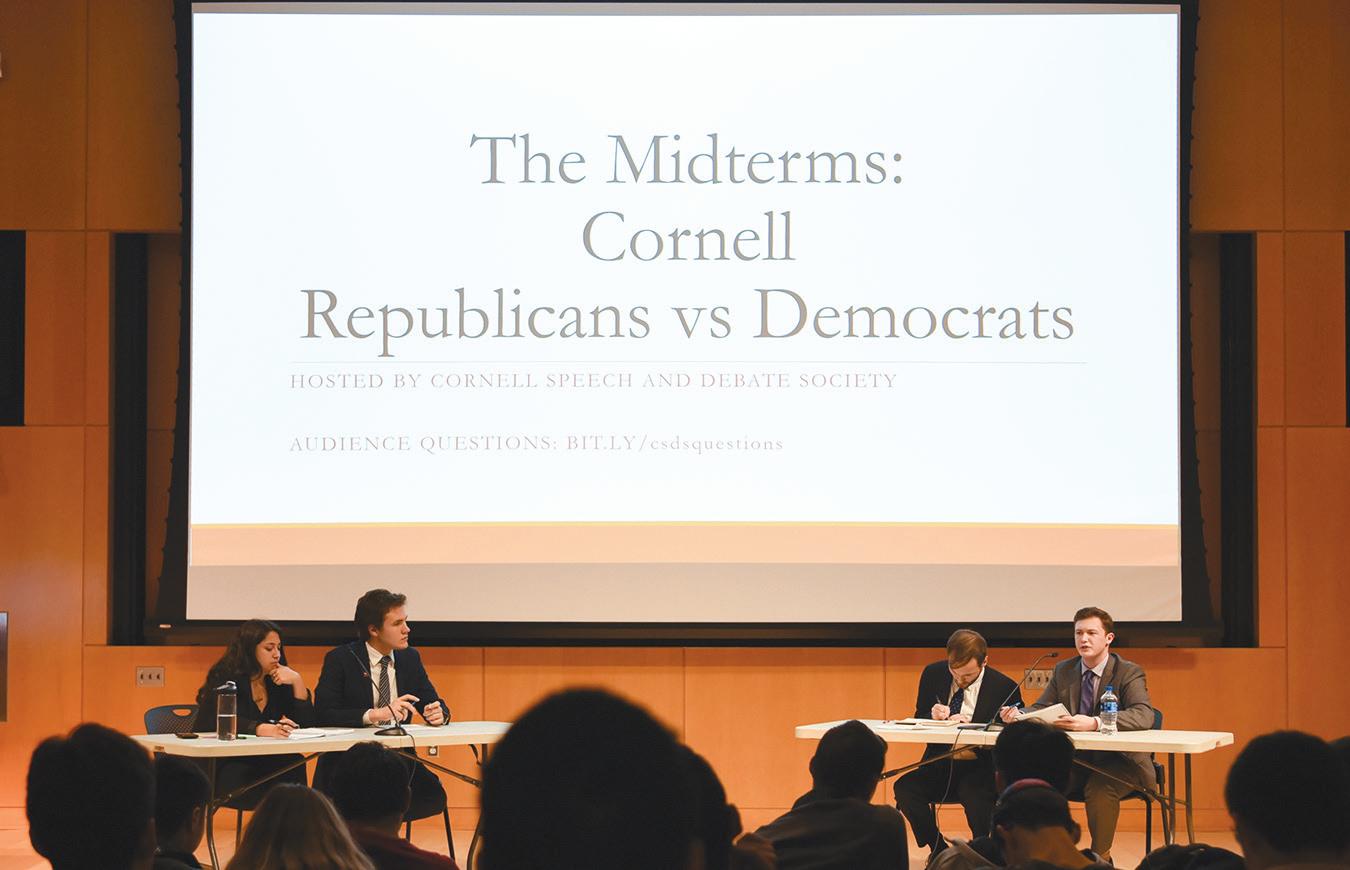
Leaders of Cornell Democrats and Republicans debated policy issues Monday, both sides trying to convince the audience to vote for their respective parties in the midterm elections.
Parties started out with eight-minute PowerPoint presentations laying out their core platforms followed by two rounds of rebuttal, conclusion arguments and questions submitted by the audience.
The Cornell Republicans framed their platform as a way to continue economic growth, referencing the current economic strength under the Trump
administration. They argued that the tax cut was growing the economy. Citing a Congressional Budget Office report, they mentioned that revenue since the tax cut is up $26 billion, largely due to increases in wages.
The Republicans repeatedly compared policies under the Obama administration with the current administration’s policies, claiming the latter achieved more growth and enhanced national security.
“Do you vote to … derail this successful platform in favor of a party which had its chance and failed on every one of these issues, or do you choose to return
Te fee, which all students must pay, cannot be reduced through grant aid or C.U. scholarships
By SARAH SKINNER Sun Assistant News Editor
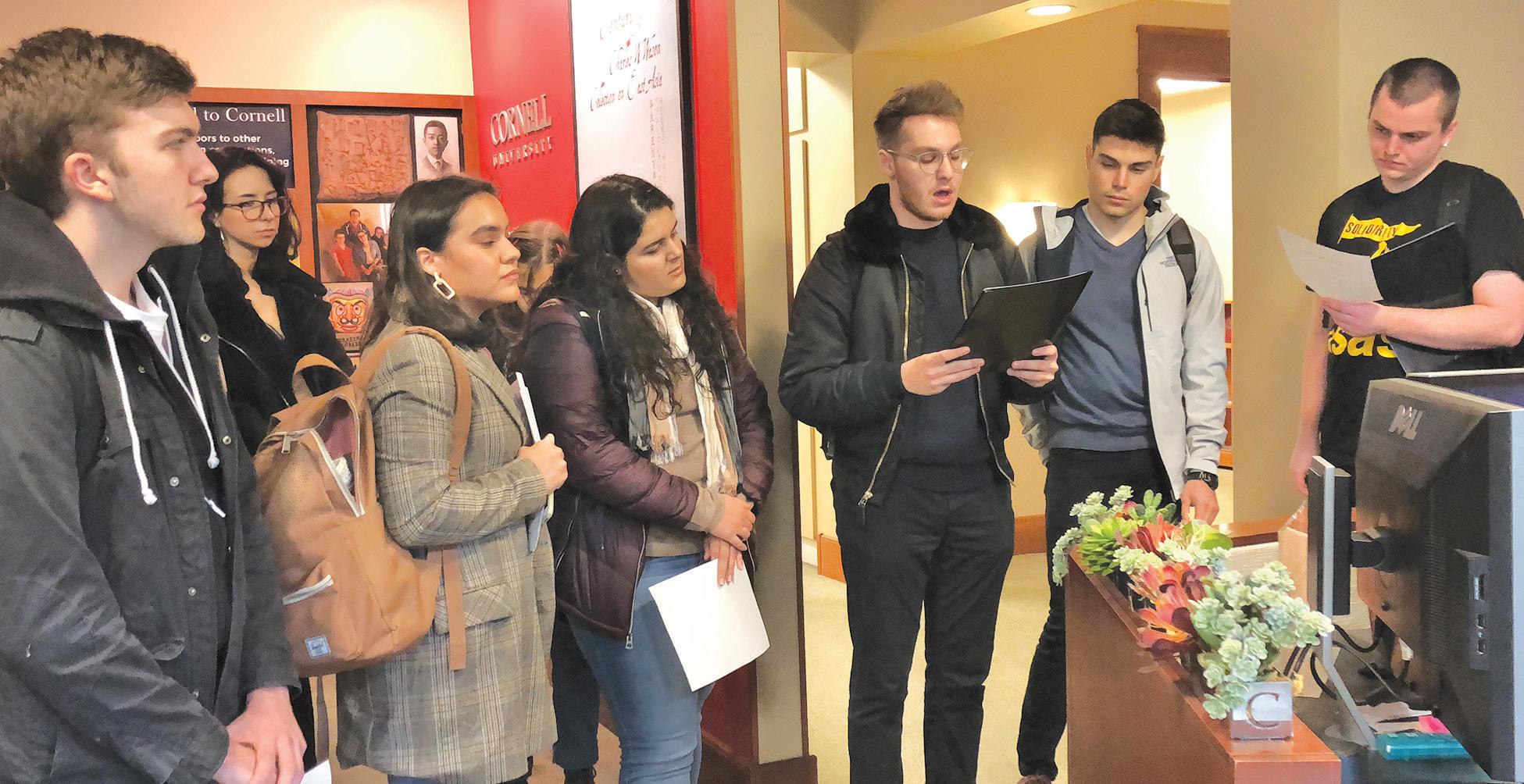
On Oct. 17, 17 students crowded through the offices of Day Hall, proudly presenting Interim Director of Financial Aid Colleen Wright with a letter and a petition with hundreds of signatures calling for an end to Cornell’s student contribution fee.
The contribution fee is a flat rate based on a student’s year in school and is a requirement for every Cornell student enrolled at the University. However, said Daniel Bromberg ’20, one of the organizers of the People’s Organizing Collective campaign, not every student on campus is even aware of its existence.
“If you haven’t looked at your tuition bill, you don’t know what it is,” he said. The experience, he said, is profoundly different for students who receive financial aid and those who do not.
By JOLIE WEI and LUCY XU Sun Contributor and Sun Staff Writer
For the first time in the instrument’s 150-year history, a group of 13 undergraduates composed a piece to be performed by the Cornell Chimes, a set of 21 bells housed in McGraw Tower.
The feat was born out of a collaboration between the Cornell Chimes and Music 3140: Instrumentation for Composers, a new music course that teaches students how to compose for various instruments of the classical orchestra.
Led by Prof. Eli Marshall, music, Instrumentation for Composers takes an active learning approach to music education by tasking each student with composing a one-minute piece for every instrument that they learn about. To guide students during this process, the class invites performers to workshop the pieces with the students.
In the composition of the piece for the Chimes, Cornell Chimesmasters collaborated with the students in their creative processes.
Since the Chimes are only two octaves high,
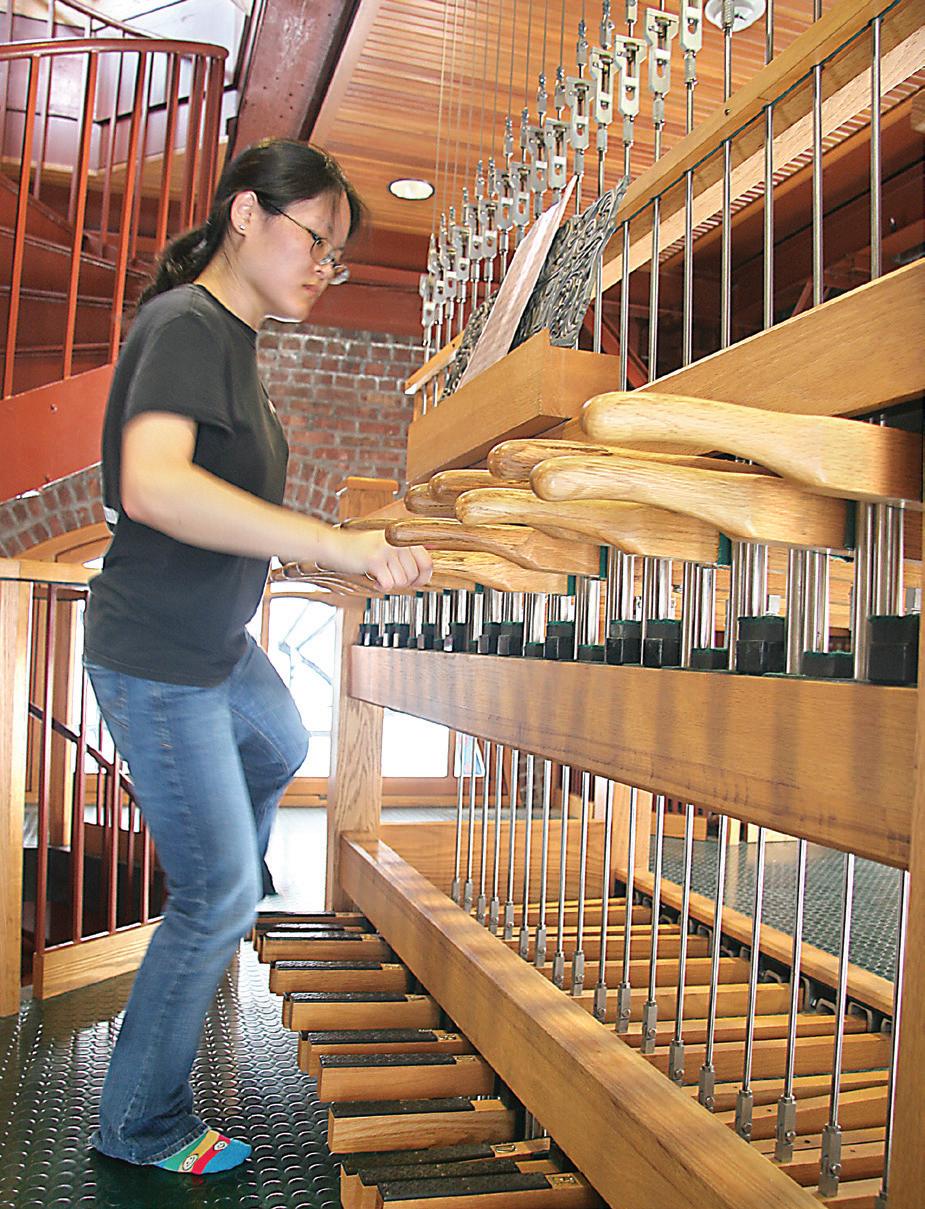
composers are limited on what they can write, said Drake Eshleman ’20, a student in the course. However, through collaboration with the Chimesmasters, students were able to learn more of the body movements and physical aspects of playing the chimes.
While the process was difficult on both ends,
Billie Sun ’19,
Chimesmaster, said the most rewarding part was getting to work with people of new perspectives.
“These [students] were coming at it from a music theory background,” Sun said. “They took a lot of things into account that Chimesmasters themselves

BEDR Workshop: Ashley Williams
11:40 a.m. - 1:10 p.m., 106 Sage Hall
Econometrics Workshop: Zhipeng Liao
11:40 a.m. - 1:10 p.m., 498 Uris Hall
Cornell Fluids Seminar: Jane Wange, Ph.D. Noon, 106 Upson Hall
Understanding the Genetic Architecture of Quantitative Traits in Plant Breeding: An Unnecessary Quest?
12:20 - 1:10 p.m., 135 Emerson Hall
Kinship, Authority and the Practice of Secularism 4:30 - 6 p.m., 122 Rockefeller Hall
New! Health Care Policy Major Information Session 4:30 - 5:30 p.m., Sloan Suite, MVR 3301
Out in the Workplace
4:30 p.m., 281 Ives Hall
Fragments of a City in Flux:
Ahmet Süheyl Ünver’s Art of Islam in 1920s Istanbul 5 - 6:15 p.m., 106 White Hall
Willard Wonka Night
6 - 8 p.m., Willard Straight Hall, Memorial Room
Reflections on Fossils and Faith 7 - 8 p.m., G10 Biotechnology Building

CALS Cyber Security Awareness Talk 9 -10 a.m., 135 Emerson Hall
Department of Science and Technology Studies Open House 9 a.m. - 3:45 p.m., 303 Morrill Hall
Working at Cornell: Staff Conversations 9 - 10 a.m., G10 Biotechnology Building
Cornell University Parking Optimization Study 11 a.m. - 3 p.m., 310 Frank H. T. Rhodes Hall
Isness and Being: Embracing the Unavoidable 4:45 - 5:15 p.m., Martha Van Rensselaer West, G71
The Lauren Pickard ’90 Emerging Artist Series 6 - 8 p.m., Williard Straight Hall, Memorial Room
Building a Community Of Support and Well-Being At Cornell: Ryan Lombardi 7 p.m., Flora Rose House, G42
The New Heirloom Garden: Modern Designs for Old-Fashioned Gardeners 7:30 p.m., Statler Auditorium
Break Free Dance Workshop 9:40 - 10:40 p.m., William T. Keeton House Tomorrow

By KEVIN LAM Sun Staff Writer
Students dined on Singaporean food and celebrated the country’s culture at Willard Straight Hall on Sunday evening.
The Singapore Students’ Association ran the event, “Crazy Rich Flavors: Singapore Makanmania 2018.”

“Makanmania” is a word for food in the Malay language, according to Natalie Tan ’21, events coordinator of the SSA.
From the event poster to the music played in the Memorial Room, elements from the movie Crazy Rich Asians were prominent in the festivities.
“We are really proud that Hollywood brought Singapore to the pictures. Today’s event, again, shows people who we really are,” Tan said.
Anna Kitamura ’21, SSA volunteer, called the event “a tour of Singapore through food,” noting that “many volunteers from outside of SSA also helped as well.”
are students of the School of Hotel Administration also helped, he said.
“There aren’t so many of us [Singaporean] students here on campus, and knowing that we are here for each other means a lot to me and SSA,” Teng said.
Samay Bansal ’21, an event volunteer and American raised in Singapore, said that Singaporean food is perhaps one of the most defining features of the country.
“It’s a great day to celebrate Singapore culture ... I tried so many new foods too.”
Emily Zhang ’21
The aroma of Singaporean street foods spread not just in the Memorial Room, but around Willard Straight Hall.
“We served laksa, which is a coconut milk spicy [noodle soup]. Roti prata, Indian flatbread with curry and Bak Kut Teh, a Chinese herbal pork ribs soup,” Tan said.
Sean Teng ’21, SSA student representative, said he and the team started prepping and cooking at 7 a.m. Sunday for this SSA tradition. The fact that many of the SSA members
“It’s a great day to celebrate Singapore culture,” said Emily Zhang ’21, an event attendee. “I have never been to Singapore but I am really glad that I came today. I tried so many new foods too.”
More than 260 tickets were sold prior to the event, and some students bought tickets at the door.
More than 300 students attended the event, Tan said.
“A lot of people have been to Singapore or they have visited and loved the food,” Tan said. “It’s just something that we would like to share with everyone.”
Kevin Lam can be reached at klam@cornellsun.com.
end of the campaign, according to their campaign page.
Four sophomore biological sciences majors successfully raised enough money to build a 980-square-foot pathway paved not by asphalt, but flowers.
The Botanic Buzzline pathway slated to link the Cornell Dairy Bar and the Cornell Botanic Gardens seeks to connect not just people, but bees. It reverses the “fragmentation of green spaces” in the campus that prevents pollinators from freely traveling from one patch of vegetation to another, according to Lev Krasnovsky ’21, the project lead behind the initiative.
“A lot of pollinators can’t travel far distances without stops for nectar,” Krasnovsky said. “If one green space is separated by a parking lot and road from another green space, [pollinators] are stuck in an island.”
The four students used a Cornellsponsored crowdfunding platform to raise 109 percent of their $10,000 goal by the
The team members — all part of a program that promotes biology-related service projects — will use their funds to purchase mulch, flowers and other materials required to build and maintain the pathway. They also plan to hire contractors to make educational signage and ironwork sculptures raising awareness of their project and pollinators, Krasnovsky said.
“[We thought that] once the crowdfunder goes live, it’s kind of going to run itself — that couldn’t have been further from the truth,” Krasnovsky said. “Almost every day we had to do new outreach, film new videos and respond to organizations.”
“If one green space is separated by a parking lot ... from another green space, [pollinators] are stuck in an island.”
Lev Krasnovsky ’21
Krasnovsky said that team members quickly realized they were wrong to think that a crowdfunder would “run by itself” once they set it up. While his team ended up raising more money than their initial fundraising goals, that was only after they conducted extensive outreach to the Cornell community.
The program encountered pushback from the University during its planning phase, according to Krasnovsky. Several administrators at the Cornell Grounds Department expressed concerns that the program would negatively affect people with bee allergies and “de-fertilize” the soil near the roads when winter maintenance crews pepper salt onto the pavement.
In response to the concerns, the student team scaled back their initial plans to create paths in parts of Cornell’s Central Campus
to create a shorter route spanning from the Cornell Dairy Bar to the Botanical Gardens.
The project team also had to adjust their plans to take Ithaca weather into consideration.
“Ithaca’s weather is really tricky — initially the plan was to have the big planting day two weeks from now,” Krasnovsky said. “We can do bigger and better things in the spring and it’s probably a little bit safer because there’s less frost death.”
Krasnovsky explained that the team’s larger goal is to connect “people, plants and pollinators” to “remind [people] that they we all share the earth together.”
“There’s sort of been a lot of separation happening just in general as humanity gets more industrialized and so we’re really trying to bring people, plants and pollinators together.”

By LOUISE XIE Sun Staff Writer
A Cornell historian will lead a Washington, D.C., tour next fall covering the conflict that was concluding at the time of the University’s founding — the Civil War.
Led by Prof. David Silbey
’90, history, associate director of Cornell in Washington, in conjunction with Cornell’s Adult University, the CAU Study Tour: Winning and Losing the Civil War will show the typical lives of soldiers from both sides and how “one of the reasons Cornell University is here is because of the Civil War,”
Silbey said.
“Cornell University was organized during the Civil War and founded at the end of it, at least partly as a way of training officers for the army because Congress had gotten suspicious of all those West Pointers going
to give the current status of workers’ benefits and an overview of his department.
In 2019, Cornell will pay $2.7 million more for employee benefits and a total of $700,000 more will be collected from faculty and staff than in 2018, according to Gordon Barger, senior director of benefit services and administration.
Barger spoke at the Employee Assembly meeting last Wednesday
Concerning budget allocation for workers’ benefits, Barger stated that his focus was maximizing efficiency.
“We are not about cutting costs at Cornell when it comes to benefits,” he emphasized. “That has never been an instruction that

declined to comment to The Sun by time of publication.
Freshmen at the University are required to chip in $2,700, which cannot be reduced through grant aid or University scholarships. The only way to reduce a student contribution, meant to be a student’s “stake in their own education,” Bromberg said, is through an outside scholarship, and, even then, only if a student is already receiving maximum financial aid from the University.
Other than that, it is up to the student to come up with the money, which the University expects to come from summer on-campus work, its website states. The expected contribution increases each year — sophomores pay $3,300, juniors $3,500 and seniors $3,700.
“If I work this entire semester I can expect to make $1,500,”
David Leynov ’21, part of the POC, told The Sun. “So I would have to work two semesters to make up that $3,000. If you do that, you can only really take four classes — if you’re working 10 hours a week, it’s hard to take five classes.”
“These parents of low-income families can’t afford to pay those fees,” Restrepo told The Sun in an interview. “People from better-off-financially families can have their parents easily pay it.”
Christopher Hanna ’18, also involved with the campaign, said that the University’s current policy was in opposition to its “any person … any study” branding.
“It’s not really embodying the main principle that Cornell aims to set out,” he told The Sun.
The Princeton Review currently puts Cornell University at #20 in its ranking of “great financial aid schools,” which the Review says comes from students’ satisfaction ratings.
“I would have to work two semesters to make up that $3,000. If you do that, you can only really take four classes ...”
David
He was one of the nearly 240 people as of the time of publication who signed the petition, which began to circulate a couple of weeks before the letter drop at Day Hall. Bromberg and Kataryna Restrepo ’21, organizers of the campaign, presented a go-between for President Martha E. Pollack with a letter personally addressed to Pollack, former Director of Financial Aid Susan Hitchcock and Associate Vice President for Enrollment Jason Locke regarding the student contribution fee.
Hitchcock is no longer the director of financial aid, and no one appears to have been hired to fill the position.
Pollack told Bromberg in an email shared with The Sun that she would be meeting with “senior leadership” in regards to the student movement and will respond to the petition demands before Oct. 31. The University
not the first among top schools or even the Ivy League to take this step, they said. At Princeton, all students from families making less than $65,000 per year have full tuition, room, board and a “residential college fee” covered by the university, according to Princeton’s website. Summer savings are expected but not billed.
The University of Pennsylvania has no flat rate contribution but expects summer savings of around $1,800-3,000, depending on the student, their website states.
Harvard also does not require a flat rate student contribution, though its website indicates an expectation of school year and summer work. Yale has the second-highest student contribution, at up to $5,950 for upper-level students per year, including the summer contribution.
Emily Hong grad was an undergraduate student at Columbia University 10 years ago, where she was part of a similar campaign. On March 11, 2008, Columbia announced that it was eliminating all loans for students receiving aid, according to its financial aid website.
Leynov ’21
The University’s website states that 56 percent of current students receive some type of aid, with 44 percent qualifying for Cornell grant aid. Students with familial incomes of less than $60,000 per year have a “parent contribution” of $0, though the student contribution is still in effect.
The POC is advocating for a complete abolishment of the student contribution fee for every student, Bromberg told The Sun. This means that every student, including full-tuition students, would have their expected payment decrease by the amount applicable to their year.
The petition lists an estimate of a $50 million cost to the University if this measure were undertaken, which POC writes will come from diverting funds from “frivolous expenses.”
The University’s operating budget is expected to total $4.45 billion this year, stemming from endowment returns, tuition costs and donations. Of that, approximately $270 million is slated for undergraduate financial aid, according to the 2018-2019 budget plan.
Though POC hopes that Cornell will become a leader in the movement to abolish the fee, the University is
“Many years later, as a grad student, I still have loans from undergrad,” she told The Sun. Now, as a teaching assistant, she said that some of her own students weren’t able to complete courses they wanted because of the requirements of an on-campus job.
She said one of her former students is involved in the POC, which prompted her to lend her “solidarity and support.”
However, Columbia still requires a “Summer Work Expectation” of $2,400 for incoming students, while Dartmouth expects the student to contribute between $1,000 and $3,000 annually.
Brown has the highest advertised expectation in the Ivy League, with a summer earnings expectation of $2,950 each year and an additional up to $3,200 for upperclassmen.
Matthew McGowen ’19 contributed reporting to this article.
might not.”
Milo Reynolds-Dominguez ’20, another student in the class, said he found the collaboration rewarding.
“The class is the perfect opportunity to have a chance to work with professional instrumentalists and see them play your compositions right in front of you,” he said. The culmination of the collaboration was the premiere of
the students’ piece on Oct. 17 at 6 p.m. on the Chimes, with an estimated tens of thousands of students and faculty members within earshot of the performance, according to Marshall. The piece was performed a final time on Oct. 18 at 6 p.m.
Sun was grateful that the collaboration allowed her to break out of the Cornell Chimes “bubble” and interact with other students.
“Something that really struck me was how eager and passionate all of the students in the class were,” she said. “You could tell it wasn’t just something they were taking for a grade. I’m sure that reflects something in the course itself.”

Both Reynolds-Dominguez and Eshleman appreciated the historical significance of their compositions.
“It is an honor to be able to have a piece played for the whole campus, but I think it more feels like I’m deeply connected to the larger musical culture on campus,” Eshleman told The Sun.
“Something that really struck me was how eager and passionate all of the students in the class were.”
“It was the Chimes’ 150th anniversary,” ReynoldsDominguez added. “We always talk about the longevity of our compositions and the historical significance of [the chimes]. I feel like in our own little Cornell bubble, this is like being a part of that history.”
Both head Chimesmaster Sun and students Eshleman and Reynolds-Dominguez hope to continue collaborating.
“It’d be mutually beneficial for all the parties involved,” Sun said.
DEBATE Continued from page 1
to Republican legislative majorities that figured out how to work productively with this admittedly unusual president?” said Michael Johns ’20, president of Cornell Republicans and columnist for The Sun.
Cornell Democrats challenged the Republican depiction of the economy, referencing another Congressional Budget Office report, which states that the tax cut was estimated to increase the deficit an additional $1.6 trillion from 2018 to 2027.
The Democrats argued that the difference in numbers between the Obama and Trump administration economies was due to context. Obama, they argued, faced slower economic growth because he entered office during the Great Recession.
“To attribute this [economic growth] to the Trump administration is a willful disregard of simple macroeconomic fact,” said Jack Ross-Pilkington ’21, Cornell Democrats communications director.
Beyond economic growth, the two parties disagreed on the effectiveness of current foreign policy. Republicans mentioned the current sanctions against Russia and the
closing of a Russian consulate as effective policy measures while Democrats discussed the impact tariffs placed on China has had on American soybean farmers.
“Republicans are willing to go a few rounds with China,” Johns said.
Social issues, however, went largely undebated. The initial Democratic presentation briefly covered issues such as LGBTQ rights, immigration and women’s rights. The initial Republican presentation made no reference to these topics. Later rebuttals focused on economic and foreign policy.
“America is a lot more than taxes and China,” said Isabelle De Brabanter ’19, president of Cornell Democrats.
Even with these differences, both sides agreed on some issues, such as the pitfalls of voting for a third party. Both parties believed that while there was nothing inherently wrong with it, voting for a third party is not an effective means to change, considering America’s two party system.
“The truth of the matter is that America has a two-party system that is not kind to third party candidates,” De Brabanter said. “That [third party] vote gets lost in the sauce.”
The Republican side agreed.
“If you want to vote for a third party candidate, go
to the South,” Silbey told The Sun.
The tour will take place in Washington, D.C., from Oct. 21 to 25, 2019 and is open to Cornell alumni, families and children, according to the CAU’s online description.
Silbey said the College of Engineering was also founded as a way of “training for people in the military.”
“Men from this area fought in the union army and participated in all three of these battles.”
Prof. David Silbey ’90
By busing participants to various battlefields and including a lecture each day by Silbey, the tour aims to bring “understanding [of] the battle at the ground level,” Silbey told The Sun.
The idea originated after Silbey’s multiple tours with CAU of the Civil War’s “western front,” which included visits to Gettysburg. This upcoming Civil War tour “seemed like a natural thing to do,” Silbey said.
The subject of the war remains relevant to current issues, according to Silbey. He said there has been “controversy over confederate monuments over the last couple of years.”
Beyond just understanding what happened on the battlefields and how battles were won and lost, it is “even more important [to try to understand] what the experience of the ordinary soldier was,” Silbey said.
Cornell’s founding history is connected with the Civil War despite the geographical distance between the University and the battlefields, he noted.
“We might think that we’re not directly connected to the Civil War because no battles had been fought up here, but men from this area fought in the union army and participated in all three of these battles,” Silbey told The Sun, referring to the battles of Antietam, Gettysburg and Petersburg that will each be stops on the tour.
In addition, Cornell has deep ties with Civil War military education, as students at the University wore uniforms for the first few years because of the “connection to military training,” Silbey said.
“That’s why engineering was such a big school at the beginning, because that’s what they were training military officers in,” he added. The Civil War is not only a “massively important part of American history,” Silbey noted, but also “something that Cornell alumni find very interesting and important to understand.”
Louise Xie can be reached at lxie@cornellsun.com.
ahead, great for you,” said Brendan Dodd ’21, vice president of external operations for Cornell Republicans. “I don’t think the vote will really do much.”
Central to Cornell Democrats’ message was voter participation. De Brabanter made repeated comments about millenial voting and told audience members about the Cornell Democrats’ providing shuttles to voting stations on Election Day.
“We hope our argument has persuaded you to vote Democratic,” she said. “But even more important, we hope our argument has persuaded you to vote, period.”
Debates between Cornell Democrats and Republicans are held every semester, with different topics. The organizations aim to facilitate productive discourse about politics. Both presidents told The Sun they hoped they changed some minds over the hour long debate.
“Obviously we have different perspectives, but if we sincerely all want what’s best for the country and we’re just different on how we get there, then I think the audience leaves this room with a lot of things to think about that they might not have before,” Johns told The Sun.
Rochelle Li can be reached at rl696@cornell.edu.
has been given to me.”
Barger reported that, in the last two years, Cornell saw better insurance cost trends compared to the rest of the nation, which saw around 5-8 percent growth in insurance costs. Cornell, on the other hand, in 2019, will only experience a 3.9 percent increase in insurance costs.
When it comes to dental plans, Barger said he wanted “to go ahead and decrease premiums for this year.” He noted that his department “pushed back” against Ameritas, a company that provides employee benefits and other services.
“We warrant a decrease,” he said. “We really really pushed back this year, and we actually got them to look back at their own claims
and this very rarely happens, but as an insured product they came back and said we will be willing to reduce your premiums.”
Concerning life insurance, Barger stated that costs for employees will increase by about 4 percent.
“We have had a fair number of deaths over the past three years … so when Cigna, who’s the insurer, looks at our risk, we are a risky population,” he said. According to Barger, 2016 was especially a bad year for employee and former employee deaths.
Barger noted the very limited control Cornell had over the flexibility of benefits and plans in the contract colleges — the School of
“As an insured product they came back and said we will be willing to reduce your premiums.”
Gordon Barger
Industrial and Labor Relations, the College of Human Ecology, the College of Agriculture and Life Sciences, and the College of Veterinary Medicine — as New York State wields most of the leverage.
Barger said the job of the benefit services and administration department is “thinking about what your needs are today, thinking about what the University’s needs are, what our needs are tomorrow.”
Shawn Hikosaka can be reached at shikosaka@cornellsun.com.

Independent Since 1880
JACOB S. KARASIK RUBASHKIN ’19 Editor in Chief
JOHN McKIM MILLER ’20
Business Manager
KATIE SIMS ’20
Associate Editor
VARUN IYENGAR ’21
Web Editor
MEGAN ROCHE ’19
Projects Editor
EMMA WILLIAMS ’19
Design Editor
JEREMIAH KIM ’19
Blogs Editor
AMOL RAJESH ’20
Science Editor
BREANNE FLEER ’20
News Editor
YUICHIRO KAKUTANI ’19
News Editor
NICHOLAS BOGEL-BURROUGHS ’19
City Editor
LEV AKABAS ’19
Arts & Entertainment Editor
SARAH SKINNER ’21
Assistant News Editor
ANNE SNABES ’19
Assistant News Editor
JOHNATHAN STIMPSON ’21
Assistant Sports Editor
EDEM DZODZOMENYO ’20
Assistant Photography Editor
PETER BUONANNO ’21
Assistant Arts & Entertainment Editor
GIRISHA ARORA ’20
Managing Editor
HEIDI MYUNG ’19
Advertising Manager
ALISHA GUPTA ’20
Assistant Managing Editor
DYLAN McDEVITT ’19
Sports Editor
MICHAEL LI ’20
Photography Editor
GRIFFIN SMITH-NICHOLS ’19 Blogs Editor
JACQUELINE QUACH ’19 Dining Editor
SHRUTI JUNEJA ’20 News Editor
ANU SUBRAMANIAM ’20 News Editor
JUSTIN J. PARK ’19
Multimedia Editor
PARIS GHAZI ’21
Assistant News Editor
MEREDITH LIU ’20
Assistant News Editor
JONATHAN HARRIS ’21
Assistant Sports Editor
RAPHY GENDLER ’21
Assistant Sports Editor
BORIS TSANG ’21
Assistant Photography Editor
VIRI GARCIA ’20
Assistant Arts & Entertainment Editor
Ad Layout Karen Jiang ’21
Design Deskers Lei Lei Wu ’21
Lauren Roseman ’21
News Deskers BreAnne Fleer ’20
Anne Snabes ’19
Sports Desker Johnathan Stimpson ’21
Arts Desker Lev Akabas ’19
Dining Desker Jacqueline Quach ’19
Photography Desker Boris Tsang ’21
Production Deskers Emma Williams ’19 Sarah Skinner ’21
Editorial
ON SUNDAY, THE NEW YORK TIMES REPORTED THAT the Trump administration is planning on implementing a narrow definition of gender under Title IX — a move that would effectively erase legal protection and deny government recognition for transgender people. The proposed change, which undoes Obama-era guidances that affect the education, labor, justice, and health and human services departments, is unwarranted, callously cruel, destructive, and possibly illegal.
As one of the most prominent institutions of higher education in America, Cornell must loudly object to these proposed changes. If they are implemented, Cornell must reiterate its support for and recognition of transgender members of our community, and New York State should take action to counteract the federal government’s mistake.
We were heartened to see that Cornell, two days before the Times’ report, published a guide on “gender transition and affirmation in the workplace” for its employees and HR staff, and reiterated its commitment to “diversity and inclusion … beyond merely adhering to legal and institutional nondiscrimination policies that prohibit discrimination on the basis of … gender identity and expression.” Providing resources on items as fundamental as name and pronoun changes is a primary responsibility of any forward-looking organization, and we applaud Cornell for that.
The Trump administration’s move is just the latest in a series meant to diminish, demean and dehumanize America’s transgender population, but it will have the farthest-reaching consequences. Without any guarantee of protection from the federal government, it will fall to state and local governments to support their transgender constituencies.
Amazingly, New York State still does not include gender identity as a protected quality under its Human Rights Law. Although Governor Andrew Cuomo issued an executive order in 2015 including transgender New Yorkers under state protections, that order could easily be rescinded by a less tolerant governor (much like we have seen at the federal level).
The New York State Legislature should pass the Gender Expression NonDiscrimination — or GENDA — Act, which would amend the Human Rights Law to include protections for transgender people. This bill has passed the State Assembly seven times, but the Republican-held State Senate continues to kill it. In light of these new moves by the Trump administration, such intransigence by our state legislators cannot be stomached by New Yorkers anymore.
Republican State Senate Majority Leader Sen. John Flanagan is a Cornell trustee. His colleagues on the board and in the Cornell administration, and the students whose interests he serves, should do their very best to impress on him the importance of passing the GENDA Act as quickly as possible.
And if he is unwilling to do so, voters should make sure he does not return as majority leader when they head to the ballot box two weeks from today.
No one should ignore, nor exploit, anti-Asian bias
To the Editor:
In last Monday’s editorial “Stand with Harvard on Affirmative Action,” The Sun’s editorial board stands firmly with Harvard University on the case SFFA v. Harvard. The Sun admits that the issue at hand is “ostensibly” about “Harvard’s alleged discrimination against AsianAmericans in their admissions process to the benefit of other minorities and white students.”
For this the Sun was “half-right.”
In their later, hastily added clarification for their Monday editorial, The Sun admits that they did “not pay sufficient attention to the specific claims against Harvard,” specifically on the claim that Harvard had used the system of “personal score”, a series of vaguely defined assessment rating students on their “likability, courage, kindness and being ‘widely respected’” to limit Asian admission.
For this the Sun was poignant.
Its Monday editorial is that of the typical argument of the “motivation.” By the editorial’s logic, anyone arguing against Harvard argues against affirmative action as a practice simply because Ed Blum and SFFA, the people behind the lawsuit, have the questionable intent of exploiting this case to dismantle affirmative action. By essentially asserting that the plaintiffs’ motivations render illegitimate the issues the lawsuit raises, the editorial suggests that the “ostensible” core of the case, the Harvard administration’s alleged long-running practice of allowing “anti-Asian bias” to affect their admission process, is worth ignoring.
For this The Sun is hurtful.
Asian students, international and American alike, have for too long suffered the fact that we need to outcompete those of similar talents and characteristics to earn any position, from admission into college to internship and job opportunities. For Asians, the details revealed by the case only confirmed what almost every Asian has long suspected, and many of us have acquiesced to the bias we experience, relegating ourselves to a secondary space in American society. Instead of voicing our concern, many of us choose to own such bias, accepting the box this country has put us in.
The most egregious part of Harvard’s alleged anti-Asian bias is that by using “personal score” to intentionally lower the chance of admission for Asian students, Harvard is conforming to the long-standing stereotype of Asians as being unlikable, unsociable and not “widely respected.” It is no wonder why the Asian Glass Ceiling is such a conscious existence hovering above our atmosphere.
By “standing with Harvard,” as The Sun has clearly intended, what The Sun risks is reinforcing these stereotypes and the glass ceiling that inevitably comes with it. It is as if The Sun, Harvard and the 15 other elite colleges and universities — including Cornell — that submitted amicus briefs in the case are demanding that Asians continue to acquiesce, to accept and to stay within that box.
We cautiously acknowledge that Ed Blum and his SFFA have ulterior motives to overrule affirmative action, and we regret this unholy alliance. But for The Sun to declare in its clarification that “this lawsuit is not the answer to positive race consideration” is to neglect the Anti-Asian bias that is the core fact of this case. To say that because of the potential legal consequence of the Harvard case against affirmative action, we shall for now allow the AntiAsian bias that Harvard is allegedly committed to, is deeply insulting.
Like the rightful worry that this Harvard case may lead to a legal precedent against affirmative action, Asian Americans and international students are also rightfully worried by the precedent, both legal and social, of affirming Harvard’s actions. Though many within our community may have different opinions on affirmative action, the majority of the contributors to this letter believe that the practice is helping the American society, of which Asians are an integral part. Since for any litigation the facts shall be the core determinants, we believe that it is possible to defend affirmative action while rebuking anti-Asian bias. To prioritize one over the other is deeply troubling to the Asian community as a whole, and to the guiding spirit of the Civil Rights Movement and affirmative action.
Aaron Li ’20
Co-President of Mainland China
Students Association
Dennis Wang ’20
John Fang ’20
V.P. of External Relations, Ascend Pan-Asian Leaders, Cornell Student Chapter
Ming Yu Yang ’21
Tianyi Zhang ’20
Yuan Zou ’21
Jingfu Zhang ’19
Cheney Yu ’21
Joseph Yang ’20
Xinzhe Yang ’20
Zhikun Zhao ’19
Zeya Peng ’19
Wenchang Yang ’18
Wentao Zhang ’21
Zidong Zheng ’20
Ge Wang ’18
Rong Tan ’20
Wenjie Lu ’22
Zilu Wang ’21
Ella Chao ’22
Iris Zheng ’20
Chengji Liu ’22
Kaishuo Cheng ’22
Yitian Susan Lin ’21
Danyang Han ’19
David Yu ’22
Lijun Yang ’21
Zhifei Jin ’21
Xucheng Wang ’21
Chunlu Li ’22
Zibing Liao ’21
Kunpeng Huang ’21
Yilei Huang ’21
Joe Kuo ’20
Ruiqi Song ’22
Steven Niu ’18
May Shen ’21
Guangze Xu ’18
Leonard Xie ’20
Yueyang Zheng ’20
Haoyang Yan ’20
Renee Lu ’19
Haoyun Xu ’18
Kaley Mi ’21
Shenyu Liu ’20
Xueying Wang ’19
Angela Chen ’20
Julia Zeng ’21
Yang Guo ’18
Janice Wei ’22
Dingqi Zhang ’21
Tianxing Jiang ’21
Tong Suo ’19
Qihang Yan ’20
Chuqi Yan grad
Wentao (Willy) Yang ’20
Eric Ma ’19
Haoxing Pu ’19
Qixi Chen ’18
Yuheng Zhu ’20
Yao Tong ’19
Andrea Yang ’20
Xinyu Huang ’19
Wilson Chen ’20
Kairui Sun ’21
Yuke Wu ’21
Jialu Bao ’19
Xinjie Abby Yao ’19
Yuanzheng Yao ’20
Tingwei Liu ’20
Xinyi Bai ’18
Richard Sun ’20
Yiwen Sun ’20
Shuhao Qing ’20
Haonan Liu ’20
To the Editor:
I am writing in regards to an article recently published in the opinion section of The Sun, ‘Why We Need to Ban Project Teams.’
As an engineering student, a project team member, and someone who has friends in a multitude of teams, I’ve seen first-hand the blood, sweat, tears and passion for the projects they are a part of. Thus, it was jarring to read how he paints the institution and exclusivity of project teams as that of Greek life without even considering the very real practicalities that make a team “exclusive.” It’s incredibly naive to think they take 30 out of 300 just to feel elite. There are only so many resources and positions that can be filled, also the rigor of the competitions that define the teams require committed, passion-driven people. Applicants are filtered out, so that a team doesn’t comprise of 300 unmotivated students that don’t even have enough tasks to contribute on a project requiring at most 30 people. Of course, you want members you can see becoming leaders and mentors later on as well. It is like this in the real world too; companies have an application process to ensure the quality of their employees and end goals. Project teams are not the next fraternities, prestige is awarded by putting in the work to win competitions, not by acceptance rate or the “attractiveness” of members. It was saddening to see him undermine the work and effort that goes into projects and recruiting in this way as well as extrapolate his specific experiences to the entire population of teams.
Furthermore, he nags about things like students assessing students without providing any alternative. Who knows better the voids that need to be filled and the overall workflow of the team than the team members themselves? It’s pretty telling how flawed his standard for recruiting is given he implies an accurate assessment for recruitment cannot be made without a GPA.
The most problematic is that his “solution” is to eliminate all teams all together without trying to target the issue at the base of it, biases in recruiting, something I agree can be worked on. With these teams, people have found a home, life-long friendships, transferrable hard skills to the workplace (something rarely found in classes), true work ethic and camaraderie. There are an incredible number of social and professional opportunities that come with them, and it is almost cruel to think of banning them without instead focusing our energy to work on their finer grain issues.
Shivanie Rambaran
’20
To the Editor:
I urge all residents of Tompkins County to vote for Derek Osborne for Sheriff.
Derek won the endorsement of the Tompkins County Progressives by a vote of 20-2. He has the experience and work ethic to bring back integrity, accountability and intelligence to the office of Sheriff. He has worked with federal prison inmates in a community reintegration program in preparation for their release, which will serve our community well. Please join me on Tuesday, Nov. 6 and vote Derek Osborne for Sheriff of Tompkins County.
To the Editor:
Dale Meskill
It’s time for a change! This year we have the opportunity to elect Derek Osborne as the next Sheriff of Tompkins County. He is totally qualified, including graduating from the FBI academy training! He has been promoted through the ranks of the Sheriff’s Office, including a promotion to Undersheriff by the current Sheriff, and he knows this community well.
Now more than ever we need a well-trained person with integrity and leadership to effectively manage and administrate the Office of Sheriff without overspending the budget like the current Sheriff.
We do not need a person like the current Sheriff who claims to have files on residents and elected officials or whom systematically destroyed a home over a DWI arrest warrant!
We desperately need a Sheriff who is up to date, who is accountable, and who understands the importance of a properly run County Jail by insuring inmates and staff are safe… and without demanding a new jail!
Most importantly we need a Sheriff that shows up and participates in our community, government and the daily operations of the Sheriff’s Office!
It’s time for a change! I urge all residents to join me in voting Tuesday, November 6 for Derek Osborne as the next Sheriff of Tompkins County.
Peter Meskill
Sheriff of Tompkins County 1999-2010
As this column goes to press, 16 days have elapsed since Brett Kavanaugh was confirmed to the Supreme Court. That is, 16 days have elapsed since a moral, cultural and political inferno engulfed the nation. Yet this once-totalizing story has slipped beneath the headlines. Perhaps, then, Mitch McConnell, a top Republican, was correct in predicting “these things always blow over.” Then again, perhaps not. The wrongful confirmation of Kavanaugh to the Supreme Court and liberals’ subsequent attacks on institutions show how high the political stakes have become. And as the stakes soar, raw power politics become ever more attractive. The logic of unbridled power politics risks plunging the country into crisis. Shrewd reforms are needed to defend American democracy from the corrosive politics of raw power. Kavanaugh’s confirmation hinged on three women’s allegations of sexual assault. Faced with hair-trigger politics and uncertainty aplenty, one would hope Senate investigators would recognize the difficulty inherent in either corroborating the allegations or exonerating Kavanaugh. A proper conformation required prudence and humility. Instead, both parties disgraced themselves. Republicans displayed near-zero curiosity about the allegations — which, if true, were patently disqualifying. They did not interview Deborah Ramirez, an accuser, instead hiding behind a hasty FBI investigation. They did not subpoena Mark Judge, a potential witness named by Christine Blasey Ford, another accuser, who likely had valuable information. Likewise, Democrats acted with reckless abandon. In July, Ford’s allegations ended up in the office of Dianne Feinstein (D-Calif.). But Feinstein sat on Ford’s testimony for months, only acting once Kavanaugh’s confirmation was almost over. Feinstein also held a letter detailing Ford’s allegations, which was later leaked — without Ford’s consent — to a reporter. It appears likely that someone in or around Feinstein’s office (i.e., Democratic staffers) is responsible for the leak. Moreover, the ease with which liberal politicians and commenta-
tors insinuated Kavanaugh’s guilt was as unseemly as it was unfair.
But the greatest damage was done when Republicans signed off on Kavanaugh’s repeated duplicity. He twisted the meanings of slang found in his highschool yearbook. His account of modest high-school and college drinking behavior was refuted
The logic of unbridled power politics risks plunging the country into crisis.
by multiple former classmates. Kavanaugh claimed the drinking age in Maryland (where he attended high school) was 18. In fact, it was raised to 21 in 1982 — when he was 17.
Kavanaugh’s defenders will maintain that none of this matters, that it is foolish to wrestle over juvenile jargon or trivial fibs.
That view is wrong. Kavanaugh demonstrated a pattern of willing dishonesty unbefitting a Supreme Court justice. He put career ambitions before integrity. He may not have perjured himself, but he surely disqualified himself.
Yet now that Judge Kavanaugh is Justice Kavanaugh, justifiable
them, rallying around Kavanaugh was the only option short of political suicide. Democrats saw Kavanaugh as the encapsulation of everything they loathe. Hubris and privilege; muzzled assault victims; hostility to Roe v. Wade; the Trump presidency — he was wonderfully easy to demonize.
As the political stakes grow, so does the appeal of raw power politics. In How Democracies Die , the political scientists Steven Levitsky and Daniel Ziblatt argue that forbearance — the idea that power is wielded with restraint — is what underpins modern democracies. Raw power politics abandons forbearance. It weaponizes political norms and uses power to perpetuate power.
That is our present reality. The Republican stonewalling of Merrick Garland, Barack Obama’s nominee to the Supreme Court, exemplified the logic of raw power politics. So did former Democratic leader Harry Reid’s choice to blow up vital rules on most judicial nominees. As with Republicans’ efforts to cull state-level voter rolls. Or recent proposals to, in Rooseveltian style, pack the Supreme Court. One could go on.
Shrewd reforms are needed to defend American democracy from the corrosive politics of raw power.
anger has devolved into attacks on institutional legitimacy. A chorus of left-leaning thinkers have called out Justice Kavanaugh — and by extension the Supreme Court — as illegitimate. A noisy few go further, suggesting the Senate itself is illegitimate.
Kavanaugh’s confirmation, however, reflects not America’s broken institutions, but rather its broken politics. It reflects norms uprooted over decades by short-sighted partisans and presidents. It reflects a poisonous public discourse and a fractious society.
His confirmation reflects, most worryingly, an inexorable rise in the political stakes. Republicans felt trapped between a tarnished Kavanaugh and an unswallowable defeat at Democratic hands. To
The logical conclusion of raw power politics is a full-fledged crisis. A spite-fueled loop of tit-fortat retaliation would eat away at every constraint the Founding Fathers put on political power.
Mercifully, we are not yet there. Promising, too, are compelling proposals to lower the political stakes, like Supreme Court term limits and rankedchoice voting. In particular, ranked-choice voting, which lets voters vote for candidates in order of preference, would discourage us-versus-them partisanship and boost candidates with a broad appeal. Implementing rankedchoice voting for state elections would be a good start. More such bold thinking is needed to stop the greatest country on Earth from self-destructing. Ethan Wu |
Giancarlo
Nearly three weeks ago, on Wednesday, October 4, Ithaca’s Mayor, and Cornell alum, Svante Myrick ’09, presented his proposal for Ithaca’s 2019 budget. Amongst discussion of a property tax decrease, the staffing of the police department and the creation of a new street crew dedicated to improving local road quality, the mayor had some choice words for the institution which he called home for four years.
In addition to pointing out that Cornell’s $2.1 billion of tax-exempt properties are equal in value to the value of all taxable properties in the entirety of Ithaca, Myrick stated that “We would be better off if any other Ivy League School were in Ithaca.”
Immediately following this comment, and in a later interview with the Sun, he specifically mentioned that Harvard — our rival in both hockey and use of colors that generally fit the description of ‘red’ — would be better for Ithaca than Cornell currently is. It might seem unfathomable that a Cornell alumnus should invoke the rest of the Ivies, and especially the Crimson, in a positive light. And yet, such is the relationship between Cornell and the city it calls home. More than 150 years after Cornell was founded far above Cayuga’s waters, one has to wonder whether or not Cornell cares about Ithaca.
In response to Myrick’s claims that Cornell is not a decent tenant of one of the hills that overlooks Downtown Ithaca, the University has pointed out how much it helps Ithaca and the surrounding areas. As noted in the Sun article written about the mayor’s comments, Cornell spent just less than $275 million in the Ithaca area in 2017, with $5.9 million going directly to local government through taxes and fees. The rest was spent through a combination of local initiatives, construction and the raising of venture capital through two organizations that the university plays a role in, Rev: Ithaca Startup Works and the McGovern Family Center. These expenditures included $1.3 million for the repair of Forest Home Drive near the intersection with East Ave, a cost taken on by the university on behalf of the city.
The simple dollars and cents of how much money Cornell spends also don’t capture the impact of thousands of students, staff and faculty who spend money in Ithaca, contributing to local businesses and taxes.. The numbers alone also can’t expound upon the trickle-down effects
In January, I wrote a column for the Sun called “The Juul Manifesto.” It was supposed to be a throwaway column – a tongue-in-cheek piece written mostly for all my friends who had recently bought the now-omnipresent e-cigarette from the 7-Eleven in Collegetown. The article garnered me my 15 minutes of fame when I was contacted and quoted by Jia Tolentino, a staff writer for The New Yorker. We talked for over an hour about how the Juul is a uniquely millennial product – an apt symbol that captures our generation’s postmodernist irreverence toward health and ironic embrace of the absurd on social media. Her article, “The Promise of Vaping and the Rise of Juul,” was received with great fanfare among my Facebook friends, consternation from my high school English teacher (I’m sorry Ms. Miller) and unadulterated chagrin from my parents.
of Cornell’s outreach and education: the Cooperative Extensions, the Vet School, the Prison Education Program, among many others.
Despite the prevalence of this benevolence that might seem endless to the administrators sitting in Day Hall, though, there is still much need in Ithaca. Beyond the surface-level issue of potholes in our roads, Ithaca has an affordable housing crisis that has led to many residents living in a strip of land in between the railroad and the Wegmans. Yes, one of the main food sources for students, at one of the richest universities in the world, is right next to the closest thing to home that people in experiencing homelessness in our community have.
their success by providing them a space to grow, trying to lift all of us up?
I, for one, am of the latter persuasion. And that is not to say that I expect Cornell to fix all of the problems in Ithaca and Tompkins; simply that it can, should and must, do more. If not for its own self-interest as another columnist described earlier in the semester, then for the good of the city that has made it great.
That is not to say that I expect Cornell to fix all of the problems in Ithaca and Tompkins; simply that it can, should and must, do more.
This is nothing to say of Tompkins County as a whole. The rates of poverty for permanent residents are 11.5 percent in Tompkins and 23 percent in Ithaca. Even more striking, 1 in 2 African American and 1 in 3 Hispanic residents of Tompkins live in poverty, 37 percent of single-mother homes in Tompkins are below the poverty line, and according to the Ithaca Voice, in 2016 every single home headed by a single mother with children only under age 5 in Ithaca and the Town of Groton were living below the poverty line.
This is not to say that Cornell bears any responsibility for these statistics or is the driving force behind them. And even though the university isn’t incorrect in stating that it has a positive impact, touting the repair of Forest Home Drive exemplifies why the current rift with the mayor exists.
Just because it footed the bill doesn’t mean it should get any special credit. It was in the University’s vested interest to undertake the repairs, yet they tout it as a generous act. That viewpoint speaks to a greater dilemma society has on how to treat people and institutions with economic power. Should the masses submit themselves to the will of those with financial might, expecting nothing from them and thanking them for even the smallest thing they do that isn’t only in their own interest? Or should society demand that they help those who fuel
den in our back pockets and easily fixed in middle school bathroom stalls.
Over the past year, Juul has transformed from just another San Francisco startup to a company that is almost as
It is time we address the Juul as what it is: the public health crisis of our generation.
It’s been fun to pontificate the cultural significance and implications of the Juul, but no analysis or criticism of our collective fervor for the Juul will ever be as compelling as the fact that we have all become addicted to nicotine. After nearly a year since publishing “The Juul Manifesto,” I wish to call upon all my Juul-loving readers and newly christened nicotine addicts, as it is time we address the Juul as what it is: the public health crisis of our generation. It has bred a new breed of addiction – one that can be hid-
ubiquitous as its Silicon Valley peers. Like Google or Twitter, Juul has ascended from a brand to a mainstream verb. $761.5 million in funding and a valuation of $15 billion later, the novelty of Juul has worn off, and it has gone from a frat party accessory to become an irreplaceable fixture of our daily lives. While most of my friends that bought Juuls in January bought it with the intention of using it on an occasional night out, they have become the very smoker they vowed they would never be.
This evolution has also manifested itself in very tangible and material ways within Cornell itself. Once a store reserved for buying mixers and indulging in mediocre midnight frozen yogurt, Jason’s Grocery on College Ave has become a fully-stocked Juul vendor. It is now impossible to walk into Jason’s with the sole objective a pint of Halo Top without rows and rows of mango-flavored nicotine teasing us from the moment we walk in.
And with an expected net surplus of $13 million in its FY 2019 budget, Cornell could do a lot of good in a city with a budget of only $35 million. If the university just doubled its $1.3 million contribution, it would be able to increase the county’s Medicaid budget by two-thirds to provide better healthcare to the county’s poor population, or to more than triple the city’s bus operations budget to expand public transit into areas of the county where transit can be a formidable barrier to improving one’s economic standing.
The university doesn’t even need to contribute more money to the city either. Just next week, the Ithaca Rescue Mission, a provider of both emergency shelter and permanent affordable housing for the homeless, will close its doors. Given that the FY 2017 revenues of Rescue Mission Syracuse, a larger branch than the Ithaca one, were just over $21 million, Cornell could significantly increase the Rescue Missions budget if it donated only a half of its surplus. Whether it’s with such donations to private organizations, or an increased contribution to the city, it wouldn’t be too big of an ask for Cornell to help out the city it calls home just a little more. Far above Cayuga’s waters, the university can choose to be above Ithaca’s problems. It should no longer choose to be so.
Giancarlo Valdetaro is a sophomore in the College of Arts and Sciences. Setting the Temperature runs every other Tuesday this semester. He can be reached at gvaldetaro@cornellsun.com
In our grandparents’ day, the tobacco industry preyed on the masses through misinformation and advertising. Especially after the proliferation of medical studies that linked smoking to cancer, brands like Camel and Lucky Strike promoted their brand of cigarette with ads that touted headlines like: “More doctors smoke Camels than any other cigarette” or “Physicians say ‘Luckies are less irritating!’” The parallels to the Juul in 2018 are unnervingly familiar.
Nicotine, like most drugs, has very addictive properties. Unlike most drugs, we believe that ingesting nicotine through a vape is a form of health insurance; since it isn’t bad as smoking a cigarette, we subconsciously feel that we can indulge more without ramification. But like every drug, the ramification of our actions is addiction.
duction to smoking for a younger age cohort. Being myopic and flippant about our health is a time-honored tradition for any person who was ever 20 years old. It has been so with our parents, their parents, and their parents’ parents, and will steadfastly continue on with posterity. But when our bad decisions trickle down to 12-year-old tweens who naively and perhaps innocently follow in our footsteps, it may be time to ask whether or not we are complicit in a larger societal phenomenon.
I have a sneaking suspicion that we, the millennials, will look back on the Juul with more regret than we do nostalgia.
In our belief that e-cigarettes like the Juul are an healthier alternative, there exists a dangerous economic moral hazard, in which we end up partaking in the risky behavior far more than we would have otherwise. Juul advertises itself as an “adult smoking cessation device,” but the reality is that it has become an intro-
I am no psychic. It’s the reason why I quit fantasy football and why I shy away from putting all my money in Bitcoin. But I have a sneaking suspicion that we, the millennials, will look back on the Juul with more regret than we do nostalgia. So in a surprising turn of events, I, the author of the Manifesto itself, ask everybody to reconsider the implications of the Juul that is nestled in the magnetic charger on the side of your laptop. No more phlegmy coughs. No more mid-lecture Juul breaks. No more 2 a.m. walks up to 7-Eleven. Relax – it shouldn’t be too hard after a month.
LEV AKABAS Arts and Entertainment Editor
When I was three, I wanted to be an astronaut when I grew up. When I was six, I wanted to be an NBA player. When I was eight, I wanted to be an NBA coach because I realized that becoming an NBA player was unrealistic. When I was nine, I realized that you basically have to be an NBA player first to become an NBA coach, and I’ve been stuck ever since.
First Man kind of made me want to be an astronaut again.
The film is advertised as a biopic of Neil Armstrong, the first man to walk on the moon, but, more than anything, it is a reminder of how awe-inspiring outer space is. From the first scene, director Damien Chazelle clearly understands humanity’s collective fascination with exploration beyond our own planet’s
First Man kind of made me want to be an astonaut again.
surface. As Armstrong flies an X-15 plane up into the atmosphere, we are immersed inside a rattling cockpit through a violently shaky camera and a cacophony of noises. Then, all of a sudden, we see Earth’s silhouette appear in reflection on Armstrong’s facemask as his eyes widen, while the sound is muted and the camera holds still.
It was not the last time during the movie that I wanted to simply say “wow” out loud; Chazelle treats every crucial moment of Armstrong’s celestial journey as monumental and wondrous. It almost doesn’t matter who’s underneath the mask — space is awesome.
After all, Armstrong isn’t the typical charismatic Hollywood hero. He’s your average quiet guy who cares for his family but can confidently buckle down and get a job done when the pressure’s on. Enter Ryan Gosling, the man whom the film industry has decided must only play suave, charming love interests or stoic, taciturn, reluctant heroes, and absolutely nothing in between. Armstrong is firmly the latter. Gosling, as always, subtly conveys internal emotion through facial expressions despite many shots of just his eyes or of his face obscured by a helmet. Unfortunately, though, either Armstrong the man just wasn’t that interesting, or the film doesn’t really care to show us what made him interesting.
The screenplay is about as square and methodical as
Armstrong’s character, essentially telling the complete story in exact chronological order, from just before Armstrong decides to apply for NASA’s Apollo program all the way through just after the moon landing (spoiler alert!).
Despite a nearly two and a half hour runtime, we don’t learn a whole lot about Armstrong’s life before he was a pilot, and the other astronauts on the team feel like interchangeable, clean-cut, middle-aged white men with perfect jaw lines. The script basically boils down to “EPIC SPACE SCENE... FILLER... EPIC SPACE SCENE... FILLER... EPIC SPACE SCENE,” and you know what? It works for me.
The movie’s realism keeps us invested. The dialogue is sparse, but believable, and the cast is universally stellar, albeit understated. Chazelle, shooting the earth scenes on grainy 16mm film, often utilizes a handheld, almost documentary-like approach. Cinematographer Linus Sandgren gets up close and personal with the characters, and this, combined with the camcorder look, adds not only a sense of authenticity but also one of intimacy, significantly outweighing any coldness in the screenplay.
But enough about the writing, and earth, for that matter. This movie is about space, and the space scenes are by far the most memorable sequences of First Man, and rank up there with those from Interstellar and Gravity. They are somehow exhilarating and intense despite the fact that we know exactly

PICTURES
what happens. For the most part, Chazelle keeps the camera inside whatever spacecraft Armstrong is in, only giving us access to his viewpoint; by the time the movie ends, we feel like we’ve been to the moon.
At first glance, First Man seems like a sharp turn for Chazelle’s career after Whiplash and La La Land, two fictional stories about jazz musicians. This film, however, not only aligns with his previous work thematically — dealing heavily with the balance between professional ambitions and personal relationships — but also stylistically. From the final concert scene in Whiplash to the dream ending of La La Land, Chazelle excels at crafting extended sequences without dialogue during which he grabs ahold of
the audience and doesn’t let them go. “I’m really interested in the plastic elements of filmmaking [...] sound and image, and just seeing how those two things work together,” Chazelle explained in an interview on The Bill Simmons Podcast. “Just that sort of idea of pure cinema.”
There are multiple such scenes in First Man, and music, despite not being the actual subject of Chazelle’s film this time around, is still key. Justin Hurwitz, Chazelle’s go-to composer, amplifies the visuals at every turn. During a masterful scene depicting the Apollo 11 rocket launch, the score slowly adds instrumental layers in the moments preceding take-off, until the booming, epic music is almost screaming at the audience, “We went to the
moon!!! How awesome is that?” Damien Chazelle is rapidly cementing himself as one of the most talented young filmmakers working today. Although it would be fair to accuse First Man for having a somewhat thin screenplay that is simply a vehicle for Chazelle to show off, I’m very much down to watch Chazelle flexing for the next 50 years of his career. He brought me back to my childhood and made me feel like I wanted to be an astronaut again. Actually, to be more accurate, he made me feel like I was an astronaut.
Lev Akabas is a senior in the College of Arts and Sciences. He can be reached at lakabas@cornellsun. com.

By
In August 2015, a Youtube video of a sea turtle getting a plastic straw pulled out of its nose went viral. For many, it was a harsh wake up call.
The movement to ban plastic pollution in the ocean has been around for decades, and yet 8 billion metric tons of plastics ranging from vehicle parts to garbage bags to microbeads found in cosmetic products still end up in the ocean each year, according to Time Magazine.
The resulting damage to marine ecosystems is ubiquitous; it affects almost every species, either directly or indirectly, and extends far beyond what the average person can imagine. By providing a glimpse of what this damage can look like, the unsettling sea turtle video helped spark a submovement to ban the plastic straw.
Three years later some large companies have pledged to stop distributing plastic straws and opt for more sustainable alternatives such as paper straws or even drink lids that don’t require the use of a straw altogether. Ithaca’s very own Collegetown Bagels has joined this pledge.
As a company notorious for its high volume of plastic straw waste, Starbucks is one of the businesses at the forefront of this movement and has recently announced it will completely phase out plastic straws by 2020, a feat they estimate will eliminate the use of more than 1 billion straws each year.
Given that Americans use an average of 500 million straws daily, according to The Wall Street Journal, this is a small dent, but a dent nonetheless.
Other companies which have also joined the “#StopSucking” movement include Hilton, American Airlines and SeaWorld to name a few — not to mention the handful of cities like Seattle, Oakland and Miami Beach that have instituted entire city-wide straw bans.
Collegetown Bagels has joined the #StopSucking movement by first introducing paper straws, followed by plastic lids for cold drinks designed to resemble the familiar hot drink lids and thus eliminate the need for a straw.
“We’re trying different things at different locations,” says Gregar Brous, co-owner of CTB. Brous, who also owns the popular southwestern restaurant AGAVA, has long believed in a commitment to sustainability and is experimenting with various straw-eliminating strategies as they become available on the market.
This is often an issue companies face when shifting to more sustainable products. If familiarity and comfort are lost, some customers are less satisfied, and the company risks losing money.
To address the unpopularity of the paper straws, Brous resorted to two further strategies — one of which was selling reusable straws made of metal or rubber next to the cash registers. Reusable straws have recently started gaining popularity as an environmentally-savvy alternative to their plastic counterparts. They come in different styles and colors and are often accompanied by thin brushes for cleaning, reusing and showing off environmental awareness. The only issue, according to Brous, is their cost.

Whether or not these strategies will sit well with the customers, however, is a whole other story.
“We started with the paper straws,” Brous says, “but we got a lot of complaints from customers. They don’t work as well and don’t last as long.”
“You have to really value the earth to buy them — they’re expensive.”
Last week, Brous’ other establishment, AGAVA, eliminated plastic straws altogether and bought 300 metal straws that customers have the option to either leave in their drinks to be washed and reused or buy for $2. This switch is easier for a restaurant to make since it’s fully service-oriented and a completely different environment, in
contrast to a place like CTB where most customers are college students on the go and unlikely to return a straw for reuse.
Apart from selling reusable straws, Brous has also changed the plastic lids used for iced drinks to ones that resemble those used for hot drinks; in other words lids one can sip from without using a straw.
In order to make it clear that the new lids are meant to eliminate straw-use, each plastic cup now comes with a sticker that reads a different message about the harm that plastic straws inflict on the environment and the benefit of using the lids instead.
But are these new lids really reducing straw usage?
“I think they’re a step in the right direction towards the elimination of plastic straws, but it needs to be made more clear how to use them,” said Finan Malcolm ’20. “I see people using the new lids with straws all the time. That’s just increasing the amount of total plastic waste generated.”
When asked about the fact that students are still using straws with the new lids, Brous explained that when it comes to making small changes, it’s more about getting the conversation started.
“We have a unique opportunity with so many young people from Ithaca College and Cornell as our customers,” says Mimi Mehaffy, another co-owner of CTB.
“If we can move the bar just slightly and make changes that will make them think, they’ll continue to carry and build on that in their future endeavors,” Mehaffy said.
Eleanor Bent can be reached at ebent@cornellsun.com.
With over 2 million adults behind bars, the United States has the world’s highest incarceration rate, according to the BBC. To understand this phenomenon better, Prof. Christopher Wildeman, policy analysis and management, set out with a team of Cornell and external researchers to find data about mass incarceration that is currently lacking in academia.
Wildeman and his team, including Profs. Maria Fitzpatrick, policy analysis and management, and Peter Enns, government, designed and conducted an in-depth survey to gauge just how pervasive mass incarceration is in the U.S. Their research will generate five approximations that illustrate the portion of the U.S. population that has a relationship to incarceration.
Four estimates have been collected from states — Arizona, Mississippi, New York, and Oklahoma — and a national sample has been collected with assistance from the National Opinion Research Center at the University of Chicago.
“The core goal of the survey,” Wildeman said, “is to provide the first ever national estimates of the proportion of the American population that has ever had an immediate or extended family member incarcerated.”
The complex survey also accounts for distinctions in the duration of jail or prison stays, as well as variations in race, ethnicity, income, gender and additional categorizations.
The survey questions asked whether respondents have ever had a family member, immediate or extended, incarcerated. They also asked which relatives were incarcerated and accommodated specifications about political participation, personal experiences with incarceration and health.
The team spent six months creating and fine-tuning the survey and six weeks executing it in the field. After submitting a journal article on their research, they are now collaborating with the funder, FWD.us, a bipartisan lobbying group, to publish a report late next month.
“We can’t say anything about the estimates before
“We can’t say anything about the estimates before their report drops, but we can say this: The numbers will absolutely astound you.”
Prof. Christopher Wildeman
their report drops,” Wildeman said. “But we can say this: The numbers will absolutely astound you.”
Collecting and working with such unprecedented data, according to Wildeman, is no easy feat. “Designing a survey from scratch that simultaneously does what we need it to and that satisfies nearly 10 researchers and a funder is an incredibly difficult task.”
Wildeman said that a driving force behind the research
was an understanding that essential information is not yet available in the study of mass incarceration.
“All of us working in this field have spent our careers trying to force data that weren’t designed to help us learn about mass incarceration to do precisely that,” he explained. “And so we all wanted to have the opportunity to design a survey that was, first and foremost, intended to help us learn about mass incarceration.”
He believes that the study is necessary not only because it illuminates “how much stronger research on this topic can be when it is designed explicitly to tell us something about it,” but also because it proves just how omnipresent mass incarceration is in the U.S.
Wildeman hopes that this research will provide Americans with a more accurate understanding of incarceration.
“I hope that it will show folks that incarceration is pervasive in all American families and that it has the potential to do great harm both for racial [and] ethnic minorities, who experience this event so much more consistently, and for more advantaged families.” He said that “even for wealthy white families, who we tend to think about as being buffered from the criminal justice system,” experiences with incarceration are extremely prevalent.
Wildeman hopes that “this report helps show that criminal justice contact is so common in the United States that all social policy conversations simply cannot ignore it any more.”
Emma DiGiovanni can be reached at edigiovanni@cornellsun.com.


Fill in the empty cells, one number in each, so that each column, row, and region contains the numbers 1-9 exactly once. Each number in the solution therefore occurs only once in each of the three “directions,” hence the “single numbers” implied by the puzzle’s name. (Rules from wikipedia.org/wiki/ Sudoku)

by Jeffrey Sondike


1, 2, 3, 4, 8 BEDROOMS FURNISHED VERY REASONABLY PRICED
607-272-3389
avramisrentals@aol.com
2 & 3 BEDROOMS
109 SAGE PLACE
Available NOW, Spring 2019 & 2019/2020
Shuttle Bus Access to Campus Access to Free Fitness Center
Novarr- Mackesey Property Management office@ithacastudentapartments.com
607-277-1234
Houses, Apts, Parking 1 to 9 Bedroom
Collegetown - College Ave, Linden Ave, Dryden Rd, Bryant Ave, Cook St. 607-330-2442 info@urbanithaca.com www.urbanithaca.com
We have availability for the 2019-2020 school year beginning June 1st at Hudson
If
607-208-7660 or
607-277-1234
>>AFFORDABLE, QUALITY LIVING<< Special Deals for you! Furnished 1-6 Bedrooms Collegetown Apartments PARKING, LAUNDRY, UTILITIES! (607) 273-7368 www.IthacaApartmentRental.com
***************************** RENT NOW, GET THE BEST www.MatoulasHouses.com
Apartments & Houses In Collegetown LINDEN AVE & E. SENECA ST 1 & 3 BEDROOM APARTMENTS ALL FURNISHED EMAIL: MatoulasHouses@Gmail.com PHONE: (607) 339-9644 FIRST-COME, FIRST-SERVED
*****************************
Collegetown Terrace Apartments INSPIRED LIVING TAILORED TO YOUR SUCCESS 24-Hour Fitness Center Shuttle Bus Service to Campus Study Rooms w/ Expansive Views
Apartments Available NOW, Spring 2019 & 2019/2020 Novarr- Mackesey Property Management collegetownterraceithaca.com office@ithacastudentapartments.com 607-277-1234
NORTH CAMPUS
Studio, 3 and 5 bedroom
Available 2019/2020 Novarr-Mackesey Property Management office@ithacastudentapartments.com 607-277-1234
27 H OUSE FOR R ENT
201 WYCKOFF AVE
6 Bedroom House Novarr-Mackesey Property Management office@ithacastudentapartments.com 607-277-1234
COLLEGETOWN 6 BEDROOMS NEWLY RENOVATED 607-272-3389
avramisrentals@aol.com
AUDI/VW (used) 7 Days Sales - 38 Years *Good/Bad Credit!! Service 315-789-2200 SelectEuroCars.com
Nicest Apts. in Collegetown Located on Eddy St. 4 Bedrooms Fully furnished. Spacious living areas with large bedrooms & closets. Hardwood flors, spectacular views, eat-in kitchens with additional sun rooms. Laundry & parking. 607-339-1137 bgm900@gmail.com
27 H OUSE FOR R ENT
Now Renting for 2019-2020 3-10 Bedroom Houses All locations. Contact us today or visit our website: certifiedpropertiesinc.com Certified Properties of TC Inc 273-1669

Don’t let the wind blow your paper away


By ROBERT LI Sun Contributor
Cornell men’s heavyweight rowing found itself unable to weather Boston’s rough waters at the 54th Head of the Charles Regatta last Saturday, underwhelmingly crossing the finish line behind 19 other boats.
The Red fielded a single eight-man boat — composed of seniors Matthew Tomaszewski, Raymond Weeks, Michael Grady, Andrew Greubel, Alex Bebb, Ben Hawley, juniors James Aimer and Tommy Brittingham and lone Sophomore Nick Horbowy — which placed 20th of 32 boats in the men’s Championship Eights Field, finishing with a time of 15:57.748.
“As we look over the numbers, and the data we gathered afterwards, I was quite disappointed,” said head coach Todd Kennett.
But while Kennett openly acknowledged the team’s shortcomings, he also attributed some of its underwhelming performance to poor conditions.
“The conditions were really rough that day — when that happens, it really just comes down to keeping your bodyweight relaxed and pulling hard,” Kennet said. “We got hit by a couple big wind gusts, and it slammed the boat pretty hard and guys got a little bit tense.”
Facing high wind speeds — at one point reaching 23 miles per hour — and choppy water, the Red found itself ultimately unable to adapt, harming the boat’s concentration and rhythm, according to Kennett.
“It’s really hard to get yourself to pull hard again [after losing pace],” he said. “You might think you’re pulling hard, but you’re really so tense that your movements get locked up.”
While the Head of the Charles regatta is only considered a preseason tune-up event — and will not negatively affect the Red’s record — Kennett stressed the importance of learning after each race, official or not.
“We need to be listening to each other and where we put emphasis on each of the stroke cycles, so that 1,200 pounds of mass can work together,” Kennet said.
As the team heads into a rigorous winter training session before the official start of the season, Kennett explained he has two principal goals for the pre-season — teamwork and mechanics.
“First, we always have an idea of what we, as a team, want to do together. We need to be unified in our thought about what we want to work on in the coming weeks,” Kennett said. “The second thing is not just pulling really hard, but also fine-tuning how we do it.”
The Red returns to more familiar waters when it hosts Team USA this Saturday at the Cayuga Lake Inlet.
Robert Li an be reached at rll94@cornell.edu.
Continued from page 16
“When you start scoring on chances, that builds your confidence and that makes your ratio of converting improve, so our past history this season of not creating chances this season becomes an Achilles heel on days when we actually do create chances,” said head coach Stephen Simpson.
The Bears also led the Red in penalty corners (5-3), which proved a lethal blow to Cornell’s chances.
In the 37th minute of the standstill game, junior midfielder Kirsten Pienaar saved a penalty corner shot by Brown’s Hannah Leckey. However, the ball failed to exit the circle, allowing Emma Rosen to quickly take advantage of the rebound and notch the first goal of the game.
The Red looked to balance the score, but its fierce efforts proved futile against Brown’s seemingly impenetrable defense. Hammaker shut down Pienaars’ shot attempts to maintain the 1-0 lead for the Bears. Freshman forward Isabel Windham met the same resistance from the goalkeeper, who registered four overall saves to complete the shutout.
In the 58th minute, Brown’s Rachel Lanouette, assisted by Hannah Leckey and Maddie Ayles, capitalized on a penalty corner to score the final goal of the game, ensuring victory for the Bears. The loss means the Red now owns the Ivy League’s worst record — a noticeable drop for a team that last year finished fifth in the conference.
While Cornell has struggled mightily against its peers, Simpson said the loss was due to important, but ultimately fixable, errors.
“Our penalty corner defensive unit that usually plays really well made a couple of skill errors which led to their two goals,” Simpson said. “But those skill errors are things that we can improve. As far as our team play goes, our recognition, our energy, our purpose, were excellent, but the outcome just did not match.”
The Red returns home on Sunday to face off against Lafayette at Dodson Field at 4 p.m. The following weekend Cornell hosts Princeton, and field hockey will have another chance to score its first Ivy goal of the year.
Faith Fisher can be reached at faf28@cornellsun.com.
By ALEX HALE Sun Contributor
Cornell men and women’s polo teams both suffered opening-round losses in their first tournament of the season but still found it a productive weekend.
Both teams traveled to UVA to participate in its Fall Invitational, where they
“We were really, really happy to see that we could stay with them and ultimately beat them.”
Interim head coach Tony Condo
each faced the same fate: a loss in the opening match followed by a bounceback win in the consolation round.
The women’s team first opened the tournament with the tough task of taking on the defending national champions Texas A&M. The Red hung on early but fell to the Aggies 10-2.
In its consolation game, the women’s squad played Kentucky, where it defeated the Wildcats 12-8.
“It was a scrappy, slow game, and not really the style we enjoy playing,” said interim head coach Tony Condo. “[The tournament] ended on a positive note, so that was good.”
The men’s tournament started against a tough Kentucky team. Tied late in the game, the Wildcats pulled away at the end, winning 13-11.
But the men were able to bounce back, as well. The Red defeated a regional rival, the University of Western Ontario, in its consolation game by a score of 12-6.
Junior Lorenzo Masias Uranga proved to be key in the Red’s victory.
Condo was glad to see a strong performance against a key regional foe.
“We anticipate it will come down to one of our two teams winning the [Northeast] region, so we were looking forward to seeing how we matched up with them,” Condo said. “We were really, really happy to see that we could stay with them and ultimately beat them.”
Despite the losses, Condo feels that both teams were able to gain from the tournament.
“Both teams learned about their identities in this tournament, and I anticipate we’re going to get much, much better,” Condo said.

The men were scheduled to be back in action against Harvard this weekend, but the Crimson cancelled the match. They will instead play a local team.
The women’s team plays at home
By ZORA HAHN Sun Staff Writer
Women’s cross country took to Cornell’s Moakley Course to race against runners from Syracuse, SUNY Cortland and Niagara in the annual John Reif Memorial Cross Country Invitational.
The event, which entered its 32nd year, honors John Reif ’86, a former Cornell runner who tragically died in an accident in 1987 while training for a triathlon. Reif’s teammates began the event to honor his legacy.
The Red gave a strong performance on its home turf, with seven runners finishing in the top 10. Sophomore Annie Glodek finished first, with a mile split time of 5:59 seconds. Freshman Isabella Morzano followed in third, while sophomore Nadia Stratton finished fifth.
Although running is often a solo sport, first-place Glodek attributed her success over the weekend to putting a greater emphasis on team dynamics.
“Something that has helped me in training recently is practicing, physically and mentally, being in a group
and working with the group … I think less about whether I am going to the right place or if I am hurting or struggling and focus solely on staying with people around me,” Glodek said. “This has shown me that I am capable of much more with others than when I am alone.”
Glodek — who has proven to be an integral part of the Cornell team — began her career last year with an impressive freshman season. Glodek competed in six track meets, where she finished third in the mile at the Sunday Invitational and sixth in the 5,000m at the Big Red Outdoor Invitational last year.
Head coach Artie Smith ’96 stressed the significant improvements the team has continuously made — which he believes will translate into a strong showing at the upcoming Ivy League Heptagonal Championships.
“The continued improvement is a result of consistent training and great efforts on race day. They’ve been working hard at finishing out their training sessions, and this group again demonstrated that what they’ve been doing in practice translates into racing,” Smith said. “Given this good
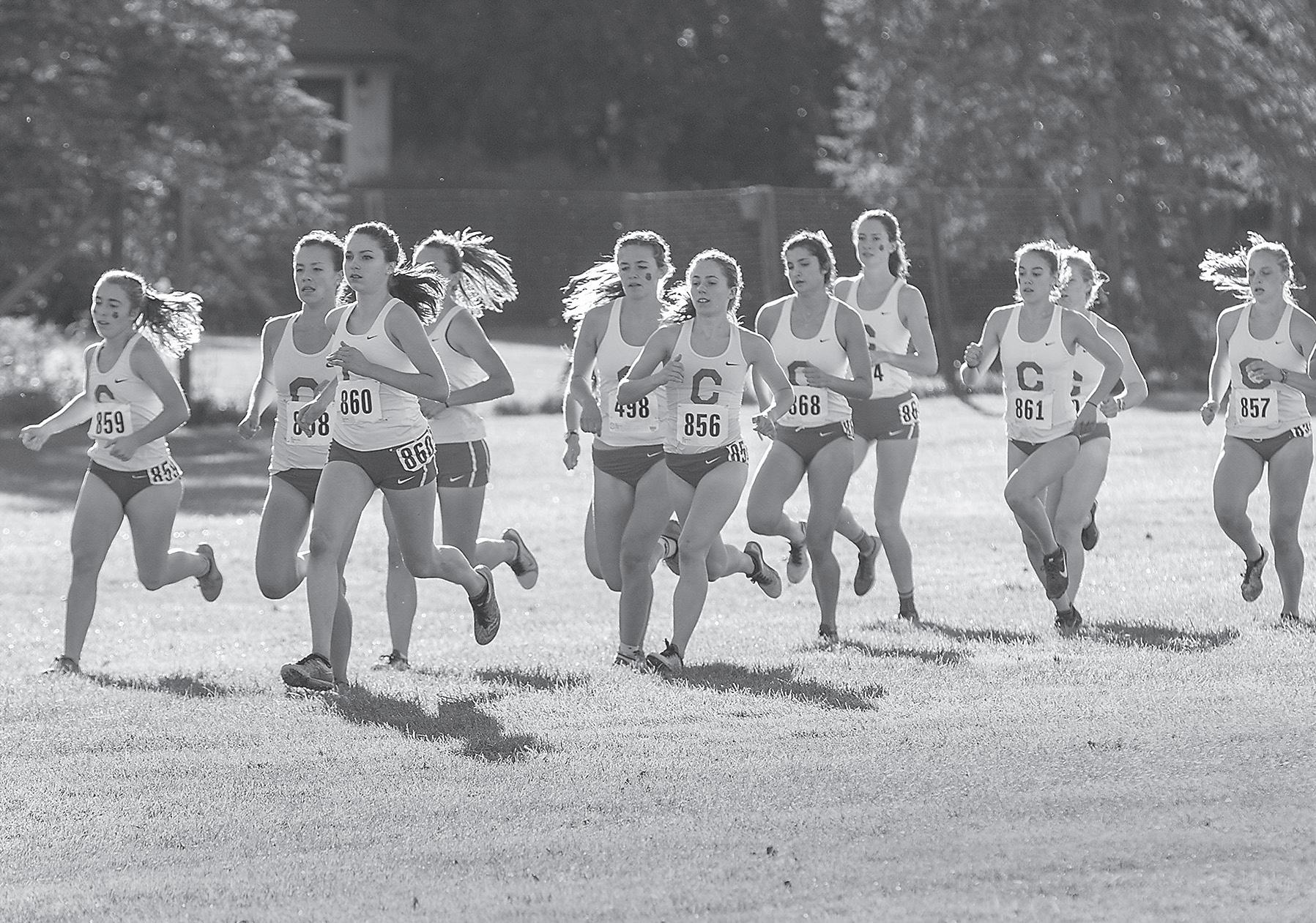
progress, yes, we’re very excited about the opportunity in front of us at the Heps this coming Saturday.”
Last year, Cornell placed fifth at Heps, considered one of the most important events of the cross country season.
The Red’s record this season has compared favorably to some of its Ivy League opponents. Cornell competed against both Princeton and Columbia earlier this season at the Princeton Invitational, where the Red placed seventh of 22 teams — ahead of the Tigers’ ninth-place finish, but behind Columbia’s second. Cornell’s fourth-place finish at the Paul Short Invitational put the squad seven spots ahead of Penn.
“We’ve had the opportunity to see most of teams in the Heps compete this season and there are clearly a lot of good teams. We think we are one of those teams,” Smith said. “We have a league with a lot of parity and it’ll be exciting to see who is at their best on October 27.”
In order to prepare for what will be its biggest meet so far, the team has adopted a very specific training routine intended to ensure peak performance.
“We’ve been gearing up all summer and fall to be at our best at this time of the year,” Smith said. “We’ve had very consistent training over the course of the season, and we continue to focus on being better each week and trying to improve on last year as well.”
For her part, Glodek added she was confident the Red will turn in a spirited, hard-fought performance at Heps.
“I know our team is going to go out there and give it their all … to honor both the hard work each individual has put in over this season and many others to get to this point,” Glodek said.
Cornell travels to Princeton, New Jersey this Saturday to compete in the Ivy League Heptagonal Championships at noon.
this Friday against Skidmore College at 7:30 p.m.
SPRINT FOOTBALL
Continued from page 16
of our day.”
Catalyzed by those key plays, Cornell’s offense went into hyperdrive by the fourth quarter — scoring a stunning 23 points to blow past a St. Thomas seemingly unprepared for such a drastic turn of events.
Senior Brooks Panhans connected with junior running back Will Griffen for a fake run touchdown pass, which combined with senior quarterback Connor Ostrander’s pass to Griffen for a two-point conversion, lifted the Red to a six point lead over St. Thomas.
On the next drive, Griffen fought past two tackles to once again end up in the endzone. That, and a successfully-executed trick play for a two-point conversion, extended Cornell to a 23-6 lead.
Padding the team’s margins, sophomore running back JR Quinones ran up the middle to score his first collegiate touchdown. An extra point from junior Ben Finkelstein brought the final score to 30-15.
“This was our first league game, and winning it helps get us on a
streak and build momentum before we head into the next two conference games,” Gneo said.
Cornell has two more matchups in the regular season, both of which are conference games. The sprint football league is divided into two, five-team divisions, and the squad with the best record within each one will face off in a single postseason game.
“Now, the game against Post is our biggest game. We are not looking past it.”
Head coach Bob Gneo
The victory over St. Thomas brings the Red’s conference record to 1-0, meaning its upcoming game against Post University is likely must-win if Cornell is to contend for a divisional title.
“Our game against Chestnut Hill was the biggest game of the season.” Gneo said. “Now the game against Post is our biggest game. We are not looking past it.”
The Red hosts Post at home this Friday at 7:00 p.m.

By JOHNATHAN STIMPSON Sun Assistant Sports Editor
In sprint football’s first conference game of the year — a contest associate head coach Bob Gneo last week considered its “biggest game of the year” so far — an explosive fourth quarter pushed Cornell past St. Thomas Aquinas to bring its record to 3-1.
While this was the Spartans’ first year fielding a sprint football team, it entered the matchup with the same 2-1 record Cornell did — an unexpectedly strong start for an inaugural program and one that showed as the Red struggled for much of the game to take the lead.
St. Thomas managed to hold Cornell scoreless through
the first half, as a muted Red offense struggled to make much noise.
“Clearly, we couldn’t get anything going in the first half,” Gneo said. “They only scored six points, but held possession for most of the time.”
But in a twist of fate, it was Cornell’s special teams — which last week proved to be one of the team’s weakest links — that ended up playing a decisive role in the team’s lategame resurgence.
“We had several big plays from our special teams … extra point, field goal, two very good returns down the line to set up a great field position,” Gneo said. “It was the biggest part
By DYLAN McDEVITT Sun Sports Editor
Kyle Dake ’13, the Cornell wrestling legend who became the only wrestler in NCAA history to win four national championships at four different weight classes, is now a world champion.
Dake, 27, dominated at the United World Wrestling championships in Budapest, Hungary this week en route to becoming the first Cornell wrestler to win gold. Throughout the course of the tournament, Dake kept each opponent from scoring even a single point, as he outscored his opponents a combined 37-0. After mowing down the preliminary competition at the 79 kilogram weight class, Dake defeated Jabrayi Hasanov of Azerbaijan in the finals, 2-0, to claim the title.
At Cornell, Dake amassed an overpowering 137-4 overall record with 83 bonus point wins including 44 by fall. He remains the only Cornell wrestler to win the Hodge Trophy, given annually to the most outstanding collegiate wrestler.
Dake was one of three members of team USA to win a gold medal in Budapest, joining fellow four-time All-Americans J’den Cox of Missouri and David Taylor of Penn State.
Dylan McDevitt can be reached at dmcdevitt@cornellsun.com.
By FAITH FISHER Sun Contributor
Having failed to land a single goal against an Ivy competitor all season, Cornell field hockey traveled to take on Brown last Saturday in the eager hopes of snapping that regrettable streak. But after scoring two unresponded goals in the second half, the Bears dashed those ambitions — instead extending the Red’s conference losing spell to four games.
“Our past history this season of not creating chances ... becomes an
Head coach Stephen Simpson
While Brown (6-8, 1-4) had a leading edge in shots (6-3) by the end of the first half, both Cornell and the Bears’ defenses were able to mount successful resistance. Late in the half, junior goalkeeper Maddie Henry warded off a shot from Gina Openshaw, while, just moments later, Brown’s goalkeeper Katie Hammaker thwarted a shot attempt by senior midfielder Gabby Depreto from the top of the circle.
In the second half, while both teams had an even number of shots (7-7), the Red failed to convert any of its scoring chances to goals, allowing Brown to claim a 2-0 lead.