The Corne¬ Daily Sun
By PARIS GHAZI Sun Assistant News Editor
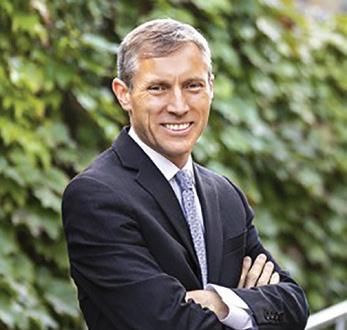
Prof. Alexander Colvin Ph.D. ’99, associate dean for academic affairs, diversity, and faculty development and Martin F. Scheinman Professor of Conflict Resolution, has been named the interim dean of the School of Labor and Industrial Relations after the former dean Prof. Kevin Hallock became the new leader of the SC Johnson College of Business.
Colvin, who joined the ILR school in 2008, assumed the position on Tuesday, Oct. 9, and will serve as dean until a new one is appointed. The University will begin searching candidates for the position immediately, Provost Michael Kotlikoff said.
“I am very excited to be taking on the new role leading the ILR School,” Colvin said to The Sun in an email. “The School is a great place with wonderful faculty, staff, students, and alumni, who I look forward to working with. It embodies the best of Cornell’s research excellence, education that bridges traditional fields in exciting collaborations, and commitment to our public outreach mission.”
Before taking on this role, Colvin contributed to Cornell both through his teaching, which focuses on employment dispute resolutions, and his research on employment arbitration and labor and employment law changes in Australia, Germany, Italy and the United States, according to the ILR website.
“Alex is extremely smart, has the highest standards, is balanced and loves ILR. I have been lucky to work very closely with him for the last

By ANU SUBRAMANIAM Sun News Editor
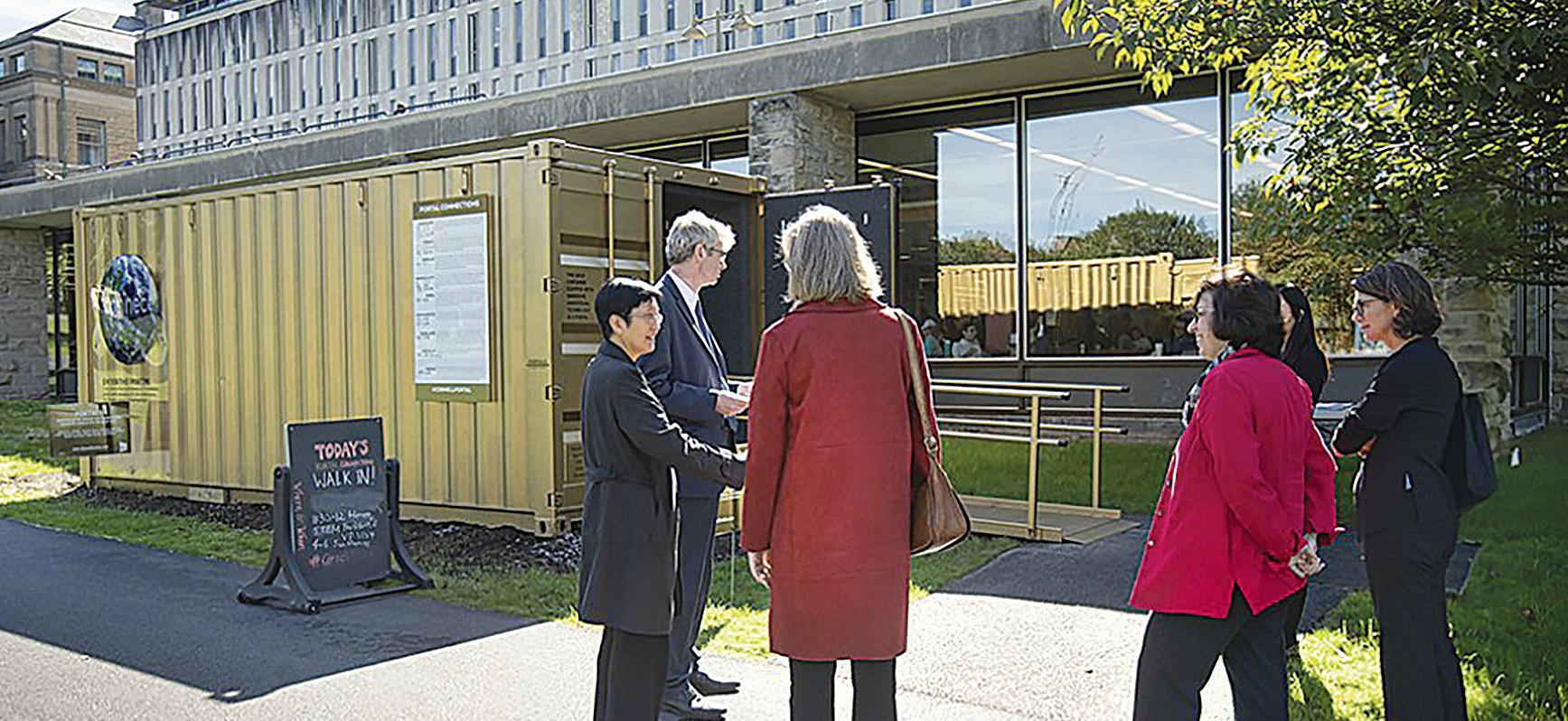
Since its installation in mid-August, the portal residing on the Arts Quad has been visited about 1,500 times. Visitors include Ithaca Mayor, Svante Myrick ’09 and, now, President Martha E. Pollack.
Myrick’s Sept. 27 visit, previously reported on by The Sun, focused on U.S. international relations during the Trump presidency with political consultant Luis Daniel Perez Vazquez.
Pollack followed up on Oct. 5 with Katherine
McComas, vice provost for engagement and land-grant affairs, and Wendy Wolfrod, vice provost for international affairs. The three spoke with
has taught about 150 students since its opening.
Pollack studied computer science in school and when she was younger, she said that
“I’m actually organizing a coding boot camp for high school kids in Ghana. My friend and I did it last winter break.”
Samuel Opoku-Agyemang ’19
representatives from Code to Inspire, an organization in Herat, Afghanistan. The organization focuses its efforts on teaching girls to code, develop websites and make apps and
“there were almost no women in the field. She said a lot has changed since then.
“Here at Cornell, engineering is about 50 percent women, and in comput-
By EMMA ROSENBAUM Sun Contributor
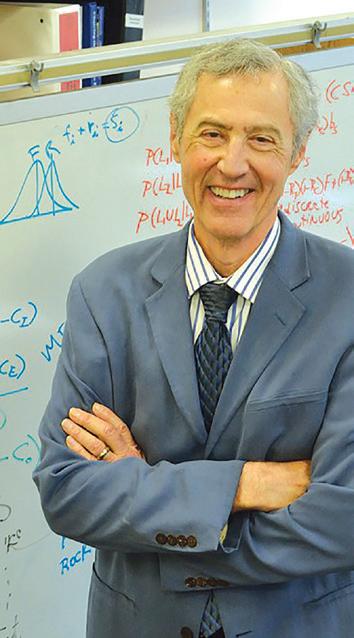
Prof. Charles Brainerd, human development, has been awarded the highest honor in the field of developmental psychology: the American Psychological Association’s G. Stanley Hall award. He will receive this award at the APA’s annual convention in August 2019.
The G. Stanley Hall award is given to a single individual who has made “distinguished contributions to developmental psycholo-
er science about a third are women,” Pollack told the Cornell Chronicle, which is run by the University.
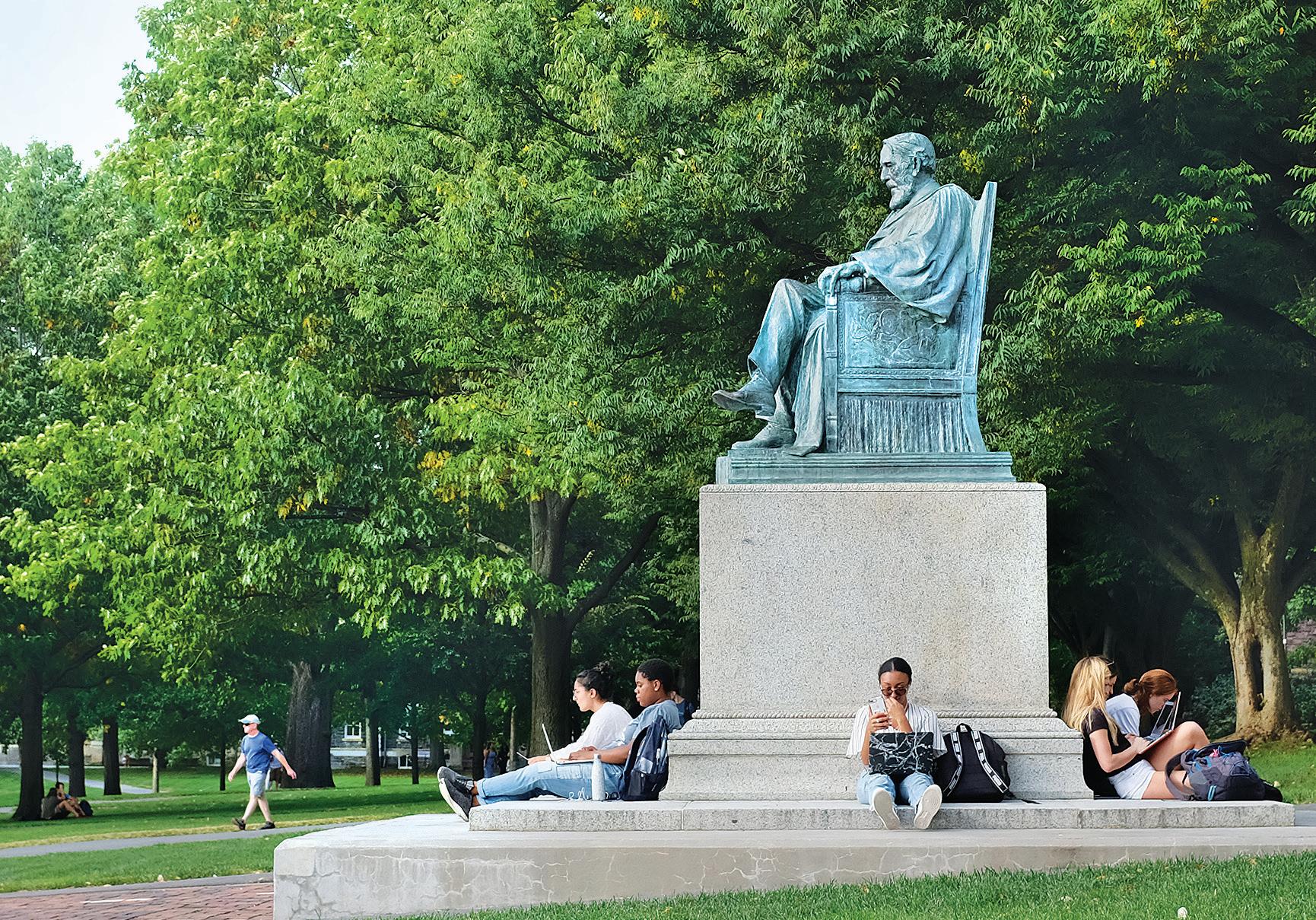
Students have also taken advantage of the portal. After Pollack’s conversation about coding, Samuel OpokuAgyemang ’19 joined the conversation, according to the University.
“I’m actually organizing a coding boot camp for high school kids in Ghana,” he said. “My friend and I did it last winter break. We are going back this December, and we have two Cornell pro-
gy, including contributions in research, student training, and other scholarly endeavors,” according to the
APA website.
The award’s evaluations are based on the scientific merit
of the individual’s work, the importance of this work for opening up new empirical or theoretical areas of development psychology and the importance of the individual’s work in linking developmental psychology with issues confronting the larger society or with other disciplines, according to the website.
Brainerd’s research focuses on human cognition. His research has been published in the Journal of
Teaching an Old Dog New Tricks: Incorporating Dogs Into Multiple Stages of Drug Development for the Treatment of Lymphoma 10 - 11 a.m., LH1, College of Veterinary Medicine
Glass Walls: Experimental Evidence on Access Constraints Faced by Women
11:40 a.m. - 1:10 p.m., 201 Warren Hall
Wage Employment, Unemployment And Self-employment Across Countries
11:40 a.m. - 1:10 p.m., 498 Uris Hall
Predator on the Line: Drones and Operative Images on the U.S.-Mexico Border
12:15 - 1:30 p.m., G08 Uris Hall
Enablers and Barriers to xEV Adoption 12:20 - 1:10 p.m., 203 Phillips Hall
Neocortical Firing Rate Dynamics Across Brain States 12:30 - 1:30 p.m., A106 Mudd Hall
Fifty Years of Global Cluster Dynamics
4 - 5 p.m., 105 Space Sciences Building
Global Directions on Reducing Risks of Natural Disasters in the Built Environment 4:30 - 5:30 p.m., 101 Phillips Hall
Eamon McEneaney Memorial Reading 4:30 p.m., G70 Klarman Hall
Ecology in Eastern Christianity 7 - 9 p.m., Founder’s Room, Annabel Taylor Hall
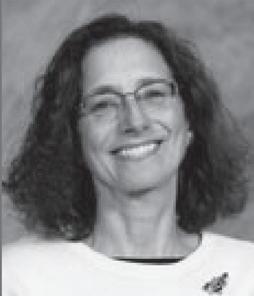
Carol Anelli Professor of Entomology, Ohio State University
Breeding Insight in the Era of Genomics 9 - 10 a.m., Auditorium, Boyce Thomas Institute
Catastrophes and Culture 12:15 - 1:15 p.m., 160 Mann Library
Future of Survey Research: Meltdown or Opportunity? 12:15 - 1:15 p.m., 226 Weill Hall
Brain-Residency Requirements For Polyomavirus-Specific T-cells 12:15 - 1:15 p.m., LH3, College of Veterinary Medicine
Growing Up Human: Quantitative Studies of Cultural Learning in Fiji 12:20 p.m., 202 Uris Hall
Recognizing Informal Recyclers: A New Paradigm for Waste Management 12:20 p.m., Abby and Howard Milstein Auditorium
The Open Humanities: Voicing Generous Spaces in Academia 2 p.m., K164 Klarman Hall
Sheep and Goat Symposium 2 p.m., Morrison Hall
Intimate Roundtable Discussion With Ndaba Mandela 3 - 4:30 p.m., Room 302, Breazzano Family Center
Obstacles to Global Development 3 - 4:30 p.m., B73 Warren Hall
With Usual Daring on Untried Paths: Anna Botsford Comstock— Educational Trailblazer, Author and Scientific Illustrator
Thursday, October 11, 2018 4:00pm G10 Bioitechnology Building
The Public is Invited

By XING GAO
Sun Staff Writer
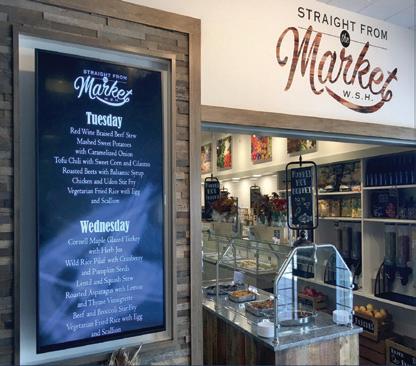
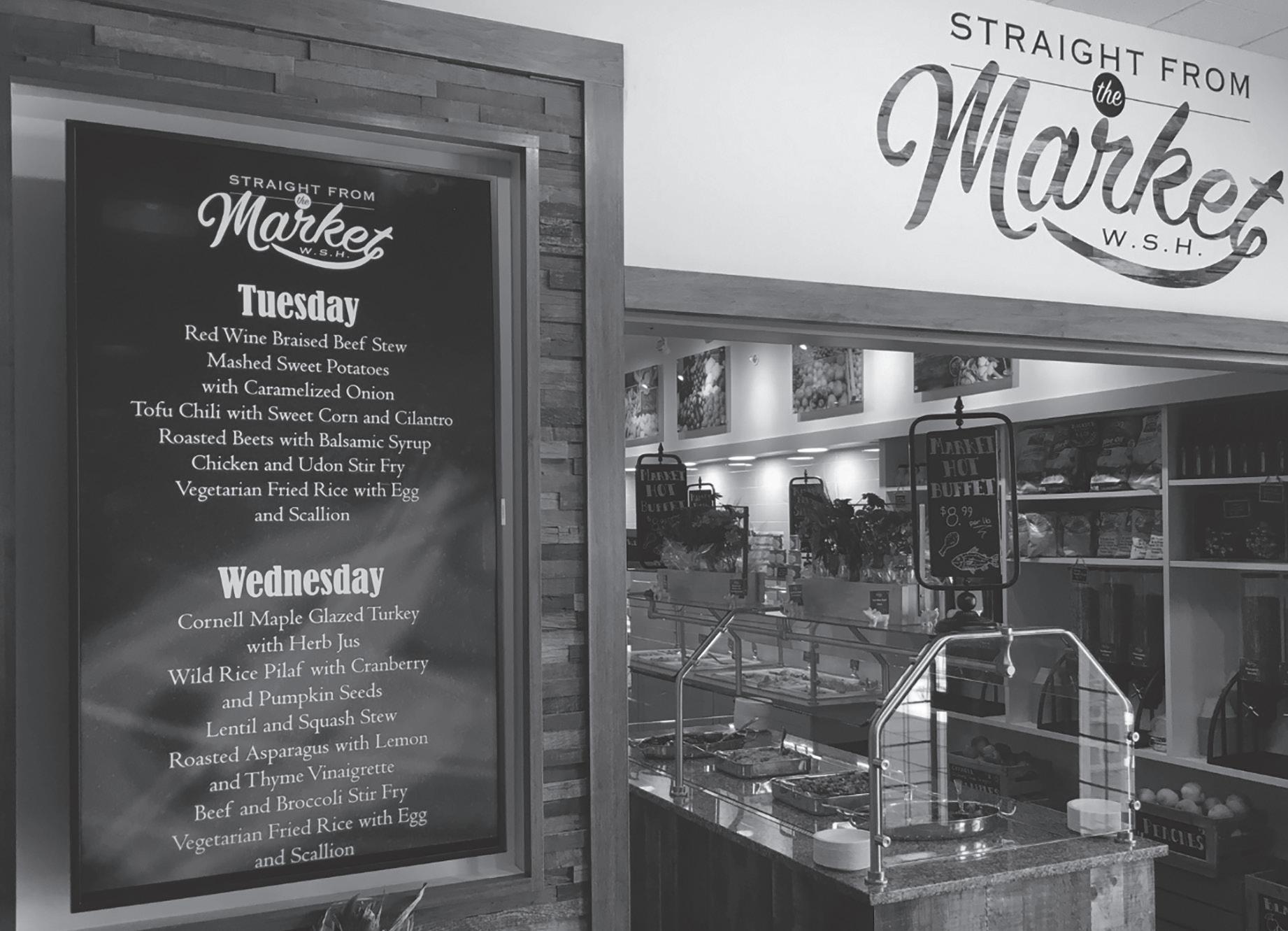
Cornell Dining officially opened up a new “Straight from the Market” dining section at Willard Straight Hall to serve food directly from the “market.” The section features farm-style decorations as well as hot and cold dishes.
The cafe’s goal is to provide a “quick Convenience Market concept for our Central Campus community,” said Mark Anbinder, web communications manager for campus life marketing and communications, The Sun previously reported.
“I like that they have vegetarian options. We have all the ‘cafeteria food’, [but] sometimes it’s harder for vegetarians [to find food choices].”
Claudia Poclaba ’20
Straight from the Market is located on the main floor of Willard Straight Hall above Okenshields. It has a hot dish bar surrounded by self-served salad section and other cold food choices including sushi and drinks. A sitting area can be found in front of Terrace Lounge.
Straight from the Market offers a number of daily specials including red wine braised beef stew, mashed sweet potatoes with caramelized onion and tofu chili. It also serves Cornell Dairy ice cream, coffee and infused water. A daily menu is posted in front of the cashier. “Our own Cornell Hydroponic Gardens will be harvesting fresh greens, tomatoes, herbs, and cucumbers in a few weeks, and we’ll be shifting to use those supplies as long as we can,” Anbinder previously told The Sun.
Straight from the Market takes a number of payment methods including Big Red Bucks, cash and credit card. It now offers free food samples in certain time peri-
ods according to Cornell Dining’s twitter account.
Straight from the Market is similar to Trillium in terms of pricing, offering self-served salad at around $8 per pound. A number of students stopped at the new dining area to check out food and drinks Straight from the Market had to offer.
Arianna Rebancos ’20 said that she appreciated the dining experience offered by Straight from the Market, which is different from the other traditional “cafeteria-style” on-campus dining choices.
“It’s good to have a source of fresh food on campus,” Rebancos said.
Claudia Poclaba ’20 told The Sun that she liked the food at Straight from the Market.
“I like that they have vegetarian options,” Poclaba said. “We have all the ‘cafeteria food’, [but] sometimes it’s harder for vegetarians [to find food choices].”
Xing Gao can be reached at xgao@cornellsun.com.
By EMILY YANG Sun Staff Writer
The Cornell Indonesian Association will raise money to support Indonesian communities in the wake of recent natural disasters.
According to The New York Times, on Sept. 28, the Indonesian island of Sulawesi was hit with a 7.5 magnitude earthquake that also triggered a devastating tsunami. The death toll has risen to 1,649 and rescue efforts are still underway, The Times reported.
“Reading news of the need for aid, seeing videos of the damages, and knowing that people in your country need help, made us want to act on the issue immediately,” said Tiffany Ng ’20, CIA treasurer, in an email to The Sun.
“With a gut feeling and a group of people,” a fundraising committee was put together within a day, Ng said.
The donation drive is collecting funds through Venmo to aid in disaster relief. All donations are being transferred to the American Red Cross Indonesia, known as Palang Merah Indonesia, as quickly as possible, according to the CIA’s Facebook post announcing the drive. The money will be used to help rebuild the community by funding fresh water and supplies.
Alice Soewito ’21, a CIA member who is heading the effort, said, “We knew that as members of the Cornell Indonesian Association, it was our responsibility to spread word about the natural disaster. We also knew that because Cornell is a huge and diverse community, there would be many individuals who connect with this issue in some way or another.”
“I think when it comes to an ‘international’ event, it might seem difficult to donate from here in America. However, the CIA wanted to do something and act as an avenue to catalyze that process of helping,” Soewito added.
The CIA has already raised $2,125 of its $5,000 goal.
Emily Yang can be reached at eyang@cornellsun.com.
By WINNY SUN Sun Staff Writer
Ithaca Bus Terminal relocated to the Urban Outfitters space at 131 E. Green St. in September after the terminal operators, David and Brenda Wallace, retired. The move was planned by Ithaca city officials, intercity bus companies and the Tompkins Consolidated Area Transit.
Tompkins Trust Company, which owns the building, was not interested in continuing to use the space as a bus station, The Sun previously reported.
“The Urban Outfitters space is the most logical for the intercity buses by keeping the area west of the store open for TCAT buses,” TCAT Communications and Marketing Manager Patty Poist told The Sun in an email.
To ensure smooth traffic at the new bus stop, intercity buses have all submitted their schedules. Several of them had
to change timetables to avoid traffic congestion, JoAnn Cornish, the city’s director of planning and development, said.
“Drivers will be held to strict schedules to keep the operations moving smoothly,” she added.
To reduce clash with intercity buses, TCAT buses have worked with the city in obtaining a few additional parking spots.
According to a TCAT press release, in addition to its current Green Street Station, the TCAT will also use the parking spaces in front of Tompkins County Mental Health Building and Tompkins County Public Library. During peak times, the TCAT will also park temporarily in front of the Sunoco gas station,
but it will not use the location for drop off or pick up.
“TCAT worked with the city, intercity bus companies and other stakeholders in very productive meetings to make this a smooth transition,” Poist said.
“The Urban Outfitters space is the most logical for the intercity buses by keeping the area west of the store open for TCAT buses.”
Patty Poist
Cornish said the new plan will work “since the intercity busses are only allowed east of the pedestrian crosswalk, and there should never be more than two [intercity buses] at any one time.”
“This collaborative endeavor will be closely monitored over the next six months; if there are problems or other issues, they will be addressed,” Poist said.
To accommodate the terminal relocation, new ticket agent locations have
also been established. Intercity bus passengers can now buy tickets or exchange online tickets for actual tickets at Green Street Pharmacy Monday through Friday from 9 a.m. to 6 p.m. and on Saturday from 9 a.m. to 4 p.m., according to the CoachUSA press release.
Shortline has also partnered with Student Agencies, which sells tickets in its collegetown office every weekday from 9 a.m. to 5 p.m.
Cornish said the terminal relocation is overall “a great move for everyone.”
“[Passengers] are a few steps away from the Commons if they want to stay downtown to eat, shop, or see a show,” she said. “ If they want to save a few dollars, they can skip the taxi or uber and ride the TCAT bus up to Campus.”
Winny Sun can be reached at wsun@cornellsun.com.



• A.D. White House
• Admissions Offce
• Africana Library Center
• Alice Cook Dining
• Anabel Taylor Hall
• Appel Commons
• Baker Hall
• Bard Hall
• Barnes Hall
• Bartels Hall
• Bethe House
• Big Red Barn
• Carl Becker House
• Carpenter Hall Library
• Center for Intercultural Dialogue
• Clark Hall
• Computer Services & Financial Aid, East Hill Plz.
• Cornell Institute for Social & Economic Research
• Cornell Store
• Corson Hall
• Court Hall
• Dairy Bar
• Day Hall Main Lobby
• Dickson Hall
• Donlon Hall
• Duffeld Hall
• East Hill Offce Complex
• Environmental Health & Safety Building
• Flora Rose
• Gannett
• Goldie’s (Physical Sci. Bldg)
• Goldwin Smith
• Hasbrouck Center
• Horticulture Offce
• Humphreys Service Bldg.
• Ives Hall (ILR)
• Ivy Room (WSH)
• Johnson Museum
• Keeton House Dining
• Kosher Dining Hall
• Mac’s Café
• Martha’s (MVR)
• Mann Library
• Myron Taylor Hall + Hughes Dining
• Noyes Main Lobby
• Okenshields, Willard Straight Hall
• Olin Hall
• Olin Library B Level
• Plantations Gift Shop
• Rhodes Hall
• Risley Dining
• Robert Purcell Community Center (RPCC)
• Sage Hall Atrium
•Sibley Hall, Green Dragon Café
• Snee Hall
• Statler Lobby
• Statler Terrace Restaurant
• Tatkon Center
• Teagle Hall
• Transportation Dept., Maple Ave.
• Trillium
• Uris Hall
• Vet Center (Shurman Hall)
•Weill Hall, M1 Rm + Synapsis
• Willard Straight Hall Lobby + Dining
• Autumn Leaves Used Books (Ithaca Commons)
• Bear Necessities
• Center Ithaca
• Coal House Café
• Collegetown Bagels: CTown + Triphammer
• Commons Grocery (Ithaca Commons)
• CFCU (Triphammer Rd.
+ East Hill Plaza)
• Corner of College & Dryden
• Corner of State & Aurora
•Express Mart, Comm. Crnrs.
• Hillside Inn
• Hilton Garden Inn
• Holiday Inn
• Ithaca Coffee Co.
•Ithaca College, Phillips Hall
• Jason’s Grocery & Deli
• Kendal
• Kraftees
• Lifelong
• Oasis (Greenstar)
• P&C Fresh (East Hill Plaza)
• Salvation Army
• Shortstop Deli
• Stella’s
• Tompkins Cty. Public Library
• Tops (Triphammer Rd.)
• Universal Deli
• Warren Real Estate (Downtown
+ Community Corners)
DEAN
Continued from page 1
few years. He will be terrific in this role,” Hallock said in an interview with the Cornell Chronicle, which is run by the University.
Colvin currently leads a curriculum review for ILR and is responsible for searching for six new faculty members to replace those retiring. Now as interim dean, Colvin will try to finalize the process, which also prioritizes recruitment of diverse faculty members.
“I intend to make it a top priority that the School use these searches to hire a high quality and diverse group of new faculty to join our ranks,” Colvin told The Sun.
Colvin also serves as an associate member of the law school faculty, and as an ILR associate dean, he has worked closely with Hallock in academic operations and has also supervised courses and curriculum planning for undergraduates.
Another initiative that Colvin
will be working on is moving ILR’s New York City office to a new location on Lexington Avenue this winter — a change he believes “will provide excellent facilities for our work in the city and is a commitment to our outreach and educational mission in the city and beyond.”
Before coming to Cornell, Colvin was a professor at Pennsylvania State University in the department of labor studies and industrial relations and also spent many years at the University of Toronto, where he received a Bachelor of Science in astronomy and astrophysics, a Juris Doctorate and a master’s in industrial relations.
Colvin is a published author and has penned papers in the Australian Journal of Labor Law and co-authored the textbook An Introduction to U.S. Collective Bargaining and Labor Relations.
Paris Ghazi can be reached at pghazi@cornellsun.com.
PORTAL
Continued from page 1
fessors who want to go with us to teach coding to these kids, as well.”
As an assignment, every student in Biology and Society 2051: Ethical Issues in Health and Medicine had to have a conversation in the portal.
Prof. Kim Overby, science and technology studies, gave the assignment as a way for her students to conduct “research on the ways cultural perspectives influence how health care is delivered and received,” according to the
University.
“The primary focus is to help students understand that having a relationship and good communication are so important in healthcare and in resolving ethical issues,” Overby told the University. “And realizing that it may be challenging to talk to someone who has a different perspective, but it’s important to understand how your own perspectives, your culture and your implicit biases can impact that relationship.”
BRAINERD
Continued from page 1
Experimental Psychology, Journal of Memory and Language, Child Development, Developmental Psychology, Developmental Review, and The Journal of Experimental Child Psychology, according to his Cornell biography.
Brainerd has made significant contributions to psychology. He and his colleague, V.F. Reyna, developed a widely known and accepted theory called fuzzy-trace theory, a general model of how memory influences reasoning and how reasoning influences memory. Some of his work has also focused on neurocognitive impairment and how memory affects legal evidence.
“I have concentrated most extensively on the development of cognitive processes in normal and atypical children, but I have also published considerable research on adult cognition and have taught widely in that area,” Brainerd said in his Cornell biography.
When asked about his opinion on receiving this award, Brainerd stated, “Although recognition for one’s research is gratifying, the award does not change my further research or teaching plans in any way. It simply says that my past

work may have some merit in the eyes of my peers.”
According to the National Academy for Education, Brainerd has published over 300 articles and over 20 books. Brainerd is a Fellow of the Division of General Psychology, the Division of Experimental Psychology, the Division of Developmental Psychology and the Division of Educational Psychology of the American Psychological Association, and he is a Fellow of the American Psychological Society and the Psychonomic Society.
In addition to the G. Stanley Hall award, Brainerd was awarded the Spirit of Excellence Award from the Governor of Arizona for “work in higher education and the Trial Defense Services Medal of the Judge Advocate General of the United States Army.”
According to the National Academy for Education, he has advised civilian and military courts on “memory research and has contributed to amicus briefs in many appeal cases, including death penalty appeals.”
He currently is the editor of Developmental Review.

136th Editorial Board
JACOB S. KARASIK RUBASHKIN ’19 Editor in Chief
JOHN McKIM MILLER ’20
Business Manager
KATIE SIMS ’20
Associate Editor
VARUN IYENGAR ’21
Web Editor
Ad Layout Jamie Lai ’21
Design Deskers Emma Williams ’19
Krystal Yang ’21
Simon Chen ’21
News Deskers Anu Subranamiam ’20
Paris Ghazi ’21
Arts Desker Peter Buonanno ’21
Dining Desker
Photography Desker Michael Li ’20
Jacqueline Quach ’19
Production Deskers Emma Williams ’19
Krystal Yang ’21
GIRISHA ARORA ’20
HEIDI MYUNG ’19
ALISHA GUPTA ’20
To the Editor:
We’re sure you’ve heard it a million times before. We’re sure you’ve scrolled past a “register to vote” meme on Facebook or have swiped through a voter registration filter on Snapchat. But we’re not sure that the message has stuck with you. And we’re telling you here, student to student, Cornellian to Cornellian, friend to friend, to make sure it sticks.
According to the Campus Vote Project, turnout among college students has reached record lows in recent years. Only 17 percent of eligible 18-24 year olds voted in a recent election. We have seen the consequences of that low turnout throughout the nation. Along with policy changes such as tax breaks for the wealthy, reversals in climate change legislation and a decrease in access to affordable medical care for all, we have two new conservative justices, continual verbal attacks on women and minorities by the president and serious challenges to the stability of our democracy.
You should register to vote and then you should actually vote. If we’re being honest, you have to vote. Below, we’ve outlined just a few of the reasons why:
You are a college student, which means it is probably one of the first times you have been able to vote. We are privileged to have numerous educational resources available to us on campus, and there is active support from multiple groups to help make voting accessible. Exercise your vote now at a time when a campus is supporting you.
Letters to the Editor
Register to vote by Oct. 12: It matters to your health
To the Editor:
These days, I find myself engaged in conversation, both inside and outside of the exam room, about the political process and its relevance to health and wellbeing. How can I get more involved in my community? Is it possible for me to feel better connected to those around me, and to something with larger meaning in the world? How do I make sure my voice is heard?
Deep questions like these are bound to come up in the course of intensely pursuing study here at Cornell. They form the basis of how we feel about ourselves, our sense of belonging, and our connectedness to our communities. While there are many ways to find engagement throughout the year, the fall election season poses a unique opportunity — to give back to your community, and also to gain something in return — by getting involved in the political process.
If you are eligible to vote in this year’s midterm elections on Nov. 6, I strongly urge you to do it. It does, in fact, matter to your health and wellness.
Various studies document an association between civic engagement and psychosocial wellbeing, with voting in particular being correlated with feelings of personal control and empowerment, efficacy and connectedness to one’s community. A study in the American Journal of Public Health found that populations with lower voter turnout are also associated with markers of poor health quality, independent of other determinants of health. While no studies have proven that voting itself causes better health outcomes, the associations are strong. Many people talk about the positive surge they feel after leaving the voting booths. Regardless of how they vote, it is the action of making their voice heard on a ballot that gives many people a boost.
The Association of American Colleges and Universities notes the benefit of voting for college students, providing an avenue for learning about engaged citizenry that is vital to higher education. For college students in particular, preparing to vote, especially in a midterm election, requires thought and planning. Should I vote at home by absentee ballot, or in New York State using my college address? Where would my vote mean more? Where is my polling location? How will I fit voting into my schedule on election day? These questions form the basis of thoughtful engagement in your community, and in the political process.
The social and behavioral parts of our lives — where and how we live, learn, eat, work, play, pray and engage in our community — have the greatest impact on the health of populations. During these difficult and tense times in our nation, I recognize that it can be difficult for many of us to see how our voice really matters. I encourage Cornellians to take the unique opportunity to express themselves at the ballot box. No matter how you vote, it is important way to stay connected, bring thought and intention to something with larger meaning, and begin the commitment to being an engaged citizen of the world.
Anne C. Jones, ’04, DO, MPH director of medical services, Cornell Health
To the Editor:
I write as a retired English and history teacher to protest the use of the term “conservative” to describe the politics of the current Republican party in Matthew McGowen’s article about Representative Tom Reed’s recent visit with 12 campus Republicans.
I also marvel that a presumably well-educated college student quoted in the article can question why he might experience some “social backlash” at Cornell wearing clothing bearing the name of a president who calls climate change a hoax, extols “pussy grabbing” on a campus (like all other college campuses) where sexual assault is a serious problem and refers to the nations of origin of many Cornell students as “shithole countries.”
I’d love to have any of the twelve students who met with Reed explain to me what any of the above characterizations have in common with political conservatism, and I suggest that all of these students, along with Matthew McGowen, ought to take a survey political science course while at Cornell.
I must also add that it offers us “left-leaning Ithacans” some pleasure to learn that Reed’s visit attracted 12 twelve students on a campus of 24,123. It looks like education might be working!
Barbara Regenspan
It is your civic duty. This is the reason that is the most “eye-roll worthy,” but that doesn’t make it any less true. Multiple groups of Americans have been denied the right to vote in the past, and they continue to be denied that right. Is it not our duty to vote if we can? Is it not our duty to vote so that we can elect officials who will destroy barriers to voting? Is it not our duty to engage in our democracy?
Kavanaugh. What has transpired this past week is not justice. We have seen our Senators confirm a man accused of sexual violence to the highest court in the land — a court whose purpose is to uphold justice and freedom. His confirmation is an utter disregard of the experiences of victims and survivors. It demonstrates a prioritization of conservative ideology and loyalty to President Trump over basic human decency. At the same time, this event is a call to action to vote and unseat the Senators who confirmed him, such as Dean Heller (R-Nev.) and Ted Cruz (R-Texas). Additionally, we must support those who voted with their conscience instead of doing what was politically expedient such as Heidi Heitkamp (D-N.D.) and Bill Nelson (D-Fla). The confirmation is a call to action to honor all those courageous enough to come forth and share their stories. The confirmation is a call to action to restore justice to a government that has overlooked it for too long.
Registering to vote is hard. We know. But we are also here to help. Please come visit our voter registration table on Ho Plaza, visit any of the many tables on Ho Plaza this week in partnership with the Tri-Council Voter Registration Drive (10/10 - 10/12), or get in contact with the Andrew Goodman Vote Everywhere Coalition. And please, register to vote before your deadlines. For New York State (for those of you registering with your Cornell address in Ithaca), it’s this Friday, October 12. You can also check registration deadlines, confirm whether you are registered, request your absentee ballot or fill out an online registration form at www.vote.org for any of the 50 states.
Voting may seem like a small action — merely a few boxes checked on a piece of paper or the quick press of a button. However, it is a constitutional right that few are afforded around the world. We have an obligation to each other to care enough about our democracy to actively participate in it. Even more importantly, we owe it to ourselves to lift up our voices through electing people who will fight for justice on a daily basis. Be an engaged citizen. Be an advocate for equality. Be an agent for change.
Vote.
Isabelle De Brabanter ’19
Maya Cutforth ’20
Liz Sherman ’21
Vale Lewis ’21
Luciano Hamel ’19
Ava Pacheco ’21
Jack Ross-Pilkington ’21
Alex Adamek ’19
Geneva Saupe ’21
To the Editor:
This summer, the well-renowned and much-loved water treatment course CEE 4540 was deliberately dismantled by the CEE Curriculum Committee and quietly replaced with a hastily assembled, entirely redefined course under the same number. For the last three months, our ad-hoc team of CEE 4540 supporters (155+ students, alumni and staff) has been questioning this decision. The Curriculum Committee has repeatedly dismissed and scolded us.
It appears that the University approaches curriculum from a “parent knows best” mindset. At no point during curriculum review were students or alumni asked for direct input. No reports or meeting minutes have been shared to explain curriculum decisions. There were no announcements or updates from CEE until the final verdict was reached. How can the University “ensure that students are properly prepared in many aspects of a field” if they are not evaluating testimonials from alumni who are now professional engineers? Lance Collins, the J. Silbert Dean of Engineering has refused to intervene despite multiple requests from alumni. The committee deliberates in secret to reach unilateral decisions based off unsubstantiated claims.
What type of engineer is Cornell trying to foster? Do they want students who raise their hands to ask questions and “break the rules”, or students who keep their heads down and are content with top-down decision-making? Effectively canceling CEE 4540 can only suggest the latter.
Since the publication of the Sun article, in an attempt to “calm the kids,” three students were invited to speak to the Curriculum Committee for 15 minutes three months after initial concerns were raised with only a few days notice. Unfortunately, no additional answers were provided and the students were met with disrespect. Alumni of this course dissatisfied with the current direction of the CEE program have decided not to donate until this issue is resolved. Perhaps over time the daily responsibilities of student life will erode our frustration over this particular grievance, but we believe in something larger that should not be forgotten. We believe the faculty, students and staff of Cornell should always strive to openly listen to one another, converse as equals and stand behind data and truth.
Alissa Diminich CEE BS ’08, EnvE MEng ’09
Juan Guzmán EnvE BS ’17, EnvE MEng ’17, AguaClara Engineer in Honduras Ethan Keller EnvE BS ’15, CS MEng ’16 Zoe Maisel
This week, an alarming United Nations report from the Intergovernmental Panel on Climate Change indicated that by 2040, the world we know — with abundant food, relatively infrequent natural disasters, and, uh, Southeast Asia — will be but a fleeting memory.
The IPCC concluded that avoiding catastrophe will require “rapid and far-reaching transitions in energy, land, urban and infrastructure… and industrial systems.” As one climate writer explains, these goals require an “immediate, coordinated crash program of re-industrialization, involving every major country in the world,” which is difficult to imagine considering “nothing even remotely similar has ever happened” in human history.
Reading the report, it’s clear we have two choices: either save the world, costing big corporations their money, or destroy it, costing millions of vulnerable people their lives.
in the 1980s but has in the past decade exploded to near ubiquity. Consumers don’t just prefer organic food, sustainable clothing or upcycled furniture when they’re presented with regular alternatives — they actively seek these products out. Almost every major corporation regularly reports its sustainability achievements and future goals.
However, while investors are increasingly captivated by the “green marketing” movement as its capacity for revenue generation continues to defy expectations, research has shown that the mitigating effect environmental consumerism has on climate change is insignificant, if any exists at all. Why, then, is supposedly tree-hugging, lefty liberal CNN advertising futile market solutions when the fate of the human race is at stake?
We are so pacified and occupied that we won’t do what’s necessary … to forestall the inevitable environmental Armageddon.
On the heels of the UN report, CNN published some suggestions for concerned citizens seeking ways to take action. Paramount to averting the impending apocalypse is, it insists, that consumers “change their lifestyle and consumption patterns to more sustainable alternatives.” One example: “Using smart thermostats or more efficient air conditioners.”
Yikes. Seventy percent of all greenhouse gas emissions are produced by only 100 corporations. Just 25 of those companies account for more than 50 percent! Yet when the author of the aforementioned suggestions — considering how soon we might face a man-made doomsday scenario — racked her brain for ideas on how humanity could best mobilize against this leviathan threat, the best she could come up with was buying a fucking thermostat.
My quarrel is not with the author, who might very well be a brilliant, thoughtful person. I do, however, take issue with the notion that the best way for an individual to express political will is through his or her purchasing decisions. Moreover, I take issue with the existence of a powerful media apparatus that weaponizes content like this to push a dangerous agenda: hegemonic neoliberalism.
CNN here promoted a type of market behavior called “environmental consumerism,” which originally surfaced
Simply put, it’s all a charade. While Fox News’s climate change denial extinguishes its viewers’ desire to exercise their political agency, CNN’s climate change acknowledgment asserts that the only agency worth exercising is as an individual in the market. Though superficially contrasting, they’re both in the same racket: the profiteering of panic.
The virulent political partisanship that now poisons every facet of our American lives is manufactured for the benefit of the powers that be. Tribalism seeps into the cracks of our relationships with family and friends, dictates which news and entertainment media we consume and influences us to purchase more or different products.
build walls separating ourselves from one another did so not for our protection, but for their own. Only once we tear them down will we finally see that our enemies and our struggles are the same.
Resisting climate change is the most important fight we’ll have in our lives; it’s a good thing we already agree on that. But before we begin, we must first accomplish something far more difficult: the collective recognition of our shared humanity. And to build unity, you’ve gotta make friends.
As the last bastion of political resistance in our country — and the only broad coalition with proven organizing abilities (see: Women’s March, saving the Affordable Care Act) — it is the responsibility of the left to get the ball rolling. We are far from perfect, but we tend to be more inclined and better prepared for take-to-the-streets rebellion than are our conservative counterparts.
So, I implore you to peel the “Impeach 45” bumper sticker off your car, remove your pink PUSSYHAT™, get out of social media’s comforting “#ImWithHer” bubble, and engage with your neighbors, whatever their political affiliation may be.
Resisting climate change is the most important fight we’ll have in our lives.
We’ll watch anything that stokes our rage, buy anything that proclaims it and vote for anyone who expresses it. So successfully have they turned us against one another that we’ll do just about anything for a hit of sweet, sweet anger.
Luckily, the prolific bounty of content that technology provides renders us far too pacified and otherwise occupied to start a Second Civil War. Unluckily, however, we are so pacified and occupied that we won’t do what’s necessary — organizing, en masse, despite our differences, against the powerful — to forestall the inevitable environmental Armageddon.
It’s time we realize that those who encouraged us to

Then, go into your community, find someone who’s making a dif ference, and offer your help. It’s time we channel our anger into productivity — every major social movement began in the streets. Revolution is most effective when it’s borne of love for our fellow human.
Make no mistake: this is not one of those calls to “hug a Trump supporter.” This is a call to arms. It’s not about proving your oppression to somebody or changing their strongly-held beliefs. It’s the recognition that through shared struggle, whether that’s climate change, automation or a diminishing social safety net, we can find common ground. Working together, communities can (and do!) enact change that improves lives when those in power will not.
The ruling class — Democratic and Republican alike — exist to serve their own interests. They’re more than happy to watch the world burn. Are you?
Jade Pinero is a senior in the College of Agriculture and Life Sciences. Jaded and Confused runs every other Thursday this semester. She can be reached at jpinero@cornellsun.com
There are a variety of ways in which Cornell students take on additional responsibilities across campus. A non-exhaustive list includes student organization leaders, student-athletes, resident assistants, shared governance representatives and teaching assistants. In addition to being an essential part of diversifying and augmenting one’s resume, these leadership positions, formal and informal, provide valuable opportunities for academic, professional and personal growth. It is an integral component of one’s professional and personal development, and, as a result, most students hold multiple leadership positions across campus.
sibilities. More often than not, when talking to students, they describe their constant struggle to maintain or even find this balance. Fear about a hyper-competitive job market and a strong personal desire to support one’s community pressure students to take on more positions than they can manage.
Students forgo sleep, miss meals and often deprioritize their academic responsibilities to meet the expectations of their leadership positions.
A consequence of this, however, is that for many students a significant portion of their non-academic time here is spent fulfilling the associated responsibilities of every leadership position they hold. Every semester students try to balance their academic, professional and personal respon-
Despite the physical and mental toll this places on students, many have a hard time stepping away from these positions. Students plan campus-wide events, invest in long-term projects and provide feedback that informs university policy decisions. Students forgo sleep, miss meals and often deprioritize their academic responsibilities to meet the expectations of their leadership positions. The reality is that the broader student experience is improved thanks to the work these students do.
But, the physical and mental toll this places on students cannot be ignored.
I have talked to students that were so exhausted that they would lie on the floor of their office trying to recharge. Others shared stories of losing weight due to the number of missed meals. One student I talked to described getting physically ill, often feeling feverish and developing intense headaches, while another experienced emotional outbursts, often snapping or yelling at those around them. In extreme circumstances, students even mentioned turning to drugs or alcohol to cope.
new to their position, easily find solutions to their tasks. We can also assist student leaders in developing training opportunities for new members. If student leaders can easily and confidently distribute labor across a broader base, we can prevent them from becoming overwhelmed.
We must actively work to disrupt the idea that exhaustion is an indicator of student success.
When asking students what would be most helpful to them, a few repeated themes emerged. Many expressed a desire to institutionalize knowledge across organizations. Students have invested significant energy into learning how this university works, how to secure funding for events and which staff members can best assist them accomplish their goals. By creating a way of storing and sharing this information across the student population, we help leaders, particularly those
Finally, we must actively work to disrupt the idea that exhaustion is an indicator of student success. This is no easy task. As I mentioned earlier, there are a variety of factors that motivate students to work past their boundaries. The ultimate goal, should be, as I often advise students, to work smart, not to work hard. If we want to better support students, we need to robustly assess what exacerbates their non-academic workload and adjust our support services accordingly.
Manisha Munasinghe is the graduate and professional student-elected member of the Board of Trustees, and a PhD candidate at Cornell University. Trustee Viewpoint runs every other week this semester. Munasinghe can be reached at mmunasinghe@ cornellsun.com.

By BENJAMIN VELANI Sun Contributor
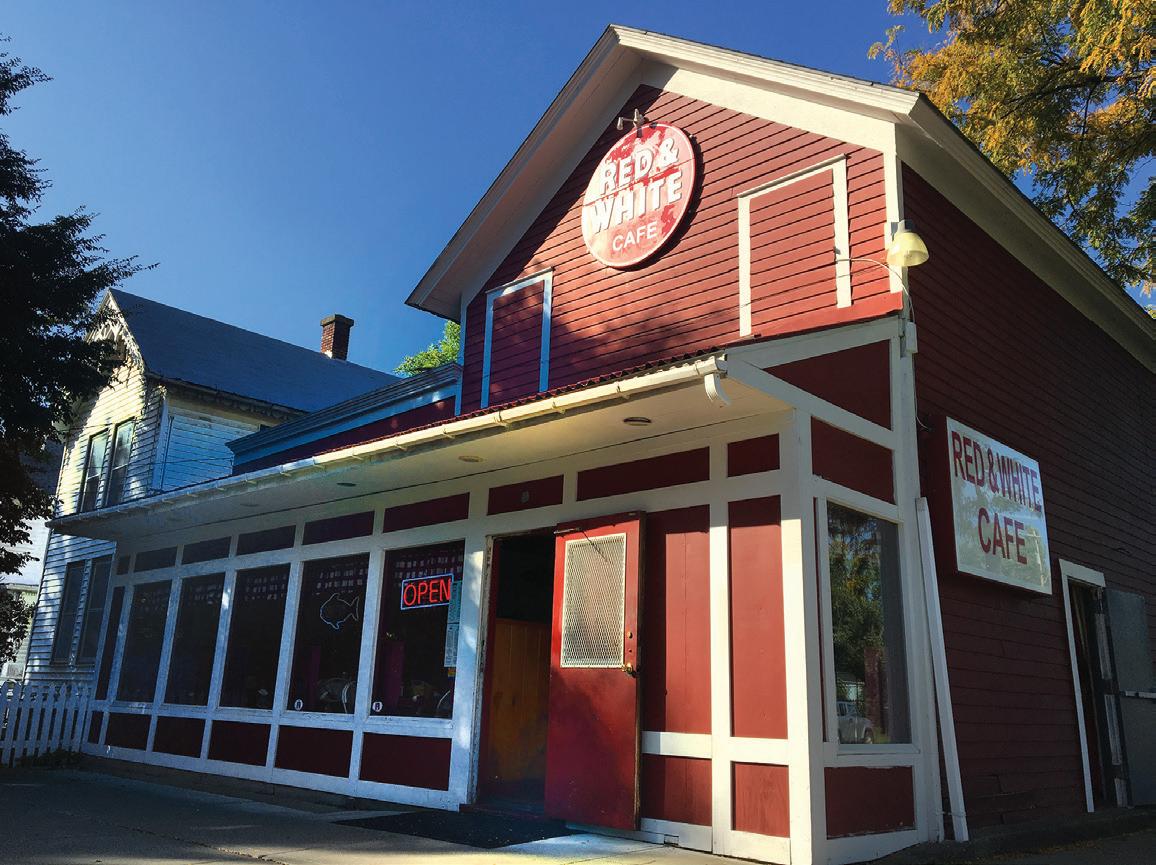
On the corner of Court and Plain streets, you will find a facade that’s, well, plain. Yet beneath the faded exterior of the Red & White Cafe emerges humble homestyle fish fry and classic American dinner.
The first thing I note when eating at any restaurant is its cleanliness, both in the kitchen and the restroom. When walking up to the counter, I noticed that while the surfaces and equipment looked clean, there was a moderate buildup of dirt and grime underneath the stoves, as well as what looked like days of grease residue above the fryers.
However, after taking a trip to the restroom, I was pleasantly surprised to find a newly refinished and clean space decorated with a fresh coat of red paint and knotty pine on the walls. This rustic theme continued throughout the restaurant, with accents like aluminum fish hanging from the ceiling, which added a certain novelty and charm.
While the front half of the building is a fairly composed restaurant, one can find a messy backroom of unfinished space just by peeking their head through a pair of red curtains by the restroom. Now, I don’t know about you, but most of the restaurants I’ve been to don’t seem to have been tacked on, almost as an afterthought, to the rest of the building.
Putting these initial fears behind me, I grabbed a menu and began peering over it. For anyone not accustomed to Chinese dining and its many options, you will be overwhelmed by the amount of items available at Red & White Cafe. From Philly cheesesteak sandwiches to pizza burgers to fried oysters sourced from Virginia, the restaurant


offers a multitude of staples of American cuisine. I decided to go with their specialty, a fried fish dinner with an upgrade from fries to potato wedges for $2, and an iced tea from the fridges to the right of the counter, totaling to $19.42 after tax. The man checking us out, who doubled as the chef, politely took our orders and began hustling and bustling at the fryers.
While waiting at the folding table and plastic chairs, I got to take in the wafting smell of hot oil on a warm fall breeze. Every little accent in the room screamed “homemade and proud,” which was only further embodied by our host: a man of stature who was probably born with his thick grey mustache and a well-loved pair of blue jeans. Known as John Wells, he proudly explained to us that all of their haddock is sourced fresh from Boston, each sub comes with a half pound of meat and each burger is a full third pound of beef.
Within 15 minutes, Chef Wells, John’s brother Chuck, cranked out all five of the meals that my friends and I had ordered, piping hot — an impressive feat from a restaurant I had walked into with low expectations. Now, just to
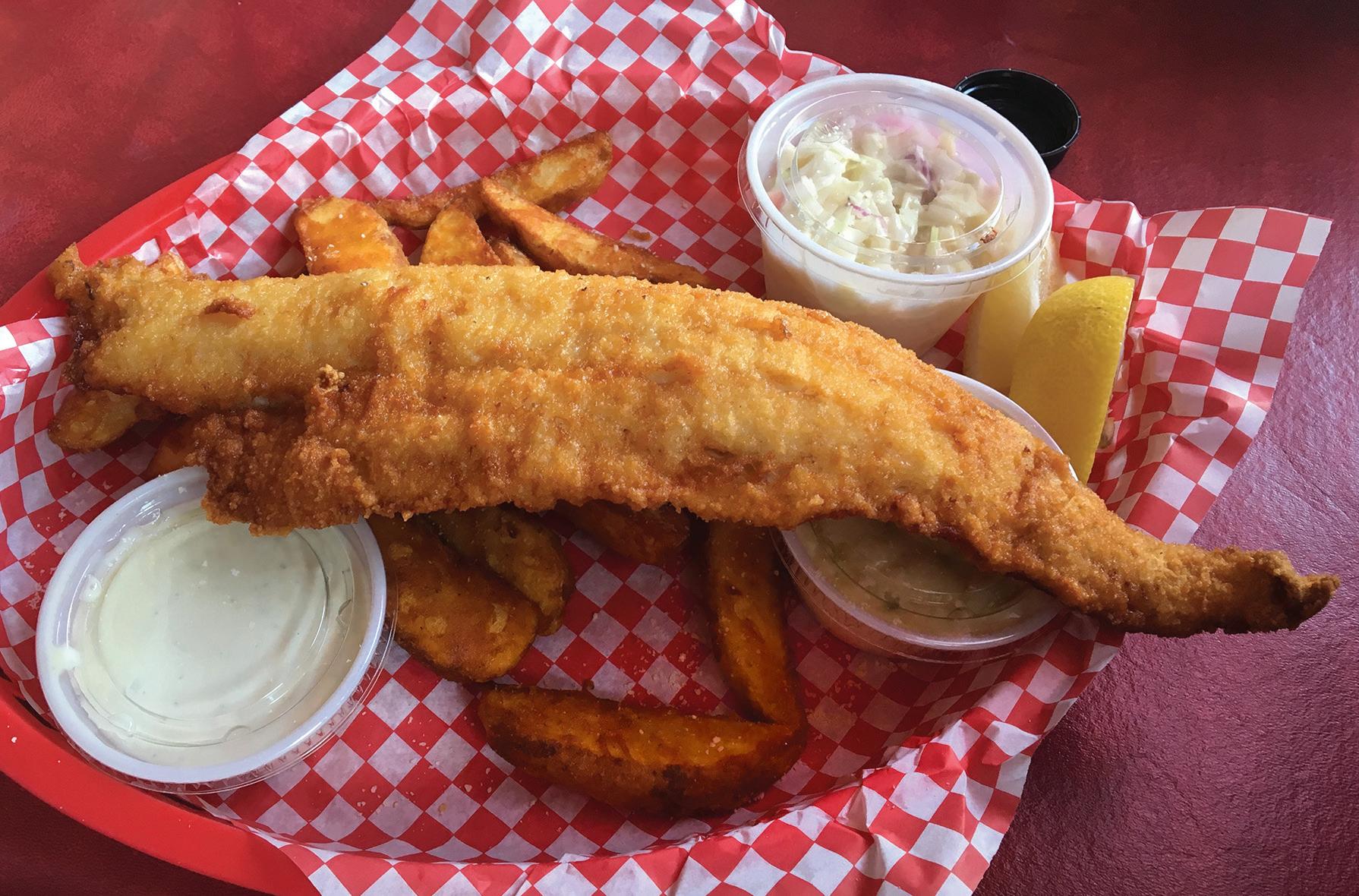
set the record straight, I am a Minnesotan, so fried fish is no laughing matter to me. It quite literally is religion in the land of 10,000 lakes because on every Friday night of Lent, your local Catholic church will serve a homestyle fish fry made by all the grandmothers of the surrounding neighborhoods. Therefore, to my surprise, laid before me in red-and-white checkered paper was a beautiful
golden-brown fillet of Bostonian haddock, positioned over a bed of crisp yet fluffy potato wedges seasoned with coarse sea salt, another unexpected touch from such a modest establishment. The fish was flaky and tender, but the batter was a little chewy, instead of the expected crunch that is characteristic of quality fried fish. This may have been due to how the haddock was fried skin-on, or maybe it just wasn’t as fresh as John had marketed it to be. Unlike the potatoes, the fish was underseasoned, so a splash of malt vinegar or sprinkling of salt was necessary.
Complimentary are some of the expected sides for any fish fry: a sweet and tangy tartar sauce, a light yet creamy coleslaw, two lemon wedges and one sauce unique to the Red & White Cafe — a homemade buttermilk ranch that John says “people go crazy over.” He also informed me that all sides and sauces were made in-house. While the ranch was good, it was nothing to lose your mind over, just a simple and tasty addition that helped
to compensate for the lack of seasoning on the fish.
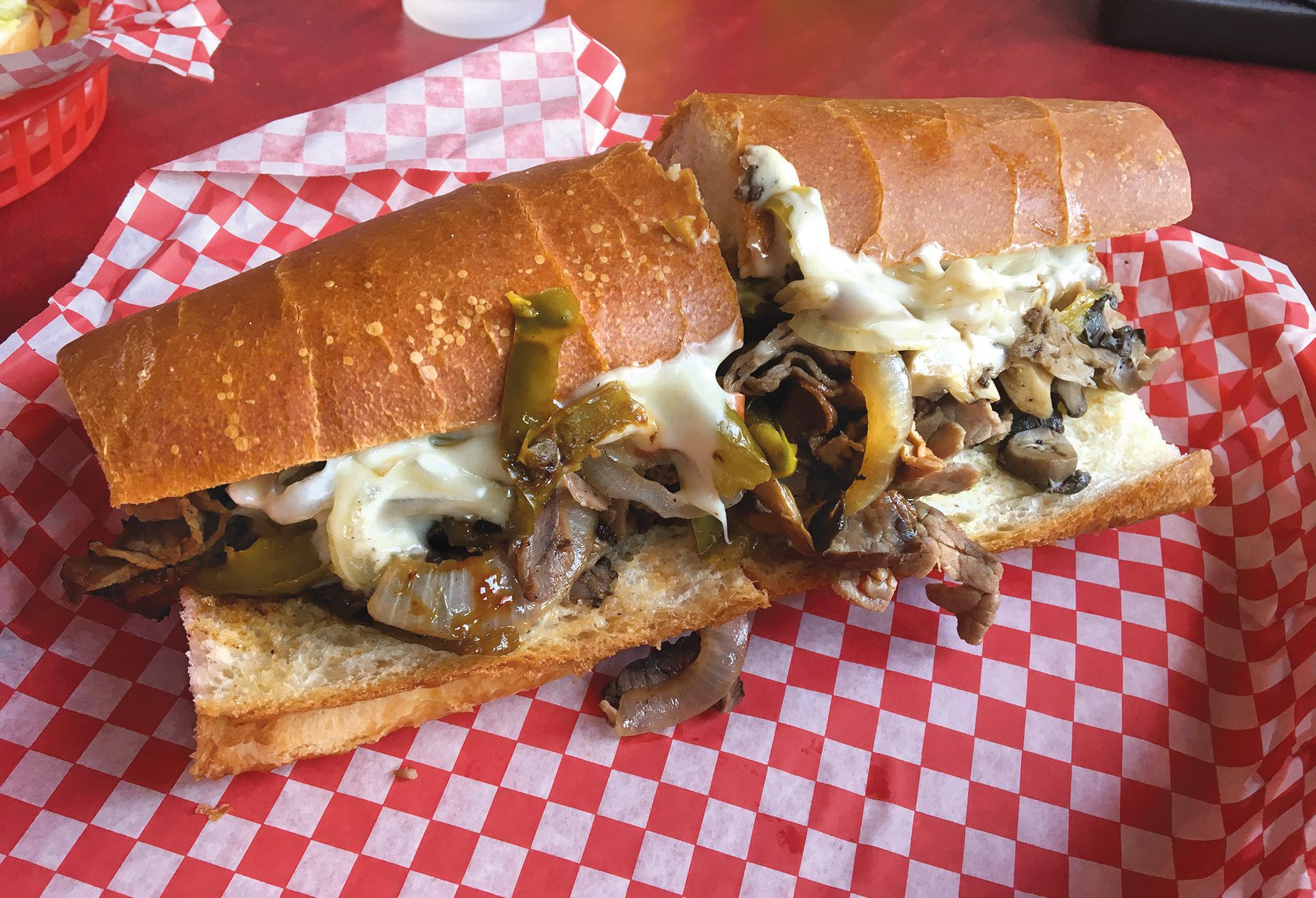
The Philly cheesesteak my friend Brennan Kosut ’22 ordered was a monstrous portion for the fair price of $8.95. It came on a toasted roll, and was piled high with shredded steak, sautéed onions and green peppers, all melded together with gooey Swiss cheese. Brennan commented that, “It tasted great, and the steak was tender and not overcooked.”
Stacked with criss-crossed bacon slices, a fried egg, lettuce, tomatoes and mayo, the juicy, medium-cooked “Papa Moe” burger my friend Andrew Martinez ’22 ordered was a traditional, yet well-executed take on a classic for just $7.49. Much to his surprise, “The food was actually really good, but I wished the burger was a little more pink on the inside,” a change that could easily be made by making your preference clear when ordering. He also preferred the potato wedges over the sweet potato fries, which were somewhat soggy and lacking salt, as they may have been frozen and prepared in haste.
Overall, the experience you get at the Red & White Cafe is perfect for a Friday night, especially when you’re a college student missing some good, old-fashioned home cooking. And if you’re looking to get the best bang for your buck, this restaurant, with its healthy portion sizes, will not disappoint.
Serves: classic Americana and homestyle fried seafood
Vibe: rustic and blue collar
Price: $
Overall:


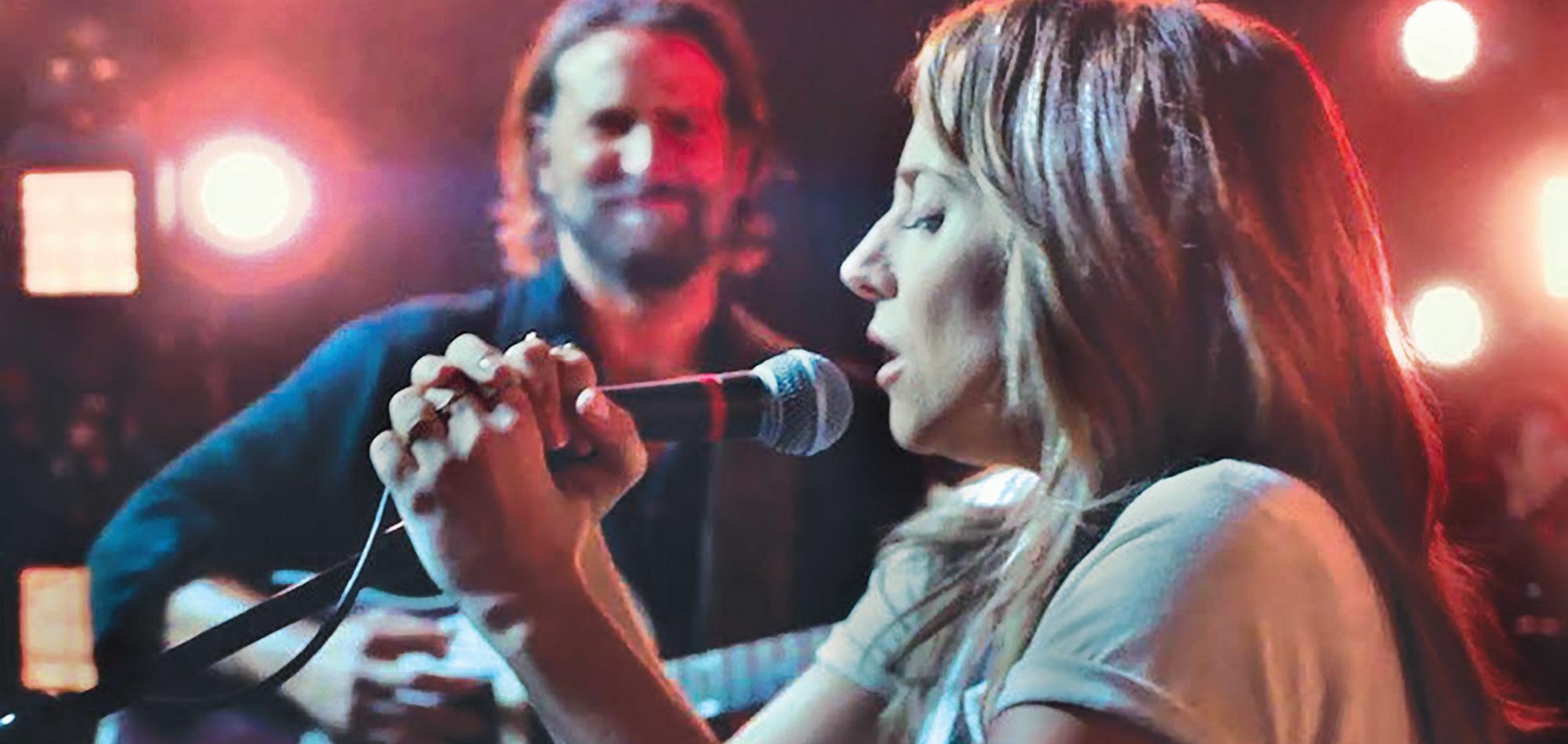
Right off the bat I’ll save you a Google — that really is Bradley Cooper singing. Damn son. I mean of course Lady Gaga can sing; she’s Lady Gaga, but . . . damn.
Anyway, the first 45 minutes or so of A Star is Born were spectacular — and shout out to Cornell Cinema for letting me see those 45 minutes (and the rest of ’em) a full two days early. Some basic plot (no spoilers — this is trailer stuff): the film’s plot sees Cooper’s character, a country music star battling addiction, “discover” and subsequently fall for Gaga (is “Gaga” her last name? I’m gonna roll with it . . . ). The two begin to tour together and Gaga’s career quickly surpasses that of Cooper’s “Jack” in step with an escalation in the severity of Jack’s alcoholism. And despite what I thought to be an admirable cinematic debut from Lady Gaga coupled with stellar acting and directing (especially with regard to the music scenes) from Cooper, the dichotomy created between Gaga’s rise Cooper’s fall felt . . . well, created.
A Star is Born just wasn’t what I thought it was gonna be. I let myself cheat a bit with trailers, and from what I saw, I thought I was in for another run-of-the-mill salvation story — Gaga’s character would “save” Cooper’s and everyone would walk out happy because love won the day. Heck, the trailer even showed him walking into what I thought was an AA meeting. This movie really surprised me by it choosing a path less travelled, postulating that perhaps things aren’t so easy and that happy endings aren’t realistic. But in taking this riskier shot, it missed.
What I think A Star is Born was going for, and what it was so close to being, was an unrelenting, gritty and focused character study on a man who’s finally gone off the deep end, but I could never shake the feeling that someone had made the decision to put what could have been an Oscarworthy story arc on the backburner.
There didn’t need to be jokes in this movie — the assumption that the American people won’t flock to theaters unless we baby them into feeling good about them-
selves is reductive and, quite frankly, a little insulting. What separates great movies from good ones is their willingness to rise above appealing to the lowest common denominator — if you’ve got something meaningful to say, and A Star is Born clearly did, just fucking say it. Movies need not speak softly around their big stick — Cooper’s character clearly had a lot of issues worth exploring, so why were we so worried about Gaga’s reservations about pop music choreography? Why, when we could be delving into the wound Jack’s father’s suicide opened, are we spending time discussing the color of Gaga’s hair?
I’m by no means dismissing the points the movie made about the music industry — the challenge facing women trying to break into show business is certainly an unfair one and one worth discussing, but if that’s the direction the film wanted to go in, it shouldn’t have limited that commentary to a series of brief, if not spunky (in lieu of being really empowering) asides.
I waited — well, actually I kinda got to skip the line because journalism is power . . . but, uh . . . other people waited – in a line up two flights of stairs and out the door of
Willard Straight because A Star is Born’s trailers promised us real, focused emotion. But in splitting my attention across a smattering of different tangents, it more or less lost me.
This is a bit of a spoiler, but Gaga’s character was sad at the end of the movie and I think my whole issue boils down to the fact that I couldn’t fully comprehend why – there was too much going on, and all of it was given too little time (which is a knock on a movie with a runtime well over two hours) for me to truly feel her sadness with her.
This movie should have made me cry.
I mentioned Oscar-worthiness earlier because I just know this is gonna be one that nags at me in February similarly to how Darkest Hour, The Post or even Lady Bird did last year. That’s to say that A Star is Born is a fine film on its own two feet, and certainly one worth seeing if only to salivate over Cooper’s disheveled country star look, but realistically will be out of place among the other titles in consideration for best of the year come awards season.
Nick Smith is a jumior in the College of Arts and Sciences. He can be reached at nsmith@cornellsun.com.
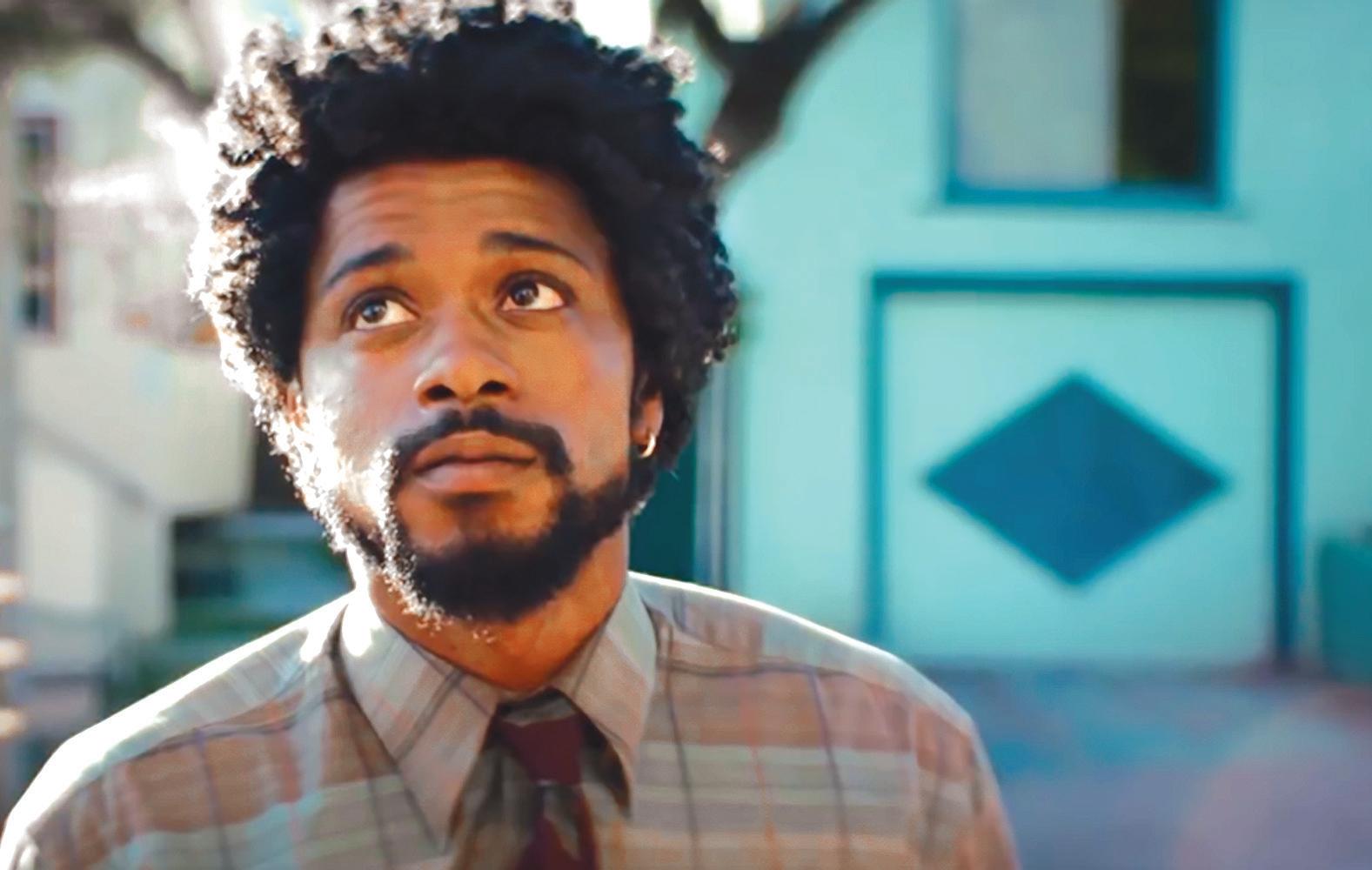
Sorry to Bother You presents a uniquely absurd story about finding meaning in a racially and economically unjust world. What appears on the surface as biting satire transforms into a thrilling but radical sci-fi about our rights as workers and as humans.
Centered in an alternate-reality present day Oakland, Sorry to Bother You tells the story of Cassius Green (Lakeith Stanfield), who after discovering the key to telemarketing success rockets up the corporate ladder and is swallowed into a world of corporate greed. Meanwhile, his girlfriend Detroit (Tessa Thompson) and his friend Salvador (Jermaine Fowler) attempt to organize the telemarketers Cassius once worked with and protest against the corporation Worry-Free, which specializes in providing modern-day slave labor to other companies.
The movie opens with Cassius landing his much-needed job in telemarketing and being told to just “stick to the script.” For the first half of the film, characters seem to follow this role, as we move through the daily life of Cassius and his coworkers in their attempts to get by. In between these scenes, we see Cassius struggle with this reality and attempts to find meaning with his life, his seriousness matched by quick humor of the rest of the characters and the absurdities of his supervisors.
One of the things that stands out in
this movie is the delicacy of the script. Every line seems intentional, holding multiple meanings and references to different parts of the movie and keeping viewers on their toes. Questions are left open and unanswered to reflect the broadness of their applications from different characters, scenes, and ultimately to our own lives. Ideas are presented only briefly for their meanings to be revealed halfway through the film. And, of course, the satire of the film is hilarious. Sorry to Bother You at times feels more like a book than a movie, and you will leave the cinema wanting to re-watch it over and over to fully understand its meaning.
The uniqueness of the script is matched equally by the color of its characters and
the strength of these performances by their actors. These capture the audience into the weirdness of the movie and the plight of Cassius and his friends. Cassius’s hesitation and weariness make his silences speak volumes, while the strong and bold presence of Detroit dominates all scenes she is in. Steve Lift (Armie Hammer) perfectly balances his uniquely manactical charisma while embodying the masculine corporate genius found at the upper echelons of every company in America. As a couple, Detroit and Cassius provide a chemistry that gives a focal point for the movie to gravitate around a revolving door of characters and surprising twists.
Halfway through, the movie dives headfirst into an abyss of crazy. But by
then, for those willing follow Cassius through this twist, the wildly absurd continues to be incredibly engaging. As the movie reaches its climax, the intensity of this nonsensical reality is somehow both thrilling and hilarious at the same time. Despite all the craziness, the movie still manages to be grounded in its messages, and the fantastical world of Cassius still manages to feel more real than any other movie I’ve seen this past year. It remains forward and unapologetic to what it reflects on our own world and forces us to contend with its presentation of racial and economic injustice.
Granted, for some, the sudden change in the plot and pace of the movie is too great a leap. However intentional it was, the transition from witty satire to science fiction feels jarring and unexpected, which may alienate some viewers. For that reason, not everybody will be willing to continue engaging with the movie, and will walk away feeling a loss of potential. To these viewers, I urge you to give this movie a chance.
Sorry to Bother You presents a world that exposes both the racial and economic reality of our country and a radically different vision of what our country could be like. The script and its performance create a thrilling and wild roller coaster that will spin around your worldview and leave you dizzy but excited for more.
Michelle Goldberg is a junior in the College of Industrial and Labor Relations. She can be reached at mmg234@cornellsun.com.
Two weeks ago, during an appearance as musical guest on the season premiere of Saturday Night Live, Kanye West delivered an unplanned pro-Trump speech to the audience as the credits rolled. Now you’re probably rolling your eyes and thinking I’m either going to defend or bash Kanye on his speech and his twitter rants about the 13th Amendment. Well, I’m not going to do either of those things. There’s something else entirely that concerns me.
This past Saturday, SNL cast member Pete Davidson discussed the incident during “Weekend Update.” Davidson urged Kanye to take his meds and said that while Kanye is a musical genius like “Joey Chestnut is a hot dog-eating genius,” he doesn’t want to “hear Joey Chestnut’s opinions about things that aren’t hot dog-related.”
Incidentally, the day before Davidson’s SNL appearance, Lady Gaga went on The Late Show with Stephen Colbert and gave a defense of Dr. Christine Blasey Ford with regards to memory mechanisms and trauma, and her speech soon went viral on Twitter. The day after, Taylor Swift made a surprising Instagram post in which she endorsed Democratic candidates for Tennessee and encouraged her fans to register to vote in the upcoming midterm elections, breaking her prolonged political silence. While many applauded Gaga for standing up for sexual assault survivors, many also laughed off her explanation of memory simply because she’s “just an artist.” And while many applauded Swift for finally using her massive platform for political advocacy, the critics, especially those who are upset about her endorsements, expressed a sentiment similar to what Davidson said on SNL — artists should not involve themselves in politics.

The idea of an apolitical artist is incredibly troubling to me, especially in this day and age. It is a sentiment shared by many people on both ends of the political spectrum, that artists should not voice their political opinions, and that when they do, they should not be listened to because they are not experts on the matter. For some, seeing an artist going public about their political stance undermines the value of their work and their credibility as a creative. The people who post in the Facebook
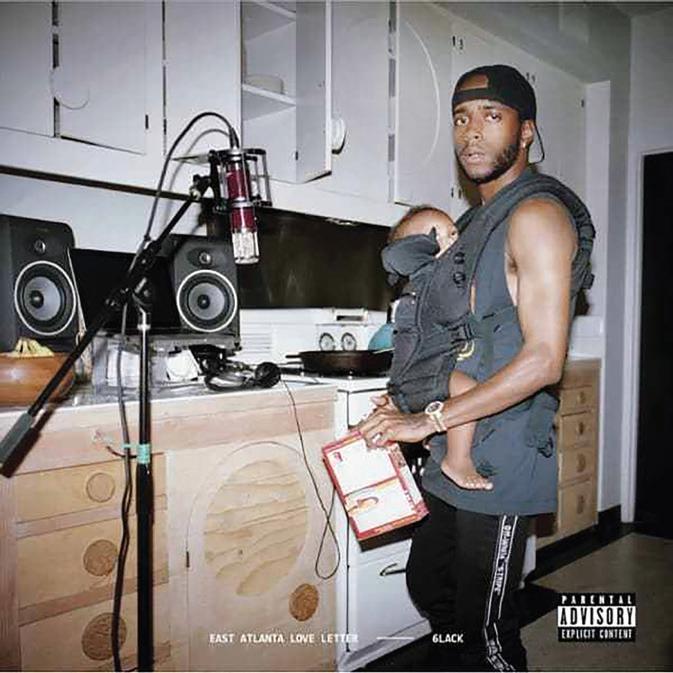




East Atlanta Love Letter is exactly what it’s called — a letter. Not an email, text or DM. 6LACK’s sophomore album works to escape from what he deems love has become. He brings us back some decades, even inviting fans to an authentic drive-thru album release event. In this new project, which he tells took over two years to complete, 6LACK steps away from the kind of subject matter that we find in mainstream rap. 6LACK’s album is calming, cozy and refreshing.
We embark on 6LACK’s journey to find that he begins a player on the albums

comment sections “who cares” with an eyeroll emoji are essentially saying “shut up and just make your art.”
The underlying assumption in such belief is that arts and politics are inherently separate entities, when in reality they have always have been interconnected. We love and resonate with music because, in one way or another, they capture what we feel or who we are. We laugh and cry at movies and plays because they either tell our own stories or enable us to see the world through a different lens. Great artists are constantly reinventing themselves, their artistic form, and in doing so essentially testing the boundaries of human imagination.
Intentionally or unintentionally, art has always strived to capture and comment on the human condition — our greatness and plight, our pain and joy, be it as “significant” as war and peace, or as “insignificant” an ex who cheated. And isn’t that what political expression is, or at least, is supposed to be? Describing the world as we see it, or voicing what we’d like it to be? In the end, the apolitical artist doesn’t exist, because there is no art that isn’t political.
second track, “Loaded Gun.” As he continues, we hear his voice soften when his mentality begins to shift in tracks like “Sorry” and, notably, “Seasons.” What makes this reflection on modern romanticism especially innovative and three dimensional is 6LACK’s use of the seasons to string together this multi layered concept. Slowly but surely, winter changes to summer as 6LACK uncovers what romanticism is today, what it has been previously and what he wants it to be. What seems of particular interest is the album’s release date of September 14. 9/14 by no means leads us into summer, while actually bringing us into the darker months. 6LACK begins with Khalid in “Seasons,” one of the most melodic, catchy track of the album, “It’s been a little cold.” Temperature, as 6LACK indicates, is more a feeling rather than a season. A vibe. For regardless of where we fall in the seasonal calendar, if we remember what love is, “a beautiful summer’s calling.”
As far as production, East Atlanta Love Letter embodies the similar eerie, yet warm and fuzzy sounds to those of 6LACK’s preceding album, FREE 6LACK. In East Atlanta Love Letter, 6LACK collaborates with none less than Future on “East Atlanta Love Letter,” J. Cole on “Pretty Little Fears” and Offset on “Balenciaga Challenge.” Collaborations are significant, yet smooth and complementary, as 6LACK gave his fans the quality content he knew they’d enjoy for seasons to come.
Pronounced by a female voice in his “Seasons” sample, “what might this life be like if we put our pride aside and let love lead the way?” 6LACK alludes to his daughter Syx throughout the album. He even featured his daughter on his Instagram page in association to the work. Unlike the overload of misogynistic con-
That is not to say that artists, like any other individual, should not be called out when they spread misinformation in discussing their individual politics, especially given that they have a much larger audience than ordinary people. Kanye can be as pro-Trump as he wants — it is, after all, written in the laws of this land — but he also deserves backlash when he says things that are factually incorrect. There’s nothing wrong with correcting Lady Gaga if she did in fact explain memory and trauma wrong, but she shouldn’t be discredited simply on the basis of being a singer. On the flip side, artists shouldn’t be obligated to be publically political just because how large of a fanbase and influence they might have. Taylor Swift’s decision to voice her political opinions now is not something she’s owed the world, but more so her redefining herself as an artist and as a citizen.
So let’s give them more credit and allow our artists their political expression — because it’s always been between the lines of the job description. And to echo Swift’s speech at the AMAs: “It’s the midterm elections on November 6. Get out and vote.”
Andrea Yang is a junior in the College of Arts and Sciences. She can be reached at ayang@cornellsun.com. Five Minutes Till Places runs alternate Mondays this semester.
female voices appear in samples throughout the album, addressing double standards in sex and relationships. It’s different. It’s progressive.
A few days following the album’s release, 6LACK indicated on Instagram that he created his East Atlanta Love Letter in order to help people have better conversations about love. Rather than declaring that he has all of the answers, 6LACK allowed fans to submit videos discussing their views on monogamy as a means of propelling the kinds of conversations that he so vehemently wants his fans around the world to have. Technology has disconnected us from our feelings, as 6LACK articulates. East Atlanta Love Letter thoughtfully criticizes love in the digital world, most notably through “Disconnect,” whose pro-
SUN
that, he implies. It can reconnect us.
6LACK writes on the East Atlanta Love Letter booklet, “I wrote this album for those with difficulty expressing themselves or their love. Communication is key and over time it’s proven to be my biggest obstacle. I want you to know that just because it’s hard doesn’t mean it’s impossible. Never give up on love because it’s the most powerful feeling you can share with someone, and if you’re feeling doubtful, know that I wrote this especially for you to listen to during those times. I hope it helps.”
is
in the College of Arts and Sciences. She can be reached at jr798@cornellsun.com.
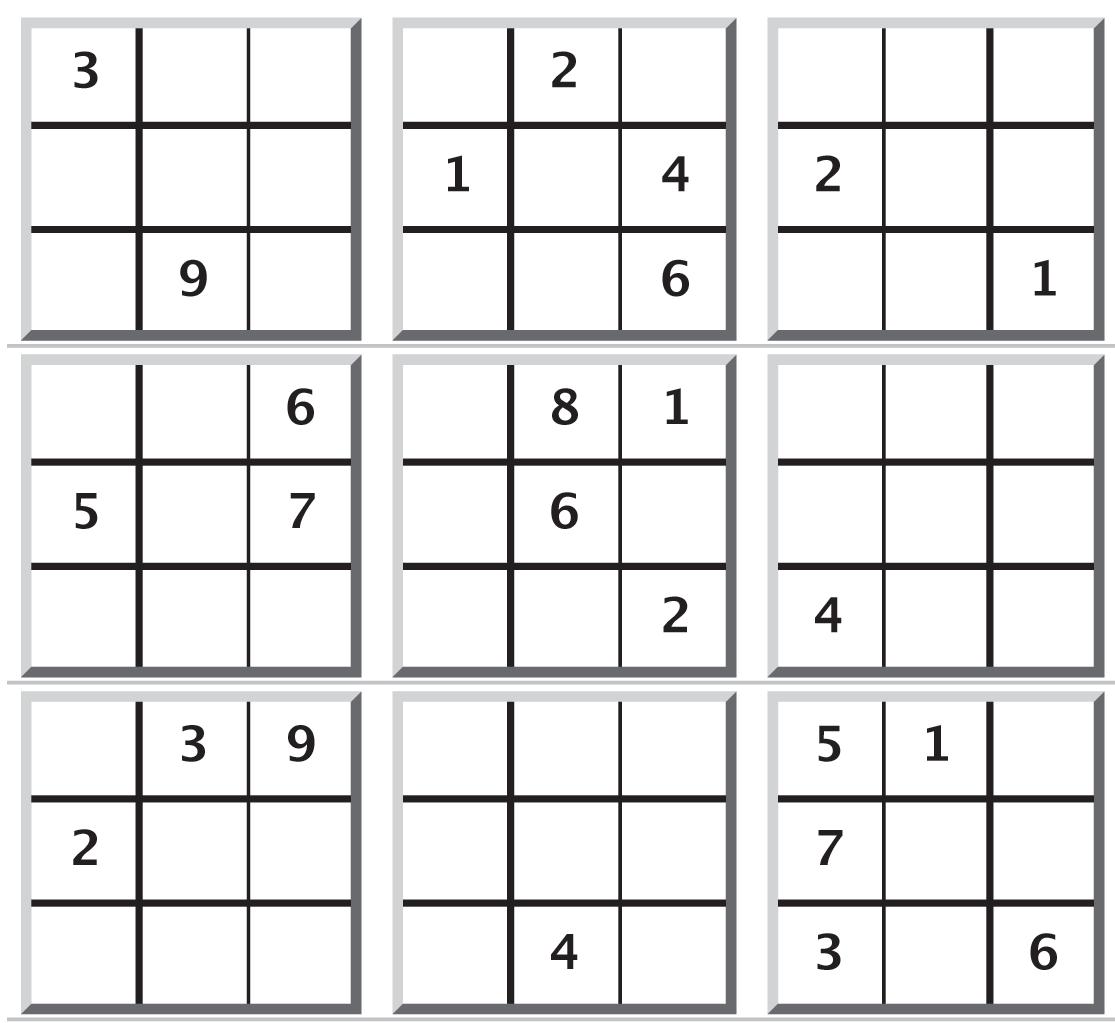
Fill in the empty cells, one number in each, so that each column, row, and region contains the numbers 1-9 exactly once. Each number in the solution therefore occurs only once in each of the three “directions,” hence the “single numbers” implied by the puzzle’s name. (Rules from wikipedia.org/wiki/ Sudoku)


2&3 BEDROOM 109 SAGE PLACE
Available NOW, Spring 2019 & 2019/2020 Shuttle Bus Access to Campus Access to Free Fitness Center Novarr- Mackesey Property Management office@ithacastudentapartments.com 607-277-1234
COLLEGE AVE.
1 Bedroom available In a 2 BR
4 Bedroom Apartment Available NOW & Spring 2019 Novarr-Mackesey Property Management office@ithacastudentapartments.com 607-277-1234
Collegetown STUDIO 2019/2020 QUIET STREET only 1/2 Block from College Ave. Roomy - Fully FurnishedHardwood Floors 607-351-3898 Email: marthabell004@yahoo.com
We have availability for the 2019-2020 school year beginning June 1st at Hudson heights apartments. The studio apartments come with: heat, water, and electricity included. There are garbages houses and coin-operated laundry facilities on site. Prices start at $750/month for a 12 month lease. If you have any questions or would like to schedule a tour contact us by phone 607-208-7660 or email: renting@ithacaLS.com
>>AFFORDABLE, QUALITY LIVING<< Special Deals for you! Furnished 1-6 Bedrooms Collegetown Apartments PARKING, LAUNDRY, UTILITIES! (607) 273-7368 www.IthacaApartmentRental.com
LUXURY AT REASONABLE PRICES 5 & 6 BEDROOM ON LINDEN AVE 8 BEDROOM ON CATHERINE ST. AVRAMISREALESTATE.COM 607-272-3389
Houses, Apts, Parking 1 to 9 Bedroom
Collegetown - College Ave, Linden Ave, Dryden Rd, Bryant Ave, Cook St. 607-330-2442 info@urbanithaca.com www.urbanithaca.com
RENT NOW, GET THE BEST www.MatoulasHouses.com
Apartments & Houses In Collegetown LINDEN AVE & E. SENECA ST 1 & 3 BEDROOM APARTMENTS ALL FURNISHED EMAIL: MatoulasHouses@Gmail.com PHONE: (607) 339-9644 FIRST-COME, FIRST-SERVED
*****************************
Don’t let the wind blow your paper away
Collegetown Terrace Apartments INSPIRED LIVING TAILORED TO YOUR SUCCESS 24-Hour Fitness Center Shuttle Bus Service to Campus Study Rooms w/ Expansive Views
Apartments Available NOW, Spring 2019 & 2019/2020 Novarr- Mackesey Property Management collegetownterraceithaca.com office@ithacastudentapartments.com 607-277-1234
27 H OUSE FOR R ENT
201 WYCKOFF AVE
6 Bedroom House Novarr-Mackesey Property Management office@ithacastudentapartments.com 607-277-1234




The 2018 postseason for Cornell men’s ice hockey was disappointing in some respects. After claiming the best record in the ECAC, the national No. 1 ranking — albeit briefly — and even the country’s best defense, the season seemed to fall short after a pair of upsets in the ECAC and NCAA tournaments.
Jack Kantor In the Box
But if one considers what was expected of the Red last year, the season was undoubtedly successful. After starting off last season ranked 15th and third in the national and ECAC polls, respectively, the Red exceeded expectations — at least in the regular season.
As a result, Cornell is now considered to be the best team in the ECAC and the seventh-best team in the nation entering the season, according to the preseason polls.
This may seem like a lot of praise for a team that failed to reach its conference finals or win a game in the NCAAs. But at the end of the day, the squad had a couple bad games that could not have come at a worse time. Playoffs aside, Cornell exhibited prowess over its opponents throughout its campaign last season, specifically on defense, proving to be the No. 1 defense in
Smith, Alex Green, Cody Haiskanen and Matt Cairns. Everyone, and I mean everyone, from the defense is still on the roster (Okay, if you’re really keeping close tabs, backup goaltender Hayden Stewart graduated. But that’s it).
Not only did the nation’s best defense keep all of its players, it added to its plethora of talent. Freshmen Misha Song from China and Joe Leahy from Ontario will join the Red at the blueline this season. If not to add more excitement to the Cornell defense, Song is the first China-born NHL draft pick after he was selected by the New York Islanders in the 6th round of the 2015 NHL Entry Draft.
On top of adding some youth, Cornell will also regain some experience on the defensive end. Senior Ryan Bliss will finally make his return to the roster after missing the last couple seasons to injury. In his most recent season (201516), Bliss contributed with 10 points and appeared in the most games of any Cornell defenseman.
Even the forwards for Cornell play a role in maintaining a stifling defense. Cornell managed to concede the least amount of shots on goal because players on both defense and offense put their bodies on the line to block shots, a focus of head coach Mike Schafer. As a result, forward Mitch Vanderlaan was named a finalist for best defensive forward in the ECAC last year. With guys
When a team has the nation’s best defense, keeps every defender, sports an All-American goaltender ... it’s reasonable to expect that they can be the league’s best team.
the nation (1.58 goals allowed per game). Considering that defense will be just as good, if not better, this season, it makes perfect sense why there are such high expectations for the Red.
At the nucleus of the Cornell defense is goaltender Matthew Galajda, who returns to net after a breakout freshman campaign that surprised all. As the netminder for the nation’s best defense, Galajda naturally led the nation with an astounding 1.51 goals allowed average, including nine shutouts (also best in the country). To see dominance and consistency from a collegiate goalie is without a doubt exciting. But to see that from a freshman is truly something else. And while a sophomore slump is always in the cards, it’s likely the first-team AllAmerican will be one of the nation’s best goaltenders again this season.
In terms of blueliners, Cornell did not lose a single defender from last season’s roster: Alec McCrea, Yanni Kaldis, Matt Nuttle, Brendan

like Vanderlaan still around, the forwards will certainly contribute to a strong defensive effort this season.
It certainly makes it easier to sleep at night knowing your team will likely give up two or less goals on average. Even if there are some minor question marks surrounding the offense with the departure of key goal scorers in Trevor Yates and Anthony Angello, who forwent his senior year to play professionally, the quality of the returning defense makes up for any offensive shortcomings.
It really can’t get much better than this, which is why expectations are as high as they are for Cornell. When a team has the nation’s best defense, keeps every defender, sports an All-American goaltender and even adds some defensive talent in the process, it’s reasonable to expect they can be the league’s best team and a top-10 team in the nation.
Jack Kantor
By FAITH FISHER
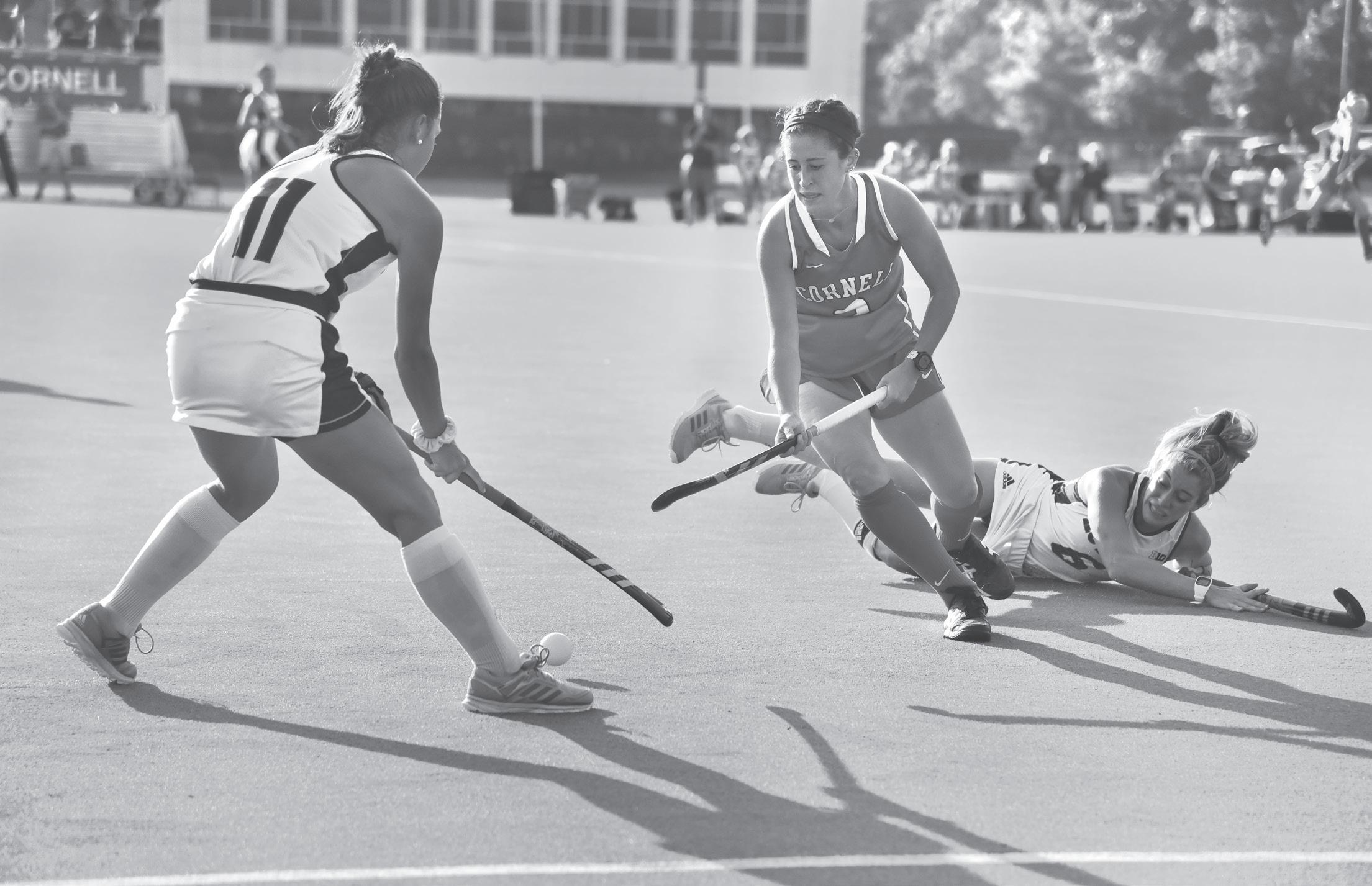
Struggling to break past Yale’s defense, Cornell field hockey fell to the Bulldogs in a well-fought 1-0 overtime loss, but recovered to triumph 2-0 over Lehigh Monday evening.
Both the Red and the Bulldogs arrived at Cornell’s Dodson Field on Saturday looking to secure their first Ivy League win of the year.
In the first half of the game, the Bulldogs (5-4, 1-2 Ivy) took the offensive advantage, overwhelming Cornell (3-8, 0-3) with a 6-2 lead in shots. Sophomore forward Grace Royer struggled to find the back of the goal as goalie Sydney Terroso and defender Theodora Dillma thwarted her back-to-back shots.
During the second half, Yale once again outshot the Red, 9-4. However, junior goalkeeper Maddie Henry managed to neutralize the Bulldogs’ offensive spree, saving a total of 10 shots on goal — an ironclad defensive performance that kept Yale off the scoreboard.
But the battle of defenses lasted just a few minutes into overtime, when Yale midfielder Bridget Condie intercepted a pass in the Red’s defensive zone, rushed into the circle and tucked a reverse stick shot into the back of the goal — ending the game with a 1-0 score.
“Frankly, overtime was a disappointment. We were immediately playing against friction instead of passing the ball to open space and giving ourselves a chance to spread the field and get into our pattern,” said assistant coach Steve Simpson.
“The goal that we lost on came directly from losing the ball when we didn’t have to lose the ball.”
With just two penalty corners during the whole game, Cornell continually struggled to gain access into Yale’s defensive zone.
But despite closely missing a chance at notching its first conference victory of the year, Simpson said that the Red’s loss was not without its positives.
“We played well against Yale,” he said. “As is often the case in sports, small percentages make the difference, and it was small percentages in this game that made the difference.”
As it turned out, the Red successfully capitalized on these critical ‘small percentages’ when it toppled Lehigh two days later.
Just 16 minutes into the game, junior midfielder Kirsten Pienaar put Cornell on the scoreboard when she sent a penalty



stroke, assisted by Julianne Mangano, into the Mountain Hawks’ goal.
The Red extended its lead at the end of the first half when senior midfielder Gabby Depetro’s shot rebounded off Lehigh goalie Paige Innarella towards sophomore midfielder Taylor Glad, who scored her first collegiate goal.
Thanks to Henry’s six saves, Lehigh failed to convert any of its shots into goals.
Cornell held onto its lead throughout the scoreless second half, dominating both on offense and defense. The Red outnumbered Lehigh in shots, 18-12, and secured its first defensive shutout of the season.
Simpson attributed the team’s success compared to its previous game to outstanding effort and teamwork.
“Our midfield play was really good and our outleting was the best that it has been all year … it was a really good statement of the group’s improvement over the last


couple of weeks,” Simpson said.
The Red faces off next against Harvard, when it will have a chance to snap its three-game Ivy losing streak. The matchup promises to be a tough one for Cornell, with Simpson stressing the need for the Red to continue making improvements if it wishes to be competitive with a team that has lost only a single game all season.
“Harvard is having a really great season and they have a lot of great players,” Simpson said.
“We can step our game to compete against them. It is going to come down to how we apply ourselves, use our support and play with consistency.”
Cornell takes the field at 12 p.m this Friday in Cambridge, Mass., where the game will be streamed on ESPN live.





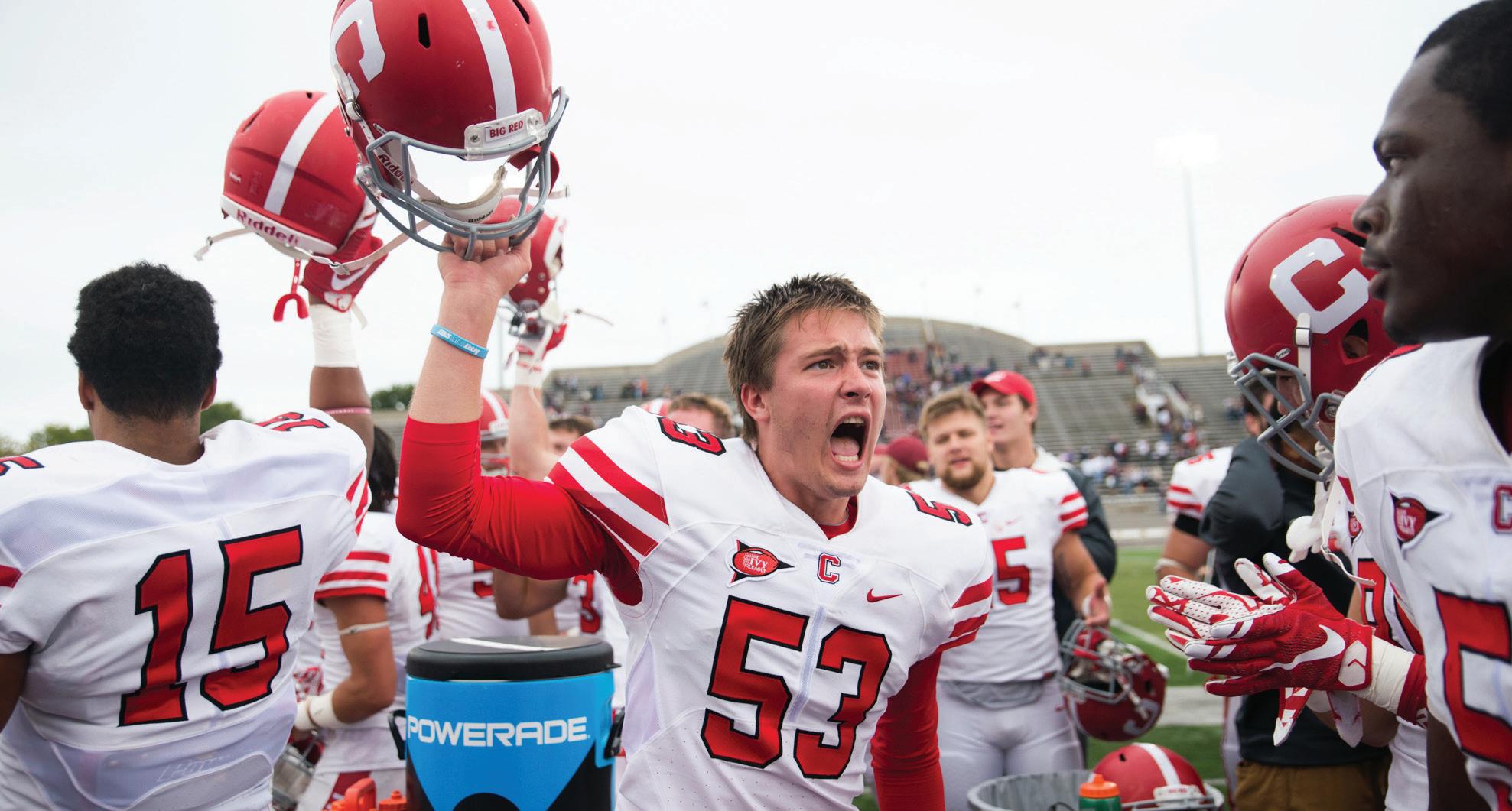
By ZACHARY SILVER Sun Senior Editor
Dalton Banks doesn’t like to live in the past.
“You have to bury those and [always] think forward,” he said Tuesday about Cornell football’s current two-game winning streak.
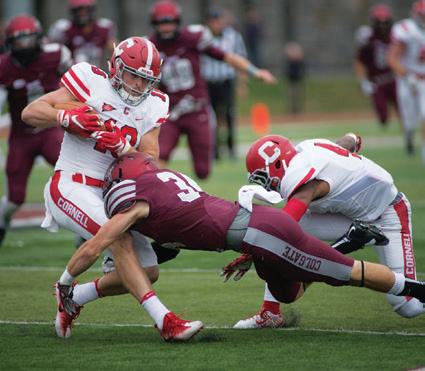
But sometimes, even as he keeps his focus squarely on the 2018 Ivy title, he can’t help but cut himself a break. Some moments in the past are too good to not reminisce upon. No highlight reel is is more prominent for Banks than that of two years ago, when he led the Red to a shocking, come-frombehind win over thenNo. 25 Colgate as just a sophomore.
“I don’t do it too much, but here and there,” Banks said with an beaming grin when asked if he watches highlights of his 454yard, five-touchdown performance against the Raiders in 2016. “It’s fun to watch plays with those guys from back then because most of them aren’t around these days. It’s always fun seeing them out there.”
everybody’s geeked up going into it. … We’re just trying to keep the momentum. One game at a time.”
Cornell owns a 49-47-3 record in the all-time series against the Raiders, but history does not support contemporary. Colgate, now ranked No. 17 in the nation, has won 31 of the last 39 meetings, including a 21-7 stifling of the Red at Schoellkopf last season.
But Saturday presents Cornell with its second consecutive opportunity to knock off a ranked Colgate on the road.
“We just know that it can be done,” Taylor said.
“That’s vivid in everybody’s mind here.”

For the first time since Banks and the Red rallied from a 28-5 deficit for a 39-38 victory over the Raiders, Cornell returns to Hamilton, New York this Saturday for the 100th meeting between the two upstate rivals. For many on the roster, it will be a trip 60 miles up Route 13 full of nostalgia and fond memories. For all, it will be a chance for the impetus of two straight wins to continue with a national powerhouse on the docket.
“I love going up there,” said head coach David Archer ’05.
“Definitely want to win the 100th matchup,” added junior safety Jelani Taylor, who recorded some of his first career tackles as a freshman in the 2016 game at Colgate. “There’s a lot of energy,
The Raiders gave Cornell a good, long look at their vicious defense as Banks was sacked on nine separate occasions in last year’s loss. That defense has only improved.
To say the current Colgate defense is smothering would be an understatement. Across the FCS, the Raiders rank No. 3 in total defense (248.2 yards per game), No. 6 in rushing defense (77.6 yards per game) and No. 7 in pass efficiency defense (98.02).
The Raiders also love to steal the ball, tallying five interceptions on the year and forcing 14 fumbles, recovering nine.
Colgate has given up just 4.6 points per game on the year, good enough for No. 1 in the country and almost twice as good as Princeton, the next team in line.
The Raiders have conceded just six points total in its last four games and 23 on the year.
“That would be good if that was [just] your points per game,” Archer said.
But luckily for Cornell, the team believes its offensive synergy is coming along at the right moment. Archer said that the Banks he saw down the stretch in the win over Harvard — 4-for-4 with 66 yards on two touchdown drives — hear-
By RAPHY GENDLER Sun Assistant Sports Editor
While Cornell stormed back in the fourth quarter to down Harvard this past weekend, Ivy League leaders Dartmouth and Princeton turned in impressive performances to remain undefeated on the season. The Green and Tigers are both 2-0 in Ivy League play while the Red, Harvard and Yale sit at 1-1 in league play.
Dartmouth 41, Yale 18
kened back images of Banks in the 2016 win over the Raiders.
“He’s matured 20-fold from that game,” Archer added on Tuesday. “He can still sling it around like he did two years ago, but as a complete quarterback, I’m so proud of the way he’s improved and how he’s played this year.”
And on the defensive side of the ball, Cornell will be tasked with stopping the top offense in the Patriot League. The Raider offense rushes more than twice the amount of times it throws (224 rushes vs. 104 passes on the season), with James Holland and his six touchdowns — five rushing, one receiving — carrying the majority of the load on the ground.
But the Raiders remain efficient in the air, too. Quarterback Grant Breneman’s favorite target is Owen Rockett, who leads the Patriot League with 67.8 yards per game, thanks in part to his 21.2 yards per catch.
With all that in mind, the Red defense has its work cut out for it.
“Everybody knows they have a tough defense, but we also feel that we have a great defense,” Taylor said. “It’s going to be a tough battle … [but we can] hopefully force some turnovers and help our offense out.”
One hundred years of upstate headbutting will take center stage on Saturday, and it’s personal for Archer. His sister was a cheerleader at Colgate before getting her graduate degree at Cornell. The Upstate New York native Archer family would often go to games in Hamilton to see their daughter perform, and the one road trip the family went on was to CornellColgate at Schoellkopf.
“We try to keep it to a minimum at Cornell-Colgate week,” Archer said of the banter with his sister with a chuckle. “[But] there’s no doubt who she’s rooting for. There’s no question she’s Big Red all the way here.”
The emergent Green stormed into New Haven and dominated preseason Ivy favorite Yale thanks to 169 rushing yards from junior quarterback Jared Gerbino. Dartmouth, which has not trailed in a game yet this season, got off to a hot start, scoring 27 first-half points thanks to 152 yards and two scores from Gerbino in the first 30 minutes. Six different players had double-digit rushing yards for Dartmouth. The Green dominated despite the Bulldogs possessing the ball for 34 minutes, due in part to Yale committing three turnovers compared to Dartmouth’s one.
Rhode Island 48, Brown 0
Ivy cellar-dweller Brown’s struggles continued Saturday during a thumping at the hands of its in-state rival Rhode Island. Sophomore Vito Priore threw for
Columbia 34, Marist 24 Marist took a 21-17 lead early in the third quarter, but Columbia scored touchdowns on its next two drives to put away the Red Foxes and improve to 3-1. Sophomore quarterback Josh Bean threw for 282 yards and two touchdowns for the Lions, who converted all four of their fourth down attempts and out rushed Marist, 131-38.
Princeton 66, Lehigh 7 Senior quarterback John Lovett and the high-flying Princeton offense were on display once again on Saturday, with Lehigh their latest victim. Lovett had 288 passing yards, 111 rushing yards and four total touchdowns as the Tigers scored four times in the first half to take a 31-7 after 30. The second half wasn’t any prettier for the Mountain Hawks — Princeton scored five second-half touchdowns while shutting out Lehigh in the third and fourth quarters.
Penn 31, Sacred Heart 27 Sacred Heart lost to an Ivy League foe for the second consecutive week after being dispatched by Cornell last week. It wasn’t for a lack of resilience, however. Penn led 24-0 early in the third quarter, but four straight second-half Pioneer touchdowns — including a fumble returned for a score — gave Sacred Heart a late three-point lead. Senior Christian Pearson, who had 104 receiving yards on the day, caught his second touchdown to give the Quakers the lead for