The Corne¬ Daily Sun


Cornell announced on Tuesday that Prof. Kevin Hallock, dean of the School of Industrial and Labor Relations, will be the next dean of the SC Johnson College of Business, choosing an internal candidate to take over the fast-growing college that aligned three schools under the same roof in 2016.
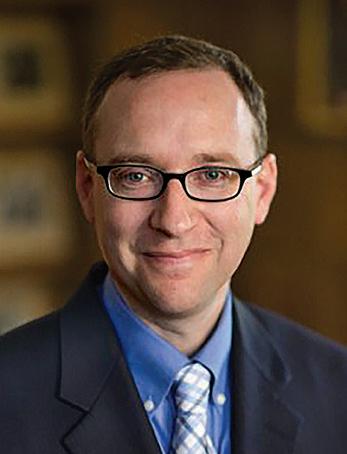
Provost Michael Kotlikoff’s appointment of Hallock, 49, caps a months-long search for a dean to replace Prof. Soumitra Dutta, the founding dean of the college who abruptly resigned without explanation in January. Emeritus Prof. L. Joseph Thomas has been serving as interim dean since Dutta’s resignation and will continue to serve until Hallock takes over on Dec. 15.
“When you have built camaraderie and trust with a group and really like the direction of how things are going, you’re reluctant to give that up.”
Prof. Kevin Hallock
Hallock, an expert on executive compensation and labor markets who has led the ILR School since 2015, said on Tuesday morning that he had initially resisted throwing his hat in the ring for the business college role because of his love for the ILR School.
“When you have built camaraderie and trust with a group and really like the direction of how things are going, you’re reluctant to give that up,” he said in a phone interview, adding that once he was convinced the ILR School would be in good hands, he decided to participate in the interview process. Kotlikoff will name an interim dean for the ILR School next week and begin searching for its next leader.
Hallock said he would spend the next two months listening to people
See DEAN page 4

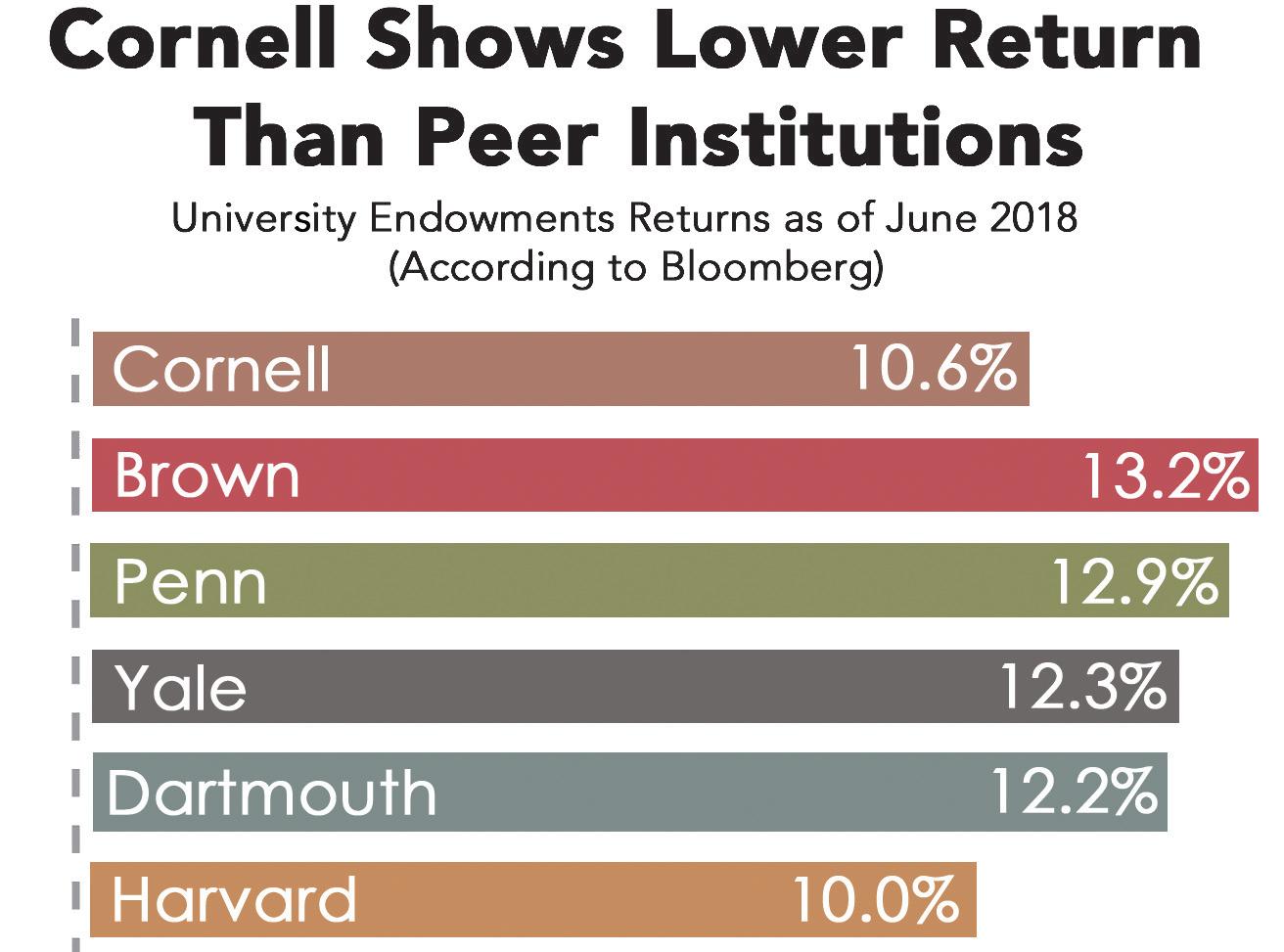

Gains | Cornell’s endowment returns for fiscal year 2018 inch just above Harvard University’s returns.
By YUICHIRO KAKUTANI and HYEJI SUH Sun News
By JOSH GIRSKY Sun Senior Editor
Cornell’s endowment increased 10.6 percent in fiscal year 2018, the second worst returns out of the Ivy League schools that have announced results so far.
This year’s increase ranks just ahead of Harvard, which has also experienced subpar endowment returns in the past few years. The Cambridge, Massachusetts school saw a 10 percent increase in its endowment in the last fiscal year, which runs from July 2017 to June 2018. Brown has posted the best result of the Ivies so far, with an increase of 13.2 percent.
Cornell’s increase also trailed the S&P 500, which increased about 12 percent. However, it beat the 8.3 percent median gain for 143 endowments of all sizes in the period, according to data by Cambridge Associates seen by Bloomberg.
This year’s increase ranks just ahead of Harvard, which has also experienced subpar endowment returns in the past few years.
In a statement, the University said this year’s gains were driven by private equity investments, global equities and enhanced fixed income.
Cornell trustee and chair of the board’s Investment Committee Girish Reddy M.Eng. ’78 MBA ’80 said in the statement that the University restructured its portfolios in the last
See ENDOWMENT page 3
By PARIS GHAZI Sun Assistant News Editor
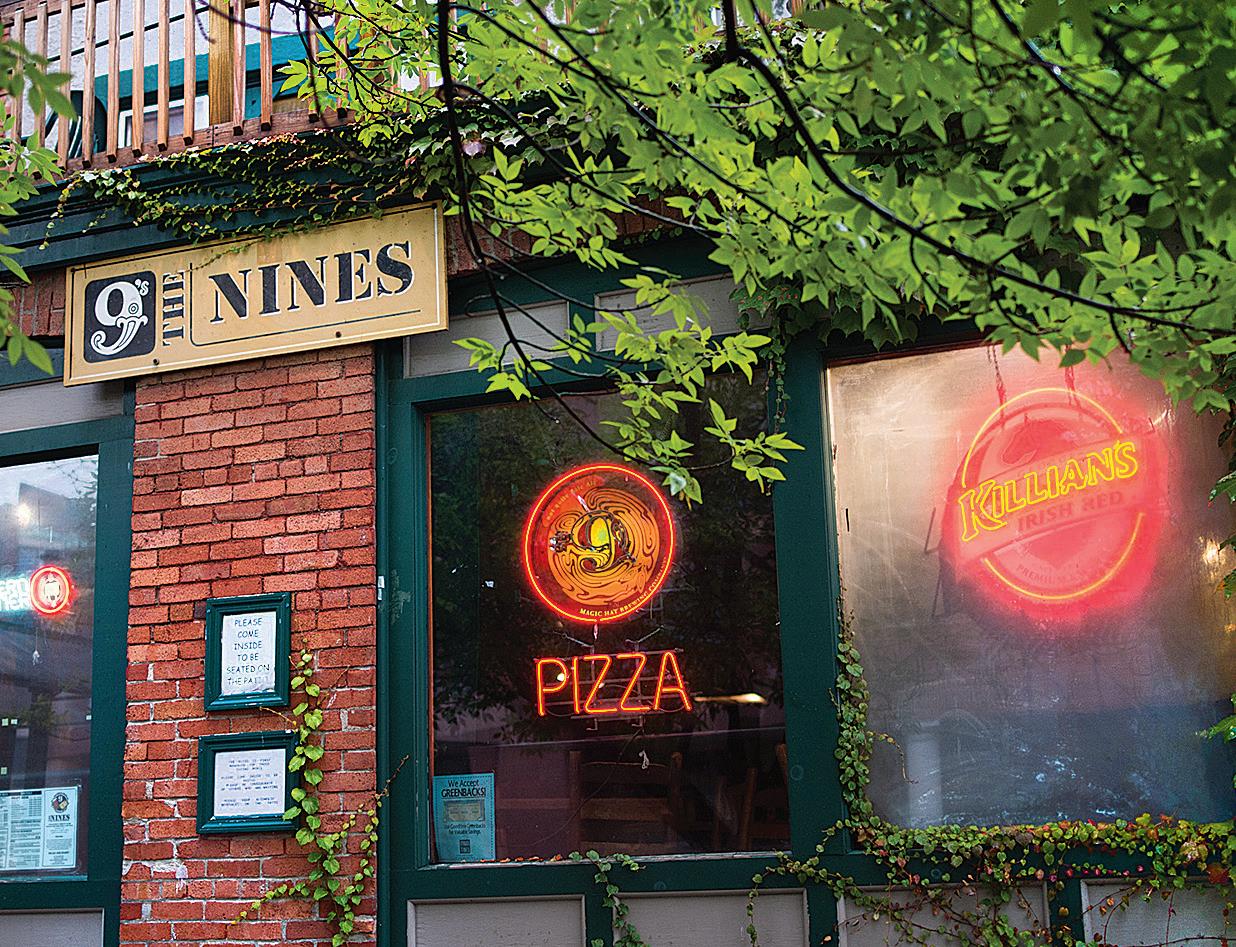
Pizza enthusiasts, trivia night frequenters, open mic night artists and Latin dance lovers will soon have to say goodbye to longtime Collegetown staple: The Nines, a popular bar and pizza joint which formerly housed Ithaca Fire Station #9, will likely bow out of nearly 40 years of business on Sunday, Oct. 7.
Though the intended closing day is Sunday, server Ryan Rutledge said that the restaurant’s final day will be determined by when they exhaust supplies.
“It’s until we run out of stuff,” Rutledge said. “We could be
open Monday, but we might not be. It’s just kind of day-to-day at that point. But at this point, Sunday will probably be our last day.”
Located at 311 College Ave., the restaurant was the subject of a contentious Ithaca Common Council debacle on whether to declare The Nines building a local landmark this past year. The proposal was struck down in June when Mayor Svante Myrick ’09 broke a 5-5 split in the council with a vote of no, The Sun previously reported.
Myrick praised the owners’ Mark Kielmann ’72 and Harold Schultz — who have now owned
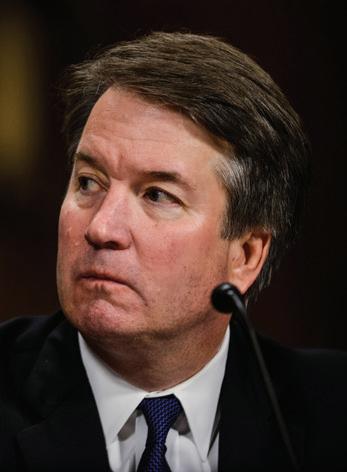
Today, a letter signed by more than 900 law professors across the country, will be sent to the Senate urging them not to confirm Supreme Court nominee Brett Kavanaugh following allegations that he sexually assaulted Dr. Christine Blasey Ford when they were both teenagers. 11 of the signatures on the currently growing list belong to professors in Cornell’s Law School. In a hearing on Sept. 27, Ford — the first woman to accuse Kavanaugh for sexual misconduct — said that during a summer party in their high school years, he pushed her onto a bed, groped her against her will and covered her mouth with his hand as his friend, Mark Judge, witnessed the assault. In a fiery opening statement, Kavanaugh asserted that he denied any sexual interactions with Ford and stated that he has no recollection of the party. President Donald Trump authorized the FBI to launch a supplemental background check into Kavanaugh on Sept. 28 so long as the investigation satisfies Senate Republicans.
See SUPREME COURT page 4
China’s 1979 War With Vietnam Noon, Kahin Center
Turkey’s Regime Change in the 21st Century 12:15 - 1:30 p.m., G08 Uris Hall
Community Engagement: Listening to the Communities You Work With 12:20 - 1:10 p.m., 100 Savage Hall
Mechanisms of Adaptive Behavior
Across Moments and Millenia
12:30 - 1:30 p.m., A106 Morison Room Corson Hall
Institute for African Development: Has African Growth Become More Inclusive?
2:30 - 4 p.m., G08 Uris Hall
Intro to ArcGIS
2:30 - 4 p.m., Stone Classroom Mann Library
Pulsar Timing Arrays: The Next Window to Open on The Gravitational-Wave Universe
4 - 5 p.m., 105 Space Sciences Building
New Frontiers in Catalytic Heteroatom Transfer: Application to Late-Stage Oxidation and Small Molecule Synthesis
4 - 5 p.m., 119 Baker Labaratory





Locking Up Our Own: Crime and Punishment in Black America 4:30 - 6 p.m., Alice Statler Auditorium
Soil and Crop Sciences Graduate Student Association Journal Club 5 - 6 p.m., 133 Emerson Hall


Using Gene Drive Technology To Contribute to Malaria Elimination 10 - 11 a.m., 102 Mann Library
As We Have Always Done 11:15 a.m. - 1:10 p.m., 400 Caldwell Hall
Sequential Information Design 11:40 a.m. - 12:55 p.m., 404 Plant Science Building
The Works in Progress Seminar 12:10 - 1:10 p.m., 488 Uris Hall
Climate Change and Transformations of Energy Systems in Canada 12:15 p.m., 253 Frank H. T. Rhodes Hall
Single-Cell Analysis of Influenza: A Virus ReplicationBroad Heterogeneity Couples with Incredible Control 12:15 - 1:15 p.m., 700 Clark Hall
Coupling for Life: The Prosodic Workspace For Cognition, Emotion and Interaction 12:20 - 1:30 p.m., 202 Uris Hall
CRP Alumni Panel: Planning for Planning Education 1 p.m., Abby and Howard Milstein Auditorium
Non-Perturbative Potentials in Real Time 12:30 p.m., 401 Physical Sciences Building
Neurosensory Control of the Heat Shock Transcription Factor HSF1 4 - 5 p.m., G10 Biotechnology Building

By MIGUEL SOTO Sun Staff Writer
Faculty discussed and voted on amendments to parts of the Arts and Sciences Curriculum Committee’s proposal to change the college’s distribution requirements. Major amendments included changes to the wording of the new “human difference” distribution category and modification to the wording concerning the double-listing of courses in distribution categories on Wednesday.
The amendments will be added to the final proposal for faculty to vote online to accept or reject entirely on an unspecified date, according to Lisa Nichii, vice provost of undergraduate education.
one non-introductory level course, The Sun previously reported. The proposal also recommended allowing American Sign Language to fulfill the language requirement, instituting a “human difference” requirement and reorganizing the distribution requirements.
The Sun reported in May that faculty decided to not vote on the proposal at a meeting. In June, a revised proposal was released where the language requirement was unchanged from its current form. The new version of the proposal still would allow sign language to be used to fulfill the requirement, however.
At the meeting on Wednesday, faculty discussed the proposal to require students to fulfill five out of the 10 new distribution requirements in their first four semesters at the University.
“[The goal is] to balance ... fitting in many different distribution courses for a student that has a very packed first couple years.”
Prof. Tom Pepinsky
The Arts and Sciences Curriculum Committee released its original proposal in March, which recommended reducing the language requirement from 11 credits of instruction in one language or one non-introductory course to two courses of at least three credits each in the same language or
The goal is “to balance the feasibility of fitting in many different distribution courses for a student that has a very packed first couple years [like those with] with pre-med requirements and also trying make sure this exploration does happen early,” said Prof. Tom Pepinsky, government, chair of the curriculum committee.
Prof. Cynthia Chase, English, expressed concern for the student “who arrives at Cornell already knowing what she or he is especially interested in” and that there are
many of those students “who are telling me they are reluctantly fulfilling a distribution requirement because it is their junior or senior year,” Chase said. Pepinksy affirmed the change was to encourage early exploration and that “the logic behind this is to encourage students to explore beyond what they think they already came here wanting to do,” he said.
Additionally, faculty passed an amendment to change the name of the “human difference” distribution category to “social difference.”
Prof. Sandra Greene, history, voiced her disapproval on the original word choice of ‘human,’ since it is not particularly even
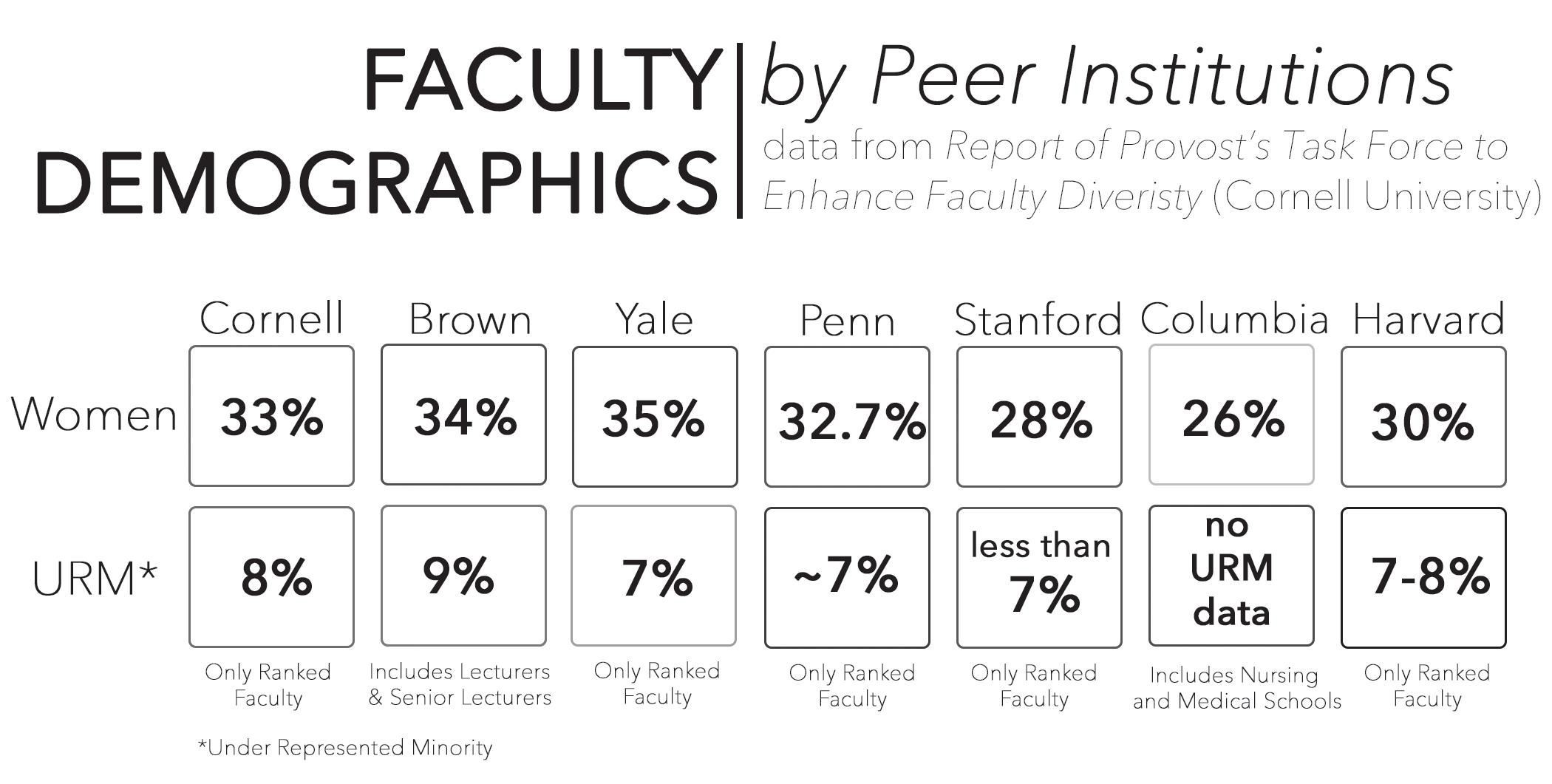
Divert to diversity | Provost Michael Kotlikoff announced that Cornell is planning to direct $60 million over the next five years to fund recruitment of a more “diverse” faculty. The University’s current faculty consists of 2,168 people, 18 percent of whom identify as a minority, according to the University’s 2017 Common Data set.
By AMANDA CRONIN Sun Staff Writer
Jason C. Locke, associate vice provost for enrollment, said the class of 2022 was “the most diverse class in university history,” with 8.3 percent identifying as African American, 18.7 percent Asian, 15.3 percent Hispanic and 5.1 percent as biracial or multiracial — the faculty demographics do not reflect the same level of diversity.
Last week, Provost Michael Kotlikoff announced that Cornell will be directing an increased amount of funds towards recruiting more “diverse” faculty — about $60 million over the next five years. This initiative is similar to one started three years ago at Yale, which follows a plan of $50 million over five years, as reported by Yale News.
The funds come from a combination of sources already in Cornell’s budget, including from the colleges and from the
central university, according to the Provost’s Office for Faculty Development and Diversity.
Cornell wants to hire more diverse faculty to expose students to “the innovation and excellence” that diverse faculty bring, according to Avery August, vice provost for academic affairs.
“Our undergraduate students, graduate students and postdocs are graduating into a complex, diverse world, and we’d like them to be able to engage successfully with diverse faculty with diverse sets of views and backgrounds,” August said in an interview with the Sun. “Research has also shown that diverse teams are more successful in solving problems and creating innovation.”
The proposal is only one part of the larger administrative movement to increase campus diversity and inclusion as informed by the report offered by the Presidential Task Force on Campus Climate.
According to the University’s 2017 Common Data Set, minori-
ty faculty members only made up 391 of a total of 2,168 faculty members, about 18 percent. Administration, however, is not only focusing on ethnicity when discussing making the faculty “diverse.”
“When we speak of diversity we look at human and social diversity (some aspects can be ability, sexual orientation, race, gender, ethnicity, but we’d like to keep it broad),” said Yael Levitte, associate vice provost for faculty development and diversity. “One of the recommendations of the taskforce is that every faculty candidate will be required to write a statement about how they contributed in the past or can contribute in the future to diversity.”
In 2016, Professor Marybeth Gasman of the University of Pennsylvania wrote in the Washington Post, “The reason we don’t have more faculty of color among college faculty is that we
accurate in how it handles what is incorporated in that category,” Greene said.
Greene told those present that “a more accurate description is social difference, because it deals with class, race, ethnicity, ethnic origin: theses all are all social categories — there’s no human difference, it’s social difference,” Greene said.
Wording was clarified for the proposed change for courses being listed under two distribution categories instead of a single distribution category. The faculty voted to adopt “individual courses can be listed in up to two distribution categories” as the
By AARAN LEVITON Sun Contributor
Lawrence Kidder, a senior research assistant at the Cornell Center for Astrophysics and Planetary Science who helped develop simulations for the gravitational waveforms of coalescing black holes, has been elected an American Physical Society Fellow.
Each year, the American Physical Society elects a small batch of its members to become APS Fellows. For 2018, Lawrence Kidder was one of the 155 new fellows.
“It was a great honor, and very satisfying to have my work recognized by my peers,” Kidder told the Sun.
APS’s website states that Kidder was elected for “major contributions to the development of numerical relativity by being a principal author of the Spectral Einstein Code” and for “contributions to the post-Newtonian theory of spinning bodies.”
Kidder, Prof. Saul Teukolsky, physics, and their multi-institutional team called Simulating eXtreme Spacetimes collaborated on the Spectral Einstein Code.
According to the SXS website, SpEC provides “one of the most accurate and efficient codes to compute the gravitational waveforms for inspiraling and coalescing binary black holes.”
Kidder and Teukolsky were also contributors to the Laser Interferometer GravitationalWave Observatory project. LIGO observed gravitational waves in 2015, which earned two of its founders, Prof. Kip S. Thorne, theoretical physics, California
Institute of Technology, and Prof. Emeritus Rainer Weiss, physics, Massachusetts Institute of Technology, a Nobel Prize in Physics in 2017. Kidder and Teukolsky shared the honor of receiving the 2016 Breakthrough Prize in Fundamental Physics for their contributions to LIGO.
“It’s been a pleasure to work with Larry,” Teukolsky said. “He has been a leader and key member of the SXS collaboration since its founding in 2005. He is responsible for much of the success of the collaboration in predicting the shape of the gravitational wave signals detected by LIGO and showing that they come from colliding black holes.”
With his election, Kidder joins the ranks of other Cornellaffiliated APS Fellows, including Hans Bethe who was elected in 1935 and Richard Feynman who was elected in 1946. According to the APS website, Cornell has a fellow almost every year.
According to the APS, fellowship is “a distinct honor signifying recognition by one’s professional peers.” No greater than 0.5 percent of APS’ membership, not including student members, are elected fellows each year.
For APS members to be made fellows, they “may have made advances in physics through original research and publication, or made significant innovative contributions in the application of physics to science and technology.”
Kidder is currently working on a project adapting the SpEC to make predictive models of the behavior of neutron stars.
DEAN
Continued from page 1
within the college, meeting in small groups and one-on-one with some stakeholders.
“It’s a much different job and a college in its infancy, and I found that quite interesting,” Hallock said. “I think there are challenges, but enormous opportunities.”
In a Tuesday afternoon email addressed to “ILRies,” Hallock said it was “with mixed emotion” that he is leaving the ILR School for the College of Business.
“As the top school focused on the workplace in the world, there simply is no comparison,” he wrote of the ILR School.
“The school’s unique focus on the workplace from many disciplines and perspectives prepares our students to become problem solvers, critical thinkers and leaders in any profession they choose.”
“confident that it will continue to thrive.” He did not thank Dutta or acknowledge the founding dean by name except to say that he had offered his resignation.
In March, Poets and Quants, a business school news website, speculated that Cornell’s leadership position would “certainly be the toughest to fill from the outside” among four major business school leadership vacancies at the time. The website attributed that difficulty to the unexpected and unexplained retirement of Dutta.
The resignation of Dutta, who remains a tenured professor at Cornell, surprised even top administrators within the business college, who learned of his departure at the same time as students and faculty members, The Sun previously reported.
“This is a remarkable business college in the middle of a massive college that is doing big things.”
In selecting Hallock, Cornell looked within the University and chose someone with experience leading a school with a strong identity. Hallock has already said he will be looking to manage and encourage the distinctive personalities of the three schools under the business college: the School of Hotel Administration, the Samuel Curtis Johnson Graduate School of Management and the Charles H. Dyson School of Applied Economics and Management.
“This business college is massive — it’s among the largest in the country — and I think it can grow,” he said. The three schools have “particular identities,” he said, “and I think the challenge is to maintain those unique strengths and lift them all.”
Cornell’s proposal in December of 2015 to place the three schools under one business college was controversial, with many worrying that the schools would
Dean Kevin Hallock
Hallock said he frequently spoke with Dutta prior to the dean’s resignation, but has not spoken with Dutta since becoming a candidate for the position. Hallock said he had no concerns about Dutta’s short tenure and does not think anyone in the school should be worried, saying he has “real confidence in” alumni, students, staff, and faculty members.
Hallock has led the ILR School since 2015 and been a faculty member in the school since 2005. In 2009, he became the founding director of Cornell’s Institute for Compensation Studies.
Before coming to Ithaca, Hallock taught economics, finance and labor and industrial relations at the University of Illinois at Urbana-Champaign from 2002 to 2005. He graduated from the University of Massachusetts at Amherst in 1991 before earning a Ph.D. in economics at Princeton University in 1995.
“There is still a lot of work to do and Dean Hallock is an outstanding choice to do that.”
Prof. L. Joseph Thomas
lose their uniqueness under one business college umbrella.
The business college ultimately opened in July of 2016 under Dean Dutta and had vastly increased its undergraduate enrollment by fall 2017, from 944 to 1603. The college also included an additional 295 graduate students and 2,433 professional students on the Ithaca campus as of fall 2017.
Thomas, the interim dean and a former dean of the Johnson School, said he and others “have moved the college, and the three schools, forward.”
“There is still a lot of work to do and Dean Hallock is an outstanding choice to do that,” Thomas said in an email to The Sun. “Kevin knows Cornell, and he is an excellent leader. I look forward to working with him during the next few months of transition.”
In a statement, Kotlikoff said Cornell “owes Joe a great debt for his steady hand at the college’s helm for the past seven months. The continuity and administrative expertise he provided has enabled the college to continue to thrive while we’ve gone through an extensive search for a new dean.”
That statement stands in stark contrast to the brief email Kotlikoff sent announcing Dutta’s resignation in January, in which he referenced “the college’s many accomplishments to date” and said he was
SUPREME COURT
Continued from page 1
News outlets like The New York Times and Washington Post have reported the investigation could end imminently.
Since Dr. Ford’s testimony garnered international attention, universities like Yale, where Kavanaugh completed his undergraduate and law school years, have become platforms for professors and students to debate whether someone under such social and judicial scrutiny is fit for office. At Yale, over 400 people protested his confirmation on Sept. 24, according to The Yale Daily News. On Monday night, Harvard sent an email to law students confirming that Kavanaugh would not be returning to teach in the winter.
At Cornell, law professors who signed the letter to the Senate are Cynthia Grant Bowman, Elizabeth Brundige, Sherry Colb, Angela Cornell, Michael C. Dorf, Odette Lienau, Andrea J. Mooney, Saule T. Omarova, Aziz Rana, Chantal Thomas and Gerald Torres.
The Sun reached out to nine professors in the law school and received comments from four, one of whom signed the letter.
The following transcripts have been lightly edited for clarity.
Prof. Michael Dorf, Robert S. Stevens Professor of Law
Both Dorf and Kavanaugh clerked for Supreme Court Justice Anthony Kennedy. Dorf clerked 2 years prior to Kavanaugh and is one of the signatories on the letter being sent to the Senate.
Prof. Jeffrey Rachlinski, Henry Allen Mark Professor of Law SUN: From your perspective, will the intense public scrutiny that Kavanaugh has been subjected to affect his work as a judge? Is his emotional performance at the Supreme Court hearing typical of other supreme court nominees frustrated by a rocky confirmation process?
JEFFREY RACHLINSKI: Every bit of research ever done on the subject concludes that judges are human beings with emotional reactions that influence how they decide cases. This process clearly has ignited a passionate reaction in Judge Kavanaugh that will doubtless influence him for the rest of his life. Research on how emotions influences judges suggest that he will be unable to set this experience aside when deciding cases involving relevant subjects or parties who are closely align with those he has today treated as personal enemies.
Prof. David Bateman, government SUN: There are some concerns that the accusations are infringing on the rule of law by judging Kavanaugh in a people’s court. Are these concerns well-founded?
Hallock said a mentor advised him, when he was 26, that he should prioritize service as much as teaching and research, and he said that advice led him to take more service and leadership roles while at Cornell. He said on Tuesday that he wants to “create bridges” while serving his term as dean, which runs through June 2024 and was approved at a closed meeting of the Board of Trustees.
“This is a remarkable business college in the middle of a massive college that is doing big things,” he said. “I do think that that’s a huge advantage for us.”
Hallock grew up in Hadley, Massachusetts, a small town in the western part of the state. He first met his wife, Tina Hallock, when they were just four years old, and they married after college. The couple has a son and daughter together.
“I’m really really excited about the opportunities for the new college,” Hallock said. “I’m confident in the people who will lead ILR going forward. I think ILR is as salient as it’s ever been.”
The next few months, he said, will be incredibly busy, as he begins studying the business college’s budget, the institution’s structure and meeting with stakeholders.
Hallock said he was initially worried that his friendships with some ILR School members might fade amid his new role. But, he said, “I am, after all, moving only a block away.”
Nicholas Bogel-Burroughs can be reached at nickbogel@gmail.com.
THE SUN: You previously told the New York Times that the controversial confirmation process may make Kavanaugh more skeptical of arguments that are either advanced by Democrats or in favor of expanding congressional power. What are some other cases where Kavanaugh’s contentious confirmation process could influence his ruling as a supreme court justice? (For example, legal cases regarding the media or sexual assault?)
“Apart from a very brief period ... the Supreme Court has never been a force of progressive change.”
DAVID BATEMAN: The complaint that Kavanaugh is being judged in the court of “public opinion” is deeply uninformed, and is entirely backward. He is to be judged by public opinion — and rightly so since he is not on criminal or civil trial but is being nominated to serve on the S.C. There is no question here of rule or law, just as there is no question of rule of law when President Trump was accused of sexual assault — if the allegations were to go to trial that would be different, but this is not even an impeachment hearing. It is a political proceeding, and necessarily and rightly so.
Prof. Joseph Margulies
SUN: Have there been confirmation processes in the past that were as controversial due to sexual misconduct allegation(s)?
MICHAEL DORF: To be clear, my main point is that one cannot trace a straight line between the confirmation experience and the decision of particular cases. That’s especially true with respect to Kavanaugh, whose views were already very conservative. Because I believe that the phenomenon I’m describing will likely operate unconsciously, I think it’s actually somewhat less likely to show up in cases that directly involve charges of the sort that Kavanaugh has faced as a nominee, where he would be very much aware of the issue.
SUN: Kavanaugh has been accused of lying under oath during his testimony. If the FBI finds these accusations to be true, do you think there is a realistic chance he will be convicted of perjury?
M.D.: I cannot imagine that the Trump Justice Department would seek an indictment against Kavanaugh for perjury. However, the statute of limitations for most federal crimes (including perjury) is five years, so if a Democrat becomes president in 2021, it is possible that his or her administration could seek such an indictment. A perjury conviction requires that one have lied about a “material” fact. Some of Kavanaugh’s pretty clearly false statements concern matters that are arguably tangential and thus not material, such as the meaning of various terms in his high school yearbook.
Dorf has shared more of his thoughts on his blog.
D. B.: The most important and obvious one is Clarence Thomas’s hearings. I doubt very much whether he would have been able to get away with the breakdown Kavanaugh showed yesterday, but wealthy, upper-class, white men can get away with a lot. Anita Hill was attacked in a way that Dr. Ford was not. This is possibly a sign of improvement in public ethics, but it could also be that white women are treated better than black women.
Prof. Joseph Margulies, law and government
Note: Comments made prior to hearings.
SUN: Given the current accusations, from a legal and constitutional perspective, should Kavanaugh’s confirmation process be suspended or proceed as planned? Please explain your reasoning.
JOSEPH MARGULIES: I have a bit of time now to pen some thoughts about this. I want to preface them, however, with some general remarks about the Supreme Court. I think many people labor under the impression that the Supreme Court is the place we go to protect our freedoms, which leads them to believe the fight over the Court is exceedingly important. I believe they are mistaken. Apart from a very brief period in the second half of the last century, the Supreme Court has never been a force for progressive change. On the contrary, for much of American life, the Supreme Court has been a source of hidebound, reactionary thinking. Most of the time, it has done much more to block progressive change than to champion it. And yet, the country seemed to survive.
See SUPREME COURT page 5
ARTS
Continued from page 3
clarifying wording in the proposal. Pepinsky previously told The Sun that the new version of the proposal allows two of the classes students take to go towards two distribution requirements each.
Additional discussion centered around having classes fall under two distribution categories. Deborah A. Starr, Near Eastern studies, expressed approval for the chance to list courses in more than a single distribution category.
However, Starr expressed concern over the possibility of a disproportionate amount of humanities courses being double-listed over science courses.
Crane specified the “hierarchical” nature of science curriculum makes it difficult for students to fulfill their distribution requirements, painting the image of a sophomore taking 25 credit hours in a single term to emphasize the inflexibility of the current distribution requirements.
“We’re worried about student stresses. We’re just saying there is some flexibility if you want to use it.”
Prof Brian Crane
In response to Starr’s concern, Brian Crane, chemistry, a member of the curriculum committee, said there is “lots of fusion between the scientific disciplines.”
Additionally, Crane said the proposal was driven by “practical concern.”
“So without this flexibly [of double listing courses], this curriculum just becomes very difficult for some science students to do,” Crane said.
“We’re worried about student stresses,” and, “We’re not saying don’t take anything, we’re just saying there is some flexibility if you want to use it,” Crane added.
“The entire meeting went well; I think that we had a productive debate — I think we had a nice exchange of ideas, we had some important amendments that had to be passed,” Pepinsky said to The Sun after the meeting.
“I think the people who are not on the committee were generally pleased with the meeting,” Pepinksy said.
Miguel Soto can be reached at msoto@cornellsun.com.
NINES
Continued from page 1
the restaurant for over 40 years — for developing a community that is “still one of the three reasons [he goes] to Collegetown” after his undergraduate years.
Kielmann and Schultz — who celebrated the council’s decision — were given the freedom to sell the property to developers if they wished without having to receive approval from the Ithaca Landmarks Preservations for making any changes to the building’s exterior.
Throughout her time as an employee, Checkovich has interacted with employees who have worked at The Nines since it was established in 1980, and she explained that hearing their experiences working though “all of the cycles [The Nines] has been through” has been “pretty crazy.”
“It’s bittersweet, but ultimately the owners … this is what they’ve been wanting for a while now, so it’s good for them.” Checkovich said.
As Collegetown residents prepare to bid farewell to the restaurants, some acknowledge the closure as a goodbye to a hangout spot.
“It’s bittersweet, but ultimately the owners ... this is what they’ve been wanting for a while now, so it’s good for them.”
Lenya Checkovich ’20
Though the fate of the property remains unclear, Lenya Checkovich ’20, who was worked as a line cook at The Nines for over a year, expressed that she hopes the property does not become a Collegetown apartment complex.
“I guess that’s my main hope for it,” she said.
“It’s sad, because we live right down the street and it’s a good [place] to eat,” said Shelby Wray ’21. The Nines’s final event will be a music show called “Hail and Farewell Nines” on Oct. 6, according to a Facebook post on the restaurant’s page that encourages Ithacans to “come out and celebrate all the good times.” The event will feature musical guests Pete Panek and the Blue Cats.
Sarah Skinner ’21 contributed reporting to this article.
Paris Ghazi can be reached at pghazi@cornellsun.com.
SUPREME COURT
Continued from page 4
I don’t know whether Judge Kavanaugh assaulted the women who have accused him. But I strongly suspect he will be confirmed regardless of what he may have done, and that as a result, the Court will continue its movement toward becoming a reactionary force against progressive change. It has been on that trajectory for decades — at least since the 80s. And as it becomes more of what it has always
been, the country will survive. To put it simply, I do not attach nearly as much significance to this debate as others because I have never pinned much hope on the
“It may be important to slow things down for political reasons, but that has nothing to do with the law or the Constitution.”
Prof. Joseph Margulies
Supreme Court. I believe that those who do are yearning for a Court that has not existed for many years and was always an exception.
Nothing in either the law or the Constitution requires that the confirmation process be suspended. It may be important to slow things down for political reasons, but that has nothing to do with the law or the Constitution. People who seize upon the law at moments like this conflate law with politics.
Yuichiro Kakutani can be reached at ykakutani@cornellsun.com. Hyeji Suh can be reaced at hs953@cornell.edu.

ENDOWMENT
Continued from page 1
12 months, and “we continue to expect strong performance in fiscal year 2019 as the portfolios reap a full year’s benefit.”
The statement highlighted changes the investment office made this year to its portfolio strategy and management, including “revamping” its benchmarks and asset allocation, among other changes. It said the updates were intended to boost performance over time.
“Following deep-dive reviews, we’ve implemented an interrelated set of initiatives aimed at improving the portfolio’s strength
“Restructuring ... takes time. So let’s wait a few years before judging how he is doing.
Prof. Ronald Gordon Ehrenberg
and resiliency, and those began to come to fruition in fiscal year 2018,” said Kenneth Miranda, chief investment officer, in the statement. “We expect to continue to see the effects of those improvements as we move forward.”
The University also highlighted many changes last year, which Miranda referred to as a “transitional year.” Miranda took over at the beginning of last fiscal year, in which Cornell’s endowment returned 12.5 percent. The investment office also began its move from Ithaca to New York in an effort to attract more qualified candidates. This year’s statement highlights that the move is now complete.
In addition to Brown, Penn, Yale and Dartmouth saw higher endowment returns than Cornell this year, with gains of 12.9, 12.3 and 12.2 percent, respectively. Princeton and Columbia have not yet reported results.
“We have a relatively new chief investment officer who has moved our investment office to NYC and who is busy restructuring our investment portfolio,” said Ronald Gordon Ehrenberg, Director of the Cornell Higher Education Research Institute and Irving M. Ives Professor of Industrial and Labor Relations and Economics. “This restructuring necessarily takes time because it takes time to liquidate many of our endowment’s assets. So let’s wait a few years before judging how he is doing.”
In fiscal years 2015 and 2016, Cornell’s endowment posted returns of 3.4 percent and negative 3.3 percent, respectively. Both years Cornell had the worst returns in the Ivy League.
Josh Girsky can be reached at jgirsky@cornellsun.com.
DIVERSITY
Continued from page 3
don’t want them. We simply don’t want them.”
She went on to explain that there are a number of factors — including college education, socioeconomic background, race-based favoritism — that influence recruiters in making sometimes discriminatory hiring decisions.
Gasman also pointed to faculty task force teams as a main issue in unfair practices because “they are not trained in recruitment, are rarely diverse in makeup, and are often more interested in hiring people just like them rather than expanding the diversity of their department.”
According to August, Cornell
“When we speak of diversity we look at human and social diversity.”
Yael Levitte
“approached the various ethnic programs, [feminist, gender and sexuality studies], and disability studies directors for suggestions” to avoid these problems.
Last month, The Sun published a story about the white majority of hotel school tenured professors. Immediately following publication, Dean of the Hotel School Kate Walsh wrote a response, affirming that “[the Hotel School is] dedicated to building a diverse faculty,” and that, “as with all searches throughout the SC Johnson College of Business, last year our candidate lists were reviewed and approved by the college’s associate dean for diversity and inclusion.”
“We celebrate interdisciplinary collaboration among colleagues.”
Yael Levitte
Increasing faculty diversity is not just a Cornell problem, it is a movement happening at every other Ivy League school. An article published in 2016 in The Dartmouth — Dartmouth’s college newspaper — ranked Yale’s minority faculty percentage highest at 30 percent and Dartmouth’s lowest at 14.7 percent. According to their respective websites, Harvard, Dartmouth, Brown, Columbia, Princeton, Yale, and Penn have all made commitments to increasing faculty diversity in the last few years.
“Our students take classes across colleges. We celebrate interdisciplinary collaboration among colleagues,” Levitte said. “Diversity will enhance the experience of all faculty, students and staff.”
Amanda Cronin can be reached at acronin@cornellsun.com.
136th Editorial Board
JACOB
S. KARASIK RUBASHKIN ’19 Editor in Chief
JOHN
McKIM MILLER ’20 Business Manager
SIMS ’20
KATIE
Associate Editor
GIRISHA
ARORA ’20 Managing Editor
HEIDI MYUNG ’19 Advertising
Manager
VARUN IYENGAR ’21
Editor
Working on Today’s Sun
Ad Layout Jamie Lai ’21
Design Deskers Emma Williams ’19
Simon Chen ’21
News Deskers Anu Subranamiam ’20
Paris Ghazi ’21
Night Desker Maryam Zafar ’21
Arts Desker Lev Akabas ’19
Dining Desker Jacqueline Quach ’19
Photography Desker Michael Li ’20
Production Deskers Katie Reis ’21
Emma Williams ’19
So junior year hasn’t exactly shaped up to be the hellfest I thought it would be. Instead, I think it turned me into a suburban mom. At different parts of the day, I now find myself being terrifyingly diligent about cleaning my room, color coding a Google Calendar and making gnocchi from scratch on a Monday night. I can be found brewing loose-leaf tea and doing concerningly middle-age yuppie things; I’m going to the gym for heaven’s sake, and I’m focusing less on toxic groups and taking more “me” time.
By God, what happened?
This looks nothing like my frazzled freshmen year — I ran out the door with a half-eaten granola bar, neglected to lock the door (because who does?) and would catch a whiff of the pineapple my roommate accidentally let rot in the trash can. I stayed up until 3 a.m. (okay, I still do that — night owlism is never going to change), eating a pack of Shin Ramen, and eventually fell asleep with a Spanish textbook plastered to my face.
So is this what junior year really is — getting to class on time and having a full eight hours of sleep? Is this the period after sophomore slump when I’ve dealt with all the nonsense already; when I no longer a naïve freshman with crushed dreams, and I’m just finally balancing all the things in my life?
something to compensate for the fact that my life could have been better?
Maybe that’s our issue: we enjoy pain, or at least flaunting a faux sense of pain while not exactly suffering it. Masochists, if you will. We enjoy “dramatic,” endearing lives. We enjoy telling the girl sitting next to us, “Dude, I got it worse, I stayed up until 5 a.m.” We enjoy telling everyone we’re just so stressed, because it gives us the sense that we’re doing something productive with our lives. We self-victimize at every point possible, and then we start to depend our happiness on it. How unhealthy do we have to be to end up this point?
My friend once told me she doesn’t want a romantic relationship that’s all “good” throughout — she wants to feel the full breadth of it, with all its ups and downs, in order to appreciate it. Or there’s the saying that a rainbow can only come after a storm, that we can’t see true happiness until we experience the low points. But is that really true? Are we really incapable of functioning without something wrong in our lives?
We enjoy pain, or at least flaunting a faux sense of pain
Well, apparently when something goes right, something else always gets messed up. See, amidst this new sense of being in touch with suburban soccer parent roots, I feel — well, bored. My suburban fantasy of weekly laundry and dish cleaning rituals (a point I never thought I’d reach) feels pretty underwhelming.
So you could imagine my surprise when I found myself thinking back on the all-nighters of last year and the take out eaten on my living room floor. What once was a nightmare now seemed like the most dynamic point in my life. Does having a full night of sleep and finishing my homework early mean I’m dull? I wonder if all my classmates who are finally pulling their lives together feel this way — do they miss the brokenness that made them feel happy?
I realized, somewhere between reading up on a book during an early night in and feeling depressed about having enough time for a face mask, that all of this was absurd. If I’m validating happiness with the amount of depression and stress I’m experiencing in conjunction, then that’s just unhealthy, not admirable. Have all those times of loudly complaining about how hard my prelim was been just a gimmick for attention,
This isn’t to say anyone can pull their life together, or should. Some others have mental health issues, and I’ve known my fair share of it — it can be impossible. Everyone works at a different pace, and just because I might think I have things figured out doesn’t mean the person next to me does. But this is just saying that there’s no harm in trying, and there’s no need to feel guilty for it. For those who do feel like everything is coming together, who do live dull and boring lives with a cup of tea before bed and a study guide for the prelim ready a week in advance, claps to you. We all want to be you, even if we won’t admit it.
So, if your life is a mess and you’re reading this at 4 a.m. in Olin Library or sleeping overnight at the Pale Fire Lounge tonight (true story), think on the bright side. It’s not so bad. Hey, you’ve got people like me in my grandma PJs reading a book, and some of us even miss that feeling of chaos. You might not get it now, but that imbalance is what kept us going. But there’s a balance point between feeling stressed and anchoring the positive parts of your life on that stress — you don’t need to be tired out of your mind to consider your life productive. As my father always said, we should be living to make our lives easier. There’s no need to miss the chaotic life when it’s over, and there’s no need to cling onto it when it’s there. Be healthy, be happy, and that’s all.
The United Nations opened the 73rd session of its General Assembly last week, an annual event at its New York City headquarters featuring a series of speeches from leaders and dignitaries from around the world. President Trump, on September 25, gave one of the proceedings’ most substantive addresses in which he properly criticized the U.N.’s many shortcomings, offered a corrective direction for the organization, and articulated a new American foreign policy agenda that for the first time boldly breaks with the globalist vision that has guided (and sometimes illserved) the U.S. since World War II.
The question is: Did the world hear Trump’s important message?
Based at least on the media coverage, which focused myopically on the unwarranted and cynical General Assembly laughter that followed Trump’s claim that his administration has “accomplished more than almost any administration in the history of our country,” it appears they likely did not. Of course, after scoffing at Trump, the same General Assembly attendees scurried to have their picture taken with our 45th president, perhaps symbolizing that beneath their public contempt lies a deep respect for American leadership.
It is a respect that is highly advisable. The U.S. is the foundation upon which the U.N. has been built and sustained.
The U.S. was a driving force behind the U.N.’s 1945 founding and has proven far and away its largest funding source. In 2017, the U.S. contributed $1.2 billion, or 22 percent, of the U.N.’s vast $5.4 billion budget. While it is conceivable that the U.N. could exist without this U.S. funding and participation, it would be a shadow of its current self in such a case. In other words, what the U.S. thinks of the U.N. is no laughing matter; its very future may depend on it.
So what did Trump say? He largely told the General Assembly that it is time to hit the reset button on its operations, which have become unduly obsessed with anti-American and anti-Israel bias, corrupted with financial mismanagement and sometimes fraud, and failed to live up to the bold and laudable goals from its founding charter. Seven decades since the U.N.’s October 1945 founding, Trump’s message is largely this: The U.N. is a global body that continues to squander its vast potential.
U.N. advocates, of course, would rightly counter that it has proven constructive in facilitating international dialogue, which is valuable as the world confronts ongoing crises from nuclear proliferation to bloody civil wars. The U.N.’s humanitarian efforts, from the World Health Organization to the World Food Program, also have served noble goals. To be sure, they have saved the lives of many.
Yet, the U.N.’s failures loom large. Consider the U.N.’s mishandling of multiple humanitarian disasters: from the genocide in Rwanda to the executions in Srebrenica, investigations have uncovered a series of systematic U.N. failures. In Rwanda, for instance, a 1999 U.N. report found that the U.. ignored warnings from peacekeepers of the impending civil war. As a result, substantial blame was appropriately placed on U.N. leadership for the Rwanda slaughter, which proved one of the deadliest human rights crises of our time, taking over a million lives in less than 100 days.
As the U.N. failed the people of Rwanda, so too did it fail the people of southern Sudan. Aicha Elbasri, who served as the U.N. spokesperson for the United Nations-African Union Mission in Darfur, a key U.N. peacekeeping effort, cited in 2014 the Mission’s “grave crimes against civilians and against its own peacekeepers,”
which she said exacerbated the Darfur crisis and were scandalously covered up by a U.N. reluctant to face the reality of its misdeeds there. As is often the case with U.N. mismanagement, token investigations were launched but ultimately no one was held accountable.
The U.N.’s politicization and dysfunction is also glaringly self-evident in its Human Rights Council, where some of the world’s most brutal violators of human rights (Cuba, Venezuela, Democratic Republic of the Congo, et al.) sit in judgment of the world’s human rights conditions and perhaps not surprisingly have spent the preponderance of their time investigating purported rights violations in Western democracies while paying nearly no attention to the world’s most serious human rights violators, such as China, Cuba, Iran, North Korea, and others.
Two weeks ago, I noted that a million innocent Uyghurs are being held in political indoctrination camps by the government of China exclusively because of their Muslim religious affiliation. In a logical world, the UNHRC would be passing resolutions condemning China for this mass imprisonment, demanding to inspect the conditions of these camps and calling for the release of the persecuted Uyghur prisoners. Is it doing that? Actually, no. UNHRC has failed to issue any formal condemnation of this vicious human rights abuse by China, and instead continues to offer China representation on the council. China now sits in judgment of human rights conditions in democratically-elected nations whose respect for human rights would more properly be a model for China to emulate.
The same outrageous hypocrisy can be seen by the UNHRC’s inclusion of Nicolás Maduro’s Venezuela, which has served as a member of the council since 2015 and has used this positional authority to stop discussion of its own vast human rights violations. Cuba, which has systematically refused to permit human rights inspectors to enter its country and has routinely jailed opponents of its communist government, outrageously also holds a seat.
If one is seeking an objective assessment of the human rights conditions in China, Cuba, Iran, North Korea or Venezuela, the UNHRC would be the last place to turn. Meanwhile, the UNHRC is entering the twelfth consecutive year of its infamous “Agenda Item 7,” a council-imposed mandatory annual review of purported human rights abuses in Israel. No other country has earned this level of scrutiny, including Myanmar, whose military actions against the Rohingya minority were unanimously declared a genocide by the Canadian House of Commons two weeks ago. To the credit of the Trump administration, it ultimately saw enough of this hypocrisy on the UNHRC’s handling of human rights to properly remove the U.S. from the body last June.
Reasonable people can differ in their perspectives and priorities on sensitive matters such as global peacekeeping, humanitarian relief, and holding human rights abusers accountable. But those laughing at Trump last week ought to take pause and evaluate their own house. The U.N.’s track record in many cases would be even more laughable if so much were not at stake. Sadly, as the U.N. has demonstrated for many decades, very much is at stake and Trump is right in calling on it to right its ways if it wishes to continue being a beneficiary of the generosity of American taxpayers.
Michael Johns is a junior in the College of Arts and Sciences. Athwart History runs every other Wednesday this semester. He can be reached at mjohns@cornellsun.com.
no sperm = no preggers. Also, this means your period can lighten or go away, which seems like a total womanhood hack to me!
Now, if you are anything like me, you are SO on board! IUDs seem like a girl’s best friend. No pregnancy. No period. No pill to take everyday. No continued cost. No worries for five years. IUDs are easy to remove. And then you start googling. And then you see the symptom list. And then you read the horror stories, “gastly intense cramps,” or “I had my period for three months after this!” Now, I’m not calling this fake news, but I also want to offer an additional storyline. Call me the IUD fairy godmother. I love my IUD. I had some crampin’ and bleedin’, but I have no regrets.
The insertion process is the most mysterious and terrifying part. But like we women are so often called to do, we rise to the challenge. As I sat in the stirrups, vagina in the wind, I felt nervous, but both my gyno and the nurse literally held my hand through the process. “This will be your new best friend,” said the Doc, holding up my Mirena, a T the same size as the packet of sugar I put in my CTB iced coffee that morning. I reminded myself that for thousands of years women had been birthing babies. Women squat in fields and push out watermelons. I simply had to “reverse birth” a packet of sugar. My body, designed
in Seattle | Te Virgin Diaries
to expel 7 pounds of flesh and bones, now just had to make room for one inch of plastic. As the IUD was inserted, I felt pain. Holy sweet tears of Jesus. The pain was reminiscent of a period cramp, but more intense. In that moment, I reminded myself that nothing, literally nothing, had ever entered my uterus from the outside world. More man-made things have been on Mars than in my uterus; a little discomfort was something I could handle. Twenty-seconds later, it was done. I felt crampy for a couple of days, and spotted a bit, but all in all, it was smooth.
If there’s anything to take away from the process its this…
Women: I did it. The IUD is nothing a strong, powerful woman like you can’t tackle. For me, getting an IUD was totally worth it. But remember, this is 100,000 percent your choice. Never feel pressured to do or get something that isn’t right for you.
Men: Women go the greatest measures so you can stick your dick in us worry-free. I dealt with this Mars-rover expedition into my uterus, I dealt with the weeks of bleeding through underwear, and I still deal with cramping that makes me feel like I’m shitting my pants. Please appreciate the sacrifices women make for you!
had my mind set to write about non-invasive sex toys, but considering current events, it’s critical we discuss sexual consent. Even though it seems like consent is all we talk about some days, it is clearly not in our heads. We talk about sex in terms of baseball, and never has anyone mentioned consent in that analogy. When I had health class in school, we talked about STDs and protection, but never about asking permission.
Consent is something I think about a lot. Given the fact that I cannot have sex, I want to make sure the people I’m with are open to communicating and are accepting of what I can and cannot do. But honestly, pain condition or not, everyone should feel safe communicating with a partner. And with that, let’s talk about the best ways I’ve been asked for consent.
“How would you feel if I did this?”
We were lying in bed, and I assumed my body language relayed that I was comfortable with the circumstances. Although the question caught me off guard, it caused me to slow down and evaluate how I was feeling. Did I really want to be here, in this bed, with this man? Would him taking it further make me feel good? My answer to both questions was yes, and I let him in the know in the most seductive voice I could muster. He casually worked consent into foreplay, and I was even more into him
as a result.
“Hey, let’s stop for a second. I don’t want to push you.”
An oldie but a goodie. This was not technically a question, but it made me feel in control of the situation. I was calmer knowing the person I was with would not pressure me into doing any thing. It actually made the rest of the night more enjoyable. He was reassured that I wanted him and I was reassured he wanted me.
“Wanna do stuff?”
I’m not sure why this was just so. damn. hot. Maybe it was his husky voice or that we had worked through a bottle of wine. Maybe it was the fact that he asked. Probably the latter.
“Are you sure this is okay?”
This is a perfect example of asking for consent even when you’re in the middle of it. We were making out and before sliding his hand underneath my bra, he reconfirmed that I was comfortable with what was going on.
A thumbs up
Yes, you read that right. I was danc ing with someone, and he gave me a thumbs up so I gave one back. Next thing I know, I was in the middle of a sweaty DFMO. It was probably the most creative way I’ve been asked so far, and it
was certainly memorable. Most of all, I find not asking for consent in some way, shape or form to be a huge turn off. A few weeks ago, someone had unexpectedly kissed me, and I didn’t want him to at all. Even though this happened in the comfort of my own room compared to the hot and sweaty dance do it in real life.
As always, be wild, be free, be respectful. And boys and girls, just ask for consent.



By SPENCER SIGALOW Sun Staff Writer
Purr-fect. The cat’s pajamas. A sight fur sore eyes. Pawsitively amazing. I could go on and on describing one of Ithaca’s newest establishments with these mediocre puns, but I should probably start the article right about meow (okay, that was the last one). The Alley Cat Cafe, located on East Seneca Street, is a delightful new eatery that combines tasty sandwiches and refreshing coffee with adorable felines. But have no fear if you are not a fan of cats (read: if you don’t have a heart), for you are still more than welcome to enjoy the edible offerings of the cafe, separated from the cats by a glass wall.
When I walked in last Friday morning, I was greeted by two cheery purr-istas (yes, they really call themselves that), who answered my myriad of questions and graciously allowed me to order lunch at 10:52 a.m., despite the menu’s proclamation that lunch began at 11:00 a.m. The Alley Cat Cafe has a fairly small menu that still manages to offer a variety of sandwiches, soups, pastries and coffees. This destination is a great spot for breakfast, a small lunch or
an afternoon snack. With plush chairs, warm colors and ample space to spread out, the cafe itself has a very homey feel. Toward the back is the cat area, where the felines are housed in one of two rooms: either high-activity or low-energy. They are both about equally sized play areas with toys, but as their names suggest, the high-activity room has kittens sprinting around while the low-energy room has more mild-mannered cats. The food was moderately priced, with sandwiches priced at about $8 and specialty coffee drinks around $5. Additionally, the cost to enter the cat area was $5 for 30 minutes.
But enough about the background, let’s jump into the good stuff. I thought it would be fitting to recreate my experience in the form of a tasting menu, but with cat pairings for each offering. Yes, I have chosen which cat I believe goes best with each item that I tasted on the menu. Now, I am not 100 percent sure, as I did not bother to look it up, but
I have a feeling that this is the FIRST EVER combined food and cat review in the history of modern print. So buckle up, take your allergy medicine, grab a lint roller and let’s go:
Beverage: mocha
Served in a ceramic mug, this mocha was a bit pricey; nevertheless, it warmed me up on a chilly Ithaca morning. It was delicious, with a blend of espresso and mocha that was neither too sweet nor too bitter. However, I somewhat regretted not ordering another more desirably named drink: the meow-chiato.
Cat: Layla
Much like an overcaffeinated college student, this energetic kitten did not stop running around for the entirety of my visit in the high-activity room. I would not be surprised if this kitten had somehow tapped into the coffee supply, given its tireless running. Even though I’m quite superstitious, I felt lucky for having met this black feline.
Pastry: cherry tart
Simple, yet tasty. With this delectable item begging me to consume it, I could not resist the urge to order it. I was initially hesitant, as I was unsure if the pastries would be fresh, but my worries soon disappeared as I devoured this sweet concoction. I would certainly recommend this and order it again in the future.
Cat: Marigold
Sweet, tender, delightful. This orange, larger cat was on the lower-energy spectrum, but craved attention and was extremely friendly. Although she is the one cat that is not up for adoption at the cafe, she is nevertheless deserving of affection and attention.
Sandwich: Cat-Prese
Whether I was inspired by the actual menu item or the name itself, I could not resist the Cat-Prese sandwich, which


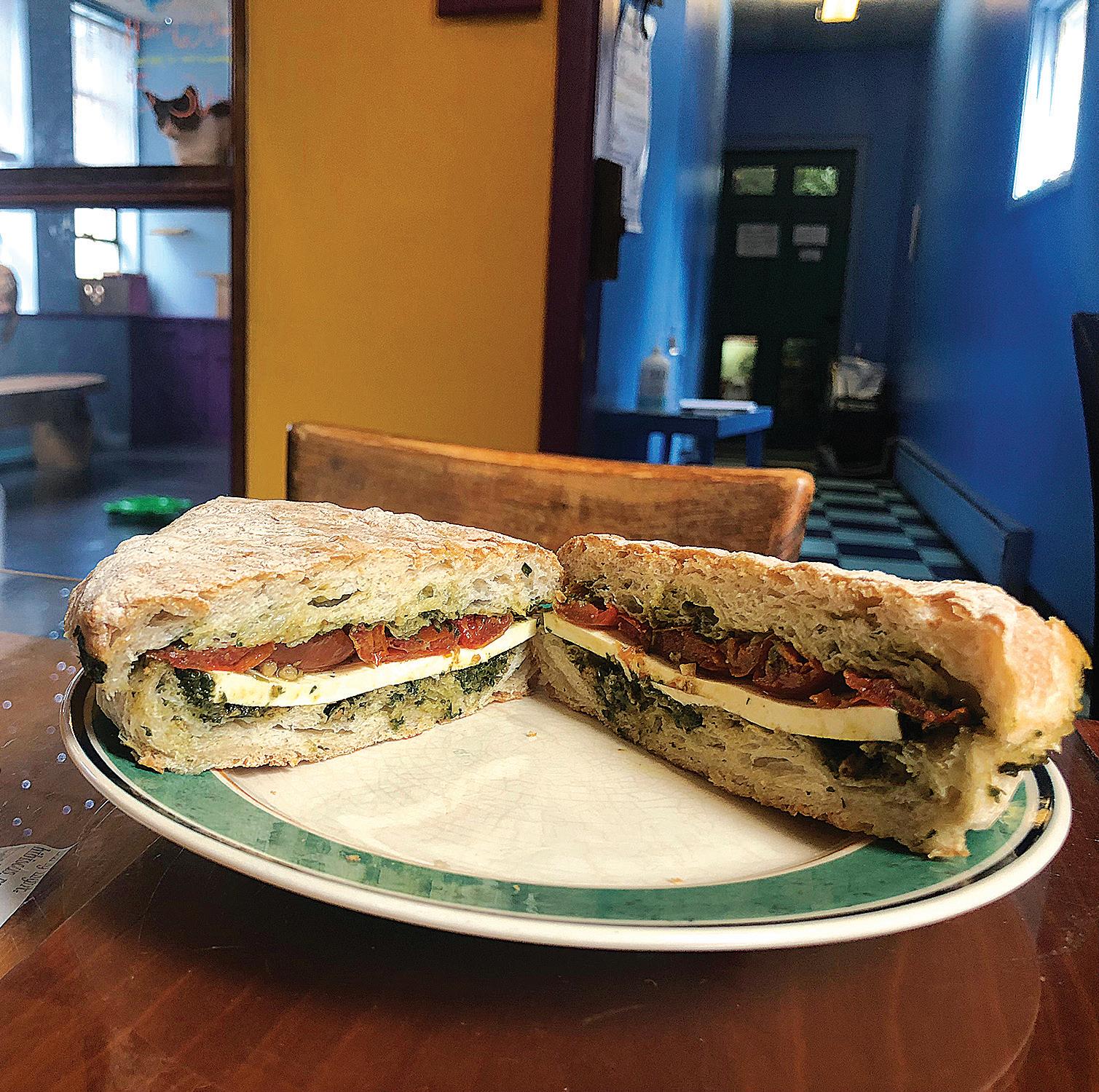
consisted of basil pesto, mozzarella and roasted tomatoes on an Ithaca Bakery ciabatta roll. The sandwich was heavenly and served warm, with large chunks of fresh mozzarella melting in my mouth. Every aspect of the sandwich was perfect, and this was most certainly the highlight of my experience. Cat: Jackie In much the same way as I was unable to find fault with the Cat-Prese, I absolutely fell in love with Jackie, an adorable gray and white kitten who would not leave me alone. I was absolutely smitten with this kitten
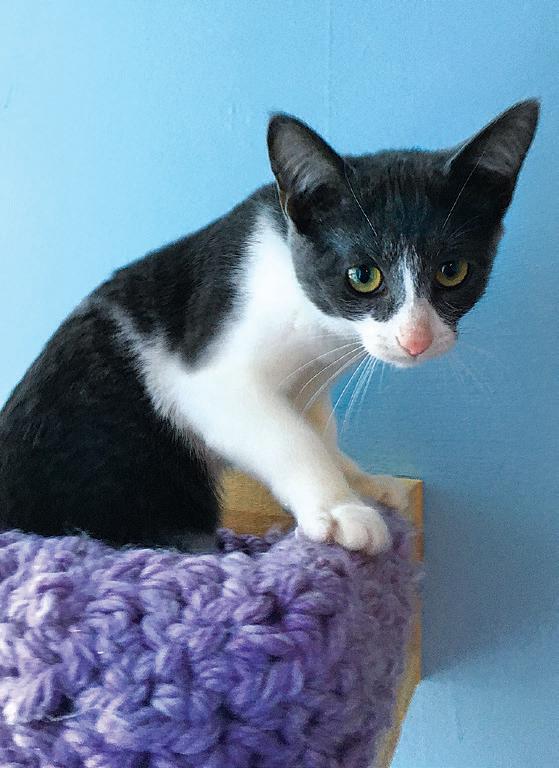
(don’t tell my girlfriend — sorry, Hannah!)! For a moment, I was convinced that I was going to leave the cafe with a new feline companion. This cat played with me, climbed up the walls, enjoyed my shoe laces and was extremely affectionate.
I cannot adequately emphasize how enjoyable of an experience I had at the Alley Cat Cafe. The food was delicious, the staff was lovely and the kittens provided endless entertainment. I implore each and every reader to visit the Alley Cat Cafe for a great dining experience. And hey, you might end up going home with a new feline friend!
Serves: soup, sandwiches and pastries
Vibe: casual, artsy and cozy
Price: $
Food:
Cats:




Yesterday, Cardi B made news when it was discovered that the artist has been charged with assault over a violent incident that occurred in a strip club in Queens and involved members of her entourage and two women who have allegedly had illicit affairs with Cardi B’s husband, Offset. According to a New York Times article about the matter, Cardi B supposedly “showed up at the Angels Strip Club on Aug.15 and confronted the sisters” when “her bodyguards and other members of her entourage attacked the bartenders with bottles and chairs, causing serious injury.”
Some qualifications and disclaimers are certainly due. As a white man, I recognize the limitations inherent in the true scope and relevance of any public, non-peer-reviewed discourse I might offer on the lives of black, female hip-hop artists. Nevertheless, as a student of musicology and cultural studies, these are topics that interest me, and I feel as though engaging in the attempt at discourse brings me closer to some sense of empathy towards the way other people experience the world. So, I turn to Cardi B.
shopping in a bathrobe on the day after the charges were discovered. The media is definitely interested in generating buzz out of such non-information from the lives of many celebrities (think of our obsession with Kanye West’s sandals), but in a society that shifts unrelenting standards and fixation on the physical attributes of women, the focus on Cardi B’s outfit and its tenuous connection to the incident is unfair.
In Cardi B’s defense, it is important to note that the details of this altercation at the strip club in August are merely alleged; none of us were there, of course, and so we don’t really know what went down. Furthermore, as needless as it is to say, hip-hop artists — and particularly black, female hip-hop artists — often have little control over how the media and mainstream discourse choose to read and sensationalize the various happenings of their lives. Moreover, in googling and doing a bit of research on the incident, I noticed articles from a few outlets, including People Magazine, that highlighted Cardi B’s choice to go out

But, didn’t Cardi B do a bad thing? Didn’t she break the law and have people seriously injured in the process? Let’s assume that the details are accurate and the charges are not unfounded. In this case, Cardi B’s behavior lends us a teachable moment about the failure of many celebrities — particularly those involved with hip-hop culture — to fully realize the significance of their wealth and stature. In a Huffington Post article from a few years ago, Prof. Oneka LaBennett, Africana studies, responded to Beyoncé and Jay Z’s performance of “Drunk in Love” at the 2014 Grammys, a song and act that, at least implicitly, condones domestic violence and the hyper-sexualization and objectification of female bodies. In the article, Professor LaBennett points out that so many celebrities, especially the immensely wealthy Beyoncé and Jay Z, do not realize when their wealth unjustly grants them the ability to make certain choices without consequences. Their Grammy performance, of course, signifies an ignorance of the complex intersection of race, class and gendered violence.
A similar case might be made against Cardi B. This is an artist who might not realize the extent to which wealth disconnects someone from the real world — a few weeks ago, Cardi B tweeted about loving Century 21, Marshalls and T.J. Maxx a few
Barnes Hall’s auditorium temporarily transformed into a jazz cafe from La La Land on the evening of Thursday, September 27. Producing a fusion of harmonious tones and fascinating improvisation, the Dave Solazzo Trio, with Dave Solazzo on the piano, Mike Solazzo (Dave’s father) playing bass and Tom Killian on the drums, performed a jazz concert that reminded me of the Oscar-winning film.
The program started with Cole Porter’s “What Is This Thing Called Love?” The piece opened with a piano melody, but was quickly joined by the metallic sound of the cymbals on the drum set and supported by a steady beat of deep pizzicatos from the bass. As the tempo of the song sped up or slowed down based on the discretion of whoever was playing the melody, the other members

hours after sharing a tweet about her Lamborghini. This juxtaposition seems ironically ignorant of any economic inequality in a neoliberal society. The recent incident, if true, highlights an utter acceptance with the parameters of heteronormative courtship as it performs the trope of “unfaithful husband, crazy wife.” Perhaps this is all illustrated by the contiwnuous use of the phrase “turned herself in,” from the New York Times article referenced above to the Snapchat “news” (the triteness of which is deserving of its own column on the downfall of journalism) story from which I first learned of the incident. Turning oneself in is a privilege typically reserved for only the richest members of any social hierarchy, a poignant contrast to the brutal treatment by police that less affluent African Americans have experienced for a long time.
One might argue that all of this is merely a sexual reclamation on Cardi B’s part, but I would adopt a more bell-hooksian approach to the matter. When these exaggerated images of women’s sexuality are the dominant ones in existence, at what point is “reclamation” more of a collusion in the overproduction of these monolithic, restrictive roles? Cardi B has made it and is an immensely successful and talented artist. But the hyper-sexual symbolism, acceptance of heteronormative courtship and ironic playfulness with neoliberal humanity’s rampant class inequality are no longer needed.
Nick Swan is a senior in the College of Arts and Sciences. He can be reached at nswan@ cornellsun.com. Swan’s Song runs alternate Tursdays this semester.
of the trio would match the beat accordingly with extreme precision. This first tune also incorporated solos for both the bassist as well as the drummer, during which the musicians constantly checked in with each other through eye contact and head nods to maintain balance and structured harmony. Dave Solazzo mentioned in an interview with me that the group has “worked a lot as a trio in the last two or three years” and he thinks their “interactive, collective improv is great” — their chemistry through unspoken communication was evident.
Transitioning from the opening number, the trio continued to perform various jazz compositions, including Victor Young’s “Love Letters,” Monty Alexander’s “Renewal” and “I Hear a Rhapsody” by Jack Baker, George Fragos and Dick Gasparre. Each of these arrangements were executed with unique embellishments to the melody and incorporated the in-
terpretations of each musician. Each member would add their own twist to the music, framing the direction in which the piece would eventually progress. When asked about how he first learned to improvise, Dave Solazzo stated, “I learned in a way where I didn’t really have a fear of it [and] just sort of dove right into it.” He sees improvisation as something that “is just perfectly natural for people to do.”
The fifth piece performed was an original composition, “Waltz in C,” composed by Dave Solazzo. This waltz repeated a distinct, light and happy phrase in the melody numerous times throughout the piece, encouraging the audience to bob their heads, sway in their seats or tap their hands in their laps to the beat.
Following the waltz, the trio played the mellow and melancholic “Skylark” by Hoagy Carmichael. While not the most upbeat tune, the rendition of “Skylark” created a tranquil
and sentimental vibe in the hall, captivating the audience’s attention. The following piece, “Solar” by Miles Davis, opened featuring a solo of Killian on the drums, revealing all the distinct sounds that each component of the drum set can produce. The high energy emanating from the drum solo in this piece paralleled that of a marching band at a football game — an energy maintained even after the drum solo ended and the piano and bass parts were introduced.
The concert concluded with Thelonious Monk’s “Straight, No Chaser,” which included a solo for each of the parts. During the solos, the members of the trio who were accompanying or not playing at all would attentively watch the soloist to see how they could incorporate their own parts back into the piece once the solo was over. Both the members of the trio and the audience were able to discover together how each improvised part impacted the
song as a whole.
The performers created a lively atmosphere, not just through the notes they played, but through their passion for the music. It was clear through the smiles the members of the trio occasionally gave each other that they deeply love jazz. Dave Solazzo explained that there is “a lot of creative leeway” with jazz and “you could really make the music personal and play your own thing.” Although he started playing piano by learning classical music, when he began learning jazz, he “really felt like that was a dream.”
In addition to performing concerts, Dave Solazzo is in his second semester teaching jazz piano on Tuesdays at Cornell University. “It’s been a great experience,” he said. “All the students I’ve worked with have been really motivated.”
Julia Kim is a freshman in the College of Arts and Sciences. She can be reached at jmk368@cornell.
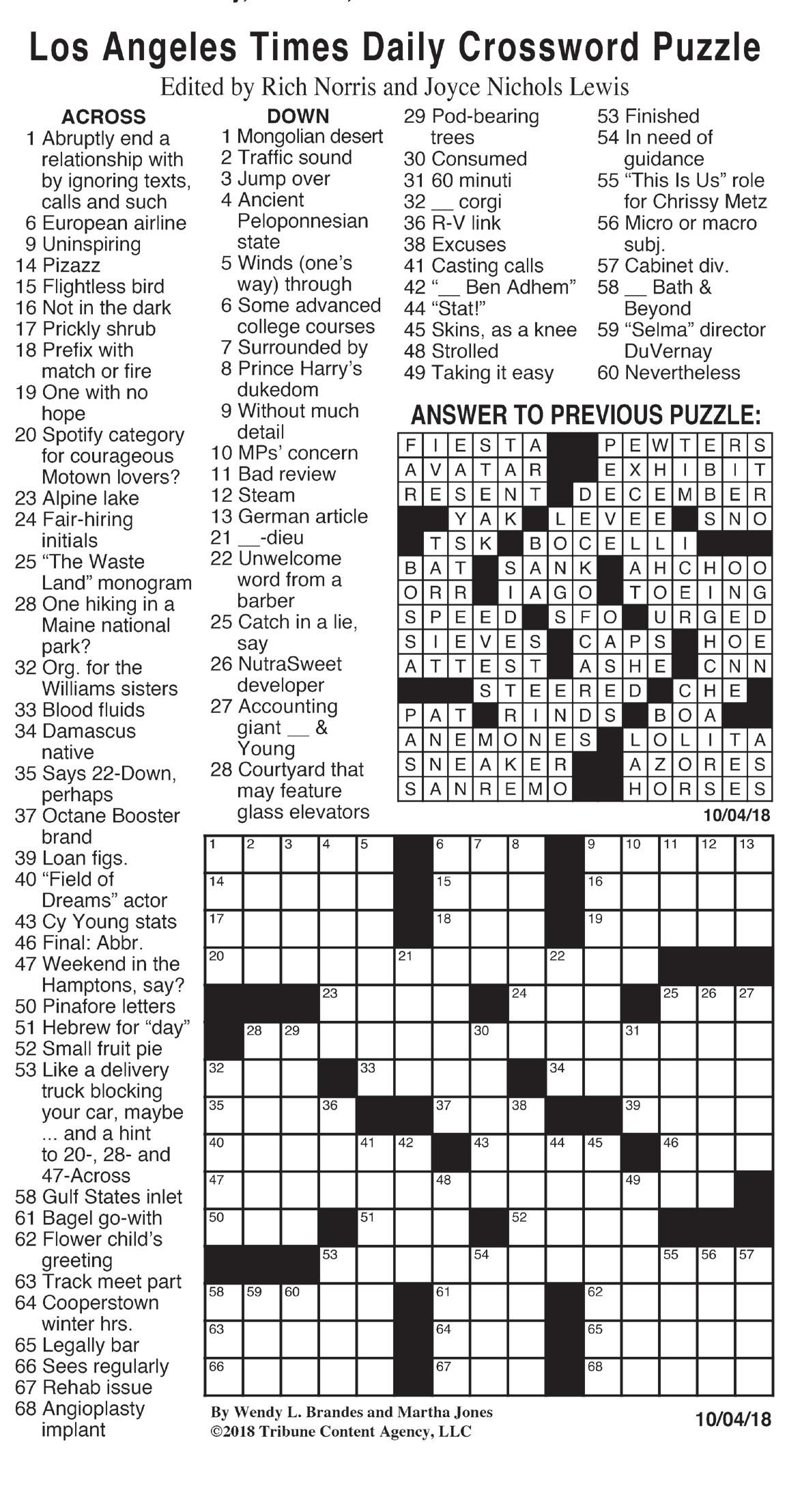
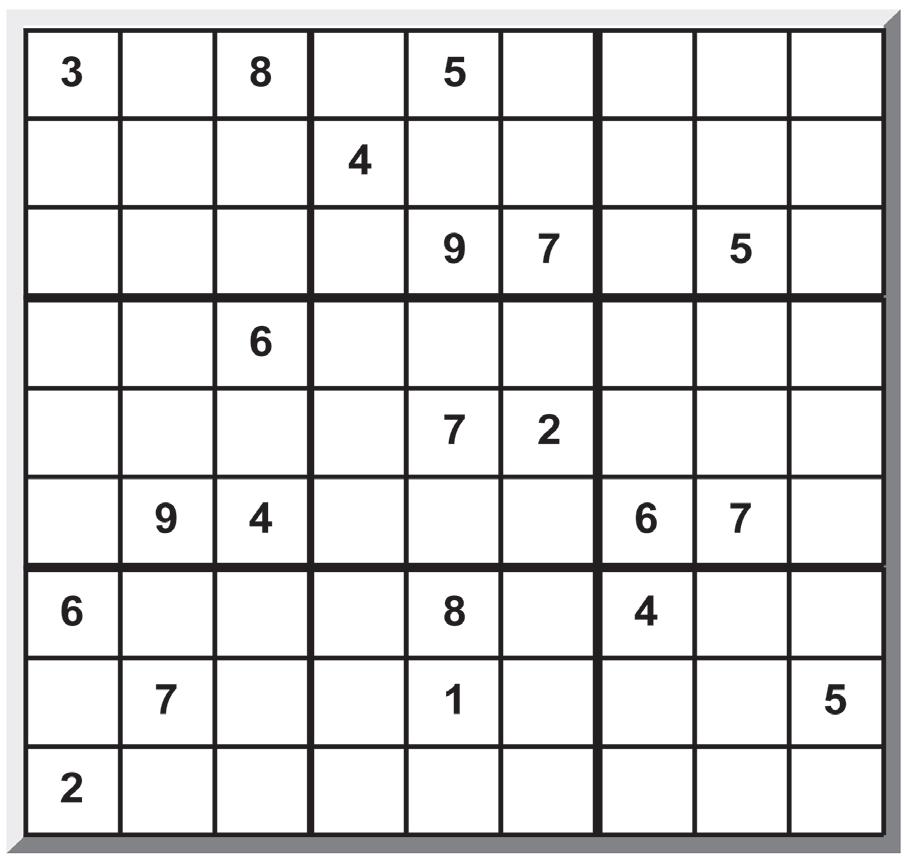
Fill in the empty cells, one number in each, so that each column, row, and region contains the numbers 1-9 exactly once. Each number in the solution therefore occurs only once in each of the three “directions,” hence the “single numbers” implied by the puzzle’s name. (Rules from wikipedia.org/wiki/ Sudoku)




LUXURY AT REASONABLE PRICES 5 & 6 BEDROOM ON LINDEN AVE 8 BEDROOM ON CATHERINE ST. AVRAMISREALESTATE.COM 607-272-3389
Male, Undergrad student. Available NOW & Spring 2019
4 Bedroom Apartment Available NOW & Spring 2019 Novarr-Mackesey Property Management office@ithacastudentapartments.com 607-277-1234
Collegetown STUDIO 2019/2020 QUIET STREET only 1/2 Block from College Ave. Roomy - Fully FurnishedHardwood Floors 607-351-3898 Email: marthabell004@yahoo.com
We have availability for the 2019-2020 school year beginning June 1st at Hudson heights apartments. The studio apartments come with: heat, water, and electricity included. There are garbages houses and coin-operated laundry facilities on site. Prices start at $750/month for a 12 month lease. If you have any questions or would like to schedule a tour contact us by phone 607-208-7660 or email: renting@ithacaLS.com
>>AFFORDABLE, QUALITY LIVING<<
Special Deals for you! Furnished 1-6 Bedrooms Collegetown Apartments PARKING, LAUNDRY, UTILITIES! (607) 273-7368 www.IthacaApartmentRental.com
***************************** RENT NOW, GET THE BEST www.MatoulasHouses.com Apartments & Houses In Collegetown LINDEN AVE & E. SENECA ST 1 & 3 BEDROOM APARTMENTS ALL FURNISHED EMAIL: MatoulasHouses@Gmail.com PHONE: (607) 339-9644 FIRST-COME, FIRST-SERVED
Collegetown Terrace Apartments INSPIRED LIVING TAILORED TO YOUR SUCCESS 24-Hour Fitness Center
Bus Service to Campus
Rooms w/ Expansive Views Apartments Available NOW, Spring 2019 & 2019/2020 Novarr- Mackesey Property Management collegetownterraceithaca.com office@ithacastudentapartments.com 607-277-1234
3 BEDROOM 109 SAGE PLACE Available NOW, Spring 2019 & 2019/2020 Shuttle Bus Access to Campus Access to Free Fitness Center Novarr- Mackesey Property Management office@ithacastudentapartments.com 607-277-1234





• Thursday, October 4 at 3 p.m. for the Wednesday, October 10 issue.
• Thursday, October 4 at 3 p.m. for the Thursday, October 11 issue.
• Thursday, October 4 at 3 p.m. for the Wednesday, October 10 issue.
The Sun’s Business Office will close at 5 p.m. on Thursday, October 4.
We will reopen on Wednesday, October 10 at 9 a.m.
D Ve R Ti S Er S
Continued from page 16
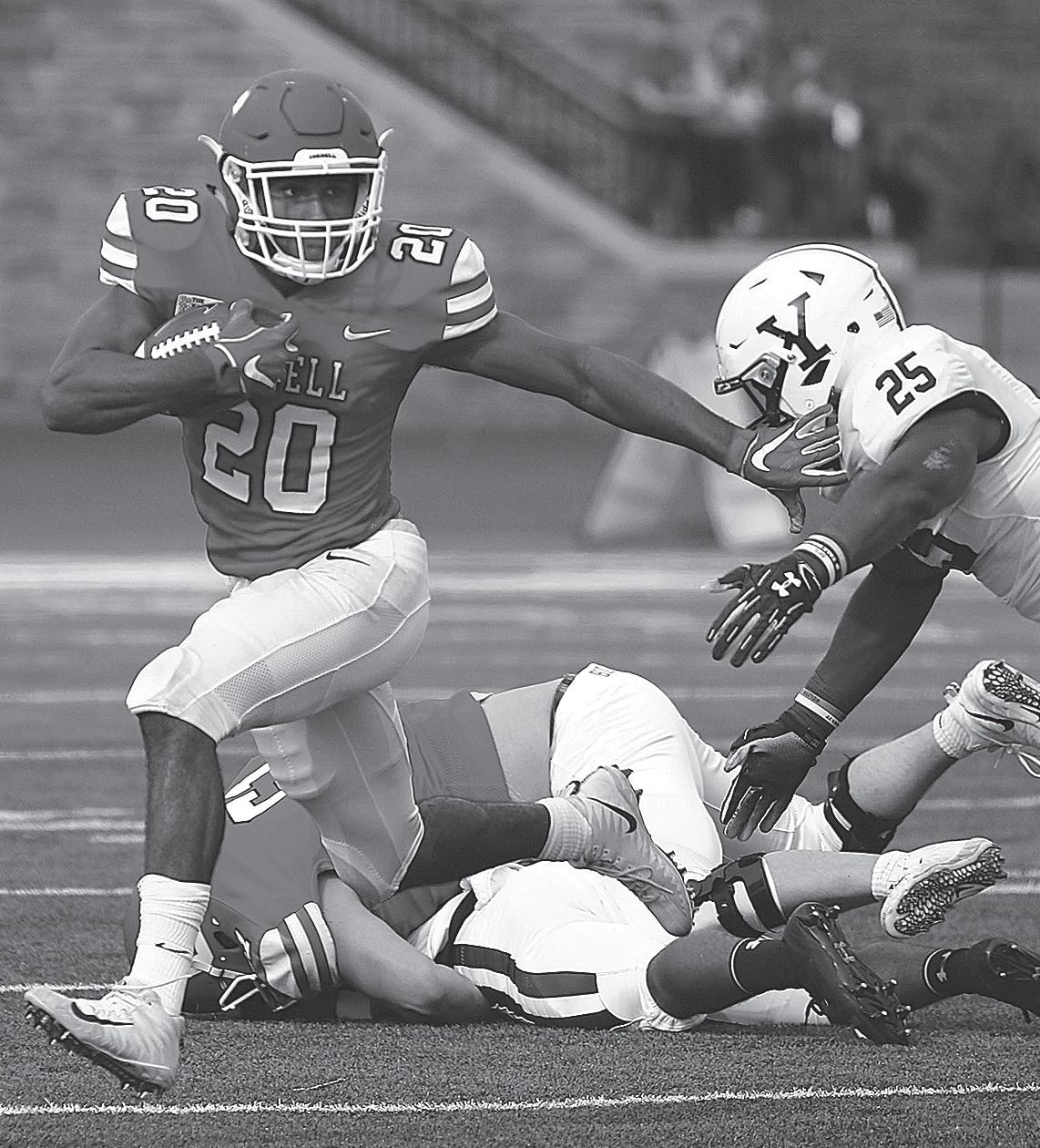
in last year’s meeting. Harvard’s offense features a number of weapons including All-Ivy running back Charlie Booker, who is set to make his season debut Saturday. The Crimson also touts All-American wideout and kick-returner
Justice Shelton-Mosley
“Kicking their butt and running all over them last year felt really good.”
Senior Henry Stillwell
“It looks like a four-headed monster we’re going to have to shut down,” Archer said of Harvard’s depth at running back.
The Red defense that provided the spark with three turnovers in last
week’s win over Sacred Heart is hungry for more this week.
“We had two picks and a strip-sack from defensive backs,” said senior linebacker Reis Seggebruch.
“Hopefully we can get some big hits this week.”
Cornell will enjoy a second straight year of home field advantage against Harvard, a unique opportunity offered by this year’s schedule restructuring.
“I feel like they don’t want to come here knowing what happened last year and it’s a long trip for them,” Seggebruch said.
“Kicking their butt and running all over them last year felt really good, and hopefully we can do it again,” Stillwell said.
Kickoff is at 1:30 p.m. Saturday at Schoellkopf Field.
Miles Henshaw can be reached at mhenshaw@cornellsun.com.

By ALEX HALE Sun Contributor
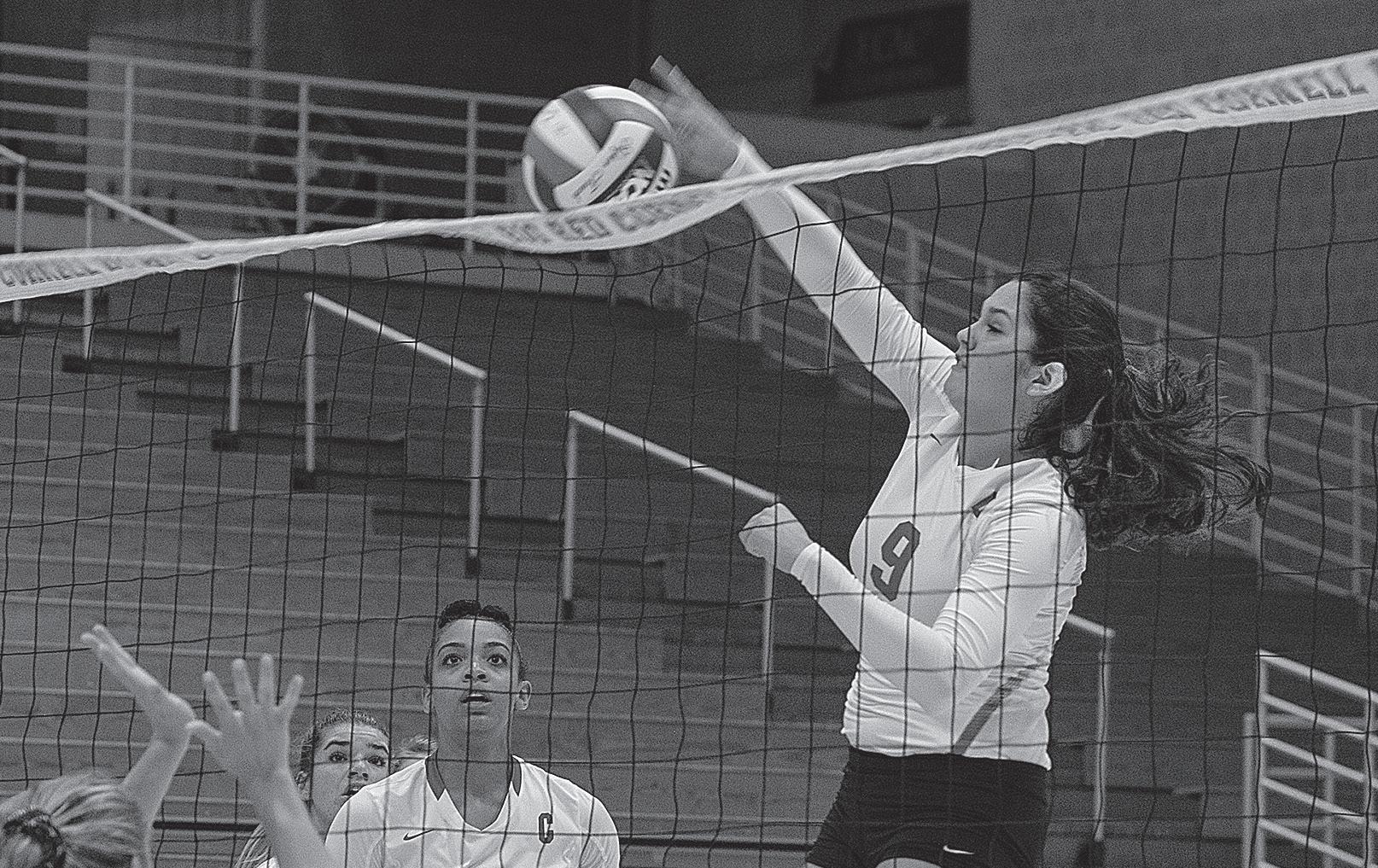
Cornell volleyball is off to its best start in Ivy League play in 10 years and will look to keep up its winning ways at home against Brown on Friday night.
Coming off of an 8-6 conference record and a tie for third in the Ivy League in 2017, the Red (8-5, 3-0 Ivy League) is on the right track to being a strong contender for the league title this season. The team started off with three non-conference tournaments, going a combined 5-5. Since then, the Red have burst into Ivy League play with three straight wins over Columbia, Harvard and Dartmouth.
“Our expectations are very high this year, so 3-0 is where we expected to be at this point.”
Head coach Trudy Vande Berg
With all that said, the early success isn’t getting in the team’s head.
“It means a lot that we’re not even paying attention to that,” said head coach Trudy Vande Berg. “Our expectations are very high this year, so 3-0 is where we expected to be at this point.”
Vande Berg attributed part of the team’s early season success to the rigor of their non-conference schedule, which included road trips to Houston and Valparaiso, Indiana.
“It helped tremendously. I purposely scheduled stressful road trips,” she said. “When we’re in the middle of October, we got a ton of prelims going on and classes are really amping up, so we’ve already been tested with the stress of things.”
The Red is coming off of an especially dominant weekend in which it defeated Harvard on Friday and
Dartmouth on Saturday. The Red only dropped one set in the two matches and held both the Crimson and the Green to less than a .100 hitting percentage. Defensive success has been a hallmark of this Red team thus far.
“Defensively and blocking-wise, we are just very disciplined. We know what the other team is going to run, so we’re making them uncomfortable and having to do things they’re not used to,” Vande Berg said. “It’s very frustrating for the other team because they have to change things up against us.”
Brown (8-5, 1-2) is under new leadership this year. Ahen Kim, long-time assistant at Patriot League powerhouse American University, is in his first season at the helm in Providence.
Despite the new coaching regime, Vande Berg feels that the Red has a feel for what Brown’s strategy will be.
“They don’t have a ton of new players playing, but they do have a little bit of a different style. They’re still the same in that they dig a lot of balls and send it back over the net and just wait for the other team to make a mistake.” First ball contact has been a focus this week in preparation for the Bears.
Friday night will also set up a head-to-head matchup between two of the best outside hitters in the league. Brown senior Sabrina Stillwell leads the Ivy League in both kills (208) and kills per set (4.00). Cornell senior Carla Sganderlla ranks second in both categories, with 157 kills and 3.57 kills per set.
Friday’s match is also the team’s annual Dig Pink night. Money will be raised for the Side-Out Foundation and its research on breast cancer treatment. To support, fans can donate at the match or online.
The match is at 7 p.m. Friday at Newman Arena.
By CHRISTINA BULKELEY Sun Contributor
Cornell men’s soccer will return to the road this Saturday to take on Harvard as it continues its quest to win the Ivy title, facing off against another squad with a 1-0 mark in conference play.
The Crimson (3-6, 1-0 Ivy League) will enter the match with a worse overall record as compared to the Red (7-2, 1-0), but the squads both won their Ivy League opener and thus will be looking to seize another to advance in the standings.
Despite the discrepancies between the teams’ records, Cornell head coach John Smith believes Harvard is a strong team. Harvard has fared a tough schedule to start the season, and that may well be the reason for its under.500 mark, according to Smith.
“They have weapons in a number of areas,” he said. “We’re going to have to do a strong job defensively to shut them out.”
No matter who Cornell is playing, the Red approaches the game the same way. Ahead of a match with Harvard
“You can’t call it a good season until we finish all 17 games ... and hopefully we’ve won the Ivy League.”
Freshman Emeka Eneli
that will prove vital to the team’s prospects of capturing the conference title, the Red will prepare just as it has all year long. Part of that preparation — in addition to recognizing that all foes can prove challenging — is the notion

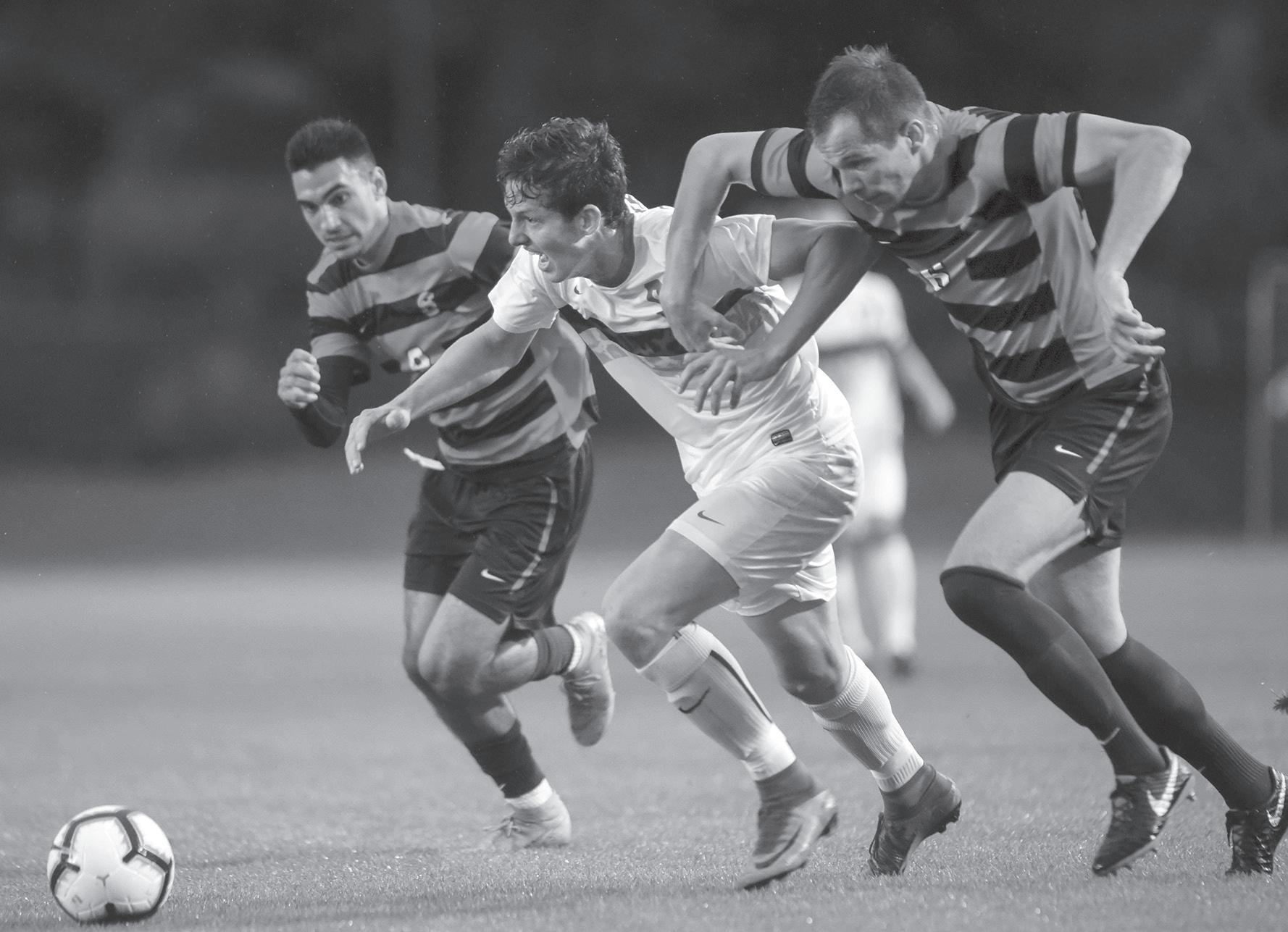
that no team is one which Cornell is not able to beat.
“For us, it’s about mentally preparing our guys for a very good team,” Smith said. “We respect every opponent just about enough; we don’t respect opponents too much.”
Road games are nothing new to this Cornell team, given that they’ve played six already this season — five of which have resulted in victories.
With eight games left to play, the Red is looking to increase its intensity through this middle third of the season.
“You can’t call it a good season until we finish all 17 games … and we’ve hopefully won the Ivy League,” said freshman forward and midfielder Emeka Eneli, whose five goals lead the team — an impressive statline for the rookie who has been crucial in the early going of 2018 for the Red.
The Red has six more conference matches ahead of it, in addition to bouts with regional foes Colgate and Albany. The upcoming stretch that begins in eastern Massachusetts will provide exactly the test that Cornell needs to prove it can compete with the best in the Ancient

Eight.
“The middle part of the season is where championships are won,” Smith said.
Coming off of a four-game winning streak, the team seeks to maintain its focus in the midst of a slew of strong showings on the pitch.
“It’s going to definitely give us a little dose of confidence,” Eneli said. “But at the same time we can’t get complacent.”
The hallmark of the 2018 season so far has been the impressive performance of the team given its youth — the Red has only seven upperclassmen on its roster out of a total of 26 players. Cornell hopes to continue that as an advantage as it travels for its first conference tilt on the road this season.
“We don’t have much experience, but what we do have is … no fear, basically, when we go into a game,” Eneli said of the team’s youth.
The match will begin at 4 p.m. Saturday at Harvard’s Jordan Field.
Christina Bulkeley can be reached at cjb367@cornell.edu.




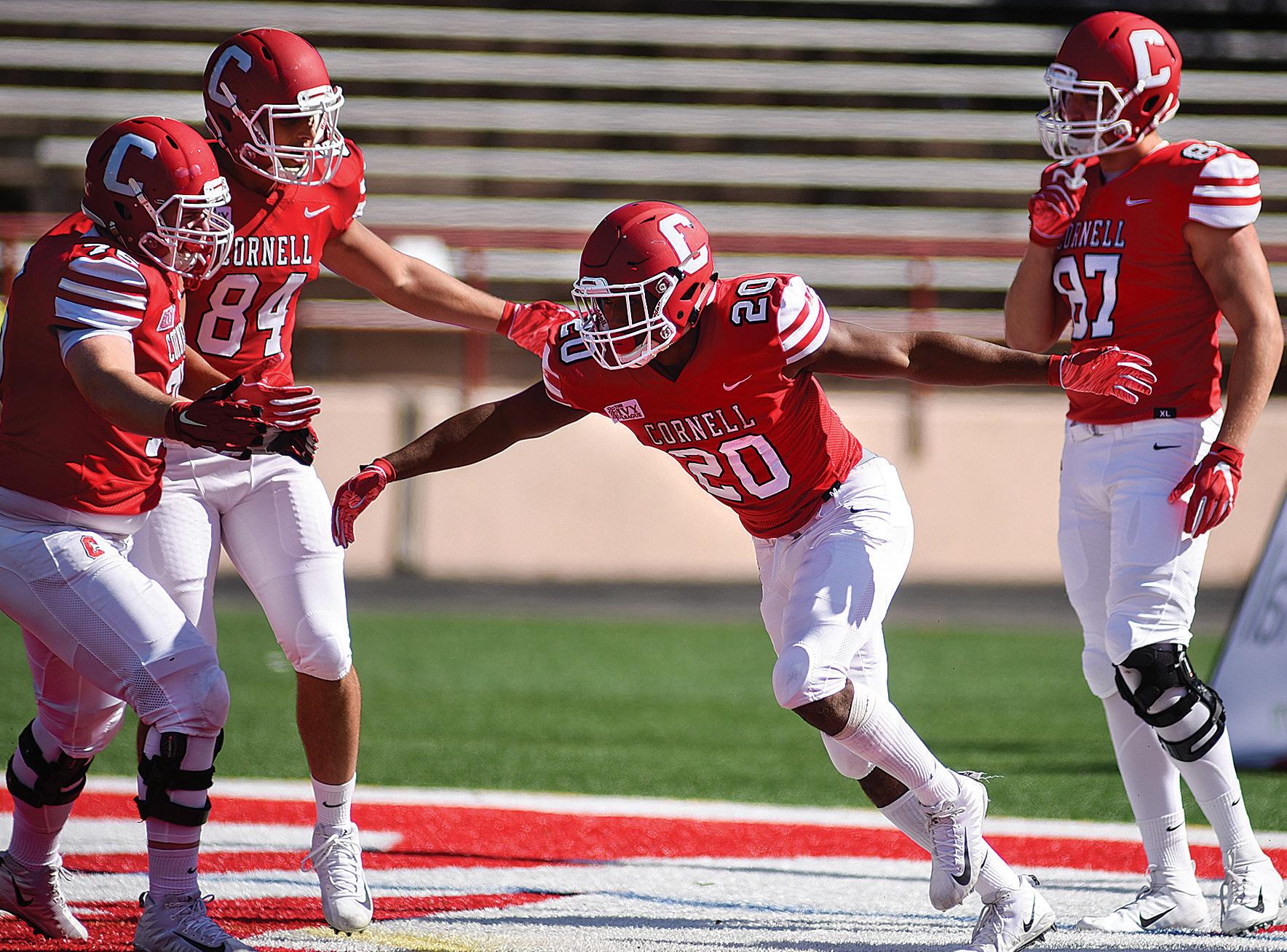
By
Cornell football’s offense was finally firing on all cylinders last week thanks to a big day on the ground. If the Red wants to replicate those results this week and pick up its second win, it will have to do so against Harvard’s highly touted defense.
Eight.
“They’re playing really good football,” said head coach David Archer ’05. “Their defense is really aggressive, and they have a lot of playmakers on offense.”
Harvard fell short last week against No. 20/22 Rhode Island for its first loss but ceded only 25 yards on the ground. The week before, in a victory against Brown, the Crimson let up an equally stingy 32 yards rushing.
“They just attack … they have two really powerful kids in the middle at defensive line, and they have a mic line backer that diagnoses and reads the play well,” Archer said
“[Harvard’s defense] just attack[s] ... They have two really powerful kids in the middle at defensive line.”
Head coach David Archer ’05
After 263 rushing yards from six different players in the win over Sacred Heart, Cornell believes it is up for the challenge.
And luckily for the Red, a shaken-up Ivy schedule has resulted in the Crimson having to make the long trek back to Ithaca, the same field on which Cornell shocked Harvard last year for its first win over its rival in 12 years.
Cornell will host the Crimson this Saturday in each team’s second Ivy contest of the season. For the Red, a win is crucial to keep hopes of a title alive: no team has won or shared an Ivy crown with two or more losses since 1982, and Cornell is already 0-1 in conference play after its homecoming loss to Yale. Harvard will come to Schoellkopf looking to impose their will on the Red’s offense and move to 2-0 in the Ancient
has been heralded by Cornell’s backs and coaches as the key to the team’s success on the ground. Running the football was key in Cornell’s upset win over the Crimson last year — the Red rushed for 233 yards. The offensive is looking forward to dancing with Harvard’s run-stoppers.
“They like to run base defense so bringing them in here locking
the gate and getting ready to roll will be nice,” said senior left tackle Henry Stillwell.
The run-first approach will be especially prevalent as the Red is without junior wide receiver Davy Lizana and junior tight end John Fitzgerald, who

By ZACHARY SILVER Sun Senior Editor
David Jones was the first to break out Cornell football’s “Turnover Time” chain in Saturday’s win over Sacred Heart, and he’s now the first from East Hill to earn Ivy League player of the week honors.
With two interceptions — one which was returned for a touchdown on the Red’s first defensive drive — the Defensive Player of the Week in the junior cornerback Jones anchored a Cornell defense that held undefeated Sacred Heart to 10 first-half points while the offense poured on 36 of its own in a 43-24 rout of the Pioneers.
“I hadn’t been in the end zone for a while. It felt good.”
Junior David Jones
On the first interception, Jones jumped his route as Sacred Heart quarterback Kevin Duke was being forced to roll out by the Cornell front seven. Jones returned the interception 48 yards for the first pick-six of his college career and the first for the program since 2011. Head coach David Archer ’05 called the sequence the spark for the win after the Red’s first offensive drive moments earlier stalled out for just a field goal.
“I haven’t been in the end zone for a while,” Jones said with a smile after the game, adding that his last pick-six came his senior year in high school. “It felt good.”
On the second pick, as the Pioneers were looking for the end zone in the dying moments of the first half, Jones stuck with his man and muscled his way to the ball on the two yard line. It maintained the Cornell lead — one that was never in danger.
With the two picks, Jones has five interceptions in his last four games including last year’s three-interception season finale against Penn and ignited a Cornell defense that struggled to take the ball away this season until Saturday.
Jones also had a pair of solo tackles on the afternoon.
Jones also shined in his special teams role as punt returner. On the drive after the pick-six, Jones returned a Sacred Heart punt 46 yards to the Pioneer 23 to set up Cornell’s third score of the day.
Zachary Silver can be reached at zsilver@cornellsun.com.