


By ELI PALLRAND Sun News Editor
The cocktail lounge, a popular Uris library study space, is closed until further notice for repairs. According to a sign left on the door by University maintenance, the closure is due to a water leak. As a result, students have had to find new spaces on campus to study.
Part of the appeal of the cocktail lounge for students is that it is open 24-hours a day. Students who got comfortable studying there late at night now have to adjust to other libraries.
“I really liked going there to study. I’ve got a prelim coming up, and now I can’t go study [there], so I’ve gotta find a new space that I’m comfortable with,” said Aiden Lee ’26. “[I’ve been studying in] the Asian studies lounge in Olin, it’s pretty quiet and spacious … but Cocktail Lounge is better.”
Some students have opted to return to dorm study spaces instead of moving to other libraries. Bella Cuomo ’25 said her friends frequently went to the cocktail lounge because of its late hours, but they are now packing into their residence hall lounge.
“Some of [my friends] have actually complained about having to be in our lounge because the other 24 hour ones are different, they don’t wanna go there,” Cuomo said. “We’re [in the residence hall lounge] every night now, there’s a lot more people — like my whole building.”
closure hasn’t had as much of an effect on older students like Jalen Knight ’23, who use the lounge less. Knight used the cocktail lounge more often as a freshman and again as a junior, once many COVID-19 restrictions had been lifted.
To read the rest of this story, please visit www.cornellsun.com.
Eli Pallrand can be reached at epallrand@cornellsun.com.

Lounge | One of campus' go-to 24 hour study spaces will be closed for repairs until further notice due to a water leak.
By CAROLINE MICHAILOFF Sun Contributor
On Friday, Sept. 30, the Facilities and Campus Services Diversity and Inclusion Council hosted a blood drive in collaboration with the Red Cross to donate much-needed blood and raise awareness about sickle cell disease.
Helen Steh, co-chair of the FCS Diversity and Inclusion Council, said the idea behind the drive came from the need to engage division staff.
“The Facilities and Campus Services Diversity and Inclusion Council is dedicated to creating engagement opportunities for division staff where we can meet, get to know one another, and give back to the community in some way,”

Steh wrote in a statement to The Sun. “We decided to sponsor the blood drive to help the community, create teamwork within our council and bring awareness to Sickle Cell disease.”
The month of September is National Sickle Cell Awareness Month. Any donor who identifies as Black or African American was tested for the Sickle Cell Trait. People who carry this trait can help to save the lives of patients who suffer from Sickle Cell Disease and require closely matched blood types.
Sickle Cell Disease is the most common inherited blood disorder in the U.S., mostly affecting patients of African descent as well as Latinx people who may require frequent blood transfusions throughout their lifetime. Seasonal changes can trigger pain crises for those battling Sickle Cell Disease — possibly increasing the need for lifesaving blood transfusions. Currently, only 4 percent of the donors identify as African American. Sickle Cell Disease is a genetic disease that affects Black and some Latino patients, and may require a lifetime of blood transfusions from donors who are closely matched ethnically and carry the "Sickle Cell Trait."
The Sickle Cell Initiative was launched last year in an effort to increase the Red Cross Back donor base. This initiative, Our Blood
Saves Lives, launched with community partners in 2021 to grow the number of blood donors who are Black and improve health outcomes for patients with sickle cell disease.
The FCS Diversity and Inclusion Council reached out to biomedi-
“I hope that a lot of other students also join in the donations because there is always a need.”
Annie Gardella, grad
cal services at the University after learning that they offer recruitment opportunities for students, faculty and staff of diversity and color. The American Red Cross is teaming up with organizations including the National Pan-Hellenic Council in the Black community to rally blood donors who are Black to support patients with sickle cell disease.
Natalie Mattrazzo, the account manager in Biomedical services at Cornell stated that this year's drive turnout was exceptional.
“The American Red Cross holds blood drives on Cornell campus throughout the school year, partnering with many different groups,” Mattrazzo said.


By ERIN YOON Sun Contributor
As the first round of prelims conclude, Cornellians are excited about their plans for the extended fall break weekend. Whether they are visiting friends and family back home, traveling or simply staying in Ithaca, students look forward to releasing some of the stress that they have accumulated during prelim season.
Morgan Hunt ’25 is flying back home to Boulder, Colorado where she looks forward to hiking and spending leisurely time in Coloradan nature, giving her time and space to relax both physically and mentally.
“I don’t think many of my friends will be home since we all have different breaks,” Hunt said. “So, I’ll probably be hanging out with my parents a lot.”
Anushka Shorewala ’26 will also be heading home, returning to Long Island, New York, where she will spend time with her family.
“I like to watch movies [with my family] when I’m at home,” Shorewala said. “I think it will be a relaxing weekend, and I’m really excited.”
Like Shorewala, many first year students are thrilled to reunite with their families after being separated from them for the first time.
Noah Salzman ’26 is traveling to his home in New York City to meet his family and enjoy the urban scene that cannot be seen in Ithaca.
“I like that I’m going to see my family,” Salzman said. “I haven’t seen my twin sister in a while because she goes to [another school]. I’m also looking forward to playing with my little cousins.”
Aside from reuniting with family members, Salzman hopes to visit coffee shops and venture through his home city.
Fiona Neibart ’26 plans to travel to New Haven, Connecticut, to visit her twin sister at Yale University in time for Yale’s Family Weekend.
“I’m just excited to see my family again,” Neibart said. “As a freshman, it’s strange having been away from them for so long.”
Meanwhile, other Cornellians view the break as an opportunity to be adventurous; some are traveling to new places to collect memorable experiences.
Quinn Reinhardt ’25 will be driving to the Adirondacks to go camping with his friends.

S.C. Tsiang Macroeconomics Workshop: Jeremy Greenwood, University of Pennsylvania
11:15 a.m. - 12:45 p.m., Uris Hall 498
Fighting Yesterday’s War: Soviet Influences in Putin’s Foreign Policy 11:25 a.m. - 12:40 p.m., Virtual Event
Cornell University Debates in Spanish Noon - 12:45 p.m., Virtual Event
Neurobiology and Behavior Seminar: “Aestehtic Agency, Sexual Autonomy and Sexual Conflict Over Mating” 12:30 p.m. - 1:30 p.m., Corson Mudd Hall Morrison Room A106
sunmailbox@cornellsun.com

Midday Music in London: New York State Baroque Young Artists, Hannah De Priest, soprano, And Michael Pecak, fortepiano 12:30 p.m. - 1:10 p.m., Lincoln Hall B20
Looking for the Hidden Folk: How Iceland’s Elves Can Save the World 4 p.m. - 5 p.m., Kroch Library 2B48
Seymour Lecture in Sports History: “Black Bombers: Doug Williams, Vince Evans and the NFL’s Most Important Game” — Louis Moore, Grand Valley State University 4:30 p.m. - 6 p.m., Goldwin Smith Hall Kaufmann Auditorium
Tomorrow
Institute for African Development Webinar: Malaria in Africa, “Thousands of Years of Persistent Prevalence, Ongoing Research Challenges and Vaccine Promises and Breakthroughs in the 21st Century” 10 a.m. - Noon, Virtual Event
Earl Peters Seminar: Spinning a Good Yarn 10:30 a.m. - 11:30 a.m., Human Ecology Building T49
Demography Training Pro-Seminar: Prof. Peter Rich, Sociology and Public Policy Noon - 1:15 p.m., Martha Van Rensselaer Hall 2250
Celebration of the Life and Scientific Accomplishments of Prof. Muawia Barazangi, Earth and Atmospheric Sciences 3 p.m., Myron Taylor Hall Elizabeth Storey Landis Auditorium
By CAMDEN WEHRLE Sun Staff Writer
With the fall semester almost halfway over and prelim season picking up, another season is in full swing for students: The rise of Cornell Cinema, which regularly shows films in Willard Straight theater. While the Cinema has had a successful return to full capacity after COVID-19, it has also had big internal shifts in recent months — following the departure of longtime Director Mary Fessenden in July, Molly Ryan, an experienced film curator, has taken over the role.
As an undergraduate student at Harvard University, Ryan studied history and literature, where she incorporated her love of film into her studies, exploring the medium as a historical artifact. After graduation, she worked in the education program of Harvard’s art museums, where she organized events and activities that increased public engagement.
Last year, Ryan attended a graduate program in film studies at the University of St. Andrews in Scotland and gained experience running the Sands International Film Festival of St Andrews and the On the Rocks Arts Festival. All of these experiences led to her decision to take the director role at Cornell Cinema.
“It’s been a lot of fun to start right in the thick of the semester.”
Molly Ryan, Cornell Cinema Director
“When this opportunity at Cornell came up, it kind of combined all the best things that I’ve liked about what I’ve
Washington D.C., Jia hopes to transition from admiring fall views in nature to actively exploring the historically-rich cityscape.
He expressed both excitement and apprehension about “going with the flow” on his first camping trip.
“We don’t exactly have [solid] plans,” Reinhardt said. “We’re going to drive around and figure things out along the way.”
Although nervous about unexpected turns and potential encounters with bears, Reinhardt said
“[Fall break] will be a good chance to refresh and re-energize.”
Anushka Shorewala ’26
he looks forward to de-stressing from academic pressure amidst wildlife and establishing stronger bonds with his friends.
Similarly, Tianzhen Jia ’24 and his friends have arranged an East Coastroad trip from Saturday to Monday.
“We’ll be passing by many state parks,” Jia said. “I’m especially excited to drive through the Blue Range Parkway because it’s the best season to be sightseeing there.”
When he arrives at his ultimate destination,
Some Cornellians will forgo traveling and remain in Ithaca for the duration of their days off. For instance, like many fellow international students, Giovanni Mariotti grad from Italy will be remaining on campus over the break. He aims to sleep in and complete work.
“I have to stay [in Ithaca] because traveling is too expensive,” Mariotti said. “But I’ll definitely be doing a lot of catching up. Plus I’ll be putting aside time for Netflix and workouts, which is something that I wasn’t able to do recently due to academics.”
Despite the crowd of students leaving campus to travel and visit home, those remaining in Ithaca over Fall Break are determined to spend time outdoors.
Cornellians can explore local produce and handmade goods at the Farmer’s Market, walk around Collegetown after grabbing bagels with friends, or go shopping at Ithaca Mall. Fall Break is an ideal time to experience the charms of Ithaca and immerse oneself in the beauty of autumn in upstate New York.
As Shorewala put it, “[Fall break] will be a good chance to refresh and re-energize.”
Erin Yoon can be reached at ey253@cornell.edu.
closely as possible with the same ethnicity.”
“The Sept. 30 blood drive was our first time partnering with the Cornell Facilities and Campus Services Diversity and Inclusion Council. We came in at 154 percent of that goal.”
According to Mattrazzo, there was no difficulty in finding donors, as the students, faculty and staff readily stepped in line to give their blood. Most of the Red Cross drives are booked to capacity.
Mattrazzo added that ethnicity was an important component of this drive.
“This blood drive was …an effort to support diverse blood donation needs,” Mattrazzo said. “The Red Cross is working hard to meet the needs of every patient, including those with genetic diseases that require a blood donation matched as
Donors who self-identify as African American were automatically tested for the sickle cell trait, and if they carry that trait, they can become a lifelong lifeline for sickle cell patients. Blood donations are
“You never know if you’ll require a blood donation one day...”
Annie Gardella, grad
sent wherever needed the most urgently within the U.S. It is common for the Red Cross to separate a blood donation into three products — red blood cells, plasma and platelets — helping three patients at once.
Annie Gardella grad was one
done in the past,” Ryan said, also noting she enjoys working with student communities and collaborating with academic researchers.
In her first two weeks as director, Ryan spent some time navigating campus and engaging with student-run activities like the annual Ag Day.
“It’s been a lot of fun to start right in the thick of the semester,” Ryan said. “I’m getting a feel for what people do here on campus and getting a chance to learn about the complexities of this university.”
Learning about students and campus culture is important to Ryan’s goals as director.
To continue reading this article, please visit www.cornellsun.com.
Camden Wehrle can be reached at cwehrle@cornellsun.com.

of the people who were eager for the opportunity to donate blood at the drive in Willard Straight Hall.
“It was my first time donating but I have always wanted to do it,” Gardella said. “It feels like a relatively easy thing to do that can hopefully make a real impact in someone else’s life.”
Gardella also urged other students to participate in the spirit of goodwill. Gardella said that Cornell’s system of signing up to donate on campus made it easy to donate blood.
“You never know if you’ll require a blood donation one day, so donating while you can is always a great way to help,” Gardella said. “I hope that a lot of other students also join in the donations because there is always a need.”
Caroline Michailof can be reached at cm849@cornell.edu.
By ALLY FERTIG Sun Staff Writer
The Office of Financial Aid has delivered aid on time this fall to students and their families, granting students a sense of relief about financial aid concerns for the fall semester.
After student protests, Student Assembly resolutions calling for change, and a class action lawsuit, the Office of Financial Aid began a process of restructuring last spring. This process has continued this fall, with the office continuing to fill vacancies, update certain roles and invest in new technology to improve student experiences.
“This year and every year, we listen, learn and make continuous efforts to improve,” said Kevin Jensen, executive director of financial aid. According to Jensen, the office of financial aid is currently focused on improving service for students in the most recent 2023-24 aid application cycle, which began Oct. 1.
During spring and summer 2022, the office has been able to recruit and hire staff to fill previously vacant positions. Vacancies were one of the challenges faced by the office, leading to delayed reviews and distribution of aid packages.
The office also has plans in progress to add positions within the office and update business processes and technology where possible.
“We anticipate filling new roles later this fall which will
further expand our availability to students in the spring,” Jensen said. “We are simultaneously focused on improving key business processes and technology tools which will enhance our ability to provide timely services.”
While aid has been delivered on time, there are other issues for students that have still not been addressed or solved by the office of financial aid.
“The FASE office seemingly does not have the capacity or bandwidth to address the basic needs of all of the student body and commonly resorts to recommending FGLI [first-generation, low-income] students to take out loans,” said Amisha Chowdhury ’23, president of CU Student Advocate and president of the First Generation Student Union.
The Cornell Student Assembly Office of the Student Advocate has been focused on helping students navigate financial aid issues and questions in the past, like completing the FAFSA application or filing their taxes. Chowdhury said that the office should expand to offer these services to students in need.
Their office has done a tax filing workshop in the past to help student workers complete their required tax forms.
To continue reading this article, please visit www.cornellsun.com.
Ally Fertig can be reached at afertig@cornellsun.com.

By JIMMY CRAWLEY Sun Staff Writer
As a townie myself, I’ve always known about the local cult that inhabits Ithaca. I’ve seen them with their many children walking around the farmers market. I’ve seen their incredibly large property in the Fall Creek neighborhood. I’ve also always known about their restaurant, or series of café’s near the Commons.
However, the happenings of this cult have largely been dormant in my mind until I went on Instagram on Saturday morning. Apparently, some unknown organization had set up a free sample stand outside of Collegetown Bagels. Soon after the first Instagram stories exclaiming “free food,” I began to see dozens of Instagram stories proclaiming this organization as white supremacists, sexists and more. I had to learn more about this group of people, and what their history in Ithaca was.
A quick Google search will tell you that the Twelve Tribes organization is a self-proclaimed “emerging spiritual nation” that is deeply religious and rooted in the practice of following the new and old testament within the realms of self-governing communities.
The Twelve Tribes organization is represented all over the world, with communities in North America, Europe and Australia. On the Twelve Tribes website, the Ithaca
community is described as “a multicultural hub within an enlightened city.” The Twelve Tribes are clearly deliberate in selecting locations for communities that provide crossroads for a plethora of thoughts and ideals. I think that their establishment focuses on certain demographics, such as impressionable people going through transitional periods in their lives.
Although this weekend was the first time that many Cornellians heard about the Twelve Tribes organization, they have had establishments in Ithaca for nearly two decades and have called Ithaca home for much longer. The Twelve Tribes started their first restaurant at their current location in Ithaca in the early 2000’s with a café called “The Maté Factor.” This café and juice bar was immediately a popular hit in Ithaca due to its fresh food and prime location, right in the heart of Ithaca on the Commons. However, Ithaca locals soon caught on and began to post online and boycott the Maté Factor around 2006 after the founder of the Twelve Tribes, Eugene Spriggs of Chattanooga, Tennessee, expressed extremely racist and homophobic viewpoints, going as far to glorify slavery and the Ku Klux Klan, and stating that homosexual people should be put to death.
What made matters worse for the public opinion on the Maté Factor is that in 2018 the Department of Labor busted

the Twelve Tribes in a nearby Upstate New York community for child labor and child abuse. Similar instances were reported to be found in the Ithaca location, with the employment and abuse of children aged as young as six years old.
Since then, the Maté Factor has been under a four year renovation, and have changed their name to the “Yellow Deli,” a restaurant aimed more at hearty food instead of light fare and drinks. The Yellow Deli will move away from serving mostly breakfast food, and will transition into an establishment focussed more on lunch and dinner.
Alas, after hearing about these developments, I knew I had to go down to the Commons and check out this restaurant myself. Coincidentally, I was going downtown for Apple Fest anyway, so I was curious to check out the
Yellow Deli.
After roaming around the Commons, buying some apple cider and eating way too much kettle corn, I wandered over toward Yellow Deli right next to the Center Ithaca Community Center. I was intercepted outside by a tall man with a ponytail and a grin on his face. He was carrying a tray of some sort of punch or juice, and ushered me into the store.
“Welcome to our home” he said with a smile as we made eye contact. As I stepped into the Yellow Deli, I was taken aback by the sheer beauty of the place. There were incredible dangling ceiling lights with stunning woodwork all throughout the restaurant. The floors, walls and tables were all spotless. There were two levels with a fine wooden railing serving as a perimeter on the upper floor. Everything seemed too perfect;
too good to be true. There were waiters (possibly Twelve Tribe members) scattered throughout the restaurant serving petit sandwiches and pastries. A couple members from my group tried some of the samples and seemed to agree with the consensus of the other visitors: the food was delicious.
What left me a bit unsettled were the subtleties underlying the operation, the things you had to look a bit closer into to notice. First, nearly every man that I saw around the restaurant had the same haircut, mannerisms and sheer enthusiasm. thing to hide?
To continue reading, visit cornellsun.com.




SERENA HUANG ’24
Business Manager
EMMA LEYNSE ’23
Associate Editor
SURITA BASU ’23
Assistant Managing Editor
NAOMI KOH ’23
Assistant Web Editor
ELI PALLRAND ’24
News Editor
ESTEE YI ’24
News Editor
KAYLA RIGGS ’24
JULA NAGEL ’24
MEHER BHATIA ’23
KATRIEN DE WAARD ’24
PAREESAY AFZAL ’24
JIWOOK JUNG ’25
ADITI HUKERIKAR ’23 Assistant
DANIELA WISE-ROJAS ’25
JASON WU ’24
Assistant Photography Editor
GRAYSON RUHL ’24
Assistant Sports Editor
KEVIN CHENG ’25
HANNAH ROSENBERG ’23
JYOTHSNA BOLLEDDULA ’24
VEE CIPPERMAN ’23 Editor in Chief
Ad Layout Katrien de Waard ‘24
Design Deskers Ashley Koo ’24 Kate Kim ‘24
Managing Desker Angela Bunay ’24
Opinion Desker Katherine Yao ’23
Dining Desker Daniela Wise-Rojas ’25
News Deskers Estee Yi ’24
Gabriella Pacitto ’24
Science Desker Tenzin Kunsang ‘25
Photography Desker Jason Wu ’24
Want to give your take on a campus issue?
The Sun thrives on your feedback. Continue the conversation by sending a letter to the editor or guest column to associate-editor@cornellsun.com.
Letters should be no longer than 250 words in length. Columns are 700-900 words
Please include graduating year if applicable.
All voices welcome.
BUNAY ’24
ZENG ’24
FLORES ’24

Adam Senzon is a freshman at the School of Industrial and Labor Relations. He can be reached at ars424@cornell.edu. My Two Sen-ts runs every other Tuesday this semester.
Internal dialogue is something many people seem to overlook.
’24
ABRAHAM ’24
BERNSTEIN ’23
ROSENBERG ’23
Yet, internal dialogue is one of the most important aspects of experiencing growth and working toward your goals. Recently, I’ve noticed my internal dialogue seems to have been defaulted to a negative thought process — I tend to be extra harsh on myself, especially when under pressure in unideal situations. I’m beginning to realize how important it is to shift your internal dialogue when you find yourself in these hyper-pressurized situations.
This negative internal dialogue, generally speaking, sounds something like:
I believe that high-pressure environments foster the additional potential for negative internal dialogue to present itself in your subconscious.
“Why can’t I handle this?” and “I can’t do this.”
Though, in the moment these urges to put myself down seem out of my control, or simply unimportant, they have major implications on the way we approach roadblocks and shortcomings in our lives. These negative thoughts manifest themselves into greater issues like an inability to identify a problem and derive a solution to the problem. If we make conscious efforts to shift our internal dialogue to thoughts that encourage us to improve on our mistakes, then we’re ultimately prioritizing ourselves and taking steps toward our goals.
How do I shift my internal dialogue? How can I tell when I’m expressing negative internal dialogue?
It’s simple. Internal dialogue is the way you talk to yourself in your head — and we seem to be using it at all times throughout the day. The tricky part is that internal dialogue tends to be subconsciously taking place within the mind. It’s your job to catch yourself in an irrational thought process and counteract it with a conscious, forward-thinking shift in your internal dialogue that can prevent the internalization of these negative ideologies. If you’re wondering what that looks like, imagine you’re about to take an exam — worth a large percent of your grade — and you find yourself thinking, “I’m so anxious
that there’s no way I’m going to pass this exam.” Instead, try thinking, “I’m anxious right now, but I’ve studied for this exam and I’m going to do well.”
I believe that high-pressure environments foster the additional potential for negative internal dialogue to present itself in your subconscious, this has been something I’ve learned through experience. One of my professors, Vanessa Bohns, industrial and labor relations, has helped remind me that everything should come back to a growth mindset. If you believe you have the courage to recognize your faults and make room for improvement, then you’re inherently taking steps toward success; not only would you be demonstrating a growth mindset, but a way to supercharge this growth mindset would be to support it with positive internal dialogue.
Now that you’ve heard my two cents, let me provide you with an instance where I recently made a conscious effort to introduce positive internal dialogue into my daily routine — the goal here is to make it habitual. I haven’t been feeling confident in my efforts to prioritize health and have been very imbalanced over the past few weeks. Most of my nights are spent studying at libraries, or planning every intricate detail of my day out. I haven’t been getting physical activity, and this has adversely affected my belief that I have the discipline to handle the responsibilities I’ve taken on at the moment.
As a result, I’ve developed a negative internal dialogue where I often find myself thinking I’m far less capable than my peers. Why can’t I just get up and go to the gym? Why haven’t I taken a break when all I want to do is relax? Falling into these thought processes and negative internal dialogue cycles discourages us from maximizing our full potential — whether it be by decreasing productivity or deterring you from achieving your long-term goals. So, once again I encourage you to catch yourself. You have the grit and capability to do so. Continue to move forward in your life, understand the lessons that you’ve learned through making mistakes, make conscious efforts to shift your internal dialogue and try to think twice before giving in to doubtful thoughts.
If you’d like to learn more about grit in specifics I suggest listening to a TED talk hosted by American psychologist, Angela Duckworth, titled “Grit: The power of passion and perseverance” where she delves more precisely into what it means to have grit and be gritty, emphasizing how this plays into overarching long term goals.
Thank you to Prof. Bohns for inspiring me to approach learning within my undergraduate career with a growth mindset — but more importantly for encouraging me to find importance and purpose through hard work and grit. Continue to put your best foot forward when it comes to being gritty, allowing for conscious efforts to be made as you exercise positive internal dialogue.
Jack Kubinec You Don’t Know Jack
Jack Kubinec is a senior in the College of Arts and Sciences. He can be reached jak525@cornell.edu. You Don’t Know Jack runs alternate Tursdays this semester.
On a gray spring day in 2021, President Pollack gave a heartfelt speech to Cornell’s graduating class, urging the socially distanced seniors to leverage their education “to tackle big, thorny problems” facing the world.
Half of Cornell’s employed 2021 graduates now work in tech, fnance or consulting. Te top employer for Arts & Sciences graduates in the class of 2021 is Facebook. Te rest of those graduating seniors are presumably in graduate programs or nonprofts, gathering skills to tackle thorny problems.
In short, there are two main paths facing the Cornell graduate: work a lot to make gobs of money, or work a lot to save the world. The trouble is, both of these options assume a work-centered life, and as it turns out, we tend to be terribly unhappy in our work-related pursuits. Orienting our lives around community and family while placing work second would be a better way to live.
Tis summer, I sat on my friend’s apartment roof as he lit a cigarette — a habit he’d picked up to cope with the depression he was facing because of his internship, he explained. Tis friend was employed by a tech giant many Cornellians would auction a kidney to work for, and he was miserable. He’s far from alone in feeling that way.
Cornell’s 2020 mental health survey found that

Rebecca Sparacio (she/her) is a junior in the College of Arts and Sciences. She can be reached at rsparacio@cornellsun.com. Te Space Between runs every other Wednesday this semester.
It was 2:45 on a Tursday morning, and the fre alarm in my apartment building was blaring. I smelled something burning, and I decided that I did not have time to throw sweatpants over the shorts I had worn to sleep. I ran down the stairs and into the chilly Ithaca night as the apartment building fooded onto the street. Collectively, I think everyone wonders the same thing when this happens: Is there actually a fre? But of course, until the entire emergency protocol is carried out, fre trucks and all, the answer remains a mystery.
I was shivering and decided to walk over to Collegetown’s notorious 7/11, where I could wait out the fre alarm in the heat. I
88.5 percent of undergrads see their coursework as “moderately or extremely stressful,” and 75.5 percent experience concerns about their future in the same way. Translation: we really don’t enjoy the work we’re doing now, and we’re not optimistic that things will get much better.
This is an accepted reality at Cornell, part of our “work hard, play hard” culture — but it’s something I’ve always found puzzling. Why is the reward for gaining acceptance to an Ivy League school working 70 hours a week at Goldman Sachs? Shouldn’t the point of going to Cornell be to earn a decent living doing something less burdensome, even if it involves taking a pay cut?
Adam Ziccardi ‘21 was one of those 2021 graduates meant to solve thorny problems. He began his time at Cornell as an engineer to avoid the “philosophy major to Starbucks pipeline,” he told me. But after accepting that he didn’t enjoy being an engineer, Ziccardi switched his major to religious studies. He worked as a substitute teacher after graduation before moving to a farm.
“I was a Cornell graduate and what was I doing? I was watering the plants and walking the dogs,” Ziccardi said with a laugh. But Ziccardi felt free and appreciative of his life.
We don’t all have to live on farms, but Ziccardi’s story illustrates that we also don’t all have to sacrifce our wellbeing to climb the corporate ladder. What if we entertained the possibility that rejecting the career-gods and building a life centered on family and community is not just a nice way for the non-Ivy-League-educated to live, but the actual best orientation for our lives?
High-paying tech and fnance jobs cluster in increasingly expensive cities and expect employees to be highly committed to their work, meaning it’s hard to start a family. Work takes a quasi-religious centrality in a person’s life.
Working excessive hours increases your risk of stroke or alcoholism, per the World Economic Forum. A lack of strong social ties can be as harmful to your health as smoking. University of Toronto researchers ranked 98 Canadian neighborhoods by happiness, and two of Canada’s megacities — Toronto and Montreal — tied for last. In short, the workaholic, fast-moving, big-city dream being sold by tech and fnance giants isn’t going to make you happy.
Plus, as Derek Tompson wrote for Te Atlantic, our career idol is a “god with fring power.” So, companies
make their ofces feel like all-inclusive resorts, and workers practice watered-down Buddhism to make life feel meaningful. I’m not sold.
To be clear, I don’t think tech and fnance careers are
In short, the workaholic, fast-moving, big-city dream being sold by tech and finance giants isn’t going to make you happy.
irredeemable. I hope some of my classmates help solve thorny problems and work in cool ofces. I spent a lot of my own time at Cornell thinking my life would be meaningless without an impressive job. But when most Cornell undergraduates can’t imagine a future without extreme stress or abject misery, something has gone terribly wrong. It’s time to start considering alternatives. If I could get existential for a moment, consider what happens when you die.
Te church was packed wall to wall as the upstate New York town turned out en masse for my friend’s dad’s funeral earlier this semester. Te man was a school headmaster and rowing coach — a community giant in his small town. Several community members tearfully testifed to the handprints he’d left on their lives. Te man made peace with God, leaving his family believing he was in Heaven. What will your funeral look like?
Tis is a question that Microsoft can’t help you answer, but it’s probably an important thought for deciding what your life should be for.
You can begin rejecting the pull of career-minded life while at Cornell. Take a new class outside of your major or minors — sheerly for the joy of learning. Get into a spontaneous long conversation with a friend, even though you should be getting started on that problem set. Allow yourself to rest in ways that don’t involve self-improvement or HBO Max binging.
Choosing between career and community isn’t a zero sum game, of course. But if I had to pick one to take over the other, I’m taking the latter.
bumped into another student on the way there, who also lived in my building, and we walked there together even though we had never met before. We had a 40 minute conversation that was just as serendipitous as the two of us meeting in the frst place — we covered the diferences between cities on the East and West Coasts, what the places that we had grown up in were like, studies at Cornell, Jazz music and so on. When I told
The butterfly effect often leads me to the hypothetical game. If this event or that event did or did not happen, would my current reality be different?
this story to my parents and grandparents, they found it funny. Tough, I wondered why.
After waking up the next morning not sure of whether or not it was a fever dream (it wasn’t), I can tell you that this kind of experience embodies college in a special way. We all love the possibility that anything is pos-
sible, and this moment highlights just that.
College is probably one of the only places where you can meet someone and befriend them at three in the morning. It’s one of the only places where a sense of limitless opportunity is both a fxture of youth and a fxture of a university with the motto “Any Person, Any Study.” When you are young and impressionable, random occurrences, like this fre alarm, can have life long implications.
Tis fre alarm experience reminded me of a phenomenon called the butterfy efect. Te butterfy efect is essentially a metaphor for chaos theory, the idea that one small event can trigger a series of events that culminate into one large event. It originated from a thought experiment posed by Edward Lorenz, a meteorology professor at MIT. He posed the question: “Does the fap of a butterfy’s wings in Brazil set of a tornado in Texas?”
Te butterfy efect often leads me to the hypothetical game. If this event or that event did or did not happen, would my current reality be diferent? For example, if my freshman year hadn’t occurred in the middle of the pandemic would I be diferent? Would I have the same friends? Would I have chosen to study abroad next semester? Had I not accidentally signed up for an actual English class (which I thought was a freshman writing seminar), would I have met one of my great friends, who is sitting across from me as I write this article?
As we approach fall break, the weather starts to get dreary and cold, the days start to get shorter, and the work piles up. It’s easy and even fulflling to simplify college to a to-do list and some kind of future goal.
But I have always marveled at the fact that you can sit in a class that will change your life or even meet the person you are going to marry. How much of life is predictable and how much is left to fate? It is hard to ignore the
I have always marveled at the fact that you can sit in a class that will change your life or even meet the person you are going to marry.
randomness that sometimes pervades college life. Tough with it, I always attribute a form of optimism. It’s a type of optimism that is easy to lose with every club rejection, or class you don’t like, or bad grade, or date gone wrong, or week/weekend that seemed to drag on for too long. But when I look back at that fre alarm conversation, I feel that optimism again, and I see a perfect moment that is now just a dream-like memory.
Maybe we can catch the butterfy before it makes the fre alarm go of, and if we can’t, we can fnd the silver lining to our lost sleep.
Fill in the empty cells, one number in each, so that each column, row, and region contains the numbers 1-9 exactly once. Each number in the solution therefore occurs only once in each of the three “directions,” hence the “single numbers” implied by the puzzle’s name. (Rules from wikipedia.org/wiki/ Sudoku)





By KAITLYN LEE Sun Staff Writer
Last month, the U.S. Food and Drug Administration approved an updated COVID-19 bivalent booster, specifically to target the Omicron variant. Starting this fall, Moderna and Pfizer will offer these boosters to provide protection as COVID-19 infection rates are expected to rise.
A bivalent vaccine is a vaccine that contains two strains, or two slightly genetically different versions, of a virus. According to Prof. Cynthia Leifer, microbiology and immunology, bivalent vaccines are created for extra protection against new viral strains that arise over time.
The COVID-19 bivalent booster is not the only vaccine with more than one strain of virus. Many vaccines, such as the flu and MMR vaccines, contain multiple strains of a virus or even different viruses.
Half of the contents in the COVID-19 bivalent booster are mRNA from the original COVID-19 strain while the other half includes mRNA from the Omicron strain.
mRNA are pieces of genetic material used to synthesize proteins. In the COVID-19 virus, mRNA allows the production of spike proteins, proteins located on the surface of COVID-19 viruses that allow entry of the viruses into host cells. Once the spike proteins are in the body, the immune system learns to develop a response and attack against them.
Because the immune system can fight against multiple antigens, vaccines with multiple viruses do not change in efficacy com-
pared to their monovalent counterparts. However, it reduces the number of shots necessary to combat against all strains of a virus. Thus, it allows our immune system to provide better protection against more viral strains.
“The bivalent COVID booster works by reminding our immune system of the original strain and introducing the new variant,” Leifer said.
The COVID-19 bivalent booster contains the Omicron variant as opposed to other strains of COVID-19 because of Omicron’s high infection rate. Omicron is now responsible for 90 percent of COVID-19 cases and is predicted to spread during the fall and winter season due to reasons such as decreasing COVID19 immunity and cold weather that drives people indoors and allows for more spread of infection.
Although the original COVID-19 vaccine and boosters reduced rates of symptomatic infection, severe disease, hospitalization and death from the original Alpha and newer Delta strain infection, it is ineffective in reducing symptomatic infection for Omicron.
However, studies have shown that the updated bivalent booster causes high levels of antibodies against the original Alpha strain and reasonable levels of antibodies against the Omicron strain.
The FDA analyzed data of 600 people over the age of 18 who all received the first dose of the Moderna monovalent booster and then received either another dose of the monovalent booster or a dose of the bivalent
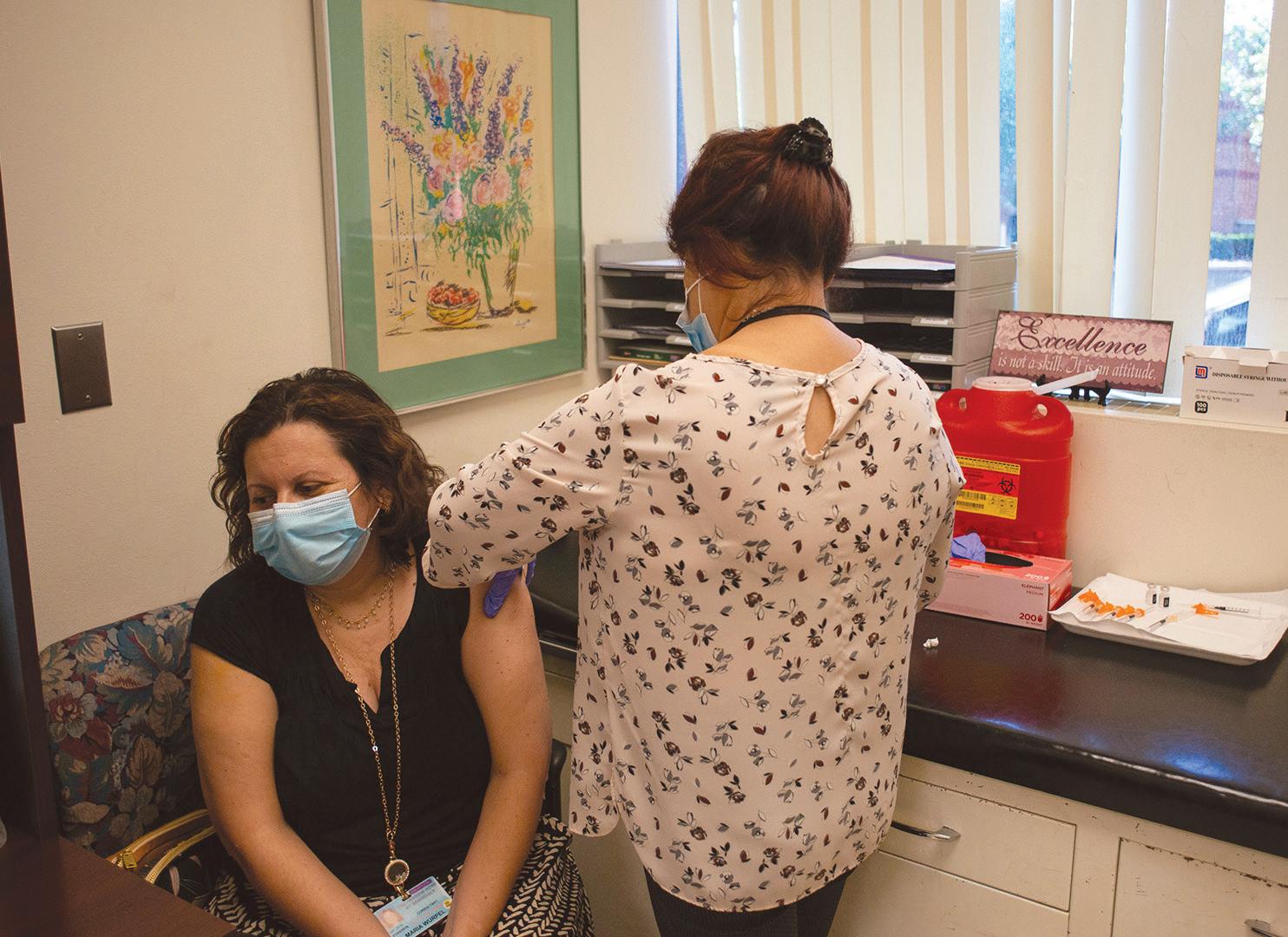
booster. A stronger immune response was observed from the individuals who received the Moderna bivalent booster dose after the first monovalent booster dose.
Additionally, an estimate of over 100,000 hospitalizations can be prevented in the upcoming month through administration of the bivalent booster.
All individuals who received the initial booster are eligible to receive the bivalent booster after two months. The Moderna
booster can be given to those ages 18 and up while the Pfizer booster can be given to those ages 12 and up.
The bivalent COVID-19 booster, like the original version, has similar side effects and takes up to two weeks to have full effects.
To continue reading this article, please visit www.cornellsun.com.
Kaitlyn Lee can be reached at klee@cornellsun.com.
By MARIAN CABALLO Sun Contributor
The most popular systems for artificial intelligence-generated art include Midjourney, Stable Diffusion and most notably, DALL-E 2: OpenAI’s program named after Salvador Dali and Disney’s WALL-E. The system opened to the general public on Sept. 28.
Generative artificial intelligence involves entering brief keywords that correlate to a desired image, including the style of output. For example, “Cornell University, digital art” indicates that a user is searching for
digital art of the University. Results appear in mere seconds, paired with opportunities to edit and fine-tune the original written inputs.
Whether it be celebrity Pokémon or Van Gogh-style bears atop McGraw Tower, text-to-image generative AI technology allows users to create digital renderings of short, descriptive text prompts. Generative AI is a rapidly advancing form of AI, distinct in its ability to create realistic new content like images, text or code.
This technology employs a subset of machine learning called deep learning, a biologically-inspired method of learning from large sets
of raw data. AI art uses generative models that take in training data in the form of images and work to produce information similar to the initial dataset. This results in a new image resembling the original selection of media.
DALL-E 2 employs diffusion, one of the most popular and efficient types of generative models. It destroys and recovers existing training data as a means of synthesizing new images.
“You take real images and add a little noise to them, then learn to remove that noise to get back the original image,” Prof. Noah Snavely, computer science, said.

Adding noise means deliberately altering pixels to random colors. With the system now having learned how to “de-noise,” it can generate new images by passing random noise patterns through that reversal process.
“If you also have text, like captions, accompanying the training images, these methods can also be adapted to generate images that match a given input text string,” Prof. Snavely said.
Text encoders interpret user-inputted words. Methods used for linking the prompts to captioned-visuals vary from company to company.
Unlike past models in the AI art sphere, diffusion models draw “from the idea of diffusion in physics to do this noise removal one tiny step at a time [as opposed to in one go],” Prof. Bharath Hariharan, computer science, said.
Removing noise one at a time as opposed to in one sum results in cutting-edge image quality as it tackles finer details.
Training data contain millions, and sometimes billions, of uncurated images from the web. As a result, some media-making AI programs have displayed explicit results reflecting the dangerous and prejudiced sides of the internet.
Pornographic images, depictions of violence and racist or homophobic content have surfaced.
This has prompted conversations on ethics, algorithmic bias and digital safety as tech companies work to develop stronger filtration systems.
AI-generated images remain controversial as artists debate its legal, social and creative merit.
Getty Images and Shutterstock have completely banned AI-created works, just a few weeks after a state fair-winning AI art piece fueled outrage across social media.
However, AI art has continued to strive in other mediums. Cosmopolitan featured the world’s first AI-generated magazine cover in June 2022. In September, Kris Kashtanova became the first known artist to receive U.S. copyright registration for an AI-generated artbased graphic novel.
Some artists argue that because AI art systems are trained with existing images, generative systems do not produce purely distinct, original works.
It is difficult to say how the generated images differ from their originals.
“In practice, because it is trained on billions of images, and because the model itself is relatively much smaller, it cannot really memorize the images,” Hariharan said.
Even so, the results can not stray too far from its training data, and Hariharan said it is difficult to succinctly articulate its limits.
Despite these limits, the intensifying market has sparked new rivals in what some media have deemed the “AI space race”, such as Google’s text-to-image system Imagen. Meta unveiled Make-A-Video last month, which converts text to videos.
The public can explore AI-generated works for free at DALL-E 2 and NightCafe, both now open on limited credit-based systems.