

The Corne¬ Daily Sun


Curtains Close on Vagina Monologues
GJAC announces its severance of support for annual production
By
The student actors of the play The Vagina Monologues unknowingly took their final bows last winter. The past sponsor of the popular show, the Women’s Resource Center, has announced that due to recent changes in its mission statement — the group was rebranded the Gender Justice Advocacy Coalition this year — it will no longer support the play.
The show is a collection of inter views-turned-narratives from people of all ages and backgrounds about their relationships and experiences with their vaginas.
“The limitations of the script, namely that it equates having a vagina with female identity, and the requirement by Eve Ensler that it remain unchanged, leaves us with an incomplete play that doesn’t honor the experiences of trans, non-binary and gender non-con forming people. It is thus hurtful, harmful and exclusionary to folks with these identities,” said Shura Gat, interim director of the Women’s Resource Center and advisor to GJAC.
Co-director of the 2019 production Nikita Lakhani ’19 was first notified of GJAC’s decision on October 9. Gat told her via email that GJAC had “decided to step away from funding a production,” citing inclusivity concerns. The Coalition expanded on these concerns in a statement sent to The Sun.
“Exclusion of gender-marginalized peo ple is counter-productive to gender justice on our campus and after much delibera tion GJAC has decided that we cannot continue to support this production.”
Auditions for the production are customarily held this time of year, and are open to any undergraduate or grad uate students. All those who audition are assigned a role in at least one monologue; no auditionees are turned away. The show is also directed by students, with help from advisors. For many years, the show has also concluded with an additional monologue authored by cast members to reflect Cornell student
experiences.
The episodic play has been performed annually for the past 21 years by a large student cast in Bailey Hall. In past years, the monologues were witness to roughly one thousand audience members, which generated ticket revenues between $10,000 and $12,000, The Sun previously reported. The majority of ticket sales — 90 percent — is donated to the Tompkins County Advocacy Center, the local shelter and resource center for victims of domestic and relationship

IFC Cancels All Halloweekend Frat Parties, Events
By MARYAM ZAFAR Sun City Editor

vetoed | Callie Aboaf ’21 performs “The Vagina Workshop” monologue at the 2019 performance.
Cornell’s fraternities “overwhelmingly” decided to suspend all registered social events scheduled for the upcoming weekend. The Wednesday evening decision — which was made by the executive board of the Interfraternity Council and the presidents of active fraternity chapters on Cornell’s campus — was prompted by last weekend’s tragedy, IFC President Cristian Gonzalez ’20 said.
The council made the decision after freshman Antonio Tsialas ’23 was found dead Saturday in Fall Creek Gorge. The vote passed with a supermajority, Gonzalez said.
The Cornell student had been missing since Thursday night, after last being seen at a Phi Kappa Psi fraternity party. The Phi Kappa Psi president did not respond to The Sun’s requests for comment.
“We believe that it would be disrespectful
and wrong to be celebrating this weekend given the passing of Antonio,” Gonzalez said in a message to The Sun.
Tsialas reportedly met with his mother for dinner on Thursday, and had planned to take his parents — who were in town during FirstYear Family Weekend — on a tour of the campus over the next few days. His parents reported him missing when he failed to meet with them on Friday, state troopers said.
On Tuesday afternoon, a memorial service held in honor of Tsialas overflowed, as students packed the Anabel Taylor Hall chapel so fully that those who couldn’t fit inside stood in a circle outside of the building. The University was not involved in the IFC decision, Gonzalez said.
Maryam Zafar can be reached at mzafar@cornellsun.com.
Crass Zine Is ‘Loud and Obnoxious’ LGBTQ+ Campus Publication Group of writers see it as outlet for unlimited creativity
By HUNTER SEITZ Sun Assistant News Editor
Seeking to be “loud and queer,” the student-run mag-
“We wanted a space to be loud and queer... a space for organized chaos.”
Naira Bezerr-Gastesi ’21
azine Crass hopes to provide a new type of space for
LGBTQ+ students on campus through self-expression across a variety of media.
“We wanted a space to be loud and queer in a very particular sense — queer as disgustingness not respectability. We were interested in writing about our feelings in ways that we weren’t able to in other spaces on campus. We wanted a space for organized chaos,”
Naira Bezerra-Gastesi ’21, an executive board member, told the Sun in an interview.
Crass seeks to fill a hole in existing LGBTQ+ spaces on
campus by providing a space for what some members affectionately call “bullshit.” The free zine is published in print once a semester.
“We wanted a space to write and make bullshit and not pretend as if everything we do is pretty and amazing,” Bezerra-Gastesi continued, explaining why they felt something lacking from other campus LGBTQ+ spaces.
“From the beginning, we wanted it to be a space for art

Vaginas
BORIS TSANG / SUN PHOTOGRAPHY EDITOR
SOPHIE ARZUMANOV Sun Staff Writer
Daybook
Thursday, October 31, 2019
A LISTING OF FREE CAMPUS EVENTS
SABRINA XIE / SUN DESIGN EDITOR
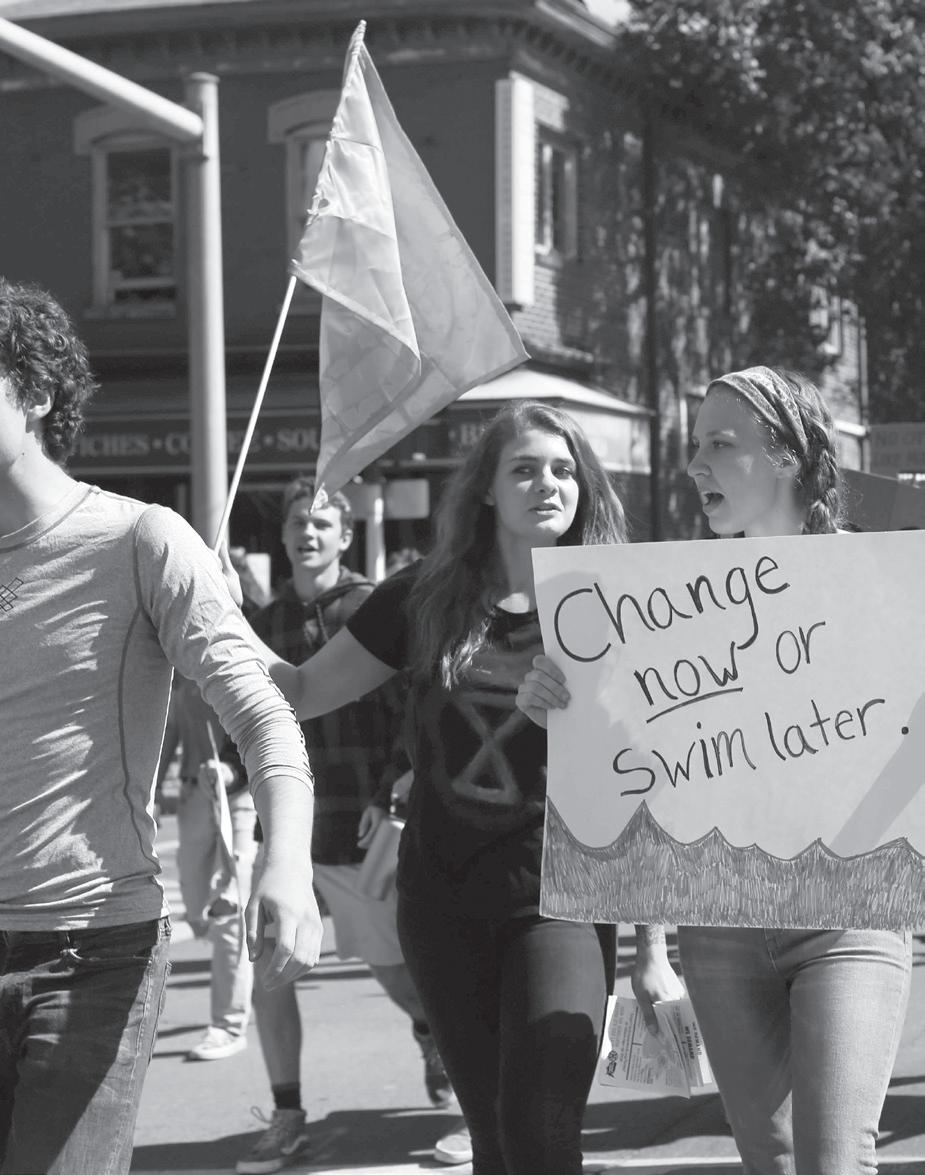
Rebel, rebel | Extinction Rebellion Ithaca will speak about their activist approach to the global climate crisis. This event comes in light of fossil fuel divestment talks. Today
Halloween Happenings
11:30 a.m. - 1 p.m., Willard Straight Hall, Room 104
Popcorn with the Police and IT Security 11:30 a.m. - 1 p.m.
Willard Straight Hall, Resource Center

Heading for Extinction 2:30 - 4 p.m., Mann Library, 102
Yoga Sponsored by Cornell Minds Matter and Cornell Fitness Center 5 - 6:15p.m., Willard Straight Hall Art Gallery 413
Therapy Dog Thursday 9 - 10 p.m., William T. Keeton House
Chimes Halloween Concert 10:30 - 11:30 p.m., McGraw Tower
Tomorrow
Building Bridges: Community and University Partnerships in East St. Louis Noon - 1 p.m., Mann Library, 102
Latino/a Studies Fridays Noon, Rockefeller Hall, 429
Feel Good Friday Noon - 1 p.m., Willard Straight Hall, International Lounge 414
Jonathan Jones: Indigenous Knowledges and Art-Making Practices 12:20 p.m., Abby and Howard Milstein Auditorium
/
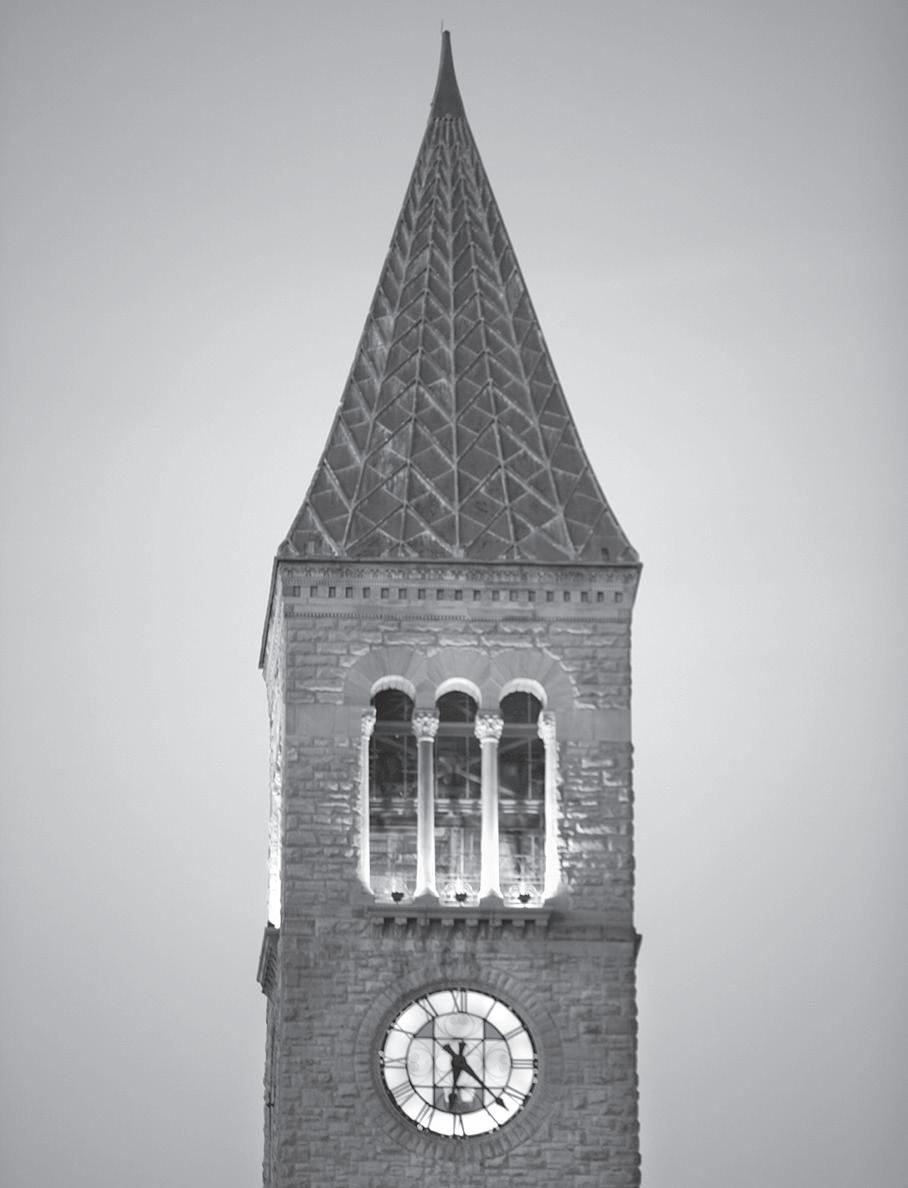
Let’s do the Time Warp again | The clock tower has ignited in its seasonal fiery orange. What time is it? Witching Hour! Jack O’ Lantern O’Clock!
The Case of Menstrual Hygiene Management in India 3 - 4:30 p.m., Warren Hall, B73
Blinded By the Light 9 - 10:57 p.m., Willard Straight Theater
Salsa! Marlo Rosado 8 - 10 p.m., Bailey Hall


Solar Flashback: The Hair-Raising History Of Halloween at Cornell
By SHRUTI JUNEJA and BREANNE FLEER Sun Senior Editors
Trick or Treat! Between prelims and Halloweekend, spooky season is truly upon us. From innocent Halloween dances to a pernicious mob almost completely destroying a bridge, Cornellians have enjoyed Halloween in various ways over the decades. This week’s Solar Flashback conjures up memories of this haunting holiday.
Solar Flashbacks is a special project connecting The Sun’s — and Cornell’s — past to the present to understand how this rich history has shaped the campus today. Flashbacks appear periodically throughout the semester. #ThrowbackThursday
’Tis the season of spooky soirees and scares, frightening festivities and fun. Halloween on the Hill has entertained students throughout Cornell’s history, whether through celebrations and revelry or through some not-so-innocuous mayhem.
Old Tricks: The Infamous Incident of 1882
Despite years of lighthearted holiday merriment, Halloween at Cornell has seen serious mischief. One early Halloween went so awry that President A. D. White mentioned the incident in an address to students the following May.
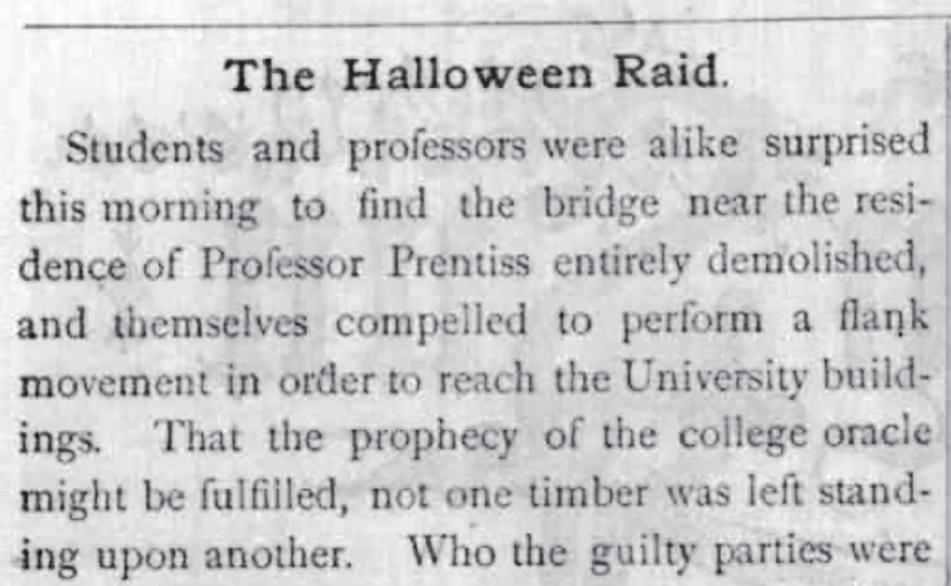
At around 3 a.m. on Nov. 1, 1882, “a large band of individuals, numbering sixty or seventy, congregated on the campus and began to demolish” a bridge, according to a Sun article published that day. Other damages included “battered in” windows and “torn down” fences.
Two individuals were arrested, and the next morning, students and professors had to “perform a flank movement in order to reach the University buildings” due to the destroyed bridge, The Sun reported — completely circumventing the gorge. As for the bridge itself, “not one timber was left standing upon another.”
On November 8, The Sun reported that most of the “ruins of the bridge” had been cleared. The disciplinary trouble, however, had just begun.
Cornell faculty indefinitely suspended twelve students, reprimanded and placed four students on probation and reprimanded an additional student, according to The Sun on November 20. The Board of Trustees requested a payment of $400 in damages.
“And they now speak of it as a suspension bridge,” one Sun update joked.
Other students ultimately helped raise the money for damages, and the University allowed the suspended students to return, according to The Sun, but the incident lived on in the memory of both White and the students.
“A large band of individuals congregated on the campus and began to demolish [the bridge].”
“It was an old bridge; those who took part in it doubtless flattered themselves that while enjoying the sport they were indirectly benefiting the University,” White stated in a May 1883 speech to students. “The University authorities could not take that view of it.”
Sun Files, 1882
The University took measures in the following years to prevent the recurrence of such Halloween mayhem, with one Sun report in 1883 remarking that the campus was so “guarded” that “even a ghost had not a shadow of a chance to flit across the Cascadilla bridge.”
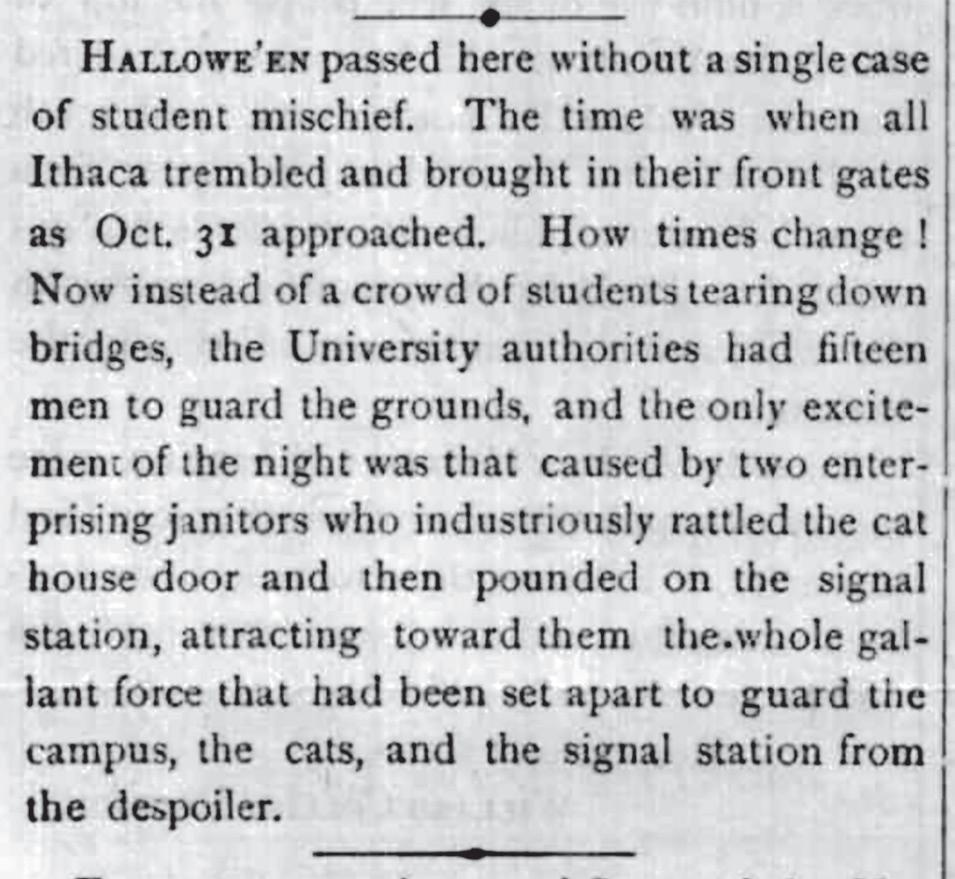
“The time was when all Ithaca trembled and brought in their front gates as Oct. 31 approached,” one Sun article lamented on Nov. 3, 1885, after a calm Halloween. “How times change!”
Old Treats: Chimes, Parties and Devilish Delights
While some Cornellians of old passed their Halloweens looking for trouble, others throughout the ages chose to engage in more lighthearted celebratory activities.
In 1934, a Halloween Gala was held at DeWitt Park, and “the most novel feature yet obtained [was] a three clown band performing on a stage mounted on a truck.”
Students donned colorful attire — ranging from hippies to Al Capone to an orange newt — and headed to the clocktower for a special Halloween chimes concert in 1980.
“The room quieted down as the Chimes Masters got down to the business of producing a concert songs in eerie minor keys,” The Sun reported. “The competition waxed fiercer, the bells rang louder, and campus safety showed up to relay some complaints from nearby residents who had requested that the concert end by midnight.”
“‘The hour of doom approacheth!’ someone shouted around midnight,” the passage continued. “It was snowing as masqueraders left, picking their wav down the stairs. A Reagan Gorilla and an Anderson Mutant stood on the top landing arguing over who would go down first.”
Some things don’t change much, however — The Sun wrote in 1980 that “most parties centered around a keg, cider punch, and dancing in cleared out living rooms decorated with brown and orange crepe paper and Halloween cut-outs and lit with Jack-o lanterns.”

New Tricks: Pumpkin Pandemonium and Costume Controversy
Thankfully no mob has tried to tear down a bridge in recent years, but it is the season to cross #75 off the 161 Things Every Cornellian Should Do and throw a flaming pumpkin in the gorge.
Speaking of the season’s emblematic orange gourds, there is a reason why the Dairy Bar has an ice cream flavor called “Clock Tower Pumpkin.” On October 8, 1997, a pumpkin appeared at the very top of McGraw Tower, sparking a mystery that made national news.
The pumpkin was removed months after its first sighting, but the legendary prank still captures the imagination of Cornellians. Years later, a man claimed to The Sun that his friend had shimmied up to place the gourd
via a door in the roof.
While Halloween mischief has its place in Cornell lore, other holiday occurrences are not so harmless to some. In 2013, a controversy about Halloween costumes and cultural appropriation arose when students noticed their peers dressing up in culturally-significant attire.
“Halloween is not an excuse to be culturally appropriative or racist,” Brenda Martinez ’15 told The Sun about costumes like sombreros, kimonos or feather headdresses. “Culture is how people construct and produce their everyday lives, and appropriating others’ culture makes a mockery of their existence.”
New Treats: More Parties,

New Ways to Wind Down and Witches
Although some aspects of Halloween can draw ire as outright goulish, recent years have seen the continuation of party traditions and the introduction of new ways to mark October 31.
While fraternities sometimes tend to get a bad rap around Halloween, in 2001 Phi Delta Theta put on a Halloween Fun House, entertaining about 300 local children with a toned-down haunted house, inflatable trampoline, arts and crafts and other carnival games.
“It is so nice to see such a great community service program for the kids. Students often get a bad rep in the community, but this was the perfect way for them to interact with families,” said Steve Lamb ’78, a parent of several attending children.
Last year, “wind down zones” made their debut during Halloweekend as a place for people to grab snacks and take a break as they came back from a night out.
“If [people] were uncomfortable at all with where their night was going they would just have a couple minutes to think about it, which they otherwise might not have had,” said Hailey Sokoloff ’20, a member of the Student Assembly Health and Wellness Committee.
“[Sexual assault] seems to get more and more relevant as we get closer to the event,” added Ruwanthi Ekanayake ’20, another committee member.
The largest witchcraft collection in North America also opened in Kroch Library on Halloween in 2017. The collection was started by Cornell’s own A.D. White, and had 3,000 objects on superstition and witchcraft — and even briefly featured the crystal ball from The Wizard of Oz
“There are a lot of accusations of witch-hunting in our present time, and it’s really interesting to see how anybody who feels that they are wrongfully persecuted for political, social, religious or whatever reasons, employs the trope of witch-hunting,” said Kornelia Tancheva, co-curator of the exhibition.
From Cornell’s earliest Halloweens to the present, revelers have used the occasion to both celebrate and wreak havoc. The season tradition as a time to hold spirited parties and enjoy the fun frights has lived on.
Shruti Juneja can be reached at sjuneja@cornellsun.com. Breanne Fleer can be reached at bfeer@cornellsun.com.
SUN FILE ARCHIVES
Casting spells | Wizards, witches and warlocks — and a parrott — roamed the Commons at Saturday’s celebration.
MICHAEL SUGUITAN / SUN STAFF PHOTOGRAPHER
Bubble bubble toil and trouble | Patrons imbibe themed non-alcoholic drinks at Wizarding Weekend.
MICHAEL SUGUITAN / SUN STAFF PHOTOGRAPHER
C.U. Reacts to Forever 21 Bankruptcy
By SCARLETT ZHA Sun Contributor
At age 21, Esther Dukhee Chang ’08 was studying stitches as a fiber science major in the College of Human Ecology. Now, Esther is better known by fashion professionals as the second daughter of Forever 21 founders, Do Won and Jin Sook Chang. In September, while serving as the famous fast-fashion brand’s vice president of merchandising, she was part of their declaration of bankruptcy.
Once regarded as the most popular brand among teens and twenty-somethings, Forever 21 at its peak made more than $4 billion in annual sales. This year,
Rose” in 2017. In 2015, Chang's parents borrowed $5 million from each of their daughters' trust funds to keep the company afloat, The Los Angeles Times reported — ensnaring them both in bankruptcy proceedings.
FSAD Prof. Van Dyk Lewis referred to Forever 21 as “a friend” of the Cornell department. “We’ve done projects with them before,” Van Dyk Lewis told The Sun. As part of a class assignment years ago, Cornell students designed two collections for the brand, which later were sold in stores.
“Fast fashion in all promotes consumerism while keeping a secret as to how the clothing is made.”
the retail titan was forced to file for bankruptcy due to its overcalculation in opening stores in expensive areas, according to The New York Times.
Chang joined her parents’ company in 2011 as the head of the visual display team and was placed in charge of creating graphics and window displays with the company’s trademark bright yellow. In partnership with her older sister Linda, she co-launched Forever 21’s beauty and accessories brand “Riley
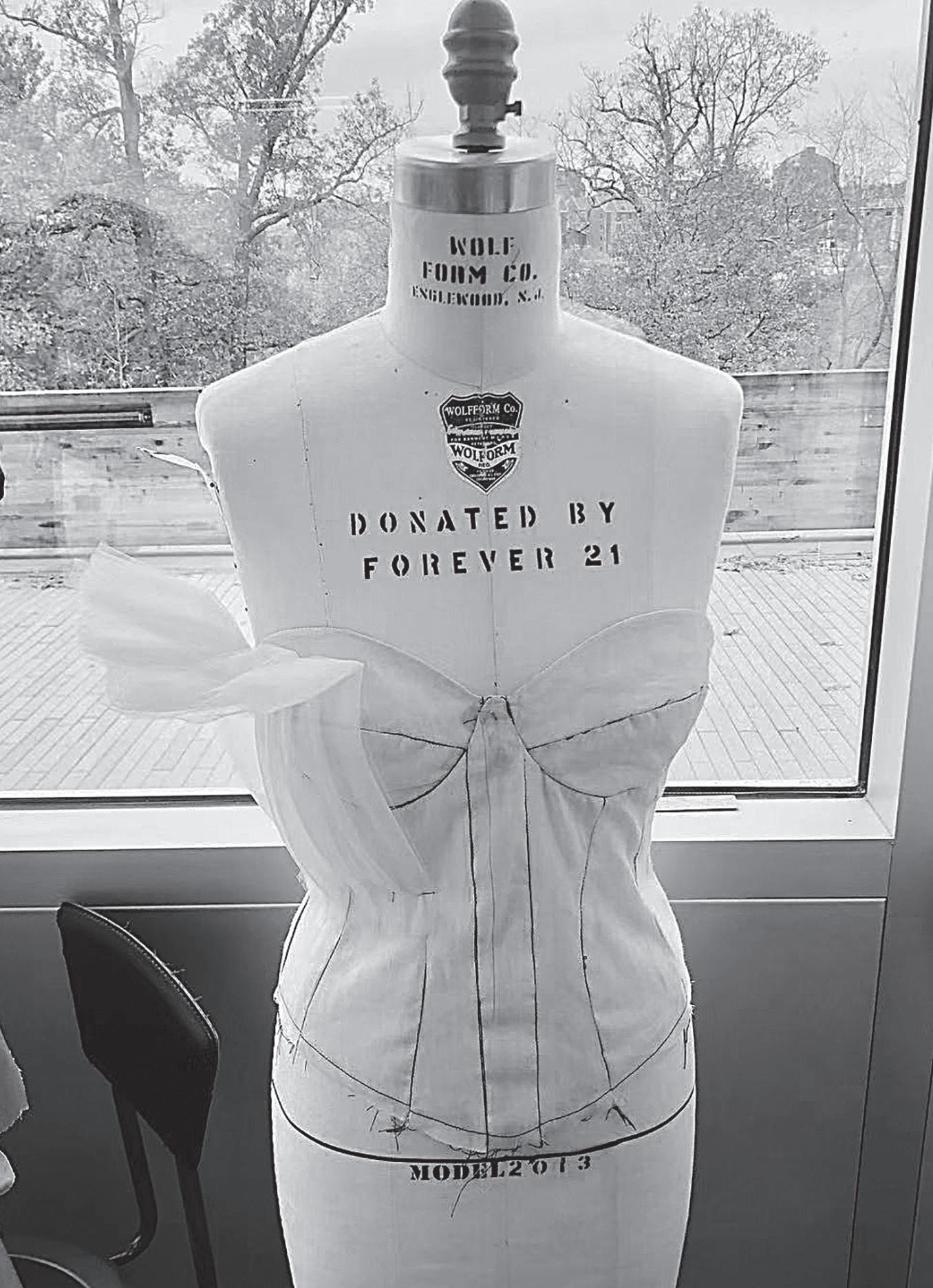
According to Grace Anderson ’21, an E-board member of Cornell Fashion Industry Network, the department also accepted a donated set of mannequins a few years ago. Forever 21 is no stranger to controversies — according to The Los Angeles Times, The U.S. Department of Labor alleged that the company’s factories operate with “sweatshop-like conditions.” And as one of the original companies that helped shape the fast-fashion industry, Forever 21 has been criticized for its vast water pollution and greenhouse gas emissions, the Los Angeles Times reported.
The perils of fast fashion are a hot topic on-campus in FSAD classrooms, too. Prof.
Sherif’s Ofce Looking for Forcible Touching Suspect
Man was reported as wearing a ski mask
By SARAH SKINNER
Sun Managing Editor
The Tompkins County Sheriff's Office is currently searching for a suspect in two recent assaults at knifepoint on trails in the Ithaca area.
The sheriff's office wrote on Facebook on Tuesday that they were searching for a stockily built white male between 5'6" and 5'8" tall, who appeared to be between 20 and 30 years old.
He was wearing a ski mask at the time of incidents, the post said.
The man is wanted in regards to two separate events: a forcible touching incident near the Fingerlakes Trail on Oct. 14 and an incident on the Thayer Preserve trail southwest of Ithaca
on October 28. On Thursday, the sheriff's office updated the post to say that the second event involved a forcible rape.
Both events occurred just before dusk, the post said, and patrols by the sheriff's office have increased in response. It is currently unknown if the suspect was travelling by vehicle or on foot.
Anyone with information regarding either incident is urged to contact the Tompkins County Sheriff's Office tip line at 607266-5420 or the Tompkins County 911 Center at 607-2722444. The Advocacy Center's 24/7 hotline number can be reached at at 607-277-5000.
Sarah Skinner can be reached at sskinner@cornellsun.com.

the run
A man is currently wanted by the Tompkins County Sheriff’s Office for two instances of forcible touching at knifepoint.
Tasha Lewis and her fellow student researchers focus on the principles of sustainability, and the once multi-billion company’s recent announcement of its bankruptcy has sparked the conversation among academic professionals.
“[The industry] is a bit problematic,” Prof. Mark Milstein, director of Center for the Sustainable Global Enterprise in the SC Johnson College of Business, told The Sun.
“I suppose in theory it addresses consumers’ desire for a different change in clothes, but the impact that it has environmentally and the amount of waste it produces is pretty significant,” he continued.
For similar reasons, Forever 21’s demise was no surprise to several students who spoke to The Sun.
“I wouldn’t be surprised if it were due to the decline in the demand for fast and cheap fashion,” Mikala Bliahu ’22, an environment and sustainability major, said. “Brands like Forever 21 are cheap and insolent and don’t deserve to be a staple for youth. Fast fashion in all promotes consumerism while keeping a secret as to how the clothing is made.”
Eva Milstein-Touesnard ’22, a government major and environmental and sustainability minor, says she is not surprised because both the company and the entire fast-fashion industry often fail to be sustainable. “Obviously they need materials that are even
cheaper than the cheap prices of their products.”
According to the Letter to Our Customers on the company’s website, filing for bankruptcy protection under chapter 11 allows Forever 21 “to continue to operate its stores as usual, while the Company takes positive steps to reorganize the business.”
Thus, it is still early days to conclude the final fate of Forever 21. Anderson wishes them well and “we hope they consider investing further into protecting the environment and their workers,” Anderson said.
Curtain Closes on Monologues
GJAC withdrew support over concerns of inclusivity of trans individuals
statement, the GJAC Executive Board says that the play “equates having a vagina with female identity.”
However, Aboaf notes that one of the monologues, “They Beat the Girl Out of My Boy... Or So They Tried,” addresses issues of trans violence. “They assigned me a sex / The day I was born. / It’s as random as being adopted / or being assigned a hotel room on the 30th floor.”
Aboaf talked further about the impact that the monologues have on the Cornell community.
“There are lots of people on this campus
who are uncomfortable with their vaginas, gender identity aside. It’s still beneficial to people,“ she said. She suggested that GJAC create more events, in addition to supporting The Vagina Monologues.
Lakhani also noted that in her forward for last February’s play, “we specifically mentioned that this play is inclusive of people who have vaginas, who don’t have vaginas, of people of all sexualities and genders.”
“My entire message was about inclusivity. If you don’t have a vagina, you’re still a part of this play,” said Lakhani.
new to college campuses. Whitman College, Mount Holyoke, American University, Southwestern University and Washington University in St. Louis have all either rebranded or banned the play outright since 2015. For instance, Washington University has rebranded it as The [Blank] Monologues to be inclusive of all genitals, while the three other schools completely canceled it.
have a vagina. In the play, I never defined a woman as a person with a vagina.”
Continued from page 1 Sophie Arzumanov can be reached at sarzumanov@cornellsun.
Inclusivity concerns regarding The Vagina Monologues are not
Ensler, the playwright, told TIME Magazine in 2015 that “ The Vagina Monologues never intended to be a play about what it means to be a woman. It is and always has been a play about what it means to
Former cast director, member and current GJAC e-board member Elle Espinoza ’20 said that she is glad that the three organizations are moving forward with brainstorming new programming ideas. “When TVM was first produced it was revolutionary and has continued to ignite many productive conversations,” said Espinoza. “However, as feminism continues to evolve it’s time for new more inclusive media.” Amanda H. Cronin ’21 contributed reporting.
COURTESY OF TOMPKINS COUNTY SHERIFF'S OFFICE
Mikala Bliahu ’21
Dummy design | One of the mannequins that Cornell accepted as a donation from Forever 21 a few years ago. The school has done a number of projects with the company in the past.
SCARLETT ZHA / SUN CONTRIBUTOR
Scarlett Zha can be reached at yz355@cornellsun.com.
MONOLOGUES
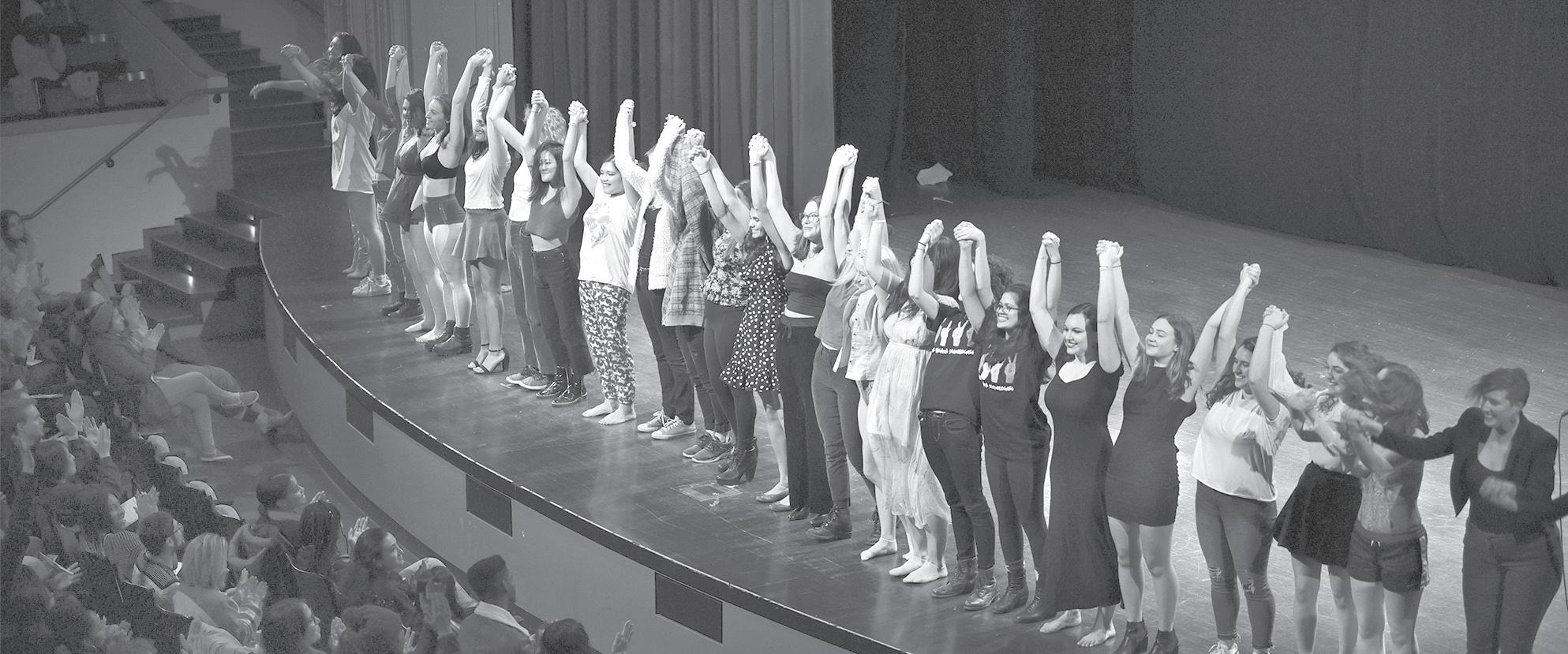
Curtain call | Performers raise their arms to applause after last year’s performance in Bailey Hall.
BORIS TSANG / SUN PHOTOGRAPHY EDITOR
LGBTQ Magazine Brings ‘Loud and Queer’ Space to Campus
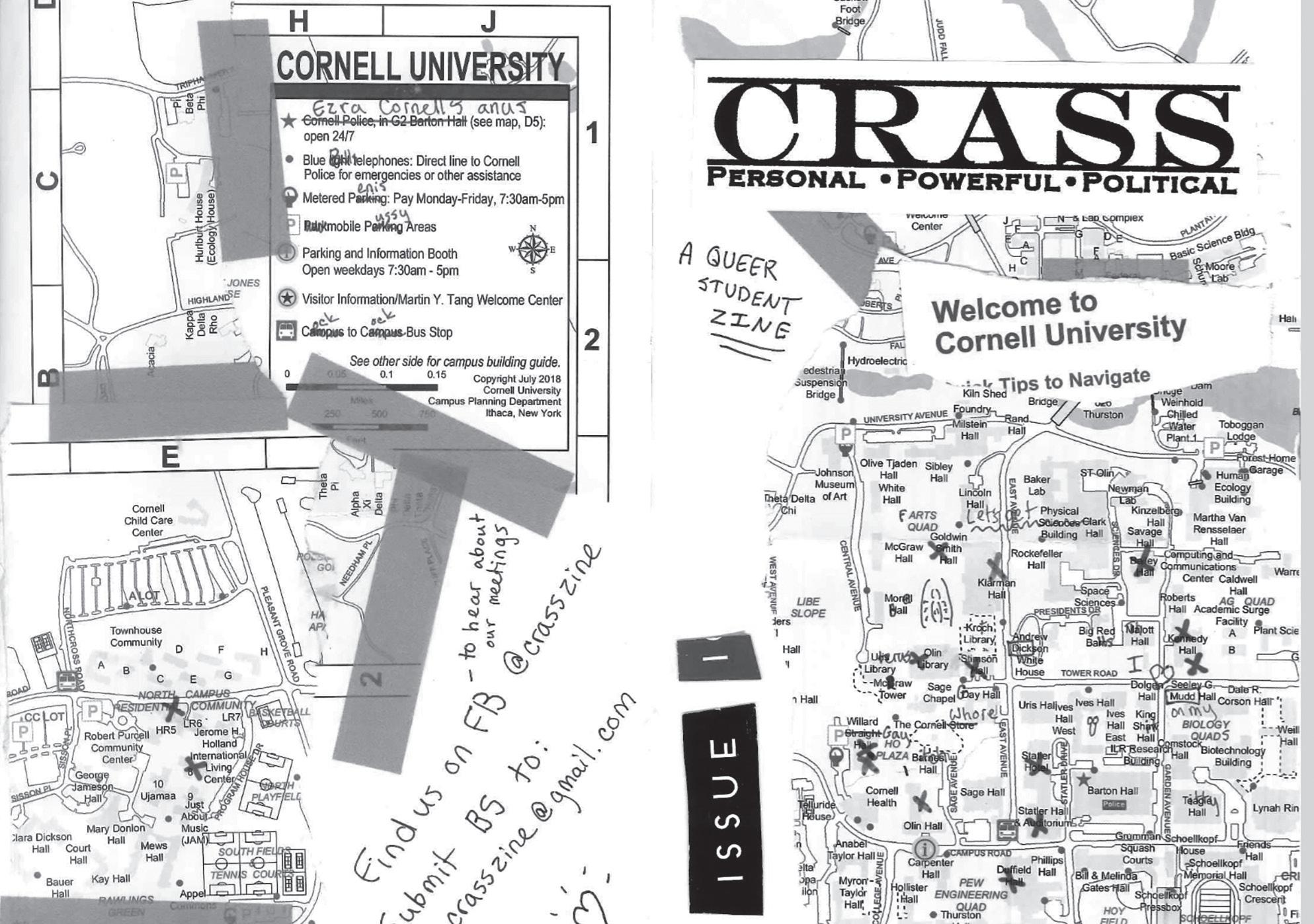
Loud and proud | The cover of Crass’s first issue. The magazine seeks to provide a space for LGBTQ+ individuals to “make bullshit” and be “loud and obnoxious” with their identity.
Continued from page 1
but also trash. We are not here to make beautiful masterpieces, we are here writing shitty poetry about our feelings and putting it on the page because the act of making the art feels good,” Janie Walter ’21, another member of the executive board, added.
The idea of simply creating art and making their own space on campus is central to the publication, and influenced the decision behind its unorthodox name.
“The reason we settled on ‘Crass’ was it felt loud and willing to be obnoxious. Crass as a word means to be obnoxious, loud, annoying and willing to be blatant and upfront. It really captured the spirit of what we are trying to do,” Walter continued.
The publication stresses “horizontal leadership,” according to Angeliki Cintron ’22, a member of the magazine’s executive board. While the publication does have positions, every member of the publication has a say in what the publication does, such as which themes to use for the semesterly issue.
The zine has been running since fall 2018, and

has featured a variety of themes such as Power, or this semester’s theme, Home.
“Home can be different for lots of LGBTQ individuals … that’s a conversation that’s important to have, such as the history of ‘chosen family.’ We are handling questions like ‘what does home mean for queer people?’ and ‘can it be something besides just a biological mom and dad?’” Bezerra-Gastesi explained.
People are free to interpret the semester’s theme in a variety of ways. For the Power issue, there were pieces about government and control next to pieces examining the power dynamic between “bottoms” and “tops” in queer sex.
The magazine stresses that all forms of expression are valid as long as they are not offensive or marginalizing towards others.
“There’s no real filter, besides obvious things like racism and sexism. If people want to write explicitly about sex, sexual assault, family, their feelings, that’s fine. Whatever we want goes,” Bezerra-Gastesi said.

COURTESY OF CRASS
Since 1880
137th Editorial Board
ANU SUBRAMANIAM ’20 Editor in Chief
JOYBEER DATTA GUPTA ’21
Business Manager
PARIS GHAZI ’21
Associate Editor
MEREDITH LIU ’20
Assistant Managing Editor
RAPHY GENDLER ’21
Sports Editor
BORIS TSANG ’21
Photography Editor
AMBER KRISCH ’21
Blogs Editor
SOPHIE REYNOLDS ’20
Science Editor
AMANDA H. CRONIN ’21
News Editor
JOHNATHAN STIMPSON ’21
News Editor
PETER BUONANNO ’21
Arts & Entertainment Editor
ANYI CHENG ’21
Assistant News Editor
HUNTER SEITZ ’20
Assistant News Editor
CHRISTINA BULKELEY ’21
Assistant Sports Editor
BEN PARKER ’22
Assistant Photography Editor
JEREMY MARKUS ’22
Assistant Arts & Entertainment Editor
ALICIA WANG ’21
Graphics and Sketch Editor
DANA CHAN ’21
Production Editor
RYAN RICHARDSON ’21
Snapchat Editor
GIRISHA ARORA ’20
Senior Editor
ALISHA GUPTA ’20
Senior Editor
AMOL RAJESH ’20
Senior Editor
SARAH SKINNER ’21
Managing Editor
KRYSTAL YANG ’21
Advertising Manager
NATALIE FUNG ’20
Web Editor
SABRINA XIE ’21
Design Editor
NOAH HARRELSON ’21
Blogs Editor
SHRIYA PERATI ’21
Science Editor
KATIE ZHANG ’21
Dining Editor
AMINA KILPATRICK ’21
News Editor
MARYAM ZAFAR ’21
City Editor
ETHAN WU ’21 Opinion Editor
SHIVANI SANGHANI ’20
Assistant News Editor
NICOLE ZHU ’21
Assistant News Editor
LUKE PICHINI ’22
Assistant Sports Editor
JING JIANG ’21
Assistant Photography Editor
DANIEL MORAN ’21
Assistant Arts & Entertainment Editor LEI LEI WU ’21
Editor EMMA WANG ’20
Editor LEANN McDOWALL ’21
Editor
ANNE FLEER ’20
Editor
SHRUTI JUNEJA ’20
Editor
KATIE SIMS ’20 Senior Editor
To the Editor:
Reading Irene Hartmann’s grad letter to the editor regarding our upcoming event with former Wisconsin Governor Scott Walker on Monday, Nov. 4, we could not help but think about how Hartmann may have benefited from attending our first event of the semester with David French, then of National Review, now with The Dispatch. French spent much of his time here warning us against embracing the politics of war, enmity and assumption. It is clear that this prudent advice has not been heeded.
One need only make use of the link Hartmann provided in her letter to dismiss the careless charges of defending pedophiles she leveled against Gov. Walker. Bureaucrats in Wisconsin’s Department of Safety and Professional Services granted licenses to the defrocked priests and Gov. Walker made no effort to assist them, as Hartmann recklessly asserts. To the contrary, once he was made aware of the situation, Gov. Walker took action to see it remedied, as the article Hartmann linked to states.
Hartmann was far from finished. Before her letter had concluded, she had accused Gov. Walker of being motivated only by donations made to his campaign and of having a special desire to attack civil servants. She even went so far as to accuse our organization of being eager to aid those accused of sexual misconduct. These smears on a public figure — and worse yet, her fellow Cornellians — reflect the exact brand of politics that French counseled this campus to resist: one of war, enmity and assumption.
In response to Walker’s supposed patronage to special interests, Hartmann cites an article asserting that $750,000 donated to Walker’s recall election campaign by lead manufacturers resulted in legislative patronage. In the 2012 recall election that resulted from a coordinated effort by state and national labor unions, these same unions pumped upwards of $5.3 million into ousting Gov. Walker. That doesn’t even include the $3 million the National Education Association dumped from their war chest to campaign against Walker. Compare the $8.3 million raised by the opposition to the $750,000 donated to Walker. Here we can see that Gov. Walker’s pledge to “stand up and take on the powerful special interests” rings true. Progressives seem keen to rant against money in politics when it serves them, but often ignore how frequently special interests benefit their own campaigns.
Letter to the Editor
Ad Layout Krystal Yang ’21
Production Deskers Sabrina Xie ’21
Sarah Skinner ’21
News Deskers Amanda Cronin ’21
Hunter Seitz ’20
Design Desker Simon Chen ’21
Krystal Yang ’21
Photography Desker Ben Parker ’22
Arts Desker Jeremy Markus ’22 Working on
Sports Desker Christina Bulkeley ’21
Scott Walker embodies what the Cornell Republicans stand for
To the Editor:
There are many reasons to oppose bringing former Wisconsin Governor Scott Walker to Cornell’s campus. From his attacks on public sector unions (while hiding behind a unionized police force) to accepting campaign donations from a lead manufacturer before then passing laws blocking families of children poisoned by lead paint from pursuing legal remedies, to helping Catholic priests who were defrocked for “substantiated cases of sexual abuse of a minor” receive or renew professional licenses that gave child molesters access to vulnerable populations, Scott Walker is the poster boy for conservatism.
While some are shocked and insulted that he would be brought to campus, I am personally grateful that Cornell Republicans are publicly embracing unflinching conservatism as demonstrated by Walker. Although the talk will likely focus on anti-union rhetoric under the guise of the “free market,” there is no denying that by welcoming Walker to campus, Cornell Republicans are co-signing political patronage in the form of dark money donations and giving quarter to pedophiles instead of prosecuting them. For many of us on the left who oppose this behavior in the Democratic Party as well, it is a welcome relief that Republicans are finally willing to show the world who they are and what they stand for.
If you are rich and have the money to buy political favors, Cornell Republicans support you. If you are looking to attack civil servants who traded personal wealth for enriching the minds of your community, Cornell Republicans supports you. If you are a Catholic priest whose records of molestation are so severe that the Diocese defrocks you so that you need a license to work with children, Cornell Republicans are here for you (or, at least, until a political opponent brings this to national attention).
We can finally see who they are and what they believe in. Thank you, Cornell Republicans, for showing us what conservatism looks like in practice.
Irene Hartmann grad
If the well-funded, unsuccessful 2012 effort does not satisfy Hartmann, she should take the example of Wisconsin’s sitting governor, Tony Evers. In Evers’s 2019 budget, his administration brought back compulsory union dues, artificial wage floors for public projects and a return to closed-shop policies that have historically served as money-making mechanisms for labor unions. In total, $8.6 million ($1.6 million directly to Evers’s campaign and $7 million by the Greater Wisconsin Committee) was spent by unions to promote Evers’s 2018 campaign. The rewards they reaped from his $83.5 billion budget were well worth the cost. Walker warned Wisconsin voters that Evers was “bought and paid for” by unions and now they’re footing the bill.
Reasonable minds can disagree in assessing Gov. Walker’s tenure in Wisconsin, though we would contend that his successful revival of the state’s economy and responsible reforms to return it to a solid fiscal footing rendered him among the nation’s best and boldest executives. Reasonable minds cannot and should not take the easy road in assuming that their political opponents are motivated by the most monstrous of intentions. Reasonable minds cannot and should not lob damaging and unfounded accusations at their peers. We do not know what assumptions or prior teachings led Hartmann to publish her letter, but we do believe she would benefit from attending the Walker event to observe an alternative perspective on these issues from the governor himself.
We also know this: Despite the myriad of inaccuracies and mischaracterizations, she did get one thing right. Our invitation of Gov. Scott Walker to campus is reflective of who we are. We are an organization that values well-reasoned discourse and that promotes the free market and fiscal responsibility. We are an organization that relishes the opportunity to engage in a good-faith debate. And perhaps most importantly, we are an organization which is, now and always, unflinchingly and unapologetically conservative.
Isaac Schorr ’20, president
Weston Barker ’21, executive vice president
Elise Viz ’22, vice president of external operations
Thérèse Russell ’20, vice president of internal operations
Bill Leiker ’22, treasurer
Anna Girod ’20, secretary
Avery Bower ’23, freshman representative Sadman Chowdhury ’23, freshman representative
Te Case for an Ithaca Tenants’ Union
Renters across the country face a particular set of burdens unique in how close they are to home. Tenants face difficulty maintaining their homes, as they rely on landlords to carry out refurbishment and repairs, which the landlords have little incentive to do in a timely fashion. Secondly, not owning one’s house naturally creates instability, as there is little guarantee of where to call home from one year to the next. Finally, the rent is too damn high.
In Ithaca, a striking 73% of households are renters, compared to 44% nationwide. As rental costs skyrocket, people across the city watch ever greater proportions of their income fall into the hands of their landlords. And the landlords hold the bulk of the power.
For the complete analysis of the tenant trials for Cornell students, read Victoria Pietsch’s ’19 January column, “The Rent is Too Damn High.” To understand the pressing situation for full-time Ithaca residents, read “Why Is Ithaca One of the Least Affordable US Cities?” from The Ithaca Times, revealing that while an Ithaca “household would need to earn $49,000 a year” to afford the average rent of a two-bedroom apartment, “the median household income in the City of Ithaca
People across the city watch ever greater proportions of their income fall into the hands of their landlords.
grab your nearest ILRie and buckle up; it’s time to talk about unions.
A traditional union is an organization of workers with a single employer, banded together to bargain collectively for improved wages, conditions, job security and benefits. While an individual worker making such demands would be laughed out of the room and likely fired, the union derives its power from strength in numbers and threat of a strike. The concept of a tenants’ union is similar, the stakes just as high.
Union membership would be open to all current and prospective tenants in the City of Ithaca. Speaking with a unified voice, the union would have three primary powers.
First, the power of political advocacy. While homeowners are the most reliable voters — which leads to a disproportionate share of property taxes being levied on rentals and incurred by tenants — full-time renters and students can and should register to vote in Ithaca. Because a small number of voters can have an outsized impact on low-turnout local elections, an organized tenants’ union pledging to uniformly vote and donate political contributions in support of pro-tenant local officials can yield considerable impact.

is $29,230 and two-thirds of the city’s households earn less than $50,000 a year.” For a call to action, read on.
There is an argument to be made that Cornell and Ithaca College students share significant blame for the city’s rental woes. We also have considerable power to unite with the tenants of our adoptive home and challenge the regime of unrestrained landlords, whose days of high rent for poor conditions must come to an end. So
Second, the power to protect its members. When a tenant is subjected to unfair practices by their landlord, including harassment, refusal to procure general maintenance or eviction, the tenant would have an organizational structure to simultaneously apply pressure on the landlord and support them in housing court. Property owners would be far more hesitant to mistreat a tenant whose economic and legal strength stands equal to their own.
Third, the power of the boycott. A well-organized union would be able to track Ithaca properties and their respective owners. If (and, inevitably, when) a landlord egregiously mismanages their units, the union would be
Aable to confront the bad actor economically with a call to boycott each and every one of the given landlord’s rental units. As many landlords own multiple properties, such an action would inflict severe economic repercussions on the most cavalierly abusive owners. With a small uptick in rental vacancies, the leverage of the threat of boycott grows dramatically as renters can affirmatively blacklist
If (and, inevitably, when) a landlord egregiously mismanages their units, the union would be able to confront the bad actor economically with a call to boycott each and every one of the given landlord’s rental units.
several properties. This power would serve as the most poignant deterrent while placing minimal burden on the busy rent-paying population of this town.
A tenants’ union has national precedent and local necessity. Overcharged and underserved, the residents of Ithaca deserve better. A tenants’ union is just the tool to level the playing field. It has proven itself in the college towns of Ann Arbor, where a series of rent strikes effectively combated rampant poor conditions, and Champaign-Urbana, where the union continues to serve as a resource for information and legal aid. We can follow their templates here. It’s not easy to go a day without hearing or expressing a complaint about the relentless exploitation inherent to monthly payments for shelter. Rather than accepting this as inevitable, we can unite to achieve fair rents and treatment that should be guaranteed but, until we collectively demand them, are not.
Elijah Fox is a junior in the School of Industrial and Labor Relations. He can be reached at efox@cornellsun.com. What Does the Fox Say? runs every other Thursday this semester.
Manisha Munasinghe | Trustee Viewpoint
Taking a Break From Cornell Should Be Easier
s we continue through the semester, the chorus of reminders that students take care of themselves continues to grow. E-mails from staff, opinion pieces in The Sun and reminders from concerned friends and family encourage us to exercise self-care in addition to managing homework, exams, work and extracurriculars. We, as a community, have begun to talk more openly about burnout, self-care and seeking clinical care in the last few years. While all of these are crucial to helping students in distress, sometimes taking care of oneself is simply not possible while continuing one’s academic work.
Sometimes the best choice for a student may be to take a voluntary leave of absence. Policy 7.1 details the procedures for obtaining an LoA, and, at first glance, a fivestep process seems fairly straightforward. However, right after the first step is a note of caution: “A graduate field, academic department or college may have specific guidelines governing leave of absence. Consult with the college registrar, graduate field representative or academic advising office.” This complicates the process, as students must now seek out their respective college’s or academic unit’s procedures. On top of notifying the academic units, students may need to inquire with additional University offices, such as the Office of Financial Aid, Housing and Dining or the Bursar’s office. Just one more level of complexity. Students may also choose to
take either a personal or health LoA, with each type having unique requirements and conferring different outcomes.
By this point, figuring out the best type of LoA and how to acquire it should seem like an unreasonably difficult task. To make matters worse, students must drive this process as well. While staff or faculty may offer advice, it is ultimately up to the student to figure out what forms need to be submitted when and to whom and what the expectations will be for them afterward, and they must do all of this on top of managing the personal, academic or medical reasons that are making it difficult to continue one’s work. It is no surprise that, when talking to students who faced this decision, nearly everyone commented on how difficult this process was and how it only added to their stress. For some, students, faculty and staff knowledgeable about the process were vitally important for completing this process.
By now, figuring out the best type of leave of absence and how to acquire it should seem like an unreasonably difficult task.
Students that are able to acquire a voluntary LoA often spoke about how helpful they found the process to be, but they also mentioned feeling disconnected to the Cornell community. Students often receive little to no formal communication from the University while on leave. A simple note reminding them that they are a member of our community, that we wish them the best during this time and that we would be happy to answer any questions they have would be a significant step forward in keeping students connected during their LoA.
Returning to campus is not necessarily easy either. Relationships with previous social groups may have ended as students graduated, and students may find themselves unsure of what new, or even old, resources exist on campus. Luckily, relatively new initiatives, such as orientation programs and peer support groups for students returning from an LoA can help mitigate these factors. However, if we truly believe that this is a tool that will help students, we must streamline the process and increase resources for students interested in taking an LoA.
Returning to campus is not necessarily easy either. Relationships with previous social groups may have ended as students graduated, and students may find themselves unsure of what resources exist on campus.
Arguably, the single most helpful change would be hiring dedicated staff focused on helping students obtain a leave, connecting with them while they are on leave and helping them transition back to campus once they return. A single centralized unit that is aware of all the different nuances associated with taking and returning from an LoA would make navigating this process significantly simpler which simultaneously makes it more accessible for interested students. Alternatively, a centralized website that houses this information in one place might be a more affordable solution in the short term. Collaboration between academic units to minimize differences between LoA procedures will reduce the complexity in this process and make information-sharing across students simpler.
In this discussion, it would be remiss of me not to mention that a recent report by The Ruderman Family Foundation that scored Ivy League leave of absence policies gave Cornell’s policy a D- score (it is also worth mentioning that no Ivy League institution scored above a D+). It is clear that we, along with many other institutions, have significant work to do if we want to improve this process for our students, and we must do this work. By following suggested best practices and adjusting the process based on student feedback, we could significantly improve our process.
While an LoA is a temporary separation from the University, it may be a better option compared to suffering through the rest of the semester. An LoA may play a crucial role in determining whether a student is able to actually complete their degree, and as such, we must work to improve this process. For any student interested in taking an LoA, I encourage them to contact their undergraduate or graduate advisor for more information.
Manisha Munasinghe is the graduate and professional student-elected member of the Board of Trustees, and a Ph.D. candidate at Cornell University. Munasinghe can be reached at mmunasinghe@cornellsun.com. Trustee Viewpoint runs every other week this semester.
Your source for good food

Paw-Paw Ice Cream, Dragon Beans and Wild Bee Honey: Treasures and Lessons from the Farm at Dilmun Hill
By JACK WAXMAN Sun Contributor
Teddy asks me, “These are paw-paw trees. Have you ever seen them before?”
“No, but they are super cool. Is it a kind of fruit?” I respond.
“Yes. Native to Kentucky. It grows like it is native to New York. Plant it and it grows. We are going to try to make some paw-paw ice cream.”
This is my introduction to Dilmun Hill Student Farm, a 12-acre student-run farm that has been practicing sustainable agriculture on Cornell University’s campus for more than a decade.
Teddy Matel ’22, a plant science major, has been a farmer at Dilmun for a year and a half. In my first minute on the farm, I have already been introduced to a new fruit — and, apparently, a new way of making ice cream.
Teddy walks me up to the high tunnel, an unheated greenhouse that farmers, especially in the northeast, use to extend the growing season. On the way, we pass a stretch of wildflowers. They are all the colors of fall — red, orange and yellow. They are beautiful, of course, but I worry that they are taking up valuable real estate on this small farm.
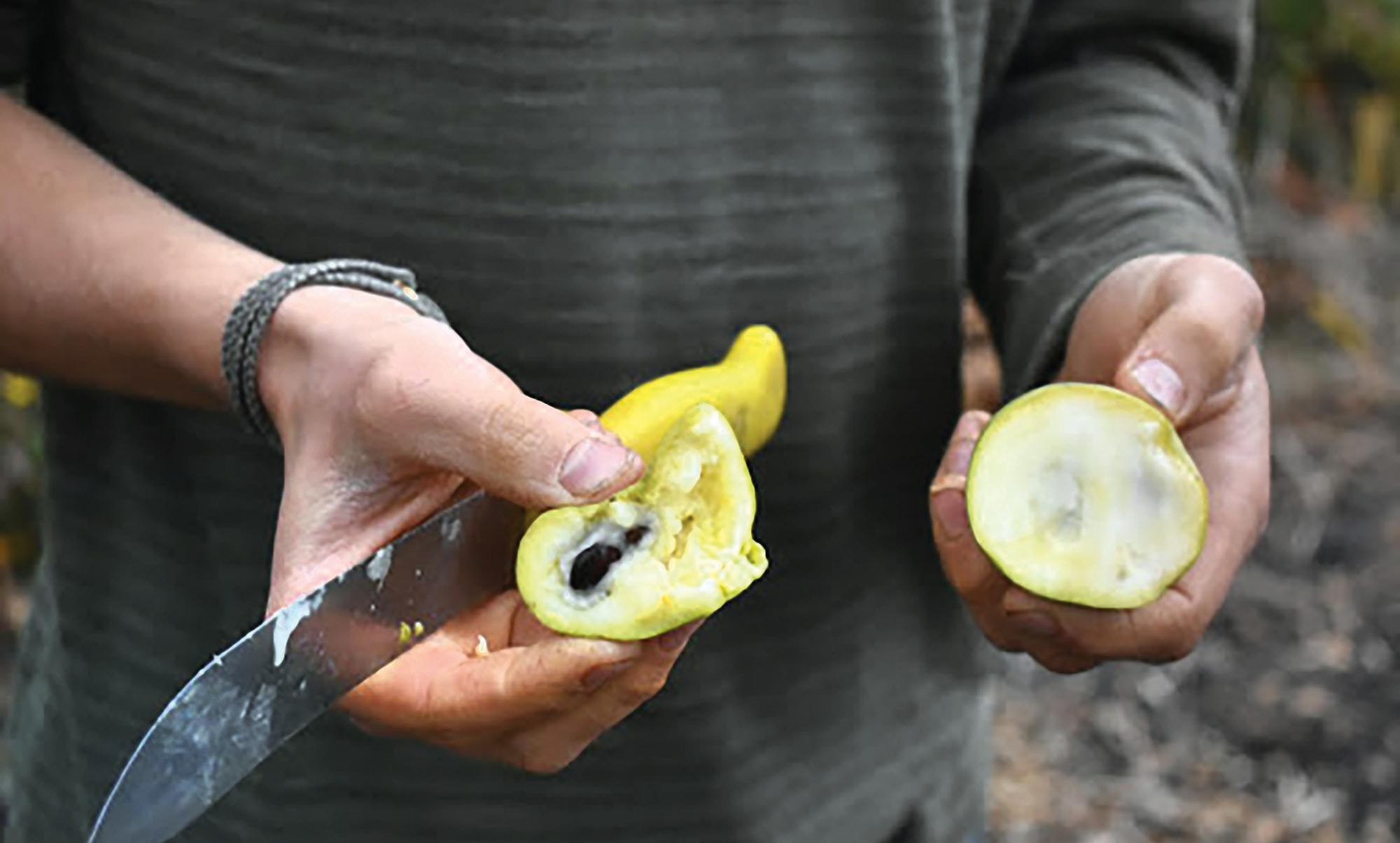
Dilmun rebels against conventional agriculture by growing nature. Instead of planting solely one crop, the students plant dozens of crops — at once.
I ask Teddy, “Why aren’t you using the slope to plant crops?”
He smiles. “We use the slope. The wildflowers feed the bees that make the Bee Club honey. There is still something going on.”
We continue to walk up to the high tunnel, and Teddy tells me the backstory of the farm.
In 1996, Dilmun Hill was given three acres of land no longer being used by Cornell Orchards. This land was contaminated with lead and arsenic from when the orchards sprayed these chemicals as pesticides. Nowadays, Dilmun Hill has transformed the land into something completely different, growing vegetables and fruits that did not before take root in the land. We arrive at the high tunnel. He gives me a quick overview of the crops: “The high tunnel is pretty consistently beans, tomatoes and peppers. The market garden — over there — is a mixture of brassica (kale, cauliflower, Brussels sprouts, broccoli) and cucurbits (winter squash, summer squash, cucumber). Down there are pumpkins and broccoli.
To the right is the pioneer garden. Lots of salad greens, root vegetables, tomatoes, eggplants.”
Teddy picks a bean, just ripe, off the stalk. He hands it to me to taste, and I take a bite.
Most times, the food I eat leaves me not fully fulfilled. This is especially true when I gorge on hot dogs, popcorn and Cracker Jack at a Yankees game. However, this bean is sweet, satiating and satisfying — like it is nourishing me. I ask Teddy, “Why does this bean taste so different?”
in their food. Albrecht believed people would likewise stuff themselves for the same reason. Starved of nutrients, we will keep eating in the hope of attaining them.
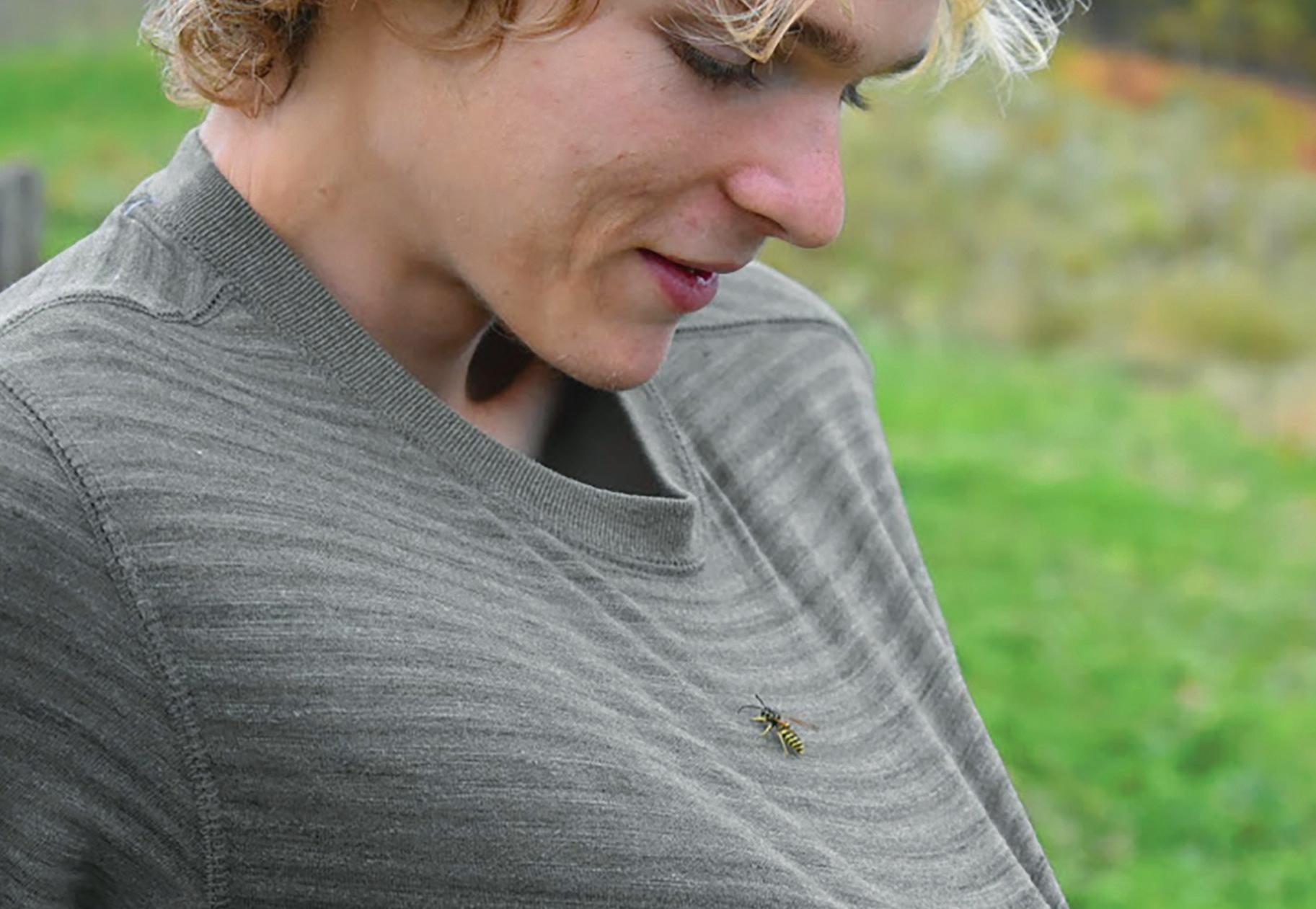
ket garden, a bee starts to crawl on Teddy’s neck. Admittedly, I am quite panicked. “Teddy, there is a bee on you. It’s going to sting you!”
“I think he is just showing me some love,” he tells me, as he looks down at the bee with more affection than he has shown me the whole afternoon.
At the market garden, I meet Kristen, a freshman at Cornell who participates in Dilmun Hill’s Work-for-Share, a program in which students come and farm five hours a week all fall. As compensation for their work, they get their own share of produce and admission to Dilmun’s concerts and parties. This is a very popular program, and it has gotten bigger over the past few years. Kristen decided to join the program because she enjoys being outside and being in nature. She tells me, “I like planting — it feels like you are giving back.”
Before I leave, Teddy leads me to the barn, and we stand

Teddy nods his head and smiles. He tells me about Dr. William A. Albrecht, the late chairman of the Department of Soils at the University of Missouri, who learned about soil by studying cows. Albrecht knew that cows grazing from well-mineralized soils ate balanced diets.
As Chef Dan Barber notes in his book The Third Plate , when these cows are kept in a barn and fed a predetermined grain ration, they never stopped eating, overindulging in a vain attempt to make up with sheer volume for what they weren’t getting
Unfortunately, most of the food we eat comes from such farms. Fixtures of agribusiness such as 5,000-acre grain monocultures and bloated animal feedlots erode soils, shrink forests, kill grasslands, contribute to global warming and produce food that, while full in calories, is unsatisfying, unsustainable and devoid of true flavor.
Dilmun rebels against conventional agriculture by growing nature. Instead of planting solely one crop, the students plant dozens of crops — at once. All of these crops come together in harmony, and the result is nutrient-rich soil that gives us that delicious bean from the high tunnel. While conventional agriculture is extractive, Dilmun is restorative. Instead of fertilizer, pesticide and herbicide, Dilmun relies on this crop diversity to produce their food. This is incredibly rare, and it reflects the growing agroecological movement within agriculture.
As we walk down to the mar-
over a huge bucket of fresh honey. He hands me a fork, and I run it through the creamy, golden nectar. I have to admit: It is the sweetest, most fulfilling honey I have ever tasted.
My experience at Dilmun Hill gave me an inside look at agriculture. When done right, it produces delicious and wholesome food, creates a sustainable and vibrant ecosystem and harmonizes the farmer with the world. In this way, Dilmun Hill offers a great opportunity to get outdoors, spend quality time with friends, connect with the land and learn more about the environment. Take these final words with you: “All value inherently comes from the land. If we change the way we grow things, we will change the way we eat things. And that’s not just a public health and nutrition thing — it is a spiritual thing, too.”
Jack Waxman is a sophomore in the College of Arts and Sciences. He can be reached at jhw264@cornell.edu.
PHOTOS BY JACK WAXMAN / SUN CONTRIBUTOR
Dining Guide Clocktower Pumpkin: More Than Just a Prank

By SARAH AUSTIN Sun Contributor
In October of 1997, Cornell students woke up to find a pumpkin skewered on the top of the clock tower. No one knew how it got there, who put it there or why it was up there at all. For five months it remained there — no one came forward to claim responsibility, and the amazing pumpkin didn’t fall.
Finally, in March of 1978, a ceremony for the lowering of the pumpkin was planned to take place. However, before it even began, the crane blew into the pumpkin and knocked it down.
in different cones, in a sundae or even by itself in a cup. Below are some of the best ways to try out the new Clocktower Pumpkin flavor:
In a Cup
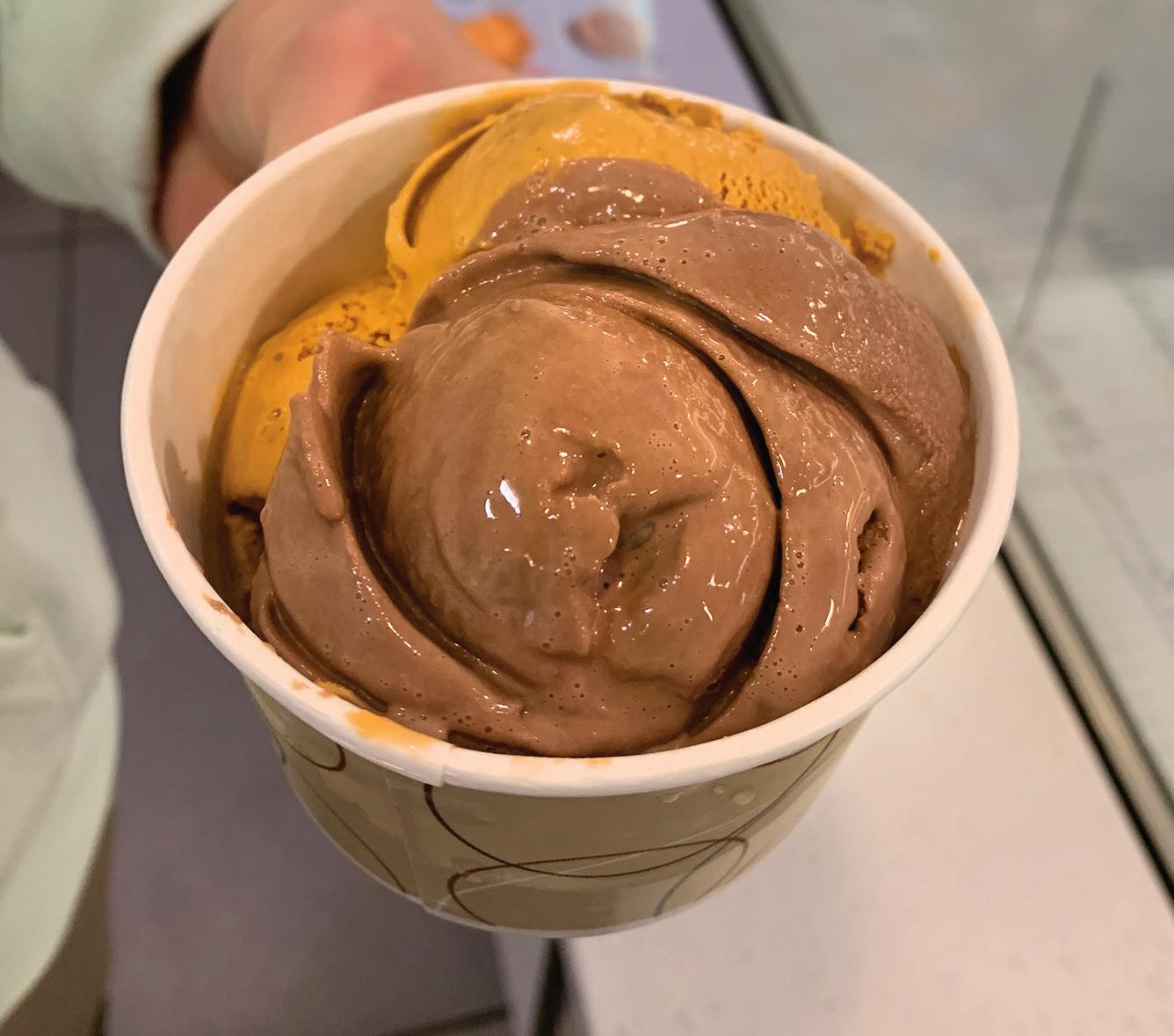
For those of you who are traditionalists, but want to expand beyond your original chocolate and vanilla, a kiddie scoop of this pumpkin ice cream in a cup is the classic way to go.
If the fall season was an ice cream, it would be Clocktower Pumpkin.
Now, 22 years later, as an homage to this piece of Cornell lore, the Cornell Dairy Bar has brought back their seasonal fall flavor: Clocktower Pumpkin; a pumpkin-based ice cream with cinnamon and nutmeg seasoning. It’s like pumpkin pie without the crust. Available at the Dairy Bar, it’s the bright orange flavor; you can’t miss it.
As a professional ice cream scooper (read: Dairy Bar employee), I can attest to the deliciousness of Clocktower Pumpkin. Although tough to scoop for those of us behind the counter, once it reaches your spoon, all you notice is the smoothness of the ice cream.
The creamy texture is the first thing you taste before it warms itself up with the nutmeg spices. If the fall season was an ice cream, it would be Clocktower Pumpkin.
Ice cream is so versatile — you can eat it with various toppings,
In a Sugar Cone
Both cups and cones cost the same at the Dairy Bar. If you want to upgrade your average everyday scoop, the addition of a sugar cone turns this single scoop into pumpkin pie ice cream, complete with the flavor of the crust.
With a Topping
The next step would be a topping. I absolutely love hot fudge. There’s no possible way to go wrong with hot fudge on anything, but especially pumpkin ice cream. The hot fudge compliments the cold, fall flavors and adds some warmth that we all need to prepare for the brutal Ithaca winters. If you’re feeling adventurous, add salted caramel sauce, too. The saltiness balances out the sweetness on
the hot fudge and creates a perfect marriage of flavors on top of an already perfect ice cream.
A Small: One Scoop Of Clocktower Pumpkin, One of Black Raspberry
Now, you wouldn’t think that these two flavors would go together. Not only do they look pretty together, the tang of the summer-y fruit coupled with the fall spices makes for an unexpected yet delicious pairing. And if that isn’t your cup of tea, you can always pair it with chocolate ice cream. Although chocolate is an anytime flavor, it’s especially perfect with the pumpkin to balance out the strong flavors in a more traditional way.
A Root Beer Float
Most people will try a float with the classic vanilla or chocolate, but change it up a bit and order the Clocktower Pumpkin. The vanilla notes in the root beer complete the fall flavor profile of cinnamon and nutmeg in the ice cream.
The vanilla notes in the root beer complete the fall flavor profile of cinnamon and nutmeg in the ice cream.
White hot chocolate
Now that it’s getting colder, we’re tending towards hot drinks like coffee, tea and hot chocolate instead of ice cream. But why not have both? Order a cup of white hot chocolate over at the deli counter and a scoop of Clocktower Pumpkin at the Dairy Bar. Put the ice cream in the hot chocolate and you’ve got yourself a winter ready float. Although prelims are starting again and the weather is starting to get bleak and cold, take a study break and walk on over to the Dairy Bar in Stocking Hall. Get your head out of a book, and your body outside to watch the leaves change. The changing leaves are the perfect backdrop for you to enjoy Clocktower Pumpkin or any of the other amazing flavors the Dairy Bar has to offer. Stop in and try one of the suggestions above, or create your own and let us know how it turned out. Happy Fall!
Sarah Austin is a freshman in the College of Argiculture and Life Sciences. She can be reached at sa2334@cornell.edu.



SARAH AUSTIN / SUN CONTRIBUTOR
ARTS & ENTERTAINMENT
What If I Don’t Want to Tell ‘Asian’ Stories?
When I was pitching my thesis to a professor, she suggested, “Have you thought about working on something about yourself?” I asked for further elaboration, and she said, “You know, something about your family, your upbringing, your identity. It could be interesting.”
I am sure she had no malicious intent, but what I didn’t want to tell her then and aim struggling to tell you now is that I don’t want to. Not because my story isn’t interesting — it sure could be — but because I fear that it could be interesting for the wrong reason. Yes, I know that playing the diversity card could probably get me places, but those places may not be where I want to go.
are catered for the festival circuit with a predominantly Western (read: white) audience. Certain things are expected of the filmmaker regardless of their intent or interest. At the Cine con Cultura Latinx American Film Festival a few weeks ago, someone in the audience pointed out the current dilemma of Latin American cinema is that a lot of films are only “Latin American in name.”
Politics of inclusion is tricky. While I welcome the idea, the practice is often flawed. In his new comedy special Right Now, Aziz Ansari joked that “newly-woke white people are exhausting!” Performative allyship, in my opinion, is no better than outright racism. To quote Ansari again, “I appreciate the support … but sometimes I’m a little suspicious.” Just like how predominantly white institutions like to put up stock photos of multiracial groups on their websites, I wonder if these well-intended actions only perpetuate the existing system by pigeonholing minorities into telling identity-centric stories.

For example, this year at Cannes I had an epiphany. After watching one after another film from the Global South, I noticed how weirdly similar they felt; the landscape is often depicted as a spectacle, and the people’s struggle a mere plot point. The void of authenticity is hidden under the beautiful cinematography and polished script. I was talking to a friend about this sense of misalignment and he laughed, “Have you paid attention to the credits? Do you know where all these films get their funding?” Then everything suddenly made sense. Of course films backed by European money won’t feel authentic — they
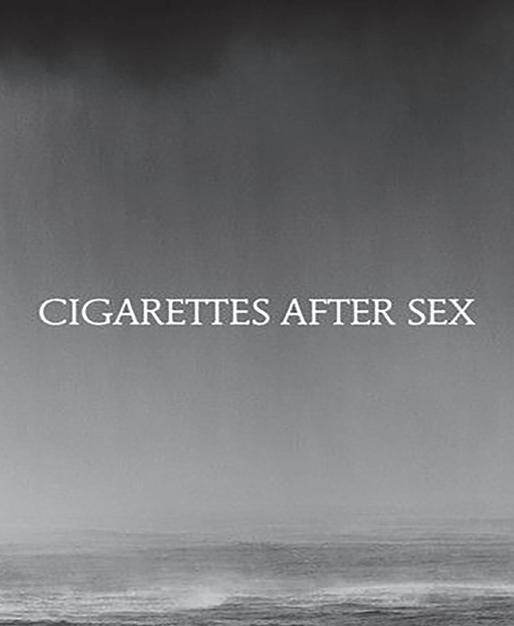
Back in 2017, Cigarettes
After Sex brought noir dreampop back to the spotlight with their self-titled debut album. Their atmospheric take on ambience is definitive of the contemporary alternative music landscape and echoes the melancholic perplexity experienced by the youth –– dark, smoky, sensual. Their sound is sweet and hazy, complemented by frontperson Greg Gonzalez’s heavenly androgynous vocal. They capture the sentiments of those long and lonely nights that are bound to inevitably follow after chaotic breakup sex. While their debut album generally received critical acclaim, critics also called into question what else the band has to offer. While Cigarettes After Sex delivers a cohesively cinematic film-noir experience, it also
Toronto-based artist Joshua Vettivelu told a story of an unpleasant anecdote in a talk. When they were applying to a selective grant at the beginning of their career, someone told them, “Oh honey, you’re brown and gay, you’ll get it.” I have heard similar comments more than I would ever need to, but these people might just be right.
Cigarettes After Sex Cry Partisan Records





comes off as monotonous and repetitive in terms of style and composition.
With Cry, Cigarettes After Sex remain firmly in their sweet spot while opening up a dreamy mesh of sensual possibilities. Within the first few tracks of the album, the band reinvented themselves with a lush of liveliness. The on-beat bass and drums in “Kiss It Off Me” are reminiscent of the sound of a pounding heart during intimate moments. The ephemeral spacey synth riff before the bridge elevates the sentiments to a miraculously unearthly state. Toward the latter half of the track, the groovy guitar melody adds poignant textures to the layers of dreamy synth pads.
The first single “Heavenly” is tied together with a bassline that bears resemblance to The

Would To All the Boys I’ve Loved Before have been made if it starred a white protagonist? Does Crazy Rich Asians really deserve a 91% on Rotten Tomatoes? Is Ava Duvernay an objectively good director? I have my answers but I will let you ponder on them.
Vettivelu mentioned his Iranian friend who swore never to use a Persian carpet in her work. I fear that I, too, have this tendency of going towards the other extreme, of running away from my identity. In my solo performance class, people always bring in autobiographical pieces, while I find myself almost struggling not to do so. I’ve done re-enactments of interviews and adaptations of poems but talking about my background terrifies me. I don’t want to talk about how my grandpa escaped a reeducation camp during the Cultural Revolution or how I haven’t talked to anyone from my family
since the past Chinese New Year. I don’t want to talk about how showing affection to a woman got me in strange situations in Prague. And I don’t want to talk about how hard it is for me to get a work visa because I am not American.
Yes, my identity inherently shapes the way I interact with others and the world, but I just hope the fact that I am a queer Asian woman isn’t the only reason people are drawn to my art. I want to counter the expectation that artists are supposed to mine their trauma, if not their own then their family’s, their country’s, their culture’s.
Ruby Que is a senior in the College of Arts and Sciences. She can be reached at rque@ cornellsun.com. Escape runs alternate Tursdays this semester.
XX’s unique blend of minimalism and grooviness. The play ful and experimental guitar melodies on the track reflect the more prominent shoegaze influence on the album. With vocal lines that stress less airy ambiance and emphasize more emotional profusion, the sound is more sentimental and less vicarious. Their new sound is less refined like scenes that are meticulously staged in a David Lynch film with implicit iconographies. Cry ’s grooviness delivers raw emotions that were unheard of on their first album. While structure-wise Cry has less control over the cinematography than their self-titled album, the delivery is emotionally more cinematic and climatic.
The album gradually delves
into the world of libidinous erotica in the form of lullabies, a field of expertise for Gonzalez that is often disguised in the lush of dreaminess. The mid-album highlight “Hentai” is perhaps the most explicit song the band has ever released. “Hentai” deals with his reminiscence of how he opens up about his porn-watching experience and his hentai fantasies during his first sexual encounter with a woman. Fetishism remains an often overlooked yet prominent feature of Gonzalez’s lyrical delivery. While a heterosexual white man’s narrative of his love life may not be the most exciting at first glance, Gonzalez’s
RACHAEL STERNLICHT/ SUN GRAPHIC DESIGNER

androgynous vocals and his stream-of-consciousness-like lyrics make up for his limited portrayal of his love and sex life.
Building on their strongholds in their niche of noir dream-pop, Cigarette After Sex reinvents themselves with a tint of enthusiasm intertwined with the lush of bemusement. While Cry still delivers the band’s signature cinematic film-noir style with prominent features of their Mazzy Star influence, the refreshing record proves that the group is not a one-trick pony but a band with a diverse range to showcase that can retain their cult-like hipster fanbase.
Stephen Yang is a sophomore in the College of Agriculture and Life Sciences. He can be reached at stephenyang@cornellsun.com.
COURTESY OF NETFLIX

Fill in the empty cells, one number in each, so that each column, row, and region contains the numbers 1-9 exactly once. Each number in the solution therefore occurs only once in each of the three “directions,” hence the “single numbers” implied by the puzzle’s name. (Rules from wikipedia.org/wiki/ Sudoku)


3 N OTICES

Niko!
by Priya Malla ’21
Pizza Rolls by Alicia Wang ’21
Mr. Gnu by Travis Dandro
The Fam (with Ben Franklin, Yoda & Sammy Davis Jr.) by Travis Dandro

26 A PA R TMENT FOR R ENT
We
COLLEGETOWN TERRACE APARTMENTS
Leasing for 2020/2021 Spring 2020 Semester leases available Heat, hot water and Wi Fi State of Art Fitness Center Shuttle Bus Service to campus Washer & Dryer in Apartments collegetownterraceithaca.com office@ithacastudentapartments.com (607) 277-1234
27 H OUSE FOR R ENT
20-21
120 Oak Avenue
Just steps to Cornell Campus 10 bedroom house & 1 and 2 bedroom apartment 607-277-1234 office@ithacastudentapartments.com Ithacastudentapartments.com
Collegetown Crossing
College Ave's Newest Location 307 College Ave. Now Leasing for 2020-2021 Completely New Modern Studios, 2 & 4 Bedroom Apartments. Fully furnished, heat & hot water included. Reception area at 307 College Ave. www.urbanithaca.com 607-330-2442 info@urbanithaca.com
Boldly Refined Living 312 College Avenue Sophisticated studio, 1, 2, 3-bedroom apartments. Superior fitness facility, theater, and coworking space. Free high-speed internet. Exclusive resident parking. Package delivery/return. Overnight concierge. 607-273-9777 or 312collegeave.com
3
20-21
4 Bedroom House $1500/month plus. 8 acre backyard. Washer & dryer. Short distance to Cornell, Wegmans. Pet friendly. thai360@juno.com



Taylor Finalist for National Accolade
By RAPHY GENDLER Sun Sports Editor
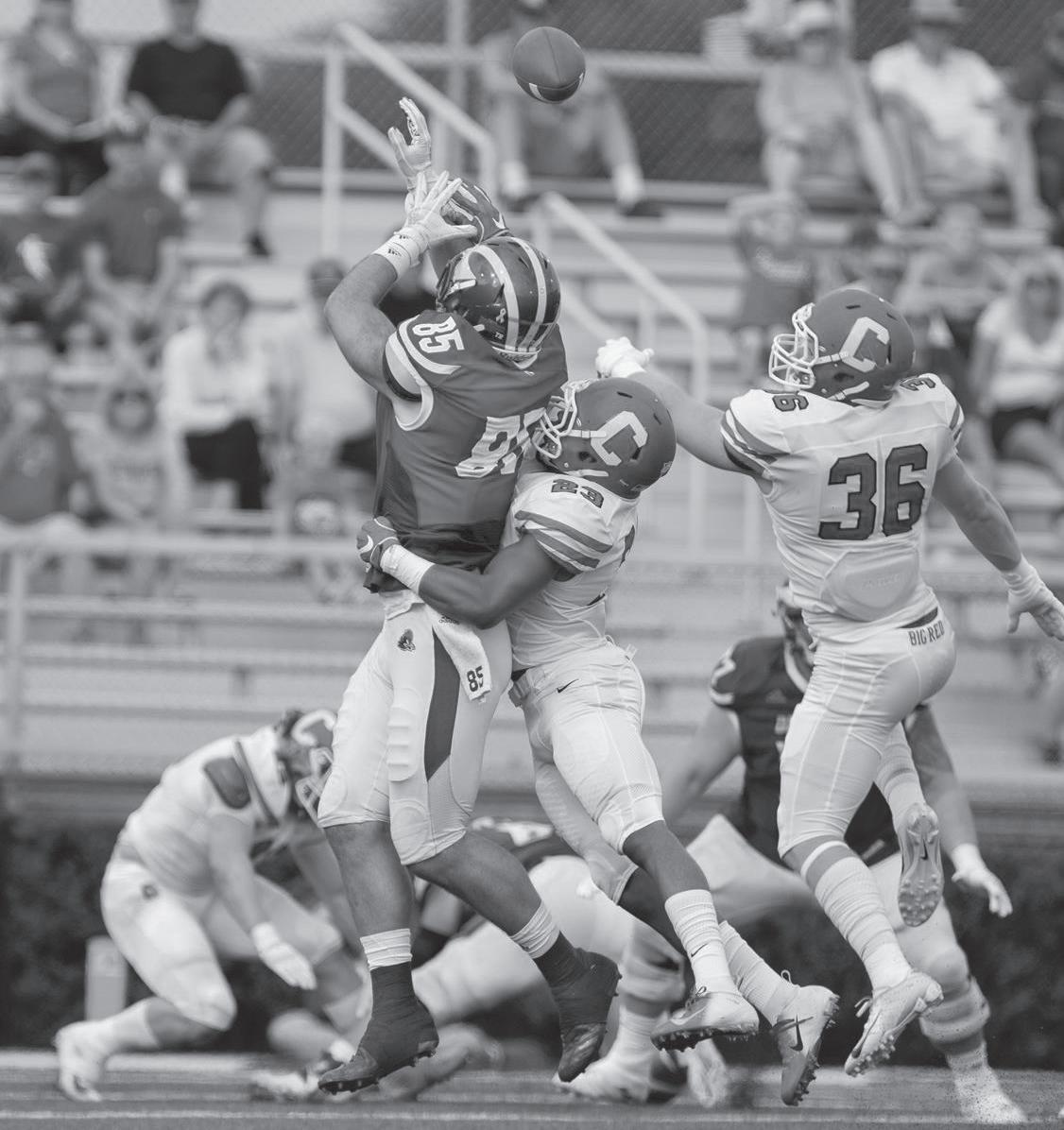
Senior safety and Cornell football captain Jelani Taylor was named one of 12 finalists for the William V. Campbell Trophy, the National Football Foundation and College Hall of Fame announced on Wednesday.
The award recognizes “an individual as the absolute best football scholar-athlete in the nation for his combined academic success, football performance and exemplary leadership.”
As a finalist, Taylor will receive an $18,000 postgraduate scholarship and will attend the NFF Annual Award Dinner on Dec. 10. The winner of the Campbell Trophy will be announced at the dinner, which will be held in New York City.
Selected among 185 semifinalists, the 12 finalists were nominated by their schools and have a 3.82 GPA on average, according to the press release.
The NFF began presenting the award in 1990, and previous winners include former NFL quarterback Peyton Manning and New Orleans Saints quarterback Drew Brees. There has never been a winner from the Ivy League.
Taylor, who studies in the School of Hotel Administration, has a 3.96 GPA, according to the release. He was the 2019 recipient of the Richie Moran award, which honors the Cornell athlete who distinguishes themselves through “academics, athletics and ambassadorship.”
On the field, Taylor has anchored the Cornell defense, leading the team with 42 tackles and two interceptions.
The Beecher, Michigan, native finished in the top 10 in the Ivy League in both tackles and pass breakups last season.
Raphy Gendler can be reached at rgendler@cornellsun.com.



Academic Heisman | The William V. Campbell Trophy is often referred to as the academic counterpart to the Heisman. Cornell’s captain, with a 3.96 GPA, has been named a finalist.
COURTESY OF CORNELL ATHLETICS
C.U. Ends Tree Game Slump in Narrow Win 1-0
tally enough to lift ailing
Red
past Bison in last non-Ivy matchup of 2019
By MIKE SEITZ Sun Staff Writer
A banged-up Cornell roster bounced back into winning ways against a physical Bucknell side on Tuesday.
“We put guys in today who haven’t played a lot of minutes [all season] and did quite well.”
John Smith
Going into the match, Cornell seemed to have lost its early-season momentum, unable to harness the same energy exhibited in big wins against Michigan State and Akron in its more recent games. The Red was winless in its past three contests, suffering two losses and tying against an underwhelming Brown side, who was just 2-8-2 heading into the game.
Key pieces were missing for the Red, as its two leading goal scorers were unable to play. Junior midfielder Harry Fuller, who leads the team with four goals, sat out due to yellow card penalty accumulation.
Sophomore midfielder Emeka Eneli, who has scored three, has been out with a lower leg injury and recently ditched a protective walking boot. The team also missed a vocal leader on the defen-
sive side, as junior goalkeeper Ryan Shellow was out with a hand injury.
Despite a compromised roster, Cornell started out strong early in the game - dominating possession and working the ball forward.
“We put guys in today who haven’t played a lot of minutes [all season] and did quite well,” said head coach John Smith.
The pace was dictated by junior midfielder Kepler Despinos, who did a nice job of distributing balls out to the wide flanks. Unfortunately, Despinos had to be helped off the field in the second half after suffering an awkward fall.
With Fuller out, junior midfielder Tyler Bagley was the go-to for set-piece situations.
“[Bagley spends] 30 minutes with the ball practicing free kicks and corners [before each practice],” Smith said.
10 minutes into the second half, his preparation was on full display for the Berman crowd. Bagley stepped up for a free-kick set just outside the 18-yard box. After the whistle blew, Bagley hit a curling strike that rattled off the crossbar and bounced on the goal line.
Luckily for the Red, senior forward Brady Dickens stuck with the play and headed home the bouncing ball for the go-ahead goal. The goal marked the senior’s second of the season.
The Red continued to look for an insurance goal, but could not distance the gap. Cornell had plenty of chances, thanks to dangerous passes by Bagley and sophomore midfielder Jonah Kagen, and finished with 9 shots.
The absence of Fuller and Eneli was obvious on offense as the Red struggled to extend the lead. The attack was constantly swarmed by a rough and stifling Bison defense, which fouled Cornell 14 times.
“We knew it was going to be an ugly game,” Smith said.
Additionally, junior forward Charles Touche, last year’s leading goal-scorer in the Ivy League, has only managed a single goal all season and has still not regained last year’s form.
“[He spends] 30 minutes with the ball practicing free kicks and corners [before practice].”
Red Under Friday Night Lights vs. Princeton
FOOTBALL
Continued from page 16
the team, tell them whatever is in their hearts,” Leary said, explaining the senior speeches. “My message was letting them know that we already know who’s for us and who’s against us. The only people who believe in us are the people in the room.”
“We just made sure that when we went out there and played, we blocked out all the noise,” Leary continued.
The contest will take place on Friday night, a spot that Cornell has not traditionally performed well in.
“Last year, we played Friday night, I feel like we came out flat,” Archer said. “I really want to start fast … history will tell you that we come out flat on Friday — we can’t afford to against [Princeton].”
In its primetime slot against Penn in 2018, the Red underwhelmed at home. Cornell held a 7-3 lead at halftime, but it was held scoreless by the Quakers in the second half en route to a 20-7 loss.
John Smith
Due to the stagnant offense, Cornell left itself vulnerable to a potential Bucknell equalizing goal as the game wound down. Lastsecond drama has been all too familiar for the Red this season, falling on both the fortunate and unfortunate sides of late-game sequences. This time around, the Red almost blew a hard-fought win.
“It was sketchy at the end,” said Bagley.
Freshman goalkeeper Brady McSwain and the Cornell defense were out of position when a dangerous ball found the feet of a Bucknell attackman in the box with seconds left. The entire roster breathed a sigh of relief as a Bison close-range shot sailed over the goal. The final whistle sounded 3 seconds later, giving Cornell the 1-0 win.
“It was too close for comfort,” Smith said.
While the win improves the Red’s record, in order to avoid falling back into a slump, the team must regain its early-season confidence.
“This gives us a little of a spark,” said Smith.
Cornell faces off at Princeton in a conference matchup at 4 p.m. Saturday.
Mike Seitz can be reached at mseitz@cornellsun.com.
Cornell Set to Face Of in Season Opener Following NCAA Quarterfnals Appearance in March
MEN’S HOCKEY
Continued from page 16
last two weekends, coming away with victories in each. In the first, against Nipissing, a long offseason left the Red looking out of sync with imprecise passes and miscommunications on the ice; going into the contest, the team had only practiced together a handful of times. This past weekend, against the USNTDP U18 team, many of the kinks looked to be largely worked out as play flowed more smoothly.
Now that the games count, Cornell can’t just focus on its own play like in its last two tune-ups. Michigan State, after all, plays a different brand of hockey than the ECAC.
“They’re trying to play pond hockey, as we call it,” Andreev said. “They don’t want
to play defense; they’re trying to get going on offense as much as possible.”
The Red, conversely, is known for its traditional emphasis on a strong blue line.
“They’re trying to play pond hockey, as we call it ... They don’t want to play defense; they're trying to get going on offense as much as possible.”
Max Andreev
Following the graduation of three key Cornell defensemen in May, this weekend will put the Red’s young defense to the test.
“They’re going to be very physical,” Andreev said. “We know that they have a
really dangerous first line.”
Andreev compared the Spartans’ style to Northeastern, who Cornell cruised by in the first round of the NCAAs in March.
“They have very good special teams ... their power play’s clipping at [23%] right now,” associate head coach Ben Syer said. “They’ve got a couple guys that returned from last year that are extremely talented players up front, to two twins on the back end — the Krygiers ... I think you’ll see a lot of what you saw last year, I think it’s a very similar makeup.”
Puck drop is at 7 p.m. Friday and Saturday in East Lansing, Mich.
As Archer said, Cornell cannot afford a subpar showing against such a stout opponent. Compared to Yale or Harvard — two Ivy teams the Red has already faced, and lost against — Princeton is a tier above.
The Tigers boast the second-highest scoring offense in the nation at 41.5 points per game, and they also have one of the best defenses in the country, holding their opponents to only 14.8 points per game, good for fifth in the FCS.
Despite Princeton seeing four of its stars leave to play in the NFL after last year, its attack has not missed a beat. Senior quarterback Kevin Davidson has dominated, averaging over 300 passing yards per game along with an impressive 70.49 completion percentage.
On the ground, the Tigers are just as fierce. Four running backs have eclipsed 100 rushing yards on the season. Leading the pack is junior Collin Eaddy, who has tallied 401 yards and seven touchdowns.
After giving up 35 points to a high-powered Bear offense last week, the Red’s defense will certainly have its hands full. But given the fact that Brown head coach James Perry previously coached at Princeton, Cornell may be more adjusted heading into the game.
“What’s ironic with coach Perry getting the job at Brown is you see almost the same style two weeks in a row,” Archer said. “We’re essentially facing the same offense — just year seven of it versus year one of it.”
The Red will hope that familiarity pays off as it seeks to upset the Tigers at 6 p.m. Friday at Schoellkopf Field.
Luke Pichini can be reached at lpichini@cornellsun.com.
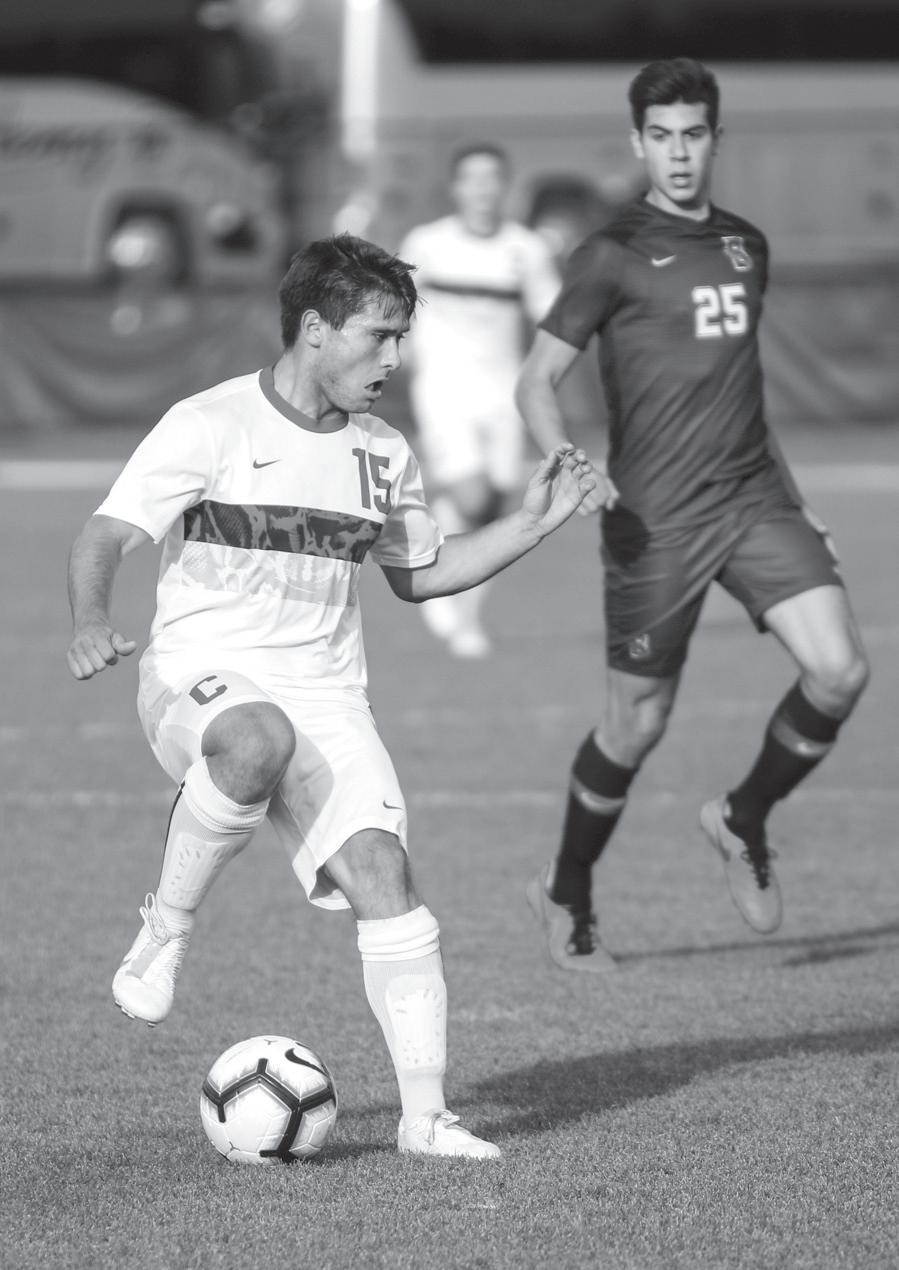
Back in form | After big wins to start off the season, an injury-ridden Cornell team found itself struggling up until Tuesday’s game.
MICHAEL WENYE LI / SUN SENIOR PHOTOGRAPHER
No. 3 Red to Start ECAC Play Following Sweep of RMU

Familiar foes | No. 6. Princeton gave the Red trouble last year, taking C.U. to double-overtime in the ECAC semifinals before Cornell ultimately pulled through.
By FAITH FISHER Sun Staff Writer
Fresh off two shutout wins against top-10 opponent Robert Morris, women’s hockey will commence ECAC play invigorated with winning momentum. The team, which has set high expectations for its season with its sweep and last year’s Frozen Four appearance, will face off against Quinnipiac and Ivy rival Princeton.
The Red registered 9 goals over the weekend, all of which went unanswered by the Colonials, a testament to both the team’s offensive and defensive depth. The Red’s desire to kickstart the season was evident in the energy it brought to the ice; its on-ice zeal and determination, which drove them to triumph, set a strong precedent for the 20192020 season.
“I think that this was a great start for us, and we are really looking forward to the rest of the season,” sophomore


forward Gillis Frechette said. “We will use this win as confidence but we definitely have a lot of strong opponents coming up, so we cannot overlook that and get too confident.”
Cornell (2-0, 0-0 ECAC) will channel that confidence and work to hone in on this weekend’s mistakes as it competes against Quinnipiac (4-1-1, 0-0-0 ECAC) on Friday, followed by Princeton (2-0, 0-0 ECAC) on Saturday.
Despite the boost from season-opening wins, the team realizes that it must strive to perform and execute flawlessly to be successful this season, especially considering the depth and breadth of talent in the ECAC.
“Over the years, we have come to realize as coaches — and we try to get this across to players — that this could be the game that is the difference between you getting to play in the NCAA tournament or not, and that has happened to us in the past,” head coach Doug Derraugh said. “When you only play 29 games in a season, you have to be ready for each one. It doesn’t matter who your opponent is — if
THE SUN’S FOOTBALL PICKS


you’re not ready, you’re going to lose.”
Last year, the Red secured two regular-season victories against the Bobcats in a pair of 2-1 victories. Its results against Princeton were more tumultuous.
The Red’s first win against the Tigers did not materialize until its third game against the Ivy League opponent. Following an early-season tie and a mid-season 5-0 loss, the Red faced the Tigers in the ECAC tournament semi-finals. The Red achieved victory on the third game to send Cornell to the finals, but the 3-2 win did not come easily. Rather, both teams were pushed to the brink of exhaustion in a double-overtime competition, in which the Red’s signature grit and determination prevailed.
“I think we always have a special rivalry with Princeton because of our history,” Frechette said. “So I think we are all looking forward to that game, but not overlooking Quinnipiac, because we know they will be a good opponent.”
Junior goaltender Lindsay Browning added: “This is the start. Princeton and Quinnipiac is always one of our toughest weekends, so we are looking forward to it.”
Going into the weekend, Cornell is ranked at No. 3, with the Tigers just trailing at No. 6. The Red welcomes playing against such high-caliber teams as a challenge and an opportunity to further develop its own skills.
“[Princeton and Quinnipiac] have always been two of the top teams in our league,” Derraugh said. “They are both very well coached, very disciplined. They are different styles of teams but they are both very effective in what they do. We know that it will be a great challenge early on in the year but that’s what we expect.”
Although the team graduated four integral seniors last year, the team has adapted, with players taking on new responsibilities. Browning has especially stepped up, filling the role left by graduated goaltender Marlène Boisonnault ’19.
“She is just really steady back there,” Derraugh said. “It is not only saves she makes, but she helps the team to be calm as well.”
Frechette echoed her coach’s assessment:
“I think our team prides itself on being a defense-first team, and having such a presence at the net and knowing we can trust Lindsay so thoroughly definitely gives us a lot of confidence on the defensive end.”
The upcoming showdowns will take place at home at Cornell’s Lynah Rink. The Red will face Quinnipiac on Friday at 6 p.m. and Princeton on Saturday at 3 p.m.
Faith Fisher can be reached at fsher@cornellsun.com.




BORIS
Season Opener at MSU Opportunity for Revenge
No. 4 men’s hockey to open its season against Spartans for 2nd year in a row, aiming for diferent result
By CHRISTINA BULKELEY
Assistant Sports Editor
A year ago, men’s hockey opened its season with a pair of games at home against Michigan State. This weekend, the Red will visit Lansing to return the favor — but hope for the opposite outcome.
Last year’s opening contests, at the time, looked to spell disaster for Cornell, who was swept at Lynah against the unranked Big 10 opponent. The Red, which was ranked at No. 8 going into that 2018 series, fell 10 spots to No. 18 in the next round of polling.


But what felt like the beginning of a long and painful season was not ultimately the foreboding omen that Cornell supporters feared. Despite that sweep on home ice, Cornell reached the NCAA quarterfinals in March. That disastrous weekend became little more than a blip over the course of a long season in which the team also won a share of the Cleary Cup.
After Cornell’s ultimately successful season, do those two defeats all the way back in last October still even matter? Have they been forgotten — or, rather, is there added motivation to down the Spartans this weekend?
“Oh, absolutely,” sophomore forward Max Andreev said. “We got swept in front of our home crowd last year. And that was absolutely embarrassing.”
Cornell conceded nine goals to the Spartans that weekend, with now-junior goaltender Matt Galajda being pulled in both matches.
“They’re a different team [now],” Galajda said. “Just one bad weekend, that’s all that was.”
Galajda will be returning from a knee injury sustained in

the ECAC title game against Clarkson. Trapped under his own net when it fell on top of him in sudden-death overtime, Galajda was then forced to miss the rest of the year.
But after shutting out the US National Team Development Program Under-18 squad last weekend, Galajda looks — and feels — ready for the season.
“I took it slow after the season last year, just training — didn’t really get on the ice until later in the summer,” Galajda said. “And I think that’s always something nice. I’ve never really done that before, but it’s always nice to have a mental break and just get refocused and rejuvenated.”
Once again, Cornell will be taking on a team whose season has already gotten underway. The 2-2 Michigan

State team has wins against Colorado College and Northern Michigan thus far. Ivy League rules force the Red to start later than its non-Ivy opponents — a tradition that head coach Mike Schafer ’86 condemned as “archaic.”
But the Red will need to overcome the disadvantage quickly if it does not wish for a repeat of last October’s debacle.
“I’ve always said, you have to get yourself up to speed, up to game speed, like [your opponent is] already,” Schafer said.
Cornell has played an exhibition game in each of the
C.U. Looks to Avenge 66-0 Loss To Princeton in Friday Night Tilt
By LUKE PICHINI Sun Assistant Sports Editor
After edging out a win over its least intimidating Ivy League foe last weekend, Cornell football will now face its most challenging conference opponent so far.
Following a narrow, last-minute victory over last-place Brown, the Red will welcome Princeton,
“The only people who believe in us are the people in the [locker] room.”
Malik Leary
a team that has ripped off six straight victories to start the season. Burned in Cornell fans’ minds is last year’s devastating outcome against the Tigers. In a contest that snowballed out of control, the Red was trounced, 66-0, in the program’s worst loss in 128 years.
“I don’t think you ever forget something like that,” said head coach David Archer ’05. “Certainly, the way that game transpired — they were ready to go — they circled us on their calendar because we upset them on national TV the year before.”
players carry a chip on their shoulders as they hope to avenge that historic defeat.
In 2017, Cornell scored 13 unanswered points in the fourth quarter to knock off the Tigers on the road, 29-28. The last three points came from then-sophomore Nickolas Null, who booted a game-winning 43-yard field goal in the final seconds to secure the victory.

When the Red squares off against Princeton, it will hope for a result more along those lines compared to the fate it suffered last year.
Given last year’s loss, Archer’s
“We’re not going to forget that,” said senior linebacker Malik Leary. “But every time we step on the field, we’re motivated, and now we know that we don’t need that to happen again.”
Had the Red lost to Brown, the remainder of its season would have looked bleak with four difficult Ivy contests left. But after its win, Cornell maintains hope heading into a tough conference slate. The emotional victory was fueled in part by a pregame speech from Leary — many of his teammates praised the senior’s speech in motivating their strong play.
“Every year, the seniors are given one chance to just address
Tough road ahead | Cornell has a tough slate of Ivy matchups throughout the rest of the season — including undefeated Princeton this weekend.
The Red remembers | Though the team went on to an NCAA quarterfinals appearance after last season’s bleak start, the MSU sweep remains in players’ minds.
Sun
vs. Michigan State Friday and Saturday, 7:00 p.m. East Lansing, Mich.
Men’s Hockey