The Corne¬ Daily Sun





By AMINA KILPATRICK Sun Staff Writer
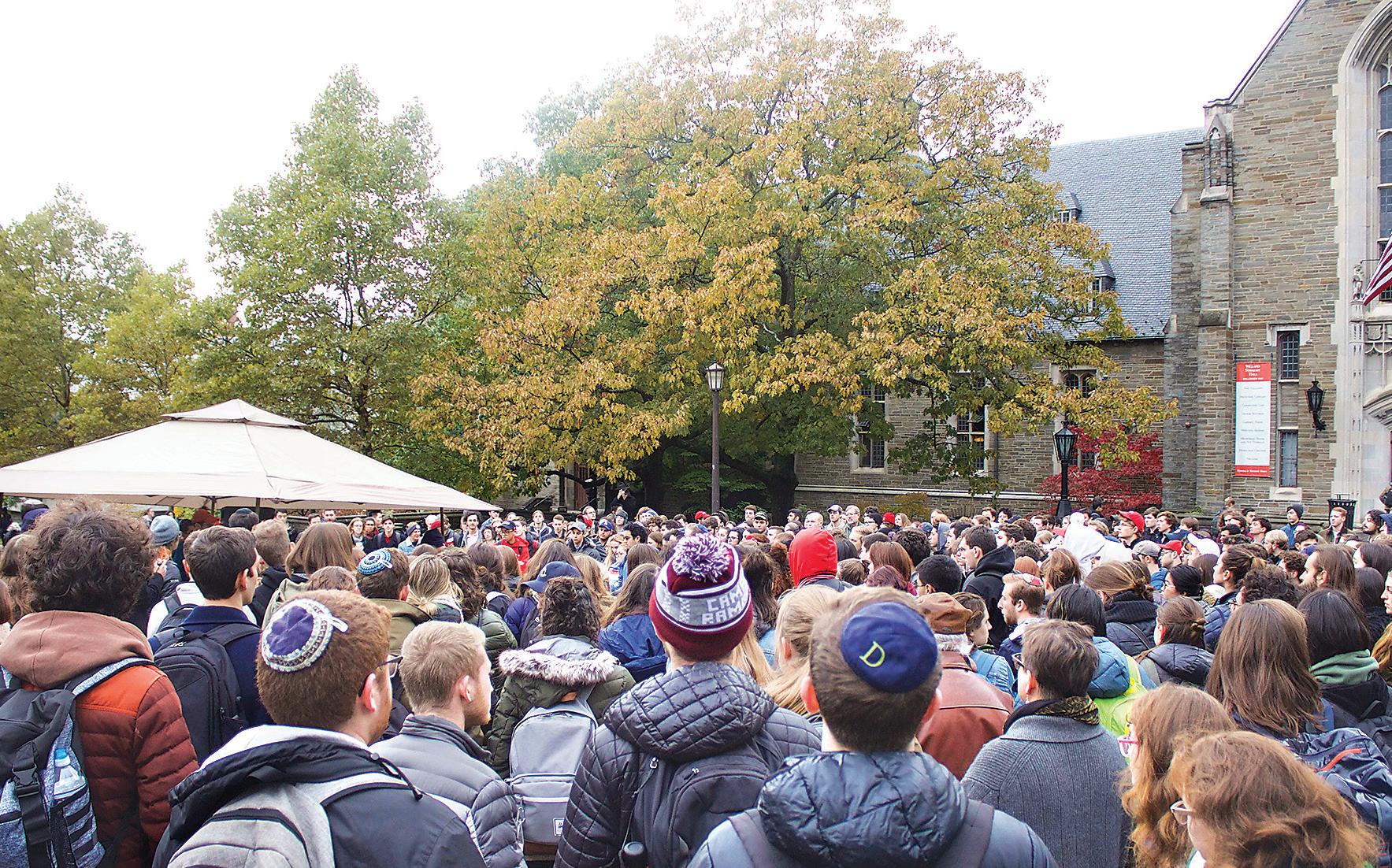
Amidst cold and rain, over 150 Cornellians — some from the Tree of Life Congregation — huddled together Monday evening on Ho Plaza to remember the victims of Saturday’s anti-Semitic shooting.
Several members of the Pittsburgh congregation community attended the mournful vigil — including Chad Rosenbloom grad, who lit 11 candles to remember his cousins Cecil and David Rosenthal, who were among the victims of the shooting.
“When we confront hatred and darkness in this world, we don’t do it with a stick, but rather we add light.”
On Saturday, Robert Bowers was charged with killing 11 members of the Tree of Life Congregation in Pittsburgh, Pennsylvania during their Shabbat services. Rotiman Chabad Center at Cornell University and Cornell Hillel planned the vigil to remember the victims.
Hannah Scherl ’19
“We mourn along with the city of Pittsburgh and we pray for a quick recovery and Refuah Shleimah for those who were injured,” declared Ashley Radparvar ’19 at the beginning of the vigil. “Anti-Semitism has no place in our country and we condemn all acts of bigotry, hatred and
By JULIA CURLEY Sun Staff Writer
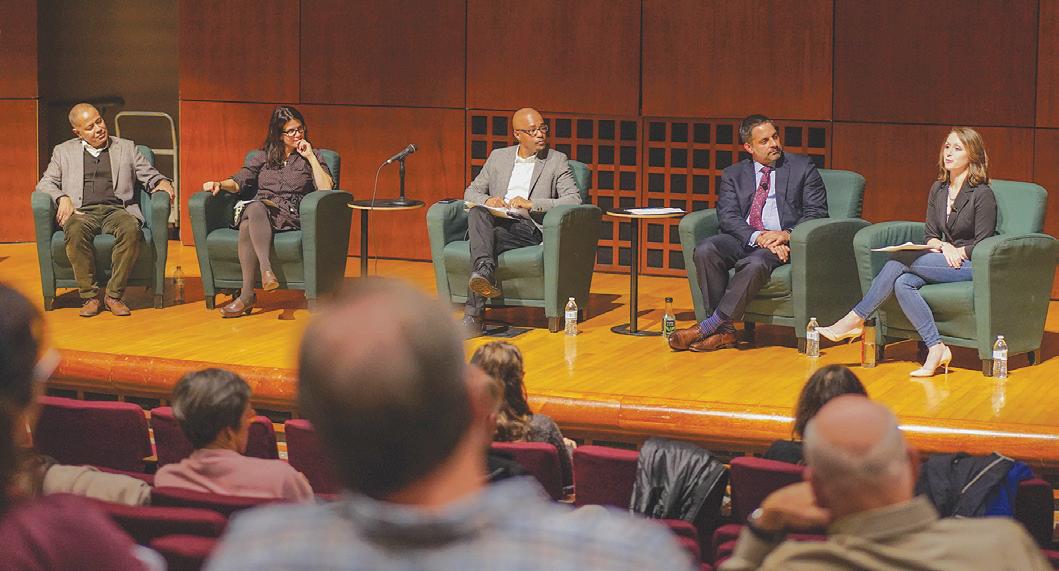
One hundred and fifty years after Ezra Cornell promised “any person … any study” to students of the University he founded, this ambitious motto still remains aspirational, — and unfulfilled — according to professors who came to share their reflections in a Monday panel.
For Prof. Gerard Aching M.A. ’90, Ph.D. ’91, romance studies, Ezra’s words served as “a license for experimenting and exploring.” As a graduate student, he was encouraged to take his inquiries to areas beyond his own discipline and even into other departments, he recalled.
Originally from Trinidad and Tobago, Aching said he also cherished the diverse group of people from “Iowa, France, South Carolina and Puerto Rico” that he studied with.
Eduardo Peñalver ’94, dean of Cornell Law School, echoed Aching’s experience in expansive learning but also added how “Ezra took the ‘any person’ language very literally.”
Peñalver said Ezra once advocated for two students who were rejected by admissions officers because “they don’t know enough.” The founder, upon hearing about this decision, asked

By MARYAM ZAFAR Sun Staff Writer

bell-ringing, foot-stomping, and cheers.
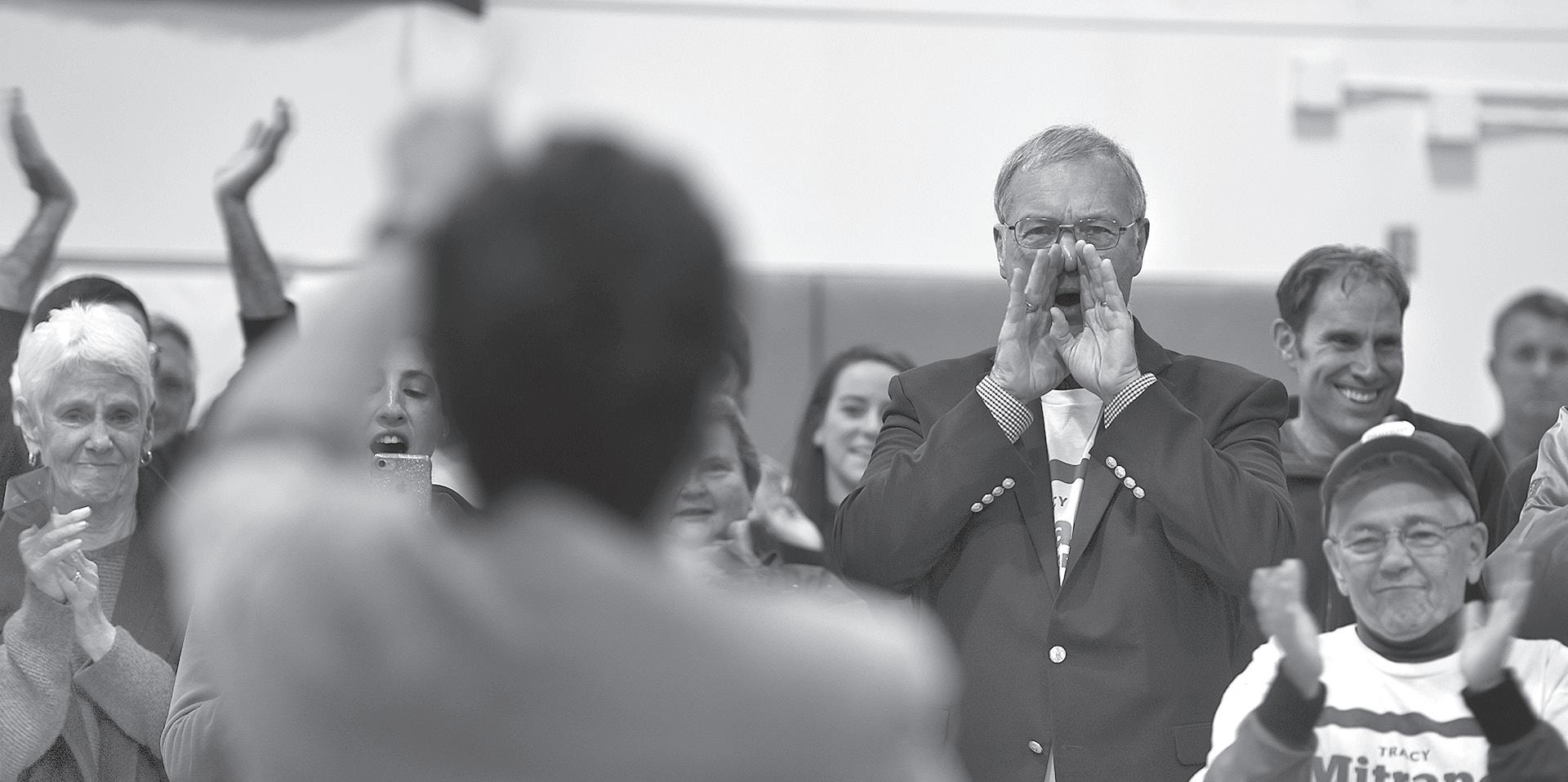
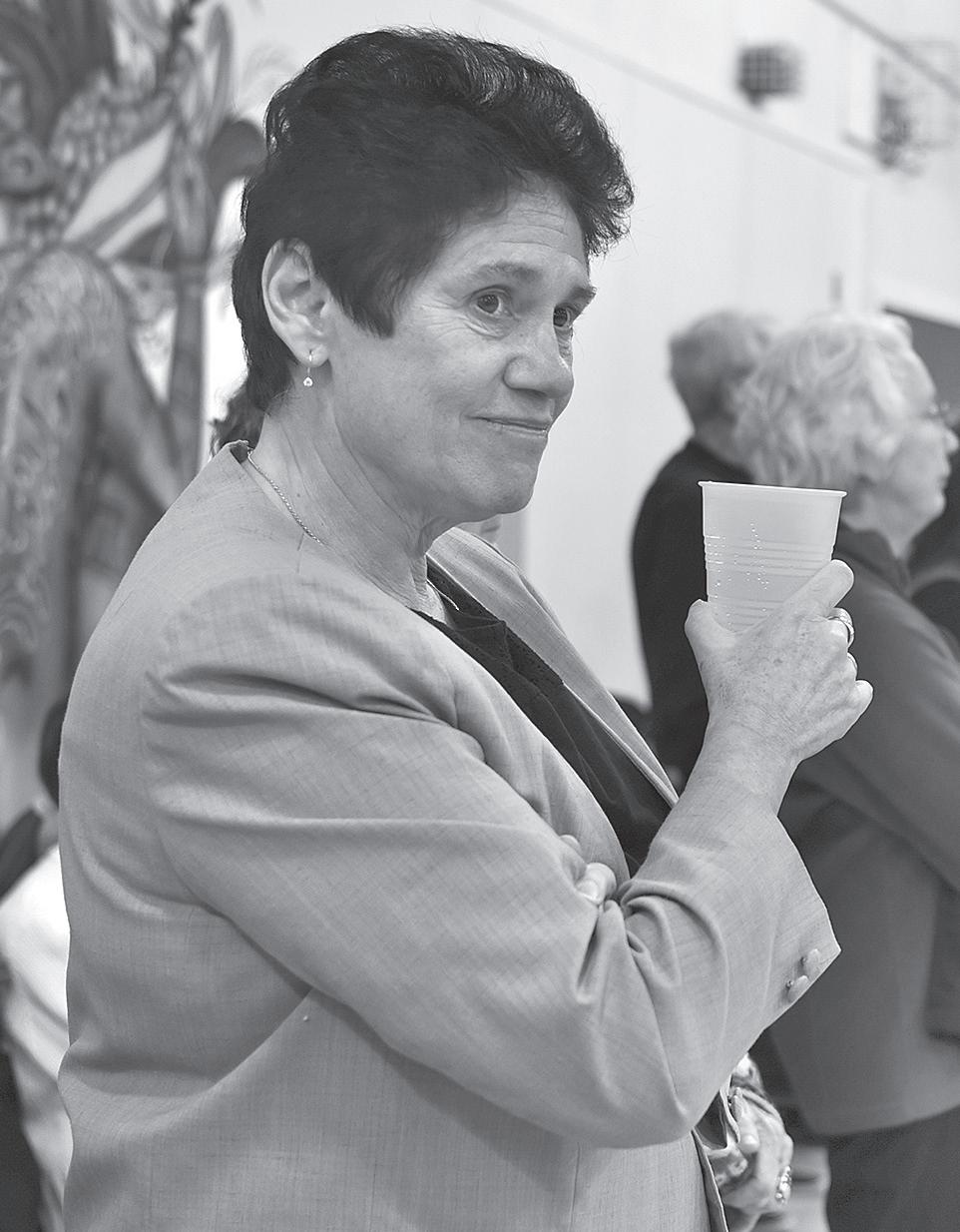
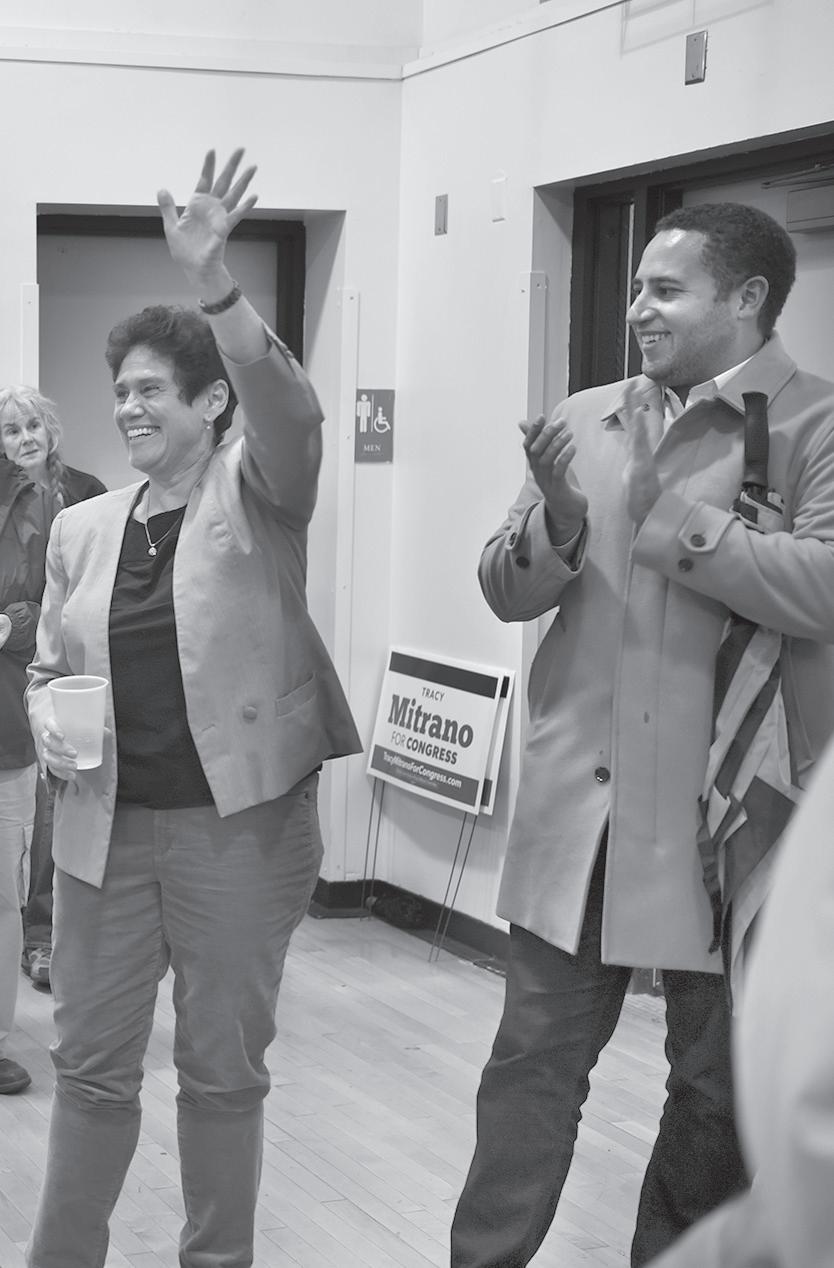
Berry was one of many who spoke at the campaign rally for Tracy Mitrano J.D. ’95, democratic congressional candidate for the New York 23rd district. Over 60 supporters of Mitrano stood in a semi-circle as campaign workers, the mayor of Ithaca and Mitrano herself spoke Monday evening. Despite the supporters rallying for the Cornellian democrat in the Southside Community Center, it still appears unlikely for Mitrano to win this election. Nevertheless, she seems to have a much better shot than her two most recent predecessors at defeating her rival incumbent
Political polling analysis website Fivethirtyeight projects that Reed will win on Nov. 6 by a margin of 6 percentage points based on a estimate partially relying on an Oct. 23-24 poll. This margin, according to campaign worker Hadiyah Chowdhury ’18, is an impressive one given that Reed won the 2014 and 2016 elections by 21.9 and 15.2
percentage points, respectively.
While a repeated message of the rally was to promote voter turnout, one audience member won’t be voting next Tuesday.
Max Rubenstein-Miller, who is only 15 years old, decided to come to the rally after school today at his mother’s request, planning to stay for a half hour. After coming to
“We need a blue wave, a brown wave, a progressive wave, a multicultural wave — a wave!”
Michelle Courtney Berry
the rally, the Ithaca High School sophomore said that he’d be signing up to volunteer to canvas with his mom for Mitrano.
“I like the fact that [Mitrano] has integrity,” Rubenstein-Miller said. “I really like the fact that she supports the working family.”
Ben Monaghan ’20, who previously worked on the Mitrano campaign, said that many students at
See MITRANO page 5
Lunch and Learn:
Fake News, Alternative Facts and Misinformation Noon - 1 p.m., 116 Warren Hall
On The Menu: Sexual and Reproductive Health Noon - 1p.m., 336 Plant Sciences
Cornell Health: “Let’s Talk” Walk -In Consultations 2:30 p.m., 146 Sibley Hall
Romance Studies Open House 3 - 4 p.m., 164 Klarman Hall
Canvas@Cornell: Moving From Blackboard to Canvas 3:30 - 4:30 p.m., G27 Stimson Hall
FGSS Open House
3:30 - 5 p.m., 190 Rockefeller Hall
Hurried Halloween
4:30 - 6:30 p.m., Mann Library, mannUfactory
Real Estate Session
With Cheryl Boyer ’87 and Jonathan Korr ’09 4:30 - 5:30 p.m., 391 Statler Hall
Sustainable Futures Lecture: Jennifer Carlson 4:30 - 6 p.m., A.D. White House, Guerlac Room
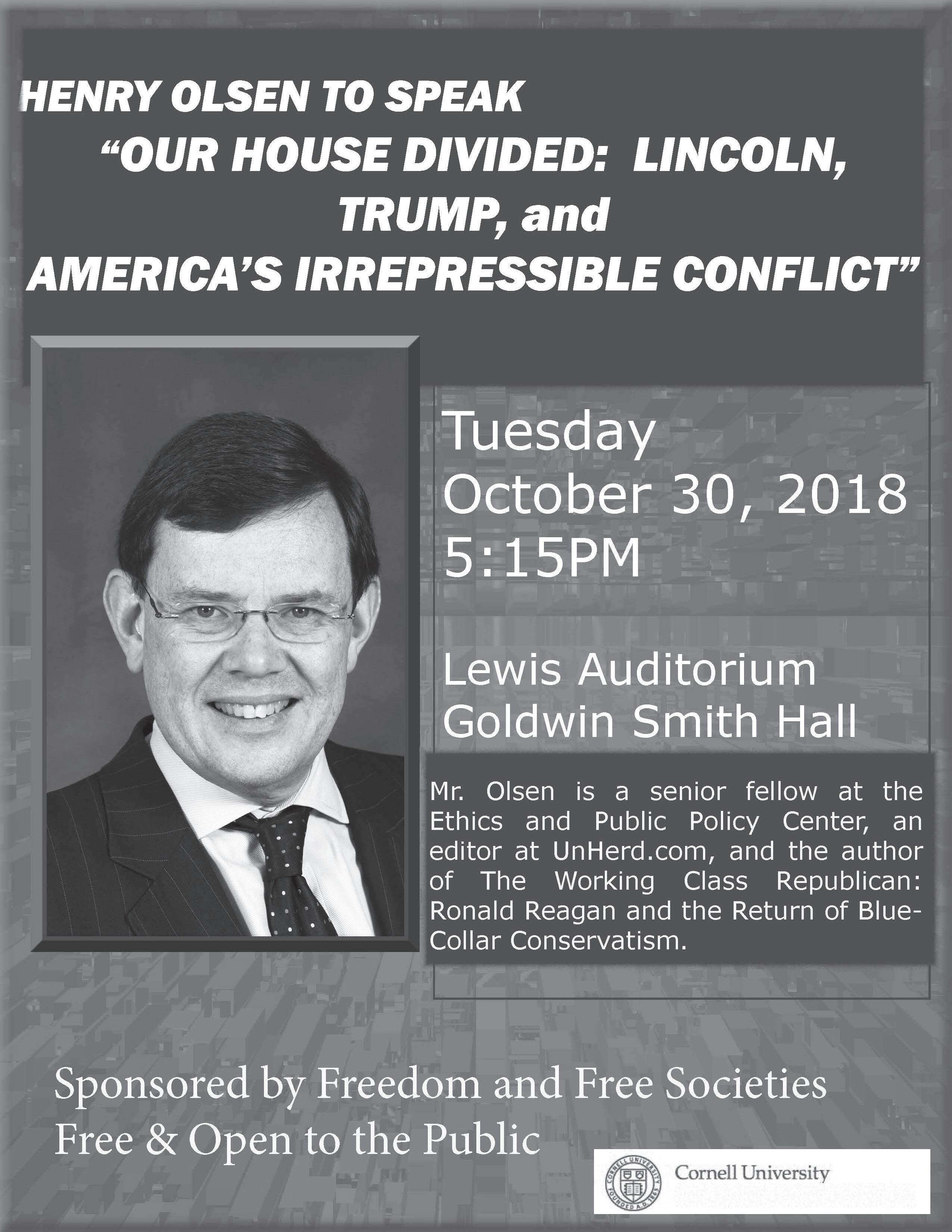
Freedom and Free Societies Lecture With Henry Olsen 5:15 p.m., Rockefeller Hall, Lewis Auditorium
The Cornell Law Federalist Society: Ilya Shapiro 6 - 7:30 p.m., G85 Myron Taylor Hall
Pan-African Drum and Dance Ensemble Open House 7:15 - 8:45 p.m., B20 Lincoln Hall
Web Accessibility Interim Policy Forum 9:30 - 10:30 a.m., 700 Clark Hall
Perspectives: Handling Difficult Conversations Workshop Noon - 2 p.m., 148 Stocking Hall

AASP and A3C PRAXIS Lunch Series Featuring Edy Barraza Noon - 1 p.m., 429 Rockefeller Hall
International Research Travel Grant 4:30 - 6 p.m., G08 Uris Hall
The Literary Society 4:30 - 6:30 p.m., 258 Goldwin Smith Hall
Econ-Themed Halloween Party 6:30 - 8 p.m., 401 Warren Hall
Handling difficult conversations | A workshop on developing communication skills will be held on Wednesday in Stocking Hall.

By MATTHEW McGOWEN Sun Senior Editor
Strolling through Mann Library on most days, you might not suspect the extent of Cornell’s ties to apples, save for the apple vending machine. But this week, displays in the Mann lobby and vivid wall prints decorating the first floor computer lab puts the history of the apple in the pommes of students’ hands.
The exhibit, “Apples to Cider: An Old Industry Takes New Root,” speaks to the rich history of apples in cider-making, and the resurgence of an industry with close ties to Cornell research.
Informational posters and prints of apples gleaned from old manuscripts will be posted in several locations around Mann Library until December. The main lobby includes a display about the history of cider-making, and the first floor is decorated with large prints and posters about Cornell research on cider. QR codes on posters and quarter cards link interested patrons to further resources online.
During Cider Week earlier this month, students had the chance to sample some of the apples currently under cultivation by Cornell researchers.
Apple cider has deep roots in the American history and in the New York area. In the 18th and 19th centuries, Americans drank an average of over 10.5 ounces of apple ciders a day. Even President John Adams started off every day with a tankard, according to the exhibit’s website.
Despite its glory in the past centuries, the cider industry dipped in the 20th century, pinched by both Prohibition and the surging popularity of beer. But the apple didn’t fall far from the tree — apple cider-making has seen a significant resurgence of late, according to the exhibit.
Cornell might be a full four hour ride from the Big Apple, but research efforts to study the fruit go back as far as Prof. Liberty Hyde Bailey’s 1892 survey of apple varieties in over 40 states. Nowadays, much of the University’s work on cider is driven by the Cornell Hard Cider Project Work Team, headed by Prof. Greg Peck, horticulture.
According to Adam Karl, M.S. ’15, a PhD. student studying orchard management with Peck, apple varieties first cultivated hundreds of years ago — like the Siberian Harvey or the Gipsy King — are well suited for cider-making. Karl said that these types of apples contain higher content of tannins — the same compounds that give wine its red color — which, while bitter, make them more amenable to cider than common culinary varieties like Honeycrisp.
To this day, apple researchers and horticulturists refer
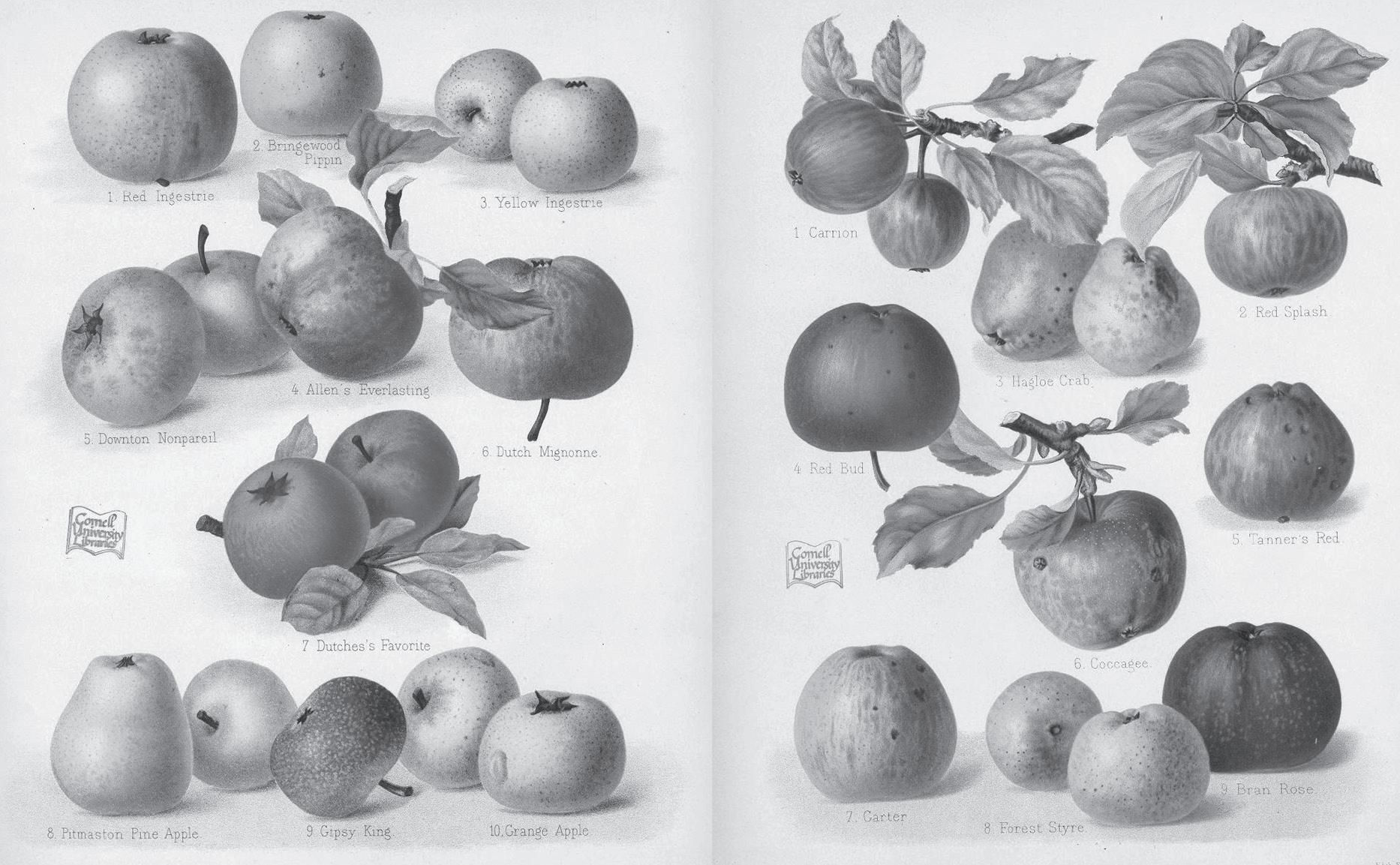
back to the knowledge of old varieties contained in Mann’s ancient manuscripts, like the 207 year-old text Pomona Herefordiensis, according to Eveline Ferretti, public programming and communication administrator for Mann Library.
“The Gipsy King was one of those apple varieties that was thought to have been lost, until it was “rediscovered” in an old orchard along the England/Wales border in 2004; the horticulturalists who identified the apple relied in part on the description & illustration provided in the Herefordshire Pomona,” Ferretti said in an interview with The Sun.
“Those old books are really good at helping people like Greg Peck. When they’re not quite sure [about a variety], they actually come look at these books,” Ferretti said. “Every Cornell student should take the time to see these books because it’s actually pretty awesome to see these books that were written a couple hundred years ago.”
A plaque posted for the exhibit about the Pomona
By SHAWN HIKOSAKA Sun Staff Writer
Tim Shenk, coordinator of Cornell’s Committee on U.S.Latin American Relations, proudly declared that the election of President Andrés Manuel López Obrador in Mexico “is a victory for the people of Mexico, and a real defeat for the sitting oligarchy.”
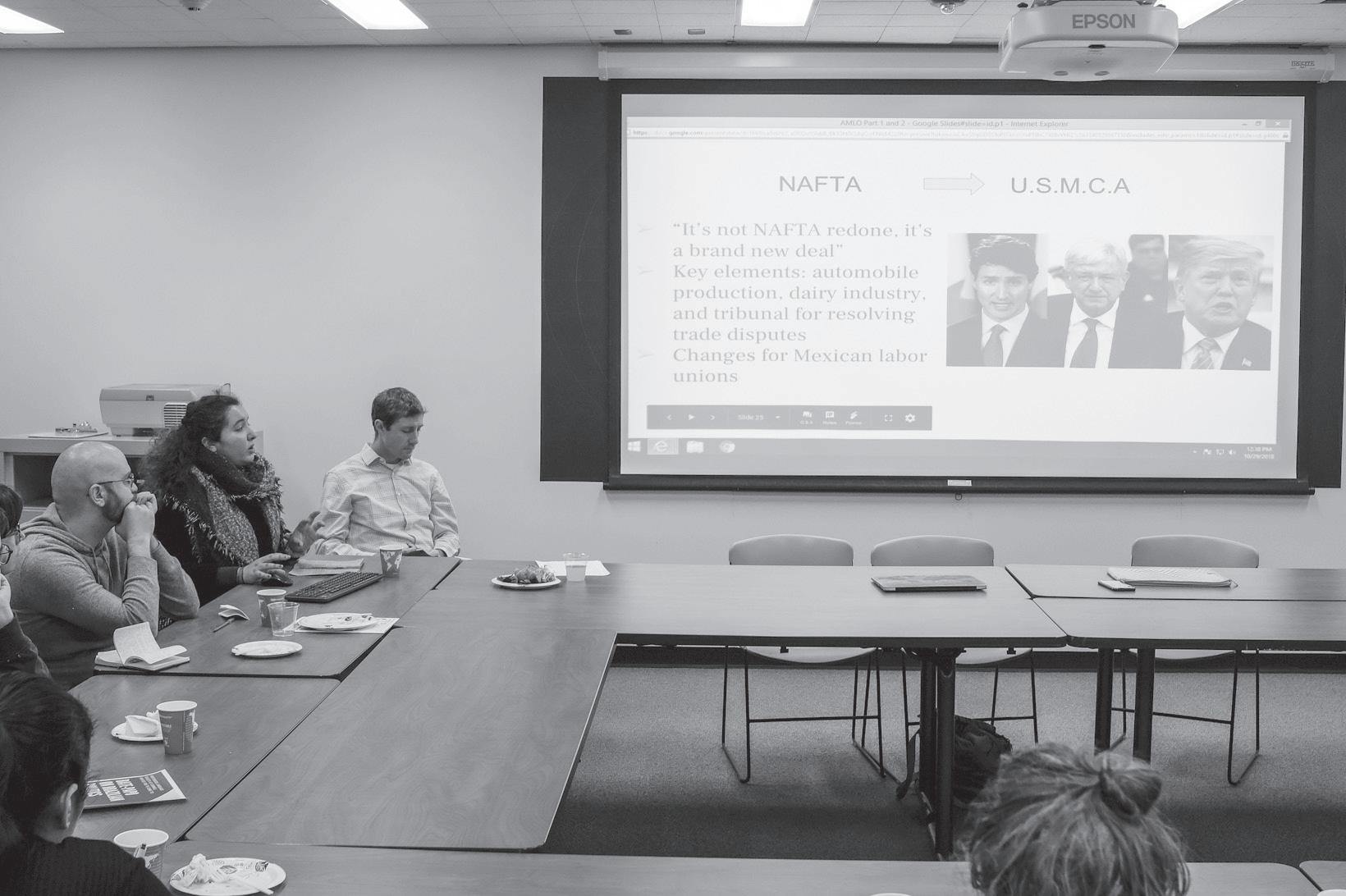
Shenk and more than a dozen academics and students participated in a Monday afternoon roundtable where they collectively analyzed the impact of the July general election in Mexico that catapulted an outsider candidate to power.
“Andrés Manuel López
Obrador, or AMLO as he’s often called in Mexico, was elected by a huge majority on July 1st in Mexico for the presidency. He had more votes than any candidate in Mexican history,” Shenk began. The triumph of AMLO, who is backed up by the Juntos Haremos Historia coaltion, has serious historical significance, according to Melanie Calderon ’20, a CUSLAR intern. CUSLAR seeks to promote “justice and mutual understanding among the people of the United States, Latin America and the Caribbean,” and does so by hosting speakers, organizing cultural events and through educational programming.
Calderon argued that AMLO’s victory represents the termination of the 89-year hold to power by the rival Partido Revolucionario Institucional party — Mexico’s primary governing party since 1929 aside from a few years out of power.
She said that while the constitutional amendments of governmental institutions — such as reformation of Federal Electoral Institute, which is now nonpartisan after reforms — certainly buoyed AMLO’s candidacy, the crime wave, “rampant” corruption and the slow economy also contributed to PRI’s downfall.
With the current crime wave in Mexico, “Mexico’s on track to record more murders this year than any other year,” Calderon said, adding that over 120 politicians have been murdered since last September.
The GDP of Mexico has also been experiencing a decline in growth. “It only grows at 2 percent, which is slower than other emerging countries,” Calderon said. “Per capita income has [also] been flat while the wealthiest in Mexico are getting wealthier.”
Meanwhile, Tomasz Falkowski, a postdoc horticulture researcher, challenged what he believed were claims that aimed to
Herefordiensis said that “a browse through this sumptuous classic of english pomology will transport you back hundreds of years, to a time when English orchards abounded in a dazzling diversity of fruit.”
Published by English horticulturalist Thomas Andrew Knight in 1811, the manuscript described and illustrated in vivid detail 30 varieties of apple and pear. A complete scan is available online through the Biodiversity Heritage Library.
“These are some of these old cider varieties, a lot of them have been ‘lost,’” Ferretti said. “They seem to have disappeared from orchards in England, sometimes though you find them again … and they actually bring them back.”
Large prints of the heirloom varieties illustrated in Pomona Herefordiensis were hung on the first floor of Mann library in the area overlooking Beebe Lake, and will remain up along with the rest of the exhibit until December.
Matthew McGowen can be reached at mmcgowen@cornellsun.com.
By
Cornell was awarded the Leadership in Green Power Education Award for the work of Cornell Cooperative Extension in communicating green energy issues to Tompkins County and New York State residents as part of its organizational mission.
The CCE, a Cornell outreach organization, educates rural farmers in New York to incorporate wind and solar energy into their operations, helps low income families apply to green energy programs, and added K-12 tours to the University’s solar farms. These initiatives, among others, helped Cornell’s stand out from the over 1000 eligible organizations for this award, according to Sarah Brylinsky, sustainability communications and integration manager of the campus sustainability office.
“Not
behind lab doors, and Cornell is the exact opposite of that,” Brylinsky said.
that there’s anything wrong with activism, there’s a role for that, but that’s not what we do.”
The Green Power Education Award, given by the the Center for Resource Solutions and Environmental Protection Agency, acknowledged the substantial initiatives the University has taken in promoting sustainability education. Winning the award won’t change much of the work the University does, instead serving as recognition of the work done so far, according to Brylinsky.
Guillermo Metz
“The award is just a tremendous honor for the hundreds and hundreds of different faculty and staff and students that do that work everyday,” Brylinsky told The Sun.
“I think sometimes we think of higher education as an ivory tower, as a campus on a hill that keeps solutions locked
CCE’s education initiatives focused on connecting with each local community and learning about their specific needs and expectations instead of advocating for a single solution at all places, according to Guillermo Metz, CCE energy
discrimination against all groups.”
“It is the tree of life to all who grasp it, and to whoever holds on to it is happy. Its ways are ways of pleasantness and all its paths are peace,” Radparvar said, citing Proverbs 3:17-18 of the Bible, as the congregation got its name from the concept of the tree of life present in the Hebrew text. “We are connected together as a community through this tree of life tethered together by our roots and united towards a world of peace and harmony.”
According to Hannah Scherl ’19, “Shabbat is a time of light and joy” and it is important to “kindle flames” on the holy day, even when confronted with hostility.
“When we confront hate and darkness in this world, we don’t try to do so with a stick, but rather we add light,” Scherl said. “Because even a small amount of light, a tiny candle has the power to dispel a tremendous amount of darkness.”
Jacob Mitrani ’21 said the shooting should not be seen as a random incident of anti-Semitism, rather a consequence of the society’s failure to address the growing problems.
“This tragedy is not a random representation of
anti-Semitic sentiments that are being held by a few unhinged radical individuals in our country,” Mitrani said. “This tragedy is compounded by a greater reality that we have been failing to address and acknowledge.”
In Judaism, those in mourning go through a process called shiva that occurs the seven days after a death. According to Samuel Barnett ’19, the vigil was a way for the “community to come together and support [that] process.”
“It’s important to be supportive to Jewish commu-
“This tragedy is not a random representation of anti-Semitic sentiments that are being held by a few unhinged radical individuals in our country.”
Jacob Mitrani ’21
nities and the people who were affected in that week to make sure there is proper closure and support where needed,” Barnett told The Sun. “It’s kind of similar to what you do when a family member dies or a loved one dies, supporting a person in the week after.”
For Julie Green ’19, Judaism is an important part of her life. The people killed at the synagogue could’ve
ior. These subtle effects can add up and “affect dramatically” people’s perceptions of others, she said.
the admissions director, “if they don’t know enough, why don’t you teach them?”
He thought college education should be affordable enough that a student could pay their way through it by working on a local farm or on the grounds. Ezra even promoted an “Earn while you Earn” program, which featured an on-campus shoe factory that allowed students to work while studying, Peñalver said, citing A History of Cornell by Morris Bishop.
Even while recognizing how Cornell was among the first universities to admit women, AfricanAmericans and other minorities, Peñalver sees Ezra’s promise as a continuous work in progress.
“There’s a lot of pressure to be elite,” Peñalver said. “The motto is a corrective of our natural temptations [to be an elite institution] that we’re most likely to forget or to neglect.”
Prof. Melissa Ferguson, psychology, and Prof. Natasha Holmes, physics, both shared their own research in identifying where Cornell, and most other academic communities, continue to fall short of Ezra’s ambition.
Ferguson, who studies subtle obstacles to success for minority groups, said these barriers often operate through implicit cognition — the quick, unconscious way in which psychological beliefs about people, power and importance sway behav-
As a result, biases are still persistent at Cornell, a university whose newest class is 52 percent women.
“It’s not just about hitting numbers in matriculation,” Ferguson said. “It’s what students and faculty members experiences are like when they’re here.”
Holmes’ research on the other hand focuses on how teachers can inclusively convey the physical sciences to generations of active learners.
“The key to ‘any person … any study’ is agency,” Holmes said. “And by that I mean handing over control to our students to make some decisions in their learning.”
Holmes promotes active learning in the lab by not simply assigning experiments but allowing students to engage in an organic process of discovery.
Provost Michael Kotlikoff, who initiated the discussion, recognized recent national events, especially the Tree of Life synagogue shooting, as outright opposition to Ezra’s words.
“Ezra’s promise rests upon respect for all, openness to educate all and, fundamentally, a rejection of hate,” Kotlikoff said. “Today, Cornell University is rededicating itself to welcoming any person. We are all so proudly celebrating an essential part of the University’s heritage, as well as its present and future.”
been her family, she said, which is why “we are not going to take it without fighting,” she told The Sun.
On Monday morning President Martha Pollack also issued a statement regarding the incidents over the past few weeks where “victims were targeted for what they believe and for who they are.” She referenced the shooting at the Tree of Life Congregation, the bombs that were mailed to public figures in politics and media in the U.S and the shooting of two African Americans by a white supremacist in Kentucky.
“As we mourn the dead and injured and confront the brutality of the crimes, individual members of our community are experiencing shock, anger, fear and sadness,” she said.
Pollack also called for the Cornell community to reach out to one another and to speak out against all forms of hatred.
“At all times, speak out against white supremacy, anti-Semitism, and all forms of bigotry,” Pollack continued. “Let it be known that Cornell stands for their very opposite: for respect, dignity, inclusion, and love.”
Amina Kilpatrick can be reached at akilpatrick@cornellsun.com.
MEXICO
Continued from page 3
smear AMLO by, amongst other claims, comparing him to President Donald Trump.
“[During the election,] there were red-scare tactics,” he said. “And then there was also a lot of dialogue about AMLO being the Mexican Trump, which is kind of ironic given that politically they represent dramatically different ideologies.”
Falkowski believes that such smear tactics remained ineffective, failing to erode AMLO’s electoral support.
“The percentages in the polling stayed remained remarkably consistent throughout the entirety of the election. AMLO was the by-and-far the leader from the get go,” Falkowski said.
Meanwhile, Daniela Rivero, an Ithaca College student studying sociology who is also an intern in CUSLAR, spoke about AMLO himself. She laid out his four policy priorities: trade, migration, security, and development.
On trade, AMLO has been negotiating with President Trump on the pending United States–Mexico–Canada Agreement, which is designed to replace the North American Free Trade Agreement, Rivero said
AMLO also “wants people to migrate out of Mexico out of choice not need,” Rivero said. To accomplish this, he has spoken about various internal developments to convince potential migrants that there are economic opportunities back home in Mexico by improving local infrastructures and raising the minimum wage in areas near the U.S.-Mexico border.
“[The development measures are] meant to act as kind of a last curtain against migration,” she said.
Shenk concluded the roundtable by reminding participants that the election of AMLO is not just an abstract policy issue but a concrete political event with very real impacts for everyday Mexicans.
“As we think about these big issues let’s also remember that these policies and these big elections and these big issues that are going on, at the end of the day they are affecting real human beings,” Shenk said.
Shawn Hikosaka can be reached at shikosaka@cornellsun.com.
Continued from page 3
team leader.
“You have to meet people where they are, so climate change might not be the first thing you talk about. It’s a community program so we work with volunteers and community leaders wherever we go.” Metz said. “We don’t just go into another county and kind of run the show. That’s not going to work.”
The cooperative has also evolved to communicate with communities in new ways as they see the changes in community preferences. In previous years, the CCE would host workshops for members of the community. Now, they take a more active role in proactively connecting to community leaders and work more directly with programs that the community is interested in, such as the “Go Solar” initiative in Tompkins County that enrolled more than 100 people to install nearly 1 megawatt of solar power to the County electricity grid.
A lot of these changes to CCE’s outreach strategy took place after Donald Trump’s election, Metz said. More people are advocating for policy changes at higher levels of governance rather than making their individual household more sustainable, according to Metz.
“I think when the stakes are so high, some people get burned out at making their own little change when leadership at the highest levels aren’t doing anything or are making things worse,” Metz told The Sun.
Even if communities are shifting towards political action, CCE will still stay out of environmental activism, according to Metz. The organization will continue to focus on educating communities about potential sustainable solutions they can implement on a smaller level.
“It’s really important that we stay unbiased and research based. So we have a lot of opinions, and those tend to stay out of our work,” Metz told The Sun. “Not that there’s anything wrong with activism, there’s a role for that, but that’s not what we do.”
Li can be reached at rli@cornellsun.com.
Continued from page 1
Cornell may not know Mitrano personally, but he expected many Cornellians to participate in elections in Ithaca and their hometowns.
Monaghan, who interned for Martha Robertson’s failed campaign for congress in 2014, said that this campaign felt different.
“Part of it is the national environment,” Monaghan said, “but I think also that [Mitrano] is learning from the mistakes of other democrats.”
Chowdhury, who began working for Mitrano’s campaign in August, drove 800 miles last week throughout Steuben, Chemung, Yates, Ontario and Schuyler Counties from her home in Corning to get people to go vote.
Alongside slimming margins, Chowdhury also pointed out other positive signs for the candidate, such as funding. Mitrano’s campaign has raised over $950,000, more than what any other democratic candidate in the same district has raised in the same elections cycle, The Sun previously reported.
“I have made a plan to vote in this midterm since November of 2016,” Mayor Svante Myrick ’09 said to hearty applause.
According to Myrick, there is a difference between “planning” and “intending” to vote, urging the audience to show up on election day and vote for Mitrano.
“More than half of our [geographic] district has never had a woman represent them,” Myrick said, referring to the changes made after redistricting in 2013. “We are going to be doing something for the women in our lives that we care about.”
Mitrano concluded the event by thanking specific campaign workers and supporters. She then recounted her campaign journey, recalling when she decided to run for office and other notable moments.
Cataloguing her policy initiatives — including increasing attention to cybersecurity, expanding broadband access, reforming college payment options and revising the existing tax plan — Mitrano’s speech was punctuated by applause, cheers and the crowd chanting the democratic candidate’s name.
Mitrano will challenge incumbent Rep. Tom Reed (R-23) on election day, November 6.
Maryam Zafar can be reached at mzafar@cornellsun.com.
136th Editorial Board
JACOB
S. KARASIK RUBASHKIN ’19 Editor in Chief
JOHN McKIM MILLER ’20
Business Manager
KATIE SIMS ’20
Associate Editor
VARUN IYENGAR ’21
Web Editor
GIRISHA ARORA ’20 Managing Editor
HEIDI MYUNG ’19
Advertising Manager
ALISHA GUPTA ’20 Assistant Managing Editor
Working on Today’s Sun
Ad Layout Karen Jiang ’21
Design Deskers Megan Roche ’19
Lei Lei Wu ’20
News Deskers Yuichiro Kakutani ’19 Meredith Liu ’20
Night Desker Maryam Zafar ’21
Sports Desker Johnathan Stimpson ’21
Arts Desker Lev Akabas ’19
Science Desker Chenab Khakh ’20
Photography Desker Boris Tsang ’20
Letter to the Editor
Production Deskers Sarah Skinner ’21
Katie Reis ’21
To the editor:
I am a fervent supporter of Amanda Kirchgessner’s campaign for NYS Senate. My biggest reason, until recently, was her strong support for the NY Health Act, which would provide a Medicare-For-All type system for all New Yorkers. Her opponent Tom O’Mara opposes the bill. Electing Amanda would be a big step toward getting the bill passed.
As her campaign has progressed, something else has also become clear. Amanda Kirchgessner is modeling the kind of campaign that Democrats need to pursue if we’re going to 1) earn the support of rural and working class voters, while 2) pursuing a truly progressive policy agenda. Amanda is doing both, incredibly successfully.
For one thing, she IS a rural, working class person who has experienced the same economic and life challenges these voters often face. With 16 years as a food service worker, she’s able to connect with people at the bottom of the economic heap and help them see the connection between their own situation and the public policy that impacts them on a daily basis.
Amanda does not dismiss, disrespect or demonize those who vote Republican. She has engaged literally hundreds of Republicans and independents, as well as Democrats, in personal conversations about progressive policy ideas. Many of them will be voting for her November 6. Democrats need to learn how to have these conversations and win over these voters to a progressive policy agenda.
Amanda Kirchgessner is an inspirational young leader, a brilliant thinker and a gifted communicator, who represents the future of progressive politics. Democrats need to learn how to encourage and support more candidates like her. Listen up.
Joanna Green
To the editor:
On Tuesday, November 6, I will be casting my vote for Tracy Mitrano to represent the people of New York State’s 23rd district. I support Tracy for her position on many of the bread and butter issues that we face — a basic level of healthcare for all families, strengthening our public schools, protecting our precious environment and ensuring a living wage for all working people. These are all areas currently under attack by a Congress dominated by Republican lawmakers like Tracy’s opponent, Tom Reed. His voting record speaks for itself. Another important reason for my strong support of Tracy Mitrano is her emphasis on the importance of protecting our nation from cyber threats. She is uniquely qualified for this particular effort given her background in information technology policy, both at the institutional and national level. I know firsthand that she works tirelessly to understand this complex environment and how to best balance the need for access with the need for vigilance. It is folly to ignore the seriousness of this threat. The recent Congressional hearings with Mark Zuckerberg, Facebook’s founder, demonstrated how ill-prepared most members of Congress are to address it. Indeed, they were hard-pressed to even formulate the right questions for Zuckerberg. We need members of Congress like Tracy who possess knowledge of the cyber landscape that is both broad and deep.
Please join me in electing the best-qualified candidate for the 23rd district Congressional seat.
Andrea Beesing
To the editor:
Your lack of coverage of the women’s ice hockey team is disgraceful. This is a nationally-ranked team packed with talent that continues a long tradition at Cornell. That talent, past and current, has found itself on the rosters of Canadian and U.S. National teams, and the coach currently doubles as a coach for Team Canada. At the very least, this group of women deserves the full support of the Cornell community.
Michael A. Smith ’69
One of the biggest culture shocks I faced coming to the United States was learning the term “political correctness.” I found it paradoxical that in this so-called land of the free people would euphemize and avoid using certain expressions out of a fear of upsetting others. I expected to be able to think critically and engage in open dialogue upon my arrival at Cornell. Yet, I could not help but feel as though many of my peers and professors attempted to protect me from what I could never fully be protected of.
We condemn the numerous accounts of bias and hate speech that have taken place across campus and around the world. But we tend to forget that such actions stem from within our very own community. We fail to remember that we live among misogynists and homophobes. And without giving all people an equal platform to speak freely, hate-inspired crimes will continue to transpire from beneath the surface. We can never fully address the hatred until we acknowledge its existence in the first place.
In theory, political correctness is a means of being sensitive and respectful of each other’s beliefs. However, in practice, it masks the animosity that continues to prevail, because developing politically correct terms does not mean that one automatically becomes more accepting and understanding of other opinions. To borrow the words of author Roxane Gay, trigger warnings create an “illusion of safety” in which people are under the false impression that they are in a safe space, when there is no universal guideline applicable to all people in reality.
All of us come from different backgrounds and retain different beliefs.
ways of thinking. It is time that we as young adults reaching beyond our campus approach the real world as it is. The other day, I was told by a peer to use the word “newcomer” instead of immigrant. How can we have an open conversation on these matters if I cannot use terms for what they are?
Universities like Cornell shall make clear that its students, as members of civil society, need to learn to embrace free, democratic discussion that allows us to advance further.
Advocates for political correctness argue that we need to be mindful of the language we use in order not to degrade minorities. Students on college campuses, they say, should be protect -
However, non-P.C. terminology does not equal demeaning others, but being frank and open to other ideas.
ed from malevolent speech. However, non-P.C. terminology does not equal demeaning others, but being frank and open to other ideas. We are not living in a perfect world, and if we do not speak our mind, our community cannot move forward. Embracing open dialogue does not mean debasing minorities, but actually embracing both majority and minority views through appreciating the various interests and cultures that exist. Limiting one’s ability to speak one’s mind is a practice of intolerance that many advocates of political correctness preach against.
Our society needs scholars who are ready to consult problems with a receptive, complex and diversified mindset.
What I believe to be offensive may be different from anyone else’s standards. If we aim to establish a single universal standard through which everyone should abide by, we undermine our ability to recognize the different perspectives that exist in this country. It is through dialogue, not shutting out views, that our society can better embrace its diverse characteristics. But political correctness restricts the possibility of engaging in such discussion.
In a university setting in particular, many of my peers seem to disregard the fact that they cannot and should not be safeguarded from those differing

In recent years, many colleges have become a space in which its students are sheltered from the outside world. And in an isolated place such as Ithaca, this is even more apparent. However, our society needs scholars who are ready to consult problems with a receptive, complex and diversified mindset. University should be a place in which its students are exposed to new horizons through open discussion. Only then will its graduates head into the real world embracing the premise of freedom to express oneself, as well as the heterogeneity of the world in which we live.
DongYeon (Margaret) Lee is a junior in the School of Industrial and Labor Relations. Here, There and Everywhere appears alternate Tuesdays this semester. She can be reached at margaretlee@cornellsun.com.
Jade Pinero | Jaded and Confused
Raise your hand if you used social media today. If you’ve posted in the past month. If any part of that post — photo, editing, caption, geotag — was vetted by someone else before publication. Wave it around if you’ve ever done something or gone somewhere specifically “for the ’gram.”
It’s true that this behavior has become normalized, and that I myself participate. Neither negates the fact that it’s totally bananas.
As shown by the neverending proliferation of hot takes about social media’s detrimental psychological effects, the elders agree. Yet, the solutions proposed — typically some variant of “reduce screen time” — fall short. This advice persists, as though the world would ever slow its spin for the Luddites who stood still.
necessarily a part. Our feeds are merely the highlight reel of our most interesting, enviable experiences — of our most attractive selves.
We play two roles simultaneously — the actual self and the performative avatar — often sacrificing the former for the benefit of the latter. Thus, we struggle to reconcile two contrasting identities.
In order to mitigate the ramifications of social media, we must earnestly acknowledge its true evil.
In order to mitigate the ramifications of social media, we must earnestly acknowledge its true evil — the inherent creation of a pseudo-self manufactured for the approval of our peers. Only once we distinguish the facade from fact will we be equipped to use the medium on our own terms.
MIT professor Sherry Turkle wrote a book in 2010, during social media’s nascent period, where she highlighted the ironic consequence of our increasing online connectedness — isolation. She found that among young people, social media rewarded not self-expression but “creating something for others’ consumption,” thus what should be the revelations of one’s “true self become a performance. Your psychology becomes a performance.”
Social media — and Instagram in particular — corrodes our sense of self because it encourages us to engage at least somewhat authentically with an inauthentic reality. Even if we are truly “thriving,” as the popular caption goes, we all live complex lives of which negative experiences, sadness, conflict and self-doubt are
We continue to do this elaborate dance partly because we are rewarded for doing so. Likes, comments, and follower counts all provide a quantifiable embodiment of the affirmation young people so desperately crave. Social media’s primary draw, however, is that it allows us to feel that we are in control.
Generation Z — those born after 1995, the first digital natives — are deeply worried about the future. The world is scary and our prospects are at best uncertain. Social media allows us to write and sustain at least one coherent narrative: the story we tell about who we are.
We play two roles simultaneously — the actual self and the performative avatar.
ashamed to make the most of that shortcut to social capital — however ‘obsessive’ it may seem — but not at the expense of our well-being.
The internet is more or less a free market, and we alone are responsible for the product we sell. Ultimately, this is what makes the conflation of the self and the avatar so dangerous. If demand for our product ever lags, we instantaneously feel its value — and thus, our own value — diminish.
But people are not products. Whether your value is recognized or not, whether your actions are seen or unseen, your existence continues. Our raison d’être is something infinitely more complicated and more beautiful than appealing to public consumption.
Our tendency to define everything — including human life — using the language of supply and demand is a natural result of late capitalism. The duali ty
This provides us the opportunity to paint a constantly evolving public portrait of our best selves.
Given the relative necessity of social media in our increasingly online world, we can’t simply forgo it — the professional and social opportunity costs would be far too great. We must instead find a way to square our public personas with our private ones. One way to do this is to make a clear distinction between the two versions of ourselves — the one that is meant to be commodified, and the one that is meant to be human.
Social media is, by design, a showroom. The user is the commodity, the aggregate content they post is their brand, and their followers are the consumers. This provides us the opportunity to paint a constantly evolving public portrait of our best selves. We should not be
Dustin Liu | Trustee Viewpoint

that social media demands of us is fundamentally incompatible with the nature of our spirit, which inevitably resists commodification. Our souls cannot compute their reduction to exchange value.
While we cannot escape the concurrent development of neoliberalism and technology, we can choose to extricate, emphatically, our @selves from our real selves. By developing meaningful relationships and following our happiness wherever it leads us, we create value that cannot be quantified. If we are unable or unwilling to do so, we risk becoming a society of the alive but not living, where both the world and its people drift between reality and unreality, inhabiting fractured identities, each divorced from itself.
Jade Pinero is a senior in the College of Agriculture and Life Sciences. Jaded and Confused runs every other Thursday this semester. She can be reached at jpinero@cornellsun.com.
Earlier this month, a recent Cornell alumna shared with me that her years at Cornell were “the hardest four years of her life but the best training she could have received for the real world.” Half of my heart is hoping this is true. These past few weeks have been some of the most challenging I have faced during my time at Cornell. Academics are in full swing, extra curricular activities are having peak programming, the sun is starting to splinter away and personal conflicts are running amuck.
While my Cornell career isn’t a storybook tale, my conversation with the alumnus made me recalibrate my emotions towards my Cornell experience, framing it as a training ground for life and that what we learn are lessons we will take with us will hopefully better the world.
I chose Cornell after an ILR postcard came into the mail with the tagline “Are you a leader?” and I remember thinking what that would mean for my life after Cornell. It’s not a stretch to believe that we sit next to future leaders of government and industry. It’s not a stretch to think that we ourselves will enter roles of influence. As an institution, we hold historical roots as a land grant institution. It is hard to pinpoint what a typical
Cornell experience is due to our expansive academic disciplines and our decentralized social structure. The classes that we take, the clubs that we join all impact a very personal definition of the Cornell experience. What I believe should be consistent between individuals on campus would be a commitment to find a public purpose behind their education. In many ways, I see our time at Cornell as a perfect way to do just that: to practice ways in which our studies can impact the world.
In many ways, I see our time at Cornell as a perfect way to do just that: to practice ways in which our studies can impact the world.
We are given opportunities to advocate, to fight for change when we see injustice. We are given the resources to engage critically with the structures of systemic oppression that occur in our society. As Cornell students, I firmly believe it is our role to leverage our education towards a more just world. A great example of students exercising their voice is the impact that student activism has at our institution. I applaud and affirm the Mental Health Awareness Week planning committee for putting forth recommendations to improve mental health services on our campus and to the People’s Organizing Collective campaign for their work regarding the student contribution fee. This fire in us to fight for change
doesn’t just stay at Cornell, but should continue to burn well after graduation.
The role that Cornell students play in our greater society is immense, and I believe we should be thinking on how we can instill that civic responsibility within every member of our community.
Engaged Cornell is a great start, and initia tive to “pro mote facul ty, staff

support that students can apply for, but in my opinion the demand should not outweigh the supply. If students are hoping to pursue opportunities toward public service and community engagement, we should work diligently to deconstruct barriers in
If students are hoping to pursue opportunities toward public service and community engagement, we should work diligently to deconstruct barriers in place.
and students partnering with community members to address global issues.” My hope is that this mindset is something that we can all share, that all faculty feel the same way — that the classroom can also serve as a way to develop leaders. The Public Service Center is a resource that “provides local, national, and international public service opportunities to Cornell students, faculty, and alumni.” For me, my most memorable Cornell experiences have been participating in programs like Alternative Spring Breaks, working closely with communities through ILR Global Service Learning Programs and volunteering in the Ithaca community.
While these experiences are formative, it is important to acknowledge that there are financial barriers to students accessing these opportunities. There are resources on campus such as grants and financial
place. If there isn’t enough money to support all students who are hoping to pursue these initiatives, we should be mending the gap that exists, restricting students from engaging with communities. My hope is that we can begin ensuring that this public mission is intentionally met through academic initiatives that span all disciplines at Cornell. I hope we can continue to invest in these opportunities to ensure that all students are supported as they pioneer a lifetime of public engagement characteristic of who we aspire to be as Cornellians.
Dustin Liu is the undergraduate student-elected member of the Board of Trustees, and a senior in the School of Industrial and Labor Relations. Trustee Viewpoint runs every other week this semester. Liu can be reached at dliu@cornellsun.com.
Priya
Memory isn’t just internal. It’s not individual. It’s all around us, in places and objects and moments. Within our own campus, there are memories buried in classrooms and halls and dorms and libraries. Year to year, even semester to semester, our routines change drastically. We’re here for four years, but still, we don’t occupy the same space for long. Seamlessly, well accustomed to the collegiate life cycle, from syllabus week to prelim season to study peri od, we adjust to our schedules, going where we are required to be, wishing we had a bit more choice in the matter.

During my freshman year, Goldwin Smith knew me well. In abandoned rooms at night, my best friends and I hosted screenings of our favorite TV shows. During the spring of my sophomore year, I was a Trillium regular. Now, it’s been so long that I’m not sure I would recognize the building even if I were an enviable 30th in the checkout queue. During that same term, I remember trudging up to Morrison Hall from Collegetown, cursing every painful, sweat-ridden step. During my junior fall, not a day passed that I wouldn’t scheme for a seat at Duffield and settle for one in Upson. During my junior spring, it was eHub — late nights, high workloads, proximity to junk food and sleeping quarters — no other place merges these elements so smoothly. It was incredibly unsettling to sulk around the elevator in eHub a few days ago, waiting to be ushered in by chance, when only months ago, I could’ve waltzed in freely.
I remember the stairs leading to Olin Basement, where I took one of the most gut-wrenching calls of my collegiate life. I remember sitting in Cocktail Lounge with one of my then-closest friends, with whom I’ve since lost touch. I remem -
ber the girl sobbing on the bench outside KoKo’s, and I remember the exact spot I took a tumble on the sidewalk, en route to my German discussion section. I remember speeding to Green Dragon Café at a friend’s frantic summons. Rarely do these memories rise to the surface as a result of a string of related
Within our own campus, there are memories buried in classrooms and halls and dorms and libraries.
thoughts. No — they always catch me by surprise. Sadly, these sites of memory, which were once so prominent, inevitably shift out of the foreground. At least places on Central Campus maintain some relevance, purely by remaining within sight. Occasionally, when I venture onto North Campus for some obscure commitment, I feel like I’m in a different era. Myself as a freshman is hardly recognizable to me, but she is frozen there in time, counting down the seconds until Sunday Brunch at RPCC.
Myself as a freshman is hardly recognizable to me, but she is frozen there in time.
Cornell’s campus has a reputation. To those on the outside, or to those who briefly come and go, it’s gorgeous. It’s ripe with opportunity, full of knowledge, and a feast for the eyes with its greenery and ornate architecture. Yet, all of these impressions are void of any true sentiment. They’re empty and incomplete, ignorant of the slew of emotions that churn constantly on this campus, transforming ordinary places into sites of intense feeling.
newcomers feel, after having been all the places we’ve been. You simply can’t capture it in a tour.
We often revisit places, either voluntarily or unwittingly, with no preparation for or awareness of the memories lying dormant there. Even when confronted with them, it’s tough to stand still and absorb the memories; we’re always moving, never pausing. Yet, past versions of ourselves are sown all around us – all testaments to growth and evolution. If there’s one thing that Cornell guarantees, it’s change, and at the right places, at the right times, it’s so plain to see.
This campus knows more about me than I ever thought I’d let it. Some places know the joy I’ve felt at receiving heartwarming news; some places know the fear and regret I’ve felt before presentations and exams; some places know the excitement I’ve felt for new prospects. I don’t avoid these places or even seek out my favorite ones because the events have long since had their impacts. Still, each time I find myself passing through an old venue, the nostalgia is beautiful and paralyzing.
Sadly, these sites of memory, which were once so prominent, inevitably shift out of the foreground.
That’s not to say Cornell’s campus isn’t gorgeous. It sure is. But when you’re here to stay, that beauty is painted with your own memories, whether happy ones or sad. It’s difficult to replicate the untainted anticipation or hope that
Sarah
TSo, kids, scatter your memories in different places, plant them across colleges, and let them catch you off guard. You’ll see who you were is both alive and long gone, and who you are is changing constantly. Some places know the sadness and longing that I’ve felt to be anywhere but here; some places know the relief and security that I’ve felt to be here and nowhere else. And, years and years from now, I suspect that the memories and emotions will remain — tinted with different perspectives of age and experience, but here nonetheless, with the barrows of memories that came before.
Priya Kankanhalli is a senior in the College of Arts and Sciences. Matters of Fact runs every other Tuesday this semester. She can be reached at pkankanhalli@cornellsun.com.
here are columns that I sit down to write that I know aren’t ready. They aren’t cooked yet. They are still angry, or tearful, or unfolding before us. But it is the current state of the world, and in two weeks, when I sit down to write my next column, there will be something completely new to mull or suffer over — something new to struggle to write.
article. His full name, his photo, his place on campus, his place at home… Maybe I can’t speak about him because he’s already been too spoken about.
I beg this community of writers and truth-tellers to watch our context, our wording, our subconscious biases and our stories.
This is hard to say because I don’t even want to look straight at it. I find great pain in even acknowledging what happened this past week, let alone finding the words to respond to it, to offer some writerly wisdom, some solace, some critique, something new. It feels so old — like a workhorse beaten to the ground. I thought I would write this column about the violent, drug-induced incident on North Campus. I would write about trauma, especially sexual trauma. I would write about the incredible bystander intervention. Somehow, I couldn’t find a way to talk about the perpetrator. I didn’t know if this column would be incomplete without mention of him. However, any information you could possibly want is posted in the Sun news
One of my Facebook friends and former co-intern at NBCUniversal, Romaissaa Benzizoune, posted a photo yesterday of the print version of The New York Times, with a headline that boldly stated, “Rampage Kills 11 at a Synagogue.” She pointed out the lack of agency given to the murderer himself. Now, I can’t stop noticing it. There have been so many attacks on safety, peace and freedom this week. There are so many opportunities to cover grief, loss and hate in the media. The more I’ve looked, the more I’ve seen that the white perpetrators of terrorist acts are protected, while people of color are villainized.
futures, and this affects how their crimes get reported. When it comes to a crime perpetrated by a person of color, however, The Sun seemed to take a perpetrator-based approach to telling the story. I’m not saying what he did wasn’t horrible. Something inside of me stirs and makes me so sick every time I think about it. I am just concerned with the way that my own community wrote these articles.
The way that we speak about violence matters. It matters to who was hurt and it matters to the community that was affected by the hurting. When you hear about something so horrible happening, that loss of words, the sickness that slides up into the throat, it feels like a plea to be careful with what you say, how you say it — and we should listen.
I can’t help but think the media wants to protect white people and their futures, and this affects how their crimes get reported.
I can’t help but think the media wants to protect white people and their
I can’t stop thinking about the people who have been attacked or killed this week. There were the 11 innocent Jewish people in their place of worship. Many of the most prominent anti-Trump figures weresent bombs in the mail. Two people of color were killed outside of a church by a white supremacist. There were the women attacked on North Campus. We can go deeper, there is more to talk about. There is more violence, and division, and pain, and victimhood. There are more instances of abuse. But an opinion column can’t just be a list, so I have to come here to say something, even if I’m not ready, even if it’s not cooked, even if I’m tearful, and afraid, and feeling like writerly wisdom might be going extinct. I know there is a way to learn, to be better, to be more prepared and more equipped to tell stories.
There have been so many attacks on safety, peace and freedom this week.

As journalists, it may seem like our first and foremost duty is to get the story out as quickly and as accurately as possible. However, the way we write affects what people believe. I beg this community of writers and truth-tellers to watch our context, our wording, our subconscious biases and our stories. A rampage didn’t kill eleven people in a synagogue — an anti-Semitic person did. I wrote a column this semester about saying what we mean. In these situations, I fully believe that we can’t just say what we mean, now, we have to say what this means — for us, for the world, for peace and for safety. Please be safe out there, please take care of each other and take great care with these stories.
Sarah Lieberman is a senior in the College of Arts and Sciences. Blueberries for Sal runs every other Tuesday this semester. She can be reached at slieberman@cornellsun.com.
In this day and age, social media has infiltrated every aspect of our life, expanding beyond the social realm and into the personal, financial, and even political sphere. Research by Manish Raghavan, a current computer science Ph.D. student, and Prof. Jon Kleinberg, computer and information science, delved into just how social media and politics interacted leading up to the 2016 presidential election between Hillary Clinton and Donald Trump.
On first glance, it may seem like social media platforms amplified the echo chamber effect in the months leading up to the election because, according to Raghavan, these platforms tend to “give you what they think you’re going to like.”
Raghavan said that the algorithms used to make active content recommendations to users “do play a role in making you feel that the world is a particular way, when that’s really the world that they’ve curated because they think it’s the world you want to see.”
However, Raghavan and Kleinberg’s research calls into question the political sig-
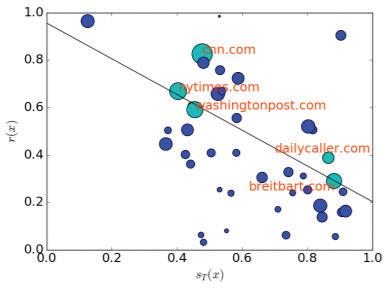

nificance of echo chambers in the months before the election. Indeed, one of the most counter-intuitive conclusions drawn in their paper is that cross-spectrum political interaction actually spiked in the months leading up to the election.
While the researchers analyzed user behavior on both Twitter and Reddit to measure political interaction, Raghavan said Twitter is more helpful than Reddit in understanding large-scale sociopolitical patterns.
“Twitter is just bigger, which means it’s easier to find these patterns,” said Raghavan, as opposed to Reddit, where “the data just isn’t there… it’s far too noisy, there’s far too little data to draw such conclusions.”
According to their paper, user behavior was modeled by a type of mathematical network known as an invocation graph.
An invocation graph, as defined and studied by Kleinberg and Raghavan, is a directed, weighted graph between political domains like The New York Times or Breitbart, where a directed edge is formed when a social media user invokes domain X to reply to a user who posted domain Y on their social media, denoted X -> Y. The weight of this edge is the amount of times this invocation occurs.
To further explain, a directed graph is one where the edges are somehow asymmetrical;
the network of all Twitter users forms a directed graph, where an edge from person A to person B, denoted A -> B, signifies that A follows B, but not necessarily the reverse. A directed graph is said to be weighted if the edges also carry some numeric component; for example, the network of all Paypal transactions forms a directed, weighted graph, where the weight is the amount in the transaction and the direction is from the sender to the recipient.
Raghavan discussed other types of graphs, such as other forms of directed graphs which can be used to study the influence of social media on politics. For example, he discussed how other researchers have examined how political article authors may reference one another in their writing. If author A were to reply to author B, then a directed edge would be formed from A to B.
The invocation graph is unique, though, in that it allows researchers to focus on “what insights you can actually get from the way that these [domains] are being used,” said Raghavan. The distinction lies in measuring the intended impact of the authors’ articles versus the real-world usage of the articles by readers.
When asked if the main cause behind the counter-intuitive conclusion lay in the
structure of the networks or election-driven sociological changes, Raghavan responded, “[I] wouldn’t say it’s a network effect because that same network is present before and after the election … what has changed is how much people care, and how much people are trying to change each other’s minds.”
Raghavan discussed some of the challenges faced during the research process, which included difficulties in measuring and collecting appropriate data.
“There’s some real-world level insight that you’re trying to pull out, how to translate that down into a mathematical formulation, into something that you can actually run on a dataset, that was a challenge for us,” Raghavan said.
In contrast, one of the benefits of this large-scale network analysis is that, in some ways, it can confirm our intuitions about the categorization of certain political domains.
“You can put a number to the politicization of how these news sources are being used and actually how that kind of reflects your prior belief of what you thought it would have been,” Raghavan said.
By CATHERINE CAI
Ten billion by 2050. This is the figure that is repeated time and time again as researchers discuss the current food insecurity and how the agricultural community must be able to sustain a growing global population.
Cornell University has launched an initiative called Cornell Initiative for Digital Agriculture to address the food production concerns from several different standpoints. In the inaugural Digital Ag Workshop held earlier this month, project leaders presented their work and held sessions about how CIDA plans to help achieve food security.
Cornell’s approach stems from its background as a land-grant university and a global research powerhouse.
“A university is supposed to add to the body of knowledge ... to help people and communities,” said Prof. Hakim Weatherspoon, computer science.
CIDA is made up of working groups of professors and graduate students across four colleges: the agriculture college, the engineering college, the business school, the College of Veterinary Medicine and additionally Cornell Computing and Information Science, a multi-disciplinary college-level unit.
Prof. Michael Gore, plant breeding and genetics called CIDA a “cross-fertilization between disciplines.” Gore heads the working group for Rapid Phenotyping, which involves developing technology to reliably correlate plant genotypes and phenotypes.
“It’s like Facebook for diseased plants,” Gore explained. The hope is that farmers can reliably identify infected plants using no more than an app on their phones.
CIDA came into being following several conversations between faculty members about a year and a half ago and officially launched this month, with five working projects besides the one headed by Gore.
Although the initiative began with faculty collaboration, professors hope to inspire their students with a similar drive to solve one of the most pressing global problems of the next century.
Among CIDA’s plans are a gradually redesigned curriculum that bridges the gap between the agricultural sciences and computer science by presenting agricultural problems that can be solved from a computing perspective. According to CIDA’s website, a digital agriculture hackathon is planned for March 1-3, 2019.
Agri-food systems, according to Prof. Susan McCouch, plant breeding and genetics, encompasses the production, distribution, and consumption of food and relationships between actors in all three components. She said that this is a
better descriptor for the area that CIDA addresses.
Food security is not a problem for agricultural producers alone. As industries progressively become more digitized, communities of scientists, agriculturists, industry workers, and policymakers need to adapt to the changing conditions of the planet and the economy.
McCouch discussed her own questions regarding the “anthropology side” of the food security question. Rather than expecting a smooth transition, she expects that the moving toward digital agriculture will be “disruptive” and even “brutal” for many established food systems. For example, as farming becomes more technology-centered, there could be less demand for farmers, potentially displacing an entire sector of work.
There are several other questions as well regarding digital agriculture, such as how to make it accessible and how to address future concerns over land and water usage.
“I hope for a future where we aren’t just trying to grab nutrients or land, but using data-driven models for how to cohabit and live and meet requirements for food security and livelihood requirements that are so challenging,” McCouch said.
When Halloween rolls around, I get the strange compulsion to haunt a graveyard, wear all black and put on the Bauhaus and Joy Division. Although I rarely succumb to the first two desires, that last one is decidedly more tempting.
After the punk movement electrified England and New York in the 1970s, postpunk rose from its ashes, adding musical complexity and a depth of emotion to punk’s relatively stripped-down sound and ethos of anger, eventually spawning a range of derivative subgenres from synth-pop to shoegaze.
Gothic rock managed to differentiate itself from post-punk through its introspective, dark lyrics and Romantic sensibility. The aesthetic was marked by black eyeliner, dark clothing, wild hair, and, as the Damned’s guitarist once noted, “half the local cemetery… propped up against the stage.” The music itself tended to feature deep vocals, distortion and distinctive bass lines, evoking existential and often mystical themes.

Nico — The Marble Index (1969) While largely unnoticed at the time of its release, The Marble Index has nevertheless come to be seen as a precursor of the genre, both in its music and its visuals. Here, Nico
(who’s most well known for her collaboration with The Velvet Underground) really comes into her own, radically changing her image from blonde model to red-headed ghoul. The album takes lyrical and thematic inspiration from the British Romantic poets and combines it with a sound reminiscent of Gregorian chant, resulting in a sonic landscape that is desolate, haunting and bleak, though nevertheless beautiful.
Joy Division — Closer (1980)
By the time Closer was released, Ian Curtis had already taken his life and the rest of the band was morphing into what would become the popular synth-pop group New Order. Nevertheless, Closer remains one of the seminal albums of the post-punk era. Martin Hannett’s experimental production lends it a ghostly, austere industrialism, and combined with Curtis’ dark, confessional, highly personal lyrics, you wouldn’t expect it to be as danceable as it actually is.
Bauhaus — In the Flat Field (1980)
Bauhaus is perhaps best known for their first single, “Bela Lugosi’s Dead,” but this whole album is pretty great. Take the opening track, “Double Dare,” for example, with its trancelike drone and fuzzy riffs, viscerally luring the listener in to stay for the remain-
der of the album. Or the erratic, fast and thunderous “Dive,” with Peter Murphy going on about fishnets and Sumo wrestlers in the background. This album makes me wish I were a vampire, or some similarly glamorous and menacing creature of the undead. Siouxsie and the Banshees — Juju (1981)
Though the album’s horror references were originally meant jokingly, audiences took them seriously and thus, Siouxsie and the Banshees cemented themselves as one of the great gothic rock bands (while still scorning the label, of course). The album was both commercially and critically successful at the time of its release with a return to guitar-based instrumentation and complex, elaborate drumming, and Siouxsie Sioux’s voice soaring strong and melodious above it all.
The Cure — Pornography (1982)
At this point in their career, the band was dealing with frequent in-fighting and drug use while lead singer Robert Smith spiraled further into depression. Intended as his sign-off, the album anticipated the gloomy, ghoulish sound of Disintegration (1989) seven years prior and became one of their most popular. Claustrophobic and oppressive, it’s not exactly light listening, though definitely well worth your time.
Clan of Xymox — Medusa (1986)
A Dutch band formed in the early ’80s, Clan of Xymox moved to England and began recording music that has sometimes been described as darkwave, featuring melancholy, introspective lyrics, slower tempos
and more use of minor keys that differentiate it from other post-punk bands of the time. These tracks are smooth and ambient, the perfect soundtrack for climbing back into your coffin at the end of a long day.
This Mortal Coil — Filigree & Shadow (1986)
This Mortal Coil was formed as a music collective in 1983 by the British record label 4AD, which was associated with acts such as Modern English, Dead Can Dance, Cocteau Twins, Pixies and others. As their second album, Filigree & Shadow consists of 25 tracks, 13 of which are instrumental and many of which are rather obscure covers. Collaborative and experimental, the album makes use of the didgeridoo and shines a light on goth’s more atmospheric, ambient, folksy qualities.
The Sisters of Mercy — Floodland (1987)
The Sisters of Mercy created some of the most iconic goth anthems. “This Corrosion,” for one, is an 11-minute jam that builds to a sweeping intensity, ironic in its lyrics yet masterfully emotional. “Lucretia, My Reflection,” another of their most recognizable songs, highlights the industrial monotony of blue-collar work without ever letting the song itself sink into monotony or dullness. Overall, a truly astounding album.
Ramya Yandava is a sophomore in the College of Arts and Sciences. She can be reached at ry86@cornell.edu. Ramy’s Rambles runs alternating Tuesdays this semester.
BY
One of my favorite quotes in modern literature comes from Stephen Chbosky’s The Perks of Being a Wallflower. The quote speaks to the conceptions, rather the misconceptions, of young love: “We accept the love we think we deserve.” This quote, and its implications of self love and self acceptance, kept ringing in my ears while reading the debut poetry book of Adam Cohen ’19, STARSHOW STARSHOW serves as a look into the darkest and most vulnerable parts of Cohen’s soul. It operates as a ballad for young queer individuals that deals with subjects from hookup culture in the LGBTQ community to the struggle with lost love and college angst. It similarly extends to the ubiquitous subjugation queer people feel.
The book reads like a journal; I felt as if I were a fly on the wall, peering into the private life of Cohen, deriving artistic insight from his woes. The poems touch on everything from infatuated love affairs, such as in “Majorelle Blue,” to haute couture icons, such as in “Saint Mode;” from raucous drunken nights in “Kalahari Ferrari,” to the trials and tribulations of the college scene in “Cool Kids
Club Forever.” The poems, though very different, operate together to form a beautiful collection depicting the queer condition, laced with celestial imagery that weaves itself in and out of every work, finding unity in their differing themes. The book finds beauty in its disorder. It is devoid of chronology and explicitness, which Cohen himself stated was purposeful. This trend was jarring at first, but as I completed the book, I realized how significant it was; the progression of poems follows a stream of consciousness style in which the reader experiences the randomness of human thought, and thus the humanity of the queer condition. One poem may be sad, the next hopeful, while the following has a resounding mood of melancholia. This uneven, emotionally exhausting structure is so symbolic of life as a queer individual, and therefore an effective way of reaching Cohen’s target audience.
This book lends itself to an aura of relatability as opposed to straightforward understanding. Many poems are shrouded in layers of metaphor and allegory — some are literal and others are not, and it is up to the reader to decide which are which. This lack of explicitness makes the book an intriguing experience, by forcing the reader to work to
find the answers hidden within. We are able to glean an understanding of Cohen’s objective through the mood he creates with the help of said literary techniques and the celestial theme of glowing stars.
When I spoke to Cohen about his work, a common theme quickly arose; this book was written with the intention of “proclaiming divinity for queerness.” This sounded foreign to me, almost as if it were grandiloquence, but, as Cohen elaborated, I began to understand. The divinity of which Cohen spoke carries with it only minimal religious allusion and speaks more to a reclamation of identity. Divinity, in the eyes of Cohen, constitutes all feelings that are “right and good,” such as loving oneself unapologetically and being prideful of one’s identity.
Pride is a word that has become synonymous with the LGBTQ community. This pride is both loved and hated, idealized and denigrated, a dichotomy that is made very clear in the French language. Cohen’s work contains two poems written entirely in French, “Tout Sacré” and “Éclat.” Within these poems, Cohen sheds light on the two types of pride that are present in the French language: “la fierté” and ‘l’orgueil.” The former is the regular pride
we have in ourselves, while the latter is the sin of pride, like hubris. In fact, it is within “Tout Sacré” that Cohen writes “L’orgueil n’existe pas,” “the sin of pride does not exist,” a concept that ties back into Cohen’s underlying theme of “proclaiming divinity for queerness.”
Cohen explained to me that queerness is often construed to exist only within the sexual realm. He continued by emphasizing that he wanted to utilize “religious motifs to define queer themes and give them some reverence,” to show that pride is not a sin. Cohen believes that one epidemic within the queer community is a lack of pride in the individual. To this, Cohen says “lets make hate a sin instead.” Cohen attempts, with his book STARSHOW, to “change the metrics of divinity to reflect true humanity.”
STARSHOW is a triumph for the Cornell queer community. Cohen compiled this book with a very specific audience in mind: his seventeen year-old self and anyone currently in that same, confused position. In his closing remarks in STARSHOW, Cohen states that the way to successfully operate in his community is to “[desire] more than you think you are worth,” to “accept the love [you] think [you] deserve.” Cohen’s penultimate poem is the poignant “Self-Love Glows

Pink.” Here, Cohen speaks directly to his audience, to his younger self, and tells of the the pain of heartbreak. This poem carries with it a resolution: one can admire the glow of the stars and long for their luminescence, but the first step in self love, and understanding one’s worth, is realizing that one is capable of glowing just as brightly as the stars, but in the healing color of pink. Glowing pink is believing that “L’orgueil n’existe pas,” knowing one’s self worth and never settling for less. STARSHOW artistically answers the rhetorical plea to be who we needed when we were younger. After all, it is we who know ourselves best.
Madeline Rutowski is a junior in the School of Industrial and Labor Relations. She can be reached at mjr444@cornell.edu.


Fill in the empty cells, one number in each, so that each column, row, and region contains the numbers 1-9 exactly once. Each number in the solution therefore occurs only once in each of the three “directions,” hence the “single numbers” implied by the puzzle’s name. (Rules from wikipedia.org/wiki/ Sudoku)

by Jeffrey Sondike ’19





1, 2, 3, 4, 8 BEDROOMS FURNISHED VERY REASONABLY PRICED 607-272-3389 avramisrentals@aol.com
2 & 3 BEDROOMS 109 SAGE PLACE
Available NOW, Spring 2019 & 2019/2020 Shuttle Bus Access to Campus Access to Free Fitness Center Novarr- Mackesey Property Management office@ithacastudentapartments.com
607-277-1234
>>AFFORDABLE, QUALITY LIVING<< Special Deals for you! Furnished 1-6 Bedrooms Collegetown Apartments PARKING, LAUNDRY, UTILITIES! (607) 273-7368 www.IthacaApartmentRental.com ***************************** RENT NOW, GET THE BEST www.MatoulasHouses.com Apartments & Houses In Collegetown LINDEN AVE & E. SENECA ST 1 & 3 BEDROOM APARTMENTS ALL FURNISHED EMAIL: MatoulasHouses@Gmail.com PHONE: (607) 339-9644 FIRST-COME, FIRST-SERVED *****************************
Collegetown Terrace Apartments INSPIRED LIVING TAILORED TO YOUR SUCCESS 24-Hour Fitness Center Shuttle Bus Service to Campus Study Rooms w/ Expansive Views Apartments Available NOW, Spring 2019 & 2019/2020 Novarr- Mackesey Property Management collegetownterraceithaca.com office@ithacastudentapartments.com 607-277-1234

NORTH CAMPUS
Studio, 3 and 5 bedroom Available 2019/2020 Novarr-Mackesey Property Management office@ithacastudentapartments.com 607-277-1234
Nicest Apts. in Collegetown Located on Eddy St. 4 Bedrooms
Houses, Apts, Parking 1 to 9 Bedroom
Collegetown - College Ave, Linden Ave, Dryden Rd, Bryant Ave, Cook St. 607-330-2442 info@urbanithaca.com www.urbanithaca.com
We have availability for the 2019-2020 school year beginning June 1st at Hudson heights apartments. The
lease. If you have any questions or would like to schedule a tour contact us by phone 607-208-7660 or email: renting@ithacaLS.com
27 H OUSE FOR R ENT
Fully furnished. Spacious living areas with large bedrooms & closets. Hardwood flors, spectacular views, eat-in kitchens with additional sun rooms. Laundry & parking. 607-339-1137 bgm900@gmail.com 201 WYCKOFF AVE 6 Bedroom House Novarr-Mackesey Property Management office@ithacastudentapartments.com 607-277-1234
COLLEGETOWN 6 BEDROOMS NEWLY RENOVATED 607-272-3389 avramisrentals@aol.com
CROSS COUNTRY
Continued from page 16
that team happened to be the Quakers.
“We were excited to turn the tables on Penn, as they had beat us two weeks before,” Smith said. “In this league you could get slightly different results each week … it is such a competitive league that results can vary.”
Still, Smith acknowledged that the team has some issues to work on, particularly struggling to finish strong. Even Knibb, Cornell’s fastest runner in the meet, was in first place after 800m, but had difficulty maintaining that momentum through the remainder of the race.
“We’ve struggled this year with finishing,” Smith said. “It’s not because of a lack of effort or competitiveness. I think we’re going out really hard.”
To combat that issue, Smith emphasized the importance of solidifying cohesion among the team’s runners this season. While it might seem counterintuitive to teach two runners who finished apart to run together during the race, this can help runners better maintain their pace for a majority of the race.
“When people around you are making a move and going ahead, it is hard to know whether to make a move with them, or to pace yourself for the rest of the race,” Smith said.
While the team still had difficulties maintaining a consistent pace, that strategy largely succeeded at Heps, with the Red’s
first five runners all finishing within a minute of each other. Following Knibb’s finish in 21:05 was senior Annie Taylor, freshman Melissa Zammitti, freshman Isabella Dobson, and senior captain Briar Brumley to round out Cornell’s top five. “I loved seeing the competitiveness and conviction that inserted the team in the team title hunt,” Smith said. “We’ll keep working on getting stronger in the last half of these cross country races.”
The Red next competes Nov. 9 in the NCAA Northeast Regional Championships in Buffalo, NY, a qualifying race for the NCAA Championships.
Archer Biggscan be reached at wcb224@cornell.edu.
the conference physically.”
Those improvements have so far paid off, with the Red’s current conference record a marked improvement on last year’s 8-6 tally.
“A big lesson we have learned this season is that we are in control of our matches and the outcomes,” added sophomore setter Zoe Chamness. “The way that we play on our side of the net, the extent to which we stick to the game plan and the energy and attitude we bring to the games are all factors that determine whether we win or lose a game.”
Cornell’s hitting proficiency was also a major driver of the squad’s success. The Red landed 51 kills against Dartmouth’s 39, while scoring a .212 hitting percentage. Similarly, against Harvard, Cornell had 8 more kills than the Crimson, while making .272 of its hits compared to Harvard’s .120. The Red also easily exceeded both teams in digs, assists, aces, and overall points.
“My own personal goals have centered a lot around technique for certain skills here and there, along with the hopes of helping contribute to our team winning the Ivy League Championship,” said junior outside hitter Samanta Arenas, who has consistently contributed the most kills for Cornell.
Outside of this weekend’s success, the Red has competed forcefully within the Ivy conference, losing only three games against Yale, Princeton, and Penn. The Bulldogs currently own a 9-1 record, while the Tigers are up 8-2 — making both teams Cornell’s biggest obstacles in claiming a league title, or at the very least, improving on last year’s fourth place finish.
“When we are in system, we are tough to play against. We did a much better job this past weekend of that and it showed. We also served really well and got Dartmouth and Harvard out of system most of the match,” said Vande Berg, confident that the team owns the fundamentals needed to remain a conference force.
Cornell will look to continue its Ivy League winning streak at home next weekend against Penn on Friday at 7 p.m. and Princeton on Saturday at 5 p.m.
Zora Hahn can be reached at zhahn@cornellsun.com.
Cornell shines in pre-season regatta, placing one 8-man boat in 1st, 2 more in top-8
By ROBERT LI Sun Contributor
Cornell men’s lightweight rowing team recorded its second win in as many weeks at the Princeton Chase this past Saturday, taking home gold in the Lightweight Eights event.
The Red fielded six boats, with three competing in the Eights event, two in the Fours event, and one in the freshman Eights event.
In a field of 22, all three boats competing in the Eights event finished among the top ten, with times of 13:10.182, 13:37.728 and 13:42.926, respectively. The two boats racing in the fours event finished third (14:50.274) and fifth
“We are definitely pleased by the outcomes ... We have a great rivalry with Princeton and the racing is never easy. ”
Head coach Chris Kerber
(14:57.182), while the freshmen placed in a strong second (14:01.940).
“We are definitely pleased by the outcomes,” said head coach Chris Kerber. “We have a great rivalry with Princeton and racing there is never easy …. the Tigers know every nook and cranny in their home race course.
Fresh off last week’s winning effort, the Red was able to build on its momentum, managing to row even harder and more efficiently at the Lake Carnegie meet.
“We’ve had success in the last number of years at the Chase but nothing like this. It was a great Sunday for family and alumni who came out to support us especially after the bad weather on Saturday,” Kerber said.
Flat water, a light head breeze, and an absence of leaves of the lake’s surface further allowed the Red to flourish, able to show off its full strength unimpeded by natural elements.
“The flatter conditions allowed us to race a lot harder this week,” said senior coxswain Molly Rochford.
“We went out there and committed to generating that enthusiasm for racing. Like what we did on the Charles last Sunday, but even better,” added sophomore Luke Small. “This approach and our training set us up for the win.”

With an incredibly successful preseason campaign soon coming to a close, Kerber outlined the team’s goals for the upcoming Autumn Classic, a regatta being held this weekend at Cornell, and a pivotal winter training period thereafter.
“Heading into the Cornell Autumn Classic, we want to keep building momentum and race the regional crews [Syracuse, Hobart, Mercyhurst and Ithaca College] with a very dynamic race,” Kerber said. “The transfer of this push into winter training is essential in order to have a successful spring season.”
The coach also emphasized the grueling nature of the upcoming months, explaining that standards of the training period are incredibly high — and not for the faint of heart.
“This time is where individual conditioning and achievement on the rowing machines become our major focus,” Kerber said. “Building capacity in the winter months is no doubt a grind, somehow the nature of the rower embraces this aspect of our sport.”
Robert Li can be reached at rll94@cornell.edu.
There was once a time when Cornell athletics was a major student and alumni attraction on campus, with big rivalry games not only within the Ivy League, but against many major programs, like nearby Syracuse. When our students walk by Schoellkopf Field, they may not know this historic stadium once hosted the 1951 win over Michigan or running back Ed Marinaro ’72 breaking the NCAA Division I rushing record in front of full-capacity crowds. Our

alumni from the early 1970s cherish Cornell’s glory years when we won the Ivy League championship in football and NCAA Division I titles in both hockey and lacrosse.
Today, while our students might see a good crowd for Homecoming, in nearly every other game, Schoellkopf Field is three quarters empty. Even the former student section was condemned and torn down in 2016.
It’s thought that some of our faculty and administrators believe, if we’re really bad at sports, it will somehow improve our academic ranking? The national rankings, of course, easily say otherwise — as Stanford, Northwestern, Duke, Harvard, Princeton, and Yale are all ranked ahead of Cornell, both academically and with significantly larger endowments.
Not everyone likes athletics, and I am
certainly not advocating for Cornell to exit the Ivy League or become a “sports factory.” But we are still an NCAA Division I member — and I believe we should have more of a balance between academics, campus life, and sports.
In fact, the Ivy League should be the model for what college athletics is all about!
The 2010 Cornell Sweet 16 basketball team proved Ivy League athletes can compete on the national stage. Our star center Jeff Foote ’10 received Academic All-American honors and also managed to serve as a T.A. on campus. Newman Arena was packed for home games, as the skeptics were quickly proved wrong in thinking our students would never show up for the big game.
But improving Big Red athletics is not only limited to so-called ‘revenue-producing’ sports like football, basketball and hockey. Many of our women’s sports are just as exciting to watch too — which is not reflected in how the school often treats them.
For example, our 2017 NCAA tournament participant and Ivy League championship women’s lacrosse team is housed in the visitor men’s locker room at Lynah Rink. That means, every time there is a home hockey game, our women laxers have to vacate the facility.
We recently spent $61 million on the addition to Goldwin Smith Hall and yet our champion laxers change in the men’s room? There is certainly plenty of space at Schoellkopf Field to build our women’s team their own home to use during the often frigid late winter and
spring lacrosse season. Lacrosse is one of the fastest growing sports for both men and women on college campuses around the country.
I do believe that Cornell is different from many of the other Ivies, as our student population is much larger, and the rural Ithaca campus is a four to six hour drive from major metropolitan areas in the Northeast. Ithaca is a beautiful college town, but it’s no Boston or New York City. Our distant location also makes it a challenge to attract our alumni back to campus.
We know that when our alumni return to campus for an Ivy League contest, they are more likely to network with students, or even make a gift to the Cornell Fund, which benefits the University in terms of improved financial aid and upgraded academic facilities.
However, when our football team loses 66-0 to Princeton it does not exactly motivate our alumni to open their checkbooks! While we would probably never make big returns from revenue-producing sports, improving competitiveness and attendance would certainly offset some of those expenses. Imagine if Cornell renewed the annual football rivalry with Syracuse University in front of 30,000 fans with an average ticket price of just $25? Add in television, parking, and concessions, and the game could generate up to a million dollars for just a single game. Enough cash to build a new home for our women’s lacrosse team!
We already play Syracuse in most of our other sports, why not football? Has the Stanford vs. Cal Berkeley football
rivalry eroded their academic standings? Obviously the publicity doesn’t hurt, as the Stanford website reports an endowment of $24.8 billion — four times bigger than Cornell.
Critics of my suggestions say it’s counter-productive to the central, Ivy League academic mission, and that we’re giving in to the big money temptations of athletics.
But meanwhile, the annual Harvard vs. Yale football game last year drew over fifty-thousand fans, where tickets went for as high as $125 each, generating significant revenues for their respective athletic departments.
Do we only make exceptions for Harvard and Yale, or can some of the other Ivies host their own big games and generate much needed revenue to support our athletic and intramural programs? Over the years many of our alumni have tried to improve athletics at Cornell, yet have faced significant push back from faculty and administrators who only want us to be a great research university — and have little interest in such trivial pursuits to enhance student life on campus.
Balancing higher profile athletics with top academic programs on the East Hill could improve the quality of student life and bring our alumni back to campus more often, thus increasing the university endowment.
And after a painful 66-0 loss, now’s as good a time as any.
Mark Wolcott can be reached at mwolcott@esl.org.
By JOHNATHAN STIMPSON Sun Assistant Sports Editor
In sprint football’s second conference game of the season — a contest that would determine if Cornell’s chances at the postseason would remain alive — the Red trounced Post University 34-0 to improve to 4-1 on the season, good for the team’s best record through five games since 2010.
Unlike last weekend’s matchup against St. Thomas Aquinas — where the Red put up a 23-point fourth quarter to stage a late-game comeback — this time, Cornell did not need to rely on 11th hour heroics to claim victory.
Just less than a minute into the first quarter, freshman wide receiver Colton Kotecki took the opening kickoff a stunning 89 yards into the endzone, his speed and skilled running carrying him past Post’s defenders.
“That play really jump started the whole night,” said associate head coach Bob Gneo. “Scoring on our first possession was really key.”
With six minutes left in the first, junior running back Will Griffen punched in a one-yard touchdown. He followed that up with a 10-yard touchdown late in the second quarter, before connecting with senior quarterback Connor Ostrander to score his third touchdown halfway through the third.
Up 27-0, Ostrander successfully tossed a 25-yard pass to senior Alexander Furman for the last score of the day. Cornell amassed 300 yards of total offense in its thrashing of Post.
“Post had just 28 yards rushing, and 58 total yards,” Gneo said. “Our defense performed incredibly well.”
In addition to near flawless defense, Gneo attributed much of the team’s overall dominant performance to the matchup’s do-or-die status. If Cornell lost, it would be out of contention for a chance at the conference title, rendering next week’s game against Army something of

an exhibition match.
“We were incredibly focused on winning this game — to have a chance against Army,” Gneo explained. “We had to beat Post, and we did exactly that.”
And with the convincing win, the Red is now the closest it has been to a title in years. If Cornell can defeat Army this weekend, it will own its conference’s best record, and have the chance to compete to be the league’s champion — a distinction that has eluded the team since 2006
That, however, is a task far easier said than done. Army currently remains undefeated 5-0, and few on the Red’s roster can forget last year’s unmitigated catastrophe

By ARCHER BIGGS Sun Contributor
Despite six of women’s cross country’s first eight runners finishing with personal best times, the Red only managed to take seventh place at the Ivy League Heptagonal Championships on Saturday — a meet widely considered to be one of the season’s most critical.
But even as Cornell missed meeting overall expectations, individual standouts nevertheless helped buoy the team’s hopes. Junior Taylor Knibb was the first Cornell runner to cross the finish line in seventh place, setting a personal best of 21:05.
“The Ivy League teams are all in the top 57 of 350 teams, with the Big Red ranked at 42 nationally. We wouldn’t be seventh in any other conference,” said head coach Artie Smith ’96. “We don’t want to be seventh, but it is hard to be frustrated when six of our eight runners have a career best finish at the cross-country Heps.”
Cornell finished the meet with 173 points — nine fewer than eighth-place Penn and 67 more than sixth-place Harvard.
While the Red disappointingly edged out only a single Ivy team, Smith was still particularly pleased
— a horrific game in which Cornell fell to West Point in an 0-55 landslide.
But Gneo hopes that — now that payback and a title are on the line — the Red will put such brutal memories far in the rearview mirror.
“We have to not turn the ball over, and give them opportunities … they will take advantage of any mistakes,” Gneo warned. “But if we can do that, we have definitely have a shot.”
The Red travels to take on Army this Friday at 7 p.m.
Johnathan Stimpson can be reached at jstimpson@cornellsun.com.
By ZORA HAHN Sun Staff Writer
Women’s volleyball travelled to New England over the weekend to take on Dartmouth and Harvard, where an assertive Cornell won both games by a margin of three sets to one — extending its winning streak to three games and record in conference play to 7-3.
First squaring off against Dartmouth on Friday, the Red quickly dominated the leaderboards, winning the first two
matches 25-17 and 25-15.
Cornell fell during the third match, 17-25, but easily recovered to secure victory with a 25-17 fourth game win.
The Red then managed to replicate its success when it came time to face Harvard the next day.
Cornell won its first game 25-19, but an undeterred Crimson fought to win the second game by a lopsided 13-25 margin. Yet the Red didn’t lose its footing, and went on to win the third game 25-19 and the final
fourth 25-15.
The strength by which Cornell dispatched two strong conference rivals can be attributed to a number of deliberate changes, according to head coach Trudy Vande Berg.
“We have worked a lot on getting better, more consistent and confident in pressure situations and on the road,” she said. “The mental side of the game has been a priority for us as we know that we can match up with anyone in