

The Corne¬ Daily Sun

Cornell Leans Overwhelmingly Blue
Ninety-eight percent of employee, prof donations go to Democrats, left-leaning PACs
By ALEC GIUFURTA, CONNOR GREENE and MILO GRINGLAS Sun Senior Editor and Sun Contributors
Cornell’s employees gave over $900,000 in political donations throughout this election cycle — just $12,775 of that went to Republican candidates and conservative political action committees.
Democratic candidates, including former Vice President Joe Biden, and left-leaning PACs received the remainder: $913,064 a significant difference in the political balance of the University’s employees.
The Sun reviewed the last two years of public filings with the Federal Elections Commission from individuals who self-reported Cornell University as their employer — professors, custodians, student-workers and dishwashers, among the many other University jobs both on and off East Hill. That totaled just over 28,000 individual contributions. Employees at Weill Cornell Medical College, New York-Presbyterian Hospital and Cornell’s Qatar campus were not included in The Sun’s analysis.
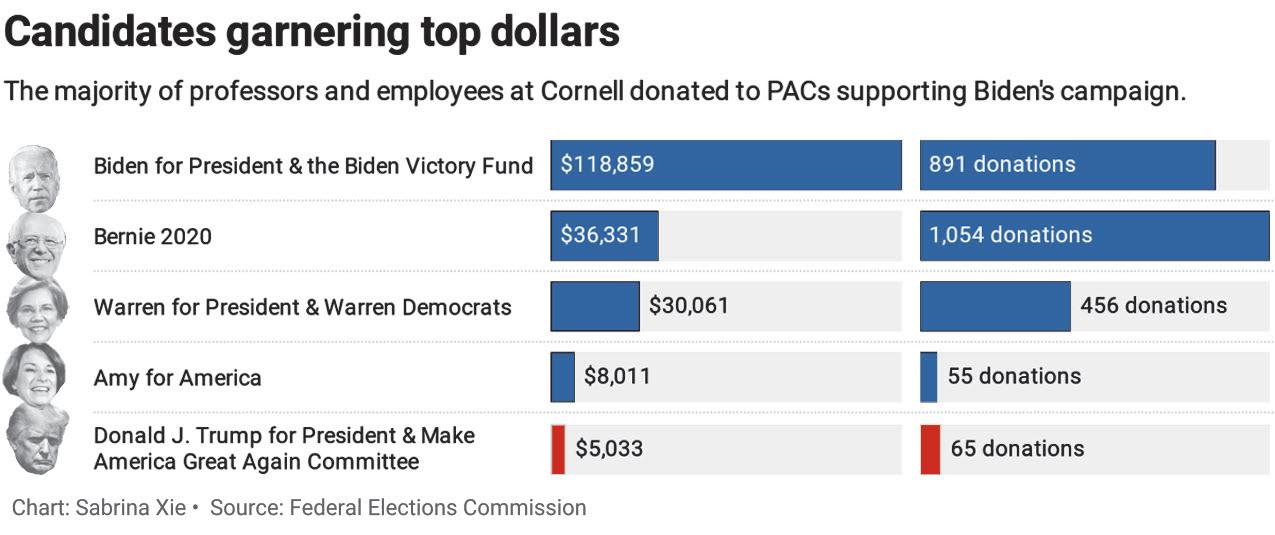
President Donald Trump’s reelection campaign amassed $5,033 from 65 contributors, while Biden received $118,859 from 891 contributors.
From faculty alone, left-leaning candidates and groups received $402,605 to conservative-leaning candidates’ and groups’ $2,377.
Of the eight undergraduate colleges and Cornell’s graduate schools –– Cornell Law School, the College of Veterinary Medicine and the S.C. Johnson College of
Business –– the College of Arts and Sciences tallied the largest portion of donations with $110,492, just under 12 percent of the total sum of donations.
Within the College of Arts and Sciences, the English department donated the most with a notable $33,150 sum. Following the English department, nine other departments were included in the top 10 department donations including government, history, German studies, music and Near Eastern studies.
In the race for New York’s 23rd congressional district, The Sun’s analysis did not find any donations to Rep. Tom Reed (R-N.Y.) from Cornell employees.

His challenger, Tracy Mitrano J.D. ’95 received 219 donations, totaling $48,596. The race is considered safe for Reed –– it’s rated “Solid R” by the Cook Political Report, a nonpartisan elections forecaster.
Claudia Wheatley, spokesperson for the Mitrano campaign, said she believes the donations were less suggestive of broad political leanings among staff, but rather signaled support for actual policy positions affecting higher education.
“It’s possible some Cornell faculty aren’t backing
Racist, Anti-Semitic Grafti Strikes Ithaca
By MEGHANA SRIVASTAVA and TAMARA KAMIS Sun Assistant News Editor and
Sunny Days of Ithaca owners Deirdre and Todd Kurzweil arrived at their shop on Oct. 26 to find their storefront vandalized by Celtic crosses — a symbol of white supremacy — and posters with anti-Semitic and homophobic messages taped to their door. The Kurzweils weren’t the only victims. Five Black Cornellians noticed the Celtic cross spray-painted on their trash cans and feces smeared on one of their cars. The general manager of Moosewood Restaurant arrived to similar posters covering their Black Lives Matter sign. And Court
Street Chiropractic’s “End White Silence” sign was vandalized for the second time in recent weeks.
“There’s a lot of anti-Semitic as well as racist rhetoric right now.”
Patti Jacobson ’76
This isn’t the first time Sunny Days has been targeted. According to Deirdre Kurzweil, her store’s property was first vandalized on Oct. 11, when their sign saying “Hate Has No Home Here” was burned. Kurzweil replaced the sign and later found
See GRAFFITI page 4

Dormitory Blues COVID-19, and the coming Ithaca winter, has complicated
Diverse Thought Shriya Perati '21 discusses the role Ithaca’s murals
Complete Disregard Assistant Sports Editor Luke Pichini ‘22 criticizes the NFL in the midst of rising COVID19 cases across the league.
12
A funeral procession winds through the streets of New Orleans on Wednesday, Oct. 28 amid a rainstorm caused by incoming Hurricane Zeta.
Rain on my parade

Thursday, October 29, 2020
Today
Let’s Meditate With Cornell Wellness 9 - 9:30 a.m., Virtual Event
Into the Desert: Questions of Coloniality and Toxicity 10 - 11 a.m., Virtual Event
Learning Community on Inclusive Teaching for Graduate Students and Postdocs 11 a.m. - Noon, Virtual Event
Badges Without Borders: How Global Counterinsurgency Transformed American Policing 11:30 a.m. - 12:45 p.m., Virtual Event The Future of Democracy Noon - 1 p.m., Virtual Event
Beauty Regimens: Disciplining Filipina Labor Under U.S. Empire 12:40 - 2:10 p.m., Virtual Event
Critical Moves: Performance in Theory and Movement 3:15 - 4:30 p.m., Virtual Event
Tomorrow
Into the Desert: Questions of Coloniality and Toxicity 10 - 11 a.m., Virtual Event
Building Back Better: Cities of the New Normal 10 - 11 a.m., Virtual Event
Cornell Wellness Virtual Walk to Run Class 11:30 a.m - 12:30 p.m., Virtual Event
A Passing Spectacle: The Marvelous Mixed-Media of Historic Circus Costumes 1 - 2 p.m., Virtual Event
Polarized: Partisanship, Social Movements and the Transformation of American Democracy 2 - 3:15 p.m., Virtual Event
From Authenticity to Resilience: Leadership Lessons From Equity, Racism and a Global Pandemic 3 - 4:30 p.m., Virtual Event
Virtual Vibrance: Making, Shaking, Breaking Performance 7:30 - 8:30 p.m., Virtual Event
Indigenous Students Demand Recognition
By KATHRYN STAMM Sun News Editor
Indigenous students on campus have launched a campaign to respond to Cornell’s founding — demanding increased funding, a land acknowledgement and a mandatory class.
Beyond active recruitment, NAISAC also stressed the need for retention support, including hiring more Indigenous faculty, staff members and a mental health professional.
possession and genocide,” Benedict said. Because of this sordid history, four of the 10 demands relate directly to land and the Morrill Act.
“The mental health struggles that affect Indigenous students specifically really can’t be addressed by a non-Indigenous person,” said Colin Benedict ’21, external relations chair for NAISAC.
Further support would occur through the American Indian and Indigenous studies program, which hopes to transition to department status within the next four years. The program hopes to achieve this status along with increased funding and the hiring of five new faculty members.
“The mental health struggles that affect Indigenous students specifically really can’t be addressed by a non-Indigenous person.”
Colin Benedict ’21
Acting on a summer that saw rethinking of historical institutions, marginalized groups began to demand anti-racist change from Cornell: Students from Do Better Cornell, faculty, staff and graduate students and the Caribbean Students Association all published their own sets of demands.
Members of Native American and Indigenous Students At Cornell see their demands as dismantling Cornell’s “tradition of profiting from acts of colonial violence and Indigenous erasure,” the petition reads.
Native American students represent only 0.3 percent of the overall Cornell student population — in 2017, that meant just 67 students, according to NAISAC. But Cornell’s history is intertwined with Indigeneity, especially related to the dispossession of the Gayogohó n , or Cayuga, people.
One of the main demands in admitting more Indigenous students, up to 1.7 percent of the student body — equal to the proportion of Indigenous people in the U.S.
The petition also includes funding for students coming from communities displaced by higher education institutions — demanding a free education for them.
NAISAC started brainstorming its demands at the beginning of September, launching the petition on Oct. 12. Since then, over 800 people have signed in support of NAISAC’s demands, Benedict said.
They worked closely with faculty from the American Indian Indigenous studies program, who are also working to further examine Cornell’s history through the Cornell University and Indigenous Dispossession Project.
Both this project and the demands address Cornell’s status as a land grant university that received nearly 1 million acres of land through the 1862 Morrill Act, eventually sold to form the basis of the endowment.
“The endowment of Cornell University is built on indigenous displacement, dis-
First, NAISAC calls for the renaming of Morrill Hall, the home to linguistics and other departments in the College of Arts and Sciences. Morrill Hall, named for the act’s primary proponent Rep. Justin Morrill, was declared a national historic landmark in 1965.
“But my individual hopes with this were to just improve the resources that Indigenous students have available.”
Beyond the name of a building, the petition also includes broader demands from the University: a land acknowledgement before all Ithacabased University-affiliated events and a formal statement acknowledging the specifics of Cornell’s acquisitions from the Morrill Act.
The petition also calls for the return of Cornell-owned land in Ithaca not “immediately utilized for educational purposes” to traditional Gayogo hó n leadership — a step to also develop relationships with the leadership to initiate the process of returning land to Indigenous people.
Finally, NAISAC wants Cornell to implement a mandatory introductory Indigenous studies class for all first-year students “to ensure that all students have a basic understanding of the gravity of Indigenous genocide and their own positionality on stolen Indigenous land.”
Indigenous land. Knowing how to navigate those relationships with the communities that historically lived in that area and still live in that area to this day is vitally important to conducting ethical research in that space.”
Colin Benedict ’21
The Student Assembly is set to vote on a resolution in support of the demands on Thursday, which would pave the way for conversations with President Martha E. Pollack about the demands, according to Benedict.
NAISAC hopes that this path — plus the reinstatement of the University’s Ad-Hoc Committee on Native American Affairs at Cornell to oversee the demands — will begin to enact real change to support Indigenous students on campus and right the historical wrongs.
“Indigenous studies overlaps with almost every other field at Cornell”
Colin Benedict ’21
“Indigenous studies overlaps with almost every other field at Cornell,” Benedict explained of the proposed requirement. “No matter where you are in the United States, you’re on someone’s
“Our goal is to support the community of Indigenous students, as well as to attempt to raise the level of consciousness of the Cornell community about Indigenous issues,” Benedict said. “But my individual hopes with this were to just improve the resources that Indigenous students have available, especially for future generations.”
Kathryn Stamm can be reached at kstamm@cornellsun.com.
Majority of Employee, Faculty Donations Tilt Dem
DONATIONS
Continued from page 1
him because they feel he hasn’t earned their support,” Wheatley wrote.
Cornell employees also looked east to New York’s 22nd Congressional District, donating $9,363 to the reelection campaign of House freshman Rep. Anthony Brindisi (D-N.Y.). The Sun did not uncover any donations from Cornell employees to challenger Claudia Tenney, who held the seat before she was ousted in the 2018 midterms.
Only four professors donated to Trump’s reelection campaign and Republican groups since the 2018 midterm elections: Physics Profs. Thomas Arias and Andre Leclair both donated to Trump’s campaign, while Prof. John Schimenti, genetics, and Prof. John Barwick, history, donated to WinRed, the Republican party’s equivalent of ActBlue. Barwick declined to comment on the record, and the other three did not respond to requests for comment by the time of publication.
ered a bastion of progressive support in the largely conservative upstate New York region. An analysis of FEC donations by The New York Times found that since April, Biden raised an estimated $610,248 in the 14850 zip code, while Trump brought in only $38,457.
The Sun’s data only includes individuals who donated over $200 over a calendar year, per FEC regulations that require the identification of these donors –– a notable exception being ActBlue and WinRed, which are both required as conduits to report every donation under federal law.
It may make sense why ActBlue, a donations-processing site created in 2004 that channels online dona-
faculty and staff is nothing new. A similar analysis conducted by The Sun in 2018 found that 99.5 percent of donations went to left-leaning PACs and political candidates that year. A total of $289,975 political donations were made that year by self-reported employees of the University.
In 2015, a data project by The Sun found that from 2011 to 2014, out of the nearly $600,000 Cornell’s faculty donated to political candidates and parties, 96 percent went to Democrats.
“We are a community where all voices may be heard and where the dignity of all individuals is protected.”
John Carberry
Cornell Institute for Healthy Futures Board Member Melissa Ceriale was the largest donor to candidates overall. She donated $35,500 to the Democratic Senatorial Campaign Committee in 2019 and $5,600 to Sen. Kyrsten Sinema (D-Ariz.) in 2020. Ithaca has long been consid-
tions to Democratic candidates, received the most donations in the examined FEC filings — 23,557, accruing more than $420,000.
The candidates supported by ActBlue donations are initially shielded from view on individual contribution FEC filings; information about to whom donations went is earmarked inside the individual filing. Cornell’s liberal make-up of
Notwithstanding contributions made through ActBlue, this cycle, a plurality of individual donations to Democratic primary candidates were made to Sen. Bernie Sanders (I-Vt.) — he received 1,054 individual contributions. Succeeding Sanders were 891 donations made to Biden, 456 to Sen. Elizabeth Warren (D-Mass.), and 55 to Sen. Amy Klobuchar (D-Minn.).
But this cycle’s donation sum dwarfs both the 2018 and 2015 analyses: Cornell’s self-reported employees donated nearly $1 million over two years.
Conservative media outlets and politicians readily assail the Ivy League and other elite universities as inherently biased against conservative beliefs. Trump mused on Twitter in July about revoking tax exemptions for higher education. Prof. William Jacobson, law, remarked on The Sun’s findings,
referring to his fellow faculty as “an intolerant echo chamber in which differing and dissenting political opinions are not welcome,” Jacobson wrote. “This lack of faculty intellectual and political diversity is a reality ignored by the university administration in its various diversity initiatives.”
Across the nation, university staff similarly tilt blue. At the University of Pennsylvania, professors spent about 100 times more on Biden’s campaign than Trump, found a similar analysis of over 5,600 donations from faculty by the student paper, The Daily Pennsylvanian. Down south at Emory University in Atlanta, “members of the Emory community” heavily backed Democrats –– a February analysis by The Emory Wheel showed that Trump received 58 contributions while Democratic primary candidates received 1,276.
A 2017 Gallup survey found that 21 percent of Republicans attributed their skepticism of higher education to colleges not allowing “students to think for themselves” and believe that colleges “are pushing their own political agenda,” the survey said. A new Pew Research Center survey found that the share of Americans who think colleges and universities negatively affect the country has increased dramatically — nearly twofold — in the past decade.
This distrust of academia emanates almost exclusively from Republicans and independents
who lean Republican. Support for higher education remained consistent among Democrats.
Roughly 8 in 10 Republicans surveyed by Pew said professors bringing their political and social views into the classroom is a major reason why the higher education system is headed in the wrong direction. (Only 17 percent of Democrats say the same.)
In a statement to The Sun, University spokesperson John Carberry reaffirmed the diversity in Cornell’s academic and intellectual community when presented with an initial conclusion of The Sun’s findings.
“Cornell University is committed to academic excellence and a core belief that learning flourishes in an environment where diverse ideas are presented and debated without hindrance,” the statement read. “We are a community where all voices may be heard and where the dignity of all individuals is protected.”
Amanda H. Cronin ’21 and Johnathan Stimpson ’21 contributed reporting.
This piece is part of The Cornell Daily Sun’s Election 2020 Section. The section can be contacted at elections2020@cornellsun.com.
Alec Giufurta can be reached at agiufurta@cornellsun.com. Connor Greene can be reached at cmg326@cornell.edu. Milo Gringlas can be reached at mg862@cornell.edu.
Days Before Election, 23rd District Candidates Make Case for Congress
By ESAT BRAVEBOY Sun Contributor
Incumbent Rep. Tom Reed (R-N.Y.) began Tuesday’s congressional debate by holding up a brick — the one that was left on his doorstep last week as a threat.
Following months of quarreling over the logistics, congressional candidates for the 23rd district went head-to-head, trading punches on their COVID-19 responses, police reform and early voting.
“Just last Friday, a brick like this, with the name of my daughter,
pandemic has brought to an already struggling Elmira. She claimed that Reed wants recognition for fulfilling his basic responsibilities as an elected official.
“What the people of this district want is someone to go to Washington and pass legislation to help the people of this district, not just your basic job at home to get PPE or some money for the hospitals,” Mitrano said.
“I understand federal issues. I’ve been teaching them or working through them for 40 years. I want to ... get results for the people of this district.”
Tracy Mitrano J.D. ’95
and a dead rat with a noose was left on my front step for my wife to find,” Reed said. “To the coward who did that to my family, I will not be intimidated — we will not be intimidated. I am a proud American, a proud Republican and my hand is open to anyone to work together.”
In her opening statement, Democratic candidate Tracy Mitrano J.D. ’95 referenced her history, both educational and occupational, within the district and in upstate New York as well as her desire to properly represent the district’s concerns in Congress.
Reed beat Democratic candidate Tracy Mitrano J.D. ’95 by an 8.4 percent margin in 2018.
This year, a top issue for voters is public health and safety, especially regarding the ongoing pandemic. The second relief bill — the Heroes Act — has been stalled in Congress for weeks largely because of partisan bickering.
Reed said he did not vote for the Heroes Act because of the inclusion of, in his view, an unrelated policy — reducing state and local taxes. He also cited his role in the Problem Solvers Caucus, which secured votes for the March to Common Ground proposal, a $1.88 trillion COVID-19 relief bill.
Mitrano retorted that the bill was not just the caucus’s handiwork, but rather the work of several other representatives.
“The notion that the caucus is the impetus behind the work that Mnuchin, Pelosi and several others is a fantasy,” Mitrano said. “The Problem Solvers Caucus has not gotten one serious piece of legislation through Congress.”
The debate eventually reached the hot topic of police reform and funding.
Anti-Semitic, Racist Vandalism Strikes Ithaca
VANDALISM Continued from page 1
“The only thing that I can understand from [Reed’s claims about Tracy’s stances], having been corrupted by being in Washington for too long, he gets a playbook and follows,” Mitrano said. “All over the country it is the same playbook about the far left, socialized medicine and defunding the police.”
Reed referenced posts on Mitrano’s Facebook page where she showed support for laws like the Justice in Policing Act, which would defund police and also allow police officers to be sued for their actions while on the job. He cited these posts as evidence that Mitrano, as he claims, wants the police to have less power and influence over communities. Reed emphasized that he is a staunch supporter of law enforcement and is not looking to reform the police.
The candidates also were asked to voice their stances on the lack of strong congressional control over the Immigrations and Customs Enforcement detention centers.
Mitrano argued that Congress should have more control on the issue of detention centers. She said that in 2013, Reed could have — but chose not to — voice more support for a 2013 bipartisan attempt at immigration reform that would have provided a path to citizenship for nearly 11 million undocumented immigrants. Reed said he believed the bipartisan bill wouldn’t have passed in Congress.
“I will make sure that you will keep your hard earned dollars, and you use your innovation ... and American spirit to lead the world for a better place.”
Rep. Tom Reed
“My opponent has been lying about me on this point,” Mitrano said, referencing advertisements and accusations that she has refuted as false.
Mitrano said, unlike her opponent Reed, she would have voted for the Heroes Act and that she has personally seen the devastation the
While Mitrano is against defunding police departments, she argued that it is “very possible” to redirect those funds within the department to bolster other social services.

“I know the politics behind that,” Reed said. “They did not want to solve this problem because they wanted to continue to keep it in dispute so that it would drive the political division of America.”
One of the issues the candidates agreed on was the current handling of early voting by mail. Reed said he disagrees with President Donald Trump on the viability of mail-in voting. Mitrano echoed Reed’s sentiment, stating her clear trust in all the county commissioners of New York.
Mitrano closed the debate by telling viewers she favors bipartisan discussion, reiterating her desire to get to Congress to work proactively for the district.
“I understand federal issues. I’ve either been teaching them or working through them for 40 years of my life now,” Mitrano said. “I want to get into Congress, and get results for the people of this district.”
Reed circled back to the brick incident and what he saw as Mitrano’s lack of sympathy. The incumbent highlighted his campaign’s stance against immense polarization within the district, emphasizing the need for unity and faith in American people and businesses to handle the pandemic.
“When we get through COVID19 with the ultimate solution of a vaccine, we will ignite the power of America, which isn’t in our government; it is in you, in the people,” Reed said. “I will make sure that you will keep your hard earned dollars, and you use your innovation and entrepreneurship and American spirit to lead the world for a better place.”
Esat Braveboy can be reached at eab323@cornell.edu.
it vandalized with the Celtic cross on two separate occasions.
That same day, Jalil Evans ’21 posted on Facebook about vandalism at his home in Ithaca, located between collegetown and the Commons, which he shares with four Black roommates and one white roommate, as well as two others who live in a separate part of the house. After the incident, he and his roommates went door-to-door to ask neighbors if they had seen anything, but the neighbors they asked said they hadn’t.
Evans was upset — though he said he had dealt with racist micro-aggressions before, this incident was, by far, his worst ordeal.
“This is the most blatantly racist thing I have experienced,” Evans said. “Most of my experiences of racism as a Black man in America have been more subtle, people doubting your abilities in the workplace, being suspicious when you didn’t do anything just because of the color of my skin.”
Evans has filed a bias report with the University and a report with the Ithaca Police Department.
Patti Jacobson ’76, who has run Court Street Chiropractic for 31 years, said she has been in contact with the IPD in investigating the vandalism of the “End White Silence” sign in front of her store.
In response to the vandalism, Jacobson purchased 100 “End White Silence” signs, which she said she will post around downtown Ithaca with a friend. She blamed both the national and local political polarization for these incidents, referring to clashing Back the Blue and Black Lives Matter protests that have swept Ithaca for the past couple of weekends.
“There’s a lot of anti-Semitic as well as racist rhetoric right now. That’s stirred up by Trump and all of his people locally,” Jacobson said. “Our own congressman Tom Reed (R-N.Y.) portrays and describes us as ‘extreme Ithaca liberals,’ which makes us separate and stirs up this kind of anger and behavior.”
On Oct. 27, Mayor Svante Myrick ’09 tweeted about the incidents, saying that his office was also targeted, along with the homes and offices of Jewish Ithacans.
According to Myrick, the IPD is working to find the suspect and is in contact with those who were targeted. The IPD and Cornell University Police Department did not respond to requests for comment by the time of publication.
While the status of the investigation has yet to be publicly released, Kurzweil said she doesn’t feel unsafe because of the incidents.
“I don’t feel in danger … I choose not to live my life in fear. I am choosing to look at this as this is a poor human who needs help,” Kurzweil said.
Evans said he, at first, worried for his safety, but now, he is stressed by the amount of time addressing the incident has taken up.
“It’s been one of the more stressful periods of my life. When you post something like this, you get messages from all angles, on Facebook, phone calls, emails,” Evans said. “I have classwork, and I’m a co-founder of a startup and an organization on campus. There is a lot I was already juggling.”
Community leadership, including Rabbi Ari Weiss, the executive director of Cornell Hillel, and John Rawlins III ’06, president of the Cornell Black Alumni Association, are
“This is the most blatantly racist thing I have experienced. Most of my experiences of racism ... have been more subtle.”
Jalil Evans ’21
working to support Jewish and Black communities on campus in the aftermath of these vandalism incidents.
Weiss is working with other Jewish leaders on campus, including the student president of Hillel Avi Kupperman ’21, to support students who feel unsafe, including promoting their recently created text-arabbi hotline.
According to Kupperman and Weiss, many Jewish students expressed concerns about these incidents, especially their timing — close to the second anniversary of the Tree of Life Synagogue massacre. Kupperman and Weiss said they hope that students will reach out to their friends and support one another.
“Hillel [a rabbi born in 110 BCE] said that the core of Jewish religion is that what is hateful to you, do not do to others. I wish that the person who did this had taken that advice,” Weiss said. “Cornell Hillel stands in solidarity with anyone who is being targeted for their race, religion, or ethnicity.”
Rawlins reached out to Evans after the incident and is coordinating with the rest of the Black Alumni Association to support the community. He expressed support across racial and religious lines.
“Just as much as we have to speak out against anti-Black racism, we have to speak out against anti-Semitic statements,” Rawlins said. “It’s heartbreaking. I’m not surprised [by this incident], but at the same time, for me as an educator, and as someone who is also an activist, it shows the work that we do is important, and is still needed.”
Meghana Srivastava can be reached at msrivastava@cornellsun.com. Tamara Kamis can be reached at tkamis@cornellsun.com.
First-Years Fret Winter Means a Frozen Social Life
As colder temperatures arrive, students worry for their emotional wellbeing
By ISABELLE GOODROW Sun Contributor
The inevitable transition to Ithaca winter beginning in October is one of the most daunting obstacles for first-years attempting to adjust to Cornell’s campus.
But thanks to the coronavirus, winter also means isolation — with lower temperatures, students are increasingly forced inside, away from the outdoor spaces that have become a critical social nexus.
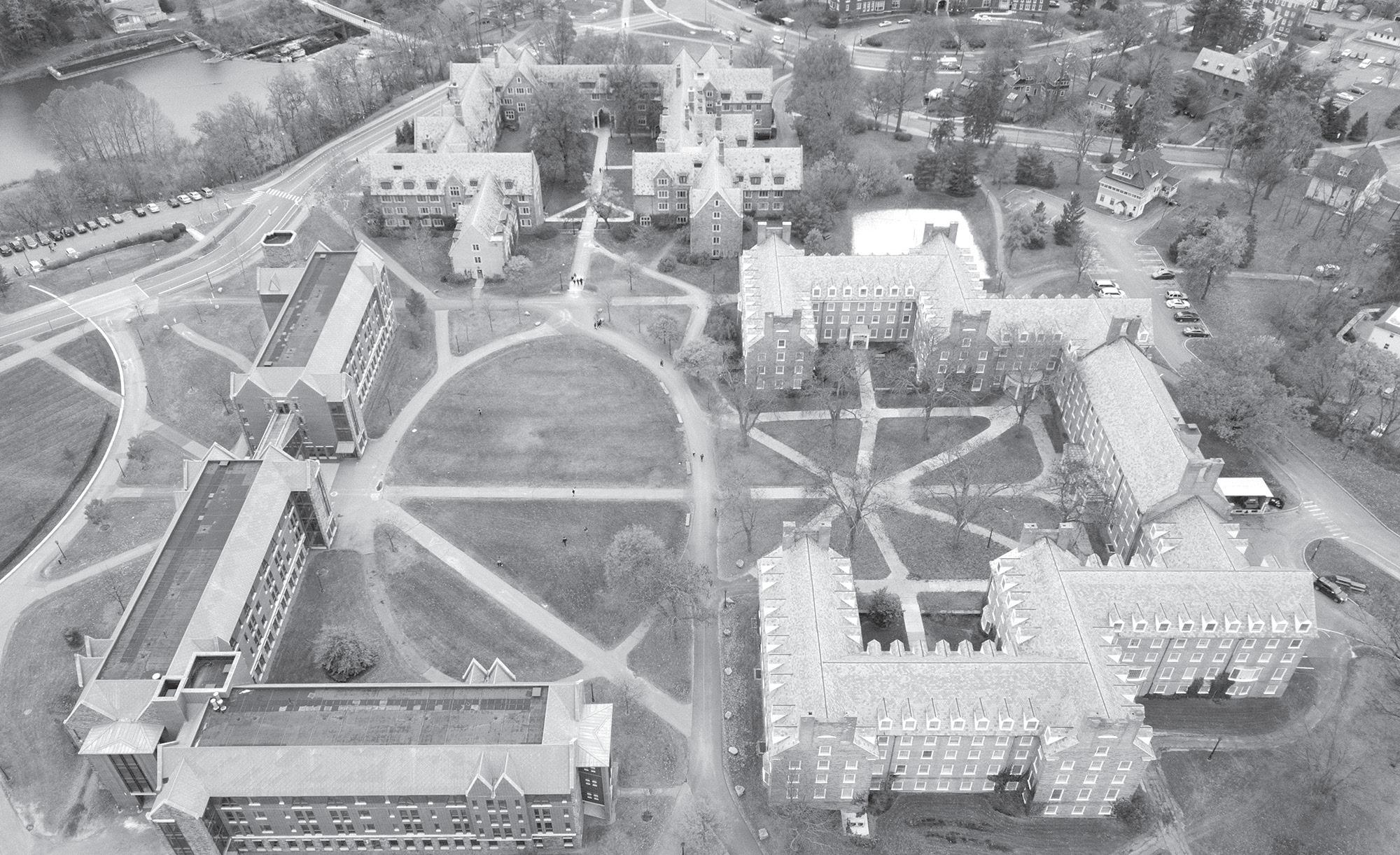
Diego Virtue ’24 said eating on the North Campus lawns and playing Spikeball have become one of the few ways he and other first-years have made friends.
But with the cold weather forcing them indoors, firstyears, still trying to find their place on campus, are con-
“Being able to discover all of these cool things and have all of these new resources available, it’s just so exciting and something that I am really comforted by, emotionally.”
William Serrano ’24
cerned with how fewer opportunities for socializing outside of their hallmates will affect their wellbeing.
“Everywhere in the dorms has limits,” said Willow Brawley ’24, “where are [we] supposed to go?”
Without the opportunity to interact outdoors, first-years and other on-campus students are forced to exclude people from gatherings to comply with Cornell’s behavioral compact — capping dorm rooms at four people.
Virtue said that although public health restrictions limit the number of in-person friends students can make, these circumstances have still fostered close connections with those they meet on the quad, in Donlon Hall hallways and on Zoom.
from
While Cornell has created online programming for students on and off campus, “[it] doesn’t make up for the lack of in-person connection,” Virtue said.
These social restrictions force first-year students to find alternative ways to connect with others and support their emotional wellbeing. For some, this means devoting more time to studying.
William Serrano ’24 said the dampened campus life has caused him to “excel academically,” but he said he realizes that if he did not feel like he was succeeding “and was doing
poor socially and emotionally [because of COVID restrictions], it would be awful.”
Brawley said she plans to prioritize mental health and self-care going into the winter months by maintaining friendships back home while trying to make new ones. But she said she’s not too worried about looming snow piles: “Snow is really pretty!”
Although their first year looks entirely different than any other Cornell class, these fall months still mark the beginning of an entirely new experience for the Class of 2024. Even under COVID restrictions, many students are living on their own for the first time, surrounded by people their
“Everywhere in the dorms has limits, where are [we] supposed to go?”
Willow Brawley ’24
age and not bound by a typical six-hour block of school.
“Being able to discover all of these cool things and have all of these new resources available,” Serrano said, “it’s just so exciting and something that I am really comforted by, emotionally.”
Isabelle Goodrow can be reached at ieg23@cornell.edu.
TCAT to Run Free Rides on Election Day
By SIMRAN SURTANI Sun Contributor
With the election less than a week away, Tompkins Consolidated Area Transit announced Monday that its buses will be fare free on Election Day to help eligible voters get to the polls.
On Nov. 3, the 36 Tompkins County polling locations will be open from 6 a.m. to 9 p.m. All TCAT bus routes will run during their normal service period, bringing riders to their designated polls for free.
In her 11 years of working for the bus company, Patty Poist, the communication and marketing manager, said that this is the first time she has seen the company offer free Election Day rides. TCAT now joins several other transit agencies across the country in providing free transportation on Election Day.
While the idea had been floated around in previous years, Poist said the company prioritized waiving fees this year because
the pandemic pushed many Tompkins County residents into financial hardship. She added that the company is committed to making voting more accessible to residents, allowing them to easily take part in what Poist called “a key part of the democratic process.”
The company requests that riders follow COVID-19 safety guidelines, which include wearing face coverings and practicing social distancing. TCAT has enforced a 25-person maximum per bus, along with frequent disinfection procedures, according to Poist.
“This day is [an] important day of decision for all voters, none of whom should be kept away from the polls due to a lack of transportation,” said Scot Vanderpool, TCAT general manager. “Much of our support comes through public dollars and providing free service on this day is the least we can do.”
Simran Surtani can be reached at sms633@cornell.edu.

TCAT to the polls | A TCAT cruises down Tower Road. The transit company is offering free
North
above | First-year students are anticipating that colder temperatures will close their favorite hangout spot: the outdoors. Some students worry for their wellbeing in the colder weeks to come.
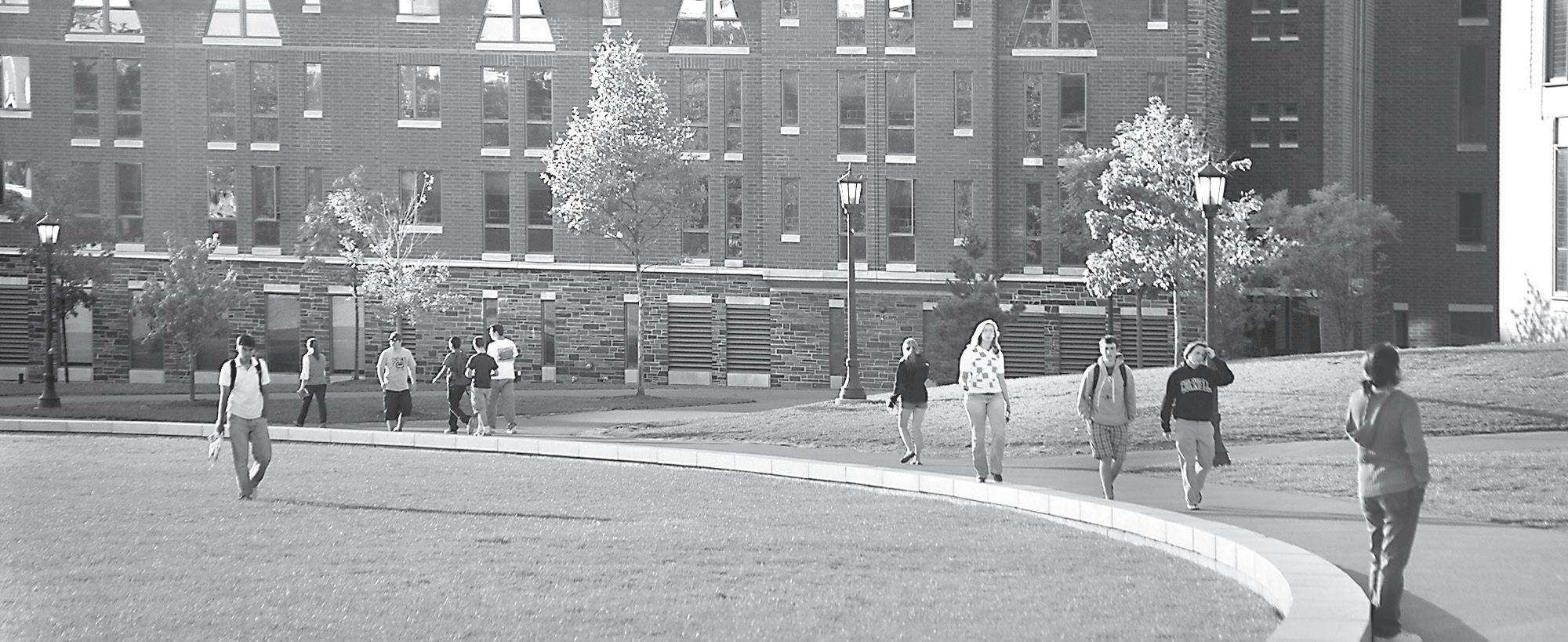
Roaming campus | Students walk through a North Campus quad. First-years have made friends through outdoor Spikeball hangouts. ANNORA MCGARRY
Dining Guide

Trick-or-Treating in 2020?
How to avoid the scares of a COVID-19 Halloween

By NICK HOGE Sun Contributor
Spooky season is officially upon us. It seems that out of nowhere pumpkin spice lattes are being sipped and fall foliage is blanketing campus. With Oct. 31 just around the corner, now is the time to start coordinating the perfect Tiger King
inspired Joe exotic costume, or maybe keep things simple by repping your favorite team’s jersey. Tentatively, we purchase our costumes with one question in mind: Are Halloween festivities going to fall victim to the pandemic as we have seen with other holidays this year?
It’s an incredibly disappointing time of year for students who



have been long anticipating the Halloween hype. Unfortunately, we have to realize and respect that coronavirus doesn’t just disappear for the night. Costume parties, which generally go hand-in-hand with large social gatherings, aren’t feasible under the current circumstances. It’s crucial for us, as a student body, to continue to adhere to the Behavior Compact, which we have already done so excellently this year. It would be a shame to make it this far into the semester just for one weekend to set back all of our well earned success. This doesn’t mean that all fun has to be thrown out of the window for Halloween. There’s plenty of other October activities to do to get a good scare in, while staying low risk. Consider grabbing some pumpkins with friends for a carving contest and then having a scary movie marathon. The most important thing we can all take part in is using common sense and understanding the consequences of our actions on those around us. Speaking of those around us, and a rare moment of good news, trickor-treating can still happen in the surrounding Ithaca community this year. While the CDC discourages the tradition as risky, precautions can be taken to ensure the safety for all those participating. I caught up with local resident and Coordinator of Public Programs here at Cornell Julie Mclean to see how she’s maintaining the Halloween cheer during this pandemic. Her, and several
We have to realize and respect that coronavirus doesn’t just disappear for the night.
other families, have decided to keep trick-or-treating limited to only close neighbors and families they have been interacting with. These tight-knit “pods” still allow their kids to experience the traditional fun of the night, without the concern of increased exposure. She also mentioned that the town of Freeville’s Fire Department is hosting a creative Halloween event for kids to come out and satisfy their candy craving, while most importantly, staying safe. The station even plans to set up “candy chutes” from the trucks, which will lessen the contact for this modified trick-ortreat event.
As usual, everyone needs to make sure to wear a mask at all times and maintain proper social distance. For a general piece of Halloween advice, be aware that masks given
Several other families have decided to keep trick-or-treating limited to only close neighbors.
in costumes often do not suffice on their own, so be certain a two layer mask is used. Fortunately, there are plenty of Halloween themed masks out there, so why not get creative with putting together a safe and protective costume? In regards to handing out candy, the CDC strictly recommends only giving out individually packaged treats, so stay away from anything homemade. The safest strategy to limit contact
The CDC strictly recommends only giving out individually packaged treats.
is to leave goodie bags at the edge of a porch or driveway for trick-ortreaters to take while passing. It’s ill advised to leave the classic bowl of candy out in front of the door, as that creates crowding and further contact. With these changes, and being consistent with the safety regulations we have been following all year, we won’t have to sacrifice this wonderful holiday. If we all work together to put safety as a priority this coming weekend, we can be more certain of a festive and fulfilling holiday season and conclusion to this unpredictable year!
Nick Hoge is a freshman in the College of Agriculture of Life Sciences. He can be reached at njh78@cornell.edu.
SABRINA XIE / SUN GRAPHIC DESIGNER
The Corne¬ Daily Sun
Since 1880
138th Editorial Board
MARYAM ZAFAR ’21
JOYBEER DATTA GUPTA ’21
Business Manager
PETER BUONANNO ’21
Associate Editor
MEGHNA MAHARISHI ’22
Assistant Managing Editor
CHRISTINA BULKELEY ’21
Sports Editor
BORIS TSANG ’21
Photography Editor
CAROLINE JOHNSON ’22
News Editor
ALEX HALE ’21
News Editor
ARI DUBOW ’21
City Editor
EMMA ROSENBAUM ’22
Science Editor
BENJAMIN VELANI ’22
Dining Editor
JOHN MONKOVIC ’22
Multimedia Editor
MIKE FANG ’21
App Editor
OLIVIA WEINBERG ’22
Assistant News Editor
JOHNATHAN STIMPSON ’21
KRYSTAL YANG ’21
HUANG ’21
NGUYEN ’22
Editor
KENKARE ’21
SEAN O’CONNELL ’21
STAMM ’22
OZA ’22
PLOWE ’23
& Entertainment Editor
LEE ’21
CHENG ’21
PEÑEÑORY ’22
MEGHANA SRIVASTAVA ’23
Working on Today’s Sun
Ad Layout Ella Benjamin ’24
Production Deskers Sabrina Xie ’21
Dana Chan ’21
News Deskers Sean O’Connell ’21
Madeline Rosenberg ’23
Opinion Desker Peter Buonanno ’21
Design Desker Lei Anne Rabeje ’22
Photo Desker Benjamin Parker ’22
Arts Desker Daniel Moran ’21
Sports Desker Luke Pichini ’22
Dining Desker Benjamin Velani ’22
Editorial
Remembering Antonio Tsialas ’23, One Year Later
Editor’s Note: Tis editorial was originally published on Oct. 26.
A YEAR AGO, CORNELL SUFFERED a tragic loss with the passing of freshman Antonio Tsialas ’23. Today, the anniversary of that news serves as a painful but poignant reminder to students of their responsibility in creating a safe campus social culture. It calls on us to remember those in our community who are not with us as Cornell navigates this unique point in its history.
In a statement to Te Sun, Tsialas’ mother Flavia Tomasello wrote about her hopes for college culture and Cornell moving forward:
“I hope that Antonio’s passing will inspire a cultural change in our colleges’ social life. I would like to see these deadly traditions and primitive practices be forever removed out of our colleges, so that hazing deaths do not occur in the future. I hope that this tragedy will force schools to create an environment for students to grow not only in knowledge, but also in love, inclusion and compassion. I hope that students will be armed with the information they need to make good decisions, to balance adventure and new experience, with safe and compassionate choices. We and the Cornell community should know the truth so that this does not repeat itself again. What started here at Cornell over 100 years ago can end here at Cornell, and we have an enormous opportunity to lead this longing for healing, love, truth and peace.”
In light of this statement, we implore Cornellians to take a pause in their daily routines and remember Antonio. Do not allow for tragedy like this to be forgotten. Speak up when you see or hear about irresponsible events, like the one that was held at Phi Kappa Psi which resulted in Antonio’s death.
If these past twelve months have shown us nothing else, it’s that we cannot aford tragedy like last October on this campus again. Tere is too much sadness and unrest in this world.
We echo the Tsialas family’s call for truth and transparency, as the investigation into the circumstances surrounding his death continues in the courtroom. We demand that the positive changes that began too late last year continue with full rigor, not sidelined, even now.
And in these moments of stress and uncertainty, we implore our fellow Cornellians to be grateful that we have had the chance to climb the slope with many who have tragically passed before having the opportunity to walk through campus garbed in cap and gown. And no matter where you are studying from, and how much Cornell life continues to change, do not forget those who walk in spirit alongside you.
Te above editorial refects the opinions of Te Cornell Daily Sun. Editorials are penned collaboratively between the Editor in Chief, Associate Editor and Opinion Editor, in consultation with additional Sun editors and stafers. Te Sun’s editorials are independent of its news coverage, other columnists and advertisers.
Jaewon Sim Trustee Viewpoint
Jaewon Sim is an undergraduate student-elected member of the Board of Trustees and a junior in the College of Arts and Sciences. Comments may be sent to opinion@cornellsun.com. Trustee Viewpoint runs every other Tursday this semester.
Pandemic Reveals Cornell’s Long Path to Better Career Advising
Many institution’s structural shortcomings are typically hidden from public view and usually garner little attention. That is, until a crisis hits.
A crisis, especially one as consequential as COVID-19, forces an immediate assessment of institutional preparedness. Cornell’s students, staff, faculty and senior leadership, for example, demonstrated the resilience of our people and the University by successfully undertaking a campus reopening during a global pandemic.
But during the recent virtual career fair mishap, the pandemic revealed an important insight: There’s much work to be done with Cornell’s career advising.
Last month, technical difficulties forced Cornell Career Services (CCS) to postpone Career Fair Days, an annual Barton Hall mingling of students and employers, which relocated to an online platform due to the pandemic. Students were repeatedly logged out of the website and kicked out of employer queues – only then to be randomly signed in as a different person, sometimes as a student, and at other times, an employer. The experience likely did not leave a positive impression of Cornell on employers.
out effective career counseling, Cornell students can leverage the university brand, education and, for some, their family background as means of landing positions at top companies. In terms of employment outcomes, Cornell, with its career offices operating at the current limited capacity, will still substantially outperform most of the nation’s universities at their full capacity.
During these times of economic downturn, Cornell students will pay the price for shortcomings in the University’s career advising.
Indeed, the accurate measure of career advising success is not how we prepare our best-resourced students but the most disadvantaged. Red herrings on postgraduate outcome reports, like the select list of highest-paying, brand-name employers that hire Cornellians gravely overstate the University’s returns on investment in career services. Instead, we must inspect how Cornell prepares students from less-privileged and non-U.S. backgrounds, who may not be able to rely on friends and relatives for employment advice and opportunities.
Earlier this year, I emphasized the need for a new approach to career advising — one that pools dispersed, college-based resources for the University’s common good as a whole. What students witnessed during the virtual fair were symptoms of the convolution of Cornell’s career advising system, which rendered it unable to quickly adapt to the COVID-era’s new demands. Of course, CCS did not build the career fair software — an external vendor did. But perhaps better testing and evaluation of the platform and its suitability would have revealed the significant insufficiencies prior to deployment.
Notably, not all universities experienced a painful transition to a virtual career fair. For example, the University of Notre Dame, a peer institution known for its practical approach to career advising, successfully executed its annual fair on Handshake, a web service also used by Cornell, for other career advising functions. Stanford, Brown and the University of Pennsylvania also held successful virtual career fairs on the platform. CCS’ choice, Brazen, was newly introduced to Cornell this year, after the onset of the pandemic.
It is not by chance that the telltales of a structurally untenable career services enterprise have largely flown under the radar before the pandemic. Frankly, even with-
During these times of global political turmoil and economic downturn, at a time when career offices should shine, Cornell students will pay the price for shortcomings in the University’s career advising system. For example, Cornell’s international students have few resources to turn to as U.S. work visa requirements continue to tighten, and a policy proposal threatens a minimum salary requirement that could reach $250,000 per year for scientists and engineers.
Career advising is not an easy task, but a well-resourced Ivy League university is the last place where students should have to fend for themselves. Cornell – or any university for that matter – cannot claim to be a true equalizer for students from different socioeconomic backgrounds if it fails to help students achieve their desired postgraduate outcomes.
Building an effective career advising system won’t happen overnight but, rather, will require an extensive process of reflection and reform. Fortunately, while a crisis reveals weak points, it can also act as a catalyst for resolving systemic deficiencies that go unnoticed for long periods. So, as we rightfully celebrate our exemplary COVID-19 response’s successes, let’s use this opportunity to pay equal attention to what isn’t working well: preparing departing students for their time after the Hill. I remain confident and optimistic about the future of career advising at Cornell. As we reflect on this timely matter, I welcome constructive feedback from the Cornell community.
Te Problem With Pronouns and Emails
Anuli Ononye Womansplaining
Anuli Ononye is a junior in the College of Arts and Sciences. She can be reached at aoo44@cornell.edu. Womansplaining runs every other Wednesday this semester.
Inever met a person who didn’t refer to themselves with he/him or she/her pronouns until my first semester at Cornell. As someone passionate about gender justice and gender equity, I had previously understood the importance of questioning gender pronouns and identifying individuals in the ways that they wanted. However, my knowledge about pronoun use was very restricted to theory classes, news articles, lectures, TedTalks, Youtube videos and social justice conferences. Meeting students, faculty, and community members who identify with pronouns besides she/ her and he/him has challenged me to “check” my own bias and to ask for pronouns (and present my own pronouns) during introductions.
Two years later, I am in no way perfect. Sometimes I mislabel people or forget to ask for pronouns in conversations. But, I am very aware of pronoun bias and I am constantly correcting myself in order to ensure
those around me are addressed in the way that they would like to be represented. For the most part, that has been practiced by using they/them pronouns until I am sure of how individuals would like to be referred to (amazing advice from Prof. Durba Ghosh, history!), including my pronouns in my bios and apologizing immediately when I am incorrect.
However, a place where I still struggle in pronoun use is professional emails. Like many Cornell students know (or will know very soon), networking is key! If you want that internship, study abroad opportunity, fellowship, or research program, it is important to cast a wide net and meet people who have 1) had the position you are applying to or 2) have advice about the program. This recruitment season, I have been more adventurous in networking and have cold-emailed quite a few Cornell alumni regarding advice for internship opportunities. Unsurprisingly, the Cornell alumni that I have reached out to have been very supportive.
However, the initial email is always uncomfortable. Usually, I scroll through the Cornell alumni database on LinkedIn and find alumni with similar interests and passions as my own. If I’m lucky, the person I am contacting 1) has a professional degree so I can refer to them as “Professor” or “Dr.” or 2) has a website, LinkedIn bio, or Wikipedia page that refers to them through pronouns in the third person. However, in honesty that rarely happens. So, like many students on campus, I resort to assuming the contact’s pronouns based on 1) their profile picture on LinkedIn and/or 2) their name.
The problem with professional emails is that they’re intended to be professional. I personally feel uncomfortable sending a networking email and referring to the contact by their first name and equally uncomfortable referring to them by their last name without a title. Although I am aware of the title “Mx.,” I am yet to see the title used frequently enough to use in a cold-email. So, it’s Ms. or Mr. and that leaves a wide window open for error. Although I’ve never been corrected,
every time that I send out a professional email, I struggle with this. My pronouns have never been misidentified and I recognize the immense privilege in this. Although in no way the same experience, having a non-English and pretty uncommon name, I recognize
I recognize how uncomfortable it is to correct people when they’re wrong. It’s even worse when people are unwilling to correct themselves. After all that, the Ms./Mr. binary still exists. Yet another confirmation that the professional world is always ten steps behind.
how frustrating it is to be misidentified and further how uncomfortable/annoying it is to correct people when they’re wrong. It’s even worse when people are unwilling to correct themselves. And after all that, the Ms./Mr. binary still exists. Yet another confirmation that the professional world is always ten steps behind.
Unfortunately, this column does not tie in a perfect bow or have any amazing solution. But I felt it worthwhile to voice my frustration with professional emails. A frustration that I’ve heard from many other friends on campus making active efforts to be gender inclusive. Although not a perfect solution, I do urge the Cornell community to remember pronouns in their introductions and online bios in the hopes that little actions lead to larger change.
Wipe the Whiteboard Coding Interview
Jonna Chen jonna.write()
Jonna Chen is a sophomore in the College of Engineering. She can be reached at jc2627@cornell.edu. jonna.write() runs every other Wednesday this semester.
The internship hunt comes around a lot faster than expected. All throughout freshman year, upperclassmen comfort you, reassuring you that “it’s okay to not have anything planned for the summer. Te summer internship grind is far away.” But a full blown pandemic and rushed plans to get back to Ithaca for a shaky fall semester came with the abrupt realization that dreaded HackerRanks and traditional whiteboard coding interviews for summer 2021 were fast approaching. Every word I type right now is just another bit of brain power I could have spent on memorizing another coding concept for an unpredictable recruitment season.
For those outside the software engineering recruitment bubble, software engineering internships are of a large supply, but also an arguably larger demand. To obtain employment for a summer, the search starts almost an entire year earlier on platforms like Handshake and Jumpstart, or just a desperate Google search for any company that will take undergraduate interns. You scrounge up the courage to ask that person you met that one time for a referral. You throw your resume into the application portal of any company that has open hands and you pray. Te easy part is done.
Te grass is clearly not greener on the other side.
Beyond the resume drop are several rounds of interviews, each on a company-to-company basis. Narrow it down further, and you’ll fnd that the most stress-inducing rounds are technical.
Te technical interview is an inevitable dread for many engineering students. It’s a notorious on-thespot test of your intelligence and ability to communicate your problem-solving skills. For software engineering specifcally, your interviewer typically gives you a coding question, asking you to come up with an algorithm that rearranges this list in a specifc way or fnds the smallest sum available. You can ask clarifying questions or reread the problem, but eventually you need to start shakily explaining your approach on a whiteboard or shared Google Doc as you reach towards the optimal algorithm. You attempt to read the mind of your interviewer, hoping that the eyebrow raise or the lip purse they just did does not mean that you’re headed in the wrong direction. You explain your thought process behind each line of code, and attempt to justify each decision you make. Tey can see your every move on the shared screen. Tis is the classic whiteboard interview.
In preparation, students spend months studying for these interviews, enrolling in academic workshops, drooling over the latest edition of Cracking the Coding Interview and laboring away on Leetcode, the online motherload of coding interview questions. Tere are even online courses you can take to get up to speed on all the apparent material you need to know — although whether $500 is worth it for resources written by an ex-Google developer is up for debate.
Tese technical interviews are, at their core, traditional. Tey’re supposed to show recruiters your problem solving and communication skills. However, a recent study from North Carolina State University showed that these interviews test more for performance anxiety rather than problem solving skills. In a controlled experiment, women were shown to have done better in a typical test setting without an interviewer watching them code on a whiteboard and worse in the traditional whiteboard setting. Tis setup has led to an exclusion of certain groups (think: minorities) and a bias towards specifc job candidates. In addition, these assessments say little about a candidate’s ability to collaborate with others or lead a team.
An alternative? I propose that technical interviews be replaced with projects and presentations, similar
to a longer version of a case study. Applicants would either work individually or in groups to design and implement a solution to a prompt over the course of a few days. Ten, they would be tasked with thoroughly presenting their solution, ending the interview as the subject of a brief question and answer session. Tey should also see what other candidates have come
This alternative, while undoubtedly more time-consuming, would give companies a more well-rounded look at the people they are hiring.
To be honest, any situation that gives me more time to critically think and less time to make a fool of myself in front of a whiteboard, I am supportive of.
up with and be given the opportunity to ask discussion-provoking questions about another solution. While I may not have the experience of a university recruiter, I still think that software developers should have the skills to not only solve problems, but also to present and defend their work while challenging others to think outside the box.
Tis alternative, while undoubtedly more time-consuming, would give companies a more well-rounded look at the people they are hiring and candidates a more level-playing feld. With a more consistent barrier-to-entry for all groups, this could also aid in creating a more diverse work environment, another large issue with our current white and male dominated tech industry.
To be honest, any situation that gives me more time to critically think and less time to make a fool of myself in front of a whiteboard, I am supportive of. But if implemented, this approach at hiring would be a step towards a more holistic recruitment process. All in favor, say “Leetcode!”
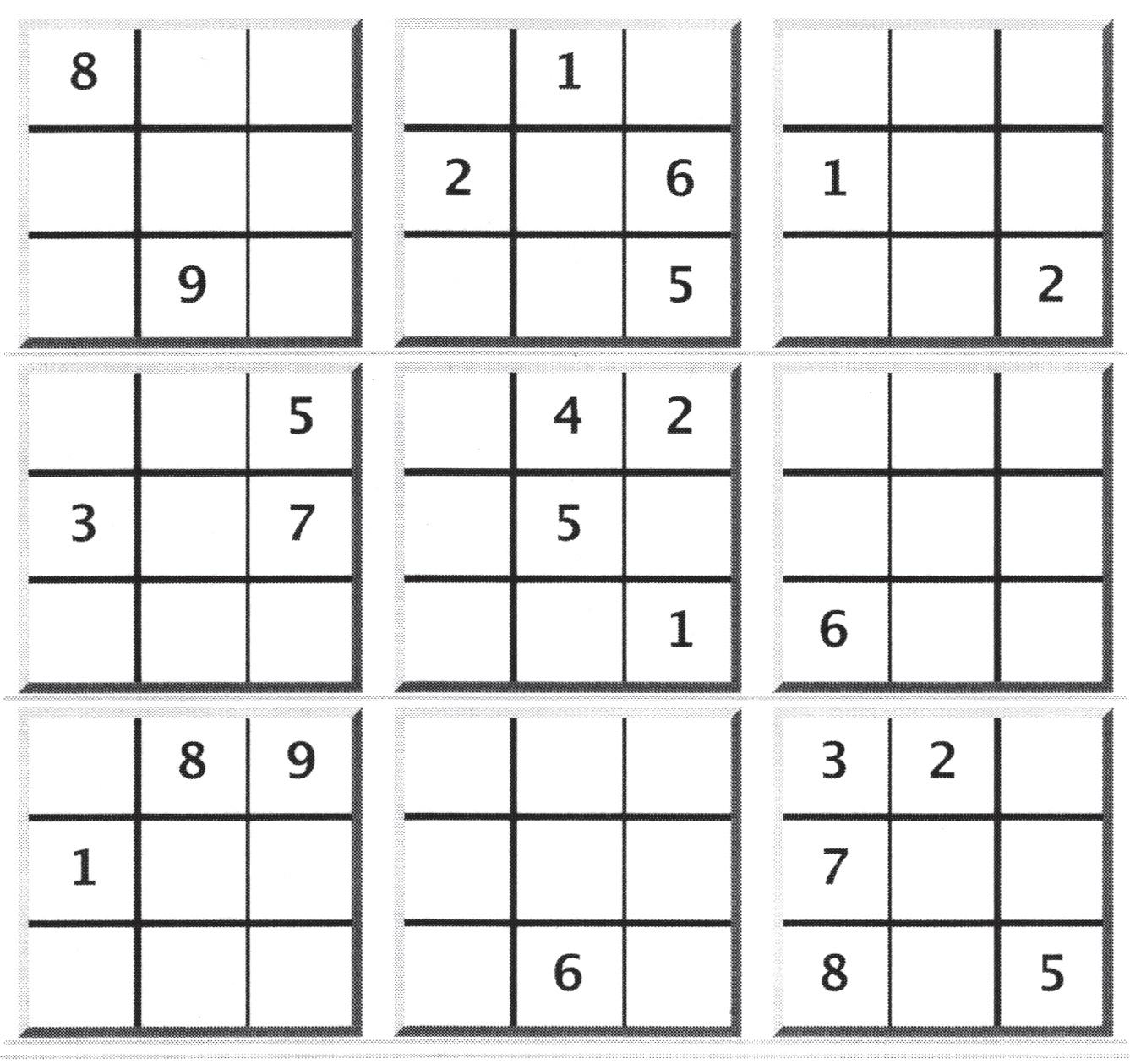
from wikipedia.org/wiki/ Sudoku)
Faster Than Light by Alicia Wang

12 A UTOMOBILES
COLLEGETOWN TERRACE

Mr. Gnu by Travis Dandro Mr. Gnu by Travis Dandro
ARTS & ENTERTAINMENT
Ithaca Murals as Mirrors for Political Action
There’s a purple house in Ithaca on the corner of Clinton and Plain, adorned with yellow sunflowers and a beautiful mural of Toni Morrison. It was painted by local muralist and painter Maryam Adib shortly after Morrison passed away last year.
I think of that mural from time to time: it’s a symbol of hope that reappears in my head and even more frequently in the recent weeks of leading up to the election.
idly increased its support of commissioned public art. In 2009, there were only 15 murals in Ithaca. Now, there are over 1,650 murals all across the city.
Local art and murals have been at the center of our long overdue national reckoning with racial injustice. On Aug. 22, a Black Lives Matter mural was painted in Downtown Ithaca by community members.
Morrison famously wrote in her essay, “No Place for Self-Pity, No Room for Fear,” published in the Nation: “This is precisely the time when artists go to work. There is no time for despair, no place for selfpity, no need for silence, no room for fear.”
Her words encapsulate the importance of art in civic engagement and political action. In a time during which multiple crises have intersected in our public sphere in the most visible and turbulent ways, the work of artists has never been more important in helping us to reimagine a better future.
At the center of this growing cross-talk between the local artists and the political engagement in the community is Ithaca Murals, which was founded in 2004 with the goal of decolonizing public space and has adopted an inclusion model “to challenge Eurocentric patriarchal capitalism.”
In recent years, the organization has rap-
However, public art has not come without backlash: on Oct. 4th the mural was vandalized to censor the word “Black”. The following day, community members congregated to restore the mural.
The murals have become an important part of the Ithaca culture: their vibrant accents and bold colors personify our changing space to reflect the eclectic voices of our city’s diverse community.
This year, Ithaca Murals teamed up with Ithaca Hummus to help #GetOutTheVote by providing local artists with funding for murals, posters and public art. The cross-collaboration is aimed at encouraging civic engagement between now and Election Day on Tuesday, Nov. 3.
On Sunday, Oct. 25, local artist Lisa Orinda completed a mural at the South Hill School in Ithaca. Orinda’s family was also involved in the completion of the project. “Vote … for our children and our children’s

children,” the mural reads, imploring the Ithaca community to exercise their civic duty.
Self-taught local illustrator Yen Ospina finished a Lady Liberty mural in Press Bay on Monday October 26th, with a one-word message: “Vote.”
Each of these pieces illustrates the important role that art retains in political expression and cultivating community dialogue and action across barriers. Under an administration in which walls have been invoked to incite division and hate, the
The
speak truth to power through art and the written word, especially right now as forces of hatred and violence threaten those who dare to speak.
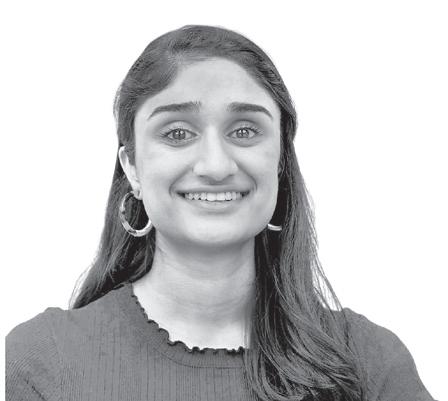
Shriya Perati is a senior in the College of Arts and Sciences. She can be reached at sperati@cornellsun. com. Thought Experiments runs alternate Tuesdays this semester.
A Cornell Alum’s Journey of Hunting Teddy Roosevelt
The furor surrounding this year’s presidential election brings with it nothing more than a mélange of confusion, partisan politics, fear and so many other unsavory components that to delve through even the most innocuous of them would turn this article into a completely different one. Interestingly enough, though, another topic has enjoyed renewed public discussion: What a now-former Commander in Chief of this country does with his (at this point, still his) time after leaving the White House. Some former Presidents, like Jimmy Carter or George H. W. Bush, devoted themselves to humanitarian work, while others, like John Quincy Adams or Andrew Johnson, returned to positions in federal government. Especially in the case of the latter two, it is occasionally difficult to predict what exactly the former President will do, even simply in the immediate months after his term ends. In the case of Theodore Roosevelt, however, one of the first things he did after leaving office could have hardly been more expected: He went on safari.
This trip to various places around the continent of Africa was probably a welcome source of relief for the so-called
“Trustbuster,” even as he began to wonder whether he made the correct choice in declining to seek re-election when he did. The safari epitomized many of the issues and pastimes he loved and championed during his time in the White House: Conservation, game hunting and general sojourns in the rugged wilderness of the Earth. After its conclusion, Roosevelt wrote an account of his journey, but it did not go into much detail besides the actual sights he encountered while abroad. Now, though, a new novel attempts to fill that void with its speculative narrative about what occurred on that safari: Hunting Teddy Roosevelt, written by James A. Ross ’75, J.D. ’82 and published by Regal House Publishing. And fill that void it does, all at once relating tales of a two people reflecting on their shared romance long after it has ended, encounters with aspects of the simmering political and social turmoil in Europe around the beginning of the 1910s and at its center, even a dastardly scheme to assassinate the former President himself. That last part becomes the book’s driving force — because of Roosevelt’s crusade against trusts and other forms of big business, the robber barons controlling much of American industry at the turn of the century did not hold him in the highest regard, to put it mildly. Thus, J. P. Morgan and
others send Dooley, a New York hooligan forged from the very depths of the Five Points, to dispatch him. Against the backdrop of Dooley’s mission, Roosevelt runs into Margaret Dunn, an indefatigable reporter who was the former President’s first love many years before. As Roosevelt grapples with these two complications, one unknown and one reluctantly acknowledged, he travels through Europe and Africa, interacting with regions in crisis and beginning to wonder whether he made the right decision in leaving office; the result of these threads makes for an in-depth, entertaining and suspenseful narrative, as informative about the time period it chronicles as it is intriguing.
James A. Ross was gracious enough to answer a number of questions about his novel via email for this article; that exchange appears below (though spoilers are present).
T HE S UN : Let us start with some broader questions: How did you get the idea to write Hunting Teddy Roosevelt? How long did it take to complete?
J AME S R O SS : Quite by accident, I ran across a blurb in a 1909 Italian newspaper which reported that a German ship carrying Roosevelt to Africa had docked in Naples where the police took off an alleged
anarchist accused of attacking Roosevelt with a knife while on board. While I was familiar with the assassination attempt on Roosevelt when he was giving a speech during the presidential campaign of 1912, I had never heard of any prior attempt on his life. As far as I know, there is no mention of the 1909 attack in any of the history books, nor in the many Roosevelt biographies. Naturally, this raises a few intriguing questions, among them: (1) Was the shipboard attempt on Roosevelt’s life suppressed? And if so, by how, why and by who? And (2) While in the last sixty years, the world has become all too familiar with assassinations of political office holders and candidates, in 1909 the fifty-year-old Roosevelt was out of power and on his way to an isolated and dangerous part of the world that might have killed him anyway. Who would want to make an attempt on his life then, and why? Hunting Teddy Roosevelt is my attempt to answer these questions. The research and writing took four years. Hunting Teddy Roosevelt is based on an actual expedition Roosevelt embarked on soon after the end of his Presidential term; what was the process of researching it for the novel like, and how closely did you adhere to what actually happened during that time?
Roosevelt wrote an account of his 1909 safari in a series of articles for Scribner’s Magazine, later compiled into a book, African Game Trails. The action in Hunting Teddy Roosevelt adheres closely to the chronology in Roosevelt’s book, adding only the untold story of the hunter Roosevelt being himself hunted. The research included reading almost everything ever written by and about Roosevelt, as well as several trips to antiquarian book shops in New York and London to purchase out of print explorers journals in order to research turn of the century African travel. One of the pivotal (and most interesting) characters is Margaret Dunn, a resourceful reporter in the mold of Nellie Bly and others who is working for William Randolph Hearst; she also used to be romantically involved with Roosevelt when both of them were much younger.
S UN : Who did you base her character on, if anyone? How integral to the narrative did you want that pseudo-romantic/journalistic subtext that she brought to be...
To continue reading this interview, please visit cornellsun.com.
John Colie is a sophomore in the College of Arts and Sciences. He currently serves as the blogs editor on The Sun’s board. He can be reached at jcolie@cornellsun.com.
Ithaca Murals serve as a powerful manifestation of resilience and resistance to an increasingly polarized climate.
murals remind us of not only our civic duty to vote but also to continue to
Shriya Perati
DANIEL MORAN / ASSISTANT ARTS EDITOR
JOHN COLIE BLOGS EDITOR
ISports
Editor’s Corner
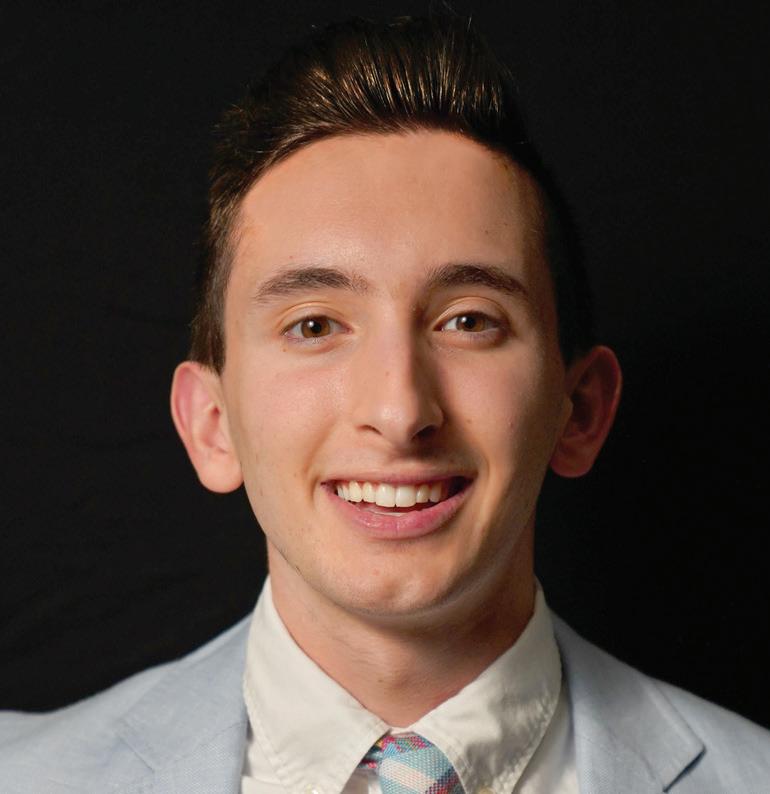
Luke Pichini is an assistant sports editor on the 138th Editorial Board and previously served as an assistant sports editor on the 137th Editorial Board. He is a junior in the School of Industrial and Labor Relations and can be reached at lpichini@cornellsun.com.
Shame on the NFL And Shame on Us
n the aftermath of ESPN’s report that Jacksonville Jaguars running back Ryquell Armstead is expected to miss the rest of the season due to COVID19 complications, it is time for all of us to engage in a serious reexamination of the current NFL season and our pleasure in watching it unfold.
Though this news may have fallen under the radar in the midst of Sunday’s slate of games, it is incredibly alarming. Armstead, a 23-year-old running back in peak physical condition, has suffered from “significant respiratory issues” due to the virus and has already been hospitalized twice.
Armstead was expected to feature as a prominent piece in Jacksonville’s offense. In his stead, undrafted
alty against the Titans for their lax enforcement of COVID protocols? A mere $350,000 fine for an organization valued at $2.3 billion.
In addition, multiple head coaches have demonstrated an inability to properly don face masks. Jon Gruden, the head coach of the Las Vegas Raiders, has been fined numerous times and even sported a pathetic excuse for a face covering against the New England Patriots. While the NFL has levied several fines against these coaches and threatened in-game penalties, full compliance across the league seems like a moonshot.
Prior to the start of training camp, a Reuters report noted that 59 players had already tested positive for
But we cannot normalize this. Players and staff should not be subjected to the perils of a deadly virus merely so we can enjoy some entertainment over the weekend.
Operating national sports leagues in a bubble environment has proven successful in mitigating COVID-19 spread while still continuing league play. But it is clear that the cost of establishing a bubble is too big of a burden for this money-hungry league to bear. The incidence of COVID-19 in the NFL only figures to increase as the nation sees record numbers in new daily cases. Sadly, the suffering that Armstead has endured is unlikely to move the needle. The NFL will continue

“Hold[ing]
games in these conditions with improper regulations and enforcement is irresponsible, and our subsequent enjoyment ... renders us complicit.
Hit hard | The Tennessee Titans experienced the largest outbreak in the league, seeing 23 players and staff test positive for COVID-19.