The Corne¬ Daily Sun




remembered Antonio Tsialas ’23, who was 18, as a “gem of a person.”
Law enforcement recovered the body of a Cornell freshman from Fall Creek Gorge on Saturday afternoon. The tragedy shocked the campus community, as Cornellians

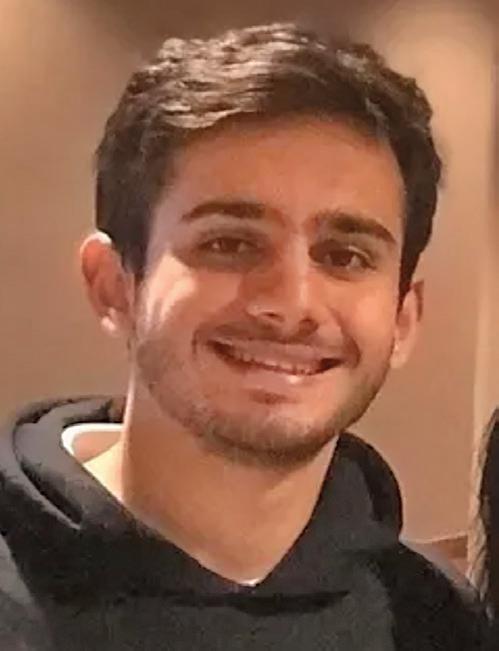
The Cornell student had been missing since Thursday night, after he was seen leaving a Phi Kappa Psi fraternity party. He met with his mother on Thursday night for dinner and planned to take his parents, who were in town during First-Year Family Weekend, on a tour of the campus over the next few days. His parents reported him missing when he failed to meet with them on Friday, state troopers said. This semester, Tsialas was taking classes in microeconomics, computing, linear algebra and writing across cultures as an undeclared freshman in Arts and Sciences. He was interested in studying chemistry in the future, Arts College Dean Ray Jayawardhana said in a col-
lege-wide email offering condolences.
“A full investigation of the circumstances of his death is underway,” wrote the Cornell University Police Department in a statement Saturday night, continuing that it did not suspect foul play.
His body was recovered near Ithaca Falls in Fall Creek Gorge; he was the fourth Cornell student found dead in the gorge in the last three years. In May 2018, Avram Pinals ’18 was found in the gorge; Winston S. PerezVentura ’22, who was 17, drowned in a swimming hole in the gorge in August 2017 and Aalaap Narasipura ’18, who was 20, died in May 2017.
Tsialas graduated from Ransom Everglades School in Miami, where he was involved as a stellar academic, debater and goalie on the soccer team, according to an email sent to the Ransom Everglades community from school headmaster Penny Townsend.
Students may consult with counselors from Counseling & Psychological Services (CAPS) by calling 607-255-5155. Employees may call the Faculty Staff Assistance Program (FSAP) at 607255-2673. An Ithaca-based Crisisline is available at 607-272-1616. For additional resources, visit caringcommunity.cornell.edu.
While Feliz maintains they were unfairly ejected from program, other Alliance for Science fellows disagree
Starting October 15, Julia Feliz would not be welcome at Cornell’s Alliance for Science program, its director said. The decision — which Feliz shared in a widely-circulated post — was followed by waves of student support in a Student Assembly resolution in solidarity with Feliz and a planned rally, as well as a University statement disputing many of Feliz’s characterizations and an email from President Martha E. Pollack.
Pollack responded to Feliz’s account and the S.A.’s resolution — which was contested by all fellows who spoke at Thursday’s S.A. meeting — by writing a brief email to Feliz, which they posted online.
“I have received your message,” Pollack wrote to Feliz, a Puerto Rican former fellow, on Friday morning. “Cornell takes reports of alleged discrimination seriously, and all appropriate offices are fully engaged in this matter.”
The email was “weak” and “generic,” Feliz wrote in the accompanying post.
The controversy began earlier this month, when Feliz accused Iowa State University Prof. Max Rothschild of racist and sexist terminology when responding to their question after a lecture. Feliz recounted their experience at the Alliance for Science in a lengthy piece on Medium, an online

On Thursday night, in a phone call and email to The Sun, Rothschild unequivocally denied all accusations, wholly disputing Feliz’s account of the incident. The animal science professor added that “[a]ccusing me of being racist because I am white is offensive and racist.”
By AMINA KILPATRICK Sun News Editor
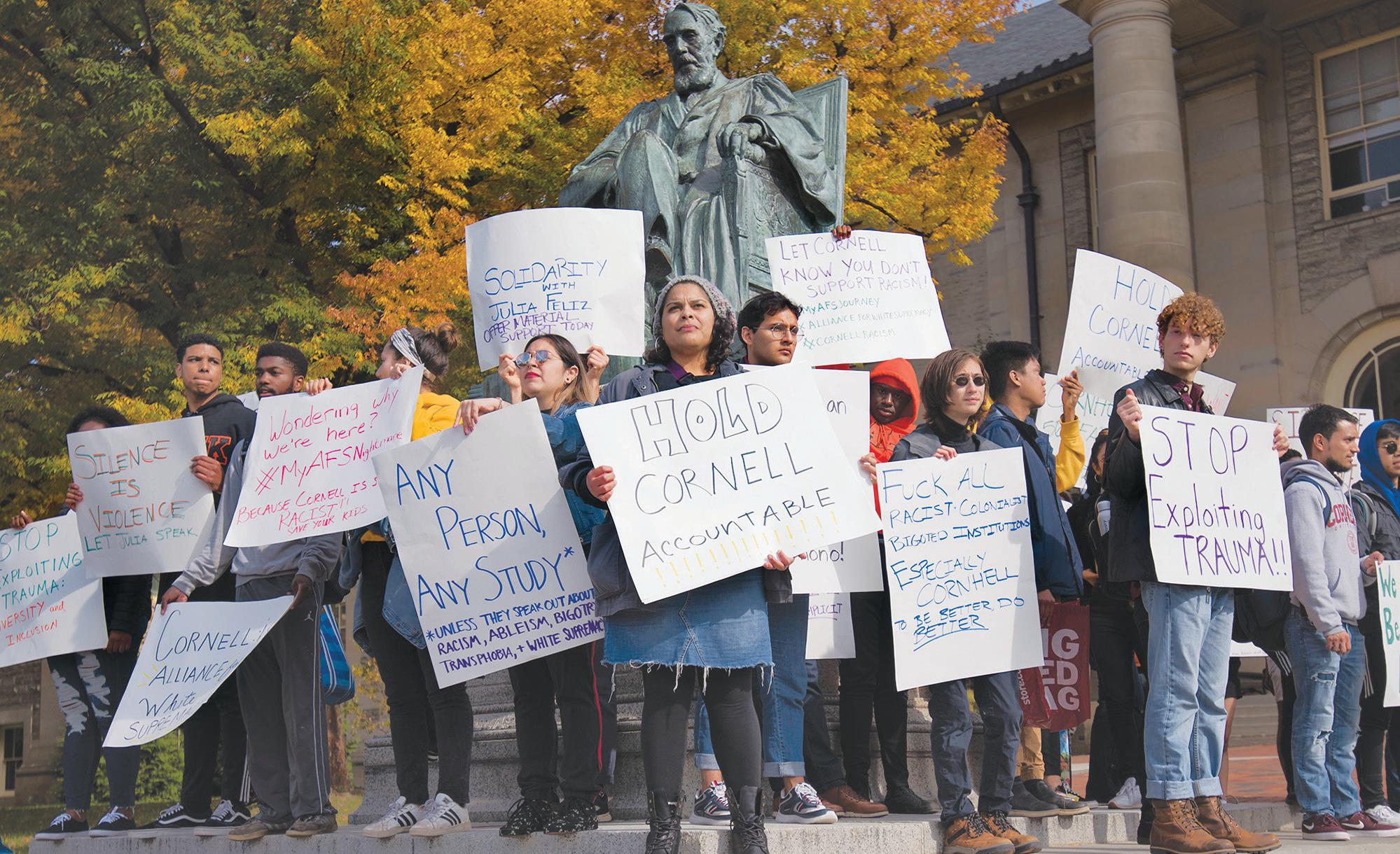
“What do we want? Accountability! When do we want it? Now!” people chanted at a demonstration on Saturday. The group marched in support of Julia Feliz, the fellow who called Cornell racist after they were removed from the Alliance for Science program on Oct. 15.
Amidst the bustle of First-Year Family Weekend, two dozen students and Ithaca community members began their demonstration outside of the Cornell Store on Ho Plaza, where people held signs in support of Feliz.
“Given the fact that we are all marginalized people, I think the turnout is amazing, because we have been punished for speaking up,” Feliz said.
Feliz’s troubles began at a lecture by Prof. Max Rothschild, an animal science professor at Iowa State University, whom Feliz claimed was racist during the event. Rothschild strongly denied Feliz’s account of his guest lecture in a statement to The Sun.
After publicly sharing their story on Medium, Feliz found support through the Student Assembly, which passed a supporting statement on Thursday. The University
Monday, October 28, 2019

Chemical and Biomolecular Engineering Fall Seminar 9 a.m., 255 Olin Hall
Unruly Cinema: Bollywood’s Unlikely Emergence 12:15 p.m., G08 Uris Hall
Department of Physics Colloquium
4 - 5 p.m., Schwartz Auditorium, Rockefeller Hall
World Theater Voices: A Conversation With Santiago Loza 4:30 p.m., 220 Schwartz Center for Performing Arts
History’s Open House 4:30 - 5:30 p.m., 137 McGraw Hall
Wednesday’s Words With Kevin Adonis Browne 4:30 p.m., Multipurpose Room, Africana Studies and Research Center
Tomorrow
Work Talks - Work Authorization for International Students
10 a.m. - 11 p.m., 276 Caldwell Hall
“Slaying the Imposter: Feminist Approaches to Thriving in the Academy” Noon - 1 p.m., 190 Rockefeller Hall
Making the Most of Your First Year 3:30 - 5 p.m., Tatkon Center
Diwali Festival of Lights Dinner
4:30 - 7:30 p.m., Jansen’s Dining Room, Hans Bethe House
Employment and Disability Book Launch 4:30 - 7:30 p.m., 115 Ives Hall


COURTESY OF
Art and activism | Art curator Yasmin Ramirez will give a talk on Oct. 29 about the role of the Young Lord’s Party in drawing attention to major social justice issues.
Talk: The Revolution Will Not Be Aestheticized (Too Much) 4:30 - 6 p.m., 366 McGraw Hall
Yoga sponsored by Cornell Minds Matter and Cornell Fitness Centers
5 - 6:15 p.m., Art Gallery, Willard Straight Hall

By HUNTER SEITZ Sun Assistant News Editor
Based on reports that the Alpha Gamma Rho fraternity blindfolded new members and repeatedly took away their cell phones for extended periods of time, the University has found the fraternity guilty of hazing and has placed it on probationary status, according to a University report.
While AGR remains on probation, the report states that full withdrawal of the University’s recognition will be deferred until fall 2021 because of the fraternity’s “lack of any recent judicial history” and its cooperation with the investigation, among other factors.
Alpha Gamma Rho will be given the opportunity to demonstrate its ability to abide by University policies.
Office of Sorority and Fraternity Life
During this period, Alpha Gamma Rho will be given the opportunity to demonstrate cooperation with University policies and “educational sanctions.”
If the chapter is found to be noncompliant with the University’s full recognition policies by fall 2021, the University will withdraw recognition for at least three years.
In early March, the Office of Fraternity and Sorority Life received a hazing report. A subsequent investigation by the Fraternity and Sorority Chapter Review Board found that members of the Alpha Gamma Rho fraternity had engaged in a number of behaviors that the University considers to be hazing.
The allegations included requiring new members to live in the chapter house for a week, repeatedly taking away their cell phones — sometimes for a whole weekend — and blindfolding new members as part of their national fraternity rituals. The University specified in its report that chapter leadership were aware that blindfolds are prohibited by Cornell.
In one instance, new members — who were made to spend the night at the house — were woken up at 5 a.m and made to listen to the same song for four hours. They were required to play “air instruments” and make “repeated hand gestures” to the song, according to the report, which classified these behaviors as hazing.

The report also noted that “consistent with established practice,” the matter was referred to the Office of the Judicial Administrator.
Leadership of Alpha Gamma Rho did not respond to requests for comment by time of publication.
As a result of the findings of the investigation, the University found the fraternity to be in violation of its policies for recognition, and decided to place the fraternity on probation until fall 2021, at which point the fraternity’s status will be reevaluated.

By JOHN MONKOVIC Sun Contributor
On Ho Plaza, Lucy Contreras ’21 defiantly faced the Thursday afternoon passersby with the words “Fur Kills” painted across her abdomen and an apparently blood-drenched Canada Goose jacket wrapped around her body.
The blood was fake, as was the jacket — an imitation with a “Canada Douche” sticker where one would normally find the coat’s iconic sleeve patch.
Contreras, who is a Sun opinion columnist, and her fellow demonstrators aimed to raise awareness about the animal cruelty involved in making the products of the ubiquitous winter-time brand. The coats use goose feathers, most commonly obtained by plucking live geese without any painkillers, and leaving open wounds before they are killed, according to Contreras, president of Cornell Vegan Society and Sun opinion columnist.
attacked by other predators before the trapper returns, according to PETA. If still alive at this point, they are bludgeoned, stomped, or strangled to death, said Contreras.
The demonstrators hoped that those who currently own Canada Goose products never buy from them again and donate the detachable coyote-fur trim of their coats. Several organizations, including PETA and the Wildlife Rescue League, accept donations of furs and redistribute them to rehabilitating animals in shelters or homeless people.
“Each Canada Goose jacket requires seven birds and two coyotes. That’s nine animals dying for no reason.”
Chloe Cabrera
And for those who don’t own Canada Goose products, the demonstrators want them to consider animal cruelty when they buy products such as coats, pillows and comforters.
Chloe Cabrera grad, a participant in the demonstration, called for people to make more responsible consumer choices.
The detachable fur trim around the hood of the coat is made of coyote fur, Contreras said. This fur is obtained by capturing wild coyotes in steel traps, where they are often left to agonize for days — suffering from gangrene, dehydration, or
“Each Canada Goose jacket requires seven birds and two coyotes. That’s nine animals dying for virtually no reason, for an overpriced coat that works just as well as any vegan coat,” Cabrera said.
Hunter Seitz can be reached at hseitz@cornellsun.com.
By VIVIAN FAN Sun Staff Writer
Hoping to create a special opportunity for women of color “to be vulnerable,” Building Ourselves through Sisterhood and Service will host a summit on Nov. 8 and 9 to address mental health issues faced by women of color at Cornell.
The keynote speaker will be Elyse Fox, a mental health advocate and filmmaker living in New York City. Fox created the popular Instagram account @sadgirlsclub.
“We brainstormed for prominent figures who focus on mental health issues,” explained Dalia Mota ’21, co-publicity chair and a member of the planning committee. “This year we are having Elyse, who’s made it more acceptable to speak up about mental health struggles.”
Partnering with campus organizations such as Cornell Health, the Women of Color Coalition and Cornell Minds Matter, BOSS planned a weekend of bonding and learning through nine workshops and a keynote speaker event.
“I don’t think there are other opportunities on campus who focus on women of color with mental needs,” Amber Haywood ’21, chair of the Mental Health Committee, told The Sun. “This platform which allows women of color to be vulnerable with each other is really special.”
According to Haywood, BOSS’s Mental Health Summit has been held each year for over a decade. She attended her first summit as a freshman and recalled many personal takeaways.
Mota agreed with the impactfulness of the summit, saying that the 2018 “The Superwoman Complex” workshop “really spoke to” her. The “superwoman complex” refers to the phenomena of high-powered women in business having fewer connections and mentors than male counterparts.
The event took months of preparation and outreach, according to Haywood.
“We started planning the summit in April,” she told The Sun. “We did a lot of work in developing our curriculum and advertising the summit to not just the Cornell community, but also women of color from other colleges.”
In addition to hosting the annual Mental Health Summit, BOSS builds a supportive community for women of color through service events and a mentorship program with bonding activities.
“It’s given me a sisterhood and brought me out of my shell,” Mota said. Haywood cited the mentor-mentee program as a source of strong personal connections.
“BOSS has developed me as a leader, as a sister, as someone who is more confident in themselves,” she told The Sun. “I really felt that I found my home on campus.” Haywood said that she hopes participants in the upcoming summit are able to benefit from the forum it provides.
“I hope that this year’s attendees will walk away feeling heard and acknowledged,” she said.
Fan can be reached at vfan@cornellsun.com.
FELIZ
Continued from page 1
Feliz said Rothschild spoke loudly and walked towards them to intimidate them. The guest lecturer denied this in an email to The Sun, saying that he requires a hearing aid, and attributed his actions to his inability to hear them at the time.
The Alliance for Science is a network that promotes scientific advances and conversation around food insecurity, sustainability and innovations in agriculture. The non-profit hosts a threemonth fellowship program to “equip and empower emerging international leaders who are committed to advocating for science-based communications and access to scientific innovation in their home countries.”
There were originally 32 fellows this year, from 15 different countries. Feliz was one of the fellows until Oct. 14, when an email from the program’s Senior Associate Director Sarah Evanega asked Feliz to leave the program and not attend any further sessions — as of the next day. Evanega did not reply to repeated requests for comment.
classrooms at Cornell, The Sun reported.
On the other hand, Patience Koku, a 2018 Alliance for Science fellow from Nigeria, said that the fellowship was an inappropriate forum for Feliz to make comments on social justice. Other fellows including Pacifique Nshimiyimana also spoke against the S.A. motion.
“You have had only one side of the story here,” Nshimiyimana, a fellow from Rwanda, repeated twice, saying that Feliz’s characterization of the biotechnology program was incorrect.
Feliz was an activist in sessions, fellow Rose Mukonyo, a native Kenyan, said in the meeting.
But “this activism came out in every single session that we had,” Mukonyo noted, saying that it ultimately prevented the fellows from having conversations about the “African dream,” and about putting food on the table in her home country.
“[Accusing] me of being racist because I am white is offensive and racist.”
Prof. Max Rothschild
“This decision was not taken lightly,” wrote John Carberry, Senior Director of Media Relations and News, in a statement posted online.
While Carberry noted that this part of Feliz’s experience — which they continue to document online — was accurate, the Cornell media representative disputed many of Feliz’s other claims.
Carberry said that Feliz’s dismissal was because they repeatedly interrupted classroom lectures and discussions, and “compromised” other fellows’ educational experience. Feliz has said that these claims are lies aiming to ruin their reputation, and issued a list of demands to the University, including an apology and 11 policy updates.
As the University and Feliz clashed on the narrative, so did those who responded to Feliz’s viral piece.
On Thursday, the S.A. passed a statement condemning the abrupt dismissal of the former fellow in a 24-0-1 vote. Students and student organizations spoke out in support of Feliz, sharing their own experiences of perceived racism in
At the S.A. meeting, Feliz was repeatedly asked questions about their experiences in the fellowship. They also said that after they raised concerns about the professor, the program failed to provide them adequate resources. In contrast, the University maintained that “Mx. Feliz chose not to take advantage of independent university support programs” in its statement on Wednesday.
There were also occasions where members of the Alliance for Science program misgendered Feliz and failed to provide them with disability accommodations for their ADHD, Feliz said at the meeting.
A protest, headlined as “Cornell: We Demand Accountability for Racism and Retaliation,” will be held on Saturday at 11:45 a.m., beginning at the Cornell Store. The rally, which coincides with day two of First-Year Family Weekend as parents of Cornellians flock to Ithaca, seeks to increase awareness and demand action.
Kathryn Stamm ’22 and Meghna Maharishi ’22 contributed reporting to this article.
Maryam Zafar can be reached at mzafar@cornellsun.com.


Continued from page 1
has responded saying Feliz was dismissed due to disrupting the classroom. Other fellows of the program have publicly denied Feliz’s accusations.
Adriana Herrera ’20, a principal organizer of the demonstration, said she did not want anyone else to have to deal with a situation like Feliz’s, and does not want any more “Band-Aid solutions” to similar situations. She held a sign stating Cornell’s motto “Any person, any study” with a footnote, “unless they speak out about racism, ableism, bigotry, transphobia, + white supremacy.”
After 30 minutes on Ho Plaza, the group began to make their way to the Arts Quad, chanting a demand for accountability as they marched.
“We will not let injustice happen on campus! We refuse to stand idly by!” said Gavin Martin ’20, leader of the chants, as the demonstrators parked themselves on the A.D. White statue in front of Goldwin Smith Hall. Martin, a S.A. Arts and Sciences representative, championed the assembly’s resolution.
Quad, attracting more attention and inquiries about the demonstration over the course of two hours.
Vonne Brown, an Ithaca resident that participated in the demonstration, found out about Feliz’s dismissal via Instagram and thought the situation was “really fucked up.”
A passing tour guide acknowledged the demonstration, emphasizing that Cornell has an active and engaged campus, before continuing on with the rest of the tour.
Martin, who led the push for the S.A. resolution and participated in the entire demonstration, said the event was for visibility and public awareness.
“The University should not be
“Any person, any study — Unless they speak out about racism, ableism, bigotry, transphobia + white supremacy.”
Adriana Herrera ’20
comfortable being complicit, being a bystander,” Martin said. His sign read, “Speaking up should not mean punishment.”
Fall Fest, hosted by Campus Activities, was in full swing on the Arts
Amina Kilpatrick can be reached at akilpatrick@cornellsun.com.
TSIALAS
Continued from page 1
“He was so kind, inclusive, intelligent and personable,” said Cole Hunter ’20 in a message to The Sun, describing Tsialas as a “gem of a person” whom Hunter had interviewed before the freshman was hired as a campus tour guide. He also played on the Cornell Mundial F.C. club soccer team as an outside back.
Vice President for Student and Campus Life Ryan Lombardi notified the Ithaca campus community that Tsalias was missing in an email Saturday afternoon, after the search for the freshman was underway.
Cristian Gonzalez ’20, president of the Interfraternity Council, said that he was alerted by an alumnus that Tsialas was missing on Friday night. He reached out to the Phi Kappa Psi fraternity, and said that it “seems like they took the right steps with cooperating
with the police.” The Phi Kappa Psi president did not reply to The Sun’s requests for comment.
In the wake of Tsialas’ death, groups across campus held community support meetings for students to share their experiences and speak with mental health professionals. The Student Assembly shared a list of support services and offered condolences on Sunday afternoon.
The president of Cornell’s club soccer team, Alex Jacobs ’20, said the team was heartbroken over the news. Teammate Alex Schindler ’23 described Tsialas as someone who was easy to talk to and said that the pair became close as they went through the tryout process together.
“It was fitting that Antonio was a goalie, as he always seemed to be watching over his teammates,” Townsend said in an email. “He brought energy, enthusiasm and drive to all he undertook, and he elevated the spirits of those around
him. He was truly a special young man, and we are all deeply saddened by the loss of Antonio.”
Teammate Sebastian BarquinSanchez ’22 referred to Tsialas as a “little brother.” According to teammate Connor Dolan ’21, the club soccer team plans to retire his jersey number, 19.
A gofundme online started by community members in Florida collected over $16,000 as of Sunday night to support the Tsialas family.
Students may consult with counselors from Counseling & Psychological Services (CAPS) by calling 607-255-5155. Employees may call the Faculty Staff Assistance Program (FSAP) at 607-255-2673. An Ithaca-based Crisisline is available at 607-272-1616. For additional resources, visit caringcommunity.cornell.edu.
Maryam Zafar can be reached at mzafar@cornellsun.com.
Continued from page 3
Ultimately, Contreras said, geese and coyotes suffer and die on behalf of the market demand for Canada Goose.
The demonstration was “eye-opening,” Paul Agbaje ’22 said after speaking with a protester.
“No matter how you feel about it, people seem to just mindlessly buy these Canada Goose jackets, without ever considering the ethical implications,” he said.
Jacob Mitrani ’21 said he appreciated learning about down-free coat options from the demonstrators, and left questioning the materials of his own coat.
Other onlookers were less keen, making hostile comments about the demonstration as they walked by.
“We’re not blaming them,” Contreras said. “We just want them to know, in the future, to buy jackets that don’t have down or fur.”
Contreras declared the demonstration a success, describing it as one step towards a better public understanding of the relationship between everyday expenditures and animal exploitation.
“People seem to just mindlessly buy these Canada Goose jackets, without ever considering the ethical implications.”
Jacob Mitrani ’21
Contreras is understanding of negative responses like these. “I feel like this shame and this frustration is the beginning of a process of acceptance and of actually taking action against Canada Goose,” she said.
By SHRUTI JUNEJA Sun Senior Editor
At 1 a.m. on Sunday, the Ithaca Police Department responded to a call that an unknown male had forcibly touched two separate victims in a “sexual manner.”
The incident occurred at a “social gathering” at 211 Stewart Avenue, and the suspect was described as a Caucasian college-age male who was about 5 feet 10 inches tall. He also had a “prominent jaw line” and “short blonde hair,” according to a media release from the Ithaca Police Department.
Wearing a dark gray shirt and jeans, the suspect was last seen heading towards State Street and had fled the scene before before IPD officers arrived. A crime alert was issued to all Cornell students via email approximately four hours after the incident. IPD is currently investigating the situation and is encouraging additional witnesses or anyone with more information about the identity of the subject to contact the department.
Shruti Juneja can be reached at sjuneja@cornellsun.com.


She encourages friends and peers of Canada Goose wearers to engage them in dialogue. On campus, conversations about ethical consumption are on the rise — Cornell Vegan Society has risen from just a handful of members twoyears ago to about twenty five today, according to Contreras. A point of discussion throughout the course of the demonstration was Canada Goose’s connotation of elitism given the hefty prices of its signature products, many of which exceed $1,000. Contreras noted that some Cornell students feel pressured to buy a Canada Goose jacket as a social status symbol. She wants them to know that, “with that social status, you are hurting a lot of beings in the process. And it’s not worth it.”
John Monkovic can be reached at jgm244@cornell.edu.

Complaints about Cornell’s geographical location never cease. Calling it isolated and far from everything is the most common remark you will hear from students hailing from metropolitan areas. Location fundamentally shapes the identities of both Cornell and Ithaca in a spontaneous and symbiotic way. The school and the city cannot cease to coexist. Yet it is as if Cornellians refuse to come to terms with our very own geographic locus — a sense of cognitive dissonance is prevalent when it comes to mapping ourselves in Ithaca. Cornellians are in Ithaca, but we are barely here. We are on campus, yet we are barely in Ithaca. We look and feel like tourists when we head to the Commons. We come and go throughout the year, and we graduate and move away. Even for the two-thirds of the year when we are actually here, we are preoccupied with things that happened far away and overlook the profusion happening in the vicinity.
People complain about Ithaca’s music scene all the time, whining that their favorite artists never tour in Ithaca or anywhere in upstate New York. We listen to and talk about those artists who are never here, and we complain about their absence. But why does the geography of the music taste here have to be so skewed towards artists that are not even close to Ithaca? Why are we endorsing the monopoly of culture with globalized distribution when technology could be better leveraged to amplify the silenced and marginalized in the digital age?
scene here is far from dying. Perhaps even the term thriving is a lukewarm remark to describe the proliferation of such community. All of you should check out the local music scene here in Ithaca. There is a vibrant underground music scene that has largely been under the radar for most Cornellians. This is almost preposterous, as Cornell is, in fact, an integral part of the formation of the alternative music scene here in Ithaca. Back in the 1960s, the most influential innovation that defined the sound of modern music was crafted in the hand of then-PhD student Robert Moog ’65 at Cornell. In the outskirts of Ithaca, he started the R. A. Moog Company and invented the Moog synthesizer. This mapped Ithaca as an unrivaled small town with a rich musical history. The legacy of Robert Moog continues to be a salient quality of Ithaca’s music scene. He has had a lasting influence on the electronic, drone, noise and avant-garde music scenes here in Ithaca.


playlist. Underground music has long been an inseparable character of Ithaca, and we as university dwellers should not segregate ourselves when we are already paying exorbitant rent to stay in Ithaca.
leverage the geographic proximity to foster a sense of community.
There is music in Ithaca, and the music

Ever wonder how someone can delay an album for over a year and still produce a piece of total garbage? Well look no further than Kanye West’s latest release for an answer to that question. Jesus is King is objectively West’s worst album. It is neither innovative, nor pleasant to listen to. The hype for Jesus Is King began back September of 2018 with the announcement of Yandhi (an album which was supposed to proceed 2018’s Ye but never came to fruition). But as West’s divisive Sunday Service began to pick up steam across the country, the prospects of ever receiving Yandhi dwindled.
Kim Kardashian West, reality television star and wife of the
Fast forward to 2019, a DIY music scene is still blooming in Ithaca. For a town with a population of 30,000, the scale and the caliber of Ithaca’s music scene is unparalleled. With a plethora of organizations like Ithaca Underground, Fanclub Collective, The Electrozone and Microtones, and with focal hubs like The Haunt and Angry Mom Records, you will always be able to find music at any time of the week. And the music is not merely good –– Ithaca offers something exceptional that it is nowhere to be found on a bland Spotify



Peter Buonanno
Yeezus rapper, teased Jesus Is King in August of this year for the first time. In a Twitter post (which soon became the homepage of West’s website) she announced an initial track list for Jesus Is King and set the release date for Sept. 27. Considering how only a handful of tracks made it from Kardashian West’s post onto the actual album, one can only imagine how bad Jesus Is King would have been had it been released in its initial form. As Sept. 27 rolled around, West began hosting listening parties in major cities across the country (which were problematic for reasons that would take too long to explain in this review). As per usual, West disappointed fans
Please go see the local musicians live. It is absurd to think that Ithaca’s music scene is far from campus, as we are already in Ithaca when we are at Cornell. In fact, a lot of local musicians are Cornellians as well. A better way to phrase it is that a lot of Cornellians are co-shaping the music landscape here in Ithaca. A student who is a musician here is never simply a student musician. A student musician is always a local musician as well. Geographic affiliations are inherent to an artist’s character. It is always the case unless you as an artist refuse to embrace and are in denial of your own locality. Music is especially a geographically-oriented art form; the sensation of live performance is still not replicable in a vicarious sense, at least not yet. These students often bring their artist friends up here to perform on campus, too. Please take advantage of that. A local music scene only exists when people recognize and
and delayed the album indefinitely. I will admit, I fell victim to the trap and bought a sweatshirt when the first wave of merch came out. No, I’m not proud of myself.
About a month later, fans were satiated ... well at least the waiting game is over. Jesus Is King, which was released on Friday around noon, opens with a track performed by West’s own Sunday Service Choir. There is no doubt that his choir is composed of very talented vocalists, but since most fans were expecting something along the lines of The Life of Pablo for this, “Every Hour” is a disappointing opening. One really must look no further than the abomination of
Music does not merely exist on Slope Day, Homecoming or whenever Cornell Concert Commission brings your favorite bands to town. Music exists outside of the world of Spotify, frat parties and Collegetown. In the digital age, we should be more connected, not more homogenized. Within the infrastructure of algorithms, we should amplify the marginalized, and we should start doing so locally. Growing up in a metropolis with a vibrant music scene, I have to admit that I did not expect too much from the Ithaca music scene before I came here. Yet Ithaca has never ceased to amaze ever since. There will be no Ithaca music scene if you don’t try to seek it out and embrace it. And the best way to do so is to go see those artists live.
Stephen Yang is a sophomore in the College of Agriculture and Life Sciences. He can be reached at syang@cornellsun.com. Rewiring Technoculture runs alternate Mondays this semester.

“Closed on Sunday” to understand just how bad this album is. While I’m sure all of you Kanye couples out there can’t wait to post Instagrams with captions that read “Closed on Sunday, you’re my Chick-fil-A,” please, just don’t. There is no need to dignify that song with any media attention. Ultimately, what makes Jesus Is King so frustrating is that with some better lyrics and some more Mike Dean (the master mind producer behind most of your favorite artists), this could’ve been a top three Kanye West album. Tracks like “Selah,” “Follow God”
and “Use This Gospel” are incredibly fun to listen to. But the fact of the matter is that they are not mixed well and West’s lyrics don’t make any sense. For Christ’s sake (yes, pun intended), the focal point of the beat on “Use This Gospel” is a car seatbelt chime. One can only hope that West finds a way to be happy without making exclusively shitty gospel music for the rest of his life. Regardless, one bad album in a nearly twenty year career isn’t enough to dismiss West forever. Peter Buonanno is a junior in the College of Arts and Sciences. He can be reached at pbuonanno@ cornellsun.com.
JAMES ROBERTSON SUN STAFF WRITER
of Montreal, a critically acclaimed indie rock/ psychedelic pop band from Athens, Georgia took the stage at The Haunt on Thursday, Oct. 24. A crowded group of mostly students enjoyed an extremely fun and wacky performance.
Locate S,1, a band with close ties to of Montreal, opened for an hour as the crowd trickled in, playing a few upbeat indie rock songs. I enjoyed their performance, although I found their repertoire very repetitive. The band had good chemistry and the members had solid instrumental performances. Their last two songs were the best of the bunch, with some catchy vocals and a noise-rock-esque breakdown capturing the audience’s appreciation.
Led by frontman and songwriter Kevin Barnes, of Montreal took the stage and began playing a flurry of some of their most well-known songs, including “Lysergic Bliss” and “Gronlandic Edit.” Barnes has developed a reputation for wild performances, representing alter-ego characters, bringing theatrical moments to emphasize a moment on stage, utilizing backup dancers and costumes … the whole works if you will. In the spirit of Halloween, three backup dancers took the stage with the band, with two skeleton-clad attendants wearing mind control goggles flanking a giant Inca-style mask with an operated mouth. This certainly set the tone of the performance. As Barnes finished the last of “Gronlandic Edit,” the band and audience took a collective breath. of Montreal continued their set by playing an eclectic mix of songs from their long discography.
Highlights of mine included “Wraith Pinned to the Mist and Other Games,” “It’s Different for Girls” and “You Do Mutilate?.” I was particularly impressed by how surprisingly funky the group was. They are generally known for their indie approach to rock and pop music, using walking basslines and dreamy keyboard tones, but Barnes also has deep musical influences in funk. On a few songs, of Montreal was very groovy, keeping a funk-pop jam going throughout. It is that level of musicianship and musical depth that kept the audience guessing throughout the show.
The backup crew was very active throughout the show, running onto the stage during several songs boasting completely new bunches of costumes. Some interesting costumes included glittery ice pigs with 70s workout gear, foxes and rainbow wigs. During “It’s Different For Girls,” a song about the institutionalized sexism and belittlement of women, a leather-clad Catwoman whipped a feeble Batman around the stage. While I thought that moment was a bit lurid, “It’s Different for Girls” is not a song meant for comfort.
of Montreal closed the show with a three-song encore, the pearl of which was “Heimdalsgate Like A Promethian Curse.” The combination of supremely catchy vocals, groovy instrumentation and the wild presence of Barnes and his band made for an electrifying closing number. I left The Haunt with my ears ringing and their songs stuck in my head.
James Robertson is a junior in the College of Arts and Sciences. He can be reached at jrobertson@cornellsun.com.
Deaf Republic by Ilya Kaminsky is a collection of 59 poems of immense humanity. Structured as a two-act play, Deaf Republic is set in the imaginary (but seemingly Eastern European) town of Vasenka. In the opening scene, a soldier shoots and kills a young deaf boy. The entire town subsequently becomes deaf, coordinating resistance through sign language. The narratives of dissent and violence are juxtaposed with moving scenes of love and intimacy, particularly between the expectant couple Alfonso and Sonya. Kaminsky himself is a hard-of-hearing poet and political asylee, and the unblinking gaze that he casts on modern atrocities unsettles the conscience.
In the first poem of the book, Kaminsky describes a state of oblivion that feels all too American (“in the street of money in the city of money in the country of money / our great country of money, we (forgive us) / lived happily during the war.”). This poem and the ones that follow hold us accountable for our own deafness: our indifference in the face of atrocities.
Kaminsky’s imagination is wrought with both compassion and passion, and much of the power of the book can be attributed to the fact that he gives the reader something to love. To read Deaf Republic is to fall in love, page after page, with a drop of lemon-egg shampoo, with a mole on the shoulder of a lover, with a pint of sunlit beer. When the soldiers come, they are no longer threatening anonymous people in an anonymous town. They are threatening the very intimacy, domesticity, eroticism and joy
that the reader has now become entangled in. The juxtaposition of fundamentally human things, such as the joys of the physical body, the glory of drinking vodka and of having children — with the reality of war is what makes the violence feel so jarring and unfair.
We assume that to be heard, to speak, even to shout, is fundamental to the act of protest. And yet, when Sonya holds up a sign above her head that reads “THE PEOPLE ARE DEAF,” our expectations of what constitutes protest are subverted. As Kaminsky notes at the end of the book, “The deaf don’t believe in silence. Silence is the invention of the hearing.” Kaminsky leverages what we would normally assume to be a disability into a powerful expression of protest. The deafness of the people in Deaf Republic disturbs the conscience in a way that even the most vocal protests fail to do.
Deaf Republic represents poetry at its best. Amongst brutality, lives and characters unfold that could only have been imagined by someone with a fundamental love of human life, not as a great concept, but as it actually manifests itself, in dirty bathwater, puppet shows, freckles, red socks, sex — in other words, by a poet. After reading Deaf Republic, we will never again be able to live happily during a war.
Disclosure: I have known Kaminsky not only as a reader of his work, but also as a professor. I would think that even if I had not been exposed to his poetic force in the classroom, I would still think as highly of this book.
Anika Potluri is a freshman in the College of Arts and Sciences. She can be reached at abp76@cornell.edu.

MADELINE RUTKOWKI SUN STAFF WRITER
Rex Orange County, the pseudonym for the British recording artist Alexander O’Connor, is perhaps one of the music world’s most famous sad boys. His music is fresh and charming. It makes hoards of vapid, young girls at Coachella flock to the 21 year old musician who perfectly epitomizes the label “introvert.” O’Connor is one of the few people putting out music today who remains stalwart in his conviction to only publish music that is unwaveringly him. This past Friday, Rex Orange County delivered his much-anticipated third album Pony, an inexplicably cheerful-sounding album about his tumultuous journey with mental health.
The album is so genuine that it becomes impossible to not feel for O’Connor in a very real way. If you were to listen to the album straight through without reading the lyrics, you would be dancing around to the upbeat, synth bops O’Connor created. However, everything changes when you take a look at the lyrics and realize how deceptive the Gen Z melodies are in comparison to the cumulative meaning of the tracks. His songs cut deep, and they make no attempt to filter out O’Connor’s battles with mental health.
The album opens with “10/10,” an uptempo ballad about accepting the fact that you’re not okay and ditching the toxicity in your life. The song is genius. Not only does it make attempts to destigmatize the act of admitting mental health problems, but it also tactfully unravels the social need to appear put-together at every turn. O’Connor sings “I feel like a five, I can’t pretend but if I get my shit together this year maybe I’ll be a 10.” He continues by saying that, despite the low-times, he ought to “give [him]self a little credit since [he] dealt with all the pain.” Given that the demography of Rex Orange County’s listeners is predominantly young, this message is so important: Small victories matter, and nothing will be solved in a day. The song concludes on a happier note. O’Connor comes out on top in his battle with his mental health: “But this time I took control and turned my shit around … Now I’m safe and sound where I belong and it took all my strength to carry on.” The path to recovery is rarely smooth, and “10/10” beautifully captures that reality.
The next song, “Always,” continues the message of “10/10.” The song addresses feelings of denial when it comes to needing help in one’s life when things get difficult. O’Connor sings “it took a while to see that I was in need of help from somebody else.” O’Connor avoids parsing words and making this a trendy song about anxiety or depression. Instead, he admits that he was disappointed in himself for feeling the way he did. The song serves as a necessary echo to “10/10” in that it allows his audience to comprehend the lack of glamor in bouts with mental health. Too many agents of modern media romanticize anxiety and depression in such a way that presents them as chic. This song humanizes the healing process and accurately characterizes the difficulty of admitting the need for help.
The final song on Pony concludes the album on a candid note.
“It’s Not the Same Anymore” delineates O’Connor’s journey to get help and it explains that despite all the high-energy, optimistic songs on the album, O’Connor will never be the same as a result of his personal and professional journey.
Pony is a rare album that addresses a stigmatized issue in a clear and sincere way. No preaching occurs, O’Connor never suggests his listeners follow in his footsteps. Rather, he utilizes the allegory of his mental health journey in Pony in such a way that will help listeners, who may be dealing with mental health problems, to employ the tactic of seeking help when it is needed and to not shy away from the prospect.
Independent Since 1880
137th Editorial Board
ANU SUBRAMANIAM ’20 Editor in Chief
JOYBEER DATTA GUPTA ’21
Business Manager
PARIS GHAZI ’21
Associate Editor
MEREDITH LIU ’20
Assistant Managing Editor
RAPHY GENDLER ’21
Sports Editor
BORIS TSANG ’21
Photography Editor
AMBER KRISCH ’21
Blogs Editor
SOPHIE REYNOLDS ’20
Science Editor
AMANDA H. CRONIN ’21
News Editor
JOHNATHAN STIMPSON ’21
News Editor
PETER BUONANNO ’21
Arts
ANYI CHENG ’21
Assistant News Editor
HUNTER SEITZ ’20
Assistant News Editor
CHRISTINA BULKELEY ’21
Assistant Sports Editor
Working on Today’s Sun
Ad Layout Jenny Huang ’22
Production Deskers Dana Chan ’21
Jenny Huang ’22
News Deskers Anyi Cheng ’21
Maryam Zafar ’21
Shruti Juneja ’20
Design Desker Jamie Lai ’20
Xiangyi Zhao ’22
Photography Desker Ben Parker ’22
Sports Desker Luke Pichini ’22
SARAH SKINNER ’21
KRYSTAL YANG ’21
Manager
FUNG ’20
SABRINA XIE ’21 Design Editor
NOAH HARRELSON ’21
SHRIYA PERATI ’21
KATIE ZHANG ’21
AMINA KILPATRICK ’21
MARYAM ZAFAR ’21
Editor ETHAN WU ’21
Editor
SHIVANI SANGHANI ’20
NICOLE ZHU ’21
PARKER ’22
Iwas very surprised by proceedings I witnessed on Thursday night when Cornell University’s Student Assembly passed a motion condemning the University and Cornell Alliance for Science over the dismissal of fellow Julia Feliz. At the end of the meeting, I said to myself, “this is more evidence of everything that’s broken with our democracy.”
There was no real examination of evidence before judgment was passed. Everyday principles of justice were suspended to allow for the misdirection of anger at University authorities. Students who claimed to be protecting the vulnerable from bullying engaged in the same terrible act, and the audience in the room seemed to assume that’s okay.
Cornell is a tough place. Each semester often feels increasingly more trying. Last semester was particularly difficult because of three little letters: BDS, which stand for the movement to Boycott, Divest and Sanction Israel, a country to which many Cornellians, including myself, feel deeply connected.
For those new to campus, the “divestment” campaign that was brought to the Student Assembly claimed to start conversations about the century-old IsraeliPalestinian conflict, a worthwhile goal that I share. Instead, after many twists and turns last semester, including President Martha Pollack’s principled rejection of BDS and the paralysis of student government for most of the semester, BDS caused a deep rift in the campus culture and was defeated. But even though it failed, the BDS campaign led to acrimony on campus and hurt efforts to build understanding or respectful dialogue, values which exemplify our Cornell community.
son for Americans for Peace Now, and Nizar Farsakh is chair of the Board of Washington’s Museum of the Palestinian People and a former advisor to Palestinian President Mahmoud Abbas. These men were able to have and share with our campus community meaningful conversations about their own personal narratives and experiences in a way that none of us were able to have when BDS was debated at Cornell.
On Oct. 30 at 6:30 p.m. in Statler Auditorium, Hillel has an exciting addition to the Conflict Conversation Series: a conversation between Israeli public intellectuals Yossi Klein Halevi and
Our Cornell community can do better, and Hillel is proud to be playing a leading role in the next chapter of this story.
Our Cornell community can do better, and Hillel is proud to be playing a leading role in the next chapter of this story. Throughout the BDS campaign, I served as president of Cornell Hillel, and as a supporter of peace between Israel and Palestine, I advocated strongly for increased dialogue and the opportunity for Cornell students to learn and think critically about the Middle East. To move the conversation forward, Cornell Hillel created the Conflict Conversation Series, which brings speakers, panels and presentations to campus to provide a wide range of perspectives and information on the Israeli-Palestinian conflict over the course of the semester.
Our first event, From Zero-Sum to Peace, was jointly headlined by an Israeli and a Palestinian. Ori Nir is a spokesper-
Mohammad Darawshe, a Palestinian citizen of the State of Israel. Their talk will focus on Halevi’s recent book “Letters to My Palestinian Neighbor,” which tells his life story as a Zionist committed to peace, and Darawashe’s response to Halevi.
I encourage all students to attend, regardless of religious or political affiliations. It is my belief that hearing different perspectives about the Israeli-Palestinian conflict from Israelis and Palestinians who live in the region will educate our campus community. This conversation has the potential to chart a new way forward in our ability to have informed dialogue about one of the most intractable geopolitical conflicts of our time.
I hope to see you there.
Jillian Shapiro is a senior in the College of Arts & Sciences. Comments may be sent to opinion@cornellsun.com.
judgement of all those who witnessed the proceeding.
But Feliz called out people who were not in the room and made serious allegations to which they had no chance to respond. Three current African Cornell Alliance for Science fellows, Pacifique Nshimiyimana, Rose Mukonyo and Mwimali Murenga, stood before the Assembly and complained bitterly about how “Julia was stopping us all from
Students who claimed to be protecting the vulnerable from bullying engaged in the same terrible act, and the audience in the room seemed to assume that’s okay.
That is the democracy we live in today. Or more accurately, the “undemocracy” which we ironically praise so highly.
Isn’t it amazing that a motion on the floor seeking condemnation of the University and the program for dismissing Feliz after Feliz complained about facing racism and misgendering, which initially failed to pass when 12 members voted against adopting it, finally got approved with 24 representatives supporting it?
Cornellians should have been in the room to see how the energy in the room built up as the president of the S.A., Joseph Anderson ’20, screamed at the 25 student representatives that they must speak up for the dismissed fellow who has complained about racial abuse. What about the rights of those who stand accused?
Cornellians should have heard him threatening Nigerian farmer Patience Koku, a member of the public who stood up to speak against the motion, that the microphone would be taken from her if she used the wrong pronoun again when referring to Feliz.
Obviously, the poor woman comes from a very different cultural setting, but the president would have none of that understanding and would rather shout at her disrespectfully, exhibiting the same bully behavior and disregard for cultural difference that Feliz accused Cornell of. And dare I say, the behavior exhibited by Anderson to a black African woman was racist and sexist.
The atmosphere became so intimidating for the 26 representatives who were to vote that I was not surprised so many of them flipped by the time the fourth vote was taken.
The most disturbing part was an insistence by a member that no one ask the complainant further questions before voting because debating the issue was emotionally draining for Feliz.
Really? Is that how democracy works now in Trump’s America? Looks to me like a very unjust process. Americans often look down on the “undemocratic” nature of decisions and elections in countries on the African continent. And yet, right here in America, this S.A. session showed me the most undemocratic process I have ever witnessed.
And the worst of it all was how the S.A. threw away its own values in coming to the decision to condemn.
The S.A. website says it is charged with “examining matters of interest to the undergraduate student community, and making proposals to appropriate officers or decision-making bodies of the University.”
proceeding with our work.” They told the Assembly that Feliz had claimed supremacy over them and called them “empty vessels.” They spoke about how Feliz’s actions in class were a “distraction” which “impeded” their learning and caused them to be “too uncomfortable.”
They said Feliz acted in ways towards them that equaled the same racism Feliz accused the University of. They complained about how Feliz’s disruption of every single session “in a toxic and negative manner.” They spoke of how they felt Feliz “was not interested in dialogue but only in harm.” They complained that because of Feliz’s attitude, their “African dream” which they had come to Cornell to train for skills to help them achieve were being shuttered.
But guess what … the S.A. that claims to be the guardian of students’ liberty did not care about this majority who are also people of color like Feliz. It was not bothered that besides Feliz, the interest of these black lives also matters. It was not moved by the reasoning that Feliz’s rights must go hand in hand with responsibility towards the other fellows. Could it be because they are Africans and Feliz is American? I honestly don’t think so. Rather, I believe it’s because the S.A. would prefer to be “politically correct” than lend a backbone to the ones who actually deserve it. The Assembly was more interested in satisfying its ego as the student group that condemned an all-powerful institution than offer a hand to which of the two sides in this debate deserves to be lifted up. I believe it was a situation of judging a case by a principle which says “whoever goes to the court of public opinion first, wins.”
I’m concerned because I don’t want to live in a world where it is only those with the loudest voices and most extraordinary fighting spirit that make it. I don’t want to live in a world where no one hears you unless you speak and can write the most polished English language. I don’t want to live in a world where the only way to win is drag people down on social media.
Populist posturing like what the Assembly displayed on Thursday night may have “feel-
The S.A. that claims to be the guardian of students’ liberty did not care about this majority who are also people of color like Feliz.
Looks like this time around, zero examination of the issues occurred. Some S.A. members were bold enough to ask Feliz for specifics to back her complaints of racism, bullying and harassment. As to whether Feliz provided that is something I will leave to the
good” benefits in the short term. But the consequence could threaten the very future of all of us young people. I rest my case.
Joseph Opoku Gakpo is a 2016 Cornell Alliance for Science Fellow. Comments may be sent to opinion@cornellsun.com.
Warning: The following content contains sensitive material about mental health, depression, anxiety and suicide.
I’ll come right out and say it — I go to therapy here at Cornell, and I’ve gone to some form of therapy for years before. I’m not ashamed of that, and you shouldn’t be either when saying the same. Unless you live under a rock, you know that Cornell’s administration has been hard at work to enact new policies for mental health services on campus to improve the mental health of its students. But what has surprised me is the relative silence I actually hear between students about it. As much as we can push the administration to help us out in terms of mental health, we need to help each other and ourselves from the inside — by talking about it. The stigma against speaking out about mental health is incredibly nuanced — it particularly affects students who are low-income, foreign-born or people of color.
Shame is a powerful thing. It kills. The recent, high-profile suicide of the K-pop star Sulli demonstrates the fatal consequences of it. She was found dead in her home just a few weeks ago after years of cyberbullying and criticism for speaking out against many taboo issues, including her longtime struggle with a panic disorder and social phobia,
As much as we can push the administration to help us out in terms of mental health, we need to help each other and ourselves from the inside.
especially in a country where it is so rare for celebrities to open up about their mental health. She was 25 years old. But that’s not to say that shame can’t be overcome, or used in a productive way. Monica Lewinsky of the now-infamous Clinton-Lewinsky scandal made a return to the
public spotlight in 2015 with a TED talk titled, “The Price of Shame.” Now 46 years old, she’s a public activist against cyberbullying, with which she’s intimately familiar ever since she gained overnight infamy at the age of 24. After staying silent for a decade, she returned to spread a powerful message about shame, and the excruciating ordeal she faced. The humiliation nearly led her to take her own life. When speaking out against cyberbullying, she quotes researcher Brené Brown: “Shame can’t survive empathy.” She goes on to say:
I’ve seen some very dark days in my life. It was the compassion and empathy from my family, friends, professionals and sometimes even strangers that saved me. Even empathy from one person can make a difference. The theory of minority influence, proposed by social psychologist Serge Moscovici, says that even in small numbers, when there’s consistency over time, change can happen.
daily inconveniences. Despite the much higher pressure environment of Cornell than my small-town high school, I’ve never come close to the mental state I was in during high school. And although I’m still nervous to publish an article about it, I’m not, and never will be, ashamed to speak about it, because I’ve learned my lesson.
No one should have to learn to speak about their mental health issues the way that I did. The new mental health initiatives brought forward by Cornell make it easier than ever
Go to therapy, get medication, take advantage of any and every resource you want. But don’t forget our best resource is each other.
When I was 17, before I even got my acceptance letter to Cornell, I nearly lost a battle with depression and anxiety that had encompassed my entire adolescence. I saw my own struggles with mental health as a sign of personal failure. I broke myself trying to maintain an outside image of an honors student, varsity athlete and perfect daughter. Telling anyone about my struggles with mental health was the most cutting and vulnerable thing I could possibly do, to the point that any time I tried to tell even my closest friends I would physically shake. I used to sometimes cry alone in my room while studying for my exams because I was so deeply ashamed of any sign that my facade was cracking.
What saved me was my friends and family. That night, I called one of my best friends and she came rushing to my house without hesitation. My parents came. And in the years since, my high school friends and I still check in with each other. In the years since, I’ve learned to reach out to others when I need help. I’m incredibly grateful to my friends here, who are always willing to listen to me talk about anything from my therapy appointments to any and all of my minor

to get a therapy appointment. The mental health resources offered by Cornell Health are substantial. Go to therapy, get medication, take advantage of any and every resource you want. But don’t forget our best resource is each other. We need to normalize talking about our mental health struggles to allow everyone to get the help they need without embarrassment. Tell others about your struggles and the help you’re getting, and listen when they tell you. Because we all know the consequences of shame and silence.
Students may consult with counselors from Counseling & Psychological Services (CAPS) by calling 607-255-5155. Employees may call the Faculty Staff Assistance Program (FSAP) at 607-255-2673. An Ithaca-based Crisisline is available at 607-272-1616. For additional resources, visit caringcommunity.cornell.edu.
Michaela Bettez is a junior in the College of Engineering. She can be reached at mlb434@cornell.edu. Bet on It runs every other Monday this semester.
In lab for one of my classes last week, I (Colton) counted the teeth of a mammal skull in order to identify the organism as Mephitis mephitis — the striped skunk — Family Mephitidae, Order Carnivora.
And at the same time, Cynthia sat in a lecture in which she did nothing but grade her own problem set for the full hour and 15 minutes.
Afterwards we met up, as we have done frequently over the past two years, to discuss how utterly cheated Cornell has made us feel — to talk about how the reality of college has been so different from the fantasy we were originally sold.
The collegiate vision Cornell promised us was intellectual curiosity. We would spend four years among the brightest and most talented of our peers. We would connect with each other in meaningful ways, gaining empathy and promoting our personal growth. We would work alongside brilliant professors in order to solve the world’s problems. But Cynthia and I are seniors now, and she is busy grading her own homework while I am memorizing that the front feet of koalas (Phascolarctos cinereus) are schizodactylous.
When we graduate from Cornell, we’ve been told we’ll be successful — meaning that we’ll be exceptionally good at solving problem sets (and maybe even have a job). Whether we’ll be any good at solving realworld problems is much less clear — unless that problem is koala conservation.
Because while we’re here, we’re conditioned to place value on things that aren’t valuable to the outside world or to ourselves. In our pursuit to fulfill requirements we’re compelled to do well in classes we don’t really care about and aren’t able to spend as much time on the ones we do like. Nobody has time to connect with anyone else when we’re too busy staying up until 3 a.m. finish-
ing tomorrow’s homework — unless, that is, to compete with our friends to decide, once and for all, who is the most stressed out.
As other columnists have pointed out, Cornell’s emphasis on grades and prestige lead to a campus culture that glorifies stress.
What Cynthia and I have realized is that our collective romanticization of “stress Olympics” has produced students that suffer from a lack of empathy and a lack of personal happiness.
It can be dangerously easy to fall into the Cornell mindset precisely because it doesn’t force us to push the boundaries of our comfort zone. It’s stressful in a way that can be comforting. When we’re too busy running from one meeting to another and cramming for a deadline, we don’t have to think about the things that actually matter to us.
In pursuit of intellectual curiosity, I’ve taken 20 or more credits each semester beginning my sophomore year. I’ve (unsuccessfully) balanced classes with jobs with research with clubs. By this point, I’ve talked to students from every college about the varying magnitudes of my stress.
The result is that I’ve closed myself off to meaningful interactions. I haven’t given myself the time to connect with people beyond the details of our day-to-day existence. I’ve been so busy feeling guilty that I haven’t begun to do the things that are important to me. I haven’t started that novel — or even that short story — that I’ve always dreamed of writing. But it doesn’t even keep me up at night like it used to — because I’m simply too tired to think that far. Whenever I feel unsatisfied with myself, I can memorize more cellular pathways and drink more coffee. And I’ve gotten a double-major out of the experience, so I guess I’m successful — at least on paper. But please don’t ask me about who I am outside of my interview per-
sona, because I haven’t been taught how to respond (I’m taking the class next semester). When Cynthia and I meet to talk every week, we’re shocked at how cold we’ve become. We sit over coffee, two grumpy old-folks, reminiscing on all the times we were forced to pull all-nighters, all the events we planned that flopped because people were too busy to attend. But it isn’t all doom and gloom. We remember the defining memories we’ve made in the hours spent outside the classroom.
One week, Cynthia told me about a game she plays with her friends at parties called “Hot Seat.” They invite a stranger to sit in the “hot seat,” set a timer for eight min utes and drill them on deep questions they based off of the New York Times’ 36 Questions that Lead to Love.
is taking, how much they earned at their internship or how long they spent on the last problem set, we’ll continue to see them as competition and not as people. We’ll be complicit in the stress-culture that we’re so quick to criticize.
So when you look at course roster for next semester, ask yourself: are you taking these classes because they’re compelling to you or because you have to? And if you think it’s because you have to, take a step back to think about what’s making you feel that way.

What she discovered was that it’s a lot more engaging to start a conversation by asking about someone’s most treasured memory or their definition of friendship, as opposed to feigning interest in someone’s major, hometown and graduation year. On Slope Day, Cynthia played this game with a group of wrestlers, and by the end had realized that they were some of the nicest and most genuine people she had met at Cornell.
When she told me this, I thought of a quote from the novel Middlemarch: “People are almost always better than their neighbors think they are.” But they’ll only be better if we let them. If we’re only interested in how many credits the kid behind us in lecture
No amount of prestige can make
who’s
up for a student
been duped into believing that stress makes them valuable.
While you’re at it, reach out to that person you’ve been meaning to catch up with and ask them about something besides how much work they have. Maybe even invite them over for a round of “Hot Seat.”
But don’t buy into Cornell’s trap. Because at the end of the day, no amount of Ivy League prestige can make up for a student who’s been duped into believing that stress makes them valuable, that their workload makes them interesting and that resume-building makes them well-rounded. Colton Poore is a senior in the College of Arts & Sciences. Cynthia Chu is a senior in the College of Agriculture & Life Sciences. They can be reached at cpoore@cornellsun.com. Help Me, I’m Poore runs every other Monday this semester.

Fill in the empty cells, one number in each, so that each column, row, and region contains the numbers 1-9 exactly once. Each number in the solution therefore occurs only once in each of the three “directions,” hence the “single numbers” implied by the puzzle’s name. (Rules from wikipedia.org/wiki/ Sudoku)


“If that clock’s right, we only have an eternity left until Cornell’s administration
an independent review of our mental health resources!” — Shay Collins’18
To submit your caption for this week’s contest, visit sunspots.cornellsun.com.


We have availability for the 2020-2021 school year beginning June 1st at Hudson heights apartments. The studios include electric, heat, water, garbage and parking. There is coin-operated laundry facilities on site. Prices start at $750 / month for a 12 month lease. If you have any questions or would like to schedule a tour contact us by phone 607-280-7660 or email: renting@ithacaLS.com
COLLEGETOWN TERRACE APARTMENTS
Leasing for 2020/2021
Spring 2020 Semester leases available Heat, hot water and Wi Fi State of Art Fitness Center Shuttle Bus Service to campus Washer & Dryer in Apartments collegetownterraceithaca.com office@ithacastudentapartments.com (607) 277-1234
Now Renting
2-10 Bedroom Houses/ Apartments for 20-21. All Locations. Call today or visit our website: Certified Properties of TC Inc certifiedpropertiesinc.com 607-273-1669
120 Oak Avenue
Just steps to Cornell Campus 10 bedroom house & 1 and 2 bedroom apartment 607-277-1234
office@ithacastudentapartments.com Ithacastudentapartments.com
AVAILABLE 2020-2021 1, 2, 4 Bedroom Apts. and 7 person House 10 & 12 month leases Cook/Blair Street Call or Text Christopher George RE 607-279-5520
Collegetown Crossing College Ave's Newest Location
307 College Ave. Now Leasing for 2020-2021 Completely New Modern Studios, 2 & 4 Bedroom Apartments. Fully furnished, heat & hot water included. Reception area at 307 College Ave. www.urbanithaca.com 607-330-2442 info@urbanithaca.com
Boldly Refined Living 312 College Avenue
Sophisticated studio, 1, 2, 3-bedroom apartments. Superior fitness facility, theater, and coworking space. Free high-speed internet. Exclusive resident parking. Package delivery/return. Overnight concierge. 607-273-9777 or 312collegeave.com
2020-2021
Studio 1, 3, 8 & 11 BR Apts. Great Locations in Collegetown. 607-227-2535
3 Bedroom
1 Block from Starbucks in Collegetown Heat & hot water included. Lease starts June 2020. Parking & laundry available. www.porealty88.com 607-277-1888
20-21 College Ave.
5 BR House Furnished. Laundry. Parking. Call 607-273-8576
20-21 Upper Eddy St.
7 BR house Furnished. Laundry. Call 607-273-8576
4 Bedroom House
$1500/month plus. 8 acre backyard. Washer & dryer. Short distance to Cornell, Wegmans. Pet friendly. thai360@juno.com
FOOTBALL Continued from page 12
with big plays to keep the Red alive.
“The defense kind of bailed us out in the beginning of the year,” Kenney said. “We were their little brother, but we realized that we had to step up for this to be a complete team.”
Now, instead of riding a fivegame losing streak heading into a Friday night matchup with Princeton, Cornell will carry with
it an Ivy win on its resume and some renewed confidence.
“A loss like this would have been crushing,” Stoxstill-Diggs said. “But a win here is a big relief, showing that all of our hard work is worth it.”
Cornell will look to build off the win when it faces the Tigers on Friday night at Schoellkopf Field.
Luke Pichini can be reached at lpichini@cornellsun.com.
By ZORA HAHN Sun Staff Writer
On Saturday, Cornell volleyball traveled to New York to play against Columbia to kick off the second half of Ivy League play.
Following a loss to Yale — which snapped Cornell’s 11-game winning streak — the Red looked to get back on track as it faced the same Lion team that it defeated in straight sets a month prior.
The result was no different this time around. Cornell swiftly defeated Columbia, handling the Lions in only three sets (25-17, 25-15, 25-22).
Cornell’s strategy coming into the game centered on defending Columbia’s star middle blocker Chichi Ikwuazom.
Although Ikwuazom still managed 14 kills, the next highest Lions scorer was only able to notch five kills. While Ikwuazom certainly made her presence known, Cornell did a great job in limiting the rest of Columbia’s attack.
But even after such a decisive victory, the Red is still preparing for the big weeks ahead. Junior setter Zoe Chamness — who earned a team-high 25 assists — reflected on the team’s mood following the victory.
“I think we definitely felt good about it, but at this point, we’re taking everything one week at a time,” Chamness said. “This week … we have new things to accomplish.”
Also integral in the victory was freshman outside hitter Joanna Chang, who recorded
a double-double with 11 kills and 12 digs. As a team, Cornell collected 17 more kills than Columbia while also holding the Lions to a .000 hitting percentage in the first two frames.
“We are fortunate to have a lot of good hitters,” Chamness said. “In my position, I’m trying to use that against the other team and get all of our hitters involved.”
The win helped Cornell maintain a three-way tie atop the Ancient Eight as the Red — along with Princeton and Yale — has tallied seven Ivy victories with the backend of the schedule starting up.
Next weekend, the Red will have its hands full as it hosts both Princeton — a top Ivy foe — as well as Penn, a team that battled for five sets against Cornell.
Each Ivy school possesses different playing styles as well as strengths, which forces the Red to make necessary adjustments.
“[For] Columbia, we focused specifically on their middle,” Chamness said. “Princeton and Penn are very well rounded teams … Penn has strong outsides, and Princeton is strong all around.”
A pair of victories next weekend are integral for Cornell to gain an edge against the Tigers while also keeping pace with the Bulldogs.
Cornell will look to bolster its conference standing as it hosts Princeton and Penn next weekend at Newman Arena.
Zora Hahn can be reached at zhahn@cornellsun.com.


week after he returned a fumble 87 yards for a touchdown against Colgate.
Cornell football had a chance to right the ship as Brown — tied with the Red at the bottom of the Ivy League — came to town for a conference tilt.
Against a struggling Bear defense, the Red tallied a new season-high in points as it narrowly edged out Brown in a thrilling contest, 37-35, and avoided a painful loss to the Ivy League’s cellar-dweller.
Coming into the game, Cornell’s (2-4, 1-2 Ivy League) struggles on offense were well-documented. Not only have injuries hampered growth, but errors in the red zone have prevented the Red from reaching its full potential. Cornell’s defense — vaunted as a top unit in the country — struggled to stop an explosive attack led by Brown (1-5, 0-3) quarterback E.J. Perry.
The Red’s recurring errors nearly sank the team, but Cornell did just enough to secure a much-needed victory as senior kicker Nickolas Null converted a game-winning 41-yard field goal to lift Cornell to its first Ivy League victory.
Down by one, the Red only had 36 seconds to get into field goal range. Junior quarterback Richie Kenney — who passed for a career-high 332 yards — completed several big passes to junior wide receiver Eric Gallman, senior tight end John Fitzgerald and senior wide receiver Owen Peters.
“They were yelling at me to run out onto the field, so I ran a little fast and kind of sped up my tempo,” Null said. “That’s probably why I didn’t hit it straight, right down the pipe.”
Still, the kick went through the uprights and gave Cornell hope heading into a tough Ivy slate.
“We needed this win like we need oxygen,” said head coach David Archer ’05. “Coming off a few heartbreaking losses, to win this game in dramatic, thrilling fashion is huge.”
What occurred before the comeback was an offensive bonanza.
Led by Kenney and junior running back SK Howard — who was filling in for injured senior running back Harold Coles — Cornell looked good early. In fact, on the first play from scrimmage, Kenney hit junior wide receiver Alex Kuzy for a 38-yard catch-and-run. The drive later ended with a 38-yard field goal from Null.
Brown was not deterred, though. Throughout the first half, the Bears moved the ball with relative ease. On its first drive, Brown crossed midfield, but Perry was picked off by senior safety Jelani Taylor. The interception was the Beecher, Michigan, native’s second career pick and came a
“He might be the most complete football player I have ever coached,” said Archer, heaping praise on his captain. Following a three-and-out by the Red, Perry sliced and diced the Red defense. Eventually, the Boston College transfer capped off the drive with a 29-yard touchdown pass to wide receiver Scott Boylan to give Brown an early 6-3 lead following a failed two-point conversion, which Taylor disrupted.
Cornell’s next drive mirrored its first. This time, Peters ripped through the Brown defense for a 63-yard reception. But once again, the Red failed to reach the end zone. A 15-yard hands-to-the-face penalty by junior wide receiver Eric Gallman set the offense back, and Kenney failed to make up the ground on ensuing plays. The Red settled for another Null field goal to knot the contest at six apiece.
At the beginning of the second frame, the Bears turned the ball over on downs, and the Red capitalized, as Kenney found Fitzgerald for two crucial third down conversions. As Cornell neared the goal line, Kenney connected with Fitzgerald for a 12-yard score — the senior’s first career touchdown.
Brown crossed midfield on its next drive but committed a grave error. After an incomplete pass on third down, the Bears elected to punt. But on the play, Perry — who handles his team’s punting duties in addition to being the starting


signal-caller — punted into the back of his offensive lineman. Sophomore cornerback Eric Stoxstill-Diggs recovered the ball and returned it 46 yards for a touchdown.
“All I heard was [senior linebacker] Justin Bedard screaming, ‘You better not fall!’” said Stoxstill-Diggs. “It was a crazy sequence.”
But the Red’s comfortable lead was reduced following an impressive drive by Perry and co. Backed up inside his own five-yard line, Perry engineered a 98-yard drive that culminated with a score to make it 20-12.
The third quarter featured two scores from each side as both offenses continued their rhythm. Perry kicked off the scoring by accounting for 74 of his team’s 75 yards on the initial touchdown drive. The next time Perry and co. got the ball, they made quick work of the Red defense, traversing 75
yards in three minutes to keep pace with Cornell.
“He’s a good player,” Archer said of Perry. “A very good player.”
Even against Brown’s high-powered offense, the Red set the tone. Cornell’s first drive of the third saw Kenney and Howard — two former high school rivals — team up to batter the Bears’ weak defense en route to a touchdown. The same was true on the second touchdown drive, but this time, Howard did most of the heavy lifting as he ripped off a 40-yard touchdown, crossing the 100-yard mark for the first time in his career.
“It was an opportunity that you have to capitalize on,” said Howard, referencing his increased workload. “Not just for myself, but for the team as well.”
Entering the final frame, Cornell held a nine-point lead, but Brown eventually gained an edge.
Midway through the fourth quarter, Perry completed a nine-yard touchdown pass to Demitri Jackson to narrow the deficit to two points, ending a drive that ate up six minutes of clock. On the Red’s ensuing possession, it went threeand-out and punted.
Brown also punted after encountering a 4th-and-long scenario, but senior cornerback David Jones fumbled the punt, giving the Bears possession at the Cornell 20-yard line, where they kicked a field goal to take the lead.
Cornell staged a pair of comeback attempts, the first of which failed. The Red could not pick up a first down, as two Kenney incompletions appeared to warrant penalties, neither of which the referees granted.
After the turnover on downs, Brown proceeded to milk the clock. On fourth down with under a minute to go, the Bears opted not to kick a field goal and instead try to kill more game time with another run. Fortunately for the Red, senior safety Jake Watkins sacked Perry for a 16-yard loss, giving Cornell favorable field position to set up Kenney and Null’s late-game heroics.
In the end, Cornell and Brown combined for an astounding 991 yards of total offense. The Red has continued to take positive steps each week on offense, taking advantage of Brown’s weak defense on Saturday.
“A lot of the receivers have had bigger games in the past weeks,” Kenney said. “It’s just everything coming together — SK Howard stepping up when Harold was down this week having a phenomenal game … It’s just everyone stepping up — that next-man mentality — and rising to the occasion.”
Meanwhile, the defense was exposed by Perry — who totalled 463 yards and three touchdowns — but it came up