The Corne¬ Daily Sun


By BREANNA MASCI
Sun Contributor
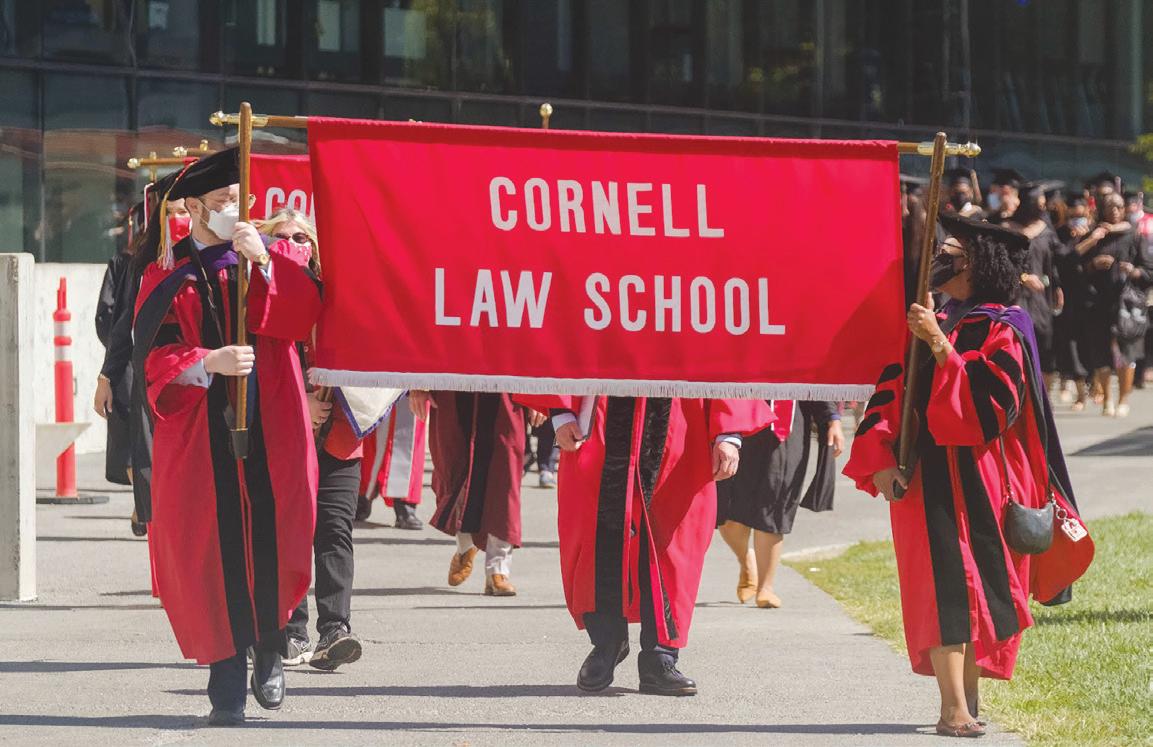
Cornell undergraduate students looking to apply to Cornell Law School do not have to wait until their senior year. Through the Cornell Law 3+3 Pathway, students can jumpstart their law career a year early by finishing their undergraduate studies in three years and forgoing their senior year to start their first year of law school instead.
3+3 reduces the total number of years pursuing an undergraduate and law degree from seven years to six by removing the fourth year of a student’s undergraduate degree and allowing their first year of law
“I really liked what I was studying and... I couldn't picture what I was going to do right after graduation with just an undergraduate degree.”
Brianna Ramos, grad
school to satisfy their senior year course requirements.
The program was originally only offered to Cornell students in the College of Arts and Sciences but has since expanded to include students across the University. Undergraduates at Hobart and William Smith Colleges and St. Lawrence University can also apply.
For Cornellians, one benefit of the program is being able to continue their education in a location with which they are already familiar.
“I really liked what I was studying and I wanted to learn more and do more and I couldn't picture


By CAROLINE MICHAILOFF Sun Staff Writer
Following weeks of campaigning, the Student Assembly freshman representative election results were announced on Friday, Oct. 12. The class of 2026 freshman student representatives are Ronan Chatterji ’26, Kathy Liu ’26, Bahram Mehretu ’26 and Andrew Richmond ’26 — who received 91, 153, 96 and 67 votes respectively. Yujian Yuan ’25 won the transfer seat with 25 votes.
fer representative must be a new transfer student and college or school-specific positions must be held by students enrolled in that particular college or school.
This fall, voting took place during the week after fall break, from Oct. 12 to 14. In the freshman election, of 3,494 eligible voters only 492 cast their votes, leading to a 14.08 percent turnout. This marks a significant drop from both the 29.82 percent turnout rate of fall 2021 and the 22.74 percent seen in fall 2020.
which could be accessed through a link sent to their student emails.
SA Elections Director Isaac Chasen ’23 said it is important for students to turn out and vote in these elections due to the assembly’s role in campus affairs.
what I was going to do right after graduation with just an undergrad degree. I heard about the program and decided that if I get in here, I would choose here,” said Brianna Ramos grad, a current first year law student who applied through the 3+3 Pathway while in the School of Industrial and Labor Relations.
Undergraduates applying must demonstrate they are mentally prepared to give up their senior year. The program is uniquely designed for ambitious students who can thrive in an accelerated environment alongside older, and more experienced law students.
“It’s going to require quite a bit of maturity, both intellectual and emotional maturity, because they are essentially going to school anywhere from a year to 18 months earlier,” said Monica Ingram, associate dean of Admissions and Financial Aid at Cornell Law School.
The workload of a 1L student — the name given to first year students in law school — differs from what most undergraduates might be used to. There are typically no quizzes or tests but only a final exam at the end.
“1L year is really rigorous and it takes a lot of your time and you’re not going to be able to have the same kind of activities going on in your life as your friends who are seniors,” said Amanda Jantzi, director of Student Services and Academic Advising at the Cornell Law School.
Students often have to develop new techniques to successfully adapt to the demanding environment of law school. Some struggle with finding time to read and
The Student Assembly holds regularly-scheduled elections twice a year. Spring elections determine the 20 students who represent the majority of the undergraduate student body, while fall elections determine freshman and transfer representatives and fill vacancies from the spring election. Certain positions are reserved for members of a particular constituency: the freshman representatives must be freshman students, the trans-
In the transfer election, turnout was even worse, falling into the single digits. In fall 2021, 24.69 percent of eligible students voted in that race — this year, with only 43 of 526 eligible voters participating, turnout sank to 8.17 percent.
However, this election season had more candidates than the previous year, with a total of nine candidates running for four positions. Students were able to vote via OPAVote Ranked Choice Vote,
“The Student Assembly helps formulate a wide range of policies on campus, from academic policy to mental health initiatives,” Chasen said. “It is also responsible for allocating the millions of dollars that comprise the Student Activity Fee to Cornell student organizations. We hope everyone will take a few seconds to vote in future SA elections and promote civic engagement on campus, as doing so will help make our Cornell experience better.”
Candidates had to gain 75 petition signatures to get on the ballot for freshman representative. After all petition signatures were collected, a two-week campaigning
By MARISA CEFOLA Sun Contributor
Grab your fish and toothpaste now: Cornell Men’s Ice Hockey began their season last Thursday and players, coaches and fans are excited not only for the games but for the culture that surrounds them.
Since its first season in 1899, the Cornell Ice Hockey program has brought crowds of students, faculty and alumni to Lynah Rink. The strong fan culture — which includes inspiring cheers, taunts and rival-university-specific traditions — has made the sport a unique one at Cornell.
This year, fans are eager to return to the rink for the first full capacity season since 2019. Isaac Chasen ’23 knew little about hockey his freshman year, but the Lynah Faithful community of the Cornell Hockey Association—- a fan-led group representing and supporting the Men’s Ice Hockey team —- inspired him to purchase season tickets for his final year at Cornell.
“From the roar of the crowd when we score to the taunting of the opposing team to the singing of the alma mater after the second period, you always feel as though the Cornell community, as well as the wider Ithaca community, comes together at Lynah,” Chasen said.
Players also said they feel the crowd’s energy when they’re on the ice.
“I believe we definitely feed off the fans' energy during the games,” said Tim Reno ’24, a defenseman. “Whenever the fans are bringing a lot of energy, you can feel it on our bench.”
Captain and defensemen Travis Mitchell ’23
particularly enjoys hearing the pep band play “Gonna Fly Now” and “Gary Glitter” with fans clapping and shouting along to it, which occurs as the players skate onto the ice at the start of the third period.

Warm welcome | Cornell fans read newspapers as the opposing team enters the hockey rink.
“As you make that loop around the net, you see all of the fans doing the clap [chant] and it's a really cool thing to experience,” Mitchell said.
The Cornell Men’s Hockey traditions are often built around historical rivalries with other universities, like Harvard.
To continue reading this article, please
Thursday, October 27, 2022

Community development | Kirk Goodrich ’90 will give a talk on three historic preservation projects in Harlem, New York that drove neighborhood revitalization. Goodrich has spent his 30 year career in community development, affordable housing finance and real estate development and currently serves as president at Monadnock Development LLC.
Dr. Francisco Leal-Yepes Seminar 11:00 a.m. - 12:00 p.m., College of Veterinary Medicine Classroom 7
Allejandro Del Valle - Cornell Health Economics Seminar 11:15 a.m. - 12:45 p.m., Mann 102
Virtual Halloween Themed Pictionary Noon - 1:00 p.m., Virtual Event
Gatty Lecture: Who Wants to Learn About Globalization? A Field Experiment in Vietnam 12:30 p.m., Kahin Center
Romance Studies Open House 2:30 p.m. - 4:30 p.m., Klarman Hall K164

You Have More Influence Than You Think With Vanessa Bohns 4:00 p.m. - 5:00 p.m., Ives Hall 227
Linguistics Colloquium Speaker: David Goldstein 4:30 p.m. - 5:30 p.m., Morrill Hall 106
The Sovereignty of Mothers 5:00 p.m., Goldwin Smith Hall G76
Tita Chico, “On Wonder: Literature, Science, and the Long Eighteenth Century” 5:00 p.m., A.D. White House, Guerlac Room
EDS Seminar: Peter McMahon: Computing with Physical Systems Noon, Phillips Hall 233
Pizza on the Patio Noon - 2 p.m., Uris Hall Terrace
Kirk Goodrich: Transformative Development: A New Lens To Evaluate the Impact of Real Estate Projects 12:25 p.m., Milstein Auditorium
Virtual Information Session for Dual Degree Programs (Regional Planning and Landscape Architecture Or Real Estate) and Minors in CRP Graduate Studies 1:30 p.m. - 2:30 p.m., Kennedy Hall 213
annotate long cases, while others may not know how to balance their work and social lives.
“The biggest thing for me was the lack of the schedule. Your entire grade for most of your classes is just the final so throughout the semester, you are holding yourself accountable to do your readings and go to class and participate,” Ramos said.
3+3 applicants must meet several requirements in order to be eligible for the program, including having already completed at least 108 academic credits throughout their three years of undergraduate studies. This means students interested in the program must take extra credits early on in their undergraduate degree.
“Oftentimes, undergraduate students haven’t thought that far ahead,” Ingram said. “The program is very hands-on and there’s a lot of self-determination and there are oftentimes undergraduates who don’t fit that profile.”
For those who do qualify for the 3+3 program, there are many advantages, including not having to take the LSAT if they have either an SAT or ACT score on record.
“Being a first-gen student, there’s a lot of resources and money that goes into the LSAT and not everyone has time and money to spend three months of their lives preparing for a huge exam,” Ramos said.
The program also ensures students save on a year of tuition by removing senior year, reducing the financial burdens of tuition, housing, and loan payments. According to Jantzi, saving money is the biggest benefit of the program for the vast majority of applicants.
While the program has benefits, some students feel they are put at a disadvantage by starting law school at a younger age compared to law students who took time after their undergraduate years to experience and explore legal careers first hand.
“When everybody goes to grad school, you’re at such different places in life,” Ramos said. “There’s people who are married, there’s peo-
ple who took two years off, or five years off. Everyone’s coming out of different places.”
Though 3+3 Pathway students may be younger and more inexperienced, they are not necessarily disadvantaged in their ability to perform well in law school.
“A lot of them are coming from Cornell or coming from a really rigorous academic environment so they tend to transition well into 1L year,” Jantzi said. “Most of them have told me they’ve wanted to be a lawyer for a really long time, so for them it’s just an opportunity to get to that career faster.”
3+3 is not the only way for students to gain law school experience during their undergraduate degree. As Jantzi notes, undergraduates can
“There are such rich traditions that are embodied within Cornell University that are mirrored within the law school that make them [Cornellians] attractive candidates.”
Monica Ingram
also take classes in the law school. For those who do pursue the program, it is highly selective.
“This is not designed to be a large program,” Ingram said. “It may be attractive to a lot of individuals, but it’s not going to be one that’s doable for the majority of students.”
However, Ingram welcomes undergraduates to apply and said she likes to see the 1L class filled with Cornellians.
“Our goal is always to have as many Cornellians in the class as possible,” Ingram said. “There are such rich traditions that are embodied within Cornell University that are mirrored within the law school that make them attractive candidates.”
Breanna Masci can be reached at bmm223@cornell.edu.
period followed, which included an SA-hosted a forum for candidates to better publicize their ideas. This year, many campaigns included promises of more social events for the freshman class and overall making Cornell a positive environment.
Being in the assembly is a big change for the new representatives. For Richmond, it’s his first time being in student government and will be a chance to get to know his class as he serves them.
“I have always been inspired by community engagement and activism and I believe that being elected to this position will allow me to grow as a person by hearing diverse perspectives, but more importantly, help me to ensure that the voices of my classmates are heard and that their needs are met,” Richmond said.
Chatterji said he decided to run for first year representative due to his connections within the freshman class.
“This position means so much to me,” Chatterji said. “I understand the importance of my duties. I’m one of four freshmen representing the entire class working with the administration.”
Many of the students who won, such as Liu, campaigned on improving campus services for students, such as shortening lines at the RPCC mailroom, free laundry, more printers, air conditioning for all students and more student organization funding.
For Mehretu, representation was also an issue. He said he ran for freshman representative to increase the number of diverse voices in the assembly that could bring insights on minority student issues.
“The experiences I face and the experiences the majority of the student population on campus faces are very different,” Mehretu said. “I ran for freshman [representative] with the understanding that the insight I could bring to
the Student Assembly would be very much beneficial to the minorities on campus.”
Despite needing to adjust to the new position and learn more about how he can help his class, Chatterji said he feels popular and happy after the election.
“People coming up to me to tell me they voted really made me feel like a significant part of the school community,” Chatterji said. “I realized that not only does everyone like me as a person, but a significant percentage of the freshman class felt like I was the best freshman to represent them and voice their concerns.”
Caroline Michailof can be reached at cmichailof@cornellsun.com.

By ALEXIS ALTON Sun Contributor
As first-year students across campus have spent the first half of their first semester forming friendships, first-year student athletes are also building relationships with their teammates, often by eating together.
Winter Wallace ’26, a member of the men’s ice hockey team, explained that the team finished practice at 5:30 p.m. two days per week and at 6 p.m. two days per week., but smoothies, stretching, saunas and ice baths after practice mean that he arrives at North Campus dining halls around 8 p.m..
Because many team practices run as late as 8 p.m., Cornell Dining provides dining options and spaces for these team meals to occur, even after practice is over. Evan Nesmith ’26, a member of the football team, said that although there are options on campus that ensure teams can eat, he still wishes for longer dining hall hours. Most dining halls close between 7-9 p.m., sending student athletes to late night eateries like Bear Necessities instead.
Caleb Straayer ’26, a member of the men’s track team, agreed with Nesmith, but acknowledged that there are challenges with keeping the dining hall open later. He is optimistic
about a potential solution.
“It’d be great if they could be open ‘til later although I am aware, of course, of the staffing issues, so somehow finding a way around that problem would definitely be beneficial for student athletes,” Straayer said.
Although students like Wallace are happy with the meal options available at dining halls and said that workers do a good job restocking food even near closing time, others like Josh Shea ’26 (who plays for the men’s baseball team) think there is room for progress, such as increasing protein and healthy starch options that athletes rely on for energy, and keeping stations open longer.
“There are days where it feels easy to get the necessary nutrition and days where it feels difficult, so I think having more consistency when it comes to healthy options would be great,” Shea said. “Additionally, extending the breakfast hours would be huge because after a morning workout and class, it would be great to still be able to get some breakfast foods in the morning.”
To continue reading this article, please visit www.cornellsun.com.
Alexis Alton can be reached at ama344@cornell.edu.


By Jimmy Cawley Dining Staff Writer
It’s no secret that the Ithaca McDonald’s is busy. I can comfortably say that I have consistently waited for over 20 minutes in the drivethrough line most times I’ve gone (excluding the midnight snack runs). In fact, the Ithaca McDonald’s drive-through is regarded by locals as one of the busiest drive-throughs in the state.
As a frequent patron of the Ithaca McDonald’s drivethrough myself, I needed to find out a bit more about what makes our McDonald’s drivethrough different.
Before proceeding further, it is important to note that Ithaca has two McDonald’s locations. There is a location on Triphammer Road, right next to the (decrepit) Ithaca Mall, which is the McDonald’s closest to Cornell — about seven minutes away — and also the location I will be referring to throughout this piece. However, more recently, there is also a newer location on Elmira Road next to Home Depot, which is about 12 minutes from campus.
The Triphammer Road McDonald’s is a stone’s throw from Route 13, a major commuting route out of Ithaca to Dryden, Cortland and surrounding rural areas. It is also along the way to Lansing, a major suburban area surrounding Ithaca.
Most reviews of this McDonald’s across a variety of platforms such as TripAdvisor and Yelp seem to agree with me that the wait times at this location are unbearable.
One review from Yelp, written this past July, reads, “Can someone tell me why I am always waiting 20+ minutes at drive thru. This is an ongoing problem with this McDonald’s.”
Along with this unhappy customer, there are dozens of other reviews complaining about similar wait times in the drive-through.
This past weekend on the way to a hike around 9 a.m., I passed by the McDonald’s and glanced over to see a line of cars wrapped around the building, all hoping to grab a tasty breakfast. I was reminded of the lore regarding this McDonald’s popularity, so I went inside to check it out.
Shockingly, when I walked inside, I was greeted by a mostly empty store. There was a couple sharing a meal in the back, but no line to order.
I admired the line of around 15 cars outside in the drive through, and was especially curious about why so many people opt for the drive-through
Although the Elmira Road McDonald’s is also on Route 13 out of Ithaca, it is surrounded by half a dozen competitors, ranging from KFC to Wendy’s. The Triphammer Road McDonald’s, on the other hand, is the only source of fast food for miles, facing no competition (excluding the sad Subway located in a strip mall nearby).


instead of the faster option of going inside.
A quick Google search informed me that during the peak of covid, McDonald’s closed their interior to customers, and instead encouraged people to use the drive through. It is likely that many people became accustomed to this habit and still, well after the peak of COVID, use the drive through for safety and convenience.
Shaylyn Nair ‘25 worked at the McDonald’s on Tripham-
mer Road during the summer of 2020, during the peak of the pandemic. Nair said that at the beginning of the summer, they implemented a policy where customers could come to the counter to order, but could not dine in. Nair suggested that this contributed to the routine of using the drivethrough which people began to develop.
Nair said, “People mainly used the drive-through and it was normally busy, but espe-

cially during the dinner rush when we scrambled to meet the demand.”
I also wondered how long the average person waited when going to the Triphammer Road McDonald’s. Nair replied, “I would say that the average person waited around twelve minutes to get their food, but often people waited much longer.”
For potentially the busiest McDonald’s location in New York State, 12 minutes doesn’t seem too shabby.
“People were aware of the fact that the location was one of the busiest. There was a sign that was up in the kitchen mentioning it but people didn’t talk about it too much,” she said.
Soon after I received the sausage and egg meal I ordered, I ravenously devoured it, realizing the mediocre patty probably wasn’t worth even the $3.99 price tag.
However, it felt remarkable standing within perhaps the busiest McDonald’s in New York. This McDonald’s stands as the closest fast food option to Cornellians with a drivethrough open until midnight weekdays and 24/7 on weekends. I urge all of you to check it out — though perhaps not during peak hours if you want your food before it’s cold.
SERENA HUANG ’24
Business Manager
EMMA LEYNSE ’23
Associate Editor
SURITA BASU ’23
Assistant Managing Editor
NAOMI KOH ’23
Assistant Web Editor
ELI PALLRAND ’24 News Editor
ESTEE YI ’24
KAYLA RIGGS ’24
JULA NAGEL ’24
BHATIA ’24
KATRIEN DE WAARD ’24
PAREESAY AFZAL ’24
JIWOOK JUNG ’25
ADITI HUKERIKAR ’23
JASON WU ’24
GRAYSON RUHL ’24
CHENG ’25
HANNAH ROSENBERG ’23
JYOTHSNA BOLLEDDULA ’24
VEE CIPPERMAN ’23
Editor in Chief
ANGELA BUNAY ’24 Managing Editor
TRACY ZENG ’24
’24
’23
’25

Brenner Beard (he/him) is a junior in the College of Arts and Sciences. He can be reached hbb57@cornell.edu. Agree to Disagree runs every other Tuesday this semester.
If you have an Instagram and are a Cornellian, you probably have run the gambit of loosely affiliated Cornell instagrams. They range from club accounts such as @cuairmae or @cuabs for example, all the way to the outspoken @bigredvirgins. One such account that strays towards the latter side of the big red social media landscape, is @bigredmissedconnections.
BERNSTEIN ’23
ROSENBERG ’23
Ad Layout Aditya Sumar ’24
Managing Desker Surita Basu ’23
Associate Desker Emma Leynse ’23
Dining Desker Jimmy Cawley ’25
News Deskers Eli Pallrand ’25
Pareesay Afzal ’24
Science Desker Meher Bhatia ‘24
Photography Desker Jason Wu ’24
Production Desker Katrien de Waard ’24
Want to give your take on a campus issue?
The Sun thrives on your feedback. Continue the conversation by sending a letter to the editor or guest column to associate-editor@cornellsun.com.
Letters should be no longer than 250 words in length. Columns are 700-900 words
Please include graduating year if applicable.
All voices welcome.
In a nutshell, it caters towards Instagram-using Cornellians by providing them with a public anonymous forum for publishing opinions, giving truth to their desires and pining for a cute classmate from afar, that they missed the opportunity to speak to. Some posts are sweet and some are hyper-sexual, but all deal in missed opppurtunities. An unspoken word here, an awkward glance there, these nearly daily posts in black and white are an archive of chances not taken. The account is a database of the hundreds of times a person thought one thing but did another.
In a way, I love it. As a liberal arts major who has indulged in history and anthropology courses, it is a veritable gold of a primary source. It illustrates a microcosm of campus culture. Love sought after, love beginning and sometimes the tears shed over a love ended. In all fairness of course, love is a bit of a stretch. Some of the more distasteful posts include phrases like “pound town,” “bang” and “have my kids.” You get the idea.
But, at the same time, one can imagine that polling our Cornellian forefathers would elicit somewhat similar responses. Think what you want, but I doubt being a 20-year-old in the 1870s made you inherently more refined.
Yet, despite this continuation of collegiate hormonal tradition, I also have misgivings about the anonymous musings on @bigredmissedconnections. There is
But, at the same time, one can imagine that polling our Cornellian forefathers would elicit somewhat similar responses.
a reason the word missed is featured prominently in its handle. These are all thoughts that remained thoughts and so many of them are painted with a shade of regret as well. Each little black square is an epitaph to what could have been; whether that be a relationship, a wild
fling, a “mid” Saturday-night hook-up or simply a friend.
Maybe this is over-dramatizing a silly instagram account. Certainly, restraint is good. As semi-adults we learn and practice that daily. I would agree that the post, “Who’s the brunette on the equestrian team with the fat a**” deserves to remain locked up in the confines of a person’s pleasure seeking amgdyala. For god sakes, don’t ever lead with that.
If @bigredmissedconnections can be taken at face value, it would appear that so many Cornellians are wilfully closing the door on their chance at some more marginal happiness.
Yet, many of these passing fancies aren’t so crass. And they wouldn’t remain as regrets if the thinker had the courage to be a speaker instead.
So what’s my point? This isn’t meant to be an overly philosophical analysis of an anonymous online confessional, but rather the power of spoken word. We all deserve the same chance at happiness. Yet, if @bigredmissedconnections can be taken at face value, it would appear that so many Cornellians are wilfully closing the door on their chance at some more marginal happiness. They sit in class thinking about approaching a potential new friend but then the class ends and they take to Instagram again. Screaming into the void over and over and over again.
To the disciples of @bigredmissedconnections and all those suffering from the pangs of regret, I implore you to speak up. You’re here for four years and four years only. What’s the harm in putting yourself out there? Take a chance, say hello to the boy in your lab class, the cute barista or the cool chess player in your dorm. It doesn’t have to be with any degree of romantic intent. Making friends and meeting people requires a voice just as much.
Speaking your mind and making a fool of yourself is better than letting the thought pass you by and living with the concerns of what could have been. And as for @bigredmissedconnections, don’t give them free content.
Fill in the empty cells, one number in each, so that each column, row, and region contains the numbers 1-9 exactly once. Each number in the solution therefore occurs only once in each of the three “directions,” hence the “single numbers” implied by the puzzle’s name. (Rules from wikipedia.org/wiki/ Sudoku)


By SAM JOHNSTONE Sun Staff Writer
Jicamarca Radio Observatory, a scientific facility for studying the equatorial ionosphere located in Lima, Peru, recently received over $12 million in grants to help expand. Dating back to the 1960s, the facility is run by the Geophysics Institute of Peru and aided by Cornell and the U.S. National Science Foundation.
The observatory’s claim to fame is its main antenna, which is composed of over 18,000 dipole antennas and covers over 90,000 square meters of the desert. It is the largest incoherent scatter radar in the world, working to send radio signals towards space and gather information.
Professor David Hysell, earth and atmospheric sciences, has been working with the observatory since the 1990s when he was a grad student at Cornell.
“I did my thesis work at this observatory,” Hysell said. “Now I’m the principal investigator for the National Science Foundation award that is mainly responsible for funding it.”
Hysell works with the observatory’s director, Danny Scipion, to steer technological development, prioritize the expansion of certain systems and articulate requests for changes in proposals to the National Science Foundation.
Because the facility has been
open for over 60 years, Hysell said that drastic modernization has occurred and almost none of the equipment is leftover from the original days.
“Really everything has changed — the way signals are acquired, generated, processed and everything like that,” Hysell said. “A lot of equipment has come and gone abd the only thing that’s really still original is the antenna.”
Despite the changes, the facility’s mission has stayed the same: collect data to add to their already substantial database on space physics and space weather.
Hysell is currently working with a team of scientists to see if they can gather echos from the sun. Hysell explains that as the sun ejects material into the solar wind, it does so in an irregular way, hitting the earth and creating weather in space. The team at Jicamarca hopes to observe this process, learning more about space and possibly making predictions to see what type of weather is headed towards Earth.
As of now, his team has yet to find any evidence, but is optimistic that the recent grant will allow the team to fund equipment upgrades — such as making the antennas steerable, replacing old equipment and buying technically better equipment — that will make the observation a success.
Also working with Jicamarca to advance upgrades is Fabiano

Rodrigues, an associate professor of physics at the University of Texas, Dallas. Rodrigues recently lead a $2.8 million grant from the National Science Foundation, part of the overall $12 million grant.
Working together with a team, Rodrigues held weekly meetings to discuss what type of science questions they wanted to address. From there, they asked themselves what types of observations
and experiments the community would benefit from the most. Together, they took all of those questions and wove them together into a document that they sent to the National Science Foundation.
“We really want to serve different areas of research and make it available to the community so that the facility can continue to provide state of the art observations,” Rodrigues said.
In a 50-page proposal,
Rodrigues advocated the building of two new receiving systems that would allow the observatory team to gather info beyond a single path, greatly increasing the team’s ability to research radio astronomy.
To continue reading this article, please visit cornellsun.com.
By EMMA ARBOLEDA Sun Staff Writer
On Oct. 4, the 2022 Nobel Prize in Chemistry was awarded to Carolyn R. Bertozzi, Morten Meldal and K. Barry Sharpless for their work in the development of click chemistry and bioorthogonal chemistry, which will allow for improved medical treatments and diagnoses among various other applications.
Prof. Jeremy Baskin, chemistry and chemical biology and Prof. Pamela
Chang, microbiology and immunology, were PhD students in Carolyn Bertozzi’s lab and worked on the bioorthogonal chemistry research that contributed to the nobel prize.
The term “click chemistry” was coined by Sharpless and was further developed by Meldal, who independently introduced a process called copper-catalyzed azide-alkyne cycloaddition. Though the name appears complex, the mechanism is relatively simple and involves “clicking” together molecules like Legos. This synthesizes a product with high yield
and limited byproducts while using copper as a catalyst to do so.
“Preceding click chemistry, most chemical reactions [were] messy, producing side-products and requiring lots of purification efforts,” Baskin said. However, click chemistry proved to be a means to resolve this.
The Nobel prize-winning research is revolutionary in the artificial design of complex molecules. Click chemistry has widespread uses such as the development of pharmaceuticals, mapping DNA and creating materials more fit for purpose. However, click chemistry can also be applied inside of an organism, which is where bioorthogonal chemistry — chemical reactions that can occur inside of living systems without interfering with biological processes —comes into play.

“[Bertozzi] was studying sugars on the cell surface in the 1990s and was frustrated that there was no way to tag them to track and analyze them, so she invented two highly selective chemical tagging reactions, collectively termed bioorthogonal because the two components that react do not cross-react with the thousands of molecules in living cells,” Sharpless said.
Using this foundation, Baskin and Bertozzi’s team were able to connect click chemistry to bioorthogonal chemistry in order to track cells without altering their functions. Bertozzi’s application of click chemistry in living organisms will allow for the tracking of biological processes which have already begun to revolutionize modern medicine.
Baskin’s research in Bertozzi’s lab involved synthesizing, and applying highly reactive compounds for imaging cell-surface glycans in live mammalian cells and live zebrafish embryos and larvae during their development with work cited by the nobel prize announcement.
During her time working in Bertozzi’s lab, Chang demonstrated that copper-free click chemistry works in living animals by studying laboratory mice and applying bioorthogonal chemistry.
“I applied bioorthogonal chemistries to image glycans on live cells and label glycans in laboratory mice. I also worked on chemical strategies to selectively label specific cells in vivo, e.g., cancer cells, using targeted pro-drug strategies,’’ Chang said.
Bertozzi is also the first openly gay woman to win the Nobel Prize Chemistry. “It’s a very compelling example of how embracing diversity of people can lead to diversity of thought and new ideas that can basically establish a whole new field of science,” Sharpless said.