

Oct. 26: vs. Michigan
Oct. 27: vs. Michigan
Nov. 2: vs. Yale
Nov. 3: vs. Brown
Nov. 9: at Northern Michigan
Nov. 10: at Northern Michigan
Nov. 16: vs. Quinnipiac
Nov. 17: vs. Princeton
Nov. 24: vs. Harvard at Madison Square Garden
Nov. 30: at Dartmouth
Dec. 1: at Harvard
Jan. 4: at Princeton
Jan. 5: at Quinnipiac
Jan. 11: vs. Arizona State
Jan. 12: vs Arizona State
Jan. 18: vs. Harvard
Jan. 19: vs. Dartmouth
Jan. 25: at Colgate
Jan. 26: vs. Colgate
Feb. 1: at Union
Feb. 2: at Rensselaer
Feb. 8: vs. Clarkson
Feb. 9: vs. St. Lawrence
Feb. 15: at Brown
Feb. 16: at Yale
Feb. 22: Rensselaer
Feb. 23: Union
March 1: at St. Lawrence
March 2: at Clarkson

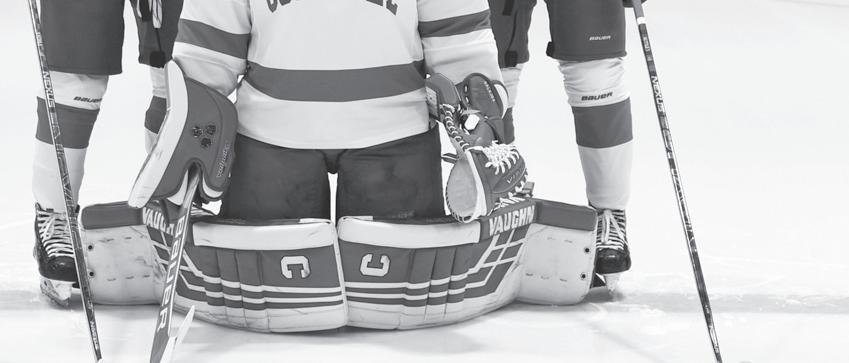

By DYLAN McDEVITT Sports Editor
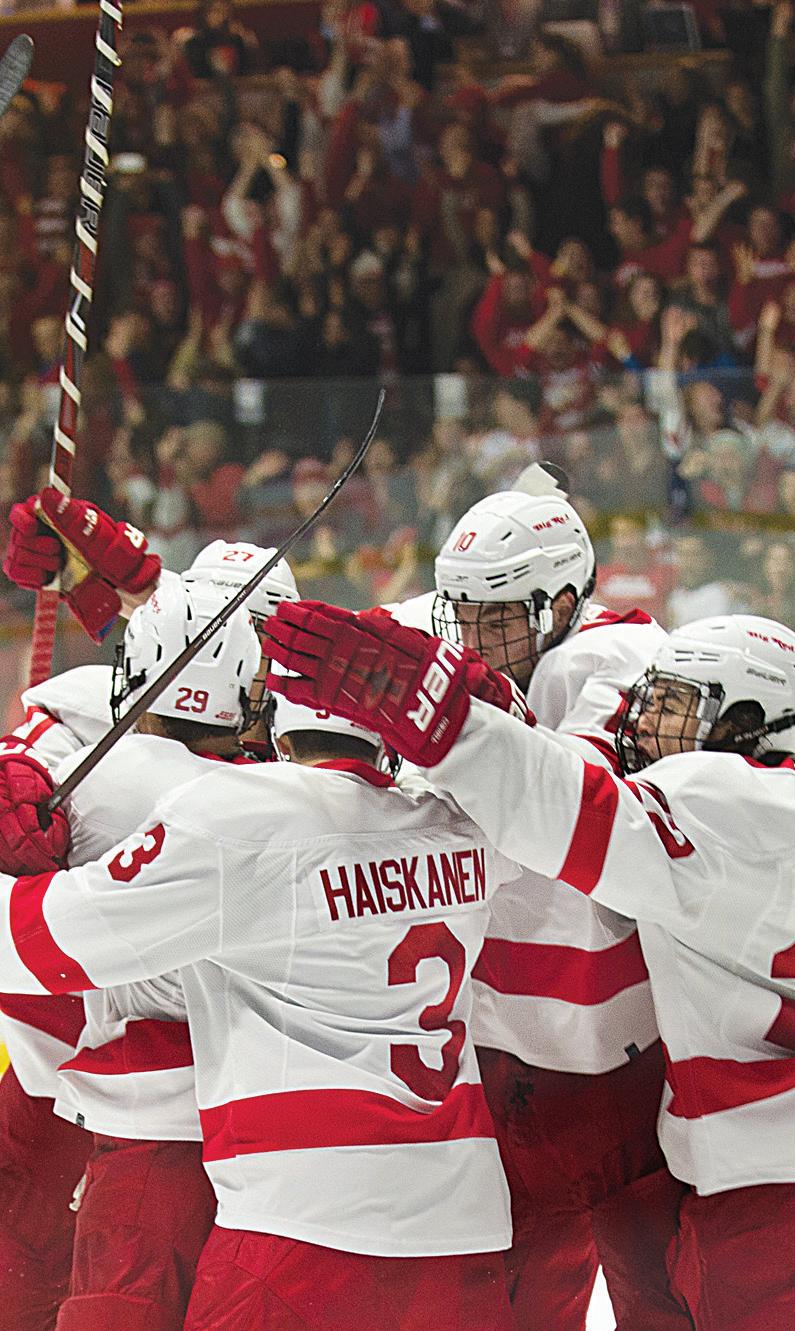
The 2017-18 Cornell men’s hockey regular season was one to remember, complete with an ECAC title, a national No. 1 ranking and countless individual and team statistical accolades for the ages.
Then came the tournaments.
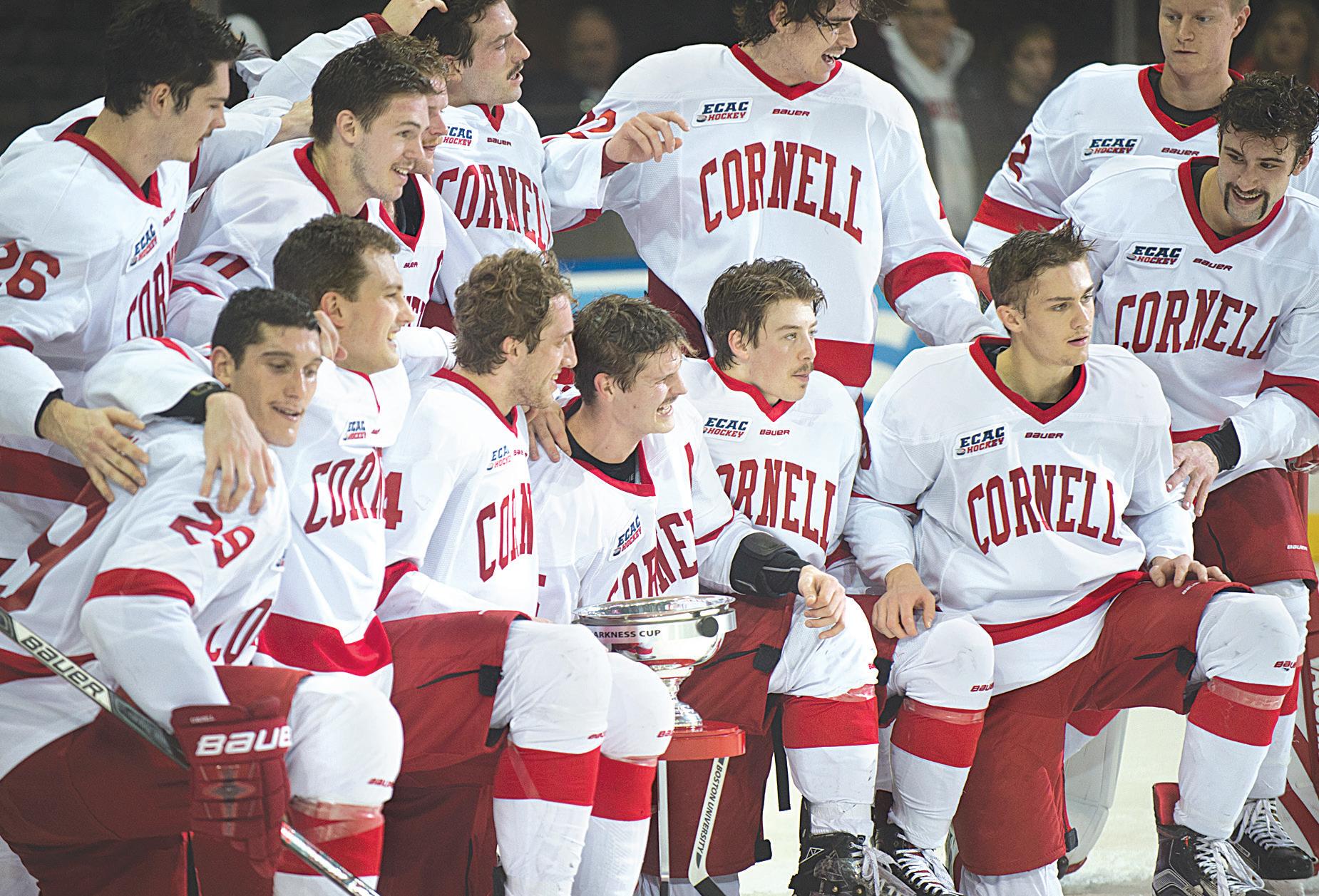
The only losing streak in Cornell’s 25-6-2 season arrived in consecutive postseason elimination games — the ECAC semifinals against Princeton and NCAA opening round against Boston University. In the end, after the program’s most successful regular season in more than a decade, the Red was left with nothing to show for it.
Now, Cornell faces a challenge: address the need to start fresh without leaving the pain of last year’s failures totally behind.
of players who didn’t experience the ups and downs of last season. But the other 20 Cornell players did. With tons of talent returning — including the entirety of the nation’s best defense — the ingredients for success are there. All that’s left is to devise the formula that will repeat last year’s success.
And then some, hopefully.
“That’s nearly a third of our team that didn’t experience last year firsthand,” said senior forward and now-two-time captain Mitch Vanderlaan. “At the end of the day, I think the biggest thing is just recognizing that we all have one main goal. Different motives and perspectives kind of help each guy to the best they can be to all go towards that one goal. That’s the ideal.”
That one goal is to win. Win against Michigan State this weekend. Win the Ivy League. Win the ECAC. Win the NCAA championship.
“How we played against Princeton and B.U. were probably two of our better games. But we lost both games. There’s no ribbon for that.”
Head Coach Mike Schafer
’86
“Last year didn’t leave a good taste in our mouth,” head coach Mike Schafer ’86 said at pre-season media day. “Statistically, how we played against Princeton and B.U. were probably two of our better games the whole season. But we lost both games.
“There’s no ribbon for that.”
The memories of last season’s unscored goals, unblocked shots and unmet expectations remain. Without question, those memories will serve as a hefty dose of inspiration.
“It motivates us a lot,” senior defenseman and alternate captain Alec McCrea said of his team’s failure to capitalize in the postseason. “Not only to get back to where we were but advance farther.”
Yet the question remains whether those lingering memories will be a help or a hindrance. In the wake of last March’s events, Schafer has emphasized the need to get back to basics and set course from the start.
“We’re getting right back to ground zero,” he said. “The season’s starting over.”
With eight freshmen, there’s a hefty chunk
“It’s easy to forget just how much work we actually did to get [to the playoffs],” Vanderlaan said. “So right now the focus isn’t the end of the year, it’s how we’re going to get better this week.
“Obviously, we want to win this year,” Vanderlaan added. “Looking long ways we’d like to win a national championship; we’d like to win the ECAC. But right now we’re not getting ahead of ourselves.”
The one-game-at-a-time process was present all throughout last season, and there were moments where it felt as though getting away from it was a crucial misstep. Just days after being crowned the No. 1 team in the nation, the Red fell flat on its face at home to a lousy Rensselaer team. After redeeming that loss on RPI’s ice and clinching the Cleary Cup, Cornell put up a weak effort against a strong Union team in the regular season finale, when the playoff scenarios had already been determined.
Still, with just four total losses in the regular season, it’s clear Cornell was doing something right. The mental and physical preparation was sufficient to fuel a team that, for a long stretch of the season, was a juggernaut that seemed all but unbeatable. Building on that is a hugely important step on the course to accomplishing more — something the team believes falls squarely on the shoulders
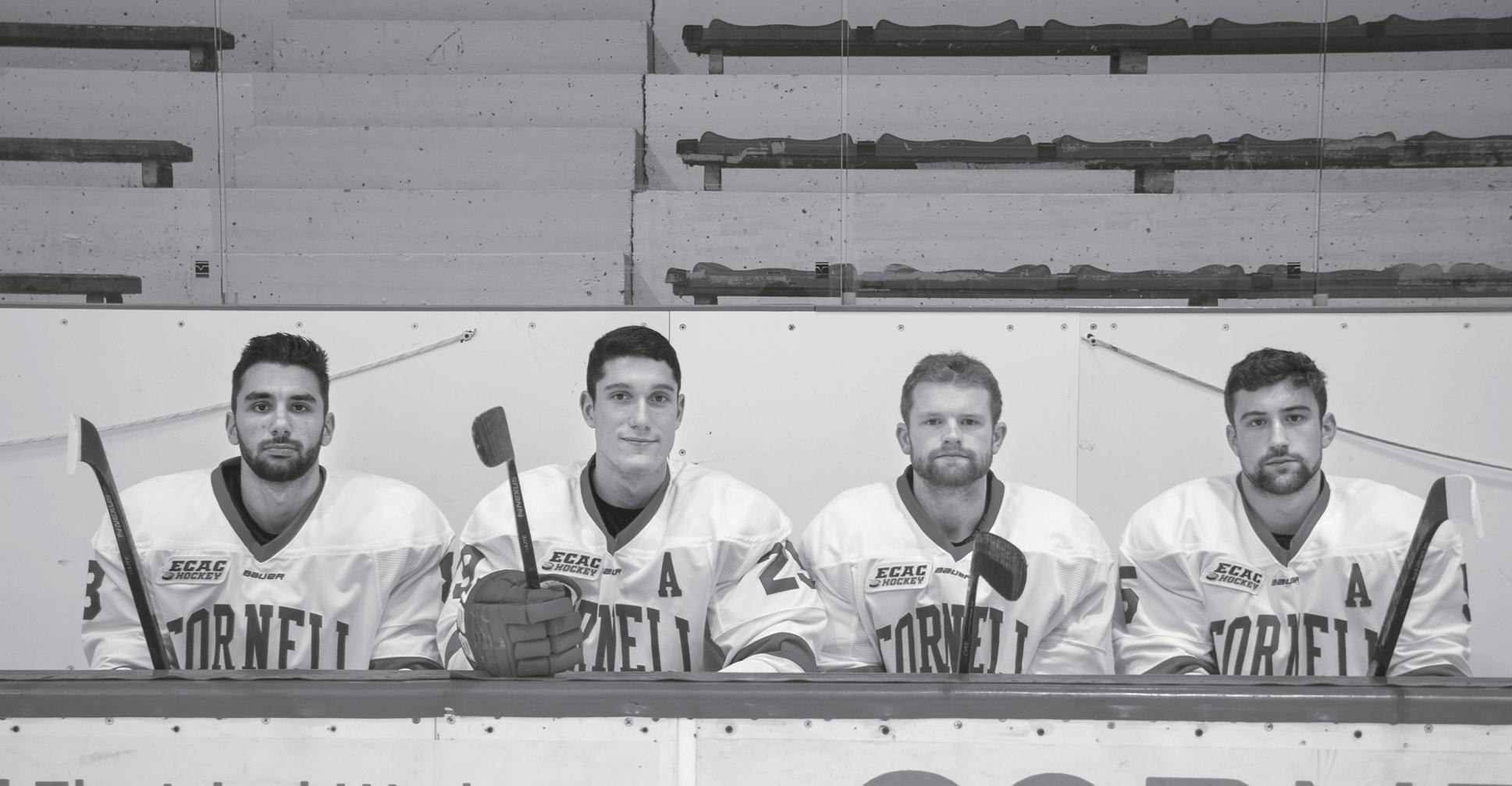
of the upperclassmen.
“You always have an influx of talent with freshmen, but the biggest improvement within a team is your sophomores, juniors and seniors,” Schafer said. “Those guys have to come back and play with more poise and understand what it takes to play at this level, night in and night out. Play when you’re tired, when you’re hurt, when you’re sick.”
A grind-it-out mentality defined Cornell’s 2017-18 season. With a handful of comefrom-behind wins and a few more that were nail biters until the end, it consistently felt like Cornell had what it took to gut out victories night-in and night-out. Until it didn’t.
The lessons learned from the playoff shortcomings and the motivations they bring are critical components of the winning formula. But the need to return to the old ways of hard work, sacrifice and grit is even more profound than it was last season.
“The culture from knowing how to win, from knowing how to block a shot, from absolutely anything with our program, we start all over,” Schafer said.
This time last year the stakes were different. Cornell was picked third in the conference behind Harvard and Quinnipiac — teams it would later beat a combined six times. And while the 2016-17 season had also ended with a loss in the first round of the NCAAs, the appearance then was an impressive feat in its own right.
Now, the team has been chosen to finish first in the ECAC and is ranked No. 8 in the country. The expectations are much higher, so the pressure is on. That makes the mentality as important as ever.
Scores of questions remain unanswered. Which forwards will step up to fill the gap of top scorers who are gone? Will the freshman class make their presence known early? Can sophomore goaltender Matt Galajda recreate his tremendous success?
Whatever the answers, they will be imperative to the winning formula that Cornell is hoping to create. For now, at least one thing is abundantly clear.
“There’s always work to be done,” Schafer said.
Dylan McDevitt can be reached at dmcdevitt@cornellsun.com.
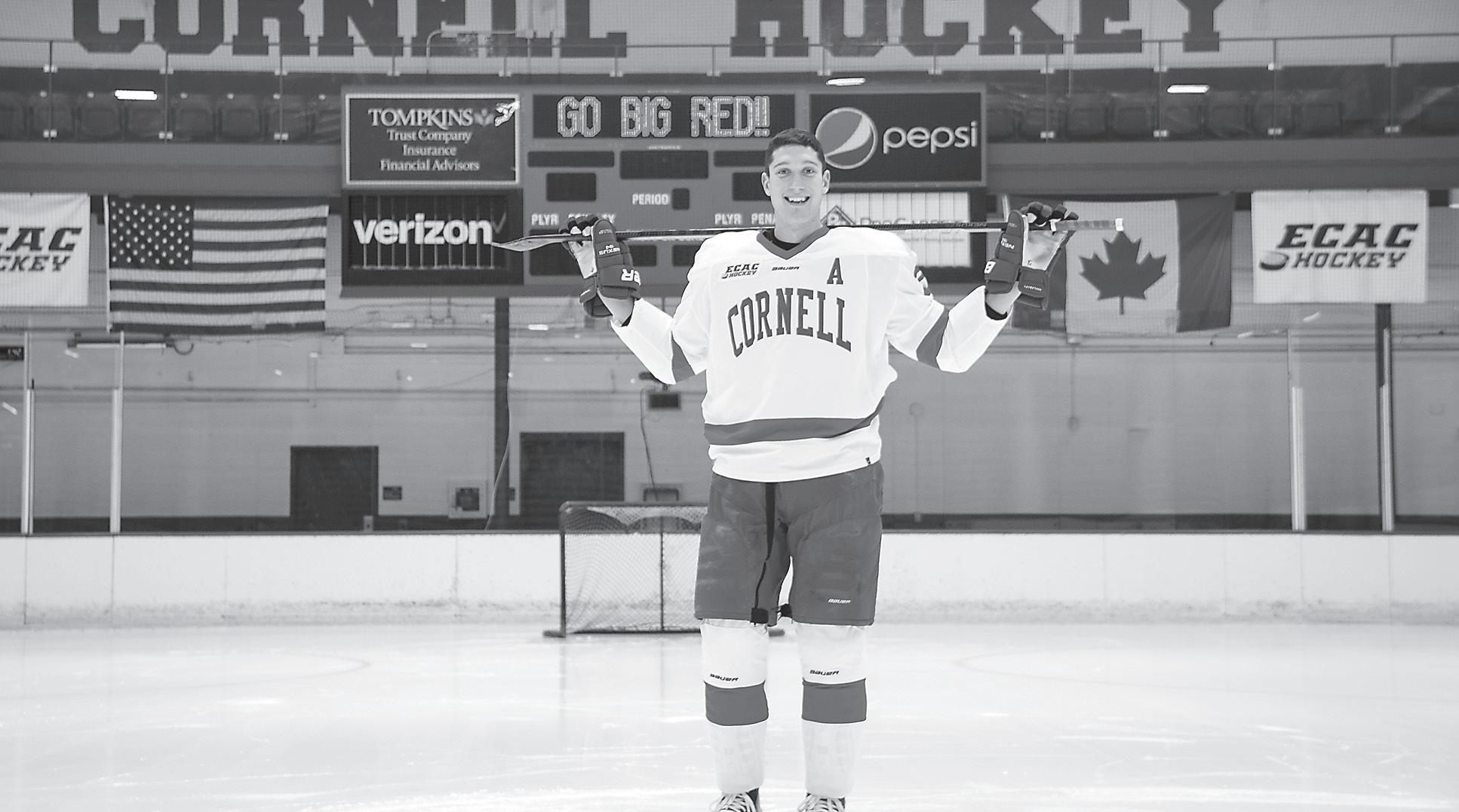
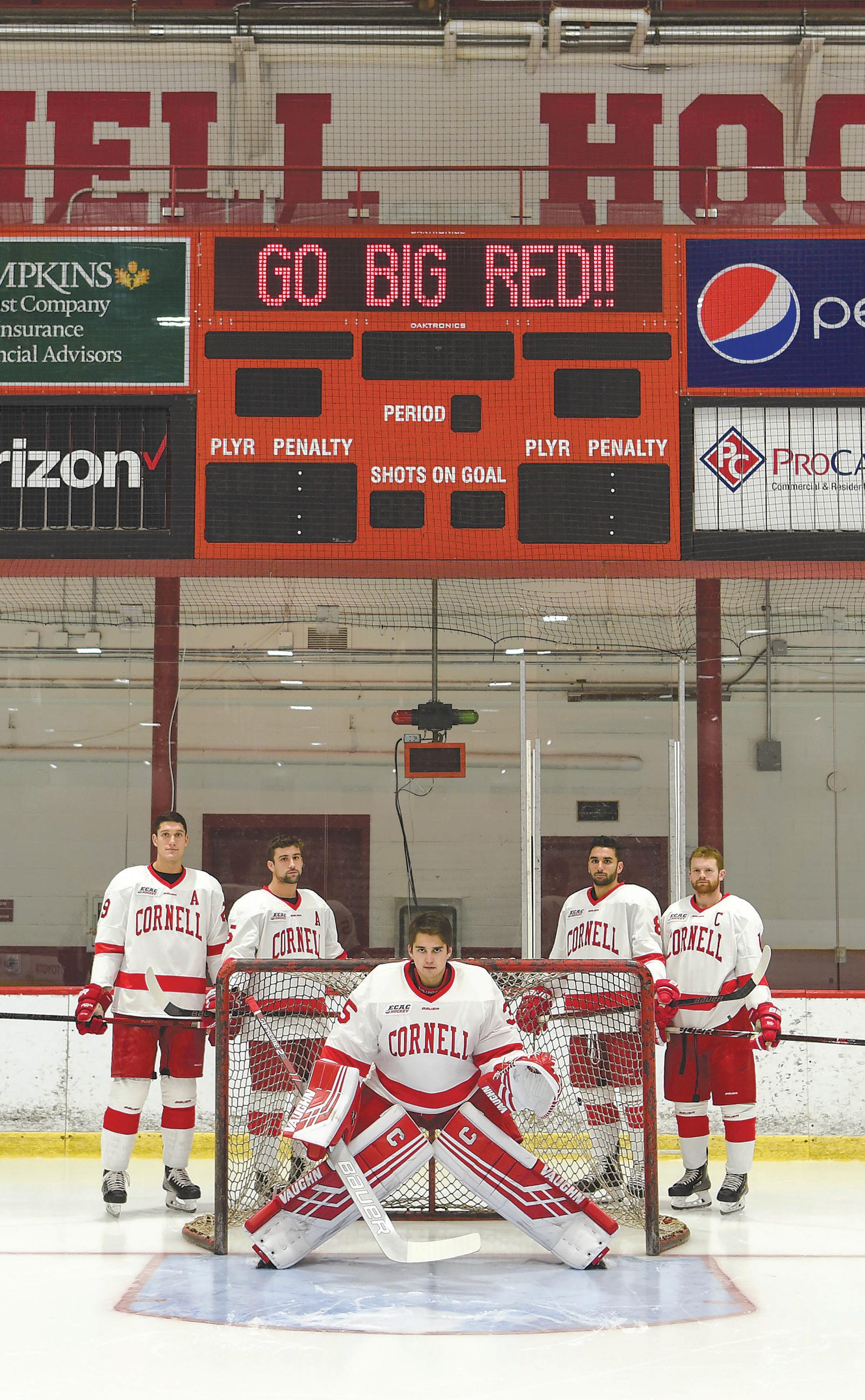
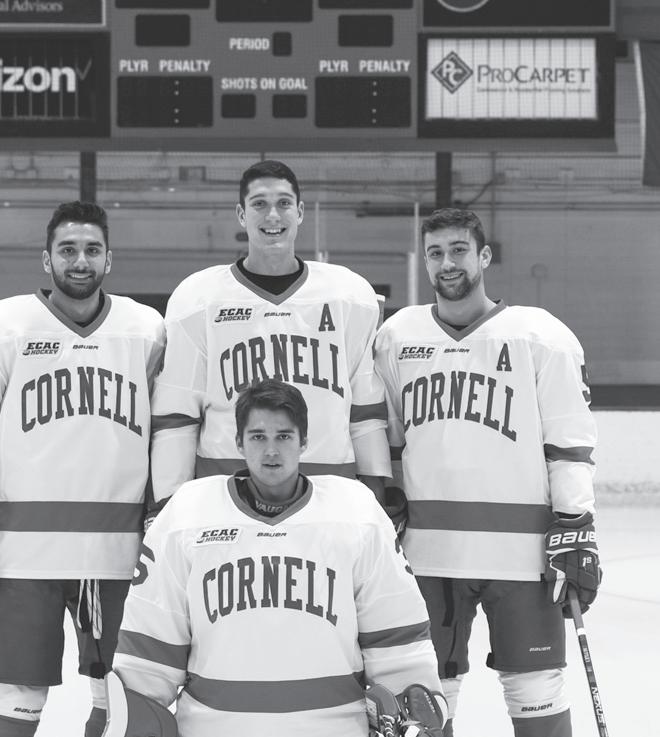
Four-year journey | Alec McCrea and the rest of the seniors for Cornell men’s hockey have seen a program develop into a powerhouse over their time. Now
By JACK KANTOR Senior Writer
The past few years Cornell men’s hockey tells a story of improved success and a rise to prominence. With the team improving its record each year since 2015-16, the current seniors have seen the progress unfold before their very eyes.
And while the five of them each skated in the same games, in the same rinks, on the same ice, for the past three years, each has forged his own path and written his own story alongside the team’s.
“They are all great kids and great people,” head coach Mike Schafer ’86 said of his senior class. “But they have all gone through their own little journey within the four years.”
For the team, each story provides something for the younger players to learn from. And as for the fans, there’s something to appreciate about these veterans and their stories of struggles and successes.
Mitch Vanderlaan - Forward (C)
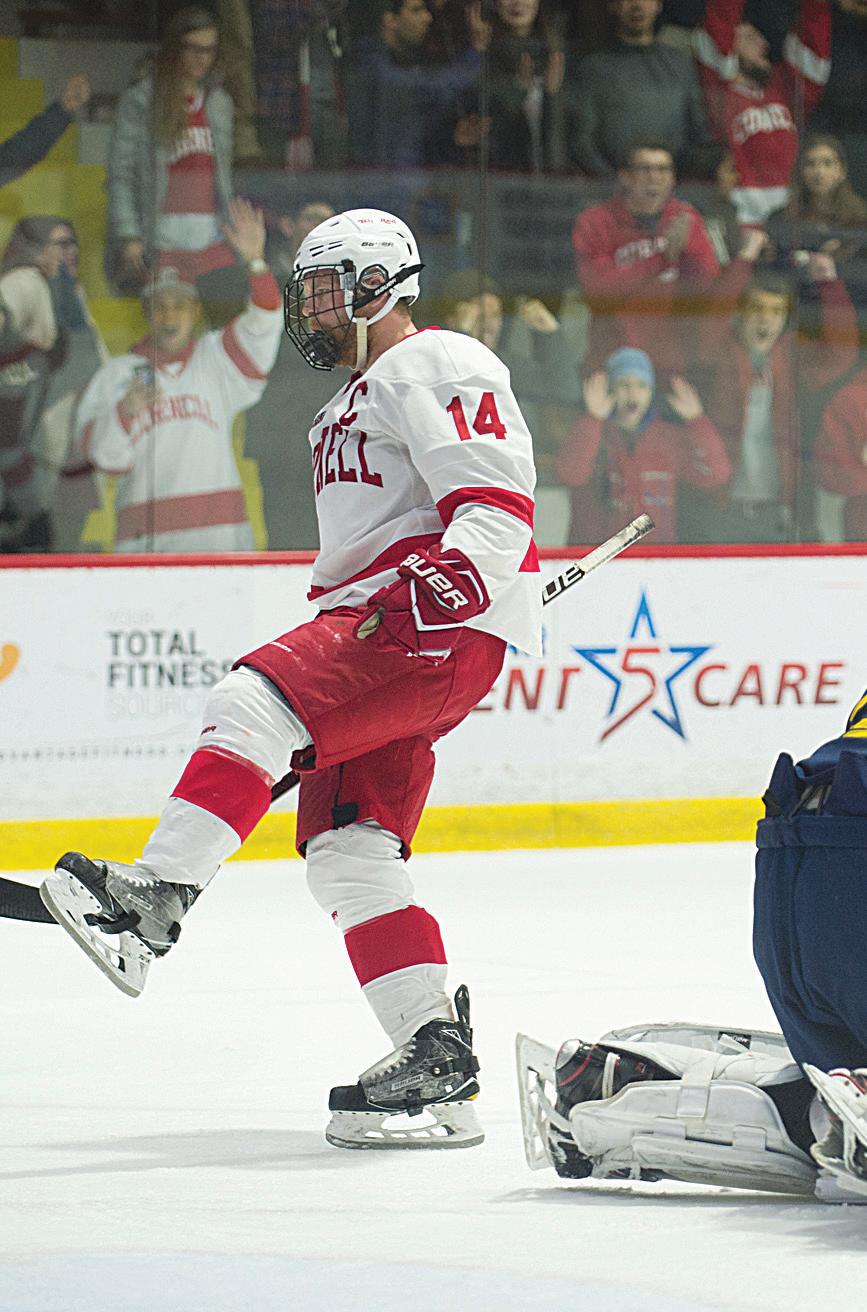
For a second straight year, Vanderlaan will sport the ‘C’ after a season in which the Red had the nation’s best winning percentage under his co-captaincy with Alex Rauter ’18. Despite missing some time last year, Vanderlaan was a key component to the success of last year’s campaign, notching 20 points across 27 games in 2017-18.
“He has been a key contributor on our team, up front one of our best scorers” said senior defenseman Matt Nuttle of his captain. “He’s really good at leading by example, always doing the right things.”
Standing just five-foot-seven, the captain has been known for his high energy play since his freshman year. He seems to be everywhere on the ice, all at once. With 27 blocked shots, a point of emphasis for Schafer’s teams, Vanderlaan led all offensive players in that category last season despite sitting out six games.
“[Vanderlaan] gives 110 percent every shift on the ice, and the younger guys follow that kind of stuff,” said junior defenseman Yanni Kaldis.
Since he scored the opening goal of his first home game at Cornell in 2015, Vanderlaan, unlike all freshman, “contributed right away,” as Nuttle described. He totaled 28 points that year — most on the team — and hasn’t looked back.
Alec McCrea - Defenseman (A) Originally committed to Harvard, McCrea eventually ended up on the “good” side. And Cornell is undoubtedly grateful that’s how it all panned out. Like Vanderlaan, McCrea had an
immediate impact for the Red.
As a freshman blueliner, McCrea played in every game, and even notched 15 points — the most for any defenseman in 2015-16.
“Alec started [well] right from the start,” Schafer said.
Despite putting his body on the line — having led the team in blocked shots in each of the last two seasons — McCrea has shown exceptional durability, playing in all but one of the 100 games Cornell has played since he arrived on East Hill.
As an alternate captain, McCrea is continuing to lead by example, with his leadership transitioning to off the ice as well now.
“The leadership … is much more than obviously anyone else outside the locker room can see,” Kaldis said. “[McCrea and Nuttle] do a lot of the talking, they’re vocal guys. They lead by example both on and off the ice.”
Matt Nuttle - Defenseman (A)
Like McCrea, Nuttle is another strong voice in the locker room alongside his co-alternate captain. But unlike McCrea, Nuttle did not nearly have as much of an impact or presence his freshman year.
“[I struggled] figuring out the speed and how [the team] played,” Nuttle said of his freshman campaign. “That was a big adjustment for me.”
Nuttle only appeared in two games his freshman year, while some of his classmates appeared in all 34. Just two years later, he appeared in every game and was a major contributor to a nation-best defense.
And since everyone can’t suit up for every game, Nuttle believes his experience gives him, “some perspective that I can share with the younger guys.”
There are probably some players now that are in the same shoes Nuttle was in three years ago, and it’s nonetheless an asset to have an alternate captain that has been down a similar path. To Schafer, it’s not that much of a surprise that Nuttle is now donning a letter on his jersey.
“Matt’s always been one of those guys that’s been able to relate to guys across all classes,” Schafer said. “He’s always been a tenacious worker and guys respect that.”
Beau Starrett - Forward
Even though Starrett came to Cornell as a third round NHL draft pick, it was not necessarily smooth sailing for the center during his first year on East Hill.
“Beau had some injuries his freshman year and since then has obviously been a big contributor,” Nuttle said.
Despite seeing the ice early in the 2015-16
campaign, Starrett ended up appearing in less than half the games that season due to injuries. Health issues prevented Beau from settling in and finding consistency as a collegiate hockey player.
But since the 2016-17, Starrett has missed only one contest and been a solid contributor to the offensive output of the Red, recording 24 points over the past couple seasons.
While Starrett was slow to get going, he has improved since and is likely to continue doing so this year with the departure of several top goal scorers. Schafer believes Starrett has the great potential to have a significant impact on offense in the senior’s last go-around.
“The biggest thing for Beau is to get him to shoot more,” Schafer said. “Something he’s wanted to do much more this year is have a shooting mentality and so far he’s done that.”
Brendan Smith - Defenseman
Smith, just like his classmate Nuttle, faced adversity at the outset of his college career. In fact, he’s not yet played a full season, missing numerous games especially in his freshman and sophomore years.
“Me and Smith have had interesting journeys, both of us kind of struggled a bit our freshman year. [Smith] dealt with some injuries,” Nuttle said.
But like Nuttle, Smith is now a cornerstone of a Cornell defense that was statistically the best in the nation last season.
“The two of those guys have probably improved the most in that senior class,” Schafer said.
Smith had the team’s second best plus-minus in 2017-18 at plus-19. And while Smith doesn’t carry an official designation as a leader, his teammates nevertheless see him at the forefront of guiding this squad.
“Even the guys who don’t have letters like [Smith] … they are really good leaders too. They could’ve had letters on their jerseys.”
* * *
Now, each of these stories has culminated into one final chapter, with this group of seniors leading and mentoring a Cornell squad on the hunt for glory.
As the Red seeks redemption, hoping to return and advance further in the ECAC and NCAA playoffs, look for all five senior skaters to have memorable roles in this 2018-19 season.
Jack Kantor can be reached at jkantor@cornellsun.com.


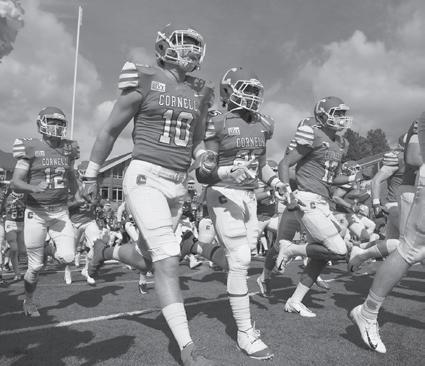
A year removed from its 34-7 Homecoming victory, Cornell football repeated its success against Brown winning 34-16.
Page 16
By NICHOLAS BOGEL-BURROUGHS Sun City Editor
By NICHOLAS BOGEL-BURROUGHS Sun City Editor
Police arrested a Cornell freshman Sunday afternoon after he attacked two women on North Campus while wearing only a green T-shirt and told them he was going to rape them, according to police and witnesses.
Saano E. Murembya ’22, of Okemos, Michigan, has pleaded not guilty to two felony counts of attempted sexual abuse and two misdemeanor counts of unlawful imprisonment. The 18-year-old runner on the cross country and track and field teams was released from jail after posting bail, which was set at $7,500 cash or $15,000 bond.
that when Murembya’s girlfriend and roommate could not calm him down, he left the residence hall and sexually abused two women near the Robert Purcell Community Center, telling them and bystanders that he wanted to rape them.
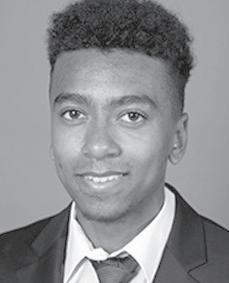
Murembya’s girlfriend said in a sworn statement to police that before the alleged attacks, he took the hallucinogen LSD in High Rise 5. After that, the girlfriend said, he “told me he wanted to rape me” and “at one point threw me to the floor.”
Police and witnesses say
Witnesses and a victim described the attacks in graphic detail in statements that police filed in Ithaca City Court. The statements describe a scene shortly after 4 p.m. Sunday in which Murembya attacked one woman in RPCC and then chased two women at a bus stop outside, one of whom said he shoved her down and straddled her. The incident could have been worse had it not been for custodian Rogelio Gordon and Ian Moritz ’22, who forced Murembya to flee and then detained him, witnesses said.
When Murembya got to RPCC shortly after 4 p.m., he was still naked from the
A Cornell custodian finishing up his shift and a freshman printing out a computer science worksheet both sprung into action when they saw a half-naked man attacking two women this weekend on North Campus, helping to end a terrifying episode that resulted in criminal charges.
Rogelio Gordon, a 35-year-old custodian in the Robert Purcell Community Center, pulled the man off of one woman twice and brought the woman to safety. And when the man ran outside and attacked a different freshman woman, witnesses said Gordon dashed toward the man
and knocked him off of her, too. That woman later told police she couldn’t escape until Gordon intervened.
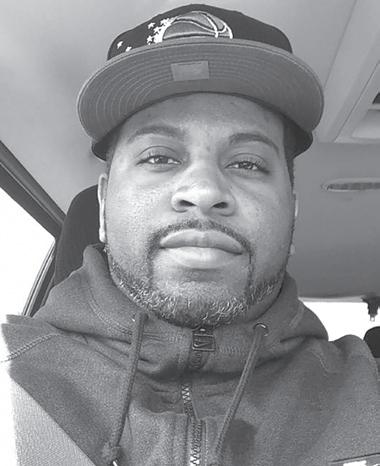
happened to them, I’d want someone else to do the same thing.”
“Instincts and having cared for my daughter, my girl, my mom, my sister — all that came into play,” Gordon told The Sun. “If something
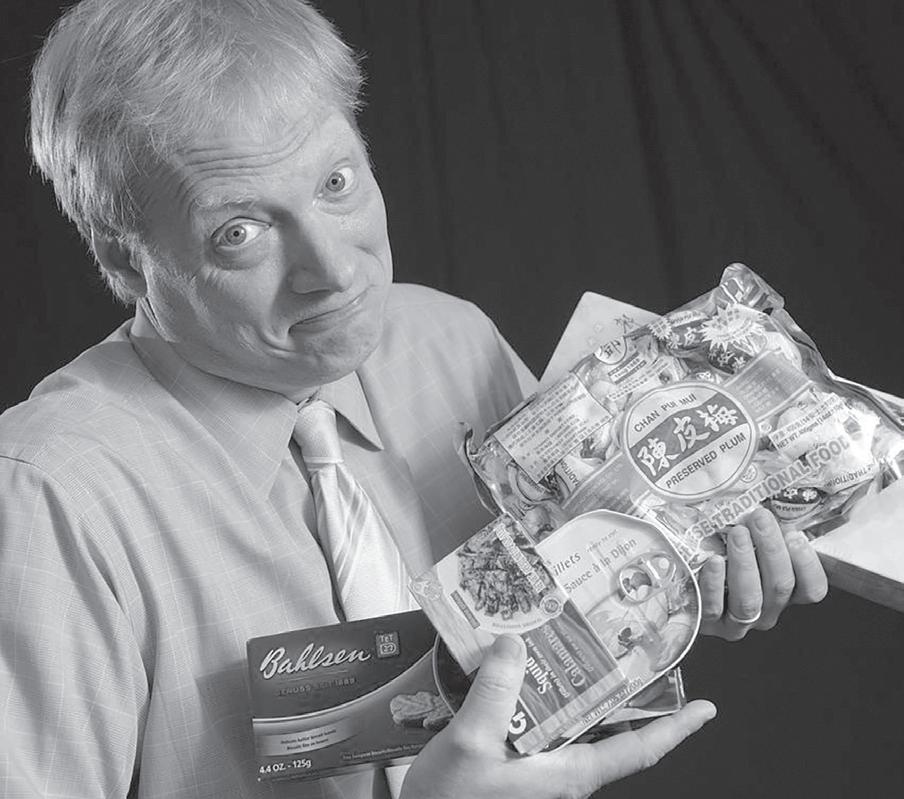
Sinking further | Food science researcher Brian Wansink had two more papers retracted, totaling 15.
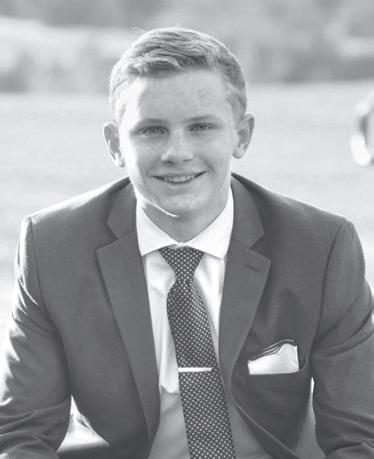
When the man ran away from Gordon after attacking the second woman, a student stepped in. A freshman who wrestled in high school grabbed the man, put him in a headlock and tried to calm him down until police arrived.
“Obviously he was a threat,” Ian Moritz ’22 said in an interview.
“Once I recognized and understood that, I just went for it. He’s clearly a
By MARYAM ZAFAR Sun Staff Writer
Food science researcher Brian Wansink faces another sour result: two more retractions.
The two recent retractions were announced by Appetite, a peer-reviewed journal that focuses on food published by Elsevier.
His 14th retraction, a
paper published in 2006, references a study that sampled 2,000 North Americans and yielded 770 responses.
To read the rest of this story, please go to www.cornellsun.com.
Maryam Zafar can be reached at mzafar@cornellsun.com.

By AMANDA CRONIN Sun Staff Writer
Around peak apple harvesting season Cornell Orchards manager Eric Schatt typically starts his morning with a cup of black tea with honey and a bowl of oatmeal to keep up with the “chaos.”
And during the day, “[his staff and he] consume plen-
ty of donuts, apples, coffee and cider to help us stay happy and focused,” Schatt said.
Schatt has worked at Cornell Orchards since 2010, but apple season is packed with constant action and is just as busy and exciting every year. The best part, he said, is interacting with the horticulture researchers, students, other growers and
the general public everyday. Today, the orchards are used for commercial apple growth and for horticultural research through the Cornell University Agricultural Experiment Station. According to Cornell Orchard’s Facebook page, some of this research includes “identifying pest and disease resistant fruit varieties, the development
of IPM (integrated pest management) programs to enable more sustainable agricultural practices, studying how fruit crops take up soil nutrients, and extending harvest periods for crops.”
The Sun spoke with Schatt for an interview during one of his peak apple season days.
1. Tree Cornell Orchards sits on
37 acres owned by Cornell University for 108 years. Eleven of the original trees still stand and bear fruit to this day. The orchards grow more than 50 varieties of apples — from popular sellers like Honeycrisp and Gala, to specialty cider apples, to experimental varieties that are yet to be named.
CUAES works with
the USDA-funded Apple Rootstock Breeding program in Geneva, New York to cultivate new apple breeds.
To read the rest of this story, please go to www.cornellsun.com.
Amanda Cronin can be reached at acronin@cornellsun.com.
Thursday, October 25, 2018
Mel Ziegler: 1000 Portraits
8 a.m. - 5 p.m., Bibliowicz Family Gallery, Milstein Hall
Alkali Antimonide Photocathodes for an SRF Photoinjector 10 a.m., Wilson Synchrotron Laboratory
Faith & Finance - The Journey of a CPA to Seminary 11:30 a.m. - 1:30 p.m., 401 Warren Hall
Popcorn with the Police and Cornell’s IT Security Office
11:30 a.m. - 1 p.m., Resource Center, Willard Straight Hall
Gatty Lecture, Arnout van der Meer, “Performing Colonialism” Noon, Kahin Center
Long-term Consequences of the Atomic Bombings in Hiroshima and Nagasaki 12:15 - 1:30 p.m., Uris Hall G-08
Electric Grid Integration of Renewable Generation and Distributed Control 12:20 - 1:10 p.m., 203 Phillips Hall
Conflict and Regional Security 2:30 - 4 p.m., Uris Hall G-08
Reading by Viet Thanh Nguyen 4:30 p.m., HEC Auditorium Goldwin Smith Hall
ECE/EDS Seminar With Owen Miller\ Yale University Noon, 233 Phillips Hall
Ezra’s Round Table/Systems Seminar Rafiq Gani 12:15 p.m., 253 Frank Rhodes Hall
PSAC Lecture: Sarah Berens, University of Cologne 12:15 - 1:45 p.m., 106 White Hall
De-Stress and Learn Self-Defense with APALSA 1 - 2 p.m., Squash Court, Myron Taylor Hall
Virginia Eubanks - Automating Inequality: How High-Tech Tools Profile, Police, And Punish the Poor 3:30 - 5 p.m., G01 Gates Hall
Doggies @ Tatkon 4 - 5:30 p.m., Tatkon Center
Love and Bananas 7 - 8:15 p.m., Willard Straight Theatre
Theodora Serbanescu-Martin, piano: CU Music 8 p.m., Barnes Hall Auditorium
Flora’s Friday Films - WALL-E 8:30 p.m., Flora Rose House

By JOLIE WEI Sun Contributor
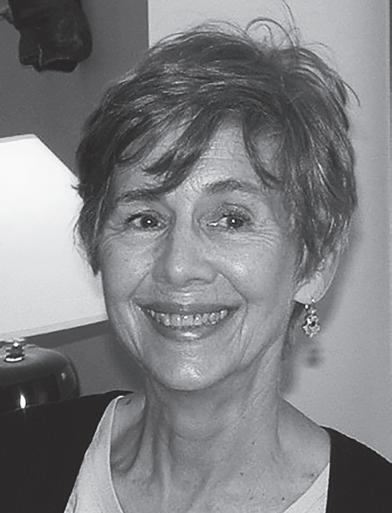
Prof. Alison Van Dyke, a senior lecturer in performing and media arts and a board member of the Cornell Prison Education Program died on Oct. 5 in London, England at 79 from natural causes.
Van Dyke was introduced to the world of acting by her father, Willard Van Dyke, a highly respected photographer and filmmaker, and her mother, Mary Barnett Van Dyke, a professor at the Yale School of Drama.
At Cornell, Van Dyke continued her parents’ legacy of teaching. She taught acting, speech and dialects for 37 years before retiring in 2014.
She later became the director of undergraduate studies in the Department of Performing and Media Arts. Mentoring students in department productions and beyond, Van Dyke made great impacts on her students.
Maria Dizzia, an actress and Tony award nominee, was advised by Van Dyke. At first uncomfortable with the idea of becoming an actor, Dizzia spoke about the immense impact Van Dyke had on her career. “Van Dyke treated me like an artist and that meant so much to me,” she said in an interview with American Theatre.
Education was an essential principle of her life’s work. In her teachings, she promoted a liberal arts education to her students, believing that “better-educated people make better performers.”
Van Dyke also promoted theater education through her involvement with the Cornell Prison Education Program at Auburn Correctional Facility, where she instructed inmates in acting classes. Before her retirement, she became a facilitator with the Phoenix Players Theatre Group, a program that fosters a transformative theater community through self-discovery.
She and her husband, William Smith Downing, a local architect and entrepreneur who passed in 2011, worked together to save the former Ithaca High School from demolishment. The couple bought the building and converted it into an eclectic collection of apartments, offices and restaurants.
The repurposed high school, now known as the Dewitt Mall, still displays remnants of its old character, with a cooperatively-owned bookstore that acts as a community resource to promote literacy and the faculty bathrooms and school library still labeled.
Community member Bob Proehl said Van Dyke and her husband were “the best landlords the [bookstore] could have asked for.”
Van Dyke later received the Donna B. Paul Academic Advising Awards at a trustee-faculty dinner, an award celebrating professorial faculty, lecturers and senior lecturers who have demonstrated exceptional effectiveness as an adviser and/or mentor of undergraduates, either through a formal advising role or through other substantial interactions with individual undergraduates outside of the classroom, according to the Arts & Sciences website.
The bookstore, Buffalo Street Books, expressed their condolences in a Facebook post. “Alison was so many things, not the least of which was an owner and generous supporter of this bookstore. We will miss her,” they said.
Outside of volunteering, she enjoyed gardening, traveling and reading. She is survived by her two grandchildren, two children and two brothers.
Jolie Wei can be reached at jw2493@cornell.edu.

Woodson strived to create unifed place for info
By ROCHELLE LI and JEFFREY LI Sun Staff Writer and
As transgender rights are under fire at the national level, Cornell is working to make the workplace a more welcoming place.
On Sept. 27, nearly a month before The New York Times reported that the Trump administration is considering defining transgender out of existence, the University published a new 15-page guide for transgender people at Cornell, outlining tips on coming out and transitioning in the workplace.
versation, the guide includes a draft email that supervisors can send. However, Woodson said the guide is not meant to be a comprehensive document.
“[The guide] is just a starting place and I was very, very particular about making sure that that was being said in the guide,” Woodson told The Sun, “This is not an end all be all. This is just one way to look at it.”
Fifty years of The Hangovers has allowed fathers, brothers and sons to share the delights of the official all-male a cappella group on campus known for their original jazz, pop and choral arrangements and parodies.
Rick Dehmel ’68, known by the group as “Big Daddy,” founded the Hangovers in 1968 after he and a group of Glee club members wanted to sing in a small a capella group. “The sound we had as a summer pick-up group was particularly good,” Dehmel said.
The initial group was about eight or nine members big for the first three years. Over their half-century on campus, The Hangovers have had both under-
graduate and graduate student members, in addition to having members follow the paths of their fathers or brothers, showing how important being a member in The Hangovers is to an alumni’s relatives.
The group’s name originated from the fact that “three of the original members were in five-year engineering or architecture programs and the fifth year was called the ‘hangover’ year,” Dehmel said.
The Hangovers were founded in The Glee Club’s 100th year and are a subset of the organization. The Glee Club, founded in 1868, is an all-male choir of approximately 60 Cornell students. It is Cornell’s oldest student organization and has had recent performances at Carnegie
Hall, the U.S. Supreme Court, the Kennedy Center and the Lincoln Center.
Jon Wardner ’79 said that being both in the Glee Club and The Hangovers, going to rehearsals and performances for both groups, keeps members busy. “It’s remarkable that the Hangs have been able to thrive for five decades, following a demanding schedule of rehearsals, performances, recording and travel, while putting the Club’s schedule first, and still managing not to flunk out of Cornell.”
Cody Fiduccia, CIPA ’17 and current Ph.D. student at Cornell, said that “it’s much easier to push through a day of instruction, seminars, or library work knowing
The guide is designed to answer common questions and address issues transgender people face in the workplace. Cornell Woodson, diversity and inclusion programs lead in the Department of Inclusion and Workforce Diversity, wrote the guide because he said he noticed that a lot of the information transgender people need is scattered online.
“I thought, let’s create a document where [it was] step one, step two, step three, very easy, very fast, so people can access it,” Woodson told The Sun.
Over the course of four months and 10 drafts, Woodson consulted the transgender people he supported about what they thought was or was not necessary. He also talked to supervisors who had experience supporting transgender employees. In response to this con -
Woodson is also planning on publishing a companion guide by May 2019 for cisgender people on the right ways to support the transgender people around them.
“Even as the idea of being trans is confusing for people, I get calls all the time from supervisors saying, ‘I don’t understand what it means to be trans. But I want to make sure my department is a place people feel secure,’” Woodson told The Sun.
In his time at Cornell, Woodson said he has found the community to be opened minded and willing to learn. Since the guide’s publishing, Woodson has received positive responses from people he knows in the transgender community, with one person telling Woodson they needed the guide a decade earlier when they transitioned.
“We did a really good job,” Woodson said.
Rochelle Li can be reached at rli@ cornellsun.com. Jefrey Li can be reached at xl288@cornell.edu.


ARREST
Continued from page 1
waist down, police and witnesses said. They said he grabbed a woman, pinned her down and tried to take her clothes off while yelling that he was going to rape her.
But when Gordon yelled for Murembya to leave the woman alone and pulled him off of her, the freshman runner “sprinted out of the door,” two other women told police.
The two women said they then left the building for a bus stop and saw Murembya trying to get into Jameson Hall. He repeatedly yelled for them to “come over,” they told police, and when they ignored him, he said, “Then I am coming over to you!” and ran toward the pair.
“We are shocked and terrified and stunned,” one of the freshmen told police. The two women ran away, holding onto each other, and tried to hide behind a tree.
Murembya grabbed the hair and jacket hood of one of the freshmen and threatened to rape her, she told police.
Murembya then tackled her from behind and straddled her, both of the freshmen told police.
Witnesses said Gordon then pulled Murembya off of the freshman woman.
Police said Murembya told both victims that he was going to rape them and touched them with his genitals. Murembya’s lawyer did not respond to multiple requests for comment Tuesday and Wednesday.
Moritz told police that after Gordon pulled him off of the second woman, Murembya ran into an open field “yelling that he wants to rape someone.”
The freshman said Murembya ran toward him, so he grabbed Murembya’s arms and put him “in a hold around his neck.”
“Throughout the time I was holding him, I heard him say that

he wanted to ‘fuck’ the women he was going after and that he wanted it all to end and that he wanted to die,” the freshman told police. “I told him that people were going to help him and that he was going to be OK.”
As a crowd formed, the male freshman told bystanders to call 911 and to get Murembya water while they waited for police to arrive.
The incident began earlier on Sunday, according to Murembya’s girlfriend, who told police that she saw him “put a tab of what he called acid in his mouth” at about 12:30 p.m.
“There was more than one dose of acid on the piece of paper,” she said.
After Murembya took the LSD, according to his girlfriend, he “said he was feeling fine,” but when he began to peak on the drug, he became incoherent, angry and sad. She said she refused to let him leave the room.
“Saano was out of control and I could not control him so I called his roommate,” she wrote, shortly after which police say Murembya fled the building and attacked the two women at the nearby RPCC, which houses a dining hall, lounge areas and the Bear Necessities eatery.
Cornell police received a report of the incident at 4:40 p.m. and said in a statement that when officers arrived, Murembya appeared to be “under the influence of some type of drug.”
Murembya was taken by Bangs Ambulance to Cayuga Medical Center, where he was evaluated before being arrested “upon his release,” police said.
Cornell Athletics spokesman Jeremy Hartigan said Murembya is no longer on the team. The cross country and track teams were called in for an emergency meeting Tuesday in response to the arrest, during which they were told not to speak to the press, according to two people present and another person briefed on the meeting.
The alleged sexual abuse follows a state Education Department report this month that said more sexual assaults were reported at Cornell than at any other college or university in New York between January and May of this year.
With 199 incidents, there were almost twice the number of sexual assault incidents reported at Cornell than at New York University, which has more than twice the students and is second on the list with 100 reports. Responding to the report, Cornell officials said they believe the University is not more dangerous, but that students may be more likely to report assaults at Cornell than students at other colleges.
If you or someone you know is a victim of sexual or domestic violence, The Advocacy Center in Tompkins County is available 24 hours a day, 7 days a week at 607-277-5000 to offer free and confidential support. For Cornell resources, visit caringcommunity. cornell.edu.
Sports Editor Dylan McDevitt ’19 and Assistant News Editor Paris Ghazi ’21 contributed reporting to this article.
Nicholas Bogel-Burroughs can be reached at nbogel-burroughs@cornellsun.com.
INTERVENE
Continued from page 1
danger to himself and others like that.”
Cornell police arrested Saano E. Murembya ’22, of Okemos, Michigan, and charged him with unlawfully imprisoning and attempting to sexually abuse two women. The 18-year-old runner on the cross country and track and field teams has pleaded not guilty to the charges and was released from jail after posting bail. His lawyer has not responded to multiple requests for comment.
Murembya’s girlfriend told police that she had seen him take “a tab of what he called acid” — referring to the hallucinogen LSD — hours before the Sunday afternoon incident.
Murembya fled his girlfriend’s dorm around 4 p.m. and entered RPCC, where he grabbed a woman and tried to take off her clothes while he yelled that he was going to rape her, police and witnesses said. They said he pinned another woman down outside minutes later, also threatening to rape her, until Gordon stepped in.
in RPCC. Gordon said the man caught up to the woman and began grabbing her and trying to unzip her jacket.
“Get off her!” Gordon yelled, pulling the man police say was Murembya away from her. Gordon said he then took the woman to a room and showed her how to lock it from the inside so she could calm down in a safe place. He said someone had called 911 by then.
Gordon and Moritz rushed outside to see where the man had gone and saw him pulling another woman to the ground.
The pair darted toward him.
“I felt like I was 12 years old, I ran so fast,” Gordon said.
“Leave her alone!” he yelled, knocking the man off of the freshman woman. Gordon helped the woman up and Murembya ran off again, witnesses said.
“That’s when the freshman student got him, pulled him down,” Gordon said, recalling the incident.
“The freshman was great. I’m glad he was there, too, because he was brave enough to do that.”
Rogelio Gordon
“The freshman was great. I’m glad he was there, too, because he was brave enough to do that.”
Moritz shouted at Murembya to stop moving, but said the man instead sprinted in his direction.
Gordon, a custodian on the student center support team, said he walked out of RPCC’s multipurpose room when he heard a commotion, planning to tell rowdy students to calm down. He quickly realized the noise was in response to something much more serious.
Gordon saw a woman on the ground, fighting off the man later identified by police as Murembya.
“He was foaming at the mouth,” Gordon said of the man. “He was just out of it.”
Gordon pulled the man off of her, but the man shoved Gordon and began chasing the woman
Moritz said he grabbed Murembya’s arms, pushed him onto the ground and put him in a headlock. He told members of a forming crowd to call 911 and get the man a cup of water.
“He would calm down and then amp back up and squirm a lot,” Moritz said of Murembya.
When the police arrived, they put Murembya on his stomach and cuffed him. At that point, Gordon and Moritz approached each other and shook hands.
Moritz said Gordon deserves “every ounce of respect” that people can give him. Cornell police
Musical group to hold anniversary concert
HANGOVERS
Continued from page 3
that I have a performance with the Hangs later in the evening. Being in the Hangovers has afforded me the opportunity to keep music a present part of my life; something for which I’m eternally grateful.”
“Sure … different songs are added to our permanent repertoire,” said Tim Chan, ’21. “However, at its core, the Hangovers have always been about brotherhood and musicianship and still remains so today.”
The Hangovers perform two large concerts each year, in the fall and spring semesters, in addition to several annual archsings, concerts for Greek life organizations and charity events. The
acknowledged the custodian’s actions in its statement on the incident, saying that a “passerby was able to intervene and pull Murembya off of one of the victims before police arrived.”
The suspect “definitely could’ve done a lot more bad stuff had he not been stopped,” Moritz said.
Nicholas Bogel-Burroughs can be reached at nbogel-burroughs@cornellsun.com.

group has also toured internationally, including in the United Kingdom, Spain and Hong Kong.
“As founder, words can’t describe the immense joy I get from hearing Hangovers of all generations,” Dehmel said. “I am so grateful for the experience of being in the group.”
In looking towards the future, Dehmel believes in “the stability of the Glee Club to provide an enduring foundation and musical preparation that will have the future generations of Hangovers reach ever new performance and entertainment heights and experiences.”
The Hangovers 50th Anniversary Concert will be held on November 10 at 8 p.m. at Bailey Hall. 150 alumni of the group are expected to attend the concert.
Katherine Heaney can be reached at kheaney@cornellsun.com.

Independent Since 1880
JACOB S. KARASIK RUBASHKIN ’19 Editor in Chief
JOHN McKIM MILLER ’20
Business Manager
KATIE SIMS ’20
Associate Editor
VARUN IYENGAR ’21
Web Editor
MEGAN ROCHE ’19
Projects Editor
EMMA WILLIAMS ’19
Design Editor
JEREMIAH KIM ’19
Blogs Editor
AMOL RAJESH ’20
Science Editor
BREANNE FLEER ’20
News Editor
YUICHIRO KAKUTANI ’19
News Editor
NICHOLAS BOGEL-BURROUGHS ’19
City Editor
LEV AKABAS ’19
Arts & Entertainment Editor
SARAH SKINNER ’21
Assistant News Editor
ANNE SNABES ’19
Assistant News Editor
JOHNATHAN STIMPSON ’21
Assistant Sports Editor
EDEM DZODZOMENYO ’20
Assistant Photography Editor
PETER BUONANNO ’21
Assistant Arts & Entertainment Editor
CHENAB KHAKH ’20
Assistant Science Editor
JULIAN ROBISON ’20
Layout Editor
HELEN HU ’21
Graphics Editor
DUSTIN LIU ’19
Human Resources Manager
ANNA DELWICHE ’19
Senior Editor
Editorial
Working on Today’s Sun 136th Editorial Board
GIRISHA ARORA ’20
Managing Editor
HEIDI MYUNG ’19
Advertising Manager
ALISHA GUPTA ’20
Assistant Managing Editor
DYLAN McDEVITT ’19
Sports Editor
MICHAEL LI ’20
Photography Editor
GRIFFIN SMITH-NICHOLS ’19
Blogs Editor
JACQUELINE QUACH ’19
Dining Editor
SHRUTI JUNEJA ’20
News Editor
ANU SUBRAMANIAM ’20
News Editor
JUSTIN J. PARK ’19
Multimedia Editor
PARIS GHAZI ’21
Assistant News Editor
MEREDITH LIU ’20
Assistant News Editor
JONATHAN HARRIS ’21
Assistant Sports Editor
RAPHY GENDLER ’21
Assistant Sports Editor
BORIS TSANG ’21
Assistant Photography Editor
VIRI GARCIA ’20
Assistant Arts & Entertainment Editor
CATHERINE HORNG ’21
Assistant Dining Editor
LIZ CANTLEBARY ’21 Snapchat Editor
ALICIA WANG ’21 Sketch Editor
JOSH GIRSKY ’19 Senior Editor
ZACHARY SILVER ’19 Senior Editor
Ad Layout Jamie Lai ’20
Design Deskers Jaime Lai ’20
Krystal Yang ’21
Greta Reis ’21
Simon Chen ’21
News Deskers Anu Subranamiam ’20
Paris Ghazi ’21
Sports Desker Raphy Gendler ’21
Arts Desker Peter Buonanno ’21
Dining Desker Jacqueline Quach ’19
Photography Desker Michael Li ’20
Production Deskers Krystal Yang ’21 Sarah Skinner ’21
ROGELIO GORDON AND IAN MORITZ ’22 ARE HEROES. When they saw others in danger, the RPCC custodian and the freshman, respectively, leapt into action, putting themselves in harm’s way to protect the safety of their fellow Cornellians. When a man — half-naked and possibly high on hallucinogens — attacked and threatened to rape several women on North Campus, Gordon tore him off of two women, and Moritz chased him down and subdued him until police arrived, according to police reports. Gordon and Moritz should be recognized for their selfless actions in service of our community.
They are also the consummate active bystanders. Instead of looking the other way or relying on someone else to act, they intervened to de-escalate and then neutralize a dangerous situation. Most of us will — hopefully — never be faced with a half-naked rampaging man on drugs, but we have all been in situations in which we can be active bystanders. Whether you are in a sweaty basement party, on a crowded TCAT bus, at a quiet dormitory or walking home to Collegetown, you can be alert to others around you. If you see someone in danger or in need of an assist, don’t keep walking or dancing. Stop and act.
Like colleges across America, Cornell has a sexual assault problem. Just this month, a New York State Department of Education report indicated that Cornell had the highest number of reported sexual assault incidents in the state, with 199 reports from January to May. Active bystanders can fight back, by helping people to exit situations before they become dangerous.
Gordon and Moritz are models for all Cornellians. We shudder to think what would have occurred had they not intervened. But as terrible as this one incident is to consider, we should learn what lessons we can from it.
Cornell offers bystander training through the Skorton Center for Health Initiatives, and we urge students, staff and faculty to read and share those materials. Each of us can play a part.
To the editor:
I am writing to whole-heartedly encourage you and your readers to vote for Tracy Mitrano, who is running to represent New York’s 23rd District in the United States House of Representatives. I have known Tracy for 25 years, and I can strongly attest that she is a morally upstanding, intelligent, and caring person who will bring opportunity to the Southern Tier.
Tracy is from the working class in Upstate New York — her parents, who never went to college, ran an Italian restaurant in Rochester — and she has bettered herself through hard work and education.
Tracy is Irish and Italian and you can bet she is a tough fighter. As a mother of two sons and a guardian of her adult brother, who has special needs, she knows how to advocate for others to make their lives better.
She lives in a rural area and understands the needs of her neighbors. She is greatly concerned about the toll opioids have taken on upstate New York and wants to work with communities to come up with solutions which work for them.
She has vital work expertise in cybersecurity, which is sorely needed in our Congress to protect our country. She wants everyone in New York’s 23rd District to have access to the internet.
I knew from the moment Tracy told me she was thinking about this race that she would make an excellent representative. Please vote for Tracy Mitrano on Nov. 6. Bridget Meeds
Re: ‘LAM | Missing the Skills for the Theories: Environmental Science Courses Must be More Practical’
To the Editor:
I read with great interest Matthew Lam’s Oct. 10 column, which called for more practical environmental science courses at Cornell. I wholeheartedly agree: in order to address the many looming sustainability challenges around the globe, we need to support a new generation of thought leaders who can tackle these problems head on. That’s why, this fall, the Atkinson Center for a Sustainable Future is launching a leadership training and development program for graduate students and postdoctoral researchers that we hope will eventually expand to include undergraduates.
This training program will help Cornell students and postdocs leverage the knowledge they gain on campus so they can develop real-world solutions to environmental issues like climate change, food security, energy transitions and achieving planetary health. Because these issues are so large and complex, we need collaboration across disciplines, as well as partnerships with groups outside of academia, like NGOs, government organizations, and private-sector organizations. By training students in science communication, policy development, leadership and career design, we will ensure they can overcome institutional barriers and effect real environmental change in the world.
Prof. David M. Lodge, ecology and evolutionary biology
The Francis J. DiSalvo Director, Atkinson Center for a Sustainable Future
To the Editor:
For protection of the environment, vote for Mitrano in the New York 23rd District.
As the next generation, nothing will be more important to you all than a clean, livable environment. President Trump has withdrawn the USA from the Paris climate change agreement and promotes fossil fuels, exacerbating atmospheric CO2 levels, essentially saying, contrary to the overwhelming majority of scientists and our recent hurricane experiences, that global warming doesn’t exist. Trump has repealed regulations on powerplant emissions, and regulations protecting streams, river and lakes, and thus our water supply. Local congressional representative Tom Reed has voted with Trump 97 percent of the time. It’s time to replace Reed with someone dedicated to environmental protection for the sake of future generations and our entire world. If you live in or around Ithaca, vote for Tracy Mitrano for Congress on November 6!
Prof. Emeritus Peter J. Davies, horticulture
Jade Pinero | Jaded and Confused
Raise your hand if you used social media today. If you’ve posted in the past month. If any part of that post — photo, editing, caption, geotag — was vetted by someone else before publication. Wave it around if you’ve ever done something or gone somewhere specifically “for the ’gram.”
It’s true that this behavior has become normalized, and that I myself participate. Neither negates the fact that it’s totally bananas.
As shown by the neverending proliferation of hot takes about social media’s detrimental psychological effects, the elders agree. Yet, the solutions proposed — typically some variant of “reduce screen time” — fall short. This advice persists, as though the world would ever slow its spin for the Luddites who stood still.
necessarily a part. Our feeds are merely the highlight reel of our most interesting, enviable experiences — of our most attractive selves.
We play two roles simultaneously — the actual self and the performative avatar — often sacrificing the former for the benefit of the latter. Thus, we struggle to reconcile two contrasting identities.
In order to mitigate the ramifications of social media, we must earnestly acknowledge its true evil.
In order to mitigate the ramifications of social media, we must earnestly acknowledge its true evil — the inherent creation of a pseudo-self manufactured for the approval of our peers. Only once we distinguish the facade from fact will we be equipped to use the medium on our own terms.
MIT professor Sherry Turkle wrote a book in 2010, during social media’s nascent period, where she highlighted the ironic consequence of our increasing online connectedness — isolation. She found that among young people, social media rewarded not self-expression but “creating something for others’ consumption,” thus what should be the revelations of one’s “true self become a performance. Your psychology becomes a performance.”
Social media — and Instagram in particular — corrodes our sense of self because it encourages us to engage at least somewhat authentically with an inauthentic reality. Even if we are truly “thriving,” as the popular caption goes, we all live complex lives of which negative experiences, sadness, conflict and self-doubt are
We continue to do this elaborate dance partly because we are rewarded for doing so. Likes, comments, and follower counts all provide a quantifiable embodiment of the affirmation young people so desperately crave. Social media’s primary draw, however, is that it allows us to feel that we are in control.
Generation Z — those born after 1995, the first digital natives — are deeply worried about the future. The world is scary and our prospects are at best uncertain. Social media allows us to write and sustain at least one coherent narrative: the story we tell about who we are.
We play two roles simultaneously — the actual self and the performative avatar.
public portrait of our best selves. We should not be ashamed to make the most of that shortcut to social capital — however ‘obsessive’ it may seem — but not at the expense of our well-being.
The internet is more or less a free market, and we alone are responsible for the product we sell. Ultimately, this is what makes the conflation of the self and the avatar so dangerous. If demand for our product ever lags, we instantaneously feel its value — and thus, our own value — diminish.
But people are not products. Whether your value is recognized or not, whether your actions are seen or unseen, your existence continues. Our raison d’être is something infinitely more complicated and more beautiful than appealing to public consumption.
Our tendency to define every thing — including human life — using the
This provides us the opportunity to paint a constantly evolving public portrait of our best selves.
Given the relative necessity of social media in our increasingly online world, we can’t simply forgo it — the professional and social opportunity costs would be far too great. We must instead find a way to square our public personas with our private ones. One way to do this is to make a clear distinction between the two versions of ourselves — the one that is meant to be commodified, and the one that is meant to be human.
Social media is, by design, a showroom. The user is the commodity, the aggregate content they post is their brand, and their followers are the consumers. This provides us the opportunity to paint a constantly evolving
Liu | Trustee Viewpoint

language of supply and demand is a natural result of late capitalism. The duality that social media demands of us is fundamentally incompatible with the nature of our spirit, which inevitably resists commodification. Our souls cannot compute their reduction to exchange value. While we cannot escape the concurrent development of neoliberalism and technology, we can choose to extricate, emphatically, our @selves from our real selves. By developing meaningful relationships and following our happiness wherever it leads us, we create value that cannot be quantified. If we are unable or unwilling to do so, we risk becoming a society of the alive but not living, where both the world and its people drift between reality and unreality, inhabiting
Jade Pinero is a senior in the College of Agriculture and Life Sciences. Jaded and Confused runs every other Thursday this semester. She can be reached at jpinero@cornellsun.com
Earlier this month, a recent Cornell alumna shared with me that her years at Cornell were “the hardest four years of her life but the best training she could have received for the real world.” Half of my heart is hoping this is true. These past few weeks have been some of the most challenging I have faced during my time at Cornell. Academics are in full swing, extra curricular activities are having peak programming, the sun is starting to splinter away and personal conflicts are running amuck.
While my Cornell career isn’t a storybook tale, my conversation with the alumnus made me recalibrate my emotions towards my Cornell experience, framing it as a training ground for life and that what we learn are lessons we will take with us will hopefully better the world.
I chose Cornell after an ILR postcard came into the mail with the tagline “Are you a leader?” and I remember thinking what that would mean for my life after Cornell. It’s not a stretch to believe that we sit next to future leaders of government and industry. It’s not a stretch to think that we ourselves will enter roles of influence. As an institution, we hold historical roots as a land grant institution. It is hard to pinpoint what
a typical Cornell experience is due to our expansive academic disciplines and our decentralized social structure. The classes that we take, the clubs that we join all impact a very personal definition of the Cornell experience. What I believe should be consistent between individuals on campus would be a commitment to find a public purpose behind their education. In many ways, I see our time at Cornell as a perfect way to do just that: to practice ways in which our studies can impact the world.
In many ways, I see our time at Cornell as a perfect way to do just that: to practice ways in which our studies can impact the world.
We are given opportunities to advocate, to fight for change when we see injustice. We are given the resources to engage critically with the structures of systemic oppression that occur in our society. As Cornell students, I firmly believe it is our role to leverage our education towards a more just world. A great example of students exercising their voice is the impact that student activism has at our institution. I applaud and affirm the Mental Health Awareness Week planning committee for putting forth recommendations to improve mental health services on our campus and to the People’s Organizing Collective campaign for their work regarding the student contribution fee. This fire in us to fight for change doesn’t just stay at
Cornell, but should continue to burn well after graduation.
The role that Cornell students play in our greater society is immense, and I believe we should be thinking on how we can instill that civic responsibility within every member of our com munity.
Engaged Cornell is a great start, and initia tive to “pro mote

resources on campus such as grants and financial support that students can apply for, but in my opinion the demand should not outweigh the supply. If students are hoping to pursue opportunities toward public service and community
If students are hoping to pursue opportunities toward public service and community engagement, we should work diligently to deconstruct barriers in place.
faculty, staff and students partnering with community members to address global issues.” My hope is that this mindset is something that we can all share, that all faculty feel the same way — that the classroom can also serve as a way to develop leaders. The Public Service Center is a resource that “provides local, national, and international public service opportunities to Cornell students, faculty, and alumni.” For me, my most memorable Cornell experiences have been participating in programs like Alternative Spring Breaks, working closely with communities through ILR Global Service Learning Programs and volunteering in the Ithaca community.
While these experiences are formative, it is important to acknowledge that there are financial barriers to students accessing these opportunities. There are
engagement, we should work diligently to deconstruct barriers in place. If there isn’t enough money to support all students who are hoping to pursue these initiatives, we should be mending the gap that exists, restricting students from engaging with communities. My hope is that we can begin ensuring that this public mission is intentionally met through academic initiatives that span all disciplines at Cornell. I hope we can continue to invest in these opportunities to ensure that all students are supported as they pioneer a lifetime of public engagement characteristic of who we aspire to be as Cornellians.
Dustin Liu is the undergraduate student-elected member of the Board of Trustees, and a senior in the School of Industrial and Labor Relations. Trustee Viewpoint runs every other week this semester. Liu can be reached at dliu@cornellsun.com.


By KATIE ZHANG Sun Contributor
It’s no secret that we Cornellians love our bubble tea. The popular Taiwanese drink — a mixture of steeped tea, milk and often some kind of flavoring combined with tapioca pearls or jelly — has slowly come to dominate our campus and Collegetown through its presence in the hands of many a boba-loving student. And no, it’s not just Asians who are fueling the trend. Boba is hip now! Boba is cool!
It’s not uncommon for groups of friends to grab boba as a way of hanging out, and come nighttime, many spots are packed with kids drinking their fill of bubble tea goodness and playing Jenga or Uno at cafe tables and couches. But with so many options for bubble tea, which places are actually worth your money and time, and which should you steer clear from?
Don’t worry; I’ve got you covered! This past weekend I drank an embarrassingly large amount of boba from all the places that offer bubble tea near and around Cornell. I ordered the same drink (smallest portion of milk black tea with bubbles) at all the spots, and here’s the verdict:
6. Ivy Room’s Bamboo (Willard Straight Hall)
$4.09 + tax = $4.42
BRBs and CornellCard accepted
Milk Tea: 0/10
I kid you not, this straight up tasted like watered-down milk. Although I saw the employee add black tea to the cup with my own two eyes, there was absolutely no tea flavor at all when I drank it. It wasn’t sweet and bore no resemblance to any milk tea I’ve ever had before, because I felt like I was drinking diluted milk. Yikes.
Boba: 4/10
Although the boba was extremely chewy and cooked evenly, it didn’t have any real flavor of its own. It was definitely the better part of this boba atrocity, but it couldn’t redeem the drink at all.
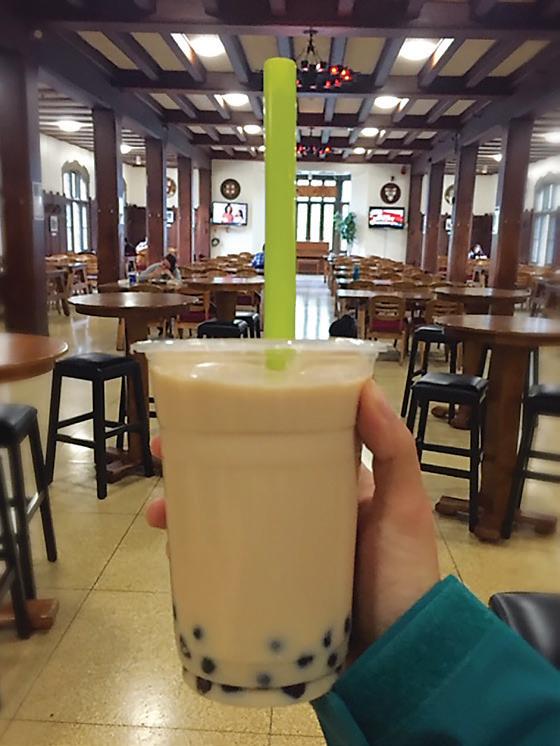
Ambiance: 5/10
The Ivy Room is certainly not a place for a casual nighttime group hangout, as its long tables and wooden chairs are more reminiscent of a cafeteria. But when it’s not crowded with the lunchtime rush of students, it can be a quiet and productive place to get some work done, so it all really depends on what you’re looking for.
Price & Wait:
Despite only waiting about five minutes for my drink, I found this cup to be on the pricier end of the spectrum, and honestly, not worth stopping by the Ivy Room for at all. I didn’t even finish the drink, which reflects poorly on its taste despite my having paid such a high price point.
5. Jansen’s Market in Noyes (West Campus)
$4.09 + tax = $4.42
BRBs and CornellCard accepted
Milk Tea: 3/10
The drink itself was slightly grainy and very obviously powdered, but not too sweet or overwhelmingly milk tea-flavored. If I had to brand it, I’d call it “Milk Tea: Lite” because the flavoring was so subtle that I couldn’t taste any black tea. Unfortunately, it left an unpleasant, dry aftertaste in my mouth.
Boba: 0/10
I’m not sure exactly what went wrong here, but the boba was a hot mess. On top of tasting like flavorless jelly, the pearls were so mushy they stuck to each other and left a sour aftertaste that I didn’t want more of.
Ambiance: 7/10
Jansen’s itself has no seating, but the lounge area in Noyes can be a decent place to relax. There are often people doing homework at the tables during the day, while others chill with their friends on the bean bags and couches. Jansen’s is always playing anime on the TV inside the store, so you can catch up on an episode of Attack on Titan when you’re grabbing snacks.
Price & Wait:
The bubble tea at both Jansen’s and the Ivy Room cost the same amount (probably due to their being operated by Cornell Dining), and the wait time was about the same as well. Considering their similarities, it should come as no surprise that I don’t plan on returning for their boba.
4. Panda Tea Lounge (Collegetown)
$3.50 Cash only
Milk Tea: 4/10
The first thing that came to mind when drinking this milk tea was that it was sweet — really sweet. There was definitely an artificial taste to the milk tea, and the amount I received was a little sad; the cup was almost 50 percent ice and didn’t leave a lot of room for the actual drink in the end.
Boba: 5/10
Not only is the boba at Panda Tea Lounge free, but the amount of pearls you are given is quite generous — I’d say that tapioca comprised 30 percent of the drink. However, it wasn’t the best boba out there, as it was cooked unevenly, with some pearls being semi-hard and others very chewy.
Furthermore, the large serving meant I finished the tea long before the boba, which kind of defeats the purpose of the two being combined.

Ambiance: 8/10
Panda Tea Lounge certainly lives up to its name, as the lounge area of this place is pretty nice! With Giant Jenga and plenty of seating, this space is conducive to group hangouts. Nonetheless, I deducted a few points because the lighting is always dim and casts a weird reddish tinge over everything, making it difficult to take a picture.
Price & Wait:
At $3.50, the milk tea here is definitely the most affordable one around. It took about seven minutes for me to receive my drink, which isn’t too bad, but nobody was ahead of me when I ordered, and there only seemed to be one person working at the time.
3. Cafe Pacific (Collegetown)
$3.99
$6.00 credit card minimum
Milk Tea: 6/10
I was pleasantly surprised by how the milk tea here wasn’t too sweet and didn’t have an overpoweringly artificial flavor. However, it just wasn’t completely on the mark of milk tea — my friend tried some and said it tasted more like red bean-flavored milk tea rather than normal milk tea. Although I don’t know whether or not that was intended, it wasn’t bad. Plus, the size is generous, and the drink doesn’t come with any ice, which means there’s more room for tea in the cup!
Boba: 6/10
The boba here was extra chewy, if that’s your thing, but there wasn’t anything special about it besides that.
Ambiance: 4/10
I thought the shop was closed when I first entered because it was dark and there was nobody else inside, but the flashing “OPEN” neon side outside said otherwise. Because Cafe Pacific also serves sitdown meals, it’s not really a place to simply hang out and drink boba by itself, especially since the entrance is cluttered and the cafe doesn’t provide any seating for those of us who just want some bubble tea.
Price & Wait:
As the second cheapest spot for bubble tea, Cafe Pacific offers a
pretty good deal considering the size and quality of its drink. The Japanese lady working behind the counter was the nicest person I encountered over the course of my bubble tea adventures; she chatted with me while she prepared my drink, making my five-minute wait pass by quickly.
2. U Tea (Collegetown)
$4.25 + tax = $4.59
Cash and card accepted, no card minimum
Milk Tea: 7/10
The flavor here was smooth, with just the right amount of sweetness that was still subtle. My friends have told me that they love the boba here, and I can definitely see that if you prefer a lighter milk tea taste. However, I love being able to taste the tea in the milk tea, and I couldn’t really find that with this drink.
Boba: 9/10
The tapioca here is much smaller than it is at the other spots I visited, but it was good. Barring size, the pearls are cooked evenly with just the right amount of chewiness and slight sweetness characteristic of good tapioca pearls.
Ambiance: 8/10
With a cute and modern interior, U Tea comes the closest to a vision of a comfortable and welcoming bubble tea hangout spot. Despite providing customers with a variety of seating options (and board games), the cafe still gets crowded, especially at night, and for some reason, U Tea’s entrance always smells of chlorine.
Price & Wait:
At $4.59 for a small drink, this is definitely the priciest place to spend your money. The wait was about eight minutes because there were so many customers, but the staff moved efficiently so it wasn’t too bad. To note: U Tea is better known for its “premium” drinks, like matcha cheese foam, so this is a good place to try if you want a different type of milk tea experience.
1. Kung Fu Tea (Collegetown)
$4.00 + tax = $4.32
$7.00 credit card minimum
Milk Tea: 9/10
While I usually customize my drink order from KFT, I went with the standard choices provided for the sake of comparison. I found that the milk tea here was just slightly too sweet for my taste, though it has a distinct flavor that distinguishes it. The drink is creamy and smooth, and has the classic hint of tea flavor underneath that cuts through and adds depth to the drink. Plus, the ease with which you can customize the drink (i.e. amount of sugar, ice and flavoring) makes it really easy for everybody to get a drink that they’ll enjoy.
Boba: 10/10
There honestly isn’t anything wrong with the boba here, which is why it’s a solid ten from me. The ratio of boba to milk tea is great,
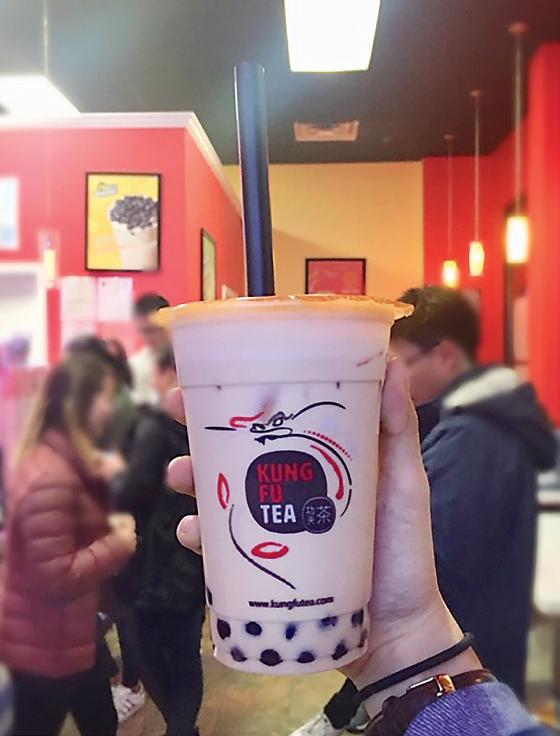
and the pearls are evenly cooked with just the right amount of chewiness. What else can I say?
Ambiance: 7/10
The actual Kung Fu Tea cafe itself is nothing special — it’s really small with limited seating that caters more toward a “to go” kind of experience. Whenever it gets busy (which is quite often), the space can get crowded while you wait for your order.
Price & Wait:
The price is average, and I think it’s worth spending an extra couple of cents for good boba and tea. The wait can last around eight minutes because there are so many people ordering, but the employees here are good at getting the drinks out in a timely manner.
These bubble tea trips have taken me on quite the journey, and after this experience, I can definitively say that I’ve had a taste of all the bubble tea in the area. These rankings have come to show me that despite the great boba revolution Cornell is experiencing, quality varies widely and not all places out there offer good boba. Bubble tea has the magical ability to bring people together and help them bond over a good drink, but mediocre boba will accomplish neither. With all these different places serving something unique, why not go out on your own boba adventure?


BY ANDREA YANG Sun Staff Writer
“The only time when I really sort of ‘let it rip’ is when I think something is cynically, cravenly motivated,” said director and theater critic for New York Magazine and Vulture.com, Sara Holdren, in a Q&A session on October 22, part of the Professional Directions Series held by the Performing & Media Arts Department.
Holdren’s words may just be the perfect description of her debut piece of dramatic criticism, “The Revolution Will Not Be Hashtagged: A Misguided ‘Joan of Arc’ at the Public Theatre,” which caused quite a stir after its publication in the online journal Culturebot in April 2017. The sharp, articulate and compelling review not only won her the George Jean Nathan Award for Dramatic Criticism — overseen by Cornell’s English department and voted on annually by a committee from Cornell, Princeton and Yale — but also jump-started her career as the theater critic for New York Magazine.
Holdren, who studied directing at the Yale School of Drama, previously worked mainly as a director and a theatermaker. She’s the co-founder and artistic director of the Brooklyn-based theater company Tiltyard, which dedicates itself to ensemble reimaginations of classical texts. She also has a passion for theater education, having worked with young actors in summer programs. Her recent works as a director include Sarah Ruhl’s adaptation of Virginia Woolf’s Orlando at the 2015 Yale Summer Cabaret, MIDSUMMER at Tiltyard and Shakespeare’s The Comedy of Errors for the “A Little Shakespeare” program at the Two River Theater.
“[With Shakespeare], directors become an author of the production,” remarked Holdren when asked about her interest in working with classical texts, and specifical-
ly in adapting Shakespeare. She highlighted the multifaceted nature of Shakespeare’s plays, and the opportunity that offers for directors to choose perspectives from which to view the text and certain aspects to focus on. “[Directors] decide what it is in the moment that they want to bring out.”
Moderated by Prof. Aoise Stratford, performing and media arts, and Prof. Caroline Levine, English, the Q&A session was largely focused on Holdren’s experience working as both a director and a critic, and the potential conflicts between the two seemingly-opposing professions.
“[Criticism] is not a career I ever thought that I would have. It just fell out of the sky. The same thing with the George Jean Nathan Award,” she said, in regards to the unplanned and unexpected beginning of her career as a theater critic with the publication of her “Joan of Arc” piece. She explained that the review simply stemmed from an incredible frustration with what she saw, and a twenty-minute conversation at the street-corner with a friend that ensued. While it’s true that the number of traditional theater critics have declined in recent years due to the flourishing of new opinion platforms, Holdren believes that “horizontalizing who’s talking” — allowing more people to express their ideas — is also a good thing.
In discussing the relationship between her roles as a maker and a critic, Holdren said her training in drama school, which taught her “how to engage with a work that’s brought to [her] and asking the questions that further that work,” inform her work as a critic. And while many were concerned about her having previously been involved in the theater community as a maker, Holdren thinks “it’s more shocking […] that that’s not the industry standard.”
“As a director, I’m really hard on directors,” she said. “I almost never blame the actors. Everything is a directorial choice.”

Yet she also tries to be generous in her criticisms, especially when it comes to works that are well-intentioned.
It would have been almost impossible for Holdren not to discuss gender, given that dramatic criticism and directing are two fields that have always been — and still are — dominated by men. Holdren noted that there seems to be a correlation between the stereotype of women being “nurturing” and the presence of more female directors in new play development rather than in large scale productions: “The number of women doing big, director-driven projects is so small, especially in classical theater.”
“We don’t like to see women as geniuses,” she added.
The Professional Directions Series brings industry experts to share their careers jour-
On Monday, The CW’s ensemble superhero show Legends of Tomorrow started off its fourth season strong with “The Virgin Gary.” The episode leans into all of the show’s best qualities: its wild and eccentric plots, its three-dimensional characters and its unapologetic dorkiness.
The episode follows the legends on their victory tour, having fixed the cracks in time that got them in trouble last season. After three seasons branding themselves with some variation of “Please, don’t call us heroes,” they finally feel comfortable identifying with the H-Word, but the team has hit a lull in their time-travel career. It’s been five months and they haven’t seen any of the supernatural action promised in the season three finale cliffhanger. The show uses this lull to explore character relationships, most
notably the unlikely comradery between Nate (Nick Zano) and Rory (Dominic Purcell), the friendship between Zari (Tala Ashe) and Ray (Brandon Routh) and the finally-domestic romantic relationship between Sara (Caity Lotz) and Ava (newly-promoted series regular Jes Macallan).
Legends isn’t the type of show to keep a status quo for too long, though, and the episode quickly transforms into a romp through the fields of 1969 Woodstock that leads to a monster familiar to anyone who’s read Drink, Slay, Love — a unicorn with a tendency to stab people through the heart. It has everything I’ve come to expect from an episode of Legends: dysfunctional teamwork, a mystical drug trip and cameos from historical figures. However, it also adds some new elements, like the addition of Time Bureau agent Gary Green (Adam Tsekhman) to the team or the dark cliffhanger involving John Constantine (Matt
neys in the performing arts and film. The events are open to the public, though many in attendance on Monday were current PMA students.
“One of my favorite things that Sara said was about theater being considered a ‘lesser’ art, and that it’s generally more acceptable to study theater than to practice it,” reflected Sabrina Liu ’20, who’s pursuing a minor in theater. “She said that theater practitioners and learners should try to push against that perception, which was inspiring for me because I always have been forced to think about theater as a hobby rather than a seminal art form.”
Andrea Yang is a junior in the College of Arts and Sciences. She can be reached at ayang@cornellsun.com.
Ryan) that felt like something out of Riverdale.
Looking back, Legends has changed a lot since its premiere in 2016. In its first season, it took itself way too seriously, throwing together a bunch of characters to try to stop the unfortunately-named Vandal Savage (Casper Crump) from destroying history. The Vandal Savage storyline was a confusing and clunky narrative about Ancient Egypt, bird people and reincarnation, leading me to expect the show’s cancellation. Thankfully it wasn’t because the show hit its stride in the second season, feeling more like TNT’s The Librarians. The writers could clearly tell that camp and team dynamics resonated the most with their audiences because they suddenly leaned into it by episode nine, “Raiders of the Lost Art.” As the name might suggest, the heroes are tasked with convincing George Lucas to make Indiana Jones and Star Wars. The episode is packed
with goofy, nerdy references, and this kind of “fanservice” has continued throughout the show. In the Season Four premiere, the show even confirms in a one-off joke that Ray and Nate are “brony bros.”
The only disappointment in The Virgin Gary was the sizeable absence of two major characters. The first being that of Amaya Jiwe (Maisie Richardson-Sellers), who left the team for the second time last season but is confirmed to make a return in a few episodes. The second was my personal favorite D.C. character, the speedster Wally West (Keiynan Lonsdale). On the season premiere of The Flash a couple of weeks ago, Wally told Team Flash that he was ready to go back to the Waverider and travel through time with his own team. However, this summer it was announced that Lonsdale would not be returning as a series regular and that Legends would have to find a way to explain the character’s sudden disappearance.
True to the spirit of the series, the writers chose to poke fun at themselves, saying early on in the episode that Wally left to travel the world and find himself, a choice they also used to explain his disappearance from The Flash last year. Zari voices the fans’ concerns in the episode: “speaking of the same old crap, isn’t that what he did last year?” which softens the blow.
That isn’t the only time The Virgin Gary goes meta. When considering the possibility of fighting a dragon, Ray jokes, “Maybe the [Time] Bureau will up our ratings. People do love the Supernatural.” This doubles as a nod to the CW’s incredibly long-running show Supernatural, now in its 14th season. I can only hope that Legends, despite being excluded from the upcoming Arrowverse crossover Elseworlds, can survive as long.
Olivia Bono is a sophomore in the College of Arts and Sciences. She can be reached at ojb26@cornell.edu.
BY VARUN BIDDANDA Sun Staff Writer
Held in both the Olive Tjaden Gallery and the Experimental Gallery of Tjaden Hall, Pinch Point exhibits the works of various students from Cornell’s Master of Fine Arts program.
In “Take I,” salt is brought to life in the form of an animation by Egé Okal, MFA ’20. The progression of images articulates a tension which is realized by a visually shaking effect between the frames, a negotiation which reifies the blustery soundtrack accompanying the animation. In this way, sound is interwoven with the constructed landscape of the mountainous terrain. The aesthetic articulation draws heavily from a certain rawness only possessed by something as fundamental as salt. The range of vignettes within the animation is pronounced by successive forms which appear to recede from each other almost as soon as they are realized. It begins with a figure of gleaming light emerging from the darkness. The figure soon finds themself upon a mine while an eagle soars above. And when the vein of ore finally shatters so too does the world of the figure.
On a wall of the Experimental Gallery is mounted “Fevered Scape.” In this piece, Libby Rosa, MFA ’19, depicts a landscape whose form is most immediately arrested from the lurid penetration of the yellow background, terminating above in a series of undulations upon what resembles the

boundaries of midnight. Below, the foreground betrays the raging fury of black currents coursing with bursts of blues, reds and yellows. The stream’s surface is rippled by frothing ridges, imbuing the recesses of the visual form with texture that is almost audible.
As mentioned, the yellow overwhelms but this is not something that detracts from the work. On the contrary, the idea of the color’s presence as an element of saturation cements the idea of the titular fever. Furthermore, the manner in which the yellow penetrates the landscape links the idea of the fever, a symptom of the body, to the cartographic implications of landscape. But for all of the vivid action tracing the work, what attracts the gaze on a secondary level are two visual interludes in particular — those which specifically serve to interrupt the yellow. In addition to the stream, on the left is a window that, through the rectangular panes, offers a glimpse at a verdant and pastoral landscape preparing to swallow once more a setting sun. However, the relationship between the two spaces — that of the river and that of the sunset — hangs unresolved.
It is unclear as to whether they exist in the conventional dichotomy of the internal in opposition to the external. But the more attention that I give to the work, another possibility is potentiated — a possibility arising from the second interruption of the yellow. The form consists of a circle supported by two lines. Emerging from the circle is a contained haze of blue, evoking the ubiquitous bubble wands which punctuate the interminable summers of youth. Perhaps it is this form which negotiates the two spaces as internalities of the same memory. Even more possible is the idea of the blue symbolizing a habitation of nostalgia, a temporal vantage of a that which could have been that invariably sublimes the boundaries of past, present and future.
Pinch Point will be held until October 26th.
Varun Biddanda is a senior in the College of Arts and Sciences. He can be reached at vdb22@cornell.edu,




Fill in the empty cells, one number in each, so that each column, row, and region contains the numbers 1-9 exactly once. Each number in the solution therefore occurs only once in each of the three “directions,” hence the “single numbers” implied by the puzzle’s name. (Rules from wikipedia.org/wiki/ Sudoku)

1, 2, 3, 4, 8 BEDROOMS FURNISHED VERY REASONABLY PRICED
607-272-3389
avramisrentals@aol.com
COLLEGETOWN 6 BEDROOMS NEWLY RENOVATED 607-272-3389
avramisrentals@aol.com
2 & 3 BEDROOMS 109 SAGE PLACE
Available NOW, Spring 2019 & 2019/2020 Shuttle Bus Access to Campus Access to Free Fitness Center Novarr- Mackesey Property Management office@ithacastudentapartments.com
607-277-1234
Houses, Apts, Parking 1 to 9 Bedroom
Collegetown - College Ave, Linden Ave, Dryden Rd, Bryant Ave, Cook St. 607-330-2442 info@urbanithaca.com www.urbanithaca.com
607-277-1234 We
>>AFFORDABLE, QUALITY LIVING<< Special Deals for you! Furnished 1-6 Bedrooms Collegetown Apartments PARKING, LAUNDRY, UTILITIES! (607) 273-7368 www.IthacaApartmentRental.com
***************************** RENT NOW, GET THE BEST www.MatoulasHouses.com
Apartments & Houses In Collegetown LINDEN AVE & E. SENECA ST 1 & 3 BEDROOM APARTMENTS ALL FURNISHED EMAIL: MatoulasHouses@Gmail.com PHONE: (607) 339-9644 FIRST-COME, FIRST-SERVED *****************************
Collegetown Terrace Apartments INSPIRED LIVING TAILORED TO YOUR SUCCESS
24-Hour Fitness Center Shuttle Bus Service to Campus Study Rooms w/ Expansive Views
Apartments Available NOW, Spring 2019 & 2019/2020 Novarr- Mackesey Property Management collegetownterraceithaca.com office@ithacastudentapartments.com
607-277-1234
NORTH CAMPUS Studio, 3 and 5 bedroom Available 2019/2020 Novarr-Mackesey Property Management office@ithacastudentapartments.com 607-277-1234
Nicest Apts. in Collegetown Located on Eddy St. 4 Bedrooms Fully furnished. Spacious living areas with large bedrooms & closets. Hardwood flors, spectacular views, eat-in kitchens with additional sun rooms. Laundry & parking. 607-339-1137 bgm900@gmail.com
2019-2020 1, 2 & 3 BR Apartments Ten month lease. Furnished. Hardwood floors. 607-227-0924 Don’t let the wind blow your paper away
27 H OUSE FOR R ENT
If
607-208-7660 or
201 WYCKOFF AVE 6 Bedroom House Novarr-Mackesey Property Management office@ithacastudentapartments.com 607-277-1234




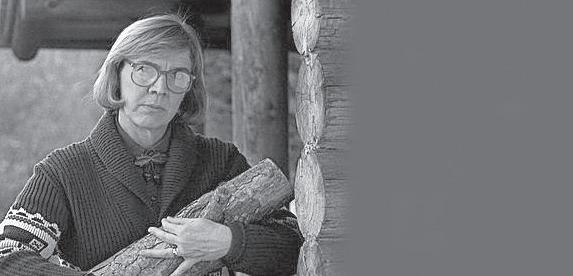


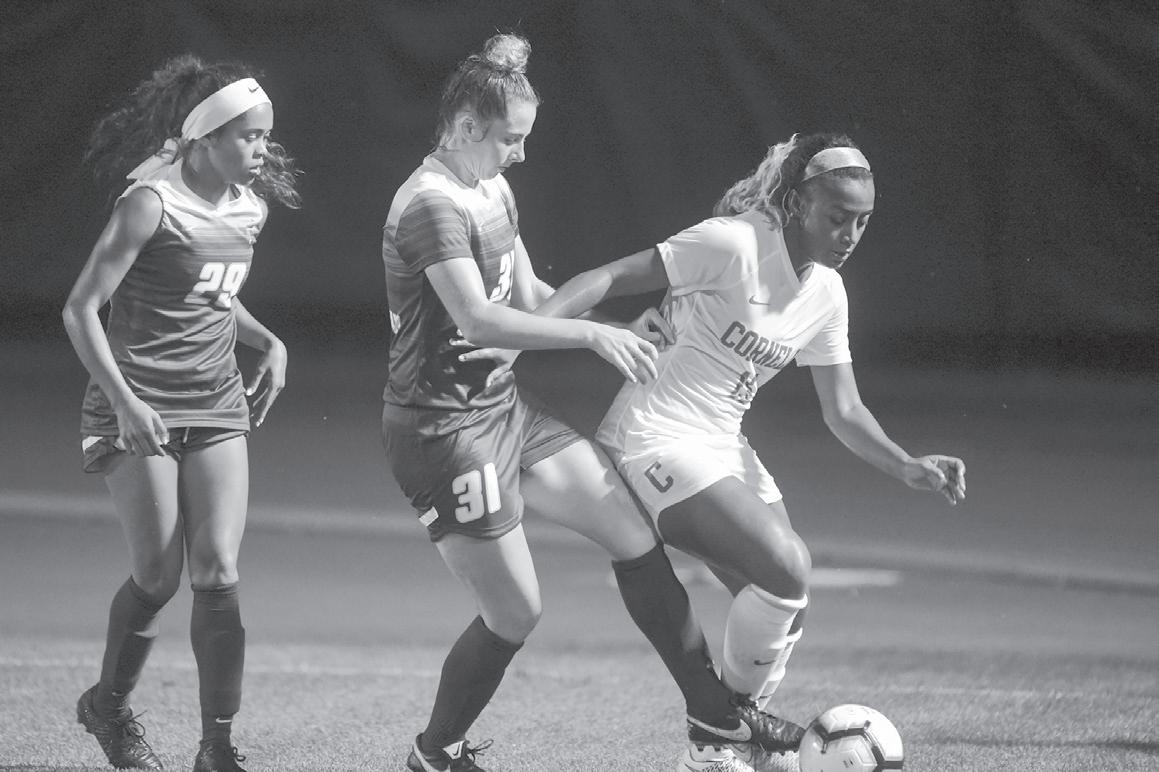
By AMAN GUPTA and GRACIE TODD Sun Contributor and Sun Staff Writer
Cornell women’s soccer will return home to take on the defending Ivy league conference champions, Princeton, this weekend, still searching for its first Ivy League victory.
The Red (1-11-1, 0-5 Ivy) will hope to capitalize on its home-field advantage, coming off a loss in its final road contest of the season, a 3-1 game at Brown. Cornell, which has not won since August, scored for the first time in four games, but quickly surrendered its lead.
The Red took a 1-0 lead about 10 minutes into the game thanks to freshman midfielder Evanthia Spyredes’ first collegiate goal.
Tied 1-1 at halftime, Brown scored on a penalty kick early in the second half and added another PK score late in the game.
Cornell will look to regroup and finally emerge successful at home in conference play, hosting Princeton (9-3-2, 3-1-1) in its penultimate contest.
“The goal is the win our last two Ivy games,” said senior captain and goalkeeper Meghan Kennedy. “And to just keep improving as a unit so that the program can bring some positives into the spring.”
It has been a season to forget for Cornell, whose 0-5 league record has it at the bottom of the Ancient Eight.
“Although our record this season is poor, we have still handled ourselves well in the conference
and have tried our best to overcome the key injuries we suffered throughout the season,” said head coach Dwight Hornibrook.
“Meghan Kennedy has been an essential player for us as she has been extremely formidable in goal.”
Having been outshot by the Bears, 22-5, and continuing its losing ways against Brown — the
“Although our record this season is poor, we have still handled ourselves well in the conference.”
Head Coach Dwight Hornibrook
Red has not taken down the Bears since 2008 — Cornell takes on a high-powered Princeton offense this weekend.
“Princeton has posed an offensive threat in every conference game, primarily due to the talented strike force that has displayed exceptional attacking prowess,” Hornibrook said. “We need to be more careful while defending, especially in the second half. It is critical for us to maintain our defensive shape and make better challenges in the box.”
The matchup between the Red and Tigers starts at 2 p.m. Saturday.
Aman Gupta can be reached at ag744@cornell.edu. Gracie Todd can be reached at gtodd@cornellsun.com.
M. HOCKEY
Continued from page 16
Spartans early allows Cornell to size up the opponent’s conference as a whole.
“You get a chance to play against Michigan State, then by the end of the year you get to find out how they matched up in their conference,” Schafer said. “Later on, that’s where your benefit happens for your program.”
Just as the Red gets some added value, so too do the Lynah Faithful, who will be able to enjoy quality, exciting hockey right from the get go. Conveniently enough, it’s
often said that Cornell is an Ivy League school with a Big Ten heart.
“I’m sure the crowd’s going to be into this one,” Kaldis said. “It helps so much to play in front of the Lynah Faithful … it really gets you going right from the start. I know, speaking with friends on other teams, they love to play in this building, and they say it’s one of the hardest places to play because the crowd’s always on them.”
The puck drops at Lynah at 7 p.m. on both Friday and Saturday.
Dylan McDevitt can be reached at dmcdevitt@cornellsun.com.
By MILES HENSHAW Sun Staff Writer
Cornell football players celebrated under the lights at Princeton last year after pulling off an unlikely comeback to upset the rolling Tigers.
The year before, however, Princeton buried Cornell 56-7 at Schoellkopf. The Red has not forgotten quarterback John Lovett and his offensive outburst.
“Seven touchdowns?” reaffirmed senior captain and linebacker Reis Seggebruch at Tuesday media availability. “Yeah, we remember that.”
Cornell (3-3, 2-1 Ivy) will travel to Princeton (6-0, 3-0 Ivy) for the second year in a row this week to face the undefeated Tigers and the top-ranked offense in the nation. While many would balk in the face of juggernaut, Cornell is drawing off its 13-point fourth quarter comeback and 29-28 last-minute win.
ity to the 2016 thrashing Cornell took at the hands of Princeton. Quarterback John Lovett, who missed last year’s game with an injury, will be taking the snaps for the Tigers Saturday. In 2016, Lovett had seven touchdowns against the Red: four passing, two rushing and one receiving.
Like Seggebruch, Archer remembers.
“We’re hungry for some revenge for Lovett’s seven touchdowns in 2016,” Archer said.
The Princeton offense is also bolstered by star running back Charlie Volker and two at wide receiver in Jesper Horsted and Stephen Carlson. Through six games Volker has 10 touchdowns, Horsted nine and Carlson five. Lovett is responsible for 20 touchdowns; the entire Red offense has scored 17 touchdowns this season.
“They’re hot but they were hot last year when we upset them.”
Head Coach David Archer ’05
“They’re hot but they were hot last year when we upset them,” said head coach David Archer ’05.
“Hot” might be an understatement for a team that routinely puts up more than 40 points and backs it up with a top-10 defense, but last year’s Princeton looked similar. The 2017 Tigers had scored 50 points in three straight games and entered their game against Cornell with the thirdbest defense in the country. Cornell’s defense sees this game as a chance to prove something.
“We’re really excited,” Seggebruch said. “We’ve given up big plays throughout the season that have hindered us from being recognized as the defense we believe we are, so I think this is a good opportunity to show people on a big stage that we can compete with the best offenses in the country.”
But there is also a concerning similar-
Cornell will go into Saturday wary of Lovett and company’s offensive abilities, but Princeton, looking to move one step closer to an Ivy ring, will be equally wary of Cornell after last year’s loss. The Red will look to build on last year’s success rather than settle.
“I was just watching film with [offensive coordinator Joe Villapiano] and we were looking at all the things we could’ve done differently,” said senior wide receiver Lars Pedersen of last year’s victory. “I think we actually could’ve cleaned up a lot of things.”
Whether another upset or another gut-wrenching blowout is in the cards, Cornell’s players will try to leave it all on the field.
“I want to put in every amount of effort I can every day of every week to be able to look back and not have any regrets,” Pedersen said. “We’re all on the same page with that.”
Miles Henshaw can be reached at mhenshaw@cornellsun.com.

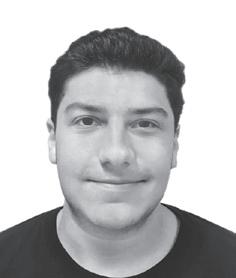
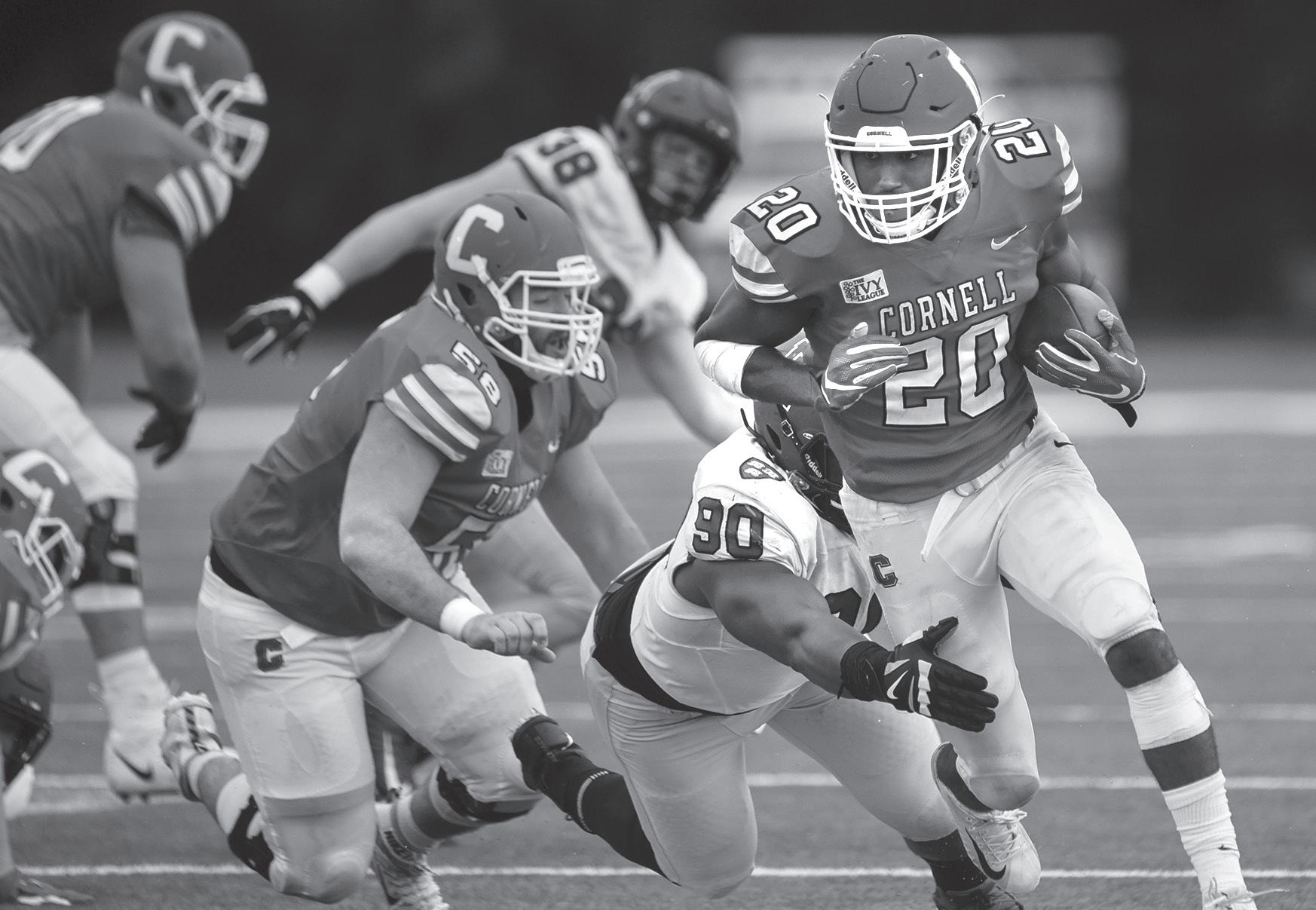
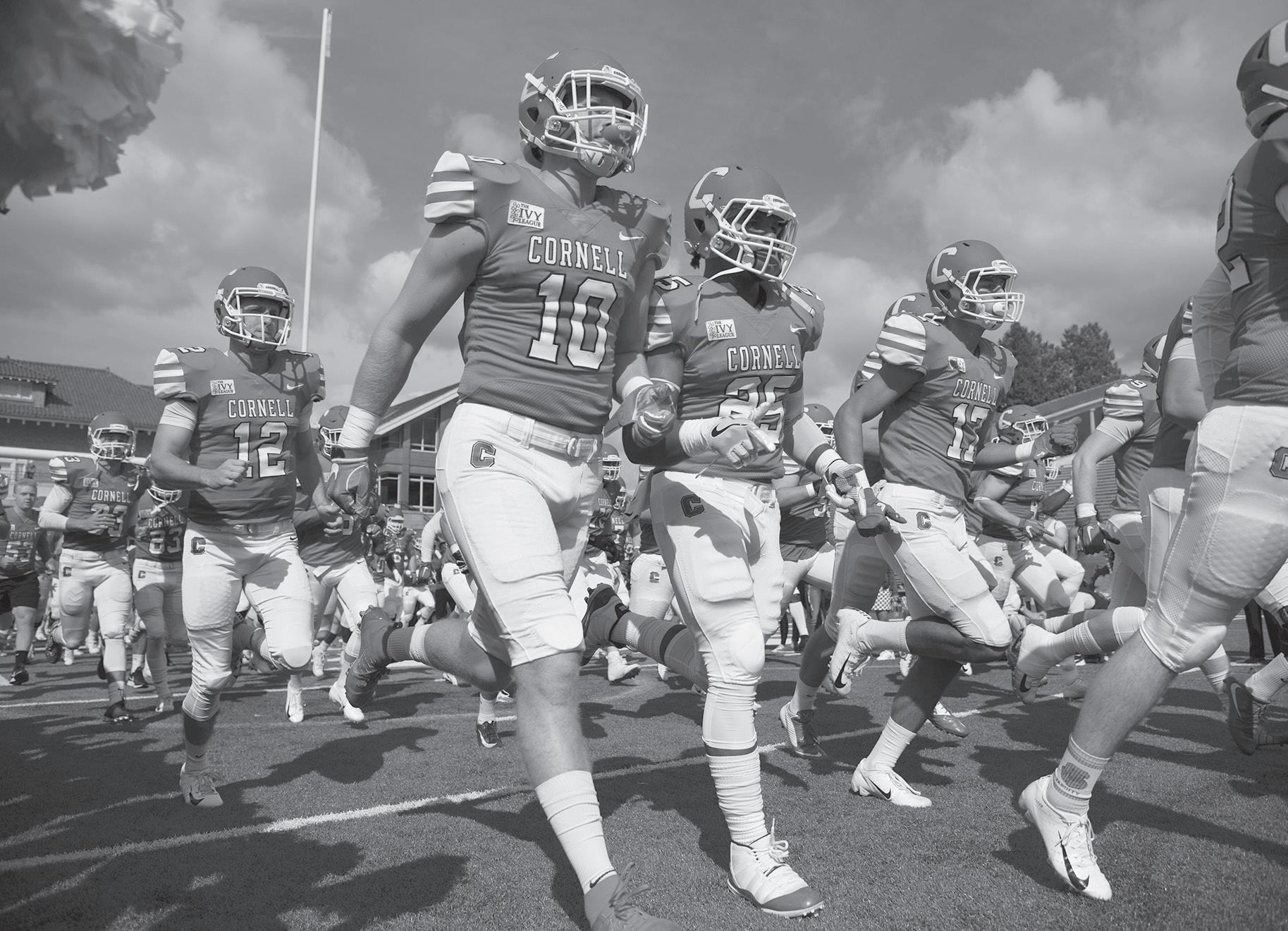



By SMITA NALLURI Sun Staff Writer
After rounding out an outstanding 2017-18 season in which it finished ranked No. 6 in the nation, the Cornell women’s hockey team looks poised for yet another successful run.
Although it graduated a strong senior class, including Sarah Knee ’18, Erin O’Connor ’18 and Brianna Veerman ’18, Cornell remains a powerhouse in the ECAC, returning three of its four ECAC all-league winners in junior captain and forward Kristin O’Neill (first team), junior defender Jamie Bourbonnais (second team) and sophomore forward Maddie Mills (all-rookie). Junior captain and defender Micah Zandee-Hart also returns to the Red after playing for the Canadian National Team last season.
“We did graduate a very strong senior class and you cannot replace what they brought to the team,” said head coach Doug Derraugh ’91. “We do have another strong senior class again this year though, and our younger players also gained valuable experience last year and have shown great improvement.”
The Red also added six new freshmen to round out its already talented roster.
“We have added freshmen at every position and we
“Our goals for the season are to win the Ivy League and make it to the Frozen Four.”
Junior forward and captain Kristin O’Neill
feel they will make an immediate impact,” Derraugh said. “We are excited about our future with this freshman class.”
The freshmen proved an integral part of the team effort last night as No.7 Cornell (1-0, 0-0 ECAC) opened up
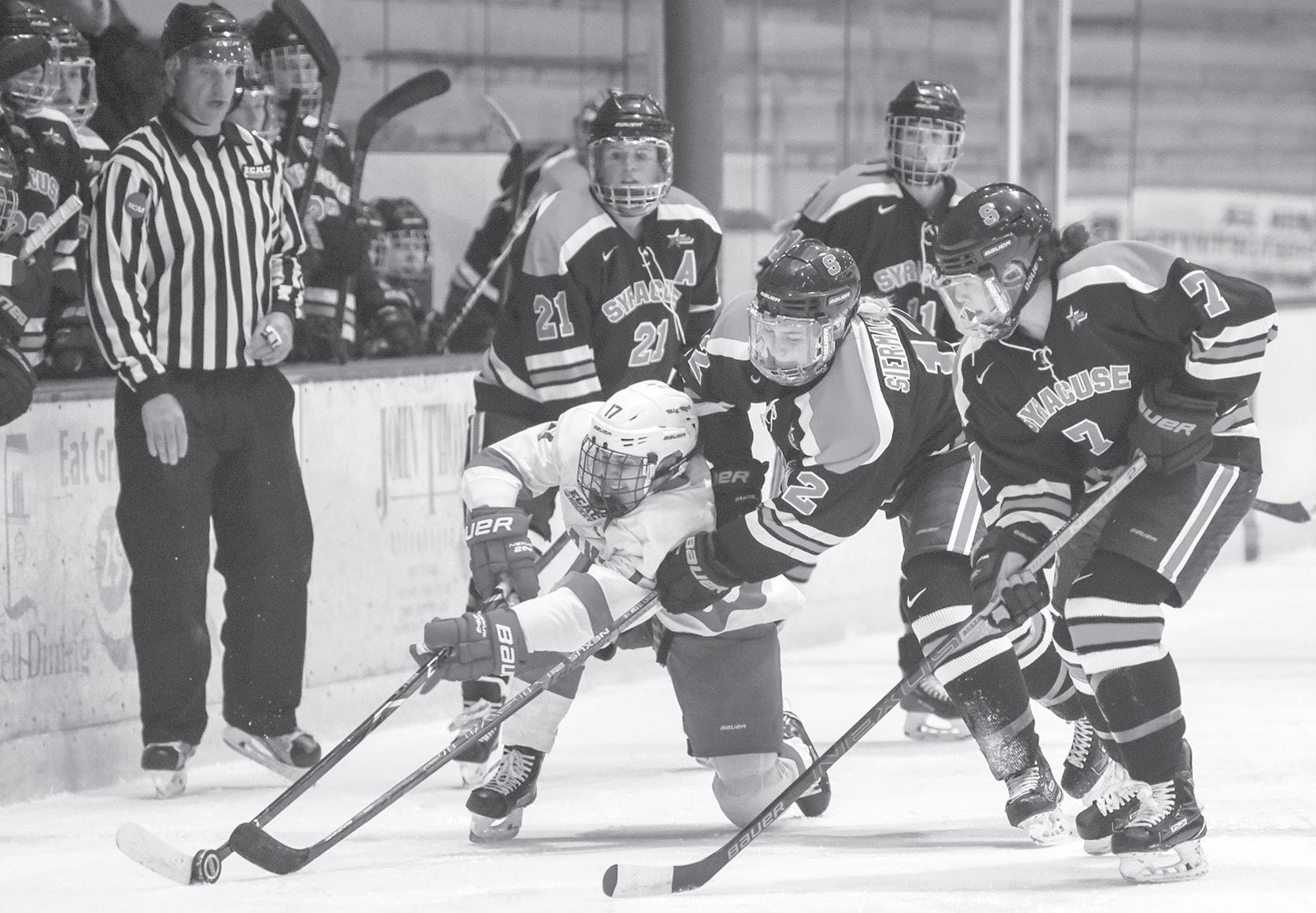
Juiced | The Red fell behind early to the Orange, but cruised to a 4-1 victory to start the year.
regular season play, coasting to a 4-1 victory over regional rival Syracuse (2-4, 2-2 CHA).
Freshman forward Gillis Frechette had her first collegiate start and fellow classmate and forward Sam Burke notched her first collegiate goal and the first goal of the season for the Red off of assists from sophomore forward Grace Graham and sophomore defender Kendra Nealey.
“The freshman class is very strong,” O’Neill said. “We’re really excited with how well they have been doing so far. They are all very dedicated and they’ve all improved already since they got to Cornell.”
Other scoring efforts came when senior forward Pippy Gerace found the back of the net off of assists from Zandee-Hart and senior forward Lenka Serdar. O’Neill also netted two goals to solidify the win. The first off of assists from Mills and Frechette and the second off of assists from Mills and Nealey.
Last season, every single skater had tallied at least one point over the course of the season and the diversity of players who contributed to the scoring effort last night showcases the depth of the current Cornell roster.
The Red also kept the Orange scoreless on power play
opportunities, proving that it has not lost its touch on its penalty kill after leading the nation in that category last season.
Despite all its successes, Cornell was the first team out of the NCAA tournament last year — a fate that left the Red with a bitter taste in its mouth and determined to prove itself on the national stage this season.
“Our goals for the season are to win the Ivy League and make it to the Frozen Four,” O’Neill said. “We are striving to win the ECAC, too, to make sure we automatically make it to the final eight.”
The Red opens up Ivy League and ECAC play at Lynah this weekend as it welcomes Harvard (1-0, 1-0 ECAC) on Friday and the Dartmouth (0-1, 0-1 ECAC) on Saturday. The puck drops at 3 p.m. for both games.
“Our goal is to be consistent and get better throughout the year,” Derraugh said. “We want to focus on the process. If we give our best, and work to get better each day, then positive results should follow.”
Smita Nalluri can be reached at snalluri@cornellsun.com.
Head Coach Mike Schafer ’86 MEN’S HOCKEY
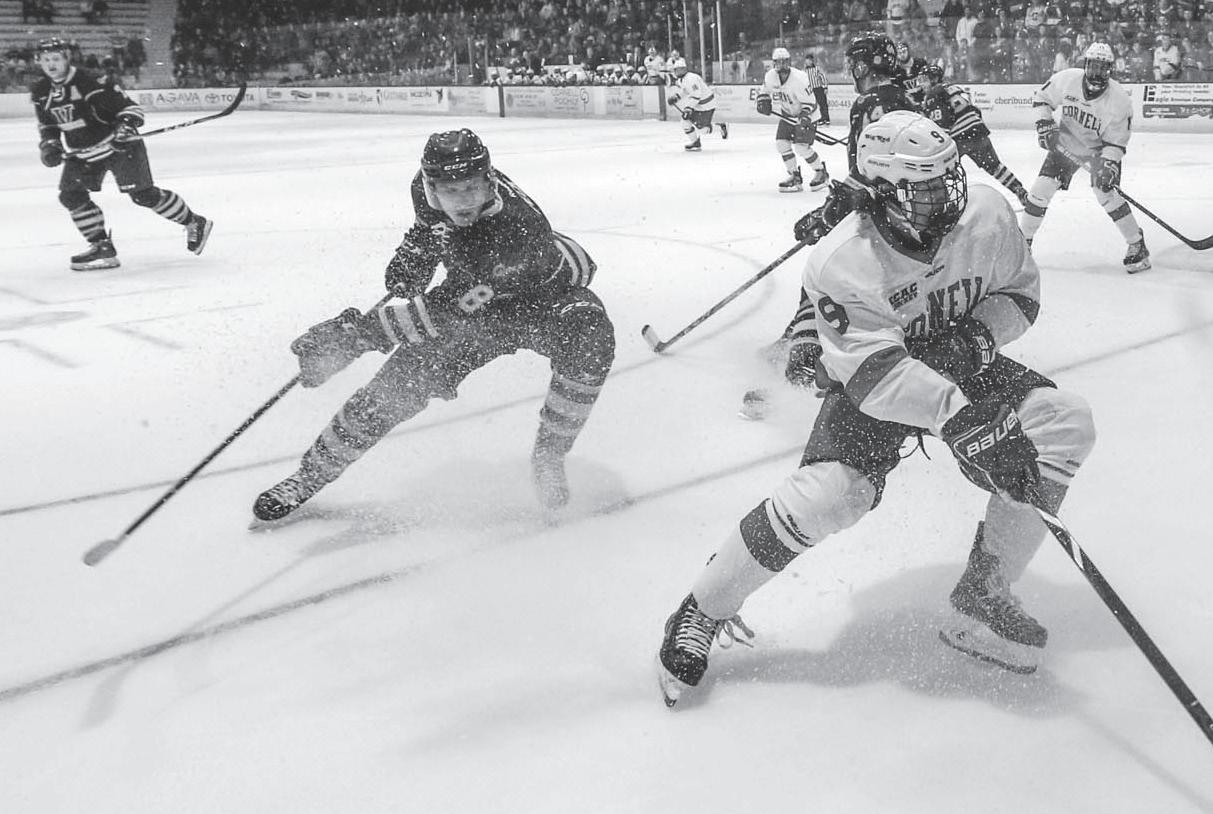
By DYLAN McDEVITT Sun Sports Editor
It has been more than 200 days since Cornell men’s hockey was eliminated from the NCAA tournament. The journey back begins now.
Cornell will host Michigan State (1-1, 0-0 Big Ten) this weekend in two games at Lynah Rink that will provide the team its
first chance to step on the ice in a game that counts since its postseason shortcomings last March. The Spartans represent a strong out-of-conference program that is sure to test Cornell right at the start of its season.
“They’ve got some of the best players in the country,” said head coach Mike Schafer ’86. “But we’re going to play good teams all year long. … We’re looking forward to starting the season.”
MSU sports a dangerous top line with all three forwards picked on the Big Ten hockey preseason watch list, including unanimous selection Taro Hirose alongside Patrick Khodorenko and Mitch Lewandowski. Khodorenko was honored last season as the Big Ten freshman of the year. The trio has already combined for eight points in the Spartans’ first two games.
“Just like any top line we face, we just got to be prepared for it, know when those guys are on the ice,” said senior defenseman and alternate captain Matt Nuttle.
“We’ll have our matchups ready up front and on the back end.”
playing defense it gives us some added confidence that we know he’s behind us,” Nuttle said. “So it’s nice that we know if we screw up he’s going to be there to make the save.”
The chance to play against a talented team early will allow Cornell to evaluate itself ahead of its conference season.
“I think it’ll show us where we are right away, what we need to work on,” said junior defenseman Yanni Kaldis. “It’s obviously going to be a challenge … I think it’ll be a good weekend for us, see where we are.”
“They’ve got some of the best players in the country, but we’re going to play good teams all year long.”
As Cornell prepares to face some top-level offensive talent, it will benefit from the services of all six starting defensemen from last season, a unit that was the nation’s leading statistical defense. Also returning is star sophomore goaltender Matt Galajda, who last year cemented himself as one of the country’s premiere netminders.
“The thing with [Galajda] is when we’re
It’s unusual for Cornell to start the season against a team from a strong conference such as the Big Ten. Last year, the Red opened up against Alabama Huntsville, the only Division I team from the American southeast. The Chargers ended up winning roughly a third of their games.
With the Big Ten sporting a long list of potential tournament teams, playing the
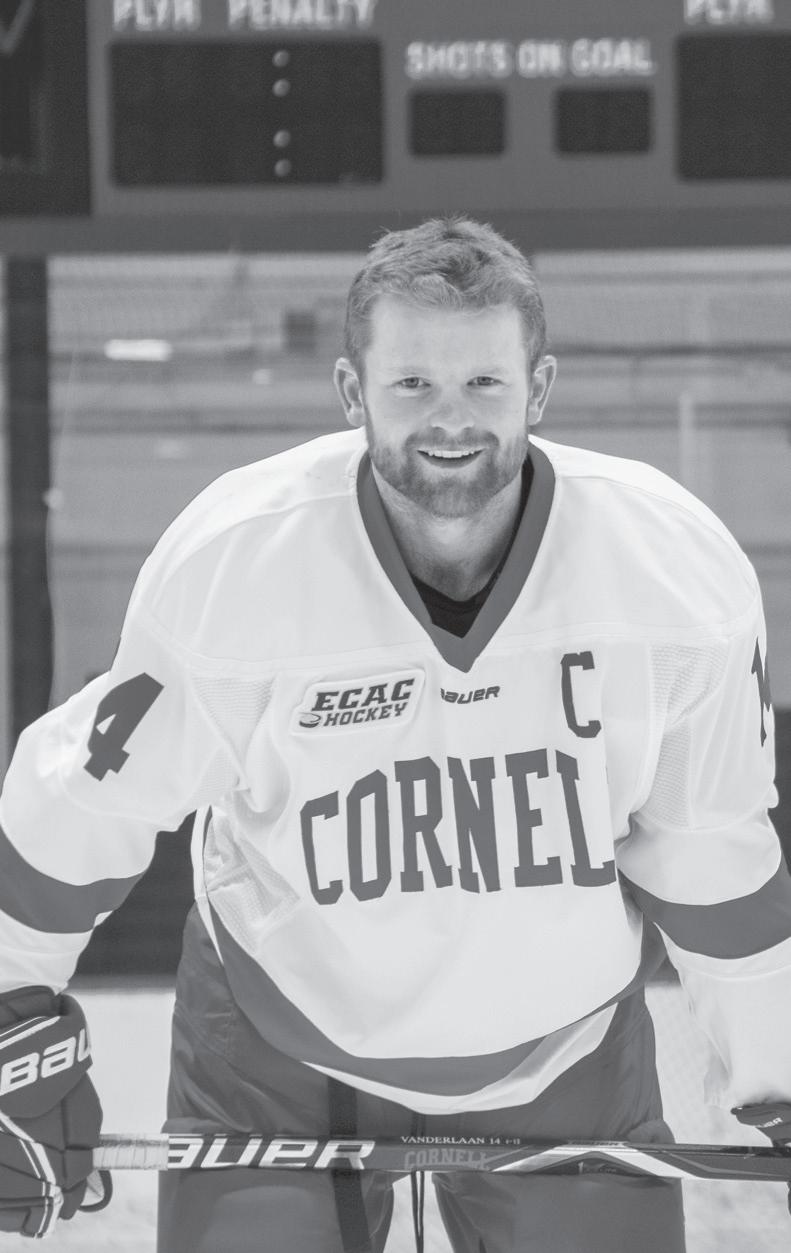
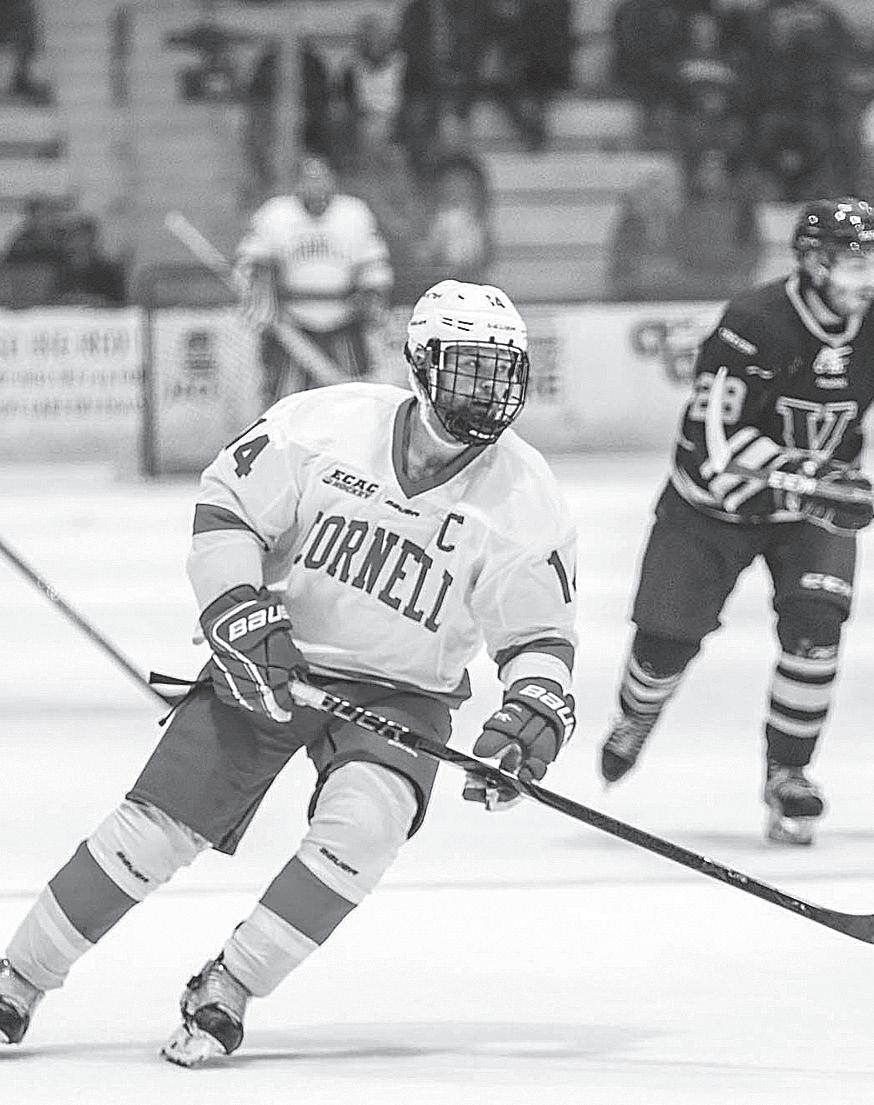
By CHRISTINA BULKELEY Staff Writer
Where Mitch Vanderlaan comes from, people don’t play college hockey. Now, the senior forward is captain of a nationally ranked NCAA team for the second year in a row.
Vanderlaan is the only current Division I men’s hockey player to hail from New Brunswick. While most of the people he played hockey with in his youth joined the pro teams straight out of the junior leagues, Vanderlaan made the decision to take the college route, a choice that has benefited him immensely. At Cornell, his understated leadership style has propelled the team to success and provided unwavering support to the program.
“I got my mind set on [going to college],” Vanderlaan said. “Some other guys … get drafted before they actually get talked to by a school and so the decision gets made that way.”
Vanderlaan’s genuineness comes across easily in conversation. He is not known as an especially outspoken or loud member of the team. Instead, his steadfast dependability earned him the ‘C’ on the front of his jersey for the second consecutive year.
Aside from speaking highly of the other players at Cornell, Vanderlaan went beyond his experience on East Hill to elaborate on how hockey has afforded him many different opportunities. Vanderlaan admitted that one of the greatest gifts hockey has given him is the people it has allowed him to meet throughout his life. He has traveled throughout both Canada and America to places that he might not have otherwise visited, and he has made connections that he knows he will use for years to come.
“One of the biggest impacts is just the travel I’ve had,” Vanderlaan said. “You get to go to a lot of different places and meet a lot of different people. … If I were to go end up in Pennsylvania or Ontario next year, I have buddies I can just call and get connected and know people that way.”
Even while Vanderlaan knows how to appreciate the opportunities hockey affords him, it is apparent that he remains focused on the game itself and on his main goal: winning. Vanderlaan’s resolve and goal-driven nature surely contribute to his ability to lead the team.
As exemplified by his decision to play college hockey even when nobody around him did, Vanderlaan is someone who knows what he wants and will work toward a goal. His ability to zero in on specific objectives also permits him to focus on things one day at a time while still not forgetting about the bigger picture.
“We’re not getting ahead of ourselves. One of the biggest things we’ve talked about is the need to focus on the right now and getting better ... after the success we had last year, it’s easy to forget just how much work we did to get there,” Vanderlaan said.
The detail-oriented Vanderlaan looks to continue Cornell hockey’s tradition of excellence in his final year. Since last season ended, he’s worked on the accuracy of his shots and recognizing scoring opportunities in order to improve his game. He is pragmatic in his approach to bettering himself and the team, and his level-headedness is a vital quality in the leader of a team with expectations that are sky-high.
“He’s really, really driven on and off the ice,” said head coach Mike Schafer ’86. “He leaves nothing to chance as far as detail.”
Indeed, Vanderlaan does not possess the “rahrah” attitude so commonly attributed to team captains. Rather, he gives the impression of a professional at work, albeit doing a job he loves. This demeanor benefits the team in its own way; Vanderlaan does not plan on changing anything about himself in order to fit a certain role.
“I think I did [act differently] at the start of last
year and it wasn’t necessarily as beneficial,” he said. “I just need to keep true to who I am.”
Vanderlaan doesn’t need to adopt a new attitude in order to lead his team to glory — his coach believes he can become the best captain just by staying the same.
“All we need him to do is just to be himself,” Schafer said. “He’s a great teammate. We just need to get him to continue doing that, and guys will follow him.
Despite leading the team in points over the last three seasons, it does not seem that Vanderlaan has let anything go to his head. He is unwilling to claim the spotlight, even while being the lone team captain. He gave high praise to the two alternate captains, senior defensemen Alec McCrea and Matt Nuttle, and other members of the team for stepping up into leadership roles.
“There are guys throughout the lineup who can be leaned on,” he said.
The fact that Vanderlaan doesn’t want to be the center of attention heightens the sense of authenticity that he exudes. He at once seems slightly uncomfortable when asked about himself but remains completely candid. It is not hard to see why his teammates view him as a supportive leader and why Schafer considers him a capable and positive influence.
But last year, Vanderlaan found himself the one in need of support. Leading up to last season’s conference playoffs, Vanderlaan missed six games due to a lower-body injury before returning for the playoffs. Being sidelined was something new to the captain, who had missed only one game until that point.
While Vanderlaan certainly does not look back fondly on the experience of only being able to watch his team play, it’s now in the past. What he won’t forget is the way his teammates treated him during his time off the ice.
“It’s tough … but it’s nice when you have 20 guys who really support you and help you get back whenever you need it,” he said.
This off-ice bond certainly contributes to the chemistry fans see during games. No team that attains the level of success of Cornell men’s hockey can get there without a bond created by mutual dependence and trust.
“He’s been a key contributor on our team … he’s really good at leading by example, he’s always doing the right things, and that’s worked out really well for him,” Nuttle said of the captain.
As for the upcoming season, Vanderlaan is prepared to start over as Cornell begins another quest for a national title. Vanderlaan’s wisdom and experience will add balance to the eight-person freshman class’ fresh perspective and vigor, allowing the team to embrace these differences in order to every player to achieve his potential.
Vanderlaan looks forward to working with the younger players and incorporating them into the team culture. He makes sure that every player gets to know one another in order to promote unity on the team. This fresh start will help the Red move past last year’s first-round loss in the playoffs.
But beyond Vanderlaan’s practical, one-day-ata-time mentality, he is still a competitor at heart.
“It’s a long, long, hard season,” he said. “We want to win.”
Vanderlaan shares the hopes of a championship with Cornell hockey fans everywhere. He is calm, collected and, above all, driven. But his composure does not lead one to believe that he is unenthusiastic about his team and the upcoming season. His passion for the sport shines through and his hopes are high.
“I’m just really happy I get to play hockey and go in the rink every day,” he said.
Christian Bulkeley an be reached at cbulkeley@cornellsun.com.
By ZACHARY SILVER Senior Editor
In the spring of 2013, all Matt Galajda could do was sit and wait. The goaltender’s job was over, and like he’s become accustomed, he opted not to speak with his voice. He let his play speak for itself.
Soon the day would be here. The Ontario Hockey League, a major talent feeder to the National Hockey League and a dream destination for many young Ontarians, was drafting in early April. Galajda, fresh off a high-level Midget AAA season with the Markham Waxers in the Toronto suburbs, hoped he did enough to be selected. Galajda waited. And waited. He never stopped waiting.
So a 15-year old Galajda did what any young Canadian would do. Shortly after going undrafted by all 20 OHL teams, Galajda and his goalie coach, David Belitski, took a post-practice trip to Tim Hortons and laid out an action plan: spend some time developing with the local St. Andrews College team where his dad is an administrator, hunt for a spot on a team in another junior league, head to the States to play in the NCAA and set himself up for the future.
And always work hard. Never forget that.
Each morning since, Galajda is greeted by a notification on his phone with a reminder of the lessons he and Belitski, a former professional hockey player in his day, discussed on that spring morning at Tim Hortons. “Don’t leave anything on the table. Perform every night. Prove everyone wrong.”
“That’s still something I play with,” sophomore Galajda says now, in phase three of the action plan and a year removed from one of the most decorated individual seasons in Cornell men’s hockey history.
It wasn’t just a high caliber season in the history of Cornell netminders, which includes hockey hall-of-famer Ken Dryden ’69 and recent NHL starter Ben Scrivens ’10. Not just for forwards, which includes Joe Nieuwendyk ’88 and a handful of recent players. Not just for rookies. Ever.
Galajda’s path is one marked by failure and resilience, reservation and confidence, risk-taking and staying true to his roots. In each stop along his journey, the self-described soft-spoken goaltender has made his name and presence known.
But through all the hardships and disappointments that have come his way, Galajda has added one credence to the list he developed with Beltski: Don’t forget to have fun.
“He models his game after [Vegas Golden Knights goalie] Marc-Andre Fleury, and if you know anything about Fleury, he’s always smiling in the net,” says Cornell senior defenseman and alternate captain Alec McCrea. “Sometimes I’ll see Matty — although he’s kind of a quiet guy off the ice — on the ice he’s vocal. And that’s how he gets his confidence, smiling a lot.”
In 2013, Galajda was denied an opportunity. In 2018, he’s earned the respect as one of the best players in college hockey after just one season.
“Some kids will turtle and blame the system. For him it was the opposite,” Belitski says. “We sat down and had a cup of coffee and said if this is something you’re passionate about it, which he was and he is, then it doesn’t mean anything.
“When one door closes doesn’t mean that another one isn’t going to open. He found a door that was a little bit open, and he pushed and pushed and eventually it opened for him.”
Getting shut out by the OHL may end the prospects of most young hockey players. For Galajda, it saved his career.
‘In his element’
To say Galajda was surprised with how he elevated himself into the conversation of best in the country in just one year would be an understatement.
When Galajda arrived at Cornell after committing before his second year in Victoria, he was — surprise, surprise — thrust into a goalie battle. The veteran Stewart seemed to have the upper hand, but Galajda’s play made it hard not to deserve a longer look.
He ultimately won the job, and once again, never looked back. His first two starts saw him stop a combined 38 of 39 shots he saw — the second a 3-0 shutout. Galajda led the nation with nine shutouts in 2017-18 and his shutout streak of 227 minutes, 11 seconds across five starts in mid-January is the second-longest in program history
Galajda will be one of the first to tell you how surprised he was to put up a freshman season at Cornell that earned him All-American status, Ivy League and ECAC top rookie and Ivy top player award and Hobey Baker finalist, among several other recognitions.
It was so surprising that Galajda would sometimes pull up last season’s results on his phone to make sure that it happened. Not in a cocky way. In a pinch-me-I-must-bedreaming way.
“You don’t want to look back at it every day or anything like that. This year is a new year. You have to start over and really not have any expectations for yourself,” Galajda says now. “But at the same time, I definitely reflected on it after the season last year. … There were some nights where I checked my phone after the season and was kind of in shock all that stuff happened.”
But Galajda will trade every individual award if it means turning Cornell’s last two elimination losses into wins.
“We worked so hard the whole year and to have it taken away from us in two games was heartbreaking,” Galajda says. “I had a couple rough games, so now I’m just having that mindset of being in the moment and thinking of every puck like it’s your last. … I definitely let that slip a couple games last year and just want to be really consistent at that this year.”
He’s accomplished it all with a quiet confidence. On game day, Galajda famously keeps to himself and won’t even touch a soccer ball — a popular warm-up activity across locker rooms. Once in eleventh grade he did and proceeded to have a bad game. It’s bad luck.
But once he steps on the ice, that reservation morphs into hollering at his defense, smiling under the cage and speaking with his performance.
“When I get out there I guess you could say I turn into a different person,” Galajda says. “I always have a little grin on my face. ... It’s a game, so you might as well have fun with it.”
“When he’s in the net he’s just in his element,” adds
‘Gives us that confidence’
Friday hosting Michigan State will be the first test if Galajda can repeat his success from last year. Given how improbable and incredible his first season was, that may not be a fair standard to hold. That’s because Galajda’s bar is higher.
Playing in the shadow of Dryden’s legendary No. 1 sweater in the Lynah rafters and under a long tradition of Cornell goalie excellence, perhaps Galajda won’t need to replicate 2017-18.
“Whether he can put up the same goals against, that’s not in our control. And it’s not in his control,” says head coach Mike Schafer ’86 “I’ve seen goaltenders make the same mistake where they want to beat that tremendous statistical year. That’s not his issue. His issue is to play his best and lead us to winning hockey games.”
Might Galajda’s No. 35 jersey hang alongside Dryden’s No. 1 in the rafters of Lynah Rink?
“It’s certainly a drive to him when you reference that. But I think that’s putting the cart before the horse,” Syer says with a chuckle. “But when you look at him, he’s got a drive to him and wants to prove everybody wrong.”
No matter the result, the top Cornell defense enters the season rest assured Galajda is behind them. “He just gives us that confidence as a defense corps,” McCrea says.
And that confidence can be traced back to one meeting at Tim Hortons. A meeting that set the course for every save, every win, every accolade, every milestone. A meeting that came on the heels of Galajda’s biggest hockey disappointment.
But maybe Dunkin’ Donuts was the more apt venue.
“Everyone [on the team] always says they miss Tim Hortons, all the Canadians,” Galajda says. “But I really don’t. I don’t really drink coffee.”
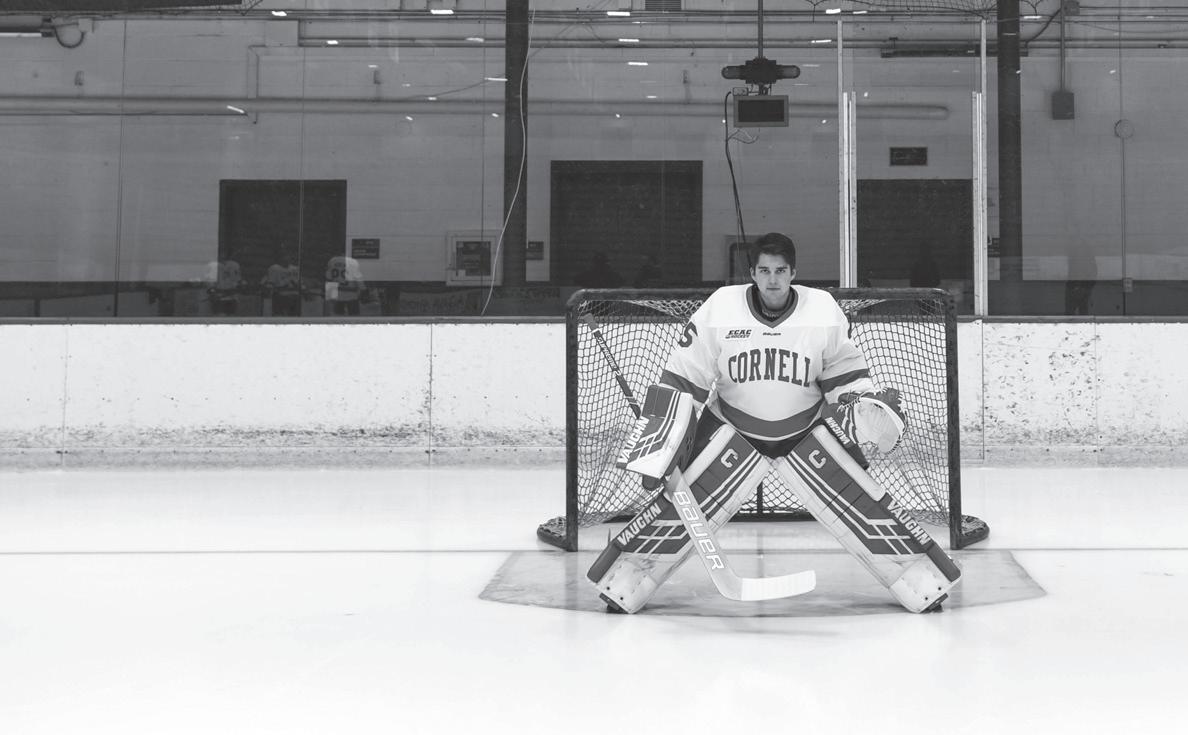
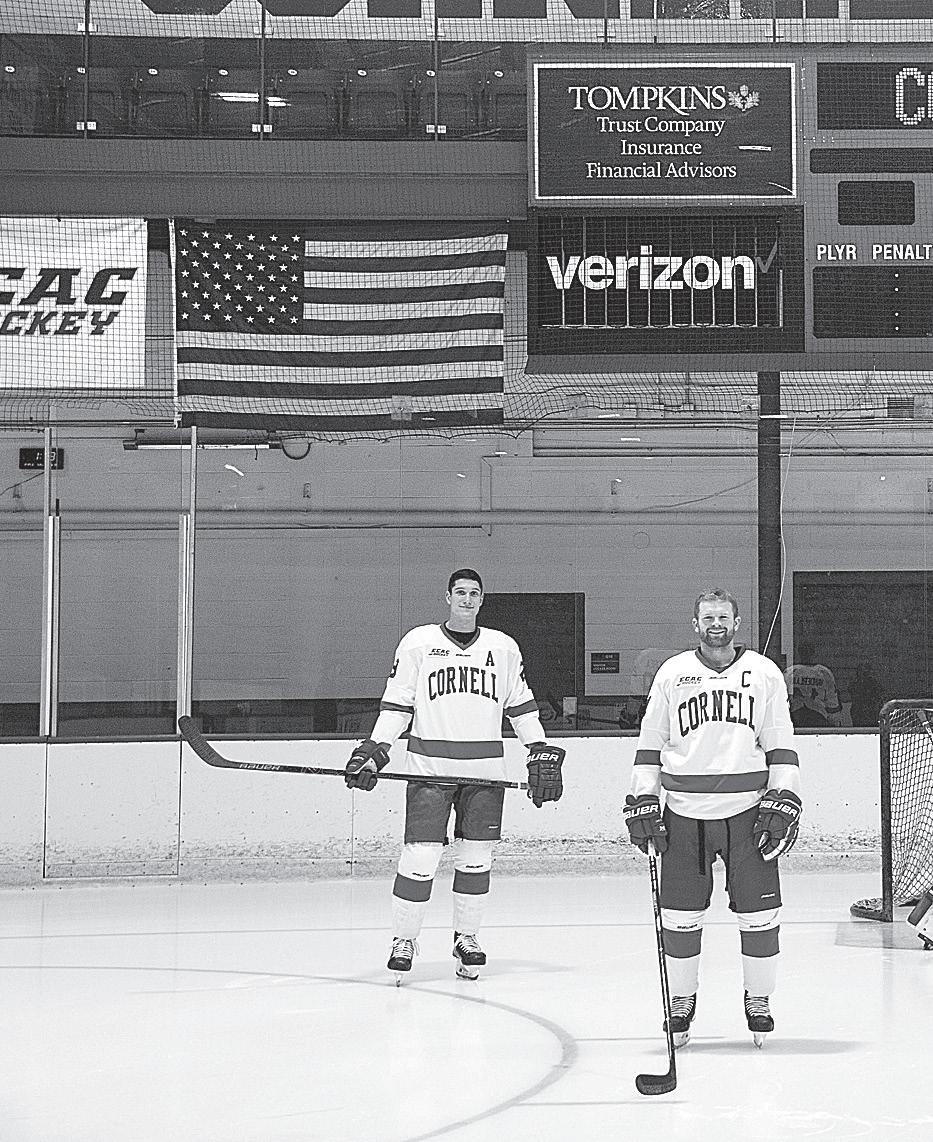
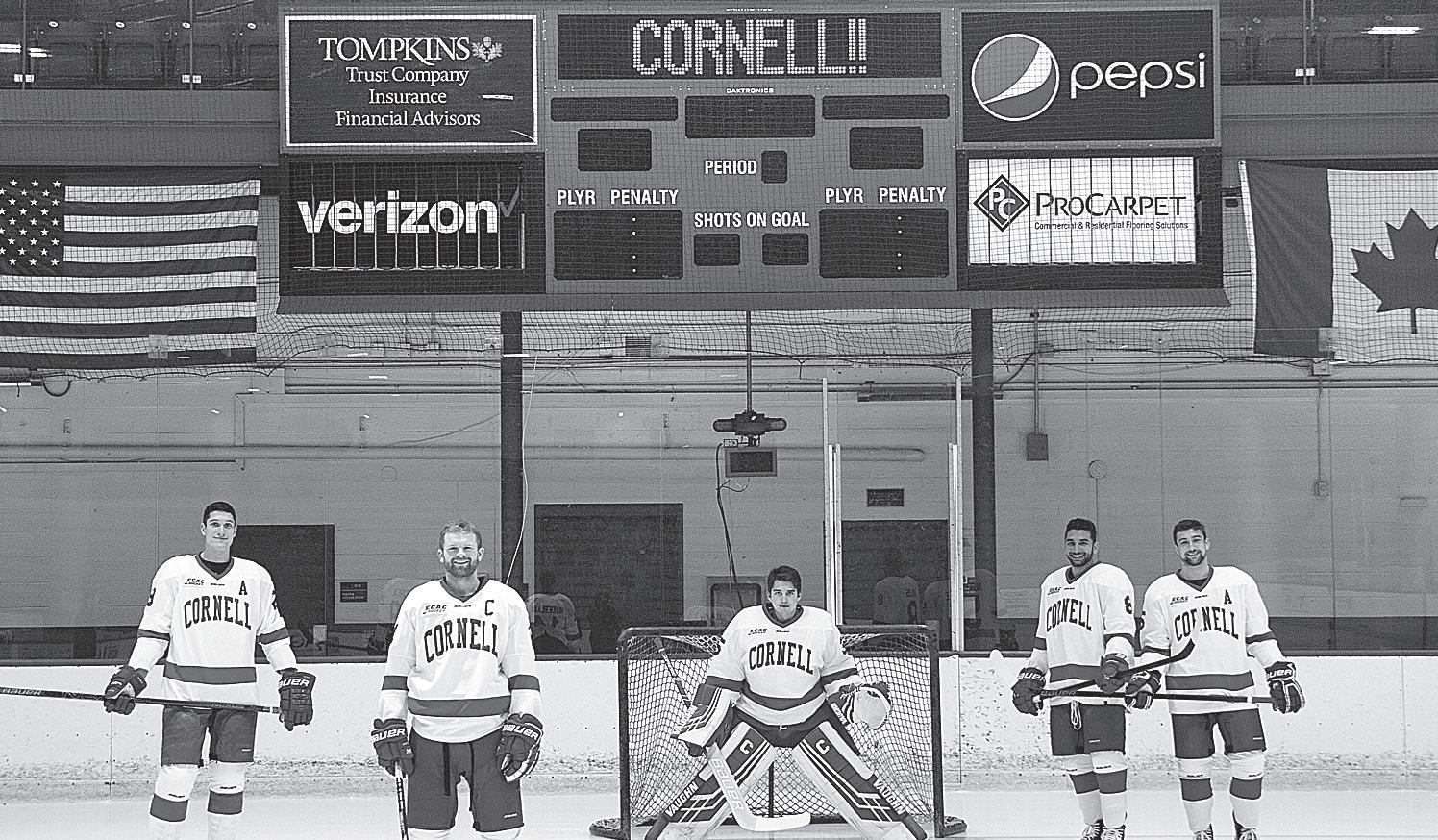
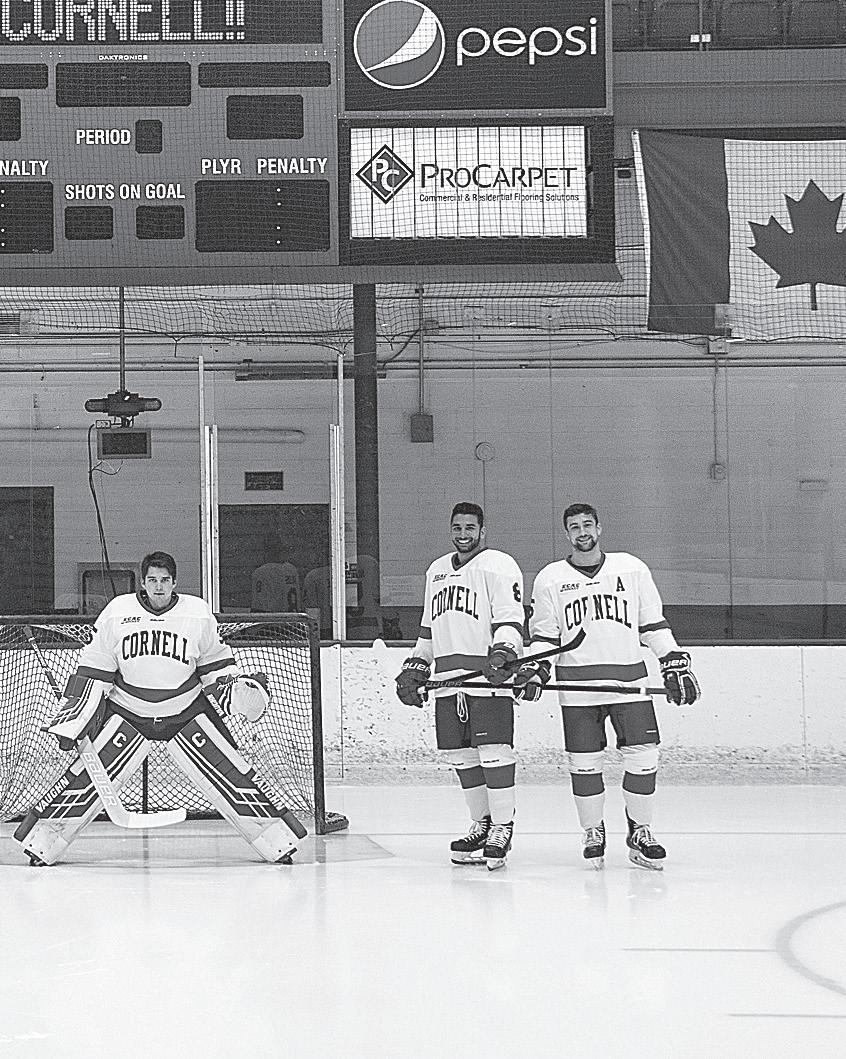
will look to replace the offensive production it lost over the summer.
By RAPHY GENDLER Assistant Sports Editor
Goaltenders: Galajda Looks to Repeat Stellar Rookie Campaign
The first-ever freshman Hobey Baker Award finalist and an all-ECAC first-team selection a season ago, sophomore Matt Galajda is back with a year of college hockey under his belt, primed to anchor a stellar Cornell defense once more.
Galajda doesn’t want to change much and has no reason to: he posted a 1.51 goals against average and recorded nine shutouts last season — both best in the country. His .939 save percentage was third-best.
“Playing simple, playing poised, being confident in my play,” the sophomore said as his keys to the upcoming year. “I think if I do that I’ll have a successful season.”
After a superb rookie campaign is it even possible for Galajda to be better? Statistically, likely not — but that might not be a bad thing, according to head coach Mike Schafer ’86.
“Can he put up the same goals against?” Schafer asked. “That’s not in our control and that’s not in his control. I’ve seen goaltenders make that mistake where they want to beat a tremendous statistical year.”
Even one of the country’s best goaltenders needs a solid backup — vying for the No. 2 role are sophomore Austin McGrath and freshman Nate McDonald. Neither have ever appeared in a game at the Division I level.
“Austin has had a good summer, I think he’s got more confidence this year than he had last year, and Nate’s had a solid camp so far too,” Schafer said. “Both those guys seem to have done a good job of challenging right now. … Obviously, you need one of them to step forward, and both those guys will get that opportunity.”
Defensemen: Red 1st Team in 17 Years to Return Entirety of Nation’s Best Defense
In case the return of star sophomore goaltender Matt Galajda wasn’t enough, the Red’s defensive corps — the best in the nation last season — is unchanged entering 2018-19.
Despite coming off a stellar 2017-18 campaign and being the first team to return an entire No. 1 defensive corps — including the goaltender — since Michigan State in 2001-02, the blueliners are prepared to improve.
“There’s always work to be done,” Schafer said. “Our expectations for all those guys is to get better. … The biggest improvement within your team is your sophomores, juniors and seniors.”
The Red allowed 1.58 goals per game last year en route to a .788 winning percentage, also the country’s best.
All three defensive pairings return: seniors Brendan Smith and alternate captain Alec McCrea; junior Yanni Kaldis and sophomore Alex Green; and senior alternate captain Matt Nuttle and sophomore Cody Haiskanen.
The top-six defensemen being back certainly makes things easier for Galajda.
“Being able to have all those guys back, they’re a huge part of my personal success last season and the team’s success as well,” Galajda said. “They’re an unbelievable defensive corps and having them back this year, every single one of them, is going to be huge for us.”
Forwards: Who Will Score?
Everybody, Cornell Hopes
Cornell scored enough to get by in 2017-18, but there’s no doubt in made it to the NCAA Tournament on the strength of its defense. This season, the Red is confident in can succeed again with its scoring-by-committee offensive approach without its top three goal-scorers from a season ago.
Trevor Yates ’18, Alex Rauter ’18 and Anthony Angello ’19 — who departed after his junior season to join the Pittsburgh Penguins organization — combined for 37 of Cornell’s 102 total goals last season. The Red has nine
returning players who scored four or more goals but none who recorded double-digit tallies.
Senior captain Mitch Vanderlaan leads returners with seven 2017-18 goals.
“Guys are going to have to step up [and] find a way to contribute a little more offensively,” Vanderlaan said. “But we’re pretty deep so I don’t think that’s something we’re too concerned with.”
Head coach Mike Schafer ’86 said there’s no one player primed for a breakout year in the scoring department and that his defensemen and freshmen need to chip in along with players who had a small handful of goals. Five of Cornell’s second-year forwards scored two or more goals as freshmen, but none scored more than five.
“Everybody can just pick pieces and you never know who’s going to break out [and] score that 13, 14, 15 goals in a season,” Schafer said. “I wish I could say there’s one guy I think’s going to have a breakout year, I just don’t see that. It’s going to happen for someone, but to pick one guy would be throwing darts.”
Returning forwards include sophomores Cam Donaldson, Morgan Barron, Kyle Betts, Brenden Locke and Tristan Mullin; juniors Jeff Malott, Noah Bauld and Connor Murphy; and seniors Vanderlaan and Beau Starrett. Five new freshmen join the mix: Max Andreev, Zach Bramwell, Michael Regush, Chase Brakel and Liam Motley.
Power-play scoring for the Red won’t mirror last year’s production. Of the Red’s 22 man-advantage scores last season, 11 don’t return. Of the 11 that do, a combined eight come from defensemen Yanni Kaldis and Alec McCrea, leaving plenty of opportunity — and need — for power-play goal scorers to step up: returning forwards combined for just two power-play goals last year for a team whose 17.1 percent mark on the power play was 40th in the country (Cornell’s 83.2 percent penalty kill was 13th-best).
Raphy Gendler can be reached at rgendler@cornellsun.com.
| Cornelll
up to