The Corne¬ Daily Sun


By KATHYRN STAMM Sun Staff Writer
After over a month of back and forth, Cornell’s Alliance for Science asked one of its fellows, Julia Feliz, to leave on Oct. 15, citing them as a continued interruption to the program. Feliz called the program racist.
Feliz — a scientific researcher in conservation ecology — was a member of the fourth cohort for the Global Leadership Fellows Program, which started in 2015. They were born in Puerto Rico and were the first Afro Indigenous fellow, they told The Sun.
The 12-week program focuses on agricultural biotechnology innovation, bringing “emerging international leaders” to Cornell’s campus to learn skills to bring back to their home countries, according to a statement from John
Carberry, senior director of media relations.
According to Carberry, 27 of the 31 fellows were people of color, coming from various countries including Bangladesh, Brazil and Burkina Faso.
Feliz described not only facing racism, but also intimidation, negligence of their requests and retaliation for speaking out throughout the program.
On Sept. 10, a visiting professor made “sexist, racist and really inappropriate comments,” while giving a seminar talk, Feliz told The Sun. Part of the program curriculum includes “seminars and workshops led by international thought leaders and subject matter experts,” according to the program website.
Feliz claimed the male professor angrily accosted them, interrupting their question following up on his claim
that animal agriculture could save developing countries. Upset by the incident, Feliz then left the classroom and skipped more of that day’s programming.
On Sept. 12, Feliz emailed the leadership of the program — including Sarah Evanega, the director of Cornell Alliance for Science — about their concerns regarding the incident, which had not been addressed.
Feliz said there was no response until Sept. 20, and then Evanega suggested a meeting with human resources, which Feliz declined.
Ultimately, Evanega met Feliz during a class on Sept. 24, according to Feliz. Evanega reportedly asked Feliz to consider leaving and asked if the program was right for them, citing that it was “about biotechnology and not social
See SCIENCE page 5
By AMANDA CRONIN Sun News Editor
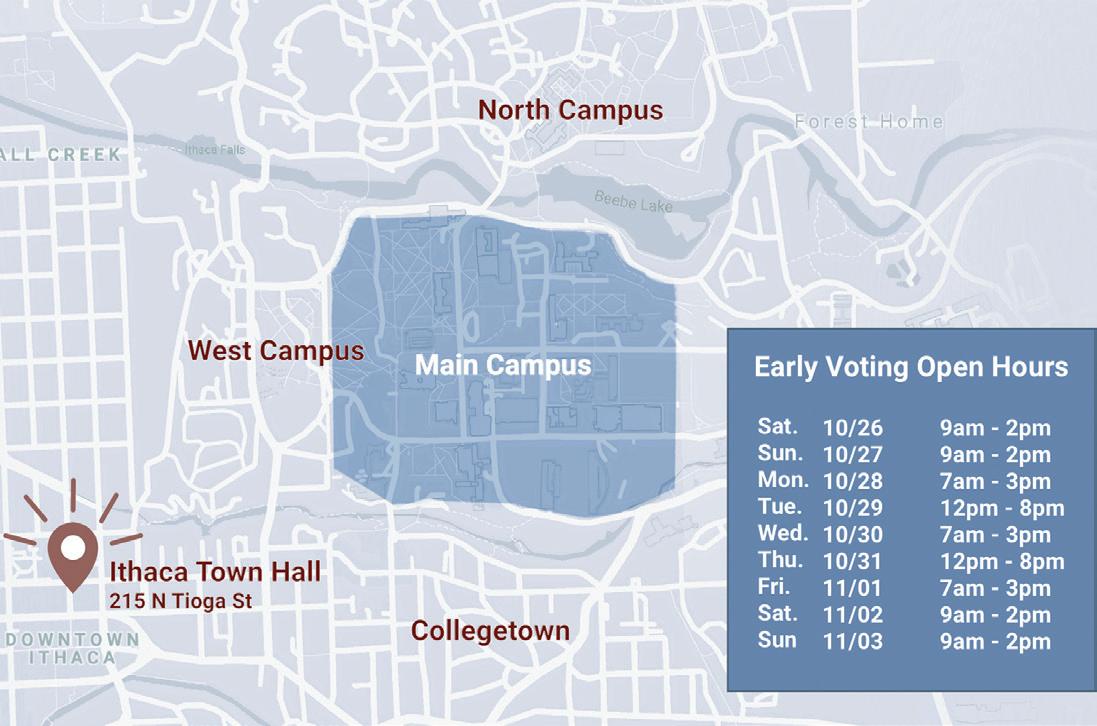
Lawns and street corners are littered with red, white and blue signs: “Justice Claudette Newman for Supreme Court!” “Svante Myrick for Mayor!” This year, voters don’t have to wait until election day to bubble their ballots. “Early Voting,” signed into New York state law in January, gives voters a nine-day head start beginning
Oct. 26. Students, faculty and staff registered to vote in any New York state county can queue at Ithaca Town Hall in the Commons or at the Crash Fire Rescue building starting at 9 a.m. on Saturday, Oct. 26, and concluding at 2 p.m. on Sunday, Nov. 3. People voting on general election day, Nov. 5, should report to their usual assigned polling location. Ithaca Town Hall, located two
blocks north of the Commons shopping center, is the closest early location to Cornell’s campus. The 10, 30, 31, 32, 51 TCAT bus lines service the area Monday through Friday, as well as the fee-free 70 and 72 bus lines on Saturday and Sunday.
The closest Nov. 6 polling place is St. Luke’s Lutheran Church in Collegetown.
By SARAH SKINNER Sun Managing Editor
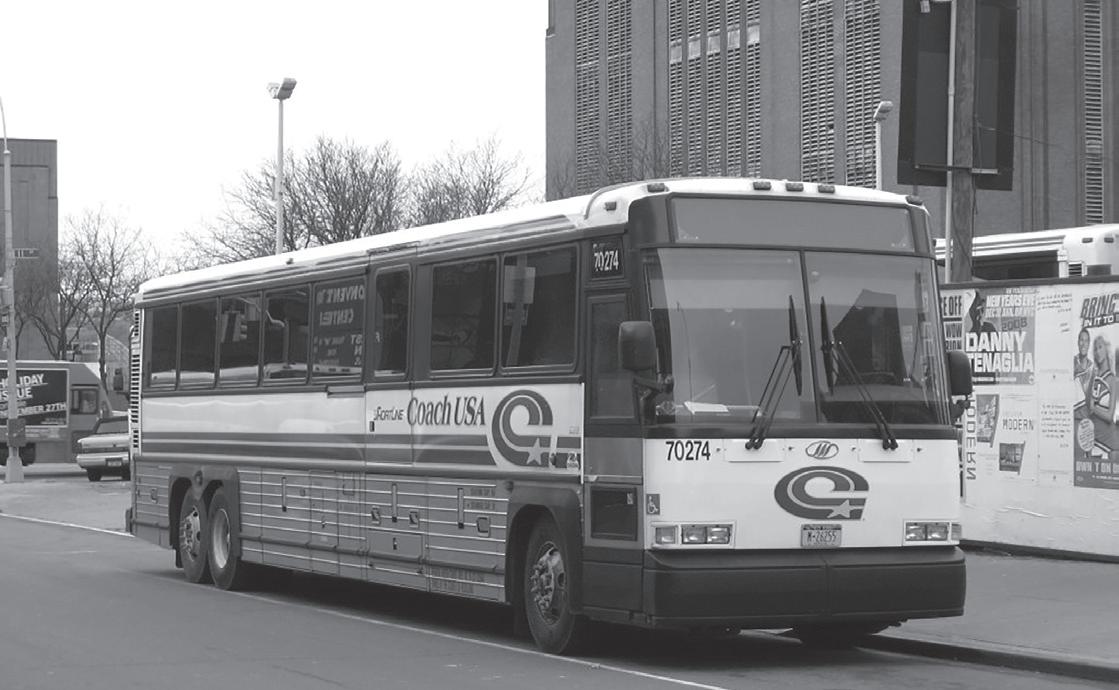
Coach USA, the parent company of the Shortline bus service whose routes routinely ferry Cornell students in and out of Ithaca, sent a cease and desist letter to on-campus satire publication CU Nooz about an online piece that poked fun at fall break travel times.
The letter, obtained by The Sun and sent by Coach USA’s legal counsel, called the piece “libelous” and threatened legal action if not pulled off of CU Nooz’s website. The article, originally entitled “Student Spent Entirety of Fall Break on Shortline Bus” spoofed the travel experience of a fictional student on a nonexistent Shortline route, saying that long bus journeys prevented her from spending time at home.
Sean Hughes, a spokesperson for Coach USA, said the article could be misleading to customers in a statement to The Sun.
“Shortline understands that the article was satirical, but if anyone unknowingly was doing a search on ShortLine services and this article came up they would not see that it was fake news,” Hughes said. The letter, sent Monday morning, lists instructions for the piece to be “immediately removed” and for “no further libelous material will be published on cunooz. com.” The original article was posted on Oct. 16.
After recieving the letter, CU Nooz updated the article on Tuesday morning, crossing out words and replacing them with bolded, all caps text: “Kayla Gladstone ‘22 spentDID NOT SPEND the entire duration of Fall Break on a Shortline service” and “When asked for comment about the delays, aNO
Thursday, October 24, 2019
C.U. Music Open House for Undergraduates Noon - 1:30 p.m., 101 Lincoln Hall
Diwali Lunch Celebration Noon - 1 p.m., 101 Warren Hall
Goldwater Scholarship Information Session Noon - 1 p.m., 103 Barnes Hall
Hugh Gusterson, Professor of Anthropology And International Affairs, George Washington University: “Drone Warfar” 12:15 - 1:30 p.m., G08 Uris Hall
Makda Weatherspoon, “Prison Break: What it’s Really Like to Teach Arabic Behind Bars” 12:15 - 1:15 p.m., 410 White Hall
Major Speaker Series: Democracy, Today: Fake News, Social Networks, and Algorithms (David Lazer, Northeastern) 4:30 p.m., Statler Auditorium
Fall 2019 Barbara & David Zalaznick Creative Writing Reading Series: Desiree Cooper 4:30 - 6:30 p.m., G70 Klarman Hall
Yoga Sponsored by Cornell Minds Matter 5 - 6:15 p.m., Willard Straight Hall
Beginner Salsa Dance Class 7:00 - 8:00 p.m., 303 Appel Commons

Doctors Without Borders information session: What do they do? Is there a place for me? Friday, 3 p.m., 132 Goldwin Smith Hall

Questions for a Dinosaur: 109 Questions About Exctinction in 10 Minutes Friday, 3 p.m., 233 Plant Science Foyer
Chocolatada! Saturday, 10 a.m. - 4 p.m., Brian C. Nevin Welcome Center
Cornell Football Game Vs. Brown University 1:30 p.m., Schoellkolpf Field
Cornell Fall Employee Celebration Saturday, 2:30 - 5 p.m., Barton Hall
Listen Live: Citations Needed and Journey West Saturday, 4:30 - 9 p.m., Herbert F. Johnson Museum of Art
Joint Journal Halloween Party Saturday, 8 - 10:30 p.m., 401 Physical Sciences Building
The Fisk Jubilee Singers in Concert Saturday, 8 p.m. Alice Statler Auditorium
Salsa Social and Performance by U.V. Latin Dance, Featuring D.J. Sal Sero Saturday, 11 p.m. - 1 a.m., Robert Purcell Community Center
By SCARLETT ZHA Sun Contributor
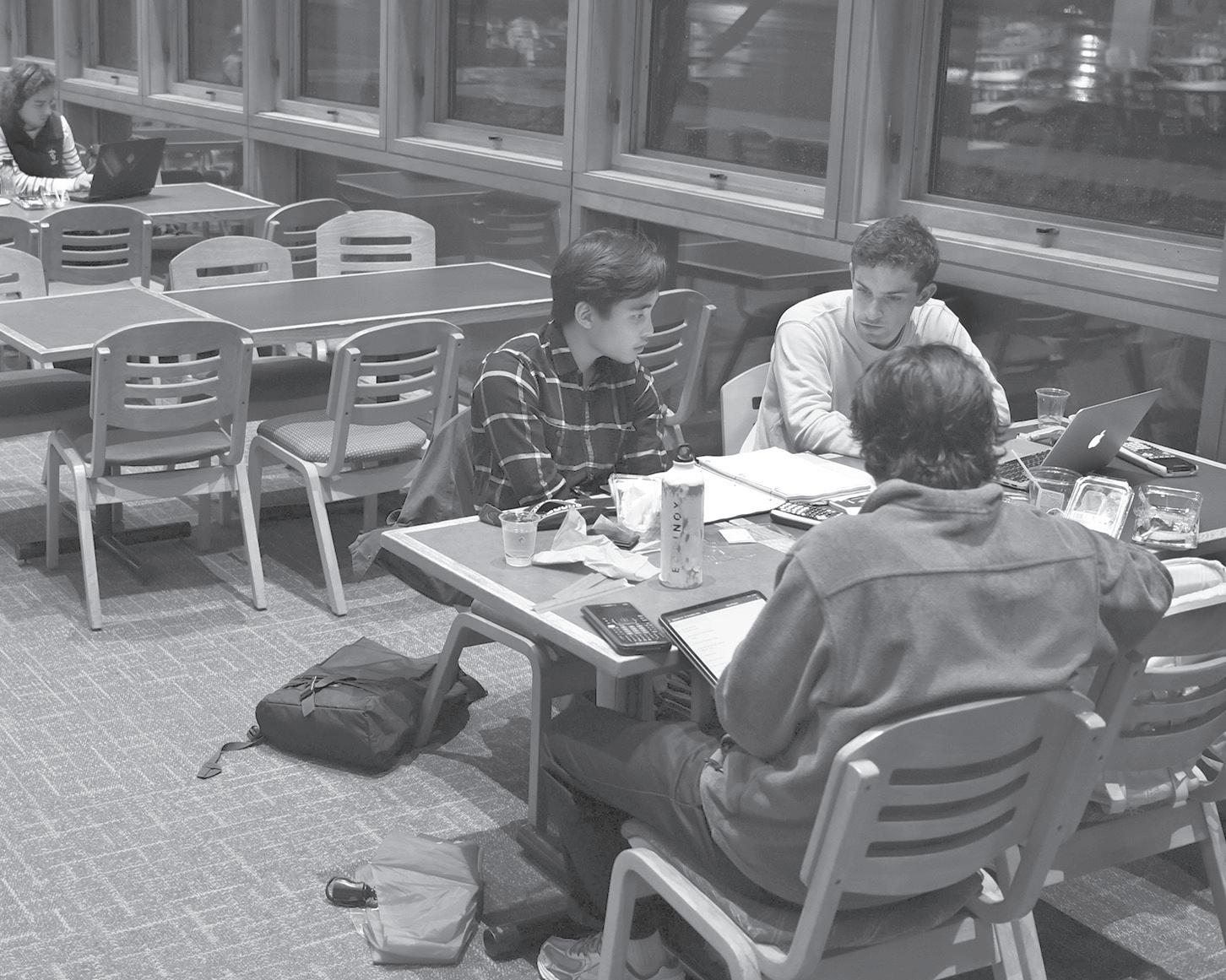
From the Ag Quad to the Engineering Quad, Cornell Dining has expanded its late-night dining services this semester and reduced the offerings available at Trillium.
This semester, Trillium no longer serves hot food because of the high cost of maintaining hot stations, Meng-Wei Hsu, senior operations manager for the Ag Quad and Coffee Shops, told The Sun in an email. Students will only be provided very limited options like grab-and-go sandwiches, salad, and sushi in the fridge.
“This is very disappointing,” said Lakshmi Babureddy ’20. “I liked it when they used to have hot food, but for now, who wants to eat cold sandwiches for dinner?”
Babureddy studies applied economics and management, a program that is based on the Ag Quad.
For student-athletes and those who stay around the Ag Quad at night, Trillium is considered the most convenient place to eat, according to Babureddy, Vanessa Lobo ’20, a student in the School of Industrial
and Labor Relations and Hailey Erkkila ’22, a member of Women’s Track & Field. However, both Babureddy and Lobo mentioned that they probably would not visit Trillium again during late-night hours if no hot food is served.
“I liked it when they used to have hot food, but for now who wants to eat cold sandwiches for dinner?”
Lakshmi Babureddy
’20
Last year, when Trillium extended their dining hours, The Sun reported the change was spearheaded by Cornell’s athletic community. When a late-night eatery located near athletic practice facilities had closed, many athletes were concerned about their late-night eating options.
However, Trillium received “very little participation” from student-athletes at night for the past three semesters, despite being
By MEGHANA SRIVASTAVA Sun Staff Writer
Looking for accounting credentials but don’t want to be in Ithaca? The SC Johnson College of Business launched an online accounting certificate as part of their eCornell initiative.
The program is designed for working professionals seeking additional credentials or pre-MBA students who want to get a head start. eCornell currently offers certificates in a variety of fields, ranging from technology and health care to leadership.
This program is completely virtual, consisting of video conferences with the instructor, video lectures, discussion forms, projects and quiz questions dispersed throughout the course. In order to earn the accounting certificate, students must successfully complete four courses over the span of two months, according to the
eCornell website. The program costs $3,650 upfront, or $950 over the course of four months, and students must complete courses about financial statements, accruals, sales accounting and financial forecasting to obtain the certificate.
“I think of a video as my best possible lecture ... I’m working with a team.”
Prof. Robert Bloomfield
Prof. Robert Bloomfield, accounting, serves as the faculty author and professor for the course. In the past, he has authored eCornell courses such as Strategic Decision Making and Measuring and Motivating Performance. He spoke to The Sun about the differ-
ences between an online versus a traditional, in-person course.
“A lot of people, when they hear ‘online education’, think oldschool, correspondence courses, you’re totally alone, and you’re just reading stuff and watching videos,” Bloomfield said. “That’s really not the way eCornell designs their courses. There is an instructor who interacts with the students regularly in live sessions.”
In addition to the live sessions, one aspect of the program that Bloomfield highlighted was video lectures, which are filmed in advance for the students to watch on their own time.
In some ways, these videos can be filmed more professionally than a traditional lecture. “I think of a video as my best possible lecture. Rather than getting up there and trying to get it perfect that one time, which is so hard in a class-
By LIN AI Sun Contributor
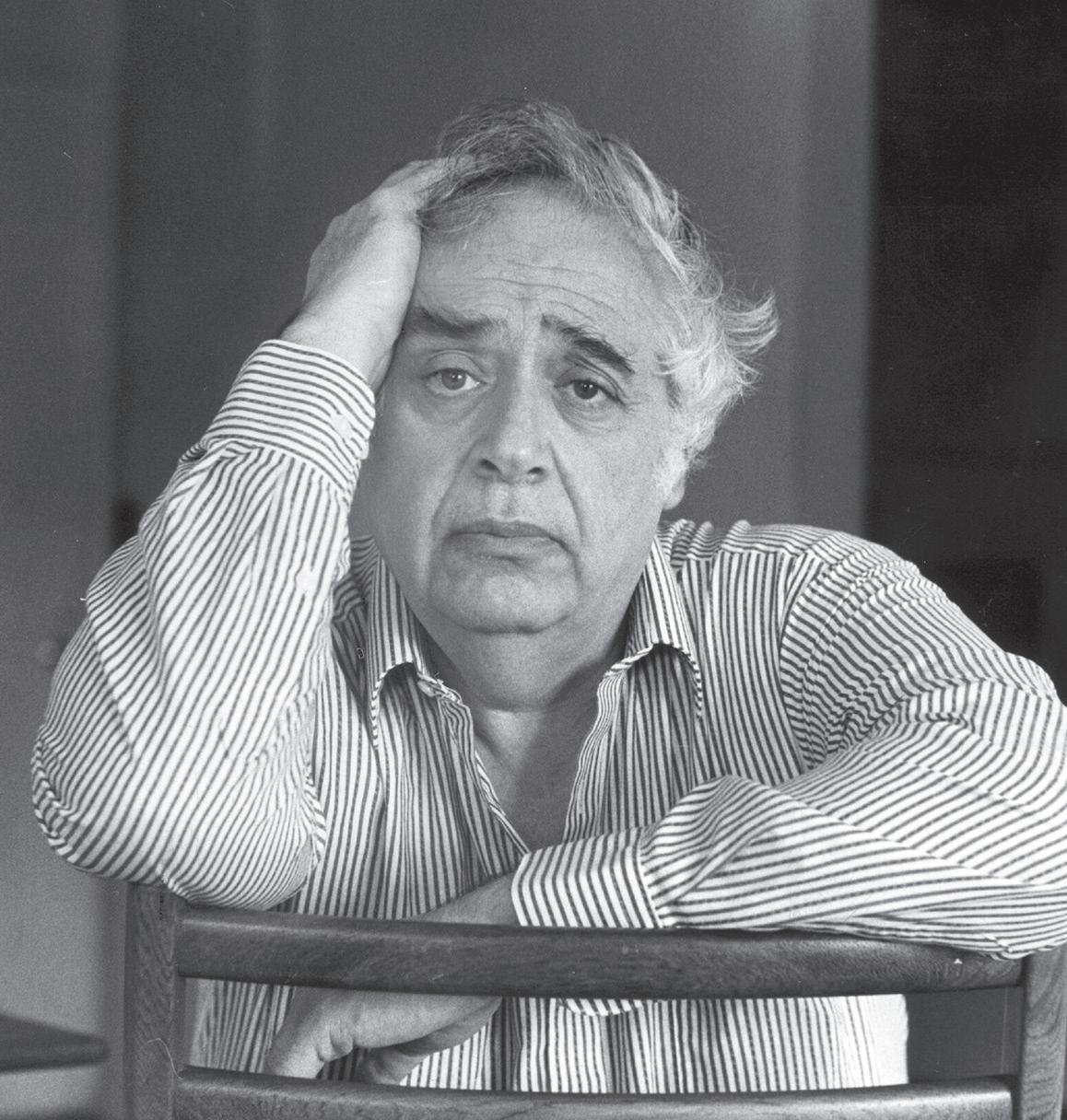
Harold Bloom ‘51, an English professor at Yale University and literary critic, died at the age of 89 on Oct. 14 in New Haven. He taught his last class at Yale University on Oct. 10.
Born in East Bronx in 1930 in New York City to a pair of Eastern European parents, Bloom had Yiddish as his first language and taught himself English afterwards. When he arrived at Cornell University in the late 1940s, he had “preternatural speed in reading, accompanied by total memorization” of what he enjoyed most, Bloom wrote in the forward to his mentor Meyer Howard Abrams’ essay collection, The Fourth Dimension of a
Yet he also dubbed his undergraduate self as “awkward” and “socially scarcely existed, hindered by self-consciousness and acute anxieties.” In the foreword, Bloom paid tribute to Abrams for freeing him from all doubts and encouraging him onto an academic and literary critical career.
member of the English department there until his death.
As a professor of English at Yale University, Bloom had a distinctive style of teaching.
“He would always do most of the talking in a stream-of-consciousness way, and never had any notes written down that I could remember,” Prof.
“He would alway do most of the talking in a stream-of-consciousness way, and never had any vnotes written down that I could remember.”
Prof. Roger Gilbert
Bloom graduated from Cornell in 1951 with a degree in Classics, and received his Ph.D. from Yale in 1955. He got a teaching job at Yale the same year, and was a
Roger Gilbert, English, said about his time as a graduate student when Bloom taught at Yale.
“He knew the text that he had asked us to read so well that he didn’t
need to take notes on what passages appeared where.”
Bloom is known for his theory of influence. For him, a writer usually has one or multiple “precursors” who influence them the most. They not only inherits the influence but also seeks to transform that influence into something original. Bloom took his ideas to the extreme, according to Prof. Gilbert. In the case of influence, Bloom claims that later writers almost have some anxiety or resentment towards their precursors, which manifests itself in gestures that imply the previous writers’ work needs correction.
For Bloom, one of the sources of his influence was from Northrop Fye,
See OBITURARY page
By MEGHNA MAHARISHI Sun Staff Writer
What started off as seemingly innocent background music in a collaboration between Cornell and two agriculture organizations soon unfolded into a major lawsuit — with the University now facing allegations of copyright infringement.
After collaborating with the two companies to create an advertisement featuring ambient music in the background, Cornell was served with a lawsuit from one of the owners of the ambient track — record label Yesh Music LLC.
The song at the center of this lawsuit is entitled “TimeAmbient Version” — an electronic, atmospheric track which crescendos with increasing instrumentation.
Yesh Music filed the lawsuit
against Cornell on Oct. 3.
Initially, the two other parties involved in the lawsuit were the Groundswell Center for Food and Planning, an organization which encourages women, people of color and other marginalized groups to pursue sustainable farming, and Ecoagriculture Partners, a non-profit that also specializes in sustainable agriculture through “integrated landscape management.”
In a statement to The Sun, Yesh Music’s attorney, Richard Garbarini said that Yesh Music filed this lawsuit because the company relies on royalties from its ambient songs. “Yesh filed the matter because the property it created and earns a living from [was] copied, synchronized, and publicly displayed without a license,” Garbarini said.
The record label is now seek-
ing damages from Cornell and Ecoagriculture of up to $150,000 but no less than $30,000.
The record label elaborated in the lawsuit that it was difficult to find the advertisement because it failed to include the copyright-
Music sent another cease and desist order to Groundswell and Ecoagriculture, but the order was ignored once again. The record label described the dismissiveness of the orders in the lawsuit as an “utter disregard,” entitling the label to file a lawsuit.
“Yesh filed the matter because the property it created and earns a living from [was] copied ... without a license.”
Richard Garbarini
ed recording title, album name, author, label and copyright owner.
Yesh Music claims in the lawsuit that its counsel issued a cease and desist order to Groundswell and Ecoagriculture on Aug. 12, but both parties ignored the order.
On Aug. 30, lawyers for Yesh
For Cornell, the lawsuit stated that the University, along with
Ecoagriculture, broadly distributed the advertisement — which allegedly lacked the proper licensing to use the song — as “an effort to increase support for [their] featured farming related entities.”
University spokesperson John Carberry told The Sun that the
VOTING
Continued from page 1
The seats of Mayor, five common council members, Town Supervisor, Town Councilperson and state supreme court judge are all up for election this year.
Cornell Votes — the campus chapter of the Andrew Goodman Foundation — is disseminating information leading up to the Early Voting period and election day to encourage students to get to their polling places.
While Cornell Votes fellows — group members –– urge Cornellians not to “discount local elections.”
Cornell Votes fellow Jenna Oliver ’20 argued that, while on the surface it may seem like local issues do not apply to Cornellians’s everyday lives, issues like “parking, trash removal, affordable housing,” are all decided by the local government.
“Whether you’re a freshman or a sophomore, or have one year left, Ithaca politics affect you, whether you realize it or not,” Oliver said.
If voters are unable to get to
town hall on any of those nine days, or their polling location on election day, absentee ballots are accepted via mail up until the seventh day before the election, or delivered in person no later than the day before the election. Free envelopes and stamps to postmark ballots are available on the third floor of Kennedy Hall. Students must be registered to vote in New York state to participate in early voting. The deadline to register in New York for the general election in November was Oct. 11. However, people can still register to vote for the April primary elections. Information about other state elections is available at vote.gov.
Because the Cornell student population residing in Ithaca is sizable, Sally Grubb, Co-President of the Tompkins County League of Women Voters, believes that “voting students who live in and around make an enormous difference. They have a perfect right to have a say in what goes on in Collegetown. That’s what local politics is all about: to reach an agreement on how we should all live together.”
Keelin Bell Key ’20, Cornell
Votes fellow, agreed: “Instead of complaining on Facebook or Twitter about how much you hate the world, go vote!”
Early voting was signed into New York state law as one way to improve voting accessibility. “It makes an enormous difference for low-income people and people who have extended family obligations,” Grubb told The Sun.
Grubb said the League has always worked “tirelessly” on the local and state level for voting modernization. Although early voting is a step in the right direction, Grubb said that there is much more that New York can do to facilitate the election process.
Although Election Day was recently classified as a public holiday in New York, that does not grant state businesses or schools a day off. However, New York does allow employees up to three hours paid time off work on election days.
Complaints from constituents about polling locations’ limited hours of operation were the central push behind early voting legislation. According to the New York Board of Elections, Tompkins County polls are
open from 12 - 9 p.m. for the primary election and from 6 a.m. to 9 p.m. for the general election. Although these hours are longer than some other states, according to Vox.com, obstacles such as work, child care, transportation and related costs can prohibit voters from getting to the polls before the doors close.
Governor Andrew Cuomo voiced his hope that the early voting period will increase voter turnout across all age groups, particularly students, who are historically difficult to motivate.
“We are going to finish the job... to once and for all make it easier for New Yorkers to make their voices heard at the ballot box,” said Cuomo.
For the 2016 presidential election, only 59.9 percent of registered Cornell student voters turned out, according to the 2017 National Study of Learning, Voting and Engagement. While that was an increase from the 2012 rate of 51 percent, a large chunk of students remains on the sidelines.
Amanda H. Cronin can be reached at acronin@cornellsun.com.
the first group to request Trillium’s late-night hours, according to Hsu.
Starting last semester, the Cornell Dining Team shifted Trillium’s late-night hours from 7-9 p.m. to 6-8 p.m. due to a limited number of customers arriving after 8 p.m.
Among the current latenight dining locations around Central Campus, Mattin’s Cafe, located on the Engineering Quad, has been the most popular one so far — with around 300 to 600 customers coming in from 6-10 p.m., according to Hsu. The extension went into effect after Fall Break.
Goldie’s Cafe, located in the Physical Sciences building, also expanded their hours after the
break to remain open one and a half hours later until 7:30 p.m, on Mondays through Thursdays.
“Goldie’s Cafe has been well received by the students and faculty from Physical Sciences Building and Clark Hall,” Hsu said. “This is a brand new latenight service we’ve never tried before.”
For the past few semesters, Cornell Dining has been receiving requests to offer more latenight dining options on Central Campus from different groups of Cornell Community, due to its limited options compared to both North and West Campus.
The Robert Purcell Community Center on North Campus has featured a dining hall that is open until 9 p.m. and a convenience store and grill open until 2 a.m. On West, the
last dining hall among its five houses closes at 9 p.m. and its convenience store is open until 1 a.m.
“We try to be responsive to all of the suggestions we hear, and try to have meals available when and where people need them,” Hsu said.
Joshua Park ’20, AEM, and Brian Jeong ’21, an Engineering student, told The Sun that Mattins’ campus location, short food-preparation process and relatively satisfactory food quality are the main reasons that keep it popular.
Besides those late-night dining places mentioned above, the Take Us Home meal, a microwavable food tray packaged by Cornell Dining, is also an option for those who prefer hot-meals during the times when kitchens cannot be opened around them.
University cannot currently comment on any active litigation.
However, the case against Groundswell was recently dismissed, according to Garbarini.
Yesh Music made headlines in February 2016 when it filed a lawsuit against Tidal Music for copyright infringement and underpayment in royalties to the keyboard player and percussionist of The American Dollar, whose music the company publishes.
In 2017, Yesh Music filed a lawsuit against Amazon over copyright infringement. Another lawsuit was filed by Yesh Music against Warner Music Group on Aug. 21, 2019, over the same issue.
The case for Cornell and Ecoagriculture is still ongoing.
Meghna Maharishi can be reached at mmaharishi@cornellsun.com.
Longterm Yale Professor, Bloom taught his last class on Oct. 10
Continued from page 3
a literary critic and author of The Anatomy of Criticism , with whom
Humanities. There, he met Archie Randolph Ammons, a poet and professor of poetry at the University and the pair became close friends.
“His basic motive is to praise those writers and to help his students understand ... them.”
Prof. Roger Gilbert
he shared an encompassing vision of literature that was not limited to one specific period or genre, as shown in Bloom’s book The Western Canon He was also known for being “an appreciative critic” and for his value of an aesthetic education — which focuses on literature’s function in augmenting and complementing the self rather than in being analysed through historical and social contexts.
“There are four very different full dinners to choose from with generous portions and affordable pricing, and students and staff have told us they enjoy them when they want to enjoy a hot meal right at the cafe or even take something home,” Hsu said.
The Take Us Home meals can be picked up at Bear Necessities, Mattin’s Cafe, Cafe Jennie, Amit Bhatia Libe Cafe, Trillium, Jansen’s Market or Green Dragon.
The Cornell Dining Team will decide on the late-night opening hours and locations for the upcoming spring semester based on the demands of both current and previous spring semesters.
Scarlett Zha can be reached at yz355@cornell.edu.
“His basic motive is
“He would always do most of the talking in a stream-of-consciousness way.”
Prof. Roger Gilbert
to praise those who in his view were the greatest writers and to help his students and readers better understand and appreciate what was most distinctive about them,” Gilbert said.
In the fall of 1968, Bloom came back to Cornell University for a year as a Fellow of the Society of the
According to Prof. Gilbert, Bloom was a great admirer of Ammons’ poetry. On the other hand, however, Bloom tried to influence Ammons and push him to be “leave mundane particulars behind” and be “intense, mad, and consistently high” instead, according to an article written by Prof. Gilbert in 2012 about the literary “bromance” of Ammons and Bloom. In 1999, Bloom came back to Cornell — for the last time — to deliver a Baccalaureate service address. Professor Gilbert then drove him to Archie’s house in Cayuga Heights, where Bloom met Archie Ammons and M. H. Abrams and had a delightful catchup. That was the last time the three were together. Bloom is survived by his wife of 61 years, Jeanne, and two sons.
Lin Ai can be reached at la382@cornell.edu.
justice.”
“Well I’m a scientist. I’m a social justice activist and I’m also an Afro Indigenous person from Puerto Rico. I can’t separate those things,” Feliz said.
Evanega did not respond to The Sun’s request for comment.
Carberry said Cornell staff reached out to Feliz with different support options, but that Feliz chose not to take advantage of those options.
On Oct. 4, Feliz received an email notifying them that Evanega had filed a bias report on their behalf with the Department of Inclusion and Workforce Diversity. Feliz replied asking why this had been reported without their consent.
On Oct. 7, Angela Winfield, Associate Vice President of Inclusion and Workforce Diversity, sent a formal apology to Feliz.
“I am glad you are planning to stay and complete the program,” Winfield said. “You should not be unfairly pushed or pressured to leave for raising legitimate concerns that Cornell needs to know and hear about if we are to truly create a diverse and inclusive community.”
On Oct. 15, Feliz was officially released from the program.
Carberry said the decision to ask Feliz to leave was made only after Feliz “engaged in behavior that caused numerous and repeated complaints from other fellows over many weeks.”
“It became clear that the educational experience of other fellows was being compromised due to ongoing interruptions of classroom lectures and discussions by Mx. Feliz,” Carberry said. “Program leadership ultimately determined with sincere regret that Mx. Feliz was not benefitting from the program and that Mx. Feliz’s continued presence was depriving other fellows of their opportunity to benefit from the program.”
For Feliz, being asked to leave was a final attempt to silence them and any conversation about race, “allowing this racism to be okay.”
Following being asked to leave, Feliz said there were further complications, including with their stipend and flight home.
Feliz said Cornell bought them a ticket home to Switzerland without
their consent — trying to “deport” them, despite being a U.S. citizen. They also say Cornell refused to pay their stipend without sitting down for a meeting.
According to Carberry, Cornell paid the entirety of Feliz’s stipend, covered all housing and purchased Feliz a ticket to return to Switzerland, where they currently reside.
Feliz has since filed a complaint with the Office of Institutional Equity and Title IX and published a list of demands for Cornell. These include a formal apology, the certificate of completion for the program and sensitivity training for faculty.
After Feliz published an article on Medium.com entitled “Cornell University’s Alliance for White Supremacy,” some students have voiced their support for Feliz.
Gavin Martin ’20, Student Assembly Arts & Sciences representative, decided to bring the issue to the S.A., proposing a public statement to be published on SA platforms and to bring awareness to Julia’s situation. There will be a vote during Thursday’s S.A. meeting on the matter.
“[In not doing something,] we become a bystander, ... complicit to the injustice done to Julia,” Martin said. “I refuse to sit idly by, and I refuse to let an organization that I love being a part of stand idly by.”
Martin explained that Julia’s case is not an isolated one, but one he has experienced himself.
“Even though drastic actions like this happened in this instance, it happens often at Cornell,” Martin said. “I have had my participation grade docked for continuing to bring up ... issues pertaining to Black rights ... in my government classes.”
For both Martin and Feliz, these incidents are emblematic of Cornell’s continued devaluing of the lived experiences of students of color in academic spaces.
“This is really a systemic issue where they just try to silence people and get rid of them,” Feliz said. “Just because we are marginalized … doesn’t mean that they can treat us like dispensable trash that they can exploit.”
Caroline Johnson ’22 contributed reporting.
Shortline representative replied: “Fuck you, we’re Shortline. That’s why.”
In a statement to The Sun, the editorial board of CU Nooz said that they modified the article to remove sections that “Shortline may find offensive.”
“While normally we wouldn’t be afraid of any legal requests, even we know not to get on the wrong side of Coach USA’s fearsome legal team,” the board’s statement read, provided by Sam Ringel ’20, one of the co-editors-in-chief.
The satire magazine’s board said that while they considered taking down the article, it elected to simply provide edits as CU Nooz was “uniquely qualified to take a stand against the nationwide assault on freedom of the press, given that we are, in fact, a college satirical newspaper.”
In cases of satire, the Student Press Law Center points to a 1988 Supreme Court Case regarding parody or spoofs that are accused of libel.
“A parody or spoof that no reasonable person would read as a factual statement, or as anything other than a joke – albeit a bad joke – cannot be actionable as a defamation,” the court’s decision in the case, Walko v. Kean College of New Jersey, read.
Coach USA stated that they did not know if customers would be in on the joke.
Ahad Rizvi ’21, who is not
associated with CU Nooz, sent an email to Shortline regarding the cease and desist, which he called “horrible,” and the original article — which he called “hilarious.” His email also listed complaints about past experiences with the service, including that the bus arrived hours later than scheduled and that workers were rude to riders during a 2018 trip.
Rizvi received a response on Tuesday from Laurie Heller, marketing manager for Coach USA. In the email, obtained by The Sun, Heller says that the article “wasn’t funny to us” and that Shortline has served Cornell and students for many years — something that that it “takes great pride in,” Heller wrote.
Heller wrote to Rizvi that seeing the article was “upsetting,” even if it was satire. “We really just didn’t want that article found
on the internet and someone think[ing] it was true,” Heller told The Sun on Wednesday.
Rizvi said that he stood by his complaints regarding Shortline’s service, and his critique of their response to CU Nooz.
“I don’t think anyone took the article as a malicious attack on Shortline, it was just funny,” he told The Sun.
Kyle Karnes, CEO of Student Agencies, which contracts with Coach USA and the Shortline service, told The Sun on Tuesday that Student Agencies had been unaware of the letter and uninvolved in its sending.
On Wednesday, CU Nooz published another article entitled “8 Bus Companies We’d Rather be Sued by Than ShortLine.”
room, and trying to use my fairly meager design skills to create slides and stuff like that, I’m working with a team,” Bloomfield said.
This team consists of graphic designers and animators, who work to make the videos more engaging.
Bloomfield described how he works with animators, saying that he plans out exactly how long each topic will take to discuss and films the segment as many times as is needed to get it exactly right. Then, Cornell brings in a team of designers who put together the animations. According to Bloomfield, “Instead of lecture, what you’re getting are these very carefully designed videos.”
Also amongst the online courses is a project calling upon students to interview professionals in accounting and finance — who are dedicated to the organizations
they work for. Since most of the students are working professionals, this organization is often the company for which they work.
“It gives them an opportunity to talk with the accounting and finance folks and learn what problems, what challenges they’re facing, how are they going about their jobs, and so on,” Bloomfield said.
According to Bloomfield, this program capitalizes on the benefits of technology, while also expanding access to an accounting certificate to something that even fulltime, working professionals can attain while also pursuing their jobs.
“The bottom line is that technology is really a great way to improve the quality of instruction,” Bloomfield said.
mms453@cornell.edu.

137th Editorial Board
ANU SUBRAMANIAM ’20 Editor in Chief
JOYBEER DATTA GUPTA ’21
Business Manager
PARIS GHAZI ’21
Associate Editor
NATALIE FUNG ’20
Web Editor
SABRINA XIE ’21
Design Editor
NOAH HARRELSON ’21
Blogs Editor
SHRIYA PERATI ’21
Science Editor
AMANDA H. CRONIN ’21
News Editor
JOHNATHAN STIMPSON ’21
News Editor
PETER BUONANNO ’21
Arts & Entertainment Editor
ANYI CHENG ’21
Assistant News Editor
SHIVANI SANGHANI ’20
Assistant News Editor
CHRISTINA BULKELEY ’21
Assistant Sports Editor
BEN PARKER ’22
Assistant Photography Editor
SARAH SKINNER ’21
Managing Editor
KRYSTAL YANG ’21
Advertising Manager
MEREDITH LIU ’20
Assistant Managing Editor
RAPHY GENDLER ’21
Sports Editor
BORIS TSANG ’21
Photography Editor
AMBER KRISCH ’21
Blogs Editor
KATIE ZHANG ’21
SOPHIE REYNOLDS ’20
AMINA KILPATRICK ’21
MARYAM ZAFAR ’21
ETHAN WU ’21
HUNTER SEITZ ’20
NICOLE ZHU ’21
Working on Today’s Sun
Ad Layout Krystal Yang ’21
Production Deskers Ben Mayer ’21
Krystal Yang ’21
News Deskers Amina Kilpatrick ’21 Shivani Sanghani ’20
Design Desker Krystal Yang ’21 Simon Chen ’21
Dining Desker Katie Zhang ’21
Photography Desker Ben Parker ’22
Sports Desker Christina Bulkeley ’21
Editorial
JULIA FELIZ’S RISE TO PROMINENCE HAS COME FOR ALL THE WRONG REASONS.
Once a participant in a little-known 12-week science fellowship, Feliz’s termination from the program has sparked furor on campus. The outrage followed a fiery Medium piece entitled, “Cornell University’s Alliance for White Supremacy” — mocking the “Cornell Alliance for Science” program from which they were unceremoniously ejected on Oct. 15. Feliz has since published a list of demands, seeking restitution from the University.
Feliz’s dismissal is an indignity. From what we know, Cornell appears to have ousted them merely for being a troublemaker. Feliz, in their article and in an interview with us, detailed how a hostile encounter with a guest speaker led them to complain to Alliance for Science leadership, who swiftly moved to sweep it all under the rug.
In Feliz’s telling, Sarah Evanega Ph.D. ’09, the program director, first asked to meet Feliz alone, ignoring their requests for disability accommodation in the form of a support person. Then, after Feliz refused the meeting, Evanega tried to shuffle them off to H.R. During this time, staffers were asking Feliz to not attend events and even to remove themselves from the program. Later, Evanega sent an unaskedfor complaint to the Department of Inclusion and Workforce Diversity on Feliz’s behalf. Two weeks later, Feliz was dismissed.
Cornell has not yet confirmed elements of Feliz’s account — but nor does it deny the broad contours. John Carberry, a top University spokesman, noted in a statement last night, “[The dismissal] was made after Mx. Feliz engaged in behavior that caused numerous and repeated complaints … due to ongoing interruptions of classroom lectures and discussions.” The statement did not specify what rules Feliz may have broken with their “ongoing interruptions” — only that they were “depriving other fellows of their opportunity to benefit from the program.”
This is a highly arbitrary standard, doing little to discredit Feliz’s claims of discrimination. And if Alliance for Science staffers came to believe Feliz’s behavior was impeding learning — but wasn’t violating any particular rules — that is grounds for a warning, not an abrupt expulsion. The ambiguity of a “depriving others of an opportunity” standard demands a clear disciplinary warning system. Feliz tells us they were given no such warning. Cornell didn’t comment in time for publication.
The University owes us a more complete recounting of the situation. If Feliz’s allegations are without merit, then say so. But if it is indeed true that Cornell dismissed Feliz without good cause, it will owe them an apology and full reinstatement into the Alliance for Science.
This afternoon, the Student Assembly will vote on whether to condemn the University’s actions. These public condemnations usually sail through the S.A. unopposed, as we hope this one does. Holding Cornell accountable is essential to the principles of shared governance which undergird the S.A., despite the administration’s checkered record of responsiveness. Perhaps this time it will even spur some action.
Pride fueled my strut out of Morrill 111. With a finished problem set in hand and bags under my eyes, I had just pulled off my first homework all-nighter. I celebrated the occasion with a hike down the Slope and a West campus breakfast. After all, while my fellow classmates slept, I worked.
Impressed and gratified for completing this seemingly underground Cornellian rite of passage, I would heroically describe my feat barely fighting back a smile — only to resign to collapsing eyelids later that morning. While fellow classmates went to class that day, I slept.
I woke to the sound of my roommate unlocking our door. The light was still on from the then-distant moment I had decided to just briefly lay my head. Through a haze of confusion, one thing was certain: I had far overslept what was only supposed to be a 20-minute nap. As I laid hungover from sleeplessness, the morning’s premature fulfillment seeped from my ego. Beyond a slew of overslept classes loomed a greater beast: my unhealthy routine. A night’s worth of perceived progress left me idle and punished for completing what I had assumed to be natural. I was too blind to recognize my mistake.
normal. If the ability to work nonstop is an idealized status, then perhaps normal and healthy are two very different things here. At times, it’s easy to forget what the latter even looks like.
So as we navigate our way through Mental Health Awareness Week, keep first things first: We cannot discuss steps toward mental well-being before we redefine what it means on this campus. Echoing zen buzzwords doesn’t solve any of our problems. Neither does exchanging Cornell Health phone numbers we already have. Change starts with recognizing we are both the victims and culprits of a larger culture crisis: the glorification of busy.
A night’s worth of perceived progress left me idle and punished for completing what I had assumed to be natural.
The week before, I aimlessly shuffled stress management cards across my desk in an advising seminar. “Mindfulness”: the last thing on my mind during prelim season. Next. “Meditation”: impossible with essay deadlines looming. Next. “Sleep”: expendable. As I watched the clock tick the remainder of the period, I was convinced I had more important things to worry about. Really, I was just reinforcing my own corrupted mentality. I put my workload on a pedestal, quick to slide everything else off my seminar desk and out of my mind.
Yet my lack of enthusiasm in seminar is only a microcosm of the bigger picture: our distorted perception of well-being makes us dismissive of mental health. In turn, the practicality of mindfulness has become foreign to others like myself. Ironically enough, those same cards I happily flicked off my seminar desk returned to haunt the Cocktail Lounge later that night. I was surrounded on all sides by yawns, coffee and deadlines.
As such, we remain convinced that boasting heavy workloads makes us more accomplished; the higher the risk we take, the higher the reward we receive.
In the present climate, more impressive than shouldering a heavy workload is stooping to dire means in the process. As a result, we equate greater sacrifice with devotion. Late nights spent studying are admirable. The later you’re awake, the more impressive. It’s for these reasons we compare bedtimes with our classmates (which are often not applicable the night before the due date). It’s for these reasons a Cornellian rarely goes through a day without parroting that the “grind never stops.” We are culturally encouraged to boast about our late night sufferings for clout, which worsens our unhealthy routines and prompts others to pick them up. In this regard, the proliferation of an already broken status quo often stems most from our influence on fellow students — and vice versa. Through this contagious spread, we internalize the belief that more work always translates into greater progress; our culture’s reverence of busy blurs our ability to tell the difference. We fail to realize we’re trapped in the first place and are left stuck in this loop. Our mental well-being crisis lies within our inability to diagnose it. As such, we remain convinced that boasting heavy workloads makes us more accomplished; the higher the risk we take, the higher the reward we receive in impressing others. On our campus, stress yields clout.
As such, especially in this community bubble, the propagation of stress cannot be divorced from personal well-being. If shouldering more work has become a symbol of respect, we must also consider what we as a community believe to be
So before we remedy our well-being crisis, let’s first disassemble our more workmore reward mindset altogether. Let’s stop glorifying the all-nighter, and not blindly praise “the grind.” To redefine progress at Cornell, let’s take busy off its pedestal.
Roei Dery is freshman in the College of Arts and Sciences. He can be reached at rdery@cornellsun. com. The Dery Bar runs every other Thursday this semester.
HELENHU/SUNGRAPHICSEDITOR
Dirty Blonde | Love in the Time of Tinder
o orgasms matter as much as we think they do? Here are At 14, I confess to a couple friends that I’ve never actually, you know, had an orgasm. They stare back at me with
I do. Maybe not in the most typical way, since I hate the slipperiness and contours of my vagina, which reminds me of a raw chicken, and prefer to keep my fingers strictly on the outside of my underwear. It’s not that I don’t think I could orgasm — sweat dripping down my forehead and thighs vibrating, I get pretty
I say, “I just want the first time I come to be with someone
My friend replies, “That’s the dumbest shit I’ve ever heard.”
Sophomore year of high school during winter break, I am reading a book a few seats away from my family on a train in Europe, when I start to feel warm and tingly. I cross my legs to increase the pressure, move my thighs back and forth ever so slightly, glancing around to make sure no one is watching. I stop reading and look out the window. Lush farmland rolls past, but all I can think about is the heat of my skin and how the pressure of my thighs against each other doesn’t feel like enough. When I can take it no longer, I rush to the train car bathroom, rip down my pants and even my underwear, balance backward on the toilet and rub my finger furiously over my clit until I at last (and for the first time) come. For reasons that I will never truly understand or be able to explain, the book I was reading when this all began was
A friend casually refers to sex with her boyfriend as “making her come every time” and I am shocked at her body’s consistency. Another friend confesses that she’s never actually able to come from sex with someone else, but that she has immediate and regular success with her vibrator. A friend shamefully says the boy she was hooking up with didn’t come from sex the night before and worries she did something wrong. I explain to yet another friend that, yes, I can come from sex, but I need at least an hour of foreplay first and that it helps if the other person whispers, “Come for me.” She crinkles her lip in slight repulsion; I reply, “Can I help it if my body is obedient?”
4. We are obsessed with the orgasm. It occupies our waking thoughts, our bored-during-lecture fantasies and our late-night anxieties. But how important is the Big O really? Does sex actually have to end with this kind of completion, and if so,
Riley Read | Tongue Tied
Afor both parties, or just for one?
Despite being a bisexual girl, I grew up thinking of sex as ending specifically when the man ejaculated. In high school hookups, I felt satisfied and fulfilled knowing I had made a guy come. I accepted that, with the briny taste of semen in my throat, the encounter had reached its natural conclusion — even if my vagina was still dry as the Sahara.
Another question implicit in all this is what we actually define as sex. In high school, I was careful to identify as doing “everything but,” meaning I would give a blowjob, but no penis was getting past me to my vagina. But defining sex based on penetration and male ejaculation is arbitrary and heteronormative. What if I am with another woman (cis or trans) or someone non-binary? What if I have penetrative sex, but I’m totally unenthused and the person’s dick feels like a fish flopping around inside me? Should this really “count”? Shouldn’t sex be defined by consent and mutual enjoyment — whatever that might look like? What if I don’t actually come from sex, but still find it extremely pleasurable?
5. After having sex with Lonely Hearts Club Boy my freshman year of college, he asked if I had come. I was pretty sure I had, but it was kind of in an uncanny valley where it had definitely been really, really good, and I had at least been close, but in the heat of the moment, I wasn’t totally 100 percent positive if it had actually crossed the orgasm threshold. “I did,” I replied. “Really? You aren’t lying?” he said back. Even though it was nice that he cared and wanted to know, the question made me uncomfortable. Why couldn’t he just take my word for it, rather than interrogate me about my body?
The truth is, my body isn’t always consistent. Sometimes, I’m soaking wet in a minute and reaching orgasm from penetration or fingering is easy. Other times, I feel stuck in my head and it takes a lot more slow, gradual foreplay before I’m really in the mood. Some orgasms are definitive, are being struck by lightning vagina first, and others are softer and (if we’re being honest) a little less clearly orgasms at all (though actually no less fun!). And sometimes, especially when I don’t know someone well or fully trust them, it doesn’t matter what you say or do to my vagina, but I am just not going to be able to come — even if I still enjoy myself. It’s hard to talk about these things when we’re taught to consider the inability to orgasm some kind of personal failing, even though sex can be exciting and beautiful with or without the Big O and all the label brings with it. But I don’t want to be ashamed anymore; I want to have the conversation. Whether you’ve come a thousand times or haven’t so far, or you’re stopping short and waiting for your first time to be with someone you love, having or not having orgasms doesn’t define your sex life. Your job in the bedroom isn’t to make sure your hook-up partner or significant other comes every time, but to try to make them feel as good as possible within the realm of what you’re both comfortable with. Talk to your friends and partners about orgasms. Ask for what you want. Listen to your heart and your genitals; and know that whatever your experience of sex and orgasms, you are normal and worthy of pleasure.
couple weeks ago, I had the birth control implant inserted. If you’re unfamiliar, it’s a four-centimeter rod that is inserted under the skin. A local anesthetic is applied and a small incision is made — so small that you don’t even need stitches. Through the miracle of Cornell Health, I was able to get the thousand-dollar procedure done for just under $21. The nurse’s comments about the size of my biceps and her questions about my workout routine were only marginally more uncomfortable than the procedure itself. And now, I’m set for three years. No daily phone reminders to take a pill, and no pre-coital condom fumbles (which my boyfriend always manages to put on inside-out on the first try).
The idea of birth control used to make me really apprehensive. I didn’t like the idea of releasing hormones into my body, altering the menstrual cycle and essentially sterilizing myself. I rationalize it by saying that progestin can’t be worse than caffeine or alcohol — both substances I introduced into my body on a regular basis. The implant was an excellent choice for me because, from the dizzying list of birth control methods, it seemed to be the least invasive. I heard horror stories
of the pill: acne, weight gain, migraines and, ironically, decreased libido. However, the implant’s main side effect is spontaneous vaginal bleeding. As sexy as that is, it’s a small price to pay to get raw-dogged.
With that in mind, the question of, “What am I getting out of this again?” has certainly crossed my mind once or twice as I showered with my arm in a plastic bag. My close friend once told me that the first time
The idea of birth control used to make me really apprehensive. I didn’t like the idea of releasing hormones into my body, altering the menstrual cycle and essentially sterilizing myself.
he had sex without a condom, it ruined sex with a condom for him forever. I told my boyfriend about it, and to my surprise, he quietly agreed. The idea that the sex we’d been having was subpar really bothered me. But what bothered me more was the fact that someone in the past could offer him something that I couldn’t.
Even though he didn’t explicitly ask for
it, and even though he says that he doesn’t care if I’m on birth control or not, I got birth control for my boyfriend more than I did for myself. And I’m not ashamed about it. Perhaps sex without a condom feels more intimate for the both of us, it inarguably feels better for him, and his gratification is gratifying to me.
Birth control is just one of those gray-area things. Things that don’t exactly make me feel bad, but make me feel something. Things like shaving my legs or wearing lace thongs or doing my makeup. Things I do for guys that guys don’t care about, but I wouldn’t want to stop doing those things anyway. They’re just expected, and I would feel uncomfortable without them. But does that mean that I do it for me? Who is it for, then?
All these small “lady duties” just lead up to the main “lady duty,” pop ping out a kid for your partner when the time comes. And honestly, the idea of getting my guts pushed around inside me by a pale wet monkey and peeing a bit every time I sneeze is not something I see myself wanting. But, I’m sure the idea of getting a birth con trol implant insert ed into my arm would’ve seemed











This weekend, as people flock in droves to Halloween parties, you’ll probably see your fair share of witches, devils, vampires, maybe some sexy mice á la Mean Girls and, if you’re lucky, that infamous nameless monster of Victor Frankenstein’s.
Perhaps no other literary monster has held a grip on the popular imagination quiet like Mary Shelley’s 1818 invention. The story has been influencing our culture for about two centuries now and shows no signs of slowing down. Recently, there’s been an uptick in interest in both the novel itself as well as its maker, with 2014’s horror-comedy web series Frankenstein, MD, 2015’s Victor Frankenstein starring James McAvoy and Daniel Radcliffe and 2017’s Mary Shelley, a biopic that depicts the now nearly mythical story of the Gothic classic’s origins.
This is where Jeanette Winterson picks up in her latest science fiction novel, Frankissstein , with Mary Shelley, her husband Percy Bysshe Shelley, Lord Byron, Byron’s physician John William Polidori (who wrote the progenitor of Twilight) and Claire Clairmont, Mary’s stepsister and Byron’s mistress at Lake Geneva in Switzerland. The novel begins when out of boredom, Byron set a challenge to each to write the best ghost story.
inventor, Claire is his sexbot and Polidori is Poly D, a female reporter for Vanity Fair. Then there’s Victor Stein, mad scientist/ professor/TED-Talker and Ry’s love interest, who has more than his fair share of problems.

The novel then pivots, however, to the present day, where Mary becomes transgender doctor Ry Shelley, Lord Byron is Ron Lord, a predictably misogynistic sexbot
Flipping back and forth between these two timeframes, Winterson manages to create an interesting parallel between the themes of Shelley’s novel and modern debates surrounding AI and robotics, bringing into the conversation such disparate voices as the Eagles, Google co-founder Larry Page and William Shakespeare with a good dose of humor that cuts nicely through a lot of the heavier topics. Near the end of the novel, a well-placed meeting between Mary Shelley and Ada Lovelace shows off Winterson’s talent in reanimating historical figures and deftly relating them to the issues of today. There are times, though, when the modern portion of the book feels rather contrived and preachy, as in sentences like, “If we are reaching the end of Project Human, don’t blame the geeks.” Or author’s notes (something, by the way, I think should stick to typo-riddled 2000s fanfiction) that attempt to break the fourth wall, like “THIS IS THE MOST PROFOUND THING CLAIRE HAS SAID IN HER LIFE.” It’s also difficult to imagine couples in real life having some of the conversations regarding AI and the human race the way Ry and Victor do — they seem more like snippets

lifted out of philosophical articles than lover’s talk, with the characters functioning merely as instruments for theories that seem to lead nowhere and resolve nothing. Furthermore, if Ry is supposed to be the voice of reason in these discussions, he doesn’t do a particularly good job at it, questioning Victor’s need for human body parts only after he’s already been procuring them for some time. Likewise, Ron Lord comes off as closer to caricature than character; his sexist and pessimistic views on women and relationships are too ridiculous to do battle with seriously. This is not to say, that Winterson doesn’t force us to confront the important questions about a future that appears nearer than ever. Do robots have gender, and should they? What are the stakes of isolating the mind from the body? Is there still something inherently human that robots will never have, or will we simply be phased out by what might be the next phase of our evolution? Will the social problems we face today still remain
if we remove the human factor — in fact, would they be exacerbated, even?
More and more people are studying computer science or related fields here at Cornell. Many of these students then go on to work for big tech companies where the standard has long since been to invent first, think later. For those of us in the humanities, it can seem as though our work is irrelevant, impractical and part of a distant, outmoded past. Yet fiction is increasingly playing an important social role in forcing us to reconsider the direction we’re heading in and the cost of technological progress. Indeed, if we stop valuing the exercising (exorcising, even) of our collective imagination through fiction, we’ll be forced to confront its very real consequences soon enough.
The crowd squeals when he enters the room, erupting into a sea of cheers at the sound of his name. The 600-seat lecture hall is packed — latecomers have to stand awkwardly against the back wall, craning their necks for a better view.
Cornell has hosted plenty of celebrities in the past, from John Mulaney to Joe Jonas. I try to take advantage of my Ivy League education and go to as many of these events as I can, but reader, I have never seen a crowd as pumped as the one I saw Monday night. Not for a comedian, not for a rock star, but for a businessman: former Nintendo of America president and COO Reggie Fils-Aimé ’83.
If you’re even slightly familiar with the gaming industry, or the online culture that surrounds it, you’re probably familiar with “The Regginator.” If you’re not, you’re probably very confused, so I’ll do my best to explain the hype. Every year, Los Angeles hosts a gaming convention called E3 where most of the world’s biggest games and consoles make
their debut. Tuning in to watch streams from giants like Nintendo is something akin to a major sporting event for gaming fans — think of it like waiting for Marvel trailers to drop at ComicCon.
In 2004, Nintendo’s presentation featured Reggie Fils-Aimé, their newly hired Executive Vice President of Sales and Marketing, boldly introducing himself with the now-famous quote “My name is Reggie. I’m about kickin’ ass, I’m about takin’ names and we’re about makin’ games.”
From then on, Reggie was a star and the subject of countless Internet memes. He regularly appeared in E3 presentations and Nintendo Directs (mini-presentations that the company releases to maintain excitement throughout the rest of the year), producing more memorable quotes like “my body is ready” (during a demonstration of the Wii Fit balance board) or the more innocuous, “Okay, that’s all the time I’ve got. I’ve gotta get back to playing Animal Crossing: New Leaf on my Nintendo 3DS.” Beyond his status as a meme, Reggie was Nintendo of America’s Chief
Operating Officer during some of the company’s boldest innovations, from the 3DS to the Switch, from Wii Sports to Splatoon Fast-forward to Oct. 21, 2019, in a crowd of excited Cornell students. Reggie gave a lecture as Dyson’s inaugural Leader in Residence, a new business program where the school brings in notable leaders from various industries. This crowd, however, was not just business students,
tically raised an unplugged Wii into the air like a lighter at a concert. The amount that Reggie has inspired Nintendo fans is astounding. Starstruck students asked well-informed questions ranging from Activision Blizzard’s actions against a Hong Kongsupporting Hearthstone player to which character Reggie “mains” in Smash (Zelda and Ridley, if you were wondering).
“It’s really difficult to try and measure the impact of one particular meme, but I believe it creates a relationship with our customer.”
Reggie Fils-Aimé ’83
but a throng of dedicated fans from around the Cornell community. Some crowd members were literally bouncing in their seats, snapping pictures of the Cornell alum and sneakily sending them to friends. During the Q&A, dozens of hopeful students lined up for the chance to speak to Reggie, some anxiously clutching their own Nintendo Switches clad in travel cases. At one point, an audience member enthusias-
As for the source of this fervor, Reggie addressed the Directs that earned him his Internet fame. “It’s really difficult to try and measure the impact of one particular meme,” he said. “But I believe it creates a relationship with our consumer. And in the end, having a healthy relationship with our customer drives sales. … As for how these memes happen,” he continued, “They’re not planned, and it’s not something you can forcibly create. … And I believe that my personality, my forthright nature, the passion I have for the business and the category, I think that’s what the fans are excited about. Whether it’s that first line at that first E3, whether it’s the laser beam out of the eyes,
or getting on the balance board and saying ‘my body is ready.’” At this point he had to pause for the audience’s raucous laughter and cries of “he really said it!” He laughed too before continuing, “They happen and then they’re a part of pop culture.”
I think that’s what makes Reggie and Nintendo at large so impactful, why fans get so emotionally invested in rumors of new games and why a few fans even got teary-eyed when Reggie pulled up a picture of Nintendo’s late CEO Satoru Iwata. While other brands awkwardly parrot dead memes in promoted tweets, Nintendo’s content in their Directs and across their products always feels genuine, like the company is serious about living up to its goal of “making people smile.” Not only is that kind of enthusiasm inspiring (more than one audience member there dreamt of following in Reggie’s footsteps), but Reggie pointed out something important in his lecture: It’s just good business.
Olivia Bono is a senior in the College of Arts and Sciences. She can be reached at obono@cornellsun.com.

Te most satisfying spots to eat your fll after a night out on the town
By SANJANA KAICKER Sun Contributor
It’s basically a ritual for newly arrived, over-eager freshmen: Flock into Collegetown on a blustery weekend night and live it up in one of the many fraternity annexes surrounding Eddy Street. After we’ve had our fill, this sizable portion of the Cornell population stumbles back to Collegetown’s late-night cafes and restaurants, exhausted and ravenous from a long day of studying and partying. But what exactly are the best places to eat after midnight in Collegetown?
When it’s late at night and you’re not exactly able to make the most rational judgments, most people merely settle for food that’s closest to them. That’s why I’ve decided to venture out and test the best late-night snacks and meals available to give every Cornellian good options.
6. Wings Over Ithaca
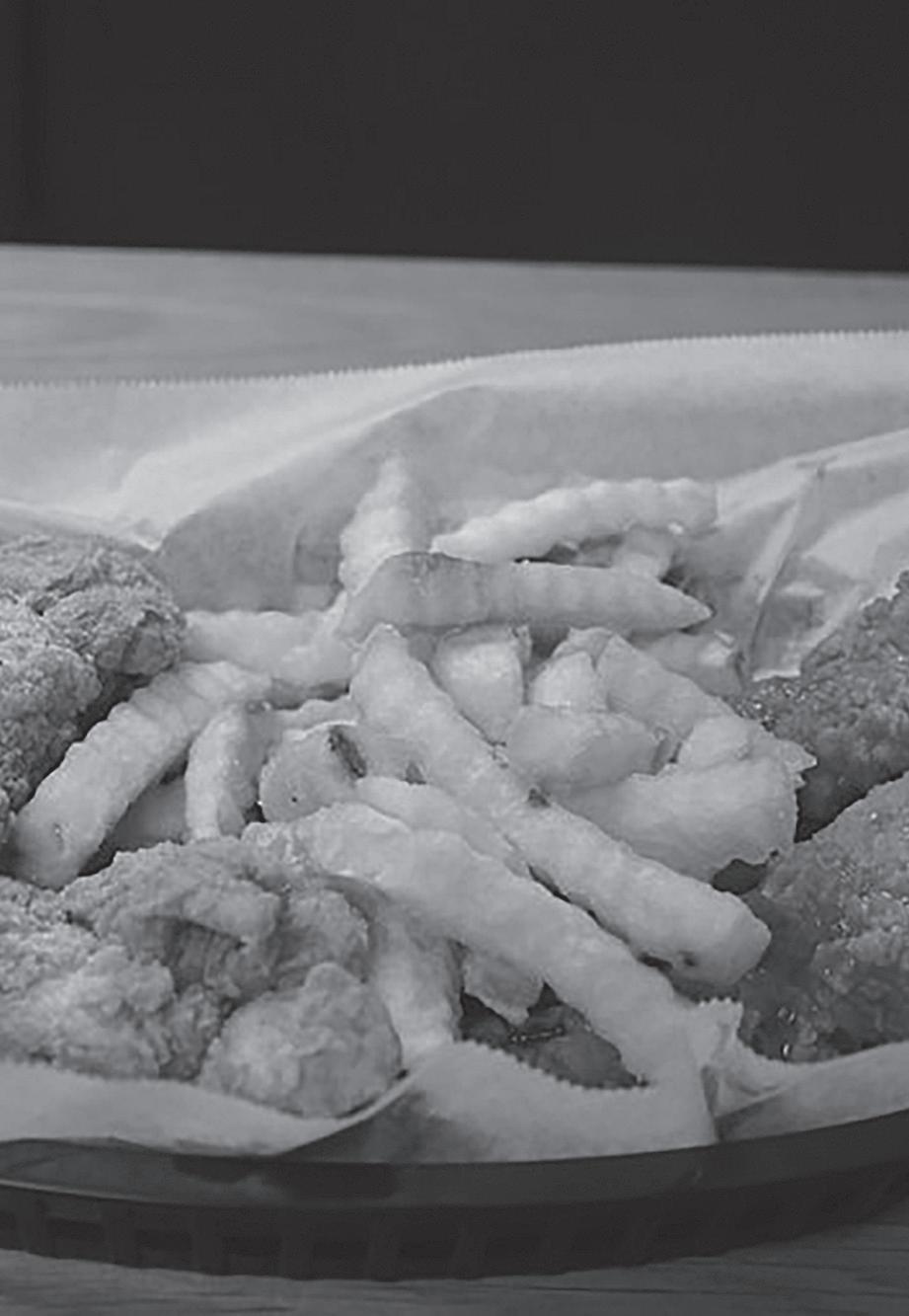
Wings Over Ithaca provides a nice, casual fast-food ambiance that’s enhanced by the scent of greasy chicken. However, true to its name, basically the only thing on the menu was wings. Unfortunately, as a vegetarian, this meant that there wasn’t really anything I could sample here besides fries. After checking the prices, I was also disappointed to find that the cheapest wings were at least $8. Overall, Wings Over may be a convenient place to get some quick greasy food, but it doesn’t really stand out compared to other options.
5. Jack’s Collegetown Grill
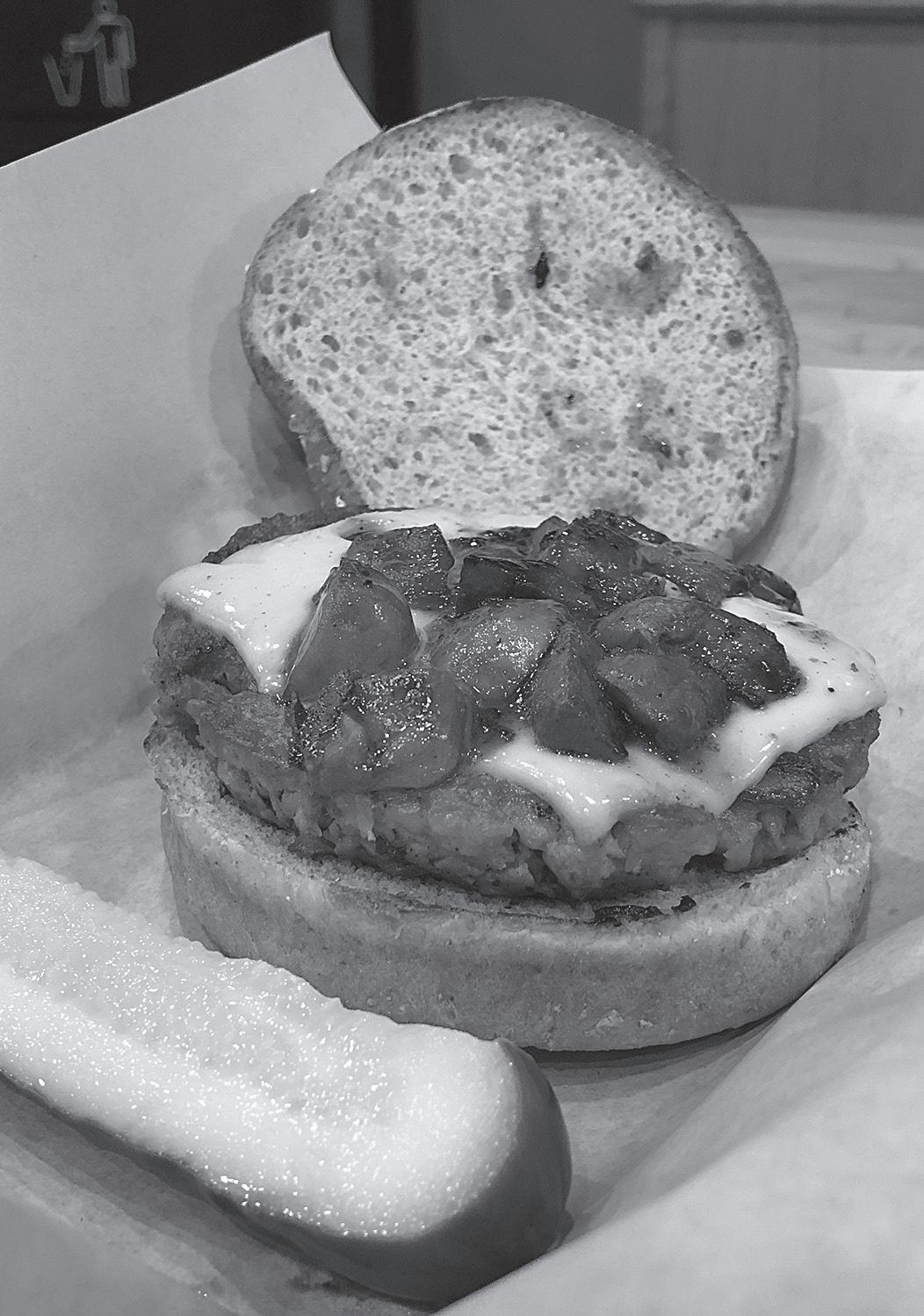
Jack’s has an ambiance similar to Luna’s Street Food, another popular restaurant in Collegetown (however, the bar opens at 10 p.m. at Luna’s and an ID is required to enter beyond that time). The menus are displayed on TV screens and customers have the option of ordering on iPads. I chose the plant-based mushroom swiss burger which came with a pickle
on the side. Combined together, the flavors worked well: The mushrooms were sauteed in a lightly sweet barbeque sauce and the swiss provided a nice sharpness to contrast the whole-wheat burger bun. The patty itself had a satisfying umami flavor and was delightfully tender. For being over $14 with tax, though, I would say this burger is definitely not worth buying again. The whole meal was the size of a regular hamburger and there was simply not enough of it to make me come back.
CTP seems to be the cheapest latenight savory option in Collegetown and its slices are definitely worth the price. The neon-red sign serves as a beacon to hungry students making their way up the hill on the left and the restaurant’s interior is spacious and the menu full of options. I opted for five garlic knots ($1.50). They were smaller than I expected but the price was reasonable — at least cheaper than other options. The knots were studded with red pepper and had a sprinkling of parmesan on top. While they weren’t especially outstanding, these garlic knots made for an affordable and flavorful snack on the go.

Insomnia is pretty much the ultimate saving grace for anyone with an incurable sweet tooth. A well-known college campus chain, Insomnia Cookies’ universal 3 a.m. closing time is a blessing for every hungover college student. When I walked through the doorway, the aroma itself was tantalizing enough to make me want to buy myself a whole cookie cake. After perusing the options, I decided to get the double chocolate chunk cookie ($1.65). The texture was amazing: The exterior had a slight crunch while the inside of the cookie was the perfect balance of soft, buttery and a tad bit chewy. Warm globs of melted chocolate studded the interior, providing for a rich flavor contrast.
My only complaint was that there was nothing savory on the menu to complement the sugar rush — but then again, that’s not to be expected for a place with “cookie” in its name. While the cookie itself was perfect, I’m more of a savory late-night food person, but that’s a personal preference.

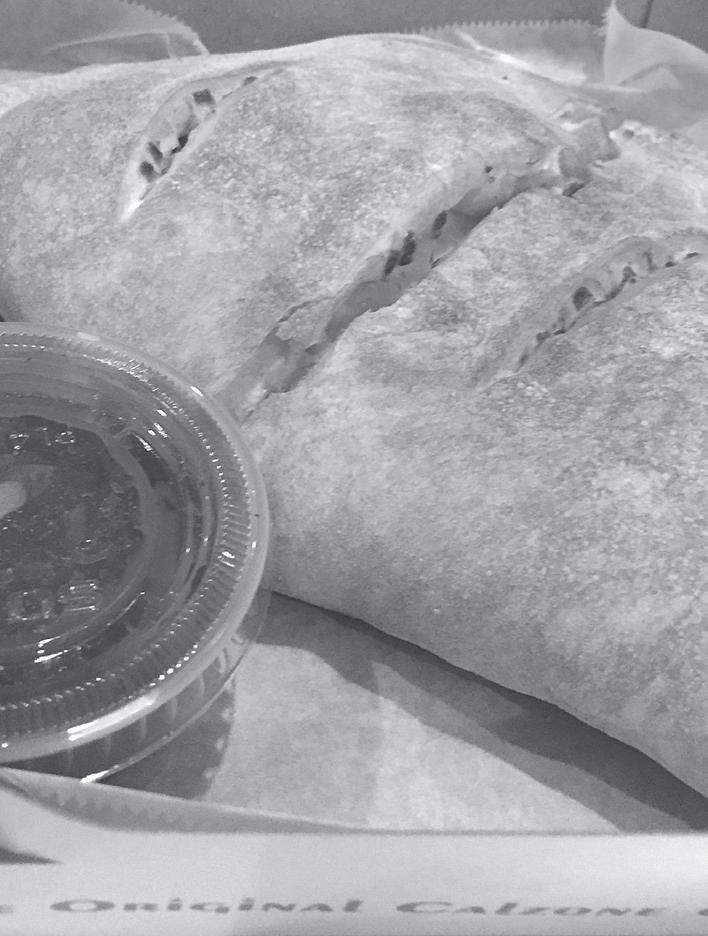
Although D.P. Dough doesn’t get quite as much action as its carb-loaded neighbor (see below), its massive calzones are enough to satisfy any cheese-lover’s cravings. I ordered the Cheeze Zone ($8.25), one of the restaurant’s classics. Despite being quite pricey, the calzones are more than enough for one meal. The calzone, while relatively plain in its offerings, packed quite a punch. The pizza base on the outside was wonderfully warm and crispy, and the cheese bubbled gloriously as I took my first bite. However, despite the wonderful texture contrast, the base was just too dry, even with the addition of marinara sauce. I found myself reaching for a cup of cold water on the side.
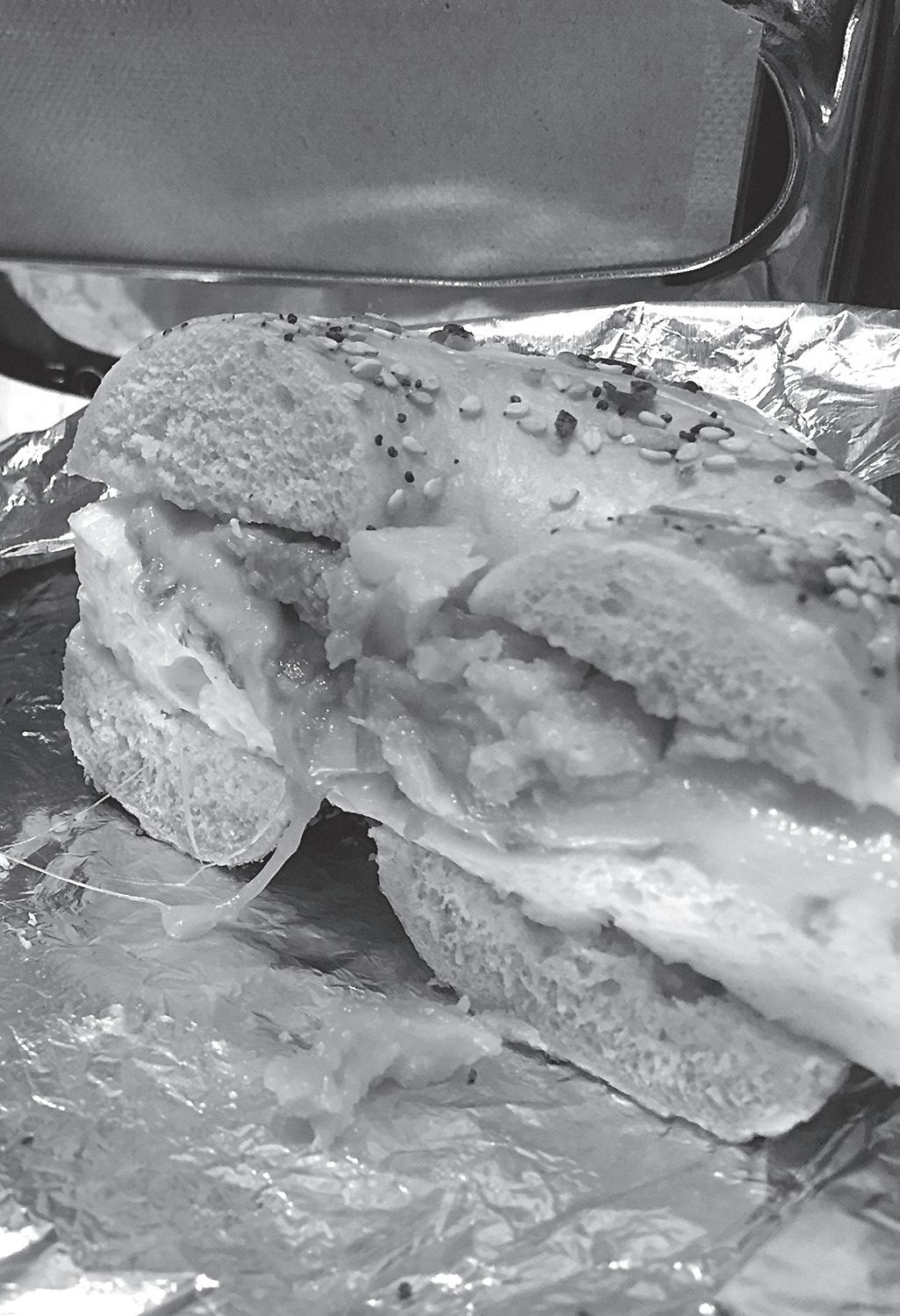
A widely-revered Cornell classic, CTB is known to be packed at all hours of the day, with AAP students sipping matcha lattes to econ professors hosting their office hours there (thanks, Nick Sanders)! I decided to order the California Sunrise ($6.97 with tax), a crispy and creamy combination of avocado, pepper jack cheese and an egg on an everything bagel. The layering of soft, chewy bread with a thick layer of melting, salty cheese paired perfectly with a fluffy egg and the coolness of the avocado. This dish hit all the right spots, but sadly it wasn’t enough to curb my cravings. I just wish I had more.
Overall, Collegetown has some solid spots for those craving comfort food after midnight. The options may not be fancy, but it gets the job done with bagels, cookies, and everything in between. So, if you haven’t tried one or more of these spots yet, make the most of your time in Ithaca and indulge your late-night cravings.
Sanjana Kaicker is a freshman in the College of Arts and Sciences. She can be reached at sk2384@cornell.edu.

By BENJAMIN VELANI
Have you have wondered where your food comes from, or how it got on your plate? Have you ever been upset upon hearing how much water was used to process those veggies or that steak?
Have you ever thought, “Hey, I could do a better job than that?” Well, this is your call to action.
Even though we are all very busy throughout the semester, at times it is important to slow down and breathe.
Growing your own produce could be the perfect excuse to do just that, not to mention the satisfaction that comes from watching something you nurture grow and blossom beautifully.
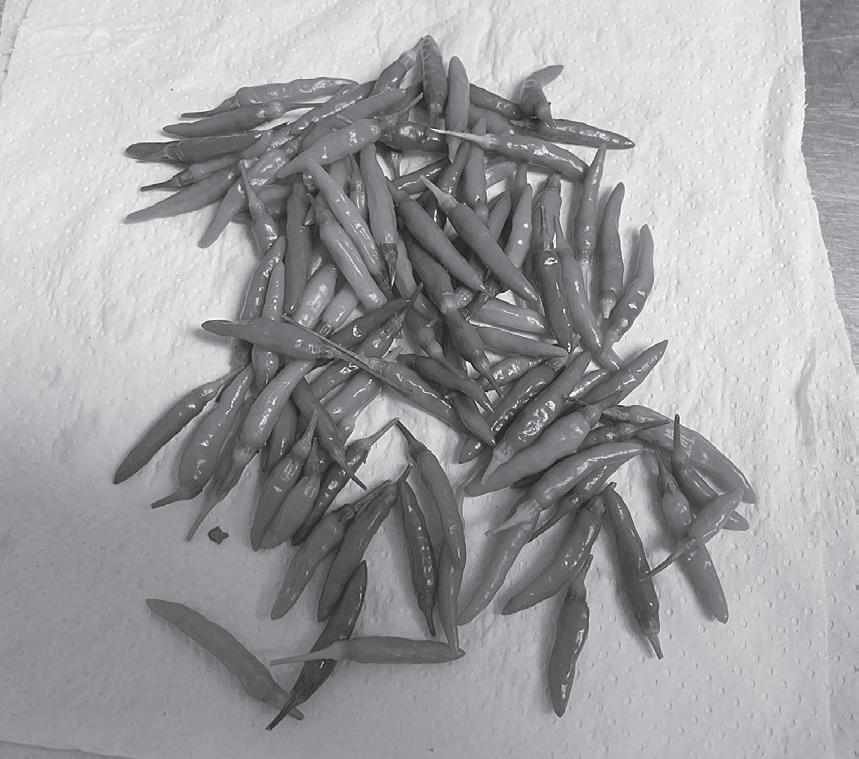
I decided this year that I need something I can take care of besides myself, in order to find peace outside of school work and clubs. Something purely designed to be peaceful. So, after watching my buddy experiment with Thai chilies he’d been growing all summer, I decided to go out and find my own. In order to find such a plant, however, I needed to go into smaller nurseries and ask if they had any herb plants or such in the back. More often than not, they’ll come back with some wicked selections. I found my
Growing your own produce could be the perfect excuse to do just that, not to mention the satisfaction that comes from watching something you nurture grow and blossom beautifully.
Thai chili plant at A New Leaf, located four miles outside of Ithaca along Highway 79. The plant cost me $22.50, with the added three percent charge for using a credit card. Thai chilies specifically need a lot of sunlight, and so I placed it on my fire escape in direct exposure to the sun. The best way to figure out what your plant needs to live a healthy life? Ask the person who you bought it from! But eventually, I knew this plant would have to be moved indoors before the first frost would have killed my warm-blooded companion. There are a few concerns you might have with moving a plant — especially one that needs ample amounts of sunlight — indoors. First, how is it going to get those much needed rays? Your answer lies on Amazon, where you can purchase a UV plant grow light for between $15 and $26. There are a variety of these, all with their own features, timers, brightness and light type settings (red, blue or both). I decided to go with a $26 model with three prongs of UV strip LEDs, an interval timer so that every 12 hours my Thai chili plant will get 12 hours of mock sunlight and a mounting clip. I transferred my baby into a larger 12” pot for ample room to grow, got a tray for any possible water leakage and moved it into my attic. With
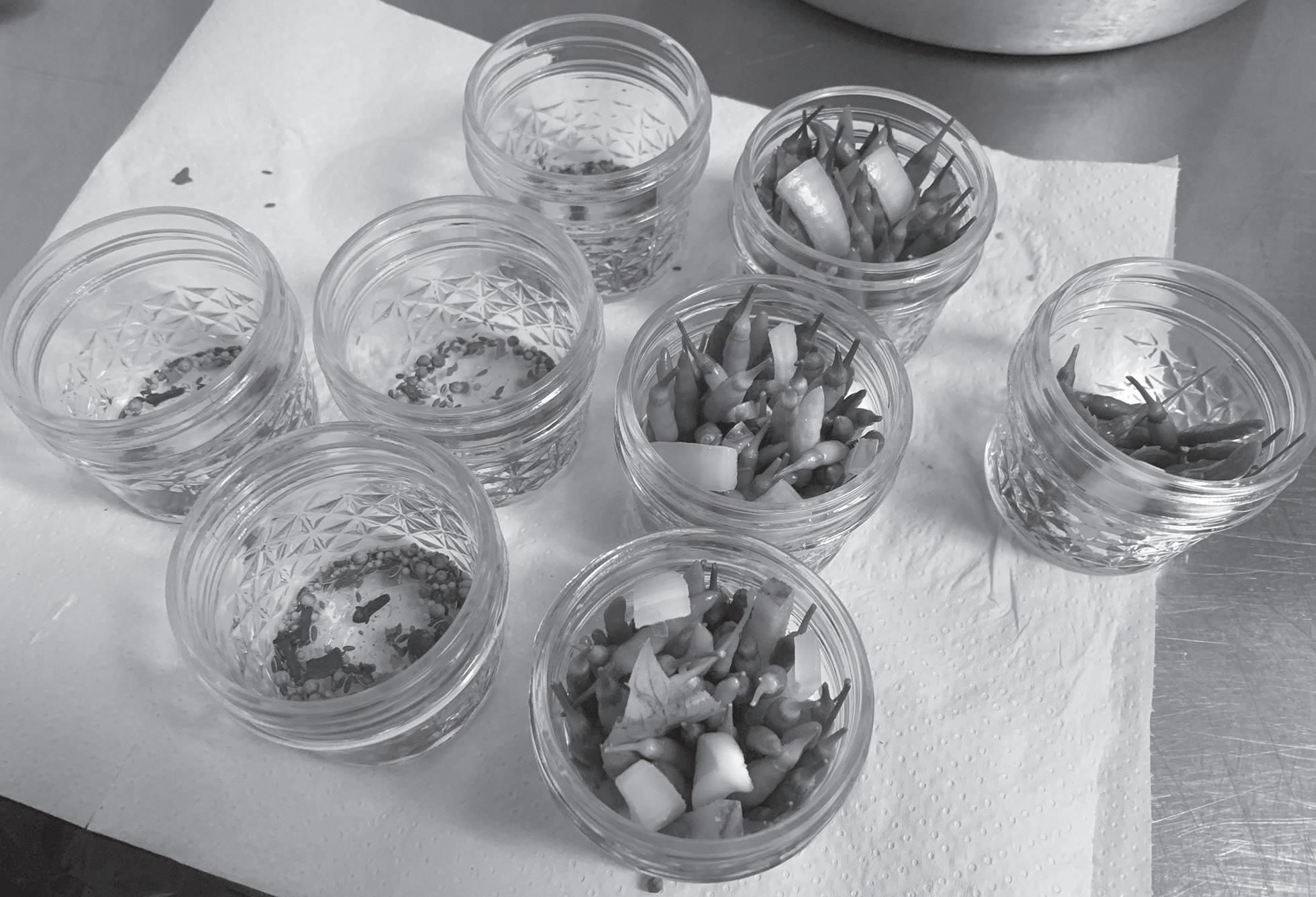
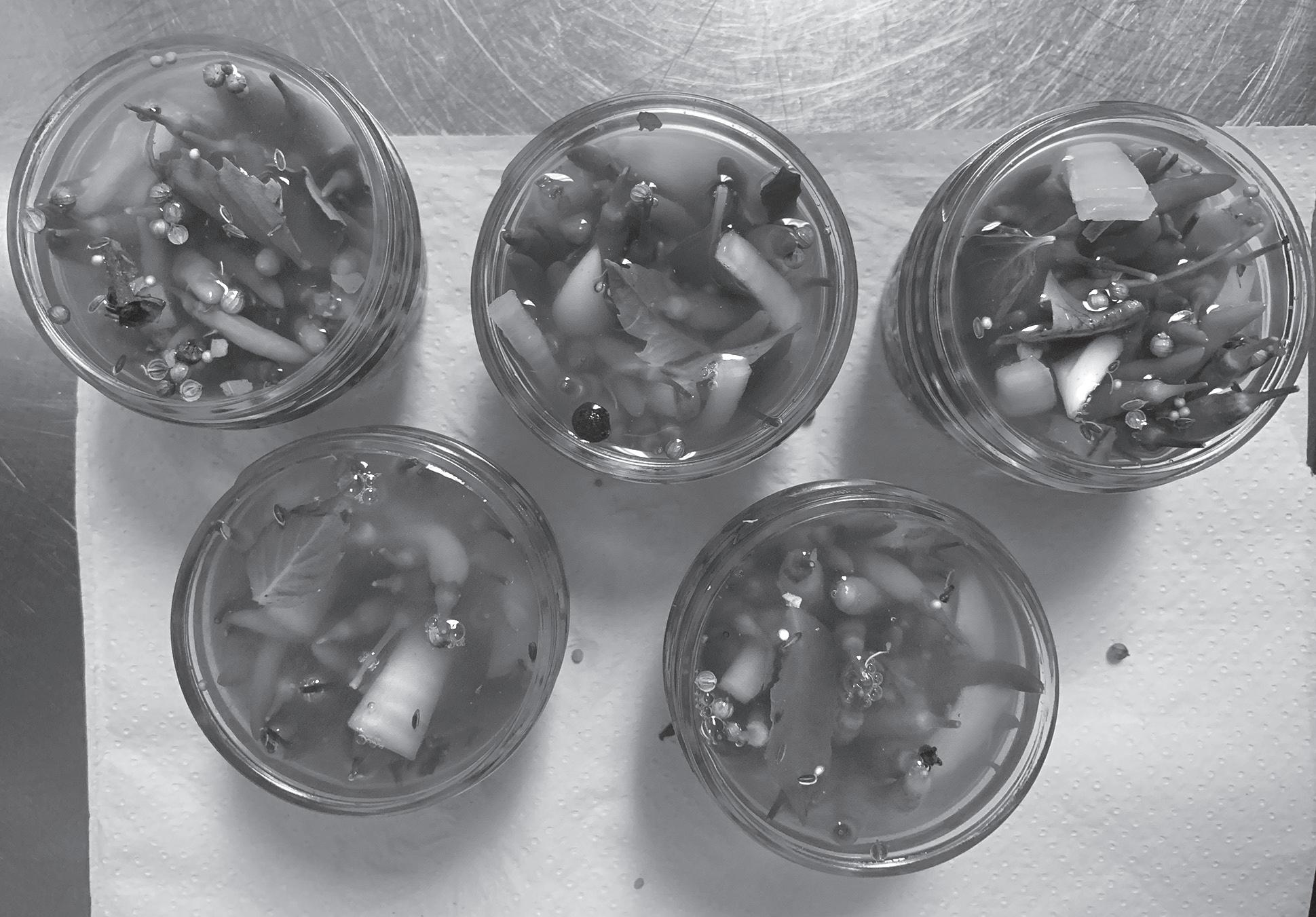
the plant light, it is greener than ever and still budding new chilies. Now, however, I need to rub the pollen around with my hand to flower new chilies, as there are no bees and bugs to do the work for me. After the tranquil labor of caretaking, the best part of this process is by far the harvest. Waiting for the chilies to get big enough requires me to practice patience and good observation. I am continuously learning about how these chilies develop over time, when they change color, how big they get and how spicy they are at different stages. For my intentions, I harvest them at a variety of colors because the redder they get, the spicer they become — and they are hot! According to pepperscale.com, Thai chilies are on average 50,000100,000 Scovilles, or about 23 times as hot as the average jalapeño. In order to tone down the heat and make them into something much more palatable, I decided to pickle them. Now there are a few things to consider when pickling for the first time, as I did this past fall break — the primary thing being safety. If done incorrectly, E. coli, botulism and Listeria can develop in your jars, and make you seriously ill. So, in order to avoid any possible screw ups, I found an old Romanian recipe to pickle hot peppers that requires only vinegar instead of a brine. Because of its acidity, vinegar will not allow these harmful bacteria to
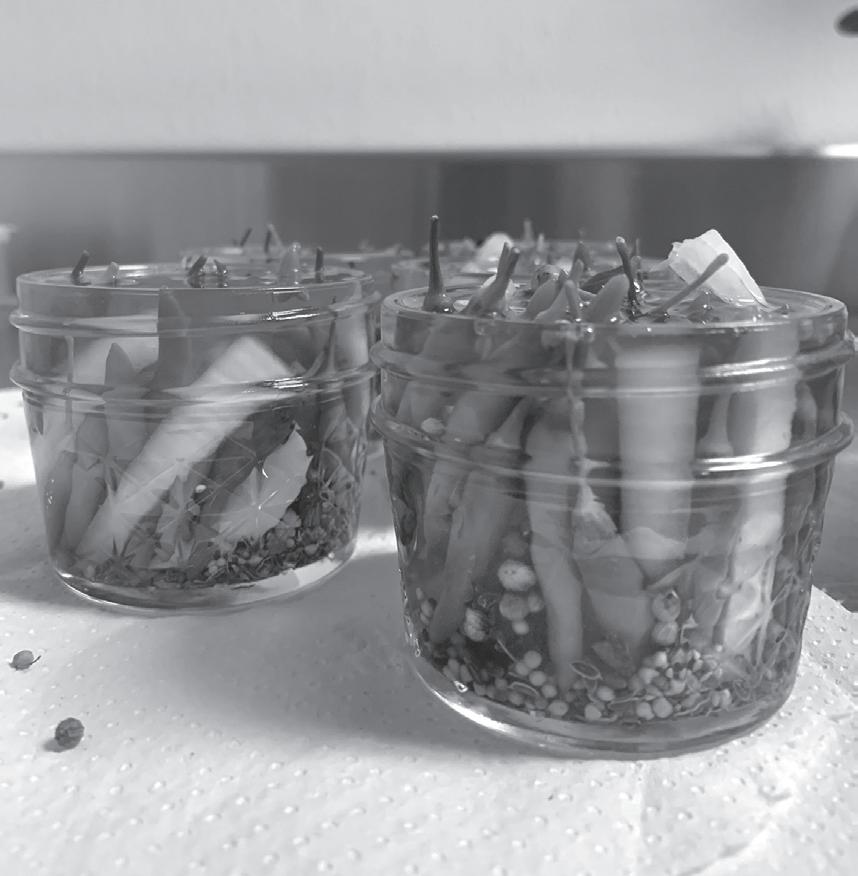
In order to tone down the heat and make them into something much more palatable, I decided to pickle them.
grow, avoiding any possible mishaps. The other thing you need to consider is what else you will be adding to your jars for a more nuanced flavor and aesthetic appeal. Going with a thoroughly Thai theme, I decided to add sliced Thai ginger, Thai basil leaves, split garlic cloves, sliced white onion and pickling spices to my chili jars. After prepping these additional ingredients, I boiled my quart size jars for 10 minutes, throwing in the lids for the last two minutes. After removing them and letting them air dry, I packed the sterilized jars tightly with clean hands, then fill them to the brim with white wine vinegar. After topping with lids tightly screwed and rinsed off, I set the colorful jars in a cool dark place to rest for a month — the full amount of time it takes for a vinegar-only solution to pickle the peppers. This, I found, was an extremely gratifying process from start to finish — a duration of about one and a half months. Not only did it give me an outlet to take my mind off my studies, but it also allowed me to make something that I’m proud of and can share with my friends and family. There is no better gift than something made from scratch.
Benjamin Velani is a sophomore in the College of Arts and Sciences. He can be reached at bsv8@cornell.edu.

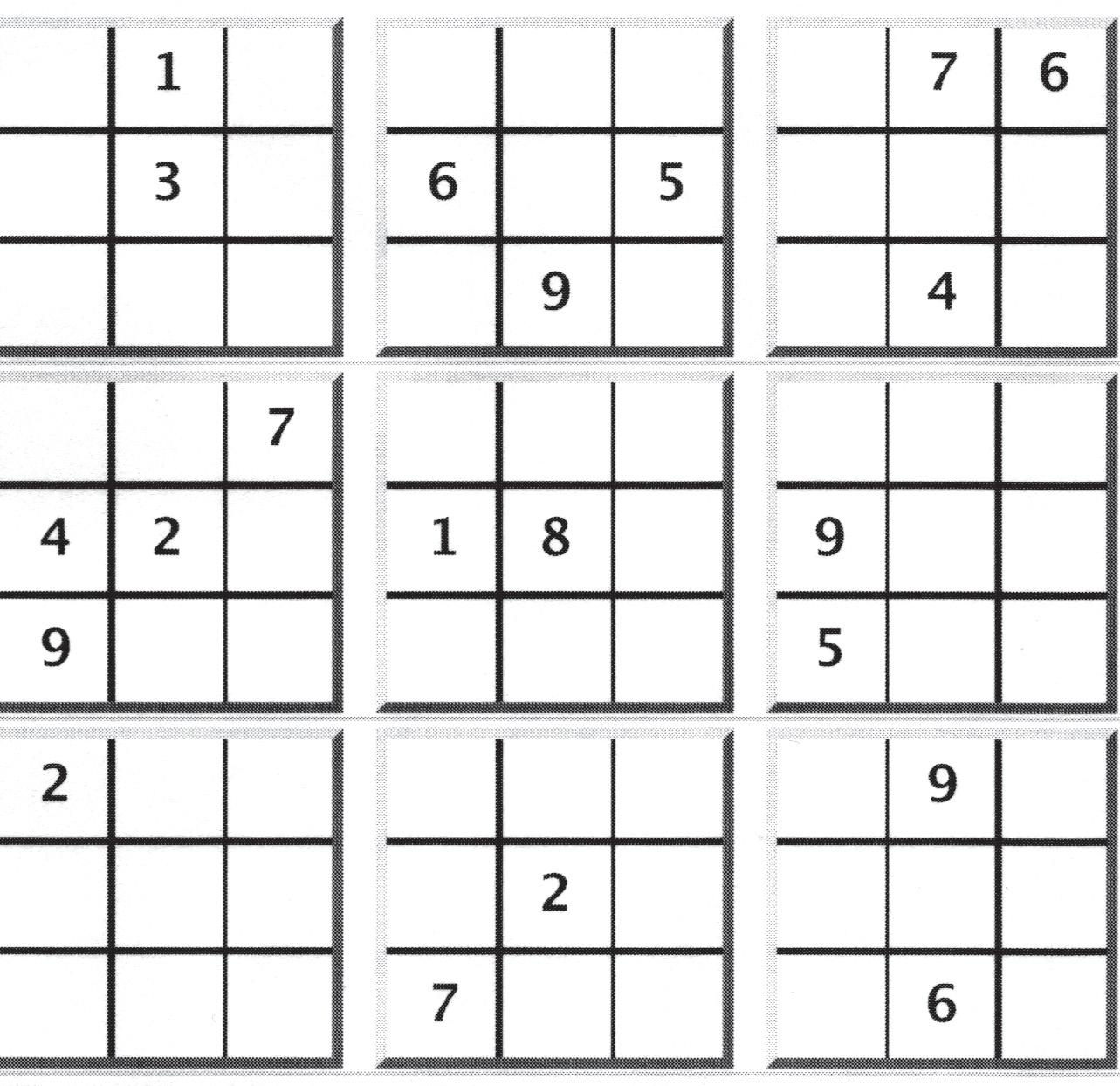
Fill in the empty cells, one number in each, so that each column, row, and region contains the numbers 1-9 exactly once. Each number in the solution therefore occurs only once in each of the three “directions,” hence the “single numbers” implied by the puzzle’s name. (Rules from wikipedia.org/wiki/ Sudoku)

11

We have availability for the 2020-2021 school year beginning June 1st at Hudson heights apartments. The studios include electric, heat, water, garbage and parking. There is coin-operated laundry facilities on site. Prices start at $750 / month for a 12 month lease. If you have any questions or would like to schedule a tour contact us by phone 607-280-7660 or email: renting@ithacaLS.com
COLLEGETOWN TERRACE APARTMENTS
Leasing for 2020/2021 Spring 2020 Semester leases available Heat, hot water and Wi Fi State of Art Fitness Center Shuttle Bus Service to campus Washer & Dryer in Apartments collegetownterraceithaca.com office@ithacastudentapartments.com (607) 277-1234
Now Renting 2-10 Bedroom Houses/ Apartments for 20-21. All Locations. Call today or visit our website: Certified Properties of TC Inc certifiedpropertiesinc.com 607-273-1669
2020-2021
Studio 1, 3, 8 & 11 BR Apts. Great Locations in Collegetown. 607-227-2535
120 Oak Avenue
Just steps to Cornell Campus 10 bedroom house & 1 and 2 bedroom apartment 607-277-1234 office@ithacastudentapartments.com Ithacastudentapartments.com
AVAILABLE 2020-2021
1, 2, 4 Bedroom Apts. and 7 person House 10 & 12 month leases Cook/Blair Street Call or Text Christopher George RE 607-279-5520
Collegetown Crossing
College Ave's Newest Location 307 College Ave. Now Leasing for 2020-2021 Completely New Modern Studios, 2 & 4 Bedroom Apartments. Fully furnished, heat & hot water included. Reception area at 307 College Ave. www.urbanithaca.com 607-330-2442 info@urbanithaca.com
Boldly Refined Living 312 College Avenue
Sophisticated studio, 1, 2, 3-bedroom apartments. Superior fitness facility, theater, and coworking space. Free high-speed internet. Exclusive resident parking. Package delivery/return. Overnight concierge. 607-273-9777 or 312collegeave.com
3 Bedroom 1 Block from Starbucks in Collegetown Heat & hot water included. Lease starts June 2020. Parking & laundry available. www.porealty88.com 607-277-1888
20-21 College Ave. 5 BR House Furnished. Laundry. Parking. Call 607-273-8576
20-21 Upper Eddy St. 7 BR house Furnished. Laundry. Call 607-273-8576
4 Bedroom House $1500/month plus. 8 acre backyard. Washer & dryer. Short distance to Cornell, Wegmans. Pet friendly. thai360@juno.com

Get your message out to the crowd!


All in | Following a Frozen Four bid, the team is looking for an even greater prize: the national title. C.U. returns many key players this year.
By FAITH FISHER and RAPHY GENDLER Sun Staff Writer and Sun Sports Editor
The 2018-19 season was outstanding in many ways for Cornell women’s hockey — it featured a thrilling overtime win in the ECAC semifinals, an NCAA Tournament victory and a trip to the Frozen Four. But the Red wasn’t the team to win the last game.
Cornell was so close to achieving the ultimate goal of a national championship. And with a Frozen Four loss fresh in its mind, Cornell enters the 2019-20 season — which starts with a pair of games this weekend at Lynah Rink — with renewed motivation to bring a national championship to Ithaca.
“It is always exciting to get to the Frozen Four. It is a great accomplishment, but as with every team, you want to be the team to win the last game of the year,” said head coach Doug Derraugh ’91. “We have come close, and sometimes it’s even more painful when you get close and don’t succeed than when you don’t even get close.”
After a 24-6-6 season that saw the Red advance to the ECAC championship game — where it lost to Clarkson — and beat Northeastern in the NCAA Tournament, all the pieces are in place for Cornell to once again be a force to be reckoned with in the ECAC and on the national stage. The Red holds the No. 5 spot in both the USCHO and USA Today/USA Hockey Magazine polls.
While last season Cornell could find preseason motivation in the fact that it had barely missed out on an NCAA Tournament bid the year prior, the Red is looking for more than a spot in the tournament in the upcoming season: its sights are
squarely set on a championship.
“[Last season] leaves us with a desire for vengeance to get back in there and make it that one step further, which I think we are confident we can do,” said senior defender and captain Micah Zandee-Hart. “We felt like we had a good season, but we ultimately feel like we didn’t get quite where we wanted to go.”
Most key pieces of the Frozen Four squad are back: All six members of the Red’s impenetrable defensive unit are returning to a team that has long prided itself on blueline strength.
“Our strength is definitely our defense — not just our defensive players, but our defense as a whole from the goalies to the forwards,” ZandeeHart said. “So having that confidence within our defensive system is huge.”
On offense, Cornell returns its their three top scorers from a year ago. Senior forward and captain Kristin O’Neill led the team with 22 goals last season, followed by junior forward Maddie Mills and senior defenseman Jaime Bourbonnais.
“It is good for all three of us to have that chemistry,” O’Neill said. “We have been playing together for two years now, Jaime and I for three. Just building that chemistry even more excites us.”
Like any year in college hockey, despite the return of many key players, the Red will have to recreate a team identity after seniors’ graduation and the introduction of six freshmen.
“We lost some players in key positions last year, especially at the forward position, so we brought in some forwards who we think are going to add some scoring, add some depth, add some grit up front,” Derraugh said. “We have added a couple of defensemen as well, who are going
to give us some depth to our returning class of defensmen.”
Junior Lindsay Browning will be the starting goaltender, succeeding Marlène Boissonnault ’19, who was a fixture between the pipes for Cornell for two seasons.
O’Neill said the newcomers’ talent and work ethic mesh with the program’s goals.
“They are all eager to learn and grow as hockey players,” O’Neill said. “All six of them work super hard, so it has been really easy integrating them into our team environment.”
Before beginning league play in a competitive ECAC that includes top-10 teams Clarkson and Princeton, Cornell will waste no time getting into games against elite competition: The Red hosts No. 9/10 Robert Morris for a pair of games at Lynah Rink to open the season on Friday and Saturday.
The Colonials have already faced high-level competition and a pair of other ECAC teams, earning a pair of wins against Union, dropping two games to No. 2 Minnesota, and earning one point in a winless weekend against No. 4 Clarkson.
In their meetings with Robert Morris last year, Cornell secured a 5-2 win and settled for a 3-3 tie. Despite last year’s results, competition both in and out of the league is increasingly stiff, and the team realizes that a favorable history provides no advantage — and that no matter the opponent, every game is crucial in a college season.
“Every game matters, and we have had seasons where one game in November has decided whether we made it to the tournament or not,”
Zandee-Hart said. “So as much as we have to use our games as a learning process, [we also need to] come out of the gate hot.”
“They have a lot of skill at every position,” Derraugh said of the Colonials. “For any team you have to be ready. If you’re not, you’re going to lose no matter who the opponent is.”
With elite talent returning, Derraugh in his 15th year behind the bench and a renewed motivation to get back to the Frozen Four and beyond, Cornell is ready to get the 2019-20 season started.
“We went to the Frozen Four, but we didn’t win it all, so we still have a burr in our side to take the next step and take it to the next level,” Derraugh said. “We are always expecting to compete with the best teams in the nation, and this year is no different.”
Cornell hosts Robert Morris at 6 p.m. Friday and 3 p.m. Saturday at Lynah Rink.
Faith Fisher and Raphy Gendler can be reached at fsher@cornellsun.com and rgendler@cornellsun.com.
ASTROS
Continued from page 20
not know me understand that the Sports Illustrated article does not reflect who I am or my values. I am sorry if anyone was offended by my actions.”
Taubman did not respond to The Sun’s requests for comment by publication time.
The former applied economics and management major and CALS Dean’s List Ambassador graduated from Cornell in 2007, kicking off his investment banking career at Ernst & Young while playing fantasy baseball online, according to the Cornell Alumni Magazine. The alumnus and his friend crafted a model to predict players’ success, and eventually, Taubman joined the Astros’ front office to work in Baseball Operations as an analyst.
In September 2018, Taubman was promoted to his current position of assistant GM (his title changed to Assistant General Manager, Player Evaluation this September), where he became GM Jeff Lunhow’s “righthand man” and as recently as Monday was reported as a possible candidate for the Boston Red Sox’s open GM position.
The Baseball Writers’ Association of America demanded a public apology from Taubman on Tuesday night and called the Astros’ official statement “unethical” and “designed to discredit our members and all journalists.”
One of the journalists targeted in the incident was wearing a purple bracelet for Domestic Violence Awareness Month and had previously drawn Taubman’s ire with tweets about domestic violence that coincided with Osuna’s appearances in Astros games. Taubman had expressed to other members of the Astros’ front office his distaste for her comments.
“Domestic violence is extraordinarily serious and everyone in baseball must use care to not engage in any behavior — whether intentional or not — that could be construed as minimizing the egregiousness of an act of domestic violence,” the league said in an official statement Tuesday afternoon. “MLB will interview those involved before commenting further.”
The Nationals lead the World Series, 2-0, after wins Tuesday and Wednesday. The next game is Friday in Washington, D.C.
Christina Bulkeley, Maryam Zafar and Raphy Gendler can be reached at sports-editor@cornellsun.com and mzafar@cornellsun.com.






BROWN
FOOTBALL
Continued from page 20
wasn’t a choice for me, other than to perform.”
Stebbins instigated the most exciting play of last Saturday, sacking Colgate quarterback Grant Breneman to force a fumble that was recovered by senior safety Jelani Taylor. Taylor returned the ball for an 87-yard touchdown. Stebbins recorded a total of six tackles on the day.
Brown no longer looks like the team that does little more than guarantee that Cornell will not fin-
ish last in the league. With the Bears and Red currently tied at the bottom of the conference, Saturday’s outcome is anything but certain.
“The [Brown] quarterback is one of the best we’ve played,” Stebbins said. “I think if we stick to our fundamentals and Coach puts in a good game plan like he always does, I think we can shut them down.”
Cornell will go for its first Ivy League win at 1:30 p.m. Saturday at Schoellkopf Field.
Christina Bulkeley can be reached at cbulkeley@cornellsun.com.

By CHRISTINA BULKELEY, MARYAM ZAFAR and RAPHY GENDLER Sun Assistant Sports Editor, Sun City Editor and Sun Sports Editor
Houston Astros’ assistant general manager Brandon Taubman ’07 is under fire after making seemingly pointed remarks to three female reporters on Saturday night regarding a player on his pennant-winning ball club who previously violated Major League Baseball’s domestic violence policy.
Stephanie Apstein of Sports Illustrated first reported Taubman’s outburst, saying the Houston staffer shouted, “Thank God we got Osuna! I’m so fucking glad we got Osuna!” unprompted at female reporters in the locker room during the Astros’ postgame celebration.
“We are extremely disappointed in Sports Illustrated’s attempt to fabricate a story.”
Houston Astros
Roberto Osuna, the Astros’ closer, blew a two-run lead in the ninth inning of Game 6 of the American League Championship Series against the New York Yankees. DJ LeMahieu’s game-tying home run delayed Houston’s pennant victory until Jose Altuve’s two-run homer in the bottom of the inning. Osuna’s poor outing put the Astros at risk of being forced into a win-or-go-home Game 7.
The Astros acquired Osuna on July 30, 2018 — five weeks after MLB commissioner Rob Manfred ’80 announced that Osuna violated MLB’s Joint Domestic
Violence, Sexual Assault and Child Abuse Policy and would serve a 75-day suspension.
The American League Champions claim to have a “zero-tolerance policy” regarding abuse of any kind. Amid
controversy, they activated Osuna to their roster when his suspension ended on August 4, 2018.
“I was surprised to see this move made, and I think it’s going to be really uncomfortable. I trust the organization,
but this move doesn’t make sense to me,” an anonymous player told the Houston Chronicle in July 2018.
MLB dispatched investigators to Houston after Taubman’s inflammatory comments, New York Post baseball columnist Joel Sherman reported Tuesday afternoon.
The Astros initially declined to comment, but then on Monday night criticized the “misleading and completely irresponsible” Sports Illustrated article. The team claimed that Taubman was supporting Osuna after a lackluster performance and that the club was “extremely disappointed in Sports Illustrated’s attempt to fabricate a story where one does not exist.”
Sports Illustrated, however, maintained that Osuna was not being discussed at the time and that Taubman was not being addressed. Other outlets corroborated the initial Sports Illustrated report.
Astros owner and chairman Jim Crane highlighted the Astros’ partnership with the Texas Council on Family Violence in a statement on Tuesday. He cited the Astros’ fundraising efforts for the charity as evidence of the team’s strong stance against domestic violence.
Taubman apologized for his comments on Tuesday, saying that they were out of character.
“This past Saturday, during our clubhouse celebration, I used inappropriate language for which I am deeply sorry and embarrassed. In retrospect, I realize that my comments were unprofessional and inappropriate,” Taubman said in a statement released by the Astros. “I hope that those who do
By CHRISTINA BULKELEY Sun Assistant Sports Editor
Two Ivy teams searching for their first conference win of the season will go toeto-toe on Saturday at Schoellkopf Field. Brown and Cornell, each of which has only one victory in 2019, are in the throes of battling for seventh place in the Ivy League.
The Bears have finished the past two seasons last in the Ancient Eight, leading the program to make some personnel changes. This year, Brown brought back former player and assistant coach James Perry to head the squad. He, in turn, brought his nephew to Providence — junior quarter-
sively, a lot of fast, up-tempo offense,” Archer said. “That’s his DNA.”
As a player at Brown, James Perry was one of the school’s — and the Ivy League’s — all-time leading passers, playing the same position that his nephew has now taken over.
The new quarterback has seen success in the starting role, having already thrown for 1,298 yards and 10 touchdowns in addition to having totaled 343 rushing yards — putting him atop the Ivy League in total offensive yardage.
While Cornell has failed to score more than 22 points in a single contest, Brown has only fallen short of that mark once so
will stand in the pocket; he doesn’t get fazed.”
Brown’s defense is far weaker — its opponents have scored 30 or more in every tilt this year. On Saturday, Princeton demolished the Bears, 65-22.
“They’re putting in a new defense ... They’ll plug you in the box — they’ll plus-one you in the box and make it very difficult to run,” Archer said. “People have success throwing on them.”
Now could be the time for the Cornell offense to break out. The unit has looked more cohesive in recent weeks, even despite a smattering of injuries hindering and taking down key offensive pieces. Against Colgate, junior quarterback Richie Kenney seemed more at ease than in his previous start at Harvard, completing 22 passes for 268
tight end John Fitzgerald. “The more you play with someone, the more you’re going to gel with them.”


Senior running back Harold Coles was also again looking like the player the Red so desperately needs right now, rushing for 89 yards on 17 carries in the game. Coles has played through a nagging hamstring injury over the course of the season — but still has rushed for 454 yards through the first half of 2019.

“Richie gets moreable with every rep he gets, so that’snitely good,” said senior
Even so, the fact remains that Cornell’s struggles are far from behind the team as it looks to break its current four-game skid this weekend following its back-and-forth 21-20 loss to Colgate.
“Everyone’s seen that we haven’t executed when we need to. I think we need to perform the fundamentals a lot better than we have been,” Fitzgerald said.
Cornell will need to continue to look solid defensively to keep up with Brown and E.J. Perry this weekend. With freshman linebacker Jake Stebbins the reigning Ivy League Rookie of the Week for the second time in a row, there is promise with the unit even in the wake of losing players to injury.
“Lance [Blass] is the starter over me. He got hurt. So I just had to go in and do what I can do,” Stebbins said. “So there really