

Conduct Code Gets December Deadline
By SEAN O’CONNELL Sun News Editor
After two years of on- and off-again work, the revised campus code of conduct — the document that dictates Cornell’s judicial proceedings — finally has a deadline: Dec. 7.
“I feel like we’re finally in the home stretch. We will obviously give full respect to the comments that come in.”
President Martha E. Pollack
Addressing the University Assembly on Tuesday, Oct. 20, President Martha E. Pollack laid out a strict timeline for the final approval of the code, allowing for a month of community input before sending it to the Board of Trustees for final approval.
“I have to tell you,” Pollack said, “there is no slack in this schedule.”
Before the final due date of Dec. 7, the code will be open for public feedback — inviting members of the Cornell community to weigh in
See CODE page 5

Tompkins County Reports 16 New COVID-19 Cases
By ALEC GIUFURTA Sun Senior Editor
The Tompkins County Health Department reported 16 new cases of COVID-19 on Wednesday, totalling 76 active cases in the highest spike since the start of Cornell’s semester.
But unlike the early September spike, the recent case jump is occurring
“We share the community’s concern with another increase in cases not associated with a clear cluster.”
Frank Kruppa
without a known source or cluster, meaning COVID-19 is likely spreading throughout the community, the health department said.
“We share the community’s concern with another increase in cases not associated with a clear cluster,” said Tompkins County public health director Frank Kruppa in an Oct. 16 press release.
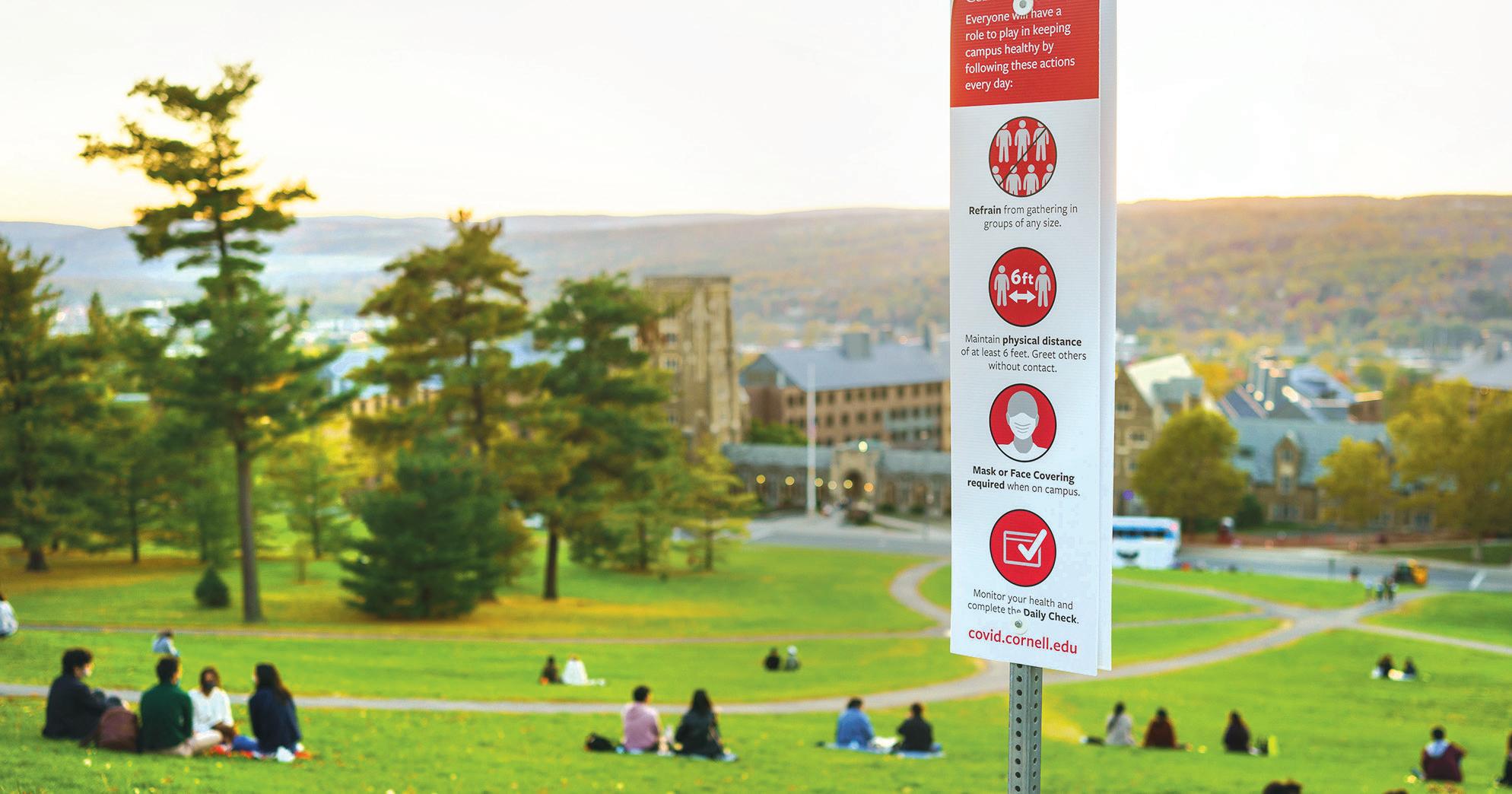
The little things | COVID-19 complicates activities as simple as sitting on Libe slope; students must wear masks at all times and stay in groups of fewer than ten.
The majority of the cases do not appear to be connected to Cornell: The University’s dashboard shows only 10 new positives from Oct. 13 to Oct. 19, while the county reported 56 positive cases over that same period. The University has not updated its dashboard since Oct. 19 and remains
ZOE YANG / SUN CONTRIBUTOR
Voting pains

Thursday, October 22, 2020
Today
Let’s Meditate with Cornell Wellness 9 - 9:30 a.m., Virtual Event
Into the Desert: Questions of Coloniality and Toxicity 10 - 11 a.m., Virtual Event
Building Equity in Education With Open Education Resources 11 a.m. - 12 p.m., Virtual Event
Give Peace a (Second) Chance: A Theory of Nonproliferation Deals 11:30 a.m. - 12:45 p.m., Virtual Event
Critical Moves: Performance in Theory and Movement 1:25 p.m. - 2:40 p.m., Virtual Event
Meet Undergraduate Student Researchers in the Life Sciences 5 - 6 p.m., Virtual Event
Archi-Protest, the Role of Buildings in Social Change 5:15 - 6:15 p.m., Virtual Event
Tomorrow
Into the Desert: Questions of Coloniality and Toxicity 10 - 11 a.m., Virtual Event
What is the Future of Commons Research and Planning? 10:10 - 11:10 a.m., Virtual Event
Cornell Wellness Virtual Walk to Run Class 11:30 a.m - 12:30 p.m., Virtual Event
Sensing, Automation and Data Analytics for Plant Pathology 11:30 a.m. - 12:20 p.m., Virtual Event
Beethoven and Pianos: Roundtable With Tom Beghin Noon - 1 p.m., Virtual Event
For Our Current Times: Navigating Election Anxiety 1 - 2 p.m., Virtual Event
Thriving in Isolation: Health and Human Connection 1 - 2 p.m., Virtual Event
A Trans Film Festival 7 - 8:30 p.m., Virtual Event
Students Plan for Partyless COVID-19 Halloween
By SASHA ABAYEVA Sun Contributor
As the spookiest holiday of the year approaches, students are planning what candy to buy and costumes to wear — but the old routine of parties and trick-ortreating won’t look the same.
Even though Michele Lee ’21 said she doesn’t really celebrate Halloween, she enjoys the spirit of the season. But above all, she misses the Halloween events that she went to in her previous years at Cornell.
“My sophomore year, Rose House had this Halloween trick-or-treat event. We went to each floor and knocked on doors and asked for candy,” Lee said.
But despite the limitations of the semester, Lee is
not discouraged — she plans on spending the weekend destressing from prelims, sticking to her routine of eating takeout with friends and watching dramas and YouTube videos.
Lee is not planning on going out, she said, and was sure that classmates would follow Cornell’s public health guidelines like her. “Since Cornell is back in the green zone, I know students are trying to be more vigilant and not party,” Lee said.
Eliza Hodgkins ’24 is disappointed with this year’s holiday — but not just because of the virus. Hodgkins said she misses how she used to spend Halloween carving pumpkins with her family.
“We used to match up with our costumes when we were little,” Hodgkins said. “One year we did Harry

Cornell Alumnus Charts Winding Journey to Filmmaking Career
By MIA GLASS Sun Staff Writer
After graduating from Cornell with a degree in economics, Jonathan Champagne ’13 moved to New York City like many Cornellians. But he didn’t jockey for a job on Wall Street. He arrived in the Big Apple to pursue acting.
But two years later, he realized what he really wanted to do: create his own films.
“You get tired of waiting for permission to make your own art,” Champagne said. “There’s a bit of a fire that lights underneath you to really create something that came out of your own mind instead of working on other people’s projects.”
Champagne founded the music licensing company Silverside Productions in 2015, alongside fellow alum Owen Pataki ’10, who works as a director. Having known each other since their undergraduate years, the two instantly hit it off and produced their first short film The Pigeon together in the summer of 2019.
He not only produced The Pigeon , but Champagne also wrote the script and composed a song featured in the film. “As a producer, you can wear a lot of hats,” Champagne said.
Champagne arrived in the Big Apple to pursue acting. But two years later, he realized what he really wanted to do: create films.
The short film was ultimately a success, featuring in the 2019 Albany and Manhattan Film festivals. It’s now available on YouTube.
As soon as their first film ended, the team moved onto their next project, called Company Retreat . This time, however, Champagne and Pataki had to navigate the pandemic.
Adapting proved difficult. Filmmaking in mid-June came with significant COVID-19 safety concerns, especially in New York City, where Champagne hoped to film.
On top of following guidelines established by the Screen Actors Guild and New York State, Champagne partnered with an ER doctor from Mount Sinai Hospital who gave the film crew access to rapid testing services.
“What kept us going was truly the love for filmmaking and that we wanted to keep hard working peers in the industry employed, and
“My undergraduate education lent itself really well to being a self starter and coming up with my own ideas.”
Jonathan Champagne ’13
we wanted to give everyone a sense of normalcy in a time where so much was uncertain,” Champagne said.
Unhindered by these obstacles, Champagne is hopeful that they will finish Company Retreat by November and have it ready for film festivals by next spring.
Champagne and Pataki are already gearing up for their third project, a feature length film. They will be bringing in conductor Jeff Cox ’13, Champagne’s former classmate, to do the majority of the scoring and composing for the film.
“It’s been wonderful to connect to two classmates and to see the very long beacons that those relationships cast,” Champagne said. Champagne said he never would have expected to go from economics to filmmaking, but credited his time at Cornell with giving him the knowledge to start his unconventional career.
“I think the nature of my undergraduate education lent itself really well to being a self starter and being an independent and really coming up with my own ideas,” Champagne said.
Mia Glass can be reached at mglass@cornellsun.com.
Potter and I did a Quidditch field on my pumpkin.”
But Hodgkins said she thinks Halloween never meets its expectations, and this year is no different.
“It never quite lives up, even in normal times, you never have the Halloween of your dreams,” Hodgkins said. “But I think it’s going to be even less this year. You can’t really meet up with people, can’t have costume competitions. No one wants to get dressed up for a Zoom thing.”
Since there is a lot of uncertainty, Hodgkins doesn’t have a costume yet. “I can pull out some basic costumes. Farmer, tourist is a big one — I have a Hawaiian shirt, throw on some shorts, and steal a fanny pack from someone and call it a day.”
Theo Bloch ’24, on the other hand, is already thinking about his costume — Steve Irwin is currently an option.
“You can’t really meet up with people, can’t have costume competitions. No one wants to get dressed up for a Zoom thing.”
Bloch said he believes that students are trying to make the holiday seem somewhat normal and exciting: “At Cornell, we seem to be good at that.”
Eliza Hodgkins
’24
Even with the constraints of the pandemic, students are nevertheless trying to find ways to uplift their spirits and take a break from the fast pace of their college lives.
“Just have fun. Dress up even if you think it’s kind of stupid,” Hodgkins said. “I feel like dressing up makes it more fun, even if it’s a stupid costume that is easy or basic. It’s fun to do something normal.”
Sasha Abayeva can be reached at aa743@cornell.edu.
Tompkins Reports 16 New Cases, Highest Spike Since Sept.
CASES
Continued from page 1
at the green alert status as of Wednesday.
On Saturday, the health department announced that nearly 100 people were quarantined after an individual who tested positive for COVID-19 traveled to an out-of-state hockey tournament. The Rink in Lansing was contacted in potential association with the exposure, The Ithaca Voice reported.
In the Oct. 16 release, the health department warned of several potential exposure events. A COVID-19 positive individual had dined at both the Ithaca Ale House and Liquid State Brewing Company on Oct. 9 and Oct. 10, and an Ithaca Wegmans cashier worked four shifts from Oct. 7 to Oct 11.
Gov. Andrew Cuomo (D-N.Y.) noted an uptick in cases along the New York–Pennsylvania border at a Wednesday news conference, restricting school openings and nonessential business operations in one county bordering
Tompkins County and another just to the west.
In the Southern Tier, COVID-19 cases have climbed throughout October. Politico reported that if the Southern Tier was a state, it would have met the criteria (10 cases per 100,000 residents) for New York State’s travel advisory list.
In a Wednesday email to the Cornell community, Vice President for Student and Campus Life Ryan Lombardi reiterated that visitors are “strongly discouraged” from coming to campus and implored students to avoid traveling outside Ithaca.
“The prevalence of COVID19 cases has increased substantially within and around Tompkins County in recent weeks,” Lombardi wrote. “It is more critical than ever that we remain diligent in following the Behavioral Compact, the Daily Check requirements, travel restrictions, and all university public health guidelines.”
Alec Giufurta can be reached at agiufurta@cornellsun.com.
Spooky season | Pumpkin picking remains a permissible fall favorite under public health restrictions, but the usual Halloween parties and group costumes will take the season off this year. Above, pumpkins are seen at Tompkins County’s Indian Creek Farm.
BEN PARKER / SUN ASSISTANT PHOTOGRAPHY EDITOR
Lacey ’87, Government Profs Discuss Election
By ESAT BRAVEBOY Sun Contributor
From “the needle” to misinformation, over 500 participants gathered on Zoom Monday for a panel on the state of election polling and journalism’s perception of voter interest.
Moderated by Prof. Doug Kriner, government, the panel featured Marc Lacey ’87, national editor of The New York Times, and an array of government professors who shared their perspectives on the trends of the looming election.
Near the beginning of the discussion, Lacey referenced “the needle” — an infamous meter graphic that The New York Times used to
Clinton win because Trump backers were less likely to admit support for him to pollsters.
But some professors denied the existence of “hidden supporters,” instead categorizing them more as unrecognized supporters that polling samples simply failed to fully capture.
“I don’t think the systemic issue that we looked at was that people were unwilling to express their opinion, but rather that they weren’t in the sample,” said Prof. Sergio Garcia-Rios, government.
“Many of the people we considered to be hidden Trump voters [in 2016] were also people we considered unlikely voters. Those weren’t on the sample.”
“Let’s not be overconfident. Nobody on the panel or the audience knows who will win.”
Marc Lacey ’87
display their forecast of the 2016 presidential race victor. The needle was steadfast in its prediction of Hillary Clinton’s win all the way until the end of election day.
But this time, Lacey hedged his bets: “Let’s not be overconfident. Nobody on the panel or the audience knows who will win.”
The first question fielded from an audience member asked the panelists whether the notion of a “silent majority” and “hidden Trump voter” was true. According to the theory, many 2016 polls inaccurately pointed towards a
Other panelists, however, reached a different conclusion. Prof. Peter Enns, who directs the Roper Center for Public Opinion Research, said that a meaningful portion of voters polled said they had not made up their minds, but, in fact, broke heavily for Trump.
“In 2016, we found ‘hidden Trump supporters,’ meaning specifically that they were detectable but not revealing their decision,” Enns said. “There were large portions of responses, in some polls almost 15 percent, that, all the way up until a few weeks before the election, would not say whether they were voting for Trump or Clinton.”
Some high-profile misses in 2016’s state-level polling —
Clinton, for instance, led Trump by 6 points in Wisconsin’s pre-election polling, despite ultimately losing there by a point — prompted concern over how election handicappers and publications would handle forecasting this election. But for Lacey’s New York Times, the answer to that question was a decisive one.
“You might think that after what happened in 2016, The New York Times would back off on polling,” Lacey said. “What happened is the opposite. We’re doing more

polling than ever, especially in key states.”
Even so, however, many news outlets are now being more cautious in their coverage. This trend comes as the spread of misinformation online is increasing in prevalence. Prof. Alexandra Cirone, government, teaches courses specifically on concepts like “fake news” and misinformation in politics, and was quick to explain everyday strategies to combat it.
“Declutter your newsfeed. Help older relatives to narrow down their sources, because at times, they do not know if their sources are dubious,” Cirone said. “Sites now have ways of tracking origins of platforms and uploads to see if they are questionable And make sure to support local newspapers and sources to encourage good grounded reporting.”
The panel also emphasized the importance of voter engagement in local politics. Despite the media’s tendency to emphasize national coverage, Prof. Jamila Michener, government, pointed out that down-ballot races — such as judicial elections — can have a surprisingly outsized influence in shaping politics.
“I think that we’ve seen now that these [local] decisions are critical, and we will now be looking to see not just how the seats are filled, but also the veracity of the process,” Michener, who is also the co-director of the Cornell Center for Health Equity, said. “This way, we won’t have to worry about how biased the court is when the election is finally here.”
While the professors agreed that polling predictions were healthy, the panelists acknowledged that the unprecedented nature of an election in a pandemic poses unique challenges. With mail-in voting already smashing previous records, prior assumptions about who votes, and how, may no longer prove true.
“There has been much ado about how early voting is dominated by Democrats, even though we know a lot of Democrats also are concerned about COVID-19 and they’re more likely to want to avoid physical voting,” Michener said. “We may see that Republicans will turn out more on election day because they’re less worried about distancing.”
Esat Braveboy can be reached at eab323@cornell.edu.

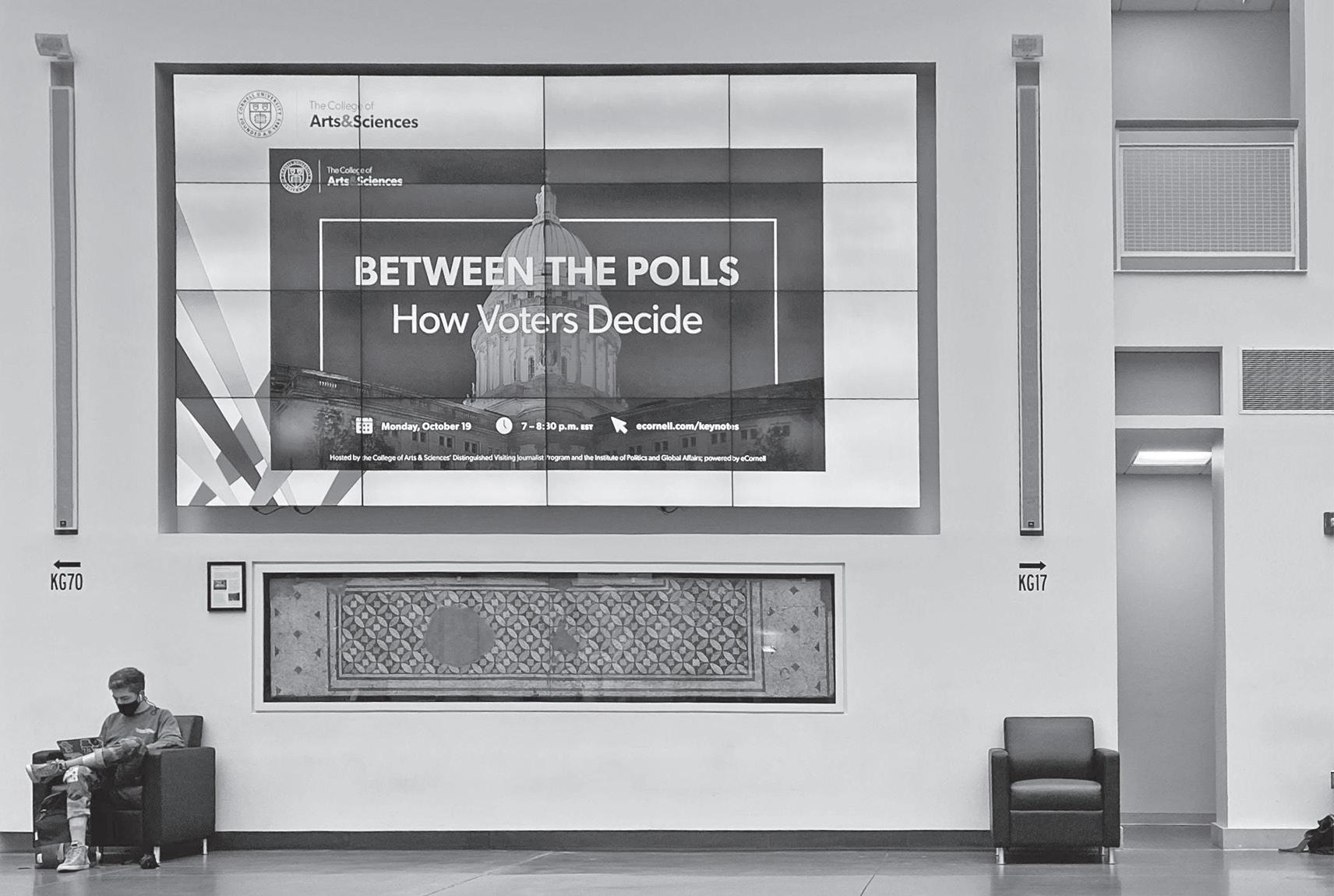
Between the polls | A Klarman Hall screen advertises Monday’s panel. As the election looms, government professors and The New York Times national editor weighed in on votes, polling and the spread of misinformation.
ALEC GIUFURTA / SUN SENIOR EDITOR
Financial Aid Delays Stretch Halfyway Into Semester
By TAMARA KAMIS and FAITH FISHER Sun Staff Writers
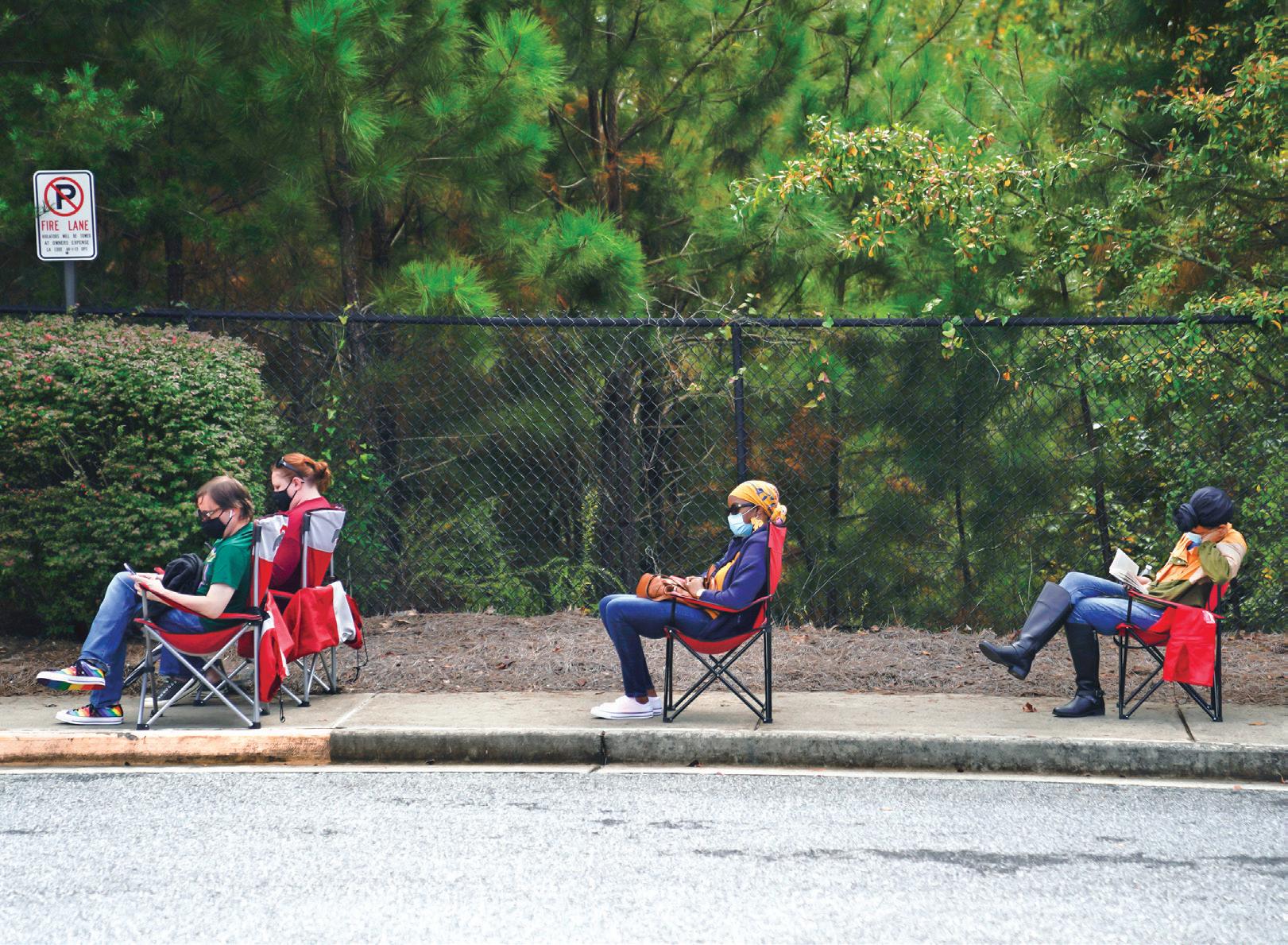
Despite significant processing delays at the beginning of the semester, many students have since finally received their financial aid package. But for some, the process has stretched into October, causing financial and mental stress.
Tómas Reuning ’21 still hasn’t received his financial aid package, despite spending about an hour each week on the phone with the financial aid office or sorting through documents. Waiting months longer than he has in past years, Reuning said he has found the entire financial aid process frustrating.
“It’s just this kind of constant stress in the back of my head,” Reuning said.
month, there were at least 300 applications that the Office of Financial Aid had not yet processed, Jonathan Burdick, vice provost for enrollment, previously told The Sun.
According to Colleen Wright, director of financial aid, heightened demand for aid since last spring is the primary culprit.
Wright said that Cornell aims to provide consistent aid to students from year-to-year, unless the student and their family faces a major change in financial circumstances — something that has proved much more common in a time of historic unemployment.
“It’s just this kind of constant stress in the back of my head.”
Thanks to his job at Louie’s Lunch, a food truck on North Campus, and a partial refund of financial aid, Reuning is now able to pay rent, but he will not be able to pay tuition until he receives the rest of his financial aid package.
Tómas Reuning ’21
This year’s financial aid efforts have continued much further into the fall semester than in previous years. Last
“Circumstances from two years ago may not reflect a family’s current ability to pay, especially in times of a global economic crisis,” Wright wrote in an email to The Sun.
Sahil Kapoor ’21, unlike Reuning, has received his financial aid. But Kapoor said the delays in receiving his original financial aid package concerned him when he tried to find out whether his award could be increased.
“This year was more stressful. I didn’t get my financial aid package until two
days before I had to pay my tuition,” Kapoor said. “I was in the dark about how much I would need to pay, and obviously, it didn’t meet my financial needs.”
Students commonly appeal their financial aid award if more of their siblings enter college, members of their family face high medical expenses or lose their jobs.
This year, Cornell’s financial awards were buttressed by CARES funding — money provided by the federal government to help with students’ financial needs caused by pandemic-related disruption.
assumption that students are able to earn money in the summer, and therefore, contribute to tuition.
Over 4,000 students are expected to be able to take advantage of the new pro-
“I didn’t get my financial aid package until two days before I had to pay my tuition. I was in the dark ... and it didn’t meet my financial needs.”
Sahil Kapoor ’21
The University initially received a $12.8 million CARES Act award. Although half of the funds could be used by Cornell to defray institutional expenses, Pollack decided to allocate the entirety of the grant directly to students.
With $8.5 million remaining to be distributed this semester, $7.5 million will be spent to fund COVID Summer Savings Expectation Grants, a program intended to account for the fact that many Cornellians, amid unprecedented economic distress, were not able to find adequate employment. Typically, financial aid packages are structured under the
Conduct Code Revisions Due by Dec.
on the changes already made until Nov. 17.
The campus code of conduct, which currently applies to faculty and employees as well as students, will become a student-specific code of conduct — leaving Princeton University as the only Ivy League school with a community code of conduct.
This change was owed to the “vanishingly small” number of faculty and staff that were involved in code violations compared to students — 4 out of 820 — according to Pollack, who said there were “contortions in the [code’s] language to make it fit all three of these cases.”
numerous delays and disagreements with the University ultimately gave the final say to University lawyers.
The code of conduct had been identified as too “legalistic” by the 2018 Presidential Task Force on Campus Climate, and revisions officially began in
to the U.A. to examine in early May.
“We will obviously give full respect to the comments that come in. We have no interest in doing something that is opposed to what the community wants.”
President Martha E.
Pollack
January 2019, but were delayed by changes to the leadership of the CJC.
The judicial process involves any student who violates the code of conduct, which can mean anything from alcohol possession to assault. From 2018 to 2019, the Office of the Judicial Administrator —
It was only in April 2020 that the CJC, under chair Joe Anderson ’20, was finally able to make headway on a draft of the code.
The campus code of conduct will become a student-specific code of conduct — leaving Princeton University as the only Ivy League school with a community code of conduct.
in charge of investigating such cases — reported 820 cases of code violations by students, of which 377 were found responsible.
Revisions to the code have been in the works for the past two years by the Codes and Judicial Committee, although
The most salient issue discussed was whether to recommend a reduction in the standard of proof needed to find the accused responsible in judicial proceedings, from the previous requirement of “clear and convincing” — which means the evidence must be “highly and substantially more likely to be true than untrue” — to “preponderance of the evidence,” a lower standard meaning the infraction had more likely than not occurred. Ultimately, the CJC decided to compromise, using separate standards of proof depending on the severity of the code violations. Its draft was delivered
However, in a May 8 email to the U.A., Pollack rebuffed the changes made to the code, calling the standard of proof “not congruent” with federal Title IX regulations. The revision process was then upended yet another time when Pollack handed over the responsibility of reworking the code to University Counsel Madelyn Wessel. Under the University Counsel’s draft, the standard of evidence has been left for the community to decide. The most important issue, Wessel said to the U.A., “is to provide feedback and help come to a decision on what the standard of evidence should be for the student code.”
Wessel also addressed a common request — to document every single change made in the code in the past months to benefit observers unfamiliar with the code. She declined, citing the difficulty of accounting for these revisions.
“I’ve got to be honest with you that I just can’t do it,” Wessel said.
Pollack underscored the importance of public additions to the code, promising to take them into account in the final draft sent to the trustees.
“I feel like we’re finally in the home stretch. We will obviously give full respect to the comments that come in,” Pollack said. “We have no interest in doing something that is opposed to what the community wants.”
Sean O’Connell can be reached at soconnell@cornellsun.com.
gram, with the average size of the awards ranging from $500 to $2,000, depending on a student’s financial aid status.
The last $1 million in funding will be allocated to an emergency fund, which students can apply to help with unexpected expenses, such as moving and storage costs. Grants are usually limited to $500 per academic year, with priority given to those who the Office of Financial Aid consider to have significant financial needs.
Tamara Kamis can be reached at tkamis@cornellsun.com. Faith Fisher can be reached at fsher@cornellsun.com.

CODE
Continued from page 1
Dining Guide
Your

Plastic Film and Nasty Dumps
Can Cornell live up to its reputation of sustainability?
By ANDREA MIRAMONTES SERRANO Sun Contributor
Iam a freshman in the School of Engineering and an international student. This last detail is important because from Aug. 17 to Aug. 31, I had to quarantine in my room, eating only the boxed meals provided by Cornell Dining. During, and well after my time in mandated quarantine, widespread complaints about two issues circulated: The overuse of single-use plastics and inadequate waste disposal. Every student I talked to feels guilty about the ridiculous amounts of plastic used by each and every dining hall.
I never thought that three pairs of dollar store, reusable utensils would be so useful, but because of them I never needed to use a single one of the plastic utensil packets that came with every one of my quarantine meals. Washing and reusing my flatware allowed me to see the plastic packages for what they were: Unnecessary. By the end of the 14 days, there were 29 packets in my bag — some wrapped individually, others not. Now, almost one month later, they still sit in my room. They have not changed, just as they wouldn’t change if they were sitting in a landfill. Plastic doesn’t disappear — not inside my room or outside in nature. It only gets smaller and smaller, degrading into microplastics that infiltrate the soil and sneak into our aquifers.
But those single-use utensils are only the ones in my hands. On average, dining halls and eater-
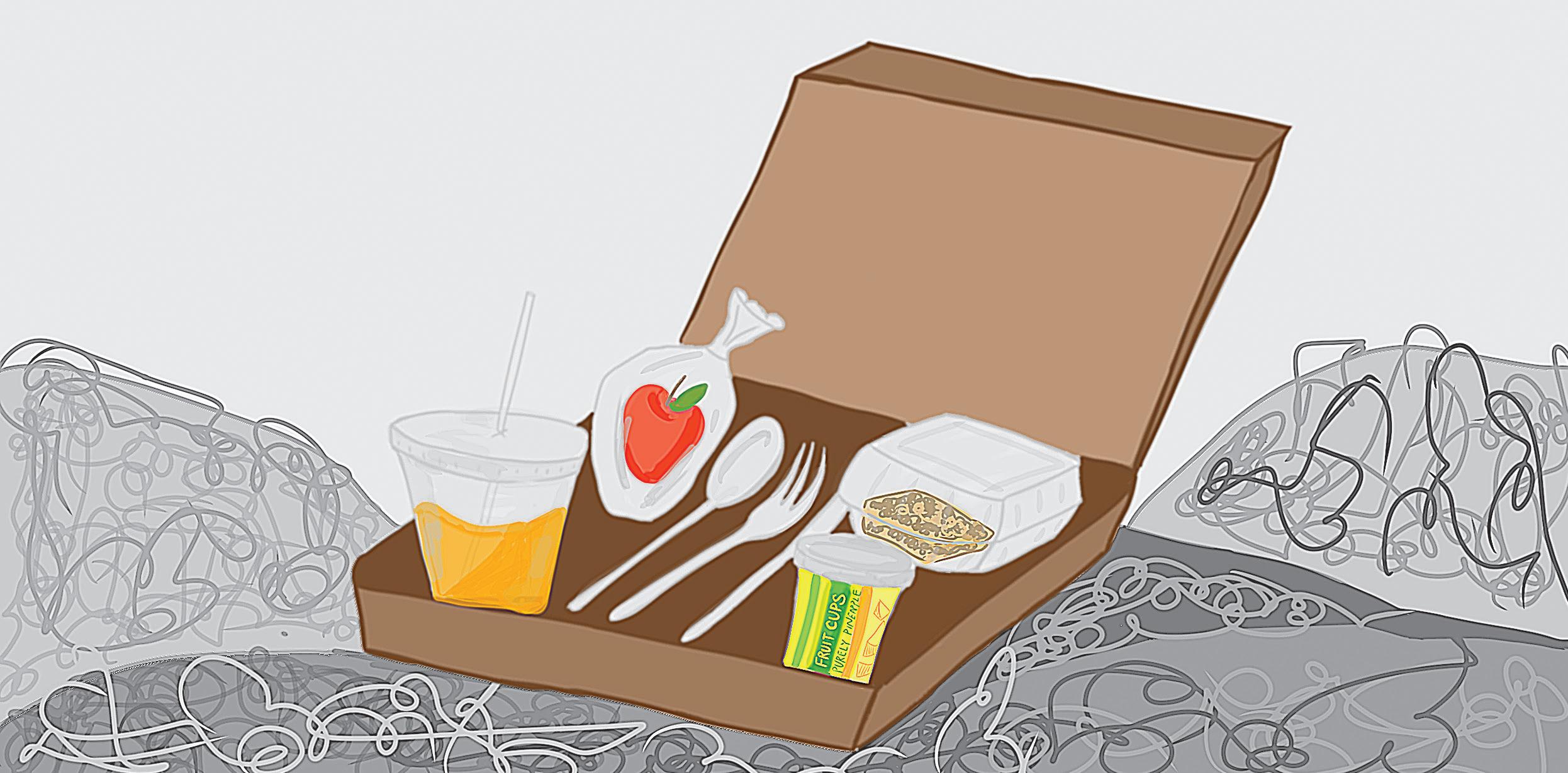
ies will distribute two, sometimes three, packets per person. There are currently 15,043 undergraduates at Cornell, so even if only one fourth of undergraduates eat at dining halls, up to 22,566 pairs of single-use, non-recyclable packets could be thrown away each day. That is 157,962 packets per week, and 631,848 in a month. I wish I had spoken out sooner because maybe then we could have prevented our entire community from creating all this unnecessary waste. However, it only occurred to me later when I saw shiny stacks of throw-away containers ready to be filled with salads, dressings, fruits and beverages, as well as the plastic film wrapping thousands of apples at every exit of every eatery.

I suggest that single-use plastic items be replaced by their reusable or sustainable counterparts. Here are some ideas:
1. Give all students a reusable water bottle, eliminating the need for plastic cups. If the average student uses one plastic cup per meal, this could avoid disposing of around 11,283 plastic cups per day.
2. Replace the pre-packed salad stations with salad bars, and allow salads to be put in the entree container. Not only would this stop the need for separate salad and topping containers, but it would also encourage students to eat more greens. The current boxed salads don’t look too appealing, so it would be great to choose your own toppings and quantity to suit your diet and preferences.
3. Dining halls should use reusable tupperware, and disposable plastic cutlery should be switched to metal cutlery. Students can keep their utensils inside the tupperware, and drop it off at the same place where tupperware is currently dropped off. If losing metal flatware is a concern, dropping it off should be required to get a new set. This should not conflict with COVID safety precautions: If staff members use dishwashers and wear masks and gloves, cleaning will be safe.
4. To avoid the need to wrap plastic cutlery, they could be kept in covered boxes and distributed by a staff member wearing gloves and a mask.
5. If individually wrapping apples is necessary, all apples should come in wax paper instead of plastic film. If we were guaranteed that all our plastics were being recycled, my conscience would be clear, but overflowing trash cans,
sickening mixtures of white cardboard, food scraps and plastic wrappers are common sights that have concluded every student’s meal in the past month and plague various public spaces on North Campus.
“There are barely enough trash cans to throw away our junk, let alone recycle it,” admitted a freshman, visually frustrated to contradict the sustainability oath Cornell had inspired her to take. It’s true that some parts of campus do make distinguishable efforts to improve their waste management — Mattin’s, located in Duffield hall, has three visually distinct bins to separate recycling from organic from trash. Nonetheless, in a campus as big as Cornell’s, most spaces don’t have trash cans or recycling bins. If people don’t have access to trash cans, they will be tempted to litter, even if they do care about sustainability.
Yet, overflowing trash cans are only the beginning of some of the stories I have come across these past weeks. The first day out of quarantine, I met a girl who showed me a drawer full of empty water bottles she was reluctant to throw away — Clara Dickson’s recycling, I learned, had been completely shut off. Another day I met a boy who stacked the salad containers under his bed because he said if he gave them a second use he wouldn’t feel so guilty about having used them in the first place. There are many others: Some arrive at the dining hall extra early to ask for unwrapped apples, others hold on to their yogurt cups and use them for storage and others simply cancel their meal plan to avoid participating in the creation of so much waste. Whatever their background, all incoming Cornell students are made to write about sustainability before starting their semester, so not a single one of
us is unaware of what our food system is doing to the planet. My suggestions for dealing with all this waste are the following:
1. That one, large-sized recycling bin be placed beside every trash can, with very clear and visual differentiation between the two.
2. That there are two recycling bins in every lounge of every residence hall.
3. That more trash cans — and their recycling counterparts — are put around green spaces such as: The fields around North Campus residence halls, the Slope, West Campus and the Quads.
4. That the compost system is reinvigorated, and organic bins for compost are put in eateries and every residence hall’s lounge and kitchen. These should be actively maintained and visually recognizable as compost because the ones currently found in our kitchens are rotten and unrecognizable — probably why nobody uses them. We understand these are difficult times and that safety is currently the main concern. However, I believe there are sustainable ways to ensure security against COVID, reduce the reliance on single-use plastics and properly dispose of different kinds of waste. It’s time for our campus to reflect what the press, other universities and thousands of people admire about Cornell. It’s time to live up to our sustainability STARS Platinum award, regardless of the adversities we face. It’s time to reform our system. It’s time to scrutinize our methods. It’s time to take action.
Andrea Miramontes Serrano is a freshman in the College of Engineering. She can be reached at am2389@cornell.edu. CLAIRE CHEN / SUN GRAPHIC DESIGNER
The Corne¬ Daily Sun
138th Editorial Board
MARYAM ZAFAR ’21
in Chief
JOYBEER DATTA GUPTA ’21
Business Manager
PETER BUONANNO ’21
Associate Editor
MEGHNA MAHARISHI ’22
Assistant Managing Editor
CHRISTINA BULKELEY ’21
Sports Editor
BORIS TSANG ’21
Photography Editor
CAROLINE JOHNSON ’22
News Editor
ALEX HALE ’21
News Editor
ARI DUBOW ’21
City Editor
EMMA ROSENBAUM ’22
Science Editor
BENJAMIN VELANI ’22
Dining Editor
JOHN MONKOVIC ’22
Multimedia Editor
MIKE FANG ’21
App Editor
OLIVIA WEINBERG ’22
Assistant News Editor
MADELINE ROSENBERG ’23
Assistant News Editor
LUKE PICHINI ’22
Assistant Sports Editor
HANNAH ROSENBERG ’23
Assistant Photography Editor
BRIAN LU ’23
Assistant Arts & Entertainment Editor
ANNABEL LI ’21
Assistant Money & Business Editor
LEI ANNE RABEJE ’22
Layout Editor
JOHN COLIE ’23
Blogs Editor
JOHNATHAN STIMPSON ’21
KRYSTAL YANG ’21
Manager JASON HUANG ’21
Editor
NGUYEN ’22
Editor PALLAVI KENKARE ’21
SEAN O’CONNELL ’21
KATHRYN STAMM ’22
ANIL OZA ’22
EMMA PLOWE ’23 Arts & Entertainment Editor
LEE ’21 Money & Business Editor
CHENG ’21
PEÑEÑORY ’22
MEGHANA SRIVASTAVA ’23 Assistant
EMILY DAWSON ’21
PARKER ’22
MORAN ’21
LAW ’22
WANG ’21
OU ’22
’21 Blogs Editor

Darren Chang Swamp Snorkeling
Darren Chang is a senior in the College of Arts and Sciences. He can be reached at dchang@cornellsun.com. Swamp Snorkeling runs alternate Tursdays this semester.
Get Some Rest, Y’all
This semester is the weariest one I’ve had yet. And I don’t particularly know why. Based on a very small, very biased survey of friends, this feeling is well-reflected in the student body. I have several theories, although knowing the root cause for general tiredness doesn’t do much. However, I do know the solution: More time off from school. I implore Cornell’s administration to consider more breaks next semester.
With COVID-19, students are under the same pressure without the support networks and social scenes they use to help them cope.
Ad Layout Ella Benjamin ’24 Production Deskers Dana Chan ’21
Sabrina Xie ’21
News Deskers Sean O’Connell ’21 Madeline Rosenberg ’23
Opinion Desker Peter Buonanno ’21
Design Desker Lei Anne Rabeje ’22
Photo Desker Benjamin Parker ’22
Arts Desker Emma Plowe ’23
Sports Desker Luke Pichini ’22 Dining Desker Benjamin Velani ’22 Working on Today’s Sun
One obvious cause for our fatigue is COVID-19. As a student body, we’re also simply people constantly bombarded by the same pressures this virus has placed on the rest of society. With the threat of contracting a deadly disease hanging over each of us, we’re constantly thinking about our own safety. I can’t count the number of times I remember feeling overwhelmed because there were so many situations and people to think about. Being back in Ithaca meant preparing for whatever situation might hit. While the COVID-19 threat might be different for each Cornellian depending on their location and living situation, it’s uniformly stressful for all.
have been less transferable to the mainly-online format of the semester, only contributing to the stressful environment. Moreover, in any given semester, we’d have more breaks. We’d have an additional day attached to a weekend for fall break and, importantly, a less compressed semester. This isn’t to say I’m not thankful for this year’s one day break. I can barely imagine the semester without it. I spent the day with a few friends, safely socially distanced, and we were able to get some barbeque I had been craving for months. Yet, I had problem sets and other homework due on the following days, and my roommate had an exam throughout the “fall break.” Which is ridiculous — our breaks should be sacrosanct, because that is, after all, the point of a break.
Our breaks should be sacrosanct, because that is, after all, the point of a break. Cornell should think about an extended break in the spring.
Dealing with disaster stress and COVID-19 fatigue are difficult enough on their own, as we found out during our extended spring break last semester and our summer break. But, adding the element of school has made this a terrifying storm of stress: Late nights, unhealthy eating and bawling in the bathroom all included. In any given semester, you can find students freaking out over their unnecessarily high number of credits and the prelims they have in the next week. With COVID-19, you have students under the same academic pressure without the on-campus support networks and social scenes they use to help them cope.
Both are important, and we can do no less than to convince the administration of the necessity of even a little vacation time.
Some classes have adapted better to the online environment, with professors who are capable of wielding Zoom and other platforms to distribute information to students ahead of time. But other classes
In light of this abject need for rest, the Cornell administration should think more carefully about the possibility of an extended break in the spring semester. There is not yet a spring break on the academic calendar, meaning that some of these plans have not yet been finalized; if they have, the details have not been released to the public. I understand the COVID-19 planning committee’s hesitation to allow students the chance to travel and return to campus, but with strict guidelines and the widespread surveillance testing we have already been conducting, the administration is faced with balancing student welfare with only a slightly higher chance of increasing the prevalence of the virus. Both are important, and we can do no less than to convince the administration of the necessity of even a little vacation time. In the meantime, however, I plan to schedule breaks in my calendar. Pockets of respite when I’m off screen or off the grid, unable to be contacted on any platform. Times when I can think deeply about my faith, or process what’s been going on in my life or simply just physically rest. I need it, and I’m sure you do too.
Tom the Dancing Bug by Reuben Bolling
WINNY SUN ’20 Newsletter Editor
Tis Semester Calls for Trust and Compassion
Joshua Dov Epstein Heterodox
Joshua Dov Epstein is a sophomore in the College of Arts and Sciences, and can be reached at jde74@cornell.edu. Heterodox runs alternate Tuesdays this semester.
With the transition of all learning to virtual instruction right around the corner, one of the main concerns for instructors and students alike is ensuring academic integrity during online exams. Professors have tried different testing modalities, with some resorting to proctored Zoom breakout rooms and others relying on Canvas timed, open-note exams.
Some professors, however, use a software called Examity. Examity is an online proctoring company with its own brand of software which markets itself to universities as a stress-reducing, lockdown-browser system option for instructors looking for a modem to conduct asynchronous exams. Te company came to prominence a few years ago as online learning became more popular. Tey have recently capitalized on the transition to virtual education as a result of the coronavirus pandemic. Tey’ve even procured a contract with Cornell.
The company and its software, put simply, is not a favorite among students. The registration process is faulty for some and knowing that an unknown person at an undisclosed location has sweeping access to your computer and is watching you for the duration of the exam is uncomfortable to say the least. Unfortunately, the concerns do not stop there – the main issue that some Cornellians have with Examity is a lack of digital privacy, stemming from the software’s terms of use.
In order to make an account with Examity, one must first agree to the company’s basic terms of use allowing them to collect certain data, although Cornell’s contract with Examity limits that data to a degree. That being said, they do require agreeing to a baseline set of terms for use of their software, and what they collect in order to use that software is vast. Additionally, the company shirks responsibility if the data is stolen by a bad actor or is used by one of the “trusted” third parties Examity shares its collected data with. At the end of their terms of use, one must acknowledge the company’s disclaimer, “while [Examity] strive[s] to protect your personally identifiable information, we cannot guarantee that it will be 100 percent secure. Your transmission of your data to our Platform thus is done entirely at your own risk.”
So what is the data that they collect, and why do they collect it?
In their own words, Examity uses the rationale of only potentially collecting personal information as a means of properly identifying a student, yet the information they would have the right to collect includes the names of immediate family members, financial information, retinal scans and access to the browsing server being used to open the application, and therefore caches and search history along with more hyper-specific data. Although a string of articles came out over the past few years in publications such as The Verge and The New York Times describing the experiences of students and professors across the country with proctoring software, along with their concerns over
the apparent privacy outreach of companies such as Examity, students at Cornell have surprisingly by large not been made aware of these risks. It’s paramount this year for students to read what they are agreeing to prior to exams and to request potential proctored alterna-
It’s paramount this year for students to read what they are agreeing to prior to exams and to request potential alternatives if the above is concerning to them.
tives if the above stated information is concerning to them. While most courses that use Examity for exams have similar, less invasive alternatives that still ensure academic integrity, if none such option exists for your course, petition for one. As many of these options are already in play across campus, an instructor is sure to find a modem that works for their course content.
Truth be told, the in-person exam environment at Cornell is impossible to replicate online, and sacrificing privacy at the capacity Examity requires in order to gain the unattainable replication of the proctored in person exam is, in my opinion, not the answer. Instead, an instructor could resort to the more inventive testing measures that can both ensure academic integrity and even the playing field among students, a strategy that has been reflected in many courses at Cornell. The answer is to put trust in students and not resort to “by any means necessary” type solutions like Examity.
At the end of the day, Cornell and our professors ofer an invaluable education experience, and students who are willing to forgo absorbing knowledge in order to cheat on exams are just cheating themselves in the end.
Vote Biden on the Working Families Party Line

Daniel Bernstein
Feel the Bern
Daniel Bernstein is a sophomore in the College of Arts and Sciences. He can be reached at dgb222@cornell.edu. Feel the Bern runs every other Monday this semester.
The Working Families Party in New York State is at risk of losing its spot on future ballots if it doesn’t reach 130,000 votes for President. This third party is a left-wing advocate for social democracy and progressivism and it’s best known for its support of democratic challengers to moderate incumbents across the state. With new rules raising the minimum votes required for a third party’s spot on the ballot, WFP is at risk of fading away.
In 2019, Governor Andrew Cuomo formed a commission to reform the campaign finance system in New York. One of the commission’s decisions was to increase the threshold of votes necessary to keep a third party on the ballot in future elections. If a minority party doesn’t receive more than 2 percent of total voter turnout or 130,000 votes (whichever is higher) in a presidential/gubernatorial election, that party will lose its automatic spot on the ballots of future elections.
This seems to come as an attack to progressivism in the state. It wasn’t long after a WFP-endorsed candidate, Cynthia Nixon, primaried Governor Cuomo that the new regulations came out. Now they’re taking effect after an incredible year in New York for progressive democrats. WFP-backed congressional candidates Mondaire Jones, Jamaal Bowman, Jackie
Gordon and Dana Balter won hard fought primaries in June. Progressive challengers can be viewed as a threat to powerful establishment Democrats like Cuomo or Congressman Eliot Engel, who was defeated by Bowman. Getting WFP off the ballot can be a way to curtail their efforts.
The party truly does make a difference in pushing progressive policies and moving the state further left. Giving help and money to grassroots campaigns goes a long way in putting progressives in office and making policy changes. In each of the 2018 and 2020 election cycles, the party spent a little less than $300,000 supporting campaigns.
Tis translates to policy wins. WFP backed progressive challengers in New York state politics like Alessandra Biaggi and played a role in defeating the Independent Democratic Conference, which was a rogue group of Democrats in the NYS Senate who caucused with Republicans, giving them the majority rule. With no IDC, state Democrats have been able to usher in sound progressive changes like strengthening rights for voters and tenants.
WFP stands for true progressive ideas, like taxing the rich, a $15 minimum wage, the Green New Deal and Medicare for All. Ideally, the party can keep supporting candidates who call for progressive change in New York. But unless the party gets votes in November, they will lose those opportunities.
Without having an automatic spot on the ballot, WFP can still lend their eforts towards helping campaigns of primary challengers, but then they’re no diferent than any other progressive PAC or organization. Te party, which has been growing in terms of victories and chapters across diferent states, would likely lose members, donors and electoral sway in New York. Tey wouldn’t be able to list general election candidates for state and local races and nobody wants to join or support a party that can’t even put names on the ballot.
Luckily, New York has fusion voting, which means that a third party can endorse a major party candidate if they feel that the candidate’s views align with their platform. Tat’s how Joe Biden is listed for the presidential election on both the Democratic party line and the WFP line. Regardless of the line you choose, a vote for Biden is still a vote for Biden and against Trump. It counts the same.
Tere isn’t too much electoral suspense over who
will win New York in the presidential election, but that your vote could still prove vital. For the thousands of New Yorkers at Cornell and for those that may be registered to vote here in Ithaca, vote for Biden and Harris on the Working Families Party line (for that matter, please vote for them regardless of your home state).
The party truly does make a difference in pushing progressive policies and moving the state further left. Giving help and money to grassroots campaigns goes a longway in putting progressives in office and making policy changes. Luckily, New York has fusion voting.
Future progressive candidates and ideas need your vote now. Put them on the ballot by voting WFP in the 2020 presidential election.
Go beyond, if you feel inclined. No matter your statehood, you can donate to the party, volunteer for their candidates and maybe even become a member. Stand for workers’ rights and progressive ideals. I wouldn’t blame you if you feel unheard by the Democratic party in our current state of politics. Tis country needs structural change and Democrats haven’t stepped up. Tey’re supporting fracking and letting the Senate judiciary committee walk all over them. Although it still elects their candidate, voting for Biden on WFP can act as a moral victory over Democratic establishment. It’s a way to tell them to do better or they will continue to be challenged, as is right.
The work to better this country doesn’t end if Joe Biden wins. The Working Families Party will continue to fight if we give them the opportunity. They deserve our vote this November.



COLLEGETOWN
oconnorapartments.com info@oconnorapartments.com

ARTS & ENTERTAINMENT
Te Twilight Zone Yesterday and Today
It is the middle ground between light and shadow, between science and superstition, and it lies between the pit of man’s fears and the summit of his knowledge.” Believe it or not, the entity described here is not no man’s land on the debate stage, but rather an entirely fictional dimension that enveloped 1960s television viewers and quickly ascended to untouchable acclaim.
Upon tuning into any arbitrary episode of The Twilight Zone , the obvious soundstages and shrill orchestrals appear to be archaic predecessors to the intricate sets and strikingly complex special effects that have become trademarks of modern horror. The grainy, monochromatic wasteland of dated three-piece suits makes the show appear to belong in an era entirely separate from our own, one to which we bear no ties or relations. Of course, however, appearances are so often deceiving. Doesn’t this twisted web of trepidation, confusion and frustration sound awfully familiar?
The Twilight Zone isn’t brimming with gore or jump scares; yet it, like many of its contemporaries, reflects the diligent design of plotlines that taunt the limits of the human condition.
As the title sequence so enthrallingly previews, the Twilight Zone is something unearthly without transgressing into the territory of the extraterrestrial.
Correspondingly, what is perhaps most perplexing in the landscape of The Twilight Zone is the role of humanity. Are Rod Sterling’s, the creator of the series, characters human? They appear to wallow in some quasi-human classification that waltzes precariously along the border between the qualities we recognize in ourselves and those we scorn as the outsider. The essence of this inquiry lies in the show’s undeniable trend towards determinism, opting frequently to insert characters into pernicious plotlines over which they are poignantly powerless.
The absence of free will is The Twilight Zone’s most moving motif. Time and time again, the characters are caught in the throes of a world they are simply incapable of impacting, a world in which the most crucial decisions are made at the hands of some force that is out of sight
yet far from out of mind. As historians have noted on numerous occasions, the show was in many ways an allegory for the environment the Cold War had constructed — potent, puissant, pervasive governmental authorities left to fiddle with the lives of citizens (in their own country or beyond) like pawns.
On a more sinister note, however, the allegory still feels unsettlingly applicable. It is clear that we cannot so easily dismiss The Twilight Zone as a relic of an era marked by containment, proxy wars and missile crises.
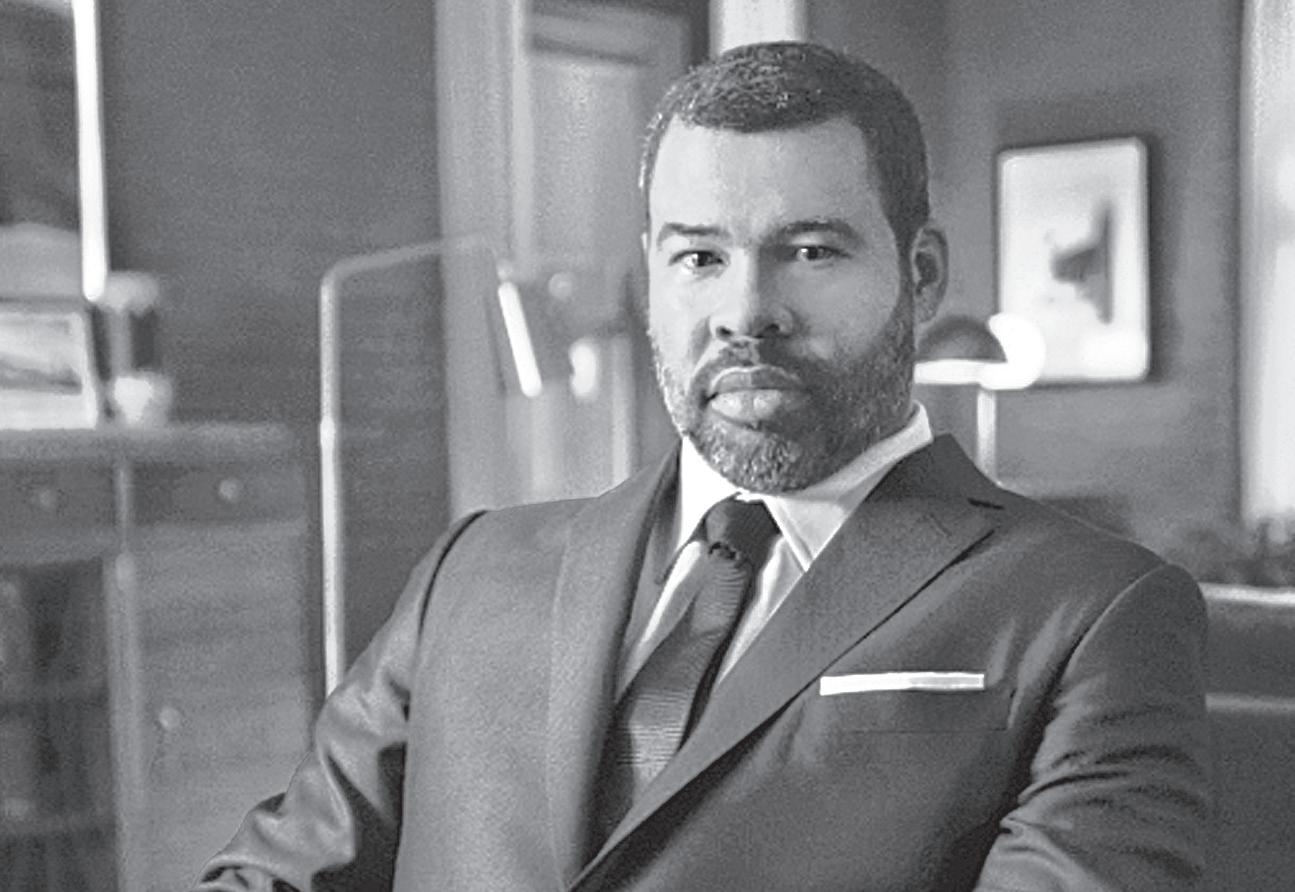
As evidence of the series’ enduring resonance, it has since been swooped up for multiple reboots. The most recent surfaced in 2019 with Jordan Peele at the helm and remains strong with two seasons now on the books. The new installment follows the triedand-true format of the original rendi -
tion, leading viewers through a path of (albeit longer) detached stories that are, of course, anchored by foreboding narration — this time with Peele’s voice instead of Serling’s. As is to be expected for a project that bears a cultural weight as heavy as The Twilight Zone ’s, the scroll of featured actors is practically bursting with big names, ranging from Seth Rogen to Tracy Morgan, Ginnifer Goodwin and Kumail Nanjiani. Peele’s interpretation is also painstakingly aware of the context in which it was created, grappling with issues like racial profiling in law enforcement and immigration policy.
The series also appears to have been a predecessor for Black Mirror , Netflix’s wildly popular foray into the world of science fiction first released in 2011. While the contemporary project’s focus is concentrated on technology’s role in fashioning the lives we lead and the people we become, the two are indisputably intertwined.
The Twilight Zone accomplished in 25 minutes each week what many film creators would be proud to execute in a single, once-in-a-lifetime project. The show’s success in developing and maintaining its trademark unpinnable haunting quality, even in the midst of an ever-circling carousel of new characters and new cast members, is not something to be taken lightly. The anthology serves as an astonishingly clear reminder that our own world, much like the Twilight Zone, is a frustratingly yet stunningly puzzling home.
Megan Pontin is a sophomore in the School of Industrial Labor Relations. She can be reached at mpontin@cornellsun.com. Rewind runs alternate Tuesdays.
A24 Captures Coming of Age in a Political Landscape
ASHLEY RAMYNKE ARTS CONTRIBUTOR
One week. Two political parties. 1,100 boys. Jesse Moss and Amanda McBaine’s documentary Boys State (an Apple Original Films and A24 release; streaming on Apple TV+) tells the story of four boys learning to distinguish themselves as individual entities in a cut-throat political environment. Its glimpse at the next generation of politicians inspires hope in our climate plagued with political tension.
Each year, high school juniors are selected to assemble their own state government in a week-long program hosted by The American Legion that shares the same name as the documentary. Participants are divided into Federalists and Nationalists, randomly assigned to a party and tasked with establishing their party’s platforms. They also pass leg islation and hold elections, with the gubernatorial election being the pinnacle of the program.
Six camera crews documented four boys uber-en thralled with winning coveted elections, specifically for governor or party chairman, at Texas Boys State in June 2018. But the differences in their back grounds and political ideology compared to other participants rang challenging. Robert MacDougall with his blunt demeanor, muscular physique and predominantly conservative politics appears like an archetypal participant destined to be governor, but is met with ethical questions about appealing to the other participants or maintaining his values. Steven Garza is the underdog advocate that dreams
are made of. With his unwavering support for immigrants, the LGTBQ community and veterans, he amalgamates humanity and policy into an unforgettable gubernatorial campaign. René Otero is a Chicago native and Texas transplant with an unequivocal ability to project and an extensive knowledge of combating injustice that doesn’t make him quiver in the face of impeachment. Ben Feinstein adores former President Ronald Reagan — to the extent where he has an action figure of him and studies his speeches — and is a double amputee that spews his political brilliance on anyone within earshot.
Despite the central focus on these four boys, their narratives rarely intertwined due to the sheer magnitude of participants and their opposing party affiliations. Their individual narratives instead patched together critical events throughout the week. The other factor that created cohesion throughout the documentary was the boys contemplating whether they could successfully run campaigns and execute their positions without sacrificing their values.

COURTESY OF A24
MacDougall embodied this contemplation during his gubernatorial campaign when he appeared to be an outspoken supporter of typically conservative values, like being pro-life. In one of the most pivotal moments throughout the documentary, he spoke vulnerably about actually being pro-choice and his newfound respect for politicians after his stint trying to appeal to his perception of other participants. Fellow Nationalist gubernatorial candidate Garza broke all barriers of a traditional Boys State participant. His resistance to conform to
the political ideology prominent amongst other participants carried his campaign until its final moments when he lost to his Federalist opponent. In the process, he garnered support for participants across the political spectrum and illuminated a path for other progressives to dominate all expectations set for participants who neglect the traditional mold.
Outside of the gubernatorial election, Otero was the Nationalist and Feinstein was the Federalist party chairmen. Otero was met with heavy criticism despite his advocacy success in the professional sphere. While members of his party called for his impeachment and he faced racist remarks on social media, his composed demeanor and continuous support for policies like universal background checks kept his position and political ideology intact. And the obsession of Feinstein to solidify his party’s success left no task neglected. Like the Renaissance man of the party, he continuously transitioned between speechwriting, deciding what meme pages about the election to endorse and providing the utmost support for his party’s gubernatorial candidate.
As the dimensions of these four boys expanded and exposed a more precise understanding of how they individually contribute to the collective narrative of democracy, it brought home the idea that humanity is detrimental to politics. Without the steadfast belief in their values and utmost desire to represent the needs of the people as the foundation for their political aspirations, these four boys wouldn’t have developed newfound approaches to navigating the political landscape like they did at Boys State. This documentary in its 109 minutes-entirety bestows a look at how burgeoning minds are laying the groundwork for democracy under a new generation of politicians.
Ashley Ramynke is a junior in the College of Arts and Sciences. She can be reached at aer285@cornell.edu.
COURTESY OF CBS ALL ACCESS
Megan Pontin Rewind

Archer ’05 Not Optimistic on Spring Football
Despite in-person practices, too many factors suggest low likelihood of such a season
By LUKE PICHINI Sun Assistant Sports Editor
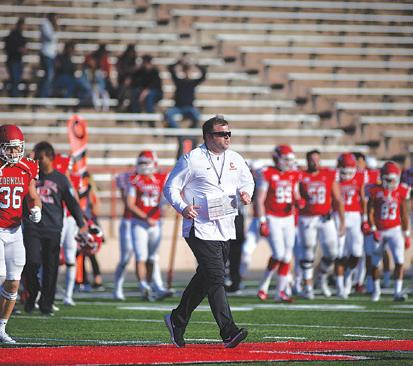
Cornell football head coach David Archer ’05 expressed little hope in the Ivy League holding a football season in the spring. The team is currently not competing during the fall semester after the Ivy League prohibited varsity athletic competition.
In an interview with The Sun, Archer confirmed that the team is moving into Phase 2 of the Ivy League’s reactivation plan, several weeks after the University approved the move into Phase 1. A move to Phase 2 allows in-person meetings and increases the conditioning cap to two hours per session.
sport in the spring and then gearing up to return in the fall.
“You have to ask the medical people, ‘Is playing football medically appropriate to play in the spring season and then turn around and play in the fall?’” Archer said. “If we play the spring, there will surely be a plan to play in the fall because there will be a vaccine.”
In addition, there are further complications that arise from fall sports, such as football, moving their competition to the spring.
“That’s why I say the likelihood of a spring competitive football season is next to none.”
’05
Despite this positive development, Archer is not optimistic about the prospects of a spring season.
“I think playing in the spring has a super, super slim chance,” Archer said. “Huge hats off to Cornell — this testing is robust, the kids are unbelievable in following the compact, and this virus is contained on campus. … That being said, we’re still just moving to Phase 2.”
Archer noted that every other Ivy League university needs to approve the return of its students back to campus before collegiate sports can resume. This semester, Cornell was the lone school in the Ancient Eight to invite all of its students for an in-person experience.
There is also the issue regarding the medical feasibility of playing a fall
Even if there are no COVID or medical issues associated with playing, a logjam will result in the use of facilities as dozens of teams must share limited space.
“How on earth do you appropriately schedule the facilities, the training staff, and all of the shared resources at work?” Archer said. “Who would you give priority to? Would you say, ‘Man, the winter and spring kids got their season crushed [last year] — I guess they get first priority.’ And then what do we do, go to Schoellkopf at 10 o’clock at night and try to practice? … That’s why I say the likelihood of a spring competitive football season is next to none.”
Though Archer is not hopeful about football returning next semester, he has higher hopes for spring sports.
“I think that still has a chance because rightfully so in the spring, they would be in-season,” Archer said.
“That would be their traditional season, so I think that still has a chance, and I’m hopeful — as we all are — that there can be a more permanent solution to the virus sooner rather than later.”
In the meantime, the football team has been ramping up its in-person practices after spending the first part of the semester in a virtual capacity. After the move to Phase 1, the team has practiced four days a week from Monday to Thursday, splitting time between lifting and conditioning.
With these practice conditions, two groups of 10 or fewer players will show up at a given time slot during one of the days. There are three slots at 4:30 p.m., 5:30 p.m. and 6:30 p.m. One group is positioned on one half of the field while the other group occupies the other half.
The players are positioned on fiveyard increments to ensure proper social distancing, and all
participating players and staff wear masks.
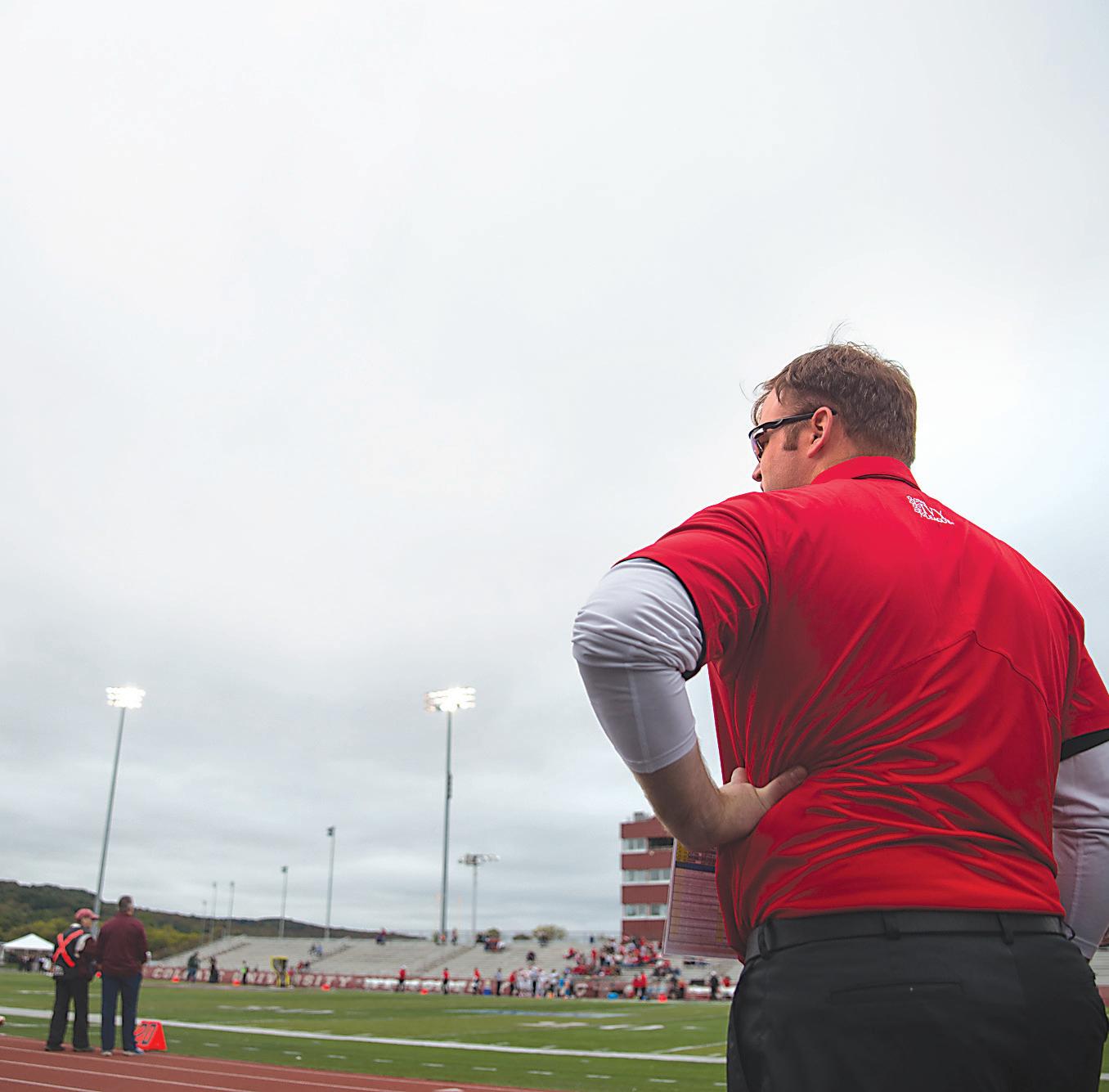
While the conditions are far from ideal, the ability to restart a small portion of the in-person athletic experience has been a morale-booster for the players.
“What I am seeing from the team is that being able to be around their teammates and do something has been such a huge mental, emotional lift,” Archer said. “I really think they’re like the rest of the student body in being really resilient, optimistic people. They’re team players, and they’re sacrificing a lot to keep the community healthy in the hopes that we can progress to the new normal — whatever that might be.”