The Corne¬ Daily Sun


As campus leaders struggle for solutions, over half of student respondents report experiencing harassment
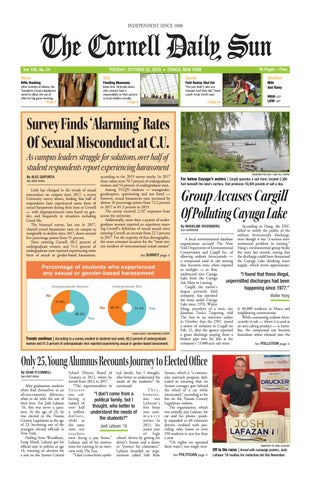
according to the 2019 survey results. In 2017 these values were 70.5 percent of undergraduate women and 54 percent of undergraduate men.


Little has changed in the trends of sexual misconduct on campus since 2017, a recent University survey shows, finding that half of respondents have experienced some form of sexual harassment during their time at Cornell — with disproportionate rates based on gender, and frequently in situations including Greek life.
The biannual survey, last run in 2017, charted sexual harassment rates on campus as marginally in decline since 2017, down around five percentage points from 55 percent.
Since entering Cornell, 68.2 percent of undergraduate women and 51.3 percent of undergraduate men reported experiencing some form of sexual or gender-based harassment,
Among TGQN students — transgender, genderqueer, questioning and not listed — however, sexual harassment rates increased by almost 10 percentage points from 72.2 percent in 2017 to 81.3 percent in 2019.
The survey received 2,247 responses from across the university.
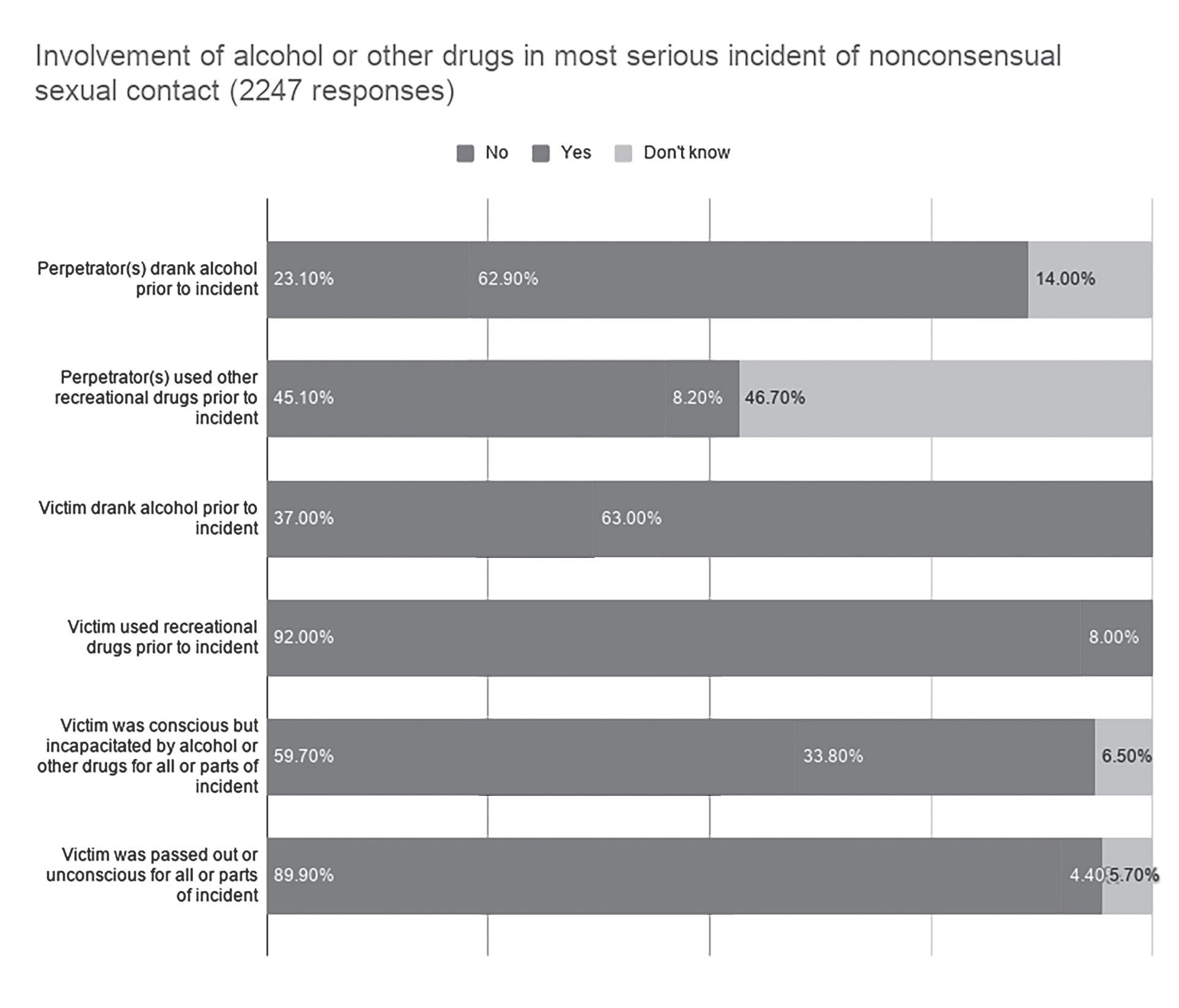
Additionally, more than a quarter of undergraduate women reported an experience meeting Cornell’s definition of sexual assault since entering Cornell, an increase from 22.5 percent in 2017. For the majority of that demographic, the most common location for the “most serious incident of nonconsensual sexual contact”
By MADELINE ROSENBERG Sun Contributor
A local environmental database organization accused The New York Department of Environmental Conservation and Cargill Inc. of allowing sodium ferrocyanide — a compound used in salt mining that becomes toxic when exposed to sunlight — to flow undetected into Cayuga Lake from the Cayuga Salt Mine in Lansing.
Cargill, the nation’s largest privately held company, has operated the mine under Cayuga Lake since 1970. Walter Hang, president of a toxic site database Toxics Targeting, told The Sun in an interview earlier in October that the DEC issued a notice of violation to Cargill on Feb. 12, after the agency reported a green discharge seeping from a broken pipe into the lake at the company’s 13,000-acre salt mine.
By SEAN O’CONNELL Sun Staff Writer
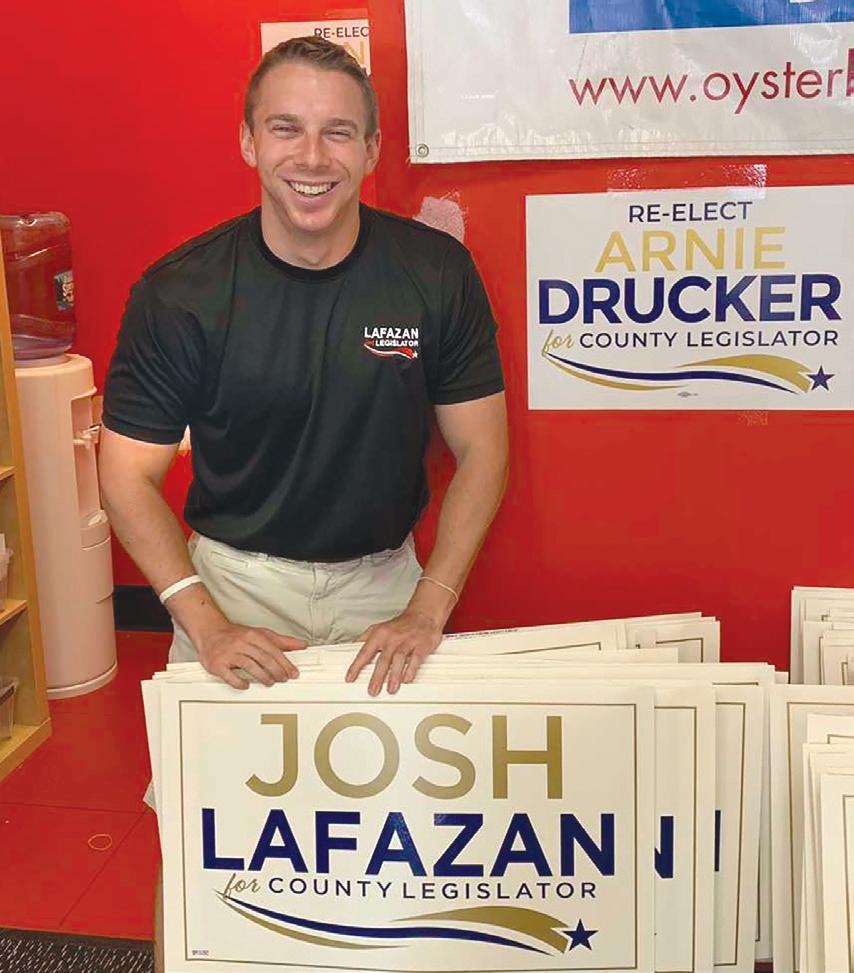
After graduation, students often find themselves in an all-too-common dilemma: what to do with the rest of their lives. For Josh Lafazan ’16, this was never a question. At the age of 23, he was elected to the Nassau County Legislature at the age of 23, becoming one of the youngest elected officials in New York.
Hailing from Woodbury, Long Island, Lafazan got his official start in politics at age 18, winning an election for a seat on the Syosset Central
School District Board of Trustees in 2012, where he served from 2012 to 2017.
“The superintendent in Syosset was collecting a [salary] of over half a million dollars, while at the same time our teachers were facing a pay freeze,” Lafazan said of his motivations for running In an interview with The Sun.
ical family, but I thought, who better to understand the needs of the students?” he continued.
“I don’t come from a political family, but I thought, who
better to understand the needs of the students?”
According to Hang, the DEC failed to notify the public of the sodium ferrocyanide discharge, even though it was “a serious environmental problem in mining.” Hang’s environmental group broke the story last month, noting that the discharge could have threatened the Cayuga Lake drinking water supply, which serves approximate-
“I found that these illegal, unpermitted discharges had been happening since 1977.”
Walter Hang
ly 40,000 residents in Ithaca and neighboring communities.
While consuming sodium ferrocyanide in salt — where it is used as an anti-caking product — is harmless, the compound can become hazardous when released into the
Josh Lafazan ’16 See POLLUTION page 5
“I don’t come from a polit-
This, however, was not Lafazan’s first foray into community service. In 2011, his junior year of high school, driven by getting his driver’s license and a desire to “protect his classmates,” Lafazan founded an organization called Safe Ride
Syosset, which is “a community outreach program dedicated to ensuring that no Syosset teenager gets behind the wheel of a car while intoxicated,” according to his bio on the Nassau County Legislature website.
The organization, which was initially just Lafazan, his car and his phone, quickly expanded to 40 volunteer drivers, credited with providing rides home to over 350 students in just less than a year.
“On nights we operated there wasn’t one single teen-
Work Talks:
Tuesday, October 22, 2019
Work Authorization for International Students 10 - 11 p.m., 276 Caldwell Hall
CUSLAR/LASP Public Issues Forum: Empire of Borders: The Expansion of the U.S. Border Around the World by Todd Miller 11:40 a.m. - 12:30 p.m., G08 Uris Hall
Frame Yourself: How to Present Yourself as an Ideal Job Candidate 11:40 a.m. - 1:10 p.m., Big Red Barn
Study Abroad: Not All Classrooms Have Four Walls 11:45 a.m. - 1 p.m., OADI Lounge, Computing and Communications Center
Community Wellbeing Speaker Series 3 - 5 p.m., Green Room, College of Veterinary Medicine
Transmedial Noises: ‘Babel’ and the Translation of Radio 4:30 p.m., KG42 Klarman Hall
Chats in the Stacks: Suman Seth on Difference and Disease: Medicine, Race and the Eighteenth-Century 4:30 - 5:30 p.m., 107 Olin Library
Uniontown Documentary Screening 7 - 8:30 p.m., Cinemapolis Movie Theater
Hortus
10 a.m. - 2:30 p.m., Big


Panel Discussion With Humphrey Fellowship Alumni 11 a.m. - 12 p.m., 160 Mann Library
Professional Directions With Charles Stuart and Nyamon Nguany Machar 11:30 a.m. - 1 p.m., Eissner Pavilion, Schwartz Performing Arts Center
Trading Our Privacy 12 - 1 p.m., 102 Mann Library
The Crisis in Kashmir: History, Politics and the Law 12:15 -1:15 p.m., 184 Myron Taylor Hall
International Student Group Counseling 3-4 p.m., 276 Caldwell Hall
International Coffee Hour, Pumpkin Carving and Painting 3:30 - 5:30 p.m., Greenhouse, Big Red Barn
EAS Seminary: Dry and Semi-Dry Hurricanes 3:30 p.m., 2146 Snee Hall
Trumpism in American Foreign Policy 4:30 - 6 p.m., G76 Goldwin Smith Hall

From how the endowment works to
T.A. pay, guide aims to demystify Cornell’s complicated cash fows
By ARI DUBOW Sun Staff Writer
By March 2020, students will be able to learn about how the University finances work through a guide written specifically in layman’s terms by the newly formed Ad Hoc Budget Planning Advisory Committee, whose membership span across undergraduates, graduate and professional students, and faculty.
Entitled “The Cornell Budget: A User’s Guide,” the document aims to address students’ questions and concerns about the most opaque parts of the system.
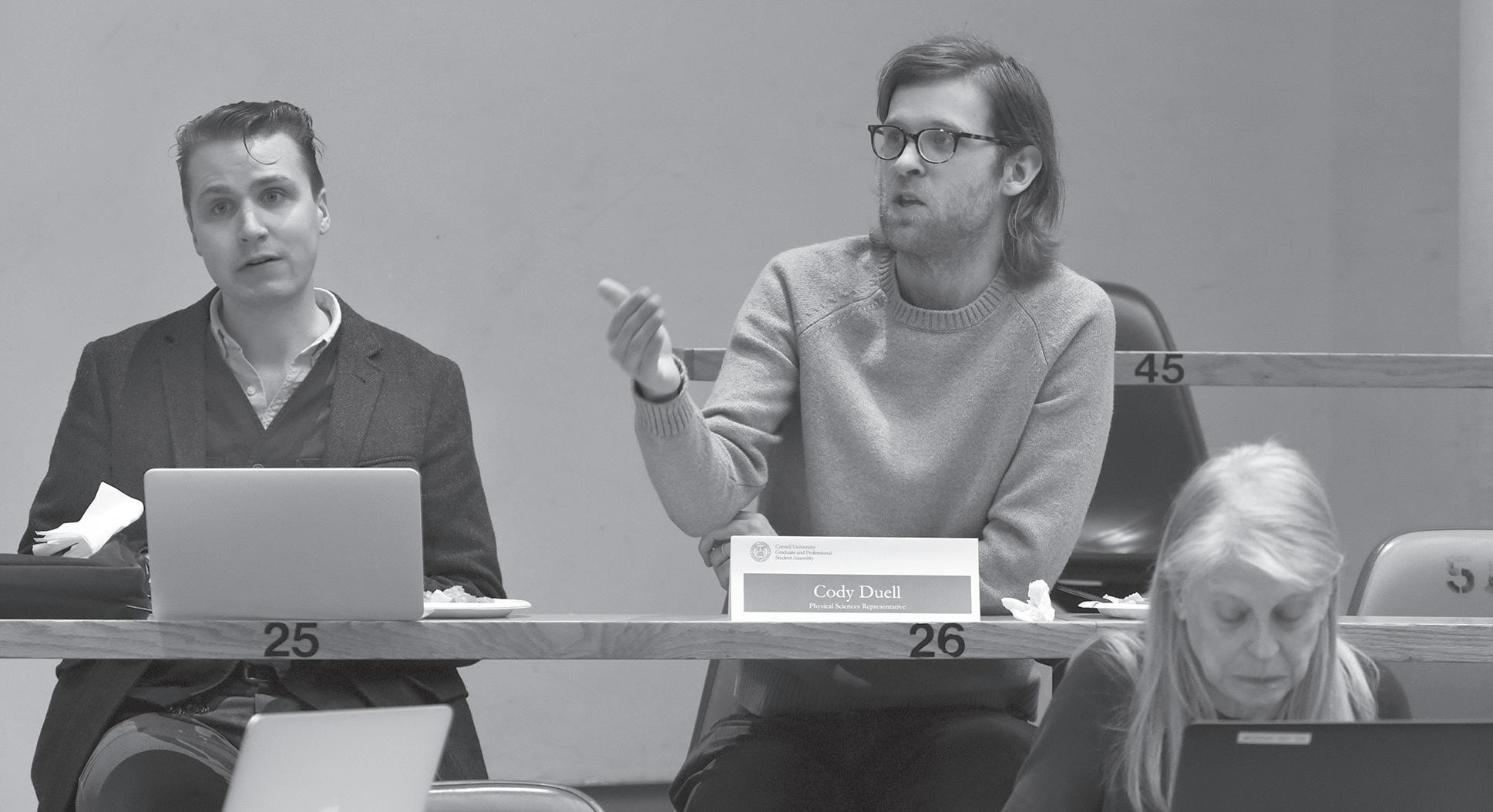
“People want to know, what sets the T.A. stipend? How many graduate students can a department financially support each semester? How does the endowment work?” said Manisha Munasinghe grad, a student-elected trustee and a representative of the ad hoc committee at a Graduate and Professional Student Assembly
“People want to know, what sets that T.A. stipend? How many graduate students can a department ... support.”
Manisha Munasinghe grad
meeting on Monday.
Additional topics that students expressed interest in include the processes behind evaluating student financial aid, costs at the university in addition to tuition such as gym membership and TCAT passes, and employee salaries — particularly those employees with salaries that are near or
above seven figures.
“We want to come out with an easy to read report for laypeople so that they can understand how the dollars flow,” said Dean of Faculty Charles Van Loan, another representative from the committee. “There’s a real shortage of people who understand the dynamics of the budget
“There’s a real shortage of people who understand the dynamics of the budget.”
Dean of Faculty Charles Van Loan
process and how it works, and also understand academic directives.”
In addition to Van Loan, the committee consists of another member from the University Assembly, two members from the Student Assembly, two from the GPSA, and two selected by the Employee Assembly, according to the committee’s webpage. In creating this guide, the Committee will be working in collaboration with the Faculty Senate’s Financial Policies Committee.
Specifically, part of the goal of the report is to enable students to better participate in the financial processes of the University by understanding the timeline of the process, so that students are aware of the University’s financial business before decisions are already made.
“We need educated laypeople who can participate in these things,” Van Loan said.
By WINNY SUN Sun Staff Writer
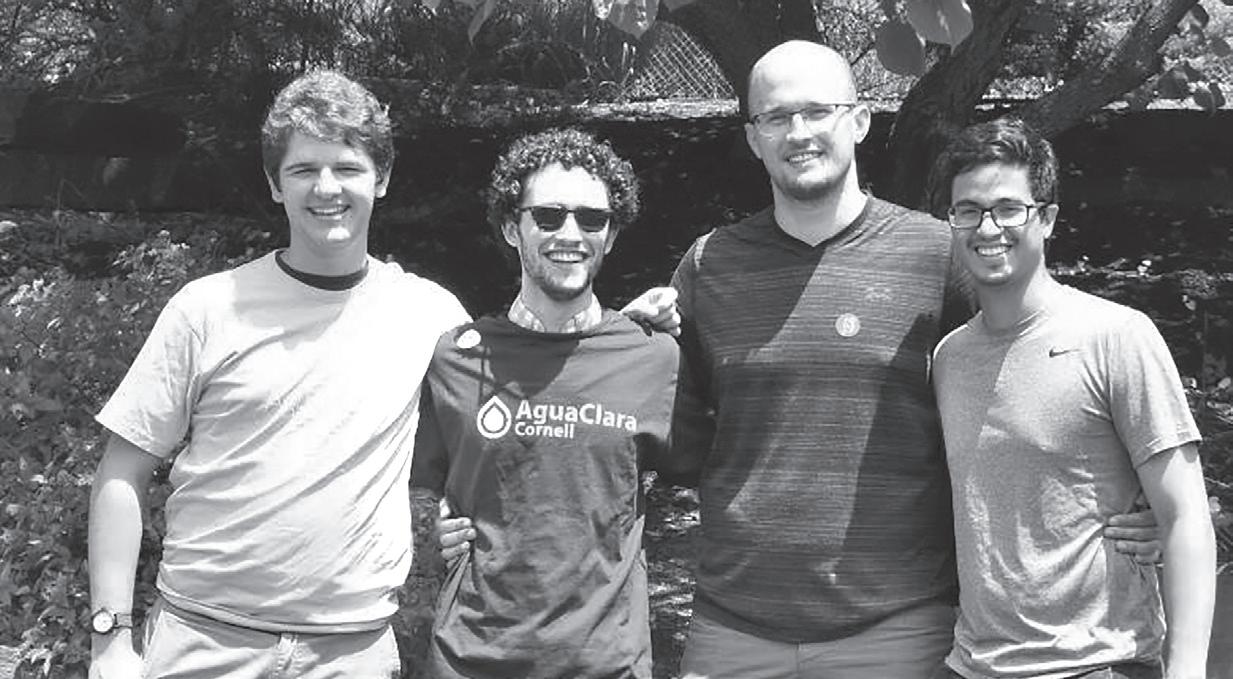
A group of student engineers from the AguaClara project team recently went head-to-head against Cornell facilities with their water filtration technology, powered solely by gravity. And so far, they are not lagging behind.
The AguaClara project team was founded by Prof. Monroe Weber-Shirk, civil and environmental engineering, in 2005 to address the lack of sustainable water treatment plants in impoverished communities. Since then, AguaClara has grown to more than 50 undergraduate and graduate students, according to the team’s website.
Weber-Shirk and his team of students have constantly looked for ways of treating water that does not demand external power sources. By studying the physics behind how water is treated, they have developed a treatment technology that treats water using only gravity, according to Yitzy Rosenberg ’21, head of AguaClara’s Investments and Public Relations teams.
“Weber-Shirk has researched the physics behind how water is treated for the past 15 years. By understanding the physics, we as a team has been able to develop certain processes based on the equation that comes out of that physics,” Rosenberg said.
Aside from being gravity-powered and electricity-free, AguaClara facilities have several other unique features. Their filters, which are stacked on top of each other, use approximately one-sixth of the area that is normally necessary for conventional water treatment. As a result, water can filter in from many different angles, rather than just through the bot-
tom as in conventional plants.
Additionally, while some treatment plants need manual help from operators to settle out sediments accumulated at the bottom, AguaClara facilities have a self-cleaning segmentation system that eliminates this often time-consuming step.
Using research and designs AguaClara develops, local NGO partners have built water treatment plants in countries such as Honduras and India. Currently, there are 12 AguaClara plants in Honduras and two in India.
In order to prove the effectiveness of existing AguaClara plants, the team compared them to Cornell’s own, more conventional water treatment systems.
During the trial run, a smaller-scale of AguaClara’s facility filtered water in parallel to the Cornell water treatment plants, offering team members a consistent basis for comparing performance and quality across the two different systems.
“The Cornell Water filtration team has been super supportive,” Rosenberg said. “The relationship works both ways. It’s a partnership where we are helping each other and learning from each other.”
According to Rosenberg, the analysis, which is still ongoing, has so far produced positive results: Water treated through the AguaClara plant meets U.S. standards, and is similar in quality to water treated by Cornell systems.
“If the results are promising, we can start to ask the question, ‘what can conventional plants do in order to improve their systems?” he said.
Winny Sun can be reached at wsun@cornellsun.com.
BY EMILY YANG Sun Staff Writer
Earlier this month, the Tompkins County Legislature narrowly voted in favor of a resolution that would allow rifle hunting for big game in the area, joining 58 other upstate New York counties that already granted such permission.
While rifle hunting is already allowed for small game, such as ducks and rabbits, the provision expands it to include deer and bear, which previously could only be hunted with shotguns, handguns or crossbows. The measure, which passed 8-6, compels the County’s legislative delegation to support an amendment to state environmental conservation laws, which, by custom, Albany almost always grants.
Although much of New York has long permitted the use of rifles during the three-week big game
hunting period, which takes place from Nov. 16 to Dec. 18 this year, discussions on the proposal lasted for months — highlighting the increasingly contentious nature of the debate on changes to gun policy.
Amanda Champion, a county legislator who voted against the resolution, believed that the move would amount to a worrisome encroachment of firearms at a time when many have increasingly feared the danger of guns.
“It is an expansion of gun rights and regulation, and we’re in a critical time right now,” she said. “I didn’t want to be a part of that.”
Michael Lane, on the other hand, voiced support of the change on the grounds that while rifles’ bullets can travel farther and faster than shotguns, they are ultimately more accurate and cause less suffering to animals being hunted.
“This is one of those issues I went back and forth on,” he said. “It’s not the responsible hunters I’m worried about, it’s the irresponsible ones.”
Other supporters said that the measure simply closes a small gap in the legislation that otherwise already has allowed rifle hunting for smaller animals.
“It makes no sense to me that hunters can use rifles 49 weeks a year to shoot anything but deer and bear, but cannot use rifles for three weeks a year and only if they’re hunting deer and bear,”
Deborah Dawson, who voted in favor of the resolution, wrote in an email to The Sun.
Dawson said her decision was also based on statistics that refuted the supposed correlation between shooting accidents and the type of weapon involved, arguing that the law would not change gun-buying behavior.
“[I]t’s been my experience that
folks who hunt tend to own several guns, including rifles,” Dawson said in the email. “The law as it stood was simply NOT a deterrent to buying a rifle.”
Dawson also said that Tompkins County’s more populous municipalities, such as the Villages of Cayuga Heights and Lansing, are free to set their own restrictions on deer hunting, and would likely not be affected by the recently passed legislation.
Anne Koreman, who voted against the resolution, argued that Tompkins County is more populated than the nearby counties that already allow big game rifle-hunting, potentially posing a risk to the passerby.
Koreman told The Sun that her neighbor once had a stray bullet graze the side of his face from several hundred feet away. She also described a friend who was accidentally shot while hiking by a hunter who was using a rifle.
“Her girlfriend was killed, and she had several bullets in her,” Koreman said. “It could do that at a distance because rifles can shoot a really long distance.”
“My main concern is safety,” she said. “I think it’s an accident waiting to happen.”
An amendment introduced by Lane will allow the new rule to be reviewed by the Legislature in two years, pointing out that “if there [are] issues, we could revert to just hunting by shotgun.”
Even with that concession, Koremane still expressed reservations about the bill.
“It’s much harder to take away people’s perceived rights,” she said. “Anything that we’re doing now to expand the use of any gun, we should have a really, really good reason to do it.”
By LOUIS CHUANG Sun Contributor
Amidst a presidency that has seen clashes at the border and high-profile confrontations with Mexico, a pair of former diplomats debated whether Trump’s immigration record represents a radical change — or merely an extension of the status quo.
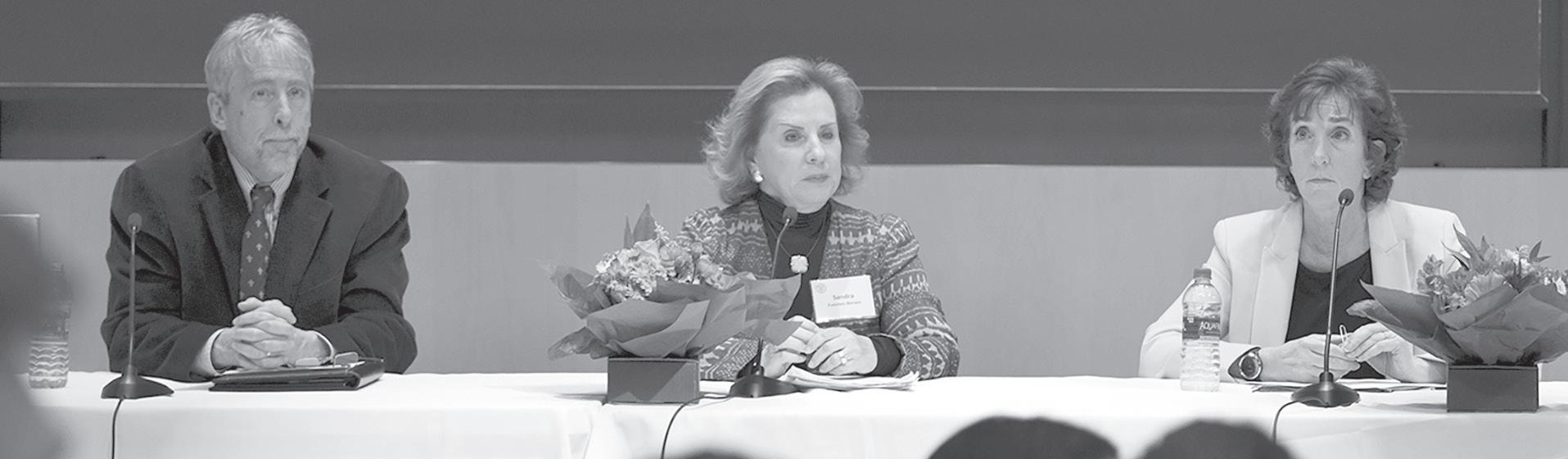
In debate on Monday moderated by Prof. Gustavo Flores-Macías, government, Sandra Fuentes-Berain, Mexico's Ambassador Emeritus who served as the Consul General of Mexico in New York, and Roberta S. Jacobson, former U.S. Ambassador to Mexico, debated the implications of the Trump’s immigration
policy.
Flores-Macías, who filled in for Jacobson during the first half of the panel when the ambassador’s flight was delayed, argued that, while Trump’s immigration policy has, at times, drawn intense outrage — it largely represents a continuation of the precedent set by the previous, and often less controversial, President.
“If you look at the numbers ... we have, in fact, fewer deportations taking place in this administration than under the Obama administration.”
Prof. Gustavo Flores-Macías
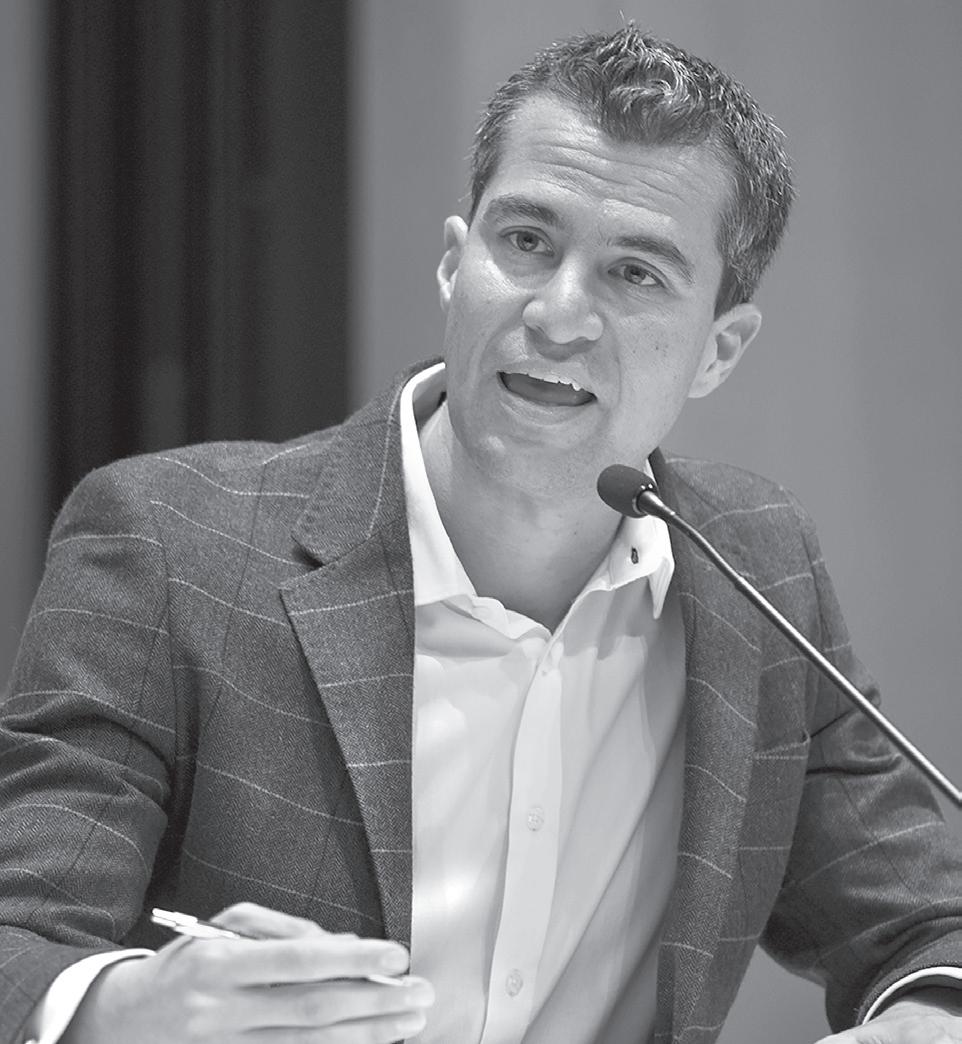
While “President Trump is accused of adopting this openly anti-Mexican policy … if you look at the numbers … we have, in fact, fewer deportations taking place in this administration than under the Obama administration,” he said.
According to Axios, despite Trump’s repeated pledge to deport large swaths of America’s approximately 11 million undocumented immigrants, that hardline position has failed to materialize during his time in office: While the Obama administration deported an average of 350,000 individuals, ICE deporations under Trump have yet to eclipse 290,000.
But Fuentes-Berain said that explanation was overly-simplistic. She said that much of Obama’s policy “was part of the strategy” — that it may have been driven by a longer-term plan to bring about the sort of comprehensive immigration reform that has eluded Congress for decades.
“It was [Obama’s] way of showing Republicans that he was tough on immigration,” according to FuentesBerain, so that “he could try and pass [the laws] that were very badly needed in immigration reform.”
Although Flores-Macías defended Trump’s deportation policy as being in line with predecessors, he did acknowledge that U.S.-Mexican relations have soured under Trump’s watch, becoming “a lot less civil” and “a lot more crass.”
However, he still maintained that the day-to-day impact of Trump’s policies, especially the revised NAFTA deal, have only had a marginal practical impact — a conclusion Fuentes-Berain said ignores Trump’s reliance on roughshod diplomatic tactics to achieve his domestic political goals.
For instance, Fuentes-Berain described Mexico as
“weakened and at the mercy of Trump” in explaining the country’s recent role in helping the Trump administration prevent migrants from reaching the United States.
Earlier this summer, in response to Trump threatening to dramatically hike tariffs to up to 25 percent, the Mexican government agreed take greater efforts to stem the flow of migrants from Central America and allow asylum-seekers to remain south of the American border while their cases are processed.
According to Fuentes-Berain, that move amounted to Trump taking Mexico “hostage” and giving it “no choice but to pay the ransom.”
But in a discussion marked by disagreement over the true impact of Trump’s polarizing policies, the panelists found little trouble agreeing on the importance of the U.S.-Mexican relationship — and that cooperation must take the place of divisive rhetoric.
“[The U.S.-Mexico relationship] is a relationship that affects more Americans ... than any other.”
Roberta S. Jacobson
“The U.S.-Mexico relationship is the most important in the world — it is a relationship that affects more Americans on a daily basis than any other,” said Jacobson, who arrived later on in the debate.
Going forward, the only way to mend the two countries’ fraying ties is for Trump to tamp down campaign bombast and focus on areas of agreement, according to Jacobson, who served as Trump’s Mexico ambassador for a little over a year before resigning over disagreements.
“The single thing that we could do is mutually respect each other and avoid the vilification of Mexicans. The chanting in rallies about the wall — it is really very insulting to us,” said Jacobson. “You have to stop the rhetoric that the administration has used towards Mexico when it’s convenient and start focusing on cooperating.''
Louis Chuang can be reached at lc742@cornell.edu.
age driving accident [in Syosset],” said Lafazan. He urged people that might consider following in his footsteps to “pay it forward,” adding that the second volunteer driver was “somebody we had picked up, drunk, the night before.”
Lafazan attended Nassau Community College after graduating high school, later transferring to the Cornell School of Industrial and Labor Relations, of which he spoke highly of.
“I don’t believe that there is a program that better prepares you for a career in public service than ILR,” he said. “Plenty of skills that I utilize in my job every day, I got from there.”
Unlike the average Cornell student, Lafazan split his time between Ithaca and Long Island, New York, making the
six-hour trip every three days in order to fulfill his responsibilities on the Syosset school board.
Lafazan mentioned turmoil in his county as part of the reason he decided to run for Nassau’s 18th district — after receiving a Master’s degree in Education from Harvard University — highlighting the arrest of former Nassau County Executive Edward P. Mangano for corruption as a driver for his run.
Lafazan ran as an independent, basing part of his campaign on issues shared by all the residents of Nassau County.
“Potholes are not partisan,” he told The New York Times, “There is no Republican or Democratic way to pave a road.”
The then-prospective legislator faced an uphill battle against two-term incumbent conservative Donald McKenzie, a veteran attorney, along with a “5,000 vote enrollment edge” from the Republicans,
as reported by Newsday. Ultimately, Lafazan’s campaign, staffed by student interns, was able to win the race with 56 percent of the vote.
As a freshman legislator, he was responsible for the passing of a number of bills that drew support from both parties through the county legislature.
“Timothy’s Law,” passed unanimously in 2018, provided for the creation of a 24-hour hotline meant to raise awareness of substance-abuse issues.
Another recent bill involved tackling the issue of food allergies, requiring restaurants across Nassau County to comply with more stringent food safety measures in order to increase their accessibility to those with sensitivities to certain foods.
Lafazan is up for re-election in 2019, and is employing over 70 student interns aged 12 to 22 — barely younger than the candidate himself — in a bid to retain
office. His campaign stresses bipartisan cooperation on salient issues in Nassau County, specifically a shortage of affordable housing.
In addition to his political career, Lafazan authored a 2015 book titled, “Political Gladiators: How Millennials Can Navigate the 21st Century Political Minefield and WIN!” He is also a TED speaker, expressing concerns about the college admissions process in addition to other topics.
With a final word, Lafazan talked about his reasons for running for office. “I didn’t know I wanted to pursue a career in politics.” He continued, “Quite frankly, I got pissed off because this is a time where people can’t afford to live in Syosset, and I thought, why not me?”
Sean O'Connell can be reached at soconnell@cornellsun.com.
Continued from page 1
was an on-campus fraternity house.
When questioned about the rates at fraternity houses, University media relations coordinator Abby Butler noted existing education programs through Cornell Health and the Office of Sorority and Fraternity Life. These include an annual ConsentEd training and a onetime mandatory training on bystander intervention given to new members.
“We are continually assessing these issues and the programming available for our students,” Butler said.
In 2019, 22.6 percent of undergraduate women responded that a fraternity house was the setting of their most serious incident of sexual violence in 2019, closely in line with the findings of two years prior.
“I think it’s inherent to patriarchal systems,” Maya Cutforth ’20, Panhellenic Council president, told The Sun.
Cutforth said it is necessary to have a “broader conversation” around why social events primarily occur at fraternity houses and fraternity-affiliated properties. Sororities at Cornell are prohibited by their national associations from hosting events, she said.
Cristian Gonzalez ’20, Interfraternity Council president, attributed the rates of sexual harassment to what he called
‘This thing happened to one of our members … and we’re choosing not to socialize with them,’ and I think that’s really valuable,” she said. “Fraternities wouldn’t hold mixers if sororities didn’t come to them.”
Gonzales expressed support for this type of collective action, but added that he found this practice “largely naive.”
“I feel that sororities will stop mixing with a certain fraternity … maybe for a short while, and then they’ll just keep doing it for reasons of social capital,” he said. Gonzales explained how sororities may feel internal pressure to continue mixing with what he called “top tier fraternities.”
Gonzales continued, “You get people who want to join IFC chapters for a lot of reasons … some of them are people we may not necessarily want in our chapters, some may not rush with the right reasons or the right motives … and they end up causing problems.”
Cummings’ position: Victim advocates are dedicated to providing catered support to those affected by harmful, threatening, or other violent incidents. For comparison, 55.2 percent of students were aware of the Title IX coordinator’s services.
“People don’t think about the resources available to them until they need help,”said Laura Santacrose, assistant director of the Skorton Center for Health Initiatives at Cornell Health. 95.9 percent of students were aware of Cornell Health’s services, something Santacrose expressed optimism in: “If students start at Cornell Health, they will find their way to the services they need.”
“It is our hope that students use the tools and knowledge gained from this training wherever they may be.”
Abby Butler
Te company is facing accusations of negligence in fxing its mines
environment. The National Center for Biotechnology Information warns in all capital letters, “Do not expose [the] solution to sunlight for any length of time to avoid generation of hydrogen cyanide.”
Cargill has since removed 400 tons of polluted soil and wastewater at the mining site to clean up the discharge, the Ithaca Times reported. But the company stopped excavation efforts when railroad tracks interfered with the remediation process. As a result, the contaminated area has not yet been cleaned up to meet New York State regulatory standards, Hang said in an online letter.
However, the DEC and Cargill disputed Hang’s claim that these organizations have not fully remediated the polluted area.
“We immediately repaired and tested the pipe before returning it to service later in the day,” Cargill told The Sun in a statement. “In coordination with the DEC, we took numerous actions to ensure the spill was properly cleaned up and regularly monitored the area to make sure there were no additional failures.”
The DEC said in an email to The Sun that the agency immediately notified the Cayuga and Tompkins Counties’ health departments to ensure that the discharge did not threaten the drinking water or create other related health concerns.
Still, Hang said Cargill has historically failed to prevent unpermitted discharges from flowing into Cayuga Lake, beyond the recent sodium ferrocyanide report.
After filing a records request under the New York Freedom of Information Law, Hang said public data documented decades of excessive levels of chlorides, cyanides and other pollutants discharging from Cargill’s Lansing salt mine into Cayuga Lake.
“I found out that these illegal, unpermitted discharges had been happening since 1977,” Hang said. “This has been going on for 40 years.”
And at fraternity parties, sober monitors designed in part as active bystanders, “aren’t always sober,” Gonzales said.
Off-campus residences represented the second most common location (19.7 percent) for undergraduate women’s most serious experienced incident of sexual violence, and represent the most common location for sexual violence (24.2 percent) if the demographic is expanded to include all students.
“You get people who want to join IFC chapters for a lot of reasons ... some of them are people we may not want in our chapters ... they end up causing problems.”
Christian Gonzalez ’20
“structural inequalities in how these parties are set up,” with fraternities serving as the host. “Sororities don’t really have much agency,” he added.
Cutforth said that some sororities ––she declined to specify which chapters –– will not attend social events at fraternities with sexual violence allegations against their members.
At Panhellenic chapter president meetings, Cutforth tries “to cultivate a space where presidents can say, like,
Off-campus, Cornell programming may have a limited reach. Butler, the university spokesperson, emphasized the skills taught in the bystander training process.
“It is our hope that students use the tools and knowledge gained from this training wherever they may be,” she said.
Nina Cummings, victim advocate and sexual violence prevention program director at Cornell’s Skorton Center for Health Initiatives, called the data “alarming.” She urged students to observe what is occurring on campus, and to “consider the collective impact of what their peers may be experiencing.”
The survey also revealed that only 24.4 percent of students were aware of
Student most often disclose experiences of sexual harassment to a friend, according to the survey results.
“Fewer than 1 in 5 students who experienced nonconsensual sexual contact reached out to a Cornell- or community-based resource to talk about that experience,” a coalition of university leaders including Ryan Lombardi, Vice President for Student and Campus Life said in a statement. “We must continue to inform students about the care and support that is available to them on campus and in the community.”
Members of the Cornell Community may consult with the Victim Advocate by calling 607-255-1212, and with Cornell Health by calling 607-255-5155. Employees may call the Faculty Staff Assistance Program (FSAP) at 607-2552673. An Ithaca-based Crisisline is available at 607-272-1616. The Tompkins County-based Advocacy Center is available at 607.277.5000. For additional resources, visit health.cornell.edu/services/ victim-advocacy
Alec Giufurta can be reached at agiufurta@cornellsun.com.
Hang is urging Gov. Andrew Cuomo (D-N.Y.) to investigate the pollution and require Cargill to clean up the contaminants. More than 1,000 Ithaca residents and other concerned individuals have signed a coalition letter to safeguard Cayuga Lake.
“We took numerous actions to ensure the spill was properly cleaned up and regularly monitored the area to make sure there were no additional failures.”
Cargill Inc.
Beyond pollution concerns, the letter also asks Cuomo to deny permits for mining expansion and “phase out” Cargill’s mining activity under the lake, allowing only dry land mining to preserve this “incomparable jewel as well as a critical component of the regional economy.”
“We’re saying, [Cargill] has dozens of these problems,” Hang told The Sun. “They have to investigate and remediate the whole site. They can’t continue to allow these pollution problems to go unremediated ... We now know that these pollution problems are a lot more severe than anyone ever understood.”
Madeline Rosenberg can be reached at mrr227@cornell.edu
137th Editorial Board
ANU SUBRAMANIAM ’20 Editor in Chief
JOYBEER DATTA GUPTA ’21
Business Manager
PARIS GHAZI ’21
Associate Editor
MEREDITH LIU ’20
Assistant Managing Editor
RAPHY GENDLER ’21
Sports Editor
BORIS TSANG ’21
Photography Editor
AMBER KRISCH ’21
Blogs Editor
SOPHIE REYNOLDS ’20
Science Editor
AMANDA H. CRONIN ’21
News Editor
JOHNATHAN STIMPSON ’21
News Editor
PETER BUONANNO ’21
Arts & Entertainment Editor
ANYI CHENG ’21
Assistant News Editor
HUNTER SEITZ ’20
Assistant News Editor
CHRISTINA BULKELEY ’21
Assistant Sports Editor
JING JIANG ’21
Assistant Photography Editor
DANIEL MORAN ’21
Assistant Arts & Entertainment Editor
LEI LEI WU ’21
Layout Editor
EMMA WANG ’20 Multimedia Editor
LEANN McDOWALL ’21
Newsletter Editor
BREANNE FLEER ’20 Senior Editor
SARAH SKINNER ’21
Managing Editor
KRYSTAL YANG ’21
Advertising Manager
NATALIE FUNG ’20
Web Editor
SABRINA XIE ’21
Design Editor
NOAH HARRELSON ’21
Blogs Editor
SHRIYA PERATI ’21
Science Editor
KATIE ZHANG ’21 Dining Editor
AMINA KILPATRICK ’21 News Editor
MARYAM ZAFAR ’21 City Editor
ETHAN WU ’21
Opinion Editor
SHIVANI SANGHANI ’20
NICOLE ZHU ’21
’22
JEREMY MARKUS ’22 Assistant Arts & Entertainment Editor
ALICIA WANG ’21
and Sketch Editor DANA CHAN ’21
RYAN RICHARDSON ’21
GIRISHA ARORA ’20
GUPTA ’20
Ad Layout Dana Chan ’21
Production Deskers Jamie Lai ’20
Sabrina Xie ’21
News Deskers Jonathan Stimpson ’21
Hunter Seitz ’20
Design Desker Lei Lei Wu ’21
Lei Anne Rabeje ’22
Photography Desker Boris Tsang ’21
Sports Desker Luke Pichini ’22
Arts Desker Peter Buonanno ’21
Letter to the Editor
To the Editor:
I’m a Chinese Ph.D. student who came to Cornell to pursue the world’s best education and technologies, hoping to one day make a contribution toward the evolution of all human societies. I usually follow political news but always stay apolitical myself, since I like to keep my life simple and focused on science.
However, upon reading two recent articles from The Sun — entitled “Claims of Vandalized Pro-Hong Kong Posters Bring Overseas Tensions to Cornell” and “When Victims Become Perpetrators: The Human Condition of Chinese Students” — and the pro-Hong Kong protest slogans actively appearing around campus, I’m deeply concerned by the serious misinformation and lack of communication between the Chinese and American communities. I’ve never felt so unrepresented before, and the past few weeks have been the most difficult time during the six years I’ve spent at Cornell.
I’m not writing to directly contradict the opinions from those aforementioned articles. In fact, I understand and even share some of the thoughts they express, such as anti-vandalism and speaking out through proper channels. But both articles share the same tone as all major U.S. (western) media: depicting the Hong Kong government and police as oppressors who beat protesters — while not mentioning the extreme mass violence (arson, abduction, assault on lone policemen and anyone who speaks Mandarin on the street) initiated and committed by the Hong Kong protesters every day that is killing the once-prosperous city.
You can find full-length videos of all these crimes online, but you must try hard, since major media outlets never report them. The media have their political goals in such biased reports, and I do not wish to think about them. But their ignorance has impacts on young communities such as Cornell: People who don’t regularly access news sources outside U.S. media don’t know the other side of the story, and people who oppose the violent Hong Kong protest find themselves isolated, unrepresented and alone. For the latter, they wish to bring it to attention that to talk about freedom, the protesters must first free themselves from violence.
I love both my own country and the U.S., since I’ve had some of my best memories in each of them. I do not wish to see a day when they are divided because of such lack of communication.
Xiaoyue Ding grad
Stay in the U.S. Or Go Back to China?
If you ask a Chinese student randomly walking on Cornell campus their plan after graduation, there’s a growing possibility that they could be heading back to China.
According to a survey conducted by S.C. Johnson MBA students in the class of 2021 during a Cornell career consulting session, Chinese students are increasingly concerned about the prospect of staying in the U.S., while attracted more by the Chinese job market.
Yes, the tendency is not new. However, in recent years, growing rejections of student visas — let alone the almost-impossible-to-get H-1B visa — have fermented pessimism among students who are striving to stay. In the meantime, growing opportunities in China’s job market, especially in finance, manufacturing, investment and AI, have drawn attention from across the global economic landscape, offering more spice for new entrants.
What are the reasons behind this trend? What are they looking for back in China? Should the trend be assigned more importance? How could a better information channel between the U.S. and China be built?
According to the survey, 64 percent of students think there are more opportunities in Chinese domestic markets, while 38 percent say staying in the U.S. is very challenging. This urge was felt months prior to the Cornell MBA slot of a joint MBA program, whose students were approached by a group of Chinese students at Cornell inquiring about job opportunities back in China.
Li Mengying, a student who was asked for career advice, initiated the career consulting session at Cornell, trying to help more students access the Chinese job market. More than 10 students from the MBA class offered one-on-one advice in the form of 15-minute coffee chats. Students who provided the consulting range from finance and investment to engineering and media, which are all among the most promising and rapidly growing industries in the world. “As a global MBA, we specially dedicate to bridge the gap on both sides,” Li said.
The dual-degree MBA program is jointly held by S.C. Johnson Business School and School of Finance of Tsinghua Univerisity, the top financial academy in China. It aims at strengthening the academic sphere and business education bond between China and the U.S. It’s so far the only MBA degree within the
Ivy League granted by the Ministry of Education in China.
That’s why the career consulting session was extremely well-received. More than 100 students signed up and stayed until the last guest left. It lasted for 3 hours with more students waiting and asking for similar sessions for more guidance.
In the 2017-18 school year, the number of Chinese students exceeded 360,000, an increase of 3.6 percent compared with the previous school year, accounting for 33.2 percent of all international students.
The arrival of Chinese students has promoted the development of education and industry in the United States.
In the past year, the cooling of SinoU.S. relations is gradually affecting the way these students are studying in the United States — which is known for its openness and freedom, but is constantly tightening visas for Chinese students and is involved in the vortex of the two countries.
Of the 100 students surveyed, more than 60 percent showed direct interest and clear goal of going back to China even before their study tour starts. However, more of them are concerned: “Seems we are not very well prepared about the domestic situation back to China, and we are kind of worried,” says Yang Lu.
According to a 2017 LinkedIn report, the areas with the highest preference for international students to return to China are Shanghai, Beijing, Shenzhen and Guangzhou — especially the Greater Bay Area, a new special economic zone, which is attracting overseas talents with lucrative bonuses.
“It’s because the job madrket in China is very compromising and I don’t want to lose the opportunity back to China,” says Li Chen, a finance major who has been looking for jobs back in China since her first year of college.
Li Mengying said because of the increasing urgency, her team has already reached out to the Cornell career center to raise the awareness of the trend. They are trying to build up a more comprehensive information-sharing platform to bridge the gap on both sides. “It’s meaningful to building up social impact in the changing context,” said Li.
Stella Song Yuhang is a graduate student in the S.C. Johnson College of Business. Guest Room runs periodically this semester. Comments may be sent to opinion@cornellsun.com.
Columbus Day is observed on the second Monday of October in the United States in order to recognize the contributions of Italian Americans and to commemorate the arrival of Christopher Columbus in the “New World” in 1492. The United States has arguably played the largest role in celebrating Columbus while ignoring the consequences of his actions. For this reason, over eight states, 130 cities and 10 universities are recognizing a more deserving alternative — Indigenous Peoples’ Day. I believe that building awareness of the history of Christopher Columbus’s behavior would lead anyone to the conclusion that Indigenous Peoples’ Day should replace Columbus Day — and that Cornell, Tompkins County and America at large aren’t doing enough to make up for Columbus’s actions and the patterns of behavior that he started.
Europeans did. Christopher Columbus did not just commit genocide during his lifetime, but the ripple effects of his actions have killed millions and destabilized numerous indigenous nations.
The U.S. has arguably played the largest role in celebrating Columbus while ignoring the consequences of his actions. For this reason, states, cities and universities are recognizing a more deserving alternative: Indigenous Peoples’ Day.
In 1492, Columbus began a series of four voyages to the Carribean. During these four voyages, Columbus and his subordinates plundered minerals and exotic wildlife while fighting brutal campaigns against local resistance and taking slaves. All attempts by Taino natives and other native groups to rebel against the slave states established by Columbus resulted in mass hangings and other brutal forms of punishment.
In addition to the things that Christopher Columbus did intentionally, we must look at the ramifications of his actions. Columbus set the tone for future exploration of the Americas. The pattern of continued exploitation and slavery was only amplified by the drastic changes that Europeans brought to the environment. Invasive species and new diseases, such as smallpox, killed even more native people through starvation, by killing native species, and general pestilence than direct conflicts with
There will certainly be those who would prefer to hold onto Columbus Day. However, the majority of these pro-Columbus parties are doing so due to a flawed sense of nationalism or readings from the flawed perspective of Columbus’s personal writings. Columbus portrayed the native people that he encountered as helpless people who cut themselves on his sword because they did not know what it was. We know from historical records that the native groups were familiar with war, as they fought numerous battles with Columbus, almost from the beginning, to get him to stop plundering their lands. Columbus was not a hero; he was a murderer. And he should not have his own holiday.
Indigenous People’s Day has the ability to begin a process of acknowledging marginalized groups in American society. Young people should confront the darker side of American history in order to bring about a better tomorrow. I do not believe that much can be done to fix the actions of Christopher Columbus. However, new problems facing indigenous communities such as exploitation by industry could, and should, be combatted.
Cornell University has its own history with Columbus Day. Protests of Columbus Day at Cornell started in early 2000, and Indigenous People’s Day was adopted by the University in 2016. However, the issue of Cornell being built atop the lands of native Cayuga tribes, of the Iroquois confederation, cannot be solved easily. Cornell should partner alongside students and faculty, especially those in American Indian and Indigenous Studies, to raise awareness on campus to inform our community about the importance of celebrating the culture of our original
inhabitants.
The Tompkins County legislature currently recognizes Columbus Day, an artifact of colonialism, and Indigenous People’s Day simultaneously, which misses the point entirely. Celebrating the two holidays concurrently does not take a neutral position; it implies that Columbus Day’s supporters have ground to stand on. Legislator Mike Lane of Tompkins County missed the mark by saying, “[I] ndigenous people have been and are an important part fact [sic] in our community. We’re pleased to have them here. It’s the same with all of our immigrants and other people that are here. They accepted us and we accept them and we want them to understand that they matter to us.”
Except that Native Americans were here first. The biggest next step that Americans, particularly those of European descent, can take is to recognize that they are responsible for another historic genocide. And that a history of vio-
Tompkins County simultaneously recognizes Columbus Day, an artifact of colonialism, and Indigenous People’s Day, which misses the point entirely.
lence and broken systems can never be made whole.
High above Cayuga’s waters lies not only our institution’s alma mater, but also those who perished for an unjust cause. Let’s remember that day in and day out, that we live and study on Native American soil; this land is stolen and Christopher Columbus is a part of our history that we should not celebrate.
Canaan Delgado is a junior in the College of Agriculture and Life Sciences. He can be reached at cdelgado@cornellsun.com. No Church in the Wild appears every other Tuesday this semester.
Early this week, the internet was consumed by a video of media personality, Kylie Jenner. In the video, Jenner enters her baby’s room and sings, “rise and shine” in a hilariously off-key tone. Amidst the hype, Jenner is selling a $65 poorly designed rise and shine hoodies.
It definitely wasn’t that funny.
Of course, capitalizing off internet
It is quite unsettling that a 22-year-old billionaire would sell such an expensive product, based on a fleeting meme, to her audience that primarily consists of adolescents.
fame is how she became famous in the first place, but it is quite unsettling that a 22-year-old billionaire would sell such an expensive product, based on a fleeting meme, to her audience that primarily consists of adolescents.
There are billions of people across the globe who live in poverty, yet the one percent continues to grow wealthier and wealthier. The income inequality gap is the greatest it has been in almost 50 years. But at what point is enough, enough?
It is said that if you made $5,000 every day since 1492, you still would not be a billionaire.
There are 2,208 billionaires in the world, each having an average of $4.1 billion. Their accumulated wealth is estimated at roughly $9.1 trillion.
I often wonder why it is that a person can have such an insane amount of
wealth, and still wish for more. Writing in The New York Times in 2014, Sam Polk, CEO of Everytable, offered a compelling possible answer, admitting that in his time as a Wall Street trader, he was addicted to money. He found himself surrounded by billionaires and desperate to be one. “Dozens of different types of 12-step support groups exist to help addicts of various types, yet there is no Wealth Addicts Anonymous. Why not? Because our culture supports and even lauds the addiction. Look at the magazine covers in any newsstand, plastered with the faces of celebrities and C.E.O.’s; the super-rich are our cultural gods.”
That said, I do somewhat believe it is unfair to vilify the wealthy completely. Many of them are “self-made” and have worked hard to amass to their success. Studies even show that wealthy people tend to work longer hours and spend less time socializing. After all, they have achieved the American Dream that has been ever so glorified in our country. I think the problem lies largely in how our government manages wealth.
The issue of income inequality has garnered much conversation in the political arena, especially with several Democratic candidates like Tom Steyer, Bernie Sanders and Elizabeth Warren being in support of implementing a wealth tax. A wealth tax would require the ultra-wealthy to pay the federal government a percentage of their yearly
net worth. Candidates suggest that the money would fund initiatives in environmental efforts, health care reform, economic investment and more.
In this month’s Democratic Debate, moderator Erin Burnett highlighted the terrifying fact that “the top one percent now own more of the nation’s wealth than the bottom 90 percent combined.” Bernie Sanders, an avid proponent of the idea that “billionaires should not exist,” also stated that “we cannot afford to continue this level of income and wealth inequality, and we cannot afford a billionaire class whose greed and corruption has been at war with the working families of this country for 45 years.”
Even some billionaires have vocalized support in enacting such legislation. Eli Broad, the 78th wealthiest man in America, wrote in a New York Times article, “Let’s admit out loud what we all know to be true: A wealth tax can start to address the economic inequality eroding the soul of our country’s strength. I can afford to pay more, and I know others can too. What we can’t afford are more shortsighted policies that skirt big ideas, avoid tough issues and do little to alleviate the poverty faced by millions of Americans. There’s no time to waste.”
didate Elizabeth Warren’s stance is the most digestible for the American people. Warren’s plan would place a 2 percent annual tax on those making over $50 million, and an additional 1 percent for those valued in the billions. Her team estimates that the tax would only affect one in 1,700 American families, but the impact would be widespread. She hopes to use this tax revenue to increase funding for the public education system, especially in low-income communities. Kylie Jenner and her hideous, ridiculously overpriced hoodie are indicative of a far more significant problem — the few who hoard wealth from the many. If she, like other billionaires, can afford lavish vacations on private jets, an extensive collection of luxury cars and five multi-million dollar homes, she can certainly afford to pay a 3 percent tax that will improve the lives of millions.
Kylie Jenner and her hideous, overpriced hoodie are indicative of a far more significant problem.
While I believe a wealth tax is imperative for our country, the upcoming presidential election will be a fascinating indication of how we as a nation prioritize this pressing issue. Canaan Delgado | No Church in the Wild
While I agree with Sanders’ sentiments on containing wealth disparities in America, I fear his verbiage will ostracize many Americans from adopting this ideology. Instead, I think can-
Amelia Zohore is a junior in the College of Agriculture and Life Sciences. She can be reached at az288@cornell.edu. And What About It? runs every other Tuesday this semester.

In Building 99 on Microsoft’s Redmond, Washington campus, Prof. Jenny Sabin, architecture, unveiled her latest project: an A.I. interface called Ada that translates people’s facial reactions into color by using a network of a dozen cameras designed to collect people’s facial expressions.
Sabin, who was invited to participate in Microsoft’s Artist in Residence program, hoped to “explore artificial intelligence in ways that would make it more human centered — would provide bridges to understanding the technology.” Through Ada, she hopes to bring more people closer to artificial intelligence in a more friendly, approachable manner.
Ada was named after gifted mathematician and early
computer programmer Ada Lovelace, who was cited to have written instructions for the first computer program in the mid-1800s. According to Sabin, the system functions as an interface for “expressing sentiment data that’s been picked up by cameras and reveals the data through light and color.”
Beyond the 12 cameras within the room, there is also an additional sensor and camera contained inside the project that can override the other cameras. These sensors and cameras read “the collective sentiment of the building [facial expressions] from individuals,” according to Sabin.
“There are inherent structures and intangible aspects of data that we can’t normally see, but visualization and showing in new ways can allow us to probe [the data] and ask new questions,” Sabin said.
Ultimately, the purpose of Ada is to raise awareness about issues that people may not necessarily think about. “[We are] providing a platform for looking and exploring artificial intelligence, but making it very playful and joyful and cheerful and full of wonder so that it allows people to have a dialogue,” Sabin said.
Addressing the specific privacy concerns surrounding Ada, Sabin explained that all of the data is anonymous, alleviating concerns of individuals being identified. “One of the mandates of this project is to foster dialogue around this issue [privacy] and to ultimately create a project that’s about transparency ... the issue of how data is being collected [and used],” she said.
Although Ada is now complete, Sabin’s work is far from over. “We have three research projects here in the lab, [and] we have a couple projects that are going into construction.”
Sabin added that she has been working on a permanent project commissioned by the College of Human Ecology for a number of years now. The project is currently in fabrication and will open in the spring of 2020.
Hockey is a complicated sport: 12 players battle on frozen ice, navigating the game on thin metal blades beneath their skates. Players try to hit a frozen disk-shaped puck into the goal, and the team with the most points after three periods wins.
While the physics department may seem worlds away from Lynah Rink, this icy sport that would be impossible without the fundamental laws of the physical sciences.
The first and, arguably, the most important component of hockey is the puck. Hockey pucks are made of vulcanized rubber and are frozen between games. “If you want the puck to stay on the ice and not bounce all over the ice, you [need to] freeze it to reduce the elasticity,” explained Nima Leclerc grad, a Ph.D. student from the physics department.
Another crucial aspect of hockey is the player’s ability to effortlessly glide on the ice with special hockey skates. “The skates in hockey are actually quite an interesting shape: The tip is really two points separated by a slight groove,” Leclerc said.
Specific conditions and the physical properties of ice further impact players’ abilities to skate
smoothly. As the compression from the narrow skate blade helps melt ice, skaters are able to move more effortlessly.
“The low-friction interphase critical for skating can be attributed to the thin-layer of quasi-liquid water between a player’s blade and the solid-ice beneath,” said Samuel Bader grad, also a Ph.D. candidate studying physics. “Less work is required to break dangling bonds at the liquid water surface when speeding up, in contrast with the person with sneakers walking on concrete.”
But despite the benefits and speed brought by a smooth surface, sometimes friction is also critical in helping players accelerate and decelerate quickly and move laterally. The process of building speed involves the skater repeatedly pushing off with blades angled away from the direction of motion, Bader said.
“Ice inherently makes a low friction interphase between chrome-coated steel and itself, given that its coefficient of kinetic friction is over 100 times smaller than the contact between our sneakers and the concrete surfaces we walk on,” Leclerc said.
Alternatively, hockey players often dig their skates into the ice in order to slow down or decelerate “to impose a lateral force oppo-

site to the direction of friction,” according to Leclerc.
“It is the physical differences between ice and normal surfaces that allow players to enable lateral motion to glide, rather than a transverse motion to walk on a surface,” Leclerc said.
Furthermore, the type of the blade on the hockey skates determines players’ mobilities. “Skates with a deeper groove dig into the ice further for more grip, while skates with a flatter groove glide more smoothly on the ice surface,”
Bader said.
In hockey — or any sport that requires skating — it is essential that players balance on the ice while moving quickly. Finding the right balance, therefore, is essential because the act of skating is essentially a clever manipulation of friction. The design of the hockey stick makes it possible for players to hit the puck and score goals; optimal hockey sticks are designed to accelerate the puck from the small force generated by the player’s swing.
“Holding force constant, one desires that the lower region of the stick be long enough to yield the maximum torque, as torque is proportional to the length of the lever arm being rotated,” Bader said.
“Every sport worth playing carves out its own niche in the interplay of physics, strategy and the ultimate limitations of the human body,” Leclerc said.
It’s easy to say that art is universal; it is something that brings us together. It is a representation of our shared humanity, or it is how we all share our divergent experiences of humanity.
But all of these statements are decidedly ignorant and are used violently to define norms and values; to divide people into groups based on those values; to stratify people based on their experience and access to education in the norms.
Museum curators, art historians, teachers, writers and critics act in impactful and intensely political ways to decide how we understand the world. They make decisions about what is art versus trifle, display-worthy versus dust-gathering substrate. Their decisions about art arrange how people make social and political decisions by either defining their assumptions about humanity or challenging them.

In defining assumptions about humanity, art is able to create the framing with which we craft our values and beliefs. Art seems like it’s our direct, objective gateway to understanding what cultures and experiences other than our own are like. Since we are so apt to take art as our “true” source of background, without an exploration of the curation, we are bound to accept a warped image. Luckily, art curators are also in a great position to challenge assumptions because
Tobjects of art are so convincing.
Some curators of work — whether in museums, classes, bookstores or other institutions — put careful thought into the ideas and values which they are constructing. I look to my high school English curricula, which focused deeply on fictional and biographical stories about racism, sexism, genocide, poverty and mental illness, written by people with those experiences. Sure, I took a class about Shakespeare, but we spent the entire year picking apart bias and oppressive systems in Othello and The Merchant of Venice.
Still, there were important themes and concepts missed. We never read about colonialism or environmental injustice. I’m sure I remain ignorant to a vast swath of other things. Still, we were taught that literature was about the exploration of strife and resistance and that lives exhibit tremendous diversity in struggles and joys.
The lack of analysis that goes into many curations of work is truly astounding. Exhibit designers can craft words which cover up crimes against humanity to glorify the successes of domination by people. They often exoticize, infantilize and deny the accomplishments of people who don’t use the same metrics of achievement as the curators.
An important amount of these decisions

do come from the demands of donors and high-level managers who make deals to increase the prestige of the institution. Constrained by these requirements and norms about what is curatable, museums self-perpetuate these exclusive and biased collections and continue to acculturate people to assume that their understandings of art are accurate.
This becomes especially pernicious in cases where the funding is coming to museums from morally questionable institutions. Lots of museums, but most famously the British Museum, are stocked full of stolen artifacts from colonized areas. Brought back as exotica, these items are held on display because. The Museum of Modern Art, for example, was recently the site of a protest against its investments, donations and board member Larry Fink, whose firm
BlackRock invests heavily in private prisons. The Met recently denied the claim that they accept donations from the Sackler family, who are closely linked to the promotion of OxyContin and the deadly opioid epidemic, yet they retain a wing named after them for previous donations.
Insisting that the money which funds art is apolitical, because the virtuous act of presenting art to the “public” (what’s the admission fee again?) is valuable enough, is unacceptable. If art cannot be presented without causing the struggles it aims to console and ameliorate, it needs to be reevaluated.
Katie Sims is a senior in the College of Agriculture and Life Sciences. She can be reached ksims@cornellsun.com. Resident Bad Media Critic runs alternate Tuesdays this semester.
rigger Warning: This column contains graphic content regarding bipolar disorder.
I’m someone who tends to take many things in life to either extreme. I would go without reading a single book for months and then one day decide to buy multiple novels and read them all in one sitting. I survived without streaming services for a year before resubscribing to Netflix and Hulu and Amazon Prime out of the blue. I could cook an elaborate meal one evening and then barely eat anything over the following days. I could clean every corner of an apartment by myself in an afternoon, only then to let my room descend into a state of
to be bipolar to do that. Yes, I’m bipolar. Type II to be exact. The aforementioned is really just some of the least harmful manifestations of my mood constantly being a rollercoaster. While I was never trying to hide it, it’s not something I like to talk about outside of my psychiatrist’s office. Why write about it now? Well, I watched a TV show.
We seem to be living in an age where it’s easier to find thoroughly researched, well-written psychopaths on screen than it is to see even just a semi-accurate depiction of more common mental illnesses, without it being romanticized or sensationalized. Believe me when I say, I’ve never seen someone remotely like me in TV shows or movies.
Thanks to Kanye West, the American public has heard quite a bit about bipolar disorder in recent years; this has done more harm than good.
chaos. And of course, I would procrastinate for days on a paper and then write all 15 pages the day it’s due, but you don’t need
And thanks to Kanye West, the American public has heard quite a bit about bipolar disorder in recent years; This has definitely done more harm than good.
So imagine my surprise when, after a bad day, I started binging
the new anthology series Modern Love on Amazon in the middle of the night, only to find myself watching the very nightmare I was trying to avoid unfold on screen. The series is based on the beloved New York Times column of the same name, and the third episode, specifically, is adapted from the 2008 essay

“Take Me as I Am, Whoever I Am,” where the author Terri Cheney details her journey with rapid-cycling bipolar and the disaster it made of her life and her romantic relationships. Anne Hathaway plays Lexi, a brilliant, accomplished attorney with beautiful red hair and a personality just as vibrant. She goes days without sleep during a manic episode, dresses whimsically and finds herself dates in the fruit aisle of the supermarket, only to crash the moment she walks through her own door
and proceeds to block out the world by hiding in bed. The guy she meets at the supermarket, upon seeing her disheveled and disoriented on their first date, asks her jokingly: “Do you happen to have a twin?”
What he doesn’t know is how close to the truth that is. But Lexi doesn’t tell him the truth. But after failing to make it through her second date with supermarket guy, and getting fired by her law firm because despite her brilliance they simply could not put up with her dismal attendance record, Lexi finally confides in a friend and co-worker.
Her friend cancels a meeting, buys her coffee and listens.
“How does it feel telling me?” She asked. “Like the elephant has taken one of its feet off my chest.”
And isn’t that just the crux of it. It’s amazing how trusting people can finally allow you to breathe, but opening up in the first place is the foot of the elephant you yourself have to lift.
I’m lucky to have supportive people around me. But even then this illness is the worst form of loneliness. I’ve often said that representation shouldn’t exist solely for representation’s sake, but that is not to discredit the tangible social impact storytelling can make. In depicting mental illness right in art and media, we could not only help many people understand experiences they have not lived through. More importantly, it could let those who suffer from the disorders know with absolute certainty that they are seen.
Students may consult with counselors from Counseling & Psychological Services (CAPS) by calling 607-255-5155. Employees may call the Faculty Staff Assistance Program (FSAP) at 607-255-2673. An Ithacabased Crisisline is available at 607-272-1616. For additional resources, visit caringcommunity. cornell.edu.
Andrea Yang is a senior in the College of Arts & Sciences. She can be reached at ayang@cornellsun. com. Five Minutes ‘Til Places runs alternate Mondays this semester.

Fill in the empty cells, one number in each, so that each column, row, and region contains the numbers 1-9 exactly once. Each number in the solution therefore occurs only once in each of the three “directions,” hence the “single numbers” implied by the puzzle’s name. (Rules from wikipedia.org/wiki/ Sudoku)





We have availability for the 2020-2021 school year beginning June 1st at Hudson heights apartments. The studios include electric, heat, water, garbage and parking. There is coin-operated laundry facilities on site. Prices start at $750 / month for a 12 month lease. If you have any questions or would like to schedule a tour contact us by phone 607-280-7660 or email: renting@ithacaLS.com
COLLEGETOWN TERRACE APARTMENTS
Leasing for 2020/2021 Spring 2020 Semester leases available Heat, hot water and Wi Fi State of Art Fitness Center Shuttle Bus Service to campus Washer & Dryer in Apartments collegetownterraceithaca.com office@ithacastudentapartments.com (607) 277-1234
Now Renting
2-10 Bedroom Houses/ Apartments for 20-21. All Locations. Call today or visit our website: Certified Properties of TC Inc certifiedpropertiesinc.com 607-273-1669
2020-2021
Studio 1, 3, 8 & 11 BR Apts. Great Locations in Collegetown. 607-227-2535
120 Oak Avenue
Just steps to Cornell Campus 10 bedroom house & 1 and 2 bedroom apartment 607-277-1234 office@ithacastudentapartments.com Ithacastudentapartments.com
Collegetown Crossing College Ave's Newest Location 307 College Ave. Now Leasing for 2020-2021 Completely New Modern Studios, 2 & 4 Bedroom Apartments. Fully furnished, heat & hot water included. Reception area at 307 College Ave. www.urbanithaca.com 607-330-2442 info@urbanithaca.com
Boldly Refined Living 312 College Avenue
Sophisticated studio, 1, 2, 3-bedroom apartments. Superior fitness facility, theater, and coworking space. Free high-speed internet. Exclusive resident parking. Package delivery/return. Overnight concierge. 607-273-9777 or 312collegeave.com
3 Bedroom 1 Block from Starbucks in Collegetown Heat & hot water included. Lease starts June 2020. Parking & laundry available. www.porealty88.com 607-277-1888
20-21 College Ave. 5 BR House Furnished. Laundry. Parking. Call 607-273-8576
20-21 Upper Eddy St. 7 BR house Furnished. Laundry. Call 607-273-8576







FIELD HOCKEY
Continued from page 16
down,” Smith said. “We made a lot of individual errors without team structure, and it cost us goals.”
The score remained neutral through an uneventful, defense-driven first quarter.
The game took a turn in the sixth minute of the second quarter as Albany scored the first goal of the contest. Just five minutes later, the Great Dane’s 1-0 advantage quickly
ballooned into a two-goal lead when Dana Bozek clinched her first goal of the day.
Smith decided to insert sophomore goalkeeper Laura Kubit in goal during the third quarter. Despite a stellar performance in the frame with three saves, Kibit failed to stop Bozek, who chipped the ball into the net and extended the scoring gap to a comfortable 3-0 lead.
The Red entered the fourth period hungry and desperate for a comeback. The team, however, struggled to capitalize on its four shots on goal. Meanwhile, Bozek clinched two
more goals to cap off scoring for the day.
“We just didn’t take our chances and they did,” Smith said. “We will go into Wednesday’s game with confidence high, knowing that we need to get the first goal.”
Looking to learn from this weekend, the Red will return to Dodson field this Wednesday at 4 p.m. to take on Lehigh.
Faith Fisher can be reached at fsher@cornellsun.com.
MEN’S HOCKEY
Continued from page 16
“We’ll figure it out, but I was encouraged. We made some good plays. I think we must’ve hit — I don’t know how many — goalposts tonight, but it was a good start. Keep working on that chemistry.”
Also of note is that Kaldis, a captain and a stronghold on the power-play unit, was out on Sunday. Schafer put forth various line combinations throughout the match, none of which are likely to be the one he will use come Nov. 1, when Kaldis is likely to return.
Early in Sunday’s game, the No. 1 power-play unit that emerged featured Regush, junior captain and forward Morgan Barron, junior forward Brenden Locke, sophomore forward Max Andreev and freshman defenseman Sam Malinski.
“You want to go out there with the same mentality every shift.”
Jack Malone
“It doesn’t matter if you’re out there with your normal linemates that you play with most of the game or someone you’ve never played with before,” Malone said. “You want to go out there with the same mentality every shift.”
Rust
Going into Sunday, the Red had only practiced together five times.
“Like many exhibition games, I thought: rusty. In a lot of different areas,” Schafer said.
Throughout the game, communication seemed to be a weak point as players missed passes and couldn’t find one another.
“There’s things in the forecheck, you know, being out of position, being sure that we’re moving away from the puck,” Malone said. “Those are two big ones that [Schafer] said in between periods, we’ve got to improve on — being more intense within the pocket, that’s something that you’ve got to be wary of.”
A New D Pair?
Malinski and junior Matt Cairns were paired up on the blue line for much of the game, and both contributed offensively while looking good as a unit on defense. Malinski had two assists, and Cairns’ second-period goal gave the Red the lead back for good after the Lakers tied the game 2-2.
With Kaldis, Haiskanen and junior Alex Green certain to
play top-four minutes and a handful of freshmen hoping to make a splash right away, Cairns worked to make his case
to earn some playing time after failing to crack the everyday top-six during his freshman and sophomore seasons.
Christina Bulkeley can be reached at cbulkeley@cornellsun.com.

By
Cornell sailing performed well last weekend in both New Haven, Connecticut and Newport, Rhode Island.
Finishing fifth at the Yale Women’s meet and ninth at the Coed East Coast Showcase Tournament, the Red added two more top-10 finishes to its impressive fall slate.
With Nationals coming up in two weeks, both regattas served as perfect opportunities to compete in larger pools and against a tougher batch of competition.
did not have as much time on the water.
“People did really well despite getting only a couple of sets before,” Fowkes said.
Still, the team did not finish off as strong as they began the sail for both of the events.
“[We need to] focus on improving consistency, mental toughness, and working together as a team,” Fowkes said.
“[The regattas were] good all around,” said assistant coach Daniel Thompson. “[We just need to work on] going out and executing.”
“We proved again that we're one of the best programs in the country.”
Alex Fawkes
Specifically, the Yale Women’s meet allowed Cornell to sail against the 18 of the best teams in the country.
Results from this weekend also reinforced the legitimacy of the team, proving that its pair of topfive finishes a week prior was no fluke.
“We proved again that we’re one of the best programs in the country,” said senior captain Alex Fowkes, “We showed the depth of our program by competing really well two weeks in a row.”
The two regattas last weekend — both of which were relatively bigger compared to earlier meets — also provided more experience for the sailors who
Keep Ithaca beautiful. Please recycle this paper.
Thompson also expressed his slight disappointment in the weather, as the wind made sailing conditions far more difficult on Sunday.
Still, the Red will likely encounter unideal weather on bigger stages, thus the inclement weather provided even more valuable experience to aid the team in the future.
Cornell will be back in action next weekend at the MAISA Women’s at St. Mary’s, Maryland and at the War Memorial coed conference championship at Kings Point, New York.
Monica Kim can be reached at hk747@cornell.edu .


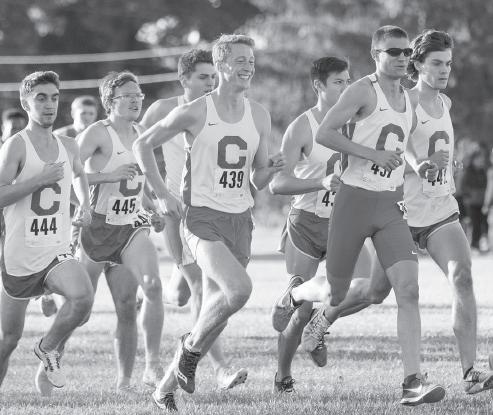
Preparation | The Red participated in the Pre-National Invitational and the Canisius Classic in the lead-up to the Heptagonal Championships.
With split-squad action in different states on Saturday, Cornell men’s and women’s cross country competed well in both meets, but they still displayed room for improvement moving forward. 14 athletes ran in the Pre-National Invitational hosted by Indiana State University in Terre Haute, Indiana, while 23 attended the Canisius Classic in Buffalo, New York.
At the notoriously competitive Pre-National Invitational, the men’s team finished 33rd out of 38 teams in the 8km with 852 points. Freshman Perry MacKinnon led the way, placing 115th overall with a time of 24:58.2.
“Overall [the team’s performance] was okay, but I think we can do a lot better. I feel like we have a lot more potential,” said MacKinnon.
The race also served as an important learning opportunity for the freshman-heavy team.
“I’m gaining a lot of experience running on the NCAA circuit … I’m getting used to the big races with a lot of people in them. There's a big learning curve for me and I’ve been improving as we go. You have to earn everything in these races — there’s nothing that’s easy,” MacKinnon said.
“This weekend I really focused on getting a better finish, which I did, so I was really happy with that,” he continued, reflecting on the adjustments he’s made.
The women’s team ran the 6km and finished 20th out of 37 teams with 567 points. Senior Taylor Knibb led the way, placing 75th overall with a time of 21:10.3.
“I think [the team’s performance] was good. We definitely have places we want to work on but the point of the meet was to gain experience and we did just that,” said Knibb. Knibb also commented on the ways in which the team could improve.
“Each individual has specific aspects of their race that they can
work on,” said Knibb. “I felt like everyone had about a kilometer or two within their race that didn’t go as they wanted to ... It’s just each individual running better and smarter, and that will add up to something bigger.”
At the Canisius Classic, the men’s team had three runners competing in the 8k, but without a complete five-person team, it did not receive a team score. Freshman Sean Henretta (25:51.8) finished first for Cornell with a ninth-place finish, followed by freshman Alec Hill (26:20.5) with a 23rd-place finish and sophomore Jamie Granata (26:42.8), who finished 37th. The women’s team ran the 5k and finished strong in first place out of 13 teams with an impressive 18 points, 67 less than the second-place team. Junior Annie Glodek placed first overall and led Cornell with a time of 18:24.5. Right behind her were freshman Tess Reyes (2nd, 18:25.9), junior Nadia Stratton (4th, 18:36.4), freshman Katy Storti (5th, 18:38.9) and sophomore Rachel Green (6th, 18:46.9).
“Every time we’ve gone to this [meet] in the past, our team has dominated and that was the goal. We sort of did that — so that was awesome,” said Glodek.
Glodek discussed critical upcoming events and the team’s goal for the remainder of the season.
“Two weeks from now is the Heptagonal Championship meet, so we run against all the other Ivy League [schools], and the goal is definitely to place as high as possible, that's kind of what we shoot for every year,” said Glodek. “I think we have a pretty good chance to do well this year … I think our training over the next couple weeks is going to set us up to be ready to compete our best at [the Heptagonal Championships].”
Next, both the men’s and women’s teams will host the John Reif Memorial Run this Friday, Oct. 25, at the Moakley Course.
Alyson Wong can be reached at aw797@cornell.edu.
By JUSTIN SUZZAN Sun Staff Writer
Cornell men’s and women’s polo continued their winning ways this past weekend as both teams earned important early-season victories.
On the men’s side, the Red notched a weekend sweep, defeating both Westport and Skidmore, 14-11, and 13-4, respectively. Meanwhile, the women’s team notched a 21-11 victory over Melinda’s Prospect from the Oxley Equestrian Center.
“We are very excited that we were able to pull that game out as a win.”
Coming off an impressive 11-2 victory against Bluestone Farm, women’s polo (2-1) added another dominant victory to their resume on Friday. Cornell dominated its opponent over the course of the entire game, coasting to a 10-point victory.
Shariah Harris
“This weekend,
I think we played extremely well,” said senior captain Shariah Harris. “We played a pretty tough and experienced team, so we are very excited that we were able to pull that game out as a win.”
With three consecutive wins, the men’s team (3-0) is off to its best start since 2016 when it began the year with seven straight victories.
The early success of both Cornell polo programs cannot be discussed without mentioning both groups’ new leader. Newly-appointed head coach Branden Van Loon ’13 has been leading his teams to success so far this season. Players from both the men’s and women’s teams recognize that the firstyear head coach has been integral to their success.
“Our new coach has contributed greatly to our teams’ success thus far,” Harris said. “Whether that is incorporating new drills during practice or reviewing more game film, he always comes up with new ways for us to better ourselves individually and also as a team.”
Both programs hope to carry this early momentum into Virginia later this week for the annual University of Virginia Invitational. The men’s team will battle Southern Methodist University on Oct. 24 in the first round. If they advance, they will then take on the winner of the UVA-Kentucky matchup

for the title on Oct. 26.
On the women’s side, Cornell will take on Texas A&M on Oct. 25. The team will look to avenge last year’s heartbreaking loss to Texas. If the women prevail, they will also face either UVA or Kentucky in the finals on Oct. 27.
The UVA Invitational will be a true test of where both programs are at this early stage in the season. UVA hosts some of the most talented teams in the country, and the Red will see its best competition of the year thus far.
“Our goal heading into the Virginia tournament is to
continue with the same intensity and aggression that we had for our game against Melinda’s Prospect this past weekend,” Harris said. “I believe if we keep up that intensity and our team cohesion, we have a very strong chance to win the tournament.”
With confidence emanating from the program, all eyes will be on Cornell when it competes in Virginia this week.
Justin Suzzan can be reached at jbs389@cornell.edu.

By FAITH FISHER Sun Staff Writer
Cornell field hockey suffered two losses versus top-25 competition this past weekend. Harvard and the University of Albany each clinched shutout wins over the Red, 2-0, and 5-0, respectively.
Four years have passed since the Red (7-5, 2-2 Ivy League) has reigned victorious over the Crimson (10-3, 4-0). As a
does. We played very hard against Harvard, and I think that the cause had a little bit of something to do with it.”
Despite the bright prospects of the day and evident heart displayed on the field, the inertia of history proved too strong to overcome.
“We played very hard against Harvard, and I think that the cause had a little bit of something to do with it.”
Andy Smith
revamped team embracing a new coaching philosophy and toting wins against top competitors this season, the team was ready to reverse the unfavorable course of history.
The game on Saturday had a dual-purpose — play quality field hockey and raise money for the Make-a-Wish foundation. The fundraiser was spearheaded by senior midfielder Maddy Conklin, who was diagnosed with Cystic Fibrosis and became a member of the Make-A-Wish family in 2010.
“She is the heart and energy of our team,” head coach Andy Smith said. “She is an inspirational person in everything she
MEN’S HOCKEY
Starting the game against the Crimson, the Red adhered to the season’s strategic trend — enter the field with energy to secure an early advantage. Although Cornell’s drive and vigor were apparent, its efforts were futile — the first half saw offensive domination by the Red, but five shots and four penalty corners failed to translate into goals.
“I feel like we came out and battled Harvard for the first 20 minutes of the game,” Smith said. “We had all the shots, we had all the possession.”
Unlike the Red, the Crimson was able to find the back of the net with more ease, notching the first goal of the day in the eighth minute of the quarter.
The Crimson — clearly energized by their first-quarter goal — brought a revamped offensive drive to the second stanza. The Red’s defense proved to be an adequate bulwark against their advances until the last two minutes of the quarter. Harvard’s Kiley Allen took advantage of a rebounded ball and netted it past senior goalkeeper Maddie Henry for the

Crimson’s second goal.
The 2-0 scoring gap established in the first half persisted for the rest of the game. The remaining frames saw staunch backand-forth defense from both sides, but the Red could not muster enough offensive opportunities to turn the scoreboard in its favor.
“I think for the full 60 minutes we went out there, never gave up, and believed we were in this game,” senior defender Kristen
Ferguson said. “We just didn’t execute under pressure and finish on the balls we had.”
The Red tried to learn from their mistakes as it faced off against Albany (10-6, 1-2 America East), but to no avail.
“I had hoped that our execution under pressure would be better against Albany, but unfortunately the same thing let us
By CHRISTINA BULKELEY Sun Assistant Sports Editor
Sunday afternoon’s game against Nipissing offered a first look at the No. 5 201920 Cornell men’s hockey squad in action. The final 6-2 tally marked the team’s 15th exhibition victory across 17 games in the last decade.
With each of those six goals
scored by a different player — and four of them coming on the power-play — the Red showed strength throughout the lineup against its opponent, who had a 4-0 record coming into the contest.
But some shaky plays and missed opportunities also demonstrated room for improvement. Here are some takeaways from the tilt.
Lineup and Injury Report
It’s an exhibition game day at Lynah Rink. Here’s how Cornell lines up against Nipissing:
Six players were listed as scratches going into Sunday’s game. Among forwards, freshman Matt Stienburg, junior Cam Donaldson and senior Jeff Malott didn’t suit up. Also scratched were defensem-

en senior Yanni Kaldis, junior Cody Haiskanen and sophomore Joe Leahy.
“Some of them, it’s just nagging stuff,” Schafer said. “So we just didn’t need to play them early in the season. I don’t think anybody’s [out] long-term right now.”
Haiskanen and Malott both had season-ending injuries last season, with Haiskanen suffering an arm laceration in a 5-0 win over Clarkson in February and Malott tearing his ACL against the Golden Knights in the ECAC Championship game. Malott is still waiting to be cleared for game action, Schafer said.
“We have a really strong group [of freshmen]. We’re looking for them to contribute a lot.”
Malott has been skating and wore a yellow no-contact sweater in Friday’s Red-White game. Kaldis, Donaldson, Stienburg and Leahy didn’t play in RedWhite; Haiskanen did suit up.
Eight of Cornell’s nine freshmen saw ice time in the match; forward Matt Stienburg was a pregame scratch.
“They’re great,” sophomore forward Michael Regush said of the newcomers. “We have a really strong group. We’re looking for them to contribute a lot.”
Forward Jack Malone — who, along with his classmate Stienburg, was selected in the 2019 NHL Draft — had an assist and a power-play goal.
“Even though it’s an exhibition game, it’s special when you’re wearing the jersey to put your first goal in,” Malone said.
Michael Regush
“It’s something I’ll remember.” Injuries throughout the lineup last year, some of which seem to still be nagging some players, gave the freshmen playing time, limiting the damage that could be done to the veterans.
“Things got chippy out there; it’s another reason to keep guys on the bench,” Schafer said.
Power-Play Pros and Cons
The power-play went 4-for12 on the day, but that 33 percent conversion rate didn’t tell the full story. Even with those four goals, the team wasn’t totally dominant on the man advantage — Nipissing even scored two shorthanded goals.
“We’re just really trying to find chemistry,” Schafer said.